
#cryptoinfrastructure
cryptoinfrastructure
258,400 views
4,112 Discussing
Hot
Latest

·
--

Article
MicroStrategy Aims to Be the JPMorgan of Bitcoin: What That Means for YouHave you ever wondered what it would take to make Bitcoin as mainstream and reliable as a major bank? MicroStrategy’s CEO, Phong Le, just laid out a bold vision: turn the company into the “JPMorgan of Bitcoin,” creating markets and liquidity for an 8‑billion‑person economy. Let’s break that down.
The Concept: Institutionalizing Bitcoin Markets
MicroStrategy isn’t just buying and holding Bitcoin; it’s building the infrastructure that lets people trade, lend, and use Bitcoin like any other asset. Think of it as a giant digital bank that offers everything from spot trading to derivatives, all backed by a massive Bitcoin vault. By providing deep liquidity and robust market-making, the company hopes to reduce price swings and give traders the confidence to move large sums without slippage. #CryptoInfrastructure #DigitalBanking
Real‑World Example: How It Plays Out
Imagine a global corporation wants to hedge its exposure to Bitcoin. Instead of sending millions of dollars to a few exchanges, it can tap into MicroStrategy’s liquidity pool. The company’s market‑making engine instantly matches buy and sell orders, ensuring tight spreads and minimal impact on the market price. Meanwhile, investors can access a suite of products—spot, futures, and even tokenized bonds—making Bitcoin a versatile tool in their portfolios. This mirrors how JPMorgan offers a full suite of financial services under one roof, but in the crypto space.
Takeaway: Why You Should Care
If MicroStrategy succeeds, Bitcoin could become as accessible as a bank account. This means lower transaction costs, faster settlements, and a more stable price environment—benefits for traders, institutional investors, and everyday users alike. Keep an eye on MicroStrategy’s moves; they could signal the next step toward mainstream crypto adoption. #BitcoinFuture
What do you think? Will MicroStrategy’s “JPMorgan of Bitcoin” strategy change how we view digital assets?
MicroStrategy Aims to Be the JPMorgan of Bitcoin: What That Means for You
Have you ever wondered what it would take to make Bitcoin as mainstream and reliable as a major bank? MicroStrategy’s CEO, Phong Le, just laid out a bold vision: turn the company into the “JPMorgan of Bitcoin,” creating markets and liquidity for an 8‑billion‑person economy. Let’s break that down.
The Concept: Institutionalizing Bitcoin Markets
MicroStrategy isn’t just buying and holding Bitcoin; it’s building the infrastructure that lets people trade, lend, and use Bitcoin like any other asset. Think of it as a giant digital bank that offers everything from spot trading to derivatives, all backed by a massive Bitcoin vault. By providing deep liquidity and robust market-making, the company hopes to reduce price swings and give traders the confidence to move large sums without slippage. #CryptoInfrastructure #DigitalBanking
Real‑World Example: How It Plays Out
Imagine a global corporation wants to hedge its exposure to Bitcoin. Instead of sending millions of dollars to a few exchanges, it can tap into MicroStrategy’s liquidity pool. The company’s market‑making engine instantly matches buy and sell orders, ensuring tight spreads and minimal impact on the market price. Meanwhile, investors can access a suite of products—spot, futures, and even tokenized bonds—making Bitcoin a versatile tool in their portfolios. This mirrors how JPMorgan offers a full suite of financial services under one roof, but in the crypto space.
Takeaway: Why You Should Care
If MicroStrategy succeeds, Bitcoin could become as accessible as a bank account. This means lower transaction costs, faster settlements, and a more stable price environment—benefits for traders, institutional investors, and everyday users alike. Keep an eye on MicroStrategy’s moves; they could signal the next step toward mainstream crypto adoption. #BitcoinFuture
What do you think? Will MicroStrategy’s “JPMorgan of Bitcoin” strategy change how we view digital assets?
The Concept: Institutionalizing Bitcoin Markets
MicroStrategy isn’t just buying and holding Bitcoin; it’s building the infrastructure that lets people trade, lend, and use Bitcoin like any other asset. Think of it as a giant digital bank that offers everything from spot trading to derivatives, all backed by a massive Bitcoin vault. By providing deep liquidity and robust market-making, the company hopes to reduce price swings and give traders the confidence to move large sums without slippage. #CryptoInfrastructure #DigitalBanking
Real‑World Example: How It Plays Out
Imagine a global corporation wants to hedge its exposure to Bitcoin. Instead of sending millions of dollars to a few exchanges, it can tap into MicroStrategy’s liquidity pool. The company’s market‑making engine instantly matches buy and sell orders, ensuring tight spreads and minimal impact on the market price. Meanwhile, investors can access a suite of products—spot, futures, and even tokenized bonds—making Bitcoin a versatile tool in their portfolios. This mirrors how JPMorgan offers a full suite of financial services under one roof, but in the crypto space.
Takeaway: Why You Should Care
If MicroStrategy succeeds, Bitcoin could become as accessible as a bank account. This means lower transaction costs, faster settlements, and a more stable price environment—benefits for traders, institutional investors, and everyday users alike. Keep an eye on MicroStrategy’s moves; they could signal the next step toward mainstream crypto adoption. #BitcoinFuture
What do you think? Will MicroStrategy’s “JPMorgan of Bitcoin” strategy change how we view digital assets?
14

·
--
NOWNodes vs ChainstackNOWNodes and Chainstack both remove much of the operational work involved in running blockchain nodes, but their infrastructure models are not identical.
NOWNodes currently presents a direct shared-plan ladder based primarily on monthly request allowances. Its public documentation also covers archive nodes, WebSockets, trace and debug interfaces, Blockbook, gRPC and custom dedicated deployments. This can suit a team that wants broad multi-chain access and straightforward request-based budgeting.
Chainstack currently offers a wider set of infrastructure shapes inside one platform: geo-balanced Global Nodes, Archive Data, Unlimited Node capacity, Dedicated Nodes and Self-Hosted orchestration. That range can suit a team expecting its deployment model to change as traffic, retention and control requirements grow.
The headline quotas are not directly comparable. Chainstack meters shared usage through request units, while NOWNodes publishes monthly request allowances. Archive, trace, debug, WebSocket and dedicated products require their own verification.
Use one controlled benchmark for both providers:
• Same client region
• Same methods and block ranges
• Same concurrency and sample size
• Same timeout and retry settings
• Separate recent-state and archive tests
• p50, p95, p99 and failure-rate recording
Do not claim a provider is faster without running both endpoints under the same conditions. Choose by total ownership cost, method coverage, recovery behavior and migration risk.
Full TokenToolHub comparison:
https://tokentoolhub.com/nownodes-vs-chainstack/
#blockchain #Web3 #RPC #CryptoInfrastructure #Developers
NOWNodes vs Chainstack
NOWNodes and Chainstack both remove much of the operational work involved in running blockchain nodes, but their infrastructure models are not identical.
NOWNodes currently presents a direct shared-plan ladder based primarily on monthly request allowances. Its public documentation also covers archive nodes, WebSockets, trace and debug interfaces, Blockbook, gRPC and custom dedicated deployments. This can suit a team that wants broad multi-chain access and straightforward request-based budgeting.
Chainstack currently offers a wider set of infrastructure shapes inside one platform: geo-balanced Global Nodes, Archive Data, Unlimited Node capacity, Dedicated Nodes and Self-Hosted orchestration. That range can suit a team expecting its deployment model to change as traffic, retention and control requirements grow.
The headline quotas are not directly comparable. Chainstack meters shared usage through request units, while NOWNodes publishes monthly request allowances. Archive, trace, debug, WebSocket and dedicated products require their own verification.
Use one controlled benchmark for both providers:
• Same client region
• Same methods and block ranges
• Same concurrency and sample size
• Same timeout and retry settings
• Separate recent-state and archive tests
• p50, p95, p99 and failure-rate recording
Do not claim a provider is faster without running both endpoints under the same conditions. Choose by total ownership cost, method coverage, recovery behavior and migration risk.
Full TokenToolHub comparison:
https://tokentoolhub.com/nownodes-vs-chainstack/
#blockchain #Web3 #RPC #CryptoInfrastructure #Developers
NOWNodes currently presents a direct shared-plan ladder based primarily on monthly request allowances. Its public documentation also covers archive nodes, WebSockets, trace and debug interfaces, Blockbook, gRPC and custom dedicated deployments. This can suit a team that wants broad multi-chain access and straightforward request-based budgeting.
Chainstack currently offers a wider set of infrastructure shapes inside one platform: geo-balanced Global Nodes, Archive Data, Unlimited Node capacity, Dedicated Nodes and Self-Hosted orchestration. That range can suit a team expecting its deployment model to change as traffic, retention and control requirements grow.
The headline quotas are not directly comparable. Chainstack meters shared usage through request units, while NOWNodes publishes monthly request allowances. Archive, trace, debug, WebSocket and dedicated products require their own verification.
Use one controlled benchmark for both providers:
• Same client region
• Same methods and block ranges
• Same concurrency and sample size
• Same timeout and retry settings
• Separate recent-state and archive tests
• p50, p95, p99 and failure-rate recording
Do not claim a provider is faster without running both endpoints under the same conditions. Choose by total ownership cost, method coverage, recovery behavior and migration risk.
Full TokenToolHub comparison:
https://tokentoolhub.com/nownodes-vs-chainstack/
#blockchain #Web3 #RPC #CryptoInfrastructure #Developers
3

·
--
MASTERCARD AND ALCHEMY UNLOCK AUTOMATED INSTITUTIONAL AI PAYMENTS VIA $ACH ⚡
Institutional payment rails are shifting toward agentic execution as Mastercard and Alchemy deploy AgentCard, enabling AI models to settle transactions using tokenized credentials and $USDT rails. 📊 This structural migration moves traditional checkout interfaces directly into autonomous background protocols.
With global networks establishing unified Know-Your-Agent protocols, smart money infrastructure is cementing the bridge between legacy card rails and on-chain liquidity. 🔍 The speed of deployment—enabling agent wallets in under sixty seconds—signals a major acceleration in machine-to-machine commerce settlement.
💬 Will autonomous AI spending become the primary driver for stablecoin liquidity velocity by next year? 👇
⚠️ Not financial advice. Always manage your risk. 🛡️
🏷️ #ACH #USDT #AIPayments #CryptoInfrastructure
⚡ 🎯
MASTERCARD AND ALCHEMY UNLOCK AUTOMATED INSTITUTIONAL AI PAYMENTS VIA $ACH ⚡
Institutional payment rails are shifting toward agentic execution as Mastercard and Alchemy deploy AgentCard, enabling AI models to settle transactions using tokenized credentials and $USDT rails. 📊 This structural migration moves traditional checkout interfaces directly into autonomous background protocols.
With global networks establishing unified Know-Your-Agent protocols, smart money infrastructure is cementing the bridge between legacy card rails and on-chain liquidity. 🔍 The speed of deployment—enabling agent wallets in under sixty seconds—signals a major acceleration in machine-to-machine commerce settlement.
💬 Will autonomous AI spending become the primary driver for stablecoin liquidity velocity by next year? 👇
⚠️ Not financial advice. Always manage your risk. 🛡️
🏷️ #ACH #USDT #AIPayments #CryptoInfrastructure
⚡ 🎯
Institutional payment rails are shifting toward agentic execution as Mastercard and Alchemy deploy AgentCard, enabling AI models to settle transactions using tokenized credentials and $USDT rails. 📊 This structural migration moves traditional checkout interfaces directly into autonomous background protocols.
With global networks establishing unified Know-Your-Agent protocols, smart money infrastructure is cementing the bridge between legacy card rails and on-chain liquidity. 🔍 The speed of deployment—enabling agent wallets in under sixty seconds—signals a major acceleration in machine-to-machine commerce settlement.
💬 Will autonomous AI spending become the primary driver for stablecoin liquidity velocity by next year? 👇
⚠️ Not financial advice. Always manage your risk. 🛡️
🏷️ #ACH #USDT #AIPayments #CryptoInfrastructure
⚡ 🎯
179

·
--
Cross-Chain Account Abstraction Is the Real UX Unlock
The cross-chain conversation keeps fixating on bridges and token transfers. That’s layer one of the problem. The actual unlock is account abstraction spreading across chains.
When a wallet can hold balances on $ETH, $SOL, and $BNB simultaneously — with a single signature, unified fee payment, and chain-agnostic smart contract accounts — the user no longer needs to care which chain they’re on. That’s when cross-chain growth stops being infrastructure and starts being invisible.
We’re seeing early versions of this now. ERC-4337 account abstraction on Ethereum. Native account abstraction on Solana. BNB Chain’s paymaster integrations. Each chain is solving the same problem differently, but the convergence point is identical: users shouldn’t need to think about gas tokens, bridge routes, or nonce management.
The chains that win the next wave of cross-chain growth won’t be the ones with the fastest bridges. They’ll be the ones where the user doesn’t even realize they crossed a chain.
Interoperability measured in user experience — not transaction throughput — is the metric that determines which ecosystems capture the next 100 million wallets.
#CrossChain #AccountAbstraction #Web3UX #CryptoInfrastructure
Cross-Chain Account Abstraction Is the Real UX Unlock
The cross-chain conversation keeps fixating on bridges and token transfers. That’s layer one of the problem. The actual unlock is account abstraction spreading across chains.
When a wallet can hold balances on $ETH , $SOL , and $BNB simultaneously — with a single signature, unified fee payment, and chain-agnostic smart contract accounts — the user no longer needs to care which chain they’re on. That’s when cross-chain growth stops being infrastructure and starts being invisible.
We’re seeing early versions of this now. ERC-4337 account abstraction on Ethereum. Native account abstraction on Solana. BNB Chain’s paymaster integrations. Each chain is solving the same problem differently, but the convergence point is identical: users shouldn’t need to think about gas tokens, bridge routes, or nonce management.
The chains that win the next wave of cross-chain growth won’t be the ones with the fastest bridges. They’ll be the ones where the user doesn’t even realize they crossed a chain.
Interoperability measured in user experience — not transaction throughput — is the metric that determines which ecosystems capture the next 100 million wallets.
#CrossChain #AccountAbstraction #Web3UX #CryptoInfrastructure
The cross-chain conversation keeps fixating on bridges and token transfers. That’s layer one of the problem. The actual unlock is account abstraction spreading across chains.
When a wallet can hold balances on $ETH , $SOL , and $BNB simultaneously — with a single signature, unified fee payment, and chain-agnostic smart contract accounts — the user no longer needs to care which chain they’re on. That’s when cross-chain growth stops being infrastructure and starts being invisible.
We’re seeing early versions of this now. ERC-4337 account abstraction on Ethereum. Native account abstraction on Solana. BNB Chain’s paymaster integrations. Each chain is solving the same problem differently, but the convergence point is identical: users shouldn’t need to think about gas tokens, bridge routes, or nonce management.
The chains that win the next wave of cross-chain growth won’t be the ones with the fastest bridges. They’ll be the ones where the user doesn’t even realize they crossed a chain.
Interoperability measured in user experience — not transaction throughput — is the metric that determines which ecosystems capture the next 100 million wallets.
#CrossChain #AccountAbstraction #Web3UX #CryptoInfrastructure
53

🐋 INFRASTRUCTURE WHALE WATCH: Liquidity Heatmap & Level Breakdowns
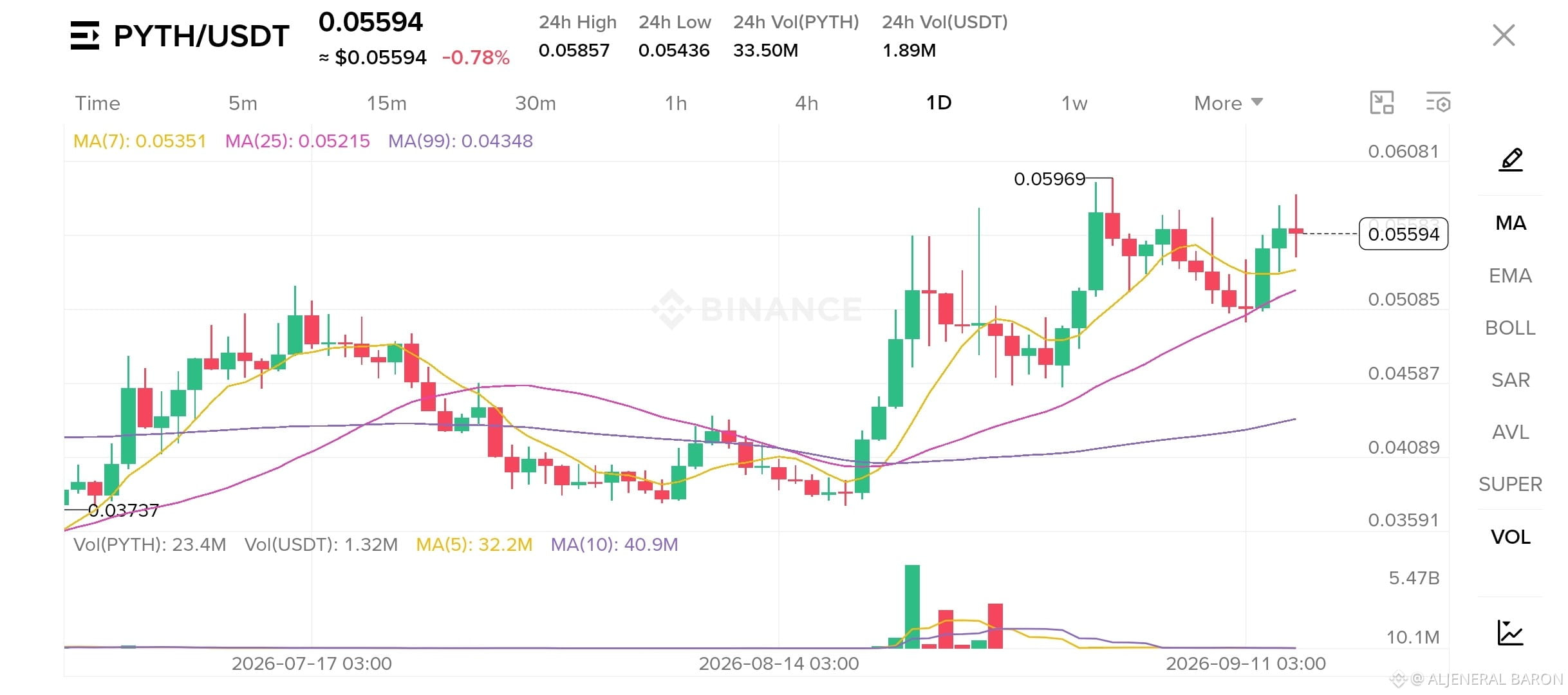
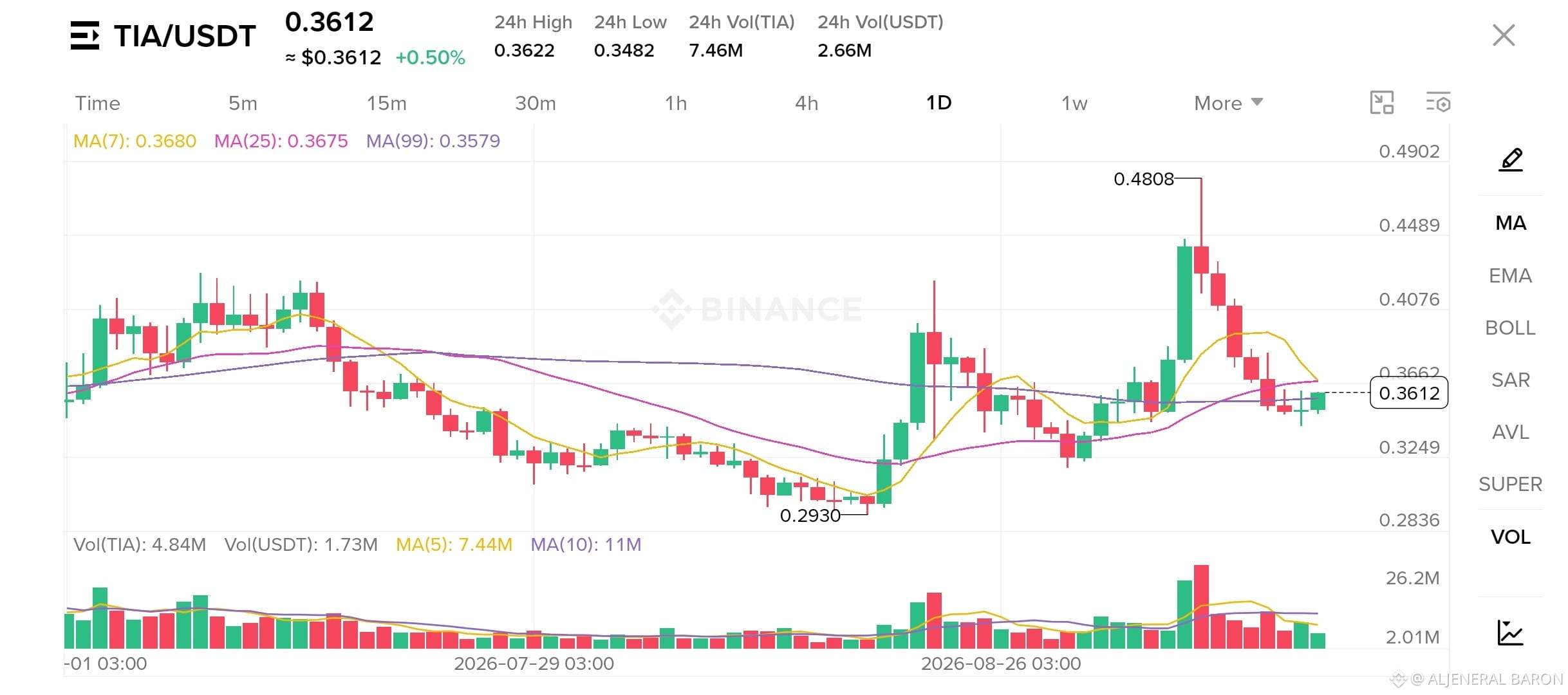
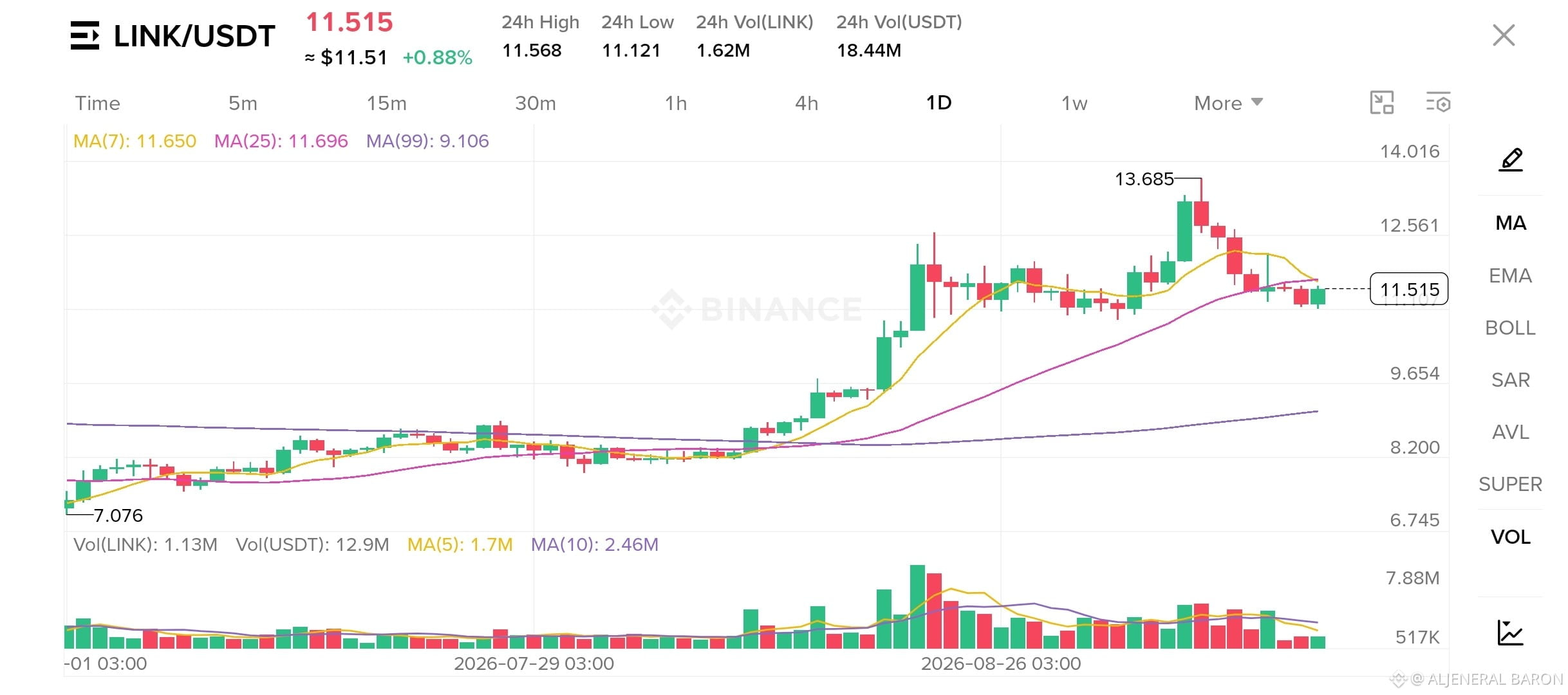
Infrastructure and Oracle heavyweights ($LINK , $TIA , $PYTH ) are compressing at critical trendline supports. Let's trace where the smart money liquidity is resting across the daily timeframe:
📡 1. LINK - Retesting Macro Support Zone
• Current Price: $11.515
• Resistance: $12.56 - $13.685 | Major Support: $11.12 - $11.50
• Liquidity Analysis: LINK pulled back sharply from its $13.685 peak and is currently consolidating around the MA(7) and MA(25) cluster ($11.65–$11.69). Decreasing sell volume indicates smart money accumulation around $11.12. Holding this zone keeps the bullish structure intact.
⚡ 2. TIA - Coiling at the MA(99) Floor
• Current Price: $0.3612
• Resistance: $0.4076 - $0.4808 | Primary Support: $0.3482 - $0.3579
• Liquidity Analysis: TIA is hovering right on top of its MA(99) line ($0.3579) after a rejection at $0.4808. A high-volume push above $0.3680 (MA7) could quickly trigger a squeeze toward $0.40, while losing $0.3482 opens liquidity down to $0.2930.
🔮 3. PYTH - Bullish Trendline Holding
• Current Price: $0.05594
• Resistance: $0.05969 | Key Support: $0.05215 (MA25)
• Liquidity Analysis: PYTH continues to print clean higher lows above its moving averages ($0.0535 MA7 / $0.0521 MA25). The chart shows steady absorption from buyers. Reclaiming $0.05969 could unleash a breakout leg toward new local highs.
🎯 Which infrastructure token shows the cleanest setup for the next liquidity grab?
👇 Drop your pick below!
#Chainlink #TIA #PYTH #CryptoInfrastructure #BinanceSquare
🐋 INFRASTRUCTURE WHALE WATCH: Liquidity Heatmap & Level Breakdowns
Infrastructure and Oracle heavyweights ($LINK , $TIA , $PYTH ) are compressing at critical trendline supports. Let's trace where the smart money liquidity is resting across the daily timeframe:
📡 1. LINK - Retesting Macro Support Zone
• Current Price: $11.515
• Resistance: $12.56 - $13.685 | Major Support: $11.12 - $11.50
• Liquidity Analysis: LINK pulled back sharply from its $13.685 peak and is currently consolidating around the MA(7) and MA(25) cluster ($11.65–$11.69). Decreasing sell volume indicates smart money accumulation around $11.12. Holding this zone keeps the bullish structure intact.
⚡ 2. TIA - Coiling at the MA(99) Floor
• Current Price: $0.3612
• Resistance: $0.4076 - $0.4808 | Primary Support: $0.3482 - $0.3579
• Liquidity Analysis: TIA is hovering right on top of its MA(99) line ($0.3579) after a rejection at $0.4808. A high-volume push above $0.3680 (MA7) could quickly trigger a squeeze toward $0.40, while losing $0.3482 opens liquidity down to $0.2930.
🔮 3. PYTH - Bullish Trendline Holding
• Current Price: $0.05594
• Resistance: $0.05969 | Key Support: $0.05215 (MA25)
• Liquidity Analysis: PYTH continues to print clean higher lows above its moving averages ($0.0535 MA7 / $0.0521 MA25). The chart shows steady absorption from buyers. Reclaiming $0.05969 could unleash a breakout leg toward new local highs.
🎯 Which infrastructure token shows the cleanest setup for the next liquidity grab?
👇 Drop your pick below!
#Chainlink #TIA #PYTH #CryptoInfrastructure #BinanceSquare
Infrastructure and Oracle heavyweights ($LINK , $TIA , $PYTH ) are compressing at critical trendline supports. Let's trace where the smart money liquidity is resting across the daily timeframe:
📡 1. LINK - Retesting Macro Support Zone
• Current Price: $11.515
• Resistance: $12.56 - $13.685 | Major Support: $11.12 - $11.50
• Liquidity Analysis: LINK pulled back sharply from its $13.685 peak and is currently consolidating around the MA(7) and MA(25) cluster ($11.65–$11.69). Decreasing sell volume indicates smart money accumulation around $11.12. Holding this zone keeps the bullish structure intact.
⚡ 2. TIA - Coiling at the MA(99) Floor
• Current Price: $0.3612
• Resistance: $0.4076 - $0.4808 | Primary Support: $0.3482 - $0.3579
• Liquidity Analysis: TIA is hovering right on top of its MA(99) line ($0.3579) after a rejection at $0.4808. A high-volume push above $0.3680 (MA7) could quickly trigger a squeeze toward $0.40, while losing $0.3482 opens liquidity down to $0.2930.
🔮 3. PYTH - Bullish Trendline Holding
• Current Price: $0.05594
• Resistance: $0.05969 | Key Support: $0.05215 (MA25)
• Liquidity Analysis: PYTH continues to print clean higher lows above its moving averages ($0.0535 MA7 / $0.0521 MA25). The chart shows steady absorption from buyers. Reclaiming $0.05969 could unleash a breakout leg toward new local highs.
🎯 Which infrastructure token shows the cleanest setup for the next liquidity grab?
👇 Drop your pick below!
#Chainlink #TIA #PYTH #CryptoInfrastructure #BinanceSquare
1
2
344

·
--
Kaiko pulled off a major move—traditional finance giants (S&P, BNP Paribas) just threw $110M its way! When data companies get serious backing from traditional players, you know crypto is about to hit a new level.
Hey folks, take note: this isn’t just small-time hype. Traditional money is starting to recognize crypto data infrastructure, which shows the industry’s maturity is increasing. Mainstream coins like Bitcoin and Ethereum may see a fresh round of capital inflows.
Remember: traditional finance entering the space usually means crypto is being officially adopted. Long term, this is bullish!
Kaiko pulling off a major move with traditional finance giants (S&P, BNP Paribas) throwing $110M their way! When data companies get serious backing from traditional players, you know crypto's about to hit a new level.
Peeps take note: traditional money recognizing crypto infrastructure signals industry maturation. Bitcoin, Ethereum are likely to see fresh institutional flows.
Remember: traditional finance entry usually means crypto is getting officially adopted. Long term, this is bullish!
#CryptoInfrastructure $BTC $ETH
Kaiko pulled off a major move—traditional finance giants (S&P, BNP Paribas) just threw $110M its way! When data companies get serious backing from traditional players, you know crypto is about to hit a new level.
Hey folks, take note: this isn’t just small-time hype. Traditional money is starting to recognize crypto data infrastructure, which shows the industry’s maturity is increasing. Mainstream coins like Bitcoin and Ethereum may see a fresh round of capital inflows.
Remember: traditional finance entering the space usually means crypto is being officially adopted. Long term, this is bullish!
Kaiko pulling off a major move with traditional finance giants (S&P, BNP Paribas) throwing $110M their way! When data companies get serious backing from traditional players, you know crypto's about to hit a new level.
Peeps take note: traditional money recognizing crypto infrastructure signals industry maturation. Bitcoin, Ethereum are likely to see fresh institutional flows.
Remember: traditional finance entry usually means crypto is getting officially adopted. Long term, this is bullish!
#CryptoInfrastructure $BTC $ETH
Hey folks, take note: this isn’t just small-time hype. Traditional money is starting to recognize crypto data infrastructure, which shows the industry’s maturity is increasing. Mainstream coins like Bitcoin and Ethereum may see a fresh round of capital inflows.
Remember: traditional finance entering the space usually means crypto is being officially adopted. Long term, this is bullish!
Kaiko pulling off a major move with traditional finance giants (S&P, BNP Paribas) throwing $110M their way! When data companies get serious backing from traditional players, you know crypto's about to hit a new level.
Peeps take note: traditional money recognizing crypto infrastructure signals industry maturation. Bitcoin, Ethereum are likely to see fresh institutional flows.
Remember: traditional finance entry usually means crypto is getting officially adopted. Long term, this is bullish!
#CryptoInfrastructure $BTC $ETH
140

·
--
Binance isn’t just an exchange.
It’s the infrastructure crypto runs on.
Deep liquidity and price discovery.
Regulated custody and compliance.
Fiat and stablecoin rails.
Payments that actually settle.
Now: Agent OS so AI apps can tap trading, data, wallets, and on-chain tools through a single layer.
Network status today: core services operating. Always check deposit/withdrawal routes for your asset before you move funds.
Infrastructure isn’t the headline. It’s what keeps the market open 24/7.
#Binance #CryptoInfrastructure
Binance isn’t just an exchange.
It’s the infrastructure crypto runs on.
Deep liquidity and price discovery.
Regulated custody and compliance.
Fiat and stablecoin rails.
Payments that actually settle.
Now: Agent OS so AI apps can tap trading, data, wallets, and on-chain tools through a single layer.
Network status today: core services operating. Always check deposit/withdrawal routes for your asset before you move funds.
Infrastructure isn’t the headline. It’s what keeps the market open 24/7.
#Binance #CryptoInfrastructure
It’s the infrastructure crypto runs on.
Deep liquidity and price discovery.
Regulated custody and compliance.
Fiat and stablecoin rails.
Payments that actually settle.
Now: Agent OS so AI apps can tap trading, data, wallets, and on-chain tools through a single layer.
Network status today: core services operating. Always check deposit/withdrawal routes for your asset before you move funds.
Infrastructure isn’t the headline. It’s what keeps the market open 24/7.
#Binance #CryptoInfrastructure
33

·
--
Picture this: you are trying to execute a critical treasury transfer or verify a complex transaction, only to watch capital get eaten away by bloated verification costs and laggy multisig coordination.
Most investors and DAOs do not realize how much money they quietly lose to cryptographic friction and failed batch executions until network congestion spikes. Getting trapped in stuck multisig approvals while the market moves against your position is a fast track to painful losses.
We saw this exact bottleneck cripple early decentralized applications on $ETH during previous market runs, forcing builders to choose between heavy security and practical usability. While ecosystems like $MATIC pushed rollups and sidechains to ease the pressure, raw cryptographic efficiency remained a messy puzzle. Bringing native, optimized support for ZK proofs, advanced multisigs, and automated batching shifts the entire paradigm by compressing verification overhead by over 40% and making complex multi-signature logic seamless at the protocol level.
When cryptographic operations become native primitives rather than expensive workarounds, it fundamentally changes how institutional liquidity interacts with on-chain protocols. Layer 2 networks powered by $ZK technology can finally settle hundreds of proofs in bundled transactions without bottlenecking validators or draining participant margins. It is the exact kind of quiet infrastructure upgrade that sets the foundation for the next wave of capital deployment.
Where do you think cryptographic optimization makes the biggest difference for everyday traders?
#ZeroKnowledge #CryptoInfrastructure #Web3Security
Picture this: you are trying to execute a critical treasury transfer or verify a complex transaction, only to watch capital get eaten away by bloated verification costs and laggy multisig coordination.
Most investors and DAOs do not realize how much money they quietly lose to cryptographic friction and failed batch executions until network congestion spikes. Getting trapped in stuck multisig approvals while the market moves against your position is a fast track to painful losses.
We saw this exact bottleneck cripple early decentralized applications on $ETH during previous market runs, forcing builders to choose between heavy security and practical usability. While ecosystems like $MATIC pushed rollups and sidechains to ease the pressure, raw cryptographic efficiency remained a messy puzzle. Bringing native, optimized support for ZK proofs, advanced multisigs, and automated batching shifts the entire paradigm by compressing verification overhead by over 40% and making complex multi-signature logic seamless at the protocol level.
When cryptographic operations become native primitives rather than expensive workarounds, it fundamentally changes how institutional liquidity interacts with on-chain protocols. Layer 2 networks powered by $ZK technology can finally settle hundreds of proofs in bundled transactions without bottlenecking validators or draining participant margins. It is the exact kind of quiet infrastructure upgrade that sets the foundation for the next wave of capital deployment.
Where do you think cryptographic optimization makes the biggest difference for everyday traders?
#ZeroKnowledge #CryptoInfrastructure #Web3Security
Most investors and DAOs do not realize how much money they quietly lose to cryptographic friction and failed batch executions until network congestion spikes. Getting trapped in stuck multisig approvals while the market moves against your position is a fast track to painful losses.
We saw this exact bottleneck cripple early decentralized applications on $ETH during previous market runs, forcing builders to choose between heavy security and practical usability. While ecosystems like $MATIC pushed rollups and sidechains to ease the pressure, raw cryptographic efficiency remained a messy puzzle. Bringing native, optimized support for ZK proofs, advanced multisigs, and automated batching shifts the entire paradigm by compressing verification overhead by over 40% and making complex multi-signature logic seamless at the protocol level.
When cryptographic operations become native primitives rather than expensive workarounds, it fundamentally changes how institutional liquidity interacts with on-chain protocols. Layer 2 networks powered by $ZK technology can finally settle hundreds of proofs in bundled transactions without bottlenecking validators or draining participant margins. It is the exact kind of quiet infrastructure upgrade that sets the foundation for the next wave of capital deployment.
Where do you think cryptographic optimization makes the biggest difference for everyday traders?
#ZeroKnowledge #CryptoInfrastructure #Web3Security

2
103

Everyone thinks high-speed Layer 1 networks have already solved onchain efficiency, but actually, developers and traders are still hitting hidden structural walls every day. Most active traders on $SOL have felt the sting of failed swaps or slipped entries during high volatility, simply because complex route instructions get chopped into separate pieces that fail midway.
Think of current onchain transactions like mailing letters in standard tiny envelopes. Right now, network capacity limits transactions to just 1,232 bytes, which forces complex decentralized applications to split batch settlements, zero-knowledge proofs, and multisig actions across multiple steps. When one piece fails, your entire trade or capital route can collapse.
The upcoming infrastructure upgrade expands that envelope capacity to 4,096 bytes, delivering roughly 3.3 times more space in a single payload. That extra room means confidential transfers, advanced cryptographic operations, and complex cross-chain liquidity routing with assets like $ETH or $BTC can finally execute atomically without breaking apart under heavy volume.
How do you see this capacity bump shifting DEX trading efficiency and developer activity over the coming months?
#Solana #CryptoInfrastructure #DeFi
Everyone thinks high-speed Layer 1 networks have already solved onchain efficiency, but actually, developers and traders are still hitting hidden structural walls every day. Most active traders on $SOL have felt the sting of failed swaps or slipped entries during high volatility, simply because complex route instructions get chopped into separate pieces that fail midway.
Think of current onchain transactions like mailing letters in standard tiny envelopes. Right now, network capacity limits transactions to just 1,232 bytes, which forces complex decentralized applications to split batch settlements, zero-knowledge proofs, and multisig actions across multiple steps. When one piece fails, your entire trade or capital route can collapse.
The upcoming infrastructure upgrade expands that envelope capacity to 4,096 bytes, delivering roughly 3.3 times more space in a single payload. That extra room means confidential transfers, advanced cryptographic operations, and complex cross-chain liquidity routing with assets like $ETH or $BTC can finally execute atomically without breaking apart under heavy volume.
How do you see this capacity bump shifting DEX trading efficiency and developer activity over the coming months?
#Solana #CryptoInfrastructure #DeFi
Think of current onchain transactions like mailing letters in standard tiny envelopes. Right now, network capacity limits transactions to just 1,232 bytes, which forces complex decentralized applications to split batch settlements, zero-knowledge proofs, and multisig actions across multiple steps. When one piece fails, your entire trade or capital route can collapse.
The upcoming infrastructure upgrade expands that envelope capacity to 4,096 bytes, delivering roughly 3.3 times more space in a single payload. That extra room means confidential transfers, advanced cryptographic operations, and complex cross-chain liquidity routing with assets like $ETH or $BTC can finally execute atomically without breaking apart under heavy volume.
How do you see this capacity bump shifting DEX trading efficiency and developer activity over the coming months?
#Solana #CryptoInfrastructure #DeFi
23

·
--
Picture this: you are trying to execute a complex multi-hop trade during peak network volatility, only for the transaction to fail repeatedly because the data packet was too heavy to process.
Every active trader knows the pain of watching slippage eat away profits or losing an entry entirely when complex routing breaks down. When networks force developers to split one logical action across multiple transactions, users are the ones left paying for dropped trades and failed execution.
$SOL is preparing to fix this structural hurdle by expanding its transaction packet size from 1,232 bytes to 4,096 bytes. That is roughly 3.3 times more data capacity per transaction. In past cycles, we saw how expanding execution parameters on networks like $ETH enabled sophisticated DeFi aggregators and batching mechanisms to thrive. Solana is now making a similar leap to support modern onchain demands.
This extra space allows builders to bundle zero-knowledge proofs, complex multisig approvals, and dense trading routes into a single atomic transaction. Instead of chaining fragile steps together and hoping none fail mid-route, everything executes together or reverts cleanly.
Do you think larger transaction sizes will finally solve execution bottlenecks for high-frequency onchain trading, or does it introduce new bandwidth challenges for validators?
#Solana #DeFi #CryptoInfrastructure
Picture this: you are trying to execute a complex multi-hop trade during peak network volatility, only for the transaction to fail repeatedly because the data packet was too heavy to process.
Every active trader knows the pain of watching slippage eat away profits or losing an entry entirely when complex routing breaks down. When networks force developers to split one logical action across multiple transactions, users are the ones left paying for dropped trades and failed execution.
$SOL is preparing to fix this structural hurdle by expanding its transaction packet size from 1,232 bytes to 4,096 bytes. That is roughly 3.3 times more data capacity per transaction. In past cycles, we saw how expanding execution parameters on networks like $ETH enabled sophisticated DeFi aggregators and batching mechanisms to thrive. Solana is now making a similar leap to support modern onchain demands.
This extra space allows builders to bundle zero-knowledge proofs, complex multisig approvals, and dense trading routes into a single atomic transaction. Instead of chaining fragile steps together and hoping none fail mid-route, everything executes together or reverts cleanly.
Do you think larger transaction sizes will finally solve execution bottlenecks for high-frequency onchain trading, or does it introduce new bandwidth challenges for validators?
#Solana #DeFi #CryptoInfrastructure
Every active trader knows the pain of watching slippage eat away profits or losing an entry entirely when complex routing breaks down. When networks force developers to split one logical action across multiple transactions, users are the ones left paying for dropped trades and failed execution.
$SOL is preparing to fix this structural hurdle by expanding its transaction packet size from 1,232 bytes to 4,096 bytes. That is roughly 3.3 times more data capacity per transaction. In past cycles, we saw how expanding execution parameters on networks like $ETH enabled sophisticated DeFi aggregators and batching mechanisms to thrive. Solana is now making a similar leap to support modern onchain demands.
This extra space allows builders to bundle zero-knowledge proofs, complex multisig approvals, and dense trading routes into a single atomic transaction. Instead of chaining fragile steps together and hoping none fail mid-route, everything executes together or reverts cleanly.
Do you think larger transaction sizes will finally solve execution bottlenecks for high-frequency onchain trading, or does it introduce new bandwidth challenges for validators?
#Solana #DeFi #CryptoInfrastructure
23

·
--
Without $LINK , DeFi simply cannot function 🔗
Price feeds, verifiable randomness, and the Cross-Chain Interoperability Protocol (CCIP) make Chainlink the backbone of decentralized finance. When major banks experiment with blockchain settlements, CCIP is frequently the bridge.
Infrastructure projects don't always pump overnight, but they are built to last across market cycles.
Is $LINK an essential long-term hold in your bag? 💼
#Chainlink #Oracle #CryptoInfrastructure
Without $LINK , DeFi simply cannot function 🔗
Price feeds, verifiable randomness, and the Cross-Chain Interoperability Protocol (CCIP) make Chainlink the backbone of decentralized finance. When major banks experiment with blockchain settlements, CCIP is frequently the bridge.
Infrastructure projects don't always pump overnight, but they are built to last across market cycles.
Is $LINK an essential long-term hold in your bag? 💼
#Chainlink #Oracle #CryptoInfrastructure
Price feeds, verifiable randomness, and the Cross-Chain Interoperability Protocol (CCIP) make Chainlink the backbone of decentralized finance. When major banks experiment with blockchain settlements, CCIP is frequently the bridge.
Infrastructure projects don't always pump overnight, but they are built to last across market cycles.
Is $LINK an essential long-term hold in your bag? 💼
#Chainlink #Oracle #CryptoInfrastructure
15
·
--
Cross-chain liquidity fragmentation is crypto's most expensive invisible tax.
Right now every chain is an island. Your $ETH sits on Ethereum. Your $SOL lives on Solana. Your $BNB stays on BNB Chain. Moving value between them means bridges — and bridges mean latency, fees, counterparty risk, and the occasional catastrophic exploit.
But the deeper problem isn't just movement. It's fragmentation of liquidity itself. A pool of $50M on one chain and $50M on another isn't a $100M market. It's two separate $50M markets that can't price-discover against each other efficiently.
The projects solving this aren't trying to build one chain to rule them all. They're building infrastructure that makes chains irrelevant to the end user — cross-chain messaging protocols, shared liquidity layers, intent-based execution frameworks where you specify what you want done, not which chain to use.
The parallel to TradFi is exact. Stock exchanges consolidated because fragmented liquidity across regional venues created arbitrage tunnels and inefficient pricing. Crypto is repeating that arc, just with chains instead of exchanges.
The chains that win won't be the ones with the best tech. They'll be the ones that integrate most seamlessly into a cross-chain abstraction layer where users never think about which chain they're on.
$ETH $BNB $SOL
#CrossChain #CryptoInfrastructure #DeFi #Web3
Cross-chain liquidity fragmentation is crypto's most expensive invisible tax.
Right now every chain is an island. Your $ETH sits on Ethereum. Your $SOL lives on Solana. Your $BNB stays on BNB Chain. Moving value between them means bridges — and bridges mean latency, fees, counterparty risk, and the occasional catastrophic exploit.
But the deeper problem isn't just movement. It's fragmentation of liquidity itself. A pool of $50M on one chain and $50M on another isn't a $100M market. It's two separate $50M markets that can't price-discover against each other efficiently.
The projects solving this aren't trying to build one chain to rule them all. They're building infrastructure that makes chains irrelevant to the end user — cross-chain messaging protocols, shared liquidity layers, intent-based execution frameworks where you specify what you want done, not which chain to use.
The parallel to TradFi is exact. Stock exchanges consolidated because fragmented liquidity across regional venues created arbitrage tunnels and inefficient pricing. Crypto is repeating that arc, just with chains instead of exchanges.
The chains that win won't be the ones with the best tech. They'll be the ones that integrate most seamlessly into a cross-chain abstraction layer where users never think about which chain they're on.
$ETH $BNB $SOL
#CrossChain #CryptoInfrastructure #DeFi #Web3
Right now every chain is an island. Your $ETH sits on Ethereum. Your $SOL lives on Solana. Your $BNB stays on BNB Chain. Moving value between them means bridges — and bridges mean latency, fees, counterparty risk, and the occasional catastrophic exploit.
But the deeper problem isn't just movement. It's fragmentation of liquidity itself. A pool of $50M on one chain and $50M on another isn't a $100M market. It's two separate $50M markets that can't price-discover against each other efficiently.
The projects solving this aren't trying to build one chain to rule them all. They're building infrastructure that makes chains irrelevant to the end user — cross-chain messaging protocols, shared liquidity layers, intent-based execution frameworks where you specify what you want done, not which chain to use.
The parallel to TradFi is exact. Stock exchanges consolidated because fragmented liquidity across regional venues created arbitrage tunnels and inefficient pricing. Crypto is repeating that arc, just with chains instead of exchanges.
The chains that win won't be the ones with the best tech. They'll be the ones that integrate most seamlessly into a cross-chain abstraction layer where users never think about which chain they're on.
$ETH $BNB $SOL
#CrossChain #CryptoInfrastructure #DeFi #Web3
64
·
--
The Layer 1 race stopped being about TPS a long time ago. Most people just haven't noticed yet.
Throughput numbers are a marketing exercise. What actually determines which chain wins institutional and developer mindshare is the tooling layer — the debuggers, oracles, SDKs, account abstraction modules, and testing frameworks that make building real applications possible.
$ETH figured this out first. The reason Ethereum dominates DeFi TVL isn't speed — it's that every developer tool you could possibly need already exists, is battle-tested, and has years of audit history behind it. That's a moat you can't replicate with a higher gas limit.
$SOL took a different bet: make the runtime fast enough that tooling constraints matter less. It worked for consumer-facing apps and high-frequency trading, but the developer experience gap is still real. Solana is closing it fast — but closing a gap is different from having one.
$BNB quietly built the most accessible onboarding pipeline in crypto. BNB Chain's developer tooling isn't the most sophisticated, but it's the most frictionless. That matters when you're competing for the next million builders, not the next hundred.
Here's the thesis: the L1 that wins in 2026-2027 won't have the highest TPS. It'll have the best developer experience. Builder gravity is everything.
#Layer1 #CryptoInfrastructure #Web3 #DeveloperTools
The Layer 1 race stopped being about TPS a long time ago. Most people just haven't noticed yet.
Throughput numbers are a marketing exercise. What actually determines which chain wins institutional and developer mindshare is the tooling layer — the debuggers, oracles, SDKs, account abstraction modules, and testing frameworks that make building real applications possible.
$ETH figured this out first. The reason Ethereum dominates DeFi TVL isn't speed — it's that every developer tool you could possibly need already exists, is battle-tested, and has years of audit history behind it. That's a moat you can't replicate with a higher gas limit.
$SOL took a different bet: make the runtime fast enough that tooling constraints matter less. It worked for consumer-facing apps and high-frequency trading, but the developer experience gap is still real. Solana is closing it fast — but closing a gap is different from having one.
$BNB quietly built the most accessible onboarding pipeline in crypto. BNB Chain's developer tooling isn't the most sophisticated, but it's the most frictionless. That matters when you're competing for the next million builders, not the next hundred.
Here's the thesis: the L1 that wins in 2026-2027 won't have the highest TPS. It'll have the best developer experience. Builder gravity is everything.
#Layer1 #CryptoInfrastructure #Web3 #DeveloperTools
Throughput numbers are a marketing exercise. What actually determines which chain wins institutional and developer mindshare is the tooling layer — the debuggers, oracles, SDKs, account abstraction modules, and testing frameworks that make building real applications possible.
$ETH figured this out first. The reason Ethereum dominates DeFi TVL isn't speed — it's that every developer tool you could possibly need already exists, is battle-tested, and has years of audit history behind it. That's a moat you can't replicate with a higher gas limit.
$SOL took a different bet: make the runtime fast enough that tooling constraints matter less. It worked for consumer-facing apps and high-frequency trading, but the developer experience gap is still real. Solana is closing it fast — but closing a gap is different from having one.
$BNB quietly built the most accessible onboarding pipeline in crypto. BNB Chain's developer tooling isn't the most sophisticated, but it's the most frictionless. That matters when you're competing for the next million builders, not the next hundred.
Here's the thesis: the L1 that wins in 2026-2027 won't have the highest TPS. It'll have the best developer experience. Builder gravity is everything.
#Layer1 #CryptoInfrastructure #Web3 #DeveloperTools
64
·
--
The next 100 million crypto users won't know which chain they're on — and that's exactly the point.
Chain abstraction is quietly becoming the most important infrastructure shift in crypto. For years, the industry treated cross-chain UX as a bridge problem. Build a better bridge, and users will come. But bridges are duct tape. They're slow, they fragment liquidity, and they introduce attack surface after attack surface.
The real unlock isn't better bridges. It's eliminating the need for users to think about chains at all.
Intent-based architecture is doing this. Instead of asking users to pick a chain, sign a transaction, wait for confirmation, switch networks, and sign again — users express what they want. A decentralized solver network handles routing, execution, and settlement across chains. The user sees a single confirmation. The backend handles the rest.
This matters because value accrual is shifting. When users don't know which chain they're on, the chain with the deepest liquidity and most reliable settlement wins — not the chain with the best marketing. $ETH settlement finality becomes infrastructure. $BNB chain distribution becomes a rail. $SOL execution speed becomes a commodity.
The chains that survive chain abstraction are the ones that stop competing for user attention and start competing for solver liquidity. That's a fundamentally different game.
The projects building solver networks, intent routers, and unified liquidity layers today are laying the rails for the next cycle. Not the next narrative — the actual infrastructure that makes crypto usable for people who don't care about crypto.
That's the real mass adoption thesis. Not everyone gets a wallet and learns gas fees. But everyone uses crypto without knowing it.
#CrossChain #ChainAbstraction #CryptoInfrastructure #DeFi
The next 100 million crypto users won't know which chain they're on — and that's exactly the point.
Chain abstraction is quietly becoming the most important infrastructure shift in crypto. For years, the industry treated cross-chain UX as a bridge problem. Build a better bridge, and users will come. But bridges are duct tape. They're slow, they fragment liquidity, and they introduce attack surface after attack surface.
The real unlock isn't better bridges. It's eliminating the need for users to think about chains at all.
Intent-based architecture is doing this. Instead of asking users to pick a chain, sign a transaction, wait for confirmation, switch networks, and sign again — users express what they want. A decentralized solver network handles routing, execution, and settlement across chains. The user sees a single confirmation. The backend handles the rest.
This matters because value accrual is shifting. When users don't know which chain they're on, the chain with the deepest liquidity and most reliable settlement wins — not the chain with the best marketing. $ETH settlement finality becomes infrastructure. $BNB chain distribution becomes a rail. $SOL execution speed becomes a commodity.
The chains that survive chain abstraction are the ones that stop competing for user attention and start competing for solver liquidity. That's a fundamentally different game.
The projects building solver networks, intent routers, and unified liquidity layers today are laying the rails for the next cycle. Not the next narrative — the actual infrastructure that makes crypto usable for people who don't care about crypto.
That's the real mass adoption thesis. Not everyone gets a wallet and learns gas fees. But everyone uses crypto without knowing it.
#CrossChain #ChainAbstraction #CryptoInfrastructure #DeFi
Chain abstraction is quietly becoming the most important infrastructure shift in crypto. For years, the industry treated cross-chain UX as a bridge problem. Build a better bridge, and users will come. But bridges are duct tape. They're slow, they fragment liquidity, and they introduce attack surface after attack surface.
The real unlock isn't better bridges. It's eliminating the need for users to think about chains at all.
Intent-based architecture is doing this. Instead of asking users to pick a chain, sign a transaction, wait for confirmation, switch networks, and sign again — users express what they want. A decentralized solver network handles routing, execution, and settlement across chains. The user sees a single confirmation. The backend handles the rest.
This matters because value accrual is shifting. When users don't know which chain they're on, the chain with the deepest liquidity and most reliable settlement wins — not the chain with the best marketing. $ETH settlement finality becomes infrastructure. $BNB chain distribution becomes a rail. $SOL execution speed becomes a commodity.
The chains that survive chain abstraction are the ones that stop competing for user attention and start competing for solver liquidity. That's a fundamentally different game.
The projects building solver networks, intent routers, and unified liquidity layers today are laying the rails for the next cycle. Not the next narrative — the actual infrastructure that makes crypto usable for people who don't care about crypto.
That's the real mass adoption thesis. Not everyone gets a wallet and learns gas fees. But everyone uses crypto without knowing it.
#CrossChain #ChainAbstraction #CryptoInfrastructure #DeFi
94

🔥 Raising $18 M for a Solana multisig stablecoin platform isn’t a hype pump; it’s a concrete bet on on‑chain dollar treasuries.
📈 Squads just closed an $18 M equity round to scale its Altitude stablecoin suite for enterprises, and the move lands amid a #Greed market sentiment score of 69/100 and a bullish #BNB rally to $757 (+1.55%).
💡 This infusion cements Solana’s role as the low‑cost plumbing of the next wave of digital cash, echoing the broader cycle where infrastructure wins over speculative spikes – a pattern we’ve seen repeat in Bitcoin’s early‑stage mining and Ethereum’s DeFi boom #CryptoInfrastructure.
🔧 Practical takeaway: diversify a slice of your portfolio into SOL‑based exposure (e.g., SOL or BSC‑bridged tokens) now that smart‑money wallets like fone, Token and StockCat are net buying Solana, each up roughly 1% on‑chain, signaling confidence ahead of enterprise adoption.
❓ How are you positioning for the on‑chain treasury shift – adding SOL, staking, or waiting for the next infrastructure catalyst?
🔥 Raising $18 M for a Solana multisig stablecoin platform isn’t a hype pump; it’s a concrete bet on on‑chain dollar treasuries.
📈 Squads just closed an $18 M equity round to scale its Altitude stablecoin suite for enterprises, and the move lands amid a #Greed market sentiment score of 69/100 and a bullish #BNB rally to $757 (+1.55%).
💡 This infusion cements Solana’s role as the low‑cost plumbing of the next wave of digital cash, echoing the broader cycle where infrastructure wins over speculative spikes – a pattern we’ve seen repeat in Bitcoin’s early‑stage mining and Ethereum’s DeFi boom #CryptoInfrastructure.
🔧 Practical takeaway: diversify a slice of your portfolio into SOL‑based exposure (e.g., SOL or BSC‑bridged tokens) now that smart‑money wallets like fone, Token and StockCat are net buying Solana, each up roughly 1% on‑chain, signaling confidence ahead of enterprise adoption.
❓ How are you positioning for the on‑chain treasury shift – adding SOL, staking, or waiting for the next infrastructure catalyst?
📈 Squads just closed an $18 M equity round to scale its Altitude stablecoin suite for enterprises, and the move lands amid a #Greed market sentiment score of 69/100 and a bullish #BNB rally to $757 (+1.55%).
💡 This infusion cements Solana’s role as the low‑cost plumbing of the next wave of digital cash, echoing the broader cycle where infrastructure wins over speculative spikes – a pattern we’ve seen repeat in Bitcoin’s early‑stage mining and Ethereum’s DeFi boom #CryptoInfrastructure.
🔧 Practical takeaway: diversify a slice of your portfolio into SOL‑based exposure (e.g., SOL or BSC‑bridged tokens) now that smart‑money wallets like fone, Token and StockCat are net buying Solana, each up roughly 1% on‑chain, signaling confidence ahead of enterprise adoption.
❓ How are you positioning for the on‑chain treasury shift – adding SOL, staking, or waiting for the next infrastructure catalyst?
71

ARTHUR HAYES UNVEILS $FLOP YELLOWPAPER TARGETING ON-CHAIN AI COMPUTING INFRASTRUCTURE ⚡ 🦈
Arthur Hayes just dropped the architecture for $FLOP , introducing a proof-of-useful-work network that converts native tokens directly into AI inference computing power. 📊 With 100% of its genesis supply allocated via airdrop and zero VC pre-mines, the structural design completely bypasses traditional insider unlock dilution.
A rapid one-second block time paired with a 730-day halving schedule establishes a tight programmatic supply sink for network operators. 🔍 By standardizing raw AI compute into an on-chain verifiable commodity, this framework positions itself as a dedicated infrastructure layer tailored for the emerging agent economy. 💡
💬 Does a zero-VC fair distribution give $FLOP a structural advantage over heavily funded compute protocols? 👇
⚠️ Not financial advice. Always manage your risk. 🛡️
🏷️ #FLOP #AIEconomy #Tokenomics #CryptoInfrastructure
⚡ 🎯
ARTHUR HAYES UNVEILS $FLOP YELLOWPAPER TARGETING ON-CHAIN AI COMPUTING INFRASTRUCTURE ⚡ 🦈
Arthur Hayes just dropped the architecture for $FLOP , introducing a proof-of-useful-work network that converts native tokens directly into AI inference computing power. 📊 With 100% of its genesis supply allocated via airdrop and zero VC pre-mines, the structural design completely bypasses traditional insider unlock dilution.
A rapid one-second block time paired with a 730-day halving schedule establishes a tight programmatic supply sink for network operators. 🔍 By standardizing raw AI compute into an on-chain verifiable commodity, this framework positions itself as a dedicated infrastructure layer tailored for the emerging agent economy. 💡
💬 Does a zero-VC fair distribution give $FLOP a structural advantage over heavily funded compute protocols? 👇
⚠️ Not financial advice. Always manage your risk. 🛡️
🏷️ #FLOP #AIEconomy #Tokenomics #CryptoInfrastructure
⚡ 🎯
Arthur Hayes just dropped the architecture for $FLOP , introducing a proof-of-useful-work network that converts native tokens directly into AI inference computing power. 📊 With 100% of its genesis supply allocated via airdrop and zero VC pre-mines, the structural design completely bypasses traditional insider unlock dilution.
A rapid one-second block time paired with a 730-day halving schedule establishes a tight programmatic supply sink for network operators. 🔍 By standardizing raw AI compute into an on-chain verifiable commodity, this framework positions itself as a dedicated infrastructure layer tailored for the emerging agent economy. 💡
💬 Does a zero-VC fair distribution give $FLOP a structural advantage over heavily funded compute protocols? 👇
⚠️ Not financial advice. Always manage your risk. 🛡️
🏷️ #FLOP #AIEconomy #Tokenomics #CryptoInfrastructure
⚡ 🎯
5

In the enduring rhythm of market cycles, capital continues its quiet rotation toward high-conviction infrastructure and utility narratives. As speculative excess fades and real adoption metrics gain prominence, the landscape favors projects with durable demand. Echoing prior transitions where patience outlasted noise, this phase carries a 65% probability of selective strength through the season if on-chain activity and institutional frameworks keep reinforcing the foundation.
$POL $ARB $OP #RadaRI100 #CoinVahini #CryptoInfrastructure #MarketCycles
In the enduring rhythm of market cycles, capital continues its quiet rotation toward high-conviction infrastructure and utility narratives. As speculative excess fades and real adoption metrics gain prominence, the landscape favors projects with durable demand. Echoing prior transitions where patience outlasted noise, this phase carries a 65% probability of selective strength through the season if on-chain activity and institutional frameworks keep reinforcing the foundation.
$POL $ARB $OP #RadaRI100 #CoinVahini #CryptoInfrastructure #MarketCycles
$POL $ARB $OP #RadaRI100 #CoinVahini #CryptoInfrastructure #MarketCycles
1
169
·
--
AI and crypto are converging faster than most people realize — and the infrastructure layer is where the real story is being written.
Most AI agents today still rely on traditional payment rails: APIs, fiat gateways, intermediaries. But that architecture has a ceiling. AI agents can't open bank accounts. They can't hold fiat. They can't autonomously transact across borders without human-controlled checkpoints.
Crypto removes every one of those constraints.
$BTC is the settlement anchor — programmable, unseizable, and borderless. $ETH provides the execution layer: smart contracts that AI agents can call, composable DeFi protocols that can be tapped for liquidity, and stablecoins for predictable pricing. $SOL adds the high-throughput dimension — the network throughput AI agents need when they're processing thousands of micro-transactions per second.
The question isn't whether AI will use crypto. It already does. The question is which infrastructure survives the load.
Portfolios built around AI-native crypto infrastructure aren't speculating on a trend. They're positioning for the plumbing the next decade of autonomous systems will run on.
#CryptoInfrastructure #AIandCrypto #Web3 #BinanceSquare #CryptoInsights
AI and crypto are converging faster than most people realize — and the infrastructure layer is where the real story is being written.
Most AI agents today still rely on traditional payment rails: APIs, fiat gateways, intermediaries. But that architecture has a ceiling. AI agents can't open bank accounts. They can't hold fiat. They can't autonomously transact across borders without human-controlled checkpoints.
Crypto removes every one of those constraints.
$BTC is the settlement anchor — programmable, unseizable, and borderless. $ETH provides the execution layer: smart contracts that AI agents can call, composable DeFi protocols that can be tapped for liquidity, and stablecoins for predictable pricing. $SOL adds the high-throughput dimension — the network throughput AI agents need when they're processing thousands of micro-transactions per second.
The question isn't whether AI will use crypto. It already does. The question is which infrastructure survives the load.
Portfolios built around AI-native crypto infrastructure aren't speculating on a trend. They're positioning for the plumbing the next decade of autonomous systems will run on.
#CryptoInfrastructure #AIandCrypto #Web3 #BinanceSquare #CryptoInsights
Most AI agents today still rely on traditional payment rails: APIs, fiat gateways, intermediaries. But that architecture has a ceiling. AI agents can't open bank accounts. They can't hold fiat. They can't autonomously transact across borders without human-controlled checkpoints.
Crypto removes every one of those constraints.
$BTC is the settlement anchor — programmable, unseizable, and borderless. $ETH provides the execution layer: smart contracts that AI agents can call, composable DeFi protocols that can be tapped for liquidity, and stablecoins for predictable pricing. $SOL adds the high-throughput dimension — the network throughput AI agents need when they're processing thousands of micro-transactions per second.
The question isn't whether AI will use crypto. It already does. The question is which infrastructure survives the load.
Portfolios built around AI-native crypto infrastructure aren't speculating on a trend. They're positioning for the plumbing the next decade of autonomous systems will run on.
#CryptoInfrastructure #AIandCrypto #Web3 #BinanceSquare #CryptoInsights
67

INSTITUTIONAL PIPELINES ARE HEATING UP AS ONCHAIN INFRASTRUCTURE TAKES CENTER STAGE FOR $DASH ! ⚡ 🏆
Institutional capital runs on seamless rails, and the spotlight is officially turning toward cross-border payment architecture and enterprise ramps. 🏦 As global awards shine a light on infrastructure powerhouses, early positioning in legacy payment protocols like $DASH could see elevated narrative momentum ahead of Q4 institutional showcases. ⚡
📊 Smart money isn't just hunting hype; they are quietly bidding the backbone of enterprise liquidity and compliance solutions. 🔍 When institutional validation begins driving market sentiment, infrastructure plays historically reprice fast. 💬 Will enterprise payment tokens lead the next market leg, or is the crowd sleeping on infrastructure? 👇
⚠️ Not financial advice. Always manage your risk. 🛡️
🏷️ #DASH #CryptoInfrastructure #OnChain #Crypto
⚡ 💎
INSTITUTIONAL PIPELINES ARE HEATING UP AS ONCHAIN INFRASTRUCTURE TAKES CENTER STAGE FOR $DASH ! ⚡ 🏆
Institutional capital runs on seamless rails, and the spotlight is officially turning toward cross-border payment architecture and enterprise ramps. 🏦 As global awards shine a light on infrastructure powerhouses, early positioning in legacy payment protocols like $DASH could see elevated narrative momentum ahead of Q4 institutional showcases. ⚡
📊 Smart money isn't just hunting hype; they are quietly bidding the backbone of enterprise liquidity and compliance solutions. 🔍 When institutional validation begins driving market sentiment, infrastructure plays historically reprice fast. 💬 Will enterprise payment tokens lead the next market leg, or is the crowd sleeping on infrastructure? 👇
⚠️ Not financial advice. Always manage your risk. 🛡️
🏷️ #DASH #CryptoInfrastructure #OnChain #Crypto
⚡ 💎
Institutional capital runs on seamless rails, and the spotlight is officially turning toward cross-border payment architecture and enterprise ramps. 🏦 As global awards shine a light on infrastructure powerhouses, early positioning in legacy payment protocols like $DASH could see elevated narrative momentum ahead of Q4 institutional showcases. ⚡
📊 Smart money isn't just hunting hype; they are quietly bidding the backbone of enterprise liquidity and compliance solutions. 🔍 When institutional validation begins driving market sentiment, infrastructure plays historically reprice fast. 💬 Will enterprise payment tokens lead the next market leg, or is the crowd sleeping on infrastructure? 👇
⚠️ Not financial advice. Always manage your risk. 🛡️
🏷️ #DASH #CryptoInfrastructure #OnChain #Crypto
⚡ 💎

81

·
--
🚨 INSTITUTIONAL COMPLIANCE FOCUS FUELS RENEWED MOMENTUM FOR ON-CHAIN INFRASTRUCTURE LEADER $DASH 🏦
The upcoming Global Onchain Awards spotlight on enterprise infrastructure highlights the shifting focus toward institutional compliance and cross-border settlement channels. 🔍 Smart money continues prioritizing structural utility as regulatory clarity paves the path for large-scale capital deployment into core infrastructure protocol $DASH .
As institutional wallet architecture and liquidity ramps mature, infrastructure assets are positioning at critical macro inflection points ahead of Q4 event catalysts. 📊 Volume trends suggest quiet accumulation as market participants price in long-term enterprise adoption over short-term speculative noise.
💬 Will enterprise compliance recognition serve as the primary catalyst for the next macro expansion phase in infrastructure assets? 👇
⚠️ Not financial advice. Always manage your risk. 🛡️
🏷️ #DASH #CryptoInfrastructure #Institutional #Web3
🎯 ⚡
🚨 INSTITUTIONAL COMPLIANCE FOCUS FUELS RENEWED MOMENTUM FOR ON-CHAIN INFRASTRUCTURE LEADER $DASH 🏦
The upcoming Global Onchain Awards spotlight on enterprise infrastructure highlights the shifting focus toward institutional compliance and cross-border settlement channels. 🔍 Smart money continues prioritizing structural utility as regulatory clarity paves the path for large-scale capital deployment into core infrastructure protocol $DASH .
As institutional wallet architecture and liquidity ramps mature, infrastructure assets are positioning at critical macro inflection points ahead of Q4 event catalysts. 📊 Volume trends suggest quiet accumulation as market participants price in long-term enterprise adoption over short-term speculative noise.
💬 Will enterprise compliance recognition serve as the primary catalyst for the next macro expansion phase in infrastructure assets? 👇
⚠️ Not financial advice. Always manage your risk. 🛡️
🏷️ #DASH #CryptoInfrastructure #Institutional #Web3
🎯 ⚡
The upcoming Global Onchain Awards spotlight on enterprise infrastructure highlights the shifting focus toward institutional compliance and cross-border settlement channels. 🔍 Smart money continues prioritizing structural utility as regulatory clarity paves the path for large-scale capital deployment into core infrastructure protocol $DASH .
As institutional wallet architecture and liquidity ramps mature, infrastructure assets are positioning at critical macro inflection points ahead of Q4 event catalysts. 📊 Volume trends suggest quiet accumulation as market participants price in long-term enterprise adoption over short-term speculative noise.
💬 Will enterprise compliance recognition serve as the primary catalyst for the next macro expansion phase in infrastructure assets? 👇
⚠️ Not financial advice. Always manage your risk. 🛡️
🏷️ #DASH #CryptoInfrastructure #Institutional #Web3
🎯 ⚡

1
78
Log in to explore more content
Join global crypto users on Binance Square
⚡️ Get latest and useful information about crypto.
💬 Trusted by the world’s largest crypto exchange.
👍 Discover real insights from verified creators.
Email / Phone number
Trending Topics
1
#BitcoinHits$85K
1,810 views
101 Discussing
2
#ECBStartsBlockchainEuroSettlement
2,136 views
215 Discussing
3
#SouthAfricaProposesCryptoExchangeControls
12,133 views
430 Discussing
4
#SolanaCutsTargetSlotTimeTo250ms
14,473 views
376 Discussing
5
#EthereumSurpasses$2700
14,259 views
189 Discussing
6
#CanaryFilesSecondAmendmentForStakedSEIETF
34,780 views
747 Discussing
7
#SaylorHintsStrategyBitcoinBuy
2.4M views
13,658 Discussing
8
#BOJRaisesRatesTo31YearHigh
347,747 views
3,967 Discussing
9
#BuffettStepsDownAsBerkshireChairman
166,576 views
2,212 Discussing
10
#XRPExchangeReservesHitSevenYearLow
191,138 views
1,978 Discussing