
#capitalmarkets
capitalmarkets
6,724 views
104 Discussing
Hot
Latest

🚨RWA × CAPITAL MARKETS INTELLIGENCE 01
DTCC × SOLANA: THE REAL TOKENIZATION TEST
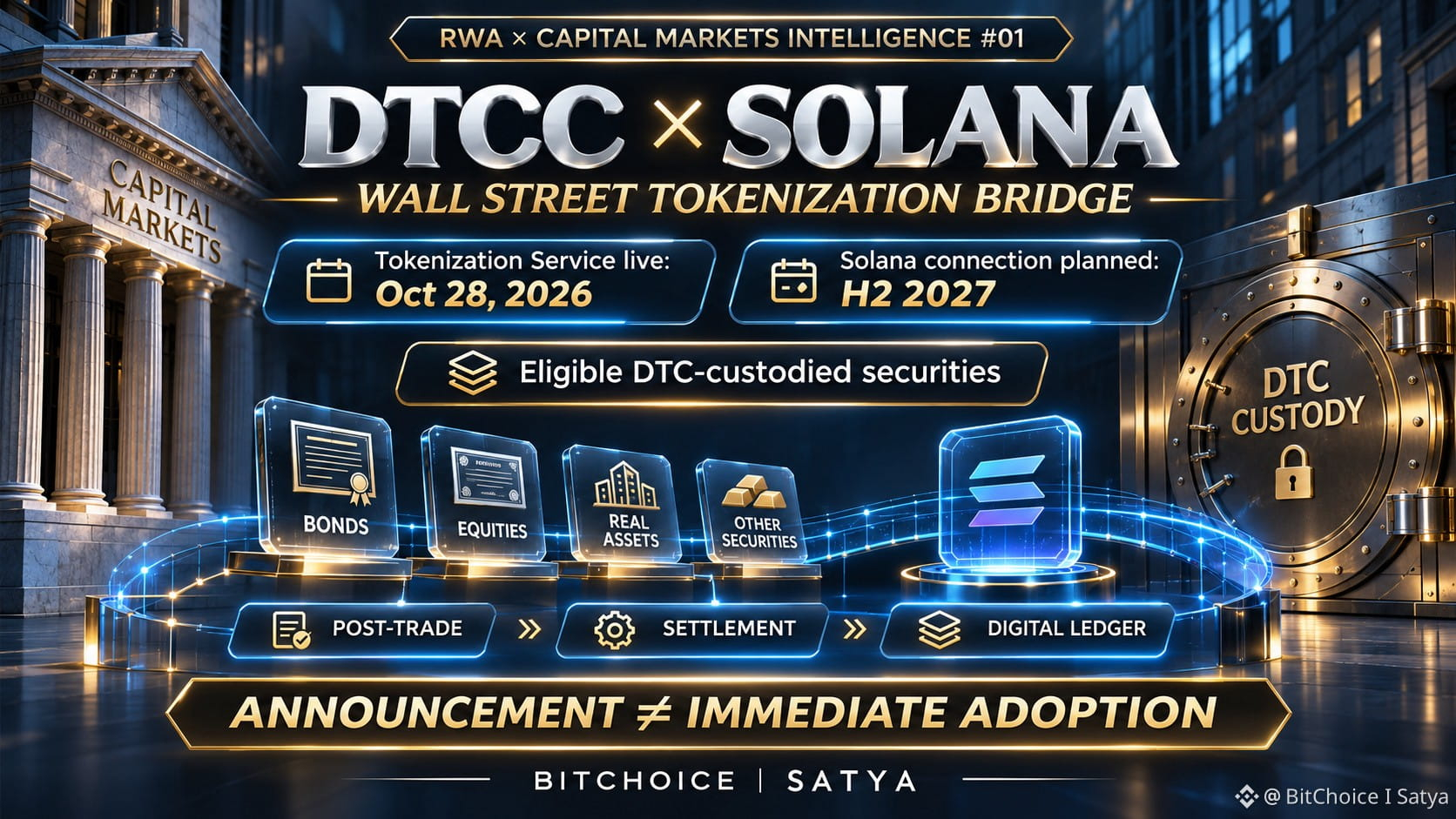
DTCC's plan to connect its Tokenization Service with Solana is more than a blockchain headline. It is a test of whether tokenized securities can improve real capital-markets infrastructure.
According to DTCC, its Tokenization Service went live on October 28, 2026, and a Solana connection is planned for H2 2027.
WHY THIS MATTERS
The core story is not about SOL's price.
It is about post-trade efficiency, collateral mobility and the possibility of moving eligible DTC-custodied securities through a more programmable infrastructure layer.
THREE KEY QUESTIONS
Can tokenization reduce operational friction in settlement and asset servicing?
Can institutions move collateral more efficiently without weakening legal protections?
Can blockchain-based infrastructure connect with regulated securities systems at scale?
IMPORTANT DISTINCTION
An announced integration is not the same as adoption.
It does not confirm immediate trading activity, large-scale institutional usage or meaningful revenue impact.
And tokenized securities are not automatically equivalent to unrestricted 24/7 public-market trading.
WHAT TO WATCH
• The 2027 integration timeline
• Which asset categories are supported
• Institutional participation
• Evidence of faster settlement or better collateral efficiency
• Whether investor protections remain fully intact
THE TAKEAWAY
The real value of tokenization will not be measured by hype.
It will be measured by lower friction, better capital efficiency and stronger market infrastructure.
#RWA #Tokenization #CapitalMarkets #Solana $SOL
{spot}(SOLUSDT)
🚨RWA × CAPITAL MARKETS INTELLIGENCE 01
DTCC × SOLANA: THE REAL TOKENIZATION TEST
DTCC's plan to connect its Tokenization Service with Solana is more than a blockchain headline. It is a test of whether tokenized securities can improve real capital-markets infrastructure.
According to DTCC, its Tokenization Service went live on October 28, 2026, and a Solana connection is planned for H2 2027.
WHY THIS MATTERS
The core story is not about SOL's price.
It is about post-trade efficiency, collateral mobility and the possibility of moving eligible DTC-custodied securities through a more programmable infrastructure layer.
THREE KEY QUESTIONS
Can tokenization reduce operational friction in settlement and asset servicing?
Can institutions move collateral more efficiently without weakening legal protections?
Can blockchain-based infrastructure connect with regulated securities systems at scale?
IMPORTANT DISTINCTION
An announced integration is not the same as adoption.
It does not confirm immediate trading activity, large-scale institutional usage or meaningful revenue impact.
And tokenized securities are not automatically equivalent to unrestricted 24/7 public-market trading.
WHAT TO WATCH
• The 2027 integration timeline
• Which asset categories are supported
• Institutional participation
• Evidence of faster settlement or better collateral efficiency
• Whether investor protections remain fully intact
THE TAKEAWAY
The real value of tokenization will not be measured by hype.
It will be measured by lower friction, better capital efficiency and stronger market infrastructure.
#RWA #Tokenization #CapitalMarkets #Solana $SOL
120

·
--
Behind Every Multi-Billion-Dollar Raise Is a Syndicate Working in Sync.
Structuring a multi-billion-dollar capital raise is not the job of a single bank. It requires a carefully coordinated syndicate of major global investment banks, all working together to manage balance sheet risk and distribute shares on a broad scale. Because the amounts involved are so large, no one institution wants to carry the full weight alone, and that is exactly why the syndicate model exists.
Within this structure, each member has a clear role. The lead underwriter manages the order book and takes charge of pricing, which keeps the process organized and the message to the market consistent. Meanwhile, the participating banks leverage their respective institutional networks to source demand from different regions. As a result, the offering reaches far more investors than any single bank could reach on its own.
Beyond distribution, this arrangement offers other important benefits. It spreads financial exposure across several institutions, so the failure of one part of the deal does not threaten the whole. It also helps ensure regulatory compliance across different jurisdictions, and it supports better pricing execution because demand is gathered from a wider pool. In other words, the syndicate protects both the issuer and the investors.
That is why understanding how syndicate members collaborate is so useful. It sheds light on the mechanical backbone of global capital markets, and it reminds us that big results usually come from coordination, not from working alone. If you would rather follow a structured approach than trade alone, you can copy my trades on Binance and let a proven strategy work while you stay in control: [https://www.binance.com/en/copy-trading/lead-details/5293024773212277505?timeRange=365D](https://www.binance.com/en/copy-trading/lead-details/5293024773212277505?timeRange=365D)
$BTC $ETH $BNB
#Investing #BinanceSquare #Copytrading #crypto #CapitalMarkets
Trading involves risk. This is not financial advice.
Behind Every Multi-Billion-Dollar Raise Is a Syndicate Working in Sync.
Structuring a multi-billion-dollar capital raise is not the job of a single bank. It requires a carefully coordinated syndicate of major global investment banks, all working together to manage balance sheet risk and distribute shares on a broad scale. Because the amounts involved are so large, no one institution wants to carry the full weight alone, and that is exactly why the syndicate model exists.
Within this structure, each member has a clear role. The lead underwriter manages the order book and takes charge of pricing, which keeps the process organized and the message to the market consistent. Meanwhile, the participating banks leverage their respective institutional networks to source demand from different regions. As a result, the offering reaches far more investors than any single bank could reach on its own.
Beyond distribution, this arrangement offers other important benefits. It spreads financial exposure across several institutions, so the failure of one part of the deal does not threaten the whole. It also helps ensure regulatory compliance across different jurisdictions, and it supports better pricing execution because demand is gathered from a wider pool. In other words, the syndicate protects both the issuer and the investors.
That is why understanding how syndicate members collaborate is so useful. It sheds light on the mechanical backbone of global capital markets, and it reminds us that big results usually come from coordination, not from working alone. If you would rather follow a structured approach than trade alone, you can copy my trades on Binance and let a proven strategy work while you stay in control: https://www.binance.com/en/copy-trading/lead-details/5293024773212277505?timeRange=365D
$BTC $ETH $BNB
#Investing #BinanceSquare #Copytrading #crypto #CapitalMarkets
Trading involves risk. This is not financial advice.
My Spot Portfolio
0 / 300
Minimum 10USDT
Public
7D PNL
(USDT)
-43.38
7D ROI
-7.79%
AUM
$513.44
Win Rate
18.75%
43

·
--
Most people think tokenized stocks are a blockchain story.
I think they're actually an infrastructure story. 🌍
Toly's comments made me focus less on the technology and more on where the real pressure comes from. Global demand for leading US companies already exists. The real friction is access.
Traditional finance was built around national borders, market hours, and multiple intermediaries. It works, but it wasn't designed for a world where capital moves digitally and investors expect seamless global access.
That's why tokenized equities make sense to me.
Blockchain doesn't create demand for Apple, Nvidia, or Microsoft shares. It simply offers more efficient infrastructure for distributing access to assets people already want.
That said, success isn't guaranteed.
The real challenge is trust. Every token must represent legally enforceable ownership, corporate actions must be handled correctly, custody must be transparent, and investor protections must remain intact. Without those foundations, faster settlement alone isn't enough.
If those pieces come together, tokenized equities could become programmable financial assets usable as collateral, integrated with DeFi, and settled globally with far less friction. ⚙️
The real opportunity isn't putting stocks on-chain.
It's modernising financial infrastructure for a global, internet native capital market.
@Binance_Square_Official #TokenizedStocks
#Solana #RWA
#CapitalMarkets $SOL $BTC $AAPL.US
Most people think tokenized stocks are a blockchain story.
I think they're actually an infrastructure story. 🌍
Toly's comments made me focus less on the technology and more on where the real pressure comes from. Global demand for leading US companies already exists. The real friction is access.
Traditional finance was built around national borders, market hours, and multiple intermediaries. It works, but it wasn't designed for a world where capital moves digitally and investors expect seamless global access.
That's why tokenized equities make sense to me.
Blockchain doesn't create demand for Apple, Nvidia, or Microsoft shares. It simply offers more efficient infrastructure for distributing access to assets people already want.
That said, success isn't guaranteed.
The real challenge is trust. Every token must represent legally enforceable ownership, corporate actions must be handled correctly, custody must be transparent, and investor protections must remain intact. Without those foundations, faster settlement alone isn't enough.
If those pieces come together, tokenized equities could become programmable financial assets usable as collateral, integrated with DeFi, and settled globally with far less friction. ⚙️
The real opportunity isn't putting stocks on-chain.
It's modernising financial infrastructure for a global, internet native capital market.
@Binance Square Official #TokenizedStocks
#Solana #RWA
#CapitalMarkets $SOL $BTC $AAPL.US
4
231

·
--
#SouthKoreaFSLToAnnounceSingleStockLeveragedMeasure South Korea could be preparing a major shift in its capital markets.
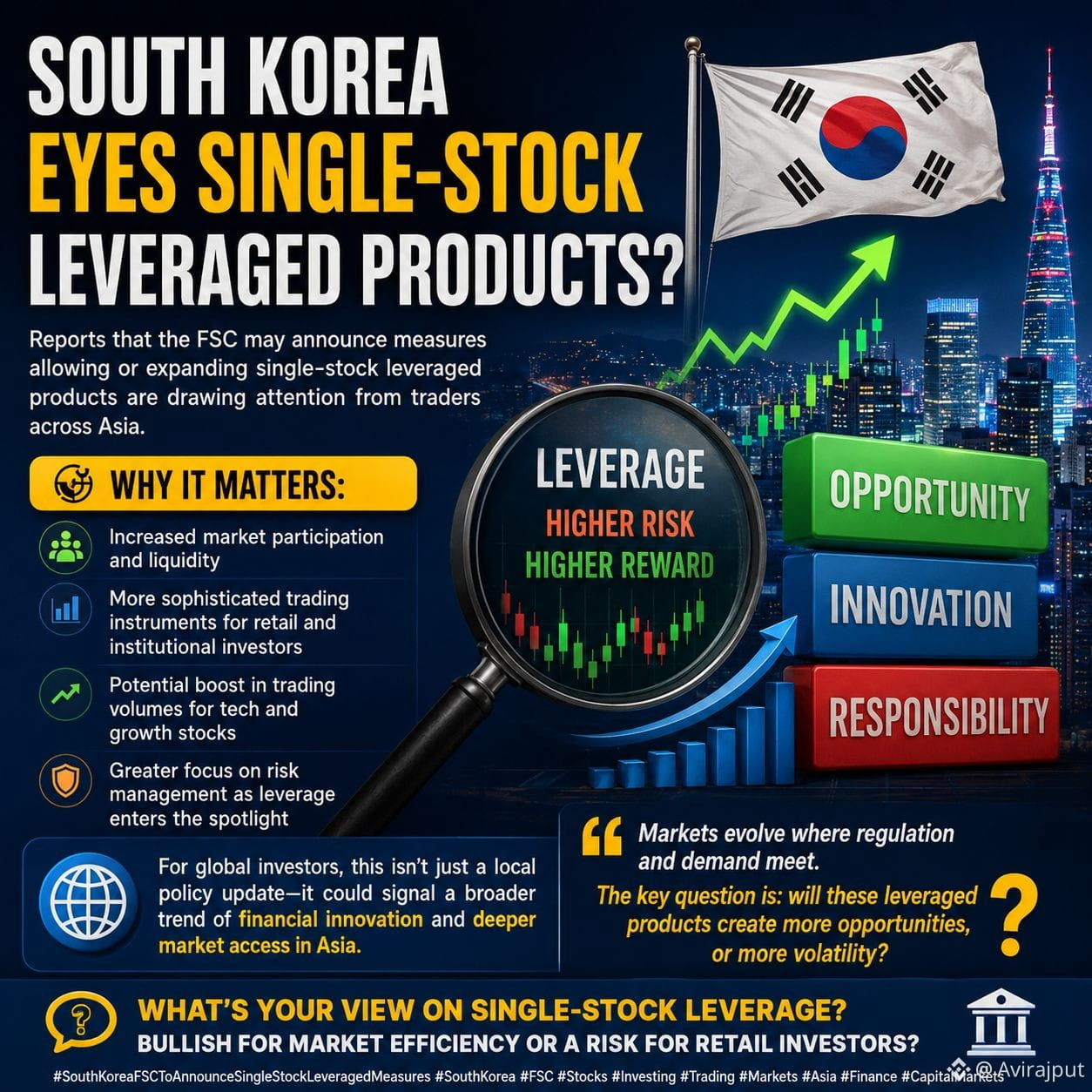
Reports that the FSC may announce measures allowing or expanding single-stock leveraged products are drawing attention from traders across Asia. If approved, this could open the door to higher-risk, higher-reward strategies tied to individual companies—bringing South Korea closer to trends seen in other major financial markets.
📈 Why it matters:
• Increased market participation and liquidity
• More sophisticated trading instruments for retail and institutional investors
• Potential boost in trading volumes for tech and growth stocks
• Greater focus on risk management as leverage enters the spotlight
For global investors, this isn’t just a local policy update—it could signal a broader trend of financial innovation and deeper market access in Asia.
Markets evolve where regulation and demand meet. The key question is: will these leveraged products create more opportunities, or more volatility?
What’s your view on single-stock leverage? Bullish for market efficiency or a risk for retail #SouthKoreaFSCToAnnounceSingleStockLeveragedMeasure #CapitalMarkets
{stock_us}(IMAX.US)
{spot}(OPUSDT)
{spot}(ETHUSDT)
#SouthKoreaFSLToAnnounceSingleStockLeveragedMeasure South Korea could be preparing a major shift in its capital markets.
Reports that the FSC may announce measures allowing or expanding single-stock leveraged products are drawing attention from traders across Asia. If approved, this could open the door to higher-risk, higher-reward strategies tied to individual companies—bringing South Korea closer to trends seen in other major financial markets.
📈 Why it matters:
• Increased market participation and liquidity
• More sophisticated trading instruments for retail and institutional investors
• Potential boost in trading volumes for tech and growth stocks
• Greater focus on risk management as leverage enters the spotlight
For global investors, this isn’t just a local policy update—it could signal a broader trend of financial innovation and deeper market access in Asia.
Markets evolve where regulation and demand meet. The key question is: will these leveraged products create more opportunities, or more volatility?
What’s your view on single-stock leverage? Bullish for market efficiency or a risk for retail #SouthKoreaFSCToAnnounceSingleStockLeveragedMeasure #CapitalMarkets
1
131

·
--
Bearish
#ITGRaises$312.2MInUSIPO
📈 #ITGRaises$312.2MInUSIPO
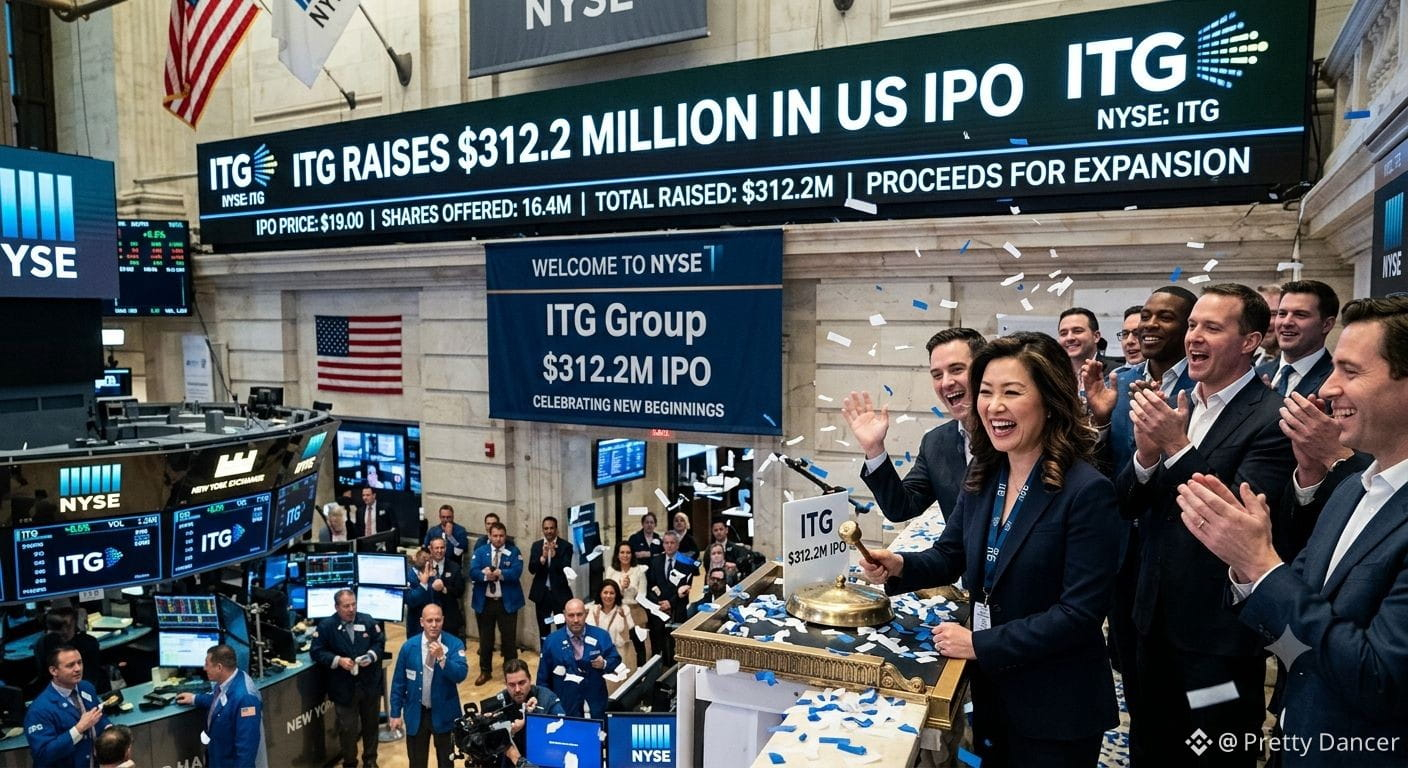
ITG has successfully raised **$312.2 million** through its U.S. initial public offering (IPO), marking one of the notable public market debuts of the year. The successful listing reflects continued investor interest in companies with strong growth potential despite ongoing market uncertainty.
A successful IPO is often viewed as a sign of healthy capital markets and improving investor confidence. It may also encourage other private companies to move forward with their own public listings if market conditions remain favorable.
For investors, IPO activity is an important indicator of market sentiment. While new listings can present exciting opportunities, it's essential to evaluate a company's financials, business model, and long-term growth prospects before investing.
#IPO #StockMarket #Investing #WallStreet #Finance #MarketNews #Stocks #Business #Trading #CapitalMarkets
$BTC
{future}(BTCUSDT)
#ITGRaises$312.2MInUSIPO
📈 #ITGRaises$312.2MInUSIPO
ITG has successfully raised **$312.2 million** through its U.S. initial public offering (IPO), marking one of the notable public market debuts of the year. The successful listing reflects continued investor interest in companies with strong growth potential despite ongoing market uncertainty.
A successful IPO is often viewed as a sign of healthy capital markets and improving investor confidence. It may also encourage other private companies to move forward with their own public listings if market conditions remain favorable.
For investors, IPO activity is an important indicator of market sentiment. While new listings can present exciting opportunities, it's essential to evaluate a company's financials, business model, and long-term growth prospects before investing.
#IPO #StockMarket #Investing #WallStreet #Finance #MarketNews #Stocks #Business #Trading #CapitalMarkets
$BTC
32

🚨 Capital Markets | SK Hynix’s U.S. ADR Offering Draws Strong Demand
Investor appetite appears robust as SK Hynix’s U.S. ADR offering has become oversubscribed, signaling strong institutional and market interest in the AI memory-chip leader.
The company announced that subscriptions will officially close at 4:00 p.m. New York time on July 8, marking the end of the offering period ahead of schedule.
With AI-driven demand continuing to fuel optimism around high-bandwidth memory (HBM) and advanced semiconductor suppliers, the strong response highlights sustained confidence in SK Hynix’s long-term growth outlook.
#SKHynix #ADR #Semiconductors #AI #HBM #StockMarket #Investing #TechStocks #CapitalMarkets
$SKHYNIX
{future}(SKHYNIXUSDT)
$SYN
{spot}(SYNUSDT)
🚨 Capital Markets | SK Hynix’s U.S. ADR Offering Draws Strong Demand
Investor appetite appears robust as SK Hynix’s U.S. ADR offering has become oversubscribed, signaling strong institutional and market interest in the AI memory-chip leader.
The company announced that subscriptions will officially close at 4:00 p.m. New York time on July 8, marking the end of the offering period ahead of schedule.
With AI-driven demand continuing to fuel optimism around high-bandwidth memory (HBM) and advanced semiconductor suppliers, the strong response highlights sustained confidence in SK Hynix’s long-term growth outlook.
#SKHynix #ADR #Semiconductors #AI #HBM #StockMarket #Investing #TechStocks #CapitalMarkets
$SKHYNIX
$SYN
199

🚨 Africa’s Biggest IPO Is Coming
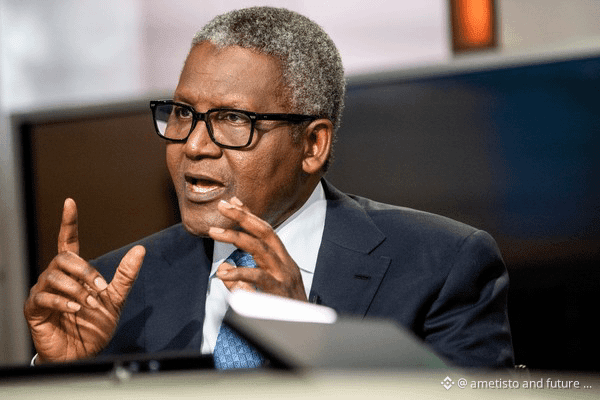
Aliko Dangote, Africa’s richest man, is preparing what could become the largest IPO in African history. His Dangote Petroleum Refinery & Petrochemicals plans to raise around $1.6 billion by offering 4.1 billion shares at 525 naira each, valuing the refinery at roughly $49 billion. (Financial Times)
The offer is designed to bring ordinary Africans into the ownership of one of the continent’s most ambitious industrial projects. Investors can subscribe to as few as 10 shares, while Dangote aims to attract up to 10 million shareholders across Africa. (AFP)
The refinery currently has a capacity of about 700,000 barrels per day, with plans to invest $14.3 billion to double capacity to 1.4 million barrels per day by 2029. The IPO is scheduled to run from September 14 to October 13, with a listing expected in November. (Reuters)
This is more than a major stock-market event. It could mark a turning point for African capital markets, energy independence and retail investment, giving everyday investors a stake in one of Africa’s most strategically important companies.
Africa is building its own industrial giants — and now, Africans may have the opportunity to own part of them. 🌍📈
#Africa #Nigeria #Dangote #IPO #Investing #StockMarket #Energy #CapitalMarkets
156

Article
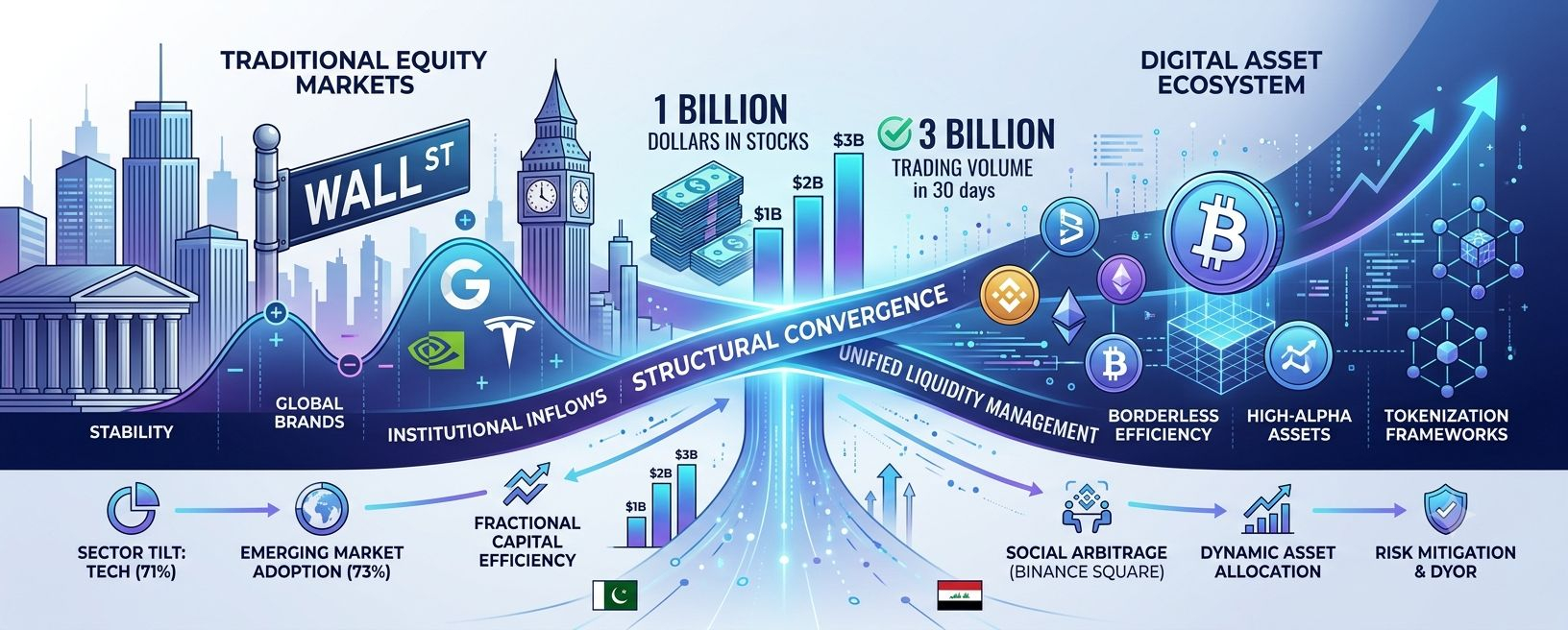
Bridging Crypto and Traditional Equity: A Deep Dive into the Next Phase of Digital Asset AllocationThe global financial architecture is undergoing a structural convergence at a pace that demands continuous #PortfolioOptimization . For market analysts and active allocators who navigate the digital asset ecosystem daily, staying ahead means identifying macro trends before they become baseline market assumptions. A significant milestone in this cross-asset integration is highlighted by the recent strategic campaign centered around the Binance 1 Billion Dollars in Stocks initiative.
Having continuously monitored high-liquidity pipelines, institutional inflows, and #MacroEconomics shifts, this movement marks a decisive pivot in retail and institutional capital deployment. It represents a fundamental bridge connecting the borderless efficiency of cryptocurrency with the foundational stability of traditional equity markets.
The Macro Context: Why #CapitalMarkets
l are Converging
For years, traditional stock exchanges and digital asset platforms operated as parallel liquidity pools. However, recent regulatory clarifications, institutional exchange-traded fund (ETF) inflows, and advanced tokenization frameworks have permanently blurred these lines. Binance’s increasing focus on traditional market vehicles underlines a broader trend: investors no longer want to choose between high-beta crypto assets and stable legacy equities. They require frictionless execution across both asset classes from a centralized, highly secure environment.
Key Drivers of This Structural Shift
Unified Liquidity Management: The fragmentation of capital across multiple traditional brokerages and web3 entities introduces execution lag and unnecessary fee layers. Consolidating equity market intelligence alongside crypto portfolios optimizes collateral utilization.
Exposure to High-Alpha Global Brands: By lowering the barriers to global equity trends, market participants can seamlessly correlate macroscopic technological waves—such as artificial intelligence or semiconductor manufacturing—directly against native crypto hedges.
Institutional-Grade Social Arbitrage: Platforms like Binance Square act as real-time sentiment aggregators. The convergence allows analytical minds to cross-reference equity market volatility indexes with crypto derivatives data, refining predictive metrics.
Strategic Outlook: True financial agility relies on dynamic asset allocation. Diversifying portfolios across uncorrelated asset classes—balancing the rapid innovation of decentralized networks with the proven cash flows of global mega-cap corporations—remains the premier strategy for sustainable risk-adjusted returns.
Analytical Framework & Risk Mitigation
While the cross-pollination of equity and crypto ecosystems introduces unprecedented capital efficiency, structured risk management models must be strictly maintained. Legacy equity markets are bound by distinct regulatory regimes, macroeconomic interest rate cycles, and corporate governance actions that differ fundamentally from algorithmic protocol mechanics. Thorough primary research (DYOR) remains mandatory before adjusting capitalization weightings.
The integration of traditional market infrastructure into leading digital asset networks represents a permanent structural evolution. Navigating this shift with a disciplined, data-driven approach will separate passive observers from sophisticated allocators in the macro regime ahead.
Bridging Crypto and Traditional Equity: A Deep Dive into the Next Phase of Digital Asset Allocation
The global financial architecture is undergoing a structural convergence at a pace that demands continuous #PortfolioOptimization . For market analysts and active allocators who navigate the digital asset ecosystem daily, staying ahead means identifying macro trends before they become baseline market assumptions. A significant milestone in this cross-asset integration is highlighted by the recent strategic campaign centered around the Binance 1 Billion Dollars in Stocks initiative.
Having continuously monitored high-liquidity pipelines, institutional inflows, and #MacroEconomics shifts, this movement marks a decisive pivot in retail and institutional capital deployment. It represents a fundamental bridge connecting the borderless efficiency of cryptocurrency with the foundational stability of traditional equity markets.
The Macro Context: Why #CapitalMarkets
l are Converging
For years, traditional stock exchanges and digital asset platforms operated as parallel liquidity pools. However, recent regulatory clarifications, institutional exchange-traded fund (ETF) inflows, and advanced tokenization frameworks have permanently blurred these lines. Binance’s increasing focus on traditional market vehicles underlines a broader trend: investors no longer want to choose between high-beta crypto assets and stable legacy equities. They require frictionless execution across both asset classes from a centralized, highly secure environment.
Key Drivers of This Structural Shift
Unified Liquidity Management: The fragmentation of capital across multiple traditional brokerages and web3 entities introduces execution lag and unnecessary fee layers. Consolidating equity market intelligence alongside crypto portfolios optimizes collateral utilization.
Exposure to High-Alpha Global Brands: By lowering the barriers to global equity trends, market participants can seamlessly correlate macroscopic technological waves—such as artificial intelligence or semiconductor manufacturing—directly against native crypto hedges.
Institutional-Grade Social Arbitrage: Platforms like Binance Square act as real-time sentiment aggregators. The convergence allows analytical minds to cross-reference equity market volatility indexes with crypto derivatives data, refining predictive metrics.
Strategic Outlook: True financial agility relies on dynamic asset allocation. Diversifying portfolios across uncorrelated asset classes—balancing the rapid innovation of decentralized networks with the proven cash flows of global mega-cap corporations—remains the premier strategy for sustainable risk-adjusted returns.
Analytical Framework & Risk Mitigation
While the cross-pollination of equity and crypto ecosystems introduces unprecedented capital efficiency, structured risk management models must be strictly maintained. Legacy equity markets are bound by distinct regulatory regimes, macroeconomic interest rate cycles, and corporate governance actions that differ fundamentally from algorithmic protocol mechanics. Thorough primary research (DYOR) remains mandatory before adjusting capitalization weightings.
The integration of traditional market infrastructure into leading digital asset networks represents a permanent structural evolution. Navigating this shift with a disciplined, data-driven approach will separate passive observers from sophisticated allocators in the macro regime ahead.
122
🚨AI × CAPITAL MARKETS INTELLIGENCE 03
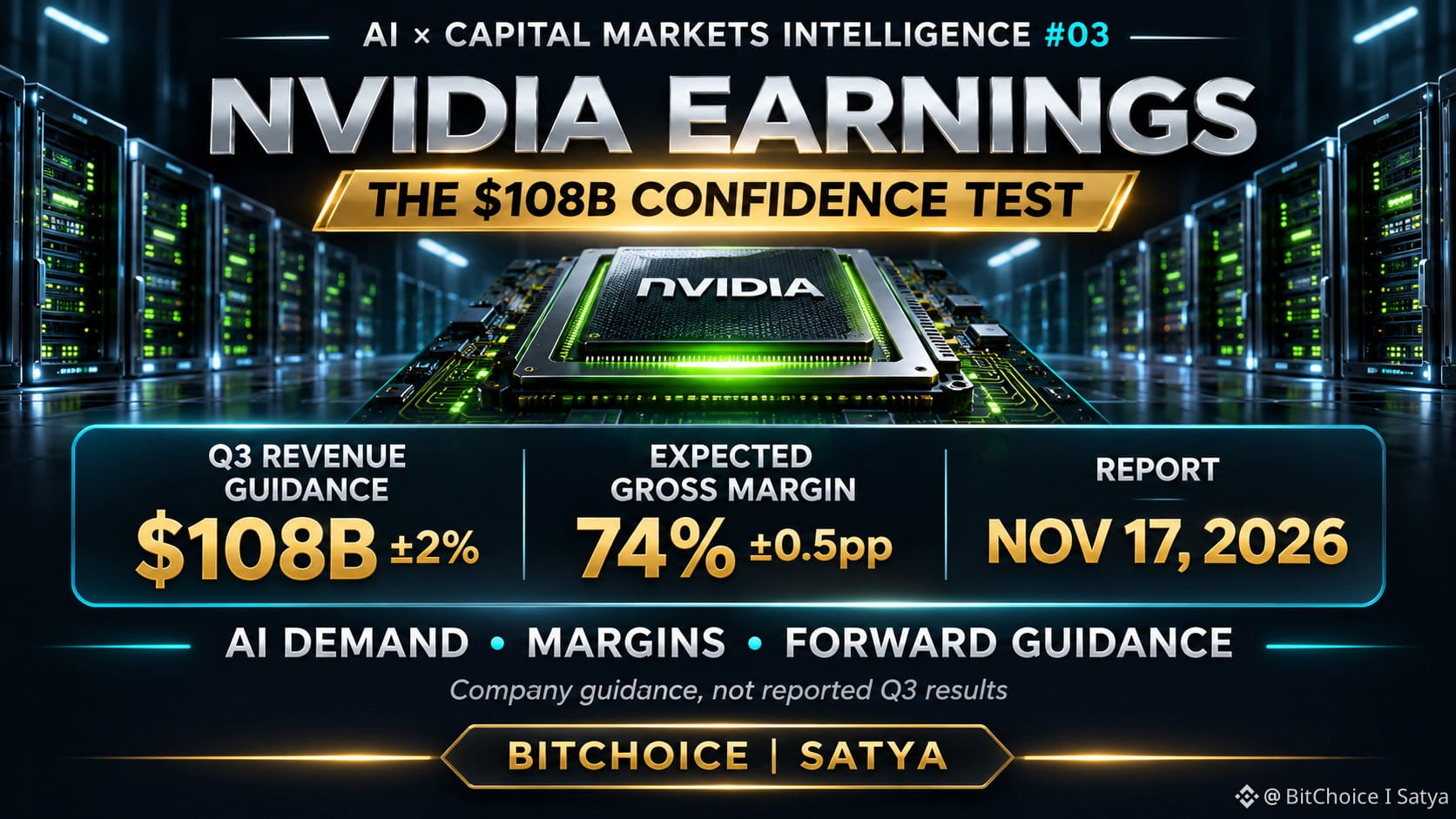
NVIDIA EARNINGS: THE $108B CONFIDENCE TEST
NVIDIA reports Q3 FY2027 results on November 17, facing two major challenges: extraordinary AI demand expectations and a leadership transition.
Following Jensen Huang's departure, CFO Colette Kress is serving as interim CEO.
THE FINANCIAL BASELINE
• Q2 revenue: $96.2B (+106% YoY)
• Data Center revenue: $89B (+117% YoY)
• Q3 revenue guidance: $108B ±2%
• Expected gross margin: 74% ±0.5 percentage points
THE THREE TESTS
DEMAND QUALITY
Can NVIDIA meet its revenue target while showing that AI infrastructure demand extends beyond a concentrated group of hyperscalers?
MARGIN RESILIENCE
A revenue beat with weaker margins may signal rising costs or product-mix pressure.
LEADERSHIP CONFIDENCE
Can interim management demonstrate continuity in customer commitments, product execution and future guidance?
WHY IT MATTERS FOR CRYPTO
NVIDIA is a major indicator of AI infrastructure investment and broader technology-sector sentiment.
Its results may influence risk appetite across equities and crypto, but the relationship is indirect and not guaranteed.
THE TAKEAWAY
A strong quarter alone may not be enough.
The decisive combination is revenue quality, margin stability and credible forward guidance.
An earnings beat is not automatically a bullish market signal.
#NVIDIA #NVDA #Aİ #CapitalMarkets $NVDA
{future}(NVDAUSDT)
🚨AI × CAPITAL MARKETS INTELLIGENCE 03
NVIDIA EARNINGS: THE $108B CONFIDENCE TEST
NVIDIA reports Q3 FY2027 results on November 17, facing two major challenges: extraordinary AI demand expectations and a leadership transition.
Following Jensen Huang's departure, CFO Colette Kress is serving as interim CEO.
THE FINANCIAL BASELINE
• Q2 revenue: $96.2B (+106% YoY)
• Data Center revenue: $89B (+117% YoY)
• Q3 revenue guidance: $108B ±2%
• Expected gross margin: 74% ±0.5 percentage points
THE THREE TESTS
DEMAND QUALITY
Can NVIDIA meet its revenue target while showing that AI infrastructure demand extends beyond a concentrated group of hyperscalers?
MARGIN RESILIENCE
A revenue beat with weaker margins may signal rising costs or product-mix pressure.
LEADERSHIP CONFIDENCE
Can interim management demonstrate continuity in customer commitments, product execution and future guidance?
WHY IT MATTERS FOR CRYPTO
NVIDIA is a major indicator of AI infrastructure investment and broader technology-sector sentiment.
Its results may influence risk appetite across equities and crypto, but the relationship is indirect and not guaranteed.
THE TAKEAWAY
A strong quarter alone may not be enough.
The decisive combination is revenue quality, margin stability and credible forward guidance.
An earnings beat is not automatically a bullish market signal.
#NVIDIA #NVDA #Aİ #CapitalMarkets $NVDA
141
BITCOIN MINING × AI INTELLIGENCE 01
WHY BITCOIN MINERS ARE SELLING BTC TO FINANCE AI
A major capital shift is unfolding across publicly traded Bitcoin miners.
The industry's most valuable asset may increasingly be its power infrastructure, not just its hashrate.
THE VERIFIED NUMBERS
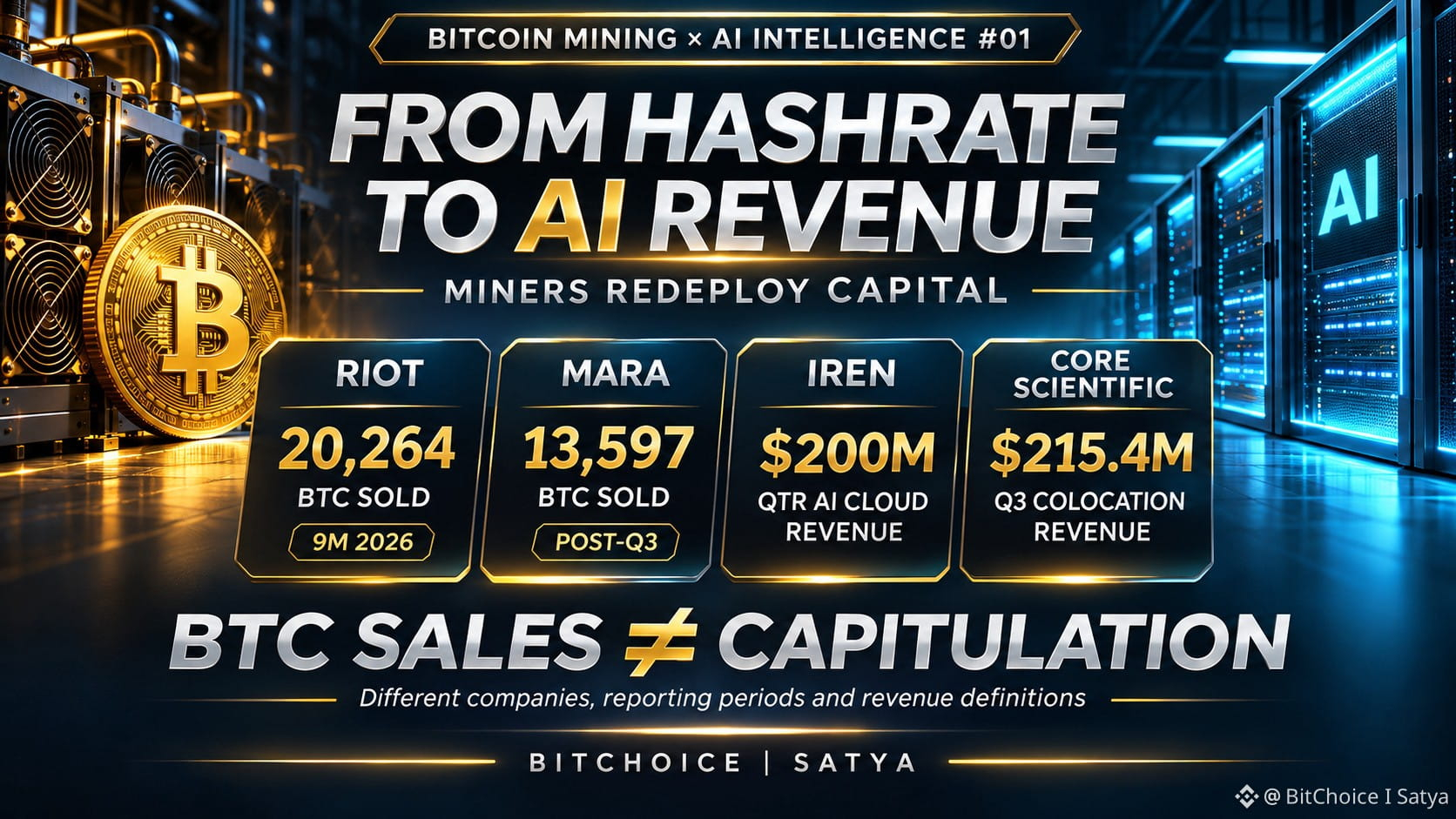
• RIOT: Sold 20,264 BTC for ~$1.5B during the first nine months of 2026, mainly funding data center development and debt repayment.
• MARA: Sold 13,597 BTC for ~$1.1B after Q3, using $750M to repay BTC-backed loans.
• IREN: Reported $200M in quarterly AI Cloud revenue versus $28M from mining.
• CORZ: Reported $215.4M in Q3 colocation revenue.
WHY THE SHIFT MATTERS
Bitcoin mining and AI computing both require substantial electricity, infrastructure and capital.
But their economics differ.
Mining revenue is highly exposed to BTC prices and network difficulty.
AI infrastructure can generate contracted revenue, potentially offering more predictable cash flows.
However, contracts do not eliminate construction risk, financing costs or customer concentration.
THREE SIGNALS TO WATCH
BTC sales: Are proceeds funding growth or covering recurring losses?
AI revenue: Is contracted capacity becoming operational and profitable?
Balance sheets: Are debt and capital expenditure growing faster than cash flow?
THE TAKEAWAY
Miner selling is not automatically capitulation.
It may signal a strategic transition from Bitcoin extraction toward AI infrastructure.
The decisive metric is return on invested capital, not BTC sold.
#Bitcoin #AIInfrastructure #Mining #CapitalMarkets $MARA $IREN
{future}(IRENUSDT)
{future}(MARAUSDT)
BITCOIN MINING × AI INTELLIGENCE 01
WHY BITCOIN MINERS ARE SELLING BTC TO FINANCE AI
A major capital shift is unfolding across publicly traded Bitcoin miners.
The industry's most valuable asset may increasingly be its power infrastructure, not just its hashrate.
THE VERIFIED NUMBERS
• RIOT: Sold 20,264 BTC for ~$1.5B during the first nine months of 2026, mainly funding data center development and debt repayment.
• MARA: Sold 13,597 BTC for ~$1.1B after Q3, using $750M to repay BTC-backed loans.
• IREN: Reported $200M in quarterly AI Cloud revenue versus $28M from mining.
• CORZ: Reported $215.4M in Q3 colocation revenue.
WHY THE SHIFT MATTERS
Bitcoin mining and AI computing both require substantial electricity, infrastructure and capital.
But their economics differ.
Mining revenue is highly exposed to BTC prices and network difficulty.
AI infrastructure can generate contracted revenue, potentially offering more predictable cash flows.
However, contracts do not eliminate construction risk, financing costs or customer concentration.
THREE SIGNALS TO WATCH
BTC sales: Are proceeds funding growth or covering recurring losses?
AI revenue: Is contracted capacity becoming operational and profitable?
Balance sheets: Are debt and capital expenditure growing faster than cash flow?
THE TAKEAWAY
Miner selling is not automatically capitulation.
It may signal a strategic transition from Bitcoin extraction toward AI infrastructure.
The decisive metric is return on invested capital, not BTC sold.
#Bitcoin #AIInfrastructure #Mining #CapitalMarkets $MARA $IREN
185

·
--
Traditional markets operate within established trading hours.
Blockchain infrastructure can support activity outside those windows.
Whether that becomes practical depends on liquidity, regulation and market design.
#Tokenization #Blockchain #CapitalMarkets #fintech
Traditional markets operate within established trading hours.
Blockchain infrastructure can support activity outside those windows.
Whether that becomes practical depends on liquidity, regulation and market design.
#Tokenization #Blockchain #CapitalMarkets #fintech
Blockchain infrastructure can support activity outside those windows.
Whether that becomes practical depends on liquidity, regulation and market design.
#Tokenization #Blockchain #CapitalMarkets #fintech
1
46

·
--
$SKHYNIX CUTS ADR FUNDRAISING TARGET TO $26.5B ❓
SK Hynix has revised its ADR listing plan downward by 7%, now targeting 400 trillion Korean won instead of 430 trillion. While still a massive capital raise, the reduction suggests a recalibration of investor appetite or internal valuation adjustments.
Capital structure shifts of this magnitude often create near-term sentiment ripples, and the semiconductor memory cycle remains the macro driver here. With memory prices trending upward since Q2, the cut feels cautious rather than bearish.
Are you watching the broader semi sector for follow-through or treating this as an isolated corporate move?
Not financial advice. Always manage your risk.
#SKHynix #ADR #Semiconductors #CapitalMarkets
❓
282

·
--
Optimized (suitable for Twitter posts):
Michael Saylor: Tokenized on-chain trading enables round-the-clock operation, a major breakthrough for digital credit and the U.S. capital markets.
#Tokenization #RWA #DigitalCredit #CapitalMarkets
Optimized (suitable for Twitter posts):
Michael Saylor: Tokenized on-chain trading enables round-the-clock operation, a major breakthrough for digital credit and the U.S. capital markets.
#Tokenization #RWA #DigitalCredit #CapitalMarkets
Michael Saylor: Tokenized on-chain trading enables round-the-clock operation, a major breakthrough for digital credit and the U.S. capital markets.
#Tokenization #RWA #DigitalCredit #CapitalMarkets
60

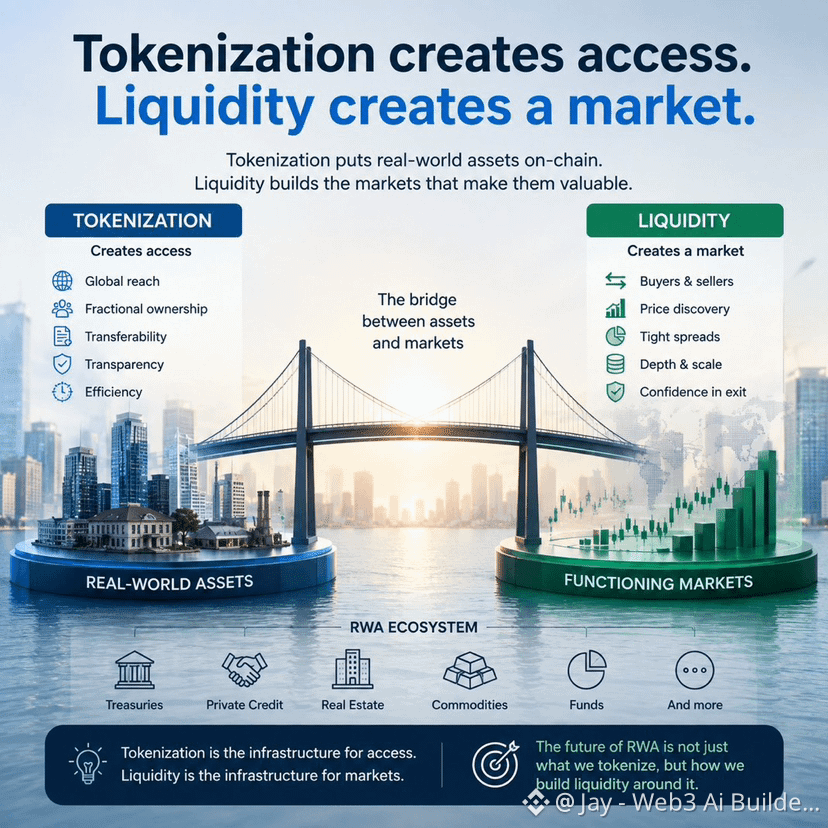
RWA has a liquidity problem, not a tokenization problem.
We’ve become increasingly good at putting real-world assets on-chain.
Treasuries.
Private credit.
Funds.
Real estate.
Commodities.
But tokenizing an asset and creating a liquid market for it are two very different things.
Tokenization ≠ Liquidity.
You can represent a $10 million asset on-chain.
You can fractionalize it into thousands of tokens.
You can make ownership and settlement more efficient.
But when an investor wants to sell:
Who is on the other side of the trade?
That is where the real challenge begins.
For RWA markets to develop further, I believe we need to pay more attention to the infrastructure surrounding the token:
→ Sufficient buyers and sellers
→ Compliant secondary-market access
→ Reliable issuance and redemption
→ Stablecoin and fiat settlement rails
→ Market makers and liquidity providers
→ Custody and transfer infrastructure
→ Clear legal rights to the underlying asset
And liquidity needs to be considered under stress—not only when markets are functioning normally.
This is also why TVL or tokenized asset value should not automatically be interpreted as available liquidity.
A $100 million tokenized asset does not necessarily mean $100 million can be sold immediately without meaningful price impact.
Different RWA structures will naturally have different liquidity characteristics.
A tokenized Treasury product should not be evaluated in exactly the same way as tokenized private credit or real estate.
So perhaps the next stage of RWA isn't simply:
“What else can we tokenize?”
It is:
“How do we build functioning markets around what we've already tokenized?”
Issuance brought assets on-chain.
Liquidity may determine whether they can stay there at scale.
#RWA #Tokenization #Liquidity #Web3 #DigitalAssets #Stablecoins #DeFi #CapitalMarkets
1
128

·
--
On the eve of the inaugural Canada Investment Summit, which opened in Toronto on September 13, Mark Carney (Mark Carney), former central bank governor and economic envoy, delivered a speech clearly outlining a new consensus in Canada: seize the future. The summit is scheduled to take place from September 14 to 15. Its core strategy is to release a prioritized list of key projects covering energy, critical minerals, high technology, and major infrastructure, aiming to attract as much as 1 trillion Canadian dollars (approximately US$0.72 trillion) in global investment over the next five years.
This statement signals a major shift in Canada’s economic transformation strategy. Against a backdrop in which Canada has long relied heavily on a single cross-border market, the government is seeking to improve domestic productivity through large-scale industrial restructuring and to accelerate efforts to reduce excessive dependence on U.S. supply chains. If this trillion-dollar capital initiative can be successfully implemented, it will have far-reaching implications for the division of labor in North American manufacturing in the medium and long term.
From a traditional macro-financial perspective, the trillion-CAD investment promotion plan will directly boost international capital’s demand to allocate to Canadian dollar assets, but it also places higher demands on government fiscal management and sovereign debt management. In the context of the global central bank policy “chess match,” such a large-scale reshuffling of capital flows may cause localized disturbances to the U.S. dollar index at the exchange-rate level, while also affecting the valuation pricing of commodities and energy supply chains.
For the crypto market, when sovereign economies accelerate their technological and infrastructure transitions, it is typically accompanied by potential demand for emerging digital settlement systems and computing power infrastructure. However, the large-scale absorption of capital by real-economy industries may also divert some of the macro liquidity chasing high returns in the short term. Whether digital assets such as $BTC can further establish their positioning as macro-neutral assets during the ongoing global supply-chain decentralization and restructuring still remains to be tested and validated through continued market capital “competition.”
#Canada #GlobalEconomy #CapitalMarkets
21
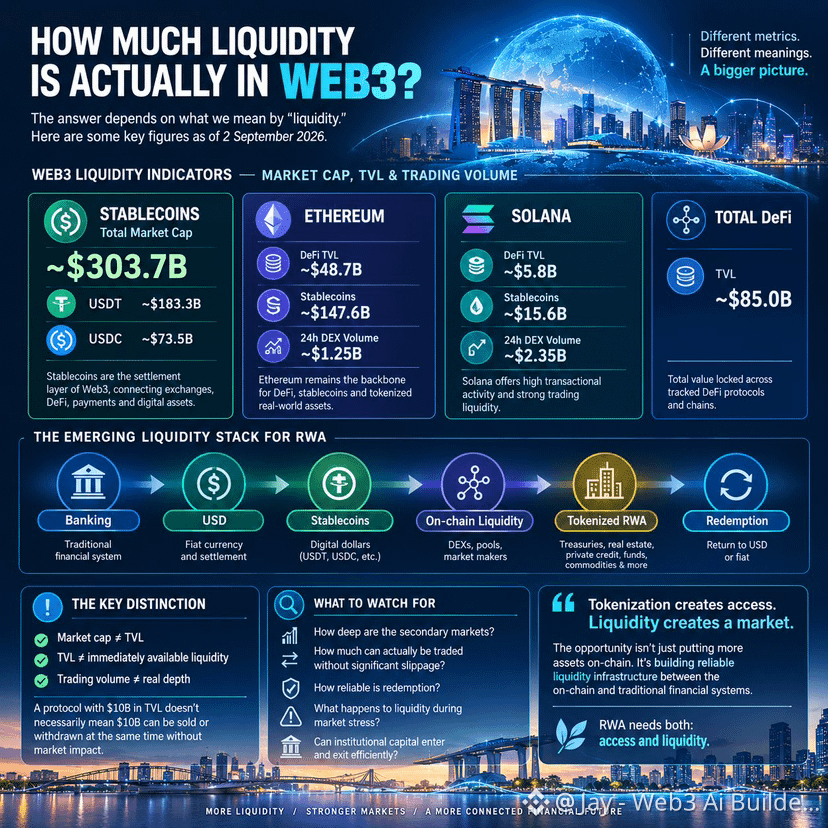
How much liquidity is actually in Web3?
The answer depends on what we mean by “liquidity.”
As of 2 September 2026, some useful indicators are:
💵 Stablecoins: ~$303.7B market cap
USDT: ~$183.3B
USDC: ~$73.5B
🔷 Ethereum
~$48.7B DeFi TVL
~$147.6B stablecoins
~$1.25B 24-hour DEX volume
🟣 Solana
~$5.8B DeFi TVL
~$15.6B stablecoins
~$2.35B 24-hour DEX volume
🌐 Total DeFi TVL: ~$85B
These are significant numbers.
But there is an important distinction:
Market cap ≠ TVL ≠ trading volume ≠ immediately available liquidity.
A protocol having $10B in TVL does not necessarily mean $10B can be sold or withdrawn at the same time without market impact.
Likewise, $300B+ of stablecoins in circulation doesn't mean the entire amount is sitting available on an exchange or liquidity pool.
For me, this becomes particularly important when we discuss RWA.
The emerging liquidity stack looks something like:
Banking → USD → Stablecoins → On-chain Liquidity → Tokenized RWA → Redemption → USD
Stablecoins can provide a settlement layer.
DeFi can help distribute and deploy liquidity.
RWA can connect that capital with real-world economic assets.
But the strength of this system will depend on more than how much value gets tokenized.
We also need to understand:
→ How deep are the secondary markets?
→ How much can actually be traded without significant slippage?
→ How reliable is redemption?
→ What happens to liquidity during market stress?
→ Can institutional capital enter and exit efficiently?
This is why I think liquidity—not simply tokenization—is one of the more important areas to watch in the next phase of Web3 and RWA.
Tokenization creates access.
Liquidity creates a market.
#Web3 #Liquidity #Stablecoins #RWA #Tokenization #DeFi #DigitalAssets #CapitalMarkets
1
178

·
--
Lantai Environmental dumps two environmental companies for $1.6B! Pay the money and take the goods—this move is solid! $1.6B in cash in hand—what big move will they make next? #企业重组 #资本交易 $BTC $ETH
Liantai Environmental just dropped a $1.61B deal! Selling two companies straight up for cold hard cash. That's some serious liquidity injection! What's their next big move? #CorporateRestructuring #CapitalMarkets $BTC $ETH
Liantai Environmental just dropped a $1.61B deal! Selling two companies straight up for cold hard cash. That's some serious liquidity injection! What's their next big move? #CorporateRestructuring #CapitalMarkets $BTC $ETH
338

October 28 or the second half of 2027? Both dates appear in DTCC’s tokenization news, and they describe different milestones.
DTCC launched its tokenization service on October 28. On November 12, it announced plans to connect that service to Solana ($SOL ) in the second half of 2027. That connection would let eligible securities already held by its depository move into tokenized form on Solana.
When I read a network adoption headline, I look for the first date customers can actually use the service. Here, that date is still a target.
#Solana #Tokenization
{spot}(SOLUSDT)
{future}(SOLUSDT)
#CapitalMarkets
Write to Earn disclosure: I may earn Binance Square rewards from this post.
October 28 or the second half of 2027? Both dates appear in DTCC’s tokenization news, and they describe different milestones.
DTCC launched its tokenization service on October 28. On November 12, it announced plans to connect that service to Solana ($SOL ) in the second half of 2027. That connection would let eligible securities already held by its depository move into tokenized form on Solana.
When I read a network adoption headline, I look for the first date customers can actually use the service. Here, that date is still a target.
#Solana #Tokenization
#CapitalMarkets
Write to Earn disclosure: I may earn Binance Square rewards from this post.
151
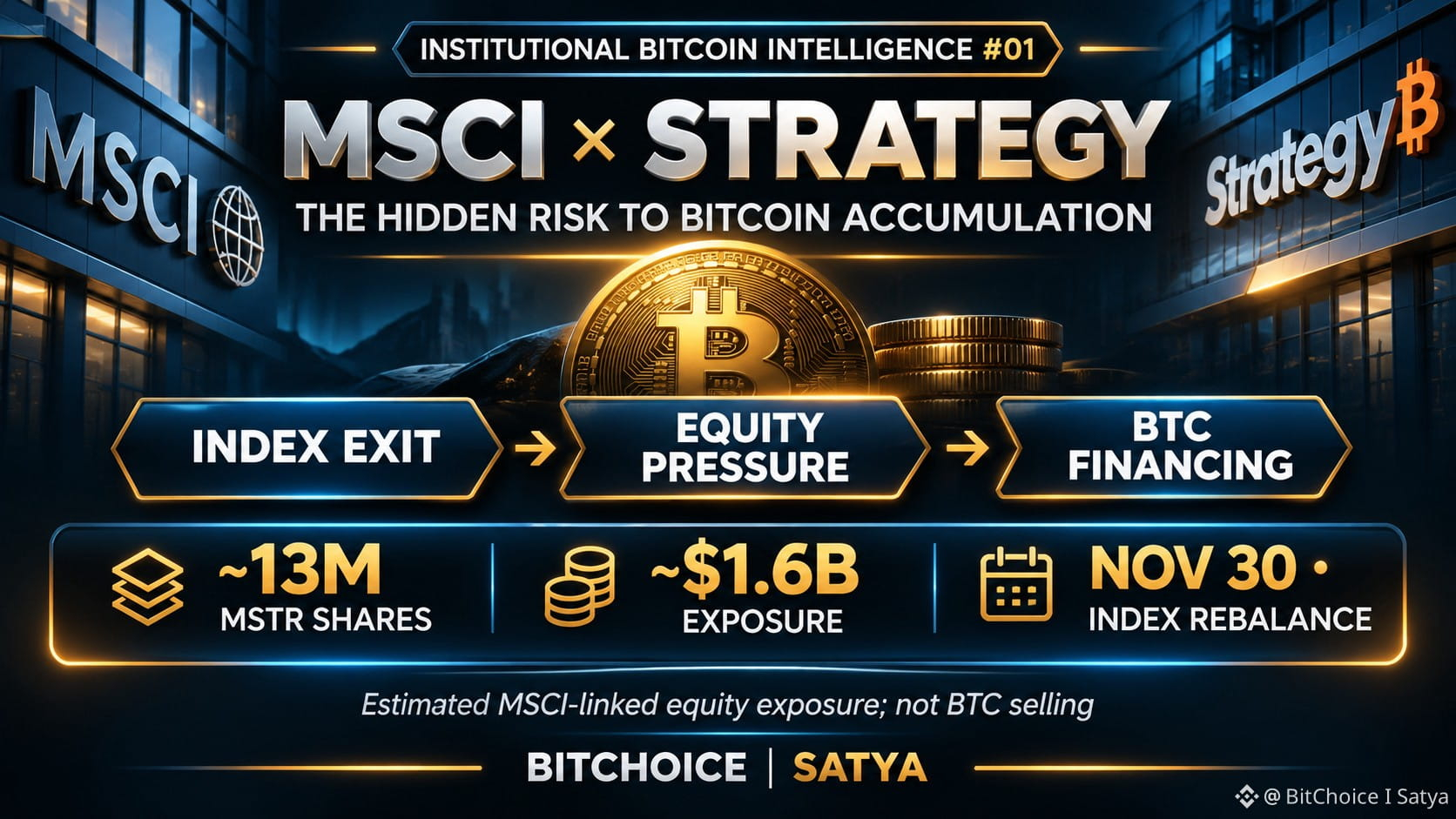
INSTITUTIONAL BITCOIN INTELLIGENCE 01
MSCI × STRATEGY: THE HIDDEN RISK TO BITCOIN ACCUMULATION
MSCI has confirmed that Strategy (MSTR) will exit its equity indexes after the November 30 close.
But the most important consequence may not be the initial selling pressure.
It could be the cost of financing future Bitcoin purchases.
THE PASSIVE CAPITAL SHOCK
Strategy estimates that MSCI-linked funds hold approximately 13 million MSTR shares, representing 3.1% of its basic shares outstanding.
At November 11 prices, that exposure was worth roughly $1.6 billion.
Earlier JPMorgan scenarios projected $2.8 billion in potential MSCI-related outflows, or up to $8.8 billion if other index providers adopted similar exclusions.
These estimates use different assumptions and should not be treated as confirmed selling volumes.
THE BITCOIN CONNECTION
Strategy's accumulation model relies partly on raising capital through equity and debt markets.
When MSTR trades at a substantial premium to its underlying Bitcoin holdings, issuing new shares can help finance additional BTC purchases.
But when that premium contracts, the economics change.
Lower equity valuations can make new share issuance less attractive, potentially slowing future accumulation.
This is where MSCI's decision becomes relevant beyond traditional equity markets.
THREE DIFFERENT RISKS
Index rebalancing: passive funds may need to sell MSTR shares.
Financing pressure: weaker equity demand could affect Strategy's ability to raise capital efficiently.
Bitcoin reserves: index exclusion does not automatically force Strategy to sell BTC.
Strategy reported 850,364 BTC as of November 8.
WHAT TO WATCH
• MSTR liquidity around November 30
• Premium to underlying BTC holdings
• Future financing and index-provider decisions
THE TAKEAWAY
MSCI's decision primarily affects MSTR shares, not Strategy's Bitcoin reserves.
The key risk is whether weaker equity demand could limit future BTC accumulation.
#Bitcoin #MSTR #MSCI #InstitutionalBitcoin #CapitalMarkets $BTC
{spot}(BTCUSDT)
INSTITUTIONAL BITCOIN INTELLIGENCE 01
MSCI × STRATEGY: THE HIDDEN RISK TO BITCOIN ACCUMULATION
MSCI has confirmed that Strategy (MSTR) will exit its equity indexes after the November 30 close.
But the most important consequence may not be the initial selling pressure.
It could be the cost of financing future Bitcoin purchases.
THE PASSIVE CAPITAL SHOCK
Strategy estimates that MSCI-linked funds hold approximately 13 million MSTR shares, representing 3.1% of its basic shares outstanding.
At November 11 prices, that exposure was worth roughly $1.6 billion.
Earlier JPMorgan scenarios projected $2.8 billion in potential MSCI-related outflows, or up to $8.8 billion if other index providers adopted similar exclusions.
These estimates use different assumptions and should not be treated as confirmed selling volumes.
THE BITCOIN CONNECTION
Strategy's accumulation model relies partly on raising capital through equity and debt markets.
When MSTR trades at a substantial premium to its underlying Bitcoin holdings, issuing new shares can help finance additional BTC purchases.
But when that premium contracts, the economics change.
Lower equity valuations can make new share issuance less attractive, potentially slowing future accumulation.
This is where MSCI's decision becomes relevant beyond traditional equity markets.
THREE DIFFERENT RISKS
Index rebalancing: passive funds may need to sell MSTR shares.
Financing pressure: weaker equity demand could affect Strategy's ability to raise capital efficiently.
Bitcoin reserves: index exclusion does not automatically force Strategy to sell BTC.
Strategy reported 850,364 BTC as of November 8.
WHAT TO WATCH
• MSTR liquidity around November 30
• Premium to underlying BTC holdings
• Future financing and index-provider decisions
THE TAKEAWAY
MSCI's decision primarily affects MSTR shares, not Strategy's Bitcoin reserves.
The key risk is whether weaker equity demand could limit future BTC accumulation.
#Bitcoin #MSTR #MSCI #InstitutionalBitcoin #CapitalMarkets $BTC
124
·
--
Debt Deadline Does Not Always Mean Forced Selling.
When a company faces a large cash repurchase obligation on its outstanding debt, many people assume the only way out is to sell assets from the balance sheet. This assumption feels logical, especially in a falling market. However, executive teams usually have far more options than the headlines suggest.
For example, management can negotiate a debt roll-over with existing holders, issue new senior notes at updated yields, or arrange a private equity placement. They can also secure credit facilities from institutional lenders. Because of this, a looming maturity does not automatically translate into selling pressure, since each of these routes lets the company meet its obligation without touching its reserves.
That is why evaluating corporate solvency requires looking at the full spectrum of capital market access. A company with strong lender relationships and open funding channels is in a very different position from one with no alternatives. Instead of reacting to the deadline alone, a careful analyst asks how easily the company can raise fresh capital, and at what cost.
On the other hand, traders who skip this analysis often exit positions too early on fear that never materializes. Weighing the real probabilities rather than the loudest narrative is part of the discipline I apply every day as a master copy trader, and you can follow my trades and copy them directly here: [https://www.binance.com/en/copy-trading/lead-details/5293024773212277505?timeRange=365D](https://www.binance.com/en/copy-trading/lead-details/5293024773212277505?timeRange=365D)
Cashtags: $BTC $ETH $BNB
Hashtags: #CorporateDebt #CapitalMarkets #CryptoTreasury #RiskManagement #Copytrading
Debt Deadline Does Not Always Mean Forced Selling.
When a company faces a large cash repurchase obligation on its outstanding debt, many people assume the only way out is to sell assets from the balance sheet. This assumption feels logical, especially in a falling market. However, executive teams usually have far more options than the headlines suggest.
For example, management can negotiate a debt roll-over with existing holders, issue new senior notes at updated yields, or arrange a private equity placement. They can also secure credit facilities from institutional lenders. Because of this, a looming maturity does not automatically translate into selling pressure, since each of these routes lets the company meet its obligation without touching its reserves.
That is why evaluating corporate solvency requires looking at the full spectrum of capital market access. A company with strong lender relationships and open funding channels is in a very different position from one with no alternatives. Instead of reacting to the deadline alone, a careful analyst asks how easily the company can raise fresh capital, and at what cost.
On the other hand, traders who skip this analysis often exit positions too early on fear that never materializes. Weighing the real probabilities rather than the loudest narrative is part of the discipline I apply every day as a master copy trader, and you can follow my trades and copy them directly here: https://www.binance.com/en/copy-trading/lead-details/5293024773212277505?timeRange=365D
Cashtags: $BTC $ETH $BNB
Hashtags: #CorporateDebt #CapitalMarkets #CryptoTreasury #RiskManagement #Copytrading
My Spot Portfolio
0 / 300
Minimum 10USDT
Public
7D PNL
(USDT)
-43.38
7D ROI
-7.79%
AUM
$513.44
Win Rate
18.75%
79
Log in to explore more content
Join global crypto users on Binance Square
⚡️ Get latest and useful information about crypto.
💬 Trusted by the world’s largest crypto exchange.
👍 Discover real insights from verified creators.
Email / Phone number
Trending Topics
1
#A Packed Week of Earnings and Data Tests Markets
17,493 views
162 Discussing
2
#AnthropicIPOTestsInvestorAppetiteForAI
12,409 views
329 Discussing
3
#HuangReportedlyConsidersReturnToNvidia
33,503 views
514 Discussing
4
#CryptoSelloffTriggersMultipleWhaleLiquidations
321,014 views
2,549 Discussing
5
#BitcoinSpotETFsPost$1.065BOutflowsForThirdStraightWeek
3,817 views
84 Discussing
6
#About64000BitcoinMiningMachinesReportedlyHijacked
28,680 views
349 Discussing
7
#USSpotXRPETFsSeeLargestWeeklyOutflowIn8Months
245,800 views
1,961 Discussing
8
#WillFOMCMinutesReinforceRateHikeExpectations?
93,208 views
998 Discussing
9
#BitcoinActiveSupplyInProfitDropsBelow45%
321,145 views
2,168 Discussing
10
#KavaSaysAbnormalActivityLimitedToKavaLend
211,453 views
1,220 Discussing