

#geopolitics
geopolitics
12.8M views
34,485 Discussing
Hot
Latest
·
--
🌍 Strait of Hormuz: Why Crypto Traders Should Pay Attention
A major geopolitical development is unfolding around the Strait of Hormuz.
Iran proposed reopening the strait within seven days under certain conditions, but President Trump rejected the latest proposal. At the same time, both sides have indicated that further negotiations could still take place this week.
Why does this matter for crypto?
The Strait of Hormuz is a major energy route, so developments around it can affect oil markets, inflation expectations, risk sentiment and overall market volatility.
For crypto traders, I think the important thing is not to immediately assume a bullish or bearish outcome.
Instead, I’m watching:
• Oil market reaction
• Further diplomatic developments
• Broader risk sentiment
• How BTC reacts if volatility increases
Geopolitical headlines can change quickly. The reaction of the markets may be more important than the headline itself.
Are you watching the Hormuz situation as a factor for BTC and the wider crypto market?
#Bitcoin #BTC #Crypto #Markets #Geopolitics
🌍 Strait of Hormuz: Why Crypto Traders Should Pay Attention
A major geopolitical development is unfolding around the Strait of Hormuz.
Iran proposed reopening the strait within seven days under certain conditions, but President Trump rejected the latest proposal. At the same time, both sides have indicated that further negotiations could still take place this week.
Why does this matter for crypto?
The Strait of Hormuz is a major energy route, so developments around it can affect oil markets, inflation expectations, risk sentiment and overall market volatility.
For crypto traders, I think the important thing is not to immediately assume a bullish or bearish outcome.
Instead, I’m watching:
• Oil market reaction
• Further diplomatic developments
• Broader risk sentiment
• How BTC reacts if volatility increases
Geopolitical headlines can change quickly. The reaction of the markets may be more important than the headline itself.
Are you watching the Hormuz situation as a factor for BTC and the wider crypto market?
#Bitcoin #BTC #Crypto #Markets #Geopolitics
A major geopolitical development is unfolding around the Strait of Hormuz.
Iran proposed reopening the strait within seven days under certain conditions, but President Trump rejected the latest proposal. At the same time, both sides have indicated that further negotiations could still take place this week.
Why does this matter for crypto?
The Strait of Hormuz is a major energy route, so developments around it can affect oil markets, inflation expectations, risk sentiment and overall market volatility.
For crypto traders, I think the important thing is not to immediately assume a bullish or bearish outcome.
Instead, I’m watching:
• Oil market reaction
• Further diplomatic developments
• Broader risk sentiment
• How BTC reacts if volatility increases
Geopolitical headlines can change quickly. The reaction of the markets may be more important than the headline itself.
Are you watching the Hormuz situation as a factor for BTC and the wider crypto market?
#Bitcoin #BTC #Crypto #Markets #Geopolitics
2
301

Former U.S. President Donald Trump rejected an Iranian proposal to reopen the Strait of Hormuz during Asian trading hours on Monday. This geopolitical standoff immediately drove crude oil higher and triggered a widespread sell-off across sovereign bond markets. U.S. 2-year Treasury yields rose 5 bps to 4.90%, while 10-year yields reached 5.20%, pulling Japanese and Australian bonds down as well.
This escalation is critical because crude staying above $100 per barrel reignites stubborn inflation risks globally. Combined with recent hawkish signals from the Federal Reserve, the looming energy bottleneck complicates any path toward monetary easing.
In broader financial markets, soaring benchmark yields and a firmer U.S. dollar are tightening global liquidity fast. The sharp repricing of interest rate expectations continues to pressure global equities and increase volatility across asset classes.
For crypto, restricted market liquidity poses a direct near-term challenge for risk assets like $BTC. While elevated yields dampen speculative appetite, sustained stagflation fears could eventually drive alternative hedge demand.
#Geopolitics #OilPrices #Fed
Former U.S. President Donald Trump rejected an Iranian proposal to reopen the Strait of Hormuz during Asian trading hours on Monday. This geopolitical standoff immediately drove crude oil higher and triggered a widespread sell-off across sovereign bond markets. U.S. 2-year Treasury yields rose 5 bps to 4.90%, while 10-year yields reached 5.20%, pulling Japanese and Australian bonds down as well.
This escalation is critical because crude staying above $100 per barrel reignites stubborn inflation risks globally. Combined with recent hawkish signals from the Federal Reserve, the looming energy bottleneck complicates any path toward monetary easing.
In broader financial markets, soaring benchmark yields and a firmer U.S. dollar are tightening global liquidity fast. The sharp repricing of interest rate expectations continues to pressure global equities and increase volatility across asset classes.
For crypto, restricted market liquidity poses a direct near-term challenge for risk assets like $BTC . While elevated yields dampen speculative appetite, sustained stagflation fears could eventually drive alternative hedge demand.
#Geopolitics #OilPrices #Fed
This escalation is critical because crude staying above $100 per barrel reignites stubborn inflation risks globally. Combined with recent hawkish signals from the Federal Reserve, the looming energy bottleneck complicates any path toward monetary easing.
In broader financial markets, soaring benchmark yields and a firmer U.S. dollar are tightening global liquidity fast. The sharp repricing of interest rate expectations continues to pressure global equities and increase volatility across asset classes.
For crypto, restricted market liquidity poses a direct near-term challenge for risk assets like $BTC . While elevated yields dampen speculative appetite, sustained stagflation fears could eventually drive alternative hedge demand.
#Geopolitics #OilPrices #Fed
139

·
--
Why is Bitcoin falling as Iran risk returns?
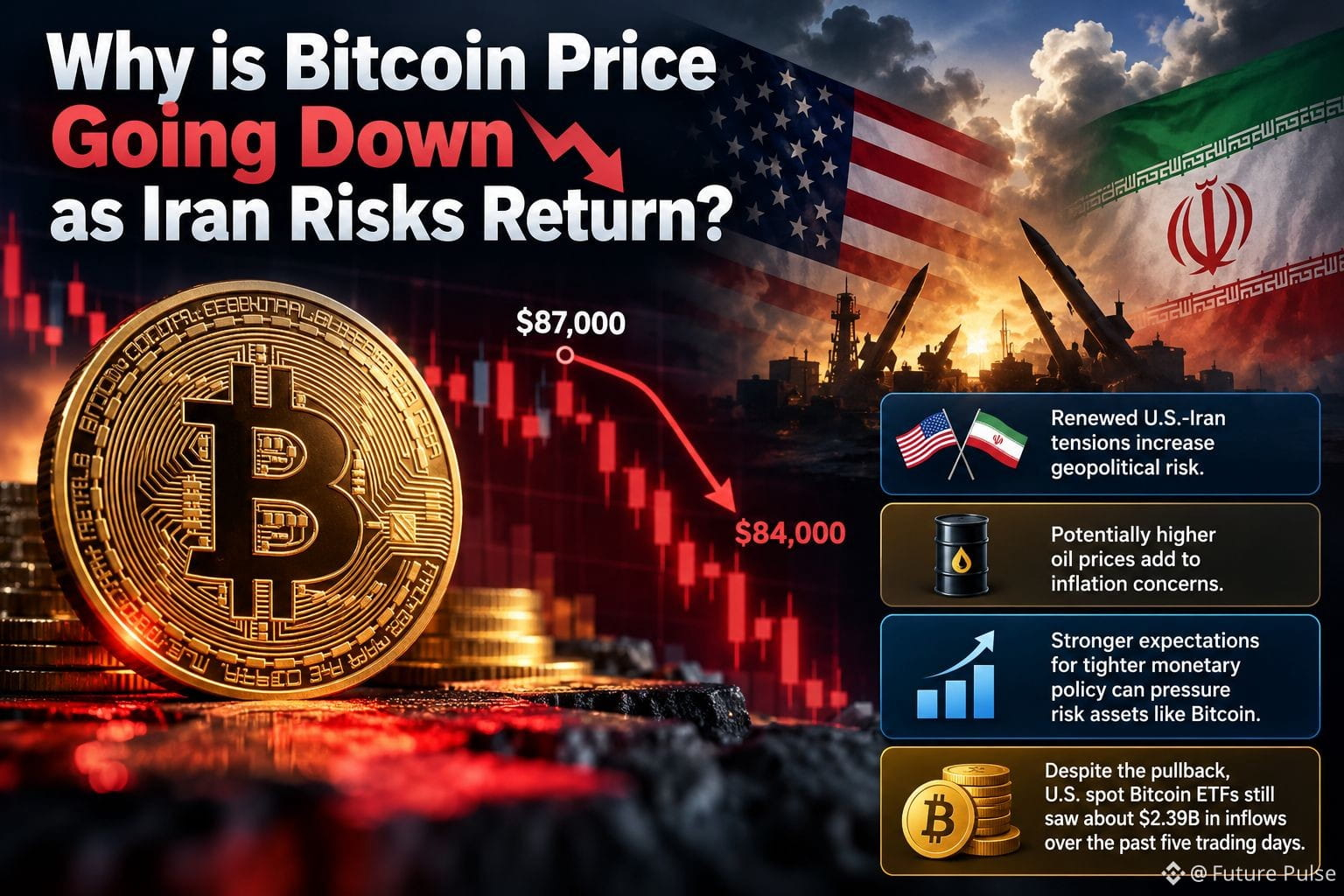
Bitcoin has pulled back below $84K after briefly moving above $87K last week, as renewed U.S.-Iran tensions pushed investors away from risk-sensitive assets.
The key issue is not Iran alone. Geopolitical escalation can lift oil prices, increase inflation concerns and strengthen expectations for tighter monetary policy—conditions that can pressure Bitcoin alongside other risk assets.
Interestingly, U.S. spot Bitcoin ETFs still attracted about $2.39B during the five trading days through Friday, suggesting institutional demand has not disappeared.
For now, the market is balancing two forces: geopolitical risk versus continued demand for BTC. That makes the next reaction around the $84K area particularly important for traders.
$QNT
{future}(QNTUSDT)
$MARSCOIN
{future}(MARSCOINUSDT)
$BTC
{future}(BTCUSDT)
#Geopolitics
#BTC
Why is Bitcoin falling as Iran risk returns?
Bitcoin has pulled back below $84K after briefly moving above $87K last week, as renewed U.S.-Iran tensions pushed investors away from risk-sensitive assets.
The key issue is not Iran alone. Geopolitical escalation can lift oil prices, increase inflation concerns and strengthen expectations for tighter monetary policy—conditions that can pressure Bitcoin alongside other risk assets.
Interestingly, U.S. spot Bitcoin ETFs still attracted about $2.39B during the five trading days through Friday, suggesting institutional demand has not disappeared.
For now, the market is balancing two forces: geopolitical risk versus continued demand for BTC. That makes the next reaction around the $84K area particularly important for traders.
$QNT
$MARSCOIN
$BTC
#Geopolitics
#BTC
Bitcoin has pulled back below $84K after briefly moving above $87K last week, as renewed U.S.-Iran tensions pushed investors away from risk-sensitive assets.
The key issue is not Iran alone. Geopolitical escalation can lift oil prices, increase inflation concerns and strengthen expectations for tighter monetary policy—conditions that can pressure Bitcoin alongside other risk assets.
Interestingly, U.S. spot Bitcoin ETFs still attracted about $2.39B during the five trading days through Friday, suggesting institutional demand has not disappeared.
For now, the market is balancing two forces: geopolitical risk versus continued demand for BTC. That makes the next reaction around the $84K area particularly important for traders.
$QNT
$MARSCOIN
$BTC
#Geopolitics
#BTC
414


·
--
Bullish
Verified
#trumprejectsiranhormuzreopening
Trump Rejects Iran’s Hormuz Proposal: Why Energy Risk Matters for Crypto
The key market question is how soon shipping through Hormuz can become more reliable.
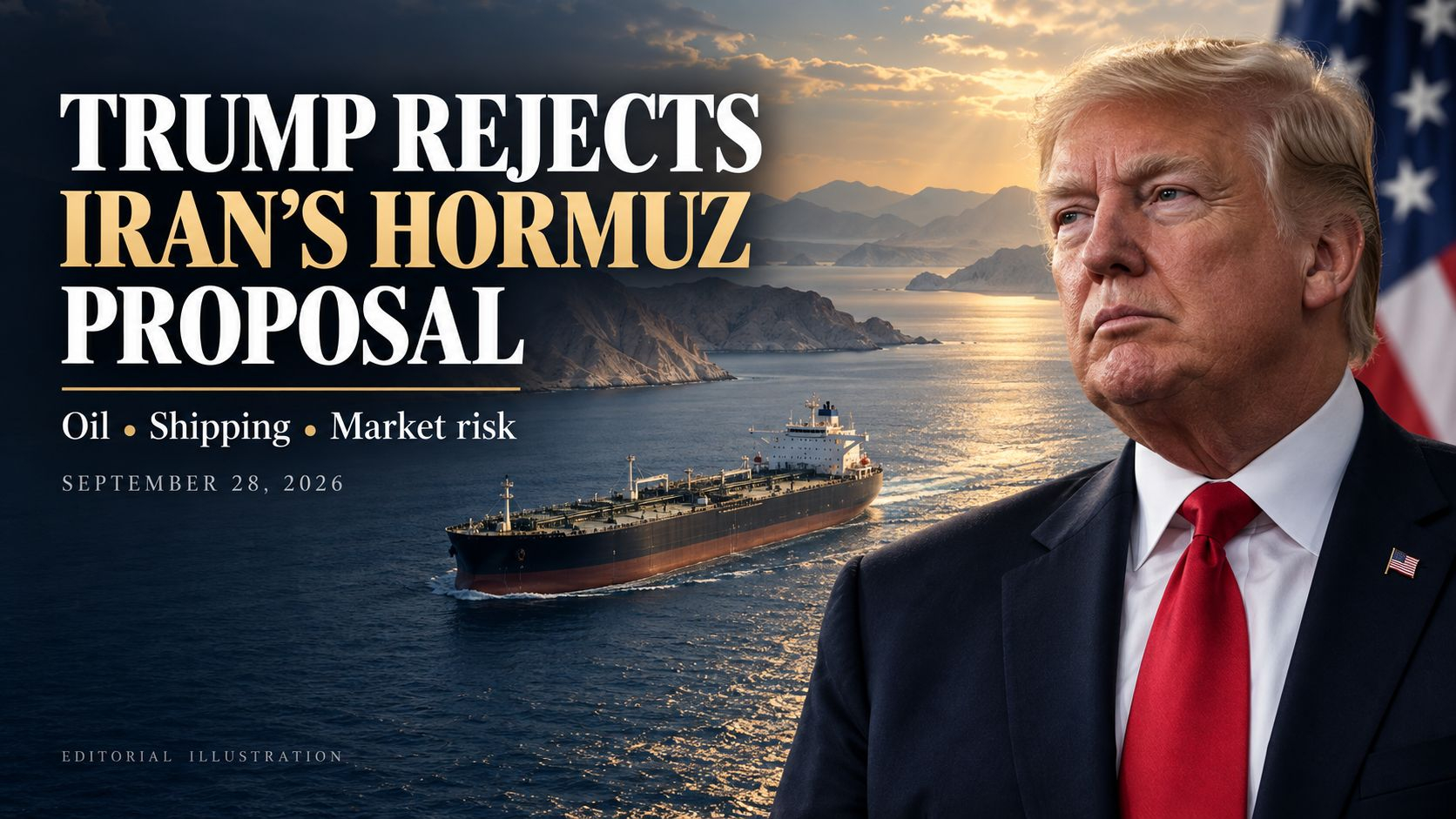
President Donald Trump said on September 26 that he had rejected Iran’s proposal to reopen the Strait of Hormuz and end fighting.
Tehran said its plan, conveyed through Qatari mediators, would begin a seven-day process toward reopening the waterway and pausing regional hostilities if an agreement was reached. On September 27, Iran said it was still awaiting a formal response through mediators.
Trump told Axios on September 27 that he expected further talks with Iran in the coming week.
My take: Persistent shipping uncertainty could keep oil, freight and insurance costs elevated. If that pressure lasts, it could complicate the inflation outlook and expectations for interest rates.
For crypto, the connection runs through liquidity and investor risk appetite. Those effects can vary, so the rejection alone provides little basis for predicting Bitcoin’s next move.
I would watch confirmed diplomatic developments, actual tanker movements and transport costs. Sustained operational improvements would offer stronger evidence of easing supply pressure.
What would give markets greater confidence: progress in negotiations or a sustained recovery in shipping activity?
#TrumpRejectsIranHormuzReopening #Geopolitics #CryptoMarkets $TRUMP $BTW $ONE
{future}(ONEUSDT)
{future}(BTWUSDT)
{future}(TRUMPUSDT)
#trumprejectsiranhormuzreopening
Trump Rejects Iran’s Hormuz Proposal: Why Energy Risk Matters for Crypto
The key market question is how soon shipping through Hormuz can become more reliable.
President Donald Trump said on September 26 that he had rejected Iran’s proposal to reopen the Strait of Hormuz and end fighting.
Tehran said its plan, conveyed through Qatari mediators, would begin a seven-day process toward reopening the waterway and pausing regional hostilities if an agreement was reached. On September 27, Iran said it was still awaiting a formal response through mediators.
Trump told Axios on September 27 that he expected further talks with Iran in the coming week.
My take: Persistent shipping uncertainty could keep oil, freight and insurance costs elevated. If that pressure lasts, it could complicate the inflation outlook and expectations for interest rates.
For crypto, the connection runs through liquidity and investor risk appetite. Those effects can vary, so the rejection alone provides little basis for predicting Bitcoin’s next move.
I would watch confirmed diplomatic developments, actual tanker movements and transport costs. Sustained operational improvements would offer stronger evidence of easing supply pressure.
What would give markets greater confidence: progress in negotiations or a sustained recovery in shipping activity?
#TrumpRejectsIranHormuzReopening #Geopolitics #CryptoMarkets $TRUMP $BTW $ONE
Trump Rejects Iran’s Hormuz Proposal: Why Energy Risk Matters for Crypto
The key market question is how soon shipping through Hormuz can become more reliable.
President Donald Trump said on September 26 that he had rejected Iran’s proposal to reopen the Strait of Hormuz and end fighting.
Tehran said its plan, conveyed through Qatari mediators, would begin a seven-day process toward reopening the waterway and pausing regional hostilities if an agreement was reached. On September 27, Iran said it was still awaiting a formal response through mediators.
Trump told Axios on September 27 that he expected further talks with Iran in the coming week.
My take: Persistent shipping uncertainty could keep oil, freight and insurance costs elevated. If that pressure lasts, it could complicate the inflation outlook and expectations for interest rates.
For crypto, the connection runs through liquidity and investor risk appetite. Those effects can vary, so the rejection alone provides little basis for predicting Bitcoin’s next move.
I would watch confirmed diplomatic developments, actual tanker movements and transport costs. Sustained operational improvements would offer stronger evidence of easing supply pressure.
What would give markets greater confidence: progress in negotiations or a sustained recovery in shipping activity?
#TrumpRejectsIranHormuzReopening #Geopolitics #CryptoMarkets $TRUMP $BTW $ONE
631
Tensions surrounding the Strait of Hormuz escalated this Monday as Iran refused to ease conditions for reopening the vital corridor after US President Donald Trump rejected Tehran's latest proposal. While Trump hinted that talks might resume later this week, European natural gas benchmark futures ticked up following a 9% drop last week.
This geopolitical standoff is critical because the Strait of Hormuz handles roughly one-fifth of global liquefied natural gas supplies. Europe faces mounting pressure to refill low gas inventories ahead of the heating season, raising fears of intensified international competition for energy supplies.
Across macro markets, prolonged energy uncertainty threatens to reignite European inflation and push global bond yields to multi-decade highs. Rising sovereign yields are already squeezing European equities, with the Stoxx 600 lagging behind the S&P 500 as fiscal risks mount.
For crypto, persistent geopolitical tension and elevated yields may restrain risk appetite in the near term. If supply bottlenecks spike inflation and delay monetary easing, $BTC and digital assets could experience tighter liquidity before finding stable footing. ⚡
#Geopolitics #EnergyCrisis #Inflation
Tensions surrounding the Strait of Hormuz escalated this Monday as Iran refused to ease conditions for reopening the vital corridor after US President Donald Trump rejected Tehran's latest proposal. While Trump hinted that talks might resume later this week, European natural gas benchmark futures ticked up following a 9% drop last week.
This geopolitical standoff is critical because the Strait of Hormuz handles roughly one-fifth of global liquefied natural gas supplies. Europe faces mounting pressure to refill low gas inventories ahead of the heating season, raising fears of intensified international competition for energy supplies.
Across macro markets, prolonged energy uncertainty threatens to reignite European inflation and push global bond yields to multi-decade highs. Rising sovereign yields are already squeezing European equities, with the Stoxx 600 lagging behind the S&P 500 as fiscal risks mount.
For crypto, persistent geopolitical tension and elevated yields may restrain risk appetite in the near term. If supply bottlenecks spike inflation and delay monetary easing, $BTC and digital assets could experience tighter liquidity before finding stable footing. ⚡
#Geopolitics #EnergyCrisis #Inflation
This geopolitical standoff is critical because the Strait of Hormuz handles roughly one-fifth of global liquefied natural gas supplies. Europe faces mounting pressure to refill low gas inventories ahead of the heating season, raising fears of intensified international competition for energy supplies.
Across macro markets, prolonged energy uncertainty threatens to reignite European inflation and push global bond yields to multi-decade highs. Rising sovereign yields are already squeezing European equities, with the Stoxx 600 lagging behind the S&P 500 as fiscal risks mount.
For crypto, persistent geopolitical tension and elevated yields may restrain risk appetite in the near term. If supply bottlenecks spike inflation and delay monetary easing, $BTC and digital assets could experience tighter liquidity before finding stable footing. ⚡
#Geopolitics #EnergyCrisis #Inflation
11

·
--
Bearish
🚨 UKRAINE: STRIKES HIT THE INFRASTRUCTURE KEEPING PEOPLE CONNECTED.
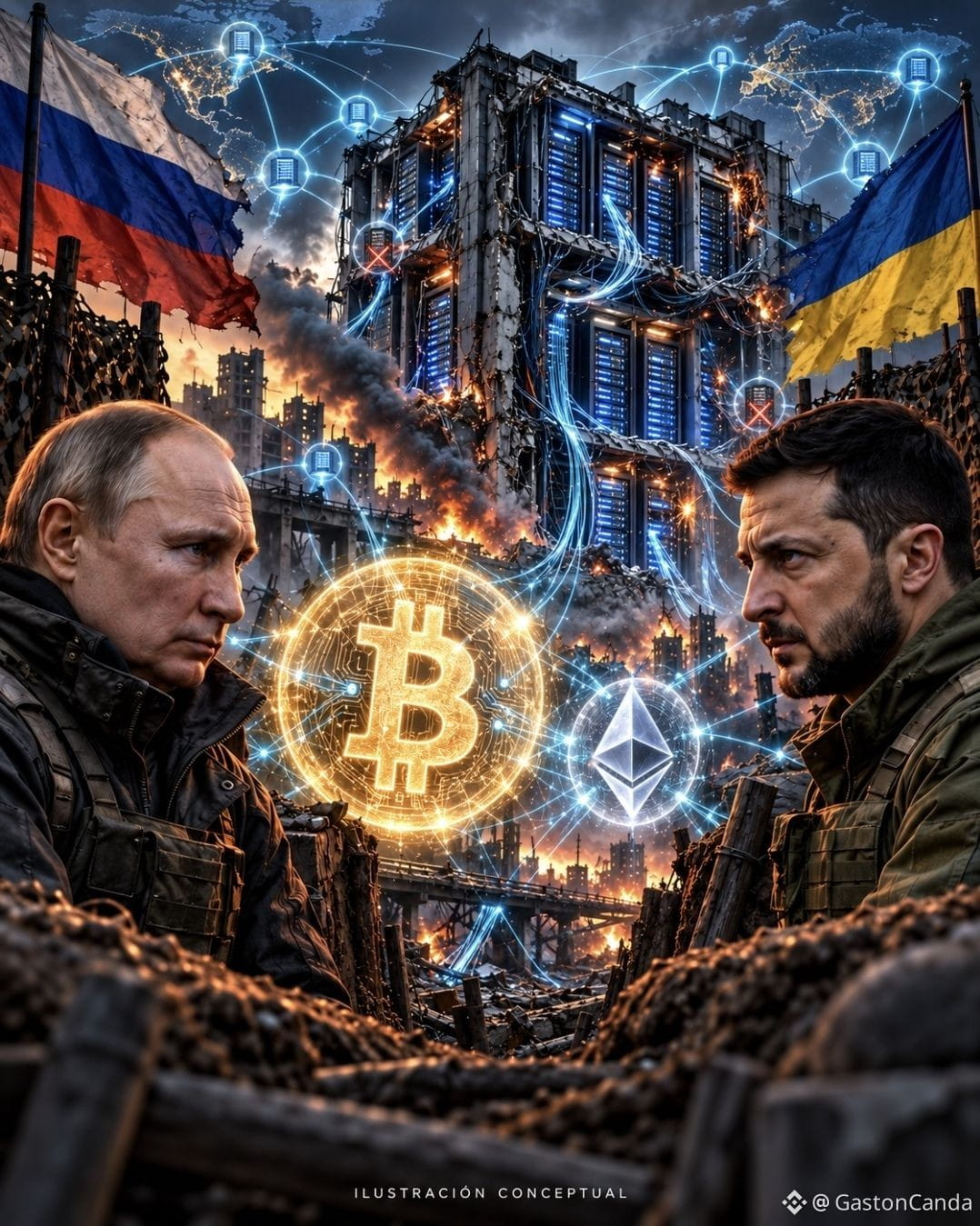
The war is also hitting data centers and telecommunications. When that infrastructure fails, communications, access to services, and emergency alerts are put at risk.
🔴 SITUATION REPORT | SEPTEMBER 27
According to Reuters, Kyivstar, Ukraine’s largest mobile operator, confirmed that its headquarters in Kyiv had been struck, with no casualties at the site.
Ukraine’s Digital Transformation Ministry reported that attacks on data centers over the past week disrupted service for approximately 100,000 households in Kyiv and the surrounding area.
The impact goes beyond a screen showing “No Signal”: families need to stay in touch, and people depend on connectivity for urgent information.
⚠️ THE CONNECTION TO CRYPTO
This situation exposes a fundamental distinction: a network continuing to operate globally does not guarantee that everyone can access it.
Your BTC can remain recorded on the blockchain. Your private keys can remain under your control. But broadcasting a transaction requires a way to communicate with the network.
Self-custody protects your control over your assets. On its own, it cannot solve a loss of connectivity.
My take: the resilience of digital finance is also tested in the physical world. Electricity, servers, cables, and communications are all part of that discussion.
Talking about decentralization also means examining the infrastructure that makes it usable.
💬 If you lost connectivity tomorrow, what alternative would you have to pay for essentials?
#Bitcoin #cripto #Geopolitics
#RussianStrikesHitUkraineDataCenters
$BTC
{future}(BTCUSDT)
🚨 UKRAINE: STRIKES HIT THE INFRASTRUCTURE KEEPING PEOPLE CONNECTED.
The war is also hitting data centers and telecommunications. When that infrastructure fails, communications, access to services, and emergency alerts are put at risk.
🔴 SITUATION REPORT | SEPTEMBER 27
According to Reuters, Kyivstar, Ukraine’s largest mobile operator, confirmed that its headquarters in Kyiv had been struck, with no casualties at the site.
Ukraine’s Digital Transformation Ministry reported that attacks on data centers over the past week disrupted service for approximately 100,000 households in Kyiv and the surrounding area.
The impact goes beyond a screen showing “No Signal”: families need to stay in touch, and people depend on connectivity for urgent information.
⚠️ THE CONNECTION TO CRYPTO
This situation exposes a fundamental distinction: a network continuing to operate globally does not guarantee that everyone can access it.
Your BTC can remain recorded on the blockchain. Your private keys can remain under your control. But broadcasting a transaction requires a way to communicate with the network.
Self-custody protects your control over your assets. On its own, it cannot solve a loss of connectivity.
My take: the resilience of digital finance is also tested in the physical world. Electricity, servers, cables, and communications are all part of that discussion.
Talking about decentralization also means examining the infrastructure that makes it usable.
💬 If you lost connectivity tomorrow, what alternative would you have to pay for essentials?
#Bitcoin #cripto #Geopolitics
#RussianStrikesHitUkraineDataCenters
$BTC
The war is also hitting data centers and telecommunications. When that infrastructure fails, communications, access to services, and emergency alerts are put at risk.
🔴 SITUATION REPORT | SEPTEMBER 27
According to Reuters, Kyivstar, Ukraine’s largest mobile operator, confirmed that its headquarters in Kyiv had been struck, with no casualties at the site.
Ukraine’s Digital Transformation Ministry reported that attacks on data centers over the past week disrupted service for approximately 100,000 households in Kyiv and the surrounding area.
The impact goes beyond a screen showing “No Signal”: families need to stay in touch, and people depend on connectivity for urgent information.
⚠️ THE CONNECTION TO CRYPTO
This situation exposes a fundamental distinction: a network continuing to operate globally does not guarantee that everyone can access it.
Your BTC can remain recorded on the blockchain. Your private keys can remain under your control. But broadcasting a transaction requires a way to communicate with the network.
Self-custody protects your control over your assets. On its own, it cannot solve a loss of connectivity.
My take: the resilience of digital finance is also tested in the physical world. Electricity, servers, cables, and communications are all part of that discussion.
Talking about decentralization also means examining the infrastructure that makes it usable.
💬 If you lost connectivity tomorrow, what alternative would you have to pay for essentials?
#Bitcoin #cripto #Geopolitics
#RussianStrikesHitUkraineDataCenters
$BTC
1
161

·
--
Bearish
🌍 GEOPOLITICAL UPDATE
$BNB
{spot}(BNBUSDT)
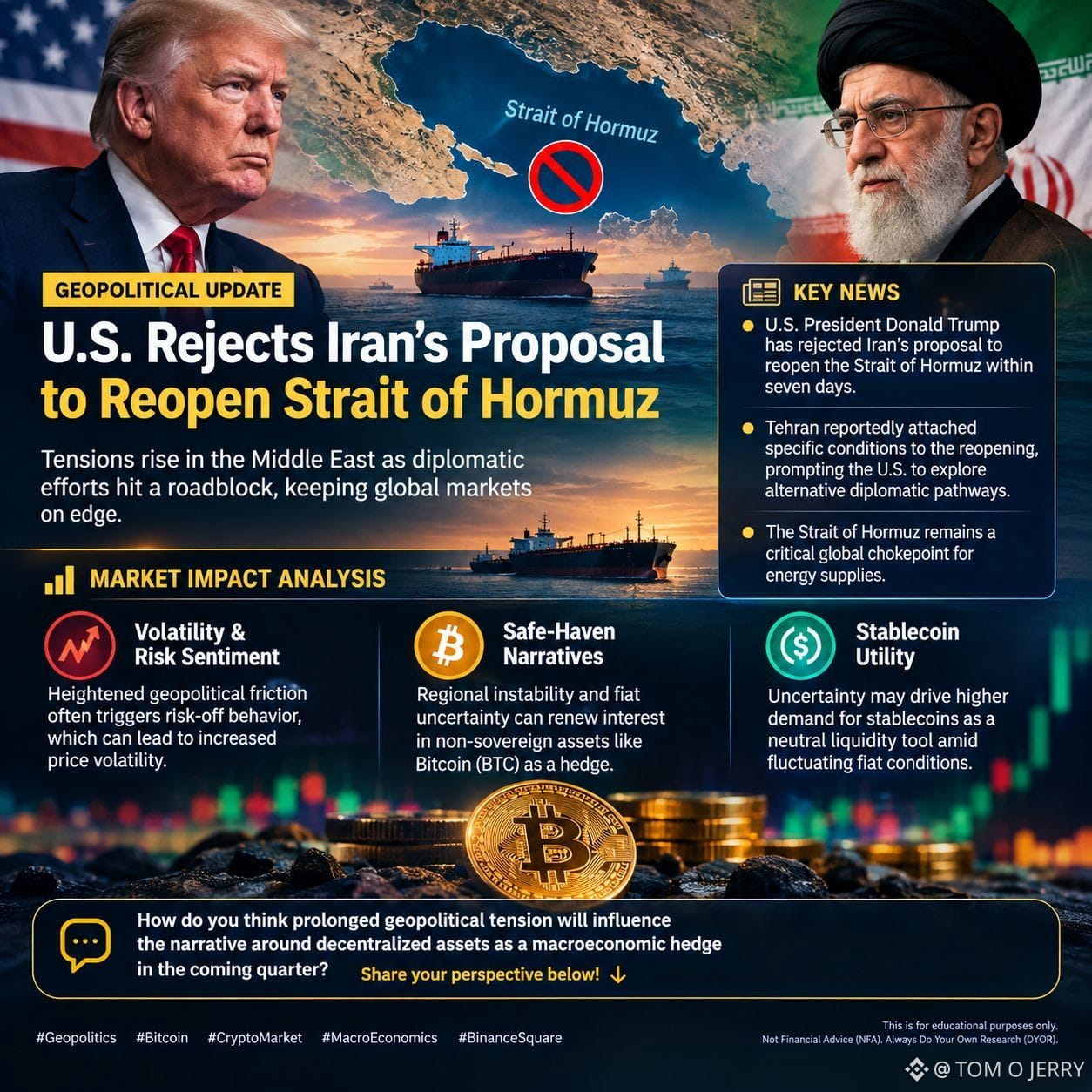
🇺🇸 Trump has rejected Iran’s proposal to reopen the Strait of Hormuz within 7 days and resume talks.
$BTC
{spot}(BTCUSDT)
⚠️ Hormuz remains a key global energy chokepoint, keeping oil and financial markets on alert.
Crypto traders are watching closely. 📉📈
#Crypto #Bitcoin #Geopolitics #Hormuz
🌍 GEOPOLITICAL UPDATE
$BNB
🇺🇸 Trump has rejected Iran’s proposal to reopen the Strait of Hormuz within 7 days and resume talks.
$BTC
⚠️ Hormuz remains a key global energy chokepoint, keeping oil and financial markets on alert.
Crypto traders are watching closely. 📉📈
#Crypto #Bitcoin #Geopolitics #Hormuz
$BNB
🇺🇸 Trump has rejected Iran’s proposal to reopen the Strait of Hormuz within 7 days and resume talks.
$BTC
⚠️ Hormuz remains a key global energy chokepoint, keeping oil and financial markets on alert.
Crypto traders are watching closely. 📉📈
#Crypto #Bitcoin #Geopolitics #Hormuz
1
39
·
--
🌍 U.S. Diplomacy in the Middle East: A Meeting to Watch
U.S. Secretary of State Marco Rubio is scheduled to meet Lebanese Prime Minister Nawaf Salam on Monday in Washington.
Rubio is also scheduled to meet Saudi Foreign Minister Prince Faisal bin Farhan.
These meetings come as regional tensions and diplomatic efforts remain closely watched. Saudi and Lebanese officials have also recently discussed regional developments, security, and economic cooperation.
For crypto markets, I’m watching this mainly through the broader risk-sentiment lens:
• Any new diplomatic developments
• Regional escalation or de-escalation
• Oil and energy-market reactions
• Changes in broader market risk appetite
It’s too early to assume a specific market reaction. The important part is how the situation develops and how global markets respond.
Do you think geopolitical developments are becoming a bigger factor for crypto traders right now?
#Crypto #Bitcoin #BTC #Geopolitics #Markets
🌍 U.S. Diplomacy in the Middle East: A Meeting to Watch
U.S. Secretary of State Marco Rubio is scheduled to meet Lebanese Prime Minister Nawaf Salam on Monday in Washington.
Rubio is also scheduled to meet Saudi Foreign Minister Prince Faisal bin Farhan.
These meetings come as regional tensions and diplomatic efforts remain closely watched. Saudi and Lebanese officials have also recently discussed regional developments, security, and economic cooperation.
For crypto markets, I’m watching this mainly through the broader risk-sentiment lens:
• Any new diplomatic developments
• Regional escalation or de-escalation
• Oil and energy-market reactions
• Changes in broader market risk appetite
It’s too early to assume a specific market reaction. The important part is how the situation develops and how global markets respond.
Do you think geopolitical developments are becoming a bigger factor for crypto traders right now?
#Crypto #Bitcoin #BTC #Geopolitics #Markets
U.S. Secretary of State Marco Rubio is scheduled to meet Lebanese Prime Minister Nawaf Salam on Monday in Washington.
Rubio is also scheduled to meet Saudi Foreign Minister Prince Faisal bin Farhan.
These meetings come as regional tensions and diplomatic efforts remain closely watched. Saudi and Lebanese officials have also recently discussed regional developments, security, and economic cooperation.
For crypto markets, I’m watching this mainly through the broader risk-sentiment lens:
• Any new diplomatic developments
• Regional escalation or de-escalation
• Oil and energy-market reactions
• Changes in broader market risk appetite
It’s too early to assume a specific market reaction. The important part is how the situation develops and how global markets respond.
Do you think geopolitical developments are becoming a bigger factor for crypto traders right now?
#Crypto #Bitcoin #BTC #Geopolitics #Markets
1
55

GEOPOLITICAL FRICTION STIRS AS US REJECTS IRAN PROPOSAL WHILE $BTC WATCHES MACRO RISK! ⚡ 🚨
Macro volatility is stirring as Washington rejects Tehran's latest proposal ahead of scheduled talks this week. 📊 Qatari mediators are pushing hard for concessions, but Iranian officials refuse to alter their core position on nuclear terms.
When diplomatic friction spikes around major geopolitical catalysts, smart money actively reevaluates risk exposure across global order books. 🛡️ Shifts in global sentiment can trigger swift liquidity sweeps in macro-sensitive assets.
💡 Expect heightened market sensitivity as these key negotiations approach their deadline. 💬 How are you structuring your risk ahead of this diplomatic outcome? 👇
⚠️ Not financial advice. Always manage your risk. 🛡️
🏷️ #BTC #Macro #Geopolitics #Crypto #MarketNews
⚡ 🎯
GEOPOLITICAL FRICTION STIRS AS US REJECTS IRAN PROPOSAL WHILE $BTC WATCHES MACRO RISK! ⚡ 🚨
Macro volatility is stirring as Washington rejects Tehran's latest proposal ahead of scheduled talks this week. 📊 Qatari mediators are pushing hard for concessions, but Iranian officials refuse to alter their core position on nuclear terms.
When diplomatic friction spikes around major geopolitical catalysts, smart money actively reevaluates risk exposure across global order books. 🛡️ Shifts in global sentiment can trigger swift liquidity sweeps in macro-sensitive assets.
💡 Expect heightened market sensitivity as these key negotiations approach their deadline. 💬 How are you structuring your risk ahead of this diplomatic outcome? 👇
⚠️ Not financial advice. Always manage your risk. 🛡️
🏷️ #BTC #Macro #Geopolitics #Crypto #MarketNews
⚡ 🎯
Macro volatility is stirring as Washington rejects Tehran's latest proposal ahead of scheduled talks this week. 📊 Qatari mediators are pushing hard for concessions, but Iranian officials refuse to alter their core position on nuclear terms.
When diplomatic friction spikes around major geopolitical catalysts, smart money actively reevaluates risk exposure across global order books. 🛡️ Shifts in global sentiment can trigger swift liquidity sweeps in macro-sensitive assets.
💡 Expect heightened market sensitivity as these key negotiations approach their deadline. 💬 How are you structuring your risk ahead of this diplomatic outcome? 👇
⚠️ Not financial advice. Always manage your risk. 🛡️
🏷️ #BTC #Macro #Geopolitics #Crypto #MarketNews
⚡ 🎯
20
Former President Donald Trump has officially rejected Iran's proposal for a temporary seven-day reopening of the Strait of Hormuz. This geopolitical standoff escalated over the weekend as Saudi-led coalition forces intercepted Houthi drones targeting Riyadh and missiles aimed at southern energy hubs, including Aramco facilities in Abha and Jazan.
The rejection dashes market hopes for a quick diplomatic resolution and keeps the world's most critical oil transit bottleneck severely constrained. Energy traders are now pricing in a prolonged supply disruption, as actual traffic through Hormuz remains highly vulnerable to military escalation.
Global financial markets reacted swiftly, with both Brent and WTI crude opening up by more than 1%. Elevated oil prices reignite global inflation concerns, strengthening the US Dollar and pushing bond yields higher as central banks may face pressure to maintain tighter monetary policy.
For crypto assets like $BTC, rising energy-driven inflation creates short-term macro headwinds by tightening broader liquidity. In the near term, digital assets will likely remain range-bound until geopolitical risks stabilize.
#OilMarkets #Geopolitics #MacroEconomics
Former President Donald Trump has officially rejected Iran's proposal for a temporary seven-day reopening of the Strait of Hormuz. This geopolitical standoff escalated over the weekend as Saudi-led coalition forces intercepted Houthi drones targeting Riyadh and missiles aimed at southern energy hubs, including Aramco facilities in Abha and Jazan.
The rejection dashes market hopes for a quick diplomatic resolution and keeps the world's most critical oil transit bottleneck severely constrained. Energy traders are now pricing in a prolonged supply disruption, as actual traffic through Hormuz remains highly vulnerable to military escalation.
Global financial markets reacted swiftly, with both Brent and WTI crude opening up by more than 1%. Elevated oil prices reignite global inflation concerns, strengthening the US Dollar and pushing bond yields higher as central banks may face pressure to maintain tighter monetary policy.
For crypto assets like $BTC , rising energy-driven inflation creates short-term macro headwinds by tightening broader liquidity. In the near term, digital assets will likely remain range-bound until geopolitical risks stabilize.
#OilMarkets #Geopolitics #MacroEconomics
The rejection dashes market hopes for a quick diplomatic resolution and keeps the world's most critical oil transit bottleneck severely constrained. Energy traders are now pricing in a prolonged supply disruption, as actual traffic through Hormuz remains highly vulnerable to military escalation.
Global financial markets reacted swiftly, with both Brent and WTI crude opening up by more than 1%. Elevated oil prices reignite global inflation concerns, strengthening the US Dollar and pushing bond yields higher as central banks may face pressure to maintain tighter monetary policy.
For crypto assets like $BTC , rising energy-driven inflation creates short-term macro headwinds by tightening broader liquidity. In the near term, digital assets will likely remain range-bound until geopolitical risks stabilize.
#OilMarkets #Geopolitics #MacroEconomics
8

·
--
Bullish
Russia strikes Kyivstar headquarters as pressure on Ukraine’s digital infrastructure grows
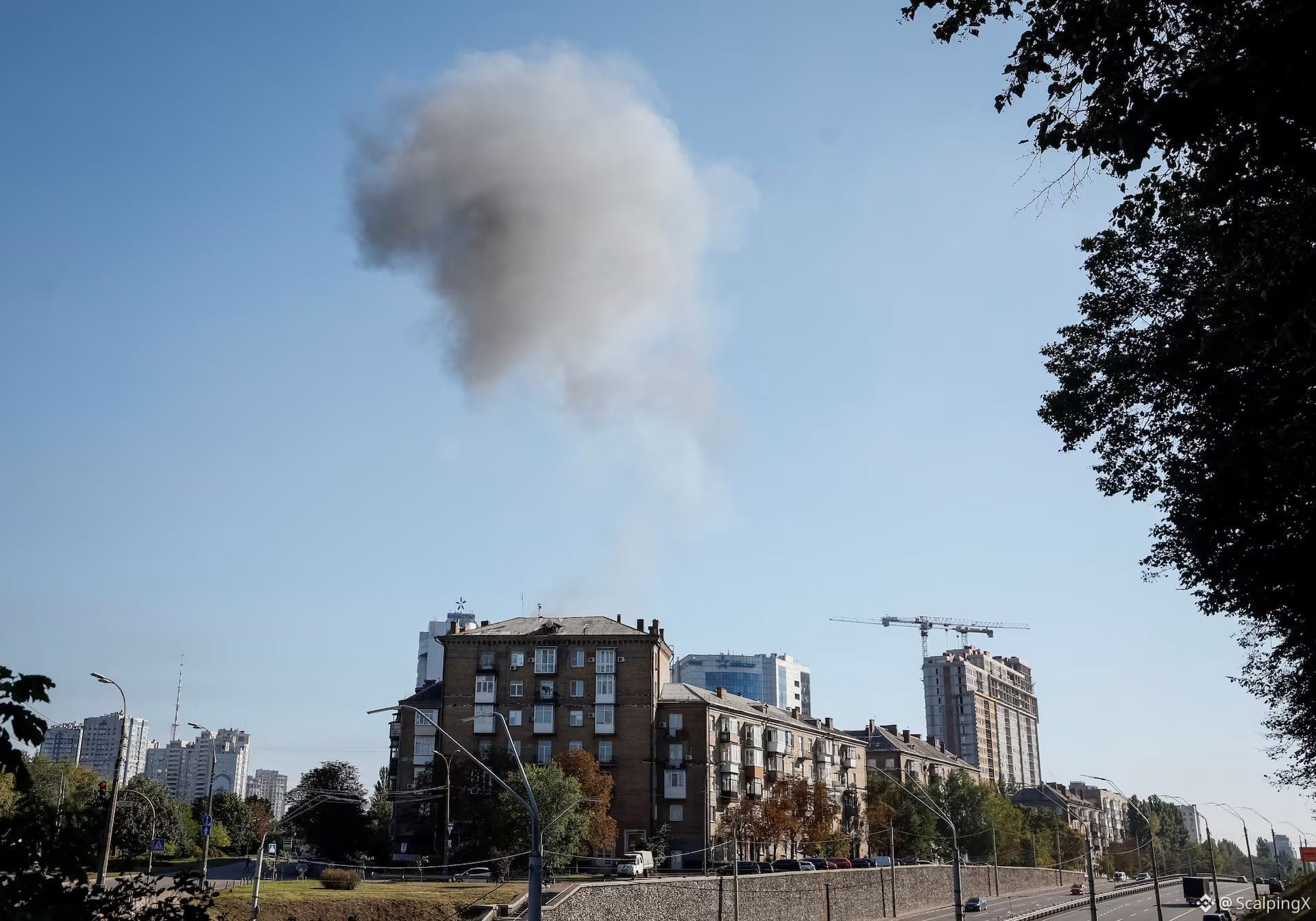
📡 The Kyiv headquarters of Kyivstar, Ukraine’s largest mobile operator, was struck on September 27. The company said there were no employee casualties and damage was still being assessed, with no nationwide network outage reported.
🏢 The incident forms part of a broader series of attacks on telecom and data-center infrastructure. Another Kyivstar facility was hit earlier in September, while recent strikes on digital infrastructure disrupted internet access for around 100,000 households in Kyiv and surrounding areas during the week.
⚠️ Russia also claimed it struck a Vodafone Ukraine data center, though Vodafone has not confirmed this. The pattern points to rising operational risks for connectivity and data infrastructure, while the immediate impact remains localized and has not yet translated into a significant shock for global markets.
#Geopolitics $BNB
Russia strikes Kyivstar headquarters as pressure on Ukraine’s digital infrastructure grows
📡 The Kyiv headquarters of Kyivstar, Ukraine’s largest mobile operator, was struck on September 27. The company said there were no employee casualties and damage was still being assessed, with no nationwide network outage reported.
🏢 The incident forms part of a broader series of attacks on telecom and data-center infrastructure. Another Kyivstar facility was hit earlier in September, while recent strikes on digital infrastructure disrupted internet access for around 100,000 households in Kyiv and surrounding areas during the week.
⚠️ Russia also claimed it struck a Vodafone Ukraine data center, though Vodafone has not confirmed this. The pattern points to rising operational risks for connectivity and data infrastructure, while the immediate impact remains localized and has not yet translated into a significant shock for global markets.
#Geopolitics $BNB
📡 The Kyiv headquarters of Kyivstar, Ukraine’s largest mobile operator, was struck on September 27. The company said there were no employee casualties and damage was still being assessed, with no nationwide network outage reported.
🏢 The incident forms part of a broader series of attacks on telecom and data-center infrastructure. Another Kyivstar facility was hit earlier in September, while recent strikes on digital infrastructure disrupted internet access for around 100,000 households in Kyiv and surrounding areas during the week.
⚠️ Russia also claimed it struck a Vodafone Ukraine data center, though Vodafone has not confirmed this. The pattern points to rising operational risks for connectivity and data infrastructure, while the immediate impact remains localized and has not yet translated into a significant shock for global markets.
#Geopolitics $BNB
69

·
--
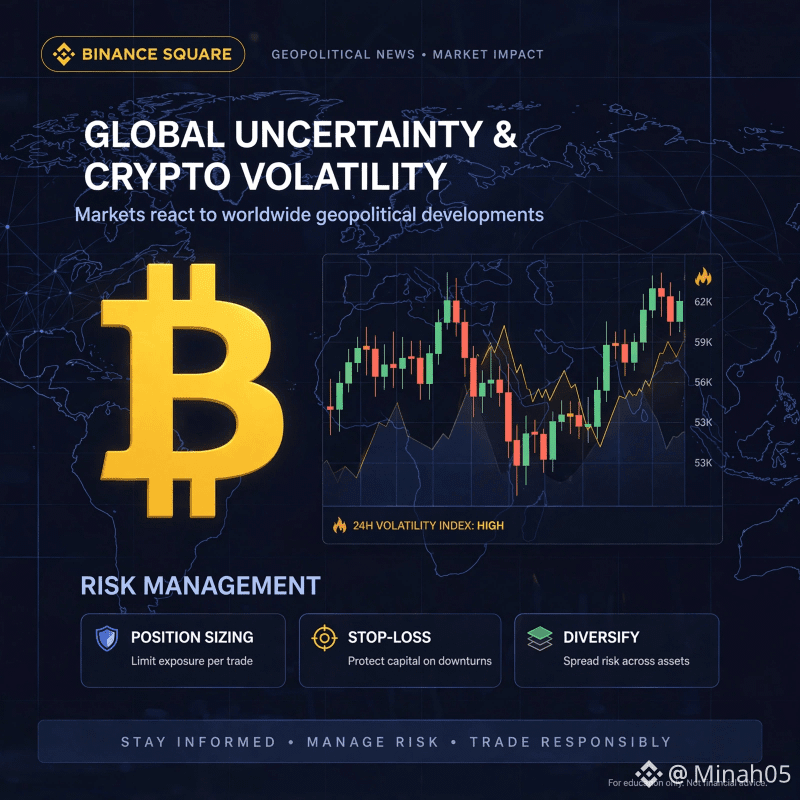
Geopolitical news is heating up🔥 and markets hate uncertainty📉 Whenever headlines spike we see the same pattern in crypto volatility goes up📈 and leverage gets flushed💥
No need to panic just stay prepared🧘♂️
Don't trade the headline📰 News moves fast and often reverses so avoid FOMO longs or panic shorts in the first 30 to 60 minutes⏳
Risk comes first🛡️ Reduce leverage tighten your stop losses and keep a stablecoin reserve ready for opportunities💰
Watch what actually moves crypto👀 Keep an eye on $BTC dominance stablecoin inflows and outflows and traditional signals like Oil🛢️ Gold🥇 and DXY 💵 they often react first
And filter your news🔍 Follow only 2 to 3 credible sources Rumors on social media are not confirmed facts always verify before you trade✅
In times like this capital preservation is a strategy in itself💎
How are you positioning your portfolio this week Defensive🛡️ or buying the dip📉👇
#Geopolitics #RiskManagement #BTC #TradingTips
Geopolitical news is heating up🔥 and markets hate uncertainty📉 Whenever headlines spike we see the same pattern in crypto volatility goes up📈 and leverage gets flushed💥
No need to panic just stay prepared🧘♂️
Don't trade the headline📰 News moves fast and often reverses so avoid FOMO longs or panic shorts in the first 30 to 60 minutes⏳
Risk comes first🛡️ Reduce leverage tighten your stop losses and keep a stablecoin reserve ready for opportunities💰
Watch what actually moves crypto👀 Keep an eye on $BTC dominance stablecoin inflows and outflows and traditional signals like Oil🛢️ Gold🥇 and DXY 💵 they often react first
And filter your news🔍 Follow only 2 to 3 credible sources Rumors on social media are not confirmed facts always verify before you trade✅
In times like this capital preservation is a strategy in itself💎
How are you positioning your portfolio this week Defensive🛡️ or buying the dip📉👇
#Geopolitics #RiskManagement #BTC #TradingTips
No need to panic just stay prepared🧘♂️
Don't trade the headline📰 News moves fast and often reverses so avoid FOMO longs or panic shorts in the first 30 to 60 minutes⏳
Risk comes first🛡️ Reduce leverage tighten your stop losses and keep a stablecoin reserve ready for opportunities💰
Watch what actually moves crypto👀 Keep an eye on $BTC dominance stablecoin inflows and outflows and traditional signals like Oil🛢️ Gold🥇 and DXY 💵 they often react first
And filter your news🔍 Follow only 2 to 3 credible sources Rumors on social media are not confirmed facts always verify before you trade✅
In times like this capital preservation is a strategy in itself💎
How are you positioning your portfolio this week Defensive🛡️ or buying the dip📉👇
#Geopolitics #RiskManagement #BTC #TradingTips
70
According to Saudi Arabia's Al Arabiya network citing Iran's Fars News Agency, Iranian forces launched a naval cruise missile at a vessel navigating an unauthorized route in the Strait of Hormuz. This direct military action marks a sharp escalation in one of the world's most critical maritime corridors.
The Strait of Hormuz handles roughly a fifth of global petroleum transit. Any physical disruption or heightened risk of naval strikes immediately threatens energy supply chains, reviving fears of stagflation and complicating global central bank easing cycles.
In traditional markets, this escalation is likely to trigger an immediate risk premium on crude oil prices and push safe-haven demand into gold and the US dollar. Conversely, equities and sovereign bonds may face selling pressure if inflation expectations rebound.
For crypto assets, heightened geopolitical turmoil typically sparks short-term volatility as capital retreats to cash. If tension spreads, $BTC could experience choppy consolidation before reasserting its narrative as a non-sovereign hedge.
#Geopolitics #CrudeOil #MacroEconomy
According to Saudi Arabia's Al Arabiya network citing Iran's Fars News Agency, Iranian forces launched a naval cruise missile at a vessel navigating an unauthorized route in the Strait of Hormuz. This direct military action marks a sharp escalation in one of the world's most critical maritime corridors.
The Strait of Hormuz handles roughly a fifth of global petroleum transit. Any physical disruption or heightened risk of naval strikes immediately threatens energy supply chains, reviving fears of stagflation and complicating global central bank easing cycles.
In traditional markets, this escalation is likely to trigger an immediate risk premium on crude oil prices and push safe-haven demand into gold and the US dollar. Conversely, equities and sovereign bonds may face selling pressure if inflation expectations rebound.
For crypto assets, heightened geopolitical turmoil typically sparks short-term volatility as capital retreats to cash. If tension spreads, $BTC could experience choppy consolidation before reasserting its narrative as a non-sovereign hedge.
#Geopolitics #CrudeOil #MacroEconomy
The Strait of Hormuz handles roughly a fifth of global petroleum transit. Any physical disruption or heightened risk of naval strikes immediately threatens energy supply chains, reviving fears of stagflation and complicating global central bank easing cycles.
In traditional markets, this escalation is likely to trigger an immediate risk premium on crude oil prices and push safe-haven demand into gold and the US dollar. Conversely, equities and sovereign bonds may face selling pressure if inflation expectations rebound.
For crypto assets, heightened geopolitical turmoil typically sparks short-term volatility as capital retreats to cash. If tension spreads, $BTC could experience choppy consolidation before reasserting its narrative as a non-sovereign hedge.
#Geopolitics #CrudeOil #MacroEconomy
163

🚨 Geopolitical Watch: Strait of Hormuz Back in Focus 🌍
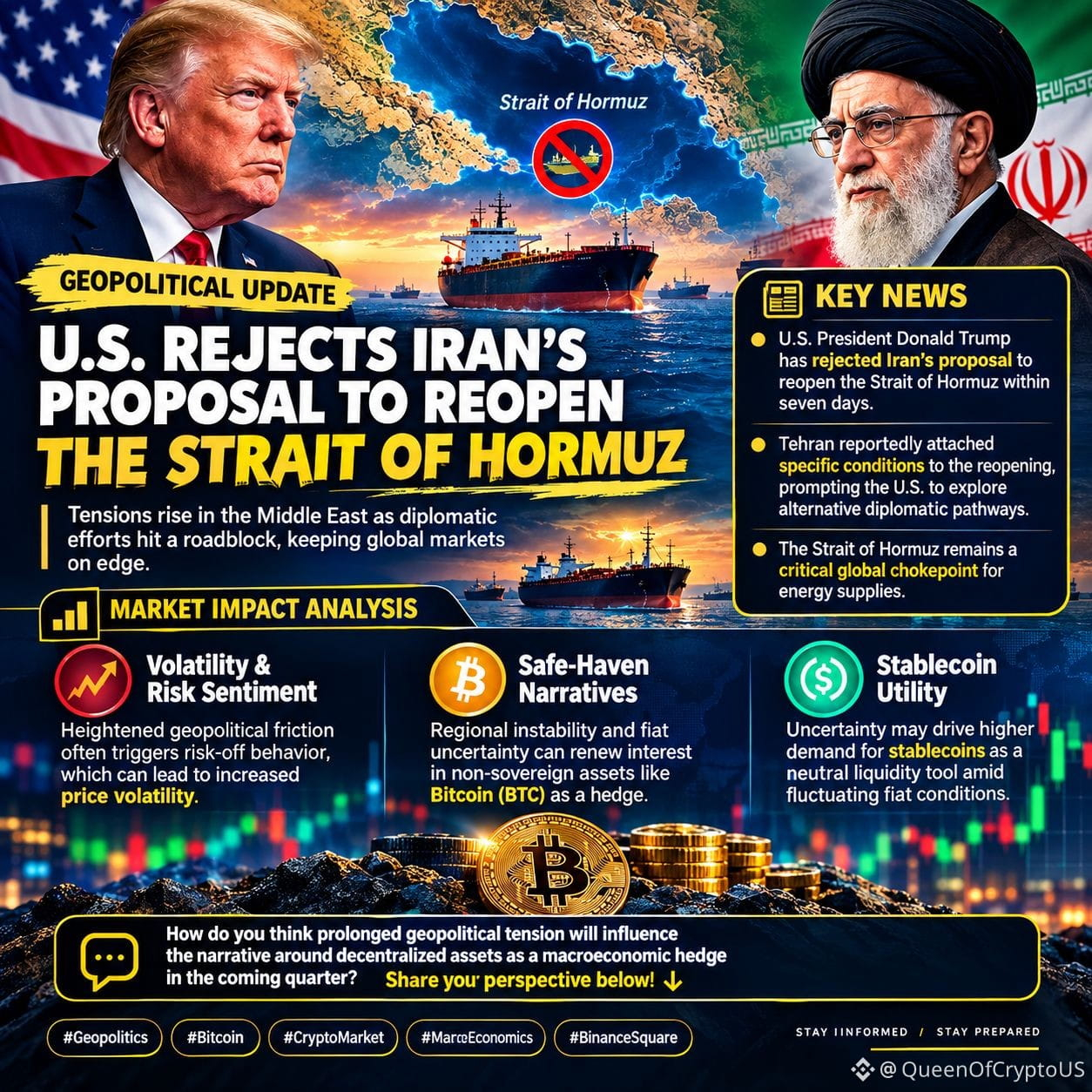
Global markets are once again paying close attention to developments in the Middle East as discussions surrounding the Strait of Hormuz face new obstacles. Energy markets, risk assets, and crypto traders are all watching closely for the next move.
🔎 What’s Happening? • Reports indicate that negotiations regarding the reopening of the Strait of Hormuz have reached another hurdle. • Diplomatic discussions remain active, but key conditions and disagreements continue to delay progress. • As one of the world's most important energy transit routes, any uncertainty surrounding the Strait can quickly influence global market sentiment.
📈 Potential Crypto Market Effects 🔸 Market Volatility
Geopolitical uncertainty often increases short-term volatility across stocks, commodities, and digital assets.
🔸 Bitcoin Narrative
Periods of global uncertainty frequently reignite discussions around Bitcoin as an independent, non-sovereign asset.
🔸 Stablecoin Demand
Traders may rely more heavily on stablecoins for liquidity management and capital preservation during uncertain market conditions.
💡 Market Insight Smart traders focus on risk management, liquidity, and market structure rather than emotional reactions to headlines.
💬 Your Take? Could prolonged geopolitical uncertainty strengthen the long-term case for decentralized assets, or will it increase overall market caution?
👇 Share your thoughts below.
#Geopolitics #Bitcoin #CryptoTrading #CryptoMarket #BTC
{spot}(BTCUSDT)
{future}(GPSUSDT)
{spot}(NVDABUSDT)
🚨 Geopolitical Watch: Strait of Hormuz Back in Focus 🌍
Global markets are once again paying close attention to developments in the Middle East as discussions surrounding the Strait of Hormuz face new obstacles. Energy markets, risk assets, and crypto traders are all watching closely for the next move.
🔎 What’s Happening? • Reports indicate that negotiations regarding the reopening of the Strait of Hormuz have reached another hurdle. • Diplomatic discussions remain active, but key conditions and disagreements continue to delay progress. • As one of the world's most important energy transit routes, any uncertainty surrounding the Strait can quickly influence global market sentiment.
📈 Potential Crypto Market Effects 🔸 Market Volatility
Geopolitical uncertainty often increases short-term volatility across stocks, commodities, and digital assets.
🔸 Bitcoin Narrative
Periods of global uncertainty frequently reignite discussions around Bitcoin as an independent, non-sovereign asset.
🔸 Stablecoin Demand
Traders may rely more heavily on stablecoins for liquidity management and capital preservation during uncertain market conditions.
💡 Market Insight Smart traders focus on risk management, liquidity, and market structure rather than emotional reactions to headlines.
💬 Your Take? Could prolonged geopolitical uncertainty strengthen the long-term case for decentralized assets, or will it increase overall market caution?
👇 Share your thoughts below.
#Geopolitics #Bitcoin #CryptoTrading #CryptoMarket #BTC
Global markets are once again paying close attention to developments in the Middle East as discussions surrounding the Strait of Hormuz face new obstacles. Energy markets, risk assets, and crypto traders are all watching closely for the next move.
🔎 What’s Happening? • Reports indicate that negotiations regarding the reopening of the Strait of Hormuz have reached another hurdle. • Diplomatic discussions remain active, but key conditions and disagreements continue to delay progress. • As one of the world's most important energy transit routes, any uncertainty surrounding the Strait can quickly influence global market sentiment.
📈 Potential Crypto Market Effects 🔸 Market Volatility
Geopolitical uncertainty often increases short-term volatility across stocks, commodities, and digital assets.
🔸 Bitcoin Narrative
Periods of global uncertainty frequently reignite discussions around Bitcoin as an independent, non-sovereign asset.
🔸 Stablecoin Demand
Traders may rely more heavily on stablecoins for liquidity management and capital preservation during uncertain market conditions.
💡 Market Insight Smart traders focus on risk management, liquidity, and market structure rather than emotional reactions to headlines.
💬 Your Take? Could prolonged geopolitical uncertainty strengthen the long-term case for decentralized assets, or will it increase overall market caution?
👇 Share your thoughts below.
#Geopolitics #Bitcoin #CryptoTrading #CryptoMarket #BTC
2
405
Following the rejection of Iran's latest proposal, US President Donald Trump stated via Axios that indirect talks could resume this week, possibly by Monday. While mediators like Qatar attempt to facilitate diplomacy, sharp divisions remain over Strait of Hormuz maritime tensions versus US nuclear demands.
This potential dialogue is critical as markets monitor escalating Middle Eastern geopolitical friction. Trump noted Iran seeks a deal but set demands too high, leaving significant uncertainty over whether renewed talks can resolve core disputes.
For broader financial markets, diplomatic progress could ease crude oil supply risks and lower geopolitical risk premiums. Conversely, prolonged impasse risks pushing energy costs higher, keeping sovereign yields volatile and supporting defensive flows into the US Dollar.
Crypto assets will likely mirror these broad macro sentiment swings. De-escalation would support market liquidity and aid $BTC momentum, while prolonged geopolitical stress could trigger short-term risk-off pressure across digital assets.
#Geopolitics #Iran #MacroMarkets
Following the rejection of Iran's latest proposal, US President Donald Trump stated via Axios that indirect talks could resume this week, possibly by Monday. While mediators like Qatar attempt to facilitate diplomacy, sharp divisions remain over Strait of Hormuz maritime tensions versus US nuclear demands.
This potential dialogue is critical as markets monitor escalating Middle Eastern geopolitical friction. Trump noted Iran seeks a deal but set demands too high, leaving significant uncertainty over whether renewed talks can resolve core disputes.
For broader financial markets, diplomatic progress could ease crude oil supply risks and lower geopolitical risk premiums. Conversely, prolonged impasse risks pushing energy costs higher, keeping sovereign yields volatile and supporting defensive flows into the US Dollar.
Crypto assets will likely mirror these broad macro sentiment swings. De-escalation would support market liquidity and aid $BTC momentum, while prolonged geopolitical stress could trigger short-term risk-off pressure across digital assets.
#Geopolitics #Iran #MacroMarkets
This potential dialogue is critical as markets monitor escalating Middle Eastern geopolitical friction. Trump noted Iran seeks a deal but set demands too high, leaving significant uncertainty over whether renewed talks can resolve core disputes.
For broader financial markets, diplomatic progress could ease crude oil supply risks and lower geopolitical risk premiums. Conversely, prolonged impasse risks pushing energy costs higher, keeping sovereign yields volatile and supporting defensive flows into the US Dollar.
Crypto assets will likely mirror these broad macro sentiment swings. De-escalation would support market liquidity and aid $BTC momentum, while prolonged geopolitical stress could trigger short-term risk-off pressure across digital assets.
#Geopolitics #Iran #MacroMarkets
249

·
--
🚨 BREAKING — IRAN 🇮🇷
According to Jin10, Iranian state media reports that an Iranian military spokesman warned the US could launch another attack, citing what Iran described as Washington’s “bad situation.”
Iran says its forces are prepared to respond and has warned that any new attack could result in greater damage to US forces.
⚠️ Tensions remain elevated as markets watch for any further developments.
#Iran #USA #Geopolitics #BreakingNews
🚨 BREAKING — IRAN 🇮🇷
According to Jin10, Iranian state media reports that an Iranian military spokesman warned the US could launch another attack, citing what Iran described as Washington’s “bad situation.”
Iran says its forces are prepared to respond and has warned that any new attack could result in greater damage to US forces.
⚠️ Tensions remain elevated as markets watch for any further developments.
#Iran #USA #Geopolitics #BreakingNews
According to Jin10, Iranian state media reports that an Iranian military spokesman warned the US could launch another attack, citing what Iran described as Washington’s “bad situation.”
Iran says its forces are prepared to respond and has warned that any new attack could result in greater damage to US forces.
⚠️ Tensions remain elevated as markets watch for any further developments.
#Iran #USA #Geopolitics #BreakingNews
1
9

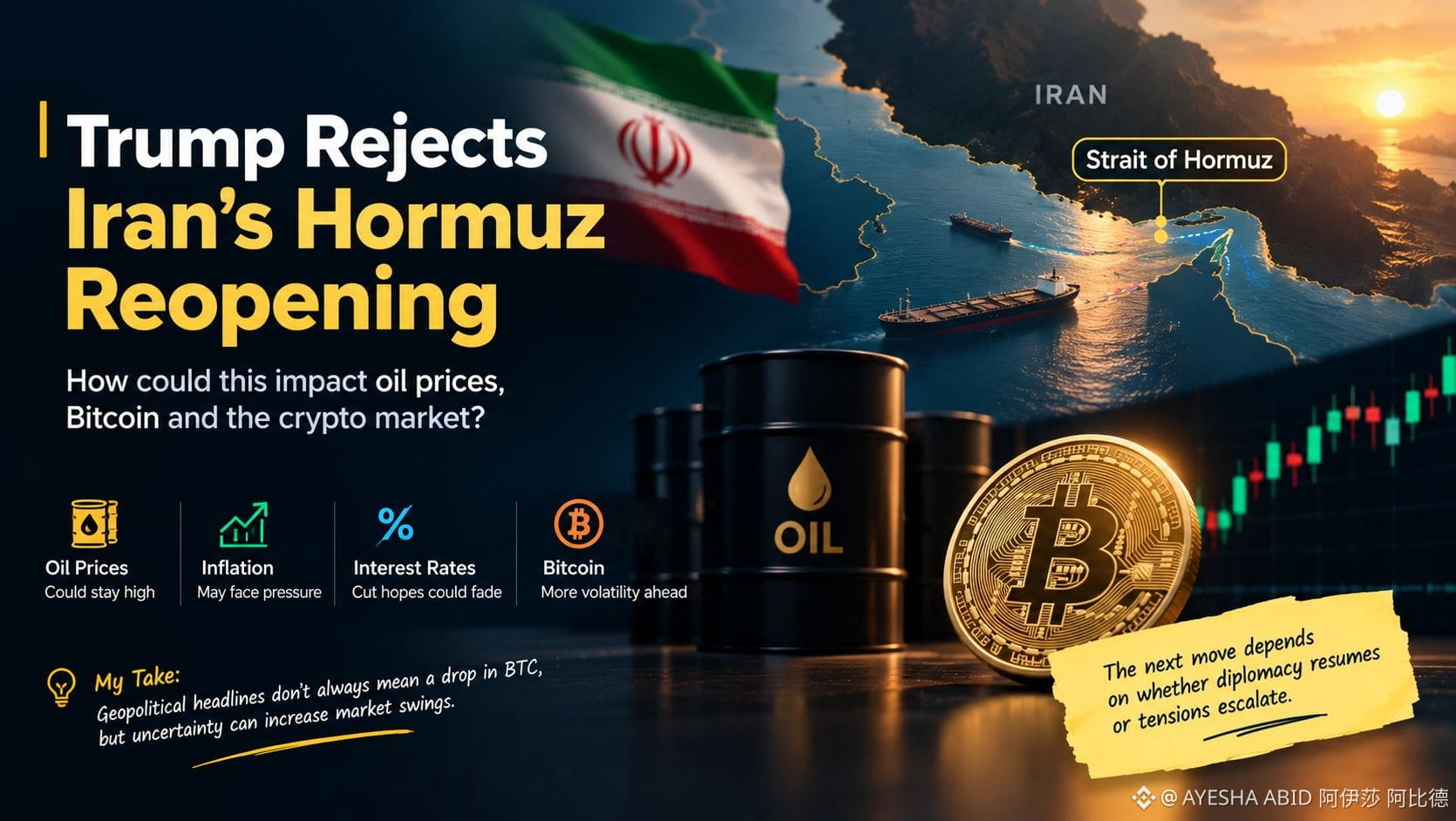
#TrumpRejectsIranHormuzReopening
🚨 One diplomatic decision could send shockwaves through oil, Bitcoin and the wider crypto market.
President Donald Trump rejected Iran’s seven day proposal to reopen the Strait of Hormuz on September 26. The proposal included conditions involving a ceasefire, sanctions relief and the US naval blockade.
Why does this matter for crypto? Hormuz is a critical route for global oil shipments. Continued disruption could keep energy prices elevated, add inflation pressure and complicate expectations for interest rate cuts.
For Bitcoin, the key signals are price action, trading volume and liquidity. If uncertainty triggers risk off sentiment, BTC could face selling pressure. A recovery in risk appetite may support a rebound, but confirmation from volume matters more than headlines alone.
My take: I’m watching oil prices, the dollar and Bitcoin’s reaction together. A geopolitical headline does not automatically mean BTC will fall, but prolonged uncertainty can increase volatility across crypto markets.
$BTC
{future}(BTCUSDT)
The next move depends on whether diplomacy resumes or tensions escalate.
Will Bitcoin hold up under renewed geopolitical pressure, or could rising oil prices weigh on the crypto market?
#Write2Earn #OilPrices #Geopolitics
#TrumpRejectsIranHormuzReopening
🚨 One diplomatic decision could send shockwaves through oil, Bitcoin and the wider crypto market.
President Donald Trump rejected Iran’s seven day proposal to reopen the Strait of Hormuz on September 26. The proposal included conditions involving a ceasefire, sanctions relief and the US naval blockade.
Why does this matter for crypto? Hormuz is a critical route for global oil shipments. Continued disruption could keep energy prices elevated, add inflation pressure and complicate expectations for interest rate cuts.
For Bitcoin, the key signals are price action, trading volume and liquidity. If uncertainty triggers risk off sentiment, BTC could face selling pressure. A recovery in risk appetite may support a rebound, but confirmation from volume matters more than headlines alone.
My take: I’m watching oil prices, the dollar and Bitcoin’s reaction together. A geopolitical headline does not automatically mean BTC will fall, but prolonged uncertainty can increase volatility across crypto markets.
$BTC
The next move depends on whether diplomacy resumes or tensions escalate.
Will Bitcoin hold up under renewed geopolitical pressure, or could rising oil prices weigh on the crypto market?
#Write2Earn #OilPrices #Geopolitics
🚨 One diplomatic decision could send shockwaves through oil, Bitcoin and the wider crypto market.
President Donald Trump rejected Iran’s seven day proposal to reopen the Strait of Hormuz on September 26. The proposal included conditions involving a ceasefire, sanctions relief and the US naval blockade.
Why does this matter for crypto? Hormuz is a critical route for global oil shipments. Continued disruption could keep energy prices elevated, add inflation pressure and complicate expectations for interest rate cuts.
For Bitcoin, the key signals are price action, trading volume and liquidity. If uncertainty triggers risk off sentiment, BTC could face selling pressure. A recovery in risk appetite may support a rebound, but confirmation from volume matters more than headlines alone.
My take: I’m watching oil prices, the dollar and Bitcoin’s reaction together. A geopolitical headline does not automatically mean BTC will fall, but prolonged uncertainty can increase volatility across crypto markets.
$BTC
The next move depends on whether diplomacy resumes or tensions escalate.
Will Bitcoin hold up under renewed geopolitical pressure, or could rising oil prices weigh on the crypto market?
#Write2Earn #OilPrices #Geopolitics
6
729
Iranian Foreign Minister Alaghezi stated on September 27 that Tehran will make zero concessions to the United States regarding its predefined demands. He emphasized that the status of navigation through the Strait of Hormuz strictly depends on Washington meeting Iran's conditions, confirming that Iran is currently awaiting a formalized response from diplomatic intermediaries.
This firm stance reignites direct risks over the world's most critical oil transit chokepoint. With approximately a fifth of global petroleum supply flowing through Hormuz, any operational disruption immediately re-prices geopolitical risk premiums across international energy markets.
Broad financial markets are likely to brace for elevated volatility, with crude oil prices and the US Dollar catching safe-haven bids. Persistent supply threats could stall disinflation trends, complicating monetary easing expectations across major central banks as bond yields react to potential energy cost shocks.
For digital assets, heightened geopolitical friction typically triggers short-term risk aversion and liquidity drain toward defensive assets. If energy tensions escalate further, $BTC and broader crypto markets may face temporary downward pressure before finding support as macro hedges.
#Geopolitics #OilMarket #MacroEconomics
Iranian Foreign Minister Alaghezi stated on September 27 that Tehran will make zero concessions to the United States regarding its predefined demands. He emphasized that the status of navigation through the Strait of Hormuz strictly depends on Washington meeting Iran's conditions, confirming that Iran is currently awaiting a formalized response from diplomatic intermediaries.
This firm stance reignites direct risks over the world's most critical oil transit chokepoint. With approximately a fifth of global petroleum supply flowing through Hormuz, any operational disruption immediately re-prices geopolitical risk premiums across international energy markets.
Broad financial markets are likely to brace for elevated volatility, with crude oil prices and the US Dollar catching safe-haven bids. Persistent supply threats could stall disinflation trends, complicating monetary easing expectations across major central banks as bond yields react to potential energy cost shocks.
For digital assets, heightened geopolitical friction typically triggers short-term risk aversion and liquidity drain toward defensive assets. If energy tensions escalate further, $BTC and broader crypto markets may face temporary downward pressure before finding support as macro hedges.
#Geopolitics #OilMarket #MacroEconomics
This firm stance reignites direct risks over the world's most critical oil transit chokepoint. With approximately a fifth of global petroleum supply flowing through Hormuz, any operational disruption immediately re-prices geopolitical risk premiums across international energy markets.
Broad financial markets are likely to brace for elevated volatility, with crude oil prices and the US Dollar catching safe-haven bids. Persistent supply threats could stall disinflation trends, complicating monetary easing expectations across major central banks as bond yields react to potential energy cost shocks.
For digital assets, heightened geopolitical friction typically triggers short-term risk aversion and liquidity drain toward defensive assets. If energy tensions escalate further, $BTC and broader crypto markets may face temporary downward pressure before finding support as macro hedges.
#Geopolitics #OilMarket #MacroEconomics
224
🚨 GEOPOLITICAL TENSIONS SURGE AS IRAN REJECTS US TERMS: IMPACT ON $BTC RISK FLIGHT! ⚠️
Strait of Hormuz deadlock is escalating fast as talks between Iran and Washington hit a firm wall. 🚨 When vital global energy choke points face prolonged uncertainty, macro liquidity shifts rapidly and tradable assets price in immediate geopolitical volatility. 📊
Smart capital is currently tracking how systemic supply shocks could trigger rapid capital rotation into decentralized hedged assets. 💡 As traditional markets brace for potential disruption, order flow dynamics across high-beta risk assets are entering a high-conviction testing phase. ⚡
💬 Will this macro friction spark a massive safe-haven bid for $BTC or trigger short-term liquidation across markets? 👇
⚠️ Not financial advice. Always manage your risk. 🛡️
🏷️ #BTC #Macro #Crypto #Geopolitics #Bitcoin
🚨 ⚡
🚨 GEOPOLITICAL TENSIONS SURGE AS IRAN REJECTS US TERMS: IMPACT ON $BTC RISK FLIGHT! ⚠️
Strait of Hormuz deadlock is escalating fast as talks between Iran and Washington hit a firm wall. 🚨 When vital global energy choke points face prolonged uncertainty, macro liquidity shifts rapidly and tradable assets price in immediate geopolitical volatility. 📊
Smart capital is currently tracking how systemic supply shocks could trigger rapid capital rotation into decentralized hedged assets. 💡 As traditional markets brace for potential disruption, order flow dynamics across high-beta risk assets are entering a high-conviction testing phase. ⚡
💬 Will this macro friction spark a massive safe-haven bid for $BTC or trigger short-term liquidation across markets? 👇
⚠️ Not financial advice. Always manage your risk. 🛡️
🏷️ #BTC #Macro #Crypto #Geopolitics #Bitcoin
🚨 ⚡
Strait of Hormuz deadlock is escalating fast as talks between Iran and Washington hit a firm wall. 🚨 When vital global energy choke points face prolonged uncertainty, macro liquidity shifts rapidly and tradable assets price in immediate geopolitical volatility. 📊
Smart capital is currently tracking how systemic supply shocks could trigger rapid capital rotation into decentralized hedged assets. 💡 As traditional markets brace for potential disruption, order flow dynamics across high-beta risk assets are entering a high-conviction testing phase. ⚡
💬 Will this macro friction spark a massive safe-haven bid for $BTC or trigger short-term liquidation across markets? 👇
⚠️ Not financial advice. Always manage your risk. 🛡️
🏷️ #BTC #Macro #Crypto #Geopolitics #Bitcoin
🚨 ⚡
16

🚨BREAKING:
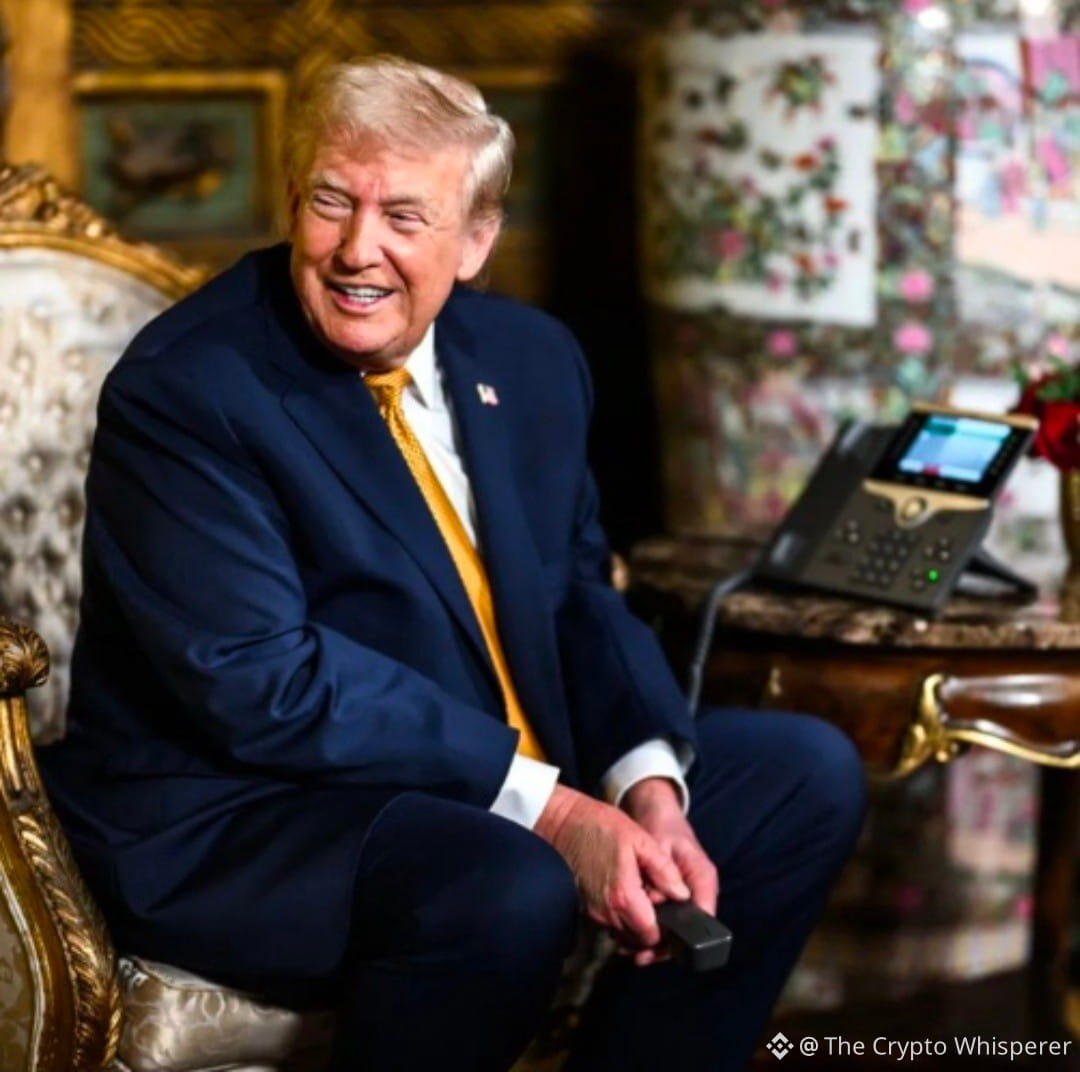
U.S. President Donald Trump has rejected Iran’s proposal to reopen the Strait of Hormuz and halt regional fighting within seven days.
Iran’s plan reportedly involved lifting the U.S. naval blockade, easing oil sanctions and observing a ceasefire. Trump said he rejected the proposal, while tensions around the critical oil-shipping route remain elevated.
The development could keep pressure on global energy markets as uncertainty over Hormuz continues.
#StraitOfHormuz #Oil #Geopolitics #MiddleEast
$TRUMP
{future}(TRUMPUSDT)
🚨BREAKING:
U.S. President Donald Trump has rejected Iran’s proposal to reopen the Strait of Hormuz and halt regional fighting within seven days.
Iran’s plan reportedly involved lifting the U.S. naval blockade, easing oil sanctions and observing a ceasefire. Trump said he rejected the proposal, while tensions around the critical oil-shipping route remain elevated.
The development could keep pressure on global energy markets as uncertainty over Hormuz continues.
#StraitOfHormuz #Oil #Geopolitics #MiddleEast
$TRUMP
U.S. President Donald Trump has rejected Iran’s proposal to reopen the Strait of Hormuz and halt regional fighting within seven days.
Iran’s plan reportedly involved lifting the U.S. naval blockade, easing oil sanctions and observing a ceasefire. Trump said he rejected the proposal, while tensions around the critical oil-shipping route remain elevated.
The development could keep pressure on global energy markets as uncertainty over Hormuz continues.
#StraitOfHormuz #Oil #Geopolitics #MiddleEast
$TRUMP
21
Log in to explore more content
Join global crypto users on Binance Square
⚡️ Get latest and useful information about crypto.
💬 Trusted by the world’s largest crypto exchange.
👍 Discover real insights from verified creators.
Email / Phone number
Trending Topics
1
#ChainlinkLaunchesCCIP2WithEnterpriseVerification
1,581 views
197 Discussing
2
#GoldFallsTo$4144
2,565 views
73 Discussing
3
#QNTFallsOver40%FromMorningHigh
22,225 views
634 Discussing
4
#KospiFalls2.7%SamsungSKHynixDropOver5%
3,997 views
266 Discussing
5
#BitgetCEOConfirms$388MStolenInHack
1,608 views
30 Discussing
6
#BTCFallsBelow$83000
14,136 views
121 Discussing
7
#BitgetDetailsSecurityIncidentTimeline
13,823 views
420 Discussing
8
#BitcoinSpotETFs$2.39BWeeklyNetInflow
5,766 views
26 Discussing
9
#FedProposesPaymentStablecoinRules
43,294 views
789 Discussing
10
#ChinaMayLetAlibabaByteDanceBuyNvidiaChips
45,165 views
798 Discussing