
#educational_post
educational_post
737,581 views
1,132 Discussing
Hot
Latest


Article
🔍 THE CONFIRMATION BIAS: WHY YOU ONLY SEE WHAT CONFIRMS WHAT YOU HOPEYou buy a crypto because you believe in its potential. From that exact moment on, something strange happens in your head, without you even realizing it. You start to see reasons
to be optimistic everywhere. A positive tweet, a slight price increase, a partnership rumor. Everything seems to confirm that you made the right choice. Meanwhile, the negative signals, for their part, slip
almost without leaving a trace. This mechanism has a name in psychology: the confirmation bias. And it affects absolutely everyone, even the most
🔍 THE CONFIRMATION BIAS: WHY YOU ONLY SEE WHAT CONFIRMS WHAT YOU HOPE
You buy a crypto because you believe in its potential. From that exact moment on, something strange happens in your head, without you even realizing it. You start to see reasons
to be optimistic everywhere. A positive tweet, a slight price increase, a partnership rumor. Everything seems to confirm that you made the right choice. Meanwhile, the negative signals, for their part, slip
almost without leaving a trace. This mechanism has a name in psychology: the confirmation bias. And it affects absolutely everyone, even the most
to be optimistic everywhere. A positive tweet, a slight price increase, a partnership rumor. Everything seems to confirm that you made the right choice. Meanwhile, the negative signals, for their part, slip
almost without leaving a trace. This mechanism has a name in psychology: the confirmation bias. And it affects absolutely everyone, even the most
1
237

Article
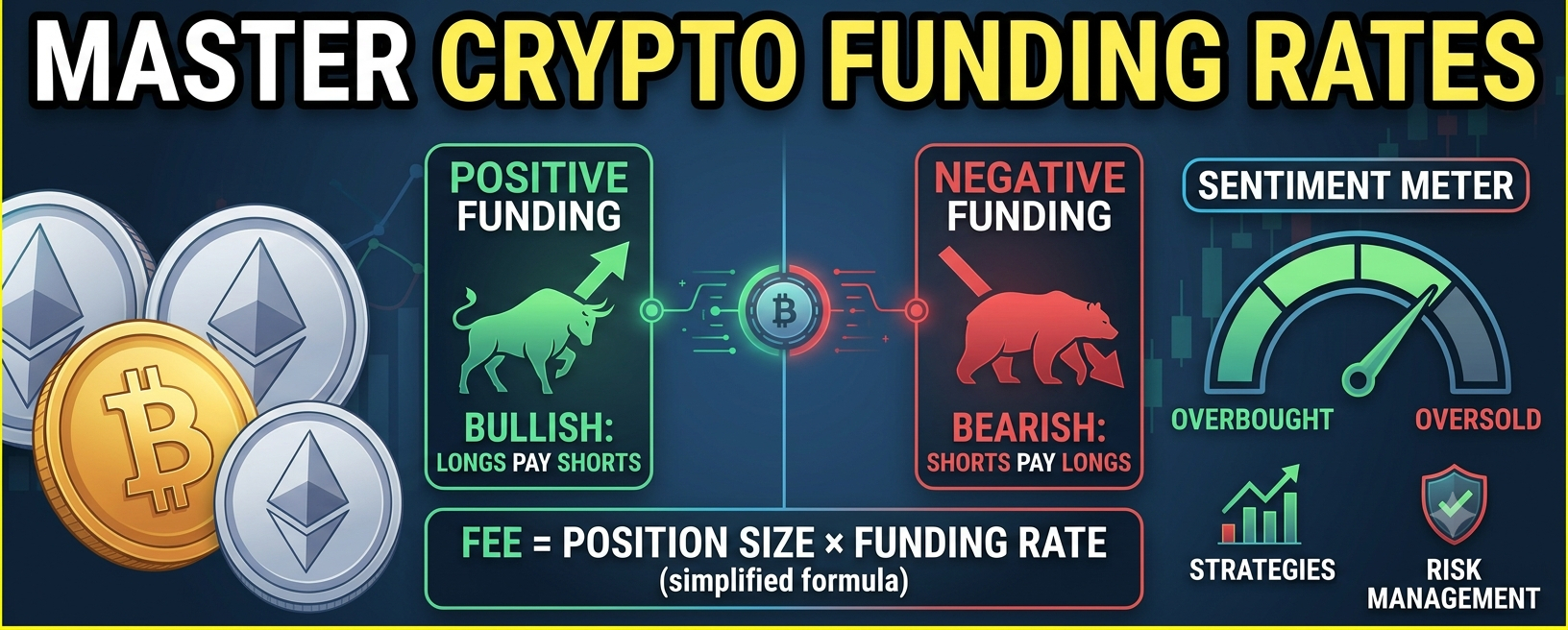
🚀What is Funding Rate in Crypto Trading? A Complete Professional Guide 📈1️⃣ Introduction (Basic Definition) 💡
📊 Funding Rate is a crucial mechanism in Crypto Perpetual Futures trading.
🔄 These are periodic payments exchanged directly between Long and Short traders.
⚡ Its main objective is to keep the Perpetual Futures price closely aligned with the Spot market price.
🎯 The exchange does not collect or keep this fee—it is transferred directly between traders.
📉 Trading without understanding the funding rate can lead to unexpected losses.
2️⃣ Spot vs. Futures Market Difference ⚖️
🛒 Spot Market: You buy or sell actual cryptocurrency for immediate delivery.
📜 Futures Market: You trade contracts based on price predictions without owning the underlying asset.
⏳ Standard Futures contracts have a fixed Expiry Date.
♾️ Perpetual Futures: These contracts have no expiration date; you can hold positions indefinitely.
🔗 Funding Rates are necessary to tether Perpetual Futures prices to Spot prices over time.
3️⃣ Primary Goals of Funding Rate 🎯
🔍 To balance the Spot Market Price (Mark Price) and Futures Price (Index Price).
⚖️ To disincentivize over-leveraged market positions.
🛑 To encourage arbitrage traders to step in and stabilize prices.
🛡️ To prevent artificial pumps, dumps, and extreme market manipulation.
4️⃣ Positive Funding Rate 🟩
📈 Occurs when Futures Price > Spot Price.
🚀 Indicates that the market is predominantly Bullish and dominated by Long positions.
💸 Rule: Long position holders pay fees to Short position holders.
💚 Displayed as a positive percentage (%) on trading interfaces.
⚠️ An excessively high positive rate suggests the market may be overbought.
5️⃣ Negative Funding Rate 🟥
📉 Occurs when Futures Price < Spot Price.
🐻 Indicates that the market is predominantly Bearish and dominated by Short positions.
💸 Rule: Short position holders pay fees to Long position holders.
❤️ Displayed as a negative percentage (-) on trading interfaces.
⚠️ An extremely negative rate suggests the market may be oversold.
6️⃣ Funding Fee Calculation Formula 🧮
🔢 Funding Fee = Position Nominal Value × Funding Rate
📍 Example: If your position size is $10,000:
📈 If Funding Rate = +0.01%
💰 Fee Payment = $10,000 × 0.0001 = $1 Paid
📉 If Funding Rate = -0.01%, you Receive $1 instead.
⚠️ Your leverage level directly scales the overall position size!
7️⃣ Funding Intervals ⏰
⏱️ Funding fees are typically charged or received every 8 hours.
🕒 Standard Schedule: 00:00 UTC, 08:00 UTC, and 16:00 UTC.
⚡ During periods of extreme volatility, some exchanges adjust intervals to every 1 hour.
🔔 Fees apply only to traders who hold open positions at the exact timestamp snapshot.
8️⃣ Market Sentiment Indicators 🧠
📊 Funding Rates serve as a key market sentiment gauge.
🔥 Very High Positive Rate: Indicates heavy long leverage—signals potential pullback or Long Squeeze.
❄️ Very High Negative Rate: Indicates heavy short leverage—signals potential rally or Short Squeeze.
🔍 Experienced traders analyze this data to identify contrarian trade setups.
9️⃣ Role in Long & Short Squeezes 💥
🚀 Short Squeeze: Extreme negative funding drives prices up, forcing shorters to buy back positions to avoid liquidation.
📉 Long Squeeze: Extreme positive funding drives prices down, causing long positions to panic sell and liquidate.
🔟 Trading Strategies Using Funding Rate 🧠
🎯 1. Cash and Carry Arbitrage: Buy spot assets while simultaneously shorting futures to collect risk-free funding fees.
🎯 2. Trend Reversal Signals: Reaching historical extremes often signals an impending price reversal.
🎯 3. Timing Scalps: Closing positions right before the 8-hour snapshot to avoid paying the funding fee.
11️⃣ Risk Management Best Practices 🛡️
❌ Avoid using high leverage when funding rates are extremely high.
📊 Long-term swing traders must account for funding costs, as high fees can eat into profits.
🔍 Track heatmap charts on platforms like Coinglass or exchange analytics dashboards.
💡 Add custom Funding Rate scripts to TradingView charts for real-time monitoring.
12️⃣ Summary & Conclusion 📝
✅ Funding Rates are a fundamental component of perpetual crypto futures trading.
🤝 They balance market incentives between buyers (Longs) and sellers (Shorts).
$VTHO $REZ $PHAROS
#FundingRates #educational_post #Write2Earn
🚀What is Funding Rate in Crypto Trading? A Complete Professional Guide 📈
1️⃣ Introduction (Basic Definition) 💡
📊 Funding Rate is a crucial mechanism in Crypto Perpetual Futures trading.
🔄 These are periodic payments exchanged directly between Long and Short traders.
⚡ Its main objective is to keep the Perpetual Futures price closely aligned with the Spot market price.
🎯 The exchange does not collect or keep this fee—it is transferred directly between traders.
📉 Trading without understanding the funding rate can lead to unexpected losses.
2️⃣ Spot vs. Futures Market Difference ⚖️
🛒 Spot Market: You buy or sell actual cryptocurrency for immediate delivery.
📜 Futures Market: You trade contracts based on price predictions without owning the underlying asset.
⏳ Standard Futures contracts have a fixed Expiry Date.
♾️ Perpetual Futures: These contracts have no expiration date; you can hold positions indefinitely.
🔗 Funding Rates are necessary to tether Perpetual Futures prices to Spot prices over time.
3️⃣ Primary Goals of Funding Rate 🎯
🔍 To balance the Spot Market Price (Mark Price) and Futures Price (Index Price).
⚖️ To disincentivize over-leveraged market positions.
🛑 To encourage arbitrage traders to step in and stabilize prices.
🛡️ To prevent artificial pumps, dumps, and extreme market manipulation.
4️⃣ Positive Funding Rate 🟩
📈 Occurs when Futures Price > Spot Price.
🚀 Indicates that the market is predominantly Bullish and dominated by Long positions.
💸 Rule: Long position holders pay fees to Short position holders.
💚 Displayed as a positive percentage (%) on trading interfaces.
⚠️ An excessively high positive rate suggests the market may be overbought.
5️⃣ Negative Funding Rate 🟥
📉 Occurs when Futures Price < Spot Price.
🐻 Indicates that the market is predominantly Bearish and dominated by Short positions.
💸 Rule: Short position holders pay fees to Long position holders.
❤️ Displayed as a negative percentage (-) on trading interfaces.
⚠️ An extremely negative rate suggests the market may be oversold.
6️⃣ Funding Fee Calculation Formula 🧮
🔢 Funding Fee = Position Nominal Value × Funding Rate
📍 Example: If your position size is $10,000:
📈 If Funding Rate = +0.01%
💰 Fee Payment = $10,000 × 0.0001 = $1 Paid
📉 If Funding Rate = -0.01%, you Receive $1 instead.
⚠️ Your leverage level directly scales the overall position size!
7️⃣ Funding Intervals ⏰
⏱️ Funding fees are typically charged or received every 8 hours.
🕒 Standard Schedule: 00:00 UTC, 08:00 UTC, and 16:00 UTC.
⚡ During periods of extreme volatility, some exchanges adjust intervals to every 1 hour.
🔔 Fees apply only to traders who hold open positions at the exact timestamp snapshot.
8️⃣ Market Sentiment Indicators 🧠
📊 Funding Rates serve as a key market sentiment gauge.
🔥 Very High Positive Rate: Indicates heavy long leverage—signals potential pullback or Long Squeeze.
❄️ Very High Negative Rate: Indicates heavy short leverage—signals potential rally or Short Squeeze.
🔍 Experienced traders analyze this data to identify contrarian trade setups.
9️⃣ Role in Long & Short Squeezes 💥
🚀 Short Squeeze: Extreme negative funding drives prices up, forcing shorters to buy back positions to avoid liquidation.
📉 Long Squeeze: Extreme positive funding drives prices down, causing long positions to panic sell and liquidate.
🔟 Trading Strategies Using Funding Rate 🧠
🎯 1. Cash and Carry Arbitrage: Buy spot assets while simultaneously shorting futures to collect risk-free funding fees.
🎯 2. Trend Reversal Signals: Reaching historical extremes often signals an impending price reversal.
🎯 3. Timing Scalps: Closing positions right before the 8-hour snapshot to avoid paying the funding fee.
11️⃣ Risk Management Best Practices 🛡️
❌ Avoid using high leverage when funding rates are extremely high.
📊 Long-term swing traders must account for funding costs, as high fees can eat into profits.
🔍 Track heatmap charts on platforms like Coinglass or exchange analytics dashboards.
💡 Add custom Funding Rate scripts to TradingView charts for real-time monitoring.
12️⃣ Summary & Conclusion 📝
✅ Funding Rates are a fundamental component of perpetual crypto futures trading.
🤝 They balance market incentives between buyers (Longs) and sellers (Shorts).
$VTHO $REZ $PHAROS
#FundingRates #educational_post #Write2Earn
📊 Funding Rate is a crucial mechanism in Crypto Perpetual Futures trading.
🔄 These are periodic payments exchanged directly between Long and Short traders.
⚡ Its main objective is to keep the Perpetual Futures price closely aligned with the Spot market price.
🎯 The exchange does not collect or keep this fee—it is transferred directly between traders.
📉 Trading without understanding the funding rate can lead to unexpected losses.
2️⃣ Spot vs. Futures Market Difference ⚖️
🛒 Spot Market: You buy or sell actual cryptocurrency for immediate delivery.
📜 Futures Market: You trade contracts based on price predictions without owning the underlying asset.
⏳ Standard Futures contracts have a fixed Expiry Date.
♾️ Perpetual Futures: These contracts have no expiration date; you can hold positions indefinitely.
🔗 Funding Rates are necessary to tether Perpetual Futures prices to Spot prices over time.
3️⃣ Primary Goals of Funding Rate 🎯
🔍 To balance the Spot Market Price (Mark Price) and Futures Price (Index Price).
⚖️ To disincentivize over-leveraged market positions.
🛑 To encourage arbitrage traders to step in and stabilize prices.
🛡️ To prevent artificial pumps, dumps, and extreme market manipulation.
4️⃣ Positive Funding Rate 🟩
📈 Occurs when Futures Price > Spot Price.
🚀 Indicates that the market is predominantly Bullish and dominated by Long positions.
💸 Rule: Long position holders pay fees to Short position holders.
💚 Displayed as a positive percentage (%) on trading interfaces.
⚠️ An excessively high positive rate suggests the market may be overbought.
5️⃣ Negative Funding Rate 🟥
📉 Occurs when Futures Price < Spot Price.
🐻 Indicates that the market is predominantly Bearish and dominated by Short positions.
💸 Rule: Short position holders pay fees to Long position holders.
❤️ Displayed as a negative percentage (-) on trading interfaces.
⚠️ An extremely negative rate suggests the market may be oversold.
6️⃣ Funding Fee Calculation Formula 🧮
🔢 Funding Fee = Position Nominal Value × Funding Rate
📍 Example: If your position size is $10,000:
📈 If Funding Rate = +0.01%
💰 Fee Payment = $10,000 × 0.0001 = $1 Paid
📉 If Funding Rate = -0.01%, you Receive $1 instead.
⚠️ Your leverage level directly scales the overall position size!
7️⃣ Funding Intervals ⏰
⏱️ Funding fees are typically charged or received every 8 hours.
🕒 Standard Schedule: 00:00 UTC, 08:00 UTC, and 16:00 UTC.
⚡ During periods of extreme volatility, some exchanges adjust intervals to every 1 hour.
🔔 Fees apply only to traders who hold open positions at the exact timestamp snapshot.
8️⃣ Market Sentiment Indicators 🧠
📊 Funding Rates serve as a key market sentiment gauge.
🔥 Very High Positive Rate: Indicates heavy long leverage—signals potential pullback or Long Squeeze.
❄️ Very High Negative Rate: Indicates heavy short leverage—signals potential rally or Short Squeeze.
🔍 Experienced traders analyze this data to identify contrarian trade setups.
9️⃣ Role in Long & Short Squeezes 💥
🚀 Short Squeeze: Extreme negative funding drives prices up, forcing shorters to buy back positions to avoid liquidation.
📉 Long Squeeze: Extreme positive funding drives prices down, causing long positions to panic sell and liquidate.
🔟 Trading Strategies Using Funding Rate 🧠
🎯 1. Cash and Carry Arbitrage: Buy spot assets while simultaneously shorting futures to collect risk-free funding fees.
🎯 2. Trend Reversal Signals: Reaching historical extremes often signals an impending price reversal.
🎯 3. Timing Scalps: Closing positions right before the 8-hour snapshot to avoid paying the funding fee.
11️⃣ Risk Management Best Practices 🛡️
❌ Avoid using high leverage when funding rates are extremely high.
📊 Long-term swing traders must account for funding costs, as high fees can eat into profits.
🔍 Track heatmap charts on platforms like Coinglass or exchange analytics dashboards.
💡 Add custom Funding Rate scripts to TradingView charts for real-time monitoring.
12️⃣ Summary & Conclusion 📝
✅ Funding Rates are a fundamental component of perpetual crypto futures trading.
🤝 They balance market incentives between buyers (Longs) and sellers (Shorts).
$VTHO $REZ $PHAROS
#FundingRates #educational_post #Write2Earn
212

·
--
#5 Fatal Errors Every Crypto Trader Should Avoid:
The cryptocurrency market offers constant opportunities, but trading without a solid plan usually ends up costing you. Whether you’re a beginner or you’ve been trading on Binance for a while, controlling these five mistakes will protect your capital and improve your long-term results.
Buying out of FOMO (Fear of missing out): Entering a position in the middle of a bullish peak just because the coin is trending often ends in losses. Wait for support zones, pullbacks, or technical confirmations before taking a position.
Trading without a Stop Loss: A Stop Loss doesn’t cap your profits—it protects your liquidity. Define your maximum risk tolerance level before opening any trade.
Abusing leverage: Using high leverage (x20, x50, or more) dramatically reduces your margin for error. If you trade Futures, prioritize lower leverage (x2 to x5) and manage your margin prudently.
Not diversifying the portfolio: Keeping 100% of your funds in a single narrative or a low-cap altcoin increases your exposure to severe drawdowns. Build a balanced allocation among major assets (like BTC and ETH), projects with solid fundamentals and liquidity in stablecoins.
Letting emotions take over: Impatience after a loss often leads to revenge trading (trading out of spite to recover quickly). Accept controlled losses as part of the process and stick to your original strategy.
💡 Golden rule: In trading, consistency and capital preservation always come before quick profit.
#Binance #cryptouniverseofficial #TradingShot #educational_post #Web3
#5 Fatal Errors Every Crypto Trader Should Avoid:
The cryptocurrency market offers constant opportunities, but trading without a solid plan usually ends up costing you. Whether you’re a beginner or you’ve been trading on Binance for a while, controlling these five mistakes will protect your capital and improve your long-term results.
Buying out of FOMO (Fear of missing out): Entering a position in the middle of a bullish peak just because the coin is trending often ends in losses. Wait for support zones, pullbacks, or technical confirmations before taking a position.
Trading without a Stop Loss: A Stop Loss doesn’t cap your profits—it protects your liquidity. Define your maximum risk tolerance level before opening any trade.
Abusing leverage: Using high leverage (x20, x50, or more) dramatically reduces your margin for error. If you trade Futures, prioritize lower leverage (x2 to x5) and manage your margin prudently.
Not diversifying the portfolio: Keeping 100% of your funds in a single narrative or a low-cap altcoin increases your exposure to severe drawdowns. Build a balanced allocation among major assets (like BTC and ETH), projects with solid fundamentals and liquidity in stablecoins.
Letting emotions take over: Impatience after a loss often leads to revenge trading (trading out of spite to recover quickly). Accept controlled losses as part of the process and stick to your original strategy.
💡 Golden rule: In trading, consistency and capital preservation always come before quick profit.
#Binance #cryptouniverseofficial #TradingShot #educational_post #Web3
The cryptocurrency market offers constant opportunities, but trading without a solid plan usually ends up costing you. Whether you’re a beginner or you’ve been trading on Binance for a while, controlling these five mistakes will protect your capital and improve your long-term results.
Buying out of FOMO (Fear of missing out): Entering a position in the middle of a bullish peak just because the coin is trending often ends in losses. Wait for support zones, pullbacks, or technical confirmations before taking a position.
Trading without a Stop Loss: A Stop Loss doesn’t cap your profits—it protects your liquidity. Define your maximum risk tolerance level before opening any trade.
Abusing leverage: Using high leverage (x20, x50, or more) dramatically reduces your margin for error. If you trade Futures, prioritize lower leverage (x2 to x5) and manage your margin prudently.
Not diversifying the portfolio: Keeping 100% of your funds in a single narrative or a low-cap altcoin increases your exposure to severe drawdowns. Build a balanced allocation among major assets (like BTC and ETH), projects with solid fundamentals and liquidity in stablecoins.
Letting emotions take over: Impatience after a loss often leads to revenge trading (trading out of spite to recover quickly). Accept controlled losses as part of the process and stick to your original strategy.
💡 Golden rule: In trading, consistency and capital preservation always come before quick profit.
#Binance #cryptouniverseofficial #TradingShot #educational_post #Web3
86

·
--
Article
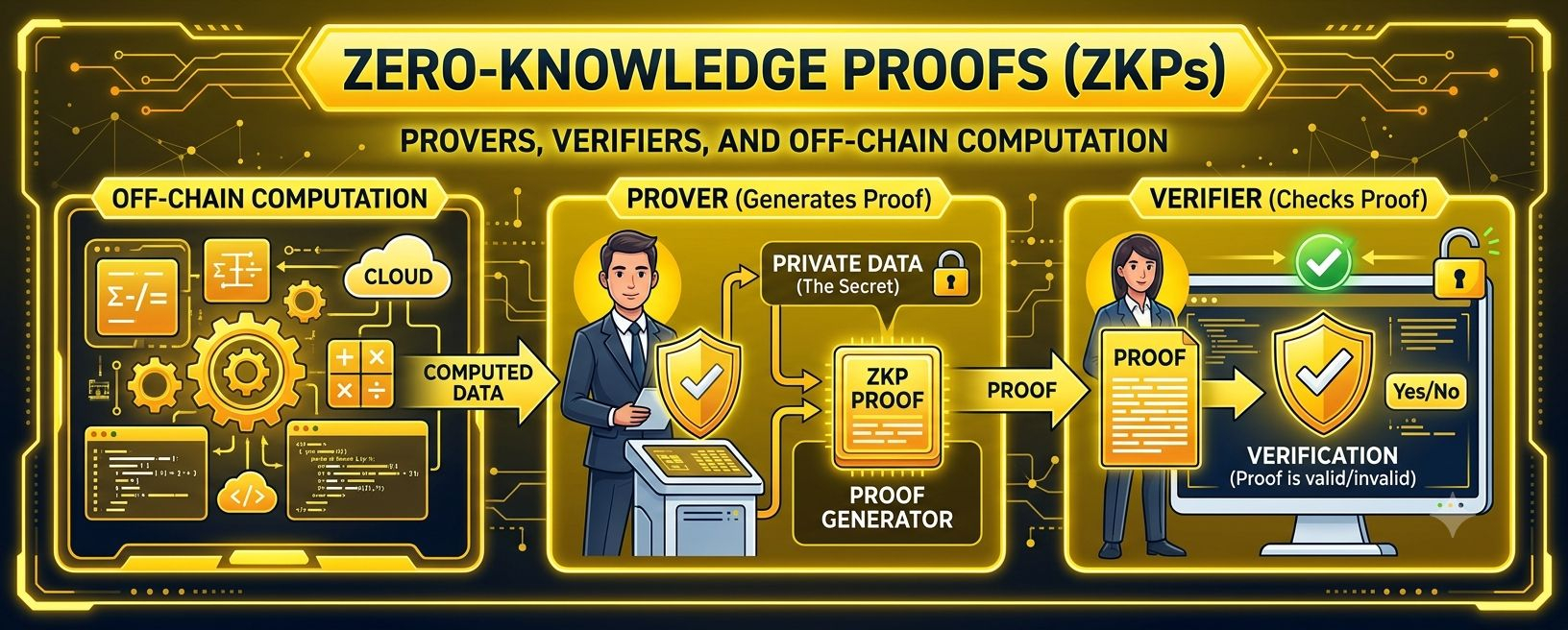
Zero-Knowledge Proofs (ZKPs) — Provers, Verifiers, and Off-Chain ComputationHow can a party prove a computation is correct without revealing the underlying data or re-executing the task?
Zero-Knowledge Proofs (ZKPs) represent a fundamental cryptographic primitive enabling verifiable computing. They allow a Prover to mathematically convince a Verifier that a statement is true without disclosing sensitive information or forcing the Verifier to repeat the underlying execution.
---
The Prover / Verifier Cycle Step-by-Step
1. Computation Execution (Off-Chain)
The Prover executes complex computational work off-chain (e.g., bundling 10,000 rollup transactions into a single state change).
2. Proof Generation
The Prover processes the transaction trace through cryptographic circuit logic to generate a compact, cryptographically secure proof (π).
3. Verification (On-Chain)
The Proof (π) and final state update are submitted to an on-chain smart contract (the Verifier).
4. State Update
The Verifier runs a simple mathematical check on π. If valid, the state is updated instantly, requiring minimal gas compared to re-executing all 10,000 transactions.
---
Comparing Key ZKP Frameworks
Attribute zk-SNARKs zk-STARKs
Full Name Succinct Non-Interactive Argument of Knowledge Scalable Transparent Argument of Knowledge
Proof Size Extremely Small (~200–500 bytes) Larger (~10–100 KB)
Trusted Setup Required? Yes (Historically required multi-party ceremony) No (Transparent, zero trusted setup)
Quantum Resistance Low (Vulnerable to quantum computing algorithms) High (Post-quantum secure)
Verification Cost Constant and extremely low gas cost Higher gas cost due to larger proof size
---
The Core Takeaway
ZKPs shift the computational burden off-chain while keeping security guarantees on-chain. As proving times decrease through hardware acceleration (GPUs and ASICs), ZK technology forms the core infrastructure for scaling zero-trust privacy and Layer-2 rollups.
Why It Matters: ZKPs are the backbone of next-generation scaling solutions—enabling Ethereum to process thousands of transactions per second without sacrificing decentralization or security.
#educational_post #Insights
Zero-Knowledge Proofs (ZKPs) — Provers, Verifiers, and Off-Chain Computation
How can a party prove a computation is correct without revealing the underlying data or re-executing the task?
Zero-Knowledge Proofs (ZKPs) represent a fundamental cryptographic primitive enabling verifiable computing. They allow a Prover to mathematically convince a Verifier that a statement is true without disclosing sensitive information or forcing the Verifier to repeat the underlying execution.
---
The Prover / Verifier Cycle Step-by-Step
1. Computation Execution (Off-Chain)
The Prover executes complex computational work off-chain (e.g., bundling 10,000 rollup transactions into a single state change).
2. Proof Generation
The Prover processes the transaction trace through cryptographic circuit logic to generate a compact, cryptographically secure proof (π).
3. Verification (On-Chain)
The Proof (π) and final state update are submitted to an on-chain smart contract (the Verifier).
4. State Update
The Verifier runs a simple mathematical check on π. If valid, the state is updated instantly, requiring minimal gas compared to re-executing all 10,000 transactions.
---
Comparing Key ZKP Frameworks
Attribute zk-SNARKs zk-STARKs
Full Name Succinct Non-Interactive Argument of Knowledge Scalable Transparent Argument of Knowledge
Proof Size Extremely Small (~200–500 bytes) Larger (~10–100 KB)
Trusted Setup Required? Yes (Historically required multi-party ceremony) No (Transparent, zero trusted setup)
Quantum Resistance Low (Vulnerable to quantum computing algorithms) High (Post-quantum secure)
Verification Cost Constant and extremely low gas cost Higher gas cost due to larger proof size
---
The Core Takeaway
ZKPs shift the computational burden off-chain while keeping security guarantees on-chain. As proving times decrease through hardware acceleration (GPUs and ASICs), ZK technology forms the core infrastructure for scaling zero-trust privacy and Layer-2 rollups.
Why It Matters: ZKPs are the backbone of next-generation scaling solutions—enabling Ethereum to process thousands of transactions per second without sacrificing decentralization or security.
#educational_post #Insights
Zero-Knowledge Proofs (ZKPs) represent a fundamental cryptographic primitive enabling verifiable computing. They allow a Prover to mathematically convince a Verifier that a statement is true without disclosing sensitive information or forcing the Verifier to repeat the underlying execution.
---
The Prover / Verifier Cycle Step-by-Step
1. Computation Execution (Off-Chain)
The Prover executes complex computational work off-chain (e.g., bundling 10,000 rollup transactions into a single state change).
2. Proof Generation
The Prover processes the transaction trace through cryptographic circuit logic to generate a compact, cryptographically secure proof (π).
3. Verification (On-Chain)
The Proof (π) and final state update are submitted to an on-chain smart contract (the Verifier).
4. State Update
The Verifier runs a simple mathematical check on π. If valid, the state is updated instantly, requiring minimal gas compared to re-executing all 10,000 transactions.
---
Comparing Key ZKP Frameworks
Attribute zk-SNARKs zk-STARKs
Full Name Succinct Non-Interactive Argument of Knowledge Scalable Transparent Argument of Knowledge
Proof Size Extremely Small (~200–500 bytes) Larger (~10–100 KB)
Trusted Setup Required? Yes (Historically required multi-party ceremony) No (Transparent, zero trusted setup)
Quantum Resistance Low (Vulnerable to quantum computing algorithms) High (Post-quantum secure)
Verification Cost Constant and extremely low gas cost Higher gas cost due to larger proof size
---
The Core Takeaway
ZKPs shift the computational burden off-chain while keeping security guarantees on-chain. As proving times decrease through hardware acceleration (GPUs and ASICs), ZK technology forms the core infrastructure for scaling zero-trust privacy and Layer-2 rollups.
Why It Matters: ZKPs are the backbone of next-generation scaling solutions—enabling Ethereum to process thousands of transactions per second without sacrificing decentralization or security.
#educational_post #Insights
1
76
·
--
Article
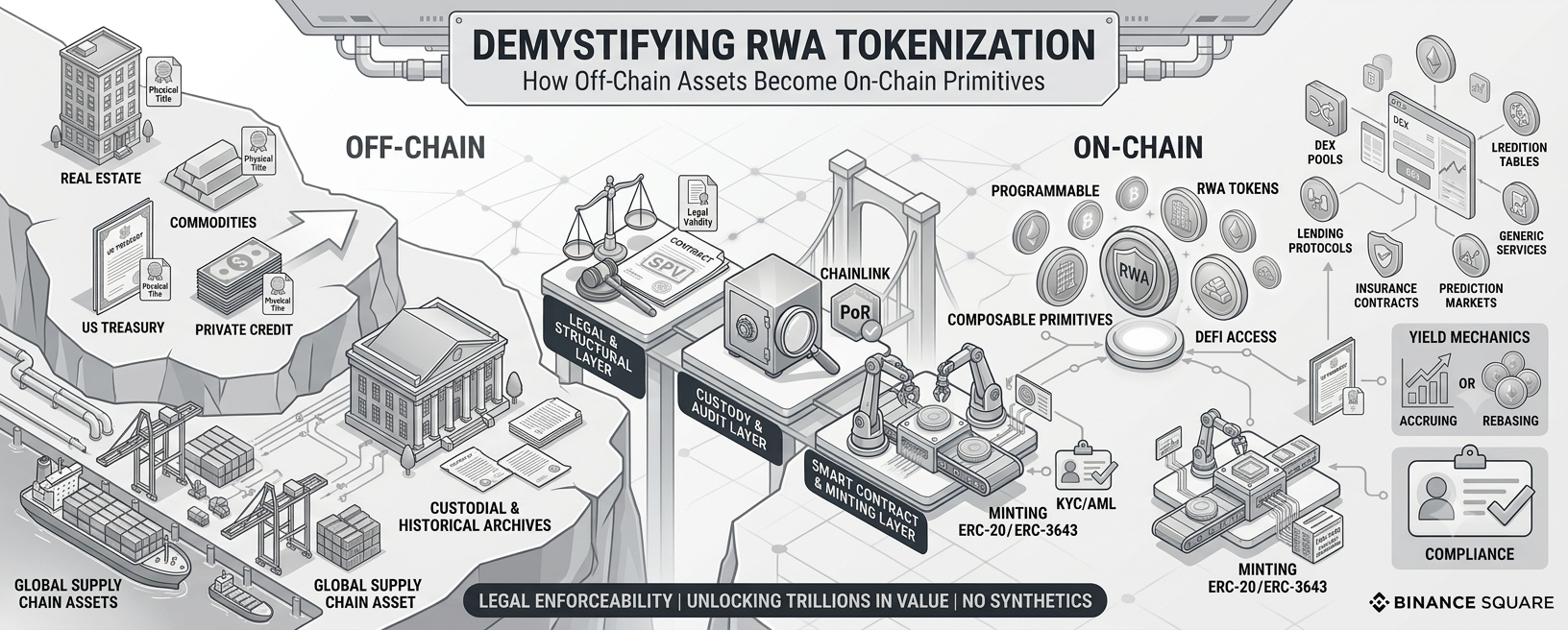
Demystifying RWA Tokenization — How Off-Chain Assets Become On-Chain PrimitivesHow do physical and traditional assets transition onto blockchain ledgers without losing legal validity?
Real-World Asset (RWA) tokenization bridges physical title, legal frameworks, and smart contract execution. Rather than creating synthetic claims, modern RWA protocols construct legally enforceable digital representations of underlying off-chain assets such as U.S. Treasuries, private credit, and commodities.
---
The Four Architecture Layers of RWA Tokenization
1. Legal & Structural Layer
A Special Purpose Vehicle (SPV) or licensed fund issuer holds title to the off-chain asset. The token represents an explicit contractual right—such as beneficial equity, debt obligation, or fractional ownership in the SPV.
2. Custody & Audit Layer
The underlying asset is secured by a regulated custodian (e.g., licensed banks, vault operators). Independent third-party auditors and Chainlink Proof of Reserve (PoR) oracles verify off-chain collateral in real time.
3. Smart Contract & Minting Layer
Upon verified deposit of collateral, smart contracts mint ERC-20 or regulatory-compliant tokens (e.g., ERC-3643) embedded with automated KYC/AML transfer restrictions.
4. Settlement & Yield Mechanics Layer
Yield distribution is coded directly into the token design via two main models:
· Accruing Tokens: Token price increases relative to the underlying basket as interest accrues.
· Rebasing Tokens: Token quantity in investor wallets increases algorithmically as yields are paid out.
---
RWA Tokenization Models Compared
Model Legal Structure Primary Utility Regulatory Classification
SPV / Fund Representation SPV/Trust holds underlying asset; tokens = legal claims on SPV Institutional yield, Treasury access Security / MiCA Asset-Referenced Token
Direct DLT Native Registry Asset is directly issued on-chain under DLT legislation (e.g., EU DLT Pilot) On-chain corporate bonds & equities Regulated Financial Instrument
Commodity Receipt Token Licensed warehouse holds physical asset (e.g., gold bullion) Inflation hedge, settlement collateral Commodity-backed / EMT Token
---
The Bottom Line: RWA tokenization transforms traditional assets into programmable, composable primitives while maintaining legal enforceability—unlocking trillions in illiquid value for DeFi ecosystems.
#educational_post #TradingCommunity
Demystifying RWA Tokenization — How Off-Chain Assets Become On-Chain Primitives
How do physical and traditional assets transition onto blockchain ledgers without losing legal validity?
Real-World Asset (RWA) tokenization bridges physical title, legal frameworks, and smart contract execution. Rather than creating synthetic claims, modern RWA protocols construct legally enforceable digital representations of underlying off-chain assets such as U.S. Treasuries, private credit, and commodities.
---
The Four Architecture Layers of RWA Tokenization
1. Legal & Structural Layer
A Special Purpose Vehicle (SPV) or licensed fund issuer holds title to the off-chain asset. The token represents an explicit contractual right—such as beneficial equity, debt obligation, or fractional ownership in the SPV.
2. Custody & Audit Layer
The underlying asset is secured by a regulated custodian (e.g., licensed banks, vault operators). Independent third-party auditors and Chainlink Proof of Reserve (PoR) oracles verify off-chain collateral in real time.
3. Smart Contract & Minting Layer
Upon verified deposit of collateral, smart contracts mint ERC-20 or regulatory-compliant tokens (e.g., ERC-3643) embedded with automated KYC/AML transfer restrictions.
4. Settlement & Yield Mechanics Layer
Yield distribution is coded directly into the token design via two main models:
· Accruing Tokens: Token price increases relative to the underlying basket as interest accrues.
· Rebasing Tokens: Token quantity in investor wallets increases algorithmically as yields are paid out.
---
RWA Tokenization Models Compared
Model Legal Structure Primary Utility Regulatory Classification
SPV / Fund Representation SPV/Trust holds underlying asset; tokens = legal claims on SPV Institutional yield, Treasury access Security / MiCA Asset-Referenced Token
Direct DLT Native Registry Asset is directly issued on-chain under DLT legislation (e.g., EU DLT Pilot) On-chain corporate bonds & equities Regulated Financial Instrument
Commodity Receipt Token Licensed warehouse holds physical asset (e.g., gold bullion) Inflation hedge, settlement collateral Commodity-backed / EMT Token
---
The Bottom Line: RWA tokenization transforms traditional assets into programmable, composable primitives while maintaining legal enforceability—unlocking trillions in illiquid value for DeFi ecosystems.
#educational_post #TradingCommunity
Real-World Asset (RWA) tokenization bridges physical title, legal frameworks, and smart contract execution. Rather than creating synthetic claims, modern RWA protocols construct legally enforceable digital representations of underlying off-chain assets such as U.S. Treasuries, private credit, and commodities.
---
The Four Architecture Layers of RWA Tokenization
1. Legal & Structural Layer
A Special Purpose Vehicle (SPV) or licensed fund issuer holds title to the off-chain asset. The token represents an explicit contractual right—such as beneficial equity, debt obligation, or fractional ownership in the SPV.
2. Custody & Audit Layer
The underlying asset is secured by a regulated custodian (e.g., licensed banks, vault operators). Independent third-party auditors and Chainlink Proof of Reserve (PoR) oracles verify off-chain collateral in real time.
3. Smart Contract & Minting Layer
Upon verified deposit of collateral, smart contracts mint ERC-20 or regulatory-compliant tokens (e.g., ERC-3643) embedded with automated KYC/AML transfer restrictions.
4. Settlement & Yield Mechanics Layer
Yield distribution is coded directly into the token design via two main models:
· Accruing Tokens: Token price increases relative to the underlying basket as interest accrues.
· Rebasing Tokens: Token quantity in investor wallets increases algorithmically as yields are paid out.
---
RWA Tokenization Models Compared
Model Legal Structure Primary Utility Regulatory Classification
SPV / Fund Representation SPV/Trust holds underlying asset; tokens = legal claims on SPV Institutional yield, Treasury access Security / MiCA Asset-Referenced Token
Direct DLT Native Registry Asset is directly issued on-chain under DLT legislation (e.g., EU DLT Pilot) On-chain corporate bonds & equities Regulated Financial Instrument
Commodity Receipt Token Licensed warehouse holds physical asset (e.g., gold bullion) Inflation hedge, settlement collateral Commodity-backed / EMT Token
---
The Bottom Line: RWA tokenization transforms traditional assets into programmable, composable primitives while maintaining legal enforceability—unlocking trillions in illiquid value for DeFi ecosystems.
#educational_post #TradingCommunity
2
261
·
--
Article
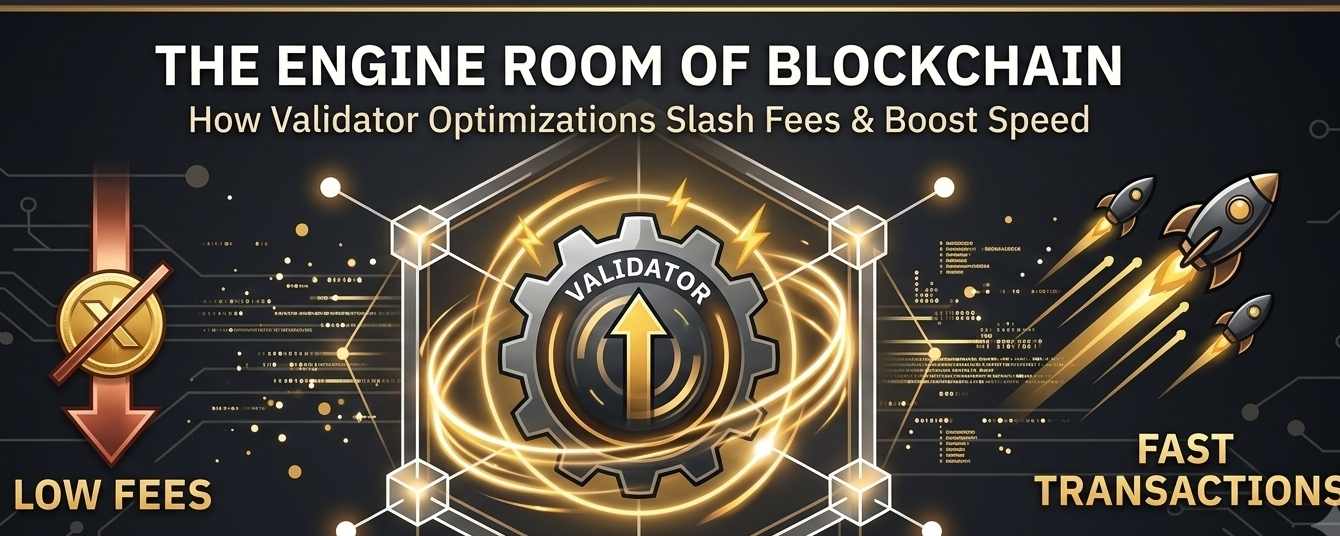
The Engine Room of Blockchain: How Validator Optimizations Slash Fees & Boost SpeedBlockchain scalability is often misattributed solely to block size. In reality, the true bottleneck—and the key to unlocking superior performance—lies within the software architecture of node clients. Recent infrastructure overhauls, such as Solana's Agave validator updates and Ethereum's ongoing client forks, demonstrate that code-level efficiency is the primary driver of reduced costs and increased throughput.
Core Technical Levers for Network Optimization
· State Rent & Storage Reduction
Blockchains maintain a massive state footprint across all nodes. Modern client updates, like those in the Agave validator, have revolutionized state indexing and storage logic. By minimizing memory overhead, these optimizations have successfully reduced state rent fees by up to 90%, making network participation significantly cheaper for validators and end-users alike.
· Consensus Client Efficiency
Latency in block propagation is a primary barrier to speed. Through enhancements like BLS signature aggregation, consensus algorithms now require fewer network hops to confirm block validity. This streamlined verification process drastically reduces propagation latency, allowing the network to reach consensus faster without sacrificing security.
· Parallel Execution Environments
Legacy execution engines process transactions sequentially, creating a computational bottleneck. By leveraging parallel execution, modern runtimes can process non-overlapping transactions concurrently. This approach dramatically increases Transactions Per Second (TPS) without demanding proportional increases in hardware resources.
---
The Educational Takeaway
Ultimately, network performance is not a function of physical limits but of software intelligence. Optimizations in state management, consensus efficiency, and execution logic lower the barrier to entry and reduce operational costs. These infrastructure upgrades are pivotal in making decentralized networks more accessible, efficient, and scalable for mass adoption.
#insights #TradingTales #educational_post
The Engine Room of Blockchain: How Validator Optimizations Slash Fees & Boost Speed
Blockchain scalability is often misattributed solely to block size. In reality, the true bottleneck—and the key to unlocking superior performance—lies within the software architecture of node clients. Recent infrastructure overhauls, such as Solana's Agave validator updates and Ethereum's ongoing client forks, demonstrate that code-level efficiency is the primary driver of reduced costs and increased throughput.
Core Technical Levers for Network Optimization
· State Rent & Storage Reduction
Blockchains maintain a massive state footprint across all nodes. Modern client updates, like those in the Agave validator, have revolutionized state indexing and storage logic. By minimizing memory overhead, these optimizations have successfully reduced state rent fees by up to 90%, making network participation significantly cheaper for validators and end-users alike.
· Consensus Client Efficiency
Latency in block propagation is a primary barrier to speed. Through enhancements like BLS signature aggregation, consensus algorithms now require fewer network hops to confirm block validity. This streamlined verification process drastically reduces propagation latency, allowing the network to reach consensus faster without sacrificing security.
· Parallel Execution Environments
Legacy execution engines process transactions sequentially, creating a computational bottleneck. By leveraging parallel execution, modern runtimes can process non-overlapping transactions concurrently. This approach dramatically increases Transactions Per Second (TPS) without demanding proportional increases in hardware resources.
---
The Educational Takeaway
Ultimately, network performance is not a function of physical limits but of software intelligence. Optimizations in state management, consensus efficiency, and execution logic lower the barrier to entry and reduce operational costs. These infrastructure upgrades are pivotal in making decentralized networks more accessible, efficient, and scalable for mass adoption.
#insights #TradingTales #educational_post
Core Technical Levers for Network Optimization
· State Rent & Storage Reduction
Blockchains maintain a massive state footprint across all nodes. Modern client updates, like those in the Agave validator, have revolutionized state indexing and storage logic. By minimizing memory overhead, these optimizations have successfully reduced state rent fees by up to 90%, making network participation significantly cheaper for validators and end-users alike.
· Consensus Client Efficiency
Latency in block propagation is a primary barrier to speed. Through enhancements like BLS signature aggregation, consensus algorithms now require fewer network hops to confirm block validity. This streamlined verification process drastically reduces propagation latency, allowing the network to reach consensus faster without sacrificing security.
· Parallel Execution Environments
Legacy execution engines process transactions sequentially, creating a computational bottleneck. By leveraging parallel execution, modern runtimes can process non-overlapping transactions concurrently. This approach dramatically increases Transactions Per Second (TPS) without demanding proportional increases in hardware resources.
---
The Educational Takeaway
Ultimately, network performance is not a function of physical limits but of software intelligence. Optimizations in state management, consensus efficiency, and execution logic lower the barrier to entry and reduce operational costs. These infrastructure upgrades are pivotal in making decentralized networks more accessible, efficient, and scalable for mass adoption.
#insights #TradingTales #educational_post
1
59

The secret with small accounts: Prioritize the percentage (%) over the dollars 🧠📊
When you trade with a small margin (e.g., $0.40 USDT), the goal isn’t to get rich from a single transaction, but to build habits and discipline:
Focus on ROI (%): A steady +4% or +10% is better than trying to find a “miracle” trade.
Leverage control: Using moderate levels helps you avoid quick liquidations when volatility spikes create wicks.
Stick to the plan: The discipline you build with $2 USDT is the same discipline that will protect you when you manage a larger capital.
👇 What’s the hardest part for you when handling small trades? Comment below!
#educational_post
The secret with small accounts: Prioritize the percentage (%) over the dollars 🧠📊
When you trade with a small margin (e.g., $0.40 USDT), the goal isn’t to get rich from a single transaction, but to build habits and discipline:
Focus on ROI (%): A steady +4% or +10% is better than trying to find a “miracle” trade.
Leverage control: Using moderate levels helps you avoid quick liquidations when volatility spikes create wicks.
Stick to the plan: The discipline you build with $2 USDT is the same discipline that will protect you when you manage a larger capital.
👇 What’s the hardest part for you when handling small trades? Comment below!
#educational_post
When you trade with a small margin (e.g., $0.40 USDT), the goal isn’t to get rich from a single transaction, but to build habits and discipline:
Focus on ROI (%): A steady +4% or +10% is better than trying to find a “miracle” trade.
Leverage control: Using moderate levels helps you avoid quick liquidations when volatility spikes create wicks.
Stick to the plan: The discipline you build with $2 USDT is the same discipline that will protect you when you manage a larger capital.
👇 What’s the hardest part for you when handling small trades? Comment below!
#educational_post
90

·
--
Article
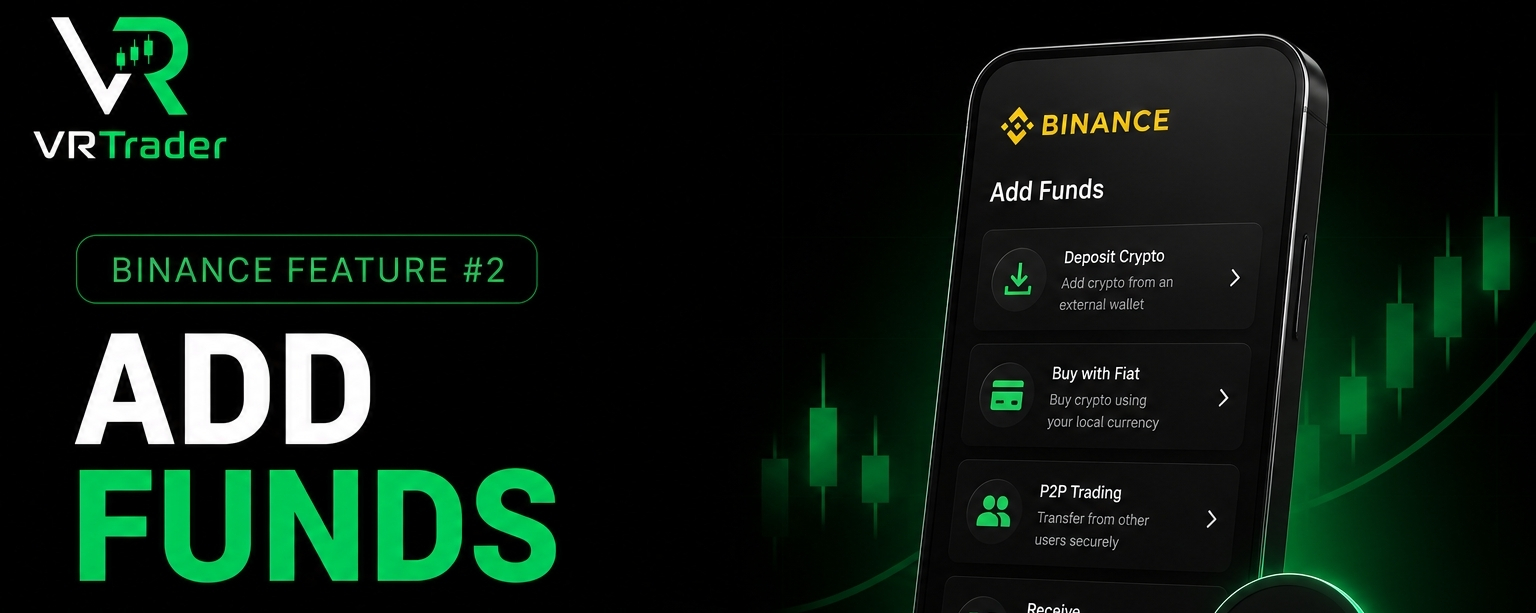
Binance Feature #2: Add Funds
(Quiz Material)Before you can trade, invest, or earn rewards on Binance, you need to fund your account.
The Add Funds feature is the starting point of every crypto journey. It gives you multiple ways to deposit money or cryptocurrency into your Binance account safely and conveniently.
Let's explore how it works.
[ Learn & Earn : Quiz 🧠
Get trading related education and win crypto rewards 🎉
Join upcoming quiz. Topic : "Add Funds"
Fun way to learn ✨ ]
What Is Add Funds?
The Add Funds section allows you to add assets to your Binance account using different methods, depending on your country and preferred payment option.
Common methods include:
• Deposit Crypto
• Buy with Card (Debit/Credit Card)
• Bank Transfer (where available)
• Binance P2P
• Third-Party Payment Providers (available in selected regions)
Choose the method that best suits your needs.
Method 1: Deposit Crypto
If you already own cryptocurrency in another wallet or exchange, you can transfer it to Binance.
Steps
Open Add FundsSelect Deposit CryptoChoose the cryptocurrency you want to deposit.Select the correct blockchain network.Copy your deposit address or scan the QR code.Send the crypto from your external wallet.
⚠️ Important: Always select the correct network. Sending assets to the wrong blockchain may result in permanent loss of funds.
Method 2: Buy with Card
If you're new to crypto, this is one of the easiest options.
Simply:
• Choose your local currency.
• Enter the amount.
• Select the cryptocurrency you want to buy.
• Complete the payment with your debit or credit card.
Your purchased crypto will be credited to your Binance account after the payment is processed.
Method 3: Binance P2P
Binance P2P allows users to buy and sell crypto directly with other users through Binance's escrow system.
While it's convenient, you should always follow safe trading practices.
P2P Safety Tips
✅ Never communicate or make deals outside the Binance P2P chat.
✅ Never send or receive payments outside the official Binance order.
✅ Keep all conversations inside Binance.
✅ Save payment receipts and transaction records until the trade is completed.
✅ If you're buying crypto, upload proof of payment after sending the funds.
✅ If you're selling crypto, never release your crypto until you have personally confirmed the money has arrived in your bank or payment account. Do not rely only on screenshots or messages from the buyer.
✅ If there's any issue, use Binance's Appeal feature instead of resolving the dispute privately.
Remember: Binance's escrow protection works best when the entire transaction stays within the platform.
Why Is Add Funds Important?
Without funding your account, you cannot:
• Buy cryptocurrencies
• Trade in Spot or Futures
• Invest in Binance Earn
• Participate in Launchpool or other Binance products
It is the first step before exploring the rest of the Binance ecosystem.
Common Mistakes to Avoid
❌ Sending crypto to the wrong blockchain network.
❌ Releasing crypto before confirming payment in your account.
❌ Trusting edited payment screenshots.
❌ Completing P2P deals outside Binance.
❌ Ignoring transaction details before confirming.
Taking a few extra minutes to verify each transaction can help prevent costly mistakes.
Final Thoughts
Adding funds is simple, but security should always come first.
Whether you're depositing crypto, buying with a card, or using Binance P2P, take your time, double-check every detail, and use Binance's built-in protections.
A secure investor isn't just someone who grows their portfolio—it's someone who protects it.
VRTrader Insight
The first investment you should make isn't into a coin—it's into good habits. Learn the platform, follow safe practices, and always verify before you confirm.
Learn today. Invest smarter tomorrow.
#Binance #EducationalContent #educational_post $BTC $NVDAB $SIREN
Binance Feature #2: Add Funds (Quiz Material)
Before you can trade, invest, or earn rewards on Binance, you need to fund your account.
The Add Funds feature is the starting point of every crypto journey. It gives you multiple ways to deposit money or cryptocurrency into your Binance account safely and conveniently.
Let's explore how it works.
[ Learn & Earn : Quiz 🧠
Get trading related education and win crypto rewards 🎉
Join upcoming quiz. Topic : "Add Funds"
Fun way to learn ✨ ]
What Is Add Funds?
The Add Funds section allows you to add assets to your Binance account using different methods, depending on your country and preferred payment option.
Common methods include:
• Deposit Crypto
• Buy with Card (Debit/Credit Card)
• Bank Transfer (where available)
• Binance P2P
• Third-Party Payment Providers (available in selected regions)
Choose the method that best suits your needs.
Method 1: Deposit Crypto
If you already own cryptocurrency in another wallet or exchange, you can transfer it to Binance.
Steps
Open Add FundsSelect Deposit CryptoChoose the cryptocurrency you want to deposit.Select the correct blockchain network.Copy your deposit address or scan the QR code.Send the crypto from your external wallet.
⚠️ Important: Always select the correct network. Sending assets to the wrong blockchain may result in permanent loss of funds.
Method 2: Buy with Card
If you're new to crypto, this is one of the easiest options.
Simply:
• Choose your local currency.
• Enter the amount.
• Select the cryptocurrency you want to buy.
• Complete the payment with your debit or credit card.
Your purchased crypto will be credited to your Binance account after the payment is processed.
Method 3: Binance P2P
Binance P2P allows users to buy and sell crypto directly with other users through Binance's escrow system.
While it's convenient, you should always follow safe trading practices.
P2P Safety Tips
✅ Never communicate or make deals outside the Binance P2P chat.
✅ Never send or receive payments outside the official Binance order.
✅ Keep all conversations inside Binance.
✅ Save payment receipts and transaction records until the trade is completed.
✅ If you're buying crypto, upload proof of payment after sending the funds.
✅ If you're selling crypto, never release your crypto until you have personally confirmed the money has arrived in your bank or payment account. Do not rely only on screenshots or messages from the buyer.
✅ If there's any issue, use Binance's Appeal feature instead of resolving the dispute privately.
Remember: Binance's escrow protection works best when the entire transaction stays within the platform.
Why Is Add Funds Important?
Without funding your account, you cannot:
• Buy cryptocurrencies
• Trade in Spot or Futures
• Invest in Binance Earn
• Participate in Launchpool or other Binance products
It is the first step before exploring the rest of the Binance ecosystem.
Common Mistakes to Avoid
❌ Sending crypto to the wrong blockchain network.
❌ Releasing crypto before confirming payment in your account.
❌ Trusting edited payment screenshots.
❌ Completing P2P deals outside Binance.
❌ Ignoring transaction details before confirming.
Taking a few extra minutes to verify each transaction can help prevent costly mistakes.
Final Thoughts
Adding funds is simple, but security should always come first.
Whether you're depositing crypto, buying with a card, or using Binance P2P, take your time, double-check every detail, and use Binance's built-in protections.
A secure investor isn't just someone who grows their portfolio—it's someone who protects it.
VRTrader Insight
The first investment you should make isn't into a coin—it's into good habits. Learn the platform, follow safe practices, and always verify before you confirm.
Learn today. Invest smarter tomorrow.
#Binance #EducationalContent #educational_post $BTC $NVDAB $SIREN
The Add Funds feature is the starting point of every crypto journey. It gives you multiple ways to deposit money or cryptocurrency into your Binance account safely and conveniently.
Let's explore how it works.
[ Learn & Earn : Quiz 🧠
Get trading related education and win crypto rewards 🎉
Join upcoming quiz. Topic : "Add Funds"
Fun way to learn ✨ ]
What Is Add Funds?
The Add Funds section allows you to add assets to your Binance account using different methods, depending on your country and preferred payment option.
Common methods include:
• Deposit Crypto
• Buy with Card (Debit/Credit Card)
• Bank Transfer (where available)
• Binance P2P
• Third-Party Payment Providers (available in selected regions)
Choose the method that best suits your needs.
Method 1: Deposit Crypto
If you already own cryptocurrency in another wallet or exchange, you can transfer it to Binance.
Steps
Open Add FundsSelect Deposit CryptoChoose the cryptocurrency you want to deposit.Select the correct blockchain network.Copy your deposit address or scan the QR code.Send the crypto from your external wallet.
⚠️ Important: Always select the correct network. Sending assets to the wrong blockchain may result in permanent loss of funds.
Method 2: Buy with Card
If you're new to crypto, this is one of the easiest options.
Simply:
• Choose your local currency.
• Enter the amount.
• Select the cryptocurrency you want to buy.
• Complete the payment with your debit or credit card.
Your purchased crypto will be credited to your Binance account after the payment is processed.
Method 3: Binance P2P
Binance P2P allows users to buy and sell crypto directly with other users through Binance's escrow system.
While it's convenient, you should always follow safe trading practices.
P2P Safety Tips
✅ Never communicate or make deals outside the Binance P2P chat.
✅ Never send or receive payments outside the official Binance order.
✅ Keep all conversations inside Binance.
✅ Save payment receipts and transaction records until the trade is completed.
✅ If you're buying crypto, upload proof of payment after sending the funds.
✅ If you're selling crypto, never release your crypto until you have personally confirmed the money has arrived in your bank or payment account. Do not rely only on screenshots or messages from the buyer.
✅ If there's any issue, use Binance's Appeal feature instead of resolving the dispute privately.
Remember: Binance's escrow protection works best when the entire transaction stays within the platform.
Why Is Add Funds Important?
Without funding your account, you cannot:
• Buy cryptocurrencies
• Trade in Spot or Futures
• Invest in Binance Earn
• Participate in Launchpool or other Binance products
It is the first step before exploring the rest of the Binance ecosystem.
Common Mistakes to Avoid
❌ Sending crypto to the wrong blockchain network.
❌ Releasing crypto before confirming payment in your account.
❌ Trusting edited payment screenshots.
❌ Completing P2P deals outside Binance.
❌ Ignoring transaction details before confirming.
Taking a few extra minutes to verify each transaction can help prevent costly mistakes.
Final Thoughts
Adding funds is simple, but security should always come first.
Whether you're depositing crypto, buying with a card, or using Binance P2P, take your time, double-check every detail, and use Binance's built-in protections.
A secure investor isn't just someone who grows their portfolio—it's someone who protects it.
VRTrader Insight
The first investment you should make isn't into a coin—it's into good habits. Learn the platform, follow safe practices, and always verify before you confirm.
Learn today. Invest smarter tomorrow.
#Binance #EducationalContent #educational_post $BTC $NVDAB $SIREN
708
5
32
708

·
--
FVG
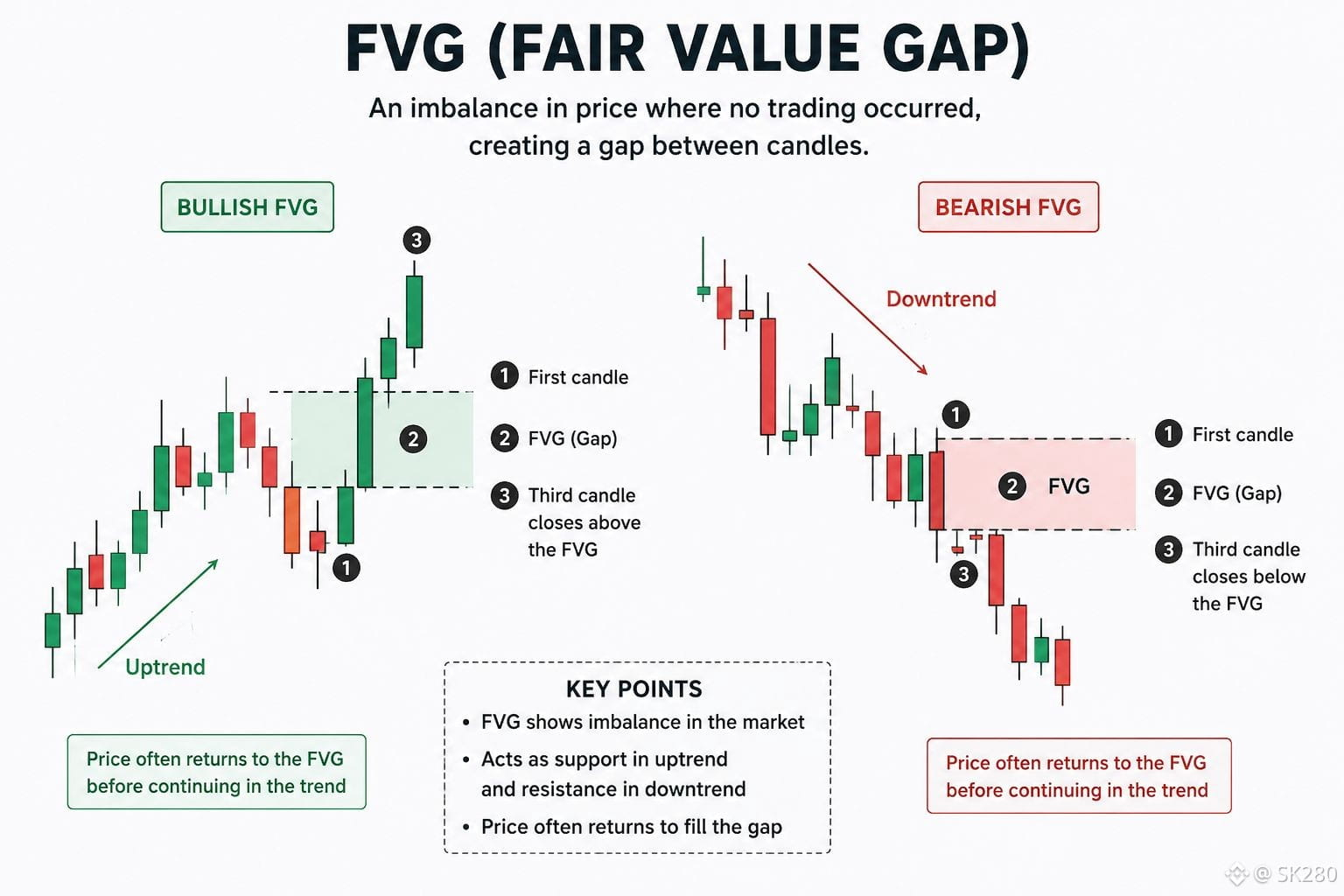
Fair Value Gap strategy is one of the best strategies in the world of trading. Here I'm giving you a free pro tip if you trade #FVG . As you know we wait for rejection and then for momentum candle, remember, that momentum candle must have lower volume than the previous candle. It increases your winning chance to 90%.
#educational_post #SkillPays
FVG
Fair Value Gap strategy is one of the best strategies in the world of trading. Here I'm giving you a free pro tip if you trade #FVG . As you know we wait for rejection and then for momentum candle, remember, that momentum candle must have lower volume than the previous candle. It increases your winning chance to 90%.
#educational_post #SkillPays
Fair Value Gap strategy is one of the best strategies in the world of trading. Here I'm giving you a free pro tip if you trade #FVG . As you know we wait for rejection and then for momentum candle, remember, that momentum candle must have lower volume than the previous candle. It increases your winning chance to 90%.
#educational_post #SkillPays
194

crypto wallets: where to securely store your assetsNow that you can read the market, it's time to gear up with the right tools — starting with the most fundamental: the crypto wallet.
📌 CUSTODIAL WALLET (on an exchange)
→ Your cryptos are managed by the platform (Binance, etc.)
→ Easy to use, no keys to manage yourself
→ But: "not your keys, not your coins" — you are entirely dependent on the platform
📌 NON-CUSTODIAL WALLET (you hold your keys)
→ Only you possess the seed phrase (12 or 24 words)
crypto wallets: where to securely store your assets
Now that you can read the market, it's time to gear up with the right tools — starting with the most fundamental: the crypto wallet.
📌 CUSTODIAL WALLET (on an exchange)
→ Your cryptos are managed by the platform (Binance, etc.)
→ Easy to use, no keys to manage yourself
→ But: "not your keys, not your coins" — you are entirely dependent on the platform
📌 NON-CUSTODIAL WALLET (you hold your keys)
→ Only you possess the seed phrase (12 or 24 words)
📌 CUSTODIAL WALLET (on an exchange)
→ Your cryptos are managed by the platform (Binance, etc.)
→ Easy to use, no keys to manage yourself
→ But: "not your keys, not your coins" — you are entirely dependent on the platform
📌 NON-CUSTODIAL WALLET (you hold your keys)
→ Only you possess the seed phrase (12 or 24 words)
1
1
218

·
--
#Binance #educational_post $NVDAB $BTC $BNB
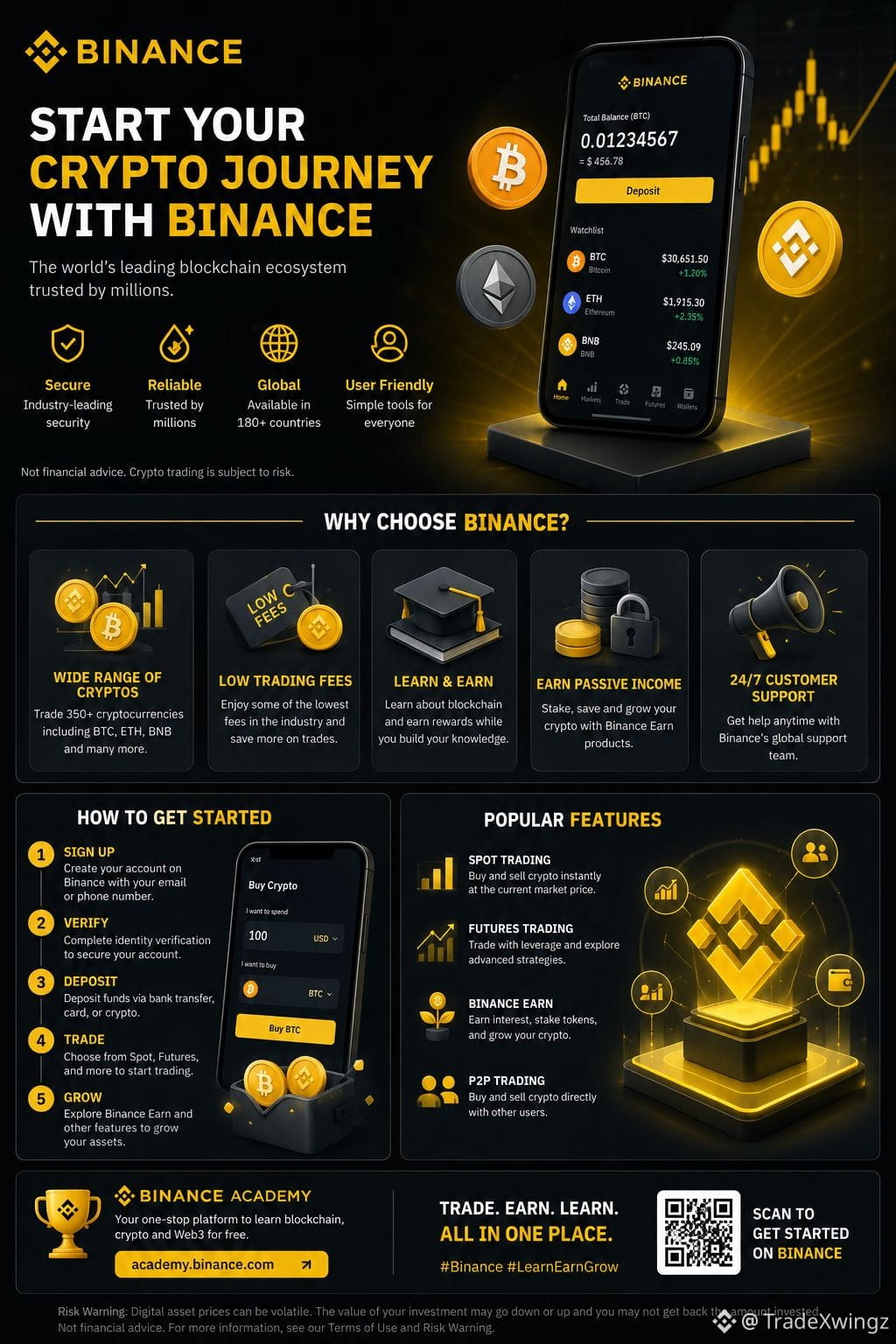
🚀 **Start Your Crypto Journey with Binance!** 📚
Understanding cryptocurrency is the first step toward making informed financial decisions. In this educational post, you'll learn:
✅ What Binance is and how it works
✅ How to create and secure your account
✅ The basics of Spot Trading, Binance Earn, and P2P Trading
✅ Essential security tips to help protect your digital assets
✅ Why continuous learning is important before investing
Remember: **Knowledge comes before investment.** Always do your own research (DYOR), understand the risks, and never invest more than you can afford to lose.
💡 Learning today can help you make smarter decisions tomorrow.
#Binance #BinanceCreatorChallenge #BinanceAcademy #CryptoEducation #Blockchain #Web3 #LearnCrypto #DYOR #FinancialEducation #CryptoBasics
#Binance #educational_post $NVDAB $BTC $BNB
🚀 **Start Your Crypto Journey with Binance!** 📚
Understanding cryptocurrency is the first step toward making informed financial decisions. In this educational post, you'll learn:
✅ What Binance is and how it works
✅ How to create and secure your account
✅ The basics of Spot Trading, Binance Earn, and P2P Trading
✅ Essential security tips to help protect your digital assets
✅ Why continuous learning is important before investing
Remember: **Knowledge comes before investment.** Always do your own research (DYOR), understand the risks, and never invest more than you can afford to lose.
💡 Learning today can help you make smarter decisions tomorrow.
#Binance #BinanceCreatorChallenge #BinanceAcademy #CryptoEducation #Blockchain #Web3 #LearnCrypto #DYOR #FinancialEducation #CryptoBasics
🚀 **Start Your Crypto Journey with Binance!** 📚
Understanding cryptocurrency is the first step toward making informed financial decisions. In this educational post, you'll learn:
✅ What Binance is and how it works
✅ How to create and secure your account
✅ The basics of Spot Trading, Binance Earn, and P2P Trading
✅ Essential security tips to help protect your digital assets
✅ Why continuous learning is important before investing
Remember: **Knowledge comes before investment.** Always do your own research (DYOR), understand the risks, and never invest more than you can afford to lose.
💡 Learning today can help you make smarter decisions tomorrow.
#Binance #BinanceCreatorChallenge #BinanceAcademy #CryptoEducation #Blockchain #Web3 #LearnCrypto #DYOR #FinancialEducation #CryptoBasics
111

·
--
Article
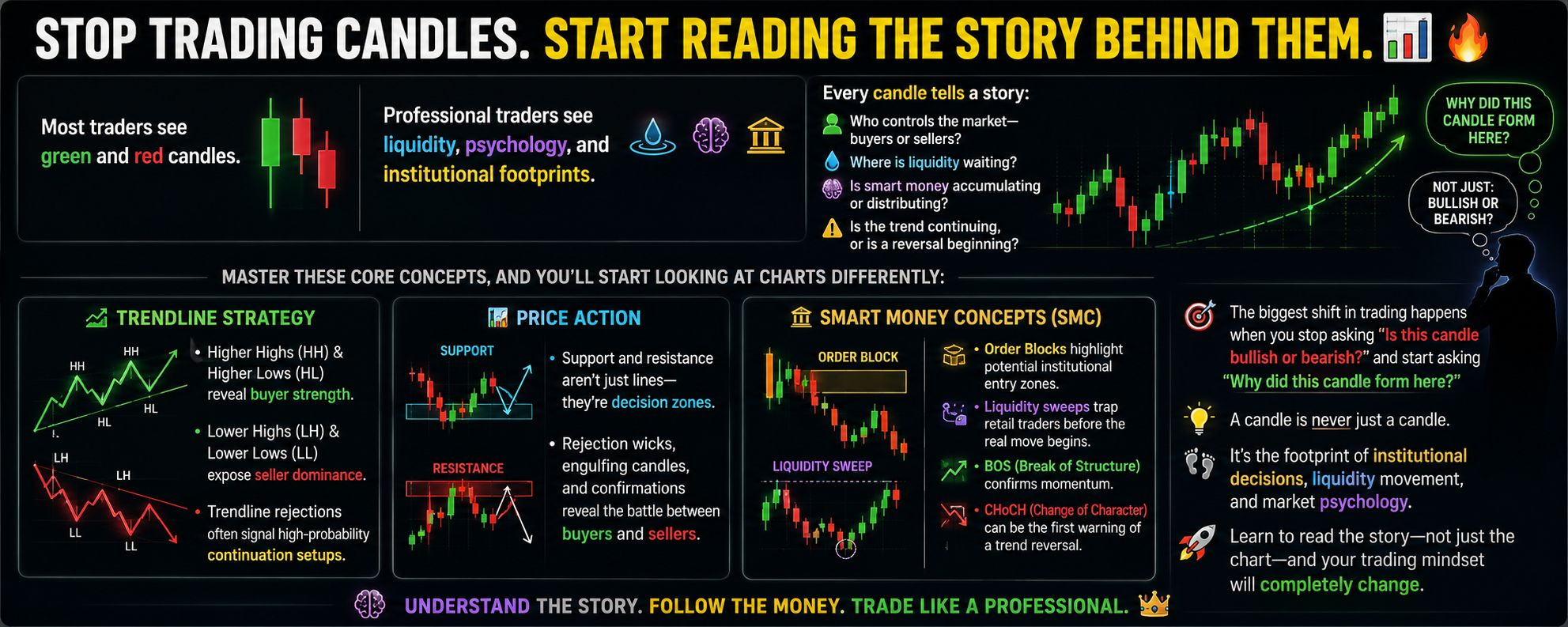
Stop Trading Candles. Start Reading the Story Behind Them. 📊🔥Most traders see green and red candles.
Professional traders see liquidity, psychology, and institutional footprints. 💡
Every candle tells a story:
🔹 Who controls the market—buyers or sellers?
🔹 Where is liquidity waiting?
🔹 Is smart money accumulating or distributing?
🔹 Is the trend continuing, or is a reversal beginning?
Master these core concepts, and you'll start looking at charts differently:
📈 Trendline Strategy
• Higher Highs (HH) & Higher Lows (HL) reveal buyer strength.
• Lower Highs (LH) & Lower Lows (LL) expose seller dominance.
• Trendline rejections often signal high-probability continuation setups.
📊 Price Action
• Support and resistance aren't just lines—they're decision zones.
• Rejection wicks, engulfing candles, and confirmations reveal the battle between buyers and sellers.
🏦 Smart Money Concepts (SMC)
• Order Blocks highlight potential institutional entry zones.
• Liquidity sweeps trap retail traders before the real move begins.
• BOS (Break of Structure) confirms momentum.
• CHoCH (Change of Character) can be the first warning of a trend reversal.
The biggest shift in trading happens when you stop asking "Is this candle bullish or bearish?" and start asking "Why did this candle form here?"
A candle is never just a candle.
It's the footprint of institutional decisions, liquidity movement, and market psychology. Learn to read the story—not just the chart—and your trading mindset will completely change. 🚀
💬 Which concept has improved your trading the most: Price Action, Trendlines, or Smart Money Concepts (SMC)? Share your answer below!
If you found this alpha valuable, hit that Like ❤️ button and Follow 🚀 for daily elite crypto insights!
$XAU
{future}(XAUUSDT)
{spot}(XAUTUSDT)
#GOLD #XAU #xaut #educational_post $HFT $ACE #GoldBreaksOutFromJanuaryDowntrend
Stop Trading Candles. Start Reading the Story Behind Them. 📊🔥
Most traders see green and red candles.
Professional traders see liquidity, psychology, and institutional footprints. 💡
Every candle tells a story:
🔹 Who controls the market—buyers or sellers?
🔹 Where is liquidity waiting?
🔹 Is smart money accumulating or distributing?
🔹 Is the trend continuing, or is a reversal beginning?
Master these core concepts, and you'll start looking at charts differently:
📈 Trendline Strategy
• Higher Highs (HH) & Higher Lows (HL) reveal buyer strength.
• Lower Highs (LH) & Lower Lows (LL) expose seller dominance.
• Trendline rejections often signal high-probability continuation setups.
📊 Price Action
• Support and resistance aren't just lines—they're decision zones.
• Rejection wicks, engulfing candles, and confirmations reveal the battle between buyers and sellers.
🏦 Smart Money Concepts (SMC)
• Order Blocks highlight potential institutional entry zones.
• Liquidity sweeps trap retail traders before the real move begins.
• BOS (Break of Structure) confirms momentum.
• CHoCH (Change of Character) can be the first warning of a trend reversal.
The biggest shift in trading happens when you stop asking "Is this candle bullish or bearish?" and start asking "Why did this candle form here?"
A candle is never just a candle.
It's the footprint of institutional decisions, liquidity movement, and market psychology. Learn to read the story—not just the chart—and your trading mindset will completely change. 🚀
💬 Which concept has improved your trading the most: Price Action, Trendlines, or Smart Money Concepts (SMC)? Share your answer below!
If you found this alpha valuable, hit that Like ❤️ button and Follow 🚀 for daily elite crypto insights!
$XAU
#GOLD #XAU #xaut #educational_post $HFT $ACE #GoldBreaksOutFromJanuaryDowntrend
Professional traders see liquidity, psychology, and institutional footprints. 💡
Every candle tells a story:
🔹 Who controls the market—buyers or sellers?
🔹 Where is liquidity waiting?
🔹 Is smart money accumulating or distributing?
🔹 Is the trend continuing, or is a reversal beginning?
Master these core concepts, and you'll start looking at charts differently:
📈 Trendline Strategy
• Higher Highs (HH) & Higher Lows (HL) reveal buyer strength.
• Lower Highs (LH) & Lower Lows (LL) expose seller dominance.
• Trendline rejections often signal high-probability continuation setups.
📊 Price Action
• Support and resistance aren't just lines—they're decision zones.
• Rejection wicks, engulfing candles, and confirmations reveal the battle between buyers and sellers.
🏦 Smart Money Concepts (SMC)
• Order Blocks highlight potential institutional entry zones.
• Liquidity sweeps trap retail traders before the real move begins.
• BOS (Break of Structure) confirms momentum.
• CHoCH (Change of Character) can be the first warning of a trend reversal.
The biggest shift in trading happens when you stop asking "Is this candle bullish or bearish?" and start asking "Why did this candle form here?"
A candle is never just a candle.
It's the footprint of institutional decisions, liquidity movement, and market psychology. Learn to read the story—not just the chart—and your trading mindset will completely change. 🚀
💬 Which concept has improved your trading the most: Price Action, Trendlines, or Smart Money Concepts (SMC)? Share your answer below!
If you found this alpha valuable, hit that Like ❤️ button and Follow 🚀 for daily elite crypto insights!
$XAU
#GOLD #XAU #xaut #educational_post $HFT $ACE #GoldBreaksOutFromJanuaryDowntrend
2
222

🐳:COMPOUND INTEREST
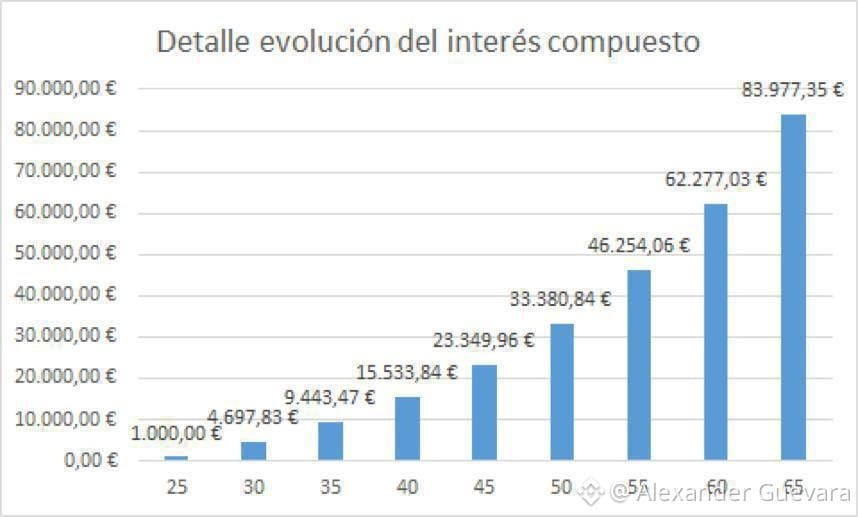
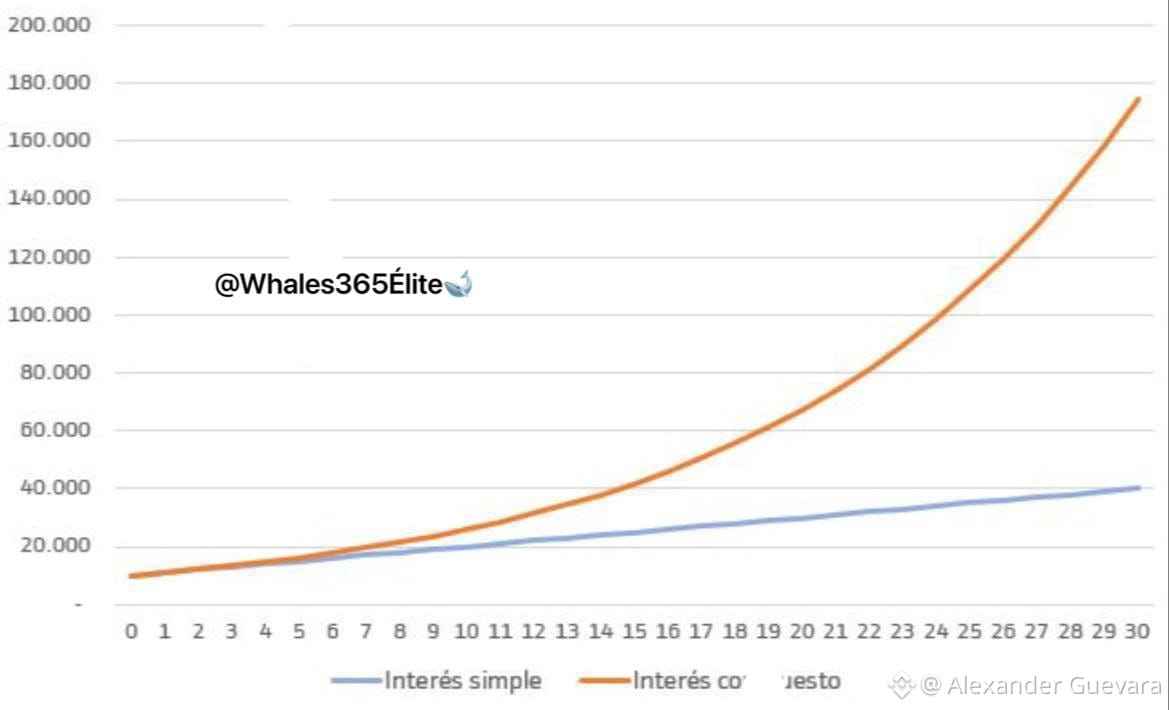
At the beginning, the capital is like a small snowball, and the more time passes, the larger the mass becomes and the faster it grows—that’s the well-known snowball effect ❄️
Exponential growth through compound interest is a great force that can be harnessed in automated trading
To do this, you have to reinvest—deposit more to increase the account size and trade with increasingly larger amounts ↗️
A key factor that anyone can take advantage of!
💹 Don’t withdraw quickly—let your account grow until it becomes big
Compound interest is a very relevant factor in the world of trading.
Thanks to it, even starting from the bottom by accumulating and reinvesting, you can reach large figures over time 💰
Keys of compound interest, what can change your life, read 📑👨🏫
#educational_post #EducationalContent #market #estrategia #BinanceSquare $BTC $ETH $POP
🐳:COMPOUND INTEREST
At the beginning, the capital is like a small snowball, and the more time passes, the larger the mass becomes and the faster it grows—that’s the well-known snowball effect ❄️
Exponential growth through compound interest is a great force that can be harnessed in automated trading
To do this, you have to reinvest—deposit more to increase the account size and trade with increasingly larger amounts ↗️
A key factor that anyone can take advantage of!
💹 Don’t withdraw quickly—let your account grow until it becomes big
Compound interest is a very relevant factor in the world of trading.
Thanks to it, even starting from the bottom by accumulating and reinvesting, you can reach large figures over time 💰
Keys of compound interest, what can change your life, read 📑👨🏫
#educational_post #EducationalContent #market #estrategia #BinanceSquare $BTC $ETH $POP
At the beginning, the capital is like a small snowball, and the more time passes, the larger the mass becomes and the faster it grows—that’s the well-known snowball effect ❄️
Exponential growth through compound interest is a great force that can be harnessed in automated trading
To do this, you have to reinvest—deposit more to increase the account size and trade with increasingly larger amounts ↗️
A key factor that anyone can take advantage of!
💹 Don’t withdraw quickly—let your account grow until it becomes big
Compound interest is a very relevant factor in the world of trading.
Thanks to it, even starting from the bottom by accumulating and reinvesting, you can reach large figures over time 💰
Keys of compound interest, what can change your life, read 📑👨🏫
#educational_post #EducationalContent #market #estrategia #BinanceSquare $BTC $ETH $POP

3
169

How I Find The Best Coins To Trade From The Losers ListMost beginners see a coin down 10% and immediately think it is a buying opportunity. I used to think the same way. I learned the hard way that not every red coin bounces.
After losing money on the wrong coins, I developed a simple method. Now I only pick coins that show specific signs before entering. Let me share exactly what I look for.
Step One — Find The Right Drop Size
Open Binance futures and sort by 24 hour change, lowest first. Ignore coins down more than 20 percent. Those are danger zones. Ignore coins down less than 5 percent. Not enough opportunity. The sweet spot is coins down 8 to 15 percent. Big enough drop to create a bounce, not big enough to keep falling forever.
Step Two — Check The Volume
Open the chart and look at the volume bars at the bottom. If volume was massive during the drop but is now getting smaller and smaller, that means sellers are exhausting. Less selling pressure equals bounce coming. If volume is still high and active on red candles, sellers are not done yet. Skip that coin and move to the next one.
Step Three — Check RSI
RSI is a simple indicator that tells you if a coin is oversold. Below 30 means oversold. Below 20 means extremely oversold. I personally look for RSI below 20 to 25 on the losers list. This means the coin has been sold too hard too fast and a recovery becomes very likely in the next few hours.
Step Four — Check Supertrend
Supertrend is the red or green line on your chart. Red means sellers in control. Green means buyers in control. On a bouncing coin from the losers list, Supertrend will be red but starting to flatten. When it stops going down and starts moving sideways, buyers are getting ready to take over. A flip to green confirms the bounce.
Step Five — Find A Support Level
Every coin has price levels where buyers historically stepped in before. Look for a previous low on the chart that held before. If current price is sitting exactly on that level with RSI oversold and volume drying up, that is your entry zone.
The Checklist I Use Every Time
Drop between 8 to 15 percent — yes or no
Volume drying up on recent candles — yes or no
RSI below 25 — yes or no
Supertrend flattening or about to flip — yes or no
Price sitting on a clear support level — yes or no
If a coin scores 4 or 5 out of 5, I take the trade seriously. If it scores 2 or less, I move to the next coin on the list.
One More Important Rule
Never enter the moment you see these signs. Wait for one strong green candle with volume to confirm buyers are actually stepping in. That confirmation candle is your signal. Without it you are just guessing.
Real Example From Today
I checked EIGEN on the losers list today. Down 10 percent, RSI at 15, volume completely dried up, price sitting on 0.2666 support. It scored 5 out of 5 on the checklist. That is the kind of setup worth watching closely.
SAHARA was also on the losers list. Down 8 percent, RSI at 15 but volume still active on red candles and no clear support nearby. It scored only 1 out of 5. I skipped it completely.
Same losers list. Completely different quality of setups
The Bottom Line
Any coin can bounce. But not every bounce is worth trading. Learn to be selective, use the checklist, wait for confirmation and you will avoid the biggest mistake most beginners make which is buying just because something looks cheap.
Red does not mean ready. The checklist decides.
Trade safe. Manage risk always.
$BTC #educational_post #EducationalContent
How I Find The Best Coins To Trade From The Losers List
Most beginners see a coin down 10% and immediately think it is a buying opportunity. I used to think the same way. I learned the hard way that not every red coin bounces.
After losing money on the wrong coins, I developed a simple method. Now I only pick coins that show specific signs before entering. Let me share exactly what I look for.
Step One — Find The Right Drop Size
Open Binance futures and sort by 24 hour change, lowest first. Ignore coins down more than 20 percent. Those are danger zones. Ignore coins down less than 5 percent. Not enough opportunity. The sweet spot is coins down 8 to 15 percent. Big enough drop to create a bounce, not big enough to keep falling forever.
Step Two — Check The Volume
Open the chart and look at the volume bars at the bottom. If volume was massive during the drop but is now getting smaller and smaller, that means sellers are exhausting. Less selling pressure equals bounce coming. If volume is still high and active on red candles, sellers are not done yet. Skip that coin and move to the next one.
Step Three — Check RSI
RSI is a simple indicator that tells you if a coin is oversold. Below 30 means oversold. Below 20 means extremely oversold. I personally look for RSI below 20 to 25 on the losers list. This means the coin has been sold too hard too fast and a recovery becomes very likely in the next few hours.
Step Four — Check Supertrend
Supertrend is the red or green line on your chart. Red means sellers in control. Green means buyers in control. On a bouncing coin from the losers list, Supertrend will be red but starting to flatten. When it stops going down and starts moving sideways, buyers are getting ready to take over. A flip to green confirms the bounce.
Step Five — Find A Support Level
Every coin has price levels where buyers historically stepped in before. Look for a previous low on the chart that held before. If current price is sitting exactly on that level with RSI oversold and volume drying up, that is your entry zone.
The Checklist I Use Every Time
Drop between 8 to 15 percent — yes or no
Volume drying up on recent candles — yes or no
RSI below 25 — yes or no
Supertrend flattening or about to flip — yes or no
Price sitting on a clear support level — yes or no
If a coin scores 4 or 5 out of 5, I take the trade seriously. If it scores 2 or less, I move to the next coin on the list.
One More Important Rule
Never enter the moment you see these signs. Wait for one strong green candle with volume to confirm buyers are actually stepping in. That confirmation candle is your signal. Without it you are just guessing.
Real Example From Today
I checked EIGEN on the losers list today. Down 10 percent, RSI at 15, volume completely dried up, price sitting on 0.2666 support. It scored 5 out of 5 on the checklist. That is the kind of setup worth watching closely.
SAHARA was also on the losers list. Down 8 percent, RSI at 15 but volume still active on red candles and no clear support nearby. It scored only 1 out of 5. I skipped it completely.
Same losers list. Completely different quality of setups
The Bottom Line
Any coin can bounce. But not every bounce is worth trading. Learn to be selective, use the checklist, wait for confirmation and you will avoid the biggest mistake most beginners make which is buying just because something looks cheap.
Red does not mean ready. The checklist decides.
Trade safe. Manage risk always.
$BTC #educational_post #EducationalContent
After losing money on the wrong coins, I developed a simple method. Now I only pick coins that show specific signs before entering. Let me share exactly what I look for.
Step One — Find The Right Drop Size
Open Binance futures and sort by 24 hour change, lowest first. Ignore coins down more than 20 percent. Those are danger zones. Ignore coins down less than 5 percent. Not enough opportunity. The sweet spot is coins down 8 to 15 percent. Big enough drop to create a bounce, not big enough to keep falling forever.
Step Two — Check The Volume
Open the chart and look at the volume bars at the bottom. If volume was massive during the drop but is now getting smaller and smaller, that means sellers are exhausting. Less selling pressure equals bounce coming. If volume is still high and active on red candles, sellers are not done yet. Skip that coin and move to the next one.
Step Three — Check RSI
RSI is a simple indicator that tells you if a coin is oversold. Below 30 means oversold. Below 20 means extremely oversold. I personally look for RSI below 20 to 25 on the losers list. This means the coin has been sold too hard too fast and a recovery becomes very likely in the next few hours.
Step Four — Check Supertrend
Supertrend is the red or green line on your chart. Red means sellers in control. Green means buyers in control. On a bouncing coin from the losers list, Supertrend will be red but starting to flatten. When it stops going down and starts moving sideways, buyers are getting ready to take over. A flip to green confirms the bounce.
Step Five — Find A Support Level
Every coin has price levels where buyers historically stepped in before. Look for a previous low on the chart that held before. If current price is sitting exactly on that level with RSI oversold and volume drying up, that is your entry zone.
The Checklist I Use Every Time
Drop between 8 to 15 percent — yes or no
Volume drying up on recent candles — yes or no
RSI below 25 — yes or no
Supertrend flattening or about to flip — yes or no
Price sitting on a clear support level — yes or no
If a coin scores 4 or 5 out of 5, I take the trade seriously. If it scores 2 or less, I move to the next coin on the list.
One More Important Rule
Never enter the moment you see these signs. Wait for one strong green candle with volume to confirm buyers are actually stepping in. That confirmation candle is your signal. Without it you are just guessing.
Real Example From Today
I checked EIGEN on the losers list today. Down 10 percent, RSI at 15, volume completely dried up, price sitting on 0.2666 support. It scored 5 out of 5 on the checklist. That is the kind of setup worth watching closely.
SAHARA was also on the losers list. Down 8 percent, RSI at 15 but volume still active on red candles and no clear support nearby. It scored only 1 out of 5. I skipped it completely.
Same losers list. Completely different quality of setups
The Bottom Line
Any coin can bounce. But not every bounce is worth trading. Learn to be selective, use the checklist, wait for confirmation and you will avoid the biggest mistake most beginners make which is buying just because something looks cheap.
Red does not mean ready. The checklist decides.
Trade safe. Manage risk always.
$BTC #educational_post #EducationalContent
343

The Magic of Compound Interest:
Each Penny Adds Up in Building a Portfolio 📈 of
Many hope to land a "stroke of luck" in the market to watch their capital grow, but true financial health is built consistently and progressively. 🧘♀️✨
Watch your portfolio grow penny by penny (+0,04 USDT today) may seem like a small step, but in finance, consistency is everything:
Snowball Effect: Daily returns generated in flexible products like Binance Earn are added to the base capital, creating interest on interest.
Emotional Control: Keeping a passive accumulation strategy helps you avoid the stress of daily volatility and protects your core capital.
Goals Perspective: Defining a target figure with a clear date lets you measure real progress and stay focused without straying from the plan.
The key isn’t how fast you move, but how firmly you protect and multiply each resource. 🪙📊
#Binance #educational_post #BinanceSquareFamily #InterestRateDecision #CPIReport
The Magic of Compound Interest:
Each Penny Adds Up in Building a Portfolio 📈 of
Many hope to land a "stroke of luck" in the market to watch their capital grow, but true financial health is built consistently and progressively. 🧘♀️✨
Watch your portfolio grow penny by penny (+0,04 USDT today) may seem like a small step, but in finance, consistency is everything:
Snowball Effect: Daily returns generated in flexible products like Binance Earn are added to the base capital, creating interest on interest.
Emotional Control: Keeping a passive accumulation strategy helps you avoid the stress of daily volatility and protects your core capital.
Goals Perspective: Defining a target figure with a clear date lets you measure real progress and stay focused without straying from the plan.
The key isn’t how fast you move, but how firmly you protect and multiply each resource. 🪙📊
#Binance #educational_post #BinanceSquareFamily #InterestRateDecision #CPIReport
Each Penny Adds Up in Building a Portfolio 📈 of
Many hope to land a "stroke of luck" in the market to watch their capital grow, but true financial health is built consistently and progressively. 🧘♀️✨
Watch your portfolio grow penny by penny (+0,04 USDT today) may seem like a small step, but in finance, consistency is everything:
Snowball Effect: Daily returns generated in flexible products like Binance Earn are added to the base capital, creating interest on interest.
Emotional Control: Keeping a passive accumulation strategy helps you avoid the stress of daily volatility and protects your core capital.
Goals Perspective: Defining a target figure with a clear date lets you measure real progress and stay focused without straying from the plan.
The key isn’t how fast you move, but how firmly you protect and multiply each resource. 🪙📊
#Binance #educational_post #BinanceSquareFamily #InterestRateDecision #CPIReport

116

·
--
Bullish
Holding $BNSOL 8.1 USDT
The power of passive accumulation
1 💡 90% of people lose money in crypto for one reason: impatience.
They chase explosive gains from one day to the next and fall into the trap of emotional trading. True wealth in Web3 isn’t built by trading nonstop, but by accumulating with strategy. 👇
2 📊 This is where the game changes with BNSOL (Binance Staked SOL).
By participating in solutions like Binance Earn, you stop chasing the market price minute by minute and allow your capital to work for you in the background through long-term passive savings.
3 📈 The dynamic of waiting and active compound interest. Seeing your balances grow (like that 0.06137391 BNSOL automatically) activates a silent multiplier.
While the market fluctuates between support and resistance, your token amount keeps increasing in a scheduled way.
4 ➡️ Less stress, more strength. Setting up automatic subscription removes the burden of guessing the market bottom. Real financial power belongs to those who understand that time in the market always beats trying to outsmart time. Activate your accumulation! 🌟
$BNSOL
#SolanaCutsTargetSlotTimeTo250ms
#educational_post
The power of passive accumulation
1 💡 90% of people lose money in crypto for one reason: impatience.
They chase explosive gains from one day to the next and fall into the trap of emotional trading. True wealth in Web3 isn’t built by trading nonstop, but by accumulating with strategy. 👇
2 📊 This is where the game changes with BNSOL (Binance Staked SOL).
By participating in solutions like Binance Earn, you stop chasing the market price minute by minute and allow your capital to work for you in the background through long-term passive savings.
3 📈 The dynamic of waiting and active compound interest. Seeing your balances grow (like that 0.06137391 BNSOL automatically) activates a silent multiplier.
While the market fluctuates between support and resistance, your token amount keeps increasing in a scheduled way.
4 ➡️ Less stress, more strength. Setting up automatic subscription removes the burden of guessing the market bottom. Real financial power belongs to those who understand that time in the market always beats trying to outsmart time. Activate your accumulation! 🌟
$BNSOL
#SolanaCutsTargetSlotTimeTo250ms
#educational_post
1 💡 90% of people lose money in crypto for one reason: impatience.
They chase explosive gains from one day to the next and fall into the trap of emotional trading. True wealth in Web3 isn’t built by trading nonstop, but by accumulating with strategy. 👇
2 📊 This is where the game changes with BNSOL (Binance Staked SOL).
By participating in solutions like Binance Earn, you stop chasing the market price minute by minute and allow your capital to work for you in the background through long-term passive savings.
3 📈 The dynamic of waiting and active compound interest. Seeing your balances grow (like that 0.06137391 BNSOL automatically) activates a silent multiplier.
While the market fluctuates between support and resistance, your token amount keeps increasing in a scheduled way.
4 ➡️ Less stress, more strength. Setting up automatic subscription removes the burden of guessing the market bottom. Real financial power belongs to those who understand that time in the market always beats trying to outsmart time. Activate your accumulation! 🌟
$BNSOL
#SolanaCutsTargetSlotTimeTo250ms
#educational_post
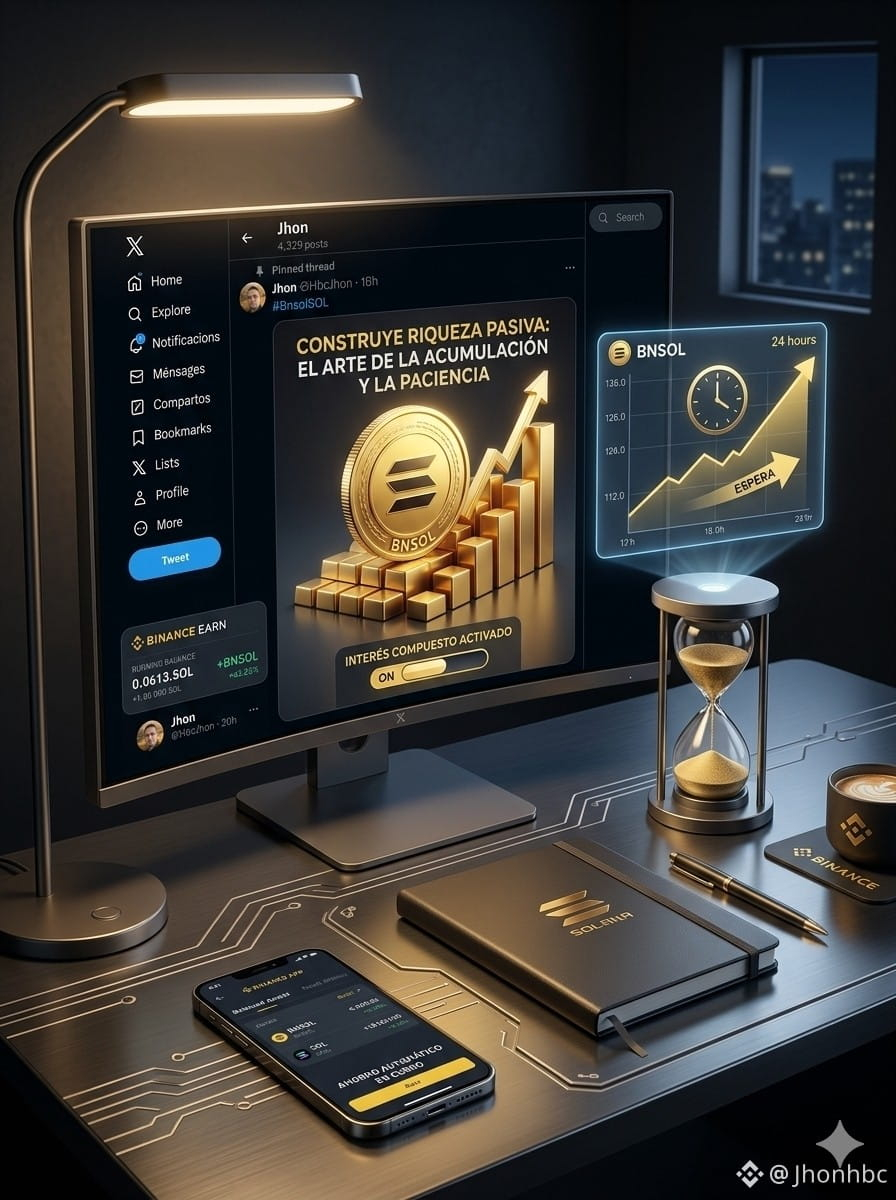
144

Stablecoins are the best option for countries to combat inflation. Replicating the dollar is the best option to save in these times. In the future, it will be the choice of all the most important ones, as well as
$USDT : (or tether) is a stablecoin whose value is designed to always stay linked to the US dollar in a 1 to 1 ratio
$USDC (usd coin) is a digital currency or stablecoin whose value is linked to the US dollar in a 1 to 1 ratio
#Ahorroafuturo #BinanceLatam #educational_post
Stablecoins are the best option for countries to combat inflation. Replicating the dollar is the best option to save in these times. In the future, it will be the choice of all the most important ones, as well as
$USDT : (or tether) is a stablecoin whose value is designed to always stay linked to the US dollar in a 1 to 1 ratio
$USDC (usd coin) is a digital currency or stablecoin whose value is linked to the US dollar in a 1 to 1 ratio
#Ahorroafuturo #BinanceLatam #educational_post
$USDT : (or tether) is a stablecoin whose value is designed to always stay linked to the US dollar in a 1 to 1 ratio
$USDC (usd coin) is a digital currency or stablecoin whose value is linked to the US dollar in a 1 to 1 ratio
#Ahorroafuturo #BinanceLatam #educational_post
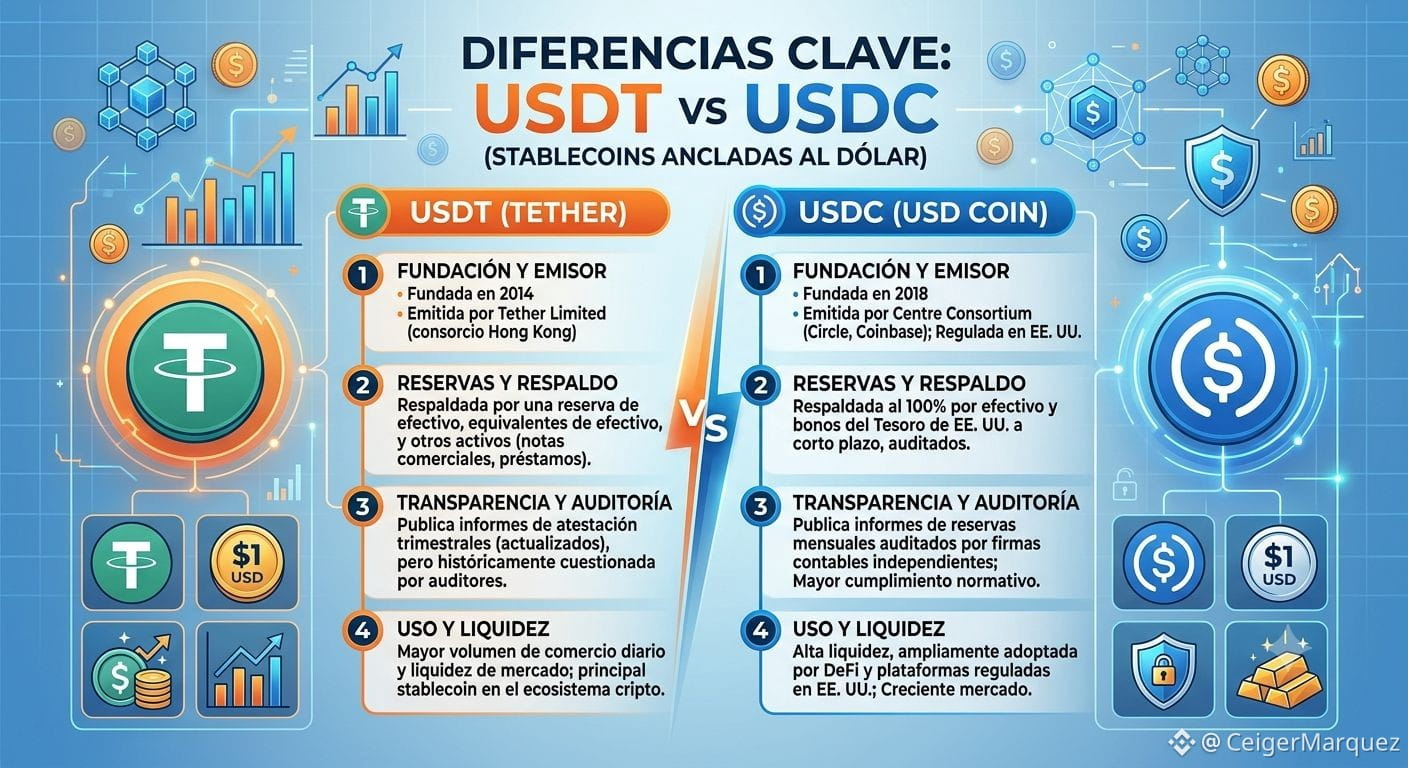
109

·
--
$BTC A lot of people see Bitcoin moving up and immediately think, “lets buy now.”
But smart trading is not about chasing every green candle.
Right now BTC is hovering around the $80K area. The important thing to understand is that a resistance break is only meaningful if price can stay above it. �
CoinGecko +1
If BTC breaks resistance and holds → buyers may stay in control.
If it gets rejected again → a pullback toward support is completely normal.
Lesson: Don't chase the move. Wait for confirmation and always manage your risk.
#Bitcoin #SquareBinance #educational_post
{future}(BTCUSDT)
$BTC A lot of people see Bitcoin moving up and immediately think, “lets buy now.”
But smart trading is not about chasing every green candle.
Right now BTC is hovering around the $80K area. The important thing to understand is that a resistance break is only meaningful if price can stay above it. �
CoinGecko +1
If BTC breaks resistance and holds → buyers may stay in control.
If it gets rejected again → a pullback toward support is completely normal.
Lesson: Don't chase the move. Wait for confirmation and always manage your risk.
#Bitcoin #SquareBinance #educational_post
But smart trading is not about chasing every green candle.
Right now BTC is hovering around the $80K area. The important thing to understand is that a resistance break is only meaningful if price can stay above it. �
CoinGecko +1
If BTC breaks resistance and holds → buyers may stay in control.
If it gets rejected again → a pullback toward support is completely normal.
Lesson: Don't chase the move. Wait for confirmation and always manage your risk.
#Bitcoin #SquareBinance #educational_post
56
·
--
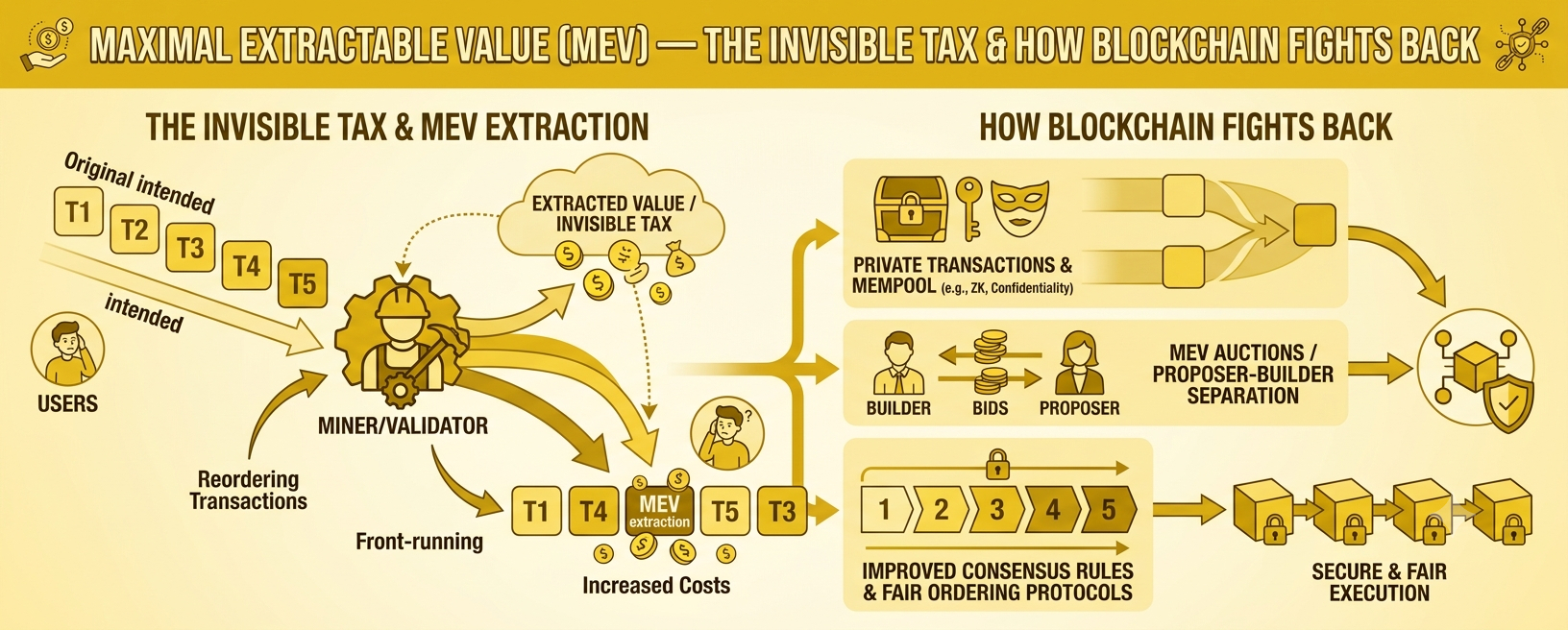
Article
Maximal Extractable Value (MEV) — The Invisible Tax & How Blockchain Fights BackWhy do traders sometimes get worse prices than expected, even when they set slippage limits?
Maximal Extractable Value (MEV) refers to the profit that block producers (validators) and automated bots extract by reordering, inserting, or censoring pending transactions in a public mempool. Often called the "invisible tax" of decentralized finance, MEV transforms transaction sequencing into an algorithmic bidding war—one that directly impacts every DeFi user's bottom line.
---
The Proposer-Builder Separation (PBS) Ecosystem
To prevent validators from centralizing the network by capturing all MEV themselves, modern blockchain architectures use Proposer-Builder Separation (PBS) to split block construction from block validation:
1. Searchers
Specialized bots that continuously scan the mempool for profitable opportunities (like DEX price imbalances) and bundle them into optimized transaction sets.
2. Builders
High-performance entities that collect bundles from searchers, aggregate them with standard user transactions, and build complete blocks designed to maximize revenue.
3. Relays
Intermediary auction mechanisms that verify block validity and pass blinded block headers to validators—ensuring validators cannot steal searcher strategies.
4. Proposers (Validators)
Select and sign the highest-bidding block submitted by the relay market, earning revenue without needing custom bot infrastructure.
---
Major Types of MEV Attacks & Arbitrage
Strategy Execution Method Market Impact
Sandwich Attack A bot buys an asset right before a user's large trade (front-running) and sells it immediately after (back-running). Negative: Artificially inflates slippage and worsens the user's execution price.
DEX Arbitrage Identifies price mismatches across liquidity pools (e.g., Uniswap vs. Sushiswap) and balances them in a single block. Positive: Keeps asset prices uniform across decentralized markets, improving overall efficiency.
Liquidation Botting Scans lending protocols for collateralized loans that drop below safety margins and executes liquidations instantly. Positive: Protects lending protocols from bad debt, though liquidators compete heavily on fees, reducing borrower recoveries.
#educational_post #insight
Maximal Extractable Value (MEV) — The Invisible Tax & How Blockchain Fights Back
Why do traders sometimes get worse prices than expected, even when they set slippage limits?
Maximal Extractable Value (MEV) refers to the profit that block producers (validators) and automated bots extract by reordering, inserting, or censoring pending transactions in a public mempool. Often called the "invisible tax" of decentralized finance, MEV transforms transaction sequencing into an algorithmic bidding war—one that directly impacts every DeFi user's bottom line.
---
The Proposer-Builder Separation (PBS) Ecosystem
To prevent validators from centralizing the network by capturing all MEV themselves, modern blockchain architectures use Proposer-Builder Separation (PBS) to split block construction from block validation:
1. Searchers
Specialized bots that continuously scan the mempool for profitable opportunities (like DEX price imbalances) and bundle them into optimized transaction sets.
2. Builders
High-performance entities that collect bundles from searchers, aggregate them with standard user transactions, and build complete blocks designed to maximize revenue.
3. Relays
Intermediary auction mechanisms that verify block validity and pass blinded block headers to validators—ensuring validators cannot steal searcher strategies.
4. Proposers (Validators)
Select and sign the highest-bidding block submitted by the relay market, earning revenue without needing custom bot infrastructure.
---
Major Types of MEV Attacks & Arbitrage
Strategy Execution Method Market Impact
Sandwich Attack A bot buys an asset right before a user's large trade (front-running) and sells it immediately after (back-running). Negative: Artificially inflates slippage and worsens the user's execution price.
DEX Arbitrage Identifies price mismatches across liquidity pools (e.g., Uniswap vs. Sushiswap) and balances them in a single block. Positive: Keeps asset prices uniform across decentralized markets, improving overall efficiency.
Liquidation Botting Scans lending protocols for collateralized loans that drop below safety margins and executes liquidations instantly. Positive: Protects lending protocols from bad debt, though liquidators compete heavily on fees, reducing borrower recoveries.
#educational_post #insight
Maximal Extractable Value (MEV) refers to the profit that block producers (validators) and automated bots extract by reordering, inserting, or censoring pending transactions in a public mempool. Often called the "invisible tax" of decentralized finance, MEV transforms transaction sequencing into an algorithmic bidding war—one that directly impacts every DeFi user's bottom line.
---
The Proposer-Builder Separation (PBS) Ecosystem
To prevent validators from centralizing the network by capturing all MEV themselves, modern blockchain architectures use Proposer-Builder Separation (PBS) to split block construction from block validation:
1. Searchers
Specialized bots that continuously scan the mempool for profitable opportunities (like DEX price imbalances) and bundle them into optimized transaction sets.
2. Builders
High-performance entities that collect bundles from searchers, aggregate them with standard user transactions, and build complete blocks designed to maximize revenue.
3. Relays
Intermediary auction mechanisms that verify block validity and pass blinded block headers to validators—ensuring validators cannot steal searcher strategies.
4. Proposers (Validators)
Select and sign the highest-bidding block submitted by the relay market, earning revenue without needing custom bot infrastructure.
---
Major Types of MEV Attacks & Arbitrage
Strategy Execution Method Market Impact
Sandwich Attack A bot buys an asset right before a user's large trade (front-running) and sells it immediately after (back-running). Negative: Artificially inflates slippage and worsens the user's execution price.
DEX Arbitrage Identifies price mismatches across liquidity pools (e.g., Uniswap vs. Sushiswap) and balances them in a single block. Positive: Keeps asset prices uniform across decentralized markets, improving overall efficiency.
Liquidation Botting Scans lending protocols for collateralized loans that drop below safety margins and executes liquidations instantly. Positive: Protects lending protocols from bad debt, though liquidators compete heavily on fees, reducing borrower recoveries.
#educational_post #insight
1
9

TOTAL Crypto Market Cap 4H: Comparing the RBR Setup Evolution! 🚀
Here is a side-by-side technical evaluation of how our Rally-Base-Rally (RBR) pattern on the 4-Hour Total Crypto Market Cap (CRYPTOCAP) has evolved from earlier in the week to the latest chart update:
📉 Phase 1 (Left Chart - Sept 1): Price action was hovering near 2.58T, mapping out the initial structural boundaries between the 2.54T support floor and the 2.71T resistance ceiling while building the consolidation base.
📈 Phase 2 (Right Chart - Sept 3): The market has successfully completed the liquidity sweep down to the lower boundary, bounced strongly, and is now actively climbing toward 2.64T, confirming that the RBR continuation structure is progressing precisely as projected.
🎯 Next Macro Milestone: With momentum recovering within the base, attention remains locked on a full push to break the major 2.71T overhead resistance level.
💡 Market Outlook:
Higher-timeframe accumulation ranges like this flush out weak hands before major expansions. Maintaining the 2.54T baseline keeps the bullish RBR thesis entirely intact for the broader crypto market.
#educational_post #cryptooinsigts
TOTAL Crypto Market Cap 4H: Comparing the RBR Setup Evolution! 🚀
Here is a side-by-side technical evaluation of how our Rally-Base-Rally (RBR) pattern on the 4-Hour Total Crypto Market Cap (CRYPTOCAP) has evolved from earlier in the week to the latest chart update:
📉 Phase 1 (Left Chart - Sept 1): Price action was hovering near 2.58T, mapping out the initial structural boundaries between the 2.54T support floor and the 2.71T resistance ceiling while building the consolidation base.
📈 Phase 2 (Right Chart - Sept 3): The market has successfully completed the liquidity sweep down to the lower boundary, bounced strongly, and is now actively climbing toward 2.64T, confirming that the RBR continuation structure is progressing precisely as projected.
🎯 Next Macro Milestone: With momentum recovering within the base, attention remains locked on a full push to break the major 2.71T overhead resistance level.
💡 Market Outlook:
Higher-timeframe accumulation ranges like this flush out weak hands before major expansions. Maintaining the 2.54T baseline keeps the bullish RBR thesis entirely intact for the broader crypto market.
#educational_post #cryptooinsigts
Here is a side-by-side technical evaluation of how our Rally-Base-Rally (RBR) pattern on the 4-Hour Total Crypto Market Cap (CRYPTOCAP) has evolved from earlier in the week to the latest chart update:
📉 Phase 1 (Left Chart - Sept 1): Price action was hovering near 2.58T, mapping out the initial structural boundaries between the 2.54T support floor and the 2.71T resistance ceiling while building the consolidation base.
📈 Phase 2 (Right Chart - Sept 3): The market has successfully completed the liquidity sweep down to the lower boundary, bounced strongly, and is now actively climbing toward 2.64T, confirming that the RBR continuation structure is progressing precisely as projected.
🎯 Next Macro Milestone: With momentum recovering within the base, attention remains locked on a full push to break the major 2.71T overhead resistance level.
💡 Market Outlook:
Higher-timeframe accumulation ranges like this flush out weak hands before major expansions. Maintaining the 2.54T baseline keeps the bullish RBR thesis entirely intact for the broader crypto market.
#educational_post #cryptooinsigts
Hanan-Crypto Analyst
·
--
TOTAL Crypto Market Cap (4H): Setting Up for the Next Rally-Base-Rally (RBR) Leg! 🚀
The latest 4-Hour Total Crypto Market Cap (CRYPTOCAP) chart reveals a textbook continuation pattern following its aggressive macro surge.
📐 Market Structure & Consolidation: Following the powerful impulse move toward the 2.71T resistance region, the total market cap has been building a healthy, structured consolidation range between 2.54T and 2.71T.
🎯 Rally-Base-Rally (RBR) Dynamics: Price action is currently printing a classic Rally-Base-Rally (RBR) setup. Having completed the initial rally, the market is currently forming the "Base" accumulation phase right around 2.58T.
📈 Projected Expansion: Once this high-timeframe base successfully digests remaining sell-side liquidity, we expect the breakout trigger to spark the next impulsive "Rally" phase, clearing the 2.71T ceiling and expanding into higher valuations.
💡 Strategic Outlook:
High-timeframe base building is a bullish indicator of accumulation rather than distribution. This consolidation prepares the ground for a synchronized upward push across major assets and altcoins alike.
Manage your risk tightly and stay positioned as the market prepares for the next leg up
The latest 4-Hour Total Crypto Market Cap (CRYPTOCAP) chart reveals a textbook continuation pattern following its aggressive macro surge.
📐 Market Structure & Consolidation: Following the powerful impulse move toward the 2.71T resistance region, the total market cap has been building a healthy, structured consolidation range between 2.54T and 2.71T.
🎯 Rally-Base-Rally (RBR) Dynamics: Price action is currently printing a classic Rally-Base-Rally (RBR) setup. Having completed the initial rally, the market is currently forming the "Base" accumulation phase right around 2.58T.
📈 Projected Expansion: Once this high-timeframe base successfully digests remaining sell-side liquidity, we expect the breakout trigger to spark the next impulsive "Rally" phase, clearing the 2.71T ceiling and expanding into higher valuations.
💡 Strategic Outlook:
High-timeframe base building is a bullish indicator of accumulation rather than distribution. This consolidation prepares the ground for a synchronized upward push across major assets and altcoins alike.
Manage your risk tightly and stay positioned as the market prepares for the next leg up
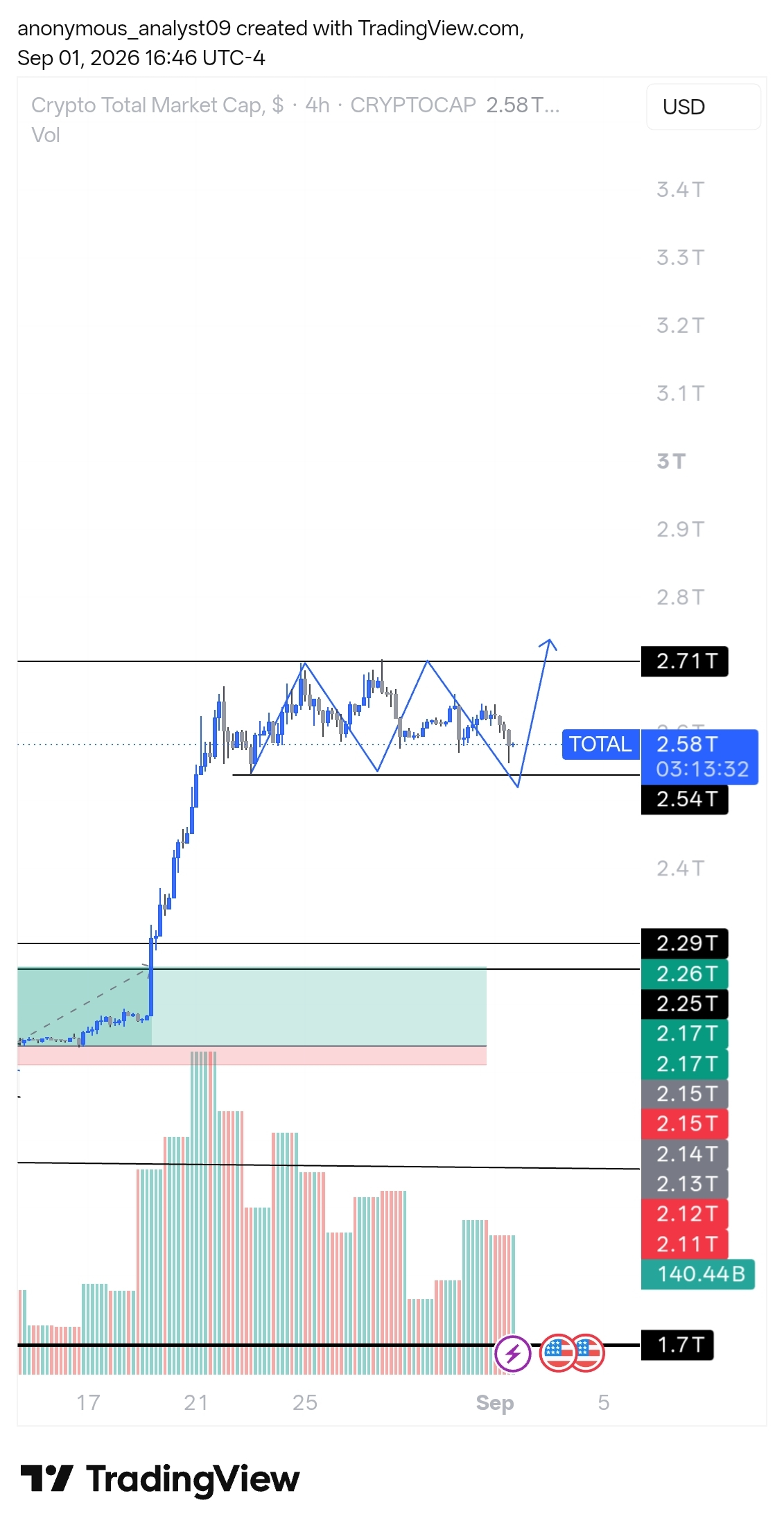
1
70
Log in to explore more content
Join global crypto users on Binance Square
⚡️ Get latest and useful information about crypto.
💬 Trusted by the world’s largest crypto exchange.
👍 Discover real insights from verified creators.
Email / Phone number
Trending Topics
1
#AIStocksWhatNext
133,288 views
1,635 Discussing
2
#BitcoinBreaksAboveMayHighNears$86K
3,178 views
58 Discussing
3
#DogecoinRises15%
7,907 views
378 Discussing
4
#$14BBitcoinOptionsExpireFriday
369 views
36 Discussing
5
#BNBMarketCapPassesBNYMellon
4,053 views
277 Discussing
6
#CryptoMarketCapReclaims$3Trillion
798 views
32 Discussing
7
#MuseOvertakesChatGPTAsTopFreeIOSApp
4,338 views
272 Discussing
8
#TokenizedStockPlatformsCouldLaunchNextQuarter
6,728 views
302 Discussing
9
#StrategyAdds950Bitcoin
10,987 views
389 Discussing
10
#CardanoAddedToX402KitForADAPayments
15,607 views
502 Discussing