

#cardano
cardano
22.4M views
29,713 Discussing
Hot
Latest

·
--
Bullish
$ADA /USDT — Golden Cross
📈 BULLISH SETUP
📍 Current: ~$0.256
📊 24h Change: +8%
🎯 Watching: 50-day MA crossing above 200-day MA
📝 Golden Cross forming. ADA rallied from $0.20 to $0.28 in 48 hours before cooling off. $ADA
{future}(ADAUSDT)
#ADA #Cardano #crypto #BinanceSquare
$ADA /USDT — Golden Cross
📈 BULLISH SETUP
📍 Current: ~$0.256
📊 24h Change: +8%
🎯 Watching: 50-day MA crossing above 200-day MA
📝 Golden Cross forming. ADA rallied from $0.20 to $0.28 in 48 hours before cooling off. $ADA
#ADA #Cardano #crypto #BinanceSquare
📈 BULLISH SETUP
📍 Current: ~$0.256
📊 24h Change: +8%
🎯 Watching: 50-day MA crossing above 200-day MA
📝 Golden Cross forming. ADA rallied from $0.20 to $0.28 in 48 hours before cooling off. $ADA
#ADA #Cardano #crypto #BinanceSquare
1
129

$ADA has been quietly building a base. 🧱
Price consolidating in a tight range, volume slowly picking up — classic setup before a directional move.
Breakout up, or fake-out down?
#Cardano
{spot}(ADAUSDT)
#ADA #CryptoNews
$ADA has been quietly building a base. 🧱
Price consolidating in a tight range, volume slowly picking up — classic setup before a directional move.
Breakout up, or fake-out down?
#Cardano
#ADA #CryptoNews
Price consolidating in a tight range, volume slowly picking up — classic setup before a directional move.
Breakout up, or fake-out down?
#Cardano
#ADA #CryptoNews
106


ADA is grinding in a tight range and the tension is building.
With a tiny +0.157% move over the last day, $ADA sits right at $0.2553. We saw a 24h high of $0.2654 and a 24h low of $0.2506. The market is compressed, and compression breeds expansion. Here are two technical pathways depending on where the break occurs. This is not a prediction or financial advice, so DYOR.
🟢 Long setup: entry $0.2553, SL $0.247641, TP $0.268065
🔴 Short setup: entry $0.2553, SL $0.262959, TP $0.242535
#Write2Earn #Cardano #CryptoTrading
ADA is grinding in a tight range and the tension is building.
With a tiny +0.157% move over the last day, $ADA sits right at $0.2553. We saw a 24h high of $0.2654 and a 24h low of $0.2506. The market is compressed, and compression breeds expansion. Here are two technical pathways depending on where the break occurs. This is not a prediction or financial advice, so DYOR.
🟢 Long setup: entry $0.2553, SL $0.247641, TP $0.268065
🔴 Short setup: entry $0.2553, SL $0.262959, TP $0.242535
#Write2Earn #Cardano #CryptoTrading
With a tiny +0.157% move over the last day, $ADA sits right at $0.2553. We saw a 24h high of $0.2654 and a 24h low of $0.2506. The market is compressed, and compression breeds expansion. Here are two technical pathways depending on where the break occurs. This is not a prediction or financial advice, so DYOR.
🟢 Long setup: entry $0.2553, SL $0.247641, TP $0.268065
🔴 Short setup: entry $0.2553, SL $0.262959, TP $0.242535
#Write2Earn #Cardano #CryptoTrading

136

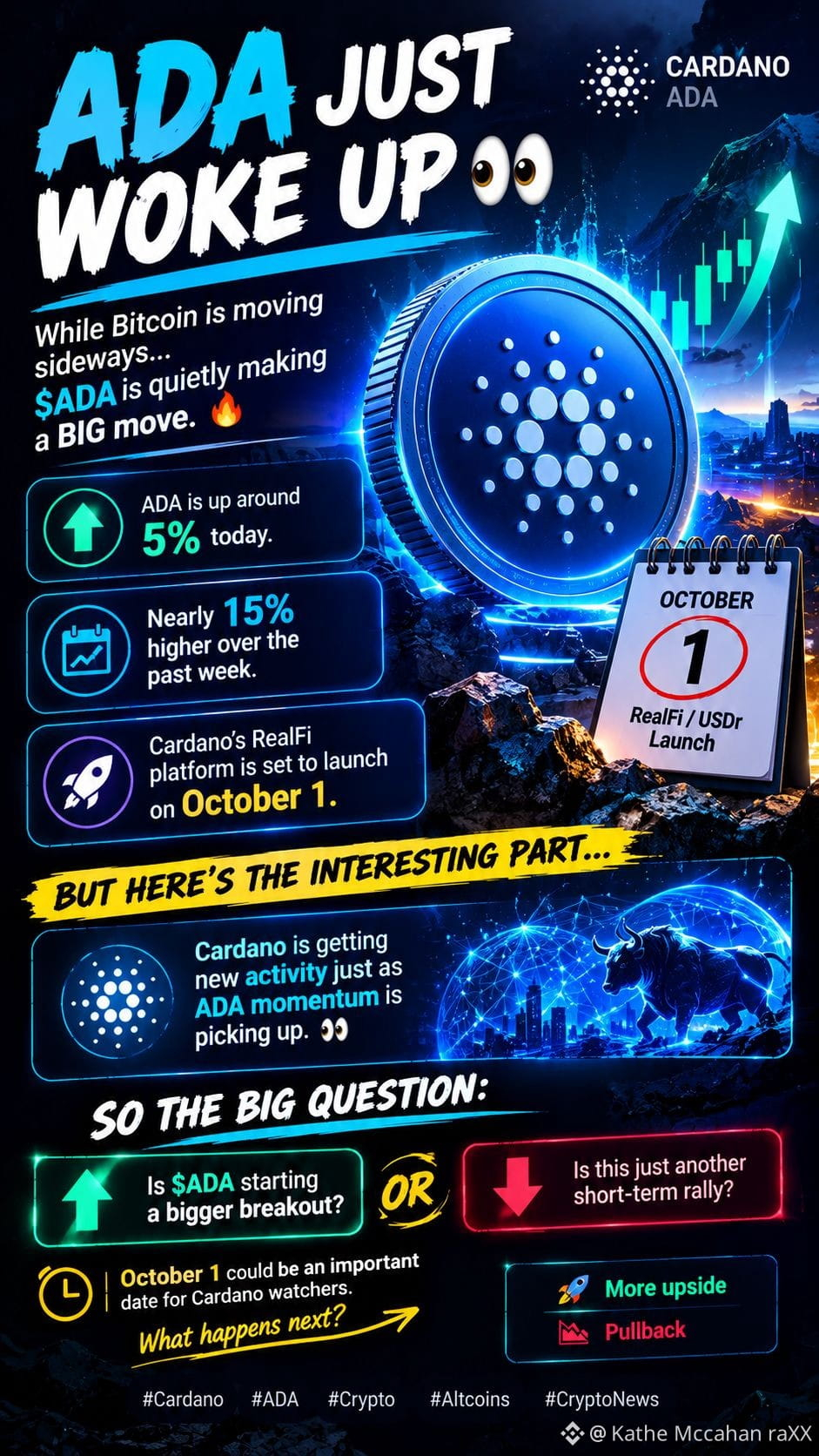
🚨 ADA JUST WOKE UP 👀
While Bitcoin is moving sideways…
$ADA is quietly making a BIG move. 🔥
🚀 ADA is up around 5% today. 📈 Nearly 15% higher over the past week. 🏦 Cardano’s RealFi platform is set to launch on October 1.
But here’s the interesting part…
Cardano is getting new activity just as ADA momentum is picking up. 👀
{spot}(ADAUSDT)
So the BIG question:
🔥 Is $ADA starting a bigger breakout?
OR
⚠️ Is this just another short-term rally?
October 1 could be an important date for Cardano watchers.
What happens next? 👇
🚀 More upside
📉 Pullback
#Cardano #ADA #crypto #altcoins #CryptoNews
🚨 ADA JUST WOKE UP 👀
While Bitcoin is moving sideways…
$ADA is quietly making a BIG move. 🔥
🚀 ADA is up around 5% today. 📈 Nearly 15% higher over the past week. 🏦 Cardano’s RealFi platform is set to launch on October 1.
But here’s the interesting part…
Cardano is getting new activity just as ADA momentum is picking up. 👀
So the BIG question:
🔥 Is $ADA starting a bigger breakout?
OR
⚠️ Is this just another short-term rally?
October 1 could be an important date for Cardano watchers.
What happens next? 👇
🚀 More upside
📉 Pullback
#Cardano #ADA #crypto #altcoins #CryptoNews
While Bitcoin is moving sideways…
$ADA is quietly making a BIG move. 🔥
🚀 ADA is up around 5% today. 📈 Nearly 15% higher over the past week. 🏦 Cardano’s RealFi platform is set to launch on October 1.
But here’s the interesting part…
Cardano is getting new activity just as ADA momentum is picking up. 👀
So the BIG question:
🔥 Is $ADA starting a bigger breakout?
OR
⚠️ Is this just another short-term rally?
October 1 could be an important date for Cardano watchers.
What happens next? 👇
🚀 More upside
📉 Pullback
#Cardano #ADA #crypto #altcoins #CryptoNews
169

·
--
🚨$ADA finally showing some strength again? 👀*
{spot}(ADAUSDT)
$ADA
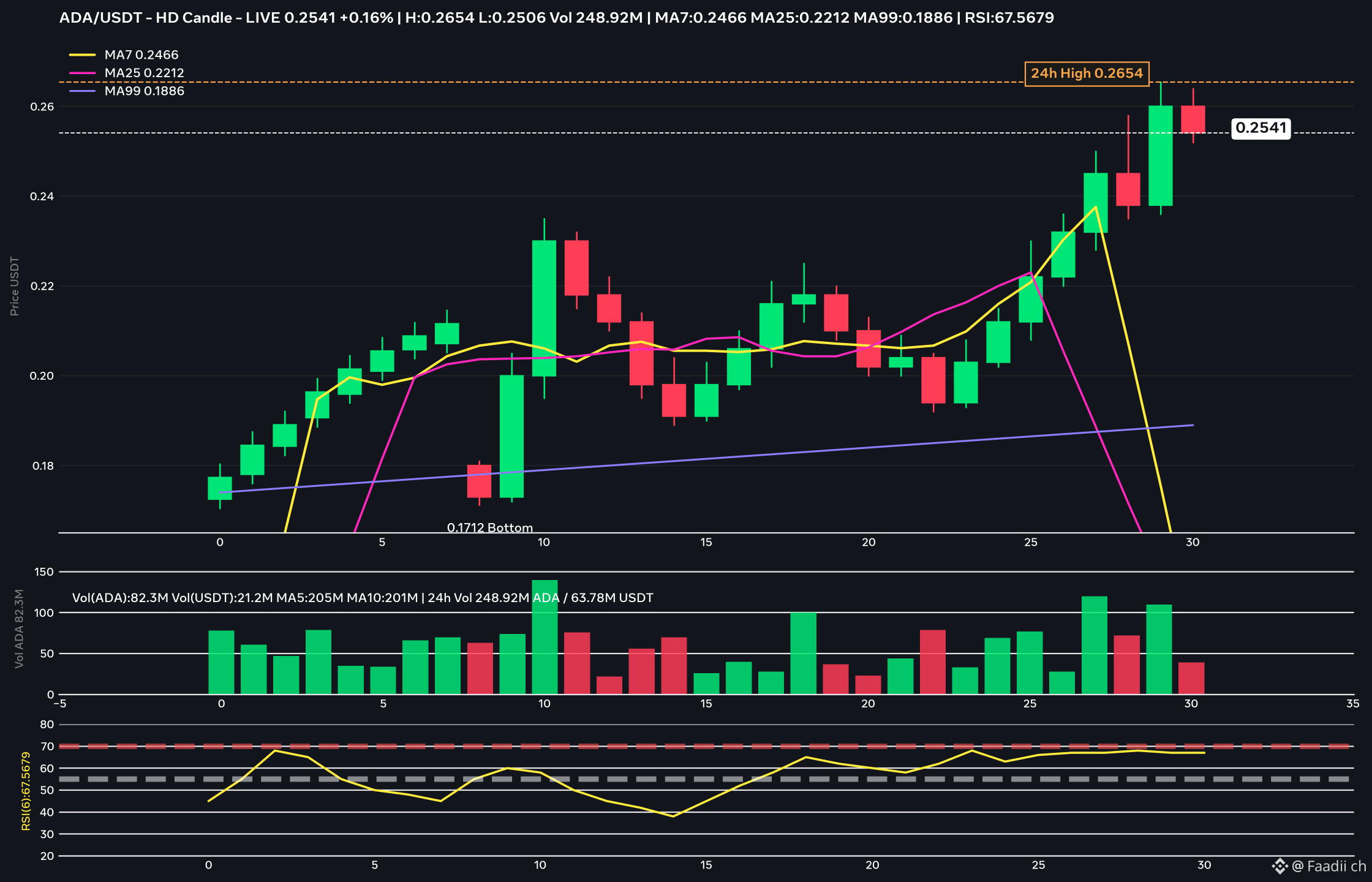
Sitting at $0.2541 after tapping $0.2654 high today. Low held nicely at $0.2506 - buyers didn't let it slip.
Momentum is bullish, price holding above MA7 $0.2466 and way above MA25 $0.2212. RSI at 67.5 - strong but getting close to overbought so watch for a small cool-off.
$ADA
Key levels:
🔴 Resistance: $0.2654 - break this and continuation could be on the table
🟢 Support: $0.2466 then $0.2212 - if these hold, uptrend stays intact. Break $0.2466 and we might see a pullback
Volume picking up too, 248M ADA traded.
You seeing ADA reclaim $0.2654 or pulling back first? 👇
#ADA #Cardano #Binance #Crypto
🚨$ADA finally showing some strength again? 👀*
$ADA
Sitting at $0.2541 after tapping $0.2654 high today. Low held nicely at $0.2506 - buyers didn't let it slip.
Momentum is bullish, price holding above MA7 $0.2466 and way above MA25 $0.2212. RSI at 67.5 - strong but getting close to overbought so watch for a small cool-off.
$ADA
Key levels:
🔴 Resistance: $0.2654 - break this and continuation could be on the table
🟢 Support: $0.2466 then $0.2212 - if these hold, uptrend stays intact. Break $0.2466 and we might see a pullback
Volume picking up too, 248M ADA traded.
You seeing ADA reclaim $0.2654 or pulling back first? 👇
#ADA #Cardano #Binance #Crypto
$ADA
Sitting at $0.2541 after tapping $0.2654 high today. Low held nicely at $0.2506 - buyers didn't let it slip.
Momentum is bullish, price holding above MA7 $0.2466 and way above MA25 $0.2212. RSI at 67.5 - strong but getting close to overbought so watch for a small cool-off.
$ADA
Key levels:
🔴 Resistance: $0.2654 - break this and continuation could be on the table
🟢 Support: $0.2466 then $0.2212 - if these hold, uptrend stays intact. Break $0.2466 and we might see a pullback
Volume picking up too, 248M ADA traded.
You seeing ADA reclaim $0.2654 or pulling back first? 👇
#ADA #Cardano #Binance #Crypto
170

🚨 $ADA is looking solid around $0.26 right now.
Consolidation is getting tight and a breakout feels like it's brewing. The ecosystem growth lately is hard to ignore, and any clean move above current resistance is going to trigger a big run.
Are you buying the dip here or waiting for confirmation? Let me know 👇
#Cardano #ADA #Crypto #Altcoins
{spot}(ADAUSDT)
🚨 $ADA is looking solid around $0.26 right now.
Consolidation is getting tight and a breakout feels like it's brewing. The ecosystem growth lately is hard to ignore, and any clean move above current resistance is going to trigger a big run.
Are you buying the dip here or waiting for confirmation? Let me know 👇
#Cardano #ADA #Crypto #Altcoins
Consolidation is getting tight and a breakout feels like it's brewing. The ecosystem growth lately is hard to ignore, and any clean move above current resistance is going to trigger a big run.
Are you buying the dip here or waiting for confirmation? Let me know 👇
#Cardano #ADA #Crypto #Altcoins
1
99
$ADA is coiling tight right at $0.2541 after printing a +0.954% 24h gain!
Price action is squeezed between the 24h high of $0.2654 and low of $0.2504, setting up a sharp breakout move. We react to structure, not bias, so keep both trade plans active.
🐂 Long setup: Entry $0.2541, SL $0.246477, TP $0.266805
🐻 Short setup: Entry $0.2541, SL $0.261723, TP $0.241395
⚡ Manage your risk strictly
This is not a prediction, Not financial advice. Always DYOR!
$ADA #Write2Earn #CryptoTrading #Cardano
$ADA is coiling tight right at $0.2541 after printing a +0.954% 24h gain!
Price action is squeezed between the 24h high of $0.2654 and low of $0.2504, setting up a sharp breakout move. We react to structure, not bias, so keep both trade plans active.
🐂 Long setup: Entry $0.2541, SL $0.246477, TP $0.266805
🐻 Short setup: Entry $0.2541, SL $0.261723, TP $0.241395
⚡ Manage your risk strictly
This is not a prediction, Not financial advice. Always DYOR!
$ADA #Write2Earn #CryptoTrading #Cardano
Price action is squeezed between the 24h high of $0.2654 and low of $0.2504, setting up a sharp breakout move. We react to structure, not bias, so keep both trade plans active.
🐂 Long setup: Entry $0.2541, SL $0.246477, TP $0.266805
🐻 Short setup: Entry $0.2541, SL $0.261723, TP $0.241395
⚡ Manage your risk strictly
This is not a prediction, Not financial advice. Always DYOR!
$ADA #Write2Earn #CryptoTrading #Cardano

45
$ADA is grinding upward, holding at $0.255 with a solid +2.204% 24h change. Price action pushed between a 24h low of $0.2486 and a 24h high of $0.2654. Volatility is creating clear boundaries for both sides of the tape today. ⚡
If buyers maintain control, an illustrative long looks at an entry at $0.255, targeting TP at $0.26775 with a tight SL at $0.24735. Flip the script for the bears, and an illustrative short enters at $0.255, targeting TP at $0.24225 with SL placed at $0.26265. Smart risk parameters keep you in the game regardless of market direction. 📊
This structured breakdown is purely for scenario planning, not a prediction and definitely not financial advice. Always manage risk, protect your capital, and DYOR before taking any trades. 🎯 #Write2Earn #Cardano #Crypto #Trading
$ADA is grinding upward, holding at $0.255 with a solid +2.204% 24h change. Price action pushed between a 24h low of $0.2486 and a 24h high of $0.2654. Volatility is creating clear boundaries for both sides of the tape today. ⚡
If buyers maintain control, an illustrative long looks at an entry at $0.255, targeting TP at $0.26775 with a tight SL at $0.24735. Flip the script for the bears, and an illustrative short enters at $0.255, targeting TP at $0.24225 with SL placed at $0.26265. Smart risk parameters keep you in the game regardless of market direction. 📊
This structured breakdown is purely for scenario planning, not a prediction and definitely not financial advice. Always manage risk, protect your capital, and DYOR before taking any trades. 🎯 #Write2Earn #Cardano #Crypto #Trading
If buyers maintain control, an illustrative long looks at an entry at $0.255, targeting TP at $0.26775 with a tight SL at $0.24735. Flip the script for the bears, and an illustrative short enters at $0.255, targeting TP at $0.24225 with SL placed at $0.26265. Smart risk parameters keep you in the game regardless of market direction. 📊
This structured breakdown is purely for scenario planning, not a prediction and definitely not financial advice. Always manage risk, protect your capital, and DYOR before taking any trades. 🎯 #Write2Earn #Cardano #Crypto #Trading

69

Article
"Cardano Forms 2020-Like Base Setup as Analyst Eyes 1,049% ADA Rally"Javon Marks, a popular market commentator, suggests #Cardano could be entering a new accumulation phase similar to the 2020 setup that preceded ADA’s historic rally.
Notably, Marks shared a long-term technical analysis suggesting that Cardano has formed a base resembling the structure it developed before its major 2021 rally. Based on the historical comparison, he believes ADA could be in the early stages of another significant move.
Cardano Forms Base Similar to 2020 Structure
According to Marks, Cardano’s current price structure shares similarities with its 2020 market setup. At the time, ADA spent an extended period consolidating before breaking higher and entering a powerful uptrend.
The accompanying weekly TradingView chart highlights the similarities between the two structures. In particular, the chart shows ADA moving through a prolonged consolidation phase before recovering from a recent low.
Meanwhile, Marks projected that the similarities could trigger a potential move toward the $2.90 level. With ADA trading around $0.246, reaching that target would require a gain of roughly 1,050%. Marks described the potential move as another monstrous run.
ADA Rebounds From September Lows
Meanwhile, ADA has also recorded notable gains since mid-September. It traded around $0.19012 on September 16 before gradually recovering amid the broader market rally.
The rebound eventually pushed ADA to $0.262 this week. However, ADA later retraced and now traded at $0.246 at press time.
If ADA eventually reaches Marks’ $2.90 target, its market capitalization would rise to $106.62 billion, given its circulating supply of 36.76 billion ADA. Moreover, the projected price would place ADA relatively close to its previous peak price of $3.10.
ADA Previous Bull Rally
Cardano’s historical performance provides the basis for Marks’ comparison. ADA traded around $0.020 in early 2020 before entering a prolonged rally that eventually pushed the token to $3.10 on September 2, 2021.
Similarly, the current chart shows ADA spending an extended period within a broader consolidation structure before attempting to break higher.
Meanwhile, SongMarketCap founder Jure Karamarko has previously expressed confidence that ADA will revisit the $3 level. He argued that the key question is when, rather than whether, Cardano will return to that price.
Cardano founder Charles Hoskinson has also pointed to ADA’s historical rise from roughly $0.02 to $3.10 when discussing the cryptocurrency’s potential for another major rally.
While Marks believes ADA’s current setup could mirror its 2020–2021 rally and propel the token toward $2.90, historical patterns do not guarantee a repeat performance. Instead, the comparison highlights a potential accumulation phase similar to Cardano’s previous cycle.
#CryptoNews
"Cardano Forms 2020-Like Base Setup as Analyst Eyes 1,049% ADA Rally"
Javon Marks, a popular market commentator, suggests #Cardano could be entering a new accumulation phase similar to the 2020 setup that preceded ADA’s historic rally.
Notably, Marks shared a long-term technical analysis suggesting that Cardano has formed a base resembling the structure it developed before its major 2021 rally. Based on the historical comparison, he believes ADA could be in the early stages of another significant move.
Cardano Forms Base Similar to 2020 Structure
According to Marks, Cardano’s current price structure shares similarities with its 2020 market setup. At the time, ADA spent an extended period consolidating before breaking higher and entering a powerful uptrend.
The accompanying weekly TradingView chart highlights the similarities between the two structures. In particular, the chart shows ADA moving through a prolonged consolidation phase before recovering from a recent low.
Meanwhile, Marks projected that the similarities could trigger a potential move toward the $2.90 level. With ADA trading around $0.246, reaching that target would require a gain of roughly 1,050%. Marks described the potential move as another monstrous run.
ADA Rebounds From September Lows
Meanwhile, ADA has also recorded notable gains since mid-September. It traded around $0.19012 on September 16 before gradually recovering amid the broader market rally.
The rebound eventually pushed ADA to $0.262 this week. However, ADA later retraced and now traded at $0.246 at press time.
If ADA eventually reaches Marks’ $2.90 target, its market capitalization would rise to $106.62 billion, given its circulating supply of 36.76 billion ADA. Moreover, the projected price would place ADA relatively close to its previous peak price of $3.10.
ADA Previous Bull Rally
Cardano’s historical performance provides the basis for Marks’ comparison. ADA traded around $0.020 in early 2020 before entering a prolonged rally that eventually pushed the token to $3.10 on September 2, 2021.
Similarly, the current chart shows ADA spending an extended period within a broader consolidation structure before attempting to break higher.
Meanwhile, SongMarketCap founder Jure Karamarko has previously expressed confidence that ADA will revisit the $3 level. He argued that the key question is when, rather than whether, Cardano will return to that price.
Cardano founder Charles Hoskinson has also pointed to ADA’s historical rise from roughly $0.02 to $3.10 when discussing the cryptocurrency’s potential for another major rally.
While Marks believes ADA’s current setup could mirror its 2020–2021 rally and propel the token toward $2.90, historical patterns do not guarantee a repeat performance. Instead, the comparison highlights a potential accumulation phase similar to Cardano’s previous cycle.
#CryptoNews
Notably, Marks shared a long-term technical analysis suggesting that Cardano has formed a base resembling the structure it developed before its major 2021 rally. Based on the historical comparison, he believes ADA could be in the early stages of another significant move.
Cardano Forms Base Similar to 2020 Structure
According to Marks, Cardano’s current price structure shares similarities with its 2020 market setup. At the time, ADA spent an extended period consolidating before breaking higher and entering a powerful uptrend.
The accompanying weekly TradingView chart highlights the similarities between the two structures. In particular, the chart shows ADA moving through a prolonged consolidation phase before recovering from a recent low.
Meanwhile, Marks projected that the similarities could trigger a potential move toward the $2.90 level. With ADA trading around $0.246, reaching that target would require a gain of roughly 1,050%. Marks described the potential move as another monstrous run.
ADA Rebounds From September Lows
Meanwhile, ADA has also recorded notable gains since mid-September. It traded around $0.19012 on September 16 before gradually recovering amid the broader market rally.
The rebound eventually pushed ADA to $0.262 this week. However, ADA later retraced and now traded at $0.246 at press time.
If ADA eventually reaches Marks’ $2.90 target, its market capitalization would rise to $106.62 billion, given its circulating supply of 36.76 billion ADA. Moreover, the projected price would place ADA relatively close to its previous peak price of $3.10.
ADA Previous Bull Rally
Cardano’s historical performance provides the basis for Marks’ comparison. ADA traded around $0.020 in early 2020 before entering a prolonged rally that eventually pushed the token to $3.10 on September 2, 2021.
Similarly, the current chart shows ADA spending an extended period within a broader consolidation structure before attempting to break higher.
Meanwhile, SongMarketCap founder Jure Karamarko has previously expressed confidence that ADA will revisit the $3 level. He argued that the key question is when, rather than whether, Cardano will return to that price.
Cardano founder Charles Hoskinson has also pointed to ADA’s historical rise from roughly $0.02 to $3.10 when discussing the cryptocurrency’s potential for another major rally.
While Marks believes ADA’s current setup could mirror its 2020–2021 rally and propel the token toward $2.90, historical patterns do not guarantee a repeat performance. Instead, the comparison highlights a potential accumulation phase similar to Cardano’s previous cycle.
#CryptoNews
377

·
--
Bearish
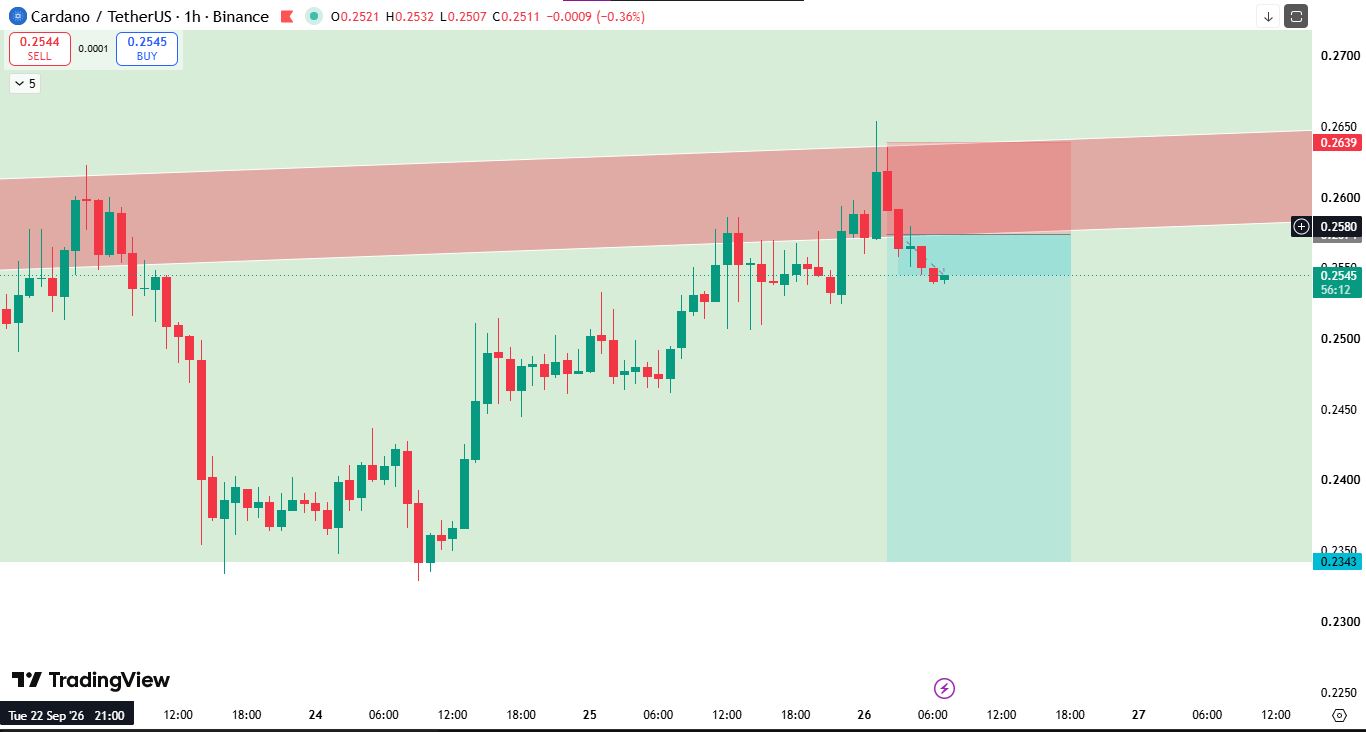
ADA/USDT 1H — SHORT SIGNAL
Cardano (ADA) is trading around $0.2545 and showing rejection from the $0.2580–$0.2600 resistance zone.
🔴 SHORT ENTRY: $0.2545–$0.2580
🎯 TP1: $0.2500
🎯 TP2: $0.2450
🎯 TP3: $0.2433
🛑 SL: $0.2640
📌 Resistance: $0.2580–$0.2640
📌 Major Support: $0.2433
If ADA breaks above $0.2640 and holds, this short setup becomes invalid.
⚠️ Wait for confirmation before entering. Use proper risk management and avoid excessive leverage. This is a technical setup, not a guaranteed-profit signal.
$ADA
{future}(ADAUSDT)
#Cardano
ADA/USDT 1H — SHORT SIGNAL
Cardano (ADA) is trading around $0.2545 and showing rejection from the $0.2580–$0.2600 resistance zone.
🔴 SHORT ENTRY: $0.2545–$0.2580
🎯 TP1: $0.2500
🎯 TP2: $0.2450
🎯 TP3: $0.2433
🛑 SL: $0.2640
📌 Resistance: $0.2580–$0.2640
📌 Major Support: $0.2433
If ADA breaks above $0.2640 and holds, this short setup becomes invalid.
⚠️ Wait for confirmation before entering. Use proper risk management and avoid excessive leverage. This is a technical setup, not a guaranteed-profit signal.
$ADA
#Cardano
Cardano (ADA) is trading around $0.2545 and showing rejection from the $0.2580–$0.2600 resistance zone.
🔴 SHORT ENTRY: $0.2545–$0.2580
🎯 TP1: $0.2500
🎯 TP2: $0.2450
🎯 TP3: $0.2433
🛑 SL: $0.2640
📌 Resistance: $0.2580–$0.2640
📌 Major Support: $0.2433
If ADA breaks above $0.2640 and holds, this short setup becomes invalid.
⚠️ Wait for confirmation before entering. Use proper risk management and avoid excessive leverage. This is a technical setup, not a guaranteed-profit signal.
$ADA
#Cardano
1
281
+3.762 percent is the daily bounce on $ADA right now. Bulls are attempting a recovery from the $0.2462 low up to the $0.2654 peak. Current price sits right at $0.2565. Watch these levels closely. Long setup idea: entry $0.2565, stop loss $0.248805, take profit $0.269325. Short setup idea: entry $0.2565, stop loss $0.264195, take profit $0.243675. This is not a prediction. Not financial advice. DYOR. #Write2Earn #ADA #Cardano #CryptoTrading
+3.762 percent is the daily bounce on $ADA right now. Bulls are attempting a recovery from the $0.2462 low up to the $0.2654 peak. Current price sits right at $0.2565. Watch these levels closely. Long setup idea: entry $0.2565, stop loss $0.248805, take profit $0.269325. Short setup idea: entry $0.2565, stop loss $0.264195, take profit $0.243675. This is not a prediction. Not financial advice. DYOR. #Write2Earn #ADA #Cardano #CryptoTrading

117
Cardano is testing the waters again with real volatility today. At 0.2563 dollars and up 3.514 percent, $ADA is shaking off the chop between 0.2462 and 0.2654 dollars. Watch these levels closely for your next move. 🚀 Long idea plays the bounce: entry at 0.2563, stop loss at 0.248611, take profit at 0.269115. 📉 Short idea fades the high: entry at 0.2563, stop loss at 0.263989, take profit at 0.243485. Not a prediction. Not financial advice. DYOR. #Write2Earn #ADA #Cardano #Trading
Cardano is testing the waters again with real volatility today. At 0.2563 dollars and up 3.514 percent, $ADA is shaking off the chop between 0.2462 and 0.2654 dollars. Watch these levels closely for your next move. 🚀 Long idea plays the bounce: entry at 0.2563, stop loss at 0.248611, take profit at 0.269115. 📉 Short idea fades the high: entry at 0.2563, stop loss at 0.263989, take profit at 0.243485. Not a prediction. Not financial advice. DYOR. #Write2Earn #ADA #Cardano #Trading

73
Cardano is moving fast right now and you need a plan. ADA is trading at $0.2586 after printing a +2.701% gain within a 24h range between $0.2462 and $0.2598. Volatility is here and both sides of the book are alive. 📈 Watch the long setup from entry $0.2586 with stop loss at $0.250842 and target $0.27153. 📉 Consider the short play entering at $0.2586 with stop loss at $0.266358 and target $0.24567. This is not a prediction, Not financial advice, and DYOR. $ADA #Write2Earn #CryptoTrading #Cardano #TradingStrategy
Cardano is moving fast right now and you need a plan. ADA is trading at $0.2586 after printing a +2.701% gain within a 24h range between $0.2462 and $0.2598. Volatility is here and both sides of the book are alive. 📈 Watch the long setup from entry $0.2586 with stop loss at $0.250842 and target $0.27153. 📉 Consider the short play entering at $0.2586 with stop loss at $0.266358 and target $0.24567. This is not a prediction, Not financial advice, and DYOR. $ADA #Write2Earn #CryptoTrading #Cardano #TradingStrategy

1
32
Cardano is moving with real purpose today holding green at $0.2582 after a solid +3.28% push inside a tight session band from a $0.2462 low up to a $0.2598 high. Momentum traders are mapping both sides right now depending on how price handles this exact spot. An illustrative long entry sits right here at $0.2582 with a tight stop loss down at $0.250454 targeting a clean run toward $0.27111. On the flip side an illustrative short setup targets an entry at $0.2582 protected by a stop loss at $0.265946 aiming for a pullback back down to $0.24529. Volatility offers opportunity if you manage risk properly. This is not a prediction. Not financial advice. Always DYOR. $ADA #Write2Earn #CryptoTrading #Cardano #Trading
Cardano is moving with real purpose today holding green at $0.2582 after a solid +3.28% push inside a tight session band from a $0.2462 low up to a $0.2598 high. Momentum traders are mapping both sides right now depending on how price handles this exact spot. An illustrative long entry sits right here at $0.2582 with a tight stop loss down at $0.250454 targeting a clean run toward $0.27111. On the flip side an illustrative short setup targets an entry at $0.2582 protected by a stop loss at $0.265946 aiming for a pullback back down to $0.24529. Volatility offers opportunity if you manage risk properly. This is not a prediction. Not financial advice. Always DYOR. $ADA #Write2Earn #CryptoTrading #Cardano #Trading

213
Cardano is moving fast and $ADA is testing key levels right now. Price is holding at $0.2585 after printing a 24h gain of +3.94%, touching a high of $0.2598 and a low of $0.2462. Markets demand discipline here, not blind hope. 📈 Tap into these setups: 1️⃣ Long entry at $0.2585 with stop loss at $0.250745 and take profit at $0.271425. 2️⃣ Short entry at $0.2585 with stop loss at $0.266255 and take profit at $0.245575. This is not a prediction, Not financial advice, and DYOR. #Write2Earn #ADA #Cardano #CryptoTrading
Cardano is moving fast and $ADA is testing key levels right now. Price is holding at $0.2585 after printing a 24h gain of +3.94%, touching a high of $0.2598 and a low of $0.2462. Markets demand discipline here, not blind hope. 📈 Tap into these setups: 1️⃣ Long entry at $0.2585 with stop loss at $0.250745 and take profit at $0.271425. 2️⃣ Short entry at $0.2585 with stop loss at $0.266255 and take profit at $0.245575. This is not a prediction, Not financial advice, and DYOR. #Write2Earn #ADA #Cardano #CryptoTrading

1
150
ADA is showing a pulse right here at $0.2535 after tapping a 24h high of $0.2586 and a 24h low of $0.2461, up 1.359% on the day. Action demands precision. Plan your levels now.
- Long setup: Entry $0.2535, stop loss $0.245895, take profit $0.266175 🚀
- Short setup: Entry $0.2535, stop loss $0.261105, take profit $0.240825 📉
- This is not a prediction, not financial advice, and DYOR. $ADA #Write2Earn #CryptoTrading #Cardano #TradingStrategies
ADA is showing a pulse right here at $0.2535 after tapping a 24h high of $0.2586 and a 24h low of $0.2461, up 1.359% on the day. Action demands precision. Plan your levels now.
- Long setup: Entry $0.2535, stop loss $0.245895, take profit $0.266175 🚀
- Short setup: Entry $0.2535, stop loss $0.261105, take profit $0.240825 📉
- This is not a prediction, not financial advice, and DYOR. $ADA #Write2Earn #CryptoTrading #Cardano #TradingStrategies
- Long setup: Entry $0.2535, stop loss $0.245895, take profit $0.266175 🚀
- Short setup: Entry $0.2535, stop loss $0.261105, take profit $0.240825 📉
- This is not a prediction, not financial advice, and DYOR. $ADA #Write2Earn #CryptoTrading #Cardano #TradingStrategies

210
Cardano is moving with purpose and traders need to pay attention right now. $ADA is printing a 2.865 percent gain over the last 24 hours, trading at 0.2549 dollars after testing a low of 0.2461 and a high of 0.2586. Volatility is here and both sides of the tape are offering setups. 🎯 Long plan sets entry at 0.2549 with stop loss at 0.247253 and target at 0.267645. 📉 Short plan enters at 0.2549 with stop loss at 0.262547 and target at 0.242155. Not a prediction. Not financial advice. DYOR. #Write2Earn #ADA #Cardano #Crypto
Cardano is moving with purpose and traders need to pay attention right now. $ADA is printing a 2.865 percent gain over the last 24 hours, trading at 0.2549 dollars after testing a low of 0.2461 and a high of 0.2586. Volatility is here and both sides of the tape are offering setups. 🎯 Long plan sets entry at 0.2549 with stop loss at 0.247253 and target at 0.267645. 📉 Short plan enters at 0.2549 with stop loss at 0.262547 and target at 0.242155. Not a prediction. Not financial advice. DYOR. #Write2Earn #ADA #Cardano #Crypto

123

ADA Market Update: Defending Critical Support Levels
Cardano ($ADA) recently tested a major ascending trendline support and successfully printed a healthy technical bounce, gaining over 3% within a 24-hour window.
Key Market Takeaways: 🔹 Price Action & Buyers: Strong buying pressure emerged at the local support floor, driving ADA back toward its immediate overhead resistance zone around $0.25+. 🔹 Volume & Momentum: Sustained volume will be the primary indicator to determine if this relief rally can transition into a broader macro trend continuation. 🔹 Risk Management: Always wait for candle confirmation on higher timeframes before entering leveraged positions in volatile market conditions.
Are you trading this ADA swing or holding for the long term? Drop your perspective in the comments below! 👇
#Cardano #ADA #CryptoTrading #BinanceSquare #Write2Earn
ADA Market Update: Defending Critical Support Levels
Cardano ($ADA) recently tested a major ascending trendline support and successfully printed a healthy technical bounce, gaining over 3% within a 24-hour window.
Key Market Takeaways: 🔹 Price Action & Buyers: Strong buying pressure emerged at the local support floor, driving ADA back toward its immediate overhead resistance zone around $0.25+. 🔹 Volume & Momentum: Sustained volume will be the primary indicator to determine if this relief rally can transition into a broader macro trend continuation. 🔹 Risk Management: Always wait for candle confirmation on higher timeframes before entering leveraged positions in volatile market conditions.
Are you trading this ADA swing or holding for the long term? Drop your perspective in the comments below! 👇
#Cardano #ADA #CryptoTrading #BinanceSquare #Write2Earn
Cardano ($ADA) recently tested a major ascending trendline support and successfully printed a healthy technical bounce, gaining over 3% within a 24-hour window.
Key Market Takeaways: 🔹 Price Action & Buyers: Strong buying pressure emerged at the local support floor, driving ADA back toward its immediate overhead resistance zone around $0.25+. 🔹 Volume & Momentum: Sustained volume will be the primary indicator to determine if this relief rally can transition into a broader macro trend continuation. 🔹 Risk Management: Always wait for candle confirmation on higher timeframes before entering leveraged positions in volatile market conditions.
Are you trading this ADA swing or holding for the long term? Drop your perspective in the comments below! 👇
#Cardano #ADA #CryptoTrading #BinanceSquare #Write2Earn
5

·
--
Bullish
Cardano Powers New FC Barcelona Fan Platform Focused on Digital Credentials
#ADA #ADABullish #Cardano #CardanoSurge $ADA
{spot}(ADAUSDT)
Related: https://altcoinsanalysis.com/cardano-powers-new-fc-barcelona-fan-platform-focused-on-digital-credentials/
Cardano Powers New FC Barcelona Fan Platform Focused on Digital Credentials
#ADA #ADABullish #Cardano #CardanoSurge $ADA
Related: https://altcoinsanalysis.com/cardano-powers-new-fc-barcelona-fan-platform-focused-on-digital-credentials/
#ADA #ADABullish #Cardano #CardanoSurge $ADA
Related: https://altcoinsanalysis.com/cardano-powers-new-fc-barcelona-fan-platform-focused-on-digital-credentials/
159
Cardano is moving with real energy today at $0.2562, printing a solid +4.062% gain within a 24h high of $0.2586 and low of $0.2461. Markets are testing patience, so let us look at raw execution levels without bias. An illustrative long setup targets an entry right at $0.2562, protected by a stop loss at $0.248514 and aiming for a take profit at $0.26901. On the flip side, an illustrative short setup plays the rejection from current levels with an entry at $0.2562, a tight stop loss at $0.263886, and a downside target at $0.24339. This breakdown is strictly for educational mapping, not a prediction, not financial advice, and always DYOR. $ADA #Write2Earn #CryptoTrading #Cardano #TradingStrategies
Cardano is moving with real energy today at $0.2562, printing a solid +4.062% gain within a 24h high of $0.2586 and low of $0.2461. Markets are testing patience, so let us look at raw execution levels without bias. An illustrative long setup targets an entry right at $0.2562, protected by a stop loss at $0.248514 and aiming for a take profit at $0.26901. On the flip side, an illustrative short setup plays the rejection from current levels with an entry at $0.2562, a tight stop loss at $0.263886, and a downside target at $0.24339. This breakdown is strictly for educational mapping, not a prediction, not financial advice, and always DYOR. $ADA #Write2Earn #CryptoTrading #Cardano #TradingStrategies

132
Log in to explore more content
Join global crypto users on Binance Square
⚡️ Get latest and useful information about crypto.
💬 Trusted by the world’s largest crypto exchange.
👍 Discover real insights from verified creators.
Email / Phone number
Trending Topics
1
#SECSaysTokenBuybacksNotAutoSecurities
0 views
7 Discussing
2
#ChinaUSAgreeOn$30BTariffCut
0 views
0 Discussing
3
#CircleMints500MUSDCOnSolana
148,029 views
2,662 Discussing
4
#PolymarketBankFailureBetsDrawFDICConcern
132,287 views
2,162 Discussing
5
#BlackRockBuildsTokenizedPortfoliosForOndo
126,693 views
1,556 Discussing
6
#BitwiseFilesToListNEARETFOnNYSEArca
88,157 views
1,219 Discussing
7
#SECCommissionerPeirceToLeaveOct2
95,788 views
992 Discussing
8
#SECSaysBuybacksUpgradesDontMakeTokenSecurity
71,698 views
707 Discussing
9
#StrategyProposesDailyDividendsForPreferreds
19,828 views
260 Discussing
10
#CircleTetherFreezeBitgetHackerWallet
17,343 views
162 Discussing