
#metamask
metamask
974,734 views
1,702 Discussing
Hot
Latest

·
--
Is MetaMask stepping out of Consensys’ shadow? 🤔
Consensys just launched a new institutional settlement network, doubling down on enterprise infrastructure. Meanwhile, MetaMask is reportedly preparing to operate independently, sparking debate over its long-term direction.
Will autonomy help MetaMask solidify its retail Web3 dominance, or is Consensys pivoting its focus toward big finance?
What’s your take on this major shift? 👇
#MetaMask #Consensys #Web3

🦊 MetaMask has added a new feature to its extension that raises security concerns!
⚠️ The latest update to the popular crypto wallet introduced the ability to automatically modify the content of websites users visit.
💬 For example, on X (Twitter), the extension now turns cryptocurrency tickers like $BTC into interactive widgets with a price, chart, and the option to buy the token.
☝️ But there are a few unpleasant aspects:
🔴 The feature is enabled without the user’s separate consent.
🔴 MetaMask may misidentify tokens, creating a risk of buying the wrong asset.
🔴 Injecting third-party elements into pages and changing the CSP security policy potentially increase the attack surface.
🛡️ How do you turn it off?
Open MetaMask → Settings → Preferences and display → turn off Ticker Widget.
👀
With crypto companies being hacked more and more often, innovations like this seem rather strange. Instead of making wallets more secure, developers are adding features that could potentially create additional risks. And the main question is: why are features like this enabled at all without the user’s prior consent?
#MetaMask
1
108


·
--
MetaMask made Stellar the default network at yesterday’s Meridian meeting in Lisbon: it’s now live on mobile and the extension, and existing accounts can derive Stellar addresses directly from their recovery phrases. The company says it’s the first major self-custody wallet to offer default access to Stellar, enabling users to send and receive XLM, trustline assets, and Soroban tokens. StellarOrg said this is roughly equivalent to giving 30 million users an address. XLM is trading at around $0.160 on CoinGecko (snapshot at approximately 10:07 Beijing time), down about 4% over 24 hours.
The payment entry point has moved: previously, users had to open a separate Stellar wallet; now Stellar assets sit alongside those on other chains in the same interface. Don’t mistake addresses being automatically created for transfer volume having already picked up; an address is just the first step—actual transfers are what count.
Set a two-week observation window: if verifiable official figures for active Stellar addresses or on-chain payment volume don’t follow, treat this as a channel-launch pulse, not proof that payment use cases are up and running.
$XLM
#Stellar #MetaMask
142

·
--
【A Stellar address has been added to MetaMask】
Starting October 29, MetaMask will set Stellar as the default network, giving every account a Stellar address.
MetaMask has long been one of the most widely used wallet gateways in the EVM ecosystem. Setting a non-EVM blockchain focused on payments as the default network signals that wallets are moving beyond being tools for a single ecosystem toward becoming gateways to multiple chains.
For payments, the point of entry matters. Users won’t need to install another wallet or configure a network themselves, naturally lowering the barrier to entry. Recently, Curve also launched on the Stellar mainnet (its first native deployment outside the EVM), adding to the activity in the Stellar ecosystem. How many people will actually use it now that the gateway is open remains to be seen.
⚠️ Risk warning: This article is for informational purposes only and does not constitute investment advice. Crypto asset prices are highly volatile; do your own research and make decisions with caution.
#MetaMask #Stellar #多链钱包 #链上支付 $XLM $CRV
282

MetaMask set Stellar as the default network, and timelines are full of “HUGE: 100 million users get direct access to XLM.” Calm down.
100 million is downloads, not users. Stellar’s official account said tonight that “30 million people just got a Stellar address,” and the original announcement consistently said “eligible accounts.” From 100 million to 30 million—these shill accounts can’t even be bothered to check the official figures.
Now, about “getting an address.” It’s derived from your existing recovery phrase, and a new line just appears automatically in your wallet. No one has to do anything, and no funds are sent to it. A Stellar account has to hold a small amount of XLM as a minimum balance to be activated, and you need to establish a trustline to receive other tokens. In other words, 30 million of these are empty addresses, not 30 million buyers.
What’s actually interesting is what hardly anyone is talking about: on the same day, Curve deployed StableSwap on Stellar mainnet—its first deployment outside the EVM. In theory, MetaMask users can swap for USDC directly on Stellar and then use the MoneyGram connection to cash out. That’s a payments use case, not a reason to pump XLM.
Distribution channels ≠ demand. Let’s talk about a “huge on-ramp” once we see new account activations and stablecoin transfer volumes on Stellar actually pick up. Most of the people shouting about it now probably already hold a bag.
#XLM #MetaMask
32

·
--
A Stellar address has appeared in MetaMask: Stellar is now the wallet’s default networkOpen MetaMask tonight, and you might find an address in your account that you never requested.
On October 29, MetaMask and the Stellar Development Foundation (SDF) announced at the Meridian 2026 conference in Lisbon that Stellar had become the default network on MetaMask’s mobile app and browser extension, launching that same day. MetaMask says it is the first major self-custody wallet to support Stellar by default.
A few key facts:
1. Existing accounts will automatically get a Stellar address derived from their existing recovery phrase, so there’s no need to install another wallet. Existing Stellar users can also import their recovery phrase.
A Stellar address has appeared in MetaMask: Stellar is now the wallet’s default network
Open MetaMask tonight, and you might find an address in your account that you never requested.
On October 29, MetaMask and the Stellar Development Foundation (SDF) announced at the Meridian 2026 conference in Lisbon that Stellar had become the default network on MetaMask’s mobile app and browser extension, launching that same day. MetaMask says it is the first major self-custody wallet to support Stellar by default.
A few key facts:
1. Existing accounts will automatically get a Stellar address derived from their existing recovery phrase, so there’s no need to install another wallet. Existing Stellar users can also import their recovery phrase.
1
88

Wallets are turning into DeFi powerhouses.
Major wallet providers like MetaMask and Phantom are evolving into full DeFi hubs by integrating swaps and yield generation directly into their apps, moving closer to the centralized exchange experience while maintaining self custody.
#MetaMask #PhantomWallet
Major wallet providers like MetaMask and Phantom are evolving into full DeFi hubs by integrating swaps and yield generation directly into their apps, moving closer to the centralized exchange experience while maintaining self custody.
#MetaMask #PhantomWallet
9

After MetaMask’s September 30 security incident, 17,000 validators urgently went offline, and over 500,000 $ETH were pushed to redeem. Now the exit queue is backed up with 870,000—want out? Get in line for 15 days.
The official statement says, “Users’ wallets and funds were not affected.” Sure, maybe the money isn’t gone, but you still can’t withdraw your coins right now. Even more surreal: on the same chain, nearly 1.4 million $ETH are queued up waiting to enter.
One queue to get out, another to get in—Ethereum’s really making it a two-way rendezvous.
Pick a side in the comments: are the redeemers ahead of the curve, or do the entrants understand the power of compounding?
$ETH #以太坊 #质押 #MetaMask
180

·
--
Bearish
MetaMask made $149,417 from the money in the Bitget hack. THORChain LPs made even more
Not because anyone was in on it. Every swap of stolen funds simply paid a fee, like any other swap. Andriy Serheienkov tallied it up through October 2:
- THORChain LPs ($RUNE): $573,226
- MetaMask: $149,417
- Chainflip: $26,751
- CoW EthFlow: $12,332
That’s $761,725 total from a $387.5M hack. Protocols raked in money from stolen funds without even lifting a finger.
I’ve written about this hack more than once, but this tally is new.
Separately, $259,718 in THORChain partner fees went to seven addresses linked to wallets used to move the funds. In my view, that’s not yet proof that they have the same owner.
Chad Barraford, THORChain co-founder, promises to put a refund of the fees to a treasury vote. To me, that’s already a signal: collecting fees from stolen funds has become uncomfortable.
I’ll post here if a refund happens, so follow along if you’re keeping up with this story.
#Bitget #THORChain #MetaMask #хак

1
130

·
--
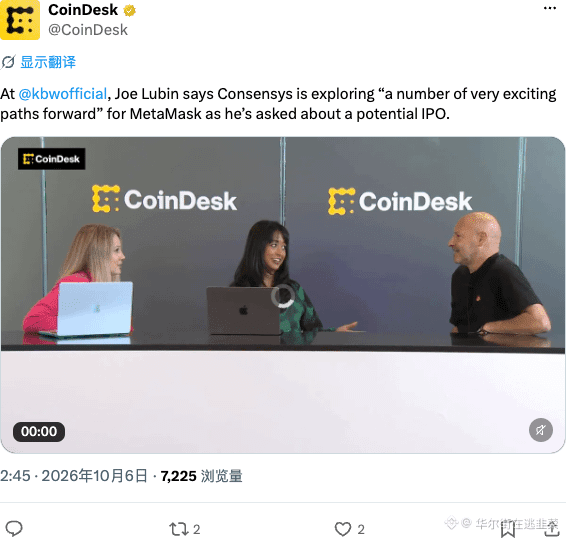
MetaMask is one step closer to an IPO. At KBW, Lubin was asked about going public. He didn’t deny it, saying only that Consensys is exploring “multiple exciting paths.”
It already has one foot in the capital markets. Wallets are Web3’s biggest gateway, with tens of millions of monthly active users, so an actual IPO wouldn’t come cheap. But airdrop hunters, don’t get your hopes up: an IPO route probably means no airdrop. With MetaMask and Linea under its belt, Consensys is one of the few solid stories in the bear market with real cash flow.
$ETH $LINEA #MetaMask #KBW
449

🛡️ MetaMask Confirms Users’ Funds Are Safe After Security Incident
MetaMask announced that users’ funds were not affected by a security incident targeting one of the network’s validators.
The statement noted that strong security measures helped protect digital assets from potential losses.
━━━━━━━━━━━━━━
📊 Impact: 📈 High
🏷️ OTHER
#MetaMask #Security #CryptoNews #Blockchain
📰 Source: cryptobriefing.com
30

·
--
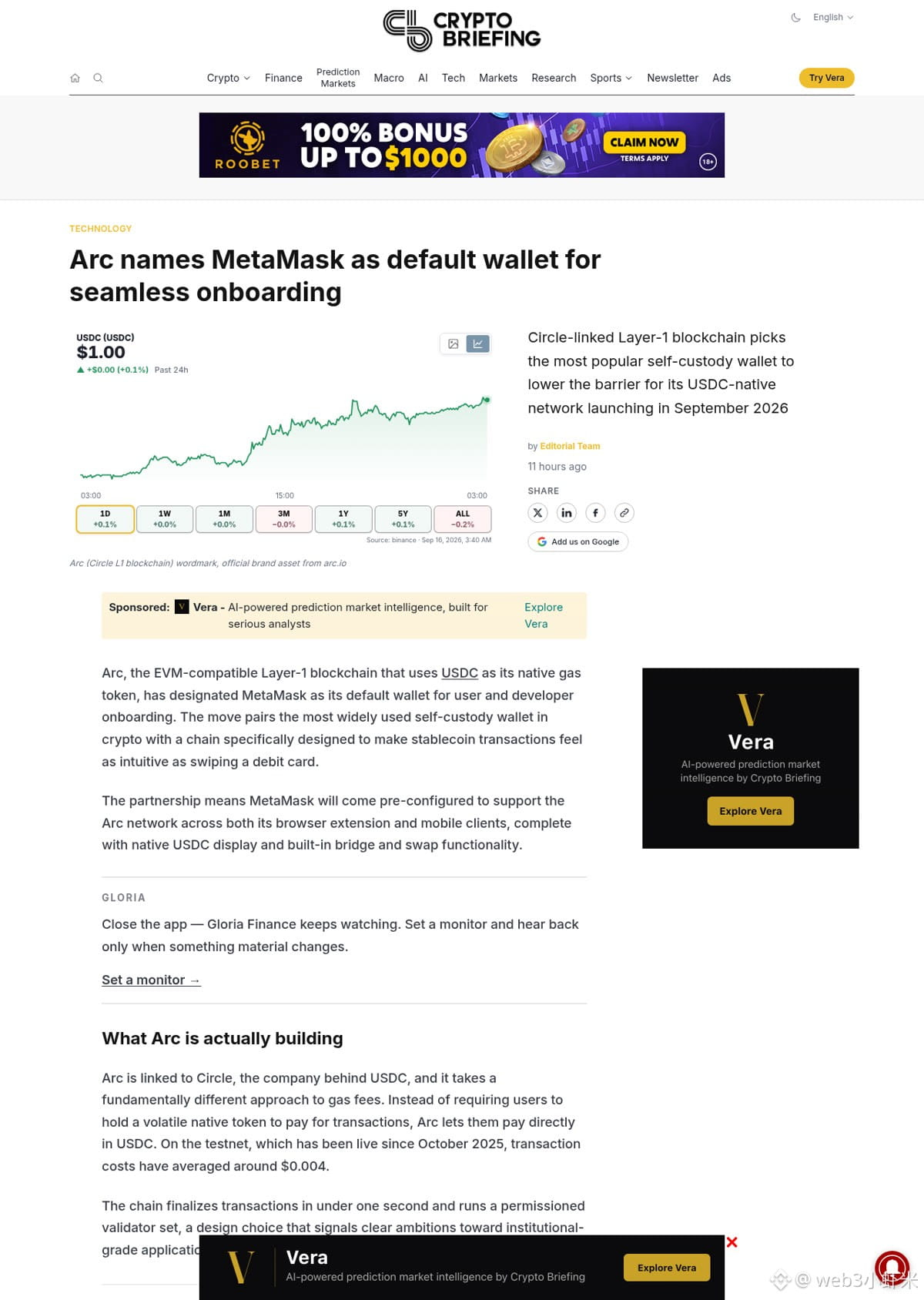
Found one entry: the L1 Arc linked to Circle sets MetaMask as the default onboarding wallet—browser extensions and the app will automatically provision the network, native display of $USDC, and bridges/swaps are also put directly into the wallet. Gas is paid directly in USDC. On the testnet, the fee is about $0.004 and the final confirmation takes less than 1 second; the mainnet launches today (9/16) as planned. Stablecoins as Gas + mainstream wallets—once again, the threshold drops by another step.#Arc #MetaMask
Found one entry: the L1 Arc linked to Circle sets MetaMask as the default onboarding wallet—browser extensions and the app will automatically provision the network, native display of $USDC , and bridges/swaps are also put directly into the wallet. Gas is paid directly in USDC. On the testnet, the fee is about $0.004 and the final confirmation takes less than 1 second; the mainnet launches today (9/16) as planned. Stablecoins as Gas + mainstream wallets—once again, the threshold drops by another step.#Arc #MetaMask
113

·
--
According to a report by Fortune, Consensys has officially split its MetaMask wallet business into a separate company, with founder Joe Lubin personally serving as CEO and focusing on the consumer-grade platform. The former Consensys’ institutional agreements and Ethereum software business will retain the company name, with Mike Kriak as CEO, while Lubin will serve as Executive Chairman.
The logic behind the split is straightforward: MetaMask’s user-facing business growth and value realization have been clearly faster than other segments of the company. The newly launched Master Account supports managing multiple crypto assets and fiat currencies within a single account, and it can be used for spending through a Mastercard debit card, while also extending into perpetual futures and prediction markets.
Two things the market is still most concerned about have not been answered: Consensys’ previously planned IPO has been put on hold due to a major drop in the crypto market, and Lubin has not provided an IPO timeline. While he has hinted that MetaMask could issue a token, in the current business and regulatory environment, token issuance is clearly no longer a priority option.
With the wallet moving toward independence, it looks more like the company is clarifying its structure for subsequent capital operations and business expansion—but don’t expect a token in the short term.
#MetaMask #Consensys #加密钱包
34
The wallet sector has seen a major architectural shake-up. According to Fortune, Consensys will split MetaMask into an independent company, with founder Joe Lubin personally serving as CEO to focus on the consumer platform. The existing institutional business and Ethereum software will continue under the Consensys name, with Mike Kriak as CEO, while Lubin will also serve as Executive Chairman.
The core reason for the split is straightforward: MetaMask’s user-facing business growth and value realization have clearly been faster than other parts of the group. Once operating independently, decision-making, fundraising, and commercialization may become more flexible.
The newly launched Master Account also shows its ambition: one account managing multiple crypto assets and fiat currency, paired with a Mastercard debit card for spending—while also expanding into perpetual futures and prediction markets. MetaMask is moving from a “wallet plugin” toward a comprehensive financial entry point.
However, two things the market cares about most still have no answers: the IPO timeline has not been specified, and the previously rumored in-house token remains cautious. A pullback in the crypto market and regulatory uncertainty are prompting large companies to focus on building the business first, before talking about listings and token issuance.
#MetaMask #Consensys #Ethereum
13

Consensys separates MetaMask from its organization services and Ethereum infrastructure
- Consensys separates MetaMask from the services for enterprises and Ethereum infrastructure.
- The separation is expected to be completed by the end of 2026.
- The current entity will rebrand as MetaMask under CEO Joe Lubin.
#BinanceSquare #CryptoNews #MetaMask #ETH
$eth
#vlikevn Titanbot
Source: The Block
47
·
--
Day after day, one shove: ConsenSys found a North Korean developer in the MetaMask codebase, using the alias Tyler Knapp, and he spent a month doing this.
Official statement: no malicious code was found, no funds were lost.
This sentence is more frightening than the attack itself. The subtext of “no malicious code” is—what about the parts that weren’t caught? The DPRK IT worker isn’t playing with bugs; they’re playing with persistence: log in to Git, open a PR, leave a variable name behind—trust then grows into the repository. Whether the code is changed or not is secondary; the identity is already in the contributor list.
When a smart contract is hacked, you can see the money move. When your wallet is infiltrated via the supply chain, you can’t see any movement at all. Two threat models—only the second kind is the one that really should trigger the SIG process.
Next time you click Sign, you shouldn’t just look at gas and the contract address—you should also think about who reviewed this code.
#MetaMask #安全 #Web3
59
·
--
Bullish
🦊 MetaMask Learns to Block Transactions with Fake Results
A fraudulent contract may show in the preview that you will receive 0.1 $ETH , and after signing, try to steal funds. This scheme is called a “red pill” attack.
MetaMask’s new protection compares the actual result of the operation with the preview. If they do not match, the transaction does not go through — the user loses only the gas fee.
The feature is enabled by default and is already available in the v13.45 extension for smart accounts on 13 EVM networks. It will appear in the mobile version later.
#SAFE #MetaMask

4
157

·
--
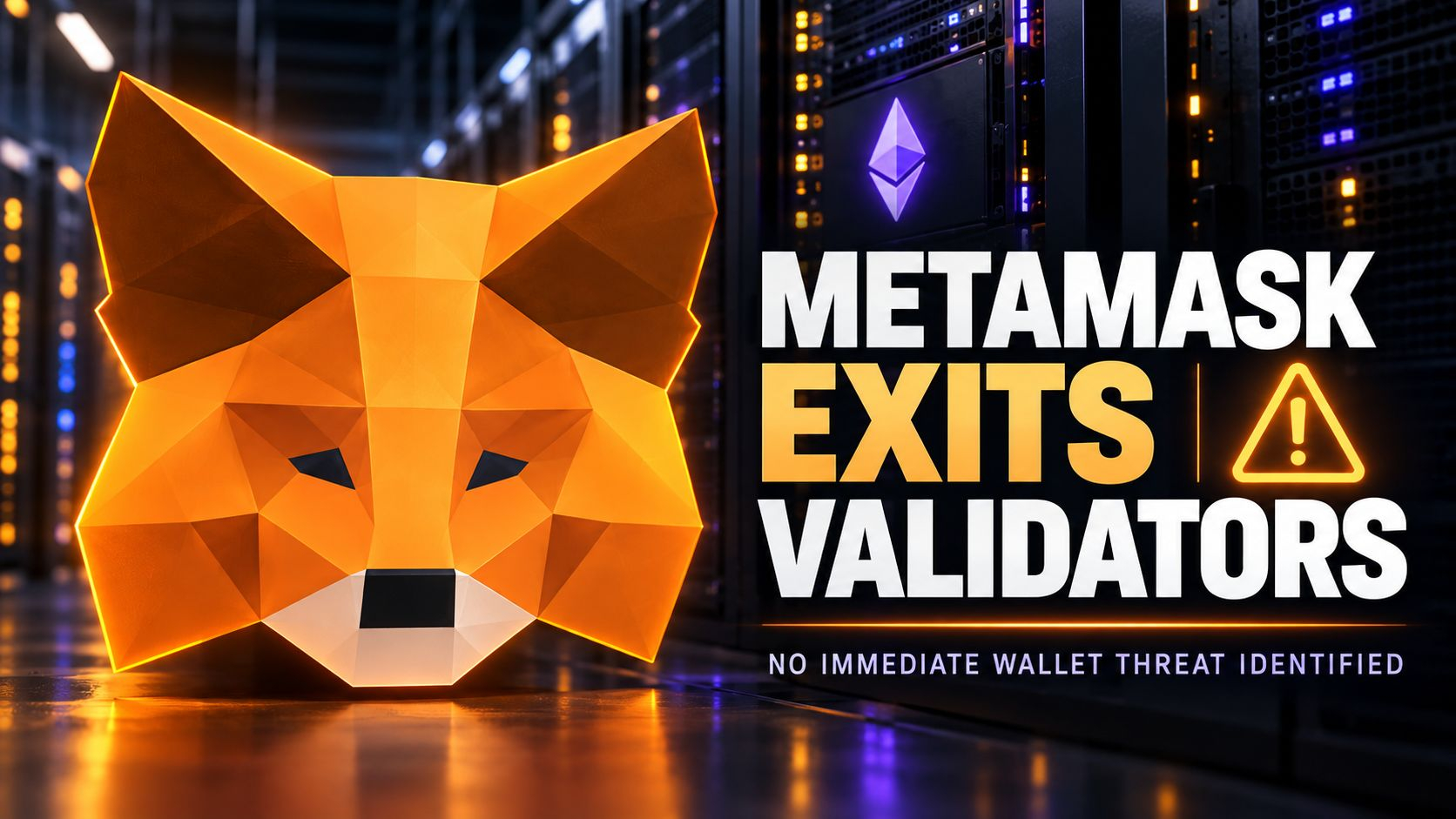
MetaMask warning ⚠️
The company said it is dealing with a security incident that affected part of its infrastructure and has begun removing some Ethereum validators from the storage service as a precaution.
So far, MetaMask says it has not detected any direct threat to users’ wallets. That means the news about storage systems and validators isn’t an announcement about people’s wallets being hacked.
The news concerns the Ethereum ecosystem and Lido services: $ETH $stETH $LDO
What do you think—does this quick action reassure you?
#MetaMask #Ethereum
126

·
--
MetaMask exits Lido validator nodes after security incident! ETH staking safety once again in focus
After encountering an infrastructure security incident, MetaMask announced preventive measures:
- Exiting affected Ethereum validator nodes.
These validator nodes previously participated in ETH staking via the Lido protocol. Lido stated that the relevant validator nodes operated by MetaMask Staking have already begun the exit process, which is expected to be completed no later than October 7.
However, there’s one key point:
There is currently no evidence that MetaMask wallet users’ assets are directly at risk.
MetaMask said this incident affects part of the infrastructure, and in its non-custodial staking business, users’ withdrawal keys are not managed by MetaMask.
Why is this worth paying attention to?
① Validator node security becomes the focus
ETH staking depends on validators running. If there is a risk to node infrastructure, operators typically choose to proactively exit to reduce potential impact.
② Exiting brings opportunity costs
Lido reminded that during the exit period of the affected validators, some staking rewards may be lost, and penalties related to downtime may also occur.
③ Once again highlights the importance of decentralized infrastructure
In the past, the market focused more on:
- Wallet security
- Private key security
- Exchange security
But as the scale of ETH staking grows, the security capabilities of node operators are becoming increasingly important.
This incident is not about user assets being stolen; it’s a proactive defense against infrastructure risk.
Next, what the market will watch:
👉 Results of the MetaMask security incident investigation
👉 Exit progress of the affected validator nodes
👉 How the ETH staking ecosystem can further raise security standards
In one sentence:
Crypto security is not only about protecting assets in your wallet—it also includes the infrastructure that supports the entire network.
#ETH #MetaMask #metamask安全事件后撤出lido验证节点
2
10
4.2k

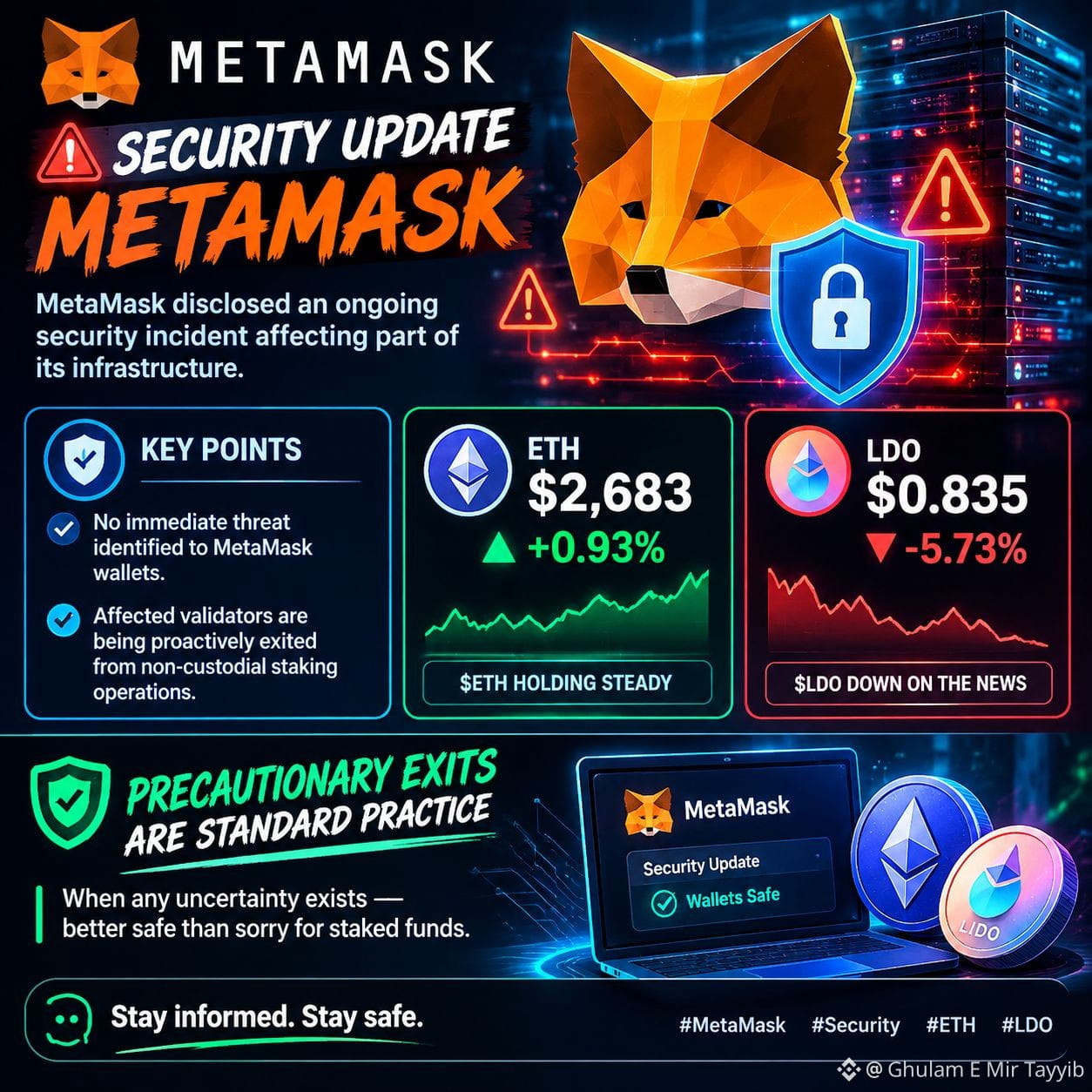
🚨 Security Update: MetaMask
• MetaMask disclosed an ongoing security incident affecting part of its infrastructure
• No immediate threat identified to MetaMask wallets
• As a precaution, affected validators are being proactively exited from non-custodial staking operations
• $ETH holding steady, +0.93%
• $LDO (LDO) down -5.73% on the news
Precautionary exits like this are standard practice when any uncertainty exists — better safe than sorry for staked funds.
#MetaMaskExitsLidoValidatorsAfterSecurityIncident
#MetaMask #ETH #LDO #CryptoSecurity
{future}(LDOUSDT)
{future}(ETHUSDT)
🚨 Security Update: MetaMask
• MetaMask disclosed an ongoing security incident affecting part of its infrastructure
• No immediate threat identified to MetaMask wallets
• As a precaution, affected validators are being proactively exited from non-custodial staking operations
• $ETH holding steady, +0.93%
• $LDO (LDO) down -5.73% on the news
Precautionary exits like this are standard practice when any uncertainty exists — better safe than sorry for staked funds.
#MetaMaskExitsLidoValidatorsAfterSecurityIncident
#MetaMask #ETH #LDO #CryptoSecurity
23
Log in to explore more content
Join global crypto users on Binance Square
⚡️ Get latest and useful information about crypto.
💬 Trusted by the world’s largest crypto exchange.
👍 Discover real insights from verified creators.
Email / Phone number
Trending Topics
1
#BinanceReopensWithdrawalsForMoreAssets
1.1M views
5,898 Discussing
2
#$2TWipedOutHedgeFundsFaceLiquidation
859 views
33 Discussing
3
#AnthropicIPOValuationDoubts
16,906 views
430 Discussing
4
#RussiaInvestigativeCommitteeProposesAddingCryptoToAMLSystem
0 views
0 Discussing
5
#SouthKoreaDelaysCryptoTaxationUntil2029
2,098 views
73 Discussing
6
#HongKongPlansTaxIncentivesCoveringDigitalAssets
2,140 views
51 Discussing
7
#ECBTargetsDigitalEuroIssuanceIn2029
1,966 views
59 Discussing
8
#ChainalysisBreachExposedPasswordHashesAndLiveTokens
296 views
12 Discussing
9
#UkraineCentralBankOpposesCurrentCryptoAssetBill
2,756 views
80 Discussing
10
#CoreScientificExpectsToExitBitcoinMiningByYearEnd2026
377 views
13 Discussing