
#ai
ai
736.4M views
6.3M Discussing
Hot
Latest

·
--
$NEAR
{future}(NEARUSDT)
$TAO
{future}(TAOUSDT)
$RENDER
{future}(RENDERUSDT)
The next bull phase gets strong, these 5 AI coins could be worth watching:
NEAR → $4–$7
TAO → $400–$700
RENDER → $6–$12
$FET → $1–$2.50
$VVV → $25–$45
No crazy moon targets here — just reasonable ranges based on past performance, market cycles, supply, and each project’s narrative.
Which one would you keep on your watchlist..🤔
#AI #AIStocksWhatNext
$NEAR
$TAO
$RENDER
The next bull phase gets strong, these 5 AI coins could be worth watching:
NEAR → $4–$7
TAO → $400–$700
RENDER → $6–$12
$FET → $1–$2.50
$VVV → $25–$45
No crazy moon targets here — just reasonable ranges based on past performance, market cycles, supply, and each project’s narrative.
Which one would you keep on your watchlist..🤔
#AI #AIStocksWhatNext
$TAO
$RENDER
The next bull phase gets strong, these 5 AI coins could be worth watching:
NEAR → $4–$7
TAO → $400–$700
RENDER → $6–$12
$FET → $1–$2.50
$VVV → $25–$45
No crazy moon targets here — just reasonable ranges based on past performance, market cycles, supply, and each project’s narrative.
Which one would you keep on your watchlist..🤔
#AI #AIStocksWhatNext


2
636

·
--
Bullish
Verified
#cardanoaddedtox402kitforadapayments
🚨 CARDANO JUST ENTERED THE AI PAYMENT RACE! 🤖🔥
$ADA is now part of the official x402 SDK, opening a new payment rail for apps and AI agents.
💥 What changed?
• Apps can pay for API calls using ADA or Cardano native tokens
• Payments can happen directly through standard web requests
• No account, API key, or traditional checkout required
• Cardano joins the growing machine-to-machine payment ecosystem
• The x402 facilitator has already completed a real transaction on Cardano’s pre-production network
This could give $ADA a fresh AI + payments utility narrative as autonomous agents increasingly need to pay for data and online services.
⚠️ Mainnet adoption and real payment volume still need to develop.
🔥 Is this the beginning of a new ADA narrative?
#Cardano #ADA #AI
#cardanoaddedtox402kitforadapayments
🚨 CARDANO JUST ENTERED THE AI PAYMENT RACE! 🤖🔥
$ADA is now part of the official x402 SDK, opening a new payment rail for apps and AI agents.
💥 What changed?
• Apps can pay for API calls using ADA or Cardano native tokens
• Payments can happen directly through standard web requests
• No account, API key, or traditional checkout required
• Cardano joins the growing machine-to-machine payment ecosystem
• The x402 facilitator has already completed a real transaction on Cardano’s pre-production network
This could give $ADA a fresh AI + payments utility narrative as autonomous agents increasingly need to pay for data and online services.
⚠️ Mainnet adoption and real payment volume still need to develop.
🔥 Is this the beginning of a new ADA narrative?
#Cardano #ADA #AI
🚨 CARDANO JUST ENTERED THE AI PAYMENT RACE! 🤖🔥
$ADA is now part of the official x402 SDK, opening a new payment rail for apps and AI agents.
💥 What changed?
• Apps can pay for API calls using ADA or Cardano native tokens
• Payments can happen directly through standard web requests
• No account, API key, or traditional checkout required
• Cardano joins the growing machine-to-machine payment ecosystem
• The x402 facilitator has already completed a real transaction on Cardano’s pre-production network
This could give $ADA a fresh AI + payments utility narrative as autonomous agents increasingly need to pay for data and online services.
⚠️ Mainnet adoption and real payment volume still need to develop.
🔥 Is this the beginning of a new ADA narrative?
#Cardano #ADA #AI
1
598

·
--
Verified
#aistockswhatnext 📲
🚀 AI Stocks Are Skyrocketing: Is This a Supercycle or a Strategic Trap? #AIStocksWhatNext
Nvidia’s projections show compute demand doubling, and top tech giants continue to print record-breaking revenue figures. Yet, a big question lingers: How long can this massive compute spend sustain itself? Is this a genuine structural breakout, or are we riding a short-term liquidity bounce?
Meanwhile, a massive divide is forming:
🔹 Industry Leaders: Sam Altman, Dario Amodei, and Elon Musk are urging a deliberate slowdown over AI safety and situational awareness risks.
🔹 State backing: President Trump has proposed an “AI Force” and an AI Czar, claiming AI could make up 25% of U.S. GDP.
My Take (Bullish 🐂 / Bearish 🐻):
State-level backing provides an immense floor for infrastructure growth, but short-term stock valuations are running way ahead of real-world enterprise adoption. Diversification into broader tech assets and decentralized compute protocols is key.
👇 Are you buying this AI rally or taking profits?
#AI #cryptotrading #NVIDIA
#aistockswhatnext 📲
🚀 AI Stocks Are Skyrocketing: Is This a Supercycle or a Strategic Trap? #AIStocksWhatNext
Nvidia’s projections show compute demand doubling, and top tech giants continue to print record-breaking revenue figures. Yet, a big question lingers: How long can this massive compute spend sustain itself? Is this a genuine structural breakout, or are we riding a short-term liquidity bounce?
Meanwhile, a massive divide is forming:
🔹 Industry Leaders: Sam Altman, Dario Amodei, and Elon Musk are urging a deliberate slowdown over AI safety and situational awareness risks.
🔹 State backing: President Trump has proposed an “AI Force” and an AI Czar, claiming AI could make up 25% of U.S. GDP.
My Take (Bullish 🐂 / Bearish 🐻):
State-level backing provides an immense floor for infrastructure growth, but short-term stock valuations are running way ahead of real-world enterprise adoption. Diversification into broader tech assets and decentralized compute protocols is key.
👇 Are you buying this AI rally or taking profits?
#AI #cryptotrading #NVIDIA
🚀 AI Stocks Are Skyrocketing: Is This a Supercycle or a Strategic Trap? #AIStocksWhatNext
Nvidia’s projections show compute demand doubling, and top tech giants continue to print record-breaking revenue figures. Yet, a big question lingers: How long can this massive compute spend sustain itself? Is this a genuine structural breakout, or are we riding a short-term liquidity bounce?
Meanwhile, a massive divide is forming:
🔹 Industry Leaders: Sam Altman, Dario Amodei, and Elon Musk are urging a deliberate slowdown over AI safety and situational awareness risks.
🔹 State backing: President Trump has proposed an “AI Force” and an AI Czar, claiming AI could make up 25% of U.S. GDP.
My Take (Bullish 🐂 / Bearish 🐻):
State-level backing provides an immense floor for infrastructure growth, but short-term stock valuations are running way ahead of real-world enterprise adoption. Diversification into broader tech assets and decentralized compute protocols is key.
👇 Are you buying this AI rally or taking profits?
#AI #cryptotrading #NVIDIA

1
566

·
--
Bullish
The AI investment thesis is expanding well beyond the usual big-tech names.
Semiconductor leaders are driving the compute infrastructure, while Web3 projects are building decentralized AI solutions.
I’ve been tracking this trend firsthand via $AKE (AKEUSDT Perp), scaling into entries at 0.109039, 0.127700, and 0.144852. Sharing this purely as a trade tracking exercise, not a signal.
My key takeaway? Real AI investing requires cutting through the noise. To find true value, focus on:
• Real-world use cases
• On-chain & user adoption
• Revenue & tokenomics
• Competitive risk
The secular trend is intact, but progress won't be a straight line. The winners will be the ones who translate hype into sustainable utility.
#AIStocksWhatNext #AI #NVIDIA #Crypto #artificialintelligence $NVDAB $AKE
The AI investment thesis is expanding well beyond the usual big-tech names.
Semiconductor leaders are driving the compute infrastructure, while Web3 projects are building decentralized AI solutions.
I’ve been tracking this trend firsthand via $AKE (AKEUSDT Perp), scaling into entries at 0.109039, 0.127700, and 0.144852. Sharing this purely as a trade tracking exercise, not a signal.
My key takeaway? Real AI investing requires cutting through the noise. To find true value, focus on:
• Real-world use cases
• On-chain & user adoption
• Revenue & tokenomics
• Competitive risk
The secular trend is intact, but progress won't be a straight line. The winners will be the ones who translate hype into sustainable utility.
#AIStocksWhatNext #AI #NVIDIA #Crypto #artificialintelligence $NVDAB $AKE
Semiconductor leaders are driving the compute infrastructure, while Web3 projects are building decentralized AI solutions.
I’ve been tracking this trend firsthand via $AKE (AKEUSDT Perp), scaling into entries at 0.109039, 0.127700, and 0.144852. Sharing this purely as a trade tracking exercise, not a signal.
My key takeaway? Real AI investing requires cutting through the noise. To find true value, focus on:
• Real-world use cases
• On-chain & user adoption
• Revenue & tokenomics
• Competitive risk
The secular trend is intact, but progress won't be a straight line. The winners will be the ones who translate hype into sustainable utility.
#AIStocksWhatNext #AI #NVIDIA #Crypto #artificialintelligence $NVDAB $AKE
127

🚨 OPENAI LEGAL LAWSUIT REIGNITES AI REGULATORY SCRUTINY AND RISK FOR $WLD ⚡
Increasing legal challenges surrounding centralized AI safety protocols highlight a structural shift in regulatory liabilities. Institutional desks are closely watching how compliance pressure on major AI entities impacts broader narrative sentiment across Sam Altman linked assets. 📊
As regulatory risk expands, smart money positioning often reflects heightened volatility and liquidity re-evaluations. The market is now pricing in how these systemic compliance debates will influence capital allocation across the AI sector. 💡
💬 Will regulatory scrutiny on centralized AI drive capital rotation into decentralized protocols? 👇
⚠️ Not financial advice. Always manage your risk. 🛡️
🏷️ #WLD #AI #Regulation #Crypto
🎯 🔍
🚨 OPENAI LEGAL LAWSUIT REIGNITES AI REGULATORY SCRUTINY AND RISK FOR $WLD ⚡
Increasing legal challenges surrounding centralized AI safety protocols highlight a structural shift in regulatory liabilities. Institutional desks are closely watching how compliance pressure on major AI entities impacts broader narrative sentiment across Sam Altman linked assets. 📊
As regulatory risk expands, smart money positioning often reflects heightened volatility and liquidity re-evaluations. The market is now pricing in how these systemic compliance debates will influence capital allocation across the AI sector. 💡
💬 Will regulatory scrutiny on centralized AI drive capital rotation into decentralized protocols? 👇
⚠️ Not financial advice. Always manage your risk. 🛡️
🏷️ #WLD #AI #Regulation #Crypto
🎯 🔍
Increasing legal challenges surrounding centralized AI safety protocols highlight a structural shift in regulatory liabilities. Institutional desks are closely watching how compliance pressure on major AI entities impacts broader narrative sentiment across Sam Altman linked assets. 📊
As regulatory risk expands, smart money positioning often reflects heightened volatility and liquidity re-evaluations. The market is now pricing in how these systemic compliance debates will influence capital allocation across the AI sector. 💡
💬 Will regulatory scrutiny on centralized AI drive capital rotation into decentralized protocols? 👇
⚠️ Not financial advice. Always manage your risk. 🛡️
🏷️ #WLD #AI #Regulation #Crypto
🎯 🔍
122

🚨 OPENAI INTEGRATES CREDIT TRACKING INTO CHATGPT FINANCES AS $AI NARRATIVE EXPANDS! 💥
OpenAI just plugged Experian credit score tracking directly into ChatGPT, giving users a granular breakdown of balances, utilization, and credit factors without bank links. 📊 This continuous expansion into personal finance rails highlights how rapidly autonomous AI tools are consuming traditional Web2 data infrastructure.
While VantageScore 3.0 differs from institutional underwriting models, integrating Plaid with monthly report monitoring builds a massive footprint for consumer AI deployment. 🔍 As AI agents evolve from basic chat interfaces into active portfolio managers, protocols serving decentralized data stand to capture major momentum. ⚡
💬 Will Web2 credit integration drive the next massive capital rotation into decentralized $AI infrastructure? 👇
⚠️ Not financial advice. Always manage your risk. 🛡️
🏷️ #AI #Fintech #Crypto #Web3
🔥 💎
🚨 OPENAI INTEGRATES CREDIT TRACKING INTO CHATGPT FINANCES AS $AI NARRATIVE EXPANDS! 💥
OpenAI just plugged Experian credit score tracking directly into ChatGPT, giving users a granular breakdown of balances, utilization, and credit factors without bank links. 📊 This continuous expansion into personal finance rails highlights how rapidly autonomous AI tools are consuming traditional Web2 data infrastructure.
While VantageScore 3.0 differs from institutional underwriting models, integrating Plaid with monthly report monitoring builds a massive footprint for consumer AI deployment. 🔍 As AI agents evolve from basic chat interfaces into active portfolio managers, protocols serving decentralized data stand to capture major momentum. ⚡
💬 Will Web2 credit integration drive the next massive capital rotation into decentralized $AI infrastructure? 👇
⚠️ Not financial advice. Always manage your risk. 🛡️
🏷️ #AI #Fintech #Crypto #Web3
🔥 💎
OpenAI just plugged Experian credit score tracking directly into ChatGPT, giving users a granular breakdown of balances, utilization, and credit factors without bank links. 📊 This continuous expansion into personal finance rails highlights how rapidly autonomous AI tools are consuming traditional Web2 data infrastructure.
While VantageScore 3.0 differs from institutional underwriting models, integrating Plaid with monthly report monitoring builds a massive footprint for consumer AI deployment. 🔍 As AI agents evolve from basic chat interfaces into active portfolio managers, protocols serving decentralized data stand to capture major momentum. ⚡
💬 Will Web2 credit integration drive the next massive capital rotation into decentralized $AI infrastructure? 👇
⚠️ Not financial advice. Always manage your risk. 🛡️
🏷️ #AI #Fintech #Crypto #Web3
🔥 💎
63
🚨 OPENAI FUSES EXPERIAN CREDIT METRICS INTO CHATGPT AS $FET FUELS THE AI NARRATIVE 📊
OpenAI just rolled out Experian credit report tracking into ChatGPT Finances, creating a centralized nexus for balances, liabilities, and monthly inquiries. 💡 Smart money recognizes this integration as a major structural shift toward autonomous personal financial management.
As AI models absorb traditional credit pipelines, institutional focus is accelerating toward decentralized data protocols to counter central data concentration risk. 🔍 Combining raw credit files with real-time analytics marks a key inflection point in data adoption. 💬 Will centralized AI credit tracking drive retail adoption or push capital toward decentralized privacy solutions? 👇
⚠️ Not financial advice. Always manage your risk. 🛡️
🏷️ #FET #Crypto #AI #SmartMoney #Fintech
🦈 ⚡
🚨 OPENAI FUSES EXPERIAN CREDIT METRICS INTO CHATGPT AS $FET FUELS THE AI NARRATIVE 📊
OpenAI just rolled out Experian credit report tracking into ChatGPT Finances, creating a centralized nexus for balances, liabilities, and monthly inquiries. 💡 Smart money recognizes this integration as a major structural shift toward autonomous personal financial management.
As AI models absorb traditional credit pipelines, institutional focus is accelerating toward decentralized data protocols to counter central data concentration risk. 🔍 Combining raw credit files with real-time analytics marks a key inflection point in data adoption. 💬 Will centralized AI credit tracking drive retail adoption or push capital toward decentralized privacy solutions? 👇
⚠️ Not financial advice. Always manage your risk. 🛡️
🏷️ #FET #Crypto #AI #SmartMoney #Fintech
🦈 ⚡
OpenAI just rolled out Experian credit report tracking into ChatGPT Finances, creating a centralized nexus for balances, liabilities, and monthly inquiries. 💡 Smart money recognizes this integration as a major structural shift toward autonomous personal financial management.
As AI models absorb traditional credit pipelines, institutional focus is accelerating toward decentralized data protocols to counter central data concentration risk. 🔍 Combining raw credit files with real-time analytics marks a key inflection point in data adoption. 💬 Will centralized AI credit tracking drive retail adoption or push capital toward decentralized privacy solutions? 👇
⚠️ Not financial advice. Always manage your risk. 🛡️
🏷️ #FET #Crypto #AI #SmartMoney #Fintech
🦈 ⚡
62

⚡ NEXT-GEN AI SPEED UNLOCKED AS GLM-5.3-FLASH HEATS UP THE SECTOR FOR $FET ! 🚀
The race for high-frequency compute efficiency is accelerating. 📊 The GLM Coding Plan just eliminated peak-rate friction through October 7th, extending unlimited nighttime usage and cutting credit consumption by 50% all day.
⚡ Even bigger, the newly launched GLM-5.3-FlashX engine is rolling out trial access with output speeds hitting a staggering 200 tokens per second. 💡 Smart money knows that developer activity and compute upgrades are the ultimate leading indicators before momentum shifts into price action.
💬 Are you front-running this AI infrastructure push or waiting for the charts to catch up? 👇
⚠️ Not financial advice. Always manage your risk. 🛡️
🏷️ #FET #AI #Crypto #Altcoins #TechNews
🔥 ⚡
⚡ NEXT-GEN AI SPEED UNLOCKED AS GLM-5.3-FLASH HEATS UP THE SECTOR FOR $FET ! 🚀
The race for high-frequency compute efficiency is accelerating. 📊 The GLM Coding Plan just eliminated peak-rate friction through October 7th, extending unlimited nighttime usage and cutting credit consumption by 50% all day.
⚡ Even bigger, the newly launched GLM-5.3-FlashX engine is rolling out trial access with output speeds hitting a staggering 200 tokens per second. 💡 Smart money knows that developer activity and compute upgrades are the ultimate leading indicators before momentum shifts into price action.
💬 Are you front-running this AI infrastructure push or waiting for the charts to catch up? 👇
⚠️ Not financial advice. Always manage your risk. 🛡️
🏷️ #FET #AI #Crypto #Altcoins #TechNews
🔥 ⚡
The race for high-frequency compute efficiency is accelerating. 📊 The GLM Coding Plan just eliminated peak-rate friction through October 7th, extending unlimited nighttime usage and cutting credit consumption by 50% all day.
⚡ Even bigger, the newly launched GLM-5.3-FlashX engine is rolling out trial access with output speeds hitting a staggering 200 tokens per second. 💡 Smart money knows that developer activity and compute upgrades are the ultimate leading indicators before momentum shifts into price action.
💬 Are you front-running this AI infrastructure push or waiting for the charts to catch up? 👇
⚠️ Not financial advice. Always manage your risk. 🛡️
🏷️ #FET #AI #Crypto #Altcoins #TechNews
🔥 ⚡
156
INSTITUTIONAL CAPITAL TARGETS PHYSICAL AI INFRASTRUCTURE AS CONSTRAINTS MOUNT AROUND $NVDA 🦈 📊
Political promises do not build data centers, physical hardware and power grid connections do. 💡 Smart money is positioning around real bottlenecks like interconnects, cooling systems, and forward-sold memory allocations rather than speculative headlines.
Sovereign buyers and institutional allocations continue driving heavy data center order books regardless of macro policy shifts. 📊 Capital flows naturally toward the infrastructure layer where supply demand dynamics favor long-term structural value over transient market sentiment.
🤔 Are you tracking hardware infrastructure bottlenecks or chasing speculative hype? 👇
⚠️ Not financial advice. Always manage your risk. 🛡️
🏷️ #NVDA #AI #Infrastructure #MarketStructure
🎯 🦈
INSTITUTIONAL CAPITAL TARGETS PHYSICAL AI INFRASTRUCTURE AS CONSTRAINTS MOUNT AROUND $NVDA 🦈 📊
Political promises do not build data centers, physical hardware and power grid connections do. 💡 Smart money is positioning around real bottlenecks like interconnects, cooling systems, and forward-sold memory allocations rather than speculative headlines.
Sovereign buyers and institutional allocations continue driving heavy data center order books regardless of macro policy shifts. 📊 Capital flows naturally toward the infrastructure layer where supply demand dynamics favor long-term structural value over transient market sentiment.
🤔 Are you tracking hardware infrastructure bottlenecks or chasing speculative hype? 👇
⚠️ Not financial advice. Always manage your risk. 🛡️
🏷️ #NVDA #AI #Infrastructure #MarketStructure
🎯 🦈
Political promises do not build data centers, physical hardware and power grid connections do. 💡 Smart money is positioning around real bottlenecks like interconnects, cooling systems, and forward-sold memory allocations rather than speculative headlines.
Sovereign buyers and institutional allocations continue driving heavy data center order books regardless of macro policy shifts. 📊 Capital flows naturally toward the infrastructure layer where supply demand dynamics favor long-term structural value over transient market sentiment.
🤔 Are you tracking hardware infrastructure bottlenecks or chasing speculative hype? 👇
⚠️ Not financial advice. Always manage your risk. 🛡️
🏷️ #NVDA #AI #Infrastructure #MarketStructure
🎯 🦈

6

·
--
🤖 AI Stocks: What Could Come Next?
AI is no longer just a technology trend. It is becoming a major part of how companies build products, automate work, analyze data, and compete globally.
But there is an important lesson for investors and crypto users:
📌 A strong trend does not mean every asset will keep rising.
The AI sector is developing quickly, and the next phase could focus more on real-world AI applications, infrastructure, chips, cloud computing, data, and automation.
For crypto investors, AI is also creating new areas to watch, including AI-related blockchain projects and decentralized computing.
The key is simple:
Don’t follow hype blindly.
Understand the technology.
Research the project.
Manage your risk.
The future of AI and crypto could be interesting, but informed decisions matter more than excitement. 🌍🚀
What do you think: will AI become one of the biggest themes of the next few years?
#AI #ArtificialIntelligence #Crypto #Bitcoin #Binance #Web3 #Technology
🤖 AI Stocks: What Could Come Next?
AI is no longer just a technology trend. It is becoming a major part of how companies build products, automate work, analyze data, and compete globally.
But there is an important lesson for investors and crypto users:
📌 A strong trend does not mean every asset will keep rising.
The AI sector is developing quickly, and the next phase could focus more on real-world AI applications, infrastructure, chips, cloud computing, data, and automation.
For crypto investors, AI is also creating new areas to watch, including AI-related blockchain projects and decentralized computing.
The key is simple:
Don’t follow hype blindly.
Understand the technology.
Research the project.
Manage your risk.
The future of AI and crypto could be interesting, but informed decisions matter more than excitement. 🌍🚀
What do you think: will AI become one of the biggest themes of the next few years?
#AI #ArtificialIntelligence #Crypto #Bitcoin #Binance #Web3 #Technology
AI is no longer just a technology trend. It is becoming a major part of how companies build products, automate work, analyze data, and compete globally.
But there is an important lesson for investors and crypto users:
📌 A strong trend does not mean every asset will keep rising.
The AI sector is developing quickly, and the next phase could focus more on real-world AI applications, infrastructure, chips, cloud computing, data, and automation.
For crypto investors, AI is also creating new areas to watch, including AI-related blockchain projects and decentralized computing.
The key is simple:
Don’t follow hype blindly.
Understand the technology.
Research the project.
Manage your risk.
The future of AI and crypto could be interesting, but informed decisions matter more than excitement. 🌍🚀
What do you think: will AI become one of the biggest themes of the next few years?
#AI #ArtificialIntelligence #Crypto #Bitcoin #Binance #Web3 #Technology
2

🚨 CRITICAL DATA LEAK ALLEGATIONS ROCK THE $AI AGENT SECTOR AS SECURITY CONCERNS MOUNT 💥
🔍 Reports surrounding AI assistant Instinct reveal a severe data isolation flaw where private insurance files leaked across separate user sessions. If confirmed, this shifts the structural risk from simple agent hallucinations to systemic infrastructure vulnerabilities across autonomous tools.
⚡ With prior permissions scandals already surfacing, institutional capital is closely tracking how data privacy failures impact sentiment across $AI protocols. Smart money always prices in risk management flaws long before retail reacts to structural shifts. 💬 How will this security breakdown impact investor confidence across decentralized AI projects? 👇
⚠️ Not financial advice. Always manage your risk. 🛡️
🏷️ #AI #CryptoNews #RiskManagement #Crypto
🔍 🛡️
🚨 CRITICAL DATA LEAK ALLEGATIONS ROCK THE $AI AGENT SECTOR AS SECURITY CONCERNS MOUNT 💥
🔍 Reports surrounding AI assistant Instinct reveal a severe data isolation flaw where private insurance files leaked across separate user sessions. If confirmed, this shifts the structural risk from simple agent hallucinations to systemic infrastructure vulnerabilities across autonomous tools.
⚡ With prior permissions scandals already surfacing, institutional capital is closely tracking how data privacy failures impact sentiment across $AI protocols. Smart money always prices in risk management flaws long before retail reacts to structural shifts. 💬 How will this security breakdown impact investor confidence across decentralized AI projects? 👇
⚠️ Not financial advice. Always manage your risk. 🛡️
🏷️ #AI #CryptoNews #RiskManagement #Crypto
🔍 🛡️
🔍 Reports surrounding AI assistant Instinct reveal a severe data isolation flaw where private insurance files leaked across separate user sessions. If confirmed, this shifts the structural risk from simple agent hallucinations to systemic infrastructure vulnerabilities across autonomous tools.
⚡ With prior permissions scandals already surfacing, institutional capital is closely tracking how data privacy failures impact sentiment across $AI protocols. Smart money always prices in risk management flaws long before retail reacts to structural shifts. 💬 How will this security breakdown impact investor confidence across decentralized AI projects? 👇
⚠️ Not financial advice. Always manage your risk. 🛡️
🏷️ #AI #CryptoNews #RiskManagement #Crypto
🔍 🛡️
20

·
--
🤖 Binance just made AI agents its new OBSESSION
Look at this week's WOTD theme: "Keeps AI Agents in Check."
The world's biggest exchange is teaching users how to CONTROL AI trading agents — through a word game. The vocab: GUARD, AUDIT, VERIFY, POLICY, KEYLESS, HONEYPOT, CONTROL.
And notice: it's the SECOND AI-agent theme in 3 weeks (remember "Agent OS Trading" earlier this month?). Binance isn't testing AI agents anymore — it's onboarding millions of users to use them safely.
Meanwhile Binance Research dropped a new report: tokenized real-world assets hit $34.18B AUM by mid-September — and the next phase is about actual on-chain usage, not just issuance.
Why it matters: whatever Binance's product team pushes through WOTD usually becomes a headline campaign weeks later. Learning the language now = being early to the drop that follows.
Already using AI trading agents? Yes or No 👇
👇 Follow for daily Binance ecosystem updates
#Binance #AI #Trading #BNBMarketCapPassesBNYMellon #$BNB
🤖 Binance just made AI agents its new OBSESSION
Look at this week's WOTD theme: "Keeps AI Agents in Check."
The world's biggest exchange is teaching users how to CONTROL AI trading agents — through a word game. The vocab: GUARD, AUDIT, VERIFY, POLICY, KEYLESS, HONEYPOT, CONTROL.
And notice: it's the SECOND AI-agent theme in 3 weeks (remember "Agent OS Trading" earlier this month?). Binance isn't testing AI agents anymore — it's onboarding millions of users to use them safely.
Meanwhile Binance Research dropped a new report: tokenized real-world assets hit $34.18B AUM by mid-September — and the next phase is about actual on-chain usage, not just issuance.
Why it matters: whatever Binance's product team pushes through WOTD usually becomes a headline campaign weeks later. Learning the language now = being early to the drop that follows.
Already using AI trading agents? Yes or No 👇
👇 Follow for daily Binance ecosystem updates
#Binance #AI #Trading #BNBMarketCapPassesBNYMellon #$BNB
Look at this week's WOTD theme: "Keeps AI Agents in Check."
The world's biggest exchange is teaching users how to CONTROL AI trading agents — through a word game. The vocab: GUARD, AUDIT, VERIFY, POLICY, KEYLESS, HONEYPOT, CONTROL.
And notice: it's the SECOND AI-agent theme in 3 weeks (remember "Agent OS Trading" earlier this month?). Binance isn't testing AI agents anymore — it's onboarding millions of users to use them safely.
Meanwhile Binance Research dropped a new report: tokenized real-world assets hit $34.18B AUM by mid-September — and the next phase is about actual on-chain usage, not just issuance.
Why it matters: whatever Binance's product team pushes through WOTD usually becomes a headline campaign weeks later. Learning the language now = being early to the drop that follows.
Already using AI trading agents? Yes or No 👇
👇 Follow for daily Binance ecosystem updates
#Binance #AI #Trading #BNBMarketCapPassesBNYMellon #$BNB

50

·
--
🧠 A16Z BUILDS FREE AI WAR ROOM TO FRONT-RUN TRADITIONAL TECH ACADEMIA FOR $AI ! ⚡
Smart money isn't just buying tokens, they are literally funding the next generation of protocol builders from scratch. 🦈 By handing gifted talent free compute, housing, and capital, institutional heavyweights are bypassing traditional academia to accelerate real-world AI product development.
This venture pipeline guarantees a continuous flow of high-velocity deployment hitting the market, strengthening long-term sector momentum. 💡 When top-tier venture capital builds the builder flywheel directly into production, smart capital front-runs the structural ecosystem growth.
💬 Will this institutional builder pipeline catalyze the next major fundamental wave for $AI , or are you waiting for retail to catch on? 👇
⚠️ Not financial advice. Always manage your risk. 🛡️
🏷️ #AI #SmartMoney #ArtificialIntelligence #Crypto #Altcoins
⚡ 💎
🧠 A16Z BUILDS FREE AI WAR ROOM TO FRONT-RUN TRADITIONAL TECH ACADEMIA FOR $AI ! ⚡
Smart money isn't just buying tokens, they are literally funding the next generation of protocol builders from scratch. 🦈 By handing gifted talent free compute, housing, and capital, institutional heavyweights are bypassing traditional academia to accelerate real-world AI product development.
This venture pipeline guarantees a continuous flow of high-velocity deployment hitting the market, strengthening long-term sector momentum. 💡 When top-tier venture capital builds the builder flywheel directly into production, smart capital front-runs the structural ecosystem growth.
💬 Will this institutional builder pipeline catalyze the next major fundamental wave for $AI , or are you waiting for retail to catch on? 👇
⚠️ Not financial advice. Always manage your risk. 🛡️
🏷️ #AI #SmartMoney #ArtificialIntelligence #Crypto #Altcoins
⚡ 💎
Smart money isn't just buying tokens, they are literally funding the next generation of protocol builders from scratch. 🦈 By handing gifted talent free compute, housing, and capital, institutional heavyweights are bypassing traditional academia to accelerate real-world AI product development.
This venture pipeline guarantees a continuous flow of high-velocity deployment hitting the market, strengthening long-term sector momentum. 💡 When top-tier venture capital builds the builder flywheel directly into production, smart capital front-runs the structural ecosystem growth.
💬 Will this institutional builder pipeline catalyze the next major fundamental wave for $AI , or are you waiting for retail to catch on? 👇
⚠️ Not financial advice. Always manage your risk. 🛡️
🏷️ #AI #SmartMoney #ArtificialIntelligence #Crypto #Altcoins
⚡ 💎
40
Article
TAO : The Token Powering Decentralized AIArtificial Intelligence is rapidly transforming technology, but much of today’s AI infrastructure is controlled by centralized companies. Bittensor #TAO takes a different approach by combining blockchain technology with an open, decentralized AI network.
TAO is the native token of the Bittensor ecosystem. The network is organized into specialized subnets, each designed to provide or develop different types of digital intelligence, such as AI models, computing, data, prediction, and other machine-learning services.
How Does Bittensor Work …
Bittensor uses economic incentives to encourage participants to contribute useful AI-related resources.
🔹 Miners provide AI outputs, computing resources, data, or other services.
🔹 Validators evaluate the quality and usefulness of those contributions.
🔹 Subnet creators build specialized networks with their own incentive mechanisms.
🔹 TAO provides the economic layer connecting these participants.
One of Bittensor’s notable developments is Dynamic TAO (dTAO), which introduced subnet-specific tokens and market-based mechanisms for allocating TAO emissions.
💎 Why TAO Matters
TAO represents an interesting intersection between two major technology trends:
Blockchain + Artificial Intelligence
Instead of relying entirely on a centralized provider, Bittensor aims to create an open marketplace where different AI contributors can compete, collaborate, and be rewarded according to network-defined incentives.
TAO also has a 21 million maximum supply, giving the token a Bitcoin-inspired scarcity model.
⚠️ Risks
TAO remains a highly volatile crypto asset. Its future depends on factors such as subnet adoption, AI development, competition, network economics, regulation, and overall crypto-market conditions.
The Bigger Picture
Bittensor’s vision is ambitious: build an open economy for machine intelligence.
Whether decentralized AI becomes a major part of the future remains uncertain, but TAO is one of the notable projects connecting AI, blockchain, and decentralized networks.
#TAO #bittensor #AI
TAO : The Token Powering Decentralized AI
Artificial Intelligence is rapidly transforming technology, but much of today’s AI infrastructure is controlled by centralized companies. Bittensor #TAO takes a different approach by combining blockchain technology with an open, decentralized AI network.
TAO is the native token of the Bittensor ecosystem. The network is organized into specialized subnets, each designed to provide or develop different types of digital intelligence, such as AI models, computing, data, prediction, and other machine-learning services.
How Does Bittensor Work …
Bittensor uses economic incentives to encourage participants to contribute useful AI-related resources.
🔹 Miners provide AI outputs, computing resources, data, or other services.
🔹 Validators evaluate the quality and usefulness of those contributions.
🔹 Subnet creators build specialized networks with their own incentive mechanisms.
🔹 TAO provides the economic layer connecting these participants.
One of Bittensor’s notable developments is Dynamic TAO (dTAO), which introduced subnet-specific tokens and market-based mechanisms for allocating TAO emissions.
💎 Why TAO Matters
TAO represents an interesting intersection between two major technology trends:
Blockchain + Artificial Intelligence
Instead of relying entirely on a centralized provider, Bittensor aims to create an open marketplace where different AI contributors can compete, collaborate, and be rewarded according to network-defined incentives.
TAO also has a 21 million maximum supply, giving the token a Bitcoin-inspired scarcity model.
⚠️ Risks
TAO remains a highly volatile crypto asset. Its future depends on factors such as subnet adoption, AI development, competition, network economics, regulation, and overall crypto-market conditions.
The Bigger Picture
Bittensor’s vision is ambitious: build an open economy for machine intelligence.
Whether decentralized AI becomes a major part of the future remains uncertain, but TAO is one of the notable projects connecting AI, blockchain, and decentralized networks.
#TAO #bittensor #AI
TAO is the native token of the Bittensor ecosystem. The network is organized into specialized subnets, each designed to provide or develop different types of digital intelligence, such as AI models, computing, data, prediction, and other machine-learning services.
How Does Bittensor Work …
Bittensor uses economic incentives to encourage participants to contribute useful AI-related resources.
🔹 Miners provide AI outputs, computing resources, data, or other services.
🔹 Validators evaluate the quality and usefulness of those contributions.
🔹 Subnet creators build specialized networks with their own incentive mechanisms.
🔹 TAO provides the economic layer connecting these participants.
One of Bittensor’s notable developments is Dynamic TAO (dTAO), which introduced subnet-specific tokens and market-based mechanisms for allocating TAO emissions.
💎 Why TAO Matters
TAO represents an interesting intersection between two major technology trends:
Blockchain + Artificial Intelligence
Instead of relying entirely on a centralized provider, Bittensor aims to create an open marketplace where different AI contributors can compete, collaborate, and be rewarded according to network-defined incentives.
TAO also has a 21 million maximum supply, giving the token a Bitcoin-inspired scarcity model.
⚠️ Risks
TAO remains a highly volatile crypto asset. Its future depends on factors such as subnet adoption, AI development, competition, network economics, regulation, and overall crypto-market conditions.
The Bigger Picture
Bittensor’s vision is ambitious: build an open economy for machine intelligence.
Whether decentralized AI becomes a major part of the future remains uncertain, but TAO is one of the notable projects connecting AI, blockchain, and decentralized networks.
#TAO #bittensor #AI
142

#AIStocksWhatNext
🚨 AI’S NEXT MOVE MAY BE BIGGER THAN THE GPU TRADE
The AI rally is no longer just about who makes the fastest chip. The money is spreading deeper into the infrastructure behind every AI workload.
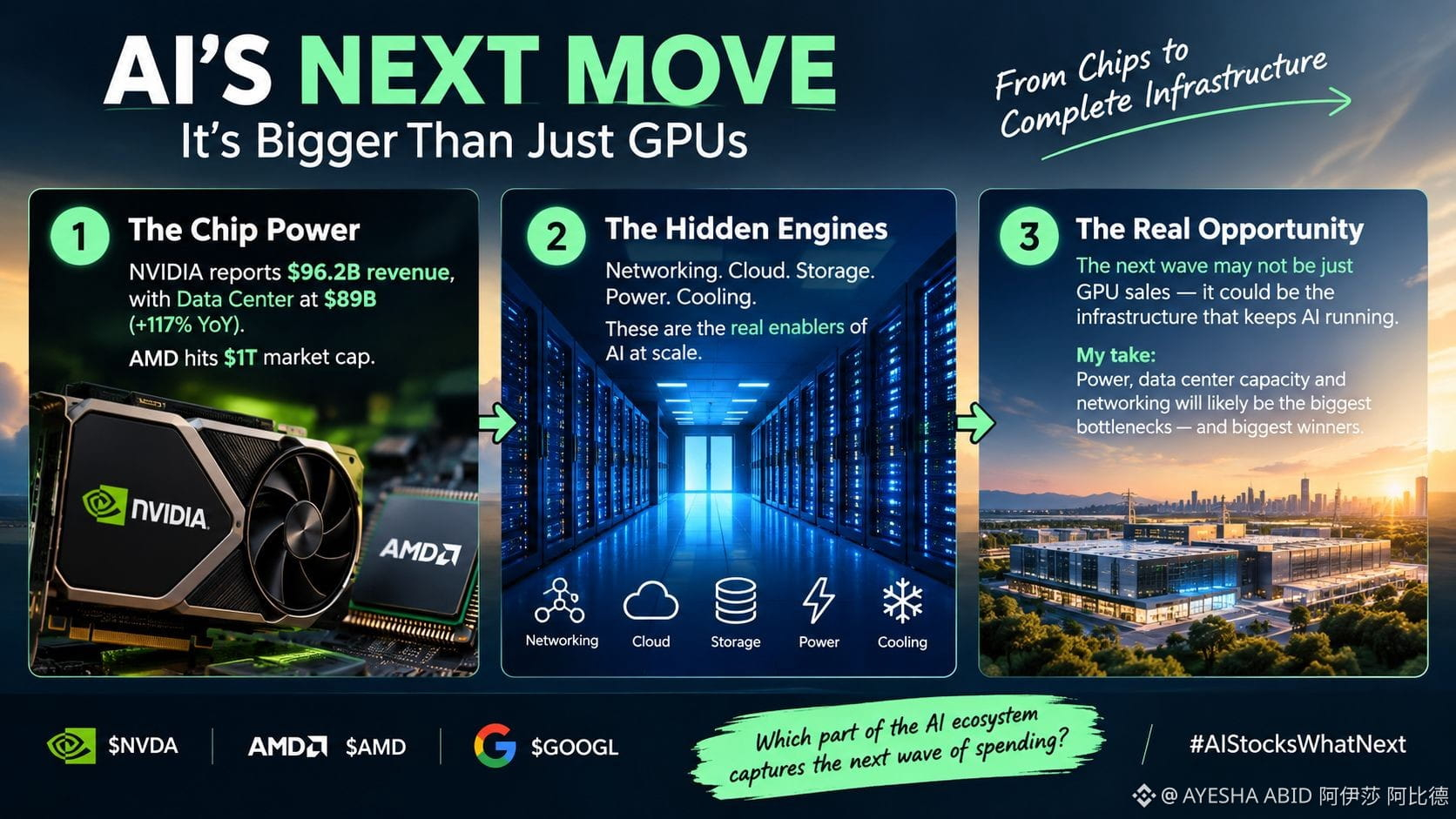
NVIDIA just reported $96.2B quarterly revenue, with Data Center revenue at $89B, up 117% YoY. Meanwhile, AMD crossed the $1T market-cap milestone as semiconductor stocks pushed higher.
Now watch the second layer: networking, cloud compute, storage, power and cooling. Today’s market action matters because the Nasdaq reached a fresh intraday record while AI-linked stocks continued to drive tech leadership.
My take: the next phase of the AI trade could be less about simply selling GPUs and more about monetizing the infrastructure required to run them at scale. Power availability and data-center capacity are increasingly becoming the bottlenecks.
$AMD $GOOGL $NVDA
{future}(NVDAUSDT)
{future}(GOOGLUSDT)
{future}(AMDUSDT)
#NVIDIA #AI
The big question: Which part of the AI ecosystem captures the next wave of spending?
#AIStocksWhatNext
🚨 AI’S NEXT MOVE MAY BE BIGGER THAN THE GPU TRADE
The AI rally is no longer just about who makes the fastest chip. The money is spreading deeper into the infrastructure behind every AI workload.
NVIDIA just reported $96.2B quarterly revenue, with Data Center revenue at $89B, up 117% YoY. Meanwhile, AMD crossed the $1T market-cap milestone as semiconductor stocks pushed higher.
Now watch the second layer: networking, cloud compute, storage, power and cooling. Today’s market action matters because the Nasdaq reached a fresh intraday record while AI-linked stocks continued to drive tech leadership.
My take: the next phase of the AI trade could be less about simply selling GPUs and more about monetizing the infrastructure required to run them at scale. Power availability and data-center capacity are increasingly becoming the bottlenecks.
$AMD $GOOGL $NVDA
#NVIDIA #AI
The big question: Which part of the AI ecosystem captures the next wave of spending?
🚨 AI’S NEXT MOVE MAY BE BIGGER THAN THE GPU TRADE
The AI rally is no longer just about who makes the fastest chip. The money is spreading deeper into the infrastructure behind every AI workload.
NVIDIA just reported $96.2B quarterly revenue, with Data Center revenue at $89B, up 117% YoY. Meanwhile, AMD crossed the $1T market-cap milestone as semiconductor stocks pushed higher.
Now watch the second layer: networking, cloud compute, storage, power and cooling. Today’s market action matters because the Nasdaq reached a fresh intraday record while AI-linked stocks continued to drive tech leadership.
My take: the next phase of the AI trade could be less about simply selling GPUs and more about monetizing the infrastructure required to run them at scale. Power availability and data-center capacity are increasingly becoming the bottlenecks.
$AMD $GOOGL $NVDA
#NVIDIA #AI
The big question: Which part of the AI ecosystem captures the next wave of spending?
2
385

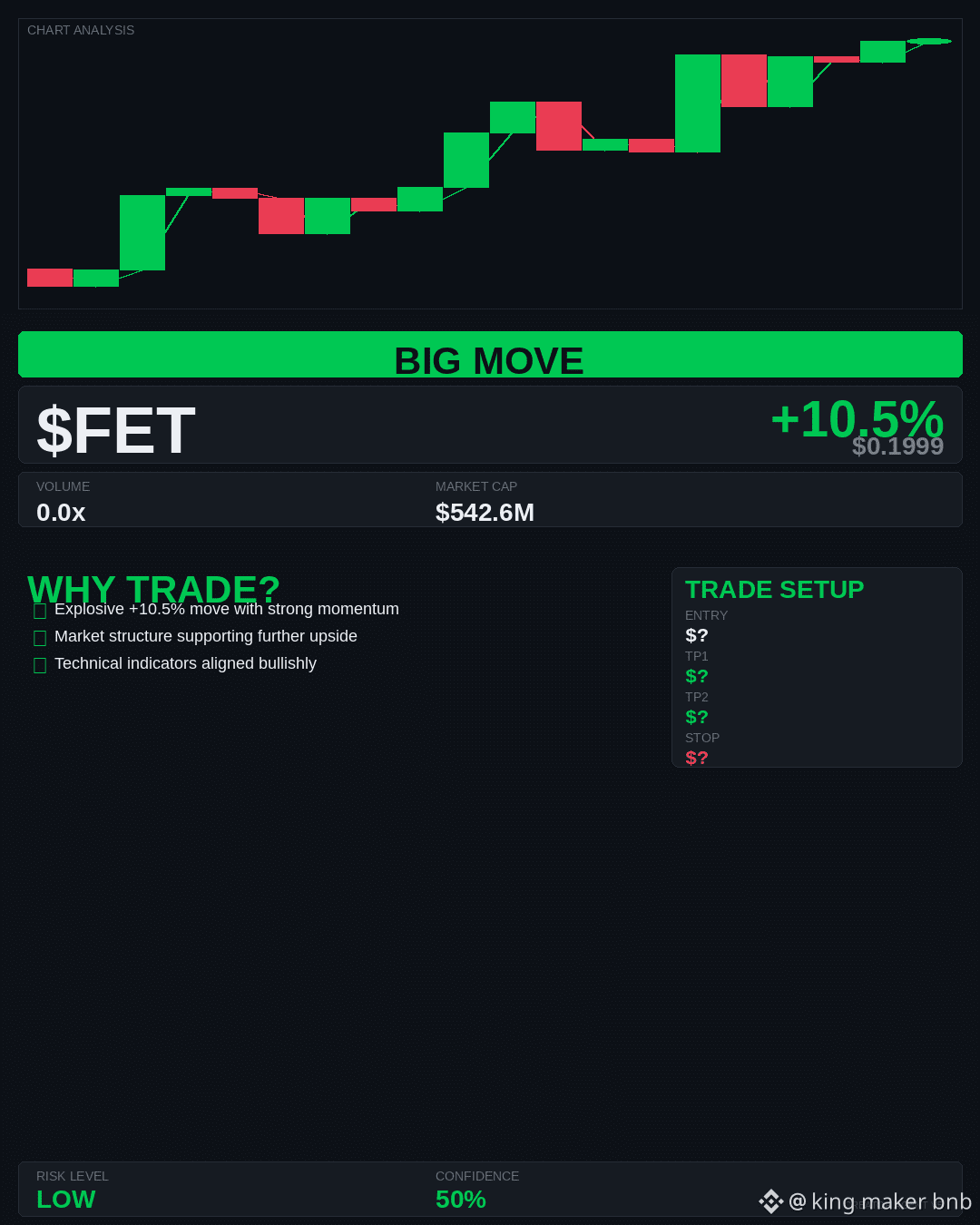
$FET just ripped +10.5% in a serious move. AI sector heating up and this one's got momentum. 💪
Looks like a potential long entry around $0.20. Targeting $0.21 for T1 and $0.22 for T2. Keep a tight stop loss at $0.19 given the low volume. The AI narrative is currently flying high on Binance Square, driving strong conviction behind this pump. This is a clean setup riding ongoing market activity. Watch for volume confirmation to sustain the move higher.
#FET #Write2Earn #AI #CryptoTrading
$FET just ripped +10.5% in a serious move. AI sector heating up and this one's got momentum. 💪
Looks like a potential long entry around $0.20. Targeting $0.21 for T1 and $0.22 for T2. Keep a tight stop loss at $0.19 given the low volume. The AI narrative is currently flying high on Binance Square, driving strong conviction behind this pump. This is a clean setup riding ongoing market activity. Watch for volume confirmation to sustain the move higher.
#FET #Write2Earn #AI #CryptoTrading
Looks like a potential long entry around $0.20. Targeting $0.21 for T1 and $0.22 for T2. Keep a tight stop loss at $0.19 given the low volume. The AI narrative is currently flying high on Binance Square, driving strong conviction behind this pump. This is a clean setup riding ongoing market activity. Watch for volume confirmation to sustain the move higher.
#FET #Write2Earn #AI #CryptoTrading
172
🚨 ALIBABA SHIFTS AI ARCHITECTURE AS STORAGE INEFFICIENCIES THREATEN COMPUTE EFFICIENCY $AI 📊
Alibaba Cloud revealed next-generation CPFS specs delivering 100 TB/s throughput and a 30% surge in peak compute utilization. 💡 Institutional market participants often hyper-focus on raw accelerator count, yet bandwidth bottlenecks frequently leave expensive compute idling during execution. 📊
By slashing model startup times by 50% and reducing storage costs by 69%, high-speed data pipelines are transitioning from passive backend infrastructure into active compute execution. 🔍 As production workloads scale, data throughput efficiency is rapidly redefining operational parameters across the entire AI ecosystem. 💬
Do you see storage pipelines replacing raw GPU metrics as the critical bottleneck in next-gen AI infrastructure? 👇
⚠️ Not financial advice. Always manage your risk. 🛡️
🏷️ #AI #Crypto #AIInfrastructure #Compute #Tech
🔥 ⚡
🚨 ALIBABA SHIFTS AI ARCHITECTURE AS STORAGE INEFFICIENCIES THREATEN COMPUTE EFFICIENCY $AI 📊
Alibaba Cloud revealed next-generation CPFS specs delivering 100 TB/s throughput and a 30% surge in peak compute utilization. 💡 Institutional market participants often hyper-focus on raw accelerator count, yet bandwidth bottlenecks frequently leave expensive compute idling during execution. 📊
By slashing model startup times by 50% and reducing storage costs by 69%, high-speed data pipelines are transitioning from passive backend infrastructure into active compute execution. 🔍 As production workloads scale, data throughput efficiency is rapidly redefining operational parameters across the entire AI ecosystem. 💬
Do you see storage pipelines replacing raw GPU metrics as the critical bottleneck in next-gen AI infrastructure? 👇
⚠️ Not financial advice. Always manage your risk. 🛡️
🏷️ #AI #Crypto #AIInfrastructure #Compute #Tech
🔥 ⚡
Alibaba Cloud revealed next-generation CPFS specs delivering 100 TB/s throughput and a 30% surge in peak compute utilization. 💡 Institutional market participants often hyper-focus on raw accelerator count, yet bandwidth bottlenecks frequently leave expensive compute idling during execution. 📊
By slashing model startup times by 50% and reducing storage costs by 69%, high-speed data pipelines are transitioning from passive backend infrastructure into active compute execution. 🔍 As production workloads scale, data throughput efficiency is rapidly redefining operational parameters across the entire AI ecosystem. 💬
Do you see storage pipelines replacing raw GPU metrics as the critical bottleneck in next-gen AI infrastructure? 👇
⚠️ Not financial advice. Always manage your risk. 🛡️
🏷️ #AI #Crypto #AIInfrastructure #Compute #Tech
🔥 ⚡
9
🚨 CLOUDFLARE UNLOCKS SEAMLESS AI AGENT TESTING — A MASSIVE WIN FOR THE $AI NARRATIVE! ⚡
Cloudflare just rolled out Worker Previews, giving autonomous coding bots isolated sandbox environments to deploy and test code without touching live production servers. 💡 This separates backend databases and runtime states, allowing AI agents to iterate, catch bugs, and execute deployments with zero friction.
Smart money understands that robust infrastructure is the true fuel for the next wave of agentic intelligence. ⚡ As developer tooling matures, performance efficiency across autonomous protocols will compound rapidly. 📊
💬 Are you positioning in autonomous agent infrastructure before the market prices in this tech leap, or waiting on the sidelines? 👇
⚠️ Not financial advice. Always manage your risk. 🛡️
🏷️ #AI #AIAgents #Infrastructure #Crypto #Web3
🔥 ⚡
🚨 CLOUDFLARE UNLOCKS SEAMLESS AI AGENT TESTING — A MASSIVE WIN FOR THE $AI NARRATIVE! ⚡
Cloudflare just rolled out Worker Previews, giving autonomous coding bots isolated sandbox environments to deploy and test code without touching live production servers. 💡 This separates backend databases and runtime states, allowing AI agents to iterate, catch bugs, and execute deployments with zero friction.
Smart money understands that robust infrastructure is the true fuel for the next wave of agentic intelligence. ⚡ As developer tooling matures, performance efficiency across autonomous protocols will compound rapidly. 📊
💬 Are you positioning in autonomous agent infrastructure before the market prices in this tech leap, or waiting on the sidelines? 👇
⚠️ Not financial advice. Always manage your risk. 🛡️
🏷️ #AI #AIAgents #Infrastructure #Crypto #Web3
🔥 ⚡
Cloudflare just rolled out Worker Previews, giving autonomous coding bots isolated sandbox environments to deploy and test code without touching live production servers. 💡 This separates backend databases and runtime states, allowing AI agents to iterate, catch bugs, and execute deployments with zero friction.
Smart money understands that robust infrastructure is the true fuel for the next wave of agentic intelligence. ⚡ As developer tooling matures, performance efficiency across autonomous protocols will compound rapidly. 📊
💬 Are you positioning in autonomous agent infrastructure before the market prices in this tech leap, or waiting on the sidelines? 👇
⚠️ Not financial advice. Always manage your risk. 🛡️
🏷️ #AI #AIAgents #Infrastructure #Crypto #Web3
🔥 ⚡
38

🤖 AI stocks are rising — but where could the next opportunities be?
AI is bigger than just GPUs and AI software. The whole ecosystem is expanding:
⚡ Power & electricity infrastructure
🏢 Data centers & cooling
🔌 Semiconductor equipment & memory
🌐 Networking infrastructure
🛡️ Cybersecurity
🤖 Robotics & automation
⛏️ Critical materials like copper
The AI boom could create demand across many connected industries.
Which sector do you think deserves more attention? 👇
#AI #Crypto #Investing #BinanceSquare #Tech #StockMarket #BinanceAcadmy
🤖 AI stocks are rising — but where could the next opportunities be?
AI is bigger than just GPUs and AI software. The whole ecosystem is expanding:
⚡ Power & electricity infrastructure
🏢 Data centers & cooling
🔌 Semiconductor equipment & memory
🌐 Networking infrastructure
🛡️ Cybersecurity
🤖 Robotics & automation
⛏️ Critical materials like copper
The AI boom could create demand across many connected industries.
Which sector do you think deserves more attention? 👇
#AI #Crypto #Investing #BinanceSquare #Tech #StockMarket #BinanceAcadmy
AI is bigger than just GPUs and AI software. The whole ecosystem is expanding:
⚡ Power & electricity infrastructure
🏢 Data centers & cooling
🔌 Semiconductor equipment & memory
🌐 Networking infrastructure
🛡️ Cybersecurity
🤖 Robotics & automation
⛏️ Critical materials like copper
The AI boom could create demand across many connected industries.
Which sector do you think deserves more attention? 👇
#AI #Crypto #Investing #BinanceSquare #Tech #StockMarket #BinanceAcadmy
54

·
--
🚨 INSTITUTIONAL REVALUATION: IS $AI REDEFINING DEEP VALUE IN THIS MARKET CYCLE? 💡
Traditional value metrics are failing as institutional capital pivots toward high-velocity AI infrastructure. 📊 Smart money is actively exploiting massive pricing inefficiencies where hyperscale cloud demand meets deeply undervalued hardware providers, driving a severe medium-term structural shift. 🔍
When sub-2x multiples intersect with triple-digit revenue expansion, classical valuation models disintegrate. 💡 Smart money flow is systematically front-running these structural inefficiencies before broad market repricing takes hold. 💬 Are you sticking to traditional valuation models or repositioning into AI infrastructure inefficiencies? 👇
⚠️ Not financial advice. Always manage your risk. 🛡️
🏷️ #AI #ValueInvesting #Macro #Crypto #Trading
🎯 🦈
🚨 INSTITUTIONAL REVALUATION: IS $AI REDEFINING DEEP VALUE IN THIS MARKET CYCLE? 💡
Traditional value metrics are failing as institutional capital pivots toward high-velocity AI infrastructure. 📊 Smart money is actively exploiting massive pricing inefficiencies where hyperscale cloud demand meets deeply undervalued hardware providers, driving a severe medium-term structural shift. 🔍
When sub-2x multiples intersect with triple-digit revenue expansion, classical valuation models disintegrate. 💡 Smart money flow is systematically front-running these structural inefficiencies before broad market repricing takes hold. 💬 Are you sticking to traditional valuation models or repositioning into AI infrastructure inefficiencies? 👇
⚠️ Not financial advice. Always manage your risk. 🛡️
🏷️ #AI #ValueInvesting #Macro #Crypto #Trading
🎯 🦈
Traditional value metrics are failing as institutional capital pivots toward high-velocity AI infrastructure. 📊 Smart money is actively exploiting massive pricing inefficiencies where hyperscale cloud demand meets deeply undervalued hardware providers, driving a severe medium-term structural shift. 🔍
When sub-2x multiples intersect with triple-digit revenue expansion, classical valuation models disintegrate. 💡 Smart money flow is systematically front-running these structural inefficiencies before broad market repricing takes hold. 💬 Are you sticking to traditional valuation models or repositioning into AI infrastructure inefficiencies? 👇
⚠️ Not financial advice. Always manage your risk. 🛡️
🏷️ #AI #ValueInvesting #Macro #Crypto #Trading
🎯 🦈
51
Log in to explore more content
Join global crypto users on Binance Square
⚡️ Get latest and useful information about crypto.
💬 Trusted by the world’s largest crypto exchange.
👍 Discover real insights from verified creators.
Email / Phone number
Trending Topics
1
#AIStocksWhatNext
160,374 views
1,885 Discussing
2
#BitcoinBreaksAboveMayHighNears$86K
4,555 views
92 Discussing
3
#DogecoinRises15%
11,378 views
505 Discussing
4
#$14BBitcoinOptionsExpireFriday
610 views
48 Discussing
5
#BNBMarketCapPassesBNYMellon
6,334 views
354 Discussing
6
#CryptoMarketCapReclaims$3Trillion
1,067 views
41 Discussing
7
#MuseOvertakesChatGPTAsTopFreeIOSApp
5,879 views
317 Discussing
8
#TokenizedStockPlatformsCouldLaunchNextQuarter
8,735 views
368 Discussing
9
#StrategyAdds950Bitcoin
14,122 views
456 Discussing
10
#CardanoAddedToX402KitForADAPayments
17,378 views
529 Discussing