
#usstocksslipandcryptomarketunderbroadpressure
usstocksslipandcryptomarketunderbroadpressure
350,784 views
832 Discussing
Hot
Latest


·
--

Article
Nasdaq 100 Tumbles 6% as Chipmaker Rout Deepens on AI Regulation FearsA post-election slide in chipmakers snowballed, dragging the Nasdaq 100 down 6% as investors fled the sector on speculation the Democratic sweep in Congress will usher in a new era of regulation for artificial intelligence, Bloomberg reported.
The 11% plunge in a gauge of chip giants put the group on course for its worst week since the April 2025 tariff meltdown. Nvidia tumbled 8%, while Qualcomm and Arm sank on underwhelming outlooks. Tesla and SpaceX each lost 11%, and Apple plans to raise about $7 billion in an investment-grade bond sale.
The S&P 500 fell 3.7% as of 10:52 a.m. in New York, the Dow lost 2.5%, the Stoxx Europe 600 slipped 0.7% and the MSCI World Index dropped 2.7%. Bitcoin fell 5.5% to $75,737, ether dropped 6.9% to $2,249.55, and the yen gained 0.5% to 157.70 per dollar as haven currencies outperformed.
Chris Murphy at Susquehanna International Group said the rotation out of chipmakers reflected growing concern about the pace and funding of AI spending given the risk of more regulation after the blue wave, even as earnings remain resilient and valuations have reset sharply.
In a rush for safety, consumer staples and health care climbed, and the tech selloff lifted bonds despite a rebound in oil. Ten-year Treasury yields fell six basis points to 4.83% and German yields dropped three to 3.24%, while WTI rose 2.2% to $90.04 a barrel and spot gold added 0.9% to $4,098.39 an ounce.
Bob Edwards at Edwards Asset Management said the AI trade is here to stay but remains volatile, and that investors should not overlook the duller corners of the market. He said he was not concerned about what the blue wave means for the AI buildout, since the president still has the veto pen and data centers bring jobs and tax revenue.
JPMorgan Asset Management's Jordan Jackson and Stephanie Aliaga said data centers have become an easy political target as electricity bills rise, and that the elections reinforced opposition in Texas and Ohio, where incoming Democratic governors favor tougher development conditions. They noted statewide moratoriums have struggled to become law and that AI is not yet a clear voter priority.
In corporate news, Microsoft declined to extend a Texas data center contract with Nscale ahead of the startup's planned IPO, Micron suspended plans for a memory chip plant in Taiwan over a protracted labor dispute, and Wendy's board unanimously rejected a roughly $1.4 billion offer from Nelson Peltz's Trian.
Nasdaq 100 Tumbles 6% as Chipmaker Rout Deepens on AI Regulation Fears
A post-election slide in chipmakers snowballed, dragging the Nasdaq 100 down 6% as investors fled the sector on speculation the Democratic sweep in Congress will usher in a new era of regulation for artificial intelligence, Bloomberg reported.
The 11% plunge in a gauge of chip giants put the group on course for its worst week since the April 2025 tariff meltdown. Nvidia tumbled 8%, while Qualcomm and Arm sank on underwhelming outlooks. Tesla and SpaceX each lost 11%, and Apple plans to raise about $7 billion in an investment-grade bond sale.
The S&P 500 fell 3.7% as of 10:52 a.m. in New York, the Dow lost 2.5%, the Stoxx Europe 600 slipped 0.7% and the MSCI World Index dropped 2.7%. Bitcoin fell 5.5% to $75,737, ether dropped 6.9% to $2,249.55, and the yen gained 0.5% to 157.70 per dollar as haven currencies outperformed.
Chris Murphy at Susquehanna International Group said the rotation out of chipmakers reflected growing concern about the pace and funding of AI spending given the risk of more regulation after the blue wave, even as earnings remain resilient and valuations have reset sharply.
In a rush for safety, consumer staples and health care climbed, and the tech selloff lifted bonds despite a rebound in oil. Ten-year Treasury yields fell six basis points to 4.83% and German yields dropped three to 3.24%, while WTI rose 2.2% to $90.04 a barrel and spot gold added 0.9% to $4,098.39 an ounce.
Bob Edwards at Edwards Asset Management said the AI trade is here to stay but remains volatile, and that investors should not overlook the duller corners of the market. He said he was not concerned about what the blue wave means for the AI buildout, since the president still has the veto pen and data centers bring jobs and tax revenue.
JPMorgan Asset Management's Jordan Jackson and Stephanie Aliaga said data centers have become an easy political target as electricity bills rise, and that the elections reinforced opposition in Texas and Ohio, where incoming Democratic governors favor tougher development conditions. They noted statewide moratoriums have struggled to become law and that AI is not yet a clear voter priority.
In corporate news, Microsoft declined to extend a Texas data center contract with Nscale ahead of the startup's planned IPO, Micron suspended plans for a memory chip plant in Taiwan over a protracted labor dispute, and Wendy's board unanimously rejected a roughly $1.4 billion offer from Nelson Peltz's Trian.
alikumail111:
This selloff shows how quickly AI regulation fears can spill over into the broader market. Bitcoin's decline alongside tech stocks also highlights crypto's sensitivity to macro sentiment. The key will be whether this is a temporary risk-off reaction or a deeper reassessment of AI valuations and investment expectations. 📊
7
10
31
29.7k

ANOTHER FACTOR THAT CONTRIBUTED TO THE COLLAPSE OF CRYPTOCURRENCY IS TRUMP'S OWN COMPANY.
Trump Media $DJT transferred approximately 4,259 $BTC to Crypto.com on November 5, the day after Democrats gained control of both chambers of Congress.
That's about 30 percent of what it has. The election is barely over, and Democrats are already discussing investigating the crypto business of the $TRUMP family.
The timing is way too convenient.
The "crypto president" no longer has the same cover with the new Congress. Furthermore, why would you send coins to an exchange?
That is not a hobby for anyone...
Traders saw it, panic set in, and the stock market and the cryptocurrency market crashed together. #USStocksSufferSteadiestRoutSince2020 #USStocksSlipandCryptoMarketUnderBroadPressure #TRUMP
71

·
--
WHY IS $BTC FALLING? WHAT IS REALLY HAPPENING BEHIND THE SELL-OFF?
Bitcoin has fallen below $76,000, reversing its post-election rally above $80,000.
But this sell-off is not simply about Bitcoin. There are broader financial market factors behind the move.
Here are four things worth paying attention to:
1. Wall Street is under heavy selling pressure.
The Nasdaq dropped 5.5%, the S&P 500 fell 4.3%, and the Dow Jones declined 3.4% on November 5.
Bitcoin followed the broader risk-off movement as investors reduced exposure to risky assets.
2. The AI investment narrative is facing pressure.
Investors are increasingly questioning the profitability of massive AI infrastructure investments, data center expansion, and semiconductor spending.
This pressure has also affected Bitcoin mining-related stocks.
3. More than $1 billion in crypto positions were liquidated.
Most of the liquidations came from LONG positions.
When leveraged traders are forced to close their positions, selling pressure can accelerate and create a liquidation cascade.
4. The post-election rally may have been weaker than it appeared.
Part of the previous rally was reportedly driven by short covering rather than strong new spot demand.
Once sentiment turned negative, Bitcoin quickly surrendered its gains.
{future}(BTCUSDT)
Understand the market before forming your own conclusions.
$ETH $BNB #AnthropicIPOValuationDoubts #USStocksSlipandCryptoMarketUnderBroadPressure
WHY IS $BTC FALLING? WHAT IS REALLY HAPPENING BEHIND THE SELL-OFF?
Bitcoin has fallen below $76,000, reversing its post-election rally above $80,000.
But this sell-off is not simply about Bitcoin. There are broader financial market factors behind the move.
Here are four things worth paying attention to:
1. Wall Street is under heavy selling pressure.
The Nasdaq dropped 5.5%, the S&P 500 fell 4.3%, and the Dow Jones declined 3.4% on November 5.
Bitcoin followed the broader risk-off movement as investors reduced exposure to risky assets.
2. The AI investment narrative is facing pressure.
Investors are increasingly questioning the profitability of massive AI infrastructure investments, data center expansion, and semiconductor spending.
This pressure has also affected Bitcoin mining-related stocks.
3. More than $1 billion in crypto positions were liquidated.
Most of the liquidations came from LONG positions.
When leveraged traders are forced to close their positions, selling pressure can accelerate and create a liquidation cascade.
4. The post-election rally may have been weaker than it appeared.
Part of the previous rally was reportedly driven by short covering rather than strong new spot demand.
Once sentiment turned negative, Bitcoin quickly surrendered its gains.
Understand the market before forming your own conclusions.
$ETH $BNB #AnthropicIPOValuationDoubts #USStocksSlipandCryptoMarketUnderBroadPressure

1
901

·
--
Verified
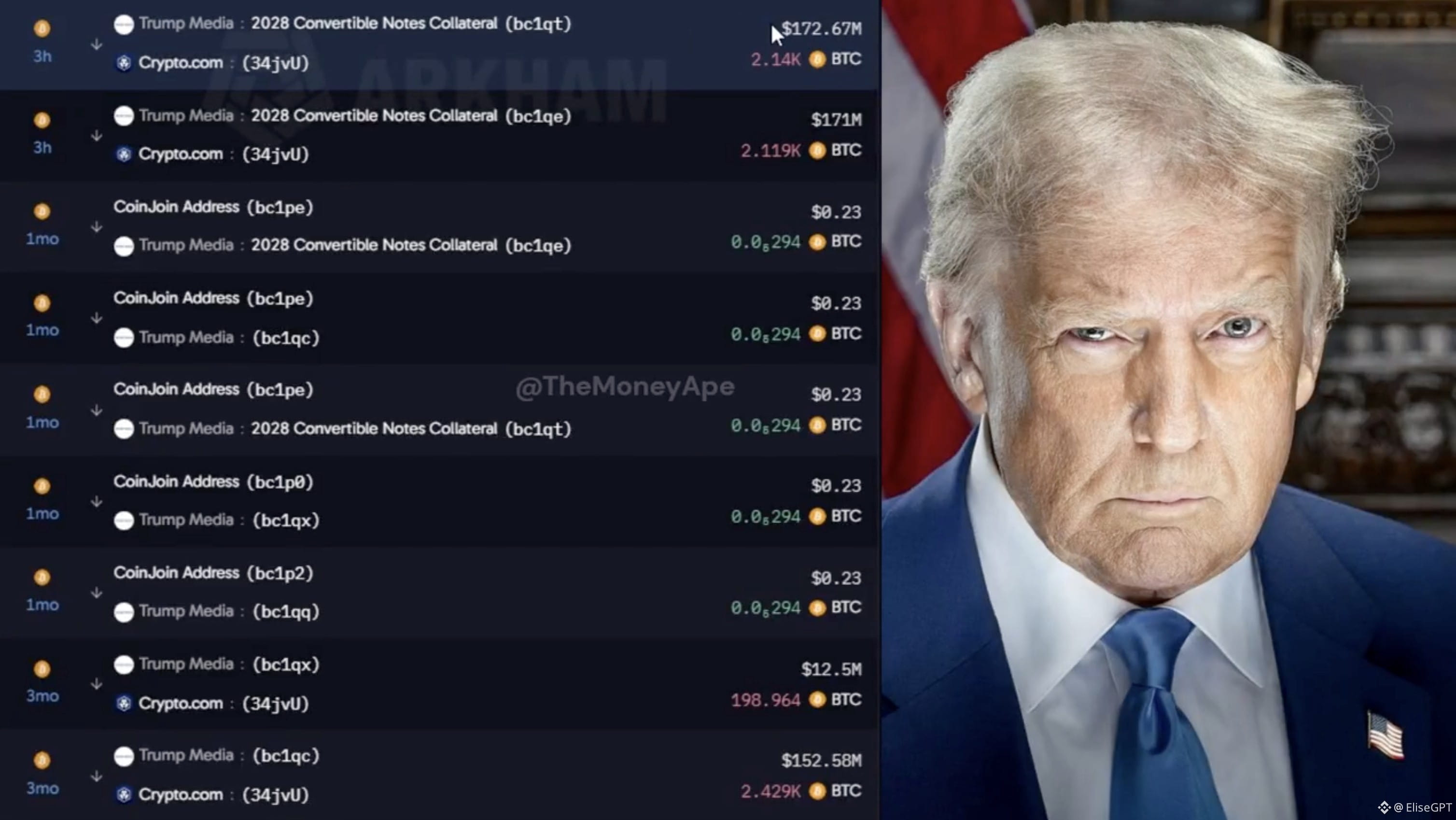
🚨There's another reason crypto got wrecked, and it's coming from Trump's own company
On Nov 5, the day after Democrats took back both chambers of Congress, Trump Media $DJT moved about 4,259 BTC to Crypto.com. That's roughly 30% of everything it holds.
The timing is way too convenient❗️❗️The election's barely over and Democrats are already talking about looking into the Trump family's crypto business. With a new Congress, the "crypto president" doesn't have the same cover anymore.
And why else would you send coins to an exchange? Nobody does that for fun...Traders saw it, panic took over, and stocks and crypto crashed together #USStocksSufferSteepestRoutSince2020 #USStocksSlipandCryptoMarketUnderBroadPressure #TRUMP
Pricilla Jarrard wEhO:
We been blinded by the truth that Trump was never pro crypto he was only using crypto to get richer and thats the reality and reality hurts…
31
3
65
131.7k

·
--
#usstocksslipandcryptomarketunderbroadpressure 🚨 WALL STREET SELLOFF HITS CRYPTO — IS A BIGGER MARKET CORRECTION COMING?
The post-election rally has quickly turned into a market shake-up!
On November 5, US stocks faced heavy selling pressure as investors moved away from technology and semiconductor stocks. Concerns over AI spending, data-center restrictions, and weaker chip-sector performance added to market uncertainty.
And crypto isn't immune. 👀
📉 CRYPTO MARKET UNDER PRESSURE
According to the Binance market overview:
🔴 Total Crypto Market Cap: $2.57 Trillion
🔻 24H Market Cap Change: -4.78%
📊 24H Trading Volume: $98 Billion
😨 Fear & Greed Index: 34 (Fear)
⚠️ 4 KEY THINGS TO WATCH:
1️⃣ Can Bitcoin defend its major support levels?
2️⃣ Will Wall Street recover or continue selling?
3️⃣ Are institutional investors reducing their crypto exposure?
4️⃣ Will Friday's US Jobs Report change expectations for the Federal Reserve?
🔥 MY MARKET VIEW
This is a time for patience, not panic.
If selling pressure continues in US equities, Bitcoin and altcoins could face another wave of volatility.
However, a recovery in traditional markets and stronger institutional demand could help crypto regain momentum.
The next few trading sessions could determine whether this is just a temporary correction or the beginning of a deeper market downturn.
💬 YOUR TAKE:
Will Bitcoin recover despite Wall Street's weakness, or are we heading toward another major crypto selloff?
👇 Share your prediction!
#Bitcoin #BTC #CryptoMarket #WallStreet
CLICK TO BELOW TRADE👇
$BTC $ETH $SOL
{future}(SOLUSDT)
{future}(ETHUSDT)
{future}(BTCUSDT)
#usstocksslipandcryptomarketunderbroadpressure 🚨 WALL STREET SELLOFF HITS CRYPTO — IS A BIGGER MARKET CORRECTION COMING?
The post-election rally has quickly turned into a market shake-up!
On November 5, US stocks faced heavy selling pressure as investors moved away from technology and semiconductor stocks. Concerns over AI spending, data-center restrictions, and weaker chip-sector performance added to market uncertainty.
And crypto isn't immune. 👀
📉 CRYPTO MARKET UNDER PRESSURE
According to the Binance market overview:
🔴 Total Crypto Market Cap: $2.57 Trillion
🔻 24H Market Cap Change: -4.78%
📊 24H Trading Volume: $98 Billion
😨 Fear & Greed Index: 34 (Fear)
⚠️ 4 KEY THINGS TO WATCH:
1️⃣ Can Bitcoin defend its major support levels?
2️⃣ Will Wall Street recover or continue selling?
3️⃣ Are institutional investors reducing their crypto exposure?
4️⃣ Will Friday's US Jobs Report change expectations for the Federal Reserve?
🔥 MY MARKET VIEW
This is a time for patience, not panic.
If selling pressure continues in US equities, Bitcoin and altcoins could face another wave of volatility.
However, a recovery in traditional markets and stronger institutional demand could help crypto regain momentum.
The next few trading sessions could determine whether this is just a temporary correction or the beginning of a deeper market downturn.
💬 YOUR TAKE:
Will Bitcoin recover despite Wall Street's weakness, or are we heading toward another major crypto selloff?
👇 Share your prediction!
#Bitcoin #BTC #CryptoMarket #WallStreet
CLICK TO BELOW TRADE👇
$BTC $ETH $SOL

Tanim816899:
Let's see how far it goes!!
1
1
1
4.8k


·
--
Verified
IT’S NOT ME, IT’S THEM...
🤣🤣🤣🤣🤣🤣🤣
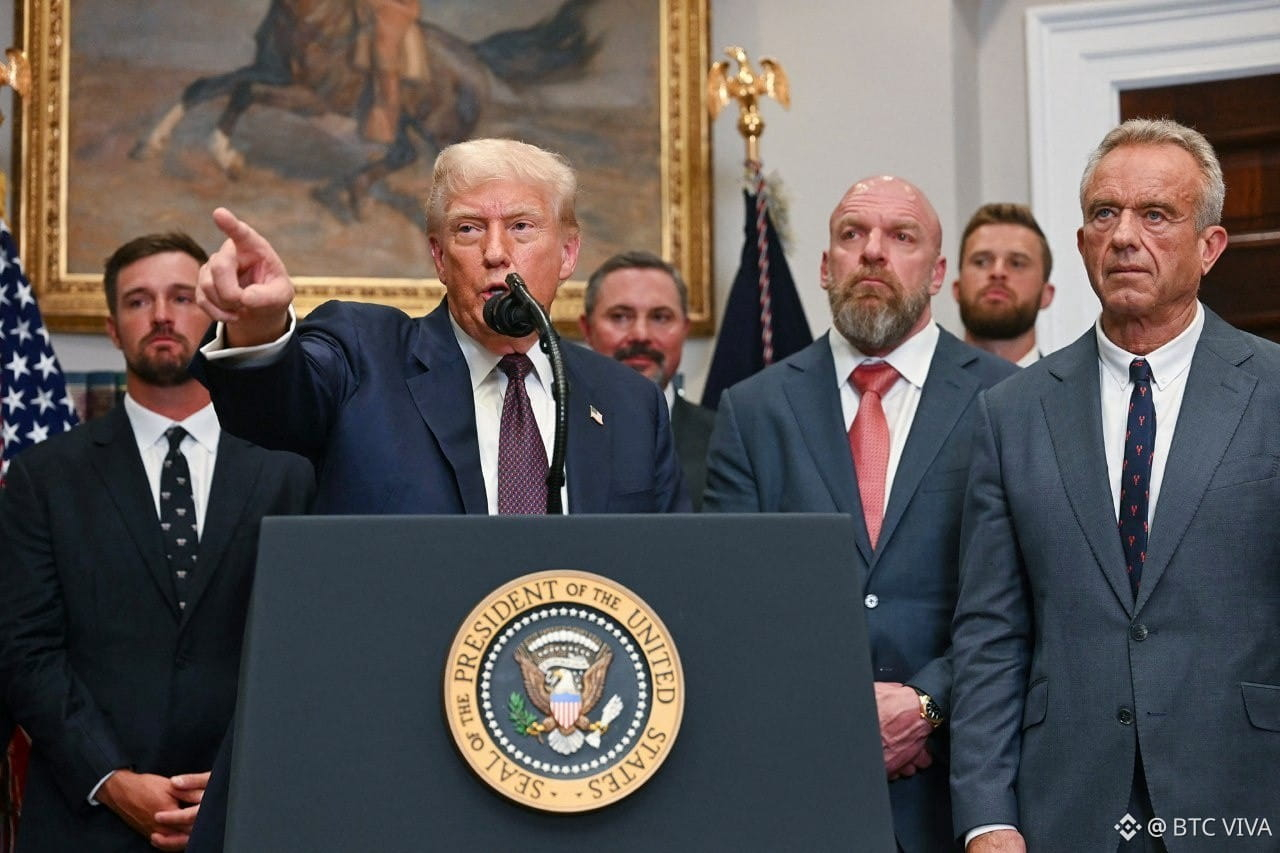
❗ Donald Trump has blamed the Democratic Party for the sharp decline in the U.S. stock market, linking the financial turbulence to the election results.
According to him, this downturn is one of the worst in history, directly impacting Americans' 401(k) retirement savings. Trump emphasized that reaching previous, unprecedented market highs required significant effort; he asserted that Republicans bear no responsibility for the current economic crisis, placing the blame entirely on his political opponents.
#Nasdaq100Tumbles6%
#USStocksSufferSteepestRoutSince2020
#USStocksSlipandCryptoMarketUnderBroadPressure
$TRUMP
{spot}(TRUMPUSDT)
IT’S NOT ME, IT’S THEM...
🤣🤣🤣🤣🤣🤣🤣
❗ Donald Trump has blamed the Democratic Party for the sharp decline in the U.S. stock market, linking the financial turbulence to the election results.
According to him, this downturn is one of the worst in history, directly impacting Americans' 401(k) retirement savings. Trump emphasized that reaching previous, unprecedented market highs required significant effort; he asserted that Republicans bear no responsibility for the current economic crisis, placing the blame entirely on his political opponents.
#Nasdaq100Tumbles6%
#USStocksSufferSteepestRoutSince2020
#USStocksSlipandCryptoMarketUnderBroadPressure
$TRUMP
Sharie Wareheim vK9Lرابحه ان شاءالله:
ok
24
2
97
124.8k

🚨 MARKET MELTDOWN: Why US Stocks & Crypto Are Bleeding Today 🚨
If your portfolio is looking red, you aren't alone. We just witnessed over $140 Billion wiped from the crypto market in a matter of hours, sending Bitcoin down to $76K and liquidating over $1 Billion in leveraged positions. 🤯
But this isn't just a crypto shakeout. It’s a massive macro wipeout. Here is exactly what is driving the crash today:
📉 The AI & Tech Wipeout
The Nasdaq just suffered a brutal 5.5% plunge—erasing $2 Trillion in value! Tech titans like Nvidia (-9%) and AMD (-17%) are taking massive hits. Investors are panicking over potential AI infrastructure regulations and questioning the ROI of heavy tech spending following the recent US midterm elections.
🔗 The Wall Street Correlation
Bitcoin's correlation with the Nasdaq is currently sitting at a high 0.68. When Wall Street panics and tech stocks slip, the crypto market feels the immediate aftershock. The "risk-off" sentiment is pushing capital out of speculative assets and straight into traditional safe havens.
⚠️ Macro & Geopolitical Jitters
From shifting Federal Reserve interest rate expectations to fresh geopolitical tensions, uncertainty is ruling the market. Add in the lingering pressure from recent industry security incidents, and traders are simply running for cover.
The Bottom Line:
Expect choppy waters ahead. If tech stocks stabilize, BTC could find a solid base. But if the tech sell-off accelerates, brace for more downside. Now is the time for extreme risk management. Spot opportunities will emerge, but don't try to catch a falling knife with high leverage! 🛡️
👇 What’s your move right now? Buying the fear or sitting in stablecoins? Drop your strategy below!
$BTC $ETH $SOL
#usstocksslipandcryptomarketunderbroadpressure #Bitcoin #CryptoMarket #TechStocks #BinanceSquare

rohitrawat0:
https://app.binance.com/uni-qr/cpos/385533009848592?r=AMTPTF5B&l=en&uco=PY9b6N3iMXx6iJMe7vGBLg&uc=app_square_share_link&us=copylink
28
2
32
38.9k

·
--
Bullish
#usstocksslipandcryptomarketunderbroadpressure
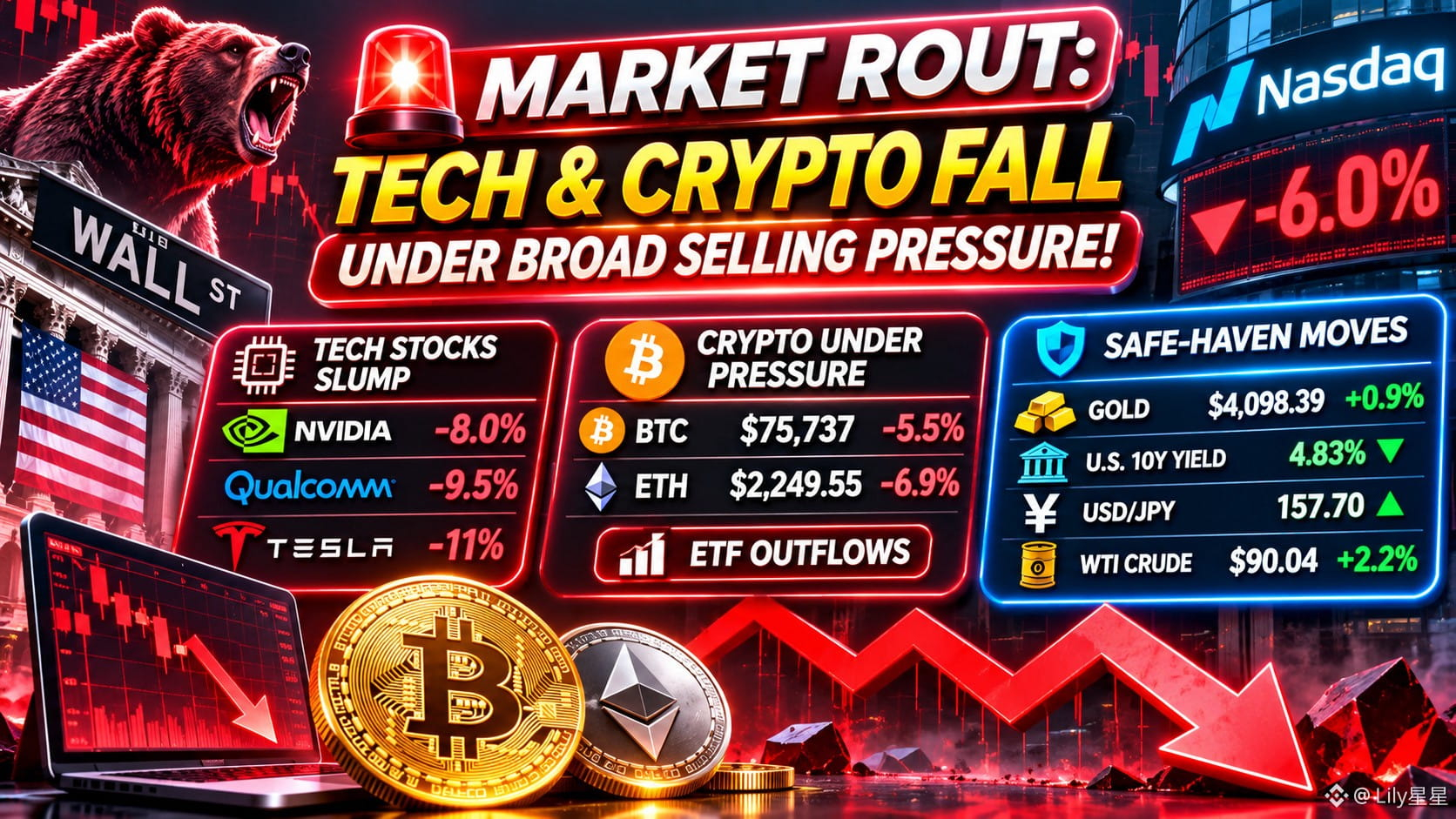
🚨 MARKET ROUT: Tech & Crypto Fall Under Broad Selling Pressure! 📉💥
Here is your trending market breakdown covering the massive tech-led selloff, AI regulatory fears, and crypto market spillovers:
💥 Nasdaq Tumbles & Semiconductor Rout
📉 Nasdaq Drops 6%: A sharp tech slide drove the Nasdaq Composite into technical correction territory, marking its worst daily plunge in 19 months!
🛑 Chipmakers Take a Hit: Semiconductor stocks dropped over 11%, led by heavy losses in Nvidia (-8%), Qualcomm (-9.5%), and Arm following disappointing outlooks.
🏛️ AI Regulatory Fears: Selloff accelerated after post-election Blue Wave speculation raised concerns over tougher Congressional oversight on AI & data center expansion.
🚗 Tech Heavyweights Slump: Tesla and SpaceX both dropped over 11%, while Apple plans to raise $7B in bond sales amid the turbulence.
🪙 Crypto Market Under Pressure (BTC / $ETH)
📉 Bitcoin Drops Below $76K:BTC fell ~5.5% to $75,737, triggered by over $370M–$500M+ in leveraged crypto liquidations as equity losses spilled over.
📉 Ethereum & Alts Slide: Ether sank 6.9% down to $2,249.55, with high-beta AI tokens and tech-correlated crypto assets taking heavy losses.
🦅 Macro Flight to Safety & Havens
🛡️ Defensive Shift: Investors rotated into healthcare, consumer staples, and government bonds, driving 10-Year U.S. Treasury yields down to 4.83%.
🥇 Gold & Haven FX: Spot Gold added 0.9% to $4,098.39/oz, while the Japanese Yen strengthened to 157.70 per dollar. WTI Crude gained 2.2% to $90.04/bbl.
💡 Trader Tip: Macro de-risking events tend to spike leverage liquidations across crypto exchanges. Keep position sizes manageable, set strict stop-losses, and watch for key support bounce levels! 📊🛡️
$NASA.ETF
{etf_us}(NASA.ETF)
$CAP
{future}(CAPUSDT)
$APPB
{spot}(APPBUSDT)
#BinanceReopensWithdrawalsForMoreAssets #AnthropicIPOValuationDoubts #NASDAQ #CryptoNews
#usstocksslipandcryptomarketunderbroadpressure
🚨 MARKET ROUT: Tech & Crypto Fall Under Broad Selling Pressure! 📉💥
Here is your trending market breakdown covering the massive tech-led selloff, AI regulatory fears, and crypto market spillovers:
💥 Nasdaq Tumbles & Semiconductor Rout
📉 Nasdaq Drops 6%: A sharp tech slide drove the Nasdaq Composite into technical correction territory, marking its worst daily plunge in 19 months!
🛑 Chipmakers Take a Hit: Semiconductor stocks dropped over 11%, led by heavy losses in Nvidia (-8%), Qualcomm (-9.5%), and Arm following disappointing outlooks.
🏛️ AI Regulatory Fears: Selloff accelerated after post-election Blue Wave speculation raised concerns over tougher Congressional oversight on AI & data center expansion.
🚗 Tech Heavyweights Slump: Tesla and SpaceX both dropped over 11%, while Apple plans to raise $7B in bond sales amid the turbulence.
🪙 Crypto Market Under Pressure (BTC / $ETH)
📉 Bitcoin Drops Below $76K:BTC fell ~5.5% to $75,737, triggered by over $370M–$500M+ in leveraged crypto liquidations as equity losses spilled over.
📉 Ethereum & Alts Slide: Ether sank 6.9% down to $2,249.55, with high-beta AI tokens and tech-correlated crypto assets taking heavy losses.
🦅 Macro Flight to Safety & Havens
🛡️ Defensive Shift: Investors rotated into healthcare, consumer staples, and government bonds, driving 10-Year U.S. Treasury yields down to 4.83%.
🥇 Gold & Haven FX: Spot Gold added 0.9% to $4,098.39/oz, while the Japanese Yen strengthened to 157.70 per dollar. WTI Crude gained 2.2% to $90.04/bbl.
💡 Trader Tip: Macro de-risking events tend to spike leverage liquidations across crypto exchanges. Keep position sizes manageable, set strict stop-losses, and watch for key support bounce levels! 📊🛡️
$NASA.ETF
$CAP
$APPB
#BinanceReopensWithdrawalsForMoreAssets #AnthropicIPOValuationDoubts #NASDAQ #CryptoNews
Abu Fahadأ:
💛
1
4
1.7k

·
--
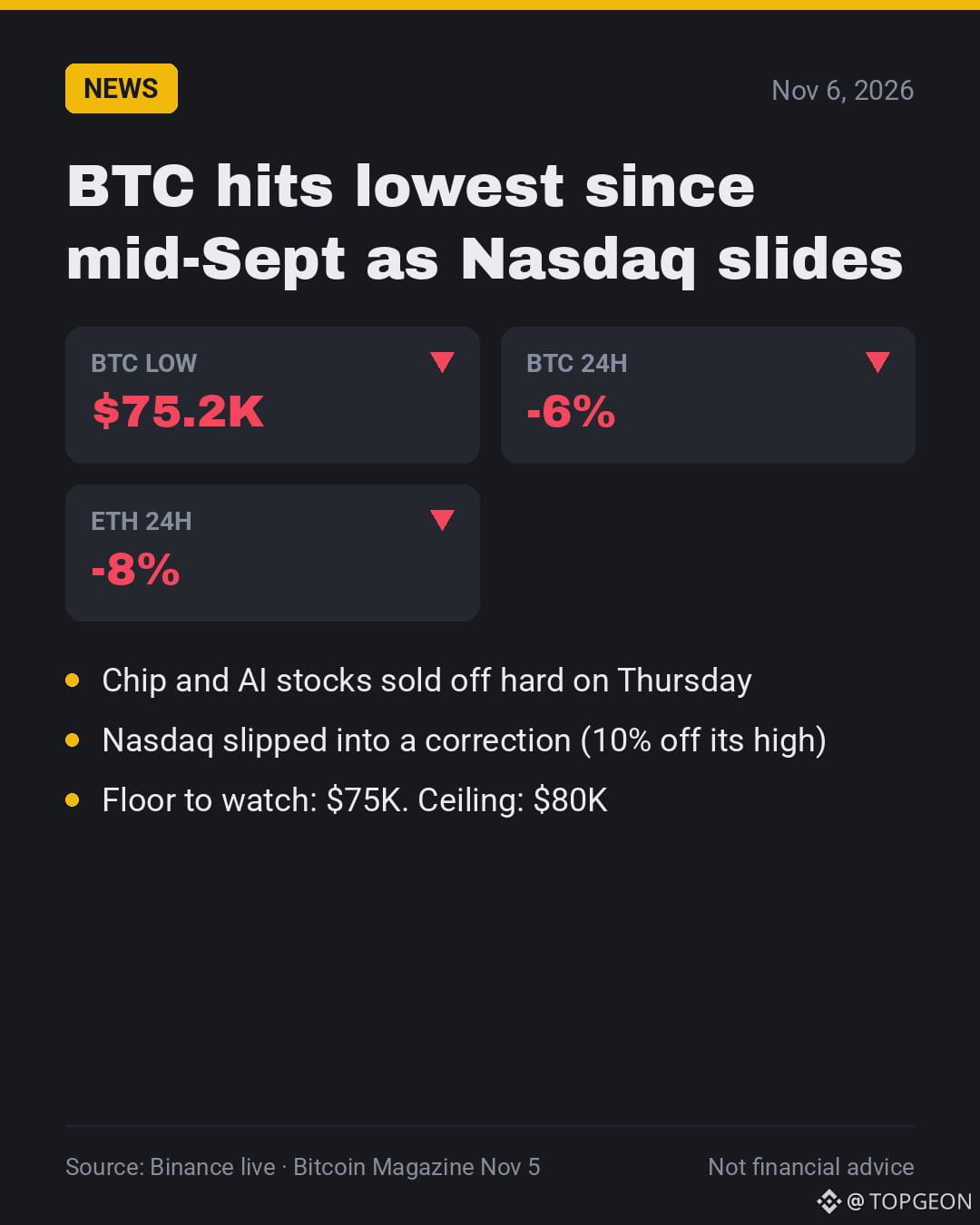
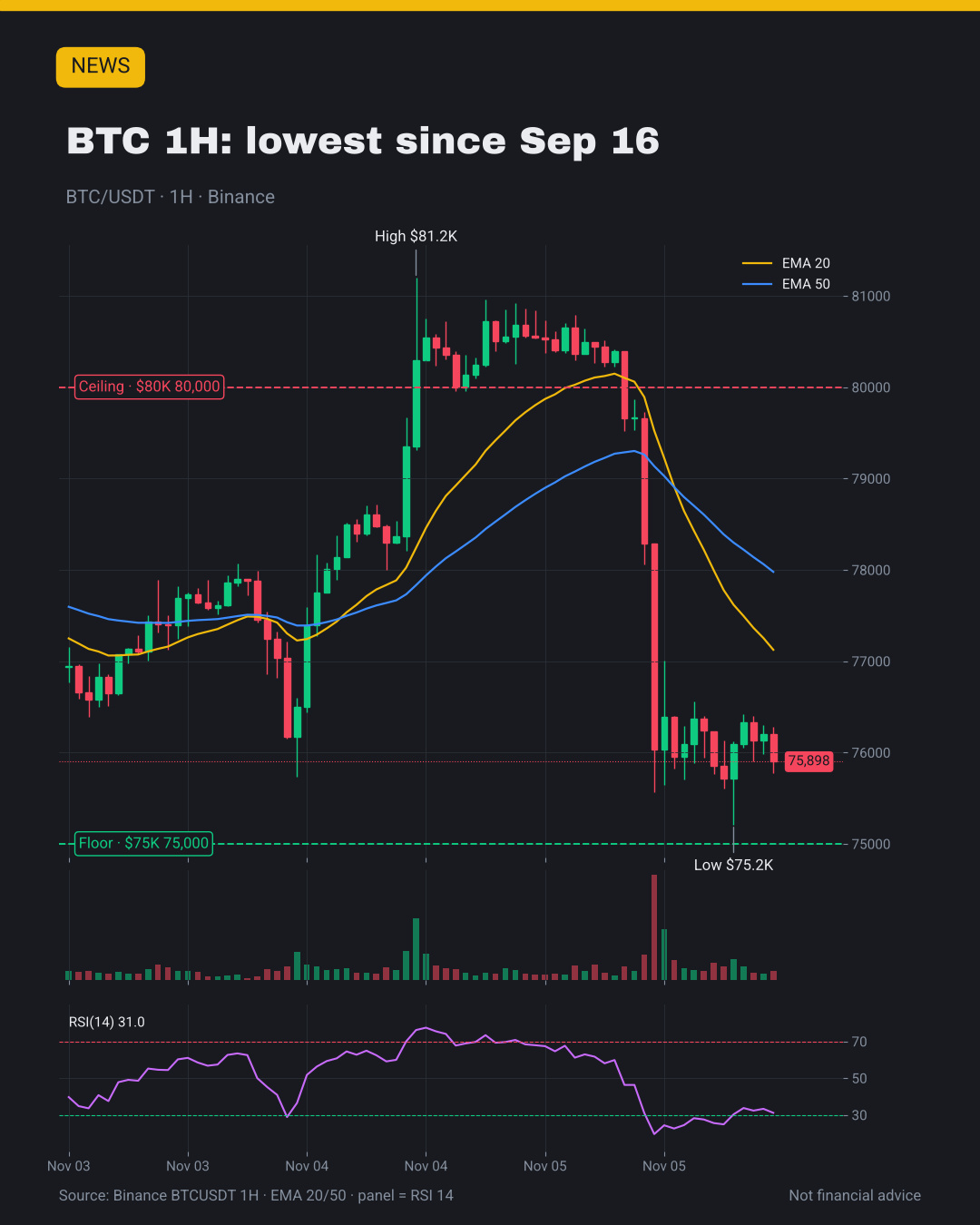
📉 $BTC dipped to $75.2K overnight, its lowest since mid-September.
💻 The trigger: chip stocks crashed and pushed the Nasdaq into a correction.
🔗 Crypto is trading like a tech stock again.
🩸 $ETH got hit even harder, down 8% in a day.
🎯 My take: $75K is the line bulls have to defend.
💬 Bounce from here, or one more flush first? 👇
#BTC #Nasdaq #USStocksSlipandCryptoMarketUnderBroadPressure
Trader M08:
Agree that 75K is the line. The overnight low on Binance spot was 75,208, only about 240 above the mid-September low of 74,968, so that small gap is where bulls really get tested. ETH looks weaker for now, down about 8% on the day and sitting near 2,230.
1
2
2.9k

🚨 $3 TRILLION WIPED OUT! TECH BILLIONAIRES LOSE $150 BILLION IN ONE DAY!
Wall Street experienced a massive selloff as the Nasdaq Composite plunged 5.52%, marking its worst trading day since April 2025.
AI and technology stocks faced heavy selling pressure, with NVIDIA ($NVDA) falling as much as 9% intraday, while TSMC, SpaceX and Tesla ($TSLA) also came under pressure.
💸 BIGGEST BILLIONAIRE LOSSES (INTRADAY):
Elon Musk: -$91.2B (-10.50%)
Michael Dell: -$20.5B (-9.60%)
Jensen Huang: -$15.1B (-8.70%)
Larry Ellison: -$13.2B (-8.05%)
Mark Zuckerberg: -$12.9B (-5.98%)
📉 WHAT DOES THIS MEAN FOR CRYPTO?
The technology selloff is adding pressure to risk assets, including Bitcoin and altcoins. Investors are becoming more cautious as market volatility increases.
🔥 THE BIG QUESTION:
Is this a temporary market correction, or the beginning of a deeper technology and crypto market selloff?
#Nasdaq100Tumbles6% [ ](https://www.binance.com/square/hashtag/Nasdaq100Tumbles6%25)#USStocksSlipandCryptoMarketUnderBroadPressure [ ](https://www.binance.com/square/hashtag/USStocksSlipandCryptoMarketUnderBroadPressure)#Musk
{spot}(SPCXBUSDT)
{spot}(NVDABUSDT)
{spot}(TSLABUSDT)
🚨 $3 TRILLION WIPED OUT! TECH BILLIONAIRES LOSE $150 BILLION IN ONE DAY!
Wall Street experienced a massive selloff as the Nasdaq Composite plunged 5.52%, marking its worst trading day since April 2025.
AI and technology stocks faced heavy selling pressure, with NVIDIA ($NVDA) falling as much as 9% intraday, while TSMC, SpaceX and Tesla ($TSLA) also came under pressure.
💸 BIGGEST BILLIONAIRE LOSSES (INTRADAY):
Elon Musk: -$91.2B (-10.50%)
Michael Dell: -$20.5B (-9.60%)
Jensen Huang: -$15.1B (-8.70%)
Larry Ellison: -$13.2B (-8.05%)
Mark Zuckerberg: -$12.9B (-5.98%)
📉 WHAT DOES THIS MEAN FOR CRYPTO?
The technology selloff is adding pressure to risk assets, including Bitcoin and altcoins. Investors are becoming more cautious as market volatility increases.
🔥 THE BIG QUESTION:
Is this a temporary market correction, or the beginning of a deeper technology and crypto market selloff?
#Nasdaq100Tumbles6% #USStocksSlipandCryptoMarketUnderBroadPressure #Musk

48

🚨 DID A MAJOR BITCOIN TRANSFER ADD PRESSURE TO THE CRYPTO MARKET? 📉
A surprising move from Trump Media has caught the attention of crypto traders.
According to reports, on November 5, Trump Media ($DJT) transferred approximately 4,259 BTC to Crypto.com, representing nearly 30% of its reported Bitcoin holdings.
👀 Why Is This Important?
🔹 The transfer came shortly after the US midterm election developments.
🔹 Political discussions around the Trump family's crypto-related business are gaining attention.
🔹 Large Bitcoin movements to exchanges often raise questions about possible selling pressure.
⚠️ However, transferring BTC to an exchange does NOT automatically mean those coins have been sold.
📊 The Bigger Picture
With political uncertainty and market volatility happening together, traders are watching large Bitcoin transactions more closely.
Is this simply a routine transfer, or could it signal something bigger for the market?
💬 What's your take?
#USStocksSufferSteepestRoutSince2020
{spot}(BTCUSDT)
{stock_us}(DJT.US)
#USStocksSlipandCryptoMarketUnderBroadPressure #TRUMP
🚨 DID A MAJOR BITCOIN TRANSFER ADD PRESSURE TO THE CRYPTO MARKET? 📉
A surprising move from Trump Media has caught the attention of crypto traders.
According to reports, on November 5, Trump Media ($DJT) transferred approximately 4,259 BTC to Crypto.com, representing nearly 30% of its reported Bitcoin holdings.
👀 Why Is This Important?
🔹 The transfer came shortly after the US midterm election developments.
🔹 Political discussions around the Trump family's crypto-related business are gaining attention.
🔹 Large Bitcoin movements to exchanges often raise questions about possible selling pressure.
⚠️ However, transferring BTC to an exchange does NOT automatically mean those coins have been sold.
📊 The Bigger Picture
With political uncertainty and market volatility happening together, traders are watching large Bitcoin transactions more closely.
Is this simply a routine transfer, or could it signal something bigger for the market?
💬 What's your take?
#USStocksSufferSteepestRoutSince2020
#USStocksSlipandCryptoMarketUnderBroadPressure #TRUMP

144

US STOCKS SLIP AS CRYPTO MARKET FACES BROAD SELLING PRESSURE!Global markets are under pressure as Wall Street and cryptocurrencies experience another sharp wave of selling. The latest market action shows how quickly fear in traditional markets can spill over into digital assets.
📉 WHY ARE US STOCKS FALLING?
US technology shares led Thursday’s decline as disappointing Qualcomm earnings and growing concerns over massive AI infrastructure spending rattled investors.
The Dow dropped around 2.2%, the S&P 500 fell 3.4%, and the Nasdaq plunged 5.2%. Concerns about political opposition to data-center expansion have added another layer of uncertainty for technology investors.
₿ BITCOIN AND ALTCOINS FEEL THE PRESSURE
Crypto has not escaped the risk-off mood. Bitcoin slipped toward $76,000, erasing much of its post-election rebound above $80,000.
The selloff also triggered approximately $428 million in crypto long liquidations within one hour, adding forced selling to an already fragile market.
$XRP and $SUI are among the altcoins traders should watch as market-wide caution weighs on risk appetite.
⚠️ THREE FACTORS KEEPING TRADERS CAUTIOUS
AI spending concerns: Investors are questioning whether massive technology investments will deliver expected returns.Political uncertainty: The US midterm results have raised fresh questions about future technology and crypto policy.Binance security fallout: The recent multibillion-dollar exploit remains a confidence issue for the crypto market, even as Binance continues its recovery and withdrawal-reopening process.
🔎 WHAT SHOULD TRADERS WATCH NEXT?
Bitcoin’s ability to stabilize and reclaim important price levels will be crucial. If selling continues across technology stocks, crypto could remain vulnerable to further volatility.
For now, avoid treating every bounce as a confirmed recovery. Watch market liquidity, liquidation activity, and whether buyers return with sustained volume.
Is this a temporary market shakeout, or are we entering a deeper correction? Share your view!
$BTC $SUI
#usstocksslipandcryptomarketunderbroadpressure
{spot}(SUIUSDT)
{spot}(BTCUSDT)
US STOCKS SLIP AS CRYPTO MARKET FACES BROAD SELLING PRESSURE!
Global markets are under pressure as Wall Street and cryptocurrencies experience another sharp wave of selling. The latest market action shows how quickly fear in traditional markets can spill over into digital assets.
📉 WHY ARE US STOCKS FALLING?
US technology shares led Thursday’s decline as disappointing Qualcomm earnings and growing concerns over massive AI infrastructure spending rattled investors.
The Dow dropped around 2.2%, the S&P 500 fell 3.4%, and the Nasdaq plunged 5.2%. Concerns about political opposition to data-center expansion have added another layer of uncertainty for technology investors.
₿ BITCOIN AND ALTCOINS FEEL THE PRESSURE
Crypto has not escaped the risk-off mood. Bitcoin slipped toward $76,000, erasing much of its post-election rebound above $80,000.
The selloff also triggered approximately $428 million in crypto long liquidations within one hour, adding forced selling to an already fragile market.
$XRP and $SUI are among the altcoins traders should watch as market-wide caution weighs on risk appetite.
⚠️ THREE FACTORS KEEPING TRADERS CAUTIOUS
AI spending concerns: Investors are questioning whether massive technology investments will deliver expected returns.Political uncertainty: The US midterm results have raised fresh questions about future technology and crypto policy.Binance security fallout: The recent multibillion-dollar exploit remains a confidence issue for the crypto market, even as Binance continues its recovery and withdrawal-reopening process.
🔎 WHAT SHOULD TRADERS WATCH NEXT?
Bitcoin’s ability to stabilize and reclaim important price levels will be crucial. If selling continues across technology stocks, crypto could remain vulnerable to further volatility.
For now, avoid treating every bounce as a confirmed recovery. Watch market liquidity, liquidation activity, and whether buyers return with sustained volume.
Is this a temporary market shakeout, or are we entering a deeper correction? Share your view!
$BTC $SUI
#usstocksslipandcryptomarketunderbroadpressure
loweef:
The 428M in long liquidations in one hour matches what the BTC hourly chart shows: price fell through 78K with very little trading in between, which is what forced selling into thin bids looks like. Agree on not trusting every bounce. If the rebound comes on lower volume than the drop, it is usually short covering, not new demand.
2
2.6k

·
--
Bullish
#usstocksslipandcryptomarketunderbroadpressure 📉 Macro Headwinds: US Equities Slip as Crypto Markets Face Broad Pressure
Traditional markets are experiencing a notable downturn, and the ripple effects are being felt across the digital asset landscape. Here is a breakdown of the current macroeconomic pressure and what it means for the crypto ecosystem.
📰 The Core News
Major US stock indices have recently recorded losses amid shifting macroeconomic data and a broader reassessment of investor risk. Consequently, the cryptocurrency market is mirroring this cautious sentiment, experiencing broad-based downward pressure as traders navigate a complex global economic environment.
📊 Market Impact
While crypto operates independently in many ways, it remains sensitive to traditional financial market movements. Here is how this dynamic plays out:
• Risk-Asset Correlation: Digital assets continue to exhibit a strong correlation with tech-heavy traditional indices like the Nasdaq. When equities face headwinds, cryptocurrencies often experience similar short-term volatility as institutional and retail capital shifts toward safer havens.
• Liquidity Dynamics: A "risk-off" environment can lead to reduced trading volumes and tighter liquidity. This can make the market more susceptible to amplified price swings in both directions.
• Macro Over Micro: During these periods, broader economic indicators—such as inflation data, interest rate expectations, and central bank policies—tend to dominate the market narrative, temporarily overshadowing crypto-specific developments or project updates.
💬 Let's Discuss
How do you adjust your portfolio strategy or risk management during periods of high macroeconomic correlation between traditional stocks and crypto? Share your perspective in the comments below! 👇
#CryptoMarket #Macroeconomics #Bitcoin #RiskManagement #BinanceSquare
This is for educational purposes only. Not Financial Advice (NFA). Always Do Your Own Research (DYOR).
$SKDDB $APPB $WENB
{spot}(WENBUSDT)
{spot}(APPBUSDT)
{spot}(SKDDBUSDT)
#usstocksslipandcryptomarketunderbroadpressure 📉 Macro Headwinds: US Equities Slip as Crypto Markets Face Broad Pressure
Traditional markets are experiencing a notable downturn, and the ripple effects are being felt across the digital asset landscape. Here is a breakdown of the current macroeconomic pressure and what it means for the crypto ecosystem.
📰 The Core News
Major US stock indices have recently recorded losses amid shifting macroeconomic data and a broader reassessment of investor risk. Consequently, the cryptocurrency market is mirroring this cautious sentiment, experiencing broad-based downward pressure as traders navigate a complex global economic environment.
📊 Market Impact
While crypto operates independently in many ways, it remains sensitive to traditional financial market movements. Here is how this dynamic plays out:
• Risk-Asset Correlation: Digital assets continue to exhibit a strong correlation with tech-heavy traditional indices like the Nasdaq. When equities face headwinds, cryptocurrencies often experience similar short-term volatility as institutional and retail capital shifts toward safer havens.
• Liquidity Dynamics: A "risk-off" environment can lead to reduced trading volumes and tighter liquidity. This can make the market more susceptible to amplified price swings in both directions.
• Macro Over Micro: During these periods, broader economic indicators—such as inflation data, interest rate expectations, and central bank policies—tend to dominate the market narrative, temporarily overshadowing crypto-specific developments or project updates.
💬 Let's Discuss
How do you adjust your portfolio strategy or risk management during periods of high macroeconomic correlation between traditional stocks and crypto? Share your perspective in the comments below! 👇
#CryptoMarket #Macroeconomics #Bitcoin #RiskManagement #BinanceSquare
This is for educational purposes only. Not Financial Advice (NFA). Always Do Your Own Research (DYOR).
$SKDDB $APPB $WENB

1
1.6k

·
--

Article
Nasdaq 100 Crashes 6% as AI Regulation Fears Shake Wall Street: Why $NVDA, $TSLA and $SPCX Deserve IWall Street just received a serious warning: The biggest threat to the AI boom may not come from technological competition, but from political decisions that determine how much money companies can actually invest in the future.
On November 5, 2026, the Nasdaq 100 plunged approximately 6.4%, wiping out nearly $2.5 trillion in market value. Semiconductor stocks suffered even heavier losses, with the Philadelphia Semiconductor Index falling around 12% and Nvidia declining approximately 9%.
Bitcoin also moved lower as investors reduced exposure to risk-sensitive assets.
The immediate trigger was growing concern about tighter AI regulation following the US midterm elections. But the market reaction points to a much bigger question:
Could political decisions reshape the global AI investment cycle — and create a new risk for technology and cryptocurrency investors?
1. The Geopolitical Battle Behind the AI Selloff
The semiconductor industry is no longer just another technology business. It has become a strategic asset in the competition between major economic powers.
The United States and China are competing for leadership in advanced chips, AI computing, semiconductor manufacturing and technological infrastructure.
Washington has already used export restrictions, investment controls and industrial subsidies to protect its strategic position in advanced technology.
Now, another challenge is emerging within the US itself.
AI data centers require enormous amounts of electricity, water, land and capital. Their expansion depends on construction permits, electricity-grid capacity and government policies.
If regulatory requirements become stricter, projects could face delays and higher costs.
That creates a potential chain reaction:
Data-center approvals become slower.
Infrastructure investment gets delayed.
Demand expectations for advanced AI chips weaken.
Semiconductor revenue forecasts face pressure.
Technology valuations come under reassessment.
Reuters reported that UBS analysts estimated around 30% of expected US data-center capacity additions in 2028 could be at risk from potential construction pauses.
This does not mean those projects have been cancelled. It highlights how sensitive the AI investment cycle has become to political and regulatory decisions.
For investors, the real question is not whether AI will survive. It is whether companies can maintain their expected growth and profitability at the pace currently priced into their stocks.
2. NVDA: Is the AI Growth Story Facing a Reality Check?
Nvidia remains at the center of the global AI infrastructure market.
Its GPUs and computing platforms power many of the world's largest AI systems. That gives the company significant exposure to long-term demand for artificial intelligence.
But there is an important distinction between strong industry demand and an attractive stock valuation.
If major cloud providers slow their infrastructure spending, chip orders could be delayed. Even without a collapse in AI demand, slower spending growth could force investors to reconsider Nvidia's valuation.
The bullish case:
AI computing demand remains structurally strong.
Existing data centers continue to require advanced GPUs.
Enterprise AI adoption creates additional demand.
A valuation correction could offer opportunities if earnings remain resilient.
The bearish case:
Data-center projects face regulatory delays.
Major customers reconsider capital expenditure.
Custom AI chips increase competitive pressure.
High expectations leave little room for disappointing earnings.
My view: Nvidia investors should pay close attention to order visibility, customer spending and forward guidance.
A falling share price does not automatically mean the business is weakening. But a premium valuation requires strong execution.
3. TSLA: More Than an Electric Vehicle Company
Tesla's investment story is increasingly connected to AI, autonomous driving, robotics and energy storage.
That makes the company particularly sensitive to changes in how investors value future technology businesses.
When financial conditions tighten, investors often become less willing to pay high valuations for profits that may arrive years later.
Tesla can therefore face selling pressure even without a major deterioration in its current business.
There is another interesting connection.
The expansion of AI data centers requires reliable electricity infrastructure. Tesla's battery storage and energy businesses could benefit from growing demand for energy management and storage solutions.
However, this opportunity still depends on actual deployments, pricing, competition and profitability.
The bullish case: Autonomous driving, robotics and energy storage could create additional revenue opportunities over the long term.
The bearish case: Higher financing costs, competition, weaker vehicle demand and delays in commercializing new technologies could pressure valuation.
For investors, the key is to separate Tesla's established business performance from expectations surrounding its future technologies.
4. SPCX: Why Space Infrastructure Matters
SpaceX represents a different part of the technology investment landscape.
Its business includes rocket launches, satellite connectivity and space infrastructure.
These services are becoming increasingly important for commercial communications, remote connectivity and government operations.
The geopolitical significance is also worth watching.
Satellite networks can support critical communications and national-security infrastructure. That creates demand drivers beyond ordinary consumer technology.
But strategic importance does not make a company immune to financial-market pressure.
Higher capital costs, valuation adjustments and institutional portfolio deleveraging can affect even businesses with strong long-term potential.
The distinction between these three companies is important:
$NVDA: AI computing and semiconductor infrastructure.
$TSLA: Electric vehicles, automation and energy technology.
$SPCX: Space infrastructure and satellite connectivity.
Their business models are different, but all three depend on capital availability, technological execution and investor confidence.
Investors should focus on recurring revenue, cash-flow generation, capital expenditure and commercial growth rather than buying purely on the strength of a technology narrative.
5. Where Is Institutional Capital Moving?
During a major market correction, the most important question is not simply how much investors are selling.
It is where that money goes next.
During the November 5 selloff, investors moved toward US Treasury bonds. The 10-year Treasury yield reportedly declined to approximately 4.84% from 4.90%.
This reflects a familiar institutional response: reducing exposure to volatile assets while increasing allocations to investments perceived as relatively defensive.
Three developments deserve attention.
First: Technology repricing.
Investors are becoming more selective about expensive growth stocks. Companies with stronger earnings visibility may receive different treatment from businesses whose valuations depend heavily on future expansion.
Second: Liquidity management.
Higher volatility can trigger portfolio rebalancing, margin adjustments and forced selling.
Third: Capital rotation.
Money may move away from speculative growth positions toward assets with more predictable cash flows.
This does not necessarily mean institutional investors are abandoning AI.
It may simply mean they are demanding stronger evidence that massive AI investments will generate sustainable returns.
6. How Could This Affect Bitcoin and Altcoins?
The relationship between technology stocks and cryptocurrency has become increasingly important.
Bitcoin operates differently from traditional equities. However, both markets are influenced by global liquidity, institutional positioning and investor risk appetite.
When investors reduce exposure to technology stocks, leveraged crypto positions can also come under pressure.
The transmission mechanism is relatively straightforward:
Technology stocks experience heavy selling.
Portfolio volatility increases.
Institutional investors reduce overall risk exposure.
Leveraged crypto positions face liquidation pressure.
Bitcoin and altcoins experience additional selling.
Bitcoin's approximately 5.5% decline during the November 5 market turmoil showed how the risk-off sentiment extended beyond equities.
However, investors should not assume that every Nasdaq correction automatically creates a prolonged Bitcoin downturn.
Crypto has its own market drivers, including ETF flows, derivatives positioning, stablecoin liquidity, regulatory developments and network activity.
The indicators worth monitoring now:
Bitcoin ETF inflows and outflows.
BTC open interest and funding rates.
Major liquidation levels.
Stablecoin market capitalization.
Bitcoin dominance.
ETH/BTC relative strength.
If institutional risk reduction continues, highly leveraged altcoins could face greater downside pressure than Bitcoin.
But if equity volatility stabilizes and crypto liquidity remains healthy, the market could begin distinguishing fundamentally stronger projects from speculative assets.
7. The Investor's Logical Map: From Politics to Portfolio Risk
The current situation can be understood through a simple chain of events:
US political developments
↓
Potentially tighter AI and data-center regulation
↓
Uncertainty around infrastructure approvals and spending
↓
Reassessment of semiconductor demand
↓
Pressure on technology valuations
↓
Institutional portfolio adjustments
↓
Potential selling pressure across Bitcoin and leveraged altcoins
There is another possible outcome.
If regulatory clarity improves, data-center projects continue and AI spending remains strong, capital could gradually return to technology and other growth-oriented assets.
That is why investors should follow actual policy implementation rather than trade solely on political headlines.
8. My Investment Strategy: Follow the Fundamentals, Not the Panic
For $NVDA , watch earnings expectations, forward guidance and evidence of continued AI infrastructure spending.
For $TSLA , focus on execution across automotive, autonomous driving and energy businesses.
For $SPCX , examine launch economics, satellite revenue and capital requirements.
Across all three, valuation matters just as much as the underlying technology.
My practical approach would be:
Avoid chasing aggressive rebounds after sharp declines.
Watch whether selling pressure weakens around important support levels.
Look for improving volume and price structure before entering.
Use staggered entries instead of committing all capital at once.
Keep position sizes aligned with portfolio risk.
Avoid excessive leverage while volatility remains elevated.
The next important signal will be whether this correction remains a valuation reset or develops into a sustained slowdown in AI infrastructure investment.
Final Investor Takeaway
The November 5 selloff is about more than falling semiconductor prices.
It highlights how political decisions, international competition, energy infrastructure and institutional capital can influence the direction of global financial markets.
NVDA, TSLA and SPCX represent three different areas of technological growth. Their long-term opportunities remain connected to real business execution, but their valuations can come under pressure when investors become more selective.
For crypto investors, the message is equally important: liquidity and institutional risk appetite can matter more in the short term than an individual project's narrative.
The next opportunity may not come from buying the first market rebound. It may come from identifying which companies retain strong fundamentals, competitive advantages and sustainable growth after the market has finished repricing risk.
What is your view? Is this 6% Nasdaq decline a temporary correction in the AI trade, or the beginning of a deeper institutional shift away from high-growth technology stocks?
Would you consider accumulating NVDA, TSLA and SPCX at lower valuations, or would you wait for clearer signs of market stabilization?
Share your analysis in the comments.
Disclaimer: This article is for informational and educational purposes only. It is not financial advice. Always conduct independent research and assess your risk tolerance before investing. DYOR.
{future}(TSLAUSDT)
{future}(NVDAUSDT)
{future}(SPCXUSDT)
#USStocksSlipandCryptoMarketUnderBroadPressure #USStocksSufferSteepestRoutSince2020 #Geopolitics #CryptoAnalysis #Binance
Nasdaq 100 Crashes 6% as AI Regulation Fears Shake Wall Street: Why $NVDA, $TSLA and $SPCX Deserve I
Wall Street just received a serious warning: The biggest threat to the AI boom may not come from technological competition, but from political decisions that determine how much money companies can actually invest in the future.
On November 5, 2026, the Nasdaq 100 plunged approximately 6.4%, wiping out nearly $2.5 trillion in market value. Semiconductor stocks suffered even heavier losses, with the Philadelphia Semiconductor Index falling around 12% and Nvidia declining approximately 9%.
Bitcoin also moved lower as investors reduced exposure to risk-sensitive assets.
The immediate trigger was growing concern about tighter AI regulation following the US midterm elections. But the market reaction points to a much bigger question:
Could political decisions reshape the global AI investment cycle — and create a new risk for technology and cryptocurrency investors?
1. The Geopolitical Battle Behind the AI Selloff
The semiconductor industry is no longer just another technology business. It has become a strategic asset in the competition between major economic powers.
The United States and China are competing for leadership in advanced chips, AI computing, semiconductor manufacturing and technological infrastructure.
Washington has already used export restrictions, investment controls and industrial subsidies to protect its strategic position in advanced technology.
Now, another challenge is emerging within the US itself.
AI data centers require enormous amounts of electricity, water, land and capital. Their expansion depends on construction permits, electricity-grid capacity and government policies.
If regulatory requirements become stricter, projects could face delays and higher costs.
That creates a potential chain reaction:
Data-center approvals become slower.
Infrastructure investment gets delayed.
Demand expectations for advanced AI chips weaken.
Semiconductor revenue forecasts face pressure.
Technology valuations come under reassessment.
Reuters reported that UBS analysts estimated around 30% of expected US data-center capacity additions in 2028 could be at risk from potential construction pauses.
This does not mean those projects have been cancelled. It highlights how sensitive the AI investment cycle has become to political and regulatory decisions.
For investors, the real question is not whether AI will survive. It is whether companies can maintain their expected growth and profitability at the pace currently priced into their stocks.
2. NVDA: Is the AI Growth Story Facing a Reality Check?
Nvidia remains at the center of the global AI infrastructure market.
Its GPUs and computing platforms power many of the world's largest AI systems. That gives the company significant exposure to long-term demand for artificial intelligence.
But there is an important distinction between strong industry demand and an attractive stock valuation.
If major cloud providers slow their infrastructure spending, chip orders could be delayed. Even without a collapse in AI demand, slower spending growth could force investors to reconsider Nvidia's valuation.
The bullish case:
AI computing demand remains structurally strong.
Existing data centers continue to require advanced GPUs.
Enterprise AI adoption creates additional demand.
A valuation correction could offer opportunities if earnings remain resilient.
The bearish case:
Data-center projects face regulatory delays.
Major customers reconsider capital expenditure.
Custom AI chips increase competitive pressure.
High expectations leave little room for disappointing earnings.
My view: Nvidia investors should pay close attention to order visibility, customer spending and forward guidance.
A falling share price does not automatically mean the business is weakening. But a premium valuation requires strong execution.
3. TSLA: More Than an Electric Vehicle Company
Tesla's investment story is increasingly connected to AI, autonomous driving, robotics and energy storage.
That makes the company particularly sensitive to changes in how investors value future technology businesses.
When financial conditions tighten, investors often become less willing to pay high valuations for profits that may arrive years later.
Tesla can therefore face selling pressure even without a major deterioration in its current business.
There is another interesting connection.
The expansion of AI data centers requires reliable electricity infrastructure. Tesla's battery storage and energy businesses could benefit from growing demand for energy management and storage solutions.
However, this opportunity still depends on actual deployments, pricing, competition and profitability.
The bullish case: Autonomous driving, robotics and energy storage could create additional revenue opportunities over the long term.
The bearish case: Higher financing costs, competition, weaker vehicle demand and delays in commercializing new technologies could pressure valuation.
For investors, the key is to separate Tesla's established business performance from expectations surrounding its future technologies.
4. SPCX: Why Space Infrastructure Matters
SpaceX represents a different part of the technology investment landscape.
Its business includes rocket launches, satellite connectivity and space infrastructure.
These services are becoming increasingly important for commercial communications, remote connectivity and government operations.
The geopolitical significance is also worth watching.
Satellite networks can support critical communications and national-security infrastructure. That creates demand drivers beyond ordinary consumer technology.
But strategic importance does not make a company immune to financial-market pressure.
Higher capital costs, valuation adjustments and institutional portfolio deleveraging can affect even businesses with strong long-term potential.
The distinction between these three companies is important:
$NVDA : AI computing and semiconductor infrastructure.
$TSLA : Electric vehicles, automation and energy technology.
$SPCX : Space infrastructure and satellite connectivity.
Their business models are different, but all three depend on capital availability, technological execution and investor confidence.
Investors should focus on recurring revenue, cash-flow generation, capital expenditure and commercial growth rather than buying purely on the strength of a technology narrative.
5. Where Is Institutional Capital Moving?
During a major market correction, the most important question is not simply how much investors are selling.
It is where that money goes next.
During the November 5 selloff, investors moved toward US Treasury bonds. The 10-year Treasury yield reportedly declined to approximately 4.84% from 4.90%.
This reflects a familiar institutional response: reducing exposure to volatile assets while increasing allocations to investments perceived as relatively defensive.
Three developments deserve attention.
First: Technology repricing.
Investors are becoming more selective about expensive growth stocks. Companies with stronger earnings visibility may receive different treatment from businesses whose valuations depend heavily on future expansion.
Second: Liquidity management.
Higher volatility can trigger portfolio rebalancing, margin adjustments and forced selling.
Third: Capital rotation.
Money may move away from speculative growth positions toward assets with more predictable cash flows.
This does not necessarily mean institutional investors are abandoning AI.
It may simply mean they are demanding stronger evidence that massive AI investments will generate sustainable returns.
6. How Could This Affect Bitcoin and Altcoins?
The relationship between technology stocks and cryptocurrency has become increasingly important.
Bitcoin operates differently from traditional equities. However, both markets are influenced by global liquidity, institutional positioning and investor risk appetite.
When investors reduce exposure to technology stocks, leveraged crypto positions can also come under pressure.
The transmission mechanism is relatively straightforward:
Technology stocks experience heavy selling.
Portfolio volatility increases.
Institutional investors reduce overall risk exposure.
Leveraged crypto positions face liquidation pressure.
Bitcoin and altcoins experience additional selling.
Bitcoin's approximately 5.5% decline during the November 5 market turmoil showed how the risk-off sentiment extended beyond equities.
However, investors should not assume that every Nasdaq correction automatically creates a prolonged Bitcoin downturn.
Crypto has its own market drivers, including ETF flows, derivatives positioning, stablecoin liquidity, regulatory developments and network activity.
The indicators worth monitoring now:
Bitcoin ETF inflows and outflows.
BTC open interest and funding rates.
Major liquidation levels.
Stablecoin market capitalization.
Bitcoin dominance.
ETH/BTC relative strength.
If institutional risk reduction continues, highly leveraged altcoins could face greater downside pressure than Bitcoin.
But if equity volatility stabilizes and crypto liquidity remains healthy, the market could begin distinguishing fundamentally stronger projects from speculative assets.
7. The Investor's Logical Map: From Politics to Portfolio Risk
The current situation can be understood through a simple chain of events:
US political developments
↓
Potentially tighter AI and data-center regulation
↓
Uncertainty around infrastructure approvals and spending
↓
Reassessment of semiconductor demand
↓
Pressure on technology valuations
↓
Institutional portfolio adjustments
↓
Potential selling pressure across Bitcoin and leveraged altcoins
There is another possible outcome.
If regulatory clarity improves, data-center projects continue and AI spending remains strong, capital could gradually return to technology and other growth-oriented assets.
That is why investors should follow actual policy implementation rather than trade solely on political headlines.
8. My Investment Strategy: Follow the Fundamentals, Not the Panic
For $NVDA , watch earnings expectations, forward guidance and evidence of continued AI infrastructure spending.
For $TSLA , focus on execution across automotive, autonomous driving and energy businesses.
For $SPCX , examine launch economics, satellite revenue and capital requirements.
Across all three, valuation matters just as much as the underlying technology.
My practical approach would be:
Avoid chasing aggressive rebounds after sharp declines.
Watch whether selling pressure weakens around important support levels.
Look for improving volume and price structure before entering.
Use staggered entries instead of committing all capital at once.
Keep position sizes aligned with portfolio risk.
Avoid excessive leverage while volatility remains elevated.
The next important signal will be whether this correction remains a valuation reset or develops into a sustained slowdown in AI infrastructure investment.
Final Investor Takeaway
The November 5 selloff is about more than falling semiconductor prices.
It highlights how political decisions, international competition, energy infrastructure and institutional capital can influence the direction of global financial markets.
NVDA, TSLA and SPCX represent three different areas of technological growth. Their long-term opportunities remain connected to real business execution, but their valuations can come under pressure when investors become more selective.
For crypto investors, the message is equally important: liquidity and institutional risk appetite can matter more in the short term than an individual project's narrative.
The next opportunity may not come from buying the first market rebound. It may come from identifying which companies retain strong fundamentals, competitive advantages and sustainable growth after the market has finished repricing risk.
What is your view? Is this 6% Nasdaq decline a temporary correction in the AI trade, or the beginning of a deeper institutional shift away from high-growth technology stocks?
Would you consider accumulating NVDA, TSLA and SPCX at lower valuations, or would you wait for clearer signs of market stabilization?
Share your analysis in the comments.
Disclaimer: This article is for informational and educational purposes only. It is not financial advice. Always conduct independent research and assess your risk tolerance before investing. DYOR.
#USStocksSlipandCryptoMarketUnderBroadPressure #USStocksSufferSteepestRoutSince2020 #Geopolitics #CryptoAnalysis #Binance
1
398
·
--
#usstocksslipandcryptomarketunderbroadpressure 🚨 MARKET MELTDOWN: $140 BILLION WIPED OUT OF CRYPTO!
The market is turning RED, and investors are feeling the pressure. 📉
Over $140 BILLION reportedly disappeared from the crypto market within hours, with Bitcoin plunging toward $76,000 and more than $1 BILLION in leveraged positions liquidated. 🤯
But this isn't just a crypto crash. Wall Street is facing serious pressure too.
🔥 WHAT'S TRIGGERING THE SELLOFF?
📉 1. AI & TECH STOCKS COLLAPSE
The Nasdaq is facing a brutal sell-off, with major tech companies taking heavy losses.
Nvidia: -9%
AMD: -17%
Around $2 trillion in market value reportedly erased.
Investors are increasingly questioning AI spending, infrastructure costs, and future returns.
🔗 2. BITCOIN & NASDAQ CORRELATION
Bitcoin is increasingly behaving like a risk asset.
When technology stocks fall sharply, crypto often feels the pressure.
A reported 0.68 correlation highlights how closely these markets can move together.
⚠️ 3. MACROECONOMIC UNCERTAINTY
Federal Reserve rate expectations, geopolitical tensions, and regulatory uncertainty are adding more pressure.
Investors are reducing exposure to risky assets and moving toward safer positions.
🎯 WHAT'S NEXT FOR BITCOIN?
Two scenarios matter now:
🟢 If US tech stocks stabilize, BTC could attempt a recovery.
🔴 If the sell-off continues, Bitcoin could face another wave of selling pressure.
MY TAKE:
This is not the time for blind leveraged trades.
Protect your capital, manage risk, and wait for confirmation before entering the market.
💬 What's your strategy right now?
1️⃣ Buying the dip
2️⃣ Holding USDT
3️⃣ Waiting for BTC to recover
4️⃣ Looking for short opportunities
Drop your opinion below! 👇
#Bitcoin #BTC #CryptoCrash #StockMarket
CLICK TO BELOW TRADE👇
$BTC $NVDAB $AMD
{future}(AMDUSDT)
{spot}(NVDABUSDT)
{future}(BTCUSDT)
#usstocksslipandcryptomarketunderbroadpressure 🚨 MARKET MELTDOWN: $140 BILLION WIPED OUT OF CRYPTO!
The market is turning RED, and investors are feeling the pressure. 📉
Over $140 BILLION reportedly disappeared from the crypto market within hours, with Bitcoin plunging toward $76,000 and more than $1 BILLION in leveraged positions liquidated. 🤯
But this isn't just a crypto crash. Wall Street is facing serious pressure too.
🔥 WHAT'S TRIGGERING THE SELLOFF?
📉 1. AI & TECH STOCKS COLLAPSE
The Nasdaq is facing a brutal sell-off, with major tech companies taking heavy losses.
Nvidia: -9%
AMD: -17%
Around $2 trillion in market value reportedly erased.
Investors are increasingly questioning AI spending, infrastructure costs, and future returns.
🔗 2. BITCOIN & NASDAQ CORRELATION
Bitcoin is increasingly behaving like a risk asset.
When technology stocks fall sharply, crypto often feels the pressure.
A reported 0.68 correlation highlights how closely these markets can move together.
⚠️ 3. MACROECONOMIC UNCERTAINTY
Federal Reserve rate expectations, geopolitical tensions, and regulatory uncertainty are adding more pressure.
Investors are reducing exposure to risky assets and moving toward safer positions.
🎯 WHAT'S NEXT FOR BITCOIN?
Two scenarios matter now:
🟢 If US tech stocks stabilize, BTC could attempt a recovery.
🔴 If the sell-off continues, Bitcoin could face another wave of selling pressure.
MY TAKE:
This is not the time for blind leveraged trades.
Protect your capital, manage risk, and wait for confirmation before entering the market.
💬 What's your strategy right now?
1️⃣ Buying the dip
2️⃣ Holding USDT
3️⃣ Waiting for BTC to recover
4️⃣ Looking for short opportunities
Drop your opinion below! 👇
#Bitcoin #BTC #CryptoCrash #StockMarket
CLICK TO BELOW TRADE👇
$BTC $NVDAB $AMD

250

·
--
Bearish
😱 The worst day for Bitcoin since February 2026.
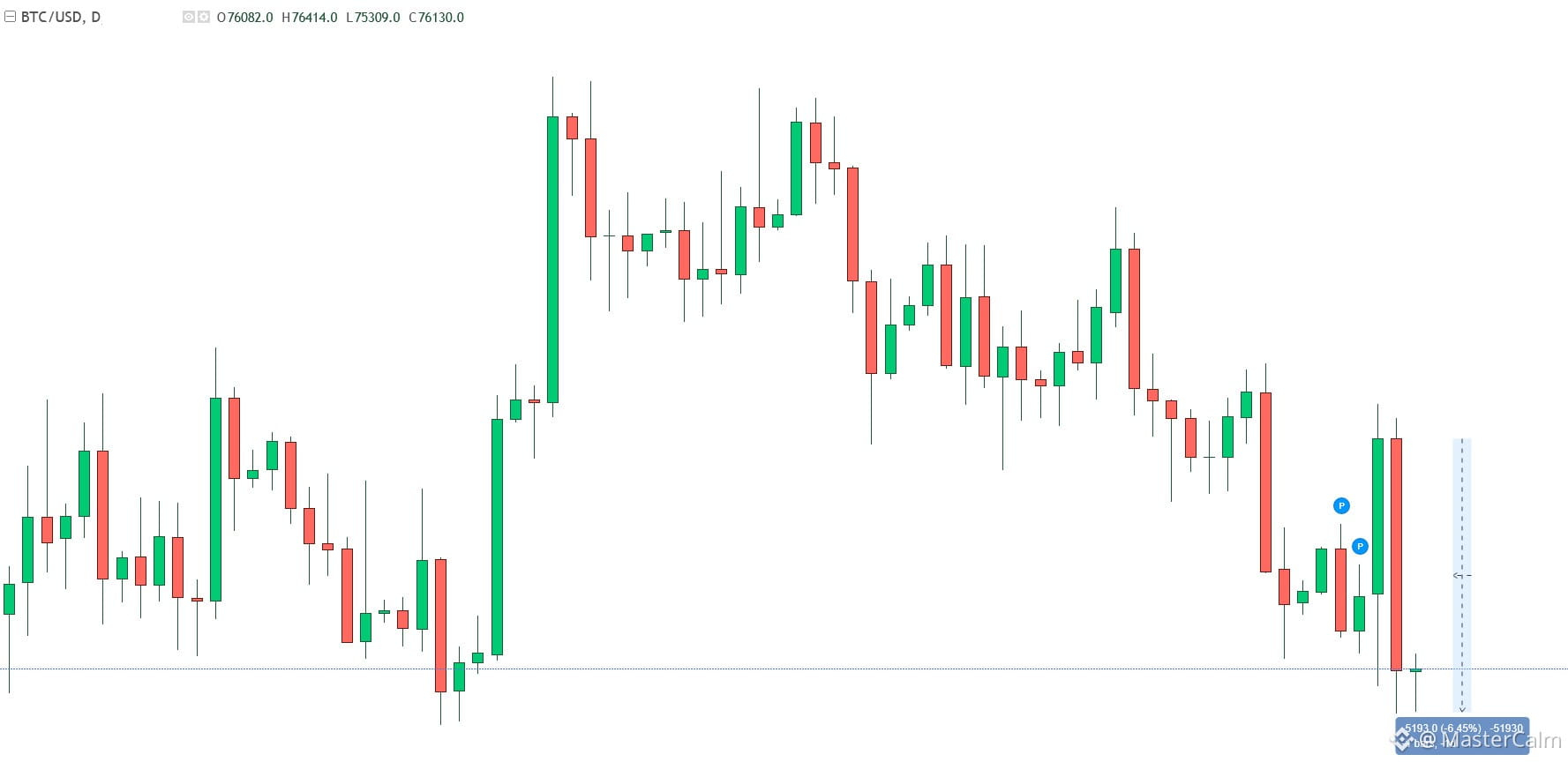
💡 Yesterday, after first US midterm elections results $BTC fell ~ 6.5 % what was the worst day for main crypto since February 5, 2026 when #bitcoin plunged nearly 10% in single session.
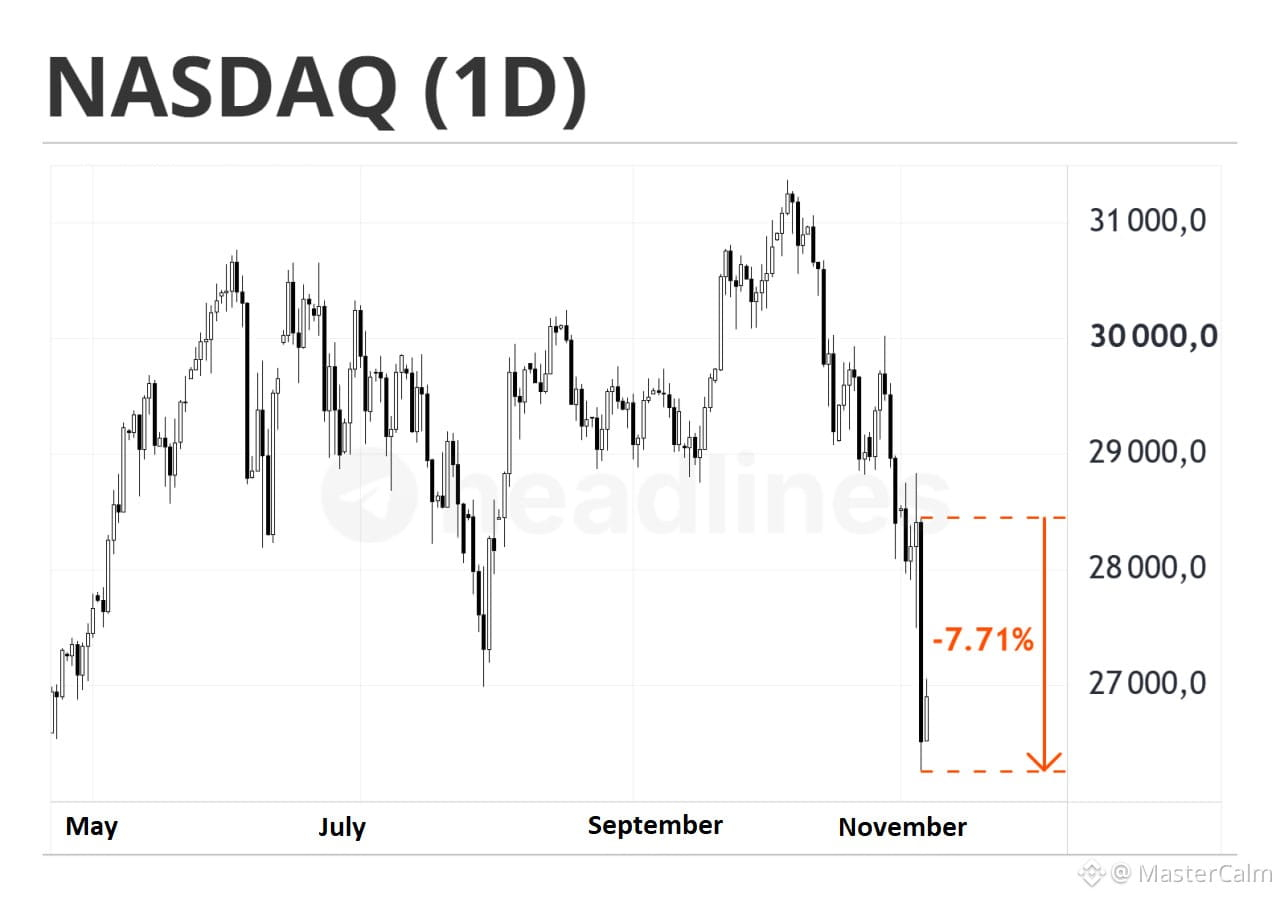
📉 It was not only #crypto falling, stock markets fell as well and were actually one of the reasons for such dramatic plunge. Nasdaq100 expirienced the worst day since 2020 decreasing by 7.7% in a moment.
💰 ❌ According to Bloomberg, combined wealth of top 500 people of Bloomberg billionaire index fell by $185 bln in one day. It takes 14th place in the deepest one day plunges since 2012.
💁 The situation shows how important it is follow the trend, use risk management and do not follow corwd emotolioanl movements, and do your own research.
💡 As example, I attach my copy trade profile (see i5 below 👇) where I try not to loose money during scuh harsh days for the markets.
🎩 As usually I try to provide useful information for you, and what to do with it is for you to decide.
NFA&DYOR
#USStocksSlipandCryptoMarketUnderBroadPressure
#USMidterms-WhatAreMarketsExpecting? #Binance
{future}(QQQUSDT)
{future}(ETHUSDT)
{future}(BTCUSDT)
😱 The worst day for Bitcoin since February 2026.
💡 Yesterday, after first US midterm elections results $BTC fell ~ 6.5 % what was the worst day for main crypto since February 5, 2026 when #bitcoin plunged nearly 10% in single session.
📉 It was not only #crypto falling, stock markets fell as well and were actually one of the reasons for such dramatic plunge. Nasdaq100 expirienced the worst day since 2020 decreasing by 7.7% in a moment.
💰 ❌ According to Bloomberg, combined wealth of top 500 people of Bloomberg billionaire index fell by $185 bln in one day. It takes 14th place in the deepest one day plunges since 2012.
💁 The situation shows how important it is follow the trend, use risk management and do not follow corwd emotolioanl movements, and do your own research.
💡 As example, I attach my copy trade profile (see i5 below 👇) where I try not to loose money during scuh harsh days for the markets.
🎩 As usually I try to provide useful information for you, and what to do with it is for you to decide.
NFA&DYOR
#USStocksSlipandCryptoMarketUnderBroadPressure
#USMidterms-WhatAreMarketsExpecting? #Binance
My Futures Portfolio
0 / 200
Minimum 10USDT
Public
7D PNL
(USDT)
547.70
7D ROI
+7.27%
AUM
$8086.31
Win Rate
62.50%
1
238

·
--
#USStocksSlipandCryptoMarketUnderBroadPressure
📉 Nasdaq -5.5% Erased Crypto's Midterm Rally
Wall Street's AI selloff spilled into crypto Thursday, wiping Wednesday's post-election bounce and forcing over $1B in liquidations.
📊 ~$1.1B liquidated in 24h; ~211K traders hit (CoinGlass)
📉 Nasdaq -5.52%; S&P -4.36%; SOX semis -12.25%
🏦 BTC ~$75.7K (~-6%); ETH ~$2,247 (~-7%)
📈 Strategy and Coinbase each about -10% on the day
Zoom out: crypto still tracks the AI risk tape more than a midterm relief trade.
Hold above $75K into Friday, or test $73K next? 👇
$BTC $ETH
#USStocksSlipandCryptoMarketUnderBroadPressure #Bitcoin #Crypto

5

Article
Why the US Stock Market Just Shed $2 Trillion: 3 Reasons Behind the Historic Sell-Off
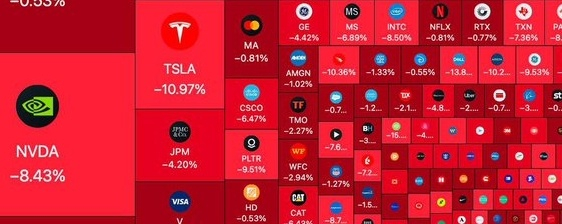
📉 The US stock market sent shockwaves through global finance on Thursday, wiping out a staggering $2 trillion in market value within the first hour of trading.
Led by a massive rout in semiconductor and technology shares, the sudden crash has triggered a wave of de-risking across all financial markets—including the cryptocurrency sector.
Here are the three primary drivers behind this historic market capitulation and what it means for investors moving forward.
1. Political Shifts Trigger AI Growth Fears
The primary catalyst for the sudden panic stems from the political landscape. Following a "Blue Wave" sweep—where the Democratic Party secured control of both the House and the Senate—Wall Street is aggressively pricing in structural changes to the tech sector.
Tech investors are highly concerned that the incoming administration will introduce stricter regulatory oversight, antitrust scrutiny, and environmental mandates. The immediate fear is that these policies will deliberately slow down America’s capital-intensive AI data center boom, causing a direct revaluation of the companies supplying the infrastructure.
2. The Semiconductor Ripped Apart
Chipmakers bore the absolute brunt of the opening-hour execution. Companies that rode the AI wave to record-high valuations over the past few years saw immediate, aggressive institutional distribution.
Because semiconductor firms require massive, uninterrupted capital expenditure (CapEx) commitments from big tech enterprises to justify their valuations, any threat to the expansion of AI infrastructure instantly deflates their forward earnings projections. The sector's vulnerability dragged down major indices like the Nasdaq 100, proving how concentrated market risk had become in just a handful of AI-exposed stocks.
3. Macroeconomic Cross-Asset De-risking
When $2 trillion evaporates in sixty minutes, the systemic ripple effects force broad-based liquidity preservation. Institutional funds are executing macro de-risking strategies across the board, pulling capital out of high-beta risk assets to cover exposures or move into safer cash positions.
This tight correlation is directly spilling over into the digital asset ecosystem. The crypto market cap, which recently faced its own friction following major exchange exploits and ETF outflows, is trading lower in tandem with Wall Street as global liquidity temporarily tightens.
The Bottom Line
This sell-off highlights how sensitive modern market structures are to political policy shifts and concentrated tech valuations. While long-term infrastructure demands for artificial intelligence remain fundamentally intact, the market is undergoing a harsh re-pegging of expectations. For both equity and crypto traders, volatility is expected to remain exceptionally high as the market searches for a definitive macro bottom.
#StrategySTRCResumesIssuanceAfterOver170Days #USStocksSlipandCryptoMarketUnderBroadPressure #USMidterms-WhatAreMarketsExpecting? #BinanceReopensWithdrawalsForMoreAssets #Binance98PercentReplenished
Why the US Stock Market Just Shed $2 Trillion: 3 Reasons Behind the Historic Sell-Off 📉
The US stock market sent shockwaves through global finance on Thursday, wiping out a staggering $2 trillion in market value within the first hour of trading.
Led by a massive rout in semiconductor and technology shares, the sudden crash has triggered a wave of de-risking across all financial markets—including the cryptocurrency sector.
Here are the three primary drivers behind this historic market capitulation and what it means for investors moving forward.
1. Political Shifts Trigger AI Growth Fears
The primary catalyst for the sudden panic stems from the political landscape. Following a "Blue Wave" sweep—where the Democratic Party secured control of both the House and the Senate—Wall Street is aggressively pricing in structural changes to the tech sector.
Tech investors are highly concerned that the incoming administration will introduce stricter regulatory oversight, antitrust scrutiny, and environmental mandates. The immediate fear is that these policies will deliberately slow down America’s capital-intensive AI data center boom, causing a direct revaluation of the companies supplying the infrastructure.
2. The Semiconductor Ripped Apart
Chipmakers bore the absolute brunt of the opening-hour execution. Companies that rode the AI wave to record-high valuations over the past few years saw immediate, aggressive institutional distribution.
Because semiconductor firms require massive, uninterrupted capital expenditure (CapEx) commitments from big tech enterprises to justify their valuations, any threat to the expansion of AI infrastructure instantly deflates their forward earnings projections. The sector's vulnerability dragged down major indices like the Nasdaq 100, proving how concentrated market risk had become in just a handful of AI-exposed stocks.
3. Macroeconomic Cross-Asset De-risking
When $2 trillion evaporates in sixty minutes, the systemic ripple effects force broad-based liquidity preservation. Institutional funds are executing macro de-risking strategies across the board, pulling capital out of high-beta risk assets to cover exposures or move into safer cash positions.
This tight correlation is directly spilling over into the digital asset ecosystem. The crypto market cap, which recently faced its own friction following major exchange exploits and ETF outflows, is trading lower in tandem with Wall Street as global liquidity temporarily tightens.
The Bottom Line
This sell-off highlights how sensitive modern market structures are to political policy shifts and concentrated tech valuations. While long-term infrastructure demands for artificial intelligence remain fundamentally intact, the market is undergoing a harsh re-pegging of expectations. For both equity and crypto traders, volatility is expected to remain exceptionally high as the market searches for a definitive macro bottom.
#StrategySTRCResumesIssuanceAfterOver170Days #USStocksSlipandCryptoMarketUnderBroadPressure #USMidterms-WhatAreMarketsExpecting? #BinanceReopensWithdrawalsForMoreAssets #Binance98PercentReplenished
loweef:
The concentration point is the key one. When a handful of AI names carry the index, a policy scare hits the whole risk complex at once, and BTC trades with it because the same funds hold both. Worth watching whether BTC stops making new lows on days when chip stocks still do. That would be the first hint the spillover is fading.
1
2
1.7k

🚨 Bitcoin gave back the whole election bounce in 24 hours.
$BTC fell about 6% to roughly $75,650 as a Nasdaq sell-off triggered $1.25B in liquidations, mostly longs, while spot ETFs saw $430M in outflows. Today's US jobs report and a $2.65B options expiry could add more volatility.
🎯 Support is near $75.2K, then about $73.2K (the 200-day average). A reclaim of $80K would change the mood. I wouldn't catch this knife without a plan. 🛡️
Are you buying this dip or waiting? 👇
#BinanceReopensWithdrawalsForMoreAssets #AnthropicIPOValuationDoubts #USStocksSlipandCryptoMarketUnderBroadPressure
1
140
·
--
Bullish
#USStocksSlipandCryptoMarketUnderBroadPressure
📉 US Stocks & Crypto Market Falling
US stock market is going down.
Bitcoin and Ethereum are also falling.
Investors are scared and selling their investments.
Many crypto traders are losing money.
Altcoins are also under selling pressure.
Impact on Bitcoin
Short-term bearish
$BTC may fall further.
* Altcoins may suffer bigger losses.
* If US stocks recover, crypto may also recover.
My takeaway: The market is currently weak. Avoid risky leveraged trades and wait for a clear recovery signal.
$USDC
{future}(USDCUSDT)
$ETH
{future}(ETHUSDT)
#USStocksSlipandCryptoMarketUnderBroadPressure
📉 US Stocks & Crypto Market Falling
US stock market is going down.
Bitcoin and Ethereum are also falling.
Investors are scared and selling their investments.
Many crypto traders are losing money.
Altcoins are also under selling pressure.
Impact on Bitcoin
Short-term bearish
$BTC may fall further.
* Altcoins may suffer bigger losses.
* If US stocks recover, crypto may also recover.
My takeaway: The market is currently weak. Avoid risky leveraged trades and wait for a clear recovery signal.
$USDC
$ETH
26

·
--
$BTC Now $75,407 (-6.24%)
- Range $75,208 - $80,643, Open $80,429, Low $75,230, Volume ∼$44.8B (+38%). Market Cap $1.52T - $1.61T Rank #1, Dominance 47%
- Performance: 5-day +2.96%, 1-month -6.63%, YTD -10.09%, 1-year -21.18%, ATH $126,080 Oct 6 2025 (-40% from ATH)
- Context: Sharp reversal Friday. Post-midterm rally to ∼$81.1K erased by tech selloff — Nasdaq -5% on AI fears. Erased Wednesday gains. Total crypto mcap $2.55T - $2.65T (-5%). BTC ETF inflows +$74.6M Nov 4 couldn't hold
- Technical: Support $75,200 critical, resistance $80,643. Below $75K risks $74K. Supply capped 21M, 20.11M circulating f722#BinanceReopensWithdrawalsForMoreAssets #AnthropicIPOValuationDoubts #UkraineCentralBankOpposesCurrentCryptoAssetBill #USStocksSlipandCryptoMarketUnderBroadPressure
{spot}(BTCUSDT)
$BTC Now $75,407 (-6.24%)
- Range $75,208 - $80,643, Open $80,429, Low $75,230, Volume ∼$44.8B (+38%). Market Cap $1.52T - $1.61T Rank #1, Dominance 47%
- Performance: 5-day +2.96%, 1-month -6.63%, YTD -10.09%, 1-year -21.18%, ATH $126,080 Oct 6 2025 (-40% from ATH)
- Context: Sharp reversal Friday. Post-midterm rally to ∼$81.1K erased by tech selloff — Nasdaq -5% on AI fears. Erased Wednesday gains. Total crypto mcap $2.55T - $2.65T (-5%). BTC ETF inflows +$74.6M Nov 4 couldn't hold
- Technical: Support $75,200 critical, resistance $80,643. Below $75K risks $74K. Supply capped 21M, 20.11M circulating f722#BinanceReopensWithdrawalsForMoreAssets #AnthropicIPOValuationDoubts #UkraineCentralBankOpposesCurrentCryptoAssetBill #USStocksSlipandCryptoMarketUnderBroadPressure

85
Log in to explore more content
Join global crypto users on Binance Square
⚡️ Get latest and useful information about crypto.
💬 Trusted by the world’s largest crypto exchange.
👍 Discover real insights from verified creators.
Email / Phone number
Trending Topics
1
#JobsReportRaisesHikeOdds
538,023 views
3,441 Discussing
2
#CPITestsDecemberRateOutlook
162,649 views
1,195 Discussing
3
#US Data Center Rules May Constrain AI Expansion
75,182 views
229 Discussing
4
#ARKPlans14ThematicETFsCoveringAIAndTokenizedMarkets
4,556 views
71 Discussing
5
#WillAnthropicListOnTime
164,808 views
1,421 Discussing
6
#WillUS-IranTensionsBoostSafe-HavenDemand?
75,615 views
551 Discussing
7
#BitcoinETFsSee$412MNetOutflows
16,402 views
78 Discussing
8
#HKSFCPlansToRestrictCryptoAndExchangeTerms
64,567 views
579 Discussing
9
#TradFiForBeginners
95,852 views
1,030 Discussing
10
#FinCENAndFedWithdraw$250CryptoTransferProposal
10,566 views
18 Discussing