
#usirantradetankerstrikesescalate
usirantradetankerstrikesescalate
559,511 views
4,268 Discussing
Hot
Latest

Here's what happened when tanker strikes started dominating the feed again: traders reached for the 2019 playbook like it was sitting on the nightstand.
You know the feeling. Oil spikes, headlines pile up around the Strait of Hormuz, and you freeze between dumping into $USDT and buying a dip that might not be a dip at all.
In June 2019, attacks on tankers in the Gulf of Oman pushed crude higher and knocked risk assets lower. $BTC sold off first, then spent weeks grinding back as the digital gold story got another hearing. The 2022 Russia invasion followed a similar shape: a violent risk-off flush, a scramble into stables, then Bitcoin slowly decoupling while traditional markets stayed messy.
This round looks familiar until you check the temperature. The Fear and Greed Index is sitting at 73. That is greed, not fear, even as strikes escalate and claims of hits on US ships and tankers hit the wire.
The lesson from both prior episodes is that crypto almost never prices a geopolitical shock in a straight line. The first flush is usually about liquidity and positioning, not a permanent regime change. What is different now is the starting point. Privacy names like $ZEC have already been bid hard, and $USDT dominance tends to tick up whenever Hormuz is back in the conversation. The comparison that actually matters is not 2019 versus today. It is whether a greedy tape still has the willingness to buy a real scare.
Where do you think this goes from here if shipping risk actually sticks?
#USIranTradeTankerStrikesEscalate #IranSaysItHit3USShips3Tankers #ZcashRises45
Here's what happened when tanker strikes started dominating the feed again: traders reached for the 2019 playbook like it was sitting on the nightstand.
You know the feeling. Oil spikes, headlines pile up around the Strait of Hormuz, and you freeze between dumping into $USDT and buying a dip that might not be a dip at all.
In June 2019, attacks on tankers in the Gulf of Oman pushed crude higher and knocked risk assets lower. $BTC sold off first, then spent weeks grinding back as the digital gold story got another hearing. The 2022 Russia invasion followed a similar shape: a violent risk-off flush, a scramble into stables, then Bitcoin slowly decoupling while traditional markets stayed messy.
This round looks familiar until you check the temperature. The Fear and Greed Index is sitting at 73. That is greed, not fear, even as strikes escalate and claims of hits on US ships and tankers hit the wire.
The lesson from both prior episodes is that crypto almost never prices a geopolitical shock in a straight line. The first flush is usually about liquidity and positioning, not a permanent regime change. What is different now is the starting point. Privacy names like $ZEC have already been bid hard, and $USDT dominance tends to tick up whenever Hormuz is back in the conversation. The comparison that actually matters is not 2019 versus today. It is whether a greedy tape still has the willingness to buy a real scare.
Where do you think this goes from here if shipping risk actually sticks?
#USIranTradeTankerStrikesEscalate #IranSaysItHit3USShips3Tankers #ZcashRises45
You know the feeling. Oil spikes, headlines pile up around the Strait of Hormuz, and you freeze between dumping into $USDT and buying a dip that might not be a dip at all.
In June 2019, attacks on tankers in the Gulf of Oman pushed crude higher and knocked risk assets lower. $BTC sold off first, then spent weeks grinding back as the digital gold story got another hearing. The 2022 Russia invasion followed a similar shape: a violent risk-off flush, a scramble into stables, then Bitcoin slowly decoupling while traditional markets stayed messy.
This round looks familiar until you check the temperature. The Fear and Greed Index is sitting at 73. That is greed, not fear, even as strikes escalate and claims of hits on US ships and tankers hit the wire.
The lesson from both prior episodes is that crypto almost never prices a geopolitical shock in a straight line. The first flush is usually about liquidity and positioning, not a permanent regime change. What is different now is the starting point. Privacy names like $ZEC have already been bid hard, and $USDT dominance tends to tick up whenever Hormuz is back in the conversation. The comparison that actually matters is not 2019 versus today. It is whether a greedy tape still has the willingness to buy a real scare.
Where do you think this goes from here if shipping risk actually sticks?
#USIranTradeTankerStrikesEscalate #IranSaysItHit3USShips3Tankers #ZcashRises45
1
294

·
--
Have you noticed how every tanker strike in the Gulf immediately triggers a wave of panic selling across crypto?
Traders see the headlines about US-Iran tensions, dump their bags at the first red candle, then sit on the sidelines watching the rebound they just missed. That cycle of reacting to geopolitics instead of reading the tape is how most people keep losing money here.
This latest round of strikes is a textbook case study. Oil routes get threatened, energy prices spike, and the usual voices start predicting a full risk-off collapse. Yet the Fear and Greed Index sits at 73 in greed territory, $USDT inflows are climbing as people simply wait, and $ZEC is catching a bid because privacy always gets a second look when governments start flexing. These events create noise, not a regime change. Crypto has already shown it can absorb oil shocks without following traditional markets off a cliff.
The mainstream take is that this escalation is purely bearish. I see it as another reminder that digital assets keep decoupling from the old energy-and-shipping world.
Where do you think this volatility settles if the strikes keep going?
#USIranTradeTankerStrikesEscalate #IranSaysItHit3USShips3Tankers #ZcashRises45
Have you noticed how every tanker strike in the Gulf immediately triggers a wave of panic selling across crypto?
Traders see the headlines about US-Iran tensions, dump their bags at the first red candle, then sit on the sidelines watching the rebound they just missed. That cycle of reacting to geopolitics instead of reading the tape is how most people keep losing money here.
This latest round of strikes is a textbook case study. Oil routes get threatened, energy prices spike, and the usual voices start predicting a full risk-off collapse. Yet the Fear and Greed Index sits at 73 in greed territory, $USDT inflows are climbing as people simply wait, and $ZEC is catching a bid because privacy always gets a second look when governments start flexing. These events create noise, not a regime change. Crypto has already shown it can absorb oil shocks without following traditional markets off a cliff.
The mainstream take is that this escalation is purely bearish. I see it as another reminder that digital assets keep decoupling from the old energy-and-shipping world.
Where do you think this volatility settles if the strikes keep going?
#USIranTradeTankerStrikesEscalate #IranSaysItHit3USShips3Tankers #ZcashRises45
Traders see the headlines about US-Iran tensions, dump their bags at the first red candle, then sit on the sidelines watching the rebound they just missed. That cycle of reacting to geopolitics instead of reading the tape is how most people keep losing money here.
This latest round of strikes is a textbook case study. Oil routes get threatened, energy prices spike, and the usual voices start predicting a full risk-off collapse. Yet the Fear and Greed Index sits at 73 in greed territory, $USDT inflows are climbing as people simply wait, and $ZEC is catching a bid because privacy always gets a second look when governments start flexing. These events create noise, not a regime change. Crypto has already shown it can absorb oil shocks without following traditional markets off a cliff.
The mainstream take is that this escalation is purely bearish. I see it as another reminder that digital assets keep decoupling from the old energy-and-shipping world.
Where do you think this volatility settles if the strikes keep going?
#USIranTradeTankerStrikesEscalate #IranSaysItHit3USShips3Tankers #ZcashRises45
267

·
--
Everyone thinks geopolitical headlines like these tanker strikes stay in traditional markets but actually they mess with our crypto timing more than most realize.
Ngl it sucks watching traders lose money on FOMO entries into alts because they ignore this stuff and then have no clue when to get out.
This is a live case study of the us iran trade tensions escalating. With iran claiming hits on 3 us ships and tankers the gulf routes look messy and that usually pressure dumps on risk even while greed sits at 73. Alts like $ARB feel it first as liquidity fades and $USDT starts looking safer. I've seen similar setups where the crowd stays greedy until the chart forces the lesson.
The $ZEC pump happening alongside doesn't cancel the risk either.
Anyone else seeing this rotation or still holding through it?
#USIranTradeTankerStrikesEscalate #IranSaysItHit3USShips3Tankers #ZcashRises45
Everyone thinks geopolitical headlines like these tanker strikes stay in traditional markets but actually they mess with our crypto timing more than most realize.
Ngl it sucks watching traders lose money on FOMO entries into alts because they ignore this stuff and then have no clue when to get out.
This is a live case study of the us iran trade tensions escalating. With iran claiming hits on 3 us ships and tankers the gulf routes look messy and that usually pressure dumps on risk even while greed sits at 73. Alts like $ARB feel it first as liquidity fades and $USDT starts looking safer. I've seen similar setups where the crowd stays greedy until the chart forces the lesson.
The $ZEC pump happening alongside doesn't cancel the risk either.
Anyone else seeing this rotation or still holding through it?
#USIranTradeTankerStrikesEscalate #IranSaysItHit3USShips3Tankers #ZcashRises45
Ngl it sucks watching traders lose money on FOMO entries into alts because they ignore this stuff and then have no clue when to get out.
This is a live case study of the us iran trade tensions escalating. With iran claiming hits on 3 us ships and tankers the gulf routes look messy and that usually pressure dumps on risk even while greed sits at 73. Alts like $ARB feel it first as liquidity fades and $USDT starts looking safer. I've seen similar setups where the crowd stays greedy until the chart forces the lesson.
The $ZEC pump happening alongside doesn't cancel the risk either.
Anyone else seeing this rotation or still holding through it?
#USIranTradeTankerStrikesEscalate #IranSaysItHit3USShips3Tankers #ZcashRises45
395

#USIranTradeTankerStrikesEscalate
The escalation in the Middle East reflects a dangerous feedback loop between economic pressure and military direct actions.
Economic Warfare:
By systematically targeting Iran's "shadow fleet" and key loading hubs like Kharg Island, the U.S. aims to sever the revenue streams funding the IRGC.
Asymmetric Counter Strategy:
Iran has responded by leveraging its geography along the Strait of Hormuz, threatening commercial shipping across allied Gulf states to create global energy price shocks.
Global Implications:
With Brent crude creeping toward $100/barrel and commercial passage through the Strait of Hormuz severely disrupted, the regional conflict poses a growing risk to global supply chains and inflation stability.
#USIranTradeTankerStrikesEscalate
The escalation in the Middle East reflects a dangerous feedback loop between economic pressure and military direct actions.
Economic Warfare:
By systematically targeting Iran's "shadow fleet" and key loading hubs like Kharg Island, the U.S. aims to sever the revenue streams funding the IRGC.
Asymmetric Counter Strategy:
Iran has responded by leveraging its geography along the Strait of Hormuz, threatening commercial shipping across allied Gulf states to create global energy price shocks.
Global Implications:
With Brent crude creeping toward $100/barrel and commercial passage through the Strait of Hormuz severely disrupted, the regional conflict poses a growing risk to global supply chains and inflation stability.
The escalation in the Middle East reflects a dangerous feedback loop between economic pressure and military direct actions.
Economic Warfare:
By systematically targeting Iran's "shadow fleet" and key loading hubs like Kharg Island, the U.S. aims to sever the revenue streams funding the IRGC.
Asymmetric Counter Strategy:
Iran has responded by leveraging its geography along the Strait of Hormuz, threatening commercial shipping across allied Gulf states to create global energy price shocks.
Global Implications:
With Brent crude creeping toward $100/barrel and commercial passage through the Strait of Hormuz severely disrupted, the regional conflict poses a growing risk to global supply chains and inflation stability.
1
119

#USIranTradeTankerStrikesEscalate 🚨 **🇺🇸🇮🇷🛢️⚠️**
The **U.S.–Iran tanker conflict is escalating sharply**. U.S. forces reportedly destroyed **five Iranian oil tankers** on Sept. 8 after Iranian missile attacks targeted U.S. Navy vessels. Iran has threatened retaliation against oil shipping and warned vessels operating around the Gulf. ([The Wall Street Journal][1])
🔥 **Why it matters:**
* 🛢️ **Oil supply risk is rising** as tanker traffic through the Strait of Hormuz slows.
* 🚢 Iran is threatening additional action against Gulf shipping.
* 📈 **Brent crude climbed toward $100/barrel** amid renewed supply fears. ([Reuters][2])
* 🌍 Further escalation could increase **energy prices, inflation and global market volatility**.
⚠️ **Key risk:** Any prolonged disruption around the Strait of Hormuz could have major consequences for global energy markets.
**#USIran #Iran #USA #TankerWar #Hormuz #Oil #BrentCrude #Geopolitics #MiddleEast #EnergyCrisis #Markets #BreakingNews**
[1]: $BNB
{spot}(BNBUSDT)
$BTC
{spot}(BTCUSDT)
$CL
{future}(CLUSDT)
#USIranTradeTankerStrikesEscalate 🚨 **🇺🇸🇮🇷🛢️⚠️**
The **U.S.–Iran tanker conflict is escalating sharply**. U.S. forces reportedly destroyed **five Iranian oil tankers** on Sept. 8 after Iranian missile attacks targeted U.S. Navy vessels. Iran has threatened retaliation against oil shipping and warned vessels operating around the Gulf. ([The Wall Street Journal][1])
🔥 **Why it matters:**
* 🛢️ **Oil supply risk is rising** as tanker traffic through the Strait of Hormuz slows.
* 🚢 Iran is threatening additional action against Gulf shipping.
* 📈 **Brent crude climbed toward $100/barrel** amid renewed supply fears. ([Reuters][2])
* 🌍 Further escalation could increase **energy prices, inflation and global market volatility**.
⚠️ **Key risk:** Any prolonged disruption around the Strait of Hormuz could have major consequences for global energy markets.
**#USIran #Iran #USA #TankerWar #Hormuz #Oil #BrentCrude #Geopolitics #MiddleEast #EnergyCrisis #Markets #BreakingNews**
[1]: $BNB
$BTC
$CL
The **U.S.–Iran tanker conflict is escalating sharply**. U.S. forces reportedly destroyed **five Iranian oil tankers** on Sept. 8 after Iranian missile attacks targeted U.S. Navy vessels. Iran has threatened retaliation against oil shipping and warned vessels operating around the Gulf. ([The Wall Street Journal][1])
🔥 **Why it matters:**
* 🛢️ **Oil supply risk is rising** as tanker traffic through the Strait of Hormuz slows.
* 🚢 Iran is threatening additional action against Gulf shipping.
* 📈 **Brent crude climbed toward $100/barrel** amid renewed supply fears. ([Reuters][2])
* 🌍 Further escalation could increase **energy prices, inflation and global market volatility**.
⚠️ **Key risk:** Any prolonged disruption around the Strait of Hormuz could have major consequences for global energy markets.
**#USIran #Iran #USA #TankerWar #Hormuz #Oil #BrentCrude #Geopolitics #MiddleEast #EnergyCrisis #Markets #BreakingNews**
[1]: $BNB
$BTC
$CL
1
24

·
--
Bearish
$BNB 🔴
Breaking: Iran's Revolutionary Guards said they used powerful ballistic missiles to strike the U.S. DDG-119 and DDG-53 destroyers, which were carrying cruise missiles and the Aegis system, and said the ships were severely damaged.
#AEROSurges17%In24Hours #IranSaysItCapturedUSUnmannedSubmarine #SaudiHaltsSouthernEnergySitesAfterAttacks #YenBreaks155NearingYearHigh #USIranTradeTankerStrikesEscalate
$BNB 🔴
Breaking: Iran's Revolutionary Guards said they used powerful ballistic missiles to strike the U.S. DDG-119 and DDG-53 destroyers, which were carrying cruise missiles and the Aegis system, and said the ships were severely damaged.
#AEROSurges17%In24Hours #IranSaysItCapturedUSUnmannedSubmarine #SaudiHaltsSouthernEnergySitesAfterAttacks #YenBreaks155NearingYearHigh #USIranTradeTankerStrikesEscalate
Breaking: Iran's Revolutionary Guards said they used powerful ballistic missiles to strike the U.S. DDG-119 and DDG-53 destroyers, which were carrying cruise missiles and the Aegis system, and said the ships were severely damaged.
#AEROSurges17%In24Hours #IranSaysItCapturedUSUnmannedSubmarine #SaudiHaltsSouthernEnergySitesAfterAttacks #YenBreaks155NearingYearHigh #USIranTradeTankerStrikesEscalate

177
·
--
Bearish
$BNB
BREAKING: US forces hit multiple Iranian tankers tied to the IRGC in response to attempted missile attacks on a Navy warship, an unnamed US official told Reuters news agency.
#AEROSurges17%In24Hours #IranSaysItCapturedUSUnmannedSubmarine #SaudiHaltsSouthernEnergySitesAfterAttacks #YenBreaks155NearingYearHigh #USIranTradeTankerStrikesEscalate
$BNB
BREAKING: US forces hit multiple Iranian tankers tied to the IRGC in response to attempted missile attacks on a Navy warship, an unnamed US official told Reuters news agency.
#AEROSurges17%In24Hours #IranSaysItCapturedUSUnmannedSubmarine #SaudiHaltsSouthernEnergySitesAfterAttacks #YenBreaks155NearingYearHigh #USIranTradeTankerStrikesEscalate
BREAKING: US forces hit multiple Iranian tankers tied to the IRGC in response to attempted missile attacks on a Navy warship, an unnamed US official told Reuters news agency.
#AEROSurges17%In24Hours #IranSaysItCapturedUSUnmannedSubmarine #SaudiHaltsSouthernEnergySitesAfterAttacks #YenBreaks155NearingYearHigh #USIranTradeTankerStrikesEscalate

49


🚨 HORMUZ REMAINS A MAJOR MARKET RISK
The latest U.S.–Iran tanker tensions are keeping the Strait of Hormuz firmly in focus.
Any prolonged disruption could keep pressure on oil supply and global inflation expectations.
Three assets I’m watching:
• $BTC — first major crypto reaction
• $AERO — newer momentum asset
• $HOODB — Robinhood bStock
The important question is what happens next.
Does the situation calm down?
Or does the disruption continue?
Markets can handle headlines.
They struggle with prolonged uncertainty.
#USIranTradeTankerStrikesEscalate
🚨 HORMUZ REMAINS A MAJOR MARKET RISK
The latest U.S.–Iran tanker tensions are keeping the Strait of Hormuz firmly in focus.
Any prolonged disruption could keep pressure on oil supply and global inflation expectations.
Three assets I’m watching:
• $BTC — first major crypto reaction
• $AERO — newer momentum asset
• $HOODB — Robinhood bStock
The important question is what happens next.
Does the situation calm down?
Or does the disruption continue?
Markets can handle headlines.
They struggle with prolonged uncertainty.
#USIranTradeTankerStrikesEscalate
The latest U.S.–Iran tanker tensions are keeping the Strait of Hormuz firmly in focus.
Any prolonged disruption could keep pressure on oil supply and global inflation expectations.
Three assets I’m watching:
• $BTC — first major crypto reaction
• $AERO — newer momentum asset
• $HOODB — Robinhood bStock
The important question is what happens next.
Does the situation calm down?
Or does the disruption continue?
Markets can handle headlines.
They struggle with prolonged uncertainty.
#USIranTradeTankerStrikesEscalate
149

·
--
Bullish
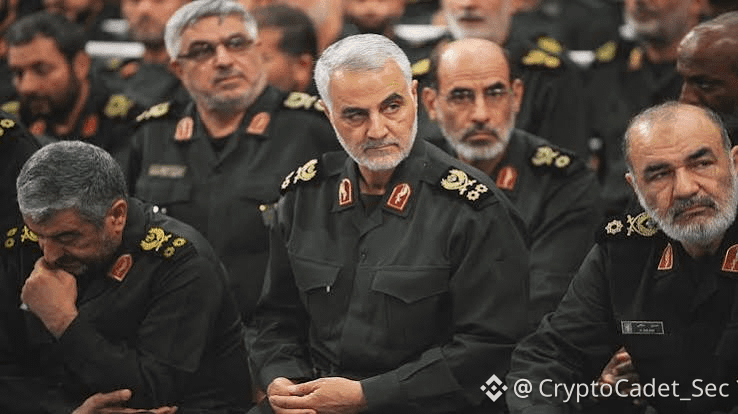
#usirantradetankerstrikesescalate 🇮🇷 Iran Claims Specialized Anti-Ship Missile Test
According to Iranian official Rezaei, Iran has tested a specialized anti-ship missile targeting a US vessel for the first time since the 12-day conflict. Iran is citing the operation as a demonstration of its military capabilities, claiming CENTCOM could not deny the impact.
📈 Market Sentiment: Bullish
#Iran $SOPH $AERO $AKE
#usirantradetankerstrikesescalate 🇮🇷 Iran Claims Specialized Anti-Ship Missile Test
According to Iranian official Rezaei, Iran has tested a specialized anti-ship missile targeting a US vessel for the first time since the 12-day conflict. Iran is citing the operation as a demonstration of its military capabilities, claiming CENTCOM could not deny the impact.
📈 Market Sentiment: Bullish
#Iran $SOPH $AERO $AKE
According to Iranian official Rezaei, Iran has tested a specialized anti-ship missile targeting a US vessel for the first time since the 12-day conflict. Iran is citing the operation as a demonstration of its military capabilities, claiming CENTCOM could not deny the impact.
📈 Market Sentiment: Bullish
#Iran $SOPH $AERO $AKE
2
2.3k

·
--
Bearish
Verified
🚨BIG BREAKINGS🚨
⚠️ US has struck multiple Iranian Oil tankers just now!
Previously Iran has said that from now on any attack on its oil tankers will be responded with attacks on US bases in the region.
So most probably a little new phase of strikes coming ..!!
🩸JUST IN: 🇺🇸🇮🇷 US launches strikes on Iran , Bleeding the GOLD!
$BTC
{future}(BTCUSDT)
$XAU
{future}(XAUUSDT)
$CL
{future}(CLUSDT)
#IranSaysItCapturedUSUnmannedSubmarine #USIranTradeTankerStrikesEscalate
🚨BIG BREAKINGS🚨
⚠️ US has struck multiple Iranian Oil tankers just now!
Previously Iran has said that from now on any attack on its oil tankers will be responded with attacks on US bases in the region.
So most probably a little new phase of strikes coming ..!!
🩸JUST IN: 🇺🇸🇮🇷 US launches strikes on Iran , Bleeding the GOLD!
$BTC
$XAU
$CL
#IranSaysItCapturedUSUnmannedSubmarine #USIranTradeTankerStrikesEscalate
⚠️ US has struck multiple Iranian Oil tankers just now!
Previously Iran has said that from now on any attack on its oil tankers will be responded with attacks on US bases in the region.
So most probably a little new phase of strikes coming ..!!
🩸JUST IN: 🇺🇸🇮🇷 US launches strikes on Iran , Bleeding the GOLD!
$BTC
$XAU
$CL
#IranSaysItCapturedUSUnmannedSubmarine #USIranTradeTankerStrikesEscalate
3
653

·
--
Verified
Article
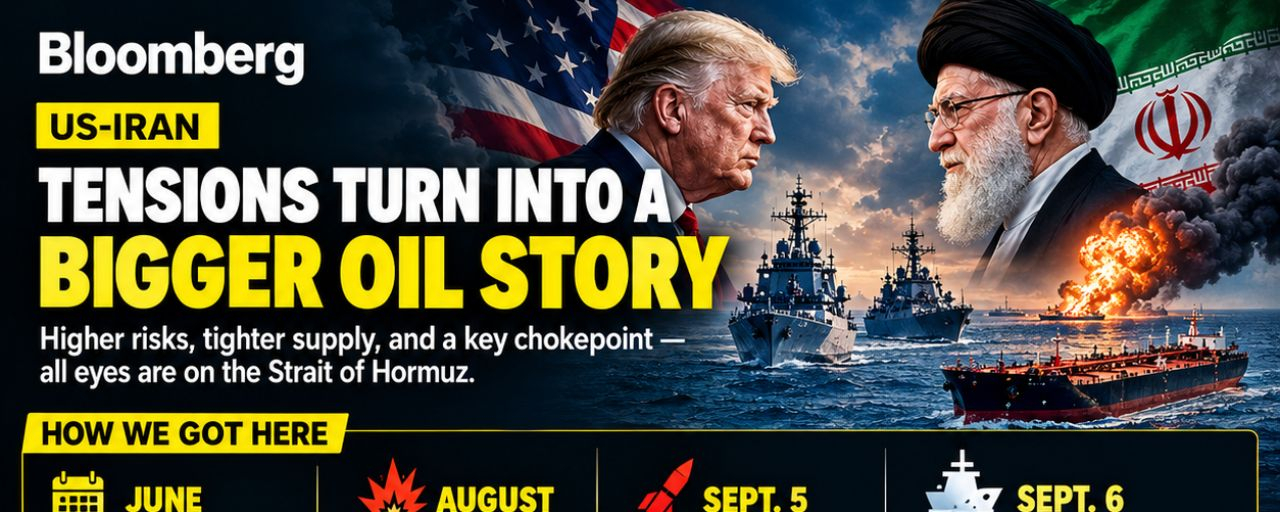
US-Iran Tanker War Escalates as Strait of Hormuz Faces New Oil Risks#usirantradetankerstrikesescalate
US-Iran Tanker War Escalates as Strait of Hormuz Faces New Oil Risks
Tensions between the United States and Iran are moving deeper into the energy market, with commercial shipping through the Strait of Hormuz coming under increasing pressure.
On September 6, the U.S. military struck three Iranian oil tankers following attacks on U.S. warships, according to reports. Iran then threatened further retaliation and warned that Gulf energy infrastructure could be exposed to attacks.
The impact is already visible in shipping data. The 10-day average for commodity vessels passing through Hormuz has fallen to around 10 ships per day, the lowest level since May. On Saturday, only two vessels crossed the strait, according to Kpler data reported by Reuters.
Why the Strait of Hormuz Matters
The Strait of Hormuz is one of the world's most important energy chokepoints, carrying roughly one-fifth of global oil and LNG supplies.
That makes the current conflict more than a regional military confrontation. Any prolonged disruption could affect crude prices, shipping costs, inflation expectations and broader financial markets.
Brent crude has already moved close to $100 per barrel, although it has remained below that level as alternative export routes, additional production and weaker demand help offset some of the supply risk.
What Traders Should Watch
The key question isn't simply how many tankers are attacked.
It's whether the disruption becomes persistent.
If shipping through Hormuz gradually normalizes, some of the geopolitical risk premium in oil could unwind. But if traffic continues falling and energy infrastructure becomes a wider target, the pressure on crude prices could intensify.
For markets, the chain reaction is straightforward:
Hormuz disruption → higher oil prices → inflation risk → rate expectations → pressure on risk assets.
That makes $BTC and other risk assets worth watching alongside crude rather than treating the conflict as an isolated geopolitical headline.
For now, the biggest signals are Hormuz shipping volumes, Brent crude and any signs of de-escalation.
$BTC
#USIran #Oil #Bitcoin #Geopolitics #Trading
US-Iran Tanker War Escalates as Strait of Hormuz Faces New Oil Risks
#usirantradetankerstrikesescalate
US-Iran Tanker War Escalates as Strait of Hormuz Faces New Oil Risks
Tensions between the United States and Iran are moving deeper into the energy market, with commercial shipping through the Strait of Hormuz coming under increasing pressure.
On September 6, the U.S. military struck three Iranian oil tankers following attacks on U.S. warships, according to reports. Iran then threatened further retaliation and warned that Gulf energy infrastructure could be exposed to attacks.
The impact is already visible in shipping data. The 10-day average for commodity vessels passing through Hormuz has fallen to around 10 ships per day, the lowest level since May. On Saturday, only two vessels crossed the strait, according to Kpler data reported by Reuters.
Why the Strait of Hormuz Matters
The Strait of Hormuz is one of the world's most important energy chokepoints, carrying roughly one-fifth of global oil and LNG supplies.
That makes the current conflict more than a regional military confrontation. Any prolonged disruption could affect crude prices, shipping costs, inflation expectations and broader financial markets.
Brent crude has already moved close to $100 per barrel, although it has remained below that level as alternative export routes, additional production and weaker demand help offset some of the supply risk.
What Traders Should Watch
The key question isn't simply how many tankers are attacked.
It's whether the disruption becomes persistent.
If shipping through Hormuz gradually normalizes, some of the geopolitical risk premium in oil could unwind. But if traffic continues falling and energy infrastructure becomes a wider target, the pressure on crude prices could intensify.
For markets, the chain reaction is straightforward:
Hormuz disruption → higher oil prices → inflation risk → rate expectations → pressure on risk assets.
That makes $BTC and other risk assets worth watching alongside crude rather than treating the conflict as an isolated geopolitical headline.
For now, the biggest signals are Hormuz shipping volumes, Brent crude and any signs of de-escalation.
$BTC
#USIran #Oil #Bitcoin #Geopolitics #Trading
US-Iran Tanker War Escalates as Strait of Hormuz Faces New Oil Risks
Tensions between the United States and Iran are moving deeper into the energy market, with commercial shipping through the Strait of Hormuz coming under increasing pressure.
On September 6, the U.S. military struck three Iranian oil tankers following attacks on U.S. warships, according to reports. Iran then threatened further retaliation and warned that Gulf energy infrastructure could be exposed to attacks.
The impact is already visible in shipping data. The 10-day average for commodity vessels passing through Hormuz has fallen to around 10 ships per day, the lowest level since May. On Saturday, only two vessels crossed the strait, according to Kpler data reported by Reuters.
Why the Strait of Hormuz Matters
The Strait of Hormuz is one of the world's most important energy chokepoints, carrying roughly one-fifth of global oil and LNG supplies.
That makes the current conflict more than a regional military confrontation. Any prolonged disruption could affect crude prices, shipping costs, inflation expectations and broader financial markets.
Brent crude has already moved close to $100 per barrel, although it has remained below that level as alternative export routes, additional production and weaker demand help offset some of the supply risk.
What Traders Should Watch
The key question isn't simply how many tankers are attacked.
It's whether the disruption becomes persistent.
If shipping through Hormuz gradually normalizes, some of the geopolitical risk premium in oil could unwind. But if traffic continues falling and energy infrastructure becomes a wider target, the pressure on crude prices could intensify.
For markets, the chain reaction is straightforward:
Hormuz disruption → higher oil prices → inflation risk → rate expectations → pressure on risk assets.
That makes $BTC and other risk assets worth watching alongside crude rather than treating the conflict as an isolated geopolitical headline.
For now, the biggest signals are Hormuz shipping volumes, Brent crude and any signs of de-escalation.
$BTC
#USIran #Oil #Bitcoin #Geopolitics #Trading
1
1
1
744

·
--
Bearish
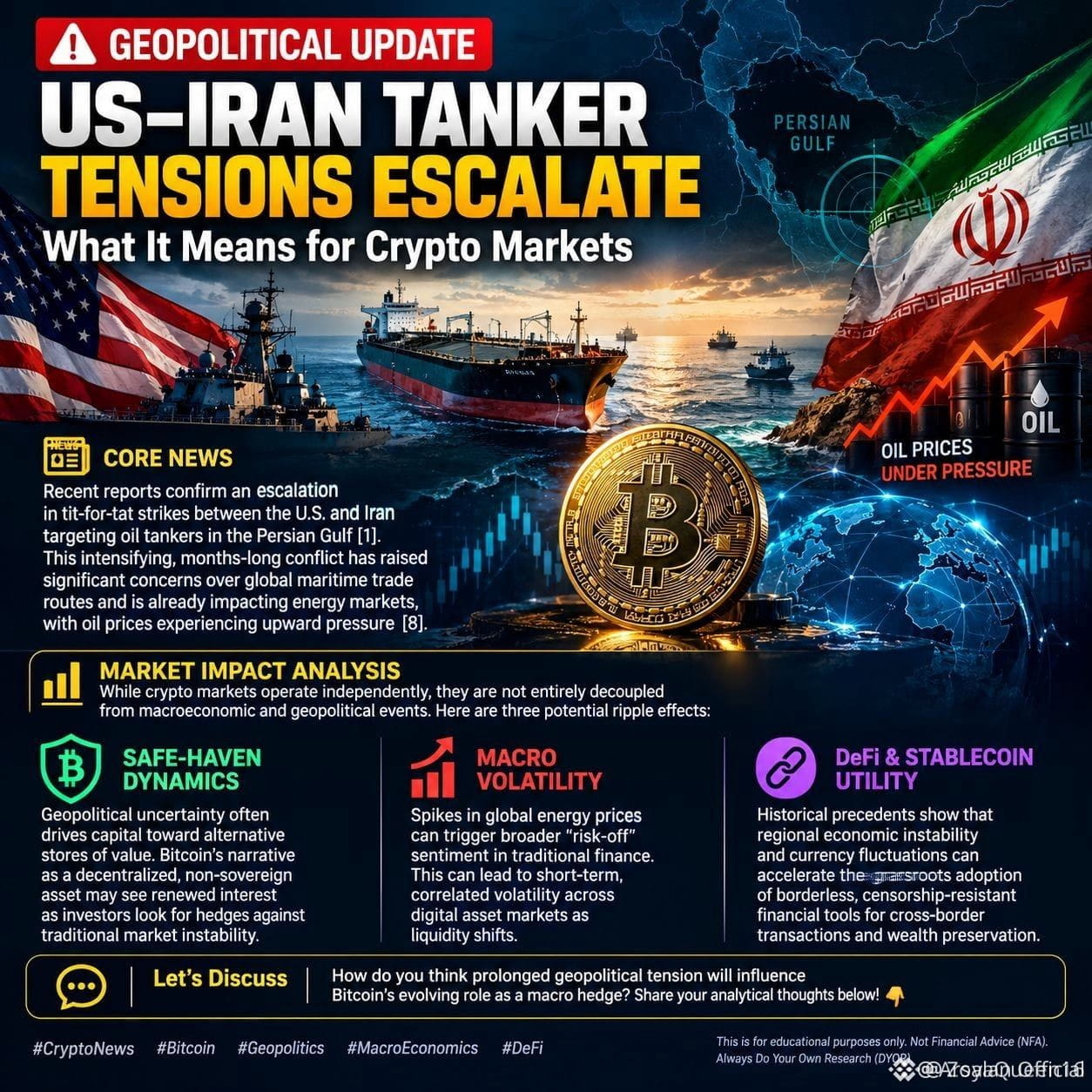
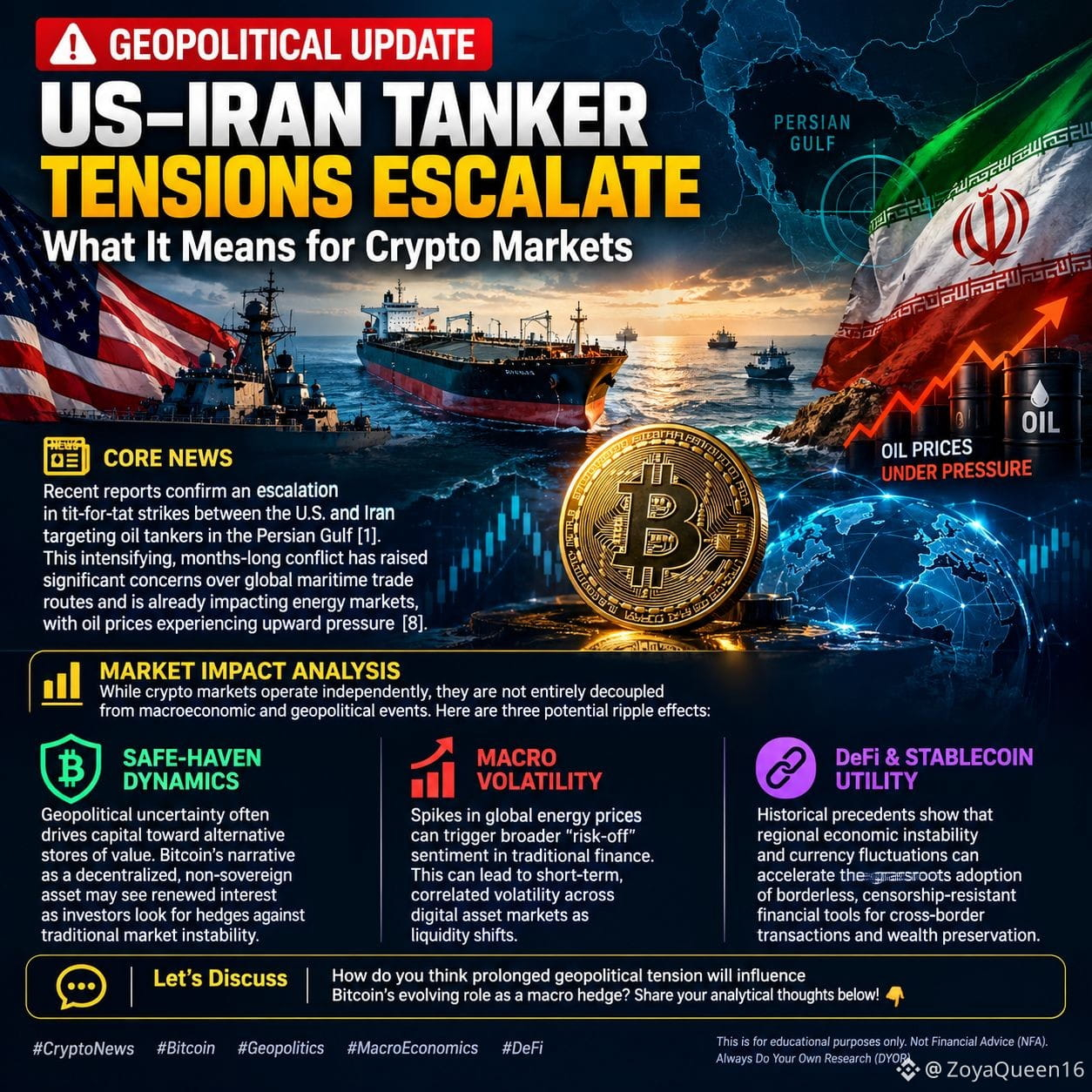
#usirantradetankerstrikesescalate 🚨 Geopolitical Update: US-Iran Tanker Tensions Escalate – What It Means for Crypto Markets
Rising tensions in the Middle East are sending ripples through global energy and trade markets. Here is an objective look at how this geopolitical shift could intersect with the crypto ecosystem.
📰 Core News
Recent reports confirm an escalation in tit-for-tat strikes between the U.S. and Iran targeting oil tankers in the Persian Gulf [[1]]. This intensifying, months-long conflict has raised significant concerns over global maritime trade routes and is already impacting energy markets, with oil prices experiencing upward pressure [[8]].
📊 Market Impact Analysis
While crypto markets operate independently, they are not entirely decoupled from macroeconomic and geopolitical events. Here are three potential ripple effects:
• Safe-Haven Dynamic Geopolitical uncertainty often drives capital toward alternative stores of value. Bitcoin’s narrative as a decentralized, non-sovereign asset may see renewed interest as investors look for hedges against traditional market instability.
• **Macro Volatility**: Spikes in global energy prices can trigger broader "risk-off" sentiment in traditional finance. This can lead to short-term, correlated volatility across digital asset markets as liquidity shifts.
• DeFi & Stablecoin Utility Historical precedents show that regional economic instability and currency fluctuations can accelerate the grassroots adoption of borderless, censorship-resistant financial tools for cross-border transactions and wealth preservation.
💬 Let’s Discuss
How do you think prolonged geopolitical tension will influence Bitcoin’s evolving role as a macro hedge? Share your analytical thoughts below! 👇
#CryptoNews #Bitcoin #Geopolitics #MacroEconomics #DeFi
This is for educational purposes only. Not Financial Advice (NFA). Always Do Your Own Research (DYOR)
$SOXLB $ZAMA
{future}(ZAMAUSDT)
{spot}(SOXLBUSDT)
#usirantradetankerstrikesescalate 🚨 Geopolitical Update: US-Iran Tanker Tensions Escalate – What It Means for Crypto Markets
Rising tensions in the Middle East are sending ripples through global energy and trade markets. Here is an objective look at how this geopolitical shift could intersect with the crypto ecosystem.
📰 Core News
Recent reports confirm an escalation in tit-for-tat strikes between the U.S. and Iran targeting oil tankers in the Persian Gulf [[1]]. This intensifying, months-long conflict has raised significant concerns over global maritime trade routes and is already impacting energy markets, with oil prices experiencing upward pressure [[8]].
📊 Market Impact Analysis
While crypto markets operate independently, they are not entirely decoupled from macroeconomic and geopolitical events. Here are three potential ripple effects:
• Safe-Haven Dynamic Geopolitical uncertainty often drives capital toward alternative stores of value. Bitcoin’s narrative as a decentralized, non-sovereign asset may see renewed interest as investors look for hedges against traditional market instability.
• **Macro Volatility**: Spikes in global energy prices can trigger broader "risk-off" sentiment in traditional finance. This can lead to short-term, correlated volatility across digital asset markets as liquidity shifts.
• DeFi & Stablecoin Utility Historical precedents show that regional economic instability and currency fluctuations can accelerate the grassroots adoption of borderless, censorship-resistant financial tools for cross-border transactions and wealth preservation.
💬 Let’s Discuss
How do you think prolonged geopolitical tension will influence Bitcoin’s evolving role as a macro hedge? Share your analytical thoughts below! 👇
#CryptoNews #Bitcoin #Geopolitics #MacroEconomics #DeFi
This is for educational purposes only. Not Financial Advice (NFA). Always Do Your Own Research (DYOR)
$SOXLB $ZAMA
Rising tensions in the Middle East are sending ripples through global energy and trade markets. Here is an objective look at how this geopolitical shift could intersect with the crypto ecosystem.
📰 Core News
Recent reports confirm an escalation in tit-for-tat strikes between the U.S. and Iran targeting oil tankers in the Persian Gulf [[1]]. This intensifying, months-long conflict has raised significant concerns over global maritime trade routes and is already impacting energy markets, with oil prices experiencing upward pressure [[8]].
📊 Market Impact Analysis
While crypto markets operate independently, they are not entirely decoupled from macroeconomic and geopolitical events. Here are three potential ripple effects:
• Safe-Haven Dynamic Geopolitical uncertainty often drives capital toward alternative stores of value. Bitcoin’s narrative as a decentralized, non-sovereign asset may see renewed interest as investors look for hedges against traditional market instability.
• **Macro Volatility**: Spikes in global energy prices can trigger broader "risk-off" sentiment in traditional finance. This can lead to short-term, correlated volatility across digital asset markets as liquidity shifts.
• DeFi & Stablecoin Utility Historical precedents show that regional economic instability and currency fluctuations can accelerate the grassroots adoption of borderless, censorship-resistant financial tools for cross-border transactions and wealth preservation.
💬 Let’s Discuss
How do you think prolonged geopolitical tension will influence Bitcoin’s evolving role as a macro hedge? Share your analytical thoughts below! 👇
#CryptoNews #Bitcoin #Geopolitics #MacroEconomics #DeFi
This is for educational purposes only. Not Financial Advice (NFA). Always Do Your Own Research (DYOR)
$SOXLB $ZAMA
2
2.2k

Verified
⚡ Another geopolitical risk premium is building.
Tanker strikes, threats of retaliation and disrupted shipping are keeping crude and global markets on edge.
$BTC $BNB $XRP
#usirantradetankerstrikesescalate
⚡ Another geopolitical risk premium is building.
Tanker strikes, threats of retaliation and disrupted shipping are keeping crude and global markets on edge.
$BTC $BNB $XRP
#usirantradetankerstrikesescalate
Tanker strikes, threats of retaliation and disrupted shipping are keeping crude and global markets on edge.
$BTC $BNB $XRP
#usirantradetankerstrikesescalate
1
2
1.4k
🚨 U.S.–Iran escalation watch
The tanker strikes are adding pressure to a critical global shipping route. With Hormuz traffic declining, the next developments could have major consequences for energy prices.
$BTC $ETH $BNB
#usirantradetankerstrikesescalate
🚨 U.S.–Iran escalation watch
The tanker strikes are adding pressure to a critical global shipping route. With Hormuz traffic declining, the next developments could have major consequences for energy prices.
$BTC $ETH $BNB
#usirantradetankerstrikesescalate
The tanker strikes are adding pressure to a critical global shipping route. With Hormuz traffic declining, the next developments could have major consequences for energy prices.
$BTC $ETH $BNB
#usirantradetankerstrikesescalate
164
🔥 Brent is nearing $100.
The latest U.S.–Iran tanker strikes and reduced Hormuz traffic are keeping supply fears elevated.
Any further disruption could add another shock to energy markets.
$BTC $ETH $BNB
#usirantradetankerstrikesescalate
🔥 Brent is nearing $100.
The latest U.S.–Iran tanker strikes and reduced Hormuz traffic are keeping supply fears elevated.
Any further disruption could add another shock to energy markets.
$BTC $ETH $BNB
#usirantradetankerstrikesescalate
The latest U.S.–Iran tanker strikes and reduced Hormuz traffic are keeping supply fears elevated.
Any further disruption could add another shock to energy markets.
$BTC $ETH $BNB
#usirantradetankerstrikesescalate
18
🌊 The U.S.–Iran confrontation is increasingly moving to the sea.
Tanker strikes, threats against shipping and slower Hormuz traffic are creating another major risk factor for global markets.
$BTC $BNB $SOL
#usirantradetankerstrikesescalate
🌊 The U.S.–Iran confrontation is increasingly moving to the sea.
Tanker strikes, threats against shipping and slower Hormuz traffic are creating another major risk factor for global markets.
$BTC $BNB $SOL
#usirantradetankerstrikesescalate
Tanker strikes, threats against shipping and slower Hormuz traffic are creating another major risk factor for global markets.
$BTC $BNB $SOL
#usirantradetankerstrikesescalate
19
🛢️ Oil traders are watching Hormuz closely.
The latest U.S.–Iran tanker strikes have added fresh pressure to an already disrupted shipping corridor, with Brent approaching the $100 area.
$BTC $ETH $BNB
#usirantradetankerstrikesescalate
🛢️ Oil traders are watching Hormuz closely.
The latest U.S.–Iran tanker strikes have added fresh pressure to an already disrupted shipping corridor, with Brent approaching the $100 area.
$BTC $ETH $BNB
#usirantradetankerstrikesescalate
The latest U.S.–Iran tanker strikes have added fresh pressure to an already disrupted shipping corridor, with Brent approaching the $100 area.
$BTC $ETH $BNB
#usirantradetankerstrikesescalate
200
🚨 US–Iran tanker tensions are escalating.
Three Iranian oil tankers were struck by U.S. forces, while Tehran has warned of further retaliation. Shipping through Hormuz is already slowing.
$BTC $BNB $ETH
#usirantradetankerstrikesescalate
🚨 US–Iran tanker tensions are escalating.
Three Iranian oil tankers were struck by U.S. forces, while Tehran has warned of further retaliation. Shipping through Hormuz is already slowing.
$BTC $BNB $ETH
#usirantradetankerstrikesescalate
Three Iranian oil tankers were struck by U.S. forces, while Tehran has warned of further retaliation. Shipping through Hormuz is already slowing.
$BTC $BNB $ETH
#usirantradetankerstrikesescalate
5

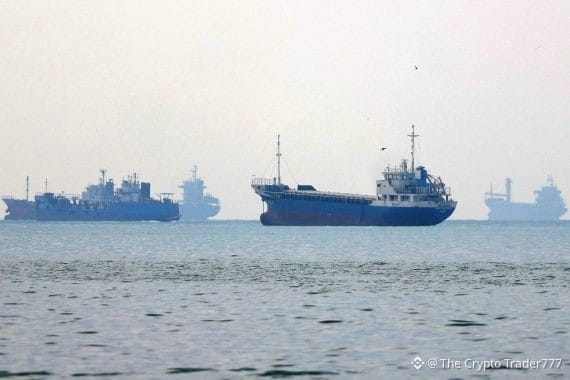
#USIranTradeTankerStrikesEscalate IRAN WAR UPDATE $: Hormuz traffic falls as US insists waterway ‘fully open’
Vessels transit the Hormuz Strait off the coast of Iran's southern port city of Bandar Abbas on September 7, 2026.
#FollowYourBrotherForMore
#followyouranalysis
{spot}(BTCUSDT)
#USIranTradeTankerStrikesEscalate IRAN WAR UPDATE $: Hormuz traffic falls as US insists waterway ‘fully open’
Vessels transit the Hormuz Strait off the coast of Iran's southern port city of Bandar Abbas on September 7, 2026.
#FollowYourBrotherForMore
#followyouranalysis
Vessels transit the Hormuz Strait off the coast of Iran's southern port city of Bandar Abbas on September 7, 2026.
#FollowYourBrotherForMore
#followyouranalysis
46
·
--
#usirantradetankerstrikesescalate
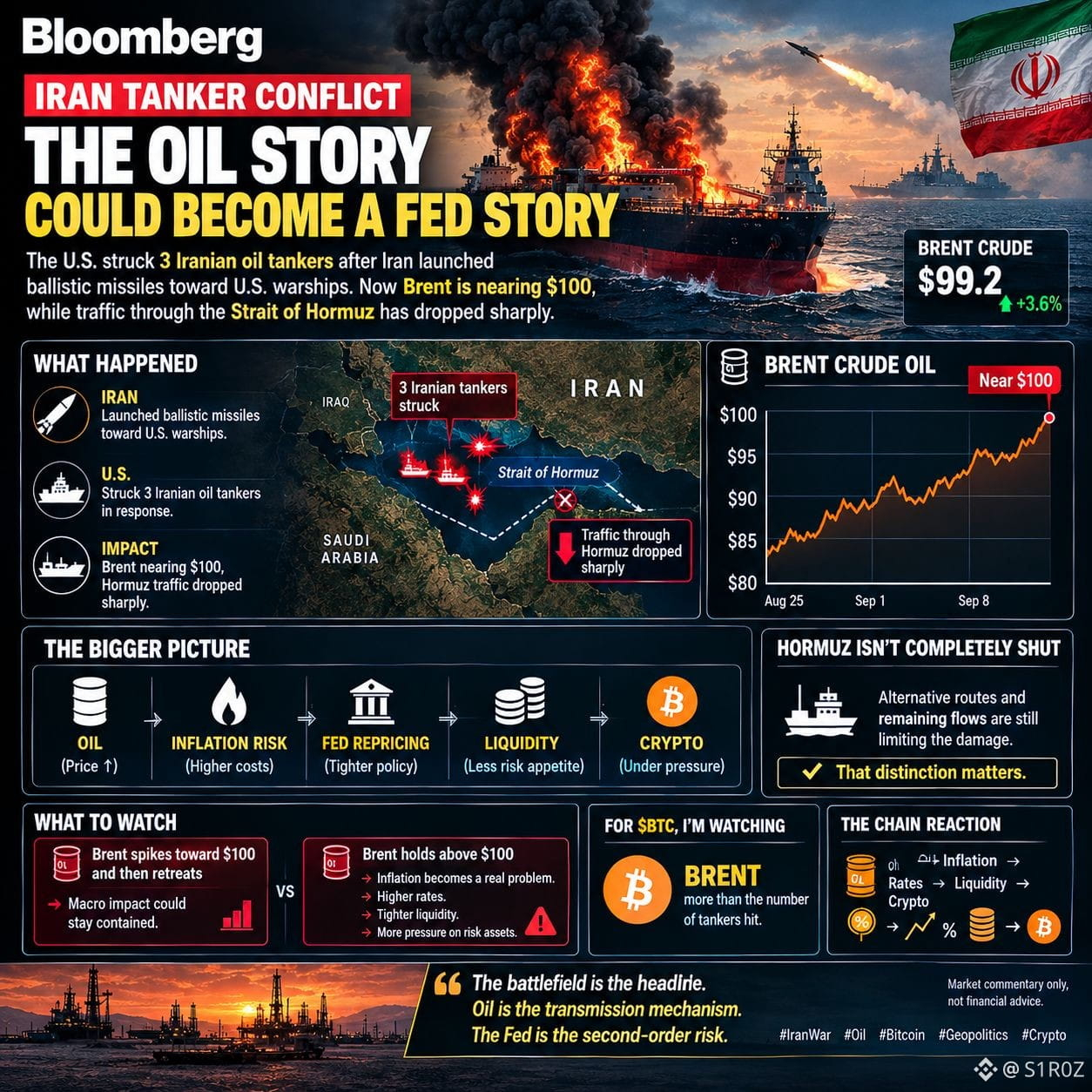
⚔️ The Iran tanker conflict is becoming an oil story — and that could turn into a Fed story.
The U.S. struck 3 Iranian oil tankers after Iran launched ballistic missiles toward U.S. warships. Now Brent is nearing $100, while traffic through the Strait of Hormuz has dropped sharply.
And this is where crypto gets involved:
Hormuz disruption → oil ↑ → inflation risk ↑ → Fed repricing → risk assets under pressure.
But Hormuz isn't completely shut. Alternative routes and remaining flows are still limiting the damage.
That distinction matters.
If Brent spikes toward $100 and then retreats as shipping normalizes, the macro impact could stay contained. But if oil holds above $100, this becomes much more than a geopolitical headline.
It becomes an inflation problem.
For $BTC, I'm watching Brent more than the number of tankers hit.
Oil → inflation → rates → liquidity → crypto.
The battlefield is the headline. Oil is the transmission mechanism. The Fed is the second-order risk.
Market commentary only, not financial advice.
#iranwarningredsea r #Oil #Bitcoin #Geopolitics #Crypto
#usirantradetankerstrikesescalate
⚔️ The Iran tanker conflict is becoming an oil story — and that could turn into a Fed story.
The U.S. struck 3 Iranian oil tankers after Iran launched ballistic missiles toward U.S. warships. Now Brent is nearing $100, while traffic through the Strait of Hormuz has dropped sharply.
And this is where crypto gets involved:
Hormuz disruption → oil ↑ → inflation risk ↑ → Fed repricing → risk assets under pressure.
But Hormuz isn't completely shut. Alternative routes and remaining flows are still limiting the damage.
That distinction matters.
If Brent spikes toward $100 and then retreats as shipping normalizes, the macro impact could stay contained. But if oil holds above $100, this becomes much more than a geopolitical headline.
It becomes an inflation problem.
For $BTC, I'm watching Brent more than the number of tankers hit.
Oil → inflation → rates → liquidity → crypto.
The battlefield is the headline. Oil is the transmission mechanism. The Fed is the second-order risk.
Market commentary only, not financial advice.
#iranwarningredsea r #Oil #Bitcoin #Geopolitics #Crypto
⚔️ The Iran tanker conflict is becoming an oil story — and that could turn into a Fed story.
The U.S. struck 3 Iranian oil tankers after Iran launched ballistic missiles toward U.S. warships. Now Brent is nearing $100, while traffic through the Strait of Hormuz has dropped sharply.
And this is where crypto gets involved:
Hormuz disruption → oil ↑ → inflation risk ↑ → Fed repricing → risk assets under pressure.
But Hormuz isn't completely shut. Alternative routes and remaining flows are still limiting the damage.
That distinction matters.
If Brent spikes toward $100 and then retreats as shipping normalizes, the macro impact could stay contained. But if oil holds above $100, this becomes much more than a geopolitical headline.
It becomes an inflation problem.
For $BTC, I'm watching Brent more than the number of tankers hit.
Oil → inflation → rates → liquidity → crypto.
The battlefield is the headline. Oil is the transmission mechanism. The Fed is the second-order risk.
Market commentary only, not financial advice.
#iranwarningredsea r #Oil #Bitcoin #Geopolitics #Crypto
190
Log in to explore more content
Join global crypto users on Binance Square
⚡️ Get latest and useful information about crypto.
💬 Trusted by the world’s largest crypto exchange.
👍 Discover real insights from verified creators.
Email / Phone number
Trending Topics
1
#SaylorHintsStrategyBitcoinBuy
2.3M views
12,385 Discussing
2
#BOJRaisesRatesTo31YearHigh
249,098 views
3,252 Discussing
3
#BuffettStepsDownAsBerkshireChairman
120,402 views
1,739 Discussing
4
#XRPExchangeReservesHitSevenYearLow
132,342 views
1,531 Discussing
5
#HKCompletesFirstHKDStablecoinUseCase
153,700 views
1,900 Discussing
6
#VietnamPlansFirstCryptoLicensesIn2026
96,725 views
1,288 Discussing
7
#BTCBreaks80K
534,929 views
5,761 Discussing
8
#BitcoinMarketCapTopsTesla
131,468 views
1,422 Discussing
9
#SOLJumpsAbout10%
131,900 views
1,276 Discussing
10
#EthereumReclaims$2600
12,032 views
140 Discussing