Binance Square
#usaugust1yinflationexpectations4.3%

usaugust1yinflationexpectations4.3%

32,196 views
285 Discussing
Dilarzz
·
--
Bullish
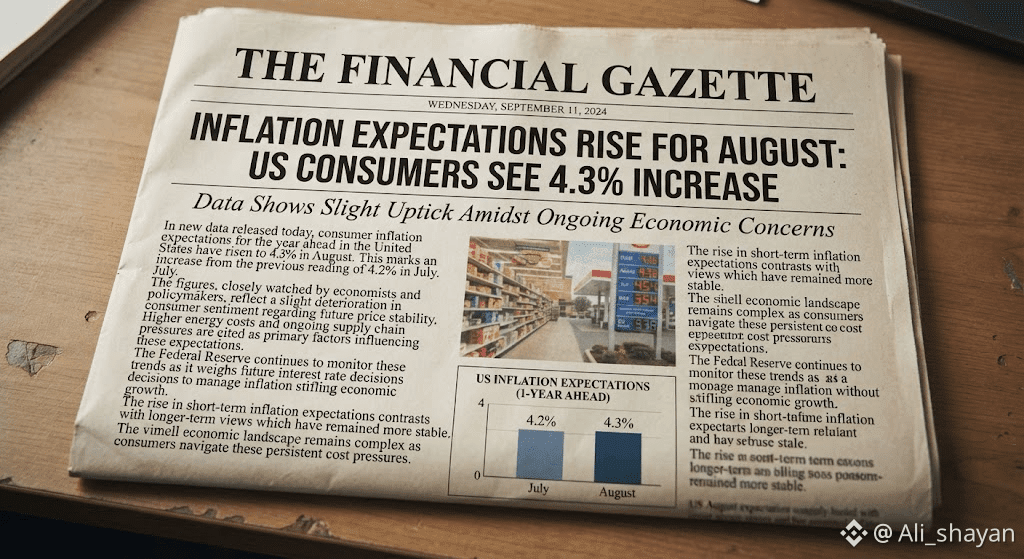
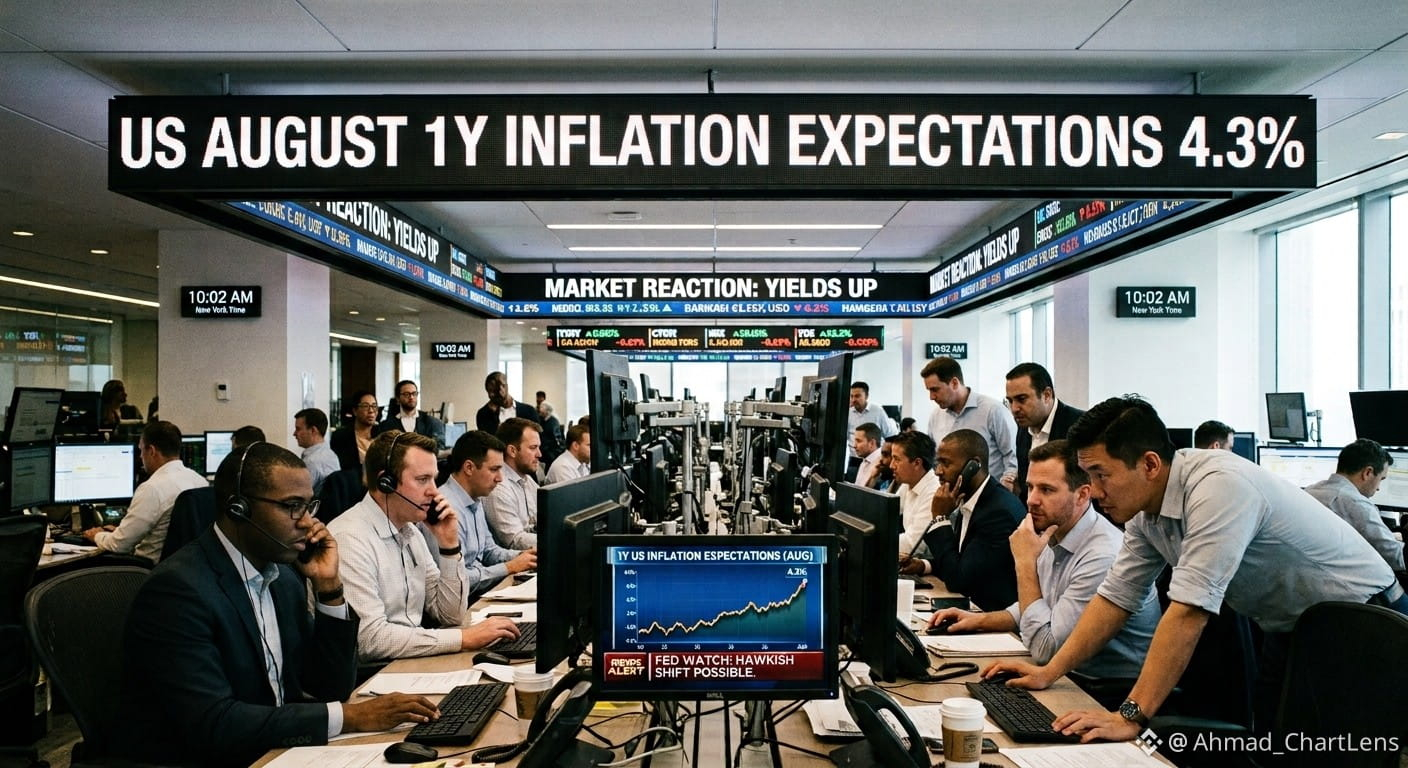
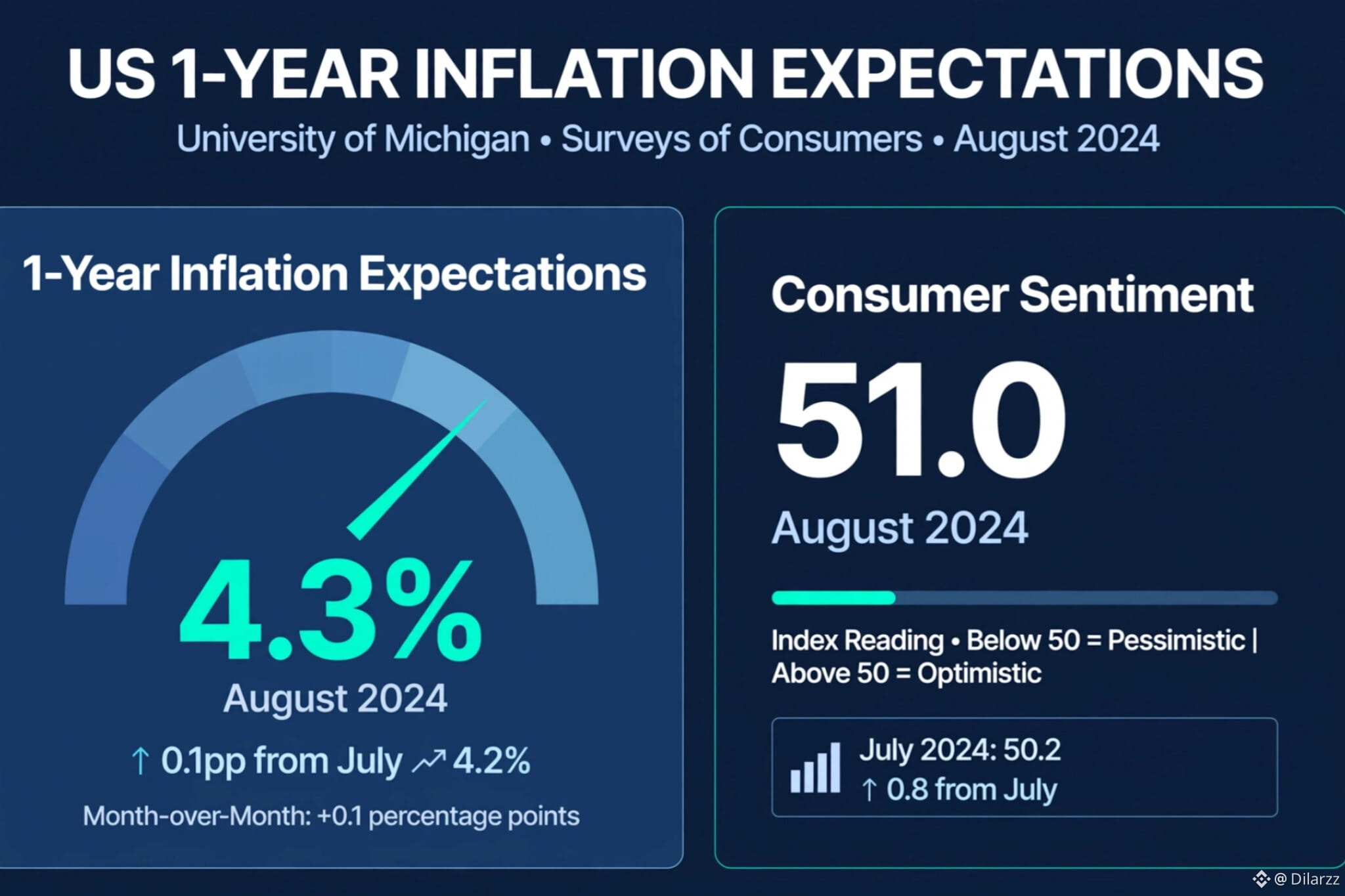
#USAugust1YInflationExpectations4.3% 💥U.S. 1-Year Inflation Expectations: 4.3% 🔥According to the University of Michigan Surveys of Consumers: • 1-year expectation: rose to 4.3% in early August from 4.2% in July • 5-year expectation: unchanged at 3.3% • Consumer Sentiment Index: dropped to 51.0 in August from 55.2 in July, ending two months of improvement Context: 🔥This is the Michigan measure - what households say they expect. It's different from: • NY Fed Survey (SCE): tracks median expectations around 3.1-3.6% for 1-year in recent months • Market-based swaps: 1-year inflation-linked swaps have been tracking closer to 3.4-3.6% Why it matters: The Fed watches 1-year expectations closely. When it rises even 0.1pp like this, combined with falling sentiment, it signals households are worried about higher goods prices - in August reports, analysts linked it to concerns about import tariffs. {spot}(BTCUSDT) {spot}(BNBUSDT) $BTC $AAPL.US $GENIUS {future}(GENIUSUSDT) #USAugust1YInflationExpectations4.3% #Dusk. #genius #NewToken
#USAugust1YInflationExpectations4.3%

💥U.S. 1-Year Inflation Expectations: 4.3%

🔥According to the University of Michigan Surveys of Consumers:
• 1-year expectation: rose to 4.3% in early August from 4.2% in July
• 5-year expectation: unchanged at 3.3%
• Consumer Sentiment Index: dropped to 51.0 in August from 55.2 in July, ending two months of improvement
Context:

🔥This is the Michigan measure - what households say they expect. It's different from:
• NY Fed Survey (SCE): tracks median expectations around 3.1-3.6% for 1-year in recent months
• Market-based swaps: 1-year inflation-linked swaps have been tracking closer to 3.4-3.6%
Why it matters: The Fed watches 1-year expectations closely. When it rises even 0.1pp like this, combined with falling sentiment, it signals households are worried about higher goods prices - in August reports, analysts linked it to concerns about import tariffs.

$BTC $AAPL.US $GENIUS
#USAugust1YInflationExpectations4.3% #Dusk. #genius #NewToken
#USAugust1YInflationExpectations4.3% That tag reads like: “U.S. August 1-year inflation expectations: 4.3%.” In simple terms, it means consumers surveyed in August 2026 expect prices to be about 4.3% higher one year from now. Why this matters: Inflation expectations influence how markets think the Fed may respond. If expectations rise, markets may worry inflation could stay sticky. If they fall, markets may feel more comfortable that inflation is cooling. For crypto and broader markets: Higher inflation expectations can be interpreted in two different ways: hawkish risk: the Fed may feel less room to ease policy; hard-asset narrative: some investors may view BTC as a hedge against fiat debasement. Which effect dominates depends on the bigger macro picture, especially rates, yields, labor data, and dollar strength. So 4.3% would generally be seen as a notably warm inflation-expectations reading, not something markets would ignore. If you want, I can next explain whether that is usually bullish or bearish for BTC, or connect it to Fed rate-cut / rate-hike expectations.$BNB {spot}(BNBUSDT) $BTC {spot}(BTCUSDT) $ETH {spot}(ETHUSDT)
#USAugust1YInflationExpectations4.3% That tag reads like: “U.S. August 1-year inflation expectations: 4.3%.”

In simple terms, it means consumers surveyed in August 2026 expect prices to be about 4.3% higher one year from now.

Why this matters:
Inflation expectations influence how markets think the Fed may respond.
If expectations rise, markets may worry inflation could stay sticky.
If they fall, markets may feel more comfortable that inflation is cooling.

For crypto and broader markets:
Higher inflation expectations can be interpreted in two different ways:
hawkish risk: the Fed may feel less room to ease policy;
hard-asset narrative: some investors may view BTC as a hedge against fiat debasement.
Which effect dominates depends on the bigger macro picture, especially rates, yields, labor data, and dollar strength.

So 4.3% would generally be seen as a notably warm inflation-expectations reading, not something markets would ignore.

If you want, I can next explain whether that is usually bullish or bearish for BTC, or connect it to Fed rate-cut / rate-hike expectations.$BNB

$BTC

$ETH
Verified
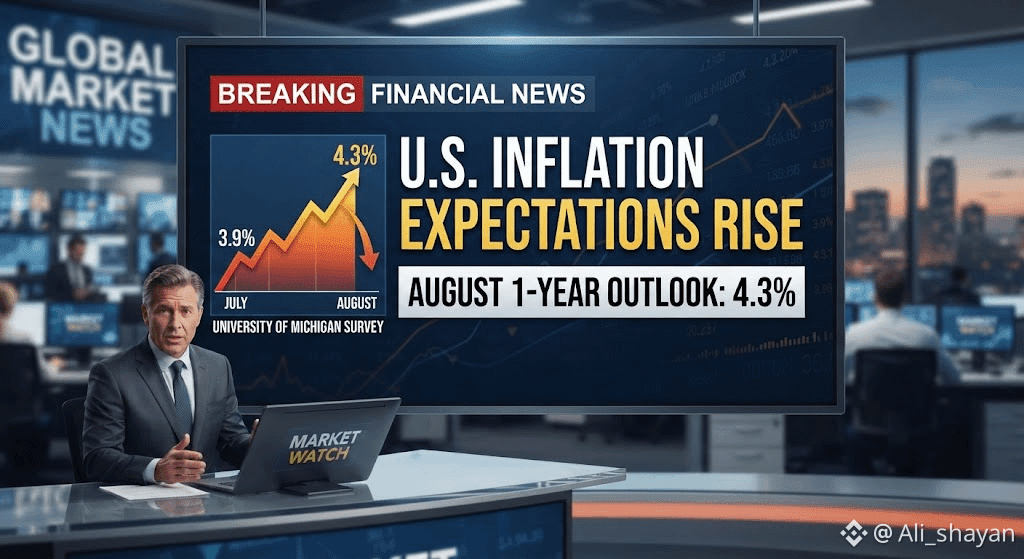
📈 US Inflation Expectations Tick Higher U.S. consumers now expect inflation to reach 4.3% over the next year, up from 4.2% in July, according to the University of Michigan’s preliminary August survey. Five-year expectations held steady at 3.3%. The rise keeps inflation expectations firmly on the Fed’s radar and could influence rate expectations and market sentiment. $BTC $ETH $BNB #usaugust1yinflationexpectations4.3%
📈 US Inflation Expectations Tick Higher
U.S. consumers now expect inflation to reach 4.3% over the next year, up from 4.2% in July, according to the University of Michigan’s preliminary August survey. Five-year expectations held steady at 3.3%.
The rise keeps inflation expectations firmly on the Fed’s radar and could influence rate expectations and market sentiment.
$BTC $ETH $BNB

#usaugust1yinflationexpectations4.3%
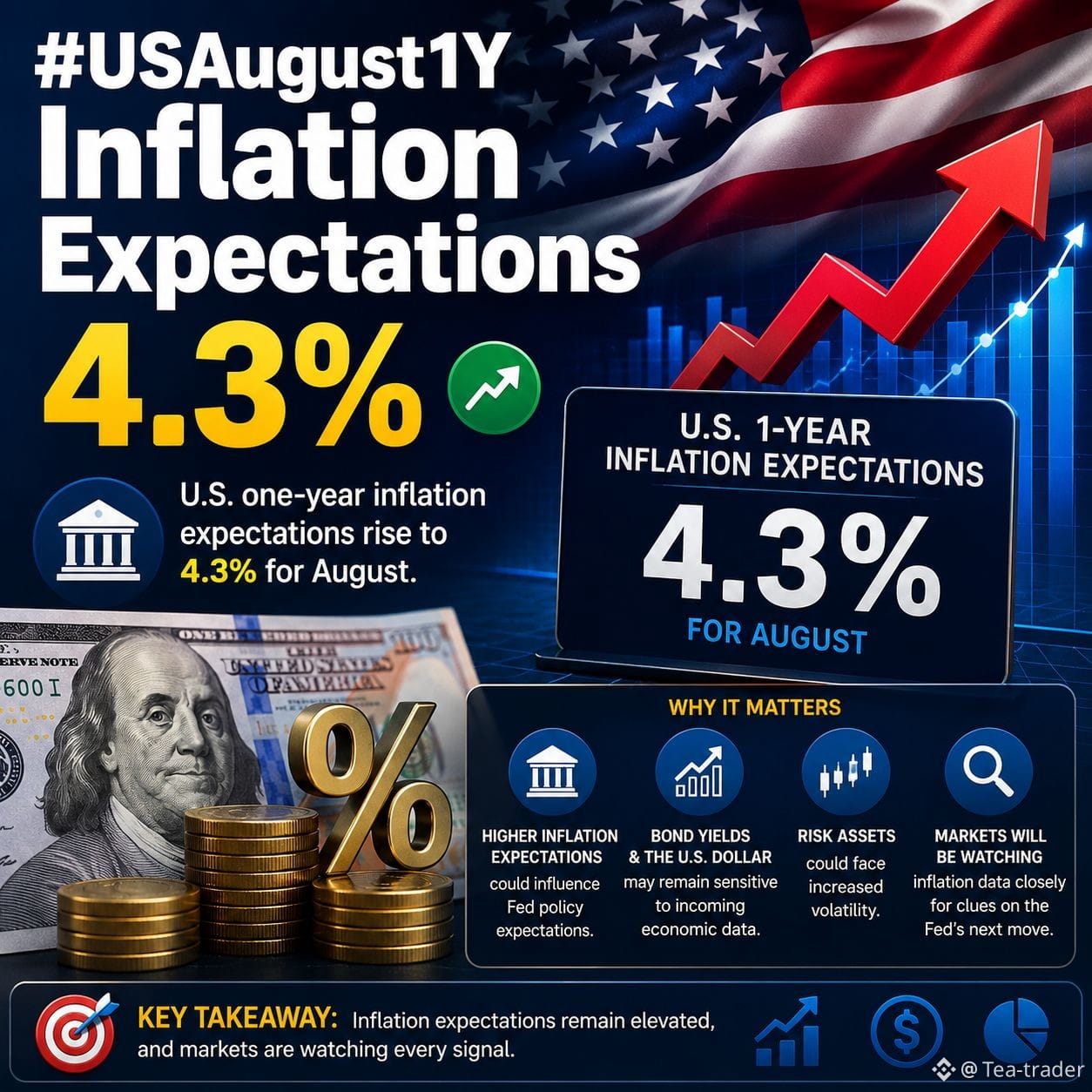
#USAugust1YInflationExpectations4.3% # U.S. one-year inflation expectations have risen to 4.3% for August, keeping inflation concerns firmly on investors’ radar. 🔥 Why it matters: • Higher inflation expectations could influence Fed policy expectations • Bond yields and the U.S. dollar may remain sensitive to incoming data • Risk assets, including stocks and crypto, could face increased volatility 👀 Markets will be watching upcoming inflation data closely for clues on the Fed’s next move. #USInflation #Fed #InterestRates #USD #Markets #Bitcoin #Crypto #Investing #USAugust1YInflationExpectations4.3%
#USAugust1YInflationExpectations4.3%
#

U.S. one-year inflation expectations have risen to 4.3% for August, keeping inflation concerns firmly on investors’ radar.

🔥 Why it matters: • Higher inflation expectations could influence Fed policy expectations
• Bond yields and the U.S. dollar may remain sensitive to incoming data
• Risk assets, including stocks and crypto, could face increased volatility

👀 Markets will be watching upcoming inflation data closely for clues on the Fed’s next move.

#USInflation #Fed #InterestRates #USD #Markets #Bitcoin #Crypto #Investing

#USAugust1YInflationExpectations4.3%
Verified
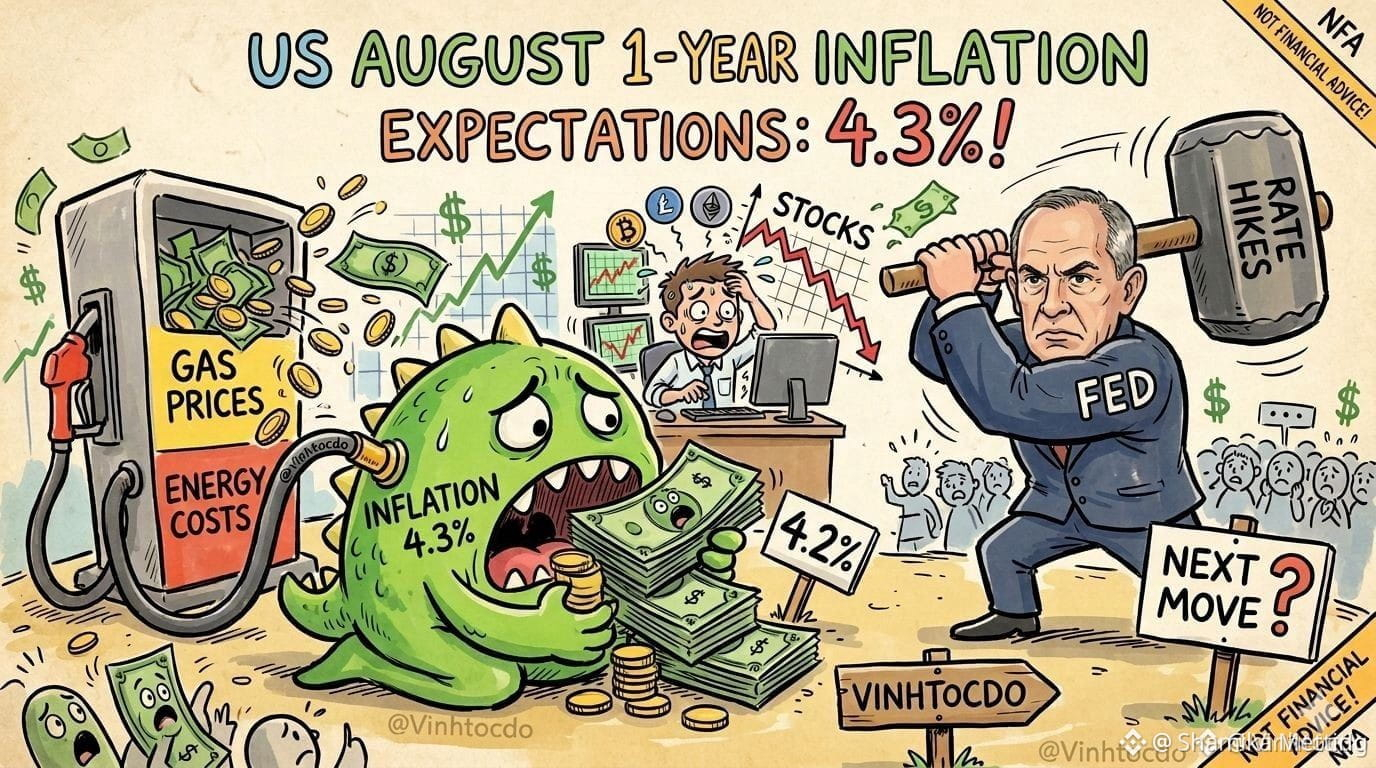
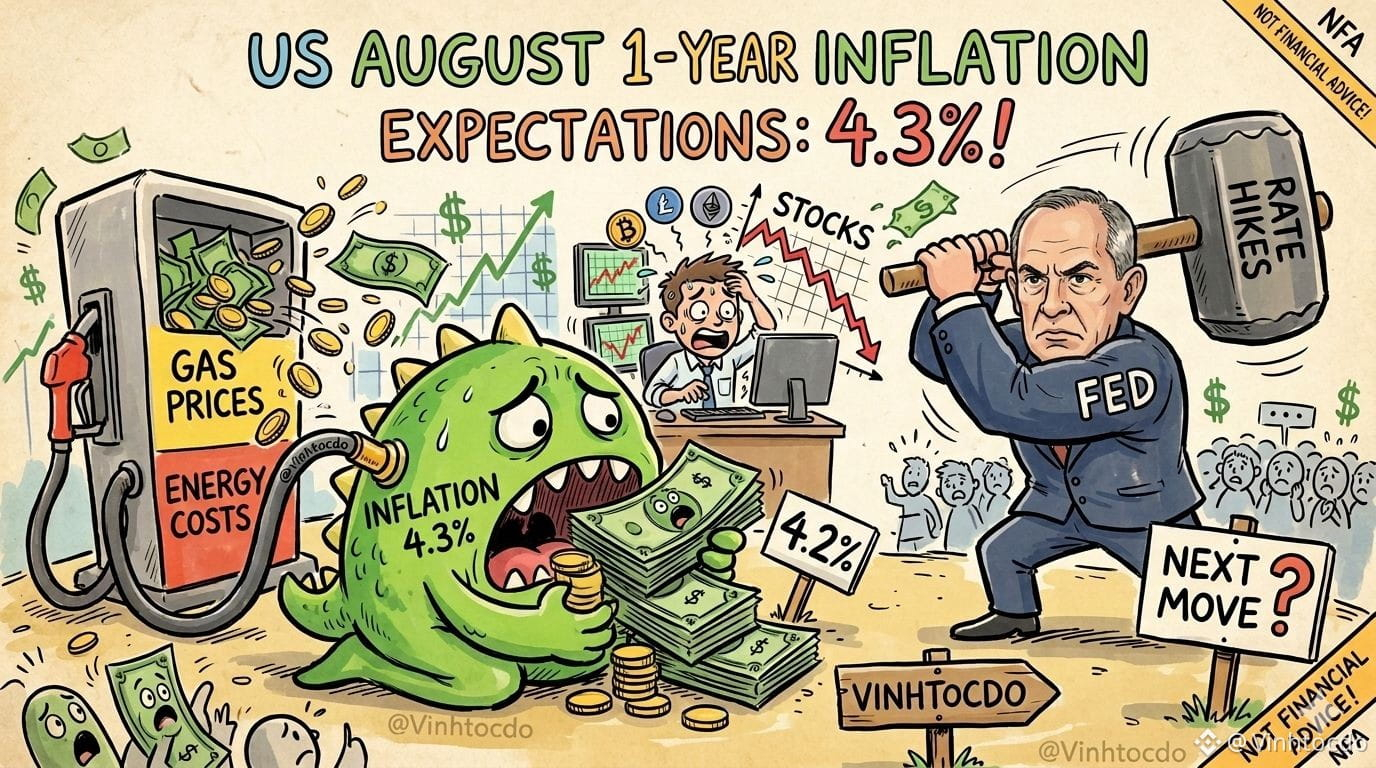
#usaugust1yinflationexpectations4.3% 📈 US inflation forecasts for one year rose slightly to 4.3% in August, exceeding expectations of 4.2%! Why is it so high? Blame the crazy energy prices that keep our pockets crying! ⛽🔥 Will the Federal Reserve raise interest rates again to tackle it? Real suspense! What should traders do? Buckle up for more volatility, closely watch the Fed’s next moves, and don’t panic about trading! 🧘‍♂️📊 ⚠️ NFA (not financial advice)! Please follow up #USInflation #MacroEconomy #FedRates $BTC {future}(BTCUSDT)
#usaugust1yinflationexpectations4.3%
📈 US inflation forecasts for one year rose slightly to 4.3% in August, exceeding expectations of 4.2%! Why is it so high? Blame the crazy energy prices that keep our pockets crying! ⛽🔥 Will the Federal Reserve raise interest rates again to tackle it? Real suspense!
What should traders do? Buckle up for more volatility, closely watch the Fed’s next moves, and don’t panic about trading! 🧘‍♂️📊
⚠️ NFA (not financial advice)!

Please follow up

#USInflation #MacroEconomy #FedRates
$BTC
Verified
#usaugust1yinflationexpectations4.3% New data shows US consumer inflation expectations for the year ahead have risen to 4.3% in August. This is up from 4.2% last month. Higher energy prices and supply worries are pushing costs up for everyday people. Because of this, overall consumer sentiment has dropped as people worry more about their future budgets and living expenses. CLICK BELOW TO TRADE : $BTC $ETH $TUT {future}(TUTUSDT) {future}(ETHUSDT) {future}(BTCUSDT)
#usaugust1yinflationexpectations4.3% New data shows US consumer inflation expectations for the year ahead have risen to 4.3% in August. This is up from 4.2% last month. Higher energy prices and supply worries are pushing costs up for everyday people. Because of this, overall consumer sentiment has dropped as people worry more about their future budgets and living expenses.

CLICK BELOW TO TRADE : $BTC $ETH $TUT
Long $XAUT 2.1K USDT
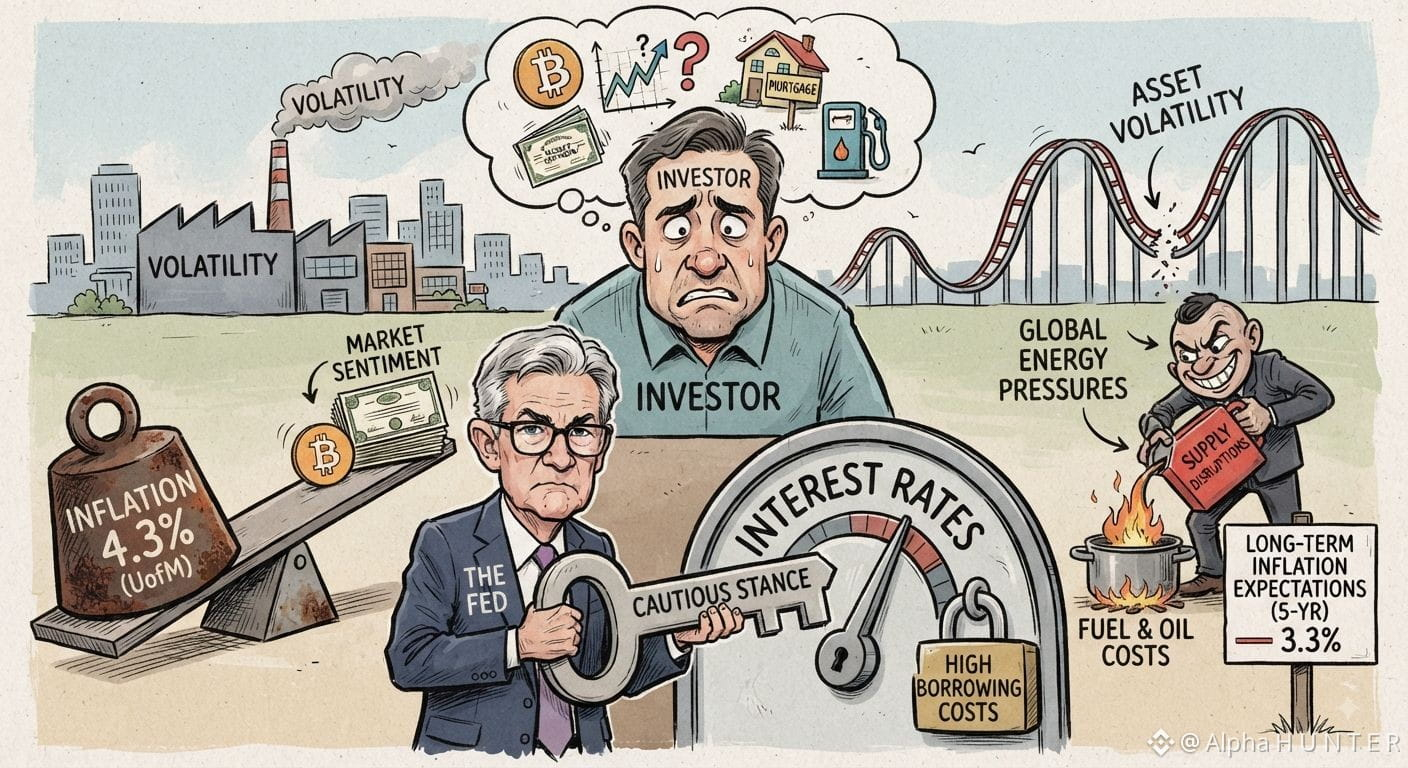
#USAugust1YInflationExpectations4.3% The latest preliminary data from the University of Michigan reveals that U.S. year-ahead inflation expectations ticked up to 4.3% in August, rising slightly from 4.2% in July. ​This upward adjustment is primarily driven by persistent pressures in global energy markets, as ongoing supply disruptions continue to influence fuel and oil costs. Meanwhile, long-term inflation expectations for the five-year outlook remained steady at 3.3%. ​For crypto and traditional market investors, these persistent inflation metrics mean the Federal Reserve will likely maintain a cautious stance on interest rates. High borrowing costs and sticky consumer prices continue to impact market sentiment and asset volatility. How will this macro environment affect your crypto portfolio strategy this month? Always remember to do your own research (DYOR) and trade responsibly. ​#BinanceSquare #Inflation #USEconomy #Fed $XAU {future}(XAUUSDT) $XAUT {future}(XAUTUSDT) $PAXG {future}(PAXGUSDT)
#USAugust1YInflationExpectations4.3%
The latest preliminary data from the University of Michigan reveals that U.S. year-ahead inflation expectations ticked up to 4.3% in August, rising slightly from 4.2% in July.

​This upward adjustment is primarily driven by persistent pressures in global energy markets, as ongoing supply disruptions continue to influence fuel and oil costs. Meanwhile, long-term inflation expectations for the five-year outlook remained steady at 3.3%.

​For crypto and traditional market investors, these persistent inflation metrics mean the Federal Reserve will likely maintain a cautious stance on interest rates. High borrowing costs and sticky consumer prices continue to impact market sentiment and asset volatility. How will this macro environment affect your crypto portfolio strategy this month?
Always remember to do your own research (DYOR) and trade responsibly.
​#BinanceSquare #Inflation #USEconomy #Fed
$XAU
$XAUT
$PAXG
#usaugust1yinflationexpectations4.3% The latest economic data shows US consumer sentiment dropping sharply in August. The preliminary University of Michigan survey reports that one-year inflation expectations ticked up to 4.3%. People across the country feel worried that prices for everyday goods, energy, and living costs will stay high over the next year. This increase adds more pressure on financial markets and hints that the Federal Reserve will keep a close eye on sticky inflation. CLICK BELOW TO TRADE : $BTC $BNB $XAU {future}(XAUUSDT) {future}(BNBUSDT) {future}(BTCUSDT)
#usaugust1yinflationexpectations4.3% The latest economic data shows US consumer sentiment dropping sharply in August. The preliminary University of Michigan survey reports that one-year inflation expectations ticked up to 4.3%. People across the country feel worried that prices for everyday goods, energy, and living costs will stay high over the next year. This increase adds more pressure on financial markets and hints that the Federal Reserve will keep a close eye on sticky inflation.

CLICK BELOW TO TRADE : $BTC $BNB $XAU
·
--
Verified
#usaugust1yinflationexpectations4.3% #Inflation 📊 Inflation data is cooling. Consumers aren’t convinced yet. This week brought softer-than-expected CPI and PPI, but the University of Michigan’s preliminary August survey painted a different picture.$ACE ,$VELVET ,$CYS {future}(CYSUSDT) {future}(VELVETUSDT) {spot}(ACEUSDT) Consumer sentiment fell to 51.0 from 55.2, while 1-year inflation expectations rose to 4.3% from 4.2%. The interesting part is the divergence: 🟢 Official inflation data is cooling 🔴 Consumers still expect higher prices ⚠️ Long-term inflation expectations stayed at 3.3% That matters for the Fed because consumer expectations can influence spending and wage decisions. For markets, the question is whether this is just a temporary sentiment hit or an early warning that inflation concerns aren’t fully gone. Which matters more right now — the hard data or consumer expectations? #Fed #Macro #Crypto #Markets
#usaugust1yinflationexpectations4.3%
#Inflation
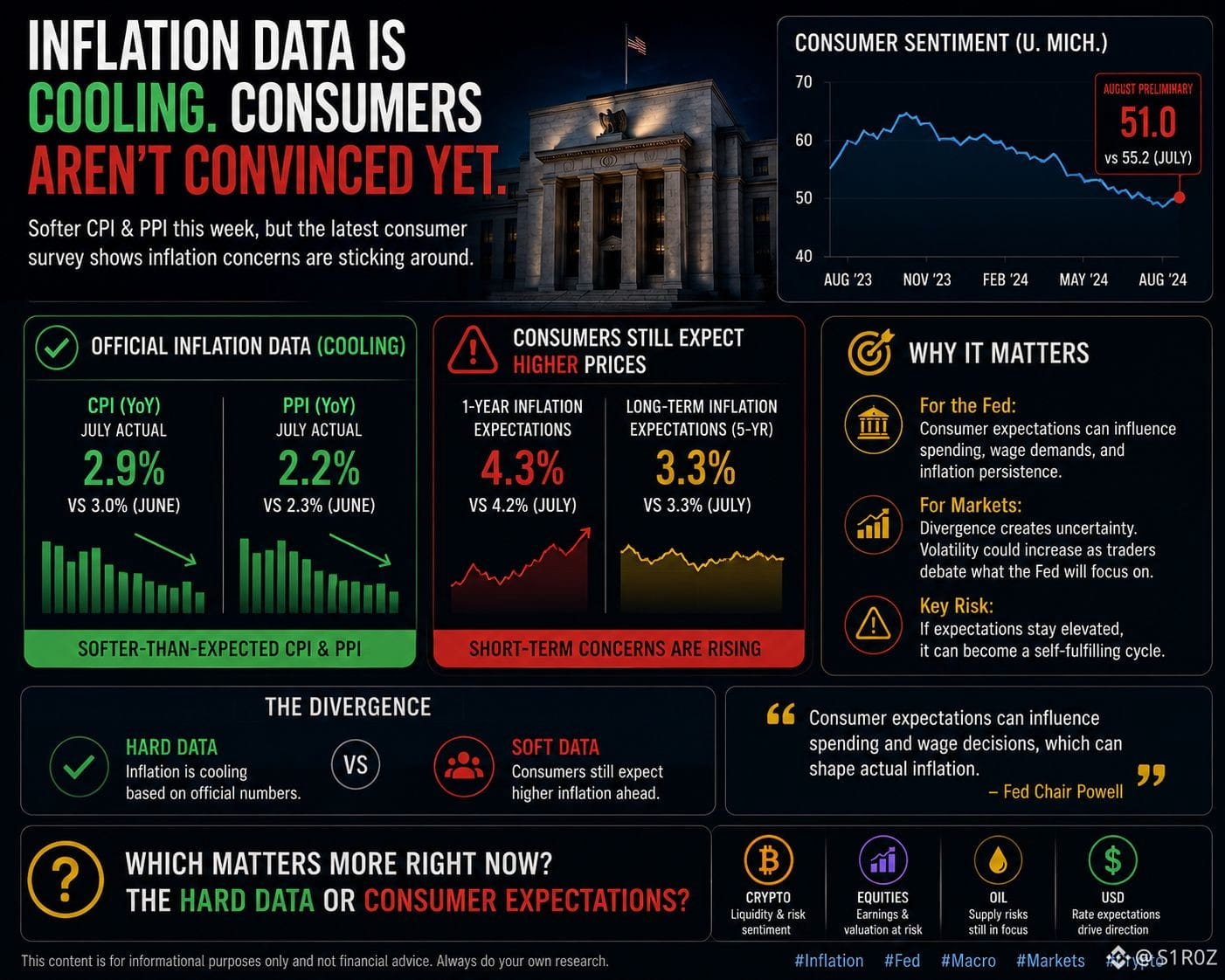
📊 Inflation data is cooling. Consumers aren’t convinced yet.

This week brought softer-than-expected CPI and PPI, but the University of Michigan’s preliminary August survey painted a different picture.$ACE ,$VELVET ,$CYS
Consumer sentiment fell to 51.0 from 55.2, while 1-year inflation expectations rose to 4.3% from 4.2%.

The interesting part is the divergence:
🟢 Official inflation data is cooling
🔴 Consumers still expect higher prices
⚠️ Long-term inflation expectations stayed at 3.3%

That matters for the Fed because consumer expectations can influence spending and wage decisions.
For markets, the question is whether this is just a temporary sentiment hit or an early warning that inflation concerns aren’t fully gone.

Which matters more right now — the hard data or consumer expectations?

#Fed #Macro #Crypto #Markets
#usaugust1yinflationexpectations4.3% 🚨🔥 Viral Crypto News – USA August 2026 🔥🚨 📊 1Y Inflation Expectations in the U.S.: 4.3% ➡️ Up from 4.2% in July, according to the University of Michigan survey. 💡 Market highlights: 🛢️ Energy and oil pressures keep prices “sticky”. 🏦 The Fed could keep rates high for longer → hawkish risk. 💎 “Hard asset” narrative: BTC and Gold return to the radar as hedges against inflation. 📈 Immediate impact: $BTC moves within a key support zone; the inflation-hedge narrative is strengthened. $XAU becomes more attractive as a traditional safe haven. $SOL and high-beta altcoins face extra volatility due to macro uncertainty. ⚠️ Market sentiment: A reading of 4.3% is “warm” → traders expect more turbulence in bonds, the dollar, and crypto. 👉 Call to Action: Don’t miss the information that moves the market. ✍️ By ElCryptoBoy
#usaugust1yinflationexpectations4.3%
🚨🔥 Viral Crypto News – USA August 2026 🔥🚨
📊 1Y Inflation Expectations in the U.S.: 4.3%
➡️ Up from 4.2% in July, according to the University of Michigan survey.
💡 Market highlights:
🛢️ Energy and oil pressures keep prices “sticky”.
🏦 The Fed could keep rates high for longer → hawkish risk.
💎 “Hard asset” narrative: BTC and Gold return to the radar as hedges against inflation.
📈 Immediate impact:
$BTC moves within a key support zone; the inflation-hedge narrative is strengthened.
$XAU becomes more attractive as a traditional safe haven.
$SOL and high-beta altcoins face extra volatility due to macro uncertainty.
⚠️ Market sentiment:
A reading of 4.3% is “warm” → traders expect more turbulence in bonds, the dollar, and crypto.
👉 Call to Action:
Don’t miss the information that moves the market.

✍️ By ElCryptoBoy
·
--
Bullish
Verified
Borussia Monchengladbach vs. Aston Villa

Borussia Monchengladbach vs. Aston Villa

BMG99%Draw1%AVL1%
Volume $4,363.9
·
--
Verified
Article
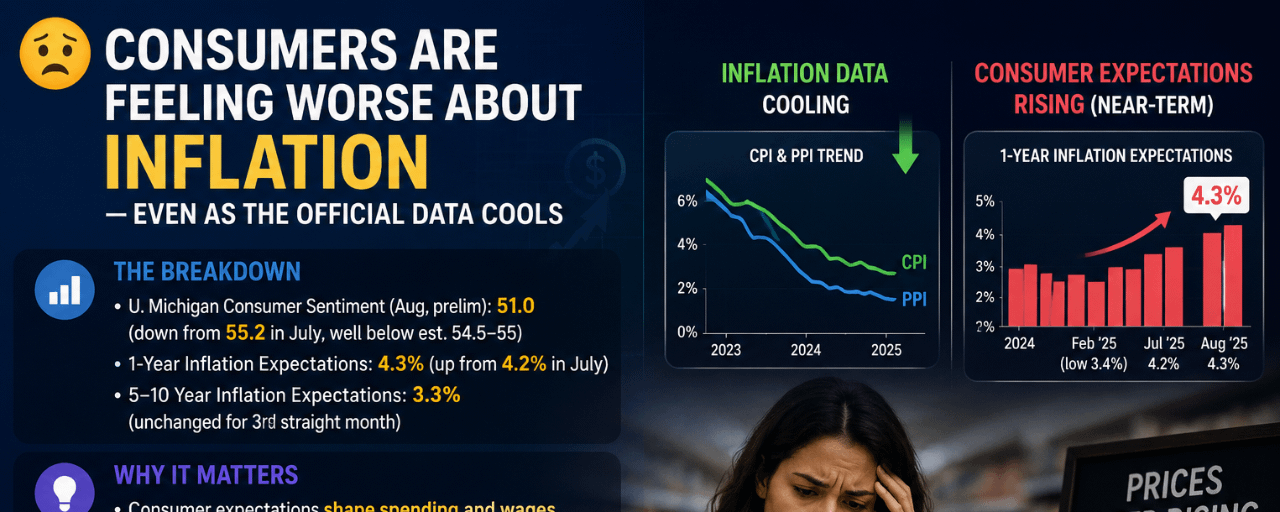
Consumers Are Feeling Worse About Inflation — Even as the Official Data Cools#usaugust1yinflationexpectations4.3% This week brought cooler-than-expected CPI and PPI reports. Then a separate survey showed everyday consumers aren't buying the disinflation story just yet. The breakdown: The University of Michigan's preliminary August Index of Consumer Sentiment fell to 51.0, down from July's final reading of 55.2 and well below the roughly 54.5-55 economists had expected — an 8% monthly drop that snapped two straight months of improvement. Both sub-indexes missed estimates too: current conditions fell to 51.8 and expectations dropped to 50.6. Alongside that decline, one-year inflation expectations ticked up to 4.3% from 4.2% in July, now sitting above every reading from 2024 and well above February's pre-conflict low of 3.4%. Longer-run, five-to-ten-year expectations held steady at 3.3% for a third consecutive month. The decline in sentiment was broad-based across demographic and political lines, with particularly sharp drops among older consumers, lower-income households, and those without a college degree. Survey director Joanne Hsu noted that expected business conditions fell 11% for the short run and 17% for the long run, and only 8% of consumers now believe their income growth will outpace inflation over the next year. Why it matters: There's a real divergence worth sitting with here: official inflation data has been cooling this week, but how consumers say they feel about near-term prices moved in the opposite direction. That gap matters because consumer expectations aren't just a mood reading — they can shape actual spending and wage-setting behavior, and consumer spending makes up roughly two-thirds of U.S. economic output. The Fed also watches these surveys closely, particularly longer-run expectations, as a gauge of whether inflation is becoming "anchored" in the public's mind — though notably, it's the near-term reading that moved here, not the long-run one, which held steady. Closing thought: With official inflation data cooling even as consumer expectations tick higher, does this gap reflect a genuine lag between hard data and lived experience — or is it noise in a single survey that could look different next month? $ACE $VELVET $CYS {future}(VELVETUSDT) {future}(CYSUSDT) {future}(ACEUSDT)

Consumers Are Feeling Worse About Inflation — Even as the Official Data Cools

#usaugust1yinflationexpectations4.3%
This week brought cooler-than-expected CPI and PPI reports. Then a separate survey showed everyday consumers aren't buying the disinflation story just yet.
The breakdown: The University of Michigan's preliminary August Index of Consumer Sentiment fell to 51.0, down from July's final reading of 55.2 and well below the roughly 54.5-55 economists had expected — an 8% monthly drop that snapped two straight months of improvement. Both sub-indexes missed estimates too: current conditions fell to 51.8 and expectations dropped to 50.6. Alongside that decline, one-year inflation expectations ticked up to 4.3% from 4.2% in July, now sitting above every reading from 2024 and well above February's pre-conflict low of 3.4%. Longer-run, five-to-ten-year expectations held steady at 3.3% for a third consecutive month. The decline in sentiment was broad-based across demographic and political lines, with particularly sharp drops among older consumers, lower-income households, and those without a college degree. Survey director Joanne Hsu noted that expected business conditions fell 11% for the short run and 17% for the long run, and only 8% of consumers now believe their income growth will outpace inflation over the next year.
Why it matters: There's a real divergence worth sitting with here: official inflation data has been cooling this week, but how consumers say they feel about near-term prices moved in the opposite direction. That gap matters because consumer expectations aren't just a mood reading — they can shape actual spending and wage-setting behavior, and consumer spending makes up roughly two-thirds of U.S. economic output. The Fed also watches these surveys closely, particularly longer-run expectations, as a gauge of whether inflation is becoming "anchored" in the public's mind — though notably, it's the near-term reading that moved here, not the long-run one, which held steady.
Closing thought: With official inflation data cooling even as consumer expectations tick higher, does this gap reflect a genuine lag between hard data and lived experience — or is it noise in a single survey that could look different next month?
$ACE
$VELVET
$CYS
#usaugust1yinflationexpectations4.3% U.S. 1-Year Inflation Expectations Rise to 4.3% in August The preliminary University of Michigan survey shows year-ahead inflation expectations in the U.S. ticked up to 4.3% in August. Persistent pressures in energy markets and geopolitical supply chain strains continue to keep short-term inflation outlooks elevated. Key Takeaways: Hawkish Rate Expectations: Rising short-term inflation expectations complicate the Federal Reserve's path toward monetary easing, signaling that interest rates may need to remain elevated for longer to anchor prices. Consumer Pressure: Sticky inflation expectations continue to weigh on broader consumer sentiment, driving demand into inflation-hedging and store-of-value assets. Macro Volatility: With bond yields reacting to lingering inflation risks, cross-asset volatility across traditional and digital markets remains elevated. 📊 Top 3 Tradable Assets to Watch As short-term inflation expectations shift macro yields, monitor these setups across digital assets and commodities: 1. $BTC Market Sentiment: Macro inflation hedge / Sovereign asset alternative. Trader Focus: High short-term inflation prints often reinforce Bitcoin's narrative as a long-term hard asset. Watch for support retests near local Demand Zones; a breakout above local resistance could signal renewed capital inflows seeking inflation protection. 2. $XAU Market Sentiment: Traditional safe-haven & inflation proxy. Trader Focus: Gold directly reflects real yields and consumer price expectations. Watch for price action around psychological resistance levels as sticky inflation data provides fundamental support against tight monetary policy. 3. $SOL Market Sentiment: High-beta crypto asset. Trader Focus: Broad macro volatility from Fed rate uncertainty can create sharp liquidity sweeps in high-beta Layer-1 tokens. Monitor lower timeframe higher-low structures near key EMAs for potential trend continuation plays. {spot}(BTCUSDT) {future}(XAUUSDT) {spot}(SOLUSDT) #BinanceSquare
#usaugust1yinflationexpectations4.3%
U.S. 1-Year Inflation Expectations Rise to 4.3% in August
The preliminary University of Michigan survey shows year-ahead inflation expectations in the U.S. ticked up to 4.3% in August. Persistent pressures in energy markets and geopolitical supply chain strains continue to keep short-term inflation outlooks elevated.
Key Takeaways:
Hawkish Rate Expectations: Rising short-term inflation expectations complicate the Federal Reserve's path toward monetary easing, signaling that interest rates may need to remain elevated for longer to anchor prices.
Consumer Pressure: Sticky inflation expectations continue to weigh on broader consumer sentiment, driving demand into inflation-hedging and store-of-value assets.
Macro Volatility: With bond yields reacting to lingering inflation risks, cross-asset volatility across traditional and digital markets remains elevated.

📊 Top 3 Tradable Assets to Watch
As short-term inflation expectations shift macro yields, monitor these setups across digital assets and commodities:
1. $BTC
Market Sentiment: Macro inflation hedge / Sovereign asset alternative.
Trader Focus: High short-term inflation prints often reinforce Bitcoin's narrative as a long-term hard asset. Watch for support retests near local Demand Zones; a breakout above local resistance could signal renewed capital inflows seeking inflation protection.
2. $XAU
Market Sentiment: Traditional safe-haven & inflation proxy.
Trader Focus: Gold directly reflects real yields and consumer price expectations. Watch for price action around psychological resistance levels as sticky inflation data provides fundamental support against tight monetary policy.
3. $SOL
Market Sentiment: High-beta crypto asset.
Trader Focus: Broad macro volatility from Fed rate uncertainty can create sharp liquidity sweeps in high-beta Layer-1 tokens. Monitor lower timeframe higher-low structures near key EMAs for potential trend continuation plays.


#BinanceSquare
#$BITCOIN {alpha}(10x72e4f9f808c49a2a61de9c5896298920dc4eeea9) #TradersCutFedRateHikeBetsBeforeMid2027 is trading around $62,900–$63,500, down from highs near $93,000 at the start of 2026 — roughly a 30% drawdown that's historically unremarkable for BTC, but the mood right now is defensive. Price is sitting below all major daily moving averages (EMA20, EMA50, EMA200), with support near $62,500 and resistance around $63,900–$64,000. Cryptonomist Momentum: Daily RSI is around 42–45 — soft, but not yet oversold — while the 1-hour RSI near 32 hints at short-term seller exhaustion. The Fear & Greed Index sits at 29, squarely in "fear" territory. CryptonomistCryptonomist Flows & dominance: Despite the price weakness, Bitcoin ETF inflows reportedly hit $850 million, and BTC dominance stands near 56% of a ~$2.25 trillion total crypto market cap — suggesting capital is leaving crypto broadly rather than rotating into altcoins. Bitcoin and Ethereum have also been among the few major coins posting positive relative performance while altcoins lag. Cryptonomist + 2 Near-term levels to watch: Support: ~$62,500–$62,700 Resistance: ~$63,900–$65,300 (EMA cluster) A reclaim of the EMA20 would be the first sign the downtrend is losing steam; a break below $62,500 opens more downside. Bottom line: Bitcoin is in a grinding, methodical downtrend rather than a crash — technically bearish, sentiment fearful, but with steady ETF demand underneath. This isn't financial advice — just a read of current market data, and crypto remains highly volatile.#DollarFallsToMayLow #USAugust1YInflationExpectations4.3% #

#$BITCOIN
#TradersCutFedRateHikeBetsBeforeMid2027 is trading around $62,900–$63,500, down from highs near $93,000 at the start of 2026 — roughly a 30% drawdown that's historically unremarkable for BTC, but the mood right now is defensive. Price is sitting below all major daily moving averages (EMA20, EMA50, EMA200), with support near $62,500 and resistance around $63,900–$64,000. Cryptonomist

Momentum: Daily RSI is around 42–45 — soft, but not yet oversold — while the 1-hour RSI near 32 hints at short-term seller exhaustion. The Fear & Greed Index sits at 29, squarely in "fear" territory. CryptonomistCryptonomist

Flows & dominance: Despite the price weakness, Bitcoin ETF inflows reportedly hit $850 million, and BTC dominance stands near 56% of a ~$2.25 trillion total crypto market cap — suggesting capital is leaving crypto broadly rather than rotating into altcoins. Bitcoin and Ethereum have also been among the few major coins posting positive relative performance while altcoins lag. Cryptonomist + 2

Near-term levels to watch:

Support: ~$62,500–$62,700

Resistance: ~$63,900–$65,300 (EMA cluster)

A reclaim of the EMA20 would be the first sign the downtrend is losing steam; a break below $62,500 opens more downside.

Bottom line: Bitcoin is in a grinding, methodical downtrend rather than a crash — technically bearish, sentiment fearful, but with steady ETF demand underneath. This isn't financial advice — just a read of current market data, and crypto remains highly volatile.#DollarFallsToMayLow #USAugust1YInflationExpectations4.3% #
Log in to explore more content
Join global crypto users on Binance Square
⚡️ Get latest and useful information about crypto.
💬 Trusted by the world’s largest crypto exchange.
👍 Discover real insights from verified creators.
Email / Phone number