

#genius
genius
8.1M views
69,188 Discussing
Hot
Latest

·
--
🚨 $GENIUS COMMUNITY ERUPTS AS DAILY POINTS SLASHED AND UNLOCK POSTPONED! 💥
📌 Order flow and liquidity move fast, but protocol trust moves even faster. Genius Terminal has quietly updated its Season 2 documentation, slashing daily point emissions from 1.5M down to just 50K while pushing a 70 million $GENIUS token unlock out to February 2028.
💡 Management defends the decision as standard protocol adjustments reflecting lower trading volume, but traders who racked up execution fees are pushing back hard. 🔍 When incentives shift mid-game, capital usually seeks cleaner, higher-conviction opportunities elsewhere. 💬 Are you sticking through points adjustments or immediately rotating your liquidity? 👇
⚠️ Not financial advice. Always manage your risk. 🛡️
🏷️ #GENIUS #Airdrop #Tokenomics #Crypto
🔥 ⚡
🚨 $GENIUS COMMUNITY ERUPTS AS DAILY POINTS SLASHED AND UNLOCK POSTPONED! 💥
📌 Order flow and liquidity move fast, but protocol trust moves even faster. Genius Terminal has quietly updated its Season 2 documentation, slashing daily point emissions from 1.5M down to just 50K while pushing a 70 million $GENIUS token unlock out to February 2028.
💡 Management defends the decision as standard protocol adjustments reflecting lower trading volume, but traders who racked up execution fees are pushing back hard. 🔍 When incentives shift mid-game, capital usually seeks cleaner, higher-conviction opportunities elsewhere. 💬 Are you sticking through points adjustments or immediately rotating your liquidity? 👇
⚠️ Not financial advice. Always manage your risk. 🛡️
🏷️ #GENIUS #Airdrop #Tokenomics #Crypto
🔥 ⚡
📌 Order flow and liquidity move fast, but protocol trust moves even faster. Genius Terminal has quietly updated its Season 2 documentation, slashing daily point emissions from 1.5M down to just 50K while pushing a 70 million $GENIUS token unlock out to February 2028.
💡 Management defends the decision as standard protocol adjustments reflecting lower trading volume, but traders who racked up execution fees are pushing back hard. 🔍 When incentives shift mid-game, capital usually seeks cleaner, higher-conviction opportunities elsewhere. 💬 Are you sticking through points adjustments or immediately rotating your liquidity? 👇
⚠️ Not financial advice. Always manage your risk. 🛡️
🏷️ #GENIUS #Airdrop #Tokenomics #Crypto
🔥 ⚡
131

🚨 $GENIUS TOKEN UNLOCK DELAYED TO 2028 AS REWARDS STRUCTURE FACES MAJOR CONTROVERSY 🚨
The structural landscape around $GENIUS has shifted dramatically following official documentation updates that slashed daily point emissions by over 95%. Institutional capital closely tracks yield compression, and this abrupt change in user incentive mechanics signals declining terminal transaction volume. 📊
Furthermore, on-chain data confirms the postponed unlock of 70 million tokens from October 25 to February 2028, significantly extending the supply overhang horizon. 🔒 While management maintains that team tokens remain locked behind user allocations, community friction highlights the risk of liquidity contraction across secondary pools. 🔍
With distribution rules recalibrating to macro volume, active traders must evaluate whether organic usage can sustain valuation without heavy emission subsidies. 🤔 How are you adjusting your capital exposure amidst this reward structure restructuring?
⚠️ Not financial advice. Always manage your risk. 🛡️
🏷️ #GENIUS #Crypto #Tokenomics #Liquidity #Trading
🚨 🛡️
🚨 $GENIUS TOKEN UNLOCK DELAYED TO 2028 AS REWARDS STRUCTURE FACES MAJOR CONTROVERSY 🚨
The structural landscape around $GENIUS has shifted dramatically following official documentation updates that slashed daily point emissions by over 95%. Institutional capital closely tracks yield compression, and this abrupt change in user incentive mechanics signals declining terminal transaction volume. 📊
Furthermore, on-chain data confirms the postponed unlock of 70 million tokens from October 25 to February 2028, significantly extending the supply overhang horizon. 🔒 While management maintains that team tokens remain locked behind user allocations, community friction highlights the risk of liquidity contraction across secondary pools. 🔍
With distribution rules recalibrating to macro volume, active traders must evaluate whether organic usage can sustain valuation without heavy emission subsidies. 🤔 How are you adjusting your capital exposure amidst this reward structure restructuring?
⚠️ Not financial advice. Always manage your risk. 🛡️
🏷️ #GENIUS #Crypto #Tokenomics #Liquidity #Trading
🚨 🛡️
The structural landscape around $GENIUS has shifted dramatically following official documentation updates that slashed daily point emissions by over 95%. Institutional capital closely tracks yield compression, and this abrupt change in user incentive mechanics signals declining terminal transaction volume. 📊
Furthermore, on-chain data confirms the postponed unlock of 70 million tokens from October 25 to February 2028, significantly extending the supply overhang horizon. 🔒 While management maintains that team tokens remain locked behind user allocations, community friction highlights the risk of liquidity contraction across secondary pools. 🔍
With distribution rules recalibrating to macro volume, active traders must evaluate whether organic usage can sustain valuation without heavy emission subsidies. 🤔 How are you adjusting your capital exposure amidst this reward structure restructuring?
⚠️ Not financial advice. Always manage your risk. 🛡️
🏷️ #GENIUS #Crypto #Tokenomics #Liquidity #Trading
🚨 🛡️
13

Orca ( ORCA ), Ark ( ARK ), Genius ( GENIUS ) show robust momentum as order blocks align and liquidity surges. Growing adoption fuels higher volume and investor sentiment turns bullish. Ecosystem innovation across DeFi and NFT layers strengthens long term prospects. Strong buy recommendation for all three. 🚀📈 #Crypto #Orca #Ark #Genius
Orca ( ORCA ), Ark ( ARK ), Genius ( GENIUS ) show robust momentum as order blocks align and liquidity surges. Growing adoption fuels higher volume and investor sentiment turns bullish. Ecosystem innovation across DeFi and NFT layers strengthens long term prospects. Strong buy recommendation for all three. 🚀📈 #Crypto #Orca #Ark #Genius
47
·
--
🚨 $GENIUS EXTENDS 70M TOKEN UNLOCK TO 2028 AS SEASON 2 REWARDS GET CRUSHED! 📉
📌 $GENIUS documentation quietly pushed the 70M token unlock from October out to February 2028 while slashing daily reward emissions from 1.5M points down to just 50K. Traders who farmed Season 2 under the original framework are now caught in a heavy liquidity crunch, with vocal demands mounting for fee refunds or strict adherence to the promised roadmap. 🔒
📊 When protocol tokenomics shift this aggressively mid-game, capital usually seeks safer order flow opportunities elsewhere until clear resolution emerges. 🔍 Smart liquidity management means respecting structural changes before market sentiment forces a repricing. 💬 Are you staying patient through tokenomics delays or pulling your liquidity immediately? 👇
⚠️ Not financial advice. Always manage your risk. 🛡️
🏷️ #GENIUS #Crypto #Tokenomics #Altcoins #OnChain
⚠️ 📉
🚨 $GENIUS EXTENDS 70M TOKEN UNLOCK TO 2028 AS SEASON 2 REWARDS GET CRUSHED! 📉
📌 $GENIUS documentation quietly pushed the 70M token unlock from October out to February 2028 while slashing daily reward emissions from 1.5M points down to just 50K. Traders who farmed Season 2 under the original framework are now caught in a heavy liquidity crunch, with vocal demands mounting for fee refunds or strict adherence to the promised roadmap. 🔒
📊 When protocol tokenomics shift this aggressively mid-game, capital usually seeks safer order flow opportunities elsewhere until clear resolution emerges. 🔍 Smart liquidity management means respecting structural changes before market sentiment forces a repricing. 💬 Are you staying patient through tokenomics delays or pulling your liquidity immediately? 👇
⚠️ Not financial advice. Always manage your risk. 🛡️
🏷️ #GENIUS #Crypto #Tokenomics #Altcoins #OnChain
⚠️ 📉
📌 $GENIUS documentation quietly pushed the 70M token unlock from October out to February 2028 while slashing daily reward emissions from 1.5M points down to just 50K. Traders who farmed Season 2 under the original framework are now caught in a heavy liquidity crunch, with vocal demands mounting for fee refunds or strict adherence to the promised roadmap. 🔒
📊 When protocol tokenomics shift this aggressively mid-game, capital usually seeks safer order flow opportunities elsewhere until clear resolution emerges. 🔍 Smart liquidity management means respecting structural changes before market sentiment forces a repricing. 💬 Are you staying patient through tokenomics delays or pulling your liquidity immediately? 👇
⚠️ Not financial advice. Always manage your risk. 🛡️
🏷️ #GENIUS #Crypto #Tokenomics #Altcoins #OnChain
⚠️ 📉
202

·
--
🚨 $GENIUS SEASON 2 POINTS SLASHED, UNLOCK DELAYED TO 2028 💥
The Genius terminal’s Season 2 points engine just got a hard reset – daily points plunged from 1.5 M to 50 k and the season‑end clock was erased. 📊 This abrupt compression signals a liquidity pullback from the on‑chain incentive pool.
More consequential, the 70 M GENIUS token unlock, originally slated for Oct 25, is now penciled for Feb 2028. 🦈 Institutional eyes will watch how the delayed supply influx reshapes order flow and whether demand can sustain price levels. 🔍
💬 How will the extended lock‑up pressure the token’s valuation and user participation? 👇
⚠️ Not financial advice. Always manage your risk. 🛡️
🏷️ #GENIUS #PointsProgram #TokenUnlock #SmartMoney #Crypto
🦈 🔥
🚨 $GENIUS SEASON 2 POINTS SLASHED, UNLOCK DELAYED TO 2028 💥
The Genius terminal’s Season 2 points engine just got a hard reset – daily points plunged from 1.5 M to 50 k and the season‑end clock was erased. 📊 This abrupt compression signals a liquidity pullback from the on‑chain incentive pool.
More consequential, the 70 M GENIUS token unlock, originally slated for Oct 25, is now penciled for Feb 2028. 🦈 Institutional eyes will watch how the delayed supply influx reshapes order flow and whether demand can sustain price levels. 🔍
💬 How will the extended lock‑up pressure the token’s valuation and user participation? 👇
⚠️ Not financial advice. Always manage your risk. 🛡️
🏷️ #GENIUS #PointsProgram #TokenUnlock #SmartMoney #Crypto
🦈 🔥
The Genius terminal’s Season 2 points engine just got a hard reset – daily points plunged from 1.5 M to 50 k and the season‑end clock was erased. 📊 This abrupt compression signals a liquidity pullback from the on‑chain incentive pool.
More consequential, the 70 M GENIUS token unlock, originally slated for Oct 25, is now penciled for Feb 2028. 🦈 Institutional eyes will watch how the delayed supply influx reshapes order flow and whether demand can sustain price levels. 🔍
💬 How will the extended lock‑up pressure the token’s valuation and user participation? 👇
⚠️ Not financial advice. Always manage your risk. 🛡️
🏷️ #GENIUS #PointsProgram #TokenUnlock #SmartMoney #Crypto
🦈 🔥
197

🚨 TOP WALLET AGGREGATES $GENIUS DATA TO TRACK INSTITUTIONAL MEME LIQUIDITY FLOWS! 🦈
Institutional meme rotation demands real-time order flow tracking across fragmented chains. 📊 The integration of $GENIUS into top-tier Web3 wallet analytics streamlines cross-chain liquidity monitoring into a single actionable interface.
By filtering multi-chain meme activity directly at the source, smart money can now spot volume spikes and structural momentum before retail catches on. 💡 Aggregating fragmented data pools minimizes information asymmetry across high-volatility plays.
With aggregated visibility now live, structure traders gain a clear lens into institutional meme velocity. 💬 Will $GENIUS filter become your primary dashboard for tracking multi-chain liquidity sweeps? 👇
⚠️ Not financial advice. Always manage your risk. 🛡️
🏷️ #GENIUS #MultiChain #Crypto #SmartMoney #Web3
🎯 🦈
🚨 TOP WALLET AGGREGATES $GENIUS DATA TO TRACK INSTITUTIONAL MEME LIQUIDITY FLOWS! 🦈
Institutional meme rotation demands real-time order flow tracking across fragmented chains. 📊 The integration of $GENIUS into top-tier Web3 wallet analytics streamlines cross-chain liquidity monitoring into a single actionable interface.
By filtering multi-chain meme activity directly at the source, smart money can now spot volume spikes and structural momentum before retail catches on. 💡 Aggregating fragmented data pools minimizes information asymmetry across high-volatility plays.
With aggregated visibility now live, structure traders gain a clear lens into institutional meme velocity. 💬 Will $GENIUS filter become your primary dashboard for tracking multi-chain liquidity sweeps? 👇
⚠️ Not financial advice. Always manage your risk. 🛡️
🏷️ #GENIUS #MultiChain #Crypto #SmartMoney #Web3
🎯 🦈
Institutional meme rotation demands real-time order flow tracking across fragmented chains. 📊 The integration of $GENIUS into top-tier Web3 wallet analytics streamlines cross-chain liquidity monitoring into a single actionable interface.
By filtering multi-chain meme activity directly at the source, smart money can now spot volume spikes and structural momentum before retail catches on. 💡 Aggregating fragmented data pools minimizes information asymmetry across high-volatility plays.
With aggregated visibility now live, structure traders gain a clear lens into institutional meme velocity. 💬 Will $GENIUS filter become your primary dashboard for tracking multi-chain liquidity sweeps? 👇
⚠️ Not financial advice. Always manage your risk. 🛡️
🏷️ #GENIUS #MultiChain #Crypto #SmartMoney #Web3
🎯 🦈

217

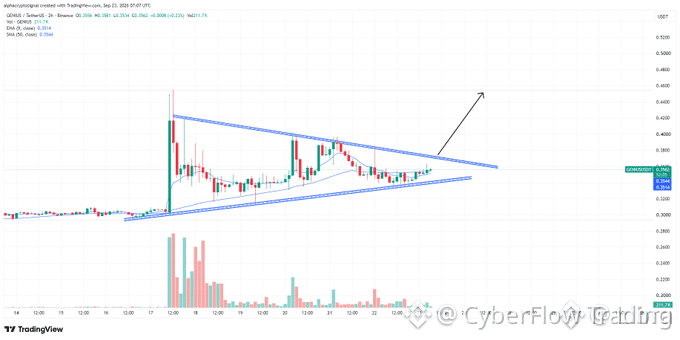
🚀 $GENIUS COULD BREAK THROUGH SYMMETRICAL TRIANGLE—WATCH THE APEX! 📈
The market's been squeezing $GENIUS into a textbook symmetrical triangle, and every side is tightening like a spring ready to snap. 📊 The apex is humming with hidden liquidity, and smart money is likely stacking orders just a tick above the breakout zone. 🦈
When the price finally erupts, we could see a clean swing into the next resistance band, giving early birds a sweet upside. ⚡ Keep an eye on volume spikes and any bullish divergence as the candle closes near the apex. 📈 💬 Are you poised to ride the breakout or waiting for the squeeze to finish? 👇
⚠️ Not financial advice. Always manage your risk. 🛡️
🏷️ #GENIUS #ChartPattern #Triangle #Crypto
🔥 💎
🚀 $GENIUS COULD BREAK THROUGH SYMMETRICAL TRIANGLE—WATCH THE APEX! 📈
The market's been squeezing $GENIUS into a textbook symmetrical triangle, and every side is tightening like a spring ready to snap. 📊 The apex is humming with hidden liquidity, and smart money is likely stacking orders just a tick above the breakout zone. 🦈
When the price finally erupts, we could see a clean swing into the next resistance band, giving early birds a sweet upside. ⚡ Keep an eye on volume spikes and any bullish divergence as the candle closes near the apex. 📈 💬 Are you poised to ride the breakout or waiting for the squeeze to finish? 👇
⚠️ Not financial advice. Always manage your risk. 🛡️
🏷️ #GENIUS #ChartPattern #Triangle #Crypto
🔥 💎
The market's been squeezing $GENIUS into a textbook symmetrical triangle, and every side is tightening like a spring ready to snap. 📊 The apex is humming with hidden liquidity, and smart money is likely stacking orders just a tick above the breakout zone. 🦈
When the price finally erupts, we could see a clean swing into the next resistance band, giving early birds a sweet upside. ⚡ Keep an eye on volume spikes and any bullish divergence as the candle closes near the apex. 📈 💬 Are you poised to ride the breakout or waiting for the squeeze to finish? 👇
⚠️ Not financial advice. Always manage your risk. 🛡️
🏷️ #GENIUS #ChartPattern #Triangle #Crypto
🔥 💎
165

·
--
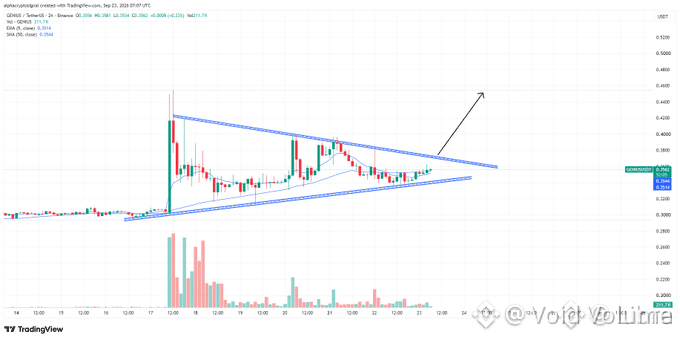
🚨 $GENIUS COULD BREAK THE SYMMETRICAL TRIANGLE APEX – WATCH FOR INSTANT SWEEP! 📈
The clean symmetrical triangle on $GENIUS is tightening, indicating a classic liquidity hunt as smart money layers orders near the apex. 📊
A breakout beyond the upper trendline would signal an institutional sweep, while a failure below the lower bound could trigger a swift capitulation. 🦈
Watch volume spikes and order‑block retests for the decisive trigger; the market is primed for a high‑impact move. 💡 💬 Which side of the triangle are you positioning for? 👇
⚠️ Not financial advice. Always manage your risk. 🛡️
🏷️ #GENIUS #TriangleSetup #SmartMoney #Crypto
🔥 💎
🚨 $GENIUS COULD BREAK THE SYMMETRICAL TRIANGLE APEX – WATCH FOR INSTANT SWEEP! 📈
The clean symmetrical triangle on $GENIUS is tightening, indicating a classic liquidity hunt as smart money layers orders near the apex. 📊
A breakout beyond the upper trendline would signal an institutional sweep, while a failure below the lower bound could trigger a swift capitulation. 🦈
Watch volume spikes and order‑block retests for the decisive trigger; the market is primed for a high‑impact move. 💡 💬 Which side of the triangle are you positioning for? 👇
⚠️ Not financial advice. Always manage your risk. 🛡️
🏷️ #GENIUS #TriangleSetup #SmartMoney #Crypto
🔥 💎
The clean symmetrical triangle on $GENIUS is tightening, indicating a classic liquidity hunt as smart money layers orders near the apex. 📊
A breakout beyond the upper trendline would signal an institutional sweep, while a failure below the lower bound could trigger a swift capitulation. 🦈
Watch volume spikes and order‑block retests for the decisive trigger; the market is primed for a high‑impact move. 💡 💬 Which side of the triangle are you positioning for? 👇
⚠️ Not financial advice. Always manage your risk. 🛡️
🏷️ #GENIUS #TriangleSetup #SmartMoney #Crypto
🔥 💎
196

·
--
Saw PANews: On Thursday, the Federal Reserve put forward two rule proposals to implement the 《GENIUS Act》 and establish regulatory responsibilities for stablecoin issuers. The proposals are now in a 60-day public comment period.
The first proposal focuses on capital and reserves—requiring that stablecoins be sufficiently backed by highly liquid assets so they can hold up even during periods of stress. It also lays out which stablecoin-related activities banks under Federal Reserve supervision are allowed to do, including stablecoin rewards. The second proposal concerns the process for banks issuing their own stablecoins: they must submit a business plan, financial information, and related documents such as policies and procedures.
Once GENIUS is implemented, the fine details begin to get tightened on the bank side—how reserves should be set aside, whether rewards can be issued, and how a bank’s own coin is approved and filed will all be clarified and debated during these 60 days of public consultation.#稳定币 #GENIUS #美联储
Saw PANews: On Thursday, the Federal Reserve put forward two rule proposals to implement the 《GENIUS Act》 and establish regulatory responsibilities for stablecoin issuers. The proposals are now in a 60-day public comment period.
The first proposal focuses on capital and reserves—requiring that stablecoins be sufficiently backed by highly liquid assets so they can hold up even during periods of stress. It also lays out which stablecoin-related activities banks under Federal Reserve supervision are allowed to do, including stablecoin rewards. The second proposal concerns the process for banks issuing their own stablecoins: they must submit a business plan, financial information, and related documents such as policies and procedures.
Once GENIUS is implemented, the fine details begin to get tightened on the bank side—how reserves should be set aside, whether rewards can be issued, and how a bank’s own coin is approved and filed will all be clarified and debated during these 60 days of public consultation.#稳定币 #GENIUS #美联储
The first proposal focuses on capital and reserves—requiring that stablecoins be sufficiently backed by highly liquid assets so they can hold up even during periods of stress. It also lays out which stablecoin-related activities banks under Federal Reserve supervision are allowed to do, including stablecoin rewards. The second proposal concerns the process for banks issuing their own stablecoins: they must submit a business plan, financial information, and related documents such as policies and procedures.
Once GENIUS is implemented, the fine details begin to get tightened on the bank side—how reserves should be set aside, whether rewards can be issued, and how a bank’s own coin is approved and filed will all be clarified and debated during these 60 days of public consultation.#稳定币 #GENIUS #美联储

82

·
--
The Fed just handed stablecoin issuers fresh capital, redeemed the rules—and yet, <c-1/> $GENIUS is actually bucking the trend and pulling up 4.25%. It’s currently at $0.3554. This price action is completely opposite to what the regulatory news suggests.
Old-school “news-torching” veterans all know the routine: before the $GENIUS Act takes effect, they borrow good news to pump the price and then distribute. Now the whole internet is watching it to trade on compliance expectations, and anyone chasing in is basically becoming the bagholder for the main players.
If you want to get involved, don’t lose your head. Wait for the daily chart to pull back and confirm support, then enter in batches. Hold the spot firmly and don’t get knocked out by a wick/candlestick “needle.” For futures, set leverage to the minimum—don’t randomly hold and force your position.
Time prediction: how many days can this run last? Optimists subtract 1, cautious folks subtract 2
#Write2Earn #BinanceSquare #GENIUS Stablecoin #TradingTournament
The Fed just handed stablecoin issuers fresh capital, redeemed the rules—and yet, <c-1/> $GENIUS is actually bucking the trend and pulling up 4.25%. It’s currently at $0.3554. This price action is completely opposite to what the regulatory news suggests.
Old-school “news-torching” veterans all know the routine: before the $GENIUS Act takes effect, they borrow good news to pump the price and then distribute. Now the whole internet is watching it to trade on compliance expectations, and anyone chasing in is basically becoming the bagholder for the main players.
If you want to get involved, don’t lose your head. Wait for the daily chart to pull back and confirm support, then enter in batches. Hold the spot firmly and don’t get knocked out by a wick/candlestick “needle.” For futures, set leverage to the minimum—don’t randomly hold and force your position.
Time prediction: how many days can this run last? Optimists subtract 1, cautious folks subtract 2
#Write2Earn #BinanceSquare #GENIUS Stablecoin #TradingTournament
Old-school “news-torching” veterans all know the routine: before the $GENIUS Act takes effect, they borrow good news to pump the price and then distribute. Now the whole internet is watching it to trade on compliance expectations, and anyone chasing in is basically becoming the bagholder for the main players.
If you want to get involved, don’t lose your head. Wait for the daily chart to pull back and confirm support, then enter in batches. Hold the spot firmly and don’t get knocked out by a wick/candlestick “needle.” For futures, set leverage to the minimum—don’t randomly hold and force your position.
Time prediction: how many days can this run last? Optimists subtract 1, cautious folks subtract 2
#Write2Earn #BinanceSquare #GENIUS Stablecoin #TradingTournament

139

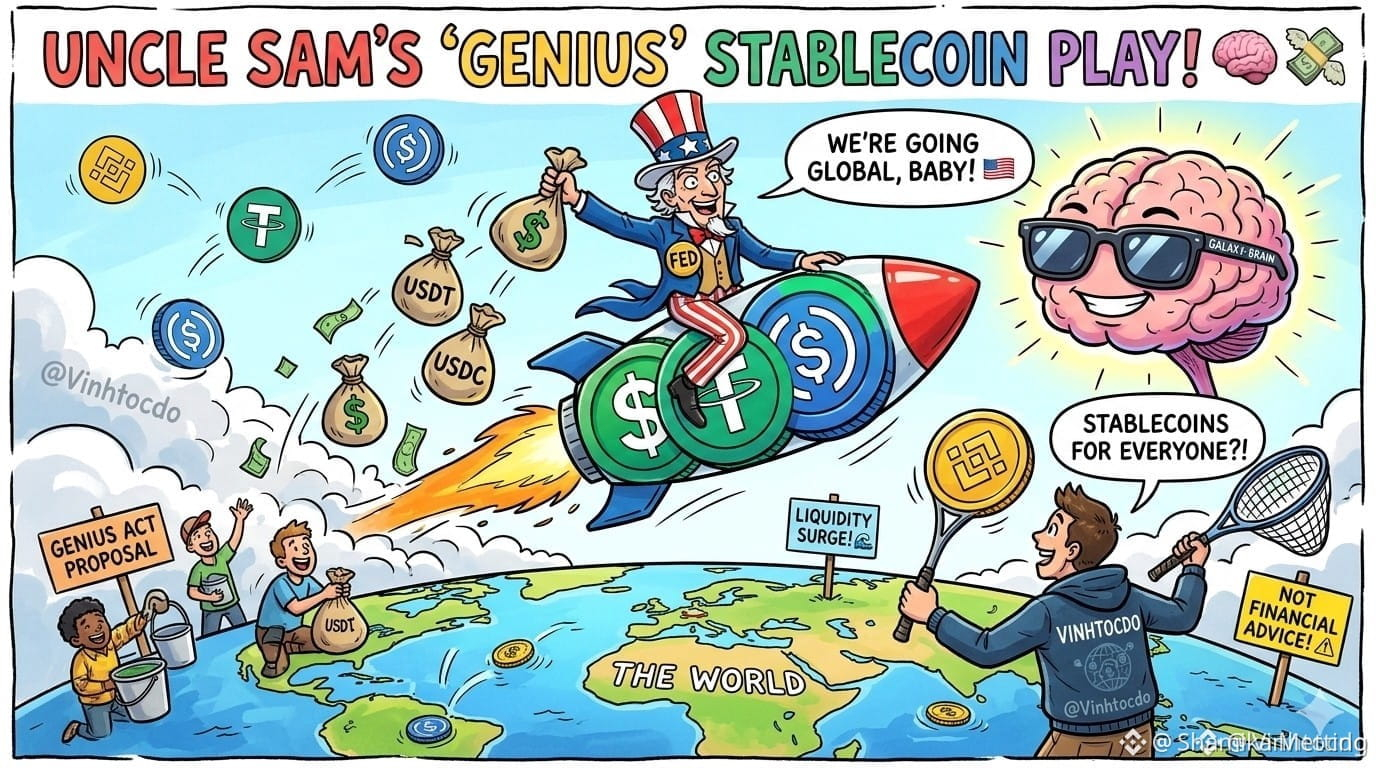
🚀 The Federal Reserve is pushing Stablecoins worldwide, and this is the pure #Genius !
So the Federal Reserve has just submitted two proposals under the GENIUS law to regulate allowing banks to issue stablecoins. 🧠 Uncle Sam is no longer trying to ban cryptocurrencies—he’s trying to export the US dollar everywhere via blockchain! Imagine the mindset shift from another world. 💸
What should traders do?
Don’t panic and sell your holdings. Volatility is just a side job. Keep your stablecoins locked and ready, stick to top-tier assets, and stay alert for liquidity spikes! 🌊
Please continue following
👉 $BTC
{future}(BTCUSDT)
|$ETH
{future}(ETHUSDT)
| $BNB
{future}(BNBUSDT)
⚠️ Warning: This is in no way financial advice. Do your own research at all times!
Please continue following
#CryptoRegulation #FedNews #stablecoin #CryptoTrading #USDC
🚀 The Federal Reserve is pushing Stablecoins worldwide, and this is the pure #Genius !
So the Federal Reserve has just submitted two proposals under the GENIUS law to regulate allowing banks to issue stablecoins. 🧠 Uncle Sam is no longer trying to ban cryptocurrencies—he’s trying to export the US dollar everywhere via blockchain! Imagine the mindset shift from another world. 💸
What should traders do?
Don’t panic and sell your holdings. Volatility is just a side job. Keep your stablecoins locked and ready, stick to top-tier assets, and stay alert for liquidity spikes! 🌊
Please continue following
👉 $BTC
|$ETH
| $BNB
⚠️ Warning: This is in no way financial advice. Do your own research at all times!
Please continue following
#CryptoRegulation #FedNews #stablecoin #CryptoTrading #USDC
So the Federal Reserve has just submitted two proposals under the GENIUS law to regulate allowing banks to issue stablecoins. 🧠 Uncle Sam is no longer trying to ban cryptocurrencies—he’s trying to export the US dollar everywhere via blockchain! Imagine the mindset shift from another world. 💸
What should traders do?
Don’t panic and sell your holdings. Volatility is just a side job. Keep your stablecoins locked and ready, stick to top-tier assets, and stay alert for liquidity spikes! 🌊
Please continue following
👉 $BTC
|$ETH
| $BNB
⚠️ Warning: This is in no way financial advice. Do your own research at all times!
Please continue following
#CryptoRegulation #FedNews #stablecoin #CryptoTrading #USDC
2
125

·
--
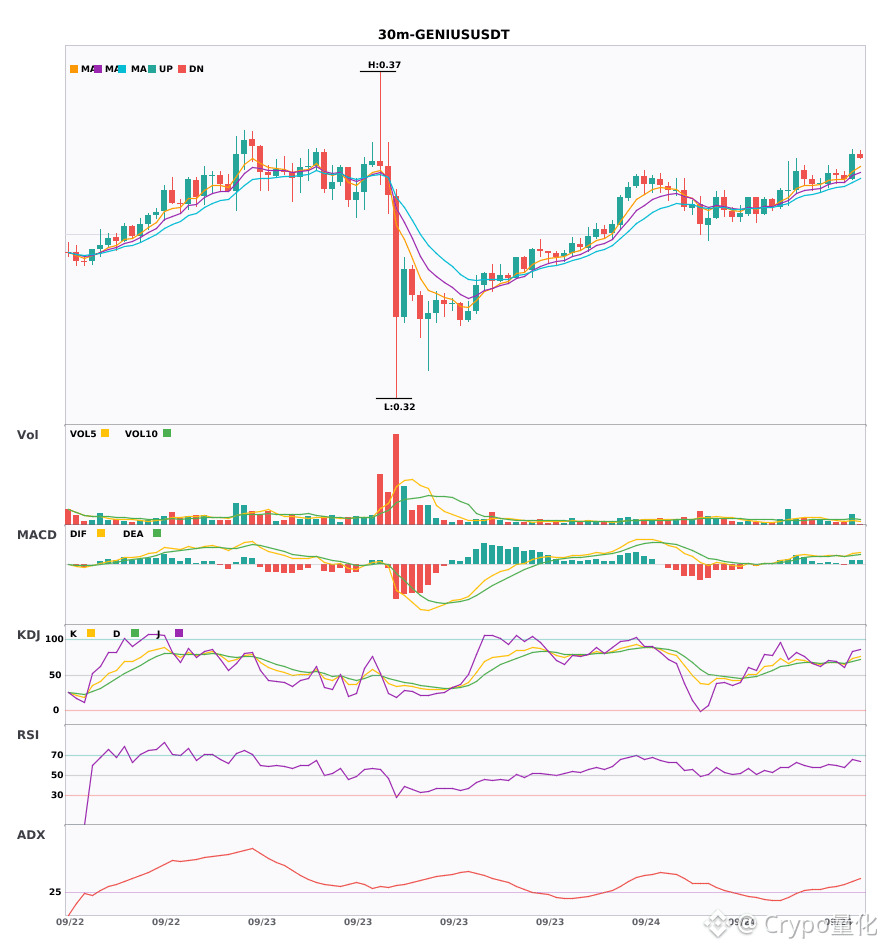
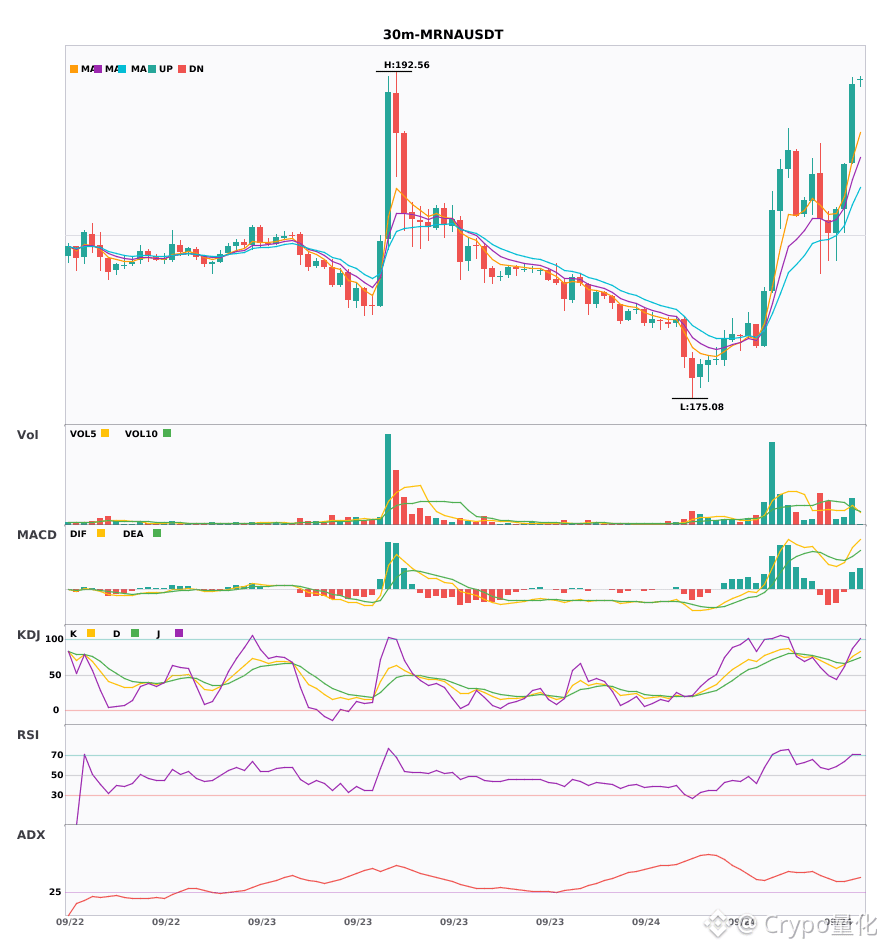
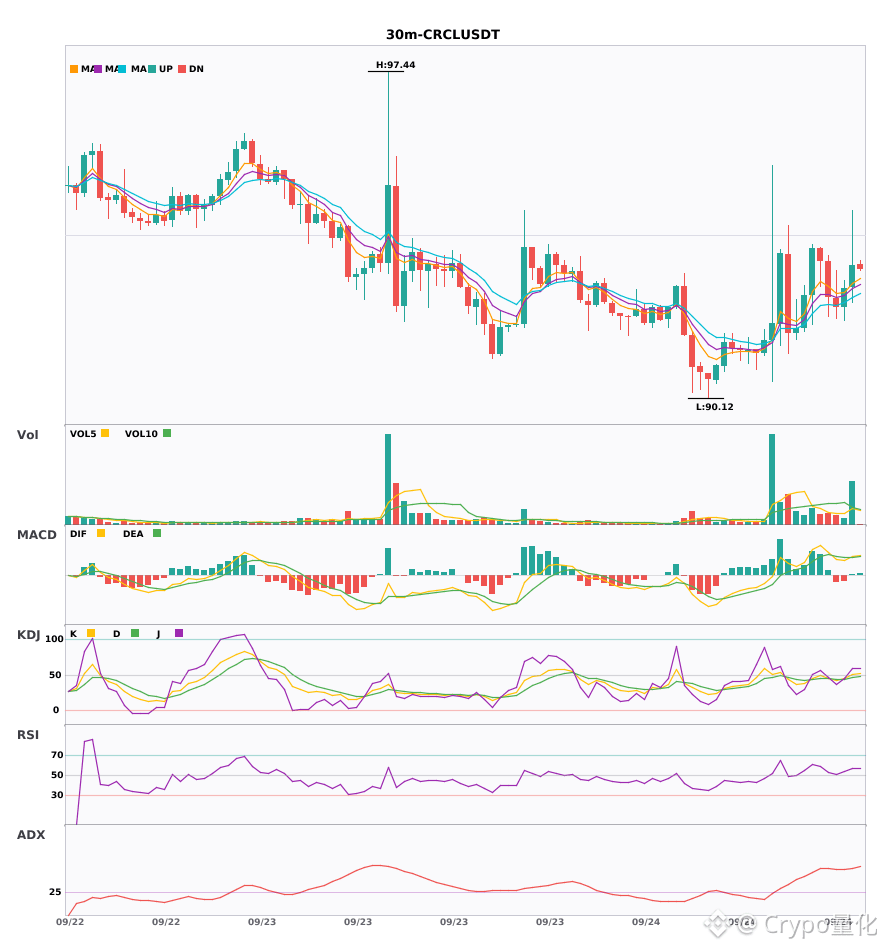
$GENIUS $MRNA $CRCL 30 minutes golden cross with volume rising and strong advance together—who will “blow up” first?🔥
════════════════════
🔴 $GENIUS 30 minutes Bullish signal
⚠️ Technicals: ADX at 42, trend is clear. After the MACD golden cross, the red histogram keeps expanding. Moving averages are in bullish alignment, dispersing upward. K crosses above D and is not overbought yet. Bias is bullish in the short term; volume expands by 1.7x.
════════════════════
🔴 $MRNA 30 minutes Bullish signal
⚠️ Technicals: ADX is as high as 39—very obvious trend. After the MACD golden cross, volume increases and the red histogram keeps expanding. Moving averages are in bullish alignment and dispersing upward. K crosses above D and is not overbought yet. Trading volume expands by 1.6x; still bullish in the short term.
════════════════════
🔴 $CRCL 30 minutes Bullish signal
⚠️ Technicals: ADX indicates an extremely strong trend—watch out for an overheated pullback. After the MACD bullish cross above zero, volume surges and the red histogram expands. Moving averages are in bullish alignment and dispersing upward; volume explodes to 2.5x.
════════════════════
🔔 Get first-hand market updates on sudden moves 🔔
#技术分析 #GENIUS #MRNA #CRCL
📌 When trading, pay attention to whether the candlestick patterns match
$GENIUS $MRNA $CRCL 30 minutes golden cross with volume rising and strong advance together—who will “blow up” first?🔥
════════════════════
🔴 $GENIUS 30 minutes Bullish signal
⚠️ Technicals: ADX at 42, trend is clear. After the MACD golden cross, the red histogram keeps expanding. Moving averages are in bullish alignment, dispersing upward. K crosses above D and is not overbought yet. Bias is bullish in the short term; volume expands by 1.7x.
════════════════════
🔴 $MRNA 30 minutes Bullish signal
⚠️ Technicals: ADX is as high as 39—very obvious trend. After the MACD golden cross, volume increases and the red histogram keeps expanding. Moving averages are in bullish alignment and dispersing upward. K crosses above D and is not overbought yet. Trading volume expands by 1.6x; still bullish in the short term.
════════════════════
🔴 $CRCL 30 minutes Bullish signal
⚠️ Technicals: ADX indicates an extremely strong trend—watch out for an overheated pullback. After the MACD bullish cross above zero, volume surges and the red histogram expands. Moving averages are in bullish alignment and dispersing upward; volume explodes to 2.5x.
════════════════════
🔔 Get first-hand market updates on sudden moves 🔔
#技术分析 #GENIUS #MRNA #CRCL
📌 When trading, pay attention to whether the candlestick patterns match
════════════════════
🔴 $GENIUS 30 minutes Bullish signal
⚠️ Technicals: ADX at 42, trend is clear. After the MACD golden cross, the red histogram keeps expanding. Moving averages are in bullish alignment, dispersing upward. K crosses above D and is not overbought yet. Bias is bullish in the short term; volume expands by 1.7x.
════════════════════
🔴 $MRNA 30 minutes Bullish signal
⚠️ Technicals: ADX is as high as 39—very obvious trend. After the MACD golden cross, volume increases and the red histogram keeps expanding. Moving averages are in bullish alignment and dispersing upward. K crosses above D and is not overbought yet. Trading volume expands by 1.6x; still bullish in the short term.
════════════════════
🔴 $CRCL 30 minutes Bullish signal
⚠️ Technicals: ADX indicates an extremely strong trend—watch out for an overheated pullback. After the MACD bullish cross above zero, volume surges and the red histogram expands. Moving averages are in bullish alignment and dispersing upward; volume explodes to 2.5x.
════════════════════
🔔 Get first-hand market updates on sudden moves 🔔
#技术分析 #GENIUS #MRNA #CRCL
📌 When trading, pay attention to whether the candlestick patterns match
42

·
--
Bearish
$GENIUS is trading around $0.35–$0.36, down roughly 6–9% today, while still holding a positive weekly move of about 16–20%.
{future}(GENIUSUSDT)
Short term, the $0.34 area is an important support zone, while $0.39–$0.40 is the key resistance area to watch. A strong move above resistance could improve momentum, while losing support may bring renewed selling pressure. Volume remains active, so volatility could stay high.
*Not financial advice.*
#genius #MultiversXPlansHardForkRecovery #CircleLaunchesInstitutionalBTCBackedBorrowing #NEARRisesNearly80%InAWeek
$GENIUS is trading around $0.35–$0.36, down roughly 6–9% today, while still holding a positive weekly move of about 16–20%.
Short term, the $0.34 area is an important support zone, while $0.39–$0.40 is the key resistance area to watch. A strong move above resistance could improve momentum, while losing support may bring renewed selling pressure. Volume remains active, so volatility could stay high.
*Not financial advice.*
#genius #MultiversXPlansHardForkRecovery #CircleLaunchesInstitutionalBTCBackedBorrowing #NEARRisesNearly80%InAWeek
Short term, the $0.34 area is an important support zone, while $0.39–$0.40 is the key resistance area to watch. A strong move above resistance could improve momentum, while losing support may bring renewed selling pressure. Volume remains active, so volatility could stay high.
*Not financial advice.*
#genius #MultiversXPlansHardForkRecovery #CircleLaunchesInstitutionalBTCBackedBorrowing #NEARRisesNearly80%InAWeek
426
·
--
🚨 CZ-BACKED ON-CHAIN PLATFORM UNVEILS UNIQUE 6666 CONTRACT IDENTITY FOR $GENIUS TOKENS! ⚡
💡 On-chain trading platform Genius Terminal just dropped a sharp branding maneuver. Every fresh launch on Genius.fun will now carry a signature "6666" suffix on its smart contract address, establishing instant recognition across block explorers.
🔍 Backed by YZi Labs with industry veteran CZ on the advisory board, this vanity address strategy targets maximum visibility in crowded DEX liquidity pools. 📊 When smart money scans new listings, immediate visual verification can significantly accelerate early volume velocity.
💬 Will iconic contract signatures become the new standard for catching early market momentum? 👇
⚠️ Not financial advice. Always manage your risk. 🛡️
🏷️ #GENIUS #OnChain #DeFi #CryptoNews
🔥 💎
🚨 CZ-BACKED ON-CHAIN PLATFORM UNVEILS UNIQUE 6666 CONTRACT IDENTITY FOR $GENIUS TOKENS! ⚡
💡 On-chain trading platform Genius Terminal just dropped a sharp branding maneuver. Every fresh launch on Genius.fun will now carry a signature "6666" suffix on its smart contract address, establishing instant recognition across block explorers.
🔍 Backed by YZi Labs with industry veteran CZ on the advisory board, this vanity address strategy targets maximum visibility in crowded DEX liquidity pools. 📊 When smart money scans new listings, immediate visual verification can significantly accelerate early volume velocity.
💬 Will iconic contract signatures become the new standard for catching early market momentum? 👇
⚠️ Not financial advice. Always manage your risk. 🛡️
🏷️ #GENIUS #OnChain #DeFi #CryptoNews
🔥 💎
💡 On-chain trading platform Genius Terminal just dropped a sharp branding maneuver. Every fresh launch on Genius.fun will now carry a signature "6666" suffix on its smart contract address, establishing instant recognition across block explorers.
🔍 Backed by YZi Labs with industry veteran CZ on the advisory board, this vanity address strategy targets maximum visibility in crowded DEX liquidity pools. 📊 When smart money scans new listings, immediate visual verification can significantly accelerate early volume velocity.
💬 Will iconic contract signatures become the new standard for catching early market momentum? 👇
⚠️ Not financial advice. Always manage your risk. 🛡️
🏷️ #GENIUS #OnChain #DeFi #CryptoNews
🔥 💎
237

·
--
🚨 ON-CHAIN TERMINAL $GENIUS INTRODUCES SIGNATURE CONTRACT ADDRESSES TO SPOT INSTITUTIONAL FLOWS! 💡
YZi Labs-backed Genius Terminal, with CZ serving as advisor, just upgraded its deployment architecture on Genius.fun. All freshly minted smart contracts will now feature a custom 6666 suffix to establish instant visual liquidity verification across on-chain scanners. 🔍
Smart money thrives on clarity, and standardizing contract footprints reduces execution friction for high-speed DEX traders while enhancing ecosystem brand awareness. 📊 Institutional backing paired with recognizable contract mechanics often marks the groundwork for serious ecosystem volume expansion. 💡
💬 Will these standardized contract signatures give on-chain traders an edge in tracking early smart money accumulation? 👇
⚠️ Not financial advice. Always manage your risk. 🛡️
🏷️ #GENIUS #OnChain #SmartMoney #Crypto #Binance
🦈 🎯
🚨 ON-CHAIN TERMINAL $GENIUS INTRODUCES SIGNATURE CONTRACT ADDRESSES TO SPOT INSTITUTIONAL FLOWS! 💡
YZi Labs-backed Genius Terminal, with CZ serving as advisor, just upgraded its deployment architecture on Genius.fun. All freshly minted smart contracts will now feature a custom 6666 suffix to establish instant visual liquidity verification across on-chain scanners. 🔍
Smart money thrives on clarity, and standardizing contract footprints reduces execution friction for high-speed DEX traders while enhancing ecosystem brand awareness. 📊 Institutional backing paired with recognizable contract mechanics often marks the groundwork for serious ecosystem volume expansion. 💡
💬 Will these standardized contract signatures give on-chain traders an edge in tracking early smart money accumulation? 👇
⚠️ Not financial advice. Always manage your risk. 🛡️
🏷️ #GENIUS #OnChain #SmartMoney #Crypto #Binance
🦈 🎯
YZi Labs-backed Genius Terminal, with CZ serving as advisor, just upgraded its deployment architecture on Genius.fun. All freshly minted smart contracts will now feature a custom 6666 suffix to establish instant visual liquidity verification across on-chain scanners. 🔍
Smart money thrives on clarity, and standardizing contract footprints reduces execution friction for high-speed DEX traders while enhancing ecosystem brand awareness. 📊 Institutional backing paired with recognizable contract mechanics often marks the groundwork for serious ecosystem volume expansion. 💡
💬 Will these standardized contract signatures give on-chain traders an edge in tracking early smart money accumulation? 👇
⚠️ Not financial advice. Always manage your risk. 🛡️
🏷️ #GENIUS #OnChain #SmartMoney #Crypto #Binance
🦈 🎯
301

·
--
🔥 $GENIUS Bullish Setup: Key Pullback into Support
Rating: 76/100 [A] • Strategy: EMATrend
📊 Trade Thesis:
The 4-hour market structure remains firmly bullish above the 200 EMA. Following a healthy retracement into the 50 EMA on the 1-hour chart, buyers printed a strong rejection candle with increasing volume, confirming defense of support.
🎯 Entry: 0.35980
🛑 Stop-Loss: 0.34852 (-3.14%)
✅ Take-Profit: 0.38236 (+6.27%)
⚖️ Risk/Reward: 1:2.0
🚫 Invalidation Rule: If a 1-hour candle closes below $0.34852 (-3.14%), this bullish thesis is invalidated. Exit trade without holding into drawdowns.
💡 Trade Management: Secure 50% profit at Take-Profit target ($0.38236 +6.27%) and move Stop-Loss to Breakeven to eliminate downside risk.
⚖️ Risk Note: Moderate leverage recommended (3x–5x on Futures). Never risk more than 1–2% of total portfolio capital on a single setup.
📈 Binance Market Data:
• Funding: 0.0050% (Neutral) • Next: 3h 19m
• Open Interest (OI): $9.31M
• 24h Volume: $16.19M
• 24h Range: 0.3439 — 0.3972 (-5.4%)
📈 Strategy Track Record: WR 49% over 346 trades
#GENIUS #FuturesTrading #Altcoins #BinanceSquare
⚠️ Not financial advice. Always manage your risk.
🔥 $GENIUS Bullish Setup: Key Pullback into Support
Rating: 76/100 [A] • Strategy: EMATrend
📊 Trade Thesis:
The 4-hour market structure remains firmly bullish above the 200 EMA. Following a healthy retracement into the 50 EMA on the 1-hour chart, buyers printed a strong rejection candle with increasing volume, confirming defense of support.
🎯 Entry: 0.35980
🛑 Stop-Loss: 0.34852 (-3.14%)
✅ Take-Profit: 0.38236 (+6.27%)
⚖️ Risk/Reward: 1:2.0
🚫 Invalidation Rule: If a 1-hour candle closes below $0.34852 (-3.14%), this bullish thesis is invalidated. Exit trade without holding into drawdowns.
💡 Trade Management: Secure 50% profit at Take-Profit target ($0.38236 +6.27%) and move Stop-Loss to Breakeven to eliminate downside risk.
⚖️ Risk Note: Moderate leverage recommended (3x–5x on Futures). Never risk more than 1–2% of total portfolio capital on a single setup.
📈 Binance Market Data:
• Funding: 0.0050% (Neutral) • Next: 3h 19m
• Open Interest (OI): $9.31M
• 24h Volume: $16.19M
• 24h Range: 0.3439 — 0.3972 (-5.4%)
📈 Strategy Track Record: WR 49% over 346 trades
#GENIUS #FuturesTrading #Altcoins #BinanceSquare
⚠️ Not financial advice. Always manage your risk.
Rating: 76/100 [A] • Strategy: EMATrend
📊 Trade Thesis:
The 4-hour market structure remains firmly bullish above the 200 EMA. Following a healthy retracement into the 50 EMA on the 1-hour chart, buyers printed a strong rejection candle with increasing volume, confirming defense of support.
🎯 Entry: 0.35980
🛑 Stop-Loss: 0.34852 (-3.14%)
✅ Take-Profit: 0.38236 (+6.27%)
⚖️ Risk/Reward: 1:2.0
🚫 Invalidation Rule: If a 1-hour candle closes below $0.34852 (-3.14%), this bullish thesis is invalidated. Exit trade without holding into drawdowns.
💡 Trade Management: Secure 50% profit at Take-Profit target ($0.38236 +6.27%) and move Stop-Loss to Breakeven to eliminate downside risk.
⚖️ Risk Note: Moderate leverage recommended (3x–5x on Futures). Never risk more than 1–2% of total portfolio capital on a single setup.
📈 Binance Market Data:
• Funding: 0.0050% (Neutral) • Next: 3h 19m
• Open Interest (OI): $9.31M
• 24h Volume: $16.19M
• 24h Range: 0.3439 — 0.3972 (-5.4%)
📈 Strategy Track Record: WR 49% over 346 trades
#GENIUS #FuturesTrading #Altcoins #BinanceSquare
⚠️ Not financial advice. Always manage your risk.
99

·
--
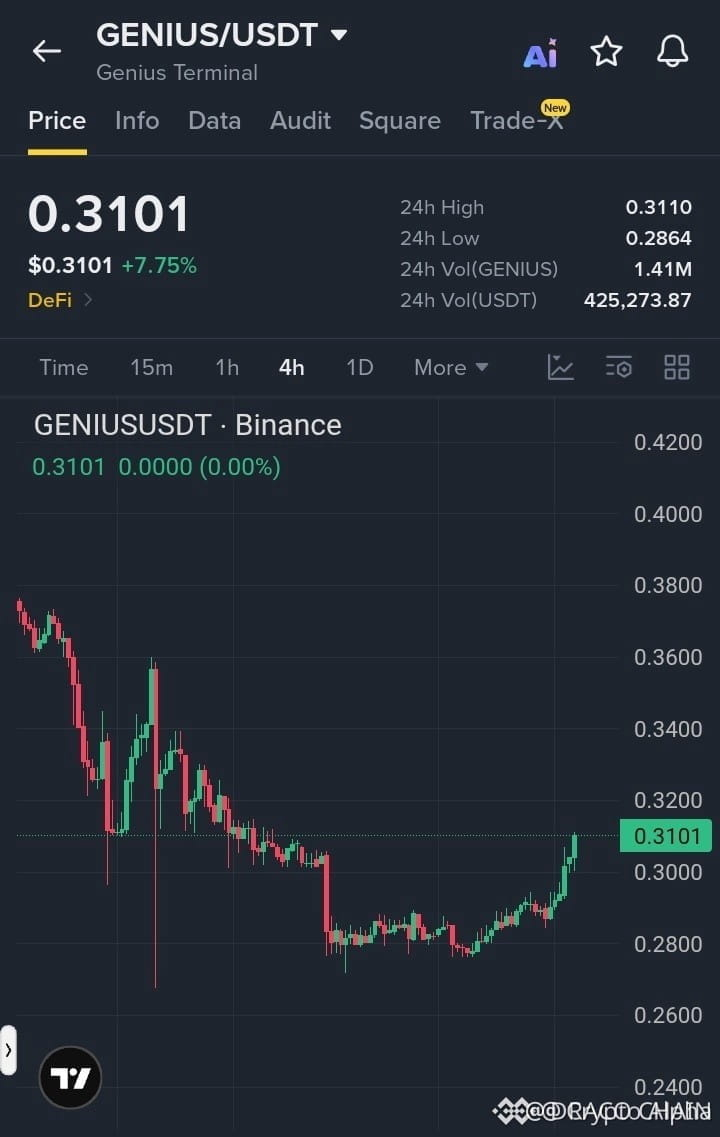
🚨 $GENIUS BREAKS MULTI-WEEK CONSOLIDATION AS INSTITUTIONAL DEMAND RECLAIMS KEY LIQUIDITY! ⚡
Entry: 0.305 - 0.310 ⚡
Target: 0.315 - 0.330 🚀
Stop Loss: 0.296 ⚠️
Smart money has successfully absorbed sell-side liquidity, driving $GENIUS above the crucial 0.30 structural pivot after an extended base-building phase. 📊 The immediate push toward the 0.31 supply block signals strong institutional intent to clear lingering overhead resistance.
A clean hold above this fresh demand zone establishes a clear inefficiency fill runway into higher targets. 🌊 With order flow leaning decisively bullish, structural momentum favors continuation so long as key support remains intact. 💬 Are you front-running this breakout or waiting for structural confirmation above 0.31? 👇
⚠️ Not financial advice. Always manage your risk. 🛡️
🏷️ #GENIUS #Breakout #Crypto #SmartMoney #Trading
⚡ 🎯
🚨 $GENIUS BREAKS MULTI-WEEK CONSOLIDATION AS INSTITUTIONAL DEMAND RECLAIMS KEY LIQUIDITY! ⚡
Entry: 0.305 - 0.310 ⚡
Target: 0.315 - 0.330 🚀
Stop Loss: 0.296 ⚠️
Smart money has successfully absorbed sell-side liquidity, driving $GENIUS above the crucial 0.30 structural pivot after an extended base-building phase. 📊 The immediate push toward the 0.31 supply block signals strong institutional intent to clear lingering overhead resistance.
A clean hold above this fresh demand zone establishes a clear inefficiency fill runway into higher targets. 🌊 With order flow leaning decisively bullish, structural momentum favors continuation so long as key support remains intact. 💬 Are you front-running this breakout or waiting for structural confirmation above 0.31? 👇
⚠️ Not financial advice. Always manage your risk. 🛡️
🏷️ #GENIUS #Breakout #Crypto #SmartMoney #Trading
⚡ 🎯
Entry: 0.305 - 0.310 ⚡
Target: 0.315 - 0.330 🚀
Stop Loss: 0.296 ⚠️
Smart money has successfully absorbed sell-side liquidity, driving $GENIUS above the crucial 0.30 structural pivot after an extended base-building phase. 📊 The immediate push toward the 0.31 supply block signals strong institutional intent to clear lingering overhead resistance.
A clean hold above this fresh demand zone establishes a clear inefficiency fill runway into higher targets. 🌊 With order flow leaning decisively bullish, structural momentum favors continuation so long as key support remains intact. 💬 Are you front-running this breakout or waiting for structural confirmation above 0.31? 👇
⚠️ Not financial advice. Always manage your risk. 🛡️
🏷️ #GENIUS #Breakout #Crypto #SmartMoney #Trading
⚡ 🎯
195

·
--
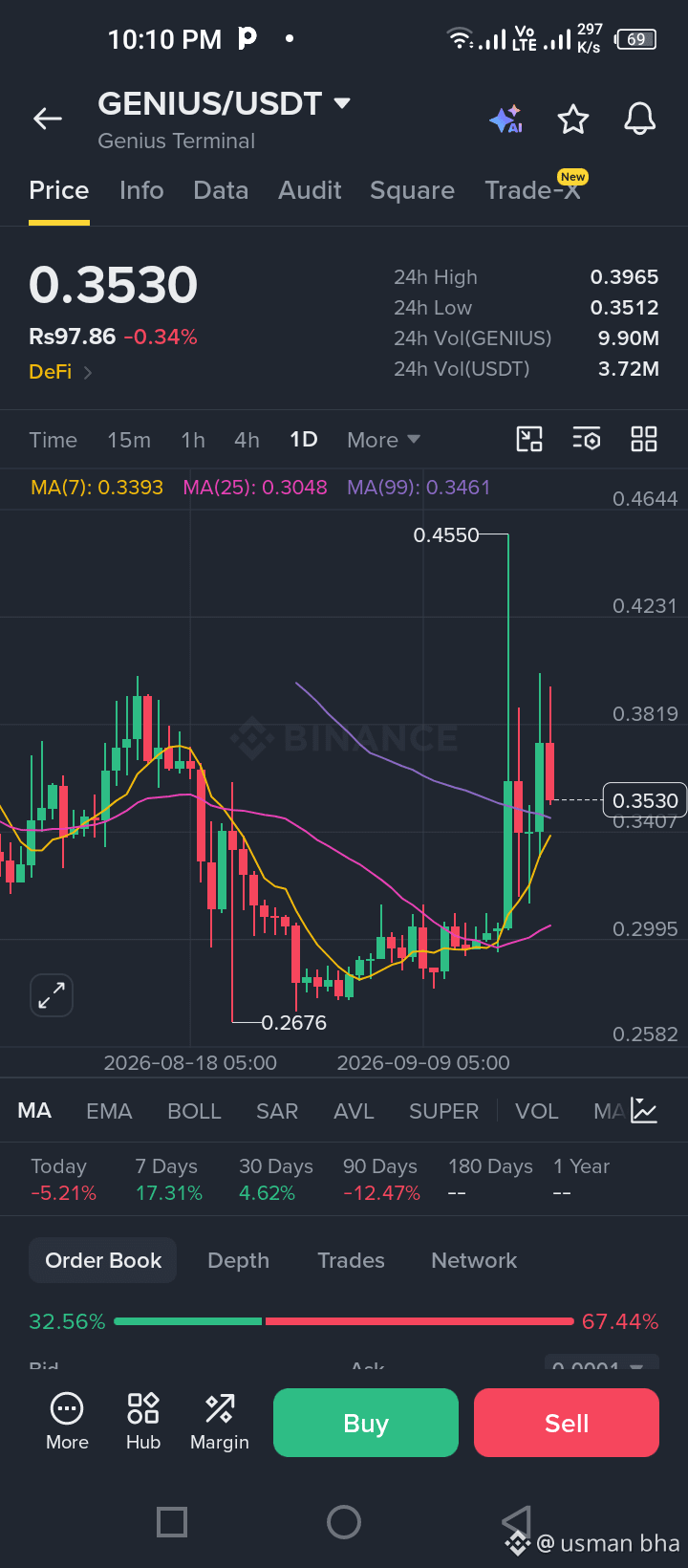
$GENIUS Launchpad is starting to make some noise on the decentralized side!
A few days ago, Genius launched a platform similar to FourMeme and Flap, and it’s definitely worth keeping an eye on. 👀
It’s still early, so there could be some interesting opportunities ahead.
Let’s watch the ecosystem grow and see what $GENIUS brings next. 🔥📈
#GENIUS
$GENIUS Launchpad is starting to make some noise on the decentralized side!
A few days ago, Genius launched a platform similar to FourMeme and Flap, and it’s definitely worth keeping an eye on. 👀
It’s still early, so there could be some interesting opportunities ahead.
Let’s watch the ecosystem grow and see what $GENIUS brings next. 🔥📈
#GENIUS
A few days ago, Genius launched a platform similar to FourMeme and Flap, and it’s definitely worth keeping an eye on. 👀
It’s still early, so there could be some interesting opportunities ahead.
Let’s watch the ecosystem grow and see what $GENIUS brings next. 🔥📈
#GENIUS
1
206

·
--
$GENIUS
#GENIUS | A sudden buy attack of 69% and a surprising reversal that breaks sell dominance with a firepower thrust 🚀
• Direction: Long / Quick rebound 🟢
• Entry: 0.3450 - 0.3542
• Stop loss: 0.3360
🎯 Instant scalping checkpoints:
1️⃣ 0.3650
2️⃣ 0.3780
3️⃣ 0.3920
💡 Market pulse: A sudden surge records an upward move of 1.1% within one minute, with liquidity flowing at $32.4K and strong buying positioning at 69% ($22.4K for buyers). An attempt to turn the table and make up for the decline of the past 24 hours, with trading volume at $3.3M. Tight, closely packed targets to grab airborne profits at lightning speed, with full decisiveness! ⚡️
{future}(GENIUSUSDT)
$ZEC
{future}(ZECUSDT)
$ZEN
{future}(ZENUSDT)
$GENIUS
#GENIUS | A sudden buy attack of 69% and a surprising reversal that breaks sell dominance with a firepower thrust 🚀
• Direction: Long / Quick rebound 🟢
• Entry: 0.3450 - 0.3542
• Stop loss: 0.3360
🎯 Instant scalping checkpoints:
1️⃣ 0.3650
2️⃣ 0.3780
3️⃣ 0.3920
💡 Market pulse: A sudden surge records an upward move of 1.1% within one minute, with liquidity flowing at $32.4K and strong buying positioning at 69% ($22.4K for buyers). An attempt to turn the table and make up for the decline of the past 24 hours, with trading volume at $3.3M. Tight, closely packed targets to grab airborne profits at lightning speed, with full decisiveness! ⚡️
$ZEC
$ZEN
#GENIUS | A sudden buy attack of 69% and a surprising reversal that breaks sell dominance with a firepower thrust 🚀
• Direction: Long / Quick rebound 🟢
• Entry: 0.3450 - 0.3542
• Stop loss: 0.3360
🎯 Instant scalping checkpoints:
1️⃣ 0.3650
2️⃣ 0.3780
3️⃣ 0.3920
💡 Market pulse: A sudden surge records an upward move of 1.1% within one minute, with liquidity flowing at $32.4K and strong buying positioning at 69% ($22.4K for buyers). An attempt to turn the table and make up for the decline of the past 24 hours, with trading volume at $3.3M. Tight, closely packed targets to grab airborne profits at lightning speed, with full decisiveness! ⚡️
$ZEC
$ZEN
2


·
--
Bullish
🚀 $GENIUS is showing strong bullish momentum.
{future}(GENIUSUSDT)
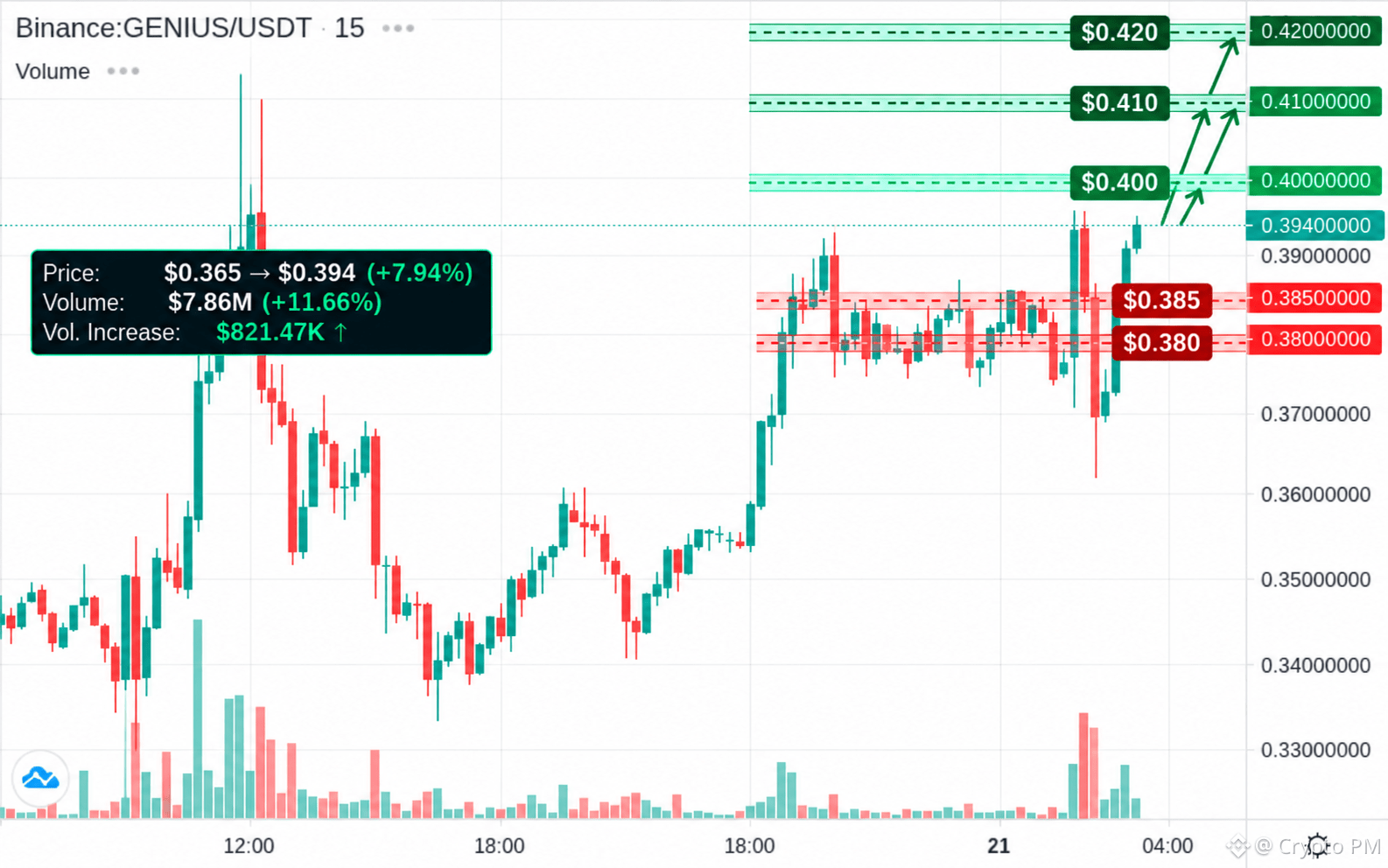
Price has moved from $0.365 to $0.394, marking a +7.94% gain.
📊 Volume has climbed to $7.86M, up 11.66%, with an additional $821.47K in volume , showing increased participation behind the move.
The 15m chart shows a strong recovery from the $0.365 area, followed by a breakout back above $0.390. Price is now testing the recent high around $0.394.
🎯 Levels to watch: • $0.400 • $0.410 • $0.420
Key support: $0.380–$0.385
A sustained breakout above $0.400 with strong volume could extend the move toward $0.410 and potentially $0.420.
⚠️ The move is already extended, so chasing the pump carries higher risk. A pullback and successful retest of the breakout zone would provide a cleaner setup.
#genius
🚀 $GENIUS is showing strong bullish momentum.
Price has moved from $0.365 to $0.394, marking a +7.94% gain.
📊 Volume has climbed to $7.86M, up 11.66%, with an additional $821.47K in volume , showing increased participation behind the move.
The 15m chart shows a strong recovery from the $0.365 area, followed by a breakout back above $0.390. Price is now testing the recent high around $0.394.
🎯 Levels to watch: • $0.400 • $0.410 • $0.420
Key support: $0.380–$0.385
A sustained breakout above $0.400 with strong volume could extend the move toward $0.410 and potentially $0.420.
⚠️ The move is already extended, so chasing the pump carries higher risk. A pullback and successful retest of the breakout zone would provide a cleaner setup.
#genius
Price has moved from $0.365 to $0.394, marking a +7.94% gain.
📊 Volume has climbed to $7.86M, up 11.66%, with an additional $821.47K in volume , showing increased participation behind the move.
The 15m chart shows a strong recovery from the $0.365 area, followed by a breakout back above $0.390. Price is now testing the recent high around $0.394.
🎯 Levels to watch: • $0.400 • $0.410 • $0.420
Key support: $0.380–$0.385
A sustained breakout above $0.400 with strong volume could extend the move toward $0.410 and potentially $0.420.
⚠️ The move is already extended, so chasing the pump carries higher risk. A pullback and successful retest of the breakout zone would provide a cleaner setup.
#genius
3
906
Log in to explore more content
Join global crypto users on Binance Square
⚡️ Get latest and useful information about crypto.
💬 Trusted by the world’s largest crypto exchange.
👍 Discover real insights from verified creators.
Email / Phone number
Trending Topics
1
#QNTRises39%
49,571 views
1,178 Discussing
2
#EthereumBreaksAbove$2700
4,394 views
116 Discussing
3
#BitgetBreachForgedRequestsNotStolenKeys
48,836 views
937 Discussing
4
#BitcoinSpotETFsTurnNetPositiveYTD
30,296 views
712 Discussing
5
#GrayscaleZcashETFHits$1BNetAssets
3,678 views
55 Discussing
6
#BitcoinSpotETFsNetInflow$191M
9,828 views
191 Discussing
7
#CFTCUpdatesGuidanceOnTokenizedAssets
72,123 views
1,658 Discussing
8
#BitgetSays$352MAffectedInHack
22,818 views
100 Discussing
9
#NYAndPolymarketSueEachOther
9,631 views
274 Discussing
10
#BinanceWillListHyperliquid(HYPE)
322,803 views
4,213 Discussing