

#rlusdsupplyhitsrecord
rlusdsupplyhitsrecord
519 views
41 Discussing
Hot
Latest

·
--
Picture this: while everyone was distracted chasing the latest meme breakout, Ripple quietly minted tens of millions of dollars in regulated stablecoins in a single afternoon.
Most traders get caught holding the bag during sudden volatility simply because they ignore the underlying liquidity pipes moving beneath the surface. We focus so much on price charts that we miss where institutional liquidity is actually parking itself.
When we look back at how $USDT and $USDC carved out their dominant market share during previous cycles, the playbook was always the same. Massive minting milestones were never just vanity metrics; they were forward-looking indicators of institutional settlement demand preparing for major on-chain activity.
Now, seeing the RLUSD supply hit unprecedented record numbers suggests Ripple is executing a targeted play to capture high-volume cross-border corridors rather than just retail trading pairs. The stablecoin landscape is no longer a simple two-horse race, and capital is clearly diversifying into enterprise-ready infrastructure.
Do you think institutional-backed stablecoins can realistically challenge USDT dominance this cycle, or is network effect simply too strong to break?
#RLUSDSupplyHitsRecord #UKSeeksViewsOnTokenizingGold
Picture this: while everyone was distracted chasing the latest meme breakout, Ripple quietly minted tens of millions of dollars in regulated stablecoins in a single afternoon.
Most traders get caught holding the bag during sudden volatility simply because they ignore the underlying liquidity pipes moving beneath the surface. We focus so much on price charts that we miss where institutional liquidity is actually parking itself.
When we look back at how $USDT and $USDC carved out their dominant market share during previous cycles, the playbook was always the same. Massive minting milestones were never just vanity metrics; they were forward-looking indicators of institutional settlement demand preparing for major on-chain activity.
Now, seeing the RLUSD supply hit unprecedented record numbers suggests Ripple is executing a targeted play to capture high-volume cross-border corridors rather than just retail trading pairs. The stablecoin landscape is no longer a simple two-horse race, and capital is clearly diversifying into enterprise-ready infrastructure.
Do you think institutional-backed stablecoins can realistically challenge USDT dominance this cycle, or is network effect simply too strong to break?
#RLUSDSupplyHitsRecord #UKSeeksViewsOnTokenizingGold
Most traders get caught holding the bag during sudden volatility simply because they ignore the underlying liquidity pipes moving beneath the surface. We focus so much on price charts that we miss where institutional liquidity is actually parking itself.
When we look back at how $USDT and $USDC carved out their dominant market share during previous cycles, the playbook was always the same. Massive minting milestones were never just vanity metrics; they were forward-looking indicators of institutional settlement demand preparing for major on-chain activity.
Now, seeing the RLUSD supply hit unprecedented record numbers suggests Ripple is executing a targeted play to capture high-volume cross-border corridors rather than just retail trading pairs. The stablecoin landscape is no longer a simple two-horse race, and capital is clearly diversifying into enterprise-ready infrastructure.
Do you think institutional-backed stablecoins can realistically challenge USDT dominance this cycle, or is network effect simply too strong to break?
#RLUSDSupplyHitsRecord #UKSeeksViewsOnTokenizingGold

14

·
--
$RLUSD hitting $2.44B supply is a sign of demand, not stability.
It means traders are locking up real USD to hold this stablecoin.
That’s not inflation it’s preference.
For a trader, it means liquidity is deep and the peg is holding under pressure.
I’m not adding position. I’m watching.
If $RLUSD drops below $0.998 for 12 hours straight, I’m wrong.
The supply surge was just noise if the peg breaks.
Tap $RLUSD and check the chart before you decide.
You think it’s a bubble?
Not financial advice.
#RLUSDSupplyHitsRecord$2.442B #RLUSD #CryptoNews
$RLUSD hitting $2.44B supply is a sign of demand, not stability.
It means traders are locking up real USD to hold this stablecoin.
That’s not inflation it’s preference.
For a trader, it means liquidity is deep and the peg is holding under pressure.
I’m not adding position. I’m watching.
If $RLUSD drops below $0.998 for 12 hours straight, I’m wrong.
The supply surge was just noise if the peg breaks.
Tap $RLUSD and check the chart before you decide.
You think it’s a bubble?
Not financial advice.
#RLUSDSupplyHitsRecord$2.442B #RLUSD #CryptoNews
It means traders are locking up real USD to hold this stablecoin.
That’s not inflation it’s preference.
For a trader, it means liquidity is deep and the peg is holding under pressure.
I’m not adding position. I’m watching.
If $RLUSD drops below $0.998 for 12 hours straight, I’m wrong.
The supply surge was just noise if the peg breaks.
Tap $RLUSD and check the chart before you decide.
You think it’s a bubble?
Not financial advice.
#RLUSDSupplyHitsRecord$2.442B #RLUSD #CryptoNews
15


The supply of RLUSD has officially hit a new record, reaching an astounding $2.442 billion. This significant milestone reflects a growing adoption and confidence in the stablecoin, potentially indicating increased demand for stable value within the crypto ecosystem.
This surge in RLUSD supply could be driven by various factors, including market participants seeking a stable asset during periods of volatility, or increased utility and integration within DeFi protocols. Investors are closely watching how this expansion impacts liquidity and trading dynamics across the market. The sustained growth suggests a strong underlying demand and a maturing use case for stablecoins in everyday crypto transactions and investments.
Disclaimer: This content is for informational purposes only and does not constitute financial advice.
#RLUSDSupplyHitsRecord$2.442B
The supply of RLUSD has officially hit a new record, reaching an astounding $2.442 billion. This significant milestone reflects a growing adoption and confidence in the stablecoin, potentially indicating increased demand for stable value within the crypto ecosystem.
This surge in RLUSD supply could be driven by various factors, including market participants seeking a stable asset during periods of volatility, or increased utility and integration within DeFi protocols. Investors are closely watching how this expansion impacts liquidity and trading dynamics across the market. The sustained growth suggests a strong underlying demand and a maturing use case for stablecoins in everyday crypto transactions and investments.
Disclaimer: This content is for informational purposes only and does not constitute financial advice.
#RLUSDSupplyHitsRecord$2.442B
This surge in RLUSD supply could be driven by various factors, including market participants seeking a stable asset during periods of volatility, or increased utility and integration within DeFi protocols. Investors are closely watching how this expansion impacts liquidity and trading dynamics across the market. The sustained growth suggests a strong underlying demand and a maturing use case for stablecoins in everyday crypto transactions and investments.
Disclaimer: This content is for informational purposes only and does not constitute financial advice.
#RLUSDSupplyHitsRecord$2.442B
21

#RLUSDSupplyHitsRecord
#RLUSDSupplyHitsRecord$2.442B
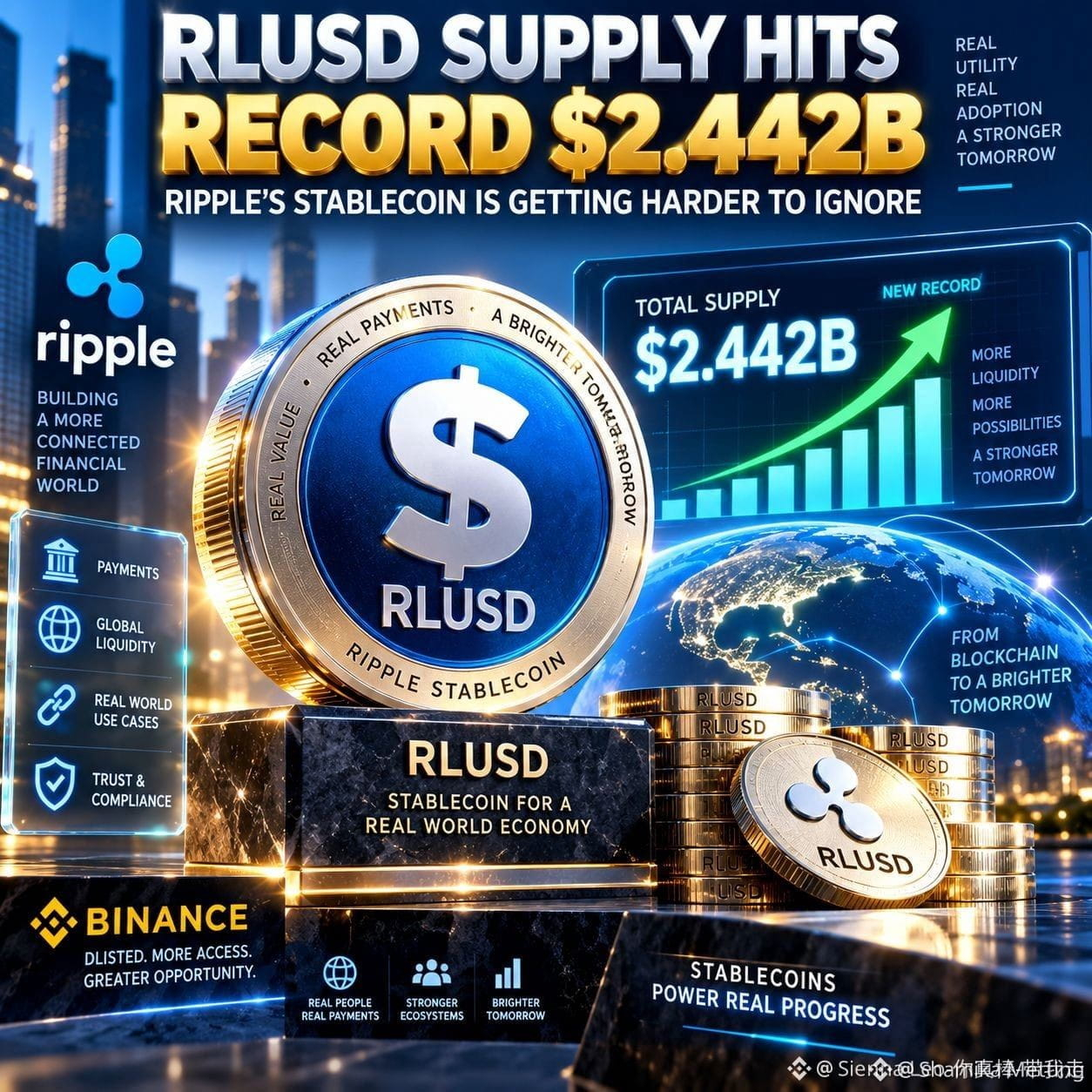
💵 $RLUSD hits a new sales record at $2.442 billion: Ripple’s stablecoin is becoming harder to ignore 💵
Imagine watching a calm digital dollar move through the financial system while only a few notice it. Then suddenly, the supply reaches a level that makes the entire market look at it twice.
RLUSD has now reached a record number of $2.442 billion in circulating supply, marking another major expansion for Ripple’s USD-backed stablecoin. Recent data also shows that its trading has surged sharply over the past month.
But the most interesting detail is where this growth is happening. The Ethereum network currently holds more RLUSD than the XRP Ledger, showing that demand for this stablecoin is not limited to Ripple’s original ecosystem.
This matters because stablecoin growth is increasingly tied to infrastructure—not speculation. More supply could reflect expanded liquidity and payments, increased trading activity, institutional usage, or simply a greater allocation of capital to that specific “digital dollar” track.
My take: The $2.442 billion threshold isn’t as exciting as the headline number—it’s more important as evidence that RLUSD is building a bigger role in digital finance.
Disclaimer: This is educational content, not financial advice.
Please follow up
#Stablecoins #Ripple #GrowWithSAC $BTC $XRP
#RLUSDSupplyHitsRecord
#RLUSDSupplyHitsRecord$2.442B
💵 $RLUSD hits a new sales record at $2.442 billion: Ripple’s stablecoin is becoming harder to ignore 💵
Imagine watching a calm digital dollar move through the financial system while only a few notice it. Then suddenly, the supply reaches a level that makes the entire market look at it twice.
RLUSD has now reached a record number of $2.442 billion in circulating supply, marking another major expansion for Ripple’s USD-backed stablecoin. Recent data also shows that its trading has surged sharply over the past month.
But the most interesting detail is where this growth is happening. The Ethereum network currently holds more RLUSD than the XRP Ledger, showing that demand for this stablecoin is not limited to Ripple’s original ecosystem.
This matters because stablecoin growth is increasingly tied to infrastructure—not speculation. More supply could reflect expanded liquidity and payments, increased trading activity, institutional usage, or simply a greater allocation of capital to that specific “digital dollar” track.
My take: The $2.442 billion threshold isn’t as exciting as the headline number—it’s more important as evidence that RLUSD is building a bigger role in digital finance.
Disclaimer: This is educational content, not financial advice.
Please follow up
#Stablecoins #Ripple #GrowWithSAC $BTC $XRP
#RLUSDSupplyHitsRecord$2.442B
💵 $RLUSD hits a new sales record at $2.442 billion: Ripple’s stablecoin is becoming harder to ignore 💵
Imagine watching a calm digital dollar move through the financial system while only a few notice it. Then suddenly, the supply reaches a level that makes the entire market look at it twice.
RLUSD has now reached a record number of $2.442 billion in circulating supply, marking another major expansion for Ripple’s USD-backed stablecoin. Recent data also shows that its trading has surged sharply over the past month.
But the most interesting detail is where this growth is happening. The Ethereum network currently holds more RLUSD than the XRP Ledger, showing that demand for this stablecoin is not limited to Ripple’s original ecosystem.
This matters because stablecoin growth is increasingly tied to infrastructure—not speculation. More supply could reflect expanded liquidity and payments, increased trading activity, institutional usage, or simply a greater allocation of capital to that specific “digital dollar” track.
My take: The $2.442 billion threshold isn’t as exciting as the headline number—it’s more important as evidence that RLUSD is building a bigger role in digital finance.
Disclaimer: This is educational content, not financial advice.
Please follow up
#Stablecoins #Ripple #GrowWithSAC $BTC $XRP
1
91

#RLUSDSupplyHitsRecord — source supply $RLUSD hits a record $2.442B
A notable figure in the stablecoin market.
RLUSD supply has risen to about $2.442 billion, showing that the scale of this stablecoin’s usage continues to expand.
But for me, what’s worth looking at is not only “supply increase = bullish.”
📊 I’ll monitor 3 things:
① Is the supply still growing?
If RLUSD continues to expand over the coming period → demand for use and liquidity may be increasing.
② Is the money actually flowing into the Crypto market?
An increase in stablecoin supply doesn’t automatically mean BTC will rise right away. What matters is whether the capital is being deployed into risky assets.
③ How does BTC respond?
If stablecoin liquidity increases while BTC still holds key support zones → this would be a signal I want to track.
🍑 For me, stablecoins are “ammunition,” but where that ammo gets fired is what matters.
$RLUSD reaching an ATH in supply is certainly noteworthy data, but it’s not enough for me to conclude that the market will pump.
For trading signals — price is the answer.
👇 What do you think RLUSD supply rising to $2.442B means?
1️⃣ Money is preparing to enter Crypto 🔥
2️⃣ It’s just supply increasing; it doesn’t tell the trend yet 📊
$RLUSD
{spot}(RLUSDUSDT)
#RLUSDSupplyHitsRecord — source supply $RLUSD hits a record $2.442B
A notable figure in the stablecoin market.
RLUSD supply has risen to about $2.442 billion, showing that the scale of this stablecoin’s usage continues to expand.
But for me, what’s worth looking at is not only “supply increase = bullish.”
📊 I’ll monitor 3 things:
① Is the supply still growing?
If RLUSD continues to expand over the coming period → demand for use and liquidity may be increasing.
② Is the money actually flowing into the Crypto market?
An increase in stablecoin supply doesn’t automatically mean BTC will rise right away. What matters is whether the capital is being deployed into risky assets.
③ How does BTC respond?
If stablecoin liquidity increases while BTC still holds key support zones → this would be a signal I want to track.
🍑 For me, stablecoins are “ammunition,” but where that ammo gets fired is what matters.
$RLUSD reaching an ATH in supply is certainly noteworthy data, but it’s not enough for me to conclude that the market will pump.
For trading signals — price is the answer.
👇 What do you think RLUSD supply rising to $2.442B means?
1️⃣ Money is preparing to enter Crypto 🔥
2️⃣ It’s just supply increasing; it doesn’t tell the trend yet 📊
$RLUSD
A notable figure in the stablecoin market.
RLUSD supply has risen to about $2.442 billion, showing that the scale of this stablecoin’s usage continues to expand.
But for me, what’s worth looking at is not only “supply increase = bullish.”
📊 I’ll monitor 3 things:
① Is the supply still growing?
If RLUSD continues to expand over the coming period → demand for use and liquidity may be increasing.
② Is the money actually flowing into the Crypto market?
An increase in stablecoin supply doesn’t automatically mean BTC will rise right away. What matters is whether the capital is being deployed into risky assets.
③ How does BTC respond?
If stablecoin liquidity increases while BTC still holds key support zones → this would be a signal I want to track.
🍑 For me, stablecoins are “ammunition,” but where that ammo gets fired is what matters.
$RLUSD reaching an ATH in supply is certainly noteworthy data, but it’s not enough for me to conclude that the market will pump.
For trading signals — price is the answer.
👇 What do you think RLUSD supply rising to $2.442B means?
1️⃣ Money is preparing to enter Crypto 🔥
2️⃣ It’s just supply increasing; it doesn’t tell the trend yet 📊
$RLUSD
118

everyone thinks stablecoin supply spikes are always bullish for your bags, but actually you might just be setting yourself up for exit liquidity.
most people see fresh mints and immediately fomo into random alts, only to get chopped up when liquidity gets sucked dry elsewhere. seen this play out way too many times during greed cycles when everyone forgets how market routing actually works.
look at the recent case with ripple minting heavy numbers while $USDT and $USDC dominance keeps shifting under the hood. traders think new supply automatically pumps the market, but smart money often uses these mint spikes to hedge or quietly rotate capital into safer yield plays.
when a new institutional stablecoin aggressively expands its footprint, it usually locks up liquidity across specific pools rather than spreading evenly into your favorite tokens. if you are blindly apeing assuming instant green candles, you are probably playing right into the hands of market makers rebalancing their books.
how are you positioning your stablecoin reserves with these new supply dynamics playing out?
#RLUSDSupplyHitsRecord #BitcoinReboundsTo
everyone thinks stablecoin supply spikes are always bullish for your bags, but actually you might just be setting yourself up for exit liquidity.
most people see fresh mints and immediately fomo into random alts, only to get chopped up when liquidity gets sucked dry elsewhere. seen this play out way too many times during greed cycles when everyone forgets how market routing actually works.
look at the recent case with ripple minting heavy numbers while $USDT and $USDC dominance keeps shifting under the hood. traders think new supply automatically pumps the market, but smart money often uses these mint spikes to hedge or quietly rotate capital into safer yield plays.
when a new institutional stablecoin aggressively expands its footprint, it usually locks up liquidity across specific pools rather than spreading evenly into your favorite tokens. if you are blindly apeing assuming instant green candles, you are probably playing right into the hands of market makers rebalancing their books.
how are you positioning your stablecoin reserves with these new supply dynamics playing out?
#RLUSDSupplyHitsRecord #BitcoinReboundsTo
most people see fresh mints and immediately fomo into random alts, only to get chopped up when liquidity gets sucked dry elsewhere. seen this play out way too many times during greed cycles when everyone forgets how market routing actually works.
look at the recent case with ripple minting heavy numbers while $USDT and $USDC dominance keeps shifting under the hood. traders think new supply automatically pumps the market, but smart money often uses these mint spikes to hedge or quietly rotate capital into safer yield plays.
when a new institutional stablecoin aggressively expands its footprint, it usually locks up liquidity across specific pools rather than spreading evenly into your favorite tokens. if you are blindly apeing assuming instant green candles, you are probably playing right into the hands of market makers rebalancing their books.
how are you positioning your stablecoin reserves with these new supply dynamics playing out?
#RLUSDSupplyHitsRecord #BitcoinReboundsTo

22
Tighter regulation is supposed to protect users, but higher reserve mandates often end up crushing local liquidity instead of making retail safer.
Most people only realize a local platform is under stress when spreads on routine $USDT trades blow out during volatility or withdrawal processing suddenly stalls. You assume your funds are insulated from regulatory reshuffling, until compliance overhead forces smaller domestic brokers to restrict access or pause operations without warning.
The Brazilian Central Bank raising capital requirements for virtual asset service providers sounds great for solvency on paper, but the immediate fallout usually hits regional order books first. Smaller licensed venues will struggle to maintain these heavy balance sheet buffers, which means trading depth against $USDC pairs is likely to dry up as smaller market makers pull back quotes and exit the market.
When capital gets locked down in mandatory reserve vaults, liquidity providers widen their spreads to offset rising operational costs. If you are routing funds through local on-ramps to manage collateral on protocols like $AAVE during sudden market swings, higher friction and slippage can quietly eat into your balance before transactions even settle.
Do you think stricter capital rules actually protect retail deposits, or does it just concentrate risk into a couple of dominant players?
#BrazilCentralBankRaisesVASPCapitalRequirements #RLUSDSupplyHitsRecord
Tighter regulation is supposed to protect users, but higher reserve mandates often end up crushing local liquidity instead of making retail safer.
Most people only realize a local platform is under stress when spreads on routine $USDT trades blow out during volatility or withdrawal processing suddenly stalls. You assume your funds are insulated from regulatory reshuffling, until compliance overhead forces smaller domestic brokers to restrict access or pause operations without warning.
The Brazilian Central Bank raising capital requirements for virtual asset service providers sounds great for solvency on paper, but the immediate fallout usually hits regional order books first. Smaller licensed venues will struggle to maintain these heavy balance sheet buffers, which means trading depth against $USDC pairs is likely to dry up as smaller market makers pull back quotes and exit the market.
When capital gets locked down in mandatory reserve vaults, liquidity providers widen their spreads to offset rising operational costs. If you are routing funds through local on-ramps to manage collateral on protocols like $AAVE during sudden market swings, higher friction and slippage can quietly eat into your balance before transactions even settle.
Do you think stricter capital rules actually protect retail deposits, or does it just concentrate risk into a couple of dominant players?
#BrazilCentralBankRaisesVASPCapitalRequirements #RLUSDSupplyHitsRecord
Most people only realize a local platform is under stress when spreads on routine $USDT trades blow out during volatility or withdrawal processing suddenly stalls. You assume your funds are insulated from regulatory reshuffling, until compliance overhead forces smaller domestic brokers to restrict access or pause operations without warning.
The Brazilian Central Bank raising capital requirements for virtual asset service providers sounds great for solvency on paper, but the immediate fallout usually hits regional order books first. Smaller licensed venues will struggle to maintain these heavy balance sheet buffers, which means trading depth against $USDC pairs is likely to dry up as smaller market makers pull back quotes and exit the market.
When capital gets locked down in mandatory reserve vaults, liquidity providers widen their spreads to offset rising operational costs. If you are routing funds through local on-ramps to manage collateral on protocols like $AAVE during sudden market swings, higher friction and slippage can quietly eat into your balance before transactions even settle.
Do you think stricter capital rules actually protect retail deposits, or does it just concentrate risk into a couple of dominant players?
#BrazilCentralBankRaisesVASPCapitalRequirements #RLUSDSupplyHitsRecord

62
·
--
Why is nobody talking about how fintech neo-banks keep pretending they are safer than self-custody?
Most people leave their capital in centralized app wallets thinking institutional backing protects them, only to wake up finding their personal identity and account details leaked on the dark web. It turns out relying on third-party security often leaves you with all the centralized risks and none of the decentralized control.
If you want to protect your assets, start by isolating your on-chain activity from fiat off-ramps. Move your core holdings out of app-based fintech accounts and into hardware-backed self-custody. Treat platforms holding your $USDT or fiat strictly as temporary liquidity channels rather than long-term vaults.
Next, segment your operations across separate wallets and rotate your contact endpoints for any service linked to fintech banking. Keeping your primary liquidity in stablecoins like $USDC across independent addresses significantly reduces your exposure when centralized databases fail.
Are centralized neo-banks still worth the convenience risk, or is full self-custody the only real option left?
#RevolutDataLeakReportedlyPostedAttackersThreatenDailyRelease #RLUSDSupplyHitsRecord #BrazilCentralBankRaisesVASPCapitalRequirements
Why is nobody talking about how fintech neo-banks keep pretending they are safer than self-custody?
Most people leave their capital in centralized app wallets thinking institutional backing protects them, only to wake up finding their personal identity and account details leaked on the dark web. It turns out relying on third-party security often leaves you with all the centralized risks and none of the decentralized control.
If you want to protect your assets, start by isolating your on-chain activity from fiat off-ramps. Move your core holdings out of app-based fintech accounts and into hardware-backed self-custody. Treat platforms holding your $USDT or fiat strictly as temporary liquidity channels rather than long-term vaults.
Next, segment your operations across separate wallets and rotate your contact endpoints for any service linked to fintech banking. Keeping your primary liquidity in stablecoins like $USDC across independent addresses significantly reduces your exposure when centralized databases fail.
Are centralized neo-banks still worth the convenience risk, or is full self-custody the only real option left?
#RevolutDataLeakReportedlyPostedAttackersThreatenDailyRelease #RLUSDSupplyHitsRecord #BrazilCentralBankRaisesVASPCapitalRequirements
Most people leave their capital in centralized app wallets thinking institutional backing protects them, only to wake up finding their personal identity and account details leaked on the dark web. It turns out relying on third-party security often leaves you with all the centralized risks and none of the decentralized control.
If you want to protect your assets, start by isolating your on-chain activity from fiat off-ramps. Move your core holdings out of app-based fintech accounts and into hardware-backed self-custody. Treat platforms holding your $USDT or fiat strictly as temporary liquidity channels rather than long-term vaults.
Next, segment your operations across separate wallets and rotate your contact endpoints for any service linked to fintech banking. Keeping your primary liquidity in stablecoins like $USDC across independent addresses significantly reduces your exposure when centralized databases fail.
Are centralized neo-banks still worth the convenience risk, or is full self-custody the only real option left?
#RevolutDataLeakReportedlyPostedAttackersThreatenDailyRelease #RLUSDSupplyHitsRecord #BrazilCentralBankRaisesVASPCapitalRequirements

2
everyone thinks the uk consulting on tokenized gold means rwa bags are about to print, but actually this is the exact moment retail usually buys the headline and gets wrecked on the details.
ngl ser the pain is always the same. you fomo the narrative, ignore the custody and kyc risk, then sit underwater when the consultation turns into rules nobody priced in.
this isn't a product launch. the uk is asking how tightly they should regulate gold sitting on-chain. look at earlier gold tokens that settled through $usdt and $usdc. people treated them like leveraged bullion. they were just receipts. when redemptions got sticky the premium vanished and holders were stuck waiting. $aave has been running real rwa collateral experiments in the background and that's closer to what actually matters here. with greed this high, everyone is pricing the dream version where tokenized gold becomes free defi collateral overnight. consultations don't work like that. they often end in heavier reporting, capital buffers, and slower rails than the timeline people just invented.
i've watched this cycle with every g7 "we're exploring tokenization" headline. the tokens attached to the story run first. then the paper comes out months later and half the move retraces because the rules were never as open as assumed. gold on-chain is useful if it becomes clean collateral. it's a trap if you're just rotating because the headline is hot.
where do you think this actually lands, real infrastructure or another narrative fade?
#UKSeeksViewsOnTokenizingGold #FedHikeOddsRiseTo89 #RLUSDSupplyHitsRecord
everyone thinks the uk consulting on tokenized gold means rwa bags are about to print, but actually this is the exact moment retail usually buys the headline and gets wrecked on the details.
ngl ser the pain is always the same. you fomo the narrative, ignore the custody and kyc risk, then sit underwater when the consultation turns into rules nobody priced in.
this isn't a product launch. the uk is asking how tightly they should regulate gold sitting on-chain. look at earlier gold tokens that settled through $usdt and $usdc. people treated them like leveraged bullion. they were just receipts. when redemptions got sticky the premium vanished and holders were stuck waiting. $aave has been running real rwa collateral experiments in the background and that's closer to what actually matters here. with greed this high, everyone is pricing the dream version where tokenized gold becomes free defi collateral overnight. consultations don't work like that. they often end in heavier reporting, capital buffers, and slower rails than the timeline people just invented.
i've watched this cycle with every g7 "we're exploring tokenization" headline. the tokens attached to the story run first. then the paper comes out months later and half the move retraces because the rules were never as open as assumed. gold on-chain is useful if it becomes clean collateral. it's a trap if you're just rotating because the headline is hot.
where do you think this actually lands, real infrastructure or another narrative fade?
#UKSeeksViewsOnTokenizingGold #FedHikeOddsRiseTo89 #RLUSDSupplyHitsRecord
ngl ser the pain is always the same. you fomo the narrative, ignore the custody and kyc risk, then sit underwater when the consultation turns into rules nobody priced in.
this isn't a product launch. the uk is asking how tightly they should regulate gold sitting on-chain. look at earlier gold tokens that settled through $usdt and $usdc. people treated them like leveraged bullion. they were just receipts. when redemptions got sticky the premium vanished and holders were stuck waiting. $aave has been running real rwa collateral experiments in the background and that's closer to what actually matters here. with greed this high, everyone is pricing the dream version where tokenized gold becomes free defi collateral overnight. consultations don't work like that. they often end in heavier reporting, capital buffers, and slower rails than the timeline people just invented.
i've watched this cycle with every g7 "we're exploring tokenization" headline. the tokens attached to the story run first. then the paper comes out months later and half the move retraces because the rules were never as open as assumed. gold on-chain is useful if it becomes clean collateral. it's a trap if you're just rotating because the headline is hot.
where do you think this actually lands, real infrastructure or another narrative fade?
#UKSeeksViewsOnTokenizingGold #FedHikeOddsRiseTo89 #RLUSDSupplyHitsRecord

149
Why is nobody paying attention to macro liquidity drying up while the market is happily sitting in greed territory?
Most traders keep getting trapped buying local tops on speculative alts, completely blind to how sudden rate adjustments can instantly drain market depth. They end up holding heavy drawdown bags while wondering why their positions got wiped out overnight.
Looking at historical cycles, a sharp rise in hawkish rate expectations tends to force capital right back into defensive positioning. When borrowing costs remain elevated, risk assets face an immediate liquidity squeeze. Instead of capital rotating freely into high-beta plays, smart money typically flees risk to park yields in $USDT or proven protocols like $AAVE before any clear trend establishes itself.
The illusion of stability often masks aggressive repositioning behind closed doors. As institutional desks rotate their exposure into liquid assets like $USDC, spot order books thin out dramatically. If macro yields stay stubborn, the margin for error on leverage becomes razor-thin, leaving over-leveraged longs vulnerable to sudden flushes.
Where do you think capital is going to rotate if these macro headwinds persist?
#FedHikeOddsRiseTo89 #BitcoinReboundsTo #RLUSDSupplyHitsRecord
Why is nobody paying attention to macro liquidity drying up while the market is happily sitting in greed territory?
Most traders keep getting trapped buying local tops on speculative alts, completely blind to how sudden rate adjustments can instantly drain market depth. They end up holding heavy drawdown bags while wondering why their positions got wiped out overnight.
Looking at historical cycles, a sharp rise in hawkish rate expectations tends to force capital right back into defensive positioning. When borrowing costs remain elevated, risk assets face an immediate liquidity squeeze. Instead of capital rotating freely into high-beta plays, smart money typically flees risk to park yields in $USDT or proven protocols like $AAVE before any clear trend establishes itself.
The illusion of stability often masks aggressive repositioning behind closed doors. As institutional desks rotate their exposure into liquid assets like $USDC , spot order books thin out dramatically. If macro yields stay stubborn, the margin for error on leverage becomes razor-thin, leaving over-leveraged longs vulnerable to sudden flushes.
Where do you think capital is going to rotate if these macro headwinds persist?
#FedHikeOddsRiseTo89 #BitcoinReboundsTo #RLUSDSupplyHitsRecord
Most traders keep getting trapped buying local tops on speculative alts, completely blind to how sudden rate adjustments can instantly drain market depth. They end up holding heavy drawdown bags while wondering why their positions got wiped out overnight.
Looking at historical cycles, a sharp rise in hawkish rate expectations tends to force capital right back into defensive positioning. When borrowing costs remain elevated, risk assets face an immediate liquidity squeeze. Instead of capital rotating freely into high-beta plays, smart money typically flees risk to park yields in $USDT or proven protocols like $AAVE before any clear trend establishes itself.
The illusion of stability often masks aggressive repositioning behind closed doors. As institutional desks rotate their exposure into liquid assets like $USDC , spot order books thin out dramatically. If macro yields stay stubborn, the margin for error on leverage becomes razor-thin, leaving over-leveraged longs vulnerable to sudden flushes.
Where do you think capital is going to rotate if these macro headwinds persist?
#FedHikeOddsRiseTo89 #BitcoinReboundsTo #RLUSDSupplyHitsRecord
24

·
--
Clearpool brings institutional credit to the XRP Ledger: why is the RWA track gaining momentum?
Clearpool has launched its first institutional credit product using RLUSD on the XRPL, a move that’s positive for the XRP ecosystem and the RWA narrative.
According to Crypto Briefing, the lending protocol Clearpool has officially expanded to the XRP Ledger (XRPL), launching its first institutional credit product based on RLUSD. RLUSD is a compliant stablecoin issued by Ripple, pegged 1:1 to the US dollar. In plain terms, Clearpool has taken TradFi-style credit management and brought it on-chain—choosing a chain that’s relatively friendly to regulators, plus a regulated stablecoin. This combination isn’t random: institutions want a compliant closed-loop, not the chain with the highest yield.
One-sentence takeaway: the institutionalization of RWA has inched forward again, and the XRP Ledger narrative is extending from payments into credit.
Market impact
- Short term: XRP’s reaction is muted. In the past 24 hours, it’s up only 0.19% to $1.401, suggesting this kind of cooperation is narrative-driven and not likely to trigger immediate buy pressure. BTC $76,949.95 (-0.98%) and ETH $2,477.58 (-1.15%) are still drifting lower. Overall market sentiment looks cautious—this single ecosystem news item isn’t enough to move the market.
- Medium term: this is further evidence that the RWA space is continuing to institutionalize. The combo of compliant stablecoins and real-world credit assets is exactly the path regulators are most willing to approve, and the application-layer narrative for the XRP ecosystem is getting thicker.
My view
I’m bullish on the direction, but don’t expect the pace to be fast. This is a medium-term fundamental catalyst, not short-term fuel. XRP holding above $1.40 suggests the market isn’t treating this as bad news. Next, we’ll watch whether the overall sentiment in the RWA sector can recover and lift the group. I’m about 70% confident in this call; the remaining 30% depends on broader market conditions. If BTC continues to weaken around $76,900, then no matter how good the altcoin narrative is, it won’t help. If I’m wrong, please be gentle—I’ll only follow this direction with a small position.
- Asset: XRP / BTC
- Bias: Bullish 📈 Predicting a rise
- Timeframe: XRP 4 hours / BTC 12 hours
$BTC $ETH #BTC #ETH
⚠️ Not investment advice
#RLUSDSupplyHitsRecord$2.442B
Clearpool brings institutional credit to the XRP Ledger: why is the RWA track gaining momentum?
Clearpool has launched its first institutional credit product using RLUSD on the XRPL, a move that’s positive for the XRP ecosystem and the RWA narrative.
According to Crypto Briefing, the lending protocol Clearpool has officially expanded to the XRP Ledger (XRPL), launching its first institutional credit product based on RLUSD. RLUSD is a compliant stablecoin issued by Ripple, pegged 1:1 to the US dollar. In plain terms, Clearpool has taken TradFi-style credit management and brought it on-chain—choosing a chain that’s relatively friendly to regulators, plus a regulated stablecoin. This combination isn’t random: institutions want a compliant closed-loop, not the chain with the highest yield.
One-sentence takeaway: the institutionalization of RWA has inched forward again, and the XRP Ledger narrative is extending from payments into credit.
Market impact
- Short term: XRP’s reaction is muted. In the past 24 hours, it’s up only 0.19% to $1.401, suggesting this kind of cooperation is narrative-driven and not likely to trigger immediate buy pressure. BTC $76,949.95 (-0.98%) and ETH $2,477.58 (-1.15%) are still drifting lower. Overall market sentiment looks cautious—this single ecosystem news item isn’t enough to move the market.
- Medium term: this is further evidence that the RWA space is continuing to institutionalize. The combo of compliant stablecoins and real-world credit assets is exactly the path regulators are most willing to approve, and the application-layer narrative for the XRP ecosystem is getting thicker.
My view
I’m bullish on the direction, but don’t expect the pace to be fast. This is a medium-term fundamental catalyst, not short-term fuel. XRP holding above $1.40 suggests the market isn’t treating this as bad news. Next, we’ll watch whether the overall sentiment in the RWA sector can recover and lift the group. I’m about 70% confident in this call; the remaining 30% depends on broader market conditions. If BTC continues to weaken around $76,900, then no matter how good the altcoin narrative is, it won’t help. If I’m wrong, please be gentle—I’ll only follow this direction with a small position.
- Asset: XRP / BTC
- Bias: Bullish 📈 Predicting a rise
- Timeframe: XRP 4 hours / BTC 12 hours
$BTC $ETH #BTC #ETH
⚠️ Not investment advice
#RLUSDSupplyHitsRecord$2.442B
Clearpool has launched its first institutional credit product using RLUSD on the XRPL, a move that’s positive for the XRP ecosystem and the RWA narrative.
According to Crypto Briefing, the lending protocol Clearpool has officially expanded to the XRP Ledger (XRPL), launching its first institutional credit product based on RLUSD. RLUSD is a compliant stablecoin issued by Ripple, pegged 1:1 to the US dollar. In plain terms, Clearpool has taken TradFi-style credit management and brought it on-chain—choosing a chain that’s relatively friendly to regulators, plus a regulated stablecoin. This combination isn’t random: institutions want a compliant closed-loop, not the chain with the highest yield.
One-sentence takeaway: the institutionalization of RWA has inched forward again, and the XRP Ledger narrative is extending from payments into credit.
Market impact
- Short term: XRP’s reaction is muted. In the past 24 hours, it’s up only 0.19% to $1.401, suggesting this kind of cooperation is narrative-driven and not likely to trigger immediate buy pressure. BTC $76,949.95 (-0.98%) and ETH $2,477.58 (-1.15%) are still drifting lower. Overall market sentiment looks cautious—this single ecosystem news item isn’t enough to move the market.
- Medium term: this is further evidence that the RWA space is continuing to institutionalize. The combo of compliant stablecoins and real-world credit assets is exactly the path regulators are most willing to approve, and the application-layer narrative for the XRP ecosystem is getting thicker.
My view
I’m bullish on the direction, but don’t expect the pace to be fast. This is a medium-term fundamental catalyst, not short-term fuel. XRP holding above $1.40 suggests the market isn’t treating this as bad news. Next, we’ll watch whether the overall sentiment in the RWA sector can recover and lift the group. I’m about 70% confident in this call; the remaining 30% depends on broader market conditions. If BTC continues to weaken around $76,900, then no matter how good the altcoin narrative is, it won’t help. If I’m wrong, please be gentle—I’ll only follow this direction with a small position.
- Asset: XRP / BTC
- Bias: Bullish 📈 Predicting a rise
- Timeframe: XRP 4 hours / BTC 12 hours
$BTC $ETH #BTC #ETH
⚠️ Not investment advice
#RLUSDSupplyHitsRecord$2.442B



200
·
--
$RLUSD moves 0.0% an hour. Most people size it like a stablecoin.
📊 A 0.0% ATR means the typical 1h swing is literally nothing.
🎯 To risk 1% on a $1000 account, that’s $10 max loss.
🛑 If I place a stop at $1.0000 (the 24h low), that’s 0.0001 away from $1.0001.
So $10 divided by 0.0001 = 100,000 units.
Tap $RLUSD and look at the last 24 hourly candles, the level is right there.
✅ Size your position so your stop distance times your units equals 1% of your account.
What’s your rule for sizing when volatility is flat?
Binance data as of 14 Sep 21:00 UTC. Not financial advice.
#RLUSDSupplyHitsRecord$2.442B #RLUSD #TradingTips
$RLUSD moves 0.0% an hour. Most people size it like a stablecoin.
📊 A 0.0% ATR means the typical 1h swing is literally nothing.
🎯 To risk 1% on a $1000 account, that’s $10 max loss.
🛑 If I place a stop at $1.0000 (the 24h low), that’s 0.0001 away from $1.0001.
So $10 divided by 0.0001 = 100,000 units.
Tap $RLUSD and look at the last 24 hourly candles, the level is right there.
✅ Size your position so your stop distance times your units equals 1% of your account.
What’s your rule for sizing when volatility is flat?
Binance data as of 14 Sep 21:00 UTC. Not financial advice.
#RLUSDSupplyHitsRecord$2.442B #RLUSD #TradingTips
📊 A 0.0% ATR means the typical 1h swing is literally nothing.
🎯 To risk 1% on a $1000 account, that’s $10 max loss.
🛑 If I place a stop at $1.0000 (the 24h low), that’s 0.0001 away from $1.0001.
So $10 divided by 0.0001 = 100,000 units.
Tap $RLUSD and look at the last 24 hourly candles, the level is right there.
✅ Size your position so your stop distance times your units equals 1% of your account.
What’s your rule for sizing when volatility is flat?
Binance data as of 14 Sep 21:00 UTC. Not financial advice.
#RLUSDSupplyHitsRecord$2.442B #RLUSD #TradingTips
1
📰 US Stock Market Daily News Quick Delivery (2026-09-15 08:07)
I. Today’s News Summary
1. 【Yahoo Finance】Stock market today: Dow, S&P 500, Nasdaq slip as chip stocks fall on AI warning - Yahoo Finance — Stock market today: Dow, S&P 500, Nasdaq slip as chip stocks fall on AI warning
2. 【CNBC】Stocks slide to kick off the week as the 10-year yield briefly touches 5%, oil rises: Live updates - CNBC — Stocks slide to kick off the week as the 10-year yield briefly touches 5%, oil rises: Live
3. 【Investopedia】Markets News, Sep. 14, 2026: Chip Stocks Drop, Software Jumps as Indexes Close Lower; Oil Prices Ris — Markets News, Sep. 14, 2026: Chip Stocks Drop, Software Jumps as Indexes Close L
II. Related Stocks Market Trends
- SPY: $760.88 (📉-1.21%)
- QQQ: $709.18 (📉-1.36%)
- AAPL: $333.08 (📈+4.10%)
- TSLA: $358.97 (📈+1.38%)
III. Industry Analysis
Judging from recent market performance, US stocks have shown a volatile trend driven by both macroeconomic data and corporate earnings. Investors should closely monitor how factors such as Federal Reserve policy moves, changes in inflation data, and geopolitical risks affect market sentiment. From a technical perspective, major indexes are moving within key support and resistance levels, and the relative strength of the Dow, the S&P 500, and the Nasdaq reflects sector rotation characteristics. Technology stocks remain the focus of attention—especially AI-related concept stocks, which continue to attract funds. In terms of fund flows, institutional allocation directions indicate a divergence in market attitudes toward growth and value stocks; investors should allocate assets reasonably according to their own risk preferences.
IV. Crypto Market Linkage
As a bellwether for the crypto market, Bitcoin is currently quoted at $78,160.98, with a 24-hour gain/loss of +1.62%. The linkage between US stocks and the crypto market has strengthened, and fluctuations in traditional financial markets will also affect the price movement of digital assets.
V. Investment Strategies and Risk Warnings
1. The current US stock market is at a key stage of development. It is recommended to focus on industry leaders and leaders in sub-sectors with core competitiveness.
2. Changes in the macroeconomic environment may affect investors’ risk appetite. Investors should pay attention to macro factors such as interest rate policy and inflation data.
3. Geopolitical risks and supply chain changes may have a major impact on industries. It is recommended to diversify investments and control position-related risk.
4. Short-term market volatility is normal. Long-term investors should stick to a value investing philosophy and avoid chasing rallies or panic-selling.
5. Continue to monitor industry technological progress and policy changes, and adjust your portfolio allocation in a timely manner.
---
🔥 Trending Tokens Recently:
1. SOL
2. LSK
3. BR
#BitcoinReboundsTo$79K #FedHikeOddsRiseTo89% #RLUSDSupplyHitsRecord$2.442B
From a global macro perspective, the US stock market sector is facing multiple opportunities and challenges. Technological innovation continues to drive industry development, while new application scenarios and business models keep emerging. At the same time, factors such as tighter regulation, intensified market competition, and rising costs also bring uncertainty to industry growth. Governments in different countries are continuously adjusting policy support and regulatory intensity for this space; investors should closely track policy developments. From the perspective of the China market, domestic companies are increasing their investment in the US stock market space, and a coordinated development pattern across the upstream and downstream of the industrial chain has taken shape, with international competitiveness improving steadily.
📰 US Stock Market Daily News Quick Delivery (2026-09-15 08:07)
I. Today’s News Summary
1. 【Yahoo Finance】Stock market today: Dow, S&P 500, Nasdaq slip as chip stocks fall on AI warning - Yahoo Finance — Stock market today: Dow, S&P 500, Nasdaq slip as chip stocks fall on AI warning
2. 【CNBC】Stocks slide to kick off the week as the 10-year yield briefly touches 5%, oil rises: Live updates - CNBC — Stocks slide to kick off the week as the 10-year yield briefly touches 5%, oil rises: Live
3. 【Investopedia】Markets News, Sep. 14, 2026: Chip Stocks Drop, Software Jumps as Indexes Close Lower; Oil Prices Ris — Markets News, Sep. 14, 2026: Chip Stocks Drop, Software Jumps as Indexes Close L
II. Related Stocks Market Trends
- SPY: $760.88 (📉-1.21%)
- QQQ: $709.18 (📉-1.36%)
- AAPL: $333.08 (📈+4.10%)
- TSLA: $358.97 (📈+1.38%)
III. Industry Analysis
Judging from recent market performance, US stocks have shown a volatile trend driven by both macroeconomic data and corporate earnings. Investors should closely monitor how factors such as Federal Reserve policy moves, changes in inflation data, and geopolitical risks affect market sentiment. From a technical perspective, major indexes are moving within key support and resistance levels, and the relative strength of the Dow, the S&P 500, and the Nasdaq reflects sector rotation characteristics. Technology stocks remain the focus of attention—especially AI-related concept stocks, which continue to attract funds. In terms of fund flows, institutional allocation directions indicate a divergence in market attitudes toward growth and value stocks; investors should allocate assets reasonably according to their own risk preferences.
IV. Crypto Market Linkage
As a bellwether for the crypto market, Bitcoin is currently quoted at $78,160.98, with a 24-hour gain/loss of +1.62%. The linkage between US stocks and the crypto market has strengthened, and fluctuations in traditional financial markets will also affect the price movement of digital assets.
V. Investment Strategies and Risk Warnings
1. The current US stock market is at a key stage of development. It is recommended to focus on industry leaders and leaders in sub-sectors with core competitiveness.
2. Changes in the macroeconomic environment may affect investors’ risk appetite. Investors should pay attention to macro factors such as interest rate policy and inflation data.
3. Geopolitical risks and supply chain changes may have a major impact on industries. It is recommended to diversify investments and control position-related risk.
4. Short-term market volatility is normal. Long-term investors should stick to a value investing philosophy and avoid chasing rallies or panic-selling.
5. Continue to monitor industry technological progress and policy changes, and adjust your portfolio allocation in a timely manner.
---
🔥 Trending Tokens Recently:
1. SOL
2. LSK
3. BR
#BitcoinReboundsTo$79K #FedHikeOddsRiseTo89% #RLUSDSupplyHitsRecord$2.442B
From a global macro perspective, the US stock market sector is facing multiple opportunities and challenges. Technological innovation continues to drive industry development, while new application scenarios and business models keep emerging. At the same time, factors such as tighter regulation, intensified market competition, and rising costs also bring uncertainty to industry growth. Governments in different countries are continuously adjusting policy support and regulatory intensity for this space; investors should closely track policy developments. From the perspective of the China market, domestic companies are increasing their investment in the US stock market space, and a coordinated development pattern across the upstream and downstream of the industrial chain has taken shape, with international competitiveness improving steadily.
I. Today’s News Summary
1. 【Yahoo Finance】Stock market today: Dow, S&P 500, Nasdaq slip as chip stocks fall on AI warning - Yahoo Finance — Stock market today: Dow, S&P 500, Nasdaq slip as chip stocks fall on AI warning
2. 【CNBC】Stocks slide to kick off the week as the 10-year yield briefly touches 5%, oil rises: Live updates - CNBC — Stocks slide to kick off the week as the 10-year yield briefly touches 5%, oil rises: Live
3. 【Investopedia】Markets News, Sep. 14, 2026: Chip Stocks Drop, Software Jumps as Indexes Close Lower; Oil Prices Ris — Markets News, Sep. 14, 2026: Chip Stocks Drop, Software Jumps as Indexes Close L
II. Related Stocks Market Trends
- SPY: $760.88 (📉-1.21%)
- QQQ: $709.18 (📉-1.36%)
- AAPL: $333.08 (📈+4.10%)
- TSLA: $358.97 (📈+1.38%)
III. Industry Analysis
Judging from recent market performance, US stocks have shown a volatile trend driven by both macroeconomic data and corporate earnings. Investors should closely monitor how factors such as Federal Reserve policy moves, changes in inflation data, and geopolitical risks affect market sentiment. From a technical perspective, major indexes are moving within key support and resistance levels, and the relative strength of the Dow, the S&P 500, and the Nasdaq reflects sector rotation characteristics. Technology stocks remain the focus of attention—especially AI-related concept stocks, which continue to attract funds. In terms of fund flows, institutional allocation directions indicate a divergence in market attitudes toward growth and value stocks; investors should allocate assets reasonably according to their own risk preferences.
IV. Crypto Market Linkage
As a bellwether for the crypto market, Bitcoin is currently quoted at $78,160.98, with a 24-hour gain/loss of +1.62%. The linkage between US stocks and the crypto market has strengthened, and fluctuations in traditional financial markets will also affect the price movement of digital assets.
V. Investment Strategies and Risk Warnings
1. The current US stock market is at a key stage of development. It is recommended to focus on industry leaders and leaders in sub-sectors with core competitiveness.
2. Changes in the macroeconomic environment may affect investors’ risk appetite. Investors should pay attention to macro factors such as interest rate policy and inflation data.
3. Geopolitical risks and supply chain changes may have a major impact on industries. It is recommended to diversify investments and control position-related risk.
4. Short-term market volatility is normal. Long-term investors should stick to a value investing philosophy and avoid chasing rallies or panic-selling.
5. Continue to monitor industry technological progress and policy changes, and adjust your portfolio allocation in a timely manner.
---
🔥 Trending Tokens Recently:
1. SOL
2. LSK
3. BR
#BitcoinReboundsTo$79K #FedHikeOddsRiseTo89% #RLUSDSupplyHitsRecord$2.442B
From a global macro perspective, the US stock market sector is facing multiple opportunities and challenges. Technological innovation continues to drive industry development, while new application scenarios and business models keep emerging. At the same time, factors such as tighter regulation, intensified market competition, and rising costs also bring uncertainty to industry growth. Governments in different countries are continuously adjusting policy support and regulatory intensity for this space; investors should closely track policy developments. From the perspective of the China market, domestic companies are increasing their investment in the US stock market space, and a coordinated development pattern across the upstream and downstream of the industrial chain has taken shape, with international competitiveness improving steadily.
35
Log in to explore more content
Join global crypto users on Binance Square
⚡️ Get latest and useful information about crypto.
💬 Trusted by the world’s largest crypto exchange.
👍 Discover real insights from verified creators.
Email / Phone number
Trending Topics
1
#EtherGains70.9%InQ3
52,493 views
678 Discussing
2
#TreasuryLetsStatesFileStablecoinCertificationsEarly
1,864 views
25 Discussing
3
#US10YearYieldNears5.3%
88,496 views
839 Discussing
4
#DollarIndexHitsHighestSinceMay2025
16,944 views
421 Discussing
5
#USWeeklyJoblessClaimsFallTo197000
19,244 views
373 Discussing
6
#BitcoinETFsTake$6.34BillionInQ3
6,556 views
57 Discussing
7
#KoreaProposesTokenizingStocksAndBonds
50,872 views
702 Discussing
8
#MetaMaskExitsLidoValidatorsAfterSecurityIncident
143,466 views
1,415 Discussing
9
#MicronBeatsEarningsLiftsGuidance
73,070 views
1,027 Discussing
10
#CFTCSubmitsTwoEventContractRulesToWhiteHouse
49,647 views
773 Discussing