
#brazilcentralbankraisesvaspcapitalrequirements
brazilcentralbankraisesvaspcapitalrequirements
54,678 views
816 Discussing
Hot
Latest

·
--
If you are still ignoring regulatory capital shifts in emerging markets, stop now.
Most traders only focus on chart patterns until sudden regulatory bottlenecks freeze local off-ramps or trigger severe liquidity drains on domestic order books. Watching your spreads blow out because an exchange fails to meet basic balance sheet obligations is an expensive lesson nobody wants to learn mid-trade.
Brazil's central bank moving to raise capital requirements for virtual asset service providers has sparked an immediate divide across the industry. Critics argue that steep capital floors will crush smaller fintech startups, reduce local competition, and drive retail users toward unregulated shadow platforms where user protection is practically nonexistent.
However, enforcing real balance sheet resilience is the only sustainable path forward for market maturity. When platforms process billions in $USDT and $USDC volume daily, strict reserve buffers ensure customer assets stay shielded against unexpected liquidity shocks. Latin America is rapidly becoming a major hub for institutional capital, and establishing rigorous financial backstops will ultimately build deeper, safer liquidity for ecosystem assets like $DOT.
Do you believe stricter capital rules genuinely protect everyday traders, or will they simply centralize market power among a few dominant players?
#BrazilCentralBankRaisesVASPCapitalRequirements #BitcoinReboundsTo
If you are still ignoring regulatory capital shifts in emerging markets, stop now.
Most traders only focus on chart patterns until sudden regulatory bottlenecks freeze local off-ramps or trigger severe liquidity drains on domestic order books. Watching your spreads blow out because an exchange fails to meet basic balance sheet obligations is an expensive lesson nobody wants to learn mid-trade.
Brazil's central bank moving to raise capital requirements for virtual asset service providers has sparked an immediate divide across the industry. Critics argue that steep capital floors will crush smaller fintech startups, reduce local competition, and drive retail users toward unregulated shadow platforms where user protection is practically nonexistent.
However, enforcing real balance sheet resilience is the only sustainable path forward for market maturity. When platforms process billions in $USDT and $USDC volume daily, strict reserve buffers ensure customer assets stay shielded against unexpected liquidity shocks. Latin America is rapidly becoming a major hub for institutional capital, and establishing rigorous financial backstops will ultimately build deeper, safer liquidity for ecosystem assets like $DOT .
Do you believe stricter capital rules genuinely protect everyday traders, or will they simply centralize market power among a few dominant players?
#BrazilCentralBankRaisesVASPCapitalRequirements #BitcoinReboundsTo
Most traders only focus on chart patterns until sudden regulatory bottlenecks freeze local off-ramps or trigger severe liquidity drains on domestic order books. Watching your spreads blow out because an exchange fails to meet basic balance sheet obligations is an expensive lesson nobody wants to learn mid-trade.
Brazil's central bank moving to raise capital requirements for virtual asset service providers has sparked an immediate divide across the industry. Critics argue that steep capital floors will crush smaller fintech startups, reduce local competition, and drive retail users toward unregulated shadow platforms where user protection is practically nonexistent.
However, enforcing real balance sheet resilience is the only sustainable path forward for market maturity. When platforms process billions in $USDT and $USDC volume daily, strict reserve buffers ensure customer assets stay shielded against unexpected liquidity shocks. Latin America is rapidly becoming a major hub for institutional capital, and establishing rigorous financial backstops will ultimately build deeper, safer liquidity for ecosystem assets like $DOT .
Do you believe stricter capital rules genuinely protect everyday traders, or will they simply centralize market power among a few dominant players?
#BrazilCentralBankRaisesVASPCapitalRequirements #BitcoinReboundsTo
56

·
--
Picture this: a booming regional crypto hub suddenly sees its compliance threshold multiply overnight while most retail traders are fixated on short-term green candles.
Most investors assume higher capital buffers only affect exchange balance sheets, right up until local order books thin out, spreads blow wide open, and off-ramps bottleneck during high volatility.
When the Central Bank of Brazil stepped in to raise capital requirements for Virtual Asset Service Providers, the move flew under the radar of global feeds. But this is a forced consolidation event. Stricter capital reserves weed out smaller, domestic brokerages that cannot meet liquidity minimums, inevitably pushing volume toward a handful of centralized giants and altering how capital moves across Latin America.
The real risk for active traders holding $USDT or $USDC is liquidity fragmentation. As smaller gateways shutter, regional on-and-off ramps contract, driving up slippage and creating friction for capital rotating into protocols like $AAVE. Stricter oversight promises institutional legitimacy on paper, but in practice, it often leaves retail users facing higher fees and fewer operational exits.
Where do you think liquidity flows when regional compliance barriers become this steep?
#BrazilCentralBankRaisesVASPCapitalRequirements #RLUSDSupplyHitsRecord
Picture this: a booming regional crypto hub suddenly sees its compliance threshold multiply overnight while most retail traders are fixated on short-term green candles.
Most investors assume higher capital buffers only affect exchange balance sheets, right up until local order books thin out, spreads blow wide open, and off-ramps bottleneck during high volatility.
When the Central Bank of Brazil stepped in to raise capital requirements for Virtual Asset Service Providers, the move flew under the radar of global feeds. But this is a forced consolidation event. Stricter capital reserves weed out smaller, domestic brokerages that cannot meet liquidity minimums, inevitably pushing volume toward a handful of centralized giants and altering how capital moves across Latin America.
The real risk for active traders holding $USDT or $USDC is liquidity fragmentation. As smaller gateways shutter, regional on-and-off ramps contract, driving up slippage and creating friction for capital rotating into protocols like $AAVE . Stricter oversight promises institutional legitimacy on paper, but in practice, it often leaves retail users facing higher fees and fewer operational exits.
Where do you think liquidity flows when regional compliance barriers become this steep?
#BrazilCentralBankRaisesVASPCapitalRequirements #RLUSDSupplyHitsRecord
Most investors assume higher capital buffers only affect exchange balance sheets, right up until local order books thin out, spreads blow wide open, and off-ramps bottleneck during high volatility.
When the Central Bank of Brazil stepped in to raise capital requirements for Virtual Asset Service Providers, the move flew under the radar of global feeds. But this is a forced consolidation event. Stricter capital reserves weed out smaller, domestic brokerages that cannot meet liquidity minimums, inevitably pushing volume toward a handful of centralized giants and altering how capital moves across Latin America.
The real risk for active traders holding $USDT or $USDC is liquidity fragmentation. As smaller gateways shutter, regional on-and-off ramps contract, driving up slippage and creating friction for capital rotating into protocols like $AAVE . Stricter oversight promises institutional legitimacy on paper, but in practice, it often leaves retail users facing higher fees and fewer operational exits.
Where do you think liquidity flows when regional compliance barriers become this steep?
#BrazilCentralBankRaisesVASPCapitalRequirements #RLUSDSupplyHitsRecord

30

Tighter regulation is supposed to protect users, but higher reserve mandates often end up crushing local liquidity instead of making retail safer.
Most people only realize a local platform is under stress when spreads on routine $USDT trades blow out during volatility or withdrawal processing suddenly stalls. You assume your funds are insulated from regulatory reshuffling, until compliance overhead forces smaller domestic brokers to restrict access or pause operations without warning.
The Brazilian Central Bank raising capital requirements for virtual asset service providers sounds great for solvency on paper, but the immediate fallout usually hits regional order books first. Smaller licensed venues will struggle to maintain these heavy balance sheet buffers, which means trading depth against $USDC pairs is likely to dry up as smaller market makers pull back quotes and exit the market.
When capital gets locked down in mandatory reserve vaults, liquidity providers widen their spreads to offset rising operational costs. If you are routing funds through local on-ramps to manage collateral on protocols like $AAVE during sudden market swings, higher friction and slippage can quietly eat into your balance before transactions even settle.
Do you think stricter capital rules actually protect retail deposits, or does it just concentrate risk into a couple of dominant players?
#BrazilCentralBankRaisesVASPCapitalRequirements #RLUSDSupplyHitsRecord
Tighter regulation is supposed to protect users, but higher reserve mandates often end up crushing local liquidity instead of making retail safer.
Most people only realize a local platform is under stress when spreads on routine $USDT trades blow out during volatility or withdrawal processing suddenly stalls. You assume your funds are insulated from regulatory reshuffling, until compliance overhead forces smaller domestic brokers to restrict access or pause operations without warning.
The Brazilian Central Bank raising capital requirements for virtual asset service providers sounds great for solvency on paper, but the immediate fallout usually hits regional order books first. Smaller licensed venues will struggle to maintain these heavy balance sheet buffers, which means trading depth against $USDC pairs is likely to dry up as smaller market makers pull back quotes and exit the market.
When capital gets locked down in mandatory reserve vaults, liquidity providers widen their spreads to offset rising operational costs. If you are routing funds through local on-ramps to manage collateral on protocols like $AAVE during sudden market swings, higher friction and slippage can quietly eat into your balance before transactions even settle.
Do you think stricter capital rules actually protect retail deposits, or does it just concentrate risk into a couple of dominant players?
#BrazilCentralBankRaisesVASPCapitalRequirements #RLUSDSupplyHitsRecord
Most people only realize a local platform is under stress when spreads on routine $USDT trades blow out during volatility or withdrawal processing suddenly stalls. You assume your funds are insulated from regulatory reshuffling, until compliance overhead forces smaller domestic brokers to restrict access or pause operations without warning.
The Brazilian Central Bank raising capital requirements for virtual asset service providers sounds great for solvency on paper, but the immediate fallout usually hits regional order books first. Smaller licensed venues will struggle to maintain these heavy balance sheet buffers, which means trading depth against $USDC pairs is likely to dry up as smaller market makers pull back quotes and exit the market.
When capital gets locked down in mandatory reserve vaults, liquidity providers widen their spreads to offset rising operational costs. If you are routing funds through local on-ramps to manage collateral on protocols like $AAVE during sudden market swings, higher friction and slippage can quietly eat into your balance before transactions even settle.
Do you think stricter capital rules actually protect retail deposits, or does it just concentrate risk into a couple of dominant players?
#BrazilCentralBankRaisesVASPCapitalRequirements #RLUSDSupplyHitsRecord
38

·
--
Everyone thinks tightening crypto regulations only affects offshore exchanges, but actually, it quietly changes where retail liquidity can safely sit.
Most traders get caught off guard when local liquidity dries up overnight or fiat off-ramps suddenly freeze during volatile market shifts.
Think of virtual asset service providers like local water reservoirs. When Brazil's Central Bank raises minimum capital requirements for VASPs, they are essentially demanding stronger retaining walls so smaller operators do not collapse under sudden withdrawal pressure. This forces regional platforms to hold deeper collateral reserves, which heavily impacts settlement routes and volume for pairs tied to $USDT and $USDC.
In the near term, higher compliance overhead might squeeze smaller regional brokers out of the market. However, institutional-grade backing tends to redirect serious capital flow into hardened DeFi protocols like $AAVE as market participants look for transparent, collateralized venues.
How do you see these rising compliance standards reshaping liquidity across emerging markets?
#BrazilCentralBankRaisesVASPCapitalRequirements #FedHikeOddsRiseTo89
Everyone thinks tightening crypto regulations only affects offshore exchanges, but actually, it quietly changes where retail liquidity can safely sit.
Most traders get caught off guard when local liquidity dries up overnight or fiat off-ramps suddenly freeze during volatile market shifts.
Think of virtual asset service providers like local water reservoirs. When Brazil's Central Bank raises minimum capital requirements for VASPs, they are essentially demanding stronger retaining walls so smaller operators do not collapse under sudden withdrawal pressure. This forces regional platforms to hold deeper collateral reserves, which heavily impacts settlement routes and volume for pairs tied to $USDT and $USDC .
In the near term, higher compliance overhead might squeeze smaller regional brokers out of the market. However, institutional-grade backing tends to redirect serious capital flow into hardened DeFi protocols like $AAVE as market participants look for transparent, collateralized venues.
How do you see these rising compliance standards reshaping liquidity across emerging markets?
#BrazilCentralBankRaisesVASPCapitalRequirements #FedHikeOddsRiseTo89
Most traders get caught off guard when local liquidity dries up overnight or fiat off-ramps suddenly freeze during volatile market shifts.
Think of virtual asset service providers like local water reservoirs. When Brazil's Central Bank raises minimum capital requirements for VASPs, they are essentially demanding stronger retaining walls so smaller operators do not collapse under sudden withdrawal pressure. This forces regional platforms to hold deeper collateral reserves, which heavily impacts settlement routes and volume for pairs tied to $USDT and $USDC .
In the near term, higher compliance overhead might squeeze smaller regional brokers out of the market. However, institutional-grade backing tends to redirect serious capital flow into hardened DeFi protocols like $AAVE as market participants look for transparent, collateralized venues.
How do you see these rising compliance standards reshaping liquidity across emerging markets?
#BrazilCentralBankRaisesVASPCapitalRequirements #FedHikeOddsRiseTo89
44

#BrazilCentralBankRaisesVASPCapitalRequirements
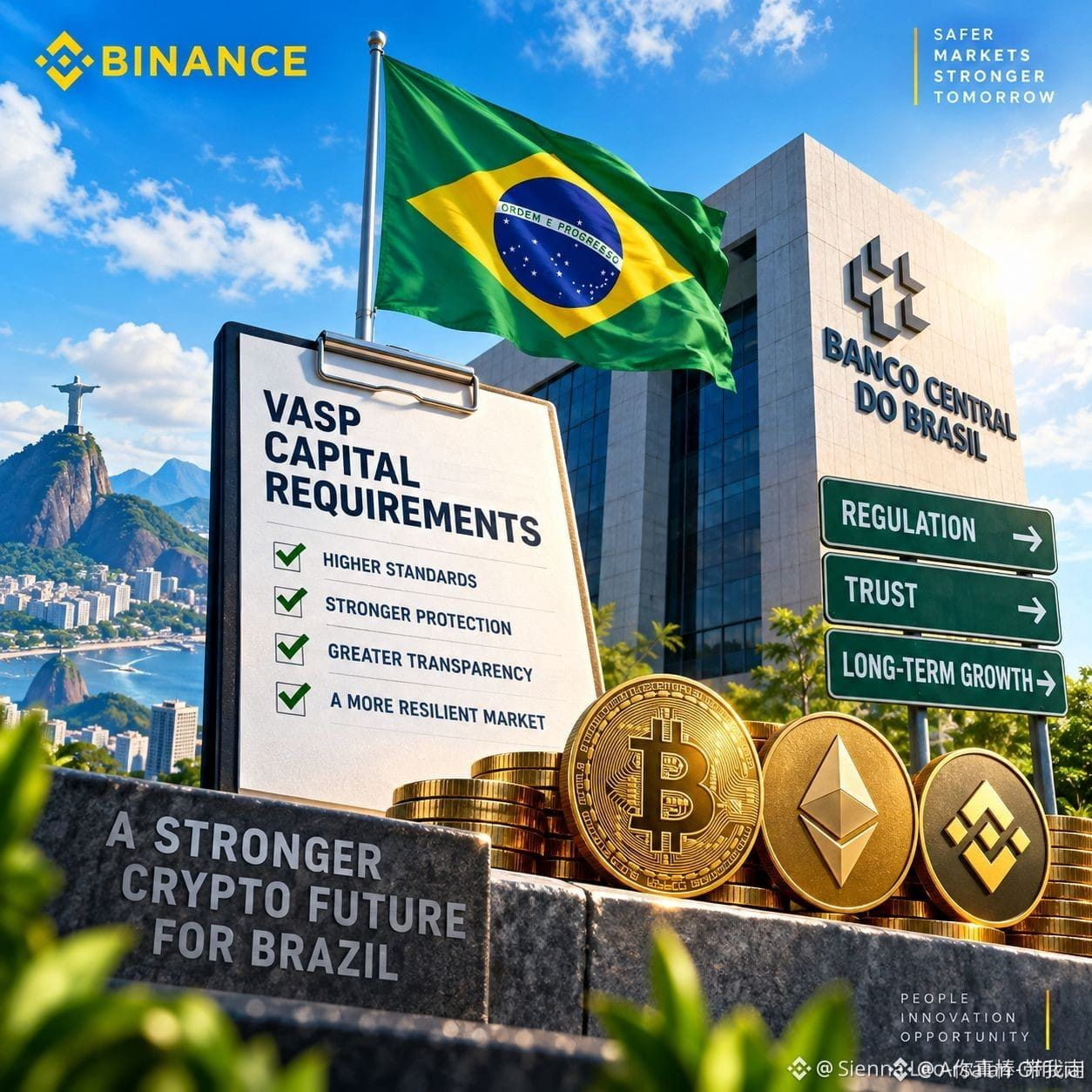
Brazil’s **Central Bank (BCB)** has introduced stricter prudential rules for virtual-asset service providers, including **minimum capital and financial-resilience requirements** under its 2025 regulatory framework that took effect in February 2026. ([Banco Central do Brasil][1])
The rules are designed to strengthen **VASP oversight, customer protection and financial stability**, while increasing compliance requirements for crypto businesses operating in Brazil.
**#Brazil #VASP #Crypto #Bitcoin #BTC #Blockchain #CryptoRegulation #DigitalAssets #Stablecoins #DeFi #Web3 #Fintech #CentralBank**
[1]: $BTC
{spot}(BTCUSDT)
$ETH
{spot}(ETHUSDT)
$SOL
{spot}(SOLUSDT)
#BrazilCentralBankRaisesVASPCapitalRequirements
Brazil’s **Central Bank (BCB)** has introduced stricter prudential rules for virtual-asset service providers, including **minimum capital and financial-resilience requirements** under its 2025 regulatory framework that took effect in February 2026. ([Banco Central do Brasil][1])
The rules are designed to strengthen **VASP oversight, customer protection and financial stability**, while increasing compliance requirements for crypto businesses operating in Brazil.
**#Brazil #VASP #Crypto #Bitcoin #BTC #Blockchain #CryptoRegulation #DigitalAssets #Stablecoins #DeFi #Web3 #Fintech #CentralBank**
[1]: $BTC
$ETH
$SOL
Brazil’s **Central Bank (BCB)** has introduced stricter prudential rules for virtual-asset service providers, including **minimum capital and financial-resilience requirements** under its 2025 regulatory framework that took effect in February 2026. ([Banco Central do Brasil][1])
The rules are designed to strengthen **VASP oversight, customer protection and financial stability**, while increasing compliance requirements for crypto businesses operating in Brazil.
**#Brazil #VASP #Crypto #Bitcoin #BTC #Blockchain #CryptoRegulation #DigitalAssets #Stablecoins #DeFi #Web3 #Fintech #CentralBank**
[1]: $BTC
$ETH
$SOL
1
95

·
--
Brazil’s central bank raises VASP capital requirements.
The regulator sets minimum capital for virtual asset service providers between R$10.8 million and R$37.2 million.
That equals roughly $2.1 million to $7.2 million, depending on business type and risk.
The final figures sit far above earlier draft levels.
Rules also demand stronger governance, internal controls, anti-money laundering measures, audits and ongoing reporting.
Industry estimates suggest only about 10 firms will secure licenses.
Many smaller platforms already exit or restructure retail operations.
The tighter framework aims to align crypto firms with traditional financial standards.
$XAU $XRP $SNDK
{future}(SNDKUSDT)
{future}(XRPUSDT)
{future}(XAUUSDT)
#brazilcentralbankraisesvaspcapitalrequirements
Brazil’s central bank raises VASP capital requirements.
The regulator sets minimum capital for virtual asset service providers between R$10.8 million and R$37.2 million.
That equals roughly $2.1 million to $7.2 million, depending on business type and risk.
The final figures sit far above earlier draft levels.
Rules also demand stronger governance, internal controls, anti-money laundering measures, audits and ongoing reporting.
Industry estimates suggest only about 10 firms will secure licenses.
Many smaller platforms already exit or restructure retail operations.
The tighter framework aims to align crypto firms with traditional financial standards.
$XAU $XRP $SNDK
#brazilcentralbankraisesvaspcapitalrequirements
The regulator sets minimum capital for virtual asset service providers between R$10.8 million and R$37.2 million.
That equals roughly $2.1 million to $7.2 million, depending on business type and risk.
The final figures sit far above earlier draft levels.
Rules also demand stronger governance, internal controls, anti-money laundering measures, audits and ongoing reporting.
Industry estimates suggest only about 10 firms will secure licenses.
Many smaller platforms already exit or restructure retail operations.
The tighter framework aims to align crypto firms with traditional financial standards.
$XAU $XRP $SNDK
#brazilcentralbankraisesvaspcapitalrequirements
1
103

#brazilcentralbankraisesvaspcapitalrequirements
Brazil Raises VASP Capital Requirements: Who Can Still Compete?
Brazil is tightening the barrier for virtual-asset service providers,
with capital requirements reaching R$37.2 million for some activities.
Brazil's crypto market is moving toward bank-like compliance. But does
the new framework strengthen crypto credibility, or push smaller
operators out of the market?
History / Credibility Anchor
Brazil's virtual-asset framework comes from Law 14.478/2022, with the
Central Bank later issuing Resolutions 519, 520 and 521 in November
2025. The rules took effect in February 2026 and moved exchanges,
custodians and intermediaries toward authorization.
citeturn4search7turn4search1
What Problem Is It Solving?
Crypto platforms handle customer assets, payments and increasingly
stablecoin transfers, creating risks that regulators want controlled.
Brazil's framework requires authorization, governance, cybersecurity,
asset segregation and other financial controls instead of treating VASPs
like ordinary technology firms.
Token Utility
Exchange and brokerage access
Crypto custody services
Stablecoin and FX infrastructure
The Honest Caveat
The capital number alone does not show which firms will survive or how
competition will change. Requirements vary with activity, and the
transition process has a defined application window. The exact economic
impact depends on licensing costs, compliance burdens and how many
operators can meet the standards. citeturn4search0turn4search4
Bottom Line
Brazil is making crypto rules look more like financial regulation, which
can improve confidence while raising costs. For Brazil's crypto sector,
that trade-off matters. Watch licensing outcomes, VASP consolidation and
whether smaller firms exit or partner with larger operators. Do your own
research.
Not financial advice.
The transition is still unfolding now.
$KAVA
{spot}(KAVAUSDT)
$CATI
{spot}(CATIUSDT)
$PENDLE
{spot}(PENDLEUSDT)
#brazilcentralbankraisesvaspcapitalrequirements
Brazil Raises VASP Capital Requirements: Who Can Still Compete?
Brazil is tightening the barrier for virtual-asset service providers,
with capital requirements reaching R$37.2 million for some activities.
Brazil's crypto market is moving toward bank-like compliance. But does
the new framework strengthen crypto credibility, or push smaller
operators out of the market?
History / Credibility Anchor
Brazil's virtual-asset framework comes from Law 14.478/2022, with the
Central Bank later issuing Resolutions 519, 520 and 521 in November
2025. The rules took effect in February 2026 and moved exchanges,
custodians and intermediaries toward authorization.
citeturn4search7turn4search1
What Problem Is It Solving?
Crypto platforms handle customer assets, payments and increasingly
stablecoin transfers, creating risks that regulators want controlled.
Brazil's framework requires authorization, governance, cybersecurity,
asset segregation and other financial controls instead of treating VASPs
like ordinary technology firms.
Token Utility
Exchange and brokerage access
Crypto custody services
Stablecoin and FX infrastructure
The Honest Caveat
The capital number alone does not show which firms will survive or how
competition will change. Requirements vary with activity, and the
transition process has a defined application window. The exact economic
impact depends on licensing costs, compliance burdens and how many
operators can meet the standards. citeturn4search0turn4search4
Bottom Line
Brazil is making crypto rules look more like financial regulation, which
can improve confidence while raising costs. For Brazil's crypto sector,
that trade-off matters. Watch licensing outcomes, VASP consolidation and
whether smaller firms exit or partner with larger operators. Do your own
research.
Not financial advice.
The transition is still unfolding now.
$KAVA
$CATI
$PENDLE
Brazil Raises VASP Capital Requirements: Who Can Still Compete?
Brazil is tightening the barrier for virtual-asset service providers,
with capital requirements reaching R$37.2 million for some activities.
Brazil's crypto market is moving toward bank-like compliance. But does
the new framework strengthen crypto credibility, or push smaller
operators out of the market?
History / Credibility Anchor
Brazil's virtual-asset framework comes from Law 14.478/2022, with the
Central Bank later issuing Resolutions 519, 520 and 521 in November
2025. The rules took effect in February 2026 and moved exchanges,
custodians and intermediaries toward authorization.
citeturn4search7turn4search1
What Problem Is It Solving?
Crypto platforms handle customer assets, payments and increasingly
stablecoin transfers, creating risks that regulators want controlled.
Brazil's framework requires authorization, governance, cybersecurity,
asset segregation and other financial controls instead of treating VASPs
like ordinary technology firms.
Token Utility
Exchange and brokerage access
Crypto custody services
Stablecoin and FX infrastructure
The Honest Caveat
The capital number alone does not show which firms will survive or how
competition will change. Requirements vary with activity, and the
transition process has a defined application window. The exact economic
impact depends on licensing costs, compliance burdens and how many
operators can meet the standards. citeturn4search0turn4search4
Bottom Line
Brazil is making crypto rules look more like financial regulation, which
can improve confidence while raising costs. For Brazil's crypto sector,
that trade-off matters. Watch licensing outcomes, VASP consolidation and
whether smaller firms exit or partner with larger operators. Do your own
research.
Not financial advice.
The transition is still unfolding now.
$KAVA
$CATI
$PENDLE
1
57

#BrazilCentralBankRaisesVASPCapitalRequirements 🇧🇷💰
Brazil's Central Bank has significantly raised capital requirements for Virtual Asset Service Providers (VASPs), pushing minimum limits to R10.8M–R37.2M ($2.1M–$7.2M). Existing crypto exchanges must apply by October 30 or shut down. Expect major market consolidation as smaller platforms exit! 📉🚨
#FedHikeOddsRiseTo89%
#AvalancheIntegratesIntoUAEPassDigitalVault
#UKSeeksViewsOnTokenizingGold
#Nadeemgujjar143
$BTC
{spot}(BTCUSDT)
$SOMI
{spot}(SOMIUSDT)
$C
{spot}(CUSDT)
#BrazilCentralBankRaisesVASPCapitalRequirements 🇧🇷💰
Brazil's Central Bank has significantly raised capital requirements for Virtual Asset Service Providers (VASPs), pushing minimum limits to R10.8M–R37.2M ($2.1M–$7.2M). Existing crypto exchanges must apply by October 30 or shut down. Expect major market consolidation as smaller platforms exit! 📉🚨
#FedHikeOddsRiseTo89%
#AvalancheIntegratesIntoUAEPassDigitalVault
#UKSeeksViewsOnTokenizingGold
#Nadeemgujjar143
$BTC
$SOMI
$C
Brazil's Central Bank has significantly raised capital requirements for Virtual Asset Service Providers (VASPs), pushing minimum limits to R10.8M–R37.2M ($2.1M–$7.2M). Existing crypto exchanges must apply by October 30 or shut down. Expect major market consolidation as smaller platforms exit! 📉🚨
#FedHikeOddsRiseTo89%
#AvalancheIntegratesIntoUAEPassDigitalVault
#UKSeeksViewsOnTokenizingGold
#Nadeemgujjar143
$BTC
$SOMI
$C

88

·
--
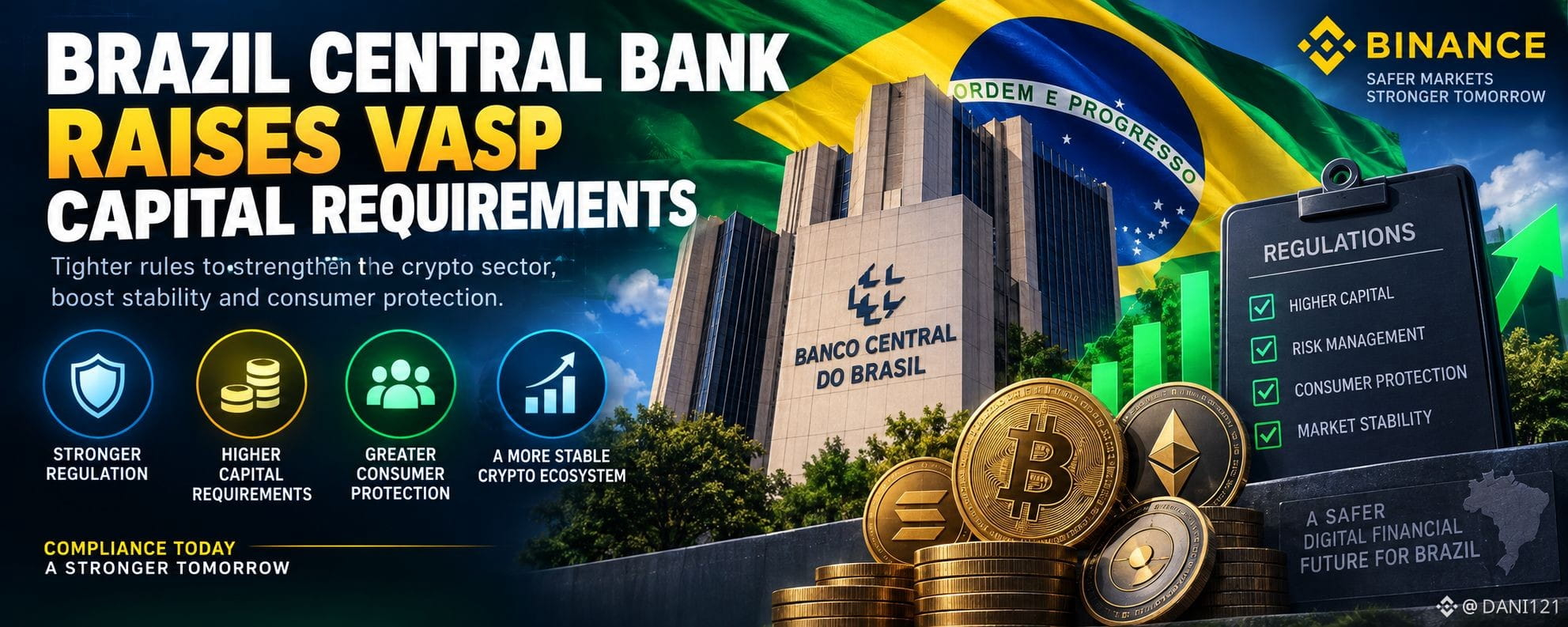
#brazilcentralbankraisesvaspcapitalrequirements 🚨 BRAZIL CENTRAL BANK RAISES VASP CAPITAL REQUIREMENTS! 🇧🇷💰
Brazil’s Central Bank has introduced tougher rules for virtual asset service providers (VASPs), including significantly higher minimum-capital requirements. Depending on the type of crypto activity, firms may need to maintain between R$10.8 million and R$37.2 million in minimum capital
🔥 Why it matters
🏦 Higher capital requirements could strengthen the financial resilience of crypto firms.
🛡️ The framework also increases regulatory oversight and audit requirements.
💵 Stablecoin-related businesses face additional scrutiny as Brazil considers treating stablecoins similarly to electronic money.
🌎 Brazil is positioning itself as a more regulated institutional crypto market.
⚠️ Cautious outlook: Larger, well-capitalized exchanges and financial institutions may benefit from clearer rules, while smaller VASPs could face higher compliance costs or consolidation pressure.
🚨 🇧🇷 BRAZIL CENTRAL BANK RAISES VASP CAPITAL REQUIREMENTS! 💰🔐
Brazil is tightening its crypto regulatory framework, with the Central Bank requiring virtual asset service providers (VASPs) to meet higher minimum-capital requirements.
💰 Minimum capital: R$10.8M–R$37.2M depending on activity
🏦 Stronger financial requirements
🛡️ Greater regulatory oversight
📋 Mandatory audits and compliance measures
💵 Stablecoins also face increased regulatory scrutiny
🔥 The move could make Brazil’s crypto market more resilient and attractive to larger institutional players.
⚠️ Cautious outlook: Higher capital requirements may improve investor protection and reduce risks, but smaller crypto companies could face significantly higher operating and compliance costs.
#Brazil #Crypto #VASP #CryptoRegulation #Bitcoin #Stablecoins #Blockchain #DigitalAssets #BinanceSquare
#brazilcentralbankraisesvaspcapitalrequirements 🚨 BRAZIL CENTRAL BANK RAISES VASP CAPITAL REQUIREMENTS! 🇧🇷💰
Brazil’s Central Bank has introduced tougher rules for virtual asset service providers (VASPs), including significantly higher minimum-capital requirements. Depending on the type of crypto activity, firms may need to maintain between R$10.8 million and R$37.2 million in minimum capital
🔥 Why it matters
🏦 Higher capital requirements could strengthen the financial resilience of crypto firms.
🛡️ The framework also increases regulatory oversight and audit requirements.
💵 Stablecoin-related businesses face additional scrutiny as Brazil considers treating stablecoins similarly to electronic money.
🌎 Brazil is positioning itself as a more regulated institutional crypto market.
⚠️ Cautious outlook: Larger, well-capitalized exchanges and financial institutions may benefit from clearer rules, while smaller VASPs could face higher compliance costs or consolidation pressure.
🚨 🇧🇷 BRAZIL CENTRAL BANK RAISES VASP CAPITAL REQUIREMENTS! 💰🔐
Brazil is tightening its crypto regulatory framework, with the Central Bank requiring virtual asset service providers (VASPs) to meet higher minimum-capital requirements.
💰 Minimum capital: R$10.8M–R$37.2M depending on activity
🏦 Stronger financial requirements
🛡️ Greater regulatory oversight
📋 Mandatory audits and compliance measures
💵 Stablecoins also face increased regulatory scrutiny
🔥 The move could make Brazil’s crypto market more resilient and attractive to larger institutional players.
⚠️ Cautious outlook: Higher capital requirements may improve investor protection and reduce risks, but smaller crypto companies could face significantly higher operating and compliance costs.
#Brazil #Crypto #VASP #CryptoRegulation #Bitcoin #Stablecoins #Blockchain #DigitalAssets #BinanceSquare
Brazil’s Central Bank has introduced tougher rules for virtual asset service providers (VASPs), including significantly higher minimum-capital requirements. Depending on the type of crypto activity, firms may need to maintain between R$10.8 million and R$37.2 million in minimum capital
🔥 Why it matters
🏦 Higher capital requirements could strengthen the financial resilience of crypto firms.
🛡️ The framework also increases regulatory oversight and audit requirements.
💵 Stablecoin-related businesses face additional scrutiny as Brazil considers treating stablecoins similarly to electronic money.
🌎 Brazil is positioning itself as a more regulated institutional crypto market.
⚠️ Cautious outlook: Larger, well-capitalized exchanges and financial institutions may benefit from clearer rules, while smaller VASPs could face higher compliance costs or consolidation pressure.
🚨 🇧🇷 BRAZIL CENTRAL BANK RAISES VASP CAPITAL REQUIREMENTS! 💰🔐
Brazil is tightening its crypto regulatory framework, with the Central Bank requiring virtual asset service providers (VASPs) to meet higher minimum-capital requirements.
💰 Minimum capital: R$10.8M–R$37.2M depending on activity
🏦 Stronger financial requirements
🛡️ Greater regulatory oversight
📋 Mandatory audits and compliance measures
💵 Stablecoins also face increased regulatory scrutiny
🔥 The move could make Brazil’s crypto market more resilient and attractive to larger institutional players.
⚠️ Cautious outlook: Higher capital requirements may improve investor protection and reduce risks, but smaller crypto companies could face significantly higher operating and compliance costs.
#Brazil #Crypto #VASP #CryptoRegulation #Bitcoin #Stablecoins #Blockchain #DigitalAssets #BinanceSquare
1
727

·
--
Bullish
#BrazilCentralBankRaisesVASPCapitalRequirements
🇧🇷 Brazil Tightens Crypto Rules
Brazil’s Central Bank is raising capital requirements for Virtual Asset Service Providers (VASPs), putting stronger financial and compliance standards on crypto companies.
🔹 Higher capital requirements
🔹 Stronger oversight
🔹 Greater focus on financial stability
🔹 Potential impact on smaller crypto firms
This could push Brazil’s crypto market toward a more regulated and institutional structure.
📊 Bullish for regulation, but challenging for smaller players.
What do you think — will stricter rules strengthen Brazil’s crypto industry?
#Brazil #CryptoRegulation #VASP #Bitcoin #Crypto #Blockchain #BinanceSquare
{spot}(BTCUSDT)
{spot}(ETHUSDT)
#FedHikeOddsRiseTo89% #AvalancheIntegratesIntoUAEPassDigitalVault #UKSeeksViewsOnTokenizingGold $NVDAB $AAPLB $NVDA.US
#BrazilCentralBankRaisesVASPCapitalRequirements
🇧🇷 Brazil Tightens Crypto Rules
Brazil’s Central Bank is raising capital requirements for Virtual Asset Service Providers (VASPs), putting stronger financial and compliance standards on crypto companies.
🔹 Higher capital requirements
🔹 Stronger oversight
🔹 Greater focus on financial stability
🔹 Potential impact on smaller crypto firms
This could push Brazil’s crypto market toward a more regulated and institutional structure.
📊 Bullish for regulation, but challenging for smaller players.
What do you think — will stricter rules strengthen Brazil’s crypto industry?
#Brazil #CryptoRegulation #VASP #Bitcoin #Crypto #Blockchain #BinanceSquare
#FedHikeOddsRiseTo89% #AvalancheIntegratesIntoUAEPassDigitalVault #UKSeeksViewsOnTokenizingGold $NVDAB $AAPLB $NVDA.US
🇧🇷 Brazil Tightens Crypto Rules
Brazil’s Central Bank is raising capital requirements for Virtual Asset Service Providers (VASPs), putting stronger financial and compliance standards on crypto companies.
🔹 Higher capital requirements
🔹 Stronger oversight
🔹 Greater focus on financial stability
🔹 Potential impact on smaller crypto firms
This could push Brazil’s crypto market toward a more regulated and institutional structure.
📊 Bullish for regulation, but challenging for smaller players.
What do you think — will stricter rules strengthen Brazil’s crypto industry?
#Brazil #CryptoRegulation #VASP #Bitcoin #Crypto #Blockchain #BinanceSquare
#FedHikeOddsRiseTo89% #AvalancheIntegratesIntoUAEPassDigitalVault #UKSeeksViewsOnTokenizingGold $NVDAB $AAPLB $NVDA.US
12

·
--
Article
Brazil Tightens Crypto Rules: Up to $7.2M Capital Requirement Could Reshape the Market#brazilcentralbankraisesvaspcapitalrequirements
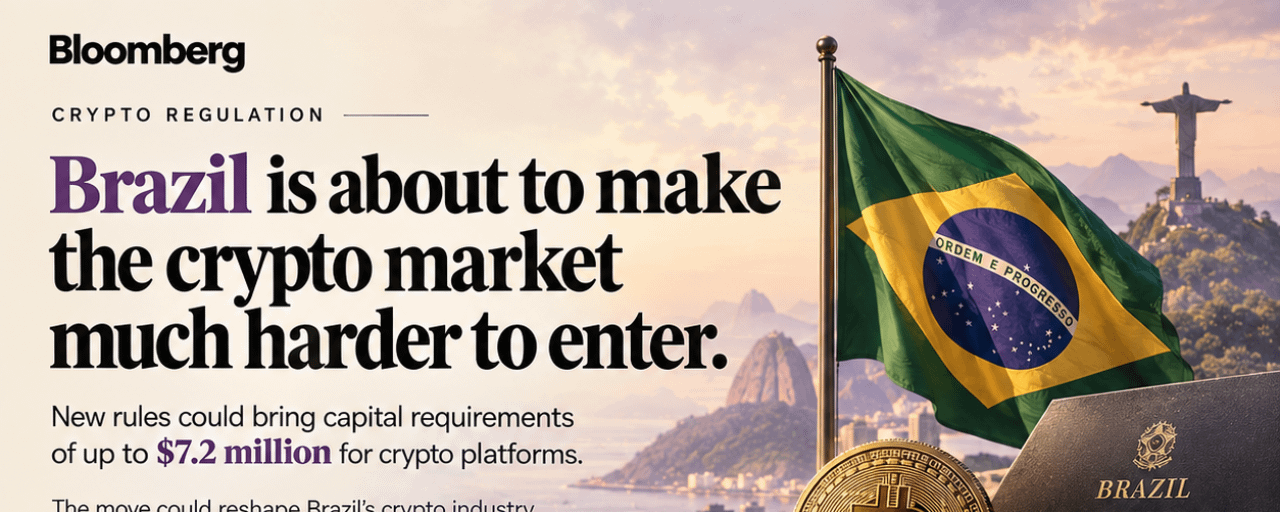
Brazil is moving toward tighter regulations for crypto platforms, with new capital requirements that could reach $7.2 million.
The proposed framework could dramatically reduce the number of platforms able to operate legally. Out of nearly 300 players, estimates suggest only 20 to 25 may be able to obtain a license, while roughly a dozen could ultimately receive approval.
That would represent a major shake-up for Brazil's crypto industry.
For established platforms, higher capital requirements could create a stronger compliance barrier against smaller competitors. For smaller crypto businesses, however, meeting the new requirements could become a serious challenge.
From a market perspective, the key question is what happens after implementation. Will stricter licensing create a more trusted and resilient crypto sector, or will it reduce competition and access?
For traders and users, it's worth watching which platforms secure licenses and how the new rules affect the broader Brazilian digital-asset market.
Brazil's crypto industry could be heading toward consolidation.
#Brazil #CryptoRegulation #Crypto #XRP #DigitalAssets
$BANK
{spot}(BANKUSDT)
$XRP
{spot}(XRPUSDT)
$SUI
{spot}(SUIUSDT)
Brazil Tightens Crypto Rules: Up to $7.2M Capital Requirement Could Reshape the Market
#brazilcentralbankraisesvaspcapitalrequirements
Brazil is moving toward tighter regulations for crypto platforms, with new capital requirements that could reach $7.2 million.
The proposed framework could dramatically reduce the number of platforms able to operate legally. Out of nearly 300 players, estimates suggest only 20 to 25 may be able to obtain a license, while roughly a dozen could ultimately receive approval.
That would represent a major shake-up for Brazil's crypto industry.
For established platforms, higher capital requirements could create a stronger compliance barrier against smaller competitors. For smaller crypto businesses, however, meeting the new requirements could become a serious challenge.
From a market perspective, the key question is what happens after implementation. Will stricter licensing create a more trusted and resilient crypto sector, or will it reduce competition and access?
For traders and users, it's worth watching which platforms secure licenses and how the new rules affect the broader Brazilian digital-asset market.
Brazil's crypto industry could be heading toward consolidation.
#Brazil #CryptoRegulation #Crypto #XRP #DigitalAssets
$BANK
$XRP
$SUI
Brazil is moving toward tighter regulations for crypto platforms, with new capital requirements that could reach $7.2 million.
The proposed framework could dramatically reduce the number of platforms able to operate legally. Out of nearly 300 players, estimates suggest only 20 to 25 may be able to obtain a license, while roughly a dozen could ultimately receive approval.
That would represent a major shake-up for Brazil's crypto industry.
For established platforms, higher capital requirements could create a stronger compliance barrier against smaller competitors. For smaller crypto businesses, however, meeting the new requirements could become a serious challenge.
From a market perspective, the key question is what happens after implementation. Will stricter licensing create a more trusted and resilient crypto sector, or will it reduce competition and access?
For traders and users, it's worth watching which platforms secure licenses and how the new rules affect the broader Brazilian digital-asset market.
Brazil's crypto industry could be heading toward consolidation.
#Brazil #CryptoRegulation #Crypto #XRP #DigitalAssets
$BANK
$XRP
$SUI
100

·
--
#brazilcentralbankraisesvaspcapitalrequirements
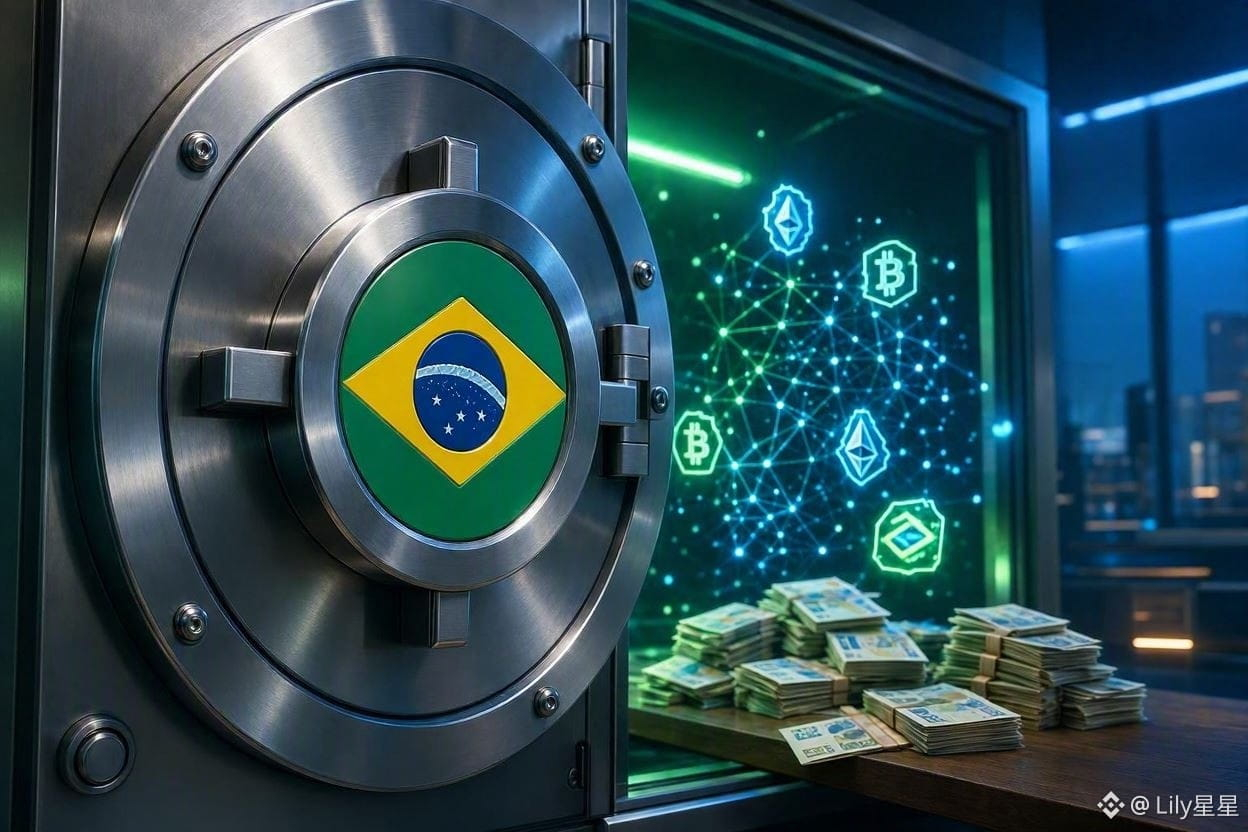
🇧🇷 Brazil Central Bank Tightens VASP Rules! Minimum Capital Requirements Raised Up To R$37.2 Million 🏦🚨
The Central Bank of Brazil (Banco Central do Brasil) has finalized strict new operational standards for Virtual Asset Service Providers (VASPs), dramatically raising the financial bar for crypto exchanges, custodians, and intermediaries operating in Latin America’s largest economy.
Under the updated regulatory framework, minimum paid-in capital requirements have been set between R$10.8 million and R$37.2 million ($2.1M to $7.2M USD) depending on risk profiles and business scope—far higher than earlier baseline drafts.
Key Regulatory Highlights:
Capital Reserve Baseline: Higher capital buffers are designed to protect customer funds and ensure market stability.
Strict Oversight: Rules mandate asset segregation, independent reserve audits, strict Travel Rule compliance, and enhanced AML/CTF controls.
Market Consolidation: Analysts expect the high compliance burden to drive consolidation, forcing smaller platforms to merge or exit while favoring institutional players.
This decisive move moves Brazil closer to European-style MiCA standards, prioritizing user protection and long-term market security over low-barrier entry.
Will stricter regulation help institutional capital flow into Brazilian crypto, or will it squeeze out smaller innovations? Share your view below! 👇
#Brazil #VASP #CryptoRegulation #BinanceSquare
#brazilcentralbankraisesvaspcapitalrequirements
🇧🇷 Brazil Central Bank Tightens VASP Rules! Minimum Capital Requirements Raised Up To R$37.2 Million 🏦🚨
The Central Bank of Brazil (Banco Central do Brasil) has finalized strict new operational standards for Virtual Asset Service Providers (VASPs), dramatically raising the financial bar for crypto exchanges, custodians, and intermediaries operating in Latin America’s largest economy.
Under the updated regulatory framework, minimum paid-in capital requirements have been set between R$10.8 million and R$37.2 million ($2.1M to $7.2M USD) depending on risk profiles and business scope—far higher than earlier baseline drafts.
Key Regulatory Highlights:
Capital Reserve Baseline: Higher capital buffers are designed to protect customer funds and ensure market stability.
Strict Oversight: Rules mandate asset segregation, independent reserve audits, strict Travel Rule compliance, and enhanced AML/CTF controls.
Market Consolidation: Analysts expect the high compliance burden to drive consolidation, forcing smaller platforms to merge or exit while favoring institutional players.
This decisive move moves Brazil closer to European-style MiCA standards, prioritizing user protection and long-term market security over low-barrier entry.
Will stricter regulation help institutional capital flow into Brazilian crypto, or will it squeeze out smaller innovations? Share your view below! 👇
#Brazil #VASP #CryptoRegulation #BinanceSquare
🇧🇷 Brazil Central Bank Tightens VASP Rules! Minimum Capital Requirements Raised Up To R$37.2 Million 🏦🚨
The Central Bank of Brazil (Banco Central do Brasil) has finalized strict new operational standards for Virtual Asset Service Providers (VASPs), dramatically raising the financial bar for crypto exchanges, custodians, and intermediaries operating in Latin America’s largest economy.
Under the updated regulatory framework, minimum paid-in capital requirements have been set between R$10.8 million and R$37.2 million ($2.1M to $7.2M USD) depending on risk profiles and business scope—far higher than earlier baseline drafts.
Key Regulatory Highlights:
Capital Reserve Baseline: Higher capital buffers are designed to protect customer funds and ensure market stability.
Strict Oversight: Rules mandate asset segregation, independent reserve audits, strict Travel Rule compliance, and enhanced AML/CTF controls.
Market Consolidation: Analysts expect the high compliance burden to drive consolidation, forcing smaller platforms to merge or exit while favoring institutional players.
This decisive move moves Brazil closer to European-style MiCA standards, prioritizing user protection and long-term market security over low-barrier entry.
Will stricter regulation help institutional capital flow into Brazilian crypto, or will it squeeze out smaller innovations? Share your view below! 👇
#Brazil #VASP #CryptoRegulation #BinanceSquare
2
167
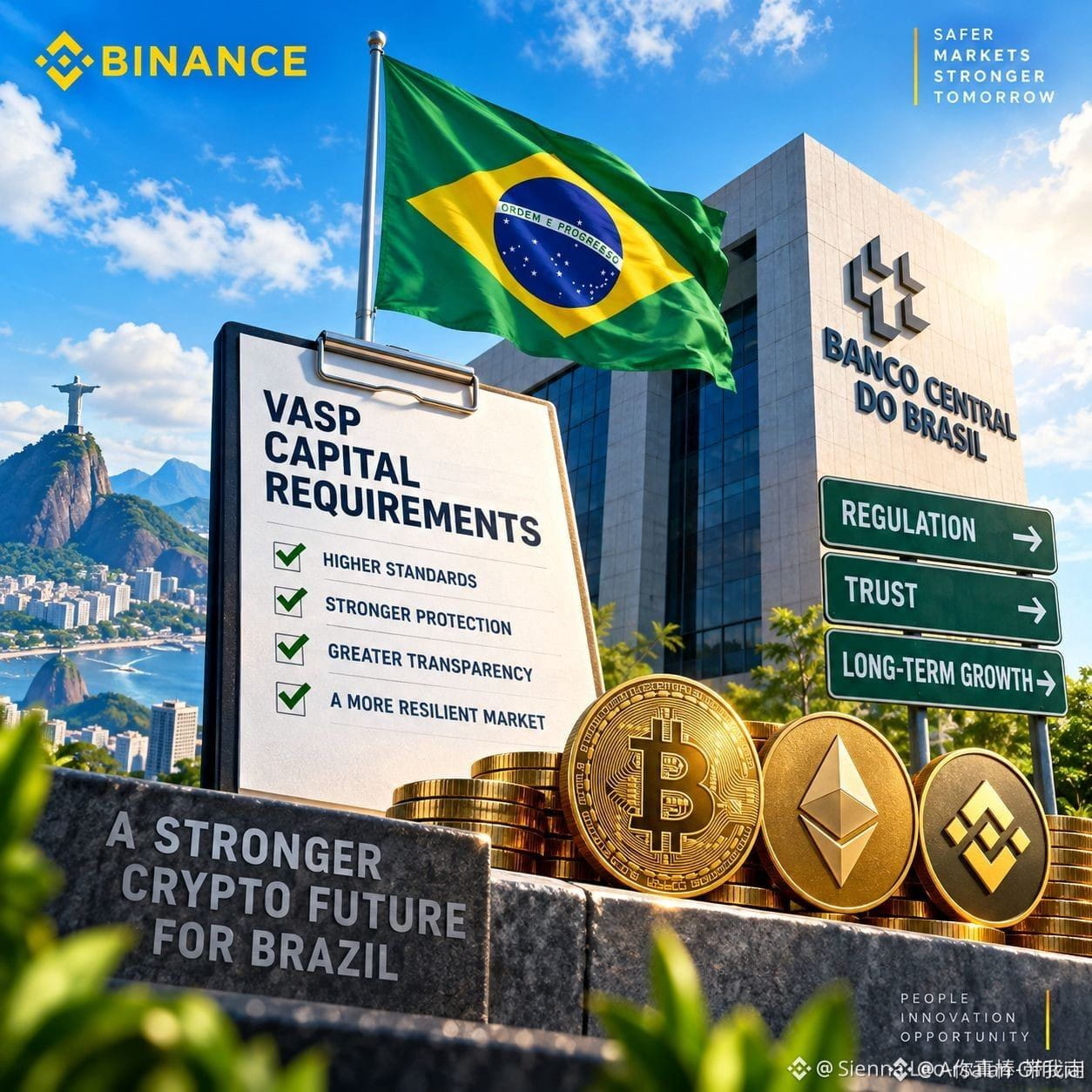
#BrazilCentralBankRaisesVASPCapitalRequirements 🇧🇷🏦
Brazil’s Central Bank has introduced a tougher regulatory framework for **Virtual Asset Service Providers (VASPs)**, including minimum capital requirements that can range from roughly **R$10.8 million to R$37.2 million**, depending on the type of activity. ([ANBIMA International][1])
The move strengthens oversight of Brazil’s crypto sector and raises the compliance and capital requirements for firms operating in the virtual-asset market.
**#Brazil #Crypto #VASP #Bitcoin #Blockchain #DigitalAssets #CryptoRegulation #CentralBank #DeFi #Web3 #BTC #ETH #Regulation**
[1]: $BTC
{spot}(BTCUSDT)
$ETH
{spot}(ETHUSDT)
#BrazilCentralBankRaisesVASPCapitalRequirements 🇧🇷🏦
Brazil’s Central Bank has introduced a tougher regulatory framework for **Virtual Asset Service Providers (VASPs)**, including minimum capital requirements that can range from roughly **R$10.8 million to R$37.2 million**, depending on the type of activity. ([ANBIMA International][1])
The move strengthens oversight of Brazil’s crypto sector and raises the compliance and capital requirements for firms operating in the virtual-asset market.
**#Brazil #Crypto #VASP #Bitcoin #Blockchain #DigitalAssets #CryptoRegulation #CentralBank #DeFi #Web3 #BTC #ETH #Regulation**
[1]: $BTC
$ETH
Brazil’s Central Bank has introduced a tougher regulatory framework for **Virtual Asset Service Providers (VASPs)**, including minimum capital requirements that can range from roughly **R$10.8 million to R$37.2 million**, depending on the type of activity. ([ANBIMA International][1])
The move strengthens oversight of Brazil’s crypto sector and raises the compliance and capital requirements for firms operating in the virtual-asset market.
**#Brazil #Crypto #VASP #Bitcoin #Blockchain #DigitalAssets #CryptoRegulation #CentralBank #DeFi #Web3 #BTC #ETH #Regulation**
[1]: $BTC
$ETH
1
31

·
--
⚽Brazil raises the bar.
Brazil is making crypto businesses answer a very traditional question:
How much capital can you actually stand behind?
Brazil's Central Bank has been building out its VASP framework in 2026, with crypto-asset service providers facing new prudential requirements depending on the activities they perform.
The capital requirements can reach tens of millions of Brazilian reais for certain VASP categories.
That's more than a compliance footnote.
Higher capital requirements can give regulators a stronger financial buffer around crypto businesses — but they can also raise the cost of entry for smaller companies.
So there's a trade-off:
Does bringing crypto closer to traditional financial standards make the industry safer — or make it harder for smaller players to survive?
Brazil may be giving us an early look at that answer.
$BNB $BTC $ETH
DYOR.
#BrazilCentralBankRaisesVASPCapitalRequirements
#RussianCentralBankFlagsCryptoAsFinancialRisk
#SouthKoreaCryptoTaxDelayPetitionTops50000
⚽Brazil raises the bar.
Brazil is making crypto businesses answer a very traditional question:
How much capital can you actually stand behind?
Brazil's Central Bank has been building out its VASP framework in 2026, with crypto-asset service providers facing new prudential requirements depending on the activities they perform.
The capital requirements can reach tens of millions of Brazilian reais for certain VASP categories.
That's more than a compliance footnote.
Higher capital requirements can give regulators a stronger financial buffer around crypto businesses — but they can also raise the cost of entry for smaller companies.
So there's a trade-off:
Does bringing crypto closer to traditional financial standards make the industry safer — or make it harder for smaller players to survive?
Brazil may be giving us an early look at that answer.
$BNB $BTC $ETH
DYOR.
#BrazilCentralBankRaisesVASPCapitalRequirements
#RussianCentralBankFlagsCryptoAsFinancialRisk
#SouthKoreaCryptoTaxDelayPetitionTops50000
Brazil is making crypto businesses answer a very traditional question:
How much capital can you actually stand behind?
Brazil's Central Bank has been building out its VASP framework in 2026, with crypto-asset service providers facing new prudential requirements depending on the activities they perform.
The capital requirements can reach tens of millions of Brazilian reais for certain VASP categories.
That's more than a compliance footnote.
Higher capital requirements can give regulators a stronger financial buffer around crypto businesses — but they can also raise the cost of entry for smaller companies.
So there's a trade-off:
Does bringing crypto closer to traditional financial standards make the industry safer — or make it harder for smaller players to survive?
Brazil may be giving us an early look at that answer.
$BNB $BTC $ETH
DYOR.
#BrazilCentralBankRaisesVASPCapitalRequirements
#RussianCentralBankFlagsCryptoAsFinancialRisk
#SouthKoreaCryptoTaxDelayPetitionTops50000

34

#brazilcentralbankraisesvaspcapitalrequirements
🇧🇷
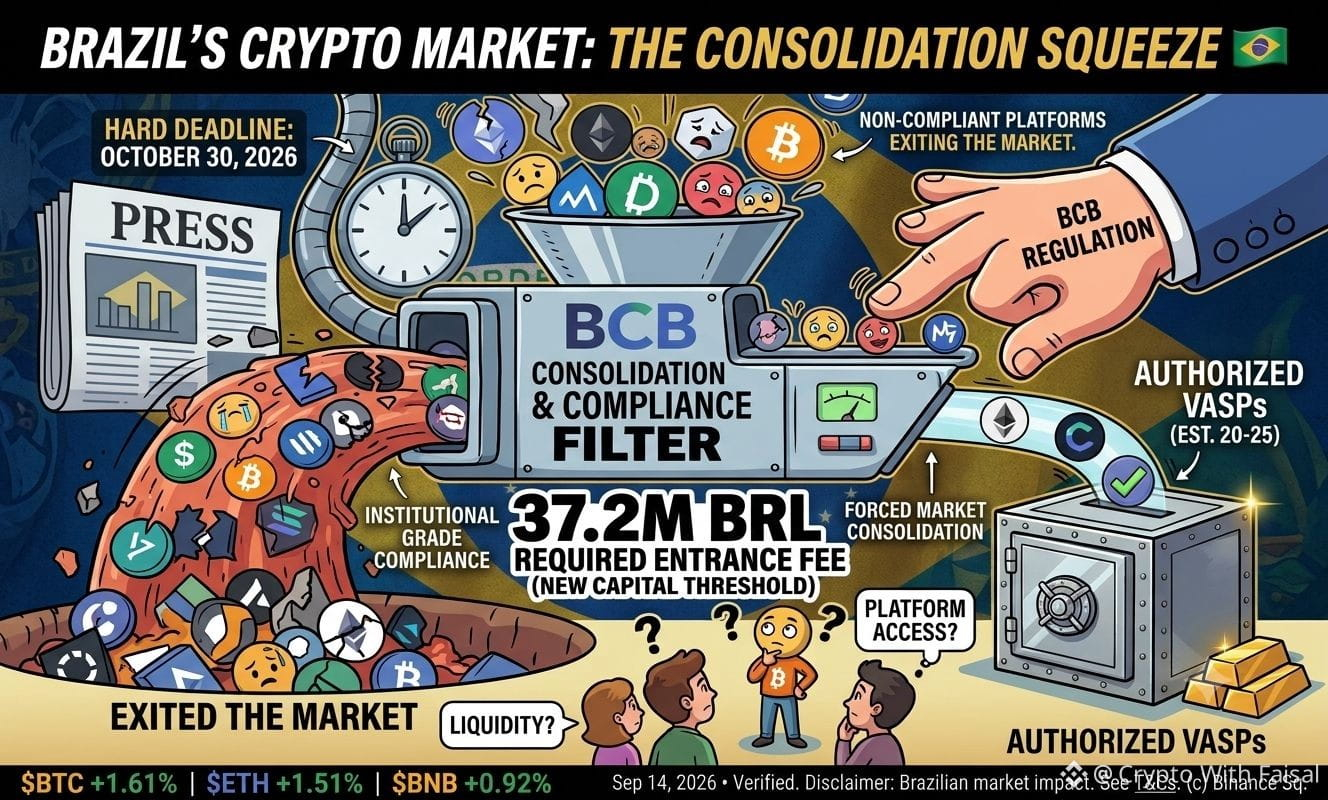
The Brazil Central Bank has officially rolled out aggressive new rules for all crypto platforms (VASPs), significantly raising the capital threshold to 37.2 million BRL.
➡️
This decisive regulatory overhaul is engineered to consolidate the market, with only 20-25 institutions expected to survive compliance and move toward institutional-grade standards.
$BR
{future}(BRUSDT)
$CAP
{future}(CAPUSDT)
$AIN
{future}(AINUSDT)
#brazilcentralbankraisesvaspcapitalrequirements
🇧🇷
The Brazil Central Bank has officially rolled out aggressive new rules for all crypto platforms (VASPs), significantly raising the capital threshold to 37.2 million BRL.
➡️
This decisive regulatory overhaul is engineered to consolidate the market, with only 20-25 institutions expected to survive compliance and move toward institutional-grade standards.
$BR
$CAP
$AIN
🇧🇷
The Brazil Central Bank has officially rolled out aggressive new rules for all crypto platforms (VASPs), significantly raising the capital threshold to 37.2 million BRL.
➡️
This decisive regulatory overhaul is engineered to consolidate the market, with only 20-25 institutions expected to survive compliance and move toward institutional-grade standards.
$BR
$CAP
$AIN
340
·
--
#brazilcentralbankraisesvaspcapitalrequirements
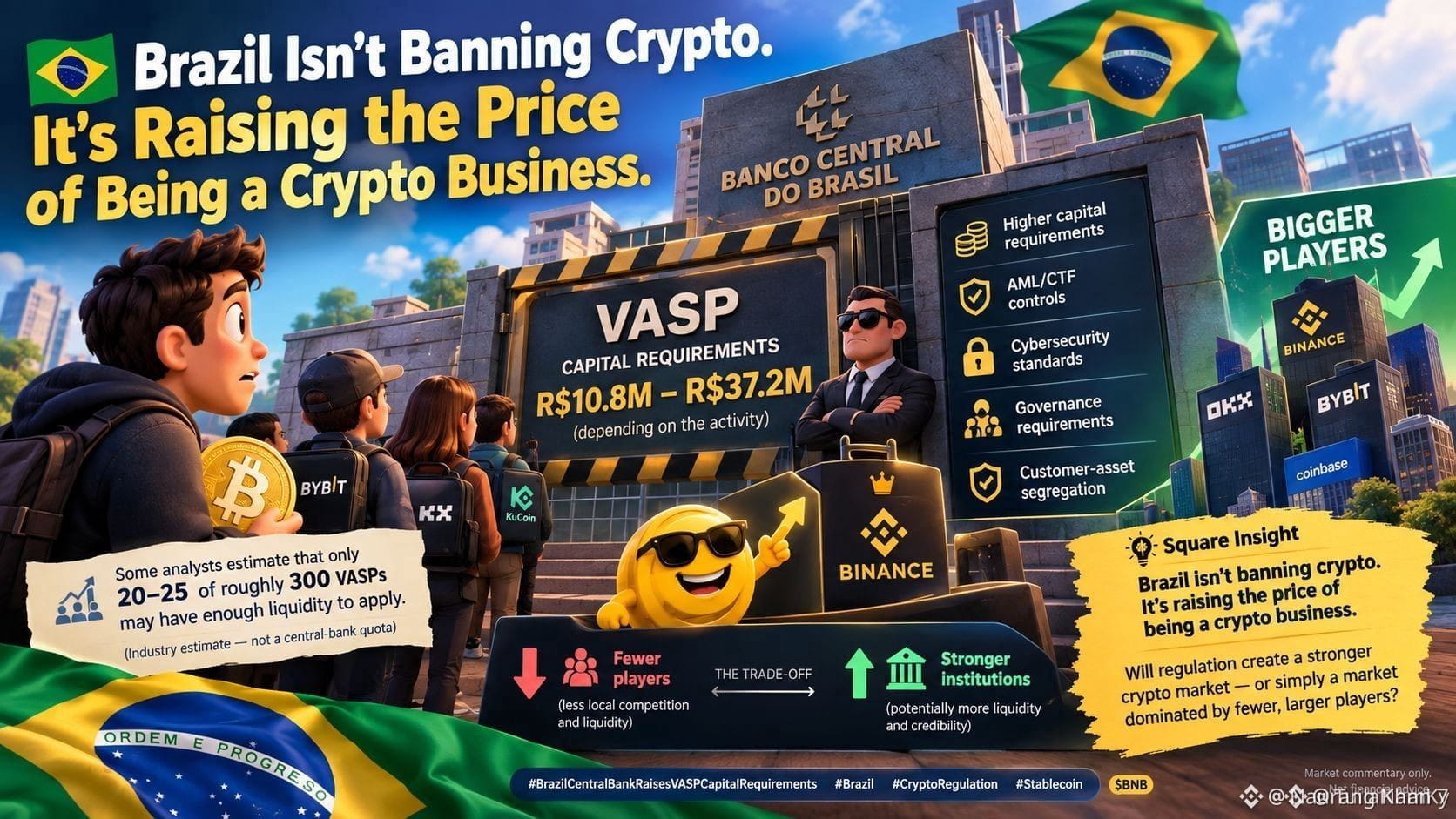
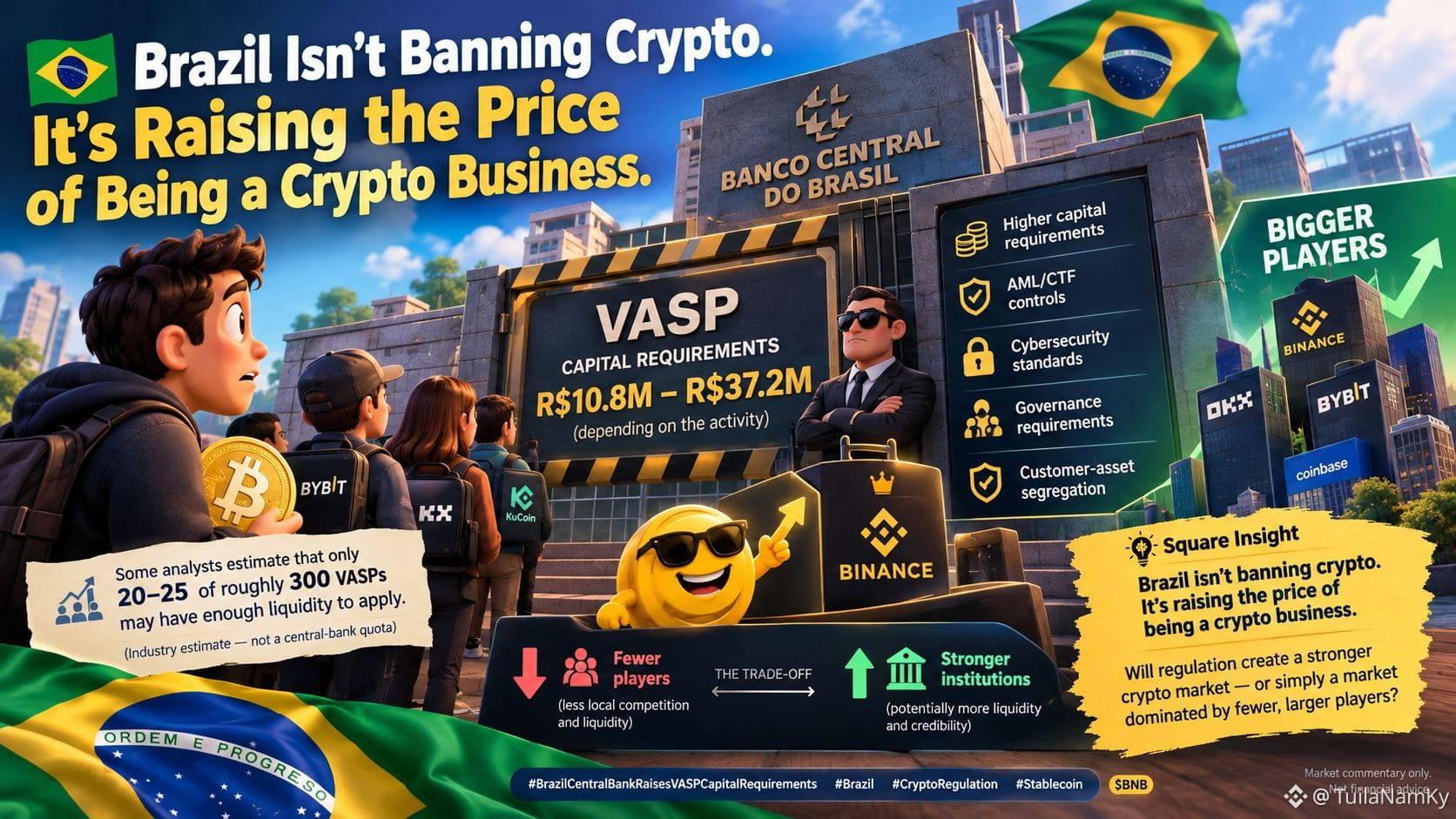
🇧🇷 Brazil Isn’t Banning Crypto. It’s Raising the Price of Being a Crypto Business.
Brazil’s central bank has drawn a much higher compliance line for crypto firms.
Under its new VASP framework, companies face minimum capital requirements of roughly R$10.8M–R$37.2M, depending on what they do.
That changes the game.
Smaller exchanges and crypto businesses now have to absorb:
→ Higher capital requirements
→ AML/CTF controls
→ Cybersecurity standards
→ Governance requirements
→ Customer-asset segregation
And here’s the interesting part. 👀
Some analysts estimate that only 20–25 of roughly 300 VASPs may have enough liquidity to apply.
But that is an industry estimate — not a central-bank quota.
🧩 THE BIGGER TWIST
Regulation doesn't necessarily kill crypto.
It can consolidate it.
If smaller players exit or merge, larger exchanges may gain market share, liquidity and institutional credibility.
That’s where the indirect connection to $BNB becomes interesting.
The beneficiaries may not be the tokens themselves.
They may be the large exchange ecosystems capable of absorbing the regulatory cost.
But there’s another risk:
Brazil is also tightening oversight around crypto-related FX and stablecoin activity.
So this isn't simply “more regulation = bullish.”
It’s a trade-off:
More compliance → fewer players → potentially stronger institutions → but potentially less local competition and liquidity.
🧠 Square Insight
Brazil isn't banning crypto. It's raising the price of being a crypto business.
The real question is: Will regulation create a stronger crypto market — or simply a market dominated by fewer, larger players?
$BNB
{future}(BNBUSDT)
#Brazil #CryptoRegulation #Stablecoin
Market commentary only. Not financial advice.
#brazilcentralbankraisesvaspcapitalrequirements
🇧🇷 Brazil Isn’t Banning Crypto. It’s Raising the Price of Being a Crypto Business.
Brazil’s central bank has drawn a much higher compliance line for crypto firms.
Under its new VASP framework, companies face minimum capital requirements of roughly R$10.8M–R$37.2M, depending on what they do.
That changes the game.
Smaller exchanges and crypto businesses now have to absorb:
→ Higher capital requirements
→ AML/CTF controls
→ Cybersecurity standards
→ Governance requirements
→ Customer-asset segregation
And here’s the interesting part. 👀
Some analysts estimate that only 20–25 of roughly 300 VASPs may have enough liquidity to apply.
But that is an industry estimate — not a central-bank quota.
🧩 THE BIGGER TWIST
Regulation doesn't necessarily kill crypto.
It can consolidate it.
If smaller players exit or merge, larger exchanges may gain market share, liquidity and institutional credibility.
That’s where the indirect connection to $BNB becomes interesting.
The beneficiaries may not be the tokens themselves.
They may be the large exchange ecosystems capable of absorbing the regulatory cost.
But there’s another risk:
Brazil is also tightening oversight around crypto-related FX and stablecoin activity.
So this isn't simply “more regulation = bullish.”
It’s a trade-off:
More compliance → fewer players → potentially stronger institutions → but potentially less local competition and liquidity.
🧠 Square Insight
Brazil isn't banning crypto. It's raising the price of being a crypto business.
The real question is: Will regulation create a stronger crypto market — or simply a market dominated by fewer, larger players?
$BNB
#Brazil #CryptoRegulation #Stablecoin
Market commentary only. Not financial advice.
🇧🇷 Brazil Isn’t Banning Crypto. It’s Raising the Price of Being a Crypto Business.
Brazil’s central bank has drawn a much higher compliance line for crypto firms.
Under its new VASP framework, companies face minimum capital requirements of roughly R$10.8M–R$37.2M, depending on what they do.
That changes the game.
Smaller exchanges and crypto businesses now have to absorb:
→ Higher capital requirements
→ AML/CTF controls
→ Cybersecurity standards
→ Governance requirements
→ Customer-asset segregation
And here’s the interesting part. 👀
Some analysts estimate that only 20–25 of roughly 300 VASPs may have enough liquidity to apply.
But that is an industry estimate — not a central-bank quota.
🧩 THE BIGGER TWIST
Regulation doesn't necessarily kill crypto.
It can consolidate it.
If smaller players exit or merge, larger exchanges may gain market share, liquidity and institutional credibility.
That’s where the indirect connection to $BNB becomes interesting.
The beneficiaries may not be the tokens themselves.
They may be the large exchange ecosystems capable of absorbing the regulatory cost.
But there’s another risk:
Brazil is also tightening oversight around crypto-related FX and stablecoin activity.
So this isn't simply “more regulation = bullish.”
It’s a trade-off:
More compliance → fewer players → potentially stronger institutions → but potentially less local competition and liquidity.
🧠 Square Insight
Brazil isn't banning crypto. It's raising the price of being a crypto business.
The real question is: Will regulation create a stronger crypto market — or simply a market dominated by fewer, larger players?
$BNB
#Brazil #CryptoRegulation #Stablecoin
Market commentary only. Not financial advice.
2
1.1k

·
--
Bearish
#brazilcentralbankraisesvaspcapitalrequirements
🚨 Brazil Tightens Crypto Rules
Brazil’s new crypto rules could require platforms to hold up to $7.2M in capital, creating a major barrier for smaller firms. Reports suggest only a fraction of the roughly 300 players may qualify for authorization.
⚠️ The tighter framework could accelerate consolidation across Brazil’s crypto market.
Trading View: SELL 🔴
Question: Could stricter regulation pressure Brazil’s crypto market? "CLICK ON THE BELOW YELLOW COIN TAG TO GO TO DESIRED TRADING PAGE TO GET BENEFIT TRADE"$MINA $LSK $TREE
{spot}(TREEUSDT)
{spot}(LSKUSDT)
{spot}(MINAUSDT)
#LSK #Brazil #centralbank
#brazilcentralbankraisesvaspcapitalrequirements
🚨 Brazil Tightens Crypto Rules
Brazil’s new crypto rules could require platforms to hold up to $7.2M in capital, creating a major barrier for smaller firms. Reports suggest only a fraction of the roughly 300 players may qualify for authorization.
⚠️ The tighter framework could accelerate consolidation across Brazil’s crypto market.
Trading View: SELL 🔴
Question: Could stricter regulation pressure Brazil’s crypto market? "CLICK ON THE BELOW YELLOW COIN TAG TO GO TO DESIRED TRADING PAGE TO GET BENEFIT TRADE"$MINA $LSK $TREE
#LSK #Brazil #centralbank
🚨 Brazil Tightens Crypto Rules
Brazil’s new crypto rules could require platforms to hold up to $7.2M in capital, creating a major barrier for smaller firms. Reports suggest only a fraction of the roughly 300 players may qualify for authorization.
⚠️ The tighter framework could accelerate consolidation across Brazil’s crypto market.
Trading View: SELL 🔴
Question: Could stricter regulation pressure Brazil’s crypto market? "CLICK ON THE BELOW YELLOW COIN TAG TO GO TO DESIRED TRADING PAGE TO GET BENEFIT TRADE"$MINA $LSK $TREE
#LSK #Brazil #centralbank

3
24

·
--
#brazilcentralbankraisesvaspcapitalrequirements 🇧🇷
Brazil is significantly tightening the rules for crypto platforms, with capital requirements that can reach $7.2 million.
➡️
Out of nearly 300 players, only 20 to 25 would be able to obtain a license, and just about a dozen might ultimately be approved.$BANK $XRP $SUI
#brazilcentralbankraisesvaspcapitalrequirements 🇧🇷
Brazil is significantly tightening the rules for crypto platforms, with capital requirements that can reach $7.2 million.
➡️
Out of nearly 300 players, only 20 to 25 would be able to obtain a license, and just about a dozen might ultimately be approved.$BANK $XRP $SUI
Brazil is significantly tightening the rules for crypto platforms, with capital requirements that can reach $7.2 million.
➡️
Out of nearly 300 players, only 20 to 25 would be able to obtain a license, and just about a dozen might ultimately be approved.$BANK $XRP $SUI

1
1
2.6k


·
--
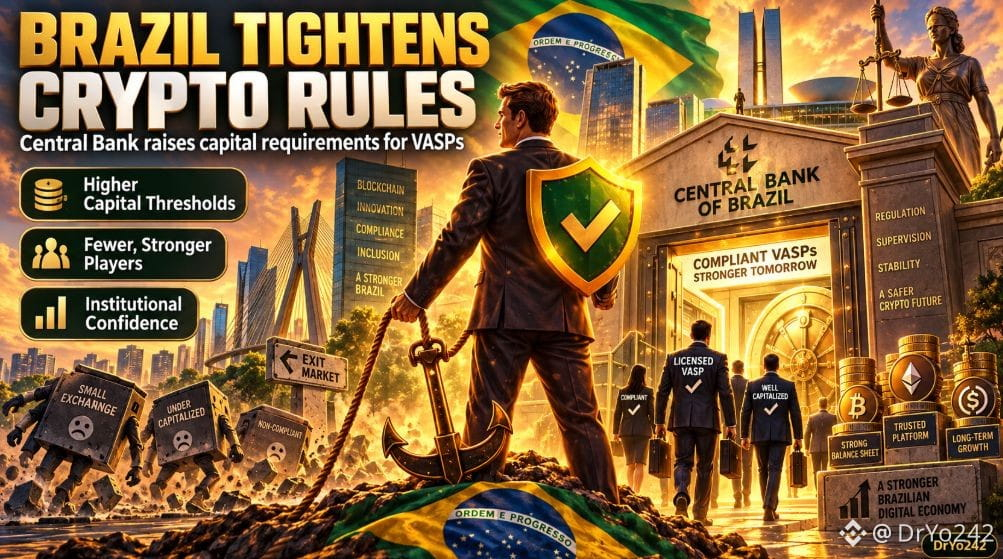
🇧🇷 BRAZIL JUST RAISED THE BAR FOR CRYPTO.
The Central Bank of Brazil is tightening rules for Virtual Asset Service Providers (VASPs).
🏦 Minimum capital requirements: R$10.8M → R$37.2M, depending on the business model.
By October 30, 2026, providers operating in Brazil must be authorized or going through the authorization process.
This means stricter governance, AML controls, risk management and customer protection.
My take: bullish for long-term market credibility — but smaller, undercapitalized crypto firms could be pushed out, accelerating consolidation.
Regulation is no longer coming to crypto. It’s already here.
Do you see this as protection or a barrier to innovation?
#DrYo242
$FIL $ETH $BTC
#brazilcentralbankraisesvaspcapitalrequirements
🇧🇷 BRAZIL JUST RAISED THE BAR FOR CRYPTO.
The Central Bank of Brazil is tightening rules for Virtual Asset Service Providers (VASPs).
🏦 Minimum capital requirements: R$10.8M → R$37.2M, depending on the business model.
By October 30, 2026, providers operating in Brazil must be authorized or going through the authorization process.
This means stricter governance, AML controls, risk management and customer protection.
My take: bullish for long-term market credibility — but smaller, undercapitalized crypto firms could be pushed out, accelerating consolidation.
Regulation is no longer coming to crypto. It’s already here.
Do you see this as protection or a barrier to innovation?
#DrYo242
$FIL $ETH $BTC
#brazilcentralbankraisesvaspcapitalrequirements
The Central Bank of Brazil is tightening rules for Virtual Asset Service Providers (VASPs).
🏦 Minimum capital requirements: R$10.8M → R$37.2M, depending on the business model.
By October 30, 2026, providers operating in Brazil must be authorized or going through the authorization process.
This means stricter governance, AML controls, risk management and customer protection.
My take: bullish for long-term market credibility — but smaller, undercapitalized crypto firms could be pushed out, accelerating consolidation.
Regulation is no longer coming to crypto. It’s already here.
Do you see this as protection or a barrier to innovation?
#DrYo242
$FIL $ETH $BTC
#brazilcentralbankraisesvaspcapitalrequirements
3
507
·
--
#brazilcentralbankraisesvaspcapitalrequirements
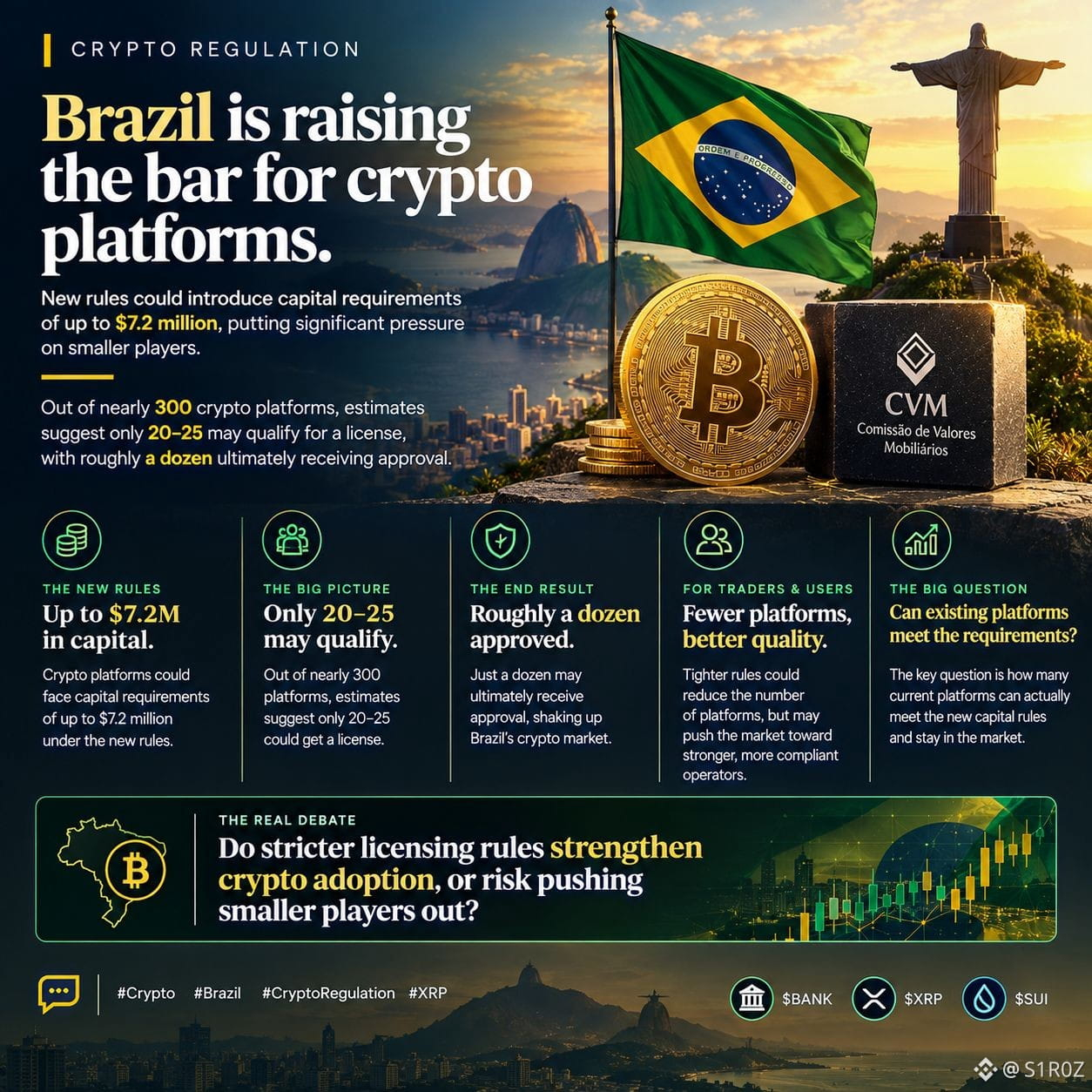
🇧🇷 Brazil is raising the bar for crypto platforms.
New rules could introduce capital requirements of up to $7.2 million, putting significant pressure on smaller players.
Out of nearly 300 crypto platforms, estimates suggest only 20–25 may qualify for a license, with roughly a dozen ultimately receiving approval.
That would be a major shake-up for Brazil’s crypto market.
For traders and users, tighter rules could reduce the number of platforms available, but they may also push the market toward better-capitalized and more compliant operators.
The key question now is how many existing platforms can actually meet the new requirements and stay in the market.
Do stricter licensing rules strengthen crypto adoption, or risk pushing smaller players out?
#crypto #Brazil #CryptoRegulation #xrp
$BANK $XRP $SUI
{spot}(BANKUSDT)
{spot}(XRPUSDT)
{spot}(SUIUSDT)
#brazilcentralbankraisesvaspcapitalrequirements
🇧🇷 Brazil is raising the bar for crypto platforms.
New rules could introduce capital requirements of up to $7.2 million, putting significant pressure on smaller players.
Out of nearly 300 crypto platforms, estimates suggest only 20–25 may qualify for a license, with roughly a dozen ultimately receiving approval.
That would be a major shake-up for Brazil’s crypto market.
For traders and users, tighter rules could reduce the number of platforms available, but they may also push the market toward better-capitalized and more compliant operators.
The key question now is how many existing platforms can actually meet the new requirements and stay in the market.
Do stricter licensing rules strengthen crypto adoption, or risk pushing smaller players out?
#crypto #Brazil #CryptoRegulation #xrp
$BANK $XRP $SUI
🇧🇷 Brazil is raising the bar for crypto platforms.
New rules could introduce capital requirements of up to $7.2 million, putting significant pressure on smaller players.
Out of nearly 300 crypto platforms, estimates suggest only 20–25 may qualify for a license, with roughly a dozen ultimately receiving approval.
That would be a major shake-up for Brazil’s crypto market.
For traders and users, tighter rules could reduce the number of platforms available, but they may also push the market toward better-capitalized and more compliant operators.
The key question now is how many existing platforms can actually meet the new requirements and stay in the market.
Do stricter licensing rules strengthen crypto adoption, or risk pushing smaller players out?
#crypto #Brazil #CryptoRegulation #xrp
$BANK $XRP $SUI
1
225
Log in to explore more content
Join global crypto users on Binance Square
⚡️ Get latest and useful information about crypto.
💬 Trusted by the world’s largest crypto exchange.
👍 Discover real insights from verified creators.
Email / Phone number
Trending Topics
1
#AIStocksWhatNext
64,719 views
632 Discussing
2
#DogecoinRises15%
8 views
4 Discussing
3
#$14BBitcoinOptionsExpireFriday
0 views
0 Discussing
4
#BNBMarketCapPassesBNYMellon
6 views
3 Discussing
5
#CryptoMarketCapReclaims$3Trillion
0 views
0 Discussing
6
#MuseOvertakesChatGPTAsTopFreeIOSApp
1,027 views
44 Discussing
7
#TokenizedStockPlatformsCouldLaunchNextQuarter
2,298 views
61 Discussing
8
#StrategyAdds950Bitcoin
4,881 views
151 Discussing
9
#CardanoAddedToX402KitForADAPayments
10,421 views
326 Discussing
10
#XRPRises8%
21,903 views
650 Discussing