

#rlusd
rlusd
2.2M views
4,021 Discussing
Hot
Latest

·
--
$RLUSD +0.00% | $PUMP -2.72% | $LINK -2.83%
#RLUSD holds steady at $1.00 with flat price action, while its $68.4 M volume shows continued interest in the Ripple‑backed stablecoin.
#PUMP slipped to $0.00580300, down 2.72% on a solid $63.1 M of trading, suggesting sellers are outpacing buyers despite the heavy flow.
#LINK fell to $14.26, a 2.83% decline, yet $60.2 M moved through the market, hinting at lingering demand even as the price eases.
👀 Watch how the comparable volumes across these three could signal whether price pressure will reverse or keep fading.
#Write2Earn #Binance
$RLUSD +0.00% | $PUMP -2.72% | $LINK -2.83%
#RLUSD holds steady at $1.00 with flat price action, while its $68.4 M volume shows continued interest in the Ripple‑backed stablecoin.
#PUMP slipped to $0.00580300, down 2.72% on a solid $63.1 M of trading, suggesting sellers are outpacing buyers despite the heavy flow.
#LINK fell to $14.26, a 2.83% decline, yet $60.2 M moved through the market, hinting at lingering demand even as the price eases.
👀 Watch how the comparable volumes across these three could signal whether price pressure will reverse or keep fading.
#Write2Earn #Binance
#RLUSD holds steady at $1.00 with flat price action, while its $68.4 M volume shows continued interest in the Ripple‑backed stablecoin.
#PUMP slipped to $0.00580300, down 2.72% on a solid $63.1 M of trading, suggesting sellers are outpacing buyers despite the heavy flow.
#LINK fell to $14.26, a 2.83% decline, yet $60.2 M moved through the market, hinting at lingering demand even as the price eases.
👀 Watch how the comparable volumes across these three could signal whether price pressure will reverse or keep fading.
#Write2Earn #Binance
13

·
--
🚨 $RLUSD SURGES PAST $2B MARKET CAP AS XRP LEDGER ABSORBS INSTITUTIONAL LIQUIDITY! ⚡
Institutional liquidity velocity is shifting fast as $RLUSD breaches the $2 billion market cap threshold. 🦈 With nearly $1 billion minted natively on the $XRP Ledger, smart money is building deep structural liquidity rails directly on-chain. 📊
This rapid stablecoin capital injection creates a massive liquidity buffer, lowering execution friction for high-volume institutional order flow. 💡 As on-chain treasury reserves expand, settlement infrastructure reaches critical mass. 💬 Do you expect this structural capital inflow to spark the next major expansion leg for $XRP ? 👇
⚠️ Not financial advice. Always manage your risk. 🛡️
🏷️ #RLUSD #XRP #Stablecoins #Crypto #SmartMoney
🎯 🦈
🚨 $RLUSD SURGES PAST $2B MARKET CAP AS XRP LEDGER ABSORBS INSTITUTIONAL LIQUIDITY! ⚡
Institutional liquidity velocity is shifting fast as $RLUSD breaches the $2 billion market cap threshold. 🦈 With nearly $1 billion minted natively on the $XRP Ledger, smart money is building deep structural liquidity rails directly on-chain. 📊
This rapid stablecoin capital injection creates a massive liquidity buffer, lowering execution friction for high-volume institutional order flow. 💡 As on-chain treasury reserves expand, settlement infrastructure reaches critical mass. 💬 Do you expect this structural capital inflow to spark the next major expansion leg for $XRP ? 👇
⚠️ Not financial advice. Always manage your risk. 🛡️
🏷️ #RLUSD #XRP #Stablecoins #Crypto #SmartMoney
🎯 🦈
Institutional liquidity velocity is shifting fast as $RLUSD breaches the $2 billion market cap threshold. 🦈 With nearly $1 billion minted natively on the $XRP Ledger, smart money is building deep structural liquidity rails directly on-chain. 📊
This rapid stablecoin capital injection creates a massive liquidity buffer, lowering execution friction for high-volume institutional order flow. 💡 As on-chain treasury reserves expand, settlement infrastructure reaches critical mass. 💬 Do you expect this structural capital inflow to spark the next major expansion leg for $XRP ? 👇
⚠️ Not financial advice. Always manage your risk. 🛡️
🏷️ #RLUSD #XRP #Stablecoins #Crypto #SmartMoney
🎯 🦈

104

·
--
⚡ $RLUSD STABLECOIN SUPPLY SURGES 86% AS RIPPLE CLOSES IN ON PYUSD! 🦈
📌 Smart money is quietly shifting liquidity as Ripple's $RLUSD market cap skyrockets past $2.49 billion, expanding over 86% this year. 📊 In just seven days, capital poured in with a $112 million supply increase while competing $PYUSD suffered a $61 million contraction.
🌊 Issuance on the XRP Ledger grew by $63 million this week alone, now capturing 44% of total supply as institutional lending scenarios take flight. 💡 Ripple is positioning $RLUSD to capture traditional liquidity right under the market's nose as competitor stablecoins bleed off their peaks. 🤔 Do you see $RLUSD flipping PYUSD before Q4 ends? 👇
⚠️ Not financial advice. Always manage your risk. 🛡️
🏷️ #RLUSD #XRP #Stablecoins #Ripple #Crypto
🔥 🦈
⚡ $RLUSD STABLECOIN SUPPLY SURGES 86% AS RIPPLE CLOSES IN ON PYUSD! 🦈
📌 Smart money is quietly shifting liquidity as Ripple's $RLUSD market cap skyrockets past $2.49 billion, expanding over 86% this year. 📊 In just seven days, capital poured in with a $112 million supply increase while competing $PYUSD suffered a $61 million contraction.
🌊 Issuance on the XRP Ledger grew by $63 million this week alone, now capturing 44% of total supply as institutional lending scenarios take flight. 💡 Ripple is positioning $RLUSD to capture traditional liquidity right under the market's nose as competitor stablecoins bleed off their peaks. 🤔 Do you see $RLUSD flipping PYUSD before Q4 ends? 👇
⚠️ Not financial advice. Always manage your risk. 🛡️
🏷️ #RLUSD #XRP #Stablecoins #Ripple #Crypto
🔥 🦈
📌 Smart money is quietly shifting liquidity as Ripple's $RLUSD market cap skyrockets past $2.49 billion, expanding over 86% this year. 📊 In just seven days, capital poured in with a $112 million supply increase while competing $PYUSD suffered a $61 million contraction.
🌊 Issuance on the XRP Ledger grew by $63 million this week alone, now capturing 44% of total supply as institutional lending scenarios take flight. 💡 Ripple is positioning $RLUSD to capture traditional liquidity right under the market's nose as competitor stablecoins bleed off their peaks. 🤔 Do you see $RLUSD flipping PYUSD before Q4 ends? 👇
⚠️ Not financial advice. Always manage your risk. 🛡️
🏷️ #RLUSD #XRP #Stablecoins #Ripple #Crypto
🔥 🦈
41


·
--
🚨 Ripple’s USD token supply surpasses $252 million, hitting a new all-time high
Group: [点击进入玖玖的粉丝群](https://app.binance.com/uni-qr/YXXQJrPb)
📊 According to CoinMarketCap data, Ripple’s issued RLUSD has already crossed the $250 million mark in total supply, currently at 2,520,234,035.02 coins; it has climbed another notch compared with last month, with growth that stands out sharply among its peers. It’s a key step for Ripple’s on-chain dollar. However, when viewed across the entire stablecoin market, its share is still not that large.
🔥 Since its launch in late 2024, RLUSD has been one of the fastest-growing USD tokens. Behind it is an issuer willing to invest for the long term, and demand has kept rising—its scale continues to expand. At the same time, application scenarios around it are also rolling out.
📌 But this track is already a red sea: USDT and USDC dominate the market by an absolute margin. For new players hoping to grab a slice, it’s not about issuing more—it’s about whether there are actually people using it for transfers, settlement, and collateral.
💡 What’s truly worth watching isn’t the $252 million number itself, but its counterparties: if RLUSD can keep pushing supply higher, it suggests it has indeed found a demand base of its own.
⚠️ Cold shower: Supply growth doesn’t necessarily mean real demand. It could also be the issuer stockpiling ammunition in advance. Whether it can retain users and support real settlement volume—or whether it’s just making the numbers look good—still needs more time to verify.
👀 Do you think RLUSD can challenge USDT and USDC? Vote in the comments👇
Click the avatar to watch the livestream + join the Jiujiu chat group to get daily strategies 🚀
#RLUSD #稳定币 #Ripple
🚨 Ripple’s USD token supply surpasses $252 million, hitting a new all-time high
Group: 点击进入玖玖的粉丝群
📊 According to CoinMarketCap data, Ripple’s issued RLUSD has already crossed the $250 million mark in total supply, currently at 2,520,234,035.02 coins; it has climbed another notch compared with last month, with growth that stands out sharply among its peers. It’s a key step for Ripple’s on-chain dollar. However, when viewed across the entire stablecoin market, its share is still not that large.
🔥 Since its launch in late 2024, RLUSD has been one of the fastest-growing USD tokens. Behind it is an issuer willing to invest for the long term, and demand has kept rising—its scale continues to expand. At the same time, application scenarios around it are also rolling out.
📌 But this track is already a red sea: USDT and USDC dominate the market by an absolute margin. For new players hoping to grab a slice, it’s not about issuing more—it’s about whether there are actually people using it for transfers, settlement, and collateral.
💡 What’s truly worth watching isn’t the $252 million number itself, but its counterparties: if RLUSD can keep pushing supply higher, it suggests it has indeed found a demand base of its own.
⚠️ Cold shower: Supply growth doesn’t necessarily mean real demand. It could also be the issuer stockpiling ammunition in advance. Whether it can retain users and support real settlement volume—or whether it’s just making the numbers look good—still needs more time to verify.
👀 Do you think RLUSD can challenge USDT and USDC? Vote in the comments👇
Click the avatar to watch the livestream + join the Jiujiu chat group to get daily strategies 🚀
#RLUSD #稳定币 #Ripple
Group: 点击进入玖玖的粉丝群
📊 According to CoinMarketCap data, Ripple’s issued RLUSD has already crossed the $250 million mark in total supply, currently at 2,520,234,035.02 coins; it has climbed another notch compared with last month, with growth that stands out sharply among its peers. It’s a key step for Ripple’s on-chain dollar. However, when viewed across the entire stablecoin market, its share is still not that large.
🔥 Since its launch in late 2024, RLUSD has been one of the fastest-growing USD tokens. Behind it is an issuer willing to invest for the long term, and demand has kept rising—its scale continues to expand. At the same time, application scenarios around it are also rolling out.
📌 But this track is already a red sea: USDT and USDC dominate the market by an absolute margin. For new players hoping to grab a slice, it’s not about issuing more—it’s about whether there are actually people using it for transfers, settlement, and collateral.
💡 What’s truly worth watching isn’t the $252 million number itself, but its counterparties: if RLUSD can keep pushing supply higher, it suggests it has indeed found a demand base of its own.
⚠️ Cold shower: Supply growth doesn’t necessarily mean real demand. It could also be the issuer stockpiling ammunition in advance. Whether it can retain users and support real settlement volume—or whether it’s just making the numbers look good—still needs more time to verify.
👀 Do you think RLUSD can challenge USDT and USDC? Vote in the comments👇
Click the avatar to watch the livestream + join the Jiujiu chat group to get daily strategies 🚀
#RLUSD #稳定币 #Ripple
7

·
--
Verified
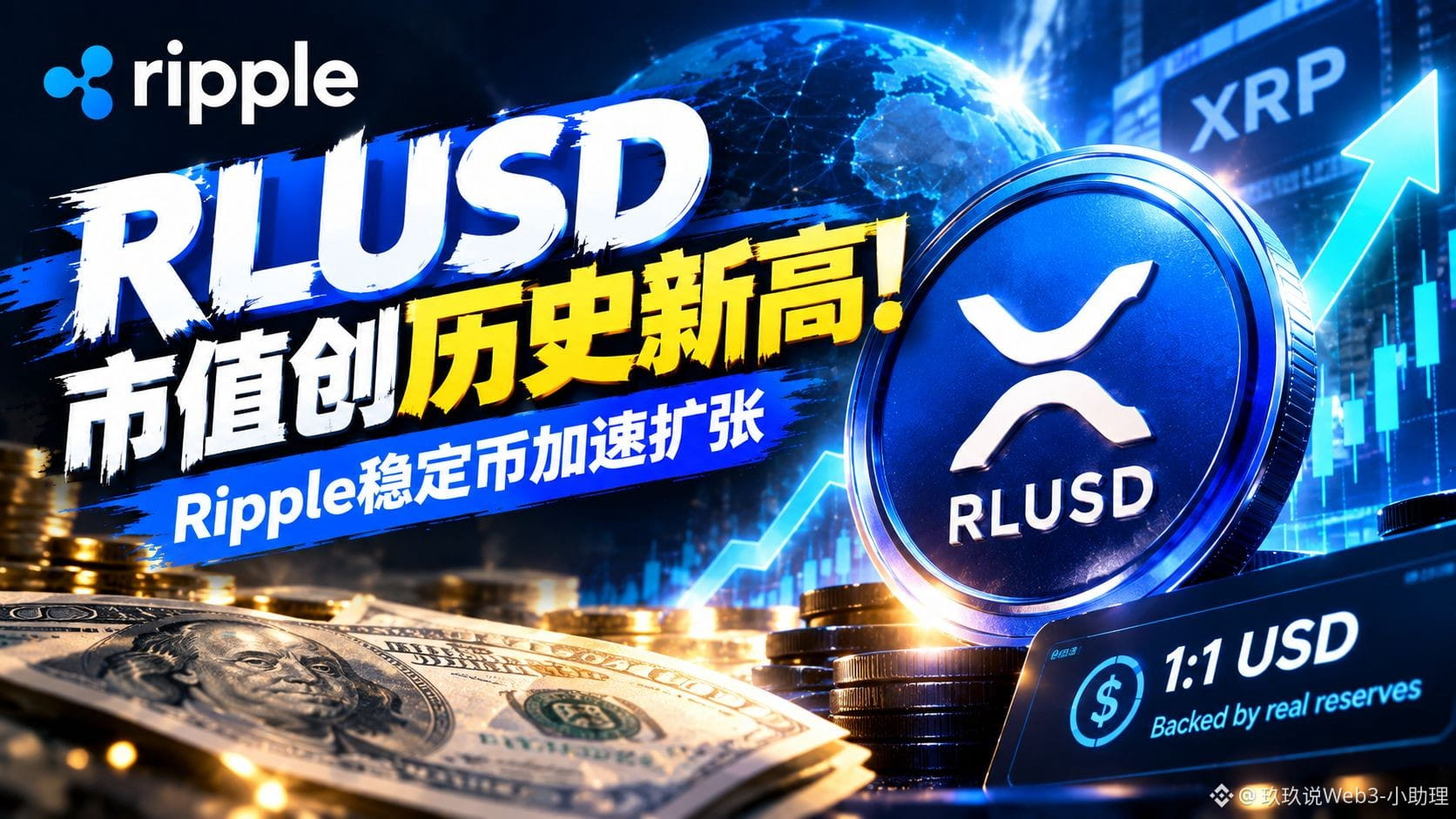
🚨 RLUSD market cap hits a new all-time high!
Ripple’s stablecoin accelerates expansion, and the XRP ecosystem just gained another card🔥
Group: [点击进入玖玖短线策略群](https://app.binance.com/uni-qr/SC8V8G2r)
Ripple’s stablecoin RLUSD has recently reached a new all-time high. But here’s a crucial difference:
When a stablecoin hits an all-time high, it’s not because the price is going up—it’s because the supply, circulating size, and market usage are expanding. 💰
Because RLUSD itself is pegged to the US dollar at a 1:1 ratio, it won’t create a so-called “all-time high” the way XRP or BTC do through price appreciation. What’s truly worth paying attention to is that more and more RLUSD is moving into on-chain circulation, which suggests demand for dollar stablecoins of this kind is increasing. Ripple’s positioning for RLUSD is also pretty clear—it’s not just meant for trading hype. Instead, Ripple aims to serve institutional payments, cross-border settlement, and enterprise applications on the XRP Ledger and Ethereum.
🔥 This is also an important reason RLUSD has been getting attention lately.
However, even with RLUSD reaching an all-time high, its rank in the stablecoin market is still only 8th.
This isn’t a contradiction.
The stablecoin market has very strong “top-of-the-market” effects—the leading stablecoins have already captured a large share of the market. As a relatively new participant, even if RLUSD’s own supply grows quickly, there’s still a clear gap versus the top stablecoins.
So what’s really worth watching isn’t whether RLUSD can surge to a higher rank in the short term, but whether it can continuously expand real-world usage scenarios.
📌 Next, focus on three key signals:
First, whether RLUSD’s supply can keep growing.
If it’s just a large short-term issuance followed by clear redemptions later, the impact is limited. If circulating supply can maintain steady growth, it suggests real demand may be forming.
Second, adoption rates across exchanges and payment scenarios.
Stablecoins ultimately compete on liquidity, the number of trading pairs, wallet coverage, and enterprise use cases—not just market buzz.
Third, regulatory stance and reserve transparency.
Click my avatar to follow me for daily market analysis and short-term trading strategies🚀
#RLUSD #xrp #Ripple
🚨 RLUSD market cap hits a new all-time high!
Ripple’s stablecoin accelerates expansion, and the XRP ecosystem just gained another card🔥
Group: 点击进入玖玖短线策略群
Ripple’s stablecoin RLUSD has recently reached a new all-time high. But here’s a crucial difference:
When a stablecoin hits an all-time high, it’s not because the price is going up—it’s because the supply, circulating size, and market usage are expanding. 💰
Because RLUSD itself is pegged to the US dollar at a 1:1 ratio, it won’t create a so-called “all-time high” the way XRP or BTC do through price appreciation. What’s truly worth paying attention to is that more and more RLUSD is moving into on-chain circulation, which suggests demand for dollar stablecoins of this kind is increasing. Ripple’s positioning for RLUSD is also pretty clear—it’s not just meant for trading hype. Instead, Ripple aims to serve institutional payments, cross-border settlement, and enterprise applications on the XRP Ledger and Ethereum.
🔥 This is also an important reason RLUSD has been getting attention lately.
However, even with RLUSD reaching an all-time high, its rank in the stablecoin market is still only 8th.
This isn’t a contradiction.
The stablecoin market has very strong “top-of-the-market” effects—the leading stablecoins have already captured a large share of the market. As a relatively new participant, even if RLUSD’s own supply grows quickly, there’s still a clear gap versus the top stablecoins.
So what’s really worth watching isn’t whether RLUSD can surge to a higher rank in the short term, but whether it can continuously expand real-world usage scenarios.
📌 Next, focus on three key signals:
First, whether RLUSD’s supply can keep growing.
If it’s just a large short-term issuance followed by clear redemptions later, the impact is limited. If circulating supply can maintain steady growth, it suggests real demand may be forming.
Second, adoption rates across exchanges and payment scenarios.
Stablecoins ultimately compete on liquidity, the number of trading pairs, wallet coverage, and enterprise use cases—not just market buzz.
Third, regulatory stance and reserve transparency.
Click my avatar to follow me for daily market analysis and short-term trading strategies🚀
#RLUSD #xrp #Ripple
Ripple’s stablecoin accelerates expansion, and the XRP ecosystem just gained another card🔥
Group: 点击进入玖玖短线策略群
Ripple’s stablecoin RLUSD has recently reached a new all-time high. But here’s a crucial difference:
When a stablecoin hits an all-time high, it’s not because the price is going up—it’s because the supply, circulating size, and market usage are expanding. 💰
Because RLUSD itself is pegged to the US dollar at a 1:1 ratio, it won’t create a so-called “all-time high” the way XRP or BTC do through price appreciation. What’s truly worth paying attention to is that more and more RLUSD is moving into on-chain circulation, which suggests demand for dollar stablecoins of this kind is increasing. Ripple’s positioning for RLUSD is also pretty clear—it’s not just meant for trading hype. Instead, Ripple aims to serve institutional payments, cross-border settlement, and enterprise applications on the XRP Ledger and Ethereum.
🔥 This is also an important reason RLUSD has been getting attention lately.
However, even with RLUSD reaching an all-time high, its rank in the stablecoin market is still only 8th.
This isn’t a contradiction.
The stablecoin market has very strong “top-of-the-market” effects—the leading stablecoins have already captured a large share of the market. As a relatively new participant, even if RLUSD’s own supply grows quickly, there’s still a clear gap versus the top stablecoins.
So what’s really worth watching isn’t whether RLUSD can surge to a higher rank in the short term, but whether it can continuously expand real-world usage scenarios.
📌 Next, focus on three key signals:
First, whether RLUSD’s supply can keep growing.
If it’s just a large short-term issuance followed by clear redemptions later, the impact is limited. If circulating supply can maintain steady growth, it suggests real demand may be forming.
Second, adoption rates across exchanges and payment scenarios.
Stablecoins ultimately compete on liquidity, the number of trading pairs, wallet coverage, and enterprise use cases—not just market buzz.
Third, regulatory stance and reserve transparency.
Click my avatar to follow me for daily market analysis and short-term trading strategies🚀
#RLUSD #xrp #Ripple
614

·
--
Position secured and ready for the campaign! 🚀💼
I just completed my strategic conversion to add balance in RLUSD and secure my spot in the XRP rewards fund that Binance has active.
Operation details: Conversion of BNB to RLUSD to enable participation.
Strategy: Quality over quantity, leveraging flexible products and automatic subscription to keep performance and weekly payments active.
Tokenization and institutional stablecoins with regulated backing are key pillars for portfolio stability in this cycle.
Are you already participating in the RLUSD campaign? I’m reading your comments! 👇
#RLUSD #BİNANCE #CryptoEducation #Web3 #xrp #GestiónDeRiesgo $RLUSD
$XRP $BNB
Position secured and ready for the campaign! 🚀💼
I just completed my strategic conversion to add balance in RLUSD and secure my spot in the XRP rewards fund that Binance has active.
Operation details: Conversion of BNB to RLUSD to enable participation.
Strategy: Quality over quantity, leveraging flexible products and automatic subscription to keep performance and weekly payments active.
Tokenization and institutional stablecoins with regulated backing are key pillars for portfolio stability in this cycle.
Are you already participating in the RLUSD campaign? I’m reading your comments! 👇
#RLUSD #BİNANCE #CryptoEducation #Web3 #xrp #GestiónDeRiesgo $RLUSD
$XRP $BNB
I just completed my strategic conversion to add balance in RLUSD and secure my spot in the XRP rewards fund that Binance has active.
Operation details: Conversion of BNB to RLUSD to enable participation.
Strategy: Quality over quantity, leveraging flexible products and automatic subscription to keep performance and weekly payments active.
Tokenization and institutional stablecoins with regulated backing are key pillars for portfolio stability in this cycle.
Are you already participating in the RLUSD campaign? I’m reading your comments! 👇
#RLUSD #BİNANCE #CryptoEducation #Web3 #xrp #GestiónDeRiesgo $RLUSD
$XRP $BNB
4
154

·
--
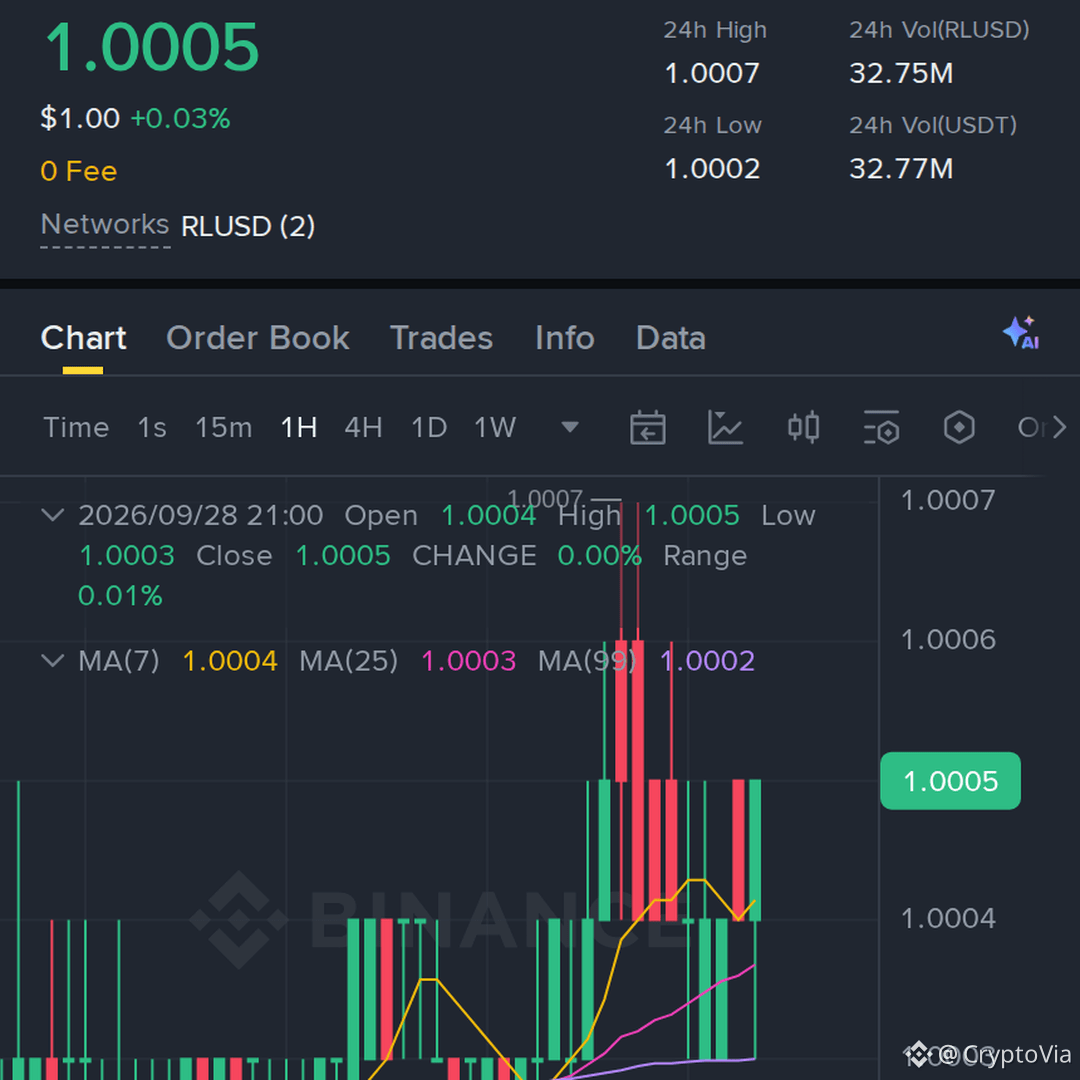
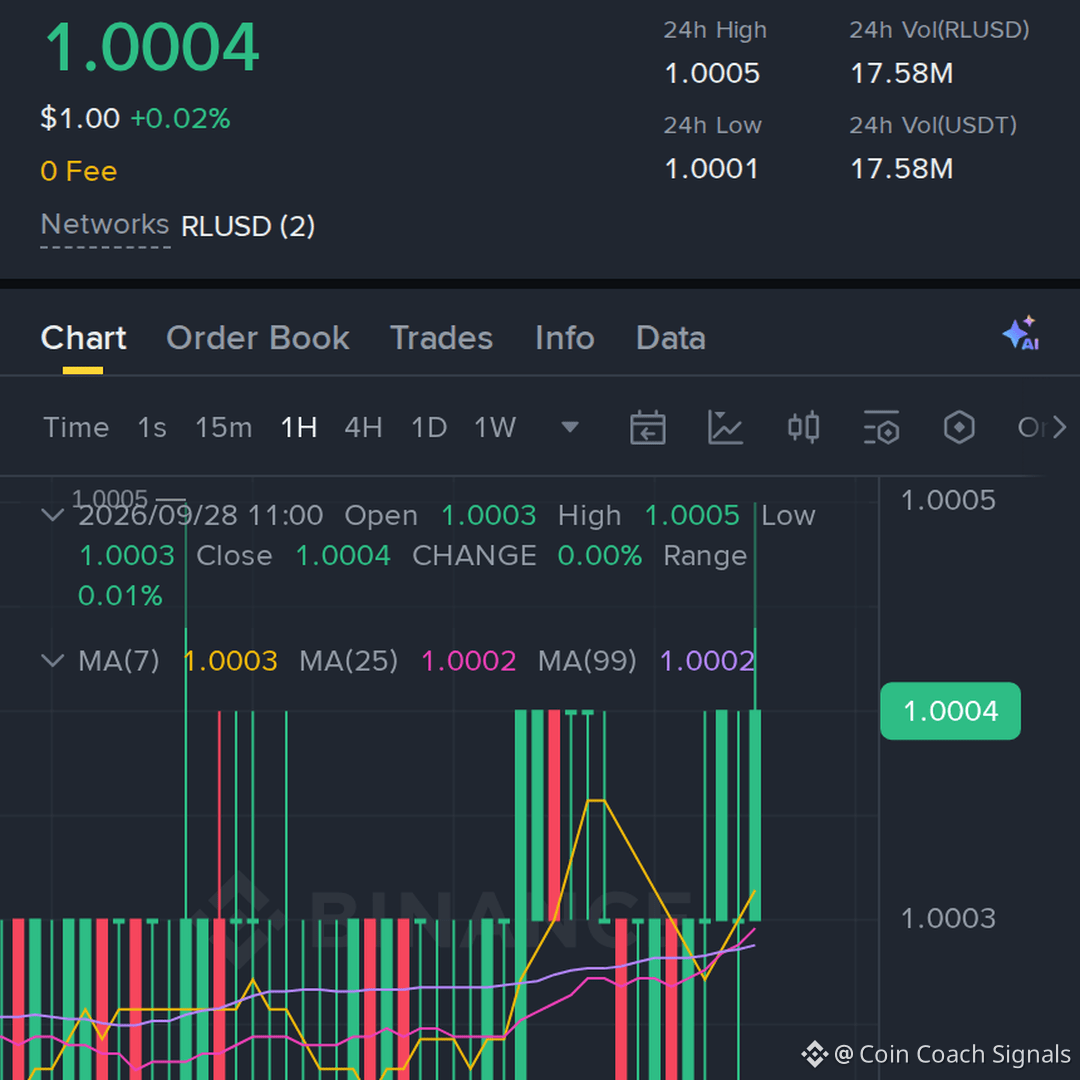
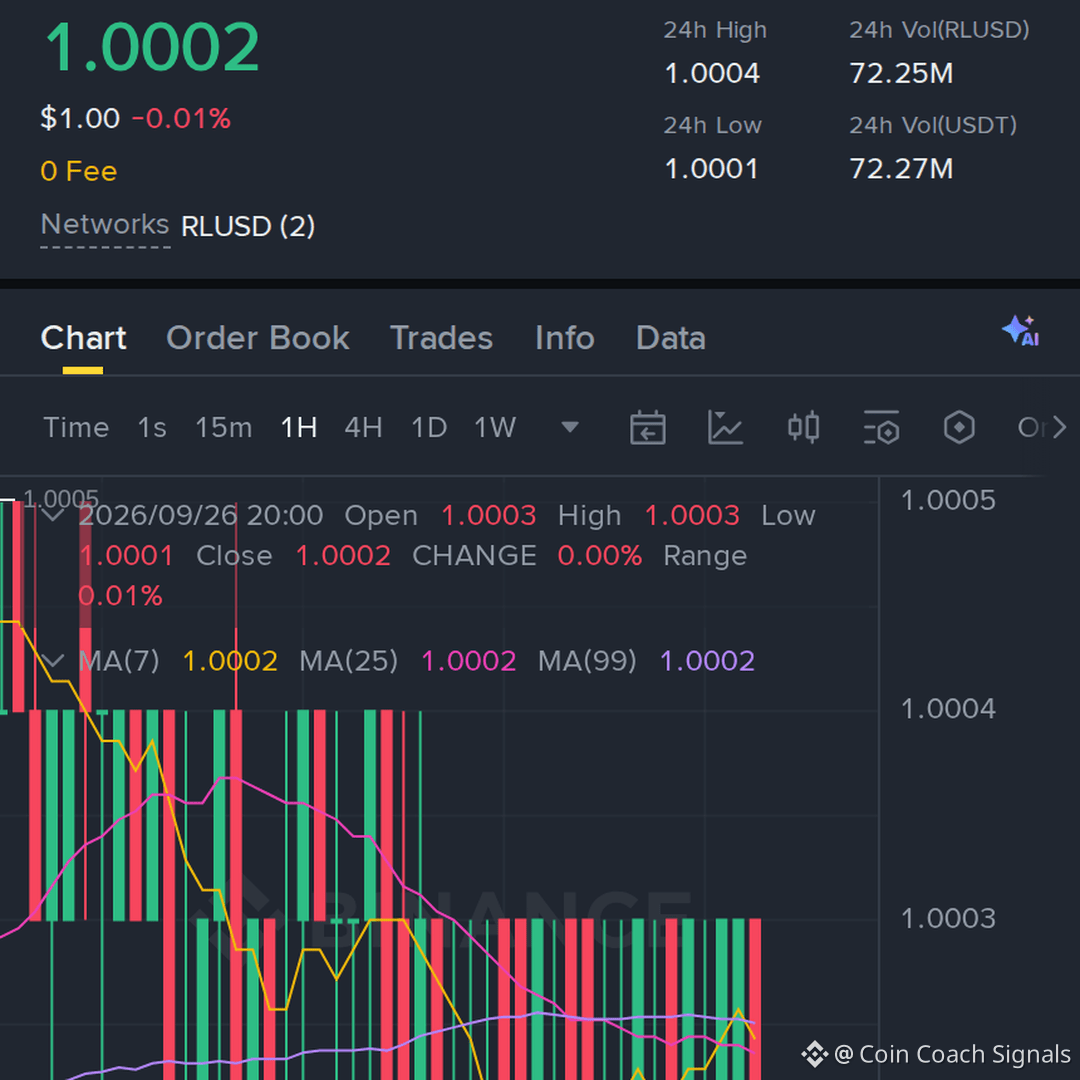
$RLUSD volume is 0.3x its weekly average and most people misread that completely
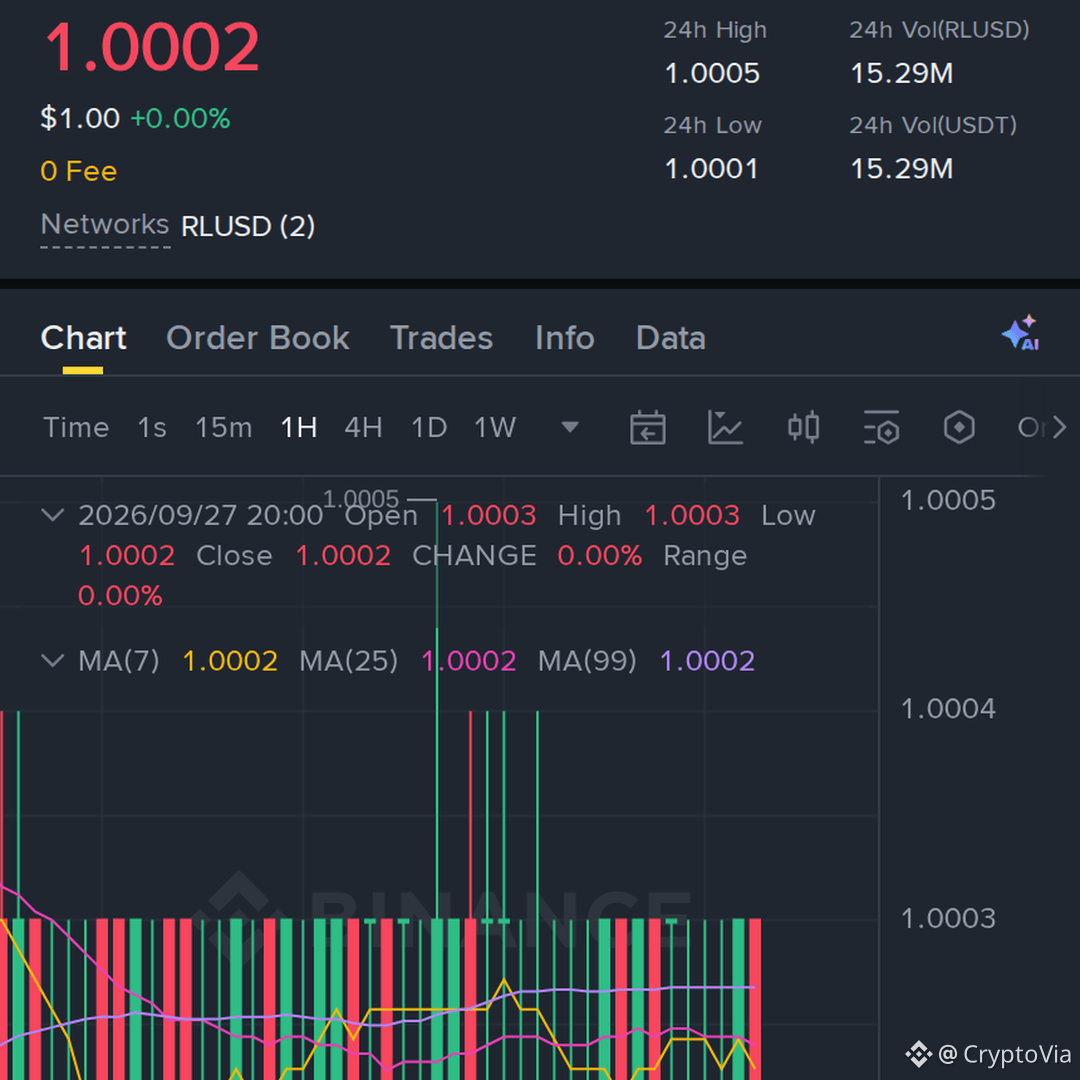
Price is sitting at $1.0002 right now near the bottom of its tight $1.0001 to $1.0005 range
When a coin moves on low volume it usually means no one is actually interested
To check this ratio yourself look at the volume bar and divide it by the simple moving average line
If the number sits below one like 0.3x then the current price action is just noise
Do not take my word for it, tap $RLUSD and look at the candles
Always check that volume ratio before trusting any breakout
#RLUSDSupplyHits2.49BMarketCapNears$2.5B #RLUSD
$RLUSD volume is 0.3x its weekly average and most people misread that completely
Price is sitting at $1.0002 right now near the bottom of its tight $1.0001 to $1.0005 range
When a coin moves on low volume it usually means no one is actually interested
To check this ratio yourself look at the volume bar and divide it by the simple moving average line
If the number sits below one like 0.3x then the current price action is just noise
Do not take my word for it, tap $RLUSD and look at the candles
Always check that volume ratio before trusting any breakout
#RLUSDSupplyHits2.49BMarketCapNears$2.5B #RLUSD
Price is sitting at $1.0002 right now near the bottom of its tight $1.0001 to $1.0005 range
When a coin moves on low volume it usually means no one is actually interested
To check this ratio yourself look at the volume bar and divide it by the simple moving average line
If the number sits below one like 0.3x then the current price action is just noise
Do not take my word for it, tap $RLUSD and look at the candles
Always check that volume ratio before trusting any breakout
#RLUSDSupplyHits2.49BMarketCapNears$2.5B #RLUSD
3

·
--
#$RLUSD SupplyHits2.49BMarketCapNears$2.5B
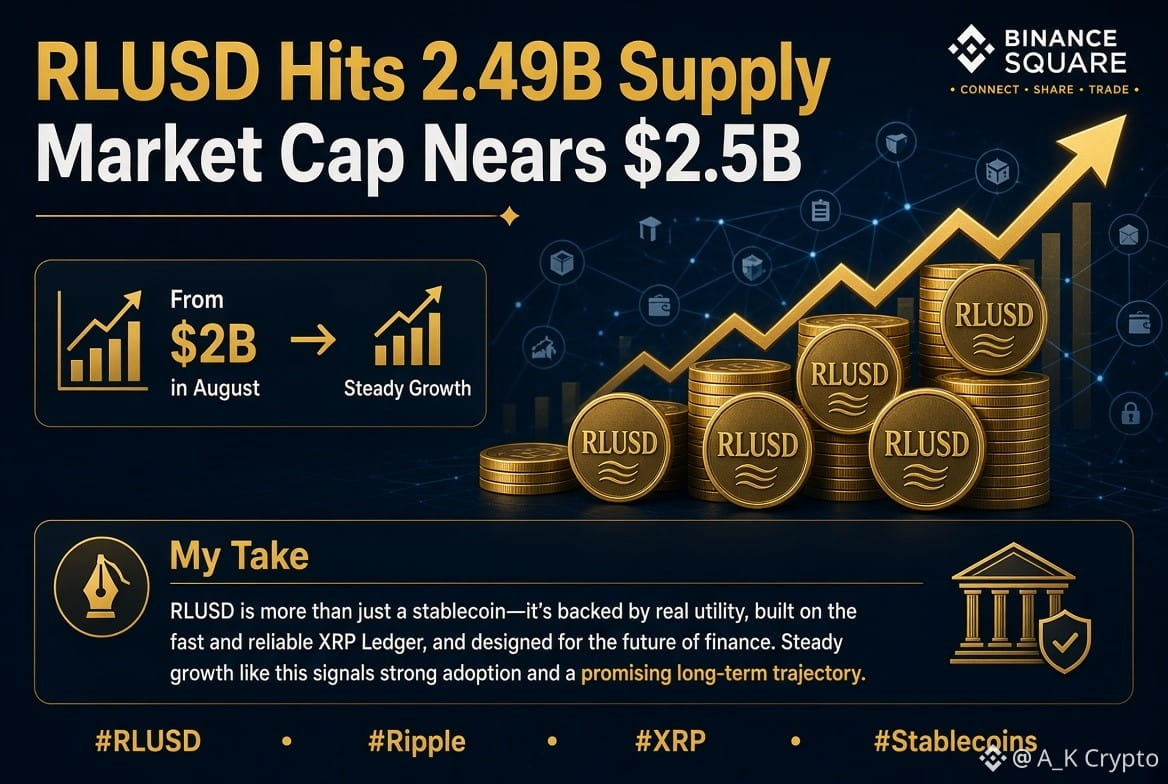
🚀 RLUSD hits 2.49B supply, market cap nears $2.5B!
Ripple’s stablecoin keeps growing steadily from its $2B mark in August. More minting as demand rises from institutions and payments. Fully backed and regulated, this expansion feels solid.
XRPL stablecoins also up ~6% this week, mostly $RLUSD . Not bad for a late-2024 launch.
This quiet climb shows real utility building on XRPL. If Ripple keeps pushing institutional adoption and payments use cases, $RLUSD could carve out a strong niche next to the bigger stables. Still early, but the trajectory looks promising for the whole ecosystem.
#RLUSD #Ripple #XRP #Stablecoins #Crypto
{spot}(RLUSDUSDT)
#$RLUSD SupplyHits2.49BMarketCapNears$2.5B
🚀 RLUSD hits 2.49B supply, market cap nears $2.5B!
Ripple’s stablecoin keeps growing steadily from its $2B mark in August. More minting as demand rises from institutions and payments. Fully backed and regulated, this expansion feels solid.
XRPL stablecoins also up ~6% this week, mostly $RLUSD . Not bad for a late-2024 launch.
This quiet climb shows real utility building on XRPL. If Ripple keeps pushing institutional adoption and payments use cases, $RLUSD could carve out a strong niche next to the bigger stables. Still early, but the trajectory looks promising for the whole ecosystem.
#RLUSD #Ripple #XRP #Stablecoins #Crypto
🚀 RLUSD hits 2.49B supply, market cap nears $2.5B!
Ripple’s stablecoin keeps growing steadily from its $2B mark in August. More minting as demand rises from institutions and payments. Fully backed and regulated, this expansion feels solid.
XRPL stablecoins also up ~6% this week, mostly $RLUSD . Not bad for a late-2024 launch.
This quiet climb shows real utility building on XRPL. If Ripple keeps pushing institutional adoption and payments use cases, $RLUSD could carve out a strong niche next to the bigger stables. Still early, but the trajectory looks promising for the whole ecosystem.
#RLUSD #Ripple #XRP #Stablecoins #Crypto
86

·
--
🥊 RLUSD breathes down PayPal’s neck
Ripple’s stablecoin set a record day: +$82.1 million, and its market cap reached $2.49 billion. The gap with PayPal’s PYUSD shrank to $248 million.
The picture is funny: since the start of the year, RLUSD is up 86%, while PYUSD is down 22% and is now 35% below the March peak. Over the week, Ripple added $112 million, while PayPal lost $61 million. 🐢➡️🐇
But don’t rush to pop the champagne: the entire stablecoin market is worth ~$306 billion, and against USDT and USDC, both heroes are still in the minor leagues. And on the same day, PYUSD also attracted $82.7 million, so the race goes on. 🏁
$RLUSD
{spot}(RLUSDUSDT)
$USDC
{future}(USDCUSDT)
$XRP
{future}(XRPUSDT)
#Ripple #RLUSD #Tether #USDC
🥊 RLUSD breathes down PayPal’s neck
Ripple’s stablecoin set a record day: +$82.1 million, and its market cap reached $2.49 billion. The gap with PayPal’s PYUSD shrank to $248 million.
The picture is funny: since the start of the year, RLUSD is up 86%, while PYUSD is down 22% and is now 35% below the March peak. Over the week, Ripple added $112 million, while PayPal lost $61 million. 🐢➡️🐇
But don’t rush to pop the champagne: the entire stablecoin market is worth ~$306 billion, and against USDT and USDC, both heroes are still in the minor leagues. And on the same day, PYUSD also attracted $82.7 million, so the race goes on. 🏁
$RLUSD
$USDC
$XRP
#Ripple #RLUSD #Tether #USDC
Ripple’s stablecoin set a record day: +$82.1 million, and its market cap reached $2.49 billion. The gap with PayPal’s PYUSD shrank to $248 million.
The picture is funny: since the start of the year, RLUSD is up 86%, while PYUSD is down 22% and is now 35% below the March peak. Over the week, Ripple added $112 million, while PayPal lost $61 million. 🐢➡️🐇
But don’t rush to pop the champagne: the entire stablecoin market is worth ~$306 billion, and against USDT and USDC, both heroes are still in the minor leagues. And on the same day, PYUSD also attracted $82.7 million, so the race goes on. 🏁
$RLUSD
$USDC
$XRP
#Ripple #RLUSD #Tether #USDC

1
527

·
--
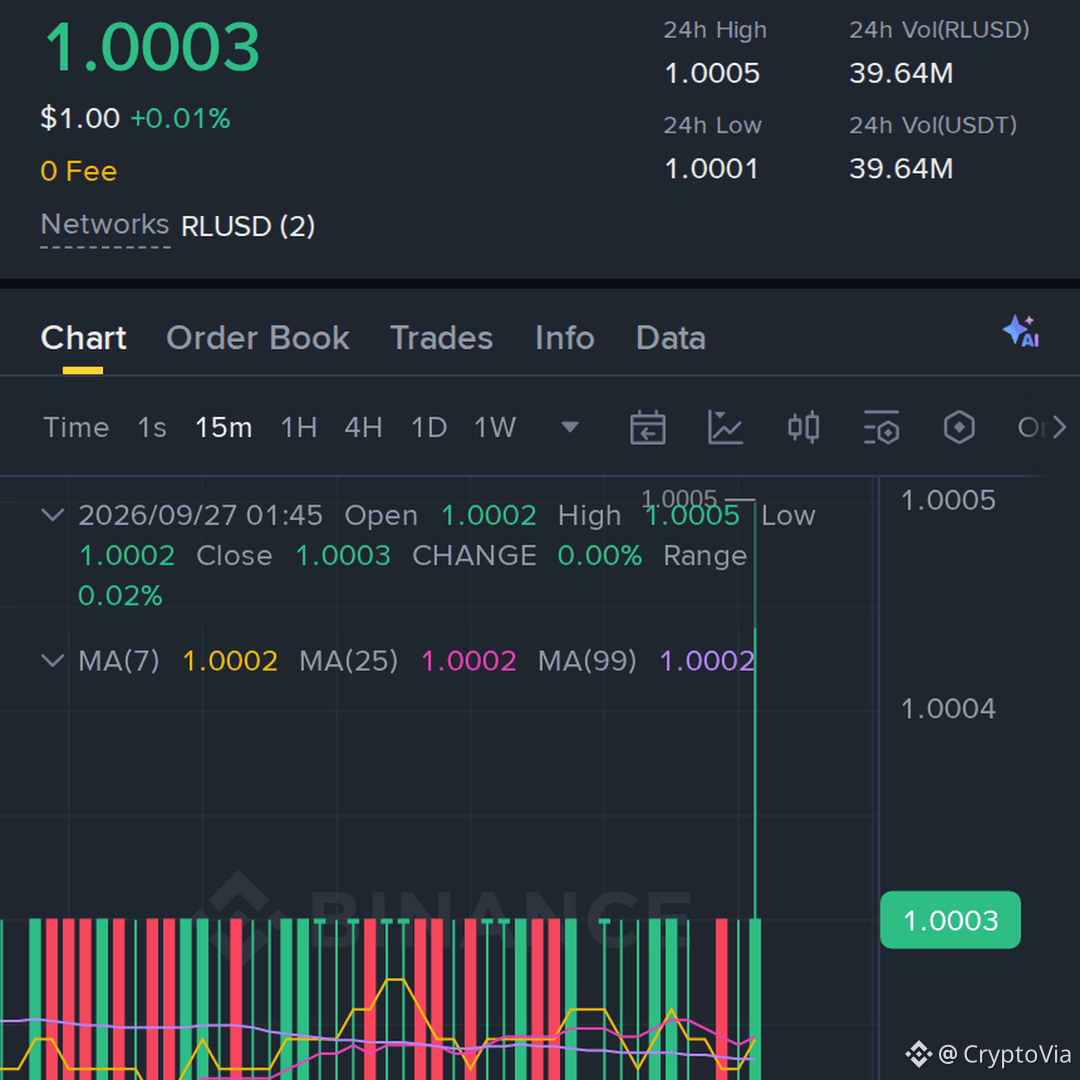
quietly watching $RLUSD, with 70x as the working leverage, is holding the dip better than expected
Entry: 1.0003–1.0003 | Stop Loss: 0.9843
TP1: 1.0249 / TP2: 1.0421 / TP3: 1.0711
#RLUSD #binance #Write2Earn #Crypto
quietly watching $RLUSD , with 70x as the working leverage, is holding the dip better than expected
Entry: 1.0003–1.0003 | Stop Loss: 0.9843
TP1: 1.0249 / TP2: 1.0421 / TP3: 1.0711
#RLUSD #binance #Write2Earn #Crypto
Entry: 1.0003–1.0003 | Stop Loss: 0.9843
TP1: 1.0249 / TP2: 1.0421 / TP3: 1.0711
#RLUSD #binance #Write2Earn #Crypto
17

·
--
【See Drop】
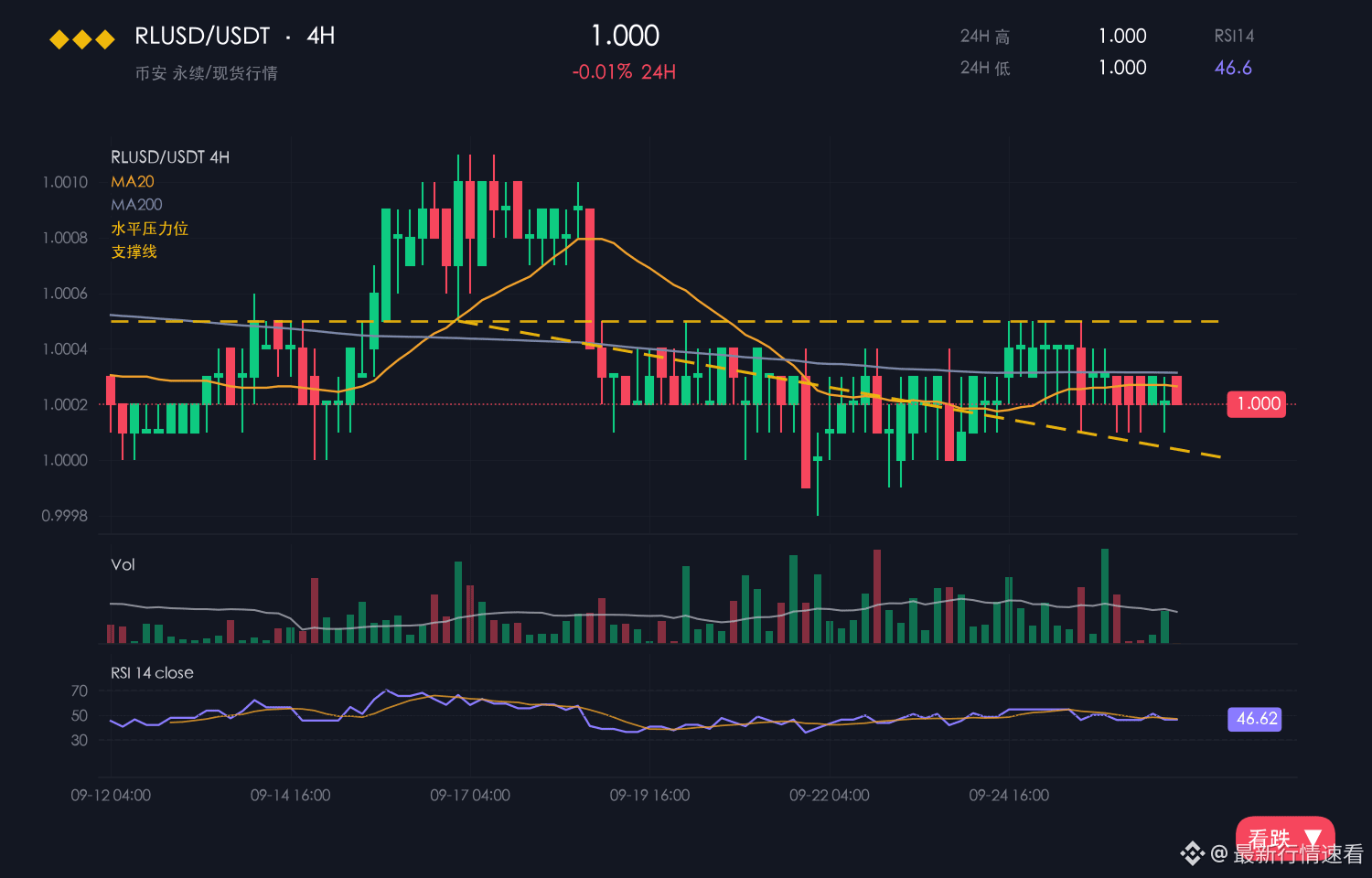
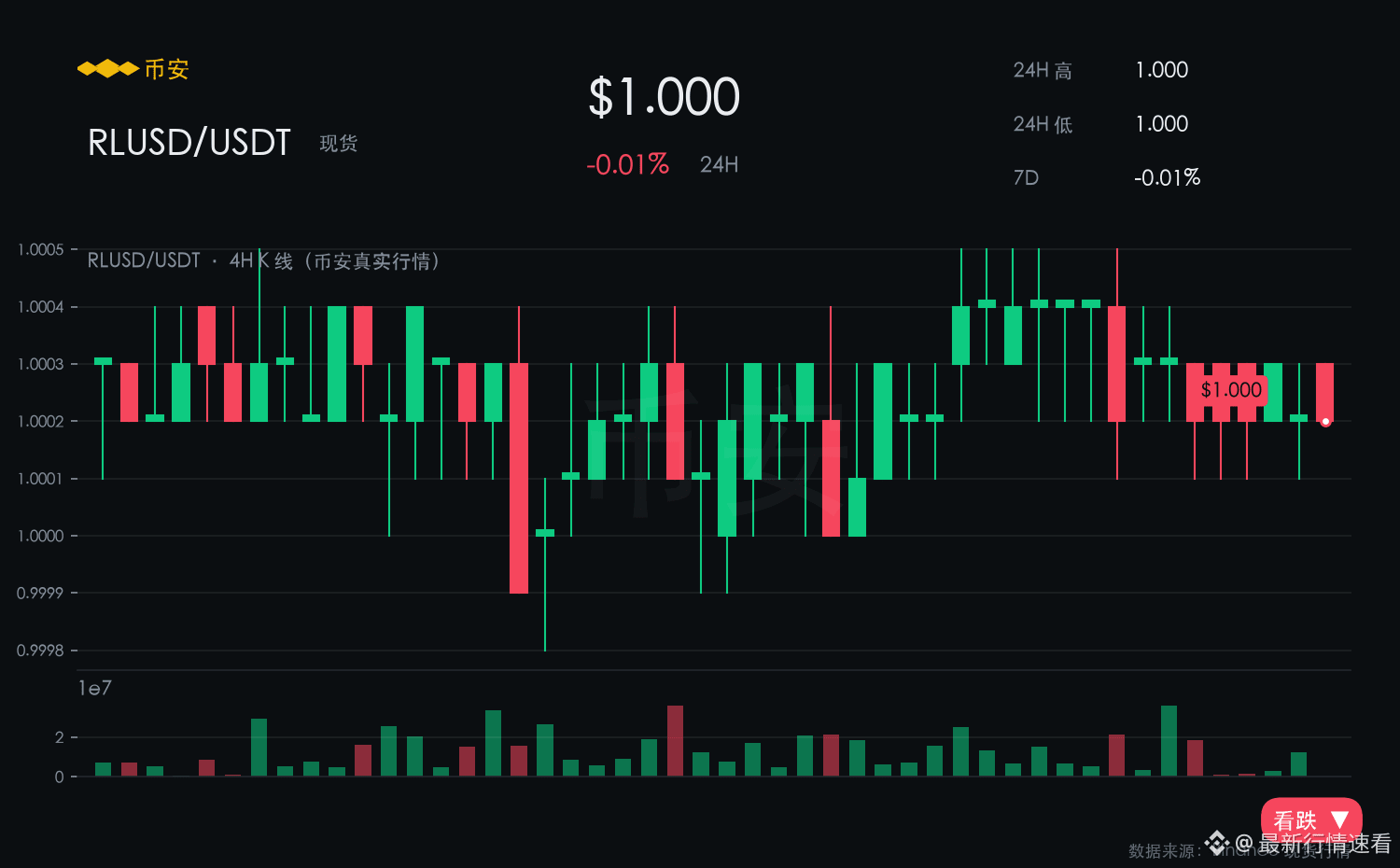
RLUSD is currently at 1.000, down 0.01% over the past 24 hours. Still down 0.01% over the last 7 days. Intraday range: 1.000–1.000. Amplitude: 0.0%.
【Market View】
Before shorting for the bottom, take note—there’s still room for further downside.
RLUSD has been rotating through 1.000–1.000 to complete this round of handoffs; the 0.01% drop is just the result.
Within 1.000–1.000, RLUSD is consolidating in a narrow range, and there’s no clear near-term support/“bids” stepping in.
Price is running right around 1.000; once this level breaks, downside will accelerate.
Compared with BTC’s +0.35%, RLUSD’s -0.01% is slightly lagging—underperforming the broader market, but by a limited margin.
In the short term, the bias is bearish.
【Bearish Reasons】
If 1.000 is broken, then there’s still something to watch in the short term; if 1.000 is reclaimed in the opposite direction, then the outlook needs to be reassessed.
The selling pressure near 1.000 hasn’t fully been digested yet—each rebound’s strength is weaker than the last.
A 0.01% decline over 24 hours indicates that active sell pressure hasn’t fully exhausted.
Choose according to yourself—no rush. Just watch.
If suddenly there’s a surge in volume near 1.000, it means capital has started stepping in; don’t get stuck fighting it at that point.
Once 1.000 breaks, price will likely continue downward to find support; rebounds toward 1.000 face relatively strong resistance.
$RLUSD #RLUSD
【See Drop】
RLUSD is currently at 1.000, down 0.01% over the past 24 hours. Still down 0.01% over the last 7 days. Intraday range: 1.000–1.000. Amplitude: 0.0%.
【Market View】
Before shorting for the bottom, take note—there’s still room for further downside.
RLUSD has been rotating through 1.000–1.000 to complete this round of handoffs; the 0.01% drop is just the result.
Within 1.000–1.000, RLUSD is consolidating in a narrow range, and there’s no clear near-term support/“bids” stepping in.
Price is running right around 1.000; once this level breaks, downside will accelerate.
Compared with BTC’s +0.35%, RLUSD’s -0.01% is slightly lagging—underperforming the broader market, but by a limited margin.
In the short term, the bias is bearish.
【Bearish Reasons】
If 1.000 is broken, then there’s still something to watch in the short term; if 1.000 is reclaimed in the opposite direction, then the outlook needs to be reassessed.
The selling pressure near 1.000 hasn’t fully been digested yet—each rebound’s strength is weaker than the last.
A 0.01% decline over 24 hours indicates that active sell pressure hasn’t fully exhausted.
Choose according to yourself—no rush. Just watch.
If suddenly there’s a surge in volume near 1.000, it means capital has started stepping in; don’t get stuck fighting it at that point.
Once 1.000 breaks, price will likely continue downward to find support; rebounds toward 1.000 face relatively strong resistance.
$RLUSD #RLUSD
RLUSD is currently at 1.000, down 0.01% over the past 24 hours. Still down 0.01% over the last 7 days. Intraday range: 1.000–1.000. Amplitude: 0.0%.
【Market View】
Before shorting for the bottom, take note—there’s still room for further downside.
RLUSD has been rotating through 1.000–1.000 to complete this round of handoffs; the 0.01% drop is just the result.
Within 1.000–1.000, RLUSD is consolidating in a narrow range, and there’s no clear near-term support/“bids” stepping in.
Price is running right around 1.000; once this level breaks, downside will accelerate.
Compared with BTC’s +0.35%, RLUSD’s -0.01% is slightly lagging—underperforming the broader market, but by a limited margin.
In the short term, the bias is bearish.
【Bearish Reasons】
If 1.000 is broken, then there’s still something to watch in the short term; if 1.000 is reclaimed in the opposite direction, then the outlook needs to be reassessed.
The selling pressure near 1.000 hasn’t fully been digested yet—each rebound’s strength is weaker than the last.
A 0.01% decline over 24 hours indicates that active sell pressure hasn’t fully exhausted.
Choose according to yourself—no rush. Just watch.
If suddenly there’s a surge in volume near 1.000, it means capital has started stepping in; don’t get stuck fighting it at that point.
Once 1.000 breaks, price will likely continue downward to find support; rebounds toward 1.000 face relatively strong resistance.
$RLUSD #RLUSD
44

·
--
Volume tells the real story for $RLUSD right now.
At a steady $1.00 (-0.02%), RLUSD just printed $77.86M in daily volume. This strong activity highlights deep liquidity supporting steady market operations.
Bull case: Sustained high turnover in RLUSD points to robust utility and efficient settlement demand.
Bear case: Elevated volume during flat price action could signal hidden distribution if momentum fades.
Watch for a decisive expansion in volume alongside a clean break from parity as a confirmation trigger. High turnover cuts both ways depending on order book depth.
How are you trading this liquidity phase? Click RLUSD for the…
Tap $RLUSD for the live chart. #RLUSD #BinanceSquare
Volume tells the real story for $RLUSD right now.
At a steady $1.00 (-0.02%), RLUSD just printed $77.86M in daily volume. This strong activity highlights deep liquidity supporting steady market operations.
Bull case: Sustained high turnover in RLUSD points to robust utility and efficient settlement demand.
Bear case: Elevated volume during flat price action could signal hidden distribution if momentum fades.
Watch for a decisive expansion in volume alongside a clean break from parity as a confirmation trigger. High turnover cuts both ways depending on order book depth.
How are you trading this liquidity phase? Click RLUSD for the…
Tap $RLUSD for the live chart. #RLUSD #BinanceSquare
At a steady $1.00 (-0.02%), RLUSD just printed $77.86M in daily volume. This strong activity highlights deep liquidity supporting steady market operations.
Bull case: Sustained high turnover in RLUSD points to robust utility and efficient settlement demand.
Bear case: Elevated volume during flat price action could signal hidden distribution if momentum fades.
Watch for a decisive expansion in volume alongside a clean break from parity as a confirmation trigger. High turnover cuts both ways depending on order book depth.
How are you trading this liquidity phase? Click RLUSD for the…
Tap $RLUSD for the live chart. #RLUSD #BinanceSquare
9

·
--
800,000 US dollars of $XRP—shared with people who hold RLUSD. The threshold is so low that you only need 0.01.
How the campaign works:
1) From 8:00 on September 25 to 8:00 on October 23 (Eastern 8th time zone). It lasts 4 weeks, and every Saturday before 02:00, one distribution is made
2) Any account works: spot, funds, wealth management, or margin—if your RLUSD net assets add up to 0.01, you’re eligible
3) The portion of holdings that was added in the past two weeks gets an extra 1.2x, and if you also subscribe to current wealth management, it can stack up to 1.3x
4) For RLUSD obtained on a margin account by borrowing other stablecoins, the reward calculation is at 40% (i.e., multiplied by 0.4). Don’t expect to over-claim rewards just by using leverage
It’s the kind of activity where you can just lie back and earn—the threshold is indeed low, but the prize pool is spread out over four weeks, so you won’t get much within a single week. For the exact bonus calculation and the effective annualized rate, refer to Binance’s official campaign page.
#币安活动 #RLUSD
800,000 US dollars of $XRP —shared with people who hold RLUSD. The threshold is so low that you only need 0.01.
How the campaign works:
1) From 8:00 on September 25 to 8:00 on October 23 (Eastern 8th time zone). It lasts 4 weeks, and every Saturday before 02:00, one distribution is made
2) Any account works: spot, funds, wealth management, or margin—if your RLUSD net assets add up to 0.01, you’re eligible
3) The portion of holdings that was added in the past two weeks gets an extra 1.2x, and if you also subscribe to current wealth management, it can stack up to 1.3x
4) For RLUSD obtained on a margin account by borrowing other stablecoins, the reward calculation is at 40% (i.e., multiplied by 0.4). Don’t expect to over-claim rewards just by using leverage
It’s the kind of activity where you can just lie back and earn—the threshold is indeed low, but the prize pool is spread out over four weeks, so you won’t get much within a single week. For the exact bonus calculation and the effective annualized rate, refer to Binance’s official campaign page.
#币安活动 #RLUSD
How the campaign works:
1) From 8:00 on September 25 to 8:00 on October 23 (Eastern 8th time zone). It lasts 4 weeks, and every Saturday before 02:00, one distribution is made
2) Any account works: spot, funds, wealth management, or margin—if your RLUSD net assets add up to 0.01, you’re eligible
3) The portion of holdings that was added in the past two weeks gets an extra 1.2x, and if you also subscribe to current wealth management, it can stack up to 1.3x
4) For RLUSD obtained on a margin account by borrowing other stablecoins, the reward calculation is at 40% (i.e., multiplied by 0.4). Don’t expect to over-claim rewards just by using leverage
It’s the kind of activity where you can just lie back and earn—the threshold is indeed low, but the prize pool is spread out over four weeks, so you won’t get much within a single week. For the exact bonus calculation and the effective annualized rate, refer to Binance’s official campaign page.
#币安活动 #RLUSD
102

🚨 Binance Update: $800,000 XRP Rewards!
Binance has launched an RLUSD holding campaign with a massive $800K XRP reward pool. 🎁
📅 Sep 25 – Oct 23
💎 Rewards distributed weekly
Would you join this campaign? 👀
#Binance #XRP #RLUSD #Crypto #BinanceSquare
🚨 Binance Update: $800,000 XRP Rewards!
Binance has launched an RLUSD holding campaign with a massive $800K XRP reward pool. 🎁
📅 Sep 25 – Oct 23
💎 Rewards distributed weekly
Would you join this campaign? 👀
#Binance #XRP #RLUSD #Crypto #BinanceSquare
Binance has launched an RLUSD holding campaign with a massive $800K XRP reward pool. 🎁
📅 Sep 25 – Oct 23
💎 Rewards distributed weekly
Would you join this campaign? 👀
#Binance #XRP #RLUSD #Crypto #BinanceSquare
60

AI agents are opting for Ripple USD over XRP, aligning with BlackRock's prediction of massive stablecoin demand from autonomous machines.
#RLUSD #AIEconomy
AI agents are opting for Ripple USD over XRP, aligning with BlackRock's prediction of massive stablecoin demand from autonomous machines.
#RLUSD #AIEconomy
#RLUSD #AIEconomy
87

·
--
Binance announced around September 24 that it is launching a four-week Hold to Earn campaign for eligible $RLUSD holders: Eastern Eight Zone time from 08:00 on September 25 to 08:00 on October 23 (corresponding to UTC 00:00 on September 25 to 00:00 on October 23). The prize pool is approximately the equivalent of $800,000 in $XRP, distributed over four weeks. The planned distribution time is each Friday at 18:00 (UTC) for October 2, October 9, October 16, and October 23, with rewards credited before the deadline. The exact timing and the applicable effective annualized rate for that week are subject to updates on the platform.
Eligible balances may be placed in spot, savings, wealth management/instant-available products, or margin accounts. The participation threshold is to hold at least 0.01 $RLUSD in a wealth management or margin account. The system takes an hourly snapshot of the lowest balance for the day, then uses the seven-day average eligible balance and the effective annualized allocation for that week published by the platform to determine the $XRP share. The actual amount you receive depends on your proportion in the total pool. Incremental positions may earn an approximately 1.2x weighted value; if the incremental portion is subscribed to instant-available wealth management, it can stack an additional approximately 1.1x, meeting approximately 1.3x in total.
The campaign is for eligible regions only; users from places such as the United States are not included. Please check the original announcement text, your account display, and regional eligibility restrictions before holding and subscribing. The reward calculation may be adjusted by week.
#RLUSD #XRP #币安 does not constitute investment advice
Binance announced around September 24 that it is launching a four-week Hold to Earn campaign for eligible $RLUSD holders: Eastern Eight Zone time from 08:00 on September 25 to 08:00 on October 23 (corresponding to UTC 00:00 on September 25 to 00:00 on October 23). The prize pool is approximately the equivalent of $800,000 in $XRP , distributed over four weeks. The planned distribution time is each Friday at 18:00 (UTC) for October 2, October 9, October 16, and October 23, with rewards credited before the deadline. The exact timing and the applicable effective annualized rate for that week are subject to updates on the platform.
Eligible balances may be placed in spot, savings, wealth management/instant-available products, or margin accounts. The participation threshold is to hold at least 0.01 $RLUSD in a wealth management or margin account. The system takes an hourly snapshot of the lowest balance for the day, then uses the seven-day average eligible balance and the effective annualized allocation for that week published by the platform to determine the $XRP share. The actual amount you receive depends on your proportion in the total pool. Incremental positions may earn an approximately 1.2x weighted value; if the incremental portion is subscribed to instant-available wealth management, it can stack an additional approximately 1.1x, meeting approximately 1.3x in total.
The campaign is for eligible regions only; users from places such as the United States are not included. Please check the original announcement text, your account display, and regional eligibility restrictions before holding and subscribing. The reward calculation may be adjusted by week.
#RLUSD #XRP #币安 does not constitute investment advice
Eligible balances may be placed in spot, savings, wealth management/instant-available products, or margin accounts. The participation threshold is to hold at least 0.01 $RLUSD in a wealth management or margin account. The system takes an hourly snapshot of the lowest balance for the day, then uses the seven-day average eligible balance and the effective annualized allocation for that week published by the platform to determine the $XRP share. The actual amount you receive depends on your proportion in the total pool. Incremental positions may earn an approximately 1.2x weighted value; if the incremental portion is subscribed to instant-available wealth management, it can stack an additional approximately 1.1x, meeting approximately 1.3x in total.
The campaign is for eligible regions only; users from places such as the United States are not included. Please check the original announcement text, your account display, and regional eligibility restrictions before holding and subscribing. The reward calculation may be adjusted by week.
#RLUSD #XRP #币安 does not constitute investment advice

224
Log in to explore more content
Join global crypto users on Binance Square
⚡️ Get latest and useful information about crypto.
💬 Trusted by the world’s largest crypto exchange.
👍 Discover real insights from verified creators.
Email / Phone number
Trending Topics
1
#BitcoinClears$85200
13,308 views
218 Discussing
2
#AltcoinSeasonIndexHoldsAbove60For5Days
66,051 views
1,211 Discussing
3
#USADPAdds90000JobsInSeptember
29,959 views
677 Discussing
4
#USCorePCEEasesTo3%InAugust
21,475 views
506 Discussing
5
#KospiPostsWorstQuarterSince2020
15,003 views
487 Discussing
6
#SECToClarifyOnChainFundraisingRules
37,406 views
663 Discussing
7
#UKFCAOpensCryptoFirmAuthorization
35,976 views
560 Discussing
8
#JapanMOFStudyGroupOnTokenizedGovtBonds
21,711 views
423 Discussing
9
#QNTRises287%
104,116 views
918 Discussing
10
#TrumpRejectsAIRulesForVoluntaryAudits
59,930 views
799 Discussing