
#halalcryptoguide
halalcryptoguide
842 views
26 Discussing
Hot
Latest
Most people will read this as “Binance invested $100M.”
The more interesting question is: why does Binance want USDC to become much more important inside its ecosystem?
Binance has reportedly invested $100 MILLION in Circle, the company behind USDC.
And this isn’t just a passive investment.
The expanded partnership is expected to bring USDC into more Binance products, including savings/investment offerings, while Binance may also provide incentives such as reduced fees on USDC trading pairs.
That matters because stablecoins are becoming much more than something traders temporarily hold between trades.
They increasingly sit underneath:
• Trading pairs
• Payments
• Lending
• Yield products
• Tokenized assets
• Cross-border settlement
🕌 For Muslim investors, there’s an important distinction here.
Holding or transferring a stablecoin is one question.
Putting that same stablecoin into a product promising a return is a different contractual question.
Before using any USDC “Earn,” lending or yield product, research:
Where does the return actually come from?
Interest from lending, trading incentives, protocol rewards and other revenue structures should not automatically be treated as equivalent simply because the same stablecoin is involved.
I’m not declaring USDC—or any Binance product—halal or haram.
📌 The token may stay the same while the financial contract around it changes completely.
That’s why understanding the source of yield matters.
👇 Would you like me to make a simple checklist for researching whether a crypto “Earn” product contains interest or other Shariah concerns?
$USDC
#USDC #IslamicFinance #HalalCryptoGuide
Educational only — not financial advice or a fatwa.
{spot}(USDCUSDT)
Most people will read this as “Binance invested $100M.”
The more interesting question is: why does Binance want USDC to become much more important inside its ecosystem?
Binance has reportedly invested $100 MILLION in Circle, the company behind USDC.
And this isn’t just a passive investment.
The expanded partnership is expected to bring USDC into more Binance products, including savings/investment offerings, while Binance may also provide incentives such as reduced fees on USDC trading pairs.
That matters because stablecoins are becoming much more than something traders temporarily hold between trades.
They increasingly sit underneath:
• Trading pairs
• Payments
• Lending
• Yield products
• Tokenized assets
• Cross-border settlement
🕌 For Muslim investors, there’s an important distinction here.
Holding or transferring a stablecoin is one question.
Putting that same stablecoin into a product promising a return is a different contractual question.
Before using any USDC “Earn,” lending or yield product, research:
Where does the return actually come from?
Interest from lending, trading incentives, protocol rewards and other revenue structures should not automatically be treated as equivalent simply because the same stablecoin is involved.
I’m not declaring USDC—or any Binance product—halal or haram.
📌 The token may stay the same while the financial contract around it changes completely.
That’s why understanding the source of yield matters.
👇 Would you like me to make a simple checklist for researching whether a crypto “Earn” product contains interest or other Shariah concerns?
$USDC
#USDC #IslamicFinance #HalalCryptoGuide
Educational only — not financial advice or a fatwa.
The more interesting question is: why does Binance want USDC to become much more important inside its ecosystem?
Binance has reportedly invested $100 MILLION in Circle, the company behind USDC.
And this isn’t just a passive investment.
The expanded partnership is expected to bring USDC into more Binance products, including savings/investment offerings, while Binance may also provide incentives such as reduced fees on USDC trading pairs.
That matters because stablecoins are becoming much more than something traders temporarily hold between trades.
They increasingly sit underneath:
• Trading pairs
• Payments
• Lending
• Yield products
• Tokenized assets
• Cross-border settlement
🕌 For Muslim investors, there’s an important distinction here.
Holding or transferring a stablecoin is one question.
Putting that same stablecoin into a product promising a return is a different contractual question.
Before using any USDC “Earn,” lending or yield product, research:
Where does the return actually come from?
Interest from lending, trading incentives, protocol rewards and other revenue structures should not automatically be treated as equivalent simply because the same stablecoin is involved.
I’m not declaring USDC—or any Binance product—halal or haram.
📌 The token may stay the same while the financial contract around it changes completely.
That’s why understanding the source of yield matters.
👇 Would you like me to make a simple checklist for researching whether a crypto “Earn” product contains interest or other Shariah concerns?
$USDC
#USDC #IslamicFinance #HalalCryptoGuide
Educational only — not financial advice or a fatwa.
36
🚨 Binance just launched 24/7 FX trading — but you’re NOT actually buying dollars or Brazilian reais.
This distinction matters more than the “100× leverage” headline.
Binance Futures has launched USDBRLUSDT, its new TradFi perpetual contract tracking the USD/BRL exchange rate.
Here’s what you’re actually getting:
• Exposure to the USD/BRL price movement
• Settlement in USDT
• Trading 24/7, including when traditional FX markets are closed
• Funding settlement every 8 hours
• Up to 100× leverage
• A perpetual derivative contract, not ownership or delivery of USD or BRL
There’s another interesting detail.
During normal FX hours, Binance builds its price index using third-party market prices.
During weekends and certain holidays—when the traditional FX market isn’t operating normally—it switches to an order-book EWMA pricing mechanism.
🕌 For Muslim investors, this is exactly why the name of the underlying market isn’t enough for a Shariah assessment.
“USD/BRL” might sound like ordinary currency exchange.
But:
spot currency exchange ≠ leveraged FX perpetual contract.
The contract structure introduces additional questions around leverage, funding, settlement, possession and the absence of actual currency delivery.
I’m not issuing a halal/haram ruling on this Binance product.
The broader lesson is:
📌 Don’t ask only: “What asset does this track?”
Also ask: “What contract am I actually entering?”
A familiar underlying asset can be packaged inside a very different financial structure.
👇 Should I break down the difference between spot FX and perpetual FX from a Shariah-research perspective?
$USDBRL
#IslamicFinance #BinanceFutures #CryptoEducation #HalalCryptoGuide
Educational only — not financial advice or a fatwa.
🚨 Binance just launched 24/7 FX trading — but you’re NOT actually buying dollars or Brazilian reais.
This distinction matters more than the “100× leverage” headline.
Binance Futures has launched USDBRLUSDT, its new TradFi perpetual contract tracking the USD/BRL exchange rate.
Here’s what you’re actually getting:
• Exposure to the USD/BRL price movement
• Settlement in USDT
• Trading 24/7, including when traditional FX markets are closed
• Funding settlement every 8 hours
• Up to 100× leverage
• A perpetual derivative contract, not ownership or delivery of USD or BRL
There’s another interesting detail.
During normal FX hours, Binance builds its price index using third-party market prices.
During weekends and certain holidays—when the traditional FX market isn’t operating normally—it switches to an order-book EWMA pricing mechanism.
🕌 For Muslim investors, this is exactly why the name of the underlying market isn’t enough for a Shariah assessment.
“USD/BRL” might sound like ordinary currency exchange.
But:
spot currency exchange ≠ leveraged FX perpetual contract.
The contract structure introduces additional questions around leverage, funding, settlement, possession and the absence of actual currency delivery.
I’m not issuing a halal/haram ruling on this Binance product.
The broader lesson is:
📌 Don’t ask only: “What asset does this track?”
Also ask: “What contract am I actually entering?”
A familiar underlying asset can be packaged inside a very different financial structure.
👇 Should I break down the difference between spot FX and perpetual FX from a Shariah-research perspective?
$USDBRL
#IslamicFinance #BinanceFutures #CryptoEducation #HalalCryptoGuide
Educational only — not financial advice or a fatwa.
This distinction matters more than the “100× leverage” headline.
Binance Futures has launched USDBRLUSDT, its new TradFi perpetual contract tracking the USD/BRL exchange rate.
Here’s what you’re actually getting:
• Exposure to the USD/BRL price movement
• Settlement in USDT
• Trading 24/7, including when traditional FX markets are closed
• Funding settlement every 8 hours
• Up to 100× leverage
• A perpetual derivative contract, not ownership or delivery of USD or BRL
There’s another interesting detail.
During normal FX hours, Binance builds its price index using third-party market prices.
During weekends and certain holidays—when the traditional FX market isn’t operating normally—it switches to an order-book EWMA pricing mechanism.
🕌 For Muslim investors, this is exactly why the name of the underlying market isn’t enough for a Shariah assessment.
“USD/BRL” might sound like ordinary currency exchange.
But:
spot currency exchange ≠ leveraged FX perpetual contract.
The contract structure introduces additional questions around leverage, funding, settlement, possession and the absence of actual currency delivery.
I’m not issuing a halal/haram ruling on this Binance product.
The broader lesson is:
📌 Don’t ask only: “What asset does this track?”
Also ask: “What contract am I actually entering?”
A familiar underlying asset can be packaged inside a very different financial structure.
👇 Should I break down the difference between spot FX and perpetual FX from a Shariah-research perspective?
$USDBRL
#IslamicFinance #BinanceFutures #CryptoEducation #HalalCryptoGuide
Educational only — not financial advice or a fatwa.
271
🚨 Binance just expanded bStocks into Margin — and Muslim investors should understand what changes when a “stock” becomes collateral.
Binance announced today that bStocks can now be used as collateral across Cross Margin and Portfolio Margin accounts.
That means an investor may now:
hold a tokenized security → use it as collateral → take on margin exposure
But there’s an important detail buried in Binance’s own disclosure:
📌 bStocks are NOT stocks or shares and do not give you direct ownership of the underlying company’s shares.
They are classified as certificates representing certain financial instruments.
Now add margin to that structure, and there are multiple layers to understand:
Underlying company
↓
bStock certificate/tokenized security
↓
Collateral
↓
Margin borrowing / leveraged exposure
🕌 For Muslim investors, screening the underlying company alone may therefore be insufficient.
Separate questions may include:
• What exactly does the bStock holder legally own?
• How closely does it represent the underlying security?
• What happens when that instrument becomes collateral?
• Is borrowing involved?
• What fees or financing mechanisms apply to the margin position?
I’m not declaring bStocks or this margin feature halal or haram.
The broader principle is more useful:
📌 A Shariah-compliant underlying company does not automatically answer whether every financial structure built around its shares is Shariah-compliant.
Before using a product, understand both the asset AND the contract.
👇 Should I break down the complete bStocks structure — from the real share to the tokenized certificate to margin collateral — next?
#IslamicFinance #BinanceStocks #HalalCryptoGuide
Educational only — not financial advice or a fatwa.
🚨 Binance just expanded bStocks into Margin — and Muslim investors should understand what changes when a “stock” becomes collateral.
Binance announced today that bStocks can now be used as collateral across Cross Margin and Portfolio Margin accounts.
That means an investor may now:
hold a tokenized security → use it as collateral → take on margin exposure
But there’s an important detail buried in Binance’s own disclosure:
📌 bStocks are NOT stocks or shares and do not give you direct ownership of the underlying company’s shares.
They are classified as certificates representing certain financial instruments.
Now add margin to that structure, and there are multiple layers to understand:
Underlying company
↓
bStock certificate/tokenized security
↓
Collateral
↓
Margin borrowing / leveraged exposure
🕌 For Muslim investors, screening the underlying company alone may therefore be insufficient.
Separate questions may include:
• What exactly does the bStock holder legally own?
• How closely does it represent the underlying security?
• What happens when that instrument becomes collateral?
• Is borrowing involved?
• What fees or financing mechanisms apply to the margin position?
I’m not declaring bStocks or this margin feature halal or haram.
The broader principle is more useful:
📌 A Shariah-compliant underlying company does not automatically answer whether every financial structure built around its shares is Shariah-compliant.
Before using a product, understand both the asset AND the contract.
👇 Should I break down the complete bStocks structure — from the real share to the tokenized certificate to margin collateral — next?
#IslamicFinance #BinanceStocks #HalalCryptoGuide
Educational only — not financial advice or a fatwa.
Binance announced today that bStocks can now be used as collateral across Cross Margin and Portfolio Margin accounts.
That means an investor may now:
hold a tokenized security → use it as collateral → take on margin exposure
But there’s an important detail buried in Binance’s own disclosure:
📌 bStocks are NOT stocks or shares and do not give you direct ownership of the underlying company’s shares.
They are classified as certificates representing certain financial instruments.
Now add margin to that structure, and there are multiple layers to understand:
Underlying company
↓
bStock certificate/tokenized security
↓
Collateral
↓
Margin borrowing / leveraged exposure
🕌 For Muslim investors, screening the underlying company alone may therefore be insufficient.
Separate questions may include:
• What exactly does the bStock holder legally own?
• How closely does it represent the underlying security?
• What happens when that instrument becomes collateral?
• Is borrowing involved?
• What fees or financing mechanisms apply to the margin position?
I’m not declaring bStocks or this margin feature halal or haram.
The broader principle is more useful:
📌 A Shariah-compliant underlying company does not automatically answer whether every financial structure built around its shares is Shariah-compliant.
Before using a product, understand both the asset AND the contract.
👇 Should I break down the complete bStocks structure — from the real share to the tokenized certificate to margin collateral — next?
#IslamicFinance #BinanceStocks #HalalCryptoGuide
Educational only — not financial advice or a fatwa.
41
🚨 Binance is adding 25 new stocks today — but “available on Binance” does NOT mean every one should be evaluated the same way.
Look closer at today’s new Binance Stocks lineup.
Alongside ordinary company shares, it includes:
• Individual company stocks
• Gold exposure through $IAUM.ETF
• Silver exposure through $SIVR.ETF
• A 2× Long $DRAM.ETF product
• 2× Long SK Hynix
• 2× Short SK Hynix
Binance also says these securities can become eligible for Fully Paid Securities Lending (FPSL) once trades settle.
🕌 For Muslim investors, this distinction matters.
Researching a normal company share is not necessarily the same exercise as researching:
an ETF → a leveraged ETF → an inverse/short product → or securities lending.
Even if two products reference the same company or asset, their contract structure, leverage, financing mechanisms, underlying holdings and method of generating returns can differ substantially.
I’m not declaring any of today’s products halal or haram.
The useful rule is:
📌 Don’t Shariah-screen the ticker only. Screen the structure too.
Before buying, ask:
1. What do I actually own?
2. What assets does the product hold?
3. Is leverage or short exposure involved?
4. How is that exposure created?
5. Am I separately opting into securities lending?
👇 Should I build a simple 5-step Shariah research checklist for stocks and ETFs on Binance?
#IslamicFinance #BinanceStocks #HalalCryptoGuide
Educational only — not financial advice or a fatwa.
🚨 Binance is adding 25 new stocks today — but “available on Binance” does NOT mean every one should be evaluated the same way.
Look closer at today’s new Binance Stocks lineup.
Alongside ordinary company shares, it includes:
• Individual company stocks
• Gold exposure through $IAUM.ETF
• Silver exposure through $SIVR.ETF
• A 2× Long $DRAM.ETF product
• 2× Long SK Hynix
• 2× Short SK Hynix
Binance also says these securities can become eligible for Fully Paid Securities Lending (FPSL) once trades settle.
🕌 For Muslim investors, this distinction matters.
Researching a normal company share is not necessarily the same exercise as researching:
an ETF → a leveraged ETF → an inverse/short product → or securities lending.
Even if two products reference the same company or asset, their contract structure, leverage, financing mechanisms, underlying holdings and method of generating returns can differ substantially.
I’m not declaring any of today’s products halal or haram.
The useful rule is:
📌 Don’t Shariah-screen the ticker only. Screen the structure too.
Before buying, ask:
1. What do I actually own?
2. What assets does the product hold?
3. Is leverage or short exposure involved?
4. How is that exposure created?
5. Am I separately opting into securities lending?
👇 Should I build a simple 5-step Shariah research checklist for stocks and ETFs on Binance?
#IslamicFinance #BinanceStocks #HalalCryptoGuide
Educational only — not financial advice or a fatwa.
Look closer at today’s new Binance Stocks lineup.
Alongside ordinary company shares, it includes:
• Individual company stocks
• Gold exposure through $IAUM.ETF
• Silver exposure through $SIVR.ETF
• A 2× Long $DRAM.ETF product
• 2× Long SK Hynix
• 2× Short SK Hynix
Binance also says these securities can become eligible for Fully Paid Securities Lending (FPSL) once trades settle.
🕌 For Muslim investors, this distinction matters.
Researching a normal company share is not necessarily the same exercise as researching:
an ETF → a leveraged ETF → an inverse/short product → or securities lending.
Even if two products reference the same company or asset, their contract structure, leverage, financing mechanisms, underlying holdings and method of generating returns can differ substantially.
I’m not declaring any of today’s products halal or haram.
The useful rule is:
📌 Don’t Shariah-screen the ticker only. Screen the structure too.
Before buying, ask:
1. What do I actually own?
2. What assets does the product hold?
3. Is leverage or short exposure involved?
4. How is that exposure created?
5. Am I separately opting into securities lending?
👇 Should I build a simple 5-step Shariah research checklist for stocks and ETFs on Binance?
#IslamicFinance #BinanceStocks #HalalCryptoGuide
Educational only — not financial advice or a fatwa.
DRAMETF-0.24%
90
🚨 Binance is teaching users about U.S. stock options this week — but Muslim investors should know something important before trading them.
Buying an option is NOT the same as buying the underlying stock.
Binance now offers call and put options on 1,000+ U.S. stocks and ETFs, and its current educational campaign specifically highlights these products.
An option gives you a contractual right to buy or sell a security at a specified price before expiry.
You pay a premium for that right.
But you do not own the underlying shares simply because you bought the option.
🕌 And unlike many crypto questions where scholars may differ substantially, there is significant institutional Shariah guidance on conventional financial-market options.
The International Islamic Fiqh Academy states that options contracts as currently traded in international financial markets are not permissible under Shariah.
AAOIFI’s Shariah Standard No. 20 likewise states that conventional options are not permitted in their formation or trading.
So don’t assume:
“The underlying stock is Shariah-compliant → therefore its option must also be Shariah-compliant.”
The underlying asset and the contract used to gain exposure to it are two separate questions.
📌 Save this principle:
Don’t research only WHAT you’re investing in.
Research HOW you’re investing in it.
👇 Should the next post explain why scholars distinguish owning a share from buying an option on that share?
#IslamicFinance #Binance #CryptoEducation #HalalCryptoGuide
Educational only. For personal religious rulings, consult a qualified Shariah scholar.
🚨 Binance is teaching users about U.S. stock options this week — but Muslim investors should know something important before trading them.
Buying an option is NOT the same as buying the underlying stock.
Binance now offers call and put options on 1,000+ U.S. stocks and ETFs, and its current educational campaign specifically highlights these products.
An option gives you a contractual right to buy or sell a security at a specified price before expiry.
You pay a premium for that right.
But you do not own the underlying shares simply because you bought the option.
🕌 And unlike many crypto questions where scholars may differ substantially, there is significant institutional Shariah guidance on conventional financial-market options.
The International Islamic Fiqh Academy states that options contracts as currently traded in international financial markets are not permissible under Shariah.
AAOIFI’s Shariah Standard No. 20 likewise states that conventional options are not permitted in their formation or trading.
So don’t assume:
“The underlying stock is Shariah-compliant → therefore its option must also be Shariah-compliant.”
The underlying asset and the contract used to gain exposure to it are two separate questions.
📌 Save this principle:
Don’t research only WHAT you’re investing in.
Research HOW you’re investing in it.
👇 Should the next post explain why scholars distinguish owning a share from buying an option on that share?
#IslamicFinance #Binance #CryptoEducation #HalalCryptoGuide
Educational only. For personal religious rulings, consult a qualified Shariah scholar.
Buying an option is NOT the same as buying the underlying stock.
Binance now offers call and put options on 1,000+ U.S. stocks and ETFs, and its current educational campaign specifically highlights these products.
An option gives you a contractual right to buy or sell a security at a specified price before expiry.
You pay a premium for that right.
But you do not own the underlying shares simply because you bought the option.
🕌 And unlike many crypto questions where scholars may differ substantially, there is significant institutional Shariah guidance on conventional financial-market options.
The International Islamic Fiqh Academy states that options contracts as currently traded in international financial markets are not permissible under Shariah.
AAOIFI’s Shariah Standard No. 20 likewise states that conventional options are not permitted in their formation or trading.
So don’t assume:
“The underlying stock is Shariah-compliant → therefore its option must also be Shariah-compliant.”
The underlying asset and the contract used to gain exposure to it are two separate questions.
📌 Save this principle:
Don’t research only WHAT you’re investing in.
Research HOW you’re investing in it.
👇 Should the next post explain why scholars distinguish owning a share from buying an option on that share?
#IslamicFinance #Binance #CryptoEducation #HalalCryptoGuide
Educational only. For personal religious rulings, consult a qualified Shariah scholar.
57
🚨 Not every “tokenized stock” is the same — and the SEC just made that distinction much more important.
A token tracking a stock price and a token carrying actual shareholder rights can be fundamentally different products.
The SEC has introduced a temporary 5-year framework for certain U.S. stocks to trade onchain.
But look at the requirements:
• The tokenized stock must carry the same rights and privileges as the corresponding traditional share
• That includes dividend and voting rights
• The underlying company can object to an unaffiliated third party tokenizing its shares
• Smart contracts must be public and auditable
• Trading must stop when the underlying stock is halted
• Synthetic tokens that merely recreate stock exposure aren’t included in this framework
🕌 Why should Muslim investors care?
When researching tokenized equities, asking only:
“Is the company Shariah-compliant?”
may be incomplete.
You should also understand:
What exactly does my token represent?
Do I receive ownership rights?
Is there a real underlying security?
Or am I simply receiving synthetic price exposure?
I’m not declaring any tokenized-stock product halal or haram.
The lesson is:
📌 Same ticker ≠ necessarily the same contract or ownership structure.
👇 Should I make a checklist for researching tokenized stocks before investing?
#TokenizedStocks #IslamicFinance #CryptoEducation #HalalCryptoGuide
Educational only — not financial advice or a fatwa.
🚨 Not every “tokenized stock” is the same — and the SEC just made that distinction much more important.
A token tracking a stock price and a token carrying actual shareholder rights can be fundamentally different products.
The SEC has introduced a temporary 5-year framework for certain U.S. stocks to trade onchain.
But look at the requirements:
• The tokenized stock must carry the same rights and privileges as the corresponding traditional share
• That includes dividend and voting rights
• The underlying company can object to an unaffiliated third party tokenizing its shares
• Smart contracts must be public and auditable
• Trading must stop when the underlying stock is halted
• Synthetic tokens that merely recreate stock exposure aren’t included in this framework
🕌 Why should Muslim investors care?
When researching tokenized equities, asking only:
“Is the company Shariah-compliant?”
may be incomplete.
You should also understand:
What exactly does my token represent?
Do I receive ownership rights?
Is there a real underlying security?
Or am I simply receiving synthetic price exposure?
I’m not declaring any tokenized-stock product halal or haram.
The lesson is:
📌 Same ticker ≠ necessarily the same contract or ownership structure.
👇 Should I make a checklist for researching tokenized stocks before investing?
#TokenizedStocks #IslamicFinance #CryptoEducation #HalalCryptoGuide
Educational only — not financial advice or a fatwa.
A token tracking a stock price and a token carrying actual shareholder rights can be fundamentally different products.
The SEC has introduced a temporary 5-year framework for certain U.S. stocks to trade onchain.
But look at the requirements:
• The tokenized stock must carry the same rights and privileges as the corresponding traditional share
• That includes dividend and voting rights
• The underlying company can object to an unaffiliated third party tokenizing its shares
• Smart contracts must be public and auditable
• Trading must stop when the underlying stock is halted
• Synthetic tokens that merely recreate stock exposure aren’t included in this framework
🕌 Why should Muslim investors care?
When researching tokenized equities, asking only:
“Is the company Shariah-compliant?”
may be incomplete.
You should also understand:
What exactly does my token represent?
Do I receive ownership rights?
Is there a real underlying security?
Or am I simply receiving synthetic price exposure?
I’m not declaring any tokenized-stock product halal or haram.
The lesson is:
📌 Same ticker ≠ necessarily the same contract or ownership structure.
👇 Should I make a checklist for researching tokenized stocks before investing?
#TokenizedStocks #IslamicFinance #CryptoEducation #HalalCryptoGuide
Educational only — not financial advice or a fatwa.
57
🚨 Binance bStocks can now pass through dividends — but Muslim investors should notice one important detail.
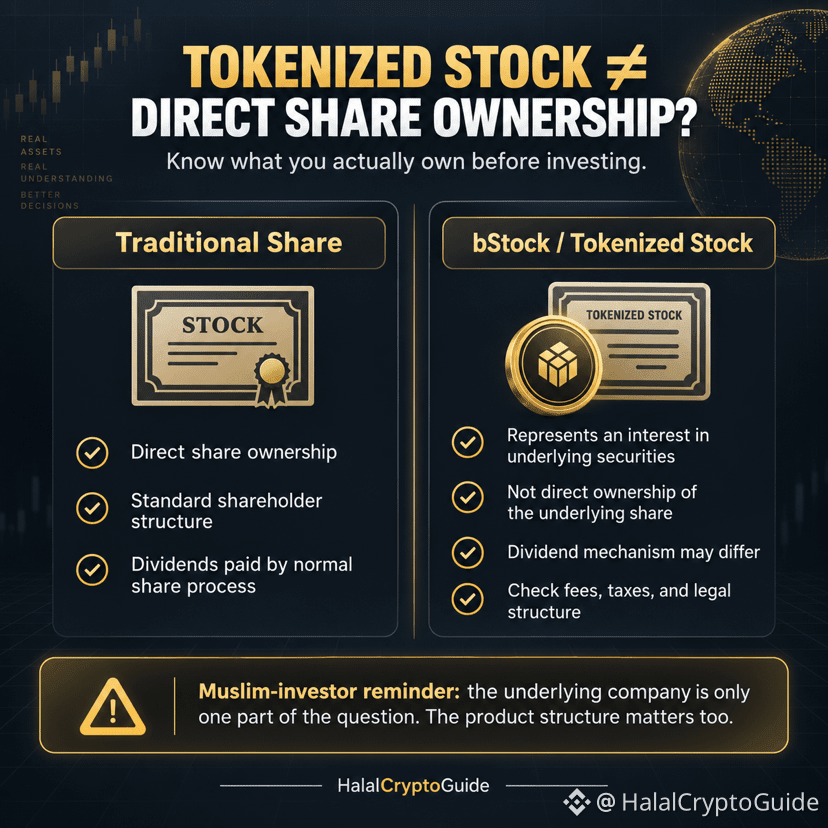
Holding a tokenized stock is not necessarily the same legal structure as owning the actual share.
Binance confirmed dividend distributions for AVGOB, QQQB, METAB and STXB holders.
Instead of simply paying the gross cash dividend:
• Applicable taxes, fees and costs are deducted
• The remaining dividend is reinvested
• Eligible holders receive additional/fractional bStock units
But here’s the detail worth understanding:
Binance states that bStocks represent an interest in underlying securities and do not give holders direct ownership of the underlying shares.
🕌 For a Muslim investor, this means looking only at whether the underlying company seems permissible may not answer the whole Shariah question.
The contract structure, what the token legally represents, ownership, dividend mechanism and underlying company’s activities/financial ratios can all matter.
I’m not declaring bStocks halal or haram here. The point is simpler:
📚 Understand what you actually own before investing.
👇 Would you like me to make a full breakdown comparing real shares vs tokenized stocks vs crypto tokens from a Shariah-awareness perspective?
#bStocks #Binance #IslamicFinance #HalalCryptoGuide
Educational only — not financial advice or a fatwa.
🚨 Binance bStocks can now pass through dividends — but Muslim investors should notice one important detail.
Holding a tokenized stock is not necessarily the same legal structure as owning the actual share.
Binance confirmed dividend distributions for AVGOB, QQQB, METAB and STXB holders.
Instead of simply paying the gross cash dividend:
• Applicable taxes, fees and costs are deducted
• The remaining dividend is reinvested
• Eligible holders receive additional/fractional bStock units
But here’s the detail worth understanding:
Binance states that bStocks represent an interest in underlying securities and do not give holders direct ownership of the underlying shares.
🕌 For a Muslim investor, this means looking only at whether the underlying company seems permissible may not answer the whole Shariah question.
The contract structure, what the token legally represents, ownership, dividend mechanism and underlying company’s activities/financial ratios can all matter.
I’m not declaring bStocks halal or haram here. The point is simpler:
📚 Understand what you actually own before investing.
👇 Would you like me to make a full breakdown comparing real shares vs tokenized stocks vs crypto tokens from a Shariah-awareness perspective?
#bStocks #Binance #IslamicFinance #HalalCryptoGuide
Educational only — not financial advice or a fatwa.
Holding a tokenized stock is not necessarily the same legal structure as owning the actual share.
Binance confirmed dividend distributions for AVGOB, QQQB, METAB and STXB holders.
Instead of simply paying the gross cash dividend:
• Applicable taxes, fees and costs are deducted
• The remaining dividend is reinvested
• Eligible holders receive additional/fractional bStock units
But here’s the detail worth understanding:
Binance states that bStocks represent an interest in underlying securities and do not give holders direct ownership of the underlying shares.
🕌 For a Muslim investor, this means looking only at whether the underlying company seems permissible may not answer the whole Shariah question.
The contract structure, what the token legally represents, ownership, dividend mechanism and underlying company’s activities/financial ratios can all matter.
I’m not declaring bStocks halal or haram here. The point is simpler:
📚 Understand what you actually own before investing.
👇 Would you like me to make a full breakdown comparing real shares vs tokenized stocks vs crypto tokens from a Shariah-awareness perspective?
#bStocks #Binance #IslamicFinance #HalalCryptoGuide
Educational only — not financial advice or a fatwa.
80
Before you see “Moonshot AI” and assume this is a way to buy the company before its IPO, look at what Binance actually launched.
Binance has opened $MOONSHOT USDT Pre-IPO Perpetual trading.
The contract references Beijing Moonshot AI Technology, but buying this contract does NOT mean you’re buying pre-IPO shares in Moonshot AI.
What you’re actually trading:
• A perpetual derivative
• Settled in USDT
• Up to 20× leverage
• Funding every 8 hours
• Trading 24/7
• No direct ownership of Moonshot AI shares
There is an especially important detail:
Before Moonshot’s final IPO price is available, Binance calculates the contract’s mark price primarily from trading activity in the Binance pre-IPO contract itself.
Binance even warns that the contract can trade above or below the assumed IPO price, and the eventual share count may differ from the estimate currently used.
So:
Company ≠ share ownership ≠ pre-IPO perpetual contract.
🕌 For Muslim investors, that distinction deserves attention.
Researching whether a company’s underlying business is acceptable is only one layer.
A separate assessment may be needed for the instrument itself — including leverage, funding payments, settlement, ownership and the derivative contract structure.
I’m not declaring MOONSHOTUSDT halal or haram.
📌 A permissible underlying business would not automatically make every financial contract referencing that business permissible.
Understand what you are actually buying before evaluating the ticker.
👇 Would you like a simple checklist for researching pre-IPO products from a Shariah perspective?
#IslamicFinance #BinanceFutures #HalalCryptoGuide
Educational only — not financial advice or a fatwa.
Before you see “Moonshot AI” and assume this is a way to buy the company before its IPO, look at what Binance actually launched.
Binance has opened $MOONSHOT USDT Pre-IPO Perpetual trading.
The contract references Beijing Moonshot AI Technology, but buying this contract does NOT mean you’re buying pre-IPO shares in Moonshot AI.
What you’re actually trading:
• A perpetual derivative
• Settled in USDT
• Up to 20× leverage
• Funding every 8 hours
• Trading 24/7
• No direct ownership of Moonshot AI shares
There is an especially important detail:
Before Moonshot’s final IPO price is available, Binance calculates the contract’s mark price primarily from trading activity in the Binance pre-IPO contract itself.
Binance even warns that the contract can trade above or below the assumed IPO price, and the eventual share count may differ from the estimate currently used.
So:
Company ≠ share ownership ≠ pre-IPO perpetual contract.
🕌 For Muslim investors, that distinction deserves attention.
Researching whether a company’s underlying business is acceptable is only one layer.
A separate assessment may be needed for the instrument itself — including leverage, funding payments, settlement, ownership and the derivative contract structure.
I’m not declaring MOONSHOTUSDT halal or haram.
📌 A permissible underlying business would not automatically make every financial contract referencing that business permissible.
Understand what you are actually buying before evaluating the ticker.
👇 Would you like a simple checklist for researching pre-IPO products from a Shariah perspective?
#IslamicFinance #BinanceFutures #HalalCryptoGuide
Educational only — not financial advice or a fatwa.
Binance has opened $MOONSHOT USDT Pre-IPO Perpetual trading.
The contract references Beijing Moonshot AI Technology, but buying this contract does NOT mean you’re buying pre-IPO shares in Moonshot AI.
What you’re actually trading:
• A perpetual derivative
• Settled in USDT
• Up to 20× leverage
• Funding every 8 hours
• Trading 24/7
• No direct ownership of Moonshot AI shares
There is an especially important detail:
Before Moonshot’s final IPO price is available, Binance calculates the contract’s mark price primarily from trading activity in the Binance pre-IPO contract itself.
Binance even warns that the contract can trade above or below the assumed IPO price, and the eventual share count may differ from the estimate currently used.
So:
Company ≠ share ownership ≠ pre-IPO perpetual contract.
🕌 For Muslim investors, that distinction deserves attention.
Researching whether a company’s underlying business is acceptable is only one layer.
A separate assessment may be needed for the instrument itself — including leverage, funding payments, settlement, ownership and the derivative contract structure.
I’m not declaring MOONSHOTUSDT halal or haram.
📌 A permissible underlying business would not automatically make every financial contract referencing that business permissible.
Understand what you are actually buying before evaluating the ticker.
👇 Would you like a simple checklist for researching pre-IPO products from a Shariah perspective?
#IslamicFinance #BinanceFutures #HalalCryptoGuide
Educational only — not financial advice or a fatwa.
446
One detail in today’s Binance headlines matters more than the headline itself: an investigation is NOT a finding of wrongdoing.
U.S. federal prosecutors are reportedly investigating whether Binance failed to prevent certain Iran-linked trading that may have violated U.S. sanctions.
According to reporting cited by Reuters, authorities are examining whether Binance knowingly allowed trading that should have been blocked.
Binance says it maintains a zero-tolerance policy toward sanctions violations, cooperates with law enforcement and works to remove bad actors.
Importantly:
📌 An investigation does not mean Binance has been found guilty of these allegations.
So why should ordinary crypto users care?
Because exchange risk isn’t only about whether Bitcoin goes up or down.
It can also include:
• Regulatory risk
• Counterparty/platform risk
• Account and jurisdiction restrictions
• Withdrawal/access risk
• Compliance changes
🕌 For Muslim investors, there is a broader lesson here too.
Due diligence shouldn’t stop at asking whether a particular token or activity appears Shariah-compatible.
We should also understand where assets are held, who controls custody, what contractual relationship exists with the platform, and what risks appear when a centralized intermediary is involved.
This isn’t a halal/haram ruling on Binance.
It’s a reminder of a useful principle:
📌 Research the asset — but research the platform holding your asset too.
👇 Do you consider exchange/custody risk before deciding where to keep your crypto?
#CryptoEducation #IslamicFinance #HalalCryptoGuide
Educational only — not financial advice or a fatwa.
One detail in today’s Binance headlines matters more than the headline itself: an investigation is NOT a finding of wrongdoing.
U.S. federal prosecutors are reportedly investigating whether Binance failed to prevent certain Iran-linked trading that may have violated U.S. sanctions.
According to reporting cited by Reuters, authorities are examining whether Binance knowingly allowed trading that should have been blocked.
Binance says it maintains a zero-tolerance policy toward sanctions violations, cooperates with law enforcement and works to remove bad actors.
Importantly:
📌 An investigation does not mean Binance has been found guilty of these allegations.
So why should ordinary crypto users care?
Because exchange risk isn’t only about whether Bitcoin goes up or down.
It can also include:
• Regulatory risk
• Counterparty/platform risk
• Account and jurisdiction restrictions
• Withdrawal/access risk
• Compliance changes
🕌 For Muslim investors, there is a broader lesson here too.
Due diligence shouldn’t stop at asking whether a particular token or activity appears Shariah-compatible.
We should also understand where assets are held, who controls custody, what contractual relationship exists with the platform, and what risks appear when a centralized intermediary is involved.
This isn’t a halal/haram ruling on Binance.
It’s a reminder of a useful principle:
📌 Research the asset — but research the platform holding your asset too.
👇 Do you consider exchange/custody risk before deciding where to keep your crypto?
#CryptoEducation #IslamicFinance #HalalCryptoGuide
Educational only — not financial advice or a fatwa.
U.S. federal prosecutors are reportedly investigating whether Binance failed to prevent certain Iran-linked trading that may have violated U.S. sanctions.
According to reporting cited by Reuters, authorities are examining whether Binance knowingly allowed trading that should have been blocked.
Binance says it maintains a zero-tolerance policy toward sanctions violations, cooperates with law enforcement and works to remove bad actors.
Importantly:
📌 An investigation does not mean Binance has been found guilty of these allegations.
So why should ordinary crypto users care?
Because exchange risk isn’t only about whether Bitcoin goes up or down.
It can also include:
• Regulatory risk
• Counterparty/platform risk
• Account and jurisdiction restrictions
• Withdrawal/access risk
• Compliance changes
🕌 For Muslim investors, there is a broader lesson here too.
Due diligence shouldn’t stop at asking whether a particular token or activity appears Shariah-compatible.
We should also understand where assets are held, who controls custody, what contractual relationship exists with the platform, and what risks appear when a centralized intermediary is involved.
This isn’t a halal/haram ruling on Binance.
It’s a reminder of a useful principle:
📌 Research the asset — but research the platform holding your asset too.
👇 Do you consider exchange/custody risk before deciding where to keep your crypto?
#CryptoEducation #IslamicFinance #HalalCryptoGuide
Educational only — not financial advice or a fatwa.
54
That “dividend” may never hit your account as cash.
Binance just announced dividend distributions for several leveraged and inverse bStocks — and the mechanism is worth understanding before focusing on the yield.
For SOXSB, MUUB, TQQQB and SQQQB, Binance says the underlying cash dividend will be:
Dividend → taxes/fees/deductions → reinvestment → additional bStock units
There is another important distinction:
Binance states that bStocks are not stocks or shares and do not give holders direct ownership of the underlying shares. Instead, they are certificates representing an interest in underlying securities held by the issuer.
And these particular underlying products aren’t ordinary company shares:
• $SOXSB — 3× bearish semiconductor exposure
• $MUUB — 2× bullish Micron exposure
• $TQQQB — 3× bullish Nasdaq-100 exposure
• SQQQ — 3× inverse Nasdaq-100 exposure
🕌 For Muslim investors, this shows why seeing the word “dividend” isn’t enough to evaluate an investment.
There can be several separate questions:
What is the underlying asset?
How is the leveraged or inverse exposure created?
What does the bStock legally represent?
How is the distribution generated and reinvested?
I’m not declaring these products halal or haram.
📌 The income label doesn’t replace understanding the contract underneath it.
This matters especially with leveraged, inverse and tokenized products, where the structure can be very different from simply owning an ordinary company share.
👇 Did you know a bStock dividend could be reinvested rather than paid to you as cash?
#IslamicFinance #BinanceStocks #HalalCryptoGuide
Educational only — not financial advice or a fatwa.
{spot}(TQQQBUSDT)
{spot}(SOXSBUSDT)
{spot}(MUUBUSDT)
That “dividend” may never hit your account as cash.
Binance just announced dividend distributions for several leveraged and inverse bStocks — and the mechanism is worth understanding before focusing on the yield.
For SOXSB, MUUB, TQQQB and SQQQB, Binance says the underlying cash dividend will be:
Dividend → taxes/fees/deductions → reinvestment → additional bStock units
There is another important distinction:
Binance states that bStocks are not stocks or shares and do not give holders direct ownership of the underlying shares. Instead, they are certificates representing an interest in underlying securities held by the issuer.
And these particular underlying products aren’t ordinary company shares:
• $SOXSB — 3× bearish semiconductor exposure
• $MUUB — 2× bullish Micron exposure
• $TQQQB — 3× bullish Nasdaq-100 exposure
• SQQQ — 3× inverse Nasdaq-100 exposure
🕌 For Muslim investors, this shows why seeing the word “dividend” isn’t enough to evaluate an investment.
There can be several separate questions:
What is the underlying asset?
How is the leveraged or inverse exposure created?
What does the bStock legally represent?
How is the distribution generated and reinvested?
I’m not declaring these products halal or haram.
📌 The income label doesn’t replace understanding the contract underneath it.
This matters especially with leveraged, inverse and tokenized products, where the structure can be very different from simply owning an ordinary company share.
👇 Did you know a bStock dividend could be reinvested rather than paid to you as cash?
#IslamicFinance #BinanceStocks #HalalCryptoGuide
Educational only — not financial advice or a fatwa.
Binance just announced dividend distributions for several leveraged and inverse bStocks — and the mechanism is worth understanding before focusing on the yield.
For SOXSB, MUUB, TQQQB and SQQQB, Binance says the underlying cash dividend will be:
Dividend → taxes/fees/deductions → reinvestment → additional bStock units
There is another important distinction:
Binance states that bStocks are not stocks or shares and do not give holders direct ownership of the underlying shares. Instead, they are certificates representing an interest in underlying securities held by the issuer.
And these particular underlying products aren’t ordinary company shares:
• $SOXSB — 3× bearish semiconductor exposure
• $MUUB — 2× bullish Micron exposure
• $TQQQB — 3× bullish Nasdaq-100 exposure
• SQQQ — 3× inverse Nasdaq-100 exposure
🕌 For Muslim investors, this shows why seeing the word “dividend” isn’t enough to evaluate an investment.
There can be several separate questions:
What is the underlying asset?
How is the leveraged or inverse exposure created?
What does the bStock legally represent?
How is the distribution generated and reinvested?
I’m not declaring these products halal or haram.
📌 The income label doesn’t replace understanding the contract underneath it.
This matters especially with leveraged, inverse and tokenized products, where the structure can be very different from simply owning an ordinary company share.
👇 Did you know a bStock dividend could be reinvested rather than paid to you as cash?
#IslamicFinance #BinanceStocks #HalalCryptoGuide
Educational only — not financial advice or a fatwa.
221
🚨 Binance Wallet just opened access to “pre-IPO” companies — but read this BEFORE assuming you’re buying private shares.
This could become one of the most interesting tokenization developments on Binance Wallet.
Pre-Access lets eligible users subscribe through PancakeSwap to tokens designed to provide indirect exposure to private companies before they potentially go public.
But Binance’s own FAQ contains several details investors shouldn’t skip:
• You’re subscribing to a third-party product or arrangement
• The token may provide indirect exposure, not direct ownership of company shares
• Structures may involve funds, SPVs, protocols or smart contracts
• An IPO is not guaranteed
• Conversion into another tokenized asset after an IPO may be delayed, restricted — or never become available
• The token could trade at a premium or discount to the eventual public share price
• Binance explicitly warns that users may lose part or all of the assets committed
The first company has not been revealed yet.
🕌 Muslim-investor reminder:
“Exposure to a good company” doesn’t automatically tell us whether the investment structure itself is Shariah-compliant.
Before participating, we need to understand:
What does the token legally represent?
Who actually owns the underlying shares?
What rights does the holder receive?
How are profits generated and distributed?
What happens if the company never IPOs?
I’m not declaring Pre-Access halal or haram. The structure of each offering needs to be understood first.
📌 Don’t buy the story. Understand the contract.
👇 When the first company is announced, should I break down the complete structure before anyone considers participating?
#BinanceWallet #Tokenization #IslamicFinance #HalalCryptoGuide
Educational only — not financial advice or a fatwa.
🚨 Binance Wallet just opened access to “pre-IPO” companies — but read this BEFORE assuming you’re buying private shares.
This could become one of the most interesting tokenization developments on Binance Wallet.
Pre-Access lets eligible users subscribe through PancakeSwap to tokens designed to provide indirect exposure to private companies before they potentially go public.
But Binance’s own FAQ contains several details investors shouldn’t skip:
• You’re subscribing to a third-party product or arrangement
• The token may provide indirect exposure, not direct ownership of company shares
• Structures may involve funds, SPVs, protocols or smart contracts
• An IPO is not guaranteed
• Conversion into another tokenized asset after an IPO may be delayed, restricted — or never become available
• The token could trade at a premium or discount to the eventual public share price
• Binance explicitly warns that users may lose part or all of the assets committed
The first company has not been revealed yet.
🕌 Muslim-investor reminder:
“Exposure to a good company” doesn’t automatically tell us whether the investment structure itself is Shariah-compliant.
Before participating, we need to understand:
What does the token legally represent?
Who actually owns the underlying shares?
What rights does the holder receive?
How are profits generated and distributed?
What happens if the company never IPOs?
I’m not declaring Pre-Access halal or haram. The structure of each offering needs to be understood first.
📌 Don’t buy the story. Understand the contract.
👇 When the first company is announced, should I break down the complete structure before anyone considers participating?
#BinanceWallet #Tokenization #IslamicFinance #HalalCryptoGuide
Educational only — not financial advice or a fatwa.
This could become one of the most interesting tokenization developments on Binance Wallet.
Pre-Access lets eligible users subscribe through PancakeSwap to tokens designed to provide indirect exposure to private companies before they potentially go public.
But Binance’s own FAQ contains several details investors shouldn’t skip:
• You’re subscribing to a third-party product or arrangement
• The token may provide indirect exposure, not direct ownership of company shares
• Structures may involve funds, SPVs, protocols or smart contracts
• An IPO is not guaranteed
• Conversion into another tokenized asset after an IPO may be delayed, restricted — or never become available
• The token could trade at a premium or discount to the eventual public share price
• Binance explicitly warns that users may lose part or all of the assets committed
The first company has not been revealed yet.
🕌 Muslim-investor reminder:
“Exposure to a good company” doesn’t automatically tell us whether the investment structure itself is Shariah-compliant.
Before participating, we need to understand:
What does the token legally represent?
Who actually owns the underlying shares?
What rights does the holder receive?
How are profits generated and distributed?
What happens if the company never IPOs?
I’m not declaring Pre-Access halal or haram. The structure of each offering needs to be understood first.
📌 Don’t buy the story. Understand the contract.
👇 When the first company is announced, should I break down the complete structure before anyone considers participating?
#BinanceWallet #Tokenization #IslamicFinance #HalalCryptoGuide
Educational only — not financial advice or a fatwa.
39
🚨 Binance is bringing forex to crypto-style perpetual futures — with up to 100× leverage.
But seeing USD/BRL on the screen does NOT mean you’re simply exchanging dollars for Brazilian reais.
Binance’s first FX perpetual, USDBRLUSDT, launches September 21.
Key details:
• Tracks USD vs Brazilian real
• Settled in USDT
• Trades 24/7
• No expiry like a traditional futures contract
• Funding payments apply
• Maximum leverage: 100×
That last point matters.
At 100× leverage, roughly a 1% adverse move can theoretically wipe out the trader’s initial margin before accounting for maintenance margin, fees and actual liquidation mechanics.
🕌 For Muslim investors, don’t confuse the underlying asset with the contract used to trade it.
Someone may ask whether exchanging USD and BRL is permissible—but a leveraged perpetual derivative with margin and recurring funding mechanics is a different transaction structure and needs to be evaluated on its own.
I’m not issuing a fatwa on this specific Binance product.
The broader lesson is:
📚 Don’t ask only “What asset am I trading?”
Also ask “What contract am I entering?”
👇 Would you like a simple breakdown of Spot vs Margin vs Futures/Perpetuals from a Shariah-awareness perspective?
#Binance #Forex #CryptoEducation #HalalCryptoGuide
Educational only — not financial advice or a fatwa.
🚨 Binance is bringing forex to crypto-style perpetual futures — with up to 100× leverage.
But seeing USD/BRL on the screen does NOT mean you’re simply exchanging dollars for Brazilian reais.
Binance’s first FX perpetual, USDBRLUSDT, launches September 21.
Key details:
• Tracks USD vs Brazilian real
• Settled in USDT
• Trades 24/7
• No expiry like a traditional futures contract
• Funding payments apply
• Maximum leverage: 100×
That last point matters.
At 100× leverage, roughly a 1% adverse move can theoretically wipe out the trader’s initial margin before accounting for maintenance margin, fees and actual liquidation mechanics.
🕌 For Muslim investors, don’t confuse the underlying asset with the contract used to trade it.
Someone may ask whether exchanging USD and BRL is permissible—but a leveraged perpetual derivative with margin and recurring funding mechanics is a different transaction structure and needs to be evaluated on its own.
I’m not issuing a fatwa on this specific Binance product.
The broader lesson is:
📚 Don’t ask only “What asset am I trading?”
Also ask “What contract am I entering?”
👇 Would you like a simple breakdown of Spot vs Margin vs Futures/Perpetuals from a Shariah-awareness perspective?
#Binance #Forex #CryptoEducation #HalalCryptoGuide
Educational only — not financial advice or a fatwa.
But seeing USD/BRL on the screen does NOT mean you’re simply exchanging dollars for Brazilian reais.
Binance’s first FX perpetual, USDBRLUSDT, launches September 21.
Key details:
• Tracks USD vs Brazilian real
• Settled in USDT
• Trades 24/7
• No expiry like a traditional futures contract
• Funding payments apply
• Maximum leverage: 100×
That last point matters.
At 100× leverage, roughly a 1% adverse move can theoretically wipe out the trader’s initial margin before accounting for maintenance margin, fees and actual liquidation mechanics.
🕌 For Muslim investors, don’t confuse the underlying asset with the contract used to trade it.
Someone may ask whether exchanging USD and BRL is permissible—but a leveraged perpetual derivative with margin and recurring funding mechanics is a different transaction structure and needs to be evaluated on its own.
I’m not issuing a fatwa on this specific Binance product.
The broader lesson is:
📚 Don’t ask only “What asset am I trading?”
Also ask “What contract am I entering?”
👇 Would you like a simple breakdown of Spot vs Margin vs Futures/Perpetuals from a Shariah-awareness perspective?
#Binance #Forex #CryptoEducation #HalalCryptoGuide
Educational only — not financial advice or a fatwa.
58
🚨 iPhone users holding crypto: deleting a suspicious app may NOT be enough.
Binance Wallet has issued a security warning about FomoPeek v1.1–1.2, after malicious code was found capable of attacking the device itself.
That distinction matters.
This isn’t simply a fake wallet asking for your seed phrase.
Researchers found code capable of:
• Exploiting iOS vulnerabilities
• Escaping normal app sandbox protections
• Accessing Keychain information
• Potentially exposing private keys and seed phrases
• Stealing login credentials and sensitive files
And the concern may be broader: Binance News reports that security researchers have now identified another app, ComeCome, using attack methods similar to the FomoPeek incident.
⚠️ If you previously installed FomoPeek 1.1–1.2, Binance recommends:
1. Delete it and don’t reinstall it.
2. Update iOS to the latest available version.
3. If you use self-custody, create a completely new wallet on a clean device that never had FomoPeek installed.
4. Move your assets to the new wallet.
5. Check for unusual transactions.
Why a new wallet?
Because if a private key or seed phrase was already exposed, deleting the malicious app doesn’t make that key secret again.
🕌 Muslim-investor reminder: protecting wealth is part of responsible financial behavior. Chasing trading tools, “whale trackers” or profit opportunities isn’t worth compromising custody security.
📌 Save this and send it to someone who keeps crypto on an iPhone.
Would you like a 10-point phone security checklist for crypto holders next?
#CryptoSecurity #BinanceWallet #HalalCryptoGuide
Educational security information — not financial advice.
🚨 iPhone users holding crypto: deleting a suspicious app may NOT be enough.
Binance Wallet has issued a security warning about FomoPeek v1.1–1.2, after malicious code was found capable of attacking the device itself.
That distinction matters.
This isn’t simply a fake wallet asking for your seed phrase.
Researchers found code capable of:
• Exploiting iOS vulnerabilities
• Escaping normal app sandbox protections
• Accessing Keychain information
• Potentially exposing private keys and seed phrases
• Stealing login credentials and sensitive files
And the concern may be broader: Binance News reports that security researchers have now identified another app, ComeCome, using attack methods similar to the FomoPeek incident.
⚠️ If you previously installed FomoPeek 1.1–1.2, Binance recommends:
1. Delete it and don’t reinstall it.
2. Update iOS to the latest available version.
3. If you use self-custody, create a completely new wallet on a clean device that never had FomoPeek installed.
4. Move your assets to the new wallet.
5. Check for unusual transactions.
Why a new wallet?
Because if a private key or seed phrase was already exposed, deleting the malicious app doesn’t make that key secret again.
🕌 Muslim-investor reminder: protecting wealth is part of responsible financial behavior. Chasing trading tools, “whale trackers” or profit opportunities isn’t worth compromising custody security.
📌 Save this and send it to someone who keeps crypto on an iPhone.
Would you like a 10-point phone security checklist for crypto holders next?
#CryptoSecurity #BinanceWallet #HalalCryptoGuide
Educational security information — not financial advice.
Binance Wallet has issued a security warning about FomoPeek v1.1–1.2, after malicious code was found capable of attacking the device itself.
That distinction matters.
This isn’t simply a fake wallet asking for your seed phrase.
Researchers found code capable of:
• Exploiting iOS vulnerabilities
• Escaping normal app sandbox protections
• Accessing Keychain information
• Potentially exposing private keys and seed phrases
• Stealing login credentials and sensitive files
And the concern may be broader: Binance News reports that security researchers have now identified another app, ComeCome, using attack methods similar to the FomoPeek incident.
⚠️ If you previously installed FomoPeek 1.1–1.2, Binance recommends:
1. Delete it and don’t reinstall it.
2. Update iOS to the latest available version.
3. If you use self-custody, create a completely new wallet on a clean device that never had FomoPeek installed.
4. Move your assets to the new wallet.
5. Check for unusual transactions.
Why a new wallet?
Because if a private key or seed phrase was already exposed, deleting the malicious app doesn’t make that key secret again.
🕌 Muslim-investor reminder: protecting wealth is part of responsible financial behavior. Chasing trading tools, “whale trackers” or profit opportunities isn’t worth compromising custody security.
📌 Save this and send it to someone who keeps crypto on an iPhone.
Would you like a 10-point phone security checklist for crypto holders next?
#CryptoSecurity #BinanceWallet #HalalCryptoGuide
Educational security information — not financial advice.
63
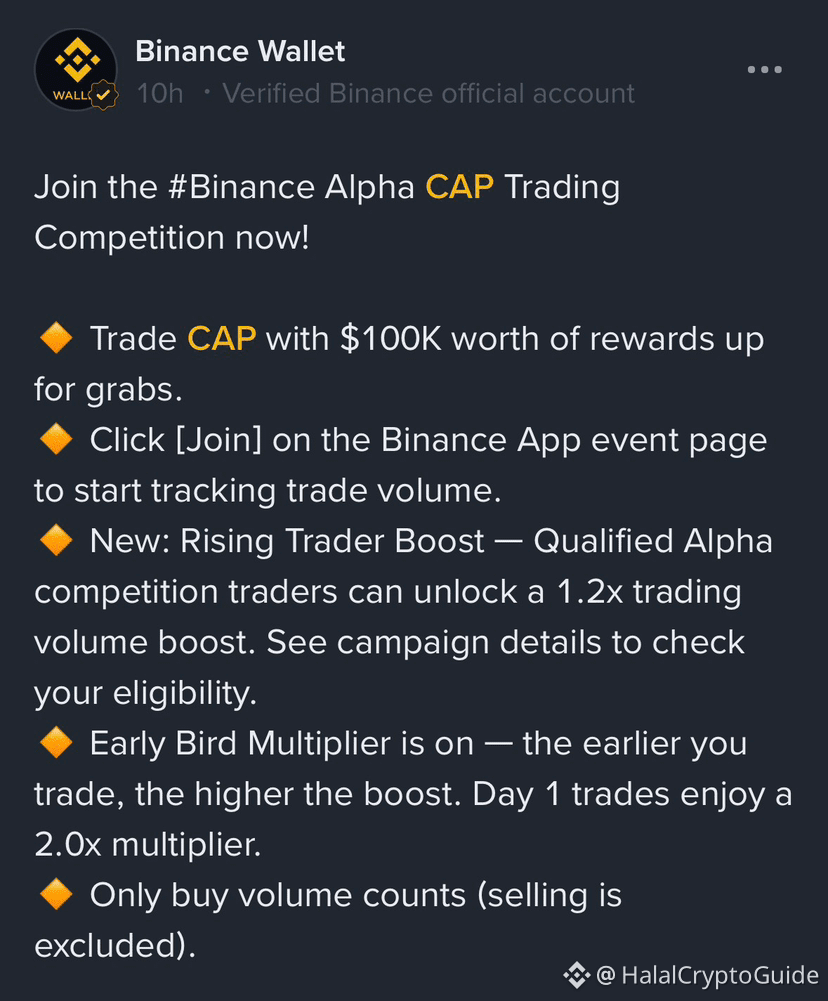
🚨 Binance is offering $50 to 2,000 CAP traders — but there’s something I’d check before chasing it.
The reward is based on trading volume, not simply participation.
Binance Alpha has launched a CAP trading competition with a 100,000 USDC reward pool.
Top 2,000 eligible traders receive 50 USDC each.
But read the mechanics carefully:
• Ranking is based on effective CAP buy volume
• Selling doesn’t count
• There is no volume cap
• Earlier purchases receive higher ranking multipliers
⚠️ A $50 potential reward shouldn’t push you into unnecessary trades, extra fees or taking more market risk than you originally intended.
🕌 For Muslim investors, a promotional reward also doesn’t answer whether the underlying token or trading activity is Shariah-compliant. Those questions should be evaluated separately.
Would you ever increase your trading volume just to qualify for a $50 reward? 👇
#BinanceAlpha #CAP #CryptoEducation #HalalCryptoGuide
🚨 Binance is offering $50 to 2,000 CAP traders — but there’s something I’d check before chasing it.
The reward is based on trading volume, not simply participation.
Binance Alpha has launched a CAP trading competition with a 100,000 USDC reward pool.
Top 2,000 eligible traders receive 50 USDC each.
But read the mechanics carefully:
• Ranking is based on effective CAP buy volume
• Selling doesn’t count
• There is no volume cap
• Earlier purchases receive higher ranking multipliers
⚠️ A $50 potential reward shouldn’t push you into unnecessary trades, extra fees or taking more market risk than you originally intended.
🕌 For Muslim investors, a promotional reward also doesn’t answer whether the underlying token or trading activity is Shariah-compliant. Those questions should be evaluated separately.
Would you ever increase your trading volume just to qualify for a $50 reward? 👇
#BinanceAlpha #CAP #CryptoEducation #HalalCryptoGuide
The reward is based on trading volume, not simply participation.
Binance Alpha has launched a CAP trading competition with a 100,000 USDC reward pool.
Top 2,000 eligible traders receive 50 USDC each.
But read the mechanics carefully:
• Ranking is based on effective CAP buy volume
• Selling doesn’t count
• There is no volume cap
• Earlier purchases receive higher ranking multipliers
⚠️ A $50 potential reward shouldn’t push you into unnecessary trades, extra fees or taking more market risk than you originally intended.
🕌 For Muslim investors, a promotional reward also doesn’t answer whether the underlying token or trading activity is Shariah-compliant. Those questions should be evaluated separately.
Would you ever increase your trading volume just to qualify for a $50 reward? 👇
#BinanceAlpha #CAP #CryptoEducation #HalalCryptoGuide
134
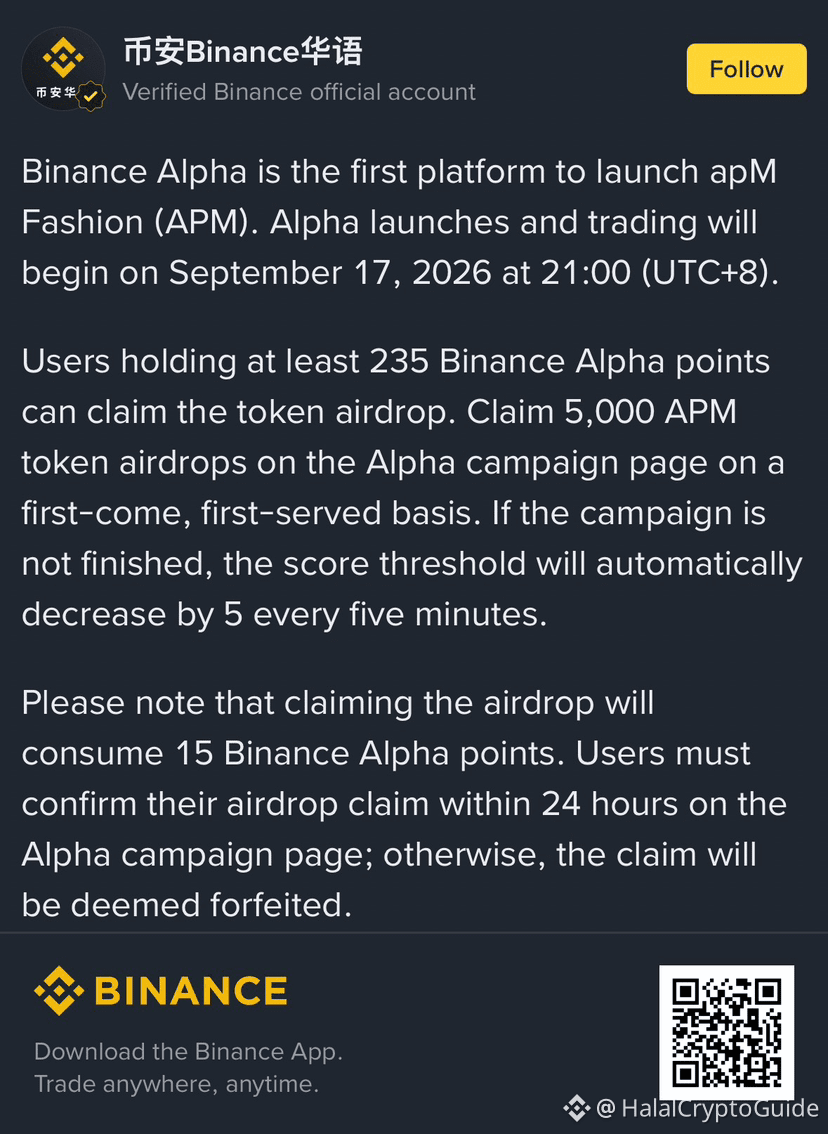
🚨 235 Alpha Points? You have an APM decision to make today.
Binance just revealed the actual APM airdrop rules — and the threshold can fall every 5 minutes.
Binance Alpha opens APM trading today at 13:00 UTC.
🎁 Official claim rules:
• Minimum: 235 Alpha Points
• Reward: 5,000 APM
• Claim cost: 15 Alpha Points
• First-come, first-served
• If rewards remain, threshold drops 5 points every 5 minutes
⚠️ Don’t spend Alpha Points just because an airdrop is available. Consider what your points are worth to you and research the project before deciding whether to hold or trade any received tokens.
🕌 Being distributed through Binance Alpha does not by itself establish Shariah compliance.
Would you spend 15 Alpha Points for 5,000 APM — or save your points for the next drop? 👇
#BinanceAlpha #Airdrop #APM #HalalCryptoGuide
🚨 235 Alpha Points? You have an APM decision to make today.
Binance just revealed the actual APM airdrop rules — and the threshold can fall every 5 minutes.
Binance Alpha opens APM trading today at 13:00 UTC.
🎁 Official claim rules:
• Minimum: 235 Alpha Points
• Reward: 5,000 APM
• Claim cost: 15 Alpha Points
• First-come, first-served
• If rewards remain, threshold drops 5 points every 5 minutes
⚠️ Don’t spend Alpha Points just because an airdrop is available. Consider what your points are worth to you and research the project before deciding whether to hold or trade any received tokens.
🕌 Being distributed through Binance Alpha does not by itself establish Shariah compliance.
Would you spend 15 Alpha Points for 5,000 APM — or save your points for the next drop? 👇
#BinanceAlpha #Airdrop #APM #HalalCryptoGuide
Binance just revealed the actual APM airdrop rules — and the threshold can fall every 5 minutes.
Binance Alpha opens APM trading today at 13:00 UTC.
🎁 Official claim rules:
• Minimum: 235 Alpha Points
• Reward: 5,000 APM
• Claim cost: 15 Alpha Points
• First-come, first-served
• If rewards remain, threshold drops 5 points every 5 minutes
⚠️ Don’t spend Alpha Points just because an airdrop is available. Consider what your points are worth to you and research the project before deciding whether to hold or trade any received tokens.
🕌 Being distributed through Binance Alpha does not by itself establish Shariah compliance.
Would you spend 15 Alpha Points for 5,000 APM — or save your points for the next drop? 👇
#BinanceAlpha #Airdrop #APM #HalalCryptoGuide
122
🚨 NEW BINANCE ALPHA AIRDROP INCOMING —APM
Binance Alpha will be the first platform to feature apM Fashion (APM) on September 17.
🎁 Eligible users will be able to claim an APM airdrop using Binance Alpha Points once trading opens.
⚠️ Binance has NOT yet announced the required Points threshold, token allocation or full claim conditions. Be careful with posts claiming exact numbers before the official details are released.
🕌 HalalCryptoGuide note: An airdrop or Binance Alpha listing does not automatically make a token halal. The project, token utility and transaction structure should be evaluated separately before investing.
I’ll be watching for the full APM claim requirements.
$APM #BinanceAlpha #BinanceAirdrop #CryptoNews #HalalCryptoGuide
Educational only — not financial advice or a fatwa.
🚨 NEW BINANCE ALPHA AIRDROP INCOMING —APM
Binance Alpha will be the first platform to feature apM Fashion (APM) on September 17.
🎁 Eligible users will be able to claim an APM airdrop using Binance Alpha Points once trading opens.
⚠️ Binance has NOT yet announced the required Points threshold, token allocation or full claim conditions. Be careful with posts claiming exact numbers before the official details are released.
🕌 HalalCryptoGuide note: An airdrop or Binance Alpha listing does not automatically make a token halal. The project, token utility and transaction structure should be evaluated separately before investing.
I’ll be watching for the full APM claim requirements.
$APM #BinanceAlpha #BinanceAirdrop #CryptoNews #HalalCryptoGuide
Educational only — not financial advice or a fatwa.
Binance Alpha will be the first platform to feature apM Fashion (APM) on September 17.
🎁 Eligible users will be able to claim an APM airdrop using Binance Alpha Points once trading opens.
⚠️ Binance has NOT yet announced the required Points threshold, token allocation or full claim conditions. Be careful with posts claiming exact numbers before the official details are released.
🕌 HalalCryptoGuide note: An airdrop or Binance Alpha listing does not automatically make a token halal. The project, token utility and transaction structure should be evaluated separately before investing.
I’ll be watching for the full APM claim requirements.
$APM #BinanceAlpha #BinanceAirdrop #CryptoNews #HalalCryptoGuide
Educational only — not financial advice or a fatwa.
75
🚨 $61M CRYPTO CASE INVOLVING BINANCE ACCOUNTS
The U.S. DOJ is seeking to forfeit roughly $61 million in crypto allegedly linked to sanctioned Iranian oil sales.
Prosecutors allege two Chinese companies used Binance accounts as part of the transaction network.
⚠️ Important context: Binance is not named as a defendant, and this is a civil forfeiture complaint—not proof that Binance itself committed wrongdoing.
🕌 For Muslim crypto users, there’s a broader lesson here: don’t evaluate an exchange or token only by potential profit. Counterparty risk, source of funds, regulation and how an asset is being used also matter.
Avoid turning allegations into facts, and always verify major crypto headlines before acting on them.
#Binance #CryptoNews #CryptoCompliance #HalalCryptoGuide
Educational only — not financial advice or a fatwa.
🚨 $61M CRYPTO CASE INVOLVING BINANCE ACCOUNTS
The U.S. DOJ is seeking to forfeit roughly $61 million in crypto allegedly linked to sanctioned Iranian oil sales.
Prosecutors allege two Chinese companies used Binance accounts as part of the transaction network.
⚠️ Important context: Binance is not named as a defendant, and this is a civil forfeiture complaint—not proof that Binance itself committed wrongdoing.
🕌 For Muslim crypto users, there’s a broader lesson here: don’t evaluate an exchange or token only by potential profit. Counterparty risk, source of funds, regulation and how an asset is being used also matter.
Avoid turning allegations into facts, and always verify major crypto headlines before acting on them.
#Binance #CryptoNews #CryptoCompliance #HalalCryptoGuide
Educational only — not financial advice or a fatwa.
The U.S. DOJ is seeking to forfeit roughly $61 million in crypto allegedly linked to sanctioned Iranian oil sales.
Prosecutors allege two Chinese companies used Binance accounts as part of the transaction network.
⚠️ Important context: Binance is not named as a defendant, and this is a civil forfeiture complaint—not proof that Binance itself committed wrongdoing.
🕌 For Muslim crypto users, there’s a broader lesson here: don’t evaluate an exchange or token only by potential profit. Counterparty risk, source of funds, regulation and how an asset is being used also matter.
Avoid turning allegations into facts, and always verify major crypto headlines before acting on them.
#Binance #CryptoNews #CryptoCompliance #HalalCryptoGuide
Educational only — not financial advice or a fatwa.
54
🚨 224 crypto users lost 274.6 ETH after following an “AI trading bot” tutorial — and their wallets didn’t necessarily warn them.
The scary part? The victims authorized the transactions themselves.
TRM Labs investigated YouTube videos claiming to teach users how to build an AI-powered crypto arbitrage bot.
What actually happened:
• Victims followed the tutorial and deployed a smart contract themselves
• Some were sent to fake compiler sites designed to resemble legitimate development tools
• In one version, the clean code shown to users was replaced with malicious code before deployment
• Funding the supposed “bot” then allowed funds to be transferred to the scammers
• 224 identified victims lost 274.6 ETH — about $517K at the time
TRM found no AI or arbitrage functionality in the malicious contracts it analyzed. The AI name was essentially part of the lure.
🕌 Muslim-investor reminder: promises of effortless automated profit deserve extra scrutiny.
Before sending money to any “AI bot,” staking scheme, arbitrage system or smart contract, understand where the return supposedly comes from, who controls the contract and what your transaction actually authorizes.
A professional-looking tutorial is not proof of legitimacy.
📌 Save this: never fund code copied from a tutorial simply because the presenter shows profitable results.
👇 Have you ever seen one of these “AI arbitrage bot” videos on YouTube?
#CryptoScam #CryptoSecurity #HalalCryptoGuide #CryptoEducation
Educational only — not financial advice or a fatwa.
🚨 224 crypto users lost 274.6 ETH after following an “AI trading bot” tutorial — and their wallets didn’t necessarily warn them.
The scary part? The victims authorized the transactions themselves.
TRM Labs investigated YouTube videos claiming to teach users how to build an AI-powered crypto arbitrage bot.
What actually happened:
• Victims followed the tutorial and deployed a smart contract themselves
• Some were sent to fake compiler sites designed to resemble legitimate development tools
• In one version, the clean code shown to users was replaced with malicious code before deployment
• Funding the supposed “bot” then allowed funds to be transferred to the scammers
• 224 identified victims lost 274.6 ETH — about $517K at the time
TRM found no AI or arbitrage functionality in the malicious contracts it analyzed. The AI name was essentially part of the lure.
🕌 Muslim-investor reminder: promises of effortless automated profit deserve extra scrutiny.
Before sending money to any “AI bot,” staking scheme, arbitrage system or smart contract, understand where the return supposedly comes from, who controls the contract and what your transaction actually authorizes.
A professional-looking tutorial is not proof of legitimacy.
📌 Save this: never fund code copied from a tutorial simply because the presenter shows profitable results.
👇 Have you ever seen one of these “AI arbitrage bot” videos on YouTube?
#CryptoScam #CryptoSecurity #HalalCryptoGuide #CryptoEducation
Educational only — not financial advice or a fatwa.
The scary part? The victims authorized the transactions themselves.
TRM Labs investigated YouTube videos claiming to teach users how to build an AI-powered crypto arbitrage bot.
What actually happened:
• Victims followed the tutorial and deployed a smart contract themselves
• Some were sent to fake compiler sites designed to resemble legitimate development tools
• In one version, the clean code shown to users was replaced with malicious code before deployment
• Funding the supposed “bot” then allowed funds to be transferred to the scammers
• 224 identified victims lost 274.6 ETH — about $517K at the time
TRM found no AI or arbitrage functionality in the malicious contracts it analyzed. The AI name was essentially part of the lure.
🕌 Muslim-investor reminder: promises of effortless automated profit deserve extra scrutiny.
Before sending money to any “AI bot,” staking scheme, arbitrage system or smart contract, understand where the return supposedly comes from, who controls the contract and what your transaction actually authorizes.
A professional-looking tutorial is not proof of legitimacy.
📌 Save this: never fund code copied from a tutorial simply because the presenter shows profitable results.
👇 Have you ever seen one of these “AI arbitrage bot” videos on YouTube?
#CryptoScam #CryptoSecurity #HalalCryptoGuide #CryptoEducation
Educational only — not financial advice or a fatwa.
76
🚨 Bitcoin just jumped above $81,000 — but this is exactly when FOMO becomes dangerous.
$BTC has gained around 6% in 24 hours, according to Binance market data.
When a move like this happens, the question shouldn’t only be:
“How much higher can Bitcoin go?”
Ask instead:
• Am I buying because of research — or because the price is moving?
• Would I still want BTC if it dropped 10% tomorrow?
• Am I using money I can genuinely afford to risk?
• Am I buying spot, or being tempted into leverage because the market suddenly looks easy?
🕌 For Muslim investors, a rising price doesn’t change the underlying Shariah questions around an asset or trading method.
And spot ownership and leveraged/futures trading shouldn’t automatically be treated as the same thing when evaluating how a transaction works.
A green candle is not a reason to abandon your principles or risk management.
👇 Be honest: after $BTC crossed $81K, are you BUYING, HOLDING or WAITING?
#Bitcoin #BTC #BTCBreaks80K #HalalCryptoGuide
Educational only — not financial advice or a fatwa.
{spot}(BTCUSDT)
🚨 Bitcoin just jumped above $81,000 — but this is exactly when FOMO becomes dangerous.
$BTC has gained around 6% in 24 hours, according to Binance market data.
When a move like this happens, the question shouldn’t only be:
“How much higher can Bitcoin go?”
Ask instead:
• Am I buying because of research — or because the price is moving?
• Would I still want BTC if it dropped 10% tomorrow?
• Am I using money I can genuinely afford to risk?
• Am I buying spot, or being tempted into leverage because the market suddenly looks easy?
🕌 For Muslim investors, a rising price doesn’t change the underlying Shariah questions around an asset or trading method.
And spot ownership and leveraged/futures trading shouldn’t automatically be treated as the same thing when evaluating how a transaction works.
A green candle is not a reason to abandon your principles or risk management.
👇 Be honest: after $BTC crossed $81K, are you BUYING, HOLDING or WAITING?
#Bitcoin #BTC #BTCBreaks80K #HalalCryptoGuide
Educational only — not financial advice or a fatwa.
$BTC has gained around 6% in 24 hours, according to Binance market data.
When a move like this happens, the question shouldn’t only be:
“How much higher can Bitcoin go?”
Ask instead:
• Am I buying because of research — or because the price is moving?
• Would I still want BTC if it dropped 10% tomorrow?
• Am I using money I can genuinely afford to risk?
• Am I buying spot, or being tempted into leverage because the market suddenly looks easy?
🕌 For Muslim investors, a rising price doesn’t change the underlying Shariah questions around an asset or trading method.
And spot ownership and leveraged/futures trading shouldn’t automatically be treated as the same thing when evaluating how a transaction works.
A green candle is not a reason to abandon your principles or risk management.
👇 Be honest: after $BTC crossed $81K, are you BUYING, HOLDING or WAITING?
#Bitcoin #BTC #BTCBreaks80K #HalalCryptoGuide
Educational only — not financial advice or a fatwa.
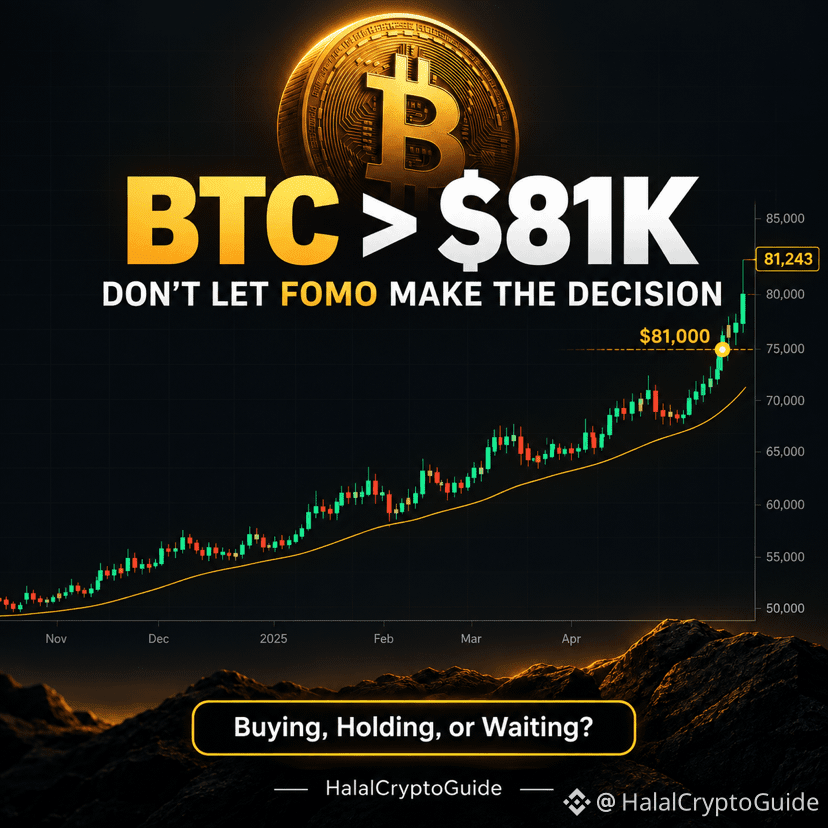
75
🚨 Binance is giving 625 $KII each to 2,000 traders — but look at what actually determines who wins.
The competition rewards buying volume, and the first two days receive a 2× multiplier.
A new KiiChain ($KII ) Binance Alpha competition is now live.
🎁 Top 2,000 → 625 KII each
⏰ Sept. 18–25
⚡ Day 1–2 trades → 2× ranking multiplier
📈 Only purchases count toward volume
♾️ No trading-volume cap
There’s also a 1.2× Rising Trader boost for certain users who have won fewer than three previous Binance Wallet Alpha competitions.
⚠️ The important part: a reward shouldn’t encourage you to buy more of a volatile token than you otherwise intended. Binance itself warns that Alpha assets can carry increased volatility, slippage and potential loss.
🕌 For Muslim investors, the existence of a Binance reward does not establish the Shariah status of KII or the trading activity. Research the token and structure separately.
Would a 2× leaderboard multiplier make you trade earlier, or would you ignore the competition? 👇
#BinanceAlpha #KII #CryptoEducation #HalalCryptoGuide
{alpha}(560xeec6574eabba52bac3f0277f2cd5ac7e67197886)
🚨 Binance is giving 625 $KII each to 2,000 traders — but look at what actually determines who wins.
The competition rewards buying volume, and the first two days receive a 2× multiplier.
A new KiiChain ($KII ) Binance Alpha competition is now live.
🎁 Top 2,000 → 625 KII each
⏰ Sept. 18–25
⚡ Day 1–2 trades → 2× ranking multiplier
📈 Only purchases count toward volume
♾️ No trading-volume cap
There’s also a 1.2× Rising Trader boost for certain users who have won fewer than three previous Binance Wallet Alpha competitions.
⚠️ The important part: a reward shouldn’t encourage you to buy more of a volatile token than you otherwise intended. Binance itself warns that Alpha assets can carry increased volatility, slippage and potential loss.
🕌 For Muslim investors, the existence of a Binance reward does not establish the Shariah status of KII or the trading activity. Research the token and structure separately.
Would a 2× leaderboard multiplier make you trade earlier, or would you ignore the competition? 👇
#BinanceAlpha #KII #CryptoEducation #HalalCryptoGuide
The competition rewards buying volume, and the first two days receive a 2× multiplier.
A new KiiChain ($KII ) Binance Alpha competition is now live.
🎁 Top 2,000 → 625 KII each
⏰ Sept. 18–25
⚡ Day 1–2 trades → 2× ranking multiplier
📈 Only purchases count toward volume
♾️ No trading-volume cap
There’s also a 1.2× Rising Trader boost for certain users who have won fewer than three previous Binance Wallet Alpha competitions.
⚠️ The important part: a reward shouldn’t encourage you to buy more of a volatile token than you otherwise intended. Binance itself warns that Alpha assets can carry increased volatility, slippage and potential loss.
🕌 For Muslim investors, the existence of a Binance reward does not establish the Shariah status of KII or the trading activity. Research the token and structure separately.
Would a 2× leaderboard multiplier make you trade earlier, or would you ignore the competition? 👇
#BinanceAlpha #KII #CryptoEducation #HalalCryptoGuide
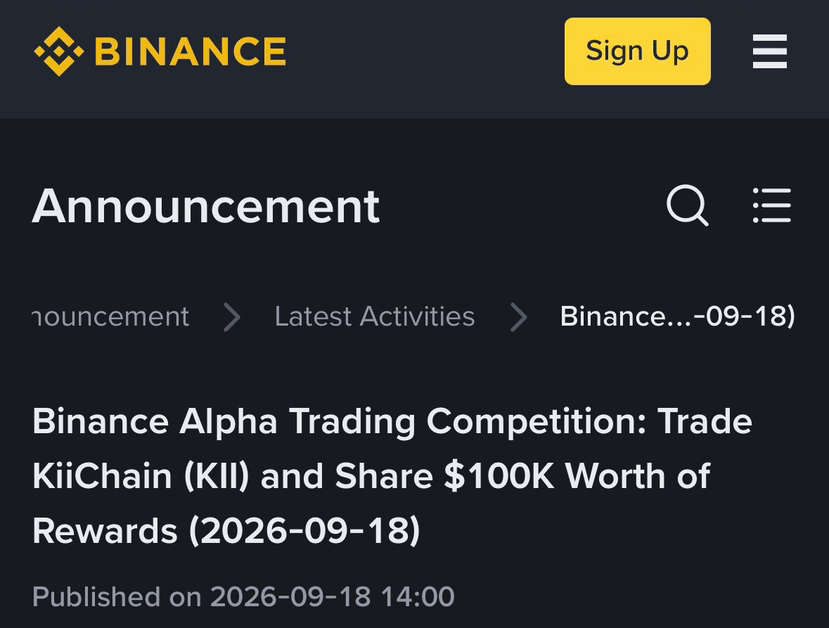
351
Log in to explore more content
Join global crypto users on Binance Square
⚡️ Get latest and useful information about crypto.
💬 Trusted by the world’s largest crypto exchange.
👍 Discover real insights from verified creators.
Email / Phone number
Trending Topics
1
#AIStocksWhatNext
259,600 views
2,571 Discussing
2
#BitcoinBreaksAboveMayHighNears$86K
9,516 views
154 Discussing
3
#DogecoinRises15%
26,090 views
811 Discussing
4
#$14BBitcoinOptionsExpireFriday
1,929 views
69 Discussing
5
#BNBMarketCapPassesBNYMellon
18,684 views
611 Discussing
6
#CryptoMarketCapReclaims$3Trillion
2,455 views
62 Discussing
7
#MuseOvertakesChatGPTAsTopFreeIOSApp
11,685 views
469 Discussing
8
#TokenizedStockPlatformsCouldLaunchNextQuarter
18,419 views
534 Discussing
9
#StrategyAdds950Bitcoin
23,838 views
589 Discussing
10
#CardanoAddedToX402KitForADAPayments
23,625 views
611 Discussing