
#balancecoin
balancecoin
11,999 views
4 Discussing
Hot
Latest


·
--
🚨 From the dollar to zero in a blink of an eye
A "ghost price" of Bitcoin destroys the Balance stablecoin in a single transaction
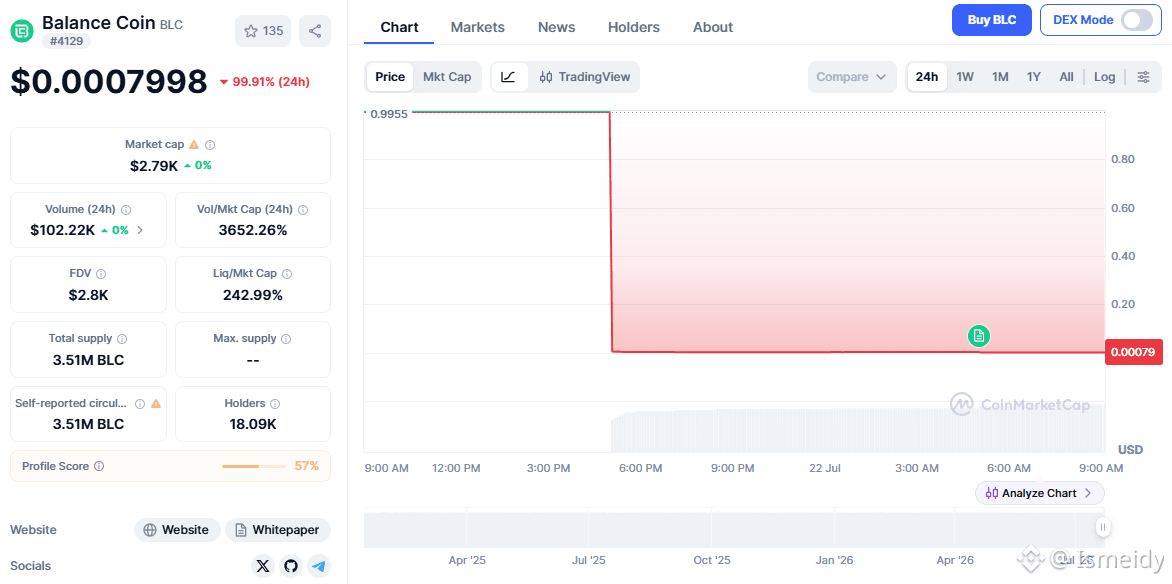
The algorithmic stablecoin #BalanceCoin (#BLC ) suffered a catastrophic collapse after falling victim to extreme manipulation of its price oracle.
In a single transaction, an attacker injected a #bitcoin fictitious and unrealistically low price into the lending protocol, triggering the immediate liquidation of completely healthy vaults and draining about $912,000 in reserves. As a result, the token lost 99.9% of its value within minutes.
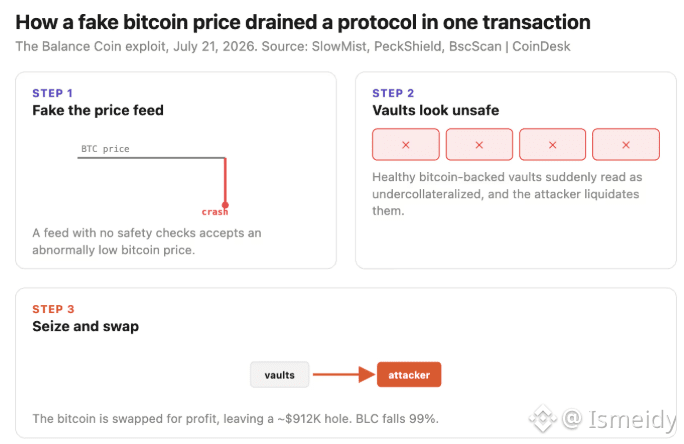
Attack Anatomy: Step by Step
According to security signature analyses such as SlowMist and PeckShield, the exploit was carried out through a direct flaw in the smart contract logic:
Step 1: Oracle Manipulation (Fake the price feed)
The attacker managed to alter the external data source (oracle) and injected a price of #BTC absurdly low into the lending system. The contract accepted the data immediately because it lacked range limits (sanity checks) to validate whether the price was consistent with the real market.
Step 2: False Insolvency of the Vaults (Vaults look unsafe)
Assuming that Bitcoin had crashed, the protocol instantly marked vaults as "undercollateralized" even though they were actually fully backed and secure.
Step 3: Instant Liquidation and Extraction (Seize and swap)
Without any safety wait period or delay (liquidation delay), the attacker liquidated the vaults eligible by mistake, confiscated the collateral in BTC, swapped it for profits, and left a financial hole that destroyed the stablecoin’s peg.
#Hack
$BAL
$BTC
{spot}(BTCUSDT)
$SOL
{spot}(SOLUSDT)
🚨 From the dollar to zero in a blink of an eye
A "ghost price" of Bitcoin destroys the Balance stablecoin in a single transaction
The algorithmic stablecoin #BalanceCoin (#BLC ) suffered a catastrophic collapse after falling victim to extreme manipulation of its price oracle.
In a single transaction, an attacker injected a #bitcoin fictitious and unrealistically low price into the lending protocol, triggering the immediate liquidation of completely healthy vaults and draining about $912,000 in reserves. As a result, the token lost 99.9% of its value within minutes.
Attack Anatomy: Step by Step
According to security signature analyses such as SlowMist and PeckShield, the exploit was carried out through a direct flaw in the smart contract logic:
Step 1: Oracle Manipulation (Fake the price feed)
The attacker managed to alter the external data source (oracle) and injected a price of #BTC absurdly low into the lending system. The contract accepted the data immediately because it lacked range limits (sanity checks) to validate whether the price was consistent with the real market.
Step 2: False Insolvency of the Vaults (Vaults look unsafe)
Assuming that Bitcoin had crashed, the protocol instantly marked vaults as "undercollateralized" even though they were actually fully backed and secure.
Step 3: Instant Liquidation and Extraction (Seize and swap)
Without any safety wait period or delay (liquidation delay), the attacker liquidated the vaults eligible by mistake, confiscated the collateral in BTC, swapped it for profits, and left a financial hole that destroyed the stablecoin’s peg.
#Hack
$BAL
$BTC
$SOL
A "ghost price" of Bitcoin destroys the Balance stablecoin in a single transaction
The algorithmic stablecoin #BalanceCoin (#BLC ) suffered a catastrophic collapse after falling victim to extreme manipulation of its price oracle.
In a single transaction, an attacker injected a #bitcoin fictitious and unrealistically low price into the lending protocol, triggering the immediate liquidation of completely healthy vaults and draining about $912,000 in reserves. As a result, the token lost 99.9% of its value within minutes.
Attack Anatomy: Step by Step
According to security signature analyses such as SlowMist and PeckShield, the exploit was carried out through a direct flaw in the smart contract logic:
Step 1: Oracle Manipulation (Fake the price feed)
The attacker managed to alter the external data source (oracle) and injected a price of #BTC absurdly low into the lending system. The contract accepted the data immediately because it lacked range limits (sanity checks) to validate whether the price was consistent with the real market.
Step 2: False Insolvency of the Vaults (Vaults look unsafe)
Assuming that Bitcoin had crashed, the protocol instantly marked vaults as "undercollateralized" even though they were actually fully backed and secure.
Step 3: Instant Liquidation and Extraction (Seize and swap)
Without any safety wait period or delay (liquidation delay), the attacker liquidated the vaults eligible by mistake, confiscated the collateral in BTC, swapped it for profits, and left a financial hole that destroyed the stablecoin’s peg.
#Hack
$BAL
$BTC
$SOL
1
9
21.4k

·
--

Article
Balance Coin Crash Raises Questions After Massive Price DropBalance Coin became one of the biggest stories in the crypto market after its price crashed by almost one hundred percent in a very short time. The token had traded close to one dollar for months before suddenly falling to almost zero. The sharp drop left many investors asking whether the project had been exploited or if it was a rug pull.
Current on chain information points more toward a protocol exploit than a planned exit by the project team.
Reports suggest that an attacker took advantage of a weakness in the price oracle used by the protocol. A price oracle provides market data to smart contracts. If that data becomes incorrect then trading and liquidations can happen at unfair prices.
According to blockchain activity the attacker moved a large amount of funds through the protocol before exchanging millions of Balance Coin tokens. This created heavy selling pressure that quickly pushed the price lower. As panic spread more holders rushed to sell which made the decline even worse.
The project also lost most of its market value within hours. Trading activity increased sharply after the crash but high trading volume alone does not mean confidence has returned. In many cases it simply shows that traders are buying and selling quickly during a period of extreme uncertainty.
On chain data has provided another important clue. Blockchain investigators have reported signs of unauthorized token minting instead of large transfers from developer wallets. There were also no clear signs that project owners moved funds before the collapse. This makes the exploit explanation stronger than the rug pull theory based on the information available today.
Another interesting change appeared after the crash. The number of wallet holders increased instead of continuing to fall. This may look positive at first but it does not automatically mean the project is recovering. Some traders often buy tokens after major crashes hoping for a quick rebound. That type of buying is usually based on speculation rather than long term confidence.
At the same time a large share of the token supply remains concentrated in a small number of wallets. If those holders decide to sell more tokens the price could remain under pressure for a longer period.
The future of Balance Coin now depends on whether the project can restore trust and fix the weakness that allowed the exploit to happen. Strong security improvements clear communication and stable buying interest will all be important if the project hopes to recover.
For now investors should remain careful and watch official updates together with verified on chain activity before making decisions. Major price drops often create opportunities but they also carry significant risk especially when the full impact of a security incident is still being investigated.
#BalanceCoin #BLC #crypto #blockchain #defi
Balance Coin Crash Raises Questions After Massive Price Drop
Balance Coin became one of the biggest stories in the crypto market after its price crashed by almost one hundred percent in a very short time. The token had traded close to one dollar for months before suddenly falling to almost zero. The sharp drop left many investors asking whether the project had been exploited or if it was a rug pull.
Current on chain information points more toward a protocol exploit than a planned exit by the project team.
Reports suggest that an attacker took advantage of a weakness in the price oracle used by the protocol. A price oracle provides market data to smart contracts. If that data becomes incorrect then trading and liquidations can happen at unfair prices.
According to blockchain activity the attacker moved a large amount of funds through the protocol before exchanging millions of Balance Coin tokens. This created heavy selling pressure that quickly pushed the price lower. As panic spread more holders rushed to sell which made the decline even worse.
The project also lost most of its market value within hours. Trading activity increased sharply after the crash but high trading volume alone does not mean confidence has returned. In many cases it simply shows that traders are buying and selling quickly during a period of extreme uncertainty.
On chain data has provided another important clue. Blockchain investigators have reported signs of unauthorized token minting instead of large transfers from developer wallets. There were also no clear signs that project owners moved funds before the collapse. This makes the exploit explanation stronger than the rug pull theory based on the information available today.
Another interesting change appeared after the crash. The number of wallet holders increased instead of continuing to fall. This may look positive at first but it does not automatically mean the project is recovering. Some traders often buy tokens after major crashes hoping for a quick rebound. That type of buying is usually based on speculation rather than long term confidence.
At the same time a large share of the token supply remains concentrated in a small number of wallets. If those holders decide to sell more tokens the price could remain under pressure for a longer period.
The future of Balance Coin now depends on whether the project can restore trust and fix the weakness that allowed the exploit to happen. Strong security improvements clear communication and stable buying interest will all be important if the project hopes to recover.
For now investors should remain careful and watch official updates together with verified on chain activity before making decisions. Major price drops often create opportunities but they also carry significant risk especially when the full impact of a security incident is still being investigated.
#BalanceCoin #BLC #crypto #blockchain #defi
Current on chain information points more toward a protocol exploit than a planned exit by the project team.
Reports suggest that an attacker took advantage of a weakness in the price oracle used by the protocol. A price oracle provides market data to smart contracts. If that data becomes incorrect then trading and liquidations can happen at unfair prices.
According to blockchain activity the attacker moved a large amount of funds through the protocol before exchanging millions of Balance Coin tokens. This created heavy selling pressure that quickly pushed the price lower. As panic spread more holders rushed to sell which made the decline even worse.
The project also lost most of its market value within hours. Trading activity increased sharply after the crash but high trading volume alone does not mean confidence has returned. In many cases it simply shows that traders are buying and selling quickly during a period of extreme uncertainty.
On chain data has provided another important clue. Blockchain investigators have reported signs of unauthorized token minting instead of large transfers from developer wallets. There were also no clear signs that project owners moved funds before the collapse. This makes the exploit explanation stronger than the rug pull theory based on the information available today.
Another interesting change appeared after the crash. The number of wallet holders increased instead of continuing to fall. This may look positive at first but it does not automatically mean the project is recovering. Some traders often buy tokens after major crashes hoping for a quick rebound. That type of buying is usually based on speculation rather than long term confidence.
At the same time a large share of the token supply remains concentrated in a small number of wallets. If those holders decide to sell more tokens the price could remain under pressure for a longer period.
The future of Balance Coin now depends on whether the project can restore trust and fix the weakness that allowed the exploit to happen. Strong security improvements clear communication and stable buying interest will all be important if the project hopes to recover.
For now investors should remain careful and watch official updates together with verified on chain activity before making decisions. Major price drops often create opportunities but they also carry significant risk especially when the full impact of a security incident is still being investigated.
#BalanceCoin #BLC #crypto #blockchain #defi
269

·
--
Balance Coin was dumped from $0.9954 down to $0.001358—down more than 99%.
Let’s make one thing clear: this is not a typical depeg. This is a direct breach of the trust layer of an algorithmic stablecoin.
Why isn’t it a normal depeg? A typical depeg usually stems from liquidity drying up or sell pressure in the market. This attack, however, directly targets 42DAO—the core entry point to the governance of the Balance Protocol ecosystem and the BLC token.
In other words: the attacker may first poison the governance layer, then use governance permissions to rewrite the stability mechanism or move away collateral, causing the entire pegging logic to fail.
PeckShield and TenArmor both detected anomalies, indicating this is not a single erroneous price feed issue, but rather a systematic exploitation of on-chain permissions, liquidity, or minting/redemption pathways.
What’s even more troubling is that the project team has not publicly disclosed the reason or any remediation plan to date.
In the world of stablecoins, silence doesn’t calm the market. Silence makes the market assume the worst case—then triggers a second wave of a bank run.
Do you think algorithmic stablecoins can still be trusted?
#BalanceCoin #42DAO #稳定币 #攻击 #algorithmic stablecoin
Balance Coin was dumped from $0.9954 down to $0.001358—down more than 99%.
Let’s make one thing clear: this is not a typical depeg. This is a direct breach of the trust layer of an algorithmic stablecoin.
Why isn’t it a normal depeg? A typical depeg usually stems from liquidity drying up or sell pressure in the market. This attack, however, directly targets 42DAO—the core entry point to the governance of the Balance Protocol ecosystem and the BLC token.
In other words: the attacker may first poison the governance layer, then use governance permissions to rewrite the stability mechanism or move away collateral, causing the entire pegging logic to fail.
PeckShield and TenArmor both detected anomalies, indicating this is not a single erroneous price feed issue, but rather a systematic exploitation of on-chain permissions, liquidity, or minting/redemption pathways.
What’s even more troubling is that the project team has not publicly disclosed the reason or any remediation plan to date.
In the world of stablecoins, silence doesn’t calm the market. Silence makes the market assume the worst case—then triggers a second wave of a bank run.
Do you think algorithmic stablecoins can still be trusted?
#BalanceCoin #42DAO #稳定币 #攻击 #algorithmic stablecoin
Let’s make one thing clear: this is not a typical depeg. This is a direct breach of the trust layer of an algorithmic stablecoin.
Why isn’t it a normal depeg? A typical depeg usually stems from liquidity drying up or sell pressure in the market. This attack, however, directly targets 42DAO—the core entry point to the governance of the Balance Protocol ecosystem and the BLC token.
In other words: the attacker may first poison the governance layer, then use governance permissions to rewrite the stability mechanism or move away collateral, causing the entire pegging logic to fail.
PeckShield and TenArmor both detected anomalies, indicating this is not a single erroneous price feed issue, but rather a systematic exploitation of on-chain permissions, liquidity, or minting/redemption pathways.
What’s even more troubling is that the project team has not publicly disclosed the reason or any remediation plan to date.
In the world of stablecoins, silence doesn’t calm the market. Silence makes the market assume the worst case—then triggers a second wave of a bank run.
Do you think algorithmic stablecoins can still be trusted?
#BalanceCoin #42DAO #稳定币 #攻击 #algorithmic stablecoin
84
Log in to explore more content
Join global crypto users on Binance Square
⚡️ Get latest and useful information about crypto.
💬 Trusted by the world’s largest crypto exchange.
👍 Discover real insights from verified creators.
Email / Phone number
Trending Topics
1
#BitcoinHits$85K
1,281 views
76 Discussing
2
#ECBStartsBlockchainEuroSettlement
962 views
145 Discussing
3
#SouthAfricaProposesCryptoExchangeControls
9,807 views
384 Discussing
4
#SolanaCutsTargetSlotTimeTo250ms
11,980 views
341 Discussing
5
#FrenchFamilyForcedToTransfer€40KCrypto
45 views
27 Discussing
6
#EthereumSurpasses$2700
12,922 views
186 Discussing
7
#CanaryFilesSecondAmendmentForStakedSEIETF
32,651 views
715 Discussing
8
#SaylorHintsStrategyBitcoinBuy
2.4M views
13,604 Discussing
9
#BOJRaisesRatesTo31YearHigh
343,469 views
3,946 Discussing
10
#BuffettStepsDownAsBerkshireChairman
164,971 views
2,200 Discussing