

Ismeidy
2.7k Posts

Ismeidy
 Square Verified+
Report
Block User
Journalist specializing in decentralized finance, crypto, blockchain, metaverse, web3.
Blockchain consultant. Real and verified information. X: ismeidyfinanzas

SUI Holder
Occasional Trader
8.9 Years
29 Following
104.7K+ Followers
20.9K+ Liked
Posts
All
Quotes
Videos
Live
PINNED
·
--
Bullish
😱🚀😱 SURPRISE YOURSELF😱🚀😱
Will #Solana reach $450?
Solana price $SOL hits 3-month high
These 5 analysts expect a new yearly high
Solana (SOL) price has been rising rapidly since October 13 and is approaching its yearly high.
Solana price also broke an inverse head and shoulders pattern.
How long will it continue to rise?
Analysts are optimistic about Solana
Analysts at #criptomonedas have a predominantly bullish sentiment towards Solana.
Tradermayne believes the price will rise to $40. But his bullish analysis is conditional on a bullish weekly candle close.
Rager and DaanCrypto also noted the importance of the $38 horizontal resistance area, which coincides with the yearly high. This area has been crucial since 2021, supporting and resisting.
Finally, CryptoGodJohn believes that SOL price will eventually reach $250 in the long term and may even reach $450 if it reaches the market cap of #Ethereum
Will it reach the new yearly high?
The daily time frame shows that SOL price has been trading within an inverse head and shoulders (IH&S) pattern since February.
The IH&S is considered a bullish pattern, which usually leads to breakouts.
Today, SOL price is in the process of breaking out of the pattern neckline. A daily close above $26 will confirm the altcoin's breakout.
#crypto2023 #cryptocurrency
😱🚀😱 SURPRISE YOURSELF😱🚀😱
Will #Solana reach $450?
Solana price $SOL hits 3-month high
These 5 analysts expect a new yearly high
Solana (SOL) price has been rising rapidly since October 13 and is approaching its yearly high.
Solana price also broke an inverse head and shoulders pattern.
How long will it continue to rise?
Analysts are optimistic about Solana
Analysts at #criptomonedas have a predominantly bullish sentiment towards Solana.
Tradermayne believes the price will rise to $40. But his bullish analysis is conditional on a bullish weekly candle close.
Rager and DaanCrypto also noted the importance of the $38 horizontal resistance area, which coincides with the yearly high. This area has been crucial since 2021, supporting and resisting.
Finally, CryptoGodJohn believes that SOL price will eventually reach $250 in the long term and may even reach $450 if it reaches the market cap of #Ethereum
Will it reach the new yearly high?
The daily time frame shows that SOL price has been trading within an inverse head and shoulders (IH&S) pattern since February.
The IH&S is considered a bullish pattern, which usually leads to breakouts.
Today, SOL price is in the process of breaking out of the pattern neckline. A daily close above $26 will confirm the altcoin's breakout.
#crypto2023 #cryptocurrency
Will #Solana reach $450?
Solana price $SOL hits 3-month high
These 5 analysts expect a new yearly high
Solana (SOL) price has been rising rapidly since October 13 and is approaching its yearly high.
Solana price also broke an inverse head and shoulders pattern.
How long will it continue to rise?
Analysts are optimistic about Solana
Analysts at #criptomonedas have a predominantly bullish sentiment towards Solana.
Tradermayne believes the price will rise to $40. But his bullish analysis is conditional on a bullish weekly candle close.
Rager and DaanCrypto also noted the importance of the $38 horizontal resistance area, which coincides with the yearly high. This area has been crucial since 2021, supporting and resisting.
Finally, CryptoGodJohn believes that SOL price will eventually reach $250 in the long term and may even reach $450 if it reaches the market cap of #Ethereum
Will it reach the new yearly high?
The daily time frame shows that SOL price has been trading within an inverse head and shoulders (IH&S) pattern since February.
The IH&S is considered a bullish pattern, which usually leads to breakouts.
Today, SOL price is in the process of breaking out of the pattern neckline. A daily close above $26 will confirm the altcoin's breakout.
#crypto2023 #cryptocurrency


163
39
454
138.9k
·
--
Verified
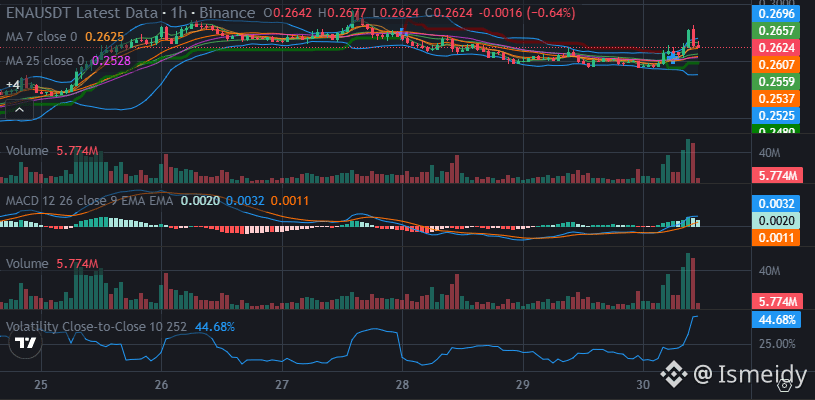
Standard Chartered projects a 669% jump for ENA
The banking giant sets Ethena at $2, driven by massive buybacks and the rise of USDe
The bullish thesis of #StandardChartered on #ethena
Standard Chartered has formally initiated coverage of the Ethena protocol, projecting that its token #ENA will reach $2 by the end of 2028. This valuation represents an estimated upside of approximately 669% from its current levels. The bank’s projection is based on the massive expansion of its synthetic stablecoin USDe and the activation of an aggressive token buyback mechanism.
Exponential growth of USDe (8x): The bank expects the circulating supply of the USDe stablecoin to multiply by more than eight, rising from the current $4.9 billion to $40.0 billion by the end of 2028. Ethena is positioned today as the fourth-largest global stablecoin issuer (behind Tether, Circle, and Sky) and the second in the yield-bearing stablecoin segment, a category that currently accounts for 5% of the total market.
Aggressive buyback mechanism ("Fee Switch Effect"): After the unanimous approval of its fee change, 95% of Ethena’s net brand revenues will be allocated to the programmatic repurchase of ENA.
Standard Chartered calculates that if USDe reaches $40.0 billion without any increase in the price of ENA, annualized buybacks would equal 23% of its circulating supply—an unsustainable figure.
Therefore, the bank argues that the price of ENA is effectively forced to appreciate in order to bring buyback yield back to a sustainable range of 3% to 4%, emulating the behavior seen in #uniswap (whose token #UNI tripled after activating its own fee switch).
$ENA
{future}(ENAUSDT)
$UNI
{future}(UNIUSDT)
Standard Chartered projects a 669% jump for ENA
The banking giant sets Ethena at $2, driven by massive buybacks and the rise of USDe
The bullish thesis of #StandardChartered on #ethena
Standard Chartered has formally initiated coverage of the Ethena protocol, projecting that its token #ENA will reach $2 by the end of 2028. This valuation represents an estimated upside of approximately 669% from its current levels. The bank’s projection is based on the massive expansion of its synthetic stablecoin USDe and the activation of an aggressive token buyback mechanism.
Exponential growth of USDe (8x): The bank expects the circulating supply of the USDe stablecoin to multiply by more than eight, rising from the current $4.9 billion to $40.0 billion by the end of 2028. Ethena is positioned today as the fourth-largest global stablecoin issuer (behind Tether, Circle, and Sky) and the second in the yield-bearing stablecoin segment, a category that currently accounts for 5% of the total market.
Aggressive buyback mechanism ("Fee Switch Effect"): After the unanimous approval of its fee change, 95% of Ethena’s net brand revenues will be allocated to the programmatic repurchase of ENA.
Standard Chartered calculates that if USDe reaches $40.0 billion without any increase in the price of ENA, annualized buybacks would equal 23% of its circulating supply—an unsustainable figure.
Therefore, the bank argues that the price of ENA is effectively forced to appreciate in order to bring buyback yield back to a sustainable range of 3% to 4%, emulating the behavior seen in #uniswap (whose token #UNI tripled after activating its own fee switch).
$ENA
$UNI
The banking giant sets Ethena at $2, driven by massive buybacks and the rise of USDe
The bullish thesis of #StandardChartered on #ethena
Standard Chartered has formally initiated coverage of the Ethena protocol, projecting that its token #ENA will reach $2 by the end of 2028. This valuation represents an estimated upside of approximately 669% from its current levels. The bank’s projection is based on the massive expansion of its synthetic stablecoin USDe and the activation of an aggressive token buyback mechanism.
Exponential growth of USDe (8x): The bank expects the circulating supply of the USDe stablecoin to multiply by more than eight, rising from the current $4.9 billion to $40.0 billion by the end of 2028. Ethena is positioned today as the fourth-largest global stablecoin issuer (behind Tether, Circle, and Sky) and the second in the yield-bearing stablecoin segment, a category that currently accounts for 5% of the total market.
Aggressive buyback mechanism ("Fee Switch Effect"): After the unanimous approval of its fee change, 95% of Ethena’s net brand revenues will be allocated to the programmatic repurchase of ENA.
Standard Chartered calculates that if USDe reaches $40.0 billion without any increase in the price of ENA, annualized buybacks would equal 23% of its circulating supply—an unsustainable figure.
Therefore, the bank argues that the price of ENA is effectively forced to appreciate in order to bring buyback yield back to a sustainable range of 3% to 4%, emulating the behavior seen in #uniswap (whose token #UNI tripled after activating its own fee switch).
$ENA
$UNI
6
735
·
--
In an attempt to “disappear” 3.9 million dollars in the darkness of Zcash, Bitget’s #Hacker de
The trail of the stolen money goes deeper into anonymity
Investigations into the historical #hackeo a Bitget, valued at 387.5 million dollars, have taken a critical turn after sophisticated evasion movements were detected on the blockchain. The attacker has begun routing the funds into advanced privacy mechanisms to break the traceability of on-chain analysts.
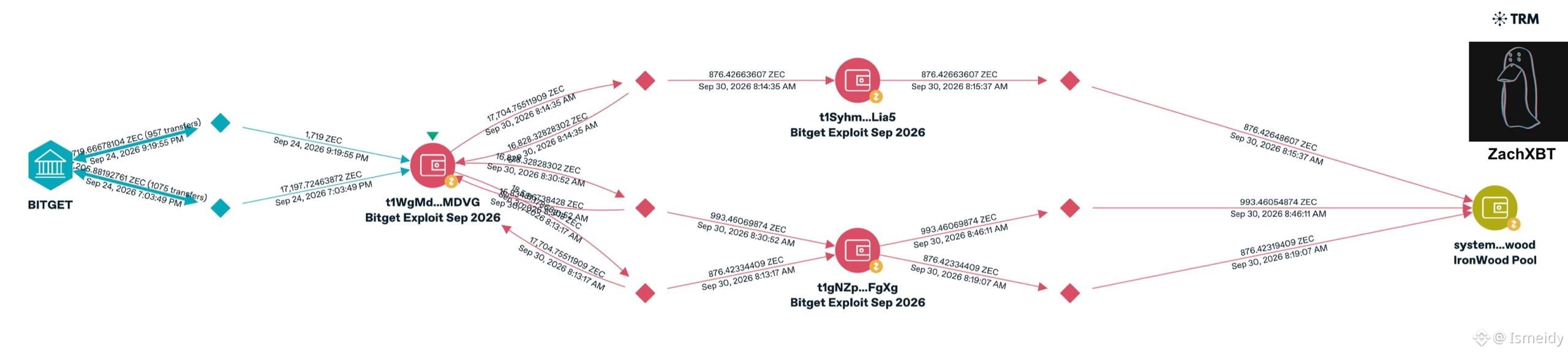
Infiltration in Zcash’s blind zone: Between 08:15 and 08:46 UTC on September 30, 2026, the attacker transferred 2.746 #zec }(approximately 3.9 million dollars) to Ironwood, the new protected fund/pool (shielded pool) of #Zcash
Operation structure (Mapping by ZachXBT / TRM Labs)
Blockchain investigator ZachXBT was the first to raise the alarm about the scheme.
The main wallet identified by Bitget after the September 24 breach held nearly 18.917 ZEC.
The funds were split through two intermediary addresses (t1Syhm...Lia5 and t1gNZp...FgXg) into three coordinated deposits before entering the private pool.
The technical challenge for investigators: Unlike public transactions where flows are visible end-to-end, Zcash’s shielded system hides the sender, the recipient, and the internal balances. Although entry into the Ironwood pool is traceable, the accounting trail is completely lost inside the system until the funds decide to exit to a public address.
Diversification of money-laundering routes: Deposits in Zcash account for roughly 15% of the total stolen ZEC. Previously, intelligence-gathering signature analyses traced the conversion of 6.3 million dollars from Ether to Bitcoin using the decentralized THORChain protocol, combining transparent cross-chain methods with tightly controlled privacy protocols.
#CryptoNews
$ZEC
{future}(ZECUSDT)
$HYPE
{future}(HYPEUSDT)
$XRP
{future}(XRPUSDT)
In an attempt to “disappear” 3.9 million dollars in the darkness of Zcash, Bitget’s #Hacker de
The trail of the stolen money goes deeper into anonymity
Investigations into the historical #hackeo a Bitget, valued at 387.5 million dollars, have taken a critical turn after sophisticated evasion movements were detected on the blockchain. The attacker has begun routing the funds into advanced privacy mechanisms to break the traceability of on-chain analysts.
Infiltration in Zcash’s blind zone: Between 08:15 and 08:46 UTC on September 30, 2026, the attacker transferred 2.746 #zec }(approximately 3.9 million dollars) to Ironwood, the new protected fund/pool (shielded pool) of #Zcash
Operation structure (Mapping by ZachXBT / TRM Labs)
Blockchain investigator ZachXBT was the first to raise the alarm about the scheme.
The main wallet identified by Bitget after the September 24 breach held nearly 18.917 ZEC.
The funds were split through two intermediary addresses (t1Syhm...Lia5 and t1gNZp...FgXg) into three coordinated deposits before entering the private pool.
The technical challenge for investigators: Unlike public transactions where flows are visible end-to-end, Zcash’s shielded system hides the sender, the recipient, and the internal balances. Although entry into the Ironwood pool is traceable, the accounting trail is completely lost inside the system until the funds decide to exit to a public address.
Diversification of money-laundering routes: Deposits in Zcash account for roughly 15% of the total stolen ZEC. Previously, intelligence-gathering signature analyses traced the conversion of 6.3 million dollars from Ether to Bitcoin using the decentralized THORChain protocol, combining transparent cross-chain methods with tightly controlled privacy protocols.
#CryptoNews
$ZEC
$HYPE
$XRP
The trail of the stolen money goes deeper into anonymity
Investigations into the historical #hackeo a Bitget, valued at 387.5 million dollars, have taken a critical turn after sophisticated evasion movements were detected on the blockchain. The attacker has begun routing the funds into advanced privacy mechanisms to break the traceability of on-chain analysts.
Infiltration in Zcash’s blind zone: Between 08:15 and 08:46 UTC on September 30, 2026, the attacker transferred 2.746 #zec }(approximately 3.9 million dollars) to Ironwood, the new protected fund/pool (shielded pool) of #Zcash
Operation structure (Mapping by ZachXBT / TRM Labs)
Blockchain investigator ZachXBT was the first to raise the alarm about the scheme.
The main wallet identified by Bitget after the September 24 breach held nearly 18.917 ZEC.
The funds were split through two intermediary addresses (t1Syhm...Lia5 and t1gNZp...FgXg) into three coordinated deposits before entering the private pool.
The technical challenge for investigators: Unlike public transactions where flows are visible end-to-end, Zcash’s shielded system hides the sender, the recipient, and the internal balances. Although entry into the Ironwood pool is traceable, the accounting trail is completely lost inside the system until the funds decide to exit to a public address.
Diversification of money-laundering routes: Deposits in Zcash account for roughly 15% of the total stolen ZEC. Previously, intelligence-gathering signature analyses traced the conversion of 6.3 million dollars from Ether to Bitcoin using the decentralized THORChain protocol, combining transparent cross-chain methods with tightly controlled privacy protocols.
#CryptoNews
$ZEC
$HYPE
$XRP
1
2
3k
·
--
Verified
Inflation in the U.S. slows down and eases macro pressure
#bitcoin reacts strongly and surpasses $85,000
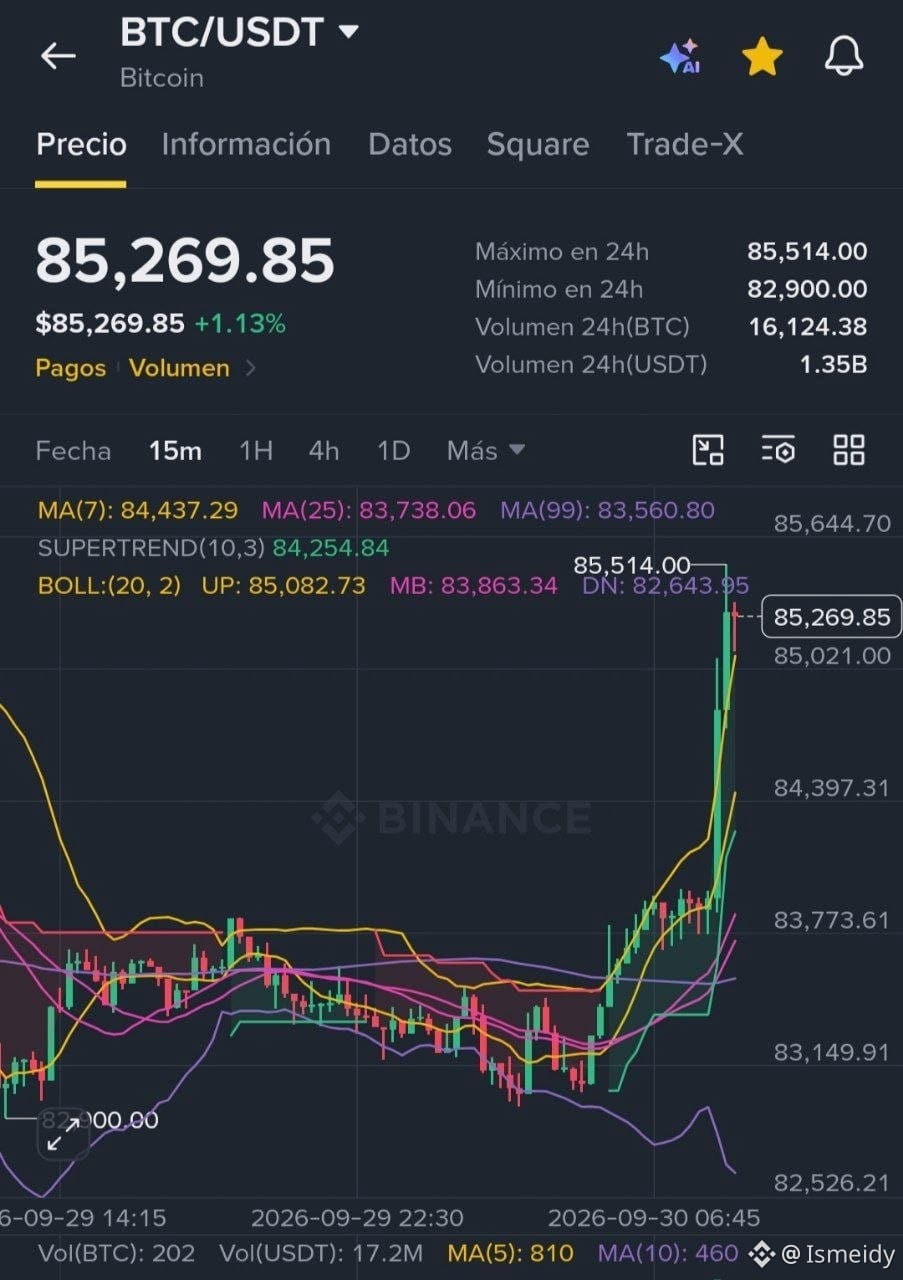
After the release of economic data, #BTC experienced a bullish impulse, reaching $85.514. Motivated by the positive inflation surprise (PCE), the August personal consumption expenditures index (a key metric for the Federal Reserve #Fed ) fell to 3.4% year over year, beating economists’ expectations of 3.7%.
Even more notably, core inflation (excluding food and energy) declined to 3.0% year over year (from 3.3% the previous month and below market estimates).
Pullback in Treasury yields: The inflation data triggered a decline in U.S. debt returns. The 10-year bond yield fell to 5.23% from its highest levels since 2007, while 30-year bonds dropped from levels not seen since 2002, temporarily easing the brake on risk assets.
Repricing expectations for the Fed: The probability that the Federal Reserve will raise interest rates by 25 basis points next month fell from 51% to 47%, according to the CME FedWatch tool. Despite easing prices, the market continues to project that there could be another increase in December.
Labor market resistance: Optimism was tempered by the ADP private employment report, which showed the creation of 90,000 jobs in September (well above the 68,000 expected). The strength of employment suggests that restrictive financial conditions will persist, keeping investors cautious about potential downside hedges.
#CryptoNews
$BTC
{future}(BTCUSDT)
$SOL
{future}(SOLUSDT)
$BNB
{future}(BNBUSDT)
Inflation in the U.S. slows down and eases macro pressure
#bitcoin reacts strongly and surpasses $85,000
After the release of economic data, #BTC experienced a bullish impulse, reaching $85.514. Motivated by the positive inflation surprise (PCE), the August personal consumption expenditures index (a key metric for the Federal Reserve #Fed ) fell to 3.4% year over year, beating economists’ expectations of 3.7%.
Even more notably, core inflation (excluding food and energy) declined to 3.0% year over year (from 3.3% the previous month and below market estimates).
Pullback in Treasury yields: The inflation data triggered a decline in U.S. debt returns. The 10-year bond yield fell to 5.23% from its highest levels since 2007, while 30-year bonds dropped from levels not seen since 2002, temporarily easing the brake on risk assets.
Repricing expectations for the Fed: The probability that the Federal Reserve will raise interest rates by 25 basis points next month fell from 51% to 47%, according to the CME FedWatch tool. Despite easing prices, the market continues to project that there could be another increase in December.
Labor market resistance: Optimism was tempered by the ADP private employment report, which showed the creation of 90,000 jobs in September (well above the 68,000 expected). The strength of employment suggests that restrictive financial conditions will persist, keeping investors cautious about potential downside hedges.
#CryptoNews
$BTC
$SOL
$BNB
#bitcoin reacts strongly and surpasses $85,000
After the release of economic data, #BTC experienced a bullish impulse, reaching $85.514. Motivated by the positive inflation surprise (PCE), the August personal consumption expenditures index (a key metric for the Federal Reserve #Fed ) fell to 3.4% year over year, beating economists’ expectations of 3.7%.
Even more notably, core inflation (excluding food and energy) declined to 3.0% year over year (from 3.3% the previous month and below market estimates).
Pullback in Treasury yields: The inflation data triggered a decline in U.S. debt returns. The 10-year bond yield fell to 5.23% from its highest levels since 2007, while 30-year bonds dropped from levels not seen since 2002, temporarily easing the brake on risk assets.
Repricing expectations for the Fed: The probability that the Federal Reserve will raise interest rates by 25 basis points next month fell from 51% to 47%, according to the CME FedWatch tool. Despite easing prices, the market continues to project that there could be another increase in December.
Labor market resistance: Optimism was tempered by the ADP private employment report, which showed the creation of 90,000 jobs in September (well above the 68,000 expected). The strength of employment suggests that restrictive financial conditions will persist, keeping investors cautious about potential downside hedges.
#CryptoNews
$BTC
$SOL
$BNB
1
6
2.6k
·
--
Market summary
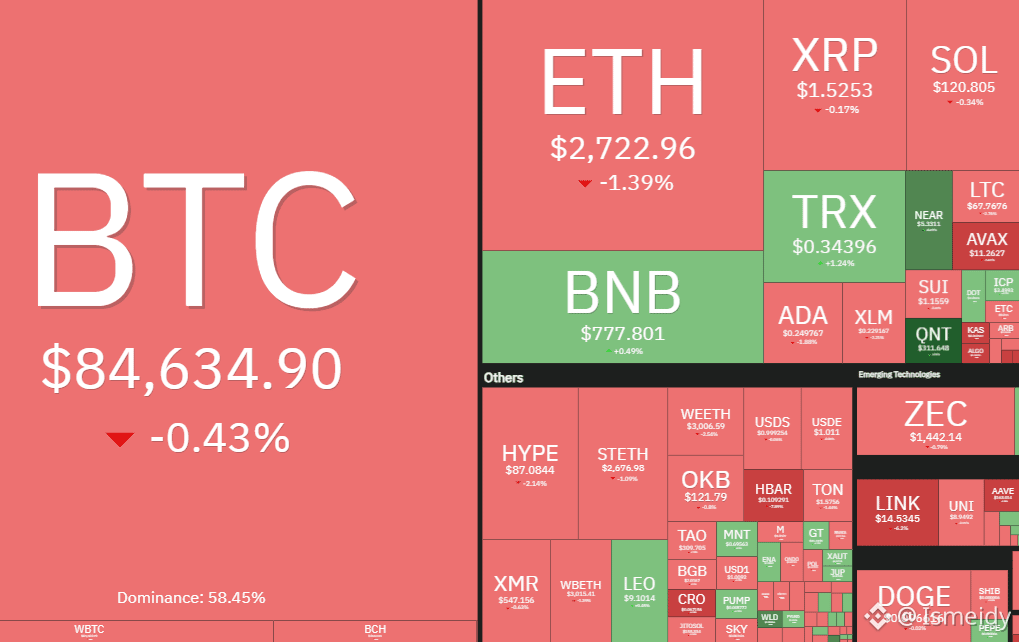
#bitcoin 💰 trades above $84.634 -0.43%
‼️ The top 10 cryptocurrencies are trading in the RED zone
The 3 winning assets
QNT 24.77% 📈
NIGHT 21.45% 📈
ZRO 8.47% 📈
The 3 losing assets
LIT -12.92% 📉
HBAR -8.63%📉
KAS -7.63% 📉
📌 Market Cap: $2.87T -0.56%
📌 Dominance of #BTC : 58.6%
📌 Dominance of #ETH : 11.4%
📌 Index of #altcoinseason : 62%
📌 Fear and Greed Index: 68 (GREED)
📌 CMC20 Index 176.11 -0.9%
📌 CMC100 Index 168.61 -0.68%
📌 Pi cycle top indicator 69.399 0.28%
📌 Puell Multiple 1.16 -3.33%
📌 RSI 22 Days 62.476 -1.15%
#CryptoNews
$QNT
{future}(QNTUSDT)
$NIGHT
{future}(NIGHTUSDT)
$ZRO
{future}(ZROUSDT)
Market summary
#bitcoin 💰 trades above $84.634 -0.43%
‼️ The top 10 cryptocurrencies are trading in the RED zone
The 3 winning assets
QNT 24.77% 📈
NIGHT 21.45% 📈
ZRO 8.47% 📈
The 3 losing assets
LIT -12.92% 📉
HBAR -8.63%📉
KAS -7.63% 📉
📌 Market Cap: $2.87T -0.56%
📌 Dominance of #BTC : 58.6%
📌 Dominance of #ETH : 11.4%
📌 Index of #altcoinseason : 62%
📌 Fear and Greed Index: 68 (GREED)
📌 CMC20 Index 176.11 -0.9%
📌 CMC100 Index 168.61 -0.68%
📌 Pi cycle top indicator 69.399 0.28%
📌 Puell Multiple 1.16 -3.33%
📌 RSI 22 Days 62.476 -1.15%
#CryptoNews
$QNT
$NIGHT
$ZRO
#bitcoin 💰 trades above $84.634 -0.43%
‼️ The top 10 cryptocurrencies are trading in the RED zone
The 3 winning assets
QNT 24.77% 📈
NIGHT 21.45% 📈
ZRO 8.47% 📈
The 3 losing assets
LIT -12.92% 📉
HBAR -8.63%📉
KAS -7.63% 📉
📌 Market Cap: $2.87T -0.56%
📌 Dominance of #BTC : 58.6%
📌 Dominance of #ETH : 11.4%
📌 Index of #altcoinseason : 62%
📌 Fear and Greed Index: 68 (GREED)
📌 CMC20 Index 176.11 -0.9%
📌 CMC100 Index 168.61 -0.68%
📌 Pi cycle top indicator 69.399 0.28%
📌 Puell Multiple 1.16 -3.33%
📌 RSI 22 Days 62.476 -1.15%
#CryptoNews
$QNT
$NIGHT
$ZRO
3
2.3k
·
--
Immediate Correction?
The profit margin of #bitcoin is reaching 21-month highs and is triggering profit-taking alarms
Even though the close of #BTC above its 365-day moving average and a Bitcoin Bull Score of 90/100 confirm a bullish market, the momentum that pushed the price to $87,400 is showing severe signs of short-term fatigue.
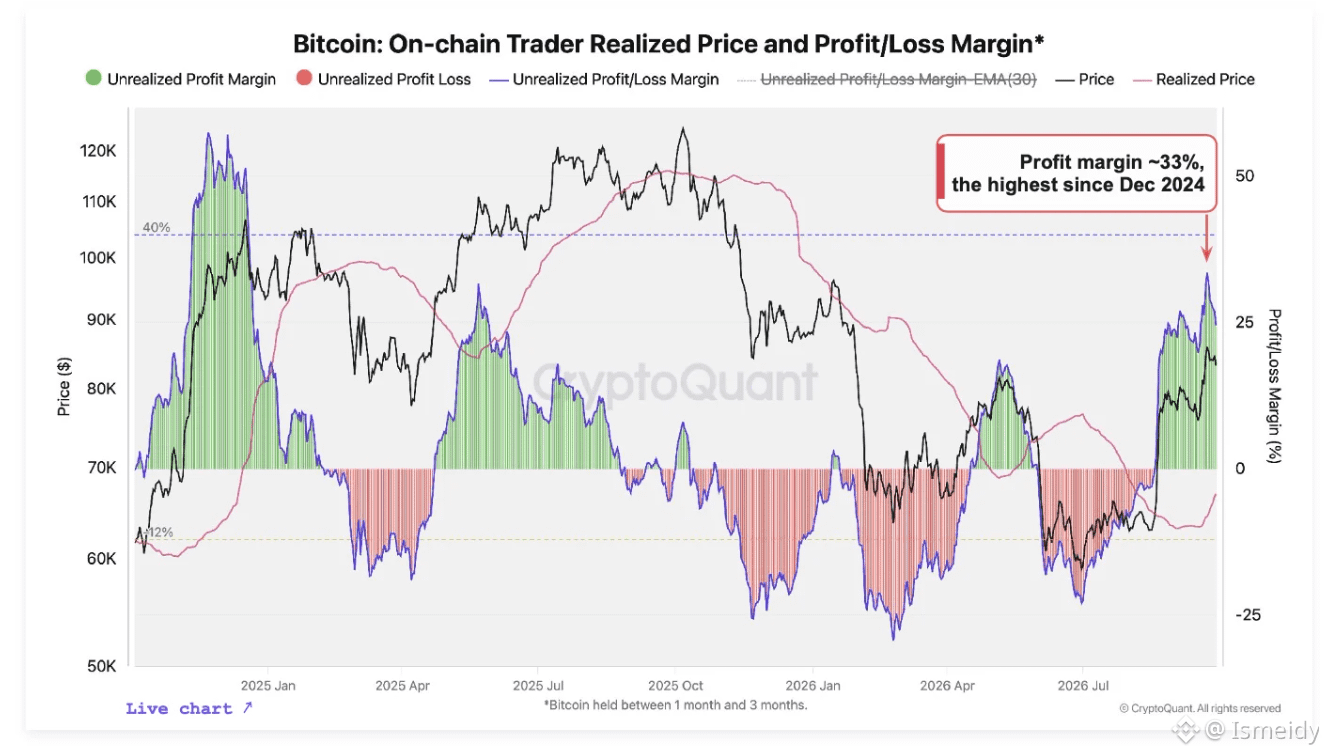
Profit margins in a critical zone: The unrealized profit margin for short-term traders has surged to roughly 33%, marking the highest level recorded since December 2024. This scenario encouraged the largest profit-taking in a single day of all 2026, with 25,700 BTC liquidated on September 22.
Cross-Sell Alert in #altcoins : Exhaustion signals aren’t limited to Bitcoin. Altcoin deposits on exchanges reached levels not seen since October 2025, with 76,000 inbound transactions in a week from 51,000 different addresses, confirming a clear intent for broad-based liquidation by investors.
Sharp slowdown in demand: Appetite for the asset is cooling off rapidly. Spot demand fell by 170,000 BTC over the last 30 days, while speculative volume in the futures market collapsed from 164,000 BTC to just 16,000 BTC in only two weeks.
Key support zones: Julio Moreno, head of research at CryptoQuant, describes the expected pullback as "healthy consolidation" within the macro trend. The technical levels to watch to stop the decline are $80,000 (365-day moving average), $71,000 (200-day moving average), and $67,000 (on-chain realized price).
#CryptoNews #analysis
$BTC
{future}(BTCUSDT)
$XRP
{future}(XRPUSDT)
$HYPE
{future}(HYPEUSDT)
Immediate Correction?
The profit margin of #bitcoin is reaching 21-month highs and is triggering profit-taking alarms
Even though the close of #BTC above its 365-day moving average and a Bitcoin Bull Score of 90/100 confirm a bullish market, the momentum that pushed the price to $87,400 is showing severe signs of short-term fatigue.
Profit margins in a critical zone: The unrealized profit margin for short-term traders has surged to roughly 33%, marking the highest level recorded since December 2024. This scenario encouraged the largest profit-taking in a single day of all 2026, with 25,700 BTC liquidated on September 22.
Cross-Sell Alert in #altcoins : Exhaustion signals aren’t limited to Bitcoin. Altcoin deposits on exchanges reached levels not seen since October 2025, with 76,000 inbound transactions in a week from 51,000 different addresses, confirming a clear intent for broad-based liquidation by investors.
Sharp slowdown in demand: Appetite for the asset is cooling off rapidly. Spot demand fell by 170,000 BTC over the last 30 days, while speculative volume in the futures market collapsed from 164,000 BTC to just 16,000 BTC in only two weeks.
Key support zones: Julio Moreno, head of research at CryptoQuant, describes the expected pullback as "healthy consolidation" within the macro trend. The technical levels to watch to stop the decline are $80,000 (365-day moving average), $71,000 (200-day moving average), and $67,000 (on-chain realized price).
#CryptoNews #analysis
$BTC
$XRP
$HYPE
The profit margin of #bitcoin is reaching 21-month highs and is triggering profit-taking alarms
Even though the close of #BTC above its 365-day moving average and a Bitcoin Bull Score of 90/100 confirm a bullish market, the momentum that pushed the price to $87,400 is showing severe signs of short-term fatigue.
Profit margins in a critical zone: The unrealized profit margin for short-term traders has surged to roughly 33%, marking the highest level recorded since December 2024. This scenario encouraged the largest profit-taking in a single day of all 2026, with 25,700 BTC liquidated on September 22.
Cross-Sell Alert in #altcoins : Exhaustion signals aren’t limited to Bitcoin. Altcoin deposits on exchanges reached levels not seen since October 2025, with 76,000 inbound transactions in a week from 51,000 different addresses, confirming a clear intent for broad-based liquidation by investors.
Sharp slowdown in demand: Appetite for the asset is cooling off rapidly. Spot demand fell by 170,000 BTC over the last 30 days, while speculative volume in the futures market collapsed from 164,000 BTC to just 16,000 BTC in only two weeks.
Key support zones: Julio Moreno, head of research at CryptoQuant, describes the expected pullback as "healthy consolidation" within the macro trend. The technical levels to watch to stop the decline are $80,000 (365-day moving average), $71,000 (200-day moving average), and $67,000 (on-chain realized price).
#CryptoNews #analysis
$BTC
$XRP
$HYPE
9
2.5k
·
--
The Awakening of #defi
#crv y #AAVE shots fire the Index #DFX in a new market rally
Decentralized finance (DeFi) has once again taken control of the crypto market, driving price action for the second time in just a week. This new bullish move shows a rotation of capital into established yield- and liquidity-focused protocols, signaling a clear resurgence of the sector against other narratives in the ecosystem.
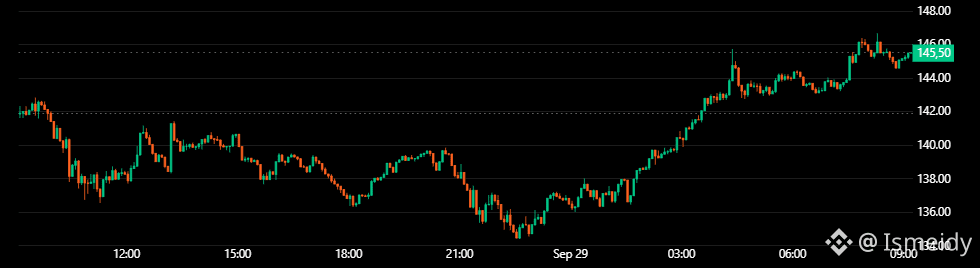
DeFi Select Index (DFX): The index that groups the sector’s leading players has recorded a gain of 5.0% since midnight, climbing in a distinctly bullish channel during the early hours of September 29 to reach the 145.50 level.
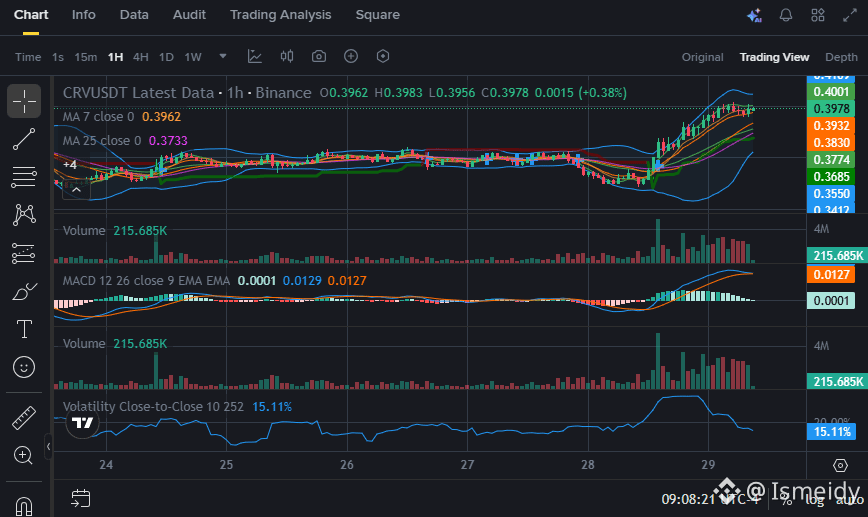
#CurveDAO (CRV): Leading the charge in the sector, the token has seen a spectacular rebound of 19%. The short-term chart confirms this momentum with a positive MACD crossover and candles with strong buy volume, pushing its recent price into the 0.3978 USDT area.
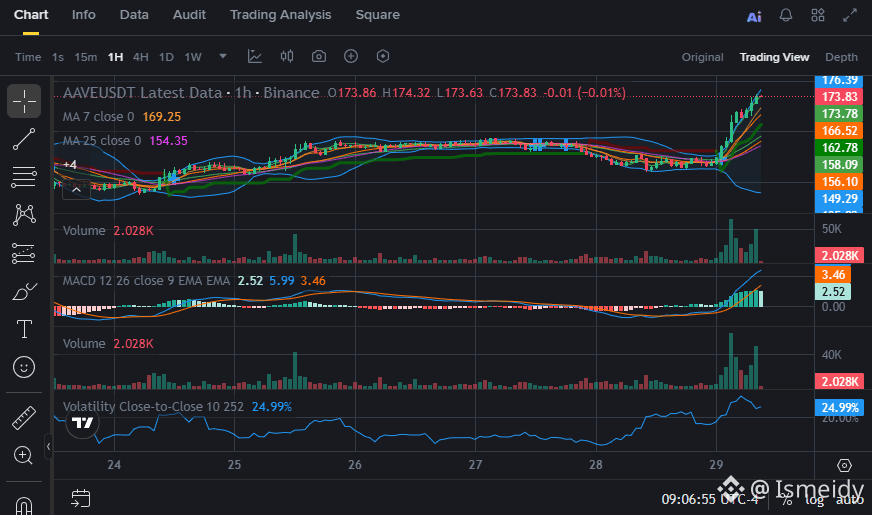
Aave (AAVE): The leading decentralized lending protocol supports the move with a rise of more than 16%. After a period of consolidation, the asset broke strongly upward with a spike in volatility, placing its price at around 173.83 USDT.
Do you think this DeFi ecosystem momentum will be sustained to kick off a new season, or is it just a short-term rotation of capital?
$CRV
{future}(CRVUSDT)
$AAVE
{future}(AAVEUSDT)
The Awakening of #defi
#crv y #AAVE shots fire the Index #DFX in a new market rally
Decentralized finance (DeFi) has once again taken control of the crypto market, driving price action for the second time in just a week. This new bullish move shows a rotation of capital into established yield- and liquidity-focused protocols, signaling a clear resurgence of the sector against other narratives in the ecosystem.
DeFi Select Index (DFX): The index that groups the sector’s leading players has recorded a gain of 5.0% since midnight, climbing in a distinctly bullish channel during the early hours of September 29 to reach the 145.50 level.
#CurveDAO (CRV): Leading the charge in the sector, the token has seen a spectacular rebound of 19%. The short-term chart confirms this momentum with a positive MACD crossover and candles with strong buy volume, pushing its recent price into the 0.3978 USDT area.
Aave (AAVE): The leading decentralized lending protocol supports the move with a rise of more than 16%. After a period of consolidation, the asset broke strongly upward with a spike in volatility, placing its price at around 173.83 USDT.
Do you think this DeFi ecosystem momentum will be sustained to kick off a new season, or is it just a short-term rotation of capital?
$CRV
$AAVE
#crv y #AAVE shots fire the Index #DFX in a new market rally
Decentralized finance (DeFi) has once again taken control of the crypto market, driving price action for the second time in just a week. This new bullish move shows a rotation of capital into established yield- and liquidity-focused protocols, signaling a clear resurgence of the sector against other narratives in the ecosystem.
DeFi Select Index (DFX): The index that groups the sector’s leading players has recorded a gain of 5.0% since midnight, climbing in a distinctly bullish channel during the early hours of September 29 to reach the 145.50 level.
#CurveDAO (CRV): Leading the charge in the sector, the token has seen a spectacular rebound of 19%. The short-term chart confirms this momentum with a positive MACD crossover and candles with strong buy volume, pushing its recent price into the 0.3978 USDT area.
Aave (AAVE): The leading decentralized lending protocol supports the move with a rise of more than 16%. After a period of consolidation, the asset broke strongly upward with a spike in volatility, placing its price at around 173.83 USDT.
Do you think this DeFi ecosystem momentum will be sustained to kick off a new season, or is it just a short-term rotation of capital?
$CRV
$AAVE
2
946
·
--
Market summary
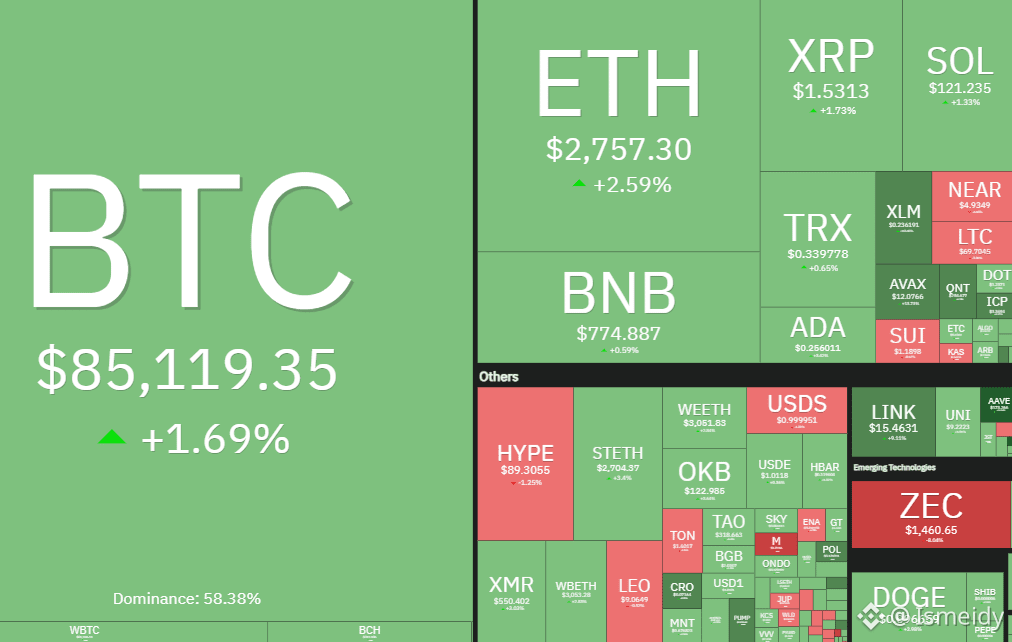
#bitcoin 💰 trading above $85.119 1.69%
‼️ The top 10 cryptocurrencies are trading in the GREEN zone
The 3 winning assets
CRV 19.23% 📈
NIGHT 18.28% 📈
AAVE 16.00% 📈
The 3 losing assets
M -9.08% 📉
ZEC -7.62% 📉
SEI -6.49% 📉
📌 Market Cap: $2.89T 1.51%
📌 Dominance of #BTC : 58.6%
📌 Dominance of #ETH : 11.5%
📌 Index of #altcoinseason : 62%
📌 Fear & Greed Index: 69 (GREED)
📌 CMC20 Index 177.74 1.76%
📌 CMC100 Index 170.11 1.77%
📌 Pi Cycle Top Indicator 69.199 0.3%
📌 Puell Multiple 1.20 11.11%
📌 RSI 22 Days 62.644 3.45%
$CRV
{future}(CRVUSDT)
$NIGHT
{future}(NIGHTUSDT)
$AAVE
{future}(AAVEUSDT)
Market summary
#bitcoin 💰 trading above $85.119 1.69%
‼️ The top 10 cryptocurrencies are trading in the GREEN zone
The 3 winning assets
CRV 19.23% 📈
NIGHT 18.28% 📈
AAVE 16.00% 📈
The 3 losing assets
M -9.08% 📉
ZEC -7.62% 📉
SEI -6.49% 📉
📌 Market Cap: $2.89T 1.51%
📌 Dominance of #BTC : 58.6%
📌 Dominance of #ETH : 11.5%
📌 Index of #altcoinseason : 62%
📌 Fear & Greed Index: 69 (GREED)
📌 CMC20 Index 177.74 1.76%
📌 CMC100 Index 170.11 1.77%
📌 Pi Cycle Top Indicator 69.199 0.3%
📌 Puell Multiple 1.20 11.11%
📌 RSI 22 Days 62.644 3.45%
$CRV
$NIGHT
$AAVE
#bitcoin 💰 trading above $85.119 1.69%
‼️ The top 10 cryptocurrencies are trading in the GREEN zone
The 3 winning assets
CRV 19.23% 📈
NIGHT 18.28% 📈
AAVE 16.00% 📈
The 3 losing assets
M -9.08% 📉
ZEC -7.62% 📉
SEI -6.49% 📉
📌 Market Cap: $2.89T 1.51%
📌 Dominance of #BTC : 58.6%
📌 Dominance of #ETH : 11.5%
📌 Index of #altcoinseason : 62%
📌 Fear & Greed Index: 69 (GREED)
📌 CMC20 Index 177.74 1.76%
📌 CMC100 Index 170.11 1.77%
📌 Pi Cycle Top Indicator 69.199 0.3%
📌 Puell Multiple 1.20 11.11%
📌 RSI 22 Days 62.644 3.45%
$CRV
$NIGHT
$AAVE
2
1.2k
·
--
From a penny test to a $388 million raid
The anatomy of the bold #hackeo a Bitget
30 minutes in the dark: how a "Zero-Day" vulnerability enabled the theft of millions at Bitget
The attack began at 18:31 UTC with two micro-transfers (0.184 ETH and 193 TRX). Since the amounts were insignificant, they did not trigger the exchange’s risk protocols, giving the attacker a green light to proceed.
The massive drain: Just 30 minutes after the test, the #Hacker ejecuted 17 high-volume transactions across multiple networks (#Ethereum , #xrp , #Zcash , BNB Chain, Base, Arbitrum, Optimism, and Avalanche), extracting $361 million in just over an hour.
Attack engineering (Zero-Day): Bitget’s cold wallets and private keys were not compromised. The hacker exploited a zero-day vulnerability in a third-party security product, allowing them to inject fraudulent withdrawal commands directly into the internal system and then erase their computer tracks.
Response and containment: The platform’s reconciliation system detected the anomaly only seven minutes after the first major withdrawal, enabling a global withdrawals freeze and stopping the bleeding.
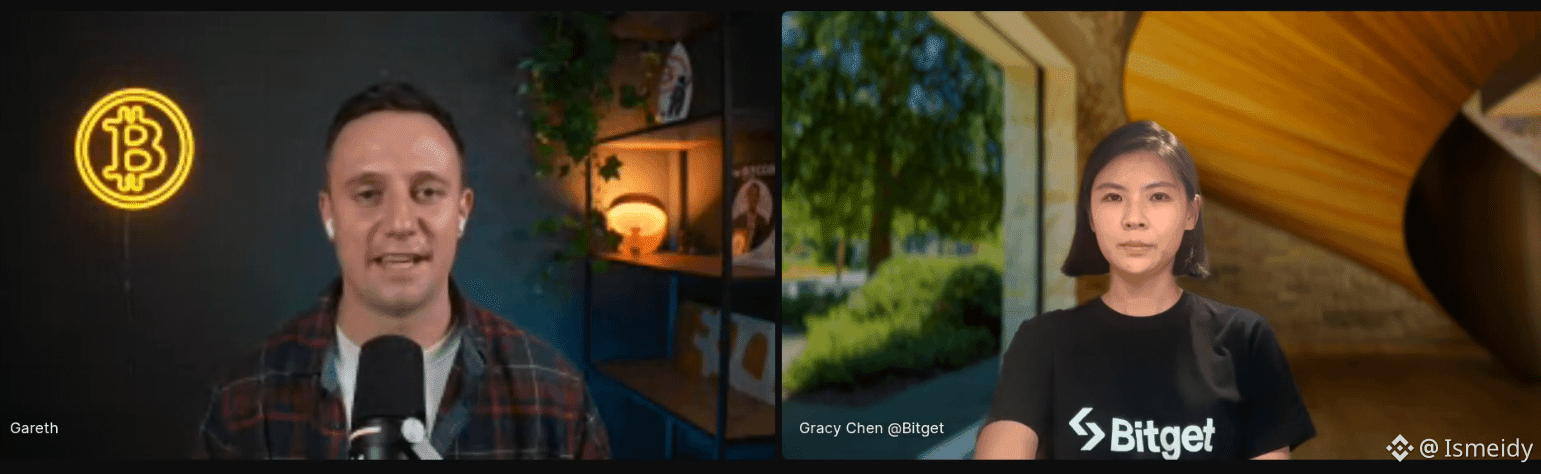
No impact for users: Gracy Chen (CEO) confirmed that the losses will be fully covered by the User Protection Fund, valued at $465 million. Bitget will replenish this fund in less than a week using its corporate reserves, which exceed $1.4 billion. "It’s serious, but not existential," Chen said.
Operational restoration and investigation: Bitcoin withdrawals have already resumed (processing more than 3,000 BTC in the first hour), and ETH withdrawals will resume on September 29. Forensic firms such as Mandiant and SlowMist are investigating, and Bitget’s directive says they already have the suspected group in their sights.
$XRP
{future}(XRPUSDT)
$ZEC
{future}(ZECUSDT)
$BNB
{future}(BNBUSDT)
From a penny test to a $388 million raid
The anatomy of the bold #hackeo a Bitget
30 minutes in the dark: how a "Zero-Day" vulnerability enabled the theft of millions at Bitget
The attack began at 18:31 UTC with two micro-transfers (0.184 ETH and 193 TRX). Since the amounts were insignificant, they did not trigger the exchange’s risk protocols, giving the attacker a green light to proceed.
The massive drain: Just 30 minutes after the test, the #Hacker ejecuted 17 high-volume transactions across multiple networks (#Ethereum , #xrp , #Zcash , BNB Chain, Base, Arbitrum, Optimism, and Avalanche), extracting $361 million in just over an hour.
Attack engineering (Zero-Day): Bitget’s cold wallets and private keys were not compromised. The hacker exploited a zero-day vulnerability in a third-party security product, allowing them to inject fraudulent withdrawal commands directly into the internal system and then erase their computer tracks.
Response and containment: The platform’s reconciliation system detected the anomaly only seven minutes after the first major withdrawal, enabling a global withdrawals freeze and stopping the bleeding.
No impact for users: Gracy Chen (CEO) confirmed that the losses will be fully covered by the User Protection Fund, valued at $465 million. Bitget will replenish this fund in less than a week using its corporate reserves, which exceed $1.4 billion. "It’s serious, but not existential," Chen said.
Operational restoration and investigation: Bitcoin withdrawals have already resumed (processing more than 3,000 BTC in the first hour), and ETH withdrawals will resume on September 29. Forensic firms such as Mandiant and SlowMist are investigating, and Bitget’s directive says they already have the suspected group in their sights.
$XRP
$ZEC
$BNB
The anatomy of the bold #hackeo a Bitget
30 minutes in the dark: how a "Zero-Day" vulnerability enabled the theft of millions at Bitget
The attack began at 18:31 UTC with two micro-transfers (0.184 ETH and 193 TRX). Since the amounts were insignificant, they did not trigger the exchange’s risk protocols, giving the attacker a green light to proceed.
The massive drain: Just 30 minutes after the test, the #Hacker ejecuted 17 high-volume transactions across multiple networks (#Ethereum , #xrp , #Zcash , BNB Chain, Base, Arbitrum, Optimism, and Avalanche), extracting $361 million in just over an hour.
Attack engineering (Zero-Day): Bitget’s cold wallets and private keys were not compromised. The hacker exploited a zero-day vulnerability in a third-party security product, allowing them to inject fraudulent withdrawal commands directly into the internal system and then erase their computer tracks.
Response and containment: The platform’s reconciliation system detected the anomaly only seven minutes after the first major withdrawal, enabling a global withdrawals freeze and stopping the bleeding.
No impact for users: Gracy Chen (CEO) confirmed that the losses will be fully covered by the User Protection Fund, valued at $465 million. Bitget will replenish this fund in less than a week using its corporate reserves, which exceed $1.4 billion. "It’s serious, but not existential," Chen said.
Operational restoration and investigation: Bitcoin withdrawals have already resumed (processing more than 3,000 BTC in the first hour), and ETH withdrawals will resume on September 29. Forensic firms such as Mandiant and SlowMist are investigating, and Bitget’s directive says they already have the suspected group in their sights.
$XRP
$ZEC
$BNB
6
11
17.8k
·
--
Cornering the offer!
#strategy devours 1.665 #BTC more and already controls 4% of all #bitcoin of the world.
$246 million in shares for more Bitcoin, the aggressive move with which Strategy dominates the corporate market.
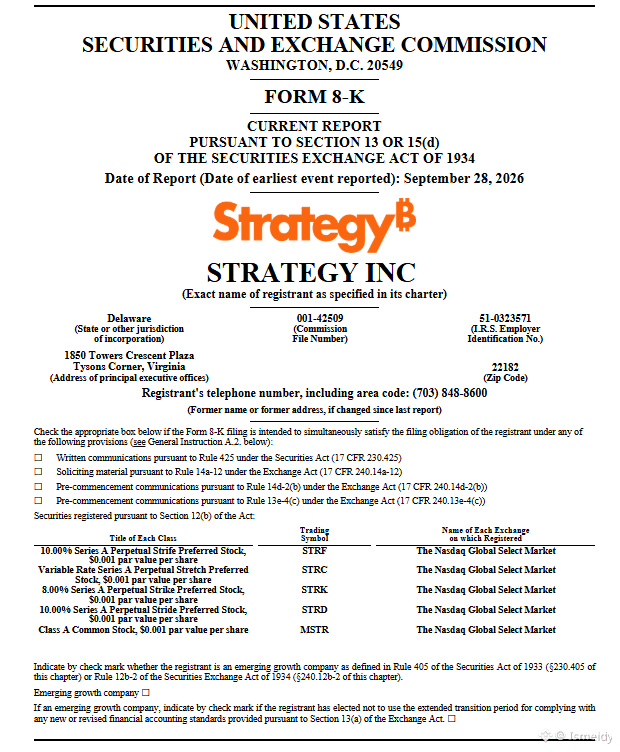
Strategy acquired 1.665 BTC for approximately $142.7 million, paying an average price of $85,681 per coin, between September 21 and 27.
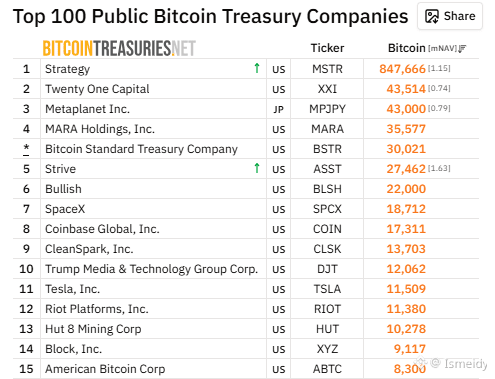
The firm led by #MichaelSaylor reaches the astonishing figure of 847.666 BTC, with a total cost of $64.000 billion. At the current price, this treasure is valued at about $70.600 billion, which translates into $6.600 billion in accounting gains.
Strategy’s leadership is indisputable. It sits in first place on the table overwhelmingly with its 847.666 BTC, surpassing by almost 20 times its closest competitor, Twenty One Capital, which barely has 43.514 BTC. Other institutional giants and listed miners are also far behind in the ranking, such as Metaplanet Inc. (43.000 BTC) and MARA Holdings, Inc. (35.577 BTC).
The company’s holdings already represent more than 4% of the total maximum supply (21 million) that the Bitcoin network will have.
#CryptoNews
$BTC
{future}(BTCUSDT)
$MSTR
{future}(MSTRUSDT)
$MSTRB
{spot}(MSTRBUSDT)
Cornering the offer!
#strategy devours 1.665 #BTC more and already controls 4% of all #bitcoin of the world.
$246 million in shares for more Bitcoin, the aggressive move with which Strategy dominates the corporate market.
Strategy acquired 1.665 BTC for approximately $142.7 million, paying an average price of $85,681 per coin, between September 21 and 27.
The firm led by #MichaelSaylor reaches the astonishing figure of 847.666 BTC, with a total cost of $64.000 billion. At the current price, this treasure is valued at about $70.600 billion, which translates into $6.600 billion in accounting gains.
Strategy’s leadership is indisputable. It sits in first place on the table overwhelmingly with its 847.666 BTC, surpassing by almost 20 times its closest competitor, Twenty One Capital, which barely has 43.514 BTC. Other institutional giants and listed miners are also far behind in the ranking, such as Metaplanet Inc. (43.000 BTC) and MARA Holdings, Inc. (35.577 BTC).
The company’s holdings already represent more than 4% of the total maximum supply (21 million) that the Bitcoin network will have.
#CryptoNews
$BTC
$MSTR
$MSTRB
#strategy devours 1.665 #BTC more and already controls 4% of all #bitcoin of the world.
$246 million in shares for more Bitcoin, the aggressive move with which Strategy dominates the corporate market.
Strategy acquired 1.665 BTC for approximately $142.7 million, paying an average price of $85,681 per coin, between September 21 and 27.
The firm led by #MichaelSaylor reaches the astonishing figure of 847.666 BTC, with a total cost of $64.000 billion. At the current price, this treasure is valued at about $70.600 billion, which translates into $6.600 billion in accounting gains.
Strategy’s leadership is indisputable. It sits in first place on the table overwhelmingly with its 847.666 BTC, surpassing by almost 20 times its closest competitor, Twenty One Capital, which barely has 43.514 BTC. Other institutional giants and listed miners are also far behind in the ranking, such as Metaplanet Inc. (43.000 BTC) and MARA Holdings, Inc. (35.577 BTC).
The company’s holdings already represent more than 4% of the total maximum supply (21 million) that the Bitcoin network will have.
#CryptoNews
$BTC
$MSTR
$MSTRB
1
3
426
·
--
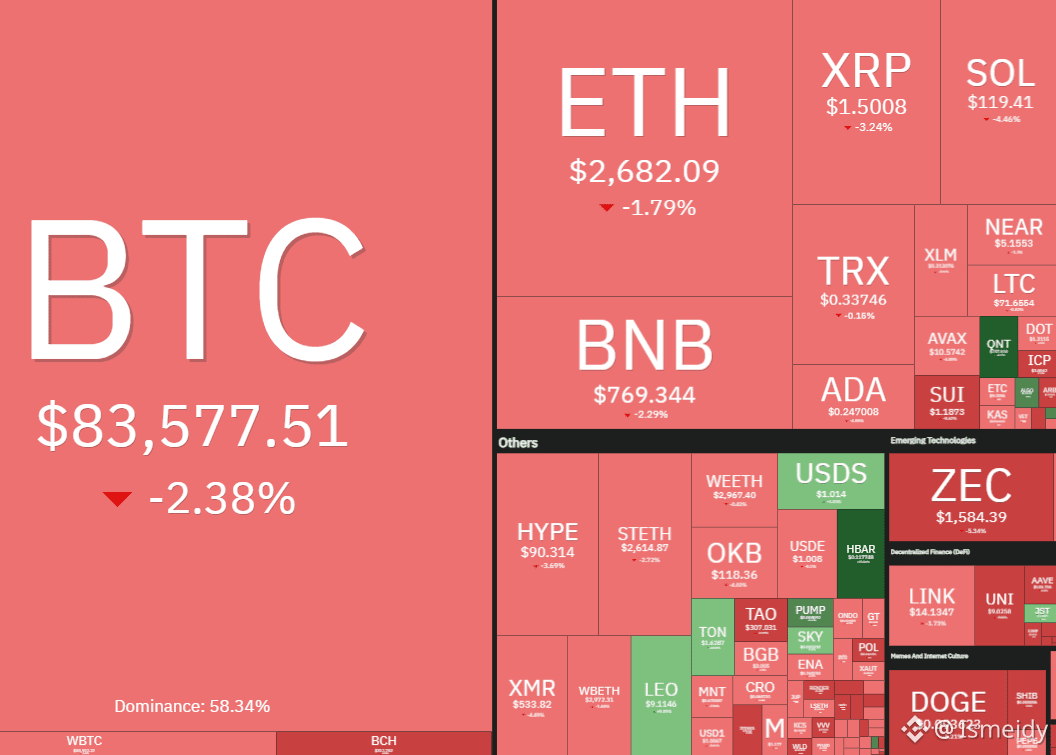
Market summary
#bitcoin 💰 trades above $83.577 -2.38%
‼️ The top 10 cryptocurrencies are trading in the RED zone
The 3 winning assets
QNT 46.25% 📈
HBAR 23.41% 📈
ALGO 11.87% 📈
The 3 losing assets
RAY -11.50% 📉
WLD -11.37%📉
VVV -11.25% 📉
📌 Market Cap: $2.85T -2.16%
📌 Dominance of #BTC : 58.5%
📌 Dominance of #ETH : 11.4%
📌 Index of #altcoinseason : 65%
📌 Fear and Greed Index: 69 (GREED)
📌 CMC20 Index 174.84 -2.25%
📌 CMC100 Index 167.33 -2.27%
📌 Pi cycle top indicator 68.991 0.28%
📌 Puell Multiple 1.08 -4.42%
📌 RSI 22 Days 60.552 -6.8%
#CryptoNews
$QNT
{future}(QNTUSDT)
$HBAR
{future}(HBARUSDT)
$ALGO
{future}(ALGOUSDT)
Market summary
#bitcoin 💰 trades above $83.577 -2.38%
‼️ The top 10 cryptocurrencies are trading in the RED zone
The 3 winning assets
QNT 46.25% 📈
HBAR 23.41% 📈
ALGO 11.87% 📈
The 3 losing assets
RAY -11.50% 📉
WLD -11.37%📉
VVV -11.25% 📉
📌 Market Cap: $2.85T -2.16%
📌 Dominance of #BTC : 58.5%
📌 Dominance of #ETH : 11.4%
📌 Index of #altcoinseason : 65%
📌 Fear and Greed Index: 69 (GREED)
📌 CMC20 Index 174.84 -2.25%
📌 CMC100 Index 167.33 -2.27%
📌 Pi cycle top indicator 68.991 0.28%
📌 Puell Multiple 1.08 -4.42%
📌 RSI 22 Days 60.552 -6.8%
#CryptoNews
$QNT
$HBAR
$ALGO
#bitcoin 💰 trades above $83.577 -2.38%
‼️ The top 10 cryptocurrencies are trading in the RED zone
The 3 winning assets
QNT 46.25% 📈
HBAR 23.41% 📈
ALGO 11.87% 📈
The 3 losing assets
RAY -11.50% 📉
WLD -11.37%📉
VVV -11.25% 📉
📌 Market Cap: $2.85T -2.16%
📌 Dominance of #BTC : 58.5%
📌 Dominance of #ETH : 11.4%
📌 Index of #altcoinseason : 65%
📌 Fear and Greed Index: 69 (GREED)
📌 CMC20 Index 174.84 -2.25%
📌 CMC100 Index 167.33 -2.27%
📌 Pi cycle top indicator 68.991 0.28%
📌 Puell Multiple 1.08 -4.42%
📌 RSI 22 Days 60.552 -6.8%
#CryptoNews
$QNT
$HBAR
$ALGO
1
3
1.1k
·
--
Verified
The future of money in the US is programmable
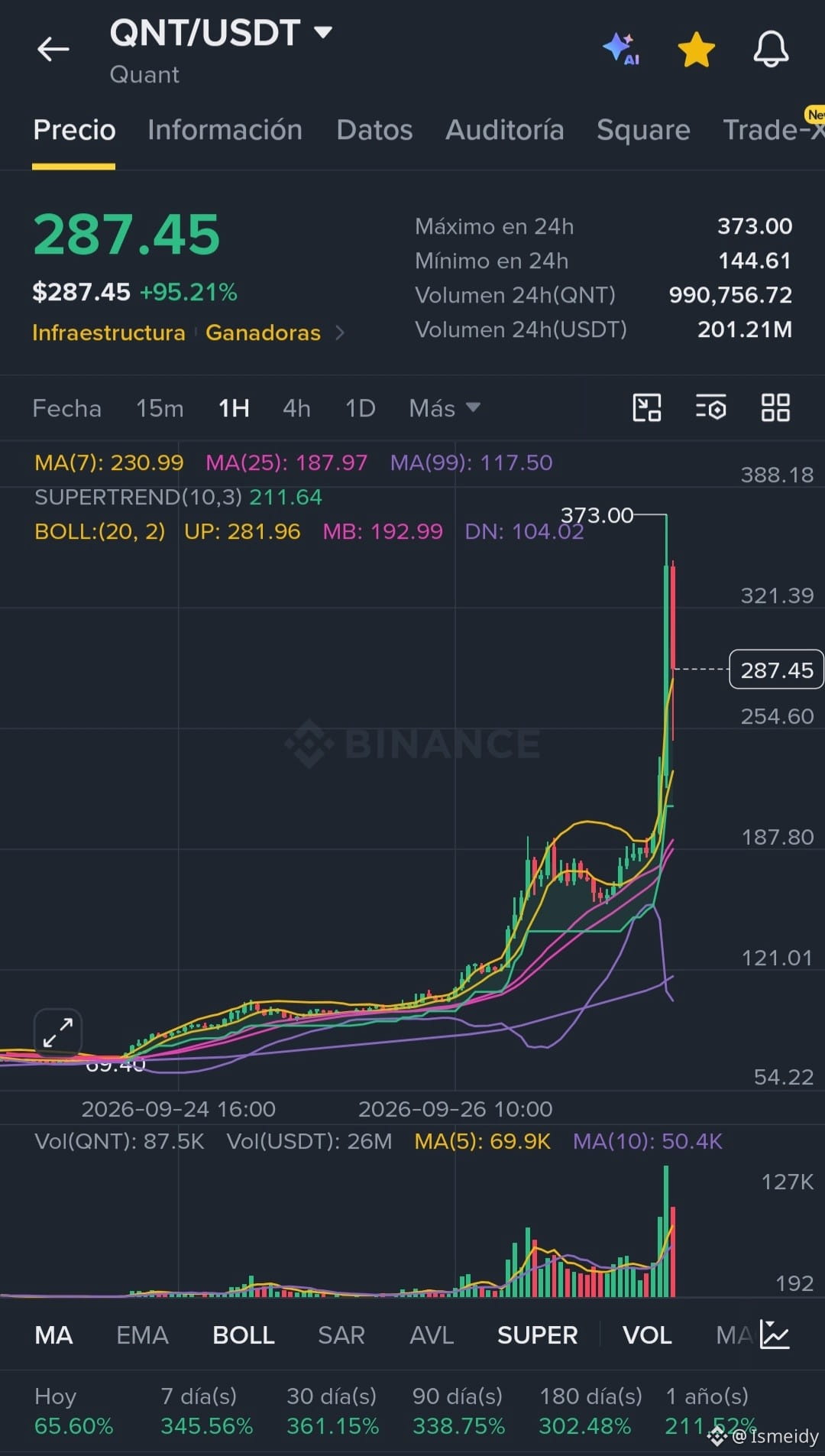
The Clearing House selects #Quant for its tokenized deposit network and #QNT surges
The strategic alliance will drive the "On-Chain Money Initiative" to connect the US banking system with tokenized, interoperable liquidity in real time.
Infrastructure for traditional banking: The Clearing House (TCH) chose Quant as the key technology provider to develop its On-Chain Money Initiative, a project designed to enable financial institutions of all sizes to clear and settle transactions using tokenized deposits.
Smart, instant payments: The network will enable instant settlement and the automation of conditional (programmable) payments, reducing manual work, waiting times, and operating costs for banks and their customers.
A bridge between fiat and blockchain: Quant will bring its orchestration and interoperability technology to connect the new tokenized banking network with existing fiat payment systems.
Unprecedented real-world scale: Unlike most tokenization projects in the crypto sector, this initiative has TCH’s clearing infrastructure, providing a direct path to scale tokenized fiat money at the interbank and cross-border level.
Launch date: The Clearing House plans to make the platform available to participating institutions during the first half of 2027.
The announcement sparked a strong bullish wave for the network’s native token, Quant.
$QNT
{future}(QNTUSDT)
The future of money in the US is programmable
The Clearing House selects #Quant for its tokenized deposit network and #QNT surges
The strategic alliance will drive the "On-Chain Money Initiative" to connect the US banking system with tokenized, interoperable liquidity in real time.
Infrastructure for traditional banking: The Clearing House (TCH) chose Quant as the key technology provider to develop its On-Chain Money Initiative, a project designed to enable financial institutions of all sizes to clear and settle transactions using tokenized deposits.
Smart, instant payments: The network will enable instant settlement and the automation of conditional (programmable) payments, reducing manual work, waiting times, and operating costs for banks and their customers.
A bridge between fiat and blockchain: Quant will bring its orchestration and interoperability technology to connect the new tokenized banking network with existing fiat payment systems.
Unprecedented real-world scale: Unlike most tokenization projects in the crypto sector, this initiative has TCH’s clearing infrastructure, providing a direct path to scale tokenized fiat money at the interbank and cross-border level.
Launch date: The Clearing House plans to make the platform available to participating institutions during the first half of 2027.
The announcement sparked a strong bullish wave for the network’s native token, Quant.
$QNT
The Clearing House selects #Quant for its tokenized deposit network and #QNT surges
The strategic alliance will drive the "On-Chain Money Initiative" to connect the US banking system with tokenized, interoperable liquidity in real time.
Infrastructure for traditional banking: The Clearing House (TCH) chose Quant as the key technology provider to develop its On-Chain Money Initiative, a project designed to enable financial institutions of all sizes to clear and settle transactions using tokenized deposits.
Smart, instant payments: The network will enable instant settlement and the automation of conditional (programmable) payments, reducing manual work, waiting times, and operating costs for banks and their customers.
A bridge between fiat and blockchain: Quant will bring its orchestration and interoperability technology to connect the new tokenized banking network with existing fiat payment systems.
Unprecedented real-world scale: Unlike most tokenization projects in the crypto sector, this initiative has TCH’s clearing infrastructure, providing a direct path to scale tokenized fiat money at the interbank and cross-border level.
Launch date: The Clearing House plans to make the platform available to participating institutions during the first half of 2027.
The announcement sparked a strong bullish wave for the network’s native token, Quant.
$QNT
7
3.9k
·
--
Verified
Cash every day!
The aggressive bet of #strategy to revolutionize dividend payments in #WallStreet
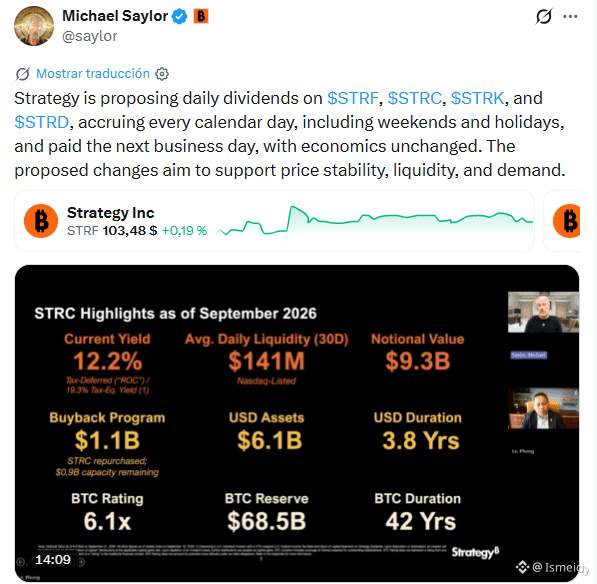
Strategy, the treasury management company of #bitcoin , seeks to redefine compensation to its shareholders by proposing daily accumulation dividend payments for four of its preferred shares: STRF, STRC, STRK and STRD.
This initiative, approved by the board of directors and notified to the SEC on September 24, aims to energize holders’ positions in its securities without altering the economic structure of the payments.
Continuous accrual: Dividends will accrue every calendar day, covering weekends and holidays, and will be paid on the next business day.
Unchanged economics: The proposal does not modify the current rates of return or increase the company’s total financial obligations to its shareholders.
Implementation timeline: If approved, the STRC share will be the first to adopt the system on November 1 (having moved from monthly payments to biweekly less than three months ago), while STRF, STRD and STRK will be rolled out in January.
Executive vision: The cofounder #MichaelSaylor highlighted on X that the main goal of the measure is to support price stability, encourage liquidity, and boost demand for the securities.
#BTC
$BTC
{future}(BTCUSDT)
$MSTRB
{spot}(MSTRBUSDT)
$MSTR
{future}(MSTRUSDT)
Cash every day!
The aggressive bet of #strategy to revolutionize dividend payments in #WallStreet
Strategy, the treasury management company of #bitcoin , seeks to redefine compensation to its shareholders by proposing daily accumulation dividend payments for four of its preferred shares: STRF, STRC, STRK and STRD.
This initiative, approved by the board of directors and notified to the SEC on September 24, aims to energize holders’ positions in its securities without altering the economic structure of the payments.
Continuous accrual: Dividends will accrue every calendar day, covering weekends and holidays, and will be paid on the next business day.
Unchanged economics: The proposal does not modify the current rates of return or increase the company’s total financial obligations to its shareholders.
Implementation timeline: If approved, the STRC share will be the first to adopt the system on November 1 (having moved from monthly payments to biweekly less than three months ago), while STRF, STRD and STRK will be rolled out in January.
Executive vision: The cofounder #MichaelSaylor highlighted on X that the main goal of the measure is to support price stability, encourage liquidity, and boost demand for the securities.
#BTC
$BTC
$MSTRB
$MSTR
The aggressive bet of #strategy to revolutionize dividend payments in #WallStreet
Strategy, the treasury management company of #bitcoin , seeks to redefine compensation to its shareholders by proposing daily accumulation dividend payments for four of its preferred shares: STRF, STRC, STRK and STRD.
This initiative, approved by the board of directors and notified to the SEC on September 24, aims to energize holders’ positions in its securities without altering the economic structure of the payments.
Continuous accrual: Dividends will accrue every calendar day, covering weekends and holidays, and will be paid on the next business day.
Unchanged economics: The proposal does not modify the current rates of return or increase the company’s total financial obligations to its shareholders.
Implementation timeline: If approved, the STRC share will be the first to adopt the system on November 1 (having moved from monthly payments to biweekly less than three months ago), while STRF, STRD and STRK will be rolled out in January.
Executive vision: The cofounder #MichaelSaylor highlighted on X that the main goal of the measure is to support price stability, encourage liquidity, and boost demand for the securities.
#BTC
$BTC
$MSTRB
$MSTR
1
6
2.6k
·
--
Verified
From #WallStreet a to the Blockchain
#ethena revolutionizes USDe collateral backing by integrating tokenized shares with #Binance
Ethena has partnered with Binance as its first platform to expand its core operations into perpetual equity contracts. This update expands the addressable market for underlying collateral beyond $2.5 trillion.
New collateral mechanism: The delta-neutral strategy evolves beyond cryptoassets by incorporating bStocks (tokenized securities of BTech Holdings Limited) as spot collateral, using Binance’s perpetual stock futures to hedge risk.
Growth outlook: Ethena Labs expects the perpetual equity bond market to significantly outpace that of cryptocurrencies. Its founder, Guy Young, describes the move as the most important expansion in the history of synthetic dollar (USDe) financing to capture the value of a global stock market worth hundreds of trillions of dollars.
Liquidity and adoption: Binance reports more than $2.9 billion in open positions in perpetual equity futures, with a 105% year-to-date monthly compound growth and an annualized 3.56% over the last six months, consolidating the convergence between traditional finance and digital assets.
#ENA #CryptoNews
$ENA
{future}(ENAUSDT)
From #WallStreet a to the Blockchain
#ethena revolutionizes USDe collateral backing by integrating tokenized shares with #Binance
Ethena has partnered with Binance as its first platform to expand its core operations into perpetual equity contracts. This update expands the addressable market for underlying collateral beyond $2.5 trillion.
New collateral mechanism: The delta-neutral strategy evolves beyond cryptoassets by incorporating bStocks (tokenized securities of BTech Holdings Limited) as spot collateral, using Binance’s perpetual stock futures to hedge risk.
Growth outlook: Ethena Labs expects the perpetual equity bond market to significantly outpace that of cryptocurrencies. Its founder, Guy Young, describes the move as the most important expansion in the history of synthetic dollar (USDe) financing to capture the value of a global stock market worth hundreds of trillions of dollars.
Liquidity and adoption: Binance reports more than $2.9 billion in open positions in perpetual equity futures, with a 105% year-to-date monthly compound growth and an annualized 3.56% over the last six months, consolidating the convergence between traditional finance and digital assets.
#ENA #CryptoNews
$ENA
#ethena revolutionizes USDe collateral backing by integrating tokenized shares with #Binance
Ethena has partnered with Binance as its first platform to expand its core operations into perpetual equity contracts. This update expands the addressable market for underlying collateral beyond $2.5 trillion.
New collateral mechanism: The delta-neutral strategy evolves beyond cryptoassets by incorporating bStocks (tokenized securities of BTech Holdings Limited) as spot collateral, using Binance’s perpetual stock futures to hedge risk.
Growth outlook: Ethena Labs expects the perpetual equity bond market to significantly outpace that of cryptocurrencies. Its founder, Guy Young, describes the move as the most important expansion in the history of synthetic dollar (USDe) financing to capture the value of a global stock market worth hundreds of trillions of dollars.
Liquidity and adoption: Binance reports more than $2.9 billion in open positions in perpetual equity futures, with a 105% year-to-date monthly compound growth and an annualized 3.56% over the last six months, consolidating the convergence between traditional finance and digital assets.
#ENA #CryptoNews
$ENA

6
1.2k
·
--
Market summary
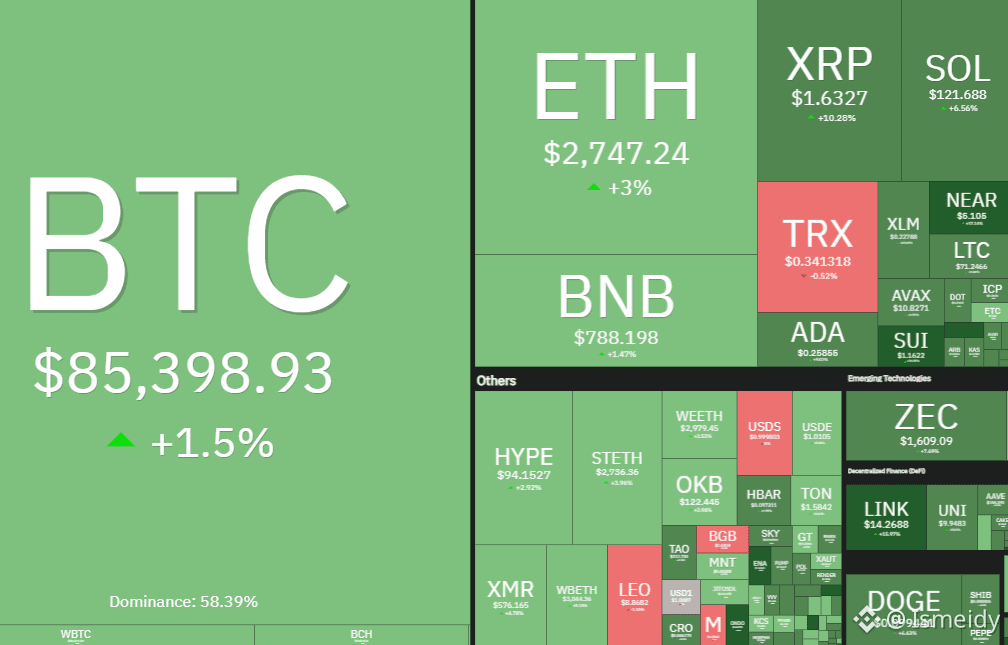
#bitcoin 💰 trades above $85.398 1.5%
‼️ The top 10 cryptocurrencies are trading in the GREEN zone
The 3 winning assets
QNT 35.37% 📈
ONDO 23.13% 📈
FET 22.50% 📈
The 3 losing assets
M -2.37% 📉
BGB -1.56%📉
PIEVERSE -1.35% 📉
📌 Market Cap: $2.9T 2.33%
📌 #BTC dominance: 58.6%
📌 #ETH dominance: 11.4%
📌 Index of #altcoinseason : 57%
📌 Fear & Greed Index: 74 (GREED)
📌 CMC20 Index 178.68 2.44%
📌 CMC100 Index 170.72 2.54%
📌 Pi cycle top indicator 68.395 0.31%
📌 Puell Multiple 1.03 8.42%
📌 RSI 22 days 65.010 4.41%
#CryptoNews
$QNT
{future}(QNTUSDT)
$ONDO
{future}(ONDOUSDT)
$FET
{future}(FETUSDT)
Market summary
#bitcoin 💰 trades above $85.398 1.5%
‼️ The top 10 cryptocurrencies are trading in the GREEN zone
The 3 winning assets
QNT 35.37% 📈
ONDO 23.13% 📈
FET 22.50% 📈
The 3 losing assets
M -2.37% 📉
BGB -1.56%📉
PIEVERSE -1.35% 📉
📌 Market Cap: $2.9T 2.33%
📌 #BTC dominance: 58.6%
📌 #ETH dominance: 11.4%
📌 Index of #altcoinseason : 57%
📌 Fear & Greed Index: 74 (GREED)
📌 CMC20 Index 178.68 2.44%
📌 CMC100 Index 170.72 2.54%
📌 Pi cycle top indicator 68.395 0.31%
📌 Puell Multiple 1.03 8.42%
📌 RSI 22 days 65.010 4.41%
#CryptoNews
$QNT
$ONDO
$FET
#bitcoin 💰 trades above $85.398 1.5%
‼️ The top 10 cryptocurrencies are trading in the GREEN zone
The 3 winning assets
QNT 35.37% 📈
ONDO 23.13% 📈
FET 22.50% 📈
The 3 losing assets
M -2.37% 📉
BGB -1.56%📉
PIEVERSE -1.35% 📉
📌 Market Cap: $2.9T 2.33%
📌 #BTC dominance: 58.6%
📌 #ETH dominance: 11.4%
📌 Index of #altcoinseason : 57%
📌 Fear & Greed Index: 74 (GREED)
📌 CMC20 Index 178.68 2.44%
📌 CMC100 Index 170.72 2.54%
📌 Pi cycle top indicator 68.395 0.31%
📌 Puell Multiple 1.03 8.42%
📌 RSI 22 days 65.010 4.41%
#CryptoNews
$QNT
$ONDO
$FET
4
2
14
2.6k
·
--
Verified
Privacy powered by FHE lands on #solana
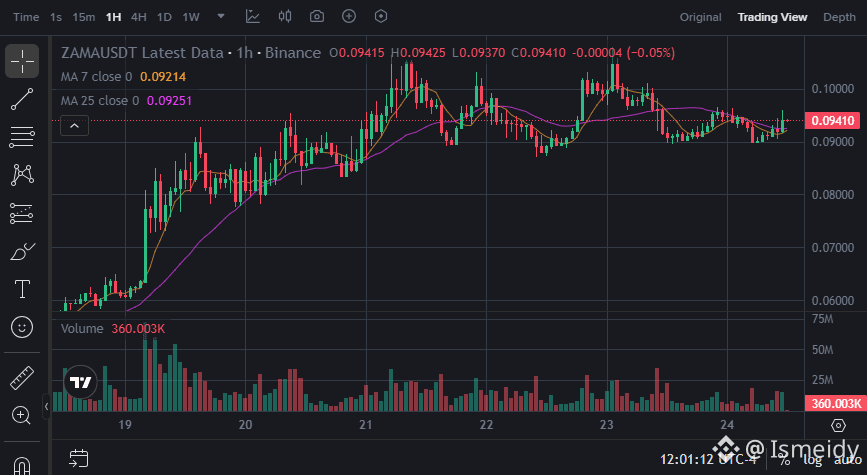
#Zama is already available for multichain trading
Zama protocol’s utility token has officially entered the Solana network (via Sunrise), expanding its presence after successfully operating on #Ethereum and #BNBChain
The move integrates Zama’s encryption infrastructure into a high-speed ecosystem.
Multichain expansion: After consolidating on Ethereum and BNB Chain, ZAMA lands on Solana, expanding liquidity and token access in one of the most active ecosystems in the market.
Utility and commission payments: ZAMA is used directly to pay the protocol’s fees, from verifying zero-knowledge proofs (ZKPoK) of encrypted data, to decrypting texts and bridging confidential assets. Fees are set in USD via an oracle but are paid exclusively in the native token.
Deflationary mechanism (Burn-and-Mint): 100% of the commissions generated from using the protocol are permanently burned. To maintain network security and reward node operators (coprocessors and KMS), the system issues new tokens through a Delegated Proof-of-Stake (DPoS) model with an initial emission rate close to 5%, adjustable.
Staking for the community: Both operators and holders can participate in securing the network; users have the option to delegate their tokens to validator nodes to receive rewards.
$ZAMA
{future}(ZAMAUSDT)
$SOL
{future}(SOLUSDT)
$BNB
{future}(BNBUSDT)
Privacy powered by FHE lands on #solana
#Zama is already available for multichain trading
Zama protocol’s utility token has officially entered the Solana network (via Sunrise), expanding its presence after successfully operating on #Ethereum and #BNBChain
The move integrates Zama’s encryption infrastructure into a high-speed ecosystem.
Multichain expansion: After consolidating on Ethereum and BNB Chain, ZAMA lands on Solana, expanding liquidity and token access in one of the most active ecosystems in the market.
Utility and commission payments: ZAMA is used directly to pay the protocol’s fees, from verifying zero-knowledge proofs (ZKPoK) of encrypted data, to decrypting texts and bridging confidential assets. Fees are set in USD via an oracle but are paid exclusively in the native token.
Deflationary mechanism (Burn-and-Mint): 100% of the commissions generated from using the protocol are permanently burned. To maintain network security and reward node operators (coprocessors and KMS), the system issues new tokens through a Delegated Proof-of-Stake (DPoS) model with an initial emission rate close to 5%, adjustable.
Staking for the community: Both operators and holders can participate in securing the network; users have the option to delegate their tokens to validator nodes to receive rewards.
$ZAMA
$SOL
$BNB
#Zama is already available for multichain trading
Zama protocol’s utility token has officially entered the Solana network (via Sunrise), expanding its presence after successfully operating on #Ethereum and #BNBChain
The move integrates Zama’s encryption infrastructure into a high-speed ecosystem.
Multichain expansion: After consolidating on Ethereum and BNB Chain, ZAMA lands on Solana, expanding liquidity and token access in one of the most active ecosystems in the market.
Utility and commission payments: ZAMA is used directly to pay the protocol’s fees, from verifying zero-knowledge proofs (ZKPoK) of encrypted data, to decrypting texts and bridging confidential assets. Fees are set in USD via an oracle but are paid exclusively in the native token.
Deflationary mechanism (Burn-and-Mint): 100% of the commissions generated from using the protocol are permanently burned. To maintain network security and reward node operators (coprocessors and KMS), the system issues new tokens through a Delegated Proof-of-Stake (DPoS) model with an initial emission rate close to 5%, adjustable.
Staking for the community: Both operators and holders can participate in securing the network; users have the option to delegate their tokens to validator nodes to receive rewards.
$ZAMA
$SOL
$BNB

4
1.8k
·
--
Verified
#WallStreet invade DeFi
#OndoFinance launched tokenized custody carteras based on strategies of #blackRock
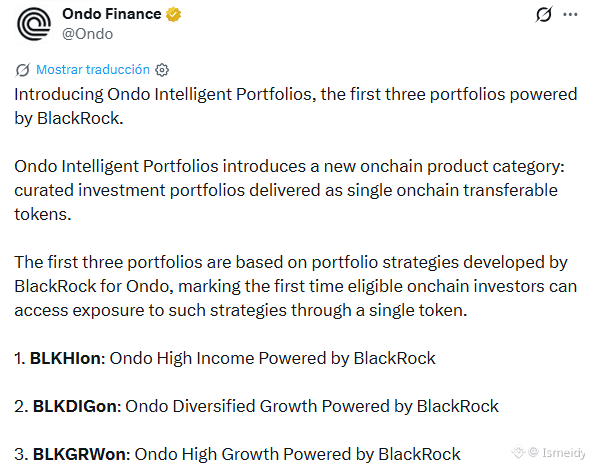
#ONDO Finance has taken a decisive step in bridging traditional finance (TradFi) and the crypto ecosystem after launching three on-chain investment products backed by model portfolio strategies developed by BlackRock.
Designed for eligible investors outside the United States, these new instruments provide access to diversified portfolios through the issuance of a single token, eliminating the need to manage individual positions.
Three new On-Chain products: Ondo Global Markets will issue and Ondo Finance will tokenize three portfolios according to the investor’s risk profile:
Ondo High Income (BLKHIon)
Ondo Diversified Growth (BLKDIGon)
Ondo High Growth (BLKGRWon)
Simplified management and DeFi integration: Investors mint or redeem a single token to access the entire basket of assets. Weights and rebalancing are 100% transparent on the blockchain, and tokens can be transferred peer-to-peer and integrated into DeFi protocols.
Role separation with BlackRock: The world’s largest asset manager acts exclusively as the provider of non-discretionary model portfolio strategies. BlackRock does not manage the on-chain portfolios nor does it handle custody, issuance, or operation of the tokens.
TradFi/Web3 sector evolution: This launch expands the firms’ indirect partnership (noting that Ondo had already moved $95 million from its OUSG fund to BlackRock’s tokenized BUIDL fund) and consolidates the trend of bringing sophisticated financial products beyond simple Treasury bills into more complex investment strategies.
$ONDO
{future}(ONDOUSDT)
$RED
{future}(REDUSDT)
$SOL
{future}(SOLUSDT)
#WallStreet invade DeFi
#OndoFinance launched tokenized custody carteras based on strategies of #blackRock
#ONDO Finance has taken a decisive step in bridging traditional finance (TradFi) and the crypto ecosystem after launching three on-chain investment products backed by model portfolio strategies developed by BlackRock.
Designed for eligible investors outside the United States, these new instruments provide access to diversified portfolios through the issuance of a single token, eliminating the need to manage individual positions.
Three new On-Chain products: Ondo Global Markets will issue and Ondo Finance will tokenize three portfolios according to the investor’s risk profile:
Ondo High Income (BLKHIon)
Ondo Diversified Growth (BLKDIGon)
Ondo High Growth (BLKGRWon)
Simplified management and DeFi integration: Investors mint or redeem a single token to access the entire basket of assets. Weights and rebalancing are 100% transparent on the blockchain, and tokens can be transferred peer-to-peer and integrated into DeFi protocols.
Role separation with BlackRock: The world’s largest asset manager acts exclusively as the provider of non-discretionary model portfolio strategies. BlackRock does not manage the on-chain portfolios nor does it handle custody, issuance, or operation of the tokens.
TradFi/Web3 sector evolution: This launch expands the firms’ indirect partnership (noting that Ondo had already moved $95 million from its OUSG fund to BlackRock’s tokenized BUIDL fund) and consolidates the trend of bringing sophisticated financial products beyond simple Treasury bills into more complex investment strategies.
$ONDO
$RED
$SOL
#OndoFinance launched tokenized custody carteras based on strategies of #blackRock
#ONDO Finance has taken a decisive step in bridging traditional finance (TradFi) and the crypto ecosystem after launching three on-chain investment products backed by model portfolio strategies developed by BlackRock.
Designed for eligible investors outside the United States, these new instruments provide access to diversified portfolios through the issuance of a single token, eliminating the need to manage individual positions.
Three new On-Chain products: Ondo Global Markets will issue and Ondo Finance will tokenize three portfolios according to the investor’s risk profile:
Ondo High Income (BLKHIon)
Ondo Diversified Growth (BLKDIGon)
Ondo High Growth (BLKGRWon)
Simplified management and DeFi integration: Investors mint or redeem a single token to access the entire basket of assets. Weights and rebalancing are 100% transparent on the blockchain, and tokens can be transferred peer-to-peer and integrated into DeFi protocols.
Role separation with BlackRock: The world’s largest asset manager acts exclusively as the provider of non-discretionary model portfolio strategies. BlackRock does not manage the on-chain portfolios nor does it handle custody, issuance, or operation of the tokens.
TradFi/Web3 sector evolution: This launch expands the firms’ indirect partnership (noting that Ondo had already moved $95 million from its OUSG fund to BlackRock’s tokenized BUIDL fund) and consolidates the trend of bringing sophisticated financial products beyond simple Treasury bills into more complex investment strategies.
$ONDO
$RED
$SOL
5
4.7k
·
--
Verified
#CathieWood da the leap into Web3
#ArkInvest tokenizes its star fund with participations in #OpenAI , #Anthropic and Stripe
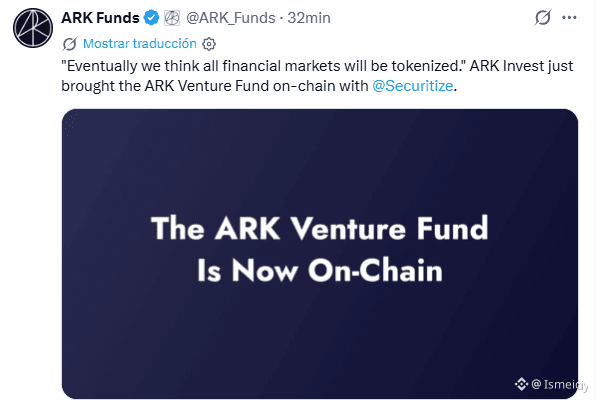
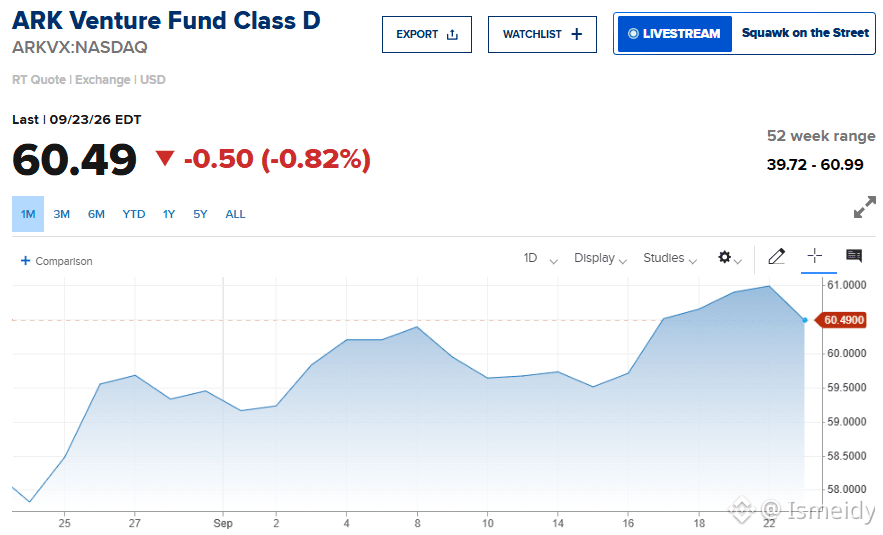
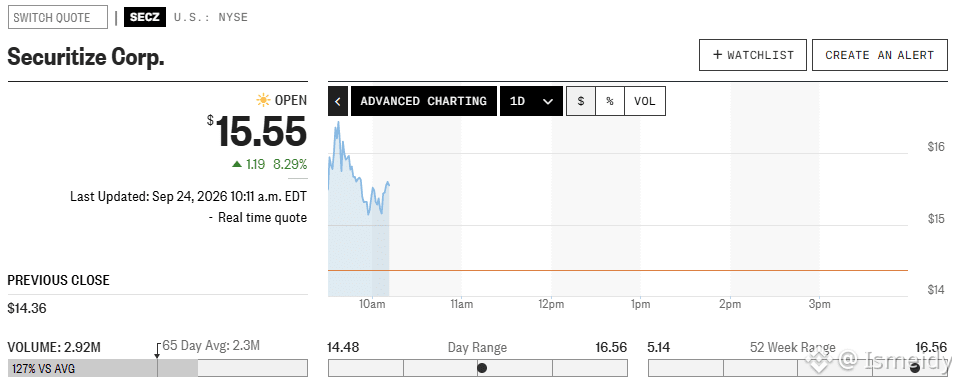
ARK Invest, the asset manager led by Cathie Wood, has announced the tokenization of its venture capital fund ARK Venture Fund (ARKVX) through Securitize’s infrastructure. This move makes it possible to move to the Ethereum network (with plans to expand to other blockchains) a portfolio that includes private tech giants such as OpenAI, Anthropic, Stripe, and Databricks.
On-chain access to AI and Web3 giants: The move enables investors to diversify their exposure to high-value private companies that are still not publicly traded. As Carlos Domingo, CEO of Securitize, noted, the fund resolves uncertainty in the sector by allowing investors to bet on the leading competitors in the AI race in a single product.
Tokenization of the fund, not the companies: The underlying assets (the shares of OpenAI, Stripe, etc.) remain private. What is issued on the blockchain is a digital representation of the investor’s stake in the ARKVX fund, providing daily net asset value (NAV) and liquidity in Web3 markets.
Ethereum as a starting point: The fund token will initially be deployed on network #Ethereum , paving the way for integration with other networks in the future.
Institutional and regulatory momentum: ARK joins firms such as BlackRock and Franklin Templeton in the race to bring traditional finance (TradFi) to blockchain technology. The announcement coincides with the SEC’s recent 5-year “innovation exemption,” a framework that facilitates the trading of tokenized securities on on-chain platforms and supports Citi’s projections of reaching $5.5 trillion in tokenized securities by 2030.
Strategic alliance: This launch strengthens the relationship between the two firms, following the strategic investment ARK made in Securitize last year with the goal of further digitizing regulated financial products.
$ETH
{future}(ETHUSDT)
#CathieWood da the leap into Web3
#ArkInvest tokenizes its star fund with participations in #OpenAI , #Anthropic and Stripe
ARK Invest, the asset manager led by Cathie Wood, has announced the tokenization of its venture capital fund ARK Venture Fund (ARKVX) through Securitize’s infrastructure. This move makes it possible to move to the Ethereum network (with plans to expand to other blockchains) a portfolio that includes private tech giants such as OpenAI, Anthropic, Stripe, and Databricks.
On-chain access to AI and Web3 giants: The move enables investors to diversify their exposure to high-value private companies that are still not publicly traded. As Carlos Domingo, CEO of Securitize, noted, the fund resolves uncertainty in the sector by allowing investors to bet on the leading competitors in the AI race in a single product.
Tokenization of the fund, not the companies: The underlying assets (the shares of OpenAI, Stripe, etc.) remain private. What is issued on the blockchain is a digital representation of the investor’s stake in the ARKVX fund, providing daily net asset value (NAV) and liquidity in Web3 markets.
Ethereum as a starting point: The fund token will initially be deployed on network #Ethereum , paving the way for integration with other networks in the future.
Institutional and regulatory momentum: ARK joins firms such as BlackRock and Franklin Templeton in the race to bring traditional finance (TradFi) to blockchain technology. The announcement coincides with the SEC’s recent 5-year “innovation exemption,” a framework that facilitates the trading of tokenized securities on on-chain platforms and supports Citi’s projections of reaching $5.5 trillion in tokenized securities by 2030.
Strategic alliance: This launch strengthens the relationship between the two firms, following the strategic investment ARK made in Securitize last year with the goal of further digitizing regulated financial products.
$ETH
#ArkInvest tokenizes its star fund with participations in #OpenAI , #Anthropic and Stripe
ARK Invest, the asset manager led by Cathie Wood, has announced the tokenization of its venture capital fund ARK Venture Fund (ARKVX) through Securitize’s infrastructure. This move makes it possible to move to the Ethereum network (with plans to expand to other blockchains) a portfolio that includes private tech giants such as OpenAI, Anthropic, Stripe, and Databricks.
On-chain access to AI and Web3 giants: The move enables investors to diversify their exposure to high-value private companies that are still not publicly traded. As Carlos Domingo, CEO of Securitize, noted, the fund resolves uncertainty in the sector by allowing investors to bet on the leading competitors in the AI race in a single product.
Tokenization of the fund, not the companies: The underlying assets (the shares of OpenAI, Stripe, etc.) remain private. What is issued on the blockchain is a digital representation of the investor’s stake in the ARKVX fund, providing daily net asset value (NAV) and liquidity in Web3 markets.
Ethereum as a starting point: The fund token will initially be deployed on network #Ethereum , paving the way for integration with other networks in the future.
Institutional and regulatory momentum: ARK joins firms such as BlackRock and Franklin Templeton in the race to bring traditional finance (TradFi) to blockchain technology. The announcement coincides with the SEC’s recent 5-year “innovation exemption,” a framework that facilitates the trading of tokenized securities on on-chain platforms and supports Citi’s projections of reaching $5.5 trillion in tokenized securities by 2030.
Strategic alliance: This launch strengthens the relationship between the two firms, following the strategic investment ARK made in Securitize last year with the goal of further digitizing regulated financial products.
$ETH
ETH+0.35%
SECZUS-0.47%
4
4.1k
·
--
Market summary
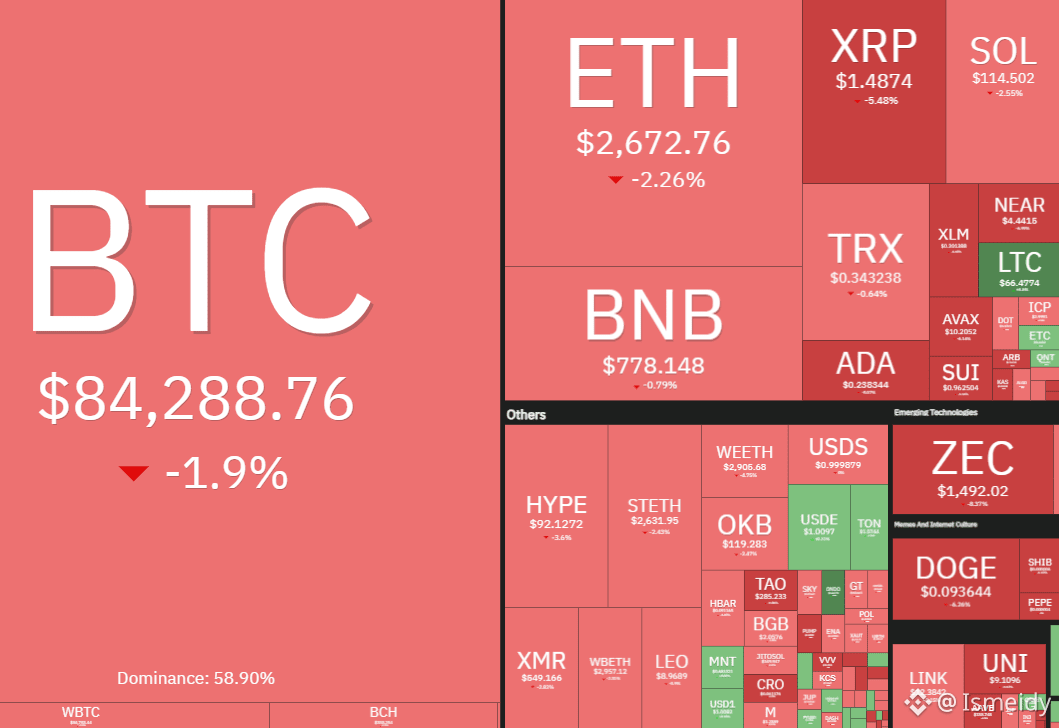
#bitcoin 💰 trading above $84.288 -1.9%
‼️ The top 10 cryptocurrencies are trading in the GREEN zone
The 3 winning assets
ONDO 6.61% 📈
LTC 6.28% 📈
RAY 4.11% 📈
The 3 losing assets
PONS -12.15% 📉
WLD -10.22%📉
ARB -9.49% 📉
📌 Market Cap: $2.84T -2.58%
📌 Dominance of #BTC : 59.1%
📌 Dominance of #ETH : 11.4%
📌 Index of #altcoinseason : 48%
📌 Fear and Greed Index: 72 (GREED)
📌 CMC20 Index 174.84 -2.58%
📌 CMC100 Index 166.73 -2.48%
📌 Pi cycle top indicator 68.182 0.29%
📌 Puell Multiple 0.95 -8.65%
📌 22-Day RSI 62.26 -8%
#CryptoNews
$ONDO
{future}(ONDOUSDT)
$LTC
{future}(LTCUSDT)
$RAY
{spot}(RAYUSDT)
Market summary
#bitcoin 💰 trading above $84.288 -1.9%
‼️ The top 10 cryptocurrencies are trading in the GREEN zone
The 3 winning assets
ONDO 6.61% 📈
LTC 6.28% 📈
RAY 4.11% 📈
The 3 losing assets
PONS -12.15% 📉
WLD -10.22%📉
ARB -9.49% 📉
📌 Market Cap: $2.84T -2.58%
📌 Dominance of #BTC : 59.1%
📌 Dominance of #ETH : 11.4%
📌 Index of #altcoinseason : 48%
📌 Fear and Greed Index: 72 (GREED)
📌 CMC20 Index 174.84 -2.58%
📌 CMC100 Index 166.73 -2.48%
📌 Pi cycle top indicator 68.182 0.29%
📌 Puell Multiple 0.95 -8.65%
📌 22-Day RSI 62.26 -8%
#CryptoNews
$ONDO
$LTC
$RAY
#bitcoin 💰 trading above $84.288 -1.9%
‼️ The top 10 cryptocurrencies are trading in the GREEN zone
The 3 winning assets
ONDO 6.61% 📈
LTC 6.28% 📈
RAY 4.11% 📈
The 3 losing assets
PONS -12.15% 📉
WLD -10.22%📉
ARB -9.49% 📉
📌 Market Cap: $2.84T -2.58%
📌 Dominance of #BTC : 59.1%
📌 Dominance of #ETH : 11.4%
📌 Index of #altcoinseason : 48%
📌 Fear and Greed Index: 72 (GREED)
📌 CMC20 Index 174.84 -2.58%
📌 CMC100 Index 166.73 -2.48%
📌 Pi cycle top indicator 68.182 0.29%
📌 Puell Multiple 0.95 -8.65%
📌 22-Day RSI 62.26 -8%
#CryptoNews
$ONDO
$LTC
$RAY
9
3.9k
·
--
Power Struggle in the Senate
Democrats Demand Hearing After Secret Meeting With Prediction Markets Firm Kalshi
A deep partisan rift has erupted in the U.S. Senate Banking Committee in the wake of prediction markets.
All the Senate Democrats on the committee (led by influential figures such as Elizabeth Warren, Mark Warner, and Catherine Cortez Masto) have sent a hard-hitting letter to their chair, Republican Tim Scott, demanding a public, bipartisan hearing to subject these betting and investment platforms to parliamentary oversight.
The political clash broke out the same Wednesday after it emerged that Scott and the Republican caucus held a closed-door meeting with Tarek Mansour, CEO of Kalshi, one of the leading platforms in the sector.
The Democrats argued that congressional oversight should not be done "at an exclusive roundtable for Republicans and industry allies," demanding transparency about the links and commitments between legislators and industry executives.
Tim Scott’s Position: The committee chair defended the private meeting, saying he sought to examine protections for retail investors and regulatory clarity to "ensure the U.S. leads financial innovation" in products tied to securities.
Jurisdiction Dispute (SEC vs. CFTC): While the CFTC (Commodity Futures Trading Commission) has historically held sway over event contracts, the Banking Committee claims authority over the SEC. Democrats argue that these markets provide contracts that operate like bets on financial indicators and corporate outcomes.
The Financial Trigger (Cboe): Legislative pressure is ramping up at a key moment, as major financial giants like Cboe Global Markets have requested SEC approval to list "all-or-nothing" options tied to companies’ earnings reports, blurring the line between traditional investing and financial betting.
Power Struggle in the Senate
Democrats Demand Hearing After Secret Meeting With Prediction Markets Firm Kalshi
A deep partisan rift has erupted in the U.S. Senate Banking Committee in the wake of prediction markets.
All the Senate Democrats on the committee (led by influential figures such as Elizabeth Warren, Mark Warner, and Catherine Cortez Masto) have sent a hard-hitting letter to their chair, Republican Tim Scott, demanding a public, bipartisan hearing to subject these betting and investment platforms to parliamentary oversight.
The political clash broke out the same Wednesday after it emerged that Scott and the Republican caucus held a closed-door meeting with Tarek Mansour, CEO of Kalshi, one of the leading platforms in the sector.
The Democrats argued that congressional oversight should not be done "at an exclusive roundtable for Republicans and industry allies," demanding transparency about the links and commitments between legislators and industry executives.
Tim Scott’s Position: The committee chair defended the private meeting, saying he sought to examine protections for retail investors and regulatory clarity to "ensure the U.S. leads financial innovation" in products tied to securities.
Jurisdiction Dispute (SEC vs. CFTC): While the CFTC (Commodity Futures Trading Commission) has historically held sway over event contracts, the Banking Committee claims authority over the SEC. Democrats argue that these markets provide contracts that operate like bets on financial indicators and corporate outcomes.
The Financial Trigger (Cboe): Legislative pressure is ramping up at a key moment, as major financial giants like Cboe Global Markets have requested SEC approval to list "all-or-nothing" options tied to companies’ earnings reports, blurring the line between traditional investing and financial betting.
Democrats Demand Hearing After Secret Meeting With Prediction Markets Firm Kalshi
A deep partisan rift has erupted in the U.S. Senate Banking Committee in the wake of prediction markets.
All the Senate Democrats on the committee (led by influential figures such as Elizabeth Warren, Mark Warner, and Catherine Cortez Masto) have sent a hard-hitting letter to their chair, Republican Tim Scott, demanding a public, bipartisan hearing to subject these betting and investment platforms to parliamentary oversight.
The political clash broke out the same Wednesday after it emerged that Scott and the Republican caucus held a closed-door meeting with Tarek Mansour, CEO of Kalshi, one of the leading platforms in the sector.
The Democrats argued that congressional oversight should not be done "at an exclusive roundtable for Republicans and industry allies," demanding transparency about the links and commitments between legislators and industry executives.
Tim Scott’s Position: The committee chair defended the private meeting, saying he sought to examine protections for retail investors and regulatory clarity to "ensure the U.S. leads financial innovation" in products tied to securities.
Jurisdiction Dispute (SEC vs. CFTC): While the CFTC (Commodity Futures Trading Commission) has historically held sway over event contracts, the Banking Committee claims authority over the SEC. Democrats argue that these markets provide contracts that operate like bets on financial indicators and corporate outcomes.
The Financial Trigger (Cboe): Legislative pressure is ramping up at a key moment, as major financial giants like Cboe Global Markets have requested SEC approval to list "all-or-nothing" options tied to companies’ earnings reports, blurring the line between traditional investing and financial betting.
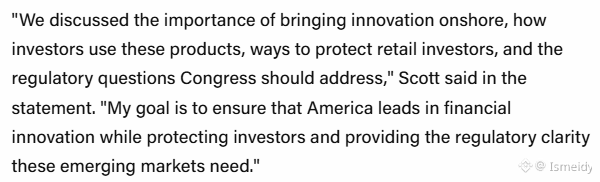
1
1
14
3.5k
Log in to explore more content
Join global crypto users on Binance Square
⚡️ Get latest and useful information about crypto.
💬 Trusted by the world’s largest crypto exchange.
👍 Discover real insights from verified creators.
Email / Phone number
Trending Topics
BitcoinClears$85200
15,759 views
237 Discussing
We got the move, and $BTC is standing exactly where we were before the data. That’s what actual patience for a trade looks like.
The data came in mixed but with some important numbers. ADP Non-Farm Employment Change came at 90K vs 73K forecast, while Core PCE came in at 0.2% vs 0.3% expected. Final GDP was also stronger at 2.2% vs 1.5% forecast, while Personal Spending came in at 0.9% vs 0.8% expected. At the same time, Personal Income missed at 0.2% vs 0.5% forecast.
BTC initially surged to $85,600 and is now back where it needs to be. I’m still looking toward the lower ranges at $82,759 and the $80,000 liquidity, because the overhead liquidity is done and dusted.
We had a live session during the data, and during that session we saw the market at $83,800, then $85,600, and then back toward $83,000 and we still didn’t enter a trade.
That’s what patience is.
We can’t force an entry when the market has no clear direction. The same range is still in focus, and we’ll wait for the market to give us the setup.
Let me know, guys, how was the session? And should we have more regular sessions with our respected members so we can have proper discussions regarding the market?
#BitcoinClears$85200 #AltcoinSeasonIndexHoldsAbove60For5Days #USADPAdds90000JobsInSeptember #BitcoinSlipsBelow$84000 #SECToClarifyOnChainFundraisingRules
Crypto_LUX
·26 Likes
·22.8k views
AltcoinSeasonIndexHoldsAbove60For5Days
78,548 views
1,292 Discussing
USADPAdds90000JobsInSeptember
35,288 views
713 Discussing