
TomCat1688
312 Posts

TomCat1688
Report
Block User
美股与加密双市场观察员,专注宏观周期与链上数据。
用概率思维拆解趋势,每日复盘市场关键节点
Open Trade

BTC Holder
Frequent Trader
1 Years
58 Following
11.2K+ Followers
2.0K+ Liked
Posts
Portfolio
All
Quotes
Videos
·
--
Verified
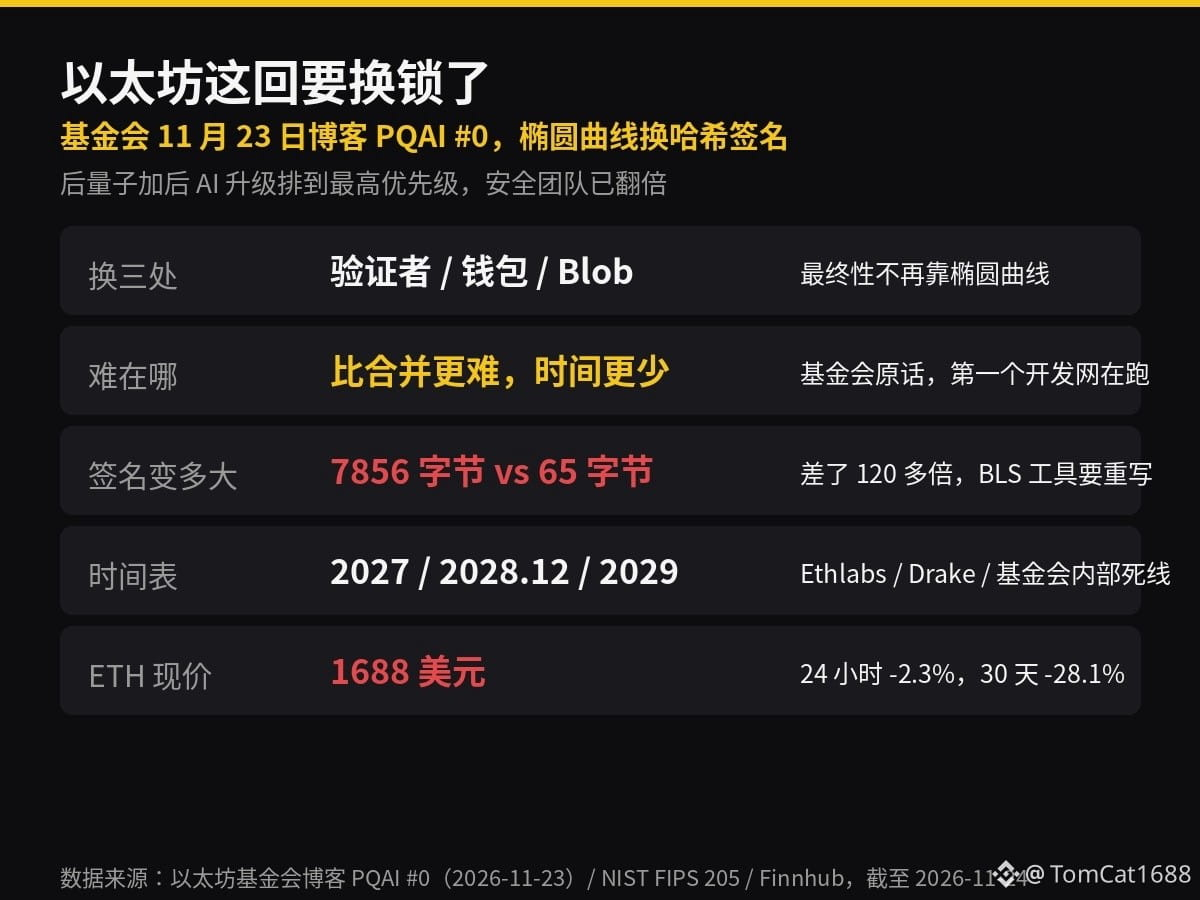
Ethereum is changing the lock again this time
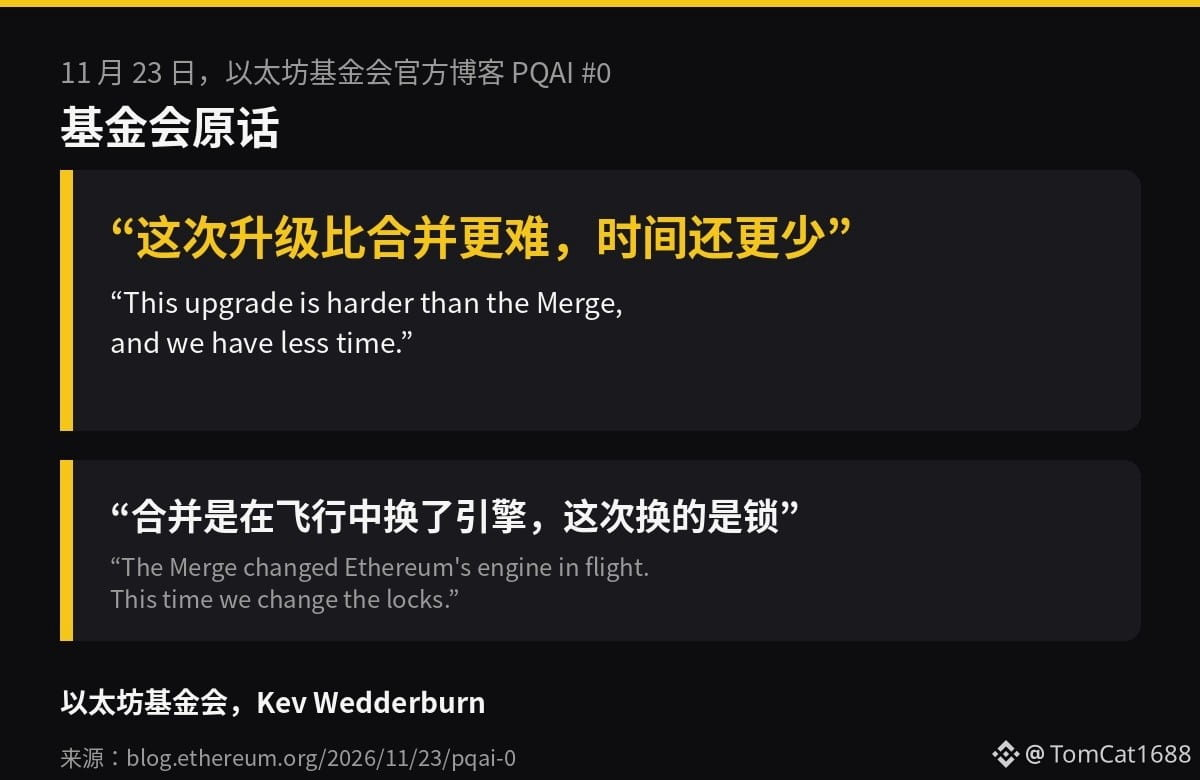
On November 23, the foundation blog’s PQAI Issue 0 set the tone in one sentence
Elliptic-curve signatures have been used for so many years
Now they’re going to be replaced with hash signatures
This has been placed at the highest priority
Changing the lock means changing three parts
Validators’ signatures will no longer rely on elliptic curves
Wallets need to give users a way to migrate
The blobs that supply data to Rollups also need to switch to hash commitments
Why now
Quantum has not arrived yet
AI has arrived first
Models finding vulnerabilities are already faster than manual review
Even the Linux kernel has had thousands of issues uncovered
The foundation’s view is
Rather than betting that the mathematical assumptions behind elliptic curves can withstand AI
It is better to switch earlier to a more conservative hash
The cost is also stated very plainly
The new signatures are much larger than what exists now
Under the NIST standard, the smallest hash signature is 7856 bytes
The current ECDSA signature is only 65 bytes
That is more than 120 times larger
The BLS toolchain has to be rewritten
Features that have been in progress for years will have to be pushed back
Whether home nodes can handle it still needs close watching
The timeline is given in three tiers
Ethlabs is calling for 2027
Justin Drake gave December 2028 at Devcon
The foundation’s internal hard deadline is still 2029
It will be reviewed again in January next year
In the short term
ETH is now at 1688 dollars
It has fallen 28% over 30 days
This news is not enough to save the market
Changing the lock is a three-year project
Not next week’s catalyst
In the long term
The fact that a chain can replace its lock without stopping the chain itself
That alone is valuable
The Merge in 2022 already replaced one engine
This time it is replacing a more fundamental lock
Just watch two windows
Which features get cut from the remaining ACD calls this year
And whether the January timeline review gives a clear answer
#以太坊基金会计划转向哈希签名 #以太坊 #ETH #后量子 #PQAI
1
2.8k
·
--
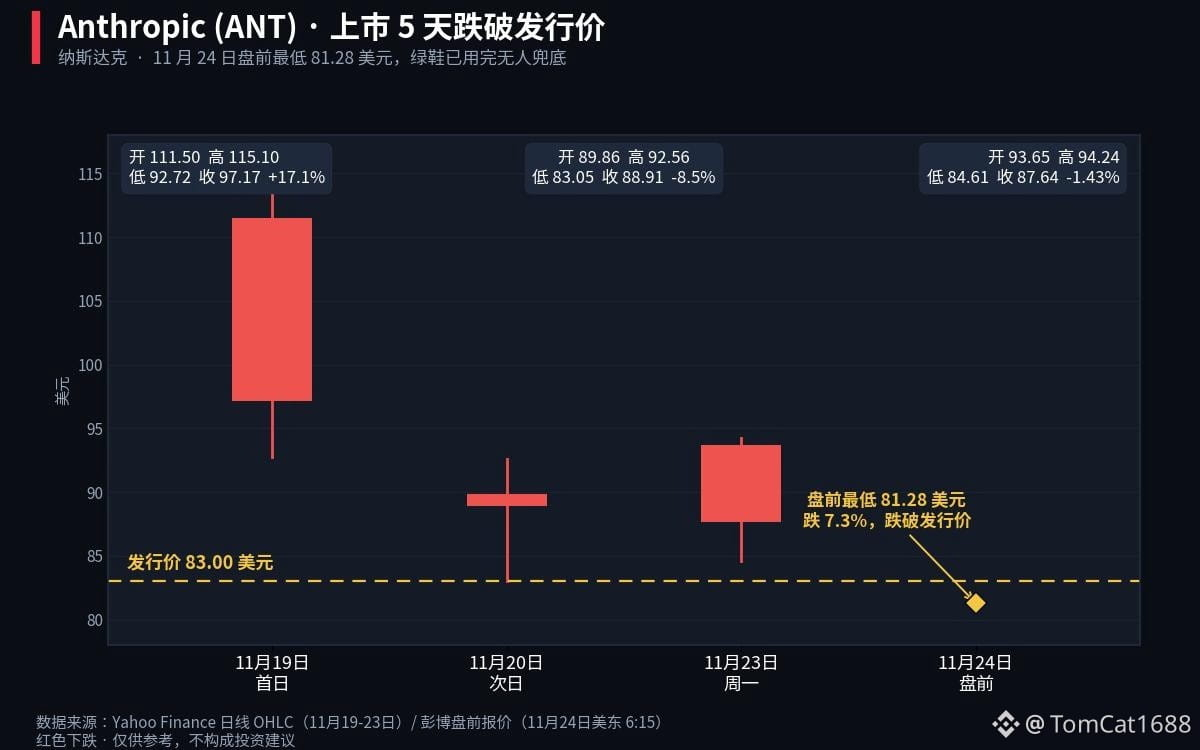
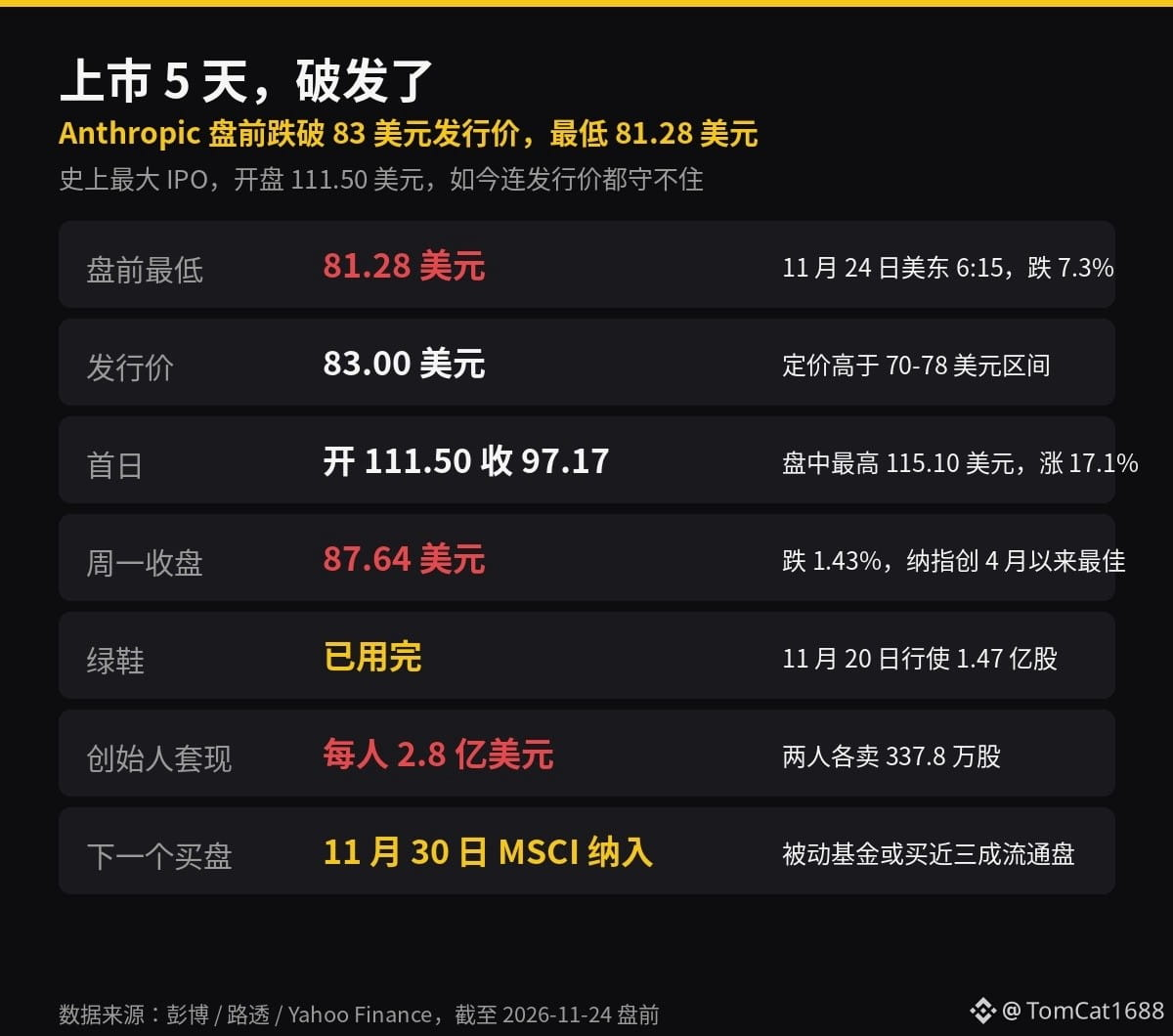
It broke below issue price just 5 days after listing.
Anthropic fell to $81.28 in pre-market trading, wiping out the $83 issue price. It opened at $111.50 on November 19 and closed at $97.17 on day one; now it can’t even hold the issue price.
The most painful part is that the safety net is gone. Morgan Stanley fully exercised the 147 million-share greenshoe on November 20, and below $83 there is no ready-made buying support left.
The founders, meanwhile, got out first. On November 20, Dario Amodei and Daniela Amodei each sold 3.378 million shares at $83, taking in $280 million apiece. Their first trade was at $111.50, so they sold at a lower price and were in a hurry to sell.
The broader market was actually pretty strong on Monday: the Nasdaq had its best day since April, but Anthropic still fell 1.43% and closed at $87.64.
What can be counted on next is inclusion in MSCI on November 30. Passive funds may buy nearly 30% of the free float before year-end. Another batch of lockup shares will also be released on December 15.
A record-breaking IPO, and in just 5 days the $2 trillion valuation myth fell back below the issue price. After the opening, can the $83 line be reclaimed?
#Anthropic盘前跌幅扩大,已跌破83美元发行价 #ANT #美股 #AI
142
·
--
Bitcoin has taken another step toward being recognized on the books of U.S. regulators
This time, its role has changed: from collateral to an exchange’s own assets
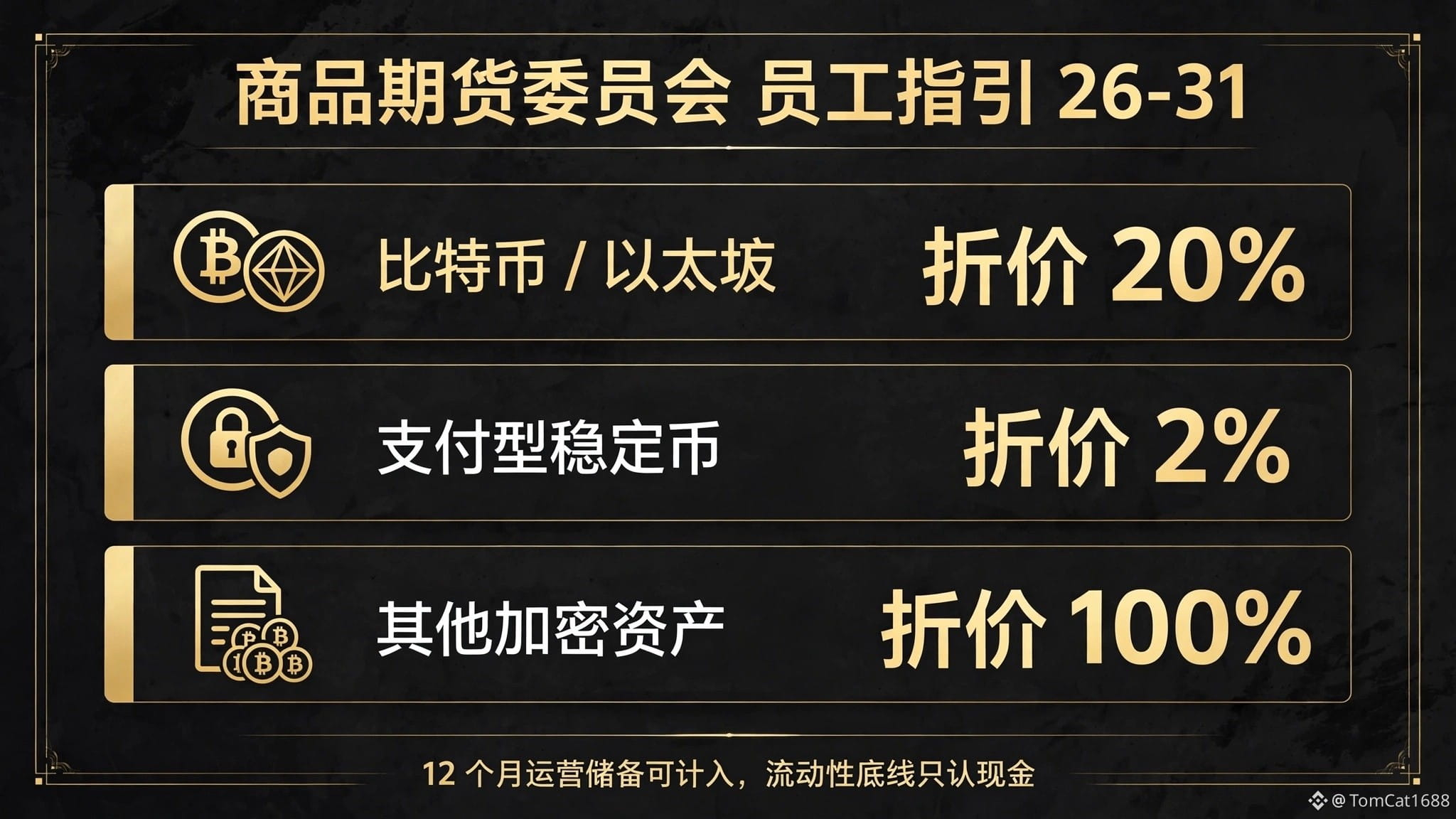
On November 23, the U.S. Commodity Futures Trading Commission issued staff guidance
Bitcoin and Ethereum held by regulated derivatives exchanges, swap platforms, and clearinghouses
may count toward their financial resources for 12 months of operating costs
But the haircuts are substantial
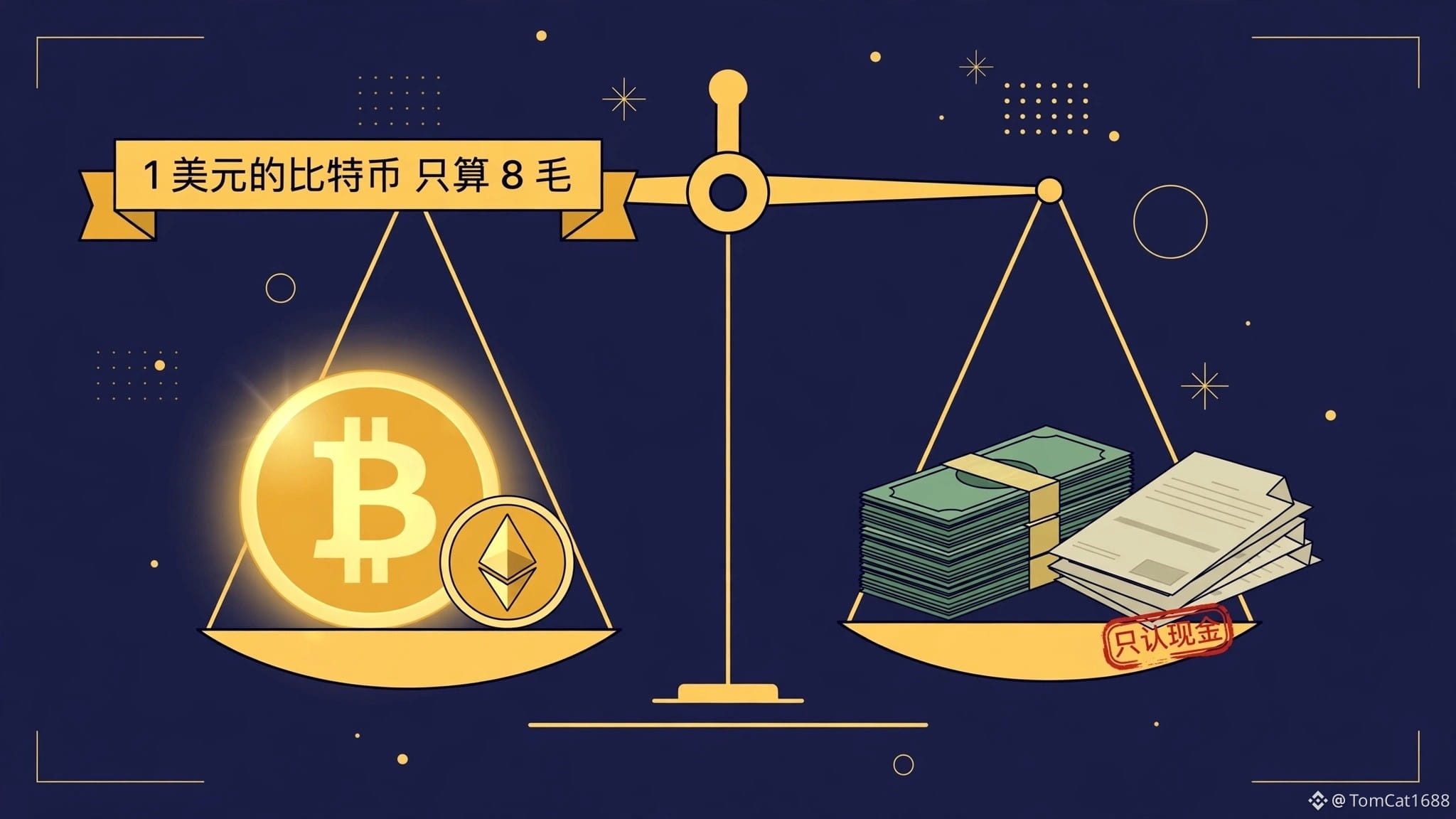
$1 of Bitcoin counts as only 80 cents
Payment stablecoins count as 98 cents
Other tokens count as zero
The most important point is buried later
Crypto assets cannot contribute a cent toward the funds that are truly needed in a crisis
Swap platforms must hold at least 3 months’ operating costs, and exchanges and clearinghouses at least 6 months’ worth
backed by cash or highly liquid securities
No matter how legitimate Bitcoin becomes, regulators still don’t consider it cash
This guidance is not a formal rule, either
It is only the views of staff from two divisions
And it does not cover the funds clearinghouses set aside to protect against member defaults
So don’t rush to call this a blanket green light
The regulators’ message is clear
Bitcoin can be an asset and can go on the books
But it still has a way to go before it can be used as money
BTC is currently around $60,400, down about 1.8% over 24 hours
#CFTC guidance requires BTC and ETH in operating reserves to be discounted by at least 20% #比特币 #以太坊 #美国监管 #CFTC
1
321
·
--
The company is trading on the market for less than the value of the coins in its treasury
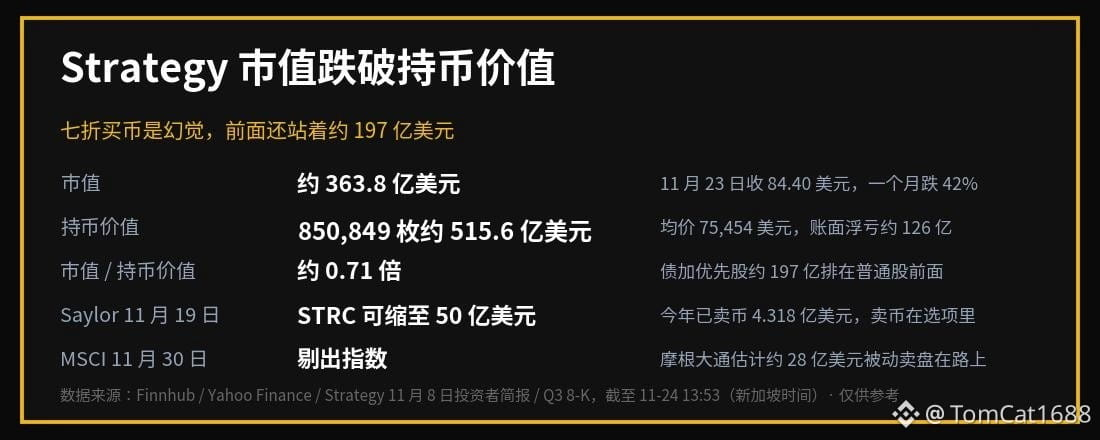
Strategy’s market cap is now about $36.4 billion
It holds 850,849 bitcoins, worth about $51.6 billion at today’s price of roughly $60,600
That’s a $15.2 billion gap—buying the stock is like buying the coins on its balance sheet at a 30% discount
But don’t rush to think you’ve found a bargain
That 30% discount is calculated using only the common stock
Debt and preferred stock of about $19.7 billion rank ahead of common shareholders, and interest plus dividends cost about $1.7 billion a year
Once you include all of that, enterprise value is about $51.1 billion—roughly equal to the value of its bitcoin
The market isn’t giving away bitcoin; it’s pricing in this leverage and the annual $1.7 billion bill
More importantly, Saylor himself has already softened his stance
On November 19, he told investors that STRC could shrink from about $7.7 billion to $5 billion, without raising its 12% dividend
If buybacks aren’t enough, selling coins is also an option. This year, the company has already sold $431.8 million worth of coins—6,948 bitcoins
The board has also approved authorization to sell up to $1.25 billion worth of coins
Strategy, which never used to sell its coins, has now added selling them to its toolkit
At the close on November 30, MSCI is also set to remove it from its indexes
JPMorgan estimates that about $2.8 billion in passive selling is on the way
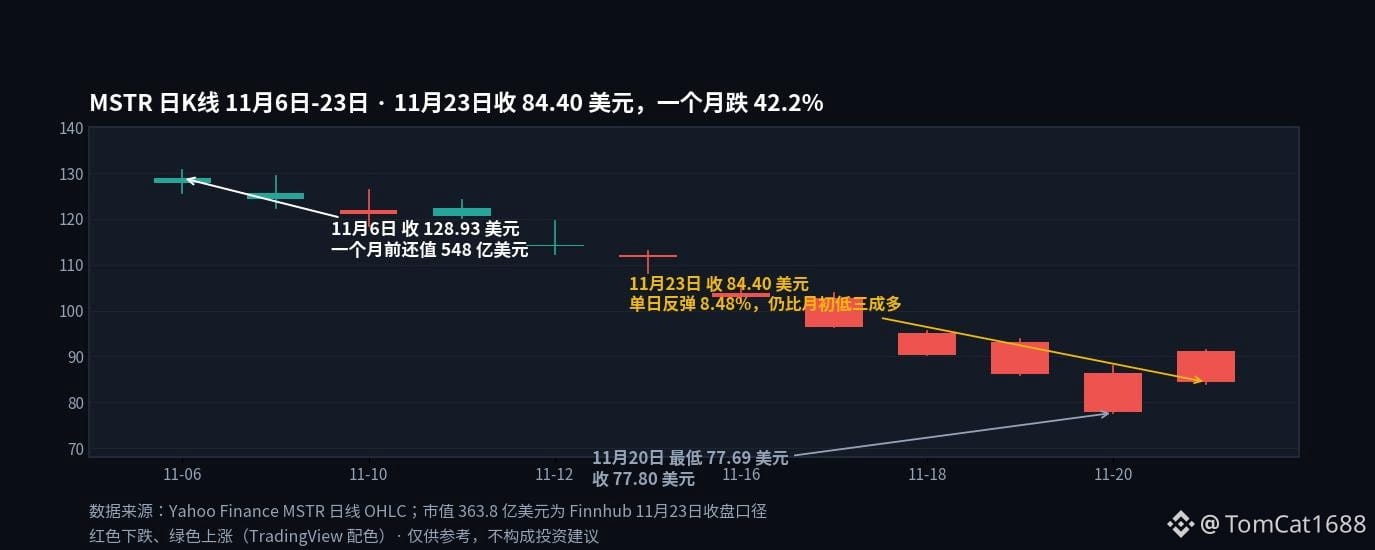
MSTR has already fallen 42% in a month, hitting a low of $77.69 on November 20
The discount itself isn’t an opportunity
The discount can only narrow if the price of bitcoin stabilizes
If bitcoin keeps falling, the discount will only widen
#Strategy市值跌破其比特币持仓价值 #MSTR #比特币 #USStocks
331
·
--
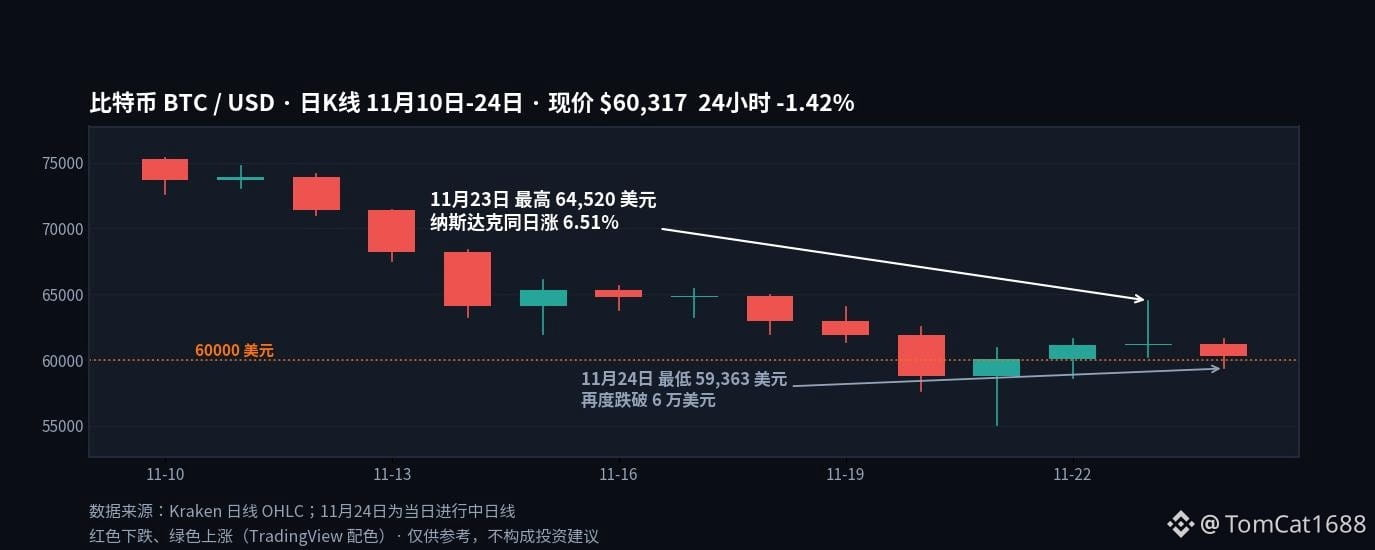
The Nasdaq rose 6.51% last night, its best day since April
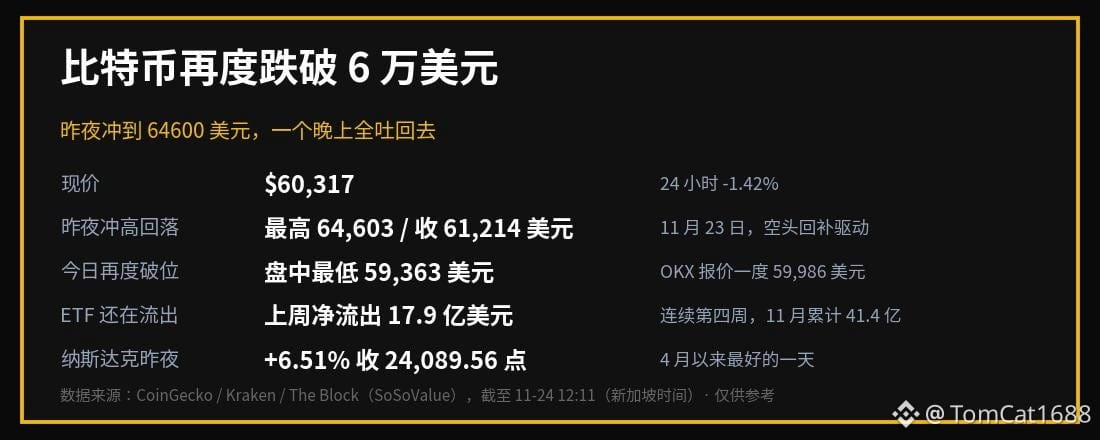
Bitcoin rode that wave for just half a day, surging to around $64,600 before getting knocked back down
Today it fell below $60,000 again, hitting a low of $59,363
No fresh money came in during this rebound
In the first hour of the rally, $68.82 million in short positions were liquidated, compared with just $1.64 million in longs
87% of liquidations were on the short side. Short covering pushed prices up, while spot holders quietly sold
According to Tealstreet data, net spot selling was around 1,780 bitcoins, and selling pressure on Coinbase is also picking up
What stings even more is the ETF picture
Last week, U.S. spot Bitcoin ETFs saw $1.79 billion in net outflows, marking a fourth straight week of outflows and the biggest weekly outflow since late June
BlackRock's IBIT alone accounted for $1.37 billion. Since November began, total outflows have reached $4.14 billion
Total ETF assets have shrunk from $110 billion in mid-September to $71.35 billion. Money is flowing out, not in
This rally in U.S. stocks is backed by earnings and Nvidia's comeback, giving it solid footing
No fresh money is coming into crypto, so a rally just provides liquidity for those above to sell into
First, let's see whether $58,000 can hold. If it doesn't, the next level is the network-wide average cost basis of $53,500
The weekend low of $55,100 is the last psychological line of defense
Tomorrow night at 9:30, October core PCE will be released
This figure will determine whether a December rate hike is really on the table. Don't rush to buy the dip tonight
#比特币 #BTC #ETF #纳斯达克 #PCE
1
1
254
·
--
Bullish
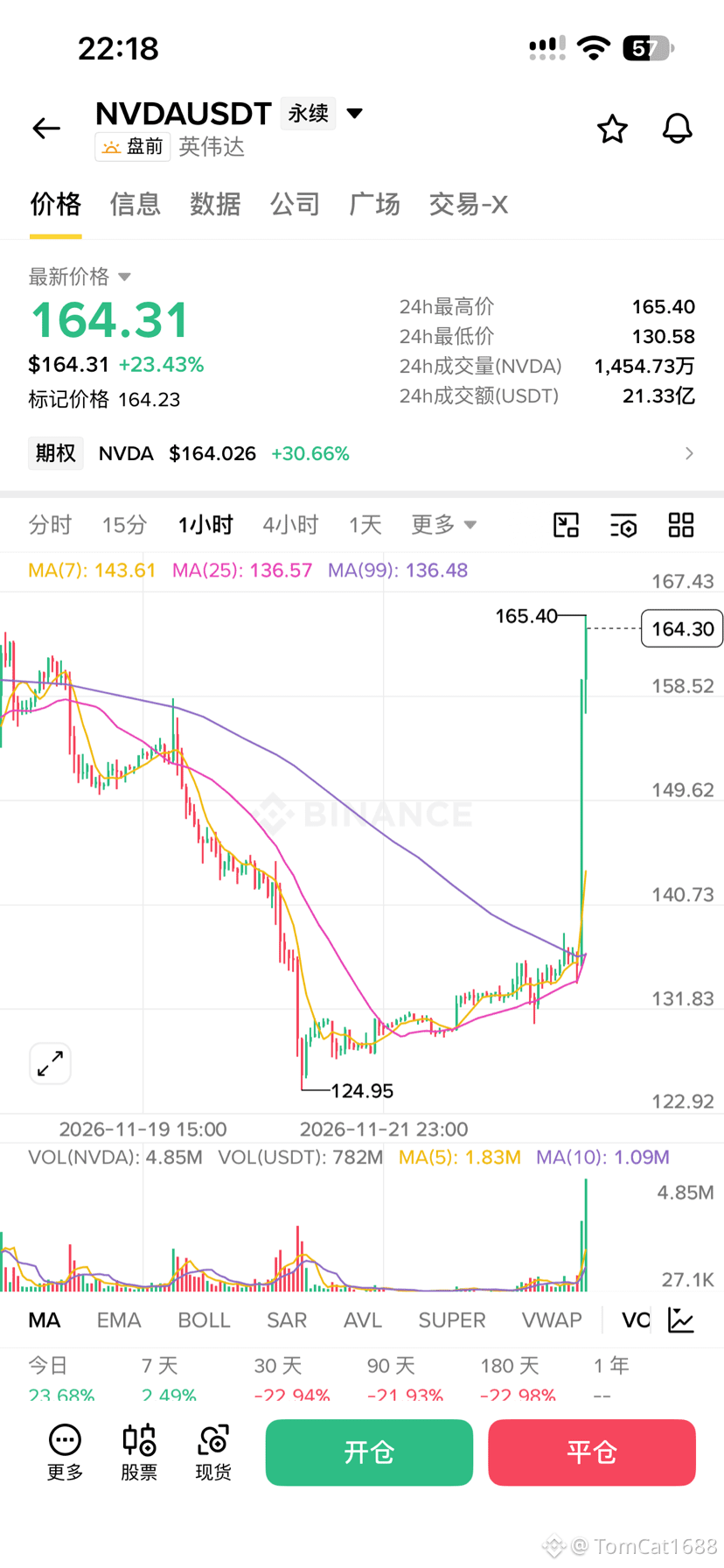
Holy shit, Jensen Huang is back in his role
$NVDAB is surging!!
Holy shit, Jensen Huang is back in his role
$NVDAB is surging!!
$NVDAB is surging!!
1
130
·
--
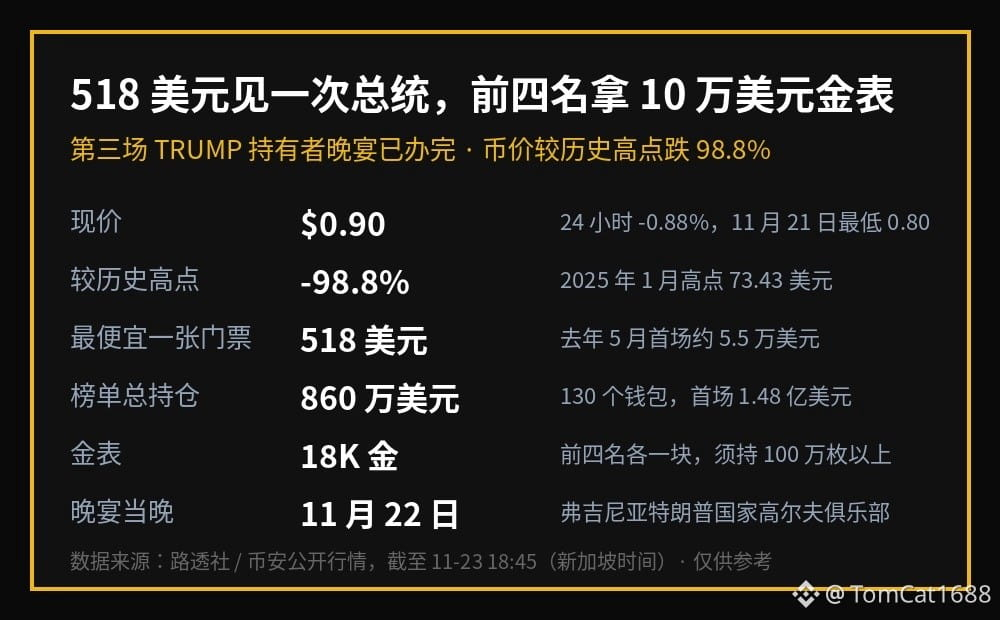
$518 can get you dinner with the US president.
At the first event last May, getting in required at least $55,000 worth of TRUMP coins.
At this year's third event, on November 22, someone bought just $518 worth of coins, ranked 179th, and got an invitation.
The dinner was held at Trump National Golf Club in Virginia. The top 185 were invited, and the top 29 also got a VIP reception.
The top four got something even better: an 18K gold watch each. It was the same tourbillon watch Trump wears, retailing for $100,000 apiece.
The requirement was to hold at least one million coins. At today's price, the coins in those four wallets are worth a combined total of around $3.6 million.
But the cheaper this dinner gets, the more it shows just how far this coin has fallen.
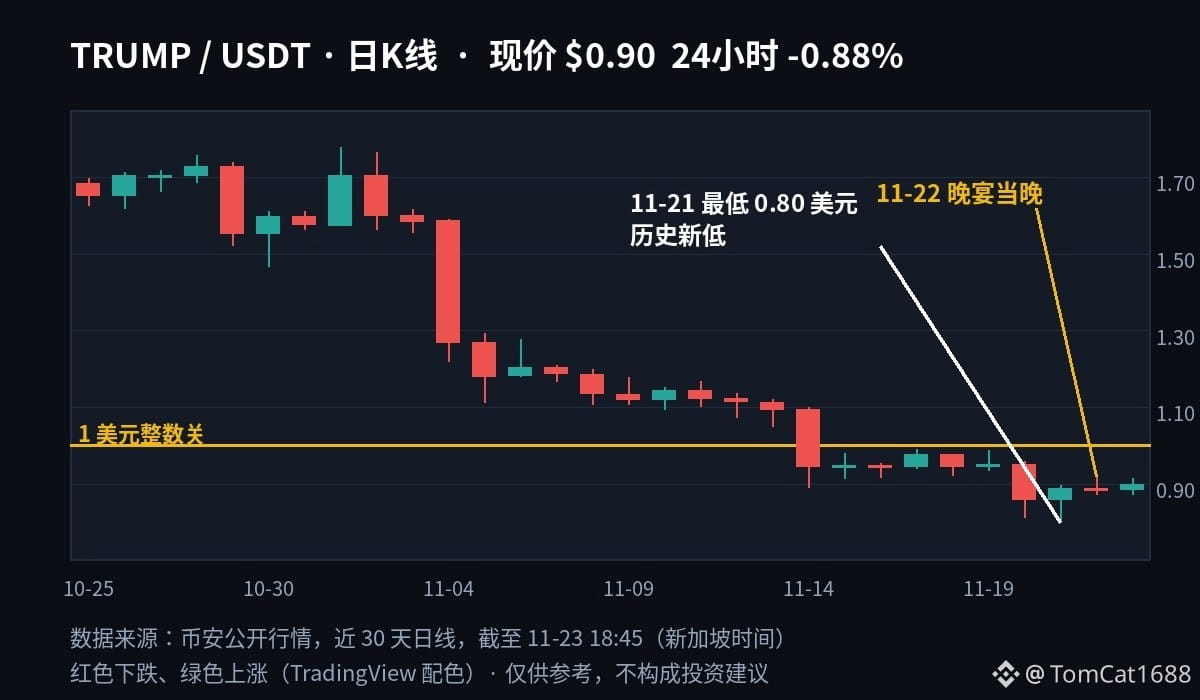
TRUMP is now at $0.90. After launching in January last year, it surged to $73.43, then fell 98.8%.
The day before the dinner, on November 21, it dropped to $0.80, a new all-time low.
There were only 130 wallets on the leaderboard, with a combined $8.6 million in holdings. For last May's event, the figure was $148 million.
The wallet in first place is now worth only about $1.65 million. Last year's top wallet was worth $18.5 million.
What's interesting is that not everyone who made the top 29 was actually putting real money on the line.
Morten Christensen, founder of the airdrop platform Airdrop Alert, told Reuters that he made it into the VIP group with a time-weighted holding worth $41,000. He hedged with perpetual futures and basically didn't lose money.
The rankings only looked at wallet balances, not hedges.
The scoring period ran from September 30 to November 16. During that time, the coin's price fell from $2.05 to $0.95. People who simply held for all seven weeks lost half their money, while those who hedged still made it into the VIP group.
Trump spoke for about 40 minutes onstage. He said he was doing this for America: “If we don't do it, China will.”
But the books need to be kept separately. Reuters reported that Trump has already made hundreds of millions of dollars from this coin. According to Nansen data, by the end of June this year, nearly one million buyers had lost a combined $3.81 billion.
The organizers and the White House didn't respond to questions about who received the gold watches or whether the top four actually held one million coins each.
The dinner is over. The coin is still hovering around $0.90, unchanged.
The price of a ticket to a presidential dinner went from $55,000 to $518, and there's still no one stepping in to buy the coin. Do you think this dinner is keeping the coin alive, or just keeping it in the spotlight for a little longer?
#特朗普将向TRUMP前四大持有者赠18K金表 #TRUMP #Meme币 #Trump
1
108
·
--
Verified
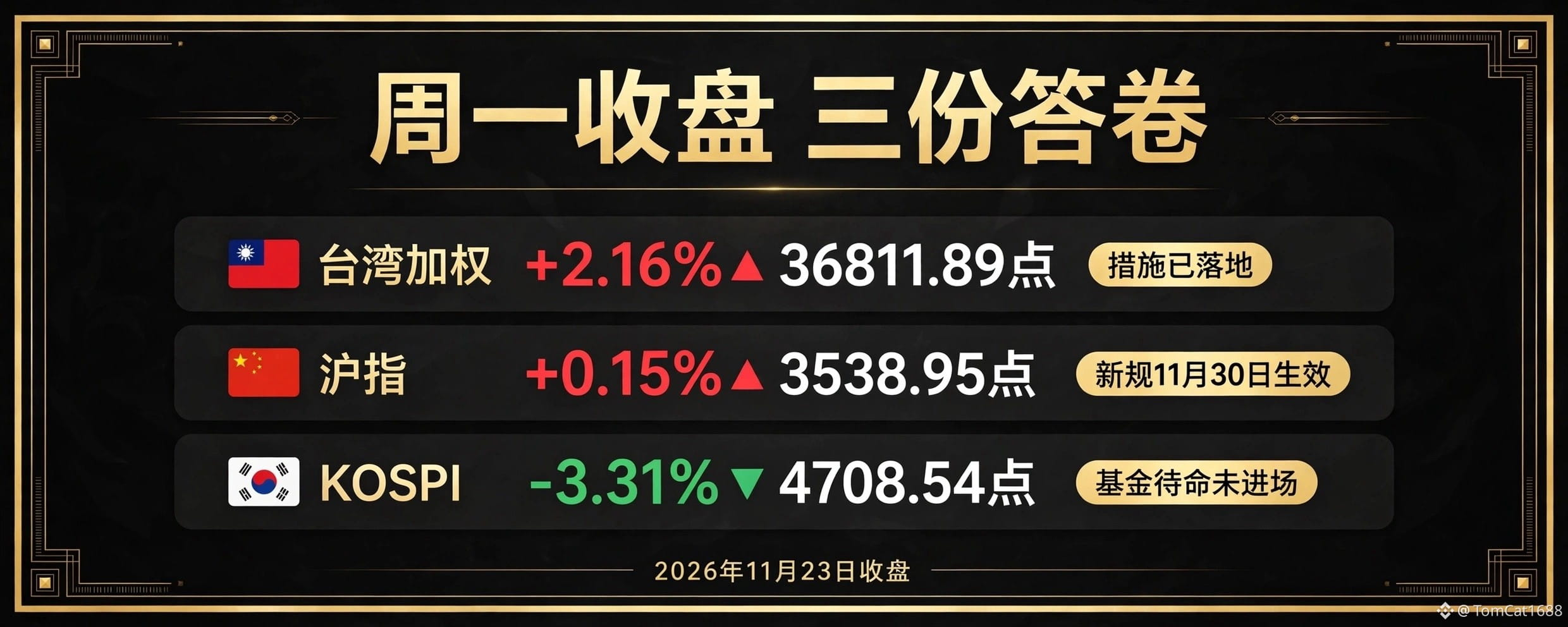
The same weekend rescue effort, but Monday’s closing bell brought three different outcomes.
Taiwan rose 2.16%, with the weighted index closing at 36,811.89. It briefly fell nearly 600 points intraday before recovering, with a full-day range of 1,665 points and turnover of NT$1.08 trillion.
South Korea fell 3.31%, with the KOSPI closing at 4,708.54, its lowest close since January 13. It hit an intraday low of 4,586, and even triggered a short-selling sidecar.
Mainland China’s A-share Shanghai Composite rose 0.15% to close at 3,538.95 after dipping below 3,500 intraday and then turning higher. The Shenzhen Component rose 1.93%, the ChiNext Index gained 3.08%, and more than 4,600 stocks advanced.
Same weekend assignment. Why did they get three different grades?
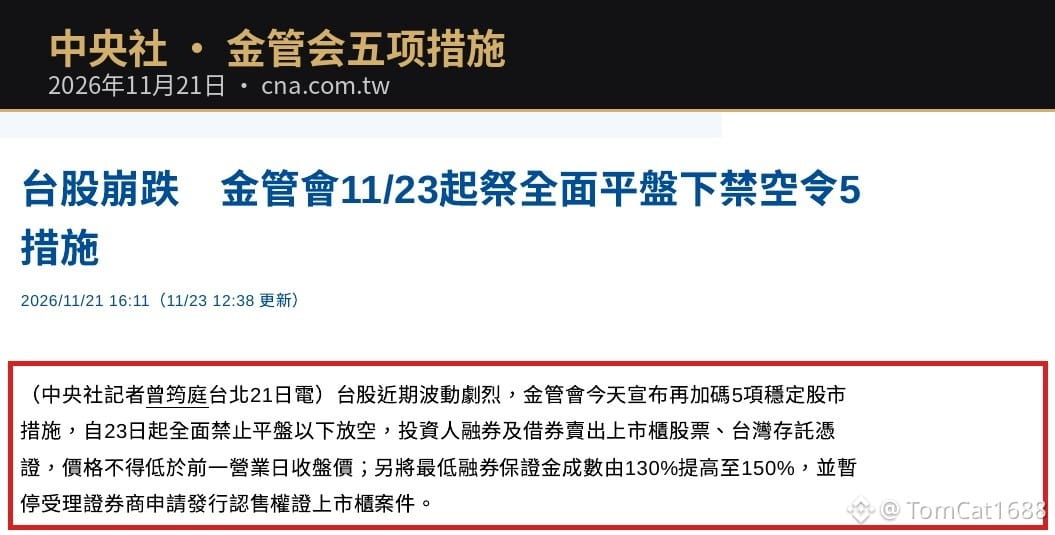
Taiwan was the only one of the three where the measures actually took effect. The five measures announced by the Financial Supervisory Commission on November 21 took effect on the 23rd: a blanket ban on short selling below the previous close, an increase in the margin requirement for securities lending from 130% to 150%, and a statement from the National Security Fund that it had already entered the market.
South Korea’s 10 trillion won stabilization fund is still on standby. An emergency meeting on the 22nd said only that officials were preparing to activate it. It would be the first time the fund had been used since 2008, but not a single won had been deployed by Monday’s close.
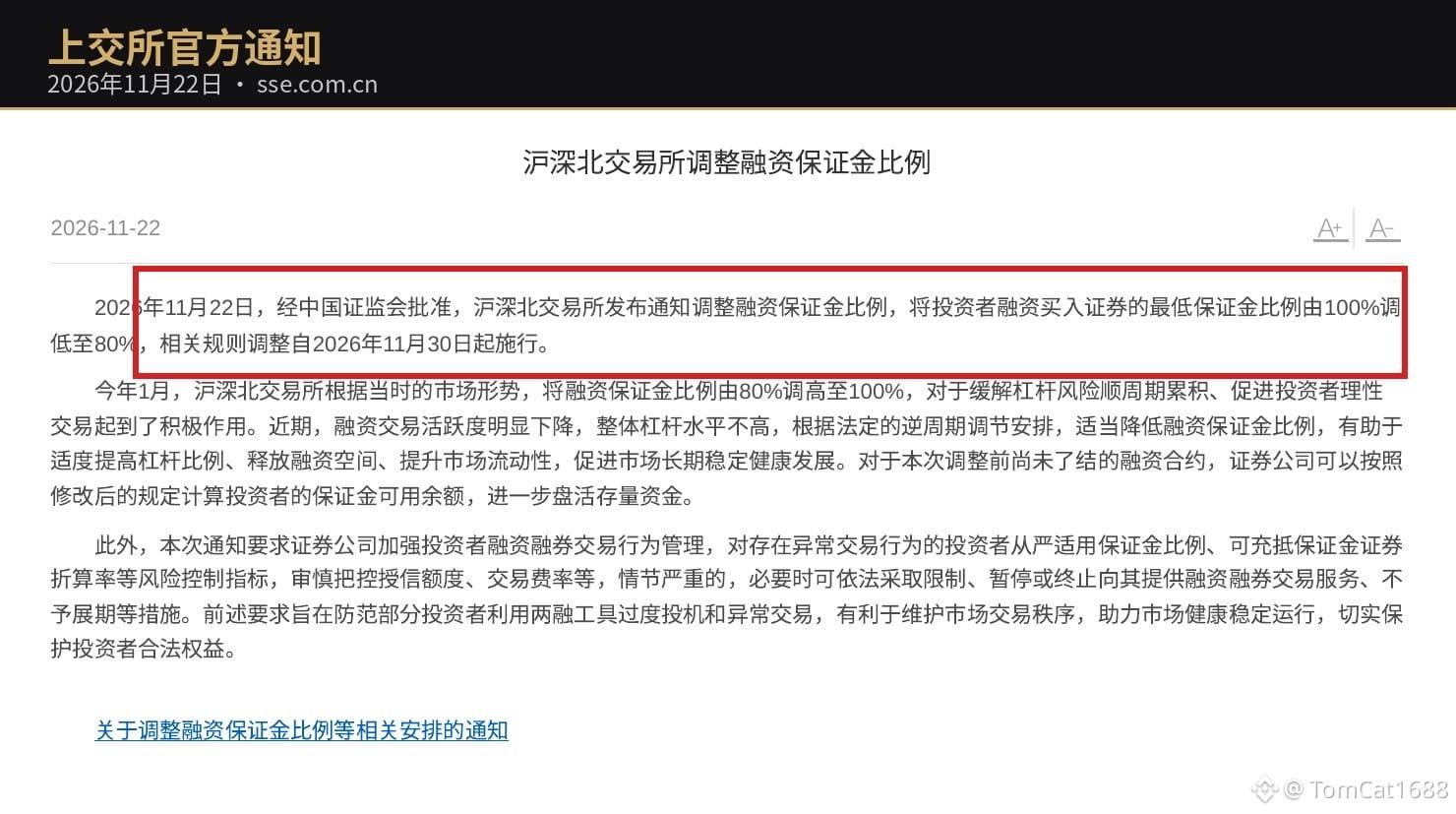
China’s big move has to wait until November 30. The margin requirement for margin financing will drop from 100% to 80%, theoretically bringing in nearly 400 billion yuan in additional funds, but it had not taken effect today.
Monday’s test came down to whether money and rules actually showed up that day. The volume of the announcements didn’t count.
There’s another detail in Taiwan’s answer sheet. The Taiwan market had just plunged 2,393 points on Friday, down 17.5% for the week—its worst week in 35 years. Yet MediaTek and Delta Electronics both hit limit-up today, while TSMC rose 1.5%. Dip-buying money was genuinely willing to step in.
South Korea was the exact opposite. Of 908 stocks, 824 fell. Foreign investors were net sellers of 247 billion won. Samsung fell 3%, and SK Hynix dropped 2.5%. News that the fund was on standby couldn’t stop the AI sell-off.
These three answer sheets also matter to crypto markets. $BTC climbed back above $61,000 today, after touching $55,000 over the weekend. Wherever panic in the stock markets first subsides is where risk appetite may first return.
Keep an eye on three things next.
When will South Korea’s 10 trillion won fund actually enter the market—or will it remain on standby?
When China’s new margin rules take effect on November 30, will the additional funds really arrive?
Can Taiwan’s rebound, driven by the short-selling ban, hold above today’s low of 35,442?
Rescue efforts begin with words. The answer comes when the money arrives.
#中韩台周一前准备股市救市措施 #全球股市 #KOSPI #台股 #BTC
8
8.9k
·
--
Cook has already revealed Wednesday’s answer ahead of time
October PCE is due right on time at 9:30 p.m. Wednesday, but the most exciting part may already have been spoiled
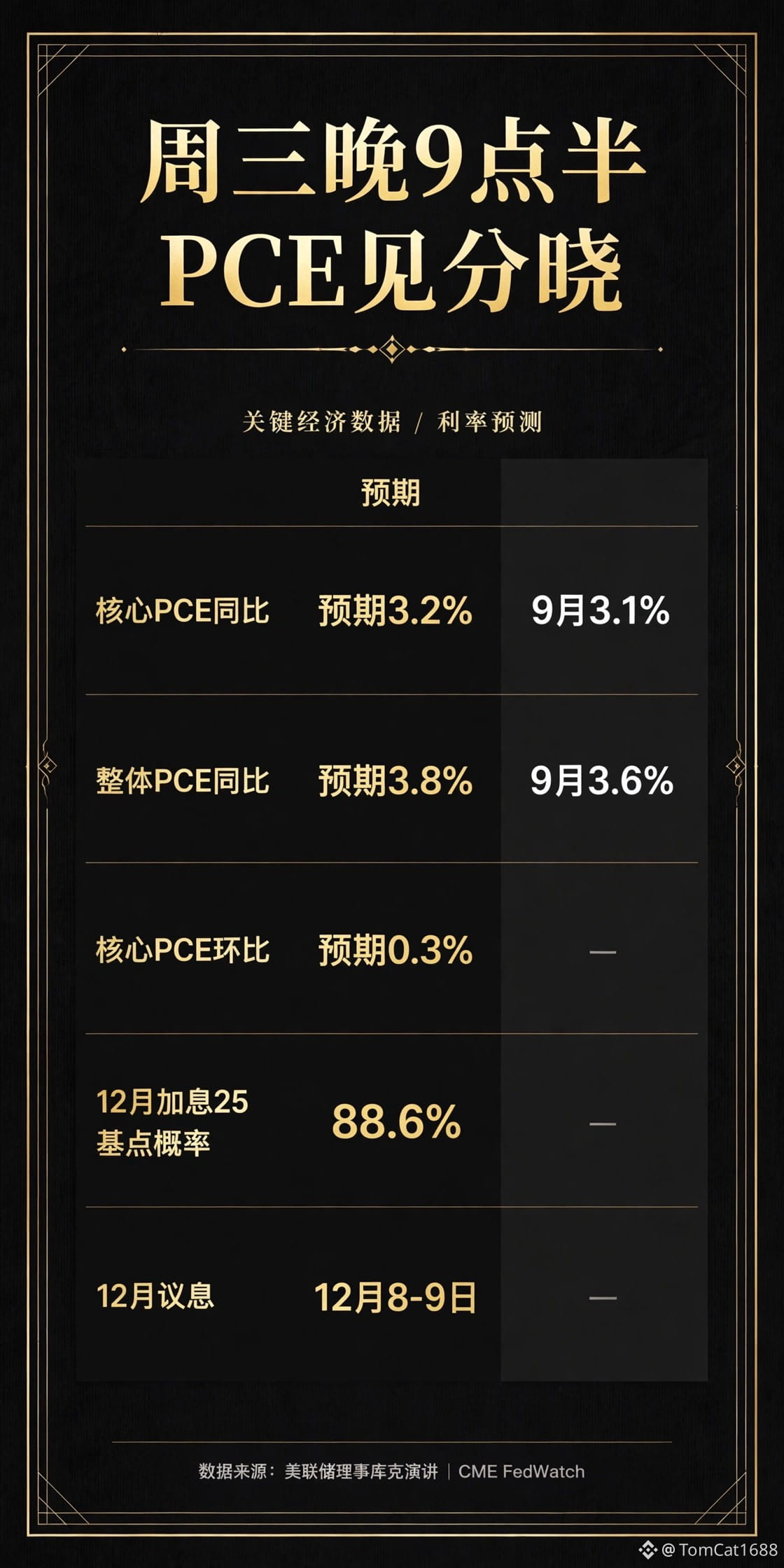
Fed Governor Cook gave the figures outright during a speech in Chile last Friday: headline PCE was up 3.8% year over year in October, and core PCE was up 3.2%
In September, they were 3.6% and 3.1%, respectively—which means inflation has pushed up another notch
This isn’t a rumor; a Fed governor calculated the figures herself and made them public. The official data won’t come out until Wednesday, but the market already has a good idea
So Wednesday’s real question is whether the figure will come in hotter than 3.2%
RBC’s forecast is more hawkish, putting core PCE at 3.3% year over year and 0.3% month over month
The Wall Street Journal’s Timiraos estimates that October core PCE rose about 0.29% month over month, equivalent to an annualized rate of 3.2%—the highest since January 2024. The three-month annualized rate is 3.5%, a six-month high
If the actual figure is close to Cook’s, a 25-basis-point hike in December is all but certain. CME FedWatch currently puts the odds at 88.6%
If the figure comes in hotter than 3.2%, the 50-basis-point hike Waller mentioned could go from tough talk to a real possibility
If the figure unexpectedly cools and falls back below 3.1%, that would be the fuel needed to keep the rebound going—and the prospect of a December rate hike would be back in question
Also due at 9:30 p.m. that night are the second estimate of third-quarter GDP and initial jobless claims, meaning three sets of data will hit at once
Bitcoin has just bounced from $55,000 to above $61,000, but it’s still down about 25% since November began. Whether it can catch its breath depends on this one figure Wednesday night
The December 8–9 rate-setting meeting concludes with a decision at 2 a.m. Beijing time on December 10. PCE is the last major inflation report before the meeting
Watch three figures: whether year-over-year core PCE can hold at 3.2%, whether the monthly figure exceeds 0.3%, and which way the odds of a December rate hike move after the release
#US October core PCE set to be revealed: How will rate-hike expectations change? #PCE #美联储 #比特币 #RateHike

140
·
--
In the UK, exchanges will no longer be allowed to act as the counterparty to your trades.
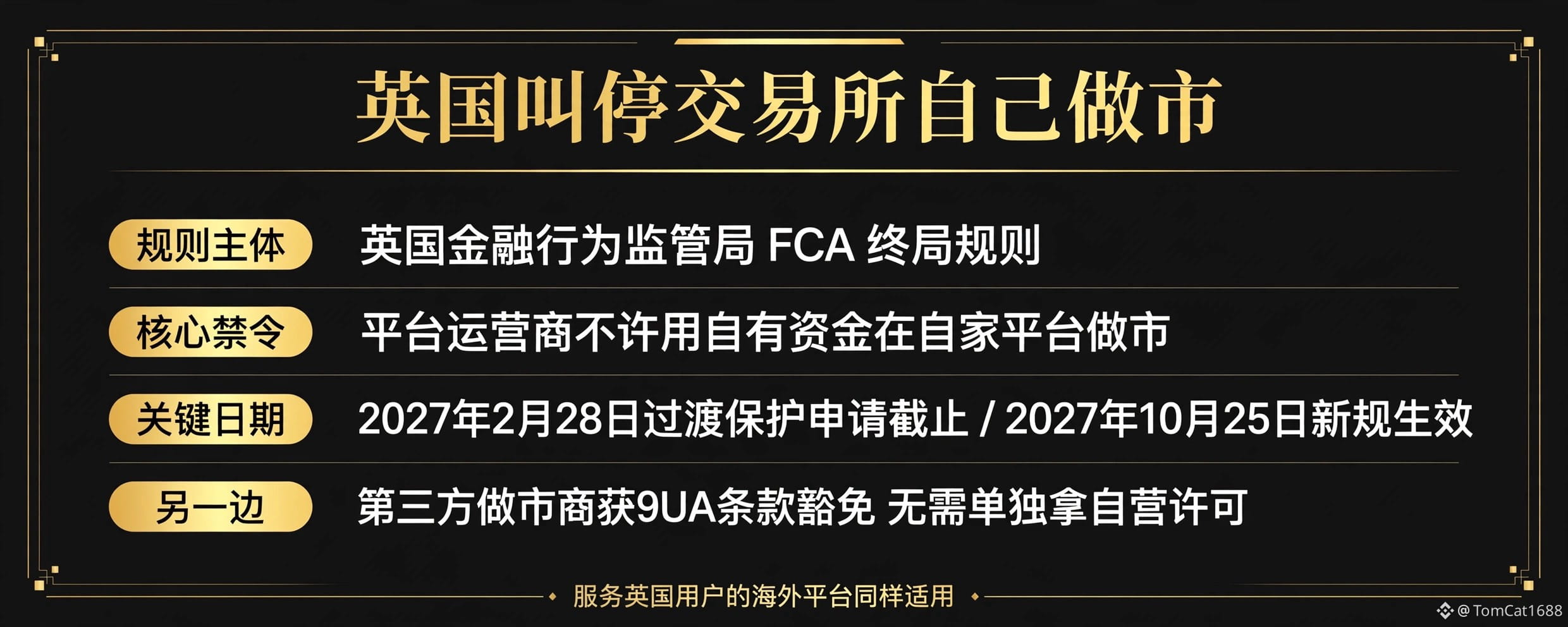
The UK Financial Conduct Authority has issued its final rules: operators of compliant crypto trading platforms are prohibited from market-making on their own platforms using their own funds. The rules take effect on October 25, 2027.
This targets a longstanding problem. An exchange runs the marketplace and also steps in as the counterparty, leaving users in the dark about who is on the other side. How prices move, how slippage is calculated, how sudden price spikes are explained—the platform has the final say on all of it. The FCA’s reasoning is straightforward: proprietary trading gives operators an unfair advantage.
The interesting part is what’s happening on the other side. Third-party market makers are actually getting more flexibility. On November 18, the UK Treasury signed an amended regulation adding Article 9UA. Independent third parties can now make markets on compliant platforms without obtaining a separate permission for proprietary trading. Spot Bitcoin is explicitly included.
Platforms aren’t completely barred from handling orders, either. They can execute orders for clients using matched-principal trading, provided they have additional permission and their execution rules leave no room for discretion in their own favor. Affiliated companies can also trade on the platform, but they can’t get better terms than other users.
The rules apply beyond the UK itself. Overseas platforms serving UK users must comply too. Operators must identify, record, and monitor users who make markets, and disclose the terms of any incentives.
Mark these two dates. February 28, 2027, is the deadline for applying for transitional protection; the new rules take effect on October 25, 2027. Once the list of applicants is published, we’ll see which platforms still want to operate in the UK.
The rules won’t directly make your coins go up or down, but they will determine whether the order book you trade on is clean.
Do you think an exchange acting as a market maker provides liquidity to the market—or is it betting against its users?
#英国将禁止加密交易所在自有平台做市 #英国加密监管 #FCA #交易所做市 #Bitcoin

2
4
2.1k
·
--
Verified
Crypto prices have just climbed back from $55,000 to $61,000, and the big players have already arranged to meet in Bangkok five days from now.
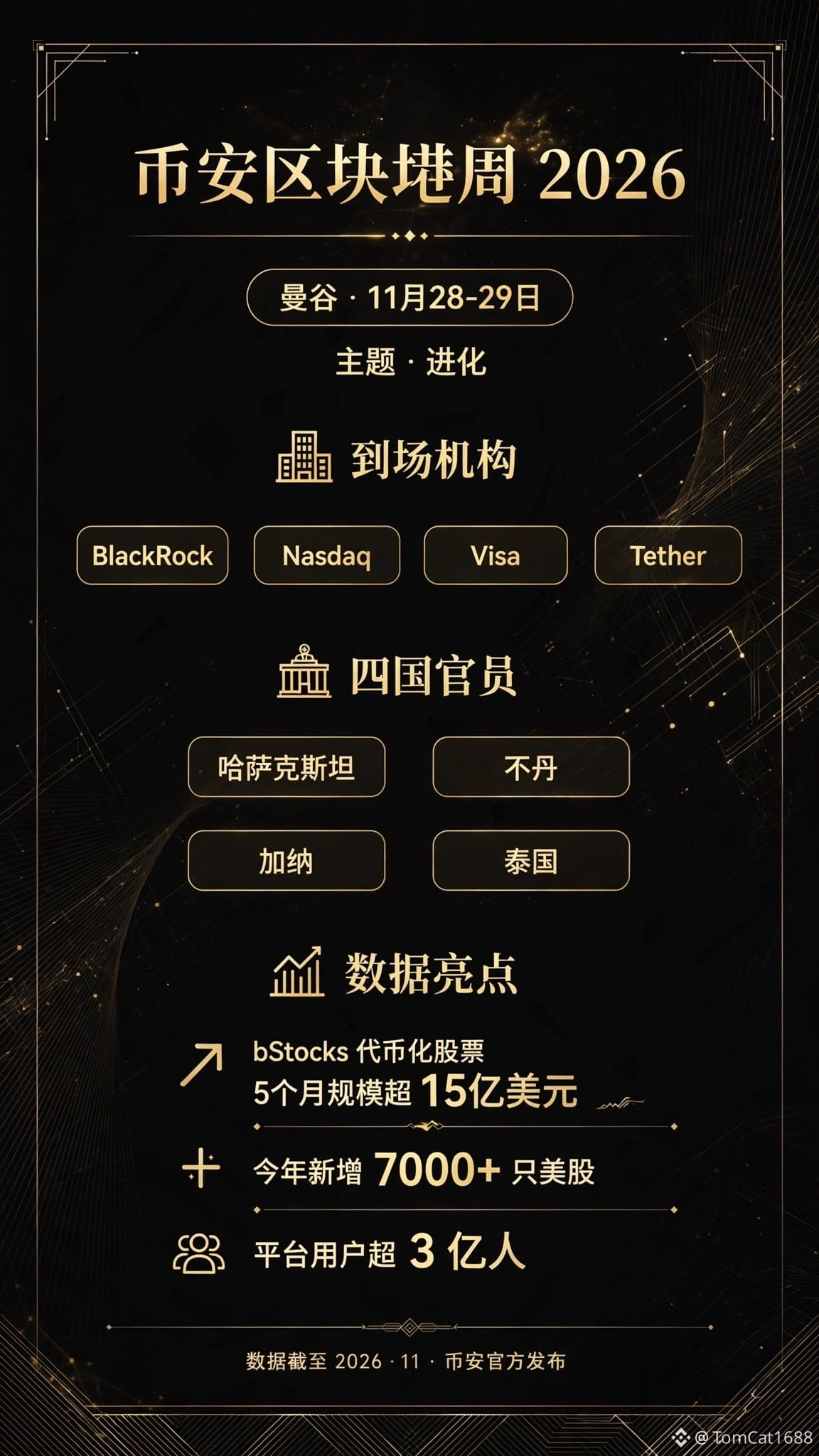
On November 28 and 29, Binance Blockchain Week kicks off in Bangkok. Its theme is simply: Evolution.
The guest list is more compelling than the market action. Executives from BlackRock, Nasdaq, Visa, and Tether will all be there, along with officials from Kazakhstan, Bhutan, Ghana, and Thailand.
Day one is about how capital is evolving. Richard Teng will open with a talk on where the next three billion users will come from. BlackRock and Nasdaq will also discuss one specific question: Will capital markets ever close again?
On day two, He Yi will open with a talk about how Binance is evolving from an exchange into a platform where you can trade just about anything.
One of the most noteworthy sets of figures lies beyond the spotlight. Binance has added more than 7,000 US stocks this year. Five months after tokenized stocks called bStocks launched, their total value has already surpassed $1.5 billion, with 70% of trading volume coming from emerging markets.
In a bear market, prices fall. Traditional finance is moving on-chain—and doing it faster than anyone can talk about it.
In five days, Bangkok will reveal where these players are really taking the market.
#币安区块链周进化由你 #比特币 #美股代币化 #BlackRock

BTC-4.51%
BLKUS+0.84%
1
4
2.1k
·
--
1.27 million people—all on the list. South Korea is serious about recording every single crypto asset sent overseas.
The new rules take effect on December 3. Exchanges in South Korea must report every cross-border transfer by 11 a.m. the following day. The time, asset type, amount, equivalent value in Korean won, fees, and information about both sender and recipient—all of it must be included.
More than 1.27 million users across the five major exchanges have made at least one cross-border transfer since July 2024, and all of them are within the scope of the review. The data must also be shared with the National Tax Service, Korea Customs Service, Financial Supervisory Service, and Korea Financial Intelligence Unit.
This isn’t a sudden crackdown. The Travel Rule threshold was already eliminated in August this year, meaning even transfers under 1 million won have to be reported. On November 15, a lawmaker proposed a new bill: users would have to verify their identity before withdrawing crypto to their own cold wallets, and transfers to non-compliant overseas platforms would be banned outright. Today, the chair of the Financial Services Commission reiterated the point.
Just last week, there was talk of allowing 3,500 listed companies to invest in Bitcoin. Meanwhile, the door for sending funds overseas keeps getting tighter. Money can come in, but if it goes out, your name has to be on the record.
Do you think this crackdown is mainly about preventing money laundering, or stopping capital outflows?
#韩国将加强加密境外转账监管 #比特币 #韩国加密监管 #CrossBorderTransfers


1
3
7k
·
--
Verified
A week ago, he said Nvidia had to find an outsider to take over.
Today, he personally opened the door a crack.
On Sunday, U.S. Treasury Secretary Bessent was asked on CBS whether Jensen Huang could come back.
He didn’t say yes, and he didn’t say no.
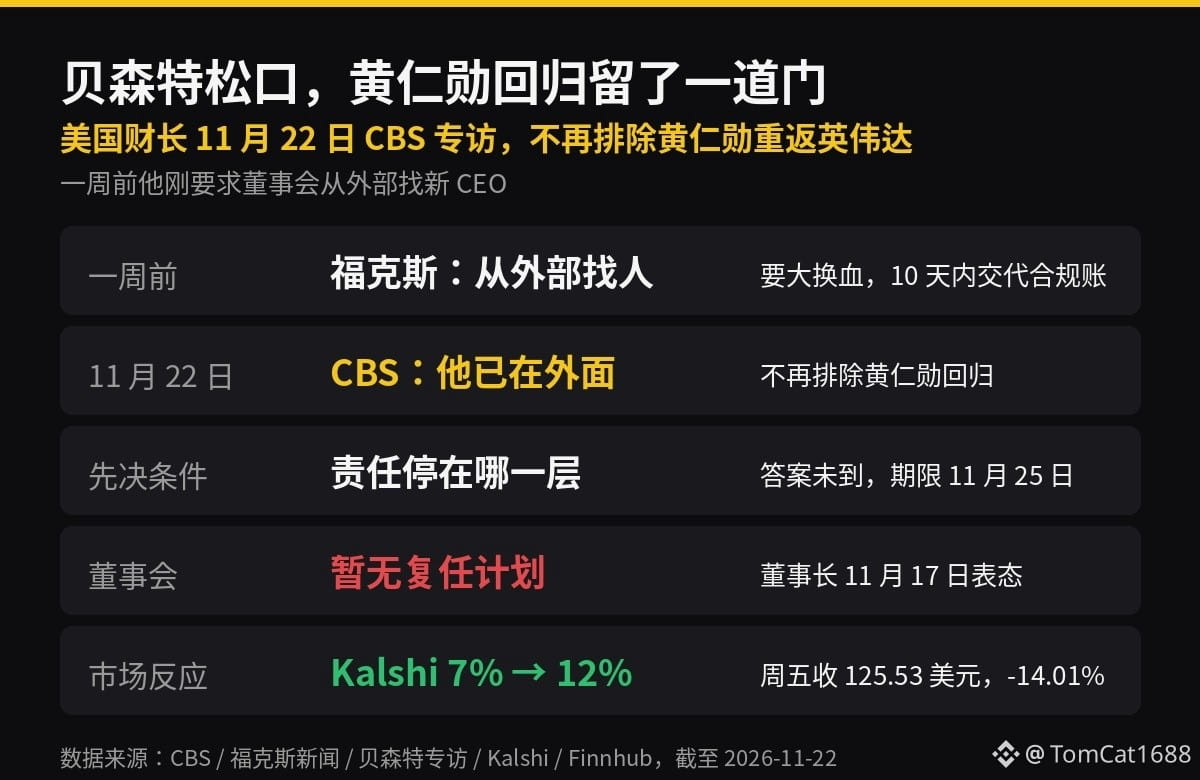
He just replied, “He’s already out there now.”
A week ago on Fox, he struck a very different tone.
Back then, he wanted a major overhaul and the board to find someone from outside.
He also gave Nvidia 10 days to account for its export compliance.
Now his words have changed, but the conditions haven’t.
Bessent is still saying, “First, we need to see where responsibility stops.”
The Treasury still hasn’t gotten the answers it wants, and November 25 is the deadline.
Trump has already made his position clear: he hopes Jensen Huang will come back.
Huang himself is weighing his options. BI says he’s received calls from Trump, Altman, and Nadella in recent days.
A Silicon Valley petition has already gathered more than 160,000 signatures.
But the board hasn’t budged yet.
The chairman said on November 17 that they weren’t planning to reinstate Huang.
Interim CEO Colette Kress is still at the helm.
The market, though, has already moved.
On prediction market Kalshi, the odds of Huang’s return rose from 7% to 12%.
Nvidia closed Friday at $125.53, down 14% for the day and nearly half off its October high.
The door’s cracked open. Can he squeeze through?
First, we’ll see what the compliance answers say on November 25.
#BessentChangesHisTuneOnHuangAsNvidiaReturnHopesRise #英伟达 #JensenHuang

1
2
2.9k
·
--
The guy who just borrowed $40 billion to buy GPUs is now warning the entire industry it could run out of money next year
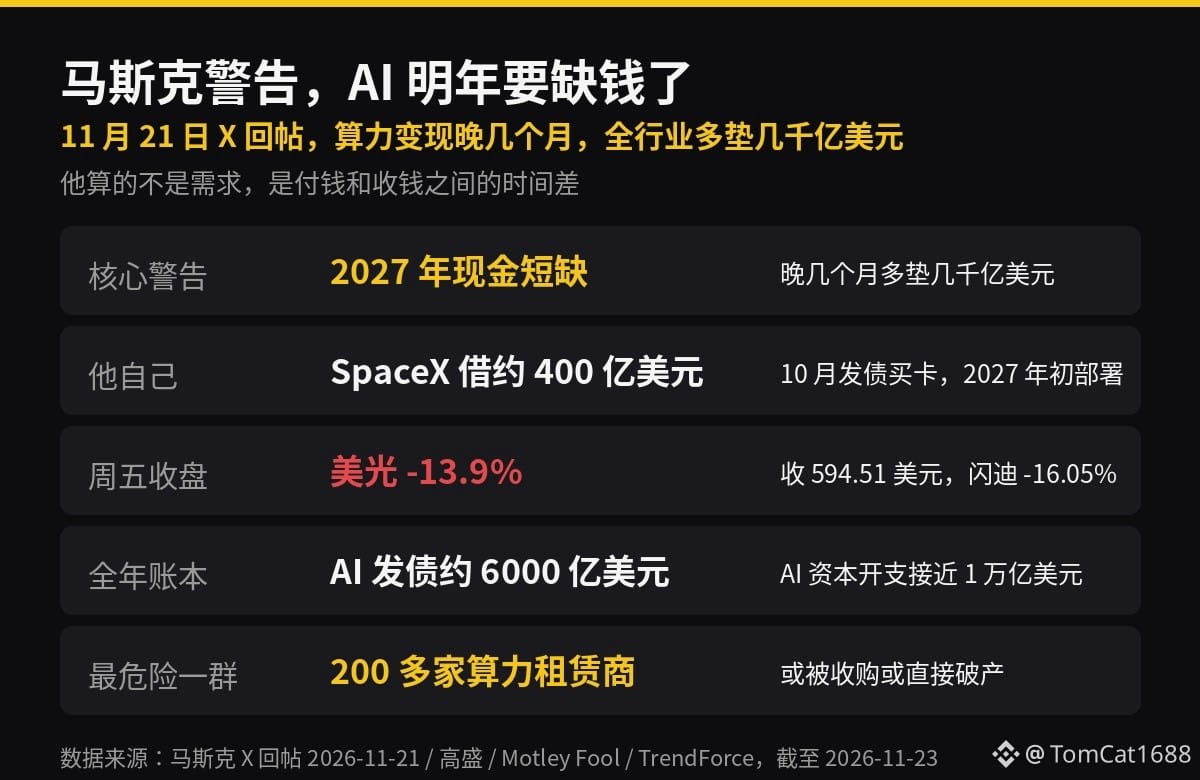
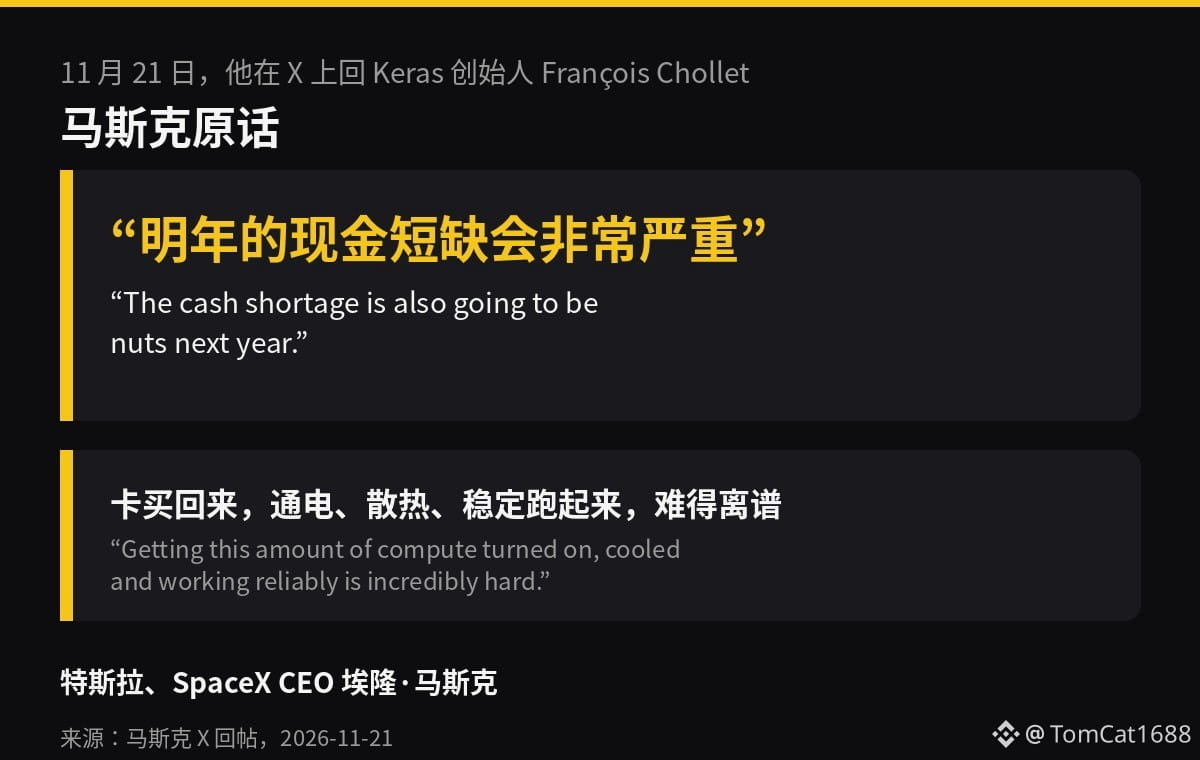
On November 21, Musk replied to François Chollet on X, saying the AI industry would face a severe cash crunch in 2027. After the GPUs are bought, it takes months to get them powered up, cooled, and running reliably. During those months, the entire industry will need to put up hundreds of billions of dollars more in working capital. He asked himself: Where will the money come from?
Demand hasn’t collapsed; it’s the timing gap that’s causing trouble. Spot GPU prices are still rising, and HBM and DRAM capacity is booked through 2029. Chollet thinks chip stocks are a rare buying opportunity. Musk didn’t dispute demand—he was doing a different calculation. Months separate spending the money from earning it back, and the more leveraged you are, the harder those months are to get through.
He’s one of the biggest borrowers himself. In October, SpaceX borrowed about $40 billion to buy GPUs, which it plans to deploy in early 2027, with payments starting in the first half of next year. Before warning others, he’d already put himself in the same boat.
The market has already cast its vote. Last Friday, Micron closed down 13.9% at $594.51, while Sandisk fell 16.05% to $79.24. Even with orders booked through 2029, the stocks are still falling. TrendForce also expects NAND contract prices to drop in the first quarter of 2027. Sluggish cash collection is scarier than a lack of orders.
Zoom out to the bigger numbers. Goldman Sachs estimates that AI-related global bond issuance will reach about $600 billion this year, while AI capital expenditure is approaching $1 trillion. At the end of October, Musk warned that more than 200 companies making a living by renting out computing capacity would be acquired or go bankrupt outright. If the bond market shuts, those companies will be the first to fall.
This AI race isn’t just about who has the most GPUs. It’s also about who can survive the months between paying and getting paid. GPUs can be bought and power can be connected, but will the money keep flowing? That’s the real question for next year. Who do you think will fall first: small compute providers, or big tech cutting back on orders?
#马斯克警告AI资金短缺,或需额外数千亿美元周转 #AI #马斯克 #美光 #AICompute
1
995
·
--
Verified
Solana has laid out its vision for 2027, with computing capacity set to double.
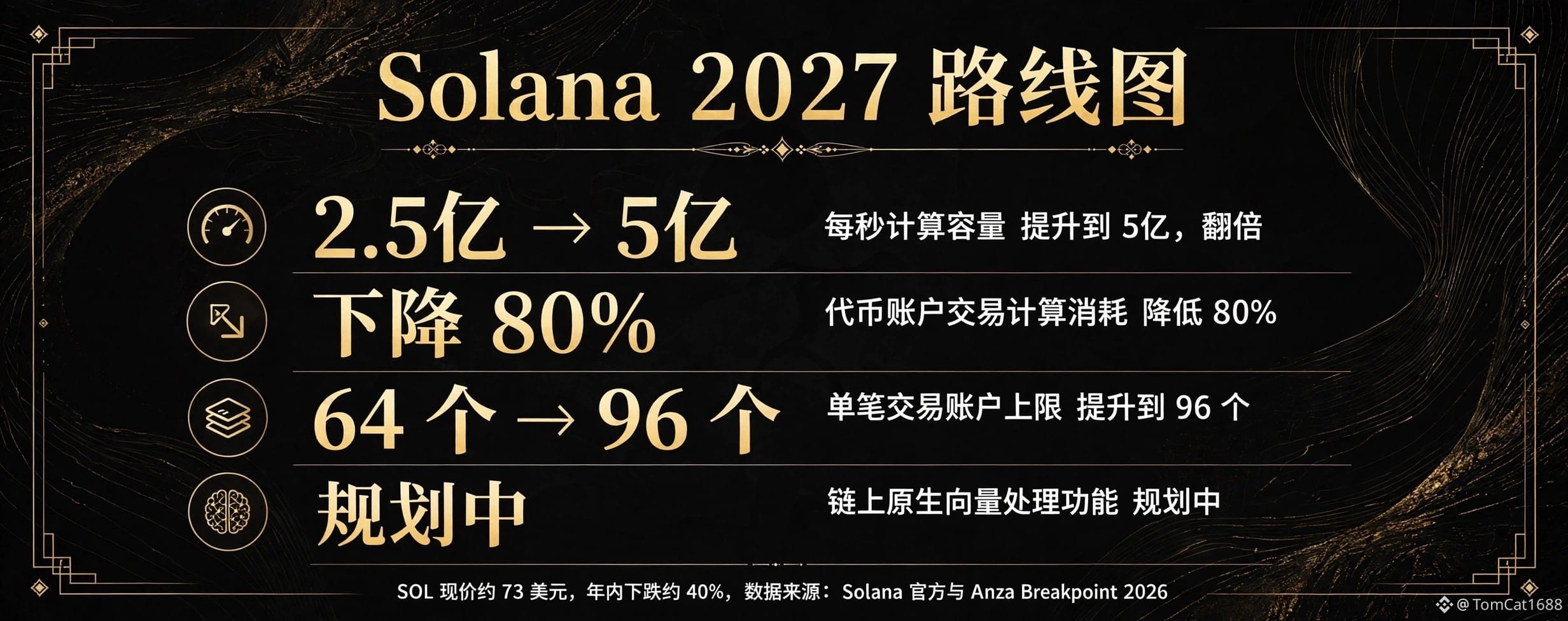
On November 19, core development team Anza unveiled Solana’s 2027 technical roadmap at Breakpoint 2026. Anza CEO Brennan Watt presented it in person, with one clear goal: by the end of 2027, Solana should be able to handle twice as much activity.
Here are the numbers. Computing capacity per second will rise from 250 million CUs to 500 million—double the current amount. Compute costs for token account transactions will be cut by 80%, so the same transfer will use just one-fifth of the computing power it does today. The number of accounts a single transaction can access will increase from 64 to 96, meaning complex transactions won’t need to be split up.
The bigger ambition is on-chain AI. The roadmap calls for native vector processing, allowing AI models to run entirely on-chain. Other planned upgrades include Rotor replacing Turbine for block propagation, and Constellation embedding transaction-ordering rules in the protocol to foster more competition among validators.
These are all goals, not live features. Anza hasn’t set firm timelines for most of the projects either. The nearest commitment is to reduce storage rent by another factor of seven within two weeks.
The market hasn’t been impressed so far. SOL is currently trading around $73, down about 40% this year, after hitting a low of $69.93 this week. The price barely moved after the roadmap was announced.
For comparison, Alpenglow went live on October 21, cutting finality from 12.8 seconds to 150 milliseconds. That was an upgrade that actually shipped. This roadmap is about next year, and delivery will depend on development progress.
In the long term, this is Solana’s declaration of intent to evolve from a fast blockchain into high-performance financial infrastructure. In the short term, it won’t change the flow of funds. The Fear & Greed Index is currently just 11, signaling extreme fear.
The roadmap is for 2027; the market is happening today. Don’t confuse the two.
#Solana2027路线图拟将网络计算容量翻倍 #Solana #SOL #Anza #On-chain AI
5
3.7k
·
--
Verified
It surged at the open, then fell back by the close: Anthropic rode a roller coaster on its first day.
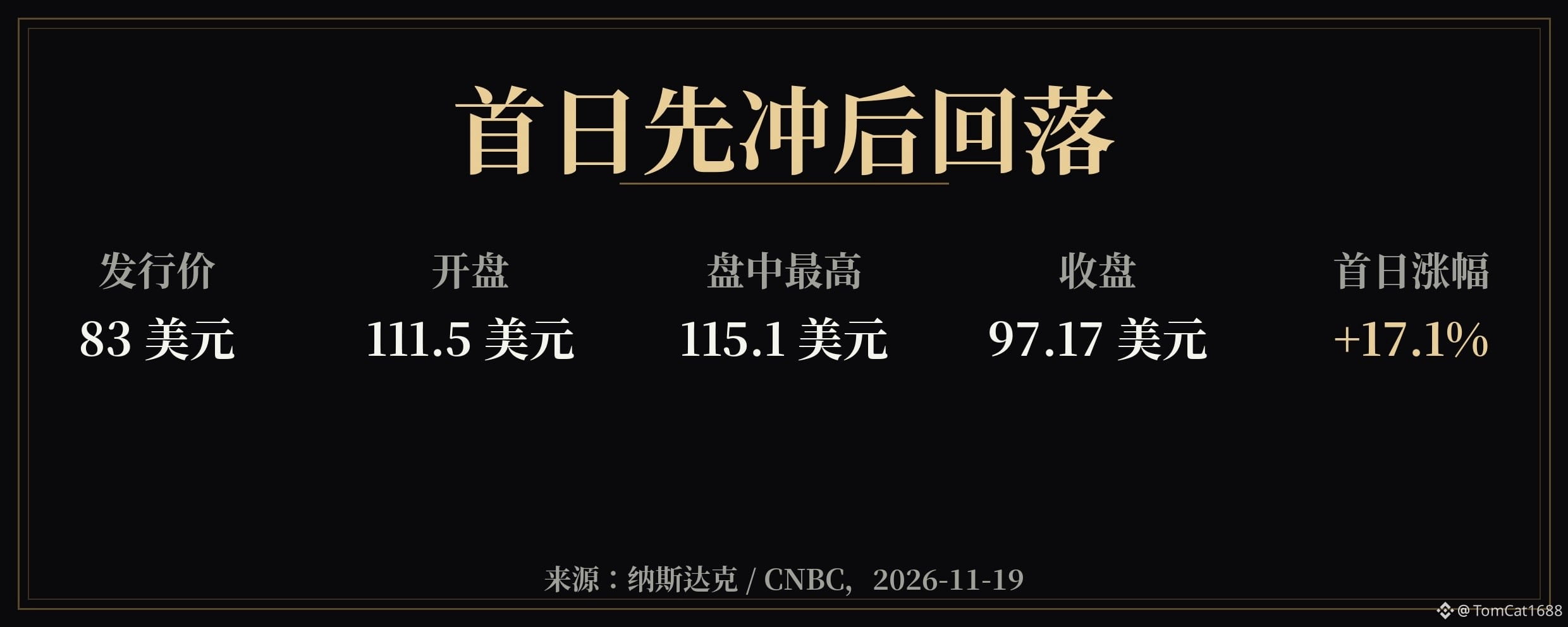
$ANT listed on Nasdaq yesterday at an IPO price of $83 per share. Its first trade was at $111.50, up 34%. It reached an intraday high of $115.10 and closed at $97.17, up 17.1%, with a market cap of about $1.76 trillion. At one point at the open, it had topped $2 trillion.
The gray market got it only half right. Before the open, it put the price at $101 to $105. Shares surged past $111 at the open, then fell back to $97 by the close, breaking out of the gray-market range in both directions.
The seven founders’ paper fortunes also rode a roller coaster. Based on their remaining holdings of 237 million to 241 million shares, each was worth about $26.4 billion to $26.9 billion at the open, and about $23 billion to $23.4 billion at the close. The seven were worth about $162.6 billion combined, with each giving back about $3.4 billion between the open and close.
That’s all on paper. The lockup period is as long as 365 days, and the commitment to donate 80% is revocable, so none of it has become money they can spend yet.
The Dow fell 1,101 points the same day, while $ANT still managed to close up 17%. It fell again after hours, to $92.40. The $100 threshold is the first hurdle it will have to clear at tonight’s open.
#美股 #Anthropic #IPO #AI #anthropic begins trading today; IPO priced at $83 per share
1
201
·
--
Verified
Ant International dropped a big one today: money on-chain can now be exchanged directly for funds.
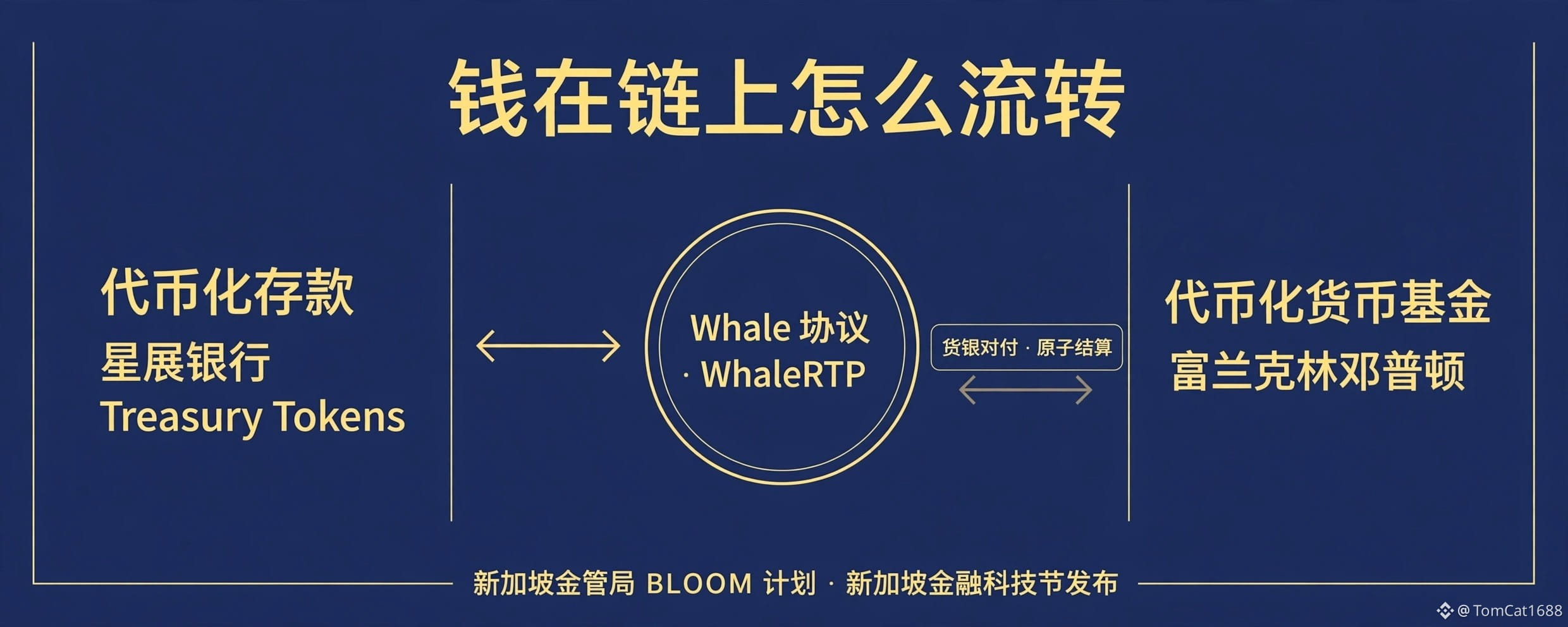
The Whale Orchestration Protocol was unveiled today at the Singapore FinTech Festival. It’s an upgrade to the WhaleRTP wholesale settlement platform, developed under the Monetary Authority of Singapore’s BLOOM initiative. The gist: tokenized deposits and tokenized money market funds can settle atomically on a delivery-versus-payment basis, with cash and assets exchanged simultaneously—no waiting.
The pilot has been completed. DBS Bank’s Treasury Tokens and Franklin Templeton’s tokenized money market fund were both connected to WhaleRTP, marking Singapore’s first cross-asset interoperability between these two types of tokenized assets.
This isn’t something retail investors can use. The pilot involved licensed institutions, and no figures on transaction amounts or settlement times have been released. But the direction is clear: bank deposits and fund shares are both on-chain, so settlement no longer has to follow the old playbook.
#蚂蚁国际 #Whale #RWA #新加坡 #AntInternationalLaunchesWhaleProtocolAndCompletesPilot

124
·
--
For the first time in history, leaders from the US, China, and Russia sat down at the same table
Kylin Villa, Shenzhen. Trump, Xi Jinping, and Putin held a trilateral meeting. During APEC, for about an hour.
Three opening remarks set the tone right away
Xi said that positive interaction among major powers is a question they must answer.
Putin said that all three of them are victors in war.
Trump said that the three countries all occupy a special position on nuclear issues.
They talked about nuclear weapons. The last treaty governing them, New START, expired on February 5 this year. The 1,550-warhead cap is gone, and none of the three countries is now bound by a nuclear cap.
Before the meeting, the US said it wasn't expecting to reach any agreement.
Afterward, China and the US agreed to develop an action plan for strategic stability—a start, at least.
Zelenskyy watched from the sidelines, warning that it must not become Yalta 2.0.
When three major powers sit down together, the question is whether their bottom lines can still be upheld.
Do you think this meeting was just for show, or were they really discussing their bottom lines?
#USChinaRussia #Shenzhen #APEC

63
·
--
Large institutions are adding to their positions as prices fall, while Strategy itself is buying fewer coins.
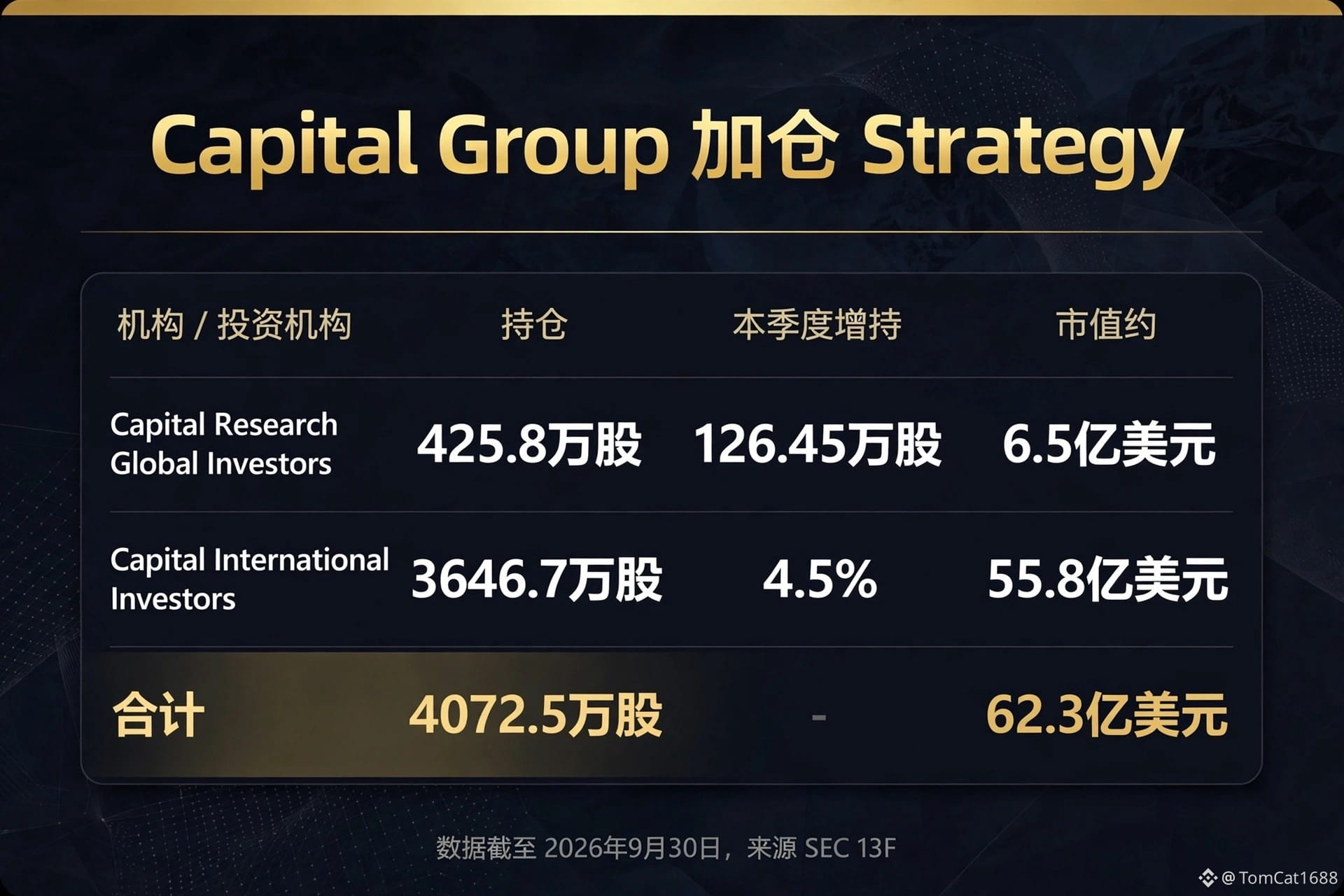
Capital Group’s third-quarter 13F filing is out. Capital Research Global Investors increased its Strategy stake by 1.2645 million shares, bringing its holdings to 4.258 million shares, worth about $650 million. Another arm, Capital International Investors, holds 36.467 million shares, worth about $5.58 billion, making it Strategy’s largest institutional shareholder. Together, the two hold 40.725 million shares, worth about $6.23 billion.
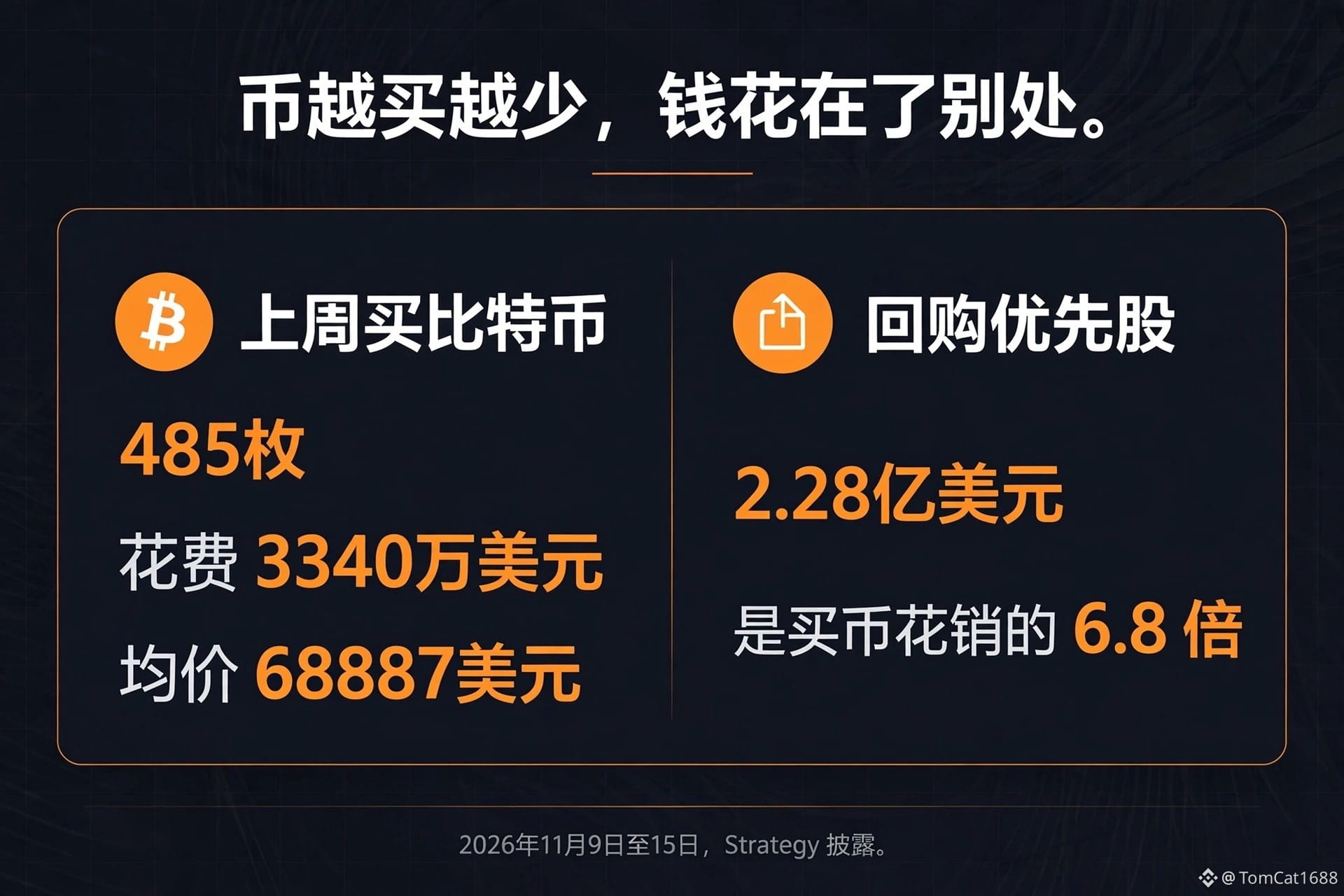
But last week, Strategy itself bought only 485 bitcoins for $33.4 million, at an average price of $68,887, bringing its total holdings to 850,849 coins. In the same week, it spent $228 million on preferred stock buybacks—6.8 times what it spent on bitcoin.
On one side, institutions are buying more as the price falls from its September 30 level. On the other, the company is using money raised by selling shares first to pay down its preferred stock obligations. MSTR is down about 25% since September 30. The books show who’s buying the dip and who’s protecting themselves.
#美股 #比特币 #BTC #Strategy #CapitalGroup increases its Strategy stake by 1.2645 million shares
137
Log in to explore more content
Join global crypto users on Binance Square
⚡️ Get latest and useful information about crypto.
💬 Trusted by the world’s largest crypto exchange.
👍 Discover real insights from verified creators.
Email / Phone number
Trending Topics
AnthropicFallsBelow$83IPOPricePremarket
6,052 views
80 Discussing
TradFi News | Anthropic Falls 5% Premarket, Slipping Below Its $83 IPO Price
Binance News
·10 Likes
·6.6k views
NVDASoarsOnJensenReturn
52,292 views
722 Discussing
Bitcoin'sReboundFadesBelow$60K
38,620 views
246 Discussing