
#gobernanza
gobernanza
16,259 views
45 Discussing
Hot
Latest
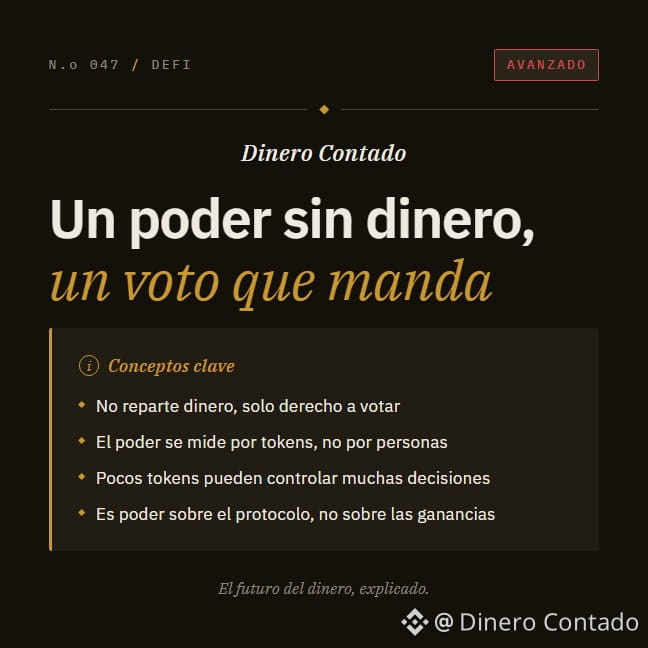
A governance token doesn’t pay you anything: it gives you a vote.
A DAO has no boss. It has rules written into a smart contract, and those rules decide who can propose a change and who can approve it. Participation isn’t measured by person; it’s measured by the number of tokens in a wallet. Imagine a DAO with one million governance tokens in circulation. The rule says a proposal needs a quorum of four percent—that is, forty thousand tokens voting. If only forty-five thousand tokens participate in total, and a single wallet controls twenty-three thousand of them, that wallet already has a majority in the vote. It controls just 2.3 percent of all tokens issued, but it decides the entire outcome. That’s how simple it is. That’s how harsh it is.
That’s what they call a governance token: a token that doesn’t distribute profits, but rather grants shares of power to make decisions about the protocol.
KEY CONCEPTS
- Holding a governance token doesn’t guarantee income or profit distributions: it only gives you the ability to vote on changes to the protocol.
- A governance token is not the same as a utility token or a security token: each follows a different logic and different rules.
- Voting power in a DAO is measured by the tokens in a wallet, not by the number of people: whoever holds more tokens has more decision-making power.
Buying a governance token is more like buying a share that gives you voting rights at a shareholders’ meeting than buying a ticket with a promise of payment. The power is there. The profits, not necessarily.
Transparency: Binance may pay us a commission if you trade after clicking an asset symbol or a price link in this post.
#Gobernanza #DAO #TokenDeGobernanza #DecentralizedFinance
1
205

·
--
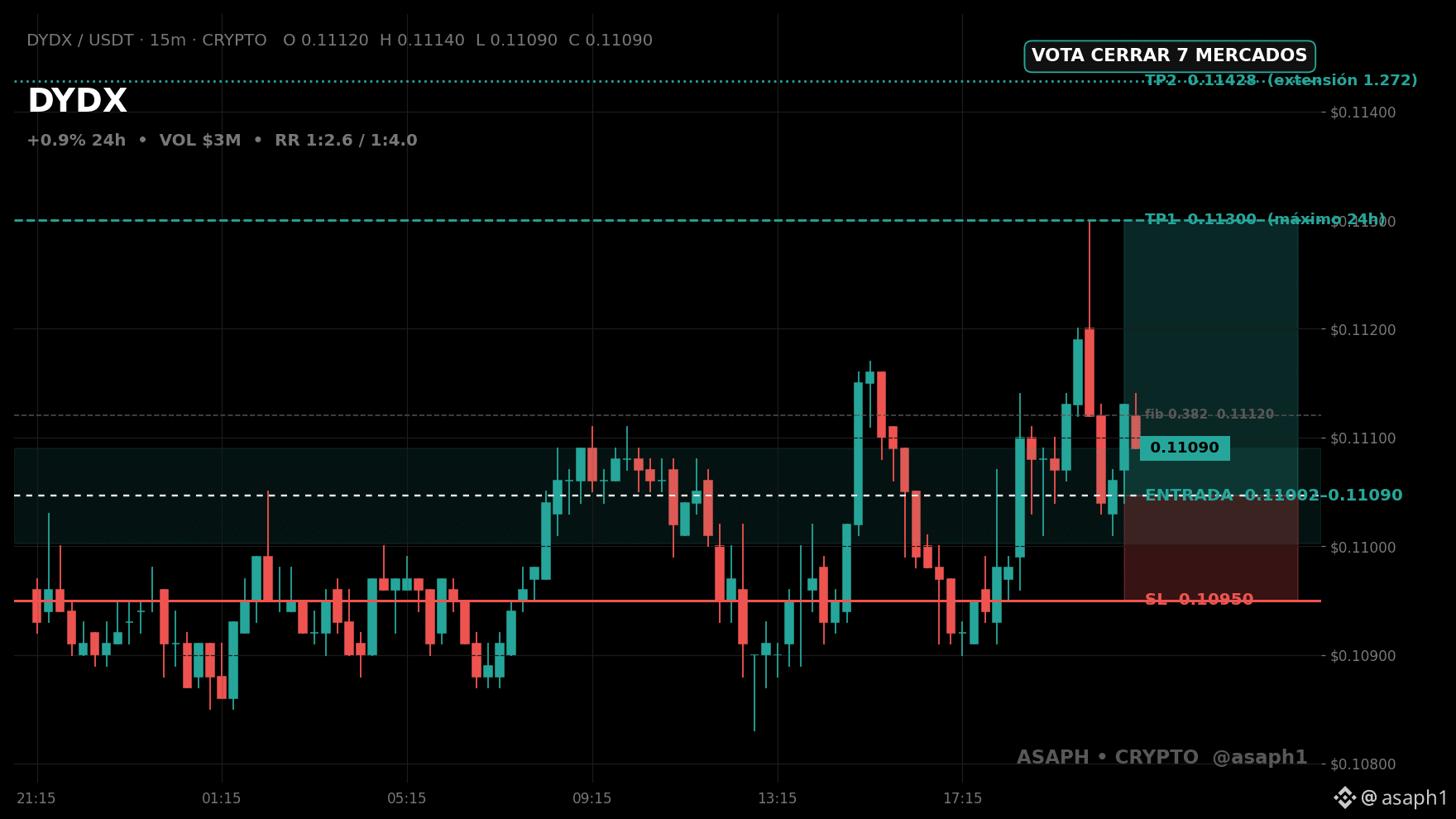
🚨 $DYDX VOTE TO CLOSE 7 UNDERPERFORMING MARKETS
DYDX is up +0.91% today on $2.9M in volume, while $BTC +0.65% and $ETH +0.65% are making smaller gains.
Here's what's behind the rebound:
→ The dYdX community is voting to close 7 markets — ENA, ONDO, WLFI, TRUMP, WIF, oil, and silver — due to low liquidity and high oracle costs; voting closes tomorrow and the proposal has not yet been approved.
→ Divergence: BTC +0.65%, ETH +0.65%… and DYDX +0.91%. It's outperforming the majors today.
→ Price action: rebounds → recovers $0.1130 → targets $0.1143.
LONG entry $0.1100–$0.1109, stop $0.1095, TP1 $0.1130, TP2 $0.1143. If it drops below $0.1095, the long is over—exit.
Note: the vote has not yet been approved—if it's rejected, all 7 markets stay open. This long is a bet on a rebound from the day's low, not on the vote having already passed.
👇 Would cutting 7 underperforming markets strengthen dYdX or make it smaller? Let me know.
$DYDX #Gobernanza #DEX #Crypto
3
51

·
--
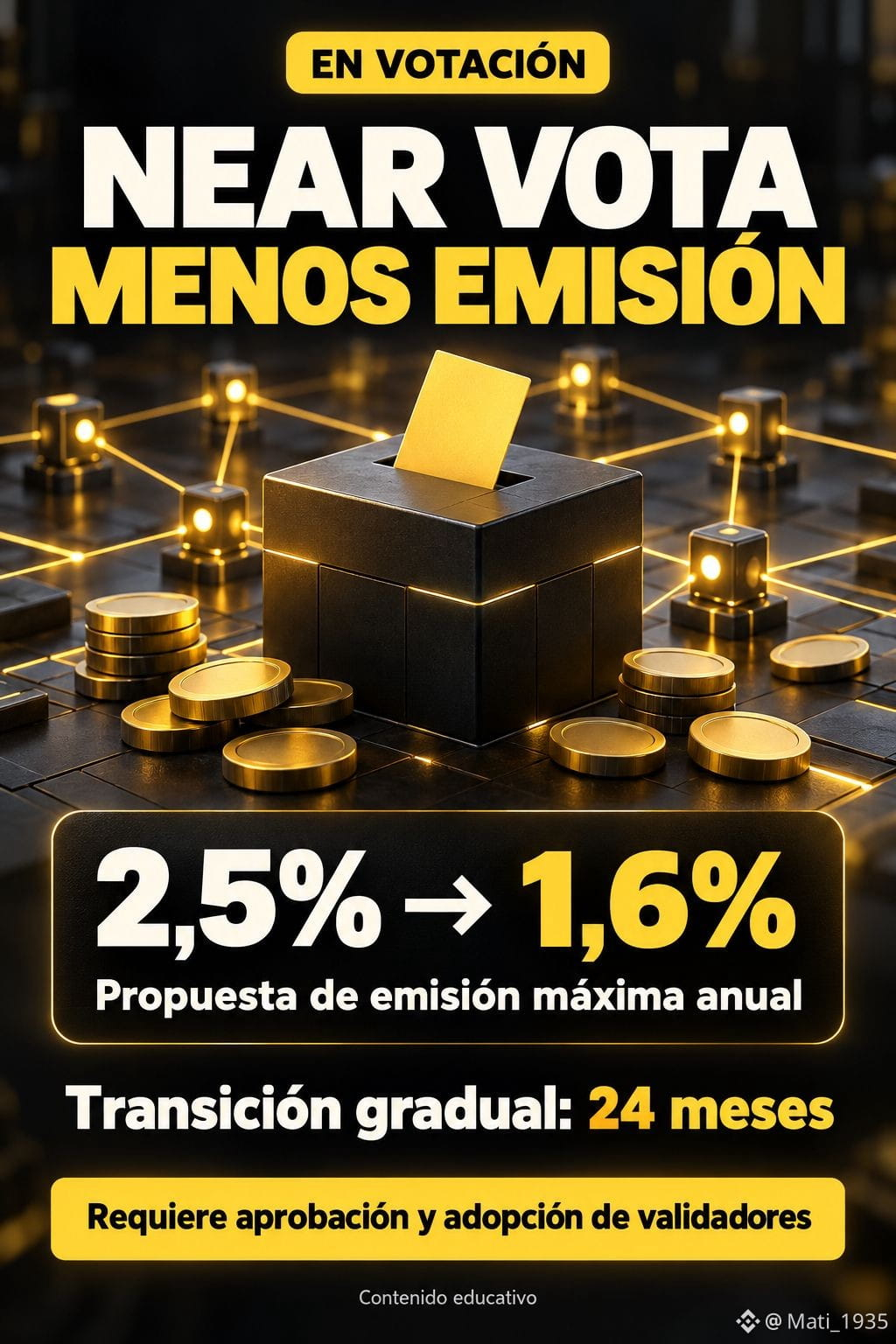
NEAR votes on lowering its issuance: 1.6% is still just a proposal
HSP-029, submitted to the NEAR forum on October 7, 2026, is being put to a vote. Its author confirmed on the 20th that voting was already underway; today, the 21st, the topic appears among Binance Square’s trending topics.
The proposal would gradually reduce the maximum annual issuance rate from 2.5% to 1.6% over 24 months, with a 90-day grace period after ratification. The reduction would be applied progressively by epoch; it would not be an immediate cut once voting ends.
The change requires two steps: approval by the House of Stake and adoption of a protocol upgrade by validators. A favorable vote alone does not change the network’s issuance.
Lower issuance means creating fewer new tokens than under the current setup. It does not mean burning existing tokens or guarantee a decline in the total supply: fee burns also matter. Nor does it make 1.6% a staking yield.
The cost of the change is significant: it would reduce rewards issued and could put pressure on smaller validators’ income. The proposal acknowledges risks to their viability and to staking participation. These factors should be considered alongside the reduction in dilution.
Market snapshot: Binance Spot showed NEAR at 5.142 USDT (+9.61% in 24 hours) on October 21 at 10:28 UTC, compared with BTC’s +2.11%. NEAR/USDT volume was around 198.6 million USDT. This is a market snapshot; it does not prove that the vote caused the increase or predict whether the proposal will be approved.
Sources: HSP-029 and its author on gov.near.org; Square trends; public Binance data.
$NEAR $BTC $USDT
Educational Content. Not financial advice.
#NEAR #Gobernanza #Tokenomics #Staking
83
·
--
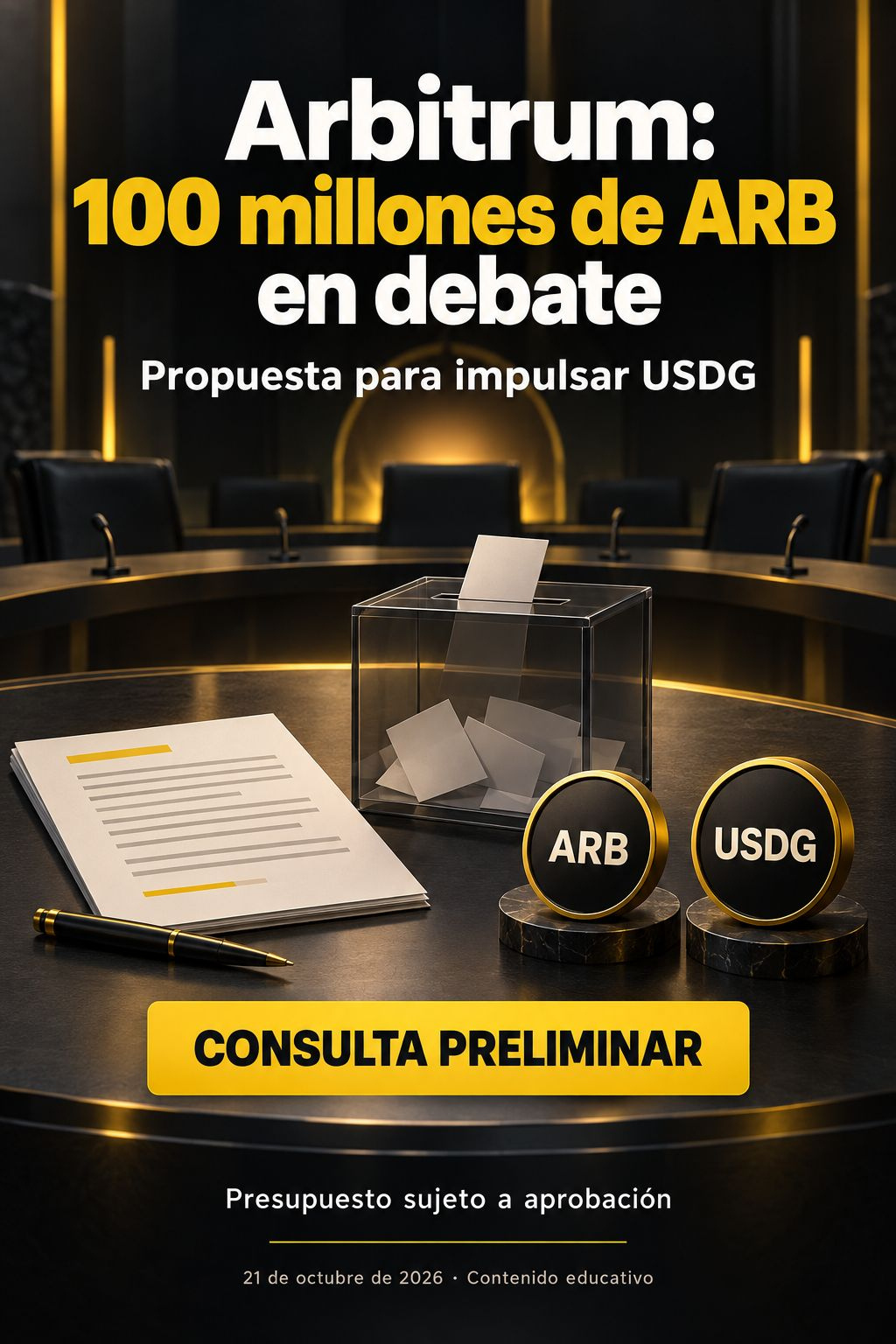
Arbitrum debate: 100 million ARB for USDG—what’s being voted on
Entropy Advisors’ proposal, published on October 6, 2026, asks to add 100 million ARB from the DAO treasury to the DRIP program to support USDG. These are ARB tokens, not 100 million dollars.
The October 19 governance summary says the off-chain preliminary poll closes on the 22nd. This phase is not equivalent to final approval: the proposed schedule includes an on-chain vote from October 29 to November 12.
The plan would combine DRIP seasons 2 through 4 into a single season focused on USDG and expand its uses to include liquidity and integrations. It would retain the selection committee, the two-thirds approval threshold, and Foundation custody.
It also proposes using treasury assets and converting Arbitrum Expansion Program fees into USDG, after deducting the Developer Guild’s share. This is a request for authorization, not evidence that those funds have already been disbursed.
This DAO proposal is separate from the Foundation’s Stablecoin Growth Program, whose announced prize pool is 2 million ARB. Both support USDG, but they have different budgets and terms.
Risks: concentrating exposure in one issuer, contract failures, and liquidity disappearing when incentives end. Projected revenue does not guarantee that spending will be recouped, nor is it automatically distributed to ARB holders.
Market snapshot: Binance Spot, on 21/10 at 06:25 UTC, showed ARB at 0.1880 USDT (-5.003% in 24 h) and ETH at 2,438.94 USDT (+1.841%). ARB’s decline does not prove that voters rejected the proposal. To assess the program, what matters is whether it is actually approved, its costs, and what usage remains after subsidies end.
$ARB $USDG $ETH
Educational Content. Not financial advice.
#Arbitrum #USDG #Gobernanza #DeFi
117

·
--
💥 MACRO IMPACT: Adam Back and Michael Saylor block the consensus on the BIP 110 proposal
🚀 Industry heavyweights, Adam Back (CEO of Blockstream) and Michael Saylor (founder of MicroStrategy), have publicly expressed their absolute rejection of the Bitcoin Improvement Proposal (BIP 110), as reported by Foresight News.
🔥 Back formally argued that BIP 110 seeks to impose regulatory or behavioral restrictions through the consensus layer, directly undermining the core principle of decentralization and the permissionless nature of the Bitcoin network.
⚡ KEY EVENT: Institutional opposition to the technical BIP 110 proposal
🎯 POLITICAL IMPACT: Strict defense of the network’s immune system
👑 MARKET TREND: Rejection of changes that alter the base consensus
💎 Flow Analysis: For macro funds and operators, this resistance from ecosystem leaders eliminates internal regulatory risk, sending a signal of long-term stability that defends Bitcoin’s immutability against centralized governance.
👇 Click the attached chart to analyze the impact on BTC volatility and monitor institutional capital flow. 👇
$BTC
{spot}(BTCUSDT)
$STRC
{future}(STRCUSDT)
$BNB
{spot}(BNBUSDT)
#BIP110 #AdamBack #MichaelSaylor #CryptoNews #Gobernanza
💥 MACRO IMPACT: Adam Back and Michael Saylor block the consensus on the BIP 110 proposal
🚀 Industry heavyweights, Adam Back (CEO of Blockstream) and Michael Saylor (founder of MicroStrategy), have publicly expressed their absolute rejection of the Bitcoin Improvement Proposal (BIP 110), as reported by Foresight News.
🔥 Back formally argued that BIP 110 seeks to impose regulatory or behavioral restrictions through the consensus layer, directly undermining the core principle of decentralization and the permissionless nature of the Bitcoin network.
⚡ KEY EVENT: Institutional opposition to the technical BIP 110 proposal
🎯 POLITICAL IMPACT: Strict defense of the network’s immune system
👑 MARKET TREND: Rejection of changes that alter the base consensus
💎 Flow Analysis: For macro funds and operators, this resistance from ecosystem leaders eliminates internal regulatory risk, sending a signal of long-term stability that defends Bitcoin’s immutability against centralized governance.
👇 Click the attached chart to analyze the impact on BTC volatility and monitor institutional capital flow. 👇
$BTC
$STRC
$BNB
#BIP110 #AdamBack #MichaelSaylor #CryptoNews #Gobernanza

181
·
--

Article
🧩 WHAT ARE DAOS AND HOW TO PARTICIPATE?💥 ORGANIZATIONS WITHOUT BOSSES, WITHOUT OWNERS
Imagine a company where there are no owners or managers. Where decisions are made by members with their tokens, and the code executes what is voted.
That’s a DAO (Decentralized Autonomous Organization).
👇 Reply with 🧩 if you already know about DAOs or with 👀 if you want to learn
📌 WHAT IS A DAO?
It’s an organization that runs with smart contracts on a blockchain. There’s no traditional hierarchy. The rules are written in code, and members vote on decisions.
🧩 WHAT ARE DAOS AND HOW TO PARTICIPATE?
💥 ORGANIZATIONS WITHOUT BOSSES, WITHOUT OWNERS
Imagine a company where there are no owners or managers. Where decisions are made by members with their tokens, and the code executes what is voted.
That’s a DAO (Decentralized Autonomous Organization).
👇 Reply with 🧩 if you already know about DAOs or with 👀 if you want to learn
📌 WHAT IS A DAO?
It’s an organization that runs with smart contracts on a blockchain. There’s no traditional hierarchy. The rules are written in code, and members vote on decisions.
1
118
·
--
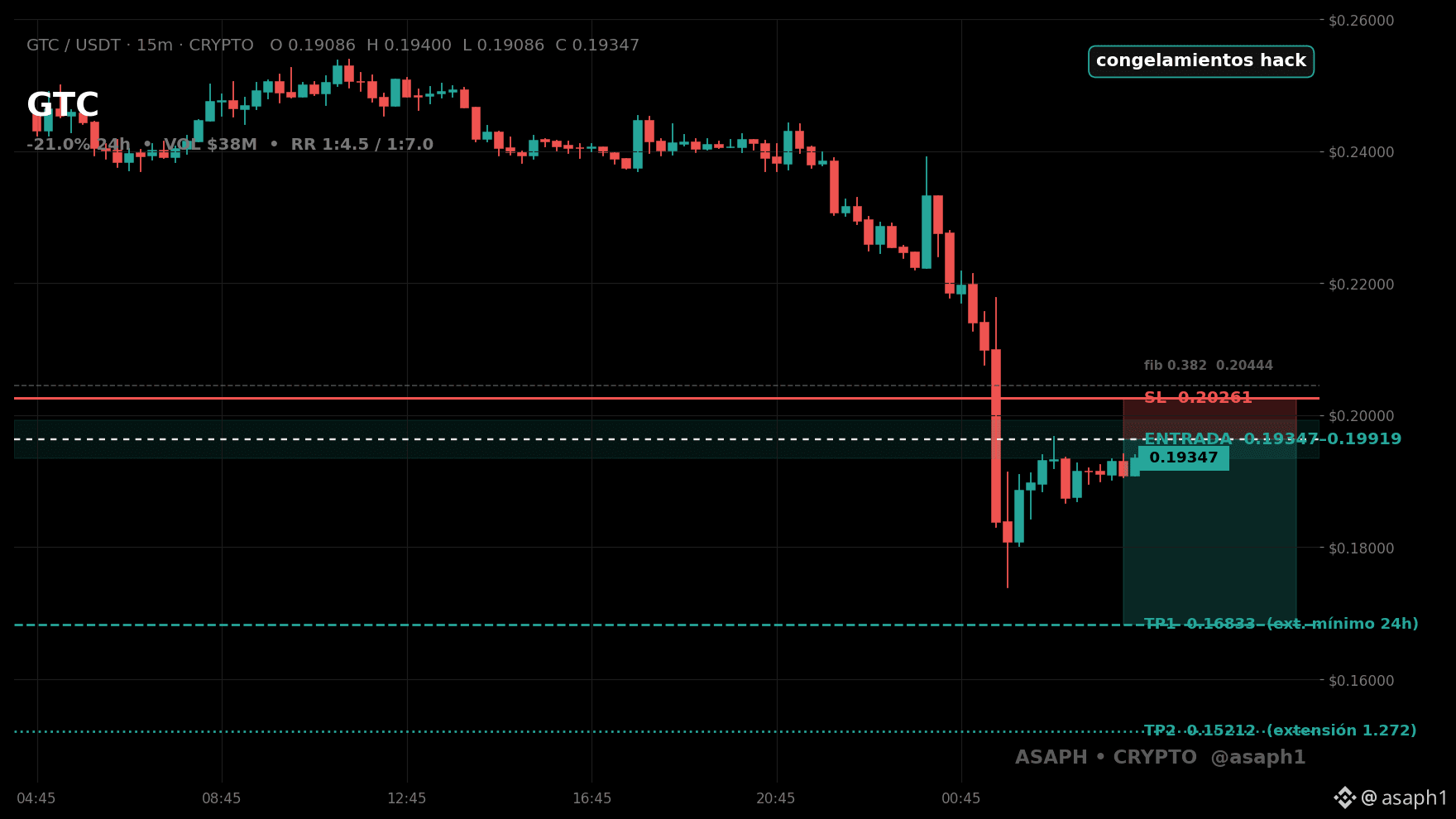
😔 $GTC GOVERNANCE SHOWDOWN: -21.0% WHILE ITS RIVALS HOLD FIRM
Ripple froze $200M linked to the hack, and Tether froze more than $1,500M. To me, every new freeze is a reminder that money is still fleeing, and smaller tokens like GTC are paying the price.
Look at the detail nobody is seeing:
→ Ripple, Tether, and Circle have already frozen billions linked to the Binance breach.
→ GTC -21.0% with $37.9M, falling much harder than $UNI -3.3% and ENS -8.0% in governance.
→ Entry $0.1935–$0.1992, SL $0.2026, TP1 $0.1683 (-14.3%) → TP2 $0.1521 (-22.5%).
Will GTC lose $0.1683, or will a buyer show up there? 👇
$GTC
#Gitcoin #Gobernanza #Trading
96
·
--
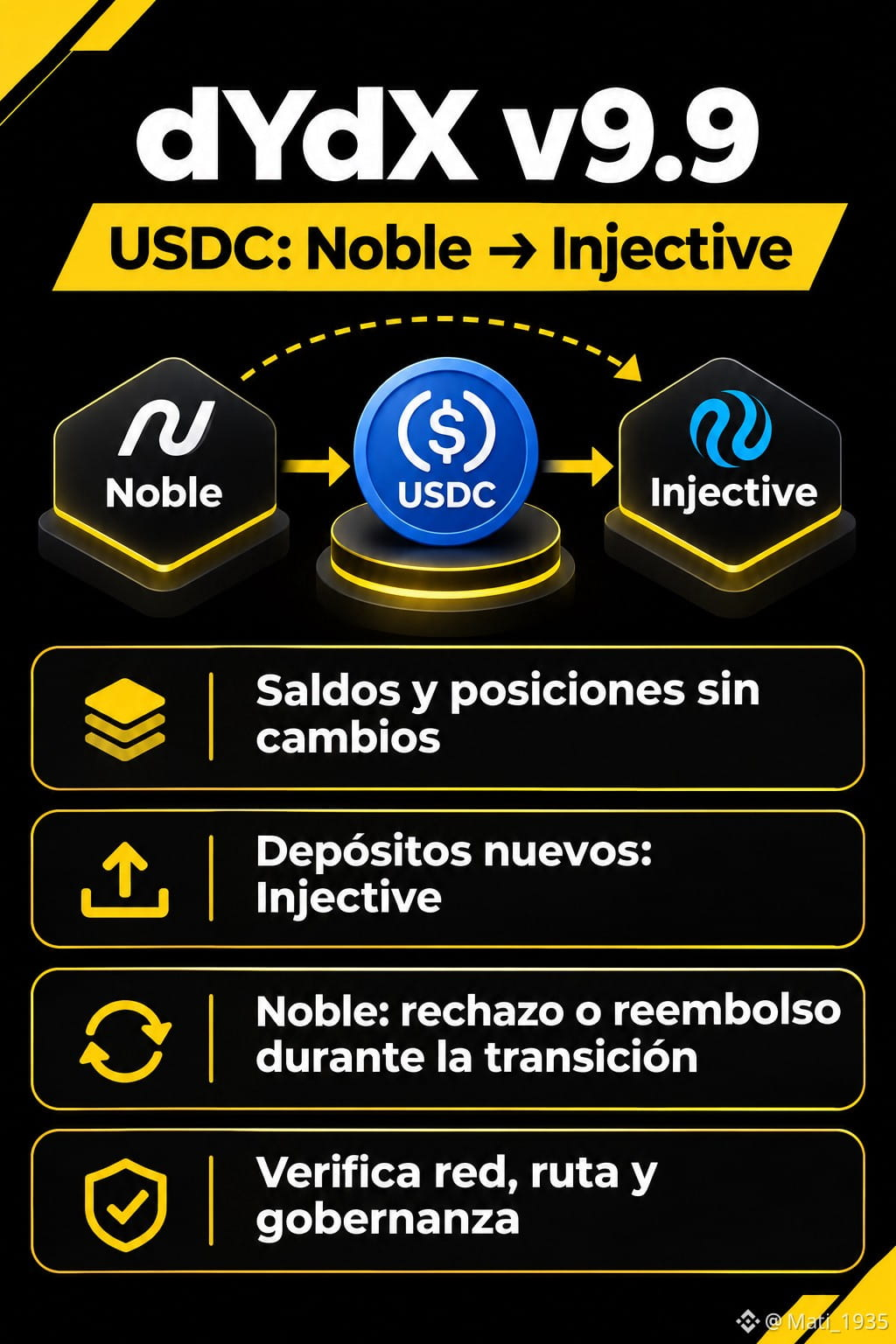
dYdX proposes v9.9: USDC switches route from Noble to Injective
Verified fact (Nov 13, 2026): dYdX’s governance forum published a DRC proposal to upgrade the protocol to v9.9. dYdX’s operational documentation, updated on Nov 15, describes a migration planned for Nov 17, still subject to the vote.
The change concerns backing and routing, not the asset: dYdX will continue to display a single USDC, and the proposal says balances, trading subaccounts, orders, and fees will remain unchanged. With v9.9, new deposits must come through Injective. Deposits sent via Noble will be rejected and refunded. During the transition, withdrawals may use Noble or Injective; a later vote could close the Noble route once no backing remains there. Circle plans to limit USDC withdrawals on Noble on Dec 1, 2026, and stop them completely on Jan 12, 2027, according to dYdX’s guide.
What this means for users and integrators: there is no need to convert balances, but you should check the network, address, route, and confirmation before depositing or withdrawing. A transfer over the wrong network may be rejected, refunded, or delayed. The proposal also provides for withdrawal limits and security pauses if the canonical representation is not fully backed. The date and parameters may change through governance; this is not a guarantee of liquidity or a price signal.
Market snapshot (24-hour window checked at 22:01 UTC): USDC is trading at 1.00026 USDT, -0.024%, with approximately 1.265 billion units traded; DYDX is at 0.07927 USDT, +4.771%; INJ, 7.002 USDT, +2.729%. These are spot-market snapshots and do not prove that the migration caused these movements. The informational focus is on infrastructure and route management: confirming the network matters more than extrapolating from a daily change.
$USDC $DYDX $INJ
Educational Content. Not financial advice.
#dYdX #USDC #Injective #Gobernanza #CryptoEducation
2
180
·
--
Cardano presents a $4.99 million proposal for 12 global events in 2027
Confirmed fact: the Cardano Foundation published a treasury withdrawal proposal on November 4, 2026, to fund Cardano Global Events 2027. It requests 4,999,155 USD —equivalent to 24,995,775 ADA using an assumed 0.20 USD per ADA— to maintain a shared presence at 12 conferences between January and December 2027.
The proposal includes booths, side events, four hackathons, workshops, networking, travel support for builders, and pre-event outreach. The first event would be Africa Tech Summit, in Nairobi, on February 10 and 11, 2027. The text says the 2025-2026 program generated 219 collaborations, including 50 with public bodies and regulators, involved 1,169 developers, and gave a stage to 79 projects. It also reports 8,191 booth contacts; these are figures declared by the program, not an independent audit.
Key point: it is still a proposal for a DReps vote, not approved funds or a guarantee of adoption. The Foundation says spending for each event would be published and any unused amount would return to the treasury. The schedule and costs may change if approval arrives late or sponsorship prices vary. The discussion also raises how to distribute control between the Foundation, Intersect, and community representatives.
Market read, no signal: at 12:52 UTC, Binance spot showed ADA near 0.1951 USDT (+2.63% in 24 h), BTC at 79,638 (+1.69%), and ETH at 2,391.31 (+3.24%). It is a snapshot of the moment, not evidence that the proposal caused the move. Risks: negative vote, execution below targets, ADA price variation, and concentration of marketing decisions.
$ADA $BTC $ETH
Educational Content. Not financial advice.
#Cardano #Gobernanza #Tesoreria #AdopcionBlockchain #FinancialEducation

123
·
--
Osmosis: Draft proposes burning 55.5 million OSMO
On October 27, JohnnyWyles published a proposal on the Osmosis forum to send 55,500,000 OSMO from the community pool to a null address. Its stated goal is to surpass 100 million OSMO burned in total; it does not propose burning another 100 million.
The target date for submitting it on-chain is October 30. As of October 28, it was still a forum discussion: the reviewed on-chain proposals did not include this request. That timeline does not confirm approval or execution.
According to the draft, the pool’s tokens are out of circulation, but can be spent if governance authorizes it. The proposal seeks to make their removal permanent. It does not describe a buyback using new money or a market purchase of OSMO.
Osmosis is a decentralized exchange in the Cosmos ecosystem, connected via IBC to networks such as Cosmos Hub, whose asset is ATOM.
Public Binance Spot data, checked on October 28 between 03:59 and 04:01 UTC: OSMO at 0.0566 USDT (+9.056% in 24 hours) and ATOM at 1.650 USDT (+1.789%).
Market outlook: removing tokens available for future spending may reduce that supply risk, but also takes resources away from the community pool. A proposed burn does not guarantee a price increase: demand, liquidity, and the final governance decision all matter. The price movement alone does not prove that this news caused it.
$OSMO $ATOM $USDT
Educational content. Not financial advice.
#Osmosis #OSMO #Gobernanza #Cosmos #Tokenomics

198
·
--
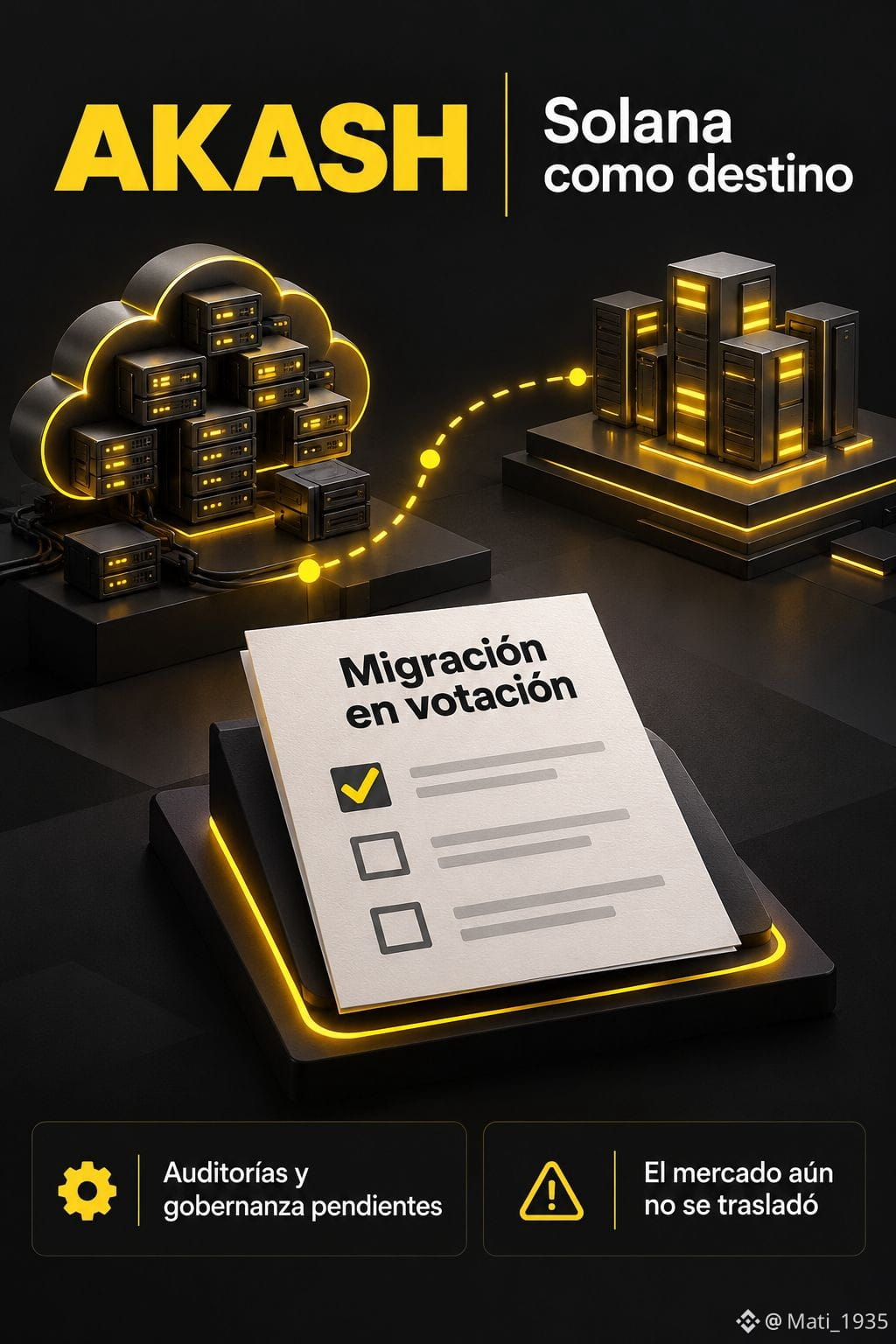
Akash chooses Solana: migration still up for a vote
The team announced its choice on October 26. Proposal 346 remains open until November 2 at 15:02 UTC; the outcome is not yet final.
The plan proposes abandoning its own Cosmos chain, akashnet-2, and rebuilding the computing marketplace as programs on Solana. The team cites lower operating costs and closer ties to the DePIN ecosystem.
AKT would be converted to the SPL format at a 1:1 ratio, subject to approval and two independent audits. The planned portal would be one-way and available for two years after launch.
The marketplace migration is a separate stage: no transition date has been set. It requires another vote, audits, and testing; current workloads will continue running in the meantime.
Binance Spot reference on October 27, 03:54 UTC: SOL is trading at 100.13 USDT (+0.220% over 24h), with 155.95 million USDT traded in that pair during the period.
Market perspective: a cheaper architecture may encourage activity, but it does not guarantee demand or price appreciation. Risks remain around the portal, loss of native IBC connectivity, and temporary liquidity fragmentation. SOL's price also does not prove a causal reaction to the announcement.
$AKT $SOL $USDT
Educational Content. Not financial advice.
#Akash #Solana #DePIN #Gobernanza #Blockchain
111
·
--
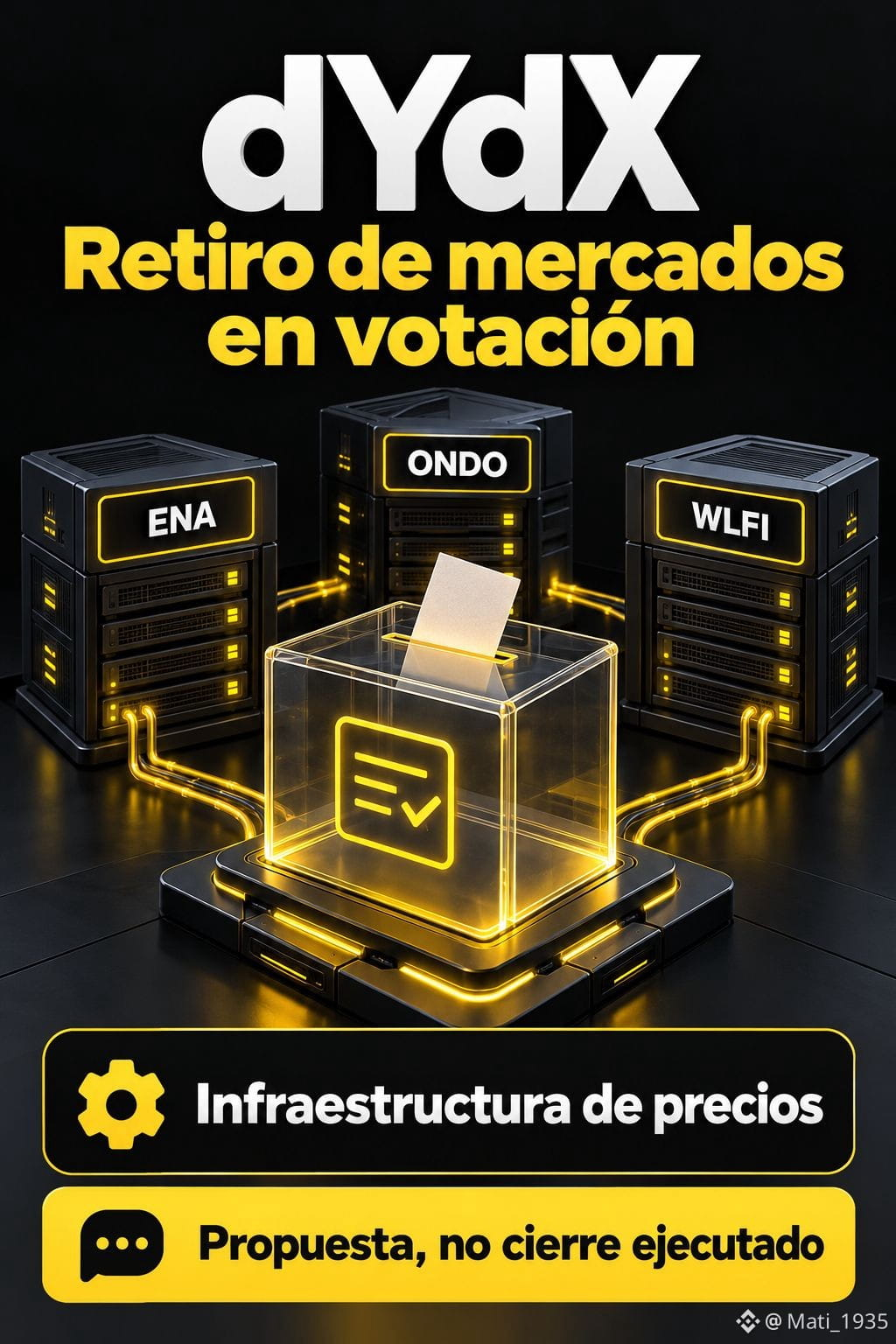
dYdX votes to remove ENA, ONDO, and WLFI markets
Proposal 399 is up for a vote until October 29 at 12:40 UTC. The draft text was published on the 23rd; on-chain voting began on the 26th.
For these three markets, Stakecito Labs cites the planned shutdown of the SOL/ETH/Base node infrastructure that feeds their prices through Slinky. It also notes that they have more activity than other candidates for removal.
Other included markets are being considered due to low activity or liquidity; for WTI and XAG, the cited reason is high oracle costs relative to usage.
If approved, the affected pairs would move to final settlement and their price feeds would be deactivated. The measure concerns dYdX products; no shutdown has been carried out yet.
Binance Spot reference on October 26, 23:58 UTC, in USDT: ENA 0.2070 (-0.145% in 24h); ONDO 0.4156 (+1.913%); WLFI 0.0530 (0.000%).
Market perspective: a market’s continuity also depends on its data and infrastructure. A local removal can change execution options without determining the token’s overall value. These Binance price movements do not demonstrate a causal reaction to the proposal.
$ENA $ONDO $WLFI
Educational Content. Not financial advice.
#dYdX #Gobernanza #Oraculos #DeFi #Markets
408
·
--
🏛️ $WLFI: the bounce isn't showing up, so I'm selling
There’s real distrust: volume has cooled by half, and the bounce isn’t showing up.
Positioning? Top traders by positions: 59.0% LONG, and by accounts: 50.2% LONG, but the price isn’t bouncing.
The money? Volume is down 50.2% from yesterday: interest has cooled.
The context? DEX: $7,790M in 24h (-1.2%); stablecoins: $304,190M (-0.41% in 7 days).
The narrative? WLFI is the token linked to the Trump family, but today the market doesn’t care about names.
When even the narrative can’t push it higher, technicals take over: and the technicals say short.
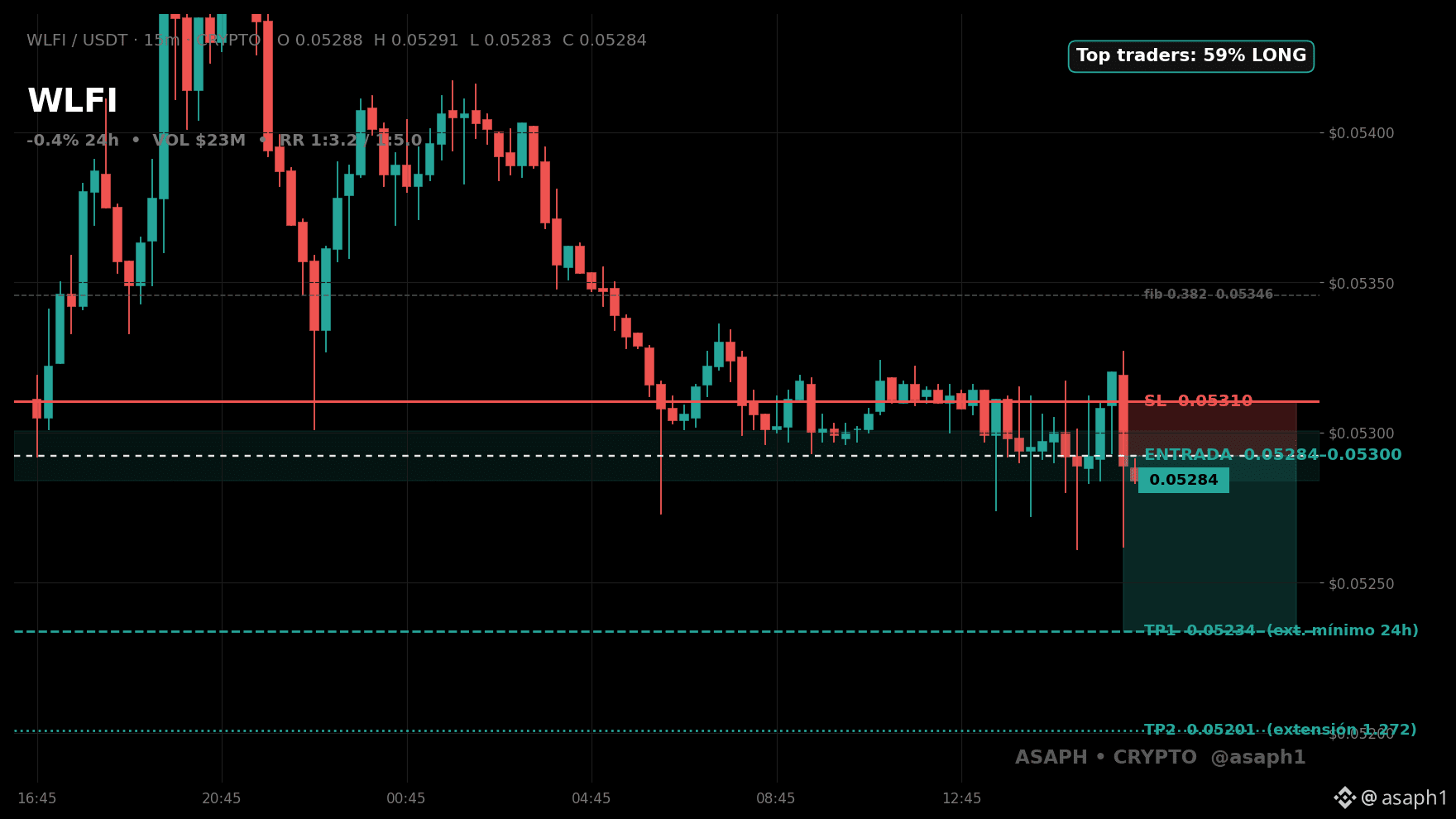
📊 SHORT signal
If the price enters $0.05284–$0.053005 → limit order, scale in 50/50.
📍 Current price: $0.05284
🎯 Zone: $0.05284–$0.053005 (dist. 0.0%)
If the price moves above the zone → stop at $0.053104 (+0.34% from the average), confirmed BEFORE entering.
Risk per trade: 2% of capital.
If it drops → ✅ TP1: $0.05233916 (+1.10%): take profit on 50% and move the stop to break-even.
If it keeps going → 🏁 TP2: $0.05200616 (+1.73%), 1.272 extension: the 1.272 extension of the move.
R/R: 1:3.21 · 1:5.05
⏳ Valid: next 2h / while $0.053104 holds
While you wait, funding pays the short side (+0.00005%).
Share it with someone who trades WLFI.
Will WLFI lose $0.052 or hold and stop me out?
Live price here 👇 WLFI
WLFI #Gobernanza #DeFi #Trading
This is a plan, not financial advice.
🏛️ $WLFI : the bounce isn't showing up, so I'm selling
There’s real distrust: volume has cooled by half, and the bounce isn’t showing up.
Positioning? Top traders by positions: 59.0% LONG, and by accounts: 50.2% LONG, but the price isn’t bouncing.
The money? Volume is down 50.2% from yesterday: interest has cooled.
The context? DEX: $7,790M in 24h (-1.2%); stablecoins: $304,190M (-0.41% in 7 days).
The narrative? WLFI is the token linked to the Trump family, but today the market doesn’t care about names.
When even the narrative can’t push it higher, technicals take over: and the technicals say short.
📊 SHORT signal
If the price enters $0.05284–$0.053005 → limit order, scale in 50/50.
📍 Current price: $0.05284
🎯 Zone: $0.05284–$0.053005 (dist. 0.0%)
If the price moves above the zone → stop at $0.053104 (+0.34% from the average), confirmed BEFORE entering.
Risk per trade: 2% of capital.
If it drops → ✅ TP1: $0.05233916 (+1.10%): take profit on 50% and move the stop to break-even.
If it keeps going → 🏁 TP2: $0.05200616 (+1.73%), 1.272 extension: the 1.272 extension of the move.
R/R: 1:3.21 · 1:5.05
⏳ Valid: next 2h / while $0.053104 holds
While you wait, funding pays the short side (+0.00005%).
Share it with someone who trades WLFI.
Will WLFI lose $0.052 or hold and stop me out?
Live price here 👇 WLFI
WLFI #Gobernanza #DeFi #Trading
This is a plan, not financial advice.
68
·
--
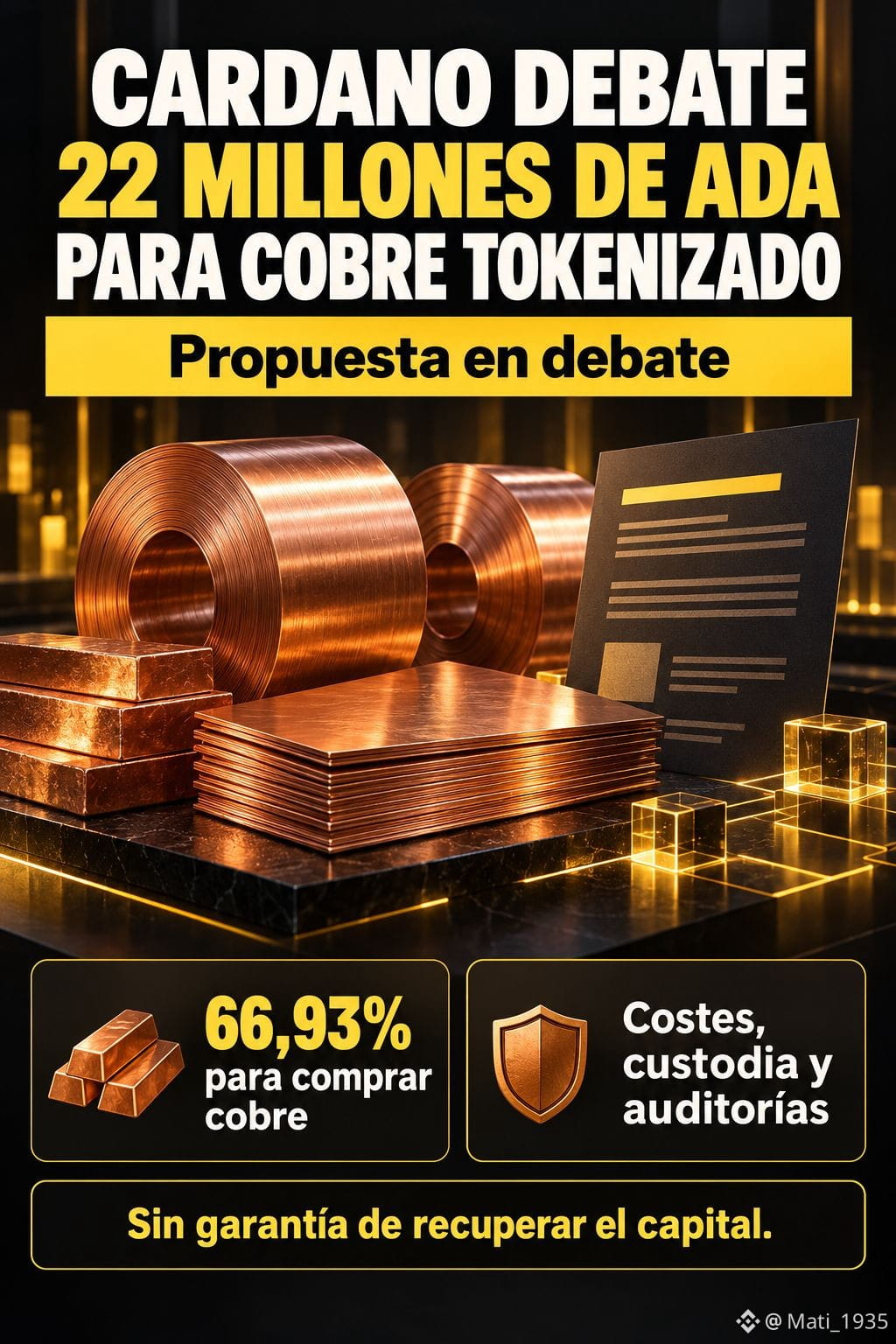
Cardano debates 22 million ADA for tokenized copper
On October 15, Toto Finance published a request for 22 million ADA for a physical copper reserve represented by CuTT. These are requested funds, not a confirmed metal purchase.
On October 22, Cardano Forum announced a public session for October 27 at 16:30 UTC. It will examine the proposal, custody, financial risks, and safeguards between Ethereum and Cardano.
According to the proposer’s budget, 14,724,409 ADA, or 66.93%, would go toward buying copper; the rest would fund technology, storage, insurance, audits, and other tasks. Tokenizing the metal does not eliminate these costs.
The plan calls for returning net sale proceeds and unused funds to the Treasury, with a maximum term of 36 months. This obligation does not guarantee recovery of the 22 million ADA: the outcome depends on the price of copper, the ADA exchange rate, expenses, and execution.
The issuance infrastructure and its security reviews are planned deliverables, not systems certified as already deployed. Physical backing also requires proof of ownership, verifiable inventories, and custody controls.
Market reference for October 23, 14:50 UTC: ADA was trading on Binance at 0.2168 USDT (+0.56% over 24 hours), and ETH at 2,408.82 USDT. These prices do not value the copper or demonstrate project approval.
My take: the appeal of tokenized real-world assets lies in connecting the digital ledger with enforceable rights and verifiable reserves. To assess this proposal, costs and Treasury protection matter as much as the technology. An adoption narrative does not turn commodity risk into guaranteed returns.
Sources: Toto Finance, Cardano Forum, and public Binance data.
$ADA $ETH $USDT
Educational content. Not financial advice.
#Cardano #Tokenizacion #RWA #Governance
115
·
--
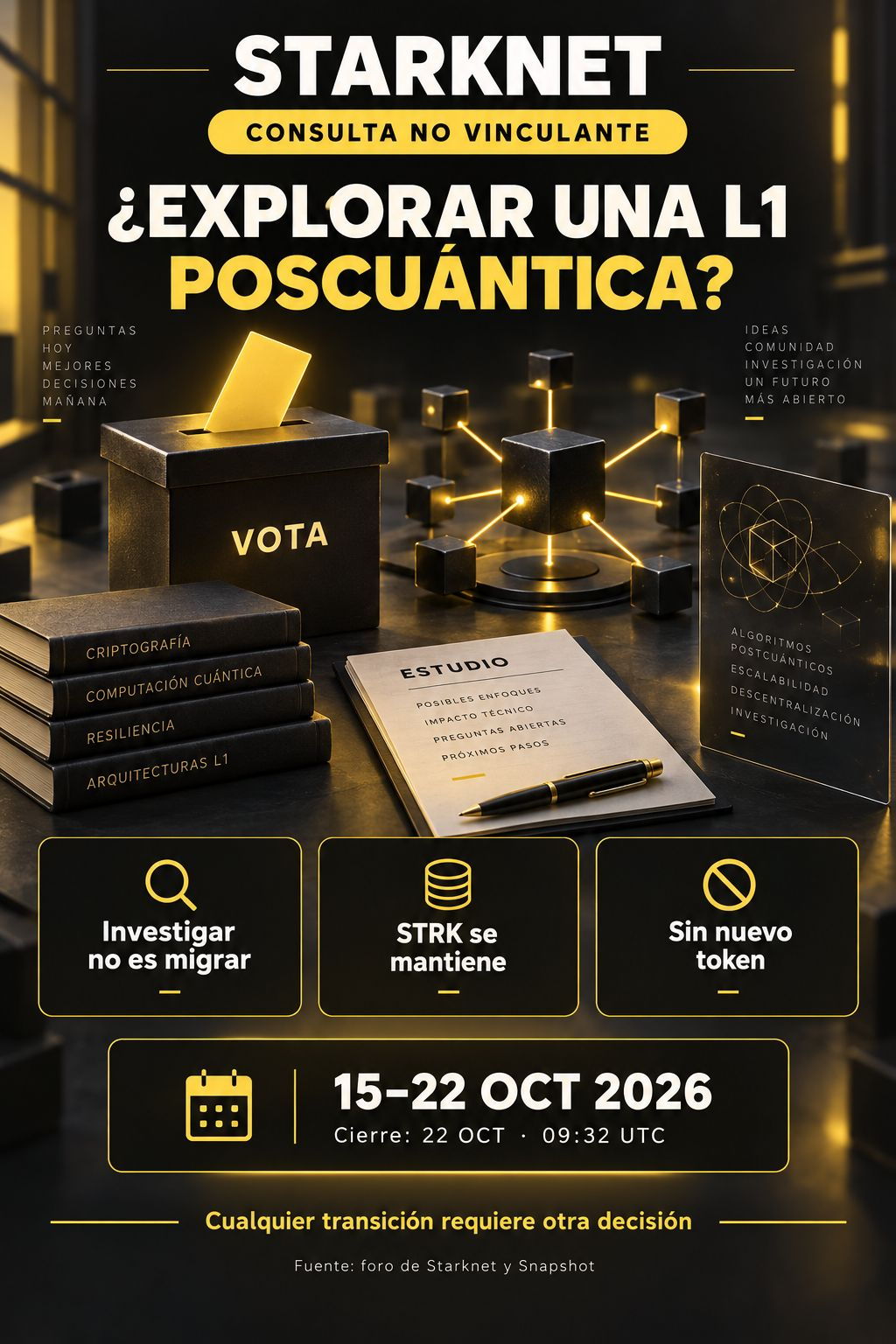
Starknet opens a consultation on a possible post-quantum L1
On October 15, a proposal was posted on the Starknet forum to explore an independent Layer 1 network with a post-quantum security focus. The consultation is active but non-binding: it gauges support for investigating this possibility.
Voting began on October 15 at 09:32 UTC and is scheduled to close on October 22 at the same time. A favorable result would not, by itself, authorize a transition. Any decision to move from L2 to L1 would require a specific governance process.
The proposal would keep STRK as the token and rule out creating another one. It also states that bridges from Ethereum would remain open. These are conditions of the proposal, not evidence that a new architecture is already operational.
It is important to distinguish three steps: consulting the community, studying a technical solution, and approving its implementation. This vote concerns the first step. The post-quantum goal does not demonstrate comprehensive protection today or set a migration date. Assessing dependencies and security risks would remain part of the work ahead.
Market snapshot: at 17:38 UTC on October 15, Binance spot showed STRK at 0.09316 USDT (+23.07% over 24 hours) and ETH at 2,445.54 USDT (+0.35%). This move does not show that the consultation is its sole cause or predict its outcome. A price increase does not eliminate technical or execution risks.
$STRK $ETH $USDT
Educational Content. Not financial advice.
#Starknet #STRK #Ethereum #Gobernanza #EducacionCripto
78
·
--
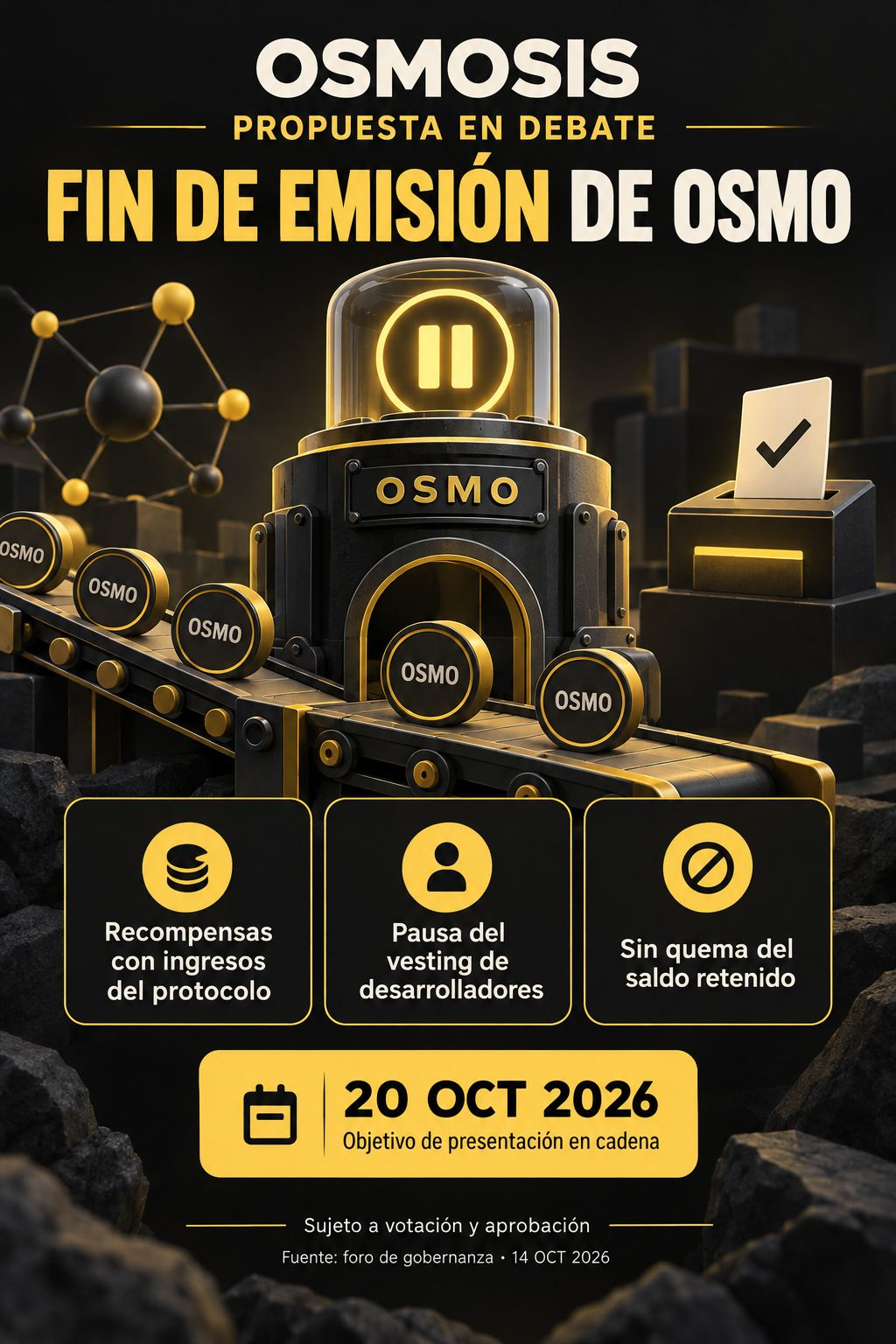
Osmosis debate on ending OSMO emissions: what would change
On October 14, a proposal to end inflationary OSMO emissions was posted on the governance forum. It is still under discussion: the Osmosis node’s query on October 15 shows that the proposed parameters have not yet been applied.
The proposal aims to stop the creation of new OSMO and have staking rewards come entirely from protocol revenue, such as trading and transaction fees. The community pool would stop receiving newly issued tokens.
The daily developer unlock would also be paused. According to the author, around 51.9 million OSMO minted since the network’s launch remain: they would stay in the vesting account, and any future unlock would require another governance decision. Pausing that unlock does not mean burning those tokens.
October 20 is the target date for submitting the proposal on-chain, not a confirmed execution date. If approved, the change would take effect from the first subsequent daily period. Fee-based rewards would depend on activity; they are not equivalent to a fixed rate.
Market snapshot: between 09:40 and 09:41 UTC on October 15, Binance spot showed OSMO at 0.0422 USDT (+5.24% in 24 hours), while ATOM, a benchmark for the Cosmos ecosystem, was at 1.668 USDT (-7.08%). This divergence does not prove a single cause. Potentially lower emissions do not guarantee a higher price: demand, liquidity, and the outcome of the governance process also matter.
$OSMO $ATOM $USDT
Educational content. Not financial advice.
#Osmosis #OSMO #Cosmos #Gobernanza #EducacionCripto
1
277
·
--
🔥 SOLANA PRESENTS PROPOSALS TO INCREASE TOKEN BURNING AND REDUCE INFLATION 📉
The Solana community and validators are evaluating a key governance package (SIMD-0553 and SIMD-0550 proposals) to reshape the network’s tokenomics.
Key Points:
Daily Burn Increase: The SIMD-0553 proposal introduces resource-based transaction fees, raising the daily burn from 650 SOL to between 7,500 and 9,000 SOL (up to $650,000 per day).
Accelerated De-Inflation: The SIMD-0550 proposal aims to double the annual de-inflation rate to 30%, moving the minimum inflation target (1.5%) from 2032 to 2029.
Financial Impact: It’s estimated to cut issuance by 18.9 million SOL (~$1,360M) over the next six years, reducing supply growth.
#Solana #SOL #Criptomonedas #Gobernanza #Tokenomics
$SOL
{spot}(SOLUSDT)
$BNB
{spot}(BNBUSDT)
$BTC
{spot}(BTCUSDT)
🔥 SOLANA PRESENTS PROPOSALS TO INCREASE TOKEN BURNING AND REDUCE INFLATION 📉
The Solana community and validators are evaluating a key governance package (SIMD-0553 and SIMD-0550 proposals) to reshape the network’s tokenomics.
Key Points:
Daily Burn Increase: The SIMD-0553 proposal introduces resource-based transaction fees, raising the daily burn from 650 SOL to between 7,500 and 9,000 SOL (up to $650,000 per day).
Accelerated De-Inflation: The SIMD-0550 proposal aims to double the annual de-inflation rate to 30%, moving the minimum inflation target (1.5%) from 2032 to 2029.
Financial Impact: It’s estimated to cut issuance by 18.9 million SOL (~$1,360M) over the next six years, reducing supply growth.
#Solana #SOL #Criptomonedas #Gobernanza #Tokenomics
$SOL
$BNB
$BTC
59

·
--

Article
🗳️ WHALES BUY, DREPS VOTE AGAINST — AND $ADA SHOWS HIGHER HIGHSOn Saturday, June 13th, Crypto.com detected the first positive technical signal in weeks: $ADA is trading at $0.17, showing "higher highs" on the daily candlestick chart — a pattern that technically indicates buyers are coming back. The price is bouncing back from the capitulation low of $0.147 — the lowest level since 2020 — and analysts are starting to mention this zone as a potential cycle bottom.
The governance context is still tricky: the Cardano Foundation announces it will respect the outcome of the vote that canceled the 2026 Summit in Singapore — the proposal for 7.8M ADA fell short by just 1.46 percentage points of the required supermajority. However, in the same voting process, 27 proposals for 111.4M ADA were approved, including Cardano's pavilion at TOKEN2049 Singapore.
🗳️ WHALES BUY, DREPS VOTE AGAINST — AND $ADA SHOWS HIGHER HIGHS
On Saturday, June 13th, Crypto.com detected the first positive technical signal in weeks: $ADA is trading at $0.17, showing "higher highs" on the daily candlestick chart — a pattern that technically indicates buyers are coming back. The price is bouncing back from the capitulation low of $0.147 — the lowest level since 2020 — and analysts are starting to mention this zone as a potential cycle bottom.
The governance context is still tricky: the Cardano Foundation announces it will respect the outcome of the vote that canceled the 2026 Summit in Singapore — the proposal for 7.8M ADA fell short by just 1.46 percentage points of the required supermajority. However, in the same voting process, 27 proposals for 111.4M ADA were approved, including Cardano's pavilion at TOKEN2049 Singapore.
The governance context is still tricky: the Cardano Foundation announces it will respect the outcome of the vote that canceled the 2026 Summit in Singapore — the proposal for 7.8M ADA fell short by just 1.46 percentage points of the required supermajority. However, in the same voting process, 27 proposals for 111.4M ADA were approved, including Cardano's pavilion at TOKEN2049 Singapore.
8
4.3k
·
--
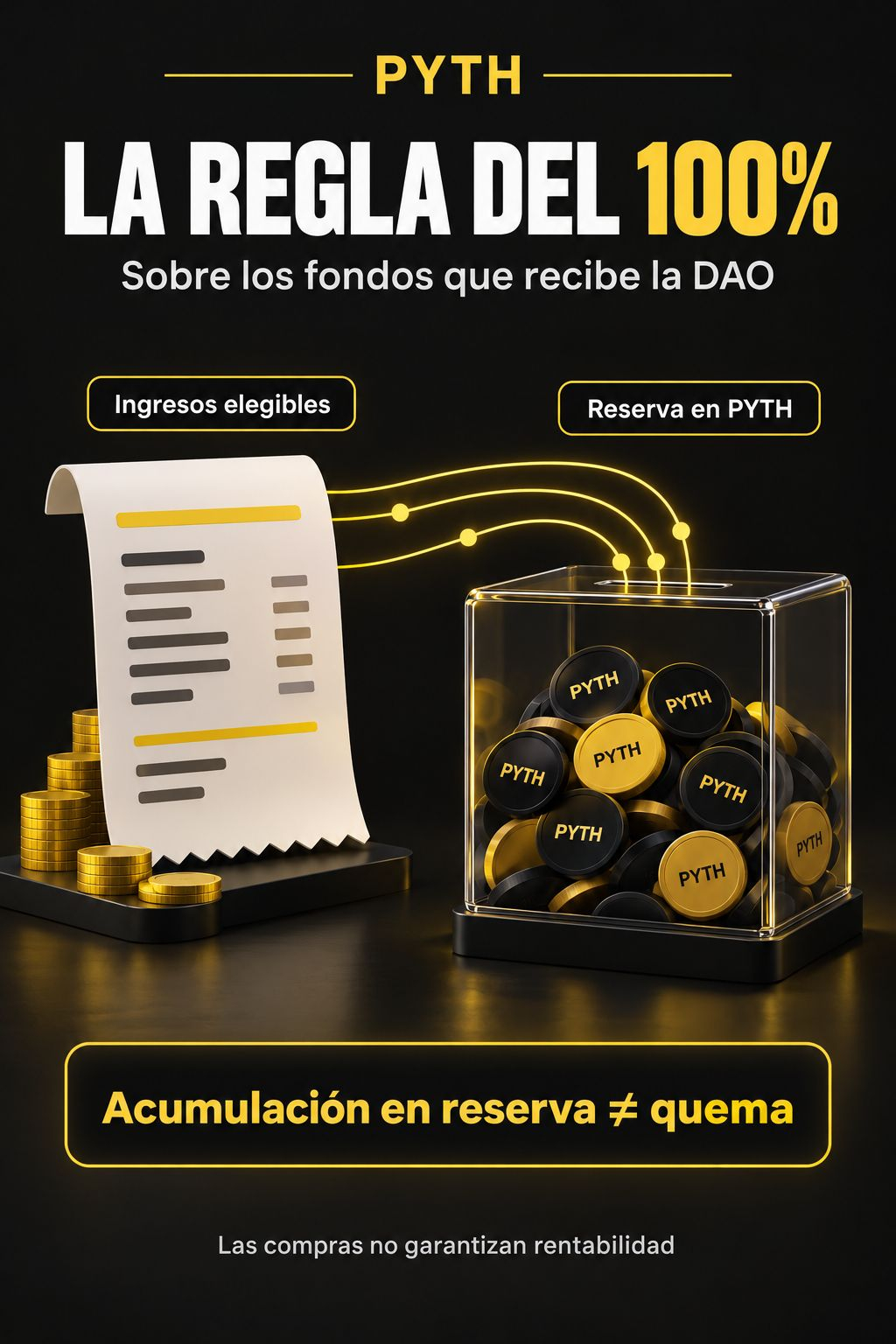
Pyth and the 100% rule: what changes in its reserve
On October 8, 2026, Pyth explained the policy approved in OP-PIP-136, submitted on September 24: allocate 100% of the eligible funds received by the DAO from its data-products to accumulate PYTH.
The percentage applies to the DAO’s revenue portion, not to the entire business invoicing. Existing commercial distributions do not change. The authorization replaces the monthly votes of the previous mechanism, based on one-third of the treasury balance separate from PYTH.
Eligible assets are converted into PYTH and returned to the treasury. If the DAO receives PYTH directly, it keeps it; that is not a market purchase. Accumulating tokens in reserve also does not mean burning them or paying dividends.
The September report places the annualized recurring revenue, or ARR, at around $11.5 million. It’s an annualized subscription run-rate: it does not represent cash collected during the quarter or already executed purchase budget.
Execution matters: OP-PIP-140, published on October 7 and still open, proposes recovering USDC and transferring balances to the executing team. Operational risks and revenue drop risks remain.
Market read: at 22:40 UTC on 8/10, Binance spot showed PYTH at 0.08345 USDT (+14.85% in 24h). As context between oracles, LINK was down 3.98% and API3, 5.79%. The divergence does not prove a single cause; the effect of the reserve will depend on actual purchases and available supply, without guaranteeing profitability.
$PYTH $LINK $API3
Educational content. Not financial advice.
#Pyth #Oraculos #Tokenomics #Gobernanza #DeFi
1
128
·
--
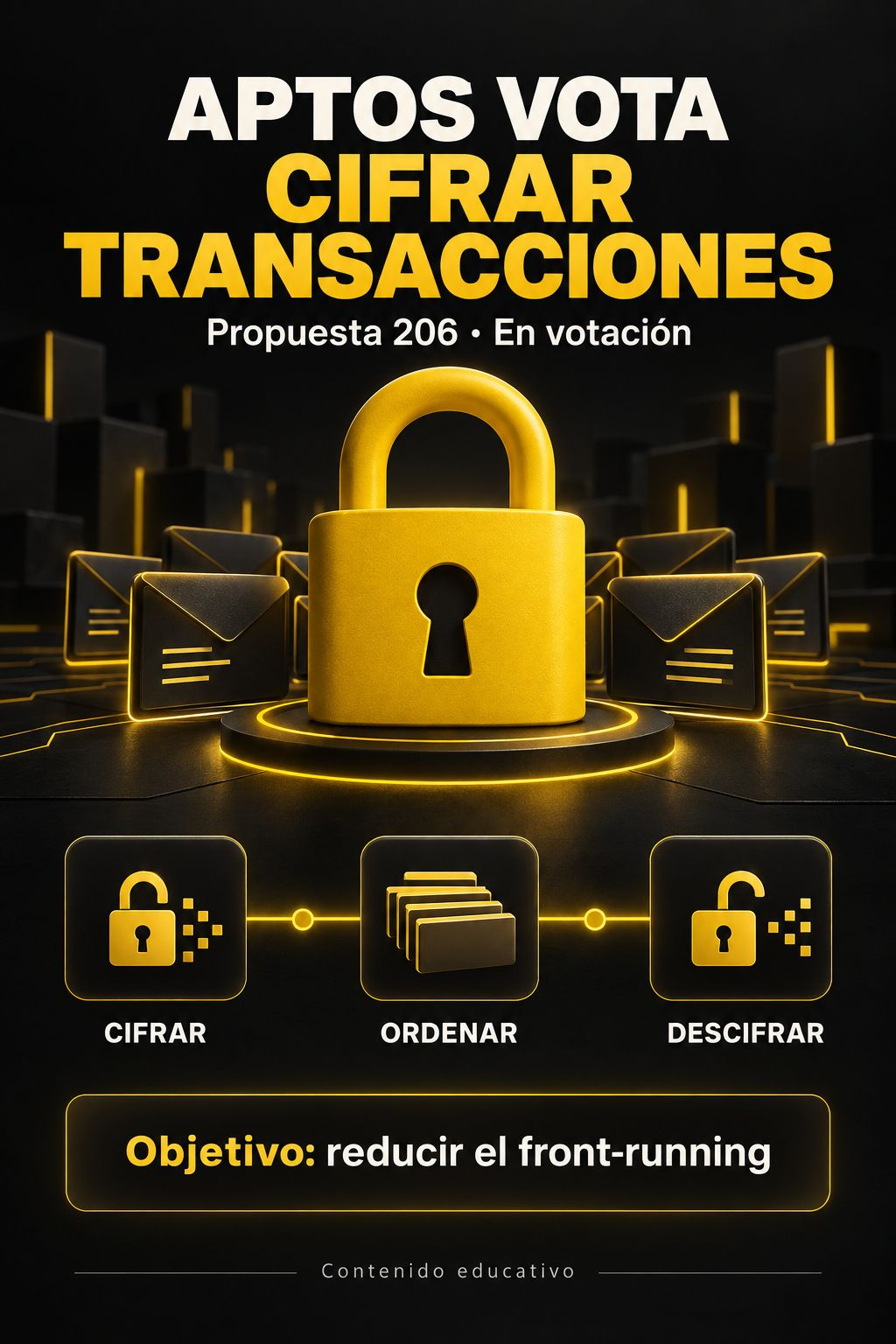
Aptos votes on encrypting transactions: what changes for MEV
Aptos has kept proposal 206 open to activate ChunkyDKG V1 and encrypted transactions. It was created on October 3, 2026, and voting ends on October 6 at 15:43 UTC. When the official governance page was checked on October 5, the proposal was still active: this vote has not confirmed that the feature will be activated.
The idea behind AIP-144 is to protect the contents of a transaction while it waits its turn. Users could submit it encrypted; validators would first agree on the order, then decrypt it before execution.
Why does this matter? Seeing a pending transaction can allow another actor to jump ahead and gain an advantage. The design aims to reduce front-running and sandwich attacks, harmful forms of MEV: value extracted by taking advantage of transaction ordering.
At 10:31 UTC, the proposal had approximately 32.63 million APT in favor, compared with a minimum threshold of 300 million. Near-unanimous support among those who voted does not mean the threshold has been met.
Limitations: encryption would be optional and would require support from user tools. The first version protects transaction contents, but is not intended to hide the sender or all metadata. It also does not replace the security of contracts or wallets. Approval, execution, and actual adoption must still be distinguished.
Market perspective: on Binance Spot, at 10:31 UTC, APT was trading at 0.8139 USDT (+2.79% in 24 hours), compared with ETH (+0.44%) and SOL (-0.54%), other smart contract networks. This difference does not prove that the proposal caused the rise. The relevant test will be its implementation and use; a technical improvement does not guarantee demand for the token or profitability.
Sources: Aptos official governance, AIP-144, and public Binance data.
$APT $ETH $SOL
Educational content. Not financial advice.
#Aptos #MEV #Gobernanza #Blockchain #BinanceSquare
216
Log in to explore more content
Join global crypto users on Binance Square
⚡️ Get latest and useful information about crypto.
💬 Trusted by the world’s largest crypto exchange.
👍 Discover real insights from verified creators.
Email / Phone number
Trending Topics
1
#NvidiaBeatsEstimatesWith$130BQ4Outlook
0 views
3 Discussing
2
#AnthropicIPOPriceCouldExceed$80
0 views
20 Discussing
3
#CanNvidia’sDataCenterGrowthContinue?
0 views
3 Discussing
4
#NvidiaBoardNotConsideringHuang’sReturnasCEO
138,256 views
1,037 Discussing
5
#KOSPIFalls2.59%ToLowestCloseSinceFebruary
36,370 views
360 Discussing
6
#AnthropicClearedToListOnNasdaqAsANT
30,910 views
302 Discussing
7
#WhatInvestmentSignalsDo13FFilingsReveal?
75,154 views
697 Discussing
8
#TetherCapitalMakesStrategicInvestmentInStables
17,436 views
136 Discussing
9
#EvernorthRecords$505MImpairmentOnPreListingXRP
2,128 views
23 Discussing
10
#GoldmanSachsReports$1.22BInEtherETFHoldings
1,536 views
19 Discussing