
The weekend market fluctuations are not large, with BTC oscillating around 88000 USD. This week we are about to enter the Christmas market.
From the data, the probability of the S&P 500 index rising during the Christmas market is 79%, with an average increase of about 1.3%. The most significant increase in one week was 7.4%. However, there are also times of reversal, with the worst drop being 4.2%.
The Christmas market is more like a barometer of market sentiment.
At the end of the year, there generally won't be macro policy stimulus. If people are still willing to spend money on risk assets at this time, it indicates optimism for next year.
Once this optimistic mindset is confirmed, it can lay a good foundation for the New Year market.
On the other hand, if the Christmas market does not rise but falls, it indicates that investor confidence has not yet recovered.
In January and possibly longer, the market is likely to remain weak or experience repeated fluctuations.
Additionally, several key data points will be released this week, such as the U.S. GDP growth rate and the PCE price index (the inflation indicator that the Federal Reserve cares about the most). This will directly affect the Federal Reserve's monetary policy and is a focus of attention.
From on-chain data, Bitcoin's turnover rate has recently been declining, indicating that real user trading activity is not high. With the Christmas holiday approaching, the overall trading volume and turnover rate are expected to decrease further.
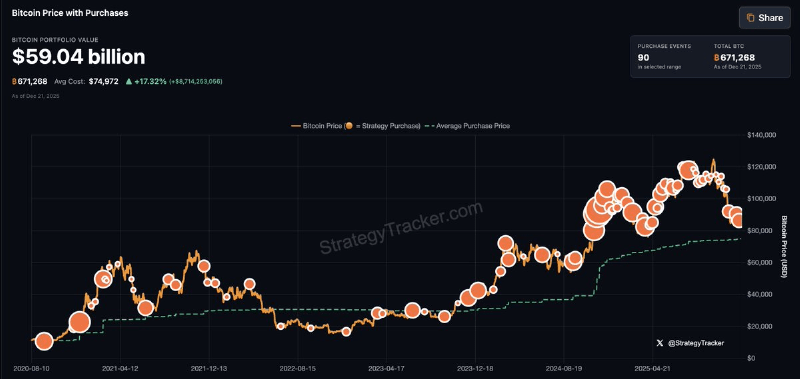
However, MicroStrategy CEO Michael Saylor has once again released a Bitcoin tracker, suggesting that he is continuing to increase his holdings.
Is SpaceX's valuation of 1.5 trillion just the starting point?
Recently, Wall Street in the U.S. valued SpaceX, believing that it will not only be the world's only major 'space delivery' player in the future but also holds the entry point for global communication and space computing power.
Once listed, 1.5 trillion may just be the starting price, not the peak.
In the U.S. capital market, this means it is a long-term opportunity that has not yet been fully priced but has high certainty.
Cathie Wood stated: SpaceX's valuation depends not on rockets, but on 'Starlink'.
In her valuation model, once Starlink completes global networking and fully commercializes, its annual revenue ceiling could reach nearly 300 billion.
What does this concept mean? It is equivalent to directly taking about 15% of the share from the global communication market's big cake.
McKinsey also predicts that by 2035, the scale of the global space economy will reach 1.8 trillion, and the growth rate over the next decade will be twice that of global GDP.
By then, SpaceX will no longer be a simple aerospace company but a super platform that controls the global communication entry point.
And the significance of Starship is to help Musk achieve this goal at an extremely low cost.
Based on this logic, Cathie Wood provided a valuation forecast for SpaceX in 2030: pessimistic 1.7 trillion, baseline 2.5 trillion, optimistic 3.1 trillion.
This model may still underestimate the market's emotional premium.
Last week, SpaceX launched a new round of employee stock transfers, with internal valuation already approaching 800 billion. Once IPO, 1.5 trillion is likely to be just the offering price.
SpaceX's bigger imagination space is the 'space computing center'.
Currently, the bottleneck in AI development is not chips, but energy. Ground data centers are limited by electricity, land, and environmental protection. However, space solar energy is almost infinitely free.
If SpaceX first throws data centers into orbit and connects them with Starlink, it can create a whole new computing power model.
This is also why, even though this matter is still in a very early conceptual stage, the capital market is willing to offer a very high premium in advance.
Because once successful, its disruptive nature is enough to reshuffle global capital.

