
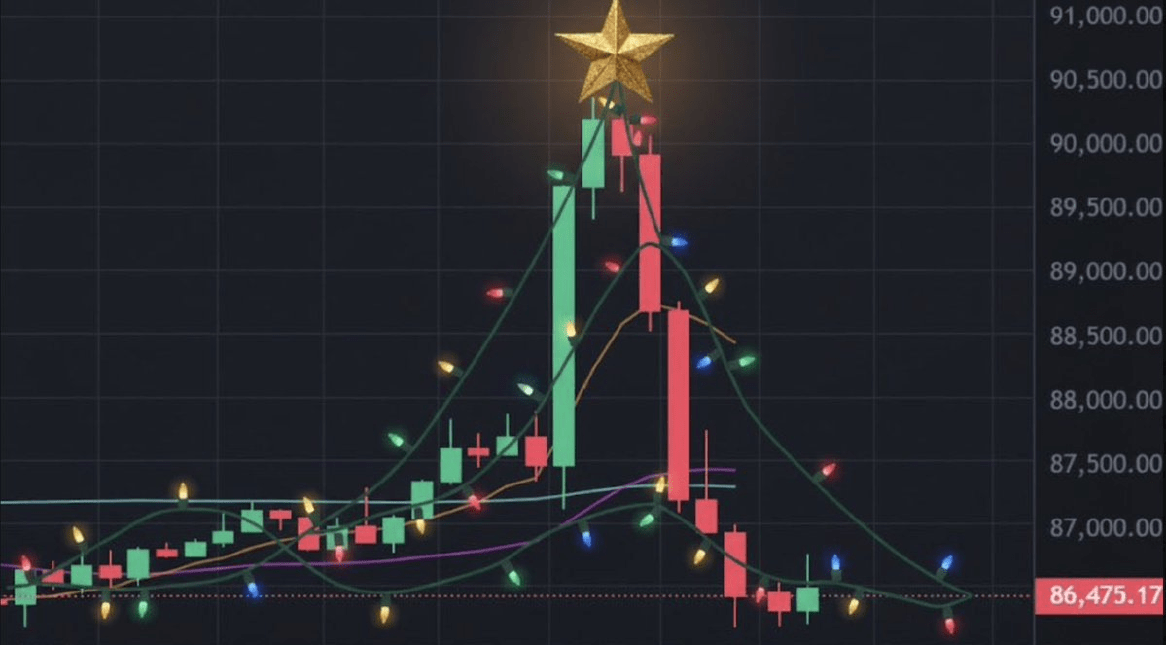
After the US stock market closed yesterday, it continued to decline, with technology stocks collectively adjusting, and Bitcoin also showing a peak and then a pullback.
The American Christmas holiday is coming soon, and market liquidity is relatively low, investor sentiment tends to be more cautious, and any slight movement can cause them to flee.
Currently, the US stock market has reached a leveraged bubble state.
From the perspective of US stock market leverage indicators, since June 2025, this indicator has broken through 1 standard deviation, and is now almost at the level of July 2007, not yet reaching the extremes of March 2000, but already far above the mid-term high points since 2009.
After entering the bubble phase, the trend of the U.S. stock market mainly depends on liquidity rather than fundamentals.
Once the market starts deleveraging and indicators turn around, the entire market will enter a medium to long-term downward channel.
Moreover, the higher the peak, the lower the trough after deleveraging.
From this perspective, if the U.S. stock market really goes down, the adjustment may be larger than that of the wave from November 2021 to December 2022.
Currently, everyone's main concern is U.S. monetary policy, which will directly determine the trend of the U.S. stock market and liquidity.
At present, AI and tech stocks are attracting purchases due to policy and capital support.
However, investors are worried that the Federal Reserve and Trump have not yet determined a winner, fearing that the U.S. economy might fall into recession, making the competition very fierce and the volatility quite large.
However, legendary trader 半木夏 stated yesterday that concerns about the AI bubble have persisted for a while, and the market has basically digested it.
Concerns about Japan's interest rate hike have also stalled the recent market, basically within market expectations.
The Federal Reserve has begun to expand its balance sheet, and liquidity is gradually improving.
Last week's non-farm data was not good but not terrible either, leading to greater room for interest rate cuts, and there won't be a direct trading recession.
Therefore, it is very likely that this is the best time to buy risk assets (Bitcoin, S&P, CSI 300) in the medium term (the next 1-2 months).
In the next year or two, concerns about the AI bubble may periodically arise, each time leading to market pullbacks, but each pullback is actually a buying opportunity until the market crazily believes this time is different.
I believe that from a broad perspective, the Federal Reserve has entered a major easing cycle, with three consecutive interest rate cuts in 2025, along with balance sheet expansion, and market liquidity will gradually recover.
In addition, next year Trump has midterm elections, and he will definitely not let the U.S. economy fall into recession, and the U.S. stock market will not plummet; this requires the Federal Reserve to cooperate with him in easing.
As long as the Federal Reserve's monetary policy does not shift, there shouldn't be major issues; now it's just a matter of who can hold on until the end.
From the data, it appears that primarily short-term holders are selling, and the selling pressure from investors who are stuck at high levels is not significant; BTC mainly follows the trend of U.S. tech stocks.
In the past week, whales have also bought 54,000 BTC, worth $4.66 billion.
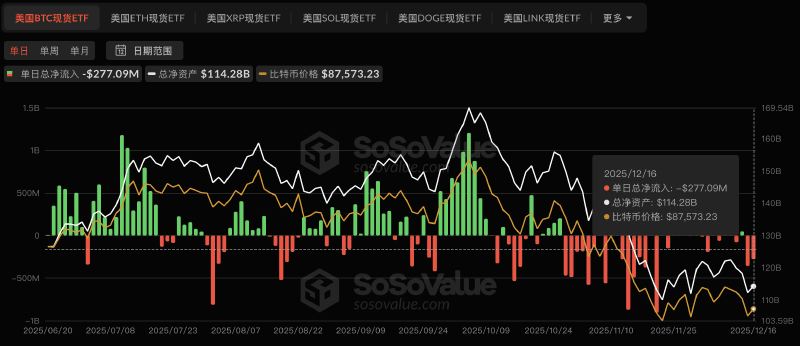
However, from the spot ETF data, both BTC and ETH are flowing out; on December 16, BTC flowed out $277 million, and ETH also flowed out $224 million, indicating that U.S. institutional investors are quite cautious at the moment.
Overall, December is the North American Christmas and year-end holiday period, which is considered the time of worst market liquidity, combined with various macro events unfolding, increasing market volatility.
Next, attention can be paid to Thursday's CPI inflation data; the lower this data, the more favorable it is for the Federal Reserve to cut interest rates.
Friday is the Bank of Japan's interest rate adjustment; this time a 25 basis point increase is basically a done deal. Although it is bad news, the market has already digested it in advance, so the impact won't be too big.
The key is to see whether the Bank of Japan will signal a sustained rate hike, which will affect short-term market sentiment and prices.


