
Yesterday, the United States released the CPI data for November, which showed a core CPI of only 2.6%, significantly lower than market expectations. This is also the lowest level since 2021, which is favorable for the Federal Reserve to continue cutting interest rates.
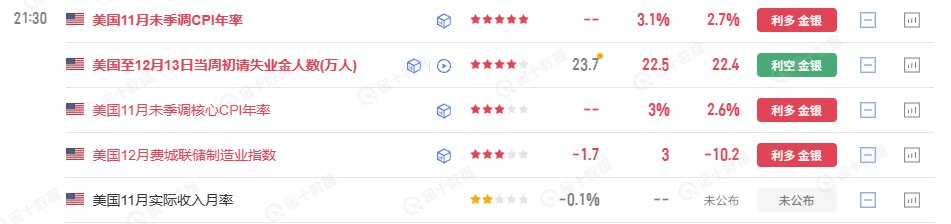
The CME Federal Reserve Watch Tool shows that the probability of the Federal Reserve cutting rates in January has risen to 27.7%.
After the data was released, U.S. stocks rebounded, with the S&P and Nasdaq indices almost completely recovering the losses from the previous day.
However, BTC experienced an initial rise followed by a fall, and after hitting $90,000, it returned to around $85,000.
This indicates that, during periods of lower liquidity, investors still lack confidence in the cryptocurrency market.
The main reason is the inertia of the four-year halving cycle, combined with some large holders being bearish, and short-term investors who are stuck selling at a loss, creating selling pressure.
Moreover, due to the low price of the currency, MicroStrategy's ability to raise funds as a listed company is limited, and everyone's expectations for the future are not strong enough, leading to insufficient buying.
From the perspective of chip structure, currently, it is mainly short-term holders who are selling, and the selling pressure from investors who are stuck at high positions is not significant. BTC is bottoming out at $83,000 - $88,000.
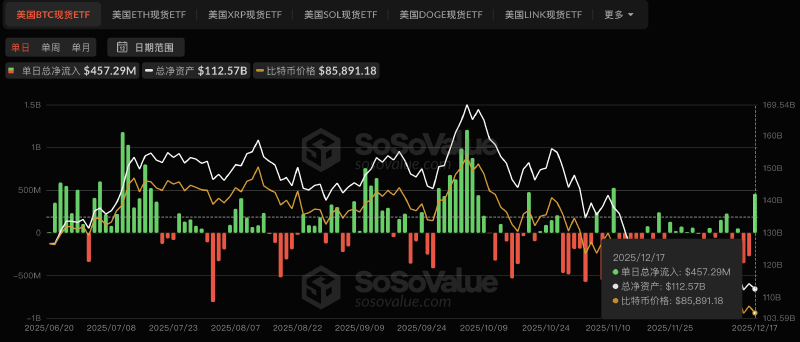
ETF data also shows that BTC saw an inflow of $457 million on December 17, ending two consecutive days of net outflows.
Next, attention needs to be paid to the Bank of Japan's interest rate adjustment on Friday. This rate hike of 25 basis points is basically a done deal. Although it is negative news, the market has already digested it in advance, so the impact will not be too great.
The key point is whether the Bank of Japan will signal continuous rate hikes, as this will affect short-term market sentiment and prices.
