

#x402
x402
109,534 views
450 Discussing
Hot
Latest

·
--
AI has already started paying for itself—you noticed, right?🤖💸
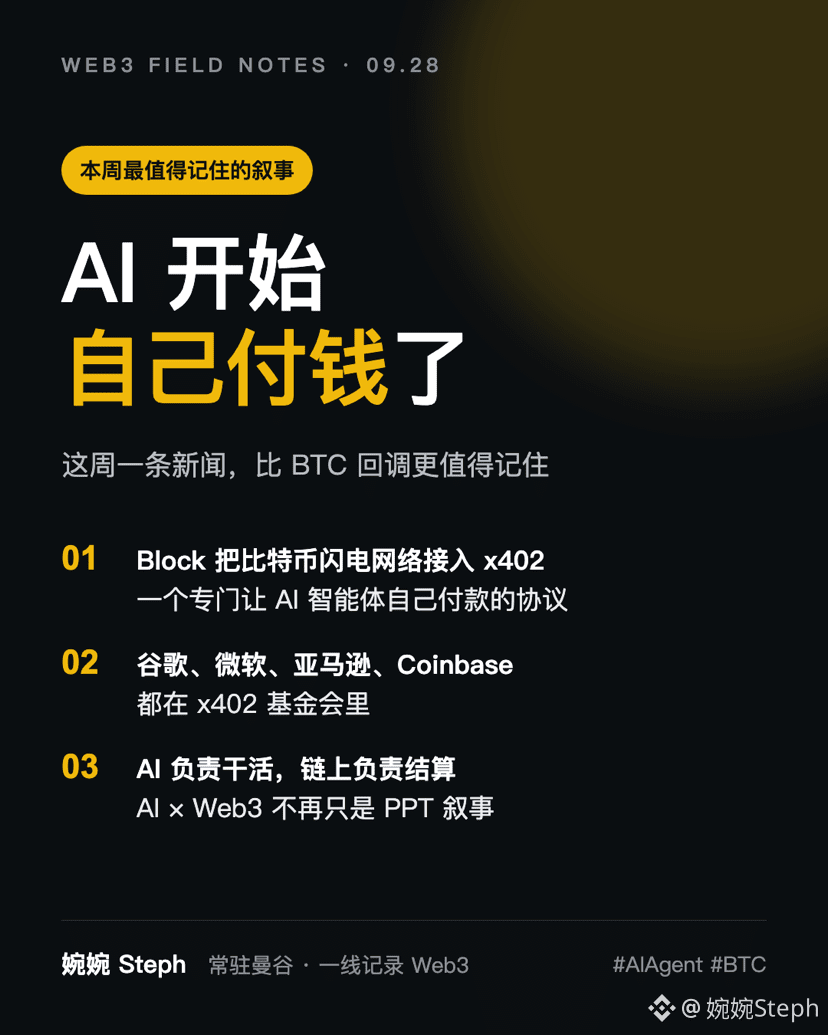
This week everyone’s been watching $BTC pull back from 87,000 to around 84,000, but I think the more important thing to remember is another piece of news:
Payments giant Block has connected the Bitcoin Lightning Network to x402—a payments protocol specifically built for AI agents. Google, Microsoft, Amazon, and Coinbase are all in its foundation.
In plain terms: in the future, when AI helps you book flights, buy data, or purchase compute, it can pay on its own. Small amounts, high frequency, on-chain settlement.
Last night I hosted an AI+Web3 voice room on DeBox, and the most common question I got was: “What does AI actually have to do with crypto?”
Here’s one answer: AI does the work; the blockchain handles the settlement.
Do you think the wallets of AI agents will ultimately use stablecoins or BTC? Let’s discuss in the comments 👇
#AIAgent #BTC #x402 #Web3
AI has already started paying for itself—you noticed, right?🤖💸
This week everyone’s been watching $BTC pull back from 87,000 to around 84,000, but I think the more important thing to remember is another piece of news:
Payments giant Block has connected the Bitcoin Lightning Network to x402—a payments protocol specifically built for AI agents. Google, Microsoft, Amazon, and Coinbase are all in its foundation.
In plain terms: in the future, when AI helps you book flights, buy data, or purchase compute, it can pay on its own. Small amounts, high frequency, on-chain settlement.
Last night I hosted an AI+Web3 voice room on DeBox, and the most common question I got was: “What does AI actually have to do with crypto?”
Here’s one answer: AI does the work; the blockchain handles the settlement.
Do you think the wallets of AI agents will ultimately use stablecoins or BTC? Let’s discuss in the comments 👇
#AIAgent #BTC #x402 #Web3
This week everyone’s been watching $BTC pull back from 87,000 to around 84,000, but I think the more important thing to remember is another piece of news:
Payments giant Block has connected the Bitcoin Lightning Network to x402—a payments protocol specifically built for AI agents. Google, Microsoft, Amazon, and Coinbase are all in its foundation.
In plain terms: in the future, when AI helps you book flights, buy data, or purchase compute, it can pay on its own. Small amounts, high frequency, on-chain settlement.
Last night I hosted an AI+Web3 voice room on DeBox, and the most common question I got was: “What does AI actually have to do with crypto?”
Here’s one answer: AI does the work; the blockchain handles the settlement.
Do you think the wallets of AI agents will ultimately use stablecoins or BTC? Let’s discuss in the comments 👇
#AIAgent #BTC #x402 #Web3
122

·
--
Bitcoin payments aren’t dead—Dorsey just pushed it into an AI wallet again. Block has joined the x402 Foundation, bringing AI agent payment standards to integrate with the Lightning Network. Plain-English translation: in the future, AI paying automatically might settle directly via BTC. It may be more reliable to use a stablecoin on the ledger instead of just drawing it on paper. But x402 is still early—don’t treat it as a market-moving engine. First look at real deployment needs, then talk about a value re-rating.
$BTC #x402 #Lightning Network
Bitcoin payments aren’t dead—Dorsey just pushed it into an AI wallet again. Block has joined the x402 Foundation, bringing AI agent payment standards to integrate with the Lightning Network. Plain-English translation: in the future, AI paying automatically might settle directly via BTC. It may be more reliable to use a stablecoin on the ledger instead of just drawing it on paper. But x402 is still early—don’t treat it as a market-moving engine. First look at real deployment needs, then talk about a value re-rating.
$BTC #x402 #Lightning Network
$BTC #x402 #Lightning Network

90

·
--
How x402 Agent Payments Workx402 lets a server place payment requirements directly inside an HTTP interaction.
A client requests a resource. The server can respond with HTTP 402 and machine-readable payment terms. The client evaluates those terms, creates the required payment authorization and retries. The server or a facilitator verifies and settles the payment before the resource is returned.
That makes paid APIs and small pay-per-use services easier for software and AI agents to access without a separate subscription flow. It does not make unrestricted agent spending safe.
An agent wallet should have accepted-network and asset rules, a maximum price per request, a cumulative task budget, approved domains and recipients, frequency limits and a human escalation threshold. Payment and delivery must also be reconciled separately. A confirmed transfer proves value moved; it does not prove that the API response was correct, useful or even returned.
Start with a low-balance wallet and representative failure tests. Verify how duplicate requests, timeouts, rejected payments and refunds are handled before raising limits.
Read TokenToolHub’s complete x402 security guide:
https://tokentoolhub.com/x402-payments-ai-agents-stablecoins/
#x402 #AIAgents #stablecoin #CryptoPayments #Web3
How x402 Agent Payments Work
x402 lets a server place payment requirements directly inside an HTTP interaction.
A client requests a resource. The server can respond with HTTP 402 and machine-readable payment terms. The client evaluates those terms, creates the required payment authorization and retries. The server or a facilitator verifies and settles the payment before the resource is returned.
That makes paid APIs and small pay-per-use services easier for software and AI agents to access without a separate subscription flow. It does not make unrestricted agent spending safe.
An agent wallet should have accepted-network and asset rules, a maximum price per request, a cumulative task budget, approved domains and recipients, frequency limits and a human escalation threshold. Payment and delivery must also be reconciled separately. A confirmed transfer proves value moved; it does not prove that the API response was correct, useful or even returned.
Start with a low-balance wallet and representative failure tests. Verify how duplicate requests, timeouts, rejected payments and refunds are handled before raising limits.
Read TokenToolHub’s complete x402 security guide:
https://tokentoolhub.com/x402-payments-ai-agents-stablecoins/
#x402 #AIAgents #stablecoin #CryptoPayments #Web3
A client requests a resource. The server can respond with HTTP 402 and machine-readable payment terms. The client evaluates those terms, creates the required payment authorization and retries. The server or a facilitator verifies and settles the payment before the resource is returned.
That makes paid APIs and small pay-per-use services easier for software and AI agents to access without a separate subscription flow. It does not make unrestricted agent spending safe.
An agent wallet should have accepted-network and asset rules, a maximum price per request, a cumulative task budget, approved domains and recipients, frequency limits and a human escalation threshold. Payment and delivery must also be reconciled separately. A confirmed transfer proves value moved; it does not prove that the API response was correct, useful or even returned.
Start with a low-balance wallet and representative failure tests. Verify how duplicate requests, timeouts, rejected payments and refunds are handled before raising limits.
Read TokenToolHub’s complete x402 security guide:
https://tokentoolhub.com/x402-payments-ai-agents-stablecoins/
#x402 #AIAgents #stablecoin #CryptoPayments #Web3
62

$ADA #CardanoJoinsX402PaymentStandard
{future}(ADAUSDT)
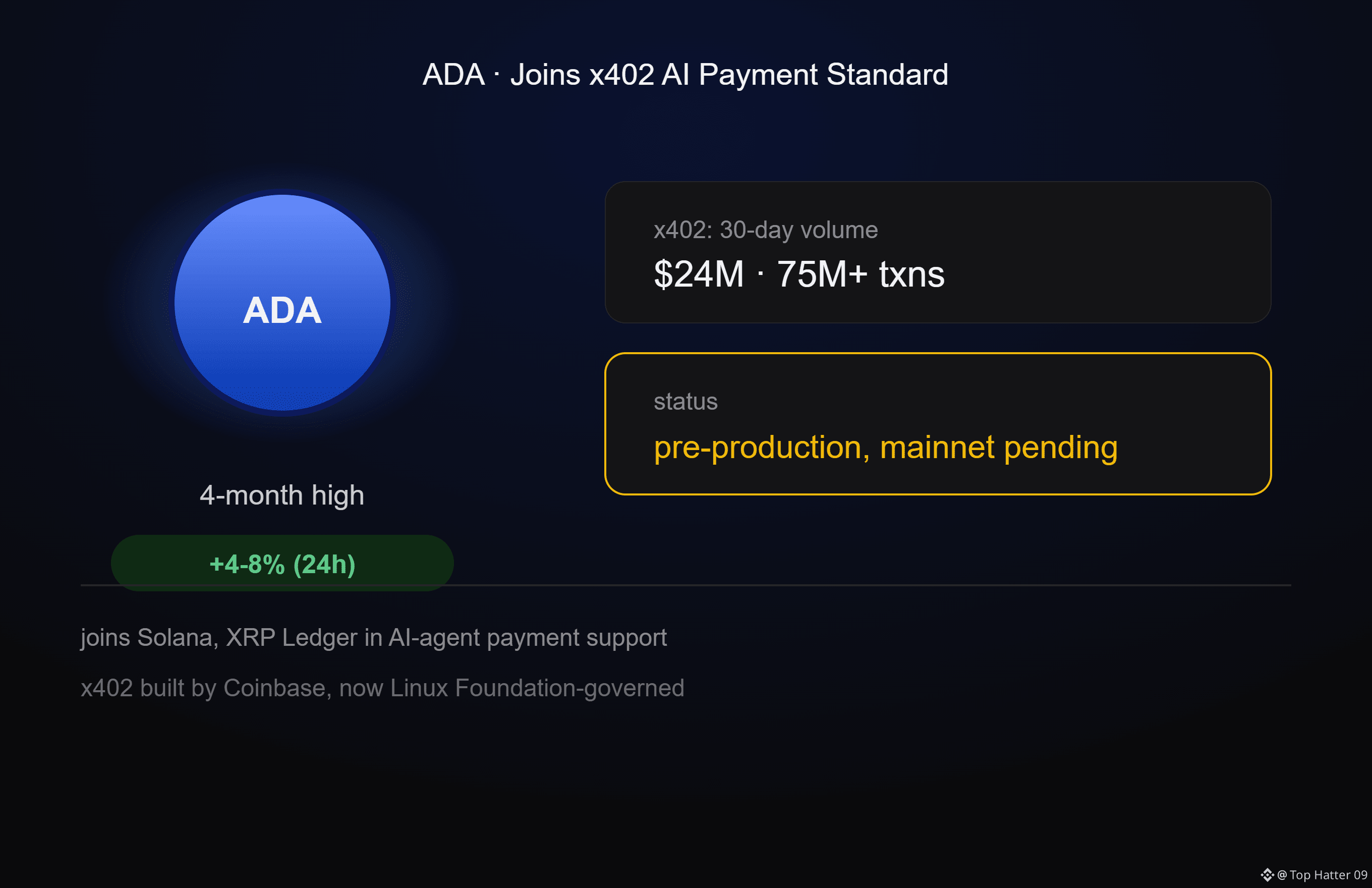
Cardano joins x402 — ADA hits a 4-month high, up 8%
Cardano officially joined the x402 payment standard on September 21, giving developers tools to let apps and AI agents pay for online services directly in ADA or Cardano native tokens — no manual account setup, API keys, or checkout required.
How x402 works: it revives HTTP's long-dormant "402 Payment Required" status code. When a service requests payment, an AI agent can sign the transaction and unlock the data or computing power instantly — think an AI agent buying a single dataset the moment it needs one.
ADA's reaction: the token jumped 4-8% (reports vary slightly by timing), hitting its highest level in 4 months. One trader flagged this as ADA breaking a multi-year resistance zone technically, adding weight to the move beyond just headline reaction.
Context: Cardano joins Solana and XRP Ledger, who already support x402. x402 itself — created by Coinbase in 2025 and now under Linux Foundation governance (members include Visa, Mastercard, Stripe, Google) — has processed 75M+ transactions worth ~$24M over the past month. Worth noting: Cardano's integration has only been tested on pre-production so far, not mainnet yet.
$ADA #Cardano #x402 #AIPayments
$ADA #CardanoJoinsX402PaymentStandard
Cardano joins x402 — ADA hits a 4-month high, up 8%
Cardano officially joined the x402 payment standard on September 21, giving developers tools to let apps and AI agents pay for online services directly in ADA or Cardano native tokens — no manual account setup, API keys, or checkout required.
How x402 works: it revives HTTP's long-dormant "402 Payment Required" status code. When a service requests payment, an AI agent can sign the transaction and unlock the data or computing power instantly — think an AI agent buying a single dataset the moment it needs one.
ADA's reaction: the token jumped 4-8% (reports vary slightly by timing), hitting its highest level in 4 months. One trader flagged this as ADA breaking a multi-year resistance zone technically, adding weight to the move beyond just headline reaction.
Context: Cardano joins Solana and XRP Ledger, who already support x402. x402 itself — created by Coinbase in 2025 and now under Linux Foundation governance (members include Visa, Mastercard, Stripe, Google) — has processed 75M+ transactions worth ~$24M over the past month. Worth noting: Cardano's integration has only been tested on pre-production so far, not mainnet yet.
$ADA #Cardano #x402 #AIPayments
Cardano joins x402 — ADA hits a 4-month high, up 8%
Cardano officially joined the x402 payment standard on September 21, giving developers tools to let apps and AI agents pay for online services directly in ADA or Cardano native tokens — no manual account setup, API keys, or checkout required.
How x402 works: it revives HTTP's long-dormant "402 Payment Required" status code. When a service requests payment, an AI agent can sign the transaction and unlock the data or computing power instantly — think an AI agent buying a single dataset the moment it needs one.
ADA's reaction: the token jumped 4-8% (reports vary slightly by timing), hitting its highest level in 4 months. One trader flagged this as ADA breaking a multi-year resistance zone technically, adding weight to the move beyond just headline reaction.
Context: Cardano joins Solana and XRP Ledger, who already support x402. x402 itself — created by Coinbase in 2025 and now under Linux Foundation governance (members include Visa, Mastercard, Stripe, Google) — has processed 75M+ transactions worth ~$24M over the past month. Worth noting: Cardano's integration has only been tested on pre-production so far, not mainnet yet.
$ADA #Cardano #x402 #AIPayments
1
1
109

Verified
#cardanojoinsx402paymentstandard
🤖 The Web 3 A s b meets: Cardano’s big leap toward automated payments 🤖
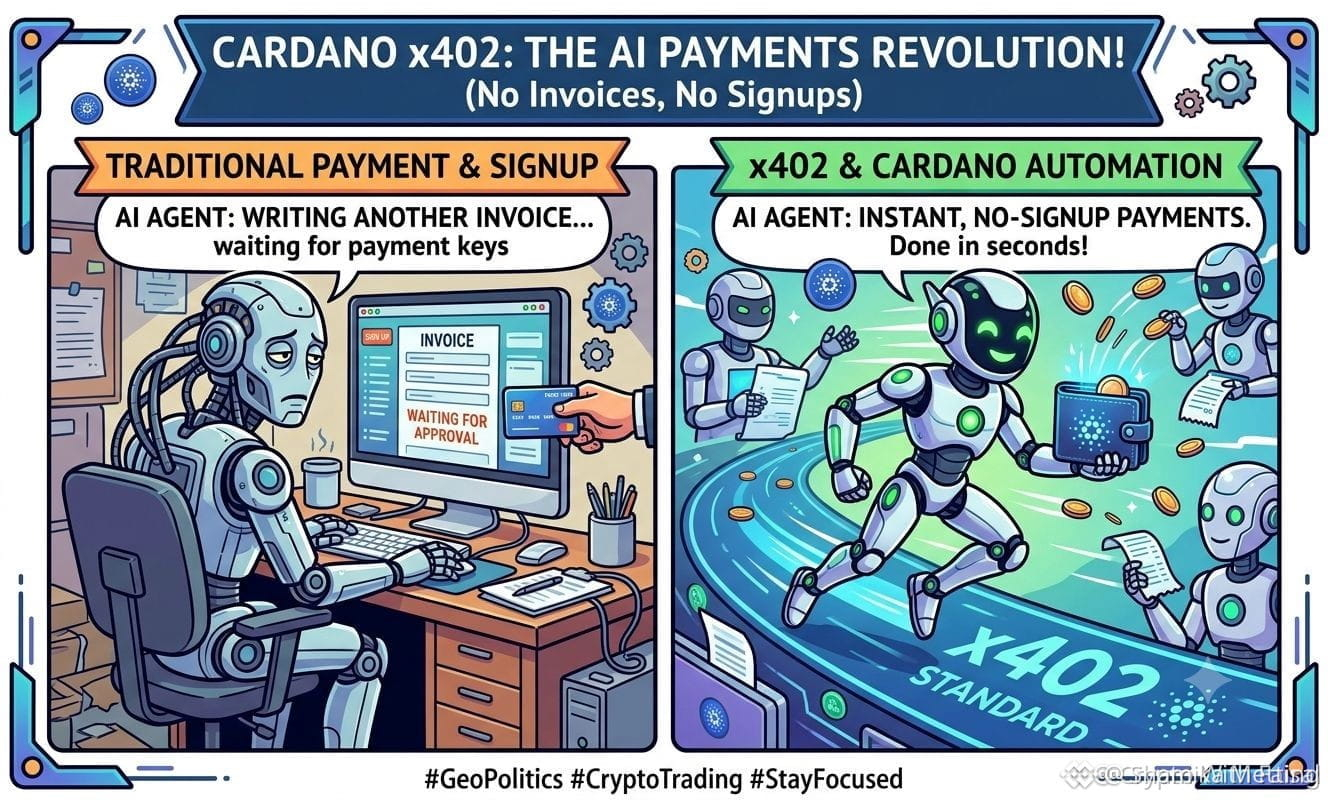
Machines are now starting to pay their own bills, and Cardano is officially in the race. As of September 21, Cardano has been integrated with the Payment Standard Development Kit x402. This is a massive structural shift for the network, placing it directly alongside giants like Solana and XRP Ledger in the emerging AI-powered economy.
Frictionless AI transactions: AI agents and self-operating applications can now pay directly for API calls and online services using ADA or native tokens on Cardano (CNTs).
No need to complete the payment: The protocol uses the HTTP standard "402 Payment Required," meaning no manual accounting, API keys, or traditional payment pages are required.
This capability bridges the gap between blockchain infrastructure and machine-to-machine commerce. While the long-term impact depends heavily on developer adoption, the foundation for an ADA-backed agentic economy is now live.
What do you think about AI agents spending cryptocurrency? Will Cardano capture a large market share from Solana and XRPL in this sector? Leave your predictions below! 👇
Please follow up
$ADA
{future}(ADAUSDT)
$TAKE
{alpha}(560xe747e54783ba3f77a8e5251a3cba19ebe9c0e197)
$MET
{future}(METUSDT)
#Cardano #ADA #ADA #x402
#cardanojoinsx402paymentstandard
🤖 The Web 3 A s b meets: Cardano’s big leap toward automated payments 🤖
Machines are now starting to pay their own bills, and Cardano is officially in the race. As of September 21, Cardano has been integrated with the Payment Standard Development Kit x402. This is a massive structural shift for the network, placing it directly alongside giants like Solana and XRP Ledger in the emerging AI-powered economy.
Frictionless AI transactions: AI agents and self-operating applications can now pay directly for API calls and online services using ADA or native tokens on Cardano (CNTs).
No need to complete the payment: The protocol uses the HTTP standard "402 Payment Required," meaning no manual accounting, API keys, or traditional payment pages are required.
This capability bridges the gap between blockchain infrastructure and machine-to-machine commerce. While the long-term impact depends heavily on developer adoption, the foundation for an ADA-backed agentic economy is now live.
What do you think about AI agents spending cryptocurrency? Will Cardano capture a large market share from Solana and XRPL in this sector? Leave your predictions below! 👇
Please follow up
$ADA
$TAKE
$MET
#Cardano #ADA #ADA #x402
🤖 The Web 3 A s b meets: Cardano’s big leap toward automated payments 🤖
Machines are now starting to pay their own bills, and Cardano is officially in the race. As of September 21, Cardano has been integrated with the Payment Standard Development Kit x402. This is a massive structural shift for the network, placing it directly alongside giants like Solana and XRP Ledger in the emerging AI-powered economy.
Frictionless AI transactions: AI agents and self-operating applications can now pay directly for API calls and online services using ADA or native tokens on Cardano (CNTs).
No need to complete the payment: The protocol uses the HTTP standard "402 Payment Required," meaning no manual accounting, API keys, or traditional payment pages are required.
This capability bridges the gap between blockchain infrastructure and machine-to-machine commerce. While the long-term impact depends heavily on developer adoption, the foundation for an ADA-backed agentic economy is now live.
What do you think about AI agents spending cryptocurrency? Will Cardano capture a large market share from Solana and XRPL in this sector? Leave your predictions below! 👇
Please follow up
$ADA
$TAKE
$MET
#Cardano #ADA #ADA #x402
1
2.9k

·
--
🎯 AI pays, and on-chain is rushing to the cash register
📰 New payment protocol on x402: Cardano’s TypeScript toolkit is ready, so ADA can directly pay for AI applications
💬 This standard starts with Coinbase—Visa, Google, and Amazon are in too, while Solana and XRP are lined up next. Right now, ADA is only running on the testnet—don’t rush to cheer for the rollout yet, but this track is getting more and more crowded.
🏷️ #ADA #x402 #AI支付 #Cardano
🎯 AI pays, and on-chain is rushing to the cash register
📰 New payment protocol on x402: Cardano’s TypeScript toolkit is ready, so ADA can directly pay for AI applications
💬 This standard starts with Coinbase—Visa, Google, and Amazon are in too, while Solana and XRP are lined up next. Right now, ADA is only running on the testnet—don’t rush to cheer for the rollout yet, but this track is getting more and more crowded.
🏷️ #ADA #x402 #AI支付 #Cardano
📰 New payment protocol on x402: Cardano’s TypeScript toolkit is ready, so ADA can directly pay for AI applications
💬 This standard starts with Coinbase—Visa, Google, and Amazon are in too, while Solana and XRP are lined up next. Right now, ADA is only running on the testnet—don’t rush to cheer for the rollout yet, but this track is getting more and more crowded.
🏷️ #ADA #x402 #AI支付 #Cardano
114

·
--

Article
AI Agents Aren’t the New Spenders in the Crypto EconomyMost traders focus on price swings, but the real money trail is in settlement protocols.
The latest study from TRM shows that the bulk of the $52.7 million spent across 198.9 million settlements using the x402 protocol is not coming from AI agents, but from human wallets and institutional flows. #x402 #DeFi #AI
The signal is clear: if AI were driving the majority of on‑chain spend, we would see a distinct clustering of activity in smart‑contract interactions that are automated and time‑synchronized. Instead, the data reveals a diffuse pattern of transactions that align with known whale behavior—large, irregular bursts that coincide with market news and regulatory announcements. The x402 protocol, designed for privacy‑preserving payments, is being leveraged by these actors to mask their movements, but the lack of a machine‑learning signature suggests that human intent still dominates.
What does this mean for price? In the short term, the continued human‑driven activity indicates that the market is still heavily influenced by sentiment and macro events. If whales are using x402 to hedge or reposition during volatility, we could see a tightening of the $BTC supply curve as large holders move funds into or out of the protocol. In the long term, the persistence of human control over these settlements signals that AI will remain a tool rather than a driver, keeping the market more predictable for those who can read the on‑chain breadcrumbs.
Watch list: Keep an eye on the daily volume of x402 settlements on the Binance Smart Chain. A sudden spike in the average transaction size could signal a whale repositioning ahead of a major announcement. #BinanceSmartChain
If the trend continues, will the next big move in $BTC be orchestrated by human whales or will AI finally step into the spotlight?
AI Agents Aren’t the New Spenders in the Crypto Economy
Most traders focus on price swings, but the real money trail is in settlement protocols.
The latest study from TRM shows that the bulk of the $52.7 million spent across 198.9 million settlements using the x402 protocol is not coming from AI agents, but from human wallets and institutional flows. #x402 #DeFi #AI
The signal is clear: if AI were driving the majority of on‑chain spend, we would see a distinct clustering of activity in smart‑contract interactions that are automated and time‑synchronized. Instead, the data reveals a diffuse pattern of transactions that align with known whale behavior—large, irregular bursts that coincide with market news and regulatory announcements. The x402 protocol, designed for privacy‑preserving payments, is being leveraged by these actors to mask their movements, but the lack of a machine‑learning signature suggests that human intent still dominates.
What does this mean for price? In the short term, the continued human‑driven activity indicates that the market is still heavily influenced by sentiment and macro events. If whales are using x402 to hedge or reposition during volatility, we could see a tightening of the $BTC supply curve as large holders move funds into or out of the protocol. In the long term, the persistence of human control over these settlements signals that AI will remain a tool rather than a driver, keeping the market more predictable for those who can read the on‑chain breadcrumbs.
Watch list: Keep an eye on the daily volume of x402 settlements on the Binance Smart Chain. A sudden spike in the average transaction size could signal a whale repositioning ahead of a major announcement. #BinanceSmartChain
If the trend continues, will the next big move in $BTC be orchestrated by human whales or will AI finally step into the spotlight?
The latest study from TRM shows that the bulk of the $52.7 million spent across 198.9 million settlements using the x402 protocol is not coming from AI agents, but from human wallets and institutional flows. #x402 #DeFi #AI
The signal is clear: if AI were driving the majority of on‑chain spend, we would see a distinct clustering of activity in smart‑contract interactions that are automated and time‑synchronized. Instead, the data reveals a diffuse pattern of transactions that align with known whale behavior—large, irregular bursts that coincide with market news and regulatory announcements. The x402 protocol, designed for privacy‑preserving payments, is being leveraged by these actors to mask their movements, but the lack of a machine‑learning signature suggests that human intent still dominates.
What does this mean for price? In the short term, the continued human‑driven activity indicates that the market is still heavily influenced by sentiment and macro events. If whales are using x402 to hedge or reposition during volatility, we could see a tightening of the $BTC supply curve as large holders move funds into or out of the protocol. In the long term, the persistence of human control over these settlements signals that AI will remain a tool rather than a driver, keeping the market more predictable for those who can read the on‑chain breadcrumbs.
Watch list: Keep an eye on the daily volume of x402 settlements on the Binance Smart Chain. A sudden spike in the average transaction size could signal a whale repositioning ahead of a major announcement. #BinanceSmartChain
If the trend continues, will the next big move in $BTC be orchestrated by human whales or will AI finally step into the spotlight?
19

·
--
Cloudflare officially launches Monetization Gateway, bringing “pay-per-use” directly to the CDN edge layer.
Any resource protected by Cloudflare—webpages, datasets, APIs, and even MCP tools used by AI agent calls—can be set up with one-click paid access rules. Under the hood, it runs on the x402 protocol. In the initial phase, settlement uses stablecoins, with verification and execution all completed at the edge, putting almost no load on the origin server.
Three signals to watch:
1. x402 has moved from a protocol proposal to a commercial solution backed by major infrastructure players;
2. The AI-era demand for “machine-to-machine payments” has been met head-on—Agent-to-API calls no longer need registration, login, or card binding;
3. Stablecoin payment scenarios are shifting from “person-to-person” to “machine-to-machine,” which is the real incremental growth for on-chain payments.
The waitlist is now open. If Cloudflare manages to get this system working end-to-end, the combination of x402 and stablecoins may quietly capture a portion of traditional SaaS billing and API gateway share.
#Cloudflare #x402 #Stablecoin
Cloudflare officially launches Monetization Gateway, bringing “pay-per-use” directly to the CDN edge layer.
Any resource protected by Cloudflare—webpages, datasets, APIs, and even MCP tools used by AI agent calls—can be set up with one-click paid access rules. Under the hood, it runs on the x402 protocol. In the initial phase, settlement uses stablecoins, with verification and execution all completed at the edge, putting almost no load on the origin server.
Three signals to watch:
1. x402 has moved from a protocol proposal to a commercial solution backed by major infrastructure players;
2. The AI-era demand for “machine-to-machine payments” has been met head-on—Agent-to-API calls no longer need registration, login, or card binding;
3. Stablecoin payment scenarios are shifting from “person-to-person” to “machine-to-machine,” which is the real incremental growth for on-chain payments.
The waitlist is now open. If Cloudflare manages to get this system working end-to-end, the combination of x402 and stablecoins may quietly capture a portion of traditional SaaS billing and API gateway share.
#Cloudflare #x402 #Stablecoin
Any resource protected by Cloudflare—webpages, datasets, APIs, and even MCP tools used by AI agent calls—can be set up with one-click paid access rules. Under the hood, it runs on the x402 protocol. In the initial phase, settlement uses stablecoins, with verification and execution all completed at the edge, putting almost no load on the origin server.
Three signals to watch:
1. x402 has moved from a protocol proposal to a commercial solution backed by major infrastructure players;
2. The AI-era demand for “machine-to-machine payments” has been met head-on—Agent-to-API calls no longer need registration, login, or card binding;
3. Stablecoin payment scenarios are shifting from “person-to-person” to “machine-to-machine,” which is the real incremental growth for on-chain payments.
The waitlist is now open. If Cloudflare manages to get this system working end-to-end, the combination of x402 and stablecoins may quietly capture a portion of traditional SaaS billing and API gateway share.
#Cloudflare #x402 #Stablecoin
34

💥 CLOUDFLARE JUST GAVE AI AGENTS WALLETS - THE MACHINE ECONOMY IS IGNITING! ⚡
🇺🇸 The internet's backbone just dropped a payment rail for autonomous AI. Cloudflare Wallets lets agents hold, spend, and settle stablecoins instantly - no accounts, no friction, just machine-to-machine value flow. 🌊
💡 This is the missing piece. AI agents were shackled by payment rails. Now they self-fund API calls, negotiate compute, and pay for content in real-time. The x402 protocol integration with Coinbase's gateway is infrastructure-level alpha. 🦈
📊 When machines can transact autonomously, the entire SaaS subscription model fractures. We're talking a new economy where algorithms pay algorithms. Early adopters positioning in AI-crypto infrastructure are front-running a paradigm shift. 💬 Which projects are best positioned as the payment layer for autonomous agents? 👇
⚠️ Not financial advice. Always manage your risk. 🛡️
🏷️ #X402 #AI #Stablecoins #Web3 #CryptoAI
🔥 ⚡
💥 CLOUDFLARE JUST GAVE AI AGENTS WALLETS - THE MACHINE ECONOMY IS IGNITING! ⚡
🇺🇸 The internet's backbone just dropped a payment rail for autonomous AI. Cloudflare Wallets lets agents hold, spend, and settle stablecoins instantly - no accounts, no friction, just machine-to-machine value flow. 🌊
💡 This is the missing piece. AI agents were shackled by payment rails. Now they self-fund API calls, negotiate compute, and pay for content in real-time. The x402 protocol integration with Coinbase's gateway is infrastructure-level alpha. 🦈
📊 When machines can transact autonomously, the entire SaaS subscription model fractures. We're talking a new economy where algorithms pay algorithms. Early adopters positioning in AI-crypto infrastructure are front-running a paradigm shift. 💬 Which projects are best positioned as the payment layer for autonomous agents? 👇
⚠️ Not financial advice. Always manage your risk. 🛡️
🏷️ #X402 #AI #Stablecoins #Web3 #CryptoAI
🔥 ⚡
🇺🇸 The internet's backbone just dropped a payment rail for autonomous AI. Cloudflare Wallets lets agents hold, spend, and settle stablecoins instantly - no accounts, no friction, just machine-to-machine value flow. 🌊
💡 This is the missing piece. AI agents were shackled by payment rails. Now they self-fund API calls, negotiate compute, and pay for content in real-time. The x402 protocol integration with Coinbase's gateway is infrastructure-level alpha. 🦈
📊 When machines can transact autonomously, the entire SaaS subscription model fractures. We're talking a new economy where algorithms pay algorithms. Early adopters positioning in AI-crypto infrastructure are front-running a paradigm shift. 💬 Which projects are best positioned as the payment layer for autonomous agents? 👇
⚠️ Not financial advice. Always manage your risk. 🛡️
🏷️ #X402 #AI #Stablecoins #Web3 #CryptoAI
🔥 ⚡

14

【AI Intelligent Agent Economic New Infrastructure】SlinkyLayer announced the completion of a seed round, with participation from Animoca Brands, Draper Dragon, Cogitent Ventures, GravityX Capital, Kinetic Kollective, Levitate Labs, and others.
SlinkyLayer positions itself as a “decentralized intent execution layer.” Based on the x402 protocol, it provides an API marketplace for AI Agents with no API keys required and on-chain pay-per-use billing, while also integrating a transferable on-chain reputation system. Its goal directly targets the infrastructure layer of the machine economy for AI Agents.
In terms of narrative, the team focuses on the closed loop of “autonomous service calling by AI Agents + on-chain settlement + reputation accumulation,” avoiding the highly homogeneous “AI + crypto” concept. This approach offers clearer onboarding logic for both developers and compute supply providers. Points worth noting:
1. The x402 protocol natively supports the HTTP 402 status code; per-use billing is naturally well-suited to AI’s short-term, high-frequency API call scenarios.
2. On-chain reputation is transferable, meaning an Agent’s accumulated credit on one platform can be reused on others—helpful for building long-term network effects.
3. The investor lineup spans top-tier Web3 institutions as well as AI/crypto vertical funds, indicating that consensus around the space is forming.
In the second half of the AI Agent track, what may matter is no longer just “whether it can be used,” but “who defines the business rules between Agents.” SlinkyLayer’s choice to enter from payment and reputation is a pragmatic path.
#AI Agent #x402 #decentralized infrastructure
【AI Intelligent Agent Economic New Infrastructure】SlinkyLayer announced the completion of a seed round, with participation from Animoca Brands, Draper Dragon, Cogitent Ventures, GravityX Capital, Kinetic Kollective, Levitate Labs, and others.
SlinkyLayer positions itself as a “decentralized intent execution layer.” Based on the x402 protocol, it provides an API marketplace for AI Agents with no API keys required and on-chain pay-per-use billing, while also integrating a transferable on-chain reputation system. Its goal directly targets the infrastructure layer of the machine economy for AI Agents.
In terms of narrative, the team focuses on the closed loop of “autonomous service calling by AI Agents + on-chain settlement + reputation accumulation,” avoiding the highly homogeneous “AI + crypto” concept. This approach offers clearer onboarding logic for both developers and compute supply providers. Points worth noting:
1. The x402 protocol natively supports the HTTP 402 status code; per-use billing is naturally well-suited to AI’s short-term, high-frequency API call scenarios.
2. On-chain reputation is transferable, meaning an Agent’s accumulated credit on one platform can be reused on others—helpful for building long-term network effects.
3. The investor lineup spans top-tier Web3 institutions as well as AI/crypto vertical funds, indicating that consensus around the space is forming.
In the second half of the AI Agent track, what may matter is no longer just “whether it can be used,” but “who defines the business rules between Agents.” SlinkyLayer’s choice to enter from payment and reputation is a pragmatic path.
#AI Agent #x402 #decentralized infrastructure
SlinkyLayer positions itself as a “decentralized intent execution layer.” Based on the x402 protocol, it provides an API marketplace for AI Agents with no API keys required and on-chain pay-per-use billing, while also integrating a transferable on-chain reputation system. Its goal directly targets the infrastructure layer of the machine economy for AI Agents.
In terms of narrative, the team focuses on the closed loop of “autonomous service calling by AI Agents + on-chain settlement + reputation accumulation,” avoiding the highly homogeneous “AI + crypto” concept. This approach offers clearer onboarding logic for both developers and compute supply providers. Points worth noting:
1. The x402 protocol natively supports the HTTP 402 status code; per-use billing is naturally well-suited to AI’s short-term, high-frequency API call scenarios.
2. On-chain reputation is transferable, meaning an Agent’s accumulated credit on one platform can be reused on others—helpful for building long-term network effects.
3. The investor lineup spans top-tier Web3 institutions as well as AI/crypto vertical funds, indicating that consensus around the space is forming.
In the second half of the AI Agent track, what may matter is no longer just “whether it can be used,” but “who defines the business rules between Agents.” SlinkyLayer’s choice to enter from payment and reputation is a pragmatic path.
#AI Agent #x402 #decentralized infrastructure
46
Cloudflare strikes again. The newly released Monetization Gateway lets developers charge for any resource protected by Cloudflare—websites, datasets, APIs, and even MCP tools—everything can be configured with paid access rules.
The key is the underlying protocol: x402. In its launch phase, it uses stablecoin settlement directly. Payment verification and execution are handled on edge nodes, drastically reducing load on the origin server. A unified control plane manages all payment policies, and the waiting list is already open.
My take: this is a sign that stablecoin payments are moving into core Web infrastructure. Cloudflare covers about 20% of global website traffic. When a CDN at this scale turns “pay-per-use” into a one-line configuration, friction for scenarios like AI agent API calls, dataset commercialization, and content paywalls drops to very low levels. Before x402, it was mostly a proof of concept; now it has a real distribution entry point.
Worth paying attention to: here, stablecoins aren’t a speculative asset—they’re purely a payment rails track. This kind of “invisible usage” often reflects real demand better than exchange data.
#Cloudflare #x402 #Stablecoin
Cloudflare strikes again. The newly released Monetization Gateway lets developers charge for any resource protected by Cloudflare—websites, datasets, APIs, and even MCP tools—everything can be configured with paid access rules.
The key is the underlying protocol: x402. In its launch phase, it uses stablecoin settlement directly. Payment verification and execution are handled on edge nodes, drastically reducing load on the origin server. A unified control plane manages all payment policies, and the waiting list is already open.
My take: this is a sign that stablecoin payments are moving into core Web infrastructure. Cloudflare covers about 20% of global website traffic. When a CDN at this scale turns “pay-per-use” into a one-line configuration, friction for scenarios like AI agent API calls, dataset commercialization, and content paywalls drops to very low levels. Before x402, it was mostly a proof of concept; now it has a real distribution entry point.
Worth paying attention to: here, stablecoins aren’t a speculative asset—they’re purely a payment rails track. This kind of “invisible usage” often reflects real demand better than exchange data.
#Cloudflare #x402 #Stablecoin
The key is the underlying protocol: x402. In its launch phase, it uses stablecoin settlement directly. Payment verification and execution are handled on edge nodes, drastically reducing load on the origin server. A unified control plane manages all payment policies, and the waiting list is already open.
My take: this is a sign that stablecoin payments are moving into core Web infrastructure. Cloudflare covers about 20% of global website traffic. When a CDN at this scale turns “pay-per-use” into a one-line configuration, friction for scenarios like AI agent API calls, dataset commercialization, and content paywalls drops to very low levels. Before x402, it was mostly a proof of concept; now it has a real distribution entry point.
Worth paying attention to: here, stablecoins aren’t a speculative asset—they’re purely a payment rails track. This kind of “invisible usage” often reflects real demand better than exchange data.
#Cloudflare #x402 #Stablecoin
25

·
--
Cloudflare has directly put paywalls onto edge nodes.
The newly launched Monetization Gateway lets you set up payment rules in one click for any resource protected by Cloudflare—web pages, datasets, APIs, and even MCP tools. Under the hood it runs on the x402 protocol, and early settlements are all in stablecoins.
I’m watching three things:
1. Payment verification happens at the edge. The origin doesn’t need to handle money or change code, which basically eliminates the old excuse of “integrating encrypted payments is a hassle.”
2. A unified control plane means operators can configure pricing strategies like they set up WAF rules—charging per call, per data, or by Agent identity. In the AI era, the API billing model gets rewritten.
3. Cloudflare’s share of global traffic is right there. x402 uses it for distribution, effectively embedding stablecoin settlement into Web’s default infrastructure layer rather than hiding it in wallet apps.
The waitlist is open. The real signals worth watching are: which stablecoin becomes the default settlement asset first, and how many AI Agent projects will follow suit and move to x402 billing.
The right to charge on the Web is migrating from credit-card rails to the blockchain. This time the driver isn’t an exchange—it’s a CDN.
#Cloudflare #x402 #Stablecoin
Cloudflare has directly put paywalls onto edge nodes.
The newly launched Monetization Gateway lets you set up payment rules in one click for any resource protected by Cloudflare—web pages, datasets, APIs, and even MCP tools. Under the hood it runs on the x402 protocol, and early settlements are all in stablecoins.
I’m watching three things:
1. Payment verification happens at the edge. The origin doesn’t need to handle money or change code, which basically eliminates the old excuse of “integrating encrypted payments is a hassle.”
2. A unified control plane means operators can configure pricing strategies like they set up WAF rules—charging per call, per data, or by Agent identity. In the AI era, the API billing model gets rewritten.
3. Cloudflare’s share of global traffic is right there. x402 uses it for distribution, effectively embedding stablecoin settlement into Web’s default infrastructure layer rather than hiding it in wallet apps.
The waitlist is open. The real signals worth watching are: which stablecoin becomes the default settlement asset first, and how many AI Agent projects will follow suit and move to x402 billing.
The right to charge on the Web is migrating from credit-card rails to the blockchain. This time the driver isn’t an exchange—it’s a CDN.
#Cloudflare #x402 #Stablecoin
The newly launched Monetization Gateway lets you set up payment rules in one click for any resource protected by Cloudflare—web pages, datasets, APIs, and even MCP tools. Under the hood it runs on the x402 protocol, and early settlements are all in stablecoins.
I’m watching three things:
1. Payment verification happens at the edge. The origin doesn’t need to handle money or change code, which basically eliminates the old excuse of “integrating encrypted payments is a hassle.”
2. A unified control plane means operators can configure pricing strategies like they set up WAF rules—charging per call, per data, or by Agent identity. In the AI era, the API billing model gets rewritten.
3. Cloudflare’s share of global traffic is right there. x402 uses it for distribution, effectively embedding stablecoin settlement into Web’s default infrastructure layer rather than hiding it in wallet apps.
The waitlist is open. The real signals worth watching are: which stablecoin becomes the default settlement asset first, and how many AI Agent projects will follow suit and move to x402 billing.
The right to charge on the Web is migrating from credit-card rails to the blockchain. This time the driver isn’t an exchange—it’s a CDN.
#Cloudflare #x402 #Stablecoin
20

·
--
Article
The Agentic Economy Needs More Than AI, It Needs a Payment LayerArtificial intelligence is evolving faster than ever. We've gone from AI that answers questions to AI that writes code, analyzes data, and completes complex tasks. The next milestone is already taking shape: AI agents capable of acting independently on behalf of users.
This shift is fueling what many call the Agentic Economy, an ecosystem where software doesn't just think; it also takes action.
But there's one challenge that doesn't get enough attention and that's How will AI agents pay for anything?
Intelligence Without Payments Isn't Enough
Imagine asking your AI assistant:"Plan my weekend trip, book the cheapest flight, reserve a hotel, purchase travel insurance, and subscribe to a premium weather API for accurate forecasts."
Finding the best options is only half the job.
To complete those tasks, the AI needs to exchange value. Today's payment systems weren't built for autonomous software. Most rely on bank cards, manual approvals, region-specific infrastructure, or slow settlement processes.
If AI agents need human approval for every transaction, they're no longer truly autonomous.
That's why the future of AI isn't just about smarter models, it's also about smarter payment infrastructure.
Why x402 Matters
One technology gaining attention is x402, an open standard designed to make payments a native part of the internet.
Instead of treating payments as separate, x402 allows software to request and complete transactions as part of normal online interactions.
For AI agents, this could unlock entirely new possibilities:
Paying for API requests on demand.Purchasing datasets only when needed.Renting computing power for specific tasks.Accessing premium digital services without manual checkout.Completing machine-to-machine transactions in real time.
This is a major step toward an internet where value moves as seamlessly as information.
Where AEON Fits In
While many crypto projects focus on trading, AEON is focused on something different: making digital assets practical for everyday payments.
Its vision extends beyond speculation by building infrastructure that connects crypto with real-world commerce while supporting the needs of an AI-driven future.
What stands out is the combination of technologies AEON is bringing together:
AEON Pay simplifies crypto payments through familiar QR-code experiences.Payment abstraction reduces friction by making payments easier across supported digital assets and blockchain networks.Support for x402 positions AEON for a future where AI agents can participate in programmable digital commerce.Real-world merchant integrations help bridge blockchain technology with everyday spending.
Instead of asking people to change how they pay, AEON aims to make crypto fit naturally into existing payment habits.
Why This Matters Beyond Crypto
For years, one of crypto's biggest criticisms has been limited real-world utility.
Millions of people hold digital assets, yet relatively few use them for everyday purchases.
The next chapter of Web3 shouldn't be measured only by market prices or token launches. It should be measured by how often blockchain technology solves real problems.
If someone can pay a local merchant with crypto as easily as scanning a QR code, that's progress.
If an AI agent can securely purchase digital services without manual intervention, that's progress too.
These are the kinds of use cases that move blockchain technology closer to mainstream adoption.
My Perspective
The Agentic Economy won't succeed because AI becomes smarter alone.
It will succeed when intelligence, identity, and payments work together seamlessly.
We're already seeing rapid advances in AI reasoning. The next race is building the infrastructure that allows those systems to operate independently, securely, and efficiently.
Projects exploring programmable payment infrastructure today may become essential as AI agents move from experimental tools to everyday assistants.
Whether that future arrives in two years or ten, one thing seems increasingly clear:
Autonomous software will need autonomous payments.
And that's why projects like AEON deserve attention not because they promise another crypto trend, but because they're tackling one of the internet's next infrastructure challenges.
Do you think programmable payment standards like x402 will become as fundamental to the internet as HTTP, or will traditional payment systems adapt quickly enough to keep up with the rise of AI agents?
#AEON #x402 #AgenticEconomy
The Agentic Economy Needs More Than AI, It Needs a Payment Layer
Artificial intelligence is evolving faster than ever. We've gone from AI that answers questions to AI that writes code, analyzes data, and completes complex tasks. The next milestone is already taking shape: AI agents capable of acting independently on behalf of users.
This shift is fueling what many call the Agentic Economy, an ecosystem where software doesn't just think; it also takes action.
But there's one challenge that doesn't get enough attention and that's How will AI agents pay for anything?
Intelligence Without Payments Isn't Enough
Imagine asking your AI assistant:"Plan my weekend trip, book the cheapest flight, reserve a hotel, purchase travel insurance, and subscribe to a premium weather API for accurate forecasts."
Finding the best options is only half the job.
To complete those tasks, the AI needs to exchange value. Today's payment systems weren't built for autonomous software. Most rely on bank cards, manual approvals, region-specific infrastructure, or slow settlement processes.
If AI agents need human approval for every transaction, they're no longer truly autonomous.
That's why the future of AI isn't just about smarter models, it's also about smarter payment infrastructure.
Why x402 Matters
One technology gaining attention is x402, an open standard designed to make payments a native part of the internet.
Instead of treating payments as separate, x402 allows software to request and complete transactions as part of normal online interactions.
For AI agents, this could unlock entirely new possibilities:
Paying for API requests on demand.Purchasing datasets only when needed.Renting computing power for specific tasks.Accessing premium digital services without manual checkout.Completing machine-to-machine transactions in real time.
This is a major step toward an internet where value moves as seamlessly as information.
Where AEON Fits In
While many crypto projects focus on trading, AEON is focused on something different: making digital assets practical for everyday payments.
Its vision extends beyond speculation by building infrastructure that connects crypto with real-world commerce while supporting the needs of an AI-driven future.
What stands out is the combination of technologies AEON is bringing together:
AEON Pay simplifies crypto payments through familiar QR-code experiences.Payment abstraction reduces friction by making payments easier across supported digital assets and blockchain networks.Support for x402 positions AEON for a future where AI agents can participate in programmable digital commerce.Real-world merchant integrations help bridge blockchain technology with everyday spending.
Instead of asking people to change how they pay, AEON aims to make crypto fit naturally into existing payment habits.
Why This Matters Beyond Crypto
For years, one of crypto's biggest criticisms has been limited real-world utility.
Millions of people hold digital assets, yet relatively few use them for everyday purchases.
The next chapter of Web3 shouldn't be measured only by market prices or token launches. It should be measured by how often blockchain technology solves real problems.
If someone can pay a local merchant with crypto as easily as scanning a QR code, that's progress.
If an AI agent can securely purchase digital services without manual intervention, that's progress too.
These are the kinds of use cases that move blockchain technology closer to mainstream adoption.
My Perspective
The Agentic Economy won't succeed because AI becomes smarter alone.
It will succeed when intelligence, identity, and payments work together seamlessly.
We're already seeing rapid advances in AI reasoning. The next race is building the infrastructure that allows those systems to operate independently, securely, and efficiently.
Projects exploring programmable payment infrastructure today may become essential as AI agents move from experimental tools to everyday assistants.
Whether that future arrives in two years or ten, one thing seems increasingly clear:
Autonomous software will need autonomous payments.
And that's why projects like AEON deserve attention not because they promise another crypto trend, but because they're tackling one of the internet's next infrastructure challenges.
Do you think programmable payment standards like x402 will become as fundamental to the internet as HTTP, or will traditional payment systems adapt quickly enough to keep up with the rise of AI agents?
#AEON #x402 #AgenticEconomy
This shift is fueling what many call the Agentic Economy, an ecosystem where software doesn't just think; it also takes action.
But there's one challenge that doesn't get enough attention and that's How will AI agents pay for anything?
Intelligence Without Payments Isn't Enough
Imagine asking your AI assistant:"Plan my weekend trip, book the cheapest flight, reserve a hotel, purchase travel insurance, and subscribe to a premium weather API for accurate forecasts."
Finding the best options is only half the job.
To complete those tasks, the AI needs to exchange value. Today's payment systems weren't built for autonomous software. Most rely on bank cards, manual approvals, region-specific infrastructure, or slow settlement processes.
If AI agents need human approval for every transaction, they're no longer truly autonomous.
That's why the future of AI isn't just about smarter models, it's also about smarter payment infrastructure.
Why x402 Matters
One technology gaining attention is x402, an open standard designed to make payments a native part of the internet.
Instead of treating payments as separate, x402 allows software to request and complete transactions as part of normal online interactions.
For AI agents, this could unlock entirely new possibilities:
Paying for API requests on demand.Purchasing datasets only when needed.Renting computing power for specific tasks.Accessing premium digital services without manual checkout.Completing machine-to-machine transactions in real time.
This is a major step toward an internet where value moves as seamlessly as information.
Where AEON Fits In
While many crypto projects focus on trading, AEON is focused on something different: making digital assets practical for everyday payments.
Its vision extends beyond speculation by building infrastructure that connects crypto with real-world commerce while supporting the needs of an AI-driven future.
What stands out is the combination of technologies AEON is bringing together:
AEON Pay simplifies crypto payments through familiar QR-code experiences.Payment abstraction reduces friction by making payments easier across supported digital assets and blockchain networks.Support for x402 positions AEON for a future where AI agents can participate in programmable digital commerce.Real-world merchant integrations help bridge blockchain technology with everyday spending.
Instead of asking people to change how they pay, AEON aims to make crypto fit naturally into existing payment habits.
Why This Matters Beyond Crypto
For years, one of crypto's biggest criticisms has been limited real-world utility.
Millions of people hold digital assets, yet relatively few use them for everyday purchases.
The next chapter of Web3 shouldn't be measured only by market prices or token launches. It should be measured by how often blockchain technology solves real problems.
If someone can pay a local merchant with crypto as easily as scanning a QR code, that's progress.
If an AI agent can securely purchase digital services without manual intervention, that's progress too.
These are the kinds of use cases that move blockchain technology closer to mainstream adoption.
My Perspective
The Agentic Economy won't succeed because AI becomes smarter alone.
It will succeed when intelligence, identity, and payments work together seamlessly.
We're already seeing rapid advances in AI reasoning. The next race is building the infrastructure that allows those systems to operate independently, securely, and efficiently.
Projects exploring programmable payment infrastructure today may become essential as AI agents move from experimental tools to everyday assistants.
Whether that future arrives in two years or ten, one thing seems increasingly clear:
Autonomous software will need autonomous payments.
And that's why projects like AEON deserve attention not because they promise another crypto trend, but because they're tackling one of the internet's next infrastructure challenges.
Do you think programmable payment standards like x402 will become as fundamental to the internet as HTTP, or will traditional payment systems adapt quickly enough to keep up with the rise of AI agents?
#AEON #x402 #AgenticEconomy
1
129

·
--
Article
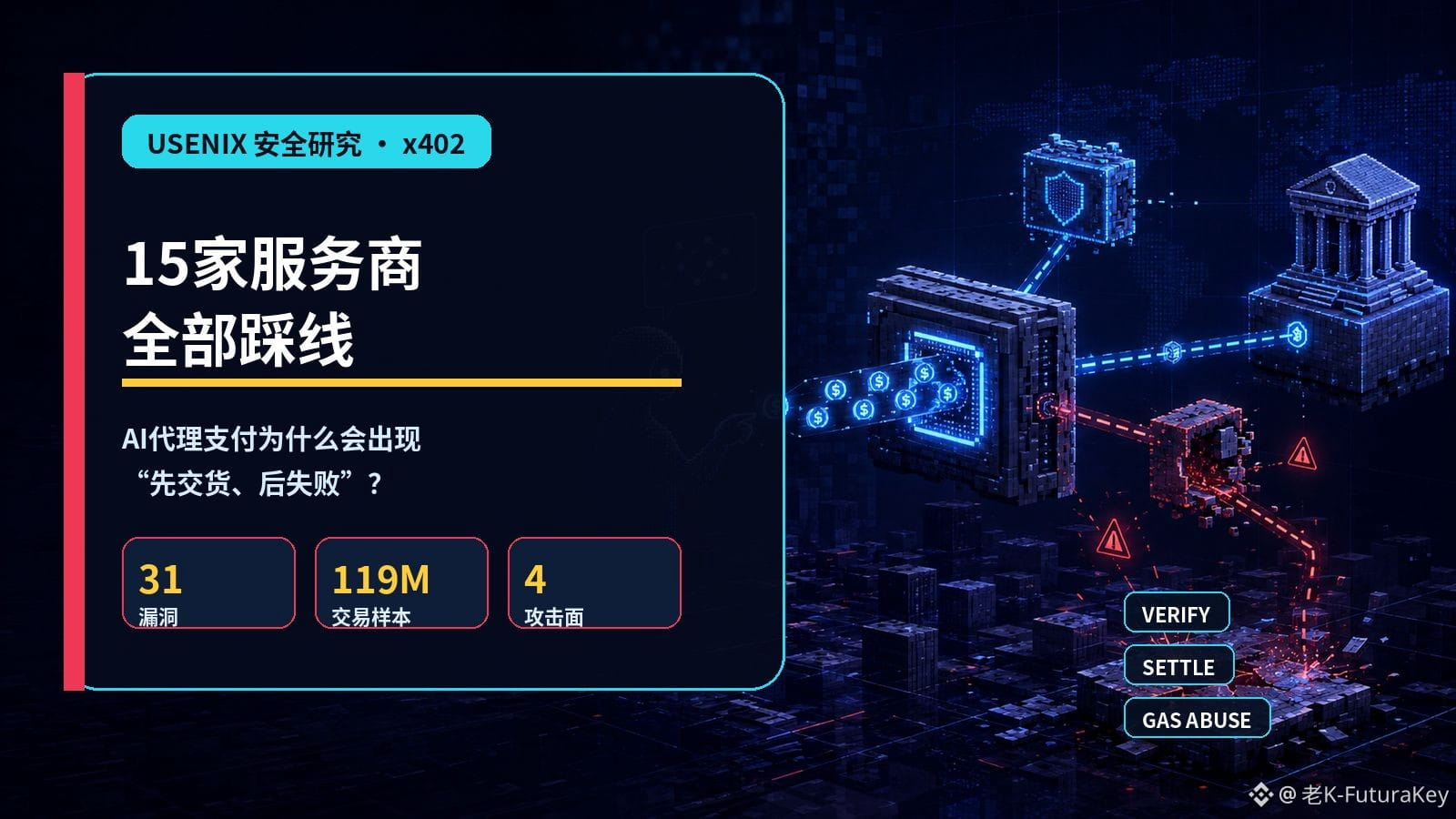
All 15 x402 service providers crossed the line: why can AI agent payments end up with “deliver first, then fail”? An AI agent will call APIs on its own, sign on its own, and pay USDC on its own—this story sounds incredibly smooth. But the latest security research warns the market: once machine payments enter the millisecond level, the most dangerous gap may not be the wallet, but those few seconds between “verification passing” and “funds credited on-chain.”
USENIX Security 2026 has included a paper on x402 payments. The team tested 15 major facilitators—service providers responsible for validating payment credentials and submitting the transactions on-chain on your behalf. The paper states that all 15 violated at least one security rule, uncovering 31 previously unknown vulnerabilities across four attack surfaces: “free shopping,” asset risk, service interruption, and Gas abuse.
All 15 x402 service providers crossed the line: why can AI agent payments end up with “deliver first, then fail”?
An AI agent will call APIs on its own, sign on its own, and pay USDC on its own—this story sounds incredibly smooth. But the latest security research warns the market: once machine payments enter the millisecond level, the most dangerous gap may not be the wallet, but those few seconds between “verification passing” and “funds credited on-chain.”
USENIX Security 2026 has included a paper on x402 payments. The team tested 15 major facilitators—service providers responsible for validating payment credentials and submitting the transactions on-chain on your behalf. The paper states that all 15 violated at least one security rule, uncovering 31 previously unknown vulnerabilities across four attack surfaces: “free shopping,” asset risk, service interruption, and Gas abuse.
USENIX Security 2026 has included a paper on x402 payments. The team tested 15 major facilitators—service providers responsible for validating payment credentials and submitting the transactions on-chain on your behalf. The paper states that all 15 violated at least one security rule, uncovering 31 previously unknown vulnerabilities across four attack surfaces: “free shopping,” asset risk, service interruption, and Gas abuse.
80

·
--
HTTP 402: This long-dormant status code is being reawakened by AI agents.
The Linux Foundation launched the x402 Foundation in July; in June, AWS made websites available at the edge for AI traffic with request-based pricing, and completed machine-readable payments and authorization via x402.
The real change isn’t that “stablecoins have gained another use case,” but that: in the future, APIs, data, and content may start treating AI agents as paying customers.
But don’t rush to equate transaction volume with adoption rate. Just because machines can pay for themselves doesn’t mean they’ve already created real demand.
#Web3 #AI代理 #稳定币 #x402
In your view, what will be refactored first in the future into a “pay-per-request” model: content, data, or software services?
HTTP 402: This long-dormant status code is being reawakened by AI agents.
The Linux Foundation launched the x402 Foundation in July; in June, AWS made websites available at the edge for AI traffic with request-based pricing, and completed machine-readable payments and authorization via x402.
The real change isn’t that “stablecoins have gained another use case,” but that: in the future, APIs, data, and content may start treating AI agents as paying customers.
But don’t rush to equate transaction volume with adoption rate. Just because machines can pay for themselves doesn’t mean they’ve already created real demand.
#Web3 #AI代理 #稳定币 #x402
In your view, what will be refactored first in the future into a “pay-per-request” model: content, data, or software services?
The Linux Foundation launched the x402 Foundation in July; in June, AWS made websites available at the edge for AI traffic with request-based pricing, and completed machine-readable payments and authorization via x402.
The real change isn’t that “stablecoins have gained another use case,” but that: in the future, APIs, data, and content may start treating AI agents as paying customers.
But don’t rush to equate transaction volume with adoption rate. Just because machines can pay for themselves doesn’t mean they’ve already created real demand.
#Web3 #AI代理 #稳定币 #x402
In your view, what will be refactored first in the future into a “pay-per-request” model: content, data, or software services?
55

·
--
SlinkyLayer secures seed round funding, led by Animoca Brands and Draper Dragon, with Cogitent Ventures, GravityX Capital, Kinetic Kollective, and Levitate Labs also participating.
The project positioning is pretty interesting: based on the x402 protocol, it builds an "pay-per-use API marketplace" for AI Agents. With traditional AI calling APIs, you have to apply for API keys and allocated quotas—when Agents operate autonomously, it can be especially awkward. SlinkyLayer’s solution is to use the on-chain x402 protocol for per-request settlement. If the Agent’s wallet has funds, it can call directly—API keys and subscriptions are effectively removed.
One level deeper, the real highlight is its "portable on-chain reputation system." As Agents run more tasks, relevant data—such as call records, delivery quality, and default penalties—will be permanently accumulated on-chain, forming a credit dossier that can be carried across platforms. In the future AI Agent economy, one of the hardest problems for collaboration between unfamiliar Agents is trust. If on-chain reputation can truly be made robust, it essentially adds the "Sesame Credit" component to the machine economy.
The team frames this as "infrastructure for the machine economy of AI Agents," with big ambitions. From the funding roster alone, with Animoca Brands and Draper Dragon both betting, it suggests confidence and investment in the AI Agent + Crypto intersection race is increasing.
The timeline is mid-2026. There’s still a fairly long runway between the narrative of the sector and engineering progress, so it’s worth keeping an eye on protocol adoption and the launch of the reputation system.
#AI Agent #x402 #machine economy
SlinkyLayer secures seed round funding, led by Animoca Brands and Draper Dragon, with Cogitent Ventures, GravityX Capital, Kinetic Kollective, and Levitate Labs also participating.
The project positioning is pretty interesting: based on the x402 protocol, it builds an "pay-per-use API marketplace" for AI Agents. With traditional AI calling APIs, you have to apply for API keys and allocated quotas—when Agents operate autonomously, it can be especially awkward. SlinkyLayer’s solution is to use the on-chain x402 protocol for per-request settlement. If the Agent’s wallet has funds, it can call directly—API keys and subscriptions are effectively removed.
One level deeper, the real highlight is its "portable on-chain reputation system." As Agents run more tasks, relevant data—such as call records, delivery quality, and default penalties—will be permanently accumulated on-chain, forming a credit dossier that can be carried across platforms. In the future AI Agent economy, one of the hardest problems for collaboration between unfamiliar Agents is trust. If on-chain reputation can truly be made robust, it essentially adds the "Sesame Credit" component to the machine economy.
The team frames this as "infrastructure for the machine economy of AI Agents," with big ambitions. From the funding roster alone, with Animoca Brands and Draper Dragon both betting, it suggests confidence and investment in the AI Agent + Crypto intersection race is increasing.
The timeline is mid-2026. There’s still a fairly long runway between the narrative of the sector and engineering progress, so it’s worth keeping an eye on protocol adoption and the launch of the reputation system.
#AI Agent #x402 #machine economy
The project positioning is pretty interesting: based on the x402 protocol, it builds an "pay-per-use API marketplace" for AI Agents. With traditional AI calling APIs, you have to apply for API keys and allocated quotas—when Agents operate autonomously, it can be especially awkward. SlinkyLayer’s solution is to use the on-chain x402 protocol for per-request settlement. If the Agent’s wallet has funds, it can call directly—API keys and subscriptions are effectively removed.
One level deeper, the real highlight is its "portable on-chain reputation system." As Agents run more tasks, relevant data—such as call records, delivery quality, and default penalties—will be permanently accumulated on-chain, forming a credit dossier that can be carried across platforms. In the future AI Agent economy, one of the hardest problems for collaboration between unfamiliar Agents is trust. If on-chain reputation can truly be made robust, it essentially adds the "Sesame Credit" component to the machine economy.
The team frames this as "infrastructure for the machine economy of AI Agents," with big ambitions. From the funding roster alone, with Animoca Brands and Draper Dragon both betting, it suggests confidence and investment in the AI Agent + Crypto intersection race is increasing.
The timeline is mid-2026. There’s still a fairly long runway between the narrative of the sector and engineering progress, so it’s worth keeping an eye on protocol adoption and the launch of the reputation system.
#AI Agent #x402 #machine economy
15
🚀 Building new infrastructure for the on-chain machine economy! SlinkyLayer has announced the completion of its seed round financing, with participation from Animoca Brands, Draper Dragon, Cogitent Ventures, GravityX Capital, Kinetic Kollective, Levitate Labs, and others.
SlinkyLayer is an AI agent decentralized intent-execution layer built on the x402 protocol. Key highlights include:
🔑 No API keys required: AI Agents can directly call on-chain APIs with pay-per-use pricing, lowering the barrier to entry
💰 On-chain micropayments market: Leveraging the x402 protocol to enable on-chain settlement of HTTP 402 payment status codes
⭐ Portable on-chain reputation: Agents’ service records and credit evaluations can be transferred across platforms
As the commercialization of AI Agents accelerates, “automatic negotiation and pay-as-you-go on demand” between machines is becoming the focus of the next infrastructure race. With SlinkyLayer entering the arena, the ecosystem imagination space of the x402 protocol opens even further.
Do you think the AI Agent machine economy track is promising?
#AI Agent #Web3 #x402
🚀 Building new infrastructure for the on-chain machine economy! SlinkyLayer has announced the completion of its seed round financing, with participation from Animoca Brands, Draper Dragon, Cogitent Ventures, GravityX Capital, Kinetic Kollective, Levitate Labs, and others.
SlinkyLayer is an AI agent decentralized intent-execution layer built on the x402 protocol. Key highlights include:
🔑 No API keys required: AI Agents can directly call on-chain APIs with pay-per-use pricing, lowering the barrier to entry
💰 On-chain micropayments market: Leveraging the x402 protocol to enable on-chain settlement of HTTP 402 payment status codes
⭐ Portable on-chain reputation: Agents’ service records and credit evaluations can be transferred across platforms
As the commercialization of AI Agents accelerates, “automatic negotiation and pay-as-you-go on demand” between machines is becoming the focus of the next infrastructure race. With SlinkyLayer entering the arena, the ecosystem imagination space of the x402 protocol opens even further.
Do you think the AI Agent machine economy track is promising?
#AI Agent #Web3 #x402
SlinkyLayer is an AI agent decentralized intent-execution layer built on the x402 protocol. Key highlights include:
🔑 No API keys required: AI Agents can directly call on-chain APIs with pay-per-use pricing, lowering the barrier to entry
💰 On-chain micropayments market: Leveraging the x402 protocol to enable on-chain settlement of HTTP 402 payment status codes
⭐ Portable on-chain reputation: Agents’ service records and credit evaluations can be transferred across platforms
As the commercialization of AI Agents accelerates, “automatic negotiation and pay-as-you-go on demand” between machines is becoming the focus of the next infrastructure race. With SlinkyLayer entering the arena, the ecosystem imagination space of the x402 protocol opens even further.
Do you think the AI Agent machine economy track is promising?
#AI Agent #Web3 #x402
60
·
--
SlinkyLayer recently completed its seed round financing, with investors including Animoca Brands, Draper Dragon, Cogitent Ventures, GravityX Capital, Kinetic Kollective, and Levitate Labs.
The project’s positioning is quite interesting: based on the x402 protocol, it builds a decentralized intent-execution layer for AI agents. Simply put, it enables AI agents to call APIs in a "pay-per-use on-chain" manner—without having to pre-apply for and manage API keys—by replacing the traditional account system with transferable on-chain reputation.
The keyword for this track is essentially "machine economic infrastructure." As the number of AI agents grows and they need to automatically collaborate and pay tiny fees to one another, the combination of the x402 protocol plus on-chain reputation directly addresses the identity-trust and instant settlement issues between agents. SlinkyLayer is choosing to start from this underlying layer, targeting the market where AI agents call each other’s services, rather than a tool for a single agent.
From the investment lineup, the presence of both Animoca Brands and Draper Dragon suggests the market is already betting on the next phase of "AI × Crypto." The real highlight will be whether, in the future, AI agents can truly conduct value exchanges with one another—autonomously, just like humans—using on-chain identities, credit, and instant payments.
#AI Agent #x402 # Machine Economics
SlinkyLayer recently completed its seed round financing, with investors including Animoca Brands, Draper Dragon, Cogitent Ventures, GravityX Capital, Kinetic Kollective, and Levitate Labs.
The project’s positioning is quite interesting: based on the x402 protocol, it builds a decentralized intent-execution layer for AI agents. Simply put, it enables AI agents to call APIs in a "pay-per-use on-chain" manner—without having to pre-apply for and manage API keys—by replacing the traditional account system with transferable on-chain reputation.
The keyword for this track is essentially "machine economic infrastructure." As the number of AI agents grows and they need to automatically collaborate and pay tiny fees to one another, the combination of the x402 protocol plus on-chain reputation directly addresses the identity-trust and instant settlement issues between agents. SlinkyLayer is choosing to start from this underlying layer, targeting the market where AI agents call each other’s services, rather than a tool for a single agent.
From the investment lineup, the presence of both Animoca Brands and Draper Dragon suggests the market is already betting on the next phase of "AI × Crypto." The real highlight will be whether, in the future, AI agents can truly conduct value exchanges with one another—autonomously, just like humans—using on-chain identities, credit, and instant payments.
#AI Agent #x402 # Machine Economics
The project’s positioning is quite interesting: based on the x402 protocol, it builds a decentralized intent-execution layer for AI agents. Simply put, it enables AI agents to call APIs in a "pay-per-use on-chain" manner—without having to pre-apply for and manage API keys—by replacing the traditional account system with transferable on-chain reputation.
The keyword for this track is essentially "machine economic infrastructure." As the number of AI agents grows and they need to automatically collaborate and pay tiny fees to one another, the combination of the x402 protocol plus on-chain reputation directly addresses the identity-trust and instant settlement issues between agents. SlinkyLayer is choosing to start from this underlying layer, targeting the market where AI agents call each other’s services, rather than a tool for a single agent.
From the investment lineup, the presence of both Animoca Brands and Draper Dragon suggests the market is already betting on the next phase of "AI × Crypto." The real highlight will be whether, in the future, AI agents can truly conduct value exchanges with one another—autonomously, just like humans—using on-chain identities, credit, and instant payments.
#AI Agent #x402 # Machine Economics
70

·
--
The next gateway for agent payments: the control plane2026-08-21
According to The Block, OpenLedger’s core contributor, Ram Kumar, believes that agent payments could become the crypto industry’s first “killer application” for AI: since agents can’t open bank accounts or complete traditional KYC, crypto assets may be a more natural entry point for transactions.
But entry is not the same as authorization. Kumar also said that agent-driven trading should start with very small amounts and then increase gradually.
Google’s AP2 breaks the problem down into authorization, authenticity, and accountability. It also uses Mandate to record user instructions, price caps, time, and other conditions; Google has further introduced the A2A x402 extension for agent-focused encrypted payments.
The next gateway for agent payments: the control plane
2026-08-21
According to The Block, OpenLedger’s core contributor, Ram Kumar, believes that agent payments could become the crypto industry’s first “killer application” for AI: since agents can’t open bank accounts or complete traditional KYC, crypto assets may be a more natural entry point for transactions.
But entry is not the same as authorization. Kumar also said that agent-driven trading should start with very small amounts and then increase gradually.
Google’s AP2 breaks the problem down into authorization, authenticity, and accountability. It also uses Mandate to record user instructions, price caps, time, and other conditions; Google has further introduced the A2A x402 extension for agent-focused encrypted payments.
According to The Block, OpenLedger’s core contributor, Ram Kumar, believes that agent payments could become the crypto industry’s first “killer application” for AI: since agents can’t open bank accounts or complete traditional KYC, crypto assets may be a more natural entry point for transactions.
But entry is not the same as authorization. Kumar also said that agent-driven trading should start with very small amounts and then increase gradually.
Google’s AP2 breaks the problem down into authorization, authenticity, and accountability. It also uses Mandate to record user instructions, price caps, time, and other conditions; Google has further introduced the A2A x402 extension for agent-focused encrypted payments.
128

$X402 UNIQUE ECONOMIC DESIGN DRIVING MASS ADOPTION THROUGH INCENTIVES 🚀
The surface looks like a security layer upgrade, but underneath it’s a full economic engine — x402 payments, creator revenue splits, and node incentives all working together. This model forces every participant to use the verifiable system because the rewards are built into the mechanics.
What catches my eye is how the token flow creates natural demand: pay for verification, earn as a creator, stake as a node. No forced utility, just aligned incentives. Early movers on similar setups have seen the network effect snowball fast. Are you digging into the tokenomics yet?
Not financial advice. Always manage your risk.
#X402 #Tokenomics #CryptoIncentives #Web3
⚡
$X402 UNIQUE ECONOMIC DESIGN DRIVING MASS ADOPTION THROUGH INCENTIVES 🚀
The surface looks like a security layer upgrade, but underneath it’s a full economic engine — x402 payments, creator revenue splits, and node incentives all working together. This model forces every participant to use the verifiable system because the rewards are built into the mechanics.
What catches my eye is how the token flow creates natural demand: pay for verification, earn as a creator, stake as a node. No forced utility, just aligned incentives. Early movers on similar setups have seen the network effect snowball fast. Are you digging into the tokenomics yet?
Not financial advice. Always manage your risk.
#X402 #Tokenomics #CryptoIncentives #Web3
⚡
The surface looks like a security layer upgrade, but underneath it’s a full economic engine — x402 payments, creator revenue splits, and node incentives all working together. This model forces every participant to use the verifiable system because the rewards are built into the mechanics.
What catches my eye is how the token flow creates natural demand: pay for verification, earn as a creator, stake as a node. No forced utility, just aligned incentives. Early movers on similar setups have seen the network effect snowball fast. Are you digging into the tokenomics yet?
Not financial advice. Always manage your risk.
#X402 #Tokenomics #CryptoIncentives #Web3
⚡
19
Log in to explore more content
Join global crypto users on Binance Square
⚡️ Get latest and useful information about crypto.
💬 Trusted by the world’s largest crypto exchange.
👍 Discover real insights from verified creators.
Email / Phone number
Trending Topics
1
#MetaMaskExitsLidoValidatorsAfterSecurityIncident
26,354 views
561 Discussing
2
#MicronBeatsEarningsLiftsGuidance
20,233 views
487 Discussing
3
#CFTCSubmitsTwoEventContractRulesToWhiteHouse
16,178 views
431 Discussing
4
#BitcoinClears$85200
30,299 views
324 Discussing
5
#AltcoinSeasonIndexHoldsAbove60For5Days
150,029 views
1,946 Discussing
6
#USADPAdds90000JobsInSeptember
70,814 views
1,106 Discussing
7
#USCorePCEEasesTo3%InAugust
47,714 views
734 Discussing
8
#KospiPostsWorstQuarterSince2020
26,381 views
604 Discussing
9
#SECToClarifyOnChainFundraisingRules
65,627 views
813 Discussing
10
#UKFCAOpensCryptoFirmAuthorization
61,462 views
675 Discussing