

#cryptoeducation
cryptoeducation
3.5M views
20,659 Discussing
Hot
Latest

·
--
Bullish
5 Crypto Mistakes Every Beginner Should Avoid 🚨
Starting your crypto journey can be exciting, but beginners often make simple mistakes that can lead to unnecessary losses. Here are 5 important mistakes to avoid:
1. Investing Money You Can't Afford to Lose
Crypto prices can move quickly in both directions. Only use money you can afford to lose, and never put your essential savings into a high-risk asset.
2. Following Every “Guaranteed Profit” Claim
If someone promises guaranteed profits or says a coin will definitely go up, be careful. No one can predict the crypto market with certainty.
3. Ignoring Account Security
Use a strong, unique password and enable two-factor authentication (2FA). Never share your password, verification codes, or private keys with anyone.
4. Buying Just Because Everyone Else Is Buying
FOMO (fear of missing out) can lead to emotional decisions. Before buying any cryptocurrency, research the project and understand the risks.
5. Not Learning the Basics
Before trading, learn basic concepts such as spot trading, market orders, limit orders, market cap, wallets, and blockchain transactions.
Final Thought 💡
Crypto can offer opportunities, but it also carries significant risk. Start small, learn continuously, protect your account, and make decisions based on research rather than emotions.
What was the first crypto concept you learned when you started? 👇
#Crypto #Binance #CryptoBeginners #Bitcoin #CryptoEducation
5 Crypto Mistakes Every Beginner Should Avoid 🚨
Starting your crypto journey can be exciting, but beginners often make simple mistakes that can lead to unnecessary losses. Here are 5 important mistakes to avoid:
1. Investing Money You Can't Afford to Lose
Crypto prices can move quickly in both directions. Only use money you can afford to lose, and never put your essential savings into a high-risk asset.
2. Following Every “Guaranteed Profit” Claim
If someone promises guaranteed profits or says a coin will definitely go up, be careful. No one can predict the crypto market with certainty.
3. Ignoring Account Security
Use a strong, unique password and enable two-factor authentication (2FA). Never share your password, verification codes, or private keys with anyone.
4. Buying Just Because Everyone Else Is Buying
FOMO (fear of missing out) can lead to emotional decisions. Before buying any cryptocurrency, research the project and understand the risks.
5. Not Learning the Basics
Before trading, learn basic concepts such as spot trading, market orders, limit orders, market cap, wallets, and blockchain transactions.
Final Thought 💡
Crypto can offer opportunities, but it also carries significant risk. Start small, learn continuously, protect your account, and make decisions based on research rather than emotions.
What was the first crypto concept you learned when you started? 👇
#Crypto #Binance #CryptoBeginners #Bitcoin #CryptoEducation
Starting your crypto journey can be exciting, but beginners often make simple mistakes that can lead to unnecessary losses. Here are 5 important mistakes to avoid:
1. Investing Money You Can't Afford to Lose
Crypto prices can move quickly in both directions. Only use money you can afford to lose, and never put your essential savings into a high-risk asset.
2. Following Every “Guaranteed Profit” Claim
If someone promises guaranteed profits or says a coin will definitely go up, be careful. No one can predict the crypto market with certainty.
3. Ignoring Account Security
Use a strong, unique password and enable two-factor authentication (2FA). Never share your password, verification codes, or private keys with anyone.
4. Buying Just Because Everyone Else Is Buying
FOMO (fear of missing out) can lead to emotional decisions. Before buying any cryptocurrency, research the project and understand the risks.
5. Not Learning the Basics
Before trading, learn basic concepts such as spot trading, market orders, limit orders, market cap, wallets, and blockchain transactions.
Final Thought 💡
Crypto can offer opportunities, but it also carries significant risk. Start small, learn continuously, protect your account, and make decisions based on research rather than emotions.
What was the first crypto concept you learned when you started? 👇
#Crypto #Binance #CryptoBeginners #Bitcoin #CryptoEducation
87
An altcoin can have a tiny price tag and still be expensive. 🧮
Hypothetical example:
• Token price: $0.10
• Circulating supply: 100 million → $10 million market cap
• Total supply: 1 billion → $100 million fully diluted valuation (FDV)
That gap is a prompt to investigate, not an automatic sell signal.
Before buying, check:
1. How many tokens unlock next month relative to circulating supply?
2. Who receives them, and what incentives might they have to sell?
3. Is there enough order-book depth to absorb selling without large price moves?
Unlocks do not guarantee a price drop. They can already be priced in, and unlocked tokens are not always sold. But ignoring supply changes means evaluating only half the story.
Market cap is not cash invested. FDV is not a price target. And a low unit price is not proof of a bargain.
What do you check first: token supply, liquidity, or demand?
#CryptoEducation #Altcoins #Tokenomics #RiskManagement
An altcoin can have a tiny price tag and still be expensive. 🧮
Hypothetical example:
• Token price: $0.10
• Circulating supply: 100 million → $10 million market cap
• Total supply: 1 billion → $100 million fully diluted valuation (FDV)
That gap is a prompt to investigate, not an automatic sell signal.
Before buying, check:
1. How many tokens unlock next month relative to circulating supply?
2. Who receives them, and what incentives might they have to sell?
3. Is there enough order-book depth to absorb selling without large price moves?
Unlocks do not guarantee a price drop. They can already be priced in, and unlocked tokens are not always sold. But ignoring supply changes means evaluating only half the story.
Market cap is not cash invested. FDV is not a price target. And a low unit price is not proof of a bargain.
What do you check first: token supply, liquidity, or demand?
#CryptoEducation #Altcoins #Tokenomics #RiskManagement
Hypothetical example:
• Token price: $0.10
• Circulating supply: 100 million → $10 million market cap
• Total supply: 1 billion → $100 million fully diluted valuation (FDV)
That gap is a prompt to investigate, not an automatic sell signal.
Before buying, check:
1. How many tokens unlock next month relative to circulating supply?
2. Who receives them, and what incentives might they have to sell?
3. Is there enough order-book depth to absorb selling without large price moves?
Unlocks do not guarantee a price drop. They can already be priced in, and unlocked tokens are not always sold. But ignoring supply changes means evaluating only half the story.
Market cap is not cash invested. FDV is not a price target. And a low unit price is not proof of a bargain.
What do you check first: token supply, liquidity, or demand?
#CryptoEducation #Altcoins #Tokenomics #RiskManagement
5
·
--

Article
💡 Mastering Risk Management in Crypto FuturesPosition sizing is key to surviving long-term in crypto. Here is a quick 3-step checklist to keep your capital safe:
Risk Max 1-2% Per Trade: Never risk more than 1–2% of your total account balance on a single setup.
Calculate Position Size: Position Size = (Account Balance × Risk %) / Stop Loss Distance.
Stick to Your Plan: Don't move your stop-loss once your trade is live!
Save this post for your next trading session!📌
#cryptoeducation #tradingtips #RiskManagement #SADEE_CRYPTO #BinanceSquare #FutureTrading $BTC
{future}(BTCUSDT)
$ETH
{future}(ETHUSDT)
💡 Mastering Risk Management in Crypto Futures
Position sizing is key to surviving long-term in crypto. Here is a quick 3-step checklist to keep your capital safe:
Risk Max 1-2% Per Trade: Never risk more than 1–2% of your total account balance on a single setup.
Calculate Position Size: Position Size = (Account Balance × Risk %) / Stop Loss Distance.
Stick to Your Plan: Don't move your stop-loss once your trade is live!
Save this post for your next trading session!📌
#cryptoeducation #tradingtips #RiskManagement #SADEE_CRYPTO #BinanceSquare #FutureTrading $BTC
$ETH
Risk Max 1-2% Per Trade: Never risk more than 1–2% of your total account balance on a single setup.
Calculate Position Size: Position Size = (Account Balance × Risk %) / Stop Loss Distance.
Stick to Your Plan: Don't move your stop-loss once your trade is live!
Save this post for your next trading session!📌
#cryptoeducation #tradingtips #RiskManagement #SADEE_CRYPTO #BinanceSquare #FutureTrading $BTC
$ETH
1
121

·
--
Tuesday: Altcoin education
Tuesday: Altcoin Education 🧠
Topic: What Is an Altcoin?
Bitcoin is the original cryptocurrency. Altcoins generally refers to crypto assets other than Bitcoin, including major networks such as Ethereum, Solana and Cardano. Ethereum, for example, supports smart contracts and decentralized applications, while Solana provides infrastructure for applications and digital assets.
Key things to learn before researching an altcoin:
🔹 Utility — What problem does the project solve?
🔹 Tokenomics — Supply, unlocks and distribution
🔹 Network activity — Users, transactions and applications
🔹 Liquidity — How easily can the token be bought or sold?
🔹 Risk — Altcoins can be significantly more volatile than established assets.
Beginner rule: Don't judge an altcoin only by its low price. Study its market cap, supply, technology, adoption and use case first.
💬 Question:
Which altcoin should beginners learn about next — ETH, SOL, XRP, ADA or LINK?
#CryptoEducation #Altcoins👀🚀 #blockchains #BinanceSquare
Tuesday: Altcoin education
Tuesday: Altcoin Education 🧠
Topic: What Is an Altcoin?
Bitcoin is the original cryptocurrency. Altcoins generally refers to crypto assets other than Bitcoin, including major networks such as Ethereum, Solana and Cardano. Ethereum, for example, supports smart contracts and decentralized applications, while Solana provides infrastructure for applications and digital assets.
Key things to learn before researching an altcoin:
🔹 Utility — What problem does the project solve?
🔹 Tokenomics — Supply, unlocks and distribution
🔹 Network activity — Users, transactions and applications
🔹 Liquidity — How easily can the token be bought or sold?
🔹 Risk — Altcoins can be significantly more volatile than established assets.
Beginner rule: Don't judge an altcoin only by its low price. Study its market cap, supply, technology, adoption and use case first.
💬 Question:
Which altcoin should beginners learn about next — ETH, SOL, XRP, ADA or LINK?
#CryptoEducation #Altcoins👀🚀 #blockchains #BinanceSquare
Tuesday: Altcoin Education 🧠
Topic: What Is an Altcoin?
Bitcoin is the original cryptocurrency. Altcoins generally refers to crypto assets other than Bitcoin, including major networks such as Ethereum, Solana and Cardano. Ethereum, for example, supports smart contracts and decentralized applications, while Solana provides infrastructure for applications and digital assets.
Key things to learn before researching an altcoin:
🔹 Utility — What problem does the project solve?
🔹 Tokenomics — Supply, unlocks and distribution
🔹 Network activity — Users, transactions and applications
🔹 Liquidity — How easily can the token be bought or sold?
🔹 Risk — Altcoins can be significantly more volatile than established assets.
Beginner rule: Don't judge an altcoin only by its low price. Study its market cap, supply, technology, adoption and use case first.
💬 Question:
Which altcoin should beginners learn about next — ETH, SOL, XRP, ADA or LINK?
#CryptoEducation #Altcoins👀🚀 #blockchains #BinanceSquare
150

🚨 Crypto lesson I wish I learned earlier
You don’t need to catch every pump.
You don’t need to trade every day.
And you definitely don’t need to risk money just because the market is moving.
The real skill in crypto is patience + risk management. 📊
Sometimes the best trade is simply NO TRADE. 🧠
Protect your capital first. Opportunities will always come again. 🔥
#Binance #Crypto # Trading #Bitcoin #CryptoEducation
🚨 Crypto lesson I wish I learned earlier
You don’t need to catch every pump.
You don’t need to trade every day.
And you definitely don’t need to risk money just because the market is moving.
The real skill in crypto is patience + risk management. 📊
Sometimes the best trade is simply NO TRADE. 🧠
Protect your capital first. Opportunities will always come again. 🔥
#Binance #Crypto # Trading #Bitcoin #CryptoEducation
You don’t need to catch every pump.
You don’t need to trade every day.
And you definitely don’t need to risk money just because the market is moving.
The real skill in crypto is patience + risk management. 📊
Sometimes the best trade is simply NO TRADE. 🧠
Protect your capital first. Opportunities will always come again. 🔥
#Binance #Crypto # Trading #Bitcoin #CryptoEducation
53

Article
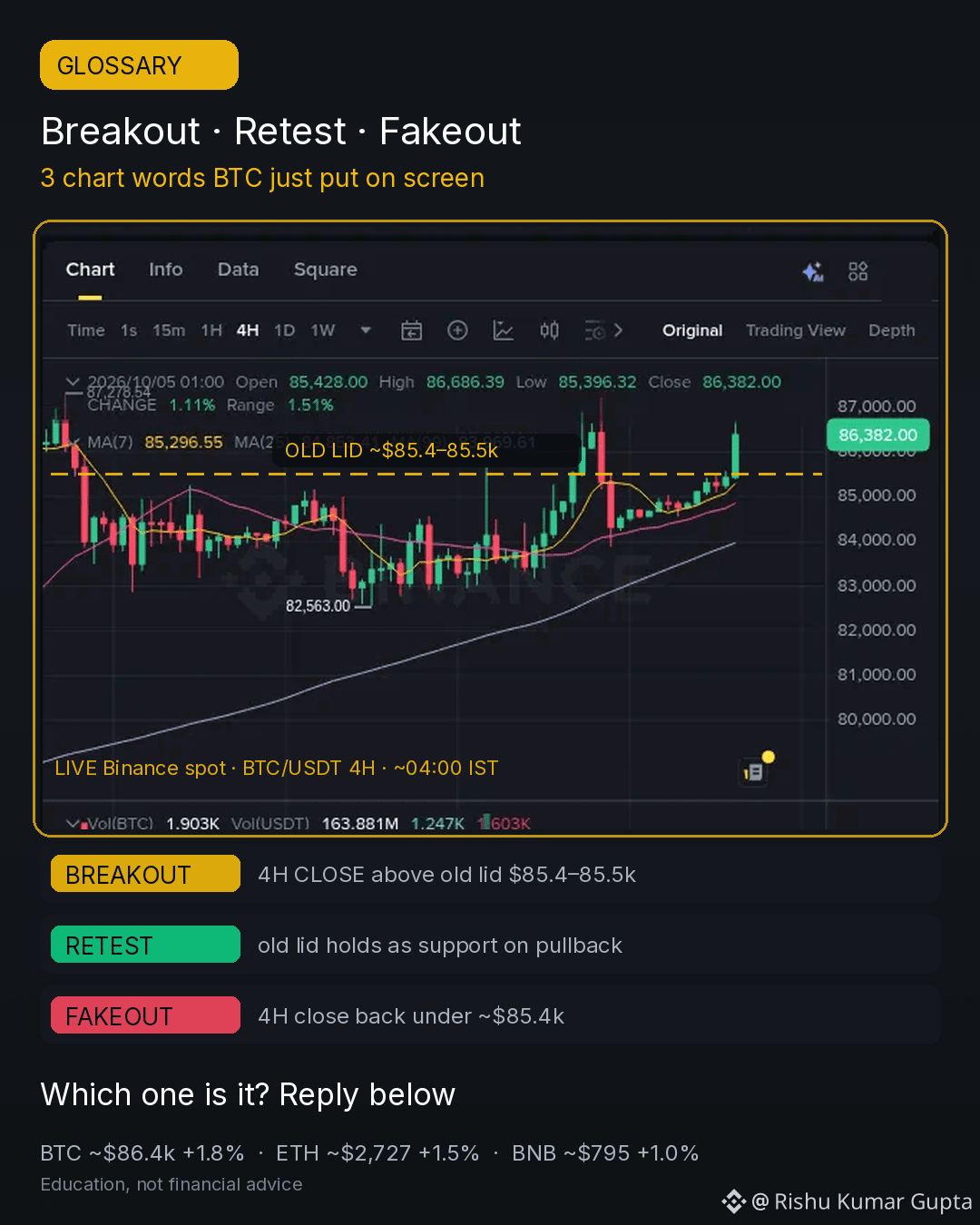
Breakout, Retest, Fakeout: 3 Chart Words BTC Just Put on Screen$BTC woke up overnight. After sitting in a tight ~$85.1–85.5k box for most of Sunday, the current 4H candle on Binance spot pushed to ~$86.7k. Right now it trades ~$86.4k (+1.8% in 24h).
That move is a clean live example of three words beginners see on Square every day but rarely get defined plainly.
1) BREAKOUT
Price CLOSES beyond a level that capped it before. The key word is close. A wick above resistance is not a breakout; a candle close on your chosen timeframe is. Here the lid was ~$85.4–85.5k (Sunday's highs). The 4H candle that closes at 05:30 IST is the first real test of whether this counts.
2) RETEST
After a breakout, price often comes back to touch the old level from the other side, so old resistance gets tested as support. For BTC that zone is ~$85.4–85.5k. Holding it on a pullback is what turns a breakout into a trend, which is why many traders wait for the retest instead of chasing the first green candle.
3) FAKEOUT
Price breaks the level, then closes back inside the old range, and late buyers get trapped. For this move, 4H closes back under ~$85.4k would be the fakeout signal.
How to use the three words together
- Mark the level before the move, not after it.
- Pick your timeframe first. A 15m breakout means little to a 4H plan.
- Write your invalidation: the close that would make it a fakeout.
- Size so that being wrong is boring.
Live snapshot (Binance spot, ~04:00 IST Monday): $BTC ~$86.4k (+1.8%) · $ETH ~$2,727 (+1.5%) · $BNB ~$795 (+1.0%)
This is a vocabulary lesson with a live chart, not financial advice.
Which one does this move become: BREAKOUT, RETEST, or FAKEOUT? Reply below.
#Bitcoin #CryptoEducation #BinanceSquare
Breakout, Retest, Fakeout: 3 Chart Words BTC Just Put on Screen
$BTC woke up overnight. After sitting in a tight ~$85.1–85.5k box for most of Sunday, the current 4H candle on Binance spot pushed to ~$86.7k. Right now it trades ~$86.4k (+1.8% in 24h).
That move is a clean live example of three words beginners see on Square every day but rarely get defined plainly.
1) BREAKOUT
Price CLOSES beyond a level that capped it before. The key word is close. A wick above resistance is not a breakout; a candle close on your chosen timeframe is. Here the lid was ~$85.4–85.5k (Sunday's highs). The 4H candle that closes at 05:30 IST is the first real test of whether this counts.
2) RETEST
After a breakout, price often comes back to touch the old level from the other side, so old resistance gets tested as support. For BTC that zone is ~$85.4–85.5k. Holding it on a pullback is what turns a breakout into a trend, which is why many traders wait for the retest instead of chasing the first green candle.
3) FAKEOUT
Price breaks the level, then closes back inside the old range, and late buyers get trapped. For this move, 4H closes back under ~$85.4k would be the fakeout signal.
How to use the three words together
- Mark the level before the move, not after it.
- Pick your timeframe first. A 15m breakout means little to a 4H plan.
- Write your invalidation: the close that would make it a fakeout.
- Size so that being wrong is boring.
Live snapshot (Binance spot, ~04:00 IST Monday): $BTC ~$86.4k (+1.8%) · $ETH ~$2,727 (+1.5%) · $BNB ~$795 (+1.0%)
This is a vocabulary lesson with a live chart, not financial advice.
Which one does this move become: BREAKOUT, RETEST, or FAKEOUT? Reply below.
#Bitcoin #CryptoEducation #BinanceSquare
That move is a clean live example of three words beginners see on Square every day but rarely get defined plainly.
1) BREAKOUT
Price CLOSES beyond a level that capped it before. The key word is close. A wick above resistance is not a breakout; a candle close on your chosen timeframe is. Here the lid was ~$85.4–85.5k (Sunday's highs). The 4H candle that closes at 05:30 IST is the first real test of whether this counts.
2) RETEST
After a breakout, price often comes back to touch the old level from the other side, so old resistance gets tested as support. For BTC that zone is ~$85.4–85.5k. Holding it on a pullback is what turns a breakout into a trend, which is why many traders wait for the retest instead of chasing the first green candle.
3) FAKEOUT
Price breaks the level, then closes back inside the old range, and late buyers get trapped. For this move, 4H closes back under ~$85.4k would be the fakeout signal.
How to use the three words together
- Mark the level before the move, not after it.
- Pick your timeframe first. A 15m breakout means little to a 4H plan.
- Write your invalidation: the close that would make it a fakeout.
- Size so that being wrong is boring.
Live snapshot (Binance spot, ~04:00 IST Monday): $BTC ~$86.4k (+1.8%) · $ETH ~$2,727 (+1.5%) · $BNB ~$795 (+1.0%)
This is a vocabulary lesson with a live chart, not financial advice.
Which one does this move become: BREAKOUT, RETEST, or FAKEOUT? Reply below.
#Bitcoin #CryptoEducation #BinanceSquare
99

·
--
Educational / Risk Management
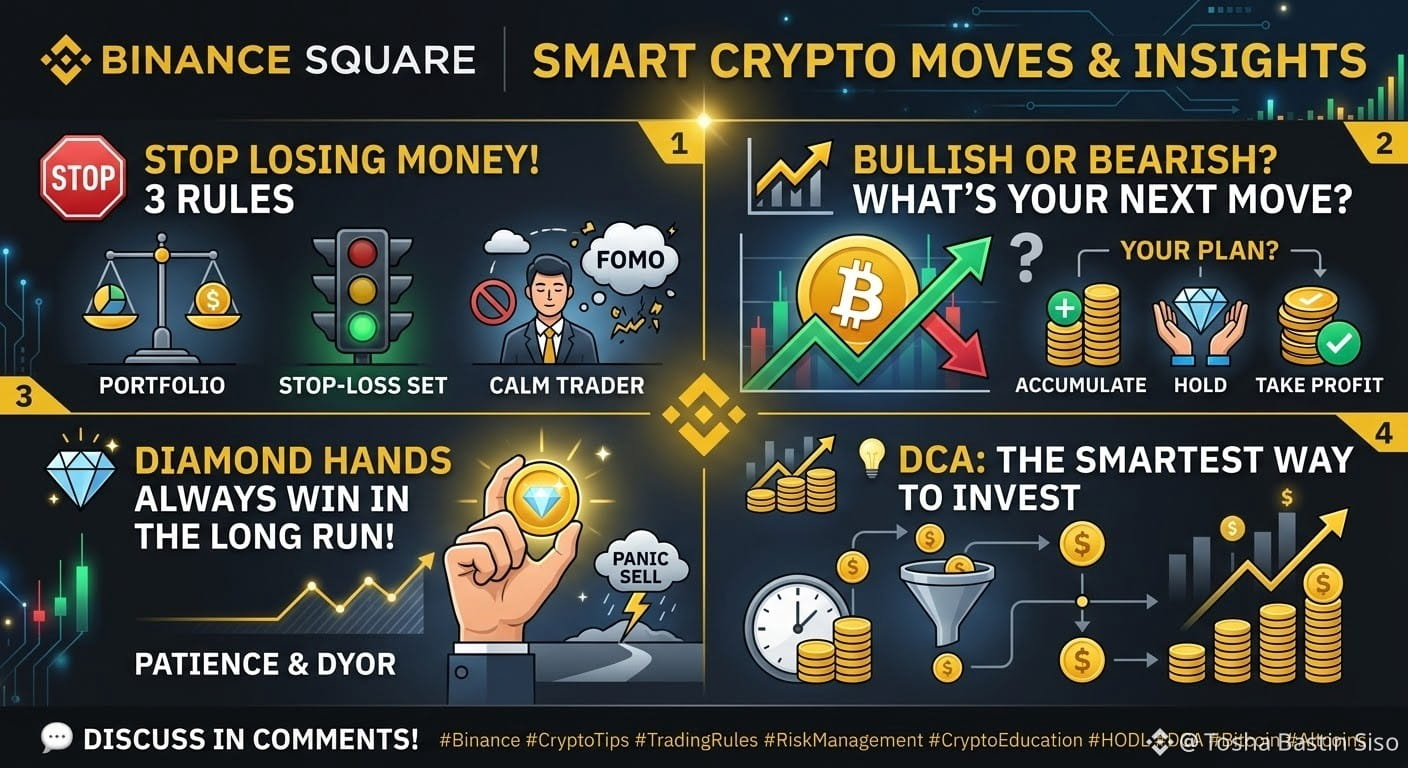
$BTC 🛑 Stop Losing Money! 3 Rules Every Crypto Trader Must Follow
If you are new to crypto trading or constantly taking unnecessary losses, keep these 3 rules locked in:
1️⃣ Risk Management First: Never throw your entire bankroll into a single asset. Limit your risk to just 2%–5% of your portfolio per trade.
2️⃣ Always Set a Stop-Loss: The market owes you nothing. Set your stop-loss immediately after entering a trade to protect your capital from sudden dips.
3️⃣ Master Your Emotions (No FOMO): Never buy a coin when it is pumping vertically. Be patient and wait for a proper pullback or retest.
💡 Pro Tip: Securing profit is an art. Scale out gradually at key targets to lock in gains.
💬 Which risk management strategy works best for you? Let's discuss below!
#Binance #CryptoTips #TradingRules #RiskManagement #cryptoeducation
Educational / Risk Management
$BTC 🛑 Stop Losing Money! 3 Rules Every Crypto Trader Must Follow
If you are new to crypto trading or constantly taking unnecessary losses, keep these 3 rules locked in:
1️⃣ Risk Management First: Never throw your entire bankroll into a single asset. Limit your risk to just 2%–5% of your portfolio per trade.
2️⃣ Always Set a Stop-Loss: The market owes you nothing. Set your stop-loss immediately after entering a trade to protect your capital from sudden dips.
3️⃣ Master Your Emotions (No FOMO): Never buy a coin when it is pumping vertically. Be patient and wait for a proper pullback or retest.
💡 Pro Tip: Securing profit is an art. Scale out gradually at key targets to lock in gains.
💬 Which risk management strategy works best for you? Let's discuss below!
#Binance #CryptoTips #TradingRules #RiskManagement #cryptoeducation
$BTC 🛑 Stop Losing Money! 3 Rules Every Crypto Trader Must Follow
If you are new to crypto trading or constantly taking unnecessary losses, keep these 3 rules locked in:
1️⃣ Risk Management First: Never throw your entire bankroll into a single asset. Limit your risk to just 2%–5% of your portfolio per trade.
2️⃣ Always Set a Stop-Loss: The market owes you nothing. Set your stop-loss immediately after entering a trade to protect your capital from sudden dips.
3️⃣ Master Your Emotions (No FOMO): Never buy a coin when it is pumping vertically. Be patient and wait for a proper pullback or retest.
💡 Pro Tip: Securing profit is an art. Scale out gradually at key targets to lock in gains.
💬 Which risk management strategy works best for you? Let's discuss below!
#Binance #CryptoTips #TradingRules #RiskManagement #cryptoeducation
75

Article
$433M Liquidated in 24 Hours: What the $87K Rejection Teaches Every Leveraged TraderBitcoin has spent the last couple of weeks moving sideways. Since September 21, its daily closes have stayed between roughly $83,500 and $86,600. Then, on October 2, price pushed toward $87,000 and faded. Bitcoin slipped back to about $84,600 by October 3. (cryptoticker) (cryptotimes)
The price move was small. The damage to leveraged traders was not.
What happened
CoinGlass data showed about $433.57 million in total crypto liquidations over 24 hours. Longs made up about 74% of that, while short liquidations were around $111.8 million. In plain words, many traders bet on a breakout above $87K, and the rejection wiped them out. (cryptotimes) (Substack)
This is not a story about one bad day. It is a reminder of how leverage works.
What is a liquidation?
When you trade with leverage, you borrow to open a bigger position. If price moves against you far enough, your margin can no longer cover the loss, and the exchange closes your position automatically. You lose the margin you put in.
Why a "small" move can be fatal
As a rough guide (ignoring fees and maintenance margin), the adverse move that can liquidate you is about 100% ÷ leverage:
5x leverage: roughly a 20% move against you
10x leverage: roughly 10%
20x leverage: roughly 5%
30x leverage: roughly 3.3%
Now compare that with the market. In one 24-hour window, Bitcoin traded between about $83,898 and $86,796. That is a swing of around 3.5%, with no crash at all. A trader using 30x or higher could have been liquidated by normal noise. (cryptoticker)
Exact liquidation prices vary by exchange, margin mode and fees, so always check the number shown on your own position.
Why breakouts trap traders
When price approaches a well-known level like $87K, many traders place the same bet at the same time. Crowded positioning makes the market fragile: if the breakout fails, longs close or get liquidated together, which pushes price down further. Analysts also pointed out that spot buyers failed to defend the breakout, which is what turned a rejection into a liquidation wave. (Substack)
A practical risk checklist
Use lower leverage. Lower leverage gives your trade room to breathe.
Place your stop-loss before your liquidation price. A stop-loss is your exit. A liquidation is the exchange's exit, and it is usually worse.
Size the trade by risk, not by excitement. Combine leverage with the 1% Rule: risk only 1% of your portfolio per trade.
Prefer isolated margin if you are a beginner. It limits the loss to the margin assigned to that trade.
Never add margin to a losing trade just to avoid liquidation. That turns a small planned loss into a large one.
Be careful around data releases and key levels. Volatility rises exactly when everyone is positioned the same way.
What about the bigger picture?
The macro backdrop is mixed. US spot Bitcoin ETFs took in $2.65 billion in September while price stayed in a tight range. That mix of steady inflows and sharp leveraged flushes is a good reminder that spot demand and derivatives positioning are two different forces. (cryptoticker)
Final thoughts
You cannot control where Bitcoin goes next. You can control your leverage, your position size and your exit plan. Traders who survive volatile ranges are usually the ones who were never forced out of their trades.
Which leverage do you usually use? Share it in the comments. 👇
This article is for educational purposes only and is not financial advice. Market data is based on reported figures from October 2-3, 2026 and may differ across sources. Trading involves risk. Always DYOR.
$BTC $ETH
#BitcoinLiquidations #RiskManagement #CryptoEducation #Write2Earn
"Aap kitni leverage use karte ho? Spot only "2-5x 10x+ 20x+
{spot}(BTCUSDT)
$433M Liquidated in 24 Hours: What the $87K Rejection Teaches Every Leveraged Trader
Bitcoin has spent the last couple of weeks moving sideways. Since September 21, its daily closes have stayed between roughly $83,500 and $86,600. Then, on October 2, price pushed toward $87,000 and faded. Bitcoin slipped back to about $84,600 by October 3. (cryptoticker) (cryptotimes)
The price move was small. The damage to leveraged traders was not.
What happened
CoinGlass data showed about $433.57 million in total crypto liquidations over 24 hours. Longs made up about 74% of that, while short liquidations were around $111.8 million. In plain words, many traders bet on a breakout above $87K, and the rejection wiped them out. (cryptotimes) (Substack)
This is not a story about one bad day. It is a reminder of how leverage works.
What is a liquidation?
When you trade with leverage, you borrow to open a bigger position. If price moves against you far enough, your margin can no longer cover the loss, and the exchange closes your position automatically. You lose the margin you put in.
Why a "small" move can be fatal
As a rough guide (ignoring fees and maintenance margin), the adverse move that can liquidate you is about 100% ÷ leverage:
5x leverage: roughly a 20% move against you
10x leverage: roughly 10%
20x leverage: roughly 5%
30x leverage: roughly 3.3%
Now compare that with the market. In one 24-hour window, Bitcoin traded between about $83,898 and $86,796. That is a swing of around 3.5%, with no crash at all. A trader using 30x or higher could have been liquidated by normal noise. (cryptoticker)
Exact liquidation prices vary by exchange, margin mode and fees, so always check the number shown on your own position.
Why breakouts trap traders
When price approaches a well-known level like $87K, many traders place the same bet at the same time. Crowded positioning makes the market fragile: if the breakout fails, longs close or get liquidated together, which pushes price down further. Analysts also pointed out that spot buyers failed to defend the breakout, which is what turned a rejection into a liquidation wave. (Substack)
A practical risk checklist
Use lower leverage. Lower leverage gives your trade room to breathe.
Place your stop-loss before your liquidation price. A stop-loss is your exit. A liquidation is the exchange's exit, and it is usually worse.
Size the trade by risk, not by excitement. Combine leverage with the 1% Rule: risk only 1% of your portfolio per trade.
Prefer isolated margin if you are a beginner. It limits the loss to the margin assigned to that trade.
Never add margin to a losing trade just to avoid liquidation. That turns a small planned loss into a large one.
Be careful around data releases and key levels. Volatility rises exactly when everyone is positioned the same way.
What about the bigger picture?
The macro backdrop is mixed. US spot Bitcoin ETFs took in $2.65 billion in September while price stayed in a tight range. That mix of steady inflows and sharp leveraged flushes is a good reminder that spot demand and derivatives positioning are two different forces. (cryptoticker)
Final thoughts
You cannot control where Bitcoin goes next. You can control your leverage, your position size and your exit plan. Traders who survive volatile ranges are usually the ones who were never forced out of their trades.
Which leverage do you usually use? Share it in the comments. 👇
This article is for educational purposes only and is not financial advice. Market data is based on reported figures from October 2-3, 2026 and may differ across sources. Trading involves risk. Always DYOR.
$BTC $ETH
#BitcoinLiquidations #RiskManagement #CryptoEducation #Write2Earn
"Aap kitni leverage use karte ho? Spot only "2-5x 10x+ 20x+
The price move was small. The damage to leveraged traders was not.
What happened
CoinGlass data showed about $433.57 million in total crypto liquidations over 24 hours. Longs made up about 74% of that, while short liquidations were around $111.8 million. In plain words, many traders bet on a breakout above $87K, and the rejection wiped them out. (cryptotimes) (Substack)
This is not a story about one bad day. It is a reminder of how leverage works.
What is a liquidation?
When you trade with leverage, you borrow to open a bigger position. If price moves against you far enough, your margin can no longer cover the loss, and the exchange closes your position automatically. You lose the margin you put in.
Why a "small" move can be fatal
As a rough guide (ignoring fees and maintenance margin), the adverse move that can liquidate you is about 100% ÷ leverage:
5x leverage: roughly a 20% move against you
10x leverage: roughly 10%
20x leverage: roughly 5%
30x leverage: roughly 3.3%
Now compare that with the market. In one 24-hour window, Bitcoin traded between about $83,898 and $86,796. That is a swing of around 3.5%, with no crash at all. A trader using 30x or higher could have been liquidated by normal noise. (cryptoticker)
Exact liquidation prices vary by exchange, margin mode and fees, so always check the number shown on your own position.
Why breakouts trap traders
When price approaches a well-known level like $87K, many traders place the same bet at the same time. Crowded positioning makes the market fragile: if the breakout fails, longs close or get liquidated together, which pushes price down further. Analysts also pointed out that spot buyers failed to defend the breakout, which is what turned a rejection into a liquidation wave. (Substack)
A practical risk checklist
Use lower leverage. Lower leverage gives your trade room to breathe.
Place your stop-loss before your liquidation price. A stop-loss is your exit. A liquidation is the exchange's exit, and it is usually worse.
Size the trade by risk, not by excitement. Combine leverage with the 1% Rule: risk only 1% of your portfolio per trade.
Prefer isolated margin if you are a beginner. It limits the loss to the margin assigned to that trade.
Never add margin to a losing trade just to avoid liquidation. That turns a small planned loss into a large one.
Be careful around data releases and key levels. Volatility rises exactly when everyone is positioned the same way.
What about the bigger picture?
The macro backdrop is mixed. US spot Bitcoin ETFs took in $2.65 billion in September while price stayed in a tight range. That mix of steady inflows and sharp leveraged flushes is a good reminder that spot demand and derivatives positioning are two different forces. (cryptoticker)
Final thoughts
You cannot control where Bitcoin goes next. You can control your leverage, your position size and your exit plan. Traders who survive volatile ranges are usually the ones who were never forced out of their trades.
Which leverage do you usually use? Share it in the comments. 👇
This article is for educational purposes only and is not financial advice. Market data is based on reported figures from October 2-3, 2026 and may differ across sources. Trading involves risk. Always DYOR.
$BTC $ETH
#BitcoinLiquidations #RiskManagement #CryptoEducation #Write2Earn
"Aap kitni leverage use karte ho? Spot only "2-5x 10x+ 20x+
50

🚀 The Crypto Market Never Sleeps — Are You Ready?
Crypto isn’t just about buying and selling. It’s about understanding the market, managing risk, and staying ahead of opportunities.
Before entering any trade, always ask yourself:
📌 What is the current market trend?
📌 Where is my entry and exit?
📌 How much am I willing to risk?
📌 Do I have a clear strategy?
Remember: Patience is a strategy too. You don’t have to trade every day to make progress.
Keep learning. Keep researching. Manage your risk. 💡
The next opportunity could be closer than you think. 🔥
#crypto #bitcoin #Trading #Web3 #cryptoeducation
Kindly Reshare, Like and Add your suggestions on $BTC $BNB $SUI Which are you buying?
Have a great day 🤑
🚀 The Crypto Market Never Sleeps — Are You Ready?
Crypto isn’t just about buying and selling. It’s about understanding the market, managing risk, and staying ahead of opportunities.
Before entering any trade, always ask yourself:
📌 What is the current market trend?
📌 Where is my entry and exit?
📌 How much am I willing to risk?
📌 Do I have a clear strategy?
Remember: Patience is a strategy too. You don’t have to trade every day to make progress.
Keep learning. Keep researching. Manage your risk. 💡
The next opportunity could be closer than you think. 🔥
#crypto #bitcoin #Trading #Web3 #cryptoeducation
Kindly Reshare, Like and Add your suggestions on $BTC $BNB $SUI Which are you buying?
Have a great day 🤑
Crypto isn’t just about buying and selling. It’s about understanding the market, managing risk, and staying ahead of opportunities.
Before entering any trade, always ask yourself:
📌 What is the current market trend?
📌 Where is my entry and exit?
📌 How much am I willing to risk?
📌 Do I have a clear strategy?
Remember: Patience is a strategy too. You don’t have to trade every day to make progress.
Keep learning. Keep researching. Manage your risk. 💡
The next opportunity could be closer than you think. 🔥
#crypto #bitcoin #Trading #Web3 #cryptoeducation
Kindly Reshare, Like and Add your suggestions on $BTC $BNB $SUI Which are you buying?
Have a great day 🤑
1
3
76
Article
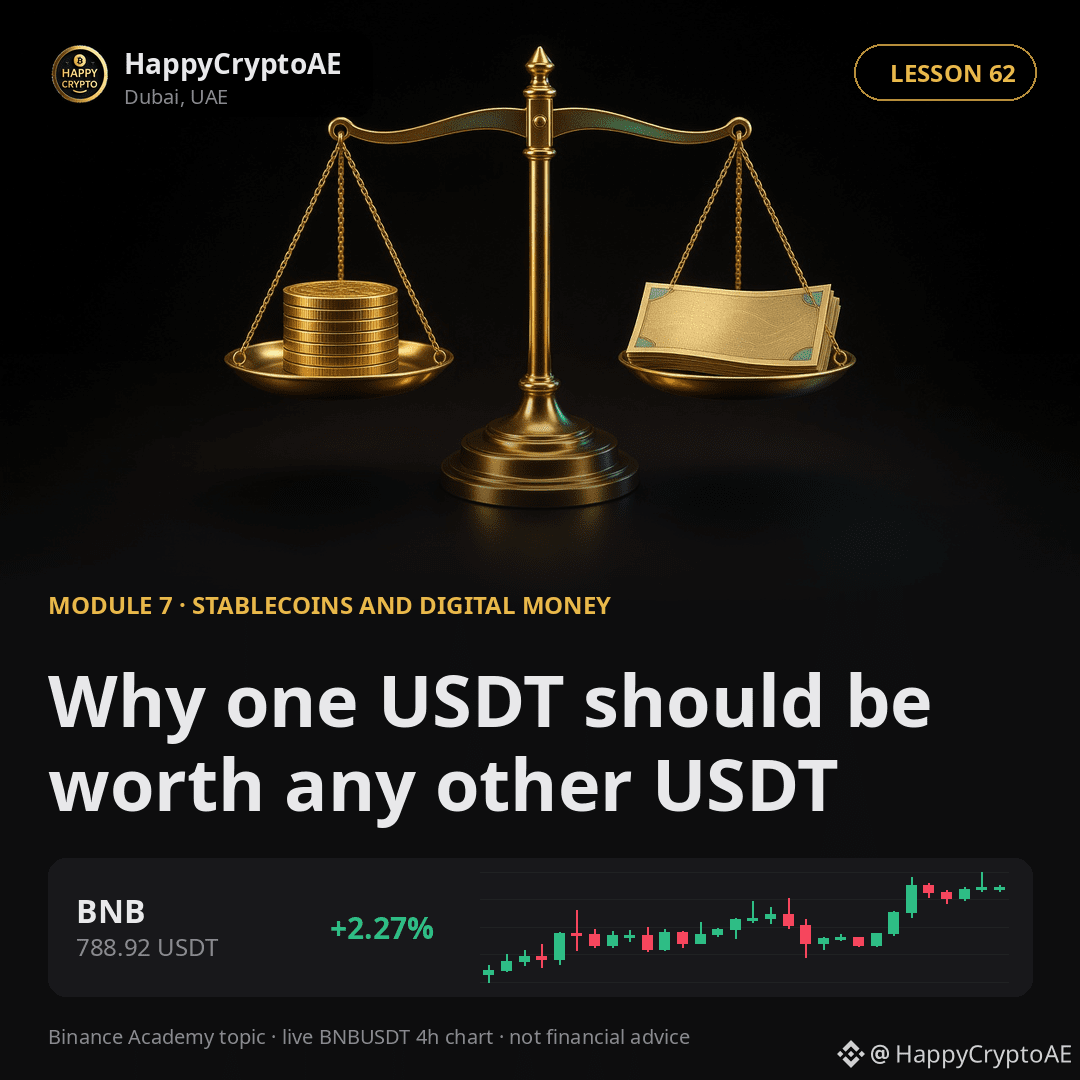
Why one USDT should be worth any other USDTFungible means interchangeable. One dirham note is as good as any other; you do not care which one you get. The property is so basic to money that we rarely notice it.
On a public blockchain every coin has a visible history, which puts fungibility under pressure. Coins that passed through an address linked to a hack can be frozen by an issuer or refused by a platform, even when the person holding them now did nothing wrong. In practice: know where the funds you receive came from, and keep records of your own transfers. A clean history is part of what keeps your coins spendable.
💬 Did you know coins carry their history with them? Has it ever affected you?
Binance Academy covers this in more depth: https://www.binance.com/en/academy/glossary/fungibility
Next lesson: Real-world assets on-chain, in plain words
Trading crypto from Dubai since 2019.
$USDT $BTC $BNB
#Fungibility #CryptoSafety #CryptoEducation
Why one USDT should be worth any other USDT
Fungible means interchangeable. One dirham note is as good as any other; you do not care which one you get. The property is so basic to money that we rarely notice it.
On a public blockchain every coin has a visible history, which puts fungibility under pressure. Coins that passed through an address linked to a hack can be frozen by an issuer or refused by a platform, even when the person holding them now did nothing wrong. In practice: know where the funds you receive came from, and keep records of your own transfers. A clean history is part of what keeps your coins spendable.
💬 Did you know coins carry their history with them? Has it ever affected you?
Binance Academy covers this in more depth: https://www.binance.com/en/academy/glossary/fungibility
Next lesson: Real-world assets on-chain, in plain words
Trading crypto from Dubai since 2019.
$USDT $BTC $BNB
#Fungibility #CryptoSafety #CryptoEducation
On a public blockchain every coin has a visible history, which puts fungibility under pressure. Coins that passed through an address linked to a hack can be frozen by an issuer or refused by a platform, even when the person holding them now did nothing wrong. In practice: know where the funds you receive came from, and keep records of your own transfers. A clean history is part of what keeps your coins spendable.
💬 Did you know coins carry their history with them? Has it ever affected you?
Binance Academy covers this in more depth: https://www.binance.com/en/academy/glossary/fungibility
Next lesson: Real-world assets on-chain, in plain words
Trading crypto from Dubai since 2019.
$USDT $BTC $BNB
#Fungibility #CryptoSafety #CryptoEducation
58


Article
Starting your crypto journey? Don't start with trading. Start with understanding.📚 Crypto Beginner’s Roadmap
Starting your crypto journey? Don't start with trading. Start with understanding.
The crypto market can move quickly, but learning the fundamentals gives you a stronger foundation.
🟠 Bitcoin (BTC) — Understand Bitcoin, scarcity, and market cycles.
🔵 Ethereum (ETH) — Learn about smart contracts and decentralized applications.
🟡 BNB — Explore BNB and the BNB Chain ecosystem.
🟣 Solana (SOL) — Understand Solana's blockchain and its ecosystem.
Then focus on five essential concepts:
• Market capitalization
• Trading volume
• Price action
• Support & resistance
• Risk management
The goal isn't to predict every market move. The goal is to understand what you're looking at before making a decision.
Which one are you currently learning — BTC, ETH, BNB, or SOL? 👇
$BTC $ETH $BNB
#BinanceSquare #CryptoEducation #CryptoForBeginners #SOL
Starting your crypto journey? Don't start with trading. Start with understanding.
📚 Crypto Beginner’s Roadmap
Starting your crypto journey? Don't start with trading. Start with understanding.
The crypto market can move quickly, but learning the fundamentals gives you a stronger foundation.
🟠 Bitcoin (BTC) — Understand Bitcoin, scarcity, and market cycles.
🔵 Ethereum (ETH) — Learn about smart contracts and decentralized applications.
🟡 BNB — Explore BNB and the BNB Chain ecosystem.
🟣 Solana (SOL) — Understand Solana's blockchain and its ecosystem.
Then focus on five essential concepts:
• Market capitalization
• Trading volume
• Price action
• Support & resistance
• Risk management
The goal isn't to predict every market move. The goal is to understand what you're looking at before making a decision.
Which one are you currently learning — BTC, ETH, BNB, or SOL? 👇
$BTC $ETH $BNB
#BinanceSquare #CryptoEducation #CryptoForBeginners #SOL
Starting your crypto journey? Don't start with trading. Start with understanding.
The crypto market can move quickly, but learning the fundamentals gives you a stronger foundation.
🟠 Bitcoin (BTC) — Understand Bitcoin, scarcity, and market cycles.
🔵 Ethereum (ETH) — Learn about smart contracts and decentralized applications.
🟡 BNB — Explore BNB and the BNB Chain ecosystem.
🟣 Solana (SOL) — Understand Solana's blockchain and its ecosystem.
Then focus on five essential concepts:
• Market capitalization
• Trading volume
• Price action
• Support & resistance
• Risk management
The goal isn't to predict every market move. The goal is to understand what you're looking at before making a decision.
Which one are you currently learning — BTC, ETH, BNB, or SOL? 👇
$BTC $ETH $BNB
#BinanceSquare #CryptoEducation #CryptoForBeginners #SOL
89

·
--
📚 Crypto Education: 5 Principles for Smarter Trading
Trading is not just about predicting price movements. A strong approach starts with knowledge, risk management, discipline, and continuous learning.
1️⃣ Do your research
2️⃣ Manage your risk
3️⃣ Control your emotions
4️⃣ Have a clear trading plan
5️⃣ Keep learning and improving
💡 Remember: Protecting your capital is just as important as looking for profits.
⚠️ Educational content only. Not financial advice.
#Binance #cryptoeducation #tradingtips #CryptoTrading #Bitcoin #RiskManagement #Crypto #Trading
📚 Crypto Education: 5 Principles for Smarter Trading
Trading is not just about predicting price movements. A strong approach starts with knowledge, risk management, discipline, and continuous learning.
1️⃣ Do your research
2️⃣ Manage your risk
3️⃣ Control your emotions
4️⃣ Have a clear trading plan
5️⃣ Keep learning and improving
💡 Remember: Protecting your capital is just as important as looking for profits.
⚠️ Educational content only. Not financial advice.
#Binance #cryptoeducation #tradingtips #CryptoTrading #Bitcoin #RiskManagement #Crypto #Trading
Trading is not just about predicting price movements. A strong approach starts with knowledge, risk management, discipline, and continuous learning.
1️⃣ Do your research
2️⃣ Manage your risk
3️⃣ Control your emotions
4️⃣ Have a clear trading plan
5️⃣ Keep learning and improving
💡 Remember: Protecting your capital is just as important as looking for profits.
⚠️ Educational content only. Not financial advice.
#Binance #cryptoeducation #tradingtips #CryptoTrading #Bitcoin #RiskManagement #Crypto #Trading
1
61

🔗 What is Blockchain?
Blockchain is a digital record system that stores transactions in connected blocks.
Think of it like a shared digital ledger that can be verified across a network.
💡 Bitcoin uses blockchain technology to record transactions.
Do you want to learn more about crypto in simple language?
Follow for daily crypto education. 🚀
⚠️ Educational content only. Crypto involves risk.
#Bitcoin #blockchain #cryptoeducation #crypto
🔗 What is Blockchain?
Blockchain is a digital record system that stores transactions in connected blocks.
Think of it like a shared digital ledger that can be verified across a network.
💡 Bitcoin uses blockchain technology to record transactions.
Do you want to learn more about crypto in simple language?
Follow for daily crypto education. 🚀
⚠️ Educational content only. Crypto involves risk.
#Bitcoin #blockchain #cryptoeducation #crypto
Blockchain is a digital record system that stores transactions in connected blocks.
Think of it like a shared digital ledger that can be verified across a network.
💡 Bitcoin uses blockchain technology to record transactions.
Do you want to learn more about crypto in simple language?
Follow for daily crypto education. 🚀
⚠️ Educational content only. Crypto involves risk.
#Bitcoin #blockchain #cryptoeducation #crypto
59
📚 What is Bitcoin?
Bitcoin is a digital asset that operates on a decentralized blockchain network.
Unlike traditional money, Bitcoin allows people to transfer value through a peer-to-peer network without relying on a central authority.
💡 Would you like to learn more about Bitcoin and blockchain?
Follow for simple crypto education. 🚀
⚠️ Educational content only. Crypto involves risk.
#bitcoin #blockchain #cryptoeducation #crypto #Binance
📚 What is Bitcoin?
Bitcoin is a digital asset that operates on a decentralized blockchain network.
Unlike traditional money, Bitcoin allows people to transfer value through a peer-to-peer network without relying on a central authority.
💡 Would you like to learn more about Bitcoin and blockchain?
Follow for simple crypto education. 🚀
⚠️ Educational content only. Crypto involves risk.
#bitcoin #blockchain #cryptoeducation #crypto #Binance
Bitcoin is a digital asset that operates on a decentralized blockchain network.
Unlike traditional money, Bitcoin allows people to transfer value through a peer-to-peer network without relying on a central authority.
💡 Would you like to learn more about Bitcoin and blockchain?
Follow for simple crypto education. 🚀
⚠️ Educational content only. Crypto involves risk.
#bitcoin #blockchain #cryptoeducation #crypto #Binance
68

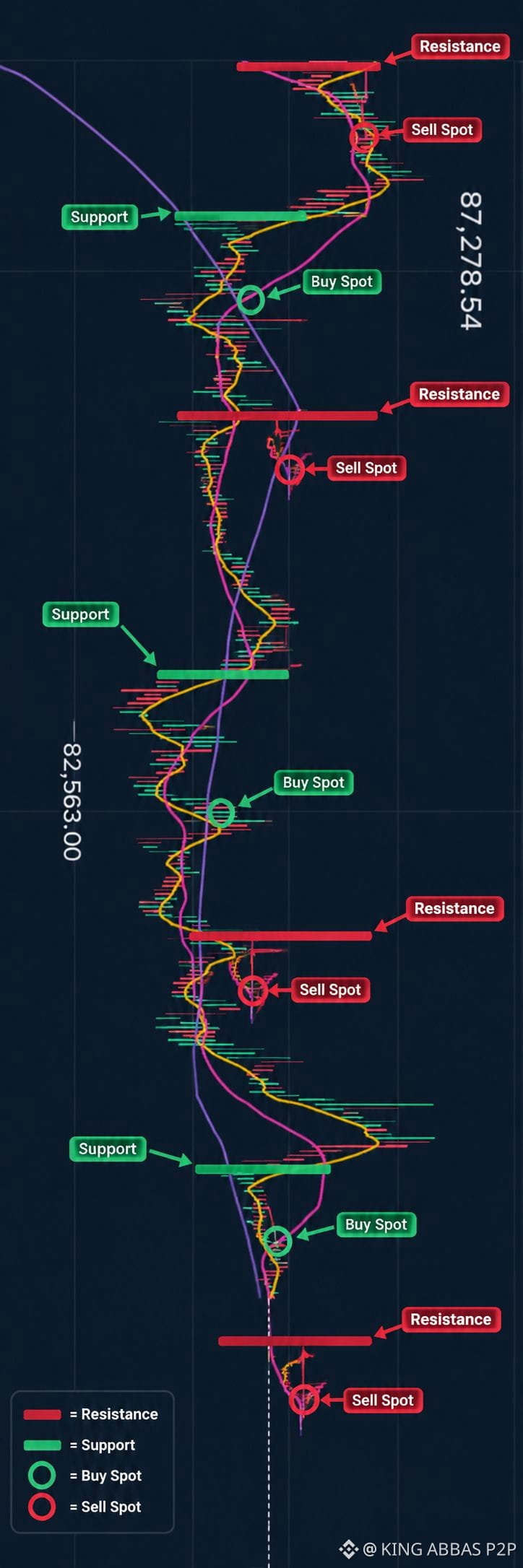
BTC/USDT Chart Study - Support & Resistance Concept (Educational)
Studying the BTC chart today for learning purpose.
Green Line = Support zone (where buyers showed interest before)
Red Line = Resistance zone (where sellers took profit before)
This chart is rotated for better view of levels. This is for education only, not a buy/sell signal. I am learning technical analysis.
What levels are you watching? Share your view 👇
#BTC走势分析 #bitcoin #supportandresistance #ChartStud #cryptoeducation
BTC/USDT Chart Study - Support & Resistance Concept (Educational)
Studying the BTC chart today for learning purpose.
Green Line = Support zone (where buyers showed interest before)
Red Line = Resistance zone (where sellers took profit before)
This chart is rotated for better view of levels. This is for education only, not a buy/sell signal. I am learning technical analysis.
What levels are you watching? Share your view 👇
#BTC走势分析 #bitcoin #supportandresistance #ChartStud #cryptoeducation
Studying the BTC chart today for learning purpose.
Green Line = Support zone (where buyers showed interest before)
Red Line = Resistance zone (where sellers took profit before)
This chart is rotated for better view of levels. This is for education only, not a buy/sell signal. I am learning technical analysis.
What levels are you watching? Share your view 👇
#BTC走势分析 #bitcoin #supportandresistance #ChartStud #cryptoeducation
1
208

🪙 CRYPTO LESSON: WHY CHEAP COINS ARE NOT ALWAYS GOOD INVESTMENTS!
A coin costing $0.001 doesn't automatically mean it's undervalued.
💡 Before buying any crypto, check:
1️⃣ Market capitalization
2️⃣ Total and circulating supply
3️⃣ Real-world utility
4️⃣ Project development and credibility
🚨 Remember: A low price doesn't guarantee a big profit.
Learn first. Invest wisely. Grow patiently.
💬 Have you ever bought a coin simply because it was cheap?
#CryptoTips #bitcoin #CryptoBeginners #blockchain #Web3 #cryptoeducation
🪙 CRYPTO LESSON: WHY CHEAP COINS ARE NOT ALWAYS GOOD INVESTMENTS!
A coin costing $0.001 doesn't automatically mean it's undervalued.
💡 Before buying any crypto, check:
1️⃣ Market capitalization
2️⃣ Total and circulating supply
3️⃣ Real-world utility
4️⃣ Project development and credibility
🚨 Remember: A low price doesn't guarantee a big profit.
Learn first. Invest wisely. Grow patiently.
💬 Have you ever bought a coin simply because it was cheap?
#CryptoTips #bitcoin #CryptoBeginners #blockchain #Web3 #cryptoeducation
A coin costing $0.001 doesn't automatically mean it's undervalued.
💡 Before buying any crypto, check:
1️⃣ Market capitalization
2️⃣ Total and circulating supply
3️⃣ Real-world utility
4️⃣ Project development and credibility
🚨 Remember: A low price doesn't guarantee a big profit.
Learn first. Invest wisely. Grow patiently.
💬 Have you ever bought a coin simply because it was cheap?
#CryptoTips #bitcoin #CryptoBeginners #blockchain #Web3 #cryptoeducation
76
·
--
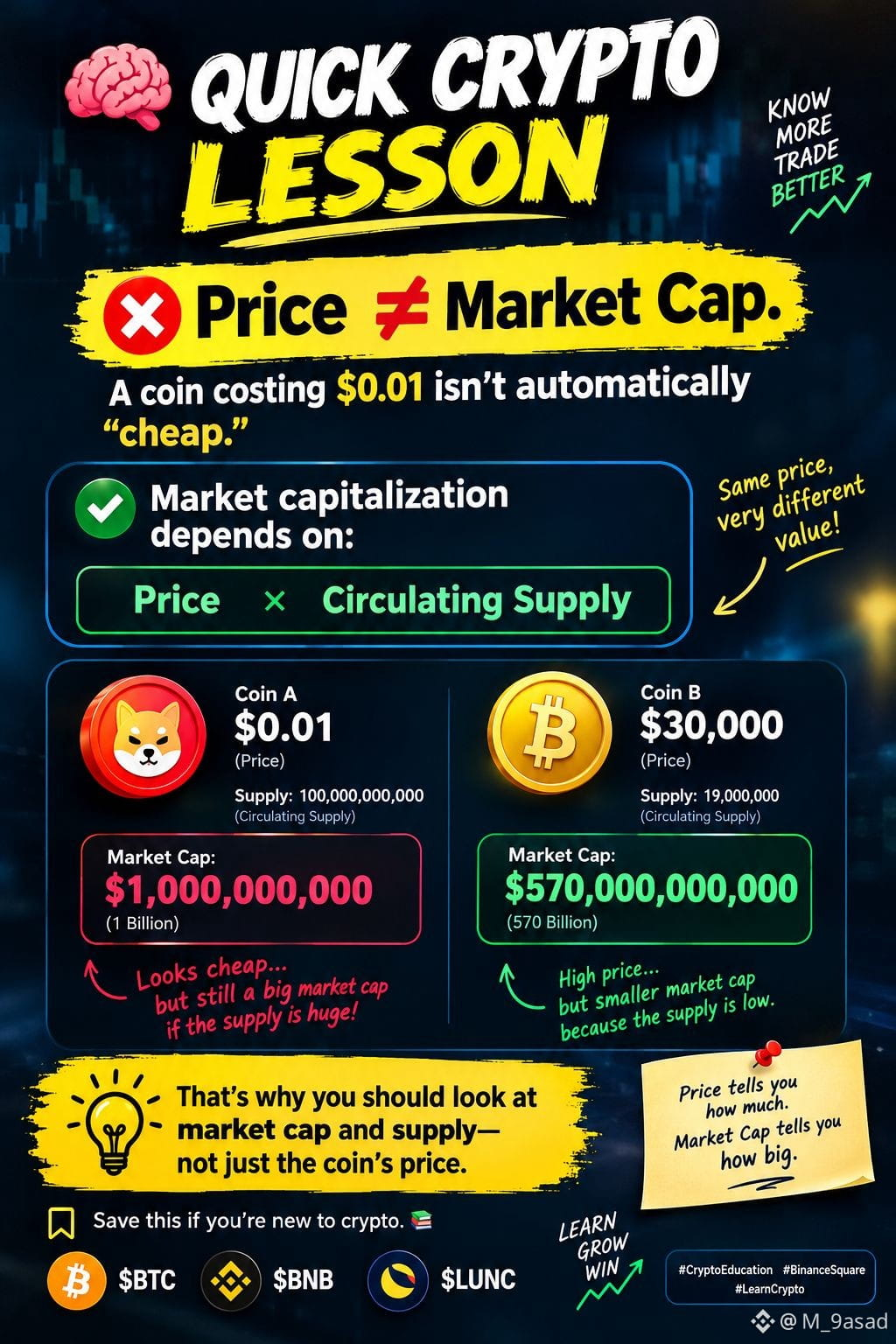
🧠 QUICK CRYPTO LESSON
Price ≠ Market Cap.
A coin costing $0.01 isn't automatically “cheap.”
Market capitalization depends on:
Price × Circulating Supply
That's why you should look at market cap and supply—not just the coin's price.
Save this if you're new to crypto. 📚
$BTC $BNB $LUNC
#cryptoeducation #BİNANCESQUARE #learncrypto
🧠 QUICK CRYPTO LESSON
Price ≠ Market Cap.
A coin costing $0.01 isn't automatically “cheap.”
Market capitalization depends on:
Price × Circulating Supply
That's why you should look at market cap and supply—not just the coin's price.
Save this if you're new to crypto. 📚
$BTC $BNB $LUNC
#cryptoeducation #BİNANCESQUARE #learncrypto
Price ≠ Market Cap.
A coin costing $0.01 isn't automatically “cheap.”
Market capitalization depends on:
Price × Circulating Supply
That's why you should look at market cap and supply—not just the coin's price.
Save this if you're new to crypto. 📚
$BTC $BNB $LUNC
#cryptoeducation #BİNANCESQUARE #learncrypto
606

🎉🎉🔍 Before buying a crypto coin, take a little time to know what you are buying.
Sometimes we see a coin suddenly trending everywhere. People are talking about it, the price is going up, and everyone seems excited.
At that moment, it is very easy to press the Buy button without thinking too much.
But I think we should stop for a moment and ask some simple questions.
What does this project actually do?
Why was this coin created?
How many coins are available?
Does the project have real use?
What is happening with the price right now?
We don't need to become a crypto expert to do basic research. Even spending a few minutes checking the project can be better than buying blindly.
Another thing I always think about is risk. A coin can have a good project but still have a big price drop. Good technology does not mean the price will always go up.
Social media can also create a lot of excitement. We may see people saying, “Buy now!” or “This coin will 10x!”
But nobody can guarantee that.
If someone gives a prediction, we should treat it as their opinion, not as a guarantee.
📌 For me, understanding what I am buying is more important than buying quickly.
If I miss a coin because I needed more time to research, that's okay. There will always be other opportunities in the crypto market.
Don't let FOMO make the decision for you.
Take your time, do your own research and only use money you can afford to lose.
💬 What is the first thing you check before buying a new coin?
Project, market cap, chart, news or something else?
#CryptoTrading #CryptoEducation #TradingTips #DYOR #crypto
$BTC
{spot}(BTCUSDT)
🎉🎉🔍 Before buying a crypto coin, take a little time to know what you are buying.
Sometimes we see a coin suddenly trending everywhere. People are talking about it, the price is going up, and everyone seems excited.
At that moment, it is very easy to press the Buy button without thinking too much.
But I think we should stop for a moment and ask some simple questions.
What does this project actually do?
Why was this coin created?
How many coins are available?
Does the project have real use?
What is happening with the price right now?
We don't need to become a crypto expert to do basic research. Even spending a few minutes checking the project can be better than buying blindly.
Another thing I always think about is risk. A coin can have a good project but still have a big price drop. Good technology does not mean the price will always go up.
Social media can also create a lot of excitement. We may see people saying, “Buy now!” or “This coin will 10x!”
But nobody can guarantee that.
If someone gives a prediction, we should treat it as their opinion, not as a guarantee.
📌 For me, understanding what I am buying is more important than buying quickly.
If I miss a coin because I needed more time to research, that's okay. There will always be other opportunities in the crypto market.
Don't let FOMO make the decision for you.
Take your time, do your own research and only use money you can afford to lose.
💬 What is the first thing you check before buying a new coin?
Project, market cap, chart, news or something else?
#CryptoTrading #CryptoEducation #TradingTips #DYOR #crypto
$BTC
Sometimes we see a coin suddenly trending everywhere. People are talking about it, the price is going up, and everyone seems excited.
At that moment, it is very easy to press the Buy button without thinking too much.
But I think we should stop for a moment and ask some simple questions.
What does this project actually do?
Why was this coin created?
How many coins are available?
Does the project have real use?
What is happening with the price right now?
We don't need to become a crypto expert to do basic research. Even spending a few minutes checking the project can be better than buying blindly.
Another thing I always think about is risk. A coin can have a good project but still have a big price drop. Good technology does not mean the price will always go up.
Social media can also create a lot of excitement. We may see people saying, “Buy now!” or “This coin will 10x!”
But nobody can guarantee that.
If someone gives a prediction, we should treat it as their opinion, not as a guarantee.
📌 For me, understanding what I am buying is more important than buying quickly.
If I miss a coin because I needed more time to research, that's okay. There will always be other opportunities in the crypto market.
Don't let FOMO make the decision for you.
Take your time, do your own research and only use money you can afford to lose.
💬 What is the first thing you check before buying a new coin?
Project, market cap, chart, news or something else?
#CryptoTrading #CryptoEducation #TradingTips #DYOR #crypto
$BTC

Pepes Son:
lilith
8
1
1
52

🚨 $8M CRYPTO SCHEME CRASHES: Why Greed Bait Still Catches Unwary Investors
When law enforcement cracked down on a multi-million dollar fraud network operating since 2025, it sent a clear message across the industry: illusionary high returns are the ultimate trap.
Here is a breakdown of how this $8,000,000 pyramid scheme lured over 10,000 victims and what real market participants must learn from it:
⚠️ The Mechanics of a Ponzi Wrapper
1. The Double-Your-Money Trap: Victims were promised guaranteed, rapid portfolio duplication with zero risk.
2. Pyramid Recruitment: Payouts were tied to recruiting new members rather than actual market yield generation.
3. The Withdrawal Lock: Once liquidity dried up, account freezes immediately followed.
💡 The Reality of Market Liquidity
Blockchain technology is built on transparency, cryptographic security, and open ledger execution. Bad actors simply use crypto terminology as a cover story to run traditional fraud.
Real growth comes from market structure, liquidity cycles, and risk management—not guaranteed percentage daily returns.
🛡️ Safety Checklist for Crypto Traders
🚫 Guaranteed Returns = Instant Red Flag
🚫 Forced Referral Requirements
✅ Verify On-Chain Liquidity & Official Protocols
✅ Keep Cold Storage & Manage Risk
Don't let FOMO drive your investment decisions. Real wealth is built through research, strategy, and patience.
💬 Have you ever encountered a suspicious "guaranteed return" investment scheme? Share your thoughts below to educate the community! 👇
$BTC $ETH $BNB
#CryptoSecurity #ScamAlert #RiskManagement #cryptoeducation
#greekpolicebustcryptoscamringarrest17
🚨 $8M CRYPTO SCHEME CRASHES: Why Greed Bait Still Catches Unwary Investors
When law enforcement cracked down on a multi-million dollar fraud network operating since 2025, it sent a clear message across the industry: illusionary high returns are the ultimate trap.
Here is a breakdown of how this $8,000,000 pyramid scheme lured over 10,000 victims and what real market participants must learn from it:
⚠️ The Mechanics of a Ponzi Wrapper
1. The Double-Your-Money Trap: Victims were promised guaranteed, rapid portfolio duplication with zero risk.
2. Pyramid Recruitment: Payouts were tied to recruiting new members rather than actual market yield generation.
3. The Withdrawal Lock: Once liquidity dried up, account freezes immediately followed.
💡 The Reality of Market Liquidity
Blockchain technology is built on transparency, cryptographic security, and open ledger execution. Bad actors simply use crypto terminology as a cover story to run traditional fraud.
Real growth comes from market structure, liquidity cycles, and risk management—not guaranteed percentage daily returns.
🛡️ Safety Checklist for Crypto Traders
🚫 Guaranteed Returns = Instant Red Flag
🚫 Forced Referral Requirements
✅ Verify On-Chain Liquidity & Official Protocols
✅ Keep Cold Storage & Manage Risk
Don't let FOMO drive your investment decisions. Real wealth is built through research, strategy, and patience.
💬 Have you ever encountered a suspicious "guaranteed return" investment scheme? Share your thoughts below to educate the community! 👇
$BTC $ETH $BNB
#CryptoSecurity #ScamAlert #RiskManagement #cryptoeducation
#greekpolicebustcryptoscamringarrest17
When law enforcement cracked down on a multi-million dollar fraud network operating since 2025, it sent a clear message across the industry: illusionary high returns are the ultimate trap.
Here is a breakdown of how this $8,000,000 pyramid scheme lured over 10,000 victims and what real market participants must learn from it:
⚠️ The Mechanics of a Ponzi Wrapper
1. The Double-Your-Money Trap: Victims were promised guaranteed, rapid portfolio duplication with zero risk.
2. Pyramid Recruitment: Payouts were tied to recruiting new members rather than actual market yield generation.
3. The Withdrawal Lock: Once liquidity dried up, account freezes immediately followed.
💡 The Reality of Market Liquidity
Blockchain technology is built on transparency, cryptographic security, and open ledger execution. Bad actors simply use crypto terminology as a cover story to run traditional fraud.
Real growth comes from market structure, liquidity cycles, and risk management—not guaranteed percentage daily returns.
🛡️ Safety Checklist for Crypto Traders
🚫 Guaranteed Returns = Instant Red Flag
🚫 Forced Referral Requirements
✅ Verify On-Chain Liquidity & Official Protocols
✅ Keep Cold Storage & Manage Risk
Don't let FOMO drive your investment decisions. Real wealth is built through research, strategy, and patience.
💬 Have you ever encountered a suspicious "guaranteed return" investment scheme? Share your thoughts below to educate the community! 👇
$BTC $ETH $BNB
#CryptoSecurity #ScamAlert #RiskManagement #cryptoeducation
#greekpolicebustcryptoscamringarrest17

90

·
--
📚 **Genesis Block: The Digital "Big Bang"** Have you ever wondered where it all began? Before the first trade, before the hype, there was a single block of data. The Genesis Block is the foundation of every blockchain, a digital anchor that proves the network’s existence. **What is it?** It is the very first block in a blockchain. Unlike subsequent blocks, it is not mined or validated in the traditional sense. Its hash is hard-coded into the network's software. For Bitcoin, it was created by Satoshi Nakamoto on January 3, 2009, containing the headline: "Chancellor on brink of second bailout for banks." **How it works** The Genesis Block establishes the initial rules of the ledger. It defines the starting supply, the consensus mechanism, and the cryptographic parameters. In Bitcoin, the initial supply was 50 BTC, though these coins are unspendable. It serves as the root of the Merkle tree, ensuring that all future transactions are cryptographically linked back to this origin point. Without it, there is no chain, only isolated data points. **Why it matters** 1. **Immutability:** It provides a fixed reference point. If the Genesis Block were altered, the entire chain would break. 2. **Trustless Verification:** Nodes can verify the history of the network without trusting a central authority. 3. **Historical Record:** It preserves the intent and origin of the protocol. **Common Mistakes** Many beginners think the Genesis Block is "empty" or just a placeholder. In reality, it is a complex data structure containing the timestamp, nonce, and previous hash (which is zero).
$BTC $ETH
#Blockchain #CryptoEducation
📚 **Genesis Block: The Digital "Big Bang"** Have you ever wondered where it all began? Before the first trade, before the hype, there was a single block of data. The Genesis Block is the foundation of every blockchain, a digital anchor that proves the network’s existence. **What is it?** It is the very first block in a blockchain. Unlike subsequent blocks, it is not mined or validated in the traditional sense. Its hash is hard-coded into the network's software. For Bitcoin, it was created by Satoshi Nakamoto on January 3, 2009, containing the headline: "Chancellor on brink of second bailout for banks." **How it works** The Genesis Block establishes the initial rules of the ledger. It defines the starting supply, the consensus mechanism, and the cryptographic parameters. In Bitcoin, the initial supply was 50 BTC, though these coins are unspendable. It serves as the root of the Merkle tree, ensuring that all future transactions are cryptographically linked back to this origin point. Without it, there is no chain, only isolated data points. **Why it matters** 1. **Immutability:** It provides a fixed reference point. If the Genesis Block were altered, the entire chain would break. 2. **Trustless Verification:** Nodes can verify the history of the network without trusting a central authority. 3. **Historical Record:** It preserves the intent and origin of the protocol. **Common Mistakes** Many beginners think the Genesis Block is "empty" or just a placeholder. In reality, it is a complex data structure containing the timestamp, nonce, and previous hash (which is zero).
$BTC $ETH
#Blockchain #CryptoEducation
$BTC $ETH
#Blockchain #CryptoEducation
18
Log in to explore more content
Join global crypto users on Binance Square
⚡️ Get latest and useful information about crypto.
💬 Trusted by the world’s largest crypto exchange.
👍 Discover real insights from verified creators.
Email / Phone number
Trending Topics
1
#EthStakingExitQueueHits2026High
237 views
62 Discussing
2
#FedOctoberHoldOdds82.3%
202 views
40 Discussing
3
#Nikkei225Jumps2.5%ToThreeMonthHigh
28,313 views
476 Discussing
4
#CircleMints$2.75BUSDCOnSolanaIn7Days
2 views
3 Discussing
5
#DriftHackVictimsBeginClaims
104,397 views
1,119 Discussing
6
#SolanaTokenizedStockVolumeTops$4.4BInSeptember
9,365 views
110 Discussing
7
#BitcoinSpotETFsDraw$6.34BInflowsInQ3
33,274 views
221 Discussing
8
#EthereumValidatorExitQueueJumps392%
241,951 views
2,105 Discussing
9
#IMFApprovesElSalvador$138MWithBitcoinWaiver
22,277 views
128 Discussing
10
#SECHaltsCryptoETFReviewsAmidFundingLapse
362,012 views
2,786 Discussing