

#stock
stock
881,059 views
1,386 Discussing
Hot
Latest

·
--
Why BStocks are the Future of Fractionalized Asset OwnershipIn the rapidly evolving world of Web3, one of the most innovative breakthroughs is the bridge between decentralized finance (DeFi) and traditional finance (TradFi). Among these developments, BStocks—or tokenized real-world equity assets—are reshaping how global investors access traditional stock markets. Whether you are a full-time crypto trader or a curious beginner, understanding the mechanics and benefits of BStocks is essential for modern wealth management. In this article, we will examine how tokenized equities work, their strategic benefits, and how to utilize them effectively.
1. What Exactly are BStocks?
At its core, BStocks represent traditional publicly traded corporate shares (such as Apple, Amazon, Tesla, or Microsoft) that have been tokenized and minted on a blockchain network.
When an asset is tokenized, its financial ownership rights are converted into smart contract-driven tokens. Instead of interacting with traditional stockbrokers, clearinghouses, and banking delays, traders can hold, transfer, and trade these tokens using standard crypto wallets and exchanges.
2. Key Advantages of BStocks over Traditional Equities
Tokenized stocks solve several major friction points found in legacy stock exchanges:
Fractionalization (Invest with Any Amount): High-performing technology stocks often trade at hundreds or thousands of dollars per share. BStocks allow users to buy tiny fractions of a share, making expensive blue-chip companies accessible to investors with any budget size.
24/7 Global Trading: Traditional stock exchanges operate on strict business hours and close on weekends and public holidays. BStocks trade continuously 24 hours a day, 7 days a week, matching the seamless nature of the global cryptocurrency market.
Instant Settlement: Conventional equity markets often operate on a T+1 or T+2 settlement cycle (taking one to two business days for cash to settle). Blockchain-backed asset transfers finalize almost instantly on-chain.
Borderless Financial Inclusion: Investors from regions without direct access to international brokers can easily participate in US equity markets without complex paperwork or foreign banking restrictions.
3. Building a Balanced Portfolio: Crypto + BStocks
A major challenge for crypto-native investors is managing market volatility. Cryptocurrencies are famous for massive bull runs, but they also experience severe bear cycles.
Integrating BStocks into your investment approach offers a powerful solution for portfolio stabilization:
Risk Hedging: While altcoins can experience sudden price drops, established US equities (e.g., S&P 500 tech leaders) provide more reliable historical returns and balance overall risk.
Profit Allocation: During crypto bull markets, taking profits into stable assets like tokenized equities allows you to preserve capital while staying exposed to productive businesses that earn real-world revenue.
All-in-One Asset Management: Instead of constantly transferring fiat funds back and forth between crypto exchanges and traditional banks, traders can manage both digital assets and traditional stock exposure directly within the Web3 ecosystem.
4. Fundamental Factors Driving US Stocks & BStocks
When trading BStocks, understanding corporate fundamentals is just as important as technical chart analysis. Here are key metrics every trader should track:
Earnings Reports (Q1 - Q4): Quarterly revenue, earnings per share (EPS), and forward guidance heavily influence stock prices.
Federal Reserve Monetary Policy: Changes in benchmark interest rates by the US Fed impact market liquidity across both crypto and equity markets.
Technological Innovation: Companies at the forefront of Artificial Intelligence (AI), clean energy, and hardware development tend to drive market rallies.
5. Best Practices for Trading BStocks
Do Your Own Research (DYOR): Analyze the underlying performance of the company before acquiring its tokenized representation.
Practice Discipline: Use Dollar-Cost Averaging (DCA) rather than attempting to time precise market tops or bottoms.
Secure Your Account: Always utilize two-factor authentication (2FA) and follow strict operational security measures on your trading platform.
Conclusion
The rise of tokenized stocks (BStocks) marks a fundamental shift toward an interconnected, borderless financial landscape. By offering fractional ownership, round-the-clock liquidity, and seamless integration with crypto portfolios, BStocks empower everyday investors to build smarter, more resilient financial strategies.
Disclaimer: This article is strictly for educational and informational purposes and does not constitute financial or investment advice. Always perform thorough research (DYOR) before entering any financial markets.
#stock #bstocks活动 #BinanceSquare
Why BStocks are the Future of Fractionalized Asset Ownership
In the rapidly evolving world of Web3, one of the most innovative breakthroughs is the bridge between decentralized finance (DeFi) and traditional finance (TradFi). Among these developments, BStocks—or tokenized real-world equity assets—are reshaping how global investors access traditional stock markets. Whether you are a full-time crypto trader or a curious beginner, understanding the mechanics and benefits of BStocks is essential for modern wealth management. In this article, we will examine how tokenized equities work, their strategic benefits, and how to utilize them effectively.
1. What Exactly are BStocks?
At its core, BStocks represent traditional publicly traded corporate shares (such as Apple, Amazon, Tesla, or Microsoft) that have been tokenized and minted on a blockchain network.
When an asset is tokenized, its financial ownership rights are converted into smart contract-driven tokens. Instead of interacting with traditional stockbrokers, clearinghouses, and banking delays, traders can hold, transfer, and trade these tokens using standard crypto wallets and exchanges.
2. Key Advantages of BStocks over Traditional Equities
Tokenized stocks solve several major friction points found in legacy stock exchanges:
Fractionalization (Invest with Any Amount): High-performing technology stocks often trade at hundreds or thousands of dollars per share. BStocks allow users to buy tiny fractions of a share, making expensive blue-chip companies accessible to investors with any budget size.
24/7 Global Trading: Traditional stock exchanges operate on strict business hours and close on weekends and public holidays. BStocks trade continuously 24 hours a day, 7 days a week, matching the seamless nature of the global cryptocurrency market.
Instant Settlement: Conventional equity markets often operate on a T+1 or T+2 settlement cycle (taking one to two business days for cash to settle). Blockchain-backed asset transfers finalize almost instantly on-chain.
Borderless Financial Inclusion: Investors from regions without direct access to international brokers can easily participate in US equity markets without complex paperwork or foreign banking restrictions.
3. Building a Balanced Portfolio: Crypto + BStocks
A major challenge for crypto-native investors is managing market volatility. Cryptocurrencies are famous for massive bull runs, but they also experience severe bear cycles.
Integrating BStocks into your investment approach offers a powerful solution for portfolio stabilization:
Risk Hedging: While altcoins can experience sudden price drops, established US equities (e.g., S&P 500 tech leaders) provide more reliable historical returns and balance overall risk.
Profit Allocation: During crypto bull markets, taking profits into stable assets like tokenized equities allows you to preserve capital while staying exposed to productive businesses that earn real-world revenue.
All-in-One Asset Management: Instead of constantly transferring fiat funds back and forth between crypto exchanges and traditional banks, traders can manage both digital assets and traditional stock exposure directly within the Web3 ecosystem.
4. Fundamental Factors Driving US Stocks & BStocks
When trading BStocks, understanding corporate fundamentals is just as important as technical chart analysis. Here are key metrics every trader should track:
Earnings Reports (Q1 - Q4): Quarterly revenue, earnings per share (EPS), and forward guidance heavily influence stock prices.
Federal Reserve Monetary Policy: Changes in benchmark interest rates by the US Fed impact market liquidity across both crypto and equity markets.
Technological Innovation: Companies at the forefront of Artificial Intelligence (AI), clean energy, and hardware development tend to drive market rallies.
5. Best Practices for Trading BStocks
Do Your Own Research (DYOR): Analyze the underlying performance of the company before acquiring its tokenized representation.
Practice Discipline: Use Dollar-Cost Averaging (DCA) rather than attempting to time precise market tops or bottoms.
Secure Your Account: Always utilize two-factor authentication (2FA) and follow strict operational security measures on your trading platform.
Conclusion
The rise of tokenized stocks (BStocks) marks a fundamental shift toward an interconnected, borderless financial landscape. By offering fractional ownership, round-the-clock liquidity, and seamless integration with crypto portfolios, BStocks empower everyday investors to build smarter, more resilient financial strategies.
Disclaimer: This article is strictly for educational and informational purposes and does not constitute financial or investment advice. Always perform thorough research (DYOR) before entering any financial markets.
#stock #bstocks活动 #BinanceSquare
1. What Exactly are BStocks?
At its core, BStocks represent traditional publicly traded corporate shares (such as Apple, Amazon, Tesla, or Microsoft) that have been tokenized and minted on a blockchain network.
When an asset is tokenized, its financial ownership rights are converted into smart contract-driven tokens. Instead of interacting with traditional stockbrokers, clearinghouses, and banking delays, traders can hold, transfer, and trade these tokens using standard crypto wallets and exchanges.
2. Key Advantages of BStocks over Traditional Equities
Tokenized stocks solve several major friction points found in legacy stock exchanges:
Fractionalization (Invest with Any Amount): High-performing technology stocks often trade at hundreds or thousands of dollars per share. BStocks allow users to buy tiny fractions of a share, making expensive blue-chip companies accessible to investors with any budget size.
24/7 Global Trading: Traditional stock exchanges operate on strict business hours and close on weekends and public holidays. BStocks trade continuously 24 hours a day, 7 days a week, matching the seamless nature of the global cryptocurrency market.
Instant Settlement: Conventional equity markets often operate on a T+1 or T+2 settlement cycle (taking one to two business days for cash to settle). Blockchain-backed asset transfers finalize almost instantly on-chain.
Borderless Financial Inclusion: Investors from regions without direct access to international brokers can easily participate in US equity markets without complex paperwork or foreign banking restrictions.
3. Building a Balanced Portfolio: Crypto + BStocks
A major challenge for crypto-native investors is managing market volatility. Cryptocurrencies are famous for massive bull runs, but they also experience severe bear cycles.
Integrating BStocks into your investment approach offers a powerful solution for portfolio stabilization:
Risk Hedging: While altcoins can experience sudden price drops, established US equities (e.g., S&P 500 tech leaders) provide more reliable historical returns and balance overall risk.
Profit Allocation: During crypto bull markets, taking profits into stable assets like tokenized equities allows you to preserve capital while staying exposed to productive businesses that earn real-world revenue.
All-in-One Asset Management: Instead of constantly transferring fiat funds back and forth between crypto exchanges and traditional banks, traders can manage both digital assets and traditional stock exposure directly within the Web3 ecosystem.
4. Fundamental Factors Driving US Stocks & BStocks
When trading BStocks, understanding corporate fundamentals is just as important as technical chart analysis. Here are key metrics every trader should track:
Earnings Reports (Q1 - Q4): Quarterly revenue, earnings per share (EPS), and forward guidance heavily influence stock prices.
Federal Reserve Monetary Policy: Changes in benchmark interest rates by the US Fed impact market liquidity across both crypto and equity markets.
Technological Innovation: Companies at the forefront of Artificial Intelligence (AI), clean energy, and hardware development tend to drive market rallies.
5. Best Practices for Trading BStocks
Do Your Own Research (DYOR): Analyze the underlying performance of the company before acquiring its tokenized representation.
Practice Discipline: Use Dollar-Cost Averaging (DCA) rather than attempting to time precise market tops or bottoms.
Secure Your Account: Always utilize two-factor authentication (2FA) and follow strict operational security measures on your trading platform.
Conclusion
The rise of tokenized stocks (BStocks) marks a fundamental shift toward an interconnected, borderless financial landscape. By offering fractional ownership, round-the-clock liquidity, and seamless integration with crypto portfolios, BStocks empower everyday investors to build smarter, more resilient financial strategies.
Disclaimer: This article is strictly for educational and informational purposes and does not constitute financial or investment advice. Always perform thorough research (DYOR) before entering any financial markets.
#stock #bstocks活动 #BinanceSquare
84

·
--
Bullish
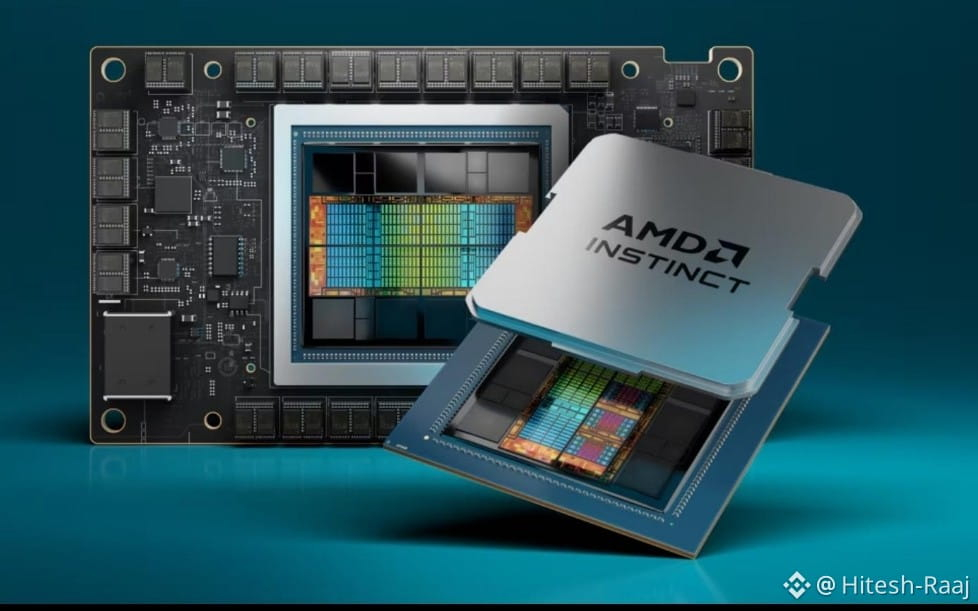
📈 AMD Shares Hit Record High
Advanced Micro Devices (NASDAQ: AMD) crossed the $1 trillion market-cap milestone for the first time on September 21, 2026. AMD shares jumped about 9.6% to a record $613.31, amid strong investor interest in AI computing. Reuters reported that AMD’s stock has risen sharply this year as the company expands its AI business and competes in the data-center chip market.
$AMDB #stock 💵💰
{spot}(AMDBUSDT)
📈 AMD Shares Hit Record High
Advanced Micro Devices (NASDAQ: AMD) crossed the $1 trillion market-cap milestone for the first time on September 21, 2026. AMD shares jumped about 9.6% to a record $613.31, amid strong investor interest in AI computing. Reuters reported that AMD’s stock has risen sharply this year as the company expands its AI business and competes in the data-center chip market.
$AMDB #stock 💵💰
Advanced Micro Devices (NASDAQ: AMD) crossed the $1 trillion market-cap milestone for the first time on September 21, 2026. AMD shares jumped about 9.6% to a record $613.31, amid strong investor interest in AI computing. Reuters reported that AMD’s stock has risen sharply this year as the company expands its AI business and competes in the data-center chip market.
$AMDB #stock 💵💰
73

NYSE and Blockchain.com sign a memorandum of understanding to explore trading tokenized stocks 24 hours a day, 7 days a week
The New York Stock Exchange and Blockchain.com signed a memorandum of understanding on September 23 to explore a platform that would allow trading 24 hours a day with U.S. stock tokens.
Under the agreement, Blockchain.com users could gain access to U.S. exchange-traded stock and ETF tokens through the digital alternative trading system (ATS) previously announced by the NYSE, subject to the required regulatory approvals. This comes at the same time that federal regulators have recently opened a new legal pathway for this kind of securities business. No launch date has been announced.
#etf #stock #NYSE #blockchain #NuevaYork $MSFTB $AAPLB $AMZNB
NYSE and Blockchain.com sign a memorandum of understanding to explore trading tokenized stocks 24 hours a day, 7 days a week
The New York Stock Exchange and Blockchain.com signed a memorandum of understanding on September 23 to explore a platform that would allow trading 24 hours a day with U.S. stock tokens.
Under the agreement, Blockchain.com users could gain access to U.S. exchange-traded stock and ETF tokens through the digital alternative trading system (ATS) previously announced by the NYSE, subject to the required regulatory approvals. This comes at the same time that federal regulators have recently opened a new legal pathway for this kind of securities business. No launch date has been announced.
#etf #stock #NYSE #blockchain #NuevaYork $MSFTB $AAPLB $AMZNB
The New York Stock Exchange and Blockchain.com signed a memorandum of understanding on September 23 to explore a platform that would allow trading 24 hours a day with U.S. stock tokens.
Under the agreement, Blockchain.com users could gain access to U.S. exchange-traded stock and ETF tokens through the digital alternative trading system (ATS) previously announced by the NYSE, subject to the required regulatory approvals. This comes at the same time that federal regulators have recently opened a new legal pathway for this kind of securities business. No launch date has been announced.
#etf #stock #NYSE #blockchain #NuevaYork $MSFTB $AAPLB $AMZNB

28

How I Read a Stock Before Buying It: 7 Simple Things I Check#stock #bstock
First, I Don't Buy a Stock Just Because the Price Is Going Up
When I first started learning about stocks, I thought investing was very simple.
I see a company. The stock price is going up. Many people are talking about it on social media. Then I think, “Maybe I should buy this stock before it goes even higher.”
But after learning more about the stock market, I understand that it is not that simple.
A stock price can go up today and go down tomorrow. A famous company can also have financial problems. Sometimes a company is good, but its stock price is already very high.
So before buying a stock, I think we should understand the business first.
I am still learning about investing, but these are 7 simple things I check when I research a stock.
1. Revenue – Is the Company Growing?
The first thing I look at is revenue.
Revenue is the money a company gets from selling its products or services.
For example, imagine a company has:
2023 Revenue: $10 billion
2024 Revenue: $11 billion
2025 Revenue: $13 billion
The revenue is increasing every year.
This can be a good sign because the company's business is growing. But I don't want to look at only one year. I want to see the trend over several years.
I ask myself:
“Is this company really growing? And why?”
Maybe it is selling more products. Maybe it is entering new markets. Maybe more customers are using its service.
But revenue growth doesn't automatically mean the company is a good investment. A company can have very high revenue and still have low profit.
So, I continue to check other numbers.
2. Net Income – Is the Company Making Profit?
The second thing I check is net income.
In simple words, net income is the money left after the company pays its expenses, interest, taxes and other costs.
For example:
A company makes $10 billion from its business.
After paying all its expenses, it has $2 billion left.
That $2 billion is the net income in this simple example.
I also want to know if the company's profit is growing.
Imagine revenue is increasing from $10 billion to $15 billion, but profit is not increasing. That makes me want to research more.
Maybe the company's costs are increasing.
So I don't only ask:
“How much money does this company make?”
I also ask:
“How much profit does the company keep?”
3. EPS – How Much Earnings Does Each Share Have?
Another number I check is EPS, or Earnings Per Share.
At first, EPS looked a little difficult for me. But the basic idea is not too hard.
For example, a company makes $1 billion profit and has 500 million shares.
So:
EPS = $1 billion ÷ 500 million = $2
That means the earnings are $2 per share in this simple example.
If EPS is growing over time, it can be a positive sign because earnings per share are increasing.
But I don't want to look at EPS alone.
I also want to understand why EPS changed. The number of shares can change too, and that can affect EPS.
For me, the important thing is to look at the trend instead of only looking at one year's number.
4. P/E Ratio – Is the Stock Expensive?
Another popular number is the P/E ratio, which means Price-to-Earnings ratio.
For example:
Stock price = $100
EPS = $5
Then:
P/E = $100 ÷ $5 = 20
So the P/E ratio is 20.
When I first learned about P/E, I thought a low P/E automatically means the stock is cheap and good.
But it is not that simple.
A company with a low P/E can still have business problems. A company with a high P/E can have strong growth expectations from investors.
So I think P/E should be compared with:
Similar companies
The same industry
The company's historical valuation
Expected business growth
This gives a better picture than looking at P/E alone.
5. Free Cash Flow – Is the Business Generating Cash?
This was one of the more confusing things for me when I started learning.
A company can report profit, but cash flow is also very important.
Free Cash Flow, or FCF, gives investors an idea of how much cash the business has left after spending money on things needed to operate and maintain the business.
For example, imagine two companies both report $500 million in net income.
Company A has $100 million free cash flow.
Company B has $400 million free cash flow.
That doesn't automatically mean Company B is a better investment. But I would want to understand why the cash flow is different.
I think this is one of those topics that beginners should learn slowly.
6. Debt – How Much Money Does the Company Owe?
The next thing I check is debt.
Companies can borrow money to build factories, develop products, expand their business or for other reasons.
Debt itself is not always bad.
But too much debt can create problems, especially when interest costs become high or the company's business becomes weaker.
For example, if two companies have similar businesses but one company has much more debt, I want to know why.
I may also look at the Debt-to-Equity ratio and compare it with other companies in the same industry.
I learned that there is no single debt number that is perfect for every company. Different industries can have very different levels of debt.
7. Market Capitalization – Don't Look Only at the Stock Price
This is another thing that beginners can misunderstand.
A $10 stock is not automatically cheaper than a $100 stock.
Why?
Because we also need to know how many shares the company has.
The simple formula is:
Market Capitalization = Share Price × Number of Shares
For example:
Company A:
10 billion shares
Stock price = $10
Market cap = $100 billion
Company B:
100 million shares
Stock price = $100
Market cap = $10 billion
So even though Company A has a $10 stock price, its total market value is much bigger in this example.
This is why I don't want to judge a company only by looking at its share price.
My Simple Stock Research Checklist
After learning these things, I made a simple checklist for myself.
Before I seriously consider a stock, I ask:
About the business
What does this company actually do?
How does it make money?
Who are its customers?
Does the company have strong competition?
About the financials
Is revenue growing?
Is net income growing?
What is the EPS?
What is the P/E ratio?
Is the company generating cash?
How much debt does it have?
About the valuation
Is the stock price already very high?
How does its valuation compare with similar companies?
What expectations are already included in the current price?
About the risk
What could make this company perform badly?
What could happen to the business in the future?
Am I putting too much money into one company?
Don't Just Follow Social Media
One more thing I learned is that social media can be useful, but it can also be dangerous for new investors.
You may see someone saying:
“This stock will go to the moon!”
Another person may say:
“This is the next big company!”
Maybe they are right. Maybe they are wrong.
We don't know just because someone posted it online.
YouTube, TikTok, Telegram, X and other platforms can give us ideas for research. But I think we should not use them as the only reason to buy a stock.
Instead, I want to check the company's financial reports and learn about the actual business.
Final Thoughts
I am still a beginner in investing, so I don't believe there is one magic number that can tell us whether a stock is good or bad.
For me, the biggest lesson is simple:
Don't buy a stock only because the price is going up. Understand what you are buying first.
Look at revenue, profit, EPS, P/E, cash flow, debt and market capitalization.
Then look at the company's business, competition and risks.
Stock investing is not about knowing everything from the beginning. It is about learning step by step and improving the way we make decisions.
I still have a lot to learn about stocks. But now, when I see a company that looks interesting, I don't immediately ask:
“How much can this stock go up?”
Instead, I try to ask:
“What kind of business is this, how does it make money, and what am I paying for it?”
I think that is a much better place to start.
Do your own research. Learn before you invest. And never invest money that you cannot afford to lose.
This article is for educational purposes only and is not financial advice. Investing involves risk, and you can lose money.
How I Read a Stock Before Buying It: 7 Simple Things I Check
#stock #bstock
First, I Don't Buy a Stock Just Because the Price Is Going Up
When I first started learning about stocks, I thought investing was very simple.
I see a company. The stock price is going up. Many people are talking about it on social media. Then I think, “Maybe I should buy this stock before it goes even higher.”
But after learning more about the stock market, I understand that it is not that simple.
A stock price can go up today and go down tomorrow. A famous company can also have financial problems. Sometimes a company is good, but its stock price is already very high.
So before buying a stock, I think we should understand the business first.
I am still learning about investing, but these are 7 simple things I check when I research a stock.
1. Revenue – Is the Company Growing?
The first thing I look at is revenue.
Revenue is the money a company gets from selling its products or services.
For example, imagine a company has:
2023 Revenue: $10 billion
2024 Revenue: $11 billion
2025 Revenue: $13 billion
The revenue is increasing every year.
This can be a good sign because the company's business is growing. But I don't want to look at only one year. I want to see the trend over several years.
I ask myself:
“Is this company really growing? And why?”
Maybe it is selling more products. Maybe it is entering new markets. Maybe more customers are using its service.
But revenue growth doesn't automatically mean the company is a good investment. A company can have very high revenue and still have low profit.
So, I continue to check other numbers.
2. Net Income – Is the Company Making Profit?
The second thing I check is net income.
In simple words, net income is the money left after the company pays its expenses, interest, taxes and other costs.
For example:
A company makes $10 billion from its business.
After paying all its expenses, it has $2 billion left.
That $2 billion is the net income in this simple example.
I also want to know if the company's profit is growing.
Imagine revenue is increasing from $10 billion to $15 billion, but profit is not increasing. That makes me want to research more.
Maybe the company's costs are increasing.
So I don't only ask:
“How much money does this company make?”
I also ask:
“How much profit does the company keep?”
3. EPS – How Much Earnings Does Each Share Have?
Another number I check is EPS, or Earnings Per Share.
At first, EPS looked a little difficult for me. But the basic idea is not too hard.
For example, a company makes $1 billion profit and has 500 million shares.
So:
EPS = $1 billion ÷ 500 million = $2
That means the earnings are $2 per share in this simple example.
If EPS is growing over time, it can be a positive sign because earnings per share are increasing.
But I don't want to look at EPS alone.
I also want to understand why EPS changed. The number of shares can change too, and that can affect EPS.
For me, the important thing is to look at the trend instead of only looking at one year's number.
4. P/E Ratio – Is the Stock Expensive?
Another popular number is the P/E ratio, which means Price-to-Earnings ratio.
For example:
Stock price = $100
EPS = $5
Then:
P/E = $100 ÷ $5 = 20
So the P/E ratio is 20.
When I first learned about P/E, I thought a low P/E automatically means the stock is cheap and good.
But it is not that simple.
A company with a low P/E can still have business problems. A company with a high P/E can have strong growth expectations from investors.
So I think P/E should be compared with:
Similar companies
The same industry
The company's historical valuation
Expected business growth
This gives a better picture than looking at P/E alone.
5. Free Cash Flow – Is the Business Generating Cash?
This was one of the more confusing things for me when I started learning.
A company can report profit, but cash flow is also very important.
Free Cash Flow, or FCF, gives investors an idea of how much cash the business has left after spending money on things needed to operate and maintain the business.
For example, imagine two companies both report $500 million in net income.
Company A has $100 million free cash flow.
Company B has $400 million free cash flow.
That doesn't automatically mean Company B is a better investment. But I would want to understand why the cash flow is different.
I think this is one of those topics that beginners should learn slowly.
6. Debt – How Much Money Does the Company Owe?
The next thing I check is debt.
Companies can borrow money to build factories, develop products, expand their business or for other reasons.
Debt itself is not always bad.
But too much debt can create problems, especially when interest costs become high or the company's business becomes weaker.
For example, if two companies have similar businesses but one company has much more debt, I want to know why.
I may also look at the Debt-to-Equity ratio and compare it with other companies in the same industry.
I learned that there is no single debt number that is perfect for every company. Different industries can have very different levels of debt.
7. Market Capitalization – Don't Look Only at the Stock Price
This is another thing that beginners can misunderstand.
A $10 stock is not automatically cheaper than a $100 stock.
Why?
Because we also need to know how many shares the company has.
The simple formula is:
Market Capitalization = Share Price × Number of Shares
For example:
Company A:
10 billion shares
Stock price = $10
Market cap = $100 billion
Company B:
100 million shares
Stock price = $100
Market cap = $10 billion
So even though Company A has a $10 stock price, its total market value is much bigger in this example.
This is why I don't want to judge a company only by looking at its share price.
My Simple Stock Research Checklist
After learning these things, I made a simple checklist for myself.
Before I seriously consider a stock, I ask:
About the business
What does this company actually do?
How does it make money?
Who are its customers?
Does the company have strong competition?
About the financials
Is revenue growing?
Is net income growing?
What is the EPS?
What is the P/E ratio?
Is the company generating cash?
How much debt does it have?
About the valuation
Is the stock price already very high?
How does its valuation compare with similar companies?
What expectations are already included in the current price?
About the risk
What could make this company perform badly?
What could happen to the business in the future?
Am I putting too much money into one company?
Don't Just Follow Social Media
One more thing I learned is that social media can be useful, but it can also be dangerous for new investors.
You may see someone saying:
“This stock will go to the moon!”
Another person may say:
“This is the next big company!”
Maybe they are right. Maybe they are wrong.
We don't know just because someone posted it online.
YouTube, TikTok, Telegram, X and other platforms can give us ideas for research. But I think we should not use them as the only reason to buy a stock.
Instead, I want to check the company's financial reports and learn about the actual business.
Final Thoughts
I am still a beginner in investing, so I don't believe there is one magic number that can tell us whether a stock is good or bad.
For me, the biggest lesson is simple:
Don't buy a stock only because the price is going up. Understand what you are buying first.
Look at revenue, profit, EPS, P/E, cash flow, debt and market capitalization.
Then look at the company's business, competition and risks.
Stock investing is not about knowing everything from the beginning. It is about learning step by step and improving the way we make decisions.
I still have a lot to learn about stocks. But now, when I see a company that looks interesting, I don't immediately ask:
“How much can this stock go up?”
Instead, I try to ask:
“What kind of business is this, how does it make money, and what am I paying for it?”
I think that is a much better place to start.
Do your own research. Learn before you invest. And never invest money that you cannot afford to lose.
This article is for educational purposes only and is not financial advice. Investing involves risk, and you can lose money.
First, I Don't Buy a Stock Just Because the Price Is Going Up
When I first started learning about stocks, I thought investing was very simple.
I see a company. The stock price is going up. Many people are talking about it on social media. Then I think, “Maybe I should buy this stock before it goes even higher.”
But after learning more about the stock market, I understand that it is not that simple.
A stock price can go up today and go down tomorrow. A famous company can also have financial problems. Sometimes a company is good, but its stock price is already very high.
So before buying a stock, I think we should understand the business first.
I am still learning about investing, but these are 7 simple things I check when I research a stock.
1. Revenue – Is the Company Growing?
The first thing I look at is revenue.
Revenue is the money a company gets from selling its products or services.
For example, imagine a company has:
2023 Revenue: $10 billion
2024 Revenue: $11 billion
2025 Revenue: $13 billion
The revenue is increasing every year.
This can be a good sign because the company's business is growing. But I don't want to look at only one year. I want to see the trend over several years.
I ask myself:
“Is this company really growing? And why?”
Maybe it is selling more products. Maybe it is entering new markets. Maybe more customers are using its service.
But revenue growth doesn't automatically mean the company is a good investment. A company can have very high revenue and still have low profit.
So, I continue to check other numbers.
2. Net Income – Is the Company Making Profit?
The second thing I check is net income.
In simple words, net income is the money left after the company pays its expenses, interest, taxes and other costs.
For example:
A company makes $10 billion from its business.
After paying all its expenses, it has $2 billion left.
That $2 billion is the net income in this simple example.
I also want to know if the company's profit is growing.
Imagine revenue is increasing from $10 billion to $15 billion, but profit is not increasing. That makes me want to research more.
Maybe the company's costs are increasing.
So I don't only ask:
“How much money does this company make?”
I also ask:
“How much profit does the company keep?”
3. EPS – How Much Earnings Does Each Share Have?
Another number I check is EPS, or Earnings Per Share.
At first, EPS looked a little difficult for me. But the basic idea is not too hard.
For example, a company makes $1 billion profit and has 500 million shares.
So:
EPS = $1 billion ÷ 500 million = $2
That means the earnings are $2 per share in this simple example.
If EPS is growing over time, it can be a positive sign because earnings per share are increasing.
But I don't want to look at EPS alone.
I also want to understand why EPS changed. The number of shares can change too, and that can affect EPS.
For me, the important thing is to look at the trend instead of only looking at one year's number.
4. P/E Ratio – Is the Stock Expensive?
Another popular number is the P/E ratio, which means Price-to-Earnings ratio.
For example:
Stock price = $100
EPS = $5
Then:
P/E = $100 ÷ $5 = 20
So the P/E ratio is 20.
When I first learned about P/E, I thought a low P/E automatically means the stock is cheap and good.
But it is not that simple.
A company with a low P/E can still have business problems. A company with a high P/E can have strong growth expectations from investors.
So I think P/E should be compared with:
Similar companies
The same industry
The company's historical valuation
Expected business growth
This gives a better picture than looking at P/E alone.
5. Free Cash Flow – Is the Business Generating Cash?
This was one of the more confusing things for me when I started learning.
A company can report profit, but cash flow is also very important.
Free Cash Flow, or FCF, gives investors an idea of how much cash the business has left after spending money on things needed to operate and maintain the business.
For example, imagine two companies both report $500 million in net income.
Company A has $100 million free cash flow.
Company B has $400 million free cash flow.
That doesn't automatically mean Company B is a better investment. But I would want to understand why the cash flow is different.
I think this is one of those topics that beginners should learn slowly.
6. Debt – How Much Money Does the Company Owe?
The next thing I check is debt.
Companies can borrow money to build factories, develop products, expand their business or for other reasons.
Debt itself is not always bad.
But too much debt can create problems, especially when interest costs become high or the company's business becomes weaker.
For example, if two companies have similar businesses but one company has much more debt, I want to know why.
I may also look at the Debt-to-Equity ratio and compare it with other companies in the same industry.
I learned that there is no single debt number that is perfect for every company. Different industries can have very different levels of debt.
7. Market Capitalization – Don't Look Only at the Stock Price
This is another thing that beginners can misunderstand.
A $10 stock is not automatically cheaper than a $100 stock.
Why?
Because we also need to know how many shares the company has.
The simple formula is:
Market Capitalization = Share Price × Number of Shares
For example:
Company A:
10 billion shares
Stock price = $10
Market cap = $100 billion
Company B:
100 million shares
Stock price = $100
Market cap = $10 billion
So even though Company A has a $10 stock price, its total market value is much bigger in this example.
This is why I don't want to judge a company only by looking at its share price.
My Simple Stock Research Checklist
After learning these things, I made a simple checklist for myself.
Before I seriously consider a stock, I ask:
About the business
What does this company actually do?
How does it make money?
Who are its customers?
Does the company have strong competition?
About the financials
Is revenue growing?
Is net income growing?
What is the EPS?
What is the P/E ratio?
Is the company generating cash?
How much debt does it have?
About the valuation
Is the stock price already very high?
How does its valuation compare with similar companies?
What expectations are already included in the current price?
About the risk
What could make this company perform badly?
What could happen to the business in the future?
Am I putting too much money into one company?
Don't Just Follow Social Media
One more thing I learned is that social media can be useful, but it can also be dangerous for new investors.
You may see someone saying:
“This stock will go to the moon!”
Another person may say:
“This is the next big company!”
Maybe they are right. Maybe they are wrong.
We don't know just because someone posted it online.
YouTube, TikTok, Telegram, X and other platforms can give us ideas for research. But I think we should not use them as the only reason to buy a stock.
Instead, I want to check the company's financial reports and learn about the actual business.
Final Thoughts
I am still a beginner in investing, so I don't believe there is one magic number that can tell us whether a stock is good or bad.
For me, the biggest lesson is simple:
Don't buy a stock only because the price is going up. Understand what you are buying first.
Look at revenue, profit, EPS, P/E, cash flow, debt and market capitalization.
Then look at the company's business, competition and risks.
Stock investing is not about knowing everything from the beginning. It is about learning step by step and improving the way we make decisions.
I still have a lot to learn about stocks. But now, when I see a company that looks interesting, I don't immediately ask:
“How much can this stock go up?”
Instead, I try to ask:
“What kind of business is this, how does it make money, and what am I paying for it?”
I think that is a much better place to start.
Do your own research. Learn before you invest. And never invest money that you cannot afford to lose.
This article is for educational purposes only and is not financial advice. Investing involves risk, and you can lose money.
60

Article
(Stocks) Unlimited Profits from the Market and Financial Freedom@BinanceBurmese
The biggest secret behind the richest people and successful investors is making a smart investment in the stock market. The stock market isn’t just about simple buying and selling—it’s a remarkable financial pathway that lets you own a portion of the world’s largest, fastest-growing companies, and steadily grows long-term wealth.
(Stocks) Unlimited Profits from the Market and Financial Freedom
@Binance Burmese
The biggest secret behind the richest people and successful investors is making a smart investment in the stock market. The stock market isn’t just about simple buying and selling—it’s a remarkable financial pathway that lets you own a portion of the world’s largest, fastest-growing companies, and steadily grows long-term wealth.
The biggest secret behind the richest people and successful investors is making a smart investment in the stock market. The stock market isn’t just about simple buying and selling—it’s a remarkable financial pathway that lets you own a portion of the world’s largest, fastest-growing companies, and steadily grows long-term wealth.
2
132
·
--
Bullish
What are Stocks and BStocks (Tokenized Stocks)? 📈💡
As financial markets evolve, new and exciting opportunities are constantly emerging for investors. Today, let’s explore the key differences between traditional Stocks and the crypto world's BStocks (Tokenized Stocks).
1. What are Traditional Stocks?
A stock represents a unit of ownership in a company, serving as proof that you own a fractional share of that business.
How to Buy: Purchased through traditional stockbrokers or centralized exchanges (e.g., NYSE, NASDAQ).
Trading Hours: Available only during standard business hours (Monday through Friday).
Benefits: Potential for company dividend payouts and voting rights on key corporate decisions.
2. What are BStocks (Tokenized Stocks)?
BStocks (or Tokenized Stocks) are digital representations of traditional company stocks built on blockchain technology as digital tokens.
How to Buy: Traded easily right from your smartphone via crypto exchanges.
24/7 Trading: Trade anytime without waiting for stock market opening or closing bells.
Fractional Ownership: You don't need to buy a full share—you can invest as little as $5 or $10 to own a fraction of high-value stocks.
🔑 Key Comparison
Feature
Traditional Stocks
Trading HoursBusiness hours only (Weekdays)
Full shares
Traditional banking (T+2 days)
BStocks (Tokenized Stocks)
24 hours / 7 days a week (24/7)
Fractional shares allowed
Near-instant on the blockchain
💡 Conclusion
BStocks bridge traditional finance with blockchain technology, making it easier and faster for everyday investors to access global stock markets.
(Note: Investing in crypto and tokenized assets involves financial risk. Always do your own research before investing. DYOR
{spot}(SPCXBUSDT)
#SEAstock #SEABstock
#Binance
#stock
What are Stocks and BStocks (Tokenized Stocks)? 📈💡
As financial markets evolve, new and exciting opportunities are constantly emerging for investors. Today, let’s explore the key differences between traditional Stocks and the crypto world's BStocks (Tokenized Stocks).
1. What are Traditional Stocks?
A stock represents a unit of ownership in a company, serving as proof that you own a fractional share of that business.
How to Buy: Purchased through traditional stockbrokers or centralized exchanges (e.g., NYSE, NASDAQ).
Trading Hours: Available only during standard business hours (Monday through Friday).
Benefits: Potential for company dividend payouts and voting rights on key corporate decisions.
2. What are BStocks (Tokenized Stocks)?
BStocks (or Tokenized Stocks) are digital representations of traditional company stocks built on blockchain technology as digital tokens.
How to Buy: Traded easily right from your smartphone via crypto exchanges.
24/7 Trading: Trade anytime without waiting for stock market opening or closing bells.
Fractional Ownership: You don't need to buy a full share—you can invest as little as $5 or $10 to own a fraction of high-value stocks.
🔑 Key Comparison
Feature
Traditional Stocks
Trading HoursBusiness hours only (Weekdays)
Full shares
Traditional banking (T+2 days)
BStocks (Tokenized Stocks)
24 hours / 7 days a week (24/7)
Fractional shares allowed
Near-instant on the blockchain
💡 Conclusion
BStocks bridge traditional finance with blockchain technology, making it easier and faster for everyday investors to access global stock markets.
(Note: Investing in crypto and tokenized assets involves financial risk. Always do your own research before investing. DYOR
#SEAstock #SEABstock
#Binance
#stock
As financial markets evolve, new and exciting opportunities are constantly emerging for investors. Today, let’s explore the key differences between traditional Stocks and the crypto world's BStocks (Tokenized Stocks).
1. What are Traditional Stocks?
A stock represents a unit of ownership in a company, serving as proof that you own a fractional share of that business.
How to Buy: Purchased through traditional stockbrokers or centralized exchanges (e.g., NYSE, NASDAQ).
Trading Hours: Available only during standard business hours (Monday through Friday).
Benefits: Potential for company dividend payouts and voting rights on key corporate decisions.
2. What are BStocks (Tokenized Stocks)?
BStocks (or Tokenized Stocks) are digital representations of traditional company stocks built on blockchain technology as digital tokens.
How to Buy: Traded easily right from your smartphone via crypto exchanges.
24/7 Trading: Trade anytime without waiting for stock market opening or closing bells.
Fractional Ownership: You don't need to buy a full share—you can invest as little as $5 or $10 to own a fraction of high-value stocks.
🔑 Key Comparison
Feature
Traditional Stocks
Trading HoursBusiness hours only (Weekdays)
Full shares
Traditional banking (T+2 days)
BStocks (Tokenized Stocks)
24 hours / 7 days a week (24/7)
Fractional shares allowed
Near-instant on the blockchain
💡 Conclusion
BStocks bridge traditional finance with blockchain technology, making it easier and faster for everyday investors to access global stock markets.
(Note: Investing in crypto and tokenized assets involves financial risk. Always do your own research before investing. DYOR
#SEAstock #SEABstock
#Binance
#stock
317

·
--
Bullish
Verified
Wall Street is about to feel very different 👀 $SNDKB $NVDAB
From December 6, U.S. stocks are planned to trade 23 hours a day, 5 days a week.
Almost 24/7 access to the market, that’s wild.
I can already see people checking their portfolios at 2 a.m.
{future}(NVDAUSDT)
{future}(SNDKUSDT)
#stock #TrendingTopic
Wall Street is about to feel very different 👀 $SNDKB $NVDAB
From December 6, U.S. stocks are planned to trade 23 hours a day, 5 days a week.
Almost 24/7 access to the market, that’s wild.
I can already see people checking their portfolios at 2 a.m.
#stock #TrendingTopic
From December 6, U.S. stocks are planned to trade 23 hours a day, 5 days a week.
Almost 24/7 access to the market, that’s wild.
I can already see people checking their portfolios at 2 a.m.
#stock #TrendingTopic

2
1.5k

Getting Started with US Stocks & BStocks: New Opportunities and Things to Know for Crypto PeopleToday, in the world of finance and investment, Crypto currencies are extremely popular with the trend of the times. On the other hand, the U.S. stock market (US Stock Market), which has grown strong over many decades, still remains highly attractive to every investor. Most modern crypto investors are interested in US stocks as well, and you can see that they are also trying to diversify their portfolios (investment allocation).
Getting Started with US Stocks & BStocks: New Opportunities and Things to Know for Crypto People
Today, in the world of finance and investment, Crypto currencies are extremely popular with the trend of the times. On the other hand, the U.S. stock market (US Stock Market), which has grown strong over many decades, still remains highly attractive to every investor. Most modern crypto investors are interested in US stocks as well, and you can see that they are also trying to diversify their portfolios (investment allocation).
119
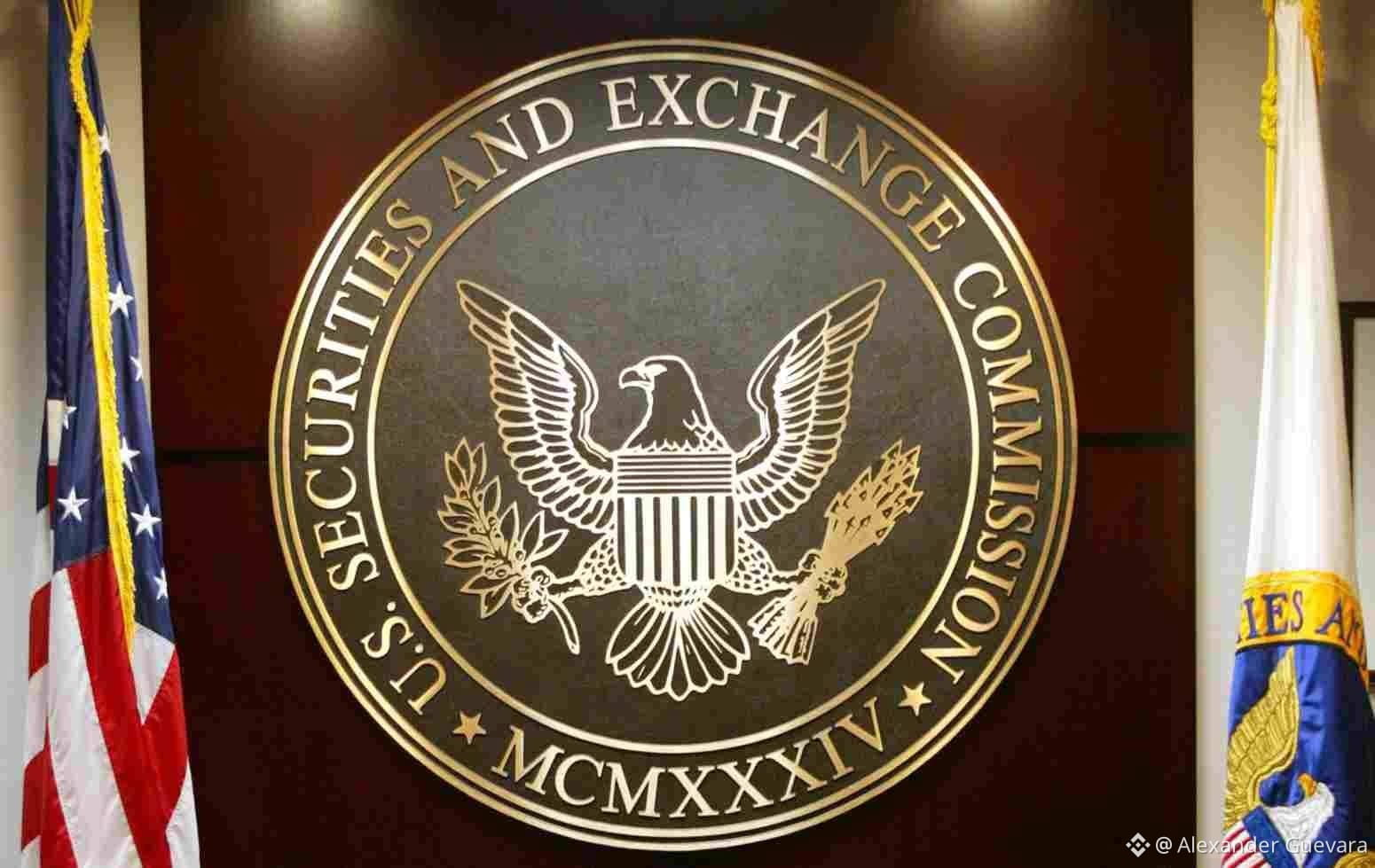
🚨 THE SEC OPENS THE DOOR TO WALL STREET ON-CHAIN 🇺🇸⛓️
The SEC has just approved an “Innovation Exemption” that will allow, under certain conditions, trading tokenized U.S. shares directly on-chain.
👉 Tokenized shares with the same rights as traditional ones
👉 Public and auditable smart contracts
👉 Use of liquidity pools and AMM
👉 Infrastructure deployed on public blockchains
👉 Temporary exemption for 5 years
Tokenizing real-world assets is no longer just a crypto narrative.
Traditional finance is starting to move ON-CHAIN. 🔥
Are we at the beginning of a new era for financial markets? 👀
#stock #WallStreetNews #Tokenization #RWA #On-chain $MSFTB $AMZNB $NVDAB
🚨 THE SEC OPENS THE DOOR TO WALL STREET ON-CHAIN 🇺🇸⛓️
The SEC has just approved an “Innovation Exemption” that will allow, under certain conditions, trading tokenized U.S. shares directly on-chain.
👉 Tokenized shares with the same rights as traditional ones
👉 Public and auditable smart contracts
👉 Use of liquidity pools and AMM
👉 Infrastructure deployed on public blockchains
👉 Temporary exemption for 5 years
Tokenizing real-world assets is no longer just a crypto narrative.
Traditional finance is starting to move ON-CHAIN. 🔥
Are we at the beginning of a new era for financial markets? 👀
#stock #WallStreetNews #Tokenization #RWA #On-chain $MSFTB $AMZNB $NVDAB
The SEC has just approved an “Innovation Exemption” that will allow, under certain conditions, trading tokenized U.S. shares directly on-chain.
👉 Tokenized shares with the same rights as traditional ones
👉 Public and auditable smart contracts
👉 Use of liquidity pools and AMM
👉 Infrastructure deployed on public blockchains
👉 Temporary exemption for 5 years
Tokenizing real-world assets is no longer just a crypto narrative.
Traditional finance is starting to move ON-CHAIN. 🔥
Are we at the beginning of a new era for financial markets? 👀
#stock #WallStreetNews #Tokenization #RWA #On-chain $MSFTB $AMZNB $NVDAB
18

·
--
Bullish
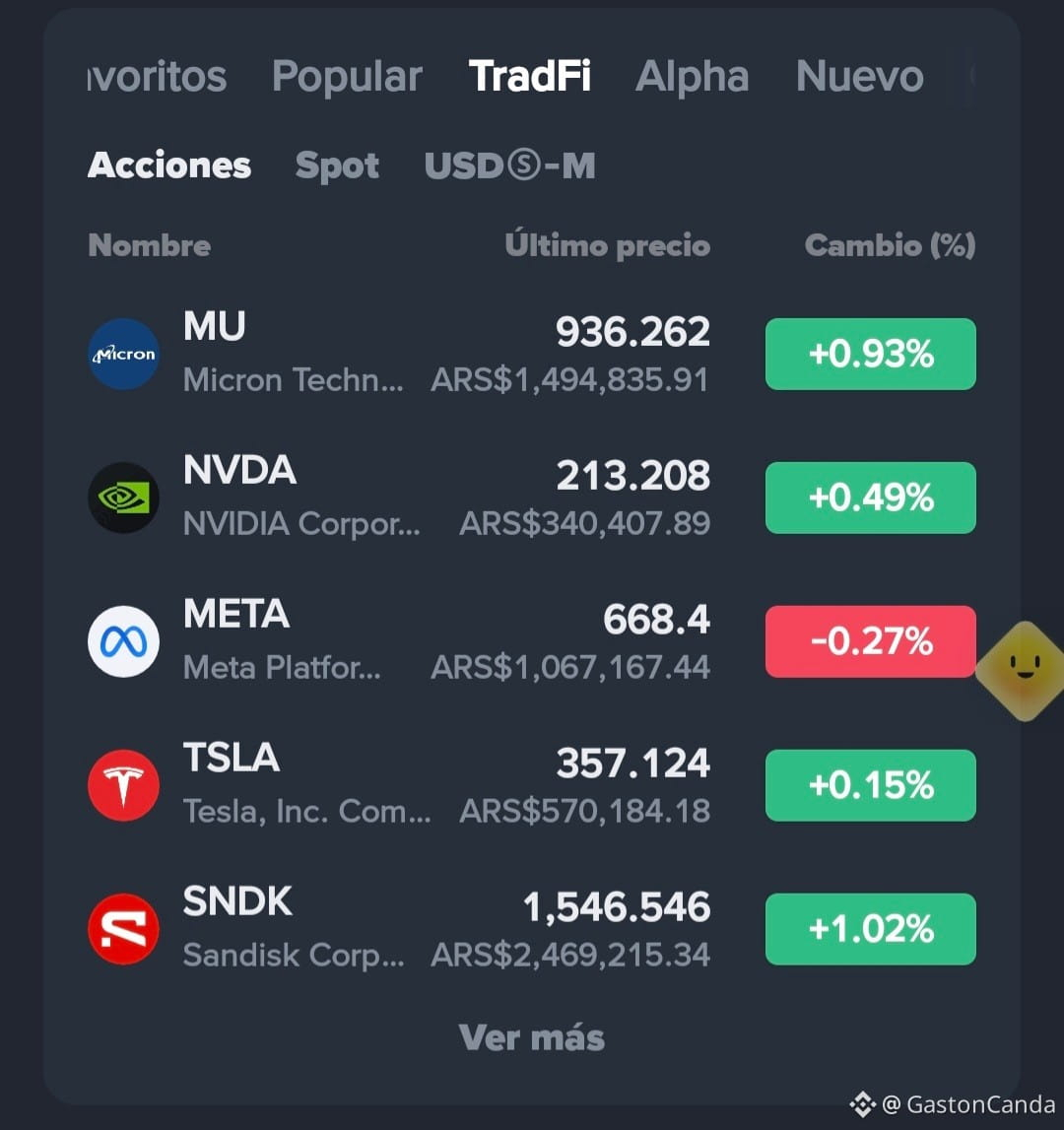
👀 You can only pick ONE.
Binance is putting more traditional-market exposure directly in front of crypto investors.
From this list:
$MU — Micron
$NVDA — NVIDIA
$META — Meta
$TSLA — Tesla
$SNDK — SanDisk
You have $1,000 and one rule:
Pick ONE and hold it until 2030. No selling.
Which one are you choosing — and why?
I’ll share my pick in the comments. 👇
#TradFi #stock #Investing #BinanceSquare
👀 You can only pick ONE.
Binance is putting more traditional-market exposure directly in front of crypto investors.
From this list:
$MU — Micron
$NVDA — NVIDIA
$META — Meta
$TSLA — Tesla
$SNDK — SanDisk
You have $1,000 and one rule:
Pick ONE and hold it until 2030. No selling.
Which one are you choosing — and why?
I’ll share my pick in the comments. 👇
#TradFi #stock #Investing #BinanceSquare
Binance is putting more traditional-market exposure directly in front of crypto investors.
From this list:
$MU — Micron
$NVDA — NVIDIA
$META — Meta
$TSLA — Tesla
$SNDK — SanDisk
You have $1,000 and one rule:
Pick ONE and hold it until 2030. No selling.
Which one are you choosing — and why?
I’ll share my pick in the comments. 👇
#TradFi #stock #Investing #BinanceSquare
2
821

The Us stock market is under short-term pressure today, but the longer-term trend remains relatively strong. The S&P 500 is around 7,586, while the Nasdaq and Dow are also lower.
The biggest concerns right now are:
U.S. Treasury yields — the 10-year yield has moved above 5%, increasing pressure on high-valuation stocks.
Oil prices — higher energy prices are increasing inflation concerns.
Federal Reserve meeting — the Fed meeting is underway, making traders cautious about interest-rate expectations.
AI/technology stocks — recent weakness in AI-related stocks has pressured the Nasdaq.
$NVDA.US $AAPLB $GOOGL.US
#viralpost #foryoupage #TrenddingTopic #stock #followme
The Us stock market is under short-term pressure today, but the longer-term trend remains relatively strong. The S&P 500 is around 7,586, while the Nasdaq and Dow are also lower.
The biggest concerns right now are:
U.S. Treasury yields — the 10-year yield has moved above 5%, increasing pressure on high-valuation stocks.
Oil prices — higher energy prices are increasing inflation concerns.
Federal Reserve meeting — the Fed meeting is underway, making traders cautious about interest-rate expectations.
AI/technology stocks — recent weakness in AI-related stocks has pressured the Nasdaq.
$NVDA.US $AAPLB $GOOGL.US
#viralpost #foryoupage #TrenddingTopic #stock #followme
The biggest concerns right now are:
U.S. Treasury yields — the 10-year yield has moved above 5%, increasing pressure on high-valuation stocks.
Oil prices — higher energy prices are increasing inflation concerns.
Federal Reserve meeting — the Fed meeting is underway, making traders cautious about interest-rate expectations.
AI/technology stocks — recent weakness in AI-related stocks has pressured the Nasdaq.
$NVDA.US $AAPLB $GOOGL.US
#viralpost #foryoupage #TrenddingTopic #stock #followme
112

·
--
Bullish
Partly True
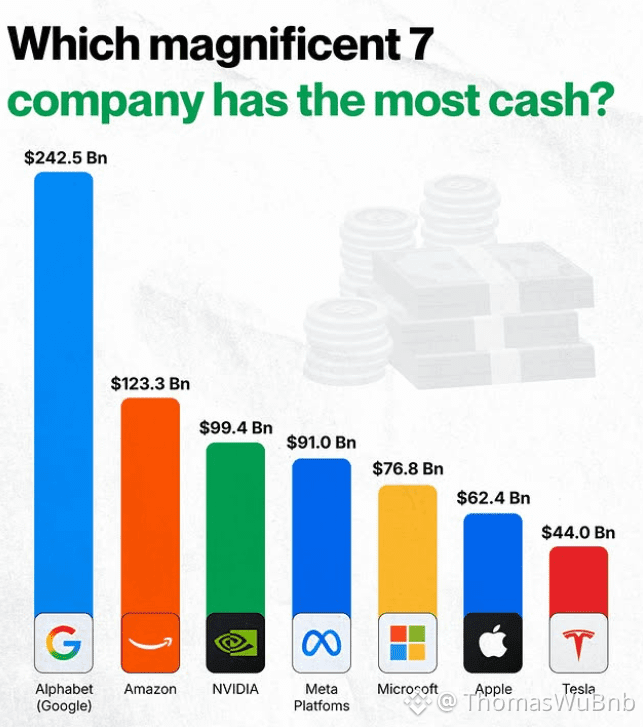
Google is sitting on $242.5B in cash — more than Amazon and NVIDIA combined. The Mag7 still holds massive dry powder while the market prices every headline.
You no longer need a US broker for exposure. Eligible users can now trade real US stocks on Binance, plus 24/7 tokenized bStocks, from the same app. Crypto and equities, one account.
#USstock $GOOGL #stock #RWA
Google is sitting on $242.5B in cash — more than Amazon and NVIDIA combined. The Mag7 still holds massive dry powder while the market prices every headline.
You no longer need a US broker for exposure. Eligible users can now trade real US stocks on Binance, plus 24/7 tokenized bStocks, from the same app. Crypto and equities, one account.
#USstock $GOOGL #stock #RWA
You no longer need a US broker for exposure. Eligible users can now trade real US stocks on Binance, plus 24/7 tokenized bStocks, from the same app. Crypto and equities, one account.
#USstock $GOOGL #stock #RWA
8
14.9k

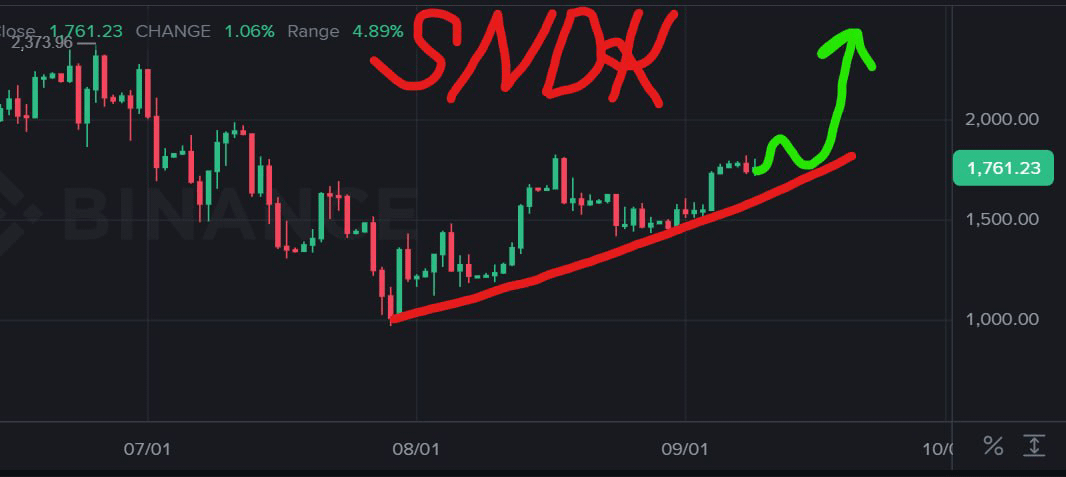
$SNDK 2,500$ I’m Waiting
SanDisk is a company that provides both flash memory and cloud services it operates in both hardware and data.
When we look at the future of AI, we can easily see that there will be a need for both. That’s why I expect its price to rise in the coming period, in line with the NASDAQ’s upward trend.
I believe this increase could reach $2,200 in the first phase and then go as high as $2,500. Compared to the current price, that’s a 50% increase.
This rally would be quite impressive for a #stock DYOR!
$SNDK 2,500$ I’m Waiting
SanDisk is a company that provides both flash memory and cloud services it operates in both hardware and data.
When we look at the future of AI, we can easily see that there will be a need for both. That’s why I expect its price to rise in the coming period, in line with the NASDAQ’s upward trend.
I believe this increase could reach $2,200 in the first phase and then go as high as $2,500. Compared to the current price, that’s a 50% increase.
This rally would be quite impressive for a #stock DYOR!
SanDisk is a company that provides both flash memory and cloud services it operates in both hardware and data.
When we look at the future of AI, we can easily see that there will be a need for both. That’s why I expect its price to rise in the coming period, in line with the NASDAQ’s upward trend.
I believe this increase could reach $2,200 in the first phase and then go as high as $2,500. Compared to the current price, that’s a 50% increase.
This rally would be quite impressive for a #stock DYOR!
335



Let's enter the world of stocks.
What is the best stock to hold in 2026?
#stock #BStocks #Binance $NVDAB $NVDA .US $AAPL .US
AAPL
US
Apple Inc. Common Stock
318.99$GOOGL.US #USIranTradeTankerStrikesEscalate
Let's enter the world of stocks.
What is the best stock to hold in 2026?
#stock #BStocks #Binance $NVDAB $NVDA .US $AAPL .US
AAPL
US
Apple Inc. Common Stock
318.99$GOOGL.US #USIranTradeTankerStrikesEscalate
What is the best stock to hold in 2026?
#stock #BStocks #Binance $NVDAB $NVDA .US $AAPL .US
AAPL
US
Apple Inc. Common Stock
318.99$GOOGL.US #USIranTradeTankerStrikesEscalate

1
95

·
--
Bearish
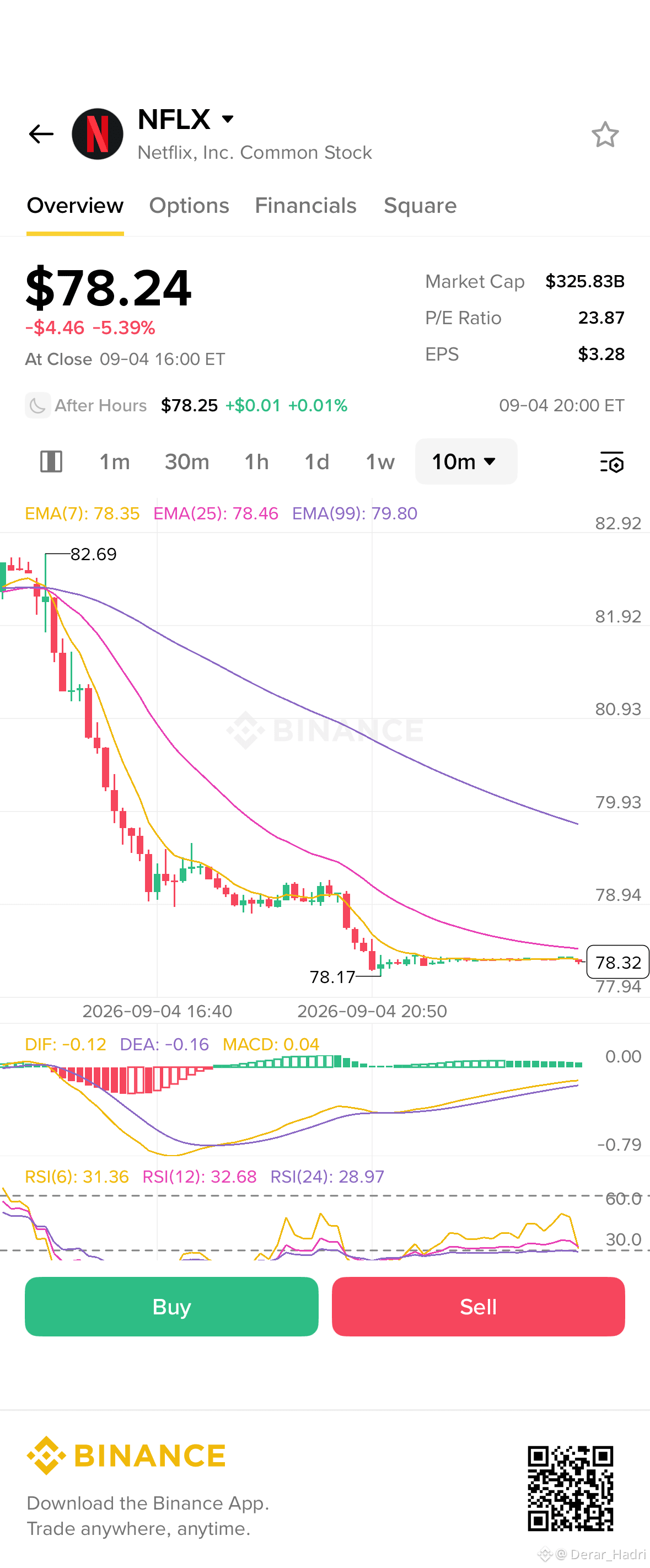
$NFLX
{future}(NFLXUSDT)
🔴 NFLX | Conditional buy — waiting for confirmation
Entry: $78.10–$78.35
Stop loss: $79.10
🎯 TP1: $76.40
🎯 TP2: $75.55
🎯 TP3: $73.70
✅ Confirmation: Hourly close without 78.10 after market open, then retest the entry zone and see a sell rejection on the 10–15 minute chart.
❌ Invalidation: Recover 79.10 before entry. After entry, the stop loss is executed once reached.
Risk: 0.5% of the account.
Reward/Risk when entering 78.25: about 2.2 / 3.2 / 5.4 before costs.
⚠️ Overbought selling on smaller timeframes: no direct selling and no chasing the downside.
#stock #tradingstocks
$NFLX
🔴 NFLX | Conditional buy — waiting for confirmation
Entry: $78.10–$78.35
Stop loss: $79.10
🎯 TP1: $76.40
🎯 TP2: $75.55
🎯 TP3: $73.70
✅ Confirmation: Hourly close without 78.10 after market open, then retest the entry zone and see a sell rejection on the 10–15 minute chart.
❌ Invalidation: Recover 79.10 before entry. After entry, the stop loss is executed once reached.
Risk: 0.5% of the account.
Reward/Risk when entering 78.25: about 2.2 / 3.2 / 5.4 before costs.
⚠️ Overbought selling on smaller timeframes: no direct selling and no chasing the downside.
#stock #tradingstocks
🔴 NFLX | Conditional buy — waiting for confirmation
Entry: $78.10–$78.35
Stop loss: $79.10
🎯 TP1: $76.40
🎯 TP2: $75.55
🎯 TP3: $73.70
✅ Confirmation: Hourly close without 78.10 after market open, then retest the entry zone and see a sell rejection on the 10–15 minute chart.
❌ Invalidation: Recover 79.10 before entry. After entry, the stop loss is executed once reached.
Risk: 0.5% of the account.
Reward/Risk when entering 78.25: about 2.2 / 3.2 / 5.4 before costs.
⚠️ Overbought selling on smaller timeframes: no direct selling and no chasing the downside.
#stock #tradingstocks
165

One earnings report could put the AI sector back in focus.
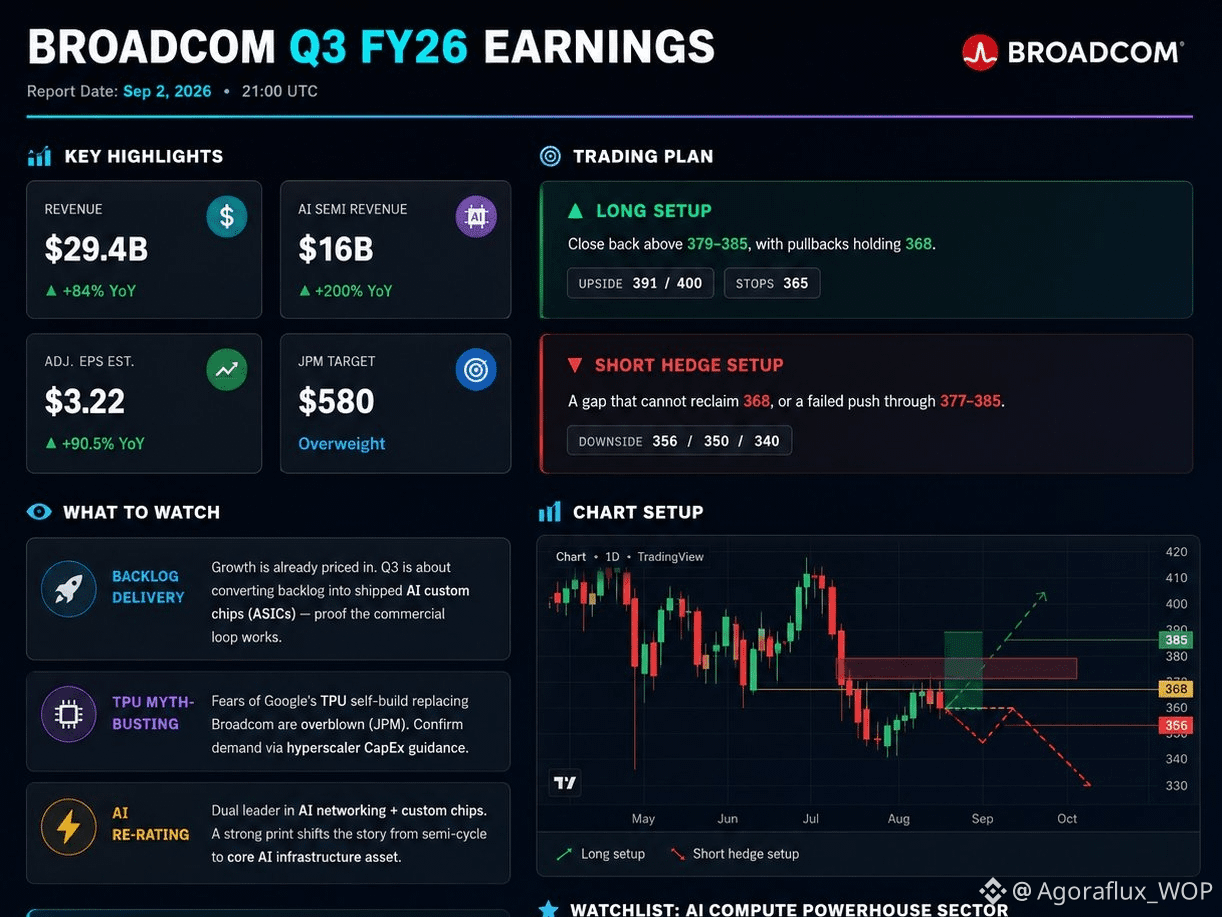
Broadcom ( $AVGO ) is set to report earnings on Sep 2 at 21:00 UTC, and the market will be watching closely not just for the numbers, but for what they reveal about the strength of AI demand.
My view:
• Strong AI revenue + raised guidance could reinforce the current AI growth narrative and improve sentiment across related stocks.
• Weak guidance or slowing growth could trigger a repricing, especially after the strong expectations already built into the sector.
Either way, this is a moment where having exposure to just one stock may not tell the whole story.
The Theme #stock feature allows traders to explore the broader AI narrative instead of manually building exposure stock by stock.
Markets → Stocks → AI Theme → Invest
This means you can follow the catalyst around $AVGO while also keeping an eye on the companies connected to the same AI ecosystem all through one theme.
For me, the real opportunity isn't only predicting AVGO's earnings.
It's understanding what those earnings could mean for the next move in the broader AI sector.
The numbers will tell one story. The market reaction may tell the bigger one.
One earnings report could put the AI sector back in focus.
Broadcom ( $AVGO ) is set to report earnings on Sep 2 at 21:00 UTC, and the market will be watching closely not just for the numbers, but for what they reveal about the strength of AI demand.
My view:
• Strong AI revenue + raised guidance could reinforce the current AI growth narrative and improve sentiment across related stocks.
• Weak guidance or slowing growth could trigger a repricing, especially after the strong expectations already built into the sector.
Either way, this is a moment where having exposure to just one stock may not tell the whole story.
The Theme #stock feature allows traders to explore the broader AI narrative instead of manually building exposure stock by stock.
Markets → Stocks → AI Theme → Invest
This means you can follow the catalyst around $AVGO while also keeping an eye on the companies connected to the same AI ecosystem all through one theme.
For me, the real opportunity isn't only predicting AVGO's earnings.
It's understanding what those earnings could mean for the next move in the broader AI sector.
The numbers will tell one story. The market reaction may tell the bigger one.
Broadcom ( $AVGO ) is set to report earnings on Sep 2 at 21:00 UTC, and the market will be watching closely not just for the numbers, but for what they reveal about the strength of AI demand.
My view:
• Strong AI revenue + raised guidance could reinforce the current AI growth narrative and improve sentiment across related stocks.
• Weak guidance or slowing growth could trigger a repricing, especially after the strong expectations already built into the sector.
Either way, this is a moment where having exposure to just one stock may not tell the whole story.
The Theme #stock feature allows traders to explore the broader AI narrative instead of manually building exposure stock by stock.
Markets → Stocks → AI Theme → Invest
This means you can follow the catalyst around $AVGO while also keeping an eye on the companies connected to the same AI ecosystem all through one theme.
For me, the real opportunity isn't only predicting AVGO's earnings.
It's understanding what those earnings could mean for the next move in the broader AI sector.
The numbers will tell one story. The market reaction may tell the bigger one.
1
385
·
--
Bullish
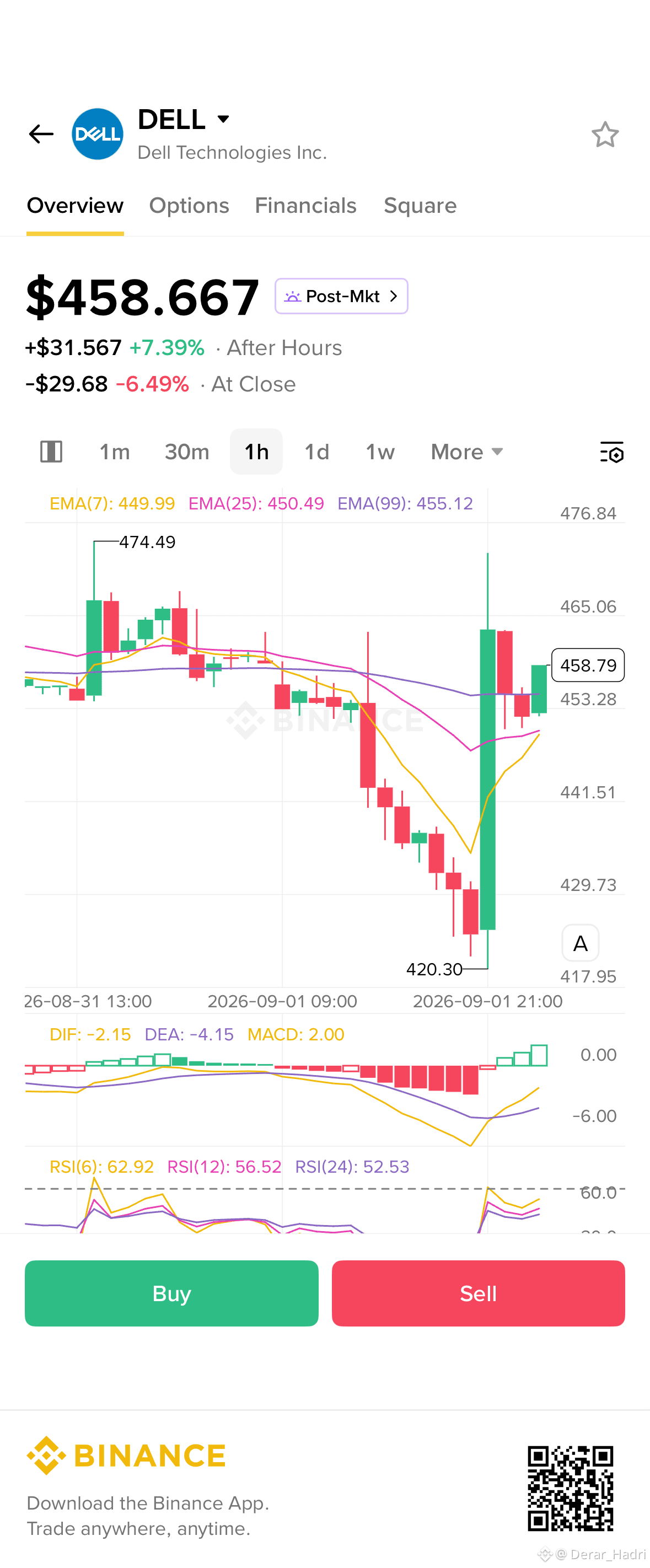
$DELL
🚨 Deal unveils a big surprise on Wall Street!
The stock $DELL jumped by about 8% after the close, after second-quarter results strongly beat expectations:
• Revenue: $46.97 billion
• Adjusted earnings per share: $7.04
• AI server revenue: $16.4 billion
But the biggest surprise was in the annual outlook:
• Raised revenue guidance to $192 billion
• Raised AI server guidance to $74 billion
• Record backlog of orders totaling $95 billion
The message is clear: the AI race benefits not only chip companies… it also boosts demand for infrastructure and servers.
Will $DELL become one of the biggest beneficiaries of the AI boom?
{future}(DELLUSDT)
#stock
$DELL
🚨 Deal unveils a big surprise on Wall Street!
The stock $DELL jumped by about 8% after the close, after second-quarter results strongly beat expectations:
• Revenue: $46.97 billion
• Adjusted earnings per share: $7.04
• AI server revenue: $16.4 billion
But the biggest surprise was in the annual outlook:
• Raised revenue guidance to $192 billion
• Raised AI server guidance to $74 billion
• Record backlog of orders totaling $95 billion
The message is clear: the AI race benefits not only chip companies… it also boosts demand for infrastructure and servers.
Will $DELL become one of the biggest beneficiaries of the AI boom?
#stock
🚨 Deal unveils a big surprise on Wall Street!
The stock $DELL jumped by about 8% after the close, after second-quarter results strongly beat expectations:
• Revenue: $46.97 billion
• Adjusted earnings per share: $7.04
• AI server revenue: $16.4 billion
But the biggest surprise was in the annual outlook:
• Raised revenue guidance to $192 billion
• Raised AI server guidance to $74 billion
• Record backlog of orders totaling $95 billion
The message is clear: the AI race benefits not only chip companies… it also boosts demand for infrastructure and servers.
Will $DELL become one of the biggest beneficiaries of the AI boom?
#stock
100
·
--
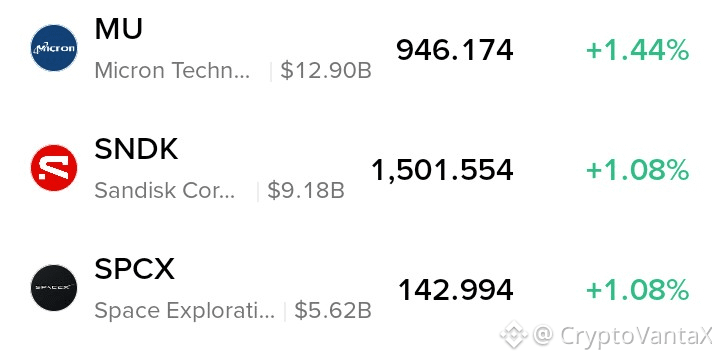
TradFi. MU SNDK SPCX market chart.
$MU $SNDK $SPCX
{stock_us}(MU.US)
{stock_us}(SNDK.US)
{stock_us}(SPCX.US)
#Market_Update #stock #TradFi #Follow_Like_Comment #Binance
TradFi. MU SNDK SPCX market chart.
$MU $SNDK $SPCX
#Market_Update #stock #TradFi #Follow_Like_Comment #Binance
$MU $SNDK $SPCX
#Market_Update #stock #TradFi #Follow_Like_Comment #Binance
1
1.2k


·
--
Verified
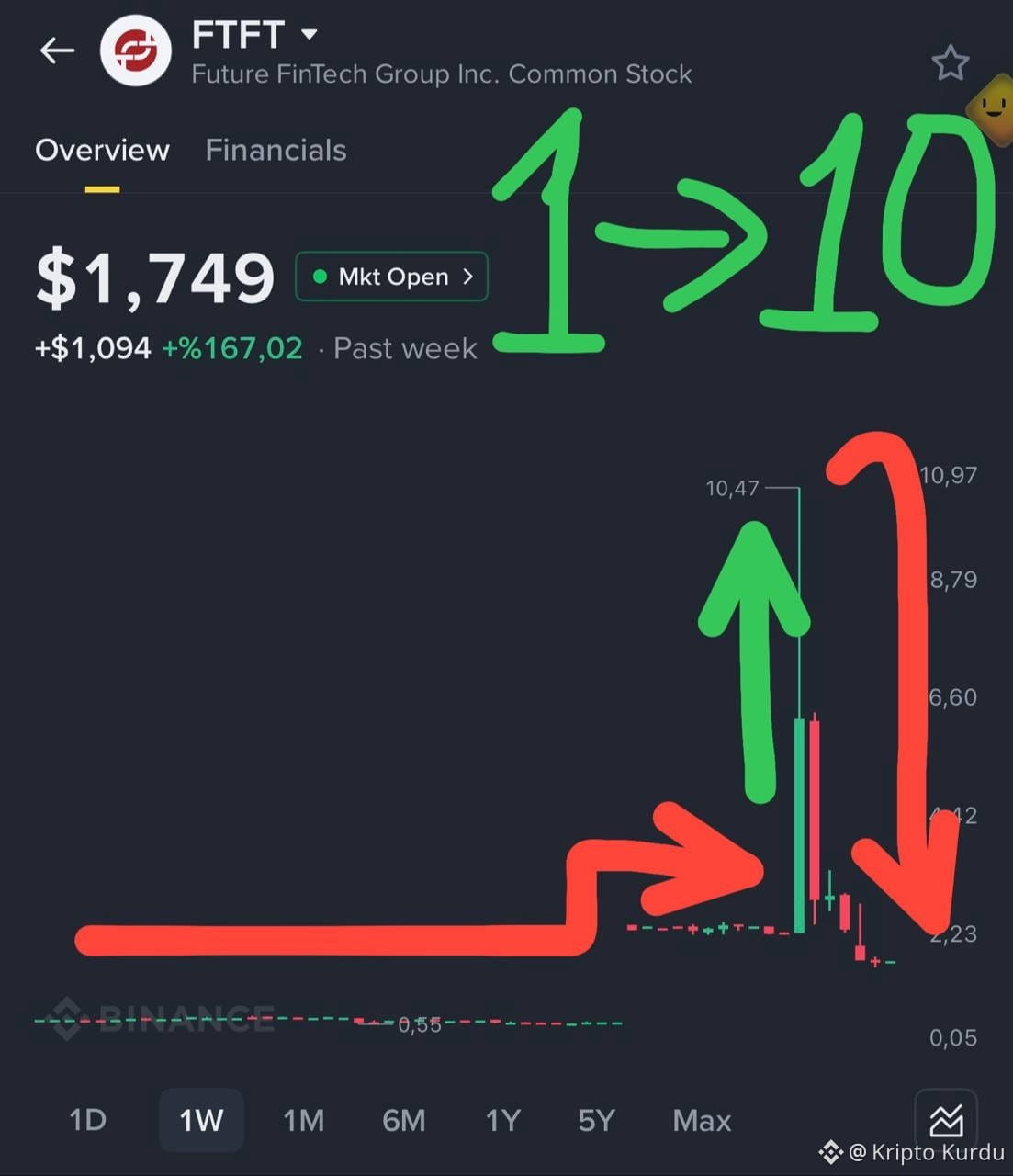
$FTFT.US Why Did This #Stock Explode and Then Crash?
Future FinTech Group (FTFT) has become one of the most volatile small-cap fintech stocks. In my opinion, the recent move is driven more by speculation than strong fundamentals.
The company completed a $30M private placement in July 2026 and announced a 1-for-4 reverse stock split, creating additional attention around the stock. Financially, the picture remains weak: revenue for the first six months of 2026 fell 52% to $546K, while the company reported a $3.2M net loss.
In 2025, FTFT generated about $3.83M in revenue but suffered a $30.95M operating loss. My take: the huge spike was fueled by low liquidity, corporate actions and speculative buying not improving fundamentals. That also explains why the stock can fall just as aggressively.
$FTFT.US Why Did This #Stock Explode and Then Crash?
Future FinTech Group (FTFT) has become one of the most volatile small-cap fintech stocks. In my opinion, the recent move is driven more by speculation than strong fundamentals.
The company completed a $30M private placement in July 2026 and announced a 1-for-4 reverse stock split, creating additional attention around the stock. Financially, the picture remains weak: revenue for the first six months of 2026 fell 52% to $546K, while the company reported a $3.2M net loss.
In 2025, FTFT generated about $3.83M in revenue but suffered a $30.95M operating loss. My take: the huge spike was fueled by low liquidity, corporate actions and speculative buying not improving fundamentals. That also explains why the stock can fall just as aggressively.
Future FinTech Group (FTFT) has become one of the most volatile small-cap fintech stocks. In my opinion, the recent move is driven more by speculation than strong fundamentals.
The company completed a $30M private placement in July 2026 and announced a 1-for-4 reverse stock split, creating additional attention around the stock. Financially, the picture remains weak: revenue for the first six months of 2026 fell 52% to $546K, while the company reported a $3.2M net loss.
In 2025, FTFT generated about $3.83M in revenue but suffered a $30.95M operating loss. My take: the huge spike was fueled by low liquidity, corporate actions and speculative buying not improving fundamentals. That also explains why the stock can fall just as aggressively.
FTFTUS-3.66%
5
2k
Log in to explore more content
Join global crypto users on Binance Square
⚡️ Get latest and useful information about crypto.
💬 Trusted by the world’s largest crypto exchange.
👍 Discover real insights from verified creators.
Email / Phone number
Trending Topics
1
#BinanceWillListHyperliquid(HYPE)
88,263 views
2,022 Discussing
2
#FedOctoberRateHikeOddsRiseTo69.7%
21,078 views
774 Discussing
3
#BitcoinFallsBelow$83,000
2,803 views
20 Discussing
4
#BitcoinFallsToAround$84,600ThisWeek
0 views
0 Discussing
5
#US30YearYieldHighestSince2004
21,843 views
625 Discussing
6
#ETHBreaksAbove$2,700
1,314 views
20 Discussing
7
#USWeighsPromotingDollarStablecoinsAbroad
53,206 views
1,506 Discussing
8
#US10YTreasuryYieldHits19YearHigh
54,629 views
1,214 Discussing
9
#SpotBitcoinETFsInflow$2.31BInFourDays
6,360 views
71 Discussing
10
#BitcoinRejectedAt$87,300Twice
0 views
0 Discussing