
#sec
sec
333.9M views
1.4M Discussing
Hot
Latest


Verified
REAL US STOCKS ARE FINALLY COMING ON-CHAIN UNDER SEC REGULATION
The SEC is officially opening a regulated US pathway for tokenized stocks, marking a massive bridge between traditional finance and public blockchains. While this is huge, the regulators are keeping a very tight grip on trading volumes, user access, and issuer rights to maintain control.
🚀 Traditional equities will now live on the same ledger tech powering $BTC and $ETH
🔒 Access will be highly regulated with strict limits on who can trade them initially
📈 This could pave the way for massive institutional capital flowing into Web3 infrastructure
Honestly, this is the regulatory clarity we have been waiting for even if it comes with strings attached.
#Tokenization #TradFi #SEC #Write2Earn
REAL US STOCKS ARE FINALLY COMING ON-CHAIN UNDER SEC REGULATION
The SEC is officially opening a regulated US pathway for tokenized stocks, marking a massive bridge between traditional finance and public blockchains. While this is huge, the regulators are keeping a very tight grip on trading volumes, user access, and issuer rights to maintain control.
🚀 Traditional equities will now live on the same ledger tech powering $BTC and $ETH
🔒 Access will be highly regulated with strict limits on who can trade them initially
📈 This could pave the way for massive institutional capital flowing into Web3 infrastructure
Honestly, this is the regulatory clarity we have been waiting for even if it comes with strings attached.
#Tokenization #TradFi #SEC #Write2Earn
The SEC is officially opening a regulated US pathway for tokenized stocks, marking a massive bridge between traditional finance and public blockchains. While this is huge, the regulators are keeping a very tight grip on trading volumes, user access, and issuer rights to maintain control.
🚀 Traditional equities will now live on the same ledger tech powering $BTC and $ETH
🔒 Access will be highly regulated with strict limits on who can trade them initially
📈 This could pave the way for massive institutional capital flowing into Web3 infrastructure
Honestly, this is the regulatory clarity we have been waiting for even if it comes with strings attached.
#Tokenization #TradFi #SEC #Write2Earn

1
1.2k

🚨 BREAKING: SEC OPENS NEW PATHWAY FOR TOKENIZED STOCK TRADING! 🇺🇸📈
#SEC : ⚡ The SEC has issued a conditional “Innovation Exemption” order under Section 36(a)(1) of the Exchange Act.
🪙 The temporary, notice-based framework creates a pathway for tokenized stock trading venues (TSVs) and AMM liquidity providers.
🔥 A major regulatory development for tokenized securities and on-chain markets.
👀 Is Wall Street moving deeper onto the blockchain?
Follow for daily updates ⚡
$TAKE $MET $BCH
🚨 BREAKING: SEC OPENS NEW PATHWAY FOR TOKENIZED STOCK TRADING! 🇺🇸📈
#SEC : ⚡ The SEC has issued a conditional “Innovation Exemption” order under Section 36(a)(1) of the Exchange Act.
🪙 The temporary, notice-based framework creates a pathway for tokenized stock trading venues (TSVs) and AMM liquidity providers.
🔥 A major regulatory development for tokenized securities and on-chain markets.
👀 Is Wall Street moving deeper onto the blockchain?
Follow for daily updates ⚡
$TAKE $MET $BCH
#SEC : ⚡ The SEC has issued a conditional “Innovation Exemption” order under Section 36(a)(1) of the Exchange Act.
🪙 The temporary, notice-based framework creates a pathway for tokenized stock trading venues (TSVs) and AMM liquidity providers.
🔥 A major regulatory development for tokenized securities and on-chain markets.
👀 Is Wall Street moving deeper onto the blockchain?
Follow for daily updates ⚡
$TAKE $MET $BCH

290

·
--
🚨 BREAKING: 🇺🇸 HUGE MOVE FROM THE SEC! 🔥
The SEC has announced a framework allowing stocks to be traded on-chain, opening the door for traditional financial assets to move onto blockchain infrastructure. 🌐📈
This could be a major step toward bringing traditional markets and crypto closer together.
And with blockchain networks like XRP Ledger focused on fast, low-cost settlement, $XRP
{spot}(XRPUSDT)
is once again attracting attention. 👀⚡
The line between traditional finance and crypto continues to blur.
🚀 On-chain markets could be a major trend to watch.
#XRP #Crypto #Blockchain #SEC #BinanceSquare
🚨 BREAKING: 🇺🇸 HUGE MOVE FROM THE SEC! 🔥
The SEC has announced a framework allowing stocks to be traded on-chain, opening the door for traditional financial assets to move onto blockchain infrastructure. 🌐📈
This could be a major step toward bringing traditional markets and crypto closer together.
And with blockchain networks like XRP Ledger focused on fast, low-cost settlement, $XRP
is once again attracting attention. 👀⚡
The line between traditional finance and crypto continues to blur.
🚀 On-chain markets could be a major trend to watch.
#XRP #Crypto #Blockchain #SEC #BinanceSquare
The SEC has announced a framework allowing stocks to be traded on-chain, opening the door for traditional financial assets to move onto blockchain infrastructure. 🌐📈
This could be a major step toward bringing traditional markets and crypto closer together.
And with blockchain networks like XRP Ledger focused on fast, low-cost settlement, $XRP
is once again attracting attention. 👀⚡
The line between traditional finance and crypto continues to blur.
🚀 On-chain markets could be a major trend to watch.
#XRP #Crypto #Blockchain #SEC #BinanceSquare
71

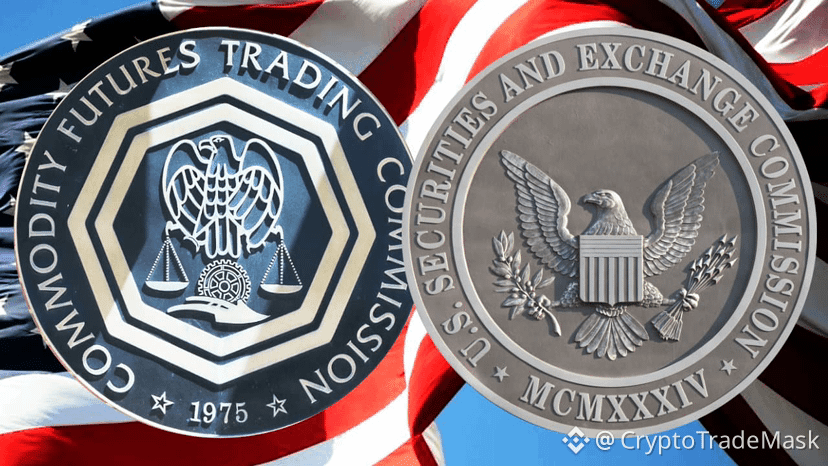
#SEC #CFTC
🚀 CFTC and SEC Set Course for Mass Tokenization of Financial Markets
US regulators are taking significant steps toward blockchain and on-chain markets, laying the groundwork for the tokenization of traditional assets.
📊 Key takeaways from regulator statements:
➡️ Mass tokenization of assets (RWA): CFTC Chair Michael Selig stated at a US Treasury Department conference that financial markets should prepare for a transition to blockchain. In his view, tokenizing real-world assets will enable near-instant settlement and the real-time movement of collateral.
➡️ Flexible regulation from the CFTC: With the CLARITY Act stalled in the Senate, the CFTC is moving forward independently. The regulator has already submitted a document to the White House proposing the development of rules for crypto-assets based on its existing authority.
➡️ SEC opens the door to tokenized stocks: The SEC has granted a temporary "Innovation Exemption," allowing select platforms to trade digital versions of US stocks in a test environment while comprehensive legislation is being developed.
➡️ Beyond politics: The SEC emphasizes that the development of crypto technologies and tokenization should not be politicized, as it represents a step toward the overall modernization and increased efficiency of the entire US financial system.
⚠️ The financial world is gradually shifting tracks: the transition from electronic trading to on-chain infrastructure is becoming a matter of time, not probability. 🌐📈
#SEC #CFTC
🚀 CFTC and SEC Set Course for Mass Tokenization of Financial Markets
US regulators are taking significant steps toward blockchain and on-chain markets, laying the groundwork for the tokenization of traditional assets.
📊 Key takeaways from regulator statements:
➡️ Mass tokenization of assets (RWA): CFTC Chair Michael Selig stated at a US Treasury Department conference that financial markets should prepare for a transition to blockchain. In his view, tokenizing real-world assets will enable near-instant settlement and the real-time movement of collateral.
➡️ Flexible regulation from the CFTC: With the CLARITY Act stalled in the Senate, the CFTC is moving forward independently. The regulator has already submitted a document to the White House proposing the development of rules for crypto-assets based on its existing authority.
➡️ SEC opens the door to tokenized stocks: The SEC has granted a temporary "Innovation Exemption," allowing select platforms to trade digital versions of US stocks in a test environment while comprehensive legislation is being developed.
➡️ Beyond politics: The SEC emphasizes that the development of crypto technologies and tokenization should not be politicized, as it represents a step toward the overall modernization and increased efficiency of the entire US financial system.
⚠️ The financial world is gradually shifting tracks: the transition from electronic trading to on-chain infrastructure is becoming a matter of time, not probability. 🌐📈
🚀 CFTC and SEC Set Course for Mass Tokenization of Financial Markets
US regulators are taking significant steps toward blockchain and on-chain markets, laying the groundwork for the tokenization of traditional assets.
📊 Key takeaways from regulator statements:
➡️ Mass tokenization of assets (RWA): CFTC Chair Michael Selig stated at a US Treasury Department conference that financial markets should prepare for a transition to blockchain. In his view, tokenizing real-world assets will enable near-instant settlement and the real-time movement of collateral.
➡️ Flexible regulation from the CFTC: With the CLARITY Act stalled in the Senate, the CFTC is moving forward independently. The regulator has already submitted a document to the White House proposing the development of rules for crypto-assets based on its existing authority.
➡️ SEC opens the door to tokenized stocks: The SEC has granted a temporary "Innovation Exemption," allowing select platforms to trade digital versions of US stocks in a test environment while comprehensive legislation is being developed.
➡️ Beyond politics: The SEC emphasizes that the development of crypto technologies and tokenization should not be politicized, as it represents a step toward the overall modernization and increased efficiency of the entire US financial system.
⚠️ The financial world is gradually shifting tracks: the transition from electronic trading to on-chain infrastructure is becoming a matter of time, not probability. 🌐📈
44


Article
Wall Street Just Got a Blockchain Door, and Almost Nobody NoticedToday, something opened that most people scrolling their phones probably won't even register. The SEC's conditional five-year exemption window went live, letting select institutional venues start pilot trading of tokenized stocks directly on public blockchains. No press conference, no confetti. Just a regulatory switch flipped quietly on a Tuesday.
I keep thinking about how backwards this feels compared to how crypto usually makes headlines. Normally it's a coin pumping 30% or a hack draining millions that gets attention. This is the opposite: a slow, boring, bureaucratic door creaking open. But boring doors sometimes lead somewhere bigger than loud ones.
Here's what it actually means. For years, "tokenized stocks" has been a phrase thrown around at crypto conferences with more excitement than substance. A handful of platforms offered synthetic exposure to stocks like Tesla or Apple, but it always lived in a gray zone, never quite legal, never quite banned. This exemption changes that calculus for the institutions willing to move carefully. It's a pilot, not a green light for everyone, but pilots are how every big regulatory shift starts.
And the market noticed before the headline did. Over the past week, DeFi tokens tied to onchain trading infrastructure quietly outperformed the rest of the market. $UNI jumped 30% on exactly this kind of speculation. That's usually how it goes: traders price in a possibility months before the average person hears about it, and by the time it's obvious, the early move is already over.
What I find genuinely interesting is the timing. This exemption landed in the same week the US Senate rejected the CLARITY Act, the bill meant to give crypto clearer rules. So on one hand, Congress can't agree on basic definitions. On the other hand, a regulator just quietly built a legal pathway for actual Wall Street assets to trade onchain. Two different parts of the same government moving in almost opposite directions, in the same seven days.
I don't think this turns into overnight adoption. Institutions move carefully, especially with something this new, and a five-year pilot window suggests the SEC itself expects a long runway before this becomes normal. But the direction of travel matters more than the speed. Traditional finance and onchain infrastructure are being wired together, one exemption at a time, whether the rest of the market is watching or not.
The thing worth tracking isn't the announcement, it's the first real trade. When one institutional venue actually settles a tokenized stock transaction on a public chain, that's the moment this stops being theoretical.
{future}(UNIUSDT)
#SEC #defi #CryptoNews #WallStreetNews #BinanceSquare
Wall Street Just Got a Blockchain Door, and Almost Nobody Noticed
Today, something opened that most people scrolling their phones probably won't even register. The SEC's conditional five-year exemption window went live, letting select institutional venues start pilot trading of tokenized stocks directly on public blockchains. No press conference, no confetti. Just a regulatory switch flipped quietly on a Tuesday.
I keep thinking about how backwards this feels compared to how crypto usually makes headlines. Normally it's a coin pumping 30% or a hack draining millions that gets attention. This is the opposite: a slow, boring, bureaucratic door creaking open. But boring doors sometimes lead somewhere bigger than loud ones.
Here's what it actually means. For years, "tokenized stocks" has been a phrase thrown around at crypto conferences with more excitement than substance. A handful of platforms offered synthetic exposure to stocks like Tesla or Apple, but it always lived in a gray zone, never quite legal, never quite banned. This exemption changes that calculus for the institutions willing to move carefully. It's a pilot, not a green light for everyone, but pilots are how every big regulatory shift starts.
And the market noticed before the headline did. Over the past week, DeFi tokens tied to onchain trading infrastructure quietly outperformed the rest of the market. $UNI jumped 30% on exactly this kind of speculation. That's usually how it goes: traders price in a possibility months before the average person hears about it, and by the time it's obvious, the early move is already over.
What I find genuinely interesting is the timing. This exemption landed in the same week the US Senate rejected the CLARITY Act, the bill meant to give crypto clearer rules. So on one hand, Congress can't agree on basic definitions. On the other hand, a regulator just quietly built a legal pathway for actual Wall Street assets to trade onchain. Two different parts of the same government moving in almost opposite directions, in the same seven days.
I don't think this turns into overnight adoption. Institutions move carefully, especially with something this new, and a five-year pilot window suggests the SEC itself expects a long runway before this becomes normal. But the direction of travel matters more than the speed. Traditional finance and onchain infrastructure are being wired together, one exemption at a time, whether the rest of the market is watching or not.
The thing worth tracking isn't the announcement, it's the first real trade. When one institutional venue actually settles a tokenized stock transaction on a public chain, that's the moment this stops being theoretical.
#SEC #defi #CryptoNews #WallStreetNews #BinanceSquare
I keep thinking about how backwards this feels compared to how crypto usually makes headlines. Normally it's a coin pumping 30% or a hack draining millions that gets attention. This is the opposite: a slow, boring, bureaucratic door creaking open. But boring doors sometimes lead somewhere bigger than loud ones.
Here's what it actually means. For years, "tokenized stocks" has been a phrase thrown around at crypto conferences with more excitement than substance. A handful of platforms offered synthetic exposure to stocks like Tesla or Apple, but it always lived in a gray zone, never quite legal, never quite banned. This exemption changes that calculus for the institutions willing to move carefully. It's a pilot, not a green light for everyone, but pilots are how every big regulatory shift starts.
And the market noticed before the headline did. Over the past week, DeFi tokens tied to onchain trading infrastructure quietly outperformed the rest of the market. $UNI jumped 30% on exactly this kind of speculation. That's usually how it goes: traders price in a possibility months before the average person hears about it, and by the time it's obvious, the early move is already over.
What I find genuinely interesting is the timing. This exemption landed in the same week the US Senate rejected the CLARITY Act, the bill meant to give crypto clearer rules. So on one hand, Congress can't agree on basic definitions. On the other hand, a regulator just quietly built a legal pathway for actual Wall Street assets to trade onchain. Two different parts of the same government moving in almost opposite directions, in the same seven days.
I don't think this turns into overnight adoption. Institutions move carefully, especially with something this new, and a five-year pilot window suggests the SEC itself expects a long runway before this becomes normal. But the direction of travel matters more than the speed. Traditional finance and onchain infrastructure are being wired together, one exemption at a time, whether the rest of the market is watching or not.
The thing worth tracking isn't the announcement, it's the first real trade. When one institutional venue actually settles a tokenized stock transaction on a public chain, that's the moment this stops being theoretical.
#SEC #defi #CryptoNews #WallStreetNews #BinanceSquare
FEDAT - sport digital assets marketplace:
Отличный и очень глубокий анализ Друг! 💎 Самые важные изменения на рынке всегда происходят тихо, без громких заголовков и конфетти. Токенизация реальных активов (RWA) и выход институционалов на публичные блокчейны — это не вопрос "если", а вопрос "когда". Этот пятилетний пилот — именно тот мост, который соединяет TradFi и Web3. Следим за первой реальной сделкой!🤝👍
3
1
48

Next for the U.S. SEC: Agency's chief crypto counsel illuminates path for custody
Taylor Lindman, the top lawyer on the agency's Crypto Task Force, says the SEC is trying to get firms comfortable with blockchain technology and crypto assets.
#SEC
Next for the U.S. SEC: Agency's chief crypto counsel illuminates path for custody
Taylor Lindman, the top lawyer on the agency's Crypto Task Force, says the SEC is trying to get firms comfortable with blockchain technology and crypto assets.
#SEC
Taylor Lindman, the top lawyer on the agency's Crypto Task Force, says the SEC is trying to get firms comfortable with blockchain technology and crypto assets.
#SEC
6
LATEST: 🇺🇸 TD Cowen says the SEC's tokenized stock innovation exemption will likely see limited near-term adoption, saying stock perpetuals draw far more trading.
#SEC
LATEST: 🇺🇸 TD Cowen says the SEC's tokenized stock innovation exemption will likely see limited near-term adoption, saying stock perpetuals draw far more trading.
#SEC
#SEC
6
🚨 BREAKING: SEC OPENS NEW DOOR FOR TOKENIZED STOCKS — 5-YEAR EXEMPTION ANNOUNCED! 🇺🇸📈
#SEC : ⚡ A new conditional 5-year exemption could allow specialized Tokenized Securities Venues (TSVs) to trade blockchain-based shares of traditional stocks without following standard exchange requirements.
🔗 ISSUER CONSENT REQUIRED: Companies must approve the tokenization.
🛡️ INVESTOR RIGHTS PROTECTED: Tokenized shares must preserve full investor rights.
🚀 A major regulatory framework for bringing traditional equities on-chain.
Follow for daily updates 💥
$MUBARAK $KERNEL $MARSCOIN
🚨 BREAKING: SEC OPENS NEW DOOR FOR TOKENIZED STOCKS — 5-YEAR EXEMPTION ANNOUNCED! 🇺🇸📈
#SEC : ⚡ A new conditional 5-year exemption could allow specialized Tokenized Securities Venues (TSVs) to trade blockchain-based shares of traditional stocks without following standard exchange requirements.
🔗 ISSUER CONSENT REQUIRED: Companies must approve the tokenization.
🛡️ INVESTOR RIGHTS PROTECTED: Tokenized shares must preserve full investor rights.
🚀 A major regulatory framework for bringing traditional equities on-chain.
Follow for daily updates 💥
$MUBARAK $KERNEL $MARSCOIN
#SEC : ⚡ A new conditional 5-year exemption could allow specialized Tokenized Securities Venues (TSVs) to trade blockchain-based shares of traditional stocks without following standard exchange requirements.
🔗 ISSUER CONSENT REQUIRED: Companies must approve the tokenization.
🛡️ INVESTOR RIGHTS PROTECTED: Tokenized shares must preserve full investor rights.
🚀 A major regulatory framework for bringing traditional equities on-chain.
Follow for daily updates 💥
$MUBARAK $KERNEL $MARSCOIN
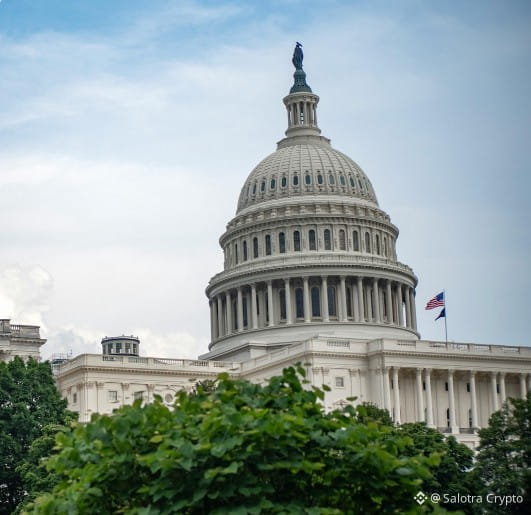
205

Article
SEC Innovation Exemption Could Open the Door to Tokenized Stock Platforms in Q4Something important is changing between traditional Wall Street and blockchain.
On September 17, 2026, the U.S. Securities and Exchange Commission (SEC) introduced its temporary Innovation Exemption, creating a regulatory pathway for certain platforms to trade tokenized U.S. stocks on blockchain-based venues. The development could allow interested tokenized-stock platforms to announce plans as early as Q4 2026.
But before looking at the crypto impact, it is important to understand what the SEC actually does.
What is the SEC?
The Securities and Exchange Commission is the U.S. federal regulator responsible for overseeing the securities markets.
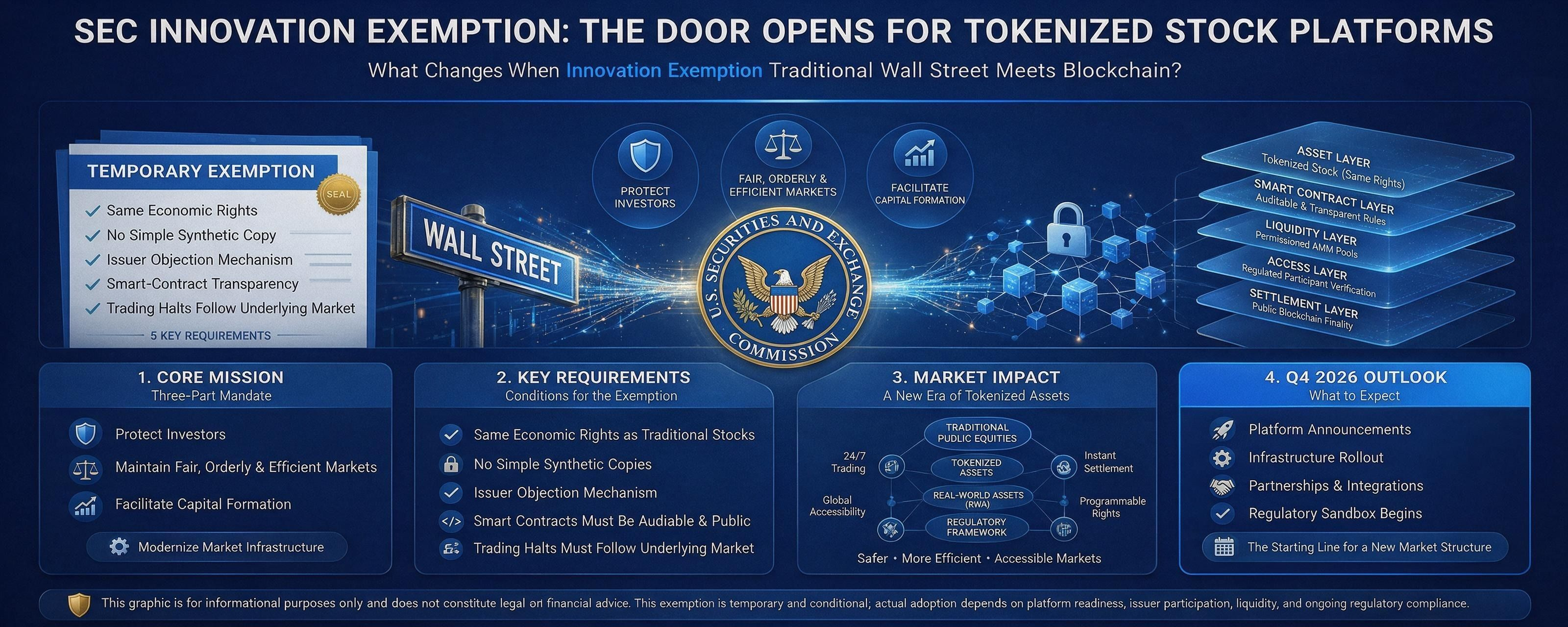
Its core mission has three parts:
Protect investorsMaintain fair, orderly and efficient marketsFacilitate capital formation
The SEC also oversees securities exchanges, brokers, dealers, investment advisers and other important parts of the U.S. securities ecosystem.
So when the SEC changes how tokenized stocks can be traded, this isn't simply a crypto announcement.
It potentially changes the infrastructure connecting blockchain + traditional equities.
What exactly changed?
The SEC granted temporary, conditional exemptions to Tokenized Securities Venues (TSVs).
These venues can use permissioned automated market makers and liquidity pools to facilitate trading of certain tokenized National Market System (NMS) stocks. The order also provides conditional relief for certain liquidity providers from the dealer definition.
The important word is conditional.
This is not a blanket approval for every crypto platform to tokenize every stock.
The framework includes several requirements.
For example:
1. Same economic rights
A tokenized stock must provide holders with the same rights and privileges as the equivalent traditional stock, including relevant dividend and voting rights.
2. No simple synthetic copy
The framework is designed around tokenized securities rather than tokens that merely imitate a stock's price without representing the underlying security rights.
3. Issuer objection mechanism
When a third party tokenizes a stock, the issuer must receive notice and an opportunity to object.
4. Smart-contract transparency
Smart contracts used by TSVs must be auditable and public, and deployed on a public, permissionless distributed ledger.
5. Trading halts must follow the underlying market
If trading in the underlying stock stops on its primary exchange, trading of its tokenized version must also stop.
The exemption is temporary and is scheduled to expire five years after publication, while the SEC collects public comments and considers longer-term rules.
Fundamental Analysis
The fundamental story is bigger than simply putting stock tickers on a blockchain.
Tokenization could potentially change several layers of market infrastructure:
Settlement:
Blockchain-based settlement can reduce the number of intermediaries involved in transferring ownership.
Transparency:
Onchain records can provide a verifiable transaction history.
Liquidity:
Permissioned AMM liquidity pools create a different mechanism for matching buyers and sellers.
Market access:
Tokenized securities could eventually make equity infrastructure more interoperable with digital-asset markets.
24/7 infrastructure:
Blockchain markets can technically operate outside traditional exchange hours, although the SEC framework still requires tokenized trading to respect restrictions such as underlying-stock trading halts.
The SEC itself has described tokenization as having potential to modernize issuance, trading, transfer, settlement and ownership-recording infrastructure.
That is why this development matters beyond crypto.
It is potentially an infrastructure upgrade, not simply another token narrative.
Technical Analysis What Changes on the Blockchain Side?
From a technical perspective, the interesting part is the combination of:
Tokenized equity + smart contracts + AMM liquidity + permissioned access + public blockchain settlement.
The architecture creates several important components:
Asset layer → token represents the underlying stock rights.
Smart-contract layer → rules govern transfers and trading.
Liquidity layer → AMM pools provide liquidity.
Access layer → only permitted participants can interact with the relevant trading venue.
Settlement layer → blockchain records transactions and ownership.
This is different from many existing crypto platforms where a token simply tracks the price of an external asset.
The SEC framework specifically focuses on tokenized NMS stock with underlying securities rights.
That distinction could become extremely important for the future of RWA markets.
What Could Happen in Q4 2026?
The current headline says platforms could announce plans as early as next quarter.
That should not be interpreted as:
Tokenized stock trading is guaranteed to launch next quarter.
The SEC has created a regulatory pathway. Individual platforms still need to satisfy the conditions, build the infrastructure, establish liquidity, address issuer participation and meet applicable requirements.
But Q4 could become an important period for announcements, partnerships and platform development.
Major financial and crypto companies have already shown interest in tokenized equities, while traditional market infrastructure providers are also exploring tokenization.
The Bigger Crypto Impact
If tokenized equities gain meaningful adoption, the boundary between crypto markets and traditional capital markets becomes much thinner.
Imagine one infrastructure where investors can interact with:
BTC
ETH
Tokenized equities
Tokenized funds
Tokenized Treasuries
Other RWAs
The technology doesn't automatically guarantee adoption.
The real test will be:
Liquidity → regulation → issuer participation → custody → settlement → investor demand.
That is where the next phase of tokenization will be decided.
For me, the most interesting part of this SEC decision isn't the headline that “stocks are coming onchain.”
It is that regulators are now experimenting with the market infrastructure itself.
And if Q4 2026 brings actual platform announcements, the tokenization narrative could move from an RWA concept into a real market-structure experiment.
Not financial advice. The exemption is temporary and conditional, and actual adoption remains dependent on platforms, issuers, liquidity and regulatory requirements.
#Binance #SEC #TokenizedStockPlatformsCouldLaunchNextQuarter $NVDAB $NVDA.US $GOOGL.US
{spot}(NVDABUSDT)
{future}(NVDAUSDT)
SEC Innovation Exemption Could Open the Door to Tokenized Stock Platforms in Q4
Something important is changing between traditional Wall Street and blockchain.
On September 17, 2026, the U.S. Securities and Exchange Commission (SEC) introduced its temporary Innovation Exemption, creating a regulatory pathway for certain platforms to trade tokenized U.S. stocks on blockchain-based venues. The development could allow interested tokenized-stock platforms to announce plans as early as Q4 2026.
But before looking at the crypto impact, it is important to understand what the SEC actually does.
What is the SEC?
The Securities and Exchange Commission is the U.S. federal regulator responsible for overseeing the securities markets.
Its core mission has three parts:
Protect investorsMaintain fair, orderly and efficient marketsFacilitate capital formation
The SEC also oversees securities exchanges, brokers, dealers, investment advisers and other important parts of the U.S. securities ecosystem.
So when the SEC changes how tokenized stocks can be traded, this isn't simply a crypto announcement.
It potentially changes the infrastructure connecting blockchain + traditional equities.
What exactly changed?
The SEC granted temporary, conditional exemptions to Tokenized Securities Venues (TSVs).
These venues can use permissioned automated market makers and liquidity pools to facilitate trading of certain tokenized National Market System (NMS) stocks. The order also provides conditional relief for certain liquidity providers from the dealer definition.
The important word is conditional.
This is not a blanket approval for every crypto platform to tokenize every stock.
The framework includes several requirements.
For example:
1. Same economic rights
A tokenized stock must provide holders with the same rights and privileges as the equivalent traditional stock, including relevant dividend and voting rights.
2. No simple synthetic copy
The framework is designed around tokenized securities rather than tokens that merely imitate a stock's price without representing the underlying security rights.
3. Issuer objection mechanism
When a third party tokenizes a stock, the issuer must receive notice and an opportunity to object.
4. Smart-contract transparency
Smart contracts used by TSVs must be auditable and public, and deployed on a public, permissionless distributed ledger.
5. Trading halts must follow the underlying market
If trading in the underlying stock stops on its primary exchange, trading of its tokenized version must also stop.
The exemption is temporary and is scheduled to expire five years after publication, while the SEC collects public comments and considers longer-term rules.
Fundamental Analysis
The fundamental story is bigger than simply putting stock tickers on a blockchain.
Tokenization could potentially change several layers of market infrastructure:
Settlement:
Blockchain-based settlement can reduce the number of intermediaries involved in transferring ownership.
Transparency:
Onchain records can provide a verifiable transaction history.
Liquidity:
Permissioned AMM liquidity pools create a different mechanism for matching buyers and sellers.
Market access:
Tokenized securities could eventually make equity infrastructure more interoperable with digital-asset markets.
24/7 infrastructure:
Blockchain markets can technically operate outside traditional exchange hours, although the SEC framework still requires tokenized trading to respect restrictions such as underlying-stock trading halts.
The SEC itself has described tokenization as having potential to modernize issuance, trading, transfer, settlement and ownership-recording infrastructure.
That is why this development matters beyond crypto.
It is potentially an infrastructure upgrade, not simply another token narrative.
Technical Analysis What Changes on the Blockchain Side?
From a technical perspective, the interesting part is the combination of:
Tokenized equity + smart contracts + AMM liquidity + permissioned access + public blockchain settlement.
The architecture creates several important components:
Asset layer → token represents the underlying stock rights.
Smart-contract layer → rules govern transfers and trading.
Liquidity layer → AMM pools provide liquidity.
Access layer → only permitted participants can interact with the relevant trading venue.
Settlement layer → blockchain records transactions and ownership.
This is different from many existing crypto platforms where a token simply tracks the price of an external asset.
The SEC framework specifically focuses on tokenized NMS stock with underlying securities rights.
That distinction could become extremely important for the future of RWA markets.
What Could Happen in Q4 2026?
The current headline says platforms could announce plans as early as next quarter.
That should not be interpreted as:
Tokenized stock trading is guaranteed to launch next quarter.
The SEC has created a regulatory pathway. Individual platforms still need to satisfy the conditions, build the infrastructure, establish liquidity, address issuer participation and meet applicable requirements.
But Q4 could become an important period for announcements, partnerships and platform development.
Major financial and crypto companies have already shown interest in tokenized equities, while traditional market infrastructure providers are also exploring tokenization.
The Bigger Crypto Impact
If tokenized equities gain meaningful adoption, the boundary between crypto markets and traditional capital markets becomes much thinner.
Imagine one infrastructure where investors can interact with:
BTC
ETH
Tokenized equities
Tokenized funds
Tokenized Treasuries
Other RWAs
The technology doesn't automatically guarantee adoption.
The real test will be:
Liquidity → regulation → issuer participation → custody → settlement → investor demand.
That is where the next phase of tokenization will be decided.
For me, the most interesting part of this SEC decision isn't the headline that “stocks are coming onchain.”
It is that regulators are now experimenting with the market infrastructure itself.
And if Q4 2026 brings actual platform announcements, the tokenization narrative could move from an RWA concept into a real market-structure experiment.
Not financial advice. The exemption is temporary and conditional, and actual adoption remains dependent on platforms, issuers, liquidity and regulatory requirements.
#Binance #SEC #TokenizedStockPlatformsCouldLaunchNextQuarter $NVDAB $NVDA.US $GOOGL.US
On September 17, 2026, the U.S. Securities and Exchange Commission (SEC) introduced its temporary Innovation Exemption, creating a regulatory pathway for certain platforms to trade tokenized U.S. stocks on blockchain-based venues. The development could allow interested tokenized-stock platforms to announce plans as early as Q4 2026.
But before looking at the crypto impact, it is important to understand what the SEC actually does.
What is the SEC?
The Securities and Exchange Commission is the U.S. federal regulator responsible for overseeing the securities markets.
Its core mission has three parts:
Protect investorsMaintain fair, orderly and efficient marketsFacilitate capital formation
The SEC also oversees securities exchanges, brokers, dealers, investment advisers and other important parts of the U.S. securities ecosystem.
So when the SEC changes how tokenized stocks can be traded, this isn't simply a crypto announcement.
It potentially changes the infrastructure connecting blockchain + traditional equities.
What exactly changed?
The SEC granted temporary, conditional exemptions to Tokenized Securities Venues (TSVs).
These venues can use permissioned automated market makers and liquidity pools to facilitate trading of certain tokenized National Market System (NMS) stocks. The order also provides conditional relief for certain liquidity providers from the dealer definition.
The important word is conditional.
This is not a blanket approval for every crypto platform to tokenize every stock.
The framework includes several requirements.
For example:
1. Same economic rights
A tokenized stock must provide holders with the same rights and privileges as the equivalent traditional stock, including relevant dividend and voting rights.
2. No simple synthetic copy
The framework is designed around tokenized securities rather than tokens that merely imitate a stock's price without representing the underlying security rights.
3. Issuer objection mechanism
When a third party tokenizes a stock, the issuer must receive notice and an opportunity to object.
4. Smart-contract transparency
Smart contracts used by TSVs must be auditable and public, and deployed on a public, permissionless distributed ledger.
5. Trading halts must follow the underlying market
If trading in the underlying stock stops on its primary exchange, trading of its tokenized version must also stop.
The exemption is temporary and is scheduled to expire five years after publication, while the SEC collects public comments and considers longer-term rules.
Fundamental Analysis
The fundamental story is bigger than simply putting stock tickers on a blockchain.
Tokenization could potentially change several layers of market infrastructure:
Settlement:
Blockchain-based settlement can reduce the number of intermediaries involved in transferring ownership.
Transparency:
Onchain records can provide a verifiable transaction history.
Liquidity:
Permissioned AMM liquidity pools create a different mechanism for matching buyers and sellers.
Market access:
Tokenized securities could eventually make equity infrastructure more interoperable with digital-asset markets.
24/7 infrastructure:
Blockchain markets can technically operate outside traditional exchange hours, although the SEC framework still requires tokenized trading to respect restrictions such as underlying-stock trading halts.
The SEC itself has described tokenization as having potential to modernize issuance, trading, transfer, settlement and ownership-recording infrastructure.
That is why this development matters beyond crypto.
It is potentially an infrastructure upgrade, not simply another token narrative.
Technical Analysis What Changes on the Blockchain Side?
From a technical perspective, the interesting part is the combination of:
Tokenized equity + smart contracts + AMM liquidity + permissioned access + public blockchain settlement.
The architecture creates several important components:
Asset layer → token represents the underlying stock rights.
Smart-contract layer → rules govern transfers and trading.
Liquidity layer → AMM pools provide liquidity.
Access layer → only permitted participants can interact with the relevant trading venue.
Settlement layer → blockchain records transactions and ownership.
This is different from many existing crypto platforms where a token simply tracks the price of an external asset.
The SEC framework specifically focuses on tokenized NMS stock with underlying securities rights.
That distinction could become extremely important for the future of RWA markets.
What Could Happen in Q4 2026?
The current headline says platforms could announce plans as early as next quarter.
That should not be interpreted as:
Tokenized stock trading is guaranteed to launch next quarter.
The SEC has created a regulatory pathway. Individual platforms still need to satisfy the conditions, build the infrastructure, establish liquidity, address issuer participation and meet applicable requirements.
But Q4 could become an important period for announcements, partnerships and platform development.
Major financial and crypto companies have already shown interest in tokenized equities, while traditional market infrastructure providers are also exploring tokenization.
The Bigger Crypto Impact
If tokenized equities gain meaningful adoption, the boundary between crypto markets and traditional capital markets becomes much thinner.
Imagine one infrastructure where investors can interact with:
BTC
ETH
Tokenized equities
Tokenized funds
Tokenized Treasuries
Other RWAs
The technology doesn't automatically guarantee adoption.
The real test will be:
Liquidity → regulation → issuer participation → custody → settlement → investor demand.
That is where the next phase of tokenization will be decided.
For me, the most interesting part of this SEC decision isn't the headline that “stocks are coming onchain.”
It is that regulators are now experimenting with the market infrastructure itself.
And if Q4 2026 brings actual platform announcements, the tokenization narrative could move from an RWA concept into a real market-structure experiment.
Not financial advice. The exemption is temporary and conditional, and actual adoption remains dependent on platforms, issuers, liquidity and regulatory requirements.
#Binance #SEC #TokenizedStockPlatformsCouldLaunchNextQuarter $NVDAB $NVDA.US $GOOGL.US
1
164
Ever wondered when traditional finance would finally realize that the world never actually sleeps? I have been watching the SEC lately, and it is honestly wild to see them prepping for around-the-clock 24/7 trading, right on the same day they approved tokenized securities. Crypto has been doing this forever, and now the stock market wants a piece of the action.\n\nThis is a massive shift that bridges the gap between traditional assets and blockchain. I mean, imagine trading stocks on a Sunday night just like we trade $BTC or $ETH. It feels like the entire global financial structure is bending toward the crypto model, and I am absolutely here for it. What do you think, are we looking at the end of market bells?\n\n#CryptoNews #TradFi #SEC #Write2Earn
Ever wondered when traditional finance would finally realize that the world never actually sleeps? I have been watching the SEC lately, and it is honestly wild to see them prepping for around-the-clock 24/7 trading, right on the same day they approved tokenized securities. Crypto has been doing this forever, and now the stock market wants a piece of the action.\n\nThis is a massive shift that bridges the gap between traditional assets and blockchain. I mean, imagine trading stocks on a Sunday night just like we trade $BTC or $ETH . It feels like the entire global financial structure is bending toward the crypto model, and I am absolutely here for it. What do you think, are we looking at the end of market bells?\n\n#CryptoNews #TradFi #SEC #Write2Earn
73

·
--
Bullish
🚨 BREAKING: SEC Opens 5-Year Tokenized Stock Pilot! 🚀
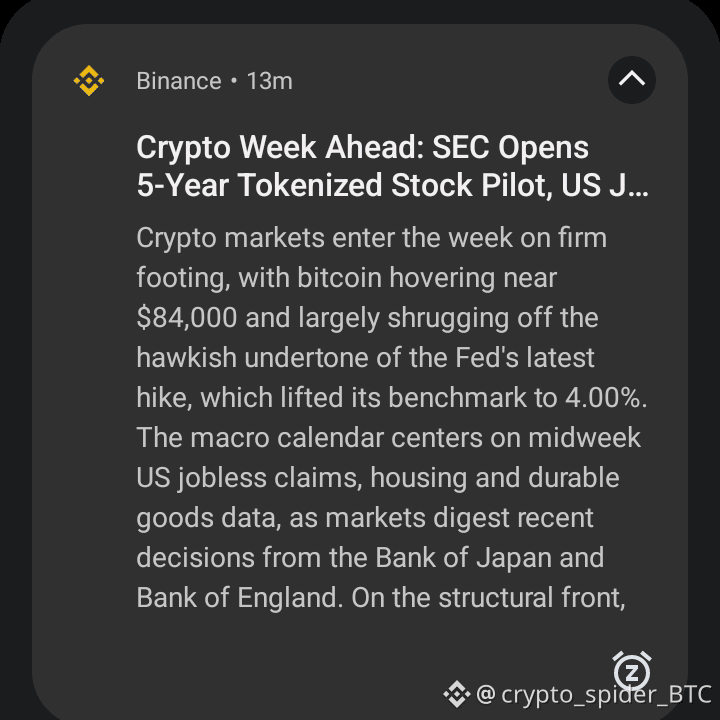
Big news from Binance notification! SEC Innovation Exemption Sep 2026 - 2031!
US Stocks will trade on PUBLIC blockchains now! Bitcoin holds $84K strong even after Fed hike to 4.00%! 💪
This week: US jobless claims + housing data coming! $BANK is ready for pump! Bullish on RWA tokens! 📈💚
$BANK #SEC #CryptoNews #Bitcoin
🚨 BREAKING: SEC Opens 5-Year Tokenized Stock Pilot! 🚀
Big news from Binance notification! SEC Innovation Exemption Sep 2026 - 2031!
US Stocks will trade on PUBLIC blockchains now! Bitcoin holds $84K strong even after Fed hike to 4.00%! 💪
This week: US jobless claims + housing data coming! $BANK is ready for pump! Bullish on RWA tokens! 📈💚
$BANK #SEC #CryptoNews #Bitcoin
Big news from Binance notification! SEC Innovation Exemption Sep 2026 - 2031!
US Stocks will trade on PUBLIC blockchains now! Bitcoin holds $84K strong even after Fed hike to 4.00%! 💪
This week: US jobless claims + housing data coming! $BANK is ready for pump! Bullish on RWA tokens! 📈💚
$BANK #SEC #CryptoNews #Bitcoin
1
252

·
--
Bullish
🔥 The SEC Just Opened a New Door for Crypto❗
🔺The CLARITY Act failed to advance in the Senate, but just days later, the SEC introduced a five-year “Innovation Exemption” for qualifying platforms to facilitate on-chain trading of certain tokenized U.S. stocks. These tokenized shares must provide the same rights as the underlying stocks, including dividend and voting rights, under specific conditions. 📈⛓️
🔺This doesn’t replace the CLARITY Act, but it does show that blockchain-based financial markets are still moving forward through existing regulatory authority. 🇺🇸🚀
🔺Market sentiment also reacted quickly, with Bitcoin recovering sharply and crypto-related stocks moving higher. Now the big question is whether this momentum can push BTC toward another test of major resistance levels. 👀
🔺If regulatory progress continues and institutional positioning starts to unwind, the next phase of the market could become very interesting. 🔥📊
🔺🔴Could this be the beginning of another major Bitcoin move—or just a relief rally? What’s your target❓ 🎯
$BTC
{spot}(BTCUSDT)
#Bitcoin
#Crypto
#SEC
#CLARITYAct
#BTCBreaks80K
🔥 The SEC Just Opened a New Door for Crypto❗
🔺The CLARITY Act failed to advance in the Senate, but just days later, the SEC introduced a five-year “Innovation Exemption” for qualifying platforms to facilitate on-chain trading of certain tokenized U.S. stocks. These tokenized shares must provide the same rights as the underlying stocks, including dividend and voting rights, under specific conditions. 📈⛓️
🔺This doesn’t replace the CLARITY Act, but it does show that blockchain-based financial markets are still moving forward through existing regulatory authority. 🇺🇸🚀
🔺Market sentiment also reacted quickly, with Bitcoin recovering sharply and crypto-related stocks moving higher. Now the big question is whether this momentum can push BTC toward another test of major resistance levels. 👀
🔺If regulatory progress continues and institutional positioning starts to unwind, the next phase of the market could become very interesting. 🔥📊
🔺🔴Could this be the beginning of another major Bitcoin move—or just a relief rally? What’s your target❓ 🎯
$BTC
#Bitcoin
#Crypto
#SEC
#CLARITYAct
#BTCBreaks80K
🔺The CLARITY Act failed to advance in the Senate, but just days later, the SEC introduced a five-year “Innovation Exemption” for qualifying platforms to facilitate on-chain trading of certain tokenized U.S. stocks. These tokenized shares must provide the same rights as the underlying stocks, including dividend and voting rights, under specific conditions. 📈⛓️
🔺This doesn’t replace the CLARITY Act, but it does show that blockchain-based financial markets are still moving forward through existing regulatory authority. 🇺🇸🚀
🔺Market sentiment also reacted quickly, with Bitcoin recovering sharply and crypto-related stocks moving higher. Now the big question is whether this momentum can push BTC toward another test of major resistance levels. 👀
🔺If regulatory progress continues and institutional positioning starts to unwind, the next phase of the market could become very interesting. 🔥📊
🔺🔴Could this be the beginning of another major Bitcoin move—or just a relief rally? What’s your target❓ 🎯
$BTC
#Bitcoin
#Crypto
#SEC
#CLARITYAct
#BTCBreaks80K
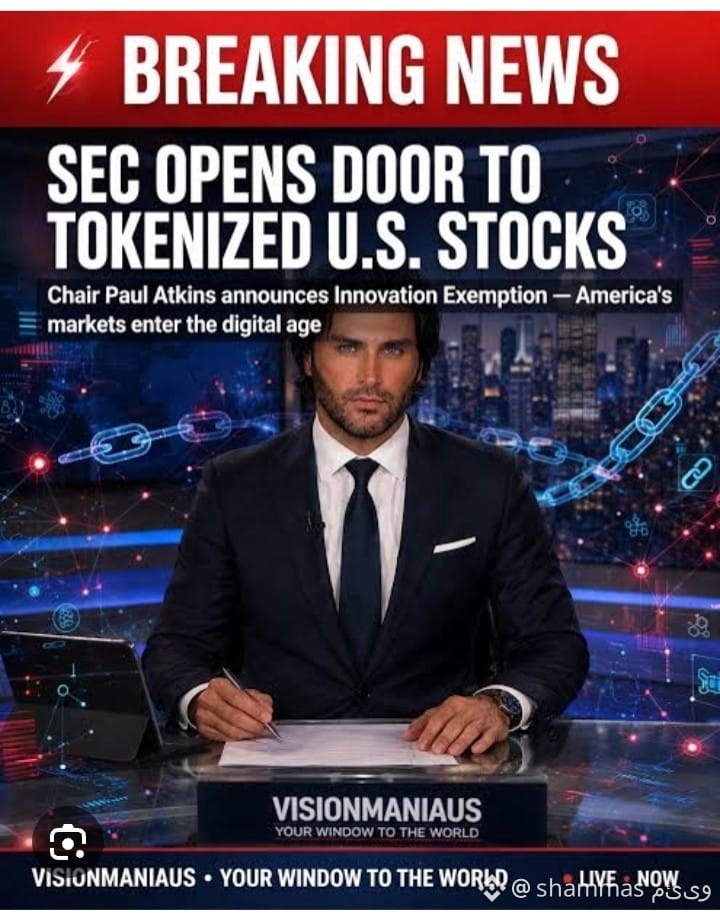
1
105

·
--
Article
Former CFTC Chair: SEC and CFTC to Develop Crypto RegulationsFormer U.S. Commodity Futures Trading Commission (CFTC) Chairman Chris Giancarlo said that despite the CLARITY Act stalling in the Senate, the U.S. Securities and Exchange Commission (SEC) and the CFTC will still move forward to formulate crypto rules. Giancarlo, who served as CFTC Chairman, expressed the above view regarding progress on U.S. crypto regulatory legislation. Tags: #CFTC #SEC #Giancarlo #regulation Source link: https://x.com/cointelegraph/status/2100075778507489376?s=46 Confirm publish? [ChainCatcher]
Former CFTC Chair: SEC and CFTC to Develop Crypto Regulations
Former U.S. Commodity Futures Trading Commission (CFTC) Chairman Chris Giancarlo said that despite the CLARITY Act stalling in the Senate, the U.S. Securities and Exchange Commission (SEC) and the CFTC will still move forward to formulate crypto rules. Giancarlo, who served as CFTC Chairman, expressed the above view regarding progress on U.S. crypto regulatory legislation. Tags: #CFTC #SEC #Giancarlo #regulation Source link: https://x.com/cointelegraph/status/2100075778507489376?s=46 Confirm publish? [ChainCatcher]
207
·
--
Crypto regulation takes a key step in the United States. The chairman of the CFTC, Michael Selig, has said that tokenization has the potential to completely reshape traditional financial markets, while the SEC officially opens the door to onchain assets and stocks despite recent legislative missteps with the CLARITY law.
Why does it matter? This joint move by U.S. regulators shows that the digital and institutional asset infrastructure continues to advance in terms of compliance and structural adoption, beyond the day-to-day volatility of prices.
What to watch? The next regulatory frameworks and how quickly major institutions integrate the issuance of tokenized securities into public and private environments.
🚀 📈 🌐
#Regulacion #Tokenizacion #SEC #CFTC $BTC
Crypto regulation takes a key step in the United States. The chairman of the CFTC, Michael Selig, has said that tokenization has the potential to completely reshape traditional financial markets, while the SEC officially opens the door to onchain assets and stocks despite recent legislative missteps with the CLARITY law.
Why does it matter? This joint move by U.S. regulators shows that the digital and institutional asset infrastructure continues to advance in terms of compliance and structural adoption, beyond the day-to-day volatility of prices.
What to watch? The next regulatory frameworks and how quickly major institutions integrate the issuance of tokenized securities into public and private environments.
🚀 📈 🌐
#Regulacion #Tokenizacion #SEC #CFTC $BTC
Why does it matter? This joint move by U.S. regulators shows that the digital and institutional asset infrastructure continues to advance in terms of compliance and structural adoption, beyond the day-to-day volatility of prices.
What to watch? The next regulatory frameworks and how quickly major institutions integrate the issuance of tokenized securities into public and private environments.
🚀 📈 🌐
#Regulacion #Tokenizacion #SEC #CFTC $BTC
54

·
--
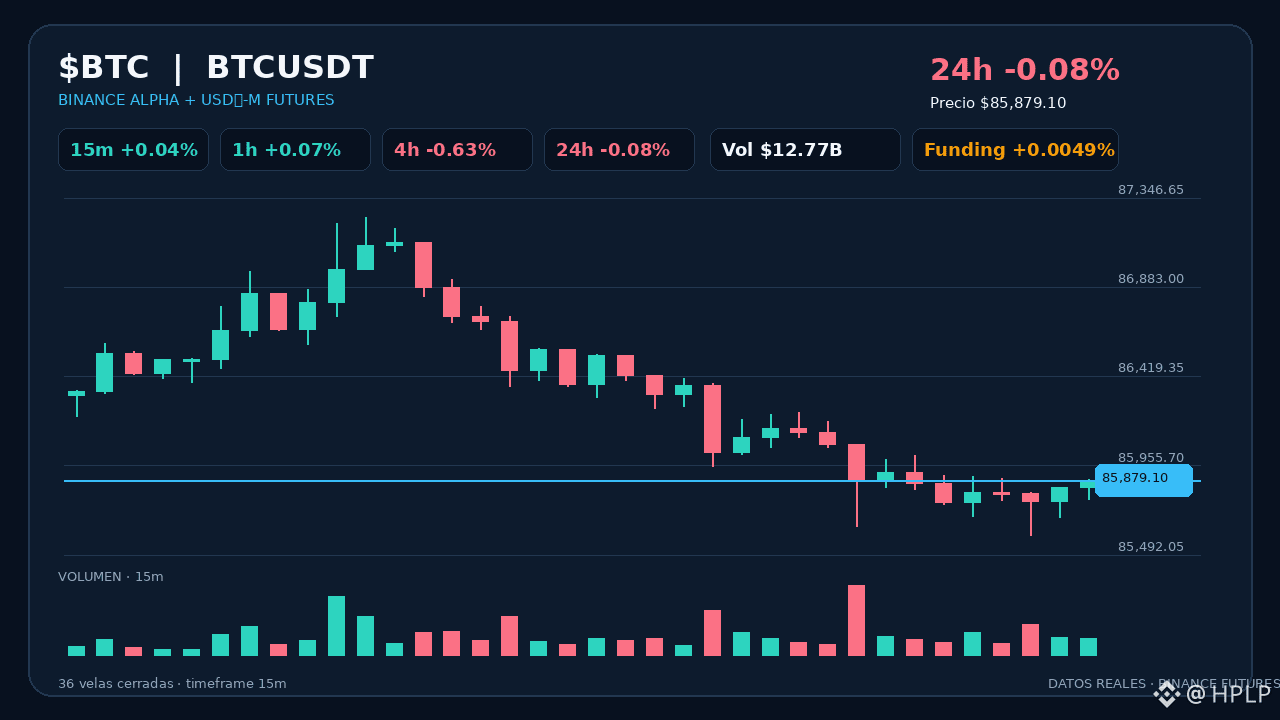
Bitcoin Surges to 85,000, But This Rally Feels “Off”
BTC has reclaimed the 85,000 mark for the first time in eight months, up more than 5.5% in 24 hours. But what’s truly interesting isn’t the size of the move—it’s who’s behind it.
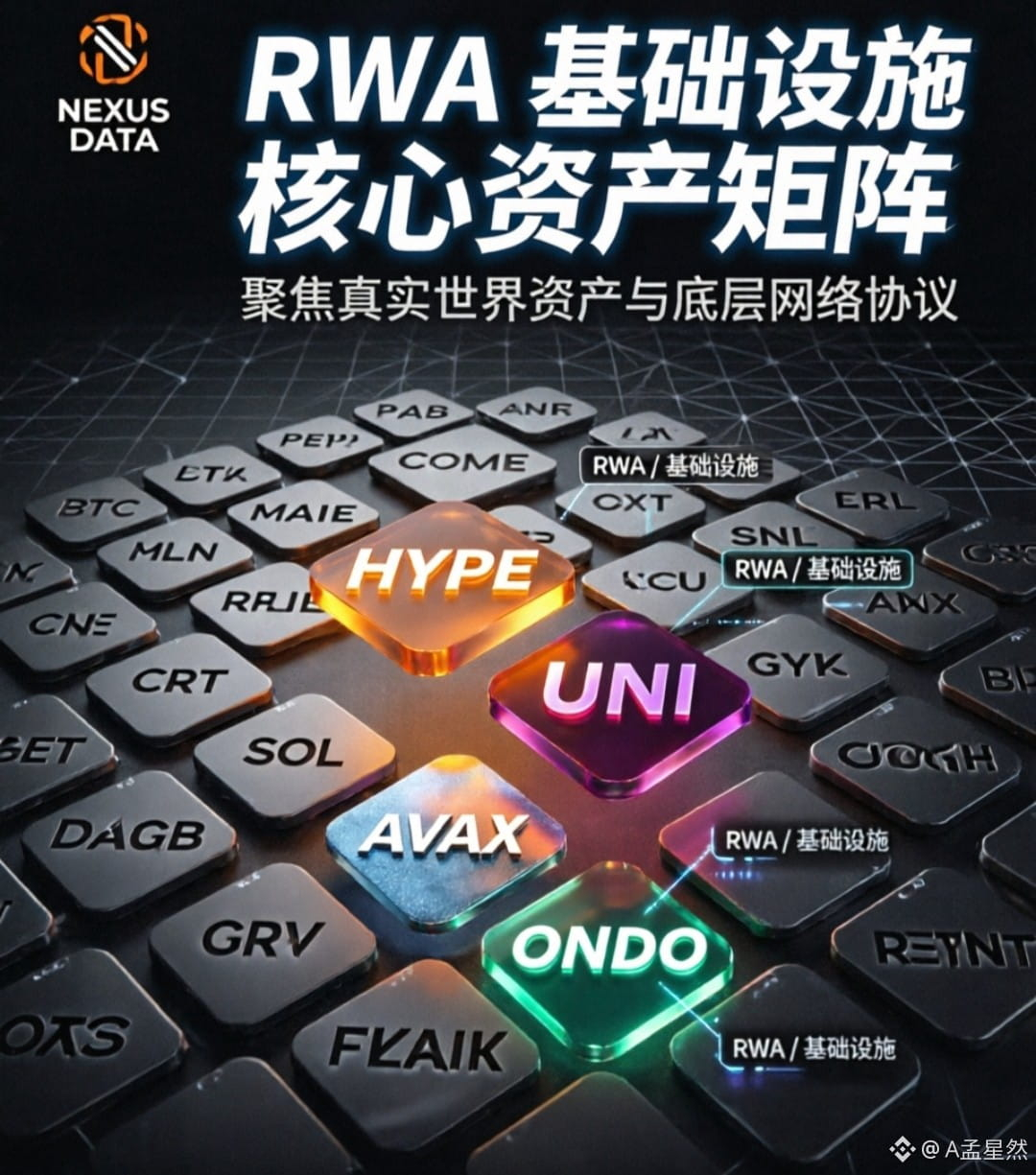
This round isn’t a blanket moonshot for all altcoins. Capital is clearly concentrating in infrastructure and the RWA (real-world assets) track: Hyperliquid’s HYPE hits a new all-time high above $96, with its market cap breaking $20 billion. UNI is up 40% over the week, AVAX rises 47%, and ONDO climbs 26%.
Why these projects?
The catalysts are unmistakable: after the SEC’s “CLARITY Act” proposal was rejected in Congress, it took matters into its own hands. On September 17, the SEC issued a five-year “innovation exemption,” opening a compliance pathway for tokenized U.S. stocks to trade on-chain for the first time. SEC Chair Atkins’ exact quote was: “Whether or not there is legislation, the SEC will act within its existing authority.”
At the same time, the CFTC submitted two draft rule proposals to the White House, aiming to carve out new compliance routes for unregistered exchanges.
So what’s the essence of this market move?
It’s narrative pricing driven by regulatory enforcement through executive action rather than legislation. The upside is speed—legislative deadlock is sidestepped. The downside is that an administrative exemption can be overturned by the next administration, so certainty is far weaker than with congressional legislation.
As GSR’s research vice president put it plainly: this rally is a structural market, with money flowing into infrastructure projects directly tied to “asset tokenization,” not a broad altcoin season.
One signal worth noting:
On-chain U.S. stocks are no longer just a concept.
Did your position benefit from this “structural rally,” or are you holding onto altcoins while waiting for a full rotation?
#RWA #代币化股票 #SEC #Circle推出机构比特币抵押借贷 #比特币突破8.5万美元
Bitcoin Surges to 85,000, But This Rally Feels “Off”
BTC has reclaimed the 85,000 mark for the first time in eight months, up more than 5.5% in 24 hours. But what’s truly interesting isn’t the size of the move—it’s who’s behind it.
This round isn’t a blanket moonshot for all altcoins. Capital is clearly concentrating in infrastructure and the RWA (real-world assets) track: Hyperliquid’s HYPE hits a new all-time high above $96, with its market cap breaking $20 billion. UNI is up 40% over the week, AVAX rises 47%, and ONDO climbs 26%.
Why these projects?
The catalysts are unmistakable: after the SEC’s “CLARITY Act” proposal was rejected in Congress, it took matters into its own hands. On September 17, the SEC issued a five-year “innovation exemption,” opening a compliance pathway for tokenized U.S. stocks to trade on-chain for the first time. SEC Chair Atkins’ exact quote was: “Whether or not there is legislation, the SEC will act within its existing authority.”
At the same time, the CFTC submitted two draft rule proposals to the White House, aiming to carve out new compliance routes for unregistered exchanges.
So what’s the essence of this market move?
It’s narrative pricing driven by regulatory enforcement through executive action rather than legislation. The upside is speed—legislative deadlock is sidestepped. The downside is that an administrative exemption can be overturned by the next administration, so certainty is far weaker than with congressional legislation.
As GSR’s research vice president put it plainly: this rally is a structural market, with money flowing into infrastructure projects directly tied to “asset tokenization,” not a broad altcoin season.
One signal worth noting:
On-chain U.S. stocks are no longer just a concept.
Did your position benefit from this “structural rally,” or are you holding onto altcoins while waiting for a full rotation?
#RWA #代币化股票 #SEC #Circle推出机构比特币抵押借贷 #比特币突破8.5万美元
BTC has reclaimed the 85,000 mark for the first time in eight months, up more than 5.5% in 24 hours. But what’s truly interesting isn’t the size of the move—it’s who’s behind it.
This round isn’t a blanket moonshot for all altcoins. Capital is clearly concentrating in infrastructure and the RWA (real-world assets) track: Hyperliquid’s HYPE hits a new all-time high above $96, with its market cap breaking $20 billion. UNI is up 40% over the week, AVAX rises 47%, and ONDO climbs 26%.
Why these projects?
The catalysts are unmistakable: after the SEC’s “CLARITY Act” proposal was rejected in Congress, it took matters into its own hands. On September 17, the SEC issued a five-year “innovation exemption,” opening a compliance pathway for tokenized U.S. stocks to trade on-chain for the first time. SEC Chair Atkins’ exact quote was: “Whether or not there is legislation, the SEC will act within its existing authority.”
At the same time, the CFTC submitted two draft rule proposals to the White House, aiming to carve out new compliance routes for unregistered exchanges.
So what’s the essence of this market move?
It’s narrative pricing driven by regulatory enforcement through executive action rather than legislation. The upside is speed—legislative deadlock is sidestepped. The downside is that an administrative exemption can be overturned by the next administration, so certainty is far weaker than with congressional legislation.
As GSR’s research vice president put it plainly: this rally is a structural market, with money flowing into infrastructure projects directly tied to “asset tokenization,” not a broad altcoin season.
One signal worth noting:
On-chain U.S. stocks are no longer just a concept.
Did your position benefit from this “structural rally,” or are you holding onto altcoins while waiting for a full rotation?
#RWA #代币化股票 #SEC #Circle推出机构比特币抵押借贷 #比特币突破8.5万美元
4
3.7k
·
--
Verified
SEC opens the door to tokenized U.S. stocks on-chain—but what you buy may not be a stock
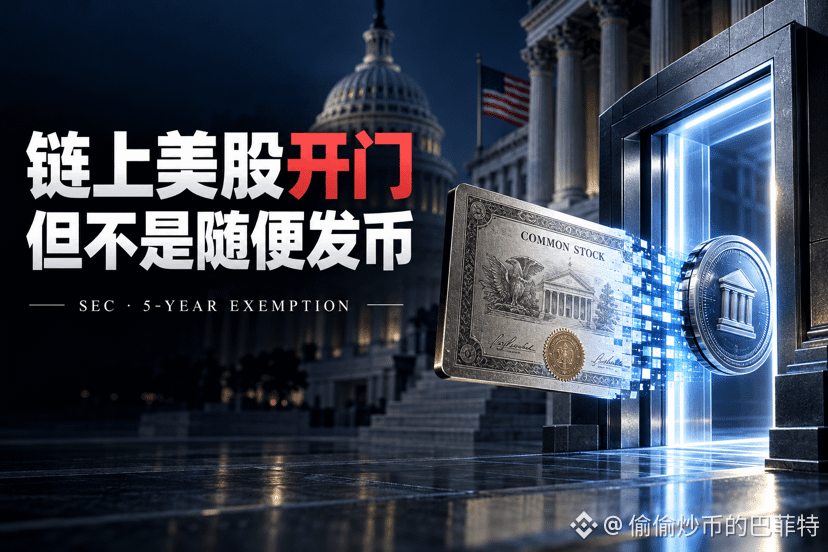
On September 17, the SEC issued a five-year “innovation exemption”: qualified platforms may trade tokenized NMS stocks using a license-based AMM framework, and some liquidity providers are temporarily exempt from registering as dealers.
The boundaries are clear:
The token must have the same rights as the corresponding stock, including dividends and voting on a pro-rata basis; synthetic price tokens are not allowed; listed companies can object; if the original stock is halted, the on-chain version must be halted at the same time. Reuters
So, offshore platforms currently offering “U.S. stock tokens” that only track stock prices and do not confer shareholder rights cannot simply use this “pass.”
Platforms such as COIN and HOOD have gained a potential new entry point, but the five-year exemption is a temporary regime with limited eligible assets and trading volume constraints. Revenue realization will have to wait until the approved venues, the number of listed stocks, and the volume of actual trades.
First learn to distinguish between “putting stocks on-chain” and “having coin prices follow stock prices.” Miss the shareholder identity, and you miss the entire set of protections.
#代币化股票 #SEC #美股超话
SEC opens the door to tokenized U.S. stocks on-chain—but what you buy may not be a stock
On September 17, the SEC issued a five-year “innovation exemption”: qualified platforms may trade tokenized NMS stocks using a license-based AMM framework, and some liquidity providers are temporarily exempt from registering as dealers.
The boundaries are clear:
The token must have the same rights as the corresponding stock, including dividends and voting on a pro-rata basis; synthetic price tokens are not allowed; listed companies can object; if the original stock is halted, the on-chain version must be halted at the same time. Reuters
So, offshore platforms currently offering “U.S. stock tokens” that only track stock prices and do not confer shareholder rights cannot simply use this “pass.”
Platforms such as COIN and HOOD have gained a potential new entry point, but the five-year exemption is a temporary regime with limited eligible assets and trading volume constraints. Revenue realization will have to wait until the approved venues, the number of listed stocks, and the volume of actual trades.
First learn to distinguish between “putting stocks on-chain” and “having coin prices follow stock prices.” Miss the shareholder identity, and you miss the entire set of protections.
#代币化股票 #SEC #美股超话
On September 17, the SEC issued a five-year “innovation exemption”: qualified platforms may trade tokenized NMS stocks using a license-based AMM framework, and some liquidity providers are temporarily exempt from registering as dealers.
The boundaries are clear:
The token must have the same rights as the corresponding stock, including dividends and voting on a pro-rata basis; synthetic price tokens are not allowed; listed companies can object; if the original stock is halted, the on-chain version must be halted at the same time. Reuters
So, offshore platforms currently offering “U.S. stock tokens” that only track stock prices and do not confer shareholder rights cannot simply use this “pass.”
Platforms such as COIN and HOOD have gained a potential new entry point, but the five-year exemption is a temporary regime with limited eligible assets and trading volume constraints. Revenue realization will have to wait until the approved venues, the number of listed stocks, and the volume of actual trades.
First learn to distinguish between “putting stocks on-chain” and “having coin prices follow stock prices.” Miss the shareholder identity, and you miss the entire set of protections.
#代币化股票 #SEC #美股超话
2
636

SEC paves the way for a 5-year framework for tokenized stocks: AI winner, AI loser?
- The SEC approves a 5-year framework for tokenized stocks, but only certain products and exchanges are eligible
- Uniswap, Robinhood, Coinbase, and Kraken are key competitors in the new model
- Rules limit the types of products and the trading venues that are allowed
- Full details not yet available in the RSS description
#BinanceSquare #CryptoNews #SEC #TokenizedStocks #UNI COIN HOOD
$uni $coin $hood
vlikevn Titanbot
Source: CoinTelegraph
SEC paves the way for a 5-year framework for tokenized stocks: AI winner, AI loser?
- The SEC approves a 5-year framework for tokenized stocks, but only certain products and exchanges are eligible
- Uniswap, Robinhood, Coinbase, and Kraken are key competitors in the new model
- Rules limit the types of products and the trading venues that are allowed
- Full details not yet available in the RSS description
#BinanceSquare #CryptoNews #SEC #TokenizedStocks #UNI COIN HOOD
$uni $coin $hood
vlikevn Titanbot
Source: CoinTelegraph
- The SEC approves a 5-year framework for tokenized stocks, but only certain products and exchanges are eligible
- Uniswap, Robinhood, Coinbase, and Kraken are key competitors in the new model
- Rules limit the types of products and the trading venues that are allowed
- Full details not yet available in the RSS description
#BinanceSquare #CryptoNews #SEC #TokenizedStocks #UNI COIN HOOD
$uni $coin $hood
vlikevn Titanbot
Source: CoinTelegraph
194

·
--
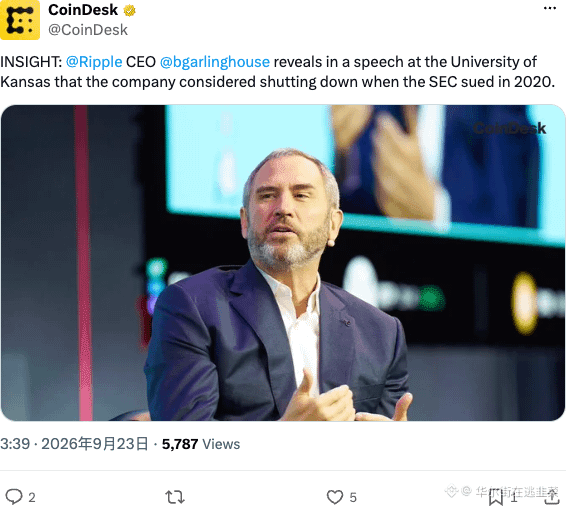
Ripple CEO admitted in person: when the company was sued by the SEC in 2020, it was almost shut down for good 🤡 So what happened? After three years of hard fighting, they still managed to reach a landmark ruling. The crypto industry’s script is just that ridiculous—you think it’s the end, but turning around might be a way to live. But if you switch to a smaller project, the weeds on the grave could be three meters tall. Lesson: don’t go all-in too easily, and don’t give up too easily.
$XRP #Ripple #SEC
Ripple CEO admitted in person: when the company was sued by the SEC in 2020, it was almost shut down for good 🤡 So what happened? After three years of hard fighting, they still managed to reach a landmark ruling. The crypto industry’s script is just that ridiculous—you think it’s the end, but turning around might be a way to live. But if you switch to a smaller project, the weeds on the grave could be three meters tall. Lesson: don’t go all-in too easily, and don’t give up too easily.
$XRP #Ripple #SEC
$XRP #Ripple #SEC
158

·
--
Just aligned the statements for two parties: it’s not just a repeat of this morning’s line about “tokenized U.S. stock market venues for next quarter.” This time, Lindman is talking about a different track—crypto custody rules.
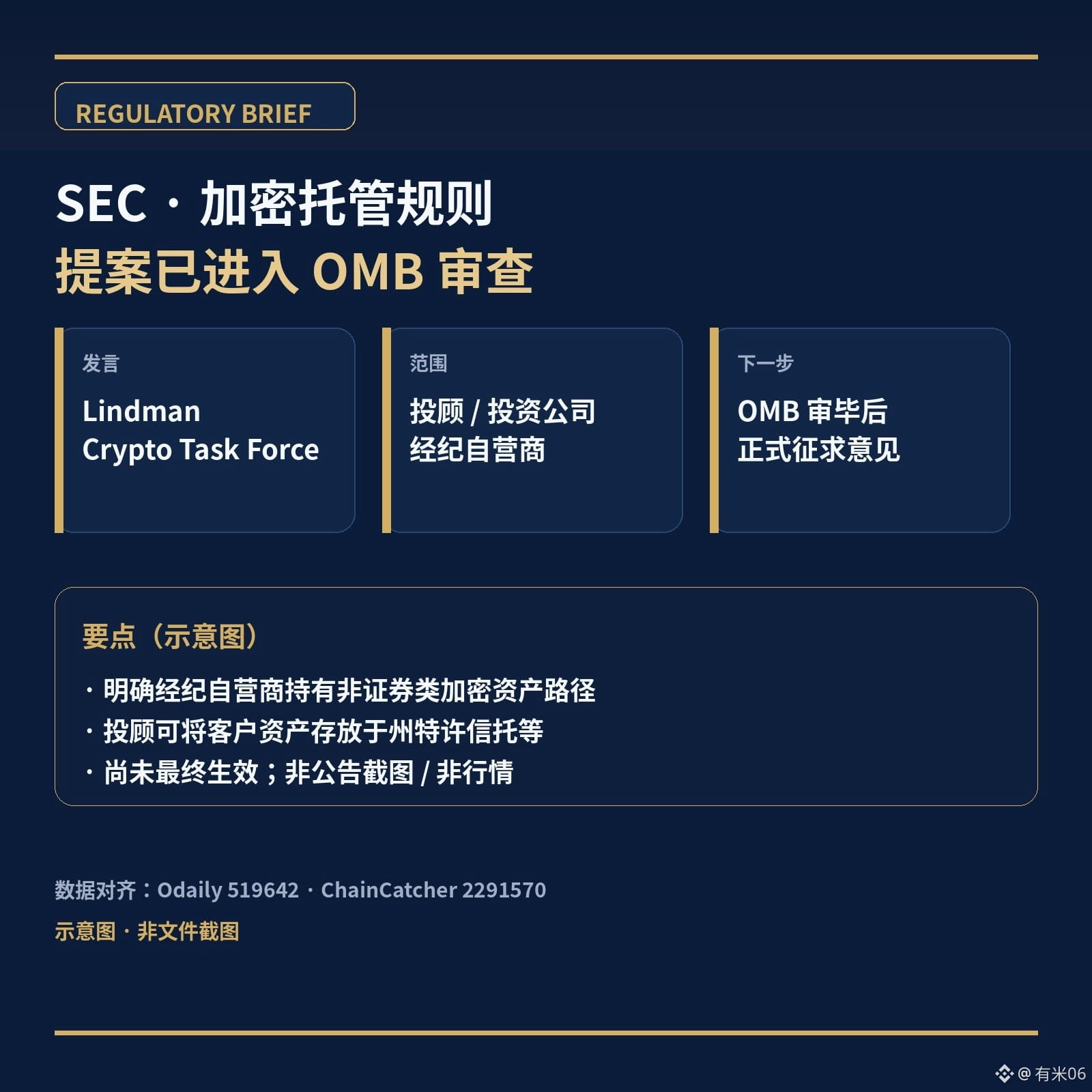
At a Washington event, Taylor Lindman, Chief Legal Counsel for the SEC’s Crypto Task Force, said the Commission is moving forward with rules for the custody of crypto assets. The related proposals have been submitted to the Office of Management and Budget (OMB) for review, and the scope includes investment companies and broker-dealers. The messaging aims to clarify two points upfront: how broker-dealers would hold non-securities-type crypto assets without needing to add an extra layer of special registration; and whether investment advisers can place clients’ assets with entities such as state-chartered trust companies.
After the OMB finishes its review, the SEC will then formally put the proposal forward and seek industry and public input—this is not yet the final rule, nor is it immediately effective.
Independent verification: Odaily Quick News 519642 and ChainCatcher 2291570 restated the same line, without naming any specific exchange. The figure is an illustration of key regulatory points—not a screenshot of any document, and not market data.
Data as of: 2026-09-22 (date of remarks; Odaily 519642 / ChainCatcher 2291570)
For information sharing only and does not constitute investment advice.
#SEC #监管
Just aligned the statements for two parties: it’s not just a repeat of this morning’s line about “tokenized U.S. stock market venues for next quarter.” This time, Lindman is talking about a different track—crypto custody rules.
At a Washington event, Taylor Lindman, Chief Legal Counsel for the SEC’s Crypto Task Force, said the Commission is moving forward with rules for the custody of crypto assets. The related proposals have been submitted to the Office of Management and Budget (OMB) for review, and the scope includes investment companies and broker-dealers. The messaging aims to clarify two points upfront: how broker-dealers would hold non-securities-type crypto assets without needing to add an extra layer of special registration; and whether investment advisers can place clients’ assets with entities such as state-chartered trust companies.
After the OMB finishes its review, the SEC will then formally put the proposal forward and seek industry and public input—this is not yet the final rule, nor is it immediately effective.
Independent verification: Odaily Quick News 519642 and ChainCatcher 2291570 restated the same line, without naming any specific exchange. The figure is an illustration of key regulatory points—not a screenshot of any document, and not market data.
Data as of: 2026-09-22 (date of remarks; Odaily 519642 / ChainCatcher 2291570)
For information sharing only and does not constitute investment advice.
#SEC #监管
At a Washington event, Taylor Lindman, Chief Legal Counsel for the SEC’s Crypto Task Force, said the Commission is moving forward with rules for the custody of crypto assets. The related proposals have been submitted to the Office of Management and Budget (OMB) for review, and the scope includes investment companies and broker-dealers. The messaging aims to clarify two points upfront: how broker-dealers would hold non-securities-type crypto assets without needing to add an extra layer of special registration; and whether investment advisers can place clients’ assets with entities such as state-chartered trust companies.
After the OMB finishes its review, the SEC will then formally put the proposal forward and seek industry and public input—this is not yet the final rule, nor is it immediately effective.
Independent verification: Odaily Quick News 519642 and ChainCatcher 2291570 restated the same line, without naming any specific exchange. The figure is an illustration of key regulatory points—not a screenshot of any document, and not market data.
Data as of: 2026-09-22 (date of remarks; Odaily 519642 / ChainCatcher 2291570)
For information sharing only and does not constitute investment advice.
#SEC #监管
11
·
--
Just aligned the positions with two parties: it’s not like we’re going to go over that five-year exemption rehash again—the key is the timeline.
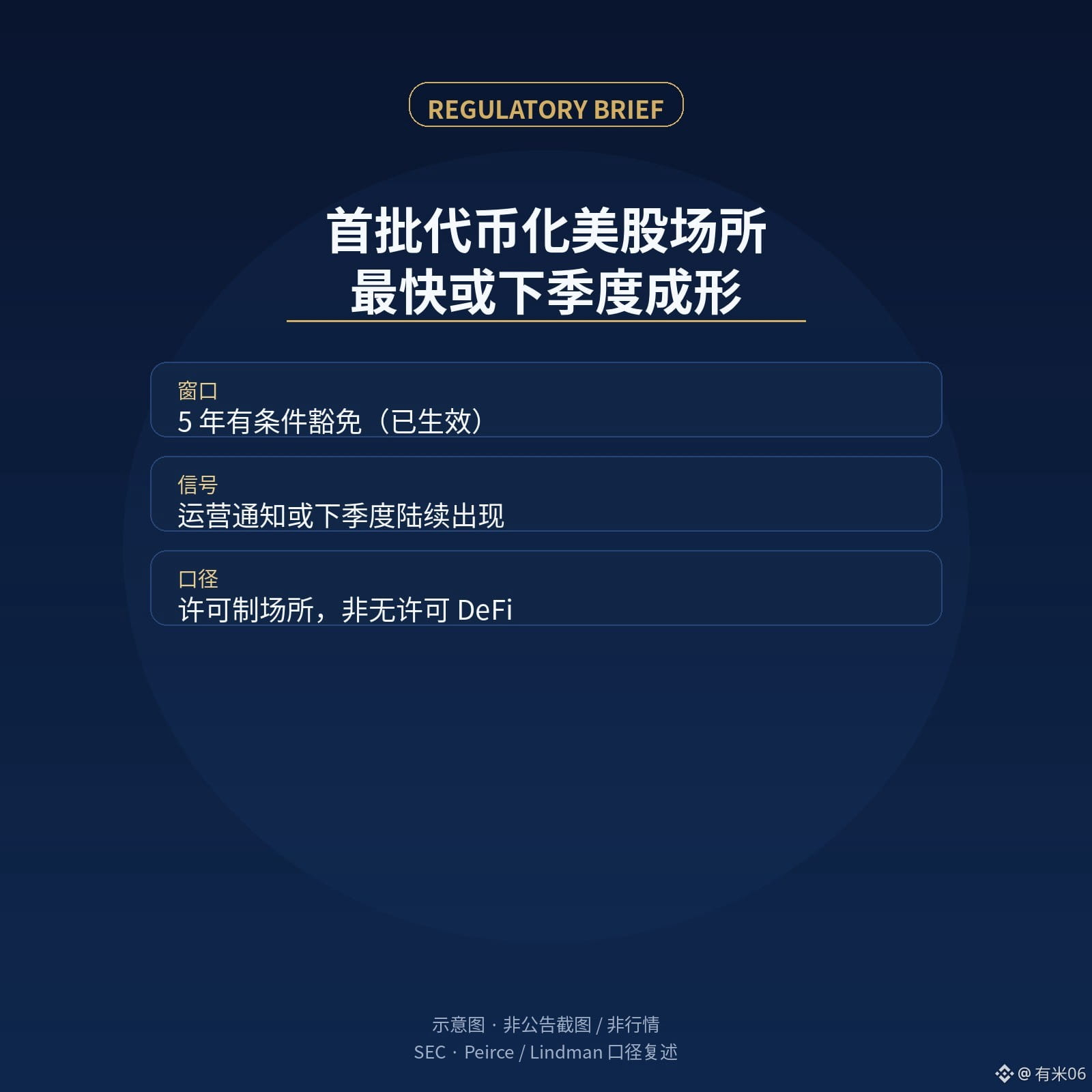
Taylor Lindman, Chief Legal Counsel of the SEC’s Encryption Working Group, said that under the already-effective “Innovation Exemption” framework, institutions are expected to see companies issue operational notices in the coming months; from the exemption taking effect to the first batch of notices, the delay will likely land around “sometime in the next quarter.” The firm should publicly spell out how it will operate, and notify the SEC within one business day after publication—that’s the first public signal for who’s ready to move in.
In the same interview, Commissioner Hester Peirce added: the number of eligible targets and the upper limit on deal size, according to her, is sufficient to support a workable business—not just a lab demonstration; the five-year window is more like a transition leading to longer-term rules. Before a third party can turn a listed company into a tokenized version for listing, it still needs to provide the issuer with an approximately 30-day objection period.
Independent verification: Odaily Flash 519459 and ChainCatcher 2291450 (2026-09-22) reported the same accounts of Lindman / Peirce in a consistent manner, without naming specific venues. The image shows an illustrative chart of regulatory takeaways—not a screenshot of any document, and not market data.
Data as of: 2026-09-22 13:40 UTC+8 (ChainCatcher 2291450; Odaily 519459)
For information sharing only and does not constitute investment advice.
#SEC #监管
Just aligned the positions with two parties: it’s not like we’re going to go over that five-year exemption rehash again—the key is the timeline.
Taylor Lindman, Chief Legal Counsel of the SEC’s Encryption Working Group, said that under the already-effective “Innovation Exemption” framework, institutions are expected to see companies issue operational notices in the coming months; from the exemption taking effect to the first batch of notices, the delay will likely land around “sometime in the next quarter.” The firm should publicly spell out how it will operate, and notify the SEC within one business day after publication—that’s the first public signal for who’s ready to move in.
In the same interview, Commissioner Hester Peirce added: the number of eligible targets and the upper limit on deal size, according to her, is sufficient to support a workable business—not just a lab demonstration; the five-year window is more like a transition leading to longer-term rules. Before a third party can turn a listed company into a tokenized version for listing, it still needs to provide the issuer with an approximately 30-day objection period.
Independent verification: Odaily Flash 519459 and ChainCatcher 2291450 (2026-09-22) reported the same accounts of Lindman / Peirce in a consistent manner, without naming specific venues. The image shows an illustrative chart of regulatory takeaways—not a screenshot of any document, and not market data.
Data as of: 2026-09-22 13:40 UTC+8 (ChainCatcher 2291450; Odaily 519459)
For information sharing only and does not constitute investment advice.
#SEC #监管
Taylor Lindman, Chief Legal Counsel of the SEC’s Encryption Working Group, said that under the already-effective “Innovation Exemption” framework, institutions are expected to see companies issue operational notices in the coming months; from the exemption taking effect to the first batch of notices, the delay will likely land around “sometime in the next quarter.” The firm should publicly spell out how it will operate, and notify the SEC within one business day after publication—that’s the first public signal for who’s ready to move in.
In the same interview, Commissioner Hester Peirce added: the number of eligible targets and the upper limit on deal size, according to her, is sufficient to support a workable business—not just a lab demonstration; the five-year window is more like a transition leading to longer-term rules. Before a third party can turn a listed company into a tokenized version for listing, it still needs to provide the issuer with an approximately 30-day objection period.
Independent verification: Odaily Flash 519459 and ChainCatcher 2291450 (2026-09-22) reported the same accounts of Lindman / Peirce in a consistent manner, without naming specific venues. The image shows an illustrative chart of regulatory takeaways—not a screenshot of any document, and not market data.
Data as of: 2026-09-22 13:40 UTC+8 (ChainCatcher 2291450; Odaily 519459)
For information sharing only and does not constitute investment advice.
#SEC #监管
69
Log in to explore more content
Join global crypto users on Binance Square
⚡️ Get latest and useful information about crypto.
💬 Trusted by the world’s largest crypto exchange.
👍 Discover real insights from verified creators.
Email / Phone number
Trending Topics
1
#AIStocksWhatNext
862,013 views
6,517 Discussing
2
#BitcoinRejectedAt$87,300Twice
0 views
0 Discussing
3
#BCHJumps28%OnCMEFuturesListing
8,818 views
461 Discussing
4
#WallStreetEarningsRevisionsTurnBearish
6,303 views
345 Discussing
5
#DollarIndexReclaims101
5,135 views
287 Discussing
6
#21SharesLaunchesEuropesFirstZcashETP
38,926 views
1,071 Discussing
7
#CardanoJoinsX402PaymentStandard
24,834 views
777 Discussing
8
#BitcoinTops$87KAtEightMonthHigh
12,210 views
131 Discussing
9
#ZECBreaksAbove$1600AtRecordHigh
8,621 views
107 Discussing
10
#BitwiseNEARStakingETPAssetsTop$100M
40,023 views
106 Discussing