

#mica
mica
2.2M views
3,391 Discussing
Hot
Latest

·
--
🚨 Circle urges EU to revise MiCA stablecoin rules, pushing for flexible liquidity over rigid bank-deposit minimums to sustain cross-border issuance.
This could ease compliance burdens for issuers like Circle, potentially supporting broader stablecoin adoption in Europe.
If adopted, CRCLB may benefit from improved regulatory clarity and reduced operational friction.
Will the EU prioritize innovation over precaution in its final framework?
#MiCA
$CRCLB #TradingSignal #CryptoAnalysis
🚨 Circle urges EU to revise MiCA stablecoin rules, pushing for flexible liquidity over rigid bank-deposit minimums to sustain cross-border issuance.
This could ease compliance burdens for issuers like Circle, potentially supporting broader stablecoin adoption in Europe.
If adopted, CRCLB may benefit from improved regulatory clarity and reduced operational friction.
Will the EU prioritize innovation over precaution in its final framework?
#MiCA
$CRCLB #TradingSignal #CryptoAnalysis
This could ease compliance burdens for issuers like Circle, potentially supporting broader stablecoin adoption in Europe.
If adopted, CRCLB may benefit from improved regulatory clarity and reduced operational friction.
Will the EU prioritize innovation over precaution in its final framework?
#MiCA
$CRCLB #TradingSignal #CryptoAnalysis

4

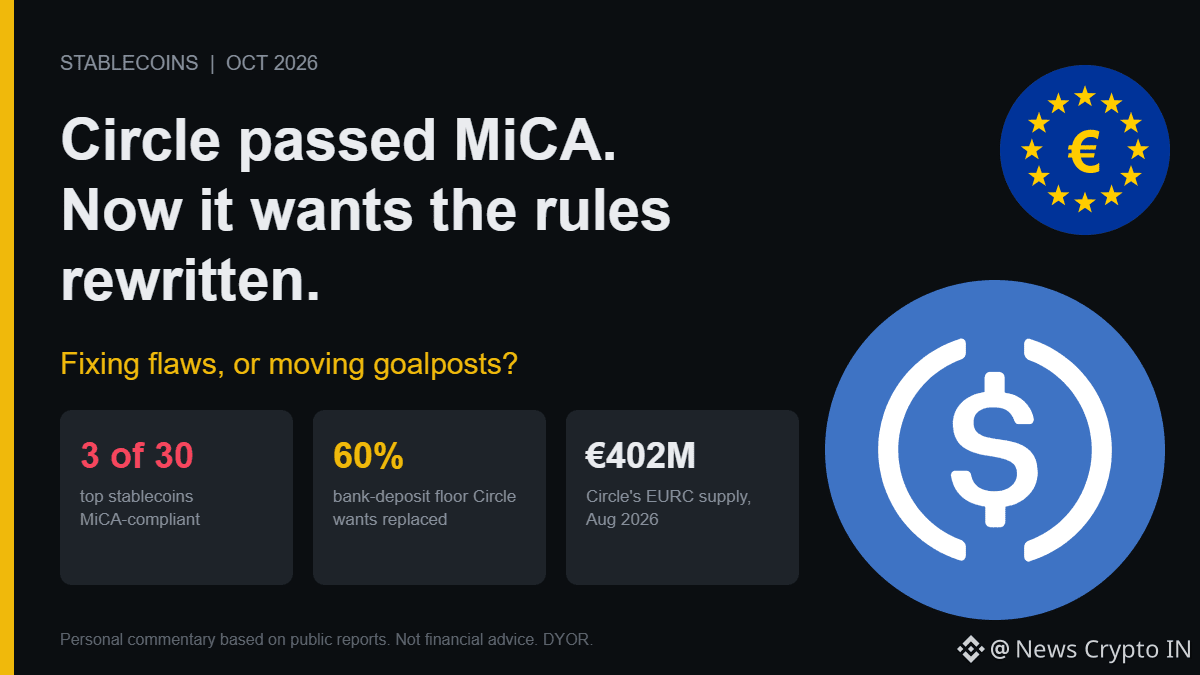
Only 3 of the top 30 stablecoins comply with Europe's MiCA rules: USDC, USDG and EURC. Two of those three are Circle's. And on Oct 1, Circle asked the European Commission to rewrite the rules anyway.
What Circle wants changed:
- Reserves: MiCA forces issuers to hold 30% of reserves as bank deposits, 60% for "significant" ones. Circle wants liquidity-based rules instead, plus looser concentration caps (35% per sovereign, 1.5% of a bank's assets per counterparty).
- Cross-border issuance: keep letting an EU-licensed entity issue the same token alongside affiliates abroad.
- Foreign recognition: let foreign-regulated stablecoins distribute through EU-licensed firms, modelled on the US GENIUS Act.
The cynical read writes itself: the company that already passed the test is lobbying to change the test, and every proposal happens to fit how a US-based global issuer operates.
But the reserve point has real history behind it. In March 2023, USDC briefly broke its peg because $3.3B of its reserves sat at Silicon Valley Bank when it failed. Forcing 60% of reserves into bank deposits puts more of a stablecoin's safety on the health of a few banks, the exact risk that already bit Circle once.
Is Circle fixing a genuine design flaw in MiCA, or using its compliant status to write the rules competitors will have to follow?
#Circle #MiCA
Only 3 of the top 30 stablecoins comply with Europe's MiCA rules: USDC, USDG and EURC. Two of those three are Circle's. And on Oct 1, Circle asked the European Commission to rewrite the rules anyway.
What Circle wants changed:
- Reserves: MiCA forces issuers to hold 30% of reserves as bank deposits, 60% for "significant" ones. Circle wants liquidity-based rules instead, plus looser concentration caps (35% per sovereign, 1.5% of a bank's assets per counterparty).
- Cross-border issuance: keep letting an EU-licensed entity issue the same token alongside affiliates abroad.
- Foreign recognition: let foreign-regulated stablecoins distribute through EU-licensed firms, modelled on the US GENIUS Act.
The cynical read writes itself: the company that already passed the test is lobbying to change the test, and every proposal happens to fit how a US-based global issuer operates.
But the reserve point has real history behind it. In March 2023, USDC briefly broke its peg because $3.3B of its reserves sat at Silicon Valley Bank when it failed. Forcing 60% of reserves into bank deposits puts more of a stablecoin's safety on the health of a few banks, the exact risk that already bit Circle once.
Is Circle fixing a genuine design flaw in MiCA, or using its compliant status to write the rules competitors will have to follow?
#Circle #MiCA
What Circle wants changed:
- Reserves: MiCA forces issuers to hold 30% of reserves as bank deposits, 60% for "significant" ones. Circle wants liquidity-based rules instead, plus looser concentration caps (35% per sovereign, 1.5% of a bank's assets per counterparty).
- Cross-border issuance: keep letting an EU-licensed entity issue the same token alongside affiliates abroad.
- Foreign recognition: let foreign-regulated stablecoins distribute through EU-licensed firms, modelled on the US GENIUS Act.
The cynical read writes itself: the company that already passed the test is lobbying to change the test, and every proposal happens to fit how a US-based global issuer operates.
But the reserve point has real history behind it. In March 2023, USDC briefly broke its peg because $3.3B of its reserves sat at Silicon Valley Bank when it failed. Forcing 60% of reserves into bank deposits puts more of a stablecoin's safety on the health of a few banks, the exact risk that already bit Circle once.
Is Circle fixing a genuine design flaw in MiCA, or using its compliant status to write the rules competitors will have to follow?
#Circle #MiCA
501

·
--
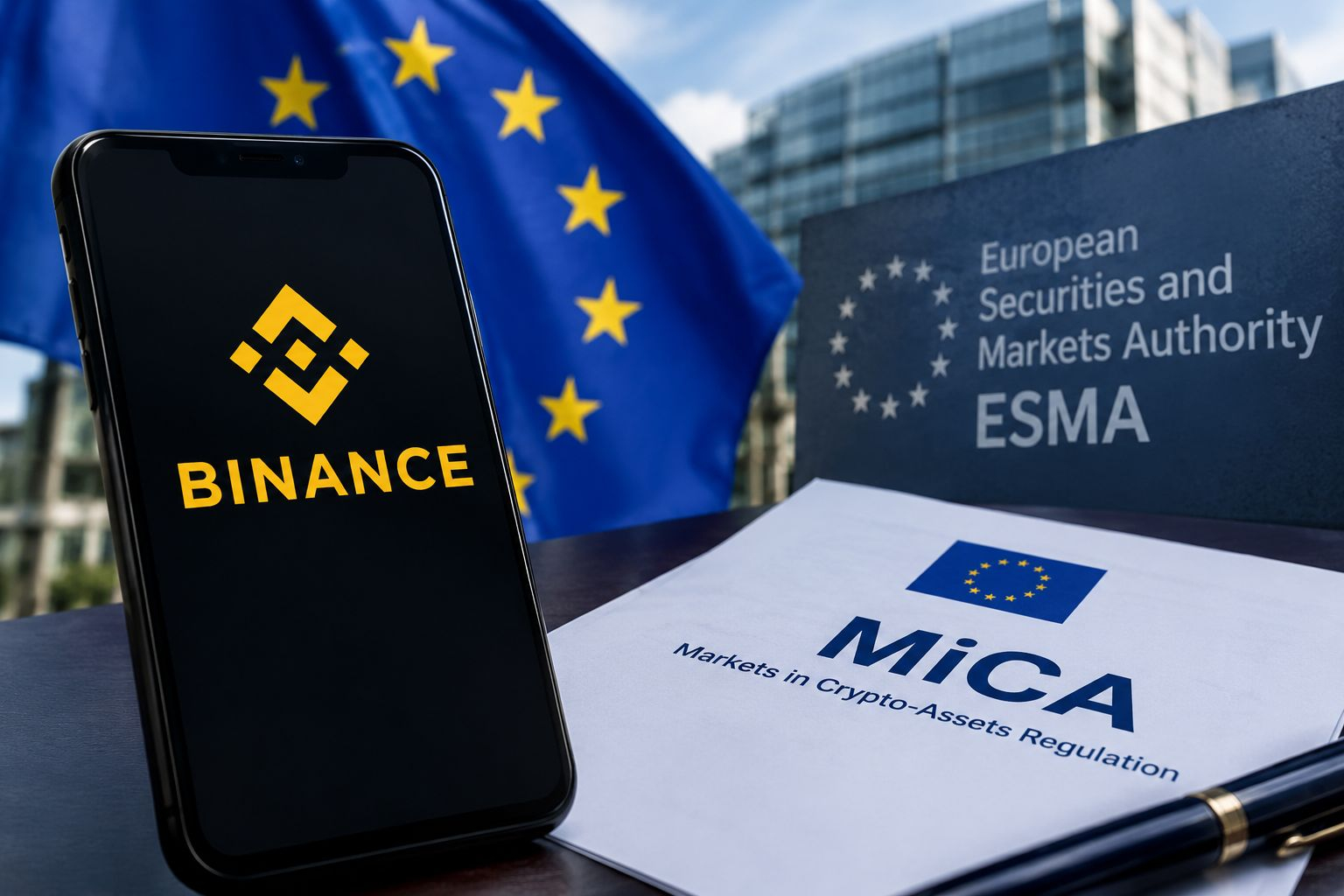
🇪🇺 European regulators are investigating Binance over its operations in the EU without a MiCA license.
The exchange refers to a rule that allows it to serve a client if the client independently seeks out the service. However, authorities want to make sure this exemption is not being used to disguise regular operations in the European market.
#MiCA
🇪🇺 European regulators are investigating Binance over its operations in the EU without a MiCA license.
The exchange refers to a rule that allows it to serve a client if the client independently seeks out the service. However, authorities want to make sure this exemption is not being used to disguise regular operations in the European market.
#MiCA
The exchange refers to a rule that allows it to serve a client if the client independently seeks out the service. However, authorities want to make sure this exemption is not being used to disguise regular operations in the European market.
#MiCA
249

Article
🇪🇺 Europe Faces Mounting Grassroots Backlash Over MiCA Stablecoin Yield BansEuropean crypto policy is confronting an unprecedented grassroots test as $BTC and broader liquidity corridors react to MiCA yield restrictions. Citizens have mobilized across member states to petition the European Union to reconsider its blanket ban on stablecoin interest.
🔹 THE GRASSROOTS CATALYST
• MiCA establishes an uncompromising perimeter that outlaws interest and yield generation on electronic money tokens and asset-referenced tokens.
• The grassroots mobilization reflects escalating friction between consumer capital preservation demands and rigid institutional oversight.
• Traders and market participants argue that stripping yield mechanisms puts European market structure at an operational disadvantage against international dollar-denominated rails.
🔹 LIQUIDITY AND COLLATERAL IMPACT
• Yield-bearing digital cash has become a fundamental building block for decentralized collateral, treasury management, and institutional settlement.
• In an elevated global rate environment, non-yielding euro stablecoins struggle to compete for organic liquidity, triggering persistent capital leakage toward flexible offshore structures.
• While $BTC continues to serve as an unencumbered macro reserve asset, local euro depth faces sustained compression if domestic rails offer no incentive for treasury deployment.
• European banking concerns over retail deposit disintermediation drove the ban, yet the resulting market distortion weakens native trading volumes across continental exchanges.
🔹 POLICY HORIZON AND MARKET RISK
• Comprehensive statutory changes within European frameworks are historically protracted, making an immediate legislative reversal highly unlikely.
• The key watch item centers on whether regulatory bodies provide interpretive latitude or sandbox carve-outs to preserve domestic competitiveness.
• Until legal parity emerges, euro-denominated decentralized liquidity risks remaining structurally impaired, leaving global market participants concentrated in yield-enabled jurisdictions.
Risk Warning: Cryptocurrency trading carries substantial risk. This quantitative brief is for informational purposes only.
Data & Telemetry: CoinXSight Intelligence Hub | Follow on Binance Square for daily alpha.
#BinanceSquare #MiCA #CryptoRegulation
🇪🇺 Europe Faces Mounting Grassroots Backlash Over MiCA Stablecoin Yield Bans
European crypto policy is confronting an unprecedented grassroots test as $BTC and broader liquidity corridors react to MiCA yield restrictions. Citizens have mobilized across member states to petition the European Union to reconsider its blanket ban on stablecoin interest.

🔹 THE GRASSROOTS CATALYST
• MiCA establishes an uncompromising perimeter that outlaws interest and yield generation on electronic money tokens and asset-referenced tokens.
• The grassroots mobilization reflects escalating friction between consumer capital preservation demands and rigid institutional oversight.
• Traders and market participants argue that stripping yield mechanisms puts European market structure at an operational disadvantage against international dollar-denominated rails.
🔹 LIQUIDITY AND COLLATERAL IMPACT
• Yield-bearing digital cash has become a fundamental building block for decentralized collateral, treasury management, and institutional settlement.
• In an elevated global rate environment, non-yielding euro stablecoins struggle to compete for organic liquidity, triggering persistent capital leakage toward flexible offshore structures.
• While $BTC continues to serve as an unencumbered macro reserve asset, local euro depth faces sustained compression if domestic rails offer no incentive for treasury deployment.
• European banking concerns over retail deposit disintermediation drove the ban, yet the resulting market distortion weakens native trading volumes across continental exchanges.
🔹 POLICY HORIZON AND MARKET RISK
• Comprehensive statutory changes within European frameworks are historically protracted, making an immediate legislative reversal highly unlikely.
• The key watch item centers on whether regulatory bodies provide interpretive latitude or sandbox carve-outs to preserve domestic competitiveness.
• Until legal parity emerges, euro-denominated decentralized liquidity risks remaining structurally impaired, leaving global market participants concentrated in yield-enabled jurisdictions.
Risk Warning: Cryptocurrency trading carries substantial risk. This quantitative brief is for informational purposes only.
Data & Telemetry: CoinXSight Intelligence Hub | Follow on Binance Square for daily alpha.
#BinanceSquare #MiCA #CryptoRegulation

🔹 THE GRASSROOTS CATALYST
• MiCA establishes an uncompromising perimeter that outlaws interest and yield generation on electronic money tokens and asset-referenced tokens.
• The grassroots mobilization reflects escalating friction between consumer capital preservation demands and rigid institutional oversight.
• Traders and market participants argue that stripping yield mechanisms puts European market structure at an operational disadvantage against international dollar-denominated rails.
🔹 LIQUIDITY AND COLLATERAL IMPACT
• Yield-bearing digital cash has become a fundamental building block for decentralized collateral, treasury management, and institutional settlement.
• In an elevated global rate environment, non-yielding euro stablecoins struggle to compete for organic liquidity, triggering persistent capital leakage toward flexible offshore structures.
• While $BTC continues to serve as an unencumbered macro reserve asset, local euro depth faces sustained compression if domestic rails offer no incentive for treasury deployment.
• European banking concerns over retail deposit disintermediation drove the ban, yet the resulting market distortion weakens native trading volumes across continental exchanges.
🔹 POLICY HORIZON AND MARKET RISK
• Comprehensive statutory changes within European frameworks are historically protracted, making an immediate legislative reversal highly unlikely.
• The key watch item centers on whether regulatory bodies provide interpretive latitude or sandbox carve-outs to preserve domestic competitiveness.
• Until legal parity emerges, euro-denominated decentralized liquidity risks remaining structurally impaired, leaving global market participants concentrated in yield-enabled jurisdictions.
Risk Warning: Cryptocurrency trading carries substantial risk. This quantitative brief is for informational purposes only.
Data & Telemetry: CoinXSight Intelligence Hub | Follow on Binance Square for daily alpha.
#BinanceSquare #MiCA #CryptoRegulation
33

·
--
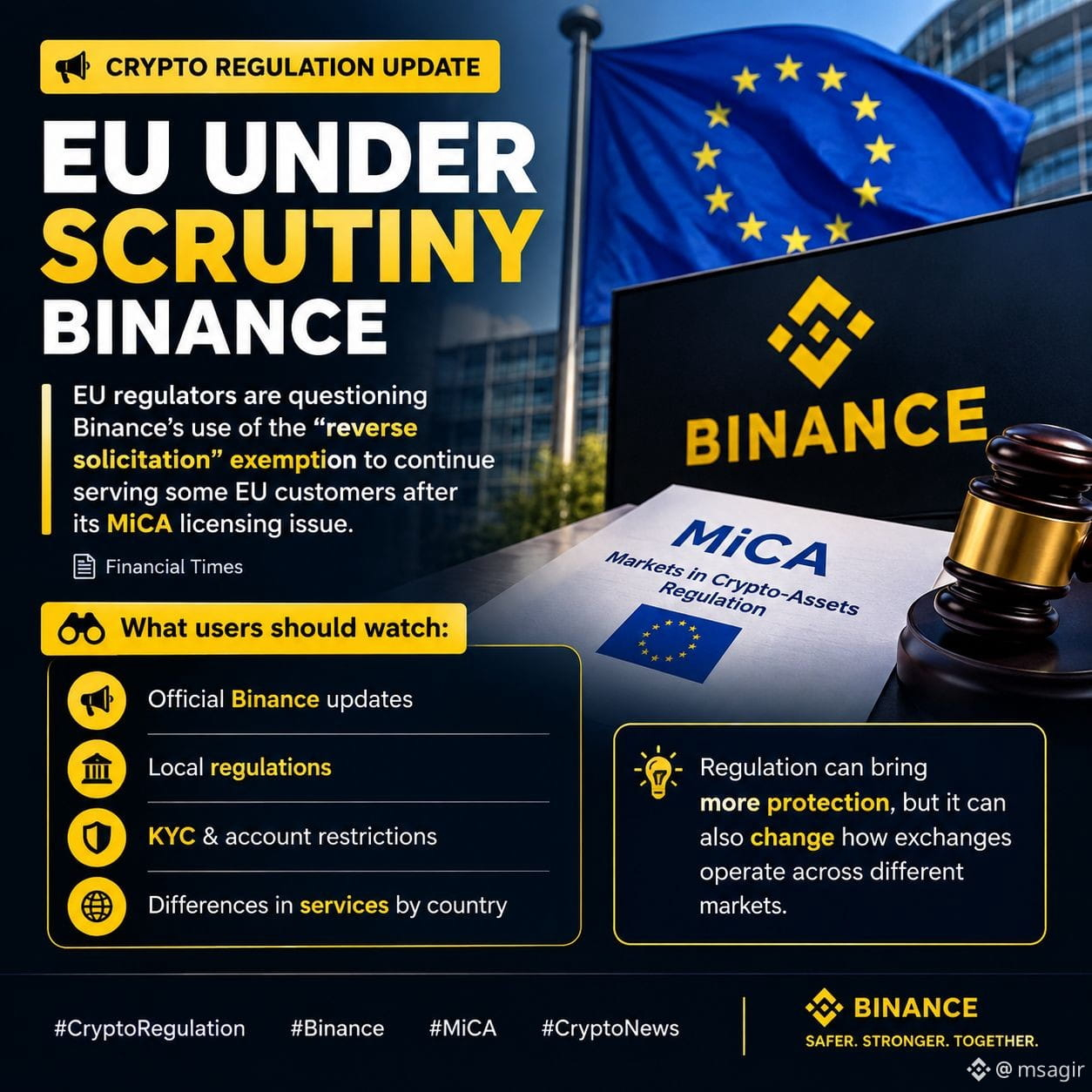
🌍 CRYPTO REGULATION UPDATE — BINANCE UNDER EU SCRUTINY
EU regulators are questioning Binance’s use of the “reverse solicitation” exemption to continue serving some EU customers after its MiCA licensing issue.
👀 What users should watch: ✅ Official Binance updates
✅ Local regulations
✅ KYC & account restrictions
✅ Differences in services by country
Regulation can change how exchanges operate across different markets.
#CryptoRegulation #Binance #MiCA #CryptoNews
🌍 CRYPTO REGULATION UPDATE — BINANCE UNDER EU SCRUTINY
EU regulators are questioning Binance’s use of the “reverse solicitation” exemption to continue serving some EU customers after its MiCA licensing issue.
👀 What users should watch: ✅ Official Binance updates
✅ Local regulations
✅ KYC & account restrictions
✅ Differences in services by country
Regulation can change how exchanges operate across different markets.
#CryptoRegulation #Binance #MiCA #CryptoNews
EU regulators are questioning Binance’s use of the “reverse solicitation” exemption to continue serving some EU customers after its MiCA licensing issue.
👀 What users should watch: ✅ Official Binance updates
✅ Local regulations
✅ KYC & account restrictions
✅ Differences in services by country
Regulation can change how exchanges operate across different markets.
#CryptoRegulation #Binance #MiCA #CryptoNews
1
30

·
--
MiCA Review Expands the MapESMA’s 30 September recommendations for the MiCA review show how quickly crypto supervision is moving beyond the original exchange and custody perimeter.
The publication addresses marketing by influencers and third parties, cost transparency, staking, lending, borrowing, non-compliant stablecoins, token classification and access to DeFi protocols. It also asks for clearer criteria to decide when an activity is genuinely decentralised.
The legal status matters. These are recommendations submitted through the European Commission’s review process, not final rules. Still, they show the questions regulators are asking and the product facts that teams need to document now.
Start with function, not branding.
A platform can call itself non-custodial, a protocol interface or a software gateway. The practical review still asks:
1. Who controls the interface and can change what users see?
2. Who routes transactions, orders, fees or rewards?
3. Who controls admin keys, upgrades, allowlists or emergency actions?
4. Does the business hold assets, transmit value, arrange trades or market products to users?
5. Which users and jurisdictions does the service actively target?
That functional map is more useful than memorising a list of regulator names. It reveals where custody, exchange, transfer, issuance, promotion, stablecoin, market integrity and consumer protection obligations may begin.
It also improves security analysis. A service that claims decentralisation while one team controls the frontend, fees, privileged contracts and emergency powers has a different risk profile from software that users can access through several independent interfaces without one party controlling execution.
TokenToolHub’s worldwide regulatory guide compares the recurring control pillars across regions and explains how to map a product before applying jurisdiction-specific rules.
https://tokentoolhub.com/cryptocurrency-regulatory-approaches-worldwide/
#crypto #blockchain #Web3 #MiCA #defi
MiCA Review Expands the Map
ESMA’s 30 September recommendations for the MiCA review show how quickly crypto supervision is moving beyond the original exchange and custody perimeter.
The publication addresses marketing by influencers and third parties, cost transparency, staking, lending, borrowing, non-compliant stablecoins, token classification and access to DeFi protocols. It also asks for clearer criteria to decide when an activity is genuinely decentralised.
The legal status matters. These are recommendations submitted through the European Commission’s review process, not final rules. Still, they show the questions regulators are asking and the product facts that teams need to document now.
Start with function, not branding.
A platform can call itself non-custodial, a protocol interface or a software gateway. The practical review still asks:
1. Who controls the interface and can change what users see?
2. Who routes transactions, orders, fees or rewards?
3. Who controls admin keys, upgrades, allowlists or emergency actions?
4. Does the business hold assets, transmit value, arrange trades or market products to users?
5. Which users and jurisdictions does the service actively target?
That functional map is more useful than memorising a list of regulator names. It reveals where custody, exchange, transfer, issuance, promotion, stablecoin, market integrity and consumer protection obligations may begin.
It also improves security analysis. A service that claims decentralisation while one team controls the frontend, fees, privileged contracts and emergency powers has a different risk profile from software that users can access through several independent interfaces without one party controlling execution.
TokenToolHub’s worldwide regulatory guide compares the recurring control pillars across regions and explains how to map a product before applying jurisdiction-specific rules.
https://tokentoolhub.com/cryptocurrency-regulatory-approaches-worldwide/
#crypto #blockchain #Web3 #MiCA #defi
The publication addresses marketing by influencers and third parties, cost transparency, staking, lending, borrowing, non-compliant stablecoins, token classification and access to DeFi protocols. It also asks for clearer criteria to decide when an activity is genuinely decentralised.
The legal status matters. These are recommendations submitted through the European Commission’s review process, not final rules. Still, they show the questions regulators are asking and the product facts that teams need to document now.
Start with function, not branding.
A platform can call itself non-custodial, a protocol interface or a software gateway. The practical review still asks:
1. Who controls the interface and can change what users see?
2. Who routes transactions, orders, fees or rewards?
3. Who controls admin keys, upgrades, allowlists or emergency actions?
4. Does the business hold assets, transmit value, arrange trades or market products to users?
5. Which users and jurisdictions does the service actively target?
That functional map is more useful than memorising a list of regulator names. It reveals where custody, exchange, transfer, issuance, promotion, stablecoin, market integrity and consumer protection obligations may begin.
It also improves security analysis. A service that claims decentralisation while one team controls the frontend, fees, privileged contracts and emergency powers has a different risk profile from software that users can access through several independent interfaces without one party controlling execution.
TokenToolHub’s worldwide regulatory guide compares the recurring control pillars across regions and explains how to map a product before applying jurisdiction-specific rules.
https://tokentoolhub.com/cryptocurrency-regulatory-approaches-worldwide/
#crypto #blockchain #Web3 #MiCA #defi
54

·
--
🚨 $BNB FACES EUROPEAN MICA SCRUTINY OVER REVERSE SOLICITATION EXEMPTION COMPLIANCE ⚠️
European securities regulator ESMA is reviewing whether top-tier exchange practices under MiCA reverse solicitation rules meet compliance standards. ⚖️ Financial Times reports indicate heightened institutional focus on potential enforcement risks, introducing macro friction across European market structures. 🔍
While short-term order flow absorbs regulatory uncertainty, smart money monitors how key liquidity zones hold during news-driven volatility. 📊 Managing exposure around policy shifts remains critical for capital preservation. 💬 How are you hedging your position as regulatory oversight tightens across European jurisdictions? 👇
⚠️ Not financial advice. Always manage your risk. 🛡️
🏷️ #BNB #MiCA #CryptoRegulation #MarketStructure
⚖️ 🔍
🚨 $BNB FACES EUROPEAN MICA SCRUTINY OVER REVERSE SOLICITATION EXEMPTION COMPLIANCE ⚠️
European securities regulator ESMA is reviewing whether top-tier exchange practices under MiCA reverse solicitation rules meet compliance standards. ⚖️ Financial Times reports indicate heightened institutional focus on potential enforcement risks, introducing macro friction across European market structures. 🔍
While short-term order flow absorbs regulatory uncertainty, smart money monitors how key liquidity zones hold during news-driven volatility. 📊 Managing exposure around policy shifts remains critical for capital preservation. 💬 How are you hedging your position as regulatory oversight tightens across European jurisdictions? 👇
⚠️ Not financial advice. Always manage your risk. 🛡️
🏷️ #BNB #MiCA #CryptoRegulation #MarketStructure
⚖️ 🔍
European securities regulator ESMA is reviewing whether top-tier exchange practices under MiCA reverse solicitation rules meet compliance standards. ⚖️ Financial Times reports indicate heightened institutional focus on potential enforcement risks, introducing macro friction across European market structures. 🔍
While short-term order flow absorbs regulatory uncertainty, smart money monitors how key liquidity zones hold during news-driven volatility. 📊 Managing exposure around policy shifts remains critical for capital preservation. 💬 How are you hedging your position as regulatory oversight tightens across European jurisdictions? 👇
⚠️ Not financial advice. Always manage your risk. 🛡️
🏷️ #BNB #MiCA #CryptoRegulation #MarketStructure
⚖️ 🔍
15

·
--
$BTC $BNB $ETH BREAKING! 🚨
EU is questioning Binance over MiCA license! 🇪🇺
Reports say Binance is using "reverse solicitation" loophole to serve EU users after license rejection.
But Binance says: "We are actively working toward becoming MiCA-authorised"
Is this FUD or real risk for $BNB?
My Take: This is temporary FUD. Binance has faced bigger issues before. $BNB still holding $770 strongly 💪
What do you think? Will $BNB dump or pump?
#Binance #BNB
{spot}(BTCUSDT)
#BTC #MiCA #CryptoNews
$BTC $BNB $ETH BREAKING! 🚨
EU is questioning Binance over MiCA license! 🇪🇺
Reports say Binance is using "reverse solicitation" loophole to serve EU users after license rejection.
But Binance says: "We are actively working toward becoming MiCA-authorised"
Is this FUD or real risk for $BNB?
My Take: This is temporary FUD. Binance has faced bigger issues before. $BNB still holding $770 strongly 💪
What do you think? Will $BNB dump or pump?
#Binance #BNB
#BTC #MiCA #CryptoNews
EU is questioning Binance over MiCA license! 🇪🇺
Reports say Binance is using "reverse solicitation" loophole to serve EU users after license rejection.
But Binance says: "We are actively working toward becoming MiCA-authorised"
Is this FUD or real risk for $BNB?
My Take: This is temporary FUD. Binance has faced bigger issues before. $BNB still holding $770 strongly 💪
What do you think? Will $BNB dump or pump?
#Binance #BNB
#BTC #MiCA #CryptoNews
1
84

·
--
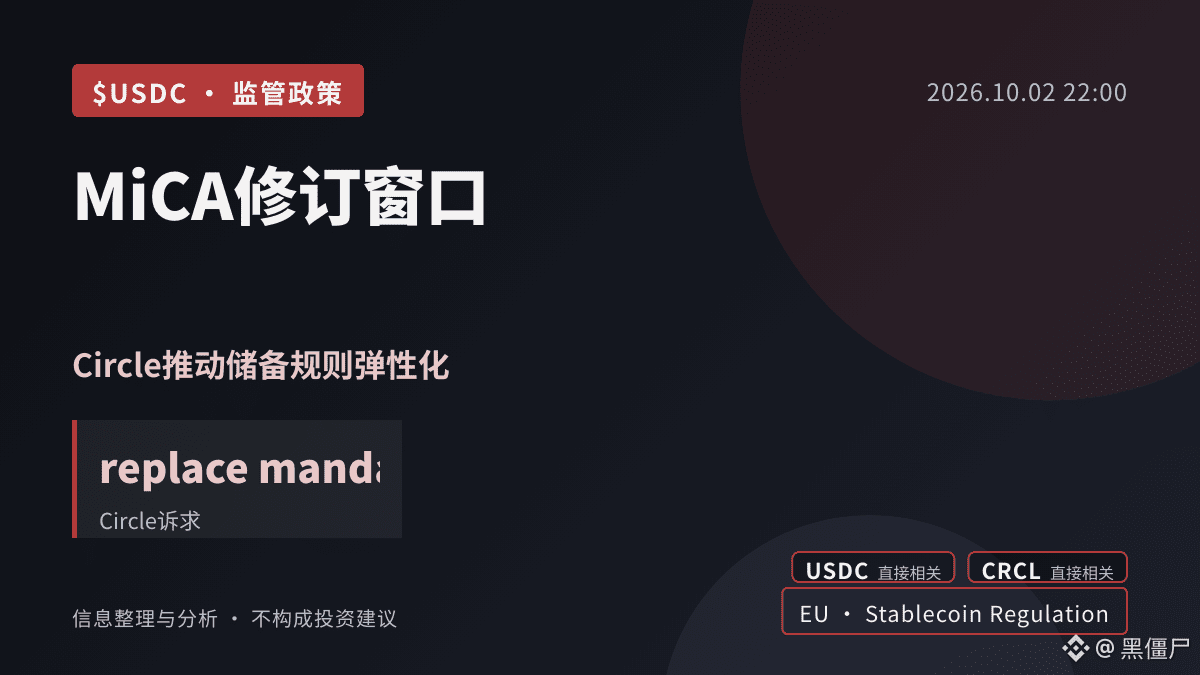
Circle pushes MiCA revisions: USDC reserve rules may see key changes
Circle is urging the EU to adjust its stablecoin reserve rules during the MiCA review, according to Cointelegraph. Its core request is to replace mandatory minimum bank deposit requirements with more flexible liquidity requirements, while preserving room for cross-border flows. This move directly points to the compliance costs and liquidity arrangements of $USDC, and it also relates to business expectations for $CRCL as the issuer.
For the stablecoin market, MiCA’s reserve rules are not merely technical provisions, but a key variable that determines whether issuers can maintain low costs and high liquidity within the EU. If the EU accepts a more flexible framework, operational space for USDC in areas such as bank partnerships, fund allocation, and cross-border settlement may expand, and compliance pressure could ease temporarily.
That said, EU regulators have consistently emphasized a prudent baseline. Whether the bank deposit requirements will be completely replaced remains uncertain. If the revision timeline is slow or the final outcome still retains a relatively high deposit ratio, the short-term price impact on USDC may be limited, manifesting more as changes in compliance expectations and institutional willingness to participate.
Next, we need to watch the public statements from the European Commission and the European Central Bank regarding the MiCA revisions, as well as whether Circle further discloses details of its reserve structure. If you’re following $USDC, in the near term it’s more worth monitoring whether regulatory signals confirm the direction, rather than betting on it in advance.
$USDC $CRCL #USDC #MiCA #Stablecoin
The above is an information summary and personal analysis and does not constitute investment advice.
Once additional policy details become clearer, I will continue to update.
Circle pushes MiCA revisions: USDC reserve rules may see key changes
Circle is urging the EU to adjust its stablecoin reserve rules during the MiCA review, according to Cointelegraph. Its core request is to replace mandatory minimum bank deposit requirements with more flexible liquidity requirements, while preserving room for cross-border flows. This move directly points to the compliance costs and liquidity arrangements of $USDC , and it also relates to business expectations for $CRCL as the issuer.
For the stablecoin market, MiCA’s reserve rules are not merely technical provisions, but a key variable that determines whether issuers can maintain low costs and high liquidity within the EU. If the EU accepts a more flexible framework, operational space for USDC in areas such as bank partnerships, fund allocation, and cross-border settlement may expand, and compliance pressure could ease temporarily.
That said, EU regulators have consistently emphasized a prudent baseline. Whether the bank deposit requirements will be completely replaced remains uncertain. If the revision timeline is slow or the final outcome still retains a relatively high deposit ratio, the short-term price impact on USDC may be limited, manifesting more as changes in compliance expectations and institutional willingness to participate.
Next, we need to watch the public statements from the European Commission and the European Central Bank regarding the MiCA revisions, as well as whether Circle further discloses details of its reserve structure. If you’re following $USDC , in the near term it’s more worth monitoring whether regulatory signals confirm the direction, rather than betting on it in advance.
$USDC $CRCL #USDC #MiCA #Stablecoin
The above is an information summary and personal analysis and does not constitute investment advice.
Once additional policy details become clearer, I will continue to update.
Circle is urging the EU to adjust its stablecoin reserve rules during the MiCA review, according to Cointelegraph. Its core request is to replace mandatory minimum bank deposit requirements with more flexible liquidity requirements, while preserving room for cross-border flows. This move directly points to the compliance costs and liquidity arrangements of $USDC , and it also relates to business expectations for $CRCL as the issuer.
For the stablecoin market, MiCA’s reserve rules are not merely technical provisions, but a key variable that determines whether issuers can maintain low costs and high liquidity within the EU. If the EU accepts a more flexible framework, operational space for USDC in areas such as bank partnerships, fund allocation, and cross-border settlement may expand, and compliance pressure could ease temporarily.
That said, EU regulators have consistently emphasized a prudent baseline. Whether the bank deposit requirements will be completely replaced remains uncertain. If the revision timeline is slow or the final outcome still retains a relatively high deposit ratio, the short-term price impact on USDC may be limited, manifesting more as changes in compliance expectations and institutional willingness to participate.
Next, we need to watch the public statements from the European Commission and the European Central Bank regarding the MiCA revisions, as well as whether Circle further discloses details of its reserve structure. If you’re following $USDC , in the near term it’s more worth monitoring whether regulatory signals confirm the direction, rather than betting on it in advance.
$USDC $CRCL #USDC #MiCA #Stablecoin
The above is an information summary and personal analysis and does not constitute investment advice.
Once additional policy details become clearer, I will continue to update.
18

·
--
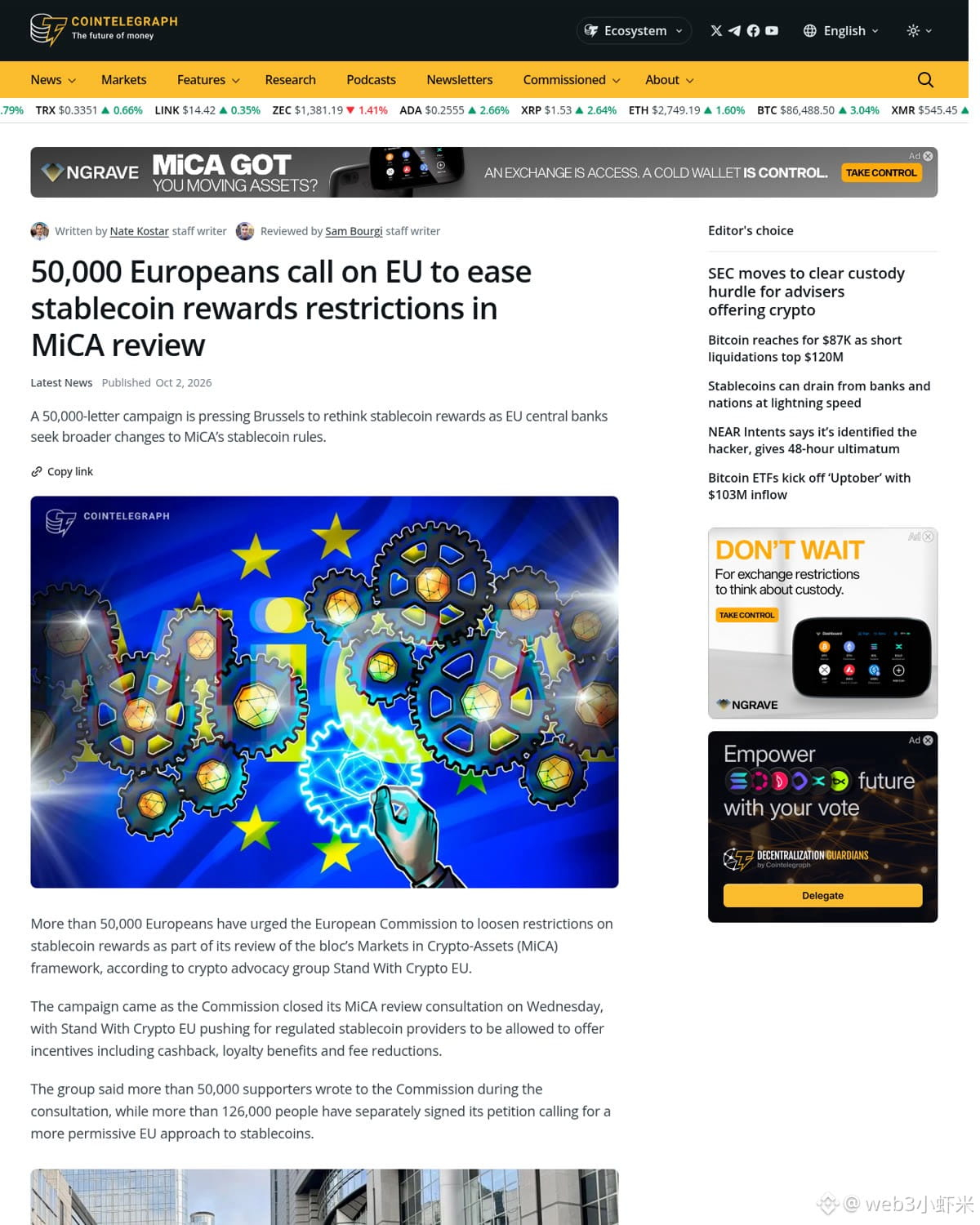
Cointelegraph roundup: “Stand With Crypto EU” says more than 50,000 EU citizens have written to the European Commission, calling for relaxed stablecoin incentive limits in the MiCA re-review; another 126,000+ have signed a petition.
The focus is very concrete—MiCA currently bans issuers and platforms from paying interest on stablecoins, and the initiative is hoping to be able to do cashback, loyalty benefits, and lower fees legally; by comparison to the U.S. GENIUS, exchanges can still offer rewards, and Europe is even tighter. On the other side, the ECB system’s 22 September opinion points in the opposite direction: it wants to extend the ban to interest-bearing arrangements such as lending and staking, and even replace the hard ratio on reserve-bank deposits with a liquidity threshold.
The consultation window has just closed—how it will ultimately be changed is still up to the European Commission. In Europe, the question is still whether stablecoins are more like payment tools or more like deposits.
#稳定币 #MiCA $USDC $USDT
Cointelegraph roundup: “Stand With Crypto EU” says more than 50,000 EU citizens have written to the European Commission, calling for relaxed stablecoin incentive limits in the MiCA re-review; another 126,000+ have signed a petition.
The focus is very concrete—MiCA currently bans issuers and platforms from paying interest on stablecoins, and the initiative is hoping to be able to do cashback, loyalty benefits, and lower fees legally; by comparison to the U.S. GENIUS, exchanges can still offer rewards, and Europe is even tighter. On the other side, the ECB system’s 22 September opinion points in the opposite direction: it wants to extend the ban to interest-bearing arrangements such as lending and staking, and even replace the hard ratio on reserve-bank deposits with a liquidity threshold.
The consultation window has just closed—how it will ultimately be changed is still up to the European Commission. In Europe, the question is still whether stablecoins are more like payment tools or more like deposits.
#稳定币 #MiCA $USDC $USDT
The focus is very concrete—MiCA currently bans issuers and platforms from paying interest on stablecoins, and the initiative is hoping to be able to do cashback, loyalty benefits, and lower fees legally; by comparison to the U.S. GENIUS, exchanges can still offer rewards, and Europe is even tighter. On the other side, the ECB system’s 22 September opinion points in the opposite direction: it wants to extend the ban to interest-bearing arrangements such as lending and staking, and even replace the hard ratio on reserve-bank deposits with a liquidity threshold.
The consultation window has just closed—how it will ultimately be changed is still up to the European Commission. In Europe, the question is still whether stablecoins are more like payment tools or more like deposits.
#稳定币 #MiCA $USDC $USDT
20

·
--
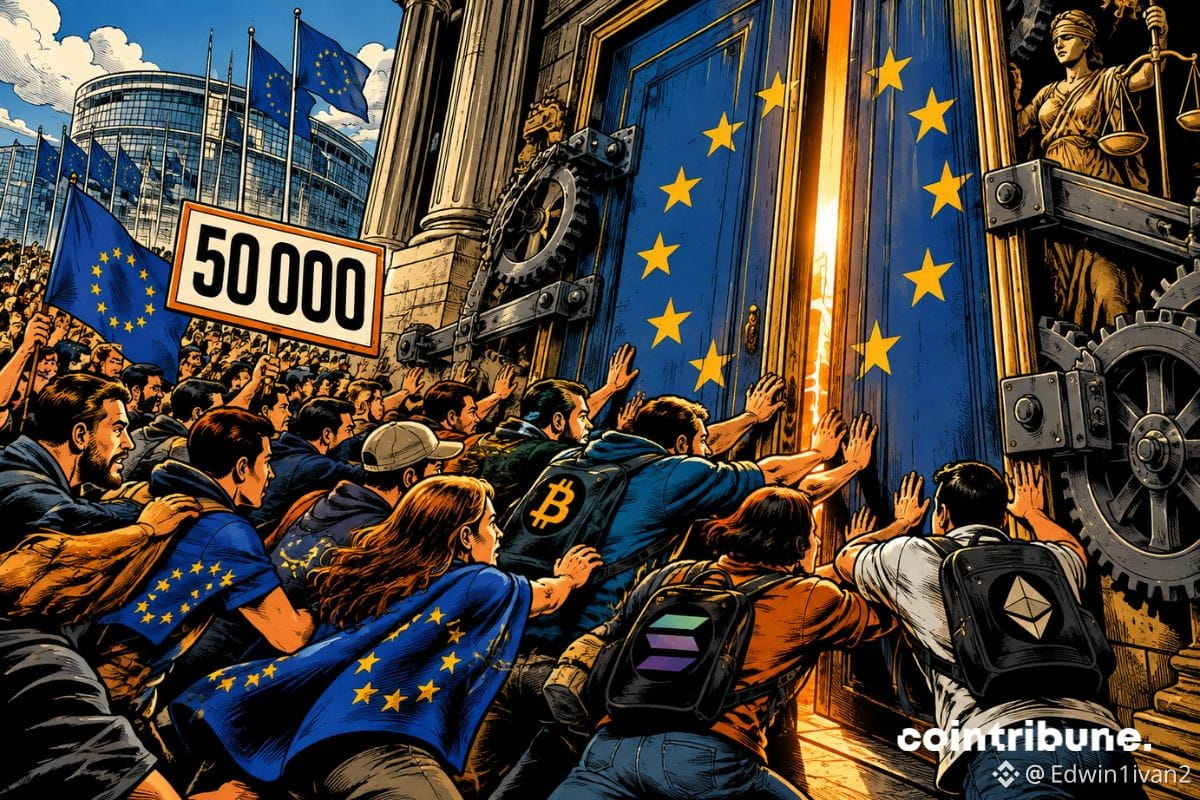
Crypto: 50,000 Europeans rebel against MiCA rules
More than 50,000 Europeans have asked the European Commission to ease the MiCA rules on rewards related to stablecoins. The mobilization comes as Brussels reviews its crypto framework. A separate petition submitted by Stand With Crypto EU also exceeds 126,000 signatures. At the heart of the debate: cashback, loyalty benefits, and above all the remuneration of regulated stablecoins.
More than 50,000 people wrote to the European Commission about MiCA.
A parallel petition exceeds 126,000 signatures.
Rewards and returns related to stablecoins concentrate part of the debate.
Crypto pushes Brussels to review rewards
The consultation launched by the European Commission in May ended on September 30. Its goal: to check whether MiCA is still fit for purpose after its first years of implementation, and in light of the rapid changes in the crypto market.
This review had already led the ECB to ask for tighter restrictions on the ban on returns on stablecoins. Stand With Crypto EU argues for the opposite direction. The organization says that more than 50,000 Europeans sent a message to the Commission during the consultation. Another petition calling for a more stablecoin-friendly European strategy also had more than 126,000 signatures.
The request concerns in particular stablecoins that comply with MiCA. The organization wants users to be able to receive certain benefits, such as cashback, reduced fees, or loyalty rewards.
It also calls for the possibility of redistributing part of the returns generated by assets held in reserve. For Stand With Crypto, current restrictions put stablecoins at a disadvantage compared with bank deposits and some other financial products.
$MICC.US
{stock_us}(MICC.US)
$WILD
{alpha}(560x6685906b75c61c57772c335402f594f855c1b0e3)
$STAR
{alpha}(560x8fce7206e3043dd360f115afa956ee31b90b787c)
#MiCA
Crypto: 50,000 Europeans rebel against MiCA rules
More than 50,000 Europeans have asked the European Commission to ease the MiCA rules on rewards related to stablecoins. The mobilization comes as Brussels reviews its crypto framework. A separate petition submitted by Stand With Crypto EU also exceeds 126,000 signatures. At the heart of the debate: cashback, loyalty benefits, and above all the remuneration of regulated stablecoins.
More than 50,000 people wrote to the European Commission about MiCA.
A parallel petition exceeds 126,000 signatures.
Rewards and returns related to stablecoins concentrate part of the debate.
Crypto pushes Brussels to review rewards
The consultation launched by the European Commission in May ended on September 30. Its goal: to check whether MiCA is still fit for purpose after its first years of implementation, and in light of the rapid changes in the crypto market.
This review had already led the ECB to ask for tighter restrictions on the ban on returns on stablecoins. Stand With Crypto EU argues for the opposite direction. The organization says that more than 50,000 Europeans sent a message to the Commission during the consultation. Another petition calling for a more stablecoin-friendly European strategy also had more than 126,000 signatures.
The request concerns in particular stablecoins that comply with MiCA. The organization wants users to be able to receive certain benefits, such as cashback, reduced fees, or loyalty rewards.
It also calls for the possibility of redistributing part of the returns generated by assets held in reserve. For Stand With Crypto, current restrictions put stablecoins at a disadvantage compared with bank deposits and some other financial products.
$MICC.US
$WILD
$STAR
#MiCA
More than 50,000 Europeans have asked the European Commission to ease the MiCA rules on rewards related to stablecoins. The mobilization comes as Brussels reviews its crypto framework. A separate petition submitted by Stand With Crypto EU also exceeds 126,000 signatures. At the heart of the debate: cashback, loyalty benefits, and above all the remuneration of regulated stablecoins.
More than 50,000 people wrote to the European Commission about MiCA.
A parallel petition exceeds 126,000 signatures.
Rewards and returns related to stablecoins concentrate part of the debate.
Crypto pushes Brussels to review rewards
The consultation launched by the European Commission in May ended on September 30. Its goal: to check whether MiCA is still fit for purpose after its first years of implementation, and in light of the rapid changes in the crypto market.
This review had already led the ECB to ask for tighter restrictions on the ban on returns on stablecoins. Stand With Crypto EU argues for the opposite direction. The organization says that more than 50,000 Europeans sent a message to the Commission during the consultation. Another petition calling for a more stablecoin-friendly European strategy also had more than 126,000 signatures.
The request concerns in particular stablecoins that comply with MiCA. The organization wants users to be able to receive certain benefits, such as cashback, reduced fees, or loyalty rewards.
It also calls for the possibility of redistributing part of the returns generated by assets held in reserve. For Stand With Crypto, current restrictions put stablecoins at a disadvantage compared with bank deposits and some other financial products.
$MICC.US
$WILD
$STAR
#MiCA
71

·
--
🚨 Aave’s founder fires back at the EU: this should be about intermediaries, not code. DeFi’s rulebook should have been rewritten long ago?
Group: [点击进入玖玖的粉丝群](https://app.binance.com/uni-qr/YXXQJrPb)
👀 The EU’s public re-review of MiCA has just wrapped up. Aave Labs submitted a 57-page position paper on September 30. Founder and CEO Stani Kulechov spoke out on X himself, saying on-chain finance can bring the kind of access and transparency that traditional financial systems lack.
📊 The request is actually very straightforward: whoever controls assets, who makes subjective judgments, should be regulated. And code that automatically executes according to pre-published rules should not be presumed to be a financial intermediary. The document’s line, “technology is just a tool,” points to this exact idea.
🔥 Even more controversial is the second point: Aave opposes extending MiCA’s restrictions on stablecoin “interest” to lending and collateral. Its argument is that borrowers pay a usage fee, which is fundamentally not the same as token holders simply earning interest. Forcing them into the same bucket would only make EU euro stablecoins harder to compete with the US dollar.
💡 The real question isn’t whether Aave can convince the EU—it’s whether regulators draw the line by “people” or by “code.” If they draw by code, then all open-source protocols must be reclassified; if they draw by people, DeFi gets a clear compliance pathway.
⚠️ Let me say something that might offend some people: this rhetoric sounds like it’s protecting innovation, but in practice it looks more like it first positions its own compliance subsidiaries in Ireland, and then lets the rules be tailored for it. The industry keeps chanting “don’t regulate code,” but in the end, the beneficiaries are often the few firms that hold the licenses.
👀 Should code be regulated, or people? Where do you stand?
Click the avatar to watch the live stream + join the Jiuji chat group to get daily strategies 🚀
#Aave #MiCA #DeFi
🚨 Aave’s founder fires back at the EU: this should be about intermediaries, not code. DeFi’s rulebook should have been rewritten long ago?
Group: 点击进入玖玖的粉丝群
👀 The EU’s public re-review of MiCA has just wrapped up. Aave Labs submitted a 57-page position paper on September 30. Founder and CEO Stani Kulechov spoke out on X himself, saying on-chain finance can bring the kind of access and transparency that traditional financial systems lack.
📊 The request is actually very straightforward: whoever controls assets, who makes subjective judgments, should be regulated. And code that automatically executes according to pre-published rules should not be presumed to be a financial intermediary. The document’s line, “technology is just a tool,” points to this exact idea.
🔥 Even more controversial is the second point: Aave opposes extending MiCA’s restrictions on stablecoin “interest” to lending and collateral. Its argument is that borrowers pay a usage fee, which is fundamentally not the same as token holders simply earning interest. Forcing them into the same bucket would only make EU euro stablecoins harder to compete with the US dollar.
💡 The real question isn’t whether Aave can convince the EU—it’s whether regulators draw the line by “people” or by “code.” If they draw by code, then all open-source protocols must be reclassified; if they draw by people, DeFi gets a clear compliance pathway.
⚠️ Let me say something that might offend some people: this rhetoric sounds like it’s protecting innovation, but in practice it looks more like it first positions its own compliance subsidiaries in Ireland, and then lets the rules be tailored for it. The industry keeps chanting “don’t regulate code,” but in the end, the beneficiaries are often the few firms that hold the licenses.
👀 Should code be regulated, or people? Where do you stand?
Click the avatar to watch the live stream + join the Jiuji chat group to get daily strategies 🚀
#Aave #MiCA #DeFi
Group: 点击进入玖玖的粉丝群
👀 The EU’s public re-review of MiCA has just wrapped up. Aave Labs submitted a 57-page position paper on September 30. Founder and CEO Stani Kulechov spoke out on X himself, saying on-chain finance can bring the kind of access and transparency that traditional financial systems lack.
📊 The request is actually very straightforward: whoever controls assets, who makes subjective judgments, should be regulated. And code that automatically executes according to pre-published rules should not be presumed to be a financial intermediary. The document’s line, “technology is just a tool,” points to this exact idea.
🔥 Even more controversial is the second point: Aave opposes extending MiCA’s restrictions on stablecoin “interest” to lending and collateral. Its argument is that borrowers pay a usage fee, which is fundamentally not the same as token holders simply earning interest. Forcing them into the same bucket would only make EU euro stablecoins harder to compete with the US dollar.
💡 The real question isn’t whether Aave can convince the EU—it’s whether regulators draw the line by “people” or by “code.” If they draw by code, then all open-source protocols must be reclassified; if they draw by people, DeFi gets a clear compliance pathway.
⚠️ Let me say something that might offend some people: this rhetoric sounds like it’s protecting innovation, but in practice it looks more like it first positions its own compliance subsidiaries in Ireland, and then lets the rules be tailored for it. The industry keeps chanting “don’t regulate code,” but in the end, the beneficiaries are often the few firms that hold the licenses.
👀 Should code be regulated, or people? Where do you stand?
Click the avatar to watch the live stream + join the Jiuji chat group to get daily strategies 🚀
#Aave #MiCA #DeFi
265

·
--
【50,000 Europeans Call for Changes to MiCA! Will Stablecoin Regulation Be Eased? 🔥】
[🌟 稳定币监管动向进群聊](https://app.binance.com/uni-qr/MwYFhLo4)
European crypto regulation may be about to undergo an adjustment.
Recently, more than 50,000 Europeans, through related activities, called on the EU to reconsider MiCA and loosen restrictions on stablecoin incentive mechanisms.
Why suddenly so many people care?
Because under the current rules, stablecoin issuers can’t, like bank deposits, directly pay users interest.
But the industry wants to go further—such as allowing stablecoins to offer cash back, loyalty rewards, fee reductions, and other benefits.
In short:
If you’re just keeping money there, why can banks give users some rewards, while stablecoins face more restrictions?
Those who support easing the rules believe that if the limits are too strict, Europe’s stablecoins may find it hard to compete with the U.S. market.
However, European regulators are also concerned that if stablecoins provide yield indirectly through lending, staking, and similar methods, it could blur the line between payment instruments and financial products.
So what’s truly worth watching in this MiCA adjustment isn’t only whether the rules will be relaxed, but how Europe will ultimately balance stablecoin innovation, market competition, and financial stability.
📌 If the rules really change, the competitive landscape among stablecoins, payments, DeFi, and Europe’s crypto industry could all be affected.
#MiCA
【50,000 Europeans Call for Changes to MiCA! Will Stablecoin Regulation Be Eased? 🔥】
🌟 稳定币监管动向进群聊
European crypto regulation may be about to undergo an adjustment.
Recently, more than 50,000 Europeans, through related activities, called on the EU to reconsider MiCA and loosen restrictions on stablecoin incentive mechanisms.
Why suddenly so many people care?
Because under the current rules, stablecoin issuers can’t, like bank deposits, directly pay users interest.
But the industry wants to go further—such as allowing stablecoins to offer cash back, loyalty rewards, fee reductions, and other benefits.
In short:
If you’re just keeping money there, why can banks give users some rewards, while stablecoins face more restrictions?
Those who support easing the rules believe that if the limits are too strict, Europe’s stablecoins may find it hard to compete with the U.S. market.
However, European regulators are also concerned that if stablecoins provide yield indirectly through lending, staking, and similar methods, it could blur the line between payment instruments and financial products.
So what’s truly worth watching in this MiCA adjustment isn’t only whether the rules will be relaxed, but how Europe will ultimately balance stablecoin innovation, market competition, and financial stability.
📌 If the rules really change, the competitive landscape among stablecoins, payments, DeFi, and Europe’s crypto industry could all be affected.
#MiCA
🌟 稳定币监管动向进群聊
European crypto regulation may be about to undergo an adjustment.
Recently, more than 50,000 Europeans, through related activities, called on the EU to reconsider MiCA and loosen restrictions on stablecoin incentive mechanisms.
Why suddenly so many people care?
Because under the current rules, stablecoin issuers can’t, like bank deposits, directly pay users interest.
But the industry wants to go further—such as allowing stablecoins to offer cash back, loyalty rewards, fee reductions, and other benefits.
In short:
If you’re just keeping money there, why can banks give users some rewards, while stablecoins face more restrictions?
Those who support easing the rules believe that if the limits are too strict, Europe’s stablecoins may find it hard to compete with the U.S. market.
However, European regulators are also concerned that if stablecoins provide yield indirectly through lending, staking, and similar methods, it could blur the line between payment instruments and financial products.
So what’s truly worth watching in this MiCA adjustment isn’t only whether the rules will be relaxed, but how Europe will ultimately balance stablecoin innovation, market competition, and financial stability.
📌 If the rules really change, the competitive landscape among stablecoins, payments, DeFi, and Europe’s crypto industry could all be affected.
#MiCA
16

Hyperliquid and Circle urge the EU to regulate perps and stablecoins under MiCA
- The Hyperliquid Policy Center recommends bringing perpetual contracts (perps) within the scope of MiFID II.
- Circle proposes adjusting rules on bank deposit reserves within the MiCA framework.
- Both filings were submitted to the European Commission during the MiCA review process.
- Detailed information has not been fully disclosed.
#BinanceSquare #CryptoNews #MiCA #Hyperliquid #Circle
$btc $eth
vlikevn Titanbot
Source: The Block
Hyperliquid and Circle urge the EU to regulate perps and stablecoins under MiCA
- The Hyperliquid Policy Center recommends bringing perpetual contracts (perps) within the scope of MiFID II.
- Circle proposes adjusting rules on bank deposit reserves within the MiCA framework.
- Both filings were submitted to the European Commission during the MiCA review process.
- Detailed information has not been fully disclosed.
#BinanceSquare #CryptoNews #MiCA #Hyperliquid #Circle
$btc $eth
vlikevn Titanbot
Source: The Block
- The Hyperliquid Policy Center recommends bringing perpetual contracts (perps) within the scope of MiFID II.
- Circle proposes adjusting rules on bank deposit reserves within the MiCA framework.
- Both filings were submitted to the European Commission during the MiCA review process.
- Detailed information has not been fully disclosed.
#BinanceSquare #CryptoNews #MiCA #Hyperliquid #Circle
$btc $eth
vlikevn Titanbot
Source: The Block
61
·
--
🚨 50,000 Europeans signed on together for one thing: can encrypted tokens deliver rewards just like deposits?
Group: [点击进入玖玖的粉丝群](https://app.binance.com/uni-qr/YXXQJrPb)
👀 MiCA’s public consultation wrapped up on September 30, and more than 50,000 European users submitted feedback, calling for regulated issuers to be allowed to offer cashback, loyalty rewards, and fee reductions to token holders; Stand With Crypto EU confirmed the scale of this submission round.
📊 Under the current MiCA, token rewards are being kept strictly under control—effectively blocking “pay you interest”-style features; users and the industry’s demands are straightforward: provide a clear regulatory framework for these incentive mechanisms, instead of leaving them in a gray area.
🔥 The controversy comes down to this: one camp argues for loosening—if rewards aren’t allowed, users will move their money to unregulated platforms; the other camp argues against—if rewards are granted, it’s tantamount to acknowledging that it functions like a deposit, but it has no deposit insurance.
💡 What really needs watching isn’t whether “Europeans want a freebie,” but the fact that these tokens are being used as if they were deposits; once rewards are allowed, it effectively defaults to being treated as a deposit-like product—so who will be held responsible when things go wrong? Deposit-like products without insurance are the key question this round should focus on.
⚠️ Let me say something a bit offensive: this round isn’t regulators relaxing—it’s users “voting with their feet.” When the rules move slower than the money, the money will find its own way out; once the new regulations take effect, the windfall will most likely first go to issuers who have already built thick compliance.
👀 Do you think it should be opened up, or kept restricted?
Click the avatar to watch the livestream + join the Jiujiu chat group to get daily strategies 🚀
#稳定币 #MiCA #加密监管
🚨 50,000 Europeans signed on together for one thing: can encrypted tokens deliver rewards just like deposits?
Group: 点击进入玖玖的粉丝群
👀 MiCA’s public consultation wrapped up on September 30, and more than 50,000 European users submitted feedback, calling for regulated issuers to be allowed to offer cashback, loyalty rewards, and fee reductions to token holders; Stand With Crypto EU confirmed the scale of this submission round.
📊 Under the current MiCA, token rewards are being kept strictly under control—effectively blocking “pay you interest”-style features; users and the industry’s demands are straightforward: provide a clear regulatory framework for these incentive mechanisms, instead of leaving them in a gray area.
🔥 The controversy comes down to this: one camp argues for loosening—if rewards aren’t allowed, users will move their money to unregulated platforms; the other camp argues against—if rewards are granted, it’s tantamount to acknowledging that it functions like a deposit, but it has no deposit insurance.
💡 What really needs watching isn’t whether “Europeans want a freebie,” but the fact that these tokens are being used as if they were deposits; once rewards are allowed, it effectively defaults to being treated as a deposit-like product—so who will be held responsible when things go wrong? Deposit-like products without insurance are the key question this round should focus on.
⚠️ Let me say something a bit offensive: this round isn’t regulators relaxing—it’s users “voting with their feet.” When the rules move slower than the money, the money will find its own way out; once the new regulations take effect, the windfall will most likely first go to issuers who have already built thick compliance.
👀 Do you think it should be opened up, or kept restricted?
Click the avatar to watch the livestream + join the Jiujiu chat group to get daily strategies 🚀
#稳定币 #MiCA #加密监管
Group: 点击进入玖玖的粉丝群
👀 MiCA’s public consultation wrapped up on September 30, and more than 50,000 European users submitted feedback, calling for regulated issuers to be allowed to offer cashback, loyalty rewards, and fee reductions to token holders; Stand With Crypto EU confirmed the scale of this submission round.
📊 Under the current MiCA, token rewards are being kept strictly under control—effectively blocking “pay you interest”-style features; users and the industry’s demands are straightforward: provide a clear regulatory framework for these incentive mechanisms, instead of leaving them in a gray area.
🔥 The controversy comes down to this: one camp argues for loosening—if rewards aren’t allowed, users will move their money to unregulated platforms; the other camp argues against—if rewards are granted, it’s tantamount to acknowledging that it functions like a deposit, but it has no deposit insurance.
💡 What really needs watching isn’t whether “Europeans want a freebie,” but the fact that these tokens are being used as if they were deposits; once rewards are allowed, it effectively defaults to being treated as a deposit-like product—so who will be held responsible when things go wrong? Deposit-like products without insurance are the key question this round should focus on.
⚠️ Let me say something a bit offensive: this round isn’t regulators relaxing—it’s users “voting with their feet.” When the rules move slower than the money, the money will find its own way out; once the new regulations take effect, the windfall will most likely first go to issuers who have already built thick compliance.
👀 Do you think it should be opened up, or kept restricted?
Click the avatar to watch the livestream + join the Jiujiu chat group to get daily strategies 🚀
#稳定币 #MiCA #加密监管

57

🔔 Alert: Europe is seeking to tighten the crypto market even more!
The European Securities and Markets Authority (ESMA) has just proposed expanding the scope of the MiCA regulation. Instead of only regulating centralized exchanges, they want to bring even the most “free” areas under scrutiny.
*Proposal details:*
🔹 New targets: DeFi gateways, staking services, and cryptocurrency lending.
🔹 Tighter controls: Strengthen restrictions on services related to stablecoins that have not been licensed.
*Why it matters?*
- DeFi places a premium on decentralization, but being brought under a regulatory framework will create major barriers for projects operating in the EU.
- Strict oversight of stablecoins could change capital flows and market liquidity in this region.
What do you think about DeFi being regulated? Will this make the market safer—or kill innovation?
👉 Where’s the Alpha? It’s here — Follow the Channel https://app.binance.com/uni-qr/cpro/Square-Creator-4a0f2008149d?l=en&r=BOZMO8A1
#MiCA #DeFi #Crypto #Yield #CryptoMarket $TRX
🔔 Alert: Europe is seeking to tighten the crypto market even more!
The European Securities and Markets Authority (ESMA) has just proposed expanding the scope of the MiCA regulation. Instead of only regulating centralized exchanges, they want to bring even the most “free” areas under scrutiny.
*Proposal details:*
🔹 New targets: DeFi gateways, staking services, and cryptocurrency lending.
🔹 Tighter controls: Strengthen restrictions on services related to stablecoins that have not been licensed.
*Why it matters?*
- DeFi places a premium on decentralization, but being brought under a regulatory framework will create major barriers for projects operating in the EU.
- Strict oversight of stablecoins could change capital flows and market liquidity in this region.
What do you think about DeFi being regulated? Will this make the market safer—or kill innovation?
👉 Where’s the Alpha? It’s here — Follow the Channel https://app.binance.com/uni-qr/cpro/Square-Creator-4a0f2008149d?l=en&r=BOZMO8A1
#MiCA #DeFi #Crypto #Yield #CryptoMarket $TRX
The European Securities and Markets Authority (ESMA) has just proposed expanding the scope of the MiCA regulation. Instead of only regulating centralized exchanges, they want to bring even the most “free” areas under scrutiny.
*Proposal details:*
🔹 New targets: DeFi gateways, staking services, and cryptocurrency lending.
🔹 Tighter controls: Strengthen restrictions on services related to stablecoins that have not been licensed.
*Why it matters?*
- DeFi places a premium on decentralization, but being brought under a regulatory framework will create major barriers for projects operating in the EU.
- Strict oversight of stablecoins could change capital flows and market liquidity in this region.
What do you think about DeFi being regulated? Will this make the market safer—or kill innovation?
👉 Where’s the Alpha? It’s here — Follow the Channel https://app.binance.com/uni-qr/cpro/Square-Creator-4a0f2008149d?l=en&r=BOZMO8A1
#MiCA #DeFi #Crypto #Yield #CryptoMarket $TRX
62

·
--
🇪🇺 Europe continues tightening Crypto regulation: Will DeFi soon be no longer "free"?
ESMA (the European Securities and Markets Authority) has just proposed expanding the scope of the MiCA regulation. This time, the goal is not only to cover CEX exchanges, but to also include decentralized segments.
📌 Key points in the proposal:
🔹 Expand the regulated subjects: Focus on DeFi gateways, staking platforms, and lending.
🔹 Tighten stablecoin rules: Apply more restrictions to stablecoin types that do not yet have a license.
⚠️ Potential impact:
Placing DeFi within a legal framework could create significant operational barriers for projects in the EU, going against the pure spirit of decentralization. At the same time, stricter stablecoin control will directly affect liquidity and capital flows in the region.
What do you think: Is regulating DeFi a necessary step to protect investors, or will it stifle Web3 innovation?
👉 Keep the wheel steady — Follow the Channel https://app.binance.com/uni-qr/cpro/Square-Creator-4a0f2008149d?l=en&r=BOZMO8A1
#MiCA #DeFi #Crypto #Yield #CryptoMarket $TRX
🇪🇺 Europe continues tightening Crypto regulation: Will DeFi soon be no longer "free"?
ESMA (the European Securities and Markets Authority) has just proposed expanding the scope of the MiCA regulation. This time, the goal is not only to cover CEX exchanges, but to also include decentralized segments.
📌 Key points in the proposal:
🔹 Expand the regulated subjects: Focus on DeFi gateways, staking platforms, and lending.
🔹 Tighten stablecoin rules: Apply more restrictions to stablecoin types that do not yet have a license.
⚠️ Potential impact:
Placing DeFi within a legal framework could create significant operational barriers for projects in the EU, going against the pure spirit of decentralization. At the same time, stricter stablecoin control will directly affect liquidity and capital flows in the region.
What do you think: Is regulating DeFi a necessary step to protect investors, or will it stifle Web3 innovation?
👉 Keep the wheel steady — Follow the Channel https://app.binance.com/uni-qr/cpro/Square-Creator-4a0f2008149d?l=en&r=BOZMO8A1
#MiCA #DeFi #Crypto #Yield #CryptoMarket $TRX
ESMA (the European Securities and Markets Authority) has just proposed expanding the scope of the MiCA regulation. This time, the goal is not only to cover CEX exchanges, but to also include decentralized segments.
📌 Key points in the proposal:
🔹 Expand the regulated subjects: Focus on DeFi gateways, staking platforms, and lending.
🔹 Tighten stablecoin rules: Apply more restrictions to stablecoin types that do not yet have a license.
⚠️ Potential impact:
Placing DeFi within a legal framework could create significant operational barriers for projects in the EU, going against the pure spirit of decentralization. At the same time, stricter stablecoin control will directly affect liquidity and capital flows in the region.
What do you think: Is regulating DeFi a necessary step to protect investors, or will it stifle Web3 innovation?
👉 Keep the wheel steady — Follow the Channel https://app.binance.com/uni-qr/cpro/Square-Creator-4a0f2008149d?l=en&r=BOZMO8A1
#MiCA #DeFi #Crypto #Yield #CryptoMarket $TRX
52

·
--
Bullish
The EU regulator is looking into Binance, but this is not a case of “already punished” or “immediately exiting the EU.”
The latest report says European regulators are trying to understand how Binance continues to serve some EU clients by using the “reverse solicitation” exception, after it has not yet obtained MiCA authorization.
This exception only applies when customers fully and actively seek services from abroad on their own. If regulators do not accept Binance’s explanation, fines or other enforcement actions could follow.
Binance responded that the company complies with the applicable rules in its operating regions and is actively working to obtain MiCA authorization. For now, what can be confirmed is that “a regulatory inquiry is underway,” so it cannot be described as already fined or fully banned.
The market has not shown panic: around 15:04, $BNB placed an order of about $770, and over the past 24 hours it is still up by roughly 1.7%.
Next, watch three things:
• BNB breaks through and holds above 777.7: it suggests there is not yet clear sell pressure from the news.
• A drop below 756.3 and no rebound that can get back above: only then should you pay attention to the regulatory risk being amplified by price.
• Whether there is an official EU enforcement document, a fine, or a new Binance announcement: this matters more than market rumors.
A regulatory inquiry is not a minor matter, but “being investigated” and “already finalized” are two completely different stages.
Do you think the market is underestimating this regulatory risk, or that the impact is limited to European business?
#bnb #Binance #MiCA
$BNB
{future}(BNBUSDT)
The EU regulator is looking into Binance, but this is not a case of “already punished” or “immediately exiting the EU.”
The latest report says European regulators are trying to understand how Binance continues to serve some EU clients by using the “reverse solicitation” exception, after it has not yet obtained MiCA authorization.
This exception only applies when customers fully and actively seek services from abroad on their own. If regulators do not accept Binance’s explanation, fines or other enforcement actions could follow.
Binance responded that the company complies with the applicable rules in its operating regions and is actively working to obtain MiCA authorization. For now, what can be confirmed is that “a regulatory inquiry is underway,” so it cannot be described as already fined or fully banned.
The market has not shown panic: around 15:04, $BNB placed an order of about $770, and over the past 24 hours it is still up by roughly 1.7%.
Next, watch three things:
• BNB breaks through and holds above 777.7: it suggests there is not yet clear sell pressure from the news.
• A drop below 756.3 and no rebound that can get back above: only then should you pay attention to the regulatory risk being amplified by price.
• Whether there is an official EU enforcement document, a fine, or a new Binance announcement: this matters more than market rumors.
A regulatory inquiry is not a minor matter, but “being investigated” and “already finalized” are two completely different stages.
Do you think the market is underestimating this regulatory risk, or that the impact is limited to European business?
#bnb #Binance #MiCA
$BNB
The latest report says European regulators are trying to understand how Binance continues to serve some EU clients by using the “reverse solicitation” exception, after it has not yet obtained MiCA authorization.
This exception only applies when customers fully and actively seek services from abroad on their own. If regulators do not accept Binance’s explanation, fines or other enforcement actions could follow.
Binance responded that the company complies with the applicable rules in its operating regions and is actively working to obtain MiCA authorization. For now, what can be confirmed is that “a regulatory inquiry is underway,” so it cannot be described as already fined or fully banned.
The market has not shown panic: around 15:04, $BNB placed an order of about $770, and over the past 24 hours it is still up by roughly 1.7%.
Next, watch three things:
• BNB breaks through and holds above 777.7: it suggests there is not yet clear sell pressure from the news.
• A drop below 756.3 and no rebound that can get back above: only then should you pay attention to the regulatory risk being amplified by price.
• Whether there is an official EU enforcement document, a fine, or a new Binance announcement: this matters more than market rumors.
A regulatory inquiry is not a minor matter, but “being investigated” and “already finalized” are two completely different stages.
Do you think the market is underestimating this regulatory risk, or that the impact is limited to European business?
#bnb #Binance #MiCA
$BNB
1
143

EUROPE WANTS TO TOUGHEN CRYPTOCURRENCY SUPERVISION
The European authority ESMA called for changes to the MiCA regulatory framework.
Among its proposals are higher transparency requirements, specific rules for staking, lending, and borrowing, and stricter controls over the promotion of cryptoassets by influencers and third parties.
ESMA also suggested moving toward an integrated European market for tokenized assets and on-chain settlement.
Europe wants crypto innovation to move forward within a more clearly defined regulatory framework.
#MiCA #CryptoRegulation #defi #Europe
EUROPE WANTS TO TOUGHEN CRYPTOCURRENCY SUPERVISION
The European authority ESMA called for changes to the MiCA regulatory framework.
Among its proposals are higher transparency requirements, specific rules for staking, lending, and borrowing, and stricter controls over the promotion of cryptoassets by influencers and third parties.
ESMA also suggested moving toward an integrated European market for tokenized assets and on-chain settlement.
Europe wants crypto innovation to move forward within a more clearly defined regulatory framework.
#MiCA #CryptoRegulation #defi #Europe
The European authority ESMA called for changes to the MiCA regulatory framework.
Among its proposals are higher transparency requirements, specific rules for staking, lending, and borrowing, and stricter controls over the promotion of cryptoassets by influencers and third parties.
ESMA also suggested moving toward an integrated European market for tokenized assets and on-chain settlement.
Europe wants crypto innovation to move forward within a more clearly defined regulatory framework.
#MiCA #CryptoRegulation #defi #Europe

105

·
--
#ESMA #MiCA
The EU’s crypto regulation shifts from legislation to enforcement, and this time it’s focused on 2027.
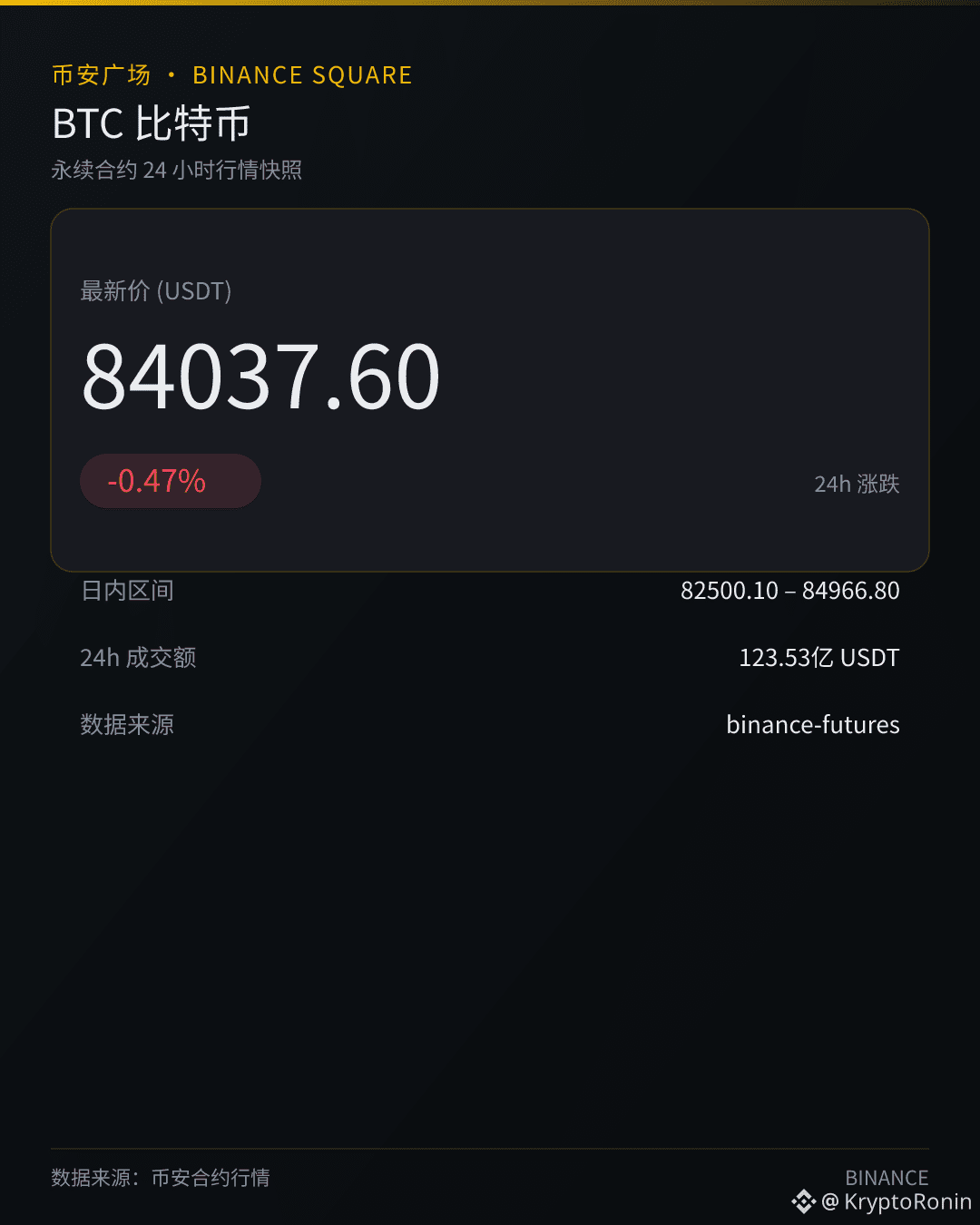
ESMA lists operational resilience, outsourcing, and sufficient EU-based operations as top priorities for crypto regulation in 2027, and also expects its MIDAS crypto market monitoring system to be fully operational in Phase 1 in 2027. After the news, $BTC moved from 82917.1 to 84037.6; since the announcement, it has risen 1.38%. In the past hour, trading value was 1.93 times the 24-hour average; the buy-sell ratio for active trading was 1.345; and open positions increased by 0.94% over the past hour.
Largely bullish. The tightening of the regulatory framework is a prerequisite for compliant capital to enter. The fact that the order book’s active buy demand and open positions are strengthening in sync does not contradict this direction. If the price falls back near 82500.1 and the active buy-sell ratio drops to below 1, this view would no longer hold.
#ESMA #MiCA
The EU’s crypto regulation shifts from legislation to enforcement, and this time it’s focused on 2027.
ESMA lists operational resilience, outsourcing, and sufficient EU-based operations as top priorities for crypto regulation in 2027, and also expects its MIDAS crypto market monitoring system to be fully operational in Phase 1 in 2027. After the news, $BTC moved from 82917.1 to 84037.6; since the announcement, it has risen 1.38%. In the past hour, trading value was 1.93 times the 24-hour average; the buy-sell ratio for active trading was 1.345; and open positions increased by 0.94% over the past hour.
Largely bullish. The tightening of the regulatory framework is a prerequisite for compliant capital to enter. The fact that the order book’s active buy demand and open positions are strengthening in sync does not contradict this direction. If the price falls back near 82500.1 and the active buy-sell ratio drops to below 1, this view would no longer hold.
The EU’s crypto regulation shifts from legislation to enforcement, and this time it’s focused on 2027.
ESMA lists operational resilience, outsourcing, and sufficient EU-based operations as top priorities for crypto regulation in 2027, and also expects its MIDAS crypto market monitoring system to be fully operational in Phase 1 in 2027. After the news, $BTC moved from 82917.1 to 84037.6; since the announcement, it has risen 1.38%. In the past hour, trading value was 1.93 times the 24-hour average; the buy-sell ratio for active trading was 1.345; and open positions increased by 0.94% over the past hour.
Largely bullish. The tightening of the regulatory framework is a prerequisite for compliant capital to enter. The fact that the order book’s active buy demand and open positions are strengthening in sync does not contradict this direction. If the price falls back near 82500.1 and the active buy-sell ratio drops to below 1, this view would no longer hold.
150
Log in to explore more content
Join global crypto users on Binance Square
⚡️ Get latest and useful information about crypto.
💬 Trusted by the world’s largest crypto exchange.
👍 Discover real insights from verified creators.
Email / Phone number
Trending Topics
1
#NFPWatch
10.7M views
18,980 Discussing
2
#BitcoinFundingRateTriplesTo10%
110,051 views
978 Discussing
3
#BitcoinSurpasses$86KUp2.99%
32,766 views
95 Discussing
4
#ZcashFalls21%FromSeptemberPeak
65,391 views
747 Discussing
5
#USSeptemberPayrollsAdd29KUnemploymentRises4.2%
54,444 views
445 Discussing
6
#XRPPostsFirstThreeGreenMonthsInQ3
43,418 views
628 Discussing
7
#BNBChainTokenizedStocksTop$1BAt30%Share
18,895 views
32 Discussing
8
#BitcoinRisesToward$85K
100,486 views
144 Discussing
9
#AmazonPlansToSell$8BNvidiaChips
7,313 views
87 Discussing
10
#NEARFallsToAround$4.70Down14%
46,475 views
114 Discussing