
#chainflipvaultthefthaltsprotocol
chainflipvaultthefthaltsprotocol
Hot
Latest

·
--
#chainflipvaultthefthaltsprotocol
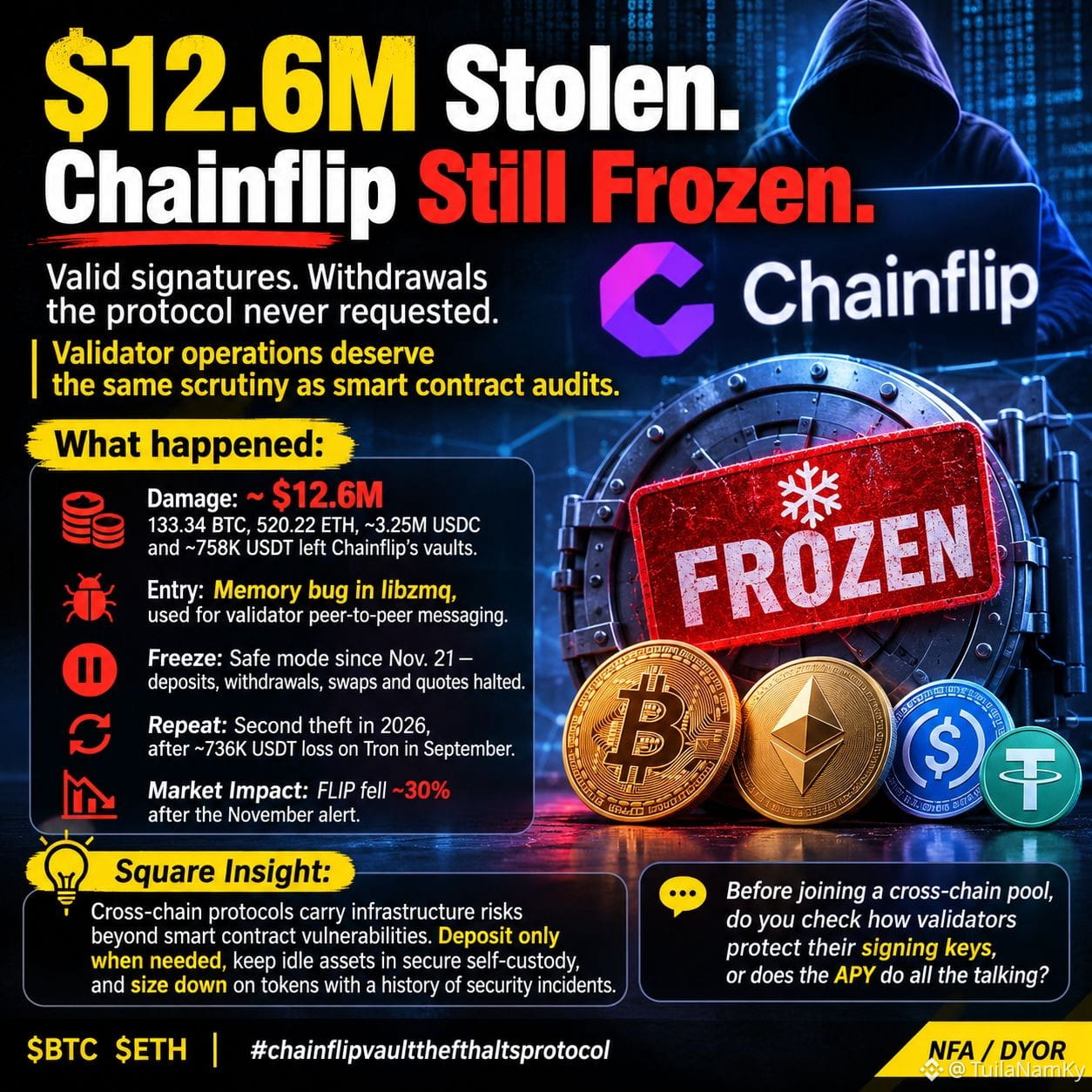
$12.6M Stolen. Chainflip Still Frozen.
Valid signatures. Withdrawals the protocol never requested. Validator operations deserve the same scrutiny as smart contract audits.
📊 What happened:
Damage: On Nov. 21, 133.34 BTC, 520.22 ETH, ~3.25M USDC and ~758K USDT left Chainflip's vaults. Estimated losses reached ~$12.6M, according to its incident report. The initial $4.86M headline covered only Ethereum, while 122.86 BTC was the first reported Bitcoin loss.
Entry: Chainflip traced the attack to a memory bug in libzmq, used for validator peer-to-peer messaging. The attacker executed code inside validator processes, copied enough key shares and signed transactions off-network. Chainflip said its vault contracts, threshold-signature system and State Chain logic were not responsible.
Freeze: Safe mode halted deposits, withdrawals, swaps and quotes, leaving LPs unable to withdraw. As of Nov. 27, the protocol remained paused. A recovery fund is planned for affected users and LPs, but a plan isn't a payout.
Repeat: This was Chainflip's second theft in 2026, following the loss of ~736K USDT from its Tron vault in September. FLIP fell roughly 30% after the November alert, adding market-confidence concerns to the security damage.
🧠 Square Insight:
Cross-chain protocols carry infrastructure risks beyond smart contract vulnerabilities. Deposit only when needed, keep idle assets in secure self-custody, and size down on tokens with a history of security incidents.
💬 Before joining a cross-chain pool, do you check how validators protect their signing keys, or does the APY do all the talking?
$BTC
{future}(BTCUSDT)
$ETH
{future}(ETHUSDT)
NFA / DYOR
#chainflipvaultthefthaltsprotocol
$12.6M Stolen. Chainflip Still Frozen.
Valid signatures. Withdrawals the protocol never requested. Validator operations deserve the same scrutiny as smart contract audits.
📊 What happened:
Damage: On Nov. 21, 133.34 BTC, 520.22 ETH, ~3.25M USDC and ~758K USDT left Chainflip's vaults. Estimated losses reached ~$12.6M, according to its incident report. The initial $4.86M headline covered only Ethereum, while 122.86 BTC was the first reported Bitcoin loss.
Entry: Chainflip traced the attack to a memory bug in libzmq, used for validator peer-to-peer messaging. The attacker executed code inside validator processes, copied enough key shares and signed transactions off-network. Chainflip said its vault contracts, threshold-signature system and State Chain logic were not responsible.
Freeze: Safe mode halted deposits, withdrawals, swaps and quotes, leaving LPs unable to withdraw. As of Nov. 27, the protocol remained paused. A recovery fund is planned for affected users and LPs, but a plan isn't a payout.
Repeat: This was Chainflip's second theft in 2026, following the loss of ~736K USDT from its Tron vault in September. FLIP fell roughly 30% after the November alert, adding market-confidence concerns to the security damage.
🧠 Square Insight:
Cross-chain protocols carry infrastructure risks beyond smart contract vulnerabilities. Deposit only when needed, keep idle assets in secure self-custody, and size down on tokens with a history of security incidents.
💬 Before joining a cross-chain pool, do you check how validators protect their signing keys, or does the APY do all the talking?
$BTC
$ETH
NFA / DYOR
幂达:
The repeat is what worries me most — a second theft in 2026, this time through a memory bug in libzmq rather than the vault contracts, means the weak point is validator infrastructure, not the on-chain logic. For LPs the practical question is also the freeze itself: deposits and withdrawals halted since Nov. 21, and a recovery fund that is only planned, not funded, leaves them exposed twice over.
2
3
1.2k

·
--
#chainflipvaultthefthaltsprotocol 🚨 $12.6 MILLION CHAINFLIP EXPLOIT — CROSS-CHAIN SECURITY FACES A MAJOR TEST! 🔥
A serious security incident has put Chainflip under pressure after approximately $12.6 million was reportedly drained from its BTC and ETH vaults on November 21.
The protocol remains in Safe Mode as the team works to address the incident.
📊 WHAT HAPPENED?
🔴 $12.6M Lost: BTC and ETH vaults were reportedly exploited.
🔴 Validator Compromise: Validator key shares were allegedly compromised through a vulnerability in a third-party networking library.
🔴 Services Paused: Swaps, deposits and withdrawals remain suspended.
🔴 Bounty Deadline: The reported 10% bounty deadline passed without funds being returned.
🔴 FLIP Under Pressure: The token suffered a sharp decline following the incident.
⚠️ IMPORTANT WARNING FOR TRADERS
Cross-chain protocols introduce additional security challenges involving validators, private-key management, signing systems and bridge infrastructure.
Protect your capital:
Avoid unnecessary exposure to compromised protocols.
Verify updates through official channels.
Never trust fake recovery or refund links.
Don't invest based on panic or recovery promises.
💡 MY TAKE:
This incident highlights an important reality: decentralization does not automatically mean complete security.
Cross-chain technology has enormous potential, but trust, transparency and stronger security infrastructure are essential for long-term adoption.
The next big challenge for crypto isn't just connecting blockchains — it's making those connections safer.
👇 YOUR OPINION MATTERS:
Are you still comfortable using cross-chain swap protocols, or would you rather stick with native Layer-1 wallets?
Share your thoughts below!
Follow for more crypto security updates, breaking news and market insights.
#Chainflip #FLIP #CryptoSecurity #Bitcoin
CLICK TO BELOW TRADE👇
$CFG $BTC $ETH
{future}(ETHUSDT)
{future}(BTCUSDT)
{future}(CFGUSDT)
#chainflipvaultthefthaltsprotocol 🚨 $12.6 MILLION CHAINFLIP EXPLOIT — CROSS-CHAIN SECURITY FACES A MAJOR TEST! 🔥
A serious security incident has put Chainflip under pressure after approximately $12.6 million was reportedly drained from its BTC and ETH vaults on November 21.
The protocol remains in Safe Mode as the team works to address the incident.
📊 WHAT HAPPENED?
🔴 $12.6M Lost: BTC and ETH vaults were reportedly exploited.
🔴 Validator Compromise: Validator key shares were allegedly compromised through a vulnerability in a third-party networking library.
🔴 Services Paused: Swaps, deposits and withdrawals remain suspended.
🔴 Bounty Deadline: The reported 10% bounty deadline passed without funds being returned.
🔴 FLIP Under Pressure: The token suffered a sharp decline following the incident.
⚠️ IMPORTANT WARNING FOR TRADERS
Cross-chain protocols introduce additional security challenges involving validators, private-key management, signing systems and bridge infrastructure.
Protect your capital:
Avoid unnecessary exposure to compromised protocols.
Verify updates through official channels.
Never trust fake recovery or refund links.
Don't invest based on panic or recovery promises.
💡 MY TAKE:
This incident highlights an important reality: decentralization does not automatically mean complete security.
Cross-chain technology has enormous potential, but trust, transparency and stronger security infrastructure are essential for long-term adoption.
The next big challenge for crypto isn't just connecting blockchains — it's making those connections safer.
👇 YOUR OPINION MATTERS:
Are you still comfortable using cross-chain swap protocols, or would you rather stick with native Layer-1 wallets?
Share your thoughts below!
Follow for more crypto security updates, breaking news and market insights.
#Chainflip #FLIP #CryptoSecurity #Bitcoin
CLICK TO BELOW TRADE👇
$CFG $BTC $ETH

2
2.8k

·
--
Bearish
#chainflipvaultthefthaltsprotocol
CHAINFLIP HALTS ITS PROTOCOL AFTER A $12.6 MILLION VAULT EXPLOIT! 🚨
Chainflip has suffered a major security incident after an attacker drained its Bitcoin and Ethereum vaults on November 21, stealing approximately $12.6 million in crypto assets.
The stolen funds included more than 133 BTC, 520 ETH, millions of dollars in USDC, and additional USDT. The attack forced Chainflip to pause swaps, deposits, and withdrawals while its team investigated the breach.
In its latest update, Chainflip confirmed that the losses have been fully accounted for and that the security team has identified the likely attack method. The exploit involved a vulnerability in validator networking software that allowed the attacker to extract key shares and authorize transactions outside the protocol.
The network remains paused until security reviews and recovery measures are completed. Chainflip is also working with liquidity providers and exploring a recovery plan for affected users.
This incident is a serious reminder: even established DeFi protocols can face unexpected security risks.
#Chainflip #defi #CryptoSecurity

2
1.5k

🚨 Chainflip Halted After $12.6M Vault Exploit — Trader Breakdown
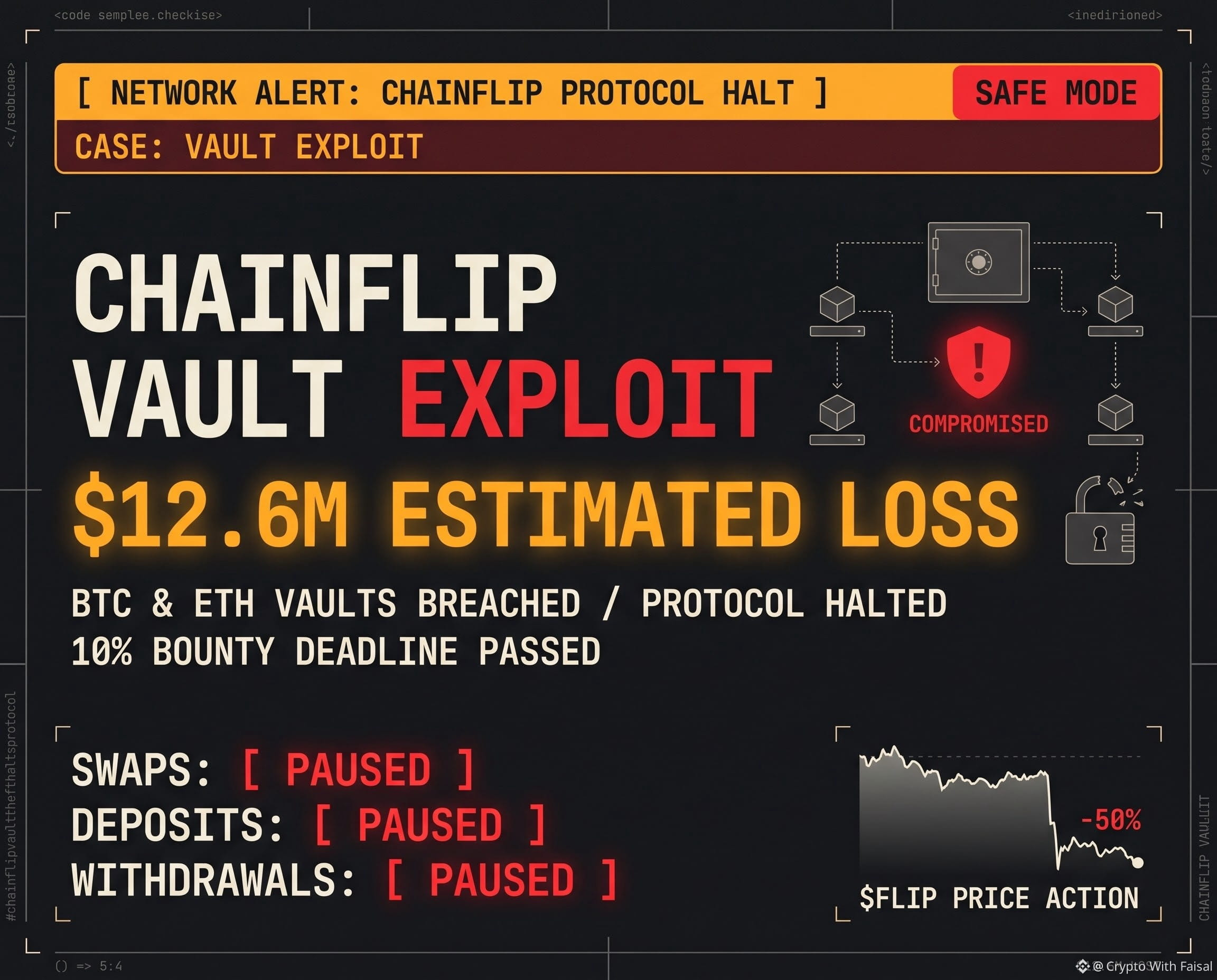
Cross-chain protocol Chainflip remains frozen in Safe Mode after an attacker compromised validator key shares and drained ~$12.6M from its BTC and ETH vaults on Nov 21.
📊 Key Facts:
• Total Loss: 133.34 BTC, 520.22 ETH, 3.25M USDC, and 758K USDT (stables swapped to ETH and routed via Tornado Cash).
• How It Happened: A rogue validator exploited a third-party networking library flaw to forge valid vault signatures outside the network.
• Latest Update: Swaps, deposits, and withdrawals stay paused. The 10% bounty deadline passed with no funds returned. Chainflip is now integrating SwapKit to reroute new trades while a user payout plan remains pending.
• Price Action: FLIP dumped nearly 50% following the breach.
⚠️ Trader Risk Note:
Cross-chain vaults concentrate signing risk. Never park idle funds on bridges, and ignore fake "Chainflip refund" phishing links.
Are you still using cross-chain swap protocols, or sticking to native L1 wallets? Share your view below 👇
$BTC $ETH $CFG
{future}(CFGUSDT)
{future}(BTCUSDT)
{future}(ETHUSDT)
#chainflipvaultthefthaltsprotocol #CryptoSecurity #Chainflip
🚨 Chainflip Halted After $12.6M Vault Exploit — Trader Breakdown
Cross-chain protocol Chainflip remains frozen in Safe Mode after an attacker compromised validator key shares and drained ~$12.6M from its BTC and ETH vaults on Nov 21.
📊 Key Facts:
• Total Loss: 133.34 BTC, 520.22 ETH, 3.25M USDC, and 758K USDT (stables swapped to ETH and routed via Tornado Cash).
• How It Happened: A rogue validator exploited a third-party networking library flaw to forge valid vault signatures outside the network.
• Latest Update: Swaps, deposits, and withdrawals stay paused. The 10% bounty deadline passed with no funds returned. Chainflip is now integrating SwapKit to reroute new trades while a user payout plan remains pending.
• Price Action: FLIP dumped nearly 50% following the breach.
⚠️ Trader Risk Note:
Cross-chain vaults concentrate signing risk. Never park idle funds on bridges, and ignore fake "Chainflip refund" phishing links.
Are you still using cross-chain swap protocols, or sticking to native L1 wallets? Share your view below 👇
$BTC $ETH $CFG
#chainflipvaultthefthaltsprotocol #CryptoSecurity #Chainflip
ابو نبراس اليمني:
المنصة والمشرفين والعاملون أصبحوا نصالبين وسرق ومجرمون باحتراف لأخذ أموالكم فاياكم إضافة أموال بل انسحبوا وسحبوا أموالكم متى ما اتيحت لكم الفرصة بسحب فورا
2
2
866

·
--
Bearish
#ChainflipVaultTheftHaltsProtocol
🚨 Cross-chain swap protocol Chainflip halted deposits, withdrawals, and swaps after an attacker drained its Bitcoin and Ethereum vaults using compromised validator key shares on November 21, 2026. The team has since patched validator software, rotated signing keys, and rerouted new trades through SwapKit while keeping the protocol paused pending security audits and a user recovery plan.$BTC
{spot}(BTCUSDT)
Source: Chainflip official incident reports and security disclosures. Readers should check official Chainflip channels before relying on any summary or interacting with protocol links.
What are your thoughts? Please like and follow
Disclaimer: Not financial or legal advice.
#LearnWithLedgerLumina
#Chainflip #DeFiSecurity
#ChainflipVaultTheftHaltsProtocol
🚨 Cross-chain swap protocol Chainflip halted deposits, withdrawals, and swaps after an attacker drained its Bitcoin and Ethereum vaults using compromised validator key shares on November 21, 2026. The team has since patched validator software, rotated signing keys, and rerouted new trades through SwapKit while keeping the protocol paused pending security audits and a user recovery plan.$BTC
Source: Chainflip official incident reports and security disclosures. Readers should check official Chainflip channels before relying on any summary or interacting with protocol links.
What are your thoughts? Please like and follow
Disclaimer: Not financial or legal advice.
#LearnWithLedgerLumina
#Chainflip #DeFiSecurity

1
20

·
--
#ChainflipVaultTheftHaltsProtocol
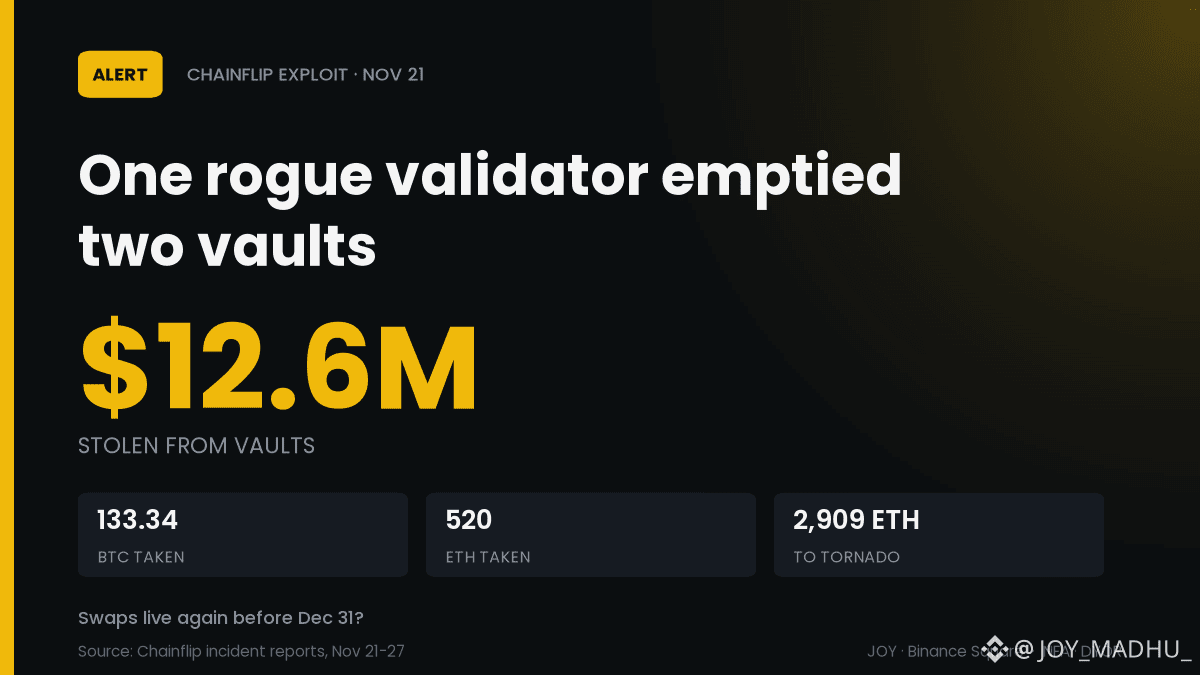
🧩 One Rogue Validator, $12.6M Gone, Every Swap Frozen
Chainflip says an attacker forged vault signatures off-network, and the protocol is still paused.
📊 133.34 BTC, 520 ETH and $4M in USDC/USDT taken on Nov 21
⚠️ Entry: a minimum-stake validator plus a libzmq use-after-free flaw
📉 2,909 ETH was pushed into Tornado Cash within minutes
🏦 Every validator online at the time is being replaced on new machines
Watch next: a proposed validator whitelist trades some openness for safety.
Chainflip swaps live again before Dec 31, or later? 👇
$BTC $ETH
#ChainflipVaultTheftHaltsProtocol #CryptoSecurity #DeFi
17

#ChainflipVaultTheftHaltsProtocol
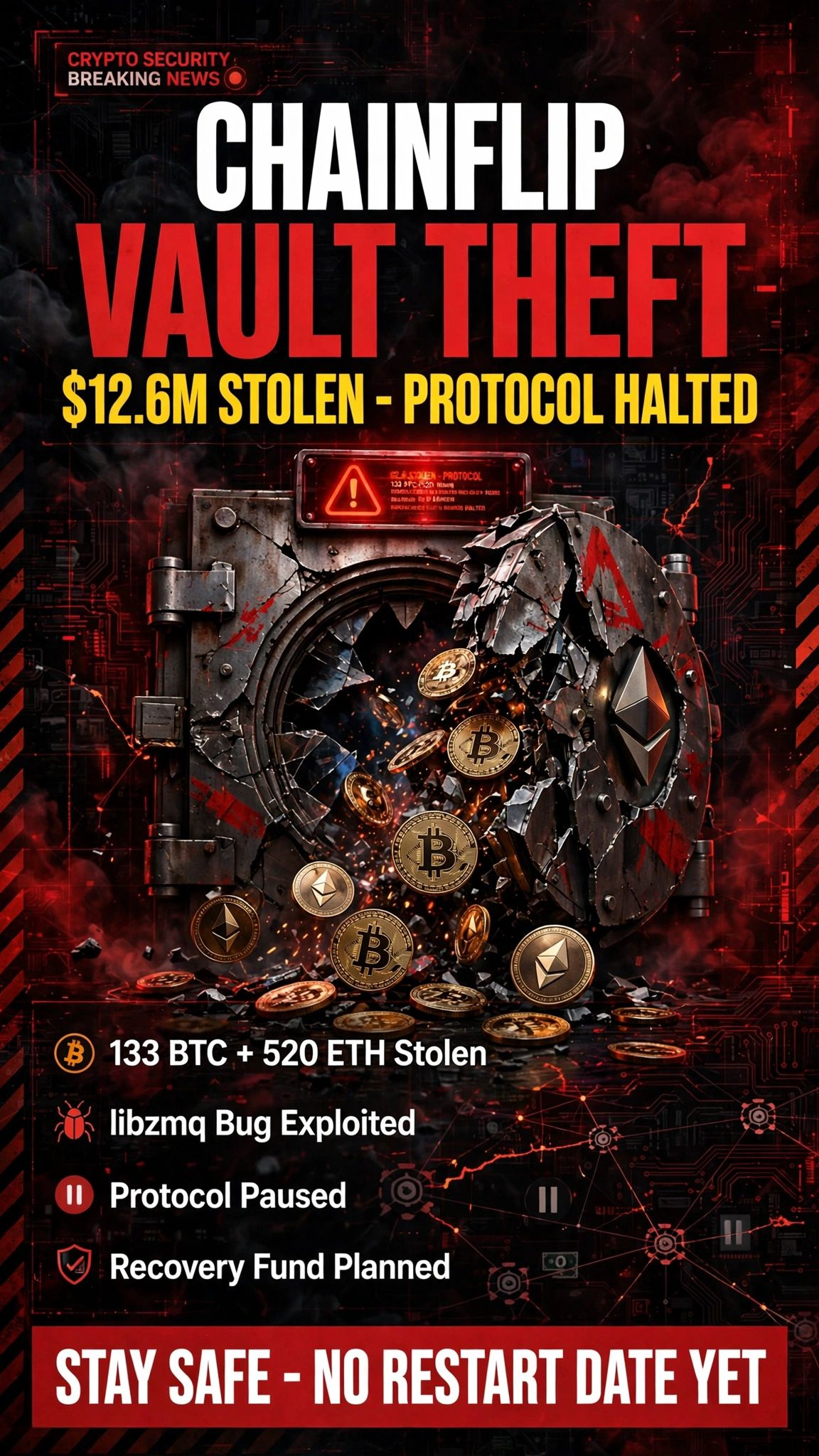
Chainflip Protocol has been halted due to a significant exploit that occurred on November 21.
An attacker took advantage of a use-after-free bug in libzmq, a messaging library used by validators for communication.
They created a validator account with 20,500 $FLIP, executed code on validator machines, and obtained enough vault key shares to authorize transactions without the network's approval.
The smart contracts themselves were not compromised; the issue was with the validator software. The stolen assets include: - 133.34 $BTC - 520.22 $ETH - $3.25M $USDC - $758,141 $USDT Totaling approximately $12.6M.
The stolen Bitcoin has not yet been moved, while the Ethereum was sent to Tornado Cash.
Current updates include: - The protocol remains paused, with no announced restart date.
All validators are in the process of rebuilding on new hardware and upgrading to libzmq 4.3.4. - Loss accounting has been completed.
A recovery fund managed by the protocol is in the planning stages.
The 10% bounty offer has expired and was bypassed by the attacker.
The swap site will temporarily use SwapKit.
Users are advised to: - Refrain from making deposits to Chainflip at this time.
Check their refund wallets for unaffected chains.
Be cautious of fake recovery or refund scams, as no official links will be provided in direct messages.
Liquidity providers should await an official recovery proposal.
This incident serves as a reminder that even decentralized protocols can be affected by vulnerabilities in third-party components.
#ChainflipLoses12Million #CryptoHacking
#Web3支付 #BTC☀
73

#ChainflipVaultTheftHaltsProtocol
Chainflip Hit by $12.6 Million Vault Exploit! 🚨
A major security breach has forced Chainflip ($FLIP) to halt its protocol after hackers stole approximately $12.6 million in crypto assets from its Bitcoin and Ethereum vaults.
The stolen funds included BTC, ETH, USDC and USDT.
The investigation revealed that attackers exploited a vulnerability in the validator communication software to gain access to vault key shares.
As of November 28, the protocol remains paused while security upgrades and recovery plans are underway.
This incident raises serious questions about DeFi security and investor confidence.
I'm watching how the team handles recovery and whether $FLIP can regain market trust.
Security comes first. Never ignore the risks. ⚠️
#Chainflip #FLIP #CryptoSecurity #DeFi #CryptoNews
Sources: Chainflip +1
Title: Chainflip's $12.6M Hack: Can FLIP Recover?

1
91


·
--
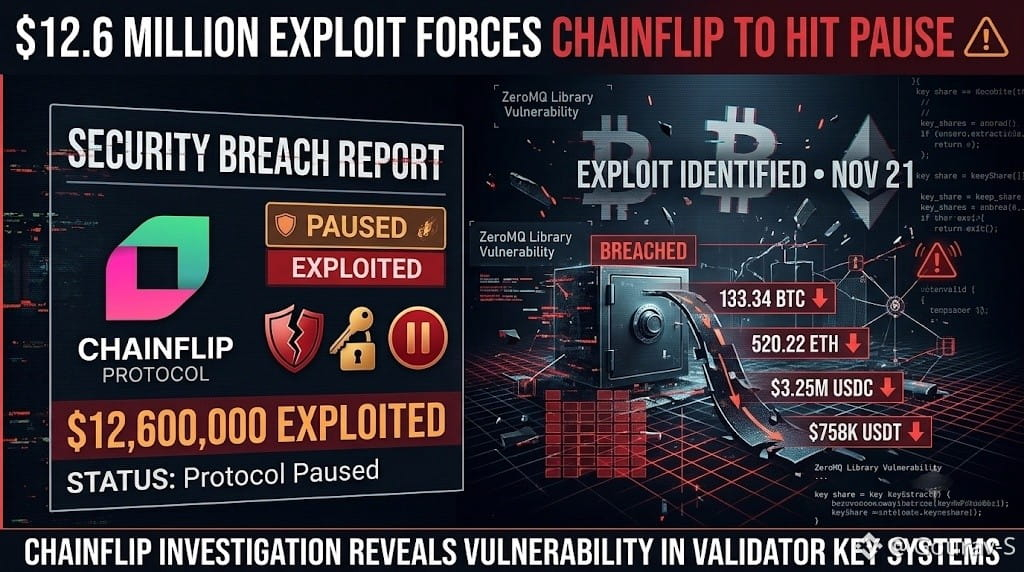
$12.6 Million Exploit Forces Chainflip to Hit Pause ⚠️
Chainflip suffered a major security breach on November 21, with attackers draining approximately $12.6 million from its Bitcoin and Ethereum vaults.
The stolen assets included 133.34 BTC, 520.22 ETH, $3.25 million in USDC and around $758,000 in USDT.
According to Chainflip’s November 27 investigation update, attackers exploited a vulnerability in the ZeroMQ networking library used by validators to extract key shares and authorize unauthorized transactions.
The protocol remains paused while security improvements are underway.
Personally, this incident highlights a critical weakness in cross-chain infrastructure: even strong vault designs depend on the security of the systems managing their keys.
In DeFi, security is not just about protecting smart contracts; the entire infrastructure must be trusted and tested.
#ChainflipVaultTheftHaltsProtocol
{spot}(ETHUSDT)
{spot}(BTCUSDT)
{spot}(USDCUSDT)
$12.6 Million Exploit Forces Chainflip to Hit Pause ⚠️
Chainflip suffered a major security breach on November 21, with attackers draining approximately $12.6 million from its Bitcoin and Ethereum vaults.
The stolen assets included 133.34 BTC, 520.22 ETH, $3.25 million in USDC and around $758,000 in USDT.
According to Chainflip’s November 27 investigation update, attackers exploited a vulnerability in the ZeroMQ networking library used by validators to extract key shares and authorize unauthorized transactions.
The protocol remains paused while security improvements are underway.
Personally, this incident highlights a critical weakness in cross-chain infrastructure: even strong vault designs depend on the security of the systems managing their keys.
In DeFi, security is not just about protecting smart contracts; the entire infrastructure must be trusted and tested.
#ChainflipVaultTheftHaltsProtocol
2
129

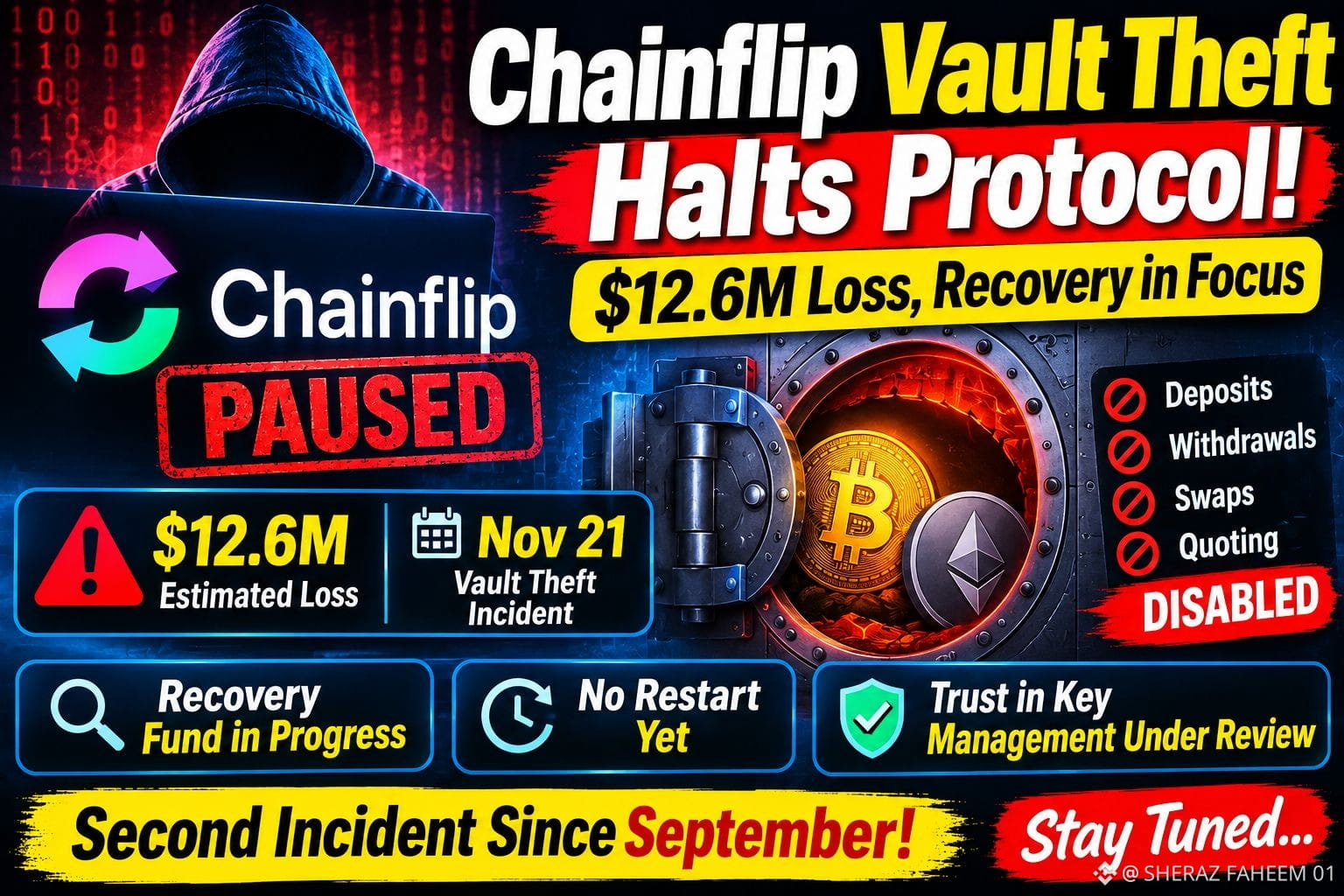
#ChainflipVaultTheftHaltsProtocol Chainflip remains paused a week after a vault theft now estimated at about $12.6 million, and the latest updates are about recovery rather than a restart.
The incident began on November 21, when 122.86 BTC left the Bitcoin vault and the Ethereum vault was emptied 30 minutes later. The protocol then entered full safe mode, disabling deposits, withdrawals, swaps and quoting.
Chainflip says the attacker registered a minimum-stake validator account, exploited a libzmq library flaw and extracted key shares to sign withdrawals outside the network. It reports no flaw in the vault contracts, signature scheme or State Chain logic.
The 10% bounty offer expired on November 23 with no funds returned. Chainflip has finished its loss accounting and is setting up a recovery fund, but no compensation has been paid. New trades may be routed through SwapKit while the native protocol stays paused.
Next, watch for a payout schedule, a reopening timeline and any movement of the stolen funds. This is the second incident since September, so trust in key management remains under review.
Not financial advice.
#ChainflipVaultTheftHaltsProtocol
The post is about 200 words. Your hashtag was cut off, so I read it as "HaltsProtocol". The newest reports are from today, but none were timestamped to the last hour, so the post covers the latest status. Early reports put the loss at $4.86 million, then $12 million, and the most recent say $12.6 million. If a fresher update comes in before you publish, send it and I'll adjust.
$PORTAL
{future}(PORTALUSDT)
$WLFI
{future}(WLFIUSDT)
$EVAA
{future}(EVAAUSDT)
#ChainflipVaultTheftHaltsProtocol Chainflip remains paused a week after a vault theft now estimated at about $12.6 million, and the latest updates are about recovery rather than a restart.
The incident began on November 21, when 122.86 BTC left the Bitcoin vault and the Ethereum vault was emptied 30 minutes later. The protocol then entered full safe mode, disabling deposits, withdrawals, swaps and quoting.
Chainflip says the attacker registered a minimum-stake validator account, exploited a libzmq library flaw and extracted key shares to sign withdrawals outside the network. It reports no flaw in the vault contracts, signature scheme or State Chain logic.
The 10% bounty offer expired on November 23 with no funds returned. Chainflip has finished its loss accounting and is setting up a recovery fund, but no compensation has been paid. New trades may be routed through SwapKit while the native protocol stays paused.
Next, watch for a payout schedule, a reopening timeline and any movement of the stolen funds. This is the second incident since September, so trust in key management remains under review.
Not financial advice.
#ChainflipVaultTheftHaltsProtocol
The post is about 200 words. Your hashtag was cut off, so I read it as "HaltsProtocol". The newest reports are from today, but none were timestamped to the last hour, so the post covers the latest status. Early reports put the loss at $4.86 million, then $12 million, and the most recent say $12.6 million. If a fresher update comes in before you publish, send it and I'll adjust.
$PORTAL
$WLFI
$EVAA
1
672
#ChainflipVaultTheftHaltsProtocol
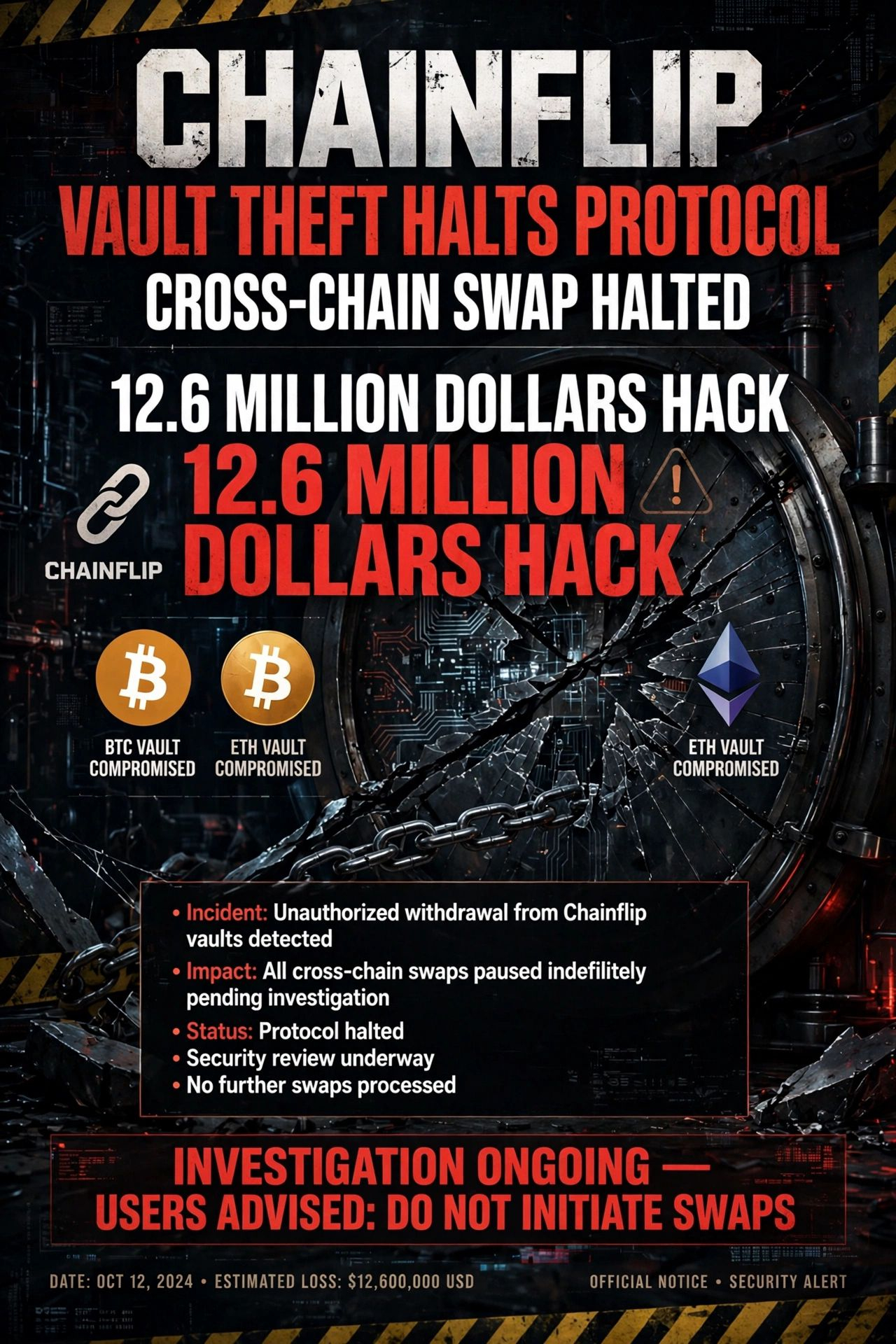
🚨 CHAINFLIP HACKED! $12.6M GONE — PROTOCOL HALTED!
→ Hack: 21 Nov 2026
→ Loss: $12.6M — 133 BTC + 520 ETH + $3.25M USDC + $758K USDT
→ Cause: libzmq bug — Hacker ran code on validators, stole key shares
→ Bypassed 100-of-150 approval rule!
→ BTC: Still NOT moved
→ ETH: Sent to Tornado Cash
→ Bounty: 10% offer EXPIRED — Hacker ignored!
→ Status: STILL PAUSED — No restart date
→ Validators rebuilding on NEW hardware
→ Recovery Fund planned
→ FLIP: ~$0.19 — CRASHED!
⚠️ Do NOT start new Chainflip swaps!
Can Chainflip recover? 👇
SAFE 🌉 or BROKEN 💔 ?
#Chainflip #FLIP #CryptoHack #defi
$BTC $ETH
89

🚨 CHAINFLIP HACKED FOR $12.6M. THE WHOLE PROTOCOL IS STILL FROZEN 👀
On November 21, someone emptied Chainflip’s Bitcoin and Ethereum vaults. Around $12.6M gone. The team put everything in safe mode: no deposits, no withdrawals, no swaps.
#ChainflipVaultTheftHaltsProtocol
How? Not a smart contract bug. The attacker got into the validators’ machines through a bug in a messaging tool, stole pieces of the signing key and created “valid” signatures. The vault thought the withdrawals were legit.
Now new trades will go through SwapKit while Chainflip stays paused. A recovery fund is planned, but there’s no payout plan yet.
Lesson: cross-chain bridges are still the weakest spot in crypto. Don’t park money there longer than you have to.
Would you trust it when it comes back? DYOR!

1
115

·
--
#ChainflipVaultTheftHaltsProtocol
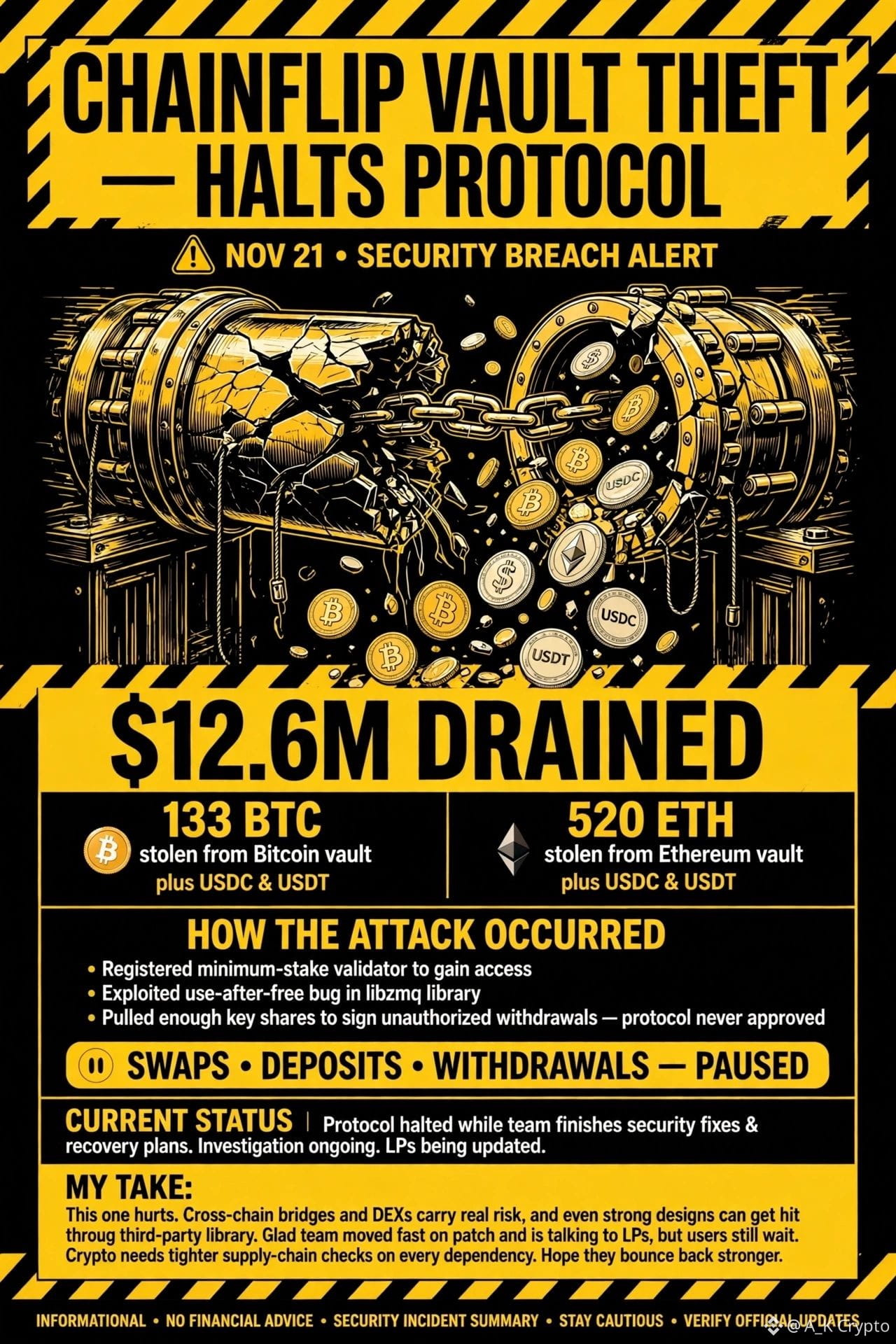
On Nov 21, an attacker drained roughly $12.6M from Chainflip’s Bitcoin and Ethereum vaults — over 133 $BTC plus 520 $ETH , $USDC and USDT.
They registered a minimum-stake validator, exploited a use-after-free bug in the libzmq library, pulled enough key shares, and signed withdrawals the protocol never approved.
Swaps, deposits and withdrawals remain paused while the team finishes security fixes and recovery plans.
This one hurts. Cross-chain bridges and DEXs carry real risk, and even strong designs can get hit through a third-party library. Glad the team moved fast on the patch and is talking to LPs, but users still wait. Crypto needs tighter supply-chain checks on every dependency. Hope they bounce back stronger.
#Chainflip #CryptoHack #DeFi #CrossChain
{spot}(BTCUSDT)
{spot}(ETHUSDT)
{spot}(USDCUSDT)
#ChainflipVaultTheftHaltsProtocol
On Nov 21, an attacker drained roughly $12.6M from Chainflip’s Bitcoin and Ethereum vaults — over 133 $BTC plus 520 $ETH , $USDC and USDT.
They registered a minimum-stake validator, exploited a use-after-free bug in the libzmq library, pulled enough key shares, and signed withdrawals the protocol never approved.
Swaps, deposits and withdrawals remain paused while the team finishes security fixes and recovery plans.
This one hurts. Cross-chain bridges and DEXs carry real risk, and even strong designs can get hit through a third-party library. Glad the team moved fast on the patch and is talking to LPs, but users still wait. Crypto needs tighter supply-chain checks on every dependency. Hope they bounce back stronger.
#Chainflip #CryptoHack #DeFi #CrossChain
107

·
--
If you're still parking size in a native vault because the whitepaper called it safer than wrapped, stop now.
You do not get rugged on the way in. You get trapped on the way out. A halt means no swaps, no exits, and a position that just sits while everything else keeps moving.
Chainflip pausing the protocol after a vault theft is a rerun we have all seen. Wormhole. Ronin. Multichain. Native asset design, a vault that was not supposed to fail, then a freeze.
$FLIP liquidity evaporates. Meanwhile $BTC and $ETH trade straight through extreme fear like the incident never happened. When the protocol built to move native coins goes dark, those coins do not move. They wait.
We spent years arguing native was the upgrade over wrapped tokens. Then one compromised vault and the whole system has to halt so the loss does not spread. Competing venues keep running. The people who believed the pitch are the ones staring at a paused interface.
Are native vaults still the safer design, or is this just the same bridge story with better branding?
#ChainflipVaultTheftHaltsProtocol #CanMarketsReboundAfterThanksgiving

67

Why is nobody talking about the Chainflip vault theft as the latest proof that cross-chain DeFi is still one exploit away from freezing your funds?
You think you have an edge swapping $BTC into $ETH, then the vault gets hit and the whole protocol stops. Your capital is stuck while everyone else is hiding in $USDT.
This is a clean case study. Chainflip ran native vaults so users could move value between chains without wrapped tokens. The model looks elegant until someone drains the vault and the team has no choice but to halt everything. That is not a bug in one contract. It is the entire security assumption collapsing in public.
People will say this is isolated. It is not. Every cycle we watch the same pattern: new cross-chain product, TVL floods in, then a vault incident reminds everyone that these systems are still honey pots. Right now the market is already sitting in extreme fear, which is why $BTC and stables dominate the searches.
The narrative that DeFi has matured enough for serious size is getting harder to defend when a protocol has to pause itself to stop the bleeding.
Where do you think this leaves cross-chain DeFi from here?
#ChainflipVaultTheftHaltsProtocol #CanMarketsReboundAfterThanksgiving
Why is nobody talking about the Chainflip vault theft as the latest proof that cross-chain DeFi is still one exploit away from freezing your funds?
You think you have an edge swapping $BTC into $ETH , then the vault gets hit and the whole protocol stops. Your capital is stuck while everyone else is hiding in $USDT.
This is a clean case study. Chainflip ran native vaults so users could move value between chains without wrapped tokens. The model looks elegant until someone drains the vault and the team has no choice but to halt everything. That is not a bug in one contract. It is the entire security assumption collapsing in public.
People will say this is isolated. It is not. Every cycle we watch the same pattern: new cross-chain product, TVL floods in, then a vault incident reminds everyone that these systems are still honey pots. Right now the market is already sitting in extreme fear, which is why $BTC and stables dominate the searches.
The narrative that DeFi has matured enough for serious size is getting harder to defend when a protocol has to pause itself to stop the bleeding.
Where do you think this leaves cross-chain DeFi from here?
#ChainflipVaultTheftHaltsProtocol #CanMarketsReboundAfterThanksgiving
55

·
--
#ChainflipVaultTheftHaltsProtocol
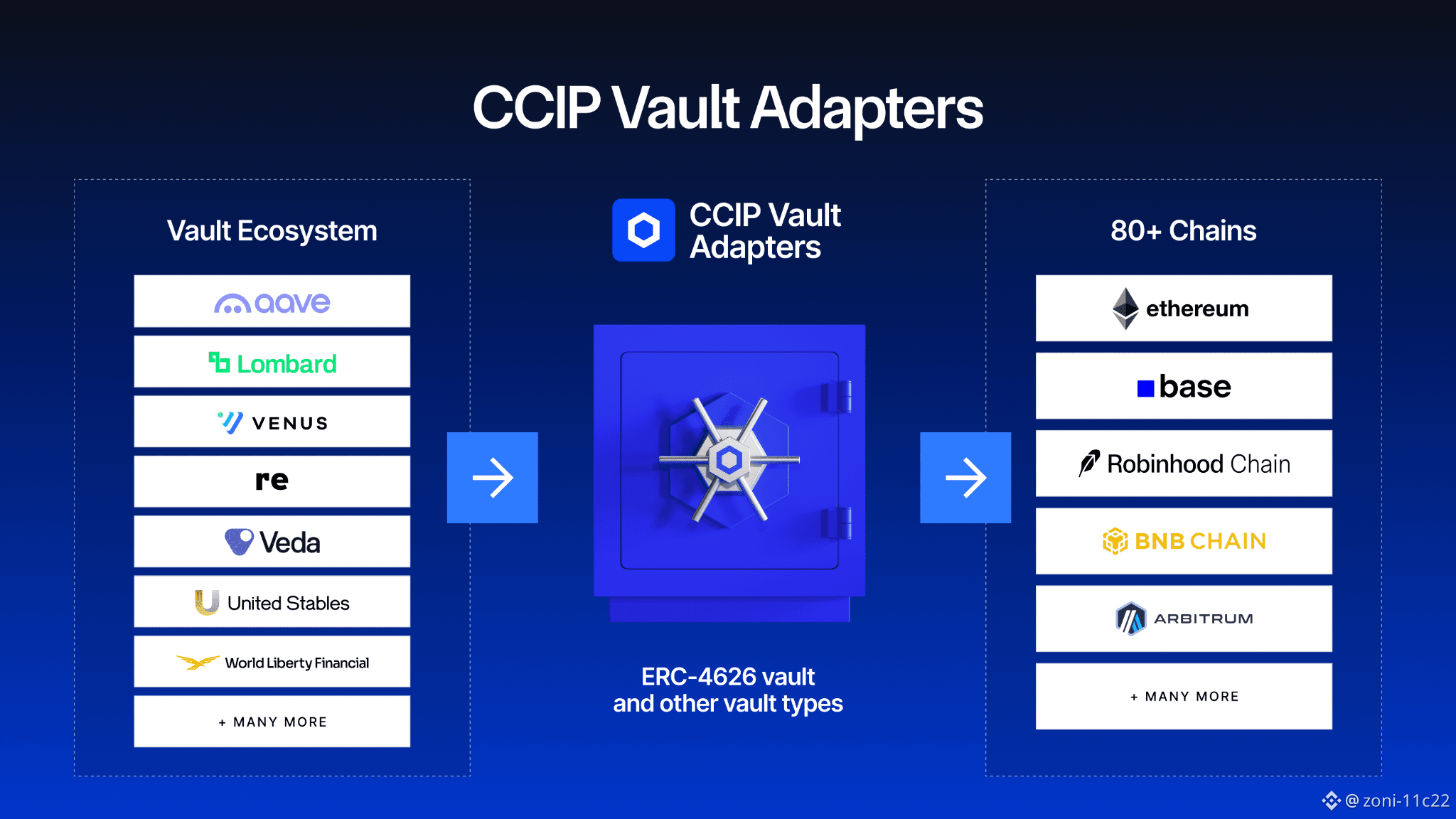
On November 21, 2026, the cross-chain swap protocol Chainflip halted all operations after an attacker stole approximately $12.6 million from its Bitcoin and Ethereum vaults. [1]
What Happened
The Breach Method. The exploit was not a smart contract bug. A day before the attack, the perpetrator registered a minimum-stake validator account. Even without joining the active validator set, registration granted peer-to-peer network access. The attacker allegedly exploited a memory-safety flaw in a third-party networking library to run code on validator machines and extract enough signing-key shares to independently authorize vault payouts.
$TRX
{future}(TRXUSDT)
$INIT
{future}(INITUSDT)
$XRP
{future}(XRPUSDT)
#ChainflipVaultTheftHaltsProtocol
On November 21, 2026, the cross-chain swap protocol Chainflip halted all operations after an attacker stole approximately $12.6 million from its Bitcoin and Ethereum vaults. [1]
What Happened
The Breach Method. The exploit was not a smart contract bug. A day before the attack, the perpetrator registered a minimum-stake validator account. Even without joining the active validator set, registration granted peer-to-peer network access. The attacker allegedly exploited a memory-safety flaw in a third-party networking library to run code on validator machines and extract enough signing-key shares to independently authorize vault payouts.
$TRX
$INIT
$XRP
122

·
--
🚨 Cross-chain swaps just took another hit as Chainflip halted operations after a ~$12.6M vault drain—and now the real recovery test begins. 🛡️⚠️
{spot}(BTCUSDT)
Honest take: Cross-chain bridges and vaults remain prime targets whenever attackers compromise signing infrastructure or validator access rather than breaking raw smart-contract math—and a second major hit within months makes rebuilding LP confidence uphill.
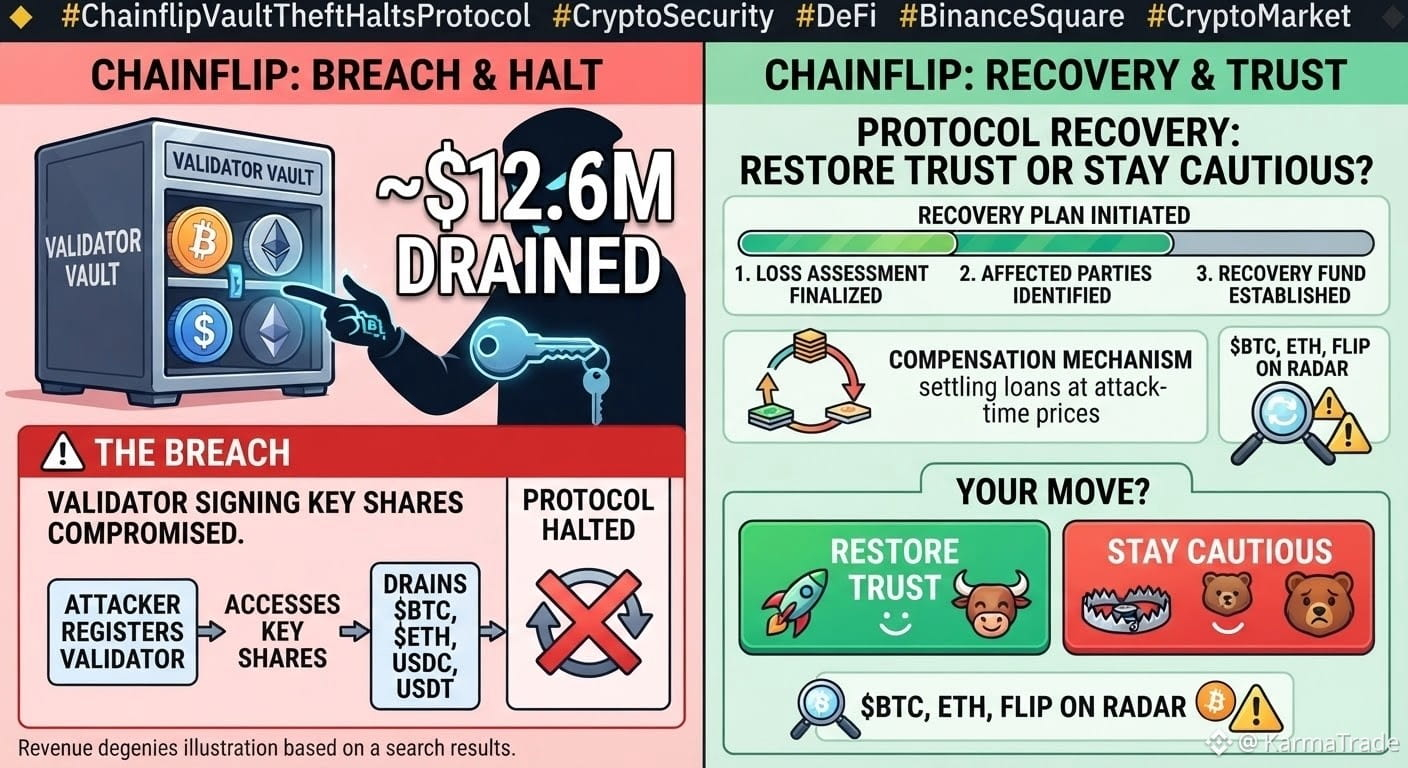
* The Breach & Halt: An attacker compromised validator signing key shares to drain roughly $12.6M across Bitcoin and Ethereum vaults (including $BTC ,$ETH , $USDC , and USDT), forcing Chainflip to pause swaps, rotate keys, and lock down the protocol.
* Recovery Update: Chainflip finalized its assessment of affected swappers, account holders, and liquidity providers—settling open loans at attack-time prices to map a recovery plan—after a 10% bounty deadline passed with funds moved via mixers and flagged addresses.
* Market Take: Keep $BTC, ETH, and FLIP on radar—security scares in thin weekend liquidity punish careless bridging, so wait for verified post-mortems and beware fake recovery links.
Does a protocol-managed recovery plan restore trust after back-to-back exploits, or do traders stay cautious on cross-chain vaults? 👇
#CryptoSecurity #DeFi #BinanceSquare #CryptoMarket
#ChainflipVaultTheftHaltsProtocol
🚨 Cross-chain swaps just took another hit as Chainflip halted operations after a ~$12.6M vault drain—and now the real recovery test begins. 🛡️⚠️
Honest take: Cross-chain bridges and vaults remain prime targets whenever attackers compromise signing infrastructure or validator access rather than breaking raw smart-contract math—and a second major hit within months makes rebuilding LP confidence uphill.
* The Breach & Halt: An attacker compromised validator signing key shares to drain roughly $12.6M across Bitcoin and Ethereum vaults (including $BTC ,$ETH , $USDC , and USDT), forcing Chainflip to pause swaps, rotate keys, and lock down the protocol.
* Recovery Update: Chainflip finalized its assessment of affected swappers, account holders, and liquidity providers—settling open loans at attack-time prices to map a recovery plan—after a 10% bounty deadline passed with funds moved via mixers and flagged addresses.
* Market Take: Keep $BTC , ETH, and FLIP on radar—security scares in thin weekend liquidity punish careless bridging, so wait for verified post-mortems and beware fake recovery links.
Does a protocol-managed recovery plan restore trust after back-to-back exploits, or do traders stay cautious on cross-chain vaults? 👇
#CryptoSecurity #DeFi #BinanceSquare #CryptoMarket
#ChainflipVaultTheftHaltsProtocol
EaglesCrypto:
ok
1
4
139

·
--
#chainflipvaultthefthaltsprotocol
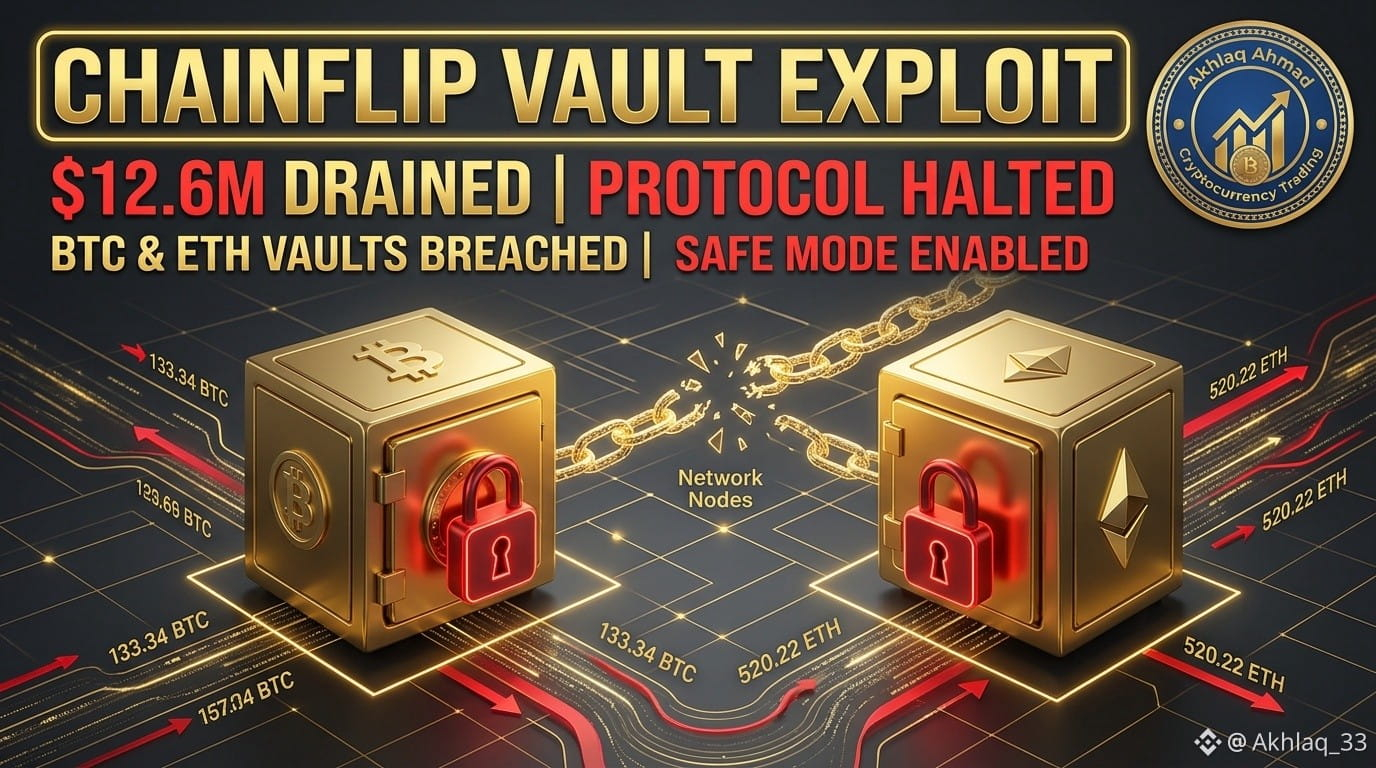
🚨 Chainflip Halted After $12.6M Vault Exploit: A Wake-Up Call for Cross-Chain Security
Cross-chain protocol Chainflip remains paused in Safe Mode after attackers compromised validator key shares on November 21 and drained roughly $12.6 million from its Bitcoin and Ethereum vaults.
Here is the full breakdown of what happened and what traders should watch:
Total Stolen: ~133.34 BTC, 520.22 ETH, $3.25M USDC, and $758K USDT (with stablecoins swapped to ETH and routed through Tornado Cash).
The Vulnerability: An attacker exploited a third-party networking library flaw (libzmq) to extract validator key shares and forge valid vault signatures outside the protocol, bypassing the 100-of-150 threshold.
Current Status: Swaps, deposits, and withdrawals remain halted with no restart date yet, while validators rebuild on new hardware and the team works on a user recovery plan.
Market & Bounty Fallout: The 10% white-hat bounty deadline expired without funds returned, and $FLIP plunged roughly 50% (to around $0.19) following the breach.
⚠️ Risk Reminder for Traders: Cross-chain vaults concentrate signing risk—never leave idle capital sitting on bridges, avoid initiating new Chainflip swaps while the network is frozen, and watch out for fake "Chainflip refund" phishing links.
Are you still comfortable using cross-chain swap protocols, or are you sticking strictly to native Layer-1 wallets? 👇
#ChainflipVaultTheftHaltsProtocol #Chainflip #CryptoSecurity #DeFi $BTC $ETH ETHFLIP
204

·
--

Article
Chainflip Hit by $12.6M Vault Exploit: Protocol Halted as Security Crisis DeepensThe cryptocurrency industry has faced another serious security incident, and this time Chainflip is at the center of attention. On November 21, 2026, the cross-chain decentralized exchange protocol suffered a major vault security breach that resulted in approximately $12.6 million worth of digital assets being stolen. The incident forced the team to suspend its main services while investigating what happened, securing the network, and figuring out how to recover from the damage.
What makes this incident particularly concerning is that the attacker did not simply exploit an ordinary user wallet. Instead, the attack targeted the infrastructure responsible for protecting and authorizing transactions from Chainflip's own vaults. This raised serious questions about the security of its validator network and the systems designed to keep users' funds safe.
According to Chainflip's investigation, the stolen assets included approximately 133.344 BTC, 520.224 ETH, 3.24 million USDC, and 758,141 USDT. At the time of the incident, the total value was estimated at around $12.6 million. These funds were held across the protocol's Bitcoin and Ethereum vaults, making the attack particularly damaging to its cross-chain operations.
The investigation suggests that the attacker may have taken advantage of a vulnerability in a third-party networking library used by Chainflip's validator software. The protocol depends on multiple validators working together to approve transactions. This system is designed to distribute responsibility rather than allow one participant to control the funds independently.
However, investigators believe that a weakness in the networking infrastructure connecting these validators may have created an opportunity for unauthorized access.
One detail that caught the team's attention was a suspicious validator account registered on November 20, just one day before the theft. Although the account never became part of the active validator set, it reportedly established peer-to-peer communication with existing validators. Chainflip suspects that a memory-safety vulnerability in the ZeroMQ networking library may have allowed unauthorized code execution on validator machines, potentially exposing sensitive cryptographic key shares.
If this explanation is confirmed, it would mean the attacker found a way around the normal transaction approval process by compromising the infrastructure responsible for protecting the keys. This is an important distinction because it shows how even advanced blockchain security systems can face serious risks when the software supporting them has weaknesses.
The attack unfolded quickly. The first major unauthorized Bitcoin transfer was detected on November 21, followed shortly afterward by transactions involving the Ethereum vault. The stolen stablecoins were then converted into ETH, and investigators reported that approximately 2,909 ETH was deposited into Tornado Cash.
Once the team realized what had happened, it had to make a difficult decision. Continuing normal operations without knowing whether the vault infrastructure was secure could have exposed even more funds. Chainflip therefore activated Safe Mode and suspended swaps, deposits, and withdrawals to contain the situation and prevent further unauthorized activity.
For users, this meant that the protocol's regular services were no longer available while the investigation continued. For liquidity providers, the situation created additional uncertainty because their funds and positions were connected to an ecosystem that had suddenly stopped operating.
Chainflip also began reviewing the financial impact across different categories of users and liquidity providers. The team worked to identify affected balances, outstanding loans, and open positions so that it could understand exactly how the incident had affected the ecosystem.
Available liquidity-provider balances on unaffected networks, including Solana, Arbitrum, Tron, BNB Chain, and Polkadot Asset Hub, were also considered for precautionary returns. However, funds committed to certain lending, strategy, and range-order positions required separate accounting.
The team did not limit its response to technical measures. It also attempted to communicate directly with the attacker by offering a 10% bounty in exchange for returning 90% of the stolen funds. The original deadline passed without a confirmed recovery of the requested assets, leaving Chainflip to continue its investigation with the help of security specialists, blockchain-tracing partners, and law enforcement.
Another important development came on November 27, when Chainflip published its second incident report. This update provided more information about the financial accounting process and the steps being considered to support affected participants.
The team confirmed that it had completed its assessment of affected users and ecosystem balances. It also discussed establishing a protocol-managed recovery fund that would create an on-chain record of affected amounts and provide a framework for future recovery efforts.
Outstanding loans were also being addressed using prices from the time of the November 21 incident. While these steps represent progress, the recovery process is not yet complete. Final compensation amounts, funding arrangements, and a confirmed payout schedule were not established in the update.
At the same time, Chainflip has been working to make sure that the same type of security problem does not happen again. The team has focused on replacing validator machines and credentials associated with the incident, updating its networking software, and introducing stronger access controls.
The ZeroMQ-related vulnerability was addressed through updated software, and Chainflip reported that its active validators were running the patched version. The team also discussed introducing a whitelist for known validator operators to strengthen control over network access.
Interestingly, the investigation did not identify the vault smart contracts, threshold-signature scheme, or State Chain logic as the source of the attack. Instead, the suspected weakness was connected to the networking infrastructure used by validators. This finding helps explain why the team is concentrating so heavily on rebuilding and securing its validator environment before considering a full return.
Chainflip is also exploring alternative ways to provide swap access through its frontend. Its work with the Crosschain Association includes integrating SwapKit and connecting users with alternative routing providers such as NEAR Intents, THORChain, and Maya Protocol. However, this arrangement should not be confused with the full restoration of Chainflip's original protocol.
The road ahead will depend on several things: completing the security investigation, restoring liquidity, establishing a credible recovery framework, and giving users and liquidity providers enough confidence to return.
The Chainflip incident is a reminder that protecting a decentralized protocol requires much more than secure smart contracts. Validator machines, networking software, cryptographic key management, and internal monitoring all play an important role. A weakness in just one of these areas can create consequences for an entire ecosystem.
With approximately $12.6 million stolen and its main services suspended, Chainflip now faces an important moment in its development. The November 27 update brought some positive progress, particularly around financial accounting and security improvements, but several major recovery questions remain unanswered.
Ultimately, the challenge for Chainflip is bigger than simply bringing its platform back online. It needs to demonstrate that its security infrastructure has been strengthened, that affected participants have a credible path toward recovery, and that its ecosystem can regain the confidence it lost during this incident.
The coming developments will determine whether Chainflip can successfully recover from this breach and return as a stronger, more secure cross-chain protocol.
#ChainflipVaultTheftHaltsProtocol
Chainflip Hit by $12.6M Vault Exploit: Protocol Halted as Security Crisis Deepens
The cryptocurrency industry has faced another serious security incident, and this time Chainflip is at the center of attention. On November 21, 2026, the cross-chain decentralized exchange protocol suffered a major vault security breach that resulted in approximately $12.6 million worth of digital assets being stolen. The incident forced the team to suspend its main services while investigating what happened, securing the network, and figuring out how to recover from the damage.
What makes this incident particularly concerning is that the attacker did not simply exploit an ordinary user wallet. Instead, the attack targeted the infrastructure responsible for protecting and authorizing transactions from Chainflip's own vaults. This raised serious questions about the security of its validator network and the systems designed to keep users' funds safe.
According to Chainflip's investigation, the stolen assets included approximately 133.344 BTC, 520.224 ETH, 3.24 million USDC, and 758,141 USDT. At the time of the incident, the total value was estimated at around $12.6 million. These funds were held across the protocol's Bitcoin and Ethereum vaults, making the attack particularly damaging to its cross-chain operations.
The investigation suggests that the attacker may have taken advantage of a vulnerability in a third-party networking library used by Chainflip's validator software. The protocol depends on multiple validators working together to approve transactions. This system is designed to distribute responsibility rather than allow one participant to control the funds independently.
However, investigators believe that a weakness in the networking infrastructure connecting these validators may have created an opportunity for unauthorized access.
One detail that caught the team's attention was a suspicious validator account registered on November 20, just one day before the theft. Although the account never became part of the active validator set, it reportedly established peer-to-peer communication with existing validators. Chainflip suspects that a memory-safety vulnerability in the ZeroMQ networking library may have allowed unauthorized code execution on validator machines, potentially exposing sensitive cryptographic key shares.
If this explanation is confirmed, it would mean the attacker found a way around the normal transaction approval process by compromising the infrastructure responsible for protecting the keys. This is an important distinction because it shows how even advanced blockchain security systems can face serious risks when the software supporting them has weaknesses.
The attack unfolded quickly. The first major unauthorized Bitcoin transfer was detected on November 21, followed shortly afterward by transactions involving the Ethereum vault. The stolen stablecoins were then converted into ETH, and investigators reported that approximately 2,909 ETH was deposited into Tornado Cash.
Once the team realized what had happened, it had to make a difficult decision. Continuing normal operations without knowing whether the vault infrastructure was secure could have exposed even more funds. Chainflip therefore activated Safe Mode and suspended swaps, deposits, and withdrawals to contain the situation and prevent further unauthorized activity.
For users, this meant that the protocol's regular services were no longer available while the investigation continued. For liquidity providers, the situation created additional uncertainty because their funds and positions were connected to an ecosystem that had suddenly stopped operating.
Chainflip also began reviewing the financial impact across different categories of users and liquidity providers. The team worked to identify affected balances, outstanding loans, and open positions so that it could understand exactly how the incident had affected the ecosystem.
Available liquidity-provider balances on unaffected networks, including Solana, Arbitrum, Tron, BNB Chain, and Polkadot Asset Hub, were also considered for precautionary returns. However, funds committed to certain lending, strategy, and range-order positions required separate accounting.
The team did not limit its response to technical measures. It also attempted to communicate directly with the attacker by offering a 10% bounty in exchange for returning 90% of the stolen funds. The original deadline passed without a confirmed recovery of the requested assets, leaving Chainflip to continue its investigation with the help of security specialists, blockchain-tracing partners, and law enforcement.
Another important development came on November 27, when Chainflip published its second incident report. This update provided more information about the financial accounting process and the steps being considered to support affected participants.
The team confirmed that it had completed its assessment of affected users and ecosystem balances. It also discussed establishing a protocol-managed recovery fund that would create an on-chain record of affected amounts and provide a framework for future recovery efforts.
Outstanding loans were also being addressed using prices from the time of the November 21 incident. While these steps represent progress, the recovery process is not yet complete. Final compensation amounts, funding arrangements, and a confirmed payout schedule were not established in the update.
At the same time, Chainflip has been working to make sure that the same type of security problem does not happen again. The team has focused on replacing validator machines and credentials associated with the incident, updating its networking software, and introducing stronger access controls.
The ZeroMQ-related vulnerability was addressed through updated software, and Chainflip reported that its active validators were running the patched version. The team also discussed introducing a whitelist for known validator operators to strengthen control over network access.
Interestingly, the investigation did not identify the vault smart contracts, threshold-signature scheme, or State Chain logic as the source of the attack. Instead, the suspected weakness was connected to the networking infrastructure used by validators. This finding helps explain why the team is concentrating so heavily on rebuilding and securing its validator environment before considering a full return.
Chainflip is also exploring alternative ways to provide swap access through its frontend. Its work with the Crosschain Association includes integrating SwapKit and connecting users with alternative routing providers such as NEAR Intents, THORChain, and Maya Protocol. However, this arrangement should not be confused with the full restoration of Chainflip's original protocol.
The road ahead will depend on several things: completing the security investigation, restoring liquidity, establishing a credible recovery framework, and giving users and liquidity providers enough confidence to return.
The Chainflip incident is a reminder that protecting a decentralized protocol requires much more than secure smart contracts. Validator machines, networking software, cryptographic key management, and internal monitoring all play an important role. A weakness in just one of these areas can create consequences for an entire ecosystem.
With approximately $12.6 million stolen and its main services suspended, Chainflip now faces an important moment in its development. The November 27 update brought some positive progress, particularly around financial accounting and security improvements, but several major recovery questions remain unanswered.
Ultimately, the challenge for Chainflip is bigger than simply bringing its platform back online. It needs to demonstrate that its security infrastructure has been strengthened, that affected participants have a credible path toward recovery, and that its ecosystem can regain the confidence it lost during this incident.
The coming developments will determine whether Chainflip can successfully recover from this breach and return as a stronger, more secure cross-chain protocol.
#ChainflipVaultTheftHaltsProtocol
2
416

·
--
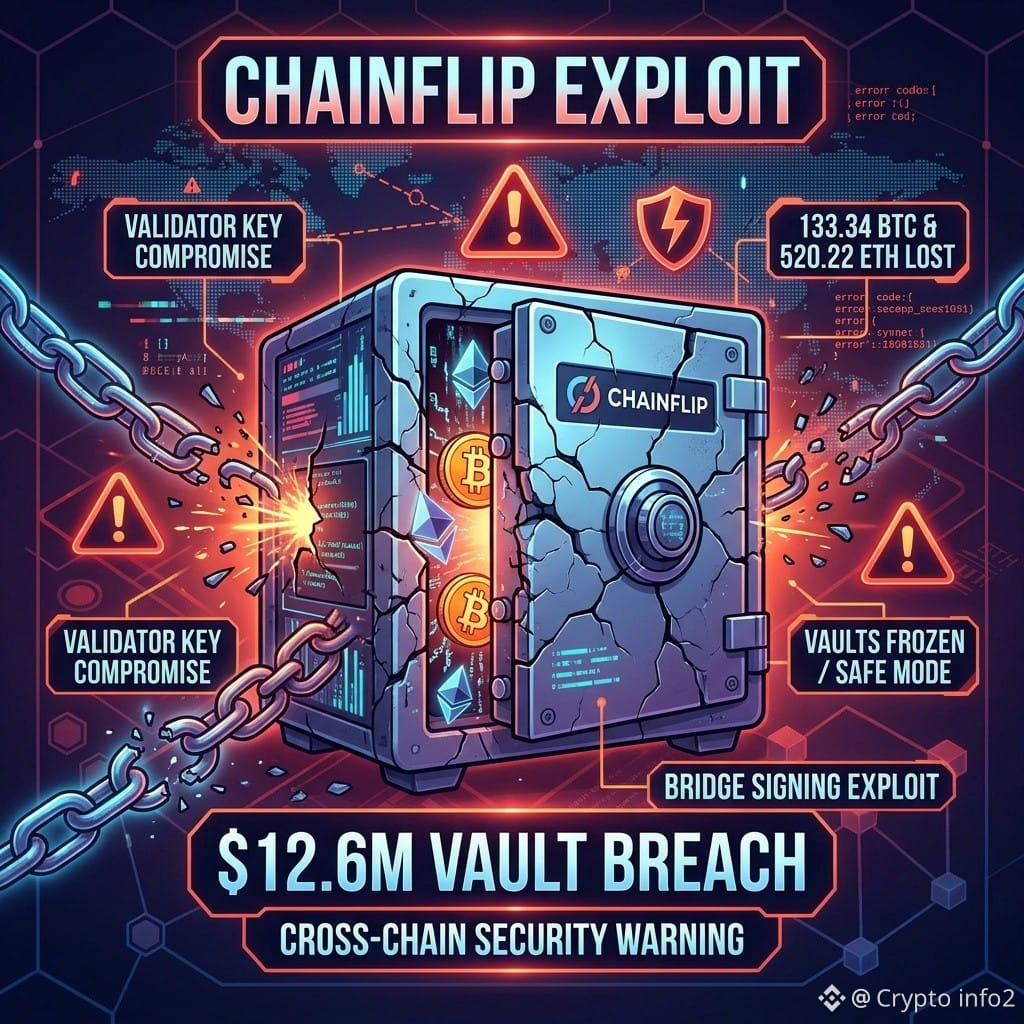
#chainflipvaultthefthaltsprotocol 🚨 CHAINFLIP EXPLOIT: $12.6M LOST — CROSS-CHAIN SECURITY UNDER PRESSURE
Chainflip remains in Safe Mode following a major vault exploit on November 21, raising serious concerns about cross-chain security. 🔐
📊 KEY TAKEAWAYS
🔴 Approximately $12.6M reportedly drained from BTC and ETH vaults.
🔴 Validator key shares were allegedly compromised through a third-party networking library vulnerability.
🔴 Swaps, deposits and withdrawals remain paused.
🔴 The 10% bounty deadline reportedly passed without funds returned.
🔴 FLIP suffered a sharp decline following the incident.
⚠️ TRADER WARNING
Cross-chain protocols can introduce additional security risks through validator systems, signing mechanisms and bridge infrastructure.
Never leave unnecessary funds sitting in cross-chain vaults. Always verify official announcements and beware of fake refund links or recovery offers.
💡 MY TAKE: This incident is another reminder that decentralization doesn't eliminate security risks. Until protocols demonstrate stronger safeguards and transparent recovery plans, traders should carefully manage their exposure.
👇 Are you still using cross-chain swap protocols, or are you sticking to native L1 wallets?
Share your thoughts below and follow for more crypto security updates, market insights and trader breakdowns.
#Chainflip #FLIP #CryptoSecurity #CrossChain
CLICK TO BELOW TRADE👇
$CFG $BTC $ETH
{future}(ETHUSDT)
{future}(BTCUSDT)
{future}(CFGUSDT)
#chainflipvaultthefthaltsprotocol 🚨 CHAINFLIP EXPLOIT: $12.6M LOST — CROSS-CHAIN SECURITY UNDER PRESSURE
Chainflip remains in Safe Mode following a major vault exploit on November 21, raising serious concerns about cross-chain security. 🔐
📊 KEY TAKEAWAYS
🔴 Approximately $12.6M reportedly drained from BTC and ETH vaults.
🔴 Validator key shares were allegedly compromised through a third-party networking library vulnerability.
🔴 Swaps, deposits and withdrawals remain paused.
🔴 The 10% bounty deadline reportedly passed without funds returned.
🔴 FLIP suffered a sharp decline following the incident.
⚠️ TRADER WARNING
Cross-chain protocols can introduce additional security risks through validator systems, signing mechanisms and bridge infrastructure.
Never leave unnecessary funds sitting in cross-chain vaults. Always verify official announcements and beware of fake refund links or recovery offers.
💡 MY TAKE: This incident is another reminder that decentralization doesn't eliminate security risks. Until protocols demonstrate stronger safeguards and transparent recovery plans, traders should carefully manage their exposure.
👇 Are you still using cross-chain swap protocols, or are you sticking to native L1 wallets?
Share your thoughts below and follow for more crypto security updates, market insights and trader breakdowns.
#Chainflip #FLIP #CryptoSecurity #CrossChain
CLICK TO BELOW TRADE👇
$CFG $BTC $ETH
3
865
Log in to explore more content
Join global crypto users on Binance Square
⚡️ Get latest and useful information about crypto.
💬 Trusted by the world’s largest crypto exchange.
👍 Discover real insights from verified creators.
Email / Phone number
Trending Topics
1
#EvolveAtBinanceBlockchainWeek
1.5M views
16,433 Discussing
2
#ChainflipVaultTheftHaltsProtocol
11,355 views
221 Discussing
3
#VitalikWantsWalletChipDesignsOpened
19,009 views
320 Discussing
4
#ColdcardFlawLeadsToTheftOfAtLeast1789BTC
5,444 views
65 Discussing
5
#MalaysiaFirstBitcoinETFToListOnDecember2
6,180 views
88 Discussing
6
#DowJonesAdds591.99Points
7,793 views
58 Discussing
7
#SECIssuesNoActionLetterOnMoleculeModel
846 views
14 Discussing
8
#AnzaUrgesSolanaNodesUpgradeAgave
7,481 views
148 Discussing
9
#EthereumGlamsterdamKeepsStorageFeeChange
49,561 views
482 Discussing
10
#ClaudeAccusedOfDroppingUserPreferences
6,105 views
69 Discussing