
#baba
baba
59,579 views
670 Discussing
Hot
Latest

·
--
The charts are finally signaling an opportunity on $BABA that demands attention. I am positioning for a move to the upside, focusing on these precise levels to manage exposure while we look for the anticipated continuation.
⚡ $BABA — LONG SETUP
📍 Entry: 111.7 – 112.38
🎯 TP1: 113.73
🎯 TP2: 114.64
🎯 TP3: 115.99
🛑 Stop Loss: 111.02
Trade here 👇
📌 Trade management rules: see pinned post.
How are you positioning for this move? Drop your thoughts below and hit follow for real-time updates.
#BABA
The charts are finally signaling an opportunity on $BABA that demands attention. I am positioning for a move to the upside, focusing on these precise levels to manage exposure while we look for the anticipated continuation.
⚡ $BABA — LONG SETUP
📍 Entry: 111.7 – 112.38
🎯 TP1: 113.73
🎯 TP2: 114.64
🎯 TP3: 115.99
🛑 Stop Loss: 111.02
Trade here 👇
📌 Trade management rules: see pinned post.
How are you positioning for this move? Drop your thoughts below and hit follow for real-time updates.
#BABA
⚡ $BABA — LONG SETUP
📍 Entry: 111.7 – 112.38
🎯 TP1: 113.73
🎯 TP2: 114.64
🎯 TP3: 115.99
🛑 Stop Loss: 111.02
Trade here 👇
📌 Trade management rules: see pinned post.
How are you positioning for this move? Drop your thoughts below and hit follow for real-time updates.
#BABA
1
99

·
--
Bearish
BABA just saw $2.0255K of longs liquidated.
At $112.7764, I’d watch the immediate downside reaction.
$BABA
{future}(BABAUSDT)
$MUBARAK
{future}(MUBARAKUSDT)
$FOLKS
{future}(FOLKSUSDT)
🔴 LIQUIDITY ZONE HIT 🔴
Long liquidation spotted 🧨
$2.0255K cleared at $112.7764
Downside liquidity swept — watch reaction 👀
🎯 TP Targets:
TP1: ~$112.21
TP2: ~$111.65
TP3: ~$110.52
#BABA
BABA just saw $2.0255K of longs liquidated.
At $112.7764, I’d watch the immediate downside reaction.
$BABA
$MUBARAK
$FOLKS
🔴 LIQUIDITY ZONE HIT 🔴
Long liquidation spotted 🧨
$2.0255K cleared at $112.7764
Downside liquidity swept — watch reaction 👀
🎯 TP Targets:
TP1: ~$112.21
TP2: ~$111.65
TP3: ~$110.52
#BABA
At $112.7764, I’d watch the immediate downside reaction.
$BABA
$MUBARAK
$FOLKS
🔴 LIQUIDITY ZONE HIT 🔴
Long liquidation spotted 🧨
$2.0255K cleared at $112.7764
Downside liquidity swept — watch reaction 👀
🎯 TP Targets:
TP1: ~$112.21
TP2: ~$111.65
TP3: ~$110.52
#BABA
153
⚡ $BABA REVEALS NATIVE AGENT HARDWARE QWENBOOK TO DOMINATE AI WORKFLOW ECOSYSTEMS 📊
Alibaba Cloud is executing a major structural shift by building QwenBook, a dedicated native AI hardware environment powered by Qwen3.8 models. 🔍 Instead of relying on fragile surface-level screen scraping like competitors, this institutional approach embeds autonomous agents directly into core system tools and enterprise files.
💡 By engineering native control over office applications first, smart money is watching how $BABA secures an unassailable data footprint before opening third-party integrations. This systematic move positions their ecosystem for deep workflow capture as autonomous execution replaces traditional software. 💬 Is native hardware integration the definitive playbook for institutional AI adoption? 👇
⚠️ Not financial advice. Always manage your risk. 🛡️
🏷️ #BABA #ArtificialIntelligence #TechInnovation #Qwen #Crypto
🎯 🦈
⚡ $BABA REVEALS NATIVE AGENT HARDWARE QWENBOOK TO DOMINATE AI WORKFLOW ECOSYSTEMS 📊
Alibaba Cloud is executing a major structural shift by building QwenBook, a dedicated native AI hardware environment powered by Qwen3.8 models. 🔍 Instead of relying on fragile surface-level screen scraping like competitors, this institutional approach embeds autonomous agents directly into core system tools and enterprise files.
💡 By engineering native control over office applications first, smart money is watching how $BABA secures an unassailable data footprint before opening third-party integrations. This systematic move positions their ecosystem for deep workflow capture as autonomous execution replaces traditional software. 💬 Is native hardware integration the definitive playbook for institutional AI adoption? 👇
⚠️ Not financial advice. Always manage your risk. 🛡️
🏷️ #BABA #ArtificialIntelligence #TechInnovation #Qwen #Crypto
🎯 🦈
Alibaba Cloud is executing a major structural shift by building QwenBook, a dedicated native AI hardware environment powered by Qwen3.8 models. 🔍 Instead of relying on fragile surface-level screen scraping like competitors, this institutional approach embeds autonomous agents directly into core system tools and enterprise files.
💡 By engineering native control over office applications first, smart money is watching how $BABA secures an unassailable data footprint before opening third-party integrations. This systematic move positions their ecosystem for deep workflow capture as autonomous execution replaces traditional software. 💬 Is native hardware integration the definitive playbook for institutional AI adoption? 👇
⚠️ Not financial advice. Always manage your risk. 🛡️
🏷️ #BABA #ArtificialIntelligence #TechInnovation #Qwen #Crypto
🎯 🦈
169

·
--
🚨 ALIBABA UNVEILS NEXT-GEN AI STORAGE TO UNLOCK MASSIVE GPU EFFICIENCY FOR $BABA ! ⚡
Compute means nothing if the pipeline chokes your throughput. $BABA Cloud just dropped next-generation CPFS storage specs, boasting a massive 100 TB/s capacity and pushing GPU compute utilization up by 30%. 📊
When data bottlenecks break, expensive AI hardware stops sitting idle. 💡 This shift flips high-speed storage from a back-end utility straight into an essential engine for the entire AI compute stack. ⚡
🔍 If data delivery speed is the real bottleneck for enterprise AI deployment, will market narratives pivot toward storage layer plays next? 👇
⚠️ Not financial advice. Always manage your risk. 🛡️
🏷️ #BABA #AIInfrastructure #CloudTech #Crypto #Tech
⚡ 💎
🚨 ALIBABA UNVEILS NEXT-GEN AI STORAGE TO UNLOCK MASSIVE GPU EFFICIENCY FOR $BABA ! ⚡
Compute means nothing if the pipeline chokes your throughput. $BABA Cloud just dropped next-generation CPFS storage specs, boasting a massive 100 TB/s capacity and pushing GPU compute utilization up by 30%. 📊
When data bottlenecks break, expensive AI hardware stops sitting idle. 💡 This shift flips high-speed storage from a back-end utility straight into an essential engine for the entire AI compute stack. ⚡
🔍 If data delivery speed is the real bottleneck for enterprise AI deployment, will market narratives pivot toward storage layer plays next? 👇
⚠️ Not financial advice. Always manage your risk. 🛡️
🏷️ #BABA #AIInfrastructure #CloudTech #Crypto #Tech
⚡ 💎
Compute means nothing if the pipeline chokes your throughput. $BABA Cloud just dropped next-generation CPFS storage specs, boasting a massive 100 TB/s capacity and pushing GPU compute utilization up by 30%. 📊
When data bottlenecks break, expensive AI hardware stops sitting idle. 💡 This shift flips high-speed storage from a back-end utility straight into an essential engine for the entire AI compute stack. ⚡
🔍 If data delivery speed is the real bottleneck for enterprise AI deployment, will market narratives pivot toward storage layer plays next? 👇
⚠️ Not financial advice. Always manage your risk. 🛡️
🏷️ #BABA #AIInfrastructure #CloudTech #Crypto #Tech
⚡ 💎
236

·
--
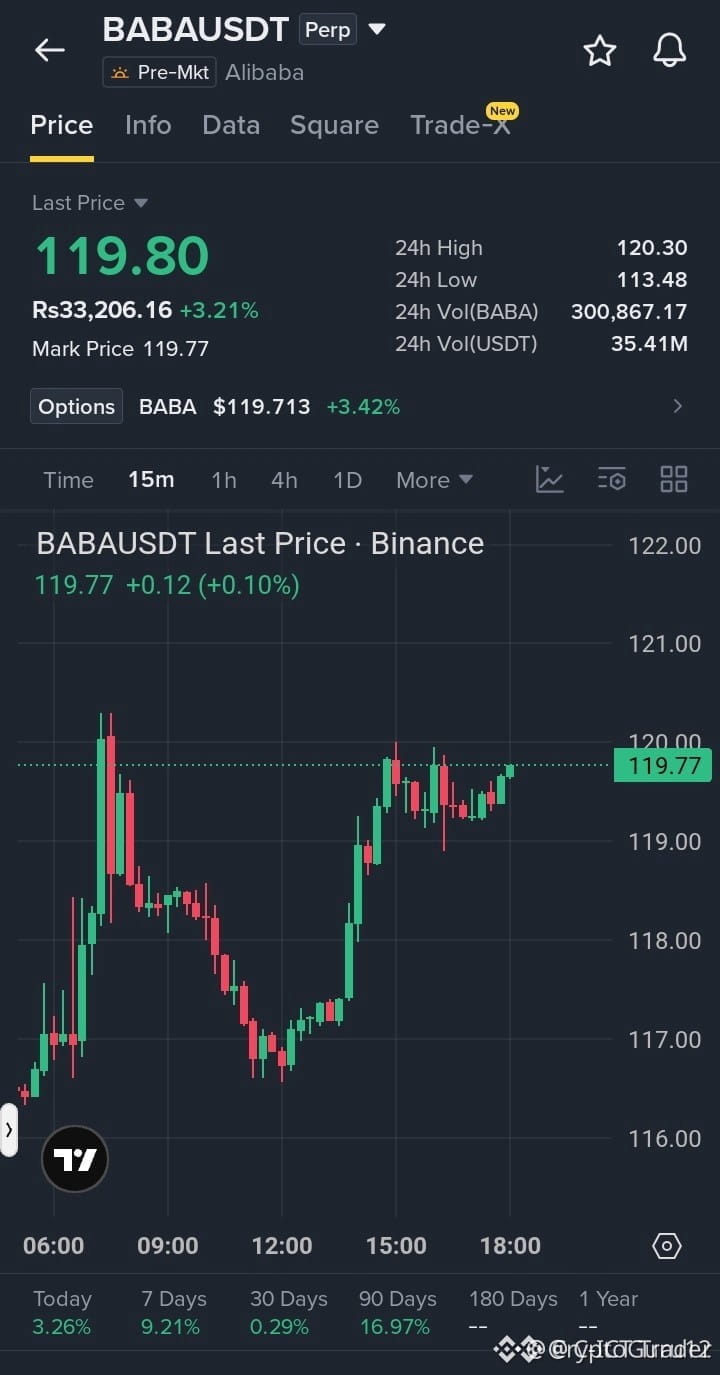
💥 $BABA RECLAIMS KEY DEMAND ZONE AS INSTITUTIONS PUSH TOWARD $120 RESISTANCE! ⚡
Entry: $119.60–$119.85 ⚡
Target: $120.80 🚀
Stop Loss: $119.00 ⚠️
📌 Smart money absorbed sell-side liquidity beneath $119 before staging a clean structural reclaim. Buyers are continuously building higher lows right beneath the $120 key liquidity pool, signaling strong institutional accumulation prior to an expansion move. 📊
⚡ As price coils into this overhead inefficiency, order flow favors a momentum impulse beyond resistance. Risk parameters remain exceptionally tight against the local swing low at $119.00. 🔍 Are you positioning ahead of the structural expansion or waiting for a confirmed candle close above $120? 👇
⚠️ Not financial advice. Always manage your risk. 🛡️
🏷️ #BABA #LongSetup #Breakout #Crypto
🎯 🦈
💥 $BABA RECLAIMS KEY DEMAND ZONE AS INSTITUTIONS PUSH TOWARD $120 RESISTANCE! ⚡
Entry: $119.60–$119.85 ⚡
Target: $120.80 🚀
Stop Loss: $119.00 ⚠️
📌 Smart money absorbed sell-side liquidity beneath $119 before staging a clean structural reclaim. Buyers are continuously building higher lows right beneath the $120 key liquidity pool, signaling strong institutional accumulation prior to an expansion move. 📊
⚡ As price coils into this overhead inefficiency, order flow favors a momentum impulse beyond resistance. Risk parameters remain exceptionally tight against the local swing low at $119.00. 🔍 Are you positioning ahead of the structural expansion or waiting for a confirmed candle close above $120? 👇
⚠️ Not financial advice. Always manage your risk. 🛡️
🏷️ #BABA #LongSetup #Breakout #Crypto
🎯 🦈
Entry: $119.60–$119.85 ⚡
Target: $120.80 🚀
Stop Loss: $119.00 ⚠️
📌 Smart money absorbed sell-side liquidity beneath $119 before staging a clean structural reclaim. Buyers are continuously building higher lows right beneath the $120 key liquidity pool, signaling strong institutional accumulation prior to an expansion move. 📊
⚡ As price coils into this overhead inefficiency, order flow favors a momentum impulse beyond resistance. Risk parameters remain exceptionally tight against the local swing low at $119.00. 🔍 Are you positioning ahead of the structural expansion or waiting for a confirmed candle close above $120? 👇
⚠️ Not financial advice. Always manage your risk. 🛡️
🏷️ #BABA #LongSetup #Breakout #Crypto
🎯 🦈
105
·
--
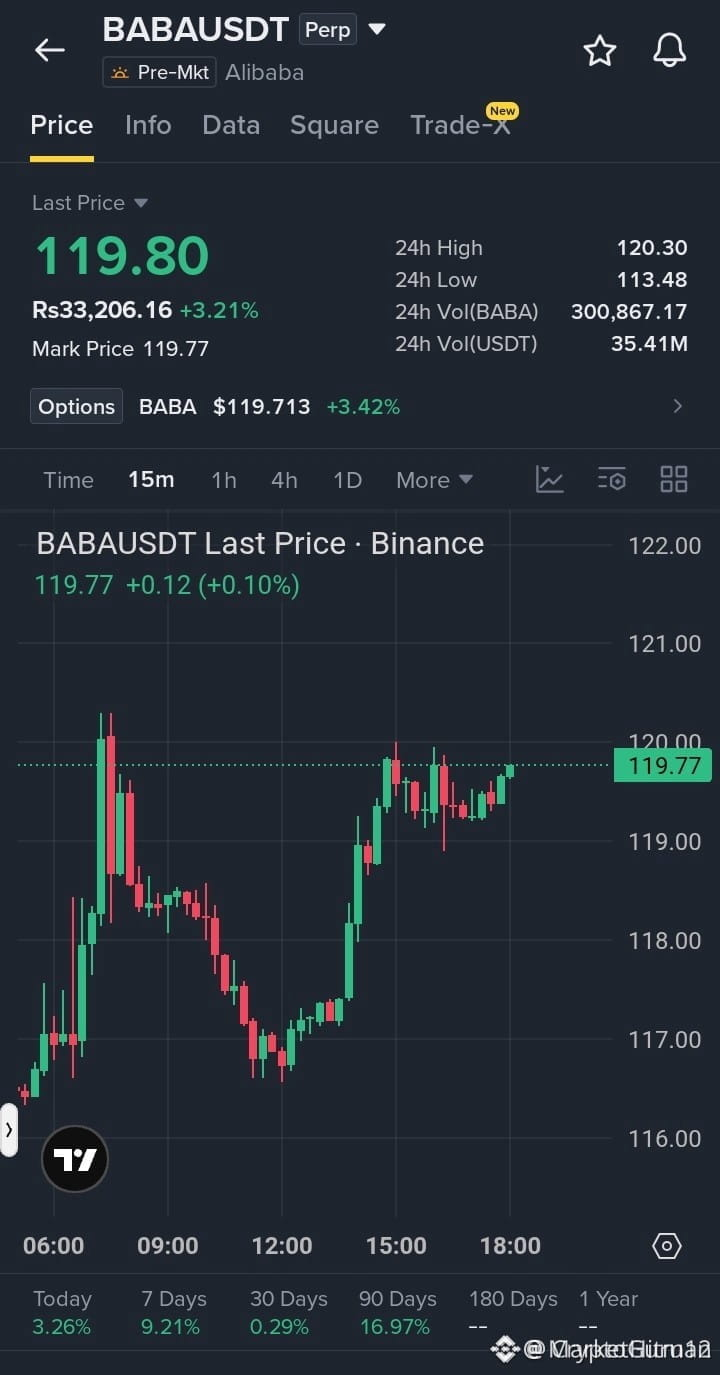
💥 $BABA PRESSURE BUILDS AT $120 RESISTANCE FOR NEXT EXPLOSIVE MOVE! 📈
Entry: $119.60 - $119.85 ⚡
Target: $120.80 🚀
Stop Loss: $119.00 ⚠️
📌 The reclaim of the $119 handle has completely flipped local market dynamics, establishing a rock-solid floor as buyers systematically absorb supply. 📊 Price is now coiling tightly right beneath the pivotal $120 resistance, showing distinct signs of accumulation before expansion.
⚡ Momentum indicators are tilting heavily toward the bulls, with consistent higher lows pressing against seller order blocks. A clean push past $120 clears the runway for an immediate run into higher liquidity targets.
💬 Are you riding this momentum toward $120.80, or waiting for a confirmed candle close above resistance? 👇
⚠️ Not financial advice. Always manage your risk. 🛡️
🏷️ #BABA #LongSetup #Breakout #Trading #MarketAnalysis
🔥 🎯
💥 $BABA PRESSURE BUILDS AT $120 RESISTANCE FOR NEXT EXPLOSIVE MOVE! 📈
Entry: $119.60 - $119.85 ⚡
Target: $120.80 🚀
Stop Loss: $119.00 ⚠️
📌 The reclaim of the $119 handle has completely flipped local market dynamics, establishing a rock-solid floor as buyers systematically absorb supply. 📊 Price is now coiling tightly right beneath the pivotal $120 resistance, showing distinct signs of accumulation before expansion.
⚡ Momentum indicators are tilting heavily toward the bulls, with consistent higher lows pressing against seller order blocks. A clean push past $120 clears the runway for an immediate run into higher liquidity targets.
💬 Are you riding this momentum toward $120.80, or waiting for a confirmed candle close above resistance? 👇
⚠️ Not financial advice. Always manage your risk. 🛡️
🏷️ #BABA #LongSetup #Breakout #Trading #MarketAnalysis
🔥 🎯
Entry: $119.60 - $119.85 ⚡
Target: $120.80 🚀
Stop Loss: $119.00 ⚠️
📌 The reclaim of the $119 handle has completely flipped local market dynamics, establishing a rock-solid floor as buyers systematically absorb supply. 📊 Price is now coiling tightly right beneath the pivotal $120 resistance, showing distinct signs of accumulation before expansion.
⚡ Momentum indicators are tilting heavily toward the bulls, with consistent higher lows pressing against seller order blocks. A clean push past $120 clears the runway for an immediate run into higher liquidity targets.
💬 Are you riding this momentum toward $120.80, or waiting for a confirmed candle close above resistance? 👇
⚠️ Not financial advice. Always manage your risk. 🛡️
🏷️ #BABA #LongSetup #Breakout #Trading #MarketAnalysis
🔥 🎯
106


·
--
Bullish
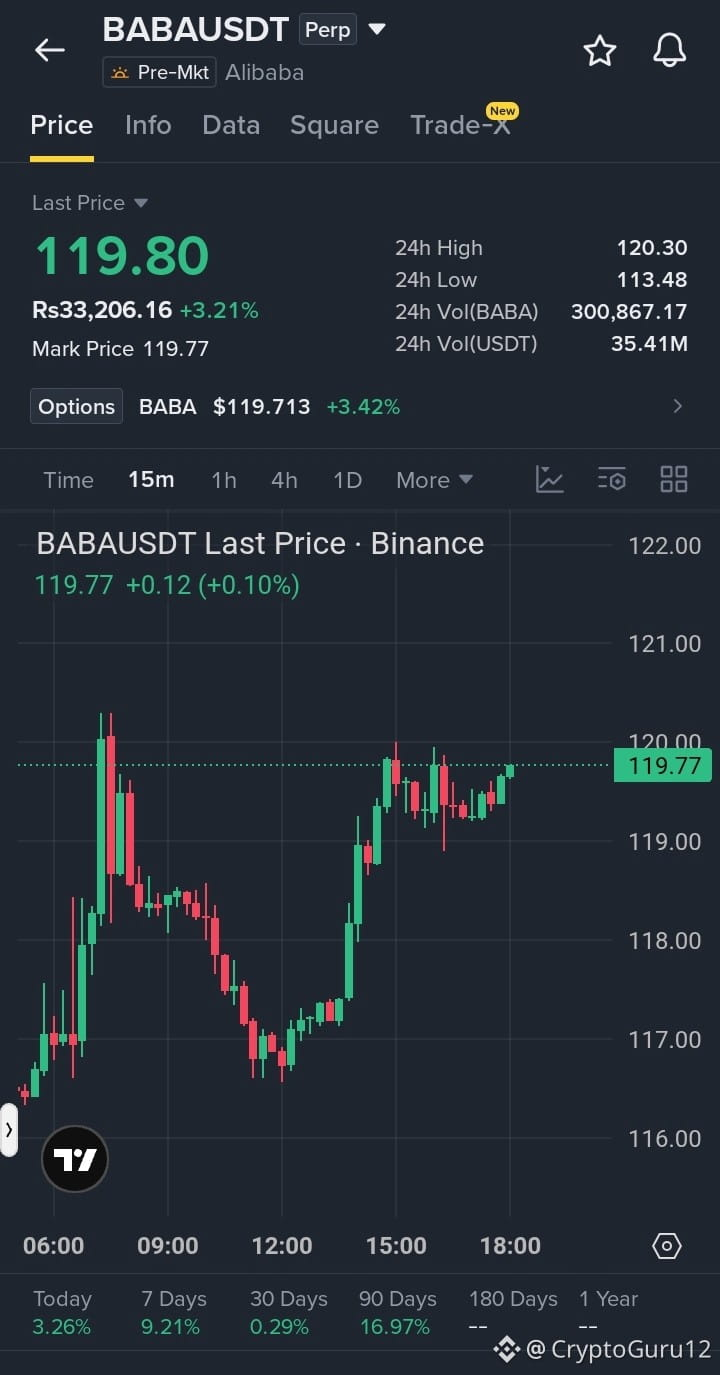
$BABA ... Breakout Pressure Building
#BABA is holding firmly around $119.70 after reclaiming the $119 zone. The latest candles show steady buying pressure, with price approaching the $120 resistance. A breakout above this area could open the next move higher.
LONG SETUP
Entry: $119.60–$119.85
TP: $120.80
SL: $119.00
Buy and Trade
{future}(BABAUSDT)
$ZEC
{future}(ZECUSDT)
$LSK
{future}(LSKUSDT)
$BABA ... Breakout Pressure Building
#BABA is holding firmly around $119.70 after reclaiming the $119 zone. The latest candles show steady buying pressure, with price approaching the $120 resistance. A breakout above this area could open the next move higher.
LONG SETUP
Entry: $119.60–$119.85
TP: $120.80
SL: $119.00
Buy and Trade
$ZEC
$LSK
#BABA is holding firmly around $119.70 after reclaiming the $119 zone. The latest candles show steady buying pressure, with price approaching the $120 resistance. A breakout above this area could open the next move higher.
LONG SETUP
Entry: $119.60–$119.85
TP: $120.80
SL: $119.00
Buy and Trade
$ZEC
$LSK
1
717

·
--
🚨 ALIBABA REVEALS SYSTEM-LEVEL QWEN INTELLIGENCE OS AGENTS AS $BABA EXPANDS AI INFRASTRUCTURE 💥
Alibaba has officially unveiled Qwen Intelligence, embedding multi-agent architecture directly into smartphone hardware rather than standalone software. 🔍 By partnering with Honor MagicOS to execute complex 100-step operations at a 90% completion rate, institutional capital is eyeing systemic integration over surface-level retail chat applications. 📊
The shift from simple visual recognition to deep API level execution signals a structural pivot in how foundational models capture execution market share. ⚡ Compressed execution steps and persistent memory capabilities mark a major shift for system-level automation. 💡 Do you expect OS-integrated agents to drive the next major valuation expansion across tech and AI assets? 👇
⚠️ Not financial advice. Always manage your risk. 🛡️
🏷️ #BABA #AI #Tech #Innovation #Crypto
🎯 🦈
🚨 ALIBABA REVEALS SYSTEM-LEVEL QWEN INTELLIGENCE OS AGENTS AS $BABA EXPANDS AI INFRASTRUCTURE 💥
Alibaba has officially unveiled Qwen Intelligence, embedding multi-agent architecture directly into smartphone hardware rather than standalone software. 🔍 By partnering with Honor MagicOS to execute complex 100-step operations at a 90% completion rate, institutional capital is eyeing systemic integration over surface-level retail chat applications. 📊
The shift from simple visual recognition to deep API level execution signals a structural pivot in how foundational models capture execution market share. ⚡ Compressed execution steps and persistent memory capabilities mark a major shift for system-level automation. 💡 Do you expect OS-integrated agents to drive the next major valuation expansion across tech and AI assets? 👇
⚠️ Not financial advice. Always manage your risk. 🛡️
🏷️ #BABA #AI #Tech #Innovation #Crypto
🎯 🦈
Alibaba has officially unveiled Qwen Intelligence, embedding multi-agent architecture directly into smartphone hardware rather than standalone software. 🔍 By partnering with Honor MagicOS to execute complex 100-step operations at a 90% completion rate, institutional capital is eyeing systemic integration over surface-level retail chat applications. 📊
The shift from simple visual recognition to deep API level execution signals a structural pivot in how foundational models capture execution market share. ⚡ Compressed execution steps and persistent memory capabilities mark a major shift for system-level automation. 💡 Do you expect OS-integrated agents to drive the next major valuation expansion across tech and AI assets? 👇
⚠️ Not financial advice. Always manage your risk. 🛡️
🏷️ #BABA #AI #Tech #Innovation #Crypto
🎯 🦈
77
🚨 $BABA SEALS NEW QWEN AI LEADERSHIP TO DRIVE REAL-WORLD AGENT EXPANSION! 💥
After months of internal reshuffling, Alibaba has officially locked in Liu Da Yiheng as the sole lead for the Qwen LLM project. 🔍 Stabilizing core engineering leadership right before the Yunqi Conference signals a firm transition from operational shifts to high-tempo product delivery. ⚡
With Liu sharing the main stage with top executives to unveil real-world AI agents, the fundamental floor around $BABA is strengthening fast. 📈 Smart money values clear organizational execution, especially when positioning around major tech catalysts. 💡
💬 Does this leadership clarity give you high conviction on the AI narrative, or are you waiting for conference volume to confirm? 👇
⚠️ Not financial advice. Always manage your risk. 🛡️
🏷️ #BABA #AI #TechCatalyst #Qwen #Crypto
🔥 ⚡
🚨 $BABA SEALS NEW QWEN AI LEADERSHIP TO DRIVE REAL-WORLD AGENT EXPANSION! 💥
After months of internal reshuffling, Alibaba has officially locked in Liu Da Yiheng as the sole lead for the Qwen LLM project. 🔍 Stabilizing core engineering leadership right before the Yunqi Conference signals a firm transition from operational shifts to high-tempo product delivery. ⚡
With Liu sharing the main stage with top executives to unveil real-world AI agents, the fundamental floor around $BABA is strengthening fast. 📈 Smart money values clear organizational execution, especially when positioning around major tech catalysts. 💡
💬 Does this leadership clarity give you high conviction on the AI narrative, or are you waiting for conference volume to confirm? 👇
⚠️ Not financial advice. Always manage your risk. 🛡️
🏷️ #BABA #AI #TechCatalyst #Qwen #Crypto
🔥 ⚡
After months of internal reshuffling, Alibaba has officially locked in Liu Da Yiheng as the sole lead for the Qwen LLM project. 🔍 Stabilizing core engineering leadership right before the Yunqi Conference signals a firm transition from operational shifts to high-tempo product delivery. ⚡
With Liu sharing the main stage with top executives to unveil real-world AI agents, the fundamental floor around $BABA is strengthening fast. 📈 Smart money values clear organizational execution, especially when positioning around major tech catalysts. 💡
💬 Does this leadership clarity give you high conviction on the AI narrative, or are you waiting for conference volume to confirm? 👇
⚠️ Not financial advice. Always manage your risk. 🛡️
🏷️ #BABA #AI #TechCatalyst #Qwen #Crypto
🔥 ⚡
194

🚨 ALIBABA STABILIZES QWEN AI LEADERSHIP AS LIU DAYIHENG TAKES THE HELM FOR $BABA ! ⚡
Following consecutive management shifts over the last six months, Alibaba has officially finalized its artificial intelligence hierarchy. 🔍 Liu Da Yiheng steps up as Qwen LLM Project Lead, signaling institutional stabilization after high-profile executive transitions.
📌 His prominent main-stage placement at the Yunqi Conference alongside executive leadership underlines high-conviction backing for autonomous agent architecture. 📊 As institutional capital closely tracks AI agent development, this structural realignment positions Qwen for real-world integration velocity. 🤔 Will this leadership clarity catalyze the next structural expansion for $BABA in the AI sector? 👇
⚠️ Not financial advice. Always manage your risk. 🛡️
🏷️ #BABA #ArtificialIntelligence #Qwen #TechNews #Crypto
🎯 🦈
🚨 ALIBABA STABILIZES QWEN AI LEADERSHIP AS LIU DAYIHENG TAKES THE HELM FOR $BABA ! ⚡
Following consecutive management shifts over the last six months, Alibaba has officially finalized its artificial intelligence hierarchy. 🔍 Liu Da Yiheng steps up as Qwen LLM Project Lead, signaling institutional stabilization after high-profile executive transitions.
📌 His prominent main-stage placement at the Yunqi Conference alongside executive leadership underlines high-conviction backing for autonomous agent architecture. 📊 As institutional capital closely tracks AI agent development, this structural realignment positions Qwen for real-world integration velocity. 🤔 Will this leadership clarity catalyze the next structural expansion for $BABA in the AI sector? 👇
⚠️ Not financial advice. Always manage your risk. 🛡️
🏷️ #BABA #ArtificialIntelligence #Qwen #TechNews #Crypto
🎯 🦈
Following consecutive management shifts over the last six months, Alibaba has officially finalized its artificial intelligence hierarchy. 🔍 Liu Da Yiheng steps up as Qwen LLM Project Lead, signaling institutional stabilization after high-profile executive transitions.
📌 His prominent main-stage placement at the Yunqi Conference alongside executive leadership underlines high-conviction backing for autonomous agent architecture. 📊 As institutional capital closely tracks AI agent development, this structural realignment positions Qwen for real-world integration velocity. 🤔 Will this leadership clarity catalyze the next structural expansion for $BABA in the AI sector? 👇
⚠️ Not financial advice. Always manage your risk. 🛡️
🏷️ #BABA #ArtificialIntelligence #Qwen #TechNews #Crypto
🎯 🦈
176

·
--
🔥💵 OPPORTUNITY
Alibaba (BABA) — Beijing AI probe knocks shares down 4%
Alibaba was one of the most visible Chinese tech companies after a supposed regulatory investigation targeting rival AI model startups weighed on market sentiment. Yahoo Finance reported that Alibaba traded at $112.09, down 4% during Wednesday morning’s session. The report tied the decline to concerns that Beijing’s crackdown on DeepSeek and Moonshot AI could extend across China’s broader model layer. That reversed some of the momentum Alibaba had built earlier with announcements made at the Apsara conference.
Market Impact
The reaction appeared more targeted than a simple, broad-based selling move across the market. KWEB fell 2%, while SPY slipped only 0.1% in the same report. Baidu dropped 2% and JD.com lost 1%, leaving Alibaba as the biggest loser among the cited Chinese tech companies. This bias suggests that investors were pricing in perceived exposure to AI models and cloud infrastructure, rather than selling all Chinese tech stocks uniformly.
Next Steps
Investors will wait for official details on the regulation and any signs that companies beyond DeepSeek and Moonshot AI could be affected. Alibaba’s own AI and cloud product announcements now need evidence of customer adoption to rebuild confidence. Peer moves such as Baidu, JD.com, and KWEB will help indicate whether the selling pressure is contained. If political uncertainty rises, the stock could trade more on regulation than on fundamentals in the near term.
$BABAB
$BABA
$BABA.US
{stock_us}(BABA.US)
#BABA #Acoes #invest #crypto #BTC
🔥💵 OPPORTUNITY
Alibaba (BABA) — Beijing AI probe knocks shares down 4%
Alibaba was one of the most visible Chinese tech companies after a supposed regulatory investigation targeting rival AI model startups weighed on market sentiment. Yahoo Finance reported that Alibaba traded at $112.09, down 4% during Wednesday morning’s session. The report tied the decline to concerns that Beijing’s crackdown on DeepSeek and Moonshot AI could extend across China’s broader model layer. That reversed some of the momentum Alibaba had built earlier with announcements made at the Apsara conference.
Market Impact
The reaction appeared more targeted than a simple, broad-based selling move across the market. KWEB fell 2%, while SPY slipped only 0.1% in the same report. Baidu dropped 2% and JD.com lost 1%, leaving Alibaba as the biggest loser among the cited Chinese tech companies. This bias suggests that investors were pricing in perceived exposure to AI models and cloud infrastructure, rather than selling all Chinese tech stocks uniformly.
Next Steps
Investors will wait for official details on the regulation and any signs that companies beyond DeepSeek and Moonshot AI could be affected. Alibaba’s own AI and cloud product announcements now need evidence of customer adoption to rebuild confidence. Peer moves such as Baidu, JD.com, and KWEB will help indicate whether the selling pressure is contained. If political uncertainty rises, the stock could trade more on regulation than on fundamentals in the near term.
$BABAB
$BABA
$BABA.US
#BABA #Acoes #invest #crypto #BTC
Alibaba (BABA) — Beijing AI probe knocks shares down 4%
Alibaba was one of the most visible Chinese tech companies after a supposed regulatory investigation targeting rival AI model startups weighed on market sentiment. Yahoo Finance reported that Alibaba traded at $112.09, down 4% during Wednesday morning’s session. The report tied the decline to concerns that Beijing’s crackdown on DeepSeek and Moonshot AI could extend across China’s broader model layer. That reversed some of the momentum Alibaba had built earlier with announcements made at the Apsara conference.
Market Impact
The reaction appeared more targeted than a simple, broad-based selling move across the market. KWEB fell 2%, while SPY slipped only 0.1% in the same report. Baidu dropped 2% and JD.com lost 1%, leaving Alibaba as the biggest loser among the cited Chinese tech companies. This bias suggests that investors were pricing in perceived exposure to AI models and cloud infrastructure, rather than selling all Chinese tech stocks uniformly.
Next Steps
Investors will wait for official details on the regulation and any signs that companies beyond DeepSeek and Moonshot AI could be affected. Alibaba’s own AI and cloud product announcements now need evidence of customer adoption to rebuild confidence. Peer moves such as Baidu, JD.com, and KWEB will help indicate whether the selling pressure is contained. If political uncertainty rises, the stock could trade more on regulation than on fundamentals in the near term.
$BABAB
$BABA
$BABA.US
#BABA #Acoes #invest #crypto #BTC
BABAUS-4.31%
BABAB-4.57%
34

·
--
$BABA dropped 5.83% over the past 24 hours, trading at 112.82. The funding rate is positive at 0.00085, and the open interest is 179,000 contracts. While the price is moving downward, the funding rate is still positive—buyers are clearly hard-pressing by adding positions. In terms of politics, the direction of US-China technology regulation is unclear, and market sentiment is being suppressed. This kind of structure is prone to triggering a liquidation cascade; once it breaks below 110, stop-loss orders are likely to fire in sequence. I think there won’t be a rebound in the short term. I won’t touch the contract until the funding rate turns negative. If the price holds above 115 and the funding rate turns negative, then I’ll consider a small-position long.
Trading tag: #TradFi #链上美股 #BABA
Where do you think this assessment is most likely to be wrong?
$BABA dropped 5.83% over the past 24 hours, trading at 112.82. The funding rate is positive at 0.00085, and the open interest is 179,000 contracts. While the price is moving downward, the funding rate is still positive—buyers are clearly hard-pressing by adding positions. In terms of politics, the direction of US-China technology regulation is unclear, and market sentiment is being suppressed. This kind of structure is prone to triggering a liquidation cascade; once it breaks below 110, stop-loss orders are likely to fire in sequence. I think there won’t be a rebound in the short term. I won’t touch the contract until the funding rate turns negative. If the price holds above 115 and the funding rate turns negative, then I’ll consider a small-position long.
Trading tag: #TradFi #链上美股 #BABA
Where do you think this assessment is most likely to be wrong?
Trading tag: #TradFi #链上美股 #BABA
Where do you think this assessment is most likely to be wrong?
83
·
--
$BABA fell 5.83% over the past 24 hours, closing at 112.82. This drop looks abrupt in the absence of major earnings reports or company-specific announcements; it typically reflects the transmission of sentiment tied to macroeconomic or geopolitical factors.
Recent expectations of tighter U.S. tech regulation and stricter policies toward China have continued to weigh on the valuations of China concept stocks. While the decline is accompanied by a funding rate of 0.00085466, which remains positive, it suggests that some outstanding long positions are still bearing costs during the drop, meaning selling pressure may not yet have been fully released.
I think $BABA lacks a reversal catalyst in the short term.
Trading tag: #TradFi #链上美股 #BABA
Where do you think this view is most likely to be wrong?
$BABA fell 5.83% over the past 24 hours, closing at 112.82. This drop looks abrupt in the absence of major earnings reports or company-specific announcements; it typically reflects the transmission of sentiment tied to macroeconomic or geopolitical factors.
Recent expectations of tighter U.S. tech regulation and stricter policies toward China have continued to weigh on the valuations of China concept stocks. While the decline is accompanied by a funding rate of 0.00085466, which remains positive, it suggests that some outstanding long positions are still bearing costs during the drop, meaning selling pressure may not yet have been fully released.
I think $BABA lacks a reversal catalyst in the short term.
Trading tag: #TradFi #链上美股 #BABA
Where do you think this view is most likely to be wrong?
Recent expectations of tighter U.S. tech regulation and stricter policies toward China have continued to weigh on the valuations of China concept stocks. While the decline is accompanied by a funding rate of 0.00085466, which remains positive, it suggests that some outstanding long positions are still bearing costs during the drop, meaning selling pressure may not yet have been fully released.
I think $BABA lacks a reversal catalyst in the short term.
Trading tag: #TradFi #链上美股 #BABA
Where do you think this view is most likely to be wrong?
1
97

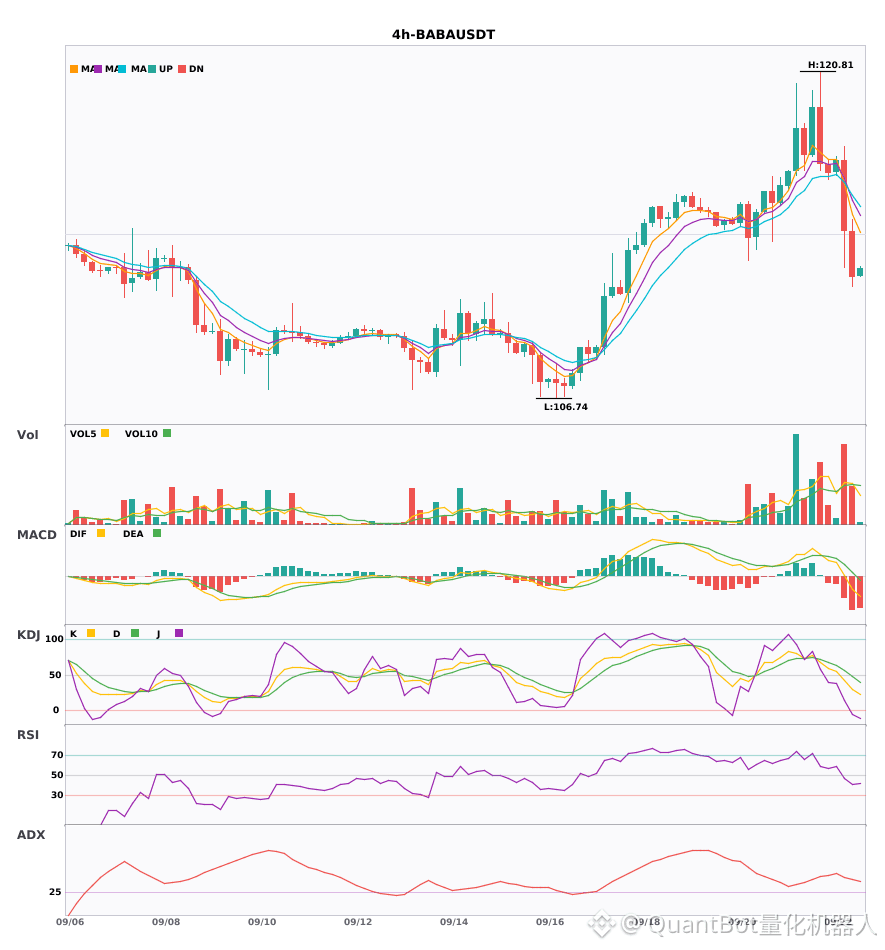
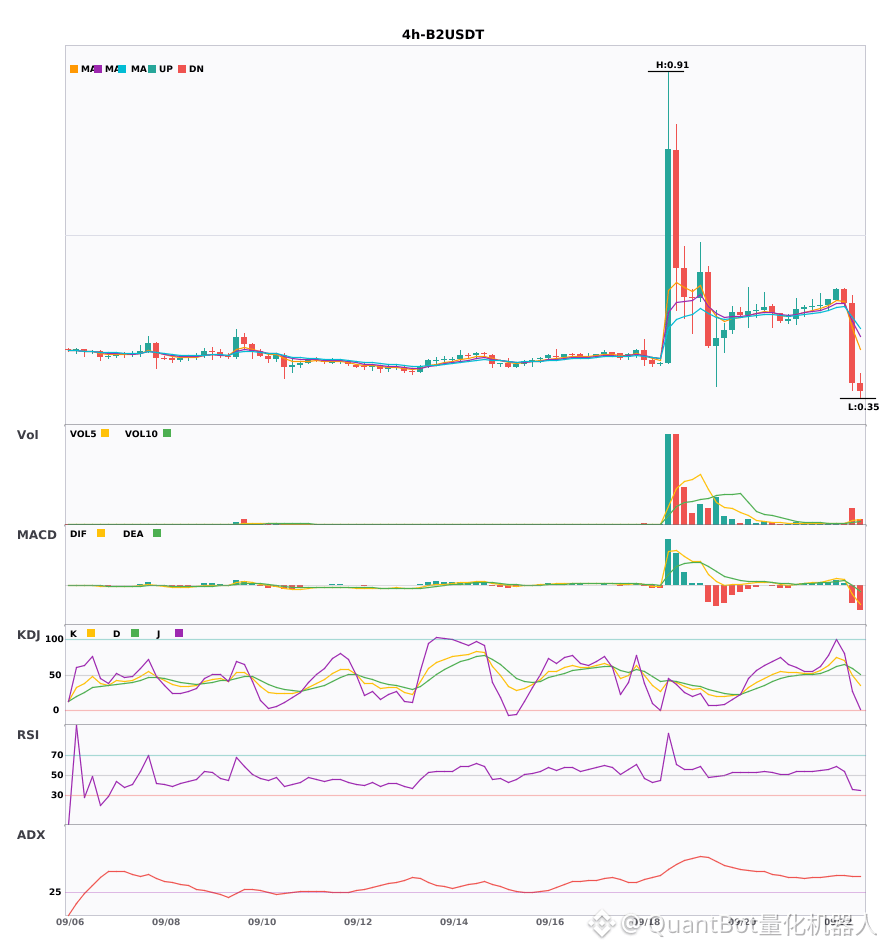
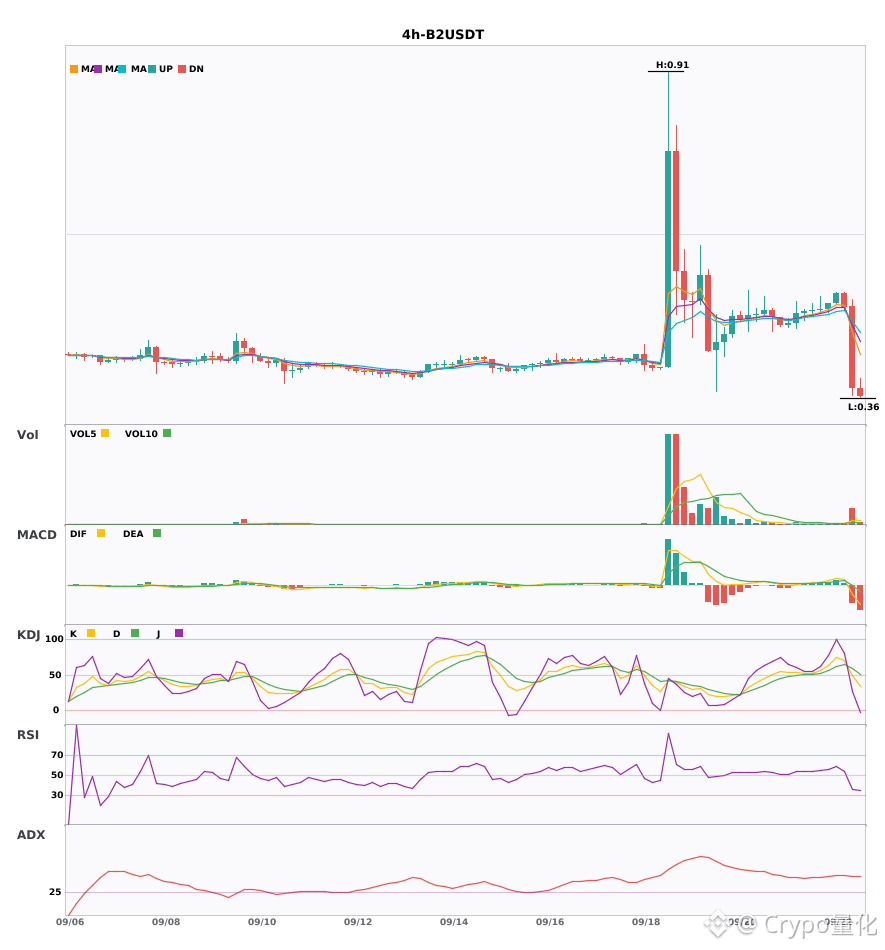
$BABA / $B2 4 hourly-level bearish signal, short-term pressure
📉 $BABA | 4-hour bearish signal
━━━━━━━━━━━━━━━━━━
Technical analysis: ADX(41) confirms a trending market. MACD DIF breaks below the zero axis and turns bearish. EMA5/8/13 are arranged bearishly. KDJ (K29.8, D47.6) is bearish. Volume is up by 2.0x.
Price change: -1.7200%
📉 $B2 | 4-hour bearish signal
━━━━━━━━━━━━━━━━━━
Technical analysis: ADX(43) shows a clear trending market | MACD is a dead cross below zero, bearish momentum accelerates | EMA5 crosses below EMA8, turning bearish in the short term | KDJ dead cross; near-term bearish outlook (K is 48.8, D is 59.6) | Trading volume surges (6.0x)
Price change: -26.7200%
━━━━━━━━━━━━━━━━━━
#技术分析 #BABA #B2
📌 The above content is for reference only and does not constitute investment advice
$BABA / $B2 4 hourly-level bearish signal, short-term pressure
📉 $BABA | 4-hour bearish signal
━━━━━━━━━━━━━━━━━━
Technical analysis: ADX(41) confirms a trending market. MACD DIF breaks below the zero axis and turns bearish. EMA5/8/13 are arranged bearishly. KDJ (K29.8, D47.6) is bearish. Volume is up by 2.0x.
Price change: -1.7200%
📉 $B2 | 4-hour bearish signal
━━━━━━━━━━━━━━━━━━
Technical analysis: ADX(43) shows a clear trending market | MACD is a dead cross below zero, bearish momentum accelerates | EMA5 crosses below EMA8, turning bearish in the short term | KDJ dead cross; near-term bearish outlook (K is 48.8, D is 59.6) | Trading volume surges (6.0x)
Price change: -26.7200%
━━━━━━━━━━━━━━━━━━
#技术分析 #BABA #B2
📌 The above content is for reference only and does not constitute investment advice
📉 $BABA | 4-hour bearish signal
━━━━━━━━━━━━━━━━━━
Technical analysis: ADX(41) confirms a trending market. MACD DIF breaks below the zero axis and turns bearish. EMA5/8/13 are arranged bearishly. KDJ (K29.8, D47.6) is bearish. Volume is up by 2.0x.
Price change: -1.7200%
📉 $B2 | 4-hour bearish signal
━━━━━━━━━━━━━━━━━━
Technical analysis: ADX(43) shows a clear trending market | MACD is a dead cross below zero, bearish momentum accelerates | EMA5 crosses below EMA8, turning bearish in the short term | KDJ dead cross; near-term bearish outlook (K is 48.8, D is 59.6) | Trading volume surges (6.0x)
Price change: -26.7200%
━━━━━━━━━━━━━━━━━━
#技术分析 #BABA #B2
📌 The above content is for reference only and does not constitute investment advice
389

·
--
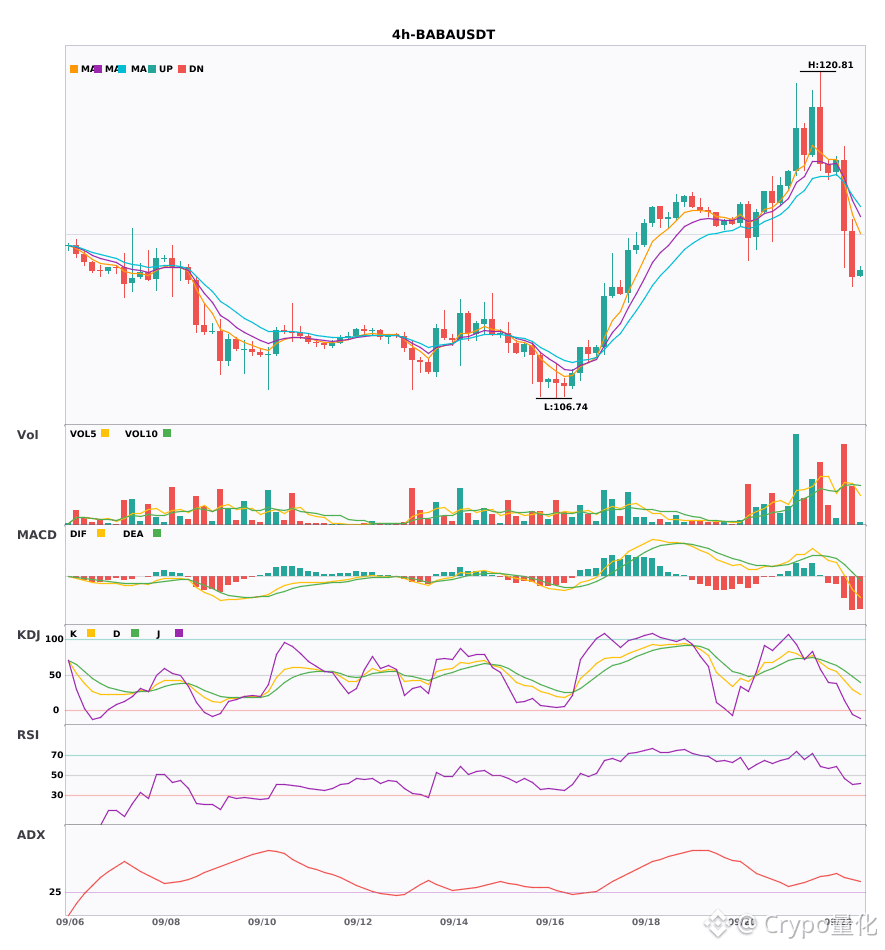
$BABA / $B2 4-hour level bearish bias, short-term pressure 🔥
════════════════════
🟢 $BABA 4-hour bearish signal
⚠️ Technicals: ADX(41) shows a clear trending market | MACD DIF falls below the zero line, trend turns bearish | EMA5 < EMA8 < EMA13, bearish alignment | KDJ weakly runs with bearish dominance (K=29.8, D=47.6) | Volume expands (2.0x)
════════════════════
🟢 $B2 4-hour bearish signal
⚠️ Technicals: ADX(43) shows a clear trending market | MACD in negative territory with a dead cross, bearish momentum accelerates | EMA5 crosses below EMA8, short-term turns bearish | KDJ dead cross, bearish in the near term (K=48.8, D=59.6) | Volume bursts (6.0x)
════════════════════
🔔 Watch for first-hand market moves 🔔
#技术分析 #BABA #B2
📌 When trading, pay attention to whether the candlestick pattern matches
$BABA / $B2 4-hour level bearish bias, short-term pressure 🔥
════════════════════
🟢 $BABA 4-hour bearish signal
⚠️ Technicals: ADX(41) shows a clear trending market | MACD DIF falls below the zero line, trend turns bearish | EMA5 < EMA8 < EMA13, bearish alignment | KDJ weakly runs with bearish dominance (K=29.8, D=47.6) | Volume expands (2.0x)
════════════════════
🟢 $B2 4-hour bearish signal
⚠️ Technicals: ADX(43) shows a clear trending market | MACD in negative territory with a dead cross, bearish momentum accelerates | EMA5 crosses below EMA8, short-term turns bearish | KDJ dead cross, bearish in the near term (K=48.8, D=59.6) | Volume bursts (6.0x)
════════════════════
🔔 Watch for first-hand market moves 🔔
#技术分析 #BABA #B2
📌 When trading, pay attention to whether the candlestick pattern matches
════════════════════
🟢 $BABA 4-hour bearish signal
⚠️ Technicals: ADX(41) shows a clear trending market | MACD DIF falls below the zero line, trend turns bearish | EMA5 < EMA8 < EMA13, bearish alignment | KDJ weakly runs with bearish dominance (K=29.8, D=47.6) | Volume expands (2.0x)
════════════════════
🟢 $B2 4-hour bearish signal
⚠️ Technicals: ADX(43) shows a clear trending market | MACD in negative territory with a dead cross, bearish momentum accelerates | EMA5 crosses below EMA8, short-term turns bearish | KDJ dead cross, bearish in the near term (K=48.8, D=59.6) | Volume bursts (6.0x)
════════════════════
🔔 Watch for first-hand market moves 🔔
#技术分析 #BABA #B2
📌 When trading, pay attention to whether the candlestick pattern matches
15

·
--
$BABA current price 113.07, in the past 24 hours it fell 4.162%. The price is moving downward, but the funding rate is still positive at 0.00048496. This combination is kind of interesting.
When the price falls, and the funding rate is positive, the rule is: longs pay shorts, while the price keeps moving down. Longs are holding positions against the trend, or during the decline trying to bottom-fish and add to positions. Financing costs are continuously eroding long positions. Open contracts are 152990.68; combined with 41.31 million in trading volume, the digestion of positioning needs time.
This is the single-signal logic here. The core contradiction is: can the longs withstand this continuous funding expense? The data only provides price, funding rate, and position size—no specific cost distribution of newly added longs. But logically, as long as the funding rate stays positive and the price can’t rebound quickly, longs’ unrealized losses and financing costs will create a double squeeze. If pushed to a tipping point, longs will trigger stop-loss selling, causing a faster drop. Shorts are currently just lying back and collecting; they have no incentive to close positions proactively.
The strongest counter-evidence is: $BABA suddenly releases a large buy order, strongly pulling the price back and holding it, causing shorts to feel panic. What data would overturn this judgment? Watch price action: if $BABA can break upward on volume and hold above 113.07, and the funding rate doesn’t drop quickly, that would indicate the long side is much stronger than the current data suggests—and shorts may start being forced to close.
Next, the forced action will be from longs paying positive funding. They bear the time cost. If the price continues to grind lower, liquidation or actively reducing positions becomes the realistic choice. Liquidity will shift from long positions to short positions, reflected in the funding payments.
My view is: with a positive funding rate backdrop, any price rebound is an opportunity to reduce positions—not a reason to add. Unless a massive spot buy flow changes the game in the derivatives market. I won’t open a long position under the current structure.
Invalidation condition: If the $BABA price closes above 113.07 for two consecutive days and the 24-hour increase exceeds 5%, I will consider that long/short power has reversed, shorts have conceded, and my current judgment is no longer valid.
For the aggressive: near the current price, short with a small position size; set the stop-loss at 114.5. For the more conservative: wait for the price to break below 112 or for the funding rate to turn negative before considering a direction. For the risk-averse: at this level, neither side feels comfortable—best to not touch it.
Trading tag: #TradFi #链上美股 #BABA
Where do you think this set of judgment is most likely to be wrong?
$BABA current price 113.07, in the past 24 hours it fell 4.162%. The price is moving downward, but the funding rate is still positive at 0.00048496. This combination is kind of interesting.
When the price falls, and the funding rate is positive, the rule is: longs pay shorts, while the price keeps moving down. Longs are holding positions against the trend, or during the decline trying to bottom-fish and add to positions. Financing costs are continuously eroding long positions. Open contracts are 152990.68; combined with 41.31 million in trading volume, the digestion of positioning needs time.
This is the single-signal logic here. The core contradiction is: can the longs withstand this continuous funding expense? The data only provides price, funding rate, and position size—no specific cost distribution of newly added longs. But logically, as long as the funding rate stays positive and the price can’t rebound quickly, longs’ unrealized losses and financing costs will create a double squeeze. If pushed to a tipping point, longs will trigger stop-loss selling, causing a faster drop. Shorts are currently just lying back and collecting; they have no incentive to close positions proactively.
The strongest counter-evidence is: $BABA suddenly releases a large buy order, strongly pulling the price back and holding it, causing shorts to feel panic. What data would overturn this judgment? Watch price action: if $BABA can break upward on volume and hold above 113.07, and the funding rate doesn’t drop quickly, that would indicate the long side is much stronger than the current data suggests—and shorts may start being forced to close.
Next, the forced action will be from longs paying positive funding. They bear the time cost. If the price continues to grind lower, liquidation or actively reducing positions becomes the realistic choice. Liquidity will shift from long positions to short positions, reflected in the funding payments.
My view is: with a positive funding rate backdrop, any price rebound is an opportunity to reduce positions—not a reason to add. Unless a massive spot buy flow changes the game in the derivatives market. I won’t open a long position under the current structure.
Invalidation condition: If the $BABA price closes above 113.07 for two consecutive days and the 24-hour increase exceeds 5%, I will consider that long/short power has reversed, shorts have conceded, and my current judgment is no longer valid.
For the aggressive: near the current price, short with a small position size; set the stop-loss at 114.5. For the more conservative: wait for the price to break below 112 or for the funding rate to turn negative before considering a direction. For the risk-averse: at this level, neither side feels comfortable—best to not touch it.
Trading tag: #TradFi #链上美股 #BABA
Where do you think this set of judgment is most likely to be wrong?
When the price falls, and the funding rate is positive, the rule is: longs pay shorts, while the price keeps moving down. Longs are holding positions against the trend, or during the decline trying to bottom-fish and add to positions. Financing costs are continuously eroding long positions. Open contracts are 152990.68; combined with 41.31 million in trading volume, the digestion of positioning needs time.
This is the single-signal logic here. The core contradiction is: can the longs withstand this continuous funding expense? The data only provides price, funding rate, and position size—no specific cost distribution of newly added longs. But logically, as long as the funding rate stays positive and the price can’t rebound quickly, longs’ unrealized losses and financing costs will create a double squeeze. If pushed to a tipping point, longs will trigger stop-loss selling, causing a faster drop. Shorts are currently just lying back and collecting; they have no incentive to close positions proactively.
The strongest counter-evidence is: $BABA suddenly releases a large buy order, strongly pulling the price back and holding it, causing shorts to feel panic. What data would overturn this judgment? Watch price action: if $BABA can break upward on volume and hold above 113.07, and the funding rate doesn’t drop quickly, that would indicate the long side is much stronger than the current data suggests—and shorts may start being forced to close.
Next, the forced action will be from longs paying positive funding. They bear the time cost. If the price continues to grind lower, liquidation or actively reducing positions becomes the realistic choice. Liquidity will shift from long positions to short positions, reflected in the funding payments.
My view is: with a positive funding rate backdrop, any price rebound is an opportunity to reduce positions—not a reason to add. Unless a massive spot buy flow changes the game in the derivatives market. I won’t open a long position under the current structure.
Invalidation condition: If the $BABA price closes above 113.07 for two consecutive days and the 24-hour increase exceeds 5%, I will consider that long/short power has reversed, shorts have conceded, and my current judgment is no longer valid.
For the aggressive: near the current price, short with a small position size; set the stop-loss at 114.5. For the more conservative: wait for the price to break below 112 or for the funding rate to turn negative before considering a direction. For the risk-averse: at this level, neither side feels comfortable—best to not touch it.
Trading tag: #TradFi #链上美股 #BABA
Where do you think this set of judgment is most likely to be wrong?
1
191
·
--
$BABA On-chain contract price 113.07, down 4.162% over the past 24 hours. Funding rate is 0.00048496—longs are still paying shorts.
This signal is straightforward: prices are falling, but longs’ financing costs are still building up. A positive funding rate means long positions are being debited once every 8 hours; price declines expand unrealized losses on positions, squeezing both sides. Current open interest is 153,000 contracts, and there’s no obvious decline yet, suggesting longs haven’t exited and are still holding positions under pressure. A similar structure appeared at the end of last year when Chinese concept stocks saw a broad pullback: funding rates stayed elevated while prices drifted lower, and only after that did a wave of long liquidations clear the market.
The core contradiction is here: market sentiment is still betting on a rebound, but price action has already weakened. As $BABA is a liquidity benchmark for Chinese concept stocks, the long/short ratio in its on-chain contracts can be distorted easily, because many positions are hedging spot holdings or betting on macro policy. But now spot is down, and contract longs are crowded. The hedging flow may flip to net short, which would intensify downside pressure.
The strongest counter-evidence is if, suddenly, news emerges that U.S.-China relations are easing or domestic stimulus is being stepped up—expectations could reverse instantly. However, there is currently no reliable news source to support this assumption, so my view is based on existing data. The invalidation conditions are very specific: if the funding rate turns negative within the next 24 hours, or if the price climbs above 115 and holds, it would mean shorts start paying and the balance of power reverses. I would then reassess.
Who would be forced to rebalance? Those using leverage to go long with stop-loss levels around 110 are the most at risk. If the price falls another 3% and hits the stop-loss line, it could trigger a chain reaction of liquidations, causing open interest to drop quickly. Liquidity would flow out of long positions, shifting to wait-and-see or even flipping to short.
My plan: I won’t touch it now. If the price breaks below 113 and the funding rate stays positive, I’ll consider a small short position, with a stop-loss set near the prior high at 116. The reverse scenario is a rapid rebound; that could be a short-term squeeze, but I won’t chase—I'll wait for funding to turn negative and then reassess long opportunities.
This round of decline in $BABA isn’t an isolated event—it reflects a tightening of liquidity in Chinese concept stocks. The market is still using the old logic to buy the dip, but the funding rate already shows that longs are paying real costs.
Trading tag: #TradFi #链上美股 #BABA
Where do you think this assessment is most likely to be wrong?
$BABA On-chain contract price 113.07, down 4.162% over the past 24 hours. Funding rate is 0.00048496—longs are still paying shorts.
This signal is straightforward: prices are falling, but longs’ financing costs are still building up. A positive funding rate means long positions are being debited once every 8 hours; price declines expand unrealized losses on positions, squeezing both sides. Current open interest is 153,000 contracts, and there’s no obvious decline yet, suggesting longs haven’t exited and are still holding positions under pressure. A similar structure appeared at the end of last year when Chinese concept stocks saw a broad pullback: funding rates stayed elevated while prices drifted lower, and only after that did a wave of long liquidations clear the market.
The core contradiction is here: market sentiment is still betting on a rebound, but price action has already weakened. As $BABA is a liquidity benchmark for Chinese concept stocks, the long/short ratio in its on-chain contracts can be distorted easily, because many positions are hedging spot holdings or betting on macro policy. But now spot is down, and contract longs are crowded. The hedging flow may flip to net short, which would intensify downside pressure.
The strongest counter-evidence is if, suddenly, news emerges that U.S.-China relations are easing or domestic stimulus is being stepped up—expectations could reverse instantly. However, there is currently no reliable news source to support this assumption, so my view is based on existing data. The invalidation conditions are very specific: if the funding rate turns negative within the next 24 hours, or if the price climbs above 115 and holds, it would mean shorts start paying and the balance of power reverses. I would then reassess.
Who would be forced to rebalance? Those using leverage to go long with stop-loss levels around 110 are the most at risk. If the price falls another 3% and hits the stop-loss line, it could trigger a chain reaction of liquidations, causing open interest to drop quickly. Liquidity would flow out of long positions, shifting to wait-and-see or even flipping to short.
My plan: I won’t touch it now. If the price breaks below 113 and the funding rate stays positive, I’ll consider a small short position, with a stop-loss set near the prior high at 116. The reverse scenario is a rapid rebound; that could be a short-term squeeze, but I won’t chase—I'll wait for funding to turn negative and then reassess long opportunities.
This round of decline in $BABA isn’t an isolated event—it reflects a tightening of liquidity in Chinese concept stocks. The market is still using the old logic to buy the dip, but the funding rate already shows that longs are paying real costs.
Trading tag: #TradFi #链上美股 #BABA
Where do you think this assessment is most likely to be wrong?
This signal is straightforward: prices are falling, but longs’ financing costs are still building up. A positive funding rate means long positions are being debited once every 8 hours; price declines expand unrealized losses on positions, squeezing both sides. Current open interest is 153,000 contracts, and there’s no obvious decline yet, suggesting longs haven’t exited and are still holding positions under pressure. A similar structure appeared at the end of last year when Chinese concept stocks saw a broad pullback: funding rates stayed elevated while prices drifted lower, and only after that did a wave of long liquidations clear the market.
The core contradiction is here: market sentiment is still betting on a rebound, but price action has already weakened. As $BABA is a liquidity benchmark for Chinese concept stocks, the long/short ratio in its on-chain contracts can be distorted easily, because many positions are hedging spot holdings or betting on macro policy. But now spot is down, and contract longs are crowded. The hedging flow may flip to net short, which would intensify downside pressure.
The strongest counter-evidence is if, suddenly, news emerges that U.S.-China relations are easing or domestic stimulus is being stepped up—expectations could reverse instantly. However, there is currently no reliable news source to support this assumption, so my view is based on existing data. The invalidation conditions are very specific: if the funding rate turns negative within the next 24 hours, or if the price climbs above 115 and holds, it would mean shorts start paying and the balance of power reverses. I would then reassess.
Who would be forced to rebalance? Those using leverage to go long with stop-loss levels around 110 are the most at risk. If the price falls another 3% and hits the stop-loss line, it could trigger a chain reaction of liquidations, causing open interest to drop quickly. Liquidity would flow out of long positions, shifting to wait-and-see or even flipping to short.
My plan: I won’t touch it now. If the price breaks below 113 and the funding rate stays positive, I’ll consider a small short position, with a stop-loss set near the prior high at 116. The reverse scenario is a rapid rebound; that could be a short-term squeeze, but I won’t chase—I'll wait for funding to turn negative and then reassess long opportunities.
This round of decline in $BABA isn’t an isolated event—it reflects a tightening of liquidity in Chinese concept stocks. The market is still using the old logic to buy the dip, but the funding rate already shows that longs are paying real costs.
Trading tag: #TradFi #链上美股 #BABA
Where do you think this assessment is most likely to be wrong?
45
·
--
$BABA fell 4.16% over the past 24 hours, but the funding rate remains positive at 0.00048. Price downside and a positive funding rate coexist, suggesting bullish sentiment hasn’t fully retreated and longs are passively holding positions.
The market is digesting expectations of escalating geopolitical risk. A single information source indicates signs of increased friction on the geopolitical front, and the outflow of funds from sensitive assets is a direct response. In on-chain perpetual contracts, a positive funding rate means the cost of holding a long position is still accumulating—yet the stock price has already begun to drop. Under this setup, long positions will become increasingly uncomfortable. When price, funding rate, and position cost diverge, the structure usually doesn’t last long.
If the geopolitical situation worsens further, I would consider adding short exposure if $BABA breaks below 110. Conversely, if the situation unexpectedly eases and the price moves back above 115, my short thesis would no longer hold and I would first exit and wait. At this level, the risk-reward of chasing longs is very low. Holding a position while waiting for a rebound by paying positive funding is essentially digging a hole for yourself.
Trading tag: #TradFi #链上美股 #BABA
Where do you think this analysis is most likely to be wrong?
$BABA fell 4.16% over the past 24 hours, but the funding rate remains positive at 0.00048. Price downside and a positive funding rate coexist, suggesting bullish sentiment hasn’t fully retreated and longs are passively holding positions.
The market is digesting expectations of escalating geopolitical risk. A single information source indicates signs of increased friction on the geopolitical front, and the outflow of funds from sensitive assets is a direct response. In on-chain perpetual contracts, a positive funding rate means the cost of holding a long position is still accumulating—yet the stock price has already begun to drop. Under this setup, long positions will become increasingly uncomfortable. When price, funding rate, and position cost diverge, the structure usually doesn’t last long.
If the geopolitical situation worsens further, I would consider adding short exposure if $BABA breaks below 110. Conversely, if the situation unexpectedly eases and the price moves back above 115, my short thesis would no longer hold and I would first exit and wait. At this level, the risk-reward of chasing longs is very low. Holding a position while waiting for a rebound by paying positive funding is essentially digging a hole for yourself.
Trading tag: #TradFi #链上美股 #BABA
Where do you think this analysis is most likely to be wrong?
The market is digesting expectations of escalating geopolitical risk. A single information source indicates signs of increased friction on the geopolitical front, and the outflow of funds from sensitive assets is a direct response. In on-chain perpetual contracts, a positive funding rate means the cost of holding a long position is still accumulating—yet the stock price has already begun to drop. Under this setup, long positions will become increasingly uncomfortable. When price, funding rate, and position cost diverge, the structure usually doesn’t last long.
If the geopolitical situation worsens further, I would consider adding short exposure if $BABA breaks below 110. Conversely, if the situation unexpectedly eases and the price moves back above 115, my short thesis would no longer hold and I would first exit and wait. At this level, the risk-reward of chasing longs is very low. Holding a position while waiting for a rebound by paying positive funding is essentially digging a hole for yourself.
Trading tag: #TradFi #链上美股 #BABA
Where do you think this analysis is most likely to be wrong?
134

·
--
$BABA increased 3.987%, funding rate 0.00026701. As political uncertainty rises, capital sometimes flows into China’s core assets like $BABA as a short-term hedge; if prices go up while the funding rate is positive, that’s a signal of long-side chasing. But political risk is already priced in—this inflow may just be fast, risk-off money. If the logic holds, shorts could be forced to cover, pushing the price higher. The invalidation level is 118.0; if it breaks below, it means the logic is wrong. I’ll test a long position with 5% of my position size; if it breaks 118, I’ll admit the mistake.
Trading tag: #TradFi #链上美股 #BABA
Where do you think this set of judgment is most likely to be wrong?
$BABA increased 3.987%, funding rate 0.00026701. As political uncertainty rises, capital sometimes flows into China’s core assets like $BABA as a short-term hedge; if prices go up while the funding rate is positive, that’s a signal of long-side chasing. But political risk is already priced in—this inflow may just be fast, risk-off money. If the logic holds, shorts could be forced to cover, pushing the price higher. The invalidation level is 118.0; if it breaks below, it means the logic is wrong. I’ll test a long position with 5% of my position size; if it breaks 118, I’ll admit the mistake.
Trading tag: #TradFi #链上美股 #BABA
Where do you think this set of judgment is most likely to be wrong?
Trading tag: #TradFi #链上美股 #BABA
Where do you think this set of judgment is most likely to be wrong?
75

·
--
5-minute trend scan: 3 clear long opportunities.
$BABA — Go long. The 5-minute uptrend breaks above the previous high with increased volume; after a pullback to test the level, it holds above it, with volume expanding 3.30x. 5-minute uptrend, 15-minute uptrend, 1-hour consolidating. Entry score 83, structure score 71. There is a high-timeframe “vacuum” space ahead, with no known resistance above.
Current price: 119.58. Entry: 118.50–119.60. Stop loss: 117.40. Target: 124.50. Risk-reward ratio: 2.3:1.
Conclusion: Buy. If the breakout pullback holds and confirms, with volume 3.3x and a complete structure, and multiple timeframes aligned in the same direction.
$TAO — Go long. A consolidation structure breaks out to a new high with increased volume. The close holds above the 322.68 resistance level, with volume expanding 1.90x. 5-minute consolidation, 15-minute strong uptrend, 1-hour uptrend. Entry score 69, structure score 80. High-timeframe vacuum space ahead, with no pressure above.
Current price: 323.91. Entry: 320.00–324.00. Stop loss: 316.50. Target: 339.00. Risk-reward ratio: 3.1:1.
Conclusion: Buy. The 15-minute strong uptrend provides momentum; structure score 80; the breakout location is clean.
$CHIP — Go long. The 5-minute uptrend breaks above the 0.04777 resistance level with increased volume, with volume up 1.62x. 5-minute uptrend, 15-minute consolidation, 1-hour uptrend. Entry score 64, structure score 75. The distance to the known high-timeframe resistance level is about 5.7%.
Current price: 0.04789. Entry: 0.0475–0.0480. Stop loss: 0.0468. Target: 0.0505. Risk-reward ratio: 2.9:1.
Conclusion: Buy. The 5-minute and 1-hour trends are aligned; the volume breakout confirmation is in place; the target above is clear.
Suggested position sizing: no more than 10% per coin.
#BABA #TAO #CHIP #突破 #Volume-expanded
5-minute trend scan: 3 clear long opportunities.
$BABA — Go long. The 5-minute uptrend breaks above the previous high with increased volume; after a pullback to test the level, it holds above it, with volume expanding 3.30x. 5-minute uptrend, 15-minute uptrend, 1-hour consolidating. Entry score 83, structure score 71. There is a high-timeframe “vacuum” space ahead, with no known resistance above.
Current price: 119.58. Entry: 118.50–119.60. Stop loss: 117.40. Target: 124.50. Risk-reward ratio: 2.3:1.
Conclusion: Buy. If the breakout pullback holds and confirms, with volume 3.3x and a complete structure, and multiple timeframes aligned in the same direction.
$TAO — Go long. A consolidation structure breaks out to a new high with increased volume. The close holds above the 322.68 resistance level, with volume expanding 1.90x. 5-minute consolidation, 15-minute strong uptrend, 1-hour uptrend. Entry score 69, structure score 80. High-timeframe vacuum space ahead, with no pressure above.
Current price: 323.91. Entry: 320.00–324.00. Stop loss: 316.50. Target: 339.00. Risk-reward ratio: 3.1:1.
Conclusion: Buy. The 15-minute strong uptrend provides momentum; structure score 80; the breakout location is clean.
$CHIP — Go long. The 5-minute uptrend breaks above the 0.04777 resistance level with increased volume, with volume up 1.62x. 5-minute uptrend, 15-minute consolidation, 1-hour uptrend. Entry score 64, structure score 75. The distance to the known high-timeframe resistance level is about 5.7%.
Current price: 0.04789. Entry: 0.0475–0.0480. Stop loss: 0.0468. Target: 0.0505. Risk-reward ratio: 2.9:1.
Conclusion: Buy. The 5-minute and 1-hour trends are aligned; the volume breakout confirmation is in place; the target above is clear.
Suggested position sizing: no more than 10% per coin.
#BABA #TAO #CHIP #突破 #Volume-expanded
$BABA — Go long. The 5-minute uptrend breaks above the previous high with increased volume; after a pullback to test the level, it holds above it, with volume expanding 3.30x. 5-minute uptrend, 15-minute uptrend, 1-hour consolidating. Entry score 83, structure score 71. There is a high-timeframe “vacuum” space ahead, with no known resistance above.
Current price: 119.58. Entry: 118.50–119.60. Stop loss: 117.40. Target: 124.50. Risk-reward ratio: 2.3:1.
Conclusion: Buy. If the breakout pullback holds and confirms, with volume 3.3x and a complete structure, and multiple timeframes aligned in the same direction.
$TAO — Go long. A consolidation structure breaks out to a new high with increased volume. The close holds above the 322.68 resistance level, with volume expanding 1.90x. 5-minute consolidation, 15-minute strong uptrend, 1-hour uptrend. Entry score 69, structure score 80. High-timeframe vacuum space ahead, with no pressure above.
Current price: 323.91. Entry: 320.00–324.00. Stop loss: 316.50. Target: 339.00. Risk-reward ratio: 3.1:1.
Conclusion: Buy. The 15-minute strong uptrend provides momentum; structure score 80; the breakout location is clean.
$CHIP — Go long. The 5-minute uptrend breaks above the 0.04777 resistance level with increased volume, with volume up 1.62x. 5-minute uptrend, 15-minute consolidation, 1-hour uptrend. Entry score 64, structure score 75. The distance to the known high-timeframe resistance level is about 5.7%.
Current price: 0.04789. Entry: 0.0475–0.0480. Stop loss: 0.0468. Target: 0.0505. Risk-reward ratio: 2.9:1.
Conclusion: Buy. The 5-minute and 1-hour trends are aligned; the volume breakout confirmation is in place; the target above is clear.
Suggested position sizing: no more than 10% per coin.
#BABA #TAO #CHIP #突破 #Volume-expanded
166
Log in to explore more content
Join global crypto users on Binance Square
⚡️ Get latest and useful information about crypto.
💬 Trusted by the world’s largest crypto exchange.
👍 Discover real insights from verified creators.
Email / Phone number
Trending Topics
1
#AIStocksWhatNext
743,961 views
5,689 Discussing
2
#BitcoinRejectedAt$87,300Twice
0 views
0 Discussing
3
#BCHJumps28%OnCMEFuturesListing
148 views
103 Discussing
4
#WallStreetEarningsRevisionsTurnBearish
206 views
56 Discussing
5
#DollarIndexReclaims101
166 views
51 Discussing
6
#21SharesLaunchesEuropesFirstZcashETP
23,790 views
812 Discussing
7
#CardanoJoinsX402PaymentStandard
16,453 views
615 Discussing
8
#BitcoinTops$87KAtEightMonthHigh
10,232 views
114 Discussing
9
#ZECBreaksAbove$1600AtRecordHigh
6,480 views
97 Discussing
10
#BitwiseNEARStakingETPAssetsTop$100M
34,574 views
96 Discussing