
#termmax
termmax
2.1M views
58,851 Discussing
Hot
Latest

·
--
🚨 URGENT REWARD CLAIM WINDOW OPEN FOR $TERMMAX CREATORPAD WINNERS! 💥
If you snagged allocations in the $TERMMAX CreatorPad campaign, the clock is ticking to secure your yield. 🔒 Head straight into the booster portal and verify your completed tasks immediately before the snapshot locks you out of your tokens.
We successfully swept both the global Booster Pool and landed a comfortable top #7 spot on the CreatorPad leaderboard. 📊 Smart participants know that leaving unclaimed allocations on the table is just handing free value back to the pool.
💬 Did you lock in your CreatorPad allocation in time, or did you let the verification window slip past? 👇
⚠️ Not financial advice. Always manage your risk. 🛡️
🏷️ #TERMMAX #CreatorPad #Airdrop #Crypto #Web3
🔥 💎
🚨 URGENT REWARD CLAIM WINDOW OPEN FOR $TERMMAX CREATORPAD WINNERS! 💥
If you snagged allocations in the $TERMMAX CreatorPad campaign, the clock is ticking to secure your yield. 🔒 Head straight into the booster portal and verify your completed tasks immediately before the snapshot locks you out of your tokens.
We successfully swept both the global Booster Pool and landed a comfortable top #7 spot on the CreatorPad leaderboard. 📊 Smart participants know that leaving unclaimed allocations on the table is just handing free value back to the pool.
💬 Did you lock in your CreatorPad allocation in time, or did you let the verification window slip past? 👇
⚠️ Not financial advice. Always manage your risk. 🛡️
🏷️ #TERMMAX #CreatorPad #Airdrop #Crypto #Web3
🔥 💎
If you snagged allocations in the $TERMMAX CreatorPad campaign, the clock is ticking to secure your yield. 🔒 Head straight into the booster portal and verify your completed tasks immediately before the snapshot locks you out of your tokens.
We successfully swept both the global Booster Pool and landed a comfortable top #7 spot on the CreatorPad leaderboard. 📊 Smart participants know that leaving unclaimed allocations on the table is just handing free value back to the pool.
💬 Did you lock in your CreatorPad allocation in time, or did you let the verification window slip past? 👇
⚠️ Not financial advice. Always manage your risk. 🛡️
🏷️ #TERMMAX #CreatorPad #Airdrop #Crypto #Web3
🔥 💎
1

·
--
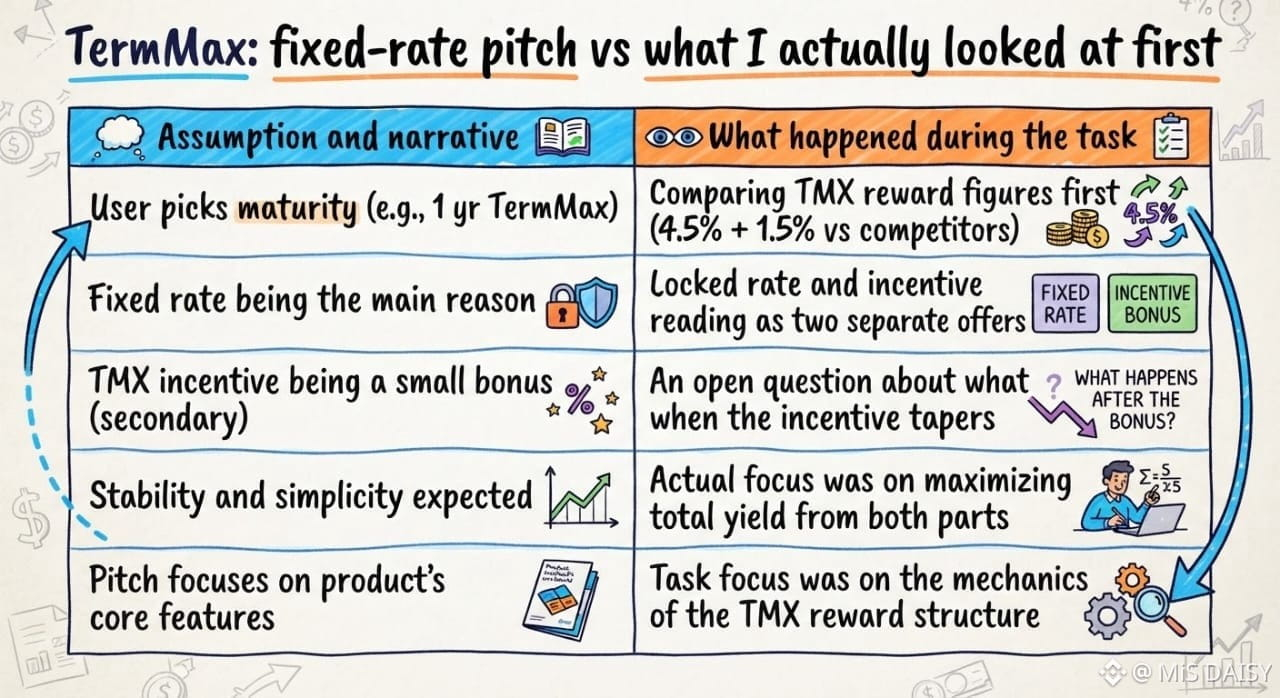
What made me pause in TermMax was how quickly my attention slid past the fixed rate and toward the number sitting beside it. The product is built on a quiet idea: pick a maturity, lock a rate, know exactly what you owe or earn. That is different from floating-rate pools where yields drift by the hour. But while moving through the task with @termmax _ts, the rate I could actually lock and the incentive layered on top of it read like two separate offers, and the second one was louder. If $TMX rewards are what make a given maturity look worth choosing, the fixed rate becomes a floor under the decision rather than the reason for it. I caught myself comparing reward figures before I compared terms, which is the opposite of the habit a fixed-rate product seems designed to build. I keep wondering what a user does once the incentive tapers and only the plain locked rate remains. Maybe demand for certainty is real but slow, and the rewards are just what keeps people in the room long enough to notice it. Or maybe they are what the room is made of. #TermMax
What made me pause in TermMax was how quickly my attention slid past the fixed rate and toward the number sitting beside it. The product is built on a quiet idea: pick a maturity, lock a rate, know exactly what you owe or earn. That is different from floating-rate pools where yields drift by the hour. But while moving through the task with @TermMax _ts, the rate I could actually lock and the incentive layered on top of it read like two separate offers, and the second one was louder. If $TMX rewards are what make a given maturity look worth choosing, the fixed rate becomes a floor under the decision rather than the reason for it. I caught myself comparing reward figures before I compared terms, which is the opposite of the habit a fixed-rate product seems designed to build. I keep wondering what a user does once the incentive tapers and only the plain locked rate remains. Maybe demand for certainty is real but slow, and the rewards are just what keeps people in the room long enough to notice it. Or maybe they are what the room is made of. #TermMax
1
844


·
--
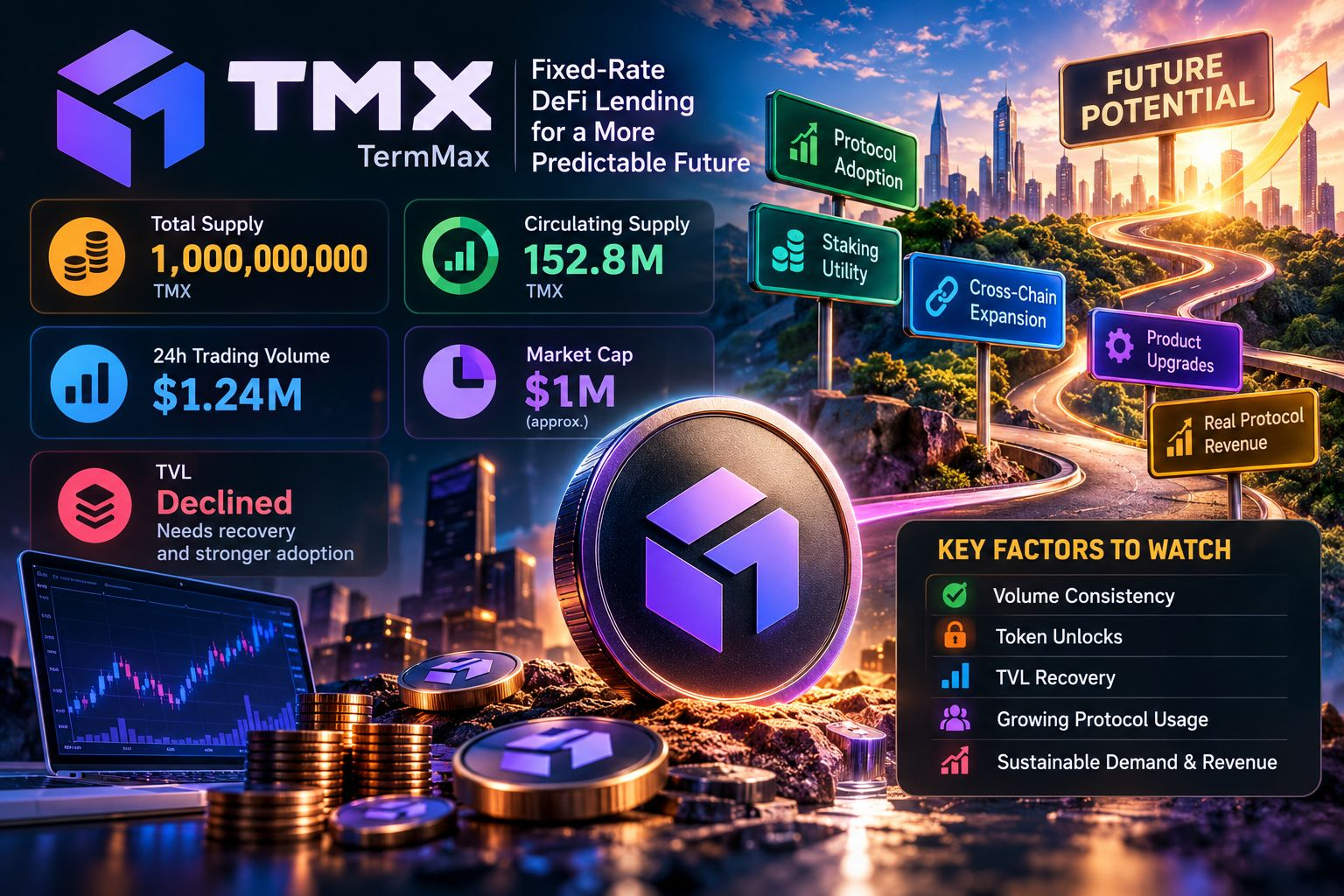
🔍 TMX: Undervalued Opportunity or a High-Risk Recovery Play?
TMX has a fixed maximum supply of 1 billion tokens, with around 152.8 million currently circulating. Its reported 24-hour trading volume is approximately $1.24M, while its market cap is near $1M. However, TermMax’s TVL has dropped sharply, making protocol adoption a key metric to watch.
The long-term outlook depends on whether fixed-rate DeFi lending, staking utility, cross-chain expansion and upcoming product upgrades can attract sustainable demand. A low valuation alone does not guarantee recovery. I’ll be watching volume consistency, token unlocks, TVL recovery and real protocol revenue before drawing stronger conclusions.
Can TMX rebuild momentum through actual usage?
$ZEC
{future}(ZECUSDT)
$DASH
{future}(DASHUSDT)
$TMX
{alpha}(560x3c2f61f2e27c865981d2e7aaf6b2cdf823030039)
#TermMax
🔍 TMX: Undervalued Opportunity or a High-Risk Recovery Play?
TMX has a fixed maximum supply of 1 billion tokens, with around 152.8 million currently circulating. Its reported 24-hour trading volume is approximately $1.24M, while its market cap is near $1M. However, TermMax’s TVL has dropped sharply, making protocol adoption a key metric to watch.
The long-term outlook depends on whether fixed-rate DeFi lending, staking utility, cross-chain expansion and upcoming product upgrades can attract sustainable demand. A low valuation alone does not guarantee recovery. I’ll be watching volume consistency, token unlocks, TVL recovery and real protocol revenue before drawing stronger conclusions.
Can TMX rebuild momentum through actual usage?
$ZEC
$DASH
$TMX
#TermMax
TMX has a fixed maximum supply of 1 billion tokens, with around 152.8 million currently circulating. Its reported 24-hour trading volume is approximately $1.24M, while its market cap is near $1M. However, TermMax’s TVL has dropped sharply, making protocol adoption a key metric to watch.
The long-term outlook depends on whether fixed-rate DeFi lending, staking utility, cross-chain expansion and upcoming product upgrades can attract sustainable demand. A low valuation alone does not guarantee recovery. I’ll be watching volume consistency, token unlocks, TVL recovery and real protocol revenue before drawing stronger conclusions.
Can TMX rebuild momentum through actual usage?
$ZEC
$DASH
$TMX
#TermMax
5
2k

·
--
Let me put the conclusion first: I’m putting $TMX on my watchlist for now. The token concentration is making me seriously uneasy. 🤔
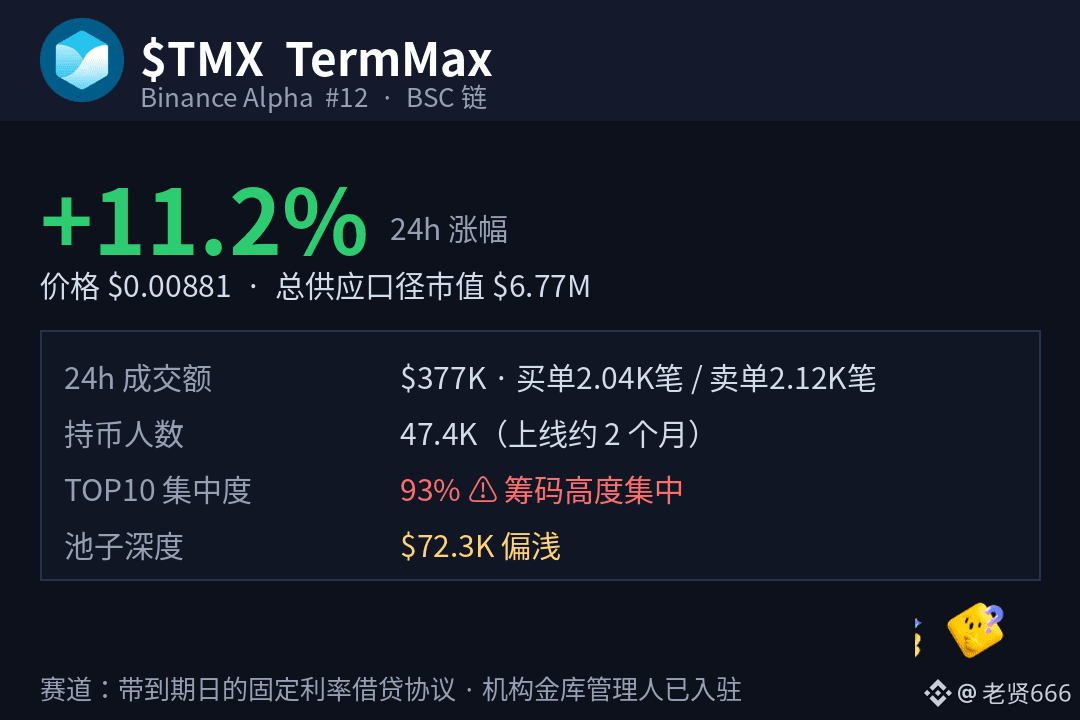
Today I went through all 280 coins on the Alpha leaderboard. TMX (TermMax) ranked 12th, up 11.2% over 24 hours, at $0.00881. What’s interesting is that it launched only two months ago, yet it already has 47,000 holders—that’s fast growth, even by Alpha standards.
On-chain, it saw $377,000 in trading volume over the past 24 hours, with 2.04K buy orders and 2.12K sell orders. Buyers and sellers are pretty evenly matched, and the activity is genuine—not just a few addresses trading back and forth. 👀
But there’s another side to the story: the top 10 wallets hold 93% of the tokens, and the liquidity pool has only a little over $70,000 in it. That’s shallow. It’s a classic case of lots of people, not much supply, and a few holders controlling most of the tokens—a small boat that gets tossed around when the waves pick up.
What does it do? It’s a fixed-rate lending protocol with set maturity dates. When you deposit, the rate and term are locked in, so neither borrowers nor lenders have to guess where floating rates will go. Its website, ts.finance, is live, and it’s already operating across several chains, including Ethereum, Arbitrum, and BNB Chain. Institutions like MEV Capital and Keyrock are also managing vaults on the platform, so there’s some substance behind it.
Verdict: Watch. Here’s what would change my mind—if token concentration stays this high and trading volume dries up, I’ll take it off the list. If ownership becomes more distributed and the liquidity pool deepens, I’ll upgrade it to active tracking.
This isn’t investment advice. Coins in the Alpha sector can drop without making a sound. Follow me, and I’ll see you in tomorrow’s ledger. 📒
#BinanceAlpha #TermMax #DeFi
Let me put the conclusion first: I’m putting $TMX on my watchlist for now. The token concentration is making me seriously uneasy. 🤔
Today I went through all 280 coins on the Alpha leaderboard. TMX (TermMax) ranked 12th, up 11.2% over 24 hours, at $0.00881. What’s interesting is that it launched only two months ago, yet it already has 47,000 holders—that’s fast growth, even by Alpha standards.
On-chain, it saw $377,000 in trading volume over the past 24 hours, with 2.04K buy orders and 2.12K sell orders. Buyers and sellers are pretty evenly matched, and the activity is genuine—not just a few addresses trading back and forth. 👀
But there’s another side to the story: the top 10 wallets hold 93% of the tokens, and the liquidity pool has only a little over $70,000 in it. That’s shallow. It’s a classic case of lots of people, not much supply, and a few holders controlling most of the tokens—a small boat that gets tossed around when the waves pick up.
What does it do? It’s a fixed-rate lending protocol with set maturity dates. When you deposit, the rate and term are locked in, so neither borrowers nor lenders have to guess where floating rates will go. Its website, ts.finance, is live, and it’s already operating across several chains, including Ethereum, Arbitrum, and BNB Chain. Institutions like MEV Capital and Keyrock are also managing vaults on the platform, so there’s some substance behind it.
Verdict: Watch. Here’s what would change my mind—if token concentration stays this high and trading volume dries up, I’ll take it off the list. If ownership becomes more distributed and the liquidity pool deepens, I’ll upgrade it to active tracking.
This isn’t investment advice. Coins in the Alpha sector can drop without making a sound. Follow me, and I’ll see you in tomorrow’s ledger. 📒
#BinanceAlpha #TermMax #DeFi
Today I went through all 280 coins on the Alpha leaderboard. TMX (TermMax) ranked 12th, up 11.2% over 24 hours, at $0.00881. What’s interesting is that it launched only two months ago, yet it already has 47,000 holders—that’s fast growth, even by Alpha standards.
On-chain, it saw $377,000 in trading volume over the past 24 hours, with 2.04K buy orders and 2.12K sell orders. Buyers and sellers are pretty evenly matched, and the activity is genuine—not just a few addresses trading back and forth. 👀
But there’s another side to the story: the top 10 wallets hold 93% of the tokens, and the liquidity pool has only a little over $70,000 in it. That’s shallow. It’s a classic case of lots of people, not much supply, and a few holders controlling most of the tokens—a small boat that gets tossed around when the waves pick up.
What does it do? It’s a fixed-rate lending protocol with set maturity dates. When you deposit, the rate and term are locked in, so neither borrowers nor lenders have to guess where floating rates will go. Its website, ts.finance, is live, and it’s already operating across several chains, including Ethereum, Arbitrum, and BNB Chain. Institutions like MEV Capital and Keyrock are also managing vaults on the platform, so there’s some substance behind it.
Verdict: Watch. Here’s what would change my mind—if token concentration stays this high and trading volume dries up, I’ll take it off the list. If ownership becomes more distributed and the liquidity pool deepens, I’ll upgrade it to active tracking.
This isn’t investment advice. Coins in the Alpha sector can drop without making a sound. Follow me, and I’ll see you in tomorrow’s ledger. 📒
#BinanceAlpha #TermMax #DeFi
590

🚨 $TERMMAX PROVES FIXED-RATE DEFI IS SHIFTING FROM ORDERBOOKS TO AMM LIQUIDITY POOLS! 🏦
Orderbook architecture offers exact rate matching, but liquidity fragmentation across fixed maturities cripples execution speed. 🏦 $TERMMAX transitioning toward custom-curve AMMs trades marginal pricing precision for continuous pool depth, allowing smart money to enter and exit positions instantly without waiting for counterparty matching.
This structural evolution mirrors early spot market expansion, proving that automated pooled liquidity is essential for fixed-income scaling. 💡 Shared liquidity architecture solves the friction of illiquid maturities, unlocking true institutional throughput for non-standard assets.
💬 Do you prioritize absolute rate precision or instant execution liquidity when locking fixed yields? 👇
⚠️ Not financial advice. Always manage your risk. 🛡️
🏷️ #TERMMAX #FixedRate #DeFi #Yield #Crypto
🎯 🦈
🚨 $TERMMAX PROVES FIXED-RATE DEFI IS SHIFTING FROM ORDERBOOKS TO AMM LIQUIDITY POOLS! 🏦
Orderbook architecture offers exact rate matching, but liquidity fragmentation across fixed maturities cripples execution speed. 🏦 $TERMMAX transitioning toward custom-curve AMMs trades marginal pricing precision for continuous pool depth, allowing smart money to enter and exit positions instantly without waiting for counterparty matching.
This structural evolution mirrors early spot market expansion, proving that automated pooled liquidity is essential for fixed-income scaling. 💡 Shared liquidity architecture solves the friction of illiquid maturities, unlocking true institutional throughput for non-standard assets.
💬 Do you prioritize absolute rate precision or instant execution liquidity when locking fixed yields? 👇
⚠️ Not financial advice. Always manage your risk. 🛡️
🏷️ #TERMMAX #FixedRate #DeFi #Yield #Crypto
🎯 🦈
Orderbook architecture offers exact rate matching, but liquidity fragmentation across fixed maturities cripples execution speed. 🏦 $TERMMAX transitioning toward custom-curve AMMs trades marginal pricing precision for continuous pool depth, allowing smart money to enter and exit positions instantly without waiting for counterparty matching.
This structural evolution mirrors early spot market expansion, proving that automated pooled liquidity is essential for fixed-income scaling. 💡 Shared liquidity architecture solves the friction of illiquid maturities, unlocking true institutional throughput for non-standard assets.
💬 Do you prioritize absolute rate precision or instant execution liquidity when locking fixed yields? 👇
⚠️ Not financial advice. Always manage your risk. 🛡️
🏷️ #TERMMAX #FixedRate #DeFi #Yield #Crypto
🎯 🦈
38

·
--
IS $TERMMAX SOLVING REAL DEFI DEMAND OR JUST MARKET COORDINATION? 🚨 📊
Smart money capital allocation in $TERMMAX reveals a fundamental institutional dilemma between predictable debt yield and pure execution flexibility. 🌊 While locking term rates solves structure coordination, high-volatility regimes historically favor immediate liquidity over fixed maturity schedules.
Institutional desks requiring cash flow precision and cost-locked arbitrage will treat fixed rates as a necessity. 💡 However, retail liquidity still votes with its feet, prioritizing rapid position rotation when market structure shifts unexpectedly.
Determining long-term protocol momentum comes down to real institutional adoption versus superficial rate tables. 💬 In high-volatility conditions, do you prioritize locking in structural certainty or preserving emergency exit flexibility? 👇
⚠️ Not financial advice. Always manage your risk. 🛡️
🏷️ #TERMMAX #DeFi #Yield #MarketStructure #Crypto
🔥 💎
IS $TERMMAX SOLVING REAL DEFI DEMAND OR JUST MARKET COORDINATION? 🚨 📊
Smart money capital allocation in $TERMMAX reveals a fundamental institutional dilemma between predictable debt yield and pure execution flexibility. 🌊 While locking term rates solves structure coordination, high-volatility regimes historically favor immediate liquidity over fixed maturity schedules.
Institutional desks requiring cash flow precision and cost-locked arbitrage will treat fixed rates as a necessity. 💡 However, retail liquidity still votes with its feet, prioritizing rapid position rotation when market structure shifts unexpectedly.
Determining long-term protocol momentum comes down to real institutional adoption versus superficial rate tables. 💬 In high-volatility conditions, do you prioritize locking in structural certainty or preserving emergency exit flexibility? 👇
⚠️ Not financial advice. Always manage your risk. 🛡️
🏷️ #TERMMAX #DeFi #Yield #MarketStructure #Crypto
🔥 💎
Smart money capital allocation in $TERMMAX reveals a fundamental institutional dilemma between predictable debt yield and pure execution flexibility. 🌊 While locking term rates solves structure coordination, high-volatility regimes historically favor immediate liquidity over fixed maturity schedules.
Institutional desks requiring cash flow precision and cost-locked arbitrage will treat fixed rates as a necessity. 💡 However, retail liquidity still votes with its feet, prioritizing rapid position rotation when market structure shifts unexpectedly.
Determining long-term protocol momentum comes down to real institutional adoption versus superficial rate tables. 💬 In high-volatility conditions, do you prioritize locking in structural certainty or preserving emergency exit flexibility? 👇
⚠️ Not financial advice. Always manage your risk. 🛡️
🏷️ #TERMMAX #DeFi #Yield #MarketStructure #Crypto
🔥 💎
39

·
--
🚨 $TERMMAX REVOLUTIONIZES RWA LIQUIDITY WITH INSTITUTIONAL PHYSICAL DELIVERY MECHANICS! 🦈
Bringing real-world assets on-chain means little if secondary market liquidity collapses under stress. 🦈 Institutional capital requires structural safety, which is why $TERMMAX is shifting the paradigm by replacing market liquidations with physical asset delivery directly to lenders.
📌 This eliminates order book slippage and preserves capital efficiency during high volatility, unlike traditional forced liquidations seen in $BTC or $ETH pools. Fixed-rate lending backed by direct settlement provides the structural clarity smart money demands before scaling size. 📊
💬 Will physical settlement mechanisms become the mandatory baseline for institutional RWA protocols? 👇
⚠️ Not financial advice. Always manage your risk. 🛡️
🏷️ #TERMMAX #RWA #DeFi #SmartMoney #Crypto
🎯 🦈
🚨 $TERMMAX REVOLUTIONIZES RWA LIQUIDITY WITH INSTITUTIONAL PHYSICAL DELIVERY MECHANICS! 🦈
Bringing real-world assets on-chain means little if secondary market liquidity collapses under stress. 🦈 Institutional capital requires structural safety, which is why $TERMMAX is shifting the paradigm by replacing market liquidations with physical asset delivery directly to lenders.
📌 This eliminates order book slippage and preserves capital efficiency during high volatility, unlike traditional forced liquidations seen in $BTC or $ETH pools. Fixed-rate lending backed by direct settlement provides the structural clarity smart money demands before scaling size. 📊
💬 Will physical settlement mechanisms become the mandatory baseline for institutional RWA protocols? 👇
⚠️ Not financial advice. Always manage your risk. 🛡️
🏷️ #TERMMAX #RWA #DeFi #SmartMoney #Crypto
🎯 🦈
Bringing real-world assets on-chain means little if secondary market liquidity collapses under stress. 🦈 Institutional capital requires structural safety, which is why $TERMMAX is shifting the paradigm by replacing market liquidations with physical asset delivery directly to lenders.
📌 This eliminates order book slippage and preserves capital efficiency during high volatility, unlike traditional forced liquidations seen in $BTC or $ETH pools. Fixed-rate lending backed by direct settlement provides the structural clarity smart money demands before scaling size. 📊
💬 Will physical settlement mechanisms become the mandatory baseline for institutional RWA protocols? 👇
⚠️ Not financial advice. Always manage your risk. 🛡️
🏷️ #TERMMAX #RWA #DeFi #SmartMoney #Crypto
🎯 🦈
75
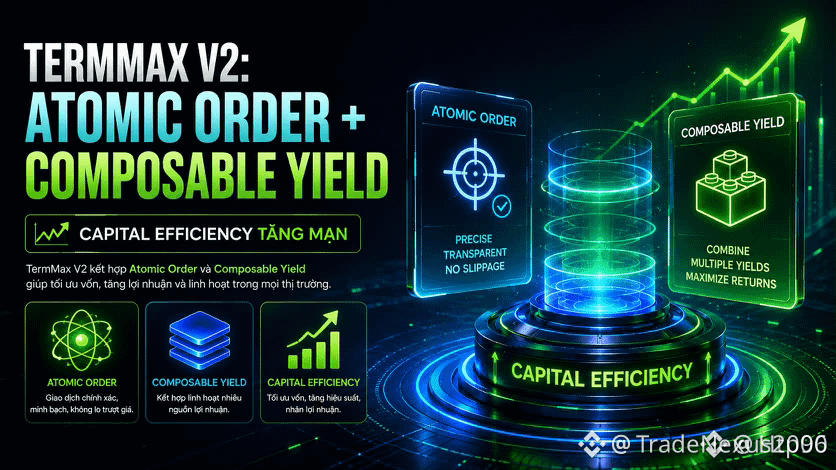
🚨 $TERMMAX V2 UNLOCKS INSTITUTIONAL CAPITAL EFFICIENCY WITH COMPOSABLE BASE YIELD ARCHITECTURE! 💥
Smart money institutional vaults often suffer from idle liquidity friction while awaiting fixed-rate matching. 🏦 TermMax V2 resolves this structural inefficiency by dynamically routing unmatched capital into base yield engines like Aave and Morpho ERC-4626 standard vaults. 🔍
By deploying virtual liquidity across multiple order books simultaneously without risk of double-allocation, large whale borrowers can now source deep liquidity frictionlessly. 📊 This structural upgrade drastically maximizes capital efficiency and optimizes risk-adjusted returns for vault curators. 💬 Will composable base yields become the mandatory blueprint for fixed-rate DeFi protocols going forward? 👇
⚠️ Not financial advice. Always manage your risk. 🛡️
🏷️ #TERMMAX #DeFi #YieldOptimization #Crypto #FixedRate
🔥 💎
🚨 $TERMMAX V2 UNLOCKS INSTITUTIONAL CAPITAL EFFICIENCY WITH COMPOSABLE BASE YIELD ARCHITECTURE! 💥
Smart money institutional vaults often suffer from idle liquidity friction while awaiting fixed-rate matching. 🏦 TermMax V2 resolves this structural inefficiency by dynamically routing unmatched capital into base yield engines like Aave and Morpho ERC-4626 standard vaults. 🔍
By deploying virtual liquidity across multiple order books simultaneously without risk of double-allocation, large whale borrowers can now source deep liquidity frictionlessly. 📊 This structural upgrade drastically maximizes capital efficiency and optimizes risk-adjusted returns for vault curators. 💬 Will composable base yields become the mandatory blueprint for fixed-rate DeFi protocols going forward? 👇
⚠️ Not financial advice. Always manage your risk. 🛡️
🏷️ #TERMMAX #DeFi #YieldOptimization #Crypto #FixedRate
🔥 💎
Smart money institutional vaults often suffer from idle liquidity friction while awaiting fixed-rate matching. 🏦 TermMax V2 resolves this structural inefficiency by dynamically routing unmatched capital into base yield engines like Aave and Morpho ERC-4626 standard vaults. 🔍
By deploying virtual liquidity across multiple order books simultaneously without risk of double-allocation, large whale borrowers can now source deep liquidity frictionlessly. 📊 This structural upgrade drastically maximizes capital efficiency and optimizes risk-adjusted returns for vault curators. 💬 Will composable base yields become the mandatory blueprint for fixed-rate DeFi protocols going forward? 👇
⚠️ Not financial advice. Always manage your risk. 🛡️
🏷️ #TERMMAX #DeFi #YieldOptimization #Crypto #FixedRate
🔥 💎
41

·
--
Partly True
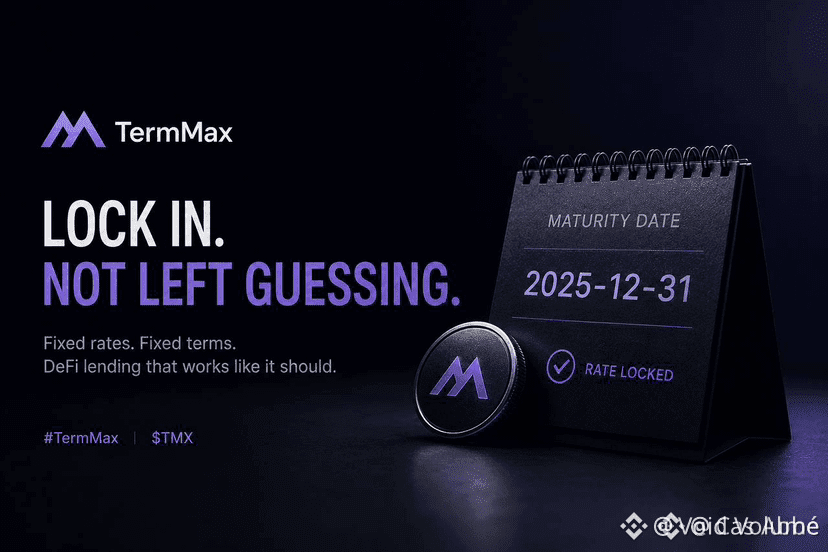
🏦 CUMBERLAND DRW BACKS $TERMMAX TO SOLVE DEFI DURATION RISK WITH ON-CHAIN BONDS 🔍
DeFi lending has long suffered from inefficient yield volatility, forcing liquidity providers into unpredictable rate exposure. 🏦 The institutional footprint behind TermMax, spearheaded by Cumberland DRW, signals a structural shift toward fixed-income maturity dates and true duration risk management on-chain. 📊
While early-stage metrics show modest TVL and single-chain deployment, introducing predictable, bond-like maturity structures addresses the core bottleneck of institutional capital entry. 🔍 Smart money understands that mature financial systems require deterministic yield curves, not random APY swings. 💡
🤔 Will fixed-term maturity models finally unlock institutional treasury allocation in DeFi? 👇
⚠️ Not financial advice. Always manage your risk. 🛡️
🏷️ #TERMMAX #DeFi #FixedIncome #SmartMoney
🏦 🔍
🏦 CUMBERLAND DRW BACKS $TERMMAX TO SOLVE DEFI DURATION RISK WITH ON-CHAIN BONDS 🔍
DeFi lending has long suffered from inefficient yield volatility, forcing liquidity providers into unpredictable rate exposure. 🏦 The institutional footprint behind TermMax, spearheaded by Cumberland DRW, signals a structural shift toward fixed-income maturity dates and true duration risk management on-chain. 📊
While early-stage metrics show modest TVL and single-chain deployment, introducing predictable, bond-like maturity structures addresses the core bottleneck of institutional capital entry. 🔍 Smart money understands that mature financial systems require deterministic yield curves, not random APY swings. 💡
🤔 Will fixed-term maturity models finally unlock institutional treasury allocation in DeFi? 👇
⚠️ Not financial advice. Always manage your risk. 🛡️
🏷️ #TERMMAX #DeFi #FixedIncome #SmartMoney
🏦 🔍
DeFi lending has long suffered from inefficient yield volatility, forcing liquidity providers into unpredictable rate exposure. 🏦 The institutional footprint behind TermMax, spearheaded by Cumberland DRW, signals a structural shift toward fixed-income maturity dates and true duration risk management on-chain. 📊
While early-stage metrics show modest TVL and single-chain deployment, introducing predictable, bond-like maturity structures addresses the core bottleneck of institutional capital entry. 🔍 Smart money understands that mature financial systems require deterministic yield curves, not random APY swings. 💡
🤔 Will fixed-term maturity models finally unlock institutional treasury allocation in DeFi? 👇
⚠️ Not financial advice. Always manage your risk. 🛡️
🏷️ #TERMMAX #DeFi #FixedIncome #SmartMoney
🏦 🔍
1
627
🔍 INSIDER ARCHITECTURE: IS $TERMMAX REDEFINING DEFI LIQUIDITY OR DELEGATING YIELD CONTROL? 🦈
💡 Institutional fixed-rate DeFi is shifting from pure algorithmic AMMs to curated liquidity boundaries. TermMax’s range order design moves pricing authority to curators who set structural yield boundaries for market participants. 🔍
🔒 While this optimizes capital efficiency, execution hinges entirely on precise parameter management. Set these APR boundaries too wide and pricing precision dilutes; set them too narrow and sudden volatility pushes liquidity out of range. 📊
🤔 As institutional capital moves into structured yield products, will curator-driven ranges become the standard for fixed-rate execution? 👇
⚠️ Not financial advice. Always manage your risk. 🛡️
🏷️ #TERMMAX #DeFi #YieldCurve #SmartMoney #Crypto
🎯 🦈
🔍 INSIDER ARCHITECTURE: IS $TERMMAX REDEFINING DEFI LIQUIDITY OR DELEGATING YIELD CONTROL? 🦈
💡 Institutional fixed-rate DeFi is shifting from pure algorithmic AMMs to curated liquidity boundaries. TermMax’s range order design moves pricing authority to curators who set structural yield boundaries for market participants. 🔍
🔒 While this optimizes capital efficiency, execution hinges entirely on precise parameter management. Set these APR boundaries too wide and pricing precision dilutes; set them too narrow and sudden volatility pushes liquidity out of range. 📊
🤔 As institutional capital moves into structured yield products, will curator-driven ranges become the standard for fixed-rate execution? 👇
⚠️ Not financial advice. Always manage your risk. 🛡️
🏷️ #TERMMAX #DeFi #YieldCurve #SmartMoney #Crypto
🎯 🦈
💡 Institutional fixed-rate DeFi is shifting from pure algorithmic AMMs to curated liquidity boundaries. TermMax’s range order design moves pricing authority to curators who set structural yield boundaries for market participants. 🔍
🔒 While this optimizes capital efficiency, execution hinges entirely on precise parameter management. Set these APR boundaries too wide and pricing precision dilutes; set them too narrow and sudden volatility pushes liquidity out of range. 📊
🤔 As institutional capital moves into structured yield products, will curator-driven ranges become the standard for fixed-rate execution? 👇
⚠️ Not financial advice. Always manage your risk. 🛡️
🏷️ #TERMMAX #DeFi #YieldCurve #SmartMoney #Crypto
🎯 🦈

46

·
--
🏦 HOW $TERMMAX FIXES DEFI YIELD INEFFICIENCIES WITH INSTITUTIONAL FIXED-RATE ARCHITECTURE 🦈
Institutional capital naturally avoids variable-rate volatility and chaotic yield swings. By integrating zero-coupon bond mechanics, $TERMMAX establishes locked borrowing costs and deterministic capital deployment directly on-chain. 📊
This fixed-term framework eliminates sudden rate spikes, allowing smart money to build structured credit strategies with precise risk parameters. 💡 Zero guessing games, just predictable maturity schedules and pure structural stability. 📌 🤔 Is fixed-rate architecture the missing key to unlocking institutional volume on-chain? 👇
⚠️ Not financial advice. Always manage your risk. 🛡️
🏷️ #TERMMAX #DeFi #Yield #Institutional #Crypto
🎯 🦈
🏦 HOW $TERMMAX FIXES DEFI YIELD INEFFICIENCIES WITH INSTITUTIONAL FIXED-RATE ARCHITECTURE 🦈
Institutional capital naturally avoids variable-rate volatility and chaotic yield swings. By integrating zero-coupon bond mechanics, $TERMMAX establishes locked borrowing costs and deterministic capital deployment directly on-chain. 📊
This fixed-term framework eliminates sudden rate spikes, allowing smart money to build structured credit strategies with precise risk parameters. 💡 Zero guessing games, just predictable maturity schedules and pure structural stability. 📌 🤔 Is fixed-rate architecture the missing key to unlocking institutional volume on-chain? 👇
⚠️ Not financial advice. Always manage your risk. 🛡️
🏷️ #TERMMAX #DeFi #Yield #Institutional #Crypto
🎯 🦈
Institutional capital naturally avoids variable-rate volatility and chaotic yield swings. By integrating zero-coupon bond mechanics, $TERMMAX establishes locked borrowing costs and deterministic capital deployment directly on-chain. 📊
This fixed-term framework eliminates sudden rate spikes, allowing smart money to build structured credit strategies with precise risk parameters. 💡 Zero guessing games, just predictable maturity schedules and pure structural stability. 📌 🤔 Is fixed-rate architecture the missing key to unlocking institutional volume on-chain? 👇
⚠️ Not financial advice. Always manage your risk. 🛡️
🏷️ #TERMMAX #DeFi #Yield #Institutional #Crypto
🎯 🦈
68

Partly True
This morning I went back through the on-chain data of $TMX before the TGE on 25/8, and found a figure of @termmax that made me look more closely.
Most of the TVL of @termmax still remains on Ethereum: $30.81M out of a total $31.29M, i.e. about 98.5%. This isn’t too surprising, because Ethereum is often the first destination when considering deep liquidity and the ecosystem’s level of trust.
But when I break down the fee data over the most recent 7 days, the story is completely different. The whole system generates about $3.071, of which bsquared contributes $2.999. Meanwhile, Ethereum brings in only $0.17. No, this isn’t a typo.
In other words, most of the capital is concentrated on one chain, but the flow of activity that generates revenue is heavily tilted elsewhere—toward a chain that may not yet be on the majority of the market’s radar.
I still haven’t figured out what’s behind this mismatch. Could it be that bsquared has many more real users trading due to higher returns or incentives? Or is the capital on Ethereum only been deployed before the TGE and then just sat there, without generating many interactions with the protocol?
To be honest, I’m leaving both possibilities open. But this gap makes me no longer want to view TVL as a simple measure of the protocol’s health.
I want to see whether, after TMX lists, this situation will shift—whether the source of capital will move, or remain exactly as it is right now.
#termmax $XRP $BLESS $BEAT #SamsungToAnnounceNewShareholderReturnPlanFriday #BitcoinBestWeekSinceMarch2023 #BitcoinHitsIntradayHigh$75500 #SpotGoldHitsHighestSinceMay15
{future}(BEATUSDT)
{future}(BLESSUSDT)
{future}(XRPUSDT)
This morning I went back through the on-chain data of $TMX before the TGE on 25/8, and found a figure of @TermMax that made me look more closely.
Most of the TVL of @TermMax still remains on Ethereum: $30.81M out of a total $31.29M, i.e. about 98.5%. This isn’t too surprising, because Ethereum is often the first destination when considering deep liquidity and the ecosystem’s level of trust.
But when I break down the fee data over the most recent 7 days, the story is completely different. The whole system generates about $3.071, of which bsquared contributes $2.999. Meanwhile, Ethereum brings in only $0.17. No, this isn’t a typo.
In other words, most of the capital is concentrated on one chain, but the flow of activity that generates revenue is heavily tilted elsewhere—toward a chain that may not yet be on the majority of the market’s radar.
I still haven’t figured out what’s behind this mismatch. Could it be that bsquared has many more real users trading due to higher returns or incentives? Or is the capital on Ethereum only been deployed before the TGE and then just sat there, without generating many interactions with the protocol?
To be honest, I’m leaving both possibilities open. But this gap makes me no longer want to view TVL as a simple measure of the protocol’s health.
I want to see whether, after TMX lists, this situation will shift—whether the source of capital will move, or remain exactly as it is right now.
#termmax $XRP $BLESS $BEAT #SamsungToAnnounceNewShareholderReturnPlanFriday #BitcoinBestWeekSinceMarch2023 #BitcoinHitsIntradayHigh$75500 #SpotGoldHitsHighestSinceMay15
Most of the TVL of @TermMax still remains on Ethereum: $30.81M out of a total $31.29M, i.e. about 98.5%. This isn’t too surprising, because Ethereum is often the first destination when considering deep liquidity and the ecosystem’s level of trust.
But when I break down the fee data over the most recent 7 days, the story is completely different. The whole system generates about $3.071, of which bsquared contributes $2.999. Meanwhile, Ethereum brings in only $0.17. No, this isn’t a typo.
In other words, most of the capital is concentrated on one chain, but the flow of activity that generates revenue is heavily tilted elsewhere—toward a chain that may not yet be on the majority of the market’s radar.
I still haven’t figured out what’s behind this mismatch. Could it be that bsquared has many more real users trading due to higher returns or incentives? Or is the capital on Ethereum only been deployed before the TGE and then just sat there, without generating many interactions with the protocol?
To be honest, I’m leaving both possibilities open. But this gap makes me no longer want to view TVL as a simple measure of the protocol’s health.
I want to see whether, after TMX lists, this situation will shift—whether the source of capital will move, or remain exactly as it is right now.
#termmax $XRP $BLESS $BEAT #SamsungToAnnounceNewShareholderReturnPlanFriday #BitcoinBestWeekSinceMarch2023 #BitcoinHitsIntradayHigh$75500 #SpotGoldHitsHighestSinceMay15
☘️ TVL ≠ Revenue
50%
⚡Activity tells more
50%
🔍 Bsquared stands out
0%
📊 Post-TGE shift
0%
6 votes • Voting closed
2
2
3k

When I first started learning about fixed-rate DeFi, I thought interest rates were pretty straightforward: high rates are attractive, low rates are less noticeable. But when RWA shows up as collateral, I started to see things differently. At that point, interest rates also partly reflect how the market values the asset behind the loan.
What pulled me in most about @termmax is how each market can form its own borrowing benchmark. When RWAs are used as collateral and tied to fixed terms, liquidity, asset quality, and even fluctuations can create meaningful differences. If enough data is available over time, @termmax can build an onchain credit measurement framework, rather than simply becoming a place that generates extra APY.
I also want to look at one more thing: whether users truly stay. A high reward doesn’t necessarily mean sustainable demand. I’ll pay attention to whether lenders keep providing funding, whether the rate self-balances when incentives are reduced, and whether borrowers come back across multiple terms. Thin liquidity can also make rates look more attractive than they really are—especially when most of the trading comes from a small group.
I’ll have a better view of @termmax if borrowing activity holds steady, with interest rates truly reflecting the characteristics of each type of collateral and liquidity distributed evenly across many terms. On the other hand, if the story being told is bigger than what’s actually happening, I’ll remain cautious.
For me, a “good-looking” interest-rate curve is not enough. I want to trace where the real source of funds is coming from.
#termmax $XRP $BLESS $BTW #SamsungToAnnounceNewShareholderReturnPlanFriday #BitcoinBestWeekSinceMarch2023 #TinFed #SpotGoldHitsHighestSinceMay15
{future}(BTWUSDT)
{future}(BLESSUSDT)
{future}(XRPUSDT)
When I first started learning about fixed-rate DeFi, I thought interest rates were pretty straightforward: high rates are attractive, low rates are less noticeable. But when RWA shows up as collateral, I started to see things differently. At that point, interest rates also partly reflect how the market values the asset behind the loan.
What pulled me in most about @TermMax is how each market can form its own borrowing benchmark. When RWAs are used as collateral and tied to fixed terms, liquidity, asset quality, and even fluctuations can create meaningful differences. If enough data is available over time, @TermMax can build an onchain credit measurement framework, rather than simply becoming a place that generates extra APY.
I also want to look at one more thing: whether users truly stay. A high reward doesn’t necessarily mean sustainable demand. I’ll pay attention to whether lenders keep providing funding, whether the rate self-balances when incentives are reduced, and whether borrowers come back across multiple terms. Thin liquidity can also make rates look more attractive than they really are—especially when most of the trading comes from a small group.
I’ll have a better view of @TermMax if borrowing activity holds steady, with interest rates truly reflecting the characteristics of each type of collateral and liquidity distributed evenly across many terms. On the other hand, if the story being told is bigger than what’s actually happening, I’ll remain cautious.
For me, a “good-looking” interest-rate curve is not enough. I want to trace where the real source of funds is coming from.
#termmax $XRP $BLESS $BTW #SamsungToAnnounceNewShareholderReturnPlanFriday #BitcoinBestWeekSinceMarch2023 #TinFed #SpotGoldHitsHighestSinceMay15
What pulled me in most about @TermMax is how each market can form its own borrowing benchmark. When RWAs are used as collateral and tied to fixed terms, liquidity, asset quality, and even fluctuations can create meaningful differences. If enough data is available over time, @TermMax can build an onchain credit measurement framework, rather than simply becoming a place that generates extra APY.
I also want to look at one more thing: whether users truly stay. A high reward doesn’t necessarily mean sustainable demand. I’ll pay attention to whether lenders keep providing funding, whether the rate self-balances when incentives are reduced, and whether borrowers come back across multiple terms. Thin liquidity can also make rates look more attractive than they really are—especially when most of the trading comes from a small group.
I’ll have a better view of @TermMax if borrowing activity holds steady, with interest rates truly reflecting the characteristics of each type of collateral and liquidity distributed evenly across many terms. On the other hand, if the story being told is bigger than what’s actually happening, I’ll remain cautious.
For me, a “good-looking” interest-rate curve is not enough. I want to trace where the real source of funds is coming from.
#termmax $XRP $BLESS $BTW #SamsungToAnnounceNewShareholderReturnPlanFriday #BitcoinBestWeekSinceMarch2023 #TinFed #SpotGoldHitsHighestSinceMay15
📈 APY cao chưa đủ
20%
💧Thanh khoản mới quan trọng
0%
🎁 Reward giảm, nhu cầu còn
40%
💰 Theo dõi dòng tiền thật
40%
5 votes • Voting closed
2
3
3.6k

·
--
I’m no longer paying much attention to the leverage levels on @termmax .At first glance, they look quite attractive, but the extra profit can quickly narrow once the cost of borrowed capital is factored in
This is the part that can easily lead users to misjudge.@termmax allowing leveraged positions to be created faster only makes the process more streamlined, not make the position’s risk disappear
With PT or yield-bearing assets, I don’t think the key is simply how much more you can borrow. What matters more is how much excess return remains after capital costs, slippage, trading fees and liquidity impact. The higher the leverage, the faster funding costs can turn the equation around
Perhaps opening a position is only the beginning
What happens when volatility appears and many @termmax users want to exit their positions at the same time? Flash loan atomicity can bundle multiple steps into a single transaction, but it cannot create exit liquidity. This is where execution risk turns into system-wide behavior
I’m more interested in the moment the market reverses, when many people on #termmax want to close their positions at the same time. Flash loan atomicity can handle multiple operations in one transaction, but it cannot turn scarce liquidity into available liquidity. At that point, pressure from individual positions can accumulate into a problem at the protocol level
I think adoption needs to be looked at beyond the surface numbers. The number of registered wallets only shows how many accounts have appeared. More worth watching is how many wallets actually deposit capital, return to borrow, and remain engaged when the reward program loses its appeal.
I like the direction @termmax is pursuing around how capital is utilized, but I still want to watch its ability to exit positions.If leverage only runs smoothly when liquidity is abundant, TMX’s governance and incentives need to show that they can strengthen the system’s resilience, rather than just make opening positions more convenient
$XRP $BLESS #SamsungToAnnounceNewShareholderReturnPlanFriday
I’m no longer paying much attention to the leverage levels on @TermMax .At first glance, they look quite attractive, but the extra profit can quickly narrow once the cost of borrowed capital is factored in
This is the part that can easily lead users to misjudge.@TermMax allowing leveraged positions to be created faster only makes the process more streamlined, not make the position’s risk disappear
With PT or yield-bearing assets, I don’t think the key is simply how much more you can borrow. What matters more is how much excess return remains after capital costs, slippage, trading fees and liquidity impact. The higher the leverage, the faster funding costs can turn the equation around
Perhaps opening a position is only the beginning
What happens when volatility appears and many @TermMax users want to exit their positions at the same time? Flash loan atomicity can bundle multiple steps into a single transaction, but it cannot create exit liquidity. This is where execution risk turns into system-wide behavior
I’m more interested in the moment the market reverses, when many people on #termmax want to close their positions at the same time. Flash loan atomicity can handle multiple operations in one transaction, but it cannot turn scarce liquidity into available liquidity. At that point, pressure from individual positions can accumulate into a problem at the protocol level
I think adoption needs to be looked at beyond the surface numbers. The number of registered wallets only shows how many accounts have appeared. More worth watching is how many wallets actually deposit capital, return to borrow, and remain engaged when the reward program loses its appeal.
I like the direction @TermMax is pursuing around how capital is utilized, but I still want to watch its ability to exit positions.If leverage only runs smoothly when liquidity is abundant, TMX’s governance and incentives need to show that they can strengthen the system’s resilience, rather than just make opening positions more convenient
$XRP $BLESS #SamsungToAnnounceNewShareholderReturnPlanFriday
This is the part that can easily lead users to misjudge.@TermMax allowing leveraged positions to be created faster only makes the process more streamlined, not make the position’s risk disappear
With PT or yield-bearing assets, I don’t think the key is simply how much more you can borrow. What matters more is how much excess return remains after capital costs, slippage, trading fees and liquidity impact. The higher the leverage, the faster funding costs can turn the equation around
Perhaps opening a position is only the beginning
What happens when volatility appears and many @TermMax users want to exit their positions at the same time? Flash loan atomicity can bundle multiple steps into a single transaction, but it cannot create exit liquidity. This is where execution risk turns into system-wide behavior
I’m more interested in the moment the market reverses, when many people on #termmax want to close their positions at the same time. Flash loan atomicity can handle multiple operations in one transaction, but it cannot turn scarce liquidity into available liquidity. At that point, pressure from individual positions can accumulate into a problem at the protocol level
I think adoption needs to be looked at beyond the surface numbers. The number of registered wallets only shows how many accounts have appeared. More worth watching is how many wallets actually deposit capital, return to borrow, and remain engaged when the reward program loses its appeal.
I like the direction @TermMax is pursuing around how capital is utilized, but I still want to watch its ability to exit positions.If leverage only runs smoothly when liquidity is abundant, TMX’s governance and incentives need to show that they can strengthen the system’s resilience, rather than just make opening positions more convenient
$XRP $BLESS #SamsungToAnnounceNewShareholderReturnPlanFriday
⚡ Leverage needs liquidity
40%
💧 Exit liquidity matters
30%
🧩 Adoption goes deeper
20%
🛡️ Resilience over convenience
10%
10 votes • Voting closed
19
4
7.7k

·
--
#termmax @termmax TermMax is a DeFi project focused on the lending and borrowing market with fixed interest rates, helping users better manage their income and borrowing costs. The project develops products such as lending, borrowing, leverage, and vaults across multiple blockchains. A standout feature of TermMax is its focus on building fixed-income infrastructure for DeFi, while also expanding into RWA and institutional users. The TMX token is used for governance, staking, and incentivizing the ecosystem. This is a noteworthy project within the DeFi and on-chain finance trends.
#termmax @TermMax TermMax is a DeFi project focused on the lending and borrowing market with fixed interest rates, helping users better manage their income and borrowing costs. The project develops products such as lending, borrowing, leverage, and vaults across multiple blockchains. A standout feature of TermMax is its focus on building fixed-income infrastructure for DeFi, while also expanding into RWA and institutional users. The TMX token is used for governance, staking, and incentivizing the ecosystem. This is a noteworthy project within the DeFi and on-chain finance trends.
1
24

·
--
#termmax @termmax $TMX Let's be real—the constant volatility in crypto can be exhausting. That is why finding stability through fixed-rate lending feels like a breath of fresh air. @termmax is doing amazing work building predictable finance tools that help everyday users protect their hard-earned capital. #TermMax
#termmax @TermMax $TMX Let's be real—the constant volatility in crypto can be exhausting. That is why finding stability through fixed-rate lending feels like a breath of fresh air. @TermMax is doing amazing work building predictable finance tools that help everyday users protect their hard-earned capital. #TermMax
85

·
--
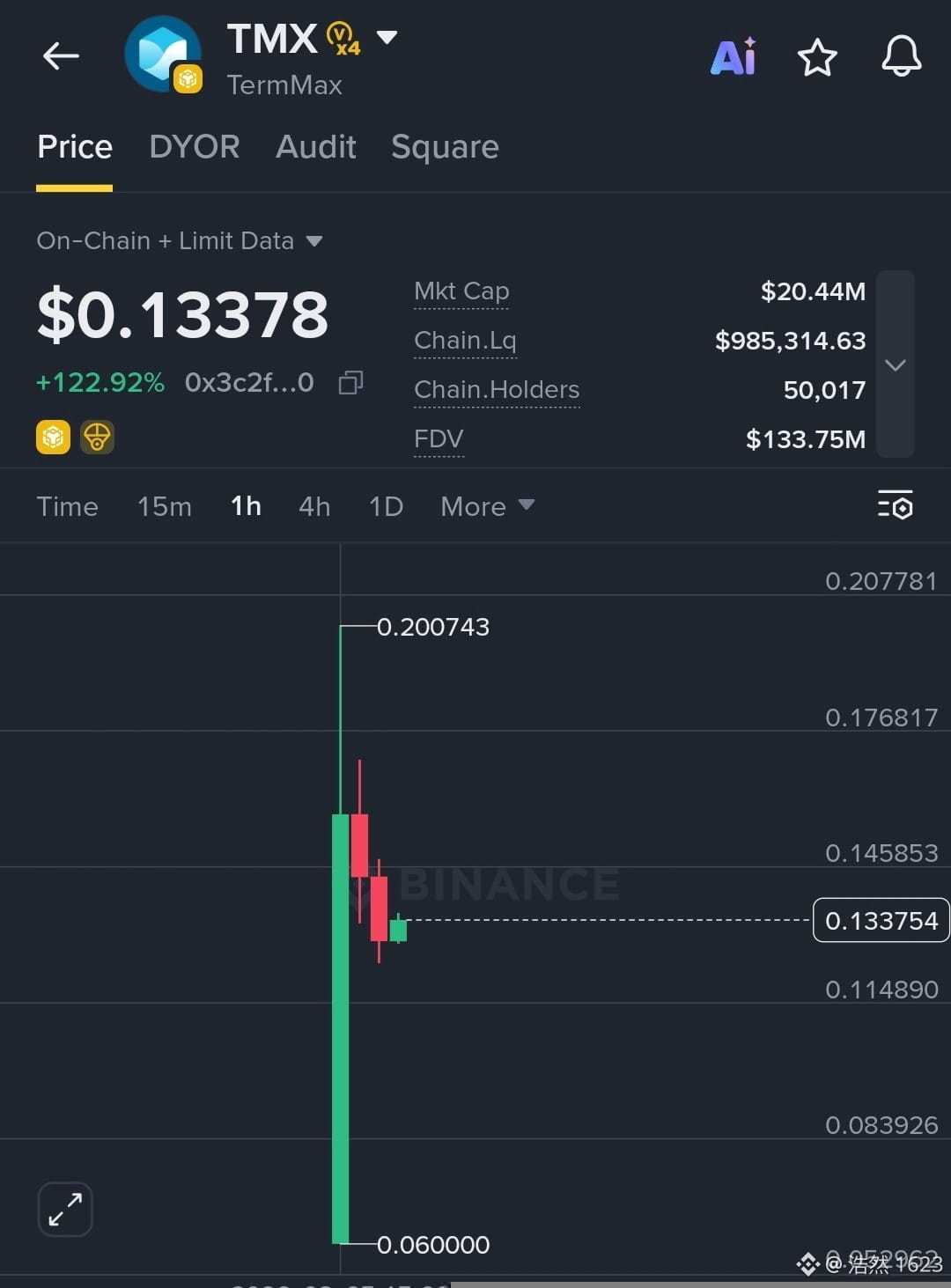
$TMX is showing massive volatility after a sharp initial spike up to 0.200743, followed by a pullback toward key support around 0.114890. Trading currently at 0.13378 with a massive gain of +122.92%, the chart reflects strong early buying volume followed by active price stabilization. As long as buyers hold the 0.11500 zone as solid support, the setup favours potential rebound continuation back toward upper resistance levels.
Target 1: 0.1458 Target 2: 0.1768 Target 3: 0.2007
#TMX #TermMax #CryptoAnalysis
$ONG
{future}(ONGUSDT)
$CYS
{alpha}(560x0c69199c1562233640e0db5ce2c399a88eb507c7)
{alpha}(560x3c2f61f2e27c865981d2e7aaf6b2cdf823030039)
$TMX is showing massive volatility after a sharp initial spike up to 0.200743, followed by a pullback toward key support around 0.114890. Trading currently at 0.13378 with a massive gain of +122.92%, the chart reflects strong early buying volume followed by active price stabilization. As long as buyers hold the 0.11500 zone as solid support, the setup favours potential rebound continuation back toward upper resistance levels.
Target 1: 0.1458 Target 2: 0.1768 Target 3: 0.2007
#TMX #TermMax #CryptoAnalysis
$ONG
$CYS
Target 1: 0.1458 Target 2: 0.1768 Target 3: 0.2007
#TMX #TermMax #CryptoAnalysis
$ONG
$CYS
1
46

·
--
Bullish
#termmax Managing interest rate volatility has always been one of the biggest bottlenecks for scalable DeFi participation. When floating yields fluctuate block-by-block, both lenders and borrowers face unpredictable returns and shifting borrowing costs.
@termmax addresses this liquidity challenge by establishing decentralized, fixed-rate and fixed-term lending and borrowing markets.
#termmax Managing interest rate volatility has always been one of the biggest bottlenecks for scalable DeFi participation. When floating yields fluctuate block-by-block, both lenders and borrowers face unpredictable returns and shifting borrowing costs.
@TermMax addresses this liquidity challenge by establishing decentralized, fixed-rate and fixed-term lending and borrowing markets.
@TermMax addresses this liquidity challenge by establishing decentralized, fixed-rate and fixed-term lending and borrowing markets.
1
1
133

·
--
#termmax When I reread the documentation of @termmax , I got stuck on a set of nouns: FT and XT. At first, I treated them as two names for the same thing—then I understood that it’s splitting a single position into two halves: one for returns and one for costs.$SPCXB
In TermMax, a fixed-term market expresses the relationship between funds by splitting it. FT represents the portion that you can recover as a fixed amount at maturity—the creditors hold that part, and the logic is close to a maturity settlement voucher. Meanwhile, the XT side corresponds to the other end of the leverage and cost structure.
Put it into plain language: in the same fixed-rate transaction, it’s divided into “a return that you’re certain to receive” and “a cost you bear in exchange for magnified returns.” Different parties with different needs take what they need—people aren’t all shoved into one vague position.$SNDKB
I used to think the split is just for accounting convenience. But then I realized this separation allows risk and returns to be priced separately and traded separately. If you want certainty, you hold FT. If you want to expand your exposure, you stand on the other side. The two sides’ demands get matched in the same market.
But the boundaries still have to be clearly stated. FT’s “fixed” refers to the maturity basis—it doesn’t mean you can sell it back at the original price anytime in the middle. The market price will move with interest rates and remaining term. The XT side naturally carries amplified risk; it’s not something you can just hold and lie back and profit. The split only clarifies roles—it doesn’t eliminate any side’s risk.
Seeing this made my understanding of #TermMax even clearer: it didn’t invent a risk-free tool. Instead, it takes two requests within the same transaction—“certainty” and “flexibility”—and turns them into two separate objects that can each circulate on their own.
Fixed-rate structure can lock in the shape of the returns, but it can’t lock in the market price when you exit mid-way.
@termmax #TermMax
#termmax When I reread the documentation of @TermMax , I got stuck on a set of nouns: FT and XT. At first, I treated them as two names for the same thing—then I understood that it’s splitting a single position into two halves: one for returns and one for costs.$SPCXB
In TermMax, a fixed-term market expresses the relationship between funds by splitting it. FT represents the portion that you can recover as a fixed amount at maturity—the creditors hold that part, and the logic is close to a maturity settlement voucher. Meanwhile, the XT side corresponds to the other end of the leverage and cost structure.
Put it into plain language: in the same fixed-rate transaction, it’s divided into “a return that you’re certain to receive” and “a cost you bear in exchange for magnified returns.” Different parties with different needs take what they need—people aren’t all shoved into one vague position.$SNDKB
I used to think the split is just for accounting convenience. But then I realized this separation allows risk and returns to be priced separately and traded separately. If you want certainty, you hold FT. If you want to expand your exposure, you stand on the other side. The two sides’ demands get matched in the same market.
But the boundaries still have to be clearly stated. FT’s “fixed” refers to the maturity basis—it doesn’t mean you can sell it back at the original price anytime in the middle. The market price will move with interest rates and remaining term. The XT side naturally carries amplified risk; it’s not something you can just hold and lie back and profit. The split only clarifies roles—it doesn’t eliminate any side’s risk.
Seeing this made my understanding of #TermMax even clearer: it didn’t invent a risk-free tool. Instead, it takes two requests within the same transaction—“certainty” and “flexibility”—and turns them into two separate objects that can each circulate on their own.
Fixed-rate structure can lock in the shape of the returns, but it can’t lock in the market price when you exit mid-way.
@TermMax #TermMax
In TermMax, a fixed-term market expresses the relationship between funds by splitting it. FT represents the portion that you can recover as a fixed amount at maturity—the creditors hold that part, and the logic is close to a maturity settlement voucher. Meanwhile, the XT side corresponds to the other end of the leverage and cost structure.
Put it into plain language: in the same fixed-rate transaction, it’s divided into “a return that you’re certain to receive” and “a cost you bear in exchange for magnified returns.” Different parties with different needs take what they need—people aren’t all shoved into one vague position.$SNDKB
I used to think the split is just for accounting convenience. But then I realized this separation allows risk and returns to be priced separately and traded separately. If you want certainty, you hold FT. If you want to expand your exposure, you stand on the other side. The two sides’ demands get matched in the same market.
But the boundaries still have to be clearly stated. FT’s “fixed” refers to the maturity basis—it doesn’t mean you can sell it back at the original price anytime in the middle. The market price will move with interest rates and remaining term. The XT side naturally carries amplified risk; it’s not something you can just hold and lie back and profit. The split only clarifies roles—it doesn’t eliminate any side’s risk.
Seeing this made my understanding of #TermMax even clearer: it didn’t invent a risk-free tool. Instead, it takes two requests within the same transaction—“certainty” and “flexibility”—and turns them into two separate objects that can each circulate on their own.
Fixed-rate structure can lock in the shape of the returns, but it can’t lock in the market price when you exit mid-way.
@TermMax #TermMax
FT和XT到底差在哪?
100%
想要确定性该持有哪个?
0%
2 votes • Voting closed
1
1
91

#termmax At 2 a.m., I wanted to add a line of stablecoin borrowing. I opened Aave and saw the USDC borrowing rate jump from 8% to 13% within a day—how could you possibly calculate the accounting for a looping strategy? I tried TermMax instead, and on the order page, it simply shows the maturity date and a fixed number. The moment the trade goes through, your total cost is locked in. I stared at the screen for a few seconds. After all these years in DeFi, it was the first time I could know—before opening a position—exactly how much I would have to repay at maturity. $SPCXB
When I break down the mechanism, I finally understand: that fixed interest rate isn’t something the protocol decides on the spot. It’s produced by market trading. Borrowing on TermMax is essentially minting FTs and selling them at a discount; the discount translated into annualized terms is your actual rate. For example, with a face value of 100 and three months to maturity, the FT might sell for 97—annualized, that’s roughly a bit over 12%. The debt is a dead number the instant the FT is minted; after that, no matter how high the pool’s utilization spikes, it has nothing to do with you. This is completely different from Aave, where pricing changes in real time with the utilization curve. Two totally different ways of thinking.
I did the math based on a real need. Borrow 50k U to run a three-month strategy. Using Aave’s floating rate average of 10%, but when the market heats up, there are plenty of days where it goes above 20%. Over three months, the interest might swing between 1250 U and 2500 U. If TermMax locks it at 12%, then the interest is 1500 U—no more, no less. Looking only at the average might not be cheaper, but if the strategy’s payoff is fixed, then floating costs are basically half naked—certainty itself should be priced in. $SNDKB
Of course, fixed also has a cost. If you repay early, you have to buy back the FT at the prevailing market price. When rates fall, FTs rise in price, and exiting will cost you a chunk. Also, in smaller markets, slippage can bite again. TermMax currently has over a hundred markets; liquidity is decent for mainstream stablecoins, while the tail markets have thinner order books. So before placing an order, figure out clearly whether this money is meant to be held to maturity—or whether it might be withdrawn at any time. That judgment is worth more than the interest-rate number itself.
#TermMax @Square-Creator-0f84001b3db77 @TermMax
#termmax At 2 a.m., I wanted to add a line of stablecoin borrowing. I opened Aave and saw the USDC borrowing rate jump from 8% to 13% within a day—how could you possibly calculate the accounting for a looping strategy? I tried TermMax instead, and on the order page, it simply shows the maturity date and a fixed number. The moment the trade goes through, your total cost is locked in. I stared at the screen for a few seconds. After all these years in DeFi, it was the first time I could know—before opening a position—exactly how much I would have to repay at maturity. $SPCXB
When I break down the mechanism, I finally understand: that fixed interest rate isn’t something the protocol decides on the spot. It’s produced by market trading. Borrowing on TermMax is essentially minting FTs and selling them at a discount; the discount translated into annualized terms is your actual rate. For example, with a face value of 100 and three months to maturity, the FT might sell for 97—annualized, that’s roughly a bit over 12%. The debt is a dead number the instant the FT is minted; after that, no matter how high the pool’s utilization spikes, it has nothing to do with you. This is completely different from Aave, where pricing changes in real time with the utilization curve. Two totally different ways of thinking.
I did the math based on a real need. Borrow 50k U to run a three-month strategy. Using Aave’s floating rate average of 10%, but when the market heats up, there are plenty of days where it goes above 20%. Over three months, the interest might swing between 1250 U and 2500 U. If TermMax locks it at 12%, then the interest is 1500 U—no more, no less. Looking only at the average might not be cheaper, but if the strategy’s payoff is fixed, then floating costs are basically half naked—certainty itself should be priced in. $SNDKB
Of course, fixed also has a cost. If you repay early, you have to buy back the FT at the prevailing market price. When rates fall, FTs rise in price, and exiting will cost you a chunk. Also, in smaller markets, slippage can bite again. TermMax currently has over a hundred markets; liquidity is decent for mainstream stablecoins, while the tail markets have thinner order books. So before placing an order, figure out clearly whether this money is meant to be held to maturity—or whether it might be withdrawn at any time. That judgment is worth more than the interest-rate number itself.
#TermMax @TalhaxAlpha @TermMax
When I break down the mechanism, I finally understand: that fixed interest rate isn’t something the protocol decides on the spot. It’s produced by market trading. Borrowing on TermMax is essentially minting FTs and selling them at a discount; the discount translated into annualized terms is your actual rate. For example, with a face value of 100 and three months to maturity, the FT might sell for 97—annualized, that’s roughly a bit over 12%. The debt is a dead number the instant the FT is minted; after that, no matter how high the pool’s utilization spikes, it has nothing to do with you. This is completely different from Aave, where pricing changes in real time with the utilization curve. Two totally different ways of thinking.
I did the math based on a real need. Borrow 50k U to run a three-month strategy. Using Aave’s floating rate average of 10%, but when the market heats up, there are plenty of days where it goes above 20%. Over three months, the interest might swing between 1250 U and 2500 U. If TermMax locks it at 12%, then the interest is 1500 U—no more, no less. Looking only at the average might not be cheaper, but if the strategy’s payoff is fixed, then floating costs are basically half naked—certainty itself should be priced in. $SNDKB
Of course, fixed also has a cost. If you repay early, you have to buy back the FT at the prevailing market price. When rates fall, FTs rise in price, and exiting will cost you a chunk. Also, in smaller markets, slippage can bite again. TermMax currently has over a hundred markets; liquidity is decent for mainstream stablecoins, while the tail markets have thinner order books. So before placing an order, figure out clearly whether this money is meant to be held to maturity—or whether it might be withdrawn at any time. That judgment is worth more than the interest-rate number itself.
#TermMax @TalhaxAlpha @TermMax
固定利率我早就想要了
0%
还是觉得浮动更灵活
100%
看提前退出的实测
0%
1 votes • Voting closed
1
80
Log in to explore more content
Join global crypto users on Binance Square
⚡️ Get latest and useful information about crypto.
💬 Trusted by the world’s largest crypto exchange.
👍 Discover real insights from verified creators.
Email / Phone number
Trending Topics
1
#JobsReportRaisesHikeOdds
190,348 views
1,590 Discussing
2
#CPITestsDecemberRateOutlook
1,872 views
62 Discussing
3
#BitcoinRebounds$75KAsChipsLead
17,481 views
188 Discussing
4
#US Data Center Rules May Constrain AI Expansion
31,500 views
139 Discussing
5
#WillAnthropicListOnTime
43,376 views
594 Discussing
6
#WillUS-IranTensionsBoostSafe-HavenDemand?
81 views
4 Discussing
7
#BitcoinETFsSee$412MNetOutflows
874 views
35 Discussing
8
#HKSFCPlansToRestrictCryptoAndExchangeTerms
5,430 views
144 Discussing
9
#FinCENAndFedWithdraw$250CryptoTransferProposal
5,662 views
14 Discussing
10
#TradFiForBeginners
30,045 views
493 Discussing