
老贤666
156 Posts

老贤666
Report
Block User
Alpha老农 I 币安Alpha账本,异动追踪,只分析不喊单,关注我认识更多alpha
6 Following
54 Followers
68 Liked
Posts
·
--
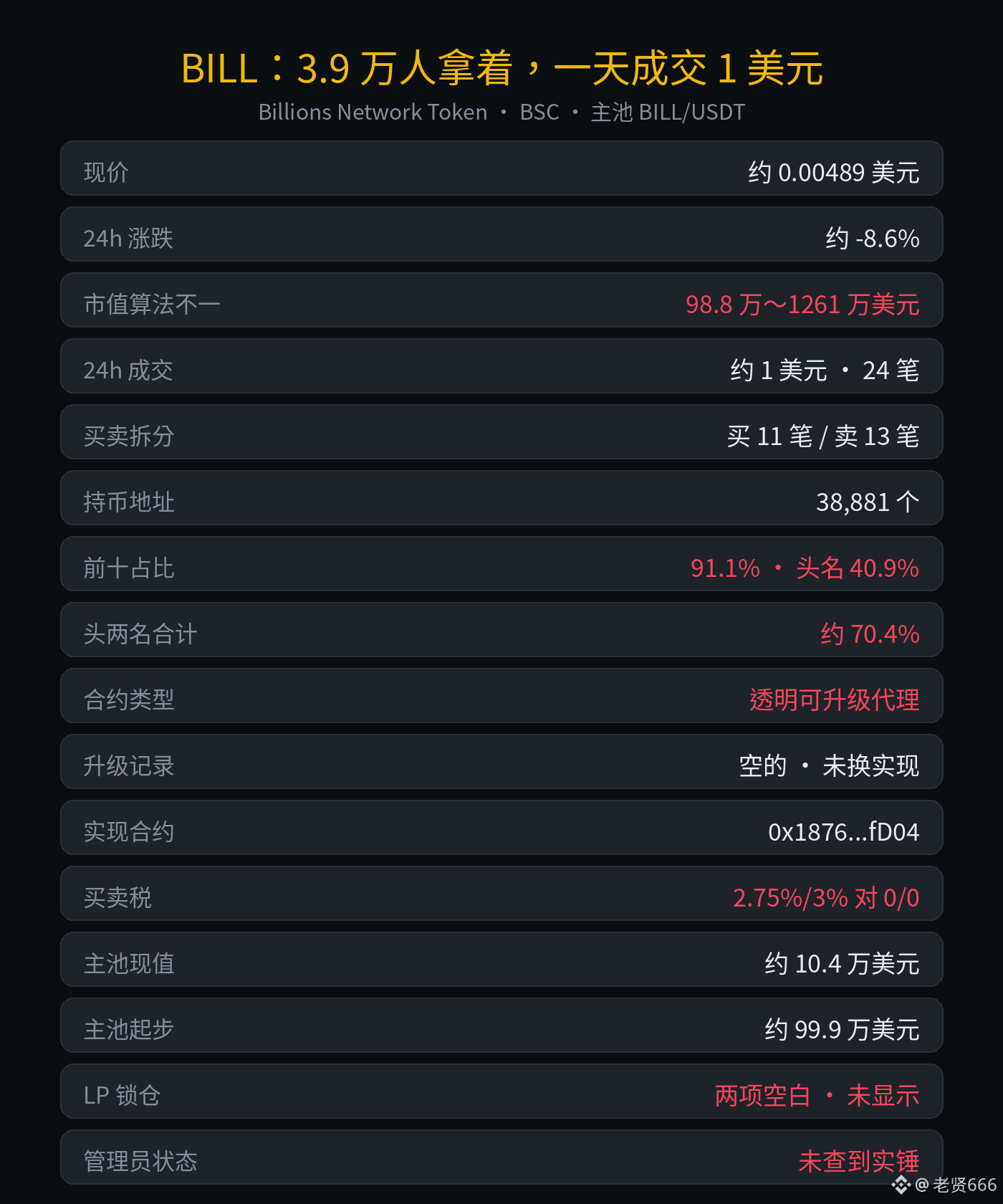
38,881 people are holding this coin, and the entire network saw just $1 in trading volume in a day. Let’s get that out of the way first.
$BILL, full name Billions Network Token, is on BSC. Its contract was created on May 3, 2026, so it’s been around for almost half a year. The current price is about $0.00489, down roughly 8.6% in 24 hours. Its market cap is about $988,000, while a blockchain explorer puts it at about $1.05 million on an on-chain basis and about $12.61 million on a circulating-supply basis. The calculations differ, so the numbers are miles apart.
Here’s how that $1 in 24-hour volume breaks down: 11 buy orders totaling $0.61 and 13 sell orders totaling $0.40, for 24 trades in all. Spread across 38,881 holder addresses, that’s less than a cent of activity per address per day.
The main pool is $BILL paired with $USDT, and currently holds $104,000. Around launch, the listing showed $999,000, so it’s shrunk by almost 90%. There are also a bunch of smaller pools worth tens of thousands of dollars each. Added together, they look bigger than the main pool, but trading is still sluggish.
The top ten holders control nearly 90%. Under the calculation that puts it at 91.1%, the top holder has 40.9% and the second has 29.5%—just two addresses hold 70%. The buy and sell taxes are also reported inconsistently: one source says 2.75% on buys and 3% on sells, while another says both are 0%.
The contract itself is what really needs watching. On-chain data shows it’s a transparent upgradeable proxy contract, and the address of the implementation contract behind it is visible. The upgrade history section is blank, which, according to that display, means the implementation hasn’t been changed. I couldn’t find conclusive evidence this time on whether admin control has been relinquished. As long as the proxy layer remains, the door to swapping out the implementation is still open.
If you’re holding it, just keep an eye on two things: whether the implementation contract address changes, and whether either of the two largest holders moves their funds. If the address changes or a major holder starts moving funds out, don’t just assume everything is fine.
This is not investment advice. Alpha coins are high-risk and could go to zero. If anything changes on the implementation-contract side, I’ll come back and check the numbers.
#BinanceAlpha #合约观察 #BILL
38,881 people are holding this coin, and the entire network saw just $1 in trading volume in a day. Let’s get that out of the way first.
$BILL , full name Billions Network Token, is on BSC. Its contract was created on May 3, 2026, so it’s been around for almost half a year. The current price is about $0.00489, down roughly 8.6% in 24 hours. Its market cap is about $988,000, while a blockchain explorer puts it at about $1.05 million on an on-chain basis and about $12.61 million on a circulating-supply basis. The calculations differ, so the numbers are miles apart.
Here’s how that $1 in 24-hour volume breaks down: 11 buy orders totaling $0.61 and 13 sell orders totaling $0.40, for 24 trades in all. Spread across 38,881 holder addresses, that’s less than a cent of activity per address per day.
The main pool is $BILL paired with $USDT, and currently holds $104,000. Around launch, the listing showed $999,000, so it’s shrunk by almost 90%. There are also a bunch of smaller pools worth tens of thousands of dollars each. Added together, they look bigger than the main pool, but trading is still sluggish.
The top ten holders control nearly 90%. Under the calculation that puts it at 91.1%, the top holder has 40.9% and the second has 29.5%—just two addresses hold 70%. The buy and sell taxes are also reported inconsistently: one source says 2.75% on buys and 3% on sells, while another says both are 0%.
The contract itself is what really needs watching. On-chain data shows it’s a transparent upgradeable proxy contract, and the address of the implementation contract behind it is visible. The upgrade history section is blank, which, according to that display, means the implementation hasn’t been changed. I couldn’t find conclusive evidence this time on whether admin control has been relinquished. As long as the proxy layer remains, the door to swapping out the implementation is still open.
If you’re holding it, just keep an eye on two things: whether the implementation contract address changes, and whether either of the two largest holders moves their funds. If the address changes or a major holder starts moving funds out, don’t just assume everything is fine.
This is not investment advice. Alpha coins are high-risk and could go to zero. If anything changes on the implementation-contract side, I’ll come back and check the numbers.
#BinanceAlpha #合约观察 #BILL
58
·
--
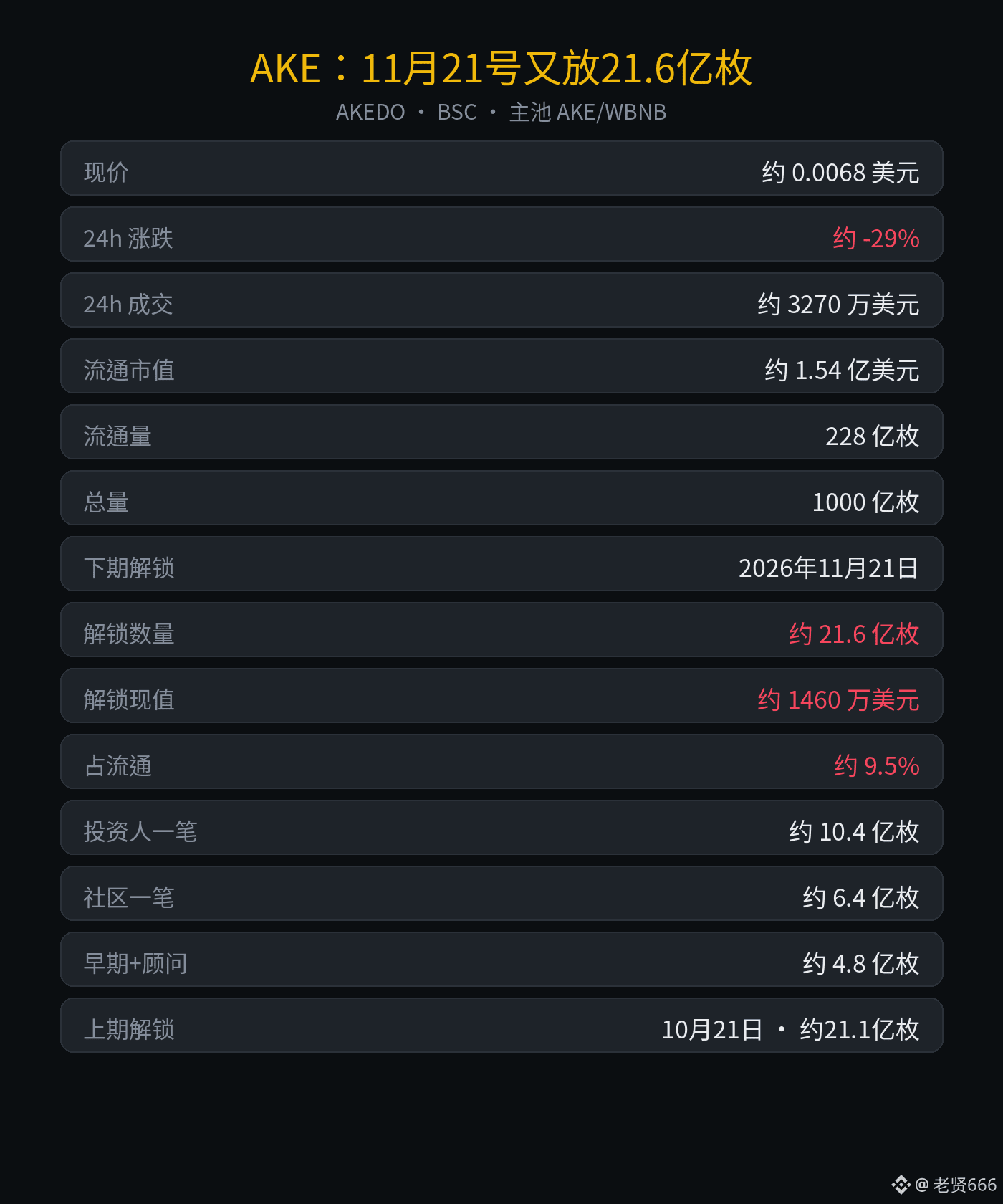
On November 21, another batch of $AKE is set to be released: 2.16 billion tokens.
These tokens are released on the 21st of every month, starting August 21, 2025, and continuing through 2029. The October 21 unlock was 2.11 billion tokens, worth around $60 million at the time. The price fell first, then bounced back somewhat over the next few days. An unlock doesn’t mean the tokens are sold on the same day—that’s worth making clear.
Several unlock calendars agree on the breakdown for November: about 1.04 billion tokens for investors, 640 million for the community, 360 million for early contributors, and 120 million for advisors. At the current price of around $0.0068, the whole batch is worth over $14 million—about 9.5% of the circulating supply. Compared with today’s trading volume of around $32.7 million, that’s also more than 40%. Two calendars differ slightly on the total, listing 2.11 billion and 2.16 billion. I haven’t been able to find the project’s own schedule yet, so for now, take it as a range.
The current price is already down nearly 70% compared with late October, and it also fell almost 30% in a single day. The main pool for $AKE is paired with WBNB; the other side is $BNB. I won’t get into the pool details in this post.
If you’re holding, just check one thing: whether the investors’ allocation moves around the 21st, and whether it heads to an exchange. If it moves, take another look; if not, leave it for now.
This isn’t investment advice. Alpha tokens are high-risk and could go to zero. I’ll come back on the 21st and check the numbers again.
#BinanceAlpha #解锁 #AKEDO
On November 21, another batch of $AKE is set to be released: 2.16 billion tokens.
These tokens are released on the 21st of every month, starting August 21, 2025, and continuing through 2029. The October 21 unlock was 2.11 billion tokens, worth around $60 million at the time. The price fell first, then bounced back somewhat over the next few days. An unlock doesn’t mean the tokens are sold on the same day—that’s worth making clear.
Several unlock calendars agree on the breakdown for November: about 1.04 billion tokens for investors, 640 million for the community, 360 million for early contributors, and 120 million for advisors. At the current price of around $0.0068, the whole batch is worth over $14 million—about 9.5% of the circulating supply. Compared with today’s trading volume of around $32.7 million, that’s also more than 40%. Two calendars differ slightly on the total, listing 2.11 billion and 2.16 billion. I haven’t been able to find the project’s own schedule yet, so for now, take it as a range.
The current price is already down nearly 70% compared with late October, and it also fell almost 30% in a single day. The main pool for $AKE is paired with WBNB; the other side is $BNB . I won’t get into the pool details in this post.
If you’re holding, just check one thing: whether the investors’ allocation moves around the 21st, and whether it heads to an exchange. If it moves, take another look; if not, leave it for now.
This isn’t investment advice. Alpha tokens are high-risk and could go to zero. I’ll come back on the 21st and check the numbers again.
#BinanceAlpha #解锁 #AKEDO
79
·
--
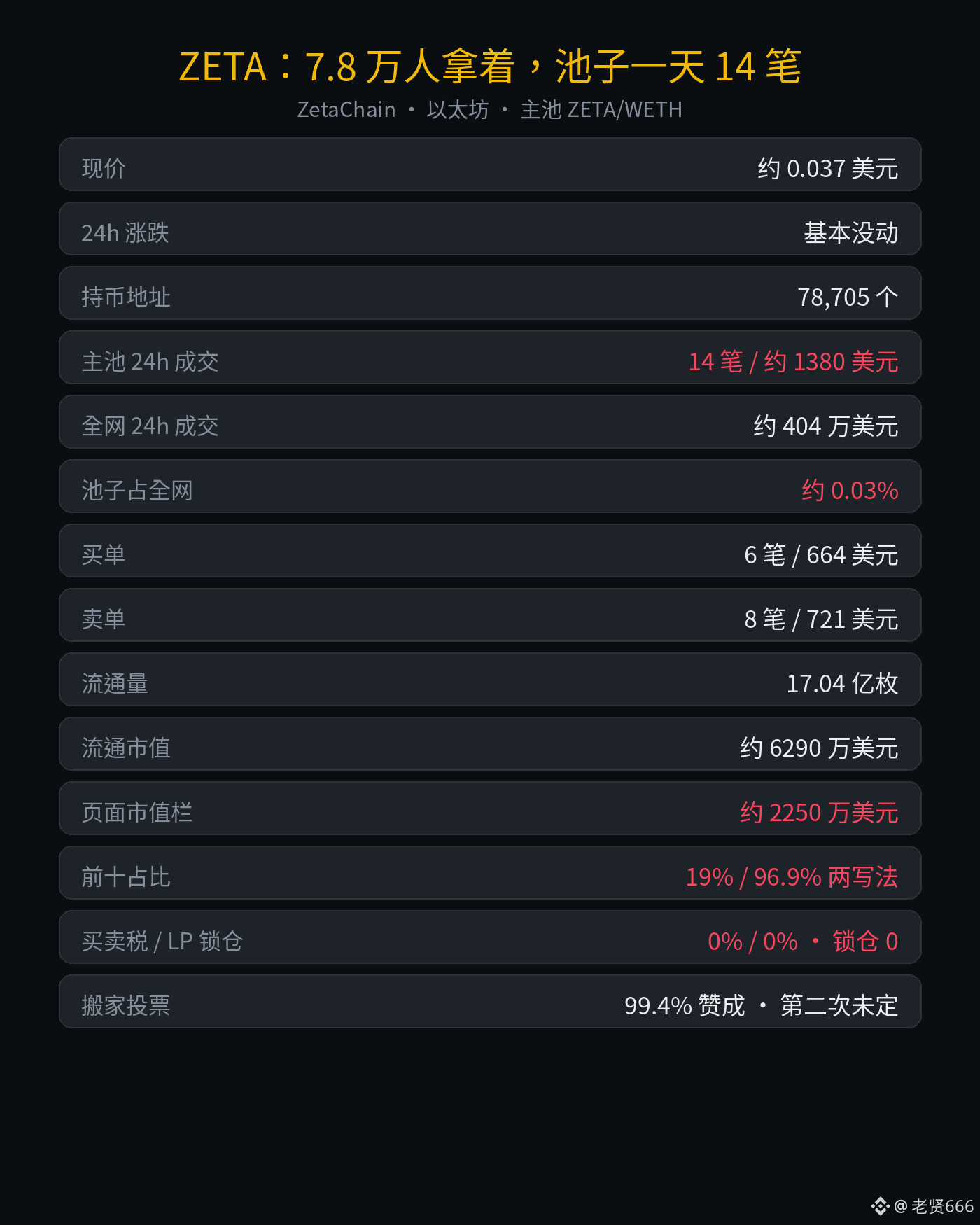
78,000 people hold $ZETA, but this pool saw just 14 trades in a day, totaling $1,380. That’s less than 2 cents per holder. Start with this: lots of holders and a busy pool are two different things.
ZetaChain is a Layer 1 blockchain built for cross-chain transactions. ZETA is used to pay gas fees and for staking. The mainnet launched on January 31, 2024. The main pool is ZETA paired with WETH, the other side being the wrapped version of $ETH . The current price is around $0.037, with virtually no movement over 24 hours.
Trading volume across the network was about $4.04 million over 24 hours, so this pool’s $1,380 accounted for just 0.03%. There were 6 buy orders totaling $664 and 8 sell orders totaling $721. There are 78,705 on-chain holder addresses, so the numbers add up: the people are there, but the volume isn’t in this pool. Most of it is on exchanges.
The market cap figure also depends on the denominator. The page shows about $22.5 million based on 600 million tokens, or about $62.9 million based on the 1.704 billion tokens in on-chain circulation. Both figures are right there. Before citing either one, check the denominator.
There’s also something whose direction has been decided but that hasn’t been implemented yet. In the September 20 vote, 99.4% voted in favor, with 58% of staked tokens participating—above the 40% threshold. The chain is set to move to Solana, with a 1:1 swap and no change to the total supply. But the second vote still has no snapshot block height, claim process, or shutdown timeline. Versions on Ethereum and BSC aren’t included in this migration.
On the same page, one section says the top 10 holders own 19%, while the security panel says 96.9%. The denominators differ, so don’t take either figure as a conclusion on its own. Buy and sell taxes are both 0. The page says LP tokens are not locked, and one address holds 93.7% of the largest LP.
If you hold it, first confirm which chain’s version you have, then wait for the second vote’s timeline. Until then, the 14 trades in this pool don’t tell us much—and lots of holders don’t mean this pool is busy.
This is not investment advice. Alpha tokens are high-risk and could go to zero. Once there’s a date for the second vote, I’ll take another look.
#BinanceAlpha #跨链 #Governance Vote
78,000 people hold $ZETA , but this pool saw just 14 trades in a day, totaling $1,380. That’s less than 2 cents per holder. Start with this: lots of holders and a busy pool are two different things.
ZetaChain is a Layer 1 blockchain built for cross-chain transactions. ZETA is used to pay gas fees and for staking. The mainnet launched on January 31, 2024. The main pool is ZETA paired with WETH, the other side being the wrapped version of $ETH . The current price is around $0.037, with virtually no movement over 24 hours.
Trading volume across the network was about $4.04 million over 24 hours, so this pool’s $1,380 accounted for just 0.03%. There were 6 buy orders totaling $664 and 8 sell orders totaling $721. There are 78,705 on-chain holder addresses, so the numbers add up: the people are there, but the volume isn’t in this pool. Most of it is on exchanges.
The market cap figure also depends on the denominator. The page shows about $22.5 million based on 600 million tokens, or about $62.9 million based on the 1.704 billion tokens in on-chain circulation. Both figures are right there. Before citing either one, check the denominator.
There’s also something whose direction has been decided but that hasn’t been implemented yet. In the September 20 vote, 99.4% voted in favor, with 58% of staked tokens participating—above the 40% threshold. The chain is set to move to Solana, with a 1:1 swap and no change to the total supply. But the second vote still has no snapshot block height, claim process, or shutdown timeline. Versions on Ethereum and BSC aren’t included in this migration.
On the same page, one section says the top 10 holders own 19%, while the security panel says 96.9%. The denominators differ, so don’t take either figure as a conclusion on its own. Buy and sell taxes are both 0. The page says LP tokens are not locked, and one address holds 93.7% of the largest LP.
If you hold it, first confirm which chain’s version you have, then wait for the second vote’s timeline. Until then, the 14 trades in this pool don’t tell us much—and lots of holders don’t mean this pool is busy.
This is not investment advice. Alpha tokens are high-risk and could go to zero. Once there’s a date for the second vote, I’ll take another look.
#BinanceAlpha #跨链 #Governance Vote
77
·
--
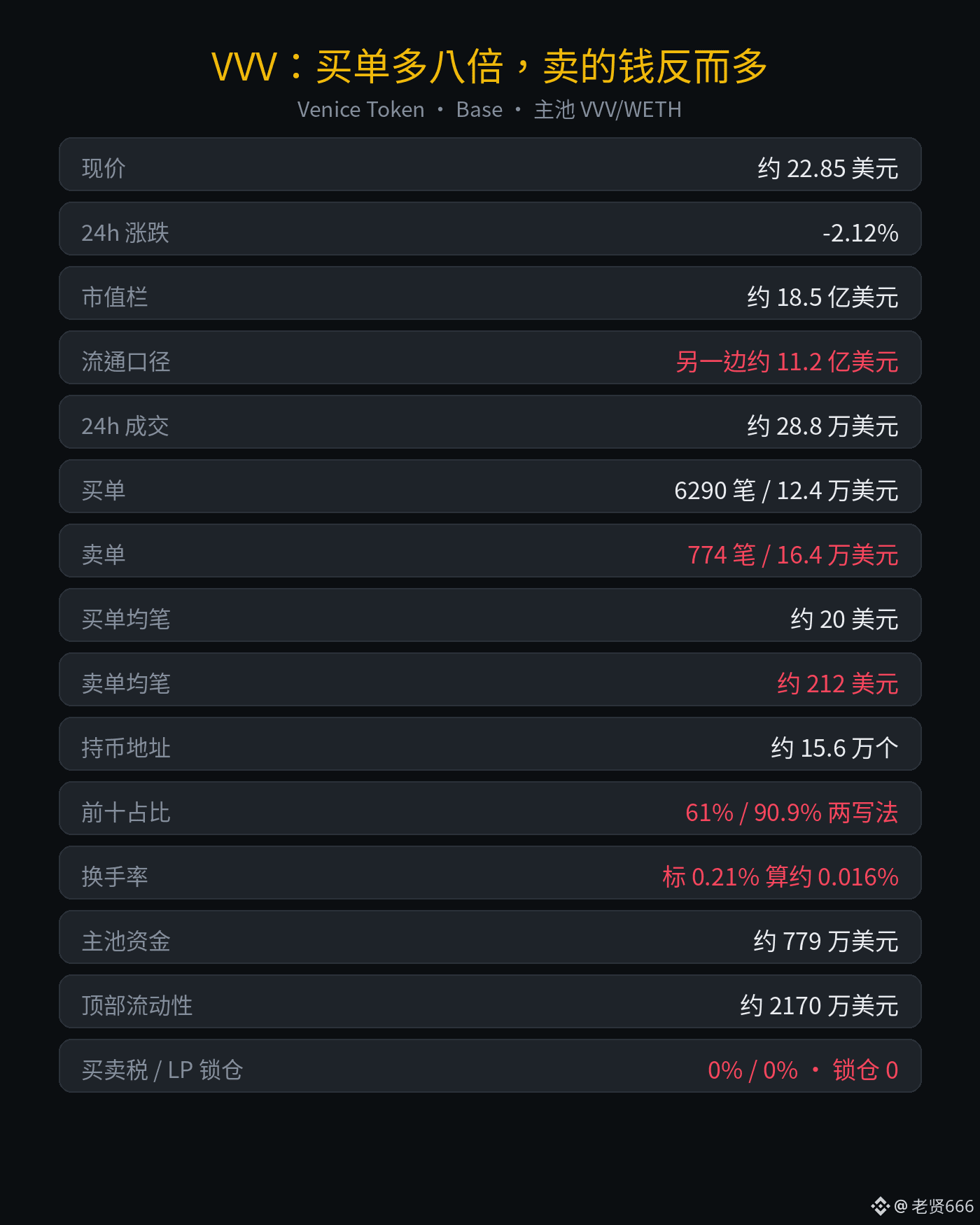
There are eight times as many buyers as sellers, yet sellers are moving more money—the first thing to notice on this $VVV page is that something doesn’t add up.
Venice provides private AI inference. You stake its token to get API credits. It’s an established token launched at the end of January 2025, running on Base. The main pool is VVV/WETH, with the other side being the wrapped version of $ETH .
Over the past 24 hours, there were 6,290 buy orders totaling $124,000, and 774 sell orders totaling $164,000. There were more than eight times as many buys as sells, but the sell volume was 32% higher. On average, each buy was worth less than $20, while each sell averaged about $212—more than ten times as much. The price hasn’t moved much, though: it’s currently about $22.85, down around 2.1% over 24 hours.
The figures on the same page also contradict one another. The market cap section says about $1.85 billion, calculated by multiplying the effective total supply of 81.2 million tokens; elsewhere, using the circulating supply, it comes to about $1.12 billion. The turnover ratio is listed as 0.21%, but dividing the $288,000 trading volume by the $1.85 billion market cap gives only about 0.016%. The top-ten holder share is similar: one figure says 61%, while another says 90.9% after excluding the burn address. The denominators differ, so don’t take either figure at face value.
The main pool holds about $7.79 million, yet the page’s liquidity figure at the top says $21.7 million. The main pool accounts for only a little over 30%. As for the security checks, both buy and sell taxes are 0, and the page says there are no transfer restrictions or blacklist. But LP lockup is 0, ownership hasn’t been renounced, and the information on minting authority doesn’t match: one section says the owner can control minting, while another says it has been revoked.
If you’re holding, keep an eye on two things: whether the average sell order returns to the same ballpark as the average buy, and which denominator the top-ten holder share uses when the page refreshes. If neither changes, leave this page alone for now. There are eight times as many buy orders, yet sell volume is higher—which set of figures seems more believable to you?
This is not investment advice. Alpha’s token is high risk and could go to zero. Follow me, and I’ll let you know next time the figures on this page change.
#BinanceAlpha #买卖结构 #Base chain
29
·
--
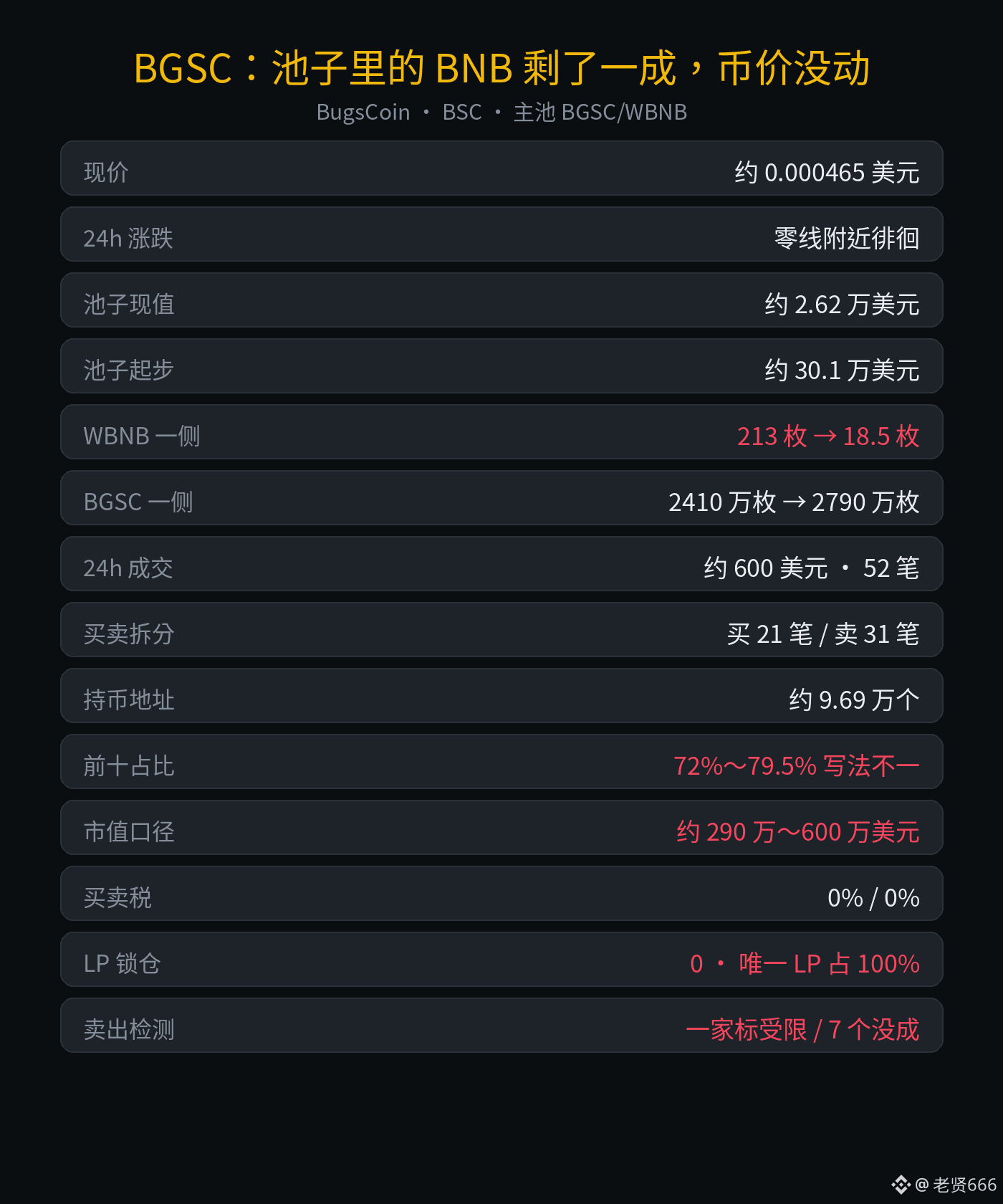
$BNB in the pool has nearly been drained, yet the token price is acting like nothing happened. We need to get this straight first.
$BGSC is a reward token for the simulated trading platform AntTalk. It launched on Alpha in July 2025. The main pool pairs BGSC with WBNB. It started with $301,000 and now has only $26,200 left. The WBNB side has fallen from 213 tokens to 18.5, a drop of over 90%. Meanwhile, the BGSC side has actually grown from 24.1 million tokens to 27.9 million.
The strange thing is the price: it’s currently around $0.000465, with the 24-hour change hovering near zero. Daily trading volume is only about $600 across 52 trades: 21 buys totaling about $319 and 31 sells totaling about $316. That volume is nowhere near enough to account for 90% of the pool being drained. The liquidity removal is a separate matter from the buy and sell activity.
There are quite a few holders, around 96,900 addresses, but that works out to only a few dozen dollars per holder on average. Sources disagree on the top 10 holders’ share, reporting anywhere from 72% to 79.5%. Market cap figures also vary, from $2.9 million to $6 million, so don’t treat any of these numbers as definitive.
The security checks look okay in some respects: both buy and sell taxes are 0. But two things deserve attention: LP lockup is 0, and one address holds the only LP token; one checker directly flagged selling restrictions, while in another platform’s simulated sells, 7 out of 699 addresses failed. The project team still holds the contract’s administrative privileges and hasn’t relinquished them.
If you’re holding, check two things: whether your own sell simulation succeeds, and whether the WBNB side gets replenished. Until both improve, keep watching this pool from the sidelines.
This is not investment advice. Alpha tokens are high-risk and could go to zero. Follow me, and I’ll see you in tomorrow’s ledger.
#BinanceAlpha #链上观察 #BGSC
37
·
--
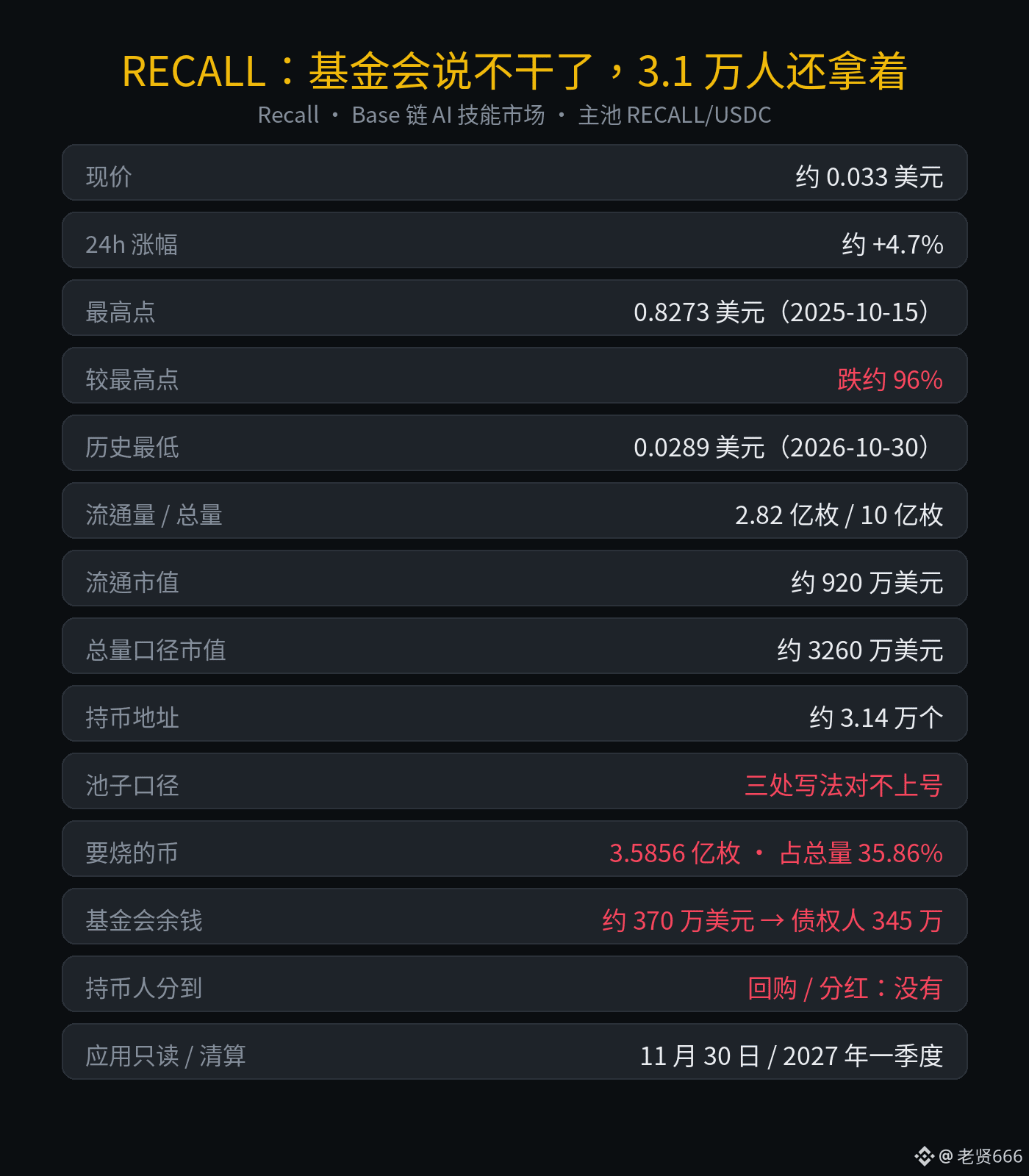
The foundation admitted it first: it’s calling it quits. On October 30, the foundation behind $RECALL announced that continuing was no longer financially viable, and that the board had approved an orderly wind-down. The message was clear: this wasn’t a hack—the numbers just didn’t add up.
Token holders should pay close attention to how the wind-down will work. The foundation will burn the 358.56 million tokens it holds, or 35.86% of the total supply, reducing the total from 1 billion to about 641 million. Only tokens held by the foundation will be burned; staked tokens are not included. The foundation has about $3.7 million on its books: $3.45 million will go to creditors and vendors, $200,000 will cover wind-down costs, and the remaining $50,000 will be set aside for future claims, leaving a balance of zero. There will be no buybacks, dividends, or pro-rata distributions. For anyone looking to unstake, new requests will no longer have to wait 30 days; existing lockup periods remain unchanged. The app will switch to read-only on November 30, and liquidation is expected to drag on into the first quarter of 2027. Development, operations, and liquidity support will all stop. Whether exchanges delist the token is up to each exchange. Recall Labs, the company that built the app, is a separate entity and is not part of this wind-down.
As for the price, most of the story has already played out. $RECALL launched on October 15 last year, reached a high of $0.8273, then plunged to an all-time low of $0.0289 on October 30. It’s now hovering around $0.033, down about 96% from its peak. There are 282 million tokens in circulation, giving it a market cap of about $9.2 million; based on the 1 billion total supply, the market cap would be about $32.6 million. Check which supply figure is being used before drawing conclusions.
More than 31,400 token-holder addresses are still listed, and the main pool is the pair of $RECALL and $USDC . The strange part is the figures shown for that pool: on the same page, the pool’s funds, liquidity, and the figure in the rankings don’t match. The tracked pool sees only tens of thousands of dollars in daily volume, so none of those figures should be treated as definitive on its own.
If you hold the token, check two things before deciding whether to act: whether tokens have started moving from the burn address—the burn has been promised and scheduled before the wind-down, but don’t assume it’s already happened—and whether you can unstake your tokens before November 30, and when your lockup period ends.
This is not investment advice. Alpha projects are high-risk and could go to zero. Follow me; I’ll report back if there’s any activity at the token’s burn address.
#BinanceAlpha #链上复盘 #FoundationWind-Down
60
·
--
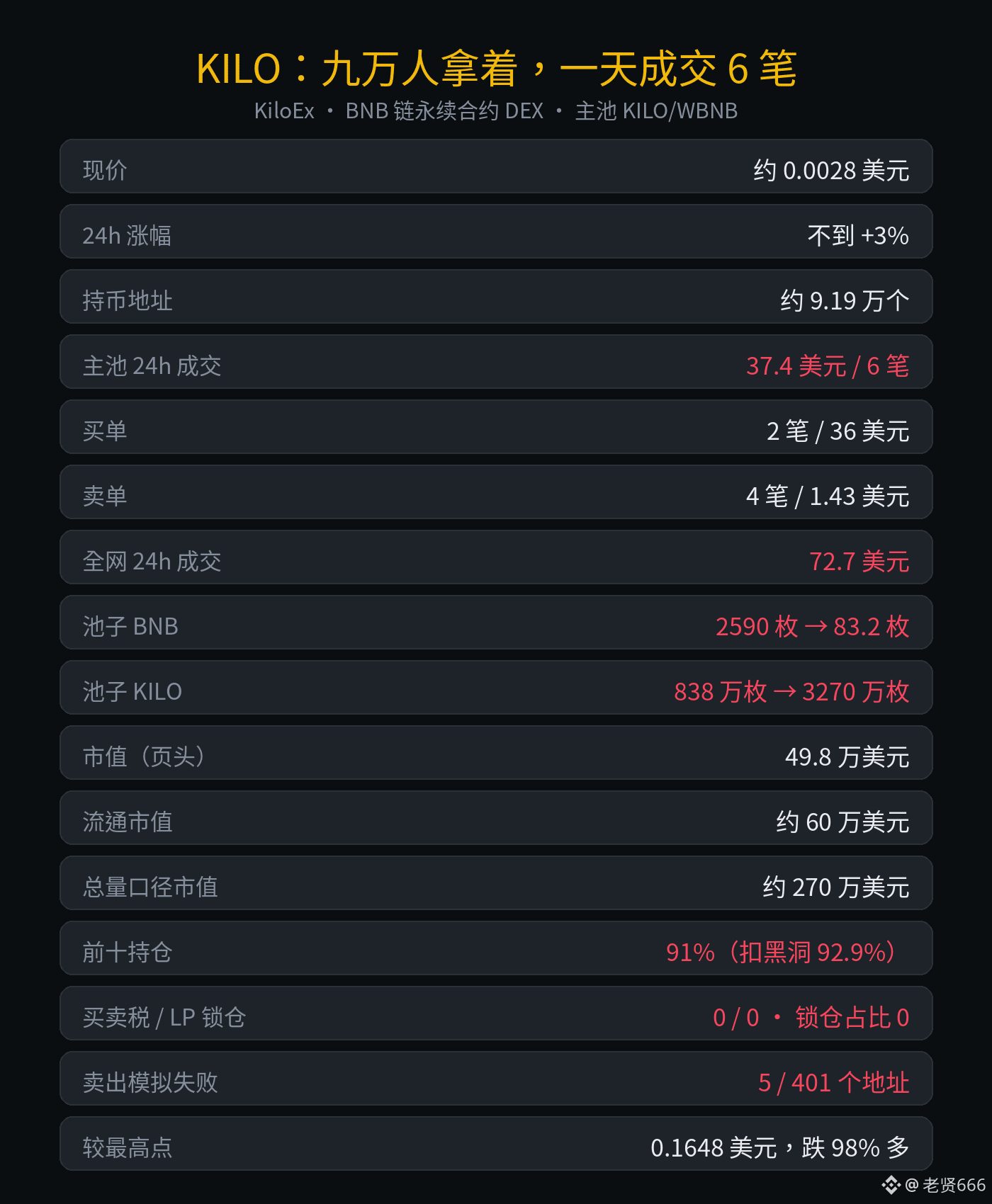
More than 90,000 people hold $KILO, yet the entire market saw only a little over $70 in trades in a day. The numbers just don’t add up. The price is around $0.0028, up less than 3% in a day. The price has barely moved, but the volume has disappeared.
The main pool is KILO/$BNB. It saw just $37.4 in trades over 24 hours: 2 buy orders totaling $36 and 4 sell orders totaling $1.43—6 trades in all. The market-wide figures are just as bleak: $72.7 in a day, down 96.6% from the day before. The pool’s reserves are even more striking: $BNB dropped from 2,590 tokens to just 83, a 97% decrease; meanwhile, the KILO side grew from 8.38 million tokens to 32.7 million, nearly quadrupling. The main pool still has $117,000 in it, and there are 9 smaller pools below it, all with zero trades for the day.
The market cap figures don’t add up either. On the same page, the header shows $498,000, but scrolling down, the total market cap is listed as $2.7 million. Based on the 210 million tokens in circulation, the market cap is around $600,000; based on the 1 billion total supply, it’s nearly $2.83 million. Those three figures differ by four to five times, so first check which set of numbers you’re looking at before deciding whether it’s expensive or cheap.
The tokens are also tightly concentrated: the top 10 holders own 91%, or 92.9% excluding the burn address. Buy and sell taxes are both 0, LP lockup is 0%, and 5 out of 401 addresses failed simulated sells. KiloEx is a perpetual futures DEX on BNB Chain. It launched its token in March 2025 and received investment from YZi Labs. It peaked at $0.1648 and is now down more than 98%.
If you’re holding, check two things first: whether you can sell your tokens smoothly, and what’s going on with the 5 addresses that failed the simulation. Then watch whether $BNB in the main pool gets replenished to above three digits, and whether daily market-wide volume returns to over $1,000. Until both happen, I’d leave this one alone. More than 90,000 people hold it, but there were only 6 trades in a day. Do you think they’re waiting, or unable to sell?
This is not investment advice. Alpha projects are high-risk and may go to zero. Follow me—I’ll share an update as soon as volume returns.
#BinanceAlpha #On-chainReview
More than 90,000 people hold $KILO , yet the entire market saw only a little over $70 in trades in a day. The numbers just don’t add up. The price is around $0.0028, up less than 3% in a day. The price has barely moved, but the volume has disappeared.
The main pool is KILO/$BNB . It saw just $37.4 in trades over 24 hours: 2 buy orders totaling $36 and 4 sell orders totaling $1.43—6 trades in all. The market-wide figures are just as bleak: $72.7 in a day, down 96.6% from the day before. The pool’s reserves are even more striking: $BNB dropped from 2,590 tokens to just 83, a 97% decrease; meanwhile, the KILO side grew from 8.38 million tokens to 32.7 million, nearly quadrupling. The main pool still has $117,000 in it, and there are 9 smaller pools below it, all with zero trades for the day.
The market cap figures don’t add up either. On the same page, the header shows $498,000, but scrolling down, the total market cap is listed as $2.7 million. Based on the 210 million tokens in circulation, the market cap is around $600,000; based on the 1 billion total supply, it’s nearly $2.83 million. Those three figures differ by four to five times, so first check which set of numbers you’re looking at before deciding whether it’s expensive or cheap.
The tokens are also tightly concentrated: the top 10 holders own 91%, or 92.9% excluding the burn address. Buy and sell taxes are both 0, LP lockup is 0%, and 5 out of 401 addresses failed simulated sells. KiloEx is a perpetual futures DEX on BNB Chain. It launched its token in March 2025 and received investment from YZi Labs. It peaked at $0.1648 and is now down more than 98%.
If you’re holding, check two things first: whether you can sell your tokens smoothly, and what’s going on with the 5 addresses that failed the simulation. Then watch whether $BNB in the main pool gets replenished to above three digits, and whether daily market-wide volume returns to over $1,000. Until both happen, I’d leave this one alone. More than 90,000 people hold it, but there were only 6 trades in a day. Do you think they’re waiting, or unable to sell?
This is not investment advice. Alpha projects are high-risk and may go to zero. Follow me—I’ll share an update as soon as volume returns.
#BinanceAlpha #On-chainReview
64
·
--
My e-bike ran out of battery halfway there, so I pushed it for two stops and worked up a sweat. Now, before I head out, the agent figures out whether I have enough charge and where to recharge along the way. All I have to do is ride. I’m saving my energy to go farther. Agent #20102 #ProofOfAgent $BNB Have you ever pushed an e-bike with a dead battery?
My e-bike ran out of battery halfway there, so I pushed it for two stops and worked up a sweat. Now, before I head out, the agent figures out whether I have enough charge and where to recharge along the way. All I have to do is ride. I’m saving my energy to go farther. Agent #20102 #ProofOfAgent $BNB Have you ever pushed an e-bike with a dead battery?

2
·
--
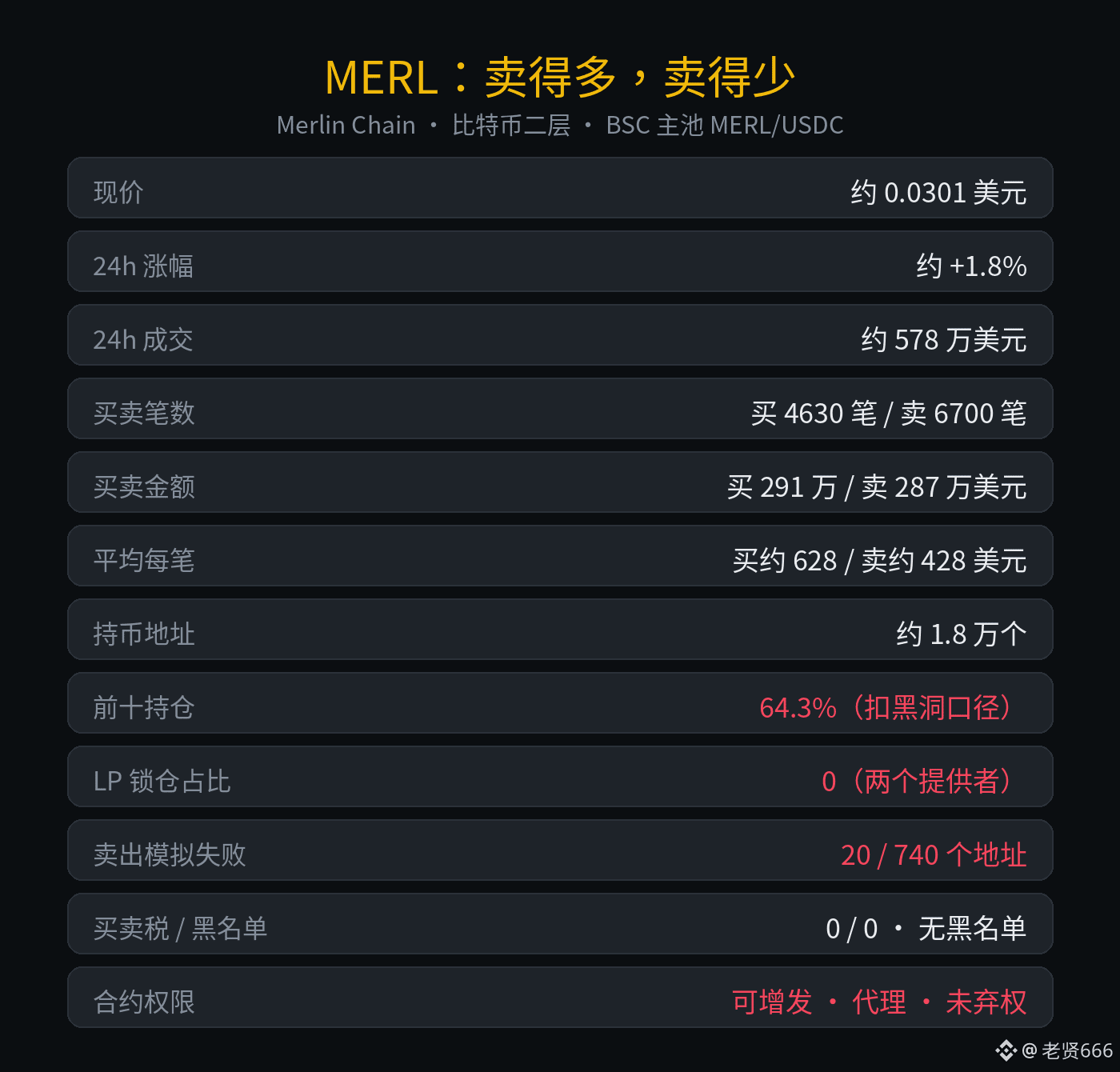
There were over 2,000 more sell transactions than buy transactions, yet the sell volume was $40,000 lower. The price barely moved all day—I'm making a note of this $MERL trade and won't rush to judgment.
When I checked this morning, $MERL was around $0.0301. The main pool is $MERL paired with $USDC. It saw $5.78 million in volume over 24 hours: 4,630 buys totaling $2.91 million, and 6,700 sells totaling $2.87 million. That works out to an average buy of around $628 and an average sell of around $428. The sells are all small orders. The pool holds around $2 million in liquidity, and 18,000 addresses hold the token.
Pay close attention to which set of figures the market cap refers to: the page for this BSC pool tracks 125M tokens, or $3.77 million. The figure for circulating supply across the entire network is around $43 million. The two numbers differ by an order of magnitude, so don't mistake the smaller one for the whole picture.
The top ten holders own 64.3%—that figure excludes the burn address. The LP lockup field says 0. There are only two liquidity providers, and the page doesn't say how long the liquidity has been locked. A sell simulation tested 740 addresses: 720 succeeded and 20 failed. The page doesn't say why.
There are some positives: neither buys nor sells are taxed, and no blacklist was found. The unresolved concerns are with the contract itself—it can mint more tokens, it's a proxy contract, and its permissions haven't been renounced. Another source reports the same thing. The project is building a Bitcoin Layer 2, Merlin Chain. The contract is 0xa0c56a8c0692bd10b3fa8f8ba79cf5332b7107f9. I checked both sources; they're referring to the same contract.
If you hold the token, keep an eye on two things: first, whether the 20 addresses that failed the sell simulation are more or fewer next time; second, whether the LP lockup percentage is still 0 and whether there are any changes to the contract permissions. If neither changes, I won't revise my assessment in this post.
This is not investment advice. Alpha projects are high-risk and may go to zero. I'll post again if anything changes—feel free to follow me.
#BinanceAlpha #比特币二层 #On-chainObservation
There were over 2,000 more sell transactions than buy transactions, yet the sell volume was $40,000 lower. The price barely moved all day—I'm making a note of this $MERL trade and won't rush to judgment.
When I checked this morning, $MERL was around $0.0301. The main pool is $MERL paired with $USDC . It saw $5.78 million in volume over 24 hours: 4,630 buys totaling $2.91 million, and 6,700 sells totaling $2.87 million. That works out to an average buy of around $628 and an average sell of around $428. The sells are all small orders. The pool holds around $2 million in liquidity, and 18,000 addresses hold the token.
Pay close attention to which set of figures the market cap refers to: the page for this BSC pool tracks 125M tokens, or $3.77 million. The figure for circulating supply across the entire network is around $43 million. The two numbers differ by an order of magnitude, so don't mistake the smaller one for the whole picture.
The top ten holders own 64.3%—that figure excludes the burn address. The LP lockup field says 0. There are only two liquidity providers, and the page doesn't say how long the liquidity has been locked. A sell simulation tested 740 addresses: 720 succeeded and 20 failed. The page doesn't say why.
There are some positives: neither buys nor sells are taxed, and no blacklist was found. The unresolved concerns are with the contract itself—it can mint more tokens, it's a proxy contract, and its permissions haven't been renounced. Another source reports the same thing. The project is building a Bitcoin Layer 2, Merlin Chain. The contract is 0xa0c56a8c0692bd10b3fa8f8ba79cf5332b7107f9. I checked both sources; they're referring to the same contract.
If you hold the token, keep an eye on two things: first, whether the 20 addresses that failed the sell simulation are more or fewer next time; second, whether the LP lockup percentage is still 0 and whether there are any changes to the contract permissions. If neither changes, I won't revise my assessment in this post.
This is not investment advice. Alpha projects are high-risk and may go to zero. I'll post again if anything changes—feel free to follow me.
#BinanceAlpha #比特币二层 #On-chainObservation
4
·
--
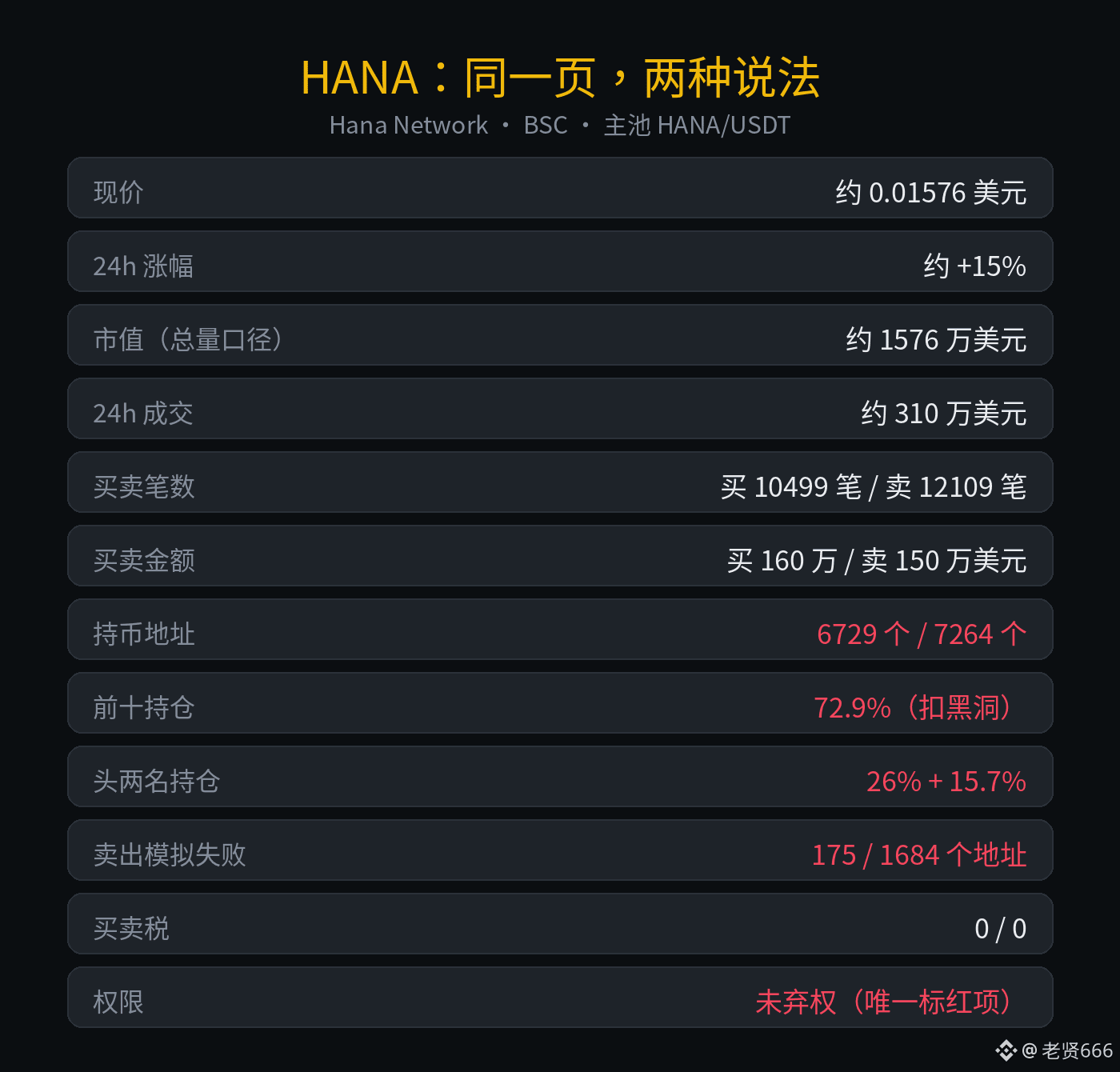
On the same page, the left side says there’s no blacklist, while the right side says 175 addresses can’t sell—$HANA needs to be unpacked first.
Here’s my take: make a note of it, and figure out what’s going on with those 175 addresses before taking action. Don’t rush in just because it’s up 15%.
When I checked this morning, $HANA was trading around $0.01576, up roughly 15% in 24 hours. The main pool is $HANA against $USDT, with $3.1 million in trading volume over the past day: 10,499 buys and 12,109 sells. There were more sell transactions, but the amounts were about the same—$1.6 million in buys and $1.5 million in sells—and the price still went up.
Based on a total supply of 1 billion, the market cap is $15.76 million. The page doesn’t provide circulating supply figures, so I won’t try to calculate them.
The real inconsistency is in the security section. The sell simulation tested 1,684 addresses: 1,509 could sell, while 175 failed. The page says some users were blocked. But elsewhere on the same page it says there’s no blacklist, and another check also says there’s no blacklist. The page doesn’t explain why those sales failed, so I can’t simply blame it on a blacklist. I can only say the two claims don’t match.
The permissions haven’t been renounced either. The creator and owner are the same address, and the contract has a burn function that only the owner can trigger. The only item flagged red in the security check is that the permissions haven’t been renounced. On the plus side, there’s no buy or sell tax, and the contract says no more tokens can be minted. Those two things check out.
The token distribution is also quite concentrated. The top 10 holders own 72.9%, and the top two alone account for 41.7%. Two sources give different holder counts: 6,729 and 7,264. There are also three different figures for the pool’s liquidity—$870,000, $890,000, and over $990,000—which don’t line up.
The project itself does look presentable: the official website loads, the official account is verified, and the bio says just one thing: “ultra-casual finance.” The contract is 0x6261963EbE9Ff014aAd10eCc3b0238D4D04E8353. I compared it character by character in two places, and it’s the same address.
If you’re holding the token, first check whether the 175 failed addresses in the sell simulation have decreased, and then see whether the permissions have been renounced. If neither of those changes, I won’t change my assessment.
This is not investment advice. Alpha projects are high-risk and could go to zero. Want to see how many of those 175 are still there next week? Follow me—I’ll keep an eye on it.
#BinanceAlpha #HANA #On-chain review
45
·
--
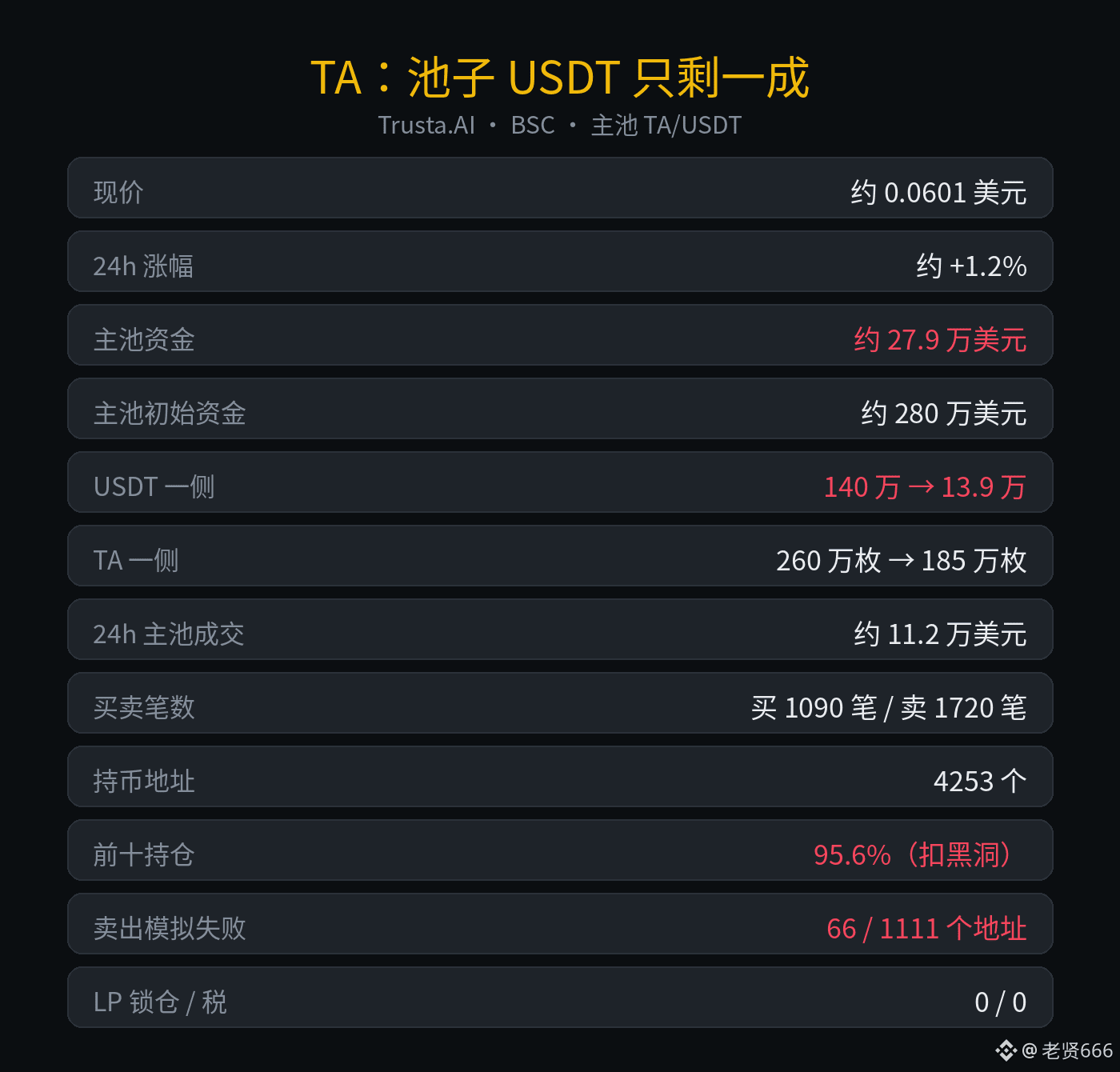
There’s only a tenth of the $USDT left in the pool, and 66 addresses still fail to sell in the sell simulation—on this $TA page, the security panel is arguing with itself. I’ve made a note of it; no rush to touch it.
TA is Trusta.AI’s token. Its website says it’s building a trusted identity network for the AI and crypto worlds, running on BSC, with on-chain gas going through $BNB . The contract is the one that starts with 0x539a and ends with b140. The current price is about $0.06, up a little over one percent in a day—not much movement. The real action is in the pool.
The main pool is TA paired with $USDT. It now holds about $279,000, down from around $2.8 million when it opened—just a tenth remains. The two sides have shrunk by different amounts: the $USDT side fell from $1.4 million to $139,000, less than a tenth remaining; the TA side went from 2.6 million tokens to 1.85 million, with a little over seven-tenths left. Real money has been pulled out, while the tokens are still piled up in the pool, and the price hasn’t moved along with them.
The main pool’s 24-hour volume is about $112,000 across 2,810 trades, less than half the pool’s value. There were 1,090 buys totaling $56,900 and 1,720 sells totaling $55,700. The dollar amounts balance out, but there were nearly 60% more sell orders. The average buy was about $52 and the average sell about $32—small trades passing tokens back and forth.
The supply is tightly held, too. There are 4,253 holder addresses. Excluding the burn address, the top ten hold 95.6%; the top two alone hold 43.2%, and the project owner’s address holds 17.4% by itself. LP lockup is 0, and buy and sell taxes are also 0. Of the first 50 buyers, 44 have already fully exited.
The most troubling contradiction is this: on the same security panel, one section says there’s no blacklist and no freeze mechanism, while the sell simulation shows that 66 out of 1,111 addresses couldn’t sell. The panel even flags in red that some users may have been blacklisted. The tax is 0, so in theory anyone can sell, yet in the simulation some people can’t.
The market-cap figures need explaining, too: the $56 million shown on the rankings is based on an effective total supply of 931.2 million tokens. Different sources give circulation figures that vary by more than twofold, so I’m not going to discuss circulating market cap in this piece.
If you’re holding TA, first try selling a small amount from your own address, then watch to see whether the $USDT side gets replenished. Until the failed-simulation count drops to zero and the pool side recovers, I’m sticking with this assessment. The panel says there’s no blacklist, but 66 addresses can’t sell in the simulation—which side do you believe?
This is not investment advice. Alpha projects are high-risk and could go to zero. I’ll report back if the pool side gets replenished. For now, keep an eye on it.
#BinanceAlpha #链上算账 #BSC #IdentityProtocol
36
·
--
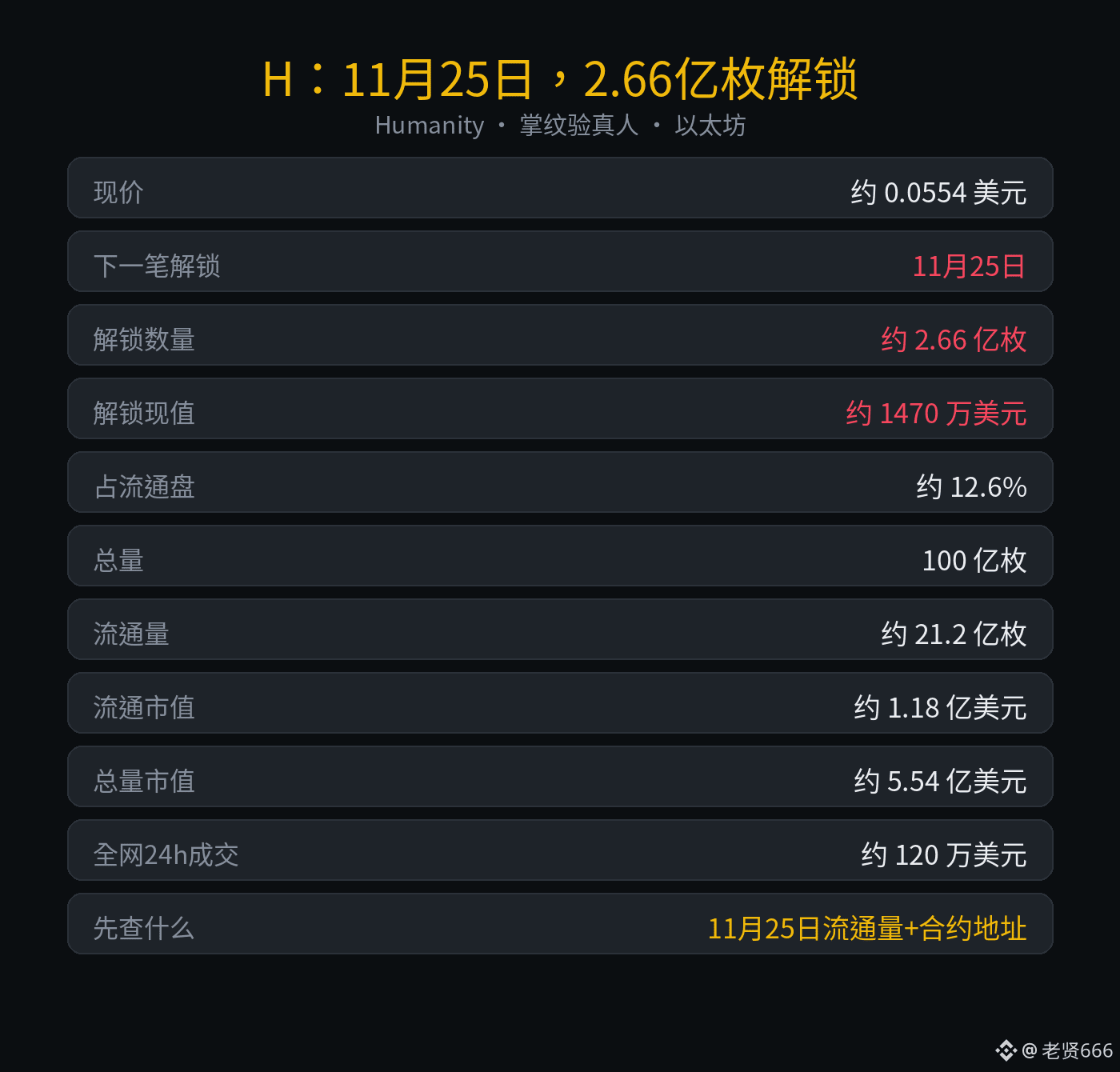
On November 25, $H tokens will be released: 266 million.
H is the project that uses palm scans to verify that you’re human. Scan your palm, then use zero-knowledge proofs to show you’re a real person, not a bot. It’s currently trading at around $0.0554.
At the current price, this unlock is worth about $14.7 million, or 2.66% of the total supply. That might not sound like much, but it’s a cliff unlock—all at once—and equals 12.6% of the circulating supply. Daily trading volume across the market is just over $1.2 million, so this unlock is worth more than ten days of volume. The unlock schedule shows the same amount on September 25 and October 25, with the next unlock on November 25.
Now look at its current supply: 10 billion tokens in total, about 2.12 billion in circulation, and roughly 7.88 billion still locked. Its fully diluted valuation is $554 million, compared with a market cap of about $118 million based on circulating supply—a 4.7x difference. Don’t look only at the bigger figure when checking its market cap.
There’s also some history here: in June this year, the project’s private key was compromised, and about 447 million tokens were withdrawn. The project then switched to a new contract and voided the old one. Existing holders could migrate their tokens at a 1:1 ratio based on a snapshot. The token currently trading is on the new contract, which starts with 0xE76c and ends with 5dE1.
If you hold H, there are two things you can do over the next few days: first, check whether the contract address in your wallet matches the new one; then mark November 25 on your calendar and see whether the circulating supply really increases by 266 million tokens. On November 25, will you check the circulating supply first, or the price?
This is not investment advice. Alpha projects are high-risk and could go to zero. Follow me, and I’ll check the numbers again on the unlock day.
#BinanceAlpha #代币解锁 #OnChainWatch
55
·
--
$AXIS Round 2 of the trading competition kicks off at 9 PM on November 2. The top 2,000 participants will split 386,000 coins, or 193 per person. The rules are the same as before: only purchases count, not sales. Purchases made after tapping Join in the app are eligible. There’s a 3x early-bird multiplier for the first two days, and rewards must be claimed by November 23.
But this round is not the same as the first one. On October 29, the token fell nearly 40% in a single day. On-chain investigator ZachXBT said more than 76 million tokens flowed out of team wallets, and that someone sold 42 million tokens in one day for over 5 million USDC. The project team denied selling tokens, saying they had entrusted community fund tokens to an OTC firm, which then breached the agreement and dumped them. The team says it has cut ties with the firm and is pursuing legal action. Both sides have their own version of events, and there’s no conclusion yet about who’s right.
One more thing to flag: Alpha trading was suspended early on the morning of October 30. Binance said it would resume once the issue was resolved, but no resumption announcement has appeared so far. Whether trading will be working normally when the competition starts at 9 PM on November 2 depends on how quickly it is restored. If you want to participate, tap Join first and wait for trading to resume—don’t get frustrated while it’s suspended.
This is not investment advice. Data is from Binance announcements and public reports.
#BinanceAlpha #AXIS
86
·
--
The night the power went out in our neighborhood, my phone had just one bar of battery left, and messages kept popping up in the group chat. Before, I had to reply to everyone one by one, and even when my battery died, the messages kept coming. Now, the agent sorts the urgent messages by priority, and I only reply to the two most urgent ones. When your battery is running low, you realize who you should save your energy for. Agent #20102 #ProofOfAgent $BNB What do you do first when your phone has just one bar of battery left?
The night the power went out in our neighborhood, my phone had just one bar of battery left, and messages kept popping up in the group chat. Before, I had to reply to everyone one by one, and even when my battery died, the messages kept coming. Now, the agent sorts the urgent messages by priority, and I only reply to the two most urgent ones. When your battery is running low, you realize who you should save your energy for. Agent #20102 #ProofOfAgent $BNB What do you do first when your phone has just one bar of battery left?

5
·
--
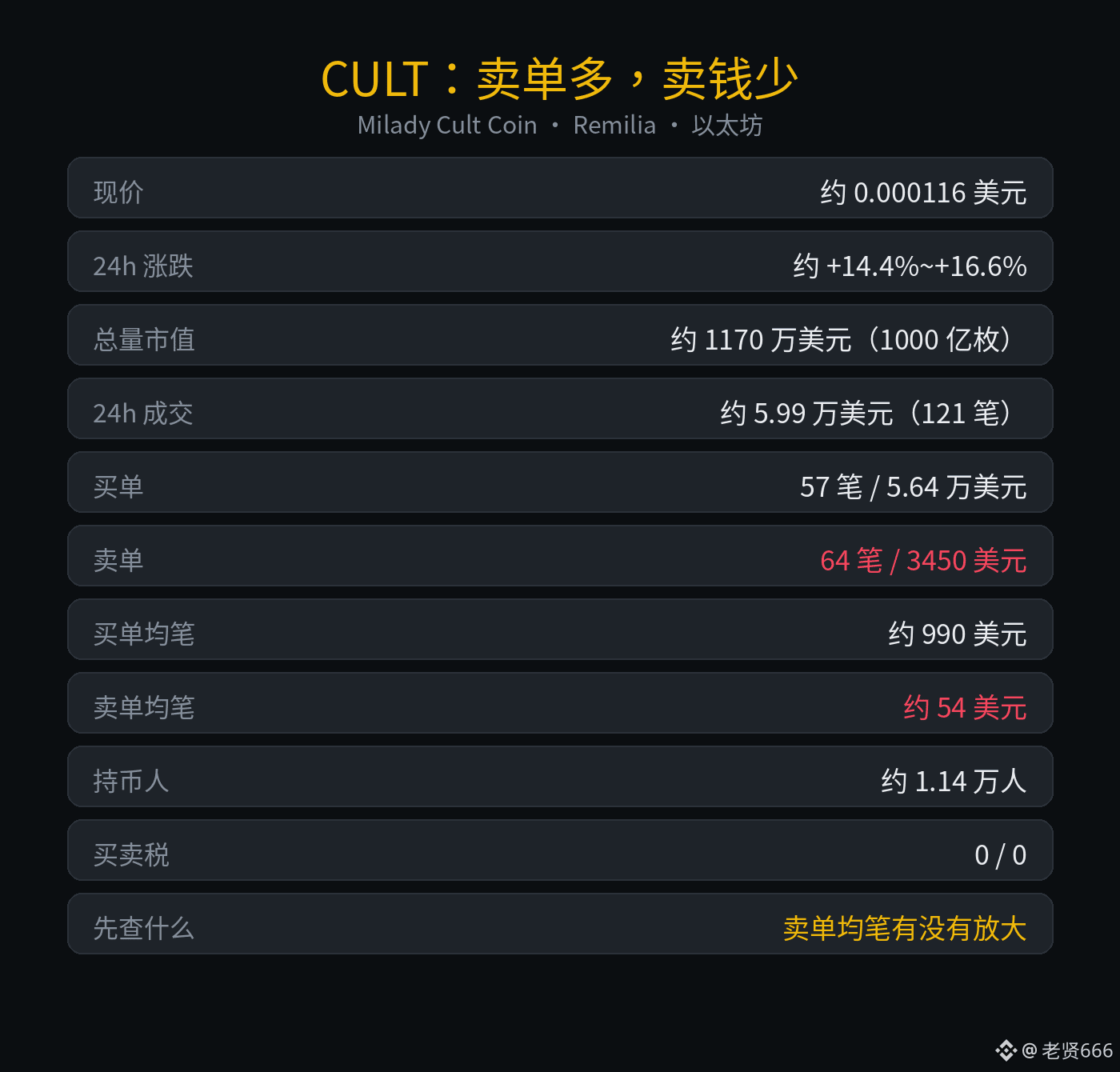
$CULT There were 7 more sell orders than buy orders, yet the amount sold was only one-sixteenth of the amount bought
Over the past 24 hours, the CULT/WETH pool saw about $59,900 in trading volume across 121 trades. There were 57 buy orders, bringing in $56,400; sell orders actually outnumbered them, with 64, but the total amount sold was only $3,450. On average, each buy order was nearly $990, while each sell order was under $54—the amount spent buying was more than 16 times the amount from sales. The price was pushed up by a series of large buy orders, rising 14% to 16% over 24 hours to around $0.000116.
About 11,400 people hold it. The total supply is 100 billion tokens, putting its market cap at about $11.7 million based on the total supply. The pool holds 9.39 billion CULT and about 1,060 WETH; the figures on both sides add up. There are no buy or sell taxes.
This isn’t a new coin. It was launched by Remilia, from the Milady circle, on December 9, 2024, so it’s been around for almost two years. More than 10,000 people hold it, and there are only around 120 trades a day—nothing much is happening.
More sell orders but less money sold could mean holders are testing the waters with small orders, or that large holders haven’t moved at all. There’s no way to tell which just from looking at this one day.
There’s just one thing holders can keep an eye on now: whether the average sell order amount increases. If sell orders are still only worth tens of dollars each, the rise is being supported by buy orders; if one day sell orders suddenly get larger while their count stays high, that would mean someone has really started selling. If you don’t hold it, there’s no need to chase the excitement over this bit of trading activity—you can always check back after sell amounts have risen consistently. Do you think these are small orders testing the waters, or are the large holders sitting tight?
This is not investment advice. Alpha projects are high-risk and may go to zero.
#BinanceAlpha #Buy/sell structure
71
·
--
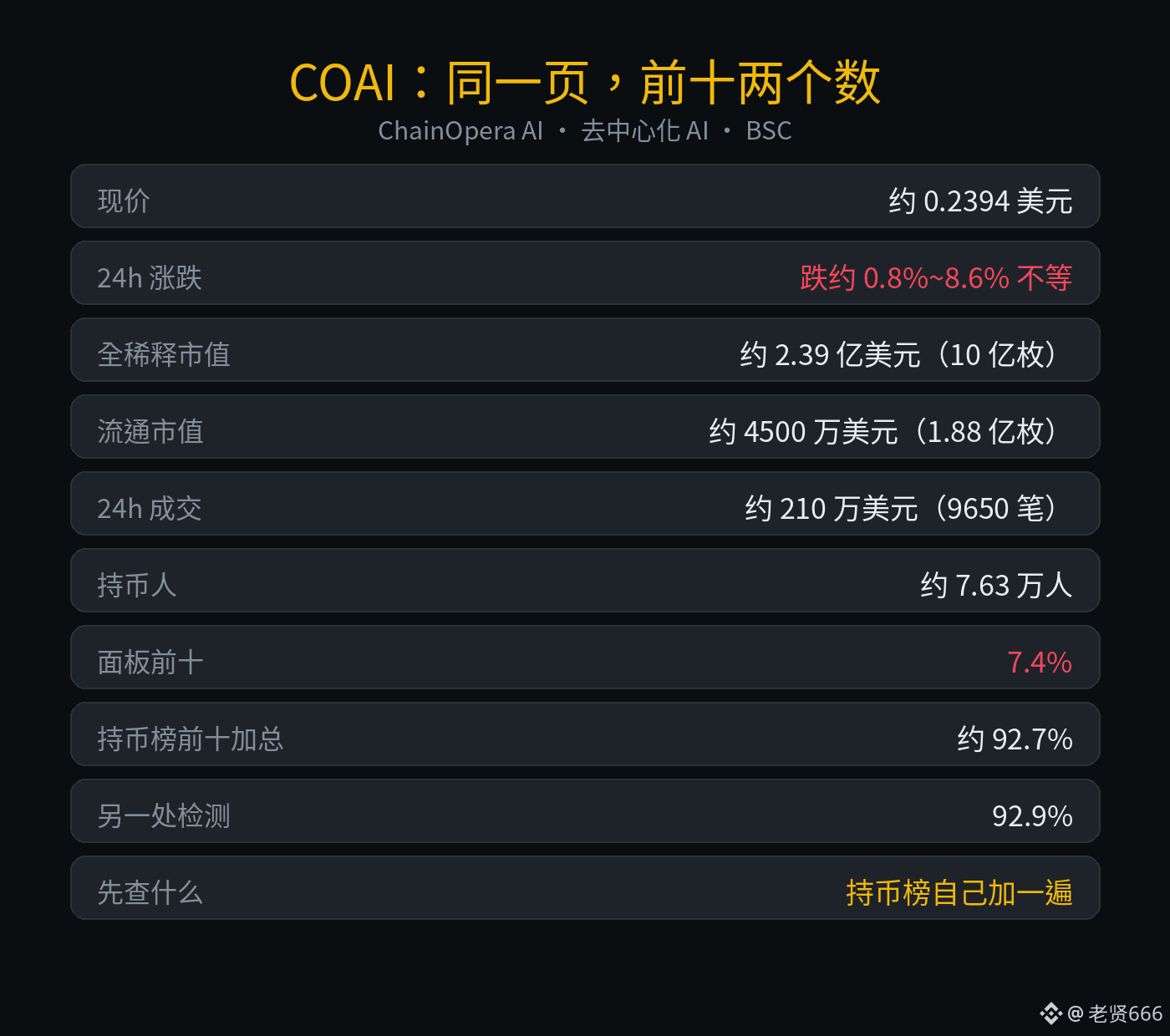
On the same page, two figures give very different answers about how much the top ten hold: $COAI shows a difference of more than 12 times.
The dashboard says 7.4%. I added up the holders’ leaderboard: the top holder has 23%, the second has 18.8%, the top five together have 79.5%, and the top ten together have 92.7%. A separate check on the same page also says 92.9%, which matches the sum. That 7.4% looks like a misplaced figure from another table.
By this calculation, the top ten hold 929 million tokens out of 76,300 holder addresses, worth about $222 million. The remaining 70-plus million tokens, worth about $16.9 million, are spread across the other 76,000-plus addresses—an average of around $222 per address. The number of holders looks substantial, but the tokens are really in the hands of a small number of addresses.
This coin is in the decentralized AI agent space, a familiar name on BSC, and it first appeared on the leaderboard last September. This morning, the page showed a price of about $0.2394. It was down on the day, though sources disagreed on by how much: some said less than 1%, others more than 8%. Daily trading volume was about $2.1 million: 4,550 buy orders worth $1.04 million and 5,100 sell orders worth $1.05 million. The two sides were basically even, but the price still couldn’t hold. There are also two different market-cap figures: using the total supply of 1 billion tokens gives about $239 million, while using the circulating supply of 188 million gives about $45 million. Depending on which figure you use, the market size differs by more than five times.
If you’re holding this token, do one thing first: don’t just look at the dashboard figure. Add up the top ten on the holders’ leaderboard yourself, and only then think further if it matches the 92.9% figure. If the dashboard’s 7.4% is corrected someday and lines up with the holders’ leaderboard, this article’s take is no longer valid—recalculate using the new figures.
This is not investment advice. Alpha projects are high-risk and may go to zero. Which figure do you trust: the dashboard or the holders’ leaderboard?
#币安Alpha #前十持仓 #On-chain number-crunching
28
·
--
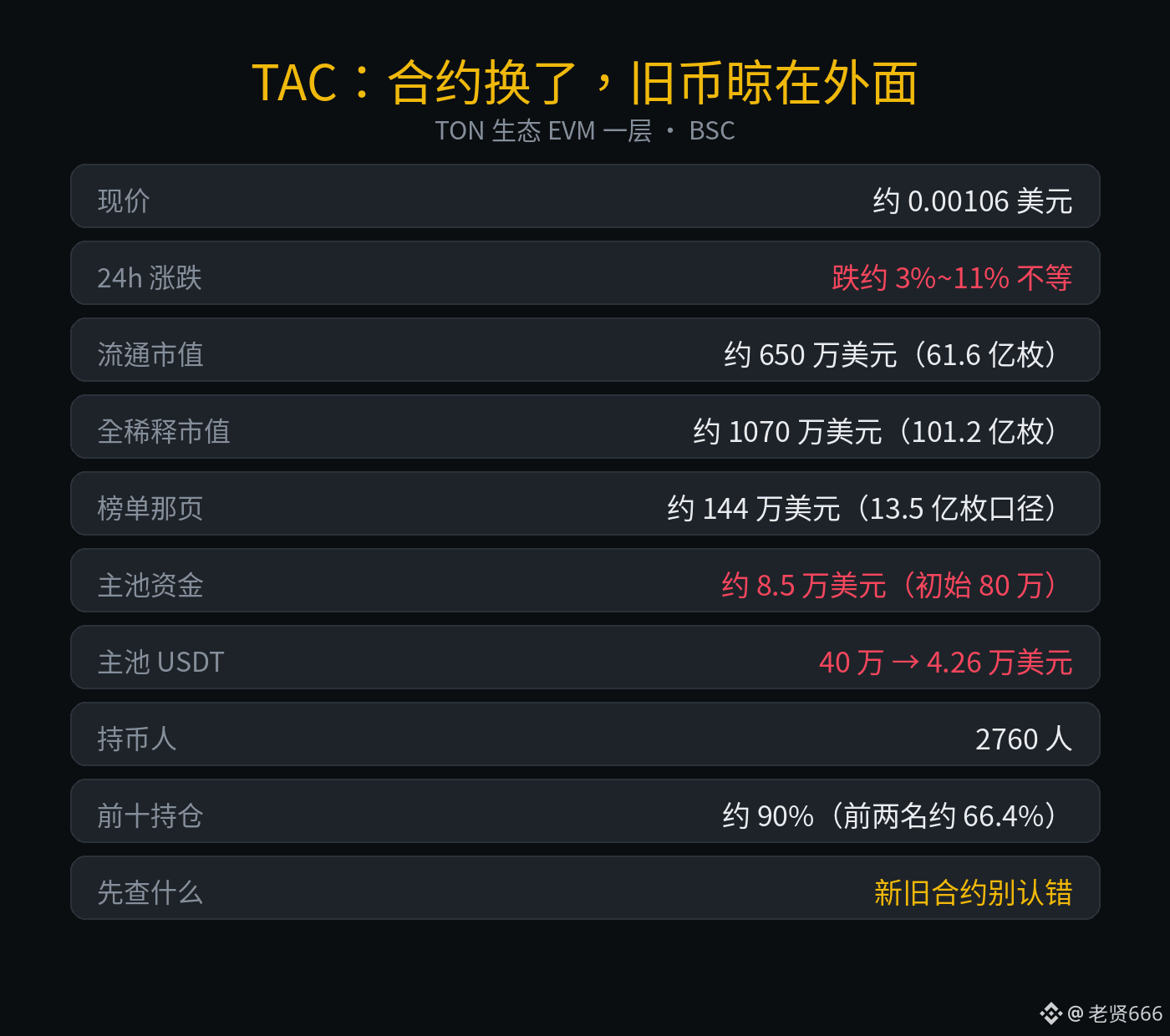
For coins that have changed contracts, don’t identify them by the old address. I spent half the night going through this page, $TAC , and what stands out most is not how much it fell, but that the old and new versions are still both out there at the same time.
In the Aug. 22 incident, the project’s own postmortem stated it plainly: someone used a single transaction to drain about 2.99 billion TAC from the staking pool, or about 28.6% of the total supply, and the chain stopped on the spot. After the Sept. 2 snapshot and the Sept. 4 resumption of mainnet block production, the BSC token was migrated to a new contract. About 1.66 billion old tokens in the attacker’s hands were left outside the new contract and could not be exchanged for new tokens. The old contract starting with 0x1219 is no longer the main one; the one to recognize now is the one starting with 0xb305.
The same coin can have two different market cap calculations. The leaderboard page shows about $1.44 million, which is based on an effective supply of 1.35 billion. Outside that, using a circulating supply of 6.16 billion gives about $6.5 million, and using a total supply of 10.12 billion gives about $10.7 million. If you only look at the leaderboard page, you’d think the project is much smaller than it really is. The current price is about $0.00106, and the reported drop varies quite a bit by source: some say 3%, others say more than 10%, but the direction is the same—down. It is still more than 98% below the late-June peak of about $0.067.
The main pool does not look good either. On the USDT side, it fell from 400,000 to 42,600; on the TAC side, it rose from 177 million tokens to 414 million tokens; the pool shrank from $800,000 to about $85,000. Daily trading is about 4,500 transactions: sell orders are about 2,400 trades worth $140,000, while buy orders are about 2,100 trades worth $138,000. Sells are slightly heavier, and the price has not held up. There are 2,760 holders, the top 10 hold about 90%, and the top two alone account for about 66.4%—one is the Binance Alpha treasury, and the other address holds about 30%.
If you hold the coin, check one thing first: whether the TAC in your wallet is on the new contract. Old tokens bought after the snapshot cannot be swapped. If you want to reassess later, it is simple: if the USDT side of the main pool gradually refills and sell orders are no longer one-sided, then it is not too late to come back and read this again. If you have TAC, is your first reaction to check the contract, or to look at the price?
This is not investment advice. Alpha projects are high risk and can go to zero. I’ll check this pool again tomorrow morning to see whether the USDT side has refilled.
#币安Alpha #合约换约 #onchain review
12
·
--
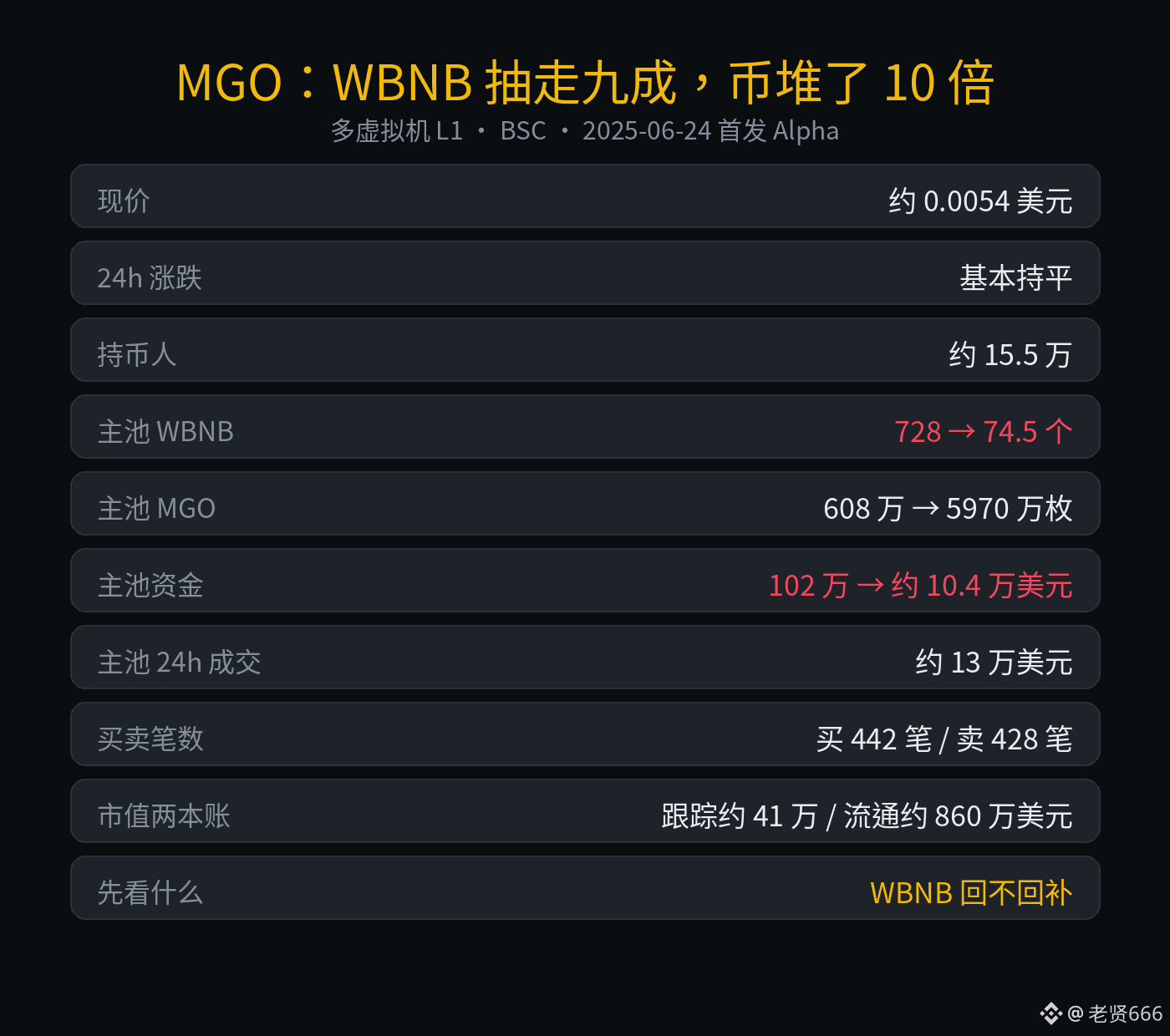
155,000 people are watching one pool, and there are only 74 WBNB left in it—$MGO . The numbers just don’t add up.
The main pool pairs MGO with WBNB. The WBNB side used to hold 728, but now has just 74.5 left—barely over 10% of the original amount. The MGO side has gone the other way, growing from 6.08 million tokens to 59.7 million, almost 10 times as much. The pool’s funds have shrunk along with it, from $1.02 million to about $104,000—also down to about 10%. The number of tokens keeps growing while the real money keeps getting pulled out, yet the price hasn’t budged: it’s about $0.0054, essentially flat over the day.
There are two different market-cap figures. The listing page calculates it using 75.9 million tokens, giving a figure of only about $410,000. Elsewhere, using a circulating supply of 1.6 billion, it comes to about $8.6 million—more than 20 times higher. Looking only at the listing page, you’d think the project is much smaller than it really is. Based on the total supply of 10 billion tokens, the fully diluted valuation is about $54 million.
Trading on both sides is fairly quiet. Daily volume is about $130,000: 442 buy orders worth $66,400 and 428 sell orders worth $64,100, for net buying of only about $2,300. Nobody is rushing to get out, and nobody is rushing to get in. The pool is just being drained and worn down. Split among 155,000 holders, there’s less than $1 in the pool per person.
This project is building an L1 designed to support multiple virtual machines, aiming to integrate the Move, EVM, and Solana virtual machines. The token first launched on Binance Alpha on June 24, 2025. At the time, 210 points could be redeemed for 1,666 tokens. The current price is down more than 80% from its high of about $0.034.
If you’re holding, watch one thing: whether the WBNB side of the main pool gets replenished. Let’s see if it gets back into the triple digits. If WBNB keeps falling while MGO keeps piling in, then this assessment still holds—the pool will only get thinner.
This is not investment advice. Alpha projects are high-risk and may go to zero. With the pool being drained like this while the price stays flat, do you think someone is quietly pulling out, or has nobody cared about this pool in the first place?
#币安Alpha #池子动向 #OnChainReview
6
·
--
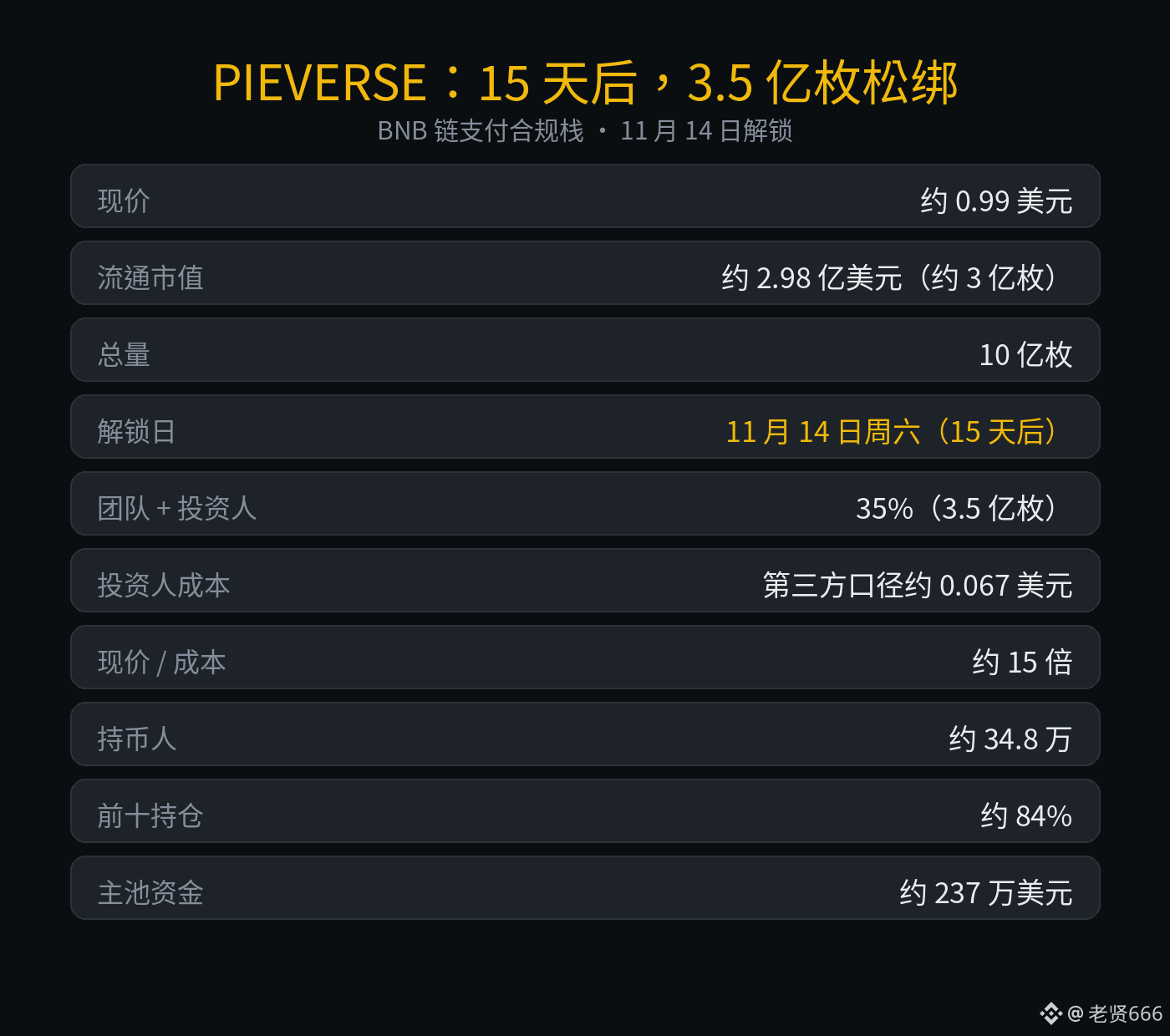
In 15 days, 350 million PIEVERSE tokens are set to start unlocking. If you’re holding any, you’d better mark the date on your calendar now. 😅
$PIEVERSE is currently around $0.99, with quotes across platforms hovering around $0.98–$0.99. The September high was about $2, so it’s now roughly cut in half. Let’s get the numbers straight first: total supply is 1 billion tokens, circulating supply is about 300 million, and circulating market cap is about $298 million. The $89.6 million figure on the rankings is based on an effective total supply of 90.6 million tokens—it’s a different calculation, so don’t mistake it for circulating market cap.
The key date is Saturday, November 14. The project launched on November 14, 2025. The team’s 20% and investors’ 15% add up to 35%, or 350 million tokens, which were locked for exactly 12 months. They unlock that day, after which linear vesting begins. According to third-party figures, the investors’ allocation has a 12-month cliff followed by 18 months of linear vesting, with a cost basis of about $0.067. Compared with the current $0.99 price, that’s roughly a 15x return. The project hasn’t given a firm number for how much will be released in the first batch, and estimates vary across sources. That needs to be said upfront—don’t trust any chart that confidently gives a precise figure.
On-chain activity looks fairly steady for now: 348,000 holders, with the top 10 holding about 84%. The main PIEVERSE/USDT pool has about $2.37 million, while tracked pools saw around $3 million in volume and 17,300 transactions in a day. Both buy and sell taxes are 0. The project is building a payment-compliance stack on BNB Chain, with delegated payments and invoiced receipts for AI agents—but a good narrative doesn’t mean there won’t be volatility on unlock day.
If you’re holding, keep an eye on two things over the next couple of weeks: first, whether the team’s and investors’ large wallets move around November 14, and whether they send tokens to exchanges; second, whether liquidity in the main pool, currently around $2.37 million, starts to fall. If the wallets stay put and liquidity holds, keep monitoring. But if large wallets start moving as soon as the unlock begins and the pool shrinks along with them, step aside for now.
This is not investment advice. Alpha projects are high-risk and could go to zero. When unlock day arrives, will you watch the large wallets first, or the pool liquidity?
#BinanceAlpha #PIEVERSE #UnlockCountdown
14
·
--
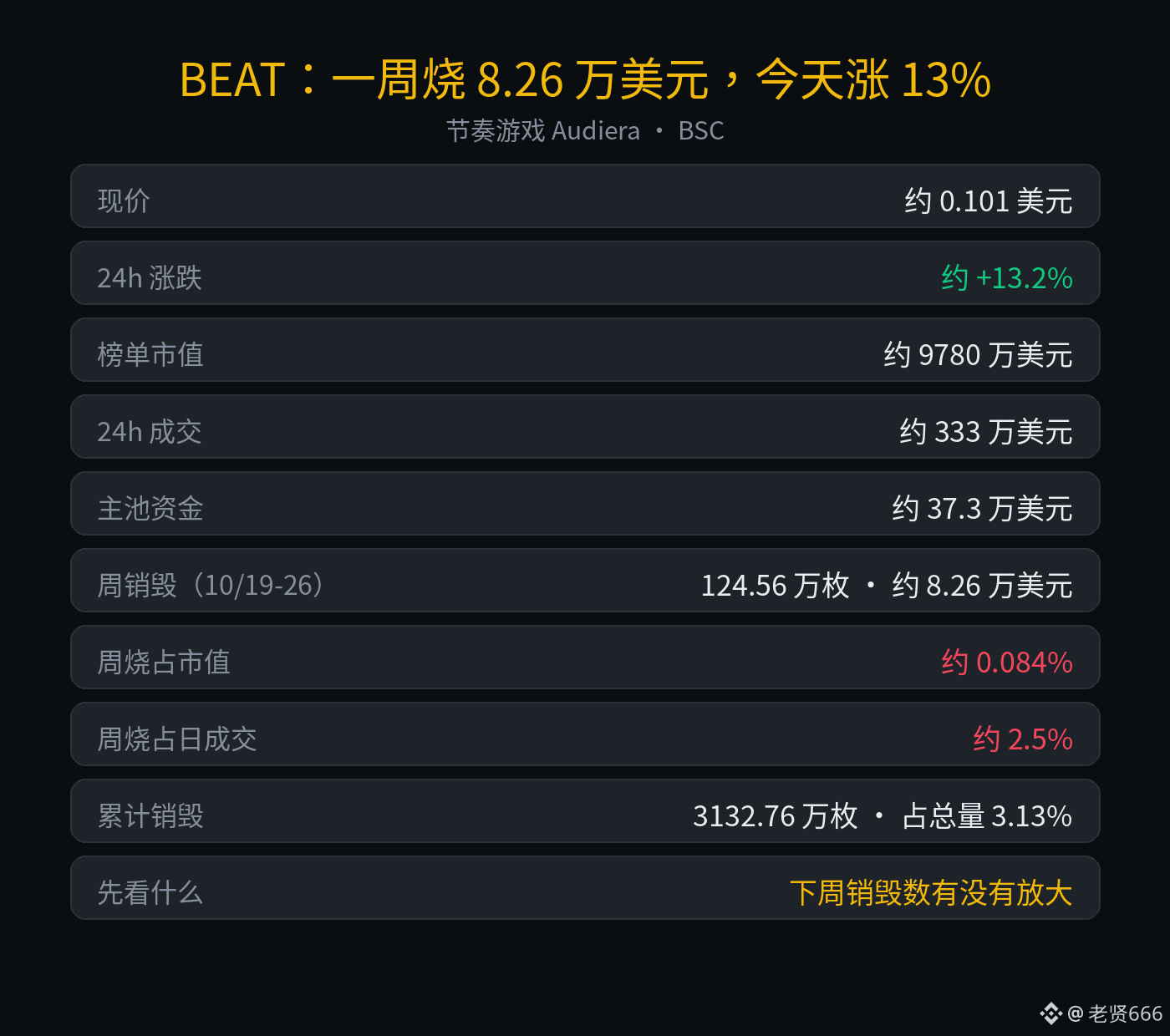
Coins worth $82,600 burned in a week, and today it's up 13%—no matter how I do the math, these numbers don't add up. —$BEAT
Let's lay out both sides. $BEAT is currently around $0.101, up about 13.2% in a day. Its market cap on the rankings is about $97.8 million, calculated using an effective supply of 968 million tokens. Daily trading volume is about $3.33 million, while the main Beat/USDT pool has about $373,000 in liquidity—so daily volume is roughly 8.9 times the pool size. There are 157,000 holders, the top ten hold about 66%, and both buys and sells are taxed at about 3%.
On the other side is the burn figure reported by the official account last week: from October 19 to 26, revenue was 1,247,800 tokens and 1,245,600 were burned. At the reference price of about $0.06632 at the time, that batch was worth roughly $82,600. The cumulative amount burned was 31,327,600 tokens.
The math makes it clear: the value burned that week was only about 0.084% of today's market cap, and less than 2.5% of a single day's trading volume. Even at today's price of $0.101, that batch would be worth only about $125,800, or around 0.13% of the market cap. The 31.32 million tokens burned so far amount to 3.13% of the total supply of 1 billion. That's not nothing, but it accumulated week by week—it wasn't burned in a single day.
So last week's burn alone can't account for today's 13% rise. Burns are indeed happening every week, but their scale doesn't match today's trading volume and market cap. That's where the numbers don't add up.
If you hold it or are thinking of following along, keep an eye on one thing: when next week's burn figures come out, will they rise significantly to a level commensurate with daily trading volume, and will the cumulative burn keep growing? If burns stay around $80,000 a week while the price keeps surging, then the rise isn't being driven by burns—don't use burning as a reason to expect the price to go up.
This is not investment advice. Alpha projects are high-risk and could go to zero. How much do you think needs to be burned next week to justify today's price?
#BinanceAlpha #BEAT #BuybackAndBurn
44
Log in to explore more content
Join global crypto users on Binance Square
⚡️ Get latest and useful information about crypto.
💬 Trusted by the world’s largest crypto exchange.
👍 Discover real insights from verified creators.
Email / Phone number
Trending Topics
BinanceWithdrawalScamWarning
51,080 views
704 Discussing
Binance Warns Users of Withdrawal Scams as Services Resume: It Will Never Charge Fees, Sell Queue Spots or Ask You to Move Funds to a “Vault”
Binance News
·15 Likes
·8.5k views
USMidtermElections
620,929 views
3,276 Discussing
USOctoberNFP-AreRateCutsStillPossible
56,008 views
567 Discussing