

#secproposescryptocustodyrules
secproposescryptocustodyrules
Hot
Latest

🔐 SEC TARGETS CRYPTO CUSTODY
The SEC is proposing stronger safeguards around client assets held by investment advisers.
The debate isn't only about regulation—it could also shape how institutions access and hold $BTC, $ETH and other digital assets. 👀
#secproposescryptocustodyrules
🔐 SEC TARGETS CRYPTO CUSTODY
The SEC is proposing stronger safeguards around client assets held by investment advisers.
The debate isn't only about regulation—it could also shape how institutions access and hold $BTC, $ETH and other digital assets. 👀
#secproposescryptocustodyrules
The SEC is proposing stronger safeguards around client assets held by investment advisers.
The debate isn't only about regulation—it could also shape how institutions access and hold $BTC, $ETH and other digital assets. 👀
#secproposescryptocustodyrules
173

·
--
🚨 STOP SCROLLING — THE SEC JUST MADE A BIG MOVE FOR CRYPTO! 👀
🇺🇸 SEC PROPOSES NEW CRYPTO CUSTODY RULES
What if crypto funds and investment advisers finally get a clearer legal path to hold digital assets?
The U.S. SEC has proposed a new framework specifically addressing how registered investment advisers and regulated funds can custody certain crypto assets. 🔐
🔥 What could change?
• Limited self-custody options for advisers when an eligible custodian isn’t available
• State trust companies could become eligible crypto custodians
• Updated custody requirements designed around digital assets
• Potentially fewer regulatory barriers for crypto investment strategies
The proposal is aimed at replacing years of uncertainty with a more defined regulatory framework. 🇺🇸
But here’s the BIG question… 👇
Could clearer custody rules unlock the next wave of institutional crypto adoption? 🚀
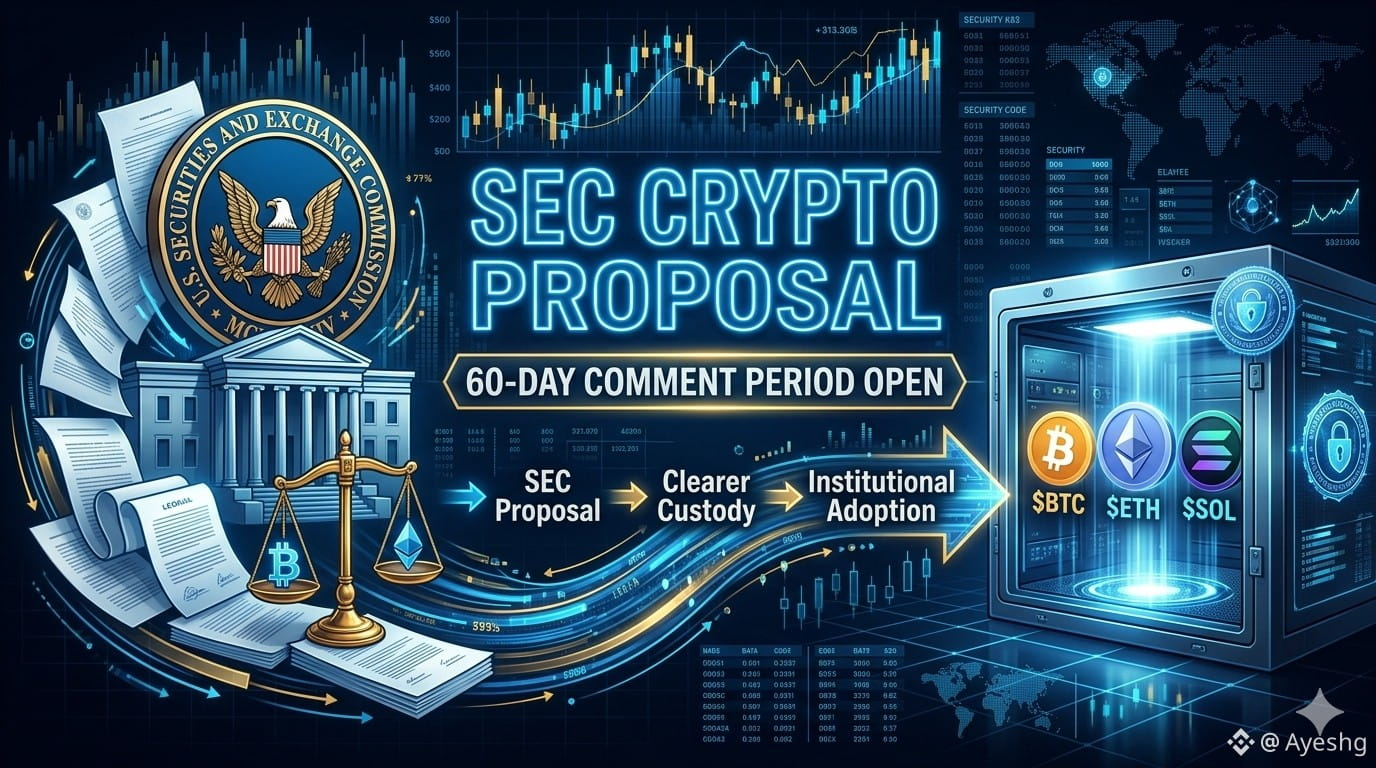
The proposal will face a 60-day public comment period after publication in the Federal Register, so this is NOT a final rule yet.
#secproposescryptocustodyrules
{spot}(XRPUSDT)
{spot}(ETHUSDT)
{spot}(BTCUSDT)
🚨 STOP SCROLLING — THE SEC JUST MADE A BIG MOVE FOR CRYPTO! 👀
🇺🇸 SEC PROPOSES NEW CRYPTO CUSTODY RULES
What if crypto funds and investment advisers finally get a clearer legal path to hold digital assets?
The U.S. SEC has proposed a new framework specifically addressing how registered investment advisers and regulated funds can custody certain crypto assets. 🔐
🔥 What could change?
• Limited self-custody options for advisers when an eligible custodian isn’t available
• State trust companies could become eligible crypto custodians
• Updated custody requirements designed around digital assets
• Potentially fewer regulatory barriers for crypto investment strategies
The proposal is aimed at replacing years of uncertainty with a more defined regulatory framework. 🇺🇸
But here’s the BIG question… 👇
Could clearer custody rules unlock the next wave of institutional crypto adoption? 🚀
The proposal will face a 60-day public comment period after publication in the Federal Register, so this is NOT a final rule yet.
#secproposescryptocustodyrules
🇺🇸 SEC PROPOSES NEW CRYPTO CUSTODY RULES
What if crypto funds and investment advisers finally get a clearer legal path to hold digital assets?
The U.S. SEC has proposed a new framework specifically addressing how registered investment advisers and regulated funds can custody certain crypto assets. 🔐
🔥 What could change?
• Limited self-custody options for advisers when an eligible custodian isn’t available
• State trust companies could become eligible crypto custodians
• Updated custody requirements designed around digital assets
• Potentially fewer regulatory barriers for crypto investment strategies
The proposal is aimed at replacing years of uncertainty with a more defined regulatory framework. 🇺🇸
But here’s the BIG question… 👇
Could clearer custody rules unlock the next wave of institutional crypto adoption? 🚀
The proposal will face a 60-day public comment period after publication in the Federal Register, so this is NOT a final rule yet.
#secproposescryptocustodyrules

DogiaCrypto:
Cómo si les estuviéramos pidiendo permiso xD
3
5
12.7k

🏛️ SEC Proposes New Crypto Custody Rules: Institutional Impact
The regulatory landscape for digital assets is shifting. The U.S. Securities and Exchange Commission (SEC) has introduced a tailored framework for crypto asset custody, aiming to reshape how traditional finance and investment advisers interact with digital assets.
📰 Core News Highlights
Tailored Framework: The proposed guidelines establish clear pathways for registered investment advisers and regulated funds regarding digital asset safety.
Flexibility & Options: The framework addresses conditional allowances for state-chartered trust companies and specific, highly restricted self-custody provisions when permitted custodians aren't available.
Strict Standards: Emphasizes high cybersecurity baselines, internal controls, robust safeguarding expertise, and independent public accountant oversight.
📊 Potential Market & Institutional Impact
🏦 Institutional Clarity: Clearer rules reduce ambiguity, potentially clearing a smoother path for mainstream financial entities to manage and integrate crypto assets.
🛡️ Elevated Security: High compliance and operational standards could significantly boost long-term market confidence.
📈 Liquidity Growth: Standardized frameworks may eventually encourage deeper institutional capital deployment across the digital asset ecosystem.
💬 Let’s Discuss!
How do you think these evolving custody regulations will influence institutional adoption and market dynamics over the next few years? Drop your thoughts below! 👇
#SECHaltsCryptoETFReviewsAmidFundingLapse #SECProposesCryptoCustodyRules $AAPLB
🏛️ SEC Proposes New Crypto Custody Rules: Institutional Impact
The regulatory landscape for digital assets is shifting. The U.S. Securities and Exchange Commission (SEC) has introduced a tailored framework for crypto asset custody, aiming to reshape how traditional finance and investment advisers interact with digital assets.
📰 Core News Highlights
Tailored Framework: The proposed guidelines establish clear pathways for registered investment advisers and regulated funds regarding digital asset safety.
Flexibility & Options: The framework addresses conditional allowances for state-chartered trust companies and specific, highly restricted self-custody provisions when permitted custodians aren't available.
Strict Standards: Emphasizes high cybersecurity baselines, internal controls, robust safeguarding expertise, and independent public accountant oversight.
📊 Potential Market & Institutional Impact
🏦 Institutional Clarity: Clearer rules reduce ambiguity, potentially clearing a smoother path for mainstream financial entities to manage and integrate crypto assets.
🛡️ Elevated Security: High compliance and operational standards could significantly boost long-term market confidence.
📈 Liquidity Growth: Standardized frameworks may eventually encourage deeper institutional capital deployment across the digital asset ecosystem.
💬 Let’s Discuss!
How do you think these evolving custody regulations will influence institutional adoption and market dynamics over the next few years? Drop your thoughts below! 👇
#SECHaltsCryptoETFReviewsAmidFundingLapse #SECProposesCryptoCustodyRules $AAPLB
The regulatory landscape for digital assets is shifting. The U.S. Securities and Exchange Commission (SEC) has introduced a tailored framework for crypto asset custody, aiming to reshape how traditional finance and investment advisers interact with digital assets.
📰 Core News Highlights
Tailored Framework: The proposed guidelines establish clear pathways for registered investment advisers and regulated funds regarding digital asset safety.
Flexibility & Options: The framework addresses conditional allowances for state-chartered trust companies and specific, highly restricted self-custody provisions when permitted custodians aren't available.
Strict Standards: Emphasizes high cybersecurity baselines, internal controls, robust safeguarding expertise, and independent public accountant oversight.
📊 Potential Market & Institutional Impact
🏦 Institutional Clarity: Clearer rules reduce ambiguity, potentially clearing a smoother path for mainstream financial entities to manage and integrate crypto assets.
🛡️ Elevated Security: High compliance and operational standards could significantly boost long-term market confidence.
📈 Liquidity Growth: Standardized frameworks may eventually encourage deeper institutional capital deployment across the digital asset ecosystem.
💬 Let’s Discuss!
How do you think these evolving custody regulations will influence institutional adoption and market dynamics over the next few years? Drop your thoughts below! 👇
#SECHaltsCryptoETFReviewsAmidFundingLapse #SECProposesCryptoCustodyRules $AAPLB

1
104

·
--
Bullish
#secproposescryptocustodyrules 🚨 SEC JUST MADE A BIG MOVE FOR CRYPTO! 🇺🇸🔐
The U.S. SEC has proposed a new framework for crypto custody that could change how registered investment advisers and regulated funds handle digital assets.
The proposal was announced on October 1, 2026 and is specifically focused on creating a clearer custody framework for crypto assets.
🔥 WHAT COULD CHANGE?
• Advisers could potentially self-custody certain crypto assets when an eligible custodian isn't available, subject to conditions.
• State trust companies could potentially qualify as custodians for client and regulated-fund crypto assets.
• The proposal would update existing custody, reporting and related requirements to better address digital assets.
• Regulated funds could potentially have a clearer path to offer a wider range of crypto-related investment strategies.
⚠️ BUT THERE'S ONE BIG CATCH
THIS IS ONLY A PROPOSAL — NOT A FINAL RULE.
The SEC has opened a 60-day public comment period after publication in the Federal Register. The proposal can still be changed before any final rules are adopted.
🌐 WHY CRYPTO MARKETS ARE WATCHING
Clearer custody rules
↓
More defined regulatory pathway
↓
Potentially fewer custody barriers
↓
More options for regulated investment products
↓
Potential implications for institutional crypto adoption
But don't confuse a proposed rule with an immediate change in the law.
👀 The real question now:
Could clearer crypto custody rules make it easier for traditional financial institutions to offer digital-asset strategies?
The next 60 days could be important for the industry.
#SEC #Crypto #Bitcoin #BTC #Ethereum #ETH #CryptoRegulation #InstitutionalCrypto #DigitalAssets #Liquidity #Web3 #Binance
$BTC
$ETH
$SOL
#secproposescryptocustodyrules 🚨 SEC JUST MADE A BIG MOVE FOR CRYPTO! 🇺🇸🔐
The U.S. SEC has proposed a new framework for crypto custody that could change how registered investment advisers and regulated funds handle digital assets.
The proposal was announced on October 1, 2026 and is specifically focused on creating a clearer custody framework for crypto assets.
🔥 WHAT COULD CHANGE?
• Advisers could potentially self-custody certain crypto assets when an eligible custodian isn't available, subject to conditions.
• State trust companies could potentially qualify as custodians for client and regulated-fund crypto assets.
• The proposal would update existing custody, reporting and related requirements to better address digital assets.
• Regulated funds could potentially have a clearer path to offer a wider range of crypto-related investment strategies.
⚠️ BUT THERE'S ONE BIG CATCH
THIS IS ONLY A PROPOSAL — NOT A FINAL RULE.
The SEC has opened a 60-day public comment period after publication in the Federal Register. The proposal can still be changed before any final rules are adopted.
🌐 WHY CRYPTO MARKETS ARE WATCHING
Clearer custody rules
↓
More defined regulatory pathway
↓
Potentially fewer custody barriers
↓
More options for regulated investment products
↓
Potential implications for institutional crypto adoption
But don't confuse a proposed rule with an immediate change in the law.
👀 The real question now:
Could clearer crypto custody rules make it easier for traditional financial institutions to offer digital-asset strategies?
The next 60 days could be important for the industry.
#SEC #Crypto #Bitcoin #BTC #Ethereum #ETH #CryptoRegulation #InstitutionalCrypto #DigitalAssets #Liquidity #Web3 #Binance
$BTC
$ETH
$SOL
The U.S. SEC has proposed a new framework for crypto custody that could change how registered investment advisers and regulated funds handle digital assets.
The proposal was announced on October 1, 2026 and is specifically focused on creating a clearer custody framework for crypto assets.
🔥 WHAT COULD CHANGE?
• Advisers could potentially self-custody certain crypto assets when an eligible custodian isn't available, subject to conditions.
• State trust companies could potentially qualify as custodians for client and regulated-fund crypto assets.
• The proposal would update existing custody, reporting and related requirements to better address digital assets.
• Regulated funds could potentially have a clearer path to offer a wider range of crypto-related investment strategies.
⚠️ BUT THERE'S ONE BIG CATCH
THIS IS ONLY A PROPOSAL — NOT A FINAL RULE.
The SEC has opened a 60-day public comment period after publication in the Federal Register. The proposal can still be changed before any final rules are adopted.
🌐 WHY CRYPTO MARKETS ARE WATCHING
Clearer custody rules
↓
More defined regulatory pathway
↓
Potentially fewer custody barriers
↓
More options for regulated investment products
↓
Potential implications for institutional crypto adoption
But don't confuse a proposed rule with an immediate change in the law.
👀 The real question now:
Could clearer crypto custody rules make it easier for traditional financial institutions to offer digital-asset strategies?
The next 60 days could be important for the industry.
#SEC #Crypto #Bitcoin #BTC #Ethereum #ETH #CryptoRegulation #InstitutionalCrypto #DigitalAssets #Liquidity #Web3 #Binance
$BTC
$ETH
$SOL
3.1k

🚨🔥 BREAKING: SEC COULD OPEN THE DOOR TO CRYPTO SELF-CUSTODY! 🇺🇸
⚡ Under “Project Crypto,” the SEC proposed a framework that could allow registered investment advisers and regulated funds to SELF-CUSTODY DIGITAL ASSETS in certain circumstances.
🏦 The framework would also allow them to potentially use STATE-CHARTERED TRUST COMPANIES for crypto custody.
💥 WALL STREET + SELF-CUSTODY? BIG SHIFT IN CRYPTO REGULATION!
👀 Could this make institutional crypto custody more flexible and accelerate adoption?
🔔 Follow for more SEC, ETF & crypto breaking news.
$AIN $BEAMX $COLLECT
#SECProposesCryptoCustodyRules
#SECHaltsCryptoETFReviewsAmidFundingLapse
🚨🔥 BREAKING: SEC COULD OPEN THE DOOR TO CRYPTO SELF-CUSTODY! 🇺🇸
⚡ Under “Project Crypto,” the SEC proposed a framework that could allow registered investment advisers and regulated funds to SELF-CUSTODY DIGITAL ASSETS in certain circumstances.
🏦 The framework would also allow them to potentially use STATE-CHARTERED TRUST COMPANIES for crypto custody.
💥 WALL STREET + SELF-CUSTODY? BIG SHIFT IN CRYPTO REGULATION!
👀 Could this make institutional crypto custody more flexible and accelerate adoption?
🔔 Follow for more SEC, ETF & crypto breaking news.
$AIN $BEAMX $COLLECT
#SECProposesCryptoCustodyRules
#SECHaltsCryptoETFReviewsAmidFundingLapse
⚡ Under “Project Crypto,” the SEC proposed a framework that could allow registered investment advisers and regulated funds to SELF-CUSTODY DIGITAL ASSETS in certain circumstances.
🏦 The framework would also allow them to potentially use STATE-CHARTERED TRUST COMPANIES for crypto custody.
💥 WALL STREET + SELF-CUSTODY? BIG SHIFT IN CRYPTO REGULATION!
👀 Could this make institutional crypto custody more flexible and accelerate adoption?
🔔 Follow for more SEC, ETF & crypto breaking news.
$AIN $BEAMX $COLLECT
#SECProposesCryptoCustodyRules
#SECHaltsCryptoETFReviewsAmidFundingLapse
131
⚠️ CRYPTO CUSTODY IS UNDER THE MICROSCOPE
The SEC's proposed custody framework could bring tighter requirements around how advisers protect client assets.
For institutional crypto investors, custody isn't a side issue—it's infrastructure. $BTC $ETH $SOL
#secproposescryptocustodyrules
⚠️ CRYPTO CUSTODY IS UNDER THE MICROSCOPE
The SEC's proposed custody framework could bring tighter requirements around how advisers protect client assets.
For institutional crypto investors, custody isn't a side issue—it's infrastructure. $BTC $ETH $SOL
#secproposescryptocustodyrules
The SEC's proposed custody framework could bring tighter requirements around how advisers protect client assets.
For institutional crypto investors, custody isn't a side issue—it's infrastructure. $BTC $ETH $SOL
#secproposescryptocustodyrules
12
🚨 SEC MAKES A BIG CRYPTO CUSTODY MOVE
The SEC is proposing new rules aimed at strengthening how investment advisers safeguard client assets, including digital assets.
For $BTC and $ETH, better custody standards could matter as institutional adoption grows. 🔐📊
#secproposescryptocustodyrules
🚨 SEC MAKES A BIG CRYPTO CUSTODY MOVE
The SEC is proposing new rules aimed at strengthening how investment advisers safeguard client assets, including digital assets.
For $BTC and $ETH, better custody standards could matter as institutional adoption grows. 🔐📊
#secproposescryptocustodyrules
The SEC is proposing new rules aimed at strengthening how investment advisers safeguard client assets, including digital assets.
For $BTC and $ETH, better custody standards could matter as institutional adoption grows. 🔐📊
#secproposescryptocustodyrules
9

#SECProposesCryptoCustodyRules
🚨 CRYPTO’S BIGGEST SEC ALLY IS GONE — WHAT HAPPENS NEXT?
The SEC has proposed a new framework for crypto custody.
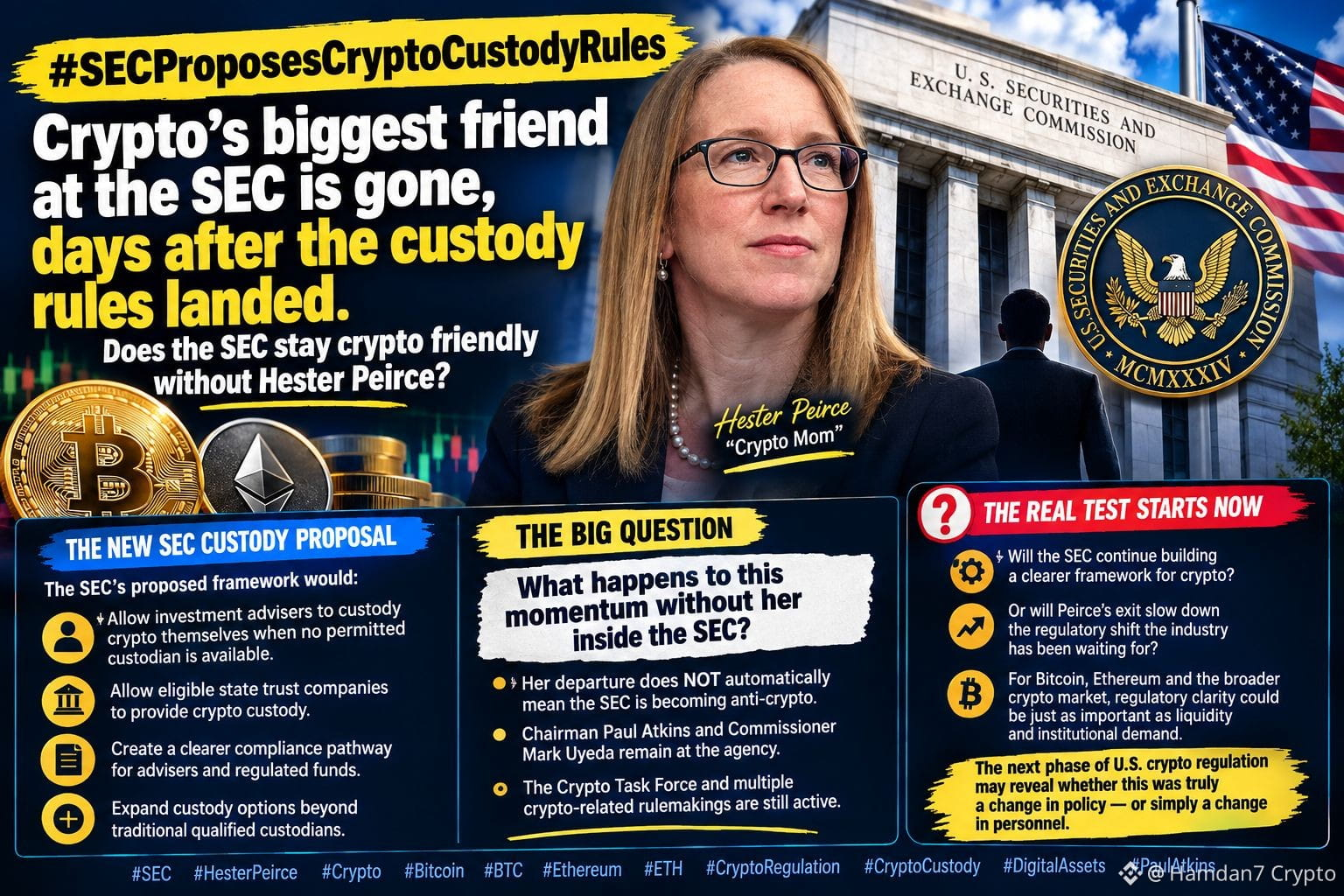
Hester Peirce has left the SEC as the agency unveiled its new custody proposal.
The proposed rules could give investment advisers flexibility to custody certain crypto assets themselves when no permitted custodian is available. Eligible state trust companies could play a larger role.
That could give institutions more options to manage digital assets.
But now comes the bigger question:
👉 Can the SEC maintain its crypto-friendly momentum without Hester Peirce?
Her departure does NOT automatically mean the SEC is turning against crypto. Chairman Paul Atkins remains involved in the agency’s digital-asset agenda, while the Crypto Task Force continues working on regulatory issues.
Still, Peirce’s absence removes one of the strongest voices for clearer crypto rules.
🔥 The next phase could be crucial.
For Bitcoin, Ethereum and crypto, regulatory clarity may become just as important as liquidity and institutional demand.
The real test now is whether the SEC’s crypto policy continues moving forward — or whether Peirce’s exit changes the pace.
Institutional investors will be watching closely, as clearer custody rules could influence institutional entry into crypto further.
The SEC’s next moves may determine whether this regulatory momentum continues.
#SECProposesCryptoCustodyRules
🚨 CRYPTO’S BIGGEST SEC ALLY IS GONE — WHAT HAPPENS NEXT?
The SEC has proposed a new framework for crypto custody.
Hester Peirce has left the SEC as the agency unveiled its new custody proposal.
The proposed rules could give investment advisers flexibility to custody certain crypto assets themselves when no permitted custodian is available. Eligible state trust companies could play a larger role.
That could give institutions more options to manage digital assets.
But now comes the bigger question:
👉 Can the SEC maintain its crypto-friendly momentum without Hester Peirce?
Her departure does NOT automatically mean the SEC is turning against crypto. Chairman Paul Atkins remains involved in the agency’s digital-asset agenda, while the Crypto Task Force continues working on regulatory issues.
Still, Peirce’s absence removes one of the strongest voices for clearer crypto rules.
🔥 The next phase could be crucial.
For Bitcoin, Ethereum and crypto, regulatory clarity may become just as important as liquidity and institutional demand.
The real test now is whether the SEC’s crypto policy continues moving forward — or whether Peirce’s exit changes the pace.
Institutional investors will be watching closely, as clearer custody rules could influence institutional entry into crypto further.
The SEC’s next moves may determine whether this regulatory momentum continues.
🚨 CRYPTO’S BIGGEST SEC ALLY IS GONE — WHAT HAPPENS NEXT?
The SEC has proposed a new framework for crypto custody.
Hester Peirce has left the SEC as the agency unveiled its new custody proposal.
The proposed rules could give investment advisers flexibility to custody certain crypto assets themselves when no permitted custodian is available. Eligible state trust companies could play a larger role.
That could give institutions more options to manage digital assets.
But now comes the bigger question:
👉 Can the SEC maintain its crypto-friendly momentum without Hester Peirce?
Her departure does NOT automatically mean the SEC is turning against crypto. Chairman Paul Atkins remains involved in the agency’s digital-asset agenda, while the Crypto Task Force continues working on regulatory issues.
Still, Peirce’s absence removes one of the strongest voices for clearer crypto rules.
🔥 The next phase could be crucial.
For Bitcoin, Ethereum and crypto, regulatory clarity may become just as important as liquidity and institutional demand.
The real test now is whether the SEC’s crypto policy continues moving forward — or whether Peirce’s exit changes the pace.
Institutional investors will be watching closely, as clearer custody rules could influence institutional entry into crypto further.
The SEC’s next moves may determine whether this regulatory momentum continues.
88

·
--
Have you noticed how quickly the market labels every SEC move as an attack instead of asking what it actually unlocks?
Most traders have already eaten losses from exchange failures and opaque custody, yet they still sell first and think later whenever Washington speaks. That reflex is exactly why they miss the setup.
These proposed custody rules aren't about crushing the space. They're about giving institutions a legal way to hold crypto without waking up to a lawsuit. That's the missing piece.
While Fear and Greed sits at 67 and timelines fill with $USDT, $ZRO and $GLMR chatter, the bigger picture is that clearer custody standards bring real capital, not just retail FOMO.
Get your own setup right now. Audit your holdings, reduce exchange exposure on anything you plan to keep long term, and pay attention to how liquid assets behave once the details land. The ones who wait for perfect confirmation usually buy higher.
Where do you think this goes from here?
#SECProposesCryptoCustodyRules #FedOctoberRateHikeOddsFallTo17 #BitcoinRejectedAt
Have you noticed how quickly the market labels every SEC move as an attack instead of asking what it actually unlocks?
Most traders have already eaten losses from exchange failures and opaque custody, yet they still sell first and think later whenever Washington speaks. That reflex is exactly why they miss the setup.
These proposed custody rules aren't about crushing the space. They're about giving institutions a legal way to hold crypto without waking up to a lawsuit. That's the missing piece.
While Fear and Greed sits at 67 and timelines fill with $USDT, $ZRO and $GLMR chatter, the bigger picture is that clearer custody standards bring real capital, not just retail FOMO.
Get your own setup right now. Audit your holdings, reduce exchange exposure on anything you plan to keep long term, and pay attention to how liquid assets behave once the details land. The ones who wait for perfect confirmation usually buy higher.
Where do you think this goes from here?
#SECProposesCryptoCustodyRules #FedOctoberRateHikeOddsFallTo17 #BitcoinRejectedAt
Most traders have already eaten losses from exchange failures and opaque custody, yet they still sell first and think later whenever Washington speaks. That reflex is exactly why they miss the setup.
These proposed custody rules aren't about crushing the space. They're about giving institutions a legal way to hold crypto without waking up to a lawsuit. That's the missing piece.
While Fear and Greed sits at 67 and timelines fill with $USDT, $ZRO and $GLMR chatter, the bigger picture is that clearer custody standards bring real capital, not just retail FOMO.
Get your own setup right now. Audit your holdings, reduce exchange exposure on anything you plan to keep long term, and pay attention to how liquid assets behave once the details land. The ones who wait for perfect confirmation usually buy higher.
Where do you think this goes from here?
#SECProposesCryptoCustodyRules #FedOctoberRateHikeOddsFallTo17 #BitcoinRejectedAt

59

Here is what happened when regulators tried to draw a hard line around who gets to hold digital assets.
Most investors still remember the gut-wrenching feeling of waking up to frozen withdrawals and realizing their funds were never truly segregated in the first place. Trying to navigate institutional-grade security while balancing daily liquidity with assets like $USDT remains one of the hardest operational hurdles in the space.
When the SEC pushed for stricter custody requirements, it immediately brought back memories of how prime brokerages reshaped traditional equities decades ago. On paper, mandating registered custodians protects client capital from reckless commingling, but in practice, it creates a massive compliance moat that smaller infrastructure players simply cannot afford. We saw a similar dynamic unfold across decentralized messaging protocols like $AR and cross-chain settlement networks like $ZRO, where compliance pressure either forces complete decentralization or total institutional surrender.
If institutional custody becomes standard practice, the market likely splits into two distinct tiers: ultra-regulated walled gardens and censorship-resistant on-chain liquidity.
Do you think stricter custody rules will finally bring true institutional volume, or will it just push genuine activity further offshore?
#SECProposesCryptoCustodyRules #FedOctoberRateHikeOddsFallTo17
Here is what happened when regulators tried to draw a hard line around who gets to hold digital assets.
Most investors still remember the gut-wrenching feeling of waking up to frozen withdrawals and realizing their funds were never truly segregated in the first place. Trying to navigate institutional-grade security while balancing daily liquidity with assets like $USDT remains one of the hardest operational hurdles in the space.
When the SEC pushed for stricter custody requirements, it immediately brought back memories of how prime brokerages reshaped traditional equities decades ago. On paper, mandating registered custodians protects client capital from reckless commingling, but in practice, it creates a massive compliance moat that smaller infrastructure players simply cannot afford. We saw a similar dynamic unfold across decentralized messaging protocols like $AR and cross-chain settlement networks like $ZRO , where compliance pressure either forces complete decentralization or total institutional surrender.
If institutional custody becomes standard practice, the market likely splits into two distinct tiers: ultra-regulated walled gardens and censorship-resistant on-chain liquidity.
Do you think stricter custody rules will finally bring true institutional volume, or will it just push genuine activity further offshore?
#SECProposesCryptoCustodyRules #FedOctoberRateHikeOddsFallTo17
Most investors still remember the gut-wrenching feeling of waking up to frozen withdrawals and realizing their funds were never truly segregated in the first place. Trying to navigate institutional-grade security while balancing daily liquidity with assets like $USDT remains one of the hardest operational hurdles in the space.
When the SEC pushed for stricter custody requirements, it immediately brought back memories of how prime brokerages reshaped traditional equities decades ago. On paper, mandating registered custodians protects client capital from reckless commingling, but in practice, it creates a massive compliance moat that smaller infrastructure players simply cannot afford. We saw a similar dynamic unfold across decentralized messaging protocols like $AR and cross-chain settlement networks like $ZRO , where compliance pressure either forces complete decentralization or total institutional surrender.
If institutional custody becomes standard practice, the market likely splits into two distinct tiers: ultra-regulated walled gardens and censorship-resistant on-chain liquidity.
Do you think stricter custody rules will finally bring true institutional volume, or will it just push genuine activity further offshore?
#SECProposesCryptoCustodyRules #FedOctoberRateHikeOddsFallTo17

135
💥 CRYPTO CUSTODY RULES COULD CHANGE
The SEC is moving forward with proposed custody rules covering investment advisers and the protection of client assets.
If adopted, the framework could have a major impact on institutional crypto custody. $BTC $ETH $SOL 📊
#secproposescryptocustodyrules
💥 CRYPTO CUSTODY RULES COULD CHANGE
The SEC is moving forward with proposed custody rules covering investment advisers and the protection of client assets.
If adopted, the framework could have a major impact on institutional crypto custody. $BTC $ETH $SOL 📊
#secproposescryptocustodyrules
The SEC is moving forward with proposed custody rules covering investment advisers and the protection of client assets.
If adopted, the framework could have a major impact on institutional crypto custody. $BTC $ETH $SOL 📊
#secproposescryptocustodyrules
428
·
--
#secproposescryptocustodyrules 🚨🇺🇸 SEC JUST PROPOSED NEW CRYPTO CUSTODY RULES!
A major regulatory development just landed in the US.
The U.S. Securities and Exchange Commission (SEC) has proposed a new framework for how registered investment advisers and regulated funds can custody crypto assets. 👀
🔐 WHAT'S CHANGING?
Under the proposal, advisers and regulated funds could potentially self-custody certain crypto assets under specific conditions.
If an eligible permitted custodian is unavailable for a particular asset, self-custody could be allowed — subject to requirements and ongoing review.
🏦 STATE TRUST COMPANIES COULD ALSO PLAY A BIGGER ROLE
The proposal would allow state-chartered trust companies to custody certain crypto assets for advisers and regulated funds, provided they meet the proposed requirements.
The SEC says the framework is designed to address issues including asset protection, theft, loss, misuse and misappropriation.
📊 WHY DOES THIS MATTER?
Institutional crypto custody has been a major challenge because traditional custody rules were created long before blockchain technology existed.
The SEC says its proposal aims to modernize those rules and provide advisers and regulated funds with a clearer compliance pathway for crypto-related investment strategies.
⚠️ IMPORTANT: THIS IS NOT FINAL YET
The SEC has only proposed the framework.
The proposal will go through the public-comment and rulemaking process, with comments due 60 days after publication in the Federal Register. The final rules could therefore change before they are adopted.
🔥 WHAT TO WATCH NEXT
🔹 Crypto self-custody requirements
🔹 State trust-company custody
🔹 Private-key & cybersecurity safeguards
🔹 Asset segregation and investor protection
🔹 Institutional adoption
🔹 Changes following public comments
$BTC
$ETH
$SOL
#SECCrypto #CryptoRegulation #Crypto #Bitcoin #Ethereum #Solana #BTC #ETH #SOL #DigitalAssets #CryptoNews
#secproposescryptocustodyrules 🚨🇺🇸 SEC JUST PROPOSED NEW CRYPTO CUSTODY RULES!
A major regulatory development just landed in the US.
The U.S. Securities and Exchange Commission (SEC) has proposed a new framework for how registered investment advisers and regulated funds can custody crypto assets. 👀
🔐 WHAT'S CHANGING?
Under the proposal, advisers and regulated funds could potentially self-custody certain crypto assets under specific conditions.
If an eligible permitted custodian is unavailable for a particular asset, self-custody could be allowed — subject to requirements and ongoing review.
🏦 STATE TRUST COMPANIES COULD ALSO PLAY A BIGGER ROLE
The proposal would allow state-chartered trust companies to custody certain crypto assets for advisers and regulated funds, provided they meet the proposed requirements.
The SEC says the framework is designed to address issues including asset protection, theft, loss, misuse and misappropriation.
📊 WHY DOES THIS MATTER?
Institutional crypto custody has been a major challenge because traditional custody rules were created long before blockchain technology existed.
The SEC says its proposal aims to modernize those rules and provide advisers and regulated funds with a clearer compliance pathway for crypto-related investment strategies.
⚠️ IMPORTANT: THIS IS NOT FINAL YET
The SEC has only proposed the framework.
The proposal will go through the public-comment and rulemaking process, with comments due 60 days after publication in the Federal Register. The final rules could therefore change before they are adopted.
🔥 WHAT TO WATCH NEXT
🔹 Crypto self-custody requirements
🔹 State trust-company custody
🔹 Private-key & cybersecurity safeguards
🔹 Asset segregation and investor protection
🔹 Institutional adoption
🔹 Changes following public comments
$BTC
$ETH
$SOL
#SECCrypto #CryptoRegulation #Crypto #Bitcoin #Ethereum #Solana #BTC #ETH #SOL #DigitalAssets #CryptoNews
A major regulatory development just landed in the US.
The U.S. Securities and Exchange Commission (SEC) has proposed a new framework for how registered investment advisers and regulated funds can custody crypto assets. 👀
🔐 WHAT'S CHANGING?
Under the proposal, advisers and regulated funds could potentially self-custody certain crypto assets under specific conditions.
If an eligible permitted custodian is unavailable for a particular asset, self-custody could be allowed — subject to requirements and ongoing review.
🏦 STATE TRUST COMPANIES COULD ALSO PLAY A BIGGER ROLE
The proposal would allow state-chartered trust companies to custody certain crypto assets for advisers and regulated funds, provided they meet the proposed requirements.
The SEC says the framework is designed to address issues including asset protection, theft, loss, misuse and misappropriation.
📊 WHY DOES THIS MATTER?
Institutional crypto custody has been a major challenge because traditional custody rules were created long before blockchain technology existed.
The SEC says its proposal aims to modernize those rules and provide advisers and regulated funds with a clearer compliance pathway for crypto-related investment strategies.
⚠️ IMPORTANT: THIS IS NOT FINAL YET
The SEC has only proposed the framework.
The proposal will go through the public-comment and rulemaking process, with comments due 60 days after publication in the Federal Register. The final rules could therefore change before they are adopted.
🔥 WHAT TO WATCH NEXT
🔹 Crypto self-custody requirements
🔹 State trust-company custody
🔹 Private-key & cybersecurity safeguards
🔹 Asset segregation and investor protection
🔹 Institutional adoption
🔹 Changes following public comments
$BTC
$ETH
$SOL
#SECCrypto #CryptoRegulation #Crypto #Bitcoin #Ethereum #Solana #BTC #ETH #SOL #DigitalAssets #CryptoNews

1
2
4k
🏦 BIG DEAL FOR INSTITUTIONAL CRYPTO
New SEC custody proposals could reshape how investment advisers handle and safeguard digital assets.
As institutional exposure to $BTC and $ETH expands, secure custody standards become increasingly important. 🔐
#secproposescryptocustodyrules
🏦 BIG DEAL FOR INSTITUTIONAL CRYPTO
New SEC custody proposals could reshape how investment advisers handle and safeguard digital assets.
As institutional exposure to $BTC and $ETH expands, secure custody standards become increasingly important. 🔐
#secproposescryptocustodyrules
New SEC custody proposals could reshape how investment advisers handle and safeguard digital assets.
As institutional exposure to $BTC and $ETH expands, secure custody standards become increasingly important. 🔐
#secproposescryptocustodyrules
443

·
--
Bearish
#secproposescryptocustodyrules 🏛️ SEC Proposes New Crypto Custody Rules: Institutional Impact
The regulatory landscape for digital assets is shifting. The SEC’s latest custody proposal could redefine how traditional finance interacts with crypto.
📰 Core News
The U.S. SEC introduced new proposed rules for crypto asset custody. These guidelines clarify how banks and broker-dealers can safely hold digital assets for clients, focusing on consumer protection, operational standards, and mitigating tech risks like key management.
📊 Market Impact
• 🏦 Institutional Clarity: A clearer regulatory pathway may lower barriers for traditional banks to offer crypto services.
• 🛡️ Enhanced Security: Strict safeguarding measures could raise industry-wide operational standards, boosting market trust.
• 📈 Liquidity Potential: Comfortable compliance may eventually attract more institutional capital and deepen market liquidity.
• ⚖️ Custody Providers: Compliant firms may see higher demand, while non-compliant entities could face industry consolidation.
💬 Let’s Discuss!
How do you think clearer custody regulations will impact institutional adoption in crypto over the next few years? Share your thoughts below! 👇
#SEC #CryptoRegulation #InstitutionalCrypto #CryptoCustody #BinanceSquare
This is for educational purposes only. Not Financial Advice (NFA). Always Do Your Own Research (DYOR).
$NOM $ETH $EDEN
{future}(EDENUSDT)
{future}(ETHUSDT)
{future}(NOMUSDT)
#secproposescryptocustodyrules 🏛️ SEC Proposes New Crypto Custody Rules: Institutional Impact
The regulatory landscape for digital assets is shifting. The SEC’s latest custody proposal could redefine how traditional finance interacts with crypto.
📰 Core News
The U.S. SEC introduced new proposed rules for crypto asset custody. These guidelines clarify how banks and broker-dealers can safely hold digital assets for clients, focusing on consumer protection, operational standards, and mitigating tech risks like key management.
📊 Market Impact
• 🏦 Institutional Clarity: A clearer regulatory pathway may lower barriers for traditional banks to offer crypto services.
• 🛡️ Enhanced Security: Strict safeguarding measures could raise industry-wide operational standards, boosting market trust.
• 📈 Liquidity Potential: Comfortable compliance may eventually attract more institutional capital and deepen market liquidity.
• ⚖️ Custody Providers: Compliant firms may see higher demand, while non-compliant entities could face industry consolidation.
💬 Let’s Discuss!
How do you think clearer custody regulations will impact institutional adoption in crypto over the next few years? Share your thoughts below! 👇
#SEC #CryptoRegulation #InstitutionalCrypto #CryptoCustody #BinanceSquare
This is for educational purposes only. Not Financial Advice (NFA). Always Do Your Own Research (DYOR).
$NOM $ETH $EDEN
The regulatory landscape for digital assets is shifting. The SEC’s latest custody proposal could redefine how traditional finance interacts with crypto.
📰 Core News
The U.S. SEC introduced new proposed rules for crypto asset custody. These guidelines clarify how banks and broker-dealers can safely hold digital assets for clients, focusing on consumer protection, operational standards, and mitigating tech risks like key management.
📊 Market Impact
• 🏦 Institutional Clarity: A clearer regulatory pathway may lower barriers for traditional banks to offer crypto services.
• 🛡️ Enhanced Security: Strict safeguarding measures could raise industry-wide operational standards, boosting market trust.
• 📈 Liquidity Potential: Comfortable compliance may eventually attract more institutional capital and deepen market liquidity.
• ⚖️ Custody Providers: Compliant firms may see higher demand, while non-compliant entities could face industry consolidation.
💬 Let’s Discuss!
How do you think clearer custody regulations will impact institutional adoption in crypto over the next few years? Share your thoughts below! 👇
#SEC #CryptoRegulation #InstitutionalCrypto #CryptoCustody #BinanceSquare
This is for educational purposes only. Not Financial Advice (NFA). Always Do Your Own Research (DYOR).
$NOM $ETH $EDEN

1
8
13.9k


·
--
Bullish
$BTC
{spot}(BTCUSDT)
What is genuinely essential for institutional investment in digital assets goes far beyond the mere launch of ETFs
The crux of the matter lies in identifying which entity is authorised to safeguard these assets, the precise conditions under which investment advisers and regulated funds may deal with them, and, should an incident occur, establishing where the full liability rests
The US Securities and Exchange Commission has proposed a clear digital asset custody framework aimed at registered advisers and regulated funds. This includes the possibility of self-custody under specific controls, or engaging state-chartered trust companies. Whilst the proposal remains under consideration, the strategic direction is of paramount importance
$SOL
{spot}(SOLUSDT)
Rather than leaving digital assets outside the traditional financial framework, secure 'pipelines' for holding and managing them are now being built directly within the existing system
Thus, the dots are gradually being joined: from ETFs to institutional custody, onwards to tokenised securities, and ultimately to on-chain markets—forming a cohesive blueprint for a more integrated financial future
$XRP
{spot}(XRPUSDT)
#SECProposesCryptoCustodyRules
$BTC
What is genuinely essential for institutional investment in digital assets goes far beyond the mere launch of ETFs
The crux of the matter lies in identifying which entity is authorised to safeguard these assets, the precise conditions under which investment advisers and regulated funds may deal with them, and, should an incident occur, establishing where the full liability rests
The US Securities and Exchange Commission has proposed a clear digital asset custody framework aimed at registered advisers and regulated funds. This includes the possibility of self-custody under specific controls, or engaging state-chartered trust companies. Whilst the proposal remains under consideration, the strategic direction is of paramount importance
$SOL
Rather than leaving digital assets outside the traditional financial framework, secure 'pipelines' for holding and managing them are now being built directly within the existing system
Thus, the dots are gradually being joined: from ETFs to institutional custody, onwards to tokenised securities, and ultimately to on-chain markets—forming a cohesive blueprint for a more integrated financial future
$XRP
#SECProposesCryptoCustodyRules
What is genuinely essential for institutional investment in digital assets goes far beyond the mere launch of ETFs
The crux of the matter lies in identifying which entity is authorised to safeguard these assets, the precise conditions under which investment advisers and regulated funds may deal with them, and, should an incident occur, establishing where the full liability rests
The US Securities and Exchange Commission has proposed a clear digital asset custody framework aimed at registered advisers and regulated funds. This includes the possibility of self-custody under specific controls, or engaging state-chartered trust companies. Whilst the proposal remains under consideration, the strategic direction is of paramount importance
$SOL
Rather than leaving digital assets outside the traditional financial framework, secure 'pipelines' for holding and managing them are now being built directly within the existing system
Thus, the dots are gradually being joined: from ETFs to institutional custody, onwards to tokenised securities, and ultimately to on-chain markets—forming a cohesive blueprint for a more integrated financial future
$XRP
#SECProposesCryptoCustodyRules
1
322

🏛️ SEC PROPOSES NEW CRYPTO CUSTODY FRAMEWORK
The SEC has proposed rules aimed at creating a tailored framework for crypto custody by investment advisers and regulated funds. The proposal includes certain conditions under which self-custody could be permitted and also addresses state trust companies as custodians.
For the crypto market, custody rules matter because institutions need clear answers around:
🔐 Where assets can be held
📋 Compliance requirements
🏦 Qualified custodians
💰 Institutional access
⚖️ Regulatory responsibilities
The proposal is not the same as a final rule.
Public comments are part of the process, so the details can still change.
For traders, this is another regulatory development worth watching.$BTC $ETH $BNB
#SECProposesCryptoCustodyRules
🏛️ SEC PROPOSES NEW CRYPTO CUSTODY FRAMEWORK
The SEC has proposed rules aimed at creating a tailored framework for crypto custody by investment advisers and regulated funds. The proposal includes certain conditions under which self-custody could be permitted and also addresses state trust companies as custodians.
For the crypto market, custody rules matter because institutions need clear answers around:
🔐 Where assets can be held
📋 Compliance requirements
🏦 Qualified custodians
💰 Institutional access
⚖️ Regulatory responsibilities
The proposal is not the same as a final rule.
Public comments are part of the process, so the details can still change.
For traders, this is another regulatory development worth watching.$BTC $ETH $BNB
#SECProposesCryptoCustodyRules
The SEC has proposed rules aimed at creating a tailored framework for crypto custody by investment advisers and regulated funds. The proposal includes certain conditions under which self-custody could be permitted and also addresses state trust companies as custodians.
For the crypto market, custody rules matter because institutions need clear answers around:
🔐 Where assets can be held
📋 Compliance requirements
🏦 Qualified custodians
💰 Institutional access
⚖️ Regulatory responsibilities
The proposal is not the same as a final rule.
Public comments are part of the process, so the details can still change.
For traders, this is another regulatory development worth watching.$BTC $ETH $BNB
#SECProposesCryptoCustodyRules
1
57

·
--
Bullish
#secproposescryptocustodyrules
The SEC Just Scrapped Its Predecessor's Crypto Custody Plan — And Replaced It With a Very Different One
Crypto custody rules have been a moving target at the SEC for years, swinging between competing visions of investor protection. The agency's latest rewrite marks a clear departure from where things stood just three years ago.
Here's the backstory: the SEC's newly proposed "Amendments to the Custody Rules" formally replaces a 2023 safeguarding proposal from former Chair Gary Gensler, which would have expanded — not loosened — custody requirements around crypto assets, and was ultimately withdrawn without being finalized. The new framework, developed under current Chair Paul Atkins, instead aims to clarify how investment advisers and regulated funds can hold crypto assets, including opening a path for state-chartered trust companies to qualify as custodians and allowing limited self-custody by advisers when no outside custodian is available. The proposal builds on steps already taken this year — a September 2025 no-action letter permitting state-chartered trusts, and a December 2025 staff statement letting broker-dealers custody crypto securities directly. It now enters a 60-day public comment period before any final vote.
Why does this matter? The whiplash between Gensler's stricter 2023 approach and this year's more permissive rewrite illustrates how much crypto policy in the US still depends on who's chairing the agency at a given moment, rather than settled, durable law. For investment advisers who've spent years navigating genuine uncertainty about compliant crypto custody, a clearer framework — even one that could shift again under a future chair — offers a real near-term path forward.
Whether this version proves more lasting than its predecessor, or simply becomes the next chapter in an ongoing back-and-forth, is something only time will tell.
Does regulatory direction that swings this much with each new chair actually give the industry the stability it needs? 🤔
$VELVET $SAND $ONE
#secproposescryptocustodyrules
The SEC Just Scrapped Its Predecessor's Crypto Custody Plan — And Replaced It With a Very Different One
Crypto custody rules have been a moving target at the SEC for years, swinging between competing visions of investor protection. The agency's latest rewrite marks a clear departure from where things stood just three years ago.
Here's the backstory: the SEC's newly proposed "Amendments to the Custody Rules" formally replaces a 2023 safeguarding proposal from former Chair Gary Gensler, which would have expanded — not loosened — custody requirements around crypto assets, and was ultimately withdrawn without being finalized. The new framework, developed under current Chair Paul Atkins, instead aims to clarify how investment advisers and regulated funds can hold crypto assets, including opening a path for state-chartered trust companies to qualify as custodians and allowing limited self-custody by advisers when no outside custodian is available. The proposal builds on steps already taken this year — a September 2025 no-action letter permitting state-chartered trusts, and a December 2025 staff statement letting broker-dealers custody crypto securities directly. It now enters a 60-day public comment period before any final vote.
Why does this matter? The whiplash between Gensler's stricter 2023 approach and this year's more permissive rewrite illustrates how much crypto policy in the US still depends on who's chairing the agency at a given moment, rather than settled, durable law. For investment advisers who've spent years navigating genuine uncertainty about compliant crypto custody, a clearer framework — even one that could shift again under a future chair — offers a real near-term path forward.
Whether this version proves more lasting than its predecessor, or simply becomes the next chapter in an ongoing back-and-forth, is something only time will tell.
Does regulatory direction that swings this much with each new chair actually give the industry the stability it needs? 🤔
$VELVET $SAND $ONE
The SEC Just Scrapped Its Predecessor's Crypto Custody Plan — And Replaced It With a Very Different One
Crypto custody rules have been a moving target at the SEC for years, swinging between competing visions of investor protection. The agency's latest rewrite marks a clear departure from where things stood just three years ago.
Here's the backstory: the SEC's newly proposed "Amendments to the Custody Rules" formally replaces a 2023 safeguarding proposal from former Chair Gary Gensler, which would have expanded — not loosened — custody requirements around crypto assets, and was ultimately withdrawn without being finalized. The new framework, developed under current Chair Paul Atkins, instead aims to clarify how investment advisers and regulated funds can hold crypto assets, including opening a path for state-chartered trust companies to qualify as custodians and allowing limited self-custody by advisers when no outside custodian is available. The proposal builds on steps already taken this year — a September 2025 no-action letter permitting state-chartered trusts, and a December 2025 staff statement letting broker-dealers custody crypto securities directly. It now enters a 60-day public comment period before any final vote.
Why does this matter? The whiplash between Gensler's stricter 2023 approach and this year's more permissive rewrite illustrates how much crypto policy in the US still depends on who's chairing the agency at a given moment, rather than settled, durable law. For investment advisers who've spent years navigating genuine uncertainty about compliant crypto custody, a clearer framework — even one that could shift again under a future chair — offers a real near-term path forward.
Whether this version proves more lasting than its predecessor, or simply becomes the next chapter in an ongoing back-and-forth, is something only time will tell.
Does regulatory direction that swings this much with each new chair actually give the industry the stability it needs? 🤔
$VELVET $SAND $ONE

1
5
6.4k
#SECProposesCryptoCustodyRules
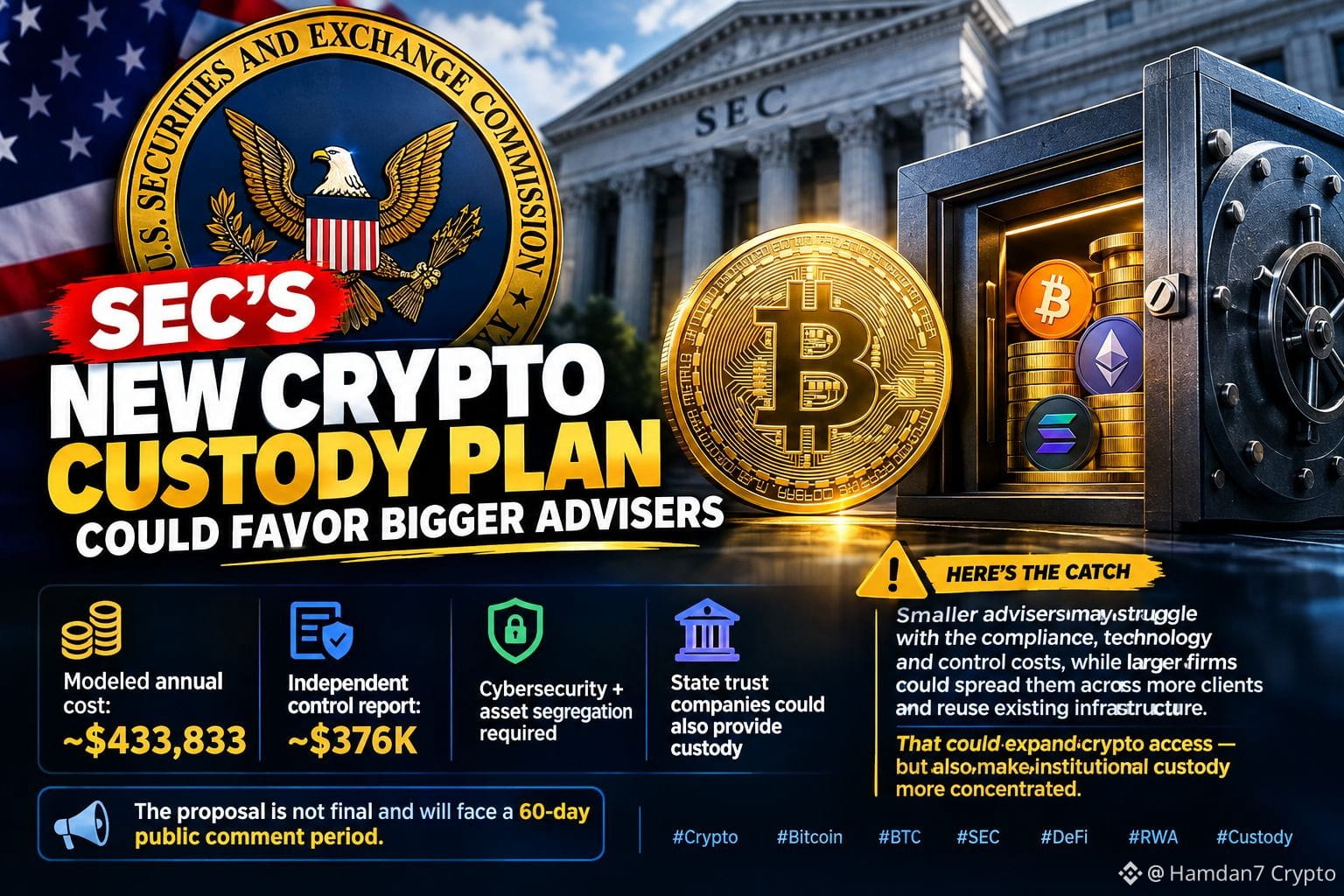
🚨 SEC’S NEW CRYPTO CUSTODY PLAN COULD CHANGE THE INSTITUTIONAL GAME
The SEC has proposed a new framework that could allow investment advisers and regulated funds to self-custody certain crypto assets under strict conditions — while also opening the door to state trust companies as custodians.
But there’s a bigger story hiding underneath. 👀
💰 Compliance costs could be significant
🔐 Independent control & safeguarding requirements
🛡️ Cybersecurity + strict asset segregation
🏦 State trust companies could enter the custody market
⚖️ Proposal is still subject to public comment
And this creates an important institutional question:
Will smaller advisers be able to compete?
Large firms may be able to spread compliance, technology and security costs across a much larger client base, while smaller advisers could face a heavier per-client burden.
That could make crypto custody more accessible to institutions…
But it could also push custody infrastructure toward larger, better-capitalized players.
Bitcoin and crypto are moving deeper into traditional finance — and custody may become one of the most important pieces of that transition. 🔥
This is only a proposal for now. The final rules could change after the public-comment process.
#Crypto #Bitcoin #BTC #SEC #DeFi #RWA #CryptoCustody #InstitutionalCrypto
#SECProposesCryptoCustodyRules
🚨 SEC’S NEW CRYPTO CUSTODY PLAN COULD CHANGE THE INSTITUTIONAL GAME
The SEC has proposed a new framework that could allow investment advisers and regulated funds to self-custody certain crypto assets under strict conditions — while also opening the door to state trust companies as custodians.
But there’s a bigger story hiding underneath. 👀
💰 Compliance costs could be significant
🔐 Independent control & safeguarding requirements
🛡️ Cybersecurity + strict asset segregation
🏦 State trust companies could enter the custody market
⚖️ Proposal is still subject to public comment
And this creates an important institutional question:
Will smaller advisers be able to compete?
Large firms may be able to spread compliance, technology and security costs across a much larger client base, while smaller advisers could face a heavier per-client burden.
That could make crypto custody more accessible to institutions…
But it could also push custody infrastructure toward larger, better-capitalized players.
Bitcoin and crypto are moving deeper into traditional finance — and custody may become one of the most important pieces of that transition. 🔥
This is only a proposal for now. The final rules could change after the public-comment process.
#Crypto #Bitcoin #BTC #SEC #DeFi #RWA #CryptoCustody #InstitutionalCrypto
🚨 SEC’S NEW CRYPTO CUSTODY PLAN COULD CHANGE THE INSTITUTIONAL GAME
The SEC has proposed a new framework that could allow investment advisers and regulated funds to self-custody certain crypto assets under strict conditions — while also opening the door to state trust companies as custodians.
But there’s a bigger story hiding underneath. 👀
💰 Compliance costs could be significant
🔐 Independent control & safeguarding requirements
🛡️ Cybersecurity + strict asset segregation
🏦 State trust companies could enter the custody market
⚖️ Proposal is still subject to public comment
And this creates an important institutional question:
Will smaller advisers be able to compete?
Large firms may be able to spread compliance, technology and security costs across a much larger client base, while smaller advisers could face a heavier per-client burden.
That could make crypto custody more accessible to institutions…
But it could also push custody infrastructure toward larger, better-capitalized players.
Bitcoin and crypto are moving deeper into traditional finance — and custody may become one of the most important pieces of that transition. 🔥
This is only a proposal for now. The final rules could change after the public-comment process.
#Crypto #Bitcoin #BTC #SEC #DeFi #RWA #CryptoCustody #InstitutionalCrypto
14
·
--
Every major crypto winter started with the same question nobody wanted to ask: who actually holds the keys.
You bought the dip, trusted the balance on the screen, and then a withdrawal halt taught you that an exchange account is not ownership. That lesson has wiped more people out than any bad trade I have ever seen.
The SEC proposing crypto custody rules is not about your hardware wallet. It is about forcing advisers and platforms to use qualified custodians so client $BTC and $USDT sit in segregated accounts an auditor can actually verify, not in a mixed pot that vanishes when the firm blows up. Most traders skip this because it is boring. Until it is the only thing that matters.
I have watched this movie three times, after Mt. Gox, after the 2018 ICO wreckage, and after FTX. The people who made it through were not the ones with perfect entries. They were the ones who treated custody as a first-class risk. The tape feels greedy right now and money is rotating into names like $ICP as if the plumbing does not matter.
These rules will slow some things down. They will also make it much harder for the next intermediary to hide a hole in the balance sheet. That is the same medicine traditional markets took after 2008. Crypto is getting it whether we like the taste or not.
Would you rather have slower rails and actual proof of ownership, or the old setup with a real chance your coins were never there?
#SECProposesCryptoCustodyRules #ICBASuesOCCOverCryptoBankCharters #SECApproves3xLongCryptoCommodityETPs
Every major crypto winter started with the same question nobody wanted to ask: who actually holds the keys.
You bought the dip, trusted the balance on the screen, and then a withdrawal halt taught you that an exchange account is not ownership. That lesson has wiped more people out than any bad trade I have ever seen.
The SEC proposing crypto custody rules is not about your hardware wallet. It is about forcing advisers and platforms to use qualified custodians so client $BTC and $USDT sit in segregated accounts an auditor can actually verify, not in a mixed pot that vanishes when the firm blows up. Most traders skip this because it is boring. Until it is the only thing that matters.
I have watched this movie three times, after Mt. Gox, after the 2018 ICO wreckage, and after FTX. The people who made it through were not the ones with perfect entries. They were the ones who treated custody as a first-class risk. The tape feels greedy right now and money is rotating into names like $ICP as if the plumbing does not matter.
These rules will slow some things down. They will also make it much harder for the next intermediary to hide a hole in the balance sheet. That is the same medicine traditional markets took after 2008. Crypto is getting it whether we like the taste or not.
Would you rather have slower rails and actual proof of ownership, or the old setup with a real chance your coins were never there?
#SECProposesCryptoCustodyRules #ICBASuesOCCOverCryptoBankCharters #SECApproves3xLongCryptoCommodityETPs
You bought the dip, trusted the balance on the screen, and then a withdrawal halt taught you that an exchange account is not ownership. That lesson has wiped more people out than any bad trade I have ever seen.
The SEC proposing crypto custody rules is not about your hardware wallet. It is about forcing advisers and platforms to use qualified custodians so client $BTC and $USDT sit in segregated accounts an auditor can actually verify, not in a mixed pot that vanishes when the firm blows up. Most traders skip this because it is boring. Until it is the only thing that matters.
I have watched this movie three times, after Mt. Gox, after the 2018 ICO wreckage, and after FTX. The people who made it through were not the ones with perfect entries. They were the ones who treated custody as a first-class risk. The tape feels greedy right now and money is rotating into names like $ICP as if the plumbing does not matter.
These rules will slow some things down. They will also make it much harder for the next intermediary to hide a hole in the balance sheet. That is the same medicine traditional markets took after 2008. Crypto is getting it whether we like the taste or not.
Would you rather have slower rails and actual proof of ownership, or the old setup with a real chance your coins were never there?
#SECProposesCryptoCustodyRules #ICBASuesOCCOverCryptoBankCharters #SECApproves3xLongCryptoCommodityETPs

1
207

·
--
#secproposescryptocustodyrules
🇺🇸 The SEC just proposed a new framework for crypto custody.
The proposal addresses how registered investment advisers and regulated funds could custody certain digital assets, potentially giving institutions a clearer regulatory path.
Here’s what could change:
🔐 Limited self-custody — potentially allowed when an eligible custodian isn’t available
🏦 State trust companies — could become eligible crypto custodians
📋 Updated custody requirements — designed specifically around digital assets
🇺🇸 Clearer framework — aimed at reducing regulatory uncertainty around crypto investment strategies
But this is important: the proposal is not a final rule.
After publication in the Federal Register, it will go through a 60-day public comment period, so the framework could still change.
For the crypto market, the key question is whether clearer custody rules could make it easier for regulated funds and advisers to hold digital assets.
$BTC | $ETH
#SEC #CryptoCustody #CryptoRegulation #Bitcoin #Crypto
#secproposescryptocustodyrules
🇺🇸 The SEC just proposed a new framework for crypto custody.
The proposal addresses how registered investment advisers and regulated funds could custody certain digital assets, potentially giving institutions a clearer regulatory path.
Here’s what could change:
🔐 Limited self-custody — potentially allowed when an eligible custodian isn’t available
🏦 State trust companies — could become eligible crypto custodians
📋 Updated custody requirements — designed specifically around digital assets
🇺🇸 Clearer framework — aimed at reducing regulatory uncertainty around crypto investment strategies
But this is important: the proposal is not a final rule.
After publication in the Federal Register, it will go through a 60-day public comment period, so the framework could still change.
For the crypto market, the key question is whether clearer custody rules could make it easier for regulated funds and advisers to hold digital assets.
$BTC | $ETH
#SEC #CryptoCustody #CryptoRegulation #Bitcoin #Crypto
🇺🇸 The SEC just proposed a new framework for crypto custody.
The proposal addresses how registered investment advisers and regulated funds could custody certain digital assets, potentially giving institutions a clearer regulatory path.
Here’s what could change:
🔐 Limited self-custody — potentially allowed when an eligible custodian isn’t available
🏦 State trust companies — could become eligible crypto custodians
📋 Updated custody requirements — designed specifically around digital assets
🇺🇸 Clearer framework — aimed at reducing regulatory uncertainty around crypto investment strategies
But this is important: the proposal is not a final rule.
After publication in the Federal Register, it will go through a 60-day public comment period, so the framework could still change.
For the crypto market, the key question is whether clearer custody rules could make it easier for regulated funds and advisers to hold digital assets.
$BTC | $ETH
#SEC #CryptoCustody #CryptoRegulation #Bitcoin #Crypto

1
116
Log in to explore more content
Join global crypto users on Binance Square
⚡️ Get latest and useful information about crypto.
💬 Trusted by the world’s largest crypto exchange.
👍 Discover real insights from verified creators.
Email / Phone number
Trending Topics
1
#SECHaltsCryptoETFReviewsAmidFundingLapse
76,303 views
781 Discussing
2
#ZcashETFPostsFirstWeeklyOutflow$93.6M
67,294 views
205 Discussing
3
#GreekPoliceBustCryptoScamRingArrest17
228,268 views
1,591 Discussing
4
#BitcoinRejectedAt$87K
172,961 views
262 Discussing
5
#FedOctoberRateHikeOddsFallTo17%
248,471 views
1,752 Discussing
6
#NvidiaHitsRecordHighUp2.4%
171,502 views
1,225 Discussing
7
#CanaryFilesAmendedS1ForPEPEETF
52,287 views
822 Discussing
8
#BitcoinParesGainsAfterRallyTo$86.5K
60,634 views
180 Discussing
9
#CerebrasSinksNearly20%OnReportNvidiaToPowerOpenAI
163,072 views
1,410 Discussing
10
#SECProposesCryptoCustodyRules
228,571 views
1,750 Discussing