
#ramusdt
ramusdt
745 views
35 Discussing
Hot
Latest

📜 History always calls the names of those who are steadfast, and I am proud that I did not betray my own beliefs.
🟢 LONG $RAM
Entry: 13.51
TP: 14.185 | SL: 12.159
👗 Digital NFT fashion is becoming a new trend among young people.
🔍 The price is accumulating beautifully above the 20-day moving average.
🔥 Burn brightly with your passion, but don’t let it burn your account to the ground.
🍀 Wishing you a day full of good fortune and the best good news from the exchange.
#RAMUSDT $RAMUSDT
📜 History always calls the names of those who are steadfast, and I am proud that I did not betray my own beliefs.
🟢 LONG $RAM
Entry: 13.51
TP: 14.185 | SL: 12.159
👗 Digital NFT fashion is becoming a new trend among young people.
🔍 The price is accumulating beautifully above the 20-day moving average.
🔥 Burn brightly with your passion, but don’t let it burn your account to the ground.
🍀 Wishing you a day full of good fortune and the best good news from the exchange.
#RAMUSDT $RAMUSDT
🟢 LONG $RAM
Entry: 13.51
TP: 14.185 | SL: 12.159
👗 Digital NFT fashion is becoming a new trend among young people.
🔍 The price is accumulating beautifully above the 20-day moving average.
🔥 Burn brightly with your passion, but don’t let it burn your account to the ground.
🍀 Wishing you a day full of good fortune and the best good news from the exchange.
#RAMUSDT $RAMUSDT
55

·
--
Bearish
$RAM - SHORT
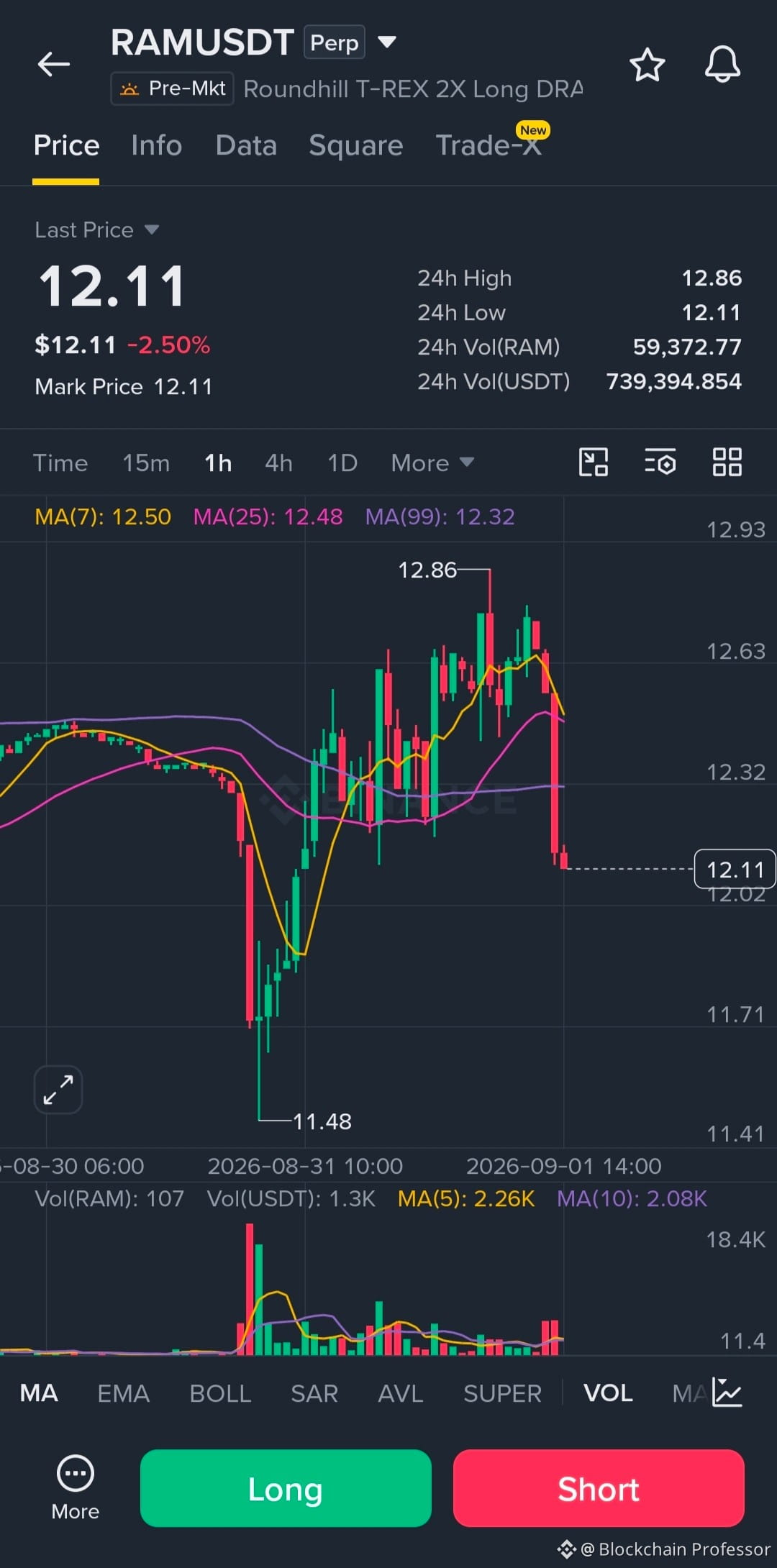
Last Price: 12.10 | 24h High: 12.86 | 24h Low: 12.09 | 24h Change: -2.58%
Price has rejected the 12.86 local top hard and is printing consecutive red candles across 15m / 1h / 4h. Structure is lower highs + lower lows after the failed breakout above the daily range. Momentum is clearly bearish on lower timeframes while higher timeframes show distribution after the earlier spike to 13.59.
Entry Zone: 12.18 – 12.28
Stop Loss: 12.55
Take Profit Targets:
TP1: 11.95
TP2: 11.70
TP3: 11.48
Why This Setup?
Strong rejection from 12.86 + breakdown of short-term structure + multi-timeframe MA death cross + rising sell volume + SAR + Supertrend alignment = high-probability short continuation. As long as price stays below 12.40–12.55, the path of least resistance remains lower. Only a strong reclaim and hold above 12.55 with volume would invalidate the short bias.
#RAMUSDT #CryptoSignals #BinanceFutures #ShortSetup #Altcoins
{future}(RAMUSDT)
$GIGGLE
{future}(GIGGLEUSDT)
$SOL
{future}(SOLUSDT)
$RAM - SHORT
Last Price: 12.10 | 24h High: 12.86 | 24h Low: 12.09 | 24h Change: -2.58%
Price has rejected the 12.86 local top hard and is printing consecutive red candles across 15m / 1h / 4h. Structure is lower highs + lower lows after the failed breakout above the daily range. Momentum is clearly bearish on lower timeframes while higher timeframes show distribution after the earlier spike to 13.59.
Entry Zone: 12.18 – 12.28
Stop Loss: 12.55
Take Profit Targets:
TP1: 11.95
TP2: 11.70
TP3: 11.48
Why This Setup?
Strong rejection from 12.86 + breakdown of short-term structure + multi-timeframe MA death cross + rising sell volume + SAR + Supertrend alignment = high-probability short continuation. As long as price stays below 12.40–12.55, the path of least resistance remains lower. Only a strong reclaim and hold above 12.55 with volume would invalidate the short bias.
#RAMUSDT #CryptoSignals #BinanceFutures #ShortSetup #Altcoins
$GIGGLE
$SOL
Last Price: 12.10 | 24h High: 12.86 | 24h Low: 12.09 | 24h Change: -2.58%
Price has rejected the 12.86 local top hard and is printing consecutive red candles across 15m / 1h / 4h. Structure is lower highs + lower lows after the failed breakout above the daily range. Momentum is clearly bearish on lower timeframes while higher timeframes show distribution after the earlier spike to 13.59.
Entry Zone: 12.18 – 12.28
Stop Loss: 12.55
Take Profit Targets:
TP1: 11.95
TP2: 11.70
TP3: 11.48
Why This Setup?
Strong rejection from 12.86 + breakdown of short-term structure + multi-timeframe MA death cross + rising sell volume + SAR + Supertrend alignment = high-probability short continuation. As long as price stays below 12.40–12.55, the path of least resistance remains lower. Only a strong reclaim and hold above 12.55 with volume would invalidate the short bias.
#RAMUSDT #CryptoSignals #BinanceFutures #ShortSetup #Altcoins
$GIGGLE
$SOL
243
🕯️ The blue candlelight has gone out, making way for the pitch-dark night of a string of lonely grind days.
💹 SHORT $RAM
Entry: 12.44
TP: 11.818 | SL: 13.684
🌔 The power of community is the strongest weapon of crypto projects.
🔍 The deadly intersection point has been negated by strong buy pressure from the exchange.
🛡️ Caution is the best guardian for the results you’ve worked so hard to achieve.
🍀 Wishing you a very productive workday and big winning trades.
#RAMUSDT $RAMUSDT
🕯️ The blue candlelight has gone out, making way for the pitch-dark night of a string of lonely grind days.
💹 SHORT $RAM
Entry: 12.44
TP: 11.818 | SL: 13.684
🌔 The power of community is the strongest weapon of crypto projects.
🔍 The deadly intersection point has been negated by strong buy pressure from the exchange.
🛡️ Caution is the best guardian for the results you’ve worked so hard to achieve.
🍀 Wishing you a very productive workday and big winning trades.
#RAMUSDT $RAMUSDT
💹 SHORT $RAM
Entry: 12.44
TP: 11.818 | SL: 13.684
🌔 The power of community is the strongest weapon of crypto projects.
🔍 The deadly intersection point has been negated by strong buy pressure from the exchange.
🛡️ Caution is the best guardian for the results you’ve worked so hard to achieve.
🍀 Wishing you a very productive workday and big winning trades.
#RAMUSDT $RAMUSDT
56



·
--
$RAM fell 7.076% over the past 24 hours, and the price is down to 11.95. The old dog glanced at the data and found something interesting: with this kind of drawdown, the perpetual contract funding rate is 0.00000000. This setup needs to be looked at piece by piece.
The price has dropped sharply; under normal logic, short-side pressure should strengthen and push the funding rate into negative territory—meaning shorts pay longs. But now the rate hasn’t moved at all and stays at zero, which indicates that the costs between longs and shorts in the contract market are perfectly balanced, with no side needing to pay extra for holding positions. This points to a possible scenario: the selling pressure behind this drop is likely not mainly from shorts actively driving the market down in the futures/perps, but more likely from spot holders or longs on the contract side actively closing positions.
Open interest (OI) remains at 37774.47, but without historical comparisons, it’s impossible to say whether this level is high or low. Looking at just this one signal, the decline lacks “fuel” from shorts in the contract market, so the continuation of the selloff needs a question mark.
My view is that this isn’t the beginning of a trend-driven selloff led by shorts. It looks more like a concentrated profit-taking and position-reduction move on the spot side or from long positions in the contracts. Because if shorts truly rushed in aggressively, they wouldn’t be able to accept the zero-funding cost—they would push funding down. The current data doesn’t support the idea that shorts have strong intentions to go heavily short. So, based on a single-signal read: the rapid selloff in the short term may be close to the end, but an immediate reversal still requires fresh evidence of new buying.
But on the other hand, the strongest counter-evidence is this: if the funding rate quickly turns negative—for example, below -0.01%—then it would mean shorts have started moving in to buy the dip and bet on further downside, and my judgment would be wrong. At the same time, watch OI: if the price stabilizes and OI increases significantly, it may indicate longs taking orders on the left side; if the price stabilizes but OI declines, it suggests funding is being withdrawn and the rebound lacks momentum.
The second-order effect is that if the price consolidates here while funding stays at zero, contract longs don’t have to pay interest, but they still face unrealized losses on their positions. That psychological pressure could trigger a new round of forced liquidations. If spot selling pressure continues, it could weigh on the coin price; however, the calm in the contract market limits the depth of panic-driven selloffs, which may keep the market trapped in a frustrating grind lower.
When would my view become invalid?
Trading tag: #BinanceFutures #TradFi #USDⓈM #RAM #RAMUSDT $RAM
$RAM fell 7.076% over the past 24 hours, and the price is down to 11.95. The old dog glanced at the data and found something interesting: with this kind of drawdown, the perpetual contract funding rate is 0.00000000. This setup needs to be looked at piece by piece.
The price has dropped sharply; under normal logic, short-side pressure should strengthen and push the funding rate into negative territory—meaning shorts pay longs. But now the rate hasn’t moved at all and stays at zero, which indicates that the costs between longs and shorts in the contract market are perfectly balanced, with no side needing to pay extra for holding positions. This points to a possible scenario: the selling pressure behind this drop is likely not mainly from shorts actively driving the market down in the futures/perps, but more likely from spot holders or longs on the contract side actively closing positions.
Open interest (OI) remains at 37774.47, but without historical comparisons, it’s impossible to say whether this level is high or low. Looking at just this one signal, the decline lacks “fuel” from shorts in the contract market, so the continuation of the selloff needs a question mark.
My view is that this isn’t the beginning of a trend-driven selloff led by shorts. It looks more like a concentrated profit-taking and position-reduction move on the spot side or from long positions in the contracts. Because if shorts truly rushed in aggressively, they wouldn’t be able to accept the zero-funding cost—they would push funding down. The current data doesn’t support the idea that shorts have strong intentions to go heavily short. So, based on a single-signal read: the rapid selloff in the short term may be close to the end, but an immediate reversal still requires fresh evidence of new buying.
But on the other hand, the strongest counter-evidence is this: if the funding rate quickly turns negative—for example, below -0.01%—then it would mean shorts have started moving in to buy the dip and bet on further downside, and my judgment would be wrong. At the same time, watch OI: if the price stabilizes and OI increases significantly, it may indicate longs taking orders on the left side; if the price stabilizes but OI declines, it suggests funding is being withdrawn and the rebound lacks momentum.
The second-order effect is that if the price consolidates here while funding stays at zero, contract longs don’t have to pay interest, but they still face unrealized losses on their positions. That psychological pressure could trigger a new round of forced liquidations. If spot selling pressure continues, it could weigh on the coin price; however, the calm in the contract market limits the depth of panic-driven selloffs, which may keep the market trapped in a frustrating grind lower.
When would my view become invalid?
Trading tag: #BinanceFutures #TradFi #USDⓈM #RAM #RAMUSDT $RAM
The price has dropped sharply; under normal logic, short-side pressure should strengthen and push the funding rate into negative territory—meaning shorts pay longs. But now the rate hasn’t moved at all and stays at zero, which indicates that the costs between longs and shorts in the contract market are perfectly balanced, with no side needing to pay extra for holding positions. This points to a possible scenario: the selling pressure behind this drop is likely not mainly from shorts actively driving the market down in the futures/perps, but more likely from spot holders or longs on the contract side actively closing positions.
Open interest (OI) remains at 37774.47, but without historical comparisons, it’s impossible to say whether this level is high or low. Looking at just this one signal, the decline lacks “fuel” from shorts in the contract market, so the continuation of the selloff needs a question mark.
My view is that this isn’t the beginning of a trend-driven selloff led by shorts. It looks more like a concentrated profit-taking and position-reduction move on the spot side or from long positions in the contracts. Because if shorts truly rushed in aggressively, they wouldn’t be able to accept the zero-funding cost—they would push funding down. The current data doesn’t support the idea that shorts have strong intentions to go heavily short. So, based on a single-signal read: the rapid selloff in the short term may be close to the end, but an immediate reversal still requires fresh evidence of new buying.
But on the other hand, the strongest counter-evidence is this: if the funding rate quickly turns negative—for example, below -0.01%—then it would mean shorts have started moving in to buy the dip and bet on further downside, and my judgment would be wrong. At the same time, watch OI: if the price stabilizes and OI increases significantly, it may indicate longs taking orders on the left side; if the price stabilizes but OI declines, it suggests funding is being withdrawn and the rebound lacks momentum.
The second-order effect is that if the price consolidates here while funding stays at zero, contract longs don’t have to pay interest, but they still face unrealized losses on their positions. That psychological pressure could trigger a new round of forced liquidations. If spot selling pressure continues, it could weigh on the coin price; however, the calm in the contract market limits the depth of panic-driven selloffs, which may keep the market trapped in a frustrating grind lower.
When would my view become invalid?
Trading tag: #BinanceFutures #TradFi #USDⓈM #RAM #RAMUSDT $RAM
5
·
--
The old dog scanned and found that this $RAM 24-hour line is pierced a bit deep; a -7.219% drop paired with a funding rate of -0.00114409 is a combination worth a closer look. The price is $12.21, daily trading volume is over $1.25 million, and open interest is 36,901.57—everything here is ready-made data.
From an angle that falls on the M4 mover, this looks more like a short-term liquidity anomaly. A negative funding rate means shorts are continuously paying longs, which is usually interpreted as bearish sentiment being dominant and positions being crowded. But the price is falling, creating a setup where the price is down while the funding rate is negative. This kind of divergence on short timeframes often suggests shorts have built up too many contrarian positions, making them prone to liquidation on a small rebound or changes in liquidity—what people commonly call a short squeeze. Right now, I haven’t seen comparative data from other coins in the same sector, so I can’t tell whether it’s a broad sector selloff or whether $RAM alone is under pressure.
My view is that the current negative funding rate may be building power for a potential rebound as shorts liquidate/close—but the prerequisite is that the price needs to stabilize. If the price keeps grinding lower, the funding rate could remain negative as well. So the key thing to watch is whether the divergence between price and funding can be corrected.
Trading tag: #BinanceFutures #TradFi #USDⓈM #RAM #RAMUSDT $RAM
The old dog scanned and found that this $RAM 24-hour line is pierced a bit deep; a -7.219% drop paired with a funding rate of -0.00114409 is a combination worth a closer look. The price is $12.21, daily trading volume is over $1.25 million, and open interest is 36,901.57—everything here is ready-made data.
From an angle that falls on the M4 mover, this looks more like a short-term liquidity anomaly. A negative funding rate means shorts are continuously paying longs, which is usually interpreted as bearish sentiment being dominant and positions being crowded. But the price is falling, creating a setup where the price is down while the funding rate is negative. This kind of divergence on short timeframes often suggests shorts have built up too many contrarian positions, making them prone to liquidation on a small rebound or changes in liquidity—what people commonly call a short squeeze. Right now, I haven’t seen comparative data from other coins in the same sector, so I can’t tell whether it’s a broad sector selloff or whether $RAM alone is under pressure.
My view is that the current negative funding rate may be building power for a potential rebound as shorts liquidate/close—but the prerequisite is that the price needs to stabilize. If the price keeps grinding lower, the funding rate could remain negative as well. So the key thing to watch is whether the divergence between price and funding can be corrected.
Trading tag: #BinanceFutures #TradFi #USDⓈM #RAM #RAMUSDT $RAM
From an angle that falls on the M4 mover, this looks more like a short-term liquidity anomaly. A negative funding rate means shorts are continuously paying longs, which is usually interpreted as bearish sentiment being dominant and positions being crowded. But the price is falling, creating a setup where the price is down while the funding rate is negative. This kind of divergence on short timeframes often suggests shorts have built up too many contrarian positions, making them prone to liquidation on a small rebound or changes in liquidity—what people commonly call a short squeeze. Right now, I haven’t seen comparative data from other coins in the same sector, so I can’t tell whether it’s a broad sector selloff or whether $RAM alone is under pressure.
My view is that the current negative funding rate may be building power for a potential rebound as shorts liquidate/close—but the prerequisite is that the price needs to stabilize. If the price keeps grinding lower, the funding rate could remain negative as well. So the key thing to watch is whether the divergence between price and funding can be corrected.
Trading tag: #BinanceFutures #TradFi #USDⓈM #RAM #RAMUSDT $RAM
40
·
--
An old dog scanned the order book: in the past 24 hours, $RAM fell 5.416%, with the price at $12.4. One interesting number is that its funding rate is stuck at an absolute zero. No up, no down—neither long nor short pays the other, which is rather unusual in a period with plenty of volatility.
This isn’t a complicated setup. Even as the price is dropping, the funding costs for going long and going short are the same. That suggests the market isn’t applying pressure uniformly to one side. Usually, a zero funding rate paired with price declines looks more like the natural erosion of positions than an all-out assault by shorts. The on-chain asset here is a long-position contract; the price dip hasn’t triggered a flip of the funding rate into the negative. Short power hasn’t really risen. Looking at funding rate alone, this signal isn’t a traditional short-term “bottoming” indicator—it’s more like longs are slowly retreating, while shorts haven’t managed to profit off the move, leaving both sides temporarily stuck in a stalemate.
Trading volume is over $770,000. Compared with the price action and open interest, it’s not especially active, but it’s not dead either. Open interest is still over 30,700 contracts. The capital trapped in those positions has to figure out its own way out.
My take is simple: $RAM is going through a deleveraging-style grind lower adjustment, not a coordinated short-squeeze-style attack. A zero funding rate means long positions aren’t getting extra unrealized gains or cost pressure. When price slides, that patience is what gets tested. The market hasn’t provided a clear rebound signal, and longs also lack a reason to add to positions. At this point, the most reasonable action is: if you don’t have a position, don’t touch it; if you do have one, set a stop-loss. For example, if the price can’t get back above $12.4 and OI doesn’t increase along with it, the adjustment likely isn’t finished. I would choose to wait on the sidelines until the funding rate shows a clear tilt or the price stabilizes at key levels.
The strongest counter-argument is: what if this isn’t an adjustment, but deep base building? It’s possible. But a zero funding rate paired with price weakness lacks the usual “bottom” signs—there’s no short covering in a meaningful way, and there’s no squeeze signal from the funding rate turning positive. The second-order effect is that longs who got stuck at high prices become a source of sell pressure later. Every time they cut losses at a lower price, they add another unit of downward momentum. And since shorts don’t have consistent funding income, they’re also less inclined to build large positions.
Where is my judgment most likely to be wrong? By assuming a zero funding rate simply means balance. What if this is just dead calm before the storm—some sudden news causes the funding rate to swing violently and triggers a one-sided move? Then the foundation of the current analysis changes completely.
Trading tag: #BinanceFutures #TradFi #USDⓈM #RAM #RAMUSDT $RAM
An old dog scanned the order book: in the past 24 hours, $RAM fell 5.416%, with the price at $12.4. One interesting number is that its funding rate is stuck at an absolute zero. No up, no down—neither long nor short pays the other, which is rather unusual in a period with plenty of volatility.
This isn’t a complicated setup. Even as the price is dropping, the funding costs for going long and going short are the same. That suggests the market isn’t applying pressure uniformly to one side. Usually, a zero funding rate paired with price declines looks more like the natural erosion of positions than an all-out assault by shorts. The on-chain asset here is a long-position contract; the price dip hasn’t triggered a flip of the funding rate into the negative. Short power hasn’t really risen. Looking at funding rate alone, this signal isn’t a traditional short-term “bottoming” indicator—it’s more like longs are slowly retreating, while shorts haven’t managed to profit off the move, leaving both sides temporarily stuck in a stalemate.
Trading volume is over $770,000. Compared with the price action and open interest, it’s not especially active, but it’s not dead either. Open interest is still over 30,700 contracts. The capital trapped in those positions has to figure out its own way out.
My take is simple: $RAM is going through a deleveraging-style grind lower adjustment, not a coordinated short-squeeze-style attack. A zero funding rate means long positions aren’t getting extra unrealized gains or cost pressure. When price slides, that patience is what gets tested. The market hasn’t provided a clear rebound signal, and longs also lack a reason to add to positions. At this point, the most reasonable action is: if you don’t have a position, don’t touch it; if you do have one, set a stop-loss. For example, if the price can’t get back above $12.4 and OI doesn’t increase along with it, the adjustment likely isn’t finished. I would choose to wait on the sidelines until the funding rate shows a clear tilt or the price stabilizes at key levels.
The strongest counter-argument is: what if this isn’t an adjustment, but deep base building? It’s possible. But a zero funding rate paired with price weakness lacks the usual “bottom” signs—there’s no short covering in a meaningful way, and there’s no squeeze signal from the funding rate turning positive. The second-order effect is that longs who got stuck at high prices become a source of sell pressure later. Every time they cut losses at a lower price, they add another unit of downward momentum. And since shorts don’t have consistent funding income, they’re also less inclined to build large positions.
Where is my judgment most likely to be wrong? By assuming a zero funding rate simply means balance. What if this is just dead calm before the storm—some sudden news causes the funding rate to swing violently and triggers a one-sided move? Then the foundation of the current analysis changes completely.
Trading tag: #BinanceFutures #TradFi #USDⓈM #RAM #RAMUSDT $RAM
This isn’t a complicated setup. Even as the price is dropping, the funding costs for going long and going short are the same. That suggests the market isn’t applying pressure uniformly to one side. Usually, a zero funding rate paired with price declines looks more like the natural erosion of positions than an all-out assault by shorts. The on-chain asset here is a long-position contract; the price dip hasn’t triggered a flip of the funding rate into the negative. Short power hasn’t really risen. Looking at funding rate alone, this signal isn’t a traditional short-term “bottoming” indicator—it’s more like longs are slowly retreating, while shorts haven’t managed to profit off the move, leaving both sides temporarily stuck in a stalemate.
Trading volume is over $770,000. Compared with the price action and open interest, it’s not especially active, but it’s not dead either. Open interest is still over 30,700 contracts. The capital trapped in those positions has to figure out its own way out.
My take is simple: $RAM is going through a deleveraging-style grind lower adjustment, not a coordinated short-squeeze-style attack. A zero funding rate means long positions aren’t getting extra unrealized gains or cost pressure. When price slides, that patience is what gets tested. The market hasn’t provided a clear rebound signal, and longs also lack a reason to add to positions. At this point, the most reasonable action is: if you don’t have a position, don’t touch it; if you do have one, set a stop-loss. For example, if the price can’t get back above $12.4 and OI doesn’t increase along with it, the adjustment likely isn’t finished. I would choose to wait on the sidelines until the funding rate shows a clear tilt or the price stabilizes at key levels.
The strongest counter-argument is: what if this isn’t an adjustment, but deep base building? It’s possible. But a zero funding rate paired with price weakness lacks the usual “bottom” signs—there’s no short covering in a meaningful way, and there’s no squeeze signal from the funding rate turning positive. The second-order effect is that longs who got stuck at high prices become a source of sell pressure later. Every time they cut losses at a lower price, they add another unit of downward momentum. And since shorts don’t have consistent funding income, they’re also less inclined to build large positions.
Where is my judgment most likely to be wrong? By assuming a zero funding rate simply means balance. What if this is just dead calm before the storm—some sudden news causes the funding rate to swing violently and triggers a one-sided move? Then the foundation of the current analysis changes completely.
Trading tag: #BinanceFutures #TradFi #USDⓈM #RAM #RAMUSDT $RAM
2
·
--
The old dog scanned the order book of $RAM —over the past 24 hours it’s down 7.91%. The current price is 12.34, but the funding rate is negative at -0.00212440. Prices are falling, yet the shorts are the ones paying. This combination is kind of interesting.
The angle is M4_mover unusual activity—dig a bit deeper. The price decline comes with a negative funding rate. By the iron law in the direction of the funding rate, this is a typical structure of crowded shorts. Shorts are willing to pay longs to maintain their positions, which suggests they have a strong bearish conviction. But on the flip side, once there’s any hint of a rebound, these paid-for shorts can easily get squeezed out.
Open interest (OI) is currently 30884.08, down somewhat from the recent highs over the past few days, which indicates that some long positions have already cut losses and exited. The market is digesting this sell-off.
The old dog’s view is that right now the downtrend is dominated by the bears’ momentum, but the negative funding rate plants the seeds for a short squeeze. My actions are very clear: I won’t touch it now. I’m waiting for two signals—either (1) price rebounds quickly along with the funding rate turning positive, which would mean the shorts are conceding and the market could pivot; or (2) price continues to bleed lower and the funding rate stays deeply negative, which would mean the shorts haven’t been squeezed out yet, and the timing for a rebound isn’t right. If I go long now, it would just be betting on a rebound, but market sentiment hasn’t shown a clear turning point yet.
Trading tag: #BinanceFutures #TradFi #USDⓈM #RAM #RAMUSDT $RAM
The old dog scanned the order book of $RAM —over the past 24 hours it’s down 7.91%. The current price is 12.34, but the funding rate is negative at -0.00212440. Prices are falling, yet the shorts are the ones paying. This combination is kind of interesting.
The angle is M4_mover unusual activity—dig a bit deeper. The price decline comes with a negative funding rate. By the iron law in the direction of the funding rate, this is a typical structure of crowded shorts. Shorts are willing to pay longs to maintain their positions, which suggests they have a strong bearish conviction. But on the flip side, once there’s any hint of a rebound, these paid-for shorts can easily get squeezed out.
Open interest (OI) is currently 30884.08, down somewhat from the recent highs over the past few days, which indicates that some long positions have already cut losses and exited. The market is digesting this sell-off.
The old dog’s view is that right now the downtrend is dominated by the bears’ momentum, but the negative funding rate plants the seeds for a short squeeze. My actions are very clear: I won’t touch it now. I’m waiting for two signals—either (1) price rebounds quickly along with the funding rate turning positive, which would mean the shorts are conceding and the market could pivot; or (2) price continues to bleed lower and the funding rate stays deeply negative, which would mean the shorts haven’t been squeezed out yet, and the timing for a rebound isn’t right. If I go long now, it would just be betting on a rebound, but market sentiment hasn’t shown a clear turning point yet.
Trading tag: #BinanceFutures #TradFi #USDⓈM #RAM #RAMUSDT $RAM
The angle is M4_mover unusual activity—dig a bit deeper. The price decline comes with a negative funding rate. By the iron law in the direction of the funding rate, this is a typical structure of crowded shorts. Shorts are willing to pay longs to maintain their positions, which suggests they have a strong bearish conviction. But on the flip side, once there’s any hint of a rebound, these paid-for shorts can easily get squeezed out.
Open interest (OI) is currently 30884.08, down somewhat from the recent highs over the past few days, which indicates that some long positions have already cut losses and exited. The market is digesting this sell-off.
The old dog’s view is that right now the downtrend is dominated by the bears’ momentum, but the negative funding rate plants the seeds for a short squeeze. My actions are very clear: I won’t touch it now. I’m waiting for two signals—either (1) price rebounds quickly along with the funding rate turning positive, which would mean the shorts are conceding and the market could pivot; or (2) price continues to bleed lower and the funding rate stays deeply negative, which would mean the shorts haven’t been squeezed out yet, and the timing for a rebound isn’t right. If I go long now, it would just be betting on a rebound, but market sentiment hasn’t shown a clear turning point yet.
Trading tag: #BinanceFutures #TradFi #USDⓈM #RAM #RAMUSDT $RAM
39
·
--
The old dog glanced at the past 24 hours of $RAM — the funding rate came in at 0.00000000. That’s even more striking than the price dropping 3.577%. At the 12.94 level, the interest paid between longs and shorts is completely zeroed out.
A price moving in one direction while the cost of the long-vs-short battle is set to zero can only happen in two situations: either the platform’s order book depth is new and insufficient, or large capital has temporarily stepped away, leaving so few orders on the book that the funding-rate calculation loses its meaning. Judging by its position size of 30491.60 and a trading volume of over $240,000 in 24 hours, liquidity really isn’t that strong. This suggests the current price movement probably isn’t driven by a flood of new longs or new shorts entering the market; it’s more likely that the book is thin—just a small number of buy/sell orders can cause big swings. With a 3.577% drop, the “make-believe” component may well be greater than the real one.
So my take is: this is not a signal of a trend-like selloff. It looks more like price drifting in a low-liquidity environment. This is not the time to chase shorts or panic. The old dog’s own actions are light-portfolio observation—no new position taken proactively. If the price can next increase volume and hold above 13.00, and the funding rate turns clearly positive, I’ll consider lightly trying longs, because that would mean new capital has entered the market to take the long side and is willing to pay the cost. Conversely, if the price breaks below 12.50 on volume, I’ll immediately close the current position, because that could mean support has failed—liquidity panic can then reinforce itself.
Where is this view most likely to be wrong? If later there’s an official news injection strong narrative that I don’t see here, or if the entire on-chain U.S.-stock sector sees a collective surge of capital inflows, then my liquidity-based judgment that the volatility is “fake” will no longer hold. Once such a one-sided, high-volume market shows up, my current wait-and-see strategy will need to change immediately.
Trading tag: #BinanceFutures #TradFi #USDⓈM #RAM #RAMUSDT $RAM
The old dog glanced at the past 24 hours of $RAM — the funding rate came in at 0.00000000. That’s even more striking than the price dropping 3.577%. At the 12.94 level, the interest paid between longs and shorts is completely zeroed out.
A price moving in one direction while the cost of the long-vs-short battle is set to zero can only happen in two situations: either the platform’s order book depth is new and insufficient, or large capital has temporarily stepped away, leaving so few orders on the book that the funding-rate calculation loses its meaning. Judging by its position size of 30491.60 and a trading volume of over $240,000 in 24 hours, liquidity really isn’t that strong. This suggests the current price movement probably isn’t driven by a flood of new longs or new shorts entering the market; it’s more likely that the book is thin—just a small number of buy/sell orders can cause big swings. With a 3.577% drop, the “make-believe” component may well be greater than the real one.
So my take is: this is not a signal of a trend-like selloff. It looks more like price drifting in a low-liquidity environment. This is not the time to chase shorts or panic. The old dog’s own actions are light-portfolio observation—no new position taken proactively. If the price can next increase volume and hold above 13.00, and the funding rate turns clearly positive, I’ll consider lightly trying longs, because that would mean new capital has entered the market to take the long side and is willing to pay the cost. Conversely, if the price breaks below 12.50 on volume, I’ll immediately close the current position, because that could mean support has failed—liquidity panic can then reinforce itself.
Where is this view most likely to be wrong? If later there’s an official news injection strong narrative that I don’t see here, or if the entire on-chain U.S.-stock sector sees a collective surge of capital inflows, then my liquidity-based judgment that the volatility is “fake” will no longer hold. Once such a one-sided, high-volume market shows up, my current wait-and-see strategy will need to change immediately.
Trading tag: #BinanceFutures #TradFi #USDⓈM #RAM #RAMUSDT $RAM
A price moving in one direction while the cost of the long-vs-short battle is set to zero can only happen in two situations: either the platform’s order book depth is new and insufficient, or large capital has temporarily stepped away, leaving so few orders on the book that the funding-rate calculation loses its meaning. Judging by its position size of 30491.60 and a trading volume of over $240,000 in 24 hours, liquidity really isn’t that strong. This suggests the current price movement probably isn’t driven by a flood of new longs or new shorts entering the market; it’s more likely that the book is thin—just a small number of buy/sell orders can cause big swings. With a 3.577% drop, the “make-believe” component may well be greater than the real one.
So my take is: this is not a signal of a trend-like selloff. It looks more like price drifting in a low-liquidity environment. This is not the time to chase shorts or panic. The old dog’s own actions are light-portfolio observation—no new position taken proactively. If the price can next increase volume and hold above 13.00, and the funding rate turns clearly positive, I’ll consider lightly trying longs, because that would mean new capital has entered the market to take the long side and is willing to pay the cost. Conversely, if the price breaks below 12.50 on volume, I’ll immediately close the current position, because that could mean support has failed—liquidity panic can then reinforce itself.
Where is this view most likely to be wrong? If later there’s an official news injection strong narrative that I don’t see here, or if the entire on-chain U.S.-stock sector sees a collective surge of capital inflows, then my liquidity-based judgment that the volatility is “fake” will no longer hold. Once such a one-sided, high-volume market shows up, my current wait-and-see strategy will need to change immediately.
Trading tag: #BinanceFutures #TradFi #USDⓈM #RAM #RAMUSDT $RAM
20
·
--
The old dog glanced at $RAM: over the past 24 hours it’s down 1.719%. Current price is 13.15. The funding rate has hit -0.00051849—shorts are paying longs. Trading volume is 195,800 units, open interest is 29,600 units. That’s all the data there is—no other news. My read is that $RAM may face tug-of-war from short covering in the near term, but the downtrend isn’t over yet. Keep a close eye on funding changes.
Why do I say that? When funding is negative at this level, by the iron law, shorts pay longs—meaning the short positions are crowded. The price is down 1.719%, and shorts are making money on paper, but they still have to keep paying funding, and that cost accumulates. If the price bounces even slightly, shorts may be forced to close to staunch the bleeding, triggering a short squeeze. But if the price keeps sliding downward, shorts can “carry” the position and continue to eat profits from funding, while longs may stop-loss due to floating losses, accelerating the selloff. Open interest at 29,600 hasn’t changed, suggesting positions aren’t exiting in large numbers—they’re just holding on. Volume at 195,800 isn’t low; turnover is active, but the price isn’t rising, so the selling pressure is still there. Just looking at funding alone is a sharp signal: the selloff supported by a negative funding rate favors shorts, but the capital cost is rising too—so it’s easy to see a short-term rebound.
My take is simple: don’t touch it now. When price is falling and funding is negative, and shorts are crowded, that combination feels like it’s brewing a short-term rebound. If $RAM rebounds above 13.30, and funding remains negative, then I might consider going long with a small position, betting on a wave of short covering. If it breaks below 13.00 and funding is still negative, then don’t chase the short—because the risk of a short squeeze would be even higher. Where I diverge from the consensus is this: the market may think the down move is smooth and just go short, but the old dog believes that in an environment where shorts are paying, the price accelerating lower is more likely to trigger shorts to trample in panic. On positioning, I’d rather wait—let funding turn positive or wait until price holds above 13.15.
Where is this call most likely to be wrong? If the trading volume for $RAM suddenly surges and the price keeps getting crushed, while funding stays negative—meaning shorts are strong enough to keep pressing down despite the cost—then my take would fail.
Trading tags: #BinanceFutures #TradFi #USDⓈM #RAM #RAMUSDT $RAM
The old dog glanced at $RAM : over the past 24 hours it’s down 1.719%. Current price is 13.15. The funding rate has hit -0.00051849—shorts are paying longs. Trading volume is 195,800 units, open interest is 29,600 units. That’s all the data there is—no other news. My read is that $RAM may face tug-of-war from short covering in the near term, but the downtrend isn’t over yet. Keep a close eye on funding changes.
Why do I say that? When funding is negative at this level, by the iron law, shorts pay longs—meaning the short positions are crowded. The price is down 1.719%, and shorts are making money on paper, but they still have to keep paying funding, and that cost accumulates. If the price bounces even slightly, shorts may be forced to close to staunch the bleeding, triggering a short squeeze. But if the price keeps sliding downward, shorts can “carry” the position and continue to eat profits from funding, while longs may stop-loss due to floating losses, accelerating the selloff. Open interest at 29,600 hasn’t changed, suggesting positions aren’t exiting in large numbers—they’re just holding on. Volume at 195,800 isn’t low; turnover is active, but the price isn’t rising, so the selling pressure is still there. Just looking at funding alone is a sharp signal: the selloff supported by a negative funding rate favors shorts, but the capital cost is rising too—so it’s easy to see a short-term rebound.
My take is simple: don’t touch it now. When price is falling and funding is negative, and shorts are crowded, that combination feels like it’s brewing a short-term rebound. If $RAM rebounds above 13.30, and funding remains negative, then I might consider going long with a small position, betting on a wave of short covering. If it breaks below 13.00 and funding is still negative, then don’t chase the short—because the risk of a short squeeze would be even higher. Where I diverge from the consensus is this: the market may think the down move is smooth and just go short, but the old dog believes that in an environment where shorts are paying, the price accelerating lower is more likely to trigger shorts to trample in panic. On positioning, I’d rather wait—let funding turn positive or wait until price holds above 13.15.
Where is this call most likely to be wrong? If the trading volume for $RAM suddenly surges and the price keeps getting crushed, while funding stays negative—meaning shorts are strong enough to keep pressing down despite the cost—then my take would fail.
Trading tags: #BinanceFutures #TradFi #USDⓈM #RAM #RAMUSDT $RAM
Why do I say that? When funding is negative at this level, by the iron law, shorts pay longs—meaning the short positions are crowded. The price is down 1.719%, and shorts are making money on paper, but they still have to keep paying funding, and that cost accumulates. If the price bounces even slightly, shorts may be forced to close to staunch the bleeding, triggering a short squeeze. But if the price keeps sliding downward, shorts can “carry” the position and continue to eat profits from funding, while longs may stop-loss due to floating losses, accelerating the selloff. Open interest at 29,600 hasn’t changed, suggesting positions aren’t exiting in large numbers—they’re just holding on. Volume at 195,800 isn’t low; turnover is active, but the price isn’t rising, so the selling pressure is still there. Just looking at funding alone is a sharp signal: the selloff supported by a negative funding rate favors shorts, but the capital cost is rising too—so it’s easy to see a short-term rebound.
My take is simple: don’t touch it now. When price is falling and funding is negative, and shorts are crowded, that combination feels like it’s brewing a short-term rebound. If $RAM rebounds above 13.30, and funding remains negative, then I might consider going long with a small position, betting on a wave of short covering. If it breaks below 13.00 and funding is still negative, then don’t chase the short—because the risk of a short squeeze would be even higher. Where I diverge from the consensus is this: the market may think the down move is smooth and just go short, but the old dog believes that in an environment where shorts are paying, the price accelerating lower is more likely to trigger shorts to trample in panic. On positioning, I’d rather wait—let funding turn positive or wait until price holds above 13.15.
Where is this call most likely to be wrong? If the trading volume for $RAM suddenly surges and the price keeps getting crushed, while funding stays negative—meaning shorts are strong enough to keep pressing down despite the cost—then my take would fail.
Trading tags: #BinanceFutures #TradFi #USDⓈM #RAM #RAMUSDT $RAM
17
·
--
$RAM fell 1.399% over the past 24 hours to close at 13.39, with a volume of 135407. This pullback isn’t big, but the funding rate is 0—meaning neither longs nor shorts have to pay the other side—suggesting that the forces are temporarily balanced. The open interest is 28066.43; I didn’t see a prior value for comparison, so I can only comment on the number in front of me.
Old dog took a quick look: a zero funding rate means the market doesn’t show a clear one-sided push, but the price is drifting lower. The selling pressure is more likely coming from proactive selling on the spot side rather than a contract-side liquidation chain reaction. As a U.S.-stock-style contract on BNB Chain, $RAM’s price action is currently decoupled from the broader Crypto market’s linkage signals. Since your input doesn’t include data for assets like BTC or Coinbase, I can’t force a resonance theory. Looking purely at the contract structure, neither side is crowded. So when the price drops—who’s holding it up? More likely, spot holders are taking losses and exiting, while the contract positioning hasn’t moved much.
My view is that in the short term the price still needs to grind, possibly dipping a bit further, because I haven’t seen signs of buying pressure stepping in. In terms of action: if the price breaks below 13.0, I’ll close my observation position. Breaking that level could trigger a chain of stop-loss orders. On the upside, I need to first see the price reclaim 13.5 and the funding rate turn negative; only then would it indicate shorts are starting to gain strength—maybe creating an opportunity for a rebound. At this point in time, I choose to observe with light exposure—no chasing, no holding the bag.
The most likely thing that could make this call wrong is if sudden external capital rapidly pulls the price back above 13.5 while open interest increases noticeably. That would suggest the longs have quietly entered, and I’d immediately flip long. The invalidation conditions are very specific: if there’s a valid breakout above 13.5 and OI rises, I’ll撤销 my bearish view. Otherwise, I’ll keep watching.
Trading tag: #BinanceFutures #TradFi #USDⓈM #RAM #RAMUSDT $RAM
$RAM fell 1.399% over the past 24 hours to close at 13.39, with a volume of 135407. This pullback isn’t big, but the funding rate is 0—meaning neither longs nor shorts have to pay the other side—suggesting that the forces are temporarily balanced. The open interest is 28066.43; I didn’t see a prior value for comparison, so I can only comment on the number in front of me.
Old dog took a quick look: a zero funding rate means the market doesn’t show a clear one-sided push, but the price is drifting lower. The selling pressure is more likely coming from proactive selling on the spot side rather than a contract-side liquidation chain reaction. As a U.S.-stock-style contract on BNB Chain, $RAM ’s price action is currently decoupled from the broader Crypto market’s linkage signals. Since your input doesn’t include data for assets like BTC or Coinbase, I can’t force a resonance theory. Looking purely at the contract structure, neither side is crowded. So when the price drops—who’s holding it up? More likely, spot holders are taking losses and exiting, while the contract positioning hasn’t moved much.
My view is that in the short term the price still needs to grind, possibly dipping a bit further, because I haven’t seen signs of buying pressure stepping in. In terms of action: if the price breaks below 13.0, I’ll close my observation position. Breaking that level could trigger a chain of stop-loss orders. On the upside, I need to first see the price reclaim 13.5 and the funding rate turn negative; only then would it indicate shorts are starting to gain strength—maybe creating an opportunity for a rebound. At this point in time, I choose to observe with light exposure—no chasing, no holding the bag.
The most likely thing that could make this call wrong is if sudden external capital rapidly pulls the price back above 13.5 while open interest increases noticeably. That would suggest the longs have quietly entered, and I’d immediately flip long. The invalidation conditions are very specific: if there’s a valid breakout above 13.5 and OI rises, I’ll撤销 my bearish view. Otherwise, I’ll keep watching.
Trading tag: #BinanceFutures #TradFi #USDⓈM #RAM #RAMUSDT $RAM
Old dog took a quick look: a zero funding rate means the market doesn’t show a clear one-sided push, but the price is drifting lower. The selling pressure is more likely coming from proactive selling on the spot side rather than a contract-side liquidation chain reaction. As a U.S.-stock-style contract on BNB Chain, $RAM ’s price action is currently decoupled from the broader Crypto market’s linkage signals. Since your input doesn’t include data for assets like BTC or Coinbase, I can’t force a resonance theory. Looking purely at the contract structure, neither side is crowded. So when the price drops—who’s holding it up? More likely, spot holders are taking losses and exiting, while the contract positioning hasn’t moved much.
My view is that in the short term the price still needs to grind, possibly dipping a bit further, because I haven’t seen signs of buying pressure stepping in. In terms of action: if the price breaks below 13.0, I’ll close my observation position. Breaking that level could trigger a chain of stop-loss orders. On the upside, I need to first see the price reclaim 13.5 and the funding rate turn negative; only then would it indicate shorts are starting to gain strength—maybe creating an opportunity for a rebound. At this point in time, I choose to observe with light exposure—no chasing, no holding the bag.
The most likely thing that could make this call wrong is if sudden external capital rapidly pulls the price back above 13.5 while open interest increases noticeably. That would suggest the longs have quietly entered, and I’d immediately flip long. The invalidation conditions are very specific: if there’s a valid breakout above 13.5 and OI rises, I’ll撤销 my bearish view. Otherwise, I’ll keep watching.
Trading tag: #BinanceFutures #TradFi #USDⓈM #RAM #RAMUSDT $RAM
11
·
--
In the past 24 hours, $RAM has fallen 6.846%, with the price stalling at 13.47 and volume surging to over 1.56 million. The funding rate is still hovering at 0.00070697—positive. Longs are continuously paying shorts, so the overcrowding on the long side hasn’t really eased.
Digging deeper from the M4_mover perspective, the core of the disruption lies in a mismatch between funding and positioning. While the price is dropping, funding remains positive—this suggests that longs are holding on hard under a negative-fee environment, and may even be adding to positions to average down. Shorts are pushing the price down, but without triggering enough squeeze. OI is 23878.55 (in contract quantity, not USD), so you can’t directly judge price direction versus OI without conversion; however, considering the price decline, positive funding, and rising volume, there are clear signs of longs being trapped and adding anyway. With no cross-coin reference, looking only at $RAM, this pullback looks more like a natural correction after excessive long overcrowding, rather than a narrative-driven independent move.
The funding-rule is applied directly here: when funding is greater than 0, longs pay shorts. The more crowded the longs are, the easier it is—on a rebound—for liquidity-driven squeezing to hurt them.
Old dog’s view is that $RAM’s near-term upside potential is capped by crowded long positions. The trigger is simple: if the price breaks below 13.00, I’ll cut down to a light position to observe. If it suddenly breaks above 14.50 on a big volume spike, I’ll consider adding cautiously. A contrarian take: the market may frame this as a normal pullback and call for buying the dip, but I disagree. The long-overcrowded structure hasn’t changed; a rebound could instead attract even more liquidation sell orders.
As for positioning: I won’t touch it now. I’ll wait until the funding rate turns negative or OI clearly declines before acting.
Invalidation conditions: if funding turns negative quickly next, meaning shorts start paying longs, then market sentiment has flipped and my view is wrong; or if price stays above 13.5 and OI keeps shrinking, that would indicate longs are exiting in an orderly way and risk is reduced. None of these signals has appeared yet, so I’m staying defensive.
Trading tag: #BinanceFutures #TradFi #USDⓈM #RAM #RAMUSDT $RAM
In the past 24 hours, $RAM has fallen 6.846%, with the price stalling at 13.47 and volume surging to over 1.56 million. The funding rate is still hovering at 0.00070697—positive. Longs are continuously paying shorts, so the overcrowding on the long side hasn’t really eased.
Digging deeper from the M4_mover perspective, the core of the disruption lies in a mismatch between funding and positioning. While the price is dropping, funding remains positive—this suggests that longs are holding on hard under a negative-fee environment, and may even be adding to positions to average down. Shorts are pushing the price down, but without triggering enough squeeze. OI is 23878.55 (in contract quantity, not USD), so you can’t directly judge price direction versus OI without conversion; however, considering the price decline, positive funding, and rising volume, there are clear signs of longs being trapped and adding anyway. With no cross-coin reference, looking only at $RAM , this pullback looks more like a natural correction after excessive long overcrowding, rather than a narrative-driven independent move.
The funding-rule is applied directly here: when funding is greater than 0, longs pay shorts. The more crowded the longs are, the easier it is—on a rebound—for liquidity-driven squeezing to hurt them.
Old dog’s view is that $RAM ’s near-term upside potential is capped by crowded long positions. The trigger is simple: if the price breaks below 13.00, I’ll cut down to a light position to observe. If it suddenly breaks above 14.50 on a big volume spike, I’ll consider adding cautiously. A contrarian take: the market may frame this as a normal pullback and call for buying the dip, but I disagree. The long-overcrowded structure hasn’t changed; a rebound could instead attract even more liquidation sell orders.
As for positioning: I won’t touch it now. I’ll wait until the funding rate turns negative or OI clearly declines before acting.
Invalidation conditions: if funding turns negative quickly next, meaning shorts start paying longs, then market sentiment has flipped and my view is wrong; or if price stays above 13.5 and OI keeps shrinking, that would indicate longs are exiting in an orderly way and risk is reduced. None of these signals has appeared yet, so I’m staying defensive.
Trading tag: #BinanceFutures #TradFi #USDⓈM #RAM #RAMUSDT $RAM
Digging deeper from the M4_mover perspective, the core of the disruption lies in a mismatch between funding and positioning. While the price is dropping, funding remains positive—this suggests that longs are holding on hard under a negative-fee environment, and may even be adding to positions to average down. Shorts are pushing the price down, but without triggering enough squeeze. OI is 23878.55 (in contract quantity, not USD), so you can’t directly judge price direction versus OI without conversion; however, considering the price decline, positive funding, and rising volume, there are clear signs of longs being trapped and adding anyway. With no cross-coin reference, looking only at $RAM , this pullback looks more like a natural correction after excessive long overcrowding, rather than a narrative-driven independent move.
The funding-rule is applied directly here: when funding is greater than 0, longs pay shorts. The more crowded the longs are, the easier it is—on a rebound—for liquidity-driven squeezing to hurt them.
Old dog’s view is that $RAM ’s near-term upside potential is capped by crowded long positions. The trigger is simple: if the price breaks below 13.00, I’ll cut down to a light position to observe. If it suddenly breaks above 14.50 on a big volume spike, I’ll consider adding cautiously. A contrarian take: the market may frame this as a normal pullback and call for buying the dip, but I disagree. The long-overcrowded structure hasn’t changed; a rebound could instead attract even more liquidation sell orders.
As for positioning: I won’t touch it now. I’ll wait until the funding rate turns negative or OI clearly declines before acting.
Invalidation conditions: if funding turns negative quickly next, meaning shorts start paying longs, then market sentiment has flipped and my view is wrong; or if price stays above 13.5 and OI keeps shrinking, that would indicate longs are exiting in an orderly way and risk is reduced. None of these signals has appeared yet, so I’m staying defensive.
Trading tag: #BinanceFutures #TradFi #USDⓈM #RAM #RAMUSDT $RAM
10
·
--
The old dog glanced at $RAM; in the past 24 hours it’s down nearly 10%, with the spot price at 13.15. In the on-chain US stock sector, this kind of drop is quite eye-catching—but its funding rate is 0, so neither side is really being offended. That suggests this selloff isn’t because the shorts are aggressively dumping; it’s more like longs are proactively taking profits, or some big players are reducing their positions. Open interest is still 25,505 contracts—no sign of large-scale liquidation, and the positioning structure is holding steady for now.
Right now, this level is kind of awkward.
Trading tag: #BinanceFutures #TradFi #USDⓈM #RAM #RAMUSDT $RAM
The old dog glanced at $RAM ; in the past 24 hours it’s down nearly 10%, with the spot price at 13.15. In the on-chain US stock sector, this kind of drop is quite eye-catching—but its funding rate is 0, so neither side is really being offended. That suggests this selloff isn’t because the shorts are aggressively dumping; it’s more like longs are proactively taking profits, or some big players are reducing their positions. Open interest is still 25,505 contracts—no sign of large-scale liquidation, and the positioning structure is holding steady for now.
Right now, this level is kind of awkward.
Trading tag: #BinanceFutures #TradFi #USDⓈM #RAM #RAMUSDT $RAM
Right now, this level is kind of awkward.
Trading tag: #BinanceFutures #TradFi #USDⓈM #RAM #RAMUSDT $RAM
12
·
--
$RAM dropped 4.86% over the past 24 hours, while the funding rate during the same period was positive at 0.0062%. This setup is worth being wary of: when price is falling and the funding rate is positive, it means longs are still paying to maintain their positions—typically a pattern of long-side trapped longs adding more.
I looked into how it’s positioned as an on-chain U.S. stock semiconductor proxy. Under the narrative of M2_semi, there aren’t other secondary meme tokens to compare against, so $RAM’s price action more clearly reflects the independent sentiment of this sub-sector. A 0.0062% annualized funding rate isn’t high, but the key is the direction: in a downtrend, longs are paying. That suggests the dip-buying capital hasn’t left—possibly it’s even adding. This is different from a purely short-dominated selloff; instead, it pushes longs into a more fragile corner. Once the price drops another level, liquidation pressure from this portion of positions could be released in a concentrated wave.
So my conclusion is straightforward: this is a typical long liquidity trap—don’t rush to buy the dip. In terms of action, I’ll set an observation level around the current price of 14.49. If the price action remains weak and can’t reclaim that area, I’ll choose to reduce exposure or exit. The strongest counter-evidence would be if the semiconductor cycle shows a strong recovery signal—then funding could ignore technical difficulties and rush in. But in the inputs I don’t have any such macro evidence.
Trading tag: #BinanceFutures #TradFi #USDⓈM #RAM #RAMUSDT $RAM
$RAM dropped 4.86% over the past 24 hours, while the funding rate during the same period was positive at 0.0062%. This setup is worth being wary of: when price is falling and the funding rate is positive, it means longs are still paying to maintain their positions—typically a pattern of long-side trapped longs adding more.
I looked into how it’s positioned as an on-chain U.S. stock semiconductor proxy. Under the narrative of M2_semi, there aren’t other secondary meme tokens to compare against, so $RAM ’s price action more clearly reflects the independent sentiment of this sub-sector. A 0.0062% annualized funding rate isn’t high, but the key is the direction: in a downtrend, longs are paying. That suggests the dip-buying capital hasn’t left—possibly it’s even adding. This is different from a purely short-dominated selloff; instead, it pushes longs into a more fragile corner. Once the price drops another level, liquidation pressure from this portion of positions could be released in a concentrated wave.
So my conclusion is straightforward: this is a typical long liquidity trap—don’t rush to buy the dip. In terms of action, I’ll set an observation level around the current price of 14.49. If the price action remains weak and can’t reclaim that area, I’ll choose to reduce exposure or exit. The strongest counter-evidence would be if the semiconductor cycle shows a strong recovery signal—then funding could ignore technical difficulties and rush in. But in the inputs I don’t have any such macro evidence.
Trading tag: #BinanceFutures #TradFi #USDⓈM #RAM #RAMUSDT $RAM
I looked into how it’s positioned as an on-chain U.S. stock semiconductor proxy. Under the narrative of M2_semi, there aren’t other secondary meme tokens to compare against, so $RAM ’s price action more clearly reflects the independent sentiment of this sub-sector. A 0.0062% annualized funding rate isn’t high, but the key is the direction: in a downtrend, longs are paying. That suggests the dip-buying capital hasn’t left—possibly it’s even adding. This is different from a purely short-dominated selloff; instead, it pushes longs into a more fragile corner. Once the price drops another level, liquidation pressure from this portion of positions could be released in a concentrated wave.
So my conclusion is straightforward: this is a typical long liquidity trap—don’t rush to buy the dip. In terms of action, I’ll set an observation level around the current price of 14.49. If the price action remains weak and can’t reclaim that area, I’ll choose to reduce exposure or exit. The strongest counter-evidence would be if the semiconductor cycle shows a strong recovery signal—then funding could ignore technical difficulties and rush in. But in the inputs I don’t have any such macro evidence.
Trading tag: #BinanceFutures #TradFi #USDⓈM #RAM #RAMUSDT $RAM
20
·
--
$RAM That 7.67% bullish candle looks pretty lively. The price pushed up to 15.16, but when the old dog glanced at another set of numbers, my heart sank halfway: the funding rate is positive at 0.00155893, yet the open interest is only 25439. This combination is clearly suspicious at a glance.
By the iron rule of funding rates: if funding is positive, longs are paying shorts, which suggests that the long positions are more crowded than shorts, and theoretically OI should be pushed higher by corresponding incremental funds. But the data says otherwise—price is up nearly 8%, yet OI hasn’t moved. And the volume, at just a little over one hundred thousand, doesn’t really count as a breakout in volume. This points to a fact: this rally is most likely a local lift caused by shifting existing positions, not fresh long money from outside the market rushing in.
Behind the rise, there’s no new money propping up new positioning volume, so the foundation isn’t solid.
My view is that $RAM ’s current round of上涨 is a local pull-up under a contest of existing positions, not the start of a trend-driven main upswing. Longs are crowded, but they lack reinforcement—this structure is fragile. The strongest counter-evidence would be: if next OI can quickly climb, say breaking above 26,000, while volume expands to more than twice the daily average, then it would mean new capital recognizes this price level, and my judgment would be wrong. But what I’m seeing now is longs trading among themselves with positive funding, without forming a real collective force.
The second-order effects are already very clear: longs with high position costs will feel increasingly uncomfortable in a negative funding-rate environment. Once price stalls, this chunk of positions will become the most unstable selling pressure. Liquidity will shift toward assets where OI and volume can grow in sync. If $RAM keeps this “price up, positions flat” pattern, it’s easy for the market’s short-term funds to abandon it.
So the action is straightforward: I won’t add to my position, and I’m even considering trimming part of my short-term holdings if the price revisits the integer level of 15. If OI doesn’t show improvement over the next one or two trading days, I’ll maintain a light position and stay on the sidelines. The invalidation conditions for this thesis are also simple: either OI rises significantly and holds above 26,000, or funding turns negative while the price remains firm—then it would indicate shorts are hard-fighting the squeeze and the situation would reverse. Now? Let’s first see how the longs digest the cage they built for themselves.
Trading tag: #BinanceFutures #TradFi #USDⓈM #RAM #RAMUSDT $RAM
$RAM That 7.67% bullish candle looks pretty lively. The price pushed up to 15.16, but when the old dog glanced at another set of numbers, my heart sank halfway: the funding rate is positive at 0.00155893, yet the open interest is only 25439. This combination is clearly suspicious at a glance.
By the iron rule of funding rates: if funding is positive, longs are paying shorts, which suggests that the long positions are more crowded than shorts, and theoretically OI should be pushed higher by corresponding incremental funds. But the data says otherwise—price is up nearly 8%, yet OI hasn’t moved. And the volume, at just a little over one hundred thousand, doesn’t really count as a breakout in volume. This points to a fact: this rally is most likely a local lift caused by shifting existing positions, not fresh long money from outside the market rushing in.
Behind the rise, there’s no new money propping up new positioning volume, so the foundation isn’t solid.
My view is that $RAM ’s current round of上涨 is a local pull-up under a contest of existing positions, not the start of a trend-driven main upswing. Longs are crowded, but they lack reinforcement—this structure is fragile. The strongest counter-evidence would be: if next OI can quickly climb, say breaking above 26,000, while volume expands to more than twice the daily average, then it would mean new capital recognizes this price level, and my judgment would be wrong. But what I’m seeing now is longs trading among themselves with positive funding, without forming a real collective force.
The second-order effects are already very clear: longs with high position costs will feel increasingly uncomfortable in a negative funding-rate environment. Once price stalls, this chunk of positions will become the most unstable selling pressure. Liquidity will shift toward assets where OI and volume can grow in sync. If $RAM keeps this “price up, positions flat” pattern, it’s easy for the market’s short-term funds to abandon it.
So the action is straightforward: I won’t add to my position, and I’m even considering trimming part of my short-term holdings if the price revisits the integer level of 15. If OI doesn’t show improvement over the next one or two trading days, I’ll maintain a light position and stay on the sidelines. The invalidation conditions for this thesis are also simple: either OI rises significantly and holds above 26,000, or funding turns negative while the price remains firm—then it would indicate shorts are hard-fighting the squeeze and the situation would reverse. Now? Let’s first see how the longs digest the cage they built for themselves.
Trading tag: #BinanceFutures #TradFi #USDⓈM #RAM #RAMUSDT $RAM
By the iron rule of funding rates: if funding is positive, longs are paying shorts, which suggests that the long positions are more crowded than shorts, and theoretically OI should be pushed higher by corresponding incremental funds. But the data says otherwise—price is up nearly 8%, yet OI hasn’t moved. And the volume, at just a little over one hundred thousand, doesn’t really count as a breakout in volume. This points to a fact: this rally is most likely a local lift caused by shifting existing positions, not fresh long money from outside the market rushing in.
Behind the rise, there’s no new money propping up new positioning volume, so the foundation isn’t solid.
My view is that $RAM ’s current round of上涨 is a local pull-up under a contest of existing positions, not the start of a trend-driven main upswing. Longs are crowded, but they lack reinforcement—this structure is fragile. The strongest counter-evidence would be: if next OI can quickly climb, say breaking above 26,000, while volume expands to more than twice the daily average, then it would mean new capital recognizes this price level, and my judgment would be wrong. But what I’m seeing now is longs trading among themselves with positive funding, without forming a real collective force.
The second-order effects are already very clear: longs with high position costs will feel increasingly uncomfortable in a negative funding-rate environment. Once price stalls, this chunk of positions will become the most unstable selling pressure. Liquidity will shift toward assets where OI and volume can grow in sync. If $RAM keeps this “price up, positions flat” pattern, it’s easy for the market’s short-term funds to abandon it.
So the action is straightforward: I won’t add to my position, and I’m even considering trimming part of my short-term holdings if the price revisits the integer level of 15. If OI doesn’t show improvement over the next one or two trading days, I’ll maintain a light position and stay on the sidelines. The invalidation conditions for this thesis are also simple: either OI rises significantly and holds above 26,000, or funding turns negative while the price remains firm—then it would indicate shorts are hard-fighting the squeeze and the situation would reverse. Now? Let’s first see how the longs digest the cage they built for themselves.
Trading tag: #BinanceFutures #TradFi #USDⓈM #RAM #RAMUSDT $RAM
11
·
--
$RAM 24 rose 3.3% in 24 hours to $14.4, with the funding rate negative at -0.000045, meaning shorts have to pay longs. This combination is a classic short squeeze setup, with crowded shorts unable to hold and getting squeezed. OI is just over 20,000, and there is no change in open interest data, so all we can do is look at the current flow of funds.
From the iron rule of funding direction, a negative fee rate plus a rising price means shorts are being forced to cover, which can easily continue. But the counterargument is that OI has not expanded significantly, so it may just be short-term wash trading rather than real large capital entering.
Trading tags: #BinanceFutures #TradFi #USDⓈM #RAM #RAMUSDT $RAM
$RAM 24 rose 3.3% in 24 hours to $14.4, with the funding rate negative at -0.000045, meaning shorts have to pay longs. This combination is a classic short squeeze setup, with crowded shorts unable to hold and getting squeezed. OI is just over 20,000, and there is no change in open interest data, so all we can do is look at the current flow of funds.
From the iron rule of funding direction, a negative fee rate plus a rising price means shorts are being forced to cover, which can easily continue. But the counterargument is that OI has not expanded significantly, so it may just be short-term wash trading rather than real large capital entering.
Trading tags: #BinanceFutures #TradFi #USDⓈM #RAM #RAMUSDT $RAM
From the iron rule of funding direction, a negative fee rate plus a rising price means shorts are being forced to cover, which can easily continue. But the counterargument is that OI has not expanded significantly, so it may just be short-term wash trading rather than real large capital entering.
Trading tags: #BinanceFutures #TradFi #USDⓈM #RAM #RAMUSDT $RAM
13
·
--
$RAM rose 4.14%, and the price held around 14.58, yet the funding rate stayed absolutely unchanged at 0. The longs didn’t pay the shorts a single cent—this rally’s force hasn’t yet translated into crowded pricing in the futures market.
Switch the viewpoint to M4_mover. In the past 24 hours, there are two key tells: the price is up, and the OI (open interest)—20,997 contracts—moved along with it. With both price and open interest rising, it suggests new money is entering to open long positions, or shorts are being forced to close passively—not merely turnover within existing positioning. The neutral reading of funding rate at 0 is crucial. It implies that, for this upswing, components driven by spot flows or sentiment may be greater than the frantic stacking of leverage by long futures positions. With no positive funding, the liquidation risk from an over-heated long crowd in the short term is suppressed by one level.
However, there’s no clear cross-reference within the same sector, so all I can say is that this move by $RAM appears relatively independent. I didn’t see obvious follow-through from within the sector or clear divergence.
My read is that it will likely consolidate with a slight bullish bias in the near term, but the risk-reward for chasing higher is deteriorating. Funding rate at 0 gives longs a temporary cost-free window, but since OI also rose as price climbed, those new longs could become a potential source of sell pressure if price stalls. The trigger is simple: if the price pulls back and the funding rate remains near 0, I’ll consider entering with a small position, betting on momentum before funding turns positive.
Trading tag: #BinanceFutures #TradFi #USDⓈM #RAM #RAMUSDT $RAM
$RAM rose 4.14%, and the price held around 14.58, yet the funding rate stayed absolutely unchanged at 0. The longs didn’t pay the shorts a single cent—this rally’s force hasn’t yet translated into crowded pricing in the futures market.
Switch the viewpoint to M4_mover. In the past 24 hours, there are two key tells: the price is up, and the OI (open interest)—20,997 contracts—moved along with it. With both price and open interest rising, it suggests new money is entering to open long positions, or shorts are being forced to close passively—not merely turnover within existing positioning. The neutral reading of funding rate at 0 is crucial. It implies that, for this upswing, components driven by spot flows or sentiment may be greater than the frantic stacking of leverage by long futures positions. With no positive funding, the liquidation risk from an over-heated long crowd in the short term is suppressed by one level.
However, there’s no clear cross-reference within the same sector, so all I can say is that this move by $RAM appears relatively independent. I didn’t see obvious follow-through from within the sector or clear divergence.
My read is that it will likely consolidate with a slight bullish bias in the near term, but the risk-reward for chasing higher is deteriorating. Funding rate at 0 gives longs a temporary cost-free window, but since OI also rose as price climbed, those new longs could become a potential source of sell pressure if price stalls. The trigger is simple: if the price pulls back and the funding rate remains near 0, I’ll consider entering with a small position, betting on momentum before funding turns positive.
Trading tag: #BinanceFutures #TradFi #USDⓈM #RAM #RAMUSDT $RAM
Switch the viewpoint to M4_mover. In the past 24 hours, there are two key tells: the price is up, and the OI (open interest)—20,997 contracts—moved along with it. With both price and open interest rising, it suggests new money is entering to open long positions, or shorts are being forced to close passively—not merely turnover within existing positioning. The neutral reading of funding rate at 0 is crucial. It implies that, for this upswing, components driven by spot flows or sentiment may be greater than the frantic stacking of leverage by long futures positions. With no positive funding, the liquidation risk from an over-heated long crowd in the short term is suppressed by one level.
However, there’s no clear cross-reference within the same sector, so all I can say is that this move by $RAM appears relatively independent. I didn’t see obvious follow-through from within the sector or clear divergence.
My read is that it will likely consolidate with a slight bullish bias in the near term, but the risk-reward for chasing higher is deteriorating. Funding rate at 0 gives longs a temporary cost-free window, but since OI also rose as price climbed, those new longs could become a potential source of sell pressure if price stalls. The trigger is simple: if the price pulls back and the funding rate remains near 0, I’ll consider entering with a small position, betting on momentum before funding turns positive.
Trading tag: #BinanceFutures #TradFi #USDⓈM #RAM #RAMUSDT $RAM
5
·
--
[M1_mag7]
The old dog scanned the order flow. $RAM rose 2.063% over the past 24 hours, with the price holding at 14.35000. Just looking at this move, it’s fairly mild in TradFi-style contracts, but the real substance is in the funding rate. The current fundingRate is 0.00000000, which means that over the 8-hour settlement cycle, neither longs nor shorts need to pay the other.
With a zero-fee setup in on-chain TradFi perpetual contracts, this is a state worth pondering. It doesn’t provide a clear directional crowding signal: it’s neither that after a rise, longs are paying hefty fees (which usually indicates long crowding and often leads to a pullback), nor that after a fall, shorts are paying. Given a 24-hour trading volume of 493,000 and open interest (OI) of 20,600, volume is about 24 times OI. In plain terms, short-term turnover enthusiasm is high, but the desire to hold positions for the medium term is relatively calm. Under the Mag7 broad-market narrative as an anchor, $RAM hasn’t broken out into independent strong momentum away from the broader market, and it hasn’t been heavily shorted either. The funding rate being zero reflects a temporary state of watchful balance.
The old dog’s view is that $RAM is currently in a directionless mid-session pause. Trading activity is lively, but open interest hasn’t increased significantly, which suggests more people are coming in to play short-term swings, while fewer are willing to bet on a trend. The zero-fee setup is the financial expression of this state. If I were to take action, I’d say this is the “waiting” position. I won’t actively open a long chase in an environment with zero fees and high turnover. My conditions for entering a long are: the funding rate turns into a sustained negative value, and the price stabilizes above 14.35000 or breaks above it. Conversely, if the funding rate turns positive and the price starts to drift downward, I’ll consider taking short-term shorts.
The strongest counterpoint is this: if the US stock broad market (e.g., SPY, QQQ) experiences wild day-to-day swings, $RAM may show an even larger discount or premium because liquidity isn’t as good as true blue-chip stocks. Then the zero-fee balance could be broken instantly, and the short-term chasing-selling capital could become the main force behind the dumping. The condition under which this view is most likely to fail is simple: over the next 24 hours, if the fundingRate for $RAM shows one-sided continuous positive or negative behavior, and the price moves significantly at the same time, then I’ll immediately abandon the “balanced watch” viewpoint and reassess the long-vs-short power.
Trading tag: #BinanceFutures #TradFi #USDⓈM #RAM #RAMUSDT $RAM
[M1_mag7]
The old dog scanned the order flow. $RAM rose 2.063% over the past 24 hours, with the price holding at 14.35000. Just looking at this move, it’s fairly mild in TradFi-style contracts, but the real substance is in the funding rate. The current fundingRate is 0.00000000, which means that over the 8-hour settlement cycle, neither longs nor shorts need to pay the other.
With a zero-fee setup in on-chain TradFi perpetual contracts, this is a state worth pondering. It doesn’t provide a clear directional crowding signal: it’s neither that after a rise, longs are paying hefty fees (which usually indicates long crowding and often leads to a pullback), nor that after a fall, shorts are paying. Given a 24-hour trading volume of 493,000 and open interest (OI) of 20,600, volume is about 24 times OI. In plain terms, short-term turnover enthusiasm is high, but the desire to hold positions for the medium term is relatively calm. Under the Mag7 broad-market narrative as an anchor, $RAM hasn’t broken out into independent strong momentum away from the broader market, and it hasn’t been heavily shorted either. The funding rate being zero reflects a temporary state of watchful balance.
The old dog’s view is that $RAM is currently in a directionless mid-session pause. Trading activity is lively, but open interest hasn’t increased significantly, which suggests more people are coming in to play short-term swings, while fewer are willing to bet on a trend. The zero-fee setup is the financial expression of this state. If I were to take action, I’d say this is the “waiting” position. I won’t actively open a long chase in an environment with zero fees and high turnover. My conditions for entering a long are: the funding rate turns into a sustained negative value, and the price stabilizes above 14.35000 or breaks above it. Conversely, if the funding rate turns positive and the price starts to drift downward, I’ll consider taking short-term shorts.
The strongest counterpoint is this: if the US stock broad market (e.g., SPY, QQQ) experiences wild day-to-day swings, $RAM may show an even larger discount or premium because liquidity isn’t as good as true blue-chip stocks. Then the zero-fee balance could be broken instantly, and the short-term chasing-selling capital could become the main force behind the dumping. The condition under which this view is most likely to fail is simple: over the next 24 hours, if the fundingRate for $RAM shows one-sided continuous positive or negative behavior, and the price moves significantly at the same time, then I’ll immediately abandon the “balanced watch” viewpoint and reassess the long-vs-short power.
Trading tag: #BinanceFutures #TradFi #USDⓈM #RAM #RAMUSDT $RAM
The old dog scanned the order flow. $RAM rose 2.063% over the past 24 hours, with the price holding at 14.35000. Just looking at this move, it’s fairly mild in TradFi-style contracts, but the real substance is in the funding rate. The current fundingRate is 0.00000000, which means that over the 8-hour settlement cycle, neither longs nor shorts need to pay the other.
With a zero-fee setup in on-chain TradFi perpetual contracts, this is a state worth pondering. It doesn’t provide a clear directional crowding signal: it’s neither that after a rise, longs are paying hefty fees (which usually indicates long crowding and often leads to a pullback), nor that after a fall, shorts are paying. Given a 24-hour trading volume of 493,000 and open interest (OI) of 20,600, volume is about 24 times OI. In plain terms, short-term turnover enthusiasm is high, but the desire to hold positions for the medium term is relatively calm. Under the Mag7 broad-market narrative as an anchor, $RAM hasn’t broken out into independent strong momentum away from the broader market, and it hasn’t been heavily shorted either. The funding rate being zero reflects a temporary state of watchful balance.
The old dog’s view is that $RAM is currently in a directionless mid-session pause. Trading activity is lively, but open interest hasn’t increased significantly, which suggests more people are coming in to play short-term swings, while fewer are willing to bet on a trend. The zero-fee setup is the financial expression of this state. If I were to take action, I’d say this is the “waiting” position. I won’t actively open a long chase in an environment with zero fees and high turnover. My conditions for entering a long are: the funding rate turns into a sustained negative value, and the price stabilizes above 14.35000 or breaks above it. Conversely, if the funding rate turns positive and the price starts to drift downward, I’ll consider taking short-term shorts.
The strongest counterpoint is this: if the US stock broad market (e.g., SPY, QQQ) experiences wild day-to-day swings, $RAM may show an even larger discount or premium because liquidity isn’t as good as true blue-chip stocks. Then the zero-fee balance could be broken instantly, and the short-term chasing-selling capital could become the main force behind the dumping. The condition under which this view is most likely to fail is simple: over the next 24 hours, if the fundingRate for $RAM shows one-sided continuous positive or negative behavior, and the price moves significantly at the same time, then I’ll immediately abandon the “balanced watch” viewpoint and reassess the long-vs-short power.
Trading tag: #BinanceFutures #TradFi #USDⓈM #RAM #RAMUSDT $RAM
·
--
[M1_mag7]
$RAM rose 1.903% in the past 24 hours, with the price holding at 13.92. On the surface, that gain doesn’t stand out much among large-cap anchor contracts, but after a quick look at another set of data, one thing caught my eye: its funding rate is 0.00000000, open interest is 19,634.87, and 24-hour trading volume is about $400,000. For an asset whose price hasn’t moved much, seeing the funding rate pinned at zero is a signal worth thinking about more than a sharp rally or selloff.
According to the iron rule of funding-rate direction, a funding rate above zero means longs pay shorts, and below zero means the opposite. $RAM’s current funding rate is zero, which means both sides have reached a rare balance at the current level, with neither side paying the other. Combined with open interest nearing 20,000 and volume of $400,000, this points to a possible situation: there is very little disagreement between longs and shorts at the current price, incremental capital is waiting on the sidelines, and existing positions are highly stable. For on-chain contracts tracking Mag7/large-cap anchors, this kind of stability often appears when price has become desensitized to the macro narrative, or when the market is waiting for a new catalyst. I don’t have comparison data for secondary meme assets, so I can’t tell whether $RAM is an outlier among its peers or just a common phenomenon, but zero funding itself is relatively rare among actively traded products.
My view is that this combination of zero funding, low volatility, and stable positioning usually signals calm before a directional move. Both longs and shorts are waiting. Given that this is an on-chain TradFi perpetual contract, its liquidity depth and price-discovery mechanism are closer to traditional assets than to wild meme coins. At this stage, I see it as an observation signal rather than an entry signal. Put simply, betting on direction now offers poor risk-reward, because price hasn’t moved, and even if it does move, volatility may not expand immediately.
The strongest counterargument would be if the underlying asset behind $RAM, such as the company or index it tracks, suddenly got a fundamentally positive catalyst and surged independently. That could quickly break the balance, push the price up fast, attract capital inflows, and drive the funding rate into positive territory. In that case, today’s zero funding would have been the quiet before the breakout. But based on the input, I don’t see any such announcement or news, so this is only a mechanism-based inference.
Next, if $RAM’s price starts to move persistently away from this 13.92 range, I’ll focus closely on how the funding rate follows.
Trading tag: #BinanceFutures #TradFi #USDⓈM #RAM #RAMUSDT $RAM
[M1_mag7]
$RAM rose 1.903% in the past 24 hours, with the price holding at 13.92. On the surface, that gain doesn’t stand out much among large-cap anchor contracts, but after a quick look at another set of data, one thing caught my eye: its funding rate is 0.00000000, open interest is 19,634.87, and 24-hour trading volume is about $400,000. For an asset whose price hasn’t moved much, seeing the funding rate pinned at zero is a signal worth thinking about more than a sharp rally or selloff.
According to the iron rule of funding-rate direction, a funding rate above zero means longs pay shorts, and below zero means the opposite. $RAM ’s current funding rate is zero, which means both sides have reached a rare balance at the current level, with neither side paying the other. Combined with open interest nearing 20,000 and volume of $400,000, this points to a possible situation: there is very little disagreement between longs and shorts at the current price, incremental capital is waiting on the sidelines, and existing positions are highly stable. For on-chain contracts tracking Mag7/large-cap anchors, this kind of stability often appears when price has become desensitized to the macro narrative, or when the market is waiting for a new catalyst. I don’t have comparison data for secondary meme assets, so I can’t tell whether $RAM is an outlier among its peers or just a common phenomenon, but zero funding itself is relatively rare among actively traded products.
My view is that this combination of zero funding, low volatility, and stable positioning usually signals calm before a directional move. Both longs and shorts are waiting. Given that this is an on-chain TradFi perpetual contract, its liquidity depth and price-discovery mechanism are closer to traditional assets than to wild meme coins. At this stage, I see it as an observation signal rather than an entry signal. Put simply, betting on direction now offers poor risk-reward, because price hasn’t moved, and even if it does move, volatility may not expand immediately.
The strongest counterargument would be if the underlying asset behind $RAM , such as the company or index it tracks, suddenly got a fundamentally positive catalyst and surged independently. That could quickly break the balance, push the price up fast, attract capital inflows, and drive the funding rate into positive territory. In that case, today’s zero funding would have been the quiet before the breakout. But based on the input, I don’t see any such announcement or news, so this is only a mechanism-based inference.
Next, if $RAM ’s price starts to move persistently away from this 13.92 range, I’ll focus closely on how the funding rate follows.
Trading tag: #BinanceFutures #TradFi #USDⓈM #RAM #RAMUSDT $RAM
$RAM rose 1.903% in the past 24 hours, with the price holding at 13.92. On the surface, that gain doesn’t stand out much among large-cap anchor contracts, but after a quick look at another set of data, one thing caught my eye: its funding rate is 0.00000000, open interest is 19,634.87, and 24-hour trading volume is about $400,000. For an asset whose price hasn’t moved much, seeing the funding rate pinned at zero is a signal worth thinking about more than a sharp rally or selloff.
According to the iron rule of funding-rate direction, a funding rate above zero means longs pay shorts, and below zero means the opposite. $RAM ’s current funding rate is zero, which means both sides have reached a rare balance at the current level, with neither side paying the other. Combined with open interest nearing 20,000 and volume of $400,000, this points to a possible situation: there is very little disagreement between longs and shorts at the current price, incremental capital is waiting on the sidelines, and existing positions are highly stable. For on-chain contracts tracking Mag7/large-cap anchors, this kind of stability often appears when price has become desensitized to the macro narrative, or when the market is waiting for a new catalyst. I don’t have comparison data for secondary meme assets, so I can’t tell whether $RAM is an outlier among its peers or just a common phenomenon, but zero funding itself is relatively rare among actively traded products.
My view is that this combination of zero funding, low volatility, and stable positioning usually signals calm before a directional move. Both longs and shorts are waiting. Given that this is an on-chain TradFi perpetual contract, its liquidity depth and price-discovery mechanism are closer to traditional assets than to wild meme coins. At this stage, I see it as an observation signal rather than an entry signal. Put simply, betting on direction now offers poor risk-reward, because price hasn’t moved, and even if it does move, volatility may not expand immediately.
The strongest counterargument would be if the underlying asset behind $RAM , such as the company or index it tracks, suddenly got a fundamentally positive catalyst and surged independently. That could quickly break the balance, push the price up fast, attract capital inflows, and drive the funding rate into positive territory. In that case, today’s zero funding would have been the quiet before the breakout. But based on the input, I don’t see any such announcement or news, so this is only a mechanism-based inference.
Next, if $RAM ’s price starts to move persistently away from this 13.92 range, I’ll focus closely on how the funding rate follows.
Trading tag: #BinanceFutures #TradFi #USDⓈM #RAM #RAMUSDT $RAM
1
·
--
It rose 4.051% in 24 hours, while the funding rate stayed at zero. This move in $RAM is quite interesting. Open interest is only a little over 19,000 contracts, so the market is light and there hasn't been any strong influx of new capital. A rise accompanied by a zero funding rate is not a typical crowded-long setup; instead, it looks more like a natural rebound after selling pressure temporarily dried up. The problem is that trading volume hasn't expanded in step with price, so the rally feels somewhat hollow. My take is that this is a weak bounce driven mainly by short covering, lacking sustained buying pressure. If OI keeps failing to rise, price could pull back at any time. I'll step aside if it breaks below around 13.8; only if it gets above 14.2 and OI clearly increases will I consider adding.
Trading tag: #BinanceFutures #TradFi #USDⓈM #RAM #RAMUSDT $RAM
It rose 4.051% in 24 hours, while the funding rate stayed at zero. This move in $RAM is quite interesting. Open interest is only a little over 19,000 contracts, so the market is light and there hasn't been any strong influx of new capital. A rise accompanied by a zero funding rate is not a typical crowded-long setup; instead, it looks more like a natural rebound after selling pressure temporarily dried up. The problem is that trading volume hasn't expanded in step with price, so the rally feels somewhat hollow. My take is that this is a weak bounce driven mainly by short covering, lacking sustained buying pressure. If OI keeps failing to rise, price could pull back at any time. I'll step aside if it breaks below around 13.8; only if it gets above 14.2 and OI clearly increases will I consider adding.
Trading tag: #BinanceFutures #TradFi #USDⓈM #RAM #RAMUSDT $RAM
Trading tag: #BinanceFutures #TradFi #USDⓈM #RAM #RAMUSDT $RAM
19
Log in to explore more content
Join global crypto users on Binance Square
⚡️ Get latest and useful information about crypto.
💬 Trusted by the world’s largest crypto exchange.
👍 Discover real insights from verified creators.
Email / Phone number
Trending Topics
1
#AIStocksWhatNext
25,600 views
43 Discussing
2
#StrategyAdds950Bitcoin
550 views
0 Discussing
3
#CardanoAddedToX402KitForADAPayments
5,304 views
177 Discussing
4
#XRPRises8%
14,768 views
507 Discussing
5
#AMDHits$1TrillionMarketCap
505 views
24 Discussing
6
#BitcoinSpotETFs$999MNetInflow
1,080 views
40 Discussing
7
#AppleGoogleSeekStablecoinTokenizedDepositTalent
8,792 views
372 Discussing
8
#NvidiaToBuyAnother$1.5BSBEnergySharesPreIPO
1,563 views
33 Discussing
9
#AgoraGetsPreliminaryOCCApprovalForTrustBank
5,892 views
190 Discussing
10
#NEARRisesNearly80%InAWeek
83,364 views
1,338 Discussing