
#djtusdt
djtusdt
753 views
13 Discussing
Hot
Latest


·
--
Bullish
$DJT Holding Support After Sharp Sell-Off
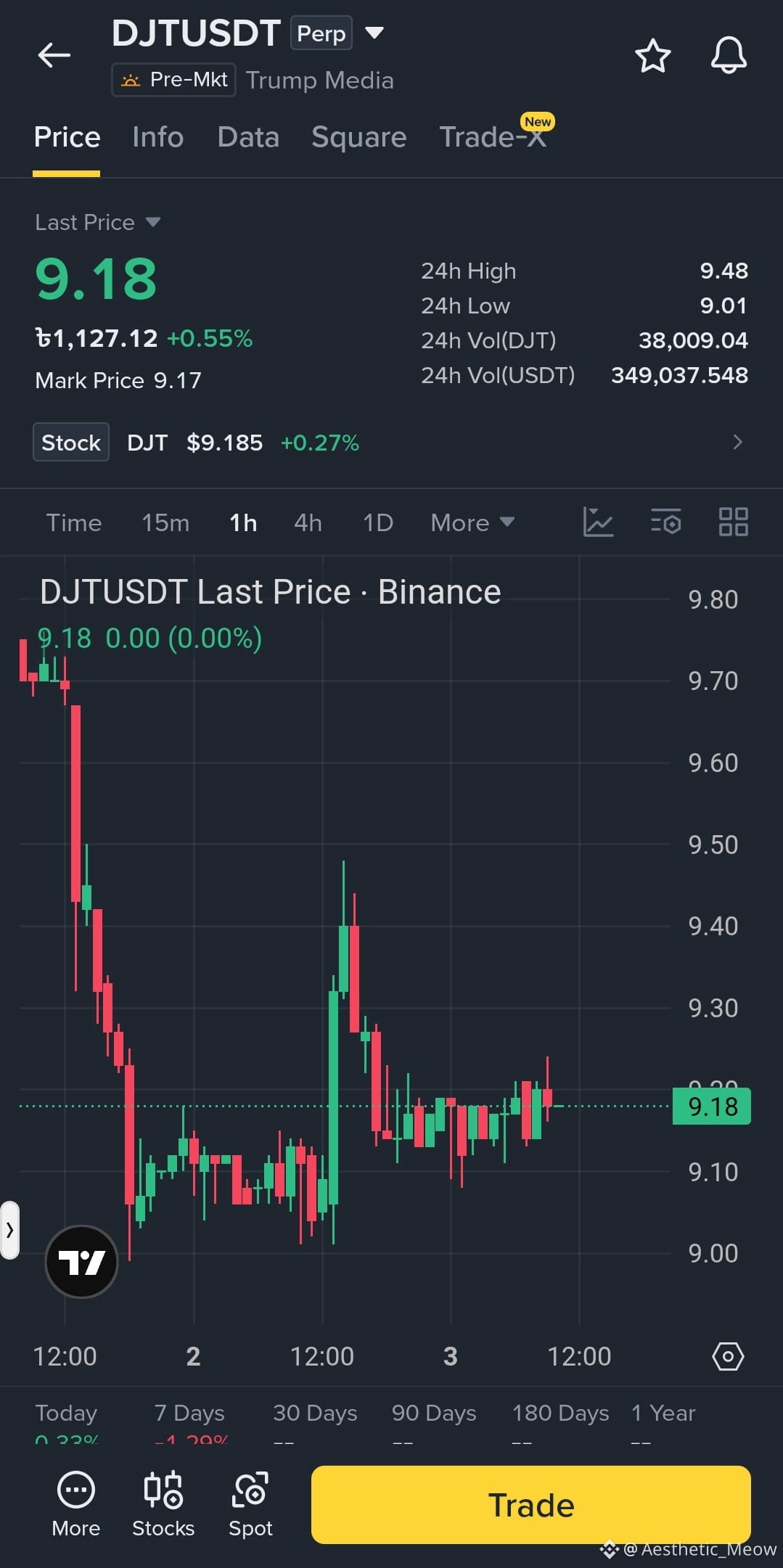
#DJTUSDT LONG
Entry: 9.10 – 9.20
TP: 9.40 | 9.60 | 9.80
SL: 8.95
Leverage: 5×
DYOR/NFA
Trade here 👇
{future}(DJTUSDT)
$DJT Holding Support After Sharp Sell-Off
#DJTUSDT LONG
Entry: 9.10 – 9.20
TP: 9.40 | 9.60 | 9.80
SL: 8.95
Leverage: 5×
DYOR/NFA
Trade here 👇
#DJTUSDT LONG
Entry: 9.10 – 9.20
TP: 9.40 | 9.60 | 9.80
SL: 8.95
Leverage: 5×
DYOR/NFA
Trade here 👇
219

·
--
$DJT In the past 24 hours, it has fallen by 2.477%, with the quote holding at 8.66. But more eye-catching than the price is its perpetual contract funding rate: it is steadily at 0.00000000. This means that for holders right now, longs don’t have to pay shorts, and shorts don’t have to pay longs. On an underlying that swings nearly 2.5% within a day, a zero funding rate like this is not common.
Old Dog believes this is a typical market-confusion signal. When the funding rate is at zero, it directly indicates that neither side—bulls nor bears—has a strong stance that requires payment to maintain. Combined with the price decline, the inference is: throughout the downtrend, there hasn’t been a clear crowded short position willing to pay high interest to capture the downside returns. Likewise, there hasn’t been a strong willingness from longs to pay for leverage while fighting the trend. Trading volume is 590,000, and liquidity is acceptable, but the market is essentially standing by—its expression through the funding rate is “wait and see.” This is a snapshot of the current Crypto on-chain TradFi-style products: market sentiment has no clear bias. It isn’t driven by macro narratives like the BTC spot market, and it lacks clear earnings reports or policy catalysts from traditional equity markets to break the deadlock. At this moment, $DJT is like a battery hovering above a zero-fee rate—the power system is silent.
Old Dog’s take is very clear: this is purely an observation period—don’t act. The most reasonable move now is to wait for the first signal that breaks the zero-funding equilibrium. If the funding rate starts turning negative—say it falls below -0.01%—and the price stops the downtrend, that would be a potential short-squeeze signal; then you could try going long with a small position. Conversely, if the price keeps drifting lower and the funding rate is pushed above 0.01%, that would suggest counter-trend longs are adding leverage and stubbornly holding on—in that case, you should be more cautious about further downside liquidation pressure.
Where is this assessment most likely to be wrong? By equating calm with safety. If suddenly a major piece of breaking news from the TradFi world appears, or if a traditional U.S. stock with high correlation moves, it could quickly activate $DJT ’s contract market—breaking the zero funding rate within minutes and triggering a fast, one-sided move. If you chase it then, the cost would be much higher.
Trading label: #BinanceFutures #TradFi #USDⓈM #DJT #DJTUSDT $DJT
$DJT In the past 24 hours, it has fallen by 2.477%, with the quote holding at 8.66. But more eye-catching than the price is its perpetual contract funding rate: it is steadily at 0.00000000. This means that for holders right now, longs don’t have to pay shorts, and shorts don’t have to pay longs. On an underlying that swings nearly 2.5% within a day, a zero funding rate like this is not common.
Old Dog believes this is a typical market-confusion signal. When the funding rate is at zero, it directly indicates that neither side—bulls nor bears—has a strong stance that requires payment to maintain. Combined with the price decline, the inference is: throughout the downtrend, there hasn’t been a clear crowded short position willing to pay high interest to capture the downside returns. Likewise, there hasn’t been a strong willingness from longs to pay for leverage while fighting the trend. Trading volume is 590,000, and liquidity is acceptable, but the market is essentially standing by—its expression through the funding rate is “wait and see.” This is a snapshot of the current Crypto on-chain TradFi-style products: market sentiment has no clear bias. It isn’t driven by macro narratives like the BTC spot market, and it lacks clear earnings reports or policy catalysts from traditional equity markets to break the deadlock. At this moment, $DJT is like a battery hovering above a zero-fee rate—the power system is silent.
Old Dog’s take is very clear: this is purely an observation period—don’t act. The most reasonable move now is to wait for the first signal that breaks the zero-funding equilibrium. If the funding rate starts turning negative—say it falls below -0.01%—and the price stops the downtrend, that would be a potential short-squeeze signal; then you could try going long with a small position. Conversely, if the price keeps drifting lower and the funding rate is pushed above 0.01%, that would suggest counter-trend longs are adding leverage and stubbornly holding on—in that case, you should be more cautious about further downside liquidation pressure.
Where is this assessment most likely to be wrong? By equating calm with safety. If suddenly a major piece of breaking news from the TradFi world appears, or if a traditional U.S. stock with high correlation moves, it could quickly activate $DJT ’s contract market—breaking the zero funding rate within minutes and triggering a fast, one-sided move. If you chase it then, the cost would be much higher.
Trading label: #BinanceFutures #TradFi #USDⓈM #DJT #DJTUSDT $DJT
Old Dog believes this is a typical market-confusion signal. When the funding rate is at zero, it directly indicates that neither side—bulls nor bears—has a strong stance that requires payment to maintain. Combined with the price decline, the inference is: throughout the downtrend, there hasn’t been a clear crowded short position willing to pay high interest to capture the downside returns. Likewise, there hasn’t been a strong willingness from longs to pay for leverage while fighting the trend. Trading volume is 590,000, and liquidity is acceptable, but the market is essentially standing by—its expression through the funding rate is “wait and see.” This is a snapshot of the current Crypto on-chain TradFi-style products: market sentiment has no clear bias. It isn’t driven by macro narratives like the BTC spot market, and it lacks clear earnings reports or policy catalysts from traditional equity markets to break the deadlock. At this moment, $DJT is like a battery hovering above a zero-fee rate—the power system is silent.
Old Dog’s take is very clear: this is purely an observation period—don’t act. The most reasonable move now is to wait for the first signal that breaks the zero-funding equilibrium. If the funding rate starts turning negative—say it falls below -0.01%—and the price stops the downtrend, that would be a potential short-squeeze signal; then you could try going long with a small position. Conversely, if the price keeps drifting lower and the funding rate is pushed above 0.01%, that would suggest counter-trend longs are adding leverage and stubbornly holding on—in that case, you should be more cautious about further downside liquidation pressure.
Where is this assessment most likely to be wrong? By equating calm with safety. If suddenly a major piece of breaking news from the TradFi world appears, or if a traditional U.S. stock with high correlation moves, it could quickly activate $DJT ’s contract market—breaking the zero funding rate within minutes and triggering a fast, one-sided move. If you chase it then, the cost would be much higher.
Trading label: #BinanceFutures #TradFi #USDⓈM #DJT #DJTUSDT $DJT
11
·
--
$DJT In the past 24 hours, it’s up 5.027%, the price is 9.61, but the funding rate is nailed to zero—longs haven’t paid shorts a single cent. The old dog calculated: this suggests the leveraged market isn’t getting carried away with this rally yet, so the long positions’ cost basis hasn’t changed.
The angle is the semiconductor/AI track, but I can’t get other coin data from the same sector—so I can only look at $DJT itself. Open interest is stuck at 12931.69; the unit is contracts and hasn’t been converted, but combined with the price and trading volume, the venue hasn’t gone cold. Having funding at zero is key: there’s no one-sided crowding. The rally may be driven by spot buying or low leverage pushing—not by frenzy in the futures market.
My take: this move in $DJT is a mild uptrend and hasn’t triggered a leverage bubble. The strongest counterargument is: if no new capital comes in later, and it’s only the existing positions, the upside may not hold. On the second-order effects: if the price keeps creeping up, funding will eventually turn positive; then crowded longs could create pullback pressure, and people chasing higher will have to absorb that cost.
Clear invalidation conditions: if the price breaks below 9.6 or if the funding suddenly turns negative, that means shorts are starting to gain strength and the balance is broken. As for actions: I’m choosing to observe—wait for funding or OI to show a clear directional signal before making a move; I won’t guess.
Trading tag: #BinanceFutures #TradFi #USDⓈM #DJT #DJTUSDT $DJT
$DJT In the past 24 hours, it’s up 5.027%, the price is 9.61, but the funding rate is nailed to zero—longs haven’t paid shorts a single cent. The old dog calculated: this suggests the leveraged market isn’t getting carried away with this rally yet, so the long positions’ cost basis hasn’t changed.
The angle is the semiconductor/AI track, but I can’t get other coin data from the same sector—so I can only look at $DJT itself. Open interest is stuck at 12931.69; the unit is contracts and hasn’t been converted, but combined with the price and trading volume, the venue hasn’t gone cold. Having funding at zero is key: there’s no one-sided crowding. The rally may be driven by spot buying or low leverage pushing—not by frenzy in the futures market.
My take: this move in $DJT is a mild uptrend and hasn’t triggered a leverage bubble. The strongest counterargument is: if no new capital comes in later, and it’s only the existing positions, the upside may not hold. On the second-order effects: if the price keeps creeping up, funding will eventually turn positive; then crowded longs could create pullback pressure, and people chasing higher will have to absorb that cost.
Clear invalidation conditions: if the price breaks below 9.6 or if the funding suddenly turns negative, that means shorts are starting to gain strength and the balance is broken. As for actions: I’m choosing to observe—wait for funding or OI to show a clear directional signal before making a move; I won’t guess.
Trading tag: #BinanceFutures #TradFi #USDⓈM #DJT #DJTUSDT $DJT
The angle is the semiconductor/AI track, but I can’t get other coin data from the same sector—so I can only look at $DJT itself. Open interest is stuck at 12931.69; the unit is contracts and hasn’t been converted, but combined with the price and trading volume, the venue hasn’t gone cold. Having funding at zero is key: there’s no one-sided crowding. The rally may be driven by spot buying or low leverage pushing—not by frenzy in the futures market.
My take: this move in $DJT is a mild uptrend and hasn’t triggered a leverage bubble. The strongest counterargument is: if no new capital comes in later, and it’s only the existing positions, the upside may not hold. On the second-order effects: if the price keeps creeping up, funding will eventually turn positive; then crowded longs could create pullback pressure, and people chasing higher will have to absorb that cost.
Clear invalidation conditions: if the price breaks below 9.6 or if the funding suddenly turns negative, that means shorts are starting to gain strength and the balance is broken. As for actions: I’m choosing to observe—wait for funding or OI to show a clear directional signal before making a move; I won’t guess.
Trading tag: #BinanceFutures #TradFi #USDⓈM #DJT #DJTUSDT $DJT
163
·
--
Over the past 24 hours, $DJT has dropped by 6.289%, which isn’t small for on-chain US stock perpetual futures. More importantly, the current funding rate is positive: 0.00007456. A funding rate greater than zero means that holders of long positions must pay fees to short sellers. Prices are falling, yet the funding rate is positive—this combination is a bit curious. It suggests that during the decline, there may still be long-side capital adding to positions against the trend, or that the existing long positions are still stubbornly holding on, preventing the rate from turning negative quickly. A crowded long situation during a downtrend is usually not a good thing.
Next, look at open interest: 12813.54. Old Dog swept through the data—there hasn’t been a major drop in open interest. That means although the price has fallen, the capital backing those positions hasn’t broadly withdrawn. This resonates with the positive funding rate: longs are holding their cost base and refusing to leave, while shorts sit back and collect. From a single signal, this looks like a weak setup. Falling prices combined with a positive funding rate typically means longs are burning ammunition, while shorts aren’t experiencing the kind of pain that would force them out. If the decline continues, these long “holding” positions could become a potential source of the next wave of sell pressure.
If the market only looks at the 6.289% drop, it might think the selloff has basically run its course. But Old Dog’s view is that unless the funding rate flips to negative quickly, or the price can stabilize at current levels and bounce, downside pressure hasn’t been cleared. A negative funding rate would mean shorts begin getting paid—that’s the signal of a crowded short setup that could potentially get squeezed. But the current situation is the opposite. If the price continues to grind lower and the funding rate stays positive, then the longs’ holding cost will keep rising, and liquidation/forced closing orders could accelerate the downward move.
What’s the strongest counter-evidence? If $DJT around the 9.0 integer level attracts strong buying pressure, causing the price to rebound quickly and hold steady, accompanied by a surge in trading volume, that would indicate some capital believes this level is undervalued and is willing to step in to absorb. Then the current bearish logic based on “down + positive funding” would need to be reassessed. The second-order effect is that if price can’t find a bottom here, those longs adding positions in the decline to average down will face the most direct loss pressure; their forced liquidations would further worsen market liquidity.
So Old Dog’s move is: don’t touch, or take an extremely light contrarian position. I’ll continue watching how price and funding rate interact.
Trading tag: #BinanceFutures #TradFi #USDⓈM #DJT #DJTUSDT $DJT
Over the past 24 hours, $DJT has dropped by 6.289%, which isn’t small for on-chain US stock perpetual futures. More importantly, the current funding rate is positive: 0.00007456. A funding rate greater than zero means that holders of long positions must pay fees to short sellers. Prices are falling, yet the funding rate is positive—this combination is a bit curious. It suggests that during the decline, there may still be long-side capital adding to positions against the trend, or that the existing long positions are still stubbornly holding on, preventing the rate from turning negative quickly. A crowded long situation during a downtrend is usually not a good thing.
Next, look at open interest: 12813.54. Old Dog swept through the data—there hasn’t been a major drop in open interest. That means although the price has fallen, the capital backing those positions hasn’t broadly withdrawn. This resonates with the positive funding rate: longs are holding their cost base and refusing to leave, while shorts sit back and collect. From a single signal, this looks like a weak setup. Falling prices combined with a positive funding rate typically means longs are burning ammunition, while shorts aren’t experiencing the kind of pain that would force them out. If the decline continues, these long “holding” positions could become a potential source of the next wave of sell pressure.
If the market only looks at the 6.289% drop, it might think the selloff has basically run its course. But Old Dog’s view is that unless the funding rate flips to negative quickly, or the price can stabilize at current levels and bounce, downside pressure hasn’t been cleared. A negative funding rate would mean shorts begin getting paid—that’s the signal of a crowded short setup that could potentially get squeezed. But the current situation is the opposite. If the price continues to grind lower and the funding rate stays positive, then the longs’ holding cost will keep rising, and liquidation/forced closing orders could accelerate the downward move.
What’s the strongest counter-evidence? If $DJT around the 9.0 integer level attracts strong buying pressure, causing the price to rebound quickly and hold steady, accompanied by a surge in trading volume, that would indicate some capital believes this level is undervalued and is willing to step in to absorb. Then the current bearish logic based on “down + positive funding” would need to be reassessed. The second-order effect is that if price can’t find a bottom here, those longs adding positions in the decline to average down will face the most direct loss pressure; their forced liquidations would further worsen market liquidity.
So Old Dog’s move is: don’t touch, or take an extremely light contrarian position. I’ll continue watching how price and funding rate interact.
Trading tag: #BinanceFutures #TradFi #USDⓈM #DJT #DJTUSDT $DJT
Next, look at open interest: 12813.54. Old Dog swept through the data—there hasn’t been a major drop in open interest. That means although the price has fallen, the capital backing those positions hasn’t broadly withdrawn. This resonates with the positive funding rate: longs are holding their cost base and refusing to leave, while shorts sit back and collect. From a single signal, this looks like a weak setup. Falling prices combined with a positive funding rate typically means longs are burning ammunition, while shorts aren’t experiencing the kind of pain that would force them out. If the decline continues, these long “holding” positions could become a potential source of the next wave of sell pressure.
If the market only looks at the 6.289% drop, it might think the selloff has basically run its course. But Old Dog’s view is that unless the funding rate flips to negative quickly, or the price can stabilize at current levels and bounce, downside pressure hasn’t been cleared. A negative funding rate would mean shorts begin getting paid—that’s the signal of a crowded short setup that could potentially get squeezed. But the current situation is the opposite. If the price continues to grind lower and the funding rate stays positive, then the longs’ holding cost will keep rising, and liquidation/forced closing orders could accelerate the downward move.
What’s the strongest counter-evidence? If $DJT around the 9.0 integer level attracts strong buying pressure, causing the price to rebound quickly and hold steady, accompanied by a surge in trading volume, that would indicate some capital believes this level is undervalued and is willing to step in to absorb. Then the current bearish logic based on “down + positive funding” would need to be reassessed. The second-order effect is that if price can’t find a bottom here, those longs adding positions in the decline to average down will face the most direct loss pressure; their forced liquidations would further worsen market liquidity.
So Old Dog’s move is: don’t touch, or take an extremely light contrarian position. I’ll continue watching how price and funding rate interact.
Trading tag: #BinanceFutures #TradFi #USDⓈM #DJT #DJTUSDT $DJT
1
·
--
$DJT In the past 24 hours, it dropped 7.238%; current price is $9.1. This move counts as notable volatility among on-chain US stock perps. The funding rate is zero, OI is 13049.72 contracts. With these three data points lined up, Old Dog can tell the shorts are probing, but they haven’t captured the advantage from funding fees.
It fell 7.2% yet funding is zero—this suggests longs haven’t been continuously bled, and shorts also can’t dilute their costs via a positive funding rate. OI at 13049.72: open interest hasn’t jumped in step with the price, so there’s no liquidation cascade. It looks more like small-scale profit-taking rather than a full-scale selloff. From the M4_mover angle, this is exactly the kind of divergence to watch: price moves, but derivatives data doesn’t match the panic. Old Dog did the math—if this is a short probe, they would need to push funding into negative territory to suppress the longs. But with the funding rate at zero, the positions’ cost basis hasn’t changed, so shorts have no “fuel” from fees either.
My take: the continuation of this drop is uncertain. The market is ignoring the temporarily balanced state between longs and shorts. The strongest counter-signal: if the spot sell pressure keeps expanding, price could quickly slide below 9.0, which would trigger algorithmic stop-losses. Second-order effects: if longs choose to hold through it, then the next time OI spikes massively, it could be a prelude to a liquidation event. Since shorts won’t be earning funding, they might close early around 9.0.
Trading tag: #BinanceFutures #TradFi #USDⓈM #DJT #DJTUSDT $DJT
$DJT In the past 24 hours, it dropped 7.238%; current price is $9.1. This move counts as notable volatility among on-chain US stock perps. The funding rate is zero, OI is 13049.72 contracts. With these three data points lined up, Old Dog can tell the shorts are probing, but they haven’t captured the advantage from funding fees.
It fell 7.2% yet funding is zero—this suggests longs haven’t been continuously bled, and shorts also can’t dilute their costs via a positive funding rate. OI at 13049.72: open interest hasn’t jumped in step with the price, so there’s no liquidation cascade. It looks more like small-scale profit-taking rather than a full-scale selloff. From the M4_mover angle, this is exactly the kind of divergence to watch: price moves, but derivatives data doesn’t match the panic. Old Dog did the math—if this is a short probe, they would need to push funding into negative territory to suppress the longs. But with the funding rate at zero, the positions’ cost basis hasn’t changed, so shorts have no “fuel” from fees either.
My take: the continuation of this drop is uncertain. The market is ignoring the temporarily balanced state between longs and shorts. The strongest counter-signal: if the spot sell pressure keeps expanding, price could quickly slide below 9.0, which would trigger algorithmic stop-losses. Second-order effects: if longs choose to hold through it, then the next time OI spikes massively, it could be a prelude to a liquidation event. Since shorts won’t be earning funding, they might close early around 9.0.
Trading tag: #BinanceFutures #TradFi #USDⓈM #DJT #DJTUSDT $DJT
It fell 7.2% yet funding is zero—this suggests longs haven’t been continuously bled, and shorts also can’t dilute their costs via a positive funding rate. OI at 13049.72: open interest hasn’t jumped in step with the price, so there’s no liquidation cascade. It looks more like small-scale profit-taking rather than a full-scale selloff. From the M4_mover angle, this is exactly the kind of divergence to watch: price moves, but derivatives data doesn’t match the panic. Old Dog did the math—if this is a short probe, they would need to push funding into negative territory to suppress the longs. But with the funding rate at zero, the positions’ cost basis hasn’t changed, so shorts have no “fuel” from fees either.
My take: the continuation of this drop is uncertain. The market is ignoring the temporarily balanced state between longs and shorts. The strongest counter-signal: if the spot sell pressure keeps expanding, price could quickly slide below 9.0, which would trigger algorithmic stop-losses. Second-order effects: if longs choose to hold through it, then the next time OI spikes massively, it could be a prelude to a liquidation event. Since shorts won’t be earning funding, they might close early around 9.0.
Trading tag: #BinanceFutures #TradFi #USDⓈM #DJT #DJTUSDT $DJT
143
·
--
$DJT fell 7.771% in the past 24 hours to a current price of 9.02. The old dog glanced at the perpetual contract data: the funding rate is steady at 0.00000000%, open interest is 11087.99, and the 24-hour trading volume is 380,000. The price is down, but the funding rate hasn’t moved—this combination is kind of interesting.
From the perspective of the M4_mover’s anomaly, a near-8% daily drop counts as severe volatility. But the key metric—the funding rate—stays completely still. That means in the contract market right now, neither longs nor shorts are paying the other; there’s no clear one-sided crowding in market sentiment. Here’s a hard rule to remember: when the funding rate is positive, longs pay shorts, which implies more bullish participants and heavier long positioning; when it’s negative, it’s the opposite. Now it’s basically zero, which suggests that on the $DJT underlying, the force from aggressive shorting bets on continued collapse is not prominent for the moment—or that the long side has retreated at the same time. The market is in a temporary balance period, or perhaps a phase of hesitation. Trading volume is relatively stable as well—there’s no panic-driven spike in volume alongside the selloff, which supports that view. With no other comparable data from the same sector board, this drop looks more like $DJT’s independent behavior.
My take: a big daily selloff with the funding rate stuck at zero is usually not a strong signal of a trend reversal; it’s more like a concentrated release of short-term sentiment. Conversely, if the short side were truly very strong, the funding rate should have already dropped into negative territory for them to “collect rent.” With the funding rate flat, it suggests leveraged shorts’ willingness to press their bets isn’t strong right now, and there’s also insufficient long “fuel” to squeeze them out. So this drop is more likely spot selling pressure without much leverage amplification, or a liquidation/closing of regular long positions in the contracts.
The strongest counterpoint is simple: the price itself is down—down is down. A 7.77% move already is the fact of bearishness. The second-order effect is: if the price continues to grind lower but the funding rate stays near zero, that may attract more arbitrage capital to bet on a funding-rate turn, or even cause the contract’s liquidity to decline, becoming less and less traded. What to watch next? If the price keeps hovering around the psychological 9 level, but the funding rate and volume remain calm, then the tape really might be “dead.” On the other hand, if the price quickly recovers the drop but the funding rate remains zero, that would suggest the rebound lacks leveraged long momentum, and its sustainability is questionable.
My current action: observation only—no moves.
Trading tag: #BinanceFutures #TradFi #USDⓈM #DJT #DJTUSDT $DJT
$DJT fell 7.771% in the past 24 hours to a current price of 9.02. The old dog glanced at the perpetual contract data: the funding rate is steady at 0.00000000%, open interest is 11087.99, and the 24-hour trading volume is 380,000. The price is down, but the funding rate hasn’t moved—this combination is kind of interesting.
From the perspective of the M4_mover’s anomaly, a near-8% daily drop counts as severe volatility. But the key metric—the funding rate—stays completely still. That means in the contract market right now, neither longs nor shorts are paying the other; there’s no clear one-sided crowding in market sentiment. Here’s a hard rule to remember: when the funding rate is positive, longs pay shorts, which implies more bullish participants and heavier long positioning; when it’s negative, it’s the opposite. Now it’s basically zero, which suggests that on the $DJT underlying, the force from aggressive shorting bets on continued collapse is not prominent for the moment—or that the long side has retreated at the same time. The market is in a temporary balance period, or perhaps a phase of hesitation. Trading volume is relatively stable as well—there’s no panic-driven spike in volume alongside the selloff, which supports that view. With no other comparable data from the same sector board, this drop looks more like $DJT ’s independent behavior.
My take: a big daily selloff with the funding rate stuck at zero is usually not a strong signal of a trend reversal; it’s more like a concentrated release of short-term sentiment. Conversely, if the short side were truly very strong, the funding rate should have already dropped into negative territory for them to “collect rent.” With the funding rate flat, it suggests leveraged shorts’ willingness to press their bets isn’t strong right now, and there’s also insufficient long “fuel” to squeeze them out. So this drop is more likely spot selling pressure without much leverage amplification, or a liquidation/closing of regular long positions in the contracts.
The strongest counterpoint is simple: the price itself is down—down is down. A 7.77% move already is the fact of bearishness. The second-order effect is: if the price continues to grind lower but the funding rate stays near zero, that may attract more arbitrage capital to bet on a funding-rate turn, or even cause the contract’s liquidity to decline, becoming less and less traded. What to watch next? If the price keeps hovering around the psychological 9 level, but the funding rate and volume remain calm, then the tape really might be “dead.” On the other hand, if the price quickly recovers the drop but the funding rate remains zero, that would suggest the rebound lacks leveraged long momentum, and its sustainability is questionable.
My current action: observation only—no moves.
Trading tag: #BinanceFutures #TradFi #USDⓈM #DJT #DJTUSDT $DJT
From the perspective of the M4_mover’s anomaly, a near-8% daily drop counts as severe volatility. But the key metric—the funding rate—stays completely still. That means in the contract market right now, neither longs nor shorts are paying the other; there’s no clear one-sided crowding in market sentiment. Here’s a hard rule to remember: when the funding rate is positive, longs pay shorts, which implies more bullish participants and heavier long positioning; when it’s negative, it’s the opposite. Now it’s basically zero, which suggests that on the $DJT underlying, the force from aggressive shorting bets on continued collapse is not prominent for the moment—or that the long side has retreated at the same time. The market is in a temporary balance period, or perhaps a phase of hesitation. Trading volume is relatively stable as well—there’s no panic-driven spike in volume alongside the selloff, which supports that view. With no other comparable data from the same sector board, this drop looks more like $DJT ’s independent behavior.
My take: a big daily selloff with the funding rate stuck at zero is usually not a strong signal of a trend reversal; it’s more like a concentrated release of short-term sentiment. Conversely, if the short side were truly very strong, the funding rate should have already dropped into negative territory for them to “collect rent.” With the funding rate flat, it suggests leveraged shorts’ willingness to press their bets isn’t strong right now, and there’s also insufficient long “fuel” to squeeze them out. So this drop is more likely spot selling pressure without much leverage amplification, or a liquidation/closing of regular long positions in the contracts.
The strongest counterpoint is simple: the price itself is down—down is down. A 7.77% move already is the fact of bearishness. The second-order effect is: if the price continues to grind lower but the funding rate stays near zero, that may attract more arbitrage capital to bet on a funding-rate turn, or even cause the contract’s liquidity to decline, becoming less and less traded. What to watch next? If the price keeps hovering around the psychological 9 level, but the funding rate and volume remain calm, then the tape really might be “dead.” On the other hand, if the price quickly recovers the drop but the funding rate remains zero, that would suggest the rebound lacks leveraged long momentum, and its sustainability is questionable.
My current action: observation only—no moves.
Trading tag: #BinanceFutures #TradFi #USDⓈM #DJT #DJTUSDT $DJT
60


·
--
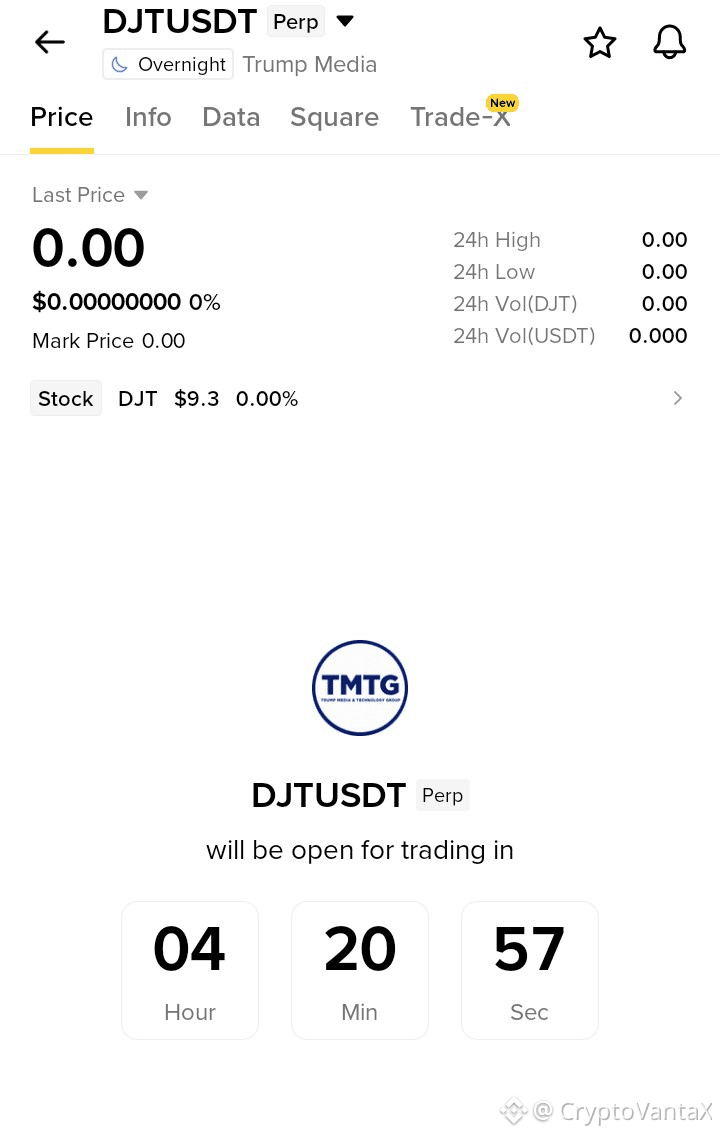
NEW LISTING ALERT!
$DJT
A new crypto project is entering the market! 🔥
Watch the listing closely, check the project fundamentals.
New Listing = New Opportunity
#NewListing #DJT #Binance #CryptoNews
#DJTUSDT
$DJT
{future}(DJTUSDT)
NEW LISTING ALERT!
$DJT
A new crypto project is entering the market! 🔥
Watch the listing closely, check the project fundamentals.
New Listing = New Opportunity
#NewListing #DJT #Binance #CryptoNews
#DJTUSDT
$DJT
$DJT
A new crypto project is entering the market! 🔥
Watch the listing closely, check the project fundamentals.
New Listing = New Opportunity
#NewListing #DJT #Binance #CryptoNews
#DJTUSDT
$DJT
1
267

·
--
$SNXX(SNXXUSDT)24h surge is 41.081%, current price is 15.66000, OI is 1632754.86, but the funding rate is -0.00010752, indicating that even amid the rapid rise, shorts are still betting on a pullback; it may also provide fuel for further short-squeeze continuation.
From Trump’s perspective, the core of market trading centers on tariffs, tax cuts, deregulation, and the expectation that America comes first. Macros focus on expectations for the US dollar and interest rates; micros require vigilance against realizing positions (chasing chips) after high volatility. Global trade frictions, military conflicts and their spillover into risk appetite can all amplify SNXX’s price swings. The FOMO sentiment from KOLs on X can only be used as a thermometer—it cannot replace position discipline.
My actions: don’t chase and add heavily at the end of a long bullish candle. If a pullback finds stable support, consider taking small-position entries in batches; if you already hold long positions, raise the stop-loss. If the negative funding rate persists and the price is not weak, observe with a mildly bullish bias; if OI is high while the price turns weaker, prioritize reducing exposure.
Trading tag: #TradFi #链上美股 #SNXXUSDT #DJTUSDT
Will Trump-style trading keep driving a further SNXX squeeze, or will it be good news for profit-taking?
$SNXX (SNXXUSDT)24h surge is 41.081%, current price is 15.66000, OI is 1632754.86, but the funding rate is -0.00010752, indicating that even amid the rapid rise, shorts are still betting on a pullback; it may also provide fuel for further short-squeeze continuation.
From Trump’s perspective, the core of market trading centers on tariffs, tax cuts, deregulation, and the expectation that America comes first. Macros focus on expectations for the US dollar and interest rates; micros require vigilance against realizing positions (chasing chips) after high volatility. Global trade frictions, military conflicts and their spillover into risk appetite can all amplify SNXX’s price swings. The FOMO sentiment from KOLs on X can only be used as a thermometer—it cannot replace position discipline.
My actions: don’t chase and add heavily at the end of a long bullish candle. If a pullback finds stable support, consider taking small-position entries in batches; if you already hold long positions, raise the stop-loss. If the negative funding rate persists and the price is not weak, observe with a mildly bullish bias; if OI is high while the price turns weaker, prioritize reducing exposure.
Trading tag: #TradFi #链上美股 #SNXXUSDT #DJTUSDT
Will Trump-style trading keep driving a further SNXX squeeze, or will it be good news for profit-taking?
From Trump’s perspective, the core of market trading centers on tariffs, tax cuts, deregulation, and the expectation that America comes first. Macros focus on expectations for the US dollar and interest rates; micros require vigilance against realizing positions (chasing chips) after high volatility. Global trade frictions, military conflicts and their spillover into risk appetite can all amplify SNXX’s price swings. The FOMO sentiment from KOLs on X can only be used as a thermometer—it cannot replace position discipline.
My actions: don’t chase and add heavily at the end of a long bullish candle. If a pullback finds stable support, consider taking small-position entries in batches; if you already hold long positions, raise the stop-loss. If the negative funding rate persists and the price is not weak, observe with a mildly bullish bias; if OI is high while the price turns weaker, prioritize reducing exposure.
Trading tag: #TradFi #链上美股 #SNXXUSDT #DJTUSDT
Will Trump-style trading keep driving a further SNXX squeeze, or will it be good news for profit-taking?
111
Log in to explore more content
Join global crypto users on Binance Square
⚡️ Get latest and useful information about crypto.
💬 Trusted by the world’s largest crypto exchange.
👍 Discover real insights from verified creators.
Email / Phone number
Trending Topics
1
#SaylorHintsStrategyBitcoinBuy
2.2M views
11,574 Discussing
2
#BOJRaisesRatesTo31YearHigh
188,808 views
2,783 Discussing
3
#BuffettStepsDownAsBerkshireChairman
91,716 views
1,450 Discussing
4
#XRPExchangeReservesHitSevenYearLow
98,928 views
1,286 Discussing
5
#HKCompletesFirstHKDStablecoinUseCase
129,080 views
1,680 Discussing
6
#VietnamPlansFirstCryptoLicensesIn2026
81,172 views
1,150 Discussing
7
#BTCBreaks80K
472,477 views
5,423 Discussing
8
#BitcoinMarketCapTopsTesla
112,812 views
1,315 Discussing
9
#SOLJumpsAbout10%
114,684 views
1,196 Discussing
10
#EthereumReclaims$2600
10,066 views
134 Discussing