

#marketmaking
marketmaking
62,415 views
64 Discussing
Hot
Latest

·
--
Have you noticed how crypto projects never disclose their actual market makers?
That's the reason so many investors get wrecked on fake volume and sudden liquidity pulls. You miss the real entries and have no idea when to exit because the books are manipulated behind closed doors.
Transparency in market making is what truly sets projects apart from the noise. Forget chasing the biggest $BTC volumes or $ETH liquidity numbers. The ones that survive are those willing to show their MM partners and on-chain proofs.
Check the actual depth charts on Binance for $BNB pairs and demand the same from any new token. That's the practical filter that saves you from rugs.
Anyone else seeing this as the key to better trading?
#MarketMaking #Crypto #Transparency
Have you noticed how crypto projects never disclose their actual market makers?
That's the reason so many investors get wrecked on fake volume and sudden liquidity pulls. You miss the real entries and have no idea when to exit because the books are manipulated behind closed doors.
Transparency in market making is what truly sets projects apart from the noise. Forget chasing the biggest $BTC volumes or $ETH liquidity numbers. The ones that survive are those willing to show their MM partners and on-chain proofs.
Check the actual depth charts on Binance for $BNB pairs and demand the same from any new token. That's the practical filter that saves you from rugs.
Anyone else seeing this as the key to better trading?
#MarketMaking #Crypto #Transparency
That's the reason so many investors get wrecked on fake volume and sudden liquidity pulls. You miss the real entries and have no idea when to exit because the books are manipulated behind closed doors.
Transparency in market making is what truly sets projects apart from the noise. Forget chasing the biggest $BTC volumes or $ETH liquidity numbers. The ones that survive are those willing to show their MM partners and on-chain proofs.
Check the actual depth charts on Binance for $BNB pairs and demand the same from any new token. That's the practical filter that saves you from rugs.
Anyone else seeing this as the key to better trading?
#MarketMaking #Crypto #Transparency

20

Picture this: two tokens launch on the same day with similar narratives and similar communities, and six months later one still has real two-sided markets while the other is a graveyard of wash-traded volume.
Every trader knows that feeling. You enter a position thinking the order book is deep, then one dump later the bids vanish and you're looking at a 30% haircut just to get out.
Here's what actually happened if you zoom out. After 2022, a handful of projects started publishing their market maker agreements, inventory levels, and spread commitments in public. Compare that to the old playbook where a team quietly hired a MM, pumped the chart for listing day, then let the book go dark. $BTC and $ETH never needed that theater because the liquidity was always organic.
Look at how $BNB listings have evolved since then. Projects that show their MM terms upfront tend to keep tighter spreads 90 days after going live. The ones that stay silent watch their average spread widen by 4x within a month, and volume quietly migrates to whatever still looks liquid on the surface.
Transparency isn't a branding exercise. It's the difference between a market you can actually trade and one that's just a chart.
Where do you think this goes from here?
#MarketMaking #CryptoLiquidity #Trading
Picture this: two tokens launch on the same day with similar narratives and similar communities, and six months later one still has real two-sided markets while the other is a graveyard of wash-traded volume.
Every trader knows that feeling. You enter a position thinking the order book is deep, then one dump later the bids vanish and you're looking at a 30% haircut just to get out.
Here's what actually happened if you zoom out. After 2022, a handful of projects started publishing their market maker agreements, inventory levels, and spread commitments in public. Compare that to the old playbook where a team quietly hired a MM, pumped the chart for listing day, then let the book go dark. $BTC and $ETH never needed that theater because the liquidity was always organic.
Look at how $BNB listings have evolved since then. Projects that show their MM terms upfront tend to keep tighter spreads 90 days after going live. The ones that stay silent watch their average spread widen by 4x within a month, and volume quietly migrates to whatever still looks liquid on the surface.
Transparency isn't a branding exercise. It's the difference between a market you can actually trade and one that's just a chart.
Where do you think this goes from here?
#MarketMaking #CryptoLiquidity #Trading
Every trader knows that feeling. You enter a position thinking the order book is deep, then one dump later the bids vanish and you're looking at a 30% haircut just to get out.
Here's what actually happened if you zoom out. After 2022, a handful of projects started publishing their market maker agreements, inventory levels, and spread commitments in public. Compare that to the old playbook where a team quietly hired a MM, pumped the chart for listing day, then let the book go dark. $BTC and $ETH never needed that theater because the liquidity was always organic.
Look at how $BNB listings have evolved since then. Projects that show their MM terms upfront tend to keep tighter spreads 90 days after going live. The ones that stay silent watch their average spread widen by 4x within a month, and volume quietly migrates to whatever still looks liquid on the surface.
Transparency isn't a branding exercise. It's the difference between a market you can actually trade and one that's just a chart.
Where do you think this goes from here?
#MarketMaking #CryptoLiquidity #Trading

12

·
--
If you're still ignoring who actually provides the liquidity in your trades, stop now.
Traders keep getting burned by sudden dumps that look organic until the market maker vanishes. You miss the real exit because the order book was never what it seemed.
There's two camps on this. Some argue market makers need to stay hidden so competitors don't eat their edge, and that's how it's always been. Others, myself included, think that's just an excuse for pumping fake volume in pairs like $BTC and $ETH.
Transparency is the real differentiator. When market makers share verifiable inventory and spreads, it cuts the manipulation. Tokens that go this route tend to weather the storms better, unlike the ones hiding behind anonymous bots. $BNB has been a good example of more open practices paying off in stability.
Where do you think this goes from here?
#MarketMaking #CryptoTrading #Transparency
If you're still ignoring who actually provides the liquidity in your trades, stop now.
Traders keep getting burned by sudden dumps that look organic until the market maker vanishes. You miss the real exit because the order book was never what it seemed.
There's two camps on this. Some argue market makers need to stay hidden so competitors don't eat their edge, and that's how it's always been. Others, myself included, think that's just an excuse for pumping fake volume in pairs like $BTC and $ETH .
Transparency is the real differentiator. When market makers share verifiable inventory and spreads, it cuts the manipulation. Tokens that go this route tend to weather the storms better, unlike the ones hiding behind anonymous bots. $BNB has been a good example of more open practices paying off in stability.
Where do you think this goes from here?
#MarketMaking #CryptoTrading #Transparency
Traders keep getting burned by sudden dumps that look organic until the market maker vanishes. You miss the real exit because the order book was never what it seemed.
There's two camps on this. Some argue market makers need to stay hidden so competitors don't eat their edge, and that's how it's always been. Others, myself included, think that's just an excuse for pumping fake volume in pairs like $BTC and $ETH .
Transparency is the real differentiator. When market makers share verifiable inventory and spreads, it cuts the manipulation. Tokens that go this route tend to weather the storms better, unlike the ones hiding behind anonymous bots. $BNB has been a good example of more open practices paying off in stability.
Where do you think this goes from here?
#MarketMaking #CryptoTrading #Transparency
22

Everyone thinks having a market maker means your token is legit and liquid but actually without full transparency you're just funding someone else's exit liquidity.
ngl ser this is how so many of us get rugged. you see the volume pumping, fomo in thinking it's organic demand then the mm pulls the plug and you're left holding bags while they cash out.
take that one case last year with a mid cap alt. they never disclosed their mm agreement and when the numbers came out it was like 80% of the volume was internal.
price dumped 65% overnight and retail got absolutely rekt.
that's why transparency in market making is the real differentiator now. projects that hide this stuff are basically setting you up to lose.
anyone else seeing this with $SOL $ETH and $BTC pairs?
#MarketMaking #CryptoTrading #Transparency
Everyone thinks having a market maker means your token is legit and liquid but actually without full transparency you're just funding someone else's exit liquidity.
ngl ser this is how so many of us get rugged. you see the volume pumping, fomo in thinking it's organic demand then the mm pulls the plug and you're left holding bags while they cash out.
take that one case last year with a mid cap alt. they never disclosed their mm agreement and when the numbers came out it was like 80% of the volume was internal.
price dumped 65% overnight and retail got absolutely rekt.
that's why transparency in market making is the real differentiator now. projects that hide this stuff are basically setting you up to lose.
anyone else seeing this with $SOL $ETH and $BTC pairs?
#MarketMaking #CryptoTrading #Transparency
ngl ser this is how so many of us get rugged. you see the volume pumping, fomo in thinking it's organic demand then the mm pulls the plug and you're left holding bags while they cash out.
take that one case last year with a mid cap alt. they never disclosed their mm agreement and when the numbers came out it was like 80% of the volume was internal.
price dumped 65% overnight and retail got absolutely rekt.
that's why transparency in market making is the real differentiator now. projects that hide this stuff are basically setting you up to lose.
anyone else seeing this with $SOL $ETH and $BTC pairs?
#MarketMaking #CryptoTrading #Transparency
15
·
--
Most new token listings show 80% of their volume coming from just two or three market makers who never disclose their positions.
That's the pain of chasing volume that isn't real. You buy thinking there's genuine interest, then the MM tightens the spread just enough to trap you before dumping the rest of their allocation.
Market making should be about providing real liquidity so traders can move in and out of $ETH or $BTC without massive slippage. When those operations stay hidden, they can fabricate order books, run coordinated pumps, and leave retail holding the bag once the volume dries up. I looked at a handful of recent $BNB pairs and the pattern is the same: huge reported volume on day one, then a 60% drop as soon as the undisclosed MM steps back.
Transparency is what actually separates sustainable projects from the ones that rug. If a team won't tell you who is making the market or how much inventory they hold, you're basically gambling on their goodwill. That's a terrible position to be in when the chart starts moving against you.
How much of the volume you see on a typical listing do you actually trust these days?
#MarketMaking #CryptoLiquidity #TradingRisks
Most new token listings show 80% of their volume coming from just two or three market makers who never disclose their positions.
That's the pain of chasing volume that isn't real. You buy thinking there's genuine interest, then the MM tightens the spread just enough to trap you before dumping the rest of their allocation.
Market making should be about providing real liquidity so traders can move in and out of $ETH or $BTC without massive slippage. When those operations stay hidden, they can fabricate order books, run coordinated pumps, and leave retail holding the bag once the volume dries up. I looked at a handful of recent $BNB pairs and the pattern is the same: huge reported volume on day one, then a 60% drop as soon as the undisclosed MM steps back.
Transparency is what actually separates sustainable projects from the ones that rug. If a team won't tell you who is making the market or how much inventory they hold, you're basically gambling on their goodwill. That's a terrible position to be in when the chart starts moving against you.
How much of the volume you see on a typical listing do you actually trust these days?
#MarketMaking #CryptoLiquidity #TradingRisks
That's the pain of chasing volume that isn't real. You buy thinking there's genuine interest, then the MM tightens the spread just enough to trap you before dumping the rest of their allocation.
Market making should be about providing real liquidity so traders can move in and out of $ETH or $BTC without massive slippage. When those operations stay hidden, they can fabricate order books, run coordinated pumps, and leave retail holding the bag once the volume dries up. I looked at a handful of recent $BNB pairs and the pattern is the same: huge reported volume on day one, then a 60% drop as soon as the undisclosed MM steps back.
Transparency is what actually separates sustainable projects from the ones that rug. If a team won't tell you who is making the market or how much inventory they hold, you're basically gambling on their goodwill. That's a terrible position to be in when the chart starts moving against you.
How much of the volume you see on a typical listing do you actually trust these days?
#MarketMaking #CryptoLiquidity #TradingRisks

25

Article
What Is Cross Exchange Market Making? The Setup Behind Every Token Listed on More Than One ExchangeWhat is cross exchange market making – TDMM
Takeaways first
Your token trades on several order books that do not talk to each other. CoinMarketCap tracks 239 spot exchanges; the ten largest list 16,045 pairs between them.Cross exchange market making quotes every venue off one reference price and hedges every fill on the deepest venue, from one shared inventory.The hard part is exchange integration: different rate limits, server regions, symbol formats and fee tiers on every venue.When makers cannot reach a venue, its prices detach. On 10 October 2025 USDe printed $0.65 and wBETH $430 on Binance while both held value elsewhere.TDMM runs this model across 100+ CEX and DEX integrations, as one book with one risk view.
The one-line definition
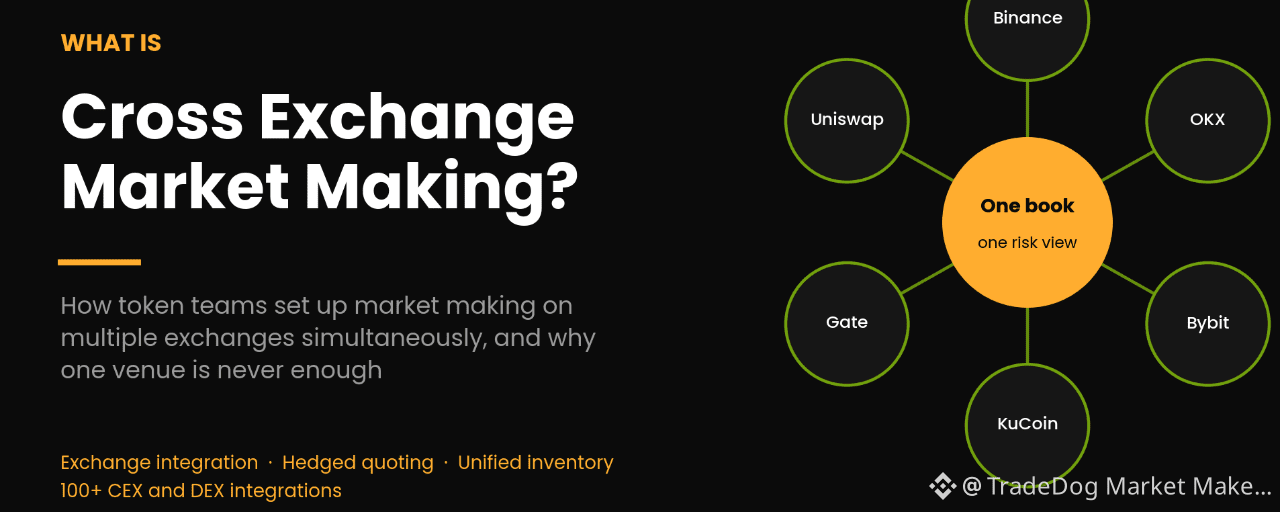
Cross exchange market making means quoting a token on several exchanges at the same time from one shared inventory, pricing every order book off a single reference price and hedging fills on the deepest venue.
The maker posts bids and asks on the secondary venues at the reference price plus or minus a margin. When a quote fills, it immediately takes the opposite side on the hedge venue. The margin covers the maker fee, the hedge taker fee, slippage, transfer costs and a profit buffer.
Why one exchange is never enough
Depth is concentrated but it moves. Kaiko found the eight largest exchanges holding 91.7% of order-book depth. In Q2 2026 Binance handled 38.7% of top-ten CEX spot volume while MEXC’s volume more than halved in one quarter. DEXs took 13.6% of spot volume in January 2026, with a peak of 24.5% in June 2025.
A token with a dedicated maker on its deepest venue and nobody on its other listings shows 100 to 300 basis point spreads on those listings, and its price drifts away from the reference for minutes at a time. Arbitrage bots close the gap and keep the money. Cross exchange market making means the token’s own maker posts the consistent price everywhere and captures that gap instead.
What a venue looks like without its makers
For 40 minutes on 10 October 2025, three assets on Binance detached from their value everywhere else. USDe printed $0.65 while holding near $1.00 on-chain. wBETH printed $430 against ETH above $3,800. BNSOL printed $34.90. Makers could not reach the venue, books thinned, and the margin engine liquidated users against those prints. Binance later paid about $283 million in compensation. The assets had not lost value; one venue had lost its makers.
Exchange integration: the real work
Binance’s spot API allows 6,000 request weight per minute per IP and 50 orders per 10 seconds per account. Bybit allows 600 requests per 5 seconds per IP. OKX scales limits for top VIP tiers by fill ratio. Binance answers in about 8 ms from Tokyo and 259 ms from São Paulo. Maker fees run from 10 basis points at standard tiers to rebates of 0.75 bps (Bybit MM3) and 1.2 bps (KuCoin Tier S) inside market maker programmes. Every venue also has its own symbol format, tick size, lot size and fee currency.
An engine that respects all of this on ten venues at once, and treats the inventory on all of them as one position with one set of caps, is what separates cross exchange market making from ten bots running side by side.
Setting up on multiple exchanges simultaneously
Week one: rank venues by depth, pick the hedge venue, agree per-venue spread, depth and uptime targets, and complete the disclosures exchanges now require. Since March 2026, Binance requires token issuers to disclose their market maker, contract terms and any token loan, and prohibits one-sided selling and volume inflation. Week two: accounts, keys, whitelists, programme applications, inventory placement. Week three: shadow quoting and calibration per venue. Then go live and report spread, depth, uptime, cross-venue deviation and inventory by venue, daily.
Why TDMM
TDMM (TradeDog Market Maker) has quoted across venues since 2015: more than $10 billion traded, 200+ markets, 100+ CEX and DEX integrations including Binance, OKX, Bybit, Gate, KuCoin, Bitget, MEXC, HTX, Uniswap, PancakeSwap and Raydium. One reference price, one book, one risk view, with real-time reporting. No manufactured volume, no one-sided selling, no price promises.
Full article with the data, the worked example, and the KPI table: tdmm.io/insights/blog/
$BTC $PONS
#MarketMaking #CrossExchange #CryptoExchanges #Liquidity #TDMM
What Is Cross Exchange Market Making? The Setup Behind Every Token Listed on More Than One Exchange
What is cross exchange market making – TDMM
Takeaways first
Your token trades on several order books that do not talk to each other. CoinMarketCap tracks 239 spot exchanges; the ten largest list 16,045 pairs between them.Cross exchange market making quotes every venue off one reference price and hedges every fill on the deepest venue, from one shared inventory.The hard part is exchange integration: different rate limits, server regions, symbol formats and fee tiers on every venue.When makers cannot reach a venue, its prices detach. On 10 October 2025 USDe printed $0.65 and wBETH $430 on Binance while both held value elsewhere.TDMM runs this model across 100+ CEX and DEX integrations, as one book with one risk view.
The one-line definition
Cross exchange market making means quoting a token on several exchanges at the same time from one shared inventory, pricing every order book off a single reference price and hedging fills on the deepest venue.
The maker posts bids and asks on the secondary venues at the reference price plus or minus a margin. When a quote fills, it immediately takes the opposite side on the hedge venue. The margin covers the maker fee, the hedge taker fee, slippage, transfer costs and a profit buffer.
Why one exchange is never enough
Depth is concentrated but it moves. Kaiko found the eight largest exchanges holding 91.7% of order-book depth. In Q2 2026 Binance handled 38.7% of top-ten CEX spot volume while MEXC’s volume more than halved in one quarter. DEXs took 13.6% of spot volume in January 2026, with a peak of 24.5% in June 2025.
A token with a dedicated maker on its deepest venue and nobody on its other listings shows 100 to 300 basis point spreads on those listings, and its price drifts away from the reference for minutes at a time. Arbitrage bots close the gap and keep the money. Cross exchange market making means the token’s own maker posts the consistent price everywhere and captures that gap instead.
What a venue looks like without its makers
For 40 minutes on 10 October 2025, three assets on Binance detached from their value everywhere else. USDe printed $0.65 while holding near $1.00 on-chain. wBETH printed $430 against ETH above $3,800. BNSOL printed $34.90. Makers could not reach the venue, books thinned, and the margin engine liquidated users against those prints. Binance later paid about $283 million in compensation. The assets had not lost value; one venue had lost its makers.
Exchange integration: the real work
Binance’s spot API allows 6,000 request weight per minute per IP and 50 orders per 10 seconds per account. Bybit allows 600 requests per 5 seconds per IP. OKX scales limits for top VIP tiers by fill ratio. Binance answers in about 8 ms from Tokyo and 259 ms from São Paulo. Maker fees run from 10 basis points at standard tiers to rebates of 0.75 bps (Bybit MM3) and 1.2 bps (KuCoin Tier S) inside market maker programmes. Every venue also has its own symbol format, tick size, lot size and fee currency.
An engine that respects all of this on ten venues at once, and treats the inventory on all of them as one position with one set of caps, is what separates cross exchange market making from ten bots running side by side.
Setting up on multiple exchanges simultaneously
Week one: rank venues by depth, pick the hedge venue, agree per-venue spread, depth and uptime targets, and complete the disclosures exchanges now require. Since March 2026, Binance requires token issuers to disclose their market maker, contract terms and any token loan, and prohibits one-sided selling and volume inflation. Week two: accounts, keys, whitelists, programme applications, inventory placement. Week three: shadow quoting and calibration per venue. Then go live and report spread, depth, uptime, cross-venue deviation and inventory by venue, daily.
Why TDMM
TDMM (TradeDog Market Maker) has quoted across venues since 2015: more than $10 billion traded, 200+ markets, 100+ CEX and DEX integrations including Binance, OKX, Bybit, Gate, KuCoin, Bitget, MEXC, HTX, Uniswap, PancakeSwap and Raydium. One reference price, one book, one risk view, with real-time reporting. No manufactured volume, no one-sided selling, no price promises.
Full article with the data, the worked example, and the KPI table: tdmm.io/insights/blog/
$BTC $PONS
#MarketMaking #CrossExchange #CryptoExchanges #Liquidity #TDMM
Takeaways first
Your token trades on several order books that do not talk to each other. CoinMarketCap tracks 239 spot exchanges; the ten largest list 16,045 pairs between them.Cross exchange market making quotes every venue off one reference price and hedges every fill on the deepest venue, from one shared inventory.The hard part is exchange integration: different rate limits, server regions, symbol formats and fee tiers on every venue.When makers cannot reach a venue, its prices detach. On 10 October 2025 USDe printed $0.65 and wBETH $430 on Binance while both held value elsewhere.TDMM runs this model across 100+ CEX and DEX integrations, as one book with one risk view.
The one-line definition
Cross exchange market making means quoting a token on several exchanges at the same time from one shared inventory, pricing every order book off a single reference price and hedging fills on the deepest venue.
The maker posts bids and asks on the secondary venues at the reference price plus or minus a margin. When a quote fills, it immediately takes the opposite side on the hedge venue. The margin covers the maker fee, the hedge taker fee, slippage, transfer costs and a profit buffer.
Why one exchange is never enough
Depth is concentrated but it moves. Kaiko found the eight largest exchanges holding 91.7% of order-book depth. In Q2 2026 Binance handled 38.7% of top-ten CEX spot volume while MEXC’s volume more than halved in one quarter. DEXs took 13.6% of spot volume in January 2026, with a peak of 24.5% in June 2025.
A token with a dedicated maker on its deepest venue and nobody on its other listings shows 100 to 300 basis point spreads on those listings, and its price drifts away from the reference for minutes at a time. Arbitrage bots close the gap and keep the money. Cross exchange market making means the token’s own maker posts the consistent price everywhere and captures that gap instead.
What a venue looks like without its makers
For 40 minutes on 10 October 2025, three assets on Binance detached from their value everywhere else. USDe printed $0.65 while holding near $1.00 on-chain. wBETH printed $430 against ETH above $3,800. BNSOL printed $34.90. Makers could not reach the venue, books thinned, and the margin engine liquidated users against those prints. Binance later paid about $283 million in compensation. The assets had not lost value; one venue had lost its makers.
Exchange integration: the real work
Binance’s spot API allows 6,000 request weight per minute per IP and 50 orders per 10 seconds per account. Bybit allows 600 requests per 5 seconds per IP. OKX scales limits for top VIP tiers by fill ratio. Binance answers in about 8 ms from Tokyo and 259 ms from São Paulo. Maker fees run from 10 basis points at standard tiers to rebates of 0.75 bps (Bybit MM3) and 1.2 bps (KuCoin Tier S) inside market maker programmes. Every venue also has its own symbol format, tick size, lot size and fee currency.
An engine that respects all of this on ten venues at once, and treats the inventory on all of them as one position with one set of caps, is what separates cross exchange market making from ten bots running side by side.
Setting up on multiple exchanges simultaneously
Week one: rank venues by depth, pick the hedge venue, agree per-venue spread, depth and uptime targets, and complete the disclosures exchanges now require. Since March 2026, Binance requires token issuers to disclose their market maker, contract terms and any token loan, and prohibits one-sided selling and volume inflation. Week two: accounts, keys, whitelists, programme applications, inventory placement. Week three: shadow quoting and calibration per venue. Then go live and report spread, depth, uptime, cross-venue deviation and inventory by venue, daily.
Why TDMM
TDMM (TradeDog Market Maker) has quoted across venues since 2015: more than $10 billion traded, 200+ markets, 100+ CEX and DEX integrations including Binance, OKX, Bybit, Gate, KuCoin, Bitget, MEXC, HTX, Uniswap, PancakeSwap and Raydium. One reference price, one book, one risk view, with real-time reporting. No manufactured volume, no one-sided selling, no price promises.
Full article with the data, the worked example, and the KPI table: tdmm.io/insights/blog/
$BTC $PONS
#MarketMaking #CrossExchange #CryptoExchanges #Liquidity #TDMM
1
62

Microeconomics Web3 : Understanding the role of Market Makers
Title : What do Market Makers really do in the crypto market? 🏦🔄
Content :
On all trading platforms, Market Makers (liquidity providers) play a fundamental role.
🤝 Their mission :
Continuously place buy and sell orders to ensure that there is always liquidity available when you want to execute a transaction.
Without them : High volatility, high slippage, and difficulty executing large volumes.
With them : A smooth market, a tighter spread, and instant transactions.
Liquidity is the blood that fuels financial markets.
#MarketMaking #Liquidity #Binance #CryptoEcosystem #DeFi @Square-Creator-ce2378404
Microeconomics Web3 : Understanding the role of Market Makers
Title : What do Market Makers really do in the crypto market? 🏦🔄
Content :
On all trading platforms, Market Makers (liquidity providers) play a fundamental role.
🤝 Their mission :
Continuously place buy and sell orders to ensure that there is always liquidity available when you want to execute a transaction.
Without them : High volatility, high slippage, and difficulty executing large volumes.
With them : A smooth market, a tighter spread, and instant transactions.
Liquidity is the blood that fuels financial markets.
#MarketMaking #Liquidity #Binance #CryptoEcosystem #DeFi @BNB
Title : What do Market Makers really do in the crypto market? 🏦🔄
Content :
On all trading platforms, Market Makers (liquidity providers) play a fundamental role.
🤝 Their mission :
Continuously place buy and sell orders to ensure that there is always liquidity available when you want to execute a transaction.
Without them : High volatility, high slippage, and difficulty executing large volumes.
With them : A smooth market, a tighter spread, and instant transactions.
Liquidity is the blood that fuels financial markets.
#MarketMaking #Liquidity #Binance #CryptoEcosystem #DeFi @BNB
41

Crypto market makers are profiting from Bitcoin's rally by employing non directional strategies. This suggests they're leveraging volatility or funding rate arbitrage rather than outright price speculation.
#MarketMaking #BitcoinDerivatives
Crypto market makers are profiting from Bitcoin's rally by employing non directional strategies. This suggests they're leveraging volatility or funding rate arbitrage rather than outright price speculation.
#MarketMaking #BitcoinDerivatives
#MarketMaking #BitcoinDerivatives
1
78
·
--
Everyone thinks market making is just quoting both sides and farming the spread, but actually that’s how a lot of traders underestimate the risk.
the painful part is when you copy “pro” liquidity behavior on $BTC or $ETH, think you’re being neutral, then get chopped up because price keeps moving through your quotes. ngl, capturing the spread sounds easy until inventory risk starts cooking you.
real market makers aren’t just placing 2 orders and repeating forever. they’re managing inventory, latency, volatility, fees, and adverse selection every second. the “spread” is only the visible part of the edge.
case study mindset: if $BNB is moving fast and you’re quoting both bid and ask without knowing when to pull liquidity, you’re not market making, ser. you’re becoming exit liquidity for someone faster. that tiny spread can disappear instantly when one side fills and the market runs away.
so the warning is simple: don’t confuse “being on both sides” with being hedged.
what’s your take on retail trying to market-make volatile pairs?
#CryptoTrading #MarketMaking #Binance
Everyone thinks market making is just quoting both sides and farming the spread, but actually that’s how a lot of traders underestimate the risk.
the painful part is when you copy “pro” liquidity behavior on $BTC or $ETH , think you’re being neutral, then get chopped up because price keeps moving through your quotes. ngl, capturing the spread sounds easy until inventory risk starts cooking you.
real market makers aren’t just placing 2 orders and repeating forever. they’re managing inventory, latency, volatility, fees, and adverse selection every second. the “spread” is only the visible part of the edge.
case study mindset: if $BNB is moving fast and you’re quoting both bid and ask without knowing when to pull liquidity, you’re not market making, ser. you’re becoming exit liquidity for someone faster. that tiny spread can disappear instantly when one side fills and the market runs away.
so the warning is simple: don’t confuse “being on both sides” with being hedged.
what’s your take on retail trying to market-make volatile pairs?
#CryptoTrading #MarketMaking #Binance
the painful part is when you copy “pro” liquidity behavior on $BTC or $ETH , think you’re being neutral, then get chopped up because price keeps moving through your quotes. ngl, capturing the spread sounds easy until inventory risk starts cooking you.
real market makers aren’t just placing 2 orders and repeating forever. they’re managing inventory, latency, volatility, fees, and adverse selection every second. the “spread” is only the visible part of the edge.
case study mindset: if $BNB is moving fast and you’re quoting both bid and ask without knowing when to pull liquidity, you’re not market making, ser. you’re becoming exit liquidity for someone faster. that tiny spread can disappear instantly when one side fills and the market runs away.
so the warning is simple: don’t confuse “being on both sides” with being hedged.
what’s your take on retail trying to market-make volatile pairs?
#CryptoTrading #MarketMaking #Binance
23
·
--
Have you noticed how everyone talks about market makers like villains, but almost nobody treats them as core crypto infrastructure?
That misunderstanding costs traders money. You see a $BTC or $ETH wick, blame manipulation, then panic-sell the bottom or FOMO into the rebound without understanding who is actually providing liquidity.
This one-line case study says a lot: market making is increasingly an infrastructure game, not just a secret trading desk pushing price around. In crypto, liquidity is the road traders drive on. If the road is broken, even a strong token can trade terribly.
Without proper market making, order books get thin, spreads widen, and exits become expensive exactly when volatility hits. Traders feel it as slippage. Projects feel it as weak price discovery. Exchanges feel it as dead markets.
That’s why the mainstream narrative is too shallow. Good market making doesn’t guarantee a token wins, whether it’s $BNB, $BTC, or a new listing, but bad liquidity can kill momentum before the market even gets a fair read.
Do you think market makers are misunderstood infrastructure, or still a net negative for crypto traders?
#CryptoMarkets #Liquidity #MarketMaking
Have you noticed how everyone talks about market makers like villains, but almost nobody treats them as core crypto infrastructure?
That misunderstanding costs traders money. You see a $BTC or $ETH wick, blame manipulation, then panic-sell the bottom or FOMO into the rebound without understanding who is actually providing liquidity.
This one-line case study says a lot: market making is increasingly an infrastructure game, not just a secret trading desk pushing price around. In crypto, liquidity is the road traders drive on. If the road is broken, even a strong token can trade terribly.
Without proper market making, order books get thin, spreads widen, and exits become expensive exactly when volatility hits. Traders feel it as slippage. Projects feel it as weak price discovery. Exchanges feel it as dead markets.
That’s why the mainstream narrative is too shallow. Good market making doesn’t guarantee a token wins, whether it’s $BNB , $BTC , or a new listing, but bad liquidity can kill momentum before the market even gets a fair read.
Do you think market makers are misunderstood infrastructure, or still a net negative for crypto traders?
#CryptoMarkets #Liquidity #MarketMaking
That misunderstanding costs traders money. You see a $BTC or $ETH wick, blame manipulation, then panic-sell the bottom or FOMO into the rebound without understanding who is actually providing liquidity.
This one-line case study says a lot: market making is increasingly an infrastructure game, not just a secret trading desk pushing price around. In crypto, liquidity is the road traders drive on. If the road is broken, even a strong token can trade terribly.
Without proper market making, order books get thin, spreads widen, and exits become expensive exactly when volatility hits. Traders feel it as slippage. Projects feel it as weak price discovery. Exchanges feel it as dead markets.
That’s why the mainstream narrative is too shallow. Good market making doesn’t guarantee a token wins, whether it’s $BNB , $BTC , or a new listing, but bad liquidity can kill momentum before the market even gets a fair read.
Do you think market makers are misunderstood infrastructure, or still a net negative for crypto traders?
#CryptoMarkets #Liquidity #MarketMaking
80
·
--
Here’s what happened when $BTC market making stopped being about “calling direction” and started looking more like a speed, cost, and infrastructure game.
A lot of traders lose money trying to beat the chart, while market makers are often competing on something less obvious: latency, fees, and API reliability. If your entry is slow, your costs are high, or your systems fail during volatility, the edge disappears before the trade even lands.
In this case, the real lesson is that $BTC liquidity is not just about who has the biggest balance sheet. It is about who can quote faster, adjust tighter, and survive sudden volatility without getting picked off. Fees matter because tiny spreads can become unprofitable fast, especially when volume spikes and every basis point counts.
We’ve seen similar dynamics before with $ETH during high-volatility periods and with faster ecosystems like $SOL, where execution speed became part of the narrative. The difference with Bitcoin is scale: everyone wants the deepest market, but fewer people talk about the machinery underneath that keeps it efficient.
So the takeaway is simple. In mature crypto markets, edge moves from “I saw the move first” to “my infrastructure handled the move better.” For traders, that means watching liquidity quality, spreads, and execution conditions can be just as important as watching candles.
Where do you think the next real edge in $BTC trading comes from?
#Bitcoin #CryptoTrading #MarketMaking
Here’s what happened when $BTC market making stopped being about “calling direction” and started looking more like a speed, cost, and infrastructure game.
A lot of traders lose money trying to beat the chart, while market makers are often competing on something less obvious: latency, fees, and API reliability. If your entry is slow, your costs are high, or your systems fail during volatility, the edge disappears before the trade even lands.
In this case, the real lesson is that $BTC liquidity is not just about who has the biggest balance sheet. It is about who can quote faster, adjust tighter, and survive sudden volatility without getting picked off. Fees matter because tiny spreads can become unprofitable fast, especially when volume spikes and every basis point counts.
We’ve seen similar dynamics before with $ETH during high-volatility periods and with faster ecosystems like $SOL , where execution speed became part of the narrative. The difference with Bitcoin is scale: everyone wants the deepest market, but fewer people talk about the machinery underneath that keeps it efficient.
So the takeaway is simple. In mature crypto markets, edge moves from “I saw the move first” to “my infrastructure handled the move better.” For traders, that means watching liquidity quality, spreads, and execution conditions can be just as important as watching candles.
Where do you think the next real edge in $BTC trading comes from?
#Bitcoin #CryptoTrading #MarketMaking
A lot of traders lose money trying to beat the chart, while market makers are often competing on something less obvious: latency, fees, and API reliability. If your entry is slow, your costs are high, or your systems fail during volatility, the edge disappears before the trade even lands.
In this case, the real lesson is that $BTC liquidity is not just about who has the biggest balance sheet. It is about who can quote faster, adjust tighter, and survive sudden volatility without getting picked off. Fees matter because tiny spreads can become unprofitable fast, especially when volume spikes and every basis point counts.
We’ve seen similar dynamics before with $ETH during high-volatility periods and with faster ecosystems like $SOL , where execution speed became part of the narrative. The difference with Bitcoin is scale: everyone wants the deepest market, but fewer people talk about the machinery underneath that keeps it efficient.
So the takeaway is simple. In mature crypto markets, edge moves from “I saw the move first” to “my infrastructure handled the move better.” For traders, that means watching liquidity quality, spreads, and execution conditions can be just as important as watching candles.
Where do you think the next real edge in $BTC trading comes from?
#Bitcoin #CryptoTrading #MarketMaking
39
·
--
Here's what happened when traders treated market making like background noise instead of market infrastructure.
Most people only notice liquidity when it disappears. That’s when entries slip, exits get ugly, and a “normal” trade on $SOL or $ETH suddenly costs more than expected.
The case study is simple: market making used to look like a trading desk problem, but in crypto it behaves more like roads, bridges, and power grids. In a 24/7 market, liquidity is not just “nice to have.” It decides whether price discovery is smooth or chaotic, especially when volatility hits $BTC pairs during major news.
We’ve seen this before. During past stress events, projects with deeper liquidity recovered confidence faster, while thin books turned small sell pressure into brutal candles. Compare that with stronger ecosystems where tighter spreads and consistent depth made it easier for real users, funds, and apps to keep operating.
That’s why the line “market making is infrastructure” matters. It shifts the conversation from short-term pumps to long-term market quality: who can support volume, reduce slippage, and keep traders from getting trapped when conditions change.
What do you think matters more for a token’s survival: hype, utility, or liquidity depth?
#CryptoMarkets #MarketMaking #Liquidity
Here's what happened when traders treated market making like background noise instead of market infrastructure.
Most people only notice liquidity when it disappears. That’s when entries slip, exits get ugly, and a “normal” trade on $SOL or $ETH suddenly costs more than expected.
The case study is simple: market making used to look like a trading desk problem, but in crypto it behaves more like roads, bridges, and power grids. In a 24/7 market, liquidity is not just “nice to have.” It decides whether price discovery is smooth or chaotic, especially when volatility hits $BTC pairs during major news.
We’ve seen this before. During past stress events, projects with deeper liquidity recovered confidence faster, while thin books turned small sell pressure into brutal candles. Compare that with stronger ecosystems where tighter spreads and consistent depth made it easier for real users, funds, and apps to keep operating.
That’s why the line “market making is infrastructure” matters. It shifts the conversation from short-term pumps to long-term market quality: who can support volume, reduce slippage, and keep traders from getting trapped when conditions change.
What do you think matters more for a token’s survival: hype, utility, or liquidity depth?
#CryptoMarkets #MarketMaking #Liquidity
Most people only notice liquidity when it disappears. That’s when entries slip, exits get ugly, and a “normal” trade on $SOL or $ETH suddenly costs more than expected.
The case study is simple: market making used to look like a trading desk problem, but in crypto it behaves more like roads, bridges, and power grids. In a 24/7 market, liquidity is not just “nice to have.” It decides whether price discovery is smooth or chaotic, especially when volatility hits $BTC pairs during major news.
We’ve seen this before. During past stress events, projects with deeper liquidity recovered confidence faster, while thin books turned small sell pressure into brutal candles. Compare that with stronger ecosystems where tighter spreads and consistent depth made it easier for real users, funds, and apps to keep operating.
That’s why the line “market making is infrastructure” matters. It shifts the conversation from short-term pumps to long-term market quality: who can support volume, reduce slippage, and keep traders from getting trapped when conditions change.
What do you think matters more for a token’s survival: hype, utility, or liquidity depth?
#CryptoMarkets #MarketMaking #Liquidity
20

📚 The Role of Market Makers: Who Provides Liquidity in Crypto Markets?
On July 6, 2026, with $54.76B traded daily, you might wonder: who provides all this liquidity? The answer: market makers.
Market makers are algorithms that continuously place buy and sell orders, profiting from the spread. They ensure that when you want to trade Bitcoin $BTC at $63,208, there's always someone on the other side.
In DeFi, liquidity providers fulfill this role, earning fees for depositing assets into protocols.
📌 Key Takeaway:
Market makers are the unsung heroes of market efficiency. Without them, trading would be slow and expensive.
#MarketMaking #Education
#BinanceAlphaAlert
📚 The Role of Market Makers: Who Provides Liquidity in Crypto Markets?
On July 6, 2026, with $54.76B traded daily, you might wonder: who provides all this liquidity? The answer: market makers.
Market makers are algorithms that continuously place buy and sell orders, profiting from the spread. They ensure that when you want to trade Bitcoin $BTC at $63,208, there's always someone on the other side.
In DeFi, liquidity providers fulfill this role, earning fees for depositing assets into protocols.
📌 Key Takeaway:
Market makers are the unsung heroes of market efficiency. Without them, trading would be slow and expensive.
#MarketMaking #Education
#BinanceAlphaAlert
On July 6, 2026, with $54.76B traded daily, you might wonder: who provides all this liquidity? The answer: market makers.
Market makers are algorithms that continuously place buy and sell orders, profiting from the spread. They ensure that when you want to trade Bitcoin $BTC at $63,208, there's always someone on the other side.
In DeFi, liquidity providers fulfill this role, earning fees for depositing assets into protocols.
📌 Key Takeaway:
Market makers are the unsung heroes of market efficiency. Without them, trading would be slow and expensive.
#MarketMaking #Education
#BinanceAlphaAlert
31
·
--
everyone thinks $BTC market making is just “place tight orders and print spread,” but actually the edge gets eaten alive by latency, fees, and weak api execution.
pain is real: you see the book move, your bot reacts late, and suddenly that “safe” spread turns into inventory you never wanted. then fees quietly turn a winning setup into chop.
case study: in $BTC, the real edge isn’t only prediction. it’s the 3 boring things most degens ignore: latency, fees, and apis. if your orders hit late, you’re not market making, you’re exit liquidity for faster players.
same with $ETH and $BNB pairs too. a few bps in fees can decide whether the strategy survives, especially when spreads compress and volume spikes. ser, the mistake is thinking the model is everything when execution is half the pnl.
where do you think the real edge is now: better infra, better fee tiers, or smarter inventory control? #Bitcoin #MarketMaking #CryptoTrading
everyone thinks $BTC market making is just “place tight orders and print spread,” but actually the edge gets eaten alive by latency, fees, and weak api execution.
pain is real: you see the book move, your bot reacts late, and suddenly that “safe” spread turns into inventory you never wanted. then fees quietly turn a winning setup into chop.
case study: in $BTC , the real edge isn’t only prediction. it’s the 3 boring things most degens ignore: latency, fees, and apis. if your orders hit late, you’re not market making, you’re exit liquidity for faster players.
same with $ETH and $BNB pairs too. a few bps in fees can decide whether the strategy survives, especially when spreads compress and volume spikes. ser, the mistake is thinking the model is everything when execution is half the pnl.
where do you think the real edge is now: better infra, better fee tiers, or smarter inventory control? #Bitcoin #MarketMaking #CryptoTrading
pain is real: you see the book move, your bot reacts late, and suddenly that “safe” spread turns into inventory you never wanted. then fees quietly turn a winning setup into chop.
case study: in $BTC , the real edge isn’t only prediction. it’s the 3 boring things most degens ignore: latency, fees, and apis. if your orders hit late, you’re not market making, you’re exit liquidity for faster players.
same with $ETH and $BNB pairs too. a few bps in fees can decide whether the strategy survives, especially when spreads compress and volume spikes. ser, the mistake is thinking the model is everything when execution is half the pnl.
where do you think the real edge is now: better infra, better fee tiers, or smarter inventory control? #Bitcoin #MarketMaking #CryptoTrading
24
·
--
A market maker can be “right” on $BTC direction and still lose money if latency, fees, or a weak API quietly eat the spread.
That’s the trap most traders miss. You see tight spreads and fast moves, but behind the scenes, bad execution can turn a clean setup into death by 1,000 tiny cuts.
In $BTC market making, the edge usually isn’t predicting the next candle. It’s quoting faster, canceling stale orders quicker, and paying less in fees than the next guy. If your bot updates 50ms late during a volatile move, you might be buying at the top of the micro-spike while someone faster is already selling into you.
Fees matter just as much. A 2 bps spread looks profitable until maker/taker fees, slippage, and failed order updates hit the PnL. This is why strategies that look amazing on paper often bleed live, especially on pairs like $ETH or $BNB where liquidity can shift fast during news.
APIs are the hidden risk layer. Rate limits, downtime, slow order acknowledgments, or delayed market data can leave quotes sitting in the book when they should’ve been pulled. In calm markets, you barely notice. In high volatility, that’s where the losses show up.
What do you think matters more for market makers right now: latency, fees, or API reliability?
#Bitcoin #Trading #MarketMaking
A market maker can be “right” on $BTC direction and still lose money if latency, fees, or a weak API quietly eat the spread.
That’s the trap most traders miss. You see tight spreads and fast moves, but behind the scenes, bad execution can turn a clean setup into death by 1,000 tiny cuts.
In $BTC market making, the edge usually isn’t predicting the next candle. It’s quoting faster, canceling stale orders quicker, and paying less in fees than the next guy. If your bot updates 50ms late during a volatile move, you might be buying at the top of the micro-spike while someone faster is already selling into you.
Fees matter just as much. A 2 bps spread looks profitable until maker/taker fees, slippage, and failed order updates hit the PnL. This is why strategies that look amazing on paper often bleed live, especially on pairs like $ETH or $BNB where liquidity can shift fast during news.
APIs are the hidden risk layer. Rate limits, downtime, slow order acknowledgments, or delayed market data can leave quotes sitting in the book when they should’ve been pulled. In calm markets, you barely notice. In high volatility, that’s where the losses show up.
What do you think matters more for market makers right now: latency, fees, or API reliability?
#Bitcoin #Trading #MarketMaking
That’s the trap most traders miss. You see tight spreads and fast moves, but behind the scenes, bad execution can turn a clean setup into death by 1,000 tiny cuts.
In $BTC market making, the edge usually isn’t predicting the next candle. It’s quoting faster, canceling stale orders quicker, and paying less in fees than the next guy. If your bot updates 50ms late during a volatile move, you might be buying at the top of the micro-spike while someone faster is already selling into you.
Fees matter just as much. A 2 bps spread looks profitable until maker/taker fees, slippage, and failed order updates hit the PnL. This is why strategies that look amazing on paper often bleed live, especially on pairs like $ETH or $BNB where liquidity can shift fast during news.
APIs are the hidden risk layer. Rate limits, downtime, slow order acknowledgments, or delayed market data can leave quotes sitting in the book when they should’ve been pulled. In calm markets, you barely notice. In high volatility, that’s where the losses show up.
What do you think matters more for market makers right now: latency, fees, or API reliability?
#Bitcoin #Trading #MarketMaking
11
·
--
Picture this: a new $BNB pair goes live, the chart looks calm, and the market maker is quietly sitting on both sides of the book.
For traders, this is where entries get tricky. You think you’re buying momentum, but one thin order book or widening spread can turn a clean setup into instant slippage.
Case study: market making looks simple from the outside. Quote 2 sides, capture the spread, repeat. But the real edge is not just the spread. It’s inventory control, speed, risk limits, and knowing when to pull liquidity before volatility runs you over.
We’ve seen the same pattern on major $BTC and $ETH moves. Retail sees price action. Market makers see flow, imbalance, and whether buyers or sellers are getting trapped. That’s why two projects with similar volume can trade completely differently if one has deep, responsive liquidity and the other is just pretending.
The lesson is simple: liquidity is not just “there” or “not there.” It has quality. Before chasing a breakout, look at spread behavior, depth, and how fast the book refills after big trades.
What do you think matters more for a token’s long-term health: hype or real liquidity? #CryptoTrading #MarketMaking #Binance
Picture this: a new $BNB pair goes live, the chart looks calm, and the market maker is quietly sitting on both sides of the book.
For traders, this is where entries get tricky. You think you’re buying momentum, but one thin order book or widening spread can turn a clean setup into instant slippage.
Case study: market making looks simple from the outside. Quote 2 sides, capture the spread, repeat. But the real edge is not just the spread. It’s inventory control, speed, risk limits, and knowing when to pull liquidity before volatility runs you over.
We’ve seen the same pattern on major $BTC and $ETH moves. Retail sees price action. Market makers see flow, imbalance, and whether buyers or sellers are getting trapped. That’s why two projects with similar volume can trade completely differently if one has deep, responsive liquidity and the other is just pretending.
The lesson is simple: liquidity is not just “there” or “not there.” It has quality. Before chasing a breakout, look at spread behavior, depth, and how fast the book refills after big trades.
What do you think matters more for a token’s long-term health: hype or real liquidity? #CryptoTrading #MarketMaking #Binance
For traders, this is where entries get tricky. You think you’re buying momentum, but one thin order book or widening spread can turn a clean setup into instant slippage.
Case study: market making looks simple from the outside. Quote 2 sides, capture the spread, repeat. But the real edge is not just the spread. It’s inventory control, speed, risk limits, and knowing when to pull liquidity before volatility runs you over.
We’ve seen the same pattern on major $BTC and $ETH moves. Retail sees price action. Market makers see flow, imbalance, and whether buyers or sellers are getting trapped. That’s why two projects with similar volume can trade completely differently if one has deep, responsive liquidity and the other is just pretending.
The lesson is simple: liquidity is not just “there” or “not there.” It has quality. Before chasing a breakout, look at spread behavior, depth, and how fast the book refills after big trades.
What do you think matters more for a token’s long-term health: hype or real liquidity? #CryptoTrading #MarketMaking #Binance
22

·
--
A market maker can quote both sides perfectly and still lose money if the flow hitting them is toxic.
That’s the part retail usually misses. We see a tight spread on $BTC or $ETH and assume “deep liquidity = safe trade,” then get chopped up buying the top or selling the bottom.
From the outside, market making looks like a simple 2-sided loop: place a bid, place an ask, capture the spread, repeat. But the real edge is not just the spread. It’s knowing when not to quote, how much inventory to hold, and whether the next trade is coming from normal flow or someone with better information.
Example: if a market maker is buying $BNB on the bid while the market is about to dump, that “spread capture” turns into inventory risk fast. The ask may never get filled before price moves against them. This is why thin books, sudden liquidity gaps, and aggressive taker flow can wreck even strategies that look low-risk.
So when you see tight spreads on Binance, don’t just read it as strength. Ask who is providing that liquidity, how stable it is, and what happens if they pull quotes during volatility.
Anyone else watching liquidity quality more than price lately?
#MarketMaking #CryptoTrading #OnChainAnalysis
A market maker can quote both sides perfectly and still lose money if the flow hitting them is toxic.
That’s the part retail usually misses. We see a tight spread on $BTC or $ETH and assume “deep liquidity = safe trade,” then get chopped up buying the top or selling the bottom.
From the outside, market making looks like a simple 2-sided loop: place a bid, place an ask, capture the spread, repeat. But the real edge is not just the spread. It’s knowing when not to quote, how much inventory to hold, and whether the next trade is coming from normal flow or someone with better information.
Example: if a market maker is buying $BNB on the bid while the market is about to dump, that “spread capture” turns into inventory risk fast. The ask may never get filled before price moves against them. This is why thin books, sudden liquidity gaps, and aggressive taker flow can wreck even strategies that look low-risk.
So when you see tight spreads on Binance, don’t just read it as strength. Ask who is providing that liquidity, how stable it is, and what happens if they pull quotes during volatility.
Anyone else watching liquidity quality more than price lately?
#MarketMaking #CryptoTrading #OnChainAnalysis
That’s the part retail usually misses. We see a tight spread on $BTC or $ETH and assume “deep liquidity = safe trade,” then get chopped up buying the top or selling the bottom.
From the outside, market making looks like a simple 2-sided loop: place a bid, place an ask, capture the spread, repeat. But the real edge is not just the spread. It’s knowing when not to quote, how much inventory to hold, and whether the next trade is coming from normal flow or someone with better information.
Example: if a market maker is buying $BNB on the bid while the market is about to dump, that “spread capture” turns into inventory risk fast. The ask may never get filled before price moves against them. This is why thin books, sudden liquidity gaps, and aggressive taker flow can wreck even strategies that look low-risk.
So when you see tight spreads on Binance, don’t just read it as strength. Ask who is providing that liquidity, how stable it is, and what happens if they pull quotes during volatility.
Anyone else watching liquidity quality more than price lately?
#MarketMaking #CryptoTrading #OnChainAnalysis

15
·
--
Most traders think market makers “control price,” but the real edge is that they provide the liquidity infrastructure everyone depends on.
I’ve seen people panic-buy green candles on $BTC, then get crushed by slippage when the book is thin. In every cycle, from early exchange days to today’s $ETH and $SOL markets, the same lesson repeats: liquidity is not a detail, it is the battlefield.
Market making is less about calling tops and bottoms, and more about keeping markets functional. A good market maker narrows spreads, fills order books, and helps buyers and sellers meet without violent price gaps. When liquidity disappears, even a small order can move price hard, and that is when retail usually feels the pain.
Think of it like roads in a city. Traders are the cars, capital is the traffic, but market makers build the lanes. In bull markets, nobody notices because everything feels smooth. In bear markets or during news shocks, weak infrastructure shows up fast through wicks, failed entries, and exits that cost far more than expected.
After enough cycles, you stop asking only “what coin should I buy?” and start asking “how deep is the market behind it?” That question has saved me more than once.
How much do you look at liquidity before entering a trade?
#CryptoTrading #MarketMaking #Liquidity
Most traders think market makers “control price,” but the real edge is that they provide the liquidity infrastructure everyone depends on.
I’ve seen people panic-buy green candles on $BTC , then get crushed by slippage when the book is thin. In every cycle, from early exchange days to today’s $ETH and $SOL markets, the same lesson repeats: liquidity is not a detail, it is the battlefield.
Market making is less about calling tops and bottoms, and more about keeping markets functional. A good market maker narrows spreads, fills order books, and helps buyers and sellers meet without violent price gaps. When liquidity disappears, even a small order can move price hard, and that is when retail usually feels the pain.
Think of it like roads in a city. Traders are the cars, capital is the traffic, but market makers build the lanes. In bull markets, nobody notices because everything feels smooth. In bear markets or during news shocks, weak infrastructure shows up fast through wicks, failed entries, and exits that cost far more than expected.
After enough cycles, you stop asking only “what coin should I buy?” and start asking “how deep is the market behind it?” That question has saved me more than once.
How much do you look at liquidity before entering a trade?
#CryptoTrading #MarketMaking #Liquidity
I’ve seen people panic-buy green candles on $BTC , then get crushed by slippage when the book is thin. In every cycle, from early exchange days to today’s $ETH and $SOL markets, the same lesson repeats: liquidity is not a detail, it is the battlefield.
Market making is less about calling tops and bottoms, and more about keeping markets functional. A good market maker narrows spreads, fills order books, and helps buyers and sellers meet without violent price gaps. When liquidity disappears, even a small order can move price hard, and that is when retail usually feels the pain.
Think of it like roads in a city. Traders are the cars, capital is the traffic, but market makers build the lanes. In bull markets, nobody notices because everything feels smooth. In bear markets or during news shocks, weak infrastructure shows up fast through wicks, failed entries, and exits that cost far more than expected.
After enough cycles, you stop asking only “what coin should I buy?” and start asking “how deep is the market behind it?” That question has saved me more than once.
How much do you look at liquidity before entering a trade?
#CryptoTrading #MarketMaking #Liquidity
24

·
--
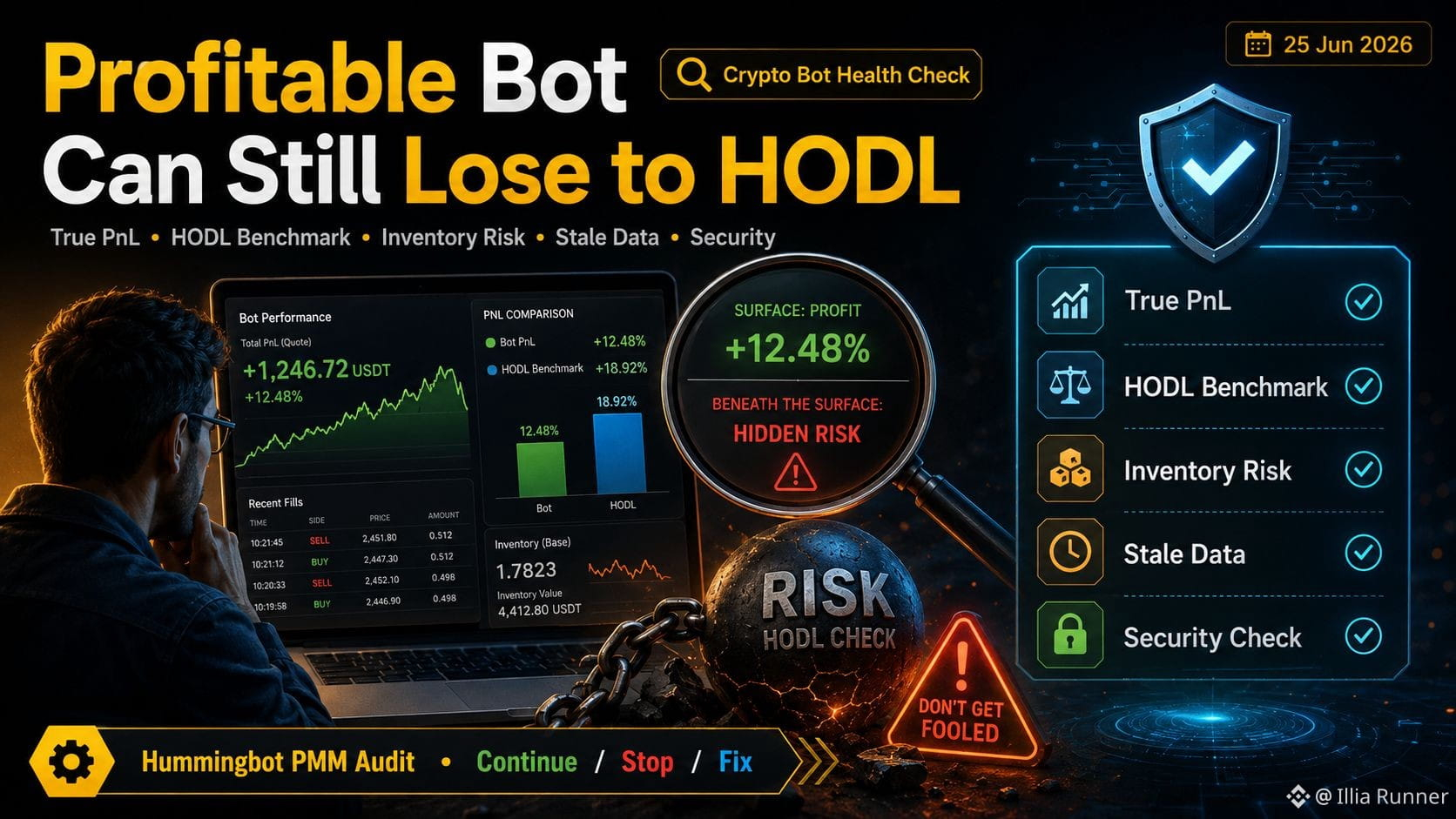
🚨 Profitable Bot ≠ Good Strategy
Here’s the uncomfortable truth 👇
A trading bot can show green PnL and still be worse than simple HODL.
Most people check:
✅ realized PnL
✅ closed trades
✅ nice dashboard curve
But that’s not enough.
A market making bot can look profitable while hiding:
⚠️ inventory risk
⚠️ unrealized losses
⚠️ stale data
⚠️ wrong benchmark
⚠️ exposed API / dashboard risk
That’s why I don’t trust PnL alone.
For any crypto bot, I want to check 5 things:
🔍 True PnL
⚖️ HODL benchmark
📦 Inventory risk
⏱️ Data freshness
🔐 Security check
The key question is simple:
👉 Is this bot really better than just holding $BTC / $ETH / $SOL ?
Or is it only a more complicated way to take risk?
No signals.
No leverage hype.
No “guaranteed passive income”.
Just a reality check for trading bots.
🧠 Honest question:
If you run a bot, what do you check first?
A) Realized PnL
B) HODL benchmark
C) Inventory risk
D) Security / API exposure
E) I just trust the dashboard 😅
Drop one letter + one sentence why.
Not financial advice. Educational only. Never share API keys.
#Hummingbot #TradingBots #CryptoBots #MarketMaking
🚨 Profitable Bot ≠ Good Strategy
Here’s the uncomfortable truth 👇
A trading bot can show green PnL and still be worse than simple HODL.
Most people check:
✅ realized PnL
✅ closed trades
✅ nice dashboard curve
But that’s not enough.
A market making bot can look profitable while hiding:
⚠️ inventory risk
⚠️ unrealized losses
⚠️ stale data
⚠️ wrong benchmark
⚠️ exposed API / dashboard risk
That’s why I don’t trust PnL alone.
For any crypto bot, I want to check 5 things:
🔍 True PnL
⚖️ HODL benchmark
📦 Inventory risk
⏱️ Data freshness
🔐 Security check
The key question is simple:
👉 Is this bot really better than just holding $BTC / $ETH / $SOL ?
Or is it only a more complicated way to take risk?
No signals.
No leverage hype.
No “guaranteed passive income”.
Just a reality check for trading bots.
🧠 Honest question:
If you run a bot, what do you check first?
A) Realized PnL
B) HODL benchmark
C) Inventory risk
D) Security / API exposure
E) I just trust the dashboard 😅
Drop one letter + one sentence why.
Not financial advice. Educational only. Never share API keys.
#Hummingbot #TradingBots #CryptoBots #MarketMaking
Here’s the uncomfortable truth 👇
A trading bot can show green PnL and still be worse than simple HODL.
Most people check:
✅ realized PnL
✅ closed trades
✅ nice dashboard curve
But that’s not enough.
A market making bot can look profitable while hiding:
⚠️ inventory risk
⚠️ unrealized losses
⚠️ stale data
⚠️ wrong benchmark
⚠️ exposed API / dashboard risk
That’s why I don’t trust PnL alone.
For any crypto bot, I want to check 5 things:
🔍 True PnL
⚖️ HODL benchmark
📦 Inventory risk
⏱️ Data freshness
🔐 Security check
The key question is simple:
👉 Is this bot really better than just holding $BTC / $ETH / $SOL ?
Or is it only a more complicated way to take risk?
No signals.
No leverage hype.
No “guaranteed passive income”.
Just a reality check for trading bots.
🧠 Honest question:
If you run a bot, what do you check first?
A) Realized PnL
B) HODL benchmark
C) Inventory risk
D) Security / API exposure
E) I just trust the dashboard 😅
Drop one letter + one sentence why.
Not financial advice. Educational only. Never share API keys.
#Hummingbot #TradingBots #CryptoBots #MarketMaking
147
Article
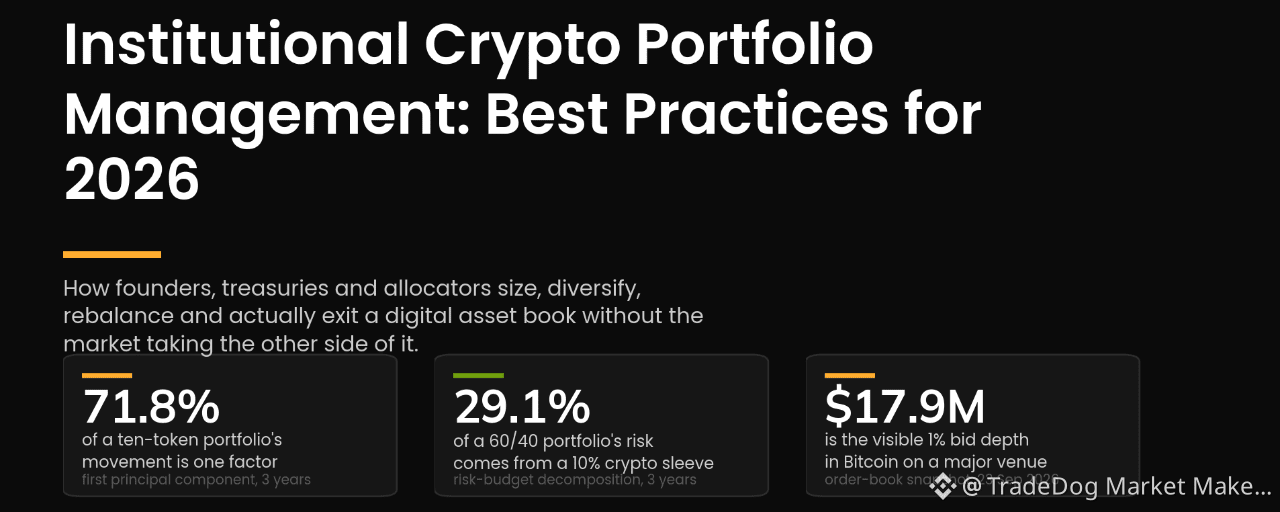
Institutional Crypto Portfolio Management: Best Practices for 2026Your 10-token crypto portfolio is one position. Here is the data.
Takeaways first:
One factor explains 82.0% of the movement of ten large tokens over the past year.A 5% Bitcoin sleeve contributes 12.4% of a 60/40 portfolio’s risk. A 10% sleeve contributes 29.1%.A $50m position in Avalanche is 80.8x the entire visible 1% bid depth on a major venue.Every rebalancing rule tested beat buy and hold over three and five years. Annual won at the lowest turnover.73% of 351 institutions surveyed plan to add in 2026, and 49% have tightened risk management and position sizing.
The diversification you think you bought
TDMM measured daily closes for ten large assets on Coinbase Exchange over the year to 23 September 2026. Correlation with Bitcoin: $ETH 0.905, Solana 0.867, $XRP 0.866, Chainlink 0.840, Cardano 0.812. Even Polkadot, the loosest of the ten, was 0.636.
Run a principal component analysis and the first component explains 82.0% of the common variation. An equal-weight ten-token basket ran at 66.6% annualised volatility over three years against 47.3% for Bitcoin alone, for a diversification ratio of 1.18. You paid nineteen points of volatility for an 18% benefit.
Nine extra tokens, one bet: 82% of the movement is a single factor
And it fails when you need it. Fitted separately on up days and down days over three years, Chainlink’s beta to Bitcoin was 0.88 up and 1.37 down. XRP was 0.89 up and 1.24 down. On the 55 worst Bitcoin days, Bitcoin fell 5.22% on average and altcoins fell between 6.01% and 7.65%.
Size by risk, not by weight
Carve a Bitcoin sleeve out of a 60/40 portfolio and measure what share of portfolio risk it contributes, over three years to 23 September 2026:
1% sleeve, 1.8% of risk2% sleeve, 4.0% of risk5% sleeve, 12.4% of risk10% sleeve, 29.1% of risk
A 5% crypto sleeve is 12% of your risk. A 10% sleeve is 29%.
BlackRock reached the same shape in December 2024. That is about as close to a stable rule as this asset class offers.
The number nobody checks before buying
Order book snapshot, Coinbase Exchange, 23 September 2026 at 06:53 UTC. Value of resting buy orders within 1% of mid:
$BTC $17.88m. ETH $5.46m. SOL $3.90m. XRP $3.05m. LINK $0.79m. ADA $0.73m. AVAX $0.62m. DOT $0.33m.
How big is too big? Measure the position against the book, not the market cap.
A $50m position is 2.8x Bitcoin’s visible depth and 80.8x Avalanche’s. Cardano’s market cap was $9.7bn that day; its visible 1% bid depth was under $750,000.
One venue, one instant, and Coinbase was 1.75% of global BTC volume, so the all-venue number is a multiple. The ranking is what matters. On 10 October 2025 about $19bn of leveraged positions were liquidated in a day and open interest fell 43%. Depth is not a constant.
Working rule: participation cap of 5% to 10% of daily volume, maximum exit horizon of about twenty trading days for a satellite, multiply the two for your position limit.
Rebalancing
A 50/30/20 BTC/ETH/SOL sleeve to 23 September 2026. Over three years: buy and hold 50.4% a year at a 0.77 Sharpe; annual rebalancing 54.7% at 0.91 with 13.2% turnover; a 10% drift band 51.9% at 0.86 with 47.6% turnover. Over five years: buy and hold 7.9% at 0.06, annual 16.2% at 0.20.
Every rebalanced version beat buy and hold. The discipline pays, the frequency mostly costs.
Where it sits
More than $3.4bn was stolen between January and early December 2025, including $713m from personal wallets across about 158,000 incidents. Core with a qualified custodian. Reserves in tested multi-sig. Exchange balances as working float only, capped and swept daily. Two stablecoin issuers minimum, because one of them printed $0.65 on a single venue during the October 2025 dislocation.
Where TDMM fits
TDMM is a market maker, not an asset manager. We supply the operating layer a portfolio decision runs on: live depth and spread across 100+ venue integrations, two-sided quoting that keeps a market tradable while a book is rebalanced, cross-venue execution on one reference price, and block liquidity for the size visible depth cannot absorb. Active since 2015, $10bn+ traded, 200+ markets, 24/7 across five continents. Tradability, transparency, full lifecycle. No promises on price or volume.
Full analysis with all 19 charts is on the tdmm.io/insights/blog/
Disclaimer: Information and education only, not investment, financial, legal or tax advice. TDMM is a market maker and liquidity provider, not a registered investment adviser. Digital assets are highly volatile and can lose all value. Data captured 23 September 2026; depth measured on one venue at one instant. Backtests are hypothetical, charge no costs and do not represent actual trading. Past performance is not a reliable indicator of future results. Do your own research.
#CryptoPortfolio #InstitutionalCrypto #RiskManagement #MarketMaking #TDMM
Institutional Crypto Portfolio Management: Best Practices for 2026
Your 10-token crypto portfolio is one position. Here is the data.
Takeaways first:
One factor explains 82.0% of the movement of ten large tokens over the past year.A 5% Bitcoin sleeve contributes 12.4% of a 60/40 portfolio’s risk. A 10% sleeve contributes 29.1%.A $50m position in Avalanche is 80.8x the entire visible 1% bid depth on a major venue.Every rebalancing rule tested beat buy and hold over three and five years. Annual won at the lowest turnover.73% of 351 institutions surveyed plan to add in 2026, and 49% have tightened risk management and position sizing.
The diversification you think you bought
TDMM measured daily closes for ten large assets on Coinbase Exchange over the year to 23 September 2026. Correlation with Bitcoin: $ETH 0.905, Solana 0.867, $XRP 0.866, Chainlink 0.840, Cardano 0.812. Even Polkadot, the loosest of the ten, was 0.636.
Run a principal component analysis and the first component explains 82.0% of the common variation. An equal-weight ten-token basket ran at 66.6% annualised volatility over three years against 47.3% for Bitcoin alone, for a diversification ratio of 1.18. You paid nineteen points of volatility for an 18% benefit.
Nine extra tokens, one bet: 82% of the movement is a single factor
And it fails when you need it. Fitted separately on up days and down days over three years, Chainlink’s beta to Bitcoin was 0.88 up and 1.37 down. XRP was 0.89 up and 1.24 down. On the 55 worst Bitcoin days, Bitcoin fell 5.22% on average and altcoins fell between 6.01% and 7.65%.
Size by risk, not by weight
Carve a Bitcoin sleeve out of a 60/40 portfolio and measure what share of portfolio risk it contributes, over three years to 23 September 2026:
1% sleeve, 1.8% of risk2% sleeve, 4.0% of risk5% sleeve, 12.4% of risk10% sleeve, 29.1% of risk
A 5% crypto sleeve is 12% of your risk. A 10% sleeve is 29%.
BlackRock reached the same shape in December 2024. That is about as close to a stable rule as this asset class offers.
The number nobody checks before buying
Order book snapshot, Coinbase Exchange, 23 September 2026 at 06:53 UTC. Value of resting buy orders within 1% of mid:
$BTC $17.88m. ETH $5.46m. SOL $3.90m. XRP $3.05m. LINK $0.79m. ADA $0.73m. AVAX $0.62m. DOT $0.33m.
How big is too big? Measure the position against the book, not the market cap.
A $50m position is 2.8x Bitcoin’s visible depth and 80.8x Avalanche’s. Cardano’s market cap was $9.7bn that day; its visible 1% bid depth was under $750,000.
One venue, one instant, and Coinbase was 1.75% of global BTC volume, so the all-venue number is a multiple. The ranking is what matters. On 10 October 2025 about $19bn of leveraged positions were liquidated in a day and open interest fell 43%. Depth is not a constant.
Working rule: participation cap of 5% to 10% of daily volume, maximum exit horizon of about twenty trading days for a satellite, multiply the two for your position limit.
Rebalancing
A 50/30/20 BTC/ETH/SOL sleeve to 23 September 2026. Over three years: buy and hold 50.4% a year at a 0.77 Sharpe; annual rebalancing 54.7% at 0.91 with 13.2% turnover; a 10% drift band 51.9% at 0.86 with 47.6% turnover. Over five years: buy and hold 7.9% at 0.06, annual 16.2% at 0.20.
Every rebalanced version beat buy and hold. The discipline pays, the frequency mostly costs.
Where it sits
More than $3.4bn was stolen between January and early December 2025, including $713m from personal wallets across about 158,000 incidents. Core with a qualified custodian. Reserves in tested multi-sig. Exchange balances as working float only, capped and swept daily. Two stablecoin issuers minimum, because one of them printed $0.65 on a single venue during the October 2025 dislocation.
Where TDMM fits
TDMM is a market maker, not an asset manager. We supply the operating layer a portfolio decision runs on: live depth and spread across 100+ venue integrations, two-sided quoting that keeps a market tradable while a book is rebalanced, cross-venue execution on one reference price, and block liquidity for the size visible depth cannot absorb. Active since 2015, $10bn+ traded, 200+ markets, 24/7 across five continents. Tradability, transparency, full lifecycle. No promises on price or volume.
Full analysis with all 19 charts is on the tdmm.io/insights/blog/
Disclaimer: Information and education only, not investment, financial, legal or tax advice. TDMM is a market maker and liquidity provider, not a registered investment adviser. Digital assets are highly volatile and can lose all value. Data captured 23 September 2026; depth measured on one venue at one instant. Backtests are hypothetical, charge no costs and do not represent actual trading. Past performance is not a reliable indicator of future results. Do your own research.
#CryptoPortfolio #InstitutionalCrypto #RiskManagement #MarketMaking #TDMM
Takeaways first:
One factor explains 82.0% of the movement of ten large tokens over the past year.A 5% Bitcoin sleeve contributes 12.4% of a 60/40 portfolio’s risk. A 10% sleeve contributes 29.1%.A $50m position in Avalanche is 80.8x the entire visible 1% bid depth on a major venue.Every rebalancing rule tested beat buy and hold over three and five years. Annual won at the lowest turnover.73% of 351 institutions surveyed plan to add in 2026, and 49% have tightened risk management and position sizing.
The diversification you think you bought
TDMM measured daily closes for ten large assets on Coinbase Exchange over the year to 23 September 2026. Correlation with Bitcoin: $ETH 0.905, Solana 0.867, $XRP 0.866, Chainlink 0.840, Cardano 0.812. Even Polkadot, the loosest of the ten, was 0.636.
Run a principal component analysis and the first component explains 82.0% of the common variation. An equal-weight ten-token basket ran at 66.6% annualised volatility over three years against 47.3% for Bitcoin alone, for a diversification ratio of 1.18. You paid nineteen points of volatility for an 18% benefit.
Nine extra tokens, one bet: 82% of the movement is a single factor
And it fails when you need it. Fitted separately on up days and down days over three years, Chainlink’s beta to Bitcoin was 0.88 up and 1.37 down. XRP was 0.89 up and 1.24 down. On the 55 worst Bitcoin days, Bitcoin fell 5.22% on average and altcoins fell between 6.01% and 7.65%.
Size by risk, not by weight
Carve a Bitcoin sleeve out of a 60/40 portfolio and measure what share of portfolio risk it contributes, over three years to 23 September 2026:
1% sleeve, 1.8% of risk2% sleeve, 4.0% of risk5% sleeve, 12.4% of risk10% sleeve, 29.1% of risk
A 5% crypto sleeve is 12% of your risk. A 10% sleeve is 29%.
BlackRock reached the same shape in December 2024. That is about as close to a stable rule as this asset class offers.
The number nobody checks before buying
Order book snapshot, Coinbase Exchange, 23 September 2026 at 06:53 UTC. Value of resting buy orders within 1% of mid:
$BTC $17.88m. ETH $5.46m. SOL $3.90m. XRP $3.05m. LINK $0.79m. ADA $0.73m. AVAX $0.62m. DOT $0.33m.
How big is too big? Measure the position against the book, not the market cap.
A $50m position is 2.8x Bitcoin’s visible depth and 80.8x Avalanche’s. Cardano’s market cap was $9.7bn that day; its visible 1% bid depth was under $750,000.
One venue, one instant, and Coinbase was 1.75% of global BTC volume, so the all-venue number is a multiple. The ranking is what matters. On 10 October 2025 about $19bn of leveraged positions were liquidated in a day and open interest fell 43%. Depth is not a constant.
Working rule: participation cap of 5% to 10% of daily volume, maximum exit horizon of about twenty trading days for a satellite, multiply the two for your position limit.
Rebalancing
A 50/30/20 BTC/ETH/SOL sleeve to 23 September 2026. Over three years: buy and hold 50.4% a year at a 0.77 Sharpe; annual rebalancing 54.7% at 0.91 with 13.2% turnover; a 10% drift band 51.9% at 0.86 with 47.6% turnover. Over five years: buy and hold 7.9% at 0.06, annual 16.2% at 0.20.
Every rebalanced version beat buy and hold. The discipline pays, the frequency mostly costs.
Where it sits
More than $3.4bn was stolen between January and early December 2025, including $713m from personal wallets across about 158,000 incidents. Core with a qualified custodian. Reserves in tested multi-sig. Exchange balances as working float only, capped and swept daily. Two stablecoin issuers minimum, because one of them printed $0.65 on a single venue during the October 2025 dislocation.
Where TDMM fits
TDMM is a market maker, not an asset manager. We supply the operating layer a portfolio decision runs on: live depth and spread across 100+ venue integrations, two-sided quoting that keeps a market tradable while a book is rebalanced, cross-venue execution on one reference price, and block liquidity for the size visible depth cannot absorb. Active since 2015, $10bn+ traded, 200+ markets, 24/7 across five continents. Tradability, transparency, full lifecycle. No promises on price or volume.
Full analysis with all 19 charts is on the tdmm.io/insights/blog/
Disclaimer: Information and education only, not investment, financial, legal or tax advice. TDMM is a market maker and liquidity provider, not a registered investment adviser. Digital assets are highly volatile and can lose all value. Data captured 23 September 2026; depth measured on one venue at one instant. Backtests are hypothetical, charge no costs and do not represent actual trading. Past performance is not a reliable indicator of future results. Do your own research.
#CryptoPortfolio #InstitutionalCrypto #RiskManagement #MarketMaking #TDMM
4
742
Log in to explore more content
Join global crypto users on Binance Square
⚡️ Get latest and useful information about crypto.
💬 Trusted by the world’s largest crypto exchange.
👍 Discover real insights from verified creators.
Email / Phone number
Trending Topics
1
#BinanceWillListHyperliquid(HYPE)
53,544 views
1,432 Discussing
2
#FedOctoberRateHikeOddsRiseTo69.7%
6,731 views
448 Discussing
3
#BitcoinFallsBelow$83,000
1,993 views
20 Discussing
4
#BitcoinFallsToAround$84,600ThisWeek
0 views
0 Discussing
5
#US30YearYieldHighestSince2004
12,439 views
411 Discussing
6
#ETHBreaksAbove$2,700
1,030 views
20 Discussing
7
#USWeighsPromotingDollarStablecoinsAbroad
41,300 views
1,299 Discussing
8
#US10YTreasuryYieldHits19YearHigh
40,031 views
1,007 Discussing
9
#SpotBitcoinETFsInflow$2.31BInFourDays
5,206 views
61 Discussing
10
#BitcoinRejectedAt$87,300Twice
0 views
0 Discussing