
#cryptoexchanges
cryptoexchanges
35,584 views
154 Discussing
Hot
Latest

·
--
Liquid Mercury has announced that ACQUA1, LLC completed the initial closing of its MERC exchange offering on September 1.
It’s an early-stage infrastructure story, but one worth watching. Exchange-focused capital raises can signal where market participants see demand building—not only in tokens, but in the trading venues and technology that support digital-asset markets.
The announcement does not yet spell out the scale of the closing, valuation, or what comes next for the MERC exchange offering. Those details will matter far more than the headline itself.
For now, the key question is whether this initial close leads to a broader rollout, additional financing, or clearer information on how the exchange plans to compete in an increasingly regulated and crowded market.
Will MERC’s next update provide the substance this initial announcement leaves unanswered?
#CryptoNews #CryptoExchanges #Blockchain
Liquid Mercury has announced that ACQUA1, LLC completed the initial closing of its MERC exchange offering on September 1.
It’s an early-stage infrastructure story, but one worth watching. Exchange-focused capital raises can signal where market participants see demand building—not only in tokens, but in the trading venues and technology that support digital-asset markets.
The announcement does not yet spell out the scale of the closing, valuation, or what comes next for the MERC exchange offering. Those details will matter far more than the headline itself.
For now, the key question is whether this initial close leads to a broader rollout, additional financing, or clearer information on how the exchange plans to compete in an increasingly regulated and crowded market.
Will MERC’s next update provide the substance this initial announcement leaves unanswered?
#CryptoNews #CryptoExchanges #Blockchain
It’s an early-stage infrastructure story, but one worth watching. Exchange-focused capital raises can signal where market participants see demand building—not only in tokens, but in the trading venues and technology that support digital-asset markets.
The announcement does not yet spell out the scale of the closing, valuation, or what comes next for the MERC exchange offering. Those details will matter far more than the headline itself.
For now, the key question is whether this initial close leads to a broader rollout, additional financing, or clearer information on how the exchange plans to compete in an increasingly regulated and crowded market.
Will MERC’s next update provide the substance this initial announcement leaves unanswered?
#CryptoNews #CryptoExchanges #Blockchain
28

·
--
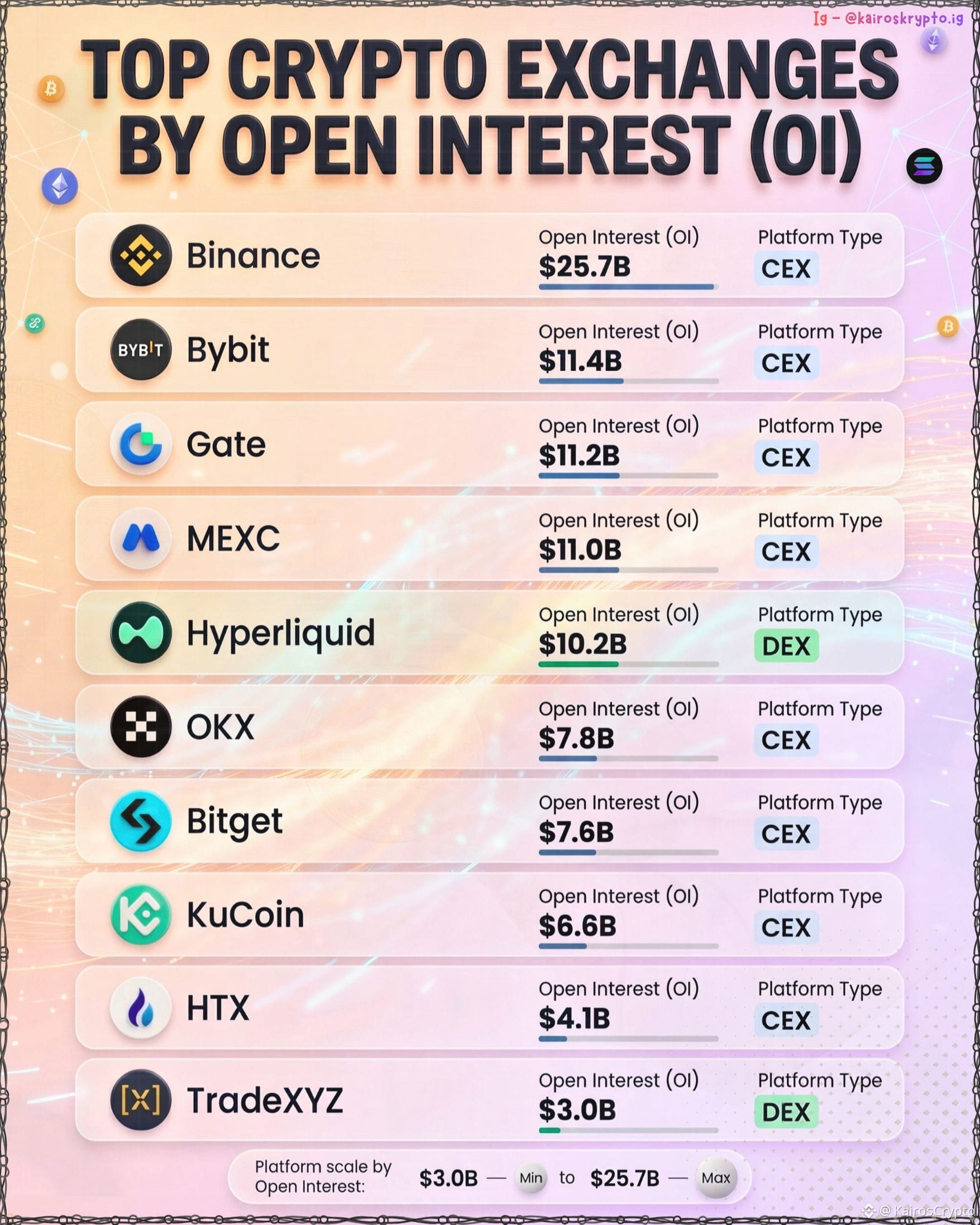
📊 Binance currently leads the top crypto exchanges with a massive Open Interest of $25.7 billion.
📈 Decentralized platforms like Hyperliquid are also securing significant market📊 share alongside traditional centralized giants.
🏦 This specific data highlights the deep liquidity present across the entire trading ecosystem today.
#CryptoExchanges #Openinterest #CryptoDerivatives #BinanceExchange #Hyperliquid
📊 Binance currently leads the top crypto exchanges with a massive Open Interest of $25.7 billion.
📈 Decentralized platforms like Hyperliquid are also securing significant market📊 share alongside traditional centralized giants.
🏦 This specific data highlights the deep liquidity present across the entire trading ecosystem today.
#CryptoExchanges #Openinterest #CryptoDerivatives #BinanceExchange #Hyperliquid
📈 Decentralized platforms like Hyperliquid are also securing significant market📊 share alongside traditional centralized giants.
🏦 This specific data highlights the deep liquidity present across the entire trading ecosystem today.
#CryptoExchanges #Openinterest #CryptoDerivatives #BinanceExchange #Hyperliquid
1
42

·
--
GAMECHANGER
ChangeNOW's trading engine, backed by cutting-edge tech and infrastructure, has been quietly OBILITERATING the competition in seamless swaps, attracting over $800M in 2026 alone #cryptoexchanges #tradingengine #innovation
The proof is in the pudding as ChangeNOW CSO Pauline Shangett reveals the intricacies of their backend, setting a new standard for speed and ease of use #decentralizedfinance #exchangefeatures
The stakes are high, folks, as this historic infrastructure shift ushers in a new era of cryptocurrency trading where speed and simplicity will be the ultimate competitive advantage, leaving traditional exchanges in the dust.
What are you waiting for? Is your money lagging behind in the slow lane? Invest in the future of trading now and join the revolution!
GAMECHANGER
ChangeNOW's trading engine, backed by cutting-edge tech and infrastructure, has been quietly OBILITERATING the competition in seamless swaps, attracting over $800M in 2026 alone #cryptoexchanges #tradingengine #innovation
The proof is in the pudding as ChangeNOW CSO Pauline Shangett reveals the intricacies of their backend, setting a new standard for speed and ease of use #decentralizedfinance #exchangefeatures
The stakes are high, folks, as this historic infrastructure shift ushers in a new era of cryptocurrency trading where speed and simplicity will be the ultimate competitive advantage, leaving traditional exchanges in the dust.
What are you waiting for? Is your money lagging behind in the slow lane? Invest in the future of trading now and join the revolution!
ChangeNOW's trading engine, backed by cutting-edge tech and infrastructure, has been quietly OBILITERATING the competition in seamless swaps, attracting over $800M in 2026 alone #cryptoexchanges #tradingengine #innovation
The proof is in the pudding as ChangeNOW CSO Pauline Shangett reveals the intricacies of their backend, setting a new standard for speed and ease of use #decentralizedfinance #exchangefeatures
The stakes are high, folks, as this historic infrastructure shift ushers in a new era of cryptocurrency trading where speed and simplicity will be the ultimate competitive advantage, leaving traditional exchanges in the dust.
What are you waiting for? Is your money lagging behind in the slow lane? Invest in the future of trading now and join the revolution!
12


·
--
📊 TradFi Futures Boom on Crypto Exchanges While Spot Trading Cools 🥶
CryptoQuant Weekly Report | Jun 7, 2026Crypto exchanges are flipping from crypto-only to “everything exchanges”. TradFi perpetual futures are surging even as Bitcoin demand stays weak 📉
⚡ Key Highlights 🔥
▶️ TradFi Futures Surge
Gold, silver + oil perpetuals exploding on crypto exchanges 🌍 Drivers: US-Iran tensions + inflation fears = demand for macro assets ⛽🥇
▶️ Gate + Binance Lead Gate $368B, Binance $298B in TradFi futures volume this year. Together = ∼2/3 of total market 🏦 Gate now top for tokenized stocks, metals + 24/7 derivatives
▶️ “Crypto Exchanges = Macro Hubs” 24/7 access to commodities + equities is pulling traders from traditional brokers. Analysts: “Traders want round-the-clock exposure as gold hits records + oil spikes” 📈
📉 Spot Market Slows Down 🐢
▶️ Volume Drop Spot trading fell to $679B in April 2026 - lowest since Oct 2023. Bear market = less retail action 🧊
▶️ Perpetuals Down Too Leverage appetite shrinking across BTC/ETH futures 📉
▶️ Top Spot Exchanges 2026 Binance, Bybit, Gate, Crypto.com lead cumulative volume
▶️ Liquidity Concentrated BTC spot depth: Binance + Gate dominate. Perps liquidity: Gate, Hyperliquid, Binance, OKX, Bitget 👑
🏦 Institutional Signal 👀
▶️ Big Money on Gate Average BTC spot trade = $4,000, peaked at $6,200 last year. Perps avg = $8,900 and growing. Gate = #1 for institutional BTC flows
▶️ BTC Trade Sizes Large trades signal whales are still active despite weak demand 🐋
Bottom Line 🎯
Crypto exchanges are becoming “macro exchanges”. TradFi assets via futures = new growth engine while spot trading hibernates. Convergence of TradFi + crypto is real, not just hype 🔗
#CryptoExchanges #Binance #GoldSilverOil #MacroTrading
$BNB $XRP $SOL
{future}(SOLUSDT)
{future}(XRPUSDT)
{future}(BNBUSDT)
📊 TradFi Futures Boom on Crypto Exchanges While Spot Trading Cools 🥶
CryptoQuant Weekly Report | Jun 7, 2026Crypto exchanges are flipping from crypto-only to “everything exchanges”. TradFi perpetual futures are surging even as Bitcoin demand stays weak 📉
⚡ Key Highlights 🔥
▶️ TradFi Futures Surge
Gold, silver + oil perpetuals exploding on crypto exchanges 🌍 Drivers: US-Iran tensions + inflation fears = demand for macro assets ⛽🥇
▶️ Gate + Binance Lead Gate $368B, Binance $298B in TradFi futures volume this year. Together = ∼2/3 of total market 🏦 Gate now top for tokenized stocks, metals + 24/7 derivatives
▶️ “Crypto Exchanges = Macro Hubs” 24/7 access to commodities + equities is pulling traders from traditional brokers. Analysts: “Traders want round-the-clock exposure as gold hits records + oil spikes” 📈
📉 Spot Market Slows Down 🐢
▶️ Volume Drop Spot trading fell to $679B in April 2026 - lowest since Oct 2023. Bear market = less retail action 🧊
▶️ Perpetuals Down Too Leverage appetite shrinking across BTC/ETH futures 📉
▶️ Top Spot Exchanges 2026 Binance, Bybit, Gate, Crypto.com lead cumulative volume
▶️ Liquidity Concentrated BTC spot depth: Binance + Gate dominate. Perps liquidity: Gate, Hyperliquid, Binance, OKX, Bitget 👑
🏦 Institutional Signal 👀
▶️ Big Money on Gate Average BTC spot trade = $4,000, peaked at $6,200 last year. Perps avg = $8,900 and growing. Gate = #1 for institutional BTC flows
▶️ BTC Trade Sizes Large trades signal whales are still active despite weak demand 🐋
Bottom Line 🎯
Crypto exchanges are becoming “macro exchanges”. TradFi assets via futures = new growth engine while spot trading hibernates. Convergence of TradFi + crypto is real, not just hype 🔗
#CryptoExchanges #Binance #GoldSilverOil #MacroTrading
$BNB $XRP $SOL
CryptoQuant Weekly Report | Jun 7, 2026Crypto exchanges are flipping from crypto-only to “everything exchanges”. TradFi perpetual futures are surging even as Bitcoin demand stays weak 📉
⚡ Key Highlights 🔥
▶️ TradFi Futures Surge
Gold, silver + oil perpetuals exploding on crypto exchanges 🌍 Drivers: US-Iran tensions + inflation fears = demand for macro assets ⛽🥇
▶️ Gate + Binance Lead Gate $368B, Binance $298B in TradFi futures volume this year. Together = ∼2/3 of total market 🏦 Gate now top for tokenized stocks, metals + 24/7 derivatives
▶️ “Crypto Exchanges = Macro Hubs” 24/7 access to commodities + equities is pulling traders from traditional brokers. Analysts: “Traders want round-the-clock exposure as gold hits records + oil spikes” 📈
📉 Spot Market Slows Down 🐢
▶️ Volume Drop Spot trading fell to $679B in April 2026 - lowest since Oct 2023. Bear market = less retail action 🧊
▶️ Perpetuals Down Too Leverage appetite shrinking across BTC/ETH futures 📉
▶️ Top Spot Exchanges 2026 Binance, Bybit, Gate, Crypto.com lead cumulative volume
▶️ Liquidity Concentrated BTC spot depth: Binance + Gate dominate. Perps liquidity: Gate, Hyperliquid, Binance, OKX, Bitget 👑
🏦 Institutional Signal 👀
▶️ Big Money on Gate Average BTC spot trade = $4,000, peaked at $6,200 last year. Perps avg = $8,900 and growing. Gate = #1 for institutional BTC flows
▶️ BTC Trade Sizes Large trades signal whales are still active despite weak demand 🐋
Bottom Line 🎯
Crypto exchanges are becoming “macro exchanges”. TradFi assets via futures = new growth engine while spot trading hibernates. Convergence of TradFi + crypto is real, not just hype 🔗
#CryptoExchanges #Binance #GoldSilverOil #MacroTrading
$BNB $XRP $SOL

9
429

📚 How Exchanges Make Money: Understanding Trading Fees, Listings, and Revenue Models
On July 12, 2026, with total market volume of $48.24B, crypto exchanges generate significant revenue. Understanding how they make money helps users make informed platform choices.
Exchanges primarily earn through trading fees — typically 0.1% per trade. They also charge listing fees for new tokens, margin trading interest, and withdrawal fees. Some earn yield on customer deposits.
Binance, with BNB at $573.34 and the BSC ecosystem, exemplifies a vertically integrated model combining exchange revenue with blockchain services.
📌 Key Takeaway:
Crypto exchanges make money through fees, listings, and ecosystem services — understanding their model helps users choose the right platform.
#CryptoExchanges #TradingFees #Binance #CryptoEducation
#BinanceAlphaAlert
📚 How Exchanges Make Money: Understanding Trading Fees, Listings, and Revenue Models
On July 12, 2026, with total market volume of $48.24B, crypto exchanges generate significant revenue. Understanding how they make money helps users make informed platform choices.
Exchanges primarily earn through trading fees — typically 0.1% per trade. They also charge listing fees for new tokens, margin trading interest, and withdrawal fees. Some earn yield on customer deposits.
Binance, with BNB at $573.34 and the BSC ecosystem, exemplifies a vertically integrated model combining exchange revenue with blockchain services.
📌 Key Takeaway:
Crypto exchanges make money through fees, listings, and ecosystem services — understanding their model helps users choose the right platform.
#CryptoExchanges #TradingFees #Binance #CryptoEducation
#BinanceAlphaAlert
On July 12, 2026, with total market volume of $48.24B, crypto exchanges generate significant revenue. Understanding how they make money helps users make informed platform choices.
Exchanges primarily earn through trading fees — typically 0.1% per trade. They also charge listing fees for new tokens, margin trading interest, and withdrawal fees. Some earn yield on customer deposits.
Binance, with BNB at $573.34 and the BSC ecosystem, exemplifies a vertically integrated model combining exchange revenue with blockchain services.
📌 Key Takeaway:
Crypto exchanges make money through fees, listings, and ecosystem services — understanding their model helps users choose the right platform.
#CryptoExchanges #TradingFees #Binance #CryptoEducation
#BinanceAlphaAlert
21
📜 Compliance Corner: Australian Exchanges Gear Up for Travel Rule
On June 30, 2026, Australian crypto exchanges are implementing systems to comply with the Travel Rule taking effect July 1. The rule requires collecting beneficiary information for transfers, a significant operational change for platforms accustomed to pseudonymous transactions.
The cost of compliance will likely accelerate consolidation among smaller exchanges that lack resources. Larger, compliant platforms will benefit from the 'flight to quality' as users migrate to regulated venues.
📌 Key Takeaway:
Australia's Travel Rule will accelerate exchange consolidation, benefiting compliant platforms while raising the barrier to entry for smaller players.
#Australia #TravelRule #CryptoExchanges
#BinanceAlphaAlert
📜 Compliance Corner: Australian Exchanges Gear Up for Travel Rule
On June 30, 2026, Australian crypto exchanges are implementing systems to comply with the Travel Rule taking effect July 1. The rule requires collecting beneficiary information for transfers, a significant operational change for platforms accustomed to pseudonymous transactions.
The cost of compliance will likely accelerate consolidation among smaller exchanges that lack resources. Larger, compliant platforms will benefit from the 'flight to quality' as users migrate to regulated venues.
📌 Key Takeaway:
Australia's Travel Rule will accelerate exchange consolidation, benefiting compliant platforms while raising the barrier to entry for smaller players.
#Australia #TravelRule #CryptoExchanges
#BinanceAlphaAlert
On June 30, 2026, Australian crypto exchanges are implementing systems to comply with the Travel Rule taking effect July 1. The rule requires collecting beneficiary information for transfers, a significant operational change for platforms accustomed to pseudonymous transactions.
The cost of compliance will likely accelerate consolidation among smaller exchanges that lack resources. Larger, compliant platforms will benefit from the 'flight to quality' as users migrate to regulated venues.
📌 Key Takeaway:
Australia's Travel Rule will accelerate exchange consolidation, benefiting compliant platforms while raising the barrier to entry for smaller players.
#Australia #TravelRule #CryptoExchanges
#BinanceAlphaAlert
20
·
--
The latest crypto storm is brewing with another major exchange shutting its doors. Did you know that the number of active cryptocurrency exchanges is dwindling at an alarming rate? The recent closure of BitMart, following in the footsteps of BitMEX, raises a crucial question: what does this mean for the crypto landscape?
BitMart's closure comes as a result of the tough market environment, which I call the "crypto winter." This is a harsh reminder that even the largest and most established exchanges can't withstand the pressure.
Let's break down what happened to BitMart. Essentially, the exchange couldn't compete with newer, more competitive platforms, and made the difficult decision to shut down. This serves as a stark reminder of the crypto industry's high stakes and rapidly changing landscape.
If you're a crypto trader, you need to reassess your strategy and adapt to these changes. Here's what you can do:
Start researching newer, more competitive exchanges and trading platforms. Don't get left behind! #CryptoExchanges #TradingStrategies
What do you think is the next trend in the crypto market?
The latest crypto storm is brewing with another major exchange shutting its doors. Did you know that the number of active cryptocurrency exchanges is dwindling at an alarming rate? The recent closure of BitMart, following in the footsteps of BitMEX, raises a crucial question: what does this mean for the crypto landscape?
BitMart's closure comes as a result of the tough market environment, which I call the "crypto winter." This is a harsh reminder that even the largest and most established exchanges can't withstand the pressure.
Let's break down what happened to BitMart. Essentially, the exchange couldn't compete with newer, more competitive platforms, and made the difficult decision to shut down. This serves as a stark reminder of the crypto industry's high stakes and rapidly changing landscape.
If you're a crypto trader, you need to reassess your strategy and adapt to these changes. Here's what you can do:
Start researching newer, more competitive exchanges and trading platforms. Don't get left behind! #CryptoExchanges #TradingStrategies
What do you think is the next trend in the crypto market?
BitMart's closure comes as a result of the tough market environment, which I call the "crypto winter." This is a harsh reminder that even the largest and most established exchanges can't withstand the pressure.
Let's break down what happened to BitMart. Essentially, the exchange couldn't compete with newer, more competitive platforms, and made the difficult decision to shut down. This serves as a stark reminder of the crypto industry's high stakes and rapidly changing landscape.
If you're a crypto trader, you need to reassess your strategy and adapt to these changes. Here's what you can do:
Start researching newer, more competitive exchanges and trading platforms. Don't get left behind! #CryptoExchanges #TradingStrategies
What do you think is the next trend in the crypto market?
2
·
--
1.36M traders will be left reeling as BitMEX dismantles 65 markets, a shocking 30% of its total offerings, as its 11-year run teeters on collapse.
In just four months, BitMEX will be wiped from the crypto landscape forever, raising questions about the fate of its users, a massive 10% of the global crypto-trading ecosystem. This isn't just a platform change, it's a systemic event that has the potential to reshape the very fabric of high-stakes trading on cryptocurrency exchanges.
Smart money is already positioning itself on the winners and casualties of the impending BitMEX exodus #cryptoexchanges. Key metrics such as order book size and volatility are already reflecting the impending market shift, but this is nowhere near the full impact. Market makers are quietly building up liquidity on alternative platforms, anticipating a massive shift in trading volumes.
As the clock ticks down to BitMEX' September 23 shutdown, look for a surge in adoption on decentralized platforms like Binance Square, which has already demonstrated a 25% price premium over traditional exchanges during periods of heightened uncertainty #binancesquare. Will you be ready when the BitMEX exodus hits, or will you be left scrambling to adapt? Get ahead of the game now.
1.36M traders will be left reeling as BitMEX dismantles 65 markets, a shocking 30% of its total offerings, as its 11-year run teeters on collapse.
In just four months, BitMEX will be wiped from the crypto landscape forever, raising questions about the fate of its users, a massive 10% of the global crypto-trading ecosystem. This isn't just a platform change, it's a systemic event that has the potential to reshape the very fabric of high-stakes trading on cryptocurrency exchanges.
Smart money is already positioning itself on the winners and casualties of the impending BitMEX exodus #cryptoexchanges. Key metrics such as order book size and volatility are already reflecting the impending market shift, but this is nowhere near the full impact. Market makers are quietly building up liquidity on alternative platforms, anticipating a massive shift in trading volumes.
As the clock ticks down to BitMEX' September 23 shutdown, look for a surge in adoption on decentralized platforms like Binance Square, which has already demonstrated a 25% price premium over traditional exchanges during periods of heightened uncertainty #binancesquare. Will you be ready when the BitMEX exodus hits, or will you be left scrambling to adapt? Get ahead of the game now.
In just four months, BitMEX will be wiped from the crypto landscape forever, raising questions about the fate of its users, a massive 10% of the global crypto-trading ecosystem. This isn't just a platform change, it's a systemic event that has the potential to reshape the very fabric of high-stakes trading on cryptocurrency exchanges.
Smart money is already positioning itself on the winners and casualties of the impending BitMEX exodus #cryptoexchanges. Key metrics such as order book size and volatility are already reflecting the impending market shift, but this is nowhere near the full impact. Market makers are quietly building up liquidity on alternative platforms, anticipating a massive shift in trading volumes.
As the clock ticks down to BitMEX' September 23 shutdown, look for a surge in adoption on decentralized platforms like Binance Square, which has already demonstrated a 25% price premium over traditional exchanges during periods of heightened uncertainty #binancesquare. Will you be ready when the BitMEX exodus hits, or will you be left scrambling to adapt? Get ahead of the game now.
8
·
--
BitMEX just threw their derivatives party like a Bitcoiner at a fiat-only club.
It appears BitMEX is streamlining their operations by delisting 65 trading pairs #cryptoexchanges, #derivatives. Their July clean-up is a far cry from the six months leading up to that, where 19 pairs were removed #BitMEXshutdown.
The punchline is: don't be surprised if a dying exchange becomes the most efficient one, but don't get too comfortable, either.
Are you ready for the next crypto market cleanup?
BitMEX just threw their derivatives party like a Bitcoiner at a fiat-only club.
It appears BitMEX is streamlining their operations by delisting 65 trading pairs #cryptoexchanges, #derivatives. Their July clean-up is a far cry from the six months leading up to that, where 19 pairs were removed #BitMEXshutdown.
The punchline is: don't be surprised if a dying exchange becomes the most efficient one, but don't get too comfortable, either.
Are you ready for the next crypto market cleanup?
It appears BitMEX is streamlining their operations by delisting 65 trading pairs #cryptoexchanges, #derivatives. Their July clean-up is a far cry from the six months leading up to that, where 19 pairs were removed #BitMEXshutdown.
The punchline is: don't be surprised if a dying exchange becomes the most efficient one, but don't get too comfortable, either.
Are you ready for the next crypto market cleanup?
55


Article
Why User Experience Is Becoming the Most Valuable Asset for Crypto ExchangesWhy User Experience Is Becoming the Most Valuable Asset for Crypto Exchanges
For much of the last decade, cryptocurrency exchanges competed primarily through asset listings, promotional campaigns, and fee reductions. While these factors remain relevant, the market has become significantly more sophisticated. Traders are increasingly choosing platforms based on how efficiently and comfortably they can manage their digital assets on a daily basis.
A modern crypto exchange is no longer just a trading engine—it is a complete financial interface. Registration should be straightforward, deposits and withdrawals should feel seamless, and portfolio management should be accessible across desktop and mobile devices. Even experienced traders appreciate platforms that reduce unnecessary complexity and allow them to focus on market opportunities rather than platform navigation.
This industry-wide shift has pushed exchanges to rethink the relationship between technology and usability. Platforms such as Viterueck.com are part of a growing category of services that emphasize responsive performance, intuitive design, and a streamlined user journey while still supporting the functionality expected by active market participants.
The importance of user experience extends beyond convenience. A well-designed platform can improve trading efficiency, reduce operational errors, and increase user confidence during periods of high market volatility. In a market that operates 24/7, reliability and clarity become essential competitive advantages.
As cryptocurrency adoption continues expanding across Europe, Asia, and emerging digital economies, exchanges that successfully combine security, performance, and usability are likely to build stronger long-term communities. The future winners in the exchange sector may not simply be those with the largest marketing budgets, but those that consistently provide the most trustworthy and efficient experience for their users.
#CryptoExchanges #blockchain #CryptoInnovations #DigitalAssets #Web3
Why User Experience Is Becoming the Most Valuable Asset for Crypto Exchanges
Why User Experience Is Becoming the Most Valuable Asset for Crypto Exchanges
For much of the last decade, cryptocurrency exchanges competed primarily through asset listings, promotional campaigns, and fee reductions. While these factors remain relevant, the market has become significantly more sophisticated. Traders are increasingly choosing platforms based on how efficiently and comfortably they can manage their digital assets on a daily basis.
A modern crypto exchange is no longer just a trading engine—it is a complete financial interface. Registration should be straightforward, deposits and withdrawals should feel seamless, and portfolio management should be accessible across desktop and mobile devices. Even experienced traders appreciate platforms that reduce unnecessary complexity and allow them to focus on market opportunities rather than platform navigation.
This industry-wide shift has pushed exchanges to rethink the relationship between technology and usability. Platforms such as Viterueck.com are part of a growing category of services that emphasize responsive performance, intuitive design, and a streamlined user journey while still supporting the functionality expected by active market participants.
The importance of user experience extends beyond convenience. A well-designed platform can improve trading efficiency, reduce operational errors, and increase user confidence during periods of high market volatility. In a market that operates 24/7, reliability and clarity become essential competitive advantages.
As cryptocurrency adoption continues expanding across Europe, Asia, and emerging digital economies, exchanges that successfully combine security, performance, and usability are likely to build stronger long-term communities. The future winners in the exchange sector may not simply be those with the largest marketing budgets, but those that consistently provide the most trustworthy and efficient experience for their users.
#CryptoExchanges #blockchain #CryptoInnovations #DigitalAssets #Web3
For much of the last decade, cryptocurrency exchanges competed primarily through asset listings, promotional campaigns, and fee reductions. While these factors remain relevant, the market has become significantly more sophisticated. Traders are increasingly choosing platforms based on how efficiently and comfortably they can manage their digital assets on a daily basis.
A modern crypto exchange is no longer just a trading engine—it is a complete financial interface. Registration should be straightforward, deposits and withdrawals should feel seamless, and portfolio management should be accessible across desktop and mobile devices. Even experienced traders appreciate platforms that reduce unnecessary complexity and allow them to focus on market opportunities rather than platform navigation.
This industry-wide shift has pushed exchanges to rethink the relationship between technology and usability. Platforms such as Viterueck.com are part of a growing category of services that emphasize responsive performance, intuitive design, and a streamlined user journey while still supporting the functionality expected by active market participants.
The importance of user experience extends beyond convenience. A well-designed platform can improve trading efficiency, reduce operational errors, and increase user confidence during periods of high market volatility. In a market that operates 24/7, reliability and clarity become essential competitive advantages.
As cryptocurrency adoption continues expanding across Europe, Asia, and emerging digital economies, exchanges that successfully combine security, performance, and usability are likely to build stronger long-term communities. The future winners in the exchange sector may not simply be those with the largest marketing budgets, but those that consistently provide the most trustworthy and efficient experience for their users.
#CryptoExchanges #blockchain #CryptoInnovations #DigitalAssets #Web3
108
🌐 Exchange Competition Heats Up: Innovation Race Benefits Crypto Users
On July 11, 2026, the battle for crypto exchange dominance is driving rapid innovation. Robinhood adds AI agents, Kraken overhauls its app around AI, and Backpack enters with tokenized equities — all in the same week.
This competition directly benefits users, who gain access to better tools, lower fees, and more products. With $59.81B in daily volume, exchanges are fighting for market share in a growing pie.
Binance, with $BNB at $574.79 and the largest exchange ecosystem, faces increasing pressure to innovate as competitors raise the bar.
📌 Key Takeaway:
Exchange competition is accelerating — AI agents, tokenized stocks, and better UX benefit every crypto trader.
#CryptoExchanges #Competition #Innovation
#BinanceAlphaAlert
🌐 Exchange Competition Heats Up: Innovation Race Benefits Crypto Users
On July 11, 2026, the battle for crypto exchange dominance is driving rapid innovation. Robinhood adds AI agents, Kraken overhauls its app around AI, and Backpack enters with tokenized equities — all in the same week.
This competition directly benefits users, who gain access to better tools, lower fees, and more products. With $59.81B in daily volume, exchanges are fighting for market share in a growing pie.
Binance, with $BNB at $574.79 and the largest exchange ecosystem, faces increasing pressure to innovate as competitors raise the bar.
📌 Key Takeaway:
Exchange competition is accelerating — AI agents, tokenized stocks, and better UX benefit every crypto trader.
#CryptoExchanges #Competition #Innovation
#BinanceAlphaAlert
On July 11, 2026, the battle for crypto exchange dominance is driving rapid innovation. Robinhood adds AI agents, Kraken overhauls its app around AI, and Backpack enters with tokenized equities — all in the same week.
This competition directly benefits users, who gain access to better tools, lower fees, and more products. With $59.81B in daily volume, exchanges are fighting for market share in a growing pie.
Binance, with $BNB at $574.79 and the largest exchange ecosystem, faces increasing pressure to innovate as competitors raise the bar.
📌 Key Takeaway:
Exchange competition is accelerating — AI agents, tokenized stocks, and better UX benefit every crypto trader.
#CryptoExchanges #Competition #Innovation
#BinanceAlphaAlert
52
🌐 Crypto Exchange Innovation: From Spot Trading to Tokenized Collateral and Beyond
On July 5, 2026, crypto exchanges are innovating beyond simple spot trading. Kraken now offers tokenized stock collateral, Binance leads with BNB $BNB utility, and DEXs like Hyperliquid $HYPE offer decentralized perps.
This diversification of services attracts different user segments — from spot traders to derivatives enthusiasts to those seeking exposure to traditional assets via crypto platforms.
Total volume of $52.28B across 1493 markets shows there's room for both CEX and DEX innovations to coexist and grow.
📌 Key Takeaway:
Exchanges are evolving into multi-service financial platforms. The lines between centralized and decentralized, and between crypto and traditional finance, are blurring rapidly.
#CryptoExchanges #Innovation
#BinanceAlphaAlert
🌐 Crypto Exchange Innovation: From Spot Trading to Tokenized Collateral and Beyond
On July 5, 2026, crypto exchanges are innovating beyond simple spot trading. Kraken now offers tokenized stock collateral, Binance leads with BNB $BNB utility, and DEXs like Hyperliquid $HYPE offer decentralized perps.
This diversification of services attracts different user segments — from spot traders to derivatives enthusiasts to those seeking exposure to traditional assets via crypto platforms.
Total volume of $52.28B across 1493 markets shows there's room for both CEX and DEX innovations to coexist and grow.
📌 Key Takeaway:
Exchanges are evolving into multi-service financial platforms. The lines between centralized and decentralized, and between crypto and traditional finance, are blurring rapidly.
#CryptoExchanges #Innovation
#BinanceAlphaAlert
On July 5, 2026, crypto exchanges are innovating beyond simple spot trading. Kraken now offers tokenized stock collateral, Binance leads with BNB $BNB utility, and DEXs like Hyperliquid $HYPE offer decentralized perps.
This diversification of services attracts different user segments — from spot traders to derivatives enthusiasts to those seeking exposure to traditional assets via crypto platforms.
Total volume of $52.28B across 1493 markets shows there's room for both CEX and DEX innovations to coexist and grow.
📌 Key Takeaway:
Exchanges are evolving into multi-service financial platforms. The lines between centralized and decentralized, and between crypto and traditional finance, are blurring rapidly.
#CryptoExchanges #Innovation
#BinanceAlphaAlert
199

·
--
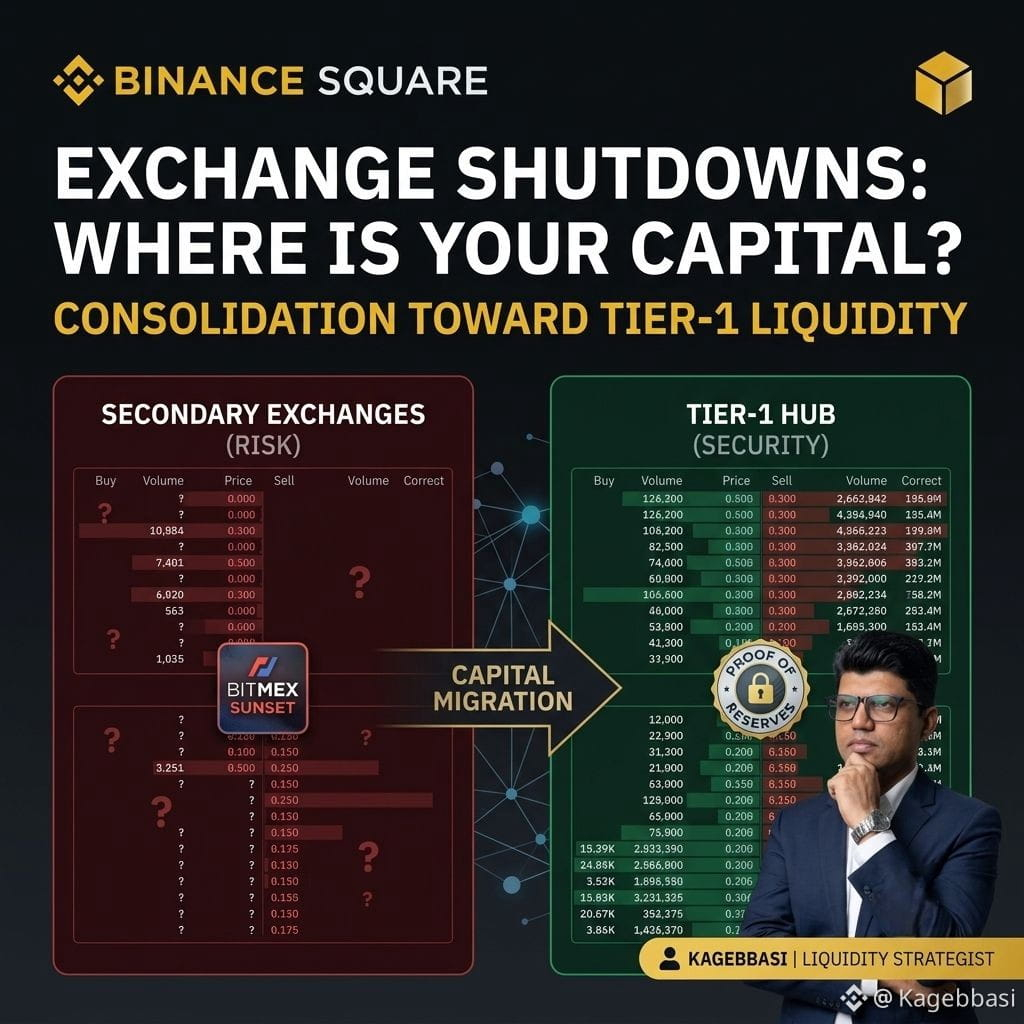
Exchange Closures: Why Capital Is Migrating to Tier-1 Hubs 🏛️
With derivatives pioneer BitMEX officially announcing the sunset of its exchange operations, the market is undergoing a major structural shift.
Changing regulations and shrinking volume across secondary venues are driving consolidation. It is time to audit where your capital lives.
🧠 What Consolidation Means for Traders
Liquidity Concentrating at the Top: Volume is migrating into dominant Tier-1 hubs like Binance. Smaller exchanges face severe order book illiquidity and slippage risk.
End of Unregulated Pure-Leverage: Extreme 100x leverage venues are giving way to institutional, compliance-first environments.
Proof of Reserves First: Verified exchange reserves separate safe platforms from failures during wind-downs.
🛡️ How We Protect Our Capital
Stick to Tier-1 Platforms: Deep order books protect against sudden volatility spikes.
Self-Custody for Cold Storage: Active capital stays on deep spot order books; long-term reserves belong in cold wallets.
Avoid Tier-3/4 Exchange Risk: Avoid low-volume venues with uncertain futures.
Key Takeaway: Platforms change, but deep liquidity and disciplined risk management stay constant. Protect your capital first.
Follow for more updates!
— Kagebbasi
#CryptoExchanges #BitMEX #Marketstructure #CryptoNewss #SpotTrading #TradingPsychology #CopyTrading #BinanceSquare
Exchange Closures: Why Capital Is Migrating to Tier-1 Hubs 🏛️
With derivatives pioneer BitMEX officially announcing the sunset of its exchange operations, the market is undergoing a major structural shift.
Changing regulations and shrinking volume across secondary venues are driving consolidation. It is time to audit where your capital lives.
🧠 What Consolidation Means for Traders
Liquidity Concentrating at the Top: Volume is migrating into dominant Tier-1 hubs like Binance. Smaller exchanges face severe order book illiquidity and slippage risk.
End of Unregulated Pure-Leverage: Extreme 100x leverage venues are giving way to institutional, compliance-first environments.
Proof of Reserves First: Verified exchange reserves separate safe platforms from failures during wind-downs.
🛡️ How We Protect Our Capital
Stick to Tier-1 Platforms: Deep order books protect against sudden volatility spikes.
Self-Custody for Cold Storage: Active capital stays on deep spot order books; long-term reserves belong in cold wallets.
Avoid Tier-3/4 Exchange Risk: Avoid low-volume venues with uncertain futures.
Key Takeaway: Platforms change, but deep liquidity and disciplined risk management stay constant. Protect your capital first.
Follow for more updates!
— Kagebbasi
#CryptoExchanges #BitMEX #Marketstructure #CryptoNewss #SpotTrading #TradingPsychology #CopyTrading #BinanceSquare
With derivatives pioneer BitMEX officially announcing the sunset of its exchange operations, the market is undergoing a major structural shift.
Changing regulations and shrinking volume across secondary venues are driving consolidation. It is time to audit where your capital lives.
🧠 What Consolidation Means for Traders
Liquidity Concentrating at the Top: Volume is migrating into dominant Tier-1 hubs like Binance. Smaller exchanges face severe order book illiquidity and slippage risk.
End of Unregulated Pure-Leverage: Extreme 100x leverage venues are giving way to institutional, compliance-first environments.
Proof of Reserves First: Verified exchange reserves separate safe platforms from failures during wind-downs.
🛡️ How We Protect Our Capital
Stick to Tier-1 Platforms: Deep order books protect against sudden volatility spikes.
Self-Custody for Cold Storage: Active capital stays on deep spot order books; long-term reserves belong in cold wallets.
Avoid Tier-3/4 Exchange Risk: Avoid low-volume venues with uncertain futures.
Key Takeaway: Platforms change, but deep liquidity and disciplined risk management stay constant. Protect your capital first.
Follow for more updates!
— Kagebbasi
#CryptoExchanges #BitMEX #Marketstructure #CryptoNewss #SpotTrading #TradingPsychology #CopyTrading #BinanceSquare
48
🏛️ Exchange Guide: Centralized vs. Decentralized Trading
On June 30, 2026, with $81.7B in daily volume, exchanges are the backbone of crypto. Centralized exchanges (CEXs) like Binance offer high liquidity, fast execution, and user-friendly interfaces but require KYC and custody your funds.
Decentralized exchanges (DEXs) offer self-custody, privacy, and censorship resistance but may have lower liquidity and more complex interfaces. Many traders use both: CEXs for large trades requiring deep liquidity, DEXs for smaller trades and access to new tokens.
📌 Key Takeaway:
CEXs offer convenience and liquidity; DEXs offer custody and privacy. The best approach uses both for different purposes.
#CEX #DEX #CryptoExchanges
#BinanceAlphaAlert
🏛️ Exchange Guide: Centralized vs. Decentralized Trading
On June 30, 2026, with $81.7B in daily volume, exchanges are the backbone of crypto. Centralized exchanges (CEXs) like Binance offer high liquidity, fast execution, and user-friendly interfaces but require KYC and custody your funds.
Decentralized exchanges (DEXs) offer self-custody, privacy, and censorship resistance but may have lower liquidity and more complex interfaces. Many traders use both: CEXs for large trades requiring deep liquidity, DEXs for smaller trades and access to new tokens.
📌 Key Takeaway:
CEXs offer convenience and liquidity; DEXs offer custody and privacy. The best approach uses both for different purposes.
#CEX #DEX #CryptoExchanges
#BinanceAlphaAlert
On June 30, 2026, with $81.7B in daily volume, exchanges are the backbone of crypto. Centralized exchanges (CEXs) like Binance offer high liquidity, fast execution, and user-friendly interfaces but require KYC and custody your funds.
Decentralized exchanges (DEXs) offer self-custody, privacy, and censorship resistance but may have lower liquidity and more complex interfaces. Many traders use both: CEXs for large trades requiring deep liquidity, DEXs for smaller trades and access to new tokens.
📌 Key Takeaway:
CEXs offer convenience and liquidity; DEXs offer custody and privacy. The best approach uses both for different purposes.
#CEX #DEX #CryptoExchanges
#BinanceAlphaAlert
13
📚 How Crypto Exchanges Work: CEX vs DEX — What's the Difference
On July 4, 2026, with total volume at $64.58B, understanding exchange types is crucial. Centralized exchanges (CEX) like Binance use order books and hold your funds — convenient but custodial.
Decentralized exchanges (DEX) like Hyperliquid $HYPE allow peer-to-peer trading without a middleman. You keep custody of your funds, which eliminates counterparty risk but requires more technical knowledge.
Each has trade-offs: CEXs offer higher liquidity and better UX; DEXs offer self-custody and censorship resistance. Many traders use both — CEX for fiat on-ramp, DEX for active trading.
📌 Key Takeaway:
CEX vs DEX is not about which is better — it's about using the right tool for each job. Self-custody on DEX, convenience on CEX.
#CryptoExchanges #CEXvsDEX #Educational
#BinanceAlphaAlert
📚 How Crypto Exchanges Work: CEX vs DEX — What's the Difference
On July 4, 2026, with total volume at $64.58B, understanding exchange types is crucial. Centralized exchanges (CEX) like Binance use order books and hold your funds — convenient but custodial.
Decentralized exchanges (DEX) like Hyperliquid $HYPE allow peer-to-peer trading without a middleman. You keep custody of your funds, which eliminates counterparty risk but requires more technical knowledge.
Each has trade-offs: CEXs offer higher liquidity and better UX; DEXs offer self-custody and censorship resistance. Many traders use both — CEX for fiat on-ramp, DEX for active trading.
📌 Key Takeaway:
CEX vs DEX is not about which is better — it's about using the right tool for each job. Self-custody on DEX, convenience on CEX.
#CryptoExchanges #CEXvsDEX #Educational
#BinanceAlphaAlert
On July 4, 2026, with total volume at $64.58B, understanding exchange types is crucial. Centralized exchanges (CEX) like Binance use order books and hold your funds — convenient but custodial.
Decentralized exchanges (DEX) like Hyperliquid $HYPE allow peer-to-peer trading without a middleman. You keep custody of your funds, which eliminates counterparty risk but requires more technical knowledge.
Each has trade-offs: CEXs offer higher liquidity and better UX; DEXs offer self-custody and censorship resistance. Many traders use both — CEX for fiat on-ramp, DEX for active trading.
📌 Key Takeaway:
CEX vs DEX is not about which is better — it's about using the right tool for each job. Self-custody on DEX, convenience on CEX.
#CryptoExchanges #CEXvsDEX #Educational
#BinanceAlphaAlert
98
·
--
Imagine waking up to a court judgment that makes you rethink your entire investment strategy, with millions at stake - for the crypto community, this isn't a hypothetical scenario but a stark reminder of the risks involved.
The concept "Court Judgments in Crypto" highlights the growing importance of legal clarity in the industry, as seen through the unfolding KuCoin saga. In a recent development, a Swiss investor alleged that the crypto exchange owes him over $2 million in unpaid court fees, stemming from a disputed 21 million CHP tokens. This ruling serves as a stark reminder of the need for transparency within crypto exchanges. #cryptoexchanges
The real-world example is KuCoin, which has faced renewed legal scrutiny following the judgment. In this case, the court's decision emphasizes the risks of delisting tokens and the potential consequences for exchanges. This development also underscores the need for investors to thoroughly research the platforms they choose.
The takeaway for investors is to exercise caution and conduct thorough research when entering or exiting the crypto market, as well as to monitor any ongoing disputes or judgments that may impact their investments. #cryptoinvesting
As the crypto landscape continues to evolve, it's essential to stay informed about potential risks and court judgments that may impact the industry - what steps should exchanges and investors take to prevent these situations from arising in the future?
Imagine waking up to a court judgment that makes you rethink your entire investment strategy, with millions at stake - for the crypto community, this isn't a hypothetical scenario but a stark reminder of the risks involved.
The concept "Court Judgments in Crypto" highlights the growing importance of legal clarity in the industry, as seen through the unfolding KuCoin saga. In a recent development, a Swiss investor alleged that the crypto exchange owes him over $2 million in unpaid court fees, stemming from a disputed 21 million CHP tokens. This ruling serves as a stark reminder of the need for transparency within crypto exchanges. #cryptoexchanges
The real-world example is KuCoin, which has faced renewed legal scrutiny following the judgment. In this case, the court's decision emphasizes the risks of delisting tokens and the potential consequences for exchanges. This development also underscores the need for investors to thoroughly research the platforms they choose.
The takeaway for investors is to exercise caution and conduct thorough research when entering or exiting the crypto market, as well as to monitor any ongoing disputes or judgments that may impact their investments. #cryptoinvesting
As the crypto landscape continues to evolve, it's essential to stay informed about potential risks and court judgments that may impact the industry - what steps should exchanges and investors take to prevent these situations from arising in the future?
The concept "Court Judgments in Crypto" highlights the growing importance of legal clarity in the industry, as seen through the unfolding KuCoin saga. In a recent development, a Swiss investor alleged that the crypto exchange owes him over $2 million in unpaid court fees, stemming from a disputed 21 million CHP tokens. This ruling serves as a stark reminder of the need for transparency within crypto exchanges. #cryptoexchanges
The real-world example is KuCoin, which has faced renewed legal scrutiny following the judgment. In this case, the court's decision emphasizes the risks of delisting tokens and the potential consequences for exchanges. This development also underscores the need for investors to thoroughly research the platforms they choose.
The takeaway for investors is to exercise caution and conduct thorough research when entering or exiting the crypto market, as well as to monitor any ongoing disputes or judgments that may impact their investments. #cryptoinvesting
As the crypto landscape continues to evolve, it's essential to stay informed about potential risks and court judgments that may impact the industry - what steps should exchanges and investors take to prevent these situations from arising in the future?
91

Article
What Is Cross Exchange Market Making? The Setup Behind Every Token Listed on More Than One ExchangeWhat is cross exchange market making – TDMM
Takeaways first
Your token trades on several order books that do not talk to each other. CoinMarketCap tracks 239 spot exchanges; the ten largest list 16,045 pairs between them.Cross exchange market making quotes every venue off one reference price and hedges every fill on the deepest venue, from one shared inventory.The hard part is exchange integration: different rate limits, server regions, symbol formats and fee tiers on every venue.When makers cannot reach a venue, its prices detach. On 10 October 2025 USDe printed $0.65 and wBETH $430 on Binance while both held value elsewhere.TDMM runs this model across 100+ CEX and DEX integrations, as one book with one risk view.
The one-line definition
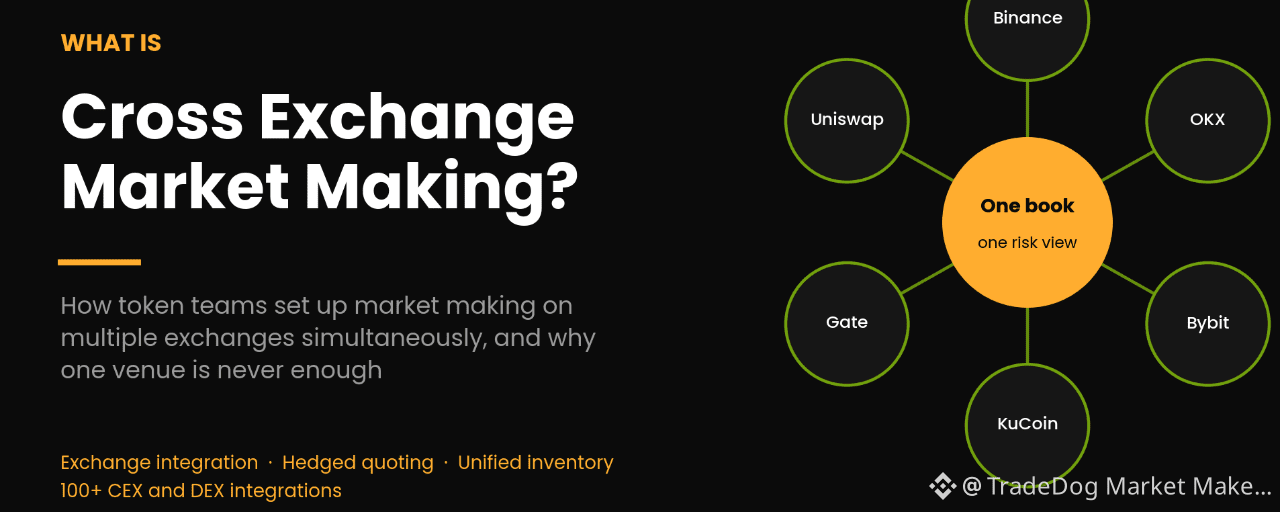
Cross exchange market making means quoting a token on several exchanges at the same time from one shared inventory, pricing every order book off a single reference price and hedging fills on the deepest venue.
The maker posts bids and asks on the secondary venues at the reference price plus or minus a margin. When a quote fills, it immediately takes the opposite side on the hedge venue. The margin covers the maker fee, the hedge taker fee, slippage, transfer costs and a profit buffer.
Why one exchange is never enough
Depth is concentrated but it moves. Kaiko found the eight largest exchanges holding 91.7% of order-book depth. In Q2 2026 Binance handled 38.7% of top-ten CEX spot volume while MEXC’s volume more than halved in one quarter. DEXs took 13.6% of spot volume in January 2026, with a peak of 24.5% in June 2025.
A token with a dedicated maker on its deepest venue and nobody on its other listings shows 100 to 300 basis point spreads on those listings, and its price drifts away from the reference for minutes at a time. Arbitrage bots close the gap and keep the money. Cross exchange market making means the token’s own maker posts the consistent price everywhere and captures that gap instead.
What a venue looks like without its makers
For 40 minutes on 10 October 2025, three assets on Binance detached from their value everywhere else. USDe printed $0.65 while holding near $1.00 on-chain. wBETH printed $430 against ETH above $3,800. BNSOL printed $34.90. Makers could not reach the venue, books thinned, and the margin engine liquidated users against those prints. Binance later paid about $283 million in compensation. The assets had not lost value; one venue had lost its makers.
Exchange integration: the real work
Binance’s spot API allows 6,000 request weight per minute per IP and 50 orders per 10 seconds per account. Bybit allows 600 requests per 5 seconds per IP. OKX scales limits for top VIP tiers by fill ratio. Binance answers in about 8 ms from Tokyo and 259 ms from São Paulo. Maker fees run from 10 basis points at standard tiers to rebates of 0.75 bps (Bybit MM3) and 1.2 bps (KuCoin Tier S) inside market maker programmes. Every venue also has its own symbol format, tick size, lot size and fee currency.
An engine that respects all of this on ten venues at once, and treats the inventory on all of them as one position with one set of caps, is what separates cross exchange market making from ten bots running side by side.
Setting up on multiple exchanges simultaneously
Week one: rank venues by depth, pick the hedge venue, agree per-venue spread, depth and uptime targets, and complete the disclosures exchanges now require. Since March 2026, Binance requires token issuers to disclose their market maker, contract terms and any token loan, and prohibits one-sided selling and volume inflation. Week two: accounts, keys, whitelists, programme applications, inventory placement. Week three: shadow quoting and calibration per venue. Then go live and report spread, depth, uptime, cross-venue deviation and inventory by venue, daily.
Why TDMM
TDMM (TradeDog Market Maker) has quoted across venues since 2015: more than $10 billion traded, 200+ markets, 100+ CEX and DEX integrations including Binance, OKX, Bybit, Gate, KuCoin, Bitget, MEXC, HTX, Uniswap, PancakeSwap and Raydium. One reference price, one book, one risk view, with real-time reporting. No manufactured volume, no one-sided selling, no price promises.
Full article with the data, the worked example, and the KPI table: tdmm.io/insights/blog/
$BTC $PONS
#MarketMaking #CrossExchange #CryptoExchanges #Liquidity #TDMM
What Is Cross Exchange Market Making? The Setup Behind Every Token Listed on More Than One Exchange
What is cross exchange market making – TDMM
Takeaways first
Your token trades on several order books that do not talk to each other. CoinMarketCap tracks 239 spot exchanges; the ten largest list 16,045 pairs between them.Cross exchange market making quotes every venue off one reference price and hedges every fill on the deepest venue, from one shared inventory.The hard part is exchange integration: different rate limits, server regions, symbol formats and fee tiers on every venue.When makers cannot reach a venue, its prices detach. On 10 October 2025 USDe printed $0.65 and wBETH $430 on Binance while both held value elsewhere.TDMM runs this model across 100+ CEX and DEX integrations, as one book with one risk view.
The one-line definition
Cross exchange market making means quoting a token on several exchanges at the same time from one shared inventory, pricing every order book off a single reference price and hedging fills on the deepest venue.
The maker posts bids and asks on the secondary venues at the reference price plus or minus a margin. When a quote fills, it immediately takes the opposite side on the hedge venue. The margin covers the maker fee, the hedge taker fee, slippage, transfer costs and a profit buffer.
Why one exchange is never enough
Depth is concentrated but it moves. Kaiko found the eight largest exchanges holding 91.7% of order-book depth. In Q2 2026 Binance handled 38.7% of top-ten CEX spot volume while MEXC’s volume more than halved in one quarter. DEXs took 13.6% of spot volume in January 2026, with a peak of 24.5% in June 2025.
A token with a dedicated maker on its deepest venue and nobody on its other listings shows 100 to 300 basis point spreads on those listings, and its price drifts away from the reference for minutes at a time. Arbitrage bots close the gap and keep the money. Cross exchange market making means the token’s own maker posts the consistent price everywhere and captures that gap instead.
What a venue looks like without its makers
For 40 minutes on 10 October 2025, three assets on Binance detached from their value everywhere else. USDe printed $0.65 while holding near $1.00 on-chain. wBETH printed $430 against ETH above $3,800. BNSOL printed $34.90. Makers could not reach the venue, books thinned, and the margin engine liquidated users against those prints. Binance later paid about $283 million in compensation. The assets had not lost value; one venue had lost its makers.
Exchange integration: the real work
Binance’s spot API allows 6,000 request weight per minute per IP and 50 orders per 10 seconds per account. Bybit allows 600 requests per 5 seconds per IP. OKX scales limits for top VIP tiers by fill ratio. Binance answers in about 8 ms from Tokyo and 259 ms from São Paulo. Maker fees run from 10 basis points at standard tiers to rebates of 0.75 bps (Bybit MM3) and 1.2 bps (KuCoin Tier S) inside market maker programmes. Every venue also has its own symbol format, tick size, lot size and fee currency.
An engine that respects all of this on ten venues at once, and treats the inventory on all of them as one position with one set of caps, is what separates cross exchange market making from ten bots running side by side.
Setting up on multiple exchanges simultaneously
Week one: rank venues by depth, pick the hedge venue, agree per-venue spread, depth and uptime targets, and complete the disclosures exchanges now require. Since March 2026, Binance requires token issuers to disclose their market maker, contract terms and any token loan, and prohibits one-sided selling and volume inflation. Week two: accounts, keys, whitelists, programme applications, inventory placement. Week three: shadow quoting and calibration per venue. Then go live and report spread, depth, uptime, cross-venue deviation and inventory by venue, daily.
Why TDMM
TDMM (TradeDog Market Maker) has quoted across venues since 2015: more than $10 billion traded, 200+ markets, 100+ CEX and DEX integrations including Binance, OKX, Bybit, Gate, KuCoin, Bitget, MEXC, HTX, Uniswap, PancakeSwap and Raydium. One reference price, one book, one risk view, with real-time reporting. No manufactured volume, no one-sided selling, no price promises.
Full article with the data, the worked example, and the KPI table: tdmm.io/insights/blog/
$BTC $PONS
#MarketMaking #CrossExchange #CryptoExchanges #Liquidity #TDMM
Takeaways first
Your token trades on several order books that do not talk to each other. CoinMarketCap tracks 239 spot exchanges; the ten largest list 16,045 pairs between them.Cross exchange market making quotes every venue off one reference price and hedges every fill on the deepest venue, from one shared inventory.The hard part is exchange integration: different rate limits, server regions, symbol formats and fee tiers on every venue.When makers cannot reach a venue, its prices detach. On 10 October 2025 USDe printed $0.65 and wBETH $430 on Binance while both held value elsewhere.TDMM runs this model across 100+ CEX and DEX integrations, as one book with one risk view.
The one-line definition
Cross exchange market making means quoting a token on several exchanges at the same time from one shared inventory, pricing every order book off a single reference price and hedging fills on the deepest venue.
The maker posts bids and asks on the secondary venues at the reference price plus or minus a margin. When a quote fills, it immediately takes the opposite side on the hedge venue. The margin covers the maker fee, the hedge taker fee, slippage, transfer costs and a profit buffer.
Why one exchange is never enough
Depth is concentrated but it moves. Kaiko found the eight largest exchanges holding 91.7% of order-book depth. In Q2 2026 Binance handled 38.7% of top-ten CEX spot volume while MEXC’s volume more than halved in one quarter. DEXs took 13.6% of spot volume in January 2026, with a peak of 24.5% in June 2025.
A token with a dedicated maker on its deepest venue and nobody on its other listings shows 100 to 300 basis point spreads on those listings, and its price drifts away from the reference for minutes at a time. Arbitrage bots close the gap and keep the money. Cross exchange market making means the token’s own maker posts the consistent price everywhere and captures that gap instead.
What a venue looks like without its makers
For 40 minutes on 10 October 2025, three assets on Binance detached from their value everywhere else. USDe printed $0.65 while holding near $1.00 on-chain. wBETH printed $430 against ETH above $3,800. BNSOL printed $34.90. Makers could not reach the venue, books thinned, and the margin engine liquidated users against those prints. Binance later paid about $283 million in compensation. The assets had not lost value; one venue had lost its makers.
Exchange integration: the real work
Binance’s spot API allows 6,000 request weight per minute per IP and 50 orders per 10 seconds per account. Bybit allows 600 requests per 5 seconds per IP. OKX scales limits for top VIP tiers by fill ratio. Binance answers in about 8 ms from Tokyo and 259 ms from São Paulo. Maker fees run from 10 basis points at standard tiers to rebates of 0.75 bps (Bybit MM3) and 1.2 bps (KuCoin Tier S) inside market maker programmes. Every venue also has its own symbol format, tick size, lot size and fee currency.
An engine that respects all of this on ten venues at once, and treats the inventory on all of them as one position with one set of caps, is what separates cross exchange market making from ten bots running side by side.
Setting up on multiple exchanges simultaneously
Week one: rank venues by depth, pick the hedge venue, agree per-venue spread, depth and uptime targets, and complete the disclosures exchanges now require. Since March 2026, Binance requires token issuers to disclose their market maker, contract terms and any token loan, and prohibits one-sided selling and volume inflation. Week two: accounts, keys, whitelists, programme applications, inventory placement. Week three: shadow quoting and calibration per venue. Then go live and report spread, depth, uptime, cross-venue deviation and inventory by venue, daily.
Why TDMM
TDMM (TradeDog Market Maker) has quoted across venues since 2015: more than $10 billion traded, 200+ markets, 100+ CEX and DEX integrations including Binance, OKX, Bybit, Gate, KuCoin, Bitget, MEXC, HTX, Uniswap, PancakeSwap and Raydium. One reference price, one book, one risk view, with real-time reporting. No manufactured volume, no one-sided selling, no price promises.
Full article with the data, the worked example, and the KPI table: tdmm.io/insights/blog/
$BTC $PONS
#MarketMaking #CrossExchange #CryptoExchanges #Liquidity #TDMM
1
62

🚀 CCXT 4.5.68: Update to the popular crypto trading library now supports over 100 exchanges!
CCXT 4.5.68 has been released. It is a multi-language trading library that supports more than 100 cryptocurrency exchanges. The update enables developers to access powerful trading tools in widely used programming languages such as Python and JavaScript and C# and more.
━━━━━━━━━━━━━━
📊 Impact: 📊 Medium
🏷️ EXCHANGE
#CCXT #CryptoAPI #TradingBots #BlockchainDevelopment #CryptoExchanges
🔗 Source: https://pypi.org/project/ccxt/4.5.68/
🚀 CCXT 4.5.68: Update to the popular crypto trading library now supports over 100 exchanges!
CCXT 4.5.68 has been released. It is a multi-language trading library that supports more than 100 cryptocurrency exchanges. The update enables developers to access powerful trading tools in widely used programming languages such as Python and JavaScript and C# and more.
━━━━━━━━━━━━━━
📊 Impact: 📊 Medium
🏷️ EXCHANGE
#CCXT #CryptoAPI #TradingBots #BlockchainDevelopment #CryptoExchanges
🔗 Source: https://pypi.org/project/ccxt/4.5.68/
CCXT 4.5.68 has been released. It is a multi-language trading library that supports more than 100 cryptocurrency exchanges. The update enables developers to access powerful trading tools in widely used programming languages such as Python and JavaScript and C# and more.
━━━━━━━━━━━━━━
📊 Impact: 📊 Medium
🏷️ EXCHANGE
#CCXT #CryptoAPI #TradingBots #BlockchainDevelopment #CryptoExchanges
🔗 Source: https://pypi.org/project/ccxt/4.5.68/
1
6
🚀 Updates connect 100+ crypto exchanges: New CCXT 4.5.67 boosts cryptocurrency trading!
The new update for the CCXT library, version 4.5.67, provides a unified application programming interface (API) for more than 100 cryptocurrency exchanges. The update supports multiple programming languages such as JavaScript, Python, C#, PHP, and Go, making it easier for developers and traders to access data and trading features from different exchanges.
━━━━━━━━━━━━━━
📊 Impact: 📈 High
🏷️ EXCHANGE
#CryptoAPI #TradingBots #BlockchainDev #CCXT #CryptoExchanges
🔗 Source: https://pypi.org/project/ccxt/4.5.67/
🚀 Updates connect 100+ crypto exchanges: New CCXT 4.5.67 boosts cryptocurrency trading!
The new update for the CCXT library, version 4.5.67, provides a unified application programming interface (API) for more than 100 cryptocurrency exchanges. The update supports multiple programming languages such as JavaScript, Python, C#, PHP, and Go, making it easier for developers and traders to access data and trading features from different exchanges.
━━━━━━━━━━━━━━
📊 Impact: 📈 High
🏷️ EXCHANGE
#CryptoAPI #TradingBots #BlockchainDev #CCXT #CryptoExchanges
🔗 Source: https://pypi.org/project/ccxt/4.5.67/
The new update for the CCXT library, version 4.5.67, provides a unified application programming interface (API) for more than 100 cryptocurrency exchanges. The update supports multiple programming languages such as JavaScript, Python, C#, PHP, and Go, making it easier for developers and traders to access data and trading features from different exchanges.
━━━━━━━━━━━━━━
📊 Impact: 📈 High
🏷️ EXCHANGE
#CryptoAPI #TradingBots #BlockchainDev #CCXT #CryptoExchanges
🔗 Source: https://pypi.org/project/ccxt/4.5.67/
2

·
--
The EU has introduced a mechanism allowing full transaction bans on foreign crypto providers used to help Russia evade sanctions.
Its latest package also targets 14 crypto service platforms based across several non-EU jurisdictions.
The market angle is enforcement scope: regulators are moving from blacklisting individual addresses toward isolating entire exchanges and service providers.
The key user risk is counterparty exposure. Deposits, withdrawals and stablecoin access could be restricted when a platform becomes formally designated.
$BTC
#CryptoRegulations #CryptoExchanges #Sanctions #Compliance
The EU has introduced a mechanism allowing full transaction bans on foreign crypto providers used to help Russia evade sanctions.
Its latest package also targets 14 crypto service platforms based across several non-EU jurisdictions.
The market angle is enforcement scope: regulators are moving from blacklisting individual addresses toward isolating entire exchanges and service providers.
The key user risk is counterparty exposure. Deposits, withdrawals and stablecoin access could be restricted when a platform becomes formally designated.
$BTC
#CryptoRegulations #CryptoExchanges #Sanctions #Compliance
Its latest package also targets 14 crypto service platforms based across several non-EU jurisdictions.
The market angle is enforcement scope: regulators are moving from blacklisting individual addresses toward isolating entire exchanges and service providers.
The key user risk is counterparty exposure. Deposits, withdrawals and stablecoin access could be restricted when a platform becomes formally designated.
$BTC
#CryptoRegulations #CryptoExchanges #Sanctions #Compliance
86
Log in to explore more content
Join global crypto users on Binance Square
⚡️ Get latest and useful information about crypto.
💬 Trusted by the world’s largest crypto exchange.
👍 Discover real insights from verified creators.
Email / Phone number
Trending Topics
1
#AIStocksWhatNext
38,913 views
98 Discussing
2
#TokenizedStockPlatformsCouldLaunchNextQuarter
129 views
0 Discussing
3
#StrategyAdds950Bitcoin
1,944 views
0 Discussing
4
#CardanoAddedToX402KitForADAPayments
7,218 views
191 Discussing
5
#XRPRises8%
17,581 views
520 Discussing
6
#AMDHits$1TrillionMarketCap
643 views
29 Discussing
7
#BitcoinSpotETFs$999MNetInflow
1,372 views
40 Discussing
8
#AppleGoogleSeekStablecoinTokenizedDepositTalent
9,994 views
377 Discussing
9
#NvidiaToBuyAnother$1.5BSBEnergySharesPreIPO
1,679 views
35 Discussing
10
#AgoraGetsPreliminaryOCCApprovalForTrustBank
6,737 views
198 Discussing