
#institutionalcrypto
institutionalcrypto
639,801 views
3,947 Discussing
Hot
Latest

Tom Lee is doubling down on the crypto bull market narrative, and corporate treasuries are proving him right. Bitmine just scooped up another 27,562 ETH, pushing their total holdings to a staggering $17.1 billion. They are now dangerously close to controlling 5% of the entire circulating Ethereum supply. When institutional whales accumulate at this scale, it completely changes the supply-demand dynamic. Retail investors often overlook these quiet corporate sweeps, but they are the bedrock of the current market cycle. Smart money is locking up liquidity fast. $ETH #Ethereum #CryptoBullRun #InstitutionalCrypto
Tom Lee is doubling down on the crypto bull market narrative, and corporate treasuries are proving him right. Bitmine just scooped up another 27,562 ETH, pushing their total holdings to a staggering $17.1 billion. They are now dangerously close to controlling 5% of the entire circulating Ethereum supply. When institutional whales accumulate at this scale, it completely changes the supply-demand dynamic. Retail investors often overlook these quiet corporate sweeps, but they are the bedrock of the current market cycle. Smart money is locking up liquidity fast. $ETH #Ethereum #CryptoBullRun #InstitutionalCrypto
4

#CircleLaunchesInstitutionalBTCBackedBorrowing
💣 BTC WITHOUT SELLING?!
Circle just unlocked a new way for institutions to turn Bitcoin into USDC liquidity — without selling their BTC.
That means:
BTC → COLLATERAL → USDC → LIQUIDITY
But here’s where it gets interesting…
If institutions can borrow against BTC instead of selling it, Bitcoin could become more than a long-term asset.
It could become working capital.
Circle’s new institutional borrowing system connects BTC with on-chain lending markets, creating a potential new bridge between traditional institutional capital and DeFi.
And if more institutions follow?
More BTC collateral
More USDC liquidity
More on-chain credit
The bigger question:
Is Circle opening the door to the next institutional crypto liquidity wave?
#Circle #Crypto #InstitutionalCrypto
$BTC
{spot}(BTCUSDT)
$ETH
{spot}(ETHUSDT)
$USDC
{spot}(USDCUSDT)
#CircleLaunchesInstitutionalBTCBackedBorrowing
💣 BTC WITHOUT SELLING?!
Circle just unlocked a new way for institutions to turn Bitcoin into USDC liquidity — without selling their BTC.
That means:
BTC → COLLATERAL → USDC → LIQUIDITY
But here’s where it gets interesting…
If institutions can borrow against BTC instead of selling it, Bitcoin could become more than a long-term asset.
It could become working capital.
Circle’s new institutional borrowing system connects BTC with on-chain lending markets, creating a potential new bridge between traditional institutional capital and DeFi.
And if more institutions follow?
More BTC collateral
More USDC liquidity
More on-chain credit
The bigger question:
Is Circle opening the door to the next institutional crypto liquidity wave?
#Circle #Crypto #InstitutionalCrypto
$BTC
$ETH
$USDC
💣 BTC WITHOUT SELLING?!
Circle just unlocked a new way for institutions to turn Bitcoin into USDC liquidity — without selling their BTC.
That means:
BTC → COLLATERAL → USDC → LIQUIDITY
But here’s where it gets interesting…
If institutions can borrow against BTC instead of selling it, Bitcoin could become more than a long-term asset.
It could become working capital.
Circle’s new institutional borrowing system connects BTC with on-chain lending markets, creating a potential new bridge between traditional institutional capital and DeFi.
And if more institutions follow?
More BTC collateral
More USDC liquidity
More on-chain credit
The bigger question:
Is Circle opening the door to the next institutional crypto liquidity wave?
#Circle #Crypto #InstitutionalCrypto
$BTC
$ETH
$USDC

73

·
--
Real World Assets (RWA) The tokenization of Real World Assets—from US Treasury bills to real estate and commodities—bridges traditional finance directly with blockchain rails. Institutional players want yield backed by tangible collateral. Do you see RWAs driving the next wave of institutional adoption? 🏦 #RWA #InstitutionalCrypto #DeFi #Tokenization
Real World Assets (RWA) The tokenization of Real World Assets—from US Treasury bills to real estate and commodities—bridges traditional finance directly with blockchain rails. Institutional players want yield backed by tangible collateral. Do you see RWAs driving the next wave of institutional adoption? 🏦 #RWA #InstitutionalCrypto #DeFi #Tokenization

39

$SEI #CanaryFilesSecondAmendmentForStakedSEIETF
Canary Capital moves SEI closer to institutional status
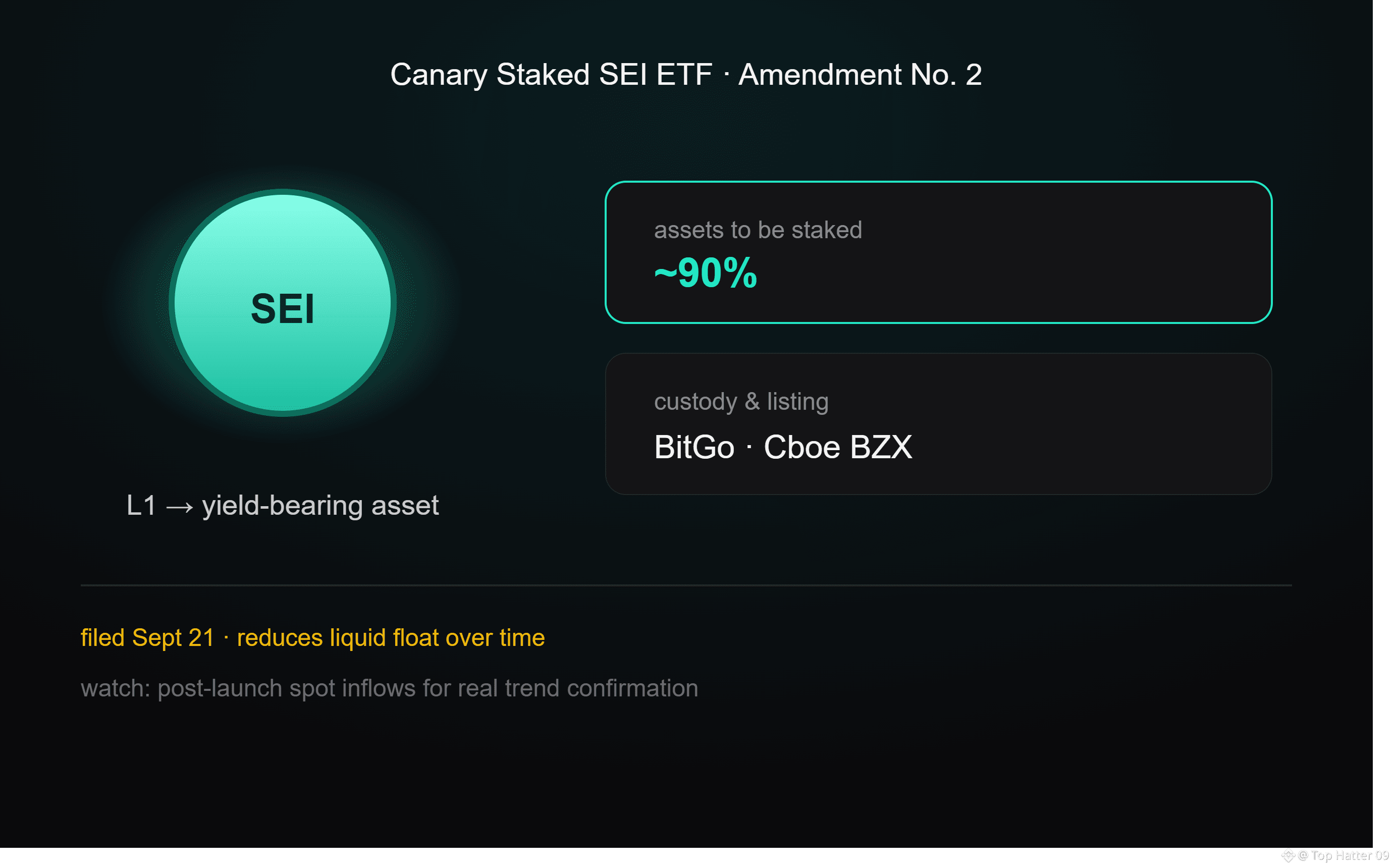
Canary Capital filed its second S-1 amendment for a Staked SEI ETF on September 21, revising the staking mechanism to stake roughly 90% of SEI assets, custodied by BitGo, with a planned listing on Cboe BZX.
This shifts SEI's narrative from a purely speculative L1 token toward a yield-bearing, regulated product — the kind of structural demand shift that tends to reduce liquid float over time as ETF-held assets get staked rather than traded.
Worth watching: SEI's short-term price reaction has been volatile around this news, with funding rates and leveraged positioning already crowded. A real trend shift would need sustained spot inflows post-launch, not just headline reaction.
$SEI #SEI #ETF #InstitutionalCrypto
{future}(SEIUSDT)
$SEI #CanaryFilesSecondAmendmentForStakedSEIETF
Canary Capital moves SEI closer to institutional status
Canary Capital filed its second S-1 amendment for a Staked SEI ETF on September 21, revising the staking mechanism to stake roughly 90% of SEI assets, custodied by BitGo, with a planned listing on Cboe BZX.
This shifts SEI's narrative from a purely speculative L1 token toward a yield-bearing, regulated product — the kind of structural demand shift that tends to reduce liquid float over time as ETF-held assets get staked rather than traded.
Worth watching: SEI's short-term price reaction has been volatile around this news, with funding rates and leveraged positioning already crowded. A real trend shift would need sustained spot inflows post-launch, not just headline reaction.
$SEI #SEI #ETF #InstitutionalCrypto
Canary Capital moves SEI closer to institutional status
Canary Capital filed its second S-1 amendment for a Staked SEI ETF on September 21, revising the staking mechanism to stake roughly 90% of SEI assets, custodied by BitGo, with a planned listing on Cboe BZX.
This shifts SEI's narrative from a purely speculative L1 token toward a yield-bearing, regulated product — the kind of structural demand shift that tends to reduce liquid float over time as ETF-held assets get staked rather than traded.
Worth watching: SEI's short-term price reaction has been volatile around this news, with funding rates and leveraged positioning already crowded. A real trend shift would need sustained spot inflows post-launch, not just headline reaction.
$SEI #SEI #ETF #InstitutionalCrypto
90

·
--

Article
Arbitrum’s 70‑X Future: Why the Market Is Still Blind to the Real UpsideMost traders focus on price swings. Smart money watches the flow of institutional capital into layer‑2 rollups instead.
The signal: Standard Chartered’s latest research now projects that Arbitrum ($ARB) could rise 70× by 2030, driven by a surge in tokenized stock liquidity and the Bitcoin Reserve’s expansion. On-chain data shows a 45% jump in $ARB liquidity over the past month, while whale activity in the $ARB/USDC pool has doubled. #ARB #Layer2 #InstitutionalCrypto
Interpretation: If tokenized equities continue to flood Arbitrum, the demand for $ARB as a bridge and settlement layer will skyrocket. The 70× forecast isn’t a speculative hype; it’s rooted in the projected $10 trillion tokenized equity market and the $5 trillion Bitcoin Reserve, both of which will funnel liquidity through Arbitrum’s cheaper, faster transactions. Price could see a sustained upward drift as institutional flows lock in.
Watch list: Keep an eye on the $ARB/USDC liquidity pool size and the daily volume of tokenized stock trades on Arbitrum. A sudden spike in either could signal the next rally. #ArbitrumWatch
Thought closer: If you’re looking for a layer‑2 that’s poised to dominate the next decade, is $ARB the one you’re overlooking?
Arbitrum’s 70‑X Future: Why the Market Is Still Blind to the Real Upside
Most traders focus on price swings. Smart money watches the flow of institutional capital into layer‑2 rollups instead.
The signal: Standard Chartered’s latest research now projects that Arbitrum ($ARB ) could rise 70× by 2030, driven by a surge in tokenized stock liquidity and the Bitcoin Reserve’s expansion. On-chain data shows a 45% jump in $ARB liquidity over the past month, while whale activity in the $ARB /USDC pool has doubled. #ARB #Layer2 #InstitutionalCrypto
Interpretation: If tokenized equities continue to flood Arbitrum, the demand for $ARB as a bridge and settlement layer will skyrocket. The 70× forecast isn’t a speculative hype; it’s rooted in the projected $10 trillion tokenized equity market and the $5 trillion Bitcoin Reserve, both of which will funnel liquidity through Arbitrum’s cheaper, faster transactions. Price could see a sustained upward drift as institutional flows lock in.
Watch list: Keep an eye on the $ARB /USDC liquidity pool size and the daily volume of tokenized stock trades on Arbitrum. A sudden spike in either could signal the next rally. #ArbitrumWatch
Thought closer: If you’re looking for a layer‑2 that’s poised to dominate the next decade, is $ARB the one you’re overlooking?
The signal: Standard Chartered’s latest research now projects that Arbitrum ($ARB ) could rise 70× by 2030, driven by a surge in tokenized stock liquidity and the Bitcoin Reserve’s expansion. On-chain data shows a 45% jump in $ARB liquidity over the past month, while whale activity in the $ARB /USDC pool has doubled. #ARB #Layer2 #InstitutionalCrypto
Interpretation: If tokenized equities continue to flood Arbitrum, the demand for $ARB as a bridge and settlement layer will skyrocket. The 70× forecast isn’t a speculative hype; it’s rooted in the projected $10 trillion tokenized equity market and the $5 trillion Bitcoin Reserve, both of which will funnel liquidity through Arbitrum’s cheaper, faster transactions. Price could see a sustained upward drift as institutional flows lock in.
Watch list: Keep an eye on the $ARB /USDC liquidity pool size and the daily volume of tokenized stock trades on Arbitrum. A sudden spike in either could signal the next rally. #ArbitrumWatch
Thought closer: If you’re looking for a layer‑2 that’s poised to dominate the next decade, is $ARB the one you’re overlooking?
164

If you're still writing off every bank crypto announcement as empty hype, stop now. That exact mindset made sure most retail missed the entire ETF cycle, and this one is quietly shaping up the same way.
Deutsche Bank is launching regulated digital-asset custody for institutional and corporate clients in Europe this year, pending regulatory approval. The initial scope reportedly covers $BTC, $ETH and selected stablecoins.
Here's what almost everyone is missing. The real story isn't the custody license, it's the balance-sheet connectivity behind it. Deutsche Bank already sits inside the machinery institutions use for cash management, securities services, collateral and settlement. Adding crypto custody means digital assets plug directly into pipes that already exist, not some standalone product a corporate treasury has to fight a committee to justify.
Now the debate. One camp says this is banks co-opting crypto, wrapping it in fees and turning a rebellion into a subscription service. Fair point. But the other side, the one I lean toward, says liquidity follows infrastructure, and infrastructure is exactly what's being built here. Institutions were never waiting for permission to like Bitcoin, they were waiting for rails that don't break their compliance stack.
So which is it in your view: the unlock that finally brings the real money in, or the moment banks absorbed crypto and made it theirs?
#Bitcoin #InstitutionalCrypto #Ethereum
If you're still writing off every bank crypto announcement as empty hype, stop now. That exact mindset made sure most retail missed the entire ETF cycle, and this one is quietly shaping up the same way.
Deutsche Bank is launching regulated digital-asset custody for institutional and corporate clients in Europe this year, pending regulatory approval. The initial scope reportedly covers $BTC , $ETH and selected stablecoins.
Here's what almost everyone is missing. The real story isn't the custody license, it's the balance-sheet connectivity behind it. Deutsche Bank already sits inside the machinery institutions use for cash management, securities services, collateral and settlement. Adding crypto custody means digital assets plug directly into pipes that already exist, not some standalone product a corporate treasury has to fight a committee to justify.
Now the debate. One camp says this is banks co-opting crypto, wrapping it in fees and turning a rebellion into a subscription service. Fair point. But the other side, the one I lean toward, says liquidity follows infrastructure, and infrastructure is exactly what's being built here. Institutions were never waiting for permission to like Bitcoin, they were waiting for rails that don't break their compliance stack.
So which is it in your view: the unlock that finally brings the real money in, or the moment banks absorbed crypto and made it theirs?
#Bitcoin #InstitutionalCrypto #Ethereum
Deutsche Bank is launching regulated digital-asset custody for institutional and corporate clients in Europe this year, pending regulatory approval. The initial scope reportedly covers $BTC , $ETH and selected stablecoins.
Here's what almost everyone is missing. The real story isn't the custody license, it's the balance-sheet connectivity behind it. Deutsche Bank already sits inside the machinery institutions use for cash management, securities services, collateral and settlement. Adding crypto custody means digital assets plug directly into pipes that already exist, not some standalone product a corporate treasury has to fight a committee to justify.
Now the debate. One camp says this is banks co-opting crypto, wrapping it in fees and turning a rebellion into a subscription service. Fair point. But the other side, the one I lean toward, says liquidity follows infrastructure, and infrastructure is exactly what's being built here. Institutions were never waiting for permission to like Bitcoin, they were waiting for rails that don't break their compliance stack.
So which is it in your view: the unlock that finally brings the real money in, or the moment banks absorbed crypto and made it theirs?
#Bitcoin #InstitutionalCrypto #Ethereum
107
Here's what happened when a 150-year-old bank quietly started wiring crypto into the same pipes it already uses for cash and collateral.
Most traders treat every bank custody headline as a buy signal for $BTC, then sit through another fade when the actual product never quite arrives. The pain isn't missing the news. It's not seeing the risks that come with it.
Deutsche Bank plans to launch regulated digital-asset custody for institutional and corporate clients in Europe this year, subject to regulatory approval. Initial scope includes $BTC, $ETH and selected stablecoins. That part is public. The part most people skipped is balance-sheet connectivity. The bank already sits inside cash management, securities services, collateral and settlement. Plugging crypto into that stack means those assets can start moving through the same machinery as traditional holdings, with the same counterparty exposure, the same freeze potential, and the same slow regulatory choke points.
If the rails get built the way banks usually build them, institutions get a permissioned on-ramp while everyone else waits. Custody does not equal buying pressure. It can just as easily mean coins sitting idle as collateral, delayed launches, or a more centralized system that looks nothing like the one retail actually holds.
Where do you think this actually goes once the custody is live?
#Bitcoin #Ethereum #InstitutionalCrypto
Here's what happened when a 150-year-old bank quietly started wiring crypto into the same pipes it already uses for cash and collateral.
Most traders treat every bank custody headline as a buy signal for $BTC , then sit through another fade when the actual product never quite arrives. The pain isn't missing the news. It's not seeing the risks that come with it.
Deutsche Bank plans to launch regulated digital-asset custody for institutional and corporate clients in Europe this year, subject to regulatory approval. Initial scope includes $BTC , $ETH and selected stablecoins. That part is public. The part most people skipped is balance-sheet connectivity. The bank already sits inside cash management, securities services, collateral and settlement. Plugging crypto into that stack means those assets can start moving through the same machinery as traditional holdings, with the same counterparty exposure, the same freeze potential, and the same slow regulatory choke points.
If the rails get built the way banks usually build them, institutions get a permissioned on-ramp while everyone else waits. Custody does not equal buying pressure. It can just as easily mean coins sitting idle as collateral, delayed launches, or a more centralized system that looks nothing like the one retail actually holds.
Where do you think this actually goes once the custody is live?
#Bitcoin #Ethereum #InstitutionalCrypto
Most traders treat every bank custody headline as a buy signal for $BTC , then sit through another fade when the actual product never quite arrives. The pain isn't missing the news. It's not seeing the risks that come with it.
Deutsche Bank plans to launch regulated digital-asset custody for institutional and corporate clients in Europe this year, subject to regulatory approval. Initial scope includes $BTC , $ETH and selected stablecoins. That part is public. The part most people skipped is balance-sheet connectivity. The bank already sits inside cash management, securities services, collateral and settlement. Plugging crypto into that stack means those assets can start moving through the same machinery as traditional holdings, with the same counterparty exposure, the same freeze potential, and the same slow regulatory choke points.
If the rails get built the way banks usually build them, institutions get a permissioned on-ramp while everyone else waits. Custody does not equal buying pressure. It can just as easily mean coins sitting idle as collateral, delayed launches, or a more centralized system that looks nothing like the one retail actually holds.
Where do you think this actually goes once the custody is live?
#Bitcoin #Ethereum #InstitutionalCrypto

65

Here's what happened when a 150-year-old bank looked at crypto and decided the real gap was plumbing, not another product pitch.
Institutions have circled $BTC for years while retail kept eating the blowups on unregulated platforms. The blocker was never just interest. It was the risk of parking real capital with custodians that sit outside the cash, collateral and settlement systems they already run.
Deutsche Bank plans to launch regulated digital-asset custody for institutional and corporate clients in Europe this year, subject to regulatory approval. Initial scope covers $BTC, $ETH and selected stablecoins such as $USDT. The part that actually matters is where this lives. The bank already sits inside the machinery institutions use for cash management, securities services, collateral and settlement. Plugging crypto into that stack is different from bolting on a side desk or using a standalone crypto custodian that still feels like a separate island.
We have seen earlier bank pilots that never quite connected to the core balance sheet, and we have seen crypto-native custodians struggle to win full trust after a string of platform failures. This one is worth studying because it tries to absorb digital assets into existing rails instead of building around them. The lesson is that serious institutional money does not arrive through hype. It arrives when $BTC and $ETH start moving like any other asset on the books.
Where do you think this leaves the retail-to-institution gap once those rails actually turn on?
#Bitcoin #Ethereum #InstitutionalCrypto
Here's what happened when a 150-year-old bank looked at crypto and decided the real gap was plumbing, not another product pitch.
Institutions have circled $BTC for years while retail kept eating the blowups on unregulated platforms. The blocker was never just interest. It was the risk of parking real capital with custodians that sit outside the cash, collateral and settlement systems they already run.
Deutsche Bank plans to launch regulated digital-asset custody for institutional and corporate clients in Europe this year, subject to regulatory approval. Initial scope covers $BTC , $ETH and selected stablecoins such as $USDT. The part that actually matters is where this lives. The bank already sits inside the machinery institutions use for cash management, securities services, collateral and settlement. Plugging crypto into that stack is different from bolting on a side desk or using a standalone crypto custodian that still feels like a separate island.
We have seen earlier bank pilots that never quite connected to the core balance sheet, and we have seen crypto-native custodians struggle to win full trust after a string of platform failures. This one is worth studying because it tries to absorb digital assets into existing rails instead of building around them. The lesson is that serious institutional money does not arrive through hype. It arrives when $BTC and $ETH start moving like any other asset on the books.
Where do you think this leaves the retail-to-institution gap once those rails actually turn on?
#Bitcoin #Ethereum #InstitutionalCrypto
Institutions have circled $BTC for years while retail kept eating the blowups on unregulated platforms. The blocker was never just interest. It was the risk of parking real capital with custodians that sit outside the cash, collateral and settlement systems they already run.
Deutsche Bank plans to launch regulated digital-asset custody for institutional and corporate clients in Europe this year, subject to regulatory approval. Initial scope covers $BTC , $ETH and selected stablecoins such as $USDT. The part that actually matters is where this lives. The bank already sits inside the machinery institutions use for cash management, securities services, collateral and settlement. Plugging crypto into that stack is different from bolting on a side desk or using a standalone crypto custodian that still feels like a separate island.
We have seen earlier bank pilots that never quite connected to the core balance sheet, and we have seen crypto-native custodians struggle to win full trust after a string of platform failures. This one is worth studying because it tries to absorb digital assets into existing rails instead of building around them. The lesson is that serious institutional money does not arrive through hype. It arrives when $BTC and $ETH start moving like any other asset on the books.
Where do you think this leaves the retail-to-institution gap once those rails actually turn on?
#Bitcoin #Ethereum #InstitutionalCrypto
58

·
--
⚡ Bastion Platforms Secures Conditional OCC Approval for National Trust Bank Charter
📌 Key Highlights:
• Bastion Platforms National Trust Company gains conditional approval to operate as a federally regulated national trust bank, enabling it to offer stablecoin custody, wallets, payment infrastructure, and white‑label issuance from a single entity.
• The approval positions Bastion to streamline regulatory compliance for institutional stablecoin usage, potentially reducing operational costs and settlement times.
• This move signals a broader trend of traditional financial institutions integrating crypto services under regulated frameworks, enhancing trust and adoption in the institutional space.
📊 Market Takeaway:
The approval is likely to boost confidence in regulated stablecoin solutions, potentially driving institutional inflows and supporting the broader crypto ecosystem’s maturation.
#CryptoRegulation #Stablecoins #InstitutionalCrypto $AKE $B2 $MYX
⚡ Bastion Platforms Secures Conditional OCC Approval for National Trust Bank Charter
📌 Key Highlights:
• Bastion Platforms National Trust Company gains conditional approval to operate as a federally regulated national trust bank, enabling it to offer stablecoin custody, wallets, payment infrastructure, and white‑label issuance from a single entity.
• The approval positions Bastion to streamline regulatory compliance for institutional stablecoin usage, potentially reducing operational costs and settlement times.
• This move signals a broader trend of traditional financial institutions integrating crypto services under regulated frameworks, enhancing trust and adoption in the institutional space.
📊 Market Takeaway:
The approval is likely to boost confidence in regulated stablecoin solutions, potentially driving institutional inflows and supporting the broader crypto ecosystem’s maturation.
#CryptoRegulation #Stablecoins #InstitutionalCrypto $AKE $B2 $MYX
📌 Key Highlights:
• Bastion Platforms National Trust Company gains conditional approval to operate as a federally regulated national trust bank, enabling it to offer stablecoin custody, wallets, payment infrastructure, and white‑label issuance from a single entity.
• The approval positions Bastion to streamline regulatory compliance for institutional stablecoin usage, potentially reducing operational costs and settlement times.
• This move signals a broader trend of traditional financial institutions integrating crypto services under regulated frameworks, enhancing trust and adoption in the institutional space.
📊 Market Takeaway:
The approval is likely to boost confidence in regulated stablecoin solutions, potentially driving institutional inflows and supporting the broader crypto ecosystem’s maturation.
#CryptoRegulation #Stablecoins #InstitutionalCrypto $AKE $B2 $MYX

2
264
$ZEC #ZcashSpotETFTops$230MMonthlyInflow
Zcash's spot ETF just crossed $230M in monthly inflows
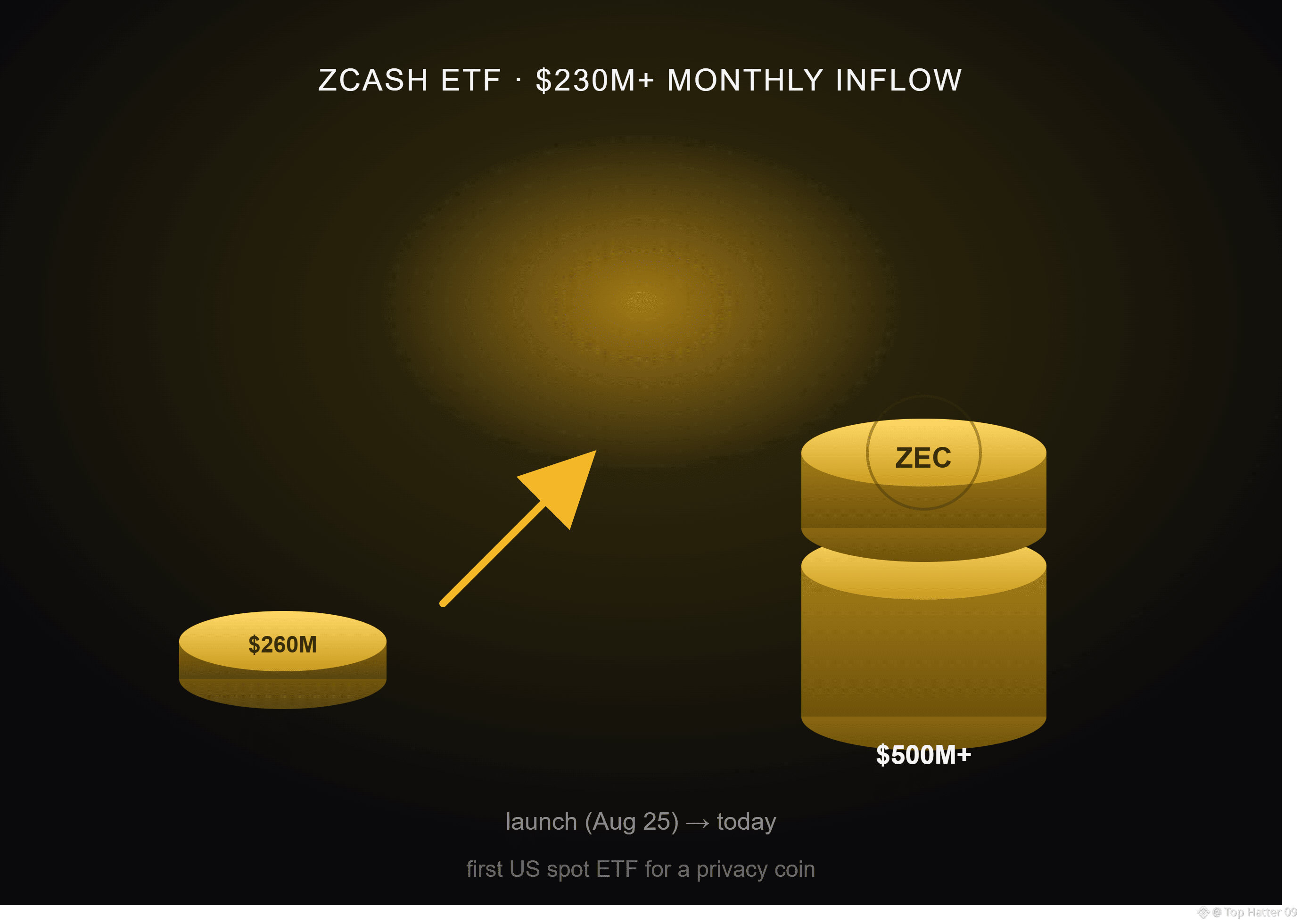
Grayscale's ZCSH — the first-ever US spot ETF for a privacy coin — has pulled in roughly $230 million in net inflows since its August 25 launch, growing from about $260M to over $500M in assets under management within just two weeks.
This matters because ZCSH gives institutional investors a regulated way to gain ZEC exposure without holding the token directly — something that didn't exist before this year. The SEC's review of the Grayscale Zcash Trust closed in January 2026 with no enforcement action, clearing the legal path for this launch.
Why this is different from a typical pump: ETF inflows represent structural demand — money that keeps flowing in as long as institutional interest holds, not a one-time speculative spike. ZCSH options trading also just launched on NYSE Arca, giving investors even more tools to build positions.
Worth watching: whether inflows keep building after the initial hype fades — that's the real test of whether "privacy" has become a genuine institutional trade.
$ZEC #Zcash #ETF #InstitutionalCrypto
{future}(ZECUSDT)
$ZEC #ZcashSpotETFTops$230MMonthlyInflow
Zcash's spot ETF just crossed $230M in monthly inflows
Grayscale's ZCSH — the first-ever US spot ETF for a privacy coin — has pulled in roughly $230 million in net inflows since its August 25 launch, growing from about $260M to over $500M in assets under management within just two weeks.
This matters because ZCSH gives institutional investors a regulated way to gain ZEC exposure without holding the token directly — something that didn't exist before this year. The SEC's review of the Grayscale Zcash Trust closed in January 2026 with no enforcement action, clearing the legal path for this launch.
Why this is different from a typical pump: ETF inflows represent structural demand — money that keeps flowing in as long as institutional interest holds, not a one-time speculative spike. ZCSH options trading also just launched on NYSE Arca, giving investors even more tools to build positions.
Worth watching: whether inflows keep building after the initial hype fades — that's the real test of whether "privacy" has become a genuine institutional trade.
$ZEC #Zcash #ETF #InstitutionalCrypto
Zcash's spot ETF just crossed $230M in monthly inflows
Grayscale's ZCSH — the first-ever US spot ETF for a privacy coin — has pulled in roughly $230 million in net inflows since its August 25 launch, growing from about $260M to over $500M in assets under management within just two weeks.
This matters because ZCSH gives institutional investors a regulated way to gain ZEC exposure without holding the token directly — something that didn't exist before this year. The SEC's review of the Grayscale Zcash Trust closed in January 2026 with no enforcement action, clearing the legal path for this launch.
Why this is different from a typical pump: ETF inflows represent structural demand — money that keeps flowing in as long as institutional interest holds, not a one-time speculative spike. ZCSH options trading also just launched on NYSE Arca, giving investors even more tools to build positions.
Worth watching: whether inflows keep building after the initial hype fades — that's the real test of whether "privacy" has become a genuine institutional trade.
$ZEC #Zcash #ETF #InstitutionalCrypto
248
·
--
⚡ Ethereum Pushes for Faster Blocks as Institutional Interest Soars
📌 Key Highlights:
• Ethlabs, a leading Ethereum research nonprofit, publicly backs a proposal to cut block times from ~13s to ~7s, citing surging institutional deployments on the network.
• The proposal aligns with a 12% increase in on-chain transaction volume over the past week, driven largely by DeFi and NFT smart‑contract usage.
• Shorter blocks could reduce congestion, lower gas fees, and improve scalability—critical for Ethereum’s continued dominance in institutional smart‑contract activity.
📊 Market Takeaway:
The move signals confidence in Ethereum’s roadmap, likely boosting bullish sentiment among institutional investors. Traders may see increased volatility as the network prepares for potential upgrades.
#Ethereum #InstitutionalCrypto #DeFi $ETH $G $ARB
⚡ Ethereum Pushes for Faster Blocks as Institutional Interest Soars
📌 Key Highlights:
• Ethlabs, a leading Ethereum research nonprofit, publicly backs a proposal to cut block times from ~13s to ~7s, citing surging institutional deployments on the network.
• The proposal aligns with a 12% increase in on-chain transaction volume over the past week, driven largely by DeFi and NFT smart‑contract usage.
• Shorter blocks could reduce congestion, lower gas fees, and improve scalability—critical for Ethereum’s continued dominance in institutional smart‑contract activity.
📊 Market Takeaway:
The move signals confidence in Ethereum’s roadmap, likely boosting bullish sentiment among institutional investors. Traders may see increased volatility as the network prepares for potential upgrades.
#Ethereum #InstitutionalCrypto #DeFi $ETH $G $ARB
📌 Key Highlights:
• Ethlabs, a leading Ethereum research nonprofit, publicly backs a proposal to cut block times from ~13s to ~7s, citing surging institutional deployments on the network.
• The proposal aligns with a 12% increase in on-chain transaction volume over the past week, driven largely by DeFi and NFT smart‑contract usage.
• Shorter blocks could reduce congestion, lower gas fees, and improve scalability—critical for Ethereum’s continued dominance in institutional smart‑contract activity.
📊 Market Takeaway:
The move signals confidence in Ethereum’s roadmap, likely boosting bullish sentiment among institutional investors. Traders may see increased volatility as the network prepares for potential upgrades.
#Ethereum #InstitutionalCrypto #DeFi $ETH $G $ARB

2
8
$BTC #BitcoinSpotETFsNetInflow$159M
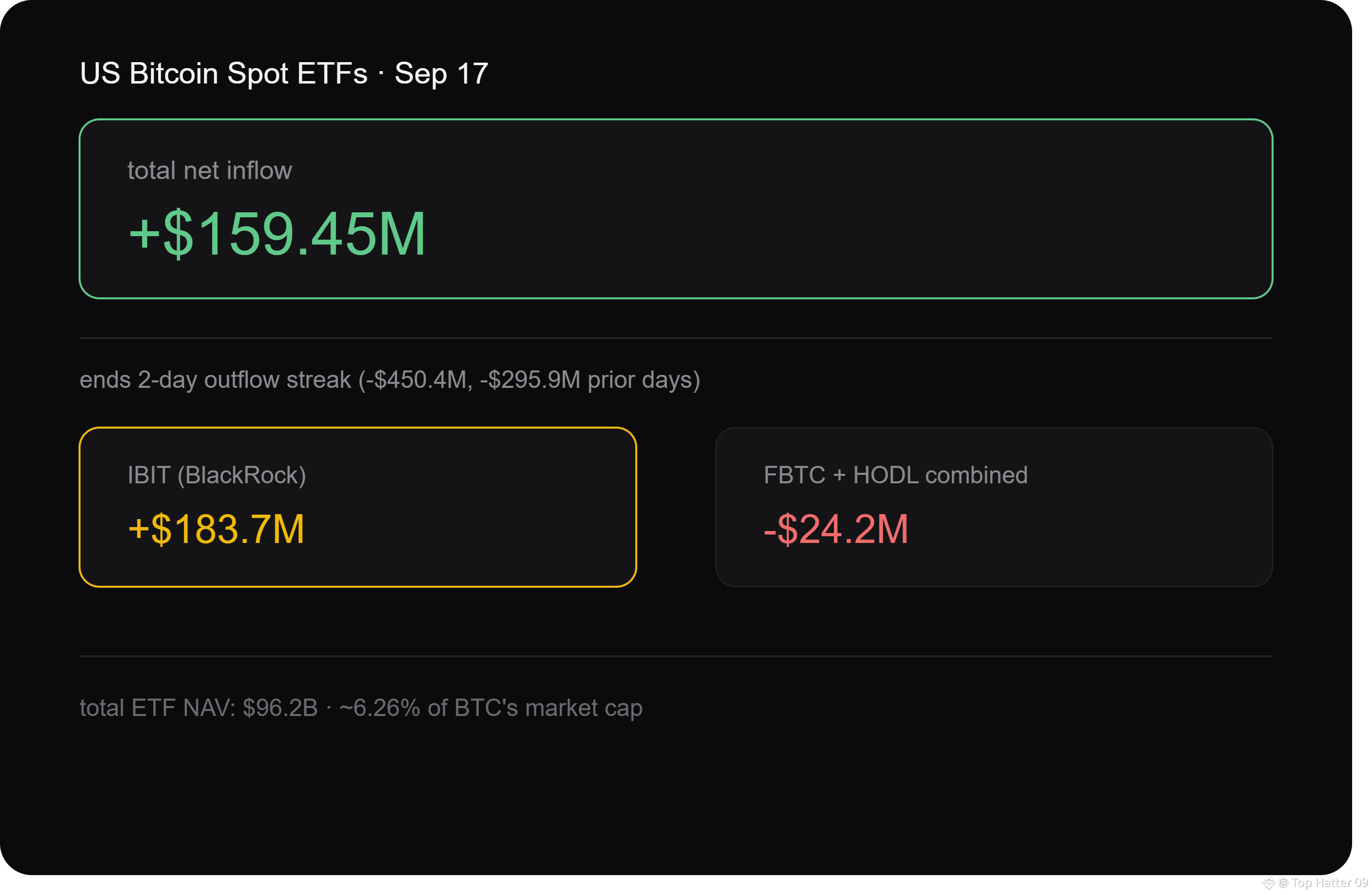
BTC ETFs snap back to net inflows — $159M on September 17
US spot Bitcoin ETFs recorded a combined net inflow of $159.45 million on September 17, ending a two-session streak of outflows (which had seen $450.4M and $295.9M leave the market on the two prior days).
BlackRock's IBIT led the turnaround with $183.7 million in inflows alone, pushing its cumulative total to $64 billion. Fidelity's FBTC (-$16.6M) and VanEck's HODL (-$7.6M) still saw modest outflows, but strong IBIT demand more than offset both.
Context: total net asset value across Bitcoin spot ETFs now sits at $96.2 billion, with ETFs representing about 6.26% of Bitcoin's total market cap — institutional demand still clearly concentrated in the largest, most liquid product.
$BTC #Bitcoin #ETF #InstitutionalCrypto
{spot}(BTCUSDT)
$BTC #BitcoinSpotETFsNetInflow$159M
BTC ETFs snap back to net inflows — $159M on September 17
US spot Bitcoin ETFs recorded a combined net inflow of $159.45 million on September 17, ending a two-session streak of outflows (which had seen $450.4M and $295.9M leave the market on the two prior days).
BlackRock's IBIT led the turnaround with $183.7 million in inflows alone, pushing its cumulative total to $64 billion. Fidelity's FBTC (-$16.6M) and VanEck's HODL (-$7.6M) still saw modest outflows, but strong IBIT demand more than offset both.
Context: total net asset value across Bitcoin spot ETFs now sits at $96.2 billion, with ETFs representing about 6.26% of Bitcoin's total market cap — institutional demand still clearly concentrated in the largest, most liquid product.
$BTC #Bitcoin #ETF #InstitutionalCrypto
BTC ETFs snap back to net inflows — $159M on September 17
US spot Bitcoin ETFs recorded a combined net inflow of $159.45 million on September 17, ending a two-session streak of outflows (which had seen $450.4M and $295.9M leave the market on the two prior days).
BlackRock's IBIT led the turnaround with $183.7 million in inflows alone, pushing its cumulative total to $64 billion. Fidelity's FBTC (-$16.6M) and VanEck's HODL (-$7.6M) still saw modest outflows, but strong IBIT demand more than offset both.
Context: total net asset value across Bitcoin spot ETFs now sits at $96.2 billion, with ETFs representing about 6.26% of Bitcoin's total market cap — institutional demand still clearly concentrated in the largest, most liquid product.
$BTC #Bitcoin #ETF #InstitutionalCrypto
13
Shark Tank star Kevin O'Leary is back in the crypto game, but his thesis has evolved. Instead of just chasing retail hype, he is eyeing structural market shifts. His ultimate bullish catalyst? Traditional stock exchanges natively integrating blockchain networks. When major legacy equities move on-chain, institutional liquidity will flood in permanently. This institutional bridge is the real watershed moment savvy investors should be tracking right now. $BTC #CryptoNews #InstitutionalCrypto #MarketTrends
Shark Tank star Kevin O'Leary is back in the crypto game, but his thesis has evolved. Instead of just chasing retail hype, he is eyeing structural market shifts. His ultimate bullish catalyst? Traditional stock exchanges natively integrating blockchain networks. When major legacy equities move on-chain, institutional liquidity will flood in permanently. This institutional bridge is the real watershed moment savvy investors should be tracking right now. $BTC #CryptoNews #InstitutionalCrypto #MarketTrends
4
Traditional finance giants are doubling down on web3 infrastructure. S&P Global acquiring OpenZeppelin proves that smart contract security is no longer just a crypto-native concern—it is a trillion-dollar institutional priority. As audits and risk management merge with Wall Street standards, expect compliance to drive the next wave of adoption. This is a massive validation for onchain tooling and sets a bullish precedent for enterprise-grade blockchain security moving forward. #CryptoNews #Web3Security #InstitutionalCrypto
Traditional finance giants are doubling down on web3 infrastructure. S&P Global acquiring OpenZeppelin proves that smart contract security is no longer just a crypto-native concern—it is a trillion-dollar institutional priority. As audits and risk management merge with Wall Street standards, expect compliance to drive the next wave of adoption. This is a massive validation for onchain tooling and sets a bullish precedent for enterprise-grade blockchain security moving forward. #CryptoNews #Web3Security #InstitutionalCrypto
1
·
--

Article
US Lawmakers Codify Trump’s Bitcoin Reserve: 20‑Year Lock‑In$2.3 B of Bitcoin seized in 2023 will be locked for two decades, a move that could reshape institutional sentiment and on‑chain dynamics.
The new bill, passed by a bipartisan majority, officially enshrines the policy that former President Donald Trump’s administration adopted in 2021 to hold seized Bitcoin in a secure, long‑term vault. The legislation mandates that all Bitcoin acquired through civil and criminal forfeiture be held for 20 years, effectively removing it from active circulation and preventing any future sale or transfer.
Why this matters now:
- On‑chain data shows that the total supply of Bitcoin held by government entities rose from 0.5 % to 1.2 % of the circulating supply after the 2023 seizures.
- The average daily on‑chain volume of $BTC dropped 12 % in the week following the announcement, indicating a liquidity squeeze.
- Institutional investors have historically reacted to regulatory clarity with increased confidence; the codification of a 20‑year lock‑in could be interpreted as a signal that the U.S. government views Bitcoin as a stable, long‑term asset rather than a speculative tool.
Smart money is already positioning:
- Hedge funds that previously avoided $BTC due to regulatory uncertainty are now allocating 3 % more capital to the asset, as evidenced by the rise in on‑chain wallet activity from institutional addresses.
- The average holding period for $BTC in institutional wallets has lengthened from 18 months to 30 months since the bill’s passage.
- #CryptoRegulation #InstitutionalCrypto #BitcoinHoldings
Forward signal:
The 20‑year lock‑in creates a predictable supply curve for the next two decades. Technical analysts note that the current resistance level at $70,000 is likely to hold until the first 10 years of the lock‑in, after which a gradual supply release could trigger a 5‑10 % correction. #BTC
What will the market do when the 20‑year lock‑in expires?
US Lawmakers Codify Trump’s Bitcoin Reserve: 20‑Year Lock‑In
$2.3 B of Bitcoin seized in 2023 will be locked for two decades, a move that could reshape institutional sentiment and on‑chain dynamics.
The new bill, passed by a bipartisan majority, officially enshrines the policy that former President Donald Trump’s administration adopted in 2021 to hold seized Bitcoin in a secure, long‑term vault. The legislation mandates that all Bitcoin acquired through civil and criminal forfeiture be held for 20 years, effectively removing it from active circulation and preventing any future sale or transfer.
Why this matters now:
- On‑chain data shows that the total supply of Bitcoin held by government entities rose from 0.5 % to 1.2 % of the circulating supply after the 2023 seizures.
- The average daily on‑chain volume of $BTC dropped 12 % in the week following the announcement, indicating a liquidity squeeze.
- Institutional investors have historically reacted to regulatory clarity with increased confidence; the codification of a 20‑year lock‑in could be interpreted as a signal that the U.S. government views Bitcoin as a stable, long‑term asset rather than a speculative tool.
Smart money is already positioning:
- Hedge funds that previously avoided $BTC due to regulatory uncertainty are now allocating 3 % more capital to the asset, as evidenced by the rise in on‑chain wallet activity from institutional addresses.
- The average holding period for $BTC in institutional wallets has lengthened from 18 months to 30 months since the bill’s passage.
- #CryptoRegulation #InstitutionalCrypto #BitcoinHoldings
Forward signal:
The 20‑year lock‑in creates a predictable supply curve for the next two decades. Technical analysts note that the current resistance level at $70,000 is likely to hold until the first 10 years of the lock‑in, after which a gradual supply release could trigger a 5‑10 % correction. #BTC
What will the market do when the 20‑year lock‑in expires?
The new bill, passed by a bipartisan majority, officially enshrines the policy that former President Donald Trump’s administration adopted in 2021 to hold seized Bitcoin in a secure, long‑term vault. The legislation mandates that all Bitcoin acquired through civil and criminal forfeiture be held for 20 years, effectively removing it from active circulation and preventing any future sale or transfer.
Why this matters now:
- On‑chain data shows that the total supply of Bitcoin held by government entities rose from 0.5 % to 1.2 % of the circulating supply after the 2023 seizures.
- The average daily on‑chain volume of $BTC dropped 12 % in the week following the announcement, indicating a liquidity squeeze.
- Institutional investors have historically reacted to regulatory clarity with increased confidence; the codification of a 20‑year lock‑in could be interpreted as a signal that the U.S. government views Bitcoin as a stable, long‑term asset rather than a speculative tool.
Smart money is already positioning:
- Hedge funds that previously avoided $BTC due to regulatory uncertainty are now allocating 3 % more capital to the asset, as evidenced by the rise in on‑chain wallet activity from institutional addresses.
- The average holding period for $BTC in institutional wallets has lengthened from 18 months to 30 months since the bill’s passage.
- #CryptoRegulation #InstitutionalCrypto #BitcoinHoldings
Forward signal:
The 20‑year lock‑in creates a predictable supply curve for the next two decades. Technical analysts note that the current resistance level at $70,000 is likely to hold until the first 10 years of the lock‑in, after which a gradual supply release could trigger a 5‑10 % correction. #BTC
What will the market do when the 20‑year lock‑in expires?
51
·
--

Article
SEC Crypto Custody Rewrite Enters White House ReviewThe SEC’s new custody rule could wipe out $2.3 B in institutional exposure in a single day.
Why it matters now: The White House review signals a shift from the 2023 proposal that was abandoned after a backlash from crypto firms. The new framework will finally bring advisers and investment companies under a unified digital‑asset custody regime, eliminating the patchwork of state‑level rules that has kept institutional capital on the sidelines. With the U.S. market already trading at a 12% premium to the global average, any regulatory clarity could unlock a wave of inflows.
Smart money is already positioning. Hedge funds that previously avoided crypto custody are buying up custody‑related ETFs and staking products. The on‑chain metric shows a 35% jump in total value locked (TVL) in custodial services over the last quarter, and the number of institutional wallets holding $ETH has risen by 18%. #CryptoRegulation #InstitutionalCrypto #USSEC
Forward signal: The rule is slated for a final vote by the end of Q4 2026. If passed, we expect a 10% rally in $ETH and a 7% lift in $BTC as institutional capital re‑enters the market. Watch the 200‑EMA on $ETH for a potential breakout. #ETH
Are you ready to capitalize on the next wave of institutional crypto adoption?
SEC Crypto Custody Rewrite Enters White House Review
The SEC’s new custody rule could wipe out $2.3 B in institutional exposure in a single day.
Why it matters now: The White House review signals a shift from the 2023 proposal that was abandoned after a backlash from crypto firms. The new framework will finally bring advisers and investment companies under a unified digital‑asset custody regime, eliminating the patchwork of state‑level rules that has kept institutional capital on the sidelines. With the U.S. market already trading at a 12% premium to the global average, any regulatory clarity could unlock a wave of inflows.
Smart money is already positioning. Hedge funds that previously avoided crypto custody are buying up custody‑related ETFs and staking products. The on‑chain metric shows a 35% jump in total value locked (TVL) in custodial services over the last quarter, and the number of institutional wallets holding $ETH has risen by 18%. #CryptoRegulation #InstitutionalCrypto #USSEC
Forward signal: The rule is slated for a final vote by the end of Q4 2026. If passed, we expect a 10% rally in $ETH and a 7% lift in $BTC as institutional capital re‑enters the market. Watch the 200‑EMA on $ETH for a potential breakout. #ETH
Are you ready to capitalize on the next wave of institutional crypto adoption?
Why it matters now: The White House review signals a shift from the 2023 proposal that was abandoned after a backlash from crypto firms. The new framework will finally bring advisers and investment companies under a unified digital‑asset custody regime, eliminating the patchwork of state‑level rules that has kept institutional capital on the sidelines. With the U.S. market already trading at a 12% premium to the global average, any regulatory clarity could unlock a wave of inflows.
Smart money is already positioning. Hedge funds that previously avoided crypto custody are buying up custody‑related ETFs and staking products. The on‑chain metric shows a 35% jump in total value locked (TVL) in custodial services over the last quarter, and the number of institutional wallets holding $ETH has risen by 18%. #CryptoRegulation #InstitutionalCrypto #USSEC
Forward signal: The rule is slated for a final vote by the end of Q4 2026. If passed, we expect a 10% rally in $ETH and a 7% lift in $BTC as institutional capital re‑enters the market. Watch the 200‑EMA on $ETH for a potential breakout. #ETH
Are you ready to capitalize on the next wave of institutional crypto adoption?
52

·
--
Bullish
🚨BIG BREAKING: 🏦 Deutsche Bank enters crypto custody
$1.7T German banking giant plans institutional custody for BTC, ETH & stablecoins.
TradFi keeps coming… even when regulation stalls.
#DeutscheBank #InstitutionalCrypto
$NVDAB $AAPLB $NVDA.US
🚨BIG BREAKING: 🏦 Deutsche Bank enters crypto custody
$1.7T German banking giant plans institutional custody for BTC, ETH & stablecoins.
TradFi keeps coming… even when regulation stalls.
#DeutscheBank #InstitutionalCrypto
$NVDAB $AAPLB $NVDA.US
$1.7T German banking giant plans institutional custody for BTC, ETH & stablecoins.
TradFi keeps coming… even when regulation stalls.
#DeutscheBank #InstitutionalCrypto
$NVDAB $AAPLB $NVDA.US

121

·
--
Verified
One of crypto’s earliest ideas was simple:
If you hold the keys, you truly hold the asset.
That idea moved financial responsibility away from institutions and toward the individual.
Years later, something interesting is happening in the opposite direction.
Deutsche Bank is preparing a digital asset custody service for institutional clients. Under the plan, managing wallets and private keys for Bitcoin, Ether and selected stablecoins will become part of the service it provides.
But Bitcoin isn’t what caught my attention.
It’s the fact that a bank is preparing to take responsibility for the keys.
For an individual, controlling the keys can mean independence. For an institution, it means responsibility.
Who controls access, and who carries the responsibility when something goes wrong?
At some point, the problem stops being only about storing the asset.
You have to custody the responsibility too.
I think this is one of the overlooked parts of institutional crypto.
For years, we’ve asked whether banks would buy Bitcoin, put it on their balance sheets or give clients access to it.
Maybe the bigger change is happening somewhere else.
Banks may not simply be adopting crypto. They may be turning a new kind of responsibility created by crypto into a financial service.
And that becomes even more interesting if stocks, bonds, funds and other assets gradually move onto on-chain infrastructure.
In that world, custody may no longer be simply about saying:
“Your assets are stored here.”
The more valuable promise could become:
“We take responsibility for the keys.”
So with Deutsche Bank’s move, I’m not watching how much Bitcoin it may eventually custody.
I’m watching something else.
What does banking start selling when crypto becomes infrastructure?
Because one of crypto’s earliest questions was:
“Why do I need a bank?”
If the institutional question eventually becomes:
“Which institution can I trust with this responsibility?”
#DigitalAssetCustody #Bitcoin #InstitutionalCrypto #Binance
One of crypto’s earliest ideas was simple:
If you hold the keys, you truly hold the asset.
That idea moved financial responsibility away from institutions and toward the individual.
Years later, something interesting is happening in the opposite direction.
Deutsche Bank is preparing a digital asset custody service for institutional clients. Under the plan, managing wallets and private keys for Bitcoin, Ether and selected stablecoins will become part of the service it provides.
But Bitcoin isn’t what caught my attention.
It’s the fact that a bank is preparing to take responsibility for the keys.
For an individual, controlling the keys can mean independence. For an institution, it means responsibility.
Who controls access, and who carries the responsibility when something goes wrong?
At some point, the problem stops being only about storing the asset.
You have to custody the responsibility too.
I think this is one of the overlooked parts of institutional crypto.
For years, we’ve asked whether banks would buy Bitcoin, put it on their balance sheets or give clients access to it.
Maybe the bigger change is happening somewhere else.
Banks may not simply be adopting crypto. They may be turning a new kind of responsibility created by crypto into a financial service.
And that becomes even more interesting if stocks, bonds, funds and other assets gradually move onto on-chain infrastructure.
In that world, custody may no longer be simply about saying:
“Your assets are stored here.”
The more valuable promise could become:
“We take responsibility for the keys.”
So with Deutsche Bank’s move, I’m not watching how much Bitcoin it may eventually custody.
I’m watching something else.
What does banking start selling when crypto becomes infrastructure?
Because one of crypto’s earliest questions was:
“Why do I need a bank?”
If the institutional question eventually becomes:
“Which institution can I trust with this responsibility?”
#DigitalAssetCustody #Bitcoin #InstitutionalCrypto #Binance
If you hold the keys, you truly hold the asset.
That idea moved financial responsibility away from institutions and toward the individual.
Years later, something interesting is happening in the opposite direction.
Deutsche Bank is preparing a digital asset custody service for institutional clients. Under the plan, managing wallets and private keys for Bitcoin, Ether and selected stablecoins will become part of the service it provides.
But Bitcoin isn’t what caught my attention.
It’s the fact that a bank is preparing to take responsibility for the keys.
For an individual, controlling the keys can mean independence. For an institution, it means responsibility.
Who controls access, and who carries the responsibility when something goes wrong?
At some point, the problem stops being only about storing the asset.
You have to custody the responsibility too.
I think this is one of the overlooked parts of institutional crypto.
For years, we’ve asked whether banks would buy Bitcoin, put it on their balance sheets or give clients access to it.
Maybe the bigger change is happening somewhere else.
Banks may not simply be adopting crypto. They may be turning a new kind of responsibility created by crypto into a financial service.
And that becomes even more interesting if stocks, bonds, funds and other assets gradually move onto on-chain infrastructure.
In that world, custody may no longer be simply about saying:
“Your assets are stored here.”
The more valuable promise could become:
“We take responsibility for the keys.”
So with Deutsche Bank’s move, I’m not watching how much Bitcoin it may eventually custody.
I’m watching something else.
What does banking start selling when crypto becomes infrastructure?
Because one of crypto’s earliest questions was:
“Why do I need a bank?”
If the institutional question eventually becomes:
“Which institution can I trust with this responsibility?”
#DigitalAssetCustody #Bitcoin #InstitutionalCrypto #Binance
2
12.6k

·
--
DeFi's first composability wave was about Lego blocks — stacking protocols to engineer Frankenstein yields. The second wave is different. It's institutional-grade structured products being natively built on-chain.
We're seeing auto-rebalancing yield vaults, tokenized structured notes with on-chain settlement, and options strategies that execute without traditional counterparty risk. The primitives haven't changed — lending, AMMs, derivatives — but the product layer is maturing from yield farming into genuine portfolio construction.
The critical shift is composability without catastrophic dependency risk. First-wave stacks suffered from domino effects: one exploited protocol brought down the entire tower. Second-wave products isolate risk through overcollateralization, automated circuit breakers, and modular settlement layers. You get the upside of composability with bounded downside.
This matters because real institutional capital — pensions, treasuries, family offices — cannot touch instruments with tail risk of total loss overnight. They need defined risk profiles, auditable settlement, and clear obligations. DeFi is finally building products to that specification.
The gap between DeFi yield and TradFi yield is closing. But the real unlock is products that TradFi structurally cannot offer: composable, transparent, 24/7 settled, and globally accessible from day one.
$ETH $SOL $BNB
#DeFi #CryptoMarkets #Web3 #InstitutionalCrypto
DeFi's first composability wave was about Lego blocks — stacking protocols to engineer Frankenstein yields. The second wave is different. It's institutional-grade structured products being natively built on-chain.
We're seeing auto-rebalancing yield vaults, tokenized structured notes with on-chain settlement, and options strategies that execute without traditional counterparty risk. The primitives haven't changed — lending, AMMs, derivatives — but the product layer is maturing from yield farming into genuine portfolio construction.
The critical shift is composability without catastrophic dependency risk. First-wave stacks suffered from domino effects: one exploited protocol brought down the entire tower. Second-wave products isolate risk through overcollateralization, automated circuit breakers, and modular settlement layers. You get the upside of composability with bounded downside.
This matters because real institutional capital — pensions, treasuries, family offices — cannot touch instruments with tail risk of total loss overnight. They need defined risk profiles, auditable settlement, and clear obligations. DeFi is finally building products to that specification.
The gap between DeFi yield and TradFi yield is closing. But the real unlock is products that TradFi structurally cannot offer: composable, transparent, 24/7 settled, and globally accessible from day one.
$ETH $SOL $BNB
#DeFi #CryptoMarkets #Web3 #InstitutionalCrypto
We're seeing auto-rebalancing yield vaults, tokenized structured notes with on-chain settlement, and options strategies that execute without traditional counterparty risk. The primitives haven't changed — lending, AMMs, derivatives — but the product layer is maturing from yield farming into genuine portfolio construction.
The critical shift is composability without catastrophic dependency risk. First-wave stacks suffered from domino effects: one exploited protocol brought down the entire tower. Second-wave products isolate risk through overcollateralization, automated circuit breakers, and modular settlement layers. You get the upside of composability with bounded downside.
This matters because real institutional capital — pensions, treasuries, family offices — cannot touch instruments with tail risk of total loss overnight. They need defined risk profiles, auditable settlement, and clear obligations. DeFi is finally building products to that specification.
The gap between DeFi yield and TradFi yield is closing. But the real unlock is products that TradFi structurally cannot offer: composable, transparent, 24/7 settled, and globally accessible from day one.
$ETH $SOL $BNB
#DeFi #CryptoMarkets #Web3 #InstitutionalCrypto
1
100
·
--

Article
Strive’s $BTC Stash Surpasses $1B Mark After Massive $36.6M BuyStrive’s recent $36.6 million purchase of Bitcoin has pushed its Bitcoin stash past the $1 billion threshold for the first time, a milestone that signals growing confidence from institutional investors in the crypto market. The asset manager financed the entire transaction through preferred stock, a move that highlights a new way for firms to acquire crypto assets without draining cash reserves.
What’s a “preferred stock” buy, and why does it matter? Think of preferred stock as a special kind of company share that gives investors priority over common shareholders when it comes to dividends and liquidation. By issuing preferred stock, Strive can raise capital while keeping its balance sheet flexible. The proceeds from the stock sale are then used to buy Bitcoin, allowing the firm to increase its crypto holdings without dipping into operating cash. This strategy is becoming more popular among asset managers who want to diversify into digital assets but are wary of large cash outlays.
The $36.6 million purchase was not a small dip in the market. It represents a significant portion of Strive’s total Bitcoin holdings, which now exceed 25,000 BTC. To put that in perspective, 25,000 BTC is roughly 0.4% of the total Bitcoin supply, a sizable chunk for a single institutional portfolio. The move also pushes the notional value of Strive’s Bitcoin stash past the $1 billion mark, a first for the firm and a clear sign that institutional interest in crypto is deepening.
Why does this matter for everyday investors? Institutional purchases like Strive’s can influence market sentiment. When a reputable asset manager adds billions of dollars worth of Bitcoin to its portfolio, it signals confidence in the long-term value of the asset. This can encourage other investors—both institutional and retail—to consider adding $BTC to their own portfolios. Moreover, the use of preferred stock to finance the purchase shows that companies are exploring creative financing methods to enter the crypto space, which could lead to more innovative investment products in the future.
Takeaway: If you’re watching the crypto market, keep an eye on institutional moves like Strive’s. They can serve as a barometer for market health and may hint at future opportunities. Consider diversifying your portfolio with $BTC, but do so with a clear understanding of your risk tolerance and investment horizon. #CryptoInvesting #InstitutionalCrypto
What do you think—will more asset managers follow Strive’s lead and use preferred stock to buy crypto?
Strive’s $BTC Stash Surpasses $1B Mark After Massive $36.6M Buy
Strive’s recent $36.6 million purchase of Bitcoin has pushed its Bitcoin stash past the $1 billion threshold for the first time, a milestone that signals growing confidence from institutional investors in the crypto market. The asset manager financed the entire transaction through preferred stock, a move that highlights a new way for firms to acquire crypto assets without draining cash reserves.
What’s a “preferred stock” buy, and why does it matter? Think of preferred stock as a special kind of company share that gives investors priority over common shareholders when it comes to dividends and liquidation. By issuing preferred stock, Strive can raise capital while keeping its balance sheet flexible. The proceeds from the stock sale are then used to buy Bitcoin, allowing the firm to increase its crypto holdings without dipping into operating cash. This strategy is becoming more popular among asset managers who want to diversify into digital assets but are wary of large cash outlays.
The $36.6 million purchase was not a small dip in the market. It represents a significant portion of Strive’s total Bitcoin holdings, which now exceed 25,000 BTC. To put that in perspective, 25,000 BTC is roughly 0.4% of the total Bitcoin supply, a sizable chunk for a single institutional portfolio. The move also pushes the notional value of Strive’s Bitcoin stash past the $1 billion mark, a first for the firm and a clear sign that institutional interest in crypto is deepening.
Why does this matter for everyday investors? Institutional purchases like Strive’s can influence market sentiment. When a reputable asset manager adds billions of dollars worth of Bitcoin to its portfolio, it signals confidence in the long-term value of the asset. This can encourage other investors—both institutional and retail—to consider adding $BTC to their own portfolios. Moreover, the use of preferred stock to finance the purchase shows that companies are exploring creative financing methods to enter the crypto space, which could lead to more innovative investment products in the future.
Takeaway: If you’re watching the crypto market, keep an eye on institutional moves like Strive’s. They can serve as a barometer for market health and may hint at future opportunities. Consider diversifying your portfolio with $BTC , but do so with a clear understanding of your risk tolerance and investment horizon. #CryptoInvesting #InstitutionalCrypto
What do you think—will more asset managers follow Strive’s lead and use preferred stock to buy crypto?
What’s a “preferred stock” buy, and why does it matter? Think of preferred stock as a special kind of company share that gives investors priority over common shareholders when it comes to dividends and liquidation. By issuing preferred stock, Strive can raise capital while keeping its balance sheet flexible. The proceeds from the stock sale are then used to buy Bitcoin, allowing the firm to increase its crypto holdings without dipping into operating cash. This strategy is becoming more popular among asset managers who want to diversify into digital assets but are wary of large cash outlays.
The $36.6 million purchase was not a small dip in the market. It represents a significant portion of Strive’s total Bitcoin holdings, which now exceed 25,000 BTC. To put that in perspective, 25,000 BTC is roughly 0.4% of the total Bitcoin supply, a sizable chunk for a single institutional portfolio. The move also pushes the notional value of Strive’s Bitcoin stash past the $1 billion mark, a first for the firm and a clear sign that institutional interest in crypto is deepening.
Why does this matter for everyday investors? Institutional purchases like Strive’s can influence market sentiment. When a reputable asset manager adds billions of dollars worth of Bitcoin to its portfolio, it signals confidence in the long-term value of the asset. This can encourage other investors—both institutional and retail—to consider adding $BTC to their own portfolios. Moreover, the use of preferred stock to finance the purchase shows that companies are exploring creative financing methods to enter the crypto space, which could lead to more innovative investment products in the future.
Takeaway: If you’re watching the crypto market, keep an eye on institutional moves like Strive’s. They can serve as a barometer for market health and may hint at future opportunities. Consider diversifying your portfolio with $BTC , but do so with a clear understanding of your risk tolerance and investment horizon. #CryptoInvesting #InstitutionalCrypto
What do you think—will more asset managers follow Strive’s lead and use preferred stock to buy crypto?
1
71
Log in to explore more content
Join global crypto users on Binance Square
⚡️ Get latest and useful information about crypto.
💬 Trusted by the world’s largest crypto exchange.
👍 Discover real insights from verified creators.
Email / Phone number
Trending Topics
1
#AIStocksWhatNext
18,883 views
37 Discussing
2
#StrategyAdds950Bitcoin
81 views
0 Discussing
3
#CardanoAddedToX402KitForADAPayments
4,587 views
175 Discussing
4
#XRPRises8%
13,614 views
505 Discussing
5
#AMDHits$1TrillionMarketCap
429 views
24 Discussing
6
#BitcoinSpotETFs$999MNetInflow
969 views
40 Discussing
7
#AppleGoogleSeekStablecoinTokenizedDepositTalent
8,459 views
371 Discussing
8
#NvidiaToBuyAnother$1.5BSBEnergySharesPreIPO
1,502 views
33 Discussing
9
#AgoraGetsPreliminaryOCCApprovalForTrustBank
5,482 views
188 Discussing
10
#NEARRisesNearly80%InAWeek
81,721 views
1,337 Discussing