
#kospifalls2
kospifalls2
1,457 views
22 Discussing
Hot
Latest

·
--
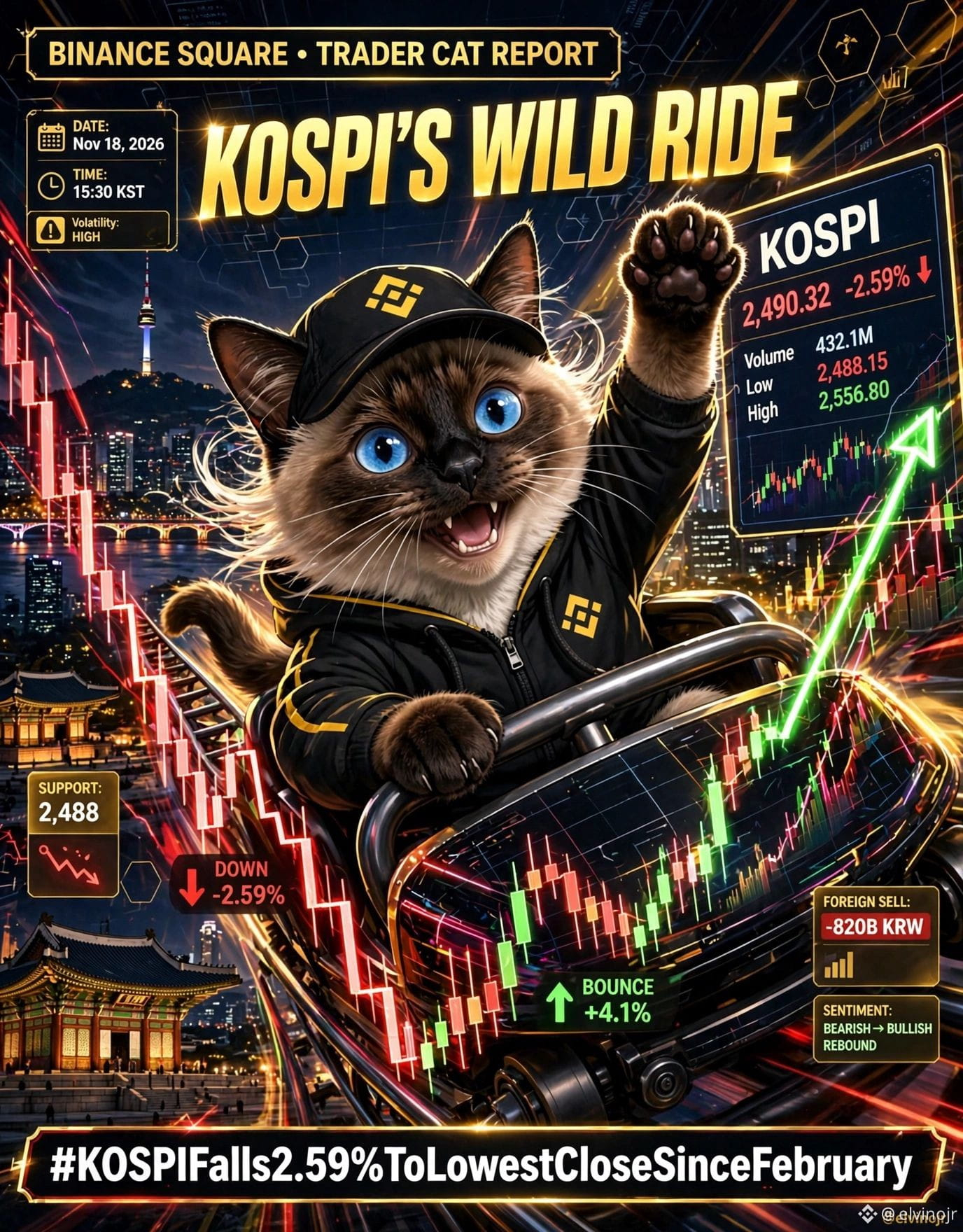
One day Korea's market lost 2.59% and closed at its lowest since February. The next morning it bounced straight back above 5,000.
The KOSPI fell 132 points on Tuesday to 4,968, its first close below 5,000 in about nine and a half months. Fourth straight day of losses, foreign investors sold a net 1.44 trillion won, and chip stocks got hit on new US curbs against China plus nerves ahead of Nvidia earnings.
Then Nvidia's numbers landed and the index jumped almost 2% today. Fear one day, relief the next. That is the whole market right now in one chart.
Crypto is riding the same rollercoaster. Fear and greed is sitting at 13, extreme fear, and $BTC keeps getting dragged around by the same AI headlines moving $NVDA.
When a big index drops that hard and bounces the next morning, do you buy the dip or wait to see if the bounce actually holds?
#KOSPIFalls2.59%ToLowestCloseSinceFebruary
One day Korea's market lost 2.59% and closed at its lowest since February. The next morning it bounced straight back above 5,000.
The KOSPI fell 132 points on Tuesday to 4,968, its first close below 5,000 in about nine and a half months. Fourth straight day of losses, foreign investors sold a net 1.44 trillion won, and chip stocks got hit on new US curbs against China plus nerves ahead of Nvidia earnings.
Then Nvidia's numbers landed and the index jumped almost 2% today. Fear one day, relief the next. That is the whole market right now in one chart.
Crypto is riding the same rollercoaster. Fear and greed is sitting at 13, extreme fear, and $BTC keeps getting dragged around by the same AI headlines moving $NVDA .
When a big index drops that hard and bounces the next morning, do you buy the dip or wait to see if the bounce actually holds?
#KOSPIFalls2.59%ToLowestCloseSinceFebruary
41

·
--
#KOSPIFalls2.59%ToLowestCloseSinceFebruary
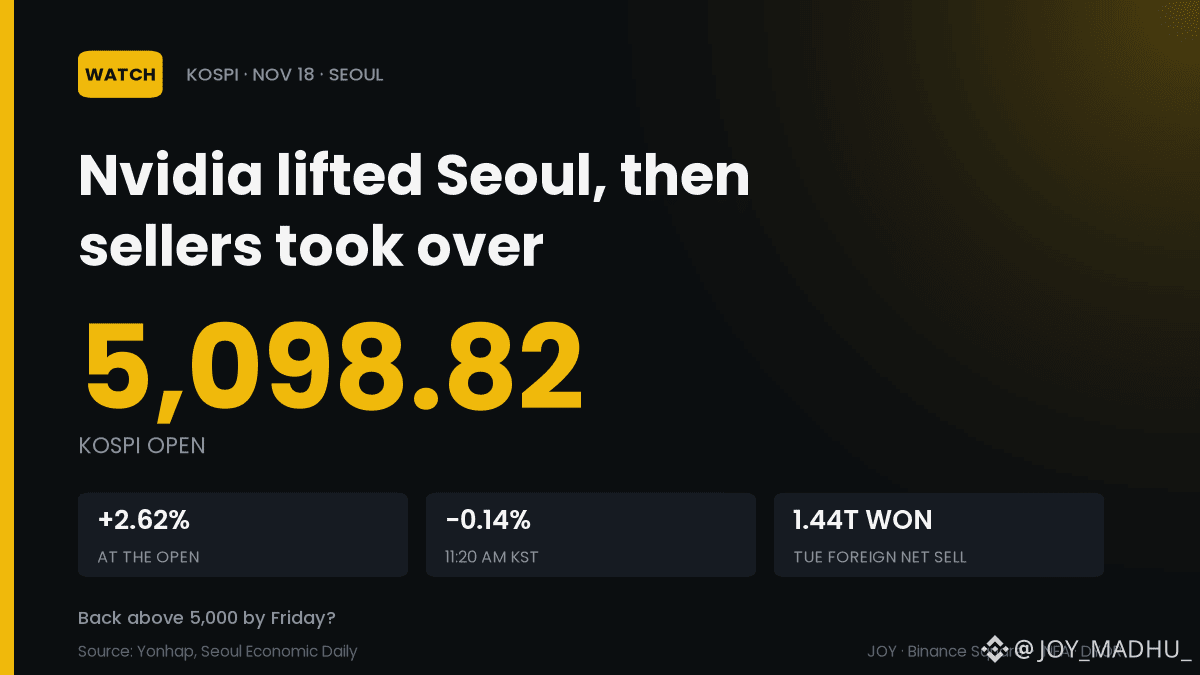
🎢 Up 2.62% at the Open, Red by 11:20: KOSPI's Nvidia Whipsaw
A day after losing 5,000, Seoul jumped on Nvidia's beat, then retail sellers erased the gain within hours.
📈 KOSPI opened at 5,098.82, up 2.62%, back above 5,000
📉 By 11:20 a.m. KST it was 4,961.58, down 0.14%
🏦 Samsung Electro-Mechanics +6.63% early on a new Nvidia substrate deal
⚠️ Tuesday: foreigners net sold 1.44T won as KOSPI closed at 4,968.48
My read: Nvidia helps chips, but foreign flows still set the floor.
Does KOSPI close above 5,000 on Friday, yes or no? 👇
$NVDA
#KOSPIFalls2.59%ToLowestCloseSinceFebruary #KOSPI #Nvidia
192
·
--
#KOSPIFalls2.59%ToLowestCloseSinceFebruary
🇰🇷 From 9,000 in June to Under 5,000: Korea's AI Rally Unwinds
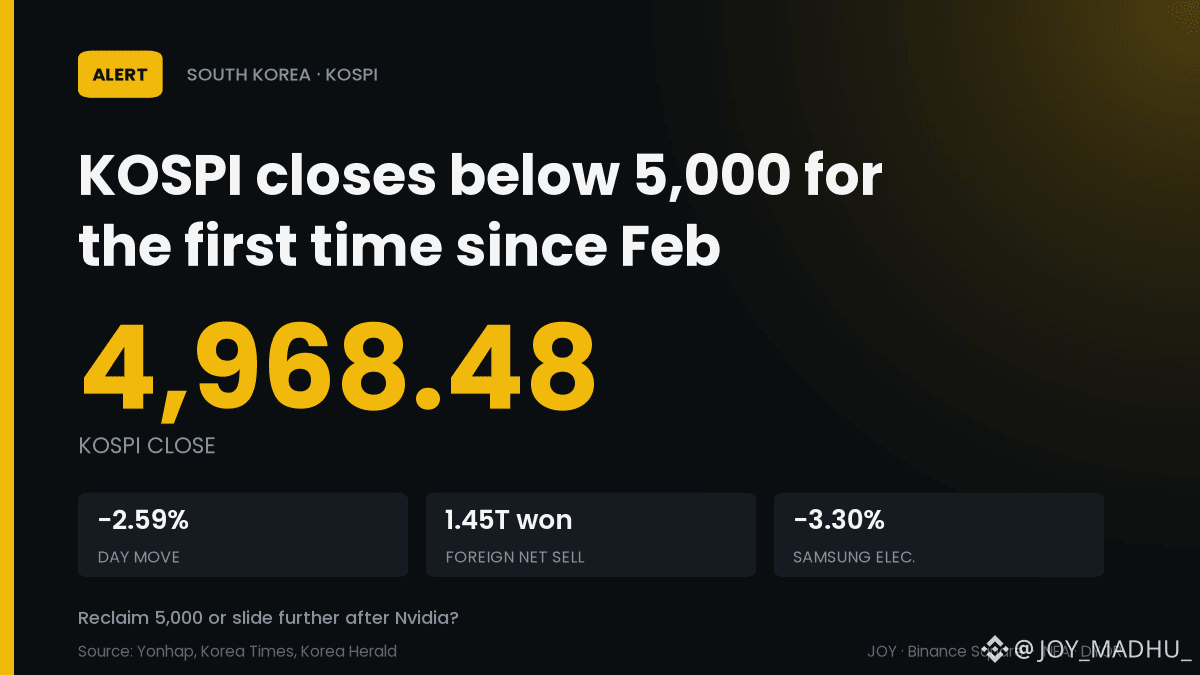
KOSPI closed at 4,968.48, its first finish below 5,000 since Feb 2 as foreigners dumped chip stocks.
📉 -132.02 points (-2.59%), 4th straight loss after Monday's -3.59%
🏦 Foreigners net sold 1.45T won (~$1.08B)
⚠️ Samsung Electronics -3.30%, SK hynix -1.96%, Kosdaq -2.34%
📅 Drivers: Nvidia CEO exit fallout and new US AI chip export curbs
Zoom out: KOSPI topped 9,000 on Jun 18; the AI trade is resetting hard.
Will KOSPI reclaim 5,000 or slide further this week after Nvidia? 👇
$NVDA
#KOSPIFalls2.59%ToLowestCloseSinceFebruary #KOSPI #AI
421

·
--
South Korea’s Kospi index plunged 2.59%, marking its lowest closing level since February 2023. The main reason was growing concern about a slowdown in global economic growth, particularly amid rising expectations that the U.S. Federal Reserve will raise interest rates. In addition, lackluster earnings during South Korea’s domestic corporate reporting season further dampened investor sentiment. I believe current market volatility is the result of a combination of economic cycles and geopolitical risks, and will be difficult to reverse in the short term. Investors should remain cautious and monitor policy developments and changes in corporate fundamentals. #KOSPIFalls2.59%ToLowestCloseSinceFebruary
$BTC
$BTC
67

·
--
KOSPI plunged 2.59% to 4,968 — its lowest level since February, and the first time it’s fallen below 5,000 in 9 months.
Asia’s already bleeding, while crypto is still holding its breath. 😬
Samsung -3.3%, SK Hynix -1.96%, Nikkei down 1.34%, Taiwan -2%. All because of one thing: everyone’s waiting for Nvidia’s earnings report, due out at 4 a.m.
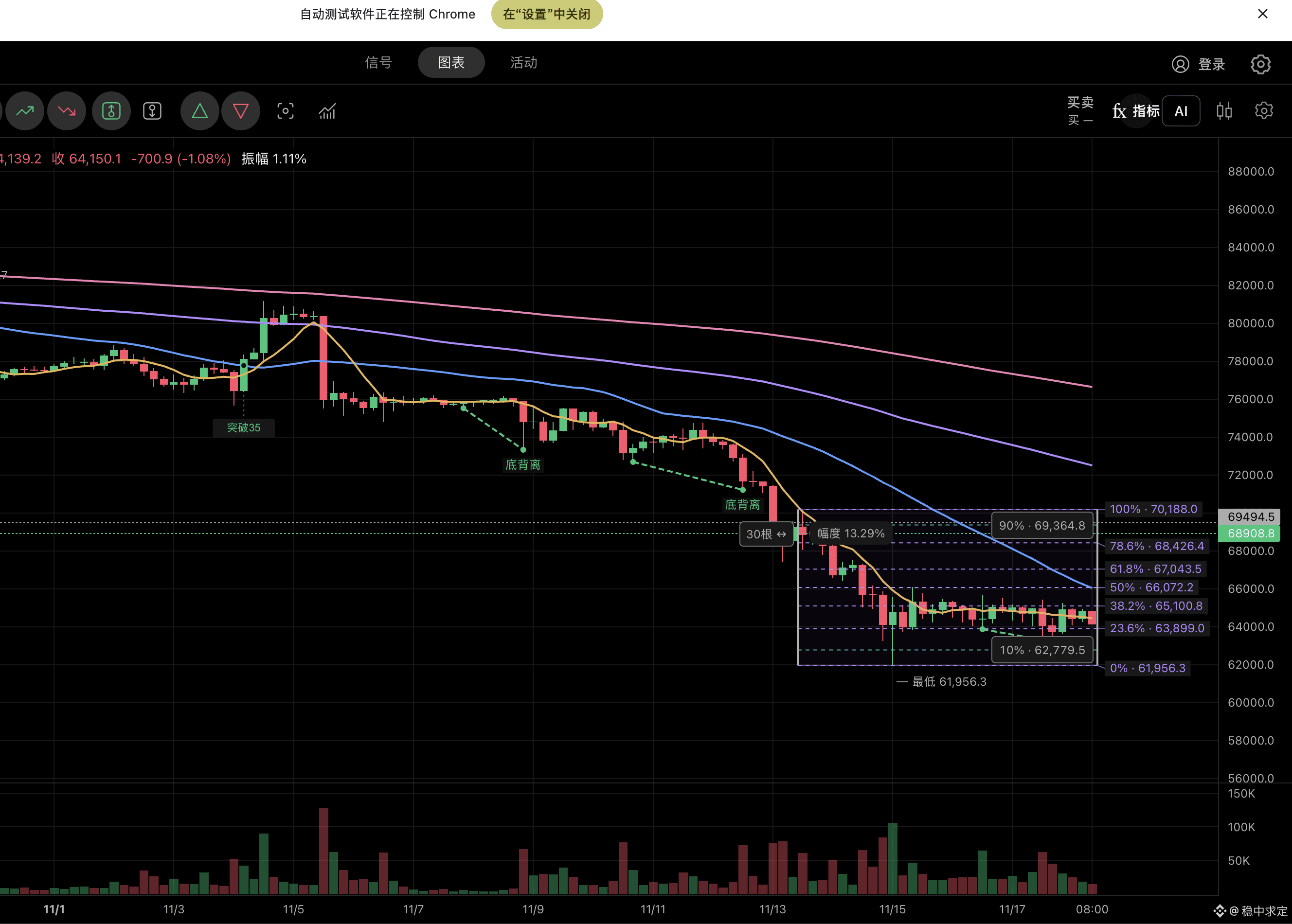
Meanwhile, $BTC is still holding around $64,500–$64,800. It hasn’t crashed, but it doesn’t dare climb either.
What’s making things even more nerve-racking:
• KOSPI is now on a 4-session losing streak, down ~400 points since Nov. 12
• Nasdaq was already down 2.5% last Monday
• Wintermute still sees downward pressure toward the $50,000 range
• Fear & Greed at 13, Extreme Fear
But here’s what’s different: $ZEC is actually up 5% to ~$927, the greenest among the major coins. With everything in the red, something’s still going its own way.
We’ll have the answer at 4 a.m. A strong Nvidia report = Asia can breathe easy. A weak one = $BTC gets tested at $62,000 too.
Which team are you on — will $BTC hold $62,000 for now, or crash straight through along with Asia? Let us know in the comments 👇
#KOSPIFalls2.59%ToLowestCloseSinceFebruary #NvidiaEarningsTonight
271

·
--
Article
After the KOSPI falls below 5,000, BTC will first watch whether risk aversion in Asia continues to spill over# After the KOSPI falls below 5,000, BTC will first watch whether risk aversion in Asia continues to spill over
On Binance Square’s current trending list, `#KOSPIFalls2.59%ToLowestCloseSinceFebruary` ranks eighth, with around 588 people discussing it on the page. The key question is not whether the Korean stock market’s decline can be directly applied to BTC, but whether risk aversion in Asia will continue to reduce spot market demand for crypto after the KOSPI falls below 5,000.
## What happened?
According to Korea Exchange figures, the KOSPI closed at 4,968.48 on November 17 Beijing time, down 132.02 points, or 2.59%, from the previous trading day. It fell below 5,000, marking its lowest close since February 2. Public reports cited foreign investor selling, uncertainty in the AI industry, and risk aversion toward global tech stocks as contributing factors, but these are market explanations—not proof that any one factor was the sole cause.
After the KOSPI falls below 5,000, BTC will first watch whether risk aversion in Asia continues to spill over
# After the KOSPI falls below 5,000, BTC will first watch whether risk aversion in Asia continues to spill over
On Binance Square’s current trending list, `#KOSPIFalls2.59%ToLowestCloseSinceFebruary` ranks eighth, with around 588 people discussing it on the page. The key question is not whether the Korean stock market’s decline can be directly applied to BTC, but whether risk aversion in Asia will continue to reduce spot market demand for crypto after the KOSPI falls below 5,000.
## What happened?
According to Korea Exchange figures, the KOSPI closed at 4,968.48 on November 17 Beijing time, down 132.02 points, or 2.59%, from the previous trading day. It fell below 5,000, marking its lowest close since February 2. Public reports cited foreign investor selling, uncertainty in the AI industry, and risk aversion toward global tech stocks as contributing factors, but these are market explanations—not proof that any one factor was the sole cause.
170

·
--
If you're still treating crypto like it lives in a vacuum, stop now.
That assumption has cost traders more than they like to admit. You sit through an Asian session dump because stocks aren't our problem, then wonder why your alts are bleeding while Korean retail already rotated out.
The Kospi is falling again and it looks a lot like those 2022 windows if you were paying attention. Korean traders don't park money for decades the way US index funds do. When their market rolls over they move. Fast.
Liquidity hits $USDT, high-beta names get offered, and suddenly $QNT is down over 40 percent while everyone is still arguing about narratives. $SUI and the rest of the usual suspects feel it in the same session. Gold slipping at the same time is just the macro rhyme. Different cycle, same muscle memory.
Greed sitting at 70 while traditional markets cough is the kind of split that used to end with a flush. Maybe this time Korean flow rotates into crypto instead of out of it. I have seen both movies.
Where do you think this goes if Kospi keeps sliding?
#KospiFalls2 #QNTFallsOver40 #USDTAdds845900HoldersInPast7Days

173

Why is nobody talking about what a falling Kospi actually signals for crypto traders?
Most people only stare at US charts and then get wrecked when their bags dump with zero on-chain explanation. That lag between traditional Asia risk-off and crypto is how you miss the exit.
Look at the Kospi drop as a case study, not a random headline. Korea remains one of the most active retail crypto markets on earth, so a 2% equity selloff is not isolated. When local stocks crack, traders there historically pull risk, and that money leaves $BTC and the alts behind it. We already saw $QNT get sliced over 40 percent while the Fear and Greed Index sits at 70 as if nothing is wrong.
That is the mismatch. The popular take is that crypto has decoupled from traditional markets. It has not, at least not from Asia. Gold is sliding at the same time, which usually means capital is reducing exposure rather than chasing it. Treating greed as a green light to load $SUI here is how you become the exit liquidity.
Where do you think this goes from here if Kospi keeps bleeding?
#KospiFalls2 #QNTFallsOver40 #GoldFallsTo

622

·
--
Korean Stock Market Pullback Topic Heats Up|Separate the Central Bank Rate from Cross-Market Risk|ZEC Around $1,593—I'll Wait
My view is to reduce the risk budget and not treat ZEC as the “safe haven” that must pay off when stocks fall. Macro pressure can transmit across markets, but you can’t write stock selling amounts as crypto capital outflows.
On the Korea forum homepage, this round has 1,812 views and 163 discussions; the previous round had 790 views and 121 discussions—attention has genuinely increased. ZEC did not make the six-hour search list in this round. On September 28, the Korea stock market’s closing performance: Yonhap News Agency and the Seoul Economic Daily cross-checked their reports. KOSPI closed at 6,889.74 points, down 2.70%. Samsung Electronics and SK Hynix both fell by over 5%. This is the market reaction that already occurred that day—not evidence of ZEC’s drawdown, nor proof that “all risk assets are synchronously crashing.”
Let’s verify the interest-rate backdrop with primary source material. In its September 10 Monetary Policy and Credit Policy report, the Bank of Korea states that the benchmark interest rate was raised twice in a row, from 2.50% to 3.00%. The official website also lists the decision on August 27, when the rate was raised from 2.75% to 3.00%. The report says it will review inflation, the economy, and financial stability, and determine the timing and pace of any further rate hikes. Note: this is not a new hike today; it’s not a commitment to take action next time, and you can’t replace the central bank’s formal decision with hot stock-market topics.
Why include ZEC in the trading plan? This is my mechanism read: as financing costs and risk appetite contract, investors who allocate both stocks and crypto will place more emphasis on cash and exit liquidity. For coins with higher volatility, the buy thesis can’t be only “the theme is different.” However, the channels above are just risk scenarios. I don’t have evidence of one-by-one cross-market transfers by investors, and I haven’t confirmed that South Korean stock-market funds have already sold ZEC. Don’t package speculation as facts about institutional exits.
In this round, Kraken’s ZEC/USD is around $1,593.25. The 24-hour range is $1,536.24 to $1,656.28. It’s rebounded from the lows, but it’s still below the 1,600 observation line. You can’t conclude that ZEC is making synchronized new lows just because the Korean stock market is down. The rolling range high changes over time, so don’t fabricate the magnitude of “news shock” based on it. I want to see whether $1,600 can be reclaimed, whether there’s support around $1,620, and use $1,575 as the risk line after entry.
If I were trading it myself, I wouldn’t participate now: position 0%, no shorting, no leverage. Only if an hourly close is above $1,600, then it pulls back and holds $1,595 to $1,600—and the platform quotes and deposits/withdrawals are normal—would I consider a spot long with a maximum of 0.3% of total capital. Cut it in half at $1,620, and fully close any remaining position at $1,640. After entry, if it breaks below $1,575, I exit with a hard stop. If two consecutive hourly closes are below $1,595, I close everything and won’t add. If it breaks below $1,550 before entry, the plan is canceled. If macro risk keeps worsening and the breakout can’t be maintained, or if there’s an abnormality in the channel, I withdraw participation. A real breakout would overturn the “not participating yet” view—but it wouldn’t prove that macro risk has disappeared. If nothing triggers, it’s not filled and does not count as profit.
Sources: [Bank of Korea report](https://www.bok.or.kr/portal/bbs/B0000156/view.do?menuNo=200754&nttId=11064613), [Yonhap News Agency](https://www.yna.co.kr/amp/view/AKR20260928124200008).
#KospiFalls2.7%SamsungSKHynixDropOver5% #ZEC
The above is only my personal market observation and does not constitute investment advice.

160

·
--
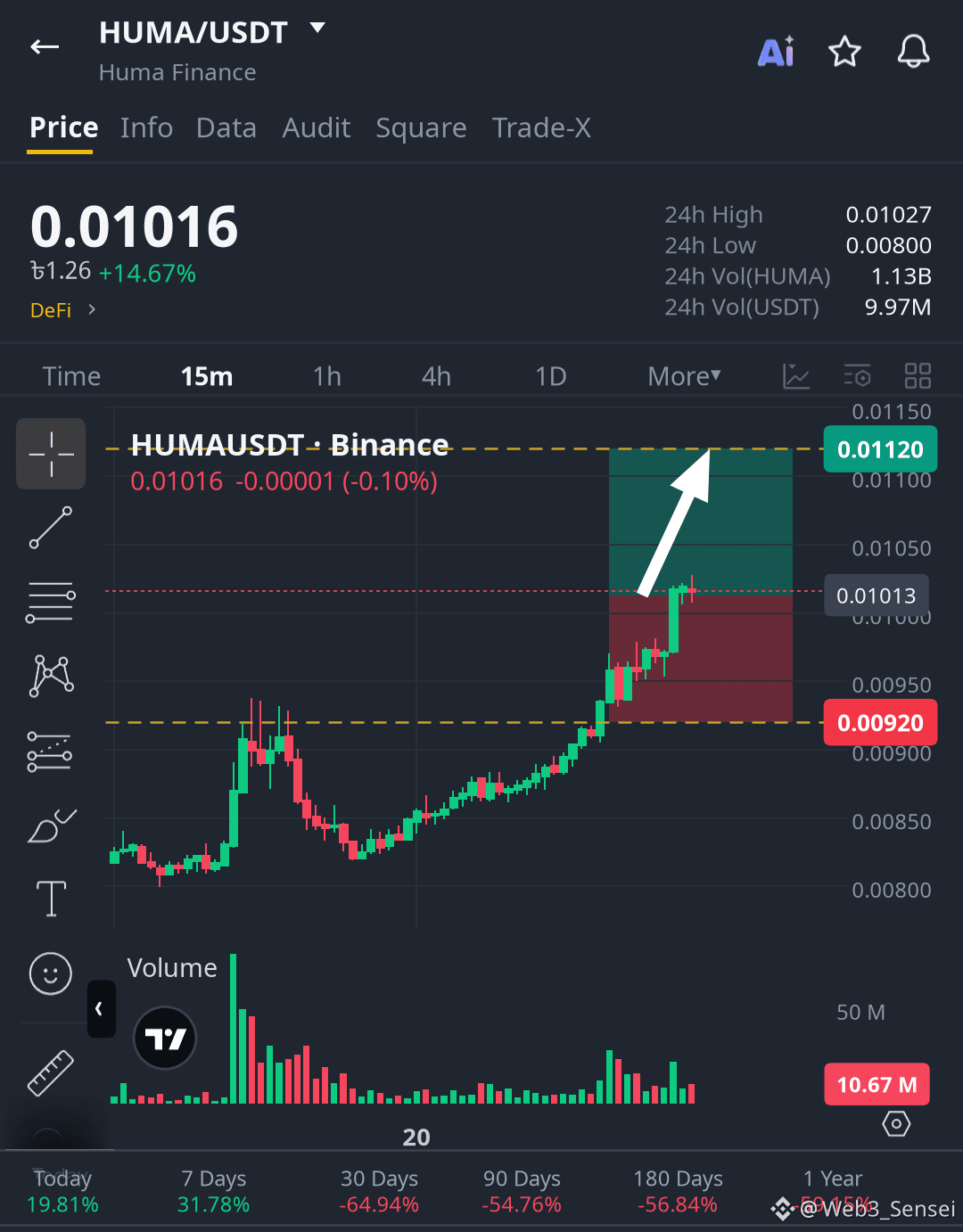
I'm opening a LONG on $HUMA here — it just cleared the level that turned it back three times yesterday.
TP: $0.0112
SL: $0.0092 👇🏻
That ceiling capped every push yesterday. This morning price walked straight through it, then built a base above the round number instead of fading back. The short closes kept printing higher into the move, and the level that was resistance all day is now the floor underneath.
Volume is doing the talking too — among the heaviest clean movers on the board while $BTC grinds sideways. A coin pushing up on real flow while the market chops is the kind of strength I want to be with, not against.
If it gives the breakout level back, the move failed and I'm out — no second guessing. Until then, the path of least resistance points up.
$HUMA — does it keep running, or does the old ceiling drag it back down? 👇
#KOSPIFalls2.59%ToLowestCloseSinceFebruary
75
·
--
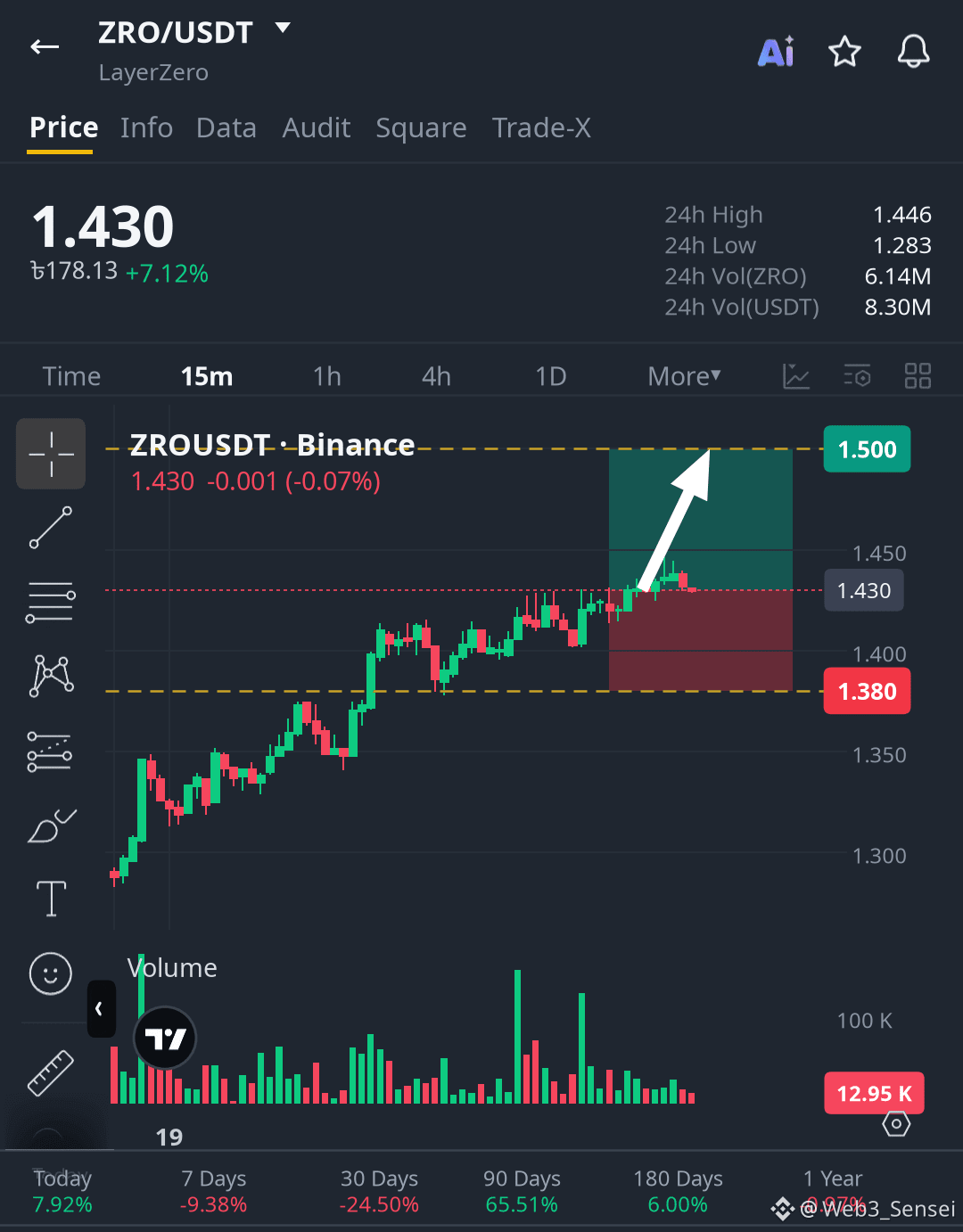
While the morning's pump coins fade back down, $ZRO is doing the opposite — and I'm taking the LONG side on it.
TP: $1.50
SL: $1.38 👇🏻
It's been sitting in a tight base just under the day high for hours, testing the same floor again and again without giving it up. That's patience, not a chase — the move already happened, now it's holding.
The morning's pump coins gave their moves back. $ZRO didn't. On a red $BTC day, the coin that refuses to fade is the one worth watching.
If price slips back under that base, I walk away and wait for a cleaner look. Hold it and the day high is the next thing in view.
Does $ZRO push through the high, or does the base finally give way? 👇
#KOSPIFalls2.59%ToLowestCloseSinceFebruary
40
·
--
Article
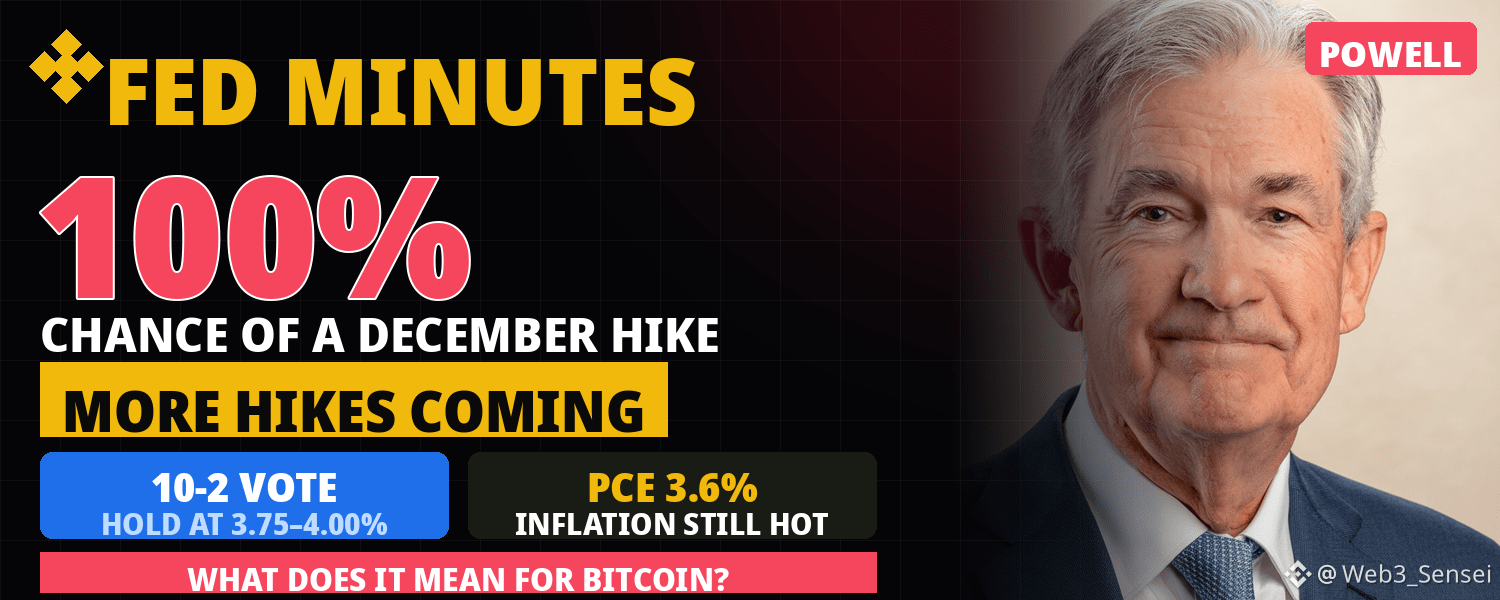
FED MINUTES: 100% CHANCE OF A DECEMBER HIKE — WHAT SHOULD BITCOIN TRADERS WATCH?Let's be honest. The Fed just told us the quiet part out loud — and Bitcoin is paying for it. The October 27–28 minutes landed overnight, and they read like a warning, not a pause.
1. THE VOTE WASN'T CLOSE
The committee held rates at 3.75–4.00% by a 10–2 vote — the two dissenters wanted a hike now, not a cut. "Almost all participants" judged further increases likely appropriate, and a couple floated a bigger December move if inflation stays hot. The argument was about how fast, not whether.
2. INFLATION IS STILL THE PROBLEM
Prices are not cooperating. PCE inflation hit 3.6%, October CPI beat forecasts, and core prices rose for a third straight month. "Many participants" even called the AI buildout a material source of inflation risk. September's hike was the first in three years.
3. MARKETS HAVE ALREADY DECIDED
Traders now price a December hike as a near-certainty. The next meeting is December 8–9, and the November CPI report lands first — that print decides whether December brings a small hike or something bigger.
4. WHAT IT MEANS FOR BITCOIN
$BTC is trading at $63,213, down 2.29% today. Higher-for-longer is a headwind for every risk asset, and crypto feels it first. The question is whether Bitcoin has already priced this in — or whether the real repricing is still ahead of us.
NOW, LET'S TALK ABOUT THE OTHER SIDE
The hawkish read is not the only read. Unemployment has edged up, hiring is slowing, and a few officials called the October hold a close call. If November CPI cools before December 8–9, the committee has room to go smaller — the minutes are data-dependent, not a promise.
MY TAKE
I am not fighting this Fed. When a central bank tells you more hikes are coming, believe them until the data says otherwise. That does not mean Bitcoin crashes — it means every bounce gets sold until December 8–9 or a cooler CPI print. I am watching $62,000: hold it and this is a scare; lose it and the repricing runs further.
Until December 8–9, trade the data — not the hope of a pivot the Fed never promised.
Do you think the December hike is already priced into Bitcoin — or is the real drop still coming?
#KOSPIFalls2.59%ToLowestCloseSinceFebruary
FED MINUTES: 100% CHANCE OF A DECEMBER HIKE — WHAT SHOULD BITCOIN TRADERS WATCH?
Let's be honest. The Fed just told us the quiet part out loud — and Bitcoin is paying for it. The October 27–28 minutes landed overnight, and they read like a warning, not a pause.
1. THE VOTE WASN'T CLOSE
The committee held rates at 3.75–4.00% by a 10–2 vote — the two dissenters wanted a hike now, not a cut. "Almost all participants" judged further increases likely appropriate, and a couple floated a bigger December move if inflation stays hot. The argument was about how fast, not whether.
2. INFLATION IS STILL THE PROBLEM
Prices are not cooperating. PCE inflation hit 3.6%, October CPI beat forecasts, and core prices rose for a third straight month. "Many participants" even called the AI buildout a material source of inflation risk. September's hike was the first in three years.
3. MARKETS HAVE ALREADY DECIDED
Traders now price a December hike as a near-certainty. The next meeting is December 8–9, and the November CPI report lands first — that print decides whether December brings a small hike or something bigger.
4. WHAT IT MEANS FOR BITCOIN
$BTC is trading at $63,213, down 2.29% today. Higher-for-longer is a headwind for every risk asset, and crypto feels it first. The question is whether Bitcoin has already priced this in — or whether the real repricing is still ahead of us.
NOW, LET'S TALK ABOUT THE OTHER SIDE
The hawkish read is not the only read. Unemployment has edged up, hiring is slowing, and a few officials called the October hold a close call. If November CPI cools before December 8–9, the committee has room to go smaller — the minutes are data-dependent, not a promise.
MY TAKE
I am not fighting this Fed. When a central bank tells you more hikes are coming, believe them until the data says otherwise. That does not mean Bitcoin crashes — it means every bounce gets sold until December 8–9 or a cooler CPI print. I am watching $62,000: hold it and this is a scare; lose it and the repricing runs further.
Until December 8–9, trade the data — not the hope of a pivot the Fed never promised.
Do you think the December hike is already priced into Bitcoin — or is the real drop still coming?
#KOSPIFalls2.59%ToLowestCloseSinceFebruary
71

·
--
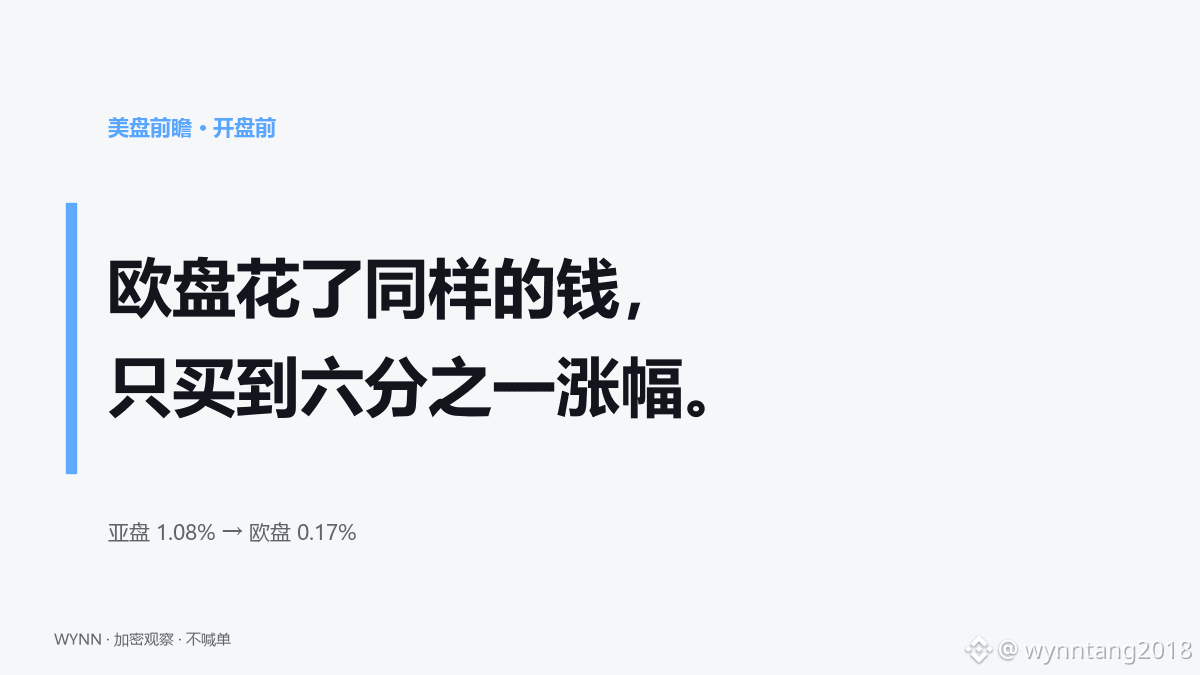
The European session spent the same amount of money but only bought one-sixth of the upside.
During Binance spot’s seven-hour Asian session, BTC trading volume was 275.7 million dollars. In the European session, those three hours saw 36.3 million dollars per hour, even a bit less.
The price performance also split apart. In the Asian session, BTC was pushed up from 63,068 to 63,753, rising 1.08%; in the European session, it only moved 0.17%.
The three names were split the same way too. $HYPE rose 2.15% in the Asian session; when it entered the European session, hourly trading volume was only 0.73 million dollars, and it added just 0.22%. $DOGE traded only 0.52 million dollars per hour, about 30% of its recent seven-day norm, yet it was the most resilient of the group. In the European session, $XRP had only 44% aggressive buying, while in the Asian session it was still above 50%.
This means the rebound carried a timezone effect. Over in Europe, no one was selling anymore, but no money stepped in to continue the move. Meanwhile, South Korea’s KOSPI fell 2.59% and closed at its lowest since February. Asian stocks were down while crypto was up, so the money lifting prices looked more like short covering. I’m watching for now: supply exhaustion and a trend reversal look the same on the chart, and the difference will show tonight.
If BTC trading volume can’t get above 110 million dollars in that first hour when the U.S. session opens tonight, I’ll change my view.
What I’m least certain about in this piece is that the European session’s calm may also just mean everyone is waiting for the U.S. session to set direction, and the money hasn’t really disappeared.
$DOGE $HYPE $XRP #Dogecoin #BinanceSquare #KOSPIFalls2.59%ToLowestCloseSinceFebruary
Crypto assets are high risk. The above is personal observation only and does not constitute investment advice. Please make your own judgment (DYOR).
268

·
--
$MMT more than doubled in a day and nobody has published a reason. Is this a repricing, or a thin float meeting one large order?
Straight answer: a liquidity event first, a repricing second. The tape is real, the project has announced nothing, and the supply schedule is the open risk.
What the tape shows:
- MMT traded at $0.2546 at 13:33 Kyiv, up 117.6% over 24 hours, between $0.1129 and $0.2666, on $38.3 million of Binance spot turnover (Binance ticker, 13:33 Kyiv).
- Binance spot volume was $13.4 million on Nov 17 versus $0.6 million on Nov 14, 22 times the earlier day (Binance klines, via MABOnChain, Nov 18).
- CoinMarketCap's analysis found no verified catalyst, only unusual volume (Nov 18).
- The backdrop was risk-off: KOSPI closed at 4,968.48, down 2.59%, the first close under 5,000 since Feb 2 (Korea Herald, Nov 17).
Why this reads as flow:
- CoinGecko lists about 204 million tokens circulating, worth roughly $52 million here, so spot turnover was about three-quarters of the float's value in a day (via MABOnChain).
- A Nov 3 report flagged about 252 million MMT unlocking on Nov 4, near three times the float then; how much reached the market is still unclear (FatCrypto, via MABOnChain).
What I am checking next:
- Whether spot turnover holds above $20 million; a fade toward $1 million would mark one-off flow.
- Exchange deposits and the next vesting tranche, since a float this small lets one transfer change the story.
- Whether price holds above $0.15, the level it fought for earlier today, and retests the $0.2666 high (MABOnChain, Nov 18).
My rule: when a small token doubles with no announcement, I treat it as liquidity until a filing or a product says otherwise.
#KOSPIFalls2.59%ToLowestCloseSinceFebruary #Write2Earn
If a token you follow doubles with no announcement, what do you check first - the order book, the unlock calendar or wallet flows - and why?
199
·
--
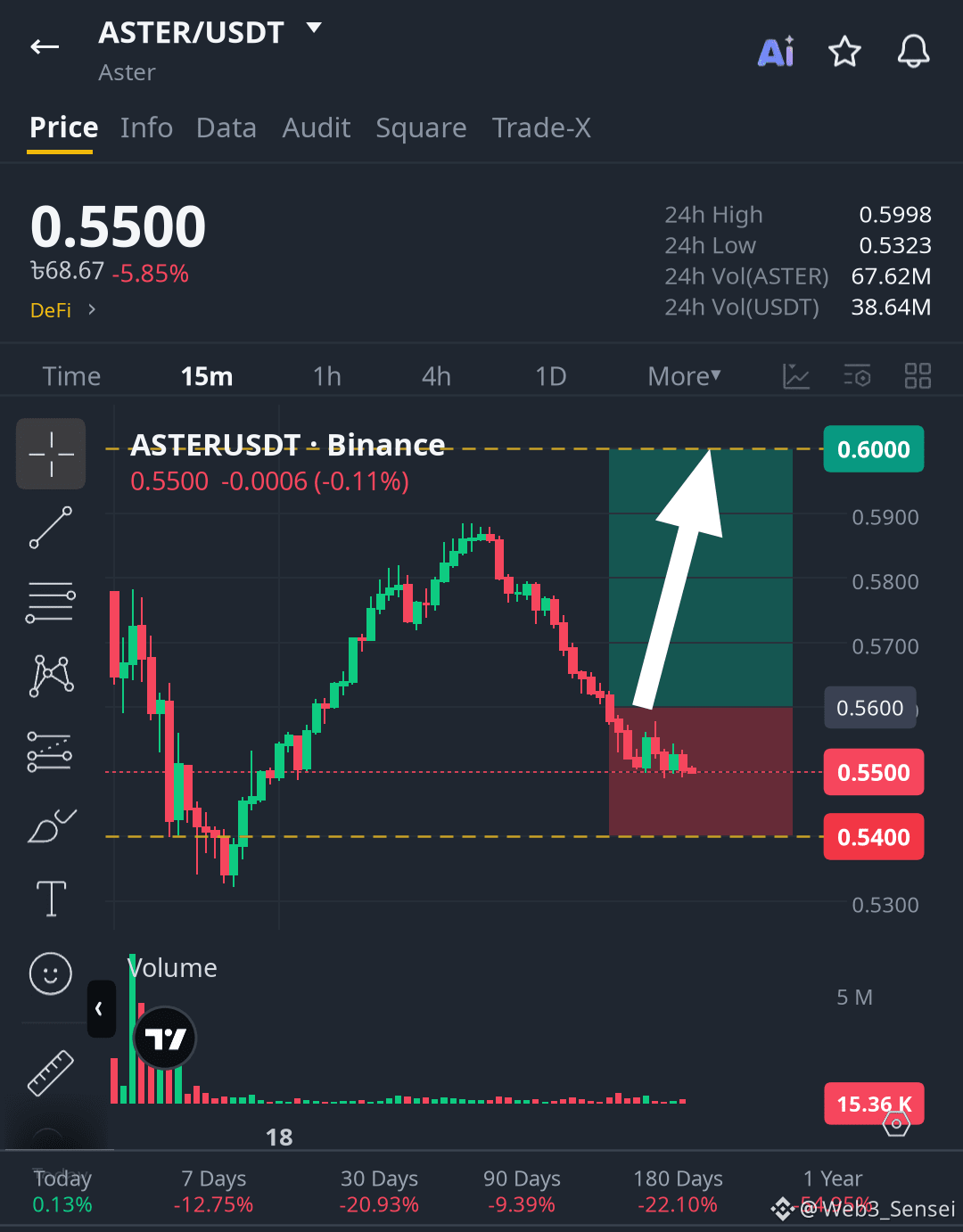
$ASTER LONG stopped me out — and I'm posting the loss, not hiding it.
TP: $0.60
SL: $0.54 👇🏻
The LONG pushed toward the target twice but never got there, then the whole market rolled over in one hour and the stop went. No excuses — the level broke, the setup is dead, I'm out.
What I take from it: chasing a top while the market was already sliding was the mistake, not the level.
Would you have held through the dip, or cut it at the stop like I did? 👇
#KOSPIFalls2.59%ToLowestCloseSinceFebruary
49

·
--
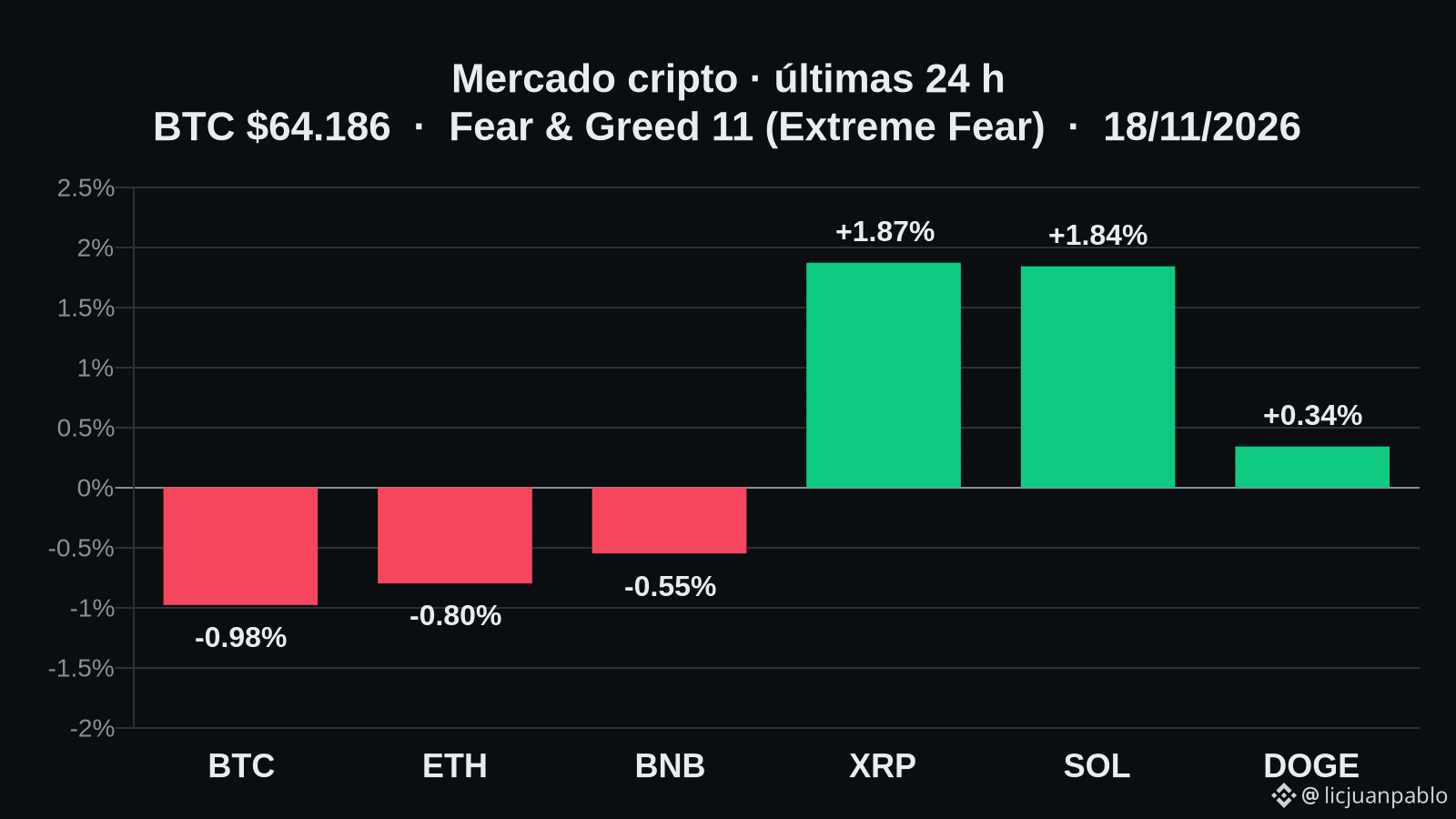
Did you see that the KOSPI fell by 2.59% and hit its lowest closing level since February? That decline reflects the pressure the global market is feeling, coinciding with the “Extreme Fear” phase (index 11). I’ve noticed that while traditional indices are falling, some cryptocurrencies like $BTC ($64,186) and $ETH ($1,800) continue to retreat modestly, while others like $XRP and SOL are showing slight gains.
What do you think about this?
#KOSPIFalls2.59%ToLowestCloseSinceFebruary #Bitcoin
What do you think about this?
#KOSPIFalls2.59%ToLowestCloseSinceFebruary #Bitcoin
99
·
--
$NVDAB carries Nvidia into its first earnings report under an interim CEO tonight, and the numbers that set the bar disagree: guidance says $108 billion, analysts about $109 billion (Gotrade, Nov 16).
Short answer: a confidence test, not a beat-or-miss story. Guidance already assumes no China data-center compute revenue and the market has spent weeks cutting AI exposure, so pipeline talk matters more than a few hundred million on the top line.
The two numbers
- Nvidia's Q3 FY2027 outlook, from its August release: revenue of $108.0 billion, plus or minus 2%, gross margin of 74.0%, plus or minus 50 basis points, and no China data-center compute revenue assumed.
- The Street's bar, per Gotrade's Nov 16 preview: adjusted EPS of $2.49, a Barchart estimate, with revenue near $109 billion.
- Into the print: Nvidia fell 4.1% on Monday, the Philadelphia Semiconductor Index dropped 5.28% overnight, and Korea's KOSPI closed at 4,968.48, down 2.59% and below 5,000 for the first time since Feb 2 (Yonhap, Nov 17).
What the gap sets up
- NVDAB is a bStock certificate on Binance that tracks Nvidia, not the NYSE-listed share, and it trades while NVDA is closed, so the first reaction prints there.
- Colette Kress is interim CEO and CFO, so succession shares the stage with revenue.
What I am watching
- Revenue against $108.0 billion and gross margin against 74.0%, in the release due after the US close.
- Whether NVDAB holds above its 24h low of $152.82, from the Binance ticker snapshot at 15:32 UTC today.
- The KOSPI open at 09:00 KST Wednesday, after four straight down sessions.
My rule from prints like this: the guidance line and the capex sentence decide the week, the headline beat decides the hour.
#KOSPIFalls2.59%ToLowestCloseSinceFebruary #Write2Earn
If you carry AI-linked tokens into tonight's report, do you read the revenue line or the capex commentary first, and why?
155
Log in to explore more content
Join global crypto users on Binance Square
⚡️ Get latest and useful information about crypto.
💬 Trusted by the world’s largest crypto exchange.
👍 Discover real insights from verified creators.
Email / Phone number
Trending Topics
1
#AnthropicBreaksBelowIPOPriceAmidAISlump
68,089 views
693 Discussing
2
#Bitcoin'sReboundFadesBelow$60K
119,158 views
399 Discussing
3
#WillMarketsStageAThanksgivingReliefRally?
614,680 views
3,592 Discussing
4
#EthereumFoundationPlansShiftToHashBasedSignaturesBy2028
5,381 views
131 Discussing
5
#ADPWeeklyPrivatePayrollsSlowTo21000
15,833 views
272 Discussing
6
#WillOctCorePCEShiftFedHikeExpectations?
256,751 views
1,926 Discussing
7
#USReportedlyPreparesNewTariffsOn16TradingPartners
24,463 views
222 Discussing
8
#SouthKoreaDigitalAssetBillProposes20%ShareholderCap
1,958 views
20 Discussing
9
#SouthKoreaProposesBanksHoldOver50%OfStablecoinIssuers
1,002 views
15 Discussing
10
#EvolveAtBinanceBlockchainWeek
426,748 views
2,272 Discussing