
wynntang2018
172 Posts

wynntang2018
Report
Block User
19 Following
49 Followers
38 Liked
Posts
All
Quotes
·
--
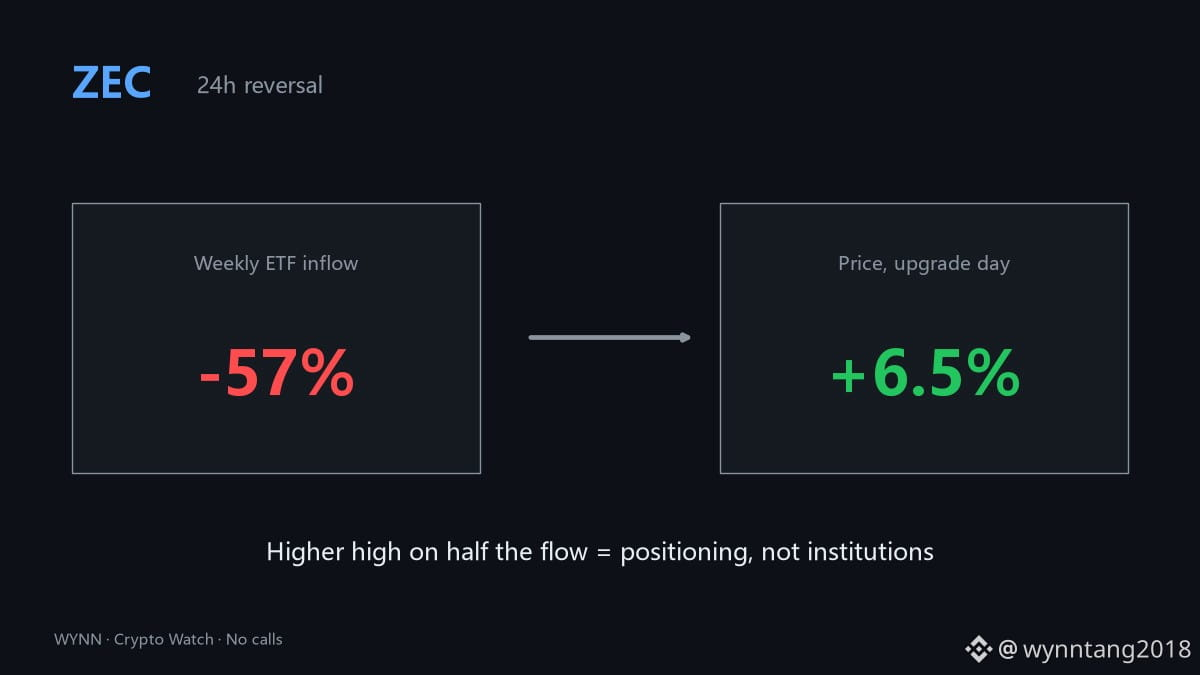
$ZEC is +6.5% near $1,298 on NU7 upgrade day, and the feed's verdict is instant: institutions are front-running the hard fork.
The flow file says otherwise. ZEC ETF products took in $41.09M two weeks ago. Last week: $17.72M — a 57% drop in weekly institutional inflow while price printed a higher high. That $17.72M is about 0.08% of ZEC's $21B market cap. Front-running looks more like trailing off.
Futures agree: OI near $2.54B, up only ~3% since Sunday. And NU7 cuts block time from 75s to 25s without changing issuance — 3x faster confirmations confirm transactions, they don't mint demand.
Context matters too: $SOL +2.9% and $NEAR +4.1% while BTC reclaims 80K. Strip the sector beta out and ZEC's upgrade-day premium looks thin.
My call: waiting, skeptical of the pop. Price up while institutional flow halves is a divergence, and divergences tend to resolve toward the smaller number.
Faster blocks confirm transactions, not demand — this pop is positioning, not conviction.
Wrong if: post-upgrade ETF inflows rebound above $40M a week while $1,250 holds.
Data as of today. Not financial advice.
By the weekend: $ZEC holds above $1,250, or closes back under it?
#BTCRebounds80K #Zcash #BinanceSquare #Altcoins
274
·
--
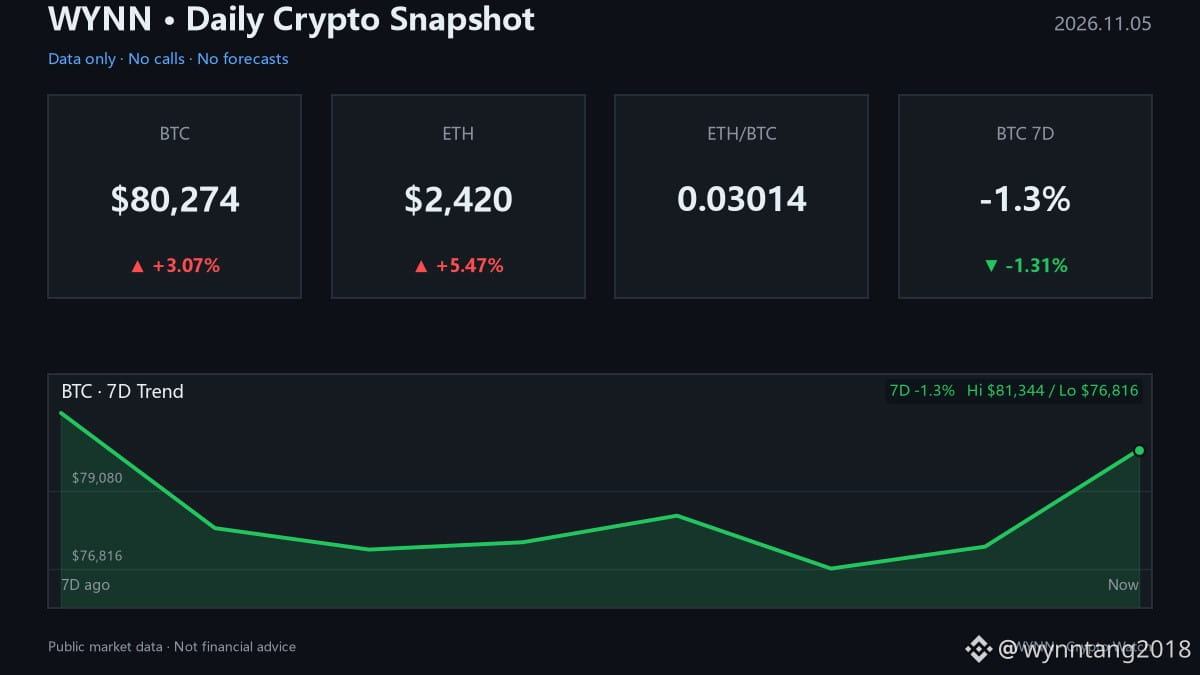
Friday is double-booked: a $2.11B options expiry and the payrolls print land hours apart, and $DOGE is lagging the $BTC rebound by more than a point. Both matter for volatility, not direction.
The checklist, in order:
1. Thursday morning: weekly jobless claims, consensus ~195K. The last labor datapoint before the report; a surprise resets the rate debate overnight.
2. Friday pre-dawn US time: $2.11B in BTC options settle with max pain at $80,000 and put/call at 0.33. Spot sits at $80,274, just 0.3% above the pain line. Dealer hedging has a mechanical reason to keep price near $80K into settlement. That is a mechanic, not a forecast.
3. Friday 8:30 ET: payrolls, consensus +65K vs +29K last month, a 2.2x step-up already priced. The Square tag asking whether cuts are still possible gets its answer, and wages at +0.3% consensus may matter more than the headline.
My stance: waiting. Ether outpaced BTC at +5.47% and $SUI split the difference at 2.41%, yet $DOGE managed only 1.65%. Large caps led, beta trailed: that reads like covering, not new money. I am wrong if DOGE outruns BTC for a full session on expanding turnover.
Pin or punch: does price drift into the $80K settlement, or does payrolls knock the pin loose?
Data as of today. Not financial advice.
#USOctoberNFP-AreRateCutsStillPossible #Dogecoin #Crypto #BinanceSquare
66
·
--
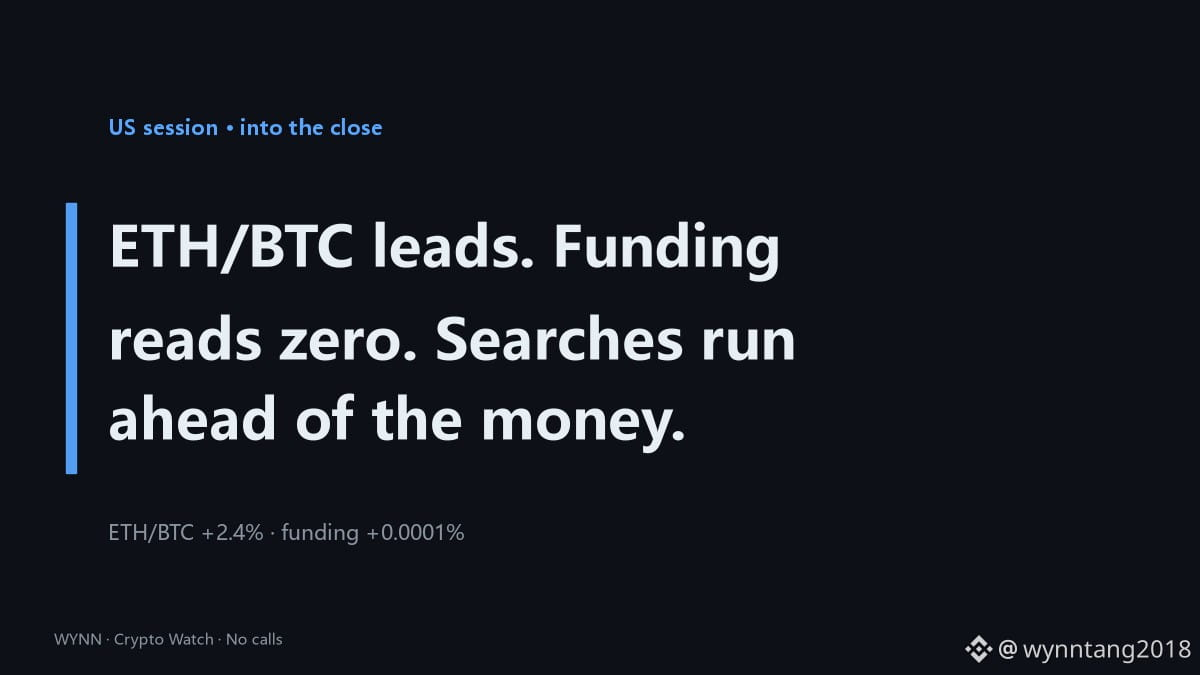
$PEPE is the second-most-searched coin on Square, BTC just retook 80K, and within the hour someone will call it meme season. Before you trust any rotation story into the close, I check three free pages - none of them is a chart of my feelings.
1. The $ETH/BTC pair. It is up 2.4% today while BTC retook 80K. When this ratio leads, the bid sits in large caps first: ETH turned over $775M - about $130M of tape for every 1% it gained.
2. Funding rates. BTC, ETH and PEPE perps all print +0.0001% or less. A market that bounces 3-6% with zero funding is paid in spot, not leverage. Nobody is paying rent to hold this move.
3. Square's Most Searched (6H): BTC, PEPE, ZEC. PEPE ranks second in attention, yet its $70.7M turnover trails SOL, ZEC, $XRP and BNB. Searches are ahead of money.
My read: rotation into size, not a meme return. If PEPE's turnover clears $150M while still green, I change my mind.
Watch what gets paid, not what gets typed. Data as of today. Not financial advice.
Into the last hour: does ETH/BTC keep the lead, or does the search list finally get paid?
#BTCRebounds80K #Pepe #BinanceSquare #Altcoins
·
--
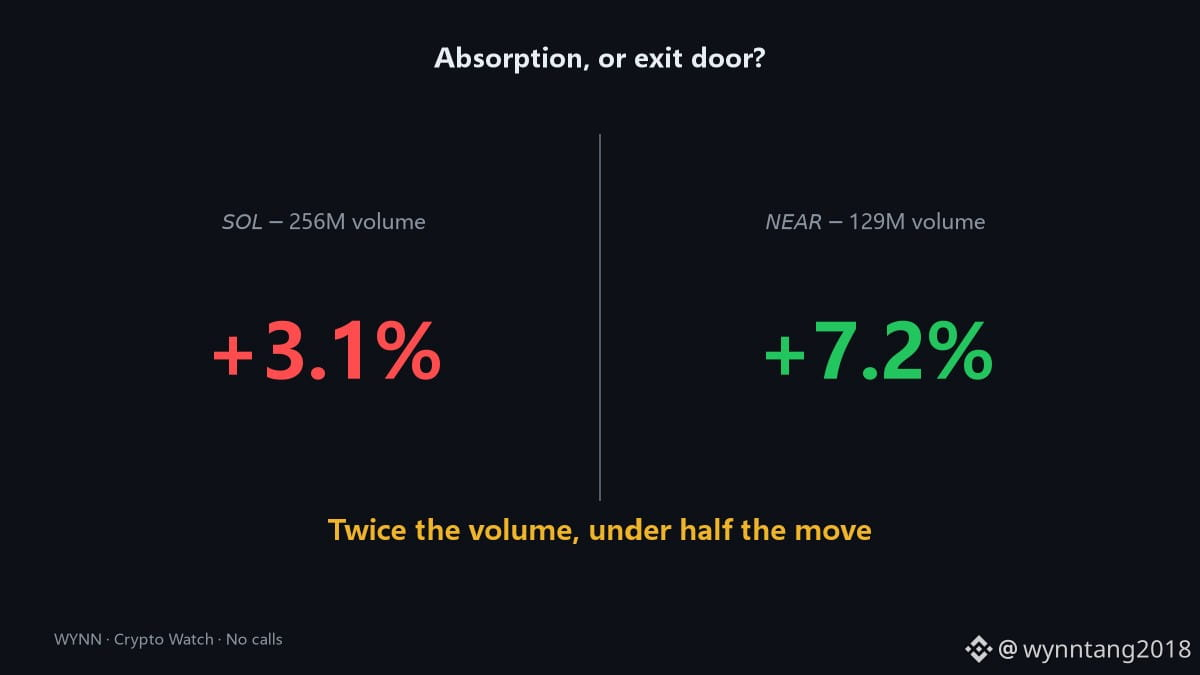
$SOL is turning 256M, the deepest alt book on Binance spot, yet it trails $ETH by nearly three points and $NEAR by four.
The US midday tape is broad: 67 of 94 liquid pairs up, BTC back above 80K, Fear & Greed up at 37. But look where the gains sit: ETH +5.8% on 742M, ZEC +9% on 253M, NEAR +7.2% on 129M. The biggest liquidity pool is being traded, not chased — twice NEAR's volume, under half its move. Even BNB, the sleepiest of the big L1s at +2.8%, sits only a hair below SOL.
So the binary: heavy tape, lagging price — absorption, or exit door?
My answer: absorption, for now — I lean bullish on the tape, not on a breakout, because sellers pressing the deepest book on a 71% green tape have not broken the price. But the money setting this midday tape is not the overnight batch: it is buying the story names, not the biggest book. If SOL closes under +3% on this volume while ETH and NEAR keep their lead, I flip.
Data as of today. Not financial advice.
One pick into the NFP print: $SOL or $NEAR?
#BinanceSquare #Solana #USOctoberNFP-AreRateCutsStillPossible #Altcoins
166
·
--
$PEPE sits in Square's Most Searched list this morning, and half the feed reads it as the meme rotation coming back.
No. Do the division.
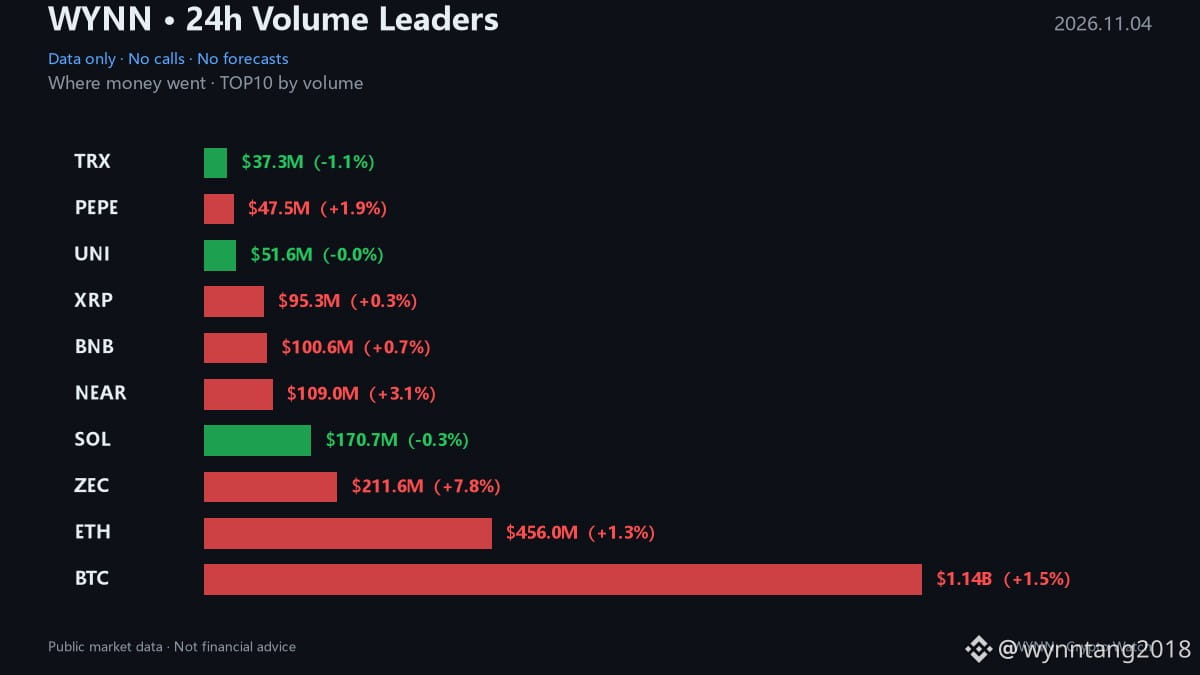
$PEPE is green, +2.1%, but turned over just $47.7M in 24 hours — about $23M traded for every 1% of move. $BNB: the 37th quarterly burn took 1,646,196 coins (about $1.2B) off supply, yet it adds only +0.6% on $101M — roughly $158M per 1%. $UNI pulled in $51.7M, more than PEPE, and is still flat. A $1.2B supply cut could not buy urgency; a search rank is not flow.
The most urgent money in the first hour pays the least per percent with real size: ZEC is +7.2% on $211.6M — 4.4x PEPE's turnover at nearly the same cost per 1%.
My call: PEPE's green is thin-book drift, not rotation. Turnover tells you money; search rank only tells you attention. If PEPE's 24h turnover clears $150M while still green, I'd flip and call the rotation real — until then I stay out.
Which breaks first from here: PEPE's price catching up to its search rank, or its volume proving the rotation real?
Data as of today. Not financial advice.
#BinanceSquare #Pepe #37thQuarterlyBNBBurnRemoves1.64MillionBNB #Altcoins
131
·
--
Overnight the midterms landed: Democrats projected to take both chambers, Bitcoin flushed to $75,700 on the first prints, then clawed back above $78,000. Relief bounces are where accounts get chewed. Three checks, one table, thirty seconds.
1. The variable. A Democratic Senate means the stalled CLARITY Act gets renegotiated, not revived. Any "the bill is back" headline is noise until formally reintroduced.
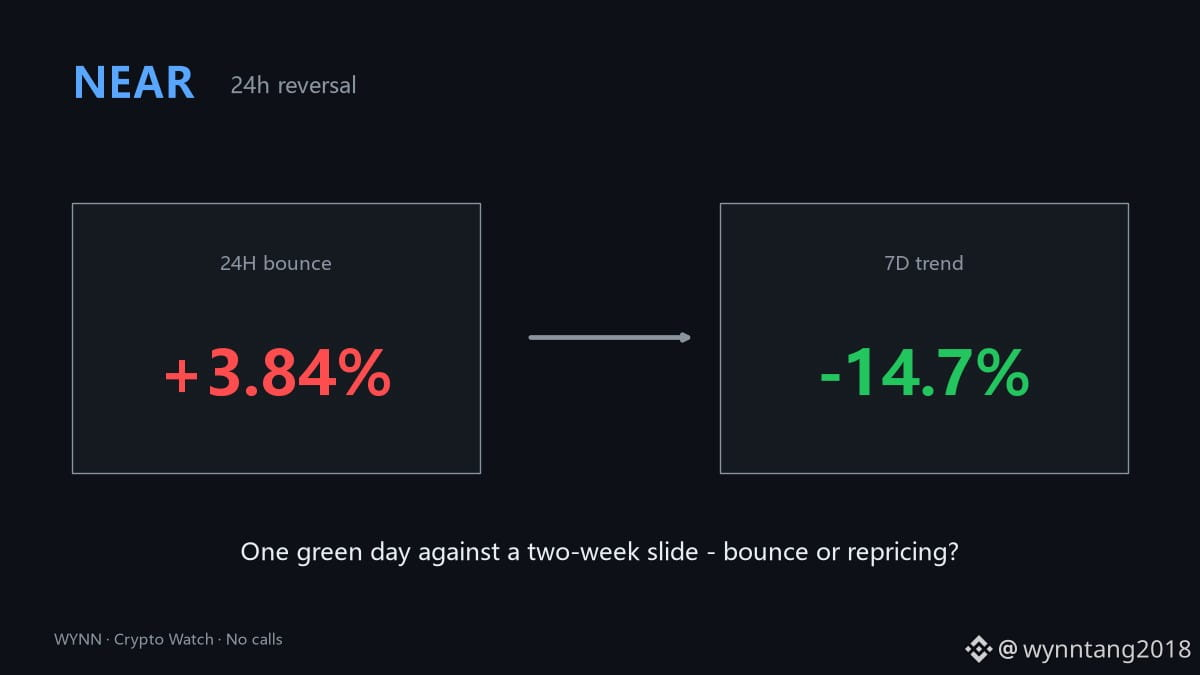
2. The overlooked number. $NEAR governance passed a 36% issuance cut two days ago — annual cap 2.5% to 1.6%, about 11.8M fewer NEAR over two years. It slid 5% that day with the tape. Today $NEAR bounces +3.8% on $110M turnover, nearly triple $BTC's +1.3%.
3. The concentration test. $UNI +2.7% on $53.6M, SUI +1.7% on $35.9M — half of NEAR's volume. Twice the next alt's flow is rotation, not broad risk-on.
At the close: NEAR holding $4.00 on $100M-plus turnover = the cut is being priced; surrendering the move while BTC holds $78,000 = beta.
I'm waiting — one green session is not proof. If NEAR closes back under $3.90 while BTC holds $78,000, the rotation was beta and I'm wrong; I'd drop the supply-cut read.
Relief is rented; supply cuts are owned.
Data as of today. Not financial advice.
Is NEAR pricing its issuance cut, or just riding alt beta?
#NEAR #Altcoins #Crypto #BinanceSquare
163
·
--
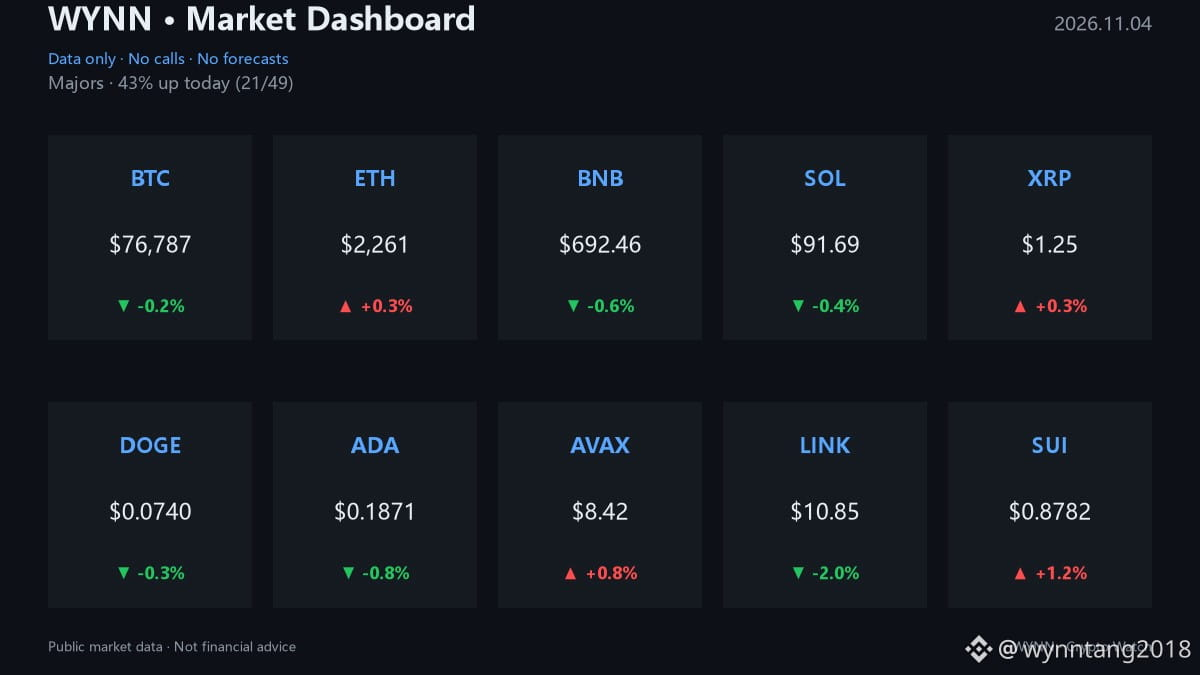
$SOL sits at $91.69, down 0.4% on the board, yet its perp open interest grew about 2% in a day. Leverage is checking in, not checking out.
The details: Binance funding still prints near +0.01% per 8h, roughly 10% annualized, and longs keep paying it. Three quarters of SOL accounts on Binance and Bybit still sit long. CoinGlass put marketwide 24h liquidations near $390M, almost 4x the prior day, and most of SOL's share came from longs.
The card shows the contrast. $SUI is the green one at +1.2%, but its open interest shrank about 1.8% — a bounce without leverage behind it. $HYPE fell harder with OI down 2.7% and $13.7M liquidated — leverage draining under fire. SOL is the odd one: price down, book up.
My read: waiting, leaning cautious. Falling price plus rising OI plus positive funding means longs are adding into weakness, not capitulating. If SOL funding flips negative or OI unwinds on the next red candle, I flip this read to "flush maturing." If the build continues, expect more long pain first.
A falling price with rising open interest is not capitulation — it is leverage signing up for more.
Data as of today. Not financial advice.
Next decisive SOL candle: long squeeze down, or short squeeze up?
$SOL $SUI $HYPE #Solana #Crypto #BinanceSquare #Altcoins
415
·
--
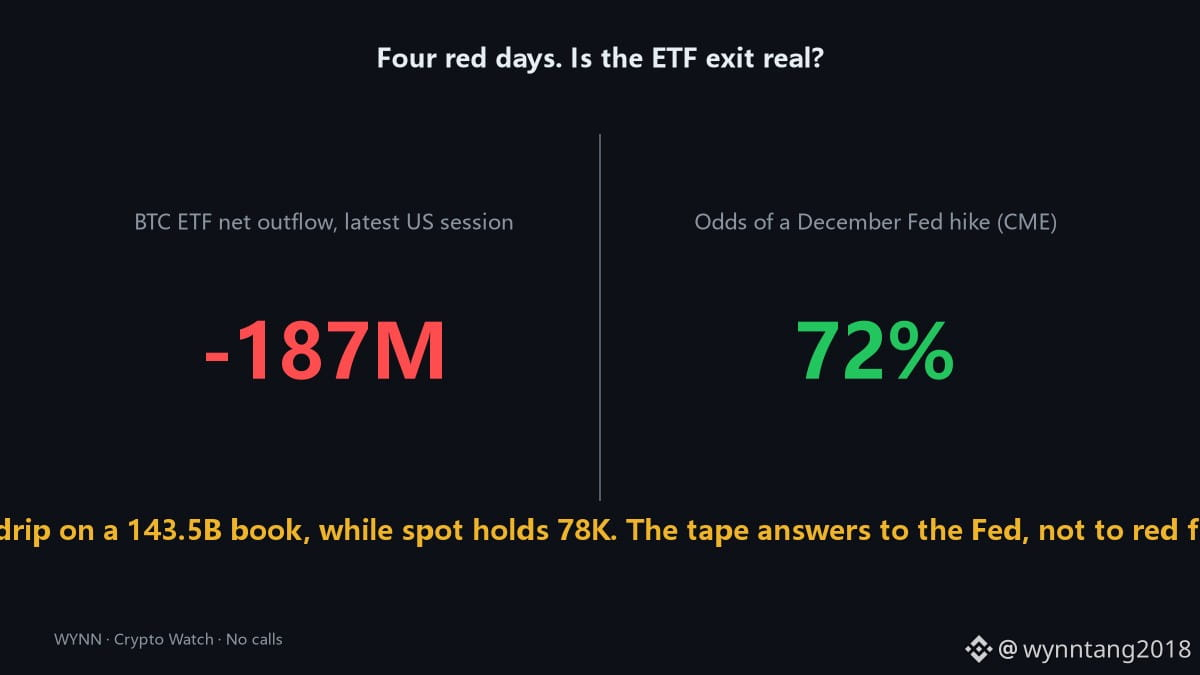
Four straight days of Bitcoin ETF outflows, and the feed has decided institutions are leaving.
Leaving? The whole spot ETF complex holds about $143.5B. The latest session's outflow was $187M, roughly 0.13% of the book.
SoSoValue shows the four-day streak, led by IBIT. ETH funds are bleeding too, six days and counting. Both assets draining together is not rotation and not a stampede. It is a slow drip. And here is what the bears skip: spot sits around $78,000, up on the day, while the red prints keep coming. Real exits move price.
I am waiting. Outflows are the symptom; the cause lives on the Fed calendar. CME FedWatch still prices a December hike at 72%, and that is the ceiling on every bounce.
Outflows without a price breakdown is absorption, not abandonment.
Data as of today. Not financial advice.
If the Fed holds in December, do ETF flows flip positive within a week? Yes or no?
$BTC #BinanceSquare #BitcoinETF #CryptoFlows #FedRates
125
·
--
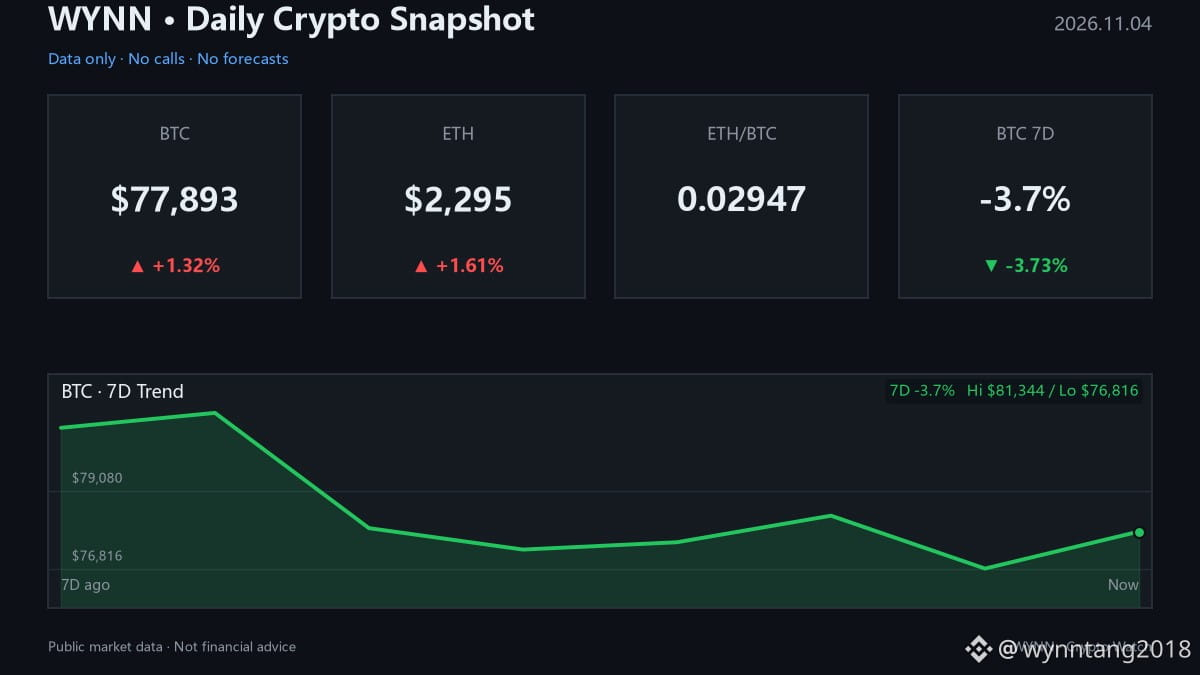
BTC probed a one-month low near $76,600 in the US session just closed, then bounced into the close — the card shows $77,893, up 1.32%, yet still 3.7% underwater on the week. Price is not my point. Three clocks strike before the weekend, and none of them is about direction.
First, US election results land overnight. The crypto-specific read is legislative: the CLARITY Act has sat stalled in the Senate, and the next Congress shapes its odds. Expect headline whipsaw, not a verdict.
Second, no Fed meeting this week — the next one is in December. Euro-area flash CPI midweek and a Bank of England decision carry the global-rates load instead.
Third, Friday stacks three releases into one morning: the October jobs report, a Hyperliquid team unlock, and about $2.1B of Deribit weekly options expiring. Deribit data puts max pain at $80,000, with 91% of calls at $82,000 or higher — positioning, not a magnet. Per SoSoValue, ETF outflows hit $643M two sessions ago, the largest since June, and another $399M followed.
I'm waiting: event weeks punish size, not opinions. $BTC $HYPE
Three clocks, one rule: size down before the calendar sizes you up.
Data as of today. Not financial advice.
One only: the vote count or the jobs print — which moves your book?
#BinanceSquare #Bitcoin #Macro #OptionsExpiry
175
·
--
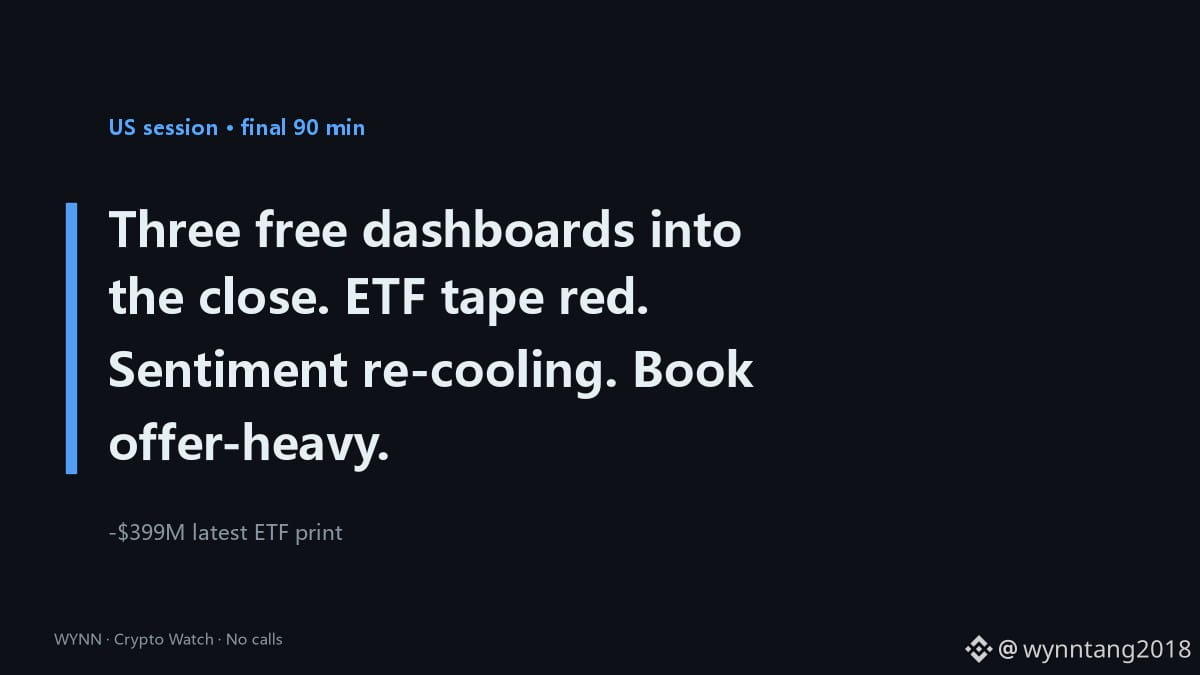
The final 90 minutes punish guessing. I keep exactly three free dashboards open — nothing else.
A green board can still hand you an ugly close. Price says what happened; these say whether it holds.
1. The ETF tracker. Latest print: Bitcoin funds bled $399M net in one day, the largest fund alone lost $405M, and Ether funds logged a sixth straight outflow day. This bounce has no institutional bid yet.
2. The Fear & Greed Index. It sits at 26, down from 37 in a day. Green candles with re-cooling sentiment read as relief, not conviction.
3. The order book itself — free on every exchange. Bitcoin depth within 0.5% of mid while I wrote: about $8M of bids vs $16M of asks. Price up, book offer-heavy.
One caution: desks still quote 76.8K as the next key support (Wintermute's line), and funding on majors is barely positive at +0.01% — no squeeze fuel if it slips.
I am waiting. A close held while the ETF tape stays red looks borrowed. Flip me with one thing: the next print turning green.
Green candles without green flows are a bounce, not a bid.
Data as of today. Not financial advice.
So which resets first into the bell — the book, or the 76.8K line?
$BTC $ETH #BinanceSquare #BitcoinETF #FearAndGreed #OrderBook
98
·
--
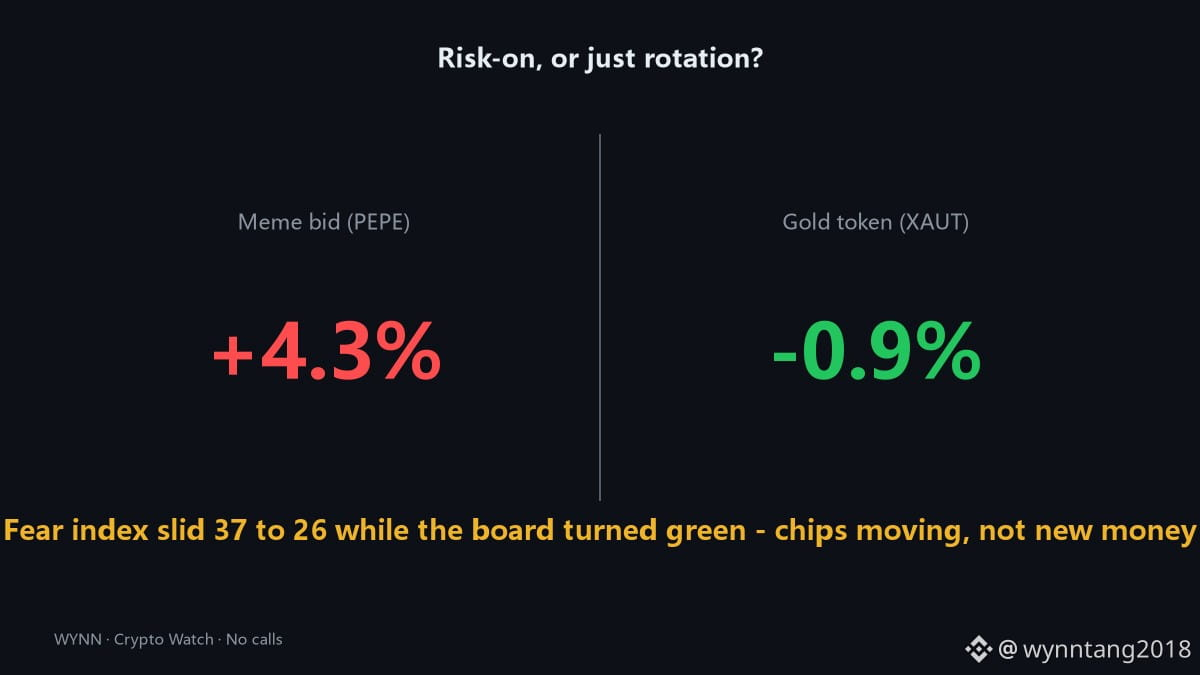
The board flipped green in the quietest hours of the US session: 26 of the top 40 pairs are up, meme names lead, and the gold tokens that topped yesterday's bid have turned red. XAUT prints -0.9% while PEPE runs +4.3%.
One word answers it: risk-on, or rotation?
My answer: rotation. The tell is the fear index - it slid from 37 to 26 while the tape turned green. Price and sentiment pointing opposite ways is not risk-on; real risk appetite lifts both. Volume agrees. PEPE's pop rides just $53M and PUMP's +5.1% sits on $13M - small rooms, easy candles. XRP is the only heavyweight with a genuine bid, +2.3% on $108M. And ZEC still pulls $219M in volume while down 1.8%: chips changing hands, not new money arriving.
So I stay waiting. This becomes a bid if fear retraces above 40 while breadth holds, or if XRP keeps its gains into the close. Until then, yesterday's defense is quietly funding today's memes.
Green tape over falling fear is rotation, not a bid.
Data as of today. Not financial advice.
Risk-on or rotation - which is your one word?
$PEPE $XRP $XAUT #BinanceSquare #MarketStructure #MemeCoins #CryptoMarket
210
·
--
"Election Day bounces markets — the open is the trade." You will hear that all session. No. Not today.
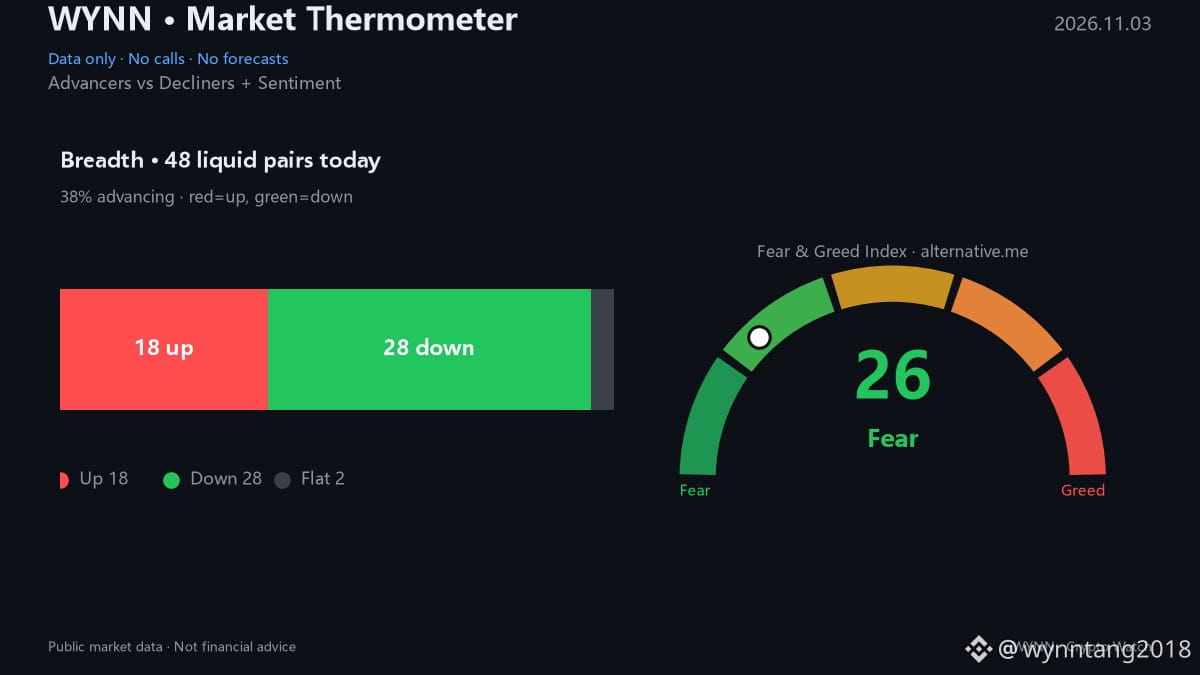
Monday, the last full session before the vote, the Nasdaq fell 1.07%. The tape right now agrees: one hour ago BTC closed at 76,816, about 2% below the hour before, and has only clawed back to 77,224 — still down 0.9% on the day. Just 16 of 48 major Binance pairs are green. ETH sits flat at 2,285. The bell rings in minutes, and nothing here looks like a bounce being bought.
What the claim gets wrong: Election Day has no catalyst inside it. Polls close after the closing bell, so the market's verdict on Congress lands at Wednesday's open. Today trades positioning, not direction.
My read: waiting, leaning careful. A bounce that has not recovered half of the hour that preceded it is drift, not demand.
Election Day prices positioning, not direction. The verdict trades Wednesday.
Data as of today. Not financial advice.
You pick one: fade bounces into the close, or stand aside until the tape proves it?
$BTC #BinanceSquare #Bitcoin #MidtermElections #CryptoMarket
77
·
--
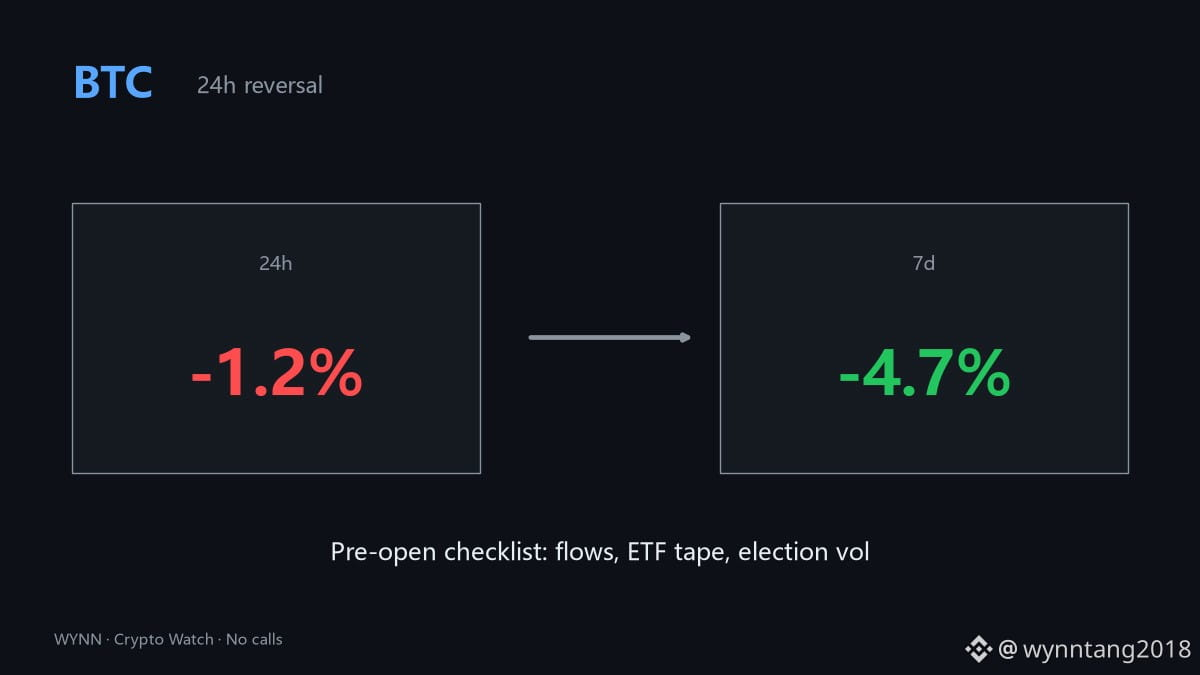
Before the US open, three checks matter more than any forecast. BTC is printing 77,000, down 1.2% over 24 hours and 4.7% on the week, with 39 of 51 majors red. Save this list.
1. Flows, not headlines. Binance's 24h net flow flipped from a -$7B peak to +$1.6B inflow (DefiLlama). If it holds through the open, the exit wave is cooling.
2. The ETF tape. Two straight sessions took $1.04B out of spot Bitcoin ETFs, IBIT leading. Check tonight's print: a third red day means institutions still are not buying this dip.
3. Election day, not election results. America votes today; results land during Wednesday's Asia session. That is a volatility event, not a direction event. Do not trade the first print.
How to use it: check 1 before the open, check 2 after the close, ignore 3 until Wednesday.
The tape on the card is context, not a signal. My stance is waiting: one green flow day after a $7B exodus is noise, not recovery. Flows tell you what is happening; elections tell you when; neither tells you where.
Data as of today. Not financial advice.
Pick one: do you trust the flow reversal, or do you wait for the full proof-of-reserves report?
$BTC $ETH #BinanceSquare #Bitcoin #CryptoMarket #BTCETF
·
--
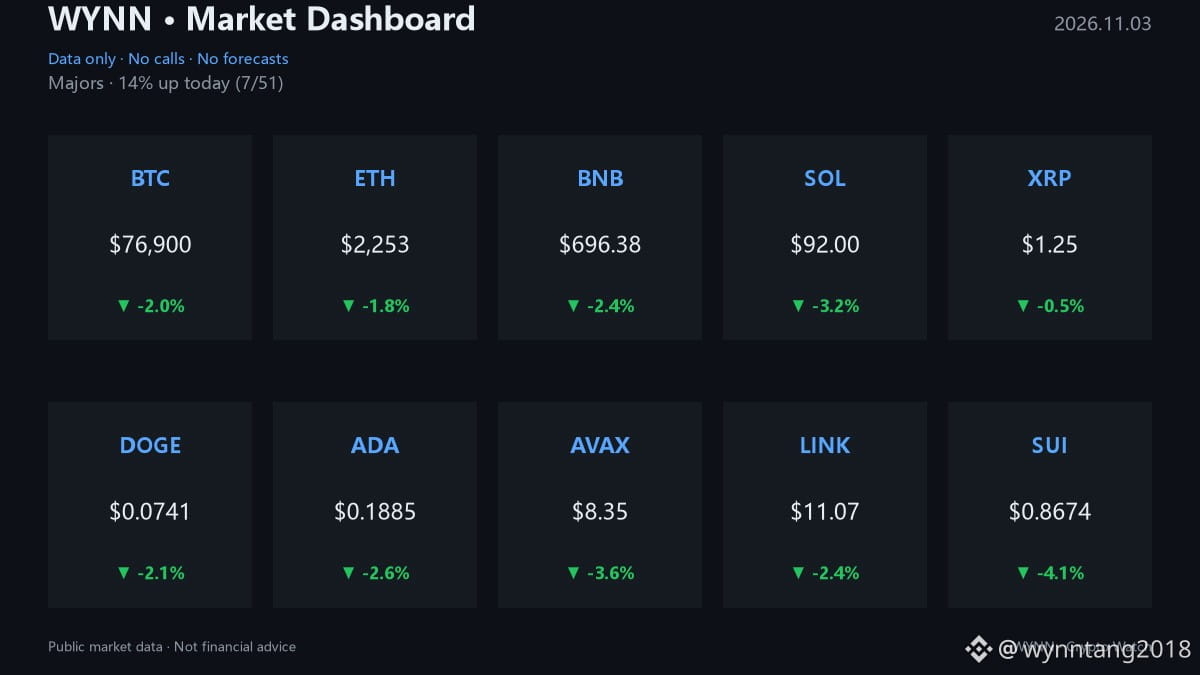
Ten majors on the board, ten red prints. BTC -2%, only 7 of 51 majors green tonight. And yet the perp book barely flinched. That gap is the whole story.
Leveraged BTC positions sit near $37B, the same level as a week ago, inside a 7-day band of roughly $36B to $38.2B. If shorts were driving this slide, open interest would be expanding while funding flipped negative. Neither is happening. Funding is still positive, about +0.006% per 8 hours, near 11% annualized on the largest venue, so longs are still paying to stay. Liquidations over the past 24h: only around $6M, and most of that was shorts getting squeezed on small bounces, not longs hunted on the way down.
Zoom out a week: about $780M of BTC positions were force-closed, 74% of them longs, with the worst single day early in the week. The damage was already taken. What remains is a slide carried by spot selling and closed-out longs, not fresh short conviction.
A perp-driven breakdown leaves fingerprints: rising OI, negative funding. Neither exists here. So I stay waiting, not bearish on the book, just unimpressed by it.
Data as of today. Not financial advice.
Which prints first: funding turning negative, or open interest finally expanding on a red candle?
$BTC #BinanceSquare #Bitcoin #OpenInterest #FundingRates
66
·
--
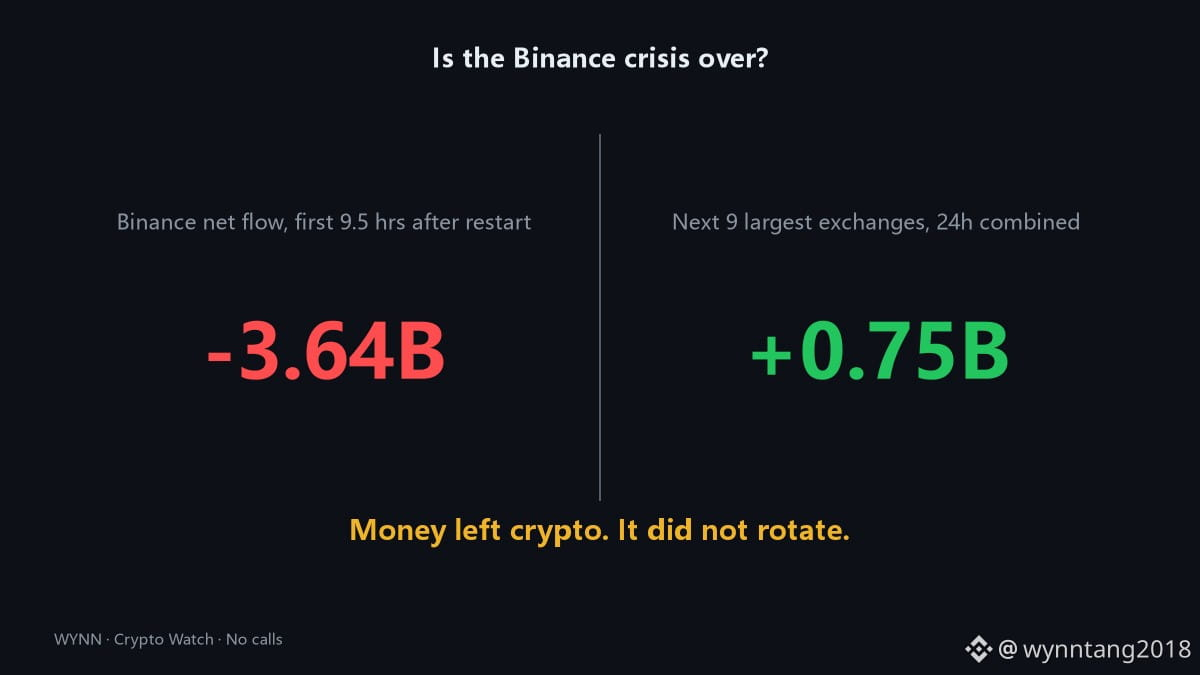
Everyone saw the same headline: withdrawals are back online, Binance covered 95% of the stolen funds, crisis contained. I don't buy "contained."
One question breaks it: if the run is over, why is the money still leaving?
Binance's own numbers for the first 9.5 hours after withdrawals restarted: $4.65B out, $1.01B in — a net $3.64B exit, about 2.1% of customer assets. Over the following 24 hours, DefiLlama tracked roughly $7B more in net outflows. And the nine largest rival exchanges combined took in only about $750M. That is not rotation. That is money leaving crypto entirely.
$BTC ETFs say the same thing: a $643M single-day outflow in the first full US session after the hack, erasing four days of inflows. $BNB holders are effectively long the exchange's balance sheet now, with the full zero-knowledge proof-of-reserves report due tomorrow.
My stance: waiting, leaning cautious. A working withdrawal button ends the queue, not the doubt.
Working withdrawals ended the bank run. They did not end the trust deficit.
Data as of today. Not financial advice.
If this were your stack: keep it on the exchange, or move it to self-custody?
$BTC $BNB #BinanceSquare #Crypto #ProofOfReserves #ExchangeFlows
1
·
--
Three dates on this week's calendar have nothing to do with direction and everything to do with volatility.
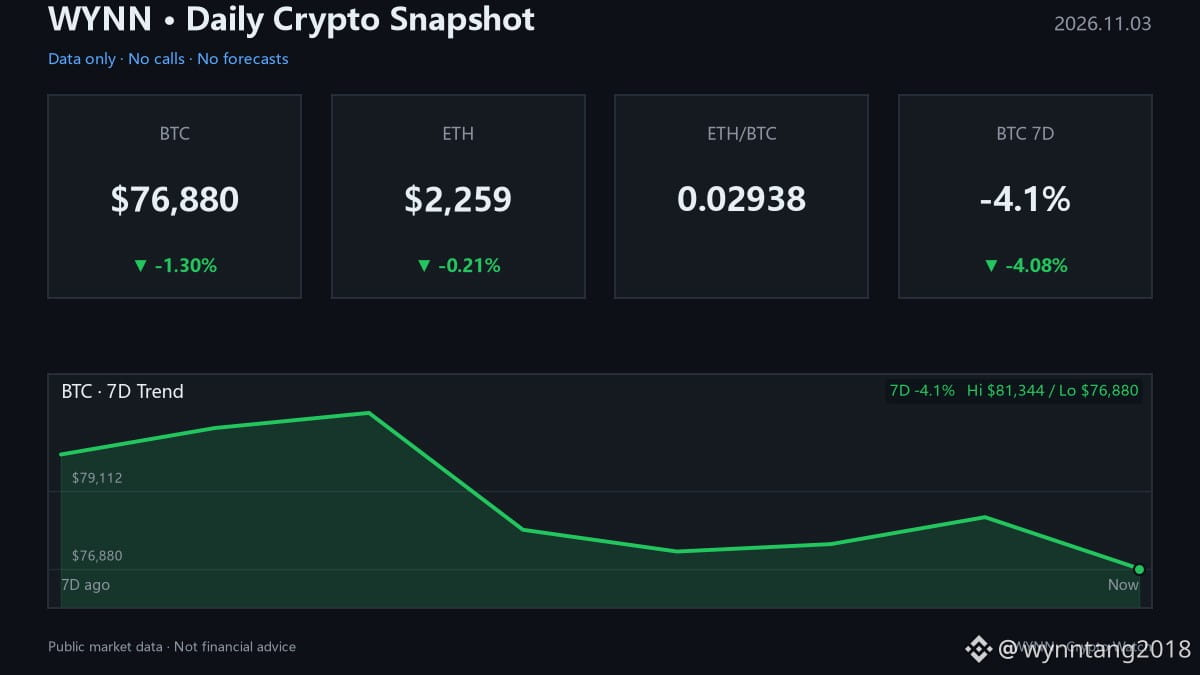
The chart sets the scene: BTC just closed the US session at $76,880, a fresh 7-day low, down 4.1% on the week.
1. Election Day. Options desks have priced the event itself: contracts expiring just after the vote trade near 43.5% implied volatility versus about 36% for later expiries (Deribit data via Laevitas). That hump is a bet on election-night headlines, not a trend change, and it decays once the votes are counted.
2. Binance's updated proof-of-reserves report, due on the PoR page. Fine print: the snapshot was taken before withdrawals resumed, so it proves refill progress, not the outflow wave that followed ($3.64B net out on day one, 2.1% of assets, per Binance; DefiLlama counted more).
3. Friday. US payrolls is the last major macro print before the December Fed meeting, and a large $HYPE unlock lands the same day.
My stance: waiting. These are vol events, not trend events. Position for calm, survive the noise. The 7-day low says caution, not collapse.
Data as of today. Not financial advice.
Which moves price more this week: election night or payrolls?
$BTC $HYPE #BinanceSquare #Bitcoin #Macro #ElectionDay
6
·
--
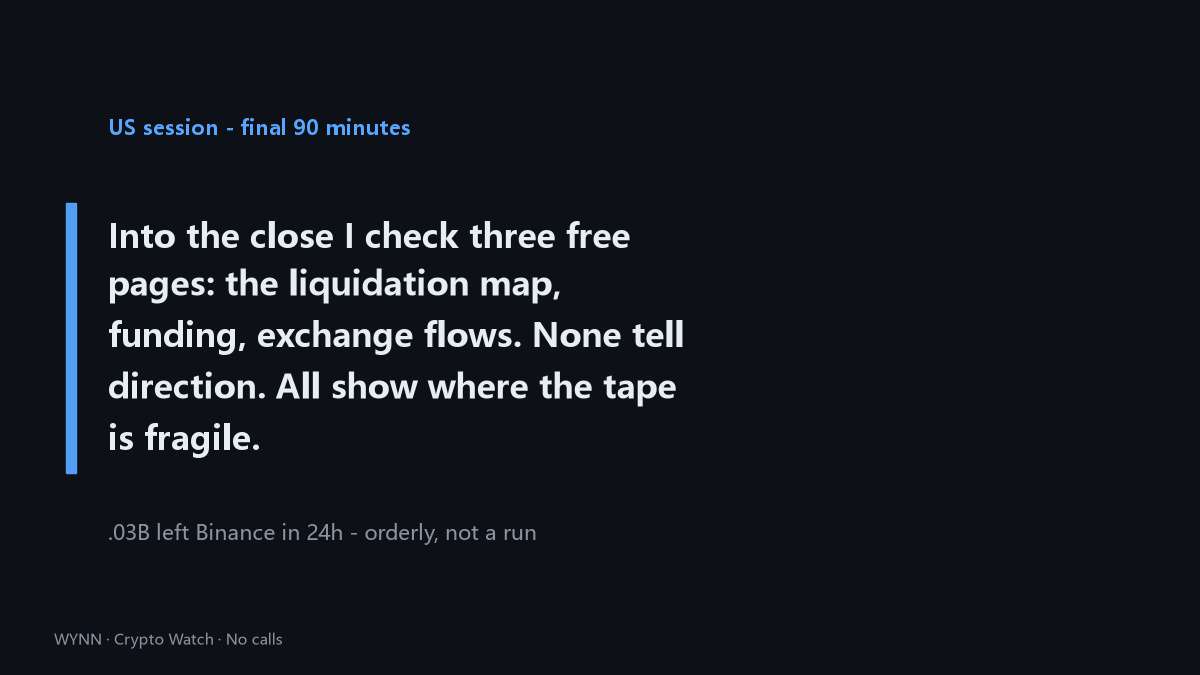
Into the close, I only check three pages. All free. The final 90 minutes rarely trades on news - it trades on who is forced to act.
1. The liquidation map (Coinglass). It shows where leveraged longs get forced out below spot. Those clusters are risk levels, not targets: drift into them and selling accelerates on its own.
2. Funding rates. BTC perp funding is +0.01% and ETH near zero on OKX right now. Neutral. No one pays to stay long, no crowded shorts. A flat tape with neutral funding has no squeeze fuel.
3. Exchange flows (DefiLlama). Binance processed $4.65B of withdrawals in the first nine hours after rails reopened, and 24h net outflow sits at $7.03B - yet the other top nine exchanges took in only about $750M combined. Coins are leaving, not migrating to rivals - orderly, not a bank run. If outflows re-accelerate into the close, thinner books make any move sharper.
My stance: waiting. Watching flows, not price. If the full proof-of-reserves report lands clean tomorrow, I lean constructive; if outflows spike again, I stay defensive.
The close trades on forced flows and thin rails, not on news.
Data as of today. Not financial advice.
Which breaks first into the close: a liquidation cluster getting tagged, or another withdrawal wave?
$BTC #BinanceSquare #IntoTheClose #MarketStructure #PerpFutures
1
·
--
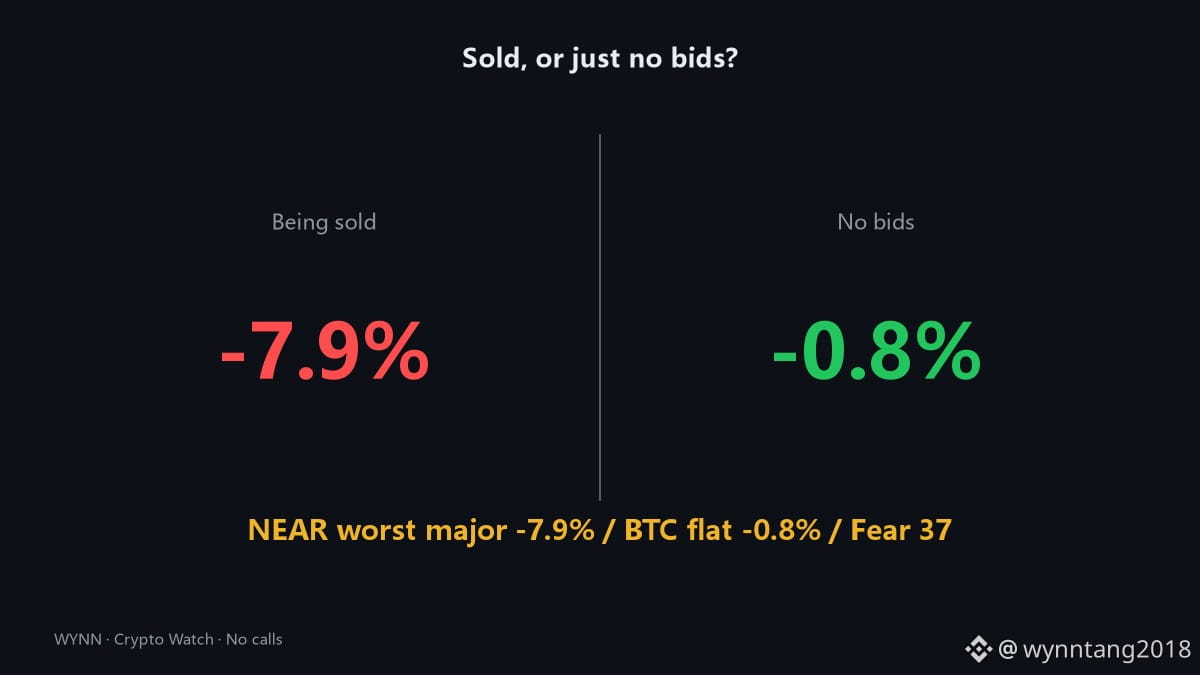
Midday in the US, and BTC has moved less than 1% all session. Meanwhile 32 of 46 majors on the board are red, and NEAR is down 7.9%.
When the index sits still while everything under it bleeds, only two explanations exist: someone is selling, or nobody is bidding.
Being sold means active distribution - you would expect BTC (-0.8%) and ETH (flat) to leak too, since every exit route runs through the deepest books. They are not leaking.
No bids means market makers stepped back on the thinnest tape of the day, so small sell orders travel far. NEAR printing -7.9% on $85M and ENA -7.5% on $23M looks like a vacuum, not an avalanche. Fear & Greed at 37 is caution, not capitulation.
My call: no bids. The part that can prove me wrong: if BTC loses its flat range on rising volume, the vacuum turns into a waterfall - the same missing bids that made the drop shallow will make the next one fast.
A flat index over bleeding alts is an empty book, not an exit.
Data as of today. Not financial advice.
One word only: are today's alt losses sold, or just unbought?
$BTC $NEAR $ETH
#BinanceSquare #MarketStructure #Altcoins #CryptoMarket
35
·
--
"Futures are green, so crypto follows the open." Not today.
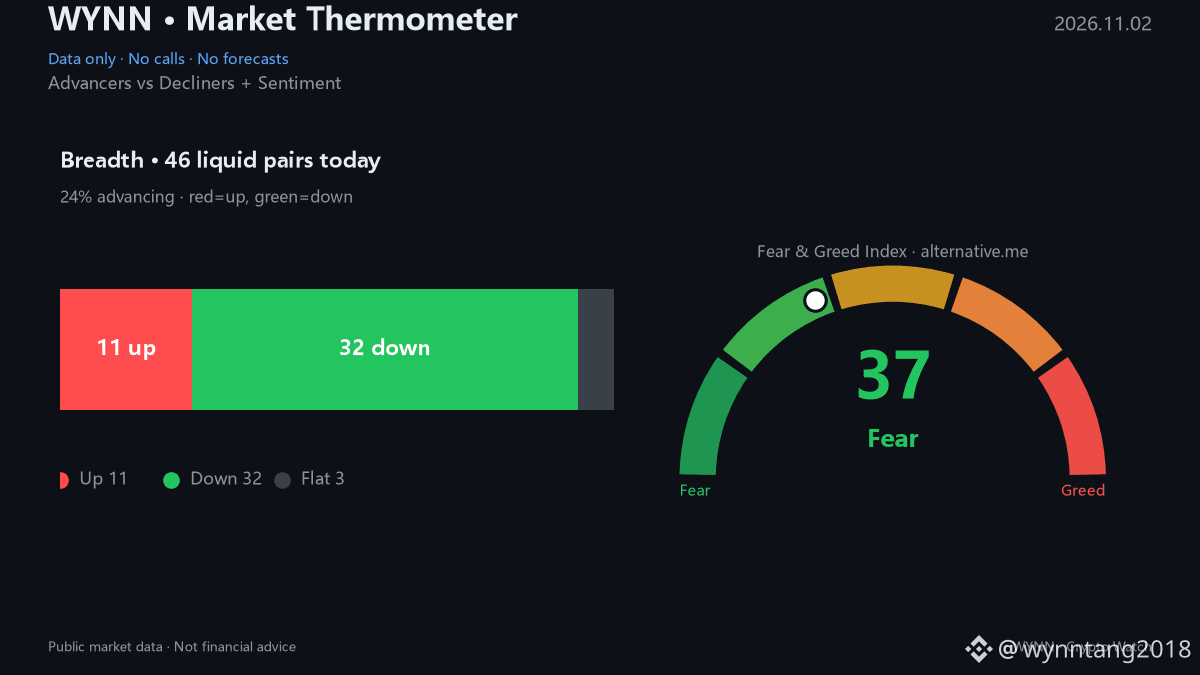
Pre-open tapes had Nasdaq futures up around 0.8% and the S&P up about 0.5%, WTI crude knocked back under $100, spot gold reclaiming $3,900 — the full risk-on checklist (Sina Finance and 21jingji premarket tapes). Now check Binance spot heading into the bell: only 12 of 46 tracked pairs are green, barely 26%. BTC prints $77,909, down 0.2%, the best name in today's top five is TRX at just +2.4%, NEAR bleeds -7.7%, and the last hourly close slid from 78,354 back to 77,892.
That is not risk-on reaching crypto. That is equities catching a bid while crypto absorption fails.
The correct read: futures tell you the door is open; breadth tells you who walked in. Crypto follows the open only when the green count expands — not when headlines are green.
My call: waiting, leaning cautious on alts. If green count reaches 25 of 46 and BTC reclaims 78,354 within two hourly closes, I flip bullish. Below that, the opening move is noise wearing a costume.
Data as of today. Not financial advice.
Which is it for you: a lag about to close, or a genuine decoupling? Watch the next hourly close and tell me.
$BTC $TRX $NEAR
#BinanceSquare #Bitcoin #Altcoins #TradingTips
24
·
--
Before the US open, three checks tell you whether this green is real. Save the list.
1) Proof-of-reserves. Binance promised its updated zero-knowledge report today. Check it actually dropped and that liabilities are fully covered. Withdrawals restarted, but $3.64B still left the exchange after resumption, so the market is not done asking.
2) ETF tape. Friday's -$643M outflow was the last print before the weekend. After the US close tonight, compare Monday's number: shrinking outflow, or a fourth straight red day.
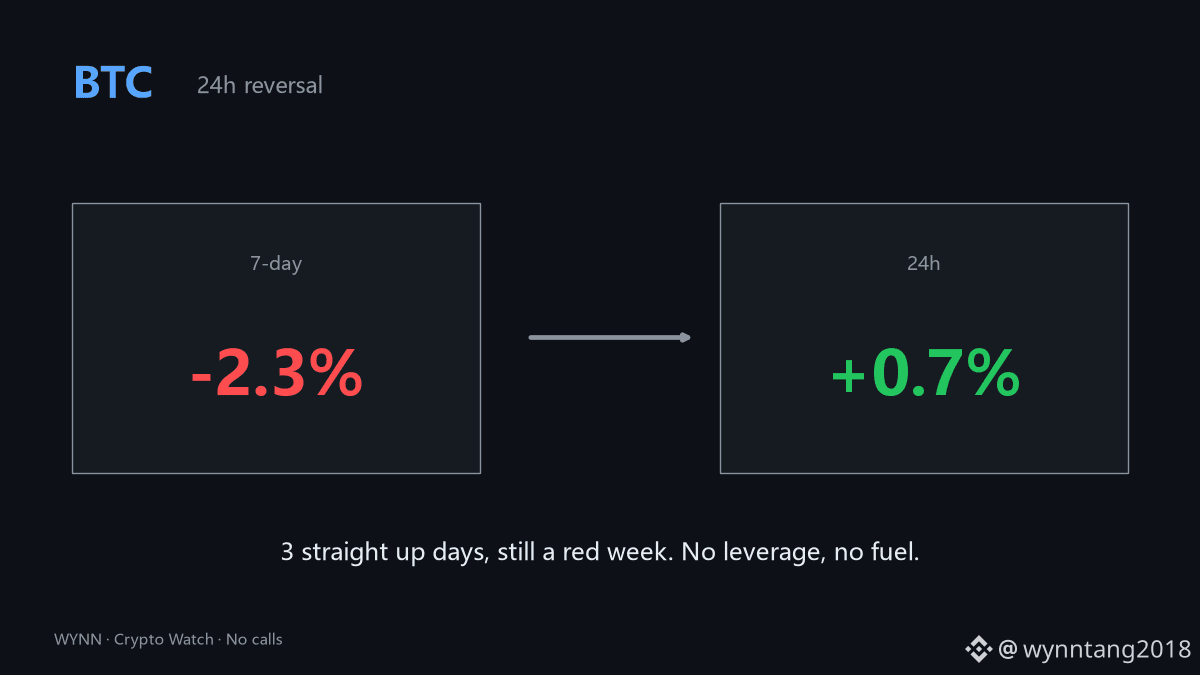
3) Fuel. Deribit BTC perp open interest sits near $660M and fell overnight; funding is near flat on every major venue. The card says it plainly: BTC is +0.7% over 24 hours yet still -2.3% on the 7-day. A spot-led bounce on shrinking leverage has no forced buyers behind it.
How to use it: before the cash open, run lines 1 and 2. Clean reserves plus a smaller outflow gives this bounce legs; either one fails and today's green is just drift.
My stance is waiting. Both conditions are unconfirmed, so declaring a bottom now means betting on data that hasn't printed. Clean reserves and shrinking outflows, or the green is drift.
Data as of today. Not financial advice.
Tonight, which do you check first: the ETF print or the proof-of-reserves page?
$BTC #BinanceSquare #Bitcoin #CryptoMarket #BTCETF
51
Log in to explore more content
Join global crypto users on Binance Square
⚡️ Get latest and useful information about crypto.
💬 Trusted by the world’s largest crypto exchange.
👍 Discover real insights from verified creators.
Email / Phone number
Trending Topics
BTCRebounds80K
60,180 views
680 Discussing
BITCOIN UPDATE I’M STILL BEARISH, AND HERE’S WHY! 🚨⚠️
As you all witnessed, BTC bounced back from the $75,700 area and touched $81K. First, the market trapped long traders, and then it trapped short traders.
I’m still bearish. First of all, as everyone knows, Democrats won today’s US midterm elections, and in my view, this outcome is bearish for the market.
The market can remain volatile in the short term and trap as many traders as it wants, but that doesn’t change the overall market outlook.
There are several important upcoming events, including US Non Farm Payrolls (November 6), US CPI Inflation (November 10), US PPI (November 13), US Retail Sales (November 17), FOMC Meeting Minutes (November 18), US PCE Inflation (November 25), Federal Reserve interest rate expectations, the US Dollar Index (DXY), Treasury Yields, Nasdaq performance, Bitcoin ETF flows, and ongoing( Iran ) Israel geopolitical developments. All of these could have a significant impact on Bitcoin and the overall crypto market.
But don’t get too carried away by Bitcoin’s recent movement. Technically speaking, there hasn’t been any major bullish move yet. Yesterday, BTC was trading between $80K and $82K, and even today, it’s still around the same range.
If you want to turn bullish, that’s entirely your choice.
In my previous post, I clearly explained that BTC had technical support in the $75K / $76K zone, and the price bounced from that support and made its way back towards $80K. But this wasn’t something I had failed to mention before. In fact, I repeatedly mentioned in my posts that BTC could move towards $80K, $81K, or even $82K.
Despite that, I’m still bearish.
And I don’t have just one reason to support my bearish outlook. I have several reasons, which I’ve already explained in my previous posts.
For now, I’ll continue to wait for BTC to drop below $74K, which I believe could happen very soon. In my view, such a correction is also necessary for the market.
Anyone looking for crypto guidance just let me know.
#BTCRebounds80K
Strategic Adviser
·28 Likes
·29.9k views
Binance98PercentReplenished
38,384 views
539 Discussing
USMidterms-WhatAreMarketsExpecting?
339,470 views
2,042 Discussing