

#k3
k3
5,869 views
8 Discussing
Hot
Latest


·
--
Crypto Earthquake
“The Kimi Moment” and how a free Chinese AI threatens the new empire of Bitcoin miners
Are we seeing a fracture in the investment thesis that links AI with the crypto ecosystem?
On Friday, #bitcoin , #Ethereum and the major cryptocurrencies suffered sharp declines that echoed the slump in semiconductor stocks in Asia. The culprit was dubbed the “Kimi Moment”: the release of the Kimi K3 Artificial Intelligence model, developed by the Beijing startup Moonshot AI.
Brutal efficiency: #K3 has 2.8 billion parameters, but it uses a “mixture of experts” architecture (activating only 16 of its 896 specialists per task), which makes it incredibly cheap to run.
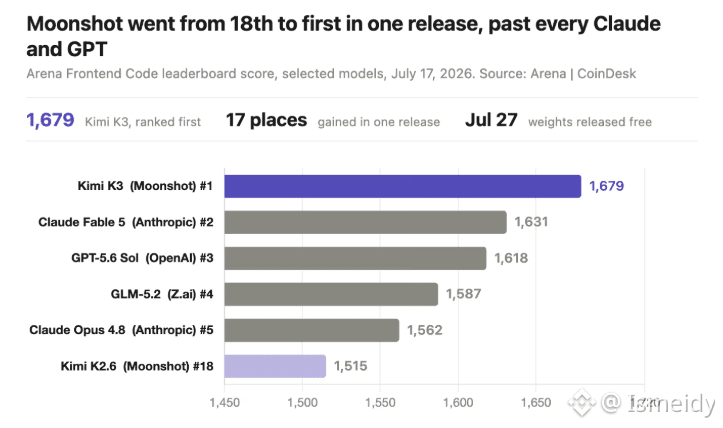
Outperforming the giants: In frontend code tests, K3 managed to dethrone U.S. flagship and paid models, beating #Claude Fable 5 (Anthropic) and GPT-5.6 (#OpenAI )
The Real Threat: Open Source
What truly sparked panic in market valuations wasn’t just the model’s performance, but its license. Kimi K3 is open source and completely free (it will be released to the public on July 27).
Paradigm shift: The multi-billion-dollar investments in AI infrastructure were sustained on the premise that cutting-edge technology would be scarce, very costly, and controlled by the United States. A free, top-tier Chinese model completely destroys that argument.
3. The Crypto Impact: why does BTC fall?
The crypto ecosystem absorbed this blow not because of a blockchain problem, but for a fundamental reason that connects BTC with AI.
The miners’ crisis: Over the past two years, Bitcoin miners have pivoted their business model toward renting out their data centers for AI training and inference. If the industry turns toward free, highly efficient models that require fewer hardware resources, demand for miners’ servers collapses.
$BTC
{spot}(BTCUSDT)
Crypto Earthquake
“The Kimi Moment” and how a free Chinese AI threatens the new empire of Bitcoin miners
Are we seeing a fracture in the investment thesis that links AI with the crypto ecosystem?
On Friday, #bitcoin , #Ethereum and the major cryptocurrencies suffered sharp declines that echoed the slump in semiconductor stocks in Asia. The culprit was dubbed the “Kimi Moment”: the release of the Kimi K3 Artificial Intelligence model, developed by the Beijing startup Moonshot AI.
Brutal efficiency: #K3 has 2.8 billion parameters, but it uses a “mixture of experts” architecture (activating only 16 of its 896 specialists per task), which makes it incredibly cheap to run.
Outperforming the giants: In frontend code tests, K3 managed to dethrone U.S. flagship and paid models, beating #Claude Fable 5 (Anthropic) and GPT-5.6 (#OpenAI )
The Real Threat: Open Source
What truly sparked panic in market valuations wasn’t just the model’s performance, but its license. Kimi K3 is open source and completely free (it will be released to the public on July 27).
Paradigm shift: The multi-billion-dollar investments in AI infrastructure were sustained on the premise that cutting-edge technology would be scarce, very costly, and controlled by the United States. A free, top-tier Chinese model completely destroys that argument.
3. The Crypto Impact: why does BTC fall?
The crypto ecosystem absorbed this blow not because of a blockchain problem, but for a fundamental reason that connects BTC with AI.
The miners’ crisis: Over the past two years, Bitcoin miners have pivoted their business model toward renting out their data centers for AI training and inference. If the industry turns toward free, highly efficient models that require fewer hardware resources, demand for miners’ servers collapses.
$BTC
“The Kimi Moment” and how a free Chinese AI threatens the new empire of Bitcoin miners
Are we seeing a fracture in the investment thesis that links AI with the crypto ecosystem?
On Friday, #bitcoin , #Ethereum and the major cryptocurrencies suffered sharp declines that echoed the slump in semiconductor stocks in Asia. The culprit was dubbed the “Kimi Moment”: the release of the Kimi K3 Artificial Intelligence model, developed by the Beijing startup Moonshot AI.
Brutal efficiency: #K3 has 2.8 billion parameters, but it uses a “mixture of experts” architecture (activating only 16 of its 896 specialists per task), which makes it incredibly cheap to run.
Outperforming the giants: In frontend code tests, K3 managed to dethrone U.S. flagship and paid models, beating #Claude Fable 5 (Anthropic) and GPT-5.6 (#OpenAI )
The Real Threat: Open Source
What truly sparked panic in market valuations wasn’t just the model’s performance, but its license. Kimi K3 is open source and completely free (it will be released to the public on July 27).
Paradigm shift: The multi-billion-dollar investments in AI infrastructure were sustained on the premise that cutting-edge technology would be scarce, very costly, and controlled by the United States. A free, top-tier Chinese model completely destroys that argument.
3. The Crypto Impact: why does BTC fall?
The crypto ecosystem absorbed this blow not because of a blockchain problem, but for a fundamental reason that connects BTC with AI.
The miners’ crisis: Over the past two years, Bitcoin miners have pivoted their business model toward renting out their data centers for AI training and inference. If the industry turns toward free, highly efficient models that require fewer hardware resources, demand for miners’ servers collapses.
$BTC
1
11
11.2k

·
--
Day after day, one step at a time: Why can Kimi build K3? Yang Xinyu lists four sins among its peers
① Arrogance: Veteran teams believe the AI war is over and that they’ve already won.
② Impatience: Young labs lack solid fundamentals, and when they can’t keep up, they quickly pivot.
③ Cowardice: Their strength isn’t weak, but they’re afraid to set their sights on being #1 in the industry.
④ Misaligned goals: Everyone is fighting for personal credit, and no one truly cares whether the company can build AGI.
Yang Xinyu says what’s most different about the Dark Side of the Moon is that the founding team still has an intense drive to pursue AGI.
He also shared “Kimi’s Five Precepts”:
- Model companies should build models
- Do Research and publish papers through experiments
- When training models, look at metrics
- Don’t force it if it doesn’t work
- Don’t YOLO
In plain terms: tell fewer stories, do more experiments. Train by data, stop failing fast, and don’t rely on intuition to place big bets.
These four sins and five precepts are really about the same thing: most AI companies fail because they’re too eager to be “the boss,” not because they’re determined to “do the right work.” Kimi’s differentiation isn’t that it’s smarter—it’s that it’s more restrained.
#Kimi #K3 #AI
Day after day, one step at a time: Why can Kimi build K3? Yang Xinyu lists four sins among its peers
① Arrogance: Veteran teams believe the AI war is over and that they’ve already won.
② Impatience: Young labs lack solid fundamentals, and when they can’t keep up, they quickly pivot.
③ Cowardice: Their strength isn’t weak, but they’re afraid to set their sights on being #1 in the industry.
④ Misaligned goals: Everyone is fighting for personal credit, and no one truly cares whether the company can build AGI.
Yang Xinyu says what’s most different about the Dark Side of the Moon is that the founding team still has an intense drive to pursue AGI.
He also shared “Kimi’s Five Precepts”:
- Model companies should build models
- Do Research and publish papers through experiments
- When training models, look at metrics
- Don’t force it if it doesn’t work
- Don’t YOLO
In plain terms: tell fewer stories, do more experiments. Train by data, stop failing fast, and don’t rely on intuition to place big bets.
These four sins and five precepts are really about the same thing: most AI companies fail because they’re too eager to be “the boss,” not because they’re determined to “do the right work.” Kimi’s differentiation isn’t that it’s smarter—it’s that it’s more restrained.
#Kimi #K3 #AI
① Arrogance: Veteran teams believe the AI war is over and that they’ve already won.
② Impatience: Young labs lack solid fundamentals, and when they can’t keep up, they quickly pivot.
③ Cowardice: Their strength isn’t weak, but they’re afraid to set their sights on being #1 in the industry.
④ Misaligned goals: Everyone is fighting for personal credit, and no one truly cares whether the company can build AGI.
Yang Xinyu says what’s most different about the Dark Side of the Moon is that the founding team still has an intense drive to pursue AGI.
He also shared “Kimi’s Five Precepts”:
- Model companies should build models
- Do Research and publish papers through experiments
- When training models, look at metrics
- Don’t force it if it doesn’t work
- Don’t YOLO
In plain terms: tell fewer stories, do more experiments. Train by data, stop failing fast, and don’t rely on intuition to place big bets.
These four sins and five precepts are really about the same thing: most AI companies fail because they’re too eager to be “the boss,” not because they’re determined to “do the right work.” Kimi’s differentiation isn’t that it’s smarter—it’s that it’s more restrained.
#Kimi #K3 #AI
28

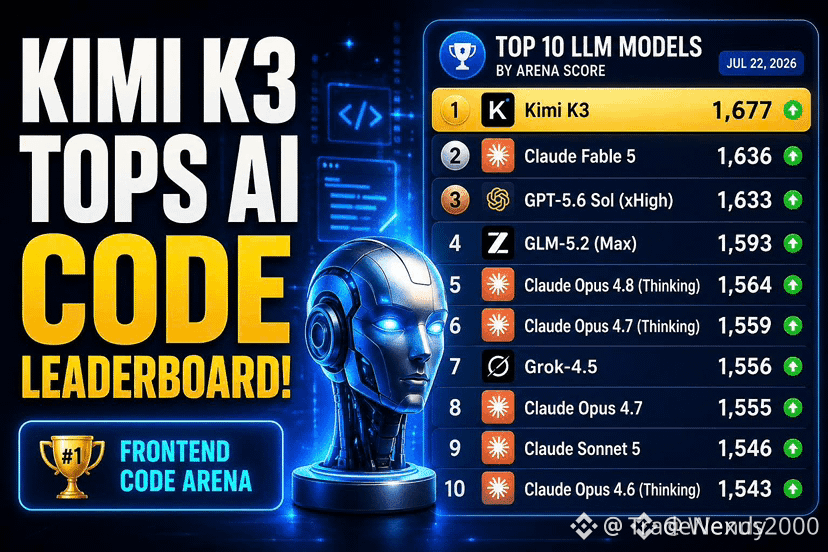
🚨 $K3 SURGES 41 POINTS AHEAD — DOMINANCE CONFIRMED AT THE TOP! 📊
📌 Kimi K3 has established a commanding lead at 1,677, widening the gap to 41 points over the closest competitor. This is not just a marginal gain — it's a structural shift in the landscape. 📊 The leaderboard shows Claude variants stacking six of the top ten slots, indicating deep liquidity in that ecosystem, but Kimi's breakout is decisive.
💡 The tight clustering from #5 to #10 — separated by only 21 points — means the next model update could trigger a violent shakeup. Are you betting on the leader's momentum or waiting for a slip to accumulate the laggards at value? 💬
⚠️ Not financial advice. Always manage your risk. 🛡️
🏷️ #K3 #AIBenchmark #Leaderboard #Tech #CryptoAI
🦈 ⚡
🚨 $K3 SURGES 41 POINTS AHEAD — DOMINANCE CONFIRMED AT THE TOP! 📊
📌 Kimi K3 has established a commanding lead at 1,677, widening the gap to 41 points over the closest competitor. This is not just a marginal gain — it's a structural shift in the landscape. 📊 The leaderboard shows Claude variants stacking six of the top ten slots, indicating deep liquidity in that ecosystem, but Kimi's breakout is decisive.
💡 The tight clustering from #5 to #10 — separated by only 21 points — means the next model update could trigger a violent shakeup. Are you betting on the leader's momentum or waiting for a slip to accumulate the laggards at value? 💬
⚠️ Not financial advice. Always manage your risk. 🛡️
🏷️ #K3 #AIBenchmark #Leaderboard #Tech #CryptoAI
🦈 ⚡
📌 Kimi K3 has established a commanding lead at 1,677, widening the gap to 41 points over the closest competitor. This is not just a marginal gain — it's a structural shift in the landscape. 📊 The leaderboard shows Claude variants stacking six of the top ten slots, indicating deep liquidity in that ecosystem, but Kimi's breakout is decisive.
💡 The tight clustering from #5 to #10 — separated by only 21 points — means the next model update could trigger a violent shakeup. Are you betting on the leader's momentum or waiting for a slip to accumulate the laggards at value? 💬
⚠️ Not financial advice. Always manage your risk. 🛡️
🏷️ #K3 #AIBenchmark #Leaderboard #Tech #CryptoAI
🦈 ⚡
23

·
--
🚨 $K3 OPEN WEIGHTS GO LIVE - 2.8 TRILLION PARAMETERS, PUBLIC ACCESS! 💥
📌 This is not a typical token narrative—Moonshot AI just dropped the full weights of Kimi K3, the largest open-weight model ever, activating only 16 of 896 experts per token. 💡 The sheer computational demand forced a subscription pause within days, hinting at a structural supply shock in the AI compute layer.
⚡ Institutional capital is flowing aggressively: valuation jumped from $20B to $31.5B in weeks, targeting $50B pre-Hong Kong listing. 🌊 For crypto AI ecosystems, this signals a tidal shift in resource allocation and open-source leverage. 💬 Which AI crypto infrastructure project is best positioned to absorb this inference demand? 👇
⚠️ Not financial advice. Always manage your risk. 🛡️
🏷️ #K3 #AI #OpenSource #Moonshot #Crypto
🔥 💎
🚨 $K3 OPEN WEIGHTS GO LIVE - 2.8 TRILLION PARAMETERS, PUBLIC ACCESS! 💥
📌 This is not a typical token narrative—Moonshot AI just dropped the full weights of Kimi K3, the largest open-weight model ever, activating only 16 of 896 experts per token. 💡 The sheer computational demand forced a subscription pause within days, hinting at a structural supply shock in the AI compute layer.
⚡ Institutional capital is flowing aggressively: valuation jumped from $20B to $31.5B in weeks, targeting $50B pre-Hong Kong listing. 🌊 For crypto AI ecosystems, this signals a tidal shift in resource allocation and open-source leverage. 💬 Which AI crypto infrastructure project is best positioned to absorb this inference demand? 👇
⚠️ Not financial advice. Always manage your risk. 🛡️
🏷️ #K3 #AI #OpenSource #Moonshot #Crypto
🔥 💎
📌 This is not a typical token narrative—Moonshot AI just dropped the full weights of Kimi K3, the largest open-weight model ever, activating only 16 of 896 experts per token. 💡 The sheer computational demand forced a subscription pause within days, hinting at a structural supply shock in the AI compute layer.
⚡ Institutional capital is flowing aggressively: valuation jumped from $20B to $31.5B in weeks, targeting $50B pre-Hong Kong listing. 🌊 For crypto AI ecosystems, this signals a tidal shift in resource allocation and open-source leverage. 💬 Which AI crypto infrastructure project is best positioned to absorb this inference demand? 👇
⚠️ Not financial advice. Always manage your risk. 🛡️
🏷️ #K3 #AI #OpenSource #Moonshot #Crypto
🔥 💎
18
·
--
Striving for one more step: Kimi K3 just released—28 trillion parameters, 1 million context, native multimodal
All three internal benchmarks surpass Claude Opus 4.8 and GPT-5.5: Online Exp 75.5, DECK-Bench 73.5, Finance-Bench 62.6.
Two architecture updates: Kimi Delta Attention (KDA) boosts decoding speed by up to 6.3x in million-token context; Attention Residuals (AttnRes) improves training efficiency by about 25%, with extra costs under 2%. The MoE expands to 896 experts, activating 16 each time; overall expansion efficiency is about 2.5x higher than K2.
Most worth paying attention to is its self-evolution capability: K3 takes 15 hours of continuous iteration to design a new two-stage kernel algorithm, reducing AttnRes forward + backward from 283.6ms to 114.4ms—no change in results, but double the speed. The model is optimizing itself.
K3 has gone live with Kimi Work, Kimi Code, and the API, with weights to be released by July 27.
Once models start optimizing their own training kernels, the narrative of “AI helps humans write code” needs an upgrade—next comes “AI helps AI write code even faster.”
#Kimi #K3 #AI
Striving for one more step: Kimi K3 just released—28 trillion parameters, 1 million context, native multimodal
All three internal benchmarks surpass Claude Opus 4.8 and GPT-5.5: Online Exp 75.5, DECK-Bench 73.5, Finance-Bench 62.6.
Two architecture updates: Kimi Delta Attention (KDA) boosts decoding speed by up to 6.3x in million-token context; Attention Residuals (AttnRes) improves training efficiency by about 25%, with extra costs under 2%. The MoE expands to 896 experts, activating 16 each time; overall expansion efficiency is about 2.5x higher than K2.
Most worth paying attention to is its self-evolution capability: K3 takes 15 hours of continuous iteration to design a new two-stage kernel algorithm, reducing AttnRes forward + backward from 283.6ms to 114.4ms—no change in results, but double the speed. The model is optimizing itself.
K3 has gone live with Kimi Work, Kimi Code, and the API, with weights to be released by July 27.
Once models start optimizing their own training kernels, the narrative of “AI helps humans write code” needs an upgrade—next comes “AI helps AI write code even faster.”
#Kimi #K3 #AI
All three internal benchmarks surpass Claude Opus 4.8 and GPT-5.5: Online Exp 75.5, DECK-Bench 73.5, Finance-Bench 62.6.
Two architecture updates: Kimi Delta Attention (KDA) boosts decoding speed by up to 6.3x in million-token context; Attention Residuals (AttnRes) improves training efficiency by about 25%, with extra costs under 2%. The MoE expands to 896 experts, activating 16 each time; overall expansion efficiency is about 2.5x higher than K2.
Most worth paying attention to is its self-evolution capability: K3 takes 15 hours of continuous iteration to design a new two-stage kernel algorithm, reducing AttnRes forward + backward from 283.6ms to 114.4ms—no change in results, but double the speed. The model is optimizing itself.
K3 has gone live with Kimi Work, Kimi Code, and the API, with weights to be released by July 27.
Once models start optimizing their own training kernels, the narrative of “AI helps humans write code” needs an upgrade—next comes “AI helps AI write code even faster.”
#Kimi #K3 #AI
18
Log in to explore more content
Join global crypto users on Binance Square
⚡️ Get latest and useful information about crypto.
💬 Trusted by the world’s largest crypto exchange.
👍 Discover real insights from verified creators.
Email / Phone number
Trending Topics
1
#ETHBreaksAbove$2,700
60 views
20 Discussing
2
#USWeighsPromotingDollarStablecoinsAbroad
8,890 views
521 Discussing
3
#US10YTreasuryYieldHits19YearHigh
7,626 views
423 Discussing
4
#SpotBitcoinETFsInflow$2.31BInFourDays
770 views
36 Discussing
5
#BitcoinRejectedAt$87,300Twice
0 views
0 Discussing
6
#BCHJumps28%OnCMEFuturesListing
51,376 views
1,096 Discussing
7
#WallStreetEarningsRevisionsTurnBearish
35,944 views
841 Discussing
8
#DollarIndexReclaims101
32,746 views
813 Discussing
9
#21SharesLaunchesEuropesFirstZcashETP
79,483 views
1,567 Discussing
10
#CardanoJoinsX402PaymentStandard
50,017 views
1,143 Discussing