

#japanbondyieldhits30yearhigh
japanbondyieldhits30yearhigh
270,197 views
828 Discussing
Hot
Latest

·
--
Bullish
#japanbondyieldhits30yearhigh
🔥 GLOBAL FINANCIAL LANDSCAPE SHIFT: JAPAN'S 30-YEAR BOND YIELD SMASHES HIGHS! 🇯🇵📉
⚠️ BANK OF JAPAN UNDER PRESSURE AS FIXED-INCOME MARKETS REWRITE THE RECORD BOOKS! 👇
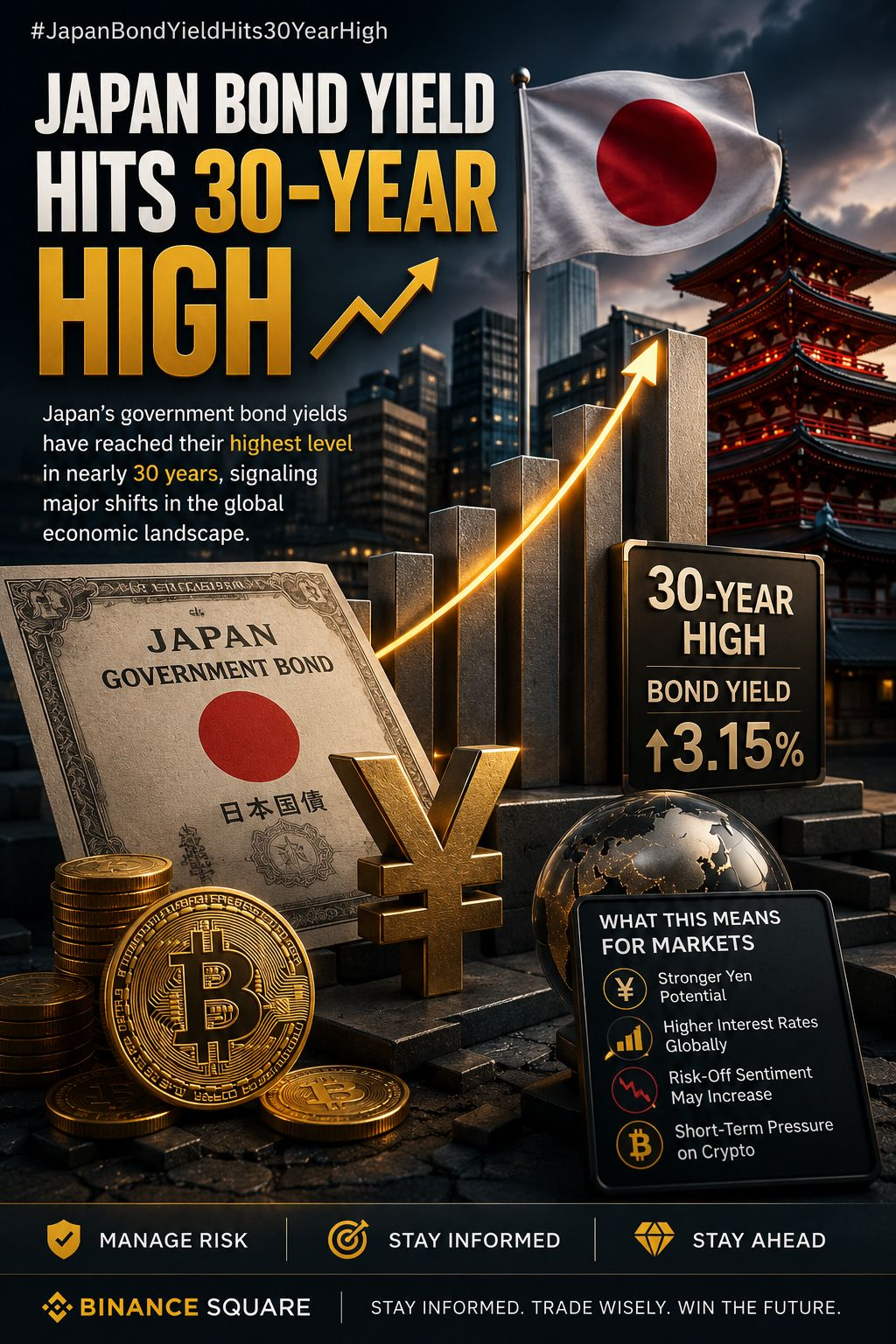
The global macro landscape has just taken a massive turn! In a historic trading session, Japan’s 30-year government bond yield has officially surged to its highest level in three decades [🌐]!
As the Bank of Japan steps back from its long-running loose monetary policies, global capital is aggressively repricing debt risk. Here is the exact, high-utility breakdown behind this massive bond market shockwave:
🏛 THE MACRO REPRICING UNPACKED
The Yield Surge Catalyst: Persistent domestic inflation and growing expectations of further interest rate hikes by the Bank of Japan are causing bond prices to slide, pushing long-term yields upward.The Yen Defense Mechanism: Higher domestic yields are designed to breathe life back into the weakening Japanese Yen, closing the aggressive interest rate gap with Western central banks.Global Liquidity Realignment: As Japanese yields hit multi-decade highs, institutional "carry trade" capital is flowing right back to Tokyo, pulling vital liquidity away from global risk assets.
DYOR!! When the world's largest creditor nation experiences a generational shift in its debt market, every single financial asset class feels the friction. Protect your portfolio and manage your macro risk closely! 📈💼
#japanbondyieldhits30yearhigh #BankOfJapan #MacroEconomics
#japanbondyieldhits30yearhigh
🔥 GLOBAL FINANCIAL LANDSCAPE SHIFT: JAPAN'S 30-YEAR BOND YIELD SMASHES HIGHS! 🇯🇵📉
⚠️ BANK OF JAPAN UNDER PRESSURE AS FIXED-INCOME MARKETS REWRITE THE RECORD BOOKS! 👇
The global macro landscape has just taken a massive turn! In a historic trading session, Japan’s 30-year government bond yield has officially surged to its highest level in three decades [🌐]!
As the Bank of Japan steps back from its long-running loose monetary policies, global capital is aggressively repricing debt risk. Here is the exact, high-utility breakdown behind this massive bond market shockwave:
🏛 THE MACRO REPRICING UNPACKED
The Yield Surge Catalyst: Persistent domestic inflation and growing expectations of further interest rate hikes by the Bank of Japan are causing bond prices to slide, pushing long-term yields upward.The Yen Defense Mechanism: Higher domestic yields are designed to breathe life back into the weakening Japanese Yen, closing the aggressive interest rate gap with Western central banks.Global Liquidity Realignment: As Japanese yields hit multi-decade highs, institutional "carry trade" capital is flowing right back to Tokyo, pulling vital liquidity away from global risk assets.
DYOR!! When the world's largest creditor nation experiences a generational shift in its debt market, every single financial asset class feels the friction. Protect your portfolio and manage your macro risk closely! 📈💼
#japanbondyieldhits30yearhigh #BankOfJapan #MacroEconomics
🔥 GLOBAL FINANCIAL LANDSCAPE SHIFT: JAPAN'S 30-YEAR BOND YIELD SMASHES HIGHS! 🇯🇵📉
⚠️ BANK OF JAPAN UNDER PRESSURE AS FIXED-INCOME MARKETS REWRITE THE RECORD BOOKS! 👇
The global macro landscape has just taken a massive turn! In a historic trading session, Japan’s 30-year government bond yield has officially surged to its highest level in three decades [🌐]!
As the Bank of Japan steps back from its long-running loose monetary policies, global capital is aggressively repricing debt risk. Here is the exact, high-utility breakdown behind this massive bond market shockwave:
🏛 THE MACRO REPRICING UNPACKED
The Yield Surge Catalyst: Persistent domestic inflation and growing expectations of further interest rate hikes by the Bank of Japan are causing bond prices to slide, pushing long-term yields upward.The Yen Defense Mechanism: Higher domestic yields are designed to breathe life back into the weakening Japanese Yen, closing the aggressive interest rate gap with Western central banks.Global Liquidity Realignment: As Japanese yields hit multi-decade highs, institutional "carry trade" capital is flowing right back to Tokyo, pulling vital liquidity away from global risk assets.
DYOR!! When the world's largest creditor nation experiences a generational shift in its debt market, every single financial asset class feels the friction. Protect your portfolio and manage your macro risk closely! 📈💼
#japanbondyieldhits30yearhigh #BankOfJapan #MacroEconomics
139

#JapanBondYieldHits30YearHigh That hashtag points to a macro headline: Japan’s government bond yields, especially long-dated ones, have surged to levels not seen in decades. As of July 7, 2026, Japan’s 30-year government bond yield was around 4.06%, after reaching an all-time high of 4.20% in May 2026. (tradingeconomics.com)
Why that matters:
Higher bond yields = higher borrowing costs for Japan’s government. (tradingeconomics.com)
It usually reflects investor concern about inflation, fiscal spending, and future interest rates. Recent coverage ties the move to worries about Japan’s fiscal policy and tighter Bank of Japan expectations. (bloomberg.com)
Because Japan has had ultra-low yields for years, this is a big regime shift for global markets. (tradingeconomics.com)
In plain English:
the hashtag means Japan’s long-term interest rates are spiking, which can ripple into:
the yen
global bond markets
Japanese bank stocks
risk assets, including crypto, if investors become more defensive. (fxstreet.com)
One nuance: if someone literally says “30-year high,” that can be misleading. The more precise statement is that the 30-year Japanese bond yield is at or near a record high, not necessarily that it is “the highest in exactly 30 years.” (tradingeconomics.com)
If you want, I can also break down what this means for BTC, altcoins, and Binance traders specifically.
#JapanBondYieldHits30YearHigh That hashtag points to a macro headline: Japan’s government bond yields, especially long-dated ones, have surged to levels not seen in decades. As of July 7, 2026, Japan’s 30-year government bond yield was around 4.06%, after reaching an all-time high of 4.20% in May 2026. (tradingeconomics.com)
Why that matters:
Higher bond yields = higher borrowing costs for Japan’s government. (tradingeconomics.com)
It usually reflects investor concern about inflation, fiscal spending, and future interest rates. Recent coverage ties the move to worries about Japan’s fiscal policy and tighter Bank of Japan expectations. (bloomberg.com)
Because Japan has had ultra-low yields for years, this is a big regime shift for global markets. (tradingeconomics.com)
In plain English:
the hashtag means Japan’s long-term interest rates are spiking, which can ripple into:
the yen
global bond markets
Japanese bank stocks
risk assets, including crypto, if investors become more defensive. (fxstreet.com)
One nuance: if someone literally says “30-year high,” that can be misleading. The more precise statement is that the 30-year Japanese bond yield is at or near a record high, not necessarily that it is “the highest in exactly 30 years.” (tradingeconomics.com)
If you want, I can also break down what this means for BTC, altcoins, and Binance traders specifically.
Why that matters:
Higher bond yields = higher borrowing costs for Japan’s government. (tradingeconomics.com)
It usually reflects investor concern about inflation, fiscal spending, and future interest rates. Recent coverage ties the move to worries about Japan’s fiscal policy and tighter Bank of Japan expectations. (bloomberg.com)
Because Japan has had ultra-low yields for years, this is a big regime shift for global markets. (tradingeconomics.com)
In plain English:
the hashtag means Japan’s long-term interest rates are spiking, which can ripple into:
the yen
global bond markets
Japanese bank stocks
risk assets, including crypto, if investors become more defensive. (fxstreet.com)
One nuance: if someone literally says “30-year high,” that can be misleading. The more precise statement is that the 30-year Japanese bond yield is at or near a record high, not necessarily that it is “the highest in exactly 30 years.” (tradingeconomics.com)
If you want, I can also break down what this means for BTC, altcoins, and Binance traders specifically.
69

·
--
#JapanBondYieldHits30YearHigh Japan's bond yield reaching a 30-year high is a significant signal for global financial markets. Rising yields can influence investor sentiment, currency movements, and capital flows. It will be interesting to see how this impacts both traditional markets and the crypto space. #JapanBondYieldHits30YearHigh
#JapanBondYieldHits30YearHigh Japan's bond yield reaching a 30-year high is a significant signal for global financial markets. Rising yields can influence investor sentiment, currency movements, and capital flows. It will be interesting to see how this impacts both traditional markets and the crypto space. #JapanBondYieldHits30YearHigh
25

·
--
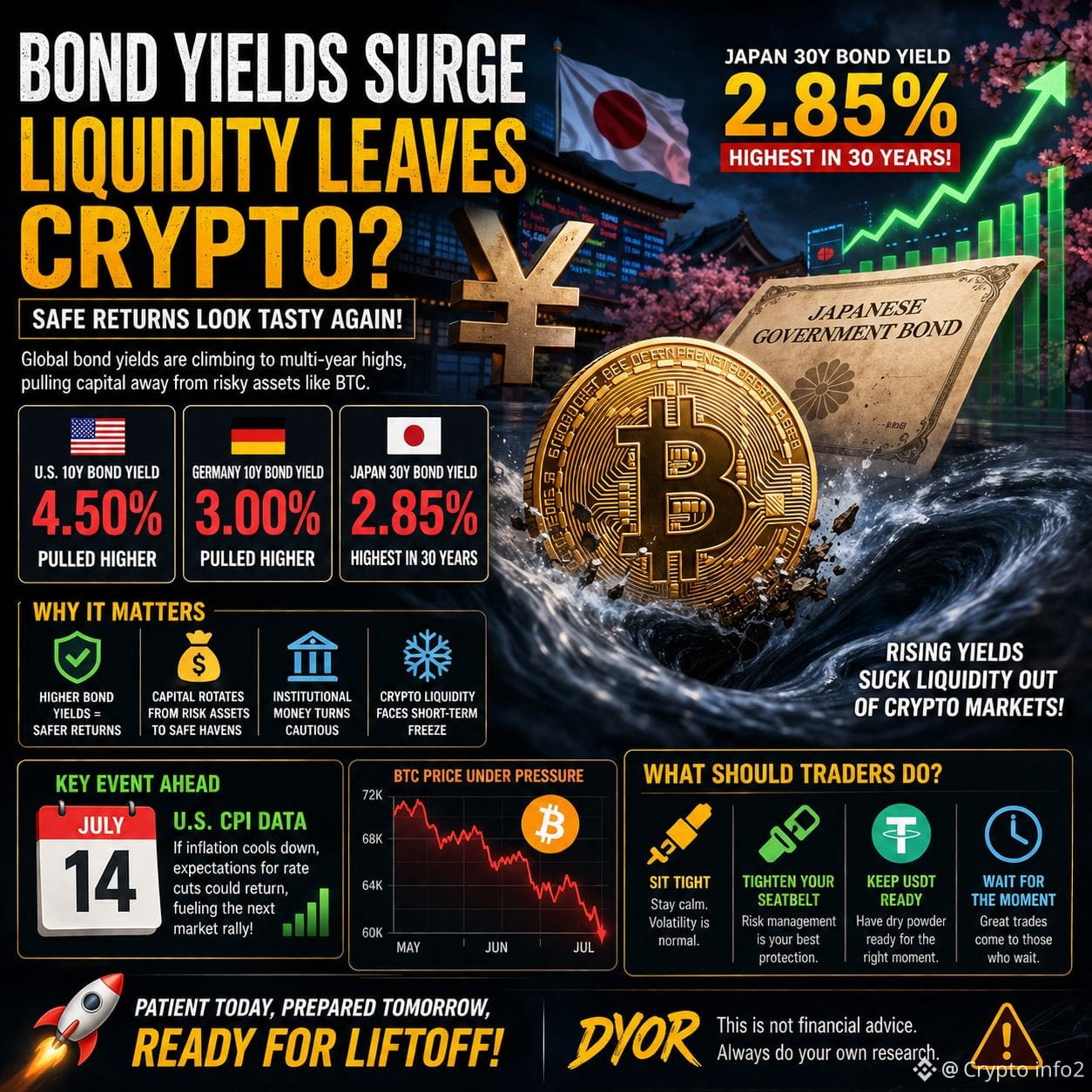
#japanbondyieldhits30yearhigh 📉 Bond Yields Are Climbing—Is Liquidity Leaving Crypto?
🇯🇵 Japanese government bond yields have surged to 2.85%, their highest level in nearly 30 years, while U.S. Treasury yields are hovering around 4.5% and German bond yields remain elevated.
💰 Why does this matter?
Higher bond yields make low-risk investments more attractive, which can temporarily pull capital away from risk assets like Bitcoin and the broader crypto market.$BNB
📊 Market Focus
🔹 Rising global bond yields
🔹 Tighter financial conditions
🔹 Institutional investors becoming more cautious
🔹 Crypto liquidity facing short-term pressure
👀 What's Next?$BTC
The upcoming U.S. CPI data could be a major catalyst. If inflation continues to cool, expectations for easier monetary policy may return, potentially supporting both crypto and equity markets.
🎯 Trader's Playbook
✅ Stay patient.
✅ Keep risk under control.
✅ Have capital ready for opportunities instead of chasing volatility.
Markets move in cycles—discipline often outperforms emotion.
#Bitcoin #BTC #Crypto #BondYields
{spot}(BNBUSDT)
{spot}(BTCUSDT)
#japanbondyieldhits30yearhigh 📉 Bond Yields Are Climbing—Is Liquidity Leaving Crypto?
🇯🇵 Japanese government bond yields have surged to 2.85%, their highest level in nearly 30 years, while U.S. Treasury yields are hovering around 4.5% and German bond yields remain elevated.
💰 Why does this matter?
Higher bond yields make low-risk investments more attractive, which can temporarily pull capital away from risk assets like Bitcoin and the broader crypto market.$BNB
📊 Market Focus
🔹 Rising global bond yields
🔹 Tighter financial conditions
🔹 Institutional investors becoming more cautious
🔹 Crypto liquidity facing short-term pressure
👀 What's Next?$BTC
The upcoming U.S. CPI data could be a major catalyst. If inflation continues to cool, expectations for easier monetary policy may return, potentially supporting both crypto and equity markets.
🎯 Trader's Playbook
✅ Stay patient.
✅ Keep risk under control.
✅ Have capital ready for opportunities instead of chasing volatility.
Markets move in cycles—discipline often outperforms emotion.
#Bitcoin #BTC #Crypto #BondYields
🇯🇵 Japanese government bond yields have surged to 2.85%, their highest level in nearly 30 years, while U.S. Treasury yields are hovering around 4.5% and German bond yields remain elevated.
💰 Why does this matter?
Higher bond yields make low-risk investments more attractive, which can temporarily pull capital away from risk assets like Bitcoin and the broader crypto market.$BNB
📊 Market Focus
🔹 Rising global bond yields
🔹 Tighter financial conditions
🔹 Institutional investors becoming more cautious
🔹 Crypto liquidity facing short-term pressure
👀 What's Next?$BTC
The upcoming U.S. CPI data could be a major catalyst. If inflation continues to cool, expectations for easier monetary policy may return, potentially supporting both crypto and equity markets.
🎯 Trader's Playbook
✅ Stay patient.
✅ Keep risk under control.
✅ Have capital ready for opportunities instead of chasing volatility.
Markets move in cycles—discipline often outperforms emotion.
#Bitcoin #BTC #Crypto #BondYields
3
270

·
--
Bearish
🇯🇵 Japanese government bond yield for 30 years rises... why does it matter for markets?
The yield on Japan’s 30-year government bonds has reached its highest level in years, signaling a gradual shift in the low-interest-rate environment Japan has been known for for decades.
Rising yields mean borrowing costs may become higher, and may prompt some investors to reallocate money from high-risk assets such as stocks and cryptocurrencies toward bonds that now offer more attractive returns.
Although this development does not necessarily imply a radical change in monetary policy, it is an important indicator of shifts that could affect global liquidity and investors’ risk appetite over the coming period—so market participants are closely watching it.
{future}(BTCUSDT)
{future}(ETHUSDT)
{future}(PAXGUSDT)
#JapanBondYieldHits30YearHigh
🇯🇵 Japanese government bond yield for 30 years rises... why does it matter for markets?
The yield on Japan’s 30-year government bonds has reached its highest level in years, signaling a gradual shift in the low-interest-rate environment Japan has been known for for decades.
Rising yields mean borrowing costs may become higher, and may prompt some investors to reallocate money from high-risk assets such as stocks and cryptocurrencies toward bonds that now offer more attractive returns.
Although this development does not necessarily imply a radical change in monetary policy, it is an important indicator of shifts that could affect global liquidity and investors’ risk appetite over the coming period—so market participants are closely watching it.
#JapanBondYieldHits30YearHigh
The yield on Japan’s 30-year government bonds has reached its highest level in years, signaling a gradual shift in the low-interest-rate environment Japan has been known for for decades.
Rising yields mean borrowing costs may become higher, and may prompt some investors to reallocate money from high-risk assets such as stocks and cryptocurrencies toward bonds that now offer more attractive returns.
Although this development does not necessarily imply a radical change in monetary policy, it is an important indicator of shifts that could affect global liquidity and investors’ risk appetite over the coming period—so market participants are closely watching it.
#JapanBondYieldHits30YearHigh

223

·
--
Japan and the Bond Market#japanbondyieldhits30yearhigh 🚨 The bond market in Japan sends a warning to the whole world. What is happening in Japan's bond market? And how does that affect Bitcoin?
Japan’s government bond yield for 10 years has reached 2.85%. This is its highest level in three decades.
So why should people who buy and sell Bitcoin care about this?
Japan and the Bond Market
#japanbondyieldhits30yearhigh 🚨 The bond market in Japan sends a warning to the whole world. What is happening in Japan's bond market? And how does that affect Bitcoin?
Japan’s government bond yield for 10 years has reached 2.85%. This is its highest level in three decades.
So why should people who buy and sell Bitcoin care about this?
Japan’s government bond yield for 10 years has reached 2.85%. This is its highest level in three decades.
So why should people who buy and sell Bitcoin care about this?
325

#JapanBondYieldHits30YearHigh #JapanBondYieldHits30YearHigh
Japan's 30-year government bond yield climbed to a multi-decade high, reflecting expectations of tighter monetary policy and persistent inflation. Rising long-term yields could increase borrowing costs, influence global bond markets, and impact investor sentiment across equities and cryptocurrencies as capital flows adjust. 📈🇯🇵
#JapanBondYieldHits30YearHigh #JapanBondYieldHits30YearHigh
Japan's 30-year government bond yield climbed to a multi-decade high, reflecting expectations of tighter monetary policy and persistent inflation. Rising long-term yields could increase borrowing costs, influence global bond markets, and impact investor sentiment across equities and cryptocurrencies as capital flows adjust. 📈🇯🇵
Japan's 30-year government bond yield climbed to a multi-decade high, reflecting expectations of tighter monetary policy and persistent inflation. Rising long-term yields could increase borrowing costs, influence global bond markets, and impact investor sentiment across equities and cryptocurrencies as capital flows adjust. 📈🇯🇵
32

·
--
Verified
🚨 The era of cheap global money is officially unraveling.
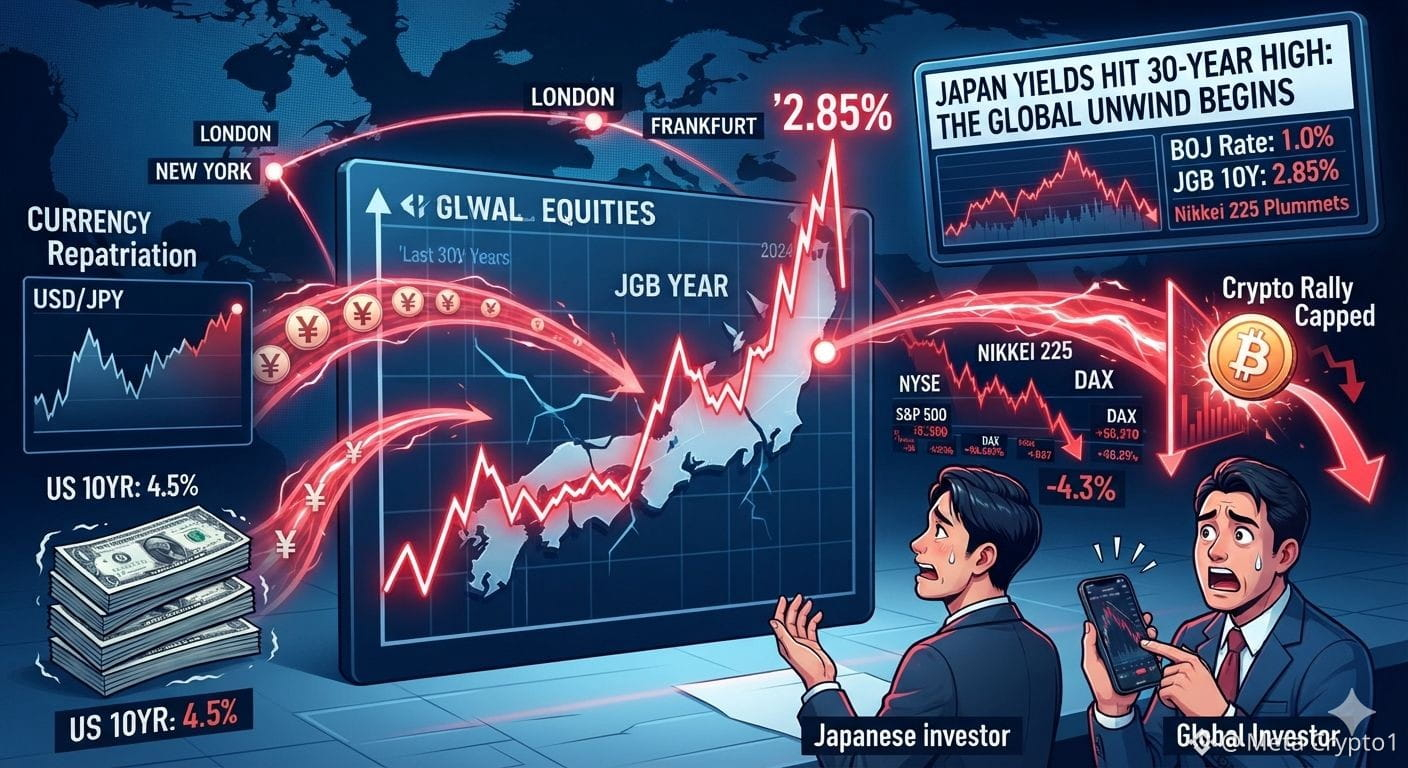
Japan's benchmark 10-year government bond (JGB) yield has just skyrocketed to a 30-year high of 2.85%. For decades, Japan was the dullest corner of finance—providing an endless well of near-zero interest capital to the rest of the world.
That era is over.
Here is exactly what is happening and why the entire global financial ecosystem is feeling the shockwaves:
🧵 Why Are Yields Exploding?
The BOJ Pivot: The Bank of Japan aggressively hiked its key policy rate to 1%, its highest level in over 30 years.
The ultra-loose, negative-rate regime is dead.
Fiscal Fears: The government’s massive ¥370 trillion long-term economic expansion plan means a mountain of new debt is coming.
Investors are selling off existing bonds ahead of a massive supply flood.
Sticky Inflation: Persistent domestic inflation has forced the central bank to keep its foot firmly on the tightening pedal.
🌊 The Global Domino Effect
Global Yield Spikes: As domestic yields spike, massive Japanese institutional investors are bringing their capital home.
This repatriation is dragging up borrowing costs everywhere—pushing US 10-Year Treasuries to 4.5% and German Bunds toward 3%.
Stock Market Bleeding: The Nikkei 225 plummeted 4.3% as companies face the terrifying reality of high borrowing costs for the first time in a generation.
Crypto Impact: Risk-free returns on government debt make speculative assets far less attractive.
🔮 What’s Next?
All eyes are now glued to the upcoming 30-year JGB debt auctions. If demand is weak, yields will go higher, and the global asset sell-off could quickly escalate from an orderly adjustment into a messy unwind.
$XAU
#japanbondyieldhits30yearhigh
🚨 The era of cheap global money is officially unraveling.
Japan's benchmark 10-year government bond (JGB) yield has just skyrocketed to a 30-year high of 2.85%. For decades, Japan was the dullest corner of finance—providing an endless well of near-zero interest capital to the rest of the world.
That era is over.
Here is exactly what is happening and why the entire global financial ecosystem is feeling the shockwaves:
🧵 Why Are Yields Exploding?
The BOJ Pivot: The Bank of Japan aggressively hiked its key policy rate to 1%, its highest level in over 30 years.
The ultra-loose, negative-rate regime is dead.
Fiscal Fears: The government’s massive ¥370 trillion long-term economic expansion plan means a mountain of new debt is coming.
Investors are selling off existing bonds ahead of a massive supply flood.
Sticky Inflation: Persistent domestic inflation has forced the central bank to keep its foot firmly on the tightening pedal.
🌊 The Global Domino Effect
Global Yield Spikes: As domestic yields spike, massive Japanese institutional investors are bringing their capital home.
This repatriation is dragging up borrowing costs everywhere—pushing US 10-Year Treasuries to 4.5% and German Bunds toward 3%.
Stock Market Bleeding: The Nikkei 225 plummeted 4.3% as companies face the terrifying reality of high borrowing costs for the first time in a generation.
Crypto Impact: Risk-free returns on government debt make speculative assets far less attractive.
🔮 What’s Next?
All eyes are now glued to the upcoming 30-year JGB debt auctions. If demand is weak, yields will go higher, and the global asset sell-off could quickly escalate from an orderly adjustment into a messy unwind.
$XAU
#japanbondyieldhits30yearhigh
Japan's benchmark 10-year government bond (JGB) yield has just skyrocketed to a 30-year high of 2.85%. For decades, Japan was the dullest corner of finance—providing an endless well of near-zero interest capital to the rest of the world.
That era is over.
Here is exactly what is happening and why the entire global financial ecosystem is feeling the shockwaves:
🧵 Why Are Yields Exploding?
The BOJ Pivot: The Bank of Japan aggressively hiked its key policy rate to 1%, its highest level in over 30 years.
The ultra-loose, negative-rate regime is dead.
Fiscal Fears: The government’s massive ¥370 trillion long-term economic expansion plan means a mountain of new debt is coming.
Investors are selling off existing bonds ahead of a massive supply flood.
Sticky Inflation: Persistent domestic inflation has forced the central bank to keep its foot firmly on the tightening pedal.
🌊 The Global Domino Effect
Global Yield Spikes: As domestic yields spike, massive Japanese institutional investors are bringing their capital home.
This repatriation is dragging up borrowing costs everywhere—pushing US 10-Year Treasuries to 4.5% and German Bunds toward 3%.
Stock Market Bleeding: The Nikkei 225 plummeted 4.3% as companies face the terrifying reality of high borrowing costs for the first time in a generation.
Crypto Impact: Risk-free returns on government debt make speculative assets far less attractive.
🔮 What’s Next?
All eyes are now glued to the upcoming 30-year JGB debt auctions. If demand is weak, yields will go higher, and the global asset sell-off could quickly escalate from an orderly adjustment into a messy unwind.
$XAU
#japanbondyieldhits30yearhigh
2
1.3k

·
--
Bullish
#japanbondyieldhits30yearhigh
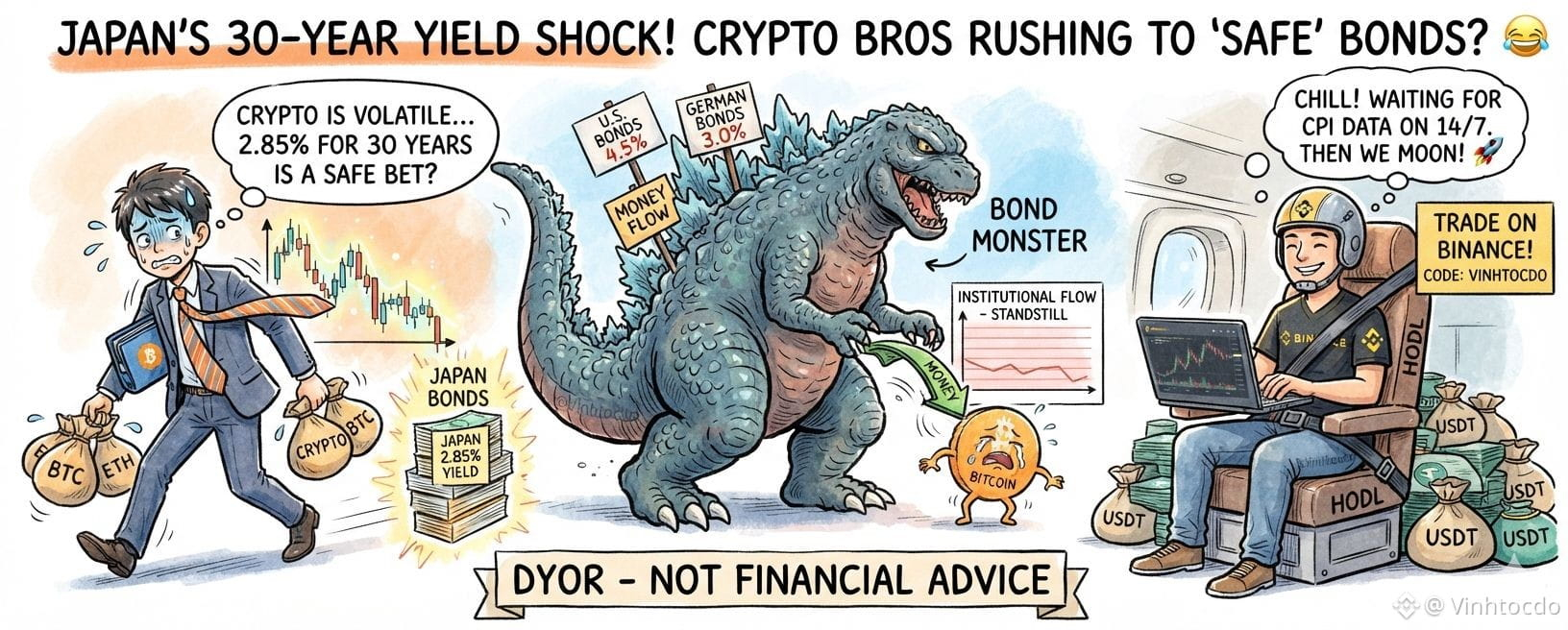
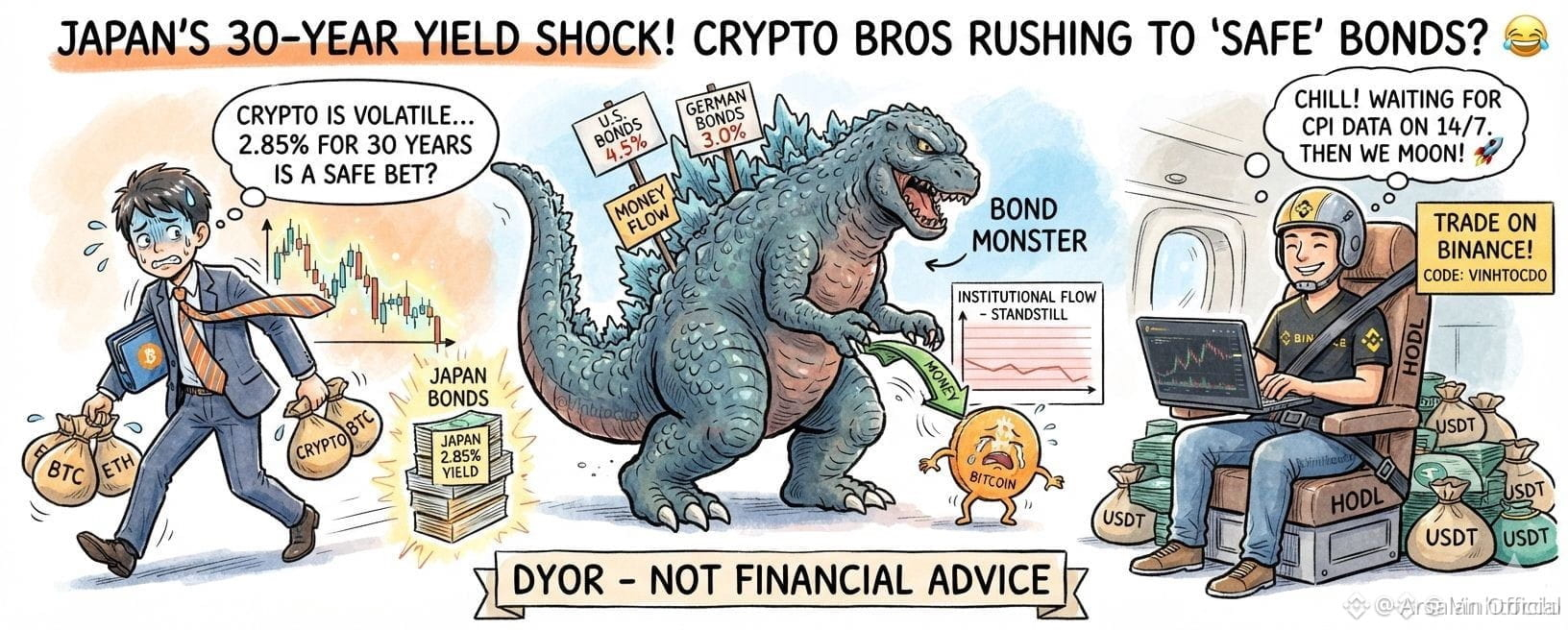
Japanese bonds surge to 2.85%, the highest in 30 years!
Do you think the guys in Japan might get together and withdraw all their crypto money to buy “safe” bonds? 😂
Not just Japan—US bonds are also pulled up to 4.5%, and Germany to 3%. With yields this tasty, our beloved BTC gets “sucked dry,” and institutional money suddenly freezes.
But don’t worry—wait until the US CPI on 14/7, once it cools down, the old-timer will fly again!
What should traders do? Sit tight and tighten your seatbelt, keep USDT ready and waiting for the moment. Register on Binance and use the code VINHTOCDO to race orders together! 🚀
DYOR - This is not financial advice.
#Japan #TradingSignals #Binance #VINHTOCDO
$BTC
{future}(BTCUSDT)
$ETH
{future}(ETHUSDT)
$BNB
{future}(BNBUSDT)
#japanbondyieldhits30yearhigh
Japanese bonds surge to 2.85%, the highest in 30 years!
Do you think the guys in Japan might get together and withdraw all their crypto money to buy “safe” bonds? 😂
Not just Japan—US bonds are also pulled up to 4.5%, and Germany to 3%. With yields this tasty, our beloved BTC gets “sucked dry,” and institutional money suddenly freezes.
But don’t worry—wait until the US CPI on 14/7, once it cools down, the old-timer will fly again!
What should traders do? Sit tight and tighten your seatbelt, keep USDT ready and waiting for the moment. Register on Binance and use the code VINHTOCDO to race orders together! 🚀
DYOR - This is not financial advice.
#Japan #TradingSignals #Binance #VINHTOCDO
$BTC
$ETH
$BNB
Japanese bonds surge to 2.85%, the highest in 30 years!
Do you think the guys in Japan might get together and withdraw all their crypto money to buy “safe” bonds? 😂
Not just Japan—US bonds are also pulled up to 4.5%, and Germany to 3%. With yields this tasty, our beloved BTC gets “sucked dry,” and institutional money suddenly freezes.
But don’t worry—wait until the US CPI on 14/7, once it cools down, the old-timer will fly again!
What should traders do? Sit tight and tighten your seatbelt, keep USDT ready and waiting for the moment. Register on Binance and use the code VINHTOCDO to race orders together! 🚀
DYOR - This is not financial advice.
#Japan #TradingSignals #Binance #VINHTOCDO
$BTC
$ETH
$BNB
4
5
4.4k

·
--
Verified

Article
Japan 10-Year Bond Yield Hits 30-Year High as Fiscal Concerns Shake MarketsJapan's government bond market is back in focus after the 10-year Japanese Government Bond (JGB) yield climbed to its highest level in around 30 years, reflecting growing concerns over fiscal policy and expectations for future monetary tightening.
The move follows investor concerns that Japan's latest economic policy blueprint could signal:
Higher government spendingIncreased bond issuanceSlower fiscal consolidationProlonged inflation pressures
Although Japanese officials denied pressuring the Bank of Japan (BOJ) to keep interest rates low, markets remain cautious about the country's long-term debt outlook.
Higher bond yields generally mean investors are demanding greater returns to hold government debt, often reflecting expectations of:
Stronger inflationTighter monetary policyIncreased fiscal risks
The rise in JGB yields also comes as the Japanese yen remains under pressure and global bond markets continue adjusting to higher interest rate expectations.
Why This Matters
1) Japan's ultra-low rate era is changing
For years, Japan maintained one of the world's lowest interest-rate environments. Rising bond yields suggest markets expect a gradual normalization of monetary policy.
2) Global bond markets could feel the impact
Japan is one of the world's largest holders of foreign assets. Higher domestic yields could encourage Japanese investors to repatriate capital, affecting global bond markets.
3) Risk assets may face pressure
Higher government bond yields can reduce the attractiveness of higher-risk investments such as:
EquitiesGrowth stocksCryptocurrencies
Assets Most Impacted
• Japanese Yen (JPY)
• Nikkei 225
• Bitcoin
The Bigger Question
Will rising Japanese bond yields mark the beginning of a lasting shift away from decades of ultra-loose monetary policy... or is this simply a temporary reaction to fiscal uncertainty?
Source: Reuters, Trading Economics, Reuters Market Coverage.
Like And Follow For More Information
#JapanBondYieldHits30YearHigh
Japan 10-Year Bond Yield Hits 30-Year High as Fiscal Concerns Shake Markets
Japan's government bond market is back in focus after the 10-year Japanese Government Bond (JGB) yield climbed to its highest level in around 30 years, reflecting growing concerns over fiscal policy and expectations for future monetary tightening.
The move follows investor concerns that Japan's latest economic policy blueprint could signal:
Higher government spendingIncreased bond issuanceSlower fiscal consolidationProlonged inflation pressures
Although Japanese officials denied pressuring the Bank of Japan (BOJ) to keep interest rates low, markets remain cautious about the country's long-term debt outlook.
Higher bond yields generally mean investors are demanding greater returns to hold government debt, often reflecting expectations of:
Stronger inflationTighter monetary policyIncreased fiscal risks
The rise in JGB yields also comes as the Japanese yen remains under pressure and global bond markets continue adjusting to higher interest rate expectations.
Why This Matters
1) Japan's ultra-low rate era is changing
For years, Japan maintained one of the world's lowest interest-rate environments. Rising bond yields suggest markets expect a gradual normalization of monetary policy.
2) Global bond markets could feel the impact
Japan is one of the world's largest holders of foreign assets. Higher domestic yields could encourage Japanese investors to repatriate capital, affecting global bond markets.
3) Risk assets may face pressure
Higher government bond yields can reduce the attractiveness of higher-risk investments such as:
EquitiesGrowth stocksCryptocurrencies
Assets Most Impacted
• Japanese Yen (JPY)
• Nikkei 225
• Bitcoin
The Bigger Question
Will rising Japanese bond yields mark the beginning of a lasting shift away from decades of ultra-loose monetary policy... or is this simply a temporary reaction to fiscal uncertainty?
Source: Reuters, Trading Economics, Reuters Market Coverage.
Like And Follow For More Information
#JapanBondYieldHits30YearHigh
The move follows investor concerns that Japan's latest economic policy blueprint could signal:
Higher government spendingIncreased bond issuanceSlower fiscal consolidationProlonged inflation pressures
Although Japanese officials denied pressuring the Bank of Japan (BOJ) to keep interest rates low, markets remain cautious about the country's long-term debt outlook.
Higher bond yields generally mean investors are demanding greater returns to hold government debt, often reflecting expectations of:
Stronger inflationTighter monetary policyIncreased fiscal risks
The rise in JGB yields also comes as the Japanese yen remains under pressure and global bond markets continue adjusting to higher interest rate expectations.
Why This Matters
1) Japan's ultra-low rate era is changing
For years, Japan maintained one of the world's lowest interest-rate environments. Rising bond yields suggest markets expect a gradual normalization of monetary policy.
2) Global bond markets could feel the impact
Japan is one of the world's largest holders of foreign assets. Higher domestic yields could encourage Japanese investors to repatriate capital, affecting global bond markets.
3) Risk assets may face pressure
Higher government bond yields can reduce the attractiveness of higher-risk investments such as:
EquitiesGrowth stocksCryptocurrencies
Assets Most Impacted
• Japanese Yen (JPY)
• Nikkei 225
• Bitcoin
The Bigger Question
Will rising Japanese bond yields mark the beginning of a lasting shift away from decades of ultra-loose monetary policy... or is this simply a temporary reaction to fiscal uncertainty?
Source: Reuters, Trading Economics, Reuters Market Coverage.
Like And Follow For More Information
#JapanBondYieldHits30YearHigh

Follow Me
From Wan_OnChain
3
236

·
--
Bearish
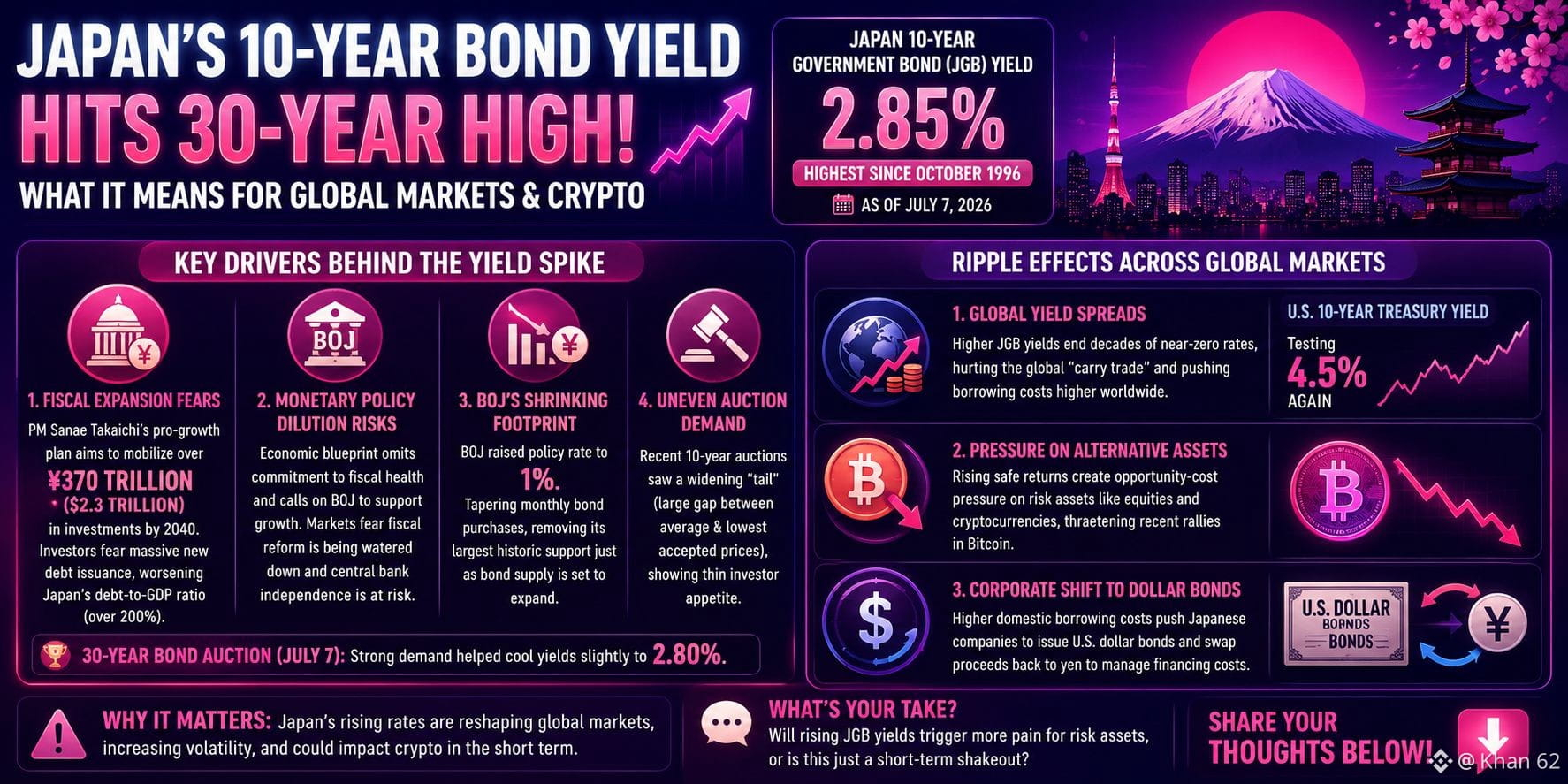
#japanbondyieldhits30yearhigh 🚨 Japans bond market is sending a warning to the whole world. What is going on in Japans bond market? How does it affect Bitcoin?
Japans 10-year government bond yield has gone up to 2.85 percent. This is the highest it has been in thirty years.
So why do people who buy and sell Bitcoin need to care about this?
💥 When bond yields go up people want to put their money into things. This means they take their money out of things like Bitcoin and technology stocks.
🙉 People who invest money are getting nervous about Japans spending plans and its debt. They are also worried, about the Bank of Japan buying bonds. All of this could make it more expensive to borrow money around the world. This could make the stock and crypto markets more unstable.
💬 Can Bitcoin handle this kind of pressure? Is Bitcoin going to drop ? Tell us what you think about Bitcoin.
#Japan #Khan62 #bitcoin #crypto
$BTC $ETH $XRP
{future}(XRPUSDT)
{future}(ETHUSDT)
{future}(BTCUSDT)
#japanbondyieldhits30yearhigh 🚨 Japans bond market is sending a warning to the whole world. What is going on in Japans bond market? How does it affect Bitcoin?
Japans 10-year government bond yield has gone up to 2.85 percent. This is the highest it has been in thirty years.
So why do people who buy and sell Bitcoin need to care about this?
💥 When bond yields go up people want to put their money into things. This means they take their money out of things like Bitcoin and technology stocks.
🙉 People who invest money are getting nervous about Japans spending plans and its debt. They are also worried, about the Bank of Japan buying bonds. All of this could make it more expensive to borrow money around the world. This could make the stock and crypto markets more unstable.
💬 Can Bitcoin handle this kind of pressure? Is Bitcoin going to drop ? Tell us what you think about Bitcoin.
#Japan #Khan62 #bitcoin #crypto
$BTC $ETH $XRP
Japans 10-year government bond yield has gone up to 2.85 percent. This is the highest it has been in thirty years.
So why do people who buy and sell Bitcoin need to care about this?
💥 When bond yields go up people want to put their money into things. This means they take their money out of things like Bitcoin and technology stocks.
🙉 People who invest money are getting nervous about Japans spending plans and its debt. They are also worried, about the Bank of Japan buying bonds. All of this could make it more expensive to borrow money around the world. This could make the stock and crypto markets more unstable.
💬 Can Bitcoin handle this kind of pressure? Is Bitcoin going to drop ? Tell us what you think about Bitcoin.
#Japan #Khan62 #bitcoin #crypto
$BTC $ETH $XRP
2
8
8.2k

·
--
#JapanBondYieldHits30YearHigh
🚨 Market Alert: #JapanBondYieldHits30YearHigh 🇯🇵📈
Japan's long-term bond yields have climbed to their highest levels in decades, a move that could ripple across global financial markets.
🔹 Higher bond yields can influence borrowing costs.
🔹 Investors may rebalance portfolios between bonds and risk assets.
🔹 Forex, stocks, and cryptocurrencies could see increased volatility as markets react.
📊 Key takeaway: Stay focused on risk management, watch major economic updates, and avoid making decisions based solely on headlines.
The market rewards patience and disciplined execution.
#JapanBondYieldHits30YearHigh #Japan #BondMarket #Investing #Forex #Stocks #Crypto #FinancialMarkets #RiskManagement #MarketNews
#JapanBondYieldHits30YearHigh
🚨 Market Alert: #JapanBondYieldHits30YearHigh 🇯🇵📈
Japan's long-term bond yields have climbed to their highest levels in decades, a move that could ripple across global financial markets.
🔹 Higher bond yields can influence borrowing costs.
🔹 Investors may rebalance portfolios between bonds and risk assets.
🔹 Forex, stocks, and cryptocurrencies could see increased volatility as markets react.
📊 Key takeaway: Stay focused on risk management, watch major economic updates, and avoid making decisions based solely on headlines.
The market rewards patience and disciplined execution.
#JapanBondYieldHits30YearHigh #Japan #BondMarket #Investing #Forex #Stocks #Crypto #FinancialMarkets #RiskManagement #MarketNews
🚨 Market Alert: #JapanBondYieldHits30YearHigh 🇯🇵📈
Japan's long-term bond yields have climbed to their highest levels in decades, a move that could ripple across global financial markets.
🔹 Higher bond yields can influence borrowing costs.
🔹 Investors may rebalance portfolios between bonds and risk assets.
🔹 Forex, stocks, and cryptocurrencies could see increased volatility as markets react.
📊 Key takeaway: Stay focused on risk management, watch major economic updates, and avoid making decisions based solely on headlines.
The market rewards patience and disciplined execution.
#JapanBondYieldHits30YearHigh #Japan #BondMarket #Investing #Forex #Stocks #Crypto #FinancialMarkets #RiskManagement #MarketNews
85

·
--
#JapanBondYieldHits30YearHigh
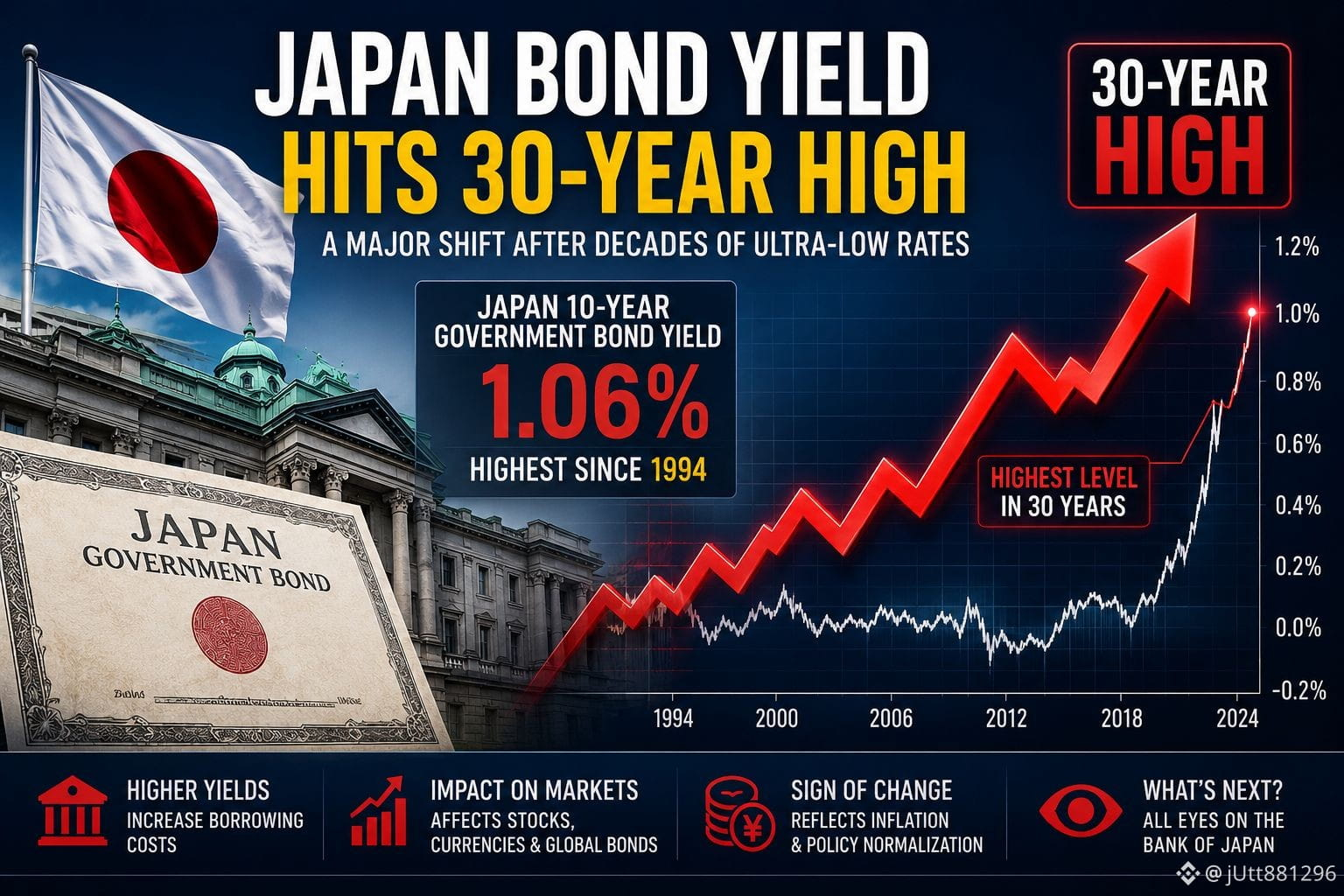
Japan's government bond yields have climbed to their highest level in three decades, reflecting a major shift in the country's financial landscape. The rise comes as investors anticipate tighter monetary policy and higher inflation after years of ultra-low interest rates.
Higher bond yields increase borrowing costs for the government and businesses, while also influencing global financial markets as investors reassess risk and capital flows. The move signals growing confidence that Japan's economy may be entering a new phase of sustainable inflation and policy normalization.
Market participants will now closely watch upcoming decisions from the Bank of Japan, as any further changes to interest rate policy could have a significant impact on currencies, equities, and global bond markets.
#JapanBondYieldHits30YearHigh
#JapanBondYieldHits30YearHigh
Japan's government bond yields have climbed to their highest level in three decades, reflecting a major shift in the country's financial landscape. The rise comes as investors anticipate tighter monetary policy and higher inflation after years of ultra-low interest rates.
Higher bond yields increase borrowing costs for the government and businesses, while also influencing global financial markets as investors reassess risk and capital flows. The move signals growing confidence that Japan's economy may be entering a new phase of sustainable inflation and policy normalization.
Market participants will now closely watch upcoming decisions from the Bank of Japan, as any further changes to interest rate policy could have a significant impact on currencies, equities, and global bond markets.
#JapanBondYieldHits30YearHigh
Japan's government bond yields have climbed to their highest level in three decades, reflecting a major shift in the country's financial landscape. The rise comes as investors anticipate tighter monetary policy and higher inflation after years of ultra-low interest rates.
Higher bond yields increase borrowing costs for the government and businesses, while also influencing global financial markets as investors reassess risk and capital flows. The move signals growing confidence that Japan's economy may be entering a new phase of sustainable inflation and policy normalization.
Market participants will now closely watch upcoming decisions from the Bank of Japan, as any further changes to interest rate policy could have a significant impact on currencies, equities, and global bond markets.
#JapanBondYieldHits30YearHigh
1
72

·
--
Bullish
#JapanBondYieldHits30YearHigh $BNB
{spot}(BNBUSDT)
Here’s a Binance Square post designed to spark engagement while staying grounded in the macro narrative.
🇯🇵 #JapanBondYieldHits30YearHigh 🚨
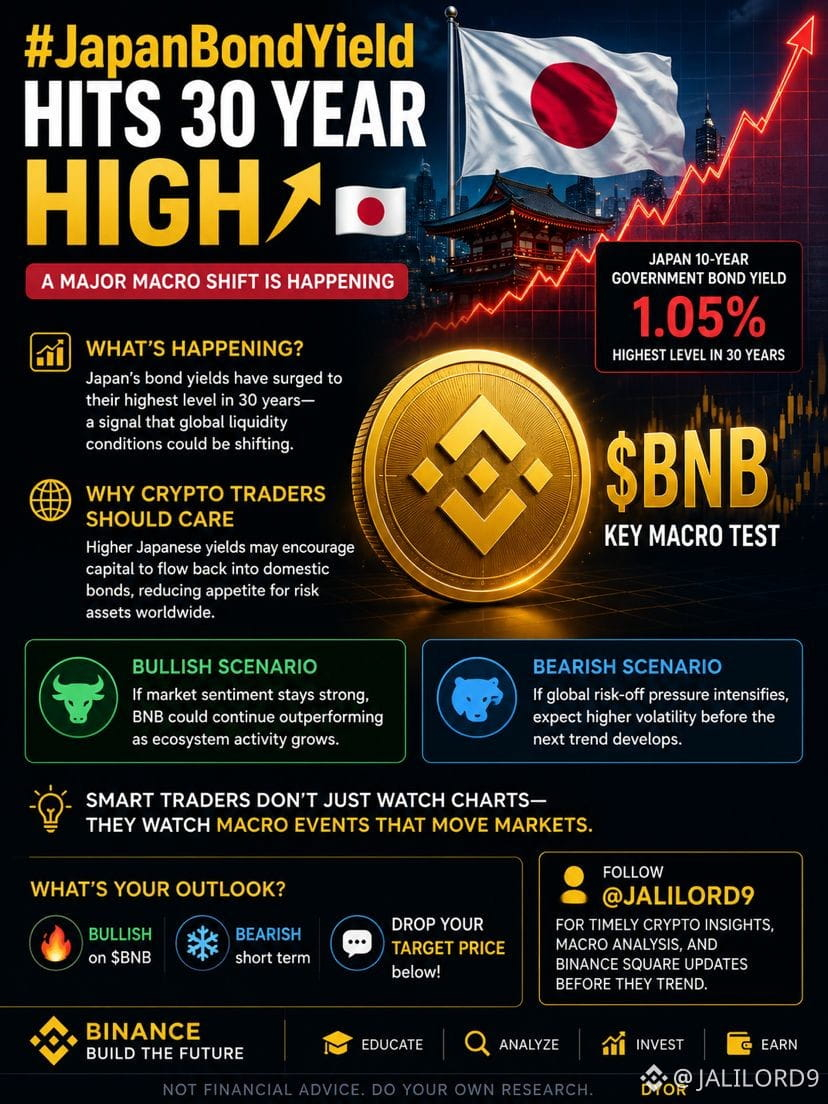
Japan’s bond yields have surged to their highest level in 30 years—a signal that global liquidity conditions could be shifting.
Why should crypto traders care?
📈 Higher Japanese yields may encourage capital to flow back into domestic bonds, reducing appetite for risk assets worldwide.
For $BNB, this is a key macro test:
🟡 If market sentiment stays strong, BNB could continue outperforming as ecosystem activity grows.
🔵 If global risk-off pressure intensifies, expect higher volatility before the next trend develops.
💡 Smart traders don’t just watch charts—they watch macro events that move markets.
What’s your outlook?
🔥 Bullish on $BNB
❄️ Bearish short term
💬 Drop your target price below!
Follow @JALILORD9 for timely crypto insights, macro analysis, and Binance Square updates before they trend.
#JapanBondYieldHits30YearHigh #BNB #Binance #Crypto #Bitcoin #Altcoins #Trading #MacroEconomy #Investing #JALILORD
#JapanBondYieldHits30YearHigh $BNB
Here’s a Binance Square post designed to spark engagement while staying grounded in the macro narrative.
🇯🇵 #JapanBondYieldHits30YearHigh 🚨
Japan’s bond yields have surged to their highest level in 30 years—a signal that global liquidity conditions could be shifting.
Why should crypto traders care?
📈 Higher Japanese yields may encourage capital to flow back into domestic bonds, reducing appetite for risk assets worldwide.
For $BNB , this is a key macro test:
🟡 If market sentiment stays strong, BNB could continue outperforming as ecosystem activity grows.
🔵 If global risk-off pressure intensifies, expect higher volatility before the next trend develops.
💡 Smart traders don’t just watch charts—they watch macro events that move markets.
What’s your outlook?
🔥 Bullish on $BNB
❄️ Bearish short term
💬 Drop your target price below!
Follow @JALILORD9 for timely crypto insights, macro analysis, and Binance Square updates before they trend.
#JapanBondYieldHits30YearHigh #BNB #Binance #Crypto #Bitcoin #Altcoins #Trading #MacroEconomy #Investing #JALILORD
Here’s a Binance Square post designed to spark engagement while staying grounded in the macro narrative.
🇯🇵 #JapanBondYieldHits30YearHigh 🚨
Japan’s bond yields have surged to their highest level in 30 years—a signal that global liquidity conditions could be shifting.
Why should crypto traders care?
📈 Higher Japanese yields may encourage capital to flow back into domestic bonds, reducing appetite for risk assets worldwide.
For $BNB , this is a key macro test:
🟡 If market sentiment stays strong, BNB could continue outperforming as ecosystem activity grows.
🔵 If global risk-off pressure intensifies, expect higher volatility before the next trend develops.
💡 Smart traders don’t just watch charts—they watch macro events that move markets.
What’s your outlook?
🔥 Bullish on $BNB
❄️ Bearish short term
💬 Drop your target price below!
Follow @JALILORD9 for timely crypto insights, macro analysis, and Binance Square updates before they trend.
#JapanBondYieldHits30YearHigh #BNB #Binance #Crypto #Bitcoin #Altcoins #Trading #MacroEconomy #Investing #JALILORD
1
121

·
--

Article
MACRO SHOCK: JAPAN BOND YIELDS HIT A 30-YEAR PEAK—WHY BTC MISSED THE $64.4K MARK?#japanbondyieldhits30yearhigh
Many people are wondering why Bitcoin just eagerly pushed up to the $64.4K level, only to immediately “turn around” back near the $63K area. Besides the technical resistance zones on the Weekly chart, the answer also lies in a macro “earthquake” that has just been triggered in Asia: Japan’s 10-year government bond yield (JGB) has officially hit 2.85%—its highest level since 1997.
The story from Japan may seem far away, but it’s actually a “headwind” directly affecting your Crypto wallets through the 3 long-move factors below:
MACRO SHOCK: JAPAN BOND YIELDS HIT A 30-YEAR PEAK—WHY BTC MISSED THE $64.4K MARK?
#japanbondyieldhits30yearhigh
Many people are wondering why Bitcoin just eagerly pushed up to the $64.4K level, only to immediately “turn around” back near the $63K area. Besides the technical resistance zones on the Weekly chart, the answer also lies in a macro “earthquake” that has just been triggered in Asia: Japan’s 10-year government bond yield (JGB) has officially hit 2.85%—its highest level since 1997.
The story from Japan may seem far away, but it’s actually a “headwind” directly affecting your Crypto wallets through the 3 long-move factors below:
Many people are wondering why Bitcoin just eagerly pushed up to the $64.4K level, only to immediately “turn around” back near the $63K area. Besides the technical resistance zones on the Weekly chart, the answer also lies in a macro “earthquake” that has just been triggered in Asia: Japan’s 10-year government bond yield (JGB) has officially hit 2.85%—its highest level since 1997.
The story from Japan may seem far away, but it’s actually a “headwind” directly affecting your Crypto wallets through the 3 long-move factors below:
201

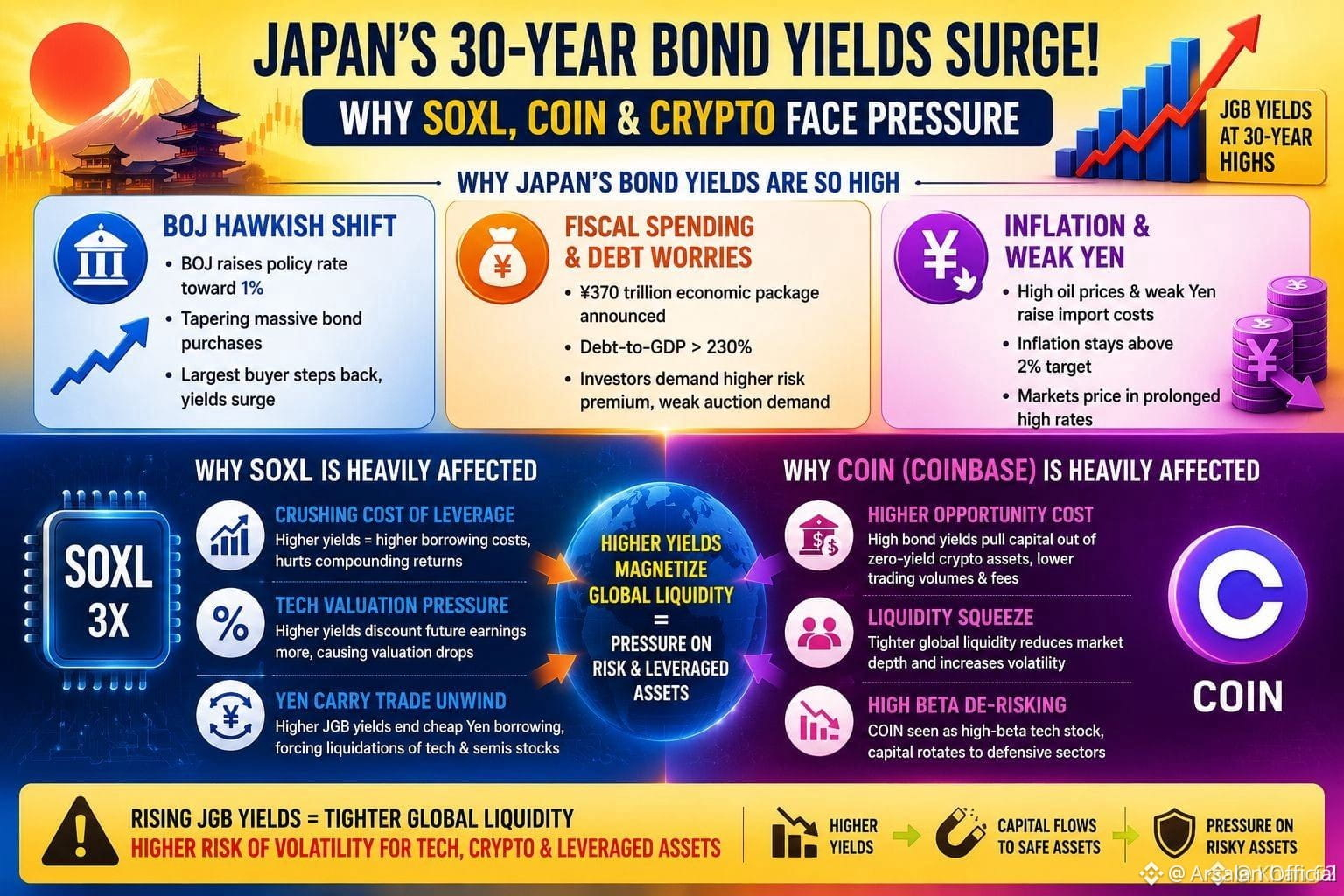
#JapanBondYieldHits30YearHigh Yes — that hashtag matches recent market reporting. In mid-May 2026, Japan’s long-dated government bonds sold off sharply, and reports said yields were rising to multi-decade highs, with the 30-year JGB yield reaching record or near-record levels during the move. Bloomberg reported on May 15, 2026 that bond yields were surging globally “from Japan to the US,” and on January 20, 2026 it described a Japanese bond rout in which yields “soared to records.” (bloomberg.com)
One small nuance: the phrase “30-year high” can be a bit imprecise. The stronger version in market coverage is that Japan’s 30-year government bond yield hit a record or multi-decade high, not just that it rose a little. (bloomberg.com)
Why it matters: when Japanese long-term yields climb, it can tighten financial conditions, pressure equities, and ripple into global bond markets because Japan is such a major capital exporter. That broader cross-market stress was explicitly noted in Bloomberg’s May 15, 2026 reporting on the global bond selloff. (bloomberg.com)
If you want, I can also break this into:
a plain-English explanation of what bond yields rising means,
the impact on USD/JPY, stocks, and crypto,
or a 1-minute market takeaway for traders.$BTC
{spot}(BTCUSDT)
$COIN
{future}(COINUSDT)
$SOXL
{future}(SOXLUSDT)
@Binance_Announcement @Binance_Square_Official @Binance_News
#JapanBondYieldHits30YearHigh Yes — that hashtag matches recent market reporting. In mid-May 2026, Japan’s long-dated government bonds sold off sharply, and reports said yields were rising to multi-decade highs, with the 30-year JGB yield reaching record or near-record levels during the move. Bloomberg reported on May 15, 2026 that bond yields were surging globally “from Japan to the US,” and on January 20, 2026 it described a Japanese bond rout in which yields “soared to records.” (bloomberg.com)
One small nuance: the phrase “30-year high” can be a bit imprecise. The stronger version in market coverage is that Japan’s 30-year government bond yield hit a record or multi-decade high, not just that it rose a little. (bloomberg.com)
Why it matters: when Japanese long-term yields climb, it can tighten financial conditions, pressure equities, and ripple into global bond markets because Japan is such a major capital exporter. That broader cross-market stress was explicitly noted in Bloomberg’s May 15, 2026 reporting on the global bond selloff. (bloomberg.com)
If you want, I can also break this into:
a plain-English explanation of what bond yields rising means,
the impact on USD/JPY, stocks, and crypto,
or a 1-minute market takeaway for traders.$BTC
$COIN
$SOXL
@Binance Announcement @Binance Square Official @Binance News
One small nuance: the phrase “30-year high” can be a bit imprecise. The stronger version in market coverage is that Japan’s 30-year government bond yield hit a record or multi-decade high, not just that it rose a little. (bloomberg.com)
Why it matters: when Japanese long-term yields climb, it can tighten financial conditions, pressure equities, and ripple into global bond markets because Japan is such a major capital exporter. That broader cross-market stress was explicitly noted in Bloomberg’s May 15, 2026 reporting on the global bond selloff. (bloomberg.com)
If you want, I can also break this into:
a plain-English explanation of what bond yields rising means,
the impact on USD/JPY, stocks, and crypto,
or a 1-minute market takeaway for traders.$BTC
$COIN
$SOXL
@Binance Announcement @Binance Square Official @Binance News
1
22
#JapanBondYieldHits30YearHigh #JapanBondYieldHits30YearHigh
Japan's 30-year government bond yield climbed to its highest level in decades, reflecting expectations of tighter monetary policy and persistent inflation. The rise in long-term yields signals shifting investor expectations, increases borrowing costs, and could influence global bond markets as capital flows adjust. Higher Japanese yields may also affect currency markets and international investment strategies.
#JapanBondYieldHits30YearHigh #JapanBondYieldHits30YearHigh
Japan's 30-year government bond yield climbed to its highest level in decades, reflecting expectations of tighter monetary policy and persistent inflation. The rise in long-term yields signals shifting investor expectations, increases borrowing costs, and could influence global bond markets as capital flows adjust. Higher Japanese yields may also affect currency markets and international investment strategies.
Japan's 30-year government bond yield climbed to its highest level in decades, reflecting expectations of tighter monetary policy and persistent inflation. The rise in long-term yields signals shifting investor expectations, increases borrowing costs, and could influence global bond markets as capital flows adjust. Higher Japanese yields may also affect currency markets and international investment strategies.
29

Verified
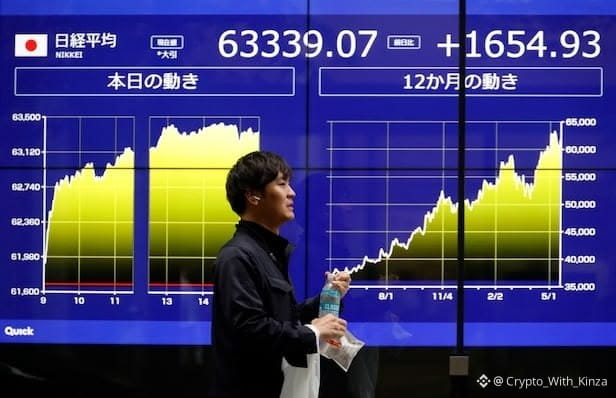
#japanbondyieldhits30yearhigh Japan's bond yields have surged to their highest level in 30 years, signaling growing concerns over inflation, government debt, and tighter monetary policy.
Higher bond yields could increase volatility across global markets, including stocks and crypto, as investors reassess risk.
Keep a close eye on macro trends—these moves often have a bigger impact than expected. 📊👀
#Japan #Bonds #Markets #Crypto
#japanbondyieldhits30yearhigh Japan's bond yields have surged to their highest level in 30 years, signaling growing concerns over inflation, government debt, and tighter monetary policy.
Higher bond yields could increase volatility across global markets, including stocks and crypto, as investors reassess risk.
Keep a close eye on macro trends—these moves often have a bigger impact than expected. 📊👀
#Japan #Bonds #Markets #Crypto
Higher bond yields could increase volatility across global markets, including stocks and crypto, as investors reassess risk.
Keep a close eye on macro trends—these moves often have a bigger impact than expected. 📊👀
#Japan #Bonds #Markets #Crypto
2
3
1.3k
#JapanBondYieldHits30YearHigh That hashtag appears to refer to Japan’s 30-year government bond yield pushing to unusually high levels, with markets focused on fiscal concerns, inflation, and BOJ policy expectations. Recent reporting on July 7, 2026 says Japan’s 30-year bond auction saw the strongest demand since 2019, which helped yields ease somewhat after the earlier surge. (bloomberg.com)
A key nuance: this is not just a “30-year high” in the time sense. Multiple reports describe the move as a record high yield level for the 30-year JGB in prior waves of the selloff, and current market data pages show the 30-year yield still elevated around 4.05% on July 7, 2026. (bloomberg.com)
Why crypto traders care: rising Japanese long-dated yields can tighten global financial conditions, push up other sovereign yields, and act as a headwind for risk assets like BTC and altcoins. That exact macro linkage was highlighted in crypto market coverage today. (coindesk.com)
If you want, I can also break this down in one of three ways:
Macro explainer — why Japan bond yields matter for crypto
Trading angle — what this could mean for BTC/ETH this week
Simple summary — explain the hashtag in plain English$BTC
{spot}(BTCUSDT)
$ETH
{spot}(ETHUSDT)
$BNB
{spot}(BNBUSDT)
@Binance_News @Binance_Square_Official @Binance_Announcement
#JapanBondYieldHits30YearHigh That hashtag appears to refer to Japan’s 30-year government bond yield pushing to unusually high levels, with markets focused on fiscal concerns, inflation, and BOJ policy expectations. Recent reporting on July 7, 2026 says Japan’s 30-year bond auction saw the strongest demand since 2019, which helped yields ease somewhat after the earlier surge. (bloomberg.com)
A key nuance: this is not just a “30-year high” in the time sense. Multiple reports describe the move as a record high yield level for the 30-year JGB in prior waves of the selloff, and current market data pages show the 30-year yield still elevated around 4.05% on July 7, 2026. (bloomberg.com)
Why crypto traders care: rising Japanese long-dated yields can tighten global financial conditions, push up other sovereign yields, and act as a headwind for risk assets like BTC and altcoins. That exact macro linkage was highlighted in crypto market coverage today. (coindesk.com)
If you want, I can also break this down in one of three ways:
Macro explainer — why Japan bond yields matter for crypto
Trading angle — what this could mean for BTC/ETH this week
Simple summary — explain the hashtag in plain English$BTC
$ETH
$BNB
@Binance News @Binance Square Official @Binance Announcement
A key nuance: this is not just a “30-year high” in the time sense. Multiple reports describe the move as a record high yield level for the 30-year JGB in prior waves of the selloff, and current market data pages show the 30-year yield still elevated around 4.05% on July 7, 2026. (bloomberg.com)
Why crypto traders care: rising Japanese long-dated yields can tighten global financial conditions, push up other sovereign yields, and act as a headwind for risk assets like BTC and altcoins. That exact macro linkage was highlighted in crypto market coverage today. (coindesk.com)
If you want, I can also break this down in one of three ways:
Macro explainer — why Japan bond yields matter for crypto
Trading angle — what this could mean for BTC/ETH this week
Simple summary — explain the hashtag in plain English$BTC
$ETH
$BNB
@Binance News @Binance Square Official @Binance Announcement
35

#JapanBondYieldHits30YearHigh 🇯🇵📈
Japan's government bond yields have climbed to their highest level in nearly 30 years, making this one of the biggest macroeconomic stories investors are watching right now. Rising bond yields often reflect changing expectations around inflation, interest rates, and central bank policy—and these shifts can influence financial markets far beyond Japan.
For the crypto market, this is an important signal. Higher bond yields can encourage investors to move part of their capital into lower-risk assets, which may reduce liquidity flowing into cryptocurrencies. As a result, Bitcoin and major altcoins could experience increased volatility, especially if global investors become more risk-averse.
The Bank of Japan's next policy decisions will be closely watched by institutions and traders worldwide. Any major shift could affect the Japanese Yen, global stock markets, and the overall risk sentiment that often drives crypto price action. This is why experienced traders don't just follow crypto news—they also monitor key macroeconomic events.
While short-term market reactions can be unpredictable, long-term investors know that volatility also creates opportunities. The smartest approach is to stay informed, manage risk carefully, and wait for confirmation before making emotional trading decisions.
Will Japan's rising bond yields trigger the next wave of volatility in Bitcoin and altcoins, or is this just another macro headline? Share your thoughts below! 👇
#Bitcoin #BTC #Ethereum #Crypto #Japan #BondMarket #MacroEconomy #Investing #Trading #BinanceSquare
$BTC
$ETH
#JapanBondYieldHits30YearHigh 🇯🇵📈
Japan's government bond yields have climbed to their highest level in nearly 30 years, making this one of the biggest macroeconomic stories investors are watching right now. Rising bond yields often reflect changing expectations around inflation, interest rates, and central bank policy—and these shifts can influence financial markets far beyond Japan.
For the crypto market, this is an important signal. Higher bond yields can encourage investors to move part of their capital into lower-risk assets, which may reduce liquidity flowing into cryptocurrencies. As a result, Bitcoin and major altcoins could experience increased volatility, especially if global investors become more risk-averse.
The Bank of Japan's next policy decisions will be closely watched by institutions and traders worldwide. Any major shift could affect the Japanese Yen, global stock markets, and the overall risk sentiment that often drives crypto price action. This is why experienced traders don't just follow crypto news—they also monitor key macroeconomic events.
While short-term market reactions can be unpredictable, long-term investors know that volatility also creates opportunities. The smartest approach is to stay informed, manage risk carefully, and wait for confirmation before making emotional trading decisions.
Will Japan's rising bond yields trigger the next wave of volatility in Bitcoin and altcoins, or is this just another macro headline? Share your thoughts below! 👇
#Bitcoin #BTC #Ethereum #Crypto #Japan #BondMarket #MacroEconomy #Investing #Trading #BinanceSquare
$BTC
$ETH
Japan's government bond yields have climbed to their highest level in nearly 30 years, making this one of the biggest macroeconomic stories investors are watching right now. Rising bond yields often reflect changing expectations around inflation, interest rates, and central bank policy—and these shifts can influence financial markets far beyond Japan.
For the crypto market, this is an important signal. Higher bond yields can encourage investors to move part of their capital into lower-risk assets, which may reduce liquidity flowing into cryptocurrencies. As a result, Bitcoin and major altcoins could experience increased volatility, especially if global investors become more risk-averse.
The Bank of Japan's next policy decisions will be closely watched by institutions and traders worldwide. Any major shift could affect the Japanese Yen, global stock markets, and the overall risk sentiment that often drives crypto price action. This is why experienced traders don't just follow crypto news—they also monitor key macroeconomic events.
While short-term market reactions can be unpredictable, long-term investors know that volatility also creates opportunities. The smartest approach is to stay informed, manage risk carefully, and wait for confirmation before making emotional trading decisions.
Will Japan's rising bond yields trigger the next wave of volatility in Bitcoin and altcoins, or is this just another macro headline? Share your thoughts below! 👇
#Bitcoin #BTC #Ethereum #Crypto #Japan #BondMarket #MacroEconomy #Investing #Trading #BinanceSquare
$BTC
$ETH
67
Log in to explore more content
Join global crypto users on Binance Square
⚡️ Get latest and useful information about crypto.
💬 Trusted by the world’s largest crypto exchange.
👍 Discover real insights from verified creators.
Email / Phone number
Trending Topics
1
#ADAGains10%Above$0.27
15,522 views
181 Discussing
2
#ETHUp70%InQ3ButLiquidityFalls
169,340 views
1,076 Discussing
3
#EthStakingExitQueueHits2026High
58,408 views
769 Discussing
4
#FedOctoberHoldOdds82.3%
60,457 views
735 Discussing
5
#Nikkei225Jumps2.5%ToThreeMonthHigh
82,218 views
1,101 Discussing
6
#CircleMints$2.75BUSDCOnSolanaIn7Days
2,222 views
48 Discussing
7
#DriftHackVictimsBeginClaims
177,433 views
1,741 Discussing
8
#SolanaTokenizedStockVolumeTops$4.4BInSeptember
13,676 views
133 Discussing
9
#BitcoinSpotETFsDraw$6.34BInflowsInQ3
54,908 views
263 Discussing
10
#EthereumValidatorExitQueueJumps392%
310,883 views
2,599 Discussing