
#geniusterminal
geniusterminal
62,486 views
445 Discussing
Hot
Latest
GENIUS will be unlocked next month, and although the order book is up about 3% in the past 24 hours, this “strength before bad news is realized” pattern is worth watching.
Unlocking doesn’t necessarily mean an immediate sell-off, but it will increase circulating supply. In particular, pay attention to the unlock size as a proportion of the circulating amount, the movements of early-holder addresses, and changes in trading volume before and after the unlock. Short-term sentiment may react in advance, so be cautious about chasing highs—volatility can amplify.
It’s recommended to include the unlock date, unlock ratio, and key support levels in your watchlist, rather than only seeing the price increase and falling into FOMO.
#GeniusTerminal #山寨币 # cryptocurrency
GENIUS will be unlocked next month, and although the order book is up about 3% in the past 24 hours, this “strength before bad news is realized” pattern is worth watching.
Unlocking doesn’t necessarily mean an immediate sell-off, but it will increase circulating supply. In particular, pay attention to the unlock size as a proportion of the circulating amount, the movements of early-holder addresses, and changes in trading volume before and after the unlock. Short-term sentiment may react in advance, so be cautious about chasing highs—volatility can amplify.
It’s recommended to include the unlock date, unlock ratio, and key support levels in your watchlist, rather than only seeing the price increase and falling into FOMO.
#GeniusTerminal #山寨币 # cryptocurrency
Unlocking doesn’t necessarily mean an immediate sell-off, but it will increase circulating supply. In particular, pay attention to the unlock size as a proportion of the circulating amount, the movements of early-holder addresses, and changes in trading volume before and after the unlock. Short-term sentiment may react in advance, so be cautious about chasing highs—volatility can amplify.
It’s recommended to include the unlock date, unlock ratio, and key support levels in your watchlist, rather than only seeing the price increase and falling into FOMO.
#GeniusTerminal #山寨币 # cryptocurrency
57

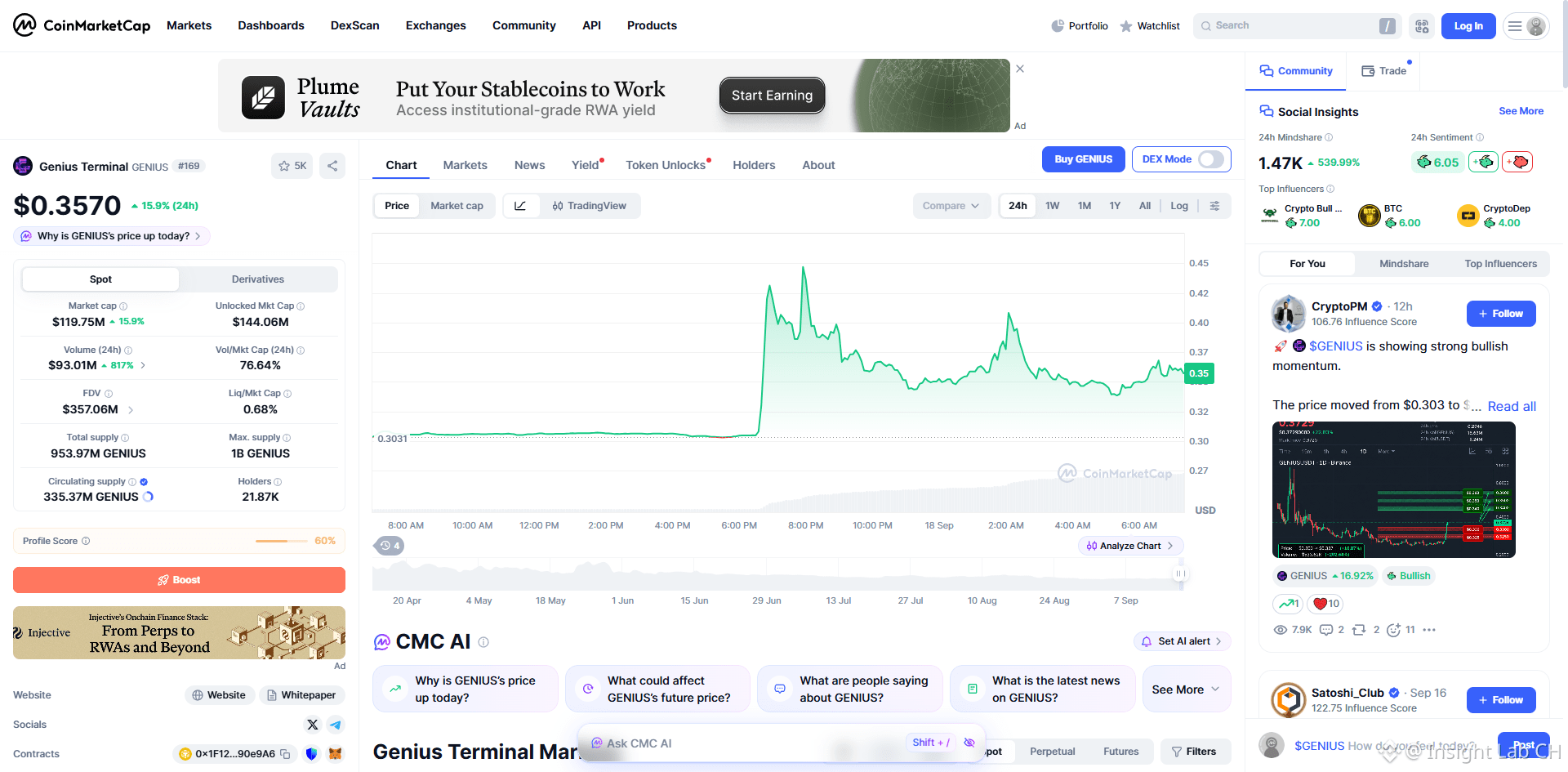
Observed that Genius Terminal ($GENIUS) is currently ranked #6 th on the CoinMarketCap trending chart. Against the backdrop of still-tight macro liquidity, abnormal movements driven by short-term speculative hype often lack fundamental support; investors should be cautious about the risk of a pullback after sentiment cools.⚠️ #GeniusTerminal #Altcoins
Observed that Genius Terminal ($GENIUS ) is currently ranked #6 th on the CoinMarketCap trending chart. Against the backdrop of still-tight macro liquidity, abnormal movements driven by short-term speculative hype often lack fundamental support; investors should be cautious about the risk of a pullback after sentiment cools.⚠️ #GeniusTerminal #Altcoins
221

·
--
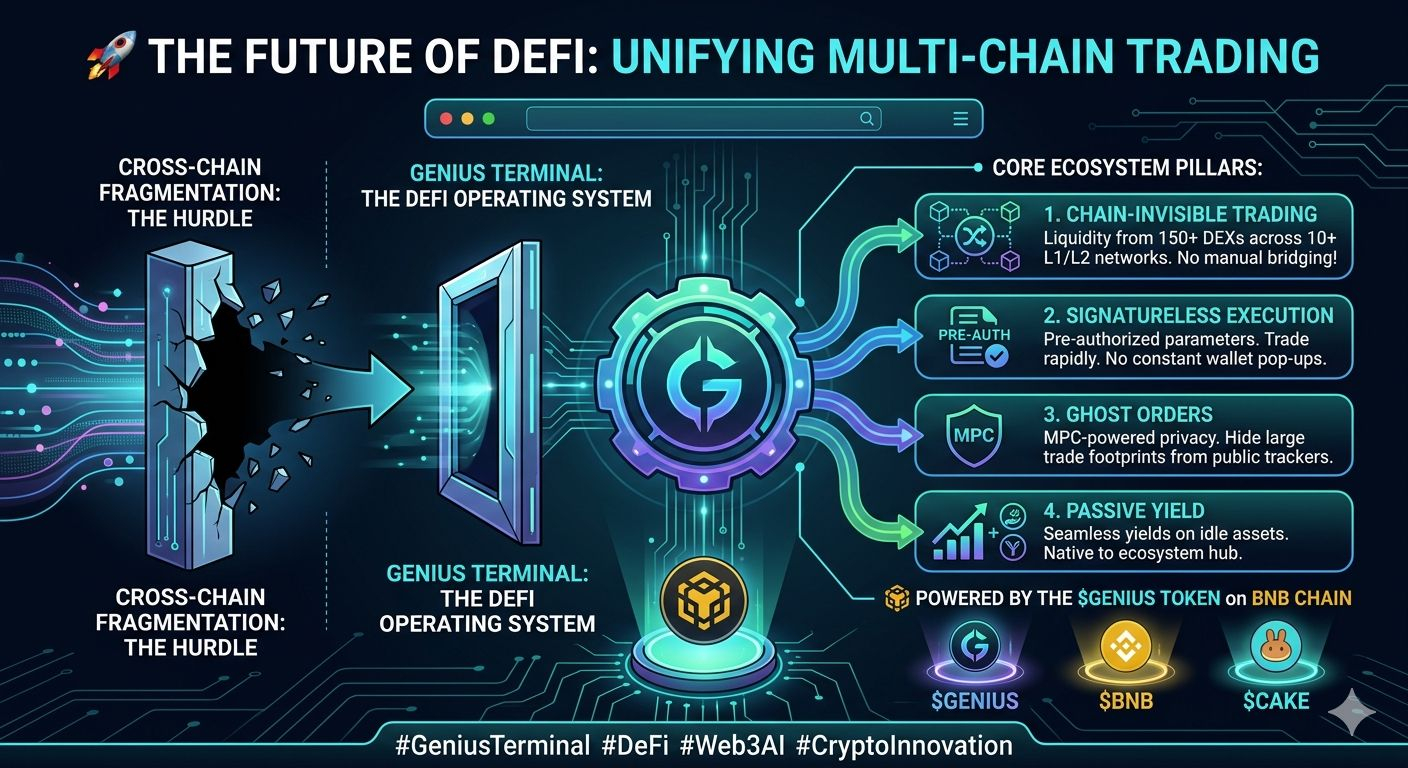
💡 THE FUTURE OF DEFI: How Genius Terminal ($GENIUS) is Unifying Multi-Chain Trading
The DeFi landscape is shifting toward smart automation, but cross-chain fragmentation remains a massive hurdle. Genius Terminal addresses this directly by acting as a highly optimized, non-custodial on-chain operating system.
🌟 Core Ecosystem Pillars:
• Chain-Invisible Trading: Access deep liquidity from 150+ DEXs across 10+ major L1/L2 networks without manual bridging.
• Signatureless Execution: Pre-authorize parameters to trade rapidly without constant wallet pop-ups.
• Ghost Orders: Leverages Multi-Party Computation (MPC) to hide large-volume trade footprints from public on-chain trackers.
• Passive Yield: Earn seamless yields on idle assets natively inside the ecosystem hub.
Powered by the genius token on BNB Chain, the project is building real utility by combining advanced automation with a professional-grade trading experience.
$GENIUS | $BNB | $CAKE
#GeniusTerminal #DeFi #Web3AI #SolsticeInstitutionsCryptoInfra #Write2Earn
💡 THE FUTURE OF DEFI: How Genius Terminal ($GENIUS ) is Unifying Multi-Chain Trading
The DeFi landscape is shifting toward smart automation, but cross-chain fragmentation remains a massive hurdle. Genius Terminal addresses this directly by acting as a highly optimized, non-custodial on-chain operating system.
🌟 Core Ecosystem Pillars:
• Chain-Invisible Trading: Access deep liquidity from 150+ DEXs across 10+ major L1/L2 networks without manual bridging.
• Signatureless Execution: Pre-authorize parameters to trade rapidly without constant wallet pop-ups.
• Ghost Orders: Leverages Multi-Party Computation (MPC) to hide large-volume trade footprints from public on-chain trackers.
• Passive Yield: Earn seamless yields on idle assets natively inside the ecosystem hub.
Powered by the genius token on BNB Chain, the project is building real utility by combining advanced automation with a professional-grade trading experience.
$GENIUS | $BNB | $CAKE
#GeniusTerminal #DeFi #Web3AI #SolsticeInstitutionsCryptoInfra #Write2Earn
The DeFi landscape is shifting toward smart automation, but cross-chain fragmentation remains a massive hurdle. Genius Terminal addresses this directly by acting as a highly optimized, non-custodial on-chain operating system.
🌟 Core Ecosystem Pillars:
• Chain-Invisible Trading: Access deep liquidity from 150+ DEXs across 10+ major L1/L2 networks without manual bridging.
• Signatureless Execution: Pre-authorize parameters to trade rapidly without constant wallet pop-ups.
• Ghost Orders: Leverages Multi-Party Computation (MPC) to hide large-volume trade footprints from public on-chain trackers.
• Passive Yield: Earn seamless yields on idle assets natively inside the ecosystem hub.
Powered by the genius token on BNB Chain, the project is building real utility by combining advanced automation with a professional-grade trading experience.
$GENIUS | $BNB | $CAKE
#GeniusTerminal #DeFi #Web3AI #SolsticeInstitutionsCryptoInfra #Write2Earn
117

$GENIUS
{spot}(GENIUSUSDT)
Ginius Terminal is a decentralized trading platform that provides multi-chain liquidity aggregation and private trading execution.
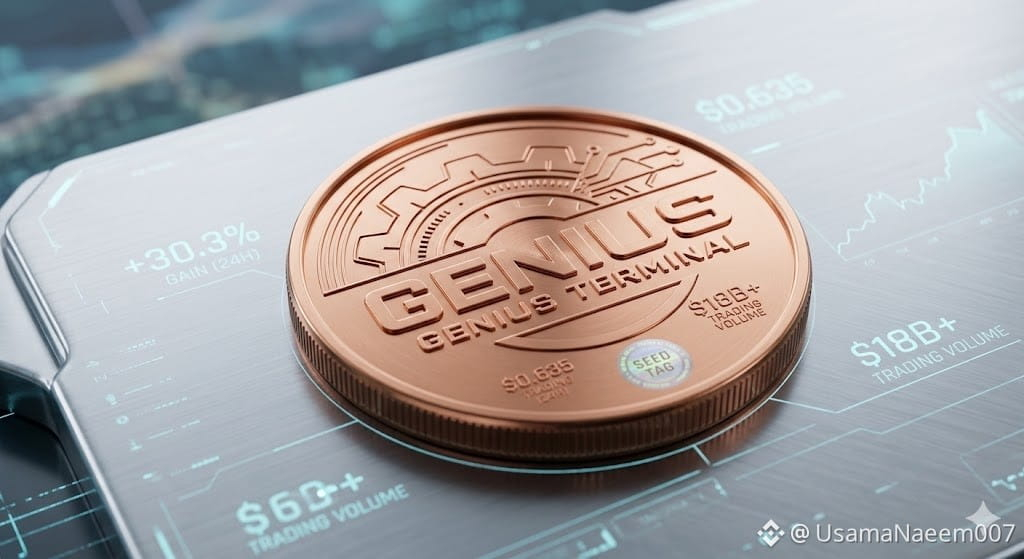
Current Market Price: Currently, the live price of the GENIUS token is trading in the market around the $0.58 to $0.63 range.
Recent Massive Pump: This token recently witnessed a tremendous upward rally, recording massive gains within a 24-hour period.
Main Reason for Surge: The primary reason behind this huge pump is its recent new listing on Binance and the commencement of its trading pairs (such as GENIUS/USDT).
Platform Performance: Another reason for the token's surge is its strong fundamental activity, having processed over $18 billion in trading volume since its mainnet launch.
Token Utility: The GENIUS coin is utilized within its ecosystem for reducing trading fees and accessing various advanced platform features.
Short-Term Prediction: Following the initial Binance listing hype, a short-term correction (profit-taking) might occur, after which the price is expected to consolidate between $0.65 and $0.75.
Long-Term Prediction: If the platform's trading volume sustains this momentum, the coin has the potential to touch the $1.00 psychological milestone by the end of 2026.
Seed Tag Warning: Binance has applied a "Seed Tag" to GENIUS, indicating that it is a relatively new project with high volatility and investment risk.
Financial Advice: Avoid buying at the top due to FOMO (Fear Of Missing Out); it is wiser to wait for the price to stabilize or dip before planning an entry with proper risk management.
Suggested Tags:
#GeniusTerminal #CryptoTrading #BinanceListing #CryptoPrediction #AltcoinPump
$GENIUS
Ginius Terminal is a decentralized trading platform that provides multi-chain liquidity aggregation and private trading execution.
Current Market Price: Currently, the live price of the GENIUS token is trading in the market around the $0.58 to $0.63 range.
Recent Massive Pump: This token recently witnessed a tremendous upward rally, recording massive gains within a 24-hour period.
Main Reason for Surge: The primary reason behind this huge pump is its recent new listing on Binance and the commencement of its trading pairs (such as GENIUS/USDT).
Platform Performance: Another reason for the token's surge is its strong fundamental activity, having processed over $18 billion in trading volume since its mainnet launch.
Token Utility: The GENIUS coin is utilized within its ecosystem for reducing trading fees and accessing various advanced platform features.
Short-Term Prediction: Following the initial Binance listing hype, a short-term correction (profit-taking) might occur, after which the price is expected to consolidate between $0.65 and $0.75.
Long-Term Prediction: If the platform's trading volume sustains this momentum, the coin has the potential to touch the $1.00 psychological milestone by the end of 2026.
Seed Tag Warning: Binance has applied a "Seed Tag" to GENIUS, indicating that it is a relatively new project with high volatility and investment risk.
Financial Advice: Avoid buying at the top due to FOMO (Fear Of Missing Out); it is wiser to wait for the price to stabilize or dip before planning an entry with proper risk management.
Suggested Tags:
#GeniusTerminal #CryptoTrading #BinanceListing #CryptoPrediction #AltcoinPump
Ginius Terminal is a decentralized trading platform that provides multi-chain liquidity aggregation and private trading execution.
Current Market Price: Currently, the live price of the GENIUS token is trading in the market around the $0.58 to $0.63 range.
Recent Massive Pump: This token recently witnessed a tremendous upward rally, recording massive gains within a 24-hour period.
Main Reason for Surge: The primary reason behind this huge pump is its recent new listing on Binance and the commencement of its trading pairs (such as GENIUS/USDT).
Platform Performance: Another reason for the token's surge is its strong fundamental activity, having processed over $18 billion in trading volume since its mainnet launch.
Token Utility: The GENIUS coin is utilized within its ecosystem for reducing trading fees and accessing various advanced platform features.
Short-Term Prediction: Following the initial Binance listing hype, a short-term correction (profit-taking) might occur, after which the price is expected to consolidate between $0.65 and $0.75.
Long-Term Prediction: If the platform's trading volume sustains this momentum, the coin has the potential to touch the $1.00 psychological milestone by the end of 2026.
Seed Tag Warning: Binance has applied a "Seed Tag" to GENIUS, indicating that it is a relatively new project with high volatility and investment risk.
Financial Advice: Avoid buying at the top due to FOMO (Fear Of Missing Out); it is wiser to wait for the price to stabilize or dip before planning an entry with proper risk management.
Suggested Tags:
#GeniusTerminal #CryptoTrading #BinanceListing #CryptoPrediction #AltcoinPump
317

·
--
#genius $GENIUS
Genius Terminal ($GENIUS ) is a revolutionary non-custodial onchain trading platform designed for professional and institutional traders. It seamlessly bridges the gap between decentralized finance (DeFi) security and centralized exchange (CEX) speed, supporting spot markets, perpetual futures, and cross-chain execution across over 10 blockchains.
Operating as a BEP-20 utility token on the BNB Smart Chain, $GENIUS serves as the native economic backbone of the entire ecosystem. Its advanced "Ghost Order" feature utilizes multi-party computation to allow large volume trades without revealing the funding source publicly. With automated routing and unified yield farming integrations, it optimizes maximum trading efficiency.@GeniusOfficial #GeniusTerminal #CryptoTrading i#Blockchain
{spot}(GENIUSUSDT)
#genius $GENIUS
Genius Terminal ($GENIUS ) is a revolutionary non-custodial onchain trading platform designed for professional and institutional traders. It seamlessly bridges the gap between decentralized finance (DeFi) security and centralized exchange (CEX) speed, supporting spot markets, perpetual futures, and cross-chain execution across over 10 blockchains.
Operating as a BEP-20 utility token on the BNB Smart Chain, $GENIUS serves as the native economic backbone of the entire ecosystem. Its advanced "Ghost Order" feature utilizes multi-party computation to allow large volume trades without revealing the funding source publicly. With automated routing and unified yield farming integrations, it optimizes maximum trading efficiency.@GeniusOfficial #GeniusTerminal #CryptoTrading i#Blockchain
Genius Terminal ($GENIUS ) is a revolutionary non-custodial onchain trading platform designed for professional and institutional traders. It seamlessly bridges the gap between decentralized finance (DeFi) security and centralized exchange (CEX) speed, supporting spot markets, perpetual futures, and cross-chain execution across over 10 blockchains.
Operating as a BEP-20 utility token on the BNB Smart Chain, $GENIUS serves as the native economic backbone of the entire ecosystem. Its advanced "Ghost Order" feature utilizes multi-party computation to allow large volume trades without revealing the funding source publicly. With automated routing and unified yield farming integrations, it optimizes maximum trading efficiency.@GeniusOfficial #GeniusTerminal #CryptoTrading i#Blockchain

89

·
--
**Are We Heading Toward a "Privacy-First" Era for DeFi?** 🛡️
Most on-chain discussions focus on speed, liquidity, or UX. But there's a missing link that very few are talking about: **Privacy.**
Right now, your entire trading history, strategy, and wallet footprint are public. In any other financial market, your activity is private—why should crypto be different?
**The Genius Terminal Thesis:**
I’ve been watching the development of Genius Terminal, which positions itself as the "first private and final on-chain terminal." It’s an interesting shift because it targets the one thing most people ignore until it’s too late: **Data Exposure.**
* **The Problem:** Transparency is great for trust, but it's a liability for strategy. Every move you make can be front-run or analyzed by bots.
* **The Shift:** As more users move on-chain, the demand for "stealth" infrastructure will likely surge alongside the demand for scalability.
* **The Metric That Matters:** I’m ignoring the marketing hype and watching **adoption metrics.** If users migrate to privacy-focused tools because they actually make trading *better* and *safer*, this narrative will be the next major trend in the space.
**The Big Question:**
Can a project actually make privacy a standard user experience, or will it remain a niche feature for pros?
I’m keeping a close eye on this, along with $PORTAL, $STG, and $SLX, as they continue to build in the infrastructure layer.
**What do you think? Is "On-Chain Privacy" the next big narrative, or are we too attached to transparency? Let’s talk in the comments! 👇**
#GeniusTerminal #DeFi #Privacy #CryptoTrends #SmartMoney #Web3
$H $PORTAL $STG
**Are We Heading Toward a "Privacy-First" Era for DeFi?** 🛡️
Most on-chain discussions focus on speed, liquidity, or UX. But there's a missing link that very few are talking about: **Privacy.**
Right now, your entire trading history, strategy, and wallet footprint are public. In any other financial market, your activity is private—why should crypto be different?
**The Genius Terminal Thesis:**
I’ve been watching the development of Genius Terminal, which positions itself as the "first private and final on-chain terminal." It’s an interesting shift because it targets the one thing most people ignore until it’s too late: **Data Exposure.**
* **The Problem:** Transparency is great for trust, but it's a liability for strategy. Every move you make can be front-run or analyzed by bots.
* **The Shift:** As more users move on-chain, the demand for "stealth" infrastructure will likely surge alongside the demand for scalability.
* **The Metric That Matters:** I’m ignoring the marketing hype and watching **adoption metrics.** If users migrate to privacy-focused tools because they actually make trading *better* and *safer*, this narrative will be the next major trend in the space.
**The Big Question:**
Can a project actually make privacy a standard user experience, or will it remain a niche feature for pros?
I’m keeping a close eye on this, along with $PORTAL , $STG , and $SLX, as they continue to build in the infrastructure layer.
**What do you think? Is "On-Chain Privacy" the next big narrative, or are we too attached to transparency? Let’s talk in the comments! 👇**
#GeniusTerminal #DeFi #Privacy #CryptoTrends #SmartMoney #Web3
$H $PORTAL $STG
Most on-chain discussions focus on speed, liquidity, or UX. But there's a missing link that very few are talking about: **Privacy.**
Right now, your entire trading history, strategy, and wallet footprint are public. In any other financial market, your activity is private—why should crypto be different?
**The Genius Terminal Thesis:**
I’ve been watching the development of Genius Terminal, which positions itself as the "first private and final on-chain terminal." It’s an interesting shift because it targets the one thing most people ignore until it’s too late: **Data Exposure.**
* **The Problem:** Transparency is great for trust, but it's a liability for strategy. Every move you make can be front-run or analyzed by bots.
* **The Shift:** As more users move on-chain, the demand for "stealth" infrastructure will likely surge alongside the demand for scalability.
* **The Metric That Matters:** I’m ignoring the marketing hype and watching **adoption metrics.** If users migrate to privacy-focused tools because they actually make trading *better* and *safer*, this narrative will be the next major trend in the space.
**The Big Question:**
Can a project actually make privacy a standard user experience, or will it remain a niche feature for pros?
I’m keeping a close eye on this, along with $PORTAL , $STG , and $SLX, as they continue to build in the infrastructure layer.
**What do you think? Is "On-Chain Privacy" the next big narrative, or are we too attached to transparency? Let’s talk in the comments! 👇**
#GeniusTerminal #DeFi #Privacy #CryptoTrends #SmartMoney #Web3
$H $PORTAL $STG
1
388

·
--
GENIUS is shifting execution privacy on-chain by making large trades chain-invisible and signatureless, which directly reduces front-running and traceability for institutional-sized orders �. Unlike typical aggregators that still expose approval paths and wrapped bridges, Genius Terminal unifies spot, perps, pre-launch, and yield in a single portfolio while avoiding multi-approval bottlenecks. This design changes how big players interact with DEXs: orders are handled privately and split to obscure flow, without changing the underlying protocol risk. The practical takeaway is that execution-layer privacy is becoming a measurable differentiator for on-chain trading tools. #GeniusTerminal #OnChain #DeFi #genius $GENIUS @GeniusOfficial
GENIUS is shifting execution privacy on-chain by making large trades chain-invisible and signatureless, which directly reduces front-running and traceability for institutional-sized orders �. Unlike typical aggregators that still expose approval paths and wrapped bridges, Genius Terminal unifies spot, perps, pre-launch, and yield in a single portfolio while avoiding multi-approval bottlenecks. This design changes how big players interact with DEXs: orders are handled privately and split to obscure flow, without changing the underlying protocol risk. The practical takeaway is that execution-layer privacy is becoming a measurable differentiator for on-chain trading tools. #GeniusTerminal #OnChain #DeFi #genius $GENIUS @GeniusOfficial
2
123

·
--
#genius $GENIUS Most DeFi aggregators compete by adding more DEX integrations. More coverage, wider reach, better price discovery. The obvious playbook: the aggregator with the most connections wins. Genius Terminal is playing a different game, and most people watching the volume numbers haven't noticed yet.
The platform's moat isn't the number of DEXs it connects. It's the layer of features sitting above the routing.
Signatureless execution, Ghost Orders privacy, native cross-chain routing, usdGG passive yield, a full analytics suite. None of these exist because Genius Terminal added more DEX integrations. They exist because the team consistently bet on building the terminal layer, not the liquidity layer.
This matters for competitive durability. An aggregator that wins on DEX count can be beaten by adding two more integrations. A product that wins on Ghost Orders privacy cannot be matched by a competitor adding two more chains. MPC-based trade fragmentation across 500 temporary wallets is not a feature you ship in a sprint. It's a research and security commitment that takes years to reach production quality.
The incoming institutional money understands this. YZi Labs doesn't back infrastructure plays because trading volume is impressive. They back them because the switching cost architecture is defensible. When a whale starts routing large positions privately through Ghost Orders, the cost of moving to a competitor isn't just friction. It's re-exposing position data that was invisible.
Ghost Orders is still in limited beta. A feature that hasn't fully shipped isn't a proven moat yet. The switching cost story is correct in theory. Whether the execution quality at scale validates it is the question still running.
Genius Terminal is building the right kind of defensibility. The proof is still loading. 🫡
@GeniusOfficial $GENIUS #GeniusTerminal
#genius $GENIUS Most DeFi aggregators compete by adding more DEX integrations. More coverage, wider reach, better price discovery. The obvious playbook: the aggregator with the most connections wins. Genius Terminal is playing a different game, and most people watching the volume numbers haven't noticed yet.
The platform's moat isn't the number of DEXs it connects. It's the layer of features sitting above the routing.
Signatureless execution, Ghost Orders privacy, native cross-chain routing, usdGG passive yield, a full analytics suite. None of these exist because Genius Terminal added more DEX integrations. They exist because the team consistently bet on building the terminal layer, not the liquidity layer.
This matters for competitive durability. An aggregator that wins on DEX count can be beaten by adding two more integrations. A product that wins on Ghost Orders privacy cannot be matched by a competitor adding two more chains. MPC-based trade fragmentation across 500 temporary wallets is not a feature you ship in a sprint. It's a research and security commitment that takes years to reach production quality.
The incoming institutional money understands this. YZi Labs doesn't back infrastructure plays because trading volume is impressive. They back them because the switching cost architecture is defensible. When a whale starts routing large positions privately through Ghost Orders, the cost of moving to a competitor isn't just friction. It's re-exposing position data that was invisible.
Ghost Orders is still in limited beta. A feature that hasn't fully shipped isn't a proven moat yet. The switching cost story is correct in theory. Whether the execution quality at scale validates it is the question still running.
Genius Terminal is building the right kind of defensibility. The proof is still loading. 🫡
@GeniusOfficial $GENIUS #GeniusTerminal
The platform's moat isn't the number of DEXs it connects. It's the layer of features sitting above the routing.
Signatureless execution, Ghost Orders privacy, native cross-chain routing, usdGG passive yield, a full analytics suite. None of these exist because Genius Terminal added more DEX integrations. They exist because the team consistently bet on building the terminal layer, not the liquidity layer.
This matters for competitive durability. An aggregator that wins on DEX count can be beaten by adding two more integrations. A product that wins on Ghost Orders privacy cannot be matched by a competitor adding two more chains. MPC-based trade fragmentation across 500 temporary wallets is not a feature you ship in a sprint. It's a research and security commitment that takes years to reach production quality.
The incoming institutional money understands this. YZi Labs doesn't back infrastructure plays because trading volume is impressive. They back them because the switching cost architecture is defensible. When a whale starts routing large positions privately through Ghost Orders, the cost of moving to a competitor isn't just friction. It's re-exposing position data that was invisible.
Ghost Orders is still in limited beta. A feature that hasn't fully shipped isn't a proven moat yet. The switching cost story is correct in theory. Whether the execution quality at scale validates it is the question still running.
Genius Terminal is building the right kind of defensibility. The proof is still loading. 🫡
@GeniusOfficial $GENIUS #GeniusTerminal
1
98

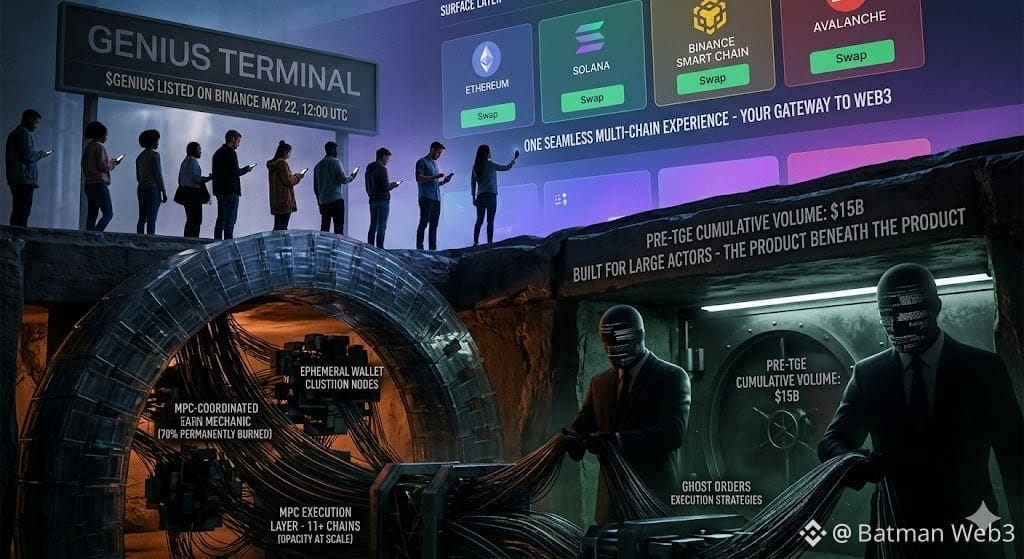
Something kept nagging at me mid-task on Genius Terminal and $GENIUS — the multi-chain story checks out on the surface, but who it actually runs for quietly shifts the longer you sit with it.
@GeniusOfficial listed on Binance spot May 22 at 12:00 UTC — pushed back one hour from the originally announced 11:00 UTC open. Watching GENIUS/USDT order books wake up on a centralized venue while the platform itself was routing cross-chain swaps through its GBP solver layer underneath was a strange layering. Two settlement realities operating simultaneously, neither particularly aware of the other.
The seamlessness is real, mostly. But ghost orders, MPC-coordinated ephemeral wallet clusters, multi-hundred-address execution strategies across 11+ chains — that's not the default experience. That's the product beneath the product. The clean single-interface wrapper is the surface. The actual infrastructure is built for large actors who need the chain to not read their through-line.
What stayed with me: the Burn or Earn airdrop mechanic permanently burned 70% of early claimers' allocations by design, while the platform already had $15B in cumulative volume pre-TGE. That volume wasn't retail-native. So I'm still chewing on whether "one seamless multi-chain experience" is genuinely the offering, or just the pitch that makes a high-end execution layer feel approachable to a wider audience it wasn't really built for first…
What kind of user actually benefits when the moat is explicitly built around opacity at scale?
@GeniusOfficial
$GENIUS
#genius
Something kept nagging at me mid-task on Genius Terminal and $GENIUS — the multi-chain story checks out on the surface, but who it actually runs for quietly shifts the longer you sit with it.
@GeniusOfficial listed on Binance spot May 22 at 12:00 UTC — pushed back one hour from the originally announced 11:00 UTC open. Watching GENIUS/USDT order books wake up on a centralized venue while the platform itself was routing cross-chain swaps through its GBP solver layer underneath was a strange layering. Two settlement realities operating simultaneously, neither particularly aware of the other.
The seamlessness is real, mostly. But ghost orders, MPC-coordinated ephemeral wallet clusters, multi-hundred-address execution strategies across 11+ chains — that's not the default experience. That's the product beneath the product. The clean single-interface wrapper is the surface. The actual infrastructure is built for large actors who need the chain to not read their through-line.
What stayed with me: the Burn or Earn airdrop mechanic permanently burned 70% of early claimers' allocations by design, while the platform already had $15B in cumulative volume pre-TGE. That volume wasn't retail-native. So I'm still chewing on whether "one seamless multi-chain experience" is genuinely the offering, or just the pitch that makes a high-end execution layer feel approachable to a wider audience it wasn't really built for first…
What kind of user actually benefits when the moat is explicitly built around opacity at scale?
@GeniusOfficial
$GENIUS
#genius
@GeniusOfficial listed on Binance spot May 22 at 12:00 UTC — pushed back one hour from the originally announced 11:00 UTC open. Watching GENIUS/USDT order books wake up on a centralized venue while the platform itself was routing cross-chain swaps through its GBP solver layer underneath was a strange layering. Two settlement realities operating simultaneously, neither particularly aware of the other.
The seamlessness is real, mostly. But ghost orders, MPC-coordinated ephemeral wallet clusters, multi-hundred-address execution strategies across 11+ chains — that's not the default experience. That's the product beneath the product. The clean single-interface wrapper is the surface. The actual infrastructure is built for large actors who need the chain to not read their through-line.
What stayed with me: the Burn or Earn airdrop mechanic permanently burned 70% of early claimers' allocations by design, while the platform already had $15B in cumulative volume pre-TGE. That volume wasn't retail-native. So I'm still chewing on whether "one seamless multi-chain experience" is genuinely the offering, or just the pitch that makes a high-end execution layer feel approachable to a wider audience it wasn't really built for first…
What kind of user actually benefits when the moat is explicitly built around opacity at scale?
@GeniusOfficial
$GENIUS
#genius
1
1
136

#genius $GENIUS
🚀 Genius Terminal: The Future of On-Chain Trading is Here! 🚀
Are you still using those old and slow tools? It's time to upgrade!
Genius Terminal is the world’s first Private and Final On-Chain Terminal, giving traders the ultimate power, speed, and privacy. 💼⚡
🌟 What makes Genius Terminal stand out?
First Private On-Chain Terminal: Your strategy and trades are yours alone. No front-running, no data leaks!🔑
Final On-Chain Execution: Secure and guaranteed trades at lightning speed directly on the blockchain.
Designed for Masters: Whether you're trading on dApps or liquidity sniping, Genius always keeps you a step ahead.
💡 In the crypto world, time is money, and Genius gives you both that precious time and security.
Binance Square community, don’t miss out on this revolution! Join Genius today and take your trading game to the next level. 📈🔥
#GeniusTerminal #OnChain #CryptoTrading #PrivacyMatters #Web3 #DeFi #BinanceSquare
#genius $GENIUS
🚀 Genius Terminal: The Future of On-Chain Trading is Here! 🚀
Are you still using those old and slow tools? It's time to upgrade!
Genius Terminal is the world’s first Private and Final On-Chain Terminal, giving traders the ultimate power, speed, and privacy. 💼⚡
🌟 What makes Genius Terminal stand out?
First Private On-Chain Terminal: Your strategy and trades are yours alone. No front-running, no data leaks!🔑
Final On-Chain Execution: Secure and guaranteed trades at lightning speed directly on the blockchain.
Designed for Masters: Whether you're trading on dApps or liquidity sniping, Genius always keeps you a step ahead.
💡 In the crypto world, time is money, and Genius gives you both that precious time and security.
Binance Square community, don’t miss out on this revolution! Join Genius today and take your trading game to the next level. 📈🔥
#GeniusTerminal #OnChain #CryptoTrading #PrivacyMatters #Web3 #DeFi #BinanceSquare
🚀 Genius Terminal: The Future of On-Chain Trading is Here! 🚀
Are you still using those old and slow tools? It's time to upgrade!
Genius Terminal is the world’s first Private and Final On-Chain Terminal, giving traders the ultimate power, speed, and privacy. 💼⚡
🌟 What makes Genius Terminal stand out?
First Private On-Chain Terminal: Your strategy and trades are yours alone. No front-running, no data leaks!🔑
Final On-Chain Execution: Secure and guaranteed trades at lightning speed directly on the blockchain.
Designed for Masters: Whether you're trading on dApps or liquidity sniping, Genius always keeps you a step ahead.
💡 In the crypto world, time is money, and Genius gives you both that precious time and security.
Binance Square community, don’t miss out on this revolution! Join Genius today and take your trading game to the next level. 📈🔥
#GeniusTerminal #OnChain #CryptoTrading #PrivacyMatters #Web3 #DeFi #BinanceSquare
70

#genius $GENIUS Title: What is Genius Terminal? My First Impressions
Content:
I just learned about @GeniusTerminal and wanted to share my thoughts.
Genius Terminal claims to be the first private and final on-chain terminal. That means more privacy for users and all data stays on-chain.
Why does this matter?
Most platforms today store your data on their own servers. Genius wants to change that by putting everything on-chain.
If they succeed, this could be big for DeFi privacy.
Still early, but worth watching.
What do you think? Would you use an on-chain terminal?
$GENIUS #GeniusTerminal
#genius $GENIUS Title: What is Genius Terminal? My First Impressions
Content:
I just learned about @GeniusTerminal and wanted to share my thoughts.
Genius Terminal claims to be the first private and final on-chain terminal. That means more privacy for users and all data stays on-chain.
Why does this matter?
Most platforms today store your data on their own servers. Genius wants to change that by putting everything on-chain.
If they succeed, this could be big for DeFi privacy.
Still early, but worth watching.
What do you think? Would you use an on-chain terminal?
$GENIUS #GeniusTerminal
Content:
I just learned about @GeniusTerminal and wanted to share my thoughts.
Genius Terminal claims to be the first private and final on-chain terminal. That means more privacy for users and all data stays on-chain.
Why does this matter?
Most platforms today store your data on their own servers. Genius wants to change that by putting everything on-chain.
If they succeed, this could be big for DeFi privacy.
Still early, but worth watching.
What do you think? Would you use an on-chain terminal?
$GENIUS #GeniusTerminal
61

💬 Honest question: Are you still paying too much to trade on-chain?
If you're hopping between Uniswap, Jupiter, Hyperliquid, and a bridge — all in separate tabs — you're wasting time AND money.
@GeniusOfficial solves this with ONE unified platform for spot trading, perpetuals, and cross-chain execution across 11+ blockchains.
And if you hold $GENIUS , you unlock the full experience:
⚡ Lower fees on every single trade
🔒 Ghost orders — private trades that bots can't front-run
💰 Refer friends, earn up to 45% of their fees in USDC
📊 Built-in screener to find opportunities before the crowd
🗳️ Governance rights — your voice actually matters here
Season 2 Genius Points are running until August 10, 2026. Every dollar you trade earns GP. GP converts to $GENIUS at the end of the season.
The platform already did $15B+ in volume. The community is growing fast. The token is live.
What are you waiting for? 🚀
#genius #GeniusTerminal #OnChainTrading
💬 Honest question: Are you still paying too much to trade on-chain?
If you're hopping between Uniswap, Jupiter, Hyperliquid, and a bridge — all in separate tabs — you're wasting time AND money.
@GeniusOfficial solves this with ONE unified platform for spot trading, perpetuals, and cross-chain execution across 11+ blockchains.
And if you hold $GENIUS , you unlock the full experience:
⚡ Lower fees on every single trade
🔒 Ghost orders — private trades that bots can't front-run
💰 Refer friends, earn up to 45% of their fees in USDC
📊 Built-in screener to find opportunities before the crowd
🗳️ Governance rights — your voice actually matters here
Season 2 Genius Points are running until August 10, 2026. Every dollar you trade earns GP. GP converts to $GENIUS at the end of the season.
The platform already did $15B+ in volume. The community is growing fast. The token is live.
What are you waiting for? 🚀
#genius #GeniusTerminal #OnChainTrading
If you're hopping between Uniswap, Jupiter, Hyperliquid, and a bridge — all in separate tabs — you're wasting time AND money.
@GeniusOfficial solves this with ONE unified platform for spot trading, perpetuals, and cross-chain execution across 11+ blockchains.
And if you hold $GENIUS , you unlock the full experience:
⚡ Lower fees on every single trade
🔒 Ghost orders — private trades that bots can't front-run
💰 Refer friends, earn up to 45% of their fees in USDC
📊 Built-in screener to find opportunities before the crowd
🗳️ Governance rights — your voice actually matters here
Season 2 Genius Points are running until August 10, 2026. Every dollar you trade earns GP. GP converts to $GENIUS at the end of the season.
The platform already did $15B+ in volume. The community is growing fast. The token is live.
What are you waiting for? 🚀
#genius #GeniusTerminal #OnChainTrading
115

·
--
Bearish
#genius $GENIUS
The @GeniusOfficial project brings an intriguing vision to the blockchain space. I’ll keep an eye on updates $GENIUS to see how it contributes to developing new solutions for users and developers. #genius
After posting on #Binancesquar , wait a bit and then return to the task page to check your points tally. The project’s token #geniusterminal focuses on trading tools and AI in the Web3 and crypto realm. It has been included in Binance programs like HODLer Airdrops and Binance Alpha during 2026. The project is developing a platform that helps users trade and manage assets across multiple blockchain networks.
It utilizes AI and market analysis tools.
Token $GENIUS is the currency used within the project's ecosystem.
#genius $GENIUS
The @GeniusOfficial project brings an intriguing vision to the blockchain space. I’ll keep an eye on updates $GENIUS to see how it contributes to developing new solutions for users and developers. #genius
After posting on #Binancesquar , wait a bit and then return to the task page to check your points tally. The project’s token #geniusterminal focuses on trading tools and AI in the Web3 and crypto realm. It has been included in Binance programs like HODLer Airdrops and Binance Alpha during 2026. The project is developing a platform that helps users trade and manage assets across multiple blockchain networks.
It utilizes AI and market analysis tools.
Token $GENIUS is the currency used within the project's ecosystem.
The @GeniusOfficial project brings an intriguing vision to the blockchain space. I’ll keep an eye on updates $GENIUS to see how it contributes to developing new solutions for users and developers. #genius
After posting on #Binancesquar , wait a bit and then return to the task page to check your points tally. The project’s token #geniusterminal focuses on trading tools and AI in the Web3 and crypto realm. It has been included in Binance programs like HODLer Airdrops and Binance Alpha during 2026. The project is developing a platform that helps users trade and manage assets across multiple blockchain networks.
It utilizes AI and market analysis tools.
Token $GENIUS is the currency used within the project's ecosystem.
80

·
--
Bearish
### The Ultimate Shield for Pro Traders: Genius Terminal 🛡️⚡
Traditional on-chain trading forces you to show your hand to MEV bots and front-runners.
$ **Genius Terminal** fixes this by delivering absolute privacy, instant finality, and complete user autonomy.
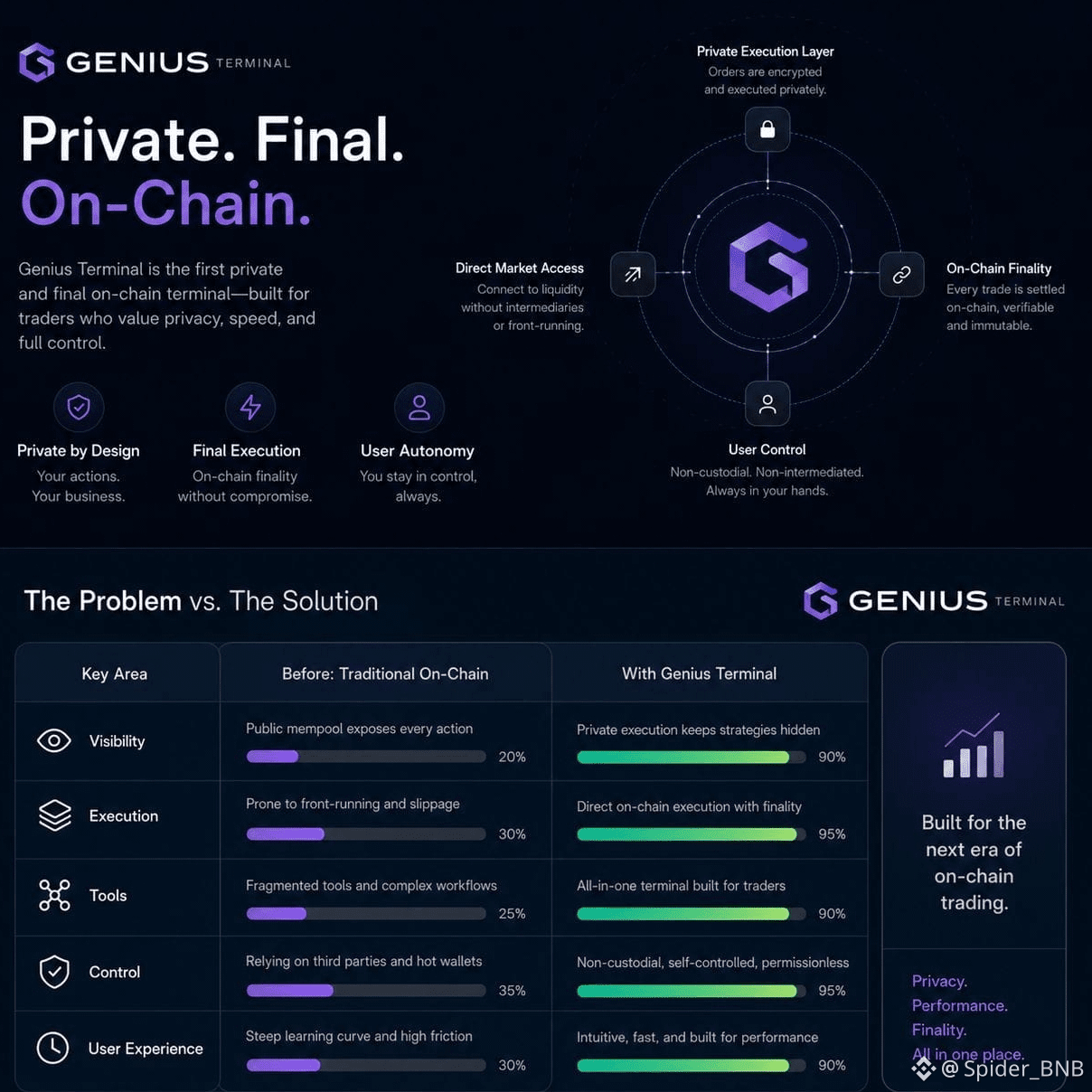
### 🔄 The Problem vs. The Solution
As shown in
* **Visibility (90% Improvement):** Traditional public mempools expose your strategies. Genius uses a **Private Execution Layer** to keep your actions completely hidden.
* **Execution (95% Improvement):** Eliminates front-running and slippage with **Direct Market Access** and instant on-chain finality.
* **Tools (90% Improvement):** Replaces fragmented workflows with an **all-in-one terminal** built specifically for traders.
* **Control (95% Improvement):** Moves away from risky third parties into a **100% non-custodial**, permissionless system.
* **User Experience (90% Improvement):** Replaces steep learning curves with an **intuitive, lightning-fast** interface.
### 💎 The Core Pillars
* **Private Execution:** Orders are encrypted and executed privately to protect your alpha.
* **Direct Market Access:** Connect straight to liquidity with zero intermediation.
* **On-Chain Finality:** Every trade is settled on-chain—verifiable, secure, and immutable.
> **Stop broadcasting your edge to predatory bots.** Take control of your performance and privacy in one unified place.
>
#GeniusTerminal #DeFi #SPIDER_BNB
### The Ultimate Shield for Pro Traders: Genius Terminal 🛡️⚡
Traditional on-chain trading forces you to show your hand to MEV bots and front-runners.
$ **Genius Terminal** fixes this by delivering absolute privacy, instant finality, and complete user autonomy.
### 🔄 The Problem vs. The Solution
As shown in
* **Visibility (90% Improvement):** Traditional public mempools expose your strategies. Genius uses a **Private Execution Layer** to keep your actions completely hidden.
* **Execution (95% Improvement):** Eliminates front-running and slippage with **Direct Market Access** and instant on-chain finality.
* **Tools (90% Improvement):** Replaces fragmented workflows with an **all-in-one terminal** built specifically for traders.
* **Control (95% Improvement):** Moves away from risky third parties into a **100% non-custodial**, permissionless system.
* **User Experience (90% Improvement):** Replaces steep learning curves with an **intuitive, lightning-fast** interface.
### 💎 The Core Pillars
* **Private Execution:** Orders are encrypted and executed privately to protect your alpha.
* **Direct Market Access:** Connect straight to liquidity with zero intermediation.
* **On-Chain Finality:** Every trade is settled on-chain—verifiable, secure, and immutable.
> **Stop broadcasting your edge to predatory bots.** Take control of your performance and privacy in one unified place.
>
#GeniusTerminal #DeFi #SPIDER_BNB
Traditional on-chain trading forces you to show your hand to MEV bots and front-runners.
$ **Genius Terminal** fixes this by delivering absolute privacy, instant finality, and complete user autonomy.
### 🔄 The Problem vs. The Solution
As shown in
* **Visibility (90% Improvement):** Traditional public mempools expose your strategies. Genius uses a **Private Execution Layer** to keep your actions completely hidden.
* **Execution (95% Improvement):** Eliminates front-running and slippage with **Direct Market Access** and instant on-chain finality.
* **Tools (90% Improvement):** Replaces fragmented workflows with an **all-in-one terminal** built specifically for traders.
* **Control (95% Improvement):** Moves away from risky third parties into a **100% non-custodial**, permissionless system.
* **User Experience (90% Improvement):** Replaces steep learning curves with an **intuitive, lightning-fast** interface.
### 💎 The Core Pillars
* **Private Execution:** Orders are encrypted and executed privately to protect your alpha.
* **Direct Market Access:** Connect straight to liquidity with zero intermediation.
* **On-Chain Finality:** Every trade is settled on-chain—verifiable, secure, and immutable.
> **Stop broadcasting your edge to predatory bots.** Take control of your performance and privacy in one unified place.
>
#GeniusTerminal #DeFi #SPIDER_BNB
77

·
--
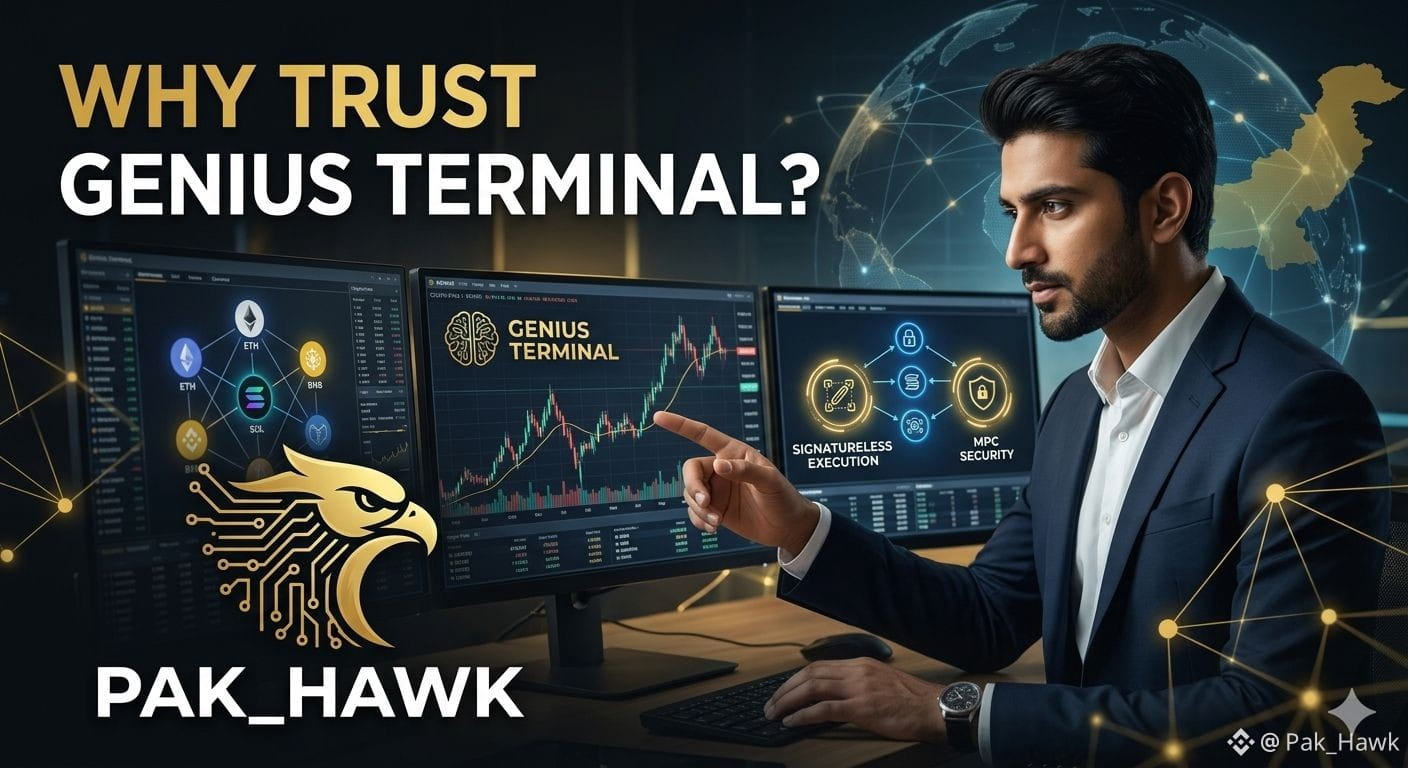
Why Professional Traders Trust Genius Terminal ($GENIUS )
In a fragmented DeFi landscape, Genius Terminal ($GENIUS ) is closing the gap between centralized exchange usability and self-custody asset ownership. Serving as the economic backbone of a professional-grade, non-custodial trading ecosystem, GENIUS connects traders to over 150 decentralized exchanges across 10+ major blockchains—including Ethereum, Solana, and BNB Chain—all through a single interface.
Why is the community trusting the process?
Signatureless Execution: Say goodbye to endless wallet pop-ups. Pre-authorized session parameters allow for seamless, rapid execution with minimal friction.
Privacy-Centric "Ghost Orders": Built for institutional and power traders, Multi-Party Computation (MPC) lets you execute large trades across multiple wallet clusters without exposing your funding sources publicly.
Chain-Invisible Swaps: Move across networks natively without the headache of manual bridging or wrapping assets.
Backed by real-world utility in governance and premium feature access, GENIUS is built for the future of onchain trading.
#Genius #DeFi #GeniusTerminal #trading @GeniusOfficial
Why Professional Traders Trust Genius Terminal ($GENIUS )
In a fragmented DeFi landscape, Genius Terminal ($GENIUS ) is closing the gap between centralized exchange usability and self-custody asset ownership. Serving as the economic backbone of a professional-grade, non-custodial trading ecosystem, GENIUS connects traders to over 150 decentralized exchanges across 10+ major blockchains—including Ethereum, Solana, and BNB Chain—all through a single interface.
Why is the community trusting the process?
Signatureless Execution: Say goodbye to endless wallet pop-ups. Pre-authorized session parameters allow for seamless, rapid execution with minimal friction.
Privacy-Centric "Ghost Orders": Built for institutional and power traders, Multi-Party Computation (MPC) lets you execute large trades across multiple wallet clusters without exposing your funding sources publicly.
Chain-Invisible Swaps: Move across networks natively without the headache of manual bridging or wrapping assets.
Backed by real-world utility in governance and premium feature access, GENIUS is built for the future of onchain trading.
#Genius #DeFi #GeniusTerminal #trading @GeniusOfficial
In a fragmented DeFi landscape, Genius Terminal ($GENIUS ) is closing the gap between centralized exchange usability and self-custody asset ownership. Serving as the economic backbone of a professional-grade, non-custodial trading ecosystem, GENIUS connects traders to over 150 decentralized exchanges across 10+ major blockchains—including Ethereum, Solana, and BNB Chain—all through a single interface.
Why is the community trusting the process?
Signatureless Execution: Say goodbye to endless wallet pop-ups. Pre-authorized session parameters allow for seamless, rapid execution with minimal friction.
Privacy-Centric "Ghost Orders": Built for institutional and power traders, Multi-Party Computation (MPC) lets you execute large trades across multiple wallet clusters without exposing your funding sources publicly.
Chain-Invisible Swaps: Move across networks natively without the headache of manual bridging or wrapping assets.
Backed by real-world utility in governance and premium feature access, GENIUS is built for the future of onchain trading.
#Genius #DeFi #GeniusTerminal #trading @GeniusOfficial
111

·
--
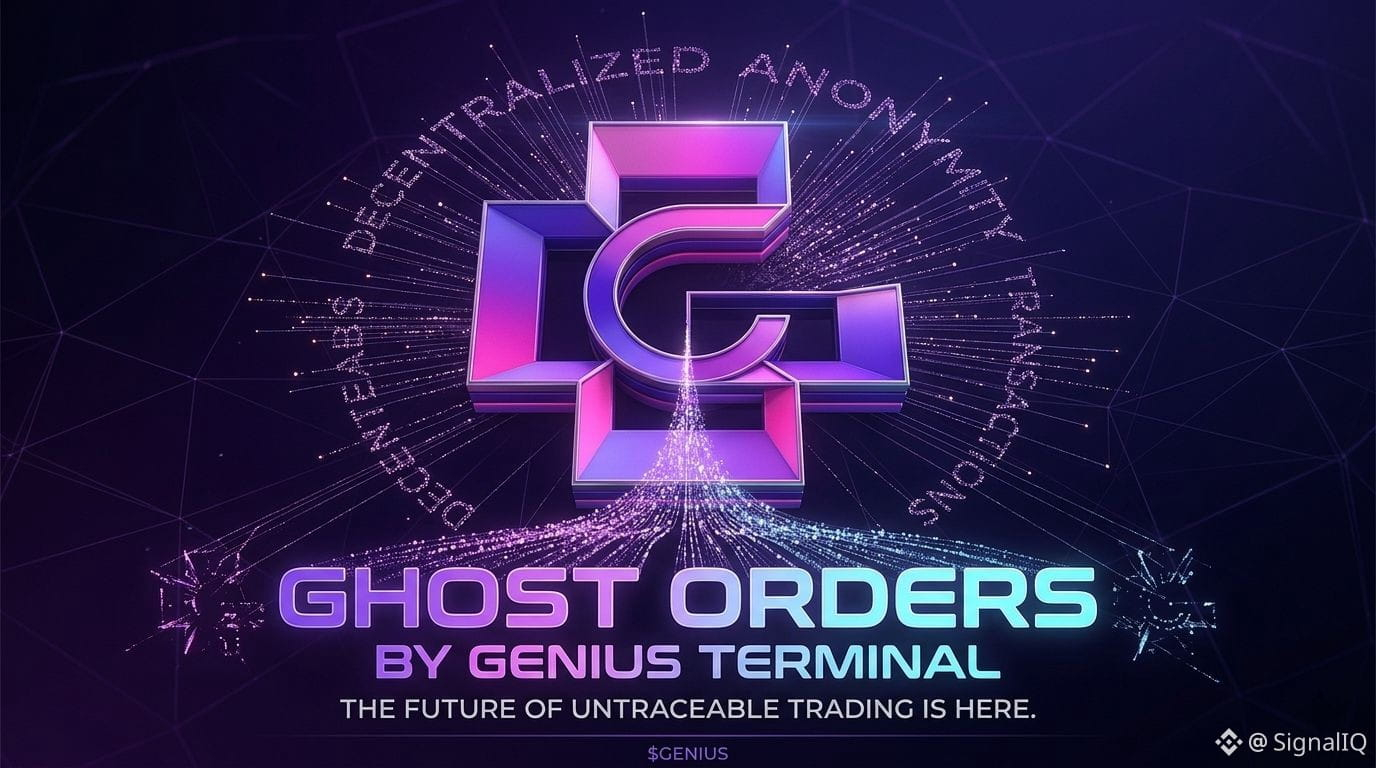
Ghost Orders... I keep going back and forth on whether @GeniusTerminal actually solved it.
Last week I watched a wallet enter a position on a low-cap and get copied within 11 seconds. Eleven. I've stopped pretending this isn't normal...
So when @GeniusTerminal started pushing Ghost Orders harder, I tried to read the docs slowly instead of skimming. MPC splitting a position across up to 500 ephemeral wallets. Jittered timing.
Randomized sizing. Everything routed through 150+ DEXs via Genius Bridge Protocol. The whole pitch is: your move arrives on-chain looking like 500 unrelated retail trades.
I want to believe it... I'm not sure I do yet.
Because 500 wallets isn't zero-knowledge. It's expensive obfuscation. A chain analyst with patience and Nansen credits can probably still cluster the funding paths. The "invite-only" Ghost Wallets language... I genuinely cannot tell if that's product gating or marketing theatre.
What's harder to dismiss is the rest of the surface. Non-custodial via Turnkey + Lit Protocol. No mixer logic, everything stays on-chain. Solana and BNB rollouts are already live, not roadmap promises.
I don't know if Ghost Orders kills MEV. I know it raises the cost of watching me.
That's not a verdict... that's the thing I keep coming back to.
#GeniusTerminal $GENIUS
Ghost Orders... I keep going back and forth on whether @Genius Terminal actually solved it.
Last week I watched a wallet enter a position on a low-cap and get copied within 11 seconds. Eleven. I've stopped pretending this isn't normal...
So when @Genius Terminal started pushing Ghost Orders harder, I tried to read the docs slowly instead of skimming. MPC splitting a position across up to 500 ephemeral wallets. Jittered timing.
Randomized sizing. Everything routed through 150+ DEXs via Genius Bridge Protocol. The whole pitch is: your move arrives on-chain looking like 500 unrelated retail trades.
I want to believe it... I'm not sure I do yet.
Because 500 wallets isn't zero-knowledge. It's expensive obfuscation. A chain analyst with patience and Nansen credits can probably still cluster the funding paths. The "invite-only" Ghost Wallets language... I genuinely cannot tell if that's product gating or marketing theatre.
What's harder to dismiss is the rest of the surface. Non-custodial via Turnkey + Lit Protocol. No mixer logic, everything stays on-chain. Solana and BNB rollouts are already live, not roadmap promises.
I don't know if Ghost Orders kills MEV. I know it raises the cost of watching me.
That's not a verdict... that's the thing I keep coming back to.
#GeniusTerminal $GENIUS
Last week I watched a wallet enter a position on a low-cap and get copied within 11 seconds. Eleven. I've stopped pretending this isn't normal...
So when @Genius Terminal started pushing Ghost Orders harder, I tried to read the docs slowly instead of skimming. MPC splitting a position across up to 500 ephemeral wallets. Jittered timing.
Randomized sizing. Everything routed through 150+ DEXs via Genius Bridge Protocol. The whole pitch is: your move arrives on-chain looking like 500 unrelated retail trades.
I want to believe it... I'm not sure I do yet.
Because 500 wallets isn't zero-knowledge. It's expensive obfuscation. A chain analyst with patience and Nansen credits can probably still cluster the funding paths. The "invite-only" Ghost Wallets language... I genuinely cannot tell if that's product gating or marketing theatre.
What's harder to dismiss is the rest of the surface. Non-custodial via Turnkey + Lit Protocol. No mixer logic, everything stays on-chain. Solana and BNB rollouts are already live, not roadmap promises.
I don't know if Ghost Orders kills MEV. I know it raises the cost of watching me.
That's not a verdict... that's the thing I keep coming back to.
#GeniusTerminal $GENIUS
1
218

·
--
Bullish
Most people think the next phase of crypto will be driven by faster chains, bigger ecosystems, or more liquidity.
I'm not convinced.
I think the next battle is about information.
For years, transparency was treated as crypto's greatest strength. Every transaction visible. Every wallet traceable. Every move recorded forever.
That worked when markets were smaller.
But today's ecosystem includes funds, market makers, quant desks, and increasingly AI systems that can process information faster than any human ever could.
In that environment, transparency creates a new dynamic.@GeniusOfficial
The more visible participants become, the easier it is to study them.
The easier it is to predict them.
And eventually, the easier it is to compete against them.
That's why projects like Genius Terminal stand out to me.
Not because they promise secrecy.
But because they challenge an assumption that crypto rarely questions:
Should ownership only apply to assets, or should it also apply to the decision-making process behind those assets?
As the industry matures, preserving optionality may become just as valuable as preserving capital.
And if that happens, privacy won't be viewed as hiding.
It will be viewed as infrastructure.
$GENIUS $BTW $LAB
#Crypto #DeFi #Privacy #blockchain #GeniusTerminal
Most people think the next phase of crypto will be driven by faster chains, bigger ecosystems, or more liquidity.
I'm not convinced.
I think the next battle is about information.
For years, transparency was treated as crypto's greatest strength. Every transaction visible. Every wallet traceable. Every move recorded forever.
That worked when markets were smaller.
But today's ecosystem includes funds, market makers, quant desks, and increasingly AI systems that can process information faster than any human ever could.
In that environment, transparency creates a new dynamic.@GeniusOfficial
The more visible participants become, the easier it is to study them.
The easier it is to predict them.
And eventually, the easier it is to compete against them.
That's why projects like Genius Terminal stand out to me.
Not because they promise secrecy.
But because they challenge an assumption that crypto rarely questions:
Should ownership only apply to assets, or should it also apply to the decision-making process behind those assets?
As the industry matures, preserving optionality may become just as valuable as preserving capital.
And if that happens, privacy won't be viewed as hiding.
It will be viewed as infrastructure.
$GENIUS $BTW $LAB
#Crypto #DeFi #Privacy #blockchain #GeniusTerminal
I'm not convinced.
I think the next battle is about information.
For years, transparency was treated as crypto's greatest strength. Every transaction visible. Every wallet traceable. Every move recorded forever.
That worked when markets were smaller.
But today's ecosystem includes funds, market makers, quant desks, and increasingly AI systems that can process information faster than any human ever could.
In that environment, transparency creates a new dynamic.@GeniusOfficial
The more visible participants become, the easier it is to study them.
The easier it is to predict them.
And eventually, the easier it is to compete against them.
That's why projects like Genius Terminal stand out to me.
Not because they promise secrecy.
But because they challenge an assumption that crypto rarely questions:
Should ownership only apply to assets, or should it also apply to the decision-making process behind those assets?
As the industry matures, preserving optionality may become just as valuable as preserving capital.
And if that happens, privacy won't be viewed as hiding.
It will be viewed as infrastructure.
$GENIUS $BTW $LAB
#Crypto #DeFi #Privacy #blockchain #GeniusTerminal
1
1
364


Article
GENIUS TERMINAL IS CHANGING HOW TRADERS INTERACT WITH CRYPTO FOREVERWHY MOST CRYPTO TRADERS ARE STILL OPERATING BLIND 👀
Every serious trader knows the feeling.
You're watching 5 different tabs.
Three different wallets.
Two different chains.
And by the time you've figured out where your assets are and what the best route is — the opportunity is gone.
This is the hidden tax of fragmented crypto infrastructure.
It's not slippage. It's not fees.
It's time. And confusion. And cognitive load.
This is exactly the problem Genius Terminal was built to solve.
Genius Terminal calls itself the first private and final on-chain terminal.
That's a bold statement. But the more you look into it, the more it makes sense.
Here's what makes it different:
✅ All your chains in one place — no more switching between apps and wallets
✅ Private by design — your strategy stays yours, not visible to bots and front-runners
✅ Self-custody first — you keep control of your assets at all times
✅ Unified portfolio view — see everything across all chains instantly
✅ Optimized execution — best routes, minimal slippage, faster decisions
The privacy angle is the most underrated part.
In traditional DeFi, every move you make is visible on-chain.
Bots scan your wallet activity.
Whales copy your positions.
Front-runners see your transaction before it confirms.
You spend years developing an edge — and the blockchain broadcasts it to everyone watching.
Genius Terminal is building infrastructure that gives you the benefits of on-chain activity without exposing your strategy to the entire market.
The bigger picture:
Most people see blockchain as a technology problem.
But the real barriers to mass crypto adoption are trust, privacy, and simplicity.
When on-chain activity feels as simple and safe as using a bank app — while keeping full self-custody — that's when the next billion users arrive.
Genius Terminal isn't just a trading tool.
It's an onboarding gateway for the future of finance.
The question isn't whether private on-chain terminals will become standard.
The question is: who will be using them before everyone else realizes they need one?
👉 Learn more: https://geniusterminal.io
#GENIUS #GeniusTerminal #DeFi #BTC #BNB #Web3 #CryptoEarnNG
GENIUS TERMINAL IS CHANGING HOW TRADERS INTERACT WITH CRYPTO FOREVER
WHY MOST CRYPTO TRADERS ARE STILL OPERATING BLIND 👀
Every serious trader knows the feeling.
You're watching 5 different tabs.
Three different wallets.
Two different chains.
And by the time you've figured out where your assets are and what the best route is — the opportunity is gone.
This is the hidden tax of fragmented crypto infrastructure.
It's not slippage. It's not fees.
It's time. And confusion. And cognitive load.
This is exactly the problem Genius Terminal was built to solve.
Genius Terminal calls itself the first private and final on-chain terminal.
That's a bold statement. But the more you look into it, the more it makes sense.
Here's what makes it different:
✅ All your chains in one place — no more switching between apps and wallets
✅ Private by design — your strategy stays yours, not visible to bots and front-runners
✅ Self-custody first — you keep control of your assets at all times
✅ Unified portfolio view — see everything across all chains instantly
✅ Optimized execution — best routes, minimal slippage, faster decisions
The privacy angle is the most underrated part.
In traditional DeFi, every move you make is visible on-chain.
Bots scan your wallet activity.
Whales copy your positions.
Front-runners see your transaction before it confirms.
You spend years developing an edge — and the blockchain broadcasts it to everyone watching.
Genius Terminal is building infrastructure that gives you the benefits of on-chain activity without exposing your strategy to the entire market.
The bigger picture:
Most people see blockchain as a technology problem.
But the real barriers to mass crypto adoption are trust, privacy, and simplicity.
When on-chain activity feels as simple and safe as using a bank app — while keeping full self-custody — that's when the next billion users arrive.
Genius Terminal isn't just a trading tool.
It's an onboarding gateway for the future of finance.
The question isn't whether private on-chain terminals will become standard.
The question is: who will be using them before everyone else realizes they need one?
👉 Learn more: https://geniusterminal.io
#GENIUS #GeniusTerminal #DeFi #BTC #BNB #Web3 #CryptoEarnNG
Every serious trader knows the feeling.
You're watching 5 different tabs.
Three different wallets.
Two different chains.
And by the time you've figured out where your assets are and what the best route is — the opportunity is gone.
This is the hidden tax of fragmented crypto infrastructure.
It's not slippage. It's not fees.
It's time. And confusion. And cognitive load.
This is exactly the problem Genius Terminal was built to solve.
Genius Terminal calls itself the first private and final on-chain terminal.
That's a bold statement. But the more you look into it, the more it makes sense.
Here's what makes it different:
✅ All your chains in one place — no more switching between apps and wallets
✅ Private by design — your strategy stays yours, not visible to bots and front-runners
✅ Self-custody first — you keep control of your assets at all times
✅ Unified portfolio view — see everything across all chains instantly
✅ Optimized execution — best routes, minimal slippage, faster decisions
The privacy angle is the most underrated part.
In traditional DeFi, every move you make is visible on-chain.
Bots scan your wallet activity.
Whales copy your positions.
Front-runners see your transaction before it confirms.
You spend years developing an edge — and the blockchain broadcasts it to everyone watching.
Genius Terminal is building infrastructure that gives you the benefits of on-chain activity without exposing your strategy to the entire market.
The bigger picture:
Most people see blockchain as a technology problem.
But the real barriers to mass crypto adoption are trust, privacy, and simplicity.
When on-chain activity feels as simple and safe as using a bank app — while keeping full self-custody — that's when the next billion users arrive.
Genius Terminal isn't just a trading tool.
It's an onboarding gateway for the future of finance.
The question isn't whether private on-chain terminals will become standard.
The question is: who will be using them before everyone else realizes they need one?
👉 Learn more: https://geniusterminal.io
#GENIUS #GeniusTerminal #DeFi #BTC #BNB #Web3 #CryptoEarnNG
54
·
--
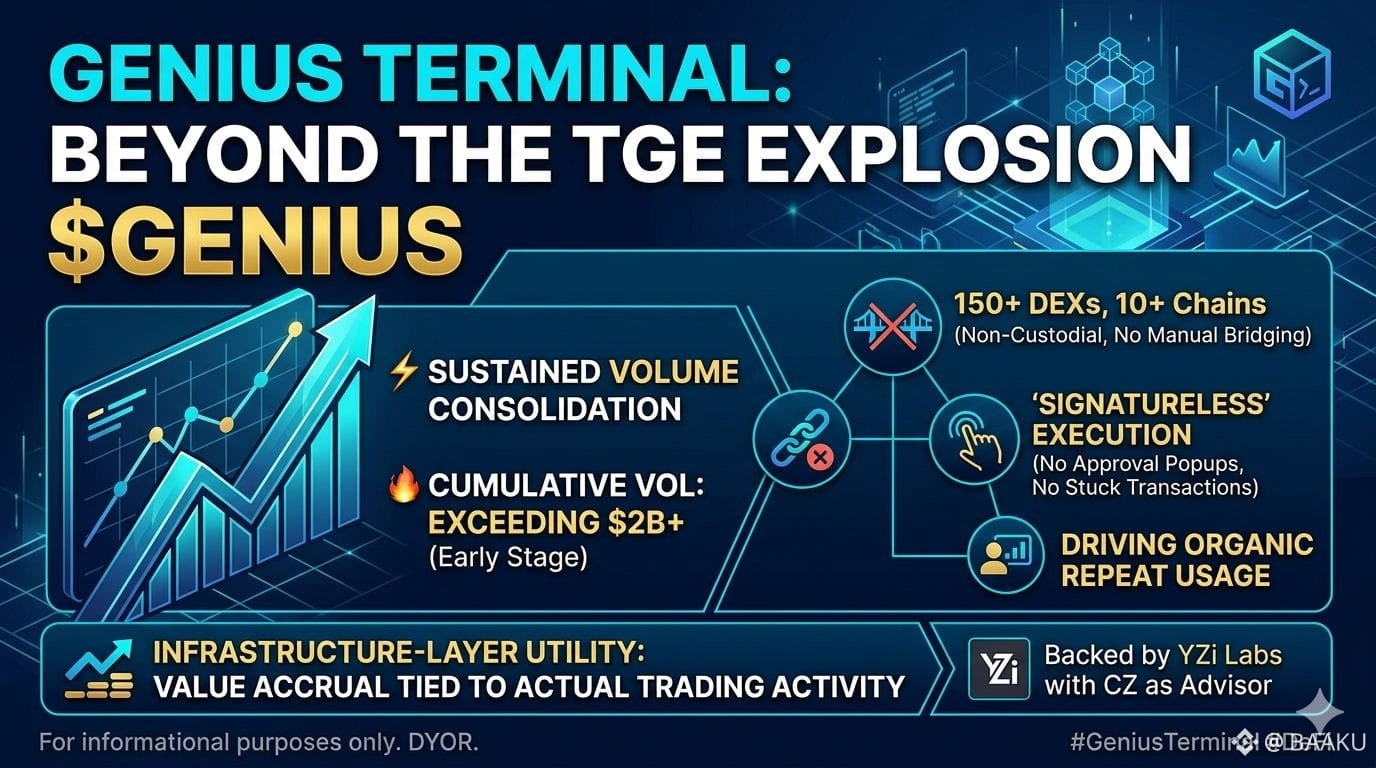
$GENIUS is showing sustained on-chain volume consolidation after its explosive TGE, with cumulative trading volume now exceeding $2B at an early product stage—rare for a terminal still rolling out core features [1][2]. The platform’s non-custodial design, connecting 150+ DEXs across 10+ chains without manual bridging, is driving organic repeat usage rather than one-off speculation [1][2]. What stands out is the "signatureless" execution model eliminating approval popups and stuck transactions, which directly addresses a key friction point for power traders [3][4]. This infrastructure-layer utility, backed by YZi Labs with CZ as advisor, suggests the token's value accrual ties to actual trading activity rather than purely narrative momentum [1][2]. Monitor whether weekly active wallets grow alongside volume to confirm sustainable adoption. #GeniusTerminal #DeFi #genius $GENIUS
$GENIUS is showing sustained on-chain volume consolidation after its explosive TGE, with cumulative trading volume now exceeding $2B at an early product stage—rare for a terminal still rolling out core features [1][2]. The platform’s non-custodial design, connecting 150+ DEXs across 10+ chains without manual bridging, is driving organic repeat usage rather than one-off speculation [1][2]. What stands out is the "signatureless" execution model eliminating approval popups and stuck transactions, which directly addresses a key friction point for power traders [3][4]. This infrastructure-layer utility, backed by YZi Labs with CZ as advisor, suggests the token's value accrual ties to actual trading activity rather than purely narrative momentum [1][2]. Monitor whether weekly active wallets grow alongside volume to confirm sustainable adoption. #GeniusTerminal #DeFi #genius $GENIUS
3
4
249

·
--
Bullish
🧠 THE TERMINAL THEY NEVER WANTED YOU TO FIND
i've been in crypto long enough to know when something is different.
i've used every tool. every scanner. every so-called "alpha terminal" out there.
None of them gave me what i actually needed
Privacy. Speed. Control. All on-chain.
Then i found *Genius Terminal.
i'm not going to sugarcoat it
this thing changed how i trade forever.
$GENIUS isn't just another token you flip and forget.
This is infrastructure.
This is the first terminal built to be **private by design and final by nature.
i watched my entries stop getting front-run.
i watched my wallet stop being tracked.
i watched my trades actually land clean, fast, invisible.
No one sees my moves anymore.
**And that's exactly the point.**
The people who built this understood one thing
on-chain shouldn't mean exposed.
$GENIUS fixes that.
i don't hype things early.
But when i see the *first and final* of something
i move.
This is that moment.
Genius Terminal. Private. On-Chain. Unstoppable.
The terminal they never wanted us to have
is live on *Binance 🔐⛓️
#GeniusTerminal #GENIUS #Binance
@GeniusOfficial $GENIUS
{future}(GENIUSUSDT)
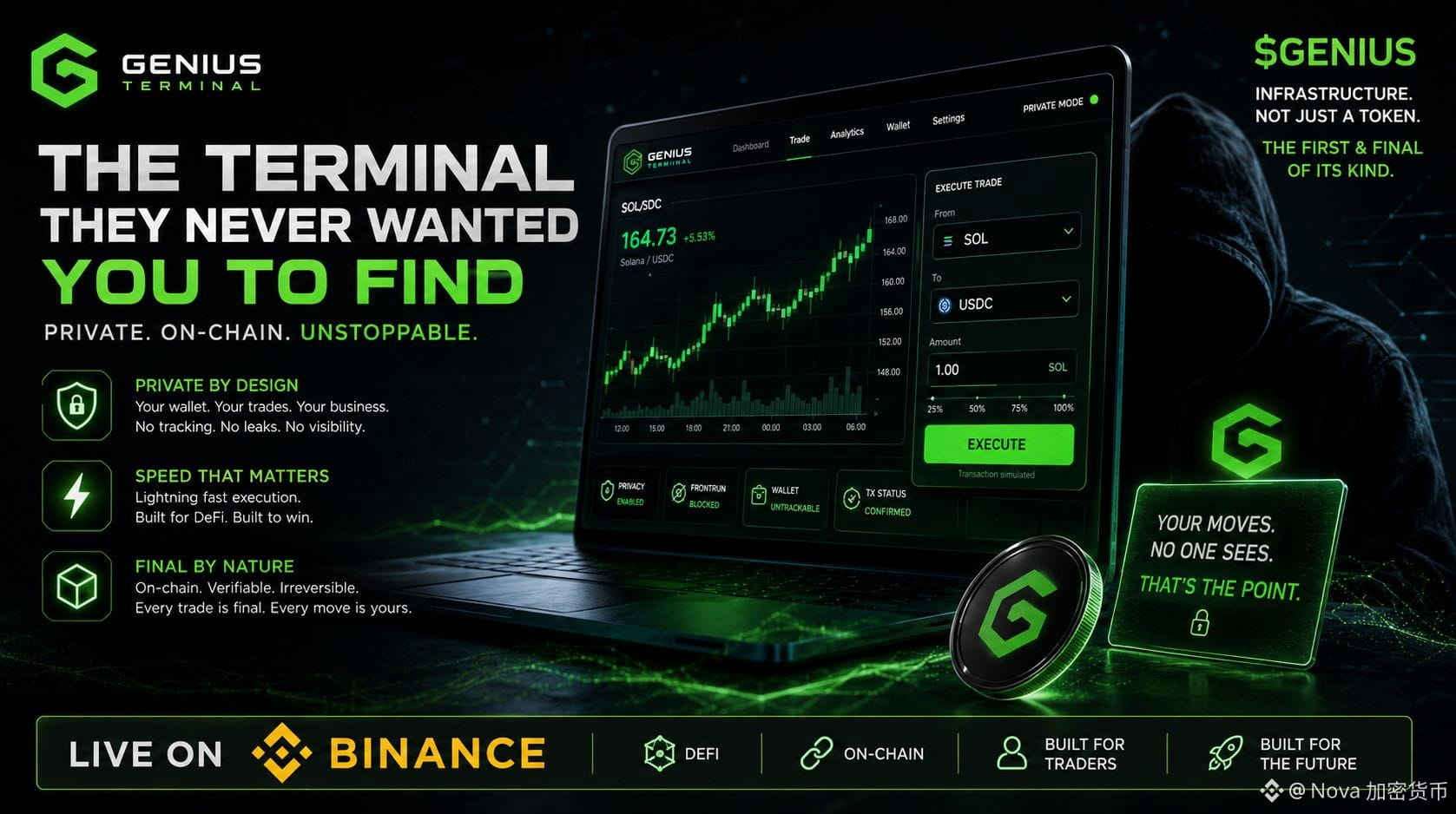
🧠 THE TERMINAL THEY NEVER WANTED YOU TO FIND
i've been in crypto long enough to know when something is different.
i've used every tool. every scanner. every so-called "alpha terminal" out there.
None of them gave me what i actually needed
Privacy. Speed. Control. All on-chain.
Then i found *Genius Terminal.
i'm not going to sugarcoat it
this thing changed how i trade forever.
$GENIUS isn't just another token you flip and forget.
This is infrastructure.
This is the first terminal built to be **private by design and final by nature.
i watched my entries stop getting front-run.
i watched my wallet stop being tracked.
i watched my trades actually land clean, fast, invisible.
No one sees my moves anymore.
**And that's exactly the point.**
The people who built this understood one thing
on-chain shouldn't mean exposed.
$GENIUS fixes that.
i don't hype things early.
But when i see the *first and final* of something
i move.
This is that moment.
Genius Terminal. Private. On-Chain. Unstoppable.
The terminal they never wanted us to have
is live on *Binance 🔐⛓️
#GeniusTerminal #GENIUS #Binance
@GeniusOfficial $GENIUS
i've been in crypto long enough to know when something is different.
i've used every tool. every scanner. every so-called "alpha terminal" out there.
None of them gave me what i actually needed
Privacy. Speed. Control. All on-chain.
Then i found *Genius Terminal.
i'm not going to sugarcoat it
this thing changed how i trade forever.
$GENIUS isn't just another token you flip and forget.
This is infrastructure.
This is the first terminal built to be **private by design and final by nature.
i watched my entries stop getting front-run.
i watched my wallet stop being tracked.
i watched my trades actually land clean, fast, invisible.
No one sees my moves anymore.
**And that's exactly the point.**
The people who built this understood one thing
on-chain shouldn't mean exposed.
$GENIUS fixes that.
i don't hype things early.
But when i see the *first and final* of something
i move.
This is that moment.
Genius Terminal. Private. On-Chain. Unstoppable.
The terminal they never wanted us to have
is live on *Binance 🔐⛓️
#GeniusTerminal #GENIUS #Binance
@GeniusOfficial $GENIUS
12
13
164
Log in to explore more content
Join global crypto users on Binance Square
⚡️ Get latest and useful information about crypto.
💬 Trusted by the world’s largest crypto exchange.
👍 Discover real insights from verified creators.
Email / Phone number
Trending Topics
1
#NEARRisesNearly80%InAWeek
2,691 views
261 Discussing
2
#MultiversXPlansHardForkRecovery
3,695 views
278 Discussing
3
#CircleLaunchesInstitutionalBTCBackedBorrowing
6,283 views
422 Discussing
4
#BitcoinHits$85K
9,211 views
220 Discussing
5
#ZetaChainVotesToMigrateZETAToSolana
5,568 views
274 Discussing
6
#ECBStartsBlockchainEuroSettlement
16,598 views
553 Discussing
7
#SouthAfricaProposesCryptoExchangeControls
27,962 views
745 Discussing
8
#SolanaCutsTargetSlotTimeTo250ms
30,989 views
662 Discussing
9
#EthereumSurpasses$2700
21,764 views
220 Discussing
10
#CanaryFilesSecondAmendmentForStakedSEIETF
47,644 views
1,005 Discussing