Binance Square
ICT Web3
16k Posts

ICT Web3

Square Verified+
Crypto 6 Years Experience with Technical Analysis.
Open Trade
Frequent Trader
11.9 Months
1.5K+ Following
41.1K+ Followers
27.1K+ Liked
Posts
Portfolio
ยท
--
Binance Square Official
ยท
--
Introducing a new layer of intelligence for everything finance.

Join the Binance Intelligence launch livestream for an early look at what we've been building.

๐Ÿ—“ Oct 5 | 12:00 UTC
๐Ÿ“ Binance Square Official

Repost this post and tag @Binance Square Official to share your vision for Binance Intelligence for a chance to be one of 5 winners selected for a 20 USDC reward.

ยท
--
go
go
Emmaa alex02
ยท
--
๐ŸŒธ Good morning, ๐ŸŒธ

beautiful people! โ˜€๏ธ
A fresh day, a little luck,

Hope today brings you something special. ๐Ÿ’ซ

#BinanceSquareFamily $NVDA.US
ยท
--
go
go
ๅ…ฐๆฑkyL
ยท
--
$ZEC $SOL Goldman Sachsโ€™ latest outlook is here: the Fed will most likely raise rates again in October. After that, this hiking cycle could possibly be nearing its end, while rate cuts may not come until the end of 2027. Many crypto friends, upon seeing this news, start thinking about how the overall market might move.๐Ÿšจ

The key point is oil prices. Goldman Sachs says that only if oil prices keep falling and suppress inflation will this rate-hike expectation materialize. If oil prices continue to surge and inflation doesnโ€™t come down, the Fedโ€™s rate-hike pace will keep adjusting, and the crypto market will definitely wobble along with it.๐Ÿšจ

We all know that crypto market performance is highly tied to USD liquidity. If the last rate hike in October is carried out as expectedโ€”making the bad news โ€œalready priced inโ€โ€”the market could see a rebound in the short term. But donโ€™t get carried away: rate cuts are still a long way off, and large funds wonโ€™t immediately rush in at scale, making it difficult to directly turn into a full-fledged bull market.๐Ÿšจ

Right now, the market is likely going to be a tug-of-warโ€”up a few days and then prone to pullbacks as the news flow keeps shifting. Make sure you donโ€™t go all-in with heavy positions. Donโ€™t be fooled by short-term rebounds.๐Ÿšจ

Remember: expectations are one thing, but the situation can change at any moment due to the Fedโ€™s future remarks and fluctuations in oil prices. In terms of trading, keep positions light, be patient, and wait for clear opportunitiesโ€”protecting your principal should always come first.๐Ÿšจ#ๅธๅฎ‰ๅฐ†ไธŠๅธ‚Hyperliquid๏ผˆHYPE๏ผ‰ #็พŽ่”ๅ‚จ10ๆœˆๅŠ ๆฏๆฆ‚็އๅ‡่‡ณ69.7%
ยท
--
go
go
ๅคง้ฅผๅ“ฅVIP
ยท
--
Bullish
#ๅ…„ๅผŸไปฌ่กŒๆƒ…ๅผ€ๅง‹ๅบ•้ƒจๅ›žๅ‡ไบ† ไธŠ่ฝฆๆฒกๆœ‰$DASH


$BNB

$ZEC
ยท
--
go
go
Quoted content has been removed
ยท
--
Bearish
CPI is coming, and I think this could be an important moment for the market. ๐Ÿ‘€ After the recent moves, a lot of people are wondering what the Fed might do next. Personally, I think the Fed is more likely to stay cautious rather than rush into another rate hike. If the CPI number comes in softer than expected, I think we could see a positive reaction across risk assets. ๐Ÿ“ˆ My personal view is that the market could turn bullish from here if inflation shows signs of cooling and rate hike fears start to fade. Of course, CPI can surprise the market, so Iโ€™m not taking anything for granted. Iโ€™ll be watching the numbers and the market reaction closely. For now, Iโ€™m staying cautiously bullish. ๐Ÿš€ What do you think: bullish or bearish? #CPIWatch #Crypto #BinanceSquare #Bullish $XAU
CPI is coming, and I think this could be an important moment for the market. ๐Ÿ‘€

After the recent moves, a lot of people are wondering what the Fed might do next. Personally, I think the Fed is more likely to stay cautious rather than rush into another rate hike.

If the CPI number comes in softer than expected, I think we could see a positive reaction across risk assets. ๐Ÿ“ˆ

My personal view is that the market could turn bullish from here if inflation shows signs of cooling and rate hike fears start to fade.

Of course, CPI can surprise the market, so Iโ€™m not taking anything for granted. Iโ€™ll be watching the numbers and the market reaction closely.

For now, Iโ€™m staying cautiously bullish. ๐Ÿš€

What do you think: bullish or bearish?

#CPIWatch #Crypto #BinanceSquare #Bullish $XAU
ยท
--
๐ŸŽ™๏ธ Letโ€™s talk about the upcoming market trend, BNB DCA
cover
End
02 h 18 m 16 s
14.6k
27
33
ยท
--
๐ŸŽ™๏ธ UXUY ร— SUBB Special Event | Binance Plaza AMA Arrives with Big News!
avatar
End
03 h 21 m 36 s
16.5k
27
28
ยท
--
go
go
Quoted content has been removed
ยท
--
go
go
Quoted content has been removed
ยท
--
๐ŸŽ™๏ธ Let's Talk Market Trends and DCA BNB Spot!
avatar
End
03 h 07 m 12 s
16k
35
36
ยท
--
TULIP__
ยท
--
#dusk $DUSK @Dusk

My automatic payments run every month without me touching anything, But automation only guarantees the instruction gets executed. It doesnโ€™t guarantee what happens afterward. I think that distinction matters when looking at staking on @dusk.

A smart contract can automate a lot. It can manage deposited DUSK, handle staking logic, distribute rewards, even reinvest them according to predefined rules. That makes the process feel predictable. Almost mechanical.

But the outcome isnโ€™t mechanical.

$DUSK staking rewards still depend on actual consensus participation and active stake. Theyโ€™re probabilistic, not something a contract can promise into existence. The code can automate what happens when rewards arrive. It cannot guarantee that a specific amount will arrive in the first place.

I think this becomes more important as @dusk makes staking increasingly programmable. Better automation can make uncertainty less visible, and thatโ€™s where expectations can quietly become unrealistic. A clean interface or clever contract doesnโ€™t change the underlying consensus mechanics.

Thatโ€™s the part Iโ€™d want users to understand before anything else.

Automation can remove repetitive work. It can enforce rules consistently.

But it cannot turn probability into certainty.

And maybe good staking infrastructure shouldnโ€™t try to make those two things look the same.

#dusk
ยท
--
Verified
I use Wi-Fi every day without thinking about the router. I only remember it exists when something stops loading. Then suddenly Iโ€™m checking lights, settings, cablesโ€ฆ all the stuff that was invisible five minutes earlier. Thatโ€™s how Iโ€™m starting to think about DuskEVM. A developer can stay in familiar territory with Solidity, wallets and normal EVM tooling while @Dusk_Foundation keeps DuskDS underneath handling settlement and data availability. When everything works, that abstraction is exactly what you want. Nobody wants extra infrastructure in their head. But abstraction creates dependency too. DuskEVM activity is batched and anchored beneath the execution layer. $DUSK also moves between L1 and DuskEVM through a bridge. So when settlement behaves unexpectedly, bridging gets complicated, or state doesnโ€™t look the way a developer expects, the base layer suddenly matters. Thatโ€™s the part I think @dusk eventually has to prove. Can developers troubleshoot those boundaries without becoming DuskDS specialists? If understanding the hidden layer becomes necessary too often, some of the simplicity EVM compatibility provides starts disappearing. Maybe good architecture isnโ€™t about making the base layer irrelevant. Itโ€™s about letting developers ignore it most daysโ€”and understand it quickly on the day they canโ€™t.$DUSK #dusk
I use Wi-Fi every day without thinking about the router. I only remember it exists when something stops loading. Then suddenly Iโ€™m checking lights, settings, cablesโ€ฆ all the stuff that was invisible five minutes earlier.

Thatโ€™s how Iโ€™m starting to think about DuskEVM. A developer can stay in familiar territory with Solidity, wallets and normal EVM tooling while @Dusk keeps DuskDS underneath handling settlement and data availability. When everything works, that abstraction is exactly what you want. Nobody wants extra infrastructure in their head.

But abstraction creates dependency too. DuskEVM activity is batched and anchored beneath the execution layer. $DUSK also moves between L1 and DuskEVM through a bridge. So when settlement behaves unexpectedly, bridging gets complicated, or state doesnโ€™t look the way a developer expects, the base layer suddenly matters.

Thatโ€™s the part I think @dusk eventually has to prove. Can developers troubleshoot those boundaries without becoming DuskDS specialists? If understanding the hidden layer becomes necessary too often, some of the simplicity EVM compatibility provides starts disappearing.

Maybe good architecture isnโ€™t about making the base layer irrelevant.

Itโ€™s about letting developers ignore it most daysโ€”and understand it quickly on the day they canโ€™t.$DUSK

#dusk
ยท
--
๐ŸŽ™๏ธ Wan Zhi Breaks the Grid๏ฝœAI Intelligent Agents Reshape a New On-Chain Financial Ecosystem!
avatar
End
03 h 48 m 43 s
19.7k
35
46
ยท
--
Honestly, the more I dig into what @Dusk_Foundation Foundation is building, the more it clicks why theyโ€™ve stuck around this long. DuskEVM testnet being live means Ethereum developers can just use the tools they already know โ€“ Solidity, Hardhat โ€“ and still get the privacy features that matter for real financial stuff. No need to start from scratch. That alone should pull in more builders for DeFi, lending, tokenized assets, whatever. And every transaction still uses $DUSK for gas, while staking secures the network. So growth in apps should actually mean more demand for the token. Then youโ€™ve got Dusk Trade, their platform for investing in tokenized real-world assets. Waitlist is open and it fits the whole picture โ€“ regulated, private where it needs to be, but still usable. Institutions hate fully transparent ledgers for a reason. Being able to keep amounts private yet auditable when required is a big deal. After years of grinding through different market cycles, the pieces are starting to lock in. Privacy plus compliance isnโ€™t just marketing here. Feels like one of the few projects actually aiming at the boring but important side of onchain finance. Curious to see how the ecosystem fills out from here and whether real volume follows the tooling. $DUSK #dusk
Honestly, the more I dig into what @Dusk Foundation is building, the more it clicks why theyโ€™ve stuck around this long. DuskEVM testnet being live means Ethereum developers can just use the tools they already know โ€“ Solidity, Hardhat โ€“ and still get the privacy features that matter for real financial stuff. No need to start from scratch.

That alone should pull in more builders for DeFi, lending, tokenized assets, whatever. And every transaction still uses $DUSK for gas, while staking secures the network. So growth in apps should actually mean more demand for the token.

Then youโ€™ve got Dusk Trade, their platform for investing in tokenized real-world assets. Waitlist is open and it fits the whole picture โ€“ regulated, private where it needs to be, but still usable. Institutions hate fully transparent ledgers for a reason. Being able to keep amounts private yet auditable when required is a big deal.

After years of grinding through different market cycles, the pieces are starting to lock in. Privacy plus compliance isnโ€™t just marketing here. Feels like one of the few projects actually aiming at the boring but important side of onchain finance. Curious to see how the ecosystem fills out from here and whether real volume follows the tooling.

$DUSK #dusk
ยท
--
Bullish
Verified
I've just been digging deeper into what @Dusk_Foundation is actually building and itโ€™s one of those projects that quietly makes a lot of sense once you sit with it for a minute. $DUSK isnโ€™t trying to be another general-purpose chain. Itโ€™s laser-focused on the messy middle ground where real finance lives โ€” privacy when you need it, compliance when the regulators come knocking, and proper settlement that institutions can actually trust. Native issuance of bonds, stocks, funds, the whole lot, without the usual circus of intermediaries. Shielded transfers that still let the right people peek when they have to. And now with DuskEVM coming online, Solidity devs can jump in without learning a completely new stack. That combination feels rare. Most privacy chains lean too hard into anonymity theatre. Most โ€œinstitutionalโ€ chains just slap a KYC wrapper on a transparent ledger and call it a day. Dusk has been grinding on the actual cryptographic and regulatory plumbing since 2018. Partnerships like the one with NPEX arenโ€™t just marketing fluff either โ€” theyโ€™re testing the real rails. Still early days in terms of volume and apps, but the direction is clear. Infrastructure for regulated digital assets that doesnโ€™t force you to choose between privacy and legitimacy. Thatโ€™s the kind of boring-but-important work that tends to compound quietly. Watching this one closely. @DuskFoundation $DUSK $TRUMP {future}(DUSKUSDT) SK #dusk
I've just been digging deeper into what @Dusk is actually building and itโ€™s one of those projects that quietly makes a lot of sense once you sit with it for a minute.

$DUSK isnโ€™t trying to be another general-purpose chain. Itโ€™s laser-focused on the messy middle ground where real finance lives โ€” privacy when you need it, compliance when the regulators come knocking, and proper settlement that institutions can actually trust. Native issuance of bonds, stocks, funds, the whole lot, without the usual circus of intermediaries. Shielded transfers that still let the right people peek when they have to. And now with DuskEVM coming online, Solidity devs can jump in without learning a completely new stack.

That combination feels rare. Most privacy chains lean too hard into anonymity theatre. Most โ€œinstitutionalโ€ chains just slap a KYC wrapper on a transparent ledger and call it a day. Dusk has been grinding on the actual cryptographic and regulatory plumbing since 2018. Partnerships like the one with NPEX arenโ€™t just marketing fluff either โ€” theyโ€™re testing the real rails.

Still early days in terms of volume and apps, but the direction is clear. Infrastructure for regulated digital assets that doesnโ€™t force you to choose between privacy and legitimacy. Thatโ€™s the kind of boring-but-important work that tends to compound quietly.

Watching this one closely.

@DuskFoundation $DUSK $TRUMP
SK #dusk
ยท
--
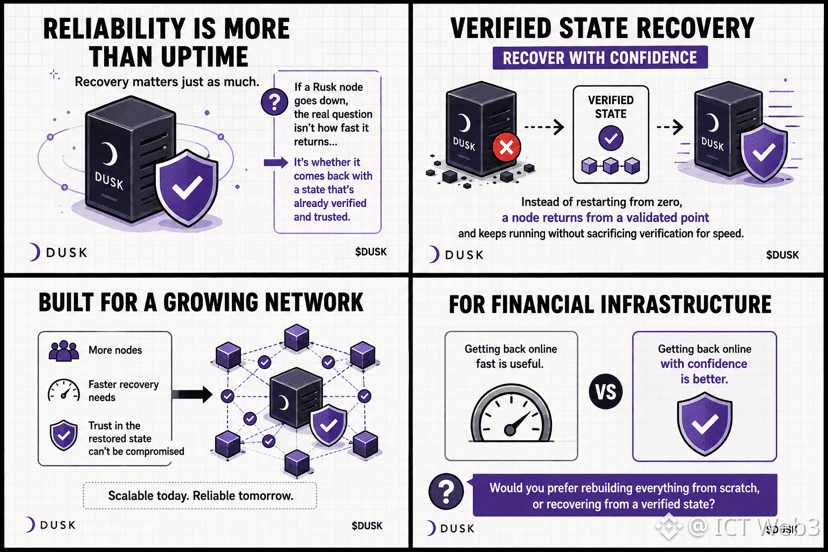
The more I look at Dusk, the more I realize that reliability isnโ€™t only about keeping a node online. Recovery matters just as much. If a Rusk node goes down, the important question isnโ€™t simply how quickly it can return. Itโ€™s whether it can come back with a state that has already been checked and can be trusted. That makes verified state recovery interesting to me. Instead of treating recovery like a full restart from zero, a node can return from a validated point and continue operating without giving up verification for speed. As the network grows, this could become increasingly important. More nodes means recovery needs to remain practical, but trust in the restored state canโ€™t become the compromise. For financial infrastructure, getting back online fast is useful. Getting back online with confidence is better. Would you prefer rebuilding everything from scratch, or recovering from a verified state? @Dusk_Foundation $DUSK #Dusk $GPS $TUT
The more I look at Dusk, the more I realize that reliability isnโ€™t only about keeping a node online.

Recovery matters just as much.

If a Rusk node goes down, the important question isnโ€™t simply how quickly it can return. Itโ€™s whether it can come back with a state that has already been checked and can be trusted.

That makes verified state recovery interesting to me.

Instead of treating recovery like a full restart from zero, a node can return from a validated point and continue operating without giving up verification for speed.

As the network grows, this could become increasingly important. More nodes means recovery needs to remain practical, but trust in the restored state canโ€™t become the compromise.

For financial infrastructure, getting back online fast is useful.

Getting back online with confidence is better.

Would you prefer rebuilding everything from scratch, or recovering from a verified state?

@Dusk $DUSK #Dusk $GPS $TUT
ยท
--
I used to look at multi-chain expansion as a simple growth strategy: launch on more networks, reach more users. But with TermMax, I think the more interesting story is what happens after those markets go live. Fixed-rate lending doesnโ€™t behave the same everywhere. On Ethereum, capital can afford to be patient. Users may care more about certainty and maturity than squeezing every last bit of yield from a position. Move to Arbitrum or BNB Chain and the behavior can change. Lower costs make it easier to enter, exit, compare rates, and move when another opportunity looks better. That means the same asset can tell a completely different story depending on where the market forms. And thatโ€™s what makes multi-chain interesting to me. The real signal isnโ€™t how many networks TermMax supports. Itโ€™s where borrowers and lenders naturally choose to stay when they have options. Sometimes liquidity follows the highest rate. Sometimes it simply follows the path with the least friction. $GPS @termmax #TermMax {future}(GPSUSDT) $ACE {future}(ACEUSDT)
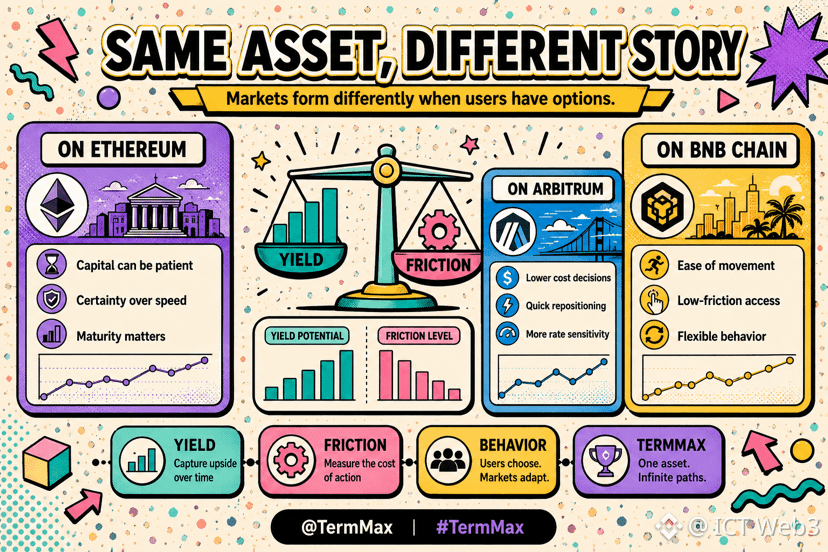
I used to look at multi-chain expansion as a simple growth strategy: launch on more networks, reach more users.

But with TermMax, I think the more interesting story is what happens after those markets go live.

Fixed-rate lending doesnโ€™t behave the same everywhere.

On Ethereum, capital can afford to be patient. Users may care more about certainty and maturity than squeezing every last bit of yield from a position.

Move to Arbitrum or BNB Chain and the behavior can change. Lower costs make it easier to enter, exit, compare rates, and move when another opportunity looks better.

That means the same asset can tell a completely different story depending on where the market forms.

And thatโ€™s what makes multi-chain interesting to me.

The real signal isnโ€™t how many networks TermMax supports.

Itโ€™s where borrowers and lenders naturally choose to stay when they have options.

Sometimes liquidity follows the highest rate.

Sometimes it simply follows the path with the least friction.
$GPS
@TermMax #TermMax
$ACE
ยท
--
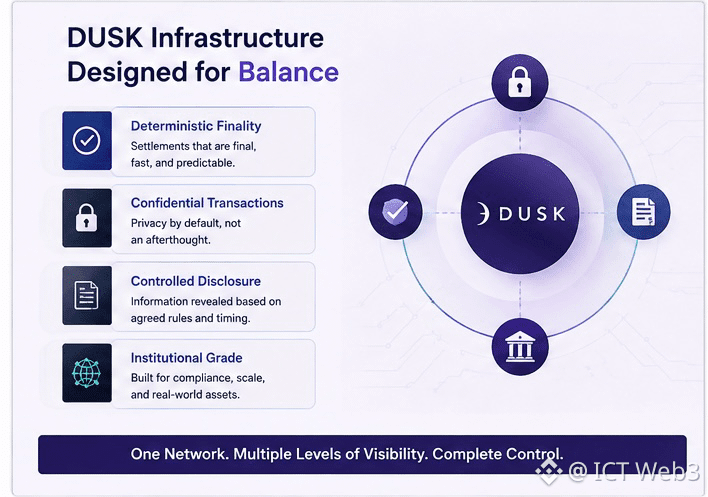
I used to think getting institutions onto the same network was the difficult part. Now I think thatโ€™s only the beginning. The real tension starts after settlement: when does information become visible, who gets to see it first, and how much delay is acceptable before transparency starts creating an advantage for someone else? That matters especially for large positions. Immediate disclosure sounds good in theory, but in practice it can expose strategy before an institution is ready. This is where Dusk gets interesting to me. The bigger challenge isnโ€™t simply putting financial activity onchain. Itโ€™s creating infrastructure where finality, privacy and disclosure can coexist without forcing every participant into the exact same level of visibility at the exact same moment. A shared network can coordinate settlement. Trust is harder. Maybe the real measure of institutional adoption wonโ€™t be how many firms join, but how comfortable they become operating under the same rules of visibility. @Dusk_Foundation $DUSK #Dusk $PORTAL $GPS
I used to think getting institutions onto the same network was the difficult part.

Now I think thatโ€™s only the beginning.

The real tension starts after settlement: when does information become visible, who gets to see it first, and how much delay is acceptable before transparency starts creating an advantage for someone else?

That matters especially for large positions. Immediate disclosure sounds good in theory, but in practice it can expose strategy before an institution is ready.

This is where Dusk gets interesting to me.

The bigger challenge isnโ€™t simply putting financial activity onchain. Itโ€™s creating infrastructure where finality, privacy and disclosure can coexist without forcing every participant into the exact same level of visibility at the exact same moment.

A shared network can coordinate settlement.

Trust is harder.

Maybe the real measure of institutional adoption wonโ€™t be how many firms join, but how comfortable they become operating under the same rules of visibility.

@Dusk $DUSK #Dusk $PORTAL $GPS
ยท
--
Go
Go
Quoted content has been removed
Log in to explore more content
Join global crypto users on Binance Square
โšก๏ธ Get latest and useful information about crypto.
๐Ÿ’ฌ Trusted by the worldโ€™s largest crypto exchange.
๐Ÿ‘ Discover real insights from verified creators.
Email / Phone number
Sitemap
Cookie Preferences
Platform T&Cs