
#gme
gme
6.5M views
2,199 Discussing
GameStop (GME) is currently leading the memecoin sector, capturing the attention of investors and enthusiasts alike. Let's discuss GME and its future as a Solana-based memecoin.
Hot
Latest


·
--
Surge In GME Meme Coin Value On Multiple Blockchain PlatformsAccording to BlockBeats, on May 13, the value of GME meme coins on several blockchain platforms skyrocketed due to the surge in GameStop's US stock. Specifically, the GME coin on the Solana blockchain saw a 24-hour increase of 1518%, with a temporary price of 0.008322 USD. Similarly, the GME coin on the Ethereum blockchain experienced a 24-hour increase of 93,492%, with a temporary price of 0.058565 USD. Lastly, the GME coin on the Base blockchain saw a 24-hour increase of 322%, with a temporary price of 0.02981 USD.
This sudden increase in the value of GME meme coins across multiple blockchain platforms is directly linked to the surge in GameStop's US stock. The correlation between the stock market and the value of meme coins is a clear indication of the influence traditional financial markets can have on the digital currency landscape. However, it's important to note that the prices mentioned are temporary and can fluctuate due to the volatile nature of digital currencies.
Surge In GME Meme Coin Value On Multiple Blockchain Platforms
According to BlockBeats, on May 13, the value of GME meme coins on several blockchain platforms skyrocketed due to the surge in GameStop's US stock. Specifically, the GME coin on the Solana blockchain saw a 24-hour increase of 1518%, with a temporary price of 0.008322 USD. Similarly, the GME coin on the Ethereum blockchain experienced a 24-hour increase of 93,492%, with a temporary price of 0.058565 USD. Lastly, the GME coin on the Base blockchain saw a 24-hour increase of 322%, with a temporary price of 0.02981 USD.
This sudden increase in the value of GME meme coins across multiple blockchain platforms is directly linked to the surge in GameStop's US stock. The correlation between the stock market and the value of meme coins is a clear indication of the influence traditional financial markets can have on the digital currency landscape. However, it's important to note that the prices mentioned are temporary and can fluctuate due to the volatile nature of digital currencies.
This sudden increase in the value of GME meme coins across multiple blockchain platforms is directly linked to the surge in GameStop's US stock. The correlation between the stock market and the value of meme coins is a clear indication of the influence traditional financial markets can have on the digital currency landscape. However, it's important to note that the prices mentioned are temporary and can fluctuate due to the volatile nature of digital currencies.
3
1
15
20.2k

·
--
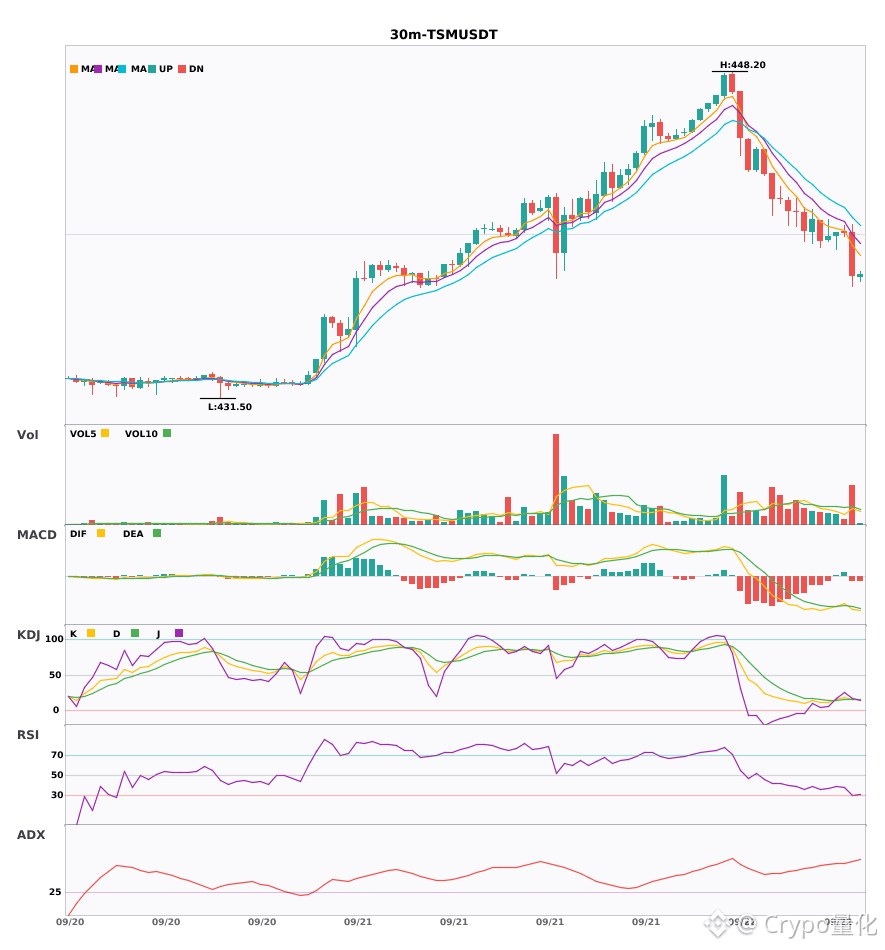
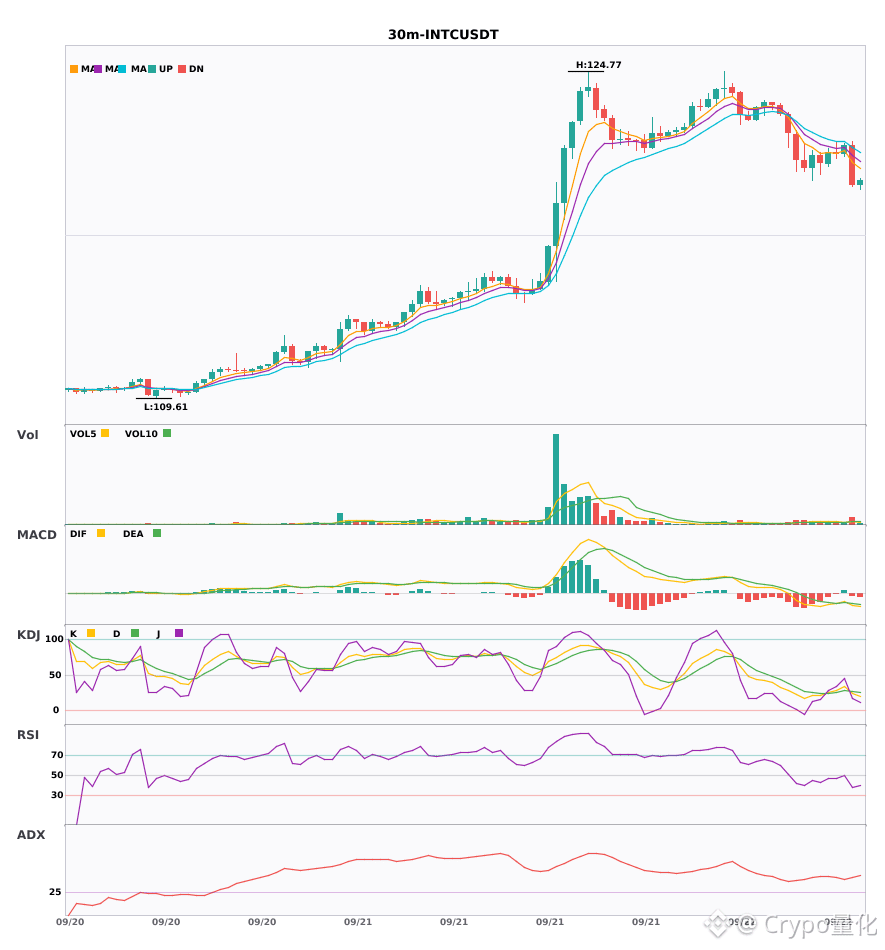
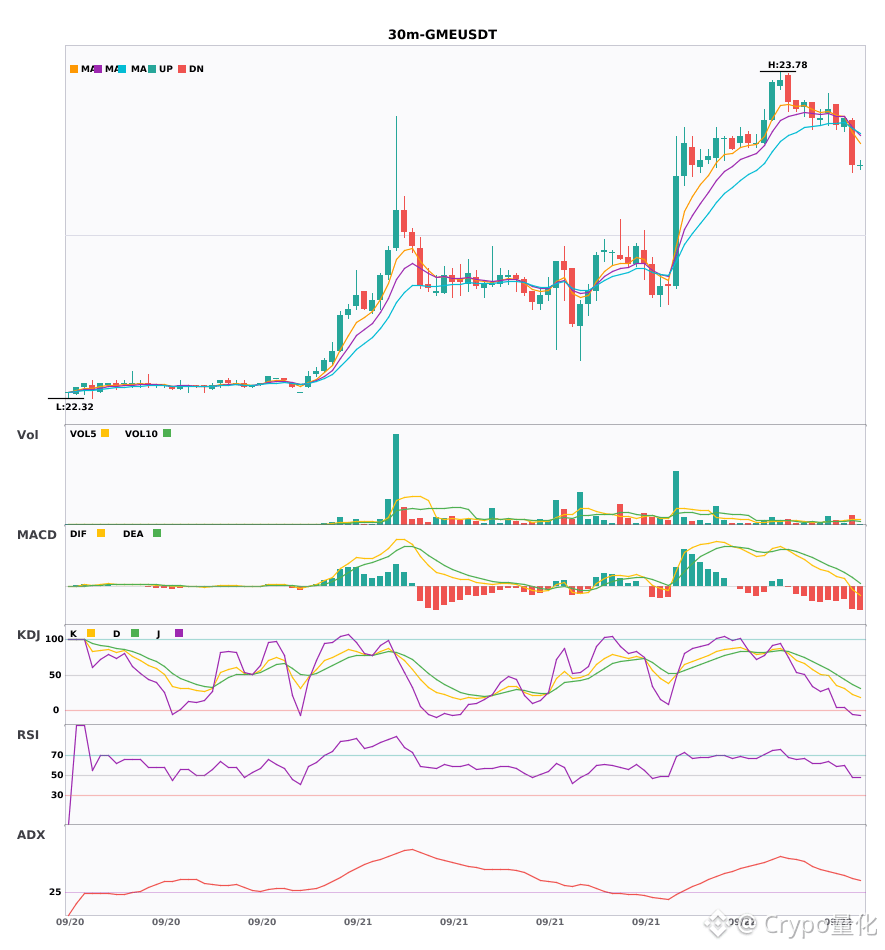
Three 30-minute-level short-signal alerts: $TSM / $INTC / $GME🔥
════════════════════
🟢 $TSM 30-minute short signal
⚠️ Technicals: ADX (64) — an extremely strong trend (watch for a hot/overheated pullback) | MACD forms a bearish “dead cross” below zero, with shorts accelerating | EMA5 < EMA8 < EMA13 (bearish alignment) | KDJ is in the oversold zone—watch for potential rebound (K is 16.2, D is 16.0) | Volume expands (2.2x)
════════════════════
🟢 $INTC 30-minute short signal
⚠️ Technicals: ADX (45) — a clear trending market | MACD bearish dead cross below zero, shorts accelerating | EMA5 < EMA8 < EMA13 (bearish alignment) | KDJ dead cross—bearish in the short term (K is 23.5, D is 27.0) | Volume expands (2.4x)
════════════════════
🟢 $GME 30-minute short signal
⚠️ Technicals: ADX (39) — a clear trending market | MACD DIF falls below the zero line, trend turns bearish | Moving averages “stuck together” as they build up energy—direction likely to be chosen soon | KDJ runs weak, bearish strength dominates (K is 23.0, D is 37.2) | Volume expands (2.4x)
════════════════════
🔔 Follow for first-hand market moves and anomalies 🔔
#技术分析 #TSM #INTC #GME
📌 When trading, pay attention to whether the candlestick patterns match
Three 30-minute-level short-signal alerts: $TSM / $INTC / $GME 🔥
════════════════════
🟢 $TSM 30-minute short signal
⚠️ Technicals: ADX (64) — an extremely strong trend (watch for a hot/overheated pullback) | MACD forms a bearish “dead cross” below zero, with shorts accelerating | EMA5 < EMA8 < EMA13 (bearish alignment) | KDJ is in the oversold zone—watch for potential rebound (K is 16.2, D is 16.0) | Volume expands (2.2x)
════════════════════
🟢 $INTC 30-minute short signal
⚠️ Technicals: ADX (45) — a clear trending market | MACD bearish dead cross below zero, shorts accelerating | EMA5 < EMA8 < EMA13 (bearish alignment) | KDJ dead cross—bearish in the short term (K is 23.5, D is 27.0) | Volume expands (2.4x)
════════════════════
🟢 $GME 30-minute short signal
⚠️ Technicals: ADX (39) — a clear trending market | MACD DIF falls below the zero line, trend turns bearish | Moving averages “stuck together” as they build up energy—direction likely to be chosen soon | KDJ runs weak, bearish strength dominates (K is 23.0, D is 37.2) | Volume expands (2.4x)
════════════════════
🔔 Follow for first-hand market moves and anomalies 🔔
#技术分析 #TSM #INTC #GME
📌 When trading, pay attention to whether the candlestick patterns match
════════════════════
🟢 $TSM 30-minute short signal
⚠️ Technicals: ADX (64) — an extremely strong trend (watch for a hot/overheated pullback) | MACD forms a bearish “dead cross” below zero, with shorts accelerating | EMA5 < EMA8 < EMA13 (bearish alignment) | KDJ is in the oversold zone—watch for potential rebound (K is 16.2, D is 16.0) | Volume expands (2.2x)
════════════════════
🟢 $INTC 30-minute short signal
⚠️ Technicals: ADX (45) — a clear trending market | MACD bearish dead cross below zero, shorts accelerating | EMA5 < EMA8 < EMA13 (bearish alignment) | KDJ dead cross—bearish in the short term (K is 23.5, D is 27.0) | Volume expands (2.4x)
════════════════════
🟢 $GME 30-minute short signal
⚠️ Technicals: ADX (39) — a clear trending market | MACD DIF falls below the zero line, trend turns bearish | Moving averages “stuck together” as they build up energy—direction likely to be chosen soon | KDJ runs weak, bearish strength dominates (K is 23.0, D is 37.2) | Volume expands (2.4x)
════════════════════
🔔 Follow for first-hand market moves and anomalies 🔔
#技术分析 #TSM #INTC #GME
📌 When trading, pay attention to whether the candlestick patterns match
90

·
--
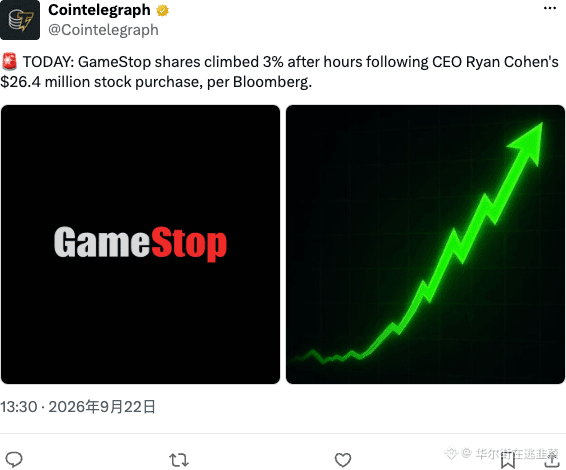
The CEO personally paid 26.4 million dollars out of his own pocket to buy the company's own stock, and GME jumped more than 3% right after hours. This move is more effective than any earnings call. The market eats these signals backed by real cash. But don’t get carried away yet—this is just the old script of meme stocks: the boss calls the shots, retail investors rush in, and in the end, you know who’s left holding the bag. The macro picture is coming in fast, and this kind of stock-specific party won’t last long.
$BTC #GME #US stocks
The CEO personally paid 26.4 million dollars out of his own pocket to buy the company's own stock, and GME jumped more than 3% right after hours. This move is more effective than any earnings call. The market eats these signals backed by real cash. But don’t get carried away yet—this is just the old script of meme stocks: the boss calls the shots, retail investors rush in, and in the end, you know who’s left holding the bag. The macro picture is coming in fast, and this kind of stock-specific party won’t last long.
$BTC #GME #US stocks
$BTC #GME #US stocks
149
·
--
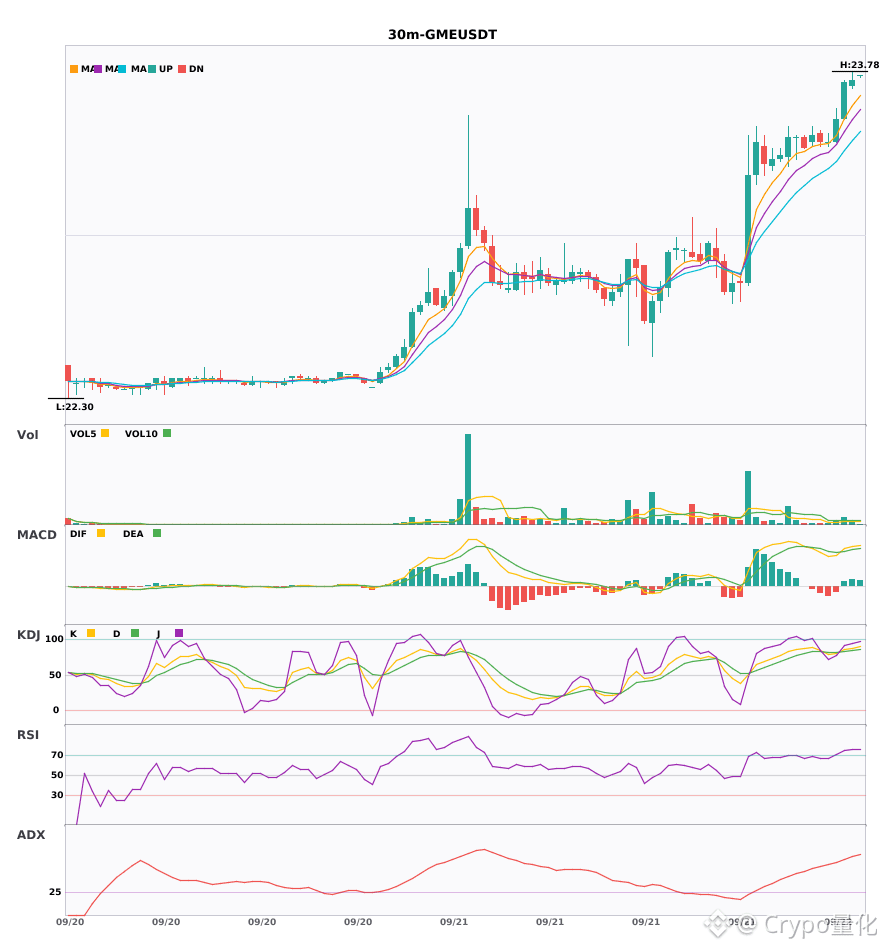
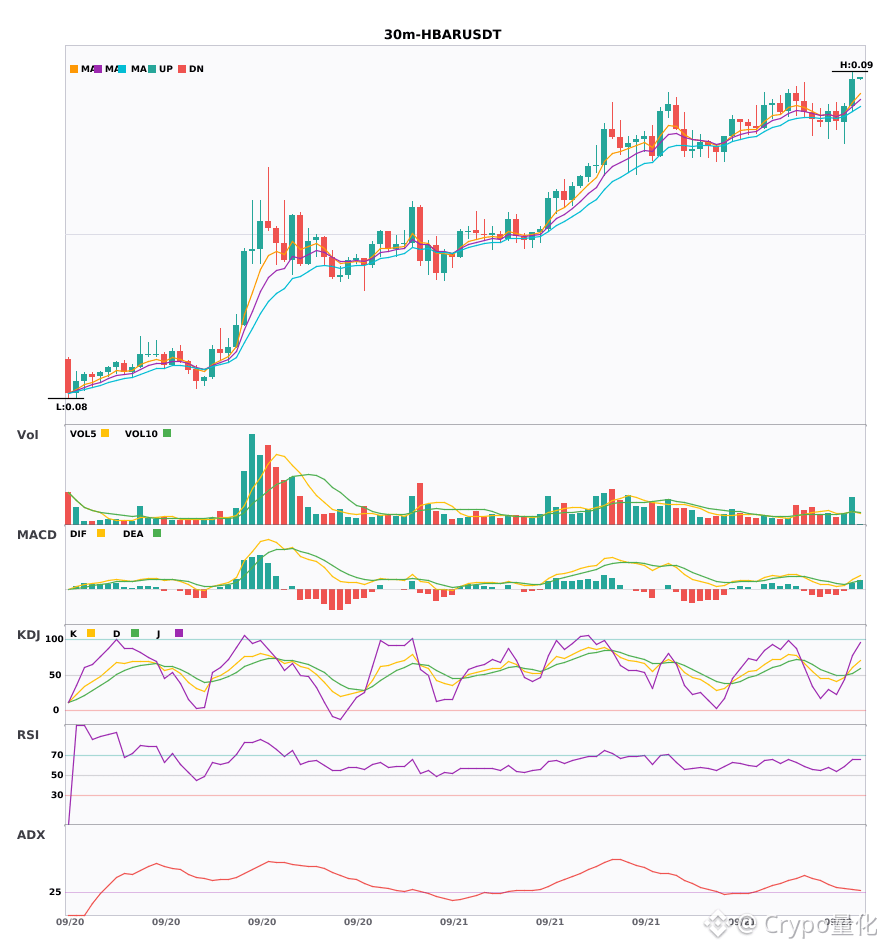
Two 30-minute-level long (bullish) signals appear at the same time: $GME / $HBAR🔥
════════════════════
🔴 $GME 30-minute bullish signal
⚠️ Technical analysis: ADX(68) is an extremely strong trend (watch out for a heated pullback) | MACD is above the zero line with a bullish crossover, bullish momentum releases | EMA5 > EMA8 > EMA13 bullish alignment | KDJ bullish crossover, bullish in the short term (K is 85.7, D is 82.7) | Volume increases (1.6x)
════════════════════
🔴 $HBAR 30-minute bullish signal
⚠️ Technical analysis: ADX(30) the trend is forming and can be entered | MACD is above the zero line with a bullish crossover, bullish momentum releases | EMA5 > EMA8 > EMA13 bullish alignment | KDJ bullish crossover, bullish in the short term (K is 60.7, D is 52.6) | Volume increases (2.1x)
════════════════════
🔔 Watch for the first-hand market news on sudden moves 🔔
#技术分析 #GME #HBAR
📌 When trading, pay attention to whether the candlestick pattern matches
Two 30-minute-level long (bullish) signals appear at the same time: $GME / $HBAR 🔥
════════════════════
🔴 $GME 30-minute bullish signal
⚠️ Technical analysis: ADX(68) is an extremely strong trend (watch out for a heated pullback) | MACD is above the zero line with a bullish crossover, bullish momentum releases | EMA5 > EMA8 > EMA13 bullish alignment | KDJ bullish crossover, bullish in the short term (K is 85.7, D is 82.7) | Volume increases (1.6x)
════════════════════
🔴 $HBAR 30-minute bullish signal
⚠️ Technical analysis: ADX(30) the trend is forming and can be entered | MACD is above the zero line with a bullish crossover, bullish momentum releases | EMA5 > EMA8 > EMA13 bullish alignment | KDJ bullish crossover, bullish in the short term (K is 60.7, D is 52.6) | Volume increases (2.1x)
════════════════════
🔔 Watch for the first-hand market news on sudden moves 🔔
#技术分析 #GME #HBAR
📌 When trading, pay attention to whether the candlestick pattern matches
════════════════════
🔴 $GME 30-minute bullish signal
⚠️ Technical analysis: ADX(68) is an extremely strong trend (watch out for a heated pullback) | MACD is above the zero line with a bullish crossover, bullish momentum releases | EMA5 > EMA8 > EMA13 bullish alignment | KDJ bullish crossover, bullish in the short term (K is 85.7, D is 82.7) | Volume increases (1.6x)
════════════════════
🔴 $HBAR 30-minute bullish signal
⚠️ Technical analysis: ADX(30) the trend is forming and can be entered | MACD is above the zero line with a bullish crossover, bullish momentum releases | EMA5 > EMA8 > EMA13 bullish alignment | KDJ bullish crossover, bullish in the short term (K is 60.7, D is 52.6) | Volume increases (2.1x)
════════════════════
🔔 Watch for the first-hand market news on sudden moves 🔔
#技术分析 #GME #HBAR
📌 When trading, pay attention to whether the candlestick pattern matches
31



GME trading value at the bottom; keep short until 0
First, the conclusion: short.
★ GME #GME 【Main】
Entry timing: 27.4560. Set up short orders in anticipation of being filled; stop loss at 10% (30.2016)
Current price 22.8800, 24h change +3.76%
24h trading value is only $2.588 million—bottom of the whole market
→ Trading volume shrank by 53.0%, buy-side is exhausted; continue holding the short until 0
Range-bound at low levels, lacking rebound momentum
These are also good opportunities to short:
····
SAGA
Current 0.021790, 24h change +10.89%
Entry timing: 0.026148. Place short order; stop loss at 10% (0.028763)
····
POWER
Current 0.129490, 24h change -1.77%
Entry timing: 0.155388. Place short order; stop loss at 10% (0.170927)
····
⚠️ Small-capital trial and error: use strict stop losses; do not trade without risk control
#做空策略 #Risk control
GME trading value at the bottom; keep short until 0
First, the conclusion: short.
★ GME #GME 【Main】
Entry timing: 27.4560. Set up short orders in anticipation of being filled; stop loss at 10% (30.2016)
Current price 22.8800, 24h change +3.76%
24h trading value is only $2.588 million—bottom of the whole market
→ Trading volume shrank by 53.0%, buy-side is exhausted; continue holding the short until 0
Range-bound at low levels, lacking rebound momentum
These are also good opportunities to short:
····
SAGA
Current 0.021790, 24h change +10.89%
Entry timing: 0.026148. Place short order; stop loss at 10% (0.028763)
····
POWER
Current 0.129490, 24h change -1.77%
Entry timing: 0.155388. Place short order; stop loss at 10% (0.170927)
····
⚠️ Small-capital trial and error: use strict stop losses; do not trade without risk control
#做空策略 #Risk control
First, the conclusion: short.
★ GME #GME 【Main】
Entry timing: 27.4560. Set up short orders in anticipation of being filled; stop loss at 10% (30.2016)
Current price 22.8800, 24h change +3.76%
24h trading value is only $2.588 million—bottom of the whole market
→ Trading volume shrank by 53.0%, buy-side is exhausted; continue holding the short until 0
Range-bound at low levels, lacking rebound momentum
These are also good opportunities to short:
····
SAGA
Current 0.021790, 24h change +10.89%
Entry timing: 0.026148. Place short order; stop loss at 10% (0.028763)
····
POWER
Current 0.129490, 24h change -1.77%
Entry timing: 0.155388. Place short order; stop loss at 10% (0.170927)
····
⚠️ Small-capital trial and error: use strict stop losses; do not trade without risk control
#做空策略 #Risk control
14

·
--
$GME 24 hours rose by 3.204%, quoted at 21.58. The funding rate is 0. With just these two numbers, it determines how I write today.
First, the conclusion: this rally lacks confirmation from the derivatives (futures/perpetuals) market. A zero funding rate indicates that the current balance of power between longs and shorts is even, but as the price moves upward, it shows there is no new long willing to pay shorts to maintain their positions. The driving force behind the move is not coming from leveraged derivatives positioning. This is a judgment based on a single signal, because trading volume and open interest—when converted into dollars—are not directly comparable dimensions, so I won’t force a comparison.
The market is pricing in the supposed positives of the Trump trade for U.S. traditional assets, but on-chain derivatives traders didn’t follow through—some even didn’t plan to use leverage to participate.
That’s the problem. The Trump trade is an emotional narrative. Markets are used to pulling up waves of U.S.-stock-related assets when he makes statements or when polls swing. For meme-like names with strong “meme” attributes, like $GME, when sentiment hits, they can surge quickly. But the funding rate didn’t move—it's 0.00000000—which suggests there’s no significant change in derivatives positioning. The open interest figure, 60042.71, by itself also can’t directly infer long/short bias. The inference is: this move is likely being dominated by the spot market, or a small portion of spot capital is pushing the price while derivatives market participants are watching.
Who is paying the cost? Right now, it looks like the people chasing spot are paying the cost, while derivatives longs aren’t paying any funding, so their cost is zero.
The counterargument is straightforward: if next, Trump releases more substantive, directly positive comments about U.S. retail or the gaming industry, or if the overall U.S. stock market pulls up broadly in an emotion-driven way, $GME could be “pulled through” the prior highs in one go by funding—at which point the funding rate might suddenly turn positive, jumping from 0 to 0.01% or higher. That would mean leveraged longs are entering and taking over the baton. But the current structure doesn’t support this view, because no incremental leveraged funding is visible.
Second-order effect: if the heat of the Trump trade cools off, or if U.S. stocks pull back for other reasons, this spot-led, derivatives-lagging situation becomes fragile. Spot longs don’t have leveraged derivatives positions from longs as allies. Once the price stalls, sell pressure will land directly on the spot order book. Derivatives shorts, because they’re currently not paying funding, have very low holding costs—they can wait more patiently. The ones trapped would be the spot buyers who chased the rally, and a tiny number of derivatives longs who rushed to open long positions during the price surge but didn’t benefit from any funding-rate “shelter.”
So the action is clear: don’t chase.
Trading tag: #TradFi #链上美股 #GME
Where do you think this reasoning is most likely to be wrong?
$GME 24 hours rose by 3.204%, quoted at 21.58. The funding rate is 0. With just these two numbers, it determines how I write today.
First, the conclusion: this rally lacks confirmation from the derivatives (futures/perpetuals) market. A zero funding rate indicates that the current balance of power between longs and shorts is even, but as the price moves upward, it shows there is no new long willing to pay shorts to maintain their positions. The driving force behind the move is not coming from leveraged derivatives positioning. This is a judgment based on a single signal, because trading volume and open interest—when converted into dollars—are not directly comparable dimensions, so I won’t force a comparison.
The market is pricing in the supposed positives of the Trump trade for U.S. traditional assets, but on-chain derivatives traders didn’t follow through—some even didn’t plan to use leverage to participate.
That’s the problem. The Trump trade is an emotional narrative. Markets are used to pulling up waves of U.S.-stock-related assets when he makes statements or when polls swing. For meme-like names with strong “meme” attributes, like $GME , when sentiment hits, they can surge quickly. But the funding rate didn’t move—it's 0.00000000—which suggests there’s no significant change in derivatives positioning. The open interest figure, 60042.71, by itself also can’t directly infer long/short bias. The inference is: this move is likely being dominated by the spot market, or a small portion of spot capital is pushing the price while derivatives market participants are watching.
Who is paying the cost? Right now, it looks like the people chasing spot are paying the cost, while derivatives longs aren’t paying any funding, so their cost is zero.
The counterargument is straightforward: if next, Trump releases more substantive, directly positive comments about U.S. retail or the gaming industry, or if the overall U.S. stock market pulls up broadly in an emotion-driven way, $GME could be “pulled through” the prior highs in one go by funding—at which point the funding rate might suddenly turn positive, jumping from 0 to 0.01% or higher. That would mean leveraged longs are entering and taking over the baton. But the current structure doesn’t support this view, because no incremental leveraged funding is visible.
Second-order effect: if the heat of the Trump trade cools off, or if U.S. stocks pull back for other reasons, this spot-led, derivatives-lagging situation becomes fragile. Spot longs don’t have leveraged derivatives positions from longs as allies. Once the price stalls, sell pressure will land directly on the spot order book. Derivatives shorts, because they’re currently not paying funding, have very low holding costs—they can wait more patiently. The ones trapped would be the spot buyers who chased the rally, and a tiny number of derivatives longs who rushed to open long positions during the price surge but didn’t benefit from any funding-rate “shelter.”
So the action is clear: don’t chase.
Trading tag: #TradFi #链上美股 #GME
Where do you think this reasoning is most likely to be wrong?
First, the conclusion: this rally lacks confirmation from the derivatives (futures/perpetuals) market. A zero funding rate indicates that the current balance of power between longs and shorts is even, but as the price moves upward, it shows there is no new long willing to pay shorts to maintain their positions. The driving force behind the move is not coming from leveraged derivatives positioning. This is a judgment based on a single signal, because trading volume and open interest—when converted into dollars—are not directly comparable dimensions, so I won’t force a comparison.
The market is pricing in the supposed positives of the Trump trade for U.S. traditional assets, but on-chain derivatives traders didn’t follow through—some even didn’t plan to use leverage to participate.
That’s the problem. The Trump trade is an emotional narrative. Markets are used to pulling up waves of U.S.-stock-related assets when he makes statements or when polls swing. For meme-like names with strong “meme” attributes, like $GME , when sentiment hits, they can surge quickly. But the funding rate didn’t move—it's 0.00000000—which suggests there’s no significant change in derivatives positioning. The open interest figure, 60042.71, by itself also can’t directly infer long/short bias. The inference is: this move is likely being dominated by the spot market, or a small portion of spot capital is pushing the price while derivatives market participants are watching.
Who is paying the cost? Right now, it looks like the people chasing spot are paying the cost, while derivatives longs aren’t paying any funding, so their cost is zero.
The counterargument is straightforward: if next, Trump releases more substantive, directly positive comments about U.S. retail or the gaming industry, or if the overall U.S. stock market pulls up broadly in an emotion-driven way, $GME could be “pulled through” the prior highs in one go by funding—at which point the funding rate might suddenly turn positive, jumping from 0 to 0.01% or higher. That would mean leveraged longs are entering and taking over the baton. But the current structure doesn’t support this view, because no incremental leveraged funding is visible.
Second-order effect: if the heat of the Trump trade cools off, or if U.S. stocks pull back for other reasons, this spot-led, derivatives-lagging situation becomes fragile. Spot longs don’t have leveraged derivatives positions from longs as allies. Once the price stalls, sell pressure will land directly on the spot order book. Derivatives shorts, because they’re currently not paying funding, have very low holding costs—they can wait more patiently. The ones trapped would be the spot buyers who chased the rally, and a tiny number of derivatives longs who rushed to open long positions during the price surge but didn’t benefit from any funding-rate “shelter.”
So the action is clear: don’t chase.
Trading tag: #TradFi #链上美股 #GME
Where do you think this reasoning is most likely to be wrong?
18

·
--
$GME 30 minutes and 4 hours simultaneously strengthening, with the moving averages in bullish alignment and diverging upward🔥
════════════════════
🔴 $GME 30-minute bullish signal
⚠️ Technicals: On the 30-minute chart, EMA5 has just crossed above EMA8. The moving averages have only just formed a bullish alignment, and the trading volume directly exploded to 4.5 times! The KDJ K value at 66.8 is moving quite strongly and hasn’t entered overbought yet. The key is that the 4-hour timeframe is also bullish—both cycles resonate in the same direction, making the short-term turn-to-bull signal fairly reliable.
════════════════════
🔔 Watch for the first-hand market update on sudden moves 🔔
#多周期共振 #GME
📌 When trading, pay attention to whether the candlestick pattern matches
$GME 30 minutes and 4 hours simultaneously strengthening, with the moving averages in bullish alignment and diverging upward🔥
════════════════════
🔴 $GME 30-minute bullish signal
⚠️ Technicals: On the 30-minute chart, EMA5 has just crossed above EMA8. The moving averages have only just formed a bullish alignment, and the trading volume directly exploded to 4.5 times! The KDJ K value at 66.8 is moving quite strongly and hasn’t entered overbought yet. The key is that the 4-hour timeframe is also bullish—both cycles resonate in the same direction, making the short-term turn-to-bull signal fairly reliable.
════════════════════
🔔 Watch for the first-hand market update on sudden moves 🔔
#多周期共振 #GME
📌 When trading, pay attention to whether the candlestick pattern matches
════════════════════
🔴 $GME 30-minute bullish signal
⚠️ Technicals: On the 30-minute chart, EMA5 has just crossed above EMA8. The moving averages have only just formed a bullish alignment, and the trading volume directly exploded to 4.5 times! The KDJ K value at 66.8 is moving quite strongly and hasn’t entered overbought yet. The key is that the 4-hour timeframe is also bullish—both cycles resonate in the same direction, making the short-term turn-to-bull signal fairly reliable.
════════════════════
🔔 Watch for the first-hand market update on sudden moves 🔔
#多周期共振 #GME
📌 When trading, pay attention to whether the candlestick pattern matches

18

·
--
$GME 24 hours up 7.193% to 21.31, volume near 7 million, but the funding rate is zero and the open interest is 53,017. This rally didn’t move the funding rate, suggesting neither side is noticeably crowded; the price action is mainly driven by demand. Old Dog’s take: currently you can hold a light position. If the price stays above 21 and the funding rate remains zero, keep observing; if it breaks below 21, reduce the position. The strongest counter-evidence is that volume increased but the price didn’t keep up, which could mean a short-term top. The second-order effect is that if it keeps rising, shorts may be forced to cover, which could push the price higher, but with the funding rate still at zero, the momentum may be insufficient.
Trading tag: #BinanceFutures #TradFi #USDⓈM #GME #GMEUSDT $GME
$GME 24 hours up 7.193% to 21.31, volume near 7 million, but the funding rate is zero and the open interest is 53,017. This rally didn’t move the funding rate, suggesting neither side is noticeably crowded; the price action is mainly driven by demand. Old Dog’s take: currently you can hold a light position. If the price stays above 21 and the funding rate remains zero, keep observing; if it breaks below 21, reduce the position. The strongest counter-evidence is that volume increased but the price didn’t keep up, which could mean a short-term top. The second-order effect is that if it keeps rising, shorts may be forced to cover, which could push the price higher, but with the funding rate still at zero, the momentum may be insufficient.
Trading tag: #BinanceFutures #TradFi #USDⓈM #GME #GMEUSDT $GME
Trading tag: #BinanceFutures #TradFi #USDⓈM #GME #GMEUSDT $GME
20

·
--
$GME In the past 24 hours, it rose 5.614%, with the price at 21.07, corresponding to an approximate trading volume of 6.86 million. The rate of increase looks substantial, but the funding rate is 0, and the open interest is 51.6k. The price moved, yet the futures market is as calm as a dead pond.
This doesn’t seem right. Typically, a leveraged rally is accompanied by a positive funding rate—longs pay shorts to maintain positions. Now that the rate is back to zero, it suggests that the longs in the futures market aren’t recklessly adding leverage to chase the spike. The driving force behind this upswing may not be originating from the derivatives/contract market itself. From a political perspective, the current U.S. election cycle is heating up; assets like $GME—once deeply tied to a retail-versus-Wall Street narrative—are prone to becoming a reflection of broader market sentiment. Election-related talking points and policy uncertainty could pull some capital out of purely crypto meme rotations and into political concept stocks with TradFi attributes.
That’s the core contradiction: the price is rising, but leveraged capital hasn’t caught up. If this is a political-narrative-driven spot-buying wave, then the futures market’s calmness is precisely evidence that it hasn’t yet been priced by mainstream leveraged traders. The counterargument is that this is purely retail follow-through, lacking confirmation from institutions or the derivatives market—so the foundation of the rally isn’t solid.
Next, if political heat continues, other assets with similar retail-uprising memories may rotate into the spotlight.
Trading tag: #TradFi #链上美股 #GME
Where do you think this thesis is most likely to be wrong?
$GME In the past 24 hours, it rose 5.614%, with the price at 21.07, corresponding to an approximate trading volume of 6.86 million. The rate of increase looks substantial, but the funding rate is 0, and the open interest is 51.6k. The price moved, yet the futures market is as calm as a dead pond.
This doesn’t seem right. Typically, a leveraged rally is accompanied by a positive funding rate—longs pay shorts to maintain positions. Now that the rate is back to zero, it suggests that the longs in the futures market aren’t recklessly adding leverage to chase the spike. The driving force behind this upswing may not be originating from the derivatives/contract market itself. From a political perspective, the current U.S. election cycle is heating up; assets like $GME —once deeply tied to a retail-versus-Wall Street narrative—are prone to becoming a reflection of broader market sentiment. Election-related talking points and policy uncertainty could pull some capital out of purely crypto meme rotations and into political concept stocks with TradFi attributes.
That’s the core contradiction: the price is rising, but leveraged capital hasn’t caught up. If this is a political-narrative-driven spot-buying wave, then the futures market’s calmness is precisely evidence that it hasn’t yet been priced by mainstream leveraged traders. The counterargument is that this is purely retail follow-through, lacking confirmation from institutions or the derivatives market—so the foundation of the rally isn’t solid.
Next, if political heat continues, other assets with similar retail-uprising memories may rotate into the spotlight.
Trading tag: #TradFi #链上美股 #GME
Where do you think this thesis is most likely to be wrong?
This doesn’t seem right. Typically, a leveraged rally is accompanied by a positive funding rate—longs pay shorts to maintain positions. Now that the rate is back to zero, it suggests that the longs in the futures market aren’t recklessly adding leverage to chase the spike. The driving force behind this upswing may not be originating from the derivatives/contract market itself. From a political perspective, the current U.S. election cycle is heating up; assets like $GME —once deeply tied to a retail-versus-Wall Street narrative—are prone to becoming a reflection of broader market sentiment. Election-related talking points and policy uncertainty could pull some capital out of purely crypto meme rotations and into political concept stocks with TradFi attributes.
That’s the core contradiction: the price is rising, but leveraged capital hasn’t caught up. If this is a political-narrative-driven spot-buying wave, then the futures market’s calmness is precisely evidence that it hasn’t yet been priced by mainstream leveraged traders. The counterargument is that this is purely retail follow-through, lacking confirmation from institutions or the derivatives market—so the foundation of the rally isn’t solid.
Next, if political heat continues, other assets with similar retail-uprising memories may rotate into the spotlight.
Trading tag: #TradFi #链上美股 #GME
Where do you think this thesis is most likely to be wrong?
5
·
--
$GME Now 21.13, the last 24 hours are up 5.65%. Funding rate is 0, with 56,000 open contracts. With this kind of rise, it looks more like traders driven by geopolitical event speculation testing the waters—not a long-biased move led by bulls.
Single-signal read: Price is rising, but the funding rate is zero, meaning neither side is willing to pay the cost to add positions. This suggests the rally lacks sustained buy-side support and looks more like quick in-and-out short-term game trading.
Strong counter-evidence: If geopolitical tensions quickly ease, this event-based trading logic could instantly stop working and the price could give back gains directly.
Trading tag: #TradFi #链上美股 #GME
Where do you think this assessment is most likely wrong?
$GME Now 21.13, the last 24 hours are up 5.65%. Funding rate is 0, with 56,000 open contracts. With this kind of rise, it looks more like traders driven by geopolitical event speculation testing the waters—not a long-biased move led by bulls.
Single-signal read: Price is rising, but the funding rate is zero, meaning neither side is willing to pay the cost to add positions. This suggests the rally lacks sustained buy-side support and looks more like quick in-and-out short-term game trading.
Strong counter-evidence: If geopolitical tensions quickly ease, this event-based trading logic could instantly stop working and the price could give back gains directly.
Trading tag: #TradFi #链上美股 #GME
Where do you think this assessment is most likely wrong?
Single-signal read: Price is rising, but the funding rate is zero, meaning neither side is willing to pay the cost to add positions. This suggests the rally lacks sustained buy-side support and looks more like quick in-and-out short-term game trading.
Strong counter-evidence: If geopolitical tensions quickly ease, this event-based trading logic could instantly stop working and the price could give back gains directly.
Trading tag: #TradFi #链上美股 #GME
Where do you think this assessment is most likely wrong?
29
·
--
$GME funding rates have stalled at zero—this cold data is even more worth watching than a 5.65% price jump. Zero-fee perpetual futures are rare; it usually means the market has already settled a round of long-vs-short disagreement, and no one is paying.
Prices are rising, but funding hasn’t turned positive, and with open interest at 56,000 contracts, there’s no surge in volume—this setup looks like it’s dodging incoming fire. From a geopolitical and military perspective, on-chain U.S.-stock futures have become a kind of hedging bid: people buying it may not be focused on earnings, they just want to decouple from the Nasdaq’s走势.
The counterargument is simple: if geopolitical tensions stay tight but don’t escalate, this risk-premium will evaporate instantly. With volume not that large and insufficient sell-off depth, it doesn’t have much force.
Trading tag: #TradFi #链上美股 #GME
Where do you think this assessment is most likely to be wrong?
$GME funding rates have stalled at zero—this cold data is even more worth watching than a 5.65% price jump. Zero-fee perpetual futures are rare; it usually means the market has already settled a round of long-vs-short disagreement, and no one is paying.
Prices are rising, but funding hasn’t turned positive, and with open interest at 56,000 contracts, there’s no surge in volume—this setup looks like it’s dodging incoming fire. From a geopolitical and military perspective, on-chain U.S.-stock futures have become a kind of hedging bid: people buying it may not be focused on earnings, they just want to decouple from the Nasdaq’s走势.
The counterargument is simple: if geopolitical tensions stay tight but don’t escalate, this risk-premium will evaporate instantly. With volume not that large and insufficient sell-off depth, it doesn’t have much force.
Trading tag: #TradFi #链上美股 #GME
Where do you think this assessment is most likely to be wrong?
Prices are rising, but funding hasn’t turned positive, and with open interest at 56,000 contracts, there’s no surge in volume—this setup looks like it’s dodging incoming fire. From a geopolitical and military perspective, on-chain U.S.-stock futures have become a kind of hedging bid: people buying it may not be focused on earnings, they just want to decouple from the Nasdaq’s走势.
The counterargument is simple: if geopolitical tensions stay tight but don’t escalate, this risk-premium will evaporate instantly. With volume not that large and insufficient sell-off depth, it doesn’t have much force.
Trading tag: #TradFi #链上美股 #GME
Where do you think this assessment is most likely to be wrong?
22
·
--
$GME 24 hours up 5.36%, current price 20.04. Funding rate is 0.00000000, open interest 45313.71, moderate. Price is trending upward, but the contract side is neutral; this buying wave may come from spot or arbitrage, not from leveraged long sentiment. With the funding rate flat, neither side currently has a clear cost advantage from positioning, so the rise hasn’t triggered aggressive additional buying. If open interest starts to increase while the funding rate stays near zero, arbitrage funds may move in. The invalidation condition is that the price falls below 20.04 and open interest drops sharply. Volatility is below 10%, so for now it’s mainly a spot trial.
Trading tag: #TradFi #链上美股 #GME
Where do you think this assessment is most likely to be wrong?
$GME 24 hours up 5.36%, current price 20.04. Funding rate is 0.00000000, open interest 45313.71, moderate. Price is trending upward, but the contract side is neutral; this buying wave may come from spot or arbitrage, not from leveraged long sentiment. With the funding rate flat, neither side currently has a clear cost advantage from positioning, so the rise hasn’t triggered aggressive additional buying. If open interest starts to increase while the funding rate stays near zero, arbitrage funds may move in. The invalidation condition is that the price falls below 20.04 and open interest drops sharply. Volatility is below 10%, so for now it’s mainly a spot trial.
Trading tag: #TradFi #链上美股 #GME
Where do you think this assessment is most likely to be wrong?
Trading tag: #TradFi #链上美股 #GME
Where do you think this assessment is most likely to be wrong?
18

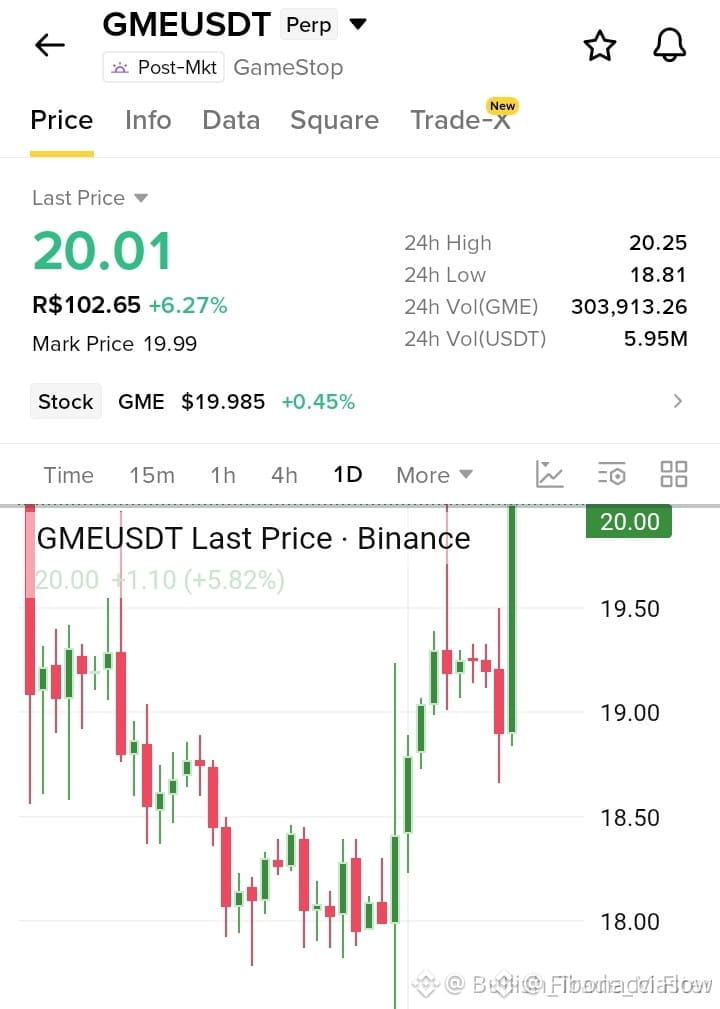
🚀 $GME SURGES INTO BULLISH MOMENTUM, WHALES ON THE HUNT! 📈
The order flow on $GME is flipping the script, with aggressive buy walls carving out the last resistance. 📊 Volume spikes on the 1‑hour chart signal a fresh influx of smart‑money capital 🦈.
Meanwhile $IOST and $BTR are echoing the rally, but $GME leads the pack, riding a tight liquidity sweep that could push it toward the next breakout zone. ⚡
💬 Are you loading up on the upside or waiting for the next liquidity trap?
⚠️ Not financial advice. Always manage your risk. 🛡️
🏷️ #GME #LongSetup #BullishMomentum #Crypto
🔥 💎
🚀 $GME SURGES INTO BULLISH MOMENTUM, WHALES ON THE HUNT! 📈
The order flow on $GME is flipping the script, with aggressive buy walls carving out the last resistance. 📊 Volume spikes on the 1‑hour chart signal a fresh influx of smart‑money capital 🦈.
Meanwhile $IOST and $BTR are echoing the rally, but $GME leads the pack, riding a tight liquidity sweep that could push it toward the next breakout zone. ⚡
💬 Are you loading up on the upside or waiting for the next liquidity trap?
⚠️ Not financial advice. Always manage your risk. 🛡️
🏷️ #GME #LongSetup #BullishMomentum #Crypto
🔥 💎
The order flow on $GME is flipping the script, with aggressive buy walls carving out the last resistance. 📊 Volume spikes on the 1‑hour chart signal a fresh influx of smart‑money capital 🦈.
Meanwhile $IOST and $BTR are echoing the rally, but $GME leads the pack, riding a tight liquidity sweep that could push it toward the next breakout zone. ⚡
💬 Are you loading up on the upside or waiting for the next liquidity trap?
⚠️ Not financial advice. Always manage your risk. 🛡️
🏷️ #GME #LongSetup #BullishMomentum #Crypto
🔥 💎
299

·
--
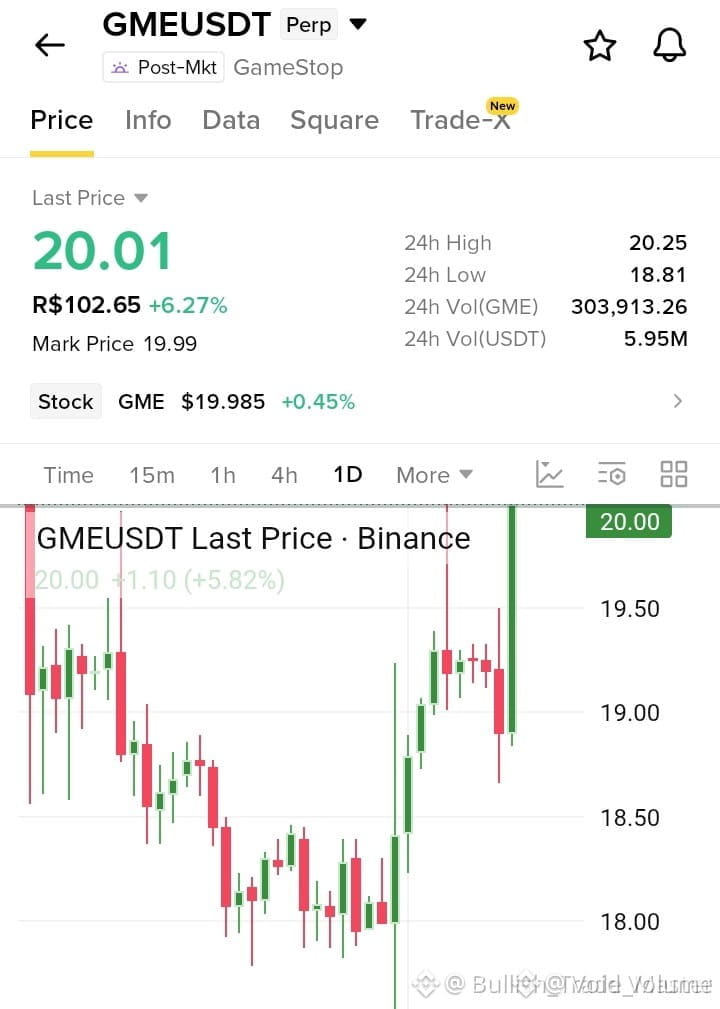
🚀 $GME RIDE THE SMART MONEY SURGE – LIQUIDITY SWEEP IN PLAY 🦈
📊 Institutional footprints are re‑stacking on the $GME demand zone, with a fresh wave of buy‑side execution that has cleared the last liquidity pool under $12.5.
🦈 The concurrent uptick in $IOST and $BTR volumes hints at cross‑asset liquidity reallocation, a classic smart‑money rotation that often precedes a sustained rally. 📈 Watch the 4‑hour order block at $12.70 for a potential retest before the next upward thrust.
💬 Are you aligning your position with the emerging order block or waiting for the next liquidity sweep? 👇
⚠️ Not financial advice. Always manage your risk. 🛡️
🏷️ #GME #SmartMoney #LiquiditySweep #Equities #Crypto
🦈 🔥
🚀 $GME RIDE THE SMART MONEY SURGE – LIQUIDITY SWEEP IN PLAY 🦈
📊 Institutional footprints are re‑stacking on the $GME demand zone, with a fresh wave of buy‑side execution that has cleared the last liquidity pool under $12.5.
🦈 The concurrent uptick in $IOST and $BTR volumes hints at cross‑asset liquidity reallocation, a classic smart‑money rotation that often precedes a sustained rally. 📈 Watch the 4‑hour order block at $12.70 for a potential retest before the next upward thrust.
💬 Are you aligning your position with the emerging order block or waiting for the next liquidity sweep? 👇
⚠️ Not financial advice. Always manage your risk. 🛡️
🏷️ #GME #SmartMoney #LiquiditySweep #Equities #Crypto
🦈 🔥
📊 Institutional footprints are re‑stacking on the $GME demand zone, with a fresh wave of buy‑side execution that has cleared the last liquidity pool under $12.5.
🦈 The concurrent uptick in $IOST and $BTR volumes hints at cross‑asset liquidity reallocation, a classic smart‑money rotation that often precedes a sustained rally. 📈 Watch the 4‑hour order block at $12.70 for a potential retest before the next upward thrust.
💬 Are you aligning your position with the emerging order block or waiting for the next liquidity sweep? 👇
⚠️ Not financial advice. Always manage your risk. 🛡️
🏷️ #GME #SmartMoney #LiquiditySweep #Equities #Crypto
🦈 🔥
270

·
--
🚨 $GME HITS FIRST TARGET, SMART MONEY RECHARGING! 🦈
The demand block at $GME 's recent low has been aggressively defended, swallowing sell orders and signaling a smart‑money accumulation zone. 📊 Volume spikes on the 1‑hour chart confirm the liquidity sweep, while the price now respects the prior swing high as a fresh bullish order block.
A modest pullback to the 4‑hour support could offer a clean entry, with the next upside target aligned with the prior resistance cluster. 🔍 Expect the market to test the next liquidity pool before any major retracement. 📈
💬 Are you positioning for the next upward thrust or waiting for a deeper liquidity hunt?
⚠️ Not financial advice. Always manage your risk. 🛡️
🏷️ #GME #LongSetup #LiquiditySweep #SmartMoney #Crypto
🔥 💎
🚨 $GME HITS FIRST TARGET, SMART MONEY RECHARGING! 🦈
The demand block at $GME 's recent low has been aggressively defended, swallowing sell orders and signaling a smart‑money accumulation zone. 📊 Volume spikes on the 1‑hour chart confirm the liquidity sweep, while the price now respects the prior swing high as a fresh bullish order block.
A modest pullback to the 4‑hour support could offer a clean entry, with the next upside target aligned with the prior resistance cluster. 🔍 Expect the market to test the next liquidity pool before any major retracement. 📈
💬 Are you positioning for the next upward thrust or waiting for a deeper liquidity hunt?
⚠️ Not financial advice. Always manage your risk. 🛡️
🏷️ #GME #LongSetup #LiquiditySweep #SmartMoney #Crypto
🔥 💎
The demand block at $GME 's recent low has been aggressively defended, swallowing sell orders and signaling a smart‑money accumulation zone. 📊 Volume spikes on the 1‑hour chart confirm the liquidity sweep, while the price now respects the prior swing high as a fresh bullish order block.
A modest pullback to the 4‑hour support could offer a clean entry, with the next upside target aligned with the prior resistance cluster. 🔍 Expect the market to test the next liquidity pool before any major retracement. 📈
💬 Are you positioning for the next upward thrust or waiting for a deeper liquidity hunt?
⚠️ Not financial advice. Always manage your risk. 🛡️
🏷️ #GME #LongSetup #LiquiditySweep #SmartMoney #Crypto
🔥 💎
18
🚀 $GME SURFACES WITH A SURPRISE LIQUIDITY SWEEP! 🦈
📊 Smart money is dragging $GME into a tight liquidity pocket, snapping the last sell wall with a clean sweep. ⚡ The 4‑hour volume surge and a bullish divergence on the RSI signal that buyers are re‑charging the order block.
🌊 With the order flow turning aggressive, the next swing could flip the recent dip into a fresh rally, especially if the whales lock in positions above the current price. 🦈
💬 Do you see the next wave of buying pressure breaking higher or a trap waiting below? 👇
⚠️ Not financial advice. Always manage your risk. 🛡️
🏷️ #GME #SmartMoney #Momentum #Crypto
🦈 🚀
🚀 $GME SURFACES WITH A SURPRISE LIQUIDITY SWEEP! 🦈
📊 Smart money is dragging $GME into a tight liquidity pocket, snapping the last sell wall with a clean sweep. ⚡ The 4‑hour volume surge and a bullish divergence on the RSI signal that buyers are re‑charging the order block.
🌊 With the order flow turning aggressive, the next swing could flip the recent dip into a fresh rally, especially if the whales lock in positions above the current price. 🦈
💬 Do you see the next wave of buying pressure breaking higher or a trap waiting below? 👇
⚠️ Not financial advice. Always manage your risk. 🛡️
🏷️ #GME #SmartMoney #Momentum #Crypto
🦈 🚀
📊 Smart money is dragging $GME into a tight liquidity pocket, snapping the last sell wall with a clean sweep. ⚡ The 4‑hour volume surge and a bullish divergence on the RSI signal that buyers are re‑charging the order block.
🌊 With the order flow turning aggressive, the next swing could flip the recent dip into a fresh rally, especially if the whales lock in positions above the current price. 🦈
💬 Do you see the next wave of buying pressure breaking higher or a trap waiting below? 👇
⚠️ Not financial advice. Always manage your risk. 🛡️
🏷️ #GME #SmartMoney #Momentum #Crypto
🦈 🚀
30
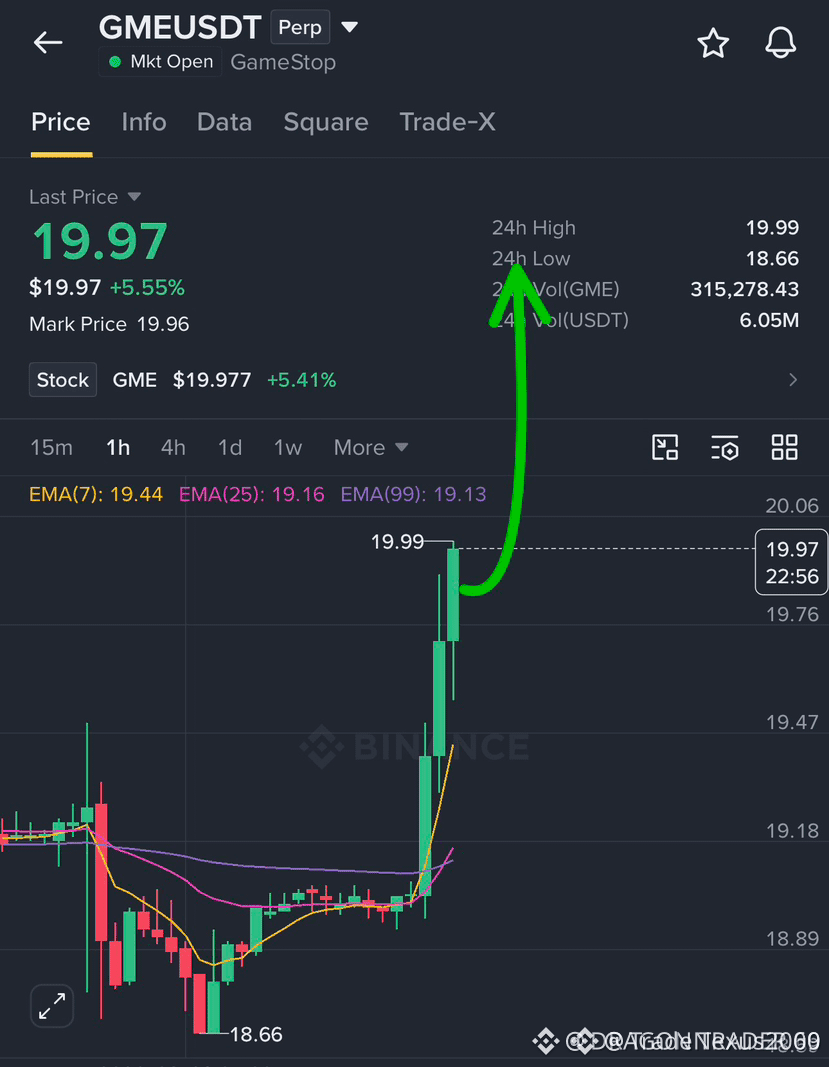
🚀 $GME SURFACES THROUGH LIQUIDITY SWEEP INTO NEW HIGHER RANGE! 🦈
Entry: 19.35-19.97 ⚡
Target: 20.05 🚀
Target: 20.45 🚀
Smart money has been chewing the $GME demand zone between 19.35‑19.97, repeatedly absorbing sell pressure and flashing a classic liquidity sweep. 📊 The 4‑hour order block now sits on a widening imbalance, hinting at a deeper institutional push. 🦈
With the next resistance at 20.05 and a secondary ceiling at 20.45, the setup offers a clean 1:3+ risk‑reward if you respect the tight stop below the block. ⚡ Expect volume to fan out as buyers retake control. 💬 Are you ready to ride this smart‑money wave or waiting for the next liquidity trap? 👇
⚠️ Not financial advice. Always manage your risk. 🛡️
🏷️ #GME #LongSetup #LiquiditySweep #Crypto
🔥 💎
🚀 $GME SURFACES THROUGH LIQUIDITY SWEEP INTO NEW HIGHER RANGE! 🦈
Entry: 19.35-19.97 ⚡
Target: 20.05 🚀
Target: 20.45 🚀
Smart money has been chewing the $GME demand zone between 19.35‑19.97, repeatedly absorbing sell pressure and flashing a classic liquidity sweep. 📊 The 4‑hour order block now sits on a widening imbalance, hinting at a deeper institutional push. 🦈
With the next resistance at 20.05 and a secondary ceiling at 20.45, the setup offers a clean 1:3+ risk‑reward if you respect the tight stop below the block. ⚡ Expect volume to fan out as buyers retake control. 💬 Are you ready to ride this smart‑money wave or waiting for the next liquidity trap? 👇
⚠️ Not financial advice. Always manage your risk. 🛡️
🏷️ #GME #LongSetup #LiquiditySweep #Crypto
🔥 💎
Entry: 19.35-19.97 ⚡
Target: 20.05 🚀
Target: 20.45 🚀
Smart money has been chewing the $GME demand zone between 19.35‑19.97, repeatedly absorbing sell pressure and flashing a classic liquidity sweep. 📊 The 4‑hour order block now sits on a widening imbalance, hinting at a deeper institutional push. 🦈
With the next resistance at 20.05 and a secondary ceiling at 20.45, the setup offers a clean 1:3+ risk‑reward if you respect the tight stop below the block. ⚡ Expect volume to fan out as buyers retake control. 💬 Are you ready to ride this smart‑money wave or waiting for the next liquidity trap? 👇
⚠️ Not financial advice. Always manage your risk. 🛡️
🏷️ #GME #LongSetup #LiquiditySweep #Crypto
🔥 💎
20

🚀 $GME RISING THROUGH THE ENTRY ZONE – READY TO FLIP TO 20.45 💥
Entry: 19.35-19.97 ⚡
Target: 20.05 / 20.45 🚀
📊 Smart money is carving a tight demand block between 19.35 and 19.97, swallowing sell pressure on each test. The 4‑hour volume spike and a bullish RSI bounce hint the whales are stacking bids, setting the stage for a clean thrust past 20.00. ⚡ With two upside anchors, the risk‑reward profile looks crisp, but watch the 19.30 support for any sudden liquidity sweep.
💬 Are you loading up at the band or waiting for the next liquidity sweep? 👇
⚠️ Not financial advice. Always manage your risk. 🛡️
🏷️ #GME #LongSetup #Momentum #Crypto
🦈 🚀
🚀 $GME RISING THROUGH THE ENTRY ZONE – READY TO FLIP TO 20.45 💥
Entry: 19.35-19.97 ⚡
Target: 20.05 / 20.45 🚀
📊 Smart money is carving a tight demand block between 19.35 and 19.97, swallowing sell pressure on each test. The 4‑hour volume spike and a bullish RSI bounce hint the whales are stacking bids, setting the stage for a clean thrust past 20.00. ⚡ With two upside anchors, the risk‑reward profile looks crisp, but watch the 19.30 support for any sudden liquidity sweep.
💬 Are you loading up at the band or waiting for the next liquidity sweep? 👇
⚠️ Not financial advice. Always manage your risk. 🛡️
🏷️ #GME #LongSetup #Momentum #Crypto
🦈 🚀
Entry: 19.35-19.97 ⚡
Target: 20.05 / 20.45 🚀
📊 Smart money is carving a tight demand block between 19.35 and 19.97, swallowing sell pressure on each test. The 4‑hour volume spike and a bullish RSI bounce hint the whales are stacking bids, setting the stage for a clean thrust past 20.00. ⚡ With two upside anchors, the risk‑reward profile looks crisp, but watch the 19.30 support for any sudden liquidity sweep.
💬 Are you loading up at the band or waiting for the next liquidity sweep? 👇
⚠️ Not financial advice. Always manage your risk. 🛡️
🏷️ #GME #LongSetup #Momentum #Crypto
🦈 🚀
45
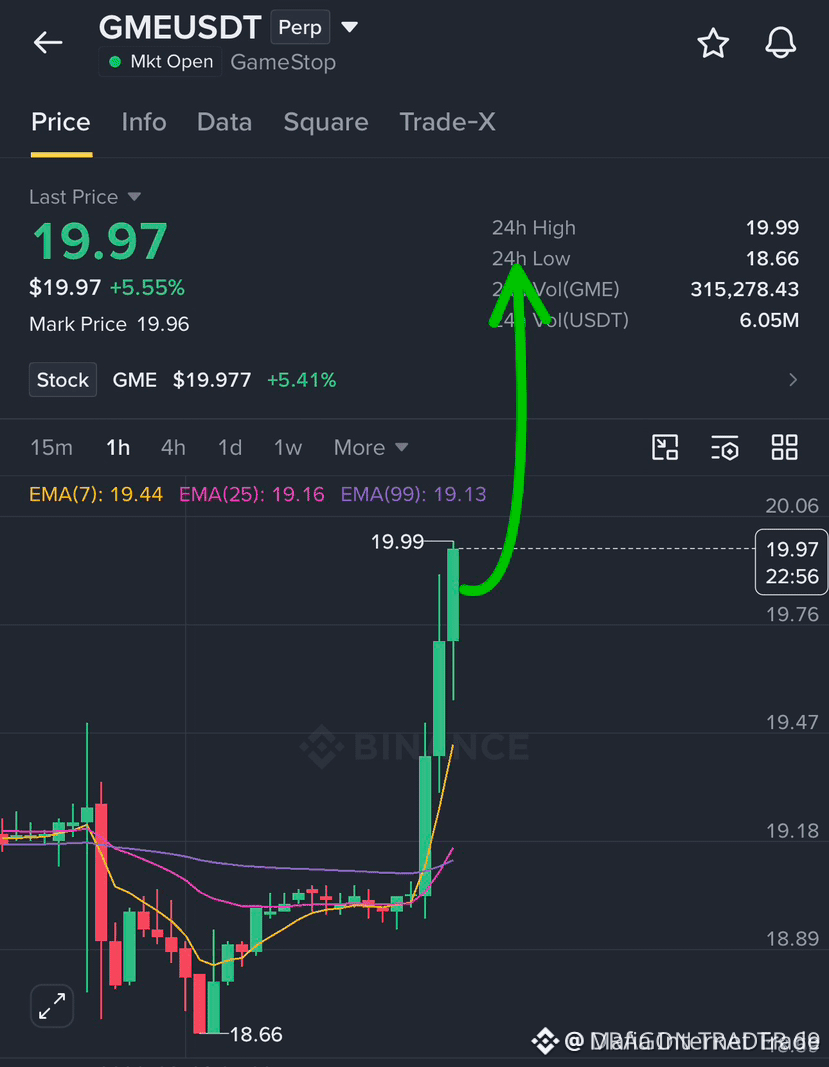
🚀 $GME BREAKING THROUGH $20 RESISTANCE WITH RAMPING MOMENTUM! 💥
Entry: 19.50-19.90 ⚡
Target: 20.20 🚀
Target: 20.60 🚀
Target: 21.00 🚀
Stop Loss: 19.00 ⚠️
📊 The price just ripped past the $18.65 anchor and is now chewing at the $20 psychological ceiling. ⚡ Smart money is loading bids at the breakout corridor, and the order flow shows a clean liquidity sweep under the $19 level. 📈 If buyers lock in above $20, the next wave could ride the $20.20‑$21 zone like a shark in a feeding frenzy.
💡 Volume spikes on the 15‑minute chart confirm the aggressive push, while the daily RSI is flirting with overbought territory yet still holding firm. 🌊 This suggests the bulls are still hungry and ready to reclaim higher ground. 💬 Do you see the next surge taking $GME past $21 or will sellers force a retest of the $19 stop zone? 👇
⚠️ Not financial advice. Always manage your risk. 🛡️
🏷️ #GME #LongSetup #Breakout #Momentum #Crypto
🔥 💎
🚀 $GME BREAKING THROUGH $20 RESISTANCE WITH RAMPING MOMENTUM! 💥
Entry: 19.50-19.90 ⚡
Target: 20.20 🚀
Target: 20.60 🚀
Target: 21.00 🚀
Stop Loss: 19.00 ⚠️
📊 The price just ripped past the $18.65 anchor and is now chewing at the $20 psychological ceiling. ⚡ Smart money is loading bids at the breakout corridor, and the order flow shows a clean liquidity sweep under the $19 level. 📈 If buyers lock in above $20, the next wave could ride the $20.20‑$21 zone like a shark in a feeding frenzy.
💡 Volume spikes on the 15‑minute chart confirm the aggressive push, while the daily RSI is flirting with overbought territory yet still holding firm. 🌊 This suggests the bulls are still hungry and ready to reclaim higher ground. 💬 Do you see the next surge taking $GME past $21 or will sellers force a retest of the $19 stop zone? 👇
⚠️ Not financial advice. Always manage your risk. 🛡️
🏷️ #GME #LongSetup #Breakout #Momentum #Crypto
🔥 💎
Entry: 19.50-19.90 ⚡
Target: 20.20 🚀
Target: 20.60 🚀
Target: 21.00 🚀
Stop Loss: 19.00 ⚠️
📊 The price just ripped past the $18.65 anchor and is now chewing at the $20 psychological ceiling. ⚡ Smart money is loading bids at the breakout corridor, and the order flow shows a clean liquidity sweep under the $19 level. 📈 If buyers lock in above $20, the next wave could ride the $20.20‑$21 zone like a shark in a feeding frenzy.
💡 Volume spikes on the 15‑minute chart confirm the aggressive push, while the daily RSI is flirting with overbought territory yet still holding firm. 🌊 This suggests the bulls are still hungry and ready to reclaim higher ground. 💬 Do you see the next surge taking $GME past $21 or will sellers force a retest of the $19 stop zone? 👇
⚠️ Not financial advice. Always manage your risk. 🛡️
🏷️ #GME #LongSetup #Breakout #Momentum #Crypto
🔥 💎
27
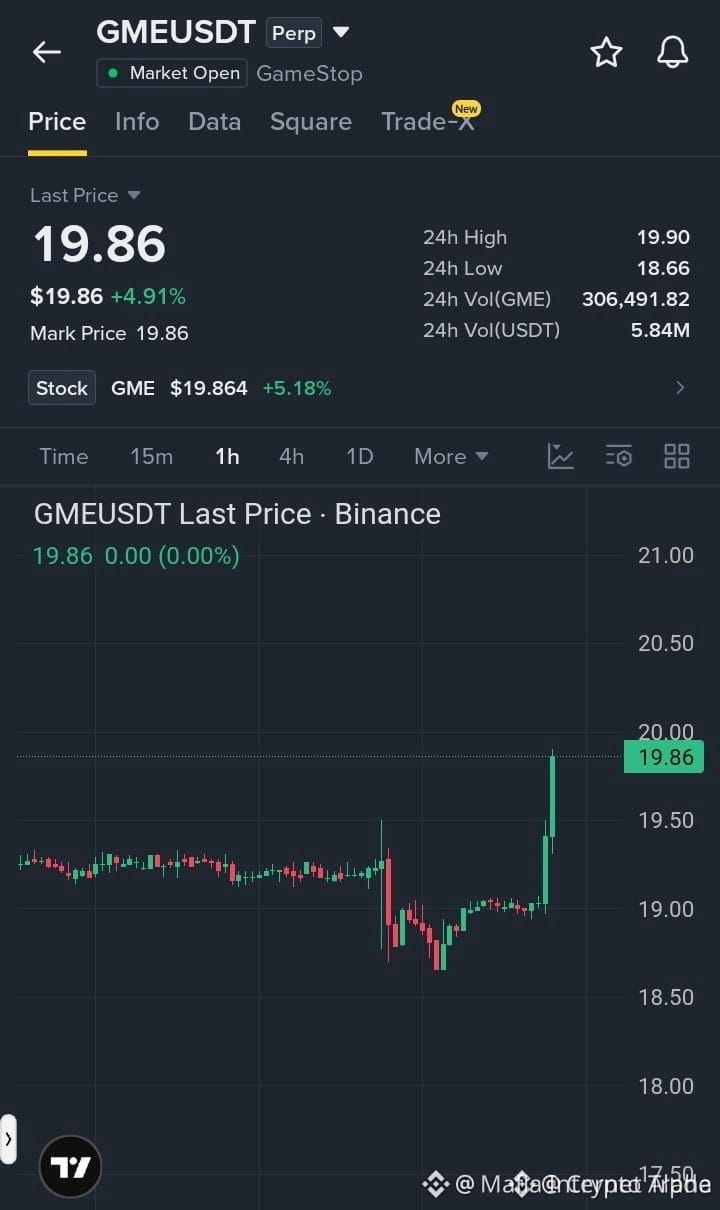
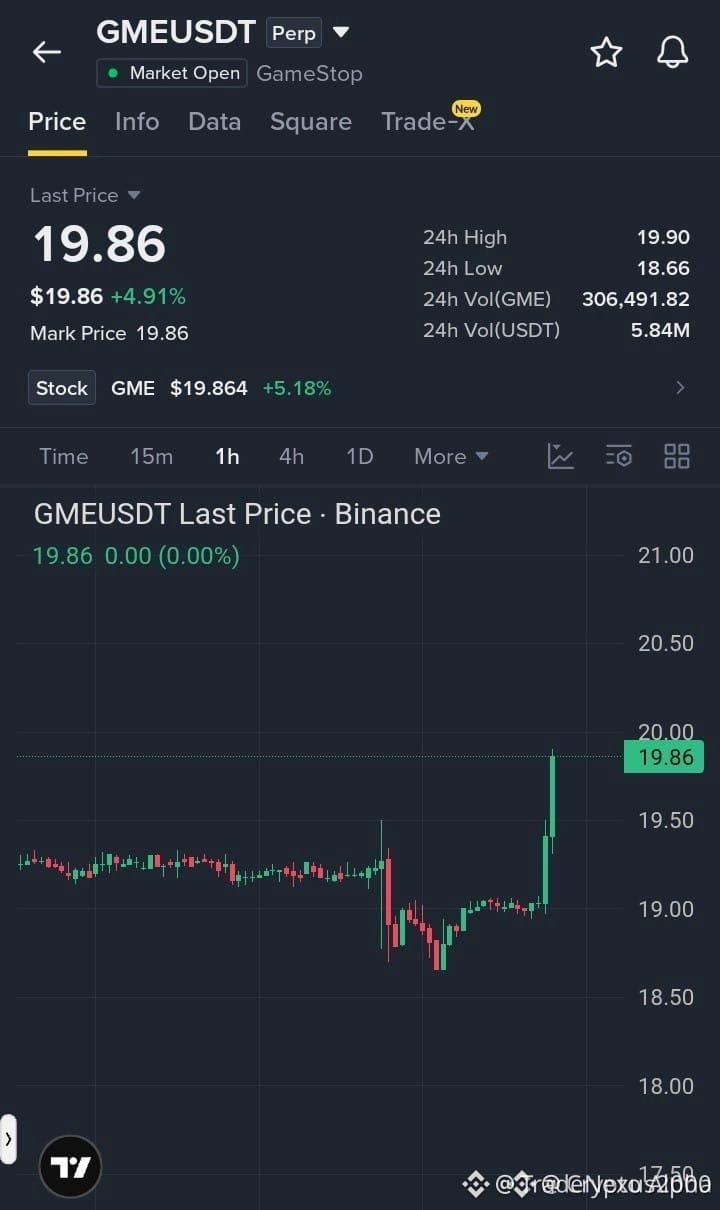
🚀 $GME BREAKS $20 RESISTANCE ON RAMPED MOMENTUM! 📈
Entry: 19.50-19.90 ⚡
Target: 20.20 / 20.60 / 21.00 🚀
Stop Loss: 19.00 ⚠️
📊 The latest surge reflects a smart‑money liquidity sweep, with $GME swallowing sell pressure at the $19.65 order block. ⚡ Volume on the 1‑hour frame is expanding, confirming buyers’ intent to defend the breakout. 💡 Should the price hold above $20, the next demand pocket near $21 becomes the logical target, aligning with historic swing patterns. 🌊
💬 Are you positioning for this breakout or waiting for a retest? 👇
⚠️ Not financial advice. Always manage your risk. 🛡️
🏷️ #GME #LongSetup #Breakout #SmartMoney #Crypto
🔥 💎
🚀 $GME BREAKS $20 RESISTANCE ON RAMPED MOMENTUM! 📈
Entry: 19.50-19.90 ⚡
Target: 20.20 / 20.60 / 21.00 🚀
Stop Loss: 19.00 ⚠️
📊 The latest surge reflects a smart‑money liquidity sweep, with $GME swallowing sell pressure at the $19.65 order block. ⚡ Volume on the 1‑hour frame is expanding, confirming buyers’ intent to defend the breakout. 💡 Should the price hold above $20, the next demand pocket near $21 becomes the logical target, aligning with historic swing patterns. 🌊
💬 Are you positioning for this breakout or waiting for a retest? 👇
⚠️ Not financial advice. Always manage your risk. 🛡️
🏷️ #GME #LongSetup #Breakout #SmartMoney #Crypto
🔥 💎
Entry: 19.50-19.90 ⚡
Target: 20.20 / 20.60 / 21.00 🚀
Stop Loss: 19.00 ⚠️
📊 The latest surge reflects a smart‑money liquidity sweep, with $GME swallowing sell pressure at the $19.65 order block. ⚡ Volume on the 1‑hour frame is expanding, confirming buyers’ intent to defend the breakout. 💡 Should the price hold above $20, the next demand pocket near $21 becomes the logical target, aligning with historic swing patterns. 🌊
💬 Are you positioning for this breakout or waiting for a retest? 👇
⚠️ Not financial advice. Always manage your risk. 🛡️
🏷️ #GME #LongSetup #Breakout #SmartMoney #Crypto
🔥 💎
16
Log in to explore more content
Join global crypto users on Binance Square
⚡️ Get latest and useful information about crypto.
💬 Trusted by the world’s largest crypto exchange.
👍 Discover real insights from verified creators.
Email / Phone number
Trending Topics
1
#AIStocksWhatNext
361,914 views
2,979 Discussing
2
#BitcoinBreaksAboveMayHighNears$86K
14,630 views
190 Discussing
3
#DogecoinRises15%
46,381 views
987 Discussing
4
#$14BBitcoinOptionsExpireFriday
3,784 views
89 Discussing
5
#BNBMarketCapPassesBNYMellon
29,388 views
705 Discussing
6
#CryptoMarketCapReclaims$3Trillion
4,982 views
81 Discussing
7
#MuseOvertakesChatGPTAsTopFreeIOSApp
17,351 views
530 Discussing
8
#TokenizedStockPlatformsCouldLaunchNextQuarter
27,594 views
587 Discussing
9
#StrategyAdds950Bitcoin
34,500 views
682 Discussing
10
#CardanoAddedToX402KitForADAPayments
29,536 views
654 Discussing