
#fincen
fincen
64,171 views
113 Discussing
Hot
Latest
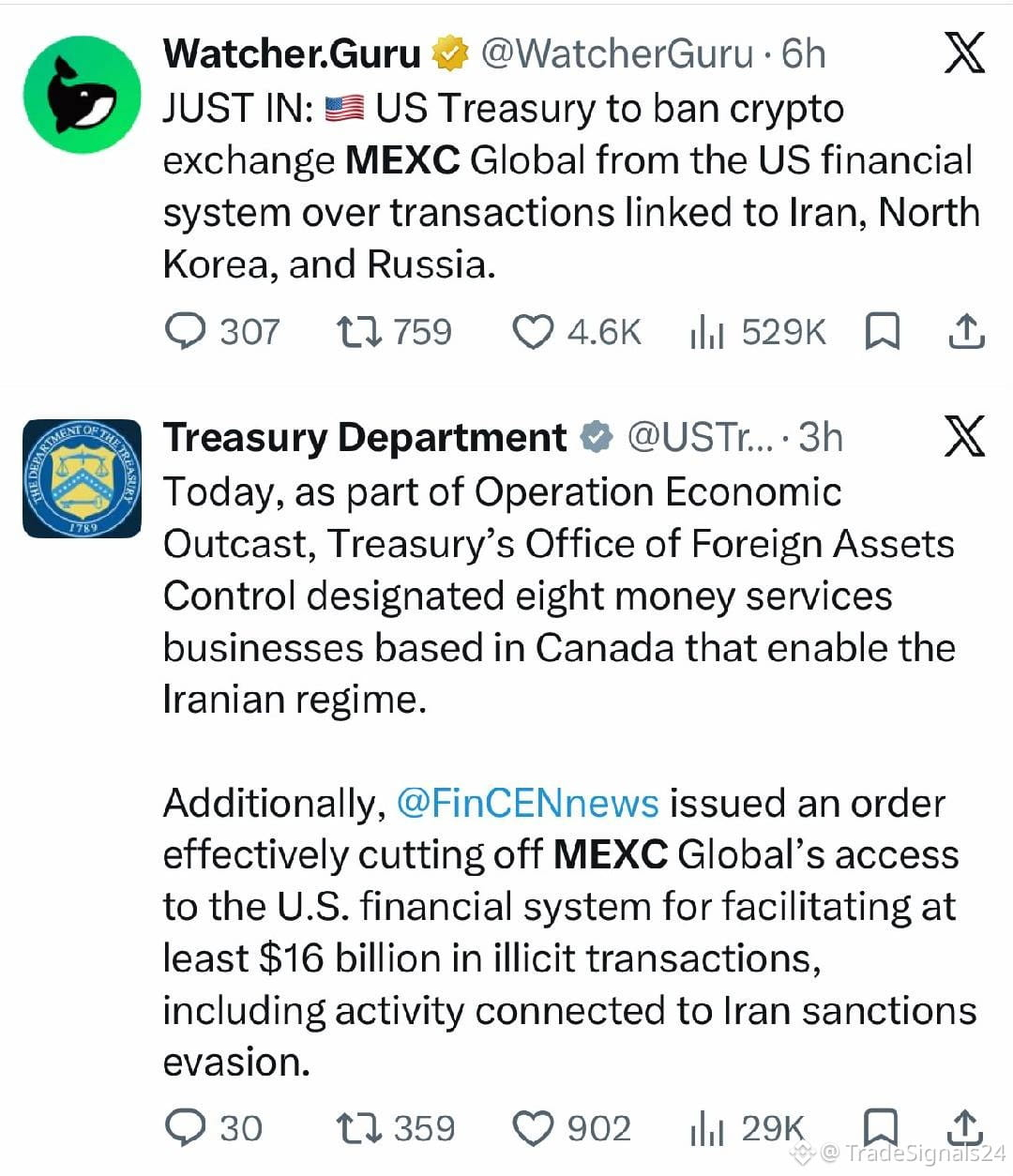
US Treasury takes major action against crypto exchange MEXC Global. FinCEN issued an order severing its access to the US financial system after it allegedly moved $16B+ in illicit flows tied to Iranian, North Korean, and Russian sanctions evasion and cybercrime.
At the same time, eight Canadian money services firms were designated for helping the Iranian regime. Part of Operation Economic Outcast.
#MEXC #OperationEconomicOutcast #CryptoSanctions #FinCEN
At the same time, eight Canadian money services firms were designated for helping the Iranian regime. Part of Operation Economic Outcast.
#MEXC #OperationEconomicOutcast #CryptoSanctions #FinCEN
142

·
--
Bearish
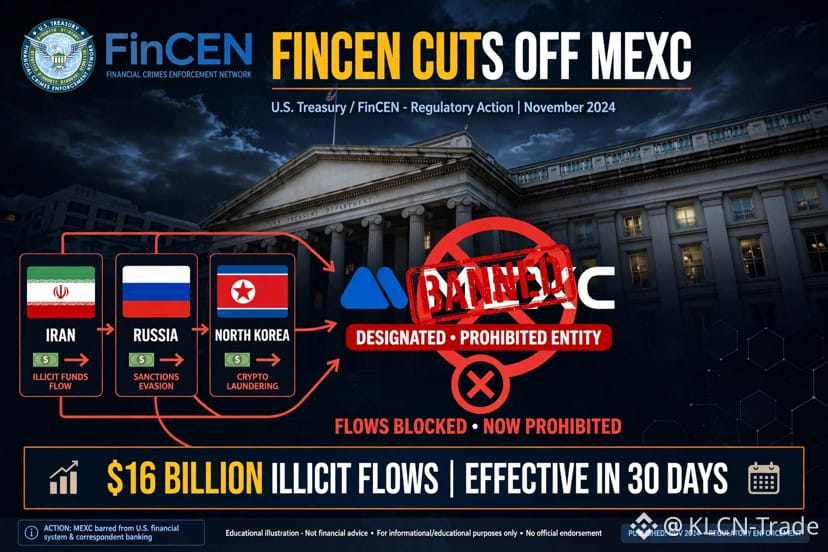
[BREAKING] US TREASURY BANS MEXC: $16B ILLICIT FLOWS EXPOSED
FinCEN just ordered US banks to stop ALL transfers with $MEXC Global【5617397683010952869†L7-L8】
WHAT HAPPENED:
FinCEN says MEXC facilitated at least $16 BILLION in illicit transactions from May 2021-May 2026【5617397683010952869†L24-L25】:
- $1.5B tied to Russian sanctions evasion【5617397683010952869†L77-L78】
- $1B direct deals with 40+ Iranian exchanges【5617397683010952869†L80-L81】
- $22M linked to Iran Central Bank & IRGC Qods Force【5617397683010952869†L152-L153】
- Still trading with sanctioned Garantex/Grinex in June 2026【5617397683010952869†L26-L27】
IMPACT:
1. Effective 30 days after Federal Register publication【5617397683010952869†L14-L15】
2. US banks banned from sending/receiving funds to MEXC【5617397683010952869†L18-L19】
3. MEXC holds $4.48B assets as of Nov 6【5617397683010952869†L86-L87】
4. France ops winding down, users moved to Kraken【5617397683010952869†L178-L179】
MEXC RESPONSE:
"We are reviewing with legal & compliance teams. Operations normal, assets secure"【5617397683010952869†L56-L57】
WHY THIS MATTERS:
1. Part of "Operation Economic Outcast" targeting Iran/Russia crypto rails【5617397683010952869†L14-L15】
2. First 9714(a) order used on major exchange = precedent for others
3. $MX token + MEXC users: Withdrawal routes via US banks will close
This is NOT an OFAC sanction yet【5617397683010952869†L149-L150】. But FinCEN ban = death by banking.
Are you still using MEXC? Withdrawing now or waiting? 👇
#MEXC #FinCEN #Sanctions #CryptoNews #USTreasury #BinanceSquare #DYOR
97

·
--
🚨 BIG WIN FOR CRYPTO PRIVACY!
The U.S. Treasury’s FinCEN and the Federal Reserve have officially WITHDRAWN their controversial 2020 proposal to lower the crypto transaction tracking threshold from $3,000 to just $250.
What does this mean for the crypto community? 👇
If implemented, the proposal would have required financial institutions to collect and maintain personal information on many more cross-border crypto transactions, including smaller transfers.
But now, the proposed change is off the table, and the existing $3,000 threshold remains in place. The withdrawal takes effect on November 9, 2026.
🔥 Why did regulators change course?
• Nearly 3,000 public comments raised concerns about privacy and compliance costs.
• The digital asset industry has evolved significantly since 2020.
• New regulatory developments, including the GENIUS Act, have changed the landscape.
💡 My takeaway:
Crypto adoption needs regulation, but it also needs a balance between compliance, innovation, and financial privacy.
Protecting users' privacy while building a transparent and responsible crypto ecosystem should remain a priority.
A significant development for crypto privacy and the entire digital asset community! 🚀
What do you think? Is this a win for crypto users? 👇
#Crypto #BinanceSquare #FinCEN #CryptoPrivacy #Bitcoin❗ #Blockchain #Regulation
69

#FinCENAndFedWithdraw$250CryptoTransferProposal
🚨 BIG WIN FOR CRYPTO? FINCEN AND THE FED WITHDRAW THEIR $250 CRYPTO TRANSFER PROPOSAL!
A regulatory development in the United States could bring some relief to the crypto industry.
FinCEN and the Federal Reserve have withdrawn a proposed rule that would have lowered the reporting threshold for certain international funds transfers from $3,000 to just $250.
🔥 WHAT HAPPENED?
The proposed $250 reporting threshold has been withdrawn.
Crypto-related businesses could avoid an additional layer of proposed reporting requirements.
The decision removes one potential compliance burden.
The debate over financial transparency and crypto privacy continues.
📊 WHY DOES IT MATTER?
Lower reporting thresholds could have increased compliance costs and paperwork for financial institutions handling smaller transactions.
For the crypto industry, this development raises an important question: How can regulators prevent financial crime without placing unnecessary restrictions on everyday digital asset transfers?
This is not the end of crypto regulation in the US, but it is a development worth watching.
Do you think this is a positive step for crypto adoption?
#CryptoRegulation #FinCEN #CryptoNews
106


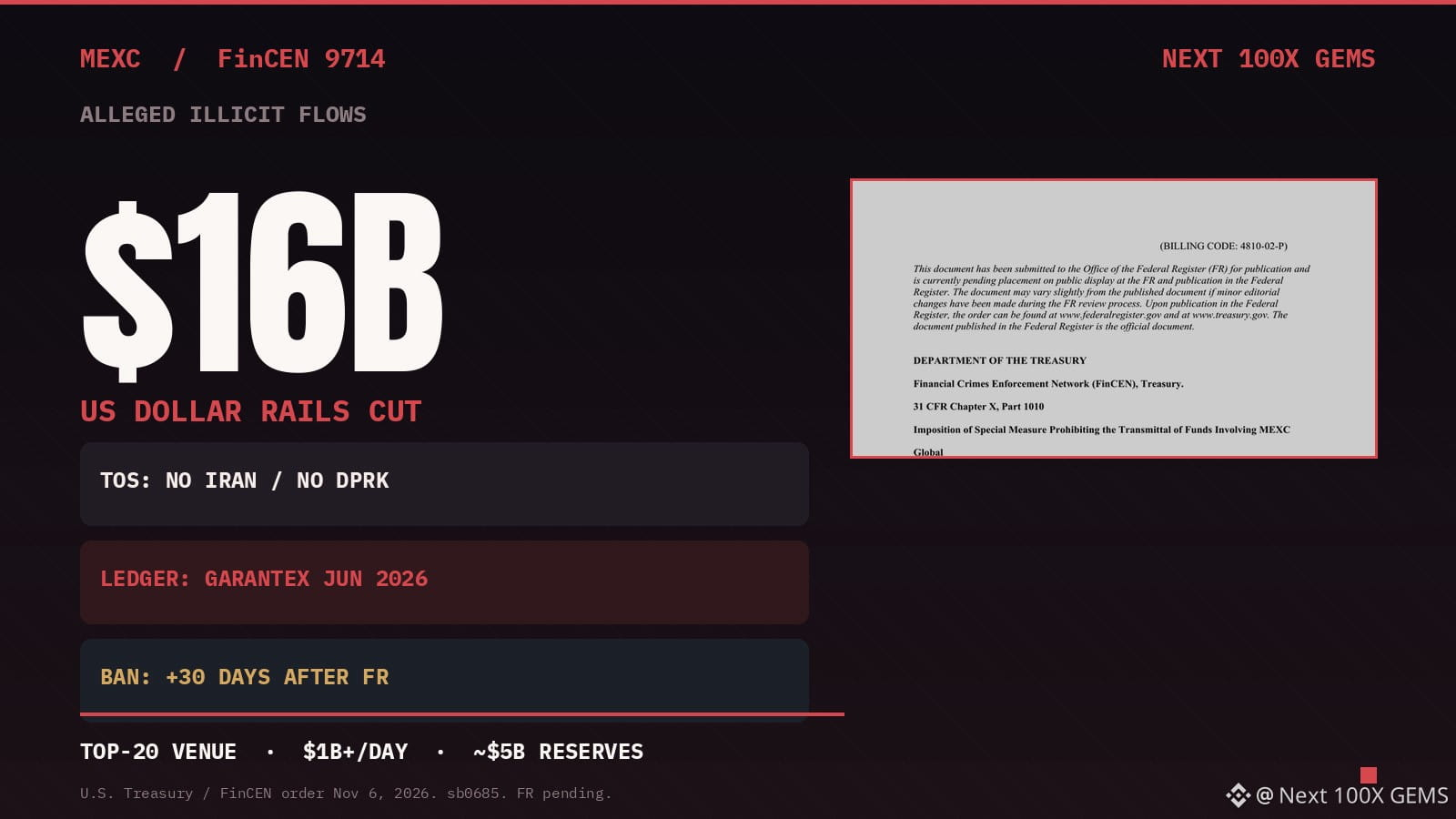
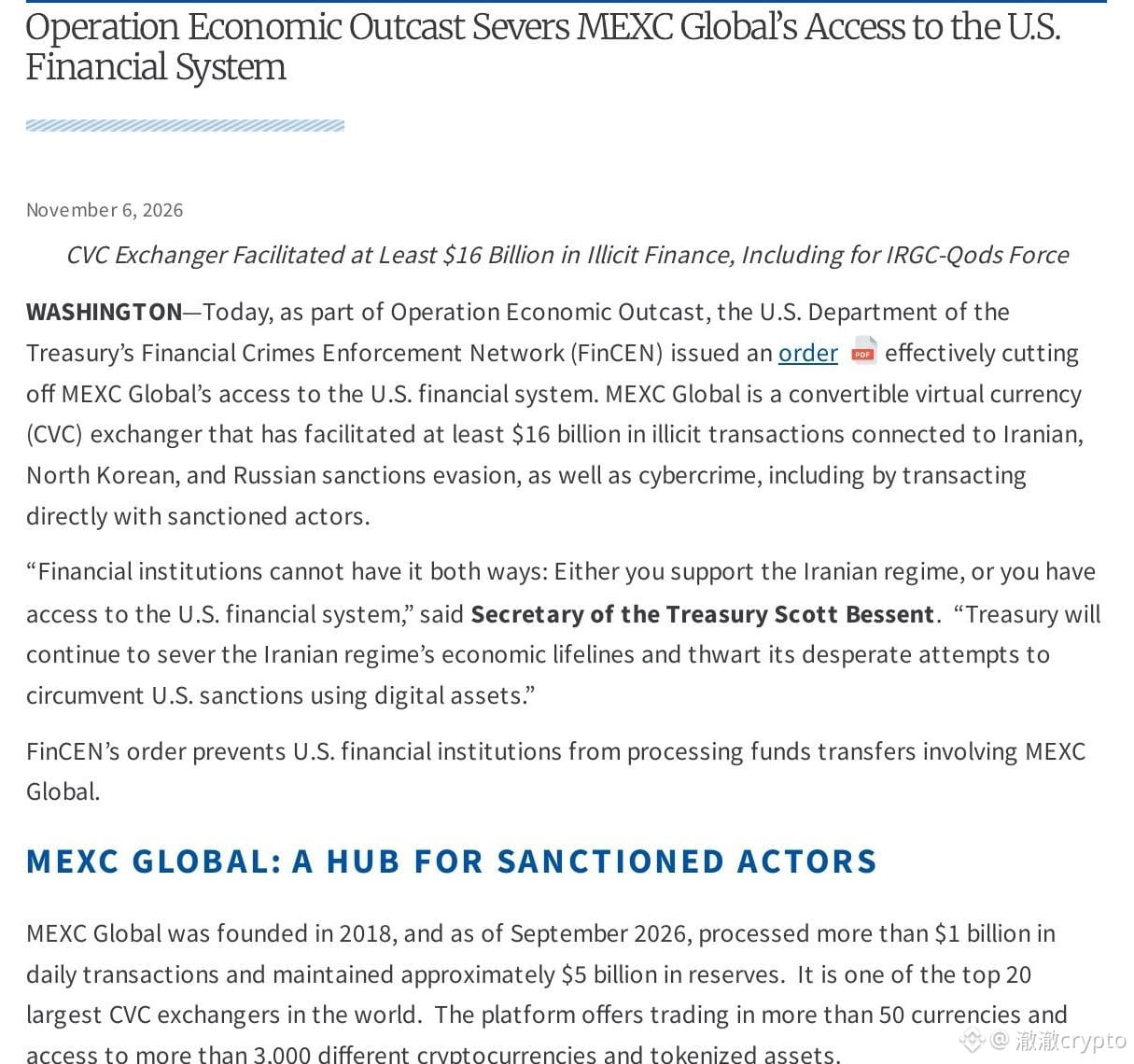
FinCEN just cut MEXC Global off US dollar rails over $16B.
Treasury says the top-20 exchange moved at least $16B in illicit-linked flows from May 2021 to May 2026 — Russia, Iran, North Korea, cybercrime. Nearly $1.5B tied to Russian sanctions evasion. About $1B with more than 40 Iranian exchangers. Roughly $22M for Iran's central bank and the IRGC-Qods Force.
The ToS already banned Iran and North Korea. The ledger still showed Garantex and Grinex traffic as late as June 2026 — more than four years after OFAC designated Garantex in April 2022.
As of September 2026: over $1B a day in volume, about $5B in reserves. The order bars US financial institutions from any funds transfer to or from MEXC. Clock starts when the Federal Register prints it. Ban lands 30 days later.
Paper said no. Rails said yes. Rails lose.
#FinCEN #CryptoRegulation
NFA. DYOR.
237

Washington just cut a top-20 exchange off from the US banking system — and I think it echoes beyond MEXC.
FinCEN ordered MEXC Global cut off from the US financial system Friday, under Operation Economic Outcast. Treasury alleges at least $16 billion in illicit flows from May 2021 to May 2026: sanctions evasion tied to Iran, North Korea and Russia, plus cybercrime. The breakdown is stark: nearly $1.5 billion in Russian sanctions evasion, $232 million with sanctioned entities directly, and trades with sanctioned exchange Garantex as recently as June 2026.
US banks will be barred from any transfers to or from MEXC once it takes effect, 30 days after Federal Register publication. Not an OFAC designation, and it doesn't shut MEXC down globally — but it strands its US dollar rails.
$BTC sits near $76,014, flat on the day — the market hasn't priced this in yet, or it simply doesn't care.
Is this Washington's template for offshore exchanges now: cut the banking rails, skip the courtroom?
#CryptoNews #MEXC #FinCEN #Sanctions
1

·
--
Last night, the biggest landmine in crypto wasn’t price—it was compliance. On November 6, the U.S. Treasury Department’s FinCEN issued a final order booting MEXC Global out of the U.S. financial system: from May 2021 to May 2026, the platform allegedly handled at least $16 billion in funds linked to sanctions evasion and cybercrime, including about $1.5 billion tied to Russian sanctions evasion and about $1.87 billion tied to Iran. As recently as June this year, it was doing business with Grinex, the successor to the sanctioned Russian exchange Garantex.
Let’s be clear about three things, so don’t get misled by sensational headlines:
① This is not an OFAC sanctions listing. It does not directly freeze users’ assets, nor does it mean MEXC is shutting down globally. The restrictions apply to U.S. financial institutions: 30 days after publication in the Federal Register, they may no longer process any fund transfers involving MEXC, including cryptocurrency.
② MEXC responded early this morning: its legal and compliance team is evaluating the matter, and operations and user assets are unaffected. But the response did not deny any of the allegations. The real test lies ahead: will banks, payment channels, and stablecoin issuers tighten restrictions preemptively?
③ This is part of the U.S. Treasury’s “Operation Economic Outcast,” which also named eight Canadian money services businesses on the same day. The message is clear: compliance is shifting from a bonus to a matter of survival.
My take:
- The platform token $MX is down only about 2.8%, at $1.54—the market hasn’t caught on yet. MEXC’s daily trading volume exceeds $1 billion and it has about $5 billion in reserves, so it won’t collapse in the short term. But if its dollar channels are cut off, fiat deposits and withdrawals and institutional partnerships will keep bleeding, and pressure on the platform token is only a matter of time.
- If you have funds on MEXC, withdraw larger amounts to your own wallet first. Don’t wait until the 30-day window is over to see how things go.
- Exchanges are being forced to choose sides, and poorly compliant ones will trade at an ever-larger discount. Funds and institutions will concentrate in leading exchanges that can remain within the dollar system, which is a long-term positive for $BNB .
Personal research; not investment advice.
$MX $BNB #MEXC #FinCEN #合规 #Exchange

1
814

·
--
U.S. Treasury cuts MEXC off from the banking system: it’s not a sanctions listing, but the money can’t get throughThis isn’t the kind of “naming” where OFAC puts you on a sanctions list. It’s a more direct move: U.S. financial institutions are barred from processing payments for you.
On November 6, the U.S. Treasury Department’s FinCEN, under the banner of “Operation Economic Outcast,” issued an order against MEXC Global under Section 9714(a) of the (Combating Russian Money Laundering Act): U.S. financial institutions are prohibited from processing any funds transfers to or from the platform, including transfers involving convertible virtual currency. The order takes effect 30 days after publication in the Federal Register and has no expiration date.
The official allegations involve substantial sums: from May 2021 to May 2026, at least $16 billion was linked to sanctions evasion, cybercrime, and other activities. Of that, about $1.5 billion involved Russian entities, including $232 million in direct dealings with sanctioned parties; roughly $1 billion involved transactions with more than 40 Iranian crypto exchange points. The allegations also name the IRGC’s Quds Force, among others. More strikingly, OFAC flagged Garantex back in 2022, yet MEXC was still dealing with it and its successor platform Grinex as of June 2026.
U.S. Treasury cuts MEXC off from the banking system: it’s not a sanctions listing, but the money can’t get through
This isn’t the kind of “naming” where OFAC puts you on a sanctions list. It’s a more direct move: U.S. financial institutions are barred from processing payments for you.
On November 6, the U.S. Treasury Department’s FinCEN, under the banner of “Operation Economic Outcast,” issued an order against MEXC Global under Section 9714(a) of the (Combating Russian Money Laundering Act): U.S. financial institutions are prohibited from processing any funds transfers to or from the platform, including transfers involving convertible virtual currency. The order takes effect 30 days after publication in the Federal Register and has no expiration date.
The official allegations involve substantial sums: from May 2021 to May 2026, at least $16 billion was linked to sanctions evasion, cybercrime, and other activities. Of that, about $1.5 billion involved Russian entities, including $232 million in direct dealings with sanctioned parties; roughly $1 billion involved transactions with more than 40 Iranian crypto exchange points. The allegations also name the IRGC’s Quds Force, among others. More strikingly, OFAC flagged Garantex back in 2022, yet MEXC was still dealing with it and its successor platform Grinex as of June 2026.
1
1k

·
--
U.S. Treasury’s sweeping move: Global top-20 exchange cut off from U.S. financial channels
▫️FinCEN orders U.S. financial institutions to stop processing money transfers involving MEXC
▫️Accuses it of handling at least $16 billion in funds linked to sanctions evasion and cybercrime over five years
▫️Daily trading volume exceeds $1 billion and reserves stand at around $5 billion, yet it remains among the global top 20
▫️Takes effect 30 days after publication in the Federal Register; violations may result in civil and criminal penalties
Deposit and withdrawal channels can be cut off just like that—the compliance bar has been raised yet again 😂
Who will be next? 👇 (Not investment advice)
#MEXC #FinCEN #CryptoRegulation

123

·
--
The U.S. Treasury’s FinCEN has made its move: under the name “Operation Economic Outcast,” it has ordered MEXC Global to be cut off from the U.S. financial system—U.S. financial institutions may no longer process any transfers of funds to or from the exchange.
The allegations are serious: from May 2021 to May 2026, at least approximately $16 billion in transactions were linked to sanctions evasion and cybercrime, including about $1.5 billion tied to Russian sanctions evasion. As recently as this June, MEXC was still transacting with sanctioned Garantex and its successor, Grinex. FinCEN has designated it a “primary money laundering concern” in connection with illicit Russian finance.
The order takes effect 30 days after its publication in the Federal Register. MEXC describes itself as one of the world’s top 20 exchanges, with daily trading volume exceeding $1 billion and reserves of around $5 billion. This isn’t the kind of designation used for the OFAC list; it directly cuts off the channels for moving dollars in and out—a significant blow for an offshore exchange.
#MEXC #FinCEN #Regulation

21

·
--
🚨 The U.S. Treasury is taking action against MEXC: One order cuts it off from the U.S. financial system!
📌 On November 6, FinCEN issued an order prohibiting U.S. financial institutions from processing any transfers involving MEXC Global, including fiat currency and crypto assets.
📌 The Treasury says that from May 2021 to May 2026, MEXC was involved in at least $16 billion in illicit fund flows linked to sanctions evasion involving Iran, North Korea, and Russia, as well as cybercrime.
📌 The order takes effect 30 days after publication in the Federal Register and has no expiration date. This is not an OFAC sanctions-list designation, but a ban on fund transfers.
📌 MEXC responded that the platform is still operating normally and that it is reviewing the order. (The amounts above are allegations by the U.S. government and have not been established by a court.)
🧐 My take:
1️⃣ Compliance costs are becoming a make-or-break issue for exchanges. Regulators are no longer focused only on U.S.-based platforms; offshore exchanges can also be “cut off.”
2️⃣ Meanwhile, BTC is fluctuating around $76,000, ETF net outflows totaled $412 million on Friday, and the Fear and Greed Index stands at 25 (extreme fear). With both news and sentiment weighing on the market, short-term investors are becoming more cautious.
3️⃣ Where you keep your assets, and whether a platform is compliant and transparent, matters more than earning a little extra yield.
👇 Would you move your funds from a smaller exchange to a compliant one because of regulatory risks? Share your thoughts in the comments.
$BTC $ETH #MEXC #加密监管 #FinCEN
Personal opinion only; not investment advice


·
--
💥The U.S. Treasury has taken direct action: MEXC, one of the world’s top 20 exchanges, handled at least $16 billion in illicit funds over five years.
On November 6, FinCEN ordered MEXC to be cut off from the U.S. financial system. From May 2021 to May 2026, MEXC handled at least $16 billion in illicit funds, nearly $1.5 billion of which was linked to evading Russian sanctions, while $232 million went directly to sanctioned entities.
Even more outrageous, as recently as June this year, MEXC was still doing business with the Russian exchange Garantex—which had been sanctioned for more than four years—and its successor. It also processed around $1 billion for more than 40 Iranian currency exchangers.
My take: this isn’t a fine—it’s a direct cutoff from the dollar system. The ban takes effect 30 days after its publication in the Federal Register, and U.S. banks will be barred from transferring even a cent to MEXC.
I’m watching two things: whether MEXC caves and makes changes in the 30-day window to seek an exemption, and whether this crackdown spreads to another major offshore exchange. If an exemption is granted, that would invalidate half of this assessment.
At the time of writing, Bitcoin was at $75,980 (-0.06%, live TradingView reading at 11:14).
Who do you think will be named next—another major offshore exchange, or will this be the end of the crackdown?
$BTC $ETH $SOL
#MEXC #FinCEN
98

Article
THE U.S. IS CUTTING MEXC OFF FROM THE FINANCIAL SYSTEM! EXCHANGE ACCUSED OF $16 BILLION IN ILLEGAL TRANSACTIONS!One of the largest cryptocurrency exchanges has come under serious pressure from U.S. regulators. On November 6, 2026, the U.S. Department of the Treasury announced its decision to restrict MEXC Global’s access to the country’s financial system.
The reason is the platform’s alleged involvement in processing at least $16 billion in transactions linked to sanctions evasion, cybercrime, and other illegal activity.
THE U.S. IS CUTTING MEXC OFF FROM THE FINANCIAL SYSTEM! EXCHANGE ACCUSED OF $16 BILLION IN ILLEGAL TRANSACTIONS!
One of the largest cryptocurrency exchanges has come under serious pressure from U.S. regulators. On November 6, 2026, the U.S. Department of the Treasury announced its decision to restrict MEXC Global’s access to the country’s financial system.
The reason is the platform’s alleged involvement in processing at least $16 billion in transactions linked to sanctions evasion, cybercrime, and other illegal activity.
The reason is the platform’s alleged involvement in processing at least $16 billion in transactions linked to sanctions evasion, cybercrime, and other illegal activity.
118
·
--
Saw this on Wu Blockchain: FinCEN and the Federal Reserve have withdrawn the 2020 proposal to revise the Travel Rule, lowering the threshold for cross-border transfers from $3,000 to $250.
The original proposal also planned to bring convertible virtual currencies and digital assets with legal-tender status under the rule—meaning identity information would have to be collected even for small cross-border crypto transfers. Nearly 3,000 public comments came in, most of them citing excessive compliance costs and privacy risks.
The official position: the industry and regulatory framework have changed, and feedback has been received, so the proposal is being withdrawn for now. Any future changes would require a new round of public comment. The current $3,000 threshold remains in place, and the Travel Rule itself has not been scrapped. The withdrawal is expected to take effect on November 9.
The threshold hasn’t been lowered, and exchanges can skip another round of heavy compliance prep.
#FinCEN #TravelRule #Regulation
4

🚨 U.S. RESTRICTS MEXC GLOBAL’S ACCESS TO THE FINANCIAL SYSTEM
On November 6, 2026, the U.S. Department of the Treasury announced a regulatory action against cryptocurrency exchange MEXC Global.
According to the Financial Crimes Enforcement Network (FinCEN), the platform facilitated at least US$16 billion in transactions associated with sanctions evasion, cybercrime, and other illicit activities between May 2021 and May 2026.
🔎 WHAT WAS ORDERED?
FinCEN issued an order prohibiting U.S. financial institutions from conducting fund transfers involving MEXC Global.
The action is part of Operation Economic Outcast, which targets financial networks used to circumvent international sanctions.
📊 KEY FIGURES CITED BY THE TREASURY
• At least US$16 billion in transactions related to illicit activities.
• Approximately US$1.5 billion linked to evasion of Russian sanctions.
• Around US$1 billion in direct transactions with more than 40 identified Iranian exchanges.
⚖️ WHEN DOES THE RESTRICTION TAKE EFFECT?
The order will take effect 30 days after its publication in the U.S. Federal Register.
This means the announcement should not be confused with all restrictions taking effect immediately.
🇧🇷 WHAT ABOUT BRAZILIAN INVESTORS?
The action may increase operational and counterparty risks in international financial services related to the exchange.
However, by itself, it does not mean that all Brazilian customers’ assets will be frozen or that trading on the platform will be universally prohibited.
⚠️ The figures and irregularities described reflect the U.S. authority’s findings and allegations. They are not presented here as a final court ruling.
📅 Announcement: 11/06/2026. Exact UTC time not confirmed.
📚 Official source — U.S. Department of the Treasury:
https://home.treasury.gov/news/press-releases/sb0685/
#MEXC #criptomoedas #regulacao #segurancafinanceira #FinCEN $BTC $USDT $BNB
118

·
--
The U.S. Treasury’s FinCEN has gone straight for the jugular—cutting MEXC off from the U.S. financial system.
This isn’t a verbal warning. It’s a formal order: U.S. financial institutions will no longer be allowed to process transactions for MEXC. It takes effect 30 days after publication in the Federal Register. The stated reasons are damning: at least $16 billion linked to sanctions evasion and cybercrime, with Iran, North Korea, and Russia all named. It also says MEXC was still moving money with sanctioned Garantex / Grinex as recently as June 2026—even after Garantex had been hit more than four years ago. Its AML terms in the user agreement are about as useful as window dressing.
A lot of people’s first reaction is: MEXC doesn’t let Americans open accounts anyway, so why should I care? That’s a shortsighted take. What’s being cut off is access to dollar rails and counterparties. European users withdrawing to U.S.-regulated exchanges, banking partners, stablecoin on- and off-ramps—once compliance officers consider those links toxic, it’s not about whether you have a U.S. IP address. It’s about whether anyone else is willing to deal with you.
This isn’t an OFAC-style order directly freezing assets. It’s a FinCEN prohibition on transmitting funds. It may sound milder, but in practice it’s more insidious: there’s no expiration date. The exchange can keep operating, but the dollar faucet gets shut off, and liquidity depends on counterparties choosing to walk away. User assets aren’t frozen automatically, but once withdrawal channels start shrinking, a bank-run narrative can take on a life of its own.
Over the past two weeks, Binance was just exposed through its signing service, and now the Treasury has MEXC pinned to the ground. The narrative is no longer “which exchange is safer?” It’s “who can still handle dollars normally?” Offshore exchanges talk compliance all day, but when they’re really scrutinized, it’s the same old story: having a prohibited list doesn’t mean you can actually block transactions. And when you can’t, everyone on the platform pays the price in counterparty risk.
#MEXC #FinCEN

97

Major regulatory action takes effect: The U.S. Treasury’s FinCEN has formally ordered a complete severing of MEXC’s ties to the U.S. financial system, prohibiting U.S. financial institutions from processing any fund transfers involving MEXC. Issued under Section 9714(a) of the Combating Russian Money Laundering Act, the order will take effect 30 days after publication in the Federal Register.
The alleged amounts are staggering: Between May 2021 and May 2026, MEXC allegedly processed at least $16 billion in funds linked to sanctions evasion, cybercrime, and other illicit activities involving Iranian, North Korean, and Russian entities. About $1.5 billion was tied to Russia, including $232 million in direct transactions with parties subject to U.S., EU, and UK sanctions. On the Iran front, about $1 billion involved dealings with more than 40 identified traders, along with approximately $22 million linked to Iran’s central bank and the Islamic Revolutionary Guard Corps.
Treasury Secretary Bessent’s remarks were forceful, sending a clear message: Offshore platforms can no longer use “geographic separation” as a compliance shield. Crossing sanctions red lines means facing the consequences of being cut off from the dollar system.
MEXC responded that its platform is operating normally and user assets are safe. It is assessing the order with its legal and compliance teams, has launched an independent review of its anti-money laundering and sanctions controls, and plans to engage constructively with FinCEN and regulators worldwide.
Three reminders: First, fiat payment channels could change during the 30-day window, so users should closely follow official announcements and plan ahead. Second, don’t trust so-called “transfer services” or “over-the-counter account unfreezing” offers; beware of follow-up scams. Third, this is another landmark enforcement case involving an offshore exchange. Compliance is now an irreversible trend, and a platform’s risk-control capabilities will be essential to its long-term survival.
#MEXC #FinCEN #CryptoCompliance
39

【Regulatory crackdown: FinCEN orders MEXC cut off from U.S. dollar financial channels】
The U.S. Treasury Department’s Financial Crimes Enforcement Network (FinCEN), invoking Section 9714(a) of the Combating Russian Money Laundering Act, issued an order requiring U.S. financial institutions to stop processing all money transfers involving MEXC—effectively “delisting” the exchange from the U.S. financial system. The order will take effect 30 days after its publication in the Federal Register.
Key figures cited in the allegations:
— From May 2021 to May 2026, MEXC processed at least $16 billion in funds linked to sanctions evasion and cybercrime;
— About $1.5 billion was linked to Russia, including $232 million in direct transactions with entities under U.S., EU, and UK sanctions, and services provided to the sanctions-evasion network A7;
— MEXC transacted directly with more than 40 Iranian crypto traders, handling about $1 billion, while another roughly $22 million was linked to the Central Bank of Iran and the Islamic Revolutionary Guard Corps;
— North Korea-linked entities were also involved.
Treasury Secretary Bessent took a hard line: financial institutions cannot support the Iranian regime while continuing to use the U.S. financial system.
MEXC’s response can be summarized in four points: the platform is operating normally; user assets are safe; it is working with its legal and compliance teams to assess the order; and it has launched an independent review of its anti-money laundering and sanctions controls, while expressing willingness to engage constructively with FinCEN and regulators worldwide.
My take: This is a rare “cutoff” enforcement action under Section 9714, and its signaling effect is greater than its short-term impact. For the centralized exchange industry as a whole, compliance is no longer just a regional concern—weaknesses in KYC, address screening, or sanctions-list monitoring could at any time lead to exclusion from the U.S. dollar system. Over the next 30 days, the key question is whether MEXC can present a credible remediation plan and reach an accommodation with regulators. Ordinary users should watch for possible friction with withdrawal channels and stablecoin conversions.
#MEXC #FinCEN #CryptoRegulation
41

·
--
【Breaking Regulatory News】The U.S. Treasury Department’s FinCEN has formally ordered a complete cutoff of MEXC’s ties to the U.S. financial system, prohibiting U.S. financial institutions from processing any money transfers involving MEXC. The order will take effect 30 days after its publication in the Federal Register.
The allegations are unusually serious: between May 2021 and May 2026, MEXC allegedly processed at least $16 billion in funds related to sanctions evasion and cybercrime, involving entities in Iran, North Korea, and Russia. Transactions linked to Russian sanctions evasion totaled nearly $1.5 billion, while direct dealings with Iranian traders amounted to about $1 billion. The funds also allegedly involved Iran’s central bank and entities linked to the Revolutionary Guard.
MEXC’s latest response: The platform is operating normally, and user assets are safe. It is working with its legal and compliance teams to assess the situation, has launched an independent review of its anti-money laundering and sanctions controls, and plans to engage constructively with FinCEN and other regulatory agencies.
Another way to look at this:
1. The action was taken under Section 9714(a) of the Combating Russian Money Laundering Act. This is a powerful enforcement tool targeting exchanges, and signals that geopolitical compliance risks at second-tier platforms are becoming increasingly apparent;
2. “Operating normally” does not mean “the risk is gone.” During the 30-day period before the order takes effect, fiat and cross-border channels may remain under pressure. Users keeping assets on the platform should assess counterparty risk for themselves—don’t wait for access channels to change before taking action;
3. In the long run, tighter regulation will continue to concentrate traffic and funds in leading platforms with more robust compliance systems. The industry shakeout is far from over.
The information comes from an announcement on the U.S. Treasury Department’s official website; it is not an unsubstantiated rumor. A reminder: especially at times like this, be alert to private-message scams offering to “unfreeze” assets or “withdraw funds on your behalf.” Rely only on information from official channels.
#MEXC #FinCEN #CryptoRegulation
43

·
--
Major regulatory action lands. The U.S. Treasury’s FinCEN, invoking Section 9714(a) of the Sanctions Russia Act, has ordered a complete cutoff of MEXC from the U.S. financial system, prohibiting U.S. financial institutions from processing any fund transfers involving MEXC. The order will take effect 30 days after publication in the Federal Register.
The alleged amounts are staggering: from May 2021 to May 2026, MEXC is accused of handling at least $16 billion in funds related to sanctions evasion and cybercrime, including nearly $1.5 billion in Russian sanctions-evasion transactions, about $1 billion in direct transactions with more than 40 Iranian crypto dealers, and roughly $22 million in transactions involving Iran’s central bank, the Islamic Revolutionary Guard Corps, and the Quds Force.
MEXC responded that its platform is operating normally and user assets are safe. It said it is evaluating the matter with its legal and compliance teams, has launched an independent review of its anti-money-laundering and sanctions controls, and plans constructive communication with FinCEN and other global regulators.
A few observations:
1. This is not a routine fine, but a "disconnect-style" enforcement action that directly cuts off dollar clearing channels, making it far more severe than typical settlement cases;
2. The 30-day effective window provides a buffer, but U.S. users and institutional counterparties will likely withdraw or disconnect early;
3. For ordinary users, exchange counterparty risk has again become a real variable — asset safety cannot rely solely on platform statements. Controlling exposure to a single platform and considering diversified custody deserve renewed attention;
4. Regulatory scrutiny is targeting stablecoins and sanctions evasion, on-chain compliance reviews are tightening, and compliance costs across the industry will continue to rise.
#MEXC #FinCEN #Crypto Regulation
37
Log in to explore more content
Join global crypto users on Binance Square
⚡️ Get latest and useful information about crypto.
💬 Trusted by the world’s largest crypto exchange.
👍 Discover real insights from verified creators.
Email / Phone number
Trending Topics
1
#JobsReportRaisesHikeOdds
305,011 views
2,341 Discussing
2
#CPITestsDecemberRateOutlook
42,788 views
517 Discussing
3
#BitcoinRebounds$75KAsChipsLead
24,496 views
239 Discussing
4
#US Data Center Rules May Constrain AI Expansion
45,695 views
168 Discussing
5
#ARKPlans14ThematicETFsCoveringAIAndTokenizedMarkets
385 views
19 Discussing
6
#WillAnthropicListOnTime
78,342 views
937 Discussing
7
#WillUS-IranTensionsBoostSafe-HavenDemand?
22,158 views
216 Discussing
8
#BitcoinETFsSee$412MNetOutflows
5,655 views
46 Discussing
9
#HKSFCPlansToRestrictCryptoAndExchangeTerms
19,322 views
320 Discussing
10
#TradFiForBeginners
48,877 views
721 Discussing