

#ethereumfoundationaiagentsfindnodecrashbug
ethereumfoundationaiagentsfindnodecrashbug
46,468 views
271 Discussing
Hot
Latest


AI Just Found a Real Ethereum Bug — And This Changes Everything
The Ethereum Foundation confirmed they used AI agents to uncover an actual vulnerability.
This isn’t hype — it’s the beginning of a new era where AI proactively strengthens blockchain security instead of just reacting to exploits.
Smarter audits. Faster fixes. Stronger networks.
What do you think — will AI become the default security layer for Ethereum and other chains?
#Ethereum #ETH #AISecurity $ETH #EthereumFoundationAIAgentsFindNodeCrashBug
AI Just Found a Real Ethereum Bug — And This Changes Everything
The Ethereum Foundation confirmed they used AI agents to uncover an actual vulnerability.
This isn’t hype — it’s the beginning of a new era where AI proactively strengthens blockchain security instead of just reacting to exploits.
Smarter audits. Faster fixes. Stronger networks.
What do you think — will AI become the default security layer for Ethereum and other chains?
#Ethereum #ETH #AISecurity $ETH #EthereumFoundationAIAgentsFindNodeCrashBug
The Ethereum Foundation confirmed they used AI agents to uncover an actual vulnerability.
This isn’t hype — it’s the beginning of a new era where AI proactively strengthens blockchain security instead of just reacting to exploits.
Smarter audits. Faster fixes. Stronger networks.
What do you think — will AI become the default security layer for Ethereum and other chains?
#Ethereum #ETH #AISecurity $ETH #EthereumFoundationAIAgentsFindNodeCrashBug

1
369

Article
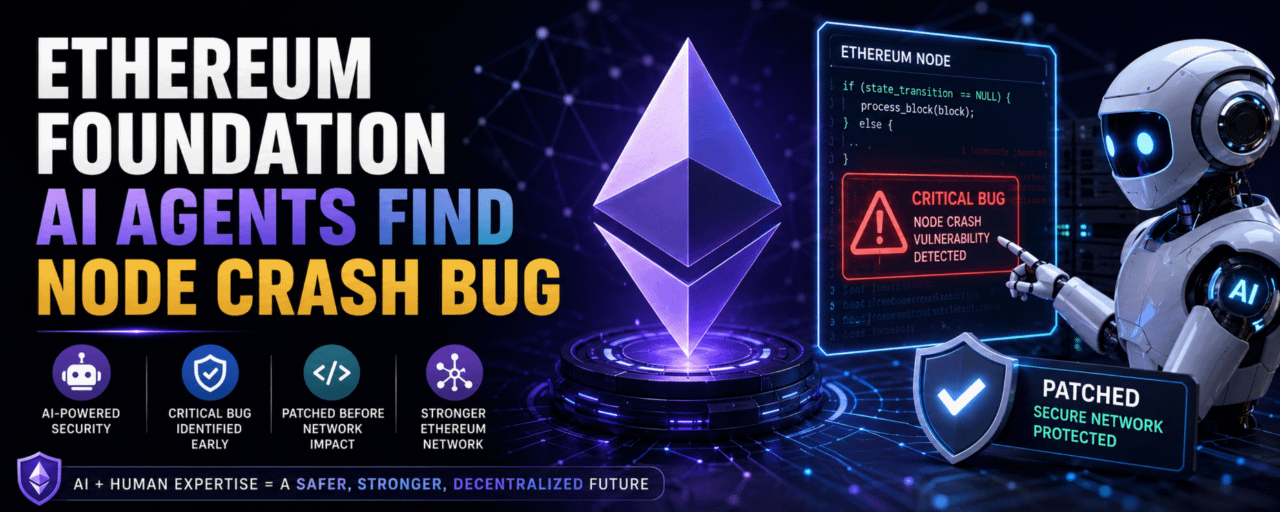
Ethereum Foundation AI Agents Find Critical Node Crash Bug$ETH
{spot}(ETHUSDT)
🤖The Ethereum Foundation has announced that AI-powered security agents successfully identified a critical bug capable of crashing Ethereum client nodes before it could impact the network.
The discovery highlights how artificial intelligence is becoming an increasingly valuable tool for blockchain security. Instead of replacing human researchers, AI agents work alongside developers by scanning millions of lines of code, simulating network conditions, and detecting vulnerabilities much faster than traditional manual reviews.
What Was Found?
According to the Ethereum Foundation, the AI agents detected a bug that could have caused certain Ethereum nodes to crash under specific conditions. The issue was discovered during testing, allowing developers to patch the vulnerability before it affected the live network.
No funds were reported lost, and the Ethereum blockchain continued operating normally throughout the discovery and fix.
Why It Matters
Finding bugs before they reach production is essential for maintaining Ethereum's reliability. Client software powers validators and network participants worldwide, making stability a top priority.
The successful use of AI demonstrates several advantages:
Faster detection of hidden software vulnerabilities.Improved testing across complex blockchain systems.Stronger network security before upgrades are released.Reduced risk of unexpected outages.
A New Era of Blockchain Security
As blockchain protocols become more sophisticated, AI-assisted auditing is expected to play a larger role in protecting decentralized networks. Automated tools can continuously analyze code, identify unusual behavior, and help developers respond more quickly to potential threats.
The Ethereum Foundation's latest success shows that combining AI technology with expert security researchers can significantly strengthen blockchain resilience.
Market Impact
The announcement is viewed as a positive development for the Ethereum ecosystem. While it is unlikely to have an immediate impact on ETH's price, improved security and proactive risk management can strengthen investor confidence over the long term.
The Ethereum Foundation's AI agents successfully identified a critical node crash bug before it could disrupt the network, highlighting the growing importance of artificial intelligence in blockchain security. As AI-driven tools continue to evolve, they are expected to become an essential part of protecting Ethereum and the broader crypto ecosystem.
#ethereumfoundationaiagentsfindnodecrashbug #ETH #Ethereum
Ethereum Foundation AI Agents Find Critical Node Crash Bug
$ETH
🤖The Ethereum Foundation has announced that AI-powered security agents successfully identified a critical bug capable of crashing Ethereum client nodes before it could impact the network.
The discovery highlights how artificial intelligence is becoming an increasingly valuable tool for blockchain security. Instead of replacing human researchers, AI agents work alongside developers by scanning millions of lines of code, simulating network conditions, and detecting vulnerabilities much faster than traditional manual reviews.
What Was Found?
According to the Ethereum Foundation, the AI agents detected a bug that could have caused certain Ethereum nodes to crash under specific conditions. The issue was discovered during testing, allowing developers to patch the vulnerability before it affected the live network.
No funds were reported lost, and the Ethereum blockchain continued operating normally throughout the discovery and fix.
Why It Matters
Finding bugs before they reach production is essential for maintaining Ethereum's reliability. Client software powers validators and network participants worldwide, making stability a top priority.
The successful use of AI demonstrates several advantages:
Faster detection of hidden software vulnerabilities.Improved testing across complex blockchain systems.Stronger network security before upgrades are released.Reduced risk of unexpected outages.
A New Era of Blockchain Security
As blockchain protocols become more sophisticated, AI-assisted auditing is expected to play a larger role in protecting decentralized networks. Automated tools can continuously analyze code, identify unusual behavior, and help developers respond more quickly to potential threats.
The Ethereum Foundation's latest success shows that combining AI technology with expert security researchers can significantly strengthen blockchain resilience.
Market Impact
The announcement is viewed as a positive development for the Ethereum ecosystem. While it is unlikely to have an immediate impact on ETH's price, improved security and proactive risk management can strengthen investor confidence over the long term.
The Ethereum Foundation's AI agents successfully identified a critical node crash bug before it could disrupt the network, highlighting the growing importance of artificial intelligence in blockchain security. As AI-driven tools continue to evolve, they are expected to become an essential part of protecting Ethereum and the broader crypto ecosystem.
#ethereumfoundationaiagentsfindnodecrashbug #ETH #Ethereum
🤖The Ethereum Foundation has announced that AI-powered security agents successfully identified a critical bug capable of crashing Ethereum client nodes before it could impact the network.
The discovery highlights how artificial intelligence is becoming an increasingly valuable tool for blockchain security. Instead of replacing human researchers, AI agents work alongside developers by scanning millions of lines of code, simulating network conditions, and detecting vulnerabilities much faster than traditional manual reviews.
What Was Found?
According to the Ethereum Foundation, the AI agents detected a bug that could have caused certain Ethereum nodes to crash under specific conditions. The issue was discovered during testing, allowing developers to patch the vulnerability before it affected the live network.
No funds were reported lost, and the Ethereum blockchain continued operating normally throughout the discovery and fix.
Why It Matters
Finding bugs before they reach production is essential for maintaining Ethereum's reliability. Client software powers validators and network participants worldwide, making stability a top priority.
The successful use of AI demonstrates several advantages:
Faster detection of hidden software vulnerabilities.Improved testing across complex blockchain systems.Stronger network security before upgrades are released.Reduced risk of unexpected outages.
A New Era of Blockchain Security
As blockchain protocols become more sophisticated, AI-assisted auditing is expected to play a larger role in protecting decentralized networks. Automated tools can continuously analyze code, identify unusual behavior, and help developers respond more quickly to potential threats.
The Ethereum Foundation's latest success shows that combining AI technology with expert security researchers can significantly strengthen blockchain resilience.
Market Impact
The announcement is viewed as a positive development for the Ethereum ecosystem. While it is unlikely to have an immediate impact on ETH's price, improved security and proactive risk management can strengthen investor confidence over the long term.
The Ethereum Foundation's AI agents successfully identified a critical node crash bug before it could disrupt the network, highlighting the growing importance of artificial intelligence in blockchain security. As AI-driven tools continue to evolve, they are expected to become an essential part of protecting Ethereum and the broader crypto ecosystem.
#ethereumfoundationaiagentsfindnodecrashbug #ETH #Ethereum
5
1.4k

·
--
Bullish
Artificial intelligence enhances Ethereum security
The Ethereum Foundation announced that artificial intelligence agents (AI Agents) were able to detect a real vulnerability that could have caused validator nodes to be taken offline remotely through a specially crafted message. The vulnerability was fixed and disclosed under the identifier CVE-2026-34219 before it could be exploited.
But the most important lesson wasn’t only that AI found the vulnerability—human review was necessary to distinguish real vulnerabilities from the hundreds of false positives produced by the models.
This step confirms that the future of cybersecurity in blockchain may depend on collaboration between AI and human experts: the AI accelerates problem detection, while the final decision and verification remain in the hands of specialists.
{future}(ETHUSDT)
#EthereumFoundationAIAgentsFindNodeCrashBug
Artificial intelligence enhances Ethereum security
The Ethereum Foundation announced that artificial intelligence agents (AI Agents) were able to detect a real vulnerability that could have caused validator nodes to be taken offline remotely through a specially crafted message. The vulnerability was fixed and disclosed under the identifier CVE-2026-34219 before it could be exploited.
But the most important lesson wasn’t only that AI found the vulnerability—human review was necessary to distinguish real vulnerabilities from the hundreds of false positives produced by the models.
This step confirms that the future of cybersecurity in blockchain may depend on collaboration between AI and human experts: the AI accelerates problem detection, while the final decision and verification remain in the hands of specialists.
#EthereumFoundationAIAgentsFindNodeCrashBug
The Ethereum Foundation announced that artificial intelligence agents (AI Agents) were able to detect a real vulnerability that could have caused validator nodes to be taken offline remotely through a specially crafted message. The vulnerability was fixed and disclosed under the identifier CVE-2026-34219 before it could be exploited.
But the most important lesson wasn’t only that AI found the vulnerability—human review was necessary to distinguish real vulnerabilities from the hundreds of false positives produced by the models.
This step confirms that the future of cybersecurity in blockchain may depend on collaboration between AI and human experts: the AI accelerates problem detection, while the final decision and verification remain in the hands of specialists.
#EthereumFoundationAIAgentsFindNodeCrashBug
3
174

·
--
Bullish
#ethereumfoundationaiagentsfindnodecrashbug
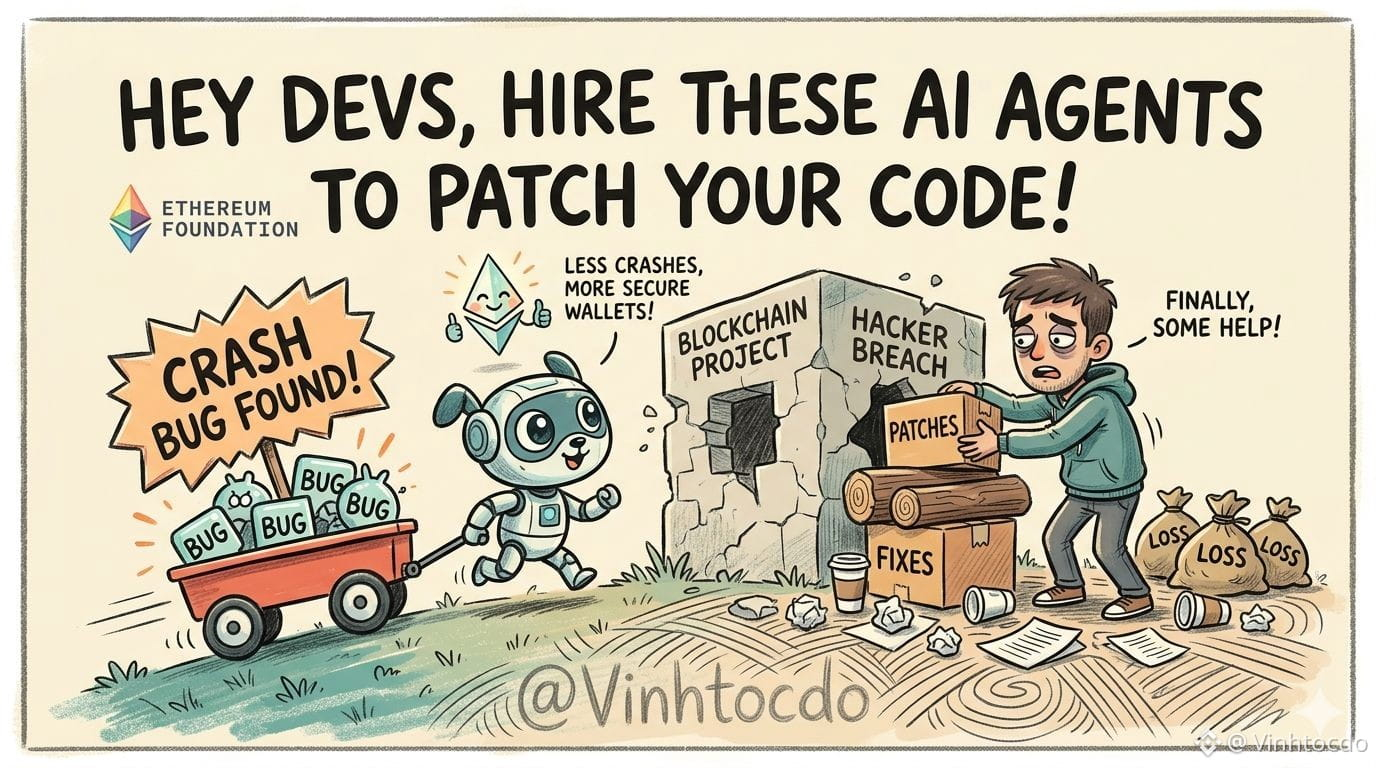
Fellow Devs on projects should urgently take care of these AIs, and also fix the bugs for us, okay? Watching hackers “rob” a few hundred incidents every year, snatching a few hundred million dollars, and still feeling it’s painful—doing nothing less is better than “breaking” the whole thing for real 😩
This time, the “babies” AI from the Ethereum Foundation just pulled off a major win: it discovered a fault and caused a network node crash. The goal was to take out as many ETH validators as possible by taking them offline. But an AI still needs humans to verify—sometimes it also “talks big” and produces false errors. Anyway, having AI shoulder some of the load helps prevent network congestion!
What should traders do? Rest easy—hold ETH, wait for new technology, and remember to set a stop-loss to handle any surprises.
*DYOR - Not investment advice. Use the code VINHTOCDO to reduce trading fees and optimize your capital!
#Ethereum #ETH #AIAgents #VINHTOCDO
$ETH
{future}(ETHUSDT)
$BTC
{future}(BTCUSDT)
$BNB
{future}(BNBUSDT)
#ethereumfoundationaiagentsfindnodecrashbug
Fellow Devs on projects should urgently take care of these AIs, and also fix the bugs for us, okay? Watching hackers “rob” a few hundred incidents every year, snatching a few hundred million dollars, and still feeling it’s painful—doing nothing less is better than “breaking” the whole thing for real 😩
This time, the “babies” AI from the Ethereum Foundation just pulled off a major win: it discovered a fault and caused a network node crash. The goal was to take out as many ETH validators as possible by taking them offline. But an AI still needs humans to verify—sometimes it also “talks big” and produces false errors. Anyway, having AI shoulder some of the load helps prevent network congestion!
What should traders do? Rest easy—hold ETH, wait for new technology, and remember to set a stop-loss to handle any surprises.
*DYOR - Not investment advice. Use the code VINHTOCDO to reduce trading fees and optimize your capital!
#Ethereum #ETH #AIAgents #VINHTOCDO
$ETH
$BTC
$BNB
Fellow Devs on projects should urgently take care of these AIs, and also fix the bugs for us, okay? Watching hackers “rob” a few hundred incidents every year, snatching a few hundred million dollars, and still feeling it’s painful—doing nothing less is better than “breaking” the whole thing for real 😩
This time, the “babies” AI from the Ethereum Foundation just pulled off a major win: it discovered a fault and caused a network node crash. The goal was to take out as many ETH validators as possible by taking them offline. But an AI still needs humans to verify—sometimes it also “talks big” and produces false errors. Anyway, having AI shoulder some of the load helps prevent network congestion!
What should traders do? Rest easy—hold ETH, wait for new technology, and remember to set a stop-loss to handle any surprises.
*DYOR - Not investment advice. Use the code VINHTOCDO to reduce trading fees and optimize your capital!
#Ethereum #ETH #AIAgents #VINHTOCDO
$ETH
$BTC
$BNB
2
2
789

·
--
💥Ethereum Foundation AI agents just found a critical node-crash bug. 🔥🔥🔥Ethereum Foundation AI agents just found a critical node-crash bug — and it’s changing how they think about security research.
🔥What happened?
🔥On July 9, 2026, the Ethereum, Foundation's Protocol Security team revealed they’re deploying coordinated AI agents to audit Ethereum’s core infrastructure: system software, crypto code, and smart contracts.
🔥The AI found a remotely triggerable crash in `libp2p`’s Gossipsub protocol — a networking component used by Ethereum consensus clients.
🔥The bug: CVE-2026-34219, GitHub High 8.2. It lets unauthenticated peers overflow calculations and kill validator nodes remotely with a single message.
🔥The real surprise: False positives
🔥The Foundation said finding bugs wasn’t the shock. The surprise was “how little of the work went into finding them, and how much went into telling the real bugs from the ones that just looked real”.
🔥Scale of the problem:
🔥• One Anthropic test produced 984 AI reports
🔥• Even after human ranking, only 86% of top items were real
🔥• “Most candidates are wrong, duplicate, or out of scope”
🔥 • Cointelegraph: “AI agents find real errors, but most of them are false positives” How they’re using AI differently
🔥1. Multi-agent setup: Instead of one AI, they run multiple agents with specialized tasks — reconnaissance, vulnerability hunting, validation, coverage analysis.
🔥2. No central coordinator: Agents collaborate through shared repos + version control, independently verifying each other’s work.
🔥3. Proof required: No issue counts unless it can be reproduced with a self-contained PoC against actual production code.
🔥4. AI = hypothesis generator: Agents inspect code, trace execution paths, and prep proof-of-concepts. Humans still validate.
🤑Why this matters
“AI did not replace security researchers; it moved the work”. The bottleneck shifted from finding bugs to triaging trust. As Decrypt put it, Ethereum researchers are using AI to “shift security work from finding bugs to proving which ones are real”.
🤑Vitalik Buterin called bugs “Ethereum’s biggest technical risk” back in Feb 2024, saying he was excited about AI-assisted formal verification. Now it’s happening — but with human judgment as the critical security layer.
🤑Bottom line: AI can crash nodes with one message, but it can also find the bugs that crash nodes. The Foundation’s take: “Don’t count how many candidates an agent produces. Count how many turn out to be real”.
#EthereumFoundationAIAgentsFindNodeCrashBug #Newt #OPG #genius #grvt $ETH
{spot}(ETHUSDT)
$BTC
{spot}(BTCUSDT)
$SPCX
{future}(SPCXUSDT)
💥Ethereum Foundation AI agents just found a critical node-crash bug. 🔥🔥
🔥Ethereum Foundation AI agents just found a critical node-crash bug — and it’s changing how they think about security research.
🔥What happened?
🔥On July 9, 2026, the Ethereum, Foundation's Protocol Security team revealed they’re deploying coordinated AI agents to audit Ethereum’s core infrastructure: system software, crypto code, and smart contracts.
🔥The AI found a remotely triggerable crash in `libp2p`’s Gossipsub protocol — a networking component used by Ethereum consensus clients.
🔥The bug: CVE-2026-34219, GitHub High 8.2. It lets unauthenticated peers overflow calculations and kill validator nodes remotely with a single message.
🔥The real surprise: False positives
🔥The Foundation said finding bugs wasn’t the shock. The surprise was “how little of the work went into finding them, and how much went into telling the real bugs from the ones that just looked real”.
🔥Scale of the problem:
🔥• One Anthropic test produced 984 AI reports
🔥• Even after human ranking, only 86% of top items were real
🔥• “Most candidates are wrong, duplicate, or out of scope”
🔥 • Cointelegraph: “AI agents find real errors, but most of them are false positives” How they’re using AI differently
🔥1. Multi-agent setup: Instead of one AI, they run multiple agents with specialized tasks — reconnaissance, vulnerability hunting, validation, coverage analysis.
🔥2. No central coordinator: Agents collaborate through shared repos + version control, independently verifying each other’s work.
🔥3. Proof required: No issue counts unless it can be reproduced with a self-contained PoC against actual production code.
🔥4. AI = hypothesis generator: Agents inspect code, trace execution paths, and prep proof-of-concepts. Humans still validate.
🤑Why this matters
“AI did not replace security researchers; it moved the work”. The bottleneck shifted from finding bugs to triaging trust. As Decrypt put it, Ethereum researchers are using AI to “shift security work from finding bugs to proving which ones are real”.
🤑Vitalik Buterin called bugs “Ethereum’s biggest technical risk” back in Feb 2024, saying he was excited about AI-assisted formal verification. Now it’s happening — but with human judgment as the critical security layer.
🤑Bottom line: AI can crash nodes with one message, but it can also find the bugs that crash nodes. The Foundation’s take: “Don’t count how many candidates an agent produces. Count how many turn out to be real”.
#EthereumFoundationAIAgentsFindNodeCrashBug #Newt #OPG #genius #grvt $ETH
$BTC
$SPCX
🔥What happened?
🔥On July 9, 2026, the Ethereum, Foundation's Protocol Security team revealed they’re deploying coordinated AI agents to audit Ethereum’s core infrastructure: system software, crypto code, and smart contracts.
🔥The AI found a remotely triggerable crash in `libp2p`’s Gossipsub protocol — a networking component used by Ethereum consensus clients.
🔥The bug: CVE-2026-34219, GitHub High 8.2. It lets unauthenticated peers overflow calculations and kill validator nodes remotely with a single message.
🔥The real surprise: False positives
🔥The Foundation said finding bugs wasn’t the shock. The surprise was “how little of the work went into finding them, and how much went into telling the real bugs from the ones that just looked real”.
🔥Scale of the problem:
🔥• One Anthropic test produced 984 AI reports
🔥• Even after human ranking, only 86% of top items were real
🔥• “Most candidates are wrong, duplicate, or out of scope”
🔥 • Cointelegraph: “AI agents find real errors, but most of them are false positives” How they’re using AI differently
🔥1. Multi-agent setup: Instead of one AI, they run multiple agents with specialized tasks — reconnaissance, vulnerability hunting, validation, coverage analysis.
🔥2. No central coordinator: Agents collaborate through shared repos + version control, independently verifying each other’s work.
🔥3. Proof required: No issue counts unless it can be reproduced with a self-contained PoC against actual production code.
🔥4. AI = hypothesis generator: Agents inspect code, trace execution paths, and prep proof-of-concepts. Humans still validate.
🤑Why this matters
“AI did not replace security researchers; it moved the work”. The bottleneck shifted from finding bugs to triaging trust. As Decrypt put it, Ethereum researchers are using AI to “shift security work from finding bugs to proving which ones are real”.
🤑Vitalik Buterin called bugs “Ethereum’s biggest technical risk” back in Feb 2024, saying he was excited about AI-assisted formal verification. Now it’s happening — but with human judgment as the critical security layer.
🤑Bottom line: AI can crash nodes with one message, but it can also find the bugs that crash nodes. The Foundation’s take: “Don’t count how many candidates an agent produces. Count how many turn out to be real”.
#EthereumFoundationAIAgentsFindNodeCrashBug #Newt #OPG #genius #grvt $ETH
$BTC
$SPCX
1
181

·
--
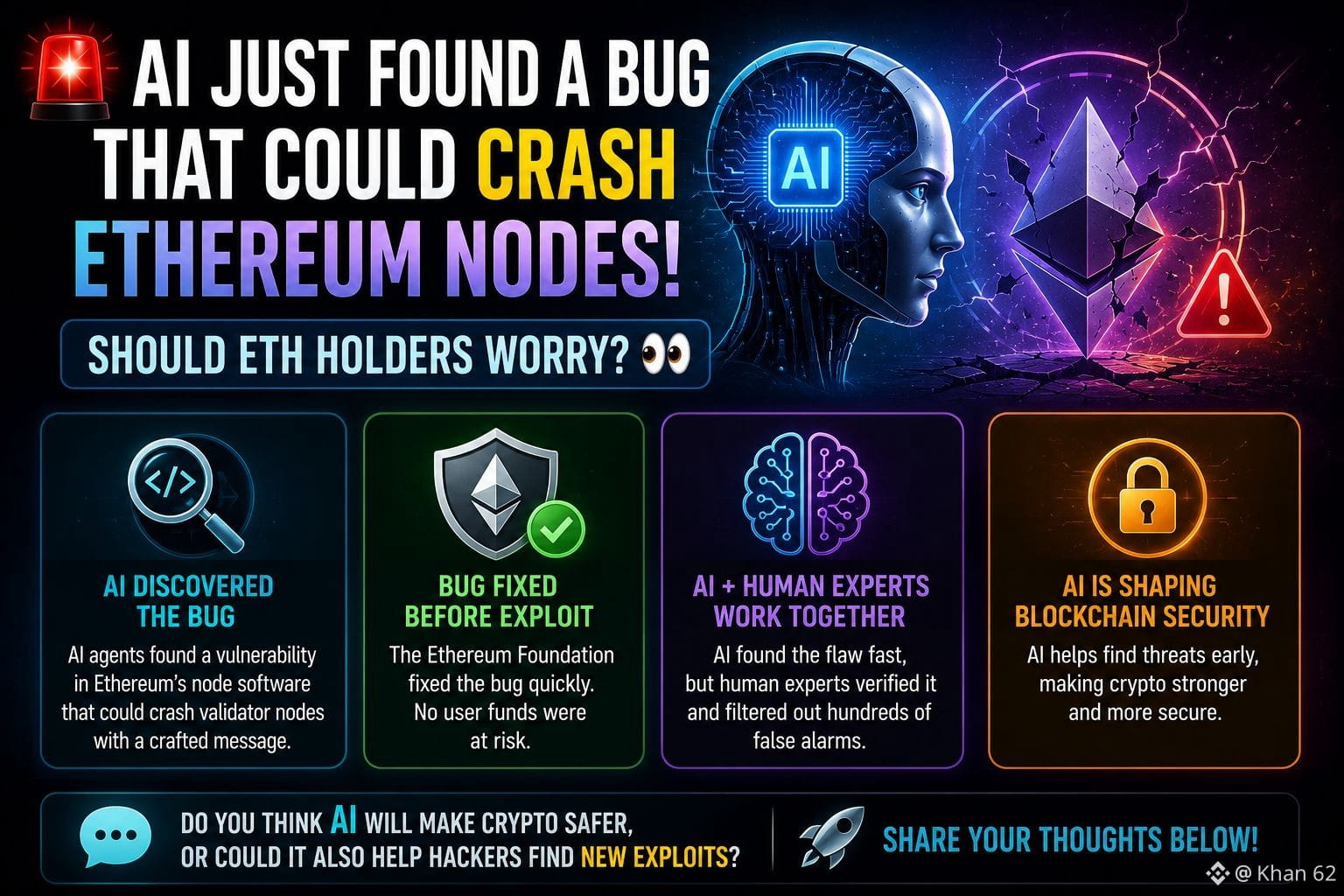
#ethereumfoundationaiagentsfindnodecrashbug 🚨 AI Found a Big Problem, with Ethereum! Should ETH Owners Be Worried? 👀
👀 Imagine if a computer program could find security problems before bad hackers do.That's what just happened.
A computer program tested Ethereums software. Found a big flaw. This flaw could make some Ethereum nodes stop working if someone sent a message.
⭐The good news is that the Ethereum team fixed the problem before anyone could use it and no one lost any money.
💥This shows how computer programs are helping to keep blockchain safe. The computer program found the problem fast. People still had to check the results and ignore lots of wrong warnings.
💬 Do you think computer programs will make crypto safer or could they also help bad hackers find ways to cause trouble? Share your thoughts ! 🚀
#Khan62 #ETH #CryptoSecurity #BinanceSquare
$ETH $BTC
{future}(BTCUSDT)
{future}(ETHUSDT)
#ethereumfoundationaiagentsfindnodecrashbug 🚨 AI Found a Big Problem, with Ethereum! Should ETH Owners Be Worried? 👀
👀 Imagine if a computer program could find security problems before bad hackers do.That's what just happened.
A computer program tested Ethereums software. Found a big flaw. This flaw could make some Ethereum nodes stop working if someone sent a message.
⭐The good news is that the Ethereum team fixed the problem before anyone could use it and no one lost any money.
💥This shows how computer programs are helping to keep blockchain safe. The computer program found the problem fast. People still had to check the results and ignore lots of wrong warnings.
💬 Do you think computer programs will make crypto safer or could they also help bad hackers find ways to cause trouble? Share your thoughts ! 🚀
#Khan62 #ETH #CryptoSecurity #BinanceSquare
$ETH $BTC
👀 Imagine if a computer program could find security problems before bad hackers do.That's what just happened.
A computer program tested Ethereums software. Found a big flaw. This flaw could make some Ethereum nodes stop working if someone sent a message.
⭐The good news is that the Ethereum team fixed the problem before anyone could use it and no one lost any money.
💥This shows how computer programs are helping to keep blockchain safe. The computer program found the problem fast. People still had to check the results and ignore lots of wrong warnings.
💬 Do you think computer programs will make crypto safer or could they also help bad hackers find ways to cause trouble? Share your thoughts ! 🚀
#Khan62 #ETH #CryptoSecurity #BinanceSquare
$ETH $BTC
1
734

#ethereumfoundationaiagentsfindnodecrashbug
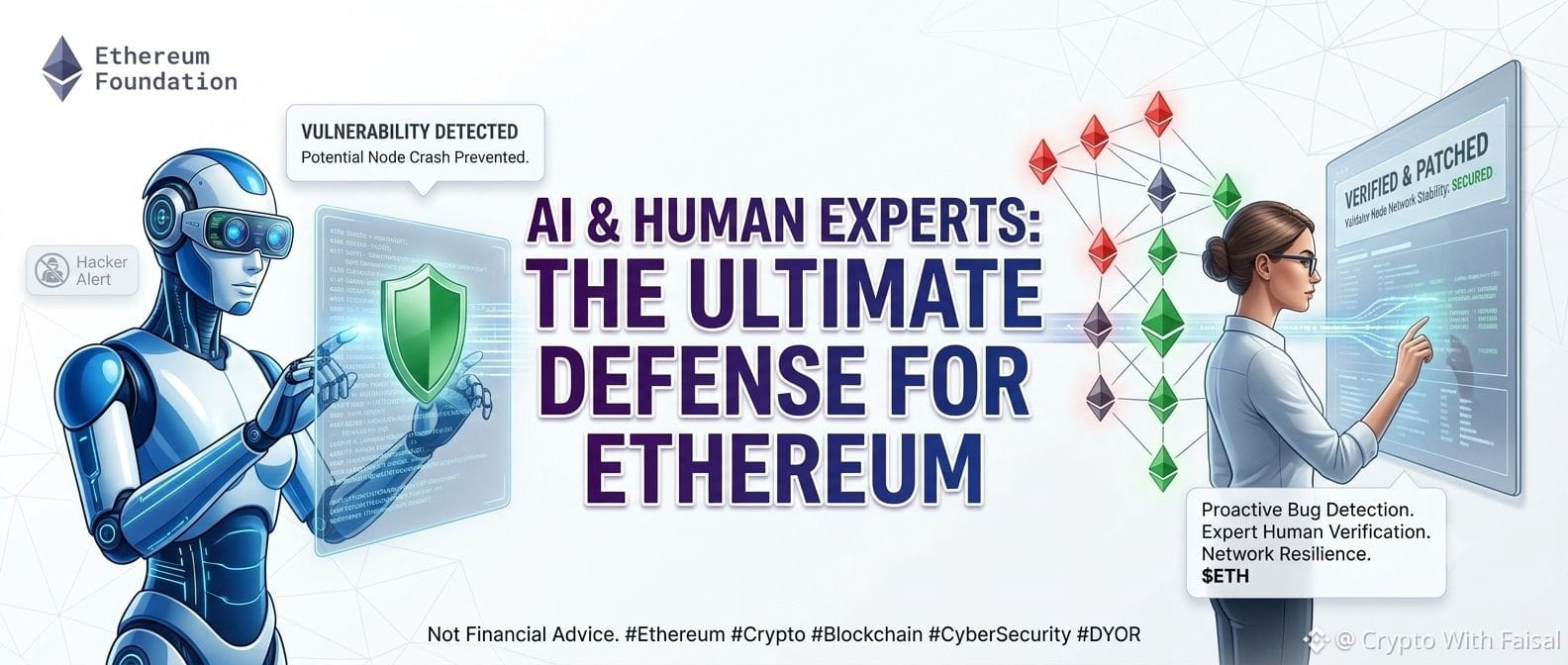
🛡️🤖 AI Steps Up: Securing the Ethereum Network Before Exploits Happen
A new chapter in blockchain security has begun. The Ethereum Foundation’s newly deployed AI system successfully detected a critical software bug that risked crashing validator nodes. Had this vulnerability slipped by, it could have triggered widespread node failures, jeopardizing the stability of the entire network. $ETH
Although artificial intelligence drastically accelerates the hunt for bugs, the human touch remains irreplaceable. Developers are necessary to double-check the AI’s alerts and filter out false alarms. This powerful synergy of AI speed and human precision is quickly becoming our best shield against tomorrow's threats.
📊 How does this impact the market and traders?
✅ Defensive tools are getting a massive upgrade.
✅ Lightning-fast vulnerability patches build long-term network resilience.
✅ Keep your eyes on fundamental growth, stick to strict risk management, and never trade without a stop-loss.
The digital asset landscape is maturing rapidly, and its defense mechanisms are leveling up alongside it.
DYOR. Not financial advice.
#Ethereum #Crypto #Blockchain #CyberSecurity
{spot}(ETHUSDT)
{future}(VANRYUSDT)
$VANRY $B
#ethereumfoundationaiagentsfindnodecrashbug
🛡️🤖 AI Steps Up: Securing the Ethereum Network Before Exploits Happen
A new chapter in blockchain security has begun. The Ethereum Foundation’s newly deployed AI system successfully detected a critical software bug that risked crashing validator nodes. Had this vulnerability slipped by, it could have triggered widespread node failures, jeopardizing the stability of the entire network. $ETH
Although artificial intelligence drastically accelerates the hunt for bugs, the human touch remains irreplaceable. Developers are necessary to double-check the AI’s alerts and filter out false alarms. This powerful synergy of AI speed and human precision is quickly becoming our best shield against tomorrow's threats.
📊 How does this impact the market and traders?
✅ Defensive tools are getting a massive upgrade.
✅ Lightning-fast vulnerability patches build long-term network resilience.
✅ Keep your eyes on fundamental growth, stick to strict risk management, and never trade without a stop-loss.
The digital asset landscape is maturing rapidly, and its defense mechanisms are leveling up alongside it.
DYOR. Not financial advice.
#Ethereum #Crypto #Blockchain #CyberSecurity
$VANRY $B
🛡️🤖 AI Steps Up: Securing the Ethereum Network Before Exploits Happen
A new chapter in blockchain security has begun. The Ethereum Foundation’s newly deployed AI system successfully detected a critical software bug that risked crashing validator nodes. Had this vulnerability slipped by, it could have triggered widespread node failures, jeopardizing the stability of the entire network. $ETH
Although artificial intelligence drastically accelerates the hunt for bugs, the human touch remains irreplaceable. Developers are necessary to double-check the AI’s alerts and filter out false alarms. This powerful synergy of AI speed and human precision is quickly becoming our best shield against tomorrow's threats.
📊 How does this impact the market and traders?
✅ Defensive tools are getting a massive upgrade.
✅ Lightning-fast vulnerability patches build long-term network resilience.
✅ Keep your eyes on fundamental growth, stick to strict risk management, and never trade without a stop-loss.
The digital asset landscape is maturing rapidly, and its defense mechanisms are leveling up alongside it.
DYOR. Not financial advice.
#Ethereum #Crypto #Blockchain #CyberSecurity
$VANRY $B
1
4.6k

Article
ETHEREUM SAVED BY AI: THE CRITICAL "NODE CRASH" BUG EXPLAINED!🚨 🚨#EthereumFoundationAIAgentsFindNodeCrashBug
The Ethereum Foundation just proved that AI is no longer just a research toy—it is actively protecting the blockchain. In a massive new security initiative, coordinated AI swarms were deployed to hunt for vulnerabilities in Ethereum's core code, and they just uncovered a highly dangerous, remotely triggerable flaw.
Here is the data-driven breakdown of the discovery and why the Ethereum Foundation says human auditors are still entirely in control:
🔍 The Critical Vulnerability (CVE-2026-34219)
The Target: The AI agents successfully hunted down a critical flaw in libp2p's "gossipsub" protocol—the fundamental peer-to-peer messaging layer that Ethereum consensus clients rely on to communicate.The Exploit: The vulnerability was a remotely triggerable panic. Any peer on the network could send a maliciously crafted message with an oversized backoff value. Processing this would instantly crash a validator node, taking it completely offline without the attacker needing any special keys or authentication.The Resolution: Because the AI agents caught this during the red-teaming process, the Ethereum Foundation's Protocol Security team successfully patched the bug (disclosed as CVE-2026-34219) before any malicious actors could exploit it in the wild.
🤖 The AI Reality Check: "Triage is the Product"
While the AI successfully found the critical bug, it also proved that AI is incredibly messy.
The False Positive Avalanche: The AI agents generated a massive flood of highly confident, yet completely wrong reports. They flagged crashes that only happen in debug builds, and mapped out attack paths that are literally impossible to execute in production.The Triage Bottleneck: In one test, a single AI agent generated around 1,000 candidate findings. The Ethereum Foundation explicitly stated that the hardest part of the job is no longer finding the bugs, but triaging the AI's reports to separate real threats from convincing hallucinations.The New Security Standard: The Foundation has instituted a strict "reproducible or it didn't happen" rule. No matter how confident the AI sounds, if a human researcher cannot build a self-contained proof-of-concept that reproduces the crash against real code, the finding is discarded.
💡 What This Means for Web3
AI-assisted smart contract and protocol audits are officially moving from experiment to infrastructure. As these networks secure trillions of dollars in value, AI swarms will act as the first line of defense, but elite human engineers will remain the irreplaceable final arbiters of truth.
Do you think AI will eventually become completely autonomous in patching blockchains, or will the "false positive" problem keep humans in the driver's seat forever? Let's debate in the comments! 👇
#ETH #BEATUSDT #TUSDT #EVAAUSDT
$T
{future}(TUSDT)
$BANK
{future}(BANKUSDT)
$BEAT
{future}(BEATUSDT)
ETHEREUM SAVED BY AI: THE CRITICAL "NODE CRASH" BUG EXPLAINED!
🚨 🚨#EthereumFoundationAIAgentsFindNodeCrashBug
The Ethereum Foundation just proved that AI is no longer just a research toy—it is actively protecting the blockchain. In a massive new security initiative, coordinated AI swarms were deployed to hunt for vulnerabilities in Ethereum's core code, and they just uncovered a highly dangerous, remotely triggerable flaw.
Here is the data-driven breakdown of the discovery and why the Ethereum Foundation says human auditors are still entirely in control:
🔍 The Critical Vulnerability (CVE-2026-34219)
The Target: The AI agents successfully hunted down a critical flaw in libp2p's "gossipsub" protocol—the fundamental peer-to-peer messaging layer that Ethereum consensus clients rely on to communicate.The Exploit: The vulnerability was a remotely triggerable panic. Any peer on the network could send a maliciously crafted message with an oversized backoff value. Processing this would instantly crash a validator node, taking it completely offline without the attacker needing any special keys or authentication.The Resolution: Because the AI agents caught this during the red-teaming process, the Ethereum Foundation's Protocol Security team successfully patched the bug (disclosed as CVE-2026-34219) before any malicious actors could exploit it in the wild.
🤖 The AI Reality Check: "Triage is the Product"
While the AI successfully found the critical bug, it also proved that AI is incredibly messy.
The False Positive Avalanche: The AI agents generated a massive flood of highly confident, yet completely wrong reports. They flagged crashes that only happen in debug builds, and mapped out attack paths that are literally impossible to execute in production.The Triage Bottleneck: In one test, a single AI agent generated around 1,000 candidate findings. The Ethereum Foundation explicitly stated that the hardest part of the job is no longer finding the bugs, but triaging the AI's reports to separate real threats from convincing hallucinations.The New Security Standard: The Foundation has instituted a strict "reproducible or it didn't happen" rule. No matter how confident the AI sounds, if a human researcher cannot build a self-contained proof-of-concept that reproduces the crash against real code, the finding is discarded.
💡 What This Means for Web3
AI-assisted smart contract and protocol audits are officially moving from experiment to infrastructure. As these networks secure trillions of dollars in value, AI swarms will act as the first line of defense, but elite human engineers will remain the irreplaceable final arbiters of truth.
Do you think AI will eventually become completely autonomous in patching blockchains, or will the "false positive" problem keep humans in the driver's seat forever? Let's debate in the comments! 👇
#ETH #BEATUSDT #TUSDT #EVAAUSDT
$T
$BANK
$BEAT
The Ethereum Foundation just proved that AI is no longer just a research toy—it is actively protecting the blockchain. In a massive new security initiative, coordinated AI swarms were deployed to hunt for vulnerabilities in Ethereum's core code, and they just uncovered a highly dangerous, remotely triggerable flaw.
Here is the data-driven breakdown of the discovery and why the Ethereum Foundation says human auditors are still entirely in control:
🔍 The Critical Vulnerability (CVE-2026-34219)
The Target: The AI agents successfully hunted down a critical flaw in libp2p's "gossipsub" protocol—the fundamental peer-to-peer messaging layer that Ethereum consensus clients rely on to communicate.The Exploit: The vulnerability was a remotely triggerable panic. Any peer on the network could send a maliciously crafted message with an oversized backoff value. Processing this would instantly crash a validator node, taking it completely offline without the attacker needing any special keys or authentication.The Resolution: Because the AI agents caught this during the red-teaming process, the Ethereum Foundation's Protocol Security team successfully patched the bug (disclosed as CVE-2026-34219) before any malicious actors could exploit it in the wild.
🤖 The AI Reality Check: "Triage is the Product"
While the AI successfully found the critical bug, it also proved that AI is incredibly messy.
The False Positive Avalanche: The AI agents generated a massive flood of highly confident, yet completely wrong reports. They flagged crashes that only happen in debug builds, and mapped out attack paths that are literally impossible to execute in production.The Triage Bottleneck: In one test, a single AI agent generated around 1,000 candidate findings. The Ethereum Foundation explicitly stated that the hardest part of the job is no longer finding the bugs, but triaging the AI's reports to separate real threats from convincing hallucinations.The New Security Standard: The Foundation has instituted a strict "reproducible or it didn't happen" rule. No matter how confident the AI sounds, if a human researcher cannot build a self-contained proof-of-concept that reproduces the crash against real code, the finding is discarded.
💡 What This Means for Web3
AI-assisted smart contract and protocol audits are officially moving from experiment to infrastructure. As these networks secure trillions of dollars in value, AI swarms will act as the first line of defense, but elite human engineers will remain the irreplaceable final arbiters of truth.
Do you think AI will eventually become completely autonomous in patching blockchains, or will the "false positive" problem keep humans in the driver's seat forever? Let's debate in the comments! 👇
#ETH #BEATUSDT #TUSDT #EVAAUSDT
$T
$BANK
$BEAT
162

·
--
Bullish
Verified
#ethereumfoundationaiagentsfindnodecrashbug #ETH
🤖 ETH SECURITY BOOST: BULLISH FOR ETH?
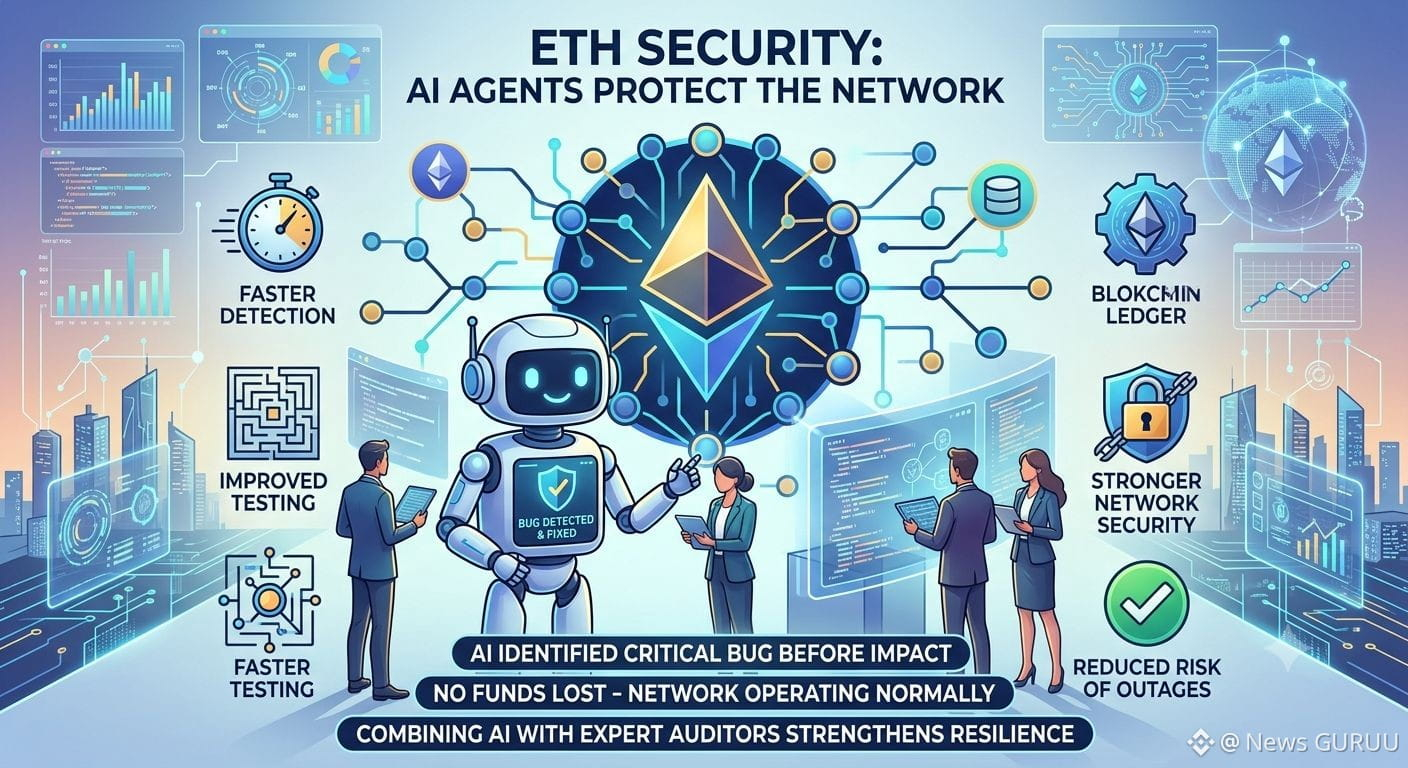
Ethereum's AI security agents detected and fixed a critical bug before it could impact the network.
✅ No funds were lost
✅ Network remained fully secure
✅ AI strengthens Ethereum's long-term security and investor confidence
This is a fundamentally bullish update for Ethereum, but it is not an immediate price catalyst. Stronger security supports long-term adoption and ecosystem growth.
📊 Trading View: BUY on dips / HOLD if you're a long-term investor. Avoid FOMO—wait for technical confirmation before making short-term trades."CLICK ON THE BELOW YELLOW COIN TAG TO GO TO DESIRED TRADING PAGE TO GET BENEFIT TRADE"👇👇👇👇👇👇👇👇👇👇
$ETH
#CryptoNews #NewsGURUU
{future}(ETHUSDT)
#ethereumfoundationaiagentsfindnodecrashbug #ETH
🤖 ETH SECURITY BOOST: BULLISH FOR ETH?
Ethereum's AI security agents detected and fixed a critical bug before it could impact the network.
✅ No funds were lost
✅ Network remained fully secure
✅ AI strengthens Ethereum's long-term security and investor confidence
This is a fundamentally bullish update for Ethereum, but it is not an immediate price catalyst. Stronger security supports long-term adoption and ecosystem growth.
📊 Trading View: BUY on dips / HOLD if you're a long-term investor. Avoid FOMO—wait for technical confirmation before making short-term trades."CLICK ON THE BELOW YELLOW COIN TAG TO GO TO DESIRED TRADING PAGE TO GET BENEFIT TRADE"👇👇👇👇👇👇👇👇👇👇
$ETH
#CryptoNews #NewsGURUU
🤖 ETH SECURITY BOOST: BULLISH FOR ETH?
Ethereum's AI security agents detected and fixed a critical bug before it could impact the network.
✅ No funds were lost
✅ Network remained fully secure
✅ AI strengthens Ethereum's long-term security and investor confidence
This is a fundamentally bullish update for Ethereum, but it is not an immediate price catalyst. Stronger security supports long-term adoption and ecosystem growth.
📊 Trading View: BUY on dips / HOLD if you're a long-term investor. Avoid FOMO—wait for technical confirmation before making short-term trades."CLICK ON THE BELOW YELLOW COIN TAG TO GO TO DESIRED TRADING PAGE TO GET BENEFIT TRADE"👇👇👇👇👇👇👇👇👇👇
$ETH
#CryptoNews #NewsGURUU
2
4
2.9k

·
--
$ETH 🥳#EthereumFoundationAIAgentsFindNodeCrashBug 😜The Ethereum Foundation's AI security agents uncovered a critical remotely triggerable node crash bug (CVE-2026-34219) in Ethereum's networking stack before attackers could exploit it. The vulnerability has been patched, highlighting how AI can accelerate bug discovery—while human experts remain essential for validation and secure fixes.
$ETH
{future}(ETHUSDT)
$BTC
{future}(BTCUSDT)
$ETH 🥳#EthereumFoundationAIAgentsFindNodeCrashBug 😜The Ethereum Foundation's AI security agents uncovered a critical remotely triggerable node crash bug (CVE-2026-34219) in Ethereum's networking stack before attackers could exploit it. The vulnerability has been patched, highlighting how AI can accelerate bug discovery—while human experts remain essential for validation and secure fixes.
$ETH
$BTC
$ETH
$BTC
118

·
--
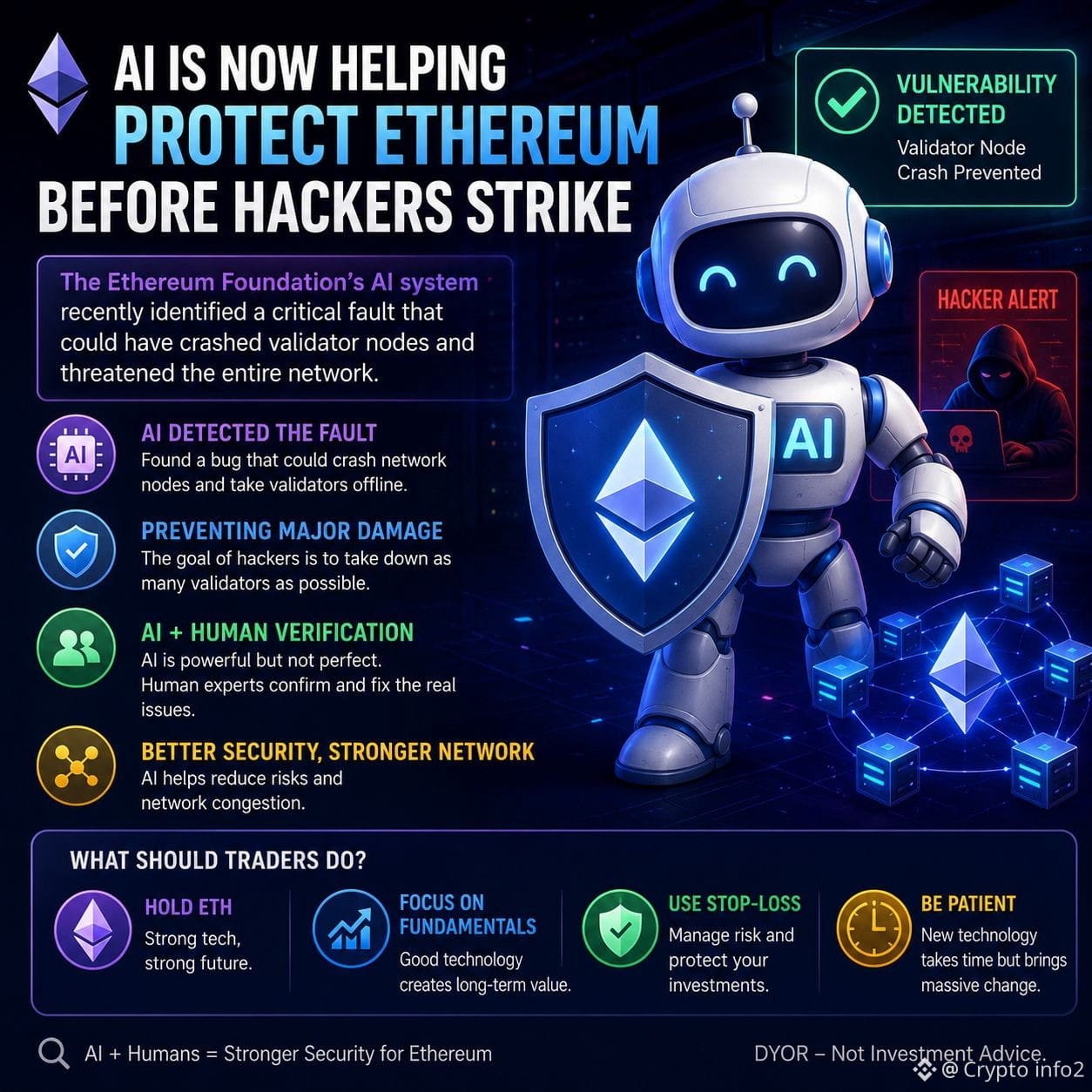
#ethereumfoundationaiagentsfindnodecrashbug 🤖🚨 AI Is Now Helping Protect Ethereum Before Hackers Strike
Ethereum security is entering a new era.
An AI system developed by the Ethereum Foundation recently identified a software fault that could have caused validator node crashes. If left undiscovered, the issue might have taken multiple validators offline and affected network stability.$ETH
While AI can speed up vulnerability detection, human developers are still essential to verify findings and eliminate false positives. The combination of AI + human expertise could become one of the strongest defenses against future exploits.$BNB
💡 What does this mean for traders?
✅ Security tools are improving.
✅ Faster bug detection can strengthen the network over time.
✅ Stay focused on long-term fundamentals, manage your risk, and always use a stop-loss.$BTC
The crypto industry is evolving—and so are the tools protecting it.
DYOR. Not financial advice. #Ethereum #Crypto #Blockchain #CyberSecurity
{future}(BNBUSDT)
{future}(ETHUSDT)
{future}(BTCUSDT)
#ethereumfoundationaiagentsfindnodecrashbug 🤖🚨 AI Is Now Helping Protect Ethereum Before Hackers Strike
Ethereum security is entering a new era.
An AI system developed by the Ethereum Foundation recently identified a software fault that could have caused validator node crashes. If left undiscovered, the issue might have taken multiple validators offline and affected network stability.$ETH
While AI can speed up vulnerability detection, human developers are still essential to verify findings and eliminate false positives. The combination of AI + human expertise could become one of the strongest defenses against future exploits.$BNB
💡 What does this mean for traders?
✅ Security tools are improving.
✅ Faster bug detection can strengthen the network over time.
✅ Stay focused on long-term fundamentals, manage your risk, and always use a stop-loss.$BTC
The crypto industry is evolving—and so are the tools protecting it.
DYOR. Not financial advice. #Ethereum #Crypto #Blockchain #CyberSecurity
Ethereum security is entering a new era.
An AI system developed by the Ethereum Foundation recently identified a software fault that could have caused validator node crashes. If left undiscovered, the issue might have taken multiple validators offline and affected network stability.$ETH
While AI can speed up vulnerability detection, human developers are still essential to verify findings and eliminate false positives. The combination of AI + human expertise could become one of the strongest defenses against future exploits.$BNB
💡 What does this mean for traders?
✅ Security tools are improving.
✅ Faster bug detection can strengthen the network over time.
✅ Stay focused on long-term fundamentals, manage your risk, and always use a stop-loss.$BTC
The crypto industry is evolving—and so are the tools protecting it.
DYOR. Not financial advice. #Ethereum #Crypto #Blockchain #CyberSecurity
3
1.7k

·
--
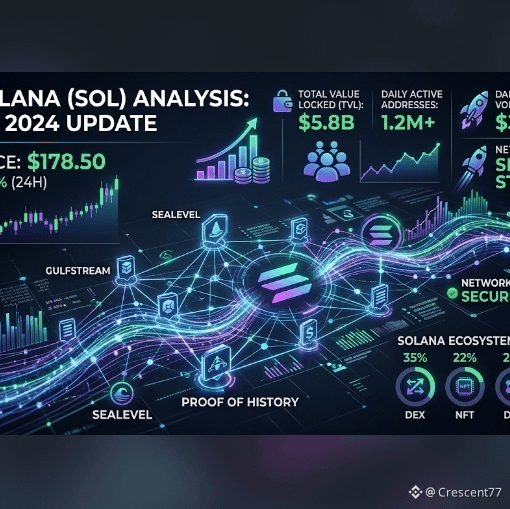
Solana $SOL Short Analysis: Q3 2026
Solana $SOL is currently navigating a period of high technical consolidation and mixed market sentiment, presenting a stark contrast between its weak short-term price action and robust network fundamentals.
### Key Market Metrics
Current Price: Hovering around $77 – $79.
Critical Support Zone: $73 – $76. Safely holding this level prevents a deeper slide toward the next major support floor near $53.
Immediate Resistance: $79 – $85. A heavy supply barrier sits in this zone. Reclaiming $85 with volume is vital to shift momentum back toward the psychologically important $100 target.
#BitcoinPlansECashHardFork
#EthereumFoundationAIAgentsFindNodeCrashBug
#BitcoinUp9.5%InJulyBestInFourYears
#MorganStanleyAdds1000BTC
Solana $SOL Short Analysis: Q3 2026
Solana $SOL is currently navigating a period of high technical consolidation and mixed market sentiment, presenting a stark contrast between its weak short-term price action and robust network fundamentals.
### Key Market Metrics
Current Price: Hovering around $77 – $79.
Critical Support Zone: $73 – $76. Safely holding this level prevents a deeper slide toward the next major support floor near $53.
Immediate Resistance: $79 – $85. A heavy supply barrier sits in this zone. Reclaiming $85 with volume is vital to shift momentum back toward the psychologically important $100 target.
#BitcoinPlansECashHardFork
#EthereumFoundationAIAgentsFindNodeCrashBug
#BitcoinUp9.5%InJulyBestInFourYears
#MorganStanleyAdds1000BTC
Solana $SOL is currently navigating a period of high technical consolidation and mixed market sentiment, presenting a stark contrast between its weak short-term price action and robust network fundamentals.
### Key Market Metrics
Current Price: Hovering around $77 – $79.
Critical Support Zone: $73 – $76. Safely holding this level prevents a deeper slide toward the next major support floor near $53.
Immediate Resistance: $79 – $85. A heavy supply barrier sits in this zone. Reclaiming $85 with volume is vital to shift momentum back toward the psychologically important $100 target.
#BitcoinPlansECashHardFork
#EthereumFoundationAIAgentsFindNodeCrashBug
#BitcoinUp9.5%InJulyBestInFourYears
#MorganStanleyAdds1000BTC
2
1
206

$DEXE 's price today is $18.65, with a 24-hour trading volume of $16.17M. DEXE is -2.12% in the last 24 hours. It is currently -16.18% from its 7-day all-time high of $22.25, and 20.82% from its 7-day all-time low of $15.44. DEXE has a circulating supply of 83.73M DEXE.
{future}(DEXEUSDT)
#BitcoinPlansECashHardFork #USStrikesIranAfterHormuzShipAttack #MorganStanleyAdds1000BTC #EthereumFoundationAIAgentsFindNodeCrashBug
$DEXE 's price today is $18.65, with a 24-hour trading volume of $16.17M. DEXE is -2.12% in the last 24 hours. It is currently -16.18% from its 7-day all-time high of $22.25, and 20.82% from its 7-day all-time low of $15.44. DEXE has a circulating supply of 83.73M DEXE.
#BitcoinPlansECashHardFork #USStrikesIranAfterHormuzShipAttack #MorganStanleyAdds1000BTC #EthereumFoundationAIAgentsFindNodeCrashBug
#BitcoinPlansECashHardFork #USStrikesIranAfterHormuzShipAttack #MorganStanleyAdds1000BTC #EthereumFoundationAIAgentsFindNodeCrashBug
208

·
--
Yes. Growing application diversity could strengthen long-term demand for Internet Computer $ICP if it leads to sustained network usage rather than just speculation.
Key reasons include:
🚀 More Real-World Utility: A wider range of decentralized apps (DeFi, AI, gaming, social platforms, enterprise tools) can attract more users and developers.
👨💻 Developer Growth: More developers building on ICP often creates a stronger ecosystem and encourages further innovation.
📈 Higher Network Activity: Increased application usage can drive more transactions, greater computing demand, and broader ecosystem participation.
🔒 Reduced Reliance on One Sector: A diversified application ecosystem makes the network more resilient if one category slows down.
💰 Potential Token Demand: If applications require $ICP for computation, governance, or other network functions, expanding usage may support long-term demand.
However, application diversity alone is not enough. Investors should also monitor:
Active users and developer activity
Total value locked (TVL) where relevant
Transaction growth
Ecosystem partnerships
Tokenomics and adoption trends
Overall, expanding application diversity is generally a constructive long-term indicator for ICP, provided it results in meaningful user adoption and sustained on-chain activity.
{future}(ICPUSDT)
#SpaceXAnthropicOpenAIIPOsMayTopVCExitsSince2000 #GOPSeeksSenateVoteOnCLARITYActWeekOfJuly20 #EthereumFoundationAIAgentsFindNodeCrashBug
Yes. Growing application diversity could strengthen long-term demand for Internet Computer $ICP if it leads to sustained network usage rather than just speculation.
Key reasons include:
🚀 More Real-World Utility: A wider range of decentralized apps (DeFi, AI, gaming, social platforms, enterprise tools) can attract more users and developers.
👨💻 Developer Growth: More developers building on ICP often creates a stronger ecosystem and encourages further innovation.
📈 Higher Network Activity: Increased application usage can drive more transactions, greater computing demand, and broader ecosystem participation.
🔒 Reduced Reliance on One Sector: A diversified application ecosystem makes the network more resilient if one category slows down.
💰 Potential Token Demand: If applications require $ICP for computation, governance, or other network functions, expanding usage may support long-term demand.
However, application diversity alone is not enough. Investors should also monitor:
Active users and developer activity
Total value locked (TVL) where relevant
Transaction growth
Ecosystem partnerships
Tokenomics and adoption trends
Overall, expanding application diversity is generally a constructive long-term indicator for ICP, provided it results in meaningful user adoption and sustained on-chain activity.
#SpaceXAnthropicOpenAIIPOsMayTopVCExitsSince2000 #GOPSeeksSenateVoteOnCLARITYActWeekOfJuly20 #EthereumFoundationAIAgentsFindNodeCrashBug
Key reasons include:
🚀 More Real-World Utility: A wider range of decentralized apps (DeFi, AI, gaming, social platforms, enterprise tools) can attract more users and developers.
👨💻 Developer Growth: More developers building on ICP often creates a stronger ecosystem and encourages further innovation.
📈 Higher Network Activity: Increased application usage can drive more transactions, greater computing demand, and broader ecosystem participation.
🔒 Reduced Reliance on One Sector: A diversified application ecosystem makes the network more resilient if one category slows down.
💰 Potential Token Demand: If applications require $ICP for computation, governance, or other network functions, expanding usage may support long-term demand.
However, application diversity alone is not enough. Investors should also monitor:
Active users and developer activity
Total value locked (TVL) where relevant
Transaction growth
Ecosystem partnerships
Tokenomics and adoption trends
Overall, expanding application diversity is generally a constructive long-term indicator for ICP, provided it results in meaningful user adoption and sustained on-chain activity.
#SpaceXAnthropicOpenAIIPOsMayTopVCExitsSince2000 #GOPSeeksSenateVoteOnCLARITYActWeekOfJuly20 #EthereumFoundationAIAgentsFindNodeCrashBug
212

·
--
🚀 $XPIN USDT – LONG Signal 🔥
Entry: $0.00199–0.00201
🎯 TP1: $0.00208
🎯 TP2: $0.00218
🎯 TP3: $0.00225
📈 Price is holding above key moving averages with buyers defending support.
💎 A breakout above recent resistance could spark another bullish move. Always use a stop-loss and manage risk.
#BitcoinPlansECashHardFork #EthereumFoundationAIAgentsFindNodeCrashBug #Write2Earn
{future}(XPINUSDT)
🚀 $XPIN USDT – LONG Signal 🔥
Entry: $0.00199–0.00201
🎯 TP1: $0.00208
🎯 TP2: $0.00218
🎯 TP3: $0.00225
📈 Price is holding above key moving averages with buyers defending support.
💎 A breakout above recent resistance could spark another bullish move. Always use a stop-loss and manage risk.
#BitcoinPlansECashHardFork #EthereumFoundationAIAgentsFindNodeCrashBug #Write2Earn
Entry: $0.00199–0.00201
🎯 TP1: $0.00208
🎯 TP2: $0.00218
🎯 TP3: $0.00225
📈 Price is holding above key moving averages with buyers defending support.
💎 A breakout above recent resistance could spark another bullish move. Always use a stop-loss and manage risk.
#BitcoinPlansECashHardFork #EthereumFoundationAIAgentsFindNodeCrashBug #Write2Earn
372

🔥 $BEAT Latest Analysis | Breakout Loading?
🟢 $BEAT is showing strong accumulation as buying volume continues to increase.
📈 A clean breakout above resistance could trigger the next explosive bullish move.
🚀 Momentum is building fast, making $BEAT one of the coins to watch this week.
⚠️ Wait for breakout confirmation and always manage your risk before entering.
{alpha}(560xcf3232b85b43bca90e51d38cc06cc8bb8c8a3e36)
#BitcoinPlansECashHardFork #USStrikesIranAfterHormuzShipAttack #SpaceXAnthropicOpenAIIPOsMayTopVCExitsSince2000 #EthereumFoundationAIAgentsFindNodeCrashBug #BPISeeksToInterveneInNoahDoeCase
🔥 $BEAT Latest Analysis | Breakout Loading?
🟢 $BEAT is showing strong accumulation as buying volume continues to increase.
📈 A clean breakout above resistance could trigger the next explosive bullish move.
🚀 Momentum is building fast, making $BEAT one of the coins to watch this week.
⚠️ Wait for breakout confirmation and always manage your risk before entering.
#BitcoinPlansECashHardFork #USStrikesIranAfterHormuzShipAttack #SpaceXAnthropicOpenAIIPOsMayTopVCExitsSince2000 #EthereumFoundationAIAgentsFindNodeCrashBug #BPISeeksToInterveneInNoahDoeCase
🟢 $BEAT is showing strong accumulation as buying volume continues to increase.
📈 A clean breakout above resistance could trigger the next explosive bullish move.
🚀 Momentum is building fast, making $BEAT one of the coins to watch this week.
⚠️ Wait for breakout confirmation and always manage your risk before entering.
#BitcoinPlansECashHardFork #USStrikesIranAfterHormuzShipAttack #SpaceXAnthropicOpenAIIPOsMayTopVCExitsSince2000 #EthereumFoundationAIAgentsFindNodeCrashBug #BPISeeksToInterveneInNoahDoeCase

1
2
176

·
--
$GOOGLB is the for everyone to earn money easy of earn money just try thr#GOPSeeksSenateVoteOnCLARITYActWeekOfJuly20 #EthereumFoundationAIAgentsFindNodeCrashBug #GOPSeeksSenateVoteOnCLARITYActWeekOfJuly20 #USStrikesIranAfterHormuzShipAttack #MorganStanleyAdds1000BTC
$GOOGLB is the for everyone to earn money easy of earn money just try thr#GOPSeeksSenateVoteOnCLARITYActWeekOfJuly20 #EthereumFoundationAIAgentsFindNodeCrashBug #GOPSeeksSenateVoteOnCLARITYActWeekOfJuly20 #USStrikesIranAfterHormuzShipAttack #MorganStanleyAdds1000BTC
2
1
117

·
--
$EVAA
{alpha}(560xaa036928c9c0df07d525b55ea8ee690bb5a628c1)
$BILL
{future}(BILLUSDT)
$VELVET
{future}(VELVETUSDT)
#BitcoinPlansECashHardFork #SpaceXAnthropicOpenAIIPOsMayTopVCExitsSince2000 #GOPSeeksSenateVoteOnCLARITYActWeekOfJuly20 #EthereumFoundationAIAgentsFindNodeCrashBug
I've seen enough Layer 1 launches to stop believing every "next big chain" story. Newton Protocol feels different because it's focused on a specific problem instead of trying to do everything. The real test isn't design—it's how it performs when real users arrive. Good ideas still need adoption, liquidity, and developers. I'm curious, but staying cautious. It might work. Or nobody shows up.
#BPISeeksToInterveneInNoahDoeCase
$EVAA
$BILL
$VELVET
#BitcoinPlansECashHardFork #SpaceXAnthropicOpenAIIPOsMayTopVCExitsSince2000 #GOPSeeksSenateVoteOnCLARITYActWeekOfJuly20 #EthereumFoundationAIAgentsFindNodeCrashBug
I've seen enough Layer 1 launches to stop believing every "next big chain" story. Newton Protocol feels different because it's focused on a specific problem instead of trying to do everything. The real test isn't design—it's how it performs when real users arrive. Good ideas still need adoption, liquidity, and developers. I'm curious, but staying cautious. It might work. Or nobody shows up.
#BPISeeksToInterveneInNoahDoeCase
$BILL
$VELVET
#BitcoinPlansECashHardFork #SpaceXAnthropicOpenAIIPOsMayTopVCExitsSince2000 #GOPSeeksSenateVoteOnCLARITYActWeekOfJuly20 #EthereumFoundationAIAgentsFindNodeCrashBug
I've seen enough Layer 1 launches to stop believing every "next big chain" story. Newton Protocol feels different because it's focused on a specific problem instead of trying to do everything. The real test isn't design—it's how it performs when real users arrive. Good ideas still need adoption, liquidity, and developers. I'm curious, but staying cautious. It might work. Or nobody shows up.
#BPISeeksToInterveneInNoahDoeCase
Bullish 💚🤗
50%
Bell😡❤️
50%
4 votes • Voting closed
2
142

·
--
Bullish
$MMT
MMT News Today
Momentum (MMT) price ≈ $0.185 (+1% 24h). Strong trading volume on Upbit and the Sui market. Concentrated Liquidity DeFi protocol (CLMM). Positive weekly performance +13–22%.
Volatility indicators: very high (5–13% daily), high ATR, RSI near overbought, wide Bollinger Bands. High-beta token.
Risk warning: extreme volatility, affected by the Korea/Sui market, risk of losing capital entirely. Invest only what you can afford to lose. Monitor closely
#BitcoinPlansECashHardFork #AMDSharesSlideNearly10% #SpaceXAnthropicOpenAIIPOsMayTopVCExitsSince2000 #MorganStanleyAdds1000BTC #EthereumFoundationAIAgentsFindNodeCrashBug
$MMT
MMT News Today
Momentum (MMT) price ≈ $0.185 (+1% 24h). Strong trading volume on Upbit and the Sui market. Concentrated Liquidity DeFi protocol (CLMM). Positive weekly performance +13–22%.
Volatility indicators: very high (5–13% daily), high ATR, RSI near overbought, wide Bollinger Bands. High-beta token.
Risk warning: extreme volatility, affected by the Korea/Sui market, risk of losing capital entirely. Invest only what you can afford to lose. Monitor closely
#BitcoinPlansECashHardFork #AMDSharesSlideNearly10% #SpaceXAnthropicOpenAIIPOsMayTopVCExitsSince2000 #MorganStanleyAdds1000BTC #EthereumFoundationAIAgentsFindNodeCrashBug
MMT News Today
Momentum (MMT) price ≈ $0.185 (+1% 24h). Strong trading volume on Upbit and the Sui market. Concentrated Liquidity DeFi protocol (CLMM). Positive weekly performance +13–22%.
Volatility indicators: very high (5–13% daily), high ATR, RSI near overbought, wide Bollinger Bands. High-beta token.
Risk warning: extreme volatility, affected by the Korea/Sui market, risk of losing capital entirely. Invest only what you can afford to lose. Monitor closely
#BitcoinPlansECashHardFork #AMDSharesSlideNearly10% #SpaceXAnthropicOpenAIIPOsMayTopVCExitsSince2000 #MorganStanleyAdds1000BTC #EthereumFoundationAIAgentsFindNodeCrashBug
2
1
138

·
--

Article
Should we write an article about the World Cup in history?#EthereumFoundationAIAgentsFindNodeCrashBug #XRPActiveWalletsHitSecondLowestOf2026 $MSFTB $SPCXB $NVDAB Yes or no
Should we write an article about the World Cup in history?
#EthereumFoundationAIAgentsFindNodeCrashBug #XRPActiveWalletsHitSecondLowestOf2026 $MSFTB $SPCXB $NVDAB Yes or no
14
Log in to explore more content
Join global crypto users on Binance Square
⚡️ Get latest and useful information about crypto.
💬 Trusted by the world’s largest crypto exchange.
👍 Discover real insights from verified creators.
Email / Phone number
Trending Topics
1
#JapanMOFStudyGroupOnTokenizedGovtBonds
0 views
0 Discussing
2
#QNTRises287%
9,609 views
265 Discussing
3
#TrumpRejectsAIRulesForVoluntaryAudits
12,944 views
373 Discussing
4
#BitgetHotWalletBreachTiedToThirdPartySecurityFlaw
6,314 views
261 Discussing
5
#OpenAIUnveilsAlwaysOnAgentDots
6,722 views
303 Discussing
6
#ChainlinkLaunchesBankSWIFTLedgerFramework
7,423 views
239 Discussing
7
#EarningsSeason
497,828 views
3,662 Discussing
8
#ZcashApproves$1.5MBugBounty
44 views
2 Discussing
9
#SECChairWantsStockMarketsOnChain
11,565 views
235 Discussing
10
#MulticoinInvestsInGrass
7,131 views
155 Discussing