
#electrum
electrum
10,838 views
77 Discussing
Hot
Latest

·
--
Electrum has released another security update. Have you upgraded your wallet?
Electrum’s official X account (Beijing time, evening of November 8): Version 4.8.4 is out, described as “another security update.” The official release notes (November 6) say it fixes a Lightning Network issue: malformed inbound onion messages from any source could cause Electrum to disconnect from its channel peer. Several other wallet and interface fixes are also included.
That same evening, the official account also issued a reminder: they do not offer private customer support; issues are handled on GitHub or public forums. Anyone claiming to be “Electrum support” and asking to move to a private chat to help you is likely an impersonator trying to steal your bitcoin.
Two simple rules: download updates only from the official website or official channels, and verify the signature according to the official instructions. Treat any “support agent” who contacts you privately as a scammer. If you don’t follow the official account, the team recommends enabling update notifications in the software.
#Electrum #钱包安全 #防骗 $BTC

39

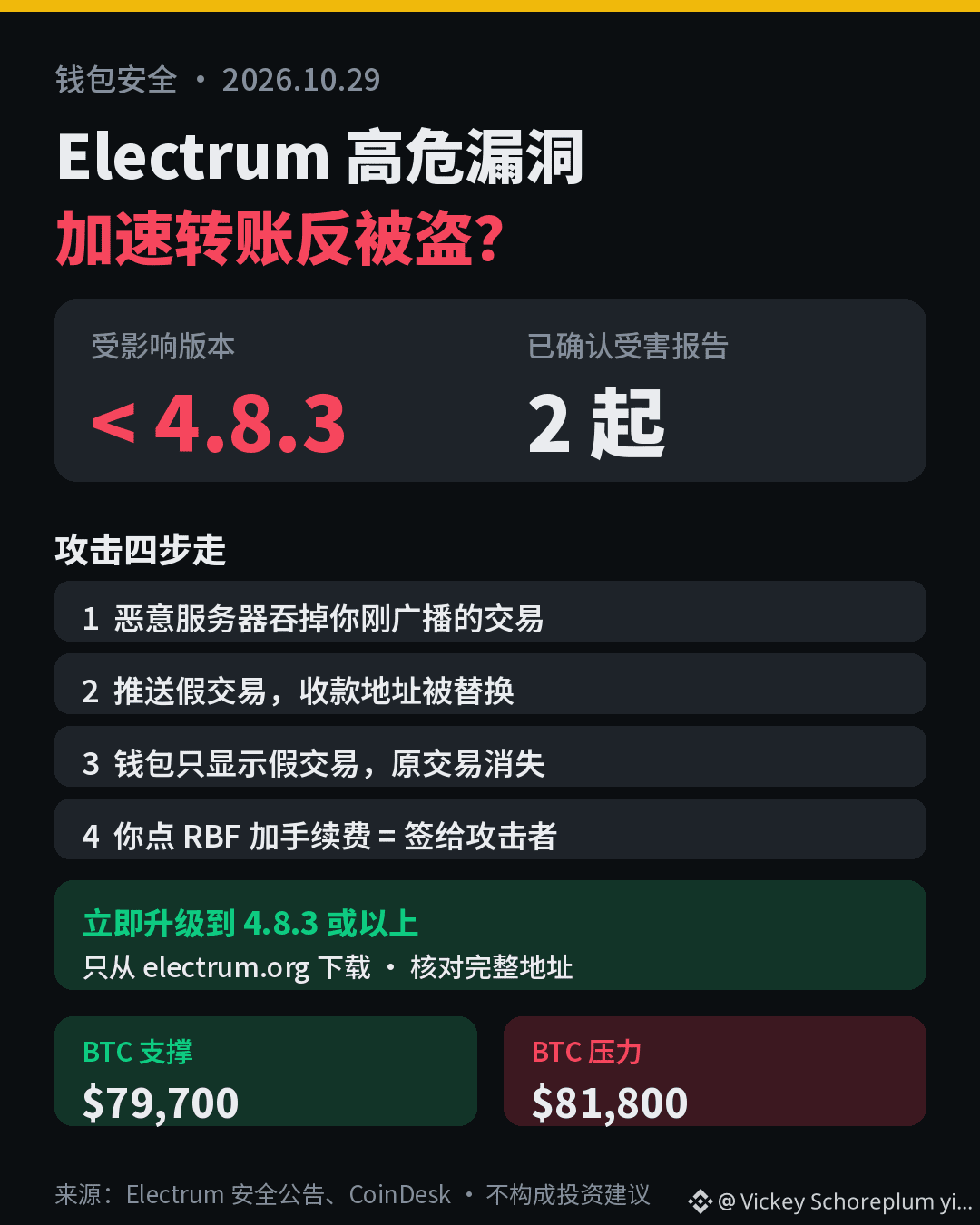
🔐 Could speeding up a Bitcoin transfer end up sending your money to hackers?
According to Electrum’s official security advisory (published October 24) and reports from media outlets including CoinDesk, all versions of Electrum before 4.8.3 have a critical vulnerability, and real attacks have already occurred: Electrum received two user reports, and at least one user lost Bitcoin.
📊 How the attack works
• After you broadcast a transfer, a malicious server “swallows” it instead of sending it to the Bitcoin network
• The server then pushes a conflicting fake transaction to your wallet, replacing the recipient address with the attacker’s
• Your wallet displays only the fake transaction, while the original one disappears
• If you then use RBF to increase the fee, your wallet uses your private key to sign a genuine, valid transaction that pays the attacker
🔍 How to protect yourself
• Upgrade immediately to Electrum 4.8.3 or later, and download it only from electrum.org
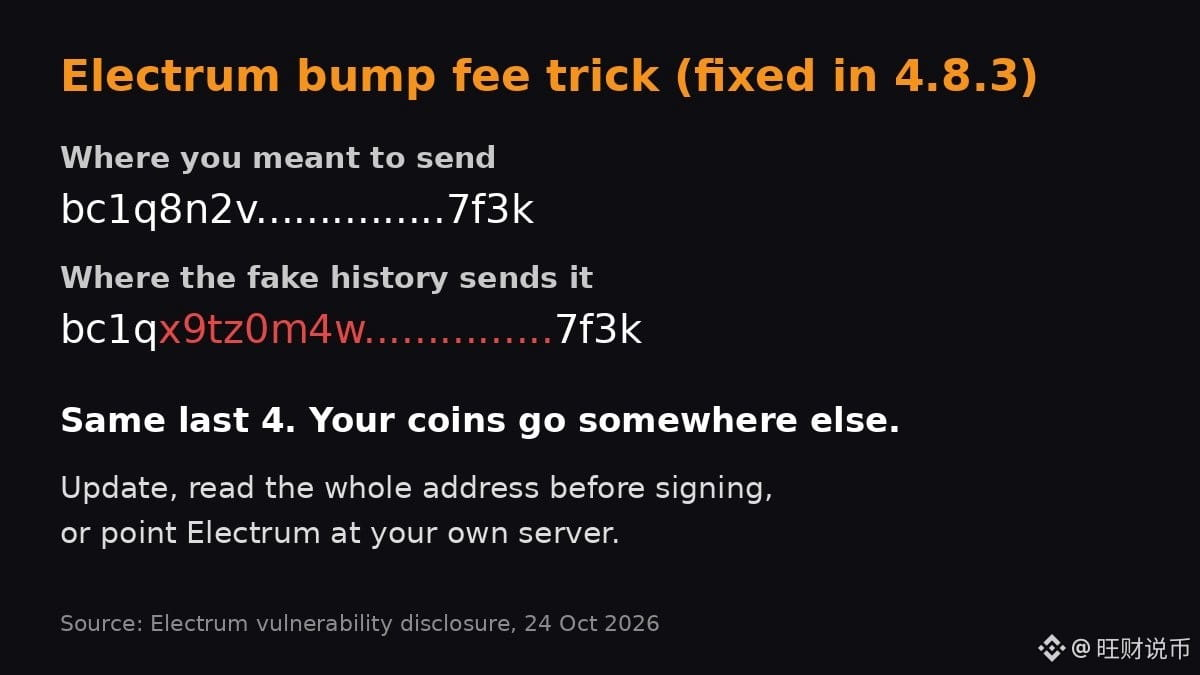
• Before speeding up a transaction or signing, carefully check the full recipient address and amount—not just the first and last few characters (the attackers’ addresses in both reported cases had the same ending as the intended addresses)
• You are not affected if you connect only to servers you trust or run yourself (CoinDesk)
📈 Market impact: This is a wallet-level risk, not a vulnerability in the Bitcoin protocol. BTC is currently near $80,000, with a 24-hour range of approximately $79,710–$81,823. $79,700 is near-term support, and $81,800 is resistance.
💬 Do you recheck the full address every time before speeding up a transaction?
👉 Trade BTC: https://www.binance.com/zh-CN/trade/BTC_USDT
#ElectrumFixesCriticalVulnerabilityInVersionsBefore4.8.3 #Electrum #比特币钱包 #WalletSecurity
⚠️ The above does not constitute investment advice. Please be aware of the risks.
144
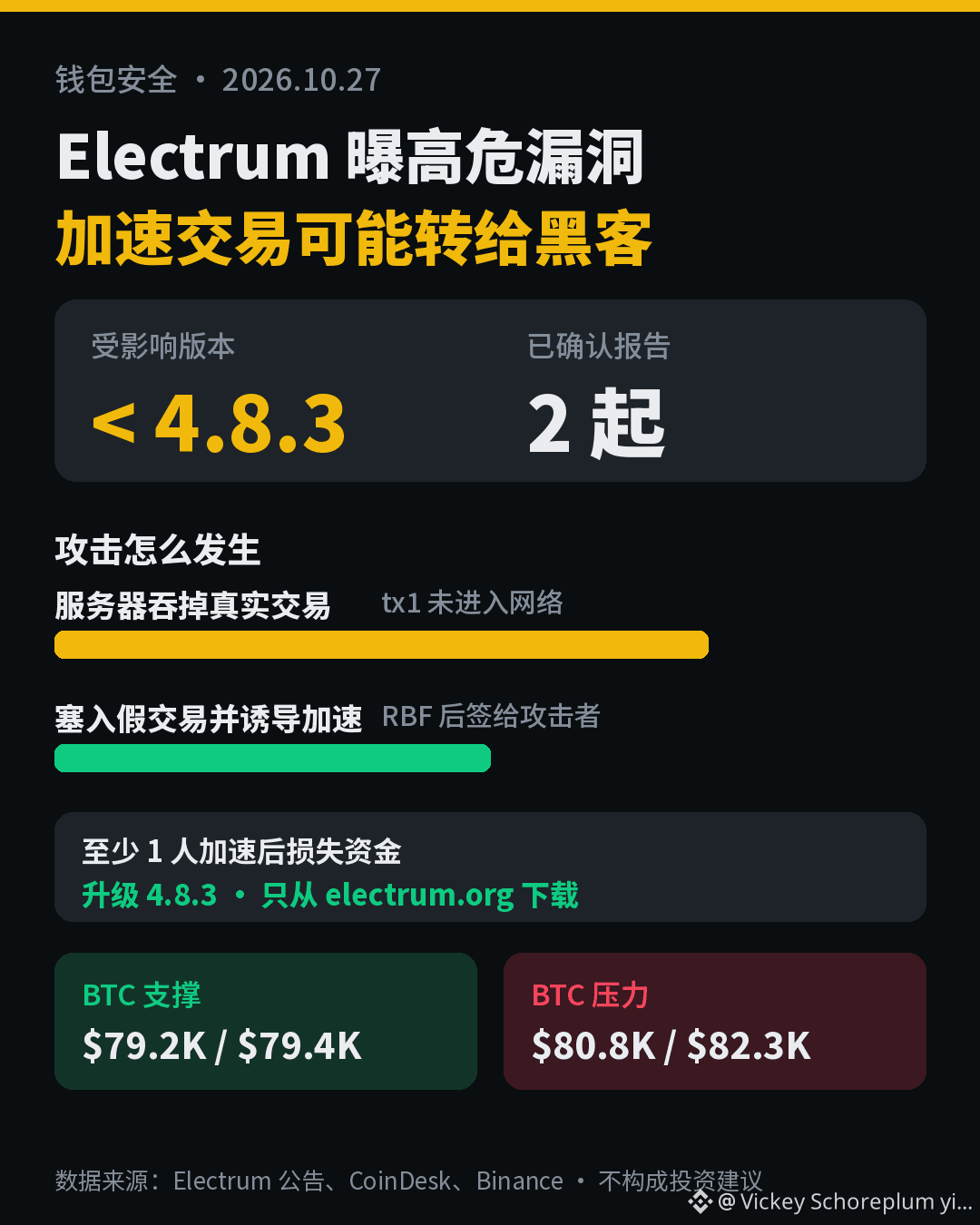
🔐 Could speeding up a transaction with Electrum mean sending money to a hacker?
Bitcoin veteran wallet Electrum released security update 4.8.3 on October 24, fixing a high-severity vulnerability: a malicious server could “swallow” a transaction you just broadcast and display a fake transaction in the wallet with a substituted recipient address. If you clicked RBF to speed it up, the wallet could sign a real transaction paying the attacker.
📋 How the attack works
• You broadcast tx1, but the malicious server doesn’t relay it, so the real transaction never reaches the Bitcoin network
• The server feeds the wallet a conflicting tx2 with the recipient address changed to the attacker’s. Its signature is invalid, but older versions don’t check
• The fake transaction has a fee of 0, making it look “stuck” and tempting you to speed it up
• When you speed it up, Electrum signs a valid transaction, transferring the funds to the attacker
⚠️ Some users have already been affected
Developers received two user reports (October 11 and October 18). One user lost funds after speeding up a fake transaction. The last four digits of the attacker’s address even matched the real address, making it hard to spot the difference by checking only the beginning and end. Total losses have not been disclosed.
🛡️ What to do
• All versions before 4.8.3 are affected. Upgrade to 4.8.3, and download it only from electrum.org
• Before speeding up a transaction (RBF), carefully check every output address and amount
• Users who connect only to servers they trust (such as their own node) are not affected
📊 Market impact
This is a wallet software issue, not a Bitcoin protocol vulnerability, so its impact on BTC itself is limited. BTC is currently around $79,800, down about 0.5% over 24 hours. Key levels: support at $79,200–79,400 (lows in recent days), resistance at $80,800 / $82,300.
Do you carefully check the address before speeding up a transaction? Share your thoughts in the comments 👇
👉 Trade BTC: https://www.binance.com/zh-CN/trade/BTC_USDT
#Electrum #比特币钱包 #钱包安全 #BTC
⚠️ The above does not constitute investment advice. Please be aware of the risks.
112

·
--
🛡️ CRITICAL UPDATE IN ELECTRUM! FIXES A LIGHTNING BACKUP FLAW ⚡🔐
The popular Bitcoin Electrum wallet has urgently released version 4.8.2 with important security and infrastructure fixes.
Key points of the update:
⚠️ Lightning Network fix: Resolves a critical issue in Lightning channel backups with non-deterministic keys. Old backups did not allow moving funds on-chain after a forced channel close.
🔑 Improved key management: Rejects malformed xpub/xprv keys that were processed previously.
📲 Privacy on Android: Prevents the QR code scanner from accessing or reading screenshots.
Recommended action: If you use Lightning features in Electrum, update to version 4.8.2 and generate a new backup, since previous backups will not be able to restore funds correctly.
Have you already updated your custody software or would you rather wait for the network to validate the patch? 💬👇 I’m reading your comments!
#BinanceSquare #Electrum #LightningNetwork #CryptoSecurity #CryptoCommunity
$BTC
{spot}(BTCUSDT)
$BNB
{spot}(BNBUSDT)
$SOL
{spot}(SOLUSDT)
🛡️ CRITICAL UPDATE IN ELECTRUM! FIXES A LIGHTNING BACKUP FLAW ⚡🔐
The popular Bitcoin Electrum wallet has urgently released version 4.8.2 with important security and infrastructure fixes.
Key points of the update:
⚠️ Lightning Network fix: Resolves a critical issue in Lightning channel backups with non-deterministic keys. Old backups did not allow moving funds on-chain after a forced channel close.
🔑 Improved key management: Rejects malformed xpub/xprv keys that were processed previously.
📲 Privacy on Android: Prevents the QR code scanner from accessing or reading screenshots.
Recommended action: If you use Lightning features in Electrum, update to version 4.8.2 and generate a new backup, since previous backups will not be able to restore funds correctly.
Have you already updated your custody software or would you rather wait for the network to validate the patch? 💬👇 I’m reading your comments!
#BinanceSquare #Electrum #LightningNetwork #CryptoSecurity #CryptoCommunity
$BTC
$BNB
$SOL

1
78

·
--
I just came across an announcement that Electrum has released version 4.8.3: it’s explicitly a security update that fixes serious security issues, and all users are urged to upgrade as soon as possible. Details of the vulnerabilities will be disclosed later.
The official reminder is to download only from the official website and verify the GPG signature. Windows Defender may flag ZXing.dll as a false positive; the official team says it can be ignored.
When an emergency patch drops for a long-established Bitcoin desktop wallet, don’t put off updating—fake download sites are also more likely to pop up at times like this.
#Electrum #比特币钱包 #Security

7

·
--
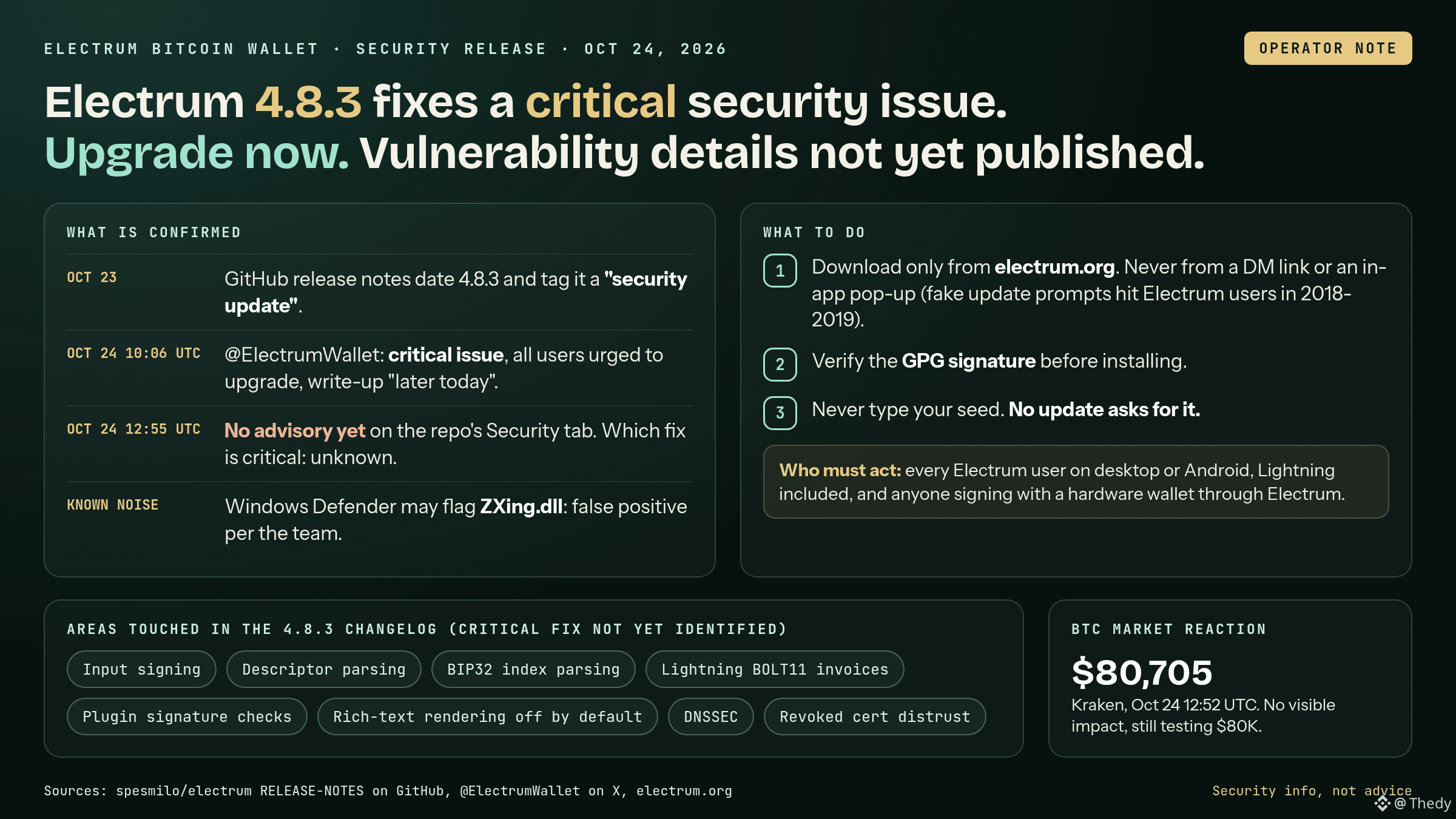
Electrum, one of the oldest $BTC wallets, has released version 4.8.3 and is asking all its users to update: it fixes a vulnerability described as “critical,” whose details have not yet been made public.
What’s confirmed:
- GitHub release notes (spesmilo/electrum): version 4.8.3 dated 23/10, labeled “security update.”
- @ElectrumWallet, 24/10 at 10:06 UTC: critical vulnerability, with a description promised “later today.” As of 12:55 UTC, there was no advisory in the repository’s Security tab.
- Windows Defender may flag ZXing.dll: the team says this is a false positive.
Who needs to act: all Electrum users on desktop or Android, including Lightning users, and anyone connecting a hardware wallet through Electrum.
What I would do:
1. Download only from electrum.org, never through a link in a DM or a pop-up. Electrum has already been targeted in 2018–2019 by fake update messages sent by malicious servers.
2. Verify the GPG signature before installing.
3. Never enter your seed: an update won’t ask for it.
My take: the changelog covers input signing, parsing of descriptors and Lightning invoices, plugin verification, and disabling “rich text” rendering by default. The team hasn’t said which issue is critical. There are two possibilities: a vulnerability requiring a compromised server or user action, addressed by the update; or a risk involving transaction signing, which would justify moving your funds to a new address.
As for the market, nothing noticeable: BTC at $80,705 on Kraken (12:52 UTC), still hovering around $80,000.
Do you still keep $BTC in a desktop wallet like Electrum, or have you moved everything to a hardware wallet or exchange?
#Bitcoin #Electrum
88

·
--
Bullish
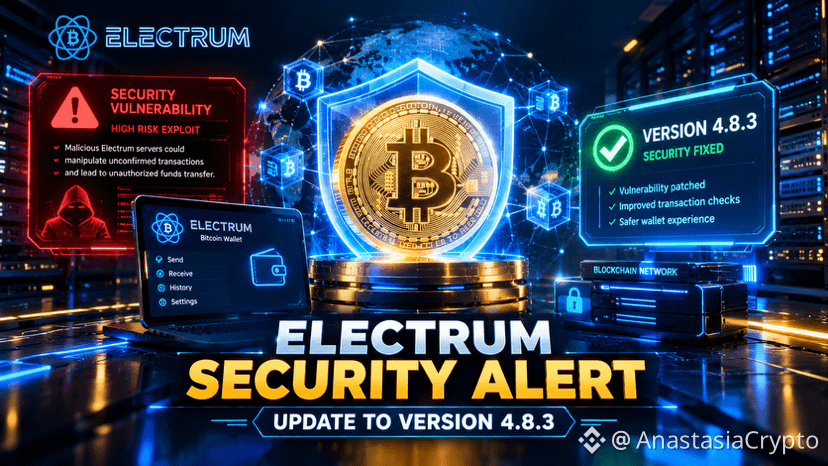
#electrumfixeshighriskexploitinversionsbefore4.8.3 🚨 BITCOIN WALLET SECURITY ALERT: ELECTRUM FIXES HIGH-RISK EXPLOIT! 🔐
Bitcoin users, this is an important security update you should not ignore.
Electrum has released version 4.8.3 to fix a high-severity vulnerability affecting earlier versions of its Bitcoin wallet. Even more concerning, the developers report that the weakness has been exploited in the wild. ⚠️
🔎 What happened?
The vulnerability involved malicious Electrum servers that could manipulate how an unconfirmed Bitcoin transaction appeared in a user’s wallet.
If a user then tried to increase the transaction fee using Replace-by-Fee (RBF), they could unknowingly authorize a transaction sending funds to an attacker’s address.
📌 What you need to know:
🔹 Affected versions: Electrum versions earlier than 4.8.3.
🔹 The fix: Electrum 4.8.3 includes security checks designed to prevent this attack.
🔹 Reported incidents: Electrum disclosed two user reports, including one case involving a loss of funds.
🔹 Recommended action: Update to version 4.8.3 through Electrum’s official website, electrum.org.
🔹 Extra precaution: Always verify the recipient address and transaction amount before signing a transaction, especially when increasing fees.
💡 My takeaway:
Crypto security is not just about protecting your private keys. Wallet software, transaction verification, and the servers you trust also matter.
Even experienced Bitcoin users should never approve a transaction without checking its destination.
💬 Question for the community:
Do you think wallet security should be a bigger priority for crypto users than price predictions and market trends?
Share your thoughts below. 👇
#Bitcoin #BTC #CryptoSecurity #Electrum
$BTC $ETH $ZEC
{future}(ZECUSDT)
{future}(ETHUSDT)
{future}(BTCUSDT)
#electrumfixeshighriskexploitinversionsbefore4.8.3 🚨 BITCOIN WALLET SECURITY ALERT: ELECTRUM FIXES HIGH-RISK EXPLOIT! 🔐
Bitcoin users, this is an important security update you should not ignore.
Electrum has released version 4.8.3 to fix a high-severity vulnerability affecting earlier versions of its Bitcoin wallet. Even more concerning, the developers report that the weakness has been exploited in the wild. ⚠️
🔎 What happened?
The vulnerability involved malicious Electrum servers that could manipulate how an unconfirmed Bitcoin transaction appeared in a user’s wallet.
If a user then tried to increase the transaction fee using Replace-by-Fee (RBF), they could unknowingly authorize a transaction sending funds to an attacker’s address.
📌 What you need to know:
🔹 Affected versions: Electrum versions earlier than 4.8.3.
🔹 The fix: Electrum 4.8.3 includes security checks designed to prevent this attack.
🔹 Reported incidents: Electrum disclosed two user reports, including one case involving a loss of funds.
🔹 Recommended action: Update to version 4.8.3 through Electrum’s official website, electrum.org.
🔹 Extra precaution: Always verify the recipient address and transaction amount before signing a transaction, especially when increasing fees.
💡 My takeaway:
Crypto security is not just about protecting your private keys. Wallet software, transaction verification, and the servers you trust also matter.
Even experienced Bitcoin users should never approve a transaction without checking its destination.
💬 Question for the community:
Do you think wallet security should be a bigger priority for crypto users than price predictions and market trends?
Share your thoughts below. 👇
#Bitcoin #BTC #CryptoSecurity #Electrum
$BTC $ETH $ZEC
1
734


·
--
Electrum has released security update v4.8.2, but some Bitcoin self-custody users still need to take manual action by updating their channel backups.
A defect in older backup files could prevent users from recovering funds in anchor channels if a remote peer suddenly closes the channel. Because non-deterministic Lightning keys cannot be recreated strictly from a wallet seed, individual channel exports and full-wallet backups created under specific conditions lack the critical payment-key data needed to sweep coins back to the main blockchain.
This primarily impacts wallets using BIP39 seeds, imported private keys, or Electrum wallets generated prior to version 4.1.
For active Lightning network users, backup integrity is critical. A failure to sweep outputs after an unannounced channel closure directly puts user balances at risk, serving as a reminder that off-chain scaling solutions still require careful backup management.
Have you checked your Electrum Lightning backup settings recently, or do you prefer fully automated channel management?
#bitcoin #Electrum #lightningnetwork #CryptoSecurityAlert
152

Electrum has released version 4.8.3, which primarily fixes a signature vulnerability. Users who manage $BTC with Electrum are advised to upgrade as soon as possible through official channels. Do not click download links in group chats, private messages, or search ads.
Before upgrading, verify the website domain and the source of the installation package. After installing, check the version number. If you have ever entered your seed phrase or private key on an untrusted device or in an untrusted environment, be extra cautious. If necessary, create a wallet on a new, trusted device and transfer your assets.
There is no need to panic about a wallet vulnerability being fixed; delaying updates and falling for phishing are the biggest risks. Keep your seed phrase safe. Never trust anyone who asks for your seed phrase, requests remote access, or claims to be customer support and offers to help transfer your funds.
#比特币 #钱包安全 #Electrum
45

·
--
Article
The patch has been out for two days—but could you still lose funds by bumping the fee before upgrading to 4.8.3?The official 4.8.3 patch was released on October 24. Electrum users on older versions who use RBF to increase the fee may still hand attackers a valid signature.
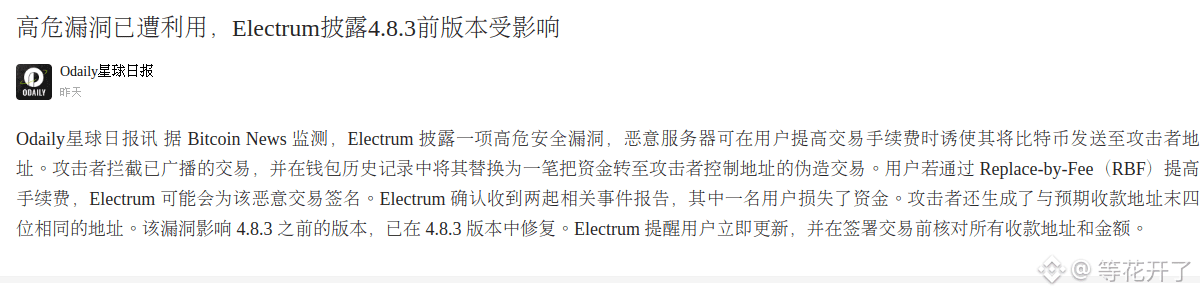
The attack works like this: a malicious server swallows a legitimate transaction just after it’s broadcast, then slips in a fake conflicting transaction with an invalid signature. The fake transaction is all that appears in the user’s local history. Thinking their transaction is stuck, the user bumps the fee—effectively providing a valid signature for the fake recipient address, allowing the attacker to steal the coins. The official advisory confirms that servers are already doing this in the wild; of two user reports, at least one involved a theft after using bump_fee. The mitigation is straightforward: upgrade to 4.8.3. Until then, check the full recipient address and amount every time you sign, including when bumping the fee—don’t just look at the last few digits. Users running their own or a trusted server are not affected. Only download from electrum.org, and verify the GPG signature.
The patch has been out for two days—but could you still lose funds by bumping the fee before upgrading to 4.8.3?
The official 4.8.3 patch was released on October 24. Electrum users on older versions who use RBF to increase the fee may still hand attackers a valid signature.
The attack works like this: a malicious server swallows a legitimate transaction just after it’s broadcast, then slips in a fake conflicting transaction with an invalid signature. The fake transaction is all that appears in the user’s local history. Thinking their transaction is stuck, the user bumps the fee—effectively providing a valid signature for the fake recipient address, allowing the attacker to steal the coins. The official advisory confirms that servers are already doing this in the wild; of two user reports, at least one involved a theft after using bump_fee. The mitigation is straightforward: upgrade to 4.8.3. Until then, check the full recipient address and amount every time you sign, including when bumping the fee—don’t just look at the last few digits. Users running their own or a trusted server are not affected. Only download from electrum.org, and verify the GPG signature.
The attack works like this: a malicious server swallows a legitimate transaction just after it’s broadcast, then slips in a fake conflicting transaction with an invalid signature. The fake transaction is all that appears in the user’s local history. Thinking their transaction is stuck, the user bumps the fee—effectively providing a valid signature for the fake recipient address, allowing the attacker to steal the coins. The official advisory confirms that servers are already doing this in the wild; of two user reports, at least one involved a theft after using bump_fee. The mitigation is straightforward: upgrade to 4.8.3. Until then, check the full recipient address and amount every time you sign, including when bumping the fee—don’t just look at the last few digits. Users running their own or a trusted server are not affected. Only download from electrum.org, and verify the GPG signature.
95

·
--
The nastiest thing about this Electrum vulnerability is that it exploits your caution
On October 24, Electrum announced a high-severity vulnerability affecting all versions before 4.8.3. The team says servers have already used this attack in the wild. They’ve confirmed two reports, and one person lost money.
The attack is simple: you broadcast a transaction, but a malicious server doesn’t relay it—it swallows it. Then it slips a fake transaction into your wallet history, using the same inputs to send almost all your funds to the attacker’s address, with the fee displayed as zero.
Your transaction is stuck, and the fee is zero. What’s the natural response? Manually bump the fee—in other words, use RBF.
That’s when Electrum signs the fake transaction, and your money goes straight into the attacker’s pocket.
Even more devious: the last four characters of the attacker’s address match those of the address you originally intended to send to.
This is a reminder to everyone managing their own funds:
1. Don’t verify an address by checking just the first or last few characters. Check the entire address, and scan a QR code instead of typing it whenever possible.
2. If a transaction is stuck, don’t use RBF directly in your wallet. Look up the txid on mempool.space to check its real status, and make sure the transaction is actually on-chain before taking action.
Updating to 4.8.3 is the bare minimum, not the whole solution.
Wallet security isn’t just about installing an update—it’s about not cutting corners at every step 👀
$BTC #Electrum #钱包安全 #BTC
69

·
--
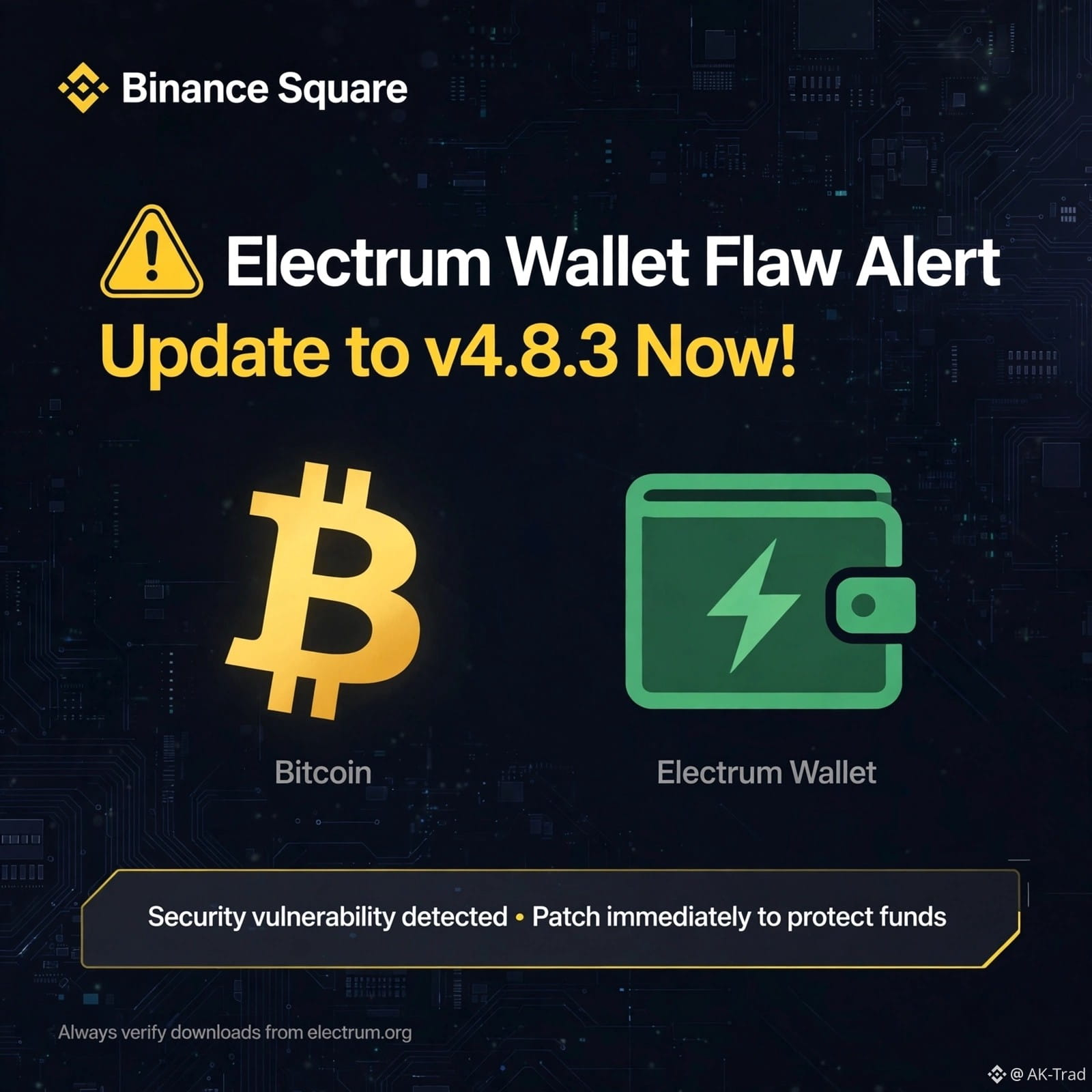
⚠️ BREAKING: Electrum Wallet Bug - BTC Stolen!
A major flaw has been found in the Electrum wallet!
Hackers are stealing users’ funds by showing fake Bitcoin payments when users increase the fee using Replace-by-Fee.
🔴 At least 1 confirmed theft has occurred
✅ Fix: Version 4.8.3 was released on October 24
⚠️ Older versions may still be vulnerable to hacking
SOLUTION: Immediately update to v4.8.3 from electrum.org and double-check the address before signing!
Which wallet do you use? Is it safe?
#BTC☀️ #Bitcoin❗ #Electrum #SecurityAlert #CryptoNews
BTC $80,179.01
72

·
--
Tried to speed up a transfer, ended up sending it to hackers: Electrum patches a vulnerabilityFor convenience, lightweight wallet users may connect to the wrong server and click “Increase fee”—and their $BTC could end up in someone else’s address.
The team behind veteran Bitcoin wallet Electrum has disclosed that malicious servers can swallow a transaction you’ve just broadcast, then insert a fake unconfirmed transaction. The output address is tweaked to match the last four characters of the original, and the signature isn’t checked at the time. You think you’re simply speeding things up with RBF, but one click means you’ve effectively signed a transaction sending funds to the attacker. There were two user reports in October, and one person did lose coins. The team says servers doing this are already active in the wild. The amount stolen has not been disclosed.
Tried to speed up a transfer, ended up sending it to hackers: Electrum patches a vulnerability
For convenience, lightweight wallet users may connect to the wrong server and click “Increase fee”—and their $BTC could end up in someone else’s address.
The team behind veteran Bitcoin wallet Electrum has disclosed that malicious servers can swallow a transaction you’ve just broadcast, then insert a fake unconfirmed transaction. The output address is tweaked to match the last four characters of the original, and the signature isn’t checked at the time. You think you’re simply speeding things up with RBF, but one click means you’ve effectively signed a transaction sending funds to the attacker. There were two user reports in October, and one person did lose coins. The team says servers doing this are already active in the wild. The amount stolen has not been disclosed.
The team behind veteran Bitcoin wallet Electrum has disclosed that malicious servers can swallow a transaction you’ve just broadcast, then insert a fake unconfirmed transaction. The output address is tweaked to match the last four characters of the original, and the signature isn’t checked at the time. You think you’re simply speeding things up with RBF, but one click means you’ve effectively signed a transaction sending funds to the attacker. There were two user reports in October, and one person did lose coins. The team says servers doing this are already active in the wild. The amount stolen has not been disclosed.
185

·
--
Bullish
#ElectrumWalletBugLetRogueServersStealFunds
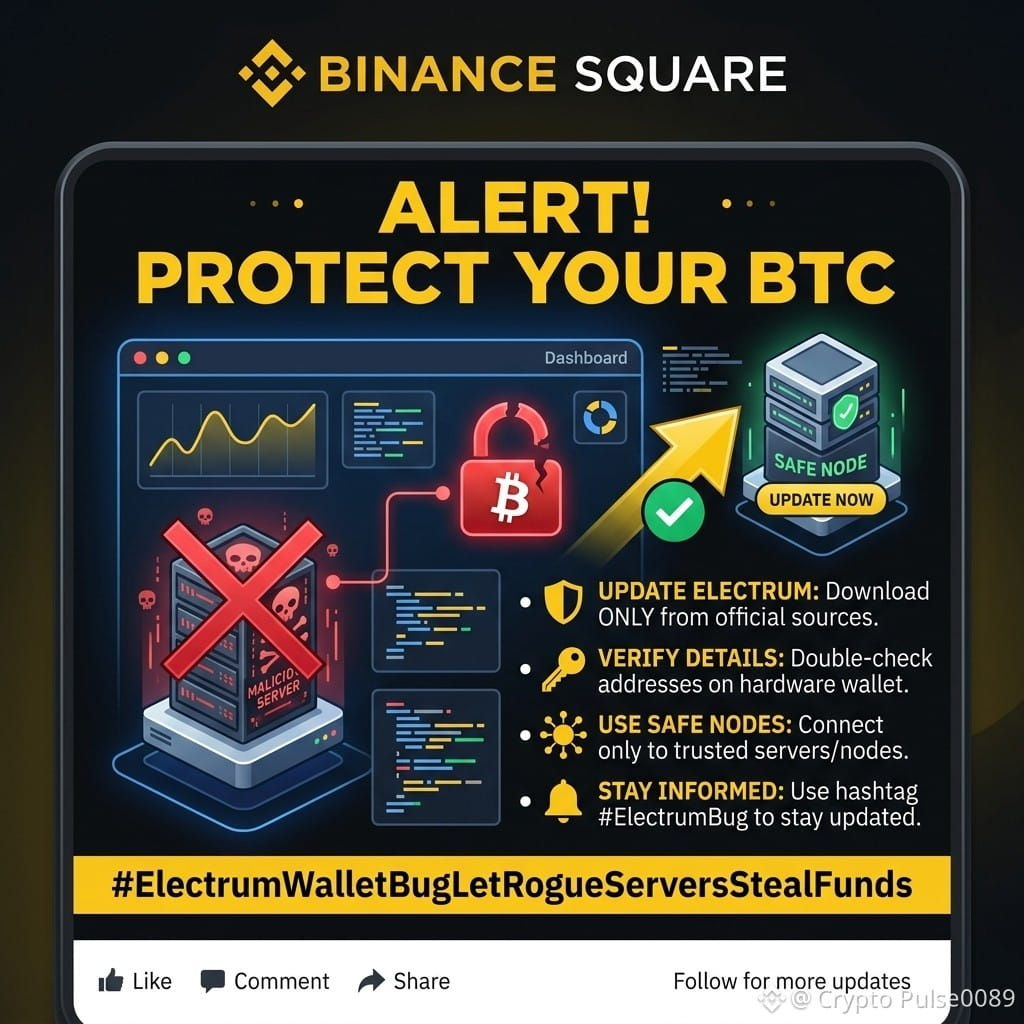
🚨 URGENT SECURITY ALERT: #ElectrumWalletBug 🚨
A critical security flaw associated with #ElectrumWalletBugLetRogueServersStealFunds has been highlighted. Malicious or rogue Electrum servers can exploit communication vulnerabilities to manipulate transaction prompts and potentially drain user funds!
If you are using the Electrum Bitcoin wallet, protect your assets by following these steps immediately:
⚠️ WHAT YOU NEED TO DO NOW:
Update Your Wallet: Ensure you are using the latest official version of Electrum downloaded strictly from the official site (electrum.org).
Avoid Unknown Servers: Do not connect to unverified public servers.
Run Your Own Node/Server: If possible, connect Electrum to your own private backend (like Electrum Personal Server or ElectrumX).
Verify on Hardware: Always double-check recipient addresses on your hardware wallet screen before confirming any transaction.
Spread Awareness: Share this alert to protect the community!
🛡️ Stay safe, stay secure, and double-check your connections!
#CryptoSecurity #Bitcoin #Electrum #BTC #CryptoSafety #WalletSecurity
$AMZNB $TSLAB $SQQQB
48

·
--
A note for those using their own Bitcoin wallets: Electrum has released version 4.8.3, which primarily fixes a security vulnerability related to signature verification. Update as soon as possible through official channels. Do not download it from links in private messages, group chats, or search ads.
Before updating, it’s best to verify the file signature, official website domain, and version number. Do not continue using older versions for signing high-value transactions. If you use an offline signing device or cold wallet, also check that your watch-only wallet and signing environment are running compatible versions.
The core of self-custody isn’t “installing a wallet means you’re safe.” It means promptly patching vulnerabilities, keeping permissions to a minimum, and maintaining an offline backup plan.
#比特币 #Electrum #WalletSecurity
80

Vulnerabilities are everywhere😧
A vulnerability in the #Electrum #Bitcoin wallet allowed rogue servers to steal funds when users tried to speed up stuck payments.😕
Older versions accepted certain pending transactions from public servers without fully verifying signatures. Attackers could insert look-alike transactions, and when users applied a fee bump (Replace-by-Fee), they risked signing a payment to the attacker instead. The issue was confirmed in at least two real cases.
Electrum has released version 4.8.3 to close the flaw. Users should update promptly and avoid relying on untrusted servers for critical operations.
Security risks and weaknesses permeate every aspect of the ecosystem.
Check This Related Information:-
[Is Cybersecurity About to Outshine AI? Here’s Why You Shouldn’t Ignore These Two Tokens!](https://app.binance.com/uni-qr/cart/381137141755585?r=S4DH99WR&l=en&uco=5ewrZ5HoRZsxouAWxbreNw&uc=app_square_share_link&us=copylink)
@Binance_News @KathalVahini #BTC #Security #CoinVahini $BTC
Vulnerabilities are everywhere😧
A vulnerability in the #Electrum #Bitcoin wallet allowed rogue servers to steal funds when users tried to speed up stuck payments.😕
Older versions accepted certain pending transactions from public servers without fully verifying signatures. Attackers could insert look-alike transactions, and when users applied a fee bump (Replace-by-Fee), they risked signing a payment to the attacker instead. The issue was confirmed in at least two real cases.
Electrum has released version 4.8.3 to close the flaw. Users should update promptly and avoid relying on untrusted servers for critical operations.
Security risks and weaknesses permeate every aspect of the ecosystem.
Check This Related Information:-
Is Cybersecurity About to Outshine AI? Here’s Why You Shouldn’t Ignore These Two Tokens!
@Binance News @Kathals Info Bits #BTC #Security #CoinVahini $BTC
1
5

·
--
🚨 Electrum users beware: the fee-bumping (RBF) step could send your coins to hackers!
Electrum disclosed a critical vulnerability: malicious servers can forge transaction history and change the recipient address when you “speed up a transaction.” Two users have already lost large amounts of BTC (Source: Electrum disclosure / SecurityOnline, 10/26).
⚠️ How the scam works:
• The new address looks similar to the original at the beginning and end, so a quick glance may not catch it
• You think you’re increasing the fee, but you’re actually resending the transaction to the attacker
✅ How to protect yourself:
1️⃣ Upgrade to version 4.8.3 immediately (all older versions are affected)
2️⃣ Carefully verify the entire recipient address before signing—don’t just check the beginning and end
3️⃣ For large amounts, use your own Electrum server, or check every character on your hardware wallet’s confirmation screen
The market is falling (BTC is hovering around 80,000), but wallet security will always matter more than price: self-custody = personal responsibility.
Where do you keep your BTC? An exchange, a hardware wallet, or Electrum? Share in the comments 👇
$BTC #Electrum #比特币安全 #CryptoEducation
Personal opinion only; not investment advice
15

·
--
That “transfer you just sent” in your wallet history might not have been sent by you at all.
On October 24, veteran Bitcoin desktop wallet Electrum released version 4.8.3, fixing a severe vulnerability that had been exploited in the wild. When versions earlier than 4.8.3 connected to a malicious server, the server could replace a transaction you’d just broadcast with a conflicting fake one. The last four characters of the recipient address were identical to those of your real recipient. If users saw the transaction taking too long to confirm and clicked “Increase fee” (RBF), the wallet would re-sign the fake transaction, sending the coins straight to the attacker. Users have already reported losing funds.
From an engineer’s perspective:
· Lightweight wallets don’t store the entire blockchain themselves. The server “tells” them what the transaction history and unconfirmed transactions are;
· Older versions didn’t verify the signatures on unconfirmed transactions, displaying whatever the server provided;
· RBF re-signs an “existing transaction.” If that transaction is fake to begin with, the signed transaction is exactly what the attacker wants;
· The fix in 4.8.3 is to add that missing step: verify unconfirmed transactions before trusting them.
Four tips for everyday users:
1) If you use Electrum, upgrade to 4.8.3. Download it only from the official website and verify the signature;
2) Check the entire address. “The first and last four characters” aren’t enough to protect you from a targeted attack;
3) If a transaction gets stuck, check its actual status on a block explorer. Don’t rely only on what your wallet shows;
4) If you’re handling a large amount of funds, run your own node. With data shown to you by a public server, it ultimately gets to decide what you see.
I don’t usually pry too much into pretty girls’ “histories,” but I verify every single entry in my wallet’s transaction history 😏
#链上安全 #比特币钱包 #Electrum
1
1
1.9k

⚠️ $BTC USERS MUST UPGRADE ELECTRUM NOW! 🚨
📌 Electrum 4.8.3 lands with a critical security patch, neutralizing a vulnerability that could have been exploited by opportunistic actors. 🦈 Windows Defender may flash a false‑positive alert on ZXing.dll, but the wallet team confirms it’s benign—upgrade to stay ahead of the smart‑money safety net. 📊 The timing aligns with heightened network activity, suggesting institutions are tightening their risk buffers across the ecosystem.
💬 Are you already running the latest build, or waiting for the official disclosure? 👇
⚠️ Not financial advice. Always manage your risk. 🛡️
🏷️ #BTC #Security #Electrum #Crypto
🛡️ 🔥
3

·
--
$BTC was paid to a stranger's address after increasing the fee: Electrum disclosed on the 24th that users have already lost funds, and 4.8.3 has fixed it.
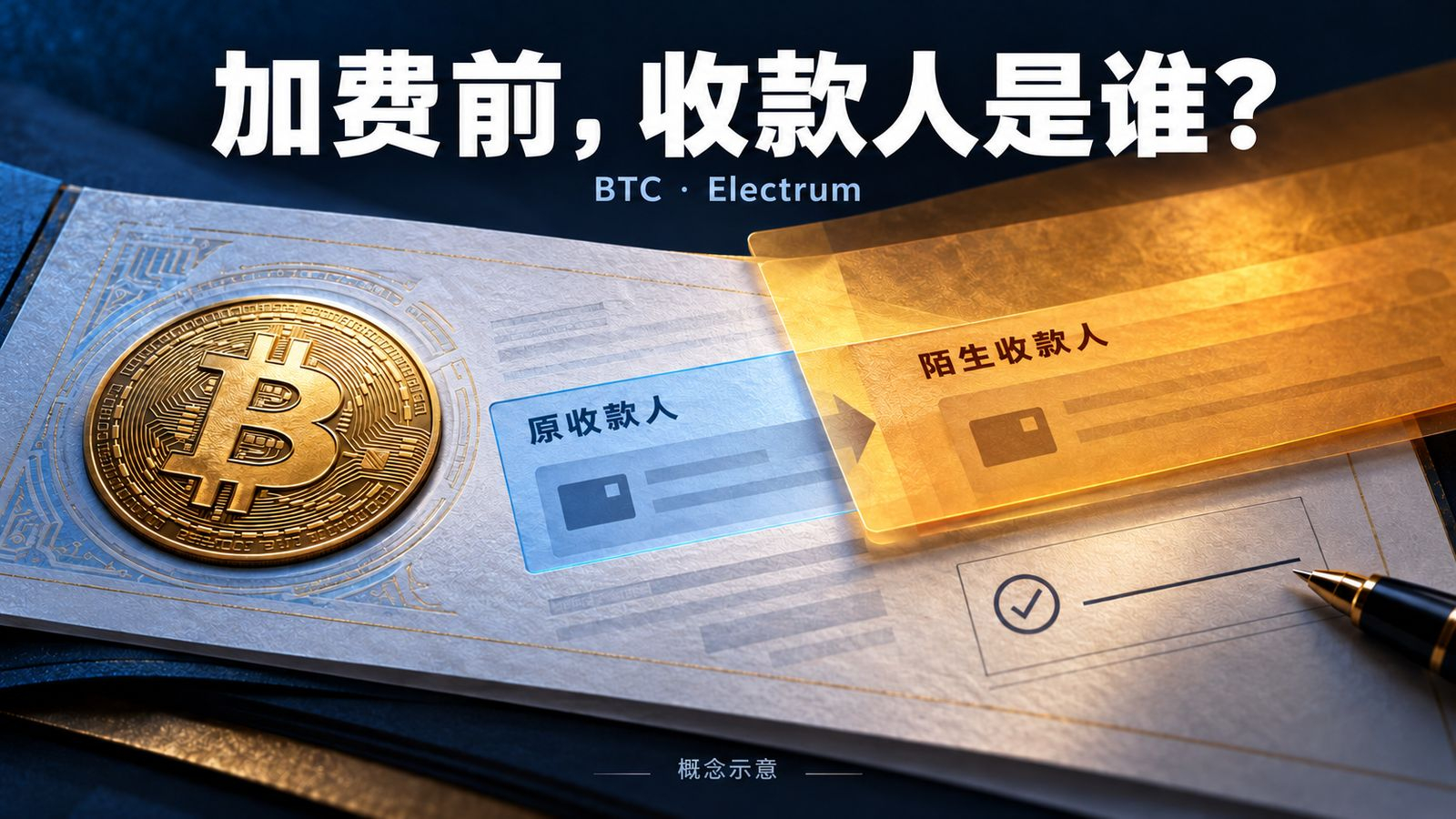
A transfer gets stuck, and you want to pay a higher fee to make it go faster; that part is normal. The problem with older wallet versions is this: the unconfirmed payment on the screen may have had its recipient replaced.
The official announcement explains that a malicious server hides the original transaction and inserts a record pointing to the attacker. If a user increases the fee and re-signs it, they may end up paying BTC to the attacker. The official report received two cases, one of which involved lost coins; the fake address even shared the same last four characters as the original, making it easy to miss at a glance.
For holders still using older versions to send BTC, the risk lies in the re-signing step. When confirming a withdrawal, check the full destination address and amount; do not compare only the last four characters. Update by obtaining it from electrum.org and verifying the signature. The official said clients connected to trusted servers (such as self-hosted ones) are not affected by this attack, and this is not a compromise of the Bitcoin network.
If you rush to re-sign, you take the risk that the entire payment goes to the wrong destination; upgrading and double-checking take more time. If the version has been patched and the full output matches the original payment, then there is a basis to continue processing the payment.
This content participates in Binance Square content mining, and the author may receive platform commissions and interaction rewards.
#BTC #Electrum #walletsecurity
{future}(BTCUSDT)
$BTC was paid to a stranger's address after increasing the fee: Electrum disclosed on the 24th that users have already lost funds, and 4.8.3 has fixed it.
A transfer gets stuck, and you want to pay a higher fee to make it go faster; that part is normal. The problem with older wallet versions is this: the unconfirmed payment on the screen may have had its recipient replaced.
The official announcement explains that a malicious server hides the original transaction and inserts a record pointing to the attacker. If a user increases the fee and re-signs it, they may end up paying BTC to the attacker. The official report received two cases, one of which involved lost coins; the fake address even shared the same last four characters as the original, making it easy to miss at a glance.
For holders still using older versions to send BTC, the risk lies in the re-signing step. When confirming a withdrawal, check the full destination address and amount; do not compare only the last four characters. Update by obtaining it from electrum.org and verifying the signature. The official said clients connected to trusted servers (such as self-hosted ones) are not affected by this attack, and this is not a compromise of the Bitcoin network.
If you rush to re-sign, you take the risk that the entire payment goes to the wrong destination; upgrading and double-checking take more time. If the version has been patched and the full output matches the original payment, then there is a basis to continue processing the payment.
This content participates in Binance Square content mining, and the author may receive platform commissions and interaction rewards.
#BTC #Electrum #walletsecurity
142
Log in to explore more content
Join global crypto users on Binance Square
⚡️ Get latest and useful information about crypto.
💬 Trusted by the world’s largest crypto exchange.
👍 Discover real insights from verified creators.
Email / Phone number
Trending Topics
1
#EvolveAtBinanceBlockchainWeek
2M views
18,812 Discussing
2
#BitcoinETFsExtendOutflowStreakToEightDays
30,753 views
416 Discussing
3
#FranklinTempletonPlansToAddHYPEToCryptoIndexETF
5,945 views
92 Discussing
4
#ColdcardFlawLeadsToTheftOfAtLeast1789BTC
96,028 views
755 Discussing
5
#EnishPlansToSell5932SOL
17,620 views
130 Discussing
6
#FTSaysRussianInvestorBackedTetherEarly
1,219 views
19 Discussing
7
#SECIssuesNoActionLetterOnMoleculeModel
22,321 views
263 Discussing
8
#MalaysiaFirstBitcoinETFToListOnDecember2
32,224 views
292 Discussing
9
#VitalikWantsWalletChipDesignsOpened
83,768 views
680 Discussing
10
#EthereumGlamsterdamKeepsStorageFeeChange
78,752 views
698 Discussing