
#cryptoinsight
cryptoinsight
116,794 views
337 Discussing
Hot
Latest

·
--
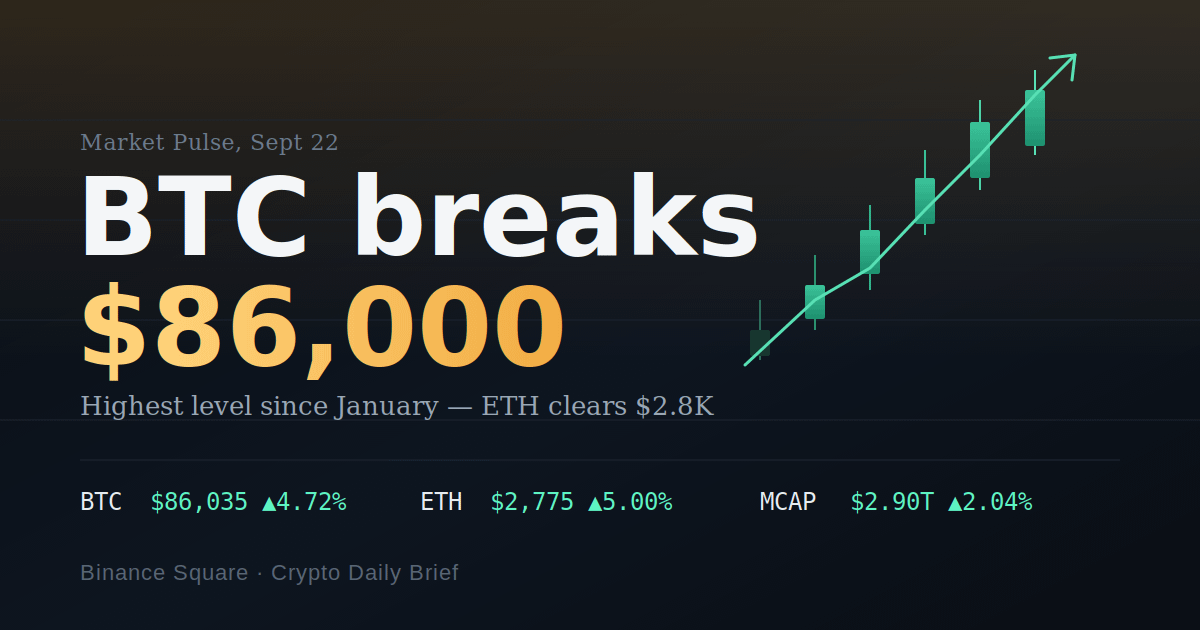
BTC's break above $86K isn't just a price move — it's a sentiment shift. This is the first time since January the market has cleared this level, and it's happening alongside falling oil prices, cooling rates, and institutional buyers (like Bitmine adding $75M in ETH) rather than retail hype. That combo — macro tailwinds + institutional accumulation — tends to be more durable than a pure momentum spike.
Watch: $85K–$87K is the breakout zone. Holding above it on continued spot volume would confirm this as trend, not a spike; losing $82K–$83K would suggest exhaustion.
#BTC #CryptoInsight #BinanceSquare #BitcoinBreaksAboveMayHighNears$86K
BTC's break above $86K isn't just a price move — it's a sentiment shift. This is the first time since January the market has cleared this level, and it's happening alongside falling oil prices, cooling rates, and institutional buyers (like Bitmine adding $75M in ETH) rather than retail hype. That combo — macro tailwinds + institutional accumulation — tends to be more durable than a pure momentum spike.
Watch: $85K–$87K is the breakout zone. Holding above it on continued spot volume would confirm this as trend, not a spike; losing $82K–$83K would suggest exhaustion.
#BTC #CryptoInsight #BinanceSquare #BitcoinBreaksAboveMayHighNears$86K
Watch: $85K–$87K is the breakout zone. Holding above it on continued spot volume would confirm this as trend, not a spike; losing $82K–$83K would suggest exhaustion.
#BTC #CryptoInsight #BinanceSquare #BitcoinBreaksAboveMayHighNears$86K
44

·
--
Bullish
Crypto Fear & Greed returns to Greed, while market structure remains below extreme euphoria
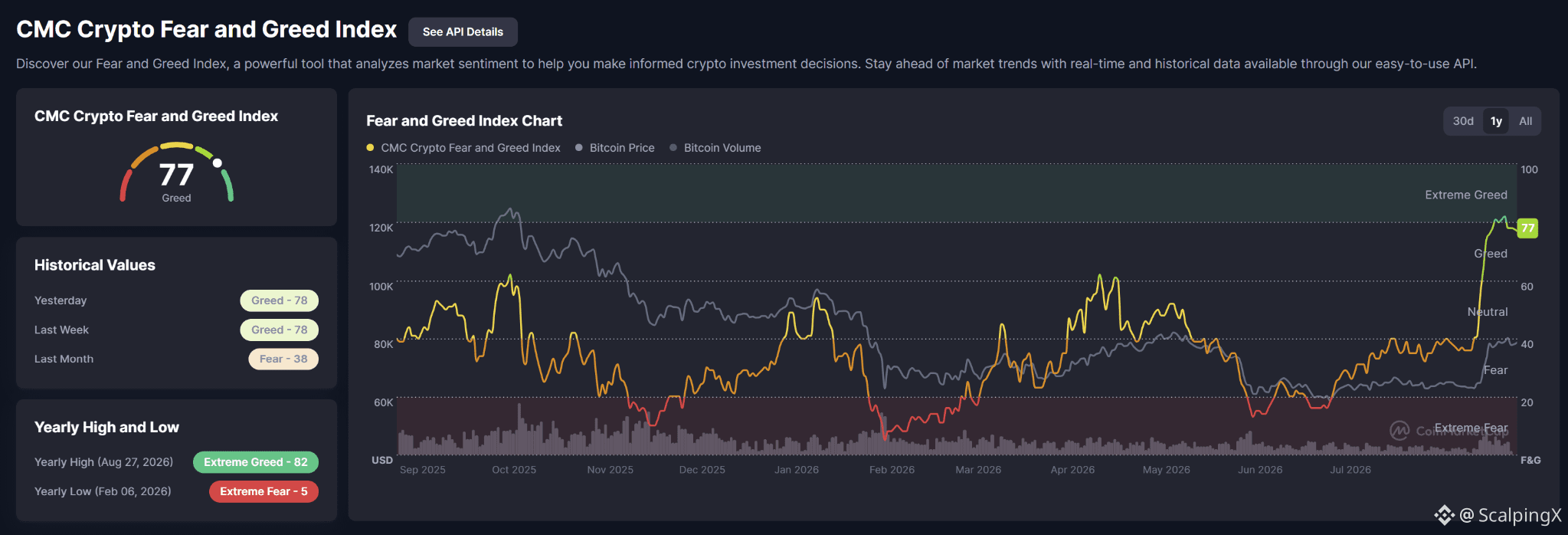
📊 The CMC Crypto Fear & Greed Index stands at 77, easing from 78 yesterday but still far above the Fear reading of 38 one month ago. The index reached 82 on August 27, its yearly high, while Bitcoin trades near $78,000–$79,000 after a strong August rally.
🔎 Despite the rapid improvement in sentiment, on-chain data remains relatively balanced. MVRV is around 1.49, NUPL near 0.33, and Reserve Risk remains low, suggesting network valuation has not yet entered levels typically associated with late-cycle euphoria.
💰 ETF flows continue to support the market, but have become more two-way after U.S. spot Bitcoin ETFs recorded roughly $202 million in outflows on August 28. Funding rates and futures basis also remain only mildly positive, indicating leverage is not yet excessive.
⚠️ This divergence between sentiment and valuation makes the $80,000–$83,000 area important to watch. Elevated F&G increases the risk of profit-taking or short-term consolidation, but the index alone is not enough to confirm a major top.
#CryptoInsight $BTC $ETH $DEBIT
Crypto Fear & Greed returns to Greed, while market structure remains below extreme euphoria
📊 The CMC Crypto Fear & Greed Index stands at 77, easing from 78 yesterday but still far above the Fear reading of 38 one month ago. The index reached 82 on August 27, its yearly high, while Bitcoin trades near $78,000–$79,000 after a strong August rally.
🔎 Despite the rapid improvement in sentiment, on-chain data remains relatively balanced. MVRV is around 1.49, NUPL near 0.33, and Reserve Risk remains low, suggesting network valuation has not yet entered levels typically associated with late-cycle euphoria.
💰 ETF flows continue to support the market, but have become more two-way after U.S. spot Bitcoin ETFs recorded roughly $202 million in outflows on August 28. Funding rates and futures basis also remain only mildly positive, indicating leverage is not yet excessive.
⚠️ This divergence between sentiment and valuation makes the $80,000–$83,000 area important to watch. Elevated F&G increases the risk of profit-taking or short-term consolidation, but the index alone is not enough to confirm a major top.
#CryptoInsight $BTC $ETH $DEBIT
📊 The CMC Crypto Fear & Greed Index stands at 77, easing from 78 yesterday but still far above the Fear reading of 38 one month ago. The index reached 82 on August 27, its yearly high, while Bitcoin trades near $78,000–$79,000 after a strong August rally.
🔎 Despite the rapid improvement in sentiment, on-chain data remains relatively balanced. MVRV is around 1.49, NUPL near 0.33, and Reserve Risk remains low, suggesting network valuation has not yet entered levels typically associated with late-cycle euphoria.
💰 ETF flows continue to support the market, but have become more two-way after U.S. spot Bitcoin ETFs recorded roughly $202 million in outflows on August 28. Funding rates and futures basis also remain only mildly positive, indicating leverage is not yet excessive.
⚠️ This divergence between sentiment and valuation makes the $80,000–$83,000 area important to watch. Elevated F&G increases the risk of profit-taking or short-term consolidation, but the index alone is not enough to confirm a major top.
#CryptoInsight $BTC $ETH $DEBIT
51

💰 Market Maturity: 2.32 Trillion and Growing Up
On July 23, 2026, the global crypto market capitalization stands at $2.32T, representing an asset class that has matured significantly. With 17743 active coins and institutional infrastructure expanding, the industry is evolving beyond speculation.
Key maturity indicators include regulatory frameworks like the CLARITY Act, institutional products like ETFs, and traditional finance integration. The market processes $65.29B in daily volume across 1,506 markets.
This maturation creates both opportunities and challenges for participants accustomed to the wild west era.
📌 Key Takeaway:
A $2.32T market cap with $65B daily volume signals crypto's transition from speculative frontier to established asset class.
#MarketMaturity #CryptoAdoption #CryptoInsight
#BinanceAlphaAlert
💰 Market Maturity: 2.32 Trillion and Growing Up
On July 23, 2026, the global crypto market capitalization stands at $2.32T, representing an asset class that has matured significantly. With 17743 active coins and institutional infrastructure expanding, the industry is evolving beyond speculation.
Key maturity indicators include regulatory frameworks like the CLARITY Act, institutional products like ETFs, and traditional finance integration. The market processes $65.29B in daily volume across 1,506 markets.
This maturation creates both opportunities and challenges for participants accustomed to the wild west era.
📌 Key Takeaway:
A $2.32T market cap with $65B daily volume signals crypto's transition from speculative frontier to established asset class.
#MarketMaturity #CryptoAdoption #CryptoInsight
#BinanceAlphaAlert
On July 23, 2026, the global crypto market capitalization stands at $2.32T, representing an asset class that has matured significantly. With 17743 active coins and institutional infrastructure expanding, the industry is evolving beyond speculation.
Key maturity indicators include regulatory frameworks like the CLARITY Act, institutional products like ETFs, and traditional finance integration. The market processes $65.29B in daily volume across 1,506 markets.
This maturation creates both opportunities and challenges for participants accustomed to the wild west era.
📌 Key Takeaway:
A $2.32T market cap with $65B daily volume signals crypto's transition from speculative frontier to established asset class.
#MarketMaturity #CryptoAdoption #CryptoInsight
#BinanceAlphaAlert
15
💠 Ethereum Underperformance: Down Only 0.6 Percent But Story Matters More
On July 23, 2026, Ethereum $ETH trades at $1,919 with a -0.6% decline, while Bitcoin $BTC is down -1.0%. The smaller relative decline masks a deeper narrative about market positioning.
The asset's market cap of $231.53B represents only 9.97% of the total market, compared to Bitcoin's 56.64%. This gap reflects ongoing debates about Ethereum's Layer-2 fragmentation and value accrual at the base layer.
Underperformance relative to the largest asset has characterized much of 2026, raising questions about the next catalyst.
📌 Key Takeaway:
Ethereum's -0.6% decline versus Bitcoin's -1.0% reflects broader market dynamics favoring the leading asset in risk-off conditions.
#Ethereum #ETH #CryptoInsight
#BinanceAlphaAlert
💠 Ethereum Underperformance: Down Only 0.6 Percent But Story Matters More
On July 23, 2026, Ethereum $ETH trades at $1,919 with a -0.6% decline, while Bitcoin $BTC is down -1.0%. The smaller relative decline masks a deeper narrative about market positioning.
The asset's market cap of $231.53B represents only 9.97% of the total market, compared to Bitcoin's 56.64%. This gap reflects ongoing debates about Ethereum's Layer-2 fragmentation and value accrual at the base layer.
Underperformance relative to the largest asset has characterized much of 2026, raising questions about the next catalyst.
📌 Key Takeaway:
Ethereum's -0.6% decline versus Bitcoin's -1.0% reflects broader market dynamics favoring the leading asset in risk-off conditions.
#Ethereum #ETH #CryptoInsight
#BinanceAlphaAlert
On July 23, 2026, Ethereum $ETH trades at $1,919 with a -0.6% decline, while Bitcoin $BTC is down -1.0%. The smaller relative decline masks a deeper narrative about market positioning.
The asset's market cap of $231.53B represents only 9.97% of the total market, compared to Bitcoin's 56.64%. This gap reflects ongoing debates about Ethereum's Layer-2 fragmentation and value accrual at the base layer.
Underperformance relative to the largest asset has characterized much of 2026, raising questions about the next catalyst.
📌 Key Takeaway:
Ethereum's -0.6% decline versus Bitcoin's -1.0% reflects broader market dynamics favoring the leading asset in risk-off conditions.
#Ethereum #ETH #CryptoInsight
#BinanceAlphaAlert
67

Crypto Insight of the Day #7
📈 Why Emotional Control Matters More Than Predictions
The crypto market is full of uncertainty.
No one can predict every move correctly.
What separates successful investors from the rest is the ability to stay calm, follow a strategy, and avoid emotional decisions during market volatility.
In the long run, discipline often beats perfect predictions.
💬 Question:
What is your biggest challenge in crypto?
🔹 Controlling emotions
🔹 Finding the right entry
🔹 Managing risk
👇 Share your thoughts in the comments!
#CryptoInsight #Bitcoin #Trading #BinanceSquare
Crypto Insight of the Day #7
📈 Why Emotional Control Matters More Than Predictions
The crypto market is full of uncertainty.
No one can predict every move correctly.
What separates successful investors from the rest is the ability to stay calm, follow a strategy, and avoid emotional decisions during market volatility.
In the long run, discipline often beats perfect predictions.
💬 Question:
What is your biggest challenge in crypto?
🔹 Controlling emotions
🔹 Finding the right entry
🔹 Managing risk
👇 Share your thoughts in the comments!
#CryptoInsight #Bitcoin #Trading #BinanceSquare
📈 Why Emotional Control Matters More Than Predictions
The crypto market is full of uncertainty.
No one can predict every move correctly.
What separates successful investors from the rest is the ability to stay calm, follow a strategy, and avoid emotional decisions during market volatility.
In the long run, discipline often beats perfect predictions.
💬 Question:
What is your biggest challenge in crypto?
🔹 Controlling emotions
🔹 Finding the right entry
🔹 Managing risk
👇 Share your thoughts in the comments!
#CryptoInsight #Bitcoin #Trading #BinanceSquare
1
2
118
Crypto Insight of the Day #6
📊 Why Patience Is a Trader's Hidden Advantage
Many traders believe success comes from making more trades.
In reality, successful investors often know when not to trade.
Waiting for high-probability opportunities can be more profitable than chasing every market move.
Patience helps reduce emotional decisions and keeps your strategy consistent.
💬 Question:
Do you think patience is one of the most underrated skills in trading?
👇 Share your opinion!
#CryptoInsight #Trading #Bitcoin #Crypto #BinanceSquare
Crypto Insight of the Day #6
📊 Why Patience Is a Trader's Hidden Advantage
Many traders believe success comes from making more trades.
In reality, successful investors often know when not to trade.
Waiting for high-probability opportunities can be more profitable than chasing every market move.
Patience helps reduce emotional decisions and keeps your strategy consistent.
💬 Question:
Do you think patience is one of the most underrated skills in trading?
👇 Share your opinion!
#CryptoInsight #Trading #Bitcoin #Crypto #BinanceSquare
📊 Why Patience Is a Trader's Hidden Advantage
Many traders believe success comes from making more trades.
In reality, successful investors often know when not to trade.
Waiting for high-probability opportunities can be more profitable than chasing every market move.
Patience helps reduce emotional decisions and keeps your strategy consistent.
💬 Question:
Do you think patience is one of the most underrated skills in trading?
👇 Share your opinion!
#CryptoInsight #Trading #Bitcoin #Crypto #BinanceSquare
1
133
Crypto Insight of the Day #1
📊 The market rewards patience more than predictions.
Many traders try to predict every price move, but the biggest gains often come from staying disciplined.
This week I'm watching: 🔹 Bitcoin dominance. 🔹 Capital flow into major altcoins. 🔹 Trading volume during key price levels.
A strong strategy isn't about being right every day-it's about managing risk and staying consistent.
💬 What's the most important signal you're watching this week?
#CryptoInsight #Bitcoin #Crypto #Trading #BinanceSquare
Crypto Insight of the Day #1
📊 The market rewards patience more than predictions.
Many traders try to predict every price move, but the biggest gains often come from staying disciplined.
This week I'm watching: 🔹 Bitcoin dominance. 🔹 Capital flow into major altcoins. 🔹 Trading volume during key price levels.
A strong strategy isn't about being right every day-it's about managing risk and staying consistent.
💬 What's the most important signal you're watching this week?
#CryptoInsight #Bitcoin #Crypto #Trading #BinanceSquare
📊 The market rewards patience more than predictions.
Many traders try to predict every price move, but the biggest gains often come from staying disciplined.
This week I'm watching: 🔹 Bitcoin dominance. 🔹 Capital flow into major altcoins. 🔹 Trading volume during key price levels.
A strong strategy isn't about being right every day-it's about managing risk and staying consistent.
💬 What's the most important signal you're watching this week?
#CryptoInsight #Bitcoin #Crypto #Trading #BinanceSquare
3
105
·
--
Bullish
BlackRock-linked wallets cut BTC exposure and add ETH, rebalancing or early rotation signal?
📊 On-chain data from Lookonchain shows that wallets linked to BlackRock/iShares sold around 3,671 BTC, worth nearly 230 million USD, while buying 10,566 ETH valued at about 17.71 million USD.
⚖️ The key detail is that the BTC sale was far larger than the ETH purchase. This does not yet look like a strong rotation from $BTC into ETH, but rather a net reduction in crypto exposure while slightly increasing ETH allocation.
🏦 For spot ETFs, buying and selling the underlying assets can be tied to investor creation and redemption flows. That is why this move is better viewed as ETF-related flow or on-chain rebalancing, rather than a simple signal that BlackRock is dumping BTC.
🌪️ In the short term, the BTC sale may add some psychological pressure, especially while the crypto market remains volatile and ETF flows are being closely watched. However, 230 million USD alone is not large enough to confirm a clear bearish signal for the broader market.
🔎 For ETH, the 17.71 million USD purchase is not huge, but it still supports the narrative that Ethereum continues to attract institutional attention. In the coming sessions, ETH/BTC and ETF flow data may be key to watch to see whether this was an isolated transaction or part of a broader rotation.
#CryptoInsight
BlackRock-linked wallets cut BTC exposure and add ETH, rebalancing or early rotation signal?
📊 On-chain data from Lookonchain shows that wallets linked to BlackRock/iShares sold around 3,671 BTC, worth nearly 230 million USD, while buying 10,566 ETH valued at about 17.71 million USD.
⚖️ The key detail is that the BTC sale was far larger than the ETH purchase. This does not yet look like a strong rotation from $BTC into ETH, but rather a net reduction in crypto exposure while slightly increasing ETH allocation.
🏦 For spot ETFs, buying and selling the underlying assets can be tied to investor creation and redemption flows. That is why this move is better viewed as ETF-related flow or on-chain rebalancing, rather than a simple signal that BlackRock is dumping BTC.
🌪️ In the short term, the BTC sale may add some psychological pressure, especially while the crypto market remains volatile and ETF flows are being closely watched. However, 230 million USD alone is not large enough to confirm a clear bearish signal for the broader market.
🔎 For ETH, the 17.71 million USD purchase is not huge, but it still supports the narrative that Ethereum continues to attract institutional attention. In the coming sessions, ETH/BTC and ETF flow data may be key to watch to see whether this was an isolated transaction or part of a broader rotation.
#CryptoInsight
📊 On-chain data from Lookonchain shows that wallets linked to BlackRock/iShares sold around 3,671 BTC, worth nearly 230 million USD, while buying 10,566 ETH valued at about 17.71 million USD.
⚖️ The key detail is that the BTC sale was far larger than the ETH purchase. This does not yet look like a strong rotation from $BTC into ETH, but rather a net reduction in crypto exposure while slightly increasing ETH allocation.
🏦 For spot ETFs, buying and selling the underlying assets can be tied to investor creation and redemption flows. That is why this move is better viewed as ETF-related flow or on-chain rebalancing, rather than a simple signal that BlackRock is dumping BTC.
🌪️ In the short term, the BTC sale may add some psychological pressure, especially while the crypto market remains volatile and ETF flows are being closely watched. However, 230 million USD alone is not large enough to confirm a clear bearish signal for the broader market.
🔎 For ETH, the 17.71 million USD purchase is not huge, but it still supports the narrative that Ethereum continues to attract institutional attention. In the coming sessions, ETH/BTC and ETF flow data may be key to watch to see whether this was an isolated transaction or part of a broader rotation.
#CryptoInsight

160
💡 Market Psychology: Navigating a 2.32 Trillion Dollar Dip
On July 23, 2026, Bitcoin $BTC trades at $65,577 with a -1.0% decline in a total market cap of $2.32T. A modest pullback in a $2.32 trillion market — yet the psychological impact often outweighs the statistical reality.
Markets decline an average of 5% ten times per year and 10% three times per year. A single percent move in the leading asset is statistically routine, yet triggers disproportionate emotional responses across the market.
Understanding market psychology is the single most valuable skill for navigating crypto volatility.
📌 Key Takeaway:
A -1.0% drop in Bitcoin $BTC within a $2.32T market is statistically routine — mastering psychology matters more than predicting price.
#MarketPsychology #Bitcoin #CryptoInsight
#BinanceAlphaAlert
💡 Market Psychology: Navigating a 2.32 Trillion Dollar Dip
On July 23, 2026, Bitcoin $BTC trades at $65,577 with a -1.0% decline in a total market cap of $2.32T. A modest pullback in a $2.32 trillion market — yet the psychological impact often outweighs the statistical reality.
Markets decline an average of 5% ten times per year and 10% three times per year. A single percent move in the leading asset is statistically routine, yet triggers disproportionate emotional responses across the market.
Understanding market psychology is the single most valuable skill for navigating crypto volatility.
📌 Key Takeaway:
A -1.0% drop in Bitcoin $BTC within a $2.32T market is statistically routine — mastering psychology matters more than predicting price.
#MarketPsychology #Bitcoin #CryptoInsight
#BinanceAlphaAlert
On July 23, 2026, Bitcoin $BTC trades at $65,577 with a -1.0% decline in a total market cap of $2.32T. A modest pullback in a $2.32 trillion market — yet the psychological impact often outweighs the statistical reality.
Markets decline an average of 5% ten times per year and 10% three times per year. A single percent move in the leading asset is statistically routine, yet triggers disproportionate emotional responses across the market.
Understanding market psychology is the single most valuable skill for navigating crypto volatility.
📌 Key Takeaway:
A -1.0% drop in Bitcoin $BTC within a $2.32T market is statistically routine — mastering psychology matters more than predicting price.
#MarketPsychology #Bitcoin #CryptoInsight
#BinanceAlphaAlert
22
💡 Micro-Cap Gains: What Drives a 7.4 Percent Rally in Small Tokens
On July 23, 2026, $RE stands out with an impressive 7.4% surge to $0.4707, making it the top gainer among tracked assets today. The token recorded a remarkable $574.61M in trading volume against a market capitalization of only $75.26M.
Micro-cap pumps are typically driven by a combination of low liquidity, concentrated holder bases, and specific catalyst events. The volume-to-market-cap ratio reveals that relatively small capital inflows can produce outsized price moves in thinly traded assets.
In this case, the daily volume of $574.61M exceeded the market cap by over 7x — a classic signature of speculative rotation into small-cap tokens. Traders should exercise caution as such moves can reverse rapidly.
📌 Key Takeaway:
The 7.4% surge in $RE with volume exceeding market cap by over 7x demonstrates how low liquidity amplifies price action in micro-cap tokens.
#MicroCap #Altcoins #CryptoInsight
#BinanceAlphaAlert
💡 Micro-Cap Gains: What Drives a 7.4 Percent Rally in Small Tokens
On July 23, 2026, $RE stands out with an impressive 7.4% surge to $0.4707, making it the top gainer among tracked assets today. The token recorded a remarkable $574.61M in trading volume against a market capitalization of only $75.26M.
Micro-cap pumps are typically driven by a combination of low liquidity, concentrated holder bases, and specific catalyst events. The volume-to-market-cap ratio reveals that relatively small capital inflows can produce outsized price moves in thinly traded assets.
In this case, the daily volume of $574.61M exceeded the market cap by over 7x — a classic signature of speculative rotation into small-cap tokens. Traders should exercise caution as such moves can reverse rapidly.
📌 Key Takeaway:
The 7.4% surge in $RE with volume exceeding market cap by over 7x demonstrates how low liquidity amplifies price action in micro-cap tokens.
#MicroCap #Altcoins #CryptoInsight
#BinanceAlphaAlert
On July 23, 2026, $RE stands out with an impressive 7.4% surge to $0.4707, making it the top gainer among tracked assets today. The token recorded a remarkable $574.61M in trading volume against a market capitalization of only $75.26M.
Micro-cap pumps are typically driven by a combination of low liquidity, concentrated holder bases, and specific catalyst events. The volume-to-market-cap ratio reveals that relatively small capital inflows can produce outsized price moves in thinly traded assets.
In this case, the daily volume of $574.61M exceeded the market cap by over 7x — a classic signature of speculative rotation into small-cap tokens. Traders should exercise caution as such moves can reverse rapidly.
📌 Key Takeaway:
The 7.4% surge in $RE with volume exceeding market cap by over 7x demonstrates how low liquidity amplifies price action in micro-cap tokens.
#MicroCap #Altcoins #CryptoInsight
#BinanceAlphaAlert
123
📊 Bitcoin Dominance: Crypto Market Leadership at 56.64 Percent
On July 23, 2026, Bitcoin $BTC dominance sits at 56.64%, reflecting the leading asset's continued market share. This elevated level suggests investors are favoring the most established digital asset during uncertain times.
Historically, dominance above 55% has preceded either continued strength for the leading asset or a turning point where capital rotates into altcoins. The current level leaves room for debate about the next market phase.
The 56.64% figure sits well above the 40% lows seen during the 2021 altcoin season.
📌 Key Takeaway:
Bitcoin dominance at 56.64% signals investor preference for the established asset, but historically has preceded eventual rotation into altcoins.
#BitcoinDominance #MarketCycle #CryptoInsight
#BinanceAlphaAlert
📊 Bitcoin Dominance: Crypto Market Leadership at 56.64 Percent
On July 23, 2026, Bitcoin $BTC dominance sits at 56.64%, reflecting the leading asset's continued market share. This elevated level suggests investors are favoring the most established digital asset during uncertain times.
Historically, dominance above 55% has preceded either continued strength for the leading asset or a turning point where capital rotates into altcoins. The current level leaves room for debate about the next market phase.
The 56.64% figure sits well above the 40% lows seen during the 2021 altcoin season.
📌 Key Takeaway:
Bitcoin dominance at 56.64% signals investor preference for the established asset, but historically has preceded eventual rotation into altcoins.
#BitcoinDominance #MarketCycle #CryptoInsight
#BinanceAlphaAlert
On July 23, 2026, Bitcoin $BTC dominance sits at 56.64%, reflecting the leading asset's continued market share. This elevated level suggests investors are favoring the most established digital asset during uncertain times.
Historically, dominance above 55% has preceded either continued strength for the leading asset or a turning point where capital rotates into altcoins. The current level leaves room for debate about the next market phase.
The 56.64% figure sits well above the 40% lows seen during the 2021 altcoin season.
📌 Key Takeaway:
Bitcoin dominance at 56.64% signals investor preference for the established asset, but historically has preceded eventual rotation into altcoins.
#BitcoinDominance #MarketCycle #CryptoInsight
#BinanceAlphaAlert
21

·
--

Article
SOL surges 7.7% in a single day, AVAX follows up with 6.4%: the altcoin season this time might really be hereAround midday, I took a look at the market. To be honest, it was a bit unexpected.
In the past 24 hours, it surged directly by 7.78%, with the price hitting $75.94, and 24-hour trading volume reaching $4.24 billion. It didn’t waste time either—up 6.41% to $6.72. These two coins took off in sync today. After watching the market for so many years, this kind of resonance doesn’t happen often.
Many people’s first reaction is that it’s another scam for hookups, but this time I’m inclined to take it seriously.
The core catalyst is nothing else but RWA. On Solana, tokenized stock 24-hour trading volume has already reached $380 million; xStocks and Backpack/Sunrise’s products are leading the pack, with the entire on-chain stock trading volume accounting for 96%. This means Solana is no longer just a dirt-cheap memecoin chain and a casino for Memecoins—it’s becoming a meeting point between traditional finance and on-chain assets.
SOL surges 7.7% in a single day, AVAX follows up with 6.4%: the altcoin season this time might really be here
Around midday, I took a look at the market. To be honest, it was a bit unexpected.
In the past 24 hours, it surged directly by 7.78%, with the price hitting $75.94, and 24-hour trading volume reaching $4.24 billion. It didn’t waste time either—up 6.41% to $6.72. These two coins took off in sync today. After watching the market for so many years, this kind of resonance doesn’t happen often.
Many people’s first reaction is that it’s another scam for hookups, but this time I’m inclined to take it seriously.
The core catalyst is nothing else but RWA. On Solana, tokenized stock 24-hour trading volume has already reached $380 million; xStocks and Backpack/Sunrise’s products are leading the pack, with the entire on-chain stock trading volume accounting for 96%. This means Solana is no longer just a dirt-cheap memecoin chain and a casino for Memecoins—it’s becoming a meeting point between traditional finance and on-chain assets.
In the past 24 hours, it surged directly by 7.78%, with the price hitting $75.94, and 24-hour trading volume reaching $4.24 billion. It didn’t waste time either—up 6.41% to $6.72. These two coins took off in sync today. After watching the market for so many years, this kind of resonance doesn’t happen often.
Many people’s first reaction is that it’s another scam for hookups, but this time I’m inclined to take it seriously.
The core catalyst is nothing else but RWA. On Solana, tokenized stock 24-hour trading volume has already reached $380 million; xStocks and Backpack/Sunrise’s products are leading the pack, with the entire on-chain stock trading volume accounting for 96%. This means Solana is no longer just a dirt-cheap memecoin chain and a casino for Memecoins—it’s becoming a meeting point between traditional finance and on-chain assets.
330
💡 Altcoin Season: Is the Rotation Still Coming
On July 23, 2026, Bitcoin $BTC dominance at 56.64% suggests that the anticipated altcoin season has yet to materialize. Despite strong fundamentals in projects like Cardano $ADA and Solana $SOL, capital rotation remains limited.
The traditional pattern — Bitcoin rallies, consolidates, then capital rotates to altcoins — has not unfolded as expected in this cycle. Several factors may explain this, including macro uncertainty and the sheer number of available tokens.
With 17743 active coins competing for capital, altcoin seasons may become less pronounced over time.
📌 Key Takeaway:
Bitcoin dominance at 56.64% suggests the traditional altcoin season pattern may be disrupted by market maturity and token proliferation.
#AltcoinSeason #MarketCycle #CryptoInsight
#BinanceAlphaAlert
💡 Altcoin Season: Is the Rotation Still Coming
On July 23, 2026, Bitcoin $BTC dominance at 56.64% suggests that the anticipated altcoin season has yet to materialize. Despite strong fundamentals in projects like Cardano $ADA and Solana $SOL , capital rotation remains limited.
The traditional pattern — Bitcoin rallies, consolidates, then capital rotates to altcoins — has not unfolded as expected in this cycle. Several factors may explain this, including macro uncertainty and the sheer number of available tokens.
With 17743 active coins competing for capital, altcoin seasons may become less pronounced over time.
📌 Key Takeaway:
Bitcoin dominance at 56.64% suggests the traditional altcoin season pattern may be disrupted by market maturity and token proliferation.
#AltcoinSeason #MarketCycle #CryptoInsight
#BinanceAlphaAlert
On July 23, 2026, Bitcoin $BTC dominance at 56.64% suggests that the anticipated altcoin season has yet to materialize. Despite strong fundamentals in projects like Cardano $ADA and Solana $SOL , capital rotation remains limited.
The traditional pattern — Bitcoin rallies, consolidates, then capital rotates to altcoins — has not unfolded as expected in this cycle. Several factors may explain this, including macro uncertainty and the sheer number of available tokens.
With 17743 active coins competing for capital, altcoin seasons may become less pronounced over time.
📌 Key Takeaway:
Bitcoin dominance at 56.64% suggests the traditional altcoin season pattern may be disrupted by market maturity and token proliferation.
#AltcoinSeason #MarketCycle #CryptoInsight
#BinanceAlphaAlert
17
💧 Stablecoin Volume: Tether Leads With 44 Billion in Daily Trading
On July 23, 2026, Tether $USDT recorded an extraordinary $44 billion in 24-hour trading volume, dominating the crypto landscape. This figure represents over 67% of total market volume of $65.29B.
Stablecoins now serve as the primary quote currency for crypto trading pairs, replacing fiat pairs on most major exchanges. The massive volume reflects their role as the liquidity backbone of the entire market.
The dominance of stablecoin volume signals that the majority of crypto transactions are already using digital-dollar infrastructure.
📌 Key Takeaway:
Tether's $44B daily volume represents over 67% of total market volume, highlighting stablecoins as the liquidity backbone of crypto markets.
#StablecoinVolume #USDT #CryptoInsight
#BinanceAlphaAlert
💧 Stablecoin Volume: Tether Leads With 44 Billion in Daily Trading
On July 23, 2026, Tether $USDT recorded an extraordinary $44 billion in 24-hour trading volume, dominating the crypto landscape. This figure represents over 67% of total market volume of $65.29B.
Stablecoins now serve as the primary quote currency for crypto trading pairs, replacing fiat pairs on most major exchanges. The massive volume reflects their role as the liquidity backbone of the entire market.
The dominance of stablecoin volume signals that the majority of crypto transactions are already using digital-dollar infrastructure.
📌 Key Takeaway:
Tether's $44B daily volume represents over 67% of total market volume, highlighting stablecoins as the liquidity backbone of crypto markets.
#StablecoinVolume #USDT #CryptoInsight
#BinanceAlphaAlert
On July 23, 2026, Tether $USDT recorded an extraordinary $44 billion in 24-hour trading volume, dominating the crypto landscape. This figure represents over 67% of total market volume of $65.29B.
Stablecoins now serve as the primary quote currency for crypto trading pairs, replacing fiat pairs on most major exchanges. The massive volume reflects their role as the liquidity backbone of the entire market.
The dominance of stablecoin volume signals that the majority of crypto transactions are already using digital-dollar infrastructure.
📌 Key Takeaway:
Tether's $44B daily volume represents over 67% of total market volume, highlighting stablecoins as the liquidity backbone of crypto markets.
#StablecoinVolume #USDT #CryptoInsight
#BinanceAlphaAlert
20
🛡️ Zcash Struggles: Privacy Assets Face Headwinds
On July 23, 2026, Zcash $ZEC is down 3.3% at $511.59, the worst performer among major tracked assets. The privacy coin sector continues to face regulatory and adoption challenges.
Privacy-focused assets operate in a difficult position — praised by advocates for financial confidentiality yet scrutinized by regulators concerned about illicit use. This tension limits exchange listings and institutional participation.
Despite strong technology including zk-SNARK proofs, the asset's market cap of $8.59B reflects the uphill battle privacy coins face.
📌 Key Takeaway:
Zcash's 3.3% decline reflects the structural challenges privacy coins face balancing confidentiality with regulatory compliance.
#Zcash #PrivacyCoins #CryptoInsight
#BinanceAlphaAlert
🛡️ Zcash Struggles: Privacy Assets Face Headwinds
On July 23, 2026, Zcash $ZEC is down 3.3% at $511.59, the worst performer among major tracked assets. The privacy coin sector continues to face regulatory and adoption challenges.
Privacy-focused assets operate in a difficult position — praised by advocates for financial confidentiality yet scrutinized by regulators concerned about illicit use. This tension limits exchange listings and institutional participation.
Despite strong technology including zk-SNARK proofs, the asset's market cap of $8.59B reflects the uphill battle privacy coins face.
📌 Key Takeaway:
Zcash's 3.3% decline reflects the structural challenges privacy coins face balancing confidentiality with regulatory compliance.
#Zcash #PrivacyCoins #CryptoInsight
#BinanceAlphaAlert
On July 23, 2026, Zcash $ZEC is down 3.3% at $511.59, the worst performer among major tracked assets. The privacy coin sector continues to face regulatory and adoption challenges.
Privacy-focused assets operate in a difficult position — praised by advocates for financial confidentiality yet scrutinized by regulators concerned about illicit use. This tension limits exchange listings and institutional participation.
Despite strong technology including zk-SNARK proofs, the asset's market cap of $8.59B reflects the uphill battle privacy coins face.
📌 Key Takeaway:
Zcash's 3.3% decline reflects the structural challenges privacy coins face balancing confidentiality with regulatory compliance.
#Zcash #PrivacyCoins #CryptoInsight
#BinanceAlphaAlert
78

·
--
GM Square fam, looks like the crypto community finally caught on to the 'Hyperliquid' sitch - it's not just another token, it's a buyback machine. By some measures, the token repurchases have accounted for nearly half of all token-buyback activity across crypto in 2025, according to Citrini.
#cryptoinsight #buybackbonanza #savageinvesting
So what does this mean? It means Hyperliquid isn't just some random token, it's a legit cash cow with a buyback strategy that's raking it in.
Punchline: You're essentially investing in a token that's printing its own buyback coupons - not bad for a HODL strategy.
Can you spot the next Hyperliquid-style buyback strategy, or will you get left behind in the liquidation? Share your predictions in the comments below!
GM Square fam, looks like the crypto community finally caught on to the 'Hyperliquid' sitch - it's not just another token, it's a buyback machine. By some measures, the token repurchases have accounted for nearly half of all token-buyback activity across crypto in 2025, according to Citrini.
#cryptoinsight #buybackbonanza #savageinvesting
So what does this mean? It means Hyperliquid isn't just some random token, it's a legit cash cow with a buyback strategy that's raking it in.
Punchline: You're essentially investing in a token that's printing its own buyback coupons - not bad for a HODL strategy.
Can you spot the next Hyperliquid-style buyback strategy, or will you get left behind in the liquidation? Share your predictions in the comments below!
#cryptoinsight #buybackbonanza #savageinvesting
So what does this mean? It means Hyperliquid isn't just some random token, it's a legit cash cow with a buyback strategy that's raking it in.
Punchline: You're essentially investing in a token that's printing its own buyback coupons - not bad for a HODL strategy.
Can you spot the next Hyperliquid-style buyback strategy, or will you get left behind in the liquidation? Share your predictions in the comments below!
64
·
--
Bullish
$BTC holders absorb 125,000 coins in early June as accumulation signal strengthens
📊 On-chain data from CryptoQuant shows that accumulator wallets absorbed around 125,000 coins in the first half of June. These addresses are typically associated with buying and holding activity, so the latest inflow is being viewed as a notable signal during a weaker market phase.
🔎 At the same time, exchange reserves have declined by roughly 80,000 coins since February, now sitting near 2.71 million. A lower amount of supply available on exchanges usually suggests that direct selling pressure is easing, although it does not confirm a new uptrend by itself.
🐋 Whale activity also supports the accumulation narrative, with more than 11,000 coins withdrawn from exchanges in the latest one-day reading. Still, short-term whale flows can be volatile, so this data should be monitored rather than treated as a standalone confirmation.
📉 Another key point is that the asset’s Sharpe Ratio touched the -20 area on June 11, a level that has appeared near previous bottom-forming phases. However, historical patterns also show that markets often need time to move sideways and build a base before a sustainable trend develops.
⚖️ Overall, this is a constructive on-chain signal, suggesting that long-term demand is absorbing weaker supply. Still, the more balanced interpretation is that the market may be forming a floor, rather than confirming an immediate strong reversal.
#CryptoInsight
$BTC holders absorb 125,000 coins in early June as accumulation signal strengthens
📊 On-chain data from CryptoQuant shows that accumulator wallets absorbed around 125,000 coins in the first half of June. These addresses are typically associated with buying and holding activity, so the latest inflow is being viewed as a notable signal during a weaker market phase.
🔎 At the same time, exchange reserves have declined by roughly 80,000 coins since February, now sitting near 2.71 million. A lower amount of supply available on exchanges usually suggests that direct selling pressure is easing, although it does not confirm a new uptrend by itself.
🐋 Whale activity also supports the accumulation narrative, with more than 11,000 coins withdrawn from exchanges in the latest one-day reading. Still, short-term whale flows can be volatile, so this data should be monitored rather than treated as a standalone confirmation.
📉 Another key point is that the asset’s Sharpe Ratio touched the -20 area on June 11, a level that has appeared near previous bottom-forming phases. However, historical patterns also show that markets often need time to move sideways and build a base before a sustainable trend develops.
⚖️ Overall, this is a constructive on-chain signal, suggesting that long-term demand is absorbing weaker supply. Still, the more balanced interpretation is that the market may be forming a floor, rather than confirming an immediate strong reversal.
#CryptoInsight
📊 On-chain data from CryptoQuant shows that accumulator wallets absorbed around 125,000 coins in the first half of June. These addresses are typically associated with buying and holding activity, so the latest inflow is being viewed as a notable signal during a weaker market phase.
🔎 At the same time, exchange reserves have declined by roughly 80,000 coins since February, now sitting near 2.71 million. A lower amount of supply available on exchanges usually suggests that direct selling pressure is easing, although it does not confirm a new uptrend by itself.
🐋 Whale activity also supports the accumulation narrative, with more than 11,000 coins withdrawn from exchanges in the latest one-day reading. Still, short-term whale flows can be volatile, so this data should be monitored rather than treated as a standalone confirmation.
📉 Another key point is that the asset’s Sharpe Ratio touched the -20 area on June 11, a level that has appeared near previous bottom-forming phases. However, historical patterns also show that markets often need time to move sideways and build a base before a sustainable trend develops.
⚖️ Overall, this is a constructive on-chain signal, suggesting that long-term demand is absorbing weaker supply. Still, the more balanced interpretation is that the market may be forming a floor, rather than confirming an immediate strong reversal.
#CryptoInsight
301

·
--
⚔️ NEAR vs ZEC 🔥— the numbers are surprisingly close
Sometimes a market scan doesn't give you one obvious winner.
This is one of those cases.
NEARUSDT
RSI: 50.20
Trend: +2.61%
$NEAR
{future}(NEARUSDT)
🔥 currently has the slightly stronger trend, but its RSI is sitting almost exactly around the neutral 50 zone. That suggests momentum is present, but not yet particularly strong.
ZECUSDT
RSI: 53.75
Trend: +2.53%
$ZEC is almost identical on trend, while its RSI is slightly higher. That could indicate stronger short-term buying pressure compared with NEAR.
The difference is small:
📈 Trend leader: NEAR
⚡ RSI leader: ZEC
Neither one is dramatically ahead.
{future}(ZECUSDT)
And that's exactly what makes the comparison interesting.
If you had to watch one chart first, which would it be?
#NEAR #ZEC #NearvsZec #cryptoinsight
⚔️ NEAR vs ZEC 🔥— the numbers are surprisingly close
Sometimes a market scan doesn't give you one obvious winner.
This is one of those cases.
NEARUSDT
RSI: 50.20
Trend: +2.61%
$NEAR
🔥 currently has the slightly stronger trend, but its RSI is sitting almost exactly around the neutral 50 zone. That suggests momentum is present, but not yet particularly strong.
ZECUSDT
RSI: 53.75
Trend: +2.53%
$ZEC is almost identical on trend, while its RSI is slightly higher. That could indicate stronger short-term buying pressure compared with NEAR.
The difference is small:
📈 Trend leader: NEAR
⚡ RSI leader: ZEC
Neither one is dramatically ahead.
And that's exactly what makes the comparison interesting.
If you had to watch one chart first, which would it be?
#NEAR #ZEC #NearvsZec #cryptoinsight
Sometimes a market scan doesn't give you one obvious winner.
This is one of those cases.
NEARUSDT
RSI: 50.20
Trend: +2.61%
$NEAR
🔥 currently has the slightly stronger trend, but its RSI is sitting almost exactly around the neutral 50 zone. That suggests momentum is present, but not yet particularly strong.
ZECUSDT
RSI: 53.75
Trend: +2.53%
$ZEC is almost identical on trend, while its RSI is slightly higher. That could indicate stronger short-term buying pressure compared with NEAR.
The difference is small:
📈 Trend leader: NEAR
⚡ RSI leader: ZEC
Neither one is dramatically ahead.
And that's exactly what makes the comparison interesting.
If you had to watch one chart first, which would it be?
#NEAR #ZEC #NearvsZec #cryptoinsight
🟢 NEAR
69%
🟣 ZEC
21%
👀 Both
7%
⏳ Neither
3%
29 votes • Voting closed
900
·
--
🔥 Momentum is clearly stronger in a few Binance Futures pairs today.
Three names stand out from the latest scan:
$IOST
{future}(IOSTUSDT)
— Trend +26.80% | RSI 62.14
This is the biggest move by far. Trend strength is well ahead of the rest, while RSI has already moved into bullish territory. The interesting question is whether momentum can keep expanding or starts cooling off.
$KAT
{future}(KATUSDT)
— Trend +7.80% | RSI 59.72
A strong second-place trend reading with RSI still below 60. That's a healthier-looking momentum profile than a coin already sitting deep in overbought territory.
$SAHARA
{future}(SAHARAUSDT)
— Trend +2.79% | RSI 69.15
The trend is much smaller, but RSI is the highest of these three. This is where chasing becomes more dangerous—the momentum is obvious, but so is the possibility of a pullback.
Three very different situations.
IOST has the strongest trend.
KAT has a solid balance between trend and RSI.
SAHARA has the hottest RSI.
Which one has the most interesting setup right now?
#Futur es #Altco ins #CryptoTrading #cryptoinsight
🔥 Momentum is clearly stronger in a few Binance Futures pairs today.
Three names stand out from the latest scan:
$IOST
— Trend +26.80% | RSI 62.14
This is the biggest move by far. Trend strength is well ahead of the rest, while RSI has already moved into bullish territory. The interesting question is whether momentum can keep expanding or starts cooling off.
$KAT
— Trend +7.80% | RSI 59.72
A strong second-place trend reading with RSI still below 60. That's a healthier-looking momentum profile than a coin already sitting deep in overbought territory.
$SAHARA
— Trend +2.79% | RSI 69.15
The trend is much smaller, but RSI is the highest of these three. This is where chasing becomes more dangerous—the momentum is obvious, but so is the possibility of a pullback.
Three very different situations.
IOST has the strongest trend.
KAT has a solid balance between trend and RSI.
SAHARA has the hottest RSI.
Which one has the most interesting setup right now?
#Futur es #Altco ins #CryptoTrading #cryptoinsight
Three names stand out from the latest scan:
$IOST
— Trend +26.80% | RSI 62.14
This is the biggest move by far. Trend strength is well ahead of the rest, while RSI has already moved into bullish territory. The interesting question is whether momentum can keep expanding or starts cooling off.
$KAT
— Trend +7.80% | RSI 59.72
A strong second-place trend reading with RSI still below 60. That's a healthier-looking momentum profile than a coin already sitting deep in overbought territory.
$SAHARA
— Trend +2.79% | RSI 69.15
The trend is much smaller, but RSI is the highest of these three. This is where chasing becomes more dangerous—the momentum is obvious, but so is the possibility of a pullback.
Three very different situations.
IOST has the strongest trend.
KAT has a solid balance between trend and RSI.
SAHARA has the hottest RSI.
Which one has the most interesting setup right now?
#Futur es #Altco ins #CryptoTrading #cryptoinsight
🚀 IOST
27%
🔥 KAT
30%
⚡ SAHARA
39%
👀 Wait for confirmation
4%
44 votes • Voting closed
2.4k
⚡ Hyperliquid Correction: DEX Token Pulls Back 2.8 Percent
On July 23, 2026, Hyperliquid $HYPE is correcting 2.8% to $59.07, following recent strong momentum. The decentralized exchange token is experiencing profit-taking after significant appreciation.
Corrections in DEX tokens are often healthy, resetting valuation metrics and providing entry points for longer-term participants. Volume of $486.80M suggests orderly selling rather than panic.
The perpetual DEX sector remains one of crypto's most competitive segments, with innovation driving continuous evolution.
📌 Key Takeaway:
Hyperliquid's 2.8% pullback represents a healthy correction in the competitive DEX token landscape.
#Hyperliquid #DEX #CryptoInsight
#BinanceAlphaAlert
⚡ Hyperliquid Correction: DEX Token Pulls Back 2.8 Percent
On July 23, 2026, Hyperliquid $HYPE is correcting 2.8% to $59.07, following recent strong momentum. The decentralized exchange token is experiencing profit-taking after significant appreciation.
Corrections in DEX tokens are often healthy, resetting valuation metrics and providing entry points for longer-term participants. Volume of $486.80M suggests orderly selling rather than panic.
The perpetual DEX sector remains one of crypto's most competitive segments, with innovation driving continuous evolution.
📌 Key Takeaway:
Hyperliquid's 2.8% pullback represents a healthy correction in the competitive DEX token landscape.
#Hyperliquid #DEX #CryptoInsight
#BinanceAlphaAlert
On July 23, 2026, Hyperliquid $HYPE is correcting 2.8% to $59.07, following recent strong momentum. The decentralized exchange token is experiencing profit-taking after significant appreciation.
Corrections in DEX tokens are often healthy, resetting valuation metrics and providing entry points for longer-term participants. Volume of $486.80M suggests orderly selling rather than panic.
The perpetual DEX sector remains one of crypto's most competitive segments, with innovation driving continuous evolution.
📌 Key Takeaway:
Hyperliquid's 2.8% pullback represents a healthy correction in the competitive DEX token landscape.
#Hyperliquid #DEX #CryptoInsight
#BinanceAlphaAlert
309
Log in to explore more content
Join global crypto users on Binance Square
⚡️ Get latest and useful information about crypto.
💬 Trusted by the world’s largest crypto exchange.
👍 Discover real insights from verified creators.
Email / Phone number
Trending Topics
1
#AIStocksWhatNext
160,374 views
1,885 Discussing
2
#BitcoinBreaksAboveMayHighNears$86K
4,555 views
92 Discussing
3
#DogecoinRises15%
11,378 views
505 Discussing
4
#$14BBitcoinOptionsExpireFriday
610 views
48 Discussing
5
#BNBMarketCapPassesBNYMellon
6,334 views
354 Discussing
6
#CryptoMarketCapReclaims$3Trillion
1,067 views
41 Discussing
7
#MuseOvertakesChatGPTAsTopFreeIOSApp
5,879 views
317 Discussing
8
#TokenizedStockPlatformsCouldLaunchNextQuarter
8,735 views
368 Discussing
9
#StrategyAdds950Bitcoin
13,745 views
452 Discussing
10
#CardanoAddedToX402KitForADAPayments
17,378 views
529 Discussing