
#marketcycle
marketcycle
923,417 views
2,662 Discussing
Hot
Latest

·
--
Everyone's arguing about whether the 4-year cycle is dead. Wrong question entirely.
Crypto has never had its own cycle. It has the highest-beta expression of global liquidity, wearing a halving costume.
The halving correlated with tops because 2012, 2016, and 2020 happened to land near liquidity inflection points — rate cuts, balance sheet expansions, dollar turning points. Scarcity schedules don't radiate price through markets. Liquidity does.
Look at the sequence honestly: the 2021 top landed when global liquidity peaked, not when the halving math decreed. Every major drawdown deepened while the dollar strengthened. Every sustained recovery began when financing conditions loosened — usually slightly before crypto participants could explain why.
The halving isn't irrelevant. It's a supply event that mattered most when demand was elastic and retail-driven. As the marginal buyer shifts to institutions rebalancing against mandates, the halving becomes a rounding error in the price equation, and the liquidity cycle becomes the whole story.
That's why cycles feel 'dead' to people watching anniversary dates while working perfectly for people watching macro. The cycle didn't die. It stopped being crypto-native.
Watch the dollar. Watch rate trajectories. Watch balance sheets. The halving is a scheduled event. Liquidity is the actual schedule.
$BTC $ETH $SOL
#MarketCycle #Bitcoin #CryptoInsight #LiquidityCycles #MacroTrading
Everyone's arguing about whether the 4-year cycle is dead. Wrong question entirely.
Crypto has never had its own cycle. It has the highest-beta expression of global liquidity, wearing a halving costume.
The halving correlated with tops because 2012, 2016, and 2020 happened to land near liquidity inflection points — rate cuts, balance sheet expansions, dollar turning points. Scarcity schedules don't radiate price through markets. Liquidity does.
Look at the sequence honestly: the 2021 top landed when global liquidity peaked, not when the halving math decreed. Every major drawdown deepened while the dollar strengthened. Every sustained recovery began when financing conditions loosened — usually slightly before crypto participants could explain why.
The halving isn't irrelevant. It's a supply event that mattered most when demand was elastic and retail-driven. As the marginal buyer shifts to institutions rebalancing against mandates, the halving becomes a rounding error in the price equation, and the liquidity cycle becomes the whole story.
That's why cycles feel 'dead' to people watching anniversary dates while working perfectly for people watching macro. The cycle didn't die. It stopped being crypto-native.
Watch the dollar. Watch rate trajectories. Watch balance sheets. The halving is a scheduled event. Liquidity is the actual schedule.
$BTC $ETH $SOL
#MarketCycle #Bitcoin #CryptoInsight #LiquidityCycles #MacroTrading
Crypto has never had its own cycle. It has the highest-beta expression of global liquidity, wearing a halving costume.
The halving correlated with tops because 2012, 2016, and 2020 happened to land near liquidity inflection points — rate cuts, balance sheet expansions, dollar turning points. Scarcity schedules don't radiate price through markets. Liquidity does.
Look at the sequence honestly: the 2021 top landed when global liquidity peaked, not when the halving math decreed. Every major drawdown deepened while the dollar strengthened. Every sustained recovery began when financing conditions loosened — usually slightly before crypto participants could explain why.
The halving isn't irrelevant. It's a supply event that mattered most when demand was elastic and retail-driven. As the marginal buyer shifts to institutions rebalancing against mandates, the halving becomes a rounding error in the price equation, and the liquidity cycle becomes the whole story.
That's why cycles feel 'dead' to people watching anniversary dates while working perfectly for people watching macro. The cycle didn't die. It stopped being crypto-native.
Watch the dollar. Watch rate trajectories. Watch balance sheets. The halving is a scheduled event. Liquidity is the actual schedule.
$BTC $ETH $SOL
#MarketCycle #Bitcoin #CryptoInsight #LiquidityCycles #MacroTrading
109

·
--
💥 THE MACRO SHIFT IS HERE AS $BTC FLIPS THE MARKET CYCLE INTO REGIME BULL! 🐂
The protracted bear cycle has officially lost its grip as structural supply absorption takes center stage. 📊 High-timeframe market dynamics are signaling a clean shift from quiet accumulation to aggressive upside momentum.
Sellers are running out of inventory, and institutional capital is positioning heavy before the real expansion phase kicks into high gear. ⚡ Spot order flow shows persistent high-conviction bids quietly sweeping the ask.
💡 Generational market transitions do not wait for consensus—they reward those who act on macro structural flips early. 💬 Are you fully positioned for this cycle expansion, or are you holding out for pullbacks that get bought up instantly? 👇
⚠️ Not financial advice. Always manage your risk. 🛡️
🏷️ #BTC #BullMarket #Crypto #MarketCycle
🚀 💎
💥 THE MACRO SHIFT IS HERE AS $BTC FLIPS THE MARKET CYCLE INTO REGIME BULL! 🐂
The protracted bear cycle has officially lost its grip as structural supply absorption takes center stage. 📊 High-timeframe market dynamics are signaling a clean shift from quiet accumulation to aggressive upside momentum.
Sellers are running out of inventory, and institutional capital is positioning heavy before the real expansion phase kicks into high gear. ⚡ Spot order flow shows persistent high-conviction bids quietly sweeping the ask.
💡 Generational market transitions do not wait for consensus—they reward those who act on macro structural flips early. 💬 Are you fully positioned for this cycle expansion, or are you holding out for pullbacks that get bought up instantly? 👇
⚠️ Not financial advice. Always manage your risk. 🛡️
🏷️ #BTC #BullMarket #Crypto #MarketCycle
🚀 💎
The protracted bear cycle has officially lost its grip as structural supply absorption takes center stage. 📊 High-timeframe market dynamics are signaling a clean shift from quiet accumulation to aggressive upside momentum.
Sellers are running out of inventory, and institutional capital is positioning heavy before the real expansion phase kicks into high gear. ⚡ Spot order flow shows persistent high-conviction bids quietly sweeping the ask.
💡 Generational market transitions do not wait for consensus—they reward those who act on macro structural flips early. 💬 Are you fully positioned for this cycle expansion, or are you holding out for pullbacks that get bought up instantly? 👇
⚠️ Not financial advice. Always manage your risk. 🛡️
🏷️ #BTC #BullMarket #Crypto #MarketCycle
🚀 💎
19
·
--
The crypto market's obsession with four-year cycles is becoming a liability.
For a decade, the halving narrative gave traders a clean story: supply shock every four years, price goes up, everyone makes money. It worked because it was self-fulfilling — enough participants believed it to front-run it, and the front-running created the cycle.
But something structural is changing. Each successive cycle has compressed. The 2017 bull run lasted roughly 18 months from bottom to peak. The 2021 run lasted about 10. The swings between are getting tighter too — not because crypto is less volatile, but because capital rotates faster and information propagates instantly.
The real cycle driver now isn't the halving. It's behavioral. Waves of accumulation and distribution driven by sentiment exhaustion, not block reward math. When everyone is convinced we're in a bull market, the distribution has already started. When everyone has given up, accumulation is already underway.
This creates shorter, choppier cycles that don't match the textbook. You can't just buy and hold for four years and expect the cycle to do the work. You need to read behavior — funding rates, stablecoin residency, long-term holder supply, exchange balances — because those are the real cycle clocks now.
The halving still matters. But it's becoming a background variable, not the main event.
$BTC $ETH $SOL
#MarketCycle #CryptoMarkets #TradingStrategy #Bitcoin #CycleAnalysis
The crypto market's obsession with four-year cycles is becoming a liability.
For a decade, the halving narrative gave traders a clean story: supply shock every four years, price goes up, everyone makes money. It worked because it was self-fulfilling — enough participants believed it to front-run it, and the front-running created the cycle.
But something structural is changing. Each successive cycle has compressed. The 2017 bull run lasted roughly 18 months from bottom to peak. The 2021 run lasted about 10. The swings between are getting tighter too — not because crypto is less volatile, but because capital rotates faster and information propagates instantly.
The real cycle driver now isn't the halving. It's behavioral. Waves of accumulation and distribution driven by sentiment exhaustion, not block reward math. When everyone is convinced we're in a bull market, the distribution has already started. When everyone has given up, accumulation is already underway.
This creates shorter, choppier cycles that don't match the textbook. You can't just buy and hold for four years and expect the cycle to do the work. You need to read behavior — funding rates, stablecoin residency, long-term holder supply, exchange balances — because those are the real cycle clocks now.
The halving still matters. But it's becoming a background variable, not the main event.
$BTC $ETH $SOL
#MarketCycle #CryptoMarkets #TradingStrategy #Bitcoin #CycleAnalysis
For a decade, the halving narrative gave traders a clean story: supply shock every four years, price goes up, everyone makes money. It worked because it was self-fulfilling — enough participants believed it to front-run it, and the front-running created the cycle.
But something structural is changing. Each successive cycle has compressed. The 2017 bull run lasted roughly 18 months from bottom to peak. The 2021 run lasted about 10. The swings between are getting tighter too — not because crypto is less volatile, but because capital rotates faster and information propagates instantly.
The real cycle driver now isn't the halving. It's behavioral. Waves of accumulation and distribution driven by sentiment exhaustion, not block reward math. When everyone is convinced we're in a bull market, the distribution has already started. When everyone has given up, accumulation is already underway.
This creates shorter, choppier cycles that don't match the textbook. You can't just buy and hold for four years and expect the cycle to do the work. You need to read behavior — funding rates, stablecoin residency, long-term holder supply, exchange balances — because those are the real cycle clocks now.
The halving still matters. But it's becoming a background variable, not the main event.
$BTC $ETH $SOL
#MarketCycle #CryptoMarkets #TradingStrategy #Bitcoin #CycleAnalysis
145
·
--
The Shrinking Amplitude Problem
Every crypto cycle, the same narrative appears: "This time is different." But there is one pattern nobody talks about — the amplitude is dying.
Cycle 1 (2011-2013): $BTC went from ~$0.30 to $1,100. A 3,600x move.
Cycle 2 (2013-2017): ~$100 to $19,000. Roughly 190x.
Cycle 3 (2017-2021): ~$3,000 to $69,000. Roughly 23x.
Cycle 4 (2022-2025): ~$15,000 to $109,000. Roughly 7x.
Each cycle compresses. The percentage gains shrink because the base grows, but also because participants front-run the pattern. When everyone knows the halving playbook, the halving stops working the way it used to.
This is not bearish. It is maturation. $BTC is transitioning from venture-scale returns to commodity-scale returns. Every asset does this as it scales — gold went through the same phase transition between the 1970s and 2000s.
The implication for altcoin investors is sharper. If the base asset compresses, altcoin beta to that asset compresses too — but the variance does not. You get the same volatility with less upside. That is a worse risk-reward, not a better one.
$ETH and $SOL are not going to replicate their previous cycle multiples. The question shifts from "which coin does 50x?" to "which protocol captures real revenue while everyone else chases multiples that no longer exist?"
The next cycle winners will not be projects promising 100x. They will be the ones building cash flows that make 3-5x feel inevitable.
#MarketCycle #Bitcoin #CryptoMarket #Investing #Web3
The Shrinking Amplitude Problem
Every crypto cycle, the same narrative appears: "This time is different." But there is one pattern nobody talks about — the amplitude is dying.
Cycle 1 (2011-2013): $BTC went from ~$0.30 to $1,100. A 3,600x move.
Cycle 2 (2013-2017): ~$100 to $19,000. Roughly 190x.
Cycle 3 (2017-2021): ~$3,000 to $69,000. Roughly 23x.
Cycle 4 (2022-2025): ~$15,000 to $109,000. Roughly 7x.
Each cycle compresses. The percentage gains shrink because the base grows, but also because participants front-run the pattern. When everyone knows the halving playbook, the halving stops working the way it used to.
This is not bearish. It is maturation. $BTC is transitioning from venture-scale returns to commodity-scale returns. Every asset does this as it scales — gold went through the same phase transition between the 1970s and 2000s.
The implication for altcoin investors is sharper. If the base asset compresses, altcoin beta to that asset compresses too — but the variance does not. You get the same volatility with less upside. That is a worse risk-reward, not a better one.
$ETH and $SOL are not going to replicate their previous cycle multiples. The question shifts from "which coin does 50x?" to "which protocol captures real revenue while everyone else chases multiples that no longer exist?"
The next cycle winners will not be projects promising 100x. They will be the ones building cash flows that make 3-5x feel inevitable.
#MarketCycle #Bitcoin #CryptoMarket #Investing #Web3
Every crypto cycle, the same narrative appears: "This time is different." But there is one pattern nobody talks about — the amplitude is dying.
Cycle 1 (2011-2013): $BTC went from ~$0.30 to $1,100. A 3,600x move.
Cycle 2 (2013-2017): ~$100 to $19,000. Roughly 190x.
Cycle 3 (2017-2021): ~$3,000 to $69,000. Roughly 23x.
Cycle 4 (2022-2025): ~$15,000 to $109,000. Roughly 7x.
Each cycle compresses. The percentage gains shrink because the base grows, but also because participants front-run the pattern. When everyone knows the halving playbook, the halving stops working the way it used to.
This is not bearish. It is maturation. $BTC is transitioning from venture-scale returns to commodity-scale returns. Every asset does this as it scales — gold went through the same phase transition between the 1970s and 2000s.
The implication for altcoin investors is sharper. If the base asset compresses, altcoin beta to that asset compresses too — but the variance does not. You get the same volatility with less upside. That is a worse risk-reward, not a better one.
$ETH and $SOL are not going to replicate their previous cycle multiples. The question shifts from "which coin does 50x?" to "which protocol captures real revenue while everyone else chases multiples that no longer exist?"
The next cycle winners will not be projects promising 100x. They will be the ones building cash flows that make 3-5x feel inevitable.
#MarketCycle #Bitcoin #CryptoMarket #Investing #Web3
97
·
--
The 4-Year Cycle Is Eating Itself
The 4-year cycle thesis has been crypto's most reliable narrative for a decade. Halving → supply shock → price discovery → euphoria → bear market → accumulation → repeat.
But the pattern is breaking. Not because the fundamentals changed — because the participants did.
In 2012, almost nobody knew the cycle existed. By 2016, a small cohort understood it. By 2020, it was mainstream canon. And now, every participant — from retail traders to institutional desks — has internalized the script.
That creates a reflexivity problem. When everyone knows the playbook, the playbook stops working. The "pre-halving accumulation" phase starts 18 months early instead of 6. The "post-halving euphoria" gets front-run and fades faster. Bear markets get bought at -30% instead of -80% because everyone expects the cycle to repeat.
The result: cycle compression. Amplitude shrinks because positions get pre-positioned. Duration shortens because everyone exits at the same time. Correlation with traditional risk assets rises as institutional participants use the same frameworks.
This isn't the death of cycles — it's the evolution. The cycle becomes shallower, faster, and harder to time. The alpha shifts from "knowing the cycle exists" to "knowing when the crowd is wrong about where we are in it."
The 4-year cycle isn't dead. It's just no longer the edge it used to be.
$BTC $ETH $BNB
#MarketCycle #Bitcoin #CryptoAnalysis #TradingStrategy
The 4-Year Cycle Is Eating Itself
The 4-year cycle thesis has been crypto's most reliable narrative for a decade. Halving → supply shock → price discovery → euphoria → bear market → accumulation → repeat.
But the pattern is breaking. Not because the fundamentals changed — because the participants did.
In 2012, almost nobody knew the cycle existed. By 2016, a small cohort understood it. By 2020, it was mainstream canon. And now, every participant — from retail traders to institutional desks — has internalized the script.
That creates a reflexivity problem. When everyone knows the playbook, the playbook stops working. The "pre-halving accumulation" phase starts 18 months early instead of 6. The "post-halving euphoria" gets front-run and fades faster. Bear markets get bought at -30% instead of -80% because everyone expects the cycle to repeat.
The result: cycle compression. Amplitude shrinks because positions get pre-positioned. Duration shortens because everyone exits at the same time. Correlation with traditional risk assets rises as institutional participants use the same frameworks.
This isn't the death of cycles — it's the evolution. The cycle becomes shallower, faster, and harder to time. The alpha shifts from "knowing the cycle exists" to "knowing when the crowd is wrong about where we are in it."
The 4-year cycle isn't dead. It's just no longer the edge it used to be.
$BTC $ETH $BNB
#MarketCycle #Bitcoin #CryptoAnalysis #TradingStrategy
The 4-year cycle thesis has been crypto's most reliable narrative for a decade. Halving → supply shock → price discovery → euphoria → bear market → accumulation → repeat.
But the pattern is breaking. Not because the fundamentals changed — because the participants did.
In 2012, almost nobody knew the cycle existed. By 2016, a small cohort understood it. By 2020, it was mainstream canon. And now, every participant — from retail traders to institutional desks — has internalized the script.
That creates a reflexivity problem. When everyone knows the playbook, the playbook stops working. The "pre-halving accumulation" phase starts 18 months early instead of 6. The "post-halving euphoria" gets front-run and fades faster. Bear markets get bought at -30% instead of -80% because everyone expects the cycle to repeat.
The result: cycle compression. Amplitude shrinks because positions get pre-positioned. Duration shortens because everyone exits at the same time. Correlation with traditional risk assets rises as institutional participants use the same frameworks.
This isn't the death of cycles — it's the evolution. The cycle becomes shallower, faster, and harder to time. The alpha shifts from "knowing the cycle exists" to "knowing when the crowd is wrong about where we are in it."
The 4-year cycle isn't dead. It's just no longer the edge it used to be.
$BTC $ETH $BNB
#MarketCycle #Bitcoin #CryptoAnalysis #TradingStrategy
73
·
--
**The Diminishing Returns Myth Gets Crypto Backwards**
Everyone knows the narrative: each cycle delivers smaller percentage gains. 2013: 500x. 2017: 50x. 2021: 10x. Next cycle should be 2x? Underwhelming.
But this framing completely misreads what is happening. The percentage gains shrink because the base is exponentially larger. What is actually compounding is the absolute dollar value absorbed per cycle — and that number is growing by orders of magnitude.
In 2013, a 500x move required absorbing roughly $1 billion of net new demand. In 2021, a 10x move required absorbing over $500 billion. The demand sink grew 500x while the multiple shrank 50x. That is not diminishing returns — that is market-cap deepening on a historic scale.
This changes the entire framework. We are not in a decelerating regime. We are in a capital absorption regime where the same percentage move now requires 100-1000x more capital than the prior cycle. That is structural maturation, not weakness.
The implication? Stop measuring cycles in multiples and start measuring them in absolute capital flows. A 3x move from current levels requires trillions in net new inflows — comparable to gold entire annual investment demand.
$BTC at 3x today is a more impressive feat than $BTC at 50x in 2017. The market is doing something far harder.
$ETH $BNB
#Bitcoin #MarketCycle #Crypto #Investing #OnChain
**The Diminishing Returns Myth Gets Crypto Backwards**
Everyone knows the narrative: each cycle delivers smaller percentage gains. 2013: 500x. 2017: 50x. 2021: 10x. Next cycle should be 2x? Underwhelming.
But this framing completely misreads what is happening. The percentage gains shrink because the base is exponentially larger. What is actually compounding is the absolute dollar value absorbed per cycle — and that number is growing by orders of magnitude.
In 2013, a 500x move required absorbing roughly $1 billion of net new demand. In 2021, a 10x move required absorbing over $500 billion. The demand sink grew 500x while the multiple shrank 50x. That is not diminishing returns — that is market-cap deepening on a historic scale.
This changes the entire framework. We are not in a decelerating regime. We are in a capital absorption regime where the same percentage move now requires 100-1000x more capital than the prior cycle. That is structural maturation, not weakness.
The implication? Stop measuring cycles in multiples and start measuring them in absolute capital flows. A 3x move from current levels requires trillions in net new inflows — comparable to gold entire annual investment demand.
$BTC at 3x today is a more impressive feat than $BTC at 50x in 2017. The market is doing something far harder.
$ETH $BNB
#Bitcoin #MarketCycle #Crypto #Investing #OnChain
Everyone knows the narrative: each cycle delivers smaller percentage gains. 2013: 500x. 2017: 50x. 2021: 10x. Next cycle should be 2x? Underwhelming.
But this framing completely misreads what is happening. The percentage gains shrink because the base is exponentially larger. What is actually compounding is the absolute dollar value absorbed per cycle — and that number is growing by orders of magnitude.
In 2013, a 500x move required absorbing roughly $1 billion of net new demand. In 2021, a 10x move required absorbing over $500 billion. The demand sink grew 500x while the multiple shrank 50x. That is not diminishing returns — that is market-cap deepening on a historic scale.
This changes the entire framework. We are not in a decelerating regime. We are in a capital absorption regime where the same percentage move now requires 100-1000x more capital than the prior cycle. That is structural maturation, not weakness.
The implication? Stop measuring cycles in multiples and start measuring them in absolute capital flows. A 3x move from current levels requires trillions in net new inflows — comparable to gold entire annual investment demand.
$BTC at 3x today is a more impressive feat than $BTC at 50x in 2017. The market is doing something far harder.
$ETH $BNB
#Bitcoin #MarketCycle #Crypto #Investing #OnChain
52
·
--
Post-halving supply absorption is telling us something the price chart doesn't.
Every Bitcoin halving cuts new issuance in half overnight, but demand doesn't adjust on a schedule. The gap between what miners produce and what the market absorbs has to close through price discovery — and exchange reserves are the mechanism.
When exchange BTC balances decline steadily, coins move to cold storage faster than they're deposited for sale. That's structural demand outpacing supply. This cycle has shown one of the most sustained reserve drawdowns on record — not a spike, not panic, but a slow bleed.
The difference from 2020-2021 is the nature of the buyers. Last cycle, institutional accumulation was headline-driven — big announcements, treasury allocations, public filings. This cycle, the absorption is quieter. DCA flows into spot ETFs, corporate treasury programs on autopilot, sovereign interest that doesn't hold press conferences.
Supply shocks no longer need a narrative catalyst. The baseline demand curve has shifted. Corrections get absorbed faster because the bid side is now a flowing river, not a waiting pool.
The risk cuts both ways. If DCA flows slow — regulation, ETF outflows, macro tightening — the supply overhang from miners and long-term holders has less cushion. The same tightness that amplifies upside amplifies downside when the bid thins.
Track exchange reserves, not just price. The inventory tells you who's winning the supply-demand tug-of-war.
$BTC $ETH $BNB #MarketCycle #OnChain #SupplyShock
Post-halving supply absorption is telling us something the price chart doesn't.
Every Bitcoin halving cuts new issuance in half overnight, but demand doesn't adjust on a schedule. The gap between what miners produce and what the market absorbs has to close through price discovery — and exchange reserves are the mechanism.
When exchange BTC balances decline steadily, coins move to cold storage faster than they're deposited for sale. That's structural demand outpacing supply. This cycle has shown one of the most sustained reserve drawdowns on record — not a spike, not panic, but a slow bleed.
The difference from 2020-2021 is the nature of the buyers. Last cycle, institutional accumulation was headline-driven — big announcements, treasury allocations, public filings. This cycle, the absorption is quieter. DCA flows into spot ETFs, corporate treasury programs on autopilot, sovereign interest that doesn't hold press conferences.
Supply shocks no longer need a narrative catalyst. The baseline demand curve has shifted. Corrections get absorbed faster because the bid side is now a flowing river, not a waiting pool.
The risk cuts both ways. If DCA flows slow — regulation, ETF outflows, macro tightening — the supply overhang from miners and long-term holders has less cushion. The same tightness that amplifies upside amplifies downside when the bid thins.
Track exchange reserves, not just price. The inventory tells you who's winning the supply-demand tug-of-war.
$BTC $ETH $BNB #MarketCycle #OnChain #SupplyShock
Every Bitcoin halving cuts new issuance in half overnight, but demand doesn't adjust on a schedule. The gap between what miners produce and what the market absorbs has to close through price discovery — and exchange reserves are the mechanism.
When exchange BTC balances decline steadily, coins move to cold storage faster than they're deposited for sale. That's structural demand outpacing supply. This cycle has shown one of the most sustained reserve drawdowns on record — not a spike, not panic, but a slow bleed.
The difference from 2020-2021 is the nature of the buyers. Last cycle, institutional accumulation was headline-driven — big announcements, treasury allocations, public filings. This cycle, the absorption is quieter. DCA flows into spot ETFs, corporate treasury programs on autopilot, sovereign interest that doesn't hold press conferences.
Supply shocks no longer need a narrative catalyst. The baseline demand curve has shifted. Corrections get absorbed faster because the bid side is now a flowing river, not a waiting pool.
The risk cuts both ways. If DCA flows slow — regulation, ETF outflows, macro tightening — the supply overhang from miners and long-term holders has less cushion. The same tightness that amplifies upside amplifies downside when the bid thins.
Track exchange reserves, not just price. The inventory tells you who's winning the supply-demand tug-of-war.
$BTC $ETH $BNB #MarketCycle #OnChain #SupplyShock
1
48
·
--
Bull markets don't die from bad fundamentals. They die from euphoria.
Every market cycle follows a predictable emotional arc: disbelief → optimism → excitement → greed → denial → capitulation. Most traders only recognize which phase they're in after it's too late.
Here's what each phase looks like on the ground:
🔹 Disbelief – "This rally won't last." Prices climb but conviction is low. The best entries are here.
🔹 Optimism – "Maybe this is real." Fundamentals start matching price. Institutions start allocating.
🔹 Excitement – "I was right all along." FOMO accelerates. Volume spikes. Retail pours in.
🔹 Greed – "This time is different." Leverage explodes. Unrealistic targets circulate. Warning signs get rationalized.
🔹 Denial → Capitulation – The exit nobody planned for.
We're in a cycle right now. The question isn't whether a top will come — it's whether you've defined your exit before the narrative captures you.
Practical edge: Tie sell targets to price levels and time windows, not feelings. Review your thesis every 30 days. Reduce when everyone around you stops asking "why" and starts asking "how much."
$BTC $ETH $BNB are all subject to the same cycle psychology — the asset changes, the human behavior doesn't.
#BullMarket #MarketCycle #CryptoTrading #RiskManagement #Crypto2026
Bull markets don't die from bad fundamentals. They die from euphoria.
Every market cycle follows a predictable emotional arc: disbelief → optimism → excitement → greed → denial → capitulation. Most traders only recognize which phase they're in after it's too late.
Here's what each phase looks like on the ground:
🔹 Disbelief – "This rally won't last." Prices climb but conviction is low. The best entries are here.
🔹 Optimism – "Maybe this is real." Fundamentals start matching price. Institutions start allocating.
🔹 Excitement – "I was right all along." FOMO accelerates. Volume spikes. Retail pours in.
🔹 Greed – "This time is different." Leverage explodes. Unrealistic targets circulate. Warning signs get rationalized.
🔹 Denial → Capitulation – The exit nobody planned for.
We're in a cycle right now. The question isn't whether a top will come — it's whether you've defined your exit before the narrative captures you.
Practical edge: Tie sell targets to price levels and time windows, not feelings. Review your thesis every 30 days. Reduce when everyone around you stops asking "why" and starts asking "how much."
$BTC $ETH $BNB are all subject to the same cycle psychology — the asset changes, the human behavior doesn't.
#BullMarket #MarketCycle #CryptoTrading #RiskManagement #Crypto2026
Every market cycle follows a predictable emotional arc: disbelief → optimism → excitement → greed → denial → capitulation. Most traders only recognize which phase they're in after it's too late.
Here's what each phase looks like on the ground:
🔹 Disbelief – "This rally won't last." Prices climb but conviction is low. The best entries are here.
🔹 Optimism – "Maybe this is real." Fundamentals start matching price. Institutions start allocating.
🔹 Excitement – "I was right all along." FOMO accelerates. Volume spikes. Retail pours in.
🔹 Greed – "This time is different." Leverage explodes. Unrealistic targets circulate. Warning signs get rationalized.
🔹 Denial → Capitulation – The exit nobody planned for.
We're in a cycle right now. The question isn't whether a top will come — it's whether you've defined your exit before the narrative captures you.
Practical edge: Tie sell targets to price levels and time windows, not feelings. Review your thesis every 30 days. Reduce when everyone around you stops asking "why" and starts asking "how much."
$BTC $ETH $BNB are all subject to the same cycle psychology — the asset changes, the human behavior doesn't.
#BullMarket #MarketCycle #CryptoTrading #RiskManagement #Crypto2026
30
·
--
Q4 Is Where Crypto Cycles Have Historically Been Made
September has a bad reputation. But for long-term investors, September is not the story — Q4 is.
Looking back across multiple market cycles, Q4 has consistently been the quarter where the biggest structural moves begin. It is not coincidence. It is mechanics.
Several forces converge toward year-end:
• Institutional rebalancing: Portfolio managers who underperformed reallocate toward higher-beta assets in Q4 to close the performance gap before year-end reporting.
• Tax-loss harvesting exits in Q3 become fresh capital in Q4: The same investors who sold in September often rotate back in October and November.
• Liquidity conditions: Global M2 expansion and central bank posture tend to loosen heading into year-end, creating a more favorable backdrop for risk assets.
• Supply compression: $BTC long-term holders have been quietly reducing exchange float each cycle. Fewer coins available for sale means smaller inflows can move price further.
Ethereum post-Pectra, BNB with its deflationary burn mechanics, and $SOL with its expanding institutional footprint all enter Q4 with fundamental tailwinds that pure seasonality narratives miss.
The real edge is not timing the exact entry. It is being positioned before the narrative becomes obvious.
What are you watching as the Q4 setup develops?
#CryptoMarkets #Bitcoin #Q4Setup #MarketCycle
Q4 Is Where Crypto Cycles Have Historically Been Made
September has a bad reputation. But for long-term investors, September is not the story — Q4 is.
Looking back across multiple market cycles, Q4 has consistently been the quarter where the biggest structural moves begin. It is not coincidence. It is mechanics.
Several forces converge toward year-end:
• Institutional rebalancing: Portfolio managers who underperformed reallocate toward higher-beta assets in Q4 to close the performance gap before year-end reporting.
• Tax-loss harvesting exits in Q3 become fresh capital in Q4: The same investors who sold in September often rotate back in October and November.
• Liquidity conditions: Global M2 expansion and central bank posture tend to loosen heading into year-end, creating a more favorable backdrop for risk assets.
• Supply compression: $BTC long-term holders have been quietly reducing exchange float each cycle. Fewer coins available for sale means smaller inflows can move price further.
Ethereum post-Pectra, BNB with its deflationary burn mechanics, and $SOL with its expanding institutional footprint all enter Q4 with fundamental tailwinds that pure seasonality narratives miss.
The real edge is not timing the exact entry. It is being positioned before the narrative becomes obvious.
What are you watching as the Q4 setup develops?
#CryptoMarkets #Bitcoin #Q4Setup #MarketCycle
September has a bad reputation. But for long-term investors, September is not the story — Q4 is.
Looking back across multiple market cycles, Q4 has consistently been the quarter where the biggest structural moves begin. It is not coincidence. It is mechanics.
Several forces converge toward year-end:
• Institutional rebalancing: Portfolio managers who underperformed reallocate toward higher-beta assets in Q4 to close the performance gap before year-end reporting.
• Tax-loss harvesting exits in Q3 become fresh capital in Q4: The same investors who sold in September often rotate back in October and November.
• Liquidity conditions: Global M2 expansion and central bank posture tend to loosen heading into year-end, creating a more favorable backdrop for risk assets.
• Supply compression: $BTC long-term holders have been quietly reducing exchange float each cycle. Fewer coins available for sale means smaller inflows can move price further.
Ethereum post-Pectra, BNB with its deflationary burn mechanics, and $SOL with its expanding institutional footprint all enter Q4 with fundamental tailwinds that pure seasonality narratives miss.
The real edge is not timing the exact entry. It is being positioned before the narrative becomes obvious.
What are you watching as the Q4 setup develops?
#CryptoMarkets #Bitcoin #Q4Setup #MarketCycle
410
·
--
September has a reputation as crypto's worst month. History says sell. Consensus says brace.
But the data is more nuanced than the narrative.
$BTC has posted negative September returns more often than positive — that part is true. But the magnitude of those moves has compressed dramatically as institutional participation deepened. The violent September selloffs of 2018 and 2020 happened in a market with almost no institutional infrastructure. Spot ETFs did not exist. Regulated custody was nascent. Corporate treasuries had not entered.
The 2026 version of September looks structurally different:
→ Spot ETF inflows provide a persistent bid floor
→ $ETH Pectra upgrade has compressing supply mechanics active
→ $BNB burns are running on autopilot regardless of macro sentiment
Seasonality works until it does not. When the marginal buyer shifts from retail to institutional, calendar-based selling signals lose precision. Pension allocations do not pause because it is September.
The smarter frame: September is when patient positioning separates from reactive positioning. Volatility may arrive. That volatility is the opportunity — not the threat.
Do not trade the month. Trade the structure underneath it.
#Bitcoin #Crypto #CryptoMarkets #MarketCycle #CryptoInvesting
September has a reputation as crypto's worst month. History says sell. Consensus says brace.
But the data is more nuanced than the narrative.
$BTC has posted negative September returns more often than positive — that part is true. But the magnitude of those moves has compressed dramatically as institutional participation deepened. The violent September selloffs of 2018 and 2020 happened in a market with almost no institutional infrastructure. Spot ETFs did not exist. Regulated custody was nascent. Corporate treasuries had not entered.
The 2026 version of September looks structurally different:
→ Spot ETF inflows provide a persistent bid floor
→ $ETH Pectra upgrade has compressing supply mechanics active
→ $BNB burns are running on autopilot regardless of macro sentiment
Seasonality works until it does not. When the marginal buyer shifts from retail to institutional, calendar-based selling signals lose precision. Pension allocations do not pause because it is September.
The smarter frame: September is when patient positioning separates from reactive positioning. Volatility may arrive. That volatility is the opportunity — not the threat.
Do not trade the month. Trade the structure underneath it.
#Bitcoin #Crypto #CryptoMarkets #MarketCycle #CryptoInvesting
But the data is more nuanced than the narrative.
$BTC has posted negative September returns more often than positive — that part is true. But the magnitude of those moves has compressed dramatically as institutional participation deepened. The violent September selloffs of 2018 and 2020 happened in a market with almost no institutional infrastructure. Spot ETFs did not exist. Regulated custody was nascent. Corporate treasuries had not entered.
The 2026 version of September looks structurally different:
→ Spot ETF inflows provide a persistent bid floor
→ $ETH Pectra upgrade has compressing supply mechanics active
→ $BNB burns are running on autopilot regardless of macro sentiment
Seasonality works until it does not. When the marginal buyer shifts from retail to institutional, calendar-based selling signals lose precision. Pension allocations do not pause because it is September.
The smarter frame: September is when patient positioning separates from reactive positioning. Volatility may arrive. That volatility is the opportunity — not the threat.
Do not trade the month. Trade the structure underneath it.
#Bitcoin #Crypto #CryptoMarkets #MarketCycle #CryptoInvesting
80

Crypto Market Cycles: Where Are We Now?
On June 27, 2026, with Bitcoin $BTC at $60,147 and total cap at $2.165T, historical patterns help orient us.
Phase 1: Accumulation. Phase 2: Mark-up. Phase 3: Distribution. Phase 4: Mark-down. Current signals suggest late accumulation or early mark-up.
Key Takeaway:
Reading cycles helps avoid buying peaks and selling bottoms - $259B stablecoins are the next fuel.
#MarketCycle #Education
#BinanceAlphaAlert
Crypto Market Cycles: Where Are We Now?
On June 27, 2026, with Bitcoin $BTC at $60,147 and total cap at $2.165T, historical patterns help orient us.
Phase 1: Accumulation. Phase 2: Mark-up. Phase 3: Distribution. Phase 4: Mark-down. Current signals suggest late accumulation or early mark-up.
Key Takeaway:
Reading cycles helps avoid buying peaks and selling bottoms - $259B stablecoins are the next fuel.
#MarketCycle #Education
#BinanceAlphaAlert
On June 27, 2026, with Bitcoin $BTC at $60,147 and total cap at $2.165T, historical patterns help orient us.
Phase 1: Accumulation. Phase 2: Mark-up. Phase 3: Distribution. Phase 4: Mark-down. Current signals suggest late accumulation or early mark-up.
Key Takeaway:
Reading cycles helps avoid buying peaks and selling bottoms - $259B stablecoins are the next fuel.
#MarketCycle #Education
#BinanceAlphaAlert
12

·
--
🧪 THOUGHT EXPERIMENT: The Déjà Vu Test
Pull up any major cycle in $BTC's history. The euphoria at the top always sounds the same: "This time it's different. The old models don't apply anymore. We've entered a new paradigm."$BTC
Then pull up the bottom of the last bear market. The despair sounds identical too: "It's over. This was the mistake of a lifetime. Nobody will trust this again."
Now here's the experiment $ETC — if you removed the dates and just read the sentiment, could you tell which cycle you were looking at?
Most people can't. Because the market doesn't actually change as much as the participants convince themselves it does. Technology evolves. Adoption grows. But human psychology at extremes — greed at the top, despair at the bottom — repeats with almost eerie consistency.$BNB
The traders who do well aren't the ones who found some secret new pattern. They're the ones who recognized the old pattern early enough to act on it.
If you couldn't see the date, would you know which part of the cycle we're in right now?
#HalvingCycle #BTC #MarketCycle #CryptoPsychology
🧪 THOUGHT EXPERIMENT: The Déjà Vu Test
Pull up any major cycle in $BTC 's history. The euphoria at the top always sounds the same: "This time it's different. The old models don't apply anymore. We've entered a new paradigm."$BTC
Then pull up the bottom of the last bear market. The despair sounds identical too: "It's over. This was the mistake of a lifetime. Nobody will trust this again."
Now here's the experiment $ETC — if you removed the dates and just read the sentiment, could you tell which cycle you were looking at?
Most people can't. Because the market doesn't actually change as much as the participants convince themselves it does. Technology evolves. Adoption grows. But human psychology at extremes — greed at the top, despair at the bottom — repeats with almost eerie consistency.$BNB
The traders who do well aren't the ones who found some secret new pattern. They're the ones who recognized the old pattern early enough to act on it.
If you couldn't see the date, would you know which part of the cycle we're in right now?
#HalvingCycle #BTC #MarketCycle #CryptoPsychology
Pull up any major cycle in $BTC 's history. The euphoria at the top always sounds the same: "This time it's different. The old models don't apply anymore. We've entered a new paradigm."$BTC
Then pull up the bottom of the last bear market. The despair sounds identical too: "It's over. This was the mistake of a lifetime. Nobody will trust this again."
Now here's the experiment $ETC — if you removed the dates and just read the sentiment, could you tell which cycle you were looking at?
Most people can't. Because the market doesn't actually change as much as the participants convince themselves it does. Technology evolves. Adoption grows. But human psychology at extremes — greed at the top, despair at the bottom — repeats with almost eerie consistency.$BNB
The traders who do well aren't the ones who found some secret new pattern. They're the ones who recognized the old pattern early enough to act on it.
If you couldn't see the date, would you know which part of the cycle we're in right now?
#HalvingCycle #BTC #MarketCycle #CryptoPsychology
1
29
·
--
Twelve hours ago the consensus was $BTC was broken. 74,300 printed. Spot ETFs bled billions. Bear accounts everywhere declared the cycle over.
Then a single headline flipped it.
This is what mid-cycle corrections are designed to do — shake out everyone who bought for the narrative, not the structure. The traders who sold at 74K weren’t wrong about the dip. They were wrong about what it meant.
Here’s what actually happened:
— LTH supply barely moved during the flush
— $ETH held relative structure better than most expected
— Stablecoin dry powder on-chain didn’t rotate out — it waited
— The 200-day MA held. Again.
The GENIUS Act is law. Institutional ETF infrastructure is intact. None of that changed because of a geopolitical macro dip.
Every cycle has its “this time it’s really over” moment. The 2021 May crash. The 2019 mid-rally fade. Today felt like that moment for a lot of people.
The data says otherwise. The structure says otherwise.
The flush wasn’t the end. It was the reset that sets up the next leg.
#Bitcoin #CryptoMarkets #MarketCycle #BTC #CryptoTrading
Twelve hours ago the consensus was $BTC was broken. 74,300 printed. Spot ETFs bled billions. Bear accounts everywhere declared the cycle over.
Then a single headline flipped it.
This is what mid-cycle corrections are designed to do — shake out everyone who bought for the narrative, not the structure. The traders who sold at 74K weren’t wrong about the dip. They were wrong about what it meant.
Here’s what actually happened:
— LTH supply barely moved during the flush
— $ETH held relative structure better than most expected
— Stablecoin dry powder on-chain didn’t rotate out — it waited
— The 200-day MA held. Again.
The GENIUS Act is law. Institutional ETF infrastructure is intact. None of that changed because of a geopolitical macro dip.
Every cycle has its “this time it’s really over” moment. The 2021 May crash. The 2019 mid-rally fade. Today felt like that moment for a lot of people.
The data says otherwise. The structure says otherwise.
The flush wasn’t the end. It was the reset that sets up the next leg.
#Bitcoin #CryptoMarkets #MarketCycle #BTC #CryptoTrading
Then a single headline flipped it.
This is what mid-cycle corrections are designed to do — shake out everyone who bought for the narrative, not the structure. The traders who sold at 74K weren’t wrong about the dip. They were wrong about what it meant.
Here’s what actually happened:
— LTH supply barely moved during the flush
— $ETH held relative structure better than most expected
— Stablecoin dry powder on-chain didn’t rotate out — it waited
— The 200-day MA held. Again.
The GENIUS Act is law. Institutional ETF infrastructure is intact. None of that changed because of a geopolitical macro dip.
Every cycle has its “this time it’s really over” moment. The 2021 May crash. The 2019 mid-rally fade. Today felt like that moment for a lot of people.
The data says otherwise. The structure says otherwise.
The flush wasn’t the end. It was the reset that sets up the next leg.
#Bitcoin #CryptoMarkets #MarketCycle #BTC #CryptoTrading
85

·
--
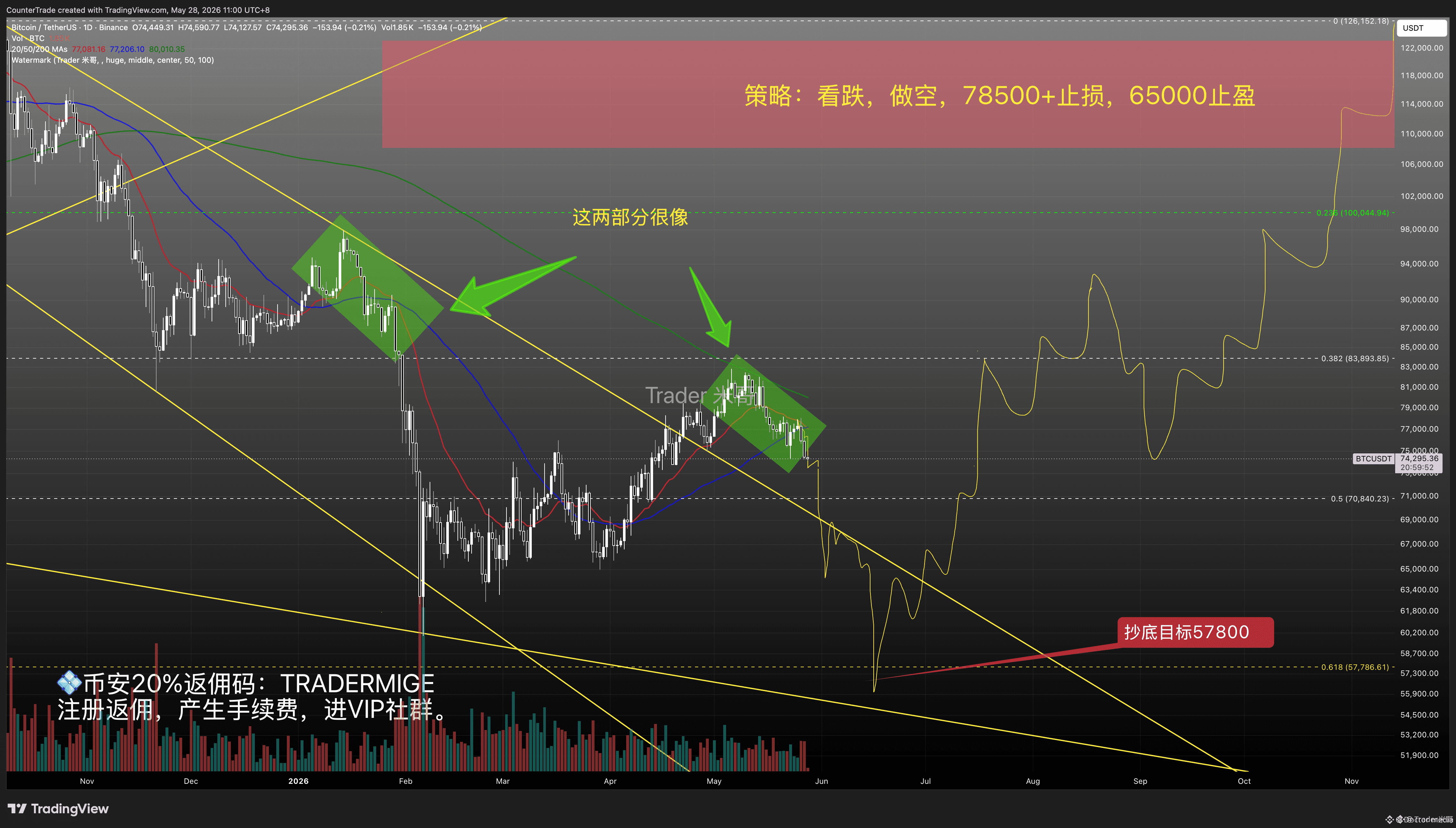
$BTC :The Final Shakeout Before the Parabolic Run? ⚠️🚀
{future}(BTCUSDT)
The next few months are going to be absolute carnage before we see true glory. Bookmark this series—we are about to witness the most critical cycle shift in years.
The Roadmap to the Peak:
The "Graveyard" Phase: We are likely looking at a sharp correction from these levels down to the $57k zone. This is designed to liquidate the over-leveraged and send the bulls to their graves. 📉
The Epic Rally: Once the weak hands are washed out, the real move begins. We are targeting a massive breakout to $135k as the final leg of this cycle. 🌕
The Long Winter: Once we hit that $135k peak, the bull market officially concludes, ushering in a brutal three-year bear cycle. ❄️
The Bottom Line: The "Big One" is coming. Whether you survive the $57k shakeout will determine if you’re around for the $135k pay-day.
Are you holding through the volatility or moving to cash to wait for the $57k entry? Let’s hear your thoughts below. 👇
#BTC #Bitcoin #CryptoMarket #TradingStrategy #BullRun #MarketCycle
$GUA
{future}(GUAUSDT)
$ALLO
{future}(ALLOUSDT)
$BTC :The Final Shakeout Before the Parabolic Run? ⚠️🚀
The next few months are going to be absolute carnage before we see true glory. Bookmark this series—we are about to witness the most critical cycle shift in years.
The Roadmap to the Peak:
The "Graveyard" Phase: We are likely looking at a sharp correction from these levels down to the $57k zone. This is designed to liquidate the over-leveraged and send the bulls to their graves. 📉
The Epic Rally: Once the weak hands are washed out, the real move begins. We are targeting a massive breakout to $135k as the final leg of this cycle. 🌕
The Long Winter: Once we hit that $135k peak, the bull market officially concludes, ushering in a brutal three-year bear cycle. ❄️
The Bottom Line: The "Big One" is coming. Whether you survive the $57k shakeout will determine if you’re around for the $135k pay-day.
Are you holding through the volatility or moving to cash to wait for the $57k entry? Let’s hear your thoughts below. 👇
#BTC #Bitcoin #CryptoMarket #TradingStrategy #BullRun #MarketCycle
$GUA
$ALLO
The next few months are going to be absolute carnage before we see true glory. Bookmark this series—we are about to witness the most critical cycle shift in years.
The Roadmap to the Peak:
The "Graveyard" Phase: We are likely looking at a sharp correction from these levels down to the $57k zone. This is designed to liquidate the over-leveraged and send the bulls to their graves. 📉
The Epic Rally: Once the weak hands are washed out, the real move begins. We are targeting a massive breakout to $135k as the final leg of this cycle. 🌕
The Long Winter: Once we hit that $135k peak, the bull market officially concludes, ushering in a brutal three-year bear cycle. ❄️
The Bottom Line: The "Big One" is coming. Whether you survive the $57k shakeout will determine if you’re around for the $135k pay-day.
Are you holding through the volatility or moving to cash to wait for the $57k entry? Let’s hear your thoughts below. 👇
#BTC #Bitcoin #CryptoMarket #TradingStrategy #BullRun #MarketCycle
$GUA
$ALLO
257

·
--
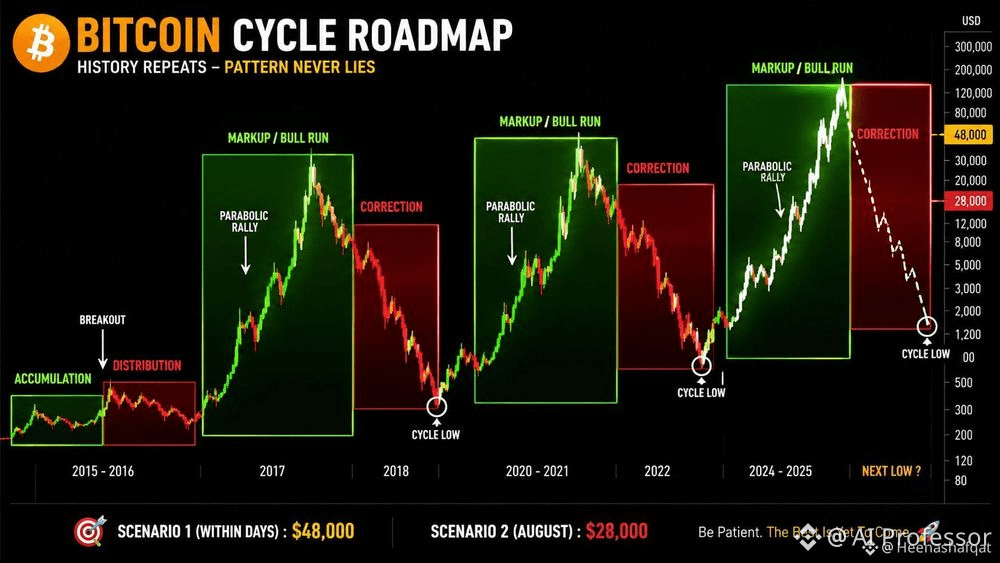
🚨 Bitcoin Is Following the Same Cycle Structure as 2017 & 2021
$BITCOIN is now mirroring the patterns seen in previous market cycles. The price action continues to follow the roadmap I’ve been tracking, and so far, the structure remains intact.
📉 The bull trap appears to be complete, and the next major move could be a deep correction before a new bull market begins.
🔍 Possible Scenarios:
📌 Scenario 1: → $BTC drops to $48,000 within the coming days.
📌 Scenario 2: → BTC continues lower and reaches $28,000 by August, creating the ultimate capitulation event before the next major rally.
History doesn’t repeat exactly, but it often rhymes. If this cycle continues to follow the same pattern, the biggest opportunities may come when fear is at its highest.
⚠️ Are you actually prepared if Bitcoin drops to $28,000? #Bitcoin #BTC #Crypto #Trading #MarketCycle
🚨 Bitcoin Is Following the Same Cycle Structure as 2017 & 2021
$BITCOIN is now mirroring the patterns seen in previous market cycles. The price action continues to follow the roadmap I’ve been tracking, and so far, the structure remains intact.
📉 The bull trap appears to be complete, and the next major move could be a deep correction before a new bull market begins.
🔍 Possible Scenarios:
📌 Scenario 1: → $BTC drops to $48,000 within the coming days.
📌 Scenario 2: → BTC continues lower and reaches $28,000 by August, creating the ultimate capitulation event before the next major rally.
History doesn’t repeat exactly, but it often rhymes. If this cycle continues to follow the same pattern, the biggest opportunities may come when fear is at its highest.
⚠️ Are you actually prepared if Bitcoin drops to $28,000? #Bitcoin #BTC #Crypto #Trading #MarketCycle
$BITCOIN is now mirroring the patterns seen in previous market cycles. The price action continues to follow the roadmap I’ve been tracking, and so far, the structure remains intact.
📉 The bull trap appears to be complete, and the next major move could be a deep correction before a new bull market begins.
🔍 Possible Scenarios:
📌 Scenario 1: → $BTC drops to $48,000 within the coming days.
📌 Scenario 2: → BTC continues lower and reaches $28,000 by August, creating the ultimate capitulation event before the next major rally.
History doesn’t repeat exactly, but it often rhymes. If this cycle continues to follow the same pattern, the biggest opportunities may come when fear is at its highest.
⚠️ Are you actually prepared if Bitcoin drops to $28,000? #Bitcoin #BTC #Crypto #Trading #MarketCycle
135

·
--
Man, that 2026 market correction is definitely going to be a game-changer. It feels like it's setting up to completely flip the current narrative we're seeing across the board for $BTC and $ETH.
We've been riding a certain wave, but if this forecast holds true, expect a total reset. It'll be interesting to see which projects survive and thrive post-correction, especially given how much speculation is out there right now.
It's going to be a wild ride.
#CryptoMarket #MarketCycle #Bitcoin #Ethereum #FutureOfCrypto
Man, that 2026 market correction is definitely going to be a game-changer. It feels like it's setting up to completely flip the current narrative we're seeing across the board for $BTC and $ETH .
We've been riding a certain wave, but if this forecast holds true, expect a total reset. It'll be interesting to see which projects survive and thrive post-correction, especially given how much speculation is out there right now.
It's going to be a wild ride.
#CryptoMarket #MarketCycle #Bitcoin #Ethereum #FutureOfCrypto
We've been riding a certain wave, but if this forecast holds true, expect a total reset. It'll be interesting to see which projects survive and thrive post-correction, especially given how much speculation is out there right now.
It's going to be a wild ride.
#CryptoMarket #MarketCycle #Bitcoin #Ethereum #FutureOfCrypto
10

Is the famous Bitcoin Rainbow Chart officially broken❓
According to CoinDesk, Bitcoin has just dropped into the model’s bottom purple band -the dreaded “Bitcoin Is Dead” zone. This marks only the second time in history that BTC has fallen this low relative to the chart, following a 50% slide from its October 2025 all-time high of $126,000.
Trading right back near its April 2024 halving price of $62,500, the market is completely split. On one side, data-driven analysts argue this signals deep, historical undervaluation. On the other hand, macro traders believe the long-running chart is simply losing its relevance. With institutional ETFs, Wall Street allocators, and broader tech-driven macro forces completely reshaping price discovery, the old retail-driven cycles might just be a thing of the past.
Either way, we are watching a massive test of market structure play out in real time.
$BTC $MUB $FLOKI #CoinVahini #BitcoinRainbowChart #CryptoAnalysis #MarketCycle
Is the famous Bitcoin Rainbow Chart officially broken❓
According to CoinDesk, Bitcoin has just dropped into the model’s bottom purple band -the dreaded “Bitcoin Is Dead” zone. This marks only the second time in history that BTC has fallen this low relative to the chart, following a 50% slide from its October 2025 all-time high of $126,000.
Trading right back near its April 2024 halving price of $62,500, the market is completely split. On one side, data-driven analysts argue this signals deep, historical undervaluation. On the other hand, macro traders believe the long-running chart is simply losing its relevance. With institutional ETFs, Wall Street allocators, and broader tech-driven macro forces completely reshaping price discovery, the old retail-driven cycles might just be a thing of the past.
Either way, we are watching a massive test of market structure play out in real time.
$BTC $MUB $FLOKI #CoinVahini #BitcoinRainbowChart #CryptoAnalysis #MarketCycle
According to CoinDesk, Bitcoin has just dropped into the model’s bottom purple band -the dreaded “Bitcoin Is Dead” zone. This marks only the second time in history that BTC has fallen this low relative to the chart, following a 50% slide from its October 2025 all-time high of $126,000.
Trading right back near its April 2024 halving price of $62,500, the market is completely split. On one side, data-driven analysts argue this signals deep, historical undervaluation. On the other hand, macro traders believe the long-running chart is simply losing its relevance. With institutional ETFs, Wall Street allocators, and broader tech-driven macro forces completely reshaping price discovery, the old retail-driven cycles might just be a thing of the past.
Either way, we are watching a massive test of market structure play out in real time.
$BTC $MUB $FLOKI #CoinVahini #BitcoinRainbowChart #CryptoAnalysis #MarketCycle
11

·
--
WHEN $BTC STRENGTHENS, ALTCOINS FOLLOW 🔥
Capital rotation from Bitcoin into altcoins is a recurring market pattern. History shows that by the time social media catches up with breakout stories, the biggest moves have already happened. Smart money builds positions during quiet accumulation phases, not after prices have surged.
Liquidity flows where attention hasn't yet peaked. The next alt season may not mirror past cycles, but the structural setup remains the same — patience and preparation typically outperform chasing hype. Are you positioning before the crowd arrives or waiting for confirmation?
Not financial advice. Always manage your risk.
#BTC #AltSeason #MarketCycle #Crypto
🔥
WHEN $BTC STRENGTHENS, ALTCOINS FOLLOW 🔥
Capital rotation from Bitcoin into altcoins is a recurring market pattern. History shows that by the time social media catches up with breakout stories, the biggest moves have already happened. Smart money builds positions during quiet accumulation phases, not after prices have surged.
Liquidity flows where attention hasn't yet peaked. The next alt season may not mirror past cycles, but the structural setup remains the same — patience and preparation typically outperform chasing hype. Are you positioning before the crowd arrives or waiting for confirmation?
Not financial advice. Always manage your risk.
#BTC #AltSeason #MarketCycle #Crypto
🔥
Capital rotation from Bitcoin into altcoins is a recurring market pattern. History shows that by the time social media catches up with breakout stories, the biggest moves have already happened. Smart money builds positions during quiet accumulation phases, not after prices have surged.
Liquidity flows where attention hasn't yet peaked. The next alt season may not mirror past cycles, but the structural setup remains the same — patience and preparation typically outperform chasing hype. Are you positioning before the crowd arrives or waiting for confirmation?
Not financial advice. Always manage your risk.
#BTC #AltSeason #MarketCycle #Crypto
🔥
29


·
--
🚨 The pattern looks familiar.
Bitcoin is starting to mirror the behavior seen during the 2017 and 2021 cycles, and the market structure continues to follow the path I've been tracking.
While many investors remain convinced that the rally has plenty of room left, I believe we may be approaching the final stages of this phase.
📉 Scenario 1 (Near Term): BTC retreats toward $48,000
📉 Scenario 2 (August Outlook): BTC revisits the $28,000 region
Markets often move against the crowd. When most participants become comfortable with one direction, a sharp move the other way can catch everyone off guard.
⚠️ Right now, the focus is on higher prices, but I'm paying close attention to the downside risk that many seem to be ignoring.
💭 What if the next major move isn't another breakout... but a significant correction before the next bull leg begins?
$BTC $XRP
🔥 Do you have a plan if the market takes an unexpected turn?
#Bitcoin #BTC #Crypto #MarketCycle #Bearish #Trading #CryptoMarket
🚨 The pattern looks familiar.
Bitcoin is starting to mirror the behavior seen during the 2017 and 2021 cycles, and the market structure continues to follow the path I've been tracking.
While many investors remain convinced that the rally has plenty of room left, I believe we may be approaching the final stages of this phase.
📉 Scenario 1 (Near Term): BTC retreats toward $48,000
📉 Scenario 2 (August Outlook): BTC revisits the $28,000 region
Markets often move against the crowd. When most participants become comfortable with one direction, a sharp move the other way can catch everyone off guard.
⚠️ Right now, the focus is on higher prices, but I'm paying close attention to the downside risk that many seem to be ignoring.
💭 What if the next major move isn't another breakout... but a significant correction before the next bull leg begins?
$BTC $XRP
🔥 Do you have a plan if the market takes an unexpected turn?
#Bitcoin #BTC #Crypto #MarketCycle #Bearish #Trading #CryptoMarket
Bitcoin is starting to mirror the behavior seen during the 2017 and 2021 cycles, and the market structure continues to follow the path I've been tracking.
While many investors remain convinced that the rally has plenty of room left, I believe we may be approaching the final stages of this phase.
📉 Scenario 1 (Near Term): BTC retreats toward $48,000
📉 Scenario 2 (August Outlook): BTC revisits the $28,000 region
Markets often move against the crowd. When most participants become comfortable with one direction, a sharp move the other way can catch everyone off guard.
⚠️ Right now, the focus is on higher prices, but I'm paying close attention to the downside risk that many seem to be ignoring.
💭 What if the next major move isn't another breakout... but a significant correction before the next bull leg begins?
$BTC $XRP
🔥 Do you have a plan if the market takes an unexpected turn?
#Bitcoin #BTC #Crypto #MarketCycle #Bearish #Trading #CryptoMarket
225

·
--
Bullish
🧑💻🧑💻🤷♂️
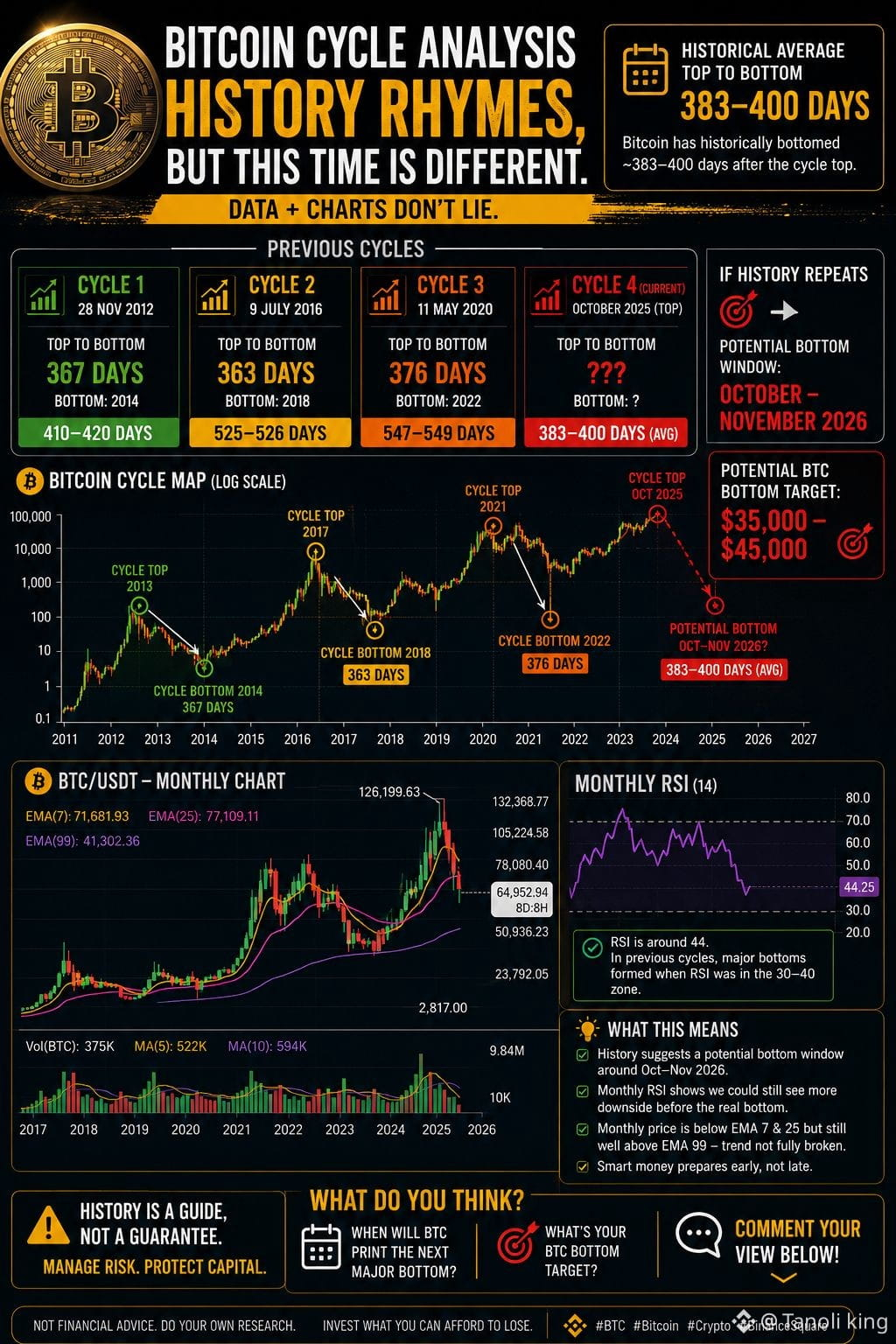
📊 History Doesn't Predict the Future… But It Leaves Clues.
Every Bitcoin cycle has looked different, yet one thing keeps repeating: major corrections create the biggest long-term opportunities.
Based on previous market cycles, #btc has$ historically formed its cycle bottom around 383–400 days after the cycle top. If that pattern holds, the next major bottom could appear sometime in late 2026.
But this cycle isn't like the others.
🚀 Spot Bitcoin ETFs
🏦 Institutional capital
🌍 Global adoption
💰 Growing long-term demand
These factors could shorten the correction, reduce the downside, or even shift the timeline completely.
That's why I'm not trying to catch the exact bottom—I’m preparing for every scenario. Smart investors don't chase hype; they build positions when fear is at its highest.
⚠️ History is a guide, not a guarantee. Risk management will always be more important than any prediction.
Now it's your turn: 📅 When do you think Bitcoin will print its next major bottom? 💵 What's your BTC bottom target?
Let's hear your thoughts in the comments! 👇
#BinanceSquar #CryptoMarke #MarketCycle #DCA #Investing $BTC $LINK $NVDAB
{spot}(BTCUSDT)
🧑💻🧑💻🤷♂️
📊 History Doesn't Predict the Future… But It Leaves Clues.
Every Bitcoin cycle has looked different, yet one thing keeps repeating: major corrections create the biggest long-term opportunities.
Based on previous market cycles, #btc has$ historically formed its cycle bottom around 383–400 days after the cycle top. If that pattern holds, the next major bottom could appear sometime in late 2026.
But this cycle isn't like the others.
🚀 Spot Bitcoin ETFs
🏦 Institutional capital
🌍 Global adoption
💰 Growing long-term demand
These factors could shorten the correction, reduce the downside, or even shift the timeline completely.
That's why I'm not trying to catch the exact bottom—I’m preparing for every scenario. Smart investors don't chase hype; they build positions when fear is at its highest.
⚠️ History is a guide, not a guarantee. Risk management will always be more important than any prediction.
Now it's your turn: 📅 When do you think Bitcoin will print its next major bottom? 💵 What's your BTC bottom target?
Let's hear your thoughts in the comments! 👇
#BinanceSquar #CryptoMarke #MarketCycle #DCA #Investing $BTC $LINK $NVDAB
📊 History Doesn't Predict the Future… But It Leaves Clues.
Every Bitcoin cycle has looked different, yet one thing keeps repeating: major corrections create the biggest long-term opportunities.
Based on previous market cycles, #btc has$ historically formed its cycle bottom around 383–400 days after the cycle top. If that pattern holds, the next major bottom could appear sometime in late 2026.
But this cycle isn't like the others.
🚀 Spot Bitcoin ETFs
🏦 Institutional capital
🌍 Global adoption
💰 Growing long-term demand
These factors could shorten the correction, reduce the downside, or even shift the timeline completely.
That's why I'm not trying to catch the exact bottom—I’m preparing for every scenario. Smart investors don't chase hype; they build positions when fear is at its highest.
⚠️ History is a guide, not a guarantee. Risk management will always be more important than any prediction.
Now it's your turn: 📅 When do you think Bitcoin will print its next major bottom? 💵 What's your BTC bottom target?
Let's hear your thoughts in the comments! 👇
#BinanceSquar #CryptoMarke #MarketCycle #DCA #Investing $BTC $LINK $NVDAB
81
Log in to explore more content
Join global crypto users on Binance Square
⚡️ Get latest and useful information about crypto.
💬 Trusted by the world’s largest crypto exchange.
👍 Discover real insights from verified creators.
Email / Phone number
Trending Topics
1
#AIStocksWhatNext
1.1M views
7,278 Discussing
2
#US10YTreasuryYieldHits19YearHigh
42 views
14 Discussing
3
#SpotBitcoinETFsInflow$2.31BInFourDays
35 views
9 Discussing
4
#BitcoinRejectedAt$87,300Twice
0 views
0 Discussing
5
#BCHJumps28%OnCMEFuturesListing
34,484 views
787 Discussing
6
#WallStreetEarningsRevisionsTurnBearish
24,732 views
576 Discussing
7
#DollarIndexReclaims101
20,607 views
507 Discussing
8
#21SharesLaunchesEuropesFirstZcashETP
62,989 views
1,269 Discussing
9
#CardanoJoinsX402PaymentStandard
38,809 views
897 Discussing
10
#BitcoinTops$87KAtEightMonthHigh
15,677 views
139 Discussing