
#cronos
cronos
74,702 views
340 Discussing
Hot
Latest

·
--
#Cronos
deflation, cronos edition:
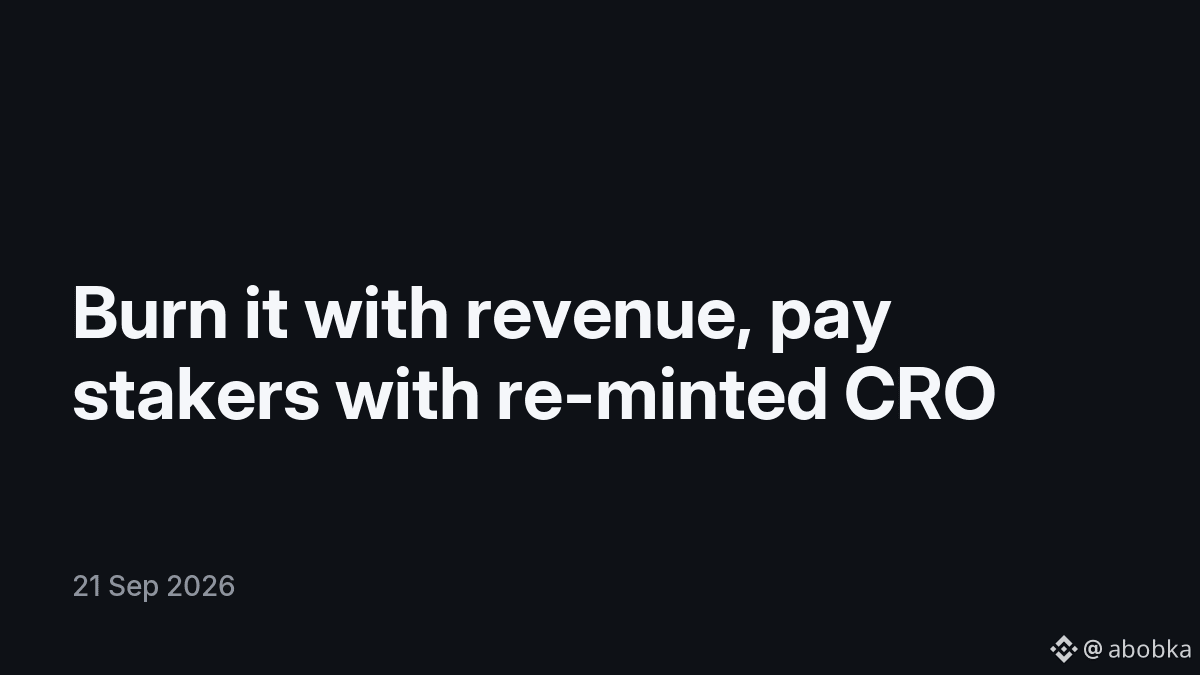
- 100% of revenue from Ult and Cronos Launch buys CRO and burns it, monthly
- the products are days old and the proposal gives no revenue number
- staking gets paid from the 70B CRO reserve, reissued from the 2021 burn
burn with one hand, un-burn with the other
signalling proposal anyway, voting until october 3
the burn contract isn't built yet
no CRO on my side
i'll believe "deflationary" after the first monthly tx hash)
#CRO
#Cronos
deflation, cronos edition:
- 100% of revenue from Ult and Cronos Launch buys CRO and burns it, monthly
- the products are days old and the proposal gives no revenue number
- staking gets paid from the 70B CRO reserve, reissued from the 2021 burn
burn with one hand, un-burn with the other
signalling proposal anyway, voting until october 3
the burn contract isn't built yet
no CRO on my side
i'll believe "deflationary" after the first monthly tx hash)
#CRO
deflation, cronos edition:
- 100% of revenue from Ult and Cronos Launch buys CRO and burns it, monthly
- the products are days old and the proposal gives no revenue number
- staking gets paid from the 70B CRO reserve, reissued from the 2021 burn
burn with one hand, un-burn with the other
signalling proposal anyway, voting until october 3
the burn contract isn't built yet
no CRO on my side
i'll believe "deflationary" after the first monthly tx hash)
#CRO
7
43

·
--
Cronos Proposal 37: Buy and burn all product revenue $CRO; staking changes to draw from the 70B reserveWhat’s worth watching isn’t another burn slogan.
Cronos POS governance has just launched Proposal 37 (the discussion post was put up on September 19, and on-chain voting ends at 02:02 UTC on October 3): product revenue from Ult (launched 9/17) and Cronos Launch (launched 9/15) will be 100% swept into the contract → converted on-chain into $CRO → monthly burned, with the hash made public.
This is different from the earlier proposal 1291, “A New Era for CRO.” In that one, revenue was split into four buckets (staking / growth / buyback-and-burn / R&D), and the burn ratio wasn’t fixed. This time it’s fixed: burn is the only destination.
The question that follows: where does staking yield come from? The proposal says: Strategic Reserve. Specifically, in March 2025, re-mint and re-issue the $CRO worth the 70 billion that was burned in 2021 into escrow, so the total supply is brought back to 10 billion. Back then, 95.7% opposed on the first day, and it ultimately passed with 62.1%.
Cronos Proposal 37: Buy and burn all product revenue $CRO; staking changes to draw from the 70B reserve
What’s worth watching isn’t another burn slogan.
Cronos POS governance has just launched Proposal 37 (the discussion post was put up on September 19, and on-chain voting ends at 02:02 UTC on October 3): product revenue from Ult (launched 9/17) and Cronos Launch (launched 9/15) will be 100% swept into the contract → converted on-chain into $CRO → monthly burned, with the hash made public.
This is different from the earlier proposal 1291, “A New Era for CRO.” In that one, revenue was split into four buckets (staking / growth / buyback-and-burn / R&D), and the burn ratio wasn’t fixed. This time it’s fixed: burn is the only destination.
The question that follows: where does staking yield come from? The proposal says: Strategic Reserve. Specifically, in March 2025, re-mint and re-issue the $CRO worth the 70 billion that was burned in 2021 into escrow, so the total supply is brought back to 10 billion. Back then, 95.7% opposed on the first day, and it ultimately passed with 62.1%.
Cronos POS governance has just launched Proposal 37 (the discussion post was put up on September 19, and on-chain voting ends at 02:02 UTC on October 3): product revenue from Ult (launched 9/17) and Cronos Launch (launched 9/15) will be 100% swept into the contract → converted on-chain into $CRO → monthly burned, with the hash made public.
This is different from the earlier proposal 1291, “A New Era for CRO.” In that one, revenue was split into four buckets (staking / growth / buyback-and-burn / R&D), and the burn ratio wasn’t fixed. This time it’s fixed: burn is the only destination.
The question that follows: where does staking yield come from? The proposal says: Strategic Reserve. Specifically, in March 2025, re-mint and re-issue the $CRO worth the 70 billion that was burned in 2021 into escrow, so the total supply is brought back to 10 billion. Back then, 95.7% opposed on the first day, and it ultimately passed with 62.1%.
127

·
--
Article
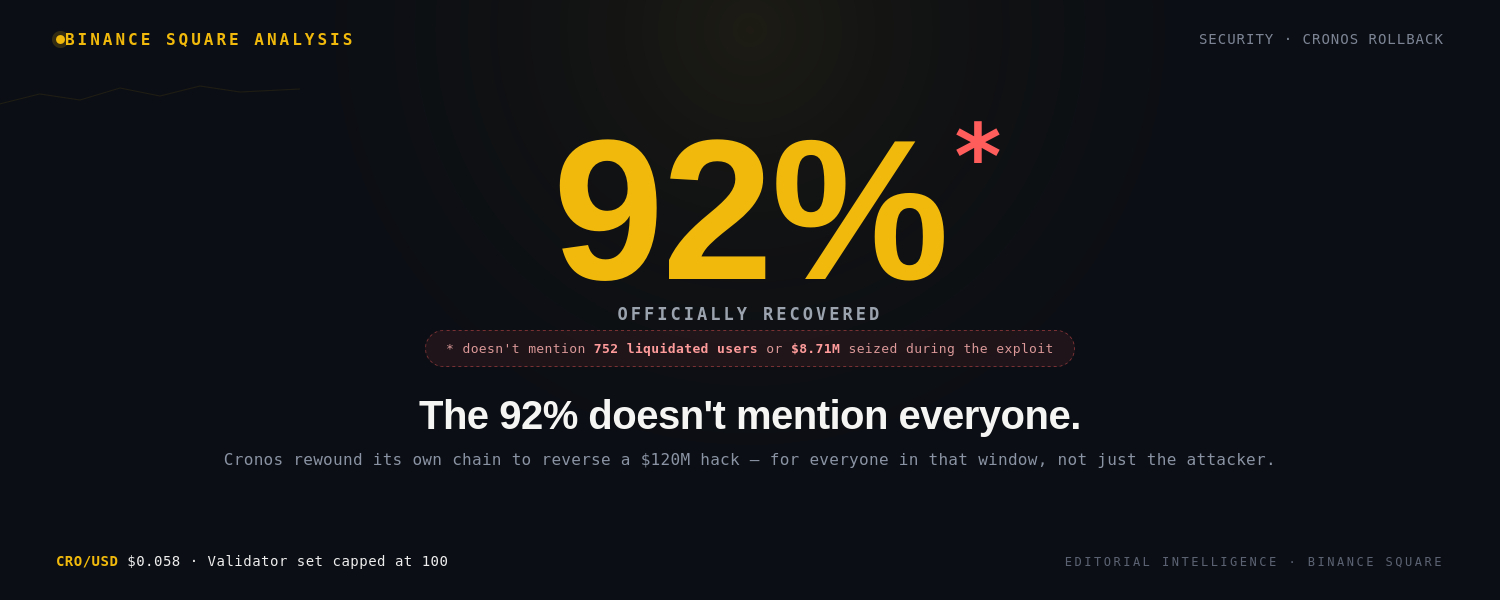
Cronos Says It Saved 92% of a $120M Hack. Here's What That Number Doesn't Cover.A blockchain is supposed to be the one thing nobody can rewrite. Cronos just showed that isn't quite true — and that might have been the right call anyway. Cronos published its full post-mortem this week, and it fills in details most of the initial hack coverage didn't have.
WHAT HAPPENED
On August 30, an attacker deployed contracts and drove up the price of TONIC — the thinly-traded governance token of Cronos lending protocol Tectonic — by roughly 100-fold in minutes against shallow exchange liquidity. About 10 minutes later, a single transaction used that inflated collateral to borrow $120.4 million across nine Tectonic markets. Cronos flagged the irregular activity 36 minutes in and halted the network entirely at block 90,907,150.
After validator coordination, Cronos restarted from block 90,896,188 — the last block before the attack began — reversing roughly $111.2 million, about 92% of the affected value. Block production resumed about 11 hours after the exploit. The rollback reversed 10,961 blocks, or nearly two hours of chain history, and reverted every transaction in that window, not only the attacker's.
WHY IT MATTERS
Blockchain finality — the idea that a confirmed transaction is permanent — is one of the core selling points of the entire technology. Cronos, a Layer 1 associated with Crypto.com, just demonstrated in production that finality can be overridden by validator consensus during an emergency, on a chain whose validator set is capped at 100 — small enough to coordinate a halt and restart within hours.
WHAT THE MARKET MAY BE MISSING
The 92%-recovered framing treats this as a clean save. It wasn't clean for everyone. Onchain investigator MASTR, using archive-node analysis, counted 752 liquidations that seized about $8.71 million from Tectonic users while the manipulated TONIC price was live — legitimate users whose positions got liquidated based on a price the attacker had artificially inflated. Copycat bots that piled into the same markets took roughly $2 million more. Cronos's post-mortem doesn't clarify whether those liquidated users had their positions restored along with everything else in the rollback window, or whether they're left holding losses caused by a price the network itself later declared invalid.
There's also a harder question sitting underneath the celebration: roughly $9.19 million had already left the chain — including about $6.29 million bridged to Ethereum — before the halt, and a rollback on Cronos has no power to touch assets once they've left the network. That means the rollback's "92% recovered" is really "92% of what stayed on-chain long enough to be reachable," not 92% of the incident.
KEY DATA
- Exploit size: $120.4 million borrowed across nine Tectonic markets (official post-mortem figure; earlier unofficial estimates before the report ranged as low as $74-75M)
- Rollback recovered: ~$111.2 million (92%) · Unrecovered: ~$9.19 million (7.6%), including ~$6.29M already bridged to Ethereum
- Chain reverted: 10,961 blocks, ~1 hour 54 minutes of history — affecting all users active in that window, not just the attacker
- Liquidations during the manipulated-price window: 752 liquidations, ~$8.71 million seized from Tectonic users (per onchain investigator MASTR)
- Copycat bot activity: ~$2 million
- Validator set: capped at 100
- Timeline: attack began 12:38 UTC Aug 30 → detected 13:25 UTC → halted 14:32 UTC → resumed 23:49 UTC (~11 hours later)
- CRO price reaction: roughly flat, up about 0.6% in the 24 hours after the post-mortem was published
BULL CASE
The rollback worked. Cronos recovered 92% of an exploit that could otherwise have been a total loss, and did it through transparent validator coordination rather than quietly absorbing the damage. For a chain tied to a major exchange brand, demonstrating it can respond decisively to an existential threat is arguably a point in its favor for institutional users who value recoverability over pure decentralization theater.
BEAR CASE
Any chain that can roll back "for a good reason" has shown it can roll back, period. That's a real precedent risk: the same capability that reversed a hack in this case could, in a future dispute, be pointed at legitimate transactions someone decides were the "problem." A 100-validator set demonstrating it can coordinate a chain rewrite within hours is a data point institutional users evaluating decentralization risk should weigh carefully.
FOR ACTIVE MARKET PARTICIPANTS
- If you were active on Cronos or Tectonic during the Aug 30, 12:38-14:32 UTC window, verify directly with Cronos whether your unrelated transactions were affected and restored — the post-mortem doesn't address this for users outside the exploit itself
- The unresolved status of the 752 liquidated users is worth tracking — how Cronos handles (or doesn't handle) that group will say a lot about how the network treats collateral damage from future incidents
- This sets a real precedent for any chain evaluating "immutability" as a selling point — worth asking the same question of any L1 you hold exposure to: what's the actual validator threshold required to roll back state?
WHAT TO WATCH NEXT
- Whether Cronos issues any further statement on the 752 liquidated users
- Any community or governance response to the rollback precedent
- Whether other Cosmos-SDK chains with small validator sets face similar scrutiny going forward
BOTTOM LINE
Cronos likely made the pragmatic choice, but "we recovered 92%" undersells what actually happened: a validator-coordinated rewrite of finalized history that helped almost everyone and left an unclear number of users — the liquidated 752 — without a stated resolution as of this post-mortem.
Community question: Does a rollback that saves 92% of stolen funds but rewrites history for every user in the window make you more or less comfortable holding assets on a chain with a capped validator set?
#Cronos #CRO #DeFi #Security #CryptoCom #BİNANCE #BinanceSquareFamily #CryptoNews
{stock_us}(CRON.US)
Cronos Says It Saved 92% of a $120M Hack. Here's What That Number Doesn't Cover.
A blockchain is supposed to be the one thing nobody can rewrite. Cronos just showed that isn't quite true — and that might have been the right call anyway. Cronos published its full post-mortem this week, and it fills in details most of the initial hack coverage didn't have.
WHAT HAPPENED
On August 30, an attacker deployed contracts and drove up the price of TONIC — the thinly-traded governance token of Cronos lending protocol Tectonic — by roughly 100-fold in minutes against shallow exchange liquidity. About 10 minutes later, a single transaction used that inflated collateral to borrow $120.4 million across nine Tectonic markets. Cronos flagged the irregular activity 36 minutes in and halted the network entirely at block 90,907,150.
After validator coordination, Cronos restarted from block 90,896,188 — the last block before the attack began — reversing roughly $111.2 million, about 92% of the affected value. Block production resumed about 11 hours after the exploit. The rollback reversed 10,961 blocks, or nearly two hours of chain history, and reverted every transaction in that window, not only the attacker's.
WHY IT MATTERS
Blockchain finality — the idea that a confirmed transaction is permanent — is one of the core selling points of the entire technology. Cronos, a Layer 1 associated with Crypto.com, just demonstrated in production that finality can be overridden by validator consensus during an emergency, on a chain whose validator set is capped at 100 — small enough to coordinate a halt and restart within hours.
WHAT THE MARKET MAY BE MISSING
The 92%-recovered framing treats this as a clean save. It wasn't clean for everyone. Onchain investigator MASTR, using archive-node analysis, counted 752 liquidations that seized about $8.71 million from Tectonic users while the manipulated TONIC price was live — legitimate users whose positions got liquidated based on a price the attacker had artificially inflated. Copycat bots that piled into the same markets took roughly $2 million more. Cronos's post-mortem doesn't clarify whether those liquidated users had their positions restored along with everything else in the rollback window, or whether they're left holding losses caused by a price the network itself later declared invalid.
There's also a harder question sitting underneath the celebration: roughly $9.19 million had already left the chain — including about $6.29 million bridged to Ethereum — before the halt, and a rollback on Cronos has no power to touch assets once they've left the network. That means the rollback's "92% recovered" is really "92% of what stayed on-chain long enough to be reachable," not 92% of the incident.
KEY DATA
- Exploit size: $120.4 million borrowed across nine Tectonic markets (official post-mortem figure; earlier unofficial estimates before the report ranged as low as $74-75M)
- Rollback recovered: ~$111.2 million (92%) · Unrecovered: ~$9.19 million (7.6%), including ~$6.29M already bridged to Ethereum
- Chain reverted: 10,961 blocks, ~1 hour 54 minutes of history — affecting all users active in that window, not just the attacker
- Liquidations during the manipulated-price window: 752 liquidations, ~$8.71 million seized from Tectonic users (per onchain investigator MASTR)
- Copycat bot activity: ~$2 million
- Validator set: capped at 100
- Timeline: attack began 12:38 UTC Aug 30 → detected 13:25 UTC → halted 14:32 UTC → resumed 23:49 UTC (~11 hours later)
- CRO price reaction: roughly flat, up about 0.6% in the 24 hours after the post-mortem was published
BULL CASE
The rollback worked. Cronos recovered 92% of an exploit that could otherwise have been a total loss, and did it through transparent validator coordination rather than quietly absorbing the damage. For a chain tied to a major exchange brand, demonstrating it can respond decisively to an existential threat is arguably a point in its favor for institutional users who value recoverability over pure decentralization theater.
BEAR CASE
Any chain that can roll back "for a good reason" has shown it can roll back, period. That's a real precedent risk: the same capability that reversed a hack in this case could, in a future dispute, be pointed at legitimate transactions someone decides were the "problem." A 100-validator set demonstrating it can coordinate a chain rewrite within hours is a data point institutional users evaluating decentralization risk should weigh carefully.
FOR ACTIVE MARKET PARTICIPANTS
- If you were active on Cronos or Tectonic during the Aug 30, 12:38-14:32 UTC window, verify directly with Cronos whether your unrelated transactions were affected and restored — the post-mortem doesn't address this for users outside the exploit itself
- The unresolved status of the 752 liquidated users is worth tracking — how Cronos handles (or doesn't handle) that group will say a lot about how the network treats collateral damage from future incidents
- This sets a real precedent for any chain evaluating "immutability" as a selling point — worth asking the same question of any L1 you hold exposure to: what's the actual validator threshold required to roll back state?
WHAT TO WATCH NEXT
- Whether Cronos issues any further statement on the 752 liquidated users
- Any community or governance response to the rollback precedent
- Whether other Cosmos-SDK chains with small validator sets face similar scrutiny going forward
BOTTOM LINE
Cronos likely made the pragmatic choice, but "we recovered 92%" undersells what actually happened: a validator-coordinated rewrite of finalized history that helped almost everyone and left an unclear number of users — the liquidated 752 — without a stated resolution as of this post-mortem.
Community question: Does a rollback that saves 92% of stolen funds but rewrites history for every user in the window make you more or less comfortable holding assets on a chain with a capped validator set?
#Cronos #CRO #DeFi #Security #CryptoCom #BİNANCE #BinanceSquareFamily #CryptoNews
WHAT HAPPENED
On August 30, an attacker deployed contracts and drove up the price of TONIC — the thinly-traded governance token of Cronos lending protocol Tectonic — by roughly 100-fold in minutes against shallow exchange liquidity. About 10 minutes later, a single transaction used that inflated collateral to borrow $120.4 million across nine Tectonic markets. Cronos flagged the irregular activity 36 minutes in and halted the network entirely at block 90,907,150.
After validator coordination, Cronos restarted from block 90,896,188 — the last block before the attack began — reversing roughly $111.2 million, about 92% of the affected value. Block production resumed about 11 hours after the exploit. The rollback reversed 10,961 blocks, or nearly two hours of chain history, and reverted every transaction in that window, not only the attacker's.
WHY IT MATTERS
Blockchain finality — the idea that a confirmed transaction is permanent — is one of the core selling points of the entire technology. Cronos, a Layer 1 associated with Crypto.com, just demonstrated in production that finality can be overridden by validator consensus during an emergency, on a chain whose validator set is capped at 100 — small enough to coordinate a halt and restart within hours.
WHAT THE MARKET MAY BE MISSING
The 92%-recovered framing treats this as a clean save. It wasn't clean for everyone. Onchain investigator MASTR, using archive-node analysis, counted 752 liquidations that seized about $8.71 million from Tectonic users while the manipulated TONIC price was live — legitimate users whose positions got liquidated based on a price the attacker had artificially inflated. Copycat bots that piled into the same markets took roughly $2 million more. Cronos's post-mortem doesn't clarify whether those liquidated users had their positions restored along with everything else in the rollback window, or whether they're left holding losses caused by a price the network itself later declared invalid.
There's also a harder question sitting underneath the celebration: roughly $9.19 million had already left the chain — including about $6.29 million bridged to Ethereum — before the halt, and a rollback on Cronos has no power to touch assets once they've left the network. That means the rollback's "92% recovered" is really "92% of what stayed on-chain long enough to be reachable," not 92% of the incident.
KEY DATA
- Exploit size: $120.4 million borrowed across nine Tectonic markets (official post-mortem figure; earlier unofficial estimates before the report ranged as low as $74-75M)
- Rollback recovered: ~$111.2 million (92%) · Unrecovered: ~$9.19 million (7.6%), including ~$6.29M already bridged to Ethereum
- Chain reverted: 10,961 blocks, ~1 hour 54 minutes of history — affecting all users active in that window, not just the attacker
- Liquidations during the manipulated-price window: 752 liquidations, ~$8.71 million seized from Tectonic users (per onchain investigator MASTR)
- Copycat bot activity: ~$2 million
- Validator set: capped at 100
- Timeline: attack began 12:38 UTC Aug 30 → detected 13:25 UTC → halted 14:32 UTC → resumed 23:49 UTC (~11 hours later)
- CRO price reaction: roughly flat, up about 0.6% in the 24 hours after the post-mortem was published
BULL CASE
The rollback worked. Cronos recovered 92% of an exploit that could otherwise have been a total loss, and did it through transparent validator coordination rather than quietly absorbing the damage. For a chain tied to a major exchange brand, demonstrating it can respond decisively to an existential threat is arguably a point in its favor for institutional users who value recoverability over pure decentralization theater.
BEAR CASE
Any chain that can roll back "for a good reason" has shown it can roll back, period. That's a real precedent risk: the same capability that reversed a hack in this case could, in a future dispute, be pointed at legitimate transactions someone decides were the "problem." A 100-validator set demonstrating it can coordinate a chain rewrite within hours is a data point institutional users evaluating decentralization risk should weigh carefully.
FOR ACTIVE MARKET PARTICIPANTS
- If you were active on Cronos or Tectonic during the Aug 30, 12:38-14:32 UTC window, verify directly with Cronos whether your unrelated transactions were affected and restored — the post-mortem doesn't address this for users outside the exploit itself
- The unresolved status of the 752 liquidated users is worth tracking — how Cronos handles (or doesn't handle) that group will say a lot about how the network treats collateral damage from future incidents
- This sets a real precedent for any chain evaluating "immutability" as a selling point — worth asking the same question of any L1 you hold exposure to: what's the actual validator threshold required to roll back state?
WHAT TO WATCH NEXT
- Whether Cronos issues any further statement on the 752 liquidated users
- Any community or governance response to the rollback precedent
- Whether other Cosmos-SDK chains with small validator sets face similar scrutiny going forward
BOTTOM LINE
Cronos likely made the pragmatic choice, but "we recovered 92%" undersells what actually happened: a validator-coordinated rewrite of finalized history that helped almost everyone and left an unclear number of users — the liquidated 752 — without a stated resolution as of this post-mortem.
Community question: Does a rollback that saves 92% of stolen funds but rewrites history for every user in the window make you more or less comfortable holding assets on a chain with a capped validator set?
#Cronos #CRO #DeFi #Security #CryptoCom #BİNANCE #BinanceSquareFamily #CryptoNews
69


🚨 Cronos Chain Rollback Sparks Massive Decentralization Debate After $111M Exploit!
In an unprecedented move, Cronos network validators took drastic action following a major security breach to protect user funds, triggering intense discussion across the crypto community.
🔹 Validators rolled back nearly 2 hours of transaction history to recover $111M in compromised assets.
🔹 Cronos halted the entire network immediately upon detecting the exploit vector.
🔹 Despite the chain rollback, attackers managed to siphon off approximately $9.19M.
🔹 The incident re-ignites core debates regarding blockchain immutability versus asset protection.
This controversial intervention highlights the ongoing tension between decentralization principles and emergency security responses in layer-1 networks.
$CRO BTC #Cronos #Blockchain #CryptoNews #Write2Earn
🚨 Cronos Chain Rollback Sparks Massive Decentralization Debate After $111M Exploit!
In an unprecedented move, Cronos network validators took drastic action following a major security breach to protect user funds, triggering intense discussion across the crypto community.
🔹 Validators rolled back nearly 2 hours of transaction history to recover $111M in compromised assets.
🔹 Cronos halted the entire network immediately upon detecting the exploit vector.
🔹 Despite the chain rollback, attackers managed to siphon off approximately $9.19M.
🔹 The incident re-ignites core debates regarding blockchain immutability versus asset protection.
This controversial intervention highlights the ongoing tension between decentralization principles and emergency security responses in layer-1 networks.
$CRO BTC #Cronos #Blockchain #CryptoNews #Write2Earn
In an unprecedented move, Cronos network validators took drastic action following a major security breach to protect user funds, triggering intense discussion across the crypto community.
🔹 Validators rolled back nearly 2 hours of transaction history to recover $111M in compromised assets.
🔹 Cronos halted the entire network immediately upon detecting the exploit vector.
🔹 Despite the chain rollback, attackers managed to siphon off approximately $9.19M.
🔹 The incident re-ignites core debates regarding blockchain immutability versus asset protection.
This controversial intervention highlights the ongoing tension between decentralization principles and emergency security responses in layer-1 networks.
$CRO BTC #Cronos #Blockchain #CryptoNews #Write2Earn
1.1k
🚨 Cronos Discloses Final Post-Mortem: $9.2M Lost After Tectonic Exploit and Chain Rollback
The Cronos network has released an official post-mortem update following the recent security breach on the Tectonic protocol. While swift validator intervention halted larger losses, significant capital managed to leave the network before state reversal.
🔹 Massive Rollback Executed: Validators performed a blockchain rollback, effectively reversing approximately $111.2 million in compromised assets back to safe states.
🔹 Unrecovered Off-Chain Drains: Despite the intervention, $9.19 million had already been bridged out of the Cronos ecosystem and remains completely unrecovered.
🔹 Immutability Debate Reignited: The decision to reverse chain state has restarted major discussions surrounding blockchain immutability versus emergency security interventions.
This incident highlights both the technical capabilities and governance decisions underlying Layer 1 ecosystems during major security crises.
$CRO #Cronos #DeFi #CryptoSecurity #Write2Earn
🚨 Cronos Discloses Final Post-Mortem: $9.2M Lost After Tectonic Exploit and Chain Rollback
The Cronos network has released an official post-mortem update following the recent security breach on the Tectonic protocol. While swift validator intervention halted larger losses, significant capital managed to leave the network before state reversal.
🔹 Massive Rollback Executed: Validators performed a blockchain rollback, effectively reversing approximately $111.2 million in compromised assets back to safe states.
🔹 Unrecovered Off-Chain Drains: Despite the intervention, $9.19 million had already been bridged out of the Cronos ecosystem and remains completely unrecovered.
🔹 Immutability Debate Reignited: The decision to reverse chain state has restarted major discussions surrounding blockchain immutability versus emergency security interventions.
This incident highlights both the technical capabilities and governance decisions underlying Layer 1 ecosystems during major security crises.
$CRO #Cronos #DeFi #CryptoSecurity #Write2Earn
The Cronos network has released an official post-mortem update following the recent security breach on the Tectonic protocol. While swift validator intervention halted larger losses, significant capital managed to leave the network before state reversal.
🔹 Massive Rollback Executed: Validators performed a blockchain rollback, effectively reversing approximately $111.2 million in compromised assets back to safe states.
🔹 Unrecovered Off-Chain Drains: Despite the intervention, $9.19 million had already been bridged out of the Cronos ecosystem and remains completely unrecovered.
🔹 Immutability Debate Reignited: The decision to reverse chain state has restarted major discussions surrounding blockchain immutability versus emergency security interventions.
This incident highlights both the technical capabilities and governance decisions underlying Layer 1 ecosystems during major security crises.
$CRO #Cronos #DeFi #CryptoSecurity #Write2Earn
81

·
--
#CRORecovery
Cronos is getting renewed attention as the altcoin rotation continues.
CRO recently gained momentum following developments around its tokenomics and clarification surrounding the Tectonic exploit.
The combination of project-specific news and broader altcoin rotation is giving CRO a fresh narrative.
$CROSS #Cronos #Crypto
#CRORecovery
Cronos is getting renewed attention as the altcoin rotation continues.
CRO recently gained momentum following developments around its tokenomics and clarification surrounding the Tectonic exploit.
The combination of project-specific news and broader altcoin rotation is giving CRO a fresh narrative.
$CROSS #Cronos #Crypto
Cronos is getting renewed attention as the altcoin rotation continues.
CRO recently gained momentum following developments around its tokenomics and clarification surrounding the Tectonic exploit.
The combination of project-specific news and broader altcoin rotation is giving CRO a fresh narrative.
$CROSS #Cronos #Crypto
21

·
--
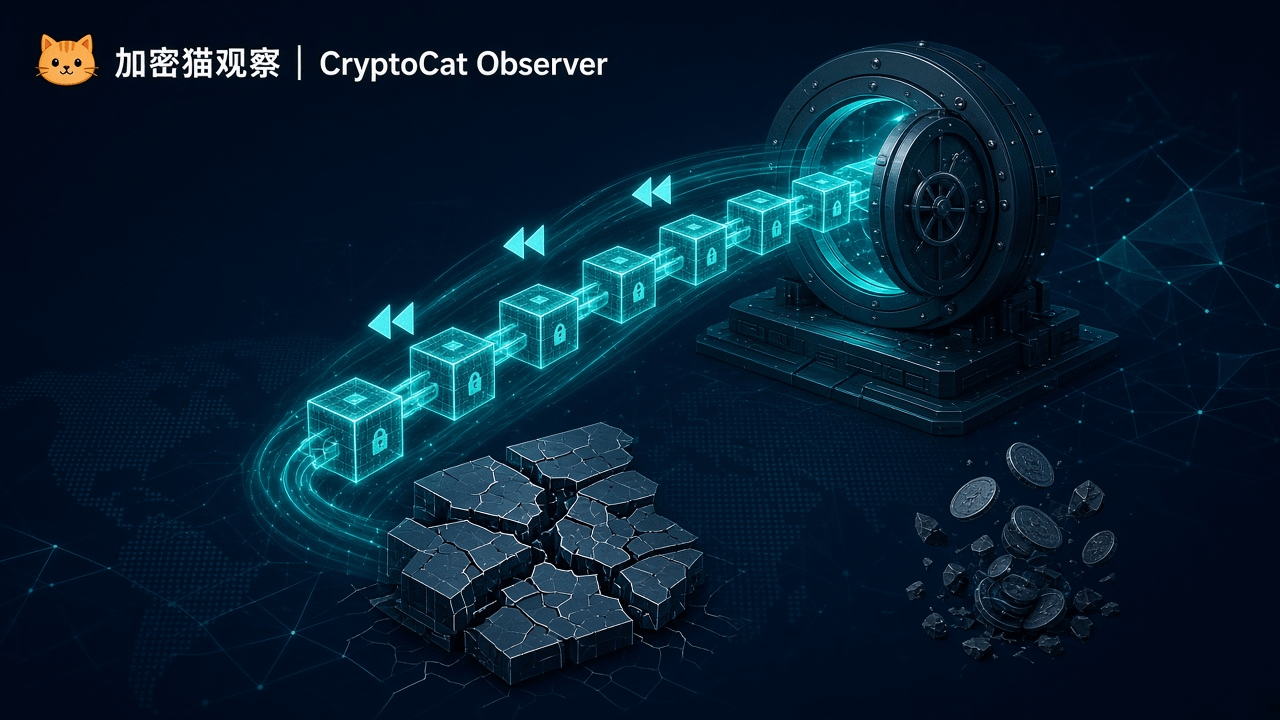
Cronos’s official post-incident report first provides the full amount breakdown for the Aug. 30 Tectonic lending attack: the attacker manipulated the TONIC price of a low-liquidity governance token as collateral, then made single loans of about $120.4 million across nine markets. The validators paused block production near block 90,907,150, and consensus rolled back to block 90,896,188 prior to the attack. They revoked affected balances of about $111.2 million that remained on-chain—about 92% of the affected value.
The rollback discarded about 1 hour 54 minutes of history, totaling 10,961 blocks. Within the window, unrelated swaps, repayments, and openings were also reverted. About $9.19 million (about 7.6%) had already been transferred out of the network before the chain was halted; the report says this amount was outside the rollback’s accessible range. Since that day 23:49 UTC, the chain has been producing blocks continuously, and the explorer and RPC have basically recovered, but exchange reconciliation, cross-chain bridge accounting, and gap recovery are still ongoing. The report also admits that communication during the incident window was insufficient. This is neither a mainnet incident involving $BTC , nor is it a hack of Binance. For anyone holding $CRO or who previously participated in related lending, it’s especially important to distinguish the three ledgers: “total lent out / rolled back and canceled / not yet recovered off-chain,” and treat thin-liquidity collateral and authorization risk as everyday lessons—don’t treat a post-incident report as a short-term trading entry signal.
#Cronos #DeFi安全 #On-chain rollback
Not investment advice
Cronos’s official post-incident report first provides the full amount breakdown for the Aug. 30 Tectonic lending attack: the attacker manipulated the TONIC price of a low-liquidity governance token as collateral, then made single loans of about $120.4 million across nine markets. The validators paused block production near block 90,907,150, and consensus rolled back to block 90,896,188 prior to the attack. They revoked affected balances of about $111.2 million that remained on-chain—about 92% of the affected value.
The rollback discarded about 1 hour 54 minutes of history, totaling 10,961 blocks. Within the window, unrelated swaps, repayments, and openings were also reverted. About $9.19 million (about 7.6%) had already been transferred out of the network before the chain was halted; the report says this amount was outside the rollback’s accessible range. Since that day 23:49 UTC, the chain has been producing blocks continuously, and the explorer and RPC have basically recovered, but exchange reconciliation, cross-chain bridge accounting, and gap recovery are still ongoing. The report also admits that communication during the incident window was insufficient. This is neither a mainnet incident involving $BTC , nor is it a hack of Binance. For anyone holding $CRO or who previously participated in related lending, it’s especially important to distinguish the three ledgers: “total lent out / rolled back and canceled / not yet recovered off-chain,” and treat thin-liquidity collateral and authorization risk as everyday lessons—don’t treat a post-incident report as a short-term trading entry signal.
#Cronos #DeFi安全 #On-chain rollback
Not investment advice
The rollback discarded about 1 hour 54 minutes of history, totaling 10,961 blocks. Within the window, unrelated swaps, repayments, and openings were also reverted. About $9.19 million (about 7.6%) had already been transferred out of the network before the chain was halted; the report says this amount was outside the rollback’s accessible range. Since that day 23:49 UTC, the chain has been producing blocks continuously, and the explorer and RPC have basically recovered, but exchange reconciliation, cross-chain bridge accounting, and gap recovery are still ongoing. The report also admits that communication during the incident window was insufficient. This is neither a mainnet incident involving $BTC , nor is it a hack of Binance. For anyone holding $CRO or who previously participated in related lending, it’s especially important to distinguish the three ledgers: “total lent out / rolled back and canceled / not yet recovered off-chain,” and treat thin-liquidity collateral and authorization risk as everyday lessons—don’t treat a post-incident report as a short-term trading entry signal.
#Cronos #DeFi安全 #On-chain rollback
Not investment advice
2
2.9k

·
--
🚨 $CRO IS GETTING ATTENTION 👀
Cronos ($CROSS ) is showing fresh strength today, with the token gaining around 3.9% as traders react to new tokenomics developments and improved clarity around a recent ecosystem exploit. 📈
🔥 Why $CROSS is interesting right now: • New tokenomics developments • Ecosystem activity remains in focus • Altcoin rotation could bring more attention • Momentum is picking up after recent weakness
But remember ⚠️ — a short-term pump doesn't automatically mean a new uptrend.
I’m watching $CROSS closely for confirmation before calling the next big move.
👀 Would you BUY here or wait for a pullback?
#cross #Cronos #crypto #Altcoin #Binance
🚨 $CRO IS GETTING ATTENTION 👀
Cronos ($CROSS ) is showing fresh strength today, with the token gaining around 3.9% as traders react to new tokenomics developments and improved clarity around a recent ecosystem exploit. 📈
🔥 Why $CROSS is interesting right now: • New tokenomics developments • Ecosystem activity remains in focus • Altcoin rotation could bring more attention • Momentum is picking up after recent weakness
But remember ⚠️ — a short-term pump doesn't automatically mean a new uptrend.
I’m watching $CROSS closely for confirmation before calling the next big move.
👀 Would you BUY here or wait for a pullback?
#cross #Cronos #crypto #Altcoin #Binance
Cronos ($CROSS ) is showing fresh strength today, with the token gaining around 3.9% as traders react to new tokenomics developments and improved clarity around a recent ecosystem exploit. 📈
🔥 Why $CROSS is interesting right now: • New tokenomics developments • Ecosystem activity remains in focus • Altcoin rotation could bring more attention • Momentum is picking up after recent weakness
But remember ⚠️ — a short-term pump doesn't automatically mean a new uptrend.
I’m watching $CROSS closely for confirmation before calling the next big move.
👀 Would you BUY here or wait for a pullback?
#cross #Cronos #crypto #Altcoin #Binance
76

·
--
Cronos executed a controversial rollback, undoing nearly two hours of chain history to recover 111 million in user assets. Attackers still walked away with 9.19 million before the network halted. What does this mean for on-chain governance and security? $CRO #Cronos #CryptoNews
Cronos executed a controversial rollback, undoing nearly two hours of chain history to recover 111 million in user assets. Attackers still walked away with 9.19 million before the network halted. What does this mean for on-chain governance and security? $CRO #Cronos #CryptoNews
5

·
--
🚨 $120 million stolen!
Cronos urgently rolled back the blockchain for nearly 2 hours, but the $9.19 million—can it really never be recovered?
Group: [点击进入玖玖的粉丝群](https://app.binance.com/uni-qr/YXXQJrPb)
In this latest Cronos Tectonic vulnerability incident, the final loss amount turned out to be far larger than the number initially disclosed. According to Cronos’s newest post-mortem report, the attacker used a manipulated TONIC price to treat the inflated tokens as collateral, borrowing about $120.4 million across multiple Tectonic markets.
What’s most shocking is that the TONIC price surged by roughly 100x in a short time.
But what really stunned the market wasn’t just the vulnerability itself—it was the decision Cronos made afterward. Validators directly stopped block production and rolled back 10,961 blocks, equivalent to about 1 hour and 54 minutes of transaction history. Through this rollback, roughly $111.2 million of the affected value was restored.
However, the question is:
$9.19 million has already been transferred out of the Cronos network. This portion of funds can’t be recovered by rolling back on-chain state, which also means the $9.19 million is still currently in an “unrecovered” status. The most值得关注 (most worth paying attention to) in this incident is actually the attack method. It isn’t a simple “oracle error.” The attacker manipulated TONIC’s market price itself, and Tectonic previously allowed this kind of low-liquidity asset to be used as collateral. In other words, the price looks very high, but that doesn’t mean the market truly has enough liquidity to sell the assets at that price.
This exposes a very real problem in DeFi lending protocols:
Price ≠ Liquidity. If a token has extremely low liquidity but can still obtain large loans at a price that gets pushed up in a short time, then once the price is manipulated, the entire collateral system can quickly fall out of balance. Even more intriguing is that while Cronos’s rollback successfully recovered most funds, it also means that many ordinary users’ transactions during those nearly two hours were wiped out along with it.
This may be the most realistic conflict yet between “blockchain finality” and “asset safety.”
If there were no rollback, the attacker might have taken even more funds;
but by choosing to roll back, the transaction history of ordinary users was erased as well.
Click the avatar to join the Jiu Jiu chat group for daily strategies 🚀
#Cronos #CRO #defi
🚨 $120 million stolen!
Cronos urgently rolled back the blockchain for nearly 2 hours, but the $9.19 million—can it really never be recovered?
Group: 点击进入玖玖的粉丝群
In this latest Cronos Tectonic vulnerability incident, the final loss amount turned out to be far larger than the number initially disclosed. According to Cronos’s newest post-mortem report, the attacker used a manipulated TONIC price to treat the inflated tokens as collateral, borrowing about $120.4 million across multiple Tectonic markets.
What’s most shocking is that the TONIC price surged by roughly 100x in a short time.
But what really stunned the market wasn’t just the vulnerability itself—it was the decision Cronos made afterward. Validators directly stopped block production and rolled back 10,961 blocks, equivalent to about 1 hour and 54 minutes of transaction history. Through this rollback, roughly $111.2 million of the affected value was restored.
However, the question is:
$9.19 million has already been transferred out of the Cronos network. This portion of funds can’t be recovered by rolling back on-chain state, which also means the $9.19 million is still currently in an “unrecovered” status. The most值得关注 (most worth paying attention to) in this incident is actually the attack method. It isn’t a simple “oracle error.” The attacker manipulated TONIC’s market price itself, and Tectonic previously allowed this kind of low-liquidity asset to be used as collateral. In other words, the price looks very high, but that doesn’t mean the market truly has enough liquidity to sell the assets at that price.
This exposes a very real problem in DeFi lending protocols:
Price ≠ Liquidity. If a token has extremely low liquidity but can still obtain large loans at a price that gets pushed up in a short time, then once the price is manipulated, the entire collateral system can quickly fall out of balance. Even more intriguing is that while Cronos’s rollback successfully recovered most funds, it also means that many ordinary users’ transactions during those nearly two hours were wiped out along with it.
This may be the most realistic conflict yet between “blockchain finality” and “asset safety.”
If there were no rollback, the attacker might have taken even more funds;
but by choosing to roll back, the transaction history of ordinary users was erased as well.
Click the avatar to join the Jiu Jiu chat group for daily strategies 🚀
#Cronos #CRO #defi
Cronos urgently rolled back the blockchain for nearly 2 hours, but the $9.19 million—can it really never be recovered?
Group: 点击进入玖玖的粉丝群
In this latest Cronos Tectonic vulnerability incident, the final loss amount turned out to be far larger than the number initially disclosed. According to Cronos’s newest post-mortem report, the attacker used a manipulated TONIC price to treat the inflated tokens as collateral, borrowing about $120.4 million across multiple Tectonic markets.
What’s most shocking is that the TONIC price surged by roughly 100x in a short time.
But what really stunned the market wasn’t just the vulnerability itself—it was the decision Cronos made afterward. Validators directly stopped block production and rolled back 10,961 blocks, equivalent to about 1 hour and 54 minutes of transaction history. Through this rollback, roughly $111.2 million of the affected value was restored.
However, the question is:
$9.19 million has already been transferred out of the Cronos network. This portion of funds can’t be recovered by rolling back on-chain state, which also means the $9.19 million is still currently in an “unrecovered” status. The most值得关注 (most worth paying attention to) in this incident is actually the attack method. It isn’t a simple “oracle error.” The attacker manipulated TONIC’s market price itself, and Tectonic previously allowed this kind of low-liquidity asset to be used as collateral. In other words, the price looks very high, but that doesn’t mean the market truly has enough liquidity to sell the assets at that price.
This exposes a very real problem in DeFi lending protocols:
Price ≠ Liquidity. If a token has extremely low liquidity but can still obtain large loans at a price that gets pushed up in a short time, then once the price is manipulated, the entire collateral system can quickly fall out of balance. Even more intriguing is that while Cronos’s rollback successfully recovered most funds, it also means that many ordinary users’ transactions during those nearly two hours were wiped out along with it.
This may be the most realistic conflict yet between “blockchain finality” and “asset safety.”
If there were no rollback, the attacker might have taken even more funds;
but by choosing to roll back, the transaction history of ordinary users was erased as well.
Click the avatar to join the Jiu Jiu chat group for daily strategies 🚀
#Cronos #CRO #defi

53

Cronos uses a rollback of $111 million in documents, yet the attack still manages to take $9.19 million
- Cronos duplicated blocks in the documents for nearly two hours to restore users’ assets.
- The attacker still managed to withdraw $9.19 million before the network was temporarily shut down.
- The rollback is controversial because it interferes with the immutability of the blockchain.
#BinanceSquare #CryptoNews #Cronos
$btc $eth
#vlikevn #Titanbot
Source: CoinDesk
Cronos uses a rollback of $111 million in documents, yet the attack still manages to take $9.19 million
- Cronos duplicated blocks in the documents for nearly two hours to restore users’ assets.
- The attacker still managed to withdraw $9.19 million before the network was temporarily shut down.
- The rollback is controversial because it interferes with the immutability of the blockchain.
#BinanceSquare #CryptoNews #Cronos
$btc $eth
#vlikevn #Titanbot
Source: CoinDesk
- Cronos duplicated blocks in the documents for nearly two hours to restore users’ assets.
- The attacker still managed to withdraw $9.19 million before the network was temporarily shut down.
- The rollback is controversial because it interferes with the immutability of the blockchain.
#BinanceSquare #CryptoNews #Cronos
$btc $eth
#vlikevn #Titanbot
Source: CoinDesk
75
Cronos confirms $9.2 million was withdrawn before Tectonic issues were fixed
- Cronos published a report after the Tectonic mining incident (post-mortem).
- The borrowed amount affected totals up to $120.4 million.
- Of that, 7.6% (equivalent to $9.2 million) was moved out of the network before the validators intervened.
- The RSS source has not provided any further details on remediation measures or compensation plans.
#Cronos #Tectonic #CryptoNews #DeFi #Security
$cro
vlikevn Titanbot
Source: CoinTelegraph
Cronos confirms $9.2 million was withdrawn before Tectonic issues were fixed
- Cronos published a report after the Tectonic mining incident (post-mortem).
- The borrowed amount affected totals up to $120.4 million.
- Of that, 7.6% (equivalent to $9.2 million) was moved out of the network before the validators intervened.
- The RSS source has not provided any further details on remediation measures or compensation plans.
#Cronos #Tectonic #CryptoNews #DeFi #Security
$cro
vlikevn Titanbot
Source: CoinTelegraph
- Cronos published a report after the Tectonic mining incident (post-mortem).
- The borrowed amount affected totals up to $120.4 million.
- Of that, 7.6% (equivalent to $9.2 million) was moved out of the network before the validators intervened.
- The RSS source has not provided any further details on remediation measures or compensation plans.
#Cronos #Tectonic #CryptoNews #DeFi #Security
$cro
vlikevn Titanbot
Source: CoinTelegraph
4
Cronos loses $9.2 million after the Tectonic exploit; the rollback doesn’t recover everything
- After the Tectonic security breach, Cronos performed a rollback of roughly $111.2 million.
- However, $9.19 million left the chain and cannot be recovered.
- The remaining amount has not yet been restored by the recovery team.
#BinanceSquare #CryptoNews #Cronos #Tectonic
$cro
#vlikevn Titanbot
Source: The Block
Cronos loses $9.2 million after the Tectonic exploit; the rollback doesn’t recover everything
- After the Tectonic security breach, Cronos performed a rollback of roughly $111.2 million.
- However, $9.19 million left the chain and cannot be recovered.
- The remaining amount has not yet been restored by the recovery team.
#BinanceSquare #CryptoNews #Cronos #Tectonic
$cro
#vlikevn Titanbot
Source: The Block
- After the Tectonic security breach, Cronos performed a rollback of roughly $111.2 million.
- However, $9.19 million left the chain and cannot be recovered.
- The remaining amount has not yet been restored by the recovery team.
#BinanceSquare #CryptoNews #Cronos #Tectonic
$cro
#vlikevn Titanbot
Source: The Block
4

·
--
📰 Cronos Labs CEO Ryan Wyatt wrote that Cronos’s App plans to go live within 10 days, and the timing has already been stated quite specifically.
🔥 What’s even more likely to spark arguments in the group is that after the App launches, another proposal will be introduced: to use 100% of the revenue generated by the App to buy back and burn CRO.
Honestly, this sounds pretty bold, but for now it’s still “a proposal to be introduced,” not something already executed. How it ultimately gets implemented still depends on the details of the proposal and the subsequent voting.
💡 Also, this week, information about the listing eligibility of Crypto.com’s token launchpad will be released. Putting these things out together—App eligibility, launchpad qualification, and the buyback & burn proposal—will definitely make the market start reassessing CRO’s future use.
🤔 But the question is also very straightforward: if the App really launches according to plan, and the proposal to buy back and burn using 100% of the revenue is approved, do you think it will change everyone’s view of CRO?
#CRO #Cronos #Crypto.com #onchain ecosystem
📰 Cronos Labs CEO Ryan Wyatt wrote that Cronos’s App plans to go live within 10 days, and the timing has already been stated quite specifically.
🔥 What’s even more likely to spark arguments in the group is that after the App launches, another proposal will be introduced: to use 100% of the revenue generated by the App to buy back and burn CRO.
Honestly, this sounds pretty bold, but for now it’s still “a proposal to be introduced,” not something already executed. How it ultimately gets implemented still depends on the details of the proposal and the subsequent voting.
💡 Also, this week, information about the listing eligibility of Crypto.com’s token launchpad will be released. Putting these things out together—App eligibility, launchpad qualification, and the buyback & burn proposal—will definitely make the market start reassessing CRO’s future use.
🤔 But the question is also very straightforward: if the App really launches according to plan, and the proposal to buy back and burn using 100% of the revenue is approved, do you think it will change everyone’s view of CRO?
#CRO #Cronos #Crypto.com #onchain ecosystem
🔥 What’s even more likely to spark arguments in the group is that after the App launches, another proposal will be introduced: to use 100% of the revenue generated by the App to buy back and burn CRO.
Honestly, this sounds pretty bold, but for now it’s still “a proposal to be introduced,” not something already executed. How it ultimately gets implemented still depends on the details of the proposal and the subsequent voting.
💡 Also, this week, information about the listing eligibility of Crypto.com’s token launchpad will be released. Putting these things out together—App eligibility, launchpad qualification, and the buyback & burn proposal—will definitely make the market start reassessing CRO’s future use.
🤔 But the question is also very straightforward: if the App really launches according to plan, and the proposal to buy back and burn using 100% of the revenue is approved, do you think it will change everyone’s view of CRO?
#CRO #Cronos #Crypto.com #onchain ecosystem

21
·
--
📰 On August 30, Tectonic suffered a collateral price manipulation attack involving roughly $120 million in borrowing. Cronos validators paused the network at 10:32 PM Beijing time and rolled back the on-chain state to the block before the attack. Block production resumed at 7:49 AM the next day.
🔥 This move is indeed direct: about $111 million in funds was recovered, and ultimately about $9.19 million flowed out before the pause and was not recovered—around 7.6%. Judging by the outcome, most of the losses were contained, and the response was very fast.
Honestly, what would actually spark arguments in the community is the question of whether validators can roll back on-chain state to recover funds. Affected users naturally want their money back, but others will also reassess: under what circumstances can this chain be paused, and who has the power to push for a rollback.
⚠️ The official statement says users currently don’t need to take any action, and cross-platform settlements are still progressing. It also specifically reminds users to watch out for phishing links impersonating the official. If someone suddenly messages you in private at this stage and asks you to connect your wallet or claim compensation, just don’t click—at least for now.
🤔 If a rollback can recover 90% of the funds, but it also shows that on-chain history can be rewritten, which matters more to you: getting losses back, or the principle that once a transaction is confirmed, it can’t be undone?
#Cronos #Tectonic #链上安全 #DeFi
📰 On August 30, Tectonic suffered a collateral price manipulation attack involving roughly $120 million in borrowing. Cronos validators paused the network at 10:32 PM Beijing time and rolled back the on-chain state to the block before the attack. Block production resumed at 7:49 AM the next day.
🔥 This move is indeed direct: about $111 million in funds was recovered, and ultimately about $9.19 million flowed out before the pause and was not recovered—around 7.6%. Judging by the outcome, most of the losses were contained, and the response was very fast.
Honestly, what would actually spark arguments in the community is the question of whether validators can roll back on-chain state to recover funds. Affected users naturally want their money back, but others will also reassess: under what circumstances can this chain be paused, and who has the power to push for a rollback.
⚠️ The official statement says users currently don’t need to take any action, and cross-platform settlements are still progressing. It also specifically reminds users to watch out for phishing links impersonating the official. If someone suddenly messages you in private at this stage and asks you to connect your wallet or claim compensation, just don’t click—at least for now.
🤔 If a rollback can recover 90% of the funds, but it also shows that on-chain history can be rewritten, which matters more to you: getting losses back, or the principle that once a transaction is confirmed, it can’t be undone?
#Cronos #Tectonic #链上安全 #DeFi
🔥 This move is indeed direct: about $111 million in funds was recovered, and ultimately about $9.19 million flowed out before the pause and was not recovered—around 7.6%. Judging by the outcome, most of the losses were contained, and the response was very fast.
Honestly, what would actually spark arguments in the community is the question of whether validators can roll back on-chain state to recover funds. Affected users naturally want their money back, but others will also reassess: under what circumstances can this chain be paused, and who has the power to push for a rollback.
⚠️ The official statement says users currently don’t need to take any action, and cross-platform settlements are still progressing. It also specifically reminds users to watch out for phishing links impersonating the official. If someone suddenly messages you in private at this stage and asks you to connect your wallet or claim compensation, just don’t click—at least for now.
🤔 If a rollback can recover 90% of the funds, but it also shows that on-chain history can be rewritten, which matters more to you: getting losses back, or the principle that once a transaction is confirmed, it can’t be undone?
#Cronos #Tectonic #链上安全 #DeFi

6
·
--
📰 The Cronos lending protocol Tectonic disclosed an attack report from August 30: the attacker manipulated the price of TONIC to about 195x, then used looping collateral to borrow roughly $120.4 million from 9 lending markets.
🔥 This wasn’t just a sudden crash—it was oracle price and collateralized borrowing being exploited together. Honestly, seeing the “195x” figure pretty much explains why the lending markets were quickly drained.
💡 Cronos then paused the network and restored operations; most assets returned to their pre-attack state. But some funds have already been bridged out—around $9.19 million hasn’t been recovered yet, which is the most unsettling part of this incident.
Actually, the project team has already outlined the next steps: remove collateral with lower liquidity, and set borrowing limits for each market. This can reduce the room for similar operations, but whether it can completely plug the problem will depend on how effective the new rules are once implemented.
🤔 Do you think lending protocols should prioritize restricting low-liquidity collateral, or first cap borrowing in a single market?
#Tectonic #Cronos #DeFi安全 #On-chain Attack
📰 The Cronos lending protocol Tectonic disclosed an attack report from August 30: the attacker manipulated the price of TONIC to about 195x, then used looping collateral to borrow roughly $120.4 million from 9 lending markets.
🔥 This wasn’t just a sudden crash—it was oracle price and collateralized borrowing being exploited together. Honestly, seeing the “195x” figure pretty much explains why the lending markets were quickly drained.
💡 Cronos then paused the network and restored operations; most assets returned to their pre-attack state. But some funds have already been bridged out—around $9.19 million hasn’t been recovered yet, which is the most unsettling part of this incident.
Actually, the project team has already outlined the next steps: remove collateral with lower liquidity, and set borrowing limits for each market. This can reduce the room for similar operations, but whether it can completely plug the problem will depend on how effective the new rules are once implemented.
🤔 Do you think lending protocols should prioritize restricting low-liquidity collateral, or first cap borrowing in a single market?
#Tectonic #Cronos #DeFi安全 #On-chain Attack
🔥 This wasn’t just a sudden crash—it was oracle price and collateralized borrowing being exploited together. Honestly, seeing the “195x” figure pretty much explains why the lending markets were quickly drained.
💡 Cronos then paused the network and restored operations; most assets returned to their pre-attack state. But some funds have already been bridged out—around $9.19 million hasn’t been recovered yet, which is the most unsettling part of this incident.
Actually, the project team has already outlined the next steps: remove collateral with lower liquidity, and set borrowing limits for each market. This can reduce the room for similar operations, but whether it can completely plug the problem will depend on how effective the new rules are once implemented.
🤔 Do you think lending protocols should prioritize restricting low-liquidity collateral, or first cap borrowing in a single market?
#Tectonic #Cronos #DeFi安全 #On-chain Attack

7

$75 Million Vanished in 20 Minutes — And the "Hack" Wasn't Even a Hack.
This one's wild once you actually read the details.
An attacker spent just $600,000 to buy up a thinly-traded governance token called Tonic on Coronos, pumping its price roughly 40x in minutes. Then they deposited that artificially inflated TONIC as collateral and borrowed close to $120 million in real assets — stablecoins, $BTC , $ETH , CRO — from the lending protocol Tectonic.
No smart contract bug. No stolen keys. Just price manipulation used exactly as the protocol's own rules allowed.
What happened next is the part that actually matters — Coronos validators halted the entire blockchain to stop the funds from moving. Only about $6 million escaped to Ethereum before the freeze. Roughly $68 million stayed stuck on-chain.
Crypto.com's CEO confirmed the exchange itself was unaffected. But Tectonic's total value locked dropped from $121 million to about $3 million in less than 24 hours.
Here's the uncomfortable question this raises: a blockchain that can be switched off to save users... is also a blockchain that isn't fully decentralized. Worth sitting with that for a second.
Do you think halting the chain was the right call, or does it defeat the point of DeFi? 👇
#Cronos #defi #CryptoSecurity
$75 Million Vanished in 20 Minutes — And the "Hack" Wasn't Even a Hack.
This one's wild once you actually read the details.
An attacker spent just $600,000 to buy up a thinly-traded governance token called Tonic on Coronos, pumping its price roughly 40x in minutes. Then they deposited that artificially inflated TONIC as collateral and borrowed close to $120 million in real assets — stablecoins, $BTC , $ETH , CRO — from the lending protocol Tectonic.
No smart contract bug. No stolen keys. Just price manipulation used exactly as the protocol's own rules allowed.
What happened next is the part that actually matters — Coronos validators halted the entire blockchain to stop the funds from moving. Only about $6 million escaped to Ethereum before the freeze. Roughly $68 million stayed stuck on-chain.
Crypto.com's CEO confirmed the exchange itself was unaffected. But Tectonic's total value locked dropped from $121 million to about $3 million in less than 24 hours.
Here's the uncomfortable question this raises: a blockchain that can be switched off to save users... is also a blockchain that isn't fully decentralized. Worth sitting with that for a second.
Do you think halting the chain was the right call, or does it defeat the point of DeFi? 👇
#Cronos #defi #CryptoSecurity
This one's wild once you actually read the details.
An attacker spent just $600,000 to buy up a thinly-traded governance token called Tonic on Coronos, pumping its price roughly 40x in minutes. Then they deposited that artificially inflated TONIC as collateral and borrowed close to $120 million in real assets — stablecoins, $BTC , $ETH , CRO — from the lending protocol Tectonic.
No smart contract bug. No stolen keys. Just price manipulation used exactly as the protocol's own rules allowed.
What happened next is the part that actually matters — Coronos validators halted the entire blockchain to stop the funds from moving. Only about $6 million escaped to Ethereum before the freeze. Roughly $68 million stayed stuck on-chain.
Crypto.com's CEO confirmed the exchange itself was unaffected. But Tectonic's total value locked dropped from $121 million to about $3 million in less than 24 hours.
Here's the uncomfortable question this raises: a blockchain that can be switched off to save users... is also a blockchain that isn't fully decentralized. Worth sitting with that for a second.
Do you think halting the chain was the right call, or does it defeat the point of DeFi? 👇
#Cronos #defi #CryptoSecurity

63

·
--
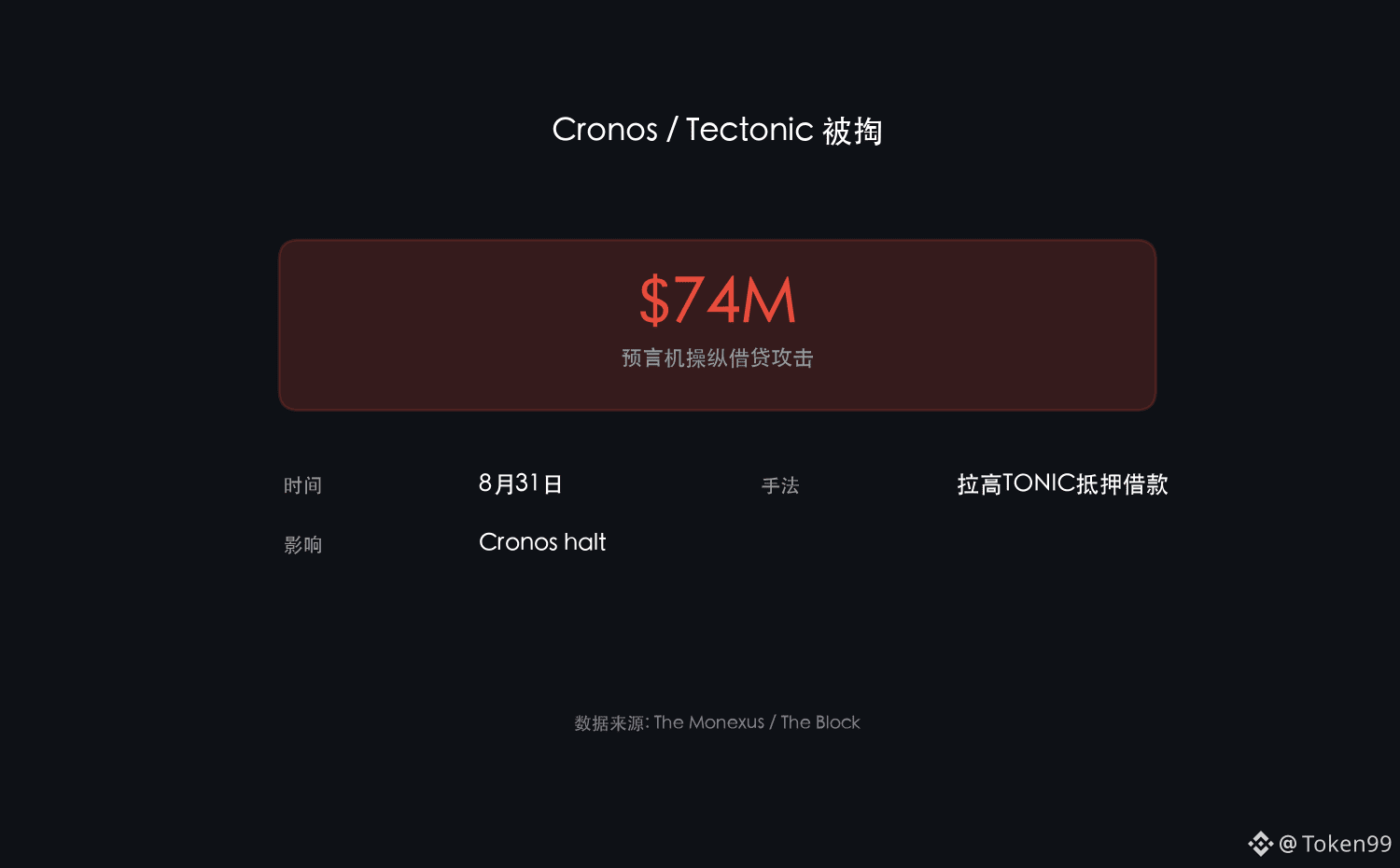
Cronos Chain August 31 at dawn halted; lending protocol Tectonic was looted for about $74 million, just like the 2022 Mango Markets incident.
The attacker drove up the price of TONIC, a thin order-book governance token, then used inflation as collateral to borrow real funds. By the time the oracle caught on, the money had already been bridged elsewhere.
Wow—using your own token as collateral and borrowing real assets; this “the market eats itself” script has played out for the third time.
The CEO of Crypto.com confirmed the incident on the spot, emphasizing that the main app and exchange were not affected, but the brand’s luster inevitably gets some dust on it.
DeFi backed by the same-origin exchange—whose security perimeter is supposed to count, exactly? This question has been raised again.
#Cronos $CRO #DeFi安全 #industry event
Cronos Chain August 31 at dawn halted; lending protocol Tectonic was looted for about $74 million, just like the 2022 Mango Markets incident.
The attacker drove up the price of TONIC, a thin order-book governance token, then used inflation as collateral to borrow real funds. By the time the oracle caught on, the money had already been bridged elsewhere.
Wow—using your own token as collateral and borrowing real assets; this “the market eats itself” script has played out for the third time.
The CEO of Crypto.com confirmed the incident on the spot, emphasizing that the main app and exchange were not affected, but the brand’s luster inevitably gets some dust on it.
DeFi backed by the same-origin exchange—whose security perimeter is supposed to count, exactly? This question has been raised again.
#Cronos $CRO #DeFi安全 #industry event
The attacker drove up the price of TONIC, a thin order-book governance token, then used inflation as collateral to borrow real funds. By the time the oracle caught on, the money had already been bridged elsewhere.
Wow—using your own token as collateral and borrowing real assets; this “the market eats itself” script has played out for the third time.
The CEO of Crypto.com confirmed the incident on the spot, emphasizing that the main app and exchange were not affected, but the brand’s luster inevitably gets some dust on it.
DeFi backed by the same-origin exchange—whose security perimeter is supposed to count, exactly? This question has been raised again.
#Cronos $CRO #DeFi安全 #industry event
12

🚨 Kronos network resumes operations after exploit on Tectonic platform
The Kronos blockchain network has resumed its operational activity after a temporary suspension following a software exploit on the Tectonic lending platform. The attack, which targeted price manipulation, resulted in an illegitimate loan of 74 million US dollars. The network is now operating normally.
━━━━━━━━━━━━━━
📊 Impact: 📈 High
🏷️ OTHER
#Cronos #Blockchain #Security #Exploit #CryptoNews
📰 Source: bleepingcomputer.com
🚨 Kronos network resumes operations after exploit on Tectonic platform
The Kronos blockchain network has resumed its operational activity after a temporary suspension following a software exploit on the Tectonic lending platform. The attack, which targeted price manipulation, resulted in an illegitimate loan of 74 million US dollars. The network is now operating normally.
━━━━━━━━━━━━━━
📊 Impact: 📈 High
🏷️ OTHER
#Cronos #Blockchain #Security #Exploit #CryptoNews
📰 Source: bleepingcomputer.com
The Kronos blockchain network has resumed its operational activity after a temporary suspension following a software exploit on the Tectonic lending platform. The attack, which targeted price manipulation, resulted in an illegitimate loan of 74 million US dollars. The network is now operating normally.
━━━━━━━━━━━━━━
📊 Impact: 📈 High
🏷️ OTHER
#Cronos #Blockchain #Security #Exploit #CryptoNews
📰 Source: bleepingcomputer.com
16

·
--

Article
Cronos Bounces Back: Validators Play “Restore” Like a Game of TetrisGM, crypto fam! Yesterday’s Cronos emergency halt felt like a sudden “Tectonic” glitch in the matrix—validators hit pause, the chain froze, and the network went into a full‑blown panic mode. But just like a meme that gets a remix, Cronos didn’t stay down for long. The validator set pulled a coordinated “undo” move, rolling the blockchain back to a pre‑attack checkpoint, and block production resumed faster than you can say “HODL.”
The alpha: Cronos’ quick rollback shows the power of a well‑structured validator set and a robust state‑sync protocol. By restoring the chain to a known good state, they avoided a prolonged fork and preserved user funds. This incident also highlights the importance of continuous monitoring and rapid response teams in DeFi ecosystems. #Cronos #DeFi #CryptoSecurity
Punchline insight: Think of Cronos as a high‑speed train that hit a sudden brake—thanks to its emergency brake system, it didn’t derail. The lesson? In crypto, having a fail‑safe rollback plan is as essential as having a meme‑worthy joke in your arsenal.
Engagement bait: If you’re a validator, what’s your go‑to emergency protocol? Drop your best “rollback” strategy below and let’s keep the network humming!
Cronos Bounces Back: Validators Play “Restore” Like a Game of Tetris
GM, crypto fam! Yesterday’s Cronos emergency halt felt like a sudden “Tectonic” glitch in the matrix—validators hit pause, the chain froze, and the network went into a full‑blown panic mode. But just like a meme that gets a remix, Cronos didn’t stay down for long. The validator set pulled a coordinated “undo” move, rolling the blockchain back to a pre‑attack checkpoint, and block production resumed faster than you can say “HODL.”
The alpha: Cronos’ quick rollback shows the power of a well‑structured validator set and a robust state‑sync protocol. By restoring the chain to a known good state, they avoided a prolonged fork and preserved user funds. This incident also highlights the importance of continuous monitoring and rapid response teams in DeFi ecosystems. #Cronos #DeFi #CryptoSecurity
Punchline insight: Think of Cronos as a high‑speed train that hit a sudden brake—thanks to its emergency brake system, it didn’t derail. The lesson? In crypto, having a fail‑safe rollback plan is as essential as having a meme‑worthy joke in your arsenal.
Engagement bait: If you’re a validator, what’s your go‑to emergency protocol? Drop your best “rollback” strategy below and let’s keep the network humming!
The alpha: Cronos’ quick rollback shows the power of a well‑structured validator set and a robust state‑sync protocol. By restoring the chain to a known good state, they avoided a prolonged fork and preserved user funds. This incident also highlights the importance of continuous monitoring and rapid response teams in DeFi ecosystems. #Cronos #DeFi #CryptoSecurity
Punchline insight: Think of Cronos as a high‑speed train that hit a sudden brake—thanks to its emergency brake system, it didn’t derail. The lesson? In crypto, having a fail‑safe rollback plan is as essential as having a meme‑worthy joke in your arsenal.
Engagement bait: If you’re a validator, what’s your go‑to emergency protocol? Drop your best “rollback” strategy below and let’s keep the network humming!
5
Log in to explore more content
Join global crypto users on Binance Square
⚡️ Get latest and useful information about crypto.
💬 Trusted by the world’s largest crypto exchange.
👍 Discover real insights from verified creators.
Email / Phone number
Trending Topics
1
#AIStocksWhatNext
373,395 views
3,002 Discussing
2
#BitcoinBreaksAboveMayHighNears$86K
15,300 views
192 Discussing
3
#DogecoinRises15%
48,876 views
997 Discussing
4
#$14BBitcoinOptionsExpireFriday
3,968 views
89 Discussing
5
#BNBMarketCapPassesBNYMellon
30,745 views
713 Discussing
6
#CryptoMarketCapReclaims$3Trillion
5,254 views
82 Discussing
7
#MuseOvertakesChatGPTAsTopFreeIOSApp
18,096 views
536 Discussing
8
#TokenizedStockPlatformsCouldLaunchNextQuarter
28,590 views
589 Discussing
9
#StrategyAdds950Bitcoin
35,755 views
686 Discussing
10
#CardanoAddedToX402KitForADAPayments
30,257 views
659 Discussing